1. Introduction
Modern photonics now encompasses a remarkably broad class of electromagnetic media, including isotropic and anisotropic dielectric, plasmonic, magnetic, gyroelectric and gyromagnetic systems, hyperbolic and multi-hyperbolic materials, and a wide range of bianisotropic responses such as chiral, Tellegen, omega, moving-medium, and axion-type couplings [
1,
2,
3,
4,
5,
6,
7,
8,
9,
10,
11,
12,
13,
14]. In parallel, contemporary research increasingly extends into non-Hermitian platforms, where loss and gain fundamentally reshape wave propagation [
15,
16,
17,
18]. In all these cases, the allowed plane-wave states are organized by the Fresnel wave surface, whose geometry encodes the directional structure of propagation in momentum space [
18,
19,
20]. Over the past decade, Fresnel surfaces have emerged as a central organizing object in photonics, supporting classifications based on topology, asymptotic high-
structure, and singular degeneracies. In particular, the high-
taxonomy introduced by Durach organizes materials into non-, mono-, bi-, tri-, and tetra-hyperbolic phases according to the number of asymptotic double-cone branches [
9], while the framework of Favaro and Hehl emphasizes diabolical points at which polarization sheets intersect [
21]. At the level of singularities, the standard distinction is between Hermitian diabolical points, where eigenvalues coincide but eigenvectors remain independent, and non-Hermitian exceptional points, where both eigenvalues and eigenvectors coalesce into a defective Jordan structure [
22,
23,
24,
25].
Despite the power of these classifications, they do not incorporate two physical attributes that are fundamental to electromagnetic wave propagation in complex media. The first is the handedness of the waves and the phase flow relative to energy transport, quantified by the sign of
, where
is the wavevector and
is the time-averaged Poynting vector. This criterion distinguishes positive-phase-velocity (PPV), negative-phase-velocity (NPV), and orthogonal-phase-velocity (OPV) propagation and becomes especially important in isotropy-broken, bianisotropic, gyrotropic, and multi-hyperbolic systems [
26]. The second is the gain–loss character of the waves in non-Hermitian media, encoded in the imaginary part of the refractive index, or equivalently in the sign of
, which distinguishes attenuation from amplification [
18,
27]. Existing isofrequency wave-surface classifications consider topology, sheet connectivity, asymptotic cones, and degeneracies, but the organization of the Fresnel wave surface into propagation domains of handedness and gain–loss has not been previously studied.
In this work, we show that Fresnel wave surfaces in Hermitian and non-Hermitian media can be naturally converted into propagation maps. Two scalar functions,
and
, divide the surface into four distinct sectors corresponding to PPV with loss, PPV with gain, NPV with loss, and NPV with gain. Using the spherical coordinates in momentum space the real part of the refractive index
is positive, and the component of the Poynting vector along the propagation direction,
, is positive for PPV
and negative for NPV
. Writing the complex refractive index as
, where
, the sign of
determines attenuation or amplification through its relation to
:
corresponds to loss, while
corresponds to gain. The four sectors therefore correspond to PPV with loss
, PPV with gain
, NPV with loss
, and NPV with gain
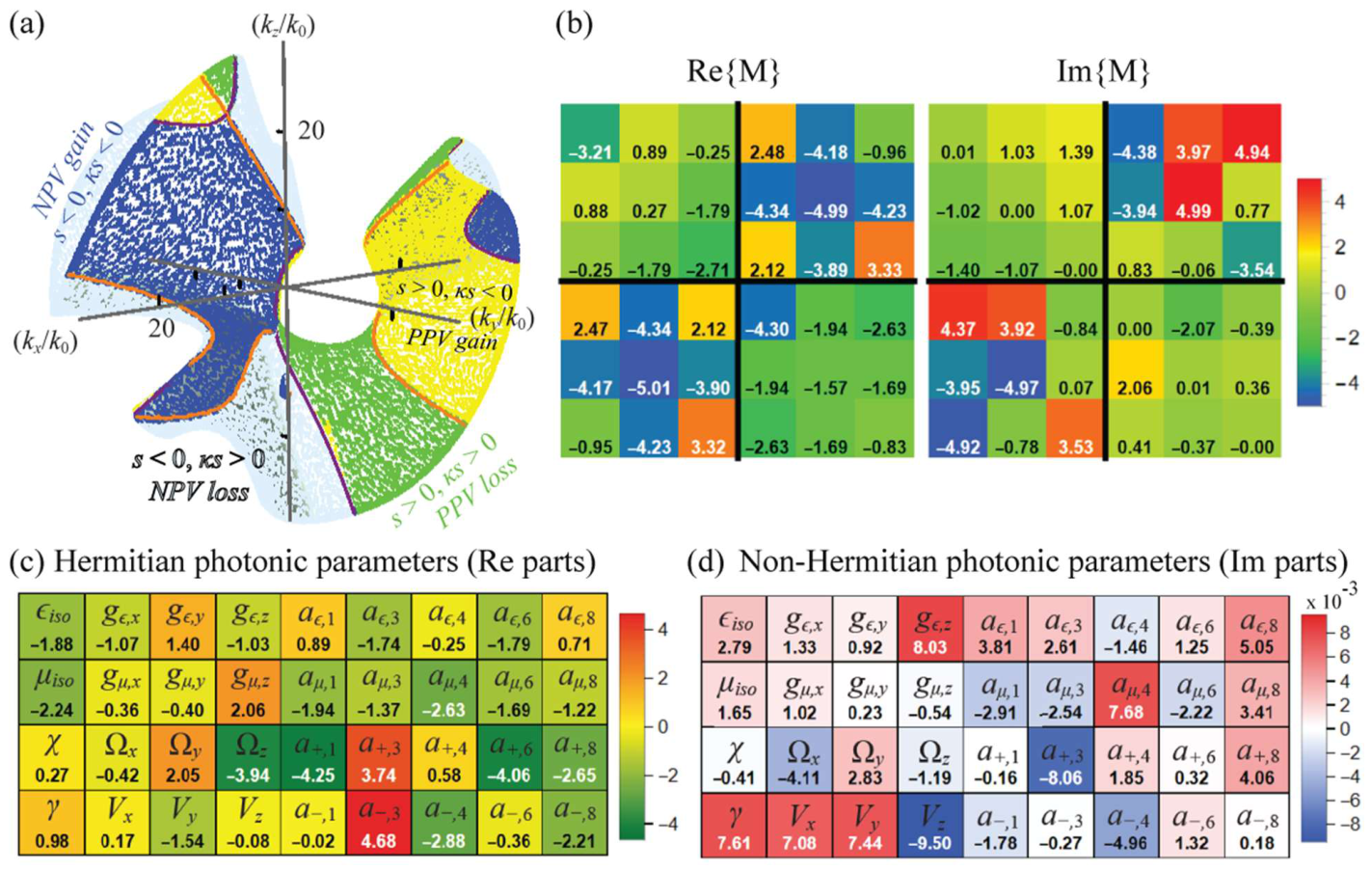
. This can be seen in
Figure 1a, where a Fresnel wave surface is depicted with these sectors identified. In this sense, the Fresnel surface acquires a map-like structure: it is partitioned into four neighboring domains of distinct physical behavior, reminiscent of the four-color theorem in planar map coloring, where four colors suffice to distinguish adjacent regions of a map [
28]. In this way, the Fresnel wave surface is no longer viewed merely as an isofrequency surface but as a directional atlas of wave behavior, which is especially important in isotropy-broken media.
The boundaries between these domains are separatrix curves of two different kinds. In Hermitian media, the OPV condition
separates forward and backward propagation and defines what we term orthogonal-phase-velocity separatrices. The purple curves in
Figure 1a corresponds to this separatrix. These curves are geometrically natural because, as we demonstrate, they correspond to the silhouette of the Fresnel surface when viewed along
, that is, to points where the Fresnel wave-surface normal is orthogonal to the viewing direction from the origin in momentum space. At the same time, they represent the locus where right-handed and left-handed propagation domains meet and touch without crossing. Because every point on this separatrix marks a touching between the conventional right-handed propagation regime and the left-handed regime, the OPV separatrix is also a continuous locus of OPV exceptional points, where the index-of-refraction operator becomes defective even though the material medium remains Hermitian.
In non-Hermitian media, the condition separates attenuation from amplification and gives rise to what we term gain–loss separatrices. The entire gain–loss separatrix is likewise a continuous locus of gain–loss singularities, where the phase propagation remains continuous while the field passes from the dark side of the separatrix to the bright side, or vice versa. Together, these structures provide a unified framework that incorporates both wave handedness and non-Hermitian gain–loss behavior into the geometry of Fresnel wave surfaces.
To connect these geometric propagation maps to actual material design, we next express the underlying electromagnetic medium through a constitutive matrix and a photonic-parameter decomposition. Within the linear regime, diverse classes of materials are described holistically by a constitutive matrix
, whose structure encodes the electromagnetic response by relating the fields in electromagnetic waves,
. Specifically, it is a block matrix
where
,
are the permittivity and permeability and
,
are magnetoelectric couplings [
6]. In
Figure 1b we show the matrix
corresponding to the Fresnel wave surface from
Figure 1a. Several parametrizations of
have been developed to connect its elements to underlying physical mechanisms. Notable examples include the decomposition of Hehl and Obukhov into principal, skewon, and axion parts [
2] and the bianisotropy parametrization by Michael Berry [
22]. Another important line of work, by Mackay and Lakhtakia, classified constitutive dyadics according to space-time symmetry and magnetic-point-group constraints [
6].
In this work, we adopt a novel photonic parametrization, which provides a systematic and physically transparent mapping between the matrix elements of the constitutive tensors and distinct coupling mechanisms. We represent the material tensors
,
,
, and
as
Here, , , and are Gell-Mann matrices, so that spans the antisymmetric spin-1 subspace, while spans the symmetric traceless subspace. The coefficients in this decomposition are obtained by direct projection onto basis matrices and therefore have a clear physical meaning.
The scalars
and
describe the isotropic electric and magnetic response. The vectors
and
describe the gyroelectric and gyromagnetic response, respectively. In the magnetoelectric part,
is the isotropic Tellegen coupling,
is the isotropic chiral coupling,
is the antisymmetric moving-medium-type nonreciprocal coupling, and
is the antisymmetric omega-type reciprocal magnetoelectric coupling. Finally,
and
describe the symmetric traceless anisotropic electric and magnetic response, while
and
describe the symmetric traceless anisotropic Tellegen-type and chiral-type magnetoelectric response, respectively. In
Figure 1c,d, we show the photonic parameters corresponding to the Fresnel wave surface and extracted from matrix
in
Figure 1b extracted according to formulas presented in
Appendix A.
One advantage of this parametrization is that it is organized by rotational symmetry. The isotropic terms are SO(3) scalars , the antisymmetric terms transform as vectors , and the symmetric traceless terms transform as quadrupolar tensors . Consequently, the five anisotropy parameters form a real tensor basis, and their behavior under rotations is governed by the corresponding Wigner rotation matrices. This parametrization allows the propagation-map sectors, OPV exceptional points, and gain–loss singularities introduced in this paper to be traced back to specific material mechanisms: isotropic response, gyrotropy, anisotropy, Tellegen/chiral response, moving-medium coupling, and omega coupling.
The propagation-map features discussed here can be approached experimentally in several existing classes of photonic media. Hyperbolic and anisotropic metamaterials provide natural platforms for observing OPV separatrices, because they support directions in momentum space where the phase velocity and energy flow become orthogonal. Chiral, omega-type, Tellegen, and more general bianisotropic metamaterials or metasurfaces provide additional control over the magnetoelectric coupling terms that enter the decomposition above. Non-Hermitian extensions can be realized by adding controlled loss, optical gain, or balanced loss–gain modulation. In such systems, the relevant measurable observables are the angular dependence of the refractive-index branches, the direction of the time-averaged Poynting vector, the sign of , polarization coalescence near OPV exceptional points, and the linewidth narrowing or enhancement of the momentum-resolved spectral response near gain–loss separatrices. Experimentally, these quantities may be accessed through angle-resolved transmission/reflection measurements, prism or grating coupling to high-k modes, near-field mapping of energy flow, polarization-resolved measurements, and momentum-resolved spectroscopy. Thus, the present formalism provides not only a classification of Fresnel-surface geometry but also a route for identifying experimentally testable signatures in anisotropic, hyperbolic, bianisotropic, and non-Hermitian photonic platforms.
2. Index-of-Refraction Operator and Directional Photonics Parameters
To demonstrate the properties of OPV exceptional points and gain–loss singularities, we begin with Maxwell’s equations in a linear medium,
These equations can be written in operator form as
with
Utilizing the decomposition in Equations (2)–(5), Maxwell’s equations for a plane wave with wave vector
and frequency
can be written as
where
is a Pauli matrix and the nine matrices
are
To express the field solutions in terms of the sources we use the dyadic Green’s function
:
In momentum space, the Green’s function is
Once the material response is specified by
, the Maxwell operator
determines the dispersion equation for plane waves in the medium. The on-shell wavevectors are those for which the Green’s function has poles, or equivalently for which the determinant of the Maxwell operator vanishes [
18]. In Hermitian media, these modes are not broadened by loss or gain, so their allowed wavevectors form a sharply defined, or bare, Fresnel wave surface given by
This surface is a two-dimensional manifold in momentum space with zero thickness, corresponding to the delta-functional momentum-resolved 3D density of states . We refer to it as a bare Fresnel wave surface to emphasize the absence of non-Hermitian broadening.
To analyze the topology and polarization structure of Fresnel wave surfaces, we employ the index-of-refraction-operator method. Consider a plane wave with fields
, and choose the coordinate system so that the propagation direction is aligned with the
-axis,
Maxwell’s equations then give
Let the rotated constitutive matrix be block-decomposed into the 4 × 4 block matrix
, 2 × 2 matrix
, and rectangular matrices
and
:
We introduce the 2D constitutive matrix
relating the transverse components of the fields:
From Maxwell’s equations we obtain the relationship between the 3D and 2D constitutive matrices
and the source vector:
We write
and expand each
block in the natural 2D isotropic–antisymmetric–symmetric traceless basis of directional photonics parameters using the Pauli matrices
.
Here
are the coefficients of a symmetric traceless rank-two tensor in the transverse plane. The directional photonics parameters—the coefficients in this decomposition—are not global material parameters but effective parameters associated with the chosen direction
. Under a rotation of the transverse axes by the angle
, the scalar and antisymmetric coefficients are invariant, while
transforms as
We rewrite Equation (9) in terms of the index-of-refraction operator
as
Following Refs. [
18,
29], we introduce the solution of this problem using the
-potential:
where
and
.
In the absence of sources,
and the generalized eigenproblem
converts into an ordinary eigenproblem for the index-of-refraction operator
. The operator
can be expressed using the 2D photonic parameters as
where
Finally, Equation (8) for the bare Fresnel wave surfaces can be rewritten as [
9]
The four roots of this quartic equation give the refractive-index branches for the chosen direction, and their collection over all directions defines the bare Fresnel wave surface.
3. OPV Exceptional Points and Separatrices
The boundaries between forward- and backward-wave propagation are the OPV separatrices, determined by the condition
which defines curves on the Fresnel wave surface
separating regions with opposite signs of
. Mathematically, these curves correspond to the silhouette of the Fresnel wave surface. In differential geometry, silhouette curves are defined as the set of points where the viewing direction is tangent to the surface, or equivalently where the surface normal is orthogonal to the observation direction. In the present case, the surface normal is given by
, and the condition
identifies precisely those points where the wavevector lies in the tangent plane to the Fresnel surface. Thus, these separatrices form the silhouette of the surface when viewed along
.
Strikingly, these curves are not merely geometric features but correspond to genuine singularities of the index-of-refraction operator. They arise in completely Hermitian, lossless media, yet exhibit the defining algebraic signature of exceptional points: the coalescence of both index-of-refraction eigenvalues and polarization eigenvectors into a defective Jordan structure. This does not contradict the usual association of exceptional points with non-Hermitian systems, because the degeneracy here is not the degeneracy of a Hamiltonian. Rather, it is the degeneracy of the index-of-refraction operator , which generally need not be Hermitian even when the underlying electromagnetic medium is Hermitian.
These OPV exceptional points differ fundamentally from diabolical points. While both involve eigenvalue degeneracy, diabolical points preserve linearly independent eigenvectors and, therefore, remain diagonalizable. Ordinary diabolical degeneracies require the stronger condition corresponding to vanishing group velocity. In contrast, the OPV exceptional points identified here occur already under the weaker silhouette condition and are therefore directly tied to the transition between forward and backward propagation.
The condition
on the Fresnel wave surface corresponds, in the wave-rotated coordinate system, to the double-root condition
, and therefore to degenerate refractive-index branches. Indeed, for each direction of propagation, the resonance condition
has four roots
corresponding to the four indices of refraction of the respective electromagnetic waves. The necessary and sufficient condition for a coalescence of two roots at
is
For a simple root with . However, for a double root with , but .
Thus, the OPV condition is not only a geometric condition on the Fresnel wave surface, but also the algebraic condition for coalescence of refractive-index eigenvalues. When this root coalescence is accompanied by eigenvector coalescence of the generally non-Hermitian operator , the result is an OPV exceptional point in a Hermitian electromagnetic medium. The simplest example of when indices of refraction, as eigenvalues belonging to the spectrum of the operator , become complex in Hermitian media are lossless hyperbolic metamaterials.
As an initial illustration, let us consider the eigenvectors corresponding to the coalescent roots . Assume first that both and are linearly polarized in the transverse -plane. On the OPV separatrix, , so the longitudinal component of the Poynting vector vanishes. For linearly polarized transverse fields, this means that the directions of and coincide. By rotating the transverse coordinate system around , this common transverse direction can be aligned with the -axis. In that frame, the full and fields lie in the -plane, and the Abraham momentum axis is aligned with the -axis, so that . The eigenvector can then be written as where is the transverse impedance. This impedance must be the same for both waves associated with the degenerate roots . Indeed, it satisfies the linear equation where and are the first and third columns of . This equation admits at most one value of . Therefore, although the eigenvalue is doubly degenerate, the corresponding eigenspace is at most one-dimensional. The two roots thus share the same eigenvector, implying eigenvector coalescence and defectiveness of in an exceptional-point-like manner, but without requiring material loss or gain.
Consider a Hermitian reciprocal material with
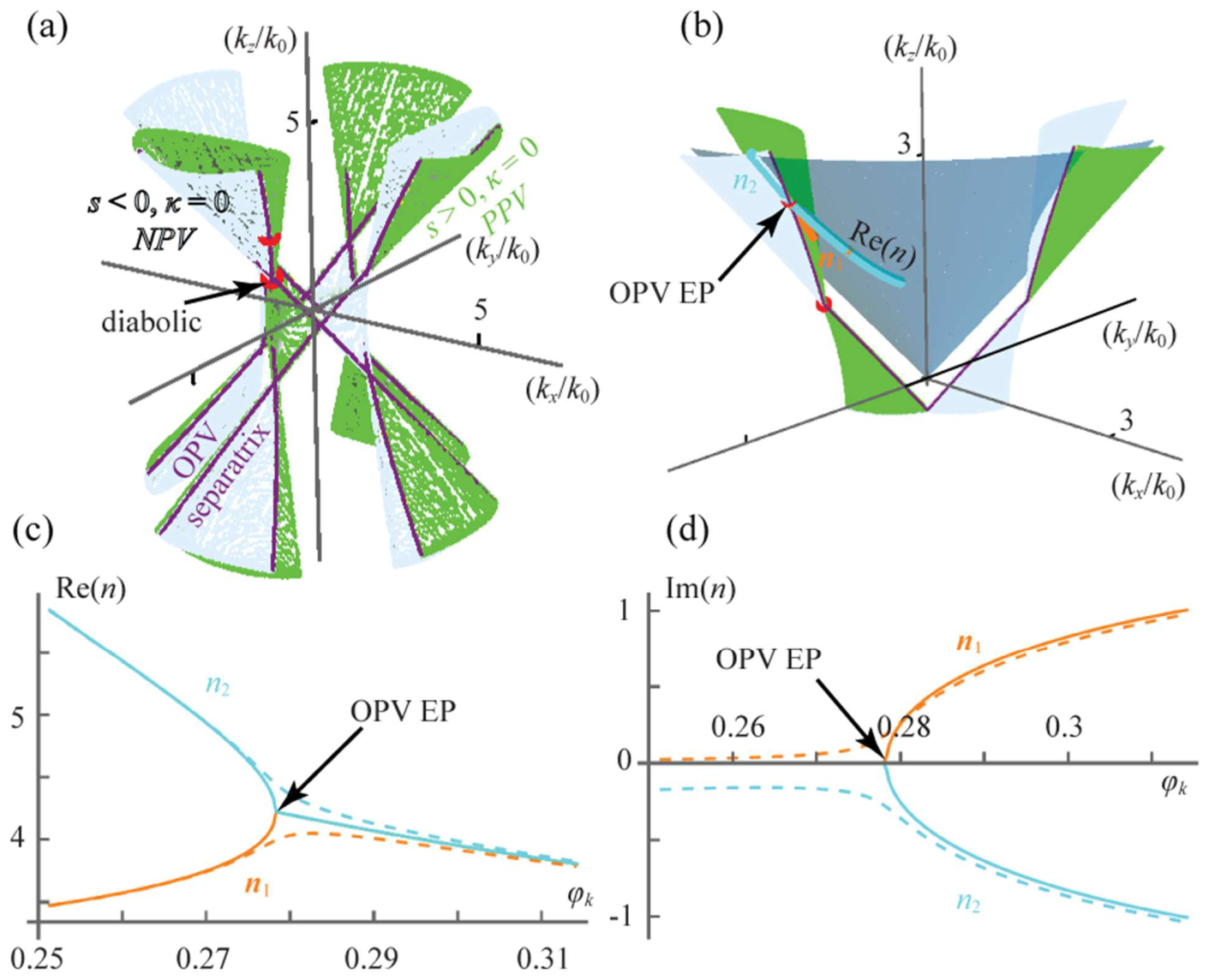
This material has twelve diabolical singularities, as can be seen from the Fresnel wave surface of this material shown in
Figure 2a. One of them, marked by a red dot, corresponds to the direction
. The index-of-refraction operator for this direction is diagonalizable
Its eigenvalues are and it possesses four independent eigenvectors, Thus, this is an ordinary diabolical degeneracy: the eigenvalues are degenerate, but the eigenspace remains complete.
By contrast, this is not true for the OPV exceptional points on the OPV separatrix. In
Figure 2a, the green and light-blue regions show the two handedness domains on the bare Fresnel wave surface, with green denoting
PPV propagation and light blue denoting
NPV propagation. For the anisotropic material considered here, these PPV and NPV regions are associated with the electric-like and magnetic-like hyperbolic branches respectively identified in Ref. [
30]. The purple curves show the OPV separatrices.
In
Figure 2 we show the OPV separatrices using the purple curves. Consider, for example, the direction
and its intersection with the Fresnel wave surface also shown using a red dot. The corresponding index-of-refraction operator is
This operator is defective. Its Jordan normal form is
The
operator
therefore has only two ordinary eigenvectors
, with
The corresponding generalized eigenvectors are
The red point in
Figure 2b shows this OPV exceptional point on Fresnel wave surface. The blue cone defines a one-parameter family of nearby directions. Moving along this cone gives the angular coordinate
used in
Figure 2c,d. The real parts of the two refractive-index branches are traced directly on the cone in
Figure 2b and then plotted as functions of
in
Figure 2c. At the OPV EP these two real branches coalesce, consistent with the double-root condition
. When a small non-Hermitian perturbation is added, the degeneracy unfolds: the real parts separate and the imaginary parts shown in
Figure 2d become nonzero. This illustrates the sensitivity of the OPV EP to loss or gain perturbations. While the perturbation is small
, the splitting is orders of magnitude larger,
.
In the Jordan-degenerate case, the index-of-refraction operator
admits an eigenvector
and a generalized eigenvector
satisfying
The corresponding field solution takes the form of an OPV mode,
This expression exhibits the characteristic linear-in-
prefactor associated with Jordan-block dynamics, formally analogous to the behavior at exceptional points. However, since
for the generalized eigenvector
, the condition
is violated if
. In an unbounded Hermitian medium, where
is real, the condition
is therefore formally enforced; otherwise, the linear prefactor would produce unbounded amplitude growth, in contrast to Voigt-type solutions in non-Hermitian media [
31].
Thus, although OPV singularities have the algebraic structure of exceptional points, they arise within Hermitian electromagnetic media and are intrinsically linked to the OPV separatrices, where forward- and backward-propagating domains meet. This gives the physical reason for OPV exceptional points. At OPV, so the transverse electric and magnetic fields no longer form the oriented-area structure that normally produces longitudinal Poynting flux. In the simplest case, they become parallel in the transverse plane. At the same time, OPV marks a turning point of the refractive-index branches for a fixed propagation direction. Thus, the loss of longitudinal energy flow is accompanied by a loss of polarization and impedance distinction between the coalescing modes, allowing the index-of-refraction operator to become defective at the OPV exceptional point.
4. Gain–Loss Singularities and Separatrices
We now extend the propagation-map construction to non-Hermitian media. We introduce loss or gain by perturbing the Hermitian constitutive matrix
as
where
describes the unperturbed lossless material and
represents the non-Hermitian part of the response. In the photonic-parameter representation introduced above, this corresponds to allowing the material parameters to acquire complex corrections. The Maxwell operator is modified accordingly,
, and the refractive index becomes complex,
The coefficient
describes extinction or amplification and the most direct way to locate the boundary between these two behaviors is to impose
At this boundary the refractive index is real, even though the medium is non-Hermitian. Therefore, the non-Hermitian dispersion equation
must admit a real-
solution. Since
is generally complex, this gives the two real conditions
This real/imaginary decomposition of a complex quartic dispersion condition was previously used in the inverse problem of quartic photonics, where complex bianisotropic media were represented through the intersection of analogous real and imaginary quartic surfaces [
32]. In that work, the construction provided a way to relate prescribed complex photonic states to effective material parameters. Here, we use the same operational principle in a different context: the simultaneous solution of Equation (10) identifies real-
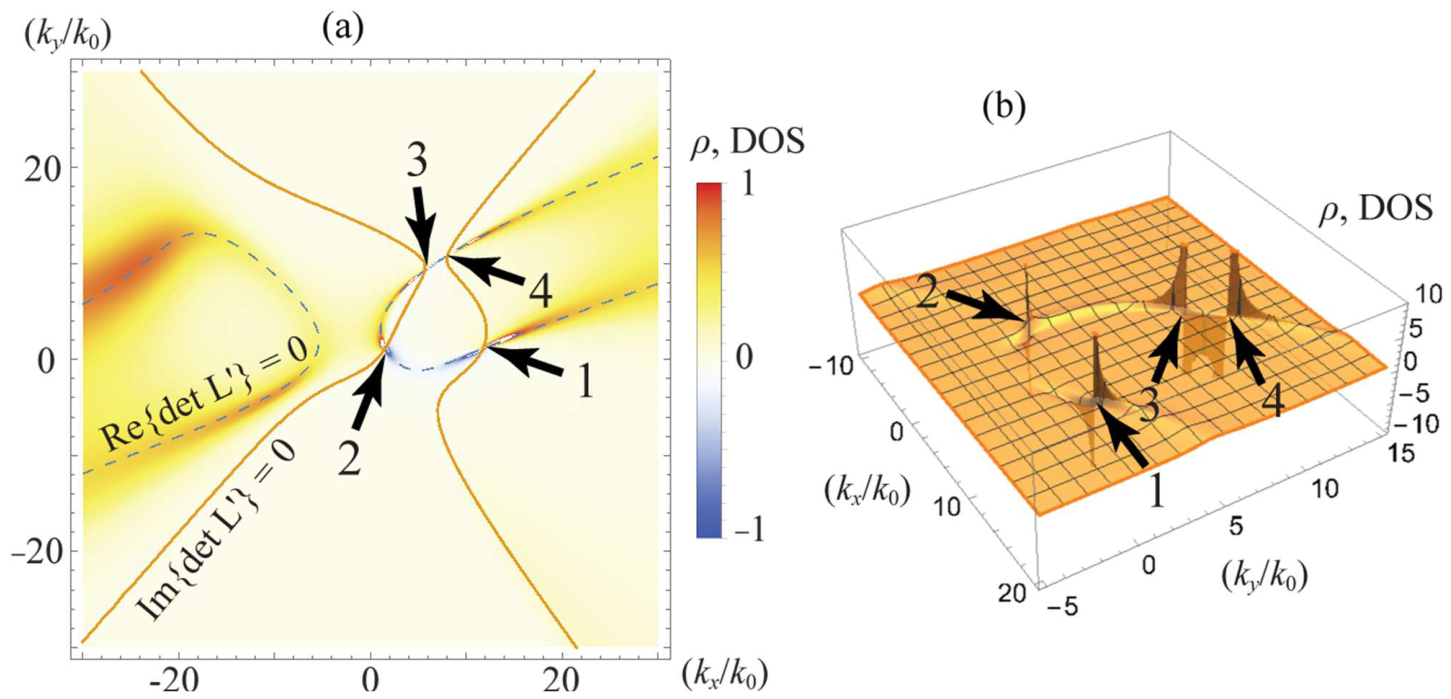
filaments on the non-Hermitian Fresnel wave surface. We interpret these filaments as gain–loss separatrices, because they mark the loci where the complex refractive index becomes real and the gain–loss character of the propagation map changes. The orange curve in
Figure 1a corresponds to this type of separatrix.
The physical distinction between attenuation and amplification is not determined by the sign of alone, but by the sign of its product with the energy-flow component along the propagation direction, For a given propagation branch, corresponds to attenuation, while corresponds to amplification. Thus, the gain–loss separatrix divides the non-Hermitian propagation map into dark and bright domains, corresponding respectively to decaying and amplified fields. The zeros of therefore define the boundaries at which the gain–loss character reverses.
These properties are illustrated in
Figure 3, where the momentum-resolved DOS distribution
is shown for the
cross-section of the Fresnel wave surface from
Figure 1a. The direction-dependent sign of the density of states,
, is an important characteristic of the material. It indicates which waves transfer energy from external sources into the medium, corresponding to
and which correspond to the opposite direction of energy transfer,
[
18,
33]. In
Figure 3a the intersections of the curves
are marked by black arrows and numbered 1–4. These intersections identify the real-
gain–loss separatrices and coincide with the sign changes in the DOS.
The singular points associated with these curves are termed gain–loss singularities. At , the phase-propagation direction remains continuous, while the gain–loss character, determined by the sign of , reverses across the gain–loss separatrix. In this sense, gain–loss singularities play for the non-Hermitian gain–loss map a role analogous to that played by OPV exceptional points for the Hermitian handedness switching.
The same condition can also be expressed perturbatively in terms of the fields. Expanding the determinant of the non-Hermitian Maxwell operator to first order gives
On the unperturbed Fresnel surface, , so the non-Hermitian correction is governed by the projection of the perturbation onto the unperturbed mode. If is the eigenvector of the corresponding Hermitian mode, this correction may be written as
Equivalently, introducing the complex energy
through
one obtains the quality factor of the electromagnetic wave as
Using
, this gives
For a weak non-Hermitian perturbation
,
Thus, the condition is the perturbative field-based form of the more operational gain–loss separatrix condition Equation (10). In this sense, the determinant equations locate the separatrix directly, while the modal expression explains how a particular electromagnetic mode experiences the non-Hermitian perturbation. Together with the OPV separatrix , the gain–loss separatrix completes the propagation map: one boundary separates PPV from NPV propagation, while the other separates attenuation from amplification.
5. Momentum-Resolved Density of States and OPV Gain–Loss Singularities
The addition of loss or gain gives the refractive-index branches imaginary parts
As a result, the delta-functional DOS of the bare Fresnel wave surface is broadened (see
Figure 3 for illustration). In the Hermitian limit, the momentum-resolved density of states is concentrated on shell. In the non-Hermitian case, this delta function is replaced by a Lorentzian [
18],
Here
are direction-dependent quantities:
is the surface-density-of-states prefactor,
is the real part of the refractive index, and
is the extinction/amplification coefficient. From the Lorentzian form above the sign of the broadened DOS can be expressed as
Following
Appendix B, the surface-density prefactor
can be written as
The sign of SDOS, , means that for right-handed waves , while for left-handed waves . The relation in Equation (11) helps combine the two sign structures of the propagation map: the factor carries the handedness information through , while carries the information about the gain–loss due to the non-Hermitian perturbation
It is noteworthy that, similarly to
, the sign of the extinction coefficient
is governed by the sign of
. As a result,
changes sign upon crossing an OPV exceptional point, so that modes on opposite sides of a OPV separatrix possess opposite extinction. Consequently, according to Equation (11) the sign of the density of states
and loss–gain state remains unchanged across OPV separatrices and only changes at gain–loss singularities:
The defining feature of OPV exceptional points is
, which leads to divergence of the surface density of states (SDOS),
. Nevertheless, the significance of this is reduced by the fact that for Hermitian media this divergence adds to the already divergent delta-functional momentum-resolved DOS distribution. In non-Hermitian media, this divergence is generally unfolded by perturbations of the OPV EP, as illustrated in
Figure 2.
Gain–loss singularities produce a more dramatic DOS signature. Since gain–loss singularities occur at
, they correspond to points where the Lorentzian linewidth
of the momentum-resolved spectral response collapses. At the on-shell momentum
, the Lorentzian amplitude scales as
so the DOS develops a sharp peak whose sign reverses across the gain–loss singularity, as illustrated in
Figure 3b, where four gain–loss singularities are marked by black arrows. Thus, a gain–loss singularity is not only a boundary between attenuation and amplification; it is a threshold-like momentum-space singularity of the non-Hermitian Fresnel wave-surface map. Its origin stems from the vanishing of the non-Hermitian linewidth of the dressed Fresnel wave surface. In this sense, gain–loss singularities identify directions in momentum space where the exchange of energy between the field and the medium reverses sign. All numerical figures in this work were generated using custom-written numerical routines. No commercial full-wave solver was used. For each chosen constitutive matrix
, the direction-dependent reduced index-of-refraction operator
was constructed, and the quartic equation
was solved as a function of propagation direction. The corresponding eigenvectors were then used to evaluate the Poynting vector, the signs of
and
, the OPV separatrices, and the gain–loss/DOS-related quantities plotted in the figures.