Article

Monolithic InP-Based Wavelength Meter for 100 nm Bandwidth Operation in the C-Band


by
Andrea Volpini
1,
Damiano Massella
1,
David Alvarez-Outarelo
1,
Vahram Voskerchyan
1,
Francisco Soares
2,
Francisco J. Diaz-Otero
1,3 and
Omar Guillan-Lorenzo
1,*
1
E.E. Telecomunicación, University of Vigo, Campus Universitario As Lagoas, 36310 Vigo, Spain
2
Soares Photonics, 1600-546 Lisbon, Portugal
3
AtlanTTic Research Center, E.E. Telecomunicación, University of Vigo, Campus Universitario As Lagoas, 36310 Vigo, Spain
*
Author to whom correspondence should be addressed.
Photonics 2026, 13(6), 527; https://doi.org/10.3390/photonics13060527
Submission received: 2 February 2026 / Revised: 7 May 2026 / Accepted: 22 May 2026 / Published: 28 May 2026

Abstract

We present a monolithically integrated wavelength meter fabricated on an indium phosphide (InP) platform, suitable for seamless integration with active photonic components such as lasers and optical amplifiers. The device architecture incorporates multiple ring resonators and was realized through a commercial multi-project wafer (MPW) process. Experimental characterization over a 1 nm spectral window using a tunable laser demonstrates the feasibility of the approach and validates the operating principle.

1. Introduction

The accurate measurement of optical wavelength is critical for a wide range of applications, including wavelength-division multiplexing (WDM) telecommunications, spectroscopy, tunable laser control, and optical metrology [1,2,3]. Among the various photonic integration platforms, indium phosphide (InP) stands out as the only material system that supports the monolithic integration of active components such as lasers and optical amplifiers [4]. This makes InP particularly attractive for developing compact, high-performance systems in which wavelength meters can be co-integrated with tunable lasers, offering reduced footprint, enhanced performance, and streamlined fabrication. In addition to its integration capabilities, the InP platform supports high-speed operation due to the availability of fast electro-optic modulators. These features position InP as a promising candidate for next-generation compact and multifunctional photonic integrated circuits. Several integrated wavelength meter architectures have been demonstrated using platforms such as silicon and silicon nitride [2,5,6], employing techniques such as microring resonators and multimode interferometry. Notably, state-of-the-art designs have achieved up to 100 nm spectral range with a resolution of approximately 15 pm [7]. InP generally exhibits higher propagation losses and requires larger bend radii, which limits the compactness of microring resonators and their achievable free spectral range (FSR), a key parameter in wavelength meter design. Consequently, the maximum reported operational bandwidth for an InP-based wavelength meter has remained limited to just 3 nm [8], and AWG-based approaches on the same platform have achieved working ranges on the order of a few nanometers [9,10]. This work addresses these limitations by introducing a wavelength meter based on four microring resonators with distinct free spectral ranges (FSRs). Each ring includes an integrated phase modulator capable of achieving a 2 π phase shift, with the through-port transmission monitored by an integrated photodiode (PD). By sweeping the phase modulators and recording the voltages at transmission minima, unique voltage combinations are generated and mapped to wavelength using an empirical lookup table. The device was fabricated on the generic InP platform of the Fraunhofer Heinrich Hertz Institute (HHI).

2. Design

2.1. Circuit Overview

Figure 1 presents a schematic of the proposed circuit. The device operates by routing a monochromatic optical signal to four microring resonators via a passive splitting network. Each ring incorporates an integrated phase shifter (PHS), enabling tunability of the ring’s resonance condition through electrical control. Notably, the design omits a “drop” port to minimize insertion loss, thereby preserving a high cavity quality factor (Q).
The waveguide and MMI structures employed in this design are based on the standard building blocks provided by the HHI foundry platform. Specifically, the circuit uses the shallow-ridge passive waveguide and the 1 × 2 multimode interference (MMI) splitter as defined in the HHI process design kit. The racetrack ring resonators consist of two curved sections connected by two straight sections: one hosting the phase shifter and the other forming the directional coupler. The total round-trip perimeter of each ring is therefore the sum of the arc lengths and the two straight sections.
The resonant wavelengths λ ( k ) of each ring are governed by the relation:
λ ( k ) = L · n eff k + θ ( V ) / 2 π
where k N is the resonance order, L is the total round-trip length of the ring, n eff is the effective refractive index, and θ ( V ) is the voltage-dependent phase shift introduced by the PHS. By varying the applied voltage V, the phase shift θ ( V ) can be modulated over a 2 π range, enabling the ring to be tuned to any desired resonance within the FSR. Resonance is identified by a distinct transmission dip observed at the output of the photodiode monitoring the ring’s through-port. However, Equation (1) does not establish a one-to-one correspondence between voltage and wavelength; that is, a single ring can function as a wavelength meter only if its FSR exceeds the spectral bandwidth of the input signal. To overcome this limitation, the system employs multiple rings of differing lengths, each exhibiting a unique FSR. This results in different sets of resonant conditions across the rings. The intersection of these sets allows the unambiguous determination of the input wavelength. In operation, the input signal is coupled into the device, and the phase shifters are swept over a 0 to 2 π phase range. Each ring produces at least one transmission minimum, corresponding to a specific driving voltage. These voltages form a set of observables that can be mapped to the corresponding wavelength via a pre-established calibration. It is important to note that accurately predicting the resonance conditions would require detailed modeling of group-index dispersion, phase-shifter response, temperature dependence, and fabrication-induced variations. Due to the complexity of such modeling, we adopt an empirical calibration approach. This involves constructing a lookup table that maps observed resonant voltages to specific wavelengths, based on prior measurements using known input signals.

2.2. Racetrack Ring Design

On the HHI platform, the shortest viable microring resonator (denoted L1) features an arc length of L arcs , 1 = 3318 μ m . To enable full 2 π phase tuning, a conservative phase shifter (PHS) length of 800 μ m is employed, resulting in a total round-trip length of L 1 = L arcs , 1 + L PHS , 1 = 4118 μ m .
The free spectral range (FSR) of a microring resonator is given by
FSR = c n g L ,
where c is the speed of light in vacuum and n g is the group index. Assuming n g = 3.5 , ring L1 exhibits FSR 1 20.80 GHz corresponding to approximately 0.167 nm at 1550 nm ).
To extend the operational bandwidth, the Vernier effect is exploited by combining rings with slightly different optical path lengths. The effective FSR of two coupled rings is approximated by
FSR 1 2 FSR 1 · FSR 2 | FSR 1 FSR 2 | .
A second ring (L2) with L arcs , 2 = 3324 μ m and an identical 800 μ m PHS section yields a total length L 2 = 4124 μ m and FSR 2 20.77 GHz . This configuration produces a Vernier FSR of FSR 1 2 14.28 THz , corresponding to a theoretical spectral periodicity of approximately 114 nm in the C-band.
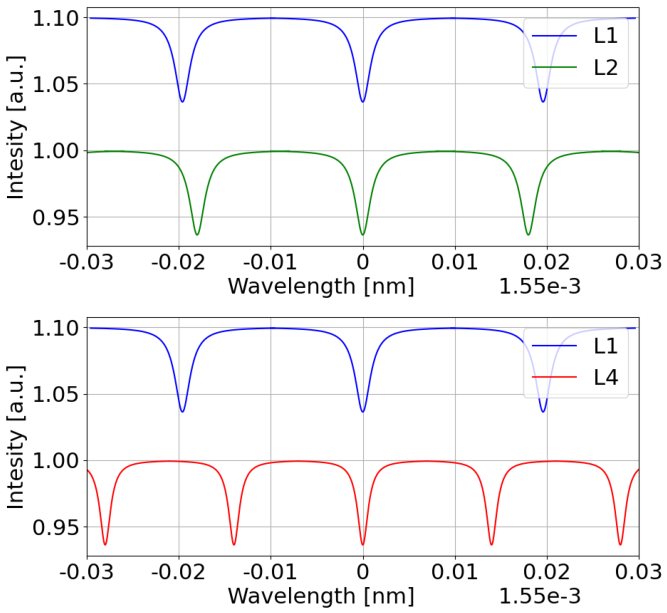
While this provides a large theoretical free spectral range, the finite resonance linewidths and fabrication variations lead to significant spectral ambiguity when using only closely spaced rings (see Figure 2, top). To improve resonance discrimination, a ring with a substantially different circumference is introduced. Ring L4, with L arcs , 4 = 3578 μ m ( L 4 = 4378 μ m ), has FSR 4 19.58 GHz , resulting in | FSR 1 FSR 4 | 1.22 GHz . When this difference exceeds the resonance full-width at half-maximum (FWHM), overlap between adjacent Vernier orders is effectively suppressed.
However, the L1–L4 pair alone provides only a limited unambiguous wavelength range of roughly 3–5 nm. Simulations indicate that even three rings are insufficient to achieve unambiguous identification across the full target bandwidth of 100 nm due to residual ambiguities in the Vernier mapping.
To overcome this limitation, a fourth ring (L3) is incorporated. Ring L3 shares the same arc length as L4 ( L arcs , 3 = 3578 μ m ) but employs a different PHS length, thereby providing a distinct effective FSR. This additional independent Vernier condition enables robust, unambiguous wavelength determination across the entire 100 nm operational bandwidth.
The extinction ratio of the resonances is limited by the deviation from critical coupling conditions in the directional coupler, which is in turn affected by the higher propagation loss of the shallow-ridge InP waveguides. The observed low extinction ratios can be improved in future designs by optimizing the directional coupler length toward critical coupling, employing multi-section couplers to enhance fabrication tolerance, or using larger bend radii to reduce radiation loss. The waveguide geometry described above, together with the resulting loss budget, dictates the achievable cavity Q and, ultimately, the trade-off between measurement speed and resolution discussed in Section 3.2.

3. Measurements

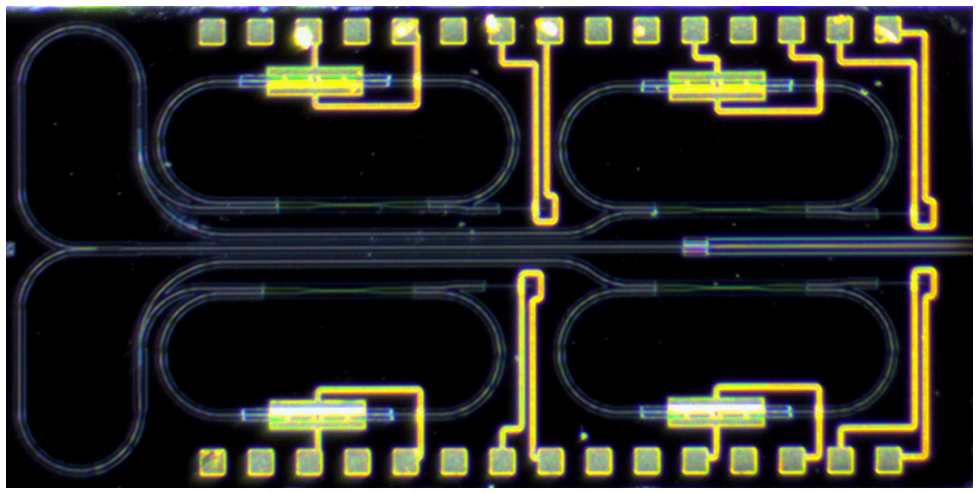
Figure 3 depicts the fabricated InP chip implementation corresponding to the circuit architecture discussed in the previous sections.

3.1. Calibration Procedure

To validate the bandwidth expansion concept, we performed experimental characterization over a 1 nm span centered at 1550 nm. For this limited spectral range, rings L1 and L4 were sufficient to enable unambiguous wavelength identification. A tunable laser source of known wavelength was used, and the photodiode responses were recorded in 20 pm increments. All measurements were carried out under ambient laboratory conditions (≈ 22   ° C ) without active thermal stabilization of the chip. Figure 4 shows a representative measurement from ring L1 at 1549.96 nm. The resulting PD response exhibited multiple transmission minima, indicating that the chosen phase shifter length was longer than necessary. This suggests that a shorter PHS would have sufficed. Moreover, the observed resonances appear in two distinct series, with odd-numbered peaks significantly deeper than even ones. This asymmetry is attributed to the simultaneous excitation of multiple optical modes—specifically, the fundamental transverse electric (TE) and transverse magnetic (TM) modes supported by the shallow-ridge InP waveguide. The observed dual-series resonance structure (TE and TM modes) is polarization-sensitive. This complicates automated peak selection and may compromise long-term stability and reliability when the input polarization is uncontrolled. In the present demonstration, only the first three odd-numbered TE-like peaks—consistently well-defined across all measurements—were used. Future designs should incorporate polarization-selective structures or polarization-diversity schemes to mitigate this issue.
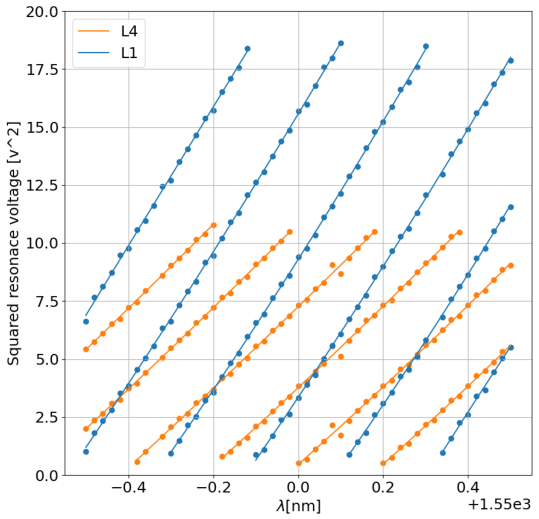
At each wavelength step, we recorded the voltages corresponding to these peaks for both ring L1 and ring L4. These voltage–wavelength data were plotted in Figure 5, where each dataset was fitted using a quadratic function. The resulting fits enabled the construction of a two-dimensional lookup table, associating pairs of voltages ( V 1 , V 2 ) with corresponding wavelengths.
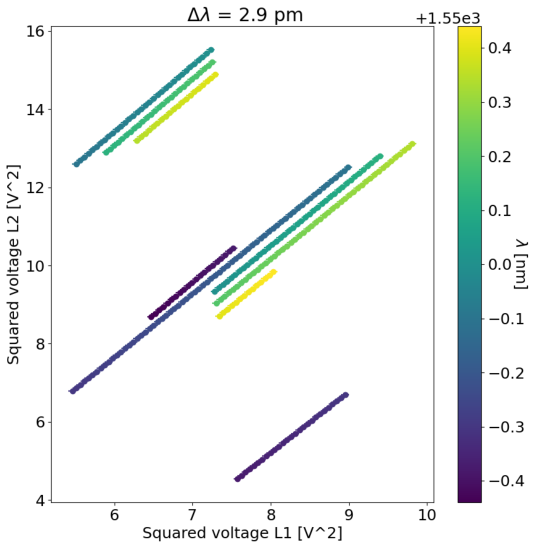
Figure 6 presents a phase diagram visualizing the lookup table. The horizontal axis represents the voltage applied to ring L1, while the vertical axis corresponds to the voltage applied to ring L4. Each point in the diagram is defined by a ( V 1 , V 2 ) pair, and its color encodes the associated wavelength, as indicated by the accompanying color bar.
However, due to the finite size of the error bars and potential overlaps in voltage space, ambiguity can arise in certain regions of the phase diagram. In these cases, a single voltage pair may correspond to more than one possible wavelength, indicating a need for either refined calibration or additional discrimination mechanisms. The wavelength uncertainty of approximately ±4 pm reflects the standard deviation between the experimental calibration points and the quadratic fitting model (fitting error). It does not represent repeatability across multiple independent measurement sweeps.

3.2. Speed Limit

The wavelength measurement speed in a ring-resonator-based system is fundamentally constrained by the cavity dynamics of the resonators. Specifically, the minimum response time is governed by the cavity lifetime τ s , which is related to the quality factor Q through:
Q = ω · τ s
A stabilization period of approximately T = 3 τ s is required before reliable measurements can be obtained from the ring cavity response [11]. To accurately capture the full FSR of each ring, the PHS must be driven across a sufficient number of voltage steps m, balancing between resolution preservation and avoiding oversampling of the PD signal. Assuming that the resolution is limited by the FWHM of the resonance, the number of required steps is given by:
m = 2 · FSR FWHM = 2 · FSR · Q ω
Accordingly, the total measurement time T can be expressed as:
T = m · τ s = 6 · FSR · Q 2 ω 2
This expression reveals that the measurement time scales quadratically with the quality factor Q. Table 1 summarizes the relationship between Q, minimum measurement time, and achievable wavelength resolution, assuming a fixed single-ring FSR of 30 GHz and center frequency ω = 193 THz.
It is important to emphasize that the measurement speed is independent of the number of rings in the system, as all resonators are interrogated simultaneously.

4. Discussion

The results presented in this work demonstrate the feasibility of implementing a monolithically integrated wavelength meter on an InP platform using multiple microring resonators with distinct free spectral ranges. By leveraging the Vernier effect and an empirical calibration approach, the proposed architecture enables wavelength identification over a potentially wide spectral range, while maintaining compatibility with active photonic components such as lasers and optical amplifiers.
A key outcome of this study is the demonstration of unambiguous wavelength discrimination using a reduced subset of rings over a limited spectral span. Although the experimental validation was restricted to a 1 nm window around 1550 nm, the results confirm the validity of the underlying operating principle and the robustness of the calibration-based approach. The extension to a full 100 nm bandwidth, as predicted by design, is therefore primarily constrained by practical considerations in measurement time and calibration effort rather than by fundamental architectural limitations. Future work will focus on improving the fabrication process and optimizing the ring design to enable experimental validation over the full 100 nm spectral range.
The achieved experimental resolution of approximately 8 pm, with a fitting uncertainty of ±4 pm, is consistent with the observed resonance linewidths and system noise. While this performance does not yet reach the theoretical resolution limit of 1.6 pm, it highlights the impact of non-idealities such as fabrication tolerances, multimode behavior, and electrical control limitations. In particular, the presence of multiple transverse modes, evidenced by the dual-series resonance structure, introduces additional complexity in peak selection and may affect long-term stability and reliability. Future designs could mitigate these effects through improved waveguide engineering or polarization-selective structures.
Another important aspect is the trade-off between measurement speed and resolution, which is intrinsically governed by the cavity dynamics of the microring resonators. As shown in the analysis, higher quality factors enable finer wavelength discrimination but at the expense of longer response times. This quadratic dependence imposes a fundamental limitation on the achievable performance and must be carefully balanced depending on the target application. Nevertheless, the possibility of interrogating all resonators in parallel ensures that the system scalability does not directly penalize acquisition speed.
From a system perspective, the reliance on a calibration-based lookup table provides flexibility and robustness against modeling inaccuracies, but it also introduces sensitivity to environmental variations such as temperature drift. In practical deployments, this may require periodic recalibration or the incorporation of compensation mechanisms.
Finally, the proposed InP-based implementation offers a clear pathway toward fully integrated photonic systems, where wavelength monitoring can be co-packaged or co-fabricated with tunable sources and amplifiers. This represents a significant advantage over other material platforms, particularly in applications requiring compactness, high speed, and functional integration. Full-band (100 nm) experimental validation is ongoing, alongside optimization of the ring design and ambiguity reduction over the extended spectral range.

Author Contributions

All authors contributed to the study conception and design. Photonic chip design and simulation was performed by A.V. and D.M. Chip measurements were performed by D.A.-O. Data processing and analysis were performed by A.V., D.M., D.A.-O., F.S., V.V., O.G.-L. and F.J.D.-O. Supervision and direction were performed by F.S. and F.J.D.-O. The first draft of the manuscript was written by O.G.-L. and all authors commented on previous versions of the manuscript. All authors have read and agreed to the published version of the manuscript.

Funding

Project developed in the framework of the European Doctorate in Indium Phosphide PIC Fabrication Technology (EDIFY) project. This work has received financial support from Consellería de Educación, Ciencia, Universidades e Formación Profesional and co-funded by UE.

Data Availability Statement

The datasets generated during and/or analysed during the current study are available from the corresponding author upon reasonable request.

Conflicts of Interest

The authors declare no conflicts of interest.

References

  1. Xiang, C.; Tran, M.A.; Komljenovic, T.; Hulme, J.; Davenport, M.; Baney, D.; Szafraniec, B.; Bowers, J.E. Integrated Chip-Scale Si3N4 Wavemeter with Narrow Free Spectral Range and High Stability. Opt. Lett. 2016, 41, 3309–3312. [Google Scholar] [CrossRef] [PubMed]
  2. Oldenbeuving, R.M.; Song, H.; Schitter, G.; Verhaegen, M.; Klein, E.J.; Lee, C.J.; Offerhaus, H.L.; Boller, K.-J. High Precision Wavelength Estimation Method for Integrated Optics. Opt. Express 2013, 21, 17042–17052. [Google Scholar] [CrossRef] [PubMed][Green Version]
  3. Komljenovic, T.; Liang, L.; Chao, R.-L.; Hulme, J.; Srinivasan, S.; Davenport, M.; E. Bowers, J. Widely-Tunable Ring-Resonator Semiconductor Lasers. Appl. Sci. 2017, 7, 732. [Google Scholar] [CrossRef]
  4. Smit, M.; Leijtens, X.; Bente, E.; van der Tol, J.; Ambrosius, H.; Robbins, D.; Wale, M.; Grote, N.; Schell, M. A Generic Foundry Model for InP-Based Photonic ICs. In Optical Fiber Communication Conference (2012); Paper OM3E.3; Optica Publishing Group: Washington, DC, USA, 2012. [Google Scholar] [CrossRef]
  5. Dey, R.; Doylend, J.; Ackert, J.; Evans, A.; Jessop, P.; Knights, A. Demonstration of a Wavelength Monitor Comprised of Racetrack-Ring Resonators with Defect Mediated Photodiodes Operating in the C-Band. Opt. Express 2013, 21, 23450. [Google Scholar] [CrossRef] [PubMed]
  6. Taballione, C.; Agbana, T.; Vdovin, G.; Hoekman, M.; Wevers, L.; Kalkman, J.; Verhaegen, M.; Van Der Slot, P.J.M.; Boller, K.-J. Temperature-Drift-Immune Wavelength Meter Based on an Integrated Micro-Ring Resonator. In Integrated Optics: Physics and Simulations III; Cheben, P., Čtyroký, J., Molina-Fernández, I., Eds.; SPIE: Prague, Czech Republic, 2017; p. 1024206. [Google Scholar] [CrossRef]
  7. Wang, P.; Hatta, A.M.; Zhao, H.; Yang, W.; Ren, J.; Fan, Y.; Farrell, G.; Brambilla, G. Passive Photonic Integrated Ratiometric Wavelength Monitor with Resolution Better than 15 pm. Opt. Express 2017, 25, 2939. [Google Scholar] [CrossRef] [PubMed]
  8. Broeke, R.; Melati, D.; Morichetti, F. Design and Performance of a Packaged InP Wavelength Meter. In Proceedings of the 18th Annual Symposium of the IEEE Photonics Society Benelux Chapter, Eindhoven, The Netherlands, 25–26 November 2013; pp. 287–290. [Google Scholar] [CrossRef]
  9. D’Agostino, D.; Broeke, R.; Boerkamp, M.; Mink, J.; Ambrosius, H.P.M.M.; Smit, M.K. AWG Based Wavelength-Meter with pm Resolution. In Proceedings of the 17th European Conference on Integrated Optics and Technical Exhibition (ECIO-MOC), Nice, France, 17–19 June 2014; p. Tu2bR2. [Google Scholar]
  10. Pustakhod, D.; Kleijn, E.; Williams, K.; Leijtens, X. High-Resolution AWG-Based Fiber Bragg Grating Interrogator. IEEE Photonics Technol. Lett. 2016, 28, 2203–2206. [Google Scholar] [CrossRef]
  11. Biasi, S.; Guilleme, P.; Volpini, A.; Fontana, G.; Pavesi, L. Time Response of a Microring Resonator to a Rectangular Pulse in Different Coupling Regimes. J. Light. Technol. 2019, 37, 5091–5099. [Google Scholar] [CrossRef]
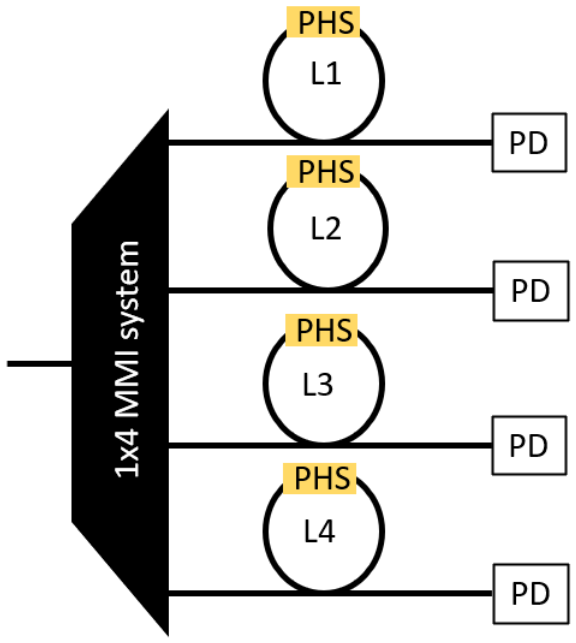
Figure 1. Schematic of the circuit: an unknown monochromatic source is routed to four rings of different lengths using a combination of MMI splitters. Phase modulators (yellow boxes) are used to tune the rings on resonance with the source. Transmission spectra are recorded with photodetectors (PD).
Photonics 13 00527 g001
Figure 2. (top) Ring L1 and ring L2 have similar FSR and consequently it is not possible to resolve the resonance unambiguously in the interval; (bottom) ring L1 and ring L4 have different spectral ranges, resulting in the possibility of determining the wavelength without ambiguity in the selected interval.
Photonics 13 00527 g002
Figure 3. Microscope photograph of the chip. The four racetrack ring resonators can be clearly seen, each of them with a phase modulator on one of the long sides and a directional coupler in the opposite one, guiding the light to a photodiode.
Photonics 13 00527 g003
Figure 4. Measured response of ring L1 at a wavelength of 1549.96 nm. The figure is obtained sweeping voltages between 0 V and 5 V and registering the power at the integrated photodiode. Using a peak detection algorithm, we can identify the voltages associated with minima, noticing two series of peaks at different depths we have decided to consider only odd peaks in our subsequent analysis.
Photonics 13 00527 g004
Figure 5. Peak voltages of ring L1 and ring L4 as a function of the injected wavelength; each point in the graph corresponds to a minimum: orange points are minima of ring L1, blue points are minima of ring L4. A quadratic function is used to fit the data; with that function we generate a lookup table.
Photonics 13 00527 g005
Figure 6. A visualization of the lookup table. On both axes we have the voltages obtained by the fitting represented in Figure 5 for the two different rings L1 and L4. The resulting wavelength is color-coded. Data points are spaced by 4.4 pm.
Photonics 13 00527 g006
Table 1. Correlation between the quality factor of the cavity, minimum measurement time, and measurement resolution. The results are obtained by applying Equation (6).
Q FactorTResolution
10 4 500 ps160 pm
10 5 50 ns20 pm
10 6 μ s 1.6 pm
Disclaimer/Publisher’s Note: The statements, opinions and data contained in all publications are solely those of the individual author(s) and contributor(s) and not of MDPI and/or the editor(s). MDPI and/or the editor(s) disclaim responsibility for any injury to people or property resulting from any ideas, methods, instructions or products referred to in the content.