Automated Inverse Design Framework for Traveling-Wave Electrode Electro-Optic Modulators with Discrete Fabrication Constraints


Abstract
1. Introduction
2. Materials and Methods
2.1. Design Space Preprocessing
2.2. High-Potential Region Identification
2.3. Fine-Grained Optimization
2.4. Computational Details
3. Results

3.1. Optimization of LiNbO3 Segmented Electrodes Modulators
3.2. Effectiveness Analysis in Engineering
- (1)
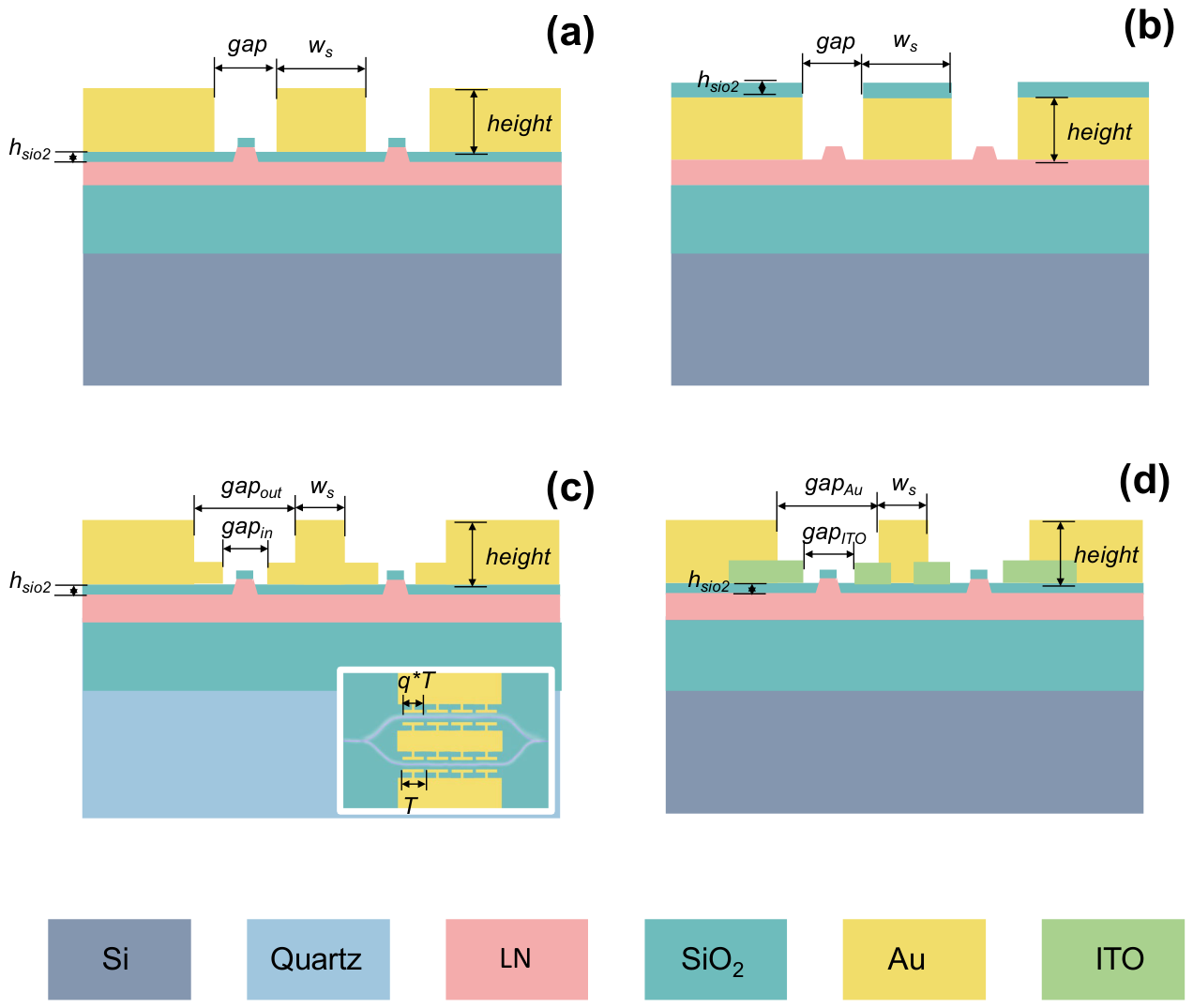
- Different Modulator Structures: The proposed framework is applied to the design of modulators with different model structures, verifying its generalization capability. Variations in etching depth and film thickness also represent different modulator configurations.
- (2)
- Different Engineering Conditions: We varied the matching impedance to assess the method’s adaptability under parametric perturbations.
4. Discussion
4.1. Analysis of Microwave Loss Mechanisms
4.2. Experimental Validation and Fabrication Feasibility
4.3. Stability Challenges
5. Conclusions
Author Contributions
Funding
Institutional Review Board Statement
Informed Consent Statement
Data Availability Statement
Conflicts of Interest
Appendix A

| Property | Value |
|---|---|
| Relative Permittivity of Si | 11.9 |
| Electrical Conductivity of Si | 0.01 S/m |
| Relative Permittivity of SiO2 | 4 |
| Relative Permittivity of LiNbO3 | ε11 = 44.2 ε33 = 28.5 |
| Refractive Index of LiNbO3 (1550 nm) | = 2.21 = 2.14 |
| Refractive Index of SiO2 | 1.44 |
| Pockels Index of LiNbO3 | r13 = 8.6 pm/V r33 = 30.8 pm/V |
| Property | Value |
|---|---|
| Learning rate | 0.02 |
| Convergence threshold | 30 |
| Smooth item | 1 × 10⁻⁸ |
| Amplification factor | 1.3 |
| Maximum iterations | 300 |
| Property | Value |
|---|---|
| Learning rate | 0.02 |
| Gradient norm threshold | 1 × 10⁻⁵ |
| Maximum iterations | 300 |
| Property | Value |
|---|---|
| Gradient norm threshold | 1 × 10⁻⁶ |
| Line search parameters | 1 × 10⁻⁴, 0.9 |
| Maximum iterations | 300 |
References
- Hu, J.T.; Mengu, D.; Tzarouchis, D.C.; Edwards, B.; Engheta, N.; Ozcan, A. Diffractive optical computing in free space. Nat. Commun. 2024, 15, 1525. [Google Scholar] [CrossRef]
- Chen, Y.; Nazhamaiti, M.; Xu, H.; Meng, Y.; Zhou, T.; Li, G.; Fan, J.; Wei, Q.; Wu, J.; Qiao, F.; et al. All-analog photoelectronic chip for high-speed vision tasks. Nature 2023, 623, 48–57. [Google Scholar] [CrossRef] [PubMed]
- Zhu, H.H.; Zou, J.; Zhang, H.; Shi, Y.Z.; Luo, S.B.; Wang, N.; Cai, H.; Wan, L.X.; Wang, B.; Jiang, X.D.; et al. Space-efficient optical computing with an integrated chip diffractive neural network. Nat. Commun. 2022, 13, 1044. [Google Scholar] [CrossRef]
- Yildirim, M.; Oguz, I.; Kaufmann, F.; Escalé, M.R.; Grange, R.; Psaltis, D.; Moser, C. Nonlinear optical feature generator for machine learning. APL Photonics 2023, 8, 106104. [Google Scholar] [CrossRef]
- de Freitas, M.M.; Zhu, X.; Ullah, M.S.; Shi, S.; Yao, P.; Schneider, G.; Prather, D.W. Monolithically integrated ultra-wideband photonic receiver on thin film lithium niobate. Commun. Eng. 2025, 4, 55. [Google Scholar] [CrossRef]
- Awasthi, S.; Chowdhury, B.; Haider, Z.; Ali, J.; Yupapin, P.; Metya, S.K.; Majumder, A. Optical configuration of an N:2N reversible decoder using a LiNbO3-based Mach-Zehnder interferometer. Appl. Opt. 2021, 60, 4544–4556. [Google Scholar] [CrossRef]
- Feng, H.; Ge, T.; Guo, X.; Wang, B.; Zhang, Y.; Chen, Z.; Zhu, S.; Zhang, K.; Sun, W.; Huang, C.; et al. Integrated lithium niobate microwave photonic processing engine. Nature 2024, 627, 80–87. [Google Scholar] [CrossRef]
- Zhu, X.; de Freitas, M.M.; Shi, S.; Mercante, A.; Yao, P.; Wang, F.; Shopp, B.A.; Cullen, C.J.; Prather, D.W. Ultra Wideband Dual-Output Thin Film Lithium Niobate Intensity Modulator. IEEE J. Sel. Top. Quantum Electron. 2024, 30, 1–13. [Google Scholar] [CrossRef]
- Zhu, X.F.; de Freitas, M.M.; Shi, S.Y.; Xue, R.D.; Yao, P.; Prather, D.W. Capacitive-loaded traveling wave electrodes on thin film lithium niobate for sub-terahertz operation. Opt. Mater. Express 2025, 15, 513–521. [Google Scholar] [CrossRef]
- Awasthi, S.; Chowdhury, B.; Haider, Z.; Ali, J.; Yupapin, P.; Metya, S.K.; Majumder, A. Exploring a reversible NOR from a 4 × 4 modified Fredkin gate and its optical mapping using a LiNbO3-based MZI. J. Comput. Electron. 2022, 21, 304–318. [Google Scholar] [CrossRef]
- Weigel, P.O.; Zhao, J.; Fang, K.; Al-Rubaye, H.; Trotter, D.; Hood, D.; Mudrick, J.; Dallo, C.; Pomerene, A.T.; Starbuck, A.L.; et al. Bonded thin film lithium niobate modulator on a silicon photonics platform exceeding 100 GHz 3-dB electrical modulation bandwidth. Opt. Express 2018, 26, 23728–23739. [Google Scholar] [CrossRef] [PubMed]
- Janjan, B.; Miri, M.; Fathi, D.; Heidari, M.; Abbott, D. Hybrid Si3N4/VO2 Modulator Thermally Triggered by a Graphene Microheater. IEEE J. Sel. Top. Quantum Electron. 2020, 26, 1–6. [Google Scholar] [CrossRef]
- Valdez, F.; Mere, V.; Mookherjea, S. 100 GHz bandwidth, 1 volt integrated electro-optic Mach-Zehnder modulator at near-IR wavelengths. Optica 2023, 10, 578–584. [Google Scholar] [CrossRef]
- Janjan, B.; Fathi, D.; Miri, M.; Ghaffari-Miab, M. Ultra-wideband high-speed Mach-Zehnder switch based on hybrid plasmonic waveguides. Appl. Opt. 2017, 56, 1717–1723. [Google Scholar] [CrossRef]
- Kharel, P.; Reimer, C.; Luke, K.; He, L.Y.; Zhang, M. Breaking voltage-bandwidth limits in integrated lithium niobate modulators using micro-structured electrodes. Optica 2021, 8, 357–363. [Google Scholar] [CrossRef]
- Liu, X.; Xiong, B.; Sun, C.; Wang, J.; Hao, Z.; Wang, L.; Han, Y.; Li, H.; Yu, J.; Luo, Y. Wideband thin-film lithium niobate modulator with low half-wave-voltage length product. Chin. Opt. Lett. 2021, 19, 060016. [Google Scholar] [CrossRef]
- Wang, Z.; Chen, G.; Ruan, Z.; Gan, R.; Huang, P.; Zheng, Z.; Lu, L.; Li, J.; Guo, C.; Chen, K.; et al. Silicon-Lithium Niobate Hybrid Intensity and Coherent Modulators Using a Periodic Capacitively Loaded Traveling-Wave Electrode. ACS Photonics 2022, 9, 2668–2675. [Google Scholar] [CrossRef]
- Li, R.; Chen, M.; Shi, X.; Han, W.; Wang, X.; Zhao, W.; Liu, J.; Teng, C.; Deng, S.; Cheng, Y.; et al. Semi-embedded slot waveguide electro-optic modulator. Appl. Opt. 2023, 62, 7346–7353. [Google Scholar] [CrossRef]
- Cai, J.M.; Guo, C.J.; Lu, C.; Lau, A.P.T.; Chen, P.X.; Liu, L. Design Optimization of Silicon and Lithium Niobate Hybrid Integrated Traveling-Wave Mach-Zehnder Modulator. IEEE Photon. J. 2021, 13, 2200206. [Google Scholar] [CrossRef]
- Kim, K.; Choi, T.; Choi, S.; Kim, H.; Lee, Y.W.; Kim, S.-J.; Lee, B.; Jeong, Y. Multi-objective optimization of dynamic VO2 metagrating: Broadband polarization-independent transmission modulator. Opt. Express 2024, 32, 32680–32690. [Google Scholar] [CrossRef]
- Darabi, E.; Keshavarz, H. Design and Optimization of a Phase-Tunable Mixer Based on Cascaded Dual-Drive Mach-Zehnder Modulator Considering Nonlinear Behavior of Modulator. Int. J. Opt. 2025, 2025, 6639145. [Google Scholar] [CrossRef]
- Molesky, S.; Lin, Z.; Piggott, A.Y.; Jin, W.L.; Vuckovic, J.; Rodriguez, A.W. Inverse design in nanophotonics. Nat. Photon. 2018, 12, 659–670. [Google Scholar] [CrossRef]
- Luce, A.; Alaee, R.; Knorr, F.; Marquardt, F. Merging automatic differentiation and the adjoint method for photonic inverse design. Mach. Learn. Sci. Technol. 2024, 5, 025076. [Google Scholar] [CrossRef]
- Gedeon, J.; Allayarov, I.; Hassan, E.; Calà Lesina, A. Topology optimization of dispersive nanostructures for broadband absorption. In Proceedings of the Photonic and Phononic Properties of Engineered Nanostructures XV, San Francisco, CA, USA, 27–30 January 2025. [Google Scholar]
- Liu, Y.T.; Wu, Y.C.; Lin, C.Y.; Su, H.T.; Zhou, Y.Q.; Huang, Y.W. Topology Optimization Enables Freeform Matrix Fourier Optics. Adv. Opt. Mater. 2025, 13, 2500872. [Google Scholar] [CrossRef]
- Zhang, H.S.; Kang, L.; Campbell, S.D.; Young, J.T.; Werner, D.H. Data driven approaches in nanophotonics: A review of AI-enabled metadevices. Nanoscale 2025, 17, 23788–23803. [Google Scholar] [CrossRef] [PubMed]
- Davoodi, F. Active Physics-Informed Deep Learning: Surrogate Modeling for Nonplanar Wavefront Excitation of Topological Nanophotonic Devices. Nano Lett. 2025, 25, 768–775. [Google Scholar] [CrossRef] [PubMed]
- Alkhazraji, E.; Mukhtar, S.; Khaled, H.; Viegas, J. AI-Driven Optimization of Multilayer Thin-Film Structures for Advanced Optical Applications. IEEE Access 2025, 13, 128173–128183. [Google Scholar] [CrossRef]
- Khorrami, Y.; Fathi, D.; Rumpf, R.C. Guided-mode resonance filter optimal inverse design using one- and two-dimensional grating. J. Opt. Soc. Am. B-Opt. Phys. 2020, 37, 425–432. [Google Scholar] [CrossRef]
- Schneider, P.-I.; Sekulic, I.; Plock, M.; Hammerschmidt, M.; Rodt, S.; Reitzenstein, S.; Burger, S. Physics-informed Bayesian optimization of nanophotonic devices. In Proceedings of the Advanced Photonics Congress (IPR, Networks, NOMA, SOLITH, SPPCom); Optica Publishing Group: Marseille, France, 2025. [Google Scholar]
- Athavale, M.R.; Al-Abri, R.; Church, S.; Wong, W.W.; Low, A.K.Y.; Tan, H.H.; Hippalgaonkar, K.; Parkinson, P. Bayesian Optimized Design for O-Band Bottom-Up Grown Microring Lasers. ACS Photonics 2025, 12, 4260–4268. [Google Scholar] [CrossRef]
- Xu, C.; Dai, T.; Wei, H.; Wang, M.; Ma, H.; Yang, J.; Luo, X.; Wang, Y. Improved inverse design of polarization splitter with advanced Bayesian optimization. Opt. Commun. 2025, 575, 131272. [Google Scholar] [CrossRef]
- de Sousa, W.T.; Montevechi, J.A.B.; Miranda, R.D.; Campos, A.T. Discrete simulation-based optimization methods for industrial engineering problems: A systematic literature review. Comput. Ind. Eng. 2019, 128, 526–540. [Google Scholar] [CrossRef]
- Fukuda, E.H.; Drummond, L.M.G.; Raupp, F.M.P. An external penalty-type method for multicriteria. Top 2016, 24, 493–513. [Google Scholar] [CrossRef]
- He, X.; Guo, L.Y.; He, D. Accelerated quadratic penalty dynamic approaches with applications to distributed optimization. Neural Netw. 2025, 184, 107032. [Google Scholar] [CrossRef]
- Knypinski, L. Adaptation of the penalty function method to genetic algorithm in electromagnetic devices designing. Compel-Int. J. Comput. Math. Electr. Electron. Eng. 2019, 38, 1285–1294. [Google Scholar] [CrossRef]
- Knypinski, L.; Kowalski, K.; Nowak, L. Constrained optimization of the magnetostrictive actuator with the use of penalty function method. Compel-Int. J. Comput. Math. Electr. Electron. Eng. 2018, 37, 1575–1584. [Google Scholar] [CrossRef]
- Xing, J.; Ma, Z.; Bai, Y. Multi Spectral Radiation External Penalty Function Inversion Algorithm for Flame Temperature Measurement of Biomass Boiler. Spectrosc. Spectr. Anal. 2020, 40, 3761–3764. [Google Scholar]
- Yang, S.; He, Z.; Huang, W.; He, J.; Yuan, Z.; Yu, J. Research on Coordination Solution Strategy of Power System Transient Stability and Short Circuit Current Based on External Penalty Function Method. In Proceedings of the IEEE 2nd International Conference on Circuits and Systems (ICCS), Chengdu, China, 10–13 December 2020; IEEE: New York, NY, USA, 2020. [Google Scholar]
- Fang, J.-K.; Fong, C.-M.; Yang, P.; Hung, C.-K.; Lu, W.-L.; Chang, C.-W. AdaGrad Gradient Descent Method for AI Image Management. In Proceedings of the 7th IEEE International Conference on Consumer Electronics-Taiwan (ICCE-Taiwan), Taoyuan, Taiwan, 28–30 September 2020. [Google Scholar]
- Hong, Y.S.; Lin, J.H. High probability bounds on AdaGrad for constrained weakly convex optimization. J. Complex. 2025, 86, 101889. [Google Scholar] [CrossRef]
- Xia, M.; Shao, H.D.; Ma, X.D.; de Silva, C.W. A Stacked GRU-RNN-Based Approach for Predicting Renewable Energy and Electricity Load for Smart Grid Operation. IEEE Trans. Ind. Inform. 2021, 17, 7050–7059. [Google Scholar] [CrossRef]
- Wen, Z.Y.; Yang, G.L.; Cai, Q.Z. An Improved Calibration Method for the IMU Biases Utilizing KF-Based AdaGrad Algorithm. Sensors 2021, 21, 5055. [Google Scholar] [CrossRef]
- Liu, Y.; Li, H.; Liu, J.; Tan, S.; Lu, Q.Y.; Guo, W.H. Low Vπ thin-film lithium niobate modulator fabricated with photolithography. Opt. Express 2021, 29, 6320–6329. [Google Scholar] [CrossRef]
- Khorrami, Y.; Fathi, D.; Rumpf, R.C. Fast optimal design of optical components using the cultural algorithm. Opt. Express 2020, 28, 15954–15968. [Google Scholar] [CrossRef]
- Maleki, J.; Fathi, D. Refractive index sensor based on fano-magnetic toroidal quadrupole resonance enabled by bound state in the continuum in all-dielectric metasurface. Sci. Rep. 2024, 14, 4110. [Google Scholar] [CrossRef] [PubMed]
- Kirschning, M.; Jansen, R.H. Accurate wide-range design equations for the frequency-dependent characteristic of parallel coupled microstrip lines. IEEE Trans. Microw. Theory Tech. 1984, 32, 83–90. [Google Scholar] [CrossRef]
- Noureldin, A.; Karamat, T.B.; Eberts, M.D.; El-Shafie, A. Performance Enhancement of MEMS-Based INS/GPS Integration for Low-Cost Navigation Applications. IEEE Trans. Veh. Technol. 2009, 58, 1077–1096. [Google Scholar] [CrossRef]
- Meng, X.; Yuan, C.; Cheng, X.; Yuan, S.; Shang, C.; Pan, A.; Qu, Z.; Wang, X.; Wang, J.; Zhang, P.; et al. Thin-Film Lithium Niobate Modulators with Ultra-High Modulation Efficiency. Laser Photon. Rev. 2024, 19, 2400809. [Google Scholar] [CrossRef]
- Shi, W.; Zhao, W.; Zhao, B.J.; Zhu, Y.Y.; Lin, Y.; Xu, Y.C.; Lan, W.X.; Wei, B. Enhanced thermal stability of OLEDs based on an organic n-p heterojunction and its derivative. Chin. Phys. B 2026, 35, 038502. [Google Scholar] [CrossRef]
- Tyagi, P.; Srivastava, R.; Giri, L.I.; Tuli, S.; Lee, C. Degradation of organic light emitting diode: Heat related issues and solutions. Synth. Met. 2016, 216, 40–50. [Google Scholar] [CrossRef]




| Optimization Parameter | Minimum Parameter Value | Maximum Parameter Value | Parameter Meaning | Typical Value [16] |
|---|---|---|---|---|
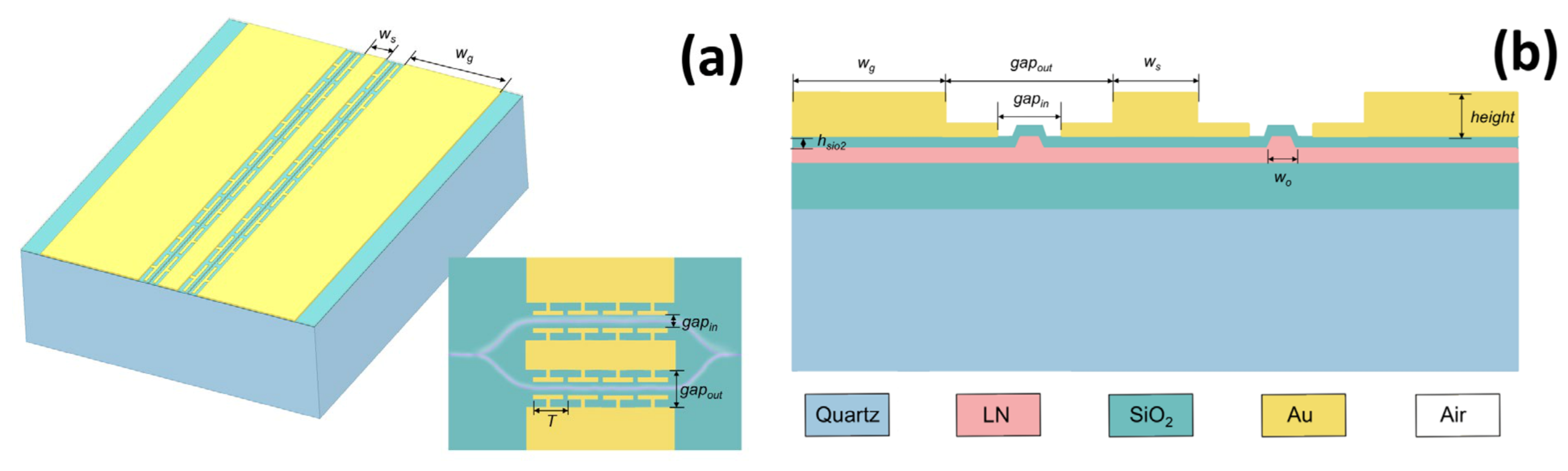
| ws | 20 μm | 100 μm | Signal electrode width | 50 μm |
| wg | 50 μm | 300 μm | Ground electrode width | / |
| gapin | 3 μm | 5 μm | Inter-electrode spacing | 3 μm |
| gapout | 7 μm | 20 μm | Outer electrode spacing | 15 μm |
| hsio2 | 100 nm | 800 nm | SiO2 thickness | 100 nm |
| height | 1 μm | 5 μm | Electrode height | 1.4 μm |
| T | 30 μm | 80 μm | T-shaped electrode period | 50 μm |
| q | 0.7 | 0.95 | Duty cycle | 0.9 |
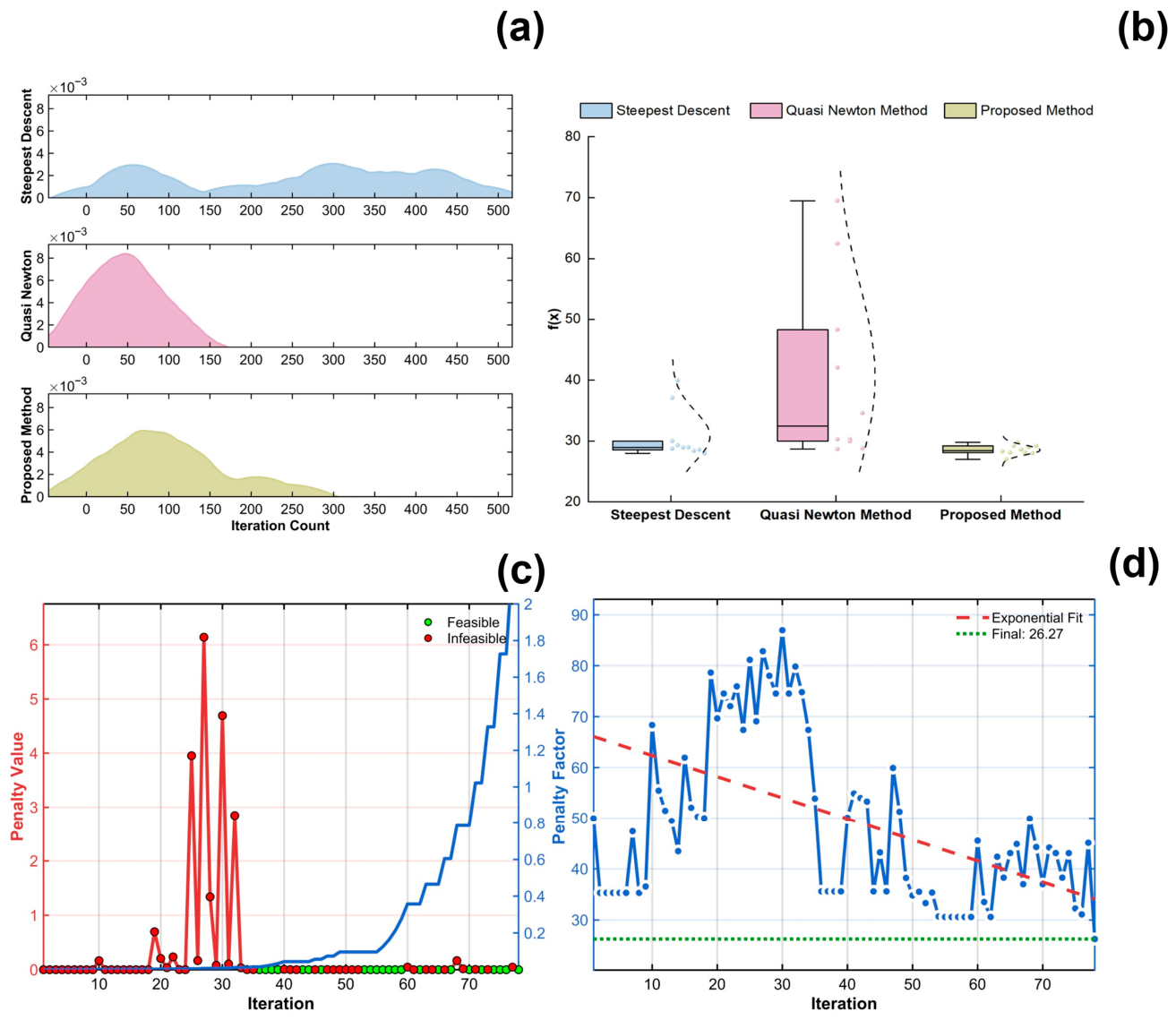
| Optimization Method | Average Number of Iterations | Minimum Iteration | Maximum Iteration | Average Number of Final f(X) | Converged Runs |
|---|---|---|---|---|---|
| Proposed Method | 96.7 | 8 | 238 | 28.5 | 20 |
| Gradient Descent Algorithm | 181.5 | 24 | 371 | 30.8 | 16 |
| Quasi-Newton Algorithm | 43 | 4 | 109 | 40.7 | 10 |
| Sequential Optimization * | 2096 | / | / | 27 | / |
| Model | Optimized Results | Optimized Indicators (40 GHz) | Iteration Count | ||
|---|---|---|---|---|---|
| Figure 8a | ws | 21 μm | Zo | 50 Ω | 97 |
| gap | 10 μm | ne | 2.25 | ||
| hsio2 | 0.1 μm | Loss | 3.3 dB/cm | ||
| height | 1 μm | 4 V·cm | |||
| Figure 8b | ws | 11.5 μm | Zo | 48 Ω | 129 |
| gap | 5 μm | ne | 2.25 | ||
| hsio2 | 1.4 μm | Loss | 4.6 dB/cm | ||
| height | 1.4 μm | 2.2 V·cm | |||
| Figure 8c | ws | 80 μm | Zo | 55 Ω | 302 |
| gapin | 3 μm | ne | 2.24 | ||
| gapout | 14 μm | Loss | 4.7 dB/cm | ||
| hsio2 | 0.1 μm | 1.4 V·cm | |||
| height | 1.2 μm | ||||
| T | 30 μm | ||||
| q | 0.9 | ||||
| Figure 8d | ws | 16 μm | Zo | 50 Ω | 107 |
| gapITO | 3 μm | ne | 2.25 | ||
| gapAu | 7 μm | Loss | 4.5 dB/cm | ||
| hsio2 | 0.1 μm | 1.5 V·cm | |||
| height | 2.8 μm | ||||
| Match Parameters | Optimized Results | Optimize Indicators | Other Indicators | |||||||
|---|---|---|---|---|---|---|---|---|---|---|
| Matching impedance | Etching Depth | ws (μm) | gap (μm) | hsio2 (μm) | height (μm) | |∆Z| (Ω) | |∆n| | Loss (dB/cm) | (V·cm) | Iteration count |
| 35 Ω | 300 nm | 23 | 4 | 1.3 | 2 | 1 | 0.02 | 4.5 | 1.7 | 43 |
| 50 Ω | 300 nm | 8 | 5 | 0.1 | 1.5 | 2 | 0.02 | 4.8 | 2.6 | 101 |
| 75 Ω | 300 nm | 6 | 10 | 1.1 | 2 | 1 | 0.02 | 3.7 | 4.3 | 139 |
| 35 Ω | 400 nm | 22 | 4 | 1.3 | 1.8 | 0 | 0.01 | 4.1 | 1.7 | 77 |
| 50 Ω | 400 nm | 11.5 | 5 | 1.4 | 1.4 | 2 | 0 | 4.6 | 2.2 | 129 |
| 75 Ω | 400 nm | 7 | 12 | 0.9 | 1.3 | 1 | 0 | 3.6 | 4.9 | 121 |
Disclaimer/Publisher’s Note: The statements, opinions and data contained in all publications are solely those of the individual author(s) and contributor(s) and not of MDPI and/or the editor(s). MDPI and/or the editor(s) disclaim responsibility for any injury to people or property resulting from any ideas, methods, instructions or products referred to in the content. |
© 2026 by the authors. Licensee MDPI, Basel, Switzerland. This article is an open access article distributed under the terms and conditions of the Creative Commons Attribution (CC BY) license.
Share and Cite
You, Q.; Hua, P.; Chen, Y.; Chen, X.; Ye, T. Automated Inverse Design Framework for Traveling-Wave Electrode Electro-Optic Modulators with Discrete Fabrication Constraints. Photonics 2026, 13, 500. https://doi.org/10.3390/photonics13050500
You Q, Hua P, Chen Y, Chen X, Ye T. Automated Inverse Design Framework for Traveling-Wave Electrode Electro-Optic Modulators with Discrete Fabrication Constraints. Photonics. 2026; 13(5):500. https://doi.org/10.3390/photonics13050500
Chicago/Turabian StyleYou, Qi, Pingrang Hua, Yifei Chen, Xingshan Chen, and Tong Ye. 2026. "Automated Inverse Design Framework for Traveling-Wave Electrode Electro-Optic Modulators with Discrete Fabrication Constraints" Photonics 13, no. 5: 500. https://doi.org/10.3390/photonics13050500
APA StyleYou, Q., Hua, P., Chen, Y., Chen, X., & Ye, T. (2026). Automated Inverse Design Framework for Traveling-Wave Electrode Electro-Optic Modulators with Discrete Fabrication Constraints. Photonics, 13(5), 500. https://doi.org/10.3390/photonics13050500