


Abstract
High-power thulium-doped fiber lasers (TDFLs) operating near 2050 nm are of great interest for applications including atmospheric gas sensing and free-space optical communication owing to the favorable atmospheric transmission and the strong absorption bands of carbon dioxide (CO2). Here, we report an all-fiber high-power TDFL based on a 793 nm-pumped master oscillator power amplifier (MOPA) architecture. The system comprises a custom-built linear-cavity seed laser and two amplification stages. With a maximum pump power of 818 W, the final amplifier delivers 501 W at 2050 nm with a slope efficiency of 51%. Stable operation is confirmed over two hours at full power, with an RMS power fluctuation of only 0.47%. The measured beam quality factors are 1.31 and 1.27 in the horizontal and vertical directions, respectively, indicating near-diffraction-limited performance. The demonstrated system combines high output power, excellent stability, and good beam quality, and thus provides a promising laser source for 2 μm high-performance applications.
1. Introduction
In recent years, TDFLs have attracted extensive academic attention owing to their advantages such as compact structure, excellent beam quality, and high quantum efficiency. Among them, high-power continuous-wave TDFLs have found significant applications in numerous fields, including medicine, military security, free-space optical communications, gas sensing, material processing, and advanced spectroscopy [1,2,3,4,5,6,7,8]. Thulium-doped fibers (TDFs) exhibit broad absorption and emission spectra, enabling laser generation across the spectral range of 1.7–2.1 μm.
From the perspective of application requirements, fiber lasers operating in the spectral band around 2050 nm with high beam quality and power stability are particularly well suited for remote sensing and free-space optical communications, primarily because their emission wavelength aligns with the strong absorption peak of CO2 [9,10,11,12,13,14]. Among the various light detection and ranging (LIDAR) techniques employed for ground-based observations, differential absorption LIDAR (DIAL) exhibits significant potential [15]. The selection of CO2 absorption lines for DIAL systems is exceptionally stringent, as these lines must remain decoupled from water-vapor absorption features. Consequently, many CO2 DIAL systems incorporate laser sources operating at 1.57 μm or 2.05 μm, wavelengths that can be directly accessed using erbium-doped fibers or thulium/holmium-doped fibers, respectively [16]. For 2050 nm lasers employed in airborne and space-borne remote sensing systems for CO2 sensing, all-fiber lasers are considered ideal due to their lightweight architecture, compact footprint, and robust resilience to environmental fluctuations [17]. Furthermore, lasers operating at 2050 nm are well suited for coherent detection techniques in wind-speed measurement systems and for the precise characterization of CO2 spectral parameters around 2.05 μm [18]. They can also serve as high-quality pump sources for ZnGeP2-based optical parametric oscillators (OPOs), enabling the efficient generation of mid-infrared radiation in the 3–5 μm range [19,20,21,22]. High-power TDFLs operating at 2050 nm are also ideal candidate sources for both soft- and hard-tissue surgical procedures, such as laser ablation and lithotripsy. Due to their high absorption in water and localized thermal effect, these lasers can be widely applied in high-precision tissue resection, ophthalmic surgery, and dental procedures [23]. Beyond medical fields, these systems are well suited for the laser transmission welding of transparent polymer [24,25,26,27]. In contrast, conventional pump wavelengths below 2 μm are prone to absorption by intrinsic defects in ZnGeP2 crystals [19,28,29]. Compared with solid-state lasers, TDFLs offer distinct advantages in thermal management, energy conversion efficiency, flexible integration, and operational stability. In compact systems for fixed-wavelength output, the primary advantage of the linear-cavity configuration lies in its structural simplicity, while avoiding the inherent mode-hopping risk of ring cavities. The highly integrated all-fiber design provides excellent mechanical and thermal stability, and also significantly reduces system footprint, cost, and engineering complexity. These characteristics make linear-cavity architectures an ideal choice for applications demanding high reliability, environmental robustness, and industrial-scale deployment [30,31].
High-power TDFLs are typically pumped by 793 nm laser diodes (LDs). This specific pump wavelength exploits the efficient cross-relaxation (CR) process within thulium ions (Tm3+), which can theoretically lead to a quantum efficiency exceeding 100% [32]. This process can generate two laser photons from a single pump photon, thereby effectively surpassing the Stokes efficiency limit. The probability of the CR process occurring depends on the doping concentration of thulium ions in the gain fiber. In recent years, the increasing maturity of high-power 793 nm semiconductor lasers, combined with the efficient CR process, has accelerated the development of TDFLs [33,34]. In 2010, Pearson et al. developed a 100 W TDFL utilizing a MOPA structur [35]. Subsequently, Q-peak reported a kilowatt-level TDFL output in 2010 through an all-fiber MOPA configuration with a slope efficiency of 53.2% [36]. More recently, in 2023, Ren et al. demonstrated a tunable all-fiber thulium-doped MOPA system capable of achieving an output power exceeding 1 kW while maintaining a high slope efficiency of over 51% [37]. Despite these advancements, the performance of conventional linear-cavity structures at the specific wavelength of 2050 nm remains significantly limited, with the highest reported output power reaching only 204.6 W. In 2015, Li et al. demonstrated a 2050 nm single-frequency all-fiber MOPA system yielding 75 W of output at a central wavelength of 2050.5 nm [38]. Shin J. S. et al. also recently reported a 2050 nm TDFL with a maximum output of 204.6 W, realized via a linear-cavity seed source and a single-stage amplifier [39]. Compared to patially configured systems, the all-fiber design for high-power TDFLs offers advantages, such as compact architecture, robust environmental adaptability, and reliable operational stability. Such characteristics provide critical support for the practical deployment of high-power 2050 nm lasers. Guided by these design advantages and aiming to overcome the current power limitations at this wavelength, this study demonstrates a simple-structured, high-power, and stable 2050 nm TDFL system.
In this study, we demonstrate a high-power and structurally simple TDFL operating at 2050 nm. Utilizing a 793 nm LD-pumped all-fiber architecture, the system achieves a maximum output power of 501 W from the final amplifier stage with a corresponding slope efficiency of 51%. The laser exhibits excellent operational stability, maintaining the maximum 501 W output over two hours of continuous operation with an RMS power fluctuation of only 0.47%. At the full power of 501 W, the measured factors are 1.27 and 1.31 in the horizontal and vertical directions, respectively.
2. Experimental Setup and Theoretical Analysis
2.1. Experimental Setup
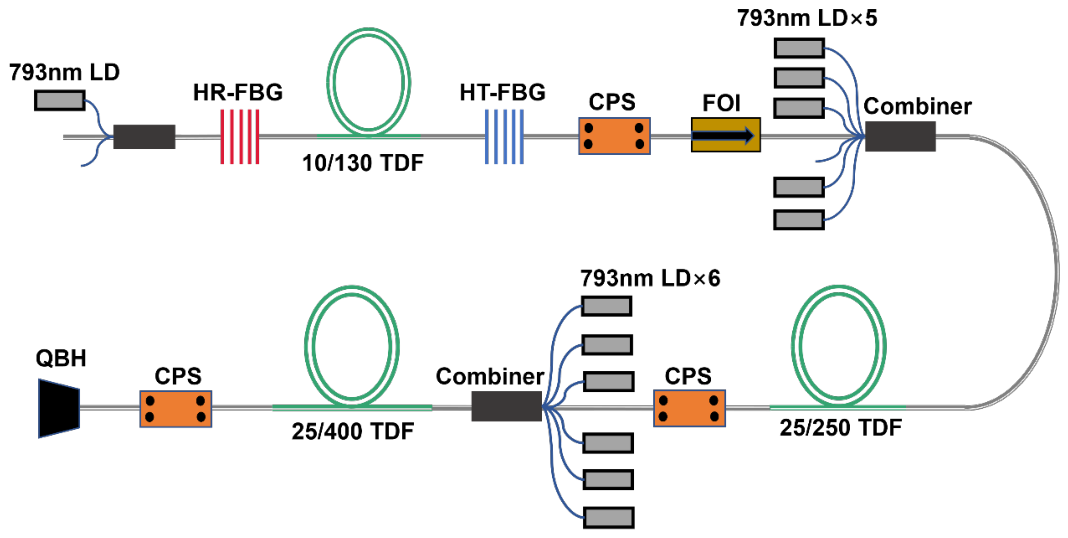
The 2050 nm fiber laser system is constructed based on a master oscillator power amplifier (MOPA) configuration. In the seed oscillator, a linear resonant cavity formed by a commercially available single-mode thulium-doped fiber (TDF) and a pair of matched fiber Bragg gratings (FBGs) provides a seed output power of 18.1 W at the target wavelength. The seed light is subsequently amplified through a two-stage all-fiber amplifier chain pumped by 793 nm laser diodes (LDs). This integrated design is ultimately intended to achieve a maximum output power of 500 W.
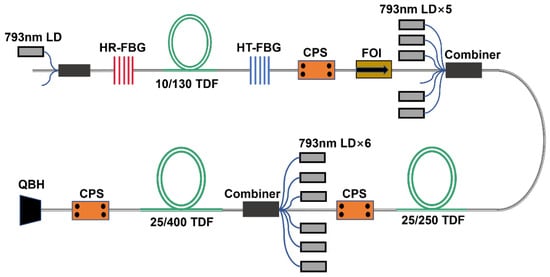
The experimental setup of the system is illustrated in Figure 1. The oscillator stage employs a 5-m-long active TDF as the gain medium. The resonant cavity is formed by two commercial FBGs: a high-reflectivity (HR) grating and a low-reflectivity (LR) grating. The HR-FBG exhibits a reflectivity of 99.8% with a 2 nm bandwidth at 2050 nm, while the LR-FBG provides 5% reflectivity with a 0.5 nm bandwidth at the same wavelength. The gain fiber is a commercially available single-mode double-clad TDF (SM-TDF-10P/130-HE, Nufern, East Granby, CT, USA), featuring a core diameter of 10 μm and a cladding diameter of 130 μm. The corresponding numerical apertures (NAs) are 0.15 and 0.46, respectively. Both ends of the TDF are fusion-spliced to core-matched single-mode fibers. The pump source for the oscillator stage is a 793 nm LD with a maximum output power of 100 W. The delivery fiber of this LD has a core diameter of 105 μm and an NA of 0.22. The pump light is injected into the TDF through a signal–pump combiner. At the output end of the oscillator, a cladding power stripper (CPS) and a polarization-insensitive fiber optical isolator (FOI) are connected in sequence. The CPS is used to suppress the residual pump light at the oscillator output. The FOI ensures unidirectional propagation of the seed light and prevents any detrimental feedback to the seed source during the amplification process.
Figure 1.
Schematic diagram of the high-power all-fiber 2050 nm TDFL MOPA system. LD: laser diode; HR-FBG: high-reflectivity fiber Bragg grating; TDF: thulium-doped fiber; HT-FBG: high-transmissivity fiber Bragg grating; CPS: cladding power stripper; FOI: fiber optical isolator; Combiner: fiber beam combiner; QBH: quartz beam header.
To scale the seed power toward 500 W, a two-stage MOPA configuration was employed. This design was chosen to ensure stable power scaling while maintaining efficient pump absorption and manageable thermal load. The fibers used in both the oscillator and amplifier stages were bare fibers without pedestals. Direct amplification from the seed to the final output in a single stage would require extremely high gain and pump intensity, which could increase the risks of amplified spontaneous emission (ASE) generation and thermal accumulation. Therefore, a pre-amplification stage was implemented to raise the signal power to approximately 140 W, providing sufficient seed power for the final amplifier stage. The seed beam generated by the master oscillator is coupled into the amplifier chain via a signal–pump combiner. The output port of this combiner consists of a large-mode-area (LMA) fiber with core and cladding diameters of 25/250 μm, respectively. The first-stage amplifier employs a 5-m-long large-mode-area thulium-doped fiber (LMA-TDF-25P/250-M, Nufern, East Granby, CT, USA) with a core/cladding diameter of 25/250 μm and an NA of 0.09/0.46. The cladding absorption coefficient at the 793 nm pump wavelength is approximately 6.3 dB/m. This design enables efficient pump absorption while effectively reducing the average thermal load on the gain fiber. The pump source for the first-stage amplifier consists of five wavelength-stabilized 793 nm LDs. These diodes are connected to a mode-field-matched signal–pump combiner, which injects the pump light into the TDF. This combiner exhibits an insertion loss of 0.12 dB and a pump coupling efficiency exceeding 97.5%, delivering a total pump power of approximately 250 W. A mode-field-matched CPS is connected at the output end of the gain fiber, achieving a pump-stripping efficiency of 98.6% and handling residual pump power up to 200 W. To enhance heat dissipation, the gain fiber is wound on a V-groove aluminum water-cooled plate with a diameter of approximately 10 cm and is directly cooled by circulating water at 10 °C. The 10 cm coil diameter is chosen to simultaneously suppress higher-order transverse modes and limit bending-induced losses, achieving effective mode control while maintaining stable high-power operation. Prior to winding, a thermal grease with a thermal conductivity of 18.2 W/(m·K) is applied within the grooves to fill the gaps between the fiber and the cooling plate, thereby improving thermal conduction efficiency.
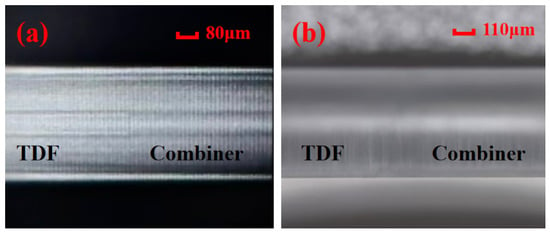
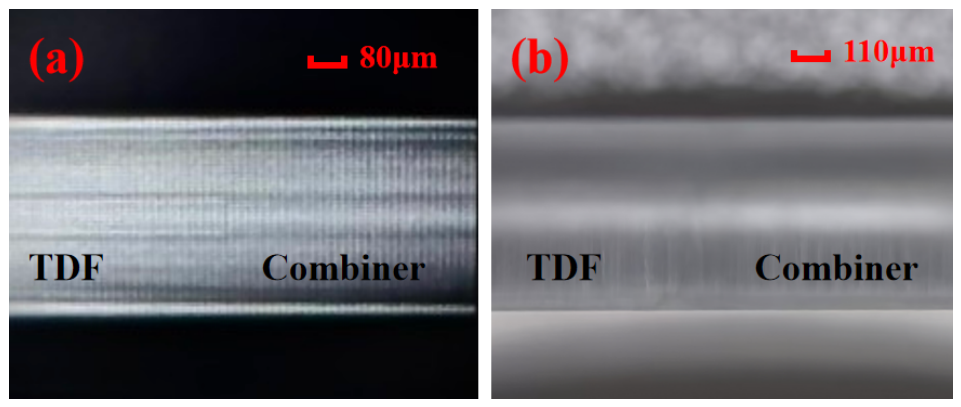
The gain fiber of the second-stage amplifier is a 7-m-long double-clad Tm3+-doped fiber (CJTDF-25/400, Wuhan Changjin Photonics Technology Co., Ltd., Wuhan, China) with core and cladding diameters of 25/400 μm and NAs of 0.11/0.46. It exhibits a cladding absorption of approximately 2.4 dB/m at 793 nm. Both ends of the fiber are fusion-spliced to matched passive fibers. To manage heat, the active fiber is wound in a helical configuration with a diameter of approximately 10 cm onto a V-shaped water-cooled plate connected to a 10 °C cooling system. Similar to the first-stage amplifier, a thermal grease with a thermal conductivity of 18.2 W/(m·K) is applied within the V-grooves before winding. Previous studies have shown that the use of LMA fibers, precise mode-field matching, and water-cooled V-groove plates can help effectively control stimulated Brillouin scattering (SBS), stimulated Raman scattering (SRS), and transverse mode instability (TMI) [37]. The second-stage amplifier is driven by six 793 nm fiber-coupled LDs, each providing an output power exceeding 150 W (FC-793-150-C200, AOEC, Weifang, China). The pump delivery fiber features a core diameter of 200 μm and an NA of 0.22. These pump beams are integrated via a pump–signal combiner, delivering a total maximum pump power of 900 W. The amplified laser output passes through a CPS capable of stripping up to 300 W of residual pump power. A fiber endcap is mounted at the output end to suppress optical feedback and prevent end-face damage. During the assembly of the amplifier, meticulous attention is paid to the fiber splicing and cladding recoating processes. Due to the high pump power, even marginal losses at the splice points can trigger a sharp temperature rise, potentially leading to fiber fusion or burnout. Therefore, during the fiber connection process, it is essential to ensure clean stripped surfaces, neat end faces, and an interface free of defects such as gaps or bubbles. Following the recoating process, the fiber surface must remain smooth and free of burrs to ensure long-term system reliability. Figure 2a,b provide microscopic views of the splicing and recoating interfaces, respectively, between the TDF and the passive fiber of the combiner. As shown in Figure 2a, the fiber cladding and core are precisely aligned with no observable offset, which minimizes fusion loss and prevents localized thermal accumulation at the splice point. Furthermore, the recoating interface in Figure 2b demonstrates a highly uniform and bubble-free protective layer. This high-quality coating ensures that the cladding light is effectively contained and the mechanical strength of the fiber is maintained, both of which are critical for stable operation under high-power pumping conditions.
Figure 2.
Micrographs of the TDF–combiner connection. (a) Splicing interface between the TDF (left) and the combiner (right), showing the alignment of the cladding and core; (b) recoated interface between the TDF (left) and the combiner (right).
Throughout the experimental process, the laser output power and its temporal stability are measured using a high-power optical power meter (1000W-BB-34, Ophir Optronics Solutions Ltd., Jerusalem, Israel). All fiber splices were performed using a fusion splicer (FSM-100P, Fujikura Ltd., Tokyo, Japan), and the splices were recoated immediately to restore the protective coating. The temperatures at critical locations, including all fiber splice points and pump LD modules, are monitored in real time using an infrared (IR) thermometer (ST9550A+, Smart Sensor Holding Company Ltd., Dongguan, China), which provides a measurement accuracy of ±2 °C. This comprehensive thermal monitoring ensures operational safety and prevents performance degradation caused by localized overheating during high-power operation.
2.2. Theoretical Analysis
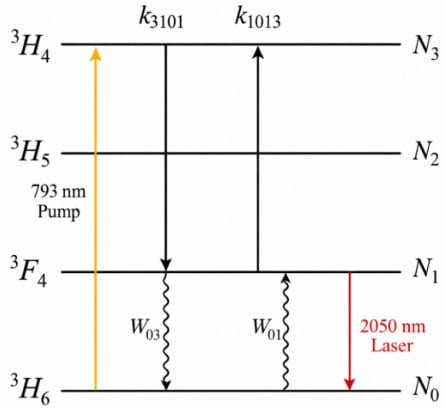
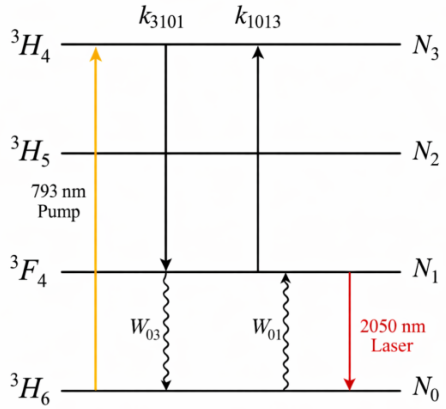
To optimize the output power of the two-stage amplifier, we analyzed the effects of the gain-fiber length and injected pump power on the signal laser by numerically solving the steady-state rate equations of thulium-doped fibers (TDFs). Under 793 nm pumping, Figure 3 illustrates the energy-level transitions of Tm3+ ions in the TDFLs, and the corresponding population dynamics are described by the following steady-state rate equations:
Figure 3.
Energy-level diagram of Tm3+ showing 793 nm pump absorption (yellow arrow) and 2050 nm stimulated emission (red arrow).
In these equations, , , and represent the ground-state pump absorption coefficient, the laser stimulated emission coefficient, and the laser stimulated absorption coefficient, respectively. N denotes the doping concentration of thulium ions in the gain fiber; , , and correspond to the thulium ion populations in the , , and energy levels, respectively; and are the lifetimes of thulium ions in the and levels, respectively; and and represent the cross-relaxation coefficients [34,40].
where and represent the forward- and backward-propagating pump power along the fiber, respectively; denotes the signal power; and represent the forward- and backward-propagating amplified spontaneous emission (ASE) power, respectively; and denote the power filling factors for the pump and the laser signal, respectively; is the stimulated emission cross-section at the signal wavelength, while and are the absorption cross-sections at the pump and signal wavelengths, respectively; c is the speed of light in vacuum; h is Planck’s constant; and is the cross-sectional area of the TDF core.
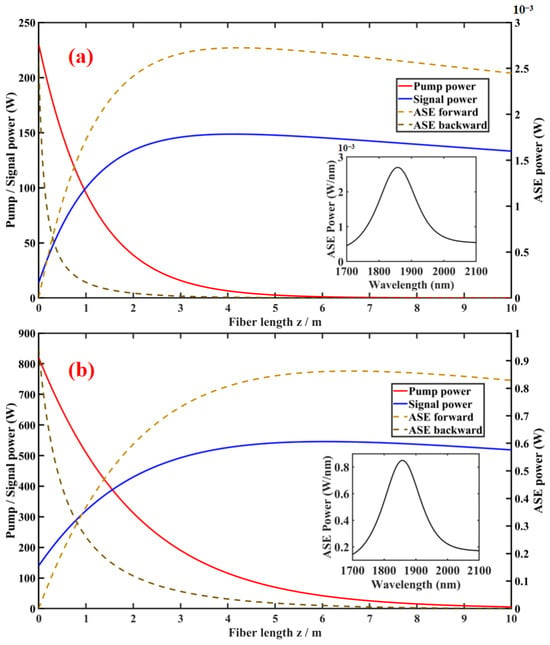
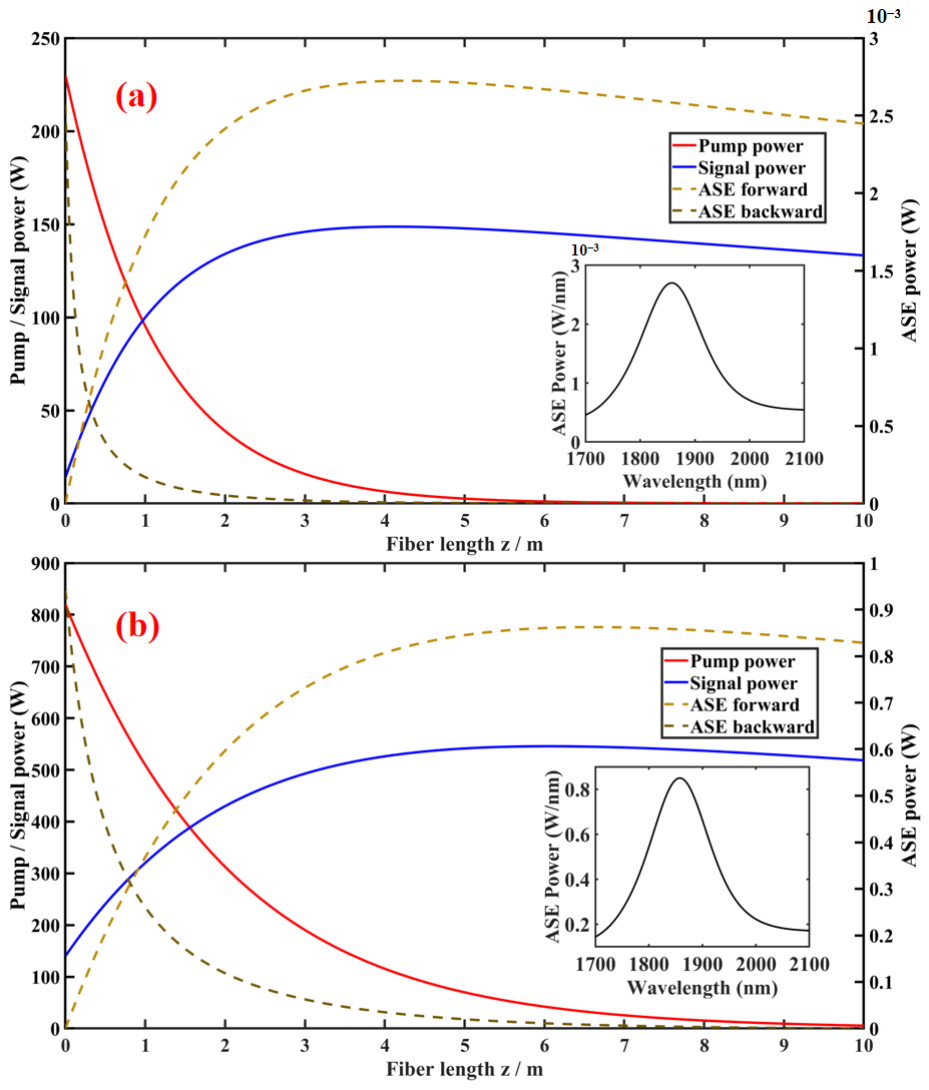
where z denotes the longitudinal position along the gain fiber and represents the wavelength sampling resolution. By solving Equations (1)–(10) simultaneously with the appropriate boundary conditions, steady-state solutions are obtained using numerical methods such as the fourth-order Runge–Kutta method. Figure 4 shows the simulated output power of the 2050 nm laser as a function of gain-fiber length for injected pump powers of 230 W and 820 W in the first- and second-stage amplifiers, respectively. It also illustrates the evolution of the pump and signal powers along the gain fiber in both amplifier stages. In both cases, the pump power decreases monotonically due to absorption in the thulium-doped fiber, while the signal power increases along the fiber through stimulated emission assisted by the cross-relaxation process characteristic of 793 nm pumping. For the first-stage amplifier, the injected pump power is 230 W. Owing to the relatively high cladding absorption coefficient (∼6.3 dB/m), the pump power is rapidly absorbed within the first few meters, leading to a fast increase in signal power that approaches saturation beyond approximately 4–5 m. Extending the fiber length further provides limited power improvement while increasing propagation loss and reabsorption. As shown in Figure 4a, the simulated forward and backward ASE powers (dashed lines, right axis) remain much lower than the signal power throughout the amplification process, and the inset displays the simulated ASE spectra along the 2050 nm band, indicating only a weak contribution of ASE under the present operating conditions. Therefore, a fiber length of about 5 m is selected for efficient pre-amplification. For the second-stage amplifier (Figure 4b), the injected pump power is increased to 820 W, while a lower-doped fiber (∼2.4 dB/m absorption) is used. The pump power therefore decays more gradually, resulting in a more distributed gain profile and allowing the signal power to continue increasing over a longer distance. The simulation indicates that the output power approaches saturation at a fiber length of about 7–8 m, and a length of 7 m is adopted in the experiment. Beyond this range, the signal power no longer increases and instead shows a slight decrease, again suggesting that excessively long fiber lengths reduce the net output power. The simulated ASE spectra (shown in the inset of Figure 4b) remain far below the signal power across the amplification band, confirming the weak impact of ASE in the second stage as well. These results provide theoretical support for the selected fiber lengths and confirm that the two-stage MOPA configuration enables efficient pump utilization while distributing the thermal load under high pump power conditions.
Figure 4.
Simulation results of output power versus fiber length for the TDFL amplifier stages. (a) First-stage amplifier with an injected pump power of 230 W; the inset shows the simulated ASE spectrum. (b) Second-stage amplifier with an injected pump power of 820 W; the inset shows the simulated ASE spectrum.
3. Experimental Results & Discussion
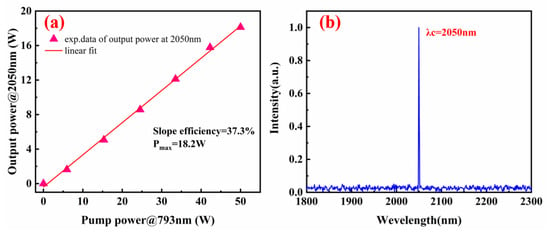
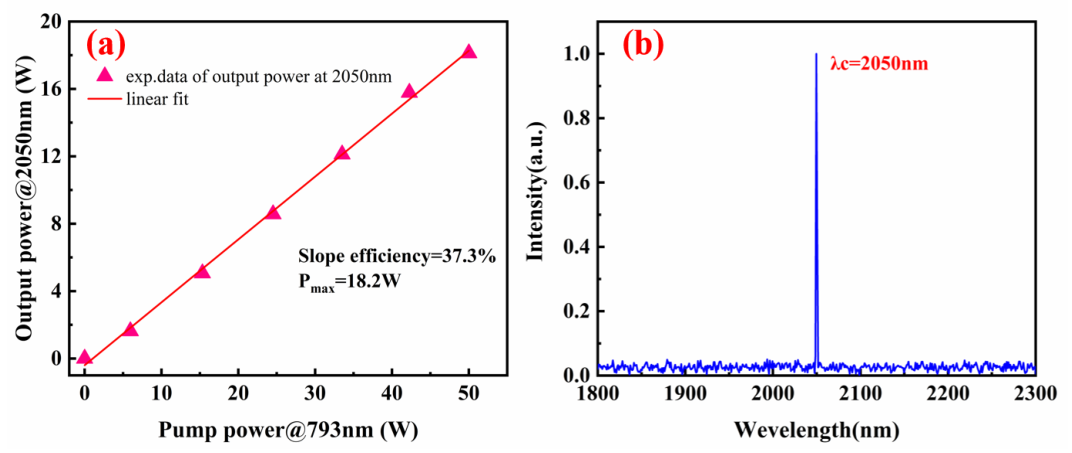
All equipment used in this experiment was carefully inspected to ensure the reliability of the measurements. Prior to connecting the thulium-doped fiber amplifier, the output characteristics of the seed laser were measured. The seed beam was delivered through a cladding power stripper (CPS) and emitted via an angle-cleaved fiber end. The relationship between the seed output power and the injected 793 nm LD pump power is shown in Figure 5a. At a pump power of 50 W, the oscillator output reaches 18.1 W, corresponding to a slope efficiency of 37.3%. The maximum output is limited by the handling capacity of the signal pump combiner. No anomalies were observed even when operating the oscillator at full power for extended periods. Figure 5b shows the corresponding emission spectrum, with a single peak centered at 2050 nm, indicating high spectral purity.
Figure 5.
(a) Output power of the oscillator as a function of LD pump power. (b) Corresponding emission spectrum of the oscillator.
Following the comprehensive characterization of the seed laser source, the two-stage power amplifier chain was sequentially integrated. During assembly, the laser power was monitored at each stage to evaluate the insertion losses of individual components. After passing through the FOI and the first-stage combiner, the seed power decreased slightly to 17.8 W. Transmission through the thulium-doped fiber (TDF) of the first-stage amplifier further reduced the power to 13.4 W, primarily due to reabsorption at the signal wavelength. Despite this reduction, numerical simulations and preliminary calculations indicate that this residual seed power is sufficient to achieve the design target of 500 W output through the planned two-stage amplification.
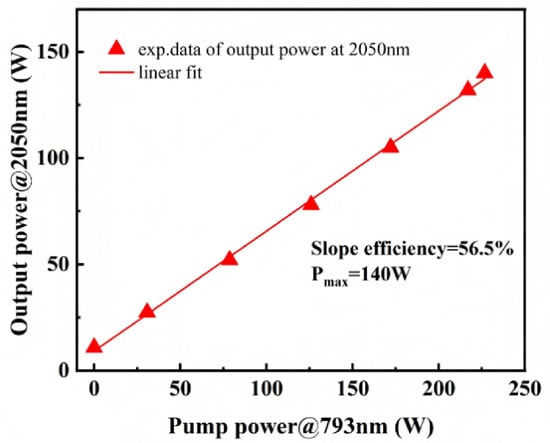
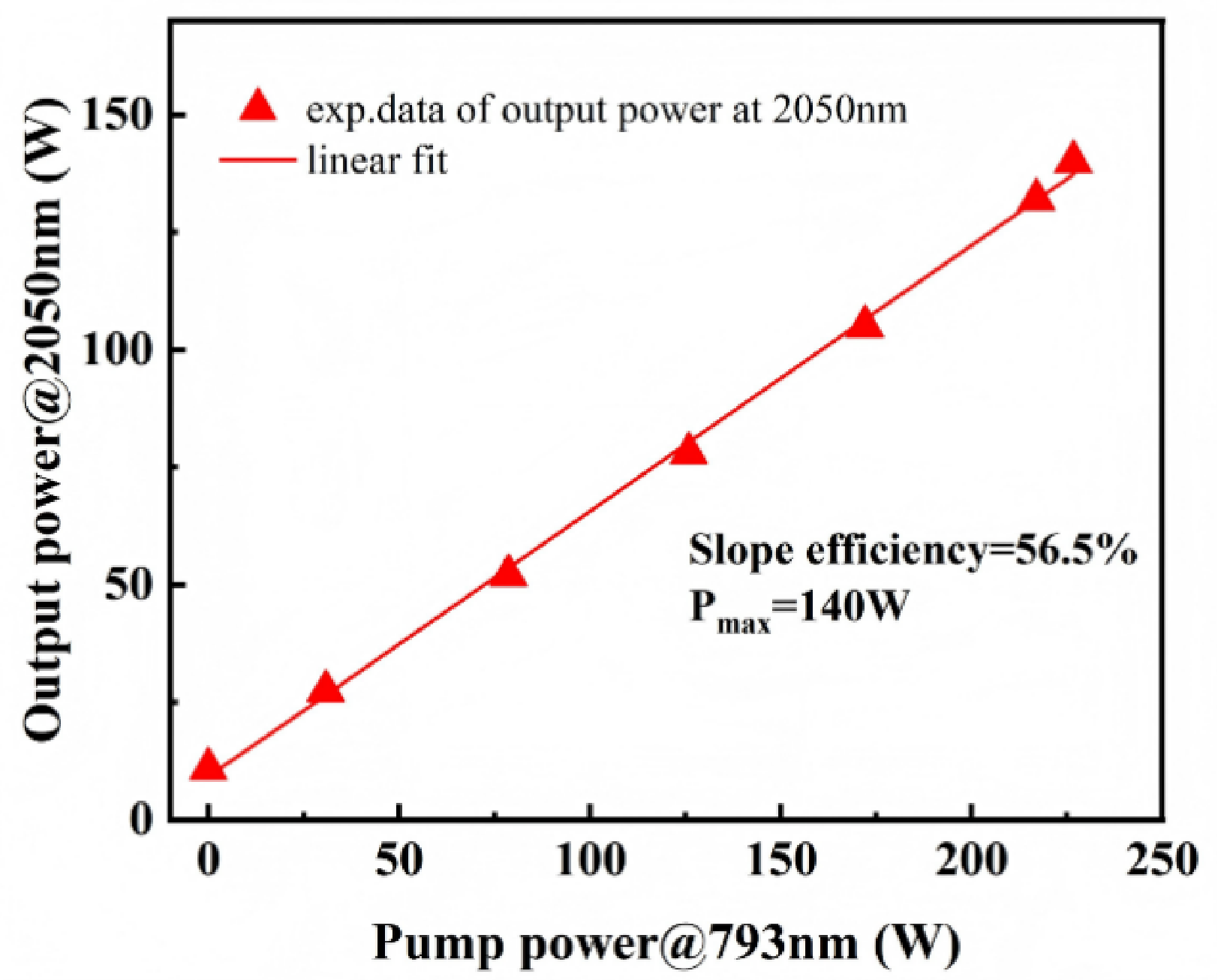
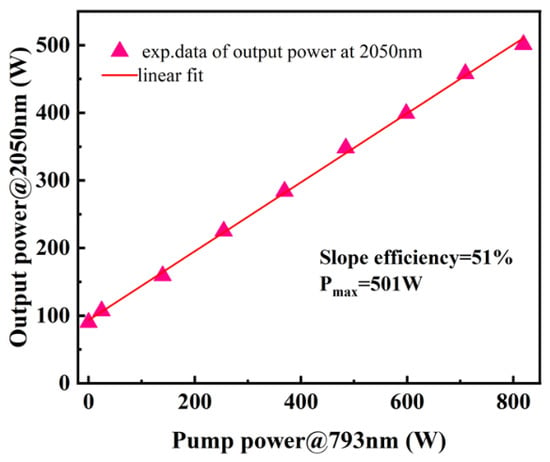
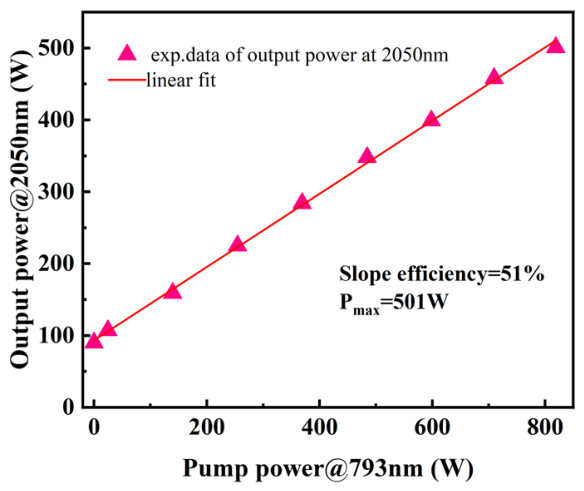
The oscillator-stage laser was subsequently injected into the MOPA system for power amplification. The relationship between the signal power of the first-stage amplifier and the injected pump power is illustrated in Figure 6. As shown, the output power increases linearly with the pump power injected into the TDF. When the injected pump power is 226 W, the output power of the first-stage amplifier reaches 140 W, corresponding to a slope efficiency of 56.5%. To prevent damage to the optical components, no further power scaling was attempted for the first-stage amplifier. Subsequently, the output from the first-stage amplifier was injected into the second-stage amplifier for final amplification. In the absence of pump power in the second-stage amplifier, the laser output power dropped to 90 W due to the reabsorption of the TDF at 2050 nm [21]. The final amplifier stage was designed to boost the laser power to above 500 W. The relationship between the signal power of the final amplifier and the injected pump power is shown in Figure 7. When the total injected pump power from the 793 nm LDs reached 818 W, the measured output power of the second-stage amplifier was 501 W, corresponding to a slope efficiency of 51%. Similarly to first-stage amplification, the final output power exhibited a linear relationship with the injected pump power. Compared with the first-stage amplifier, the slight reduction in the slope efficiency of the second-stage amplifier can be attributed to a weaker cross-relaxation effect resulting from the lower doping concentration of Tm3+ ions in the TDF-25/400 fiber [14,23].
Figure 6.
Output power of the first-stage amplifier versus the injected LD pump power.
Figure 7.
Output power of the second-stage amplifier (Amplifier 2) versus the injected LD pump power.
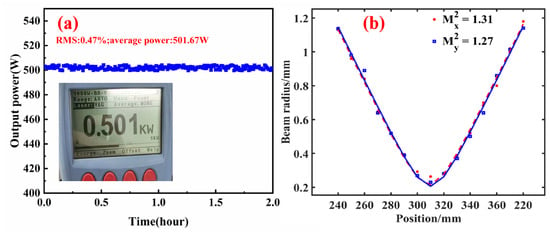
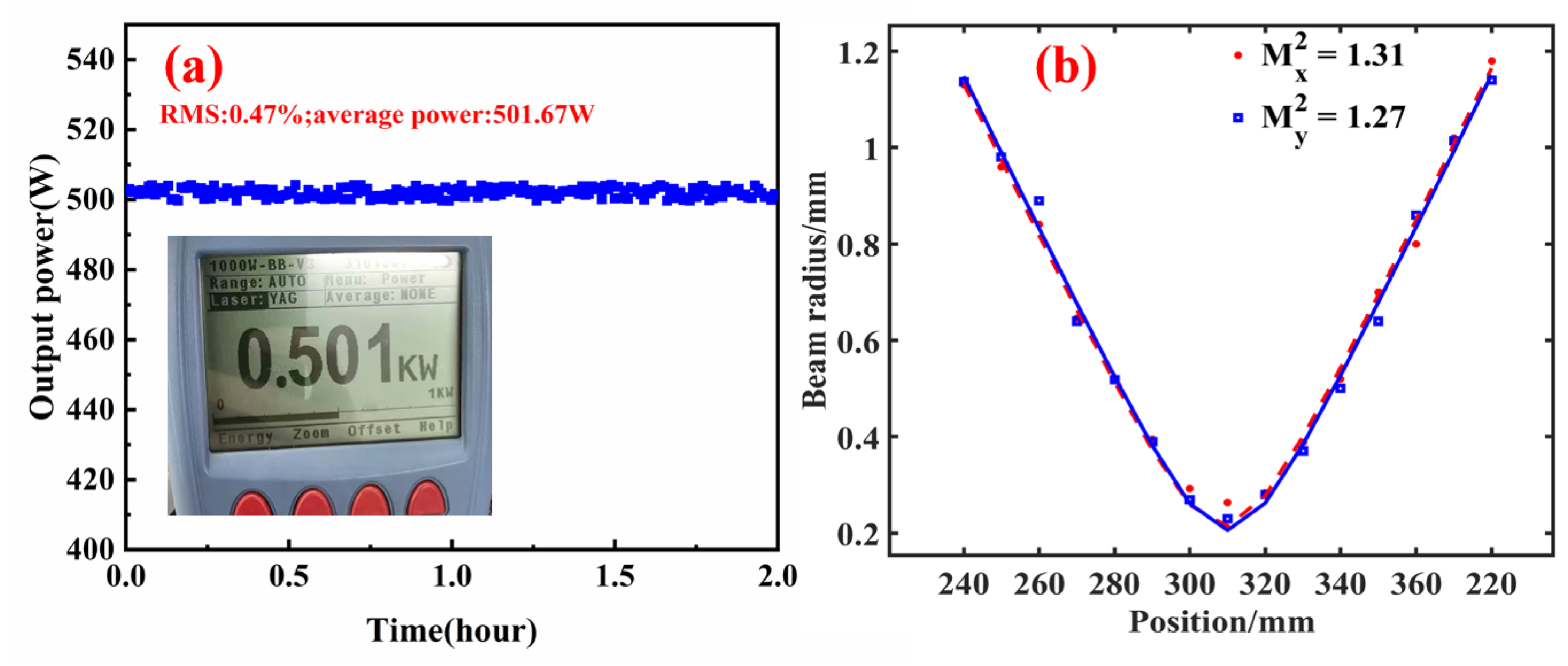
To evaluate the system stability under sustained high-power operation, the laser was operated continuously for two hours, with the output power recorded at 1-min intervals. Under an injected pump power of 818 W in the second-stage amplifier, the system delivered an average output power of 501.67 W with an RMS fluctuation of 0.47%, as shown in Figure 8a, demonstrating robust operational stability. The output beam quality at the maximum power is shown in Figure 8b, with measured values of 1.31 and 1.27 in the horizontal and vertical directions, respectively, obtained using the knife-edge method, indicating good beam quality approaching the diffraction limit. This performance was achieved through the use of LMA fibers, careful mode-field matching, and the selection of appropriate fiber bending radii to minimize stress-induced distortions.
Figure 8.
(a) Temporal power stability tests over a 2-h duration. (b) Measured beam quality of the laser output at the maximum power of 501 W.
For compact, fixed-wavelength 2050 nm systems, linear-cavity configurations are preferred for their structural simplicity and minimal intracavity components, which help reduce assembly complexity, insertion loss, and potential failure points. The fully integrated all-fiber design provides mechanical and thermal stability while maintaining a small system footprint and moderate cost, making it suitable for robust and industrially deployable applications. Recent progress on high-power TDFLs operating near 2050 nm is summarized in Table 1. Although a three-stage ring-cavity system in [37] reached a maximum output power of 1028 W, the output after its second amplification stage was only 429 W. In comparison, our two-stage linear-cavity system achieves 501 W, representing the highest reported continuous-wave output for linear-cavity all-fiber TDFLs at 2050 nm, and illustrating the power-scaling capability and compactness of a two-stage linear-cavity architecture.
Table 1.
Performance comparison of high-power TDFLs operating at 2050 nm.
4. Conclusions
In summary, a high-power 2050 nm fiber laser based on a MOPA architecture is reported. In the oscillator stage, a linear resonant cavity is formed by two FBGs and subsequently connected to a two-stage all-fiber amplifier chain. Owing to its simplified configuration, the system features high stability and robustness, making it suitable for various applications in demanding environments. Pumped by 793 nm LDs, the system achieves a maximum output power of 501 W. To the best of our knowledge, this is the highest output power ever reported for a continuous-wave linear-cavity TDFL at 2050 nm. During two hours of continuous operation, the laser exhibits stable performance without parasitic oscillations, with RMS power fluctuations of 0.47%. At maximum output power, the measured factors are 1.31 and 1.27 in the horizontal and vertical directions, respectively, indicating good beam quality approaching the diffraction limit.
Author Contributions
Conceptualization, H.Z.; data curation, H.P., Z.D. and D.X.; formal analysis, D.X. and X.Z.; funding acquisition, W.Z.; investigation, H.P. and Z.D.; methodology, F.D., X.Z., H.Z. and W.Z.; resources, F.D. and W.Z.; supervision, H.Z. and W.Z.; validation, H.Z.; writing—original draft, H.P. and Z.D.; writing—review and editing, Z.D. and H.Z. All authors have read and agreed to the published version of the manuscript.
Funding
This work was supported by the National Key Research and Development Program of China (2023YFB3609800) and the Key Research and Development Program of Shandong Province, China (2024CXPT098).
Data Availability Statement
Data will be made available on request.
Conflicts of Interest
The authors declare no known competing financial interests or personal relationships that could have appeared to influence the work reported in this paper.
References
- Cousin, S.L.; Silva, F.; Teichmann, S.; Hemmer, M.; Buades, B.; Biegert, J. High-flux table-top soft x-ray source driven by sub-2-cycle, CEP stable, 1.85-μm 1-kHz pulses for carbon K-edge spectroscopy. Opt. Lett. 2014, 39, 5383–5386. [Google Scholar] [CrossRef] [Scilit] [PubMed]
- Sohail, M.T.; Wang, M.; Shareef, M.; Yan, P. A review of ultrafast photonics enabled by metal-based nanomaterials: Fabrication, integration, applications and future perspective. Infrared Phys. Technol. 2024, 137, 105127. [Google Scholar] [CrossRef] [Scilit]
- Jackson, S.D. Towards high-power mid-infrared emission from a fiber laser. Nat. Photonics 2012, 6, 423–431. [Google Scholar] [CrossRef] [Scilit]
- Scott, N.J.; Cilip, C.M.; Fried, N.M. Thulium fiber laser ablation of urinary stones through small-core optical fibers. IEEE J. Sel. Top. Quantum Electron. 2009, 15, 435–440. [Google Scholar] [CrossRef] [Scilit]
- Tao, M.; Tao, B.; Hu, Z.; Feng, G.; Ye, X.; Zhao, J. Development of a 2-μm Tm-doped fiber laser for hyperspectral absorption spectroscopy applications. Opt. Express 2017, 25, 32386–32394. [Google Scholar] [CrossRef] [Scilit]
- Sohail, M.T.; Li, B.; Abdullah, M.; Younis, M.; Wang, M.; Yan, P. Recent advances and challenges of perovskite materials-based saturable absorbers for short-pulsed lasers. Infrared Phys. Technol. 2024, 139, 105306. [Google Scholar] [CrossRef] [Scilit]
- Mingareev, I.; Weirauch, F.; Olowinsky, A.; Shah, L.; Kadwani, P.; Richardson, M. Welding of polymers using a 2-μm thulium fiber laser. Opt. Lett. 2012, 44, 2095–2099. [Google Scholar]
- Sincore, A.; Bradford, J.D.; Cook, J.; Shah, L.; Richardson, M.C. High average power thulium-doped silica fiber lasers: Review of systems and concepts. IEEE J. Sel. Top. Quantum Electron. 2017, 24, 0901808. [Google Scholar] [CrossRef] [Scilit]
- Simakov, N.; Li, Z.; Alam, S.U.; Shardlow, P.C.; Daniel, J.M.O.; Jain, D.; Sahu, J.K.; Hemming, A.; Clarkson, W.A.; Richardson, D.J. Holmium-doped fiber amplifier for optical communications at 2.05–2.13 μm. In Proceedings of the Optical Fiber Communication Conference, Los Angeles, CA, USA, 22–26 March 2015; p. Tu2C.6. [Google Scholar]
- Shah, L.; McComb, T.S.; Sims, R.A.; Willis, C.C.C.; Kadwani, P.; Sudesh, V.; Richardson, M. High power thulium fiber lasers. AIP Conf. Proc. 2010, 1278, 852–860. [Google Scholar]
- Kir’yanov, A.V.; Barmenkov, Y.O.; Garcia, I.V. 2.05 μm holmium-doped all-fiber laser diode-pumped at 1.125 μm. Laser Phys. 2017, 27, 085101. [Google Scholar] [CrossRef] [Scilit]
- Liu, W.; Ju, Y.; Dai, T.; Liu, Q.; Liu, C. A Compact 2.05 μm MOPA Laser with SLM Operation. Microw. Opt. Technol. Lett. 2025, 67, e34482. [Google Scholar] [CrossRef] [Scilit]
- Guo, Y.; Yan, F.; Feng, T. Multi-wavelength thulium-doped fiber laser at 2.05 μm incorporating a superimposed polarization-maintaining fiber Bragg grating. Infrared Phys. Technol. 2022, 122, 104081. [Google Scholar] [CrossRef] [Scilit]
- Zhang, D.; Wang, Y.; Zhou, W.; Cai, X.; Yan, W.; Li, Y.; Hu, H.; Li, P. Single-Mode 2.05 μm Narrow Linewidth Bidirectional Pumped Tm/Ho-Doped Hybrid Pulsed Fiber Amplifier. IEEE Photon. J. 2025, 17, 1503406. [Google Scholar] [CrossRef] [Scilit]
- Li, J.S.; Durry, G.; Cousin, J.; Joly, L.; Parvitte, B.; Flamant, P.H.; Gibert, F.; Zéninari, V. Tunable diode laser measurement of pressure-induced shift coefficients of CO2 around 2.05 μm for Lidar application. J. Quant. Spectrosc. Radiat. Transf. 2011, 112, 1411–1419. [Google Scholar] [CrossRef] [Scilit]
- Bagheri, M.; Frez, C.; Kelly, B.; Gupta, J.; Forouhar, S. High output power, fibre-coupled distributed feedback lasers operating near 2.05 μm wavelength range. Electron. Lett. 2013, 49, 1552–1553. [Google Scholar] [CrossRef] [Scilit]
- Christensen, L.E.; Spiers, G.D.; Menzies, R.T.; Jacob, J. Tunable laser spectroscopy of CO2 near 2.05 μm: Atmospheric retrieval biases due to neglecting line-mixing. Appl. Opt. 2013, 52, 6410–6418. [Google Scholar] [CrossRef] [Scilit]
- Lahyani, J.; Thiers, M.; Gibert, F.; Edouart, D.; Le Gouët, J.; Cézard, N. Hybrid fiber/bulk laser source designed for CO2 and wind measurements at 2.05 μm. Opt. Lett. 2024, 49, 1018–1021. [Google Scholar]
- Dergachev, A.; Armstrong, D.; Smith, A.; Drake, T.; Dubois, M. 3.4-μm ZGP RISTRA nanosecond optical parametric oscillator pumped by a 2.05-μm Ho:YLF MOPA system. Opt. Express 2007, 15, 14404–14413. [Google Scholar] [CrossRef] [Scilit]
- Lucas, E.M.D.; Canat, G.; Lombard, L.; Jaouën, Y.; Bordais, S. Pulsed kW-peak power and integrated all fiber MOPA single-frequency source at 2050 nm. Proc. SPIE 2014, 9135, 76–82. [Google Scholar]
- Wu, J.; Ju, Y.; Duan, X.; Yan, R.; Ding, Y.; Yan, D.; Wu, Y.; Dai, T.; Fan, J. Electro-optically Q-switching performance of diode-pumped Ho:GdVO4 laser at 2.05 μm. Opt. Laser Technol. 2023, 158, 108845. [Google Scholar] [CrossRef] [Scilit]
- Wei, D.; Wang, F.; Gao, L.; Jin, Z.; Li, W.; Meng, J.; Liu, G.; Liu, Z. High-efficiency multi-millijoule mid-infrared optical vortex parametric oscillator based on a ZGP crystal. Infrared Phys. Technol. 2026, 154, 105122. [Google Scholar] [CrossRef] [Scilit]
- Fried, N.M. High-power laser vaporization of the canine prostate using a 110 W thulium fiber laser at 1.91 μm. Lasers Surg. Med. 2005, 36, 52–56. [Google Scholar] [CrossRef] [Scilit]
- Mamuschkin, V.; Haeusler, A.; Engelmann, C.; Olowinsky, A.; Aehling, H. Enabling pyrometry in absorber-free laser transmission welding through pulsed irradiation. J. Laser Appl. 2017, 29, 022409. [Google Scholar] [CrossRef] [Scilit]
- Mamuschkin, V.; Engelmann, C.; Olowinsky, A. Improvement of Energy Deposition in Absorber-free Laser Welding through Quasi-simultaneous Irradiation. Phys. Procedia 2016, 83, 472–482. [Google Scholar] [CrossRef] [Scilit]
- De Pelsmaeker, J.; Graulus, G.J.; Van Vlierberghe, S.; Thienpont, H.; van Hemelrijck, D.; Dubruel, P.; Ottevaere, H. Clear-to-clear laser welding for joining thermoplastic polymers: A comparative study based on physicochemical characterization. J. Mater. Process. Technol. 2018, 255, 808–815. [Google Scholar] [CrossRef] [Scilit]
- Acherjee, B. Laser transmission welding of polymers—A review on process fundamentals, material attributes, weldability, and welding techniques. J. Manuf. Process. 2020, 60, 227–246. [Google Scholar] [CrossRef] [Scilit]
- Gebhardt, M.; Gaida, C.; Kadwani, P.; Sincore, A.; Gehlich, N.; Jeon, C.; Shah, L.; Richardson, M. High peak-power mid-infrared ZnGeP2 optical parametric oscillator pumped by a Tm:fiber master oscillator power amplifier system. Opt. Lett. 2014, 39, 1212–1215. [Google Scholar] [CrossRef] [Scilit] [PubMed]
- Leindecker, N.; Marandi, A.; Byer, R.L.; Vodopyanov, K.L.; Jiang, J.; Hartl, I.; Fermann, M.; Schunemann, P.G. Octave-spanning ultrafast OPO with 2.6–6.1 μm instantaneous bandwidth pumped by femtosecond Tm-fiber laser. Opt. Express 2012, 20, 7046–7053. [Google Scholar] [CrossRef] [Scilit] [PubMed]
- Zhang, W.; Su, R.; Li, C.; Xu, M. Progress in narrow-linewidth fiber laser oscillators (invited). Infrared Laser Eng. 2022, 51, 135–160. [Google Scholar]
- Ahmad, H.; Thambiratnam, K.; Awang, N.A.; Ghani, Z.A.; Harun, S.W. Four-wave mixing in zirconia-erbium doped fiber—A comparison between ring and linear cavities. Laser Phys. Lett. 2012, 9, 819–825. [Google Scholar] [CrossRef] [Scilit]
- Jackson, S.D. Cross relaxation and energy transfer up conversion processes relevant to the functioning of 2 μm Tm3+-doped silica fiber lasers. Opt. Commun. 2004, 230, 197–203. [Google Scholar] [CrossRef] [Scilit]
- Khamis, M.A.; Ennser, K. Theoretical model of a thulium-doped fiber amplifier pumped at 1570 nm and 793 nm in the presence of cross relaxation. J. Light. Technol. 2016, 34, 5675–5681. [Google Scholar] [CrossRef] [Scilit]
- Jackson, S.D. The spectroscopic and energy transfer characteristics of the rare earth ions used for silicate glass fibre lasers operating in the shortwave infrared. Laser Photon. Rev. 2009, 3, 466–482. [Google Scholar] [CrossRef] [Scilit]
- Pearson, L.; Kim, J.W.; Zhang, Z.; Ibsen, M.; Sahu, J.K.; Clarkson, W.A. High-power linearly-polarized single-frequency thulium-doped fiber master-oscillator power-amplifier. Opt. Express 2010, 18, 1607–1612. [Google Scholar] [CrossRef] [Scilit] [PubMed]
- Ehrenreich, T.; Leveille, R.; Majid, I.; Tankala, K.; Rines, G.; Moulton, P. 1-kW, all-glass Tm:fiber laser. Proc. SPIE 2010, 7580, 758016. [Google Scholar]
- Ren, C.Y.; Shen, Y.Q.; Zheng, Y.H.; Mao, Y.; Wang, F.; Shen, D.; Zhu, H. Widely-tunable all-fiber Tm doped MOPA with >1 kW of output power. Opt. Express 2023, 31, 22733–22739. [Google Scholar] [CrossRef] [Scilit]
- Li, L.; Zhang, B.; Yin, K.; Hou, J. 75 W single-frequency, thulium-doped fiber laser at 2.05 μm. Laser Phys. Lett. 2015, 12, 095101. [Google Scholar] [CrossRef] [Scilit]
- Shin, J.S.; Cha, Y.H.; Chun, B.J.; Jeong, D.-Y.; Park, H. 200-W continuous-wave thulium-doped all-fiber laser at 2050 nm. J. Opt. Soc. Korea 2021, 5, 215–220. [Google Scholar]
- Jackson, S.D.; King, T.A. Theoretical Modeling of Tm-Doped Silica Fiber Lasers. J. Light. Technol. 1999, 17, 948–956. [Google Scholar] [CrossRef] [Scilit]
- Romano, C.; Tench, R.E.; Jaouen, Y.; Williams, G.M. Simulation and design of a multistage 10 W thulium-doped double-clad silica fiber amplifier at 2050 nm. Proc. SPIE 2017, 10083, 78–88. [Google Scholar]
- Luo, X.; Zhang, L.; Fu, S.; Sheng, Q.; Zhang, J.; Shi, W.; Yao, J. 57 W 2.05 μm single-transverse-mode thulium-doped fiber laser MOPA. Chin. J. Lasers 2024, 51, 0801005. [Google Scholar]

Disclaimer/Publisher’s Note: The statements, opinions and data contained in all publications are solely those of the individual author(s) and contributor(s) and not of MDPI and/or the editor(s). MDPI and/or the editor(s) disclaim responsibility for any injury to people or property resulting from any ideas, methods, instructions or products referred to in the content. |
© 2026 by the authors. Licensee MDPI, Basel, Switzerland. This article is an open access article distributed under the terms and conditions of the Creative Commons Attribution (CC BY) license.