Review

Ultrafast Fiber Lasers in the 2 μm Band: Mode-Locking Techniques, Performance Advances and Applications


1
The National and Local Joint Engineering Research Center of Space Optoelectronics Technology, Changchun University of Science and Technology, Changchun 130022, China
2
School of Opto-Electronic Engineering, Changchun University of Science and Technology, Changchun 130022, China
*
Authors to whom correspondence should be addressed.
Photonics 2026, 13(5), 420; https://doi.org/10.3390/photonics13050420
Submission received: 7 March 2026 / Revised: 18 April 2026 / Accepted: 22 April 2026 / Published: 24 April 2026
(This article belongs to the Special Issue Advancements in Mode-Locked Lasers)

Abstract

Ultrafast fiber lasers operating near 2 μm have emerged as a critical platform for advancing mid-infrared photonics due to their narrow pulse durations, high peak powers, and broad tunability. These sources exploit the rich energy-level structures of Tm3+ and Ho3+ doped fibers and reside within an atmospheric transmission window, enabling applications spanning nonlinear microscopy, precision micromachining, optical frequency metrology, biophotonics, and free-space optical communication. Recent progress in low-loss fiber fabrication, dispersion-engineered cavity design, and mode-locking technologies has significantly expanded the performance boundaries of 2 μm ultrafast fiber lasers. This review systematically examines the underlying pulse-formation mechanisms and categorizes state-of-the-art mode-locking approaches. Representative laser architectures are compared with respect to pulse duration, energy scalability, repetition-rate enhancement, spectral characteristics, and environmental stability. Key application pathways in high-resolution spectroscopy, biomedical diagnostics, and mid-IR supercontinuum generation are highlighted. Finally, the remaining challenges and prospective research directions are discussed to inform the development of next-generation ultrafast photonic sources in the 2 μm band.

1. Introduction

Ultrafast lasers, with ultrashort pulse durations, high peak power, and broad optical spectra, have found wide application in non-metallic material processing, biomedical diagnostics, quantum communication, and defense technology [1]. In particular, 2 μm ultrafast lasers have attracted significant attention owing to their overlap with numerous molecular absorption lines and their location within an atmospheric transmission window [2]. Rapid progress in this spectral region has significantly advanced research in nonlinear microscopy, laser micro-fabrication, optical metrology, and biomedical imaging [3].
Ultrashort-pulse generation in the mid-infrared spectral region can be achieved using several mainstream laser platforms. The primary technologies in this field encompass quantum cascade lasers (QCLs), solid-state lasers, optical parametric chirped-pulse amplifiers (OPCPAs), and fiber lasers [4]. QCLs offer compact architectures and can generate nanosecond pulses. However, their emission wavelengths are fundamentally constrained by band-structure engineering and therefore typically operate at 3 μm and beyond, making them unsuitable for short-wavelength mid-infrared applications [5]. Solid-state lasers can produce ultrashort pulses around the 2 μm region through transition-metal-doped crystal gain media or optical parametric oscillation. While they excel in delivering high-power pulses, their performance is often limited by the temperature-dependent fluorescence lifetime of the gain crystals [6]. OPCPA systems can further enhance single-pulse energy. The system’s inherent complexity and sensitivity to misalignment pose significant challenges to its practical deployment. [7].
Ultrafast fiber lasers have undergone rapid development in recent years compared with these approaches, driven by the maturity of low-loss silica fiber fabrication, advances in rare-earth-doped fiber drawing techniques, and the progress of high-efficiency semiconductor pump-laser technologies. Consequently, they have emerged as one of the most dynamic research frontiers in photonics, offering a unique combination of compact footprint, high efficiency, low power consumption, superior beam quality, and long-term operational stability.
With the emergence of diverse SA materials and continuous improvements in fiber components, 2 μm ultrafast fiber lasers have achieved significant breakthroughs in recent years. Despite the rapid progress in 2 μm ultrafast fiber lasers, several fundamental scientific challenges remain unresolved. Achieving stable mode locking in quasi-three-level gain systems, which are highly sensitive to intracavity loss, continues to be a critical issue. At the same time, effectively managing the strong anomalous dispersion and nonlinear effects in silica fibers near 2 μm remains an open problem, as these factors can easily lead to soliton instability and pulse breakup. In addition, there exists an inherent trade-off in cavity design between scaling pulse energy and maintaining ultrashort pulse duration without compromising stability. From a materials perspective, the development of saturable absorbers that simultaneously exhibit ultrafast response and high damage threshold for long-term operation also represents a key challenge. Addressing these issues requires coordinated advances in gain fiber design, cavity engineering, nonlinear dynamics control, and functional materials.
Although several research groups have reported progress in mid-infrared fiber lasers [3,4,8,9], comprehensive reviews that summarize and compare the mode-locking techniques explicitly used for pulse generation in the 2 μm wavelength region remain limited.
In this paper, Section 2 reviews the fundamental principles and classifications of fiber-based ultrashort-pulse generation in the 2 μm band. Section 3 summarizes recent advances in ultrafast fiber lasers employing various mode-locking techniques. Section 4 discusses representative and emerging application areas enabled by 2 μm ultrafast lasers. Section 5 outlines the prospects, challenges, and future development trends of ultrafast fiber lasers in this wavelength regime.

2. Generation Technologies for 2 μm Ultrashort Pulses

The architecture of a typical fiber laser employs a pump source, a doped fiber, a resonant cavity, and a mode-locking mechanism as its key components. For ultrafast operation, the gain fiber and mode-locking technique are particularly critical. With advances in the fabrication of rare-earth-doped fibers and the continuous optimization of mode-locking mechanisms, 2 μm ultrafast fiber lasers have attracted significant attention since the 1990s and have rapidly evolved into a key research direction [10].
In terms of gain media, Tm3+-doped, Ho3+-doped, and Tm3+/Ho3+ co-doped silica fibers provide broad gain bandwidths spanning approximately 1.8–2.1 μm, making them ideal materials for ultrafast laser development in this spectral region [11]. The first femtosecond mid-infrared Tm3+-doped silica fiber laser was reported in 1995 [10], marking a significant milestone in the field.
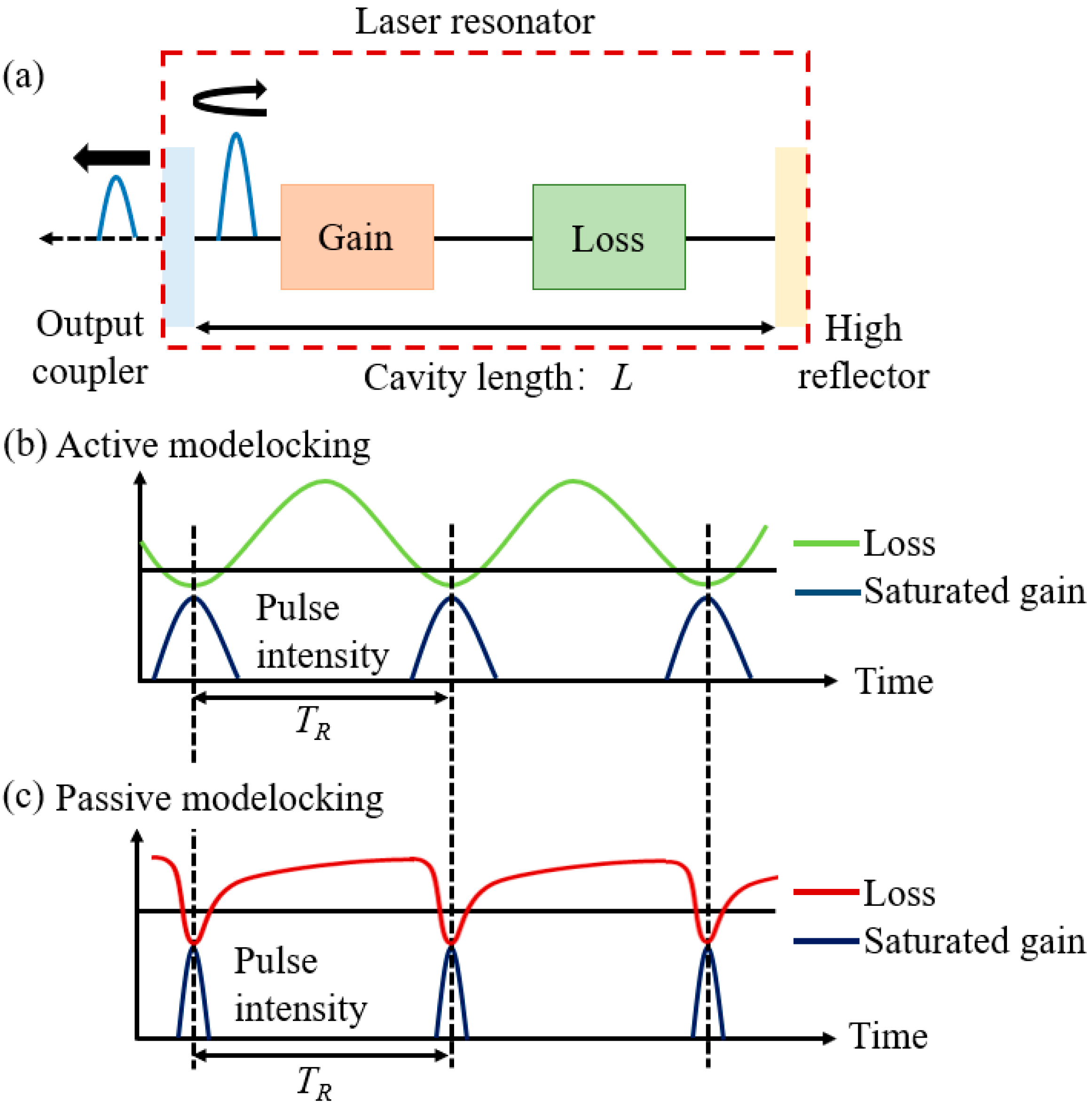
Mode locking is an essential technique for generating ultrashort pulses from lasers. A schematic representation of the gain and loss elements inside a laser resonator is shown in Figure 1a. The output coupler extracts a portion of the circulating pulse during each round trip while maintaining equal time intervals between successive pulses. In most configurations, an intracavity loss modulator is introduced to preferentially select the pulses that experience the minimum temporal loss. The repetition period of these pulses is determined by the cavity round-trip time, expressed as TR = 2L/vg, where L is the cavity length and vg the group velocity, which corresponds to the propagation speed of the pulse peak. Mode locking can be implemented using either passive or active schemes [12].
The techniques for generating ultrashort pulses in fiber lasers are broadly categorized into active and passive mode-locking. Active mode locking uses intracavity modulators or externally injected pulses to modulate the optical field within the cavity. This method is suitable for generating high-order harmonic mode locking and has promising applications in optical communication and all-optical switching [13]. Although actively mode-locked lasers offer high repetition rates and relatively high output power, their pulse durations are typically limited to the picosecond regime due to the finite response time of the modulators [14]. By contrast, passive mode locking provides a more efficient and mechanically simple pathway to femtosecond pulse generation. The most common approach employs saturable absorbers (SAs), whose intensity-dependent transmission enables self-amplitude modulation and supports the formation of ultrashort pulses [15].
SAs in mode-locked fiber lasers are generally classified into two categories. One category consists of material-based absorbers, referred to as real SAs, which include semiconductor saturable absorber mirrors (SESAMs) and two-dimensional materials such as graphene, topological insulators (TIs), MXenes [16,17,18], and transition metal dichalcogenides [19,20,21]. Under intense light excitation, carriers are elevated from the ground state to the excited state, which depletes the ground-state population and partially populates the excited state, resulting in absorption saturation.
In addition to real SAs, there are also passively mode-locking mechanisms which can be considered as artificial SAs. These methods rely on nonlinear phase accumulation at the pulse peak or intensity-dependent transmission. Nelson et al. first reported passive mode locking in Tm3+-doped fiber lasers based on nonlinear polarization rotation (NPR) [10]. Other important techniques include nonlinear optical loop mirrors (NOLMs), nonlinear amplifying loop mirrors (NALMs), Nonlinear multimode interference (NL-MMI), and Mamyshev oscillators (MO) [22,23].
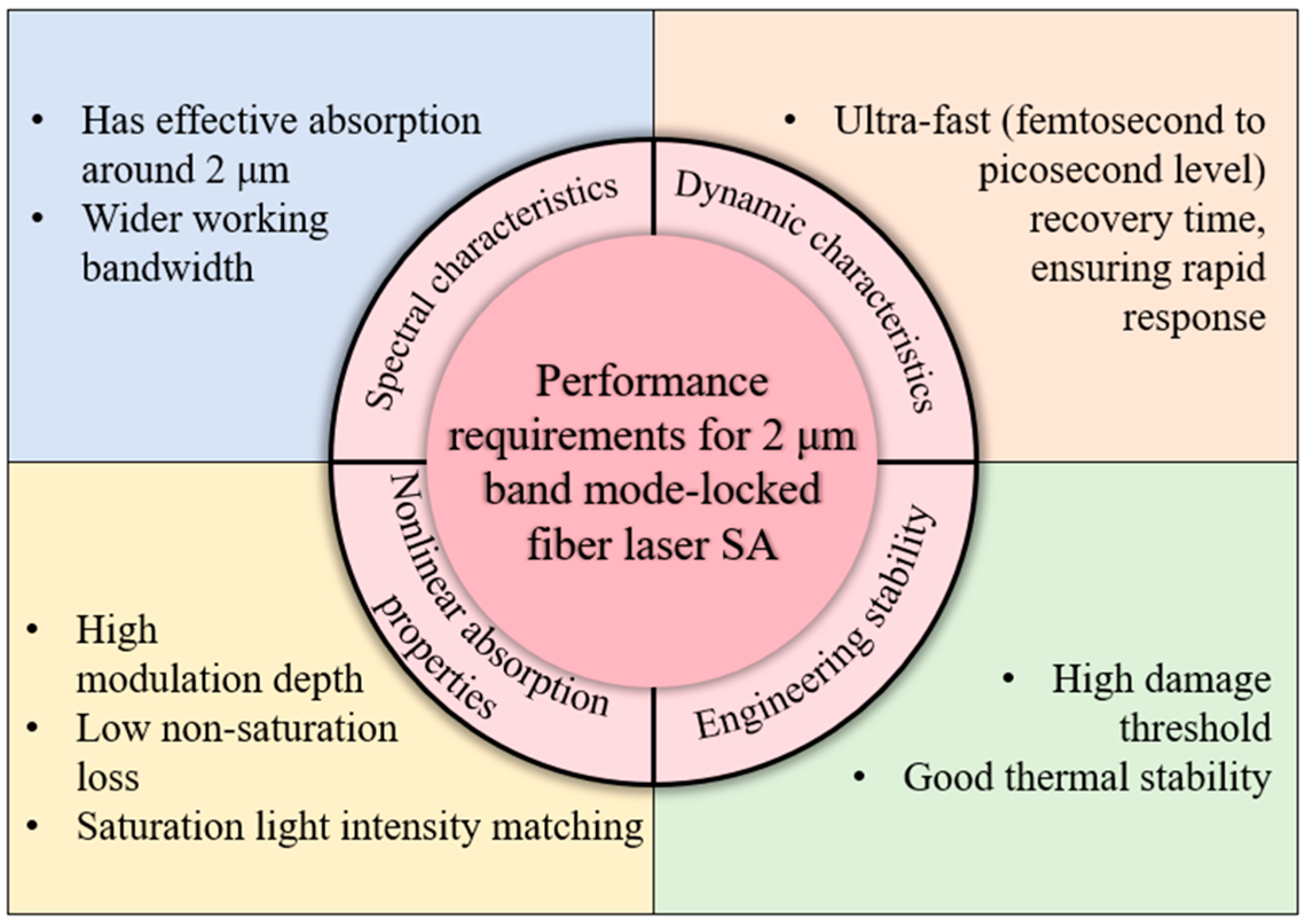
For mode-locked fiber lasers operating in the 2 μm wavelength region, the performance of the SA is crucial for enabling reliable self-starting mode locking and stable ultrashort pulse generation. The SA should exhibit sufficient absorption near 2 μm together with a relatively broad operation bandwidth to match the wide gain spectrum of thulium-doped fibers, typically spanning 1.8–2.1 μm, while also accommodating spectral broadening and wavelength tuning during mode-locked operation. In addition, a fast recovery time is required so that the absorber can respond effectively to femtosecond–picosecond pulses and suppress unstable regimes such as Q-switched mode locking that may arise when the recovery process is too slow. The nonlinear absorption properties of the SA are equally important for stable pulse formation: a modulation depth of several percent is generally needed to provide sufficient saturable loss modulation, whereas the non-saturable loss should remain as low as possible to minimize intracavity loss and maintain laser efficiency. Meanwhile, the saturation intensity should be compatible with the intracavity optical intensity to ensure effective saturation under practical operating conditions. Since mode-locked fiber lasers in the 2 μm band often generate relatively high peak powers, the SA must also possess a high optical damage threshold and good thermal stability for long-term operation.
Consequently, an effective SA for the 2 μm wavelength region should combine broadband absorption, ultrafast recovery dynamics, moderate modulation depth, low non-saturable loss, and a high damage threshold, as these parameters collectively determine its ability to initiate and sustain stable mode locking in ultrafast fiber laser systems [24,25,26,27]. The performance requirements for SAs in 2 μm mode-locked fiber lasers are summarized in Figure 2.

3. Recent Developments in 2 μm Ultrafast Fiber Lasers

In recent years, advances in mode-locking techniques and the extensive integration of low-dimensional nanomaterials into fiber laser systems have significantly improved the performance of ultrafast lasers operating in the 2 μm spectral region. Substantial progress has been made in key parameters, including repetition rate, pulse energy, pulse duration, and average output power. In this section, we review the latest advances in both active and passive mode-locking technologies for ultrafast fiber lasers in the 2 μm mid-infrared region.
Before discussing individual demonstrations, it is important to comparatively analyze the fundamental differences among various mode-locking techniques in the 2 μm spectral region.
Active mode locking provides excellent control over repetition rate and timing stability, making it suitable for high-frequency applications such as optical communication. However, its pulse duration is typically limited to the picosecond regime due to the finite response speed of modulators. In contrast, passive mode locking enables the generation of femtosecond pulses with simpler cavity configurations, but often suffers from environmental sensitivity and limited tunability.
Among passive techniques, real saturable absorbers (e.g., SESAMs, CNTs, and 2D materials) offer self-starting capability and relatively stable operation, but their performance is constrained by material properties such as damage threshold and recovery time. Artificial saturable absorbers, including NPR, NOLM, and NALM, rely on nonlinear optical effects and provide ultrafast response and high peak-power handling, although they are typically more sensitive to environmental perturbations and require careful cavity optimization.
Furthermore, emerging techniques such as Mamyshev oscillators and spatiotemporal mode locking significantly extend the achievable pulse energy and dimensional control, but at the cost of increased system complexity.
Therefore, different mode-locking approaches represent distinct trade-offs among pulse duration, energy scalability, environmental stability, and system complexity, which must be carefully considered depending on specific application requirements.

3.1. Two μm Active Mode-Locked Fiber Laser

Active mode-locked generates 2 μm laser pulses by introducing a loss modulator into the fiber laser cavity. The periodic loss and phase modulation imposed by the modulator facilitates the efficient formation of ultrashort pulses. In 2021, Yousheng S et al. demonstrated a repetition-rate-tunable 2 μm actively mode-locked fiber laser designed for free-space communication [28]. The system used THDF as the gain medium and employed an MZM driven by an arbitrary waveform generator for active mode locking. With the assistance of a Lyot filter and a polarization dependent isolator (PD-ISO), the SNR of the 690 MHz pulse train was improved from 42.64 dB to 49.45 dB. By introducing a variable optical delay line, the cavity fundamental frequency was precisely tuned from 18.13 MHz to 18.21 MHz, enabling continuous tuning of the 330th-order harmonic repetition rate up to 6 GHz. The laser could also operate with different electrical waveforms (sine, triangle, square), providing adjustable pulse durations. These results demonstrate a flexible and high-performance light source suitable for free-space optical (FSO) communication [28].
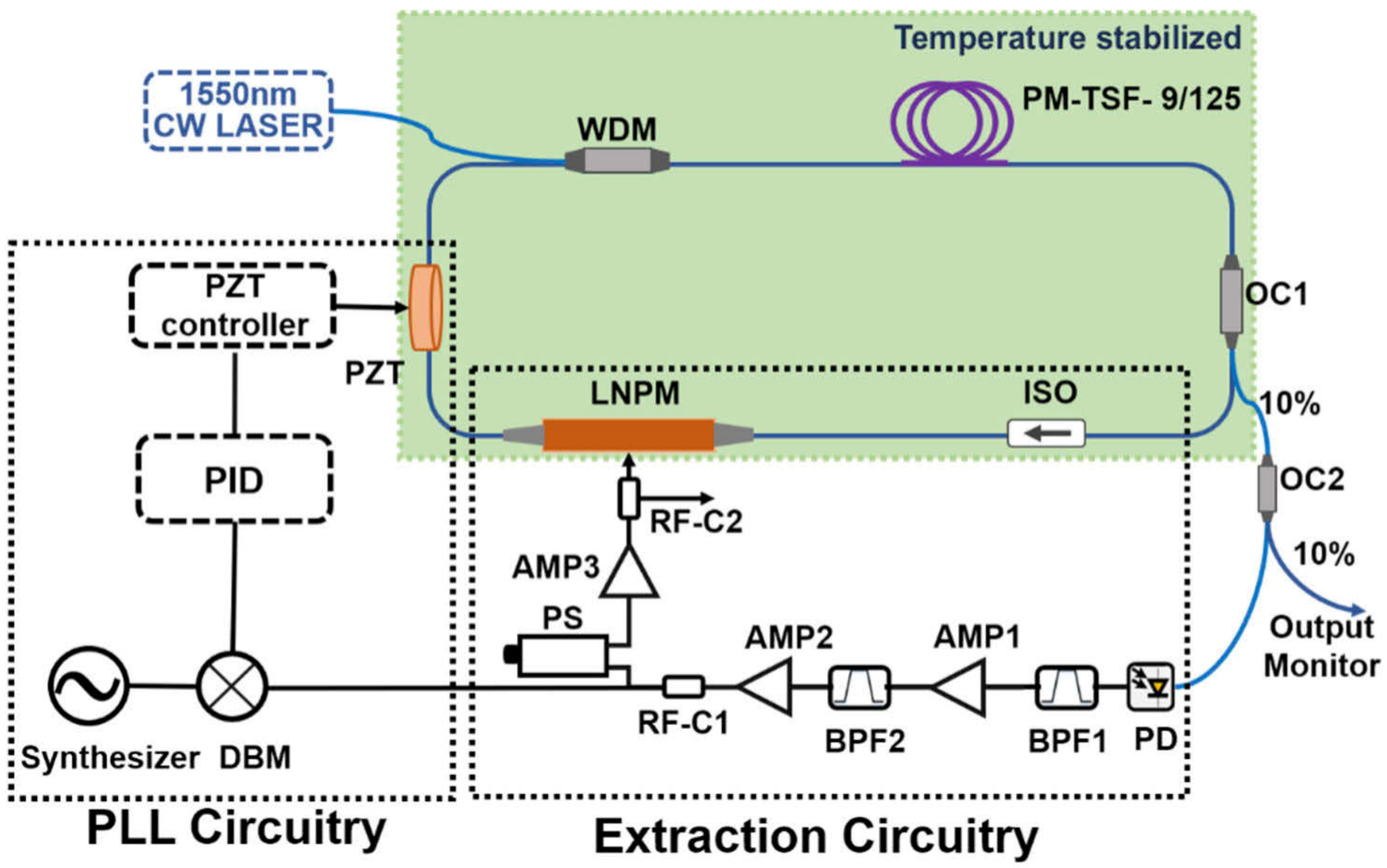
In the same year, Jiarong Q et al. reported a highly stable 10 GHz regenerative mode-locked Tm3+-doped fiber laser for 2 μm optical communication and related applications. The system employed polarization-maintaining Tm3+-doped single-mode fiber (PM-TSF 9/125) and used a 10 GHz clock signal to drive an intracavity lithium-niobate phase modulator, with the modulation frequency precisely matched to the cavity free spectral range (FSR) to ensure stable operation, as shown in Figure 3. A piezo-electric transducer (PZT)-based phase-locked loop, temperature control, and polarization-maintaining (PM) components were implemented to suppress environmental fluctuations. The laser achieved remarkable stability, including a 60 dB supermode suppression ratio (SMSR), only 8 Hz of repetition rate drift over 8 h, an Allan deviation of 2 × 10⁻¹², −78 dBc/Hz phase noise at a 10 kHz offset, and 1.28 ps of integrated timing jitter. The combination of regenerative mode locking and phase-lock-loop (PLL) stabilization effectively mitigated modulation FSR detuning and enabled long-term, interference-resistant operation [29].
Li Y. et al. (2022) conducted a study on the propagation behavior of a 1.96-μm Tm3+-doped actively mode-locked fiber laser when transmitted through an atmospheric path containing smoke particulates [30]. The laser operated at a central wavelength of 1961.63 nm, and active mode locking was achieved using an MZM. At a repetition rate of 2.11 GHz, the pulse duration was 12.47 ps. Their study further evaluated the communication capability of this 1.96 μm actively mode-locked source under adverse atmospheric conditions, such as smoke.
In 2023, Anjali P. S. et al. reported a wavelength and repetition-rate-tunable Tm3+-doped actively mode-locked fiber laser based on a fully fiber-integrated architecture, employing a lithium-niobate phase modulator for longitudinal mode synchronization [31]. Using double-clad Tm3+-doped fiber pumped by a 790 nm diode, the laser achieved a broad tuning range from 1955 nm to 2045 nm, with a maximum repetition rate of 10 GHz. The shortest pulse duration was 42 ps, with an average output power of 5 mW. Across the entire tuning range, the supermode suppression ratio exceeded 50 dB, while both pulse duration and timing jitter remained below 50 ps. The study further revealed that increasing the repetition rate reduces timing jitter and expands the mode-locking range.
Gain-switched active mode-locking refers to a mode-locking scheme in which periodic modulation of the pump power induces temporal gain windows synchronized with the cavity round-trip time, enabling phase locking of longitudinal modes without intracavity modulators [32]. Xiaoran Ma et al. reported a gain-switched fiber laser operating in the 2 μm region in 2024, pumped by a tunable self-pulsed Er-doped Q-switched mode-locked (QML) fiber laser. By adjusting the pump power, stable gain-switched pulses at 1959 nm were achieved with a minimum pulse duration of 366.2 ns and a repetition rate tunable from 37 to 73 kHz [33]. In 2025, Varsha and Gautam Das experimentally demonstrated a Tm-doped fiber laser pumped by a 1570 nm mode-locked source, generating mode-locked pulses at 1925 nm with a repetition rate of 20 MHz and a duration of 105 ps. Implemented in a unidirectional ring cavity without an isolator, the design is notably simplified, with improved stability achieved by inserting an FBG, which also enables wavelength tuning [34].
Table 1 summarizes and compares recent studies on actively mode-locked 2 μm ultrafast fiber lasers, highlighting different modulation schemes and their corresponding key performance parameters.
From Table 1, it can be observed that actively mode-locked systems generally achieve higher repetition rates (up to GHz level) and superior timing stability, while their pulse durations remain in the picosecond regime. In addition, the system complexity increases significantly due to the requirement for high-speed modulators and electronic synchronization.
In contrast, passive mode-locking techniques summarized in Table 2 demonstrate a clear advantage in achieving ultrashort pulse durations down to the femtosecond regime and higher pulse energies. However, their repetition rates are typically limited to tens of MHz, and their stability is more susceptible to environmental fluctuations. This comparison highlights a fundamental trade-off between temporal resolution and system controllability in 2 μm ultrafast fiber lasers.

3.2. Passive Mode-Locked 2 μm Fiber Lasers Based on Artificial SAs

Passive mode-locked 2 μm fiber lasers based on artificial SAs have experienced rapid advancements in recent years. Early progress was driven by the introduction of novel saturable absorber materials such as graphene and graphene oxide, which enabled the initial realization of mode-locked operation in the 2 μm band. Meanwhile, major artificial-SA-based mode-locking schemes-including NPR, NOLM, and NALM-have been continuously refined, progressing from fundamental cavity design optimization to multi-effect collaborative control. These advancements have gradually addressed key challenges such as mode instability and unwanted nonlinear effects [61].
NPR mode locking exploits the Kerr nonlinearity of optical fibers combined with intracavity polarization control to realize an effective fast SA. Owing to its ultrafast response, NPR has become one of the most widely used techniques for generating femtosecond pulses in conventional fiber lasers [62].
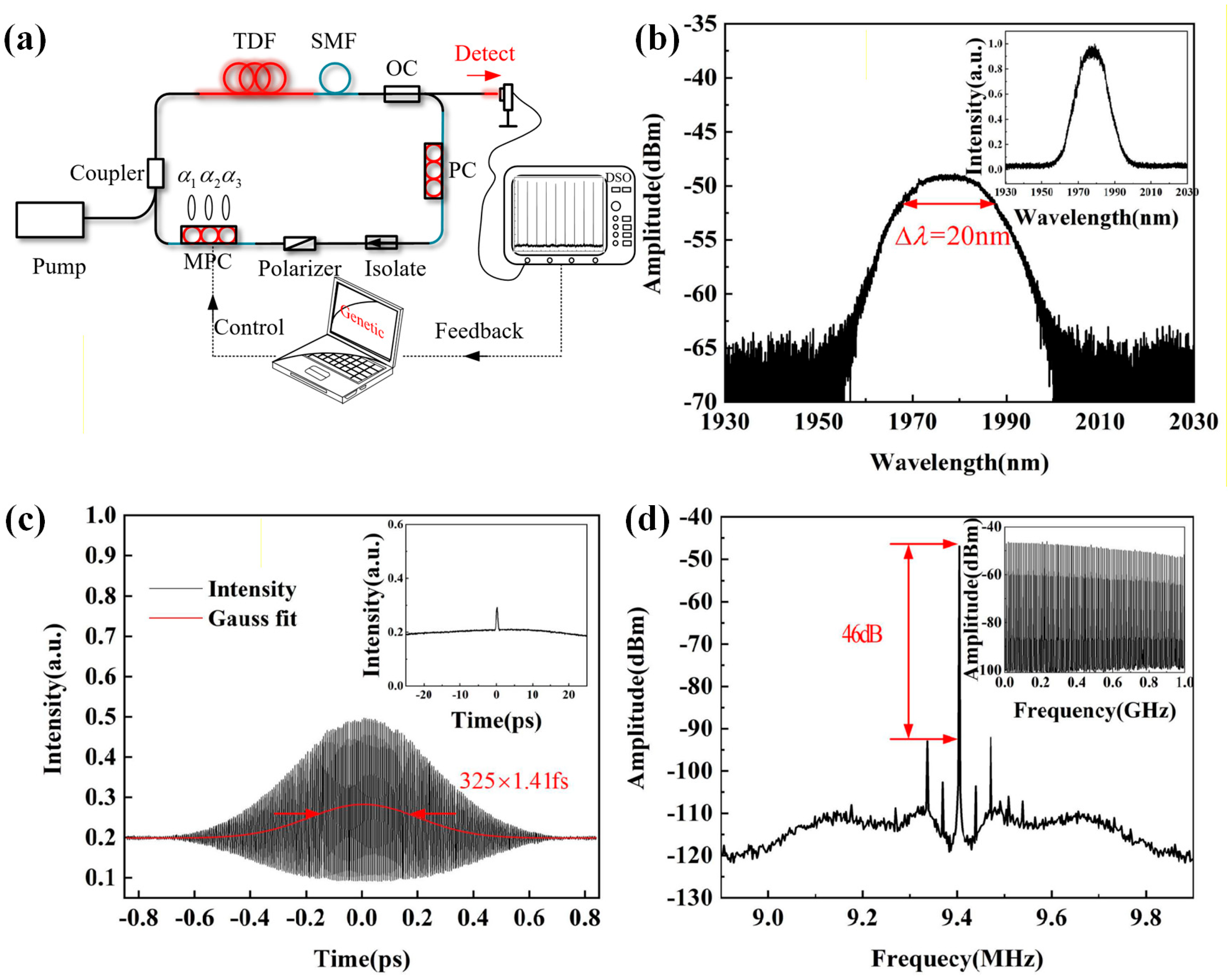
In 2021, Anhua Xian et al. reported the first intelligent mode-locked fiber laser operating in the 2 μm band based on an NPR architecture. A genetic algorithm (GA) with an adaptive mutation rate was employed to automatically optimize the polarization state, enabling self-starting and hands-free mode-locking operation. Under 6.5 W pump power, the laser produced stable noise-like pulses with an average output power of 57.7 mW at a central wavelength of 1973 nm. The RF spectrum exhibited a SNR of 52 dB, and the coherent spike width of the noise-like pulses was measured to be 325 fs (Gaussian-fitted). Some of the key experimental results are presented in Figure 4. The system architecture incorporated a closed-loop feedback scheme in which a photodetector monitored time-domain intensity traces and the GA controller adjusted the electronic polarization controller accordingly. The study further analyzed the evolution dynamics of GA-controlled NPR mode-locking under different mutation rates, demonstrating the robustness and effectiveness of intelligent control for ultrafast TDF lasers [41].
In 2022, Imtiaz Alamgir et al. demonstrated an NPR mode-locked Tm3+-doped fiber laser incorporating a high-nonlinearity chalcogenide tapered fiber. The enhanced nonlinearity significantly reduced the mode-locking threshold (230 mW) and cavity length (9.45 m). The laser supported stable wavelength-tunable soliton pulses in the CW mode-locked regime, and single- or multi-wavelength operation with tunable spacing in the Q-switched mode-locked (QML) regime. The multi-wavelength output was adjustable from 1.883 to 1.915 μm with frequency spacings of 0.7–2.0 THz [42].
By adjusting intracavity parameters, NPR-based fiber lasers can access a variety of pulse regimes, including conventional solitons, dissipative solitons, stretched pulses, bound states, soliton rain, and noise-like pulses. Among them, soliton-rain dynamics are particularly attractive because they provide high pulse energy and robust operation while enabling rich nonlinear interactions [63]. In 2022, Ping Hu et al. demonstrated both soliton-rain and NLP regimes in a long-cavity NPR-mode-locked Ho3+-doped fiber laser. The soliton-rain state, obtained at 2042.1 nm, delivered 1.21 ps pulses with 22.98 nJ energy, while the NLP regime produced 1.18 ps pulses with 34.14 nJ energy at 2041.6 nm. At the time of reporting, these pulse energies were the highest achieved in NPR-mode-locked Ho3+-doped fiber lasers and exceeded most SA-based Ho3+-doped systems [43].
Distributed dispersion management has recently emerged as an efficient strategy for enhancing 2 µm ultrafast fiber lasers. In 2025, Xiaoran Ma et al. demonstrated a self-starting NPR-mode-locked Tm-doped oscillator with dispersion-tailored fiber segments distributed throughout the cavity. The system delivered a broadband spectrum spanning 1.824–2.005 µm and generated 2.70-nJ pulses at 45.5 MHz, which could be compressed to 75 fs. This work highlights dispersion-distributed cavity design as a practical route to achieving sub-100-fs pulses in 2 µm fiber lasers [44].
In the study of NPR fiber lasers, some researchers have also explored the transition between soliton states. In 2024, Yingying Li et al. from Jilin University examined multistate soliton dynamics in an NPR-based TDFL, demonstrating controllable switching among conventional solitons, bound solitons, soliton bunches, and dual-wavelength solitons by adjusting the pump power and polarization controllers [45]. The transition between conventional and bound solitons was found to be primarily governed by the polarization controller state, which modifies the NPR transmission characteristics and induces tight temporal or spatial binding through direct soliton interaction. The disappearance of bound states was attributed to increasing pump power. The emergence of broadband pulses and switching among affected soliton states mainly occurred between cluster-like multistate solitons and polarization-controlled dual-wavelength solitons.
In 2024, Chencheng Shang et al. demonstrated the first fully fiber-integrated, all-optical wavelength-swept laser source at 2 μm. Using an NPR-mode-locked femtosecond oscillator and a chirped fiber Bragg grating, the system achieved 33 nm sweep bandwidth at 18.4 MHz, with power boosted to 1.01 W through two-stage amplification. Its all-fiber architecture, high sweep speed, and excellent stability make it a strong candidate for 2 μm spectroscopy and swept-source OCT in highly scattering, low-water-content media [46].
In 2023, Jinzhang Wang’s group reported a self-starting, nonlinear polarization evolution (NPE)-based all-polarization-maintaining Ho3+-doped fiber oscillator operating at ~2.08 μm. The linear-cavity laser provides two output ports with distinct pulse characteristics: one delivers clean soliton-like pulses with a duration of 439 fs, 7.5 mW average power, and a 61.67 MHz repetition rate, while the other exhibits degraded and complex pulse structures. The pulse disparity originates from nonlinear interactions between the fast and slow polarization axes in the PM fiber. Compared with complex pulses, the clean pulses show significantly improved relative intensity noise and power stability, offering a useful guideline for generating high-quality pulses in PM-NPE fiber oscillators [47]. In 2024, the same group experimentally demonstrated a pulse-state-switchable Tm3+-doped fiber laser mode-locked by linear-cavity nonlinear polarization rotation (LNPR). Compared with conventional free-space LNPR lasers, the all-fiber cavity design significantly enhances structural flexibility and stability. The laser operates over a wide anomalous-dispersion regime and supports three distinct states: conventional soliton, multi-pulse, and noise-like pulse. Stable mode-locking was achieved at a repetition rate of 9.34 MHz [49].
While NPR-based oscillators have enabled the generation of femtosecond pulses in the 2 μm band. The nonlinear pulse compression has become an effective route for pushing the temporal performance of Tm-doped fiber lasers beyond the Fourier-transform limit. In 2025, Minglie Hu’s group demonstrated few-cycle pulse generation from a Tm-doped fiber laser operating at a repetition rate of ~199.74 MHz using a two-stage all-fiber nonlinear pulse compression scheme. The system achieved octave-spanning spectral broadening (1.2–2.4 μm) and directly delivered near–transform-limited pulses with a duration of 19.8 fs (2.9 optical cycles at 2 μm) and a pulse energy of 3.37 nJ, representing the shortest pulses directly generated from a Tm-doped fiber laser to date [48].
In 2021, an all-polarization-maintaining Tm3+-doped fiber laser based on a NOLM configuration was demonstrated by Wang Meng et al., wherein the typical issues of environmental susceptibility and limited repeatability in conventional cavity designs were substantially alleviated [50]. The all-polarization-maintaining design markedly enhanced the system’s resistance to environmental disturbances and facilitated self-starting, stable mode locking at a pump power of 848 mW.
In 2021, Wang Xiaofa and colleagues reported a Tm3+-doped noise-like mode-locked (NLML) fiber laser employing a compact linear cavity formed by dual NOLMs [51]. The dual-NOLM configuration offered enhanced structural compactness and flexibility while enabling stable mode locking through nonlinear loop dynamics. Building on their work with NOLM-based cavity designs, Wang Xiao-fa and co-workers further investigated the nonlinear pulse dynamics of passive mode-locked fiber lasers in the 2 μm region. In 2023, they developed a Tm3+/Ho3+ co-doped passively mode-locked fiber laser using an NOLM structure and demonstrated four distinct, switchable operating states-fundamental mode-locking, dual-soliton pulses, bright-dark pulse pairs, and harmonic mode locking by simply increasing the pump power to strengthen intracavity nonlinear effects without adjusting the cavity polarization state [52].
In 2025, Andrei Borodkin et al. reported the first self-starting, all-polarization-maintaining, dispersion-managed TDF oscillator mode-locked by a NOLM. The cavity, constructed entirely from polarization-maintaining fibers, generated stable linearly polarized and linearly chirped pico-second pulses at 1998 nm, which could be externally compressed to 688 fs using a short segment of anomalous-dispersion fiber. The laser operated at a repetition rate of 9.39 MHz and delivered an average output power of 200 μW per pulse train [53].
A NALM can be regarded as an improved form of the conventional NOLM, achieved by introducing an asymmetric placement of the gain fiber within the loop to enhance the nonlinear differential phase accumulation. Owing to the unequal optical intensities encountered by the clockwise and counterclockwise waves along most sections of the loop, high-intensity pulses acquire substantially greater nonlinear phase shifts compared with their low-intensity counterparts. As a result, strong pulses are efficiently transmitted, while weaker background light is strongly suppressed. By integrating both gain and nonlinear effects within the loop, NALM typically provides higher nonlinear responsivity and superior self-starting capability compared with NOLM.
In 2022, Zbigniew et al. investigated the pulse dynamics of an all-polarization-maintaining “figure-9” TDFL, in which both the cavity and components were constructed from polarization-maintaining fibers, and a dedicated 1565 nm CW pump source was used to drive the system. When the pump power was decreased, the laser evolved from a self-starting multi-pulse regime into a stable single-pulse state. Under single-pulse operation, the source produced pulses centered at 1985 nm, exhibiting a spectral full width at half maximum (FWHM) of 6.4 nm, a pulse duration of 650 fs, and an individual pulse energy of 177 pJ [54]. In the same year, Christoph Mahnke et al. demonstrated a low-noise fiber oscillator employing a NALM as the SA, generating 41.6 MHz pulse trains with 1.3 ps duration, 140 pJ pulse energy, and an optical bandwidth of approximately 15 nm, tunable from 2035 to 2075 nm [55].
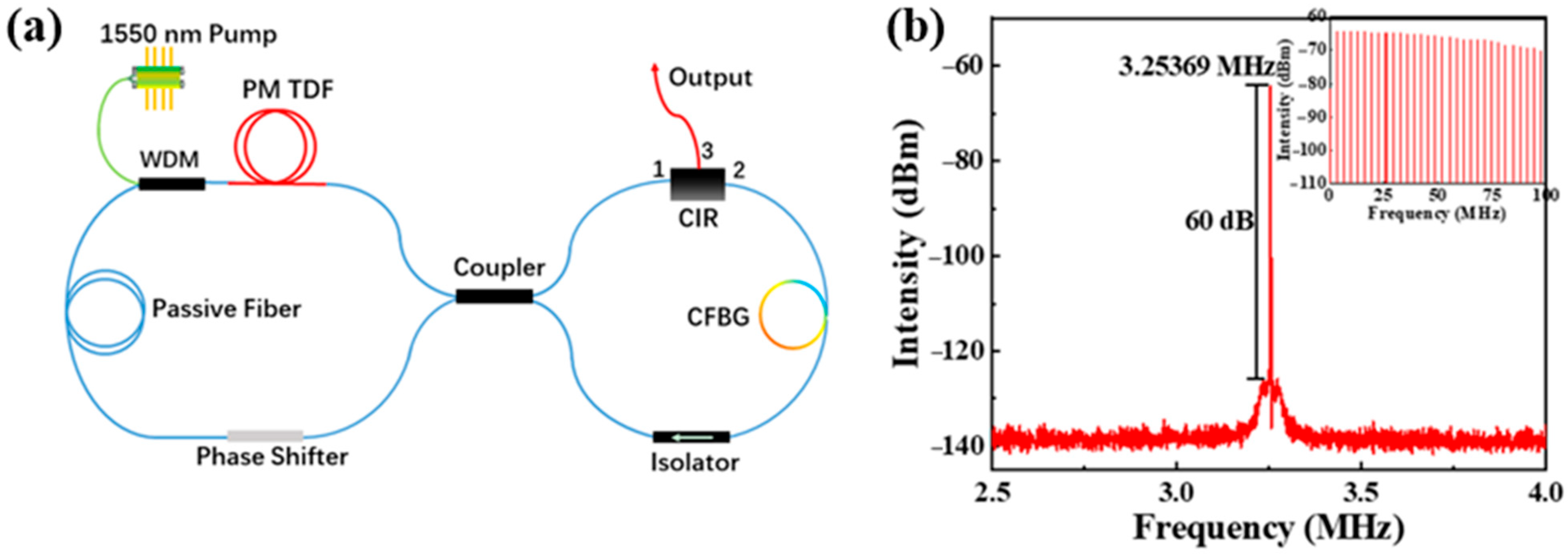
In same year, Bo Ren and colleagues demonstrated all-polarization-maintaining (PM) noise-like pulse (NLP) generation in a thulium-doped fiber oscillator based on a NALM, achieved by incorporating a phase shifter and a chirped fiber Bragg grating (CFBG) [64]. At a central wavelength of 1950 nm, the output spectrum exhibited a 3 dB bandwidth of 25 nm, with a maximum average output power of 13.6 mW and a repetition rate of 3.25 MHz. The noise performance of the NLP was systematically evaluated for the first time, revealing an improving trend with increasing output power. Representative experimental results are presented in Figure 5.
NL-MMI-based SAs offer advantages such as simple structure, ultrafast instantaneous response, and excellent long-term reliability, and are particularly effective in supporting higher pulse energies and peak powers. Nazemosadat and Mafi first provided a comprehensive numerical analysis of NL-MMI and proposed using a SMF–GIMF–SMF structure as an effective SA for mode-locked fiber lasers [65]. In 2020, Hao Jiang et al. experimentally demonstrated a fully fiber-integrated Tm-doped mode-locked laser using an NL-MMI-based SA formed in a tapered GIMF. The tapered GIMF-based saturable absorber demonstrated a modulation depth of 21.15% and a saturation intensity of 89.04 μJ/cm2 [56].
In 2023, the same research group conducted a more detailed examination of NLMMI–based structures. Feng Huang and co-workers implemented a series of saturable absorbers incorporating few-mode fibers (FMFs) of varying lengths in a passively mode-locked Tm-doped fiber laser, enabling the generation of ultrafast pulses in the 2 μm spectral region [57]. Upon further elevation of the pump power within the same cavity, stable and well-organized harmonic pulse trains were immediately formed. These outcomes confirm that the SMF–FMF–SMF structure can function effectively as a saturable absorber, and that its saturable absorption characteristics can be tuned by modifying the FMF length.
In recent years, significant interest has been directed toward Mamyshev oscillators (MOs) because they can deliver high-energy pulses directly at the oscillator output [66,67,68,69]. Mode locking in a master oscillator is governed by SPM–induced spectral broadening within the two nonlinear amplifier arms, followed by spectral filtering with an offset passband, collectively establishing the pulse-shaping mechanism [70]. Owing to its two confocally arranged nonlinear amplifiers, the cavity exhibits a high tolerance to nonlinear phase accumulation [71].
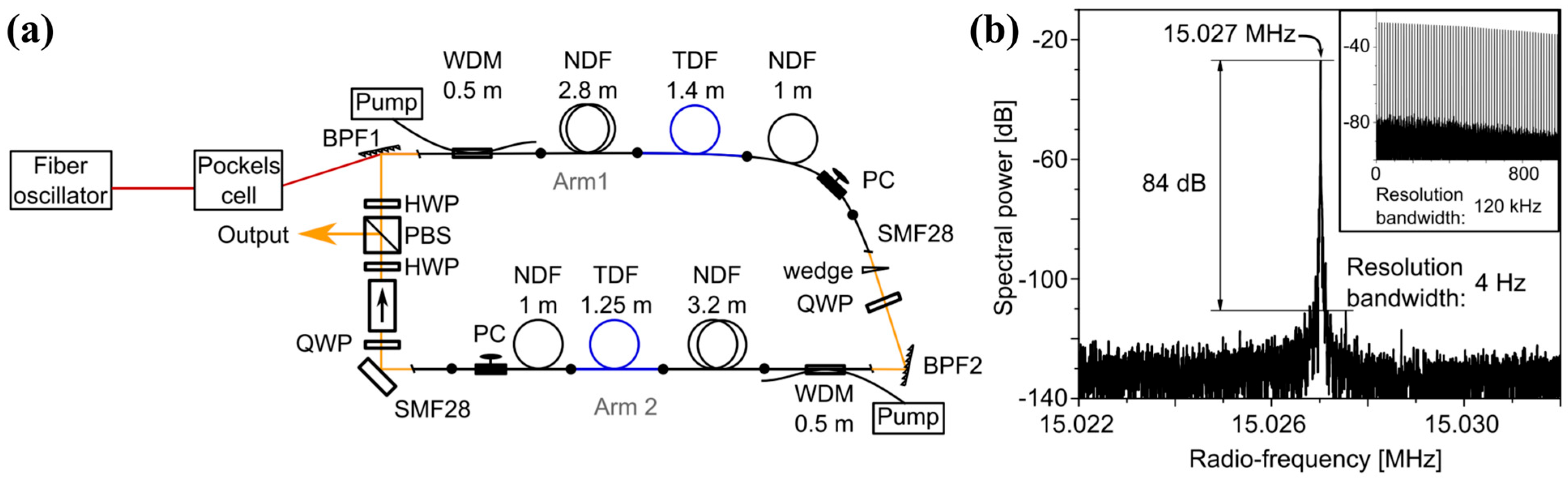
In 2020, Paul et al. experimentally demonstrated, for the first time, mode-locked operation in a MO based on standard Tm3+-doped glass fibers. The MO architecture consisted of two TDF gain stages separated by a pair of band-pass filters (BPFs). To initiate mode locking, an external seed pulse-originating from a stretched-pulse fiber laser with a 26 nm FWHM centered near 1977 nm-was injected into the cavity. The RF spectrum confirmed highly stable mode locking, with a fundamental beat note at 15.027 MHz and an SNR of 84 dB. At this 15 MHz repetition rate, the prototype oscillator generated pulses with an energy of 3.55 nJ approximately one order of magnitude greater than that of conventional soliton pulses typically obtained in Tm-doped fiber lasers, as shown in Figure 6 [58]. In 2025, Song Yang et al. reported an all-fiber 2 μm MO consisting of two TDF amplifier stages separated by a broadband fixed-wavelength filter and a tunable narrowband filter. Pulses with a minimum duration of 309 fs were generated at a central wavelength of 1954.5 nm. As the pump power was increased, a characteristic progression of operating regimes was observed: the oscillator was first driven from a non–mode-locked state into stable single-pulse mode locking, subsequently transitioned into a noise-like pulse regime, and at higher pump levels ultimately reverted to non–mode-locked operation [59].
In 2025, a fully fiber-integrated, self-starting Tm-doped MO capable of generating high-performance ultrafast pulses was demonstrated by Zhifeng Shi et al. In addition, the nonlinear dynamical behavior of various multipulse states was investigated, including the formation of soliton molecules and higher-order harmonic mode-locking regimes. The system achieved harmonic mode locking up to the 130th order, corresponding to a 588 MHz repetition rate, with a SNR exceeding 60 dB [60].
Table 2 summarizes and compares recent studies on passively mode-locked 2 μm ultrafast fiber lasers employing various artificial SA structures, highlighting the different modulation mechanisms and their key performance parameters.
The results in Table 2 indicate that passively mode-locked 2 μm fiber lasers based on artificial saturable absorbers offer clear advantages in achieving ultrashort pulse durations, extending to the femtosecond regime, as well as improved pulse energy scalability. NPR-based systems enable the shortest pulses due to their ultrafast nonlinear response, while NOLM, NALM, and Mamyshev oscillators provide enhanced energy scaling through optimized cavity nonlinearities.
However, these approaches generally exhibit higher sensitivity to environmental perturbations, particularly for polarization-dependent techniques such as NPR. Although loop-based and polarization-maintaining designs improve stability, they often increase system complexity or mode-locking thresholds. Overall, artificial-SA-based passive mode locking enables superior temporal and energy performance, but involves inherent trade-offs in stability and controllability.

3.3. Passive Mode-Locked 2 μm Fiber Lasers Based on Real SAs

Owing to the excellent properties of semiconductor materials, SESAMs can achieve self-starting mode-locking within the laser cavity with effective saturable absorption and enhanced stability. Furthermore, key parameters such as modulation depth, absorption wavelength, and recovery time can be precisely tailored during the fabrication process. Their compatibility with fiber pigtailing also enables all-fiber integration. These merits make SESAMs a widely adopted component in passively mode-locked fiber lasers [72].
In 2020, Jingru Wang et al. reported a linear-cavity TDFL mode-locked with a SESAM that generated a novel type of h-shaped pulse. The laser produced stable nanosecond h-shaped pulse envelopes ranging from 880 ps to 1.41 ns, with substructure durations of ~440 fs. These h-shaped pulses exhibited noise-like characteristics and strong robustness against pump fluctuations and environmental perturbations, and the system could also operate in a harmonic mode-locked regime. The compact and stable design enabled repetition rates in the megahertz range [73].
In 2022, Xiaoming Wei’s group developed a high-power 2.0 μm all-fiber laser system delivering femtosecond pulses at a fundamental repetition rate exceeding 10 GHz. Based on a self-starting, fundamentally mode-locked Tm-doped fiber laser and subsequent all-fiber amplification and soliton-based compression, the system achieved an 11.3 GHz repetition rate, 163 fs pulse duration, and ~612 mW average output power, highlighting its strong potential for high-speed and high-power ultrafast applications [74].This group has further investigated a low-noise, GHz-repetition-rate mode-locked Tm3+-doped fiber laser, in 2024. By employing a home-developed low-dispersion Tm3+-doped barium gallo-germanate fiber (TGF), broadband mode-locking was achieved while significantly suppressing amplified spontaneous emission-induced quantum-limited timing jitter [75].
Although GHz-repetition-rate pulses have been realized in Tm-doped fiber lasers, their mode-locking mechanisms and potential instabilities remain under active investigation. In 2021, Huihui Cheng et al. developed a combined-cavity model to systematically classify pulse instabilities in high-repetition-rate TDFLs, introducing nonlinear phase changes (NPC) induced by SESAM saturation. The model predicts pulse dynamics driven by gain or soliton effects, revealing gain- and soliton-induced breathing behaviors as well as instabilities arising from nonuniform gain geometry [76].
In 2025, a high-power, all-fiber femtosecond TDFL was reported by Yaogen Yang et al. The SESAM-mode-locked master oscillator was operated at 1945.2 nm with a repetition rate of 23.96 MHz, producing stable soliton pulses. With a monolithic master-oscillator power-amplifier (MOPA) configuration, an average output power of 6.44 W was achieved. Owing to the strong nonlinear effects encountered by low-repetition-rate pulses during amplification, direct all-fiber compression to sub-200-fs pulse durations was achieved at full output power. [77].
Carbon-nanotube-based saturable absorbers (CNT-SAs) represent an important technique for achieving passive mode locking in 2 μm fiber lasers. Their operation relies on the intrinsic saturable absorption of CNTs: when the intracavity pulse intensity exceeds the saturation threshold, the absorption decreases significantly, enabling high transmission at the pulse peak while suppressing background noise. This nonlinear response facilitates the formation and stabilization of ultrashort pulse trains. Over the past decade, CNT-SAs have been widely explored in Tm3+- and Ho3+-doped fiber lasers owing to their excellent compatibility with fiber platforms, simple fabrication, low cost, and broadband tunability. Early demonstrations mainly operated in Q-switched mode-locking regimes. Subsequent advances in waveguide design and CNT processing enabled fully fiber-integrated devices and stable continuous-wave mode locking, leading to pulse durations compressed from the picosecond range to sub-hundred-femtosecond levels and increasingly wider wavelength tunability. Despite these advantages, the intrinsic damage threshold and long-term environmental stability of CNTs impose limitations in high-power or high-peak-power systems. These constraints have motivated the exploration of emerging two-dimensional materials as alternative SA platforms [78].
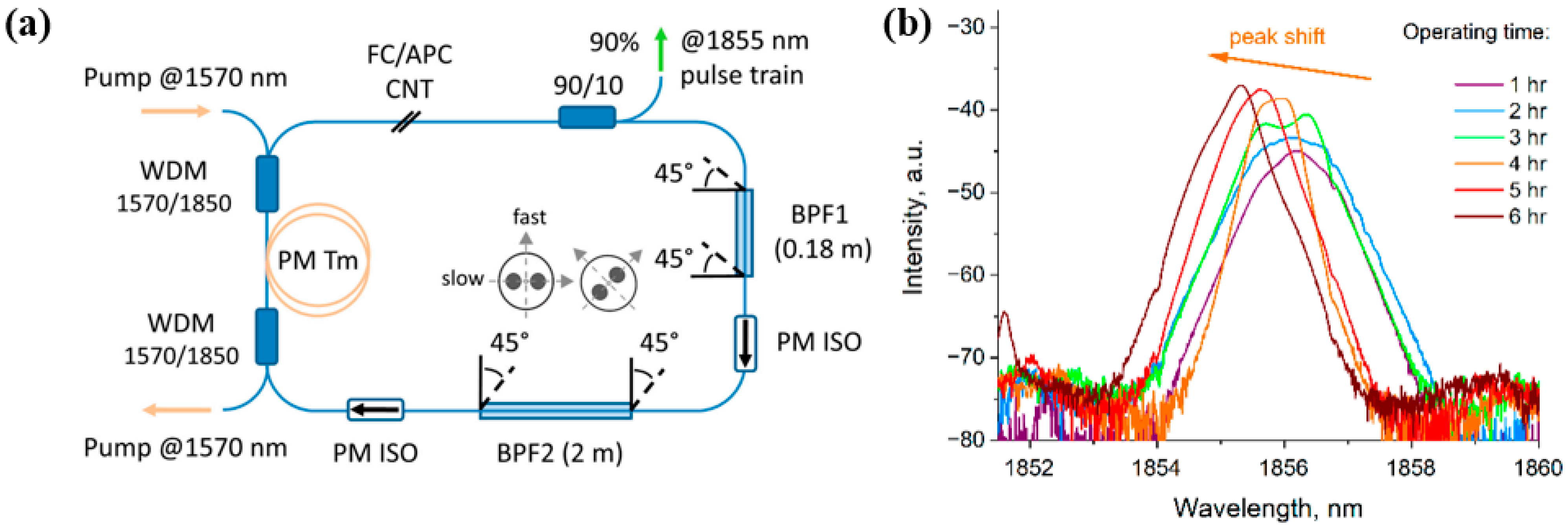
In 2022, an all–polarization-maintaining Tm3+-doped mode-locked fiber laser was reported by Yan Ososkov et al., in which CNT saturable absorbers and two fiber-based Lyot filters were incorporated into a ring resonator, yielding an operating wavelength of approximately 1855 nm. The experimental setup and selected results are presented in Figure 7. The CNT-SA was characterized by a recovery time of ~0.7 ps and a modulation depth of about 10%, thereby enabling reliable self-starting passive mode locking. Pulses with a duration of 13.6 ps, an energy of 27 pJ, and a repetition rate near 14.66 MHz were generated [79].
In 2025, soliton energy quantization in a Tm3+-doped fiber laser mode-locked using a single-walled CNT saturable absorber was investigated experimentally and numerically by Jiancheng Zheng et al. Stable self-starting mode locking was obtained, and an increase in pump power resulted in the appearance of multiple solitons that exhibited pronounced energy quantization, characterized by nearly identical pulse energies and durations [80]. In the same year, Vasilii Voropaev et al. reported a polymer-free single-wall CNT-SA enabling sixth-order harmonic mode locking (504 MHz) in an all-PM TDFL at 1.9 μm [81]. The laser delivered 400 fs pulses with 493 mW average power, 1 nJ pulse energy, a 1912 nm center wavelength, and a 7 nm bandwidth, demonstrating state-of-the-art performance for applications in polymer micro-machining and infrared material processing.
Within the family of two-dimensional (2D) materials, topological insulators (TIs) have garnered growing attention owing to their distinctive electronic band structure: although they possess a bulk bandgap, their surface or edge states exhibit gapless characteristics protected by topological order [82]. Compared with graphene and CNTs, TIs offer advantages in fabrication and integration, and their excellent semiconductor properties and high surface carrier mobility make them highly suitable as efficient and stable SA materials for mode-locked fiber lasers [83]. Sb2Te3 is one of the most widely used TIs-based SAs.
In 2021, Xiaohui Ma et al. first employed Sb2Se3 as a SA for harmonic mode locking in a TDFL. Using Sb2Se3 nanoparticles deposited on a D-shaped fiber, they achieved fundamental pulses at 1961.35 nm with an 890 fs duration and 22.35 MHz repetition rate, and generated harmonic orders from 2 to 31 (44.7–693 MHz). The results demonstrate that Sb2Se3 offers strong saturable absorption and is well suited for high-repetition-rate ultrashort-pulse generation [84]. In 2022, Harith Ahmad et al. demonstrated another Sb2Se3-based SA operating at 1902.06 nm, producing pulses with a 2.88 nm FWHM bandwidth. The laser delivered a 10.88 MHz repetition rate, 1.32 ps pulse duration, and an SNR of ~61.21 dB, confirming Sb2Se3 as an effective SA for ultrafast operation in the 2 μm band [85].
Black phosphorus (BP) has also been identified as a highly promising saturable absorber because its layer-dependent bandgap-ranging from ~0.3 eV in the bulk to nearly 2 eV in the monolayer—allows for substantially stronger photon absorption in the 2 μm region than that achieved with graphene or transition-metal dichalcogenides (TMDs). In 2024, a dispersion-managed BP-SA mode-locked TDFL operating near zero net cavity dispersion was demonstrated by Qian Zhang et al. Self-starting mode locking was achieved when the pump power was set to 490 mW, and at an increased pump level of 820 mW, dispersion-managed solitons with Gaussian-like spectra, rather than the conventional Kelly sidebands were generated. The pulses exhibited an 1875 nm center wavelength and an 805 fs duration [86]. The performance comparison of ultrafast fiber lasers operating in the 2 μm wavelength regime based on real SAs, as discussed in this paper, is summarized in Table 3.
Comparing different passive mode-locking mechanisms, NPR-based systems are particularly advantageous for generating ultrashort pulses due to their instantaneous nonlinear response, but they are highly sensitive to polarization fluctuations. NOLM and NALM configurations improve environmental stability through symmetric or polarization-maintaining designs, although they generally exhibit higher mode-locking thresholds.
Real saturable absorbers such as SESAMs provide reliable self-starting operation and good repeatability, making them suitable for practical systems, whereas emerging materials such as CNTs and 2D materials offer broader bandwidth and simpler integration but still face challenges in long-term stability and damage threshold.
Overall, artificial SA techniques favor performance limits, while real SA approaches favor robustness and practicality.

3.4. Emerging Mode-Locking Strategies and Fiber Integration

As application requirements continue to evolve toward higher repetition rates, increased pulse energy, enhanced environmental robustness, and more compact system architectures, conventional single-mechanism mode-locking schemes and discretely assembled cavity components are gradually approaching their practical performance limits. In recent years, growing interest has been devoted to the development of novel mode-locking strategies and integrated photonic components in the 2 μm spectral region. Hybrid mode locking, in which two or more mode-locking mechanisms are deliberately combined within a single cavity, enables more flexible and cooperative regulation of intracavity gain, dispersion, and nonlinear effects. Meanwhile, spatiotemporal mode locking (STML) extends the conventional time-domain description of pulse formation by incorporating transverse modal dynamics, thereby providing an effective route toward high-energy ultrafast pulse generation in multimode regimes. At the same time, continuous progress in 2 μm integrated devices has played an increasingly important role in promoting compact, robust, and highly integrated ultrafast fiber laser systems [88,89,90].
Hybrid mode-locking such as the combination of NPR and a 2D material SA can be understood as the cooperative action of two distinct nonlinear modulation mechanisms operating within the same laser cavity. The 2D material SA relies on its intrinsic saturable absorption, enabling preferential transmission of high-intensity noise spikes at relatively low saturation intensities, which effectively reduces the mode-locking threshold and facilitates self-starting operation. In the steady-state regime, NPR provides strong nonlinear filtering and pulse shaping. When combined, the 2D material SA predominantly governs the initiation of mode-locking and the formation of initial pulses, while NPR enhances energy discrimination and suppresses the continuous-wave background during pulse evolution. The hybrid scheme enables the coexistence of low-threshold, self-starting operation and high long-term stability.
A hybrid mode-locked Tm-Ho co-doped fiber laser based on a few-layer Ti3CNTx MXene SA was reported by Tianshu Wang et al. in 2024 [91]. By integrating NPR with the Ti3CNTx-based SA, self-starting hybrid mode-locking with low threshold, high stability, and high efficiency was achieved. The laser delivered femtosecond pulses centered at 1959.23 nm, featuring a 3 dB spectral bandwidth of 5.34 nm and a pulse duration of 766 fs. Compared with pure NPR mode-locking, the hybrid scheme significantly reduced the self-starting threshold, shortened the pulse width by at least 21 fs, and markedly improved the signal-to-noise ratio [91].
Wang et al. reported an all-polarization-maintaining Ho-doped fiber oscillator operating at 2.08 μm based on a hybrid mode-locking scheme that combines nonlinear polarization evolution and a SESAM. Notably, the hybrid configuration significantly broadened the single-pulse pump tolerance to ~220 mW, nearly four times that of a pure NPE scheme, demonstrating enhanced operational flexibility, stability, and reliability, and offering an effective route to mitigate the self-starting limitations of phase-modulated NPE lasers [92].
The simultaneous locking of transverse (spatial) and longitudinal (temporal) modes-referred to as STML-has attracted increasing attention in recent years. MMF lasers provide a viable platform for realizing STML and spatiotemporal dissipative solitons (STDSs), which require a delicate balance between linear and nonlinear effects. The first experimental demonstration of STML in an MMF laser was reported in 2017, representing a seminal advance [93]. This pioneering work not only confirmed the existence of STML and STDSs in multimode fiber lasers but also stimulated extensive subsequent research in this emerging field.
STML originates from the nonlinear coupling and mutual phase synchronization of longitudinal modes in the temporal domain and transverse modes in the spatial domain within a laser cavity. Unlike conventional single-mode mode-locking, which involves only temporal phase locking among longitudinal modes, STML occurs in few-mode or multimode fiber lasers where different transverse modes possess distinct group velocities, dispersion characteristics, and nonlinear responses. Under strong Kerr nonlinearity, SPM, XPM, and intermodal energy exchange, the initially independent spatial modes become phase-correlated and evolve toward a stable locked state that is synchronized with the longitudinal modes. As a result, a coherent spatiotemporal structure emerges, in which both the temporal pulse envelope and the spatial modal profile remain stable from round trip to round trip. From a dynamical perspective, STML can be regarded as the formation of a multidimensional dissipative structure governed by the interplay of gain, loss, dispersion, and nonlinearity. By exploiting the additional spatial degrees of freedom, STML overcomes the energy and power limitations of single-mode ultrafast lasers and provides an effective route toward high-energy and high-peak-power pulse generation, particularly in multimode and hybrid fiber laser systems operating in the 2 μm spectral region [94].
STML in MMF lasers has emerged as a promising route to overcome the energy and modal limitations of conventional ultrafast SMF lasers in the 2 μm band. However, the realization and control of STML at this wavelength are strongly hindered by large anomalous dispersion (typically ~−70 ps2 km−1) and complex spatiotemporal dynamics associated with soliton breakup induced by nonlinear phase accumulation. In 2025, Tianchen Yao et al. proposed an intelligent 2 μm STML scheme based on NPR in a hybrid cavity incorporating single-mode, few-mode, and multimode fibers. Two representative STML states-NLPs and solitons-were experimentally observed, with central wavelengths of 2007 nm and 1993 nm and pulse durations of 447 fs and ~596 fs, respectively. The intrinsic spatiotemporal nonlinearity of NPR in the hybrid fiber configuration induces mode-dependent modulation across different transverse modes. By combining NPR with intelligent control, this work demonstrates effective STML operation in the 2 μm regime and provides a viable strategy for developing high-energy, multidimensionally controllable ultrafast fiber lasers at 2 μm [95].
Comprehensive studies on various mode-locking architectures indicate that linear cavities exhibit significant potential for generating ultrahigh repetition rate pulses [96]. However, for convenient parameter tuning and wavelength agility, ring cavities are more commonly employed. Most 2 μm ring oscillators exhibit anomalous dispersion. According to the soliton area theorem [97], such cavities with relatively small net dispersion are expected to support shorter and higher-energy pulses.
Therefore, achieving high-quality pulses at 2 μm requires simplified cavity designs with reduced lengths. Short cavities producing repetition rates from hundreds of MHz to several GHz are particularly valuable for applications in frequency comb generation and high-speed optical sampling [98,99,100]. Since Er-doped fibers typically exhibit normal second-order dispersion, mode-locking under small net dispersion conditions requires stringent design constraints [101]. Consequently, cavity shortening at 1550 nm is limited, whereas at 2 μm, such limitations are alleviated due to the fully anomalous dispersion regime [102]. These considerations suggest that introducing integrated components to enhance laser performance is more feasible and practical in the 2 μm spectral region.
Tapered micro–nano fibers have been demonstrated as an effective platform for multifunctional integrated fiber components, offering a practical approach to shortening laser cavities. In 2022, Shaodong Hou reported a compact Tm-doped ultrafast fiber laser based on a tapered fiber coupler coated with a vanadium dioxide (VO2) SA via magnetron sputtering, with a waist diameter of ~17.3 μm and coating thickness of ~55 nm [103]. This component simultaneously enabled WDM, OC, and SA, generating mode-locked pulses with a 160 MHz repetition rate, 478 fs pulse duration, and 48 mW output power, while exhibiting low timing jitter and relative intensity noise.
In the same year, Zhiyong Chen et al. introduced a WDM/OC/SA/TDF multifunctional integrated tapered coupler by depositing WTe2 onto the tapered region, serving simultaneously as a WDM, OC, SA, and gain medium [104]. Incorporation of this device into a Tm-doped mode-locked fiber laser produced pulses centered at 1966.6 nm, with 450 fs duration, 214 MHz fundamental repetition rate, and a total cavity length of ~0.96 m. These results demonstrate that integrated tapered couplers can significantly simplify cavity design while maintaining high-performance ultrafast pulse generation, highlighting their potential for compact 2 μm fiber laser systems.
Combining the above comparisons, it becomes evident that different mode-locking techniques in the 2 μm spectral region are governed by distinct physical mechanisms and performance trade-offs. Active mode locking offers superior control over repetition rate and timing stability but is inherently limited in pulse duration. In contrast, passive mode-locking approaches enable access to the femtosecond regime and higher pulse energies, although they typically suffer from reduced environmental stability and increased sensitivity to cavity perturbations. Emerging approaches such as hybrid mode locking and spatiotemporal mode locking attempt to bridge these limitations by introducing additional degrees of freedom in pulse formation, but their underlying dynamics and optimization strategies remain active areas of research.
This chapter has provided a comprehensive development in recent years of mode-locking techniques for 2 μm ultrafast fiber lasers, encompassing both conventional and emerging approaches. Active and passive mode-locking schemes, including real and artificial SAs, have enabled stable femtosecond pulse generation with continuously improved repetition rates, pulse energies, and operational robustness. Building upon these foundations, recent developments in hybrid mode locking and spatiotemporal mode locking have further expanded the accessible pulse regimes by introducing additional degrees of freedom in intracavity dynamics. Moreover, rapid progress in 2 μm integrated photonic devices is accelerating the evolution of ultrafast fiber lasers toward compact, robust, and system-level integrated platforms. Therefore, the advances summarized in this chapter establish a solid technological and physical basis for the continued development of high-performance 2 μm ultrafast laser sources and their emerging applications.

4. Applications of 2 μm Ultrafast Fiber Lasers

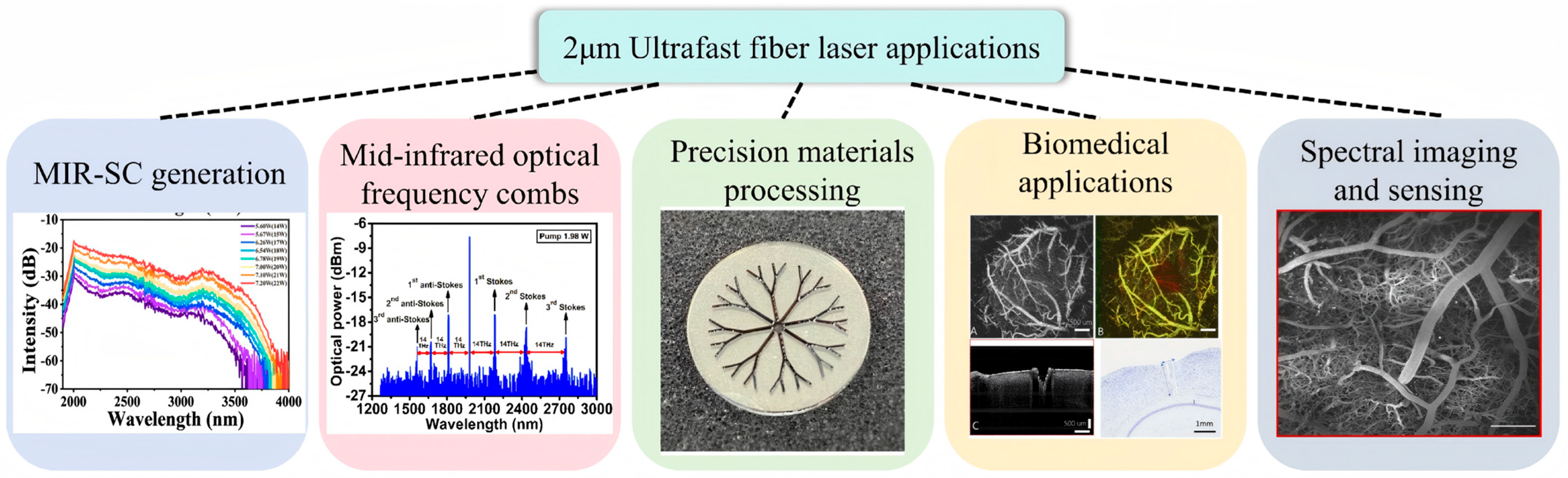
Ultrafast fiber lasers operating in the 2 μm spectral region play an increasingly important role in mid-infrared photonics, with applications spanning nonlinear spectral broadening, precision metrology, spectroscopic imaging and sensing, biomedicine, and advanced manufacturing, as shown in Figure 8 [4]. Compact and fully integrated 2 μm ultrafast fiber lasers offer high peak power, excellent beam quality, and broad gain bandwidth, making them particularly attractive for mid-infrared supercontinuum (MIR-SC) generation, optical-frequency-comb development, and high-resolution spectroscopic instrumentation [105]. In biophotonics, the strong absorption of water and molecular vibrational modes near 2 μm enables minimally invasive surgical procedures and highly specific diagnostic techniques. In materials processing, the unique absorption characteristics of metals and dielectrics in this wavelength band facilitate high-precision machining with reduced thermal damage. Owing to their eye-safe operating wavelength, compact architecture, high peak-power capability, and compatibility with all-fiber integration, 2 μm ultrafast fiber lasers exhibit significant potential for both scientific research and industrial deployment across a wide range of photonic applications [106].

4.1. MIR-SC Generation

MIR-SC sources typically consist of two major components: a pump laser and a nonlinear fiber. Depending on the pump scheme, SC generation can be categorized into two approaches. The first employs high-peak-power pulsed fiber lasers-most commonly ultrashort-pulse sources at 1.5 μm or 2 μm-which are well suited for high-power SC generation [112]. The second approach generates the SC directly inside a pulsed fiber amplifier, where a broadband seed is spectrally broadened during amplification; this method is particularly advantageous for producing broadband SC spectra with enhanced long-wavelength power [113]. Compared with 1 μm pumping, 2 μm pump lasers offer lower quantum defect, higher nonlinear conversion efficiency, broader compatibility with nonlinear crystals, and the ability to provide ultrashort pulses in all-fiber configurations. Ultrashort-pulse pumping has been shown to facilitate more efficient nonlinear frequency conversion processes.
In 2017, Hudson et al. combined a 2.9 μm Ho3+-doped ZBLAN ultrafast fiber laser (230 fs, 4.2 kW peak power) with a polymer-coated all-chalcogenide tapered fiber, producing >30 mW SC output spanning 1.8–9.5 μm at −20 dB [114]. In 2023, Zhu et al. employed 2 μm noise-like pulses to pump a large-core ZBLAN fiber through fusion splicing, achieving a flat and high-power SC spanning 1.9–4.02 μm. The system delivered up to 33.1 W of output power with a high optical-to-optical efficiency of 75%, demonstrating that 2 μm noise-like pulses are advantageous for producing power-scalable and spectrally flat SC sources [115]. In the same year, Kibler et al. used femtosecond solitons from a TDF amplifier to realize the first fully fiber-integrated coherent SC source covering 2–6 μm. The spectrum was generated in 4 cm of chalcogenide fiber, yielding 50 mW average power at a 25 MHz repetition rate while preserving the coherence of the pump laser [116].
These advances demonstrate that, within the past three years, MIR-SC sources have expanded to cover the 2–10 μm region with output powers reaching several tens of watts, underscoring the significant potential of 2 μm ultrafast fiber lasers as next-generation pump sources for broadband and high-power mid-IR photonics.

4.2. Mid-Infrared Optical Frequency Combs

Ultrafast fiber lasers operating near 2 μm have become highly effective pump sources for generating mid-infrared optical frequency combs (OFCs). An OFC consists of a broadband spectrum made up of evenly spaced, mutually coherent spectral components, where the line spacing is fixed by the repetition rate of the driving laser and the overall spectrum maintains strong phase coherence [4]. Mid-infrared combs are typically produced by down-converting 2 μm femtosecond pulses through difference-frequency generation or other optical parametric processes, which transfer the coherence of near-infrared combs directly into the mid-IR range [117]. Because 2 μm ultrafast lasers emit highly coherent femtosecond pulses, the generated mid-IR radiation can retain its comb structure even after substantial nonlinear broadening [118]. Compared with pumping at 1 μm, systems driven in the 2–3 μm range—such as optical parametric oscillators (OPOs) and optical parametric amplifiers (OPAs)—offer higher conversion efficiencies and simpler system architectures [119]. Consequently, 2 μm ultrafast sources provide an efficient and coherent pumping platform for mid-infrared OFC generation.
A notable early milestone was reported in 2014 by Nicola Coluccelli et al., who realized the first high-power mid-IR frequency-comb system based on a Ho3+-doped large-mode-area (LMA) fiber. The system employed a commercial 1.55 μm Er-fiber femtosecond laser whose output was Raman-shifted to 1.92 μm, after which a segment of highly nonlinear fiber red-shifted the Raman solitons further to 2.06 μm. These pulses subsequently seeded a chirped-pulse amplifier utilizing Ho3+-doped LMA fiber pumped by a 1.94 μm TDFL [120]. This work marked the first demonstration of a power-scalable Ho3+-doped LMA architecture for mid-infrared frequency-comb generation.
Towards integrated platforms, Pathak et al. (in 2024) reported a low-threshold Kerr microcomb driven by a 2 μm TDF amplifier, achieving widely tunable mid-infrared microcomb generation with tens-of-GHz comb-line spacing on a silicon-based micro resonator [121]. These developments highlight a converging trend toward broadband, highly stable, and technologically integrated mid-IR comb sources, laying the groundwork for next-generation precision metrology and spectroscopic sensing in the mid-infrared.

4.3. Spectral Imaging and Sensing

The MIR band encompasses the fundamental vibrational “fingerprint” region of most molecules, allowing 2 μm-pumped SC sources to enable highly sensitive, label-free chemical identification through techniques such as Fourier transform infrared spectroscopy (FTIR) spectroscopy and MIR OCT [122].
In 2021, J. Yamamoto and colleagues developed a fiber laser-based SC source for OCT imaging in the 2 μm wavelength region. The setup employed a high-efficiency Tm-Ho co-doped ultrafast fiber laser incorporating single-walled carbon nanotubes (SWNTs), which was subsequently amplified by a thulium-doped fiber amplifier to generate a high-power supercontinuum. An OCT system based on this light source successfully achieved cross-sectional imaging of biological samples.
Overall, recent developments demonstrate that 2 μm ultrafast fiber lasers are becoming key enablers for next-generation MIR imaging and sensing systems, providing broadband and coherent illumination for high-resolution OCT, sensitive gas and molecular spectroscopy, and multimodal biomedical diagnostics. These advances indicate that 2 μm-driven MIR photonics will play an increasingly important role in noninvasive medical imaging, disease diagnosis, environmental monitoring, and chemical sensing.

4.4. Biomedical Applications

MIR ultrafast fiber lasers exhibit unique advantages in biomedical applications owing to their high peak power, minimal thermal load, and capability for “cold ablation.” The femtosecond-scale pulse duration suppresses heat diffusion, enabling highly precise tissue processing with negligible collateral damage. Consequently, 2 μm ultrafast fiber lasers—located near the strong absorption band of water—have emerged as powerful tools for laser surgery, image-guided diagnostics, and minimally invasive biomedical photonics [123,124].
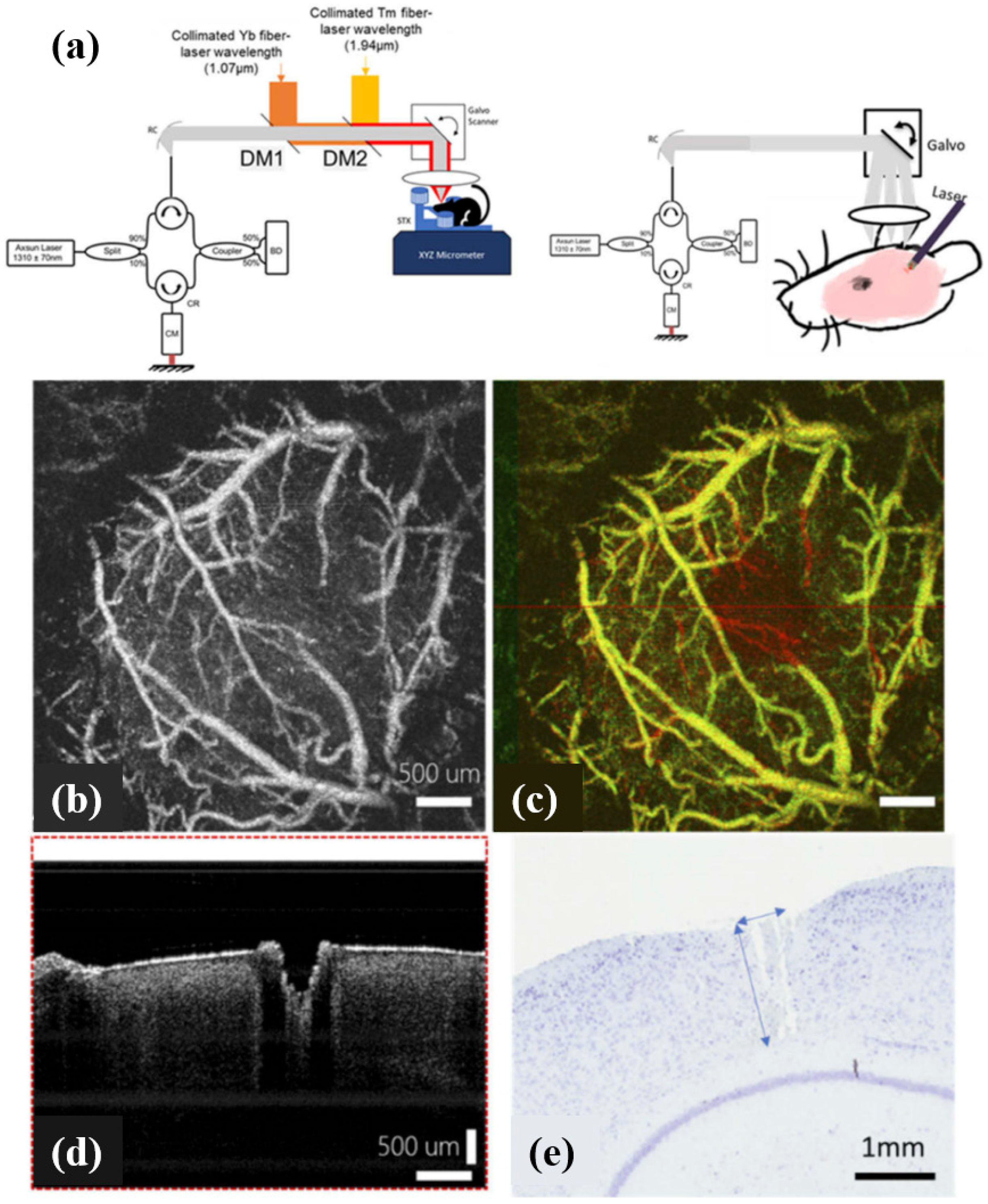
As a non-contact surgical modality, MIR ultrafast lasers can achieve single-cell-level cutting precision while maintaining high spatial selectivity. Their compatibility with large-core or hollow-core delivery fibers enables flexible and minimally disruptive beam delivery during surgery. These features collectively allow faster procedures, improved accuracy, and enhanced patient outcomes. In 2022, the first fiber-laser-based platform for precision microsurgery in mouse brain tissue was demonstrated by Katta et al. As shown in Figure 9, a Tm3+ fiber laser for ablation, a Yb3+ fiber laser for coagulation, and OCT-based image guidance were integrated into the system. Pre- and post-operative vascular OCT angiograms revealed sharply defined ablation boundaries and bloodless incisions, while H&E-stained histological sections confirmed that only negligible thermal damage was produced. These results highlight the potential of the platform for future clinical translation [110].
Beyond microsurgery, MIR fiber-laser-based imaging technologies enable label-free biochemical sensing within the “molecular fingerprint” region. A representative example is the fiber-based MIR endoscopic system proposed by Seddon et al., which employs a broadband SC source to perform in vivo spectral biopsy across the fingerprint band [125]. Such systems support early tumor detection through fluorescence or spectroscopic signatures. Moreover, MIR fiber-laser diagnostics are increasingly applied to noninvasive physiological monitoring-including glucose levels, blood oxygenation, and hemodynamics-using techniques such as laser Doppler flowmetry and laser-assisted mass spectrometry [126].
Overall, recent studies demonstrate that 2 μm ultrafast fiber lasers are rapidly expanding the capabilities of MIR biomedical imaging, sensing, and surgical technologies, offering high precision, label-free chemical contrast, deep tissue penetration, and clinically translatable system architectures.

4.5. Precision Materials Processing

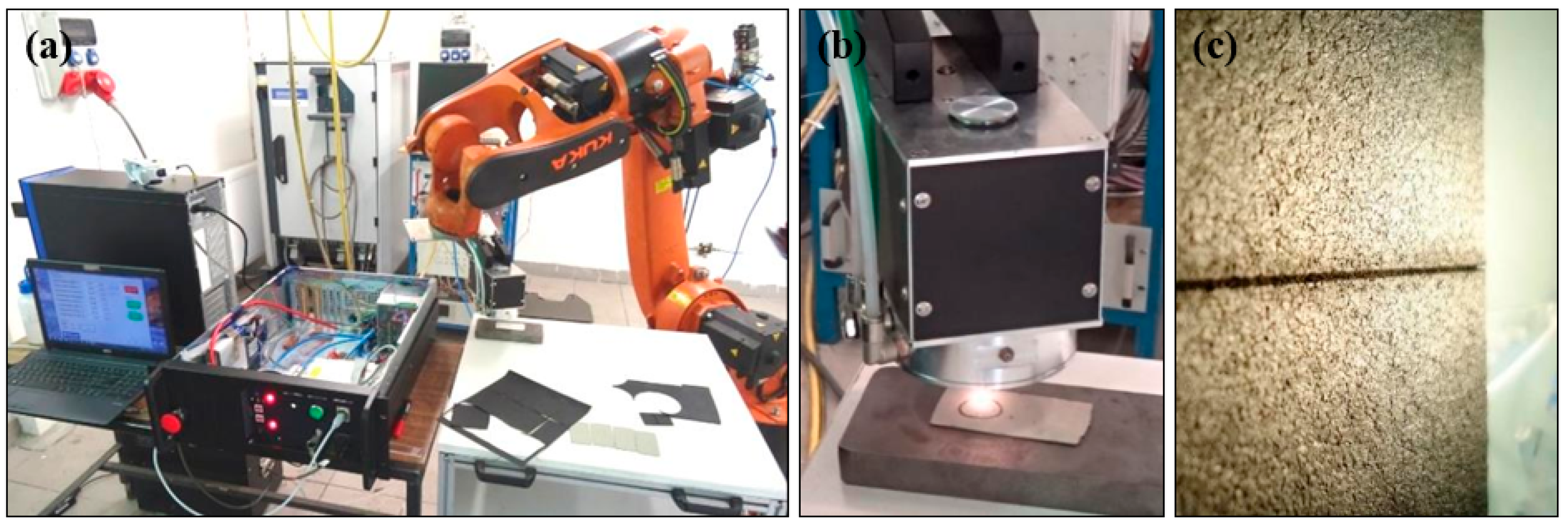
MIR ultrafast fiber lasers have become powerful tools for precision materials processing due to their high beam quality, strong material absorption in the 2–3.4 μm band, and minimal thermal load. These sources facilitate high-efficiency cutting, drilling, welding, and surface texturing of a wide range of materials, including metals such as stainless steel, aluminum, copper, and titanium, as well as polymers, ceramics, glasses, and other dielectrics. Their capability to deliver tightly confined ultrashort pulses makes them particularly suitable for micromachining of electronic components, micro-electro-mechanical systems (MEMS) structures, semiconductor devices, and electronic packaging, supporting next-generation silicon photonics manufacturing [127]. The laser workplace with robotic arm and some details are shown in Figure 10 [128].
Furthermore, many materials exhibit strong absorption features in the 2–3.4 μm mid-infrared region, which renders ultrafast lasers operating in this band highly suitable for micro- and nanoscale material processing. [129]. For example, high-repetition-rate mid-infrared femtosecond fiber lasers are capable of performing ultrahigh-precision point-by-point etching on optical fibers, enabling the fabrication of fiber Bragg gratings that serve as wavelength-selective and narrow-band filtering elements in fiber-laser systems [130].
Because most polymers exhibit high absorption near 2 μm but remain highly transparent at 1 μm, 2 μm ultrafast fiber lasers offer a distinct advantage for non-metal polymer processing. The combination of high peak power, sub-picosecond pulses, and eye-safe wavelengths enables high-precision structuring with minimal heat-affected zones-beneficial for flexible electronics, advanced packaging, and micro-fabrication. For example, stable laser welding of thin polymethacrylates (PMMA) samples has been demonstrated using fully fiberized 2 μm ultrafast sources [131]. A commercial 1950 nm fiber laser with 40 ps pulses, 4.35 W average power, and 23 kW peak power has achieved clean 11 μm-wide cuts in polymer films at 60 mm/s scanning speeds [132].
Beyond polymers, industrial-grade 2 μm ultrafast systems are also emerging for semiconductor processing. In 2024, Christian Gaida et al. developed a Tm3+-based chirped-pulse-amplification (CPA) fiber laser delivering > 100 µJ, <400 fs pulses at 1980 nm with >15 W average power, enabling precision filament cutting and micro-welding of silicon and other semiconductor materials-indicating strong potential for wafer-level manufacturing applications [133].

4.6. Prospects for Future Applications

The 2 μm ultrafast fiber lasers are poised to play an increasingly significant role across several frontier application domains beyond the conventional areas discussed above, notably attosecond science, free-space optical (FSO) communication, and defense-related infrared photonics [3]. In extreme nonlinear optics, high-harmonic generation (HHG) remains a central mechanism for producing coherent femtosecond-to-attosecond pulse trains with excellent spatial coherence, enabling direct access to ultrafast electron dynamics in atoms, molecules, and condensed-matter systems [134]. As mode-locking, coherent combining, and fiber-based chirped-pulse amplification continue to mature, high-energy, few-cycle, mid-infrared pulses from 2 μm fiber platforms are expected to become increasingly attractive drivers for HHG [135]. Their intrinsic advantages in compactness, robustness, thermal management, and cost may ultimately position fiber-based MIR sources as competitive alternatives to bulk solid-state systems in attosecond research.
In FSO communication, broadband coherent supercontinuum sources pumped by 2 μm ultrafast lasers offer strong compatibility with major atmospheric transmission windows and exhibit reduced attenuation under fog, aerosol, and precipitation compared with near-infrared wavelengths. These features make MIR fiber-laser-driven transmitters compelling candidates for high-capacity terrestrial or airborne FSO links. In the defense sector, MIR ultrafast sources hold potential for next-generation infrared countermeasure (IRCM) systems, where directional high-brightness emission is used to disrupt heat-seeking threats. While current systems rely mainly on optical parametric oscillators and quantum cascade lasers, ongoing advances in power scaling and repetition-rate enhancement at 2 μm suggest that fiber-laser-based IRCM may become feasible. Additional opportunities arise in short-range secure tactical communication and battlefield sensing, where compact MIR ultrafast fiber lasers could replace more complex bulk MIR platforms [136,137].
Collectively, these emerging directions underscore the broad transformative potential of 2 μm ultrafast fiber lasers. As architectures become increasingly power-scalable, integrated, and environmentally robust, MIR fiber-laser technology is expected to expand its impact across extreme nonlinear optics, free-space communication, and security applications, thereby shaping the next generation of mid-infrared photonic systems.

5. Conclusions

Substantial progress has been achieved in 2 μm ultrafast fiber lasers over the past decade, driven by advances in doped fiber technology, nonlinear photonic devices, and diverse mode-locking mechanisms. Active mode-locking techniques based on EOMs and AOMs enable precise repetition-rate control, while passive mode-locking approaches, including NPR, NOLM/NALM, NL-MMI, SESAMs, and emerging 2D nanomaterials—have enabled the generation of sub-picosecond and even few-hundred-femtosecond pulses with multi-nanojoule pulse energies. In addition, MOs and dispersion-managed cavity architectures have demonstrated strong potential for power scaling and noise suppression.
Although substantial progress has been achieved in recent years, the future development of 2 μm ultrafast fiber lasers is expected to be shaped by several converging trends and underlying physical constraints. A clear trajectory toward higher pulse energy and shorter pulse duration is emerging, with advanced architectures such as Mamyshev oscillators and nonlinear pulse compression playing a pivotal role. Nevertheless, further performance scaling is fundamentally constrained by nonlinear phase accumulation, gain saturation, and the onset of complex pulse instabilities.
In parallel, improving environmental stability and long-term robustness remains a central challenge for practical deployment. Approaches based on all-polarization-maintaining configurations and integrated photonic components offer promising pathways toward enhanced stability and reproducibility, although they often come at the expense of increased fabrication complexity and reduced design flexibility.
To overcome the intrinsic limitations of single-mechanism mode-locking schemes, hybrid mode-locking strategies have attracted growing attention. By enabling cooperative interactions between different nonlinear effects, these schemes can simultaneously improve self-starting capability and operational stability. However, the underlying dynamics of such hybrid systems remain insufficiently understood, particularly in terms of multi-parameter coupling and stability boundaries.
Beyond conventional temporal pulse shaping, spatiotemporal mode locking introduces an additional degree of freedom for energy scaling and multidimensional pulse control. Despite its significant potential, its practical implementation is still hindered by complex multimode interactions, limited controllability, and the lack of a comprehensive theoretical framework.
At the system level, the integration of multifunctional fiber devices is expected to play a key role in reducing system size, enhancing robustness, and enabling scalable manufacturing.
Overall, future research should move beyond incremental performance improvements and place greater emphasis on the fundamental understanding of nonlinear dynamics, the development of predictive design methodologies, and the realization of highly integrated and application-oriented ultrafast fiber laser systems.

Author Contributions

Conceptualization, S.D.; methodology, S.D. and T.W.; validation, S.D., T.C. and T.W.; formal analysis, S.D. and T.W.; investigation, S.D.; resources, B.Z. and S.T.; data curation, B.Z. and S.D.; writing—original draft preparation, S.D.; writing—review and editing, S.D. and T.C.; visualization, S.D. and S.T.; supervision, T.W. and T.C.; funding acquisition, T.W. All authors have read and agreed to the published version of the manuscript.

Funding

This research was funded by the Science and Technology Project of Jilin Province (20220508134RC); the 111 Project of China (D21009).

Data Availability Statement

Data are available upon request.

Conflicts of Interest

The authors declare no conflicts of interest.

References

  1. Keller, U.; Paschotta, R. Ultrafast Lasers; Springer: Berlin/Heidelberg, Germany, 2021. [Google Scholar]
  2. Tancin, R.J. Ultrafast Laser-Absorption Spectroscopy in the Mid-Infrared for Spatiotemporally Resolved Measurements of Gas Properties. Doctoral Dissertation, Purdue University, West Lafayette, IN, USA, 2021. [Google Scholar]
  3. Liu, X.; Ye, F.; Luo, Y.; Fu, H.; Li, Q.J. Ultrafast polarization-maintaining fiber lasers: Design, fabrication, performance, and applications. Laser Photonics Rev. 2025, 19, 2400927. [Google Scholar] [CrossRef]
  4. Zhang, Y.; Wu, K.; Guang, Z.; Guo, B.; Qiao, D.; Wei, Z.; Yang, H.; Wang, Q.; Li, K.; Copner, N. Advances and challenges of ultrafast fiber lasers in 2-4 µm mid-infrared spectral regions. Laser Photonics Rev. 2024, 18, 2300786. [Google Scholar] [CrossRef]
  5. Wang, F.; Qi, X.; Chen, Z.; Razeghi, M.; Dhillon, S. Ultrafast pulse generation from quantum cascade lasers. Micromachines 2022, 13, 2063. [Google Scholar] [CrossRef] [PubMed]
  6. Keller, U. 1 Ultrafast solid-state lasers: 2 Short and ultrashort pulse generation. In Laser Physics and Applications; Springer: Berlin/Heidelberg, Germany, 2007; pp. 33–167. [Google Scholar]
  7. Witte, S.; Eikema, K.S. Ultrafast optical parametric chirped-pulse amplification. IEEE J. Sel. Top. Quantum Electron. 2011, 18, 296–307. [Google Scholar] [CrossRef]
  8. Wang, Y.; Wang, M. Research Progress on All-Polarization-Maintaining Mode-Locked Fiber Lasers. Photonics 2025, 12, 366. [Google Scholar] [CrossRef]
  9. Ren, T.; Wu, C.; Yu, Y.; Dai, T.; Chen, F.; Pan, Q. Development progress of 3–5 μm mid-infrared lasers: OPO, solid-state and fiber laser. Appl. Sci. 2021, 11, 11451. [Google Scholar] [CrossRef]
  10. Nelson, L.; Tamura, K.; Ippen, E.; Haus, H. Additive-pulse mode-locked thulium-doped fiber ring laser. In Conference on Lasers and Electro-Optics; Optica Publishing Group: Washington, DC, USA, 1995; p. CWI4. [Google Scholar]
  11. Yang, W.; Zhang, B.; Hou, J.; Xiao, R.; Song, R.; Liu, Z. Gain-switched and mode-locked Tm/Ho-codoped 2 μm fiber laser for mid-IR supercontinuum generation in a Tm-doped fiber amplifier. Laser Phys. Lett. 2013, 10, 045106. [Google Scholar] [CrossRef]
  12. Keller, U. Recent developments in compact ultrafast lasers. Nature 2003, 424, 831–838. [Google Scholar] [CrossRef] [PubMed]
  13. Nakazawa, M.; Yoshida, E. A 40-GHz 850-fs regeneratively FM mode-locked polarization-maintaining erbium fiber ring laser. IEEE Photonics Technol. Lett. 2000, 12, 1613–1615. [Google Scholar] [CrossRef]
  14. Jeon, C.-G.; Zhang, S.; Shin, J.; Kim, J. Highly tunable repetition-rate multiplication of mode-locked lasers using all-fibre harmonic injection locking. Sci. Rep. 2018, 8, 13875. [Google Scholar] [CrossRef]
  15. Smith, K.; Armitage, I.; Wyatt, R.; Doran, N.; Kelly, S. Erbium fibre soliton laser. Electron. Lett. 1990, 26, 1149–1151. [Google Scholar] [CrossRef]
  16. Ali, S.; Raza, A.; Afzal, A.M.; Iqbal, M.W.; Hussain, M.; Imran, M.; Assiri, M.A. Recent advances in 2d-MXene based nanocomposites for optoelectronics. Adv. Mater. Interfaces 2022, 9, 2200556. [Google Scholar] [CrossRef]
  17. Yang, H.; Qi, M.; Li, X.; Xue, Z.; Cheng, J.; Lu, C.; Han, D.; Li, L.; Zhang, Y.; Zhao, F. Soliton interaction in a MXene-based mode-locked fiber laser. Opt. Express 2023, 31, 38688–38698. [Google Scholar] [CrossRef]
  18. Wu, Q.; Peng, L.; Zhao, J.; Sun, K.; Chen, S.; Huang, W. Mxene Nb2C/MoS2 heterostructure: Nonlinear optical properties and a new broadband saturable absorber for ultrafast photonics. Mater. Today Phys. 2025, 52, 101678. [Google Scholar] [CrossRef]
  19. Li, L.; Pang, L.; Wang, R.; Zhang, X.; Hui, Z.; Han, D.; Zhao, F.; Liu, W. Ternary transition metal dichalcogenides for high power vector dissipative soliton ultrafast fiber laser. Laser Photonics Rev. 2022, 16, 2100255. [Google Scholar] [CrossRef]
  20. Meng, X.; Li, L.; Sun, N.; Xue, Z.; Liu, Q.; Ye, H.; Liu, W. Ultrafast fiber laser based on tungsten sulphoselenide materials. Chin. Phys. Lett. 2023, 40, 124202. [Google Scholar] [CrossRef]
  21. Liang, S.; Lu, Y.; Liu, H.; Shang, X.; Du, R.; Ji, J.; Yu, Y.; Zhang, S. Saturable absorption of few-layer WS2 and WSe2 at exciton resonance. Opt. Express 2025, 33, 7266–7277. [Google Scholar] [CrossRef]
  22. Saltarelli, F.; Diebold, A.; Graumann, I.J.; Phillips, C.R.; Keller, U. Modelocking of a thin-disk laser with the frequency-doubling nonlinear-mirror technique. Opt. Express 2017, 25, 23254–23266. [Google Scholar] [CrossRef] [PubMed]
  23. Kim, D.; Kwon, D.; Lee, B.; Kim, J. Polarization-maintaining nonlinear-amplifying-loop-mirror mode-locked fiber laser based on a 3 × 3 coupler. Opt. Lett. 2019, 44, 1068–1071. [Google Scholar] [CrossRef]
  24. Ab Rahman, M.F.; Latiff, A.A.; Rosol, A.H.A.; Dimyati, K.; Wang, P.; Harun, S.W. Ultrashort pulse soliton fiber laser generation with integration of antimony film saturable absorber. J. Light. Technol. 2018, 36, 3522–3527. [Google Scholar] [CrossRef]
  25. Kwon, S.-Y.; Lee, J.; Lee, J.H. Intracavity pulse formation dynamics of dissipative soliton fiber lasers depending on saturable absorber parameters at 1.9 μm. Opt. Laser Technol. 2025, 181, 111594. [Google Scholar] [CrossRef]
  26. Huang, C.; Wang, C.; Shang, W.; Yang, N.; Tang, Y.; Xu, J. Developing high energy dissipative soliton fiber lasers at 2 micron. Sci. Rep. 2015, 5, 13680. [Google Scholar] [CrossRef]
  27. Gene, J.; Yeom, D.-I.; Kim, S.K.; Do Lim, S. Long-cavity mode-locked thulium-doped fiber laser for high pulse energy. Opt. Laser Technol. 2021, 136, 106739. [Google Scholar] [CrossRef]
  28. Sun, Y.; Duanmu, Q.; Wang, T.; Lin, P.; Liang, Y.; Chen, X.; Lu, S. Actively mode-locked fiber laser at 2-μm for free-space data transmission with tunable repetition rate. Optik 2021, 236, 166427. [Google Scholar] [CrossRef]
  29. Qin, J.; Jiang, W.; Li, Y.; Xu, Y.; Zhu, S.; Shi, Y.; Wang, F. 10 GHz regeneratively mode-locked thulium fiber laser with a stabilized repetition rate. Opt. Express 2021, 29, 37695–37702. [Google Scholar] [CrossRef]
  30. Li, Y.; Li, M.; Duan, R.; Liu, Z.; Wang, T.; Ma, W.; Tao, Z.; Lou, Y.; Jiang, H. Transmission performance of a 1.96 µm active mode-locked laser in smoke channel. Appl. Opt. 2022, 61, 1912–1917. [Google Scholar] [CrossRef] [PubMed]
  31. Anjali, P.; Srinivasan, B.; Venkitesh, D. Wavelength tunable actively mode-locked Tm3+ doped fiber laser with GHz repetition rate. Opt. Laser Technol. 2023, 165, 109611. [Google Scholar]
  32. Li, C.; Shi, J.; Gong, X.; Kong, C.; Luo, Z.; Song, L.; Wong, K.K. 1.7 μm wavelength tunable gain-switched fiber laser and its application to spectroscopic photoacoustic imaging. Opt. Lett. 2018, 43, 5849–5852. [Google Scholar] [CrossRef]
  33. Ma, X.; Huang, W.; Zhao, S.; Liu, Y.; Wang, C.; Fan, M.; Shang, J.; Hu, P.; Mao, J.; Yang, K. Gain-switched 2 µm fiber laser pumped by a Q-switching and mode-locking self-pulsing Er-doped fiber laser. Opt. Fiber Technol. 2024, 83, 103681. [Google Scholar] [CrossRef]
  34. Varsha; Das, G. In-band pumped, high peak-power gain-switched mode-locked thulium-doped fiber laser at 1925 nm. Opt. Contin. 2025, 4, 30–36. [Google Scholar] [CrossRef]
  35. Kneis, C.; Donelan, B.; Berrou, A.; Manek-Hönninger, I.; Robin, T.; Cadier, B.; Eichhorn, M.; Kieleck, C. Actively mode-locked Tm3+-doped silica fiber laser with wavelength-tunable, high average output power. Opt. Lett. 2015, 40, 1464–1467. [Google Scholar] [CrossRef]
  36. Hübner, P.; Kieleck, C.; Jackson, S.D.; Eichhorn, M. High-power actively mode-locked sub-nanosecond Tm3+-doped silica fiber laser. Opt. Lett. 2011, 36, 2483–2485. [Google Scholar] [CrossRef]
  37. Eckerle, M.; Kieleck, C.; Swiderski, J.; Jackson, S.D.; Mazé, G.; Eichhorn, M. Actively Q-switched and mode-locked Tm3+-doped silicate 2 μm fiber laser for supercontinuum generation in fluoride fiber. Opt. Lett. 2012, 37, 512–514. [Google Scholar] [CrossRef] [PubMed]
  38. Ma, W.; Wang, T.; Wang, F.; Wang, C.; Zhang, J.; Jiang, H. Tunable high repetition rate actively mode-locked fiber laser at 2 μm. Opto-Electron. Eng. 2018, 45, 170662. [Google Scholar]
  39. Wang, X.; Zhou, P.; Wang, X.; Tao, R.; Si, L. 2-μm Tm-Doped All-Fiber Pulse Laser With Active Mode-Locking and Relaxation Oscillation Modulating. IEEE Photonics J. 2013, 5, 1502206. [Google Scholar] [CrossRef]
  40. Yin, K.; Zhang, B.; Yang, W.; Chen, H.; Chen, S.; Hou, J. Flexible picosecond thulium-doped fiber laser using the active mode-locking technique. Opt. Lett. 2014, 39, 4259–4262. [Google Scholar] [CrossRef]
  41. Xian, A.; Cao, X.; Liu, Y.; Wang, Y.; Yin, X.; Liu, G.; Zhou, W.; Wang, H.; Huang, H.; Tang, D. Adaptive genetic algorithm-based 2 μm intelligent mode-locked fiber laser. OSA Contin. 2021, 4, 2747–2756. [Google Scholar] [CrossRef]
  42. Alamgir, I.; Rochette, M. Thulium-doped fiber laser mode-locked by nonlinear polarization rotation in a chalcogenide tapered fiber. Opt. Express 2022, 30, 14300–14310. [Google Scholar] [CrossRef]
  43. Hu, P.; Mao, J.; Zhou, X.; Feng, T.; Nie, H.; Wang, R.; Zhang, B.; Li, T.; He, J.; Yang, K. Passively mode-locked Ho-doped fiber laser with soliton rain and noise-like pulse regime. Opt. Laser Technol. 2022, 153, 108215. [Google Scholar] [CrossRef]
  44. Ma, X.; Li, Y.; Wang, C.; Fan, M.; Shang, J.; Yang, K.; Li, T.; Zhao, S.; Pan, Z.; Feng, T. 75 fs-pulse duration, ∼200 nm-span, distributed dispersion managed 2 μm ultrafast fiber laser. J. Light. Technol. 2025, 43, 8338–8343. [Google Scholar] [CrossRef]
  45. Li, Y.; Gao, B.; Han, Y.; Zhou, L.; Wen, H.; Li, Q.; Di, H.; Wu, G.; Liu, L.; Huo, J. Switching and transformation of multi-state solitons in thulium-doped fiber laser based on nonlinear polarization rotation. Opt. Fiber Technol. 2024, 88, 103991. [Google Scholar] [CrossRef]
  46. Shang, C.; Liu, W.; Zeng, Z.; Wu, Z.; Fan, Z.; Yue, H.; Wang, P.; Wei, C.; Liu, Y. High-power and high-speed all-optical all-fiber wavelength-swept source at 2 μm based on a femtosecond laser and time stretch technique. Infrared Phys. Technol. 2024, 139, 105328. [Google Scholar] [CrossRef]
  47. Wang, J.; Wen, B.; Chen, X.; Zhang, H.; Chen, X.; Yan, P.; Zhang, H. All-polarization-maintaining Ho-doped fiber oscillator mode-locked with nonlinear polarization evolution. Opt. Lett. 2023, 49, 133–136. [Google Scholar] [CrossRef]
  48. Wu, Y.; Cai, Y.; Zhou, G.; Fan, J.; Song, Y.; Cao, S.; Hu, M. Generation of sub-three-cycle pulses via double-stage all-fiber nonlinear compression from a thulium-doped fiber laser. Adv. Photonics Nexus 2025, 4, 056009. [Google Scholar] [CrossRef]
  49. He, J.; Hu, J.; Ouyang, D.; Tang, Z.; Luo, X.; Wang, J.; Dong, F.; Yan, P.; Wang, J.; Guo, C. Pulse-state switchable mode-locked Tm-doped fiber laser based on linear-cavity nonlinear polarization rotation. Infrared Phys. Technol. 2024, 142, 105550. [Google Scholar] [CrossRef]
  50. Wang, M.; Liu, M.; Chen, Y.; Ouyang, D.; Zhao, J.; Pei, J.; Ruan, S. Stable noise-like pulse generation in all-PM mode-locked Tm-doped fiber laser based on NOLM. Chin. Opt. Lett. 2021, 19, 091402. [Google Scholar] [CrossRef]
  51. Wang, X.-f.; Mao, H.-y.; Liu, Q.-h.; Liu, D.-x. 2 µm noise-like mode-locked fiber laser based on non-linear optical loop mirror. Optoelectron. Lett. 2021, 17, 294–297. [Google Scholar] [CrossRef]
  52. Wang, X.; Pan, J.; He, Y. Investigation on switchable operation states in a Tm/Ho co-doped fiber laser based on nonlinear optical loop mirror. Optoelectron. Lett. 2023, 19, 455–461. [Google Scholar] [CrossRef]
  53. Borodkin, A.; Honzátko, P. All-PM dispersion-managed Tm-doped fiber laser mode-locked by the NOLM. In Proceedings of the 23rd Slovak-Czech-Polish Optical Conference on Wave and Quantum Aspects of Contemporary Optics; SPIE: Bellingham, WA, USA, 2025; p. 1350803. [Google Scholar]
  54. Łaszczych, Z.; Krakowski, M.; Soboń, G. Mode-Locking dynamics in an all-PM figure-nine Tm-doped fiber laser. Appl. Sci. 2022, 12, 10613. [Google Scholar] [CrossRef]
  55. Mahnke, C.; Hua, Y.; Ma, Y.; Salman, S.; Lamb, T.; Schulz, S.; Heyl, C.M.; Cankaya, H.; Hartl, I. Long-term stable, synchronizable, low-noise picosecond Ho: Fiber NALM oscillator for Ho: YLF amplifier seeding. Opt. Lett. 2022, 47, 822–825. [Google Scholar] [CrossRef]
  56. Jiang, H.; Li, H.; Hu, F.; Ren, X.; Li, C.; Xu, S. Mode-locked Tm fiber laser with a tapered GIMF SA based on nonlinear multimode interference effect. IEEE Photonics Technol. Lett. 2020, 32, 503–506. [Google Scholar] [CrossRef]
  57. Huang, F.; Li, H.; Wang, K.; Li, C.; Xu, S.; Zhang, J. Few-mode fiber based saturable absorber for ultra-fast fiber laser at 2 μm. Infrared Phys. Technol. 2023, 133, 104838. [Google Scholar] [CrossRef]
  58. Repgen, P.; Schuhbauer, B.; Hinkelmann, M.; Wandt, D.; Wienke, A.; Morgner, U.; Neumann, J.; Kracht, D. Mode-locked pulses from a Thulium-doped fiber Mamyshev oscillator. Opt. Express 2020, 28, 13837–13844. [Google Scholar] [CrossRef]
  59. Yang, S.; Smith, C.R.; Petersen, C.R.; Bang, O. All-Fiber 2 µm Mamyshev Oscillator: Mapping of Different Operating Regimes. Laser Photonics Rev. 2025, 19, 2500074. [Google Scholar] [CrossRef]
  60. Shi, Z.; Sun, S.; Wang, Q.; Liu, Y.-G.; Wang, Z.; Wang, P. Ultrafast soliton dynamics from an all-fiber self-starting thulium-doped Mamyshev oscillator. Opt. Lett. 2025, 50, 1025–1028. [Google Scholar] [CrossRef]
  61. Zhou, Y.; Sun, Y.; Hou, Y.; Liu, Y.; Luo, T.; Li, Z.; Wang, T.; Pan, X. Generation and modulation of soliton molecules in an all-polarization-maintaining fiber laser mode-locked by NPE. Opt. Commun. 2025, 574, 131093. [Google Scholar] [CrossRef]
  62. Peng, S.; Liu, X.; Fu, H.; Li, Q. Intracavity filtering effect in a dual-output linear-cavity all-PM fiber laser mode-locked by NPE. Appl. Opt. 2023, 62, 6323–6332. [Google Scholar] [CrossRef]
  63. Chouli, S.; Grelu, P. Soliton rains in a fiber laser: An experimental study. Phys. Rev. A-At. Mol. Opt. Phys. 2010, 81, 063829. [Google Scholar] [CrossRef]
  64. Ren, B.; Li, C.; Wang, T.; Guo, K.; Zhou, P. Stable noise-like pulse generation from a NALM-based all-PM Tm-doped fiber laser. Opt. Express 2022, 30, 26464–26471. [Google Scholar] [CrossRef]
  65. Nazemosadat, E.; Mafi, A. Nonlinear multimodal interference and saturable absorption using a short graded-indexline-break justify multimode optical fiber. J. Opt. Soc. Am. B 2013, 30, 1357–1367. [Google Scholar] [CrossRef]
  66. Fu, W.; Wright, L.G.; Sidorenko, P.; Backus, S.; Wise, F.W. Several new directions for ultrafast fiber lasers. Opt. Express 2018, 26, 9432–9463. [Google Scholar] [CrossRef] [PubMed]
  67. Želudevičius, J.; Mickus, M.; Regelskis, K. Investigation of different configurations and operation regimes of fiber pulse generators based on nonlinear spectral re-shaping. Opt. Express 2018, 26, 27247–27264. [Google Scholar] [CrossRef] [PubMed]
  68. Liu, W.; Liao, R.; Zhao, J.; Cui, J.; Song, Y.; Wang, C.; Hu, M. Femtosecond Mamyshev oscillator with 10-MW-level peak power. Optica 2019, 6, 194–197. [Google Scholar] [CrossRef]
  69. Ma, C.; Khanolkar, A.; Zang, Y.; Chong, A. Ultrabroadband, few-cycle pulses directly from a Mamyshev fiber oscillator. Photonics Res. 2019, 8, 65–69. [Google Scholar] [CrossRef]
  70. Pitois, S.; Finot, C.; Provost, L.; Richardson, D. Generation of localized pulses from incoherent wave in optical fiber lines made of concatenated Mamyshev regenerators. J. Opt. Soc. Am. B 2008, 25, 1537–1547. [Google Scholar] [CrossRef]
  71. Liu, Z.; Ziegler, Z.M.; Wright, L.G.; Wise, F.W. Megawatt peak power from a Mamyshev oscillator. Optica 2017, 4, 649–654. [Google Scholar] [CrossRef]
  72. Gumenyuk, R.; Vartiainen, I.; Tuovinen, H.; Okhotnikov, O. Dissipative dispersion-managed soliton 2 μm thulium/holmium fiber laser. Opt. Lett. 2011, 36, 609–611. [Google Scholar] [CrossRef]
  73. Wang, J.; Cao, X.; Xian, A.; Chen, X.; Wu, Q.; Liu, Y.; Ge, Z.; Zhou, W.; Wang, H.; Huang, H. Noise-like pulses with an h-shape from a 2 μm semiconductor saturable-absorber mirror mode-locked fiber oscillator. Laser Phys. Lett. 2020, 17, 115101. [Google Scholar] [CrossRef]
  74. Liang, Z.; Lin, W.; Wu, J.; Chen, X.; Guo, Y.; Ling, L.; Wei, X.; Yang, Z. >10 GHz femtosecond fiber laser system at 2.0 μm. Opt. Lett. 2022, 47, 1867–1870. [Google Scholar] [CrossRef]
  75. Liang, Z.; Lin, W.; Wang, W.; Hu, X.; Pan, M.; Fan, Y.; Wei, C.; Wang, L.; Tang, G.; Wei, X. Low-noise mode-locking in a GHz repetition rate Tm3+-doped fiber laser. Opt. Lett. 2024, 49, 403–406. [Google Scholar] [CrossRef]
  76. Cheng, H.; Lin, W.; Zhang, Y.; Jiang, M.; Luo, W. Numerical insights into the pulse instability in a GHz repetition-rate thulium-doped fiber laser. J. Light. Technol. 2021, 39, 1464–1470. [Google Scholar] [CrossRef]
  77. Yang, Y.; Yang, Y.; Li, B.; He, Y.; Yan, P. High-power all-fiber femtosecond fiber laser system at 2μm. In Advanced Fiber Laser Conference (AFL 2024); SPIE: Bellingham, WA, USA, 2025; pp. 244–250. [Google Scholar]
  78. Martinez, A.; Sun, Z. Nanotube and graphene saturable absorbers for fibre lasers. Nat. Photonics 2013, 7, 842–845. [Google Scholar] [CrossRef]
  79. Ososkov, Y.; Khegai, A.; Riumkin, K.; Mkrtchyan, A.; Gladush, Y.; Krasnikov, D.; Nasibulin, A.; Yashkov, M.; Guryanov, A.; Melkumov, M. All-PM fiber Tm-doped laser with two fiber Lyot filters mode-locked by CNT. Photonics 2022, 9, 608. [Google Scholar] [CrossRef]
  80. Zheng, J.; Xie, J.; Zhang, Y.; Nie, X. Soliton energy quantization effect in a thulium-doped fiber laser. Opt. Laser Technol. 2025, 188, 112965. [Google Scholar] [CrossRef]
  81. Voropaev, V.; Batov, D.; Mizgirev, S.; Ivashkina, E.; Belova, V.; Mkrtchyan, A.; Gladush, Y.; Krasnikov, D.; Nasibulin, A.; Lazarev, V. PM thulium-doped fiber laser harmonically mode-locked by polymer-free single-walled carbon nanotubes. Opt. Express 2025, 33, 32780–32797. [Google Scholar] [CrossRef]
  82. Hasan, M.Z.; Kane, C.L. Colloquium: Topological insulators. Rev. Mod. Phys. 2010, 82, 3045–3067. [Google Scholar] [CrossRef]
  83. Tian, H.Y.; Channa, S.A.; Hu, S.W. Relationships between genetic distance, combining ability and heterosis in rapeseed (Brassica napus L.). Euphytica 2017, 213, 1. [Google Scholar] [CrossRef]
  84. Ma, X.; Chen, W.; Tong, L.; Liu, S.; Dai, W.; Ye, S.; Zheng, Z.; Wang, Y.; Zhou, Y.; Zhang, W. Experimental demonstration of harmonic mode-locking in Sb2Se3-based thulium-doped fiber laser. Opt. Laser Technol. 2021, 143, 107286. [Google Scholar] [CrossRef]
  85. Ahmad, H.; Makhfuz, M.J.M.; Yusoff, N.; Reduan, S.A. Thulium holmium-doped fiber laser mode-locked using Sb2Te3 saturable absorber coated arc-shaped fiber. Infrared Phys. Technol. 2022, 125, 104228. [Google Scholar] [CrossRef]
  86. Zhang, Q.; Jin, X.; Zhang, M.; Wu, Q.; Zheng, Z. Controlled generation of soliton molecules from a dispersion-managed Tm-doped fiber laser with BP-SA. Results Phys. 2024, 64, 107908. [Google Scholar] [CrossRef]
  87. Huang, C.; Xiao, H.; Xu, J.; Tang, Y. Selectively mode-locked high-order-mode 2-μm thulium fiber laser. Opt. Commun. 2019, 440, 95–99. [Google Scholar] [CrossRef]
  88. Filatova, S.A.; Kamynin, V.A.; Arutyunyan, N.R.; Pozharov, A.S.; Trikshev, A.I.; Zhluktova, I.V.; Zolotovskii, I.O.; Obraztsova, E.D.; Tsvetkov, V.B. Hybrid mode locking of an all-fiber holmium laser. J. Opt. Soc. Am. B 2018, 35, 3122–3125. [Google Scholar] [CrossRef]
  89. Cao, B.; Gao, C.; Liu, K.; Xiao, X.; Yang, C.; Bao, C. Spatiotemporal mode-locking and dissipative solitons in multimode fiber lasers. Light Sci. Appl. 2023, 12, 260. [Google Scholar] [CrossRef]
  90. Ricciardi, A.; Zimmer, M.; Witz, N.; Micco, A.; Piccirillo, F.; Giaquinto, M.; Kaschel, M.; Burghartz, J.; Jetter, M.; Michler, P.; et al. Integrated optoelectronic devices using lab-on-fiber technology. Adv. Mater. Technol. 2022, 7, 2101681. [Google Scholar] [CrossRef]
  91. Sui, L.; Zhao, T.; Sun, C.; Lu, M.; Wang, T. Tm–Ho co-doped hybrid mode-locked fiber laser based on Ti3CNTx saturable absorber. Opt. Commu. 2024, 569, 130858. [Google Scholar] [CrossRef]
  92. Chen, X.; Wen, B.; Zhang, H.; Long, X.; Zhang, E.; Guo, C.; Yan, P.; Wang, J. Enhanced performance of all-PM Ho-doped fiber oscillator using NPE-SESAM hybrid mode-locking. Opt. Express 2024, 32, 32643–32654. [Google Scholar] [CrossRef]
  93. Wright, L.G.; Christodoulides, D.N.; Wise, F.W. Spatiotemporal mode-locking in multimode fiber lasers. Science 2017, 358, 94–97. [Google Scholar] [CrossRef]
  94. Wright, L.G.; Sidorenko, P.; Pourbeyram, H.; Ziegler, Z.M.; Isichenko, A.; Malomed, B.A.; Menyuk, C.R.; Christodoulides, D.N.; Wise, F.W.W. Mechanisms of spatiotemporal mode-locking. Nat. Phys. 2020, 16, 565–570. [Google Scholar] [CrossRef]
  95. Yao, T.; Zheng, F.; Kang, H.; Zhu, Q.; Song, X.; Ma, J.; Zhou, W.; Wang, H.; Wang, F.; Wang, Y.; et al. 2 µm spatiotemporal mode-locked fiber laser based on intelligent hybrid fiber structure strategy. Opt. Laser Technol. 2025, 192, 114114. [Google Scholar] [CrossRef]
  96. Zeng, J.; Akosman, A.E.; Sander, M.Y. Scaling the repetition rate of thulium-doped ultrafast soliton fiber lasers to the GHz regime. Opt. Express 2018, 26, 24687–24694. [Google Scholar] [CrossRef] [PubMed]
  97. Nelson, L.E.; Jones, D.; Tamura, K.; Haus, H.A.; Ippen, E. Ultrashort-pulse fiber ring lasers. Appl. Phys. B Laser Opt. 1997, 65, 277–294. [Google Scholar] [CrossRef]
  98. Tsuzuki, M.; Jin, L.; Yamanaka, M.; Sonnenchein, V.; Tomita, H.; Sato, A.; Ohara, T.; Sakakibara, Y.; Omoda, E.; Kataura, H. Midinfrared optical frequency comb based on difference frequency generation using high repetition rate Er-doped fiber laser with single wall carbon nanotube film. Photonics Res. 2016, 4, 313–317. [Google Scholar] [CrossRef]
  99. Bartels, A.; Cerna, R.; Kistner, C.; Thoma, A.; Hudert, F.; Janke, C.; Dekorsy, T. Ultrafast time-domain spectroscopy based on high-speed asynchronous optical sampling. Rev. Sci. Instrum. 2007, 78, 035107. [Google Scholar] [CrossRef]
  100. Wang, Y.; Hou, S.; Yu, Y.; Liu, W.; Yan, P.; Yang, J. Photonic device combined optical microfiber coupler with saturable-absorption materials and its application in mode-locked fiber laser. Opt. Express 2021, 29, 20526–20534. [Google Scholar] [CrossRef]
  101. Jeon, J.; Lee, J.; Lee, J.H. Numerical study on the minimum modulation depth of a saturable absorber for stable fiber laser mode locking. J. Opt. Soc. Am. B 2014, 32, 31–37. [Google Scholar] [CrossRef]
  102. Shaodong, H.; Zhijian, M.; Junbo, Y.; Min, Z.; Peiguang, Y.; Shuangchen, R. Mode-locked Er-doped fiber laser based on function-integrated fiber coupler. Opt. Lett. 2021, 46, 5934–5937. [Google Scholar] [CrossRef]
  103. Hou, S.; Ma, Z.; Wang, J.; Zhang, M.; Yan, P. Ultrafast Tm-doped fiber laser based on hybrid fiber coupler. J. Lumin. 2022, 251, 119232. [Google Scholar] [CrossRef]
  104. Chen, Z.; Hou, S.; Ma, Z.; Wang, J.; Wang, J.; Yan, P. 214 MHz, 450 fs mode-locked Tm-doped fiber laser with a WTe2&gain fiber integrated fiber coupler. Infrared Phys. Technol. 2022, 125, 104324. [Google Scholar]
  105. Chang, G.; Wei, Z.J.I. Ultrafast fiber lasers: An expanding versatile toolbox. iScience 2020, 23, 101101. [Google Scholar] [CrossRef]
  106. Li, X.; Yu, X.; Sun, Z.; Yan, Z.; Sun, B.; Cheng, Y.; Yu, X.; Zhang, Y.; Wang, Q.J. High-power graphene mode-locked Tm/Ho co-doped fiber laser with evanescent field interaction. Sci. Rep. 2015, 5, 16624. [Google Scholar] [CrossRef] [PubMed]
  107. Wang, X.; Zhang, Y.; Yao, C.; Yang, L.; Zhu, Y.; Li, P. Toward Octave-Spanning Mid-Infrared Supercontinuum Laser Generation Using Cascaded Germania-Doped Fiber and Fluorotellurite Fiber. Photonics 2026, 13, 50. [Google Scholar] [CrossRef]
  108. Jiang, S.; Guo, C.; Fu, H.; Che, K.; Xu, H.; Cai, Z. Mid-infrared Raman lasers and Kerr-frequency combs from an all-silica narrow-linewidth microresonator/fiber laser system. Opt. Express 2020, 28, 38304–38316. [Google Scholar] [CrossRef]
  109. Liu, L. Research on Ultrafast Laser Precision Processing Technology for Hard and Brittle Crystal Materials. Master’s Thesis, University of Chinese Academy of Sciences (Xi’an Institute of Optics and Precision Mechanics, Chinese Academy of Sciences), Xi’an, China, 2024. [Google Scholar]
  110. Katta, N.; Estrada, A.D.; McErloy, A.B.; Milner, T.E. Fiber-laser platform for precision brain surgery. Biomed. Opt. Express 2022, 13, 1985–1994. [Google Scholar] [CrossRef]
  111. Engelmann, S.A.; Zhou, A.; Hassan, A.M.; Williamson, M.R.; Jarrett, J.W.; Perillo, E.P.; Tomar, A.; Spence, D.J.; Jones, T.A.; Dunn, A.K. Diamond Raman laser and Yb fiber amplifier for in vivo multiphoton fluorescence microscopy. Biomed. Opt. Express 2022, 13, 1888–1898. [Google Scholar] [CrossRef]
  112. Xia, K.; Yang, L.; Yan, B.; Liu, J.; Li, X.; Zhao, R.; Yang, P.; Dai, S.; Nie, Q. Watt-level ultra-flattened mid-infrared supercontinuum with high power stability generation in an all-fiber structured Tm-doped fiber amplifier pumped ZBLAN single-mode fiber. Opt. Laser Technol. 2020, 127, 106204. [Google Scholar] [CrossRef]
  113. Gauthier, J.-C.; Fortin, V.; Duval, S.; Vallée, R.; Bernier, M. In-amplifier mid-infrared supercontinuum generation. Opt. Lett. 2015, 40, 5247–5250. [Google Scholar] [CrossRef]
  114. Hudson, D.D.; Antipov, S.; Li, L.; Alamgir, I.; Hu, T.; Amraoui, M.E.; Messaddeq, Y.; Rochette, M.; Jackson, S.D.; Fuerbach, A. Toward all-fiber supercontinuum spanning the mid-infrared. Optica 2017, 4, 1163–1166. [Google Scholar] [CrossRef]
  115. Zhu, X.; Zhao, D.; Zhang, B.; Yang, L.; Yao, J.; Yang, Y.; Liu, S.; Hou, J. Spectrally flat mid-infrared supercontinuum pumped by a high power 2 µm noise-like pulse. Opt. Express 2023, 31, 13182–13194. [Google Scholar] [CrossRef] [PubMed]
  116. Kibler, B.; Serrano, E.; Maldonado, A.; Robichaud, L.-R.; Duval, S.; Bernier, M.; Bizot, R.; Désévédavy, F.; Vallée, R.; Messaddeq, Y. All-fiber 2-6 μm coherent supercontinuum source based on chalcogenide fibers pumped by an amplified mid-IR soliton laser. Opt. Commu. 2023, 542, 129568. [Google Scholar] [CrossRef]
  117. Cruz, F.C.; Maser, D.L.; Johnson, T.; Ycas, G.; Klose, A.; Sinclair, L.C.; Coddington, I.; Newbury, N.R.; Diddams, S. Mid-infrared optical frequency combs based on difference frequency generation for dual-comb spectroscopy. In Proceedings of the Conference on Lasers and Electro-Optics (CLEO 2015), San Jose, CA, USA, 10–15 May 2015. [Google Scholar]
  118. Vainio, M.; Karhu, J. Fully stabilized mid-infrared frequency comb for high-precision molecular spectroscopy. Opt. Express 2017, 25, 4190–4200. [Google Scholar] [CrossRef]
  119. Schunemann, P.G.; Zawilski, K.T.; Pomeranz, L.A.; Creeden, D.J.; Budni, P.A. Advances in nonlinear optical crystals for mid-infrared coherent sources. J. Opt. Soc. Am. B 2016, 33, D36–D43. [Google Scholar] [CrossRef]
  120. Coluccelli, N.; Cassinerio, M.; Gambetta, A.; Laporta, P.; Galzerano, G. High-power frequency comb in the range of 2–2.15 μm based on a holmium fiber amplifier seeded by wavelength-shifted Raman solitons from an erbium-fiber laser. Opt. Lett. 2014, 39, 1661–1664. [Google Scholar] [CrossRef]
  121. Pathak, K.; Pant, R. Brillouin laser pumped tunable low-threshold mid-IR Kerr comb at 2 μm. APL. Photonics 2024, 9, 100803. [Google Scholar] [CrossRef]
  122. Grassani, D.; Tagkoudi, E.; Guo, H.; Herkommer, C.; Yang, F.; Kippenberg, T.J.; Brès, C.-S. Mid infrared gas spectroscopy using efficient fiber laser driven photonic chip-based supercontinuum. Nat. Commu. 2019, 10, 1553. [Google Scholar] [CrossRef]
  123. Li, X.; Huang, X.; Hu, X.; Guo, X.; Han, Y. Recent progress on mid-infrared pulsed fiber lasers and the applications. Opt. Laser Technol. 2023, 158, 108898. [Google Scholar] [CrossRef]
  124. Mortensen, L.J.; Alt, C.; Turcotte, R.; Masek, M.; Liu, T.-M.; Côté, D.C.; Xu, C.; Intini, G.; Lin, C.P. Femtosecond laser bone ablation with a high repetition rate fiber laser source. Biomed. Opt. Express 2014, 6, 32–42. [Google Scholar] [CrossRef] [PubMed]
  125. Seddon, A.B.; Napier, B.; Lindsay, I.; Lamrini, S.; Moselund, P.M.; Stone, N.; Bang, O.; Farries, M.J.A. Prospective on using fibre mid-infrared supercontinuum laser sources for in vivo spectral discrimination of disease. Analyst 2018, 143, 5874–5887. [Google Scholar] [CrossRef]
  126. Hänel, L.; Kwiatkowski, M.; Heikaus, L.; Schlüter, H. Mass spectrometry-based intraoperative tumor diagnostics. Future Sci. OA 2019, 5, FSO373. [Google Scholar] [CrossRef]
  127. Geng, J.; Jiang, S. Fiber lasers: The 2 μm market heats up. Opt. Photonics News 2014, 25, 34–41. [Google Scholar] [CrossRef]
  128. Todorov, F.; Aubrecht, J.; Peterka, P.; Schreiber, O.; Jasim, A.A.; Mrázek, J.; Podrazký, O.; Kamrádek, M.; Kanagaraj, N.; Grábner, M.; et al. Active optical fibers and components for fiber lasers emitting in the 2-μm spectral range. Materials 2020, 13, 5177. [Google Scholar] [CrossRef]
  129. Henderson-Sapir, O.; Jackson, S.D.; Ottaway, D.J. Versatile and widely tunable mid-infrared erbium doped ZBLAN fiber laser. Opt. Lett. 2016, 41, 1676–1679. [Google Scholar] [CrossRef]
  130. Peterka, P.; Honzátko, P.; Becker, M.; Todorov, F.; Písařík, M.; Podrazký, O.; Kašík, I. Monolithic Tm-doped fiber laser at 1951 nm with deep-UV femtosecond-induced FBG pair. IEEE Photonics Technol. Lett. 2013, 25, 1623–1625. [Google Scholar] [CrossRef]
  131. Geng, J.; Wang, Q.; Lee, Y.; Jiang, S. Development of eye-safe fiber lasers near 2 μm. IEEE J. Sel. Top. Quantum Electron. 2014, 20, 150–160. [Google Scholar] [CrossRef]
  132. Voisiat, B.; Gaponov, D.; Gečys, P.; Lavoute, L.; Silva, M.; Hideur, A.; Ducros, N.; Račiukaitis, G. Material processing with ultra-short pulse lasers working in 2µm wavelength range. In Laser Applications in Microelectronic and Optoelectronic Manufacturing (LAMOM); SPIE: Bellingham, WA, USA, 2015; pp. 120–127. [Google Scholar]
  133. Gaida, C.; Heuermann, T.; Breitkopf, S.; Eidam, T.; Limpert, J. Industrial-grade 2-μm ultrafast fiber laser CPA for silicon processing: Delivering > 100 μJ pulses at 1980 nm with <400 fs duration and >15 W average power. Photonics Views 2024, 21, 44–47. [Google Scholar] [CrossRef]
  134. Lee, D.G.; Park, J.J.; Sung, J.H.; Nam, C.H. Wave-front phase measurements of high-order harmonic beams by use of point-diffraction interferometry. Opt. Lett. 2003, 28, 480–482. [Google Scholar] [CrossRef]
  135. Miaja-Avila, L.; Saathoff, G.; Mathias, S.; Yin, J.; La-o-vorakiat, C.; Bauer, M.; Aeschlimann, M.; Murnane, M.M.; Kapteyn, H.C. Direct Measurement of Core-Level Relaxation Dynamics on a Surface-Adsorbate System. Phys. Rev. Lett. 2008, 101, 046101. [Google Scholar] [CrossRef]
  136. Lin, P.; Wang, T.; Ma, W.; Chen, J.; Jiang, Z.; Yu, C. 2 μm Free-Space Data Transmission Based on an Actively Mode-Locked Holmium-Doped Fiber Laser. IEEE Photonics Technol. Lett. 2020, 32, 223–226. [Google Scholar] [CrossRef]
  137. Piotrowski, M.; Alessandro Medina, M.; Schellhorn, M.; Spindler, G.; Hildenbrand-Dhollande, A. Effects of pump pulse energy and repetition rate on beam quality in a high-power mid-infrared ZnGeP2 OPO. Opt. Express 2021, 29, 2577–2586. [Google Scholar] [CrossRef]
Figure 1. Conceptual representation of the fundamental mechanisms of mode locking. (a) Distribution of gain and loss elements within a fiber-laser cavity operating in the mode-locked regime. (b) Illustration of the loss-modulation mechanism employed in active mode locking. (c) Illustration of the loss-modulation dynamics associated with passive mode locking.
Photonics 13 00420 g001
Figure 2. The performance requirements of 2 μm wavelength mode-locked fiber lasers for SA.
Photonics 13 00420 g002
Figure 3. The schematic setup of the PLL-regeneratively mode-locked fiber laser system [29]. Reproduced under the terms of the Optica Open Access Publishing Agreement, © 2021, Optica Publishing Group.
Photonics 13 00420 g003
Figure 4. (a) Experimental configuration of the intelligent Tm-doped mode-locked fiber laser. (b) Corresponding optical spectrum. (c) Autocorrelation trace recorded within a narrow temporal window of 1.5 ps, with the inset showing the trace captured over an extended 50 ps range. (d) RF spectrum of the fundamental cavity repetition frequency, measured with a 2 kHz span and a 10 Hz resolution bandwidth [41]. Reproduced under the terms of the Optica Open Access Publishing Agreement, © 2021, Optica Publishing Group.
Photonics 13 00420 g004
Figure 5. (a) Experimental setup of the NLP operation NALM-based all-PM TDFL; (b) RF spectrum at the output power of 11.5 mW, inset: RF spectrums in a large frequency range of 100 MHz [64]. Reproduced under the terms of the Optica Open Access Publishing Agreement, © 2022, Optica Publishing Group.
Photonics 13 00420 g005
Figure 6. (a) Configuration of the two arms within the MO. (b) RF trace corresponding to the fundamental repetition-rate component, with the inset displaying the spectral response up to 1 GHz [58]. Reproduced under the terms of the Optica Open Access Publishing Agreement, © 2020, Optica Publishing Group.
Photonics 13 00420 g006
Figure 7. (a) The all-PM mode-locked Tm-doped fiber laser: CNT-carbon nanotubes in FC/APC connectors module; (b) variation in output spectra vs. time [79]. Under the terms of the Creative Commons Attribution (CC BY) license.
Photonics 13 00420 g007
Figure 8. Applications of 2 μm ultrafast fiber lasers. This figure incorporates content from the following sources, arranged from left to right: Ref. [107], under the terms of the Creative Commons Attribution (CC BY) license, Ref. [108], reproduced under the terms of the Optica Open Access Publishing Agreement, © 2020, Optica Publishing Group, Ref. [109] archived in CNKI, Refs. [110,111] reproduced under the terms of the Optica Open Access Publishing Agreement, © 2022, Optica Publishing Group.
Photonics 13 00420 g008
Figure 9. (a) Bench-top fiber-laser platform comprising a TDFL for cutting and an ytterbium fiber laser for coagulation, integrated with swept-source OCT guidance. (b) Pre-operative cerebral angiography of a control mouse. (c) Post-operative angiography of the same specimen. (d) Post-operative B-scan OCT image of the ablation crater generated by the TDFL. (e) Corresponding histological section showing qualitative agreement with the B-scan OCT results [110]. Reproduced under the terms of the Optica Open Access Publishing Agreement, © 2022, Optica Publishing Group.
Photonics 13 00420 g009
Figure 10. (a) Experimental setup for material processing using a thulium-doped all-fiber laser integrated with a robotic arm; (b) Close-up view of the laser head during cutting of 1 mm-thick synthetic leather; (c) Detailed image of a cut in styrene-butadiene rubber (SBR) material [128]. Under the terms of the Creative Commons Attribution (CC BY) license.
Photonics 13 00420 g010
Table 1. Recent studies on actively mode-locked 2 μm ultrafast fiber lasers.
ModulatorGain
Medium
Central Wavelength (nm)Pulse Width (ps)Repetition Frequency
(MHz)
Pulse Energy (nJ)Average Output Power (W)Ref.Year
AOMTm3+1950–21302006680053[35]2015
AOMTm3+19783837.8831411.8[36]2011
AOMTm3+--0.0680005[37]2012
EOMTm3+/HO3+1907–192720022,000--[38]2018
EOMTm3+1950816/44611.884/12.0990.0012-[39]2013
EOMTm3+19805821.4--[40]2014
MZMTm3+/HO3+1929.916.3691.9-0.026[28]2021
MZMTm3+196212.472110--[30]2022
LNPMTm3+18884910,008-0.0015[29]2021
LNPMTm3+1955–20454210,000-0.005[31]2023
Gain-switchedTm3+1959.5668.89 ns0.0727 0.0265[33]2024
Gain-switchedTm3+192510520 0.0049[34]2025
Table 2. Recent studies on passively mode-locked 2 μm ultrafast fiber lasers employing various artificial SA structures.
SAGain
Medium
Central
Wavelength (nm)
Pulse WidthRepetition
Frequency
(MHz)
Pulse
Energy
(nJ)
Average
Output Power (mW)
Ref.Year
NPRTm3+1973325 fs9.4045-57.7[41]2021
NPRTm3+1877–19452.4 ps20.9-0.4[42]2022
NPRHo3+20411.18 ps4.87234.14166.34[43]2022
NPRTm3+191475 fs45.52.70123[44]2025
NPRTm3+1900886 fs14.247-10[45]2024
NPRTm3+2015169 fs18.4-14[46]2024
NPEHo3+2080439 fs61.670.127.5[47]2024
NPRTm3+~200019.8 fs199.743.37674[48]2025
NPRTm3+1970268.5 ps9.3418.9113.95[49]2024
NOLMTm3+1891721 fs840.339.47[50]2021
NOLMTm3+1999.7985 fs6.52346300.2[51]2021
NOLMTm3+/Ho3+1917.8626.70 ns1.59-38.7[52]2023
NOLMTm3+1998688 fs9.390.02130.2[53]2025
NALMTm3+1985650 fs52.40.1772.24[54]2022
NALMHo3+2035–20751.3 ps41.60.147.1[55]2022
NL-MMITm3+19351.9 ps18.79--[56]2020
NL-MMITm3+18781.96 ps8.33--[57]2023
MOTm3+19770.293 ps153.5553.4[58]2020
MOTm3+1954.5309 fs5.80.95.1[59]2025
MOTm3+1940350 fs687.534[60]2025
Table 3. Recent studies on passively mode-locked 2 μm ultrafast fiber lasers employing various real SA structures.
SAGain
Medium
Central
Wavelength (nm)
Pulse WidthRepetition
Frequency
(MHz)
Pulse
Energy
(nJ)
Average
Output Power (mW)
Ref.Year
SESAMTm3+1939.53.93 ps17.338.8672[87]2019
SESAMTm3+1970440 fs14.795.2~1000[73]2020
SESAMTm3+1945.2290 fs23.96268.819.1[77]2025
SESAMTm3+1890–1960163 fs106-612[74]2022
SESAMTm3+1964.97.9 fs106--[75]2024
CNTTm3+185513.6 ps14.660.027>2[79]2022
CNTTm3+1889.22.7 ps14.8--[80]2025
CNTTm3+1912400 fs841493[81]2025
Sb2Te3Tm3+1961.35890 fs22.35-93.6[84]2021
Sb2Te3Tm3+1902.061.32 ps10.880.2832.03[85]2022
BPTm3+1875805 fs15.41.0221.3[86]2024
Disclaimer/Publisher’s Note: The statements, opinions and data contained in all publications are solely those of the individual author(s) and contributor(s) and not of MDPI and/or the editor(s). MDPI and/or the editor(s) disclaim responsibility for any injury to people or property resulting from any ideas, methods, instructions or products referred to in the content.