You are currently viewing a new version of our website. To view the old version click .
Photonics
  • Review
  • Open Access

31 December 2025

Review of Optical Fiber Sensors: Principles, Classifications and Applications in Emerging Technologies


,
,
,
,
,
,
and
1
Facultad de Ingeniería y Ciencias, Universidad Autónoma de Tamaulipas, Centro Universitario Victoria, Ciudad Victoria 87149, Tamaulipas, Mexico
2
Centro de Investigación Científica y de Educación Superior de Ensenada (CICESE), División de Física Aplicada-Departamento de Óptica, Carretera Ensenada-Tijuana, No. 3918, Zona Playitas, Ensenada 22860, Baja California, Mexico
3
Departamento de Investigación en Física, Universidad de Sonora, Blvd. Luis Encinas y Rosales, Hermosillo 83000, Sonora, Mexico
*
Author to whom correspondence should be addressed.
This article belongs to the Special Issue Advancements in Mode-Locked Lasers

Abstract

Optical fiber sensors (OFSs) have emerged as essential tools in the monitoring of physical, chemical, and bio-medical parameters in harsh situations due to their high sensitivity, electromagnetic interference (EMI) immunity, and long-term stability. However, the current literature contains scattered information in most reviews regarding individual sensing technologies or domains. This study provides a structured exploratory review in a novel inter-family analysis of both intrinsic and extrinsic configurations by analyzing more than 23,000 publications between 2019 and 2025 in five key domains: industry, medicine and biomedicine, environmental chemistry, civil/structural engineering, and aerospace. The analysis aims to critically discuss how functional principles/parameters and methods of interrogation affect the applicability of different OFS categories. The results reveal leading trends in the use of techniques like the use of fiber Bragg gratings (FBG) and distributed sensing in high-accuracy conditions or the rising role of extrinsic sensors in selective chemical situations and point out new approaches in areas like Artificial Intelligence (AI)- or Internet of Things (IoT)-integrated sensors. Further, this synthesis not only connects pieces of knowledge but also defines the technological barriers in terms of calibration cost and standardization: this provides strategic insight regarding future research and the scalability of industry deployment.

1. Introduction

Accurate, safe, and efficient measurement of physical and chemical variables is a cornerstone for technological advancement in fields such as precision agriculture [1], food processing [2], and biomedical monitoring [3]. In this context, optical fiber sensor (OFS) technology has established itself as one of the most promising and versatile technologies in recent years due to specific characteristics such as sensitivity [4], robustness [5,6], EMI immunity [7], small size, and potential for remote and distributed detection [8].
Since the 1970s [5,8], the development and application of OFS technology have undergone substantial advancements. These advances include diversification in sensor structures, materials, and sensing mechanisms [9]. The areas of application have also expanded to include medicine [10], the aerospace industry [11], civil engineering [12], and environmental chemistry [13].
Classifying OFSs as intrinsic and extrinsic schemes has been a key point in their technological development [5]. Intrinsic sensors use fiber as both a transmission medium and a sensing element, enabling detection of parameters through changes in their internal optical properties, such as refractive index, intensity, phase, or wavelength [5]. These properties have led to various research projects aimed at exploiting their advantages over other sensors, such as electronic sensors [5,14], and has given OFSs the ability to be used for detecting vibrations, deformations, or temperature changes in hostile environments [15], including geological hazard detection [16]. Among the most prominent architectures of this type are fiber Bragg gratings (FBG) [17], and sensors based on Raman scattering [18,19], Brillouin scattering [14,20], and certain interferometers like Mach–Zehnder [5,21], Sagnac [17], and Michelson [6,22].
Conversely, extrinsic sensors use optical fiber only as a signal guide, with phenomena that modify the light’s properties occurring outside the fiber [5]. This allows for greater flexibility in designing measurement points and is often used in industrial processes [23]. Typical architectures include variations of Fabry–Perot interferometers [24,25]. This distinction between sensor schemes influences not only the design and material selection but also the construction, data collection, and calibration strategies for the final sensor [5,8,23].
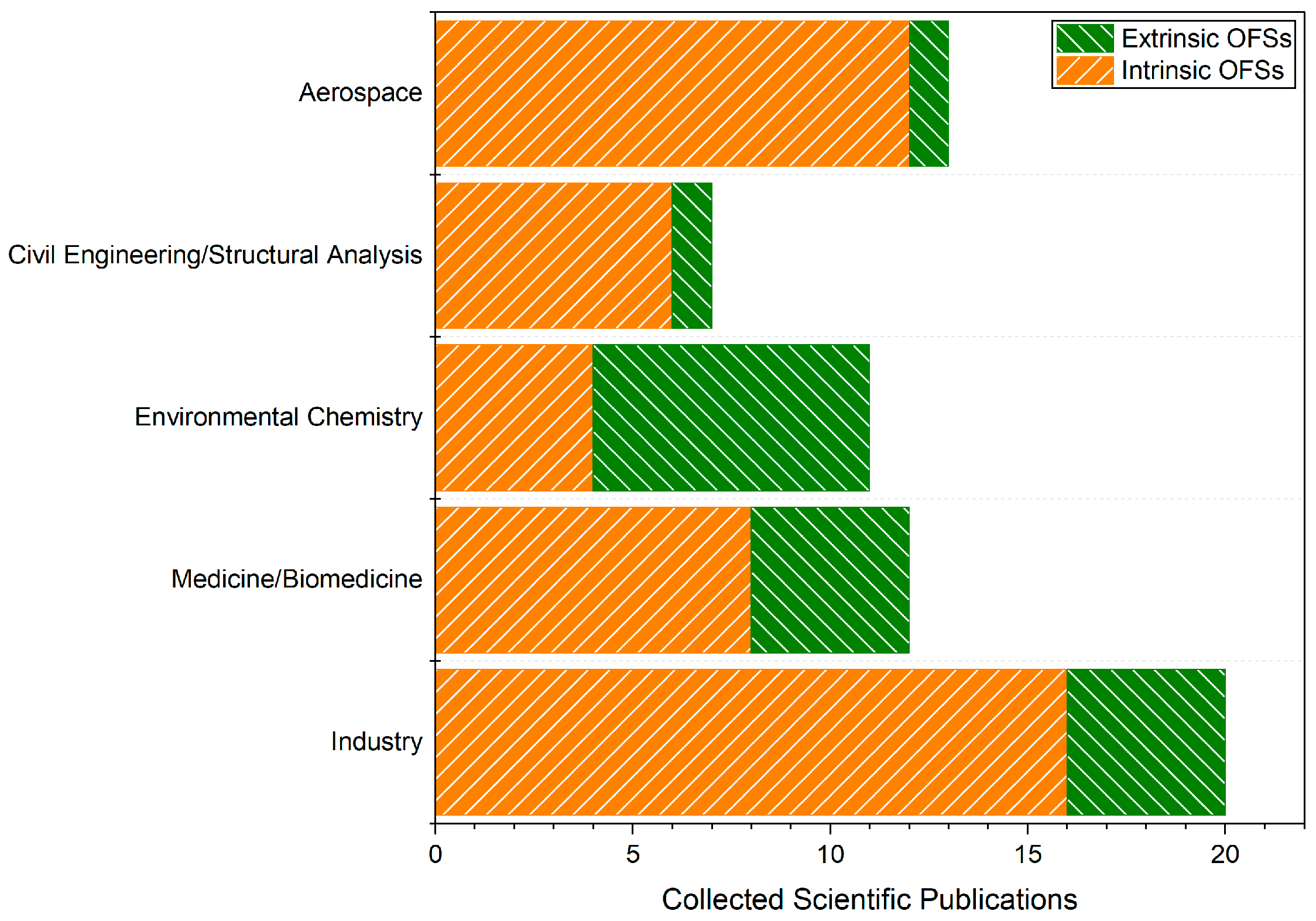
Given the continuous progress in scientific publications related to OFSs and the fragmentation of knowledge in specialized reviews by application or sensor type, there is a need for a structured exploration review that compares both usage schemes. The primary objective of this work is to provide an updated and structured overview of the operating principles, emerging technologies, and dominant applications of OFSs, from basic concepts and various classifications to the most common OFS configurations for measuring different parameters. In addition, discussions and comparisons are presented throughout the work, addressing the most significant points of the relevant works of other authors. Likewise, the areas of applications of OFSs are categorized into five main fields: (1) industrial, (2) medicine and biomedicine, (3) environmental chemistry, (4) civil engineering or structural analysis, and (5) aerospace. These categories were not chosen randomly but derived from a detailed review of the use cases described by the authors of the analyzed articles. During classification, each study was assigned to an application field based on the orientation explicitly presented in its content, particularly in the abstract, introduction, or stated objectives, ensuring consistency in theme and minimizing subjective judgment.

2. Methodology

The compilation of works is carried out through a thorough and structured exploratory review of scientific literature, focusing on the applications of OFSs. This is achieved using the TAK (Title, Abstract, Keywords) methodology [26,27], which is widely employed in academic reviews. This approach allows for the identification of relevant works through cross-analysis of titles, summaries, and keywords. Three major scientific databases were used, each employing multiple search strings for different application areas, primarily covering the years 2019–2025. The selection of these sources was based on their technical relevance, editorial credibility, and ability to provide multidisciplinary coverage. Together, they offer a balanced, high-quality collection that minimizes irrelevant entries and facilitates a structured review across both theoretical and practical domains.
It is essential to highlight that, unlike approaches that depend only on keyword searches or citation metrics, this method combines the analysis of titles, abstracts, and keywords. Such integration provides a more accurate understanding of the thematic focus of articles and reduces the chance of missing relevant works that might otherwise be excluded due to variations in terminology or indexing [28,29]. Additionally, compared to bibliometric or purely narrative review methods, TAK provides broader and more balanced coverage by combining a thematic filter with a structured classification system, enabling consistent comparisons of both theoretical reviews and experimental studies [28,29]. Furthermore, different methodological guidelines highlight that traditional approaches, which focus only on keywords or citations, often lack the rigor and thoroughness needed to ensure review reliability [30,31].
To complement this methodological framework, the articles selected through the TAK-based research were also subjected to detailed quantitative and visual analysis. This analysis includes various data visualizations, such as annual publication trends by discipline, sensor typology distributions, and thematic relevance per application area, to provide a broad overview of the field’s evolution and priorities.

3. Historical Analysis of the Development of OFSs

The history of OFSs begins in the second half of the 20th century, and its evolution has been closely linked to technological advances in optical communications. The first significant record dates back to 1967 with the invention of the “fotonic sensor” (FS), patented under US number 03327584, and recognized in the literature as the first sensor of its kind [32,33]. This device used a bifurcated fiber, where one part of the beam illuminated a surface and the other part received the reflected light (Figure 1). In this way, it was possible to measure the relative position between the sensor (fiber tip) and the reflective surface with high precision, laying the foundation for the future development of what would become extrinsic OFSs.
Figure 1. Schematic representation of FS, illustrating how the bifurcated optical fiber guides light toward a reflective target to determine its position relative to the fiber tip.
The simplicity and effectiveness of the FS were not only vital for demonstrating the feasibility of non-contact sensing with light but also laid the foundation for decades of research into proximity and vibration sensors, many of which still use similar principles today [33].
The 1970s marked a key transition with the development of interferometric techniques within the fiber core, enabling the emergence of intrinsic OFSs [34,35]. The most notable advances included dual-path interferometers such as MZI and MI interferometers implemented in fiber, which offered unprecedented sensitivity. These systems could detect phase changes on the order of microradians in the optical signal, making them highly valuable tools for measuring physical parameters such as vibrations, strain, pressure, and temperature [34,36,37].
Another key moment in the development of OFSs was the idea of distributed sensing, a technology that started in the 1980s and allowed the measurement of a physical variable along the fiber at different points [38,39]. This feature greatly expanded the sensing uses of optical fibers, making it possible to monitor large structures like pipelines, tunnels, bridges, or power lines. At the same time, multiplexing systems were also introduced, enabling multiple sensors to be integrated into a single fiber network, which improved efficiency and lowered the cost of monitoring multiple variables [32,37,39,40].
Throughout these first two decades of evolution, the technological foundations supporting the development of OFSs were firmly established. These include the distinction between extrinsic and intrinsic sensors, the implementation of interferometric techniques, and the advancement of distributed sensing and multiplexing capabilities. As optical telecommunications made significant improvements in fibers, laser light sources, and photonic devices, it is clear that scientists successfully leveraged these advancements and adapted them to the sensing field, fostering a technological synergy that continues today.
Understanding this historical landscape not only emphasizes the technical milestones that marked the emergence of OFSs but also offers insight into the conceptual evolution that transformed them from laboratory experiments into versatile and commercially viable technologies. The path started by the FS in 1967 laid the foundation for a discipline that has expanded year by year alongside global optical technologies, and that now plays a leading role in intelligent monitoring, biomedical diagnostics, and many other scientific advancements of the 21st century.
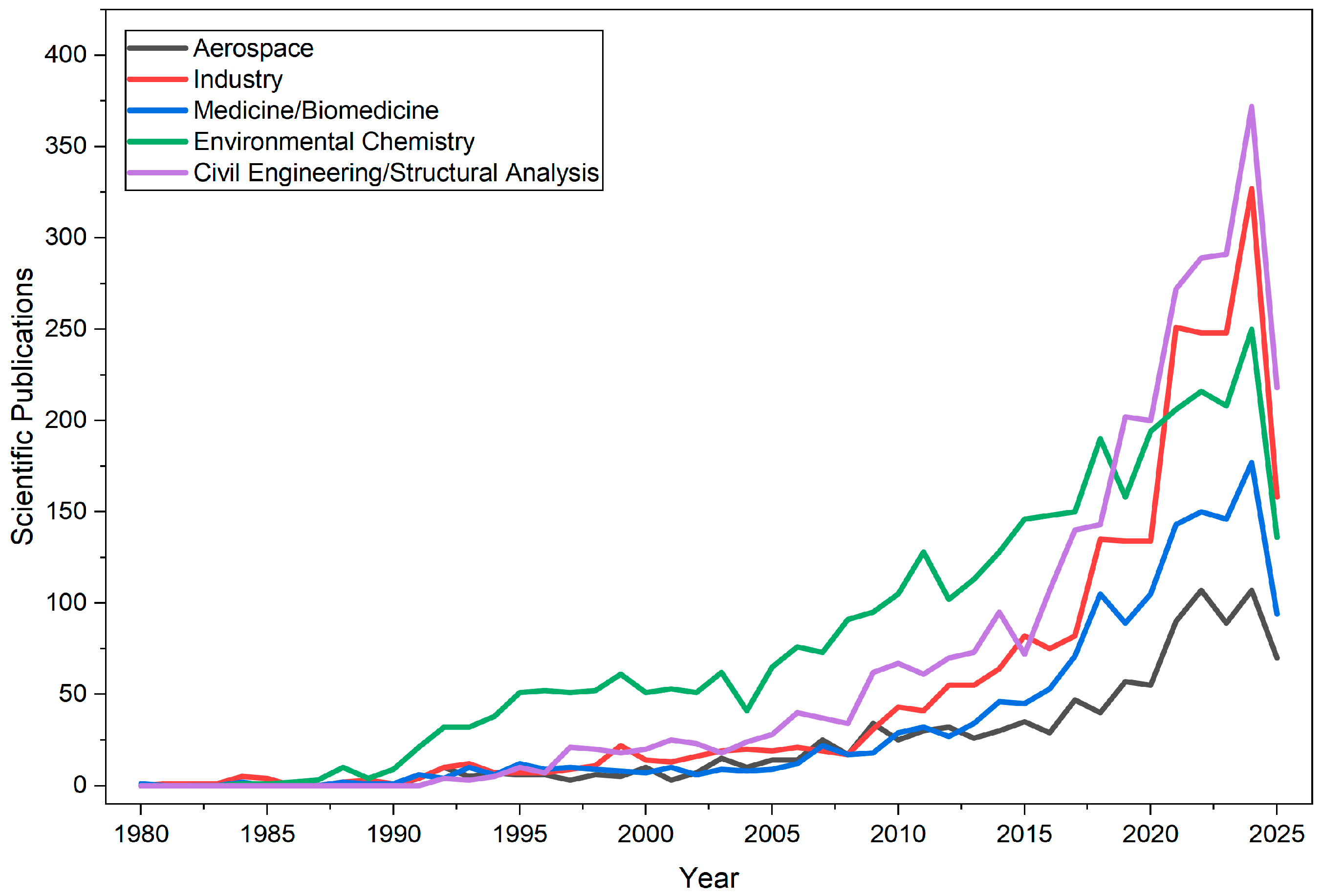
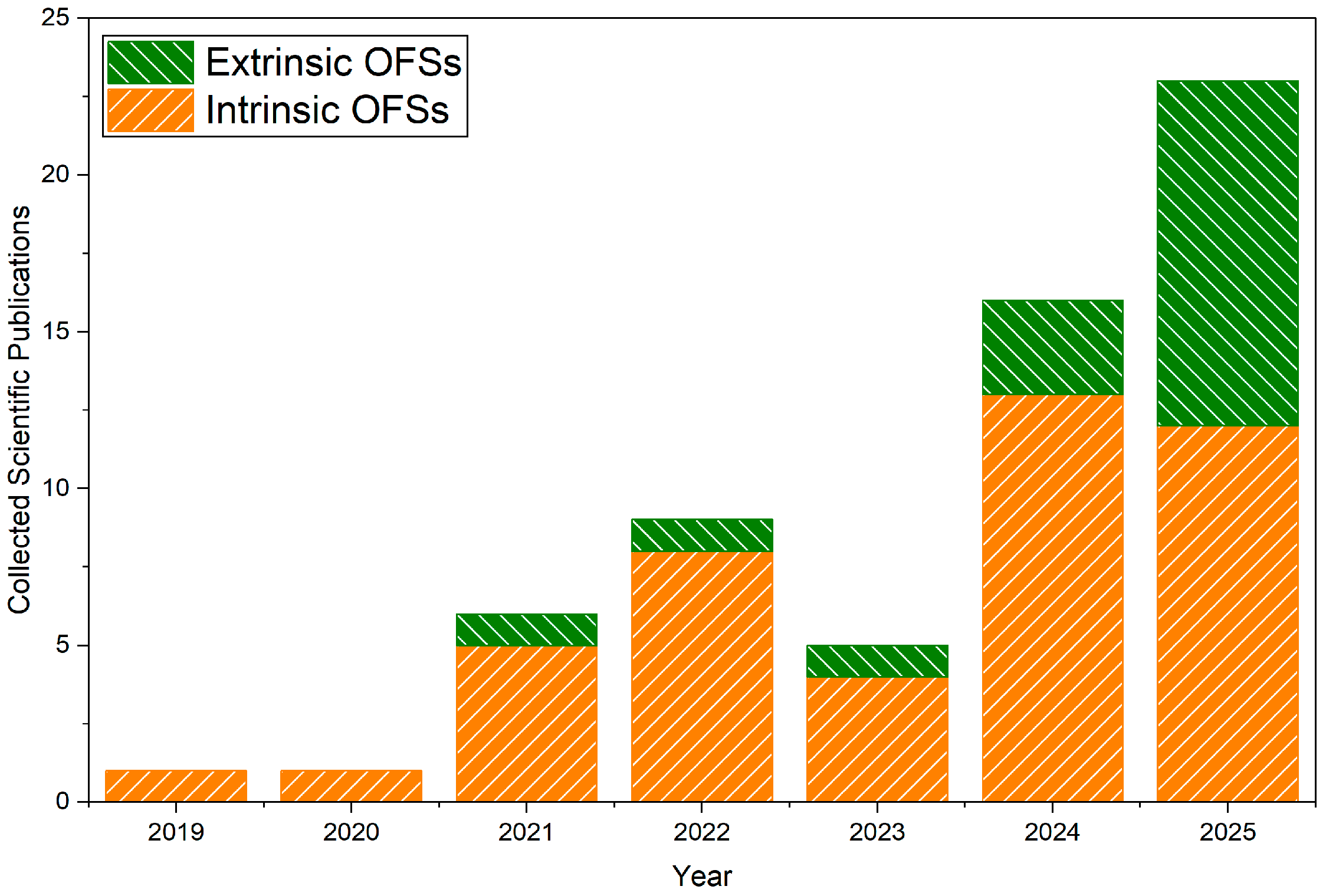
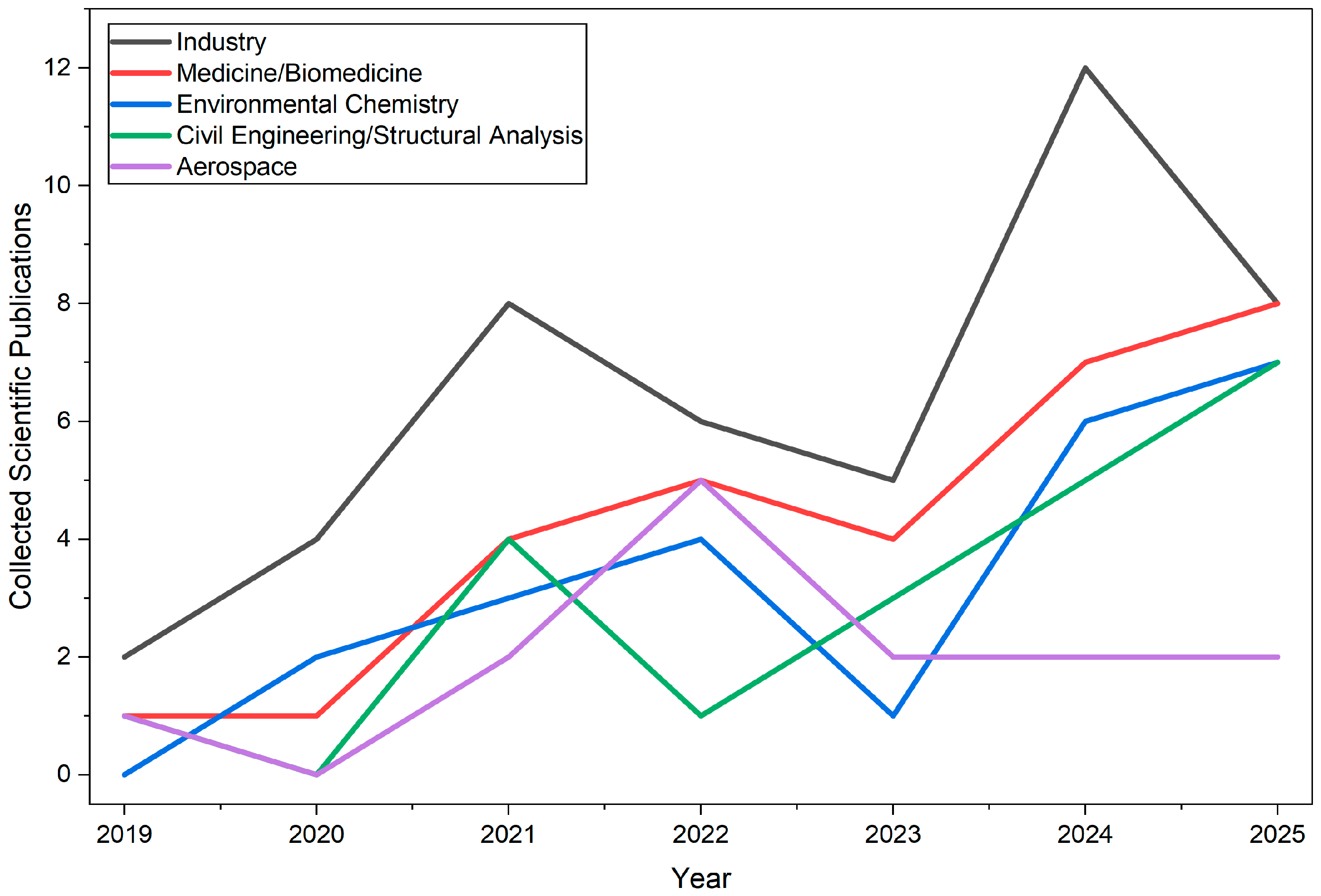
Figure 2 illustrates the temporal evolution of scientific publications related to OFS applications across five major disciplinary areas. The data show a sustained growth during the past three decades, with a pronounced increase between 2010 and 2024. The record of publications for the year 2025 was truncated until the month of July, when all the queries were compiled. To obtain the dataset, the “All Databases” option of Web of Science was used, applying the keyword string “optical fiber sensors applications [discipline]”, where discipline was replaced with industry, environmental chemistry, medicine/biomedicine, civil engineering/structural analysis, and aerospace. Each search was performed under the “All Collections” setting and using the “Topic” field (searches title, abstract, and indexing). The annual publication counts from each query were exported as Excel files and subsequently combined to construct the final plot.
Figure 2. Temporal evolution of scientific publications related to OFSs, indexed in the Web of Science database, illustrating the growth of research activity across major application domains from the early 1980s to July 2025.
In the last fifteen years, the development of OFSs has seen unprecedented growth, characterized by both technological diversification and practical validation across multiple fields. One of the most notable aspects of this period is the shift from laboratory prototypes to real-world applications. While in the past OFSs were often limited to experimental setups, recent years have seen their adoption in field applications such as industrial monitoring of turbines and pipelines [41], biomedical sensing during surgical procedures [22], and large-scale deployment in smart infrastructures like tunnels and bridges [15]. The availability of distributed sensing architectures based on Rayleigh, Raman, and Brillouin scattering has been crucial to this transition, allowing continuous monitoring along kilometers of fiber with centimeter-level resolution [5].
Another key factor has been the integration of OFSs with advanced materials and functional coatings, such as nanocomposites, metal oxides, and graphene layers, which have significantly improved selectivity, chemical stability, and resilience in harsh environments. These innovations have allowed OFSs to address issues such as biofouling in environmental monitoring [42], long-term drift in biomedical applications [43], and high-temperature degradation in aerospace systems [44]. The emphasis on coatings and packaging underscores how the last decade has shifted research from purely optical principles to multidisciplinary solutions that ensure long-term durability and reliability [9].
The comparison with traditional sensors has also intensified during this period. In civil and aerospace engineering, OFSs have demonstrated superior multiplexing capacity and EMI immunity compared to strain gauges, accelerometers, or eddy-current devices [16]. Similarly, in medicine, OFSs have moved beyond in vitro validation to clinical trials, proving their feasibility in applications such as catheter-based pressure monitoring, tissue ablation guidance, and wearable biosensors [25]. These advances highlight how OFSs are not only alternatives but, in many cases, disruptive technologies that redefine sensing strategies in critical fields [45].
Despite their progress, practical challenges remain, including cost, calibration protocols, and service life. The need for specialized interrogators and protective coatings continues to raise the cost of large-scale deployment [46], though prices are gradually decreasing as manufacturing and integration techniques mature [47]. Calibration in field conditions, especially in dynamic and hostile environments, has required adaptive algorithms and hybrid validation methods [10]. Regarding service life, the last 15 years have brought solutions such as radiation-hardened fibers for aerospace [48], metal-coated fibers for industrial machinery [49], and anti-fouling treatments for environmental sensors [50], ensuring improved long-term stability compared to earlier generations.
Overall, the last decade and a half marks a period of consolidation in which OFSs have evolved from niche laboratory devices into established technologies with multidisciplinary influence. The trend shown in Figure 2 illustrates not only exponential academic interest but also the strategic importance of OFSs in global technological progress. From the invention of the FS in 1967 to today’s distributed, multifunctional, and clinically validated architectures, the discipline has grown into one of the main pillars of intelligent monitoring and next-generation sensing solutions [51].

4. Fundamentals and Classification of OFSs

4.1. Optical Fiber and Principle of Operation of an OFS

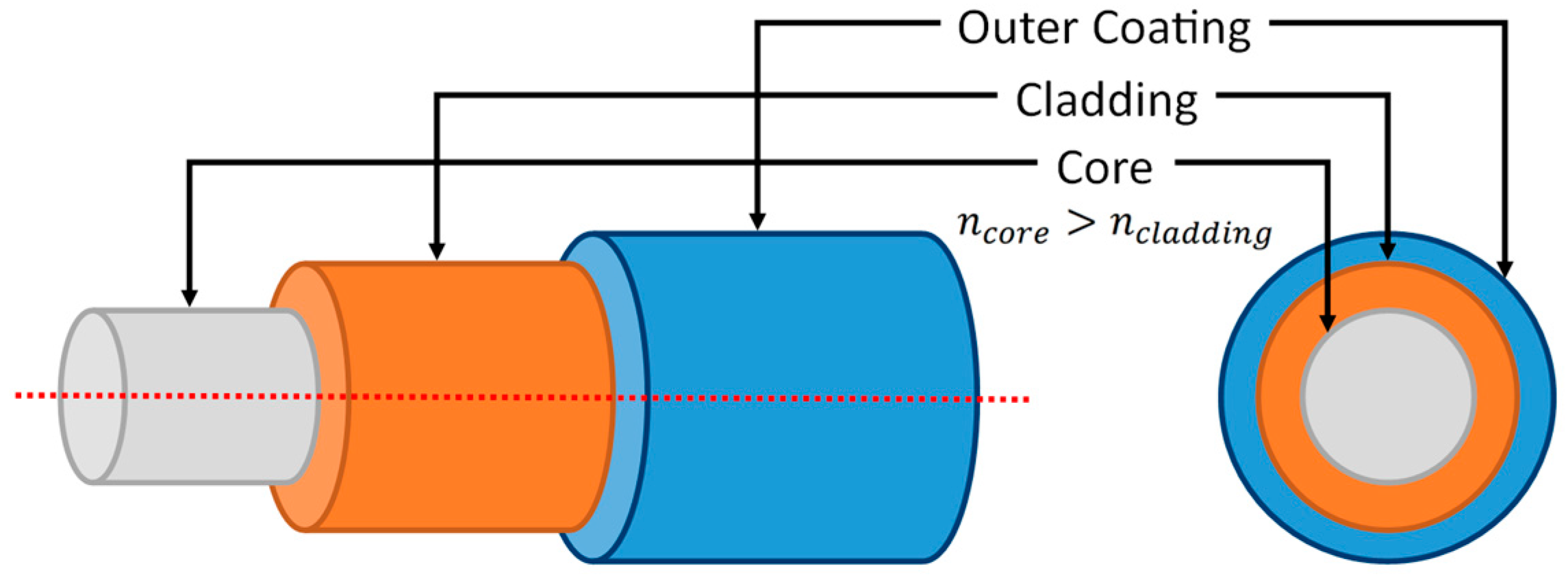
The general structure of an optical fiber is shown in Figure 3; this structure is for a silica or plastic-based thread that carries a beam of light. The core, cladding, and outer coating are the three concentric layers that make up the general structure of an optical fiber. The core is the thin central cylindrical layer that carries light from one end to the other. This core is covered by a cladding with a refractive index n lower than that of the core, and the light is trapped inside due to the difference in refractive index between the core and the cladding. The outermost plastic layer, the outer coating, surrounds both layers further, shielding the fiber from physical harm and reducing light dispersion losses due to microbends [20,52,53].
Figure 3. Schematic representation of the basic structure of an optical fiber, highlighting the core, cladding, and protective outer coating, with the refractive-index condition required for total internal reflection and guided light propagation.
In addition to its basic structure, optical fiber can be classified according to its propagation mode, which directly influences its performance as a sensing medium [21]. In this field, two main types can be distinguished: single-mode fiber (SMF) and multimode fiber (MMF), to which are added hybrid configurations explicitly designed for specific sensing applications, such as SMS (Single-Mode–Multimode–Single-Mode) composite fibers, each type with its modal distribution of the optical signal.
Single-mode fiber (SMF) has a very small core (8–10 µm), which allows the propagation of a single light mode. It exhibits low dispersion and provides high precision in optical signal measurement, making it suitable for high-resolution sensing and accurate determination of optical parameters [15,54,55,56].
Multimode fiber (MMF) has a larger core (50–62.5 µm), enabling the simultaneous propagation of multiple light modes. This feature facilitates coupling and allows higher light power capture, although with lower resolution. MMFs are typically used in short-range systems, in sensors requiring robust coupling, and in applications where greater light capture is needed [4,19,21,23,41,57].
Finally, hybrid SMS (Singlemode–Multimode–Singlemode) fibers represent a combined configuration in which multiple modes are excited in the multimode fiber and subsequently coupled back into the single-mode fiber. This type of fiber is employed in specific multimodal sensing applications and advanced experimental designs [21,58,59].
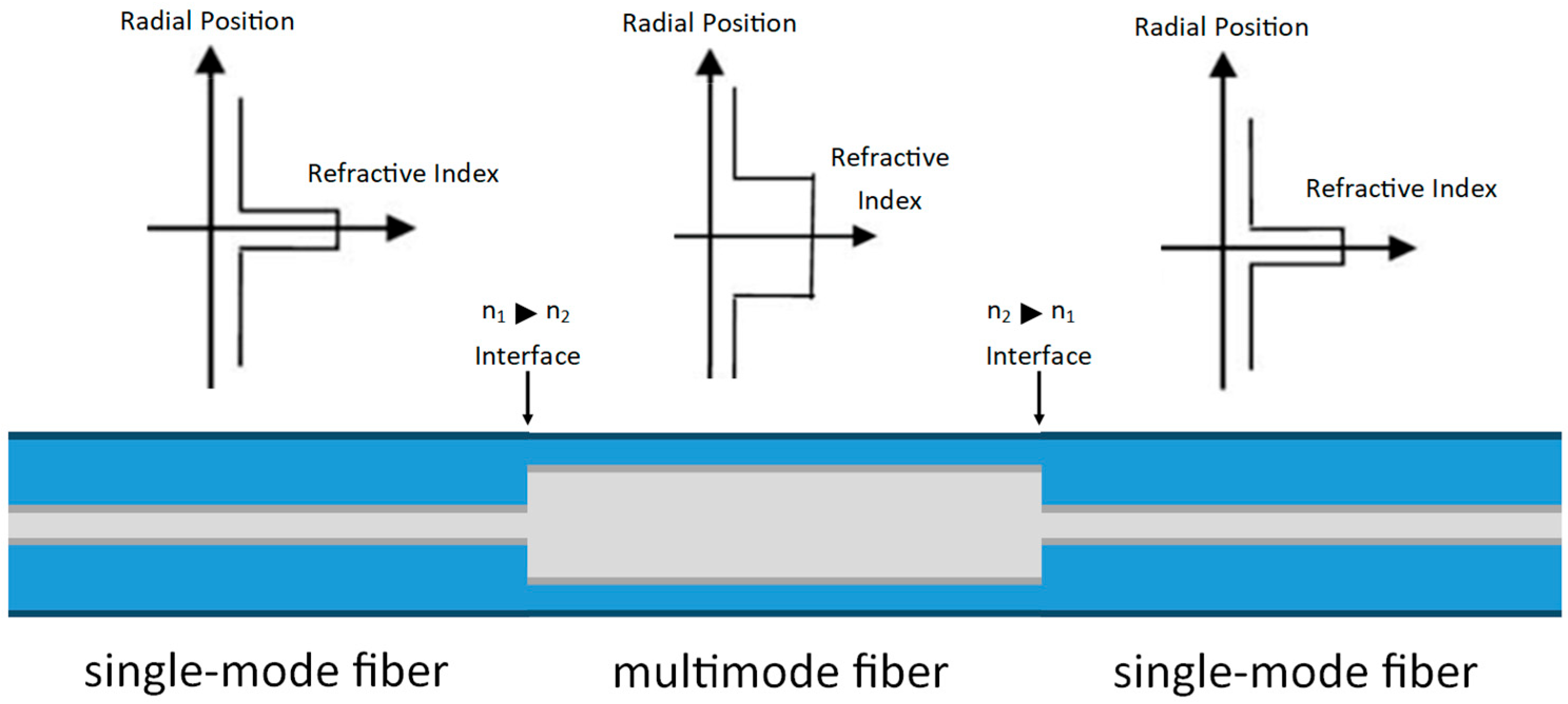
Figure 4 shows an area between fibers called “interface”, which corresponds to the transition point between the SMF and the MMF, where an abrupt change in the refractive index profile occurs together with the change in core diameter. At this interface, the refractive index shifts suddenly from the SMF core value n 1 to the MMF core value n 2 , generating multiple-mode excitation in the multimode fiber. Conversely, at the second interface, the index drops back from n2 to n1 as the modes propagated in the MMF are coupled again into the single-mode output fiber.
Figure 4. Schematic representation of hybrid SMS (Single-Mode–Multimode–Single-Mode) fiber structure, illustrating the refractive-index profiles and the interfaces where modal transitions occur as light propagates through the composite configuration.
The choice of fiber type depends on the sensor’s physical operating principle, as well as the requirements for resolution, range, sensitivity, and the installation environment. Therefore, understanding the dynamics of light propagation in each type of fiber is crucial for designing efficient and reliable optical sensing systems.
Another relevant dimension in classifying optical fibers is the type of fiber, encompassing the material used to manufacture it and its internal structure. The mechanical, chemical, and optical properties of the fiber directly influence its sensitivity, operating range, and suitability for various applications. In this field, although no standard classification is mentioned in the literature, three broad categories are generally identified, as shown in Table 1.
Table 1. Types of optical fiber according to their manufacturing material and internal structure.
Fiber TypeMain PropertiesTypical ApplicationsRef
Silica Optical Fibers (OF)Standard silica fiber. Low attenuation, high thermal stability, compatible with telecommunications systemsCommercial and industrial use, monitoring in demanding environments.[6,57]
Polymer Optical Fibers (POF)Greater flexibility, lower cost, and larger core diameter. Higher optical losses compared to silica fibersShort-range applications, physiological monitoring, and detection in environments requiring high maneuverability[58,60,61]
Special Optical Fibers (PCF, hollow-core, doped, microstructured, coated)Complex designs such as photonic crystal fibers (PCF), hollow-core, doped, or microstructured fibers. Functional coatings (polydimethylsiloxane, polyimide, graphene). Enabled advanced property manipulation (dispersion, birefringence, sensitivity to gases or liquids)Specialized sensing, chemical and environmental detection, high-sensitivity applications in extreme conditionsPCF [5,6,21,62,63,64], hollow-core fibers [24,65,66,67], doped fibers [7,68], microstructured fibers [8,9,23,69,70]
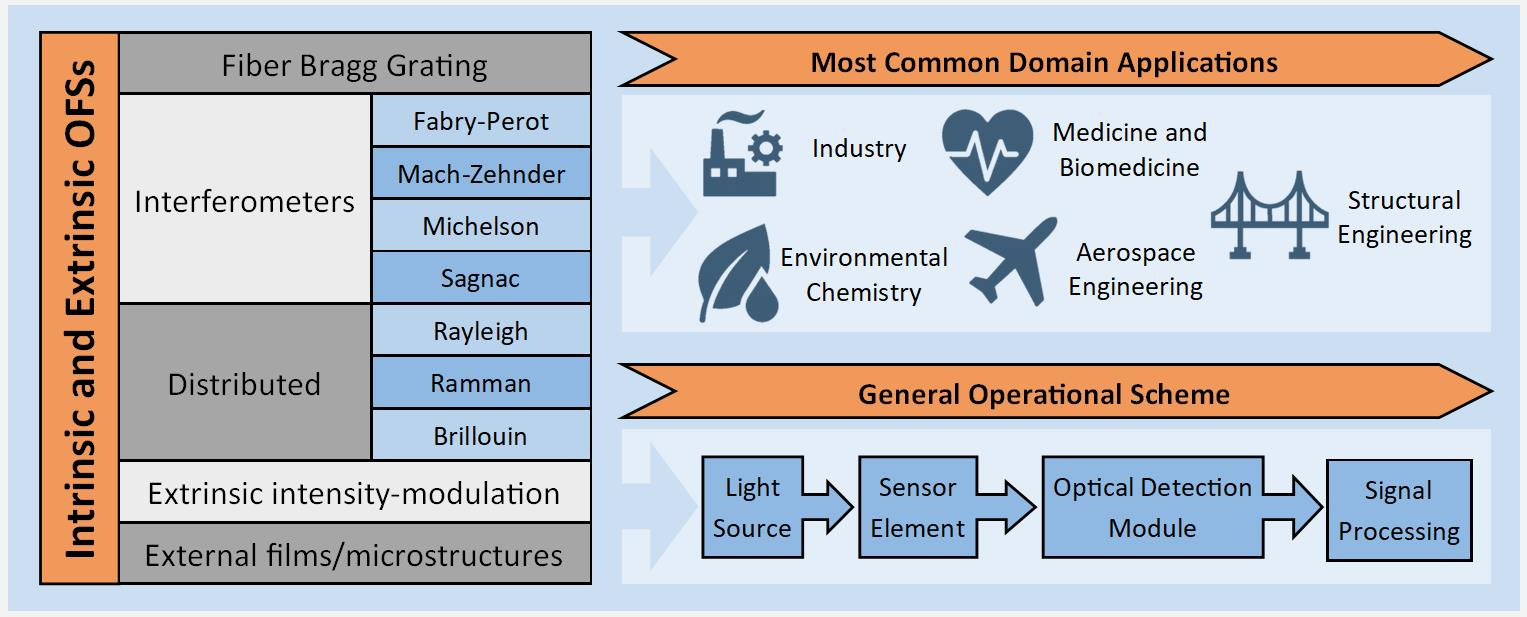
OFS devices typically use an optical fiber, a light source, a sensor element, and a light detector such as a spectrometer or an optical detection unit. This system works together to detect, transmit, and often also transform physical information from the environment for visualization and analysis (Figure 5) [5,6,22,50]. Its operating principle is based on the interaction of an optical signal, typically laser light or from a light-emitting diode (LED), with an external physical or chemical variable. This generates a measurable change in the property of the light signal, such as intensity, phase, frequency, or polarization [5,12,22]. This modification in the light beam is then analyzed by an optical spectrum analyzer (OSA) or another optical detection module, allowing for continuous or spot monitoring of the magnitude of interest.
Figure 5. General operational scheme of an OFS, illustrating the sequential stages comprising the light source, the sensing element, the optical detection module, and the subsequent signal-processing unit.
Optical fiber, when implemented in monitoring systems, offers unique advantages over other types of sensors, including EMI immunity [5], high precision [71], high flexibility [72], resistance to extreme conditions [6], and the capacity for distributed monitoring [73]. These properties have driven its adoption as a platform for sensing in harsh environments where other types of sensors may fail or be impractical to install and maintain [6,16,19].

4.2. Classification of OFSs: Intrinsic Sensors vs. Extrinsic Sensors

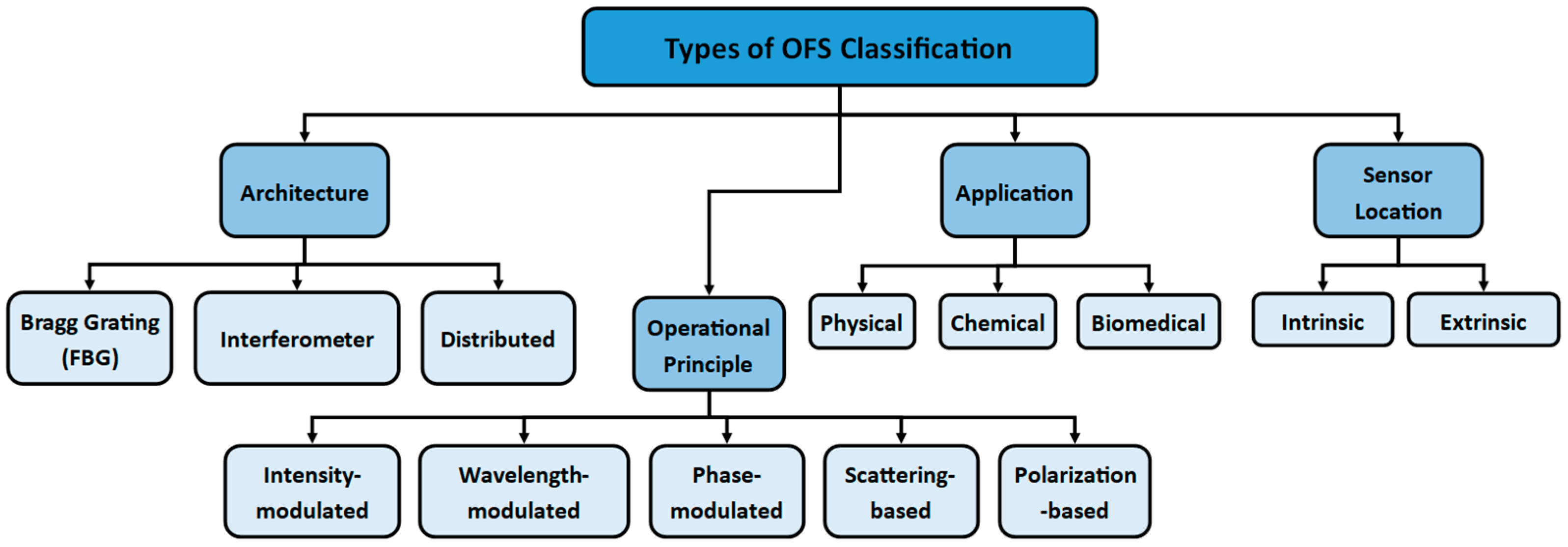
The evolution of the technological diversity of OFSs over the years has led to the development of multiple classification schemes, which respond to various technical, physical, and operational criteria [74]. This variety of approaches not only reflects the versatility of technology but also allows OFSs to be adapted to specific environments and needs. Figure 6 shows and summarizes these classification dimensions to provide a structured view of the OFSs ecosystem.
Figure 6. Sketch of the general taxonomy of OFS based on four categories: architecture, operational principle, application domain, and sensor location.
According to the literature, OFSs can be categorized based on different characteristics [74]; for example, they can be classified according to their application or measurement architecture [5,23]. Taking into account their application, OFSs can be grouped according to the type of parameters they are designed to measure, dividing them into three groups: physical (pressure, temperature) [20,22,71], chemical (pH, ammonia, humidity) [21,41,71], and biomedical (oxygen, carbon dioxide, proteins) [8,22,57,75].
On the other hand, regarding architecture, OFSs are classified into three groups: FBG [10,65,76], interferometric [10,76], and distributed [11,68]. FBGs are created by exposing a section of the optical fiber core to a periodic pattern of ultraviolet light (UV), which results in a permanent alteration of the core’s refractive index. The reflected wavelength exhibits high sensitivity to variations in pressure and temperature [10,15,43]. Interferometric sensors, on the other hand, are phase-modulated sensors that measure the interference of light in an optical fiber. The most popular types of interferometers include: Mach-Zehnder [17,58], Sagnac [12,17], Michelson [6,8], and Fabry-Perot [54,58]. Distributed sensors, on the other hand, have a configuration that allows them to detect changes in the light signal at multiple points, enabling distributed measurement along the optical fiber [11,68].
In addition to the principle or physical design of the sensor, OFSs can also be classified by the physical principle that modulates the optical signal, i.e., the mechanism by which the external quantity affects the propagated light [5,74]. In this regard, five broad categories can be identified:
  • Intensity-modulated sensors: The quantity to be measured causes a variation in the intensity of the transmitted or reflected light [17,58].
  • Wavelength-modulated sensors: These use structures such as FBGs that alter the reflected wavelength as the external stimulus changes [7,16,23].
  • Phase-modulated sensors: These use optical interferometry to identify phase transformations of the signal [5,8,14].
  • Dispersion-based sensors: These are based on phenomena such as Raman, Brillouin, or Rayleigh scattering, whereby an interaction between light and fiber generates a backscattering spectrum that varies depending on temperature or deformation [11,43,68].
  • Polarization-based sensors: These detect changes in the polarization of light induced by mechanical stress, magnetic fields, or thermal fields [5,6,12].
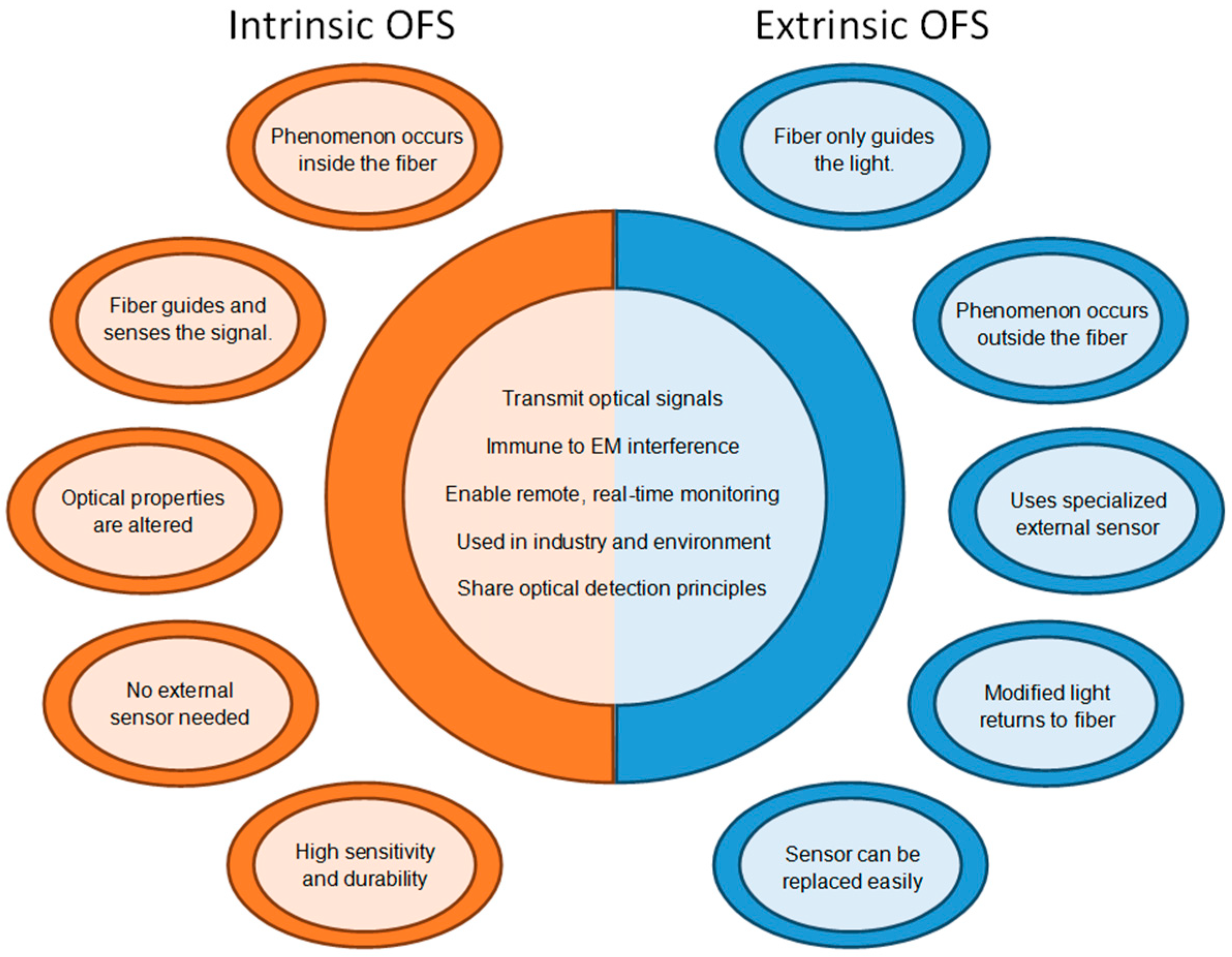
In addition to the criteria explained above, a more fundamental classification, based on the OFSs literature, is based on the location of the sensing phenomenon with respect to the fiber [23,24,58]. In this context, according to the literature, OFSs can be divided into two groups: intrinsic and extrinsic sensors, as shown in Figure 7 [5,12,23,24,58].
Figure 7. Comparative overview of intrinsic and extrinsic OFSs, highlighting their respective sensing mechanisms, operational characteristics, and shared advantages.
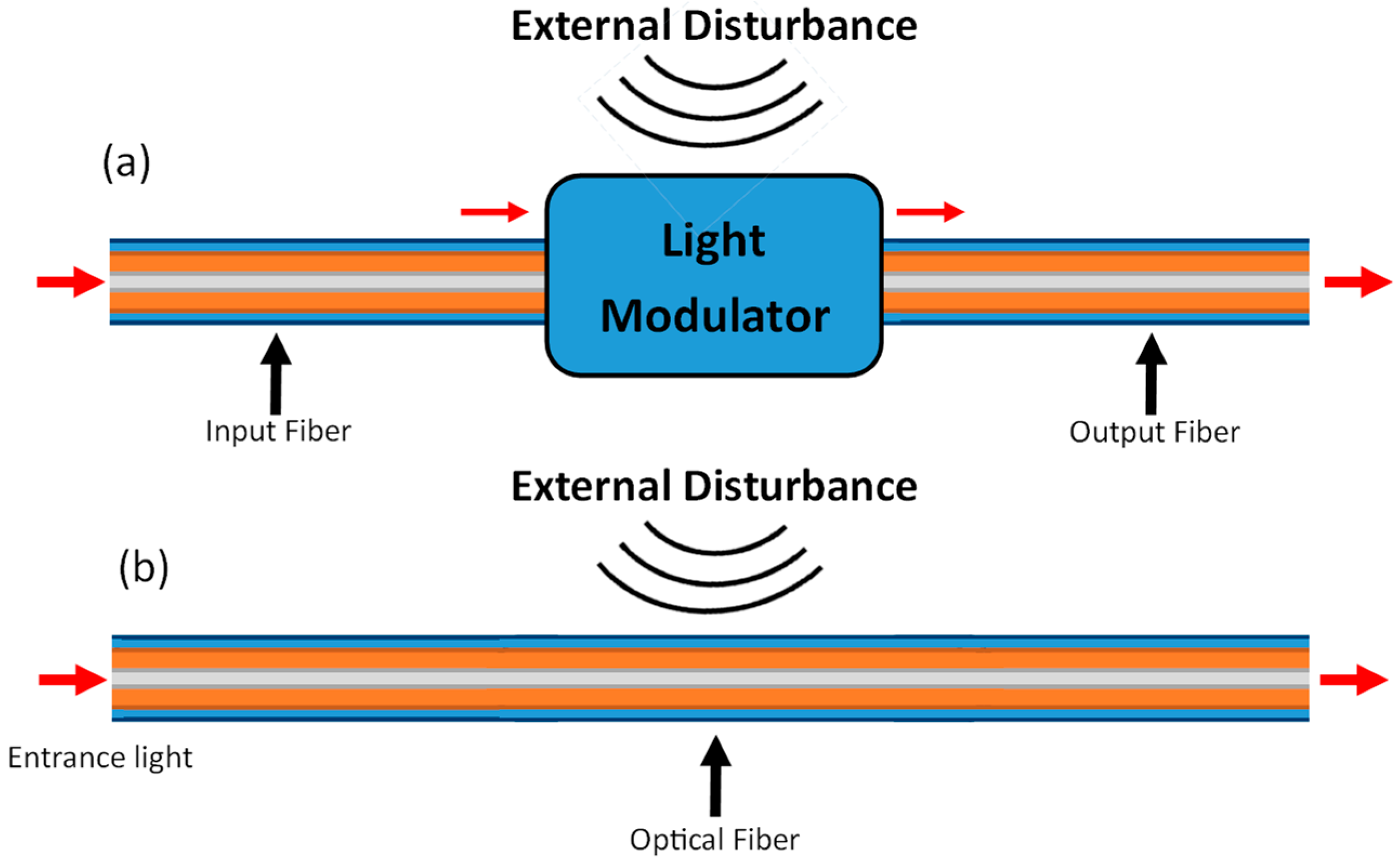
  • Intrinsic sensors: The physical phenomenon to be measured occurs within the optical fiber itself. In other words, the fiber acts as both a light guide and a sensitive medium (Figure 8a). The optical properties of the fiber (such as refractive index, propagation mode, or dispersion) are directly altered by the external variable to be measured [7,12,23,58,77].
    Figure 8. Schematic comparison between (a) an extrinsic OFS, in which an external modulation element alters the guided light, and (b) an intrinsic OFS, where the perturbation directly affects the optical properties of the fiber itself.
  • Extrinsic sensors: The fiber is used solely as a means of transporting the optical signal to an external sensor element, where interaction with the physical quantity occurs. Subsequently, the modified light is recaptured by the fiber and sent to the detection system (Figure 8b) [7,12,23,24,58,77].

5. Intrinsic and Extrinsic OFS Architectures

5.1. Intrinsic: Sensors Based on Fiber Bragg Grating (FBGs)

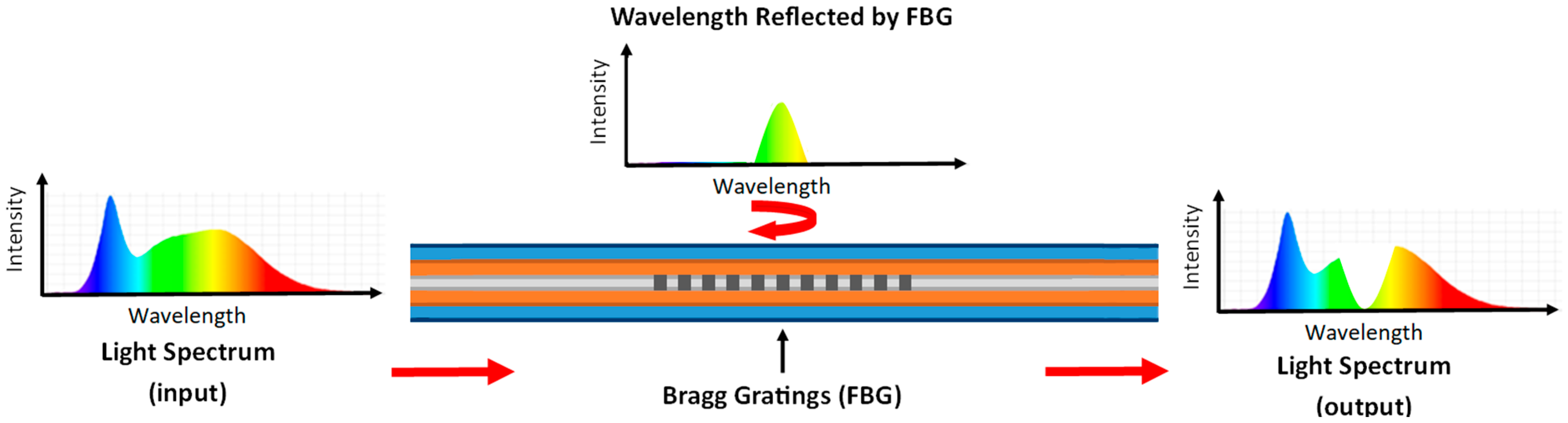
A sensor based on FBG features a periodic modulation of the refractive index within the optical fiber’s core, typically created by exposing the fiber to ultraviolet radiation [5,14,20,22,65,78]. This modified fiber functions as a spectral filter, as illustrated in Figure 9, reflecting a specific wavelength of incoming light known as the Bragg wavelength ( λ B ). This reflected wavelength depends on the grating period and the effective refractive index of the core, both of which can be affected by mechanical deformation, temperature variations, or stress. The reflected Bragg wavelength ( λ B ) is described by Equation (1) [5,6,7,16,17,58,79]:
λ B = 2 n e f f Λ ,
where n e f f is the effective refractive index of the fiber core, and Λ is the grating period. The grating period is affected by variations in deformation, and the effective refractive index is influenced by temperature changes.
Figure 9. Schematic of a typical FBG–based sensing structure, showing the broadband input spectrum, the selective reflection of the Bragg wavelength, and the resulting transmitted output spectrum after interaction with the periodic grating.
To measure a physical parameter with an FBG sensor, it is essential to isolate the effects of temperature from those of deformation in the fiber. Using a reference grating provides a practical and straightforward approach [5,8,14,20,54]. FBG sensors require a component called a demodulator, or interrogator, which extracts information about the measurand from the light signals emitted by the sensor heads. Because the information is encoded in the Bragg wavelength, interrogators must detect shifts in this wavelength and deliver data related to the measurand [5,6,7,54,58,80,81].
The ability of FBGs to operate as passive and compact units makes them ideal for harsh environments or applications requiring minimal intrusion. They also provide several advantages, such as easy multiplexing over a single fiber line (using wavelength) [20,22,23,24,57] and EMI immunity [5,14,20,22,23,65].

5.2. Interferometers

Optical interferometers operate on the principle of wave superposition, where two or more optical beams follow different paths and then recombine [5,12,22,24]. The phase difference that develops between them depends on changes caused by the variable being measured, allowing for precise measurements [5,12,22,24,58,65,75]. There are several types of interferometers.

5.2.1. Intrinsic and Extrinsic: Fabry-Perot Interferometer

Fabry-Perot interferometer sensors (FPIs) operate by measuring light wave interference between two mirrors within the fiber, one of which is partially transparent. By adjusting the distance between the mirrors, the sensor can be fine-tuned to a specific wavelength, enabling precise measurement of physical parameters such as deformation, temperature, and pressure [5,12,22,24,82]. The FPI configuration is among the simplest and most extensively studied in the development of compact OFSs [12,19,22,58,65,75].
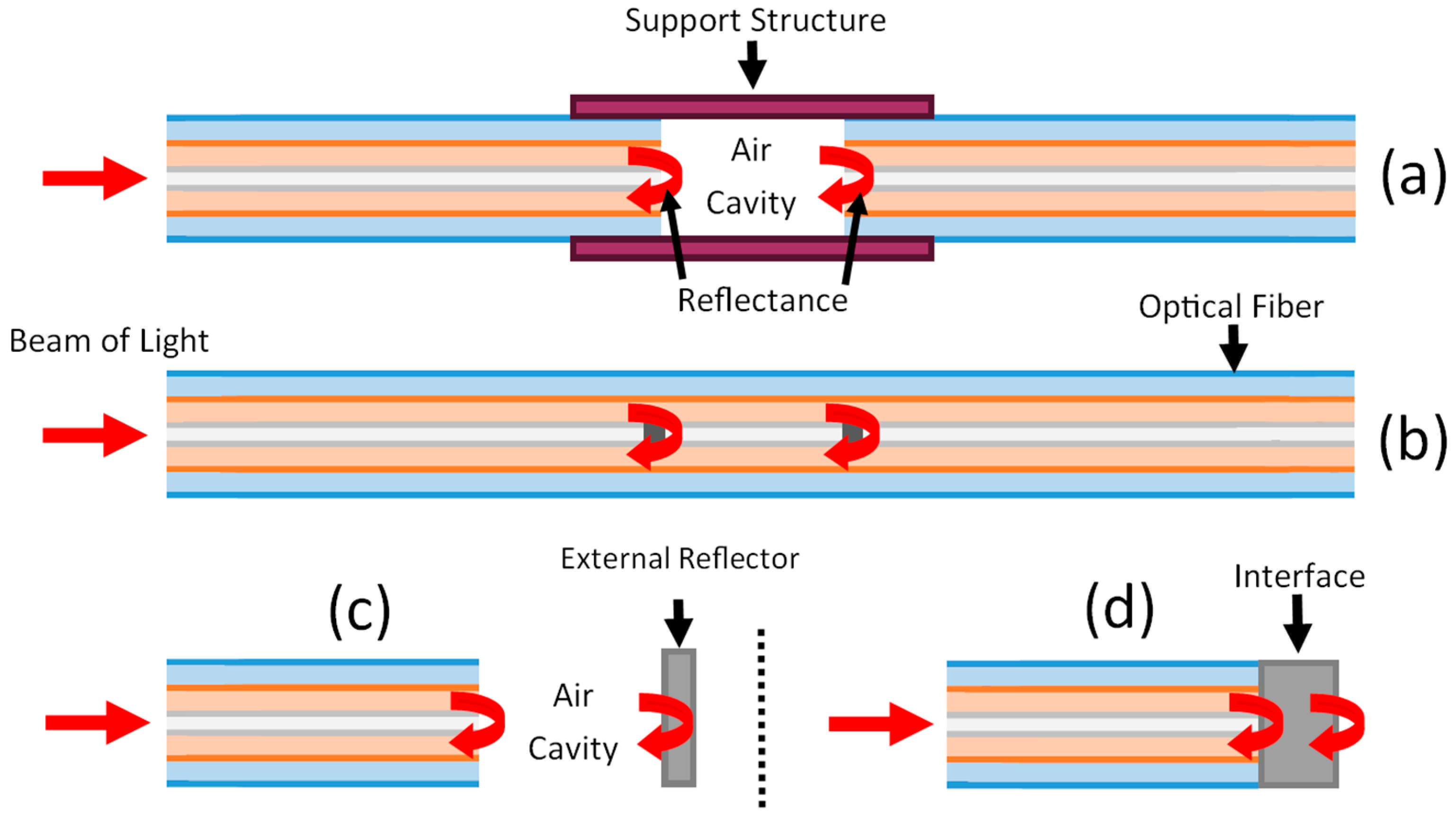
With variations in their structure, FPI sensors are divided into two groups: intrinsic (IFPI) and extrinsic (EFPI) [6,24,58]. For IFPI, the Fabry-Perot cavity forms between two reflectors (mirrors) aligned within the optical fiber, as shown in Figure 10a. This can be accomplished through methods such as femtosecond laser micromachining, fusion splicing, using two FBGs in series, chemical etching, or creating an air bubble inside the fiber [6,24,54,58]. In its simplest form, when the cavity uses low-reflectivity mirrors, it can be modeled as a two-wave IFPI interferometer [6,8,24,54,58]. In such cases, the reflection spectrum is mainly determined by the phase difference ( δ F P ) between the waves reflected by the two mirrors, as described by Equation (2) [24,58].
δ F P = 4 π n e f f L F P λ ,
where n e f f , ( L F P ) and λ represent the effective refractive index of the cavity material, the physical length of the cavity, and the wavelength of the incident light, respectively. When an external disturbance occurs, such as a change in deformation, temperature, or other parameters, both the cavity length and the effective refractive index can change, leading to a shift in the phase difference [5,12,22,24].
Figure 10. Schematic of various FPI interferometer sensor configurations: (a) IFPI with a solid cavity. (b) EFPI with an air cavity supported by a tube. (c) EFPI with an external free-space reflector and air cavity. (d) EFPI with a film deposited on the end face of the optical fiber without an air cavity.
In contrast, for EFPI, the Fabry-Perot cavity is formed between the tip of the fiber with its cleaved end and an external reflector, with the air between them serving as the cavity medium, without requiring any microfabrication process. Instead, a tube or support structure holds both fibers (Figure 10b) [6,24,54,58,83]. Since the first reflector of an EFPI sensor is typically the interface between the fiber’s end face and the air, accounting for less than 4%, the multiple light trips can be approximated as a single round trip within the cavity. Consequently, a two-beam interference model can describe a low-finesse EFPI device. In this case, total reflection ( I ) can be expressed by Equation (3) [24,58]:
I = I 1 + I 2 + 2 I 1 I 2 c o s ( φ + φ 0 ) ,
where I 1 and I 2 are the intensities of light reflected at the fiber-air interface and the external reflector, respectively; φ 0 is the additional phase introduced by the second reflector, and φ is the round-trip phase delay caused by the Fabry-Perot cavity, as defined in [24,58].
φ = 4 π n L F P λ ,
where n denotes the refractive index of the cavity medium, which is considered constant for air with n = 1 , L F P is the physical length of the Fabry-Perot cavity, meaning the distance between the two reflectors, and λ represents the wavelength of light.
Alternatively, for the EFPI structure, a separate mirror positioned at a certain distance from the end of the input fiber can serve as an external reflector [24,54,58], with the fiber and mirror fixed to different structures to form the Fabry-Perot cavity (Figure 10c). Alternatively, a thin film of the material of interest can be deposited on the cleaved end of an optical fiber to create the EFPI [24,54,58], where the interface between the fiber and the material acts as the first reflector and the interface between the material and the environment functions as the second reflector (Figure 10d).
The FPI configuration can be used for both physical and mechanical detection, as well as for chemical and biological sensing, by encoding the measurand of interest according to changes in the refractive index of the medium within its cavity [8,10,43,54,76].

5.2.2. Intrinsic: Mach-Zehnder Interferometer

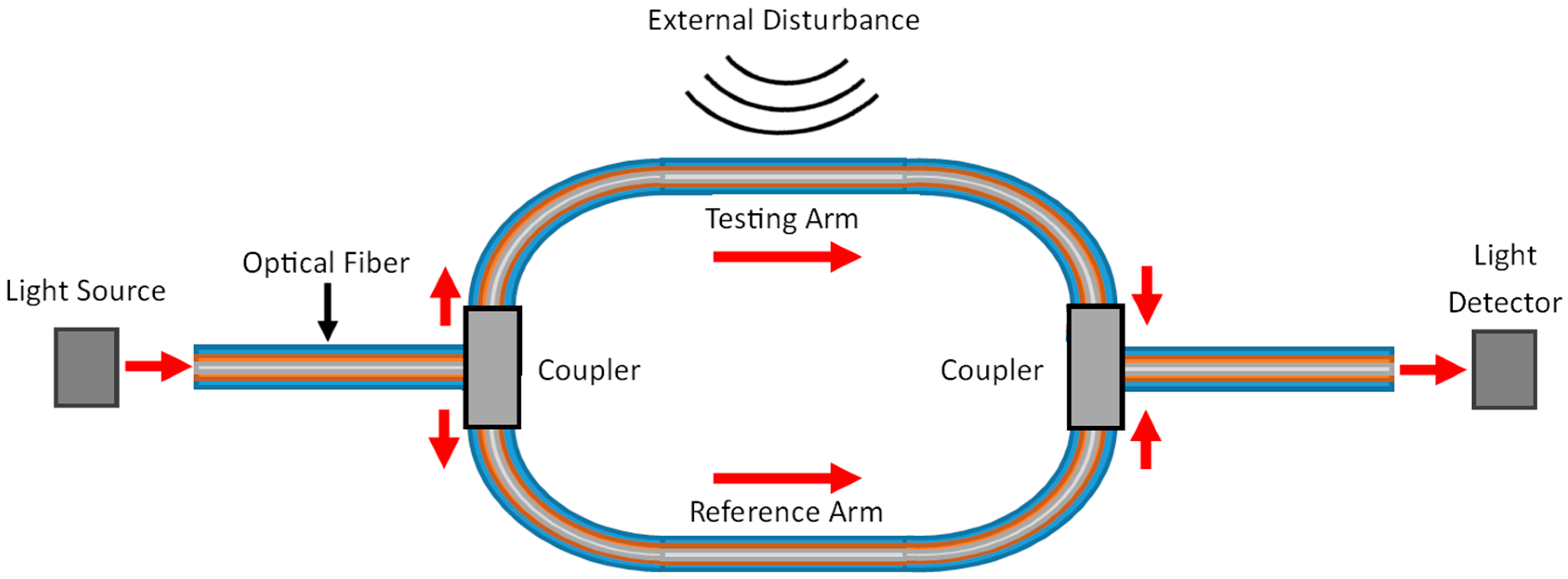
Mach-Zehnder interferometer (MZI) sensors are widely used in various multiparametric detection applications due to their inherent design. In this setup, the phase shift between two light beams is measured, one beam exposed to the environment and the other serving as a reference [84]. Although the physical lengths of the sensor and reference arms are identical, differences in the optical path length produce interference. For parameter measurement, the sensor arm is exposed to the environment, while the reference arm remains isolated [42,85,86,87,88,89], as shown in Figure 11. Any change in the surrounding parameters induces a phase difference, resulting in a measurable interference pattern. This phase difference of the MZI interferometer ( ϕ ) is described by Equation (5) [42,89]:
ϕ = 2 π λ n e f f 1 L 1 n e f f 2 L 2 + ϕ 0 ,
where n e f f 1 and n e f f 2 are the effective refractive indices of the two optical paths, L 1 and L 2 are the transmission lengths of the two optical paths, λ is the wavelength of light, and ϕ 0 is the initial phase.
Figure 11. Schematic configuration of an MZI sensor, showing the division of light into a testing arm and a reference arm via optical couplers and the subsequent recombination used to detect phase variations induced by external disturbances.

5.2.3. Intrinsic: Michelson Interferometer

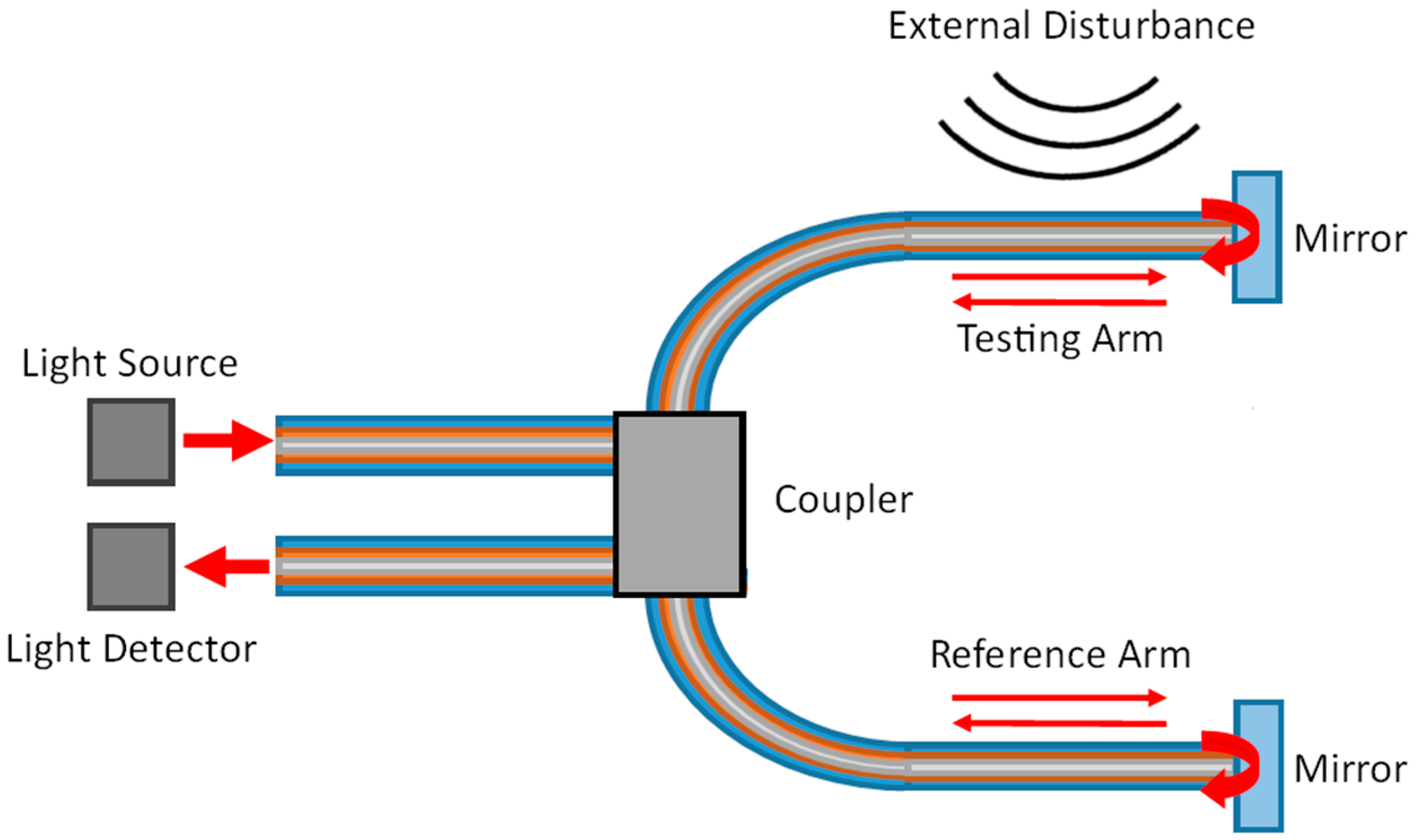
Michelson interferometer (MI) is another type of intrinsic interferometer very similar to MZIs, following the same principle of two light beams in two fiber optic arms, with the difference that, in the MI, each beam is reflected at the end of each arm [5,51,90,91,92]. The measurand (the physical quantity to be measured) modifies the phase of the signal beam, while the reference beam remains in a constant environment. The signal and reference beams end in mirrors and are reflected along the same path to recombine in the same coupler used (Figure 12) [5,51,90,91,93,94,95,96].
Figure 12. Schematic configuration of an MI sensor, showing the splitting of light into testing and reference arms, its reflection by mirrors, and the recombination at the coupler used to detect phase variations produced by external disturbances.

5.2.4. Intrinsic Sagnac Interferometer

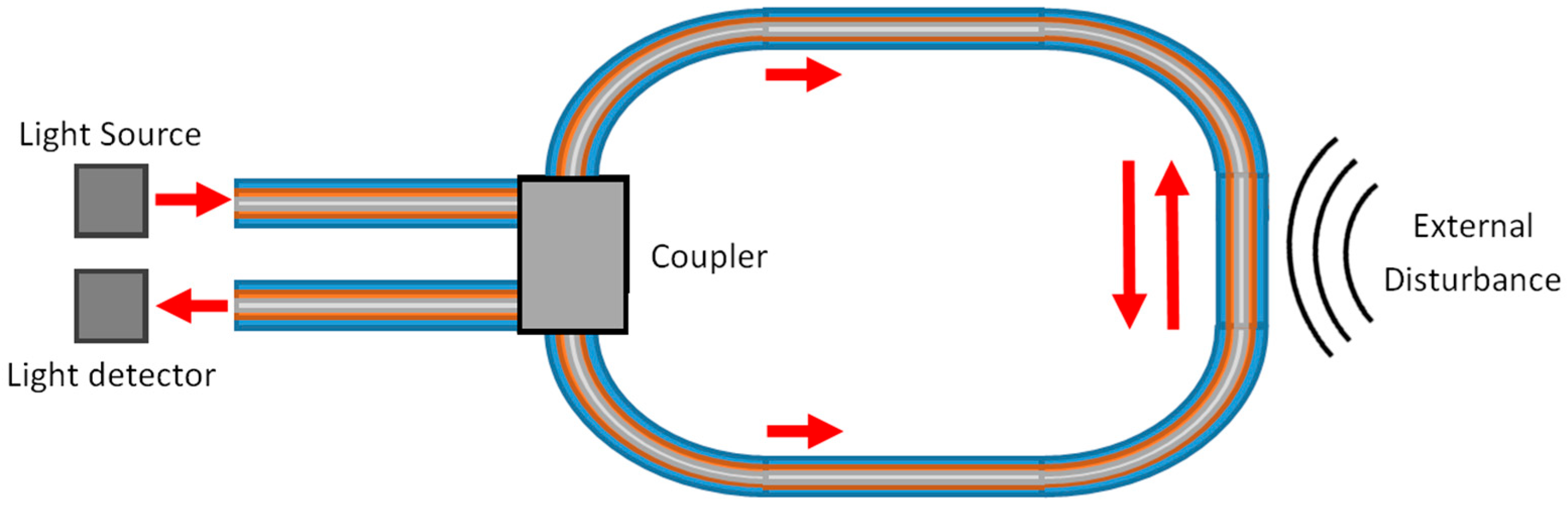
The intrinsic Sagnac interferometer (SI) sensor is built with a simple setup, usually using just one optical fiber in a loop. In this setup, a light beam enters the coupler and splits into two coherent beams. These beams travel in opposite directions (clockwise and counterclockwise) and have different polarization states, forming a closed optical loop that recombines in the coupler after completing the loop in the fiber, then sends the light to the detector (Figure 13) [5,17,42,86]. Although the two beams follow the same optical length, because they are altered at different times, the propagation loop changes, creating a difference in the optical path between them, which leads to measurable interference [17,42,51,86,93,94].
Figure 13. Schematic configuration of an SI sensor, where counter-propagating light waves travel along a looped fiber path and experience phase shifts induced by external disturbances, which are subsequently detected after recombination at the optical coupler.

5.3. Intrinsic: Distributed Sensors Based on Dispersion

The distributed optical fiber sensor (DOFS) architecture enables information to be collected using just a single optical fiber along its entire length, functioning as a continuous sensor. Unlike earlier setups, where measurements are taken at specific points on the fiber, distributed sensors are an innovative technology for large-scale monitoring [12,20,68,97,98,99,100,101].
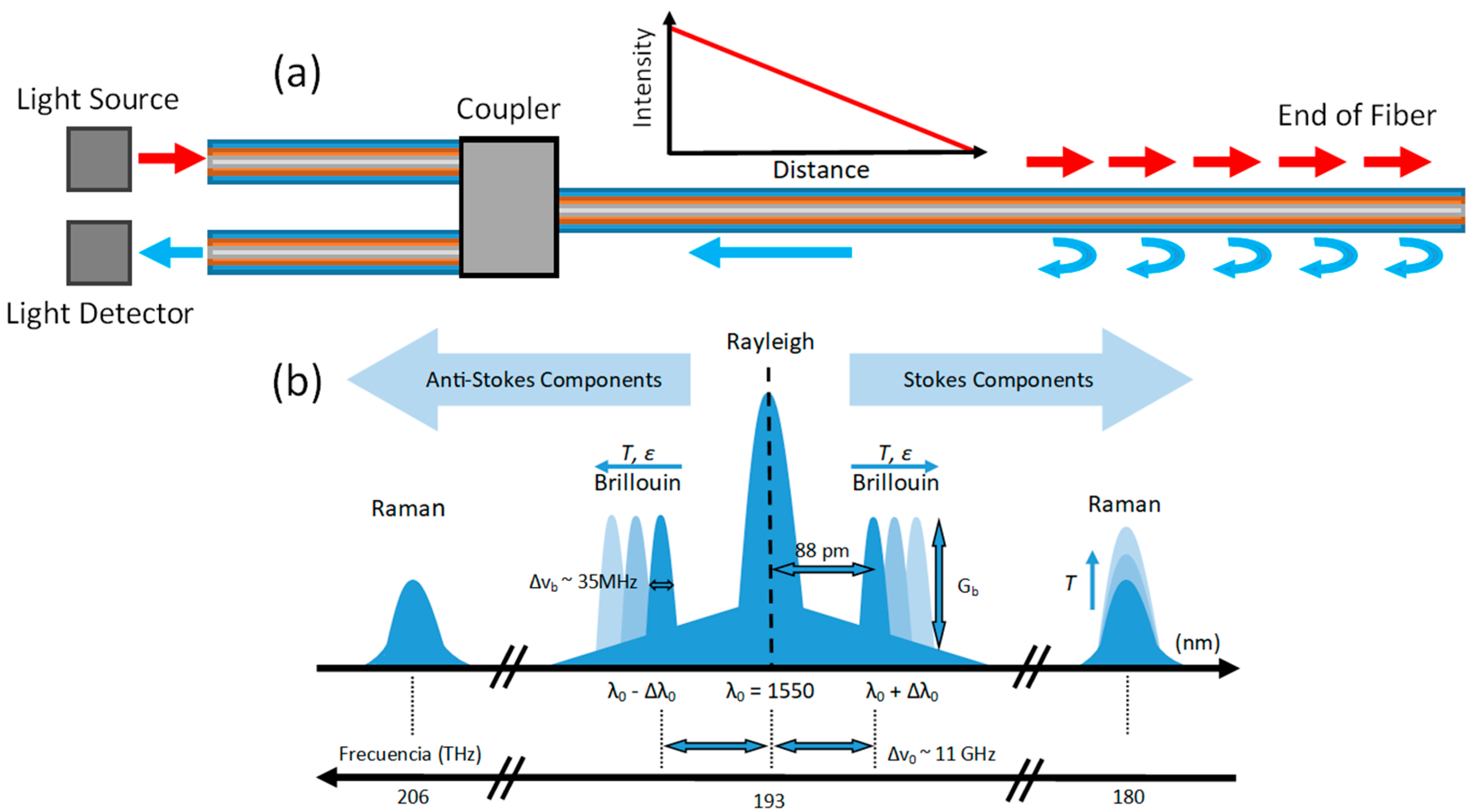
This intrinsic architecture of DOFS measures by analyzing backscattered light. This occurs when a light pulse with an original wavelength (called the Rayleigh linear component) interacts with microscopic imperfections or physical effects within the fiber core, where most of the light travels. Simultaneously, a small fraction is backscattered (Figure 11) [12,97,99]. This creates displaced light beams that contain components with wavelengths above and below the original signal, known as non-linear Raman and Brillouin components. These components offer information about the local properties of the fiber and disturbances like temperature or deformation. However, the accuracy of these measurements declines as the distance from the fiber increases, due to optical signal attenuation, low signal-to-noise, and hardware limitations of the optical interrogator [97,99,101].
Rayleigh scattering results from the interaction of incident light with fluctuations in the refractive index of the fiber core, mainly at the molecular level, and it is characterized by having the same frequency as the incident light [97,100,101]. Brillouin scattering, on the other hand, occurs when incident light interacts with acoustic modes in the medium, which are generated by the propagation of light in the fiber. Measuring the Brillouin frequency shift relative to the incident light allows for the estimation of parameters such as temperature or strain and supports distributed detection over long-range fibers [100,101]. On the other hand, Raman scattering is a consequence of the interaction between light and molecular vibrations within the medium, involving an energy exchange between light and matter. This type of scattering has a higher power threshold than Brillouin scattering and is also used in distributed sensing systems [99,100,101].
Figure 14 illustrates the operating principle of a DOFS, where a light source emits pulses that travel along the fiber, while a detector measures the backscattered light. At the bottom, the spectrum displays the three main types of dispersion: Rayleigh, Brillouin, and Raman. In the center, a dominant peak corresponding to Rayleigh scattering is observed, centered at the operating wavelength λ 0 = 1550 nanometers (nm), which indicates backscattering without a frequency shift. This scattering does not exhibit a significant frequency shift relative to the incident light and occurs within a narrow band of approximately 88 picometers (pm). On either side of the Rayleigh peak are the Brillouin components with an approximate shift of v b ~ 35 megahertz (MHz) relative to λ 0 . The bandwidth of these components is indicated as Gb, and the total spectral separation is about v 0 ~ 11 gigahertz (GHz). The Brillouin components respond to changes in temperature (T) and mechanical strain (ε), enabling distributed sensing of these variables. In the farthest regions of the spectrum, Raman components appear on both the anti-Stokes side (shorter wavelength and higher frequency than λ 0 ) and the Stokes side (longer wavelength and lower frequency than λ 0 ). The frequency of the Raman components shifts by terahertz (THz) to approximately 206 THz (anti-Stokes) and 180 THz (Stokes), and their intensity is closely related to temperature T.
Figure 14. (a) Schematic representation of a DOFS, illustrating the emission, backscattering, and return path of the optical signal along the fiber length. (b) Spectral distribution of Rayleigh, Raman, and Brillouin scattering components under 1.55 µm excitation, highlighting the corresponding Stokes and anti-Stokes shifts (adapted from [102]).
The theoretical basis for light scattering in fibers was proposed by Froggatt and Moore, demonstrating that backscattered light from permittivity is a deterministic function of distance along the fiber [103,104]. Demonstrating that, for an optical fiber, as for any waveguide, the electric field ( E ( z ) ), where z is the location of the fiber, obeys the homogeneous wave equation adjusted by the dispersion term (Equation (6)) [68,98,100,101]:
2 E ( z ) z 2 g 2 1 + ε z ε E z = 0 ,
where g is the complex propagation constant, the term ε ε contains the dispersion phenomena that occur in the fiber, which are responsible for local reflections at each location in the fiber, ε is the dielectric permittivity of the fiber, and ε z contributes to local reflections that are a function of both wavelength and space.
The complex propagation constant is expressed as Equation (7) [98,100,101]:
g = + j β ,
where the real part represents the one-way losses of the fiber, and the imaginary part β is the wave number.

6. Applications by Technological Area

In recent years, OFSs have been used across a wide range of scientific, industrial, and technological fields, thanks to advantageous characteristics such as high sensitivity, EMI immunity, multiplexing ability, and the capacity to operate in extreme environments [5,6,9,10,12,16].

6.1. OFSs in Industry

In the industrial sector, OFSs have proven to be essential devices for measuring physical parameters in challenging environments. Both intrinsic and extrinsic sensors have been adopted, each with specific advantages depending on environmental conditions and the type of variable to be measured [23,41,65,74,105].
The literature clearly shows the dominance of intrinsic sensors, especially those based on FBG and interferometers (Table 2). The most common configurations include FBGs used for detecting temperature and mechanical deformation in industrial components such as pipes, turbines, and electrochemical cells. Notably, FBGs distributed along a single fiber enable multipoint monitoring, allowing for the detection of anomalies or structural fatigue in critical installations [106,107,108]. The use of Fabry-Perot and Michelson interferometers for measuring pressure and temperature has also been documented [91,109]. Conversely, extrinsic sensors (Table 3) are employed in specific applications requiring more localized or specialized interactions, such as inspecting electrochromic devices (EC) [110] or materials with complex geometries [111,112,113].
Regarding the fiber material, the most commonly used are silica SMFs with coatings tailored to industrial needs: from polyamide coatings for high temperatures [108] to metal coatings for machinery applications [91,106,107,114]. It is also common to use fibers with special coatings and encapsulated structures that enable them to operate in environments with high humidity or exposure to chemical compounds [115,116,117,118].
Along with their benefits, the industrial use of OFSs still encounters major technical and economic hurdles. One common problem is cost, since advanced designs like photonic crystal fibers or sapphire-based fibers significantly increase fabrication costs and restrict their use compared to traditional electronic sensors [41,51]. Even in more standardized technologies like FBGs, the requirement for specialized interrogation systems and encapsulation methods suited to harsh environments continues to be a financial obstacle for large-scale deployment [21,49].
Another critical aspect is field calibration, which becomes a complex task in real industrial environments. The response of optical fibers can be influenced by temperature changes, mechanical stress, or chemical exposure, requiring in situ recalibration protocols that are not always compatible with continuous operation demands [24,76]. Some strategies suggest hybrid calibration models that combine laboratory references with adaptive algorithms to enhance the sensor’s stability over time [93].
The service life of OFSs also plays a key role in their competitiveness. Although silica fibers provide high thermal and mechanical stability, extended exposure to radiation, high humidity, or corrosive agents causes gradual degradation of sensitivity and signal-to-noise ratio [6].
Coatings made from polymers or metals can reduce these effects, but they increase manufacturing complexity and sometimes lessen the sensor’s flexibility [51]. In high-temperature settings, crystal fibers such as sapphire or neodymium-doped aluminum have proven to significantly extend the operating lifespan, although their fragility and cost are still limiting factors [41].
Finally, issues related to integration and maintenance also impact industrial adoption. Unlike traditional sensors, OFSs often require interrogation units and optical alignment that must be periodically checked to ensure reliable operation [21]. This increases the need for trained personnel and restricts their use in environments where access is limited [76]. Despite these challenges, the literature emphasizes that the long-term benefits, such as distributed measurement, EMI immunity, and multifunctionality, outweigh the drawbacks, indicating that the current barriers are temporary and will diminish as manufacturing techniques advance [49,51].
Table 2. Intrinsic OFSs in industry.
ArchitectureApplicationFiber TypeFeaturesRef.
FBG + IFPI in a single fiberMeasurement of internal pressure and temperature
in lithium-ion batteries
Silica SMF with polymer section
-
FPI sensitivity: −11.2 nm/bar, 920 pm/°C
-
FBG sensitivity: 8.3 pm/°C
-
Resolution: ±0.4 mbar, ±0.5 °C
-
Response time: 1.7 s to 3.1 s
-
Operation tested up to 40 °C
-
Pressure range recorded: up to ±4.5 bar
[108]
Modal interferometry by curvature in the shape of a globeMeasurement of refractive index and temperature in aqueous solutions of acetic acidSilica SMF and a silica capillary tube secured with a
polytetrafluoroethylene tube
-
Refractive index sensitivity: up to 170.66 nm/RIU
-
Temperature sensitivity: −119.2 pm/°C (in the range 29–43 °C)
-
Resolution: 0.0000303 RIU and 0.57 °C
[109]
Multiple architectures:
-
IFPI
-
FBG
-
Rayleigh scattering DOFS
Measurement of temperature and deformation within industrial metal structuresAluminum-coated silica SMF, stainless steel, or metal capillary
-
High temperature-resistant FBG, engraved with a femtosecond laser—IFPI encapsulated in a steel tube with an internal mirror
-
Integrated sensors without compromising the mechanical properties of the component
[107]
Distributed sensor based on
Rayleigh
scattering
Detection of Delamination damageSilica SMF
-
Spectral strain sensitivity: ~1 με resolution
-
Spatial resolution: millimeter-scale
-
Enables detection of strain mutation peaks caused by delamination
-
Capable of localizing damage with <3 mm error
[106]
FBGMonitoring of optical transmittance in EC Silica MMF
-
Wavelength used: 810 nm LED
-
Detects temperature, but does not correlate well with optical transmittance
[110]
FBGMeasurement of mechanical deformation in structuresSilica SMF
-
Measured deformation range: up to 2 mm/m
-
Sensitivity: ~1.2 nm per 0.2%
-
Accuracy: relative error of 0.04%
[119]
Distributed reflectometer sensorDetection of water leaks in underground systemsPlastic MMF
-
Leak location accuracy: ±10 cm
-
System range: up to 100 m
-
Response time: in real time
[120]
MITemperature measurement in high-temperature environmentsSilica SMF Optional coating with gold film to improve reflectivity.
-
Temperature range: 100–900 °C
-
Sensitivity: 80 pm/°C (100–450 °C), 109 pm/°C (450–900 °C)
-
Thermal stability up to 900 °C
-
Reflected sensor with increased reflectivity of 16 dB when gold is applied
[91]
FBGHigh-resolution liquid level measurement Plastic MMF with a polymethylmethacrylate core
-
Measurement range: 7.2 cm
-
Resolution: 0.5 mm
-
Sensitivity: 17.4 pm/mm
-
No direct contact with the liquid required
[118]
Distributed sensor based on Rayleigh scatteringMeasurement of surface temperature of cylindrical cells in Li-ion batteries 21700Silica SMF
-
Spatial resolution: 3 mm
-
Measurement range: from 25 °C to 82 °C.
-
Sensitivity: 1.55 GHz/°C (requires prior calibration)
-
Accuracy: ±0.2 °C
[121]
FBGDeformation in carbon fiber composite materialsSilica SMF
-
Sensitivity to deformation: ~1.2 pm/με
-
Measurement of deformations up to ~2000 με
-
Accuracy: on the order of ±10 με
-
Multiplexing capability
[122]
FBGDeformation and temperature monitoring in smart structures and composite materialsSilica SMF with acrylate coating
-
The sensor can simultaneously measure deformation and temperature.
-
No exact values are given for sensitivity or temperature range, but the high fidelity of response after the insertion process is highlighted.
[117]
FBGSimultaneous measurement of temperature and deformationErbium-doped silica SMF
-
Temperature resolution: ±0.1 °C
-
Strain resolution: ±0.85 με
-
Sensitivities: 9.29 pm/με and 11.29 pm/°C
-
Spectral operating range: around 1550 nm
[116]
Distributed sensor based on Rayleigh scatteringDistributed magnetic field measurementSilica SMF with germanium-doped core and nickel-acrylate composite coating
-
Sensitivity: 22.85 MHz/mT
-
Measurement range: 3 mT to 245 mT
-
Spatial resolution: 20 cm
-
Measured deformation change: up to 36.4 με
-
High linearity (R2 > 0.99)
-
Remote detection capability and resistant to extreme environments
[115]
Distributed sensor based on Rayleigh scatteringDistributed temperature monitoring in continuous emulsion polymerization tubular reactorsSilica SMF
-
Distributed thermal detection with a spatial resolution of 2.6 mm
-
Temperature range: inferred up to ~100 °C, although no upper limit is specified.
-
No process intrusion or direct contact with the fluid is required
[123]
FBGMeasurement of mechanical vibrations (frequency and acceleration)Silica SMF coated with silver film
-
Operating frequency: 100 Hz to 800 Hz; resonance at ~1900 Hz
-
Acceleration sensitivity: up to 38.79 mV/g
-
Axial strain sensitivity: −2.57 pm/με, −1.6 pm/με
-
Frequency range: up to 10,000 Hz
-
Signal-to-noise ratio: 55.1 dB at 1900 Hz
[114]
Table 3. Extrinsic OFSs in industry.
ArchitectureApplicationFiber TypeFeaturesRef
1. Transmittance with fibers on both sides of the device
2. Fiber-to-fiber measurement crossing the device
3. Lateral transmittance through the edge
Monitoring of optical transmittance in EC devicesSilica SMF
-
Wavelength used: 810 nm LED
-
1. Signal sensitive to the angle of incident light
-
2. Clear signal, but dependent on the alignment of fibers
-
3. Good correlation with reference transmittance, robust for manufacturing
[110]
Sensor based on ultraviolet-visible absorption spectroscopyMonitoring of ammonia in the air inside poultry farmsPlastic MMF
-
Detection limit: 0.33 ppm
-
Linear range: 0.33 to 8 ppm
-
Response time: 5–10 min
-
Proven selectivity against interference (carbon dioxide, humidity, temperature)
[113]
EFPI integrated with microelectromechanical systemsVibration/acceleration measurement in high-temperature environmentsGold-coated silica SMF
-
Axial sensitivity: ~2.48 nm/g (at 20 °C), higher at elevated temperatures
-
Thermal stability: maximum phase drift of 0.0109 rad in 110 min at 400 °C
-
Thermal range: tested from 20 °C to 400 °C
-
Non-linearity error: 1.88% at 300 °C
[112]
Backscatter reflection-based sensorPressure measurement to detect mechanical filter blockages in hydraulic systemsPlastic MMF
-
Measurement range: 0–35 kPa
-
Sensitivity: 0.285 mm/kPa
-
System repeatability: ±0.0038 mm
-
Near-linear response up to 35 kPa
[111]
Overall, the industrial deployment of OFSs shows a clear shift toward intrinsic configurations, especially FBG- and interferometer-based systems, because of their high precision and capacity to support distributed, multipoint measurements. Extrinsic sensors remain important in specialized applications that require localized interactions or compatibility with complex device geometries. In both categories, the choice of fiber coatings and encapsulation methods reflects a move toward materials designed for harsh conditions, balancing sensitivity with durability. Despite ongoing challenges related to fabrication costs, field calibration, and long-term stability, the literature suggests a steady shift from laboratory demonstrations to scalable industrial integration, driven by the need for reliable monitoring solutions in increasingly demanding environments.

6.2. OFSs in Medicine and Biomedicine

In recent years, in the fields of medicine and biomedicine, the use of OFS has appeared as a means for tracking physiological and biochemical parameters. These OFS are used in medical procedures and surgeries, generally [17,22,57,75].
The tendencies are visible in these applications, favouring two types of intrinsic sensors as are summarised in Table 4, most commonly those exploiting Bragg gratings, including interferometric ones. Here, intrinsic sensors are of prime importance within smart catheters, temperature observation in ablated tissues, muscle vibration measurement, and real-time physiological observation [17,22,43]. It is worth highlighting the utilization of FBG sensors applied for temperature and strain observation in medical applications due to the strong, predictable reflectance spectrum and the ability to be implanted in tissues or built into wearable devices [14,22].
On the other hand, the use of extrinsic sensors has proved beneficial in cases where the coupling of the variable of interest with the fiber takes place outside the core region of the fiber itself (Table 5). This includes EFPI sensors used in endovascular applications for pressure measurements, and scintillating detectors used in brachytherapy procedures for radiation treatment measurements. This kind of sensor design enables the use of external cavities and sensitive materials, thus adding towards increased versatility, especially in cases demanding high resolution with medical devices [10,22,54]. Silica SMF are the most used types of fibers, although many examples involve plastic MMF in extrinsic sensors, most preferably due to flexibility and low-cost factors. Functional coatings including refractive index-sensing films and those used for biomarker detection have become common in FBG setups, adding towards an increased biological sensing potential [14,58].
It is apparent from the recent available literature that the level of interest in the use of OFSs in the field of biomedicine has increasingly moved from in vitro proof-of-principle measurements to in vivo validations, proving that OFSs have applications beyond the lab feasibility stage and can function exceedingly well within a medical setting and clinical trials. Various reviews have highlighted the effectiveness of FBG and FPI integration with minimally invasive surgical tools and catheters, where measurements related to intracranial and intravascular pressure, thermal ablation, and tissue deformation tests were performed within living organisms [22,58]. Such medical validations establish the fact that OFSs not only compete with electronic sensors but can be superior because of their EMI immunity within MR environments [68].
Despite these benefits, the transition from research-to-innovation-based translations to mainstream clinical use is currently hampered by some challenges. First, the cost is a key concern, considering the increased costs due to the use of interrogation technologies and the loss of the cost advantage of standard biosensors [10,25]. Moreover, calibrating these devices in a real clinical environment is a complex process due to physiological complexities, including temperature variations, motion of tissues, and fluid dynamics, which create noise levels requiring recalibration [14].
A further consideration is related to service life and biocompatibility. Over a period of exposure to bio-fluids, degradation of optical coatings can occur, leading to a reduction in sensitivity, biofouling effects on the surface of the fiber, and ultimately influencing the reliability of the sensors [43,60]. To mitigate these effects, progress has been made in developing biocompatible coatings of polymeric and graphene materials with improved robustness and the ability of fibers to identify specific bio-markers [14]. However, maintaining a balance is a challenge.
The use of OFSs in wearable devices and rehab instruments is already past the prototyping stage, with clinical tests underway for tracking respiration, joint motion, and cardiac activity. Such devices exploit the non-invasive, continuous tracking offered by OFSs. But such instruments have limitations related to cost, fragility, and recalibration requirements for longer-term use [10,17,43].
It is emphasized in the literature that the progress of OFSs in the field of medicine demands an interdisciplinary approach by engineers, clinicians, and regulatory agencies. Even though some OFSs have already received approval from the Food and Drug Administration (FDA) for use in physical measurements such as pressure [22], biochemical sensing, including glucose and protein targets, is currently only researched in lab-scale and pilot-scale settings due to issues with calibration, biofouling, and the need for clinical validation [14,25]. However, advances in distributed sensing approaches and Ruthenium-based electrochemical sensing methods hold much promise [25,68].
Table 4. Intrinsic OFSs in Medicine and Biomedicine.
ArchitectureApplicationFiber TypeFeaturesRef.
MZIDetection of acetone in human breath as a biomarker for diabetes mellitusSilica SMF coated with a polydimethylsiloxane film
-
Concentration range: 0–332 ppm
-
Detection limit: 1.5 ppm
-
Sensitivity: up to 0.0147 ppm−1
-
Operating temperature: ≈25 °C
[124]
Sensor based on intensity modulationDetection of acetone in human breath as a biomarker for diabetes mellitusSilica SMF thinned by thermal process without coating
-
Measurement range: 0–500 ppm
-
Detection limit: 5.56 ppm
-
Operating temperature: ≈25 °C
[125]
IFPIMonitoring of tissue refractive index during radiotherapy sessionsSilica SMF with external coating of nanocrystalline diamond film
-
Adjustable sensitivity range through design variations
-
High spatial and temporal resolution
-
Interferometric modulation dependent on refractive index
[126]
FBGThermal analysis of perfusion cooling in porcine liver tissue during and after laser ablationSilica SMF encapsulated within a stainless steel guiding needle
-
Monitored temperature range: up to 100 °C
-
Thermal resolution: 0.1 °C
-
Minimally invasive instrumentation
-
In vitro experimental validation with perfused and non-perfused porcine liver
[127]
IFPIGas pressure measurementSilica SMF
-
Maximum sensitivity: 2.526 nm/kPa
-
Pressure range: 200–300 kPa
-
Cavity formed with epoxy resin to enhance sensitivity and response
[128]
FBGMonitoring of brain deformations
induced by pressure waves during impacts
Silica SMF mounted on a flexible silicone substrate
-
Strain range: up to ~4%
-
Temporal resolution: 650 kHz
-
Millimetric spatial accuracy
-
Sensor response time: ~1.5 μs
[129]
MZIDetection of acetone in gaseous phaseSilica SMF with a stripped fiber section coated with a thin layer of indium oxide
-
Application of PLS regression (Projection to Latent Structures) for spectral response modeling
-
Sensitivity: up to 1 ppm
-
Interrogation in the visible spectral range (~630 nm)
-
Good fit between experimental data and model: R2 > 0.98
[89]
FBGSimultaneous measurement of temperature and relative humidity in confined environmentsSilica SMF with partial coating of SFT (sensitive functional tube) material
-
Humidity sensitivity: ~1.007 pm/%RH in the range 11–97% RH
-
Thermal sensitivity: ~10.18 pm/°C in the range 20–80 °C
-
Compact dimensions (external diameter < 1 mm)
[130]
Table 5. Extrinsic OFSs in Medicine and Biomedicine.
ArchitectureApplicationFiber TypeFeaturesRef.
Bending sensor based on curvature-induced attenuationEstimation of the knee flexion/extension angle during walkingPlastic MMF coated with a heat-shrink tube
-
Need for a neural network to model temporal dynamics
-
Minimum root mean square error (RMSE): 3.41° (IQR: 2.50–5.19°)
-
Sampling frequency: 1800 Hz
[131]
EFPIPressure monitoring during endovascular surgical proceduresSilica SMF with an interferometric thin film on the fiber core end face
-
Pressure sensitivity: 0.4646 nm/kPa
-
Measurement range: up to 200 kPa
-
Resolution: 0.1 kPa
-
Sensor diameter: 125 µm (compatible with vascular guidewires)
[132]
Optical sensor based on scintillation radiation detectionDose measurement in low-dose-rate brachytherapyPlastic MMF with a core doped with scintillating material, coated with reflective material
-
High spatial resolution for dose distribution detection
-
Reproducible response under varying orientation and distance conditions
-
Passive sensor, no need for an electrical power supply
-
Good performance within a water phantom, simulating human tissue
[133]
EFPIWide field photoacoustic microscopy for monitoring acoustic signals induced by laser pulsesSilica SMF with a cavity formed by a thin polymer film
-
Lateral resolution: ~6.3 μm
-
Field of view: 3.3 × 3.3 mm2
-
Penetration depth: ~1 mm
-
High-speed interrogation with an acquisition rate of 1.6 kHz per channel
-
Sensitivity to acoustic signals
[134]
In the biomedical field, the dominant trend favors intrinsic FBG- and interferometer-based sensors, which allow for precise, minimally invasive monitoring of physiological variables and can be easily integrated into surgical tools or wearable devices. Extrinsic configurations complement these advances in specialized roles, such as pressure monitoring or radiation dosimetry, where external cavities and scintillating materials provide additional versatility. A clear shift is observed from in vitro validations to in vivo applications, emphasizing the clinical potential of OFSs beyond laboratory settings. Meanwhile, research highlights ongoing challenges, including high interrogation costs, calibration in dynamic biological environments, and ensuring long-term biocompatibility, but the overall path points steadily toward clinical translation and routine medical use.

6.3. OFSs in Environmental Chemistry

OFSs have found wide acceptance in chemistry for gas and liquid analysis, and for measurements of physicochemical parameters of the environment [13,135]. A review of the literature shows a wide variability of design and functional materials according to the demand for sensitivity and selectivity.
Intrinsic sensors dominate in interferometric and scattering setups (Table 6). Such setups are used for gas sensing of substances such as ethanol and dimethyl sulfoxide, as well as metal ions Hg2+ and Pb2+, due to the high sensitivity, low detection thresholds, and ability to work with functional materials such as polyaniline layers, metallic nanoparticles, metal oxide, and printed nanostructures [98,136].
On the other hand, extrinsic sensors can be better fitted into applications with modularity requirements, design versatility, and integration with other external materials, which cannot be readily included within the fiber core itself (Table 7). The use of POFs [135], metallic layers such as gold nanostars and palladium layers, polymeric layers, and evanescent field-based sensors has already been explained [13,72,135,137]. Their performance is excellent with regard to the measurement of volatile organic substances, inflammable gases, and traces of heavy metals present in a liquid [13,72].
A new direction is the use of nanocomposites and hybrid functional structures, which enhance the optical properties of the sensor and enable increased levels of sensitivity, stability, and selectivity [13,72,135,136]. This reflects a new direction for OFSs in promoting green technologies for environmental monitoring and the detection of priority pollutants.
Regarding environmental measurements, the transition of lab-scale designs into reality shows limitations for each specific medium. For example, in evanescent field sensors and other surface-based sensors, the sensing region is always close to, or actually at, the fiber–medium interface, which makes it necessary to access or reduce the cladding thickness in order to allow for optical interaction. This makes it prone to fouling and biofouling effects (non-specific adsorption of biomolecules, organic layers, or biofilms), introducing baseline drift and loss of selectivity. This also demands stable surface functionalization and protection against the mentioned effects in the mechanical design of the sensor itself. Literature shows that surface sensing using evanescent light depends on the analyte’s proximity to the core and often involves cladding removal, affecting robustness and field stability [13].
For interferometric setups designed for volatile organic compound detection, the reviews indicate remarkably sensitive detection thresholds in the ppb–ppm range whenever thin-film materials such as polydimethylsiloxane and zeolites were used. However, some issues concerning the respective setups’ selectivity, ability to demodulate spectra, and temperature, pressure, and humidity dependence still exist in most cases. The majority of these interferometric setups were only able to function within a centralized setting due to a lack of a means for distributed monitoring [42].
Humidity effects can also produce strong errors due to the impact of humidity interference. The swelling process in a polymer coating will make the change non-linear with a low response rate, making calibration a challenge, especially for a broad range of relative humidity values. Experimental evidence shows that a graphene oxide coating has a strong sensing capability with a rapid response compared with a “water-swelling” polymer [50].
As regards cost and complexity of the interrogator, the interferometric methods provide a much better sensitivity; however, these methods may be prone to a temperature effect and need a temperature compensation system, thereby complicating the acquisition cost and complexity. In contrast, reflective methods with a micromirror design can be cost-effective, but these methods mostly tend to be intensity-based and may be prone to pathlength variations in the optical measurements and can only be used for a single-point measurement [136].
The service life of OFSs largely depends on the material choice. Group IV metal oxide coatings (HfO2, ZrO2, TiO2) demonstrate high chemical stability and resistance to corrosion, while also being more cost-effective than polymer films. As a result, they are promising options for long-term humidity and gas sensing in harsh environments. However, careful control of coating thickness and microstructure is necessary to prevent drift and fatigue during repeated exposure cycles [50].
Taken together, these observations suggest prioritizing: (i) anti-fouling surfaces or inorganic protective coatings for evanescent-field sensors; (ii) thermal compensation and robust demodulation in interferometric schemes; (iii) range-specific calibration strategies for humidity-affected coatings; and (iv) material and coating choices aligned with the expected lifetime and cost-effectiveness of environmental monitoring systems [13,42,50].
Table 6. Intrinsic OFSs in Environmental Chemistry.
ArchitectureApplicationFiber TypeFeaturesRef.
Distributed sensor based on Raman scatteringTemperature measurement in high-temperature environments for environmental monitoringGraded-index silica MMF with a germanium-doped silica core. Two variants: one with gold coating and another with polyimide coating
-
System operating temperature range: −270 °C to 700 °C, depending on coating
-
Gold coating withstands up to 700 °C, polyimide up to 300 °C
-
Attenuation with gold: 14.8 dB/km at 850 nm, 13.4 dB/km at 1300 nm
-
Attenuation with polyimide: 2.58 dB/km at 850 nm, 0.73 dB/km at 1300 nm
-
Typical thermal resolution: <0.3 °C
[138]
MIDetection of chemical compounds in liquids at low concentrations and reduced volumesSilica SMF with a microcavity, forming two reflective arms within the fiber itself
-
Minimum required volume: <50 nL
-
Concentration detection limit: <0.005% (v/v)
-
High spectral resolution due to the use of a ring cavity laser
-
Reusable and regenerable sensor
[95]
IFPIpH measurement in aqueous solutionsSilica SMF with a sensitive film of titanium dioxide and palladium applied via sol-gel method
-
pH range: 1.0 to 7.0
-
Response time: ~7 s
-
Sensitivity: up to 30 με at pH 1.0, and ~6 με at pH 7.0
-
Minimum detectable strain resolution: 64 nε
-
Operating temperature: ambient
[139]
Distributed sensor based on Rayleigh scatteringMonitoring of mooring lines in floating wind turbinesPlastic SMF with a polymethylmethacrylate resin core
-
Total fiber length: up to 12 m
-
Damage event localization resolution: ~50 cm
-
Standard deviation <3.5% across 30 consecutive reliability tests
-
Compatible with large curvatures due to the mechanical properties of the POF
[140]
Table 7. Extrinsic OFSs in Environmental Chemistry.
ArchitectureApplicationFiber TypeFeaturesRef.
Sensor based on intensity modulation through evanescent interactionDetection of ethanol at low concentrations, with application in environmental monitoringSilica SMF coated with Bi2Fe4O9 nanoparticles and biomass-derived biochar
-
Concentration range: 0–250 ppm
-
Cost-effective and eco-friendly sensor due to the use of biomass-derived materials
-
Maximum sensitivity at 250 ppm of ethanol with a significant optical signal change
-
Operation in the visible range ~600 nm
[141]
Sensor based on
intensity modulation via evanescent interaction
Detection of dimethyl sulfoxide in liquid solutions, relevant for environmental and water quality monitoringSilica SMF with a central
stripped section coated with a functional layer of polymer/MXene TiO2
-
Detection range: up to 10% v/v
-
Response time: 5 s; recovery time: 8 s
-
Estimated detection limit: <1% v/v
-
Potential for miniaturization and low cost
[142]
Sensor based on intensity modulation and spectral shift via localized surface plasmon resonanceDetection of changes in the refractive index of liquids, applicable in environmental monitoring and chemical analysis in solutionsSilica SMF with a region coated with a layer of gold nanostars
-
Detection limit: changes of 0.001 in refractive index
-
Resonance peak tunable in the visible–NIR range (~730 nm)
-
High reproducibility and spectral stability
-
Evaluated in water/glycerol mixtures to test optical index response
[137]
EFPIDetection of Pb2+ ions in aqueous solutionsSilica SMF with a coating of sodium alginate hydrogel ionically imprinted with Pb2+
-
Sensitivity: 1.78475 nm/(mg/L) in the range 0–2.5 mg/L
-
Evaluated temperature range: 12–42 °C with low thermal sensitivity (0.07223 nm/°C)
-
Selectivity: high against other ions (Cu2+, Cr3+, Mn2+, Fe3+, Zn2+)
-
Linearity: 0.9
[143]
Sensor based on
intensity modulation via evanescent interaction
Detection of a wide range of organic solvents and volatile
chemical compounds
Combination of silica SMF and MMF
-
Intensity changes of up to 40% in the presence of solvents such as acetone and methanol
-
Fast response time: ~10 s
-
Good repeatability: variation < 5% after multiple cycles
[144]
Sensor based on localized surface plasmon resonanceDetection of mercury ions (Hg2+) in aqueous solutionPlastic MMF with tip treated by chemical etching and subsequent functionalization with gold nanoparticles and glutaric acid
-
Detection limit (LOD): 0.03 µM of Hg2+
-
Linear detection range: 0.03–1.0 µM
-
Maximum spectral response at ~530 nm
-
High selectivity against other metal ions
-
Response time: ~1 min
-
Portable, cost-effective, and low-power sensor
[145]
EFPIpH detection in aqueous solutionsSilica SMF coated with a uniform layer of polyaniline
-
Measured pH range: 4 to 10
-
Sensitivity: up to ~145 pm/pH
-
High linearity (R2 > 0.995)
-
Response time: 5 s
-
Good repeatability, variations under 2%
-
Detection limit: ~0.02 pH units
[146]
OFSs show a clear trend toward hybrid and nanocomposite designs that improve sensitivity, chemical selectivity, and robustness for pollutant detection. Intrinsic interferometric and scattering setups dominate where ultra-low detection limits are needed, while extrinsic architectures with plastic fibers and functional coatings offer modular and cost-effective solutions for large-scale monitoring. Despite ongoing challenges like humidity interference, surface fouling, and calibration stability, the literature shows steady progress toward reliable, field-ready systems. These advancements position OFSs as key enablers of next-generation environmental monitoring technologies aligned with sustainability and early-warning detection needs.

6.4. OFSs in Civil Engineering and Structural Analysis

In such fields, OFSs have played an important role in detecting strain, cracks, and displacement in infrastructures such as tunnels, bridges, concrete linings, and historical buildings, especially in intrinsic OFS employing backscattering architectures (Table 8) [18,19,20].
DOFSs, well-known for such capabilities as mapping data at high spatial resolution all the way along the fiber length, offer great applicability in early detection and measurement of concrete cracks and ground displacements. The applicability can be identified through the success of DOFS applications in submerged tunnels and in lab experiments using concrete cover coatings under loading [12,15,16,19,147]. The distributed nature of these devices allows analysis from micro-strain to local failure mechanisms at high resolution in millimeters, dependent on the installation process or the detection technology employed (Rayleigh, Brillouin, or Raman).
The use of extrinsic-type sensor usage is limited (Table 9), but some studies have explored the role of surface roughness in sensor output in structural monitoring applications [148].
Regarding fiber type, silica SMF is used because of its low fiber attenuation and compatibility with distributed scattering methods. Installation arrangements and corresponding coatings (polymeric or metal) vary according to the final application, with cables or fibers reinforced in concrete often used to effectively transfer strains from the structure to the sensor [15,148].
One of the main benefits of OFSs regards the fact that they can operate as distributed sensors. These characteristics make OFSs superior to traditional sensors such as electrical strain gauges, linear variable differential transformers, or vibrating wires, which offer data merely at discrete points and at high densities in order to detect local events [19]. The economic and operational issues related to the installation of thousands of conventional sensors in large-scale facilities make OFSs, especially DOFSs, highly competitive because they can offer data on large-scale structures through merely one fiber line [15].
Comparison studies using conventional sensors reveal that although inclinometers, extensometers, and accelerometers have long-established application history, these devices tend to cause service interruptions during installation, display low-level automation, and offer limited spatial resolution. Visual observation and 3D laser scanning offer complementary data, but these methods tend to be time-consuming and expensive, hence not suitable or practical in real-time and large-scale structural health monitoring. In comparison, DOFS devices using the Rayleigh, Brillouin, or Raman scattering principle can offer non-interruptive long-term stable measurement capabilities [15,19].
Despite these benefits, there are several challenges that exist in terms of cost, calibration, and lifespan. The upfront cost of interrogators and the installation cost of fiber cables is much higher than conventional sensing technologies; however, the cost per unit is reducing with increased usage. There are several challenges in the process of calibration due to the reliance of fiber-strain transfer characteristics on certain adhesives, coatings, and installation procedures, which affect the measurement signal when not treated effectively [15]. For service lifespan, silica SMF cables ensure robustness against environmental factors but require protective coatings or cables to counter adverse environmental influences such as water seepage or heavy loads in buried or underwater infrastructures [5,12].
In terms of maintenance and standardization, OFSs, unlike electronic sensors, require both interrogation devices and alignment procedures, which need trained staff. Further, there exist no global standards regarding OFS calibration and installation, thus hindering large-scale deployment in Structural Health Monitoring missions [15]. However, based on current literature assessments, the long-run advantages of OFS technology, including multiplexing, non-intrusiveness, and compatibility with smart infrastructures, overcome current challenges in advancing them as alternatives in the state-of-the-art in monitoring technology [16,20].
In the area of structural monitoring, OFSs can offer an effective and scalable solution to overcome the spatial constraints and operational limitations of conventional sensors. They can offer real-time, distributed, and automated data acquisition; all these aspects are critical in advanced infrastructures where accurate and early damage assessment and maintenance are absolutely essential. In the future, there shall be scopes to make installation cost-effective, make calibration easier, and develop standard operational procedures to make them widespread in civil engineering as conventional monitoring tools [15,19].
Table 8. Intrinsic OFSs in Civil Engineering and Structural Analysis.
ArchitectureApplicationFiber TypeFeaturesRef.
Distributed sensor based on Brillouin and Rayleigh scatteringStructural monitoring of strain in joints of submerged tunnelsSilica SMF
-
Detected strain range: up to 4000 µε (microstrain)
-
Measurement resolution: 1.5 µε
-
Maximum covered length: up to 1 km per segment
-
Spatial accuracy: ~1 m
[147]
Distributed sensor based on Brillouin and Rayleigh scatteringStudy of local failure mechanisms in hard rock tunnel liningsSilica SMF
-
Detected strain range: up to 12,000 µε (microstrain)
-
Measurement resolution: 10 µε (Brillouin) and 1 µε (Rayleigh)
-
Spatial resolution: 10 cm (Rayleigh) and 50 cm (Brillouin)
-
Monitored length: up to 30 m
[149]
IFPIMonitoring of structural displacements in heritage building elementsSilica SMF
-
Measurement range: up to 10 mm of linear displacement
-
Resolution: 1–2 µm
-
Strain sensitivity: determined by Bragg wavelength shift (~1.2 pm/µε)
-
Discrete installation, suitable for historical monuments
[150]
Distributed sensor based on Rayleigh scatteringSimultaneous monitoring of ground displacements and water pressureSilica SMF mounted on a geotechnical tube with a deformable structure
-
Displacement measurement range: up to 40 mm (±20 mm)
-
Displacement resolution: 0.5 mm
-
Hydraulic system accuracy: ±2.5 kPa
-
Rayleigh sensor spatial resolution: 1.3 mm
[151]
Distributed sensor based on Rayleigh scatteringReal-time monitoring of fouling formation in tubular reactorsSilica SMF helically wound around the reactor
-
Fouling detection range: detects deposits on the order of 0.1 mm
-
Spatial resolution: ~0.65 mm
-
Capability to identify specific fouling initiation zones
-
Measurement at 2-min intervals
[49]
Distributed sensor based on Raman scatteringMeasurement of transient seepage flows and heat transfer in saturated soilSilica MMF with acrylate coating
-
Spatial resolution: 0.25 m
-
Temporal resolution: 15 s
-
Thermal accuracy: ±0.1 °C
-
Total sensor length: 15 m (spirally wound over the area of interest)
[152]
Table 9. Extrinsic OFSs in Civil Engineering and Structural Analysis.
ArchitectureApplicationFiber TypeFeaturesRef.
Sensor based on surface plasmon resonance (SPR)Experimental evaluation of the influence of surface roughnessSilica SMF with an aluminum film
-
Modified fiber length: ~4 mm
-
Evaluation for surface roughness between 0.45 µm and 2.4 µm (Ra)
-
Spectral range: 400–900 nm
-
Maximum sensitivity: peak shifts > 20 nm with changes in the refractive index of the medium
[153]
In structural and civil engineering, the use of OFSs is solidifying around distributed and FBG-based systems, which allow for precise, continuous monitoring of large structures like bridges, tunnels, and dams. These systems offer vital data on strain, vibration, and thermal effects, aiding preventive maintenance and helping to extend the service life. Extrinsic configurations remain useful in situations where adaptability to complex shapes or localized measurements is necessary. Despite challenges related to installation costs, field calibration, and long-term durability under changing environmental conditions, the overall trend points toward a shift to integrated smart infrastructures where OFSs serve as key parts of structural health monitoring systems.

6.5. OFSs in Aerospace Engineering

In the field of aerospace technology and aerial vehicles, OFSs are widely used for evaluating integrity during flight and detecting high-precision dynamic events. In addition, because they are lightweight, multiplexable, and stable in extreme environments, they can easily be incorporated for use in aircraft, space construction, and high-pressure environments [11,154,155].
In this area, the main type of sensor used is intrinsic (Table 10 and Table 11), and FBG, MZI, and the distributed sensor layout are the most popular ones in use. FBG stands out because of its ability to detect strain, temperatures, and impacts in composite aircraft components such as aircraft fuselage panels, wings, and other important aircraft components [11,155]. New designs in these sensing components involve the use of erbium-doped fibers to increase the thermal detectivity and spectral purity [156]. Also included in the use of these devices in aircraft structures are sensors treated with deep-learning algorithms to detect parameters through pattern detection [157,158].
In terms of fiber type, there are mainly single-mode silica optical fibers with some doped with gallium or erbium elements to increase spectral transmission, although coated fiber designs have been tested in high-temperature environments (up to 1000 °C) or when exposed to radiation or corrosion as in space-based applications [11,93,154,155].
It has emerged from the literature that FBGs are widely utilized in space-related applications because of their compact size, capability of wavelength-encoded data retrieval, and multiplexing capacity to measure several locations through one fiber. FBGs have already experienced rigorous verification in monitoring strain and temperature in the fuselage skin of aircraft manufactured using composites, solar panels in satellites, and cryogenic fuel components, where the effectiveness of distributed sensing surpasses discrete data obtained from conventional strain gauges or piezoelectric sensors [47,159]. In space missions, FBGs have found application in thermal protection designs in order to detect shock loads and aerodynamic heating experienced in re-entry missions [11,159].
One of the newer applications where OFS can make a significant difference would be in the health monitoring of satellites and space stations. OFS can ensure long-lasting reliability and spatiotemporal distribution at large geographical scales in such applications when compared to conventional electrical strain gauges, facing challenges related to wiring complexity, EMI immunity, and relatively less lifespan of up to five years in space [11,46].
Space exploration missions have much stricter requirements. Lunar and Martian missions require radiation-hardened and vacuum-compatible sensors that can operate in extreme thermal variations. More recent literature highlights the need for radiation-hardened optical fibers and sapphire grating sensors that can operate in ionized radiation environments and above 1000 °C temperatures, beyond which conventional electronic sensors degrade [45]. Space exploration missions using these optical fibers extend the mission lifetime, although it has remained rather costly so far.
Although OFSs offer many benefits, they face some commercial and practical issues. One important factor in the commercial challenges they face is the expense of interrogation units and fiber coatings. These costs contribute significantly to the overall cost associated with OFSs as opposed to conventional sensors [155]. It is further important to note that in-flight OFS recalibration can face challenges such as thermo-mechanical loads, adhesive degradation, and fiber coating fatigue; therefore, experts recommend using redundant fiber topologies, defining in-orbit OFS recalibration strategies, and using OFS deformation analysis algorithms [11,48].
OFSs have highly advantageous capabilities in space exploration technology, ranging from satellite technology to planetary exploration. Their uses go beyond the measurement of strain and temperatures to real-time measurements of vibration, radiation, and deformation. Although the issues concerning cost, calibration, and repairability keep emerging, the latest developments in radiation-hardened fiber, advanced coatings, and multi-functional composites ensure that OFSs will feature prominently in future space crafts and exploratory missions [44,160].
Table 10. Intrinsic OFSs in Aerospace Engineering.
ArchitectureApplicationFiber TypeFeaturesRef.
FBGStructural monitoring in aircraft, specifically for detection of barely visible impact damageSilica SMF encapsulated in glass fiber reinforced polymer
-
Temperature range: −50 °C to +80 °C
-
Flight compatibility tests: pressure up to 47,000 ft, relative humidity > 90%, exposure to fluids, vibrations, and fatigue
-
Temperature sensitivity: 10.2 ± 1.7 pm/°C
[161]
IFPIDistributed monitoring of high temperatures in aerospace structures within confined spacesSilica SMF internally modified by laser ablation to form microcavities
-
Temperature range: 25 °C to 1000 °C
-
Spatial resolution: 1 mm
-
Measurement accuracy: ±0.5 °C
-
Minimal thermal drift: <0.2 pm/°C at 1000 °C
-
Response time: <2 s for thermal changes
[162]
FBG sensor network and distributed sensorsDistributed thermal monitoring in simulated space environment testing
-
Silica SMF for FBG sensors—Silica MMF for distributed sensors
-
Simultaneous monitoring of >100 thermal measurement points
-
Temperature range: −150 °C to +200 °C
-
Spatial resolution: up to 0.5 m (DTS) and point-based (FBG)
-
Thermal resolution: <0.2 °C (FBG)
-
Validated in thermal vacuum chambers under simulated space conditions
[163]
MZITemperature measurementErbium-doped silica SMF
-
Sensitivity: 571 pm/°C
-
Temperature range: 5–55 °C
-
Signal-to-noise ratio (SNR): 50 dB
-
3 dB bandwidth: <0.12 nm
-
High linearity (R2 ≈ 0.999)
[156]
FBGMeasurement of mechanical strain on surfaces of aerospace structuresSilica SMF with aerospace-grade encapsulation
-
Strain sensitivity: ~1.2 pm/µε
-
Strain range: up to 5000 µε
-
Temperature range: −55 °C to 120 °C
-
Flight-validated: Airbus A350 aircraft
-
Measured accuracy: ±10 µε
[164]
Specklegram-based interferometer sensorFiber curvature detectionSilica MMF with fluorine-doped cladding, gallium-doped core, and boron coating
-
Curvature range: 0.96 to 4.30 m−1
-
Classification accuracy: 100% in stable environments and 98.3% in disturbed environments
-
Optical signal processing using a convolutional neural network
[157]
Distributed sensor based on optical vector network analysisDistributed measurement of structural vibrationsSilica SMF
-
Vibration frequency range: 10 Hz–40 kHz
-
Spatial resolution: 1 m
-
Simultaneous detection of amplitude and phase
[165]
FBGDetection of temperature, strain, and pressureSilica SMF
-
Temperature range: up to >1000 °C
-
Long-term thermal resistance: >300 h at 900 °C for type II-IR FBG
-
Radiation immunity (type II-IR FBG)
-
Sensitivity: ~10 pm/°C, ~1.2 pm/µε
[166]
MZITemperature measurement in extreme environmentsErbium-doped silica SMF
-
Temperature range: 20–80 °C
-
Sensitivity: 1.27 nm/°C
-
Laser SNR: >45 dB
-
Spectral linewidth: ~0.02 nm
-
High linearity: R2 > 0.998
[167]
FBGMonitoring of temperature and strain in extreme environmentsSilica SMF
-
Supported operating temperature: up to 600 °C
-
Thermal strain accuracy: ±10 µε
-
Excellent mechanical and thermal stability after 200 thermal cycles
[168]
Table 11. Extrinsic OFSs in Aerospace Engineering.
ArchitectureApplicationFiber TypeFeaturesRef.
Sensor based on angular displacement detection between two separated fibersAngular displacement measurementPlastic MMF
-
Measured angular range: up to 12°
-
Maximum sensitivity: 5.38 mV/°
-
Maximum model prediction error: <1%
-
Sensitivity can be adjusted by varying the separation and size of the receiver
[169]
Within aerospace applications, OFSs are increasingly recognized as essential tools for monitoring critical parameters such as strain, vibration, and temperature in aircraft and spacecraft structures. Lightweight and multiplexed FBG networks, along with interferometric and distributed sensing systems, provide reliable performance under the demanding conditions of high altitudes and propulsion systems. The use of specialized coatings and advanced fibers addresses issues of radiation exposure and thermal stress, though cost and integration into existing aerospace platforms remain significant challenges. Current trends indicate a gradual shift toward embedding OFSs in next-generation aerospace designs, where they will play a key role in ensuring structural safety, optimizing performance, and enabling autonomous health-monitoring capabilities.

7. Optical Fiber Sensing Cross-Family Comparative Analysis

The discussion in the previous sections has critically addressed the deployment of different OFS architectures in the main field categories of industry, environmental chemistry, medicine/biomedical applications, structural/civil engineering, and aeronautical/aerospace engineering, with a comparison designed according to applications per discipline, with a view to the specific constraints of each field applying those specific technologies in specific applications of optical fiber sensing. This new section will present a comparison across families.
A comparison shows that FBG sensors have a moderate but very stable sensitivity, such as 1.2 pm/με for strains and 10–11 pm/°C for temperature measurements, functioning within 300 °C and showing high multiplex capabilities with wavelength division methods. This makes FBG sensors particularly favorable within rugged environments such as aeronautical composite materials monitoring and medical purposes with regard to the importance of cartridge reproducibility and exact calibration. Interferometric sensors, including FPI, MZI, and MI, show significantly better sensitivities, often ranging above tens of pm/°C, with even nanoscale capabilities in terms of refractive wavelength changes per received stimulus (for instance, 60–109 pm/°C with increased temperature for MI sensors and about 2.48 nm/g for aeration sensitivity within an FPI). Yet, these improvements come with refined temperature drift, resonator length errors, and enhanced complexity in calibrations.
Capabilities regarding multiplexing and spatial resolution vary further within the sensing families. FBGs can handle dense quasi-distribution configurations (up to 120 FBGs on four fibers, or seven arrays and five FBGs), in comparison to single-point interferometric probes with restricted multiplexing possibilities only. Conversely, extreme examples related to DOFS technologies, such as Rayleigh, Raman, and Brillouin techniques, capable of full spatially distributed measurements with a resolution of a few millimeters (for instance, ~1 mm resolution with an FPI-based distributed temperature sensor, and 2.6–5 mm resolution with a Rayleigh-based system), up to tens of meters to tens of kilometers’ range.
Requirements concerning calibration and compensation may vary greatly among different sets of sensors. For instance, interferometric sensors often include temperature drift correction, cavity length control, and phase tracking, whereas FBGs only involve established methods for decoupling the effects of strain and temperature. DOFS techniques involve calibration models for Stokes and anti-Stokes components and often use reference temperature measurements, two-way measurements, or both for accuracy. It is apparent that complexity increases with increased sensitivity and complexity of the sensors. Collectively, the performance characteristics described in Table 12 above show a specific strength set for each family of architectures, including FBGs, which can produce robust, multiplexed, and repeatable measurements; interferometric sensors, which can be very sensitive but vulnerable to environmental effects; and distributed scattering-based methods, which can offer an unparalleled level of spatial mapping for structural, temperature, and environmental characterization measurements. It is clear that a synthesis among the families emphasizes the importance of considering a series of tradeoffs when choosing an optimal OFS architecture solution.
Table 12. Cross-Family Comparative Summary of OFS Technologies.

9. Future Perspectives and Opportunities of OFSs

9.1. Miniaturization of OFSs

One of the most promising directions in OFS technology has to do with miniaturization. Not only does there appear to be a future direction concerning the actual size of these devices, but there is potentially an expansion of the use of OFS technology in such sectors as the biomedical field, industry, and environmental observation.
Micro- and nano-fabrication technology has spurred the development of highly miniaturized optical probes with dimensions less than one millimeter in size. In fact, there was the introduction of a spatial confocal point distance sensor with a head size of about 600 μm, produced through femtosecond direct laser writing on optical fiber bundles. The development proves that confocal analysis can be performed in small environments, hence facilitating in-situ analysis in additive manufacturing and biomedical analysis in endoscopic applications [197]. In fact, it can be seen that not only can in-situ analysis be facilitated but that precision in measurement can still be ensured at such small sizes.
In the biomedical application area, the relevance of size reduction can be found in implantable and real-time monitoring applications. One such study demonstrated the use of a portable oxygen detection sensor using ruthenium-fluorescent dyes doped in optical fibers. The sensor was portable because it was based on using LEDs as optical sources and phase shift detection circuits, thereby reducing the need for large optical components [198]. The above example highlights how reducing the size of the sensor can expedite the process of using OFS in health monitoring.
At the material level, there exist new directions in the miniaturization of sensing interfaces using plasmonic and nanostructured coatings. Recently, the construction of a glycoprotein detection sensor using discontinuous silver nanostructures formed onto a partially clad polymer optical fiber was reported, where a nanostructure was employed to increase the surface plasmon resonance to enhance sensitivity without scaling up the sensor size [199]. In another study, the idea of optical fiber meta-tips comprising plasmonic metasurfaces fabricated directly onto the fiber end-face was presented, resulting in ultracompact lab-on-tip biosensors that can detect cancer biomarkers [200].
Further support for OFS miniaturization can be derived from the general trend towards multiparameter and multifunctional sensing. It was found in a comprehensive review of the literature that compact FPI, or compact interferometers, make it possible to measure several parameters such as temperature, strain, pressure, and refractive index at the same time in a compact element, and such a level of integration can only be obtained because of the current miniaturization process in OFS [201]. The trend towards multifunctional sensing in small space environments will further increase the range of OFS applications in such environments.
Building upon these successes, it is equally important to reflect upon fundamental technology and economics constraints driving real-world adoption of alternative OFS architectures. By examining across these families of OFS, there appear to be significant trade-offs in performance strengths and weaknesses of the leading sensing technologies. For example, FBGs coupled with miniature sensor technology and Micro-Electro-Mechanical Systems (MEMS) offer superior template-based reproducibility in fabrication, robust long-term reliability, and good compatibility with economical mass fabrication technology domains, giving them significant advantages from an industrial and technology readiness perspective [51,112]. By comparison, there exist fundamental constraints in native sensing capability approaching a technology barrier in FBG technology, in addition to significant cost constraints due to the cost-intensive nature of interrogator technology [51,112,155,190]. By contrast, FPI, MZI, and MI configurations appear to offer native sensing capability that is several orders of magnitude greater with dramatically less expensive interrogators, thereby offering attractive technology prospects in terms of high-performance OFS adoption [22,24,51]. These superiorities notwithstanding, these OFS technologies appear to confront significant technology challenges in achieving template-based reproducible cavity geometries, good environmental isolation, or economical large-scale fabrication [5,24,86,124]. By these considerations, the selection of advanced OFS architectures appears rather difficult when based upon performance considerations alone.

9.2. Implemented Biosensors

Another area where the OFS technologies can make significant paradigm shifts in medical fields is in the development of implantable biosensors, thereby offering real-time in vivo analysis of critical biochemical parameters in living organisms. Their defining characteristics of miniaturization, biocompatibility, and the capability to offer detection without the need for labels make them prime contenders in this area.
Recently, an analysis was presented that incorporated a graphene oxide-functionalized micro-tapered long-period fiber grating sensor for hemoglobin detection. An exemplary measurement was obtained with a detection limit of 0.02 mg/mL, which is much lower than the cut-off level specified by the World Health Organization for anemia. The fact that these sensors are highly sensitive and can resist interference in complex environments confirms OFSs’ applicability in constant blood biomarker measurement, thereby supporting early diagnoses in cases of blood disorders [202].
The other line of exploratory research has centered around the improvement of surface plasmon resonance (SPR) biosensors using hybrid nanostructures. An optical fiber biosensor using MoSe2–Au nanofilms demonstrated enhanced sensitivity by a factor of two compared to standard SPR biosensors, achieving detection sensitivities as low as 0.33 µg/mL in immunoassays of Goat-anti-Rabbit IgG [203]. It can be shown from the above discussion that the combined use of transition metal dichalcogenides with gold nanostructured films can result in extremely selective and ultra-sensitive biosensors suitable for the detection of immune biomarkers at trace concentrations, suitable for use in implantable devices.
More direct, but equally effective designs have also been reported. For example, a bare optical fiber with a thin gold layer was fabricated to detect changes in the refractive index and for real-time protein-binding kinetics measurements. Their detection sensitivities were reported in the order of 10−4–10−5 RIU, which was sufficient to detect both antibody and antigen interactions, as well as biomolecular recognition events [204]. One can easily predict that low-cost and minimally invasive OFS devices will soon emerge due to the simplicity of such designs.
In addition, a plasmonic nanocoated tilted fiber Bragg grating (TFBG) in a microfluidic channel was able to detect the variation in urinary protein without any label with an amplitude sensitivity of greater than 8000 dB/RIU and an RI detection limit of 10−5 RIU. Using an ultra-thin layer of Ag with a thickness of approximately 20–30 nm to co-excite both the cut-off and plasmonic resonances was able to offer a protein concentration sensitivity of 5.5 dB/(mg mL−1) with an LOD of 1.5 × 10⁻³ mg mL−1. The researchers further reported that the head of the TFBG could potentially be designed to work in reflection and in the form factor of a hypodermic needle [205].
In medical diagnostics, optical fiber biosensors have found applications in dealing with critical medical issues. For example, an SPR sensor based on plastic optical fiber was developed to measure the level of pancreatic amylase in drained fluid in surgically implanted drains. It takes about 8 min to measure, having a detection range of about 0.5 U/L. This can lead to the reduction of postoperative complications due to pancreatic fistula by offering early postoperative analysis [206]. These emerging OFS technologies can directly aid in the treatment of patients by offering early detection of critical biomarkers.
Furthermore, advanced designs have expanded the limits of sensitivity and specificity in cancer diagnostics. A black phosphorus–based fiber optic biosensor functionalized with neuron-specific enolase (NSE) antibodies achieved a detection limit of 1.0 pg/mL, four orders of magnitude below the clinical cutoff values for small cell lung cancer. This device harnessed the unique optoelectronic properties of black phosphorus nanosheets combined with a tilted fiber grating, providing unprecedented light–matter interaction within a compact, implantable probe [207].
A recent comprehensive review highlighted the challenges and opportunities of in vivo optical fiber biosensors, focusing on key needs such as biocompatibility, sterilization, packaging, and multiplexing features. The idea of integrating fiber-based probes into catheters, needles, or multi-fiber assemblies has been suggested as a promising way to enable minimally invasive and continuous monitoring of disease biomarkers directly within tissues [208].

9.3. Integration of OFSs with 6G Communications

The integration of OFSs with sixth-generation (6G) networks is becoming a key focus for supporting advanced communication and sensing capabilities. As 6G aims to deliver ultra-low latency, terabit-per-second speeds, and extensive connectivity, OFSs provide the benefits of high-capacity data transmission and distributed sensing within the same fiber network. This combination not only enhances data services but also enables real-time monitoring and control in vital areas like smart cities, transportation, and industrial automation.
A recent review highlighted the importance of combining radio-over-fiber (RoF) and power-over-fiber (PoF) as core elements for 6G architectures. By enabling the simultaneous transmission of radio signals and electrical power through optical fibers, radio- and power-over-fiber (RPoF) systems facilitate simpler fronthaul and backhaul connectivity, as well as efficient powering of dense small-cell networks. The analysis pointed out key challenges such as power transmission efficiency, fiber design, and scalability, but also demonstrated that RPoF can deliver high-capacity links and safe, interference-free power distribution for 6G deployments [209].
Meanwhile, the integration of IoT and RoF technologies has become crucial for supporting the expected massive connectivity of 6G. A detailed study explains how RoF provides broad bandwidth, low attenuation, and EMI immunity making it suitable for environments such as smart homes, hospitals, Industry 5.0, and satellite–terrestrial integrated communications. In this context, OFSs integrated into IoT systems are seen as key enablers of intelligent sensing and control, with RoF offering reliable high-capacity transmission across various devices [210].
The use of DOFSs is considered a key component of 6G networks. Recent studies show that φ-OTDR-based distributed fiber systems can be directly integrated with AI-driven methods like vision transformers to monitor traffic in smart cities. These systems utilize existing buried fiber infrastructure to transmit data and support real-time environmental sensing, aligning with the 6G concept of combined sensing and communication (ISAC) [211].
Complementary to this, the role of plasmonic nanostructures in telecommunications has been widely reviewed, with applications ranging from optical modulators and filters to nanoantennas and THz converters. These devices aim to increase bandwidth and improve the integration density of OFSs, directly supporting ultrafast board-to-board, chip-to-chip, and fiber-to-THz front-ends necessary for 6G infrastructures [212].
An essential aspect of this convergence is ensuring resilience-by-design in 6G networks. A comprehensive framework has been proposed that incorporates resilience principles, protection, self-awareness, and reconfiguration into all network layers. Optical fibers, with their EMI immunity and ability for distributed monitoring, are highlighted as a key technology to ensure robustness against failures, cyberattacks, and natural disasters in 6G-enabled smart infrastructures [213].
Recently, experimental studies have demonstrated the integration of FBG sensors with free-space optical (FSO) multiple-input multiple-output (MIMO) channels. This hybrid approach compensates for environmental effects such as strain, temperature, and atmospheric turbulence while supporting high-capacity 10 Gb/s data transmission. The results show that FBGs embedded in FSO links significantly reduce bit error rates and improve received signal strength, paving the way for last-mile connectivity in 6G IoT applications [214].

9.4. OFSs in Renewable Energy Applications

The shift towards the adoption of renewable energy sources has further accentuated the need for accurate monitoring, predictive maintenance, and efficient energy conversion. In these regards, OFSs have increasingly found application in every area related to the generation, storage, and distribution of renewable energy, with benefits including EMI immunity, small size, and ruggedness in hostile environments.
An important emerging trend is the application of OFSs in the monitoring of energy storage. An experiment demonstrated the first in-situ plasmonic optical fiber sensor measurement of the state of charge in supercapacitors using an FBG coated with gold at the nanoscale to generate surface plasmon resonances. Using such technology, charge-discharge cycles can easily be monitored online without interference from temperatures, hence serving as a low-cost technology in assessing the electrochemical behavior of devices in storing renewable energies [215].
In the hydrogen economy, OFSs have found important applications in hydrogen safety and performance. DOFSs have been incorporated in composite pressure vessels designed for hydrogen storage. Their compactness and ability to be incorporated during manufacturing have facilitated early detection of both strain and damage, hence improving safety and lowering maintenance costs [216]. On the other hand, OFS innovation in hydrogen sensor technology has incorporated interferometry and Fabry-Perot designs, SPR designs with palladium layers, and other technologies. These technologies have combined high sensitivities, rapid detection rates, and robustness, thereby meeting the fundamental need in hydrogen leak prevention for renewable energy technologies [217].
OFSs are also involved in energy transport and distribution. In fact, a conceptual analysis was presented regarding the use of smart ocean transport cables that involve the embedding of optical fibers to detect strain and temperatures in copper wires. In such analysis, it was postulated that there would be no occurrence of overheating beyond critical limits (up to 90 °C) that precipitate failure in undersea power transmission cables, which are critical in maintaining undersea wind or wave power plants [218]. In addition, there has been an assessment of the prospect of using polymeric optical fibers in the condition monitoring of moored marine power devices based on polymers. The assessment presented the effectiveness of PMMA-based fibers, tested with DOFSs, in determining the load characteristics of such devices [219].
In the area of harvesting energy, OFSs have been considered and developed in solar energy utilization and daylighting applications. Experiments have shown the feasibility of a hybrid optical fiber daylighting and LED technology where Fresnel lenses, stepped-index waveguides, and concentrator photovoltaics (CPVs) were combined to split the visible and non-visible parts of the solar spectrum. The visible spectrum was transmitted inside the building using optical fibers to produce lighting, whereas the other spectrum was converted into electricity to power LEDs in order to attain optical efficiencies in excess of 60% [220]. Finally, advances in computer algorithms have coupled OFS with artificial intelligence in order to optimize renewable energy resources. Recently, an OFS-based AI model was presented using the GAN model in order to optimize the efficiency of fiber-optic-supported renewable resources. By overcoming visibility issues, the characterization of the refractive index, and noise constraints in underground or indoor environments, there have been indications of increased efficiency in using AI-assisted optical fiber technology in renewable resource distribution [221].

9.5. OFSs in Smart Cities

The future of smart cities relies on technologies that offer real-time monitoring, efficient data management, and dynamic infrastructures. One of the emerging technologies in smart cities was OFSs due to their suitability in distributed sensing, EMI immunity, and compatibility with telecommunication infrastructures. OFS technology can offer smart applications in traffic management, seismic detection, structural integrity assessment, and smart buildings.
An innovative use of OFSs regards them as the “fiber-optic auditory nerve of the ground” to harness the capability of distributed vibration sensing (DVS) based on φ-OTDR. Practical experiments have shown that telecom fibers buried in the ground can serve as macrosensors to detect vibrations caused by vehicular traffic, construction works, or environmental events up to 31.8 km. It helped ensure proper monitoring of traffic flow without using cameras or roadside devices, thus highlighting the effectiveness of OFSs as economical tools in smart traffic management in the suburb or in the city [222].
Similarly, expanding ground motion sensing using existing internet fiber infrastructure has been studied as a scalable way to improve urban resilience. By applying distributed acoustic sensing (DAS) on already-installed metropolitan fiber cables, it was demonstrated that the monitored area for seismic events of magnitude > 0.5 could increase from about 1% to over 12–20% of urban areas. This integration significantly lowers the need for expensive dedicated seismic networks, thereby boosting urban safety and hazard preparedness [223].
Health infrastructure is another area where OFSs are making a significant impact. Research on multimode optical fiber strain monitoring has shown that single-mode–multimode–single-mode concatenated structures can surpass FBGs in sensitivity, while also being cheaper and easier to manufacture. These sensors have been effectively used for monitoring the health of pressurized pipelines, highlighting their usefulness in ongoing assessment of civil infrastructure in smart cities [224]. Additional work on mortar–diatom composites has introduced new cement-based materials optimized for embedding OFSs. These materials help reduce heterogeneity, improve sensor stability, and boost CO2 trapping. This development supports the goal of creating sustainable, sensor-integrated smart buildings [225].
Beyond physical monitoring, OFSs also contribute to next-generation photonic communication systems for smart cities. Research on photonic sensors has proposed integrated solutions for urban applications, including visible light communication, optical wireless networks, and environmental sensing. These photonic methods extend the functions of OFSs beyond sensing, aligning them with the digital infrastructure of smart cities [226].

10. Conclusions

OFSs have progressed from experimental laboratory tools to commercially successful technologies with broad applications in scientific, industrial, biomedical, environmental, and aerospace fields. This evolution begins with the key milestone of the 1967 FS which started the development of both intrinsic and extrinsic sensing methods. This dual approach has given OFSs exceptional flexibility, allowing their configurations to be tailored for specific needs in sensitivity, selectivity, and durability based on the application.
This comprehensive review, based on the TAK methodology and enhanced with a quantitative graphical analysis, consolidates knowledge that is often scattered across the literature. It shows that intrinsic architectures, especially those utilizing Bragg gratings, interferometry, and scattering, have demonstrated excellent performance in harsh and high-precision environments. At the same time, extrinsic configurations excel at modular integration, making them particularly useful in flexible, non-invasive, or hybrid systems.
The analysis of recent trends shows a clear shift toward smart and autonomous systems, where OFSs are increasingly combined with artificial intelligence (AI), the Internet of Things (IoT), and next-generation communication networks like 6G. These new connections enable the creation of smaller, faster, and more independent sensors capable of distributed sensing and real-time decision-making. At the same time, improvements in chemical coatings, functional materials, and multiplexing techniques are expanding the sensing abilities and scalability of OFS-based systems.
However, challenges remain, especially in lowering fabrication and interrogation costs, improving field calibration procedures, and increasing long-term reliability in harsh environments. Tackling these issues is essential for broader use, particularly in large-scale infrastructure and in vivo biomedical applications.
In summary, the technological path of OFSs shows not only their adaptability and functional variety but also their strategic significance in the age of automation, distributed sensing, and data-driven technologies. This review offers a thorough and comparative base to guide future research and innovation toward more robust, intelligent, and multidisciplinary optical fiber platforms.

Author Contributions

Conceptualization, J.R.M.-A., J.D.F.-R. and J.P.L.-C.; methodology, J.R.M.-A., J.D.F.-R.; software, D.A.R.-R. and D.J.-V.; validation, J.R.M.-A., D.A.R.-R. and V.P.S.-A.; formal analysis, A.D.-M.; investigation, D.A.R.-R.; resources, J.C.E.-L.; data curation, J.D.F.-R.; writing—original draft preparation, D.A.R.-R.; writing—review and editing, D.A.R.-R.; visualization, J.C.E.-L. and D.A.R.-R.; supervision, J.R.M.-A.; project administration, D.J.-V.; funding acquisition, V.P.S.-A. All authors have read and agreed to the published version of the manuscript.

Funding

We are grateful for the Autonomous University of Tamaulipas (UAT), Mexico for the financial support for the publication of the article.

Acknowledgments

Appreciation is extended to the Secretaría de Ciencia, Humanidades, Tecnología e Innovación (SECIHTI) for their support through the National Scholarship for Graduate Studies Number 005642, grant number CBF-2025-G-1233, CBF2023-2024-1089 and the “Estancias Posdoctorales por México 2022” under project No. 2840970. Gratitude is also expressed to the Universidad Autónoma de Tamaulipas (UAT) for granting access to facilities and infrastructure during this review article’s development. During the preparation of this manuscript, the author(s) used Grammarly (1.2.211.1787) for the purpose of English editing by generative IA text support. The authors have reviewed and edited the output and take full responsibility for the content of this publication.

Conflicts of Interest

The authors declare no conflicts of interest.

Abbreviations

The following abbreviations are used in this manuscript:
AIArtificial Intelligence
DOFSDistributed Optical Fiber Sensor
DVAEDeep Variational Autoencoder
DWDMDense Wavelength-Division Multiplexing
ECElectrochromic Devices
EFPIExtrinsic Fabry-Perot Interferometer
FBGFiber Bragg Gratings
FPIFabry-Perot Interferometer
FSOFree-Space Optical
GANGenerative Adversarial Network
IFPIIntrinsic Fabry-Perot Interferometer
IoTInternet of Things
ISACIntegrated Sensing and Communication
LEDLight Emitting Diode
LODLimit of Detection
MIMichelson Interferometer
MIMOMultiple-Input Multiple-Output
MMFMultimode Fiber
MZIMach-Zehnder Interferometer
NSENeuron-Specific Enolase
OFSOptical Fiber Sensor
OSAOptical Spectrum Analyzer
OWCOptical Wireless Communication
PCFPhotonic Crystal Fiber
PoFPower-Over-Fiber
POFPolymer Optical Fiber
PONPassive Optical Network
RPoFRadio and Power-Over-Fiber
RoFRadio-Over-Fiber
SISagnac Interferometer
SMFSingle Mode Fiber
SMSSingle-Mode-Multimode-Single-Mode Fiber
SPRSurface Plasmon Resonance
TAKTitle, Abstract, Keywords
TFBGTilted Fiber Bragg Grating
TMDCsTransition Metal Dichalcogenides

References

  1. Bhakta, I.; Phadikar, S.; Majumder, K. State-of-the-art technologies in precision agriculture: A systematic review. J. Sci. Food Agric. 2019, 99, 4878–4888. [Google Scholar] [CrossRef]
  2. Bec, K.B.; Grabska, J.; Huck, C.W. Miniaturized NIR Spectroscopy in Food Analysis and Quality Control: Promises, Challenges, and Perspectives. Foods 2022, 11, 1465. [Google Scholar] [CrossRef]
  3. Samadi Pakchin, P.; Fathi, M.; Ghanbari, H.; Saber, R.; Omidi, Y. A novel electrochemical immunosensor for ultrasensitive detection of CA125 in ovarian cancer. Biosens. Bioelectron. 2020, 153, 112029. [Google Scholar] [CrossRef]
  4. Khani, S.; Rezaei, P. Optical sensors based on plasmonic nano-structures: A review. Heliyon 2024, 10, e40923. [Google Scholar] [CrossRef] [PubMed]
  5. Pendao, C.; Silva, I. Optical Fiber Sensors and Sensing Networks: Overview of the Main Principles and Applications. Sensors 2022, 22, 7554. [Google Scholar] [CrossRef]
  6. Ma, S.; Xu, Y.; Pang, Y.; Zhao, X.; Li, Y.; Qin, Z.; Liu, Z.; Lu, P.; Bao, X. Optical Fiber Sensors for High-Temperature Monitoring: A Review. Sensors 2022, 22, 5722. [Google Scholar] [CrossRef] [PubMed]
  7. Girard, S.; Kuhnhenn, J.; Gusarov, A.; Morana, A.; Paillet, P.; Robin, T.; Weninger, L.; Fricano, F.; Roche, M.; Campanella, C.; et al. Overview of Radiation Effects on Silica-Based Optical Fibers and Fiber Sensors. IEEE Trans. Nucl. Sci. 2025, 72, 982–1020. [Google Scholar] [CrossRef]
  8. Urrutia, E.; Ayesta, I.; Azkune, M.; Illarramendi, M.A.; Zubia, J. Recent Advances in Sensor Applications of Microstructured Optical Fibers: A Review. IEEE Sens. J. 2025, 25, 18584–18607. [Google Scholar] [CrossRef]
  9. Pang, F.; Xiang, L.; Liu, H.; Zhang, L.; Wen, J.; Zeng, X.; Wang, T. Review on Fiber-Optic Vortices and Their Sensing Applications. J. Light. Technol. 2021, 39, 3740–3750. [Google Scholar] [CrossRef]
  10. Zhang, X.; Wang, C.; Zheng, T.; Wu, H.; Wu, Q.; Wang, Y. Wearable Optical Fiber Sensors in Medical Monitoring Applications: A Review. Sensors 2023, 23, 6671. [Google Scholar] [CrossRef] [PubMed]
  11. Zhu, L.; Sun, G.; Bao, W.; You, Z.; Meng, F.; Dong, M. Structural Deformation Monitoring of Flight Vehicles Based on Optical Fiber Sensing Technology: A Review and Future Perspectives. Engineering 2022, 16, 39–55. [Google Scholar] [CrossRef]
  12. Chen, S.; Wang, J.; Zhang, C.; Li, M.; Li, N.; Wu, H.; Liu, Y.; Peng, W.; Song, Y. Marine Structural Health Monitoring with Optical Fiber Sensors: A Review. Sensors 2023, 23, 1877. [Google Scholar] [CrossRef]
  13. Li, J. A review: Development of novel fiber-optic platforms for bulk and surface refractive index sensing applications. Sens. Actuators Rep. 2020, 2, 100018. [Google Scholar] [CrossRef]
  14. Jean-Ruel, H.; Albert, J. Recent advances and current trends in optical fiber biosensors based on tilted fiber Bragg gratings. TrAC Trends Anal. Chem. 2024, 174, 117663. [Google Scholar] [CrossRef]
  15. Bado, M.F.; Casas, J.R. A Review of Recent Distributed Optical Fiber Sensors Applications for Civil Engineering Structural Health Monitoring. Sensors 2021, 21, 1818. [Google Scholar] [CrossRef]
  16. Anjana, K.; Herath, M.; Epaarachchi, J. Optical fibre sensors for geohazard monitoring—A review. Measurement 2024, 235, 114846. [Google Scholar] [CrossRef]
  17. He, R.; Shen, L.; Wang, Z.; Wang, G.; Qu, H.; Hu, X.; Min, R. Optical fiber sensors for heart rate monitoring: A review of mechanisms and applications. Results Opt. 2023, 11, 100386. [Google Scholar] [CrossRef]
  18. Gutiérrez, F.; Sevil, J.; Sevillano, P.; Preciado-Garbayo, J.; Martínez, J.J.; Martín-López, S.; González-Herráez, M. The application of distributed optical fiber sensors (BOTDA) to sinkhole monitoring. Review and the case of a damaging sinkhole in the Ebro Valley evaporite karst (NE Spain). Eng. Geol. 2023, 325, 107289. [Google Scholar] [CrossRef]
  19. Zhang, X.; Zhu, H.; Jiang, X.; Broere, W. Distributed fiber optic sensors for tunnel monitoring: A state-of-the-art review. J. Rock Mech. Geotech. Eng. 2024, 16, 3841–3863. [Google Scholar] [CrossRef]
  20. Acharya, A.; Kogure, T. Advances in fibre-optic-based slope reinforcement monitoring: A review. J. Rock Mech. Geotech. Eng. 2025, 17, 1263–1284. [Google Scholar] [CrossRef]
  21. Wang, K.; Dong, X.; Kohler, M.H.; Kienle, P.; Bian, Q.; Jakobi, M.; Koch, A.W. Advances in Optical Fiber Sensors Based on Multimode Interference (MMI): A Review. IEEE Sens. J. 2021, 21, 132–142. [Google Scholar] [CrossRef]
  22. Bartnik, K.; Koba, M.; Śmietana, M. Advancements in optical fiber sensors for in vivo applications—A review of sensors tested on living organisms. Measurement 2024, 224, 113818. [Google Scholar] [CrossRef]
  23. Arcadio, F.; Del Prete, D.; Zeni, L.; Cennamo, N.; Seggio, M. Optical Sensor Chips Monitored via Extrinsic Optical Fiber Schemes. IEEE Sens. Rev. 2025, 2, 179–198. [Google Scholar] [CrossRef]
  24. Zhu, C.; Zheng, H.; Ma, L.; Yao, Z.; Liu, B.; Huang, J.; Rao, Y. Advances in Fiber-Optic Extrinsic Fabry–Perot Interferometric Physical and Mechanical Sensors: A Review. IEEE Sens. J. 2023, 23, 6406–6426. [Google Scholar] [CrossRef]
  25. Janik, M.; Koba, M.; Śmietana, M. Optical fiber chemo and biosensors operating in the electrochemical domain—A review. TrAC Trends Anal. Chem. 2024, 178, 117829. [Google Scholar] [CrossRef]
  26. Pottier, P.; Lagisz, M.; Burke, S.; Drobniak, S.M.; Downing, P.A.; Macartney, E.L.; Martinig, A.R.; Mizuno, A.; Morrison, K.; Pollo, P.; et al. Title, abstract and keywords: A practical guide to maximize the visibility and impact of academic papers. Proc. Biol. Sci. 2024, 291, 20241222. [Google Scholar] [CrossRef]
  27. Barry, E.S.; Merkebu, J.; Varpio, L. State-of-the-art literature review methodology: A six-step approach for knowledge synthesis. Perspect. Med. Educ. 2022, 11, 281–288. [Google Scholar] [CrossRef]
  28. Booth, A.; Sutton, A.; Clowes, M.; James, M.M.-S. Systematic Approaches to a Successful Literature Review, 2nd ed.; SAGE Publications: London, UK, 2012. [Google Scholar]
  29. Snyder, H. Literature review as a research methodology: An overview and guidelines. J. Bus. Res. 2019, 104, 333–339. [Google Scholar] [CrossRef]
  30. Shah, H.M.; Gardas, B.B.; Narwane, V.S.; Mehta, H.S. The contemporary state of big data analytics and artificial intelligence towards intelligent supply chain risk management: A comprehensive review. Kybernetes 2021, 52, 1643–1697. [Google Scholar] [CrossRef]
  31. Mtapuri, O. Community-based tourism research in academic journals: A numerical analysis. Afr. J. Phys. Health Educ. Recreat. Danc. 2015, 21, 688–705. [Google Scholar]
  32. Culshaw, B. Fiber Optics in Sensing and Measurement. IEEE J. Sel. Top. Quantum Electron. 2000, 6, 1014–1021. [Google Scholar] [CrossRef]
  33. Culshaw, B.; Kersey, A. Fiber-Optic Sensing: A Historical Perspective. J. Light. Technol. 2008, 26, 1064–1078. [Google Scholar] [CrossRef]
  34. Hall, T.J.; Fiddy, M.A.; Ner, M.S. Detector for an optical-fiber acoustic sensor using dynamic holographic interferometry. Opt. Lett. 1980, 5, 485–487. [Google Scholar] [CrossRef]
  35. Udd, E. Fiber Optic Smart Structures. Proc. IEEE 1996, 84, 884–894. [Google Scholar] [CrossRef]
  36. Dandridge, A.; Tveten, A.B.; Sigel, G.H., Jr.; West, E.J.; Giallorenzi, T.G. Optical Fibre Magnetic Field Sensors. Electron. Lett. 1980, 16, 408–409. [Google Scholar] [CrossRef]
  37. Udd, E. An overview of fiber-optic sensors. Rev. Sci. Instrum. 1995, 66, 4015–4030. [Google Scholar] [CrossRef]
  38. Ferdinand, P. The Evolution of Optical Fiber Sensors Technologies During the 35 Last Years and Their Applications in Structural Health Monitoring. In Proceedings of the 7th European Workshop on Structural Health Monitoring, Nantes, France, 8–11 July 2014. [Google Scholar]
  39. Ferdinand, P.; Denayrolles, Y.; Mersier, C.; Plantey, J.; Recrosio, N.; Pays, M.; Vielpeau, D. The potential for distributed sensors and optical fibre sensor networks in the electric power industry. Meas. Sci. Technol. 1990, 1, 908–916. [Google Scholar] [CrossRef]
  40. Al-Raweshidy, H.S.; Uttamchandani, D. Spread spectium technique for passive multiplexing of interferometric optical fiber sensors. Opt. Commun. 1990, 80, 18–22. [Google Scholar] [CrossRef]
  41. Janani, R.; Majumder, D.; Scrimshire, A.; Stone, A.; Wakelin, E.; Jones, A.H.; Wheeler, N.V.; Brooks, W.; Bingham, P.A. From acrylates to silicones: A review of common optical fibre coatings used for normal to harsh environments. Prog. Org. Coat. 2023, 180, 107557. [Google Scholar] [CrossRef]
  42. Khan, S.; Le Calvé, S.; Newport, D. A review of optical interferometry techniques for VOC detection. Sens. Actuators A Phys. 2020, 302, 111782. [Google Scholar] [CrossRef]
  43. Li, X.; Li, Y.; Wei, H.; Wang, C.; Liu, B. A Review of Wearable Optical Fiber Sensors for Rehabilitation Monitoring. Sensors 2024, 24, 3602. [Google Scholar] [CrossRef]
  44. Marques, C.; Leal-Junior, A.; Kumar, S. Multifunctional Integration of Optical Fibers and Nanomaterials for Aircraft Systems. Materials 2023, 16, 1433. [Google Scholar] [CrossRef] [PubMed]
  45. Rovera, A.; Tancau, A.; Boetti, N.; Dalla Vedova, M.D.L.; Maggiore, P.; Janner, D. Fiber Optic Sensors for Harsh and High Radiation Environments in Aerospace Applications. Sensors 2023, 23, 2512. [Google Scholar] [CrossRef] [PubMed]
  46. Lopatin, C. 9-Aerospace Applications of Optical Fiber Mechanical Sensors. In Opto-Mechanical Fiber Optic Sensors; Butterworth-Heinemann: Oxford, UK, 2018; pp. 237–262. [Google Scholar] [CrossRef]
  47. Vedova, M.D.L.D.; Berri, P.C.; Maggiore, P.; Quattrocchi, G. Design and development of innovative FBG-based fiber optic sensors for aerospace applications. J. Phys. Conf. Ser. 2020, 1589, 012012. [Google Scholar] [CrossRef]
  48. Culshaw, B.; Zhang, X.; Wang, A.; Jiang, J.; Liu, T.; Liu, K.; Wang, S.; Yin, J.; Zhao, B.; Zhang, J.; et al. Development of optical fiber sensing instrument for aviation and aerospace application. In Proceedings of the 2013 International Conference on Optical Instruments and Technology: Optical Sensors and Applications, Beijing, China, 20 December 2013. [Google Scholar] [CrossRef]
  49. Klippert, M.; Pauer, W. Distributed optical fiber sensors for real-time tracking of fouling buildup for tubular continuous polymerization reactors. Chem. Eng. Res. Des. 2024, 211, 168–178. [Google Scholar] [CrossRef]
  50. Mustaffa, S.N.; Rashid, A.R.A.; Jin, T.S.; Menon, P.S.; Razak, M.Z.A.; Markom, A.M.; Haris, H.; Saad, I.; Muhammad, A.R. Metal Oxide Coated Optical Fiber for Humidity Sensing Application: A Review. IEEE Access 2023, 11, 126568–126600. [Google Scholar] [CrossRef]
  51. Ran, Z.; He, X.; Rao, Y.; Sun, D.; Qin, X.; Zeng, D.; Chu, W.; Li, X.; Wei, Y. Fiber-Optic Microstructure Sensors: A Review. Photonic Sens. 2021, 11, 227–261. [Google Scholar] [CrossRef]
  52. Hernandez-García, J.C.; Estudillo-A, J.M.; Rojas-Laguna, R.; Chávez, R.I.M.; Martínez-Ríos, A.; Gutiérrez, J.G.; Trejo-Durán, M.; Vargas-Rodríguez, E.; Andrade-Lucio, J.A.; Alvarado-Méndez, E. Instrumentacion y diseño de una fuente de alto voltaje para fabricar rejillas de fibra optica mediante la técnica de arco eléctrico. Rev. Mex. Física 2010, 3, 255–261. [Google Scholar]
  53. Ramiro, C.R.; Montalvo, E.R.; Mónica, Y.V.R. Estudio y Diseño de una Red de Última Milla, Utilizando la Tecnología G-PON, Para el Sector del Nuevo Aeropuerto de Quito. Bachelor’s Thesis, Escuela Politécnica Nacional, Quito, Ecuador, March 2018. [Google Scholar]
  54. Abdhul Rahuman, M.A.; Kahatapitiya, N.S.; Amarakoon, V.N.; Wijenayake, U.; Silva, B.N.; Jeon, M.; Kim, J.; Ravichandran, N.K.; Wijesinghe, R.E. Recent Technological Progress of Fiber-Optical Sensors for Bio-Mechatronics Applications. Technologies 2023, 11, 157. [Google Scholar] [CrossRef]
  55. Fu, X.; Ran, R.; Li, Q.; Huang, Z.; Li, D.; Zhang, R.; Fu, G.; Jin, W.; Qi, Y.; Bi, W. A Few Mode Fiber Temperature Sensor Filled With PDMS Based on Vernier Effect. IEEE Photonics J. 2021, 13, 1–5. [Google Scholar] [CrossRef]
  56. Mumtaz, F.; Roman, M.; Zhang, B.; Abbas, L.G.; Ashraf, M.A.; Fiaz, M.A.; Dai, Y.; Huang, J. A Simple Optical Fiber SPR Sensor with Ultra-High Sensitivity for Dual-Parameter Measurement. IEEE Photonics J. 2022, 14, 1–7. [Google Scholar] [CrossRef]
  57. Dabagh, S.; Singh, R.; Borri, C.; Chiavaioli, F. Functional Nanomaterial Coatings on Optical Fibers: Toward Enhanced Biosensing Performance. IEEE Sens. Rev. 2025, 2, 157–169. [Google Scholar] [CrossRef]
  58. Roriz, P.; Silva, S.; Frazao, O.; Novais, S. Optical Fiber Temperature Sensors and Their Biomedical Applications. Sensors 2020, 20, 2113. [Google Scholar] [CrossRef]
  59. Wang, Q.; Farrell, G.; Yan, W. Investigation on Single-Mode–Multimode– Single-Mode Fiber Structure. J. Light. Technol. 2008, 26, 512–519. [Google Scholar] [CrossRef]
  60. Sokołowski, P.; Łubiński, J.; Wierzba, P.; Czubek, J.; Miluski, P.; Janiak, F.; Guan, S.; Szczerska, M. Polymer Materials for U-Shaped Optic Fiber Sensors: A Review. Photonics 2025, 12, 56. [Google Scholar] [CrossRef]
  61. Tavares, C.; Silva, J.O.E.; Mendes, A.; Rebolo, L.; Domingues, M.D.F.; Alberto, N.; Lima, M.; Silva, H.P.; Antunes, P.F.D.C. Instrumented Office Chair with Low-Cost Plastic Optical Fiber Sensors for Posture Control and Work Conditions Optimization. IEEE Access 2022, 10, 69063–69071. [Google Scholar] [CrossRef]
  62. Gao, X.; Xu, J.; Xie, C.; Zhang, W.; Pei, L.; Zheng, J.; Li, J.; Ning, T. Strain-Insensitive Temperature Sensor Based on Few-Mode Fiber and Photonic Crystal Fiber. IEEE Photonics J. 2022, 14, 1–7. [Google Scholar] [CrossRef]
  63. Nejad, J.Y.; Soroosh, M.; Al-Shammri, F.K.; Alkhayer, A.G. High-sensitive and linear temperature sensor based on liquid-filled photonic crystal fiber. Opt. Quantum Electron. 2024, 57, 32. [Google Scholar] [CrossRef]
  64. Chen, N.; Guo, W.; Chen, H.; Ding, X.; Yang, F.; Zhu, Y.; Song, M.; Xu, Y. Multifunctional in-fiber polarization beam splitter using liquid crystal infiltrated dual-core photonic crystal fiber with gold layers and its temperature sensing characteristic. Opt. Laser Technol. 2025, 191, 113350. [Google Scholar] [CrossRef]
  65. Zhang, Y.; Li, Y.; Guo, Z.; Li, J.; Ge, X.; Sun, Q.; Yan, Z.; Li, Z.; Huang, Y. Health monitoring by optical fiber sensing technology for rechargeable batteries. eScience 2024, 4, 100174. [Google Scholar] [CrossRef]
  66. Halendy, M.; Sielska, A.; Ertman, S. Scalable sensors of refractive index and liquid level based on multimode interference in small-core hollow core fiber. Measurement 2025, 248, 116977. [Google Scholar] [CrossRef]
  67. Xu, J.; Huang, K.; Zheng, J.; Li, J.; Pei, L.; You, H.; Ning, T. Sensitivity Enhanced Magnetic Field Sensor Based on Hollow Core Fiber Fabry-Perot Interferometer and Vernier Effect. IEEE Photonics J. 2022, 14, 1–5. [Google Scholar] [CrossRef]
  68. Katrenova, Z.; Alisherov, S.; Abdol, T.; Molardi, C. Status and future development of distributed optical fiber sensors for biomedical applications. Sens. Bio-Sens. Res. 2024, 43, 100616. [Google Scholar] [CrossRef]
  69. Leffers, L.; Locmelis, J.; Bremer, K.; Roth, B.; Overmeyer, L. Optical Bend Sensor Based on Eccentrically Micro-Structured Multimode Polymer Optical Fibers. IEEE Photonics J. 2021, 13, 1–7. [Google Scholar] [CrossRef]
  70. Li, C.; Yang, W.; Wang, M.; Yu, X.; Fan, J.; Xiong, Y.; Yang, Y.; Li, L. A Review of Coating Materials Used to Improve the Performance of Optical Fiber Sensors. Sensors 2020, 20, 4215. [Google Scholar] [CrossRef]
  71. Paul, T.; Roy Choudhury, D.; Ghosh, D.; Saha, C. Advancements in optical sensors for explosive materials Identification: A comprehensive review. Results Chem. 2024, 8, 101602. [Google Scholar] [CrossRef]
  72. Hengoju, S.; Shvydkiv, O.; Tovar, M.; Roth, M.; Rosenbaum, M.A. Advantages of optical fibers for facile and enhanced detection in droplet microfluidics. Biosens. Bioelectron. 2022, 200, 113910. [Google Scholar] [CrossRef] [PubMed]
  73. Lin, X.; Li, G.; Wang, Y.; Zeng, K.; Yang, W.; Wang, F. Advances in intelligent identification of fiber-optic vibration signals in oil and gas pipelines. J. Pipeline Sci. Eng. 2024, 4, 100184. [Google Scholar] [CrossRef]
  74. Poczekajło, P.; Suszyński, R.; Antosz, A. Review of the usage of fiber optic technologies in electrical power engineering and a development outline in Poland. Energy Rep. 2024, 11, 5227–5234. [Google Scholar] [CrossRef]
  75. Miao, R.; Zhang, X.; Zhang, J.; Li, S.; Wang, P.; Wang, X.-H. Hollow-core anti-resonant optical fibers for chemical and biomedical sensing. Sens. Bio-Sens. Res. 2024, 46, 100701. [Google Scholar] [CrossRef]
  76. Xu, S.; Kang, P.; Hu, Z.; Chang, W.; Huang, F. Ultrasensitive Optical Fiber Sensors Working at Dispersion Turning Point: Review. Sensors 2023, 23, 1725. [Google Scholar] [CrossRef]
  77. Aljanabi, M. Resonance frequency analysis of laser optical fiber based on microcantilever. Int. J. Electr. Comput. Eng. (IJECE) 2019, 9, 3090. [Google Scholar] [CrossRef]
  78. Chi, M.J.; Yang, H.J.; Yang, K.S.; Dong, W.Z.; Wang, X.W.; Zhang, S.; Wang, X.C.; Kong, L.X. High Sensitivity Photon Pressure Sensitive Skin of Piercing Robot Based on Balloon-Shaped Fiber Optic Sensor. IEEE Access 2024, 12, 54772–54780. [Google Scholar] [CrossRef]
  79. Supe, A.; Zurikovs, D.; Braunfelds, J. Optical Filter-Based FBG Sensor Interrogator Unit for Low-Cost Sensing. IEEE Sens. J. 2025, 25, 17055–17061. [Google Scholar] [CrossRef]
  80. Huang, B.; Wang, Y.; Liao, C.; Wang, Y. Highly Sensitive Temperature Sensor Based on All-Fiber Polarization Interference Filter with Vernier Effect. IEEE Access 2020, 8, 207397–207403. [Google Scholar] [CrossRef]
  81. Contreras-Teran, M.A.; Berganza, A.; Lindner, F.; Bierlich, J.; Wondraczek, K.; Villatoro, J. Multipoint Temperature-Independent Vector Bending Sensing with Coupled-Core Fibers. IEEE Sens. J. 2024, 24, 36784–36790. [Google Scholar] [CrossRef]
  82. Wang, S.; Wang, S.; Jin, R.-B.; Feng, M.; Wu, S.; Zhang, L.; Lu, P. All-Optical Demodulation Fiber Acoustic Sensor with Real-Time Controllable Sensitivity Based on Optical Vernier Effect. IEEE Photonics J. 2019, 11, 1–11. [Google Scholar] [CrossRef]
  83. Zhang, S.; Lei, Q.; Hu, J.; Zhao, Y.; Gao, H.; Shen, J.; Li, C. An optical Fiber Pressure Sensor with Ultra-Thin Epoxy Film and High Sensitivity Characteristics Based on Blowing Bubble Method. IEEE Photonics J. 2021, 13, 1–10. [Google Scholar] [CrossRef]
  84. Wang, T.; Liu, B.; Zhao, L.; Mao, Y.; Ren, J.; Zheng, J. High-Sensitivity Liquid Level Sensor Based on the Balloon-Shaped Fiber Optic MZI. IEEE Photonics J. 2022, 14, 1–7. [Google Scholar] [CrossRef]
  85. Chung, Y.; Jin, W.; Lee, B.; Canning, J.; Nakamura, K.; Yuan, L.; Munendhar, P.; Zhang, L.; Tong, L.; Yu, S. Highly sensitive temperature sensor using intrinsic Mach-Zehnder interferometer formed by bent micro-fiber embedded in polymer. In Proceedings of the 25th International Conference on Optical Fiber Sensors, Jeju, Republic of Korea, 24–28 April 2017. [Google Scholar] [CrossRef]
  86. Miliou, A. In-Fiber Interferometric-Based Sensors: Overview and Recent Advances. Photonics 2021, 8, 265. [Google Scholar] [CrossRef]
  87. Zhao, Y.; Zhao, H.; Lv, R.-Q.; Zhao, J. Review of optical fiber Mach–Zehnder interferometers with micro-cavity fabricated by femtosecond laser and sensing applications. Opt. Lasers Eng. 2019, 117, 7–20. [Google Scholar] [CrossRef]
  88. Bhardwaj, V.; Kishor, K.; Sharma, A.C. Tapered optical fiber geometries and sensing applications based on Mach-Zehnder Interferometer: A review. Opt. Fiber Technol. 2020, 58, 102302. [Google Scholar] [CrossRef]
  89. Hernández-Guerrero, L.D.; Castillo-Mixcóatl, J.; Muñoz-Aguirre, S.; Rodríguez-Torres, M.; Ramírez-Sánchez, E.; Beltrán-Pérez, G. Projection to latent structures regression and its application to Mach–Zehnder interferometer optical fiber sensors for acetone detection. Opt. Lasers Eng. 2025, 184, 108689. [Google Scholar] [CrossRef]
  90. Caldas, P.; Rego, G. Optical Fiber Interferometers Based on Arc-Induced Long Period Gratings at INESC TEC. Sensors 2021, 21, 7400. [Google Scholar] [CrossRef] [PubMed]
  91. Guo, J.; Lian, S.; Zhang, Y.; Zhang, Y.; Liang, D.; Yu, Y.; Chen, R.; Du, C.; Ruan, S. High-Temperature Measurement of a Fiber Probe Sensor Based on the Michelson Interferometer. Sensors 2021, 22, 289. [Google Scholar] [CrossRef] [PubMed]
  92. Wang, T.; Mao, Y.; Liu, B.; Zhao, L.; Ren, J.; Zheng, J.; Wan, Y. Compact Fiber Optic Sensor for Temperature and Transverse Load Measurement Based on the Parallel Vernier Effect. IEEE Photonics J. 2022, 14, 1–8. [Google Scholar] [CrossRef]
  93. Mikolajek, M.; Martinek, R.; Koziorek, J.; Hejduk, S.; Vitasek, J.; Vanderka, A.; Poboril, R.; Vasinek, V.; Hercik, R.; Wu, Q. Temperature Measurement Using Optical Fiber Methods: Overview and Evaluation. J. Sens. 2020, 2020, 8831332. [Google Scholar] [CrossRef]
  94. Elsherif, M.; Salih, A.E.; Muñoz, M.G.; Alam, F.; AlQattan, B.; Antonysamy, D.S.; Zaki, M.F.; Yetisen, A.K.; Park, S.; Wilkinson, T.D.; et al. Optical Fiber Sensors: Working Principle, Applications, and Limitations. Adv. Photonics Res. 2022, 3, 2100371. [Google Scholar] [CrossRef]
  95. Hu, X.-G.; Zhao, Y.; Peng, Y.; Tong, R.-J.; Zheng, H.-K.; Zhao, J.; Hu, S. In-fiber optofluidic michelson interferometer for detecting small volume and low concentration chemicals with a fiber ring cavity laser. Sens. Actuators B Chem. 2022, 370, 132467. [Google Scholar] [CrossRef]
  96. Wang, S.; Yang, Y.; Niu, P.; Wu, S.; Liu, S.; Jin, R.-B.; Lu, P.; Hu, X.; Dai, N. Fiber tip Michelson interferometer for temperature sensing based on polymer-filled suspended core fiber. Opt. Laser Technol. 2021, 141, 107147. [Google Scholar] [CrossRef]
  97. Bao, X.; Wang, Y. Recent Advancements in Rayleigh Scattering-Based Distributed Fiber Sensors. Adv. Devices Instrum. 2021, 2021, 8696571. [Google Scholar] [CrossRef]
  98. Tosi, D.; Molardi, C.; Sypabekova, M.; Blanc, W. Enhanced Backscattering Optical Fiber Distributed Sensors: Tutorial and Review. IEEE Sens. J. 2021, 21, 12667–12678. [Google Scholar] [CrossRef]
  99. Mizuno, Y.; Theodosiou, A.; Kalli, K.; Liehr, S.; Lee, H.; Nakamura, K. Distributed polymer optical fiber sensors: A review and outlook. Photonics Res. 2021, 9, 1719–1733. [Google Scholar] [CrossRef]
  100. Zheng, H.; Zhang, J.; Guo, N.; Zhu, T. Distributed Optical Fiber Sensor for Dynamic Measurement. J. Light. Technol. 2021, 39, 3801–3811. [Google Scholar] [CrossRef]
  101. Lu, P.; Lalam, N.; Badar, M.; Liu, B.; Chorpening, B.T.; Buric, M.P.; Ohodnicki, P.R. Distributed optical fiber sensing: Review and perspective. Appl. Phys. Rev. 2019, 6, 041302. [Google Scholar] [CrossRef]
  102. Hsu, W.-K.; Lee, Y.-L.; Kuan, T.-T. Brillouin Frequency Shift Sensing Technology Used in Railway Strain and Temperature Measurement. Appl. Sci. 2021, 11, 7101. [Google Scholar] [CrossRef]
  103. Froggatt, M.; Moore, J. High-spatial-resolution distributed strain measurement in optical fiber with rayleigh scatter. Appl. Opt. 1998, 37, 1735–1740. [Google Scholar] [CrossRef]
  104. Bao, X.; Chen, L. Recent progress in distributed fiber optic sensors. Sensors 2012, 12, 8601–8639. [Google Scholar] [CrossRef] [PubMed]
  105. Nilakanta Meitei, S.; Borah, K.; Chatterjee, S. Review on monitoring of transformer insulation oil using optical fiber sensors. Results Opt. 2023, 10, 100361. [Google Scholar] [CrossRef]
  106. Xu, H.; Wang, J.; Zhu, R.; Strauss, A.; Cao, M.; Wu, Z. Quantitative Identification of Delamination Damage in Composite Structure Based on Distributed Optical Fiber Sensors and Model Updating. Struct. Durab. Health Monit. 2024, 18, 785–803. [Google Scholar] [CrossRef]
  107. Pouillea, Q.; Ladaci, A.; Cheymol, G.; Girard, S.; Aubry, P. Results on the insertion of optical fiber sensors in components manufactured by Laser Powder Bed Fusion. In Proceedings of the 13th CIRP Conference on Photonic Technologies, Fürth, Germany, 15–19 September 2024. [Google Scholar] [CrossRef]
  108. Matuck, L.; Santos, J.P.; Freitas, F.; Fontes, L.B.; Bierlich, J.; Geniès, S.; Pinto, J.L.; Ferreira, M.S.; Raccurt, O.; Nascimento, M. Towards smart and secure batteries: Linking pressure and temperature profiles with electrochemical behavior through hybrid optical fiber sensors. Chem. Eng. J. 2024, 500, 156806. [Google Scholar] [CrossRef]
  109. Freitas, A.I.; Pereira, D.; Bierlich, J.; Marques, J.C.; Ferreira, M.S. Simultaneous measurement of refractive index and temperature using a balloon-type optical fiber sensor. Optik 2024, 309, 171854. [Google Scholar] [CrossRef]
  110. Petermann, I.; Lindblom, M.; Sterner, C.; Gregard, G.; Karlsson, S. Optical fiber sensor solutions for in-situ transmittance control of electrochromic glazing. Adv. Sens. Energy Mater. 2025, 4, 100134. [Google Scholar] [CrossRef]
  111. Zhang, P.; Wang, S.; Jiang, J.; Li, C.; Xu, T.; Zhiyuan, L.; Yu, X.; Yu, Y.; Liu, K.; Liu, T. Mechanical Filter-Based Differential Pressure Fiber-Optic Fabry-Perot Infrasound Sensor. IEEE Photonics J. 2021, 13, 1–10. [Google Scholar] [CrossRef]
  112. Qian, J.; Jia, P.; Liu, H.; Ren, Q.; Liu, J.; Qin, L.; Xiong, J. A MEMS Fiber-Optic Fabry-Perot Vibration Sensor for High-Temperature Applications. IEEE Access 2022, 10, 42908–42915. [Google Scholar] [CrossRef]
  113. López Aveiga, M.G.; Ramos, M.D.F.; Núnez, V.M.; Vallvey, L.F.C.; Casado, A.G.; Medina Castillo, A.L. Portable fiber-optic sensor for simple, fast, cost-effective, and environmentally friendly quantification of total acidity in real-world applications. Sens. Actuators B Chem. 2024, 417, 136214. [Google Scholar] [CrossRef]
  114. Liu, K.; Luo, B.; Wu, D.; Zou, X.; Zou, X.; Guo, Y.; Fan, J.; Li, Y.; Wang, Z.; Zhao, M. Broadband Vibration Sensor Using Reflected Excessively Tilted Fiber Grating with Clamped Beam. IEEE Photonics Technol. Lett. 2021, 33, 379–382. [Google Scholar] [CrossRef]
  115. Mahmud, Z.; Ibrahim, S.A.; Azman, M.F.; Mokhtar, M.R.; Abdul Rashid, H.A.; Mad Zahir, M.H. Distributed magnetic field sensor using nickel-acrylate composite coated silica optical fiber. Optik 2024, 305, 171788. [Google Scholar] [CrossRef]
  116. Guo, K.; He, J.; Xu, G.; Wang, Y. Dual-Polarization Distributed Feedback Fiber Laser Sensor Based on Femtosecond Laser-Inscribed In-Fiber Stressors for Simultaneous Strain and Temperature Measurements. IEEE Access 2020, 8, 97823–97829. [Google Scholar] [CrossRef]
  117. Zhang, X.; Daw, J.; Payne, C.; Zhong, B.; Fleming, A.; Hua, Z.; Rufner, J. Electric field-assisted embedding of fiber optic sensors in structural materials for structural health monitoring. J. Mater. Res. Technol. 2025, 34, 15–31. [Google Scholar] [CrossRef]
  118. Ramos, C.C.; Preizal, J.; Hu, X.; Caucheteur, C.; Woyessa, G.; Bang, O.; Rocha, A.M.; Oliveira, R. High resolution liquid level sensor based on Archimedes’ law of buoyancy using polymer optical fiber Bragg gratings. Measurement 2025, 252, 117368. [Google Scholar] [CrossRef]
  119. Krause, F.; Schütte, M.; Nguyen, D.M.; Schweizer, F.; Junker, M.; Sauer, D.U. Novel optical fiber-based method for spatially resolved temperature measurement and thermal anomaly detection in battery modules. J. Energy Storage 2025, 131, 117347. [Google Scholar] [CrossRef]
  120. Li, T.; Zhao, P.; Wang, P.; Krishnaiah, K.V.; Jin, W.; Zhang, A.P. Miniature optical fiber photoacoustic spectroscopy gas sensor based on a 3D micro-printed planar-spiral spring optomechanical resonator. Photoacoustics 2024, 40, 100657. [Google Scholar] [CrossRef]
  121. Guo, Z.; Briggs, C.; Vincent, T.A.; Gulsoy, B.; Sansom, J.E.H.; Marco, J. Global thermal image of cylindrical 21700 Li-ion batteries with distributed optical fibre sensor. J. Power Sources 2024, 592, 233980. [Google Scholar] [CrossRef]
  122. Gabardi, M.; Tozzetti, L.; Faralli, S.; Solazzi, M.; Benedetti, D.; Rajbhandari, S.; Buttaro, G.; Di Pasquale, F. Embedding Fiber Bragg Grating Sensors in Carbon Composite Structures for Accurate Strain Measurement. IEEE Sens. J. 2023, 23, 16882–16892. [Google Scholar] [CrossRef]
  123. Klippert, M.; Pauer, W. Determination of the clogging time for continuous emulsion copolymerization in a tubular reactor using distributed optical fiber sensors. Chem. Eng. Res. Des. 2025, 215, 465–475. [Google Scholar] [CrossRef]
  124. Meneses-Mijares, J.; Castillo-Mixcóatl, J.; Muñoz-Aguirre, S.; Beltrán-Pérez, G. Application of principal component regression in Mach–Zehnder interferometer optical fiber sensors in reflection mode for acetone detection as biomarker of diabetes mellitus. Opt. Laser Technol. 2024, 177, 111196. [Google Scholar] [CrossRef]
  125. Ramírez-Sánchez, E.; Muñoz-Aguirre, S.; Castillo-Mixcóatl, J.; González-León, K.; Rodríguez-Torres, M.; Hernández-Guerrero, L.D.; Beltrán-Pérez, G. A comparative study between PCR and PLSR in a tapered optical fiber sensor for acetone detection. Opt. Laser Technol. 2025, 181, 111838. [Google Scholar] [CrossRef]
  126. Kosowska, M.; Tuchin, V.V.; Szczerska, M. Concept study on using fiber-optic sensors with nanocrystalline diamond sheet for tissue monitoring in radiotherapy. Results Opt. 2025, 21, 100837. [Google Scholar] [CrossRef]
  127. De Vita, E.; De Landro, M.; Massaroni, C.; Iadicicco, A.; Saccomandi, P.; Schena, E.; Campopiano, S. Fiber Optic Sensors-Based Thermal Analysis of Perfusion-Mediated Tissue Cooling in Liver Undergoing Laser Ablation. IEEE Trans. Biomed. Eng. 2021, 68, 1066–1073. [Google Scholar] [CrossRef]
  128. Xu, D.; Gao, H.; Hou, Z.; Zhang, Y.; Tong, X.; Zhang, Y.; Zhang, P.; Shen, J.; Li, C. A High-Sensitivity Fiber-Optic Fabry-Perot Gas Pressure Sensor with Epoxy Resin Adhesive. IEEE Sens. J. 2022, 22, 10551–10558. [Google Scholar] [CrossRef]
  129. Zhang, Y.; Hu, Y.; Liu, Q.; Lou, K.; Wang, S.; Zhang, N.; Jiang, N.; Yetisen, A.K. Multiplexed optical fiber sensors for dynamic brain monitoring. Matter 2022, 5, 3947–3976. [Google Scholar] [CrossRef]
  130. Lv, Z.; Niu, P.; Jiang, J.; Wang, S.; Liu, Y.; Liu, T. Reflective SFT-FBG Hybrid Micro-Probe for Simultaneous Measurement of Relative Humidity and Temperature. IEEE Photonics J. 2022, 14, 1–6. [Google Scholar] [CrossRef]
  131. Pugliese, B.L.; Angelucci, A.; Parisi, F.; Sapienza, S.; Fabara, E.; Corniani, G.; Tenforde, A.S.; Aliverti, A.; Demarchi, D.; Bonato, P. Development of a Wearable Sleeve-Based System Combining Polymer Optical Fiber Sensors and an LSTM Network for Estimating Knee Kinematics. IEEE Trans. Neural Syst. Rehabil. Eng. 2025, 33, 728–738. [Google Scholar] [CrossRef]
  132. Bartnik, K.; Martychowiec, A.; Kwietniewski, N.; Musolf, P.; Niedziolka-Jonsson, J.; Koba, M.; Smietana, M. Thin-Film-Based Optical Fiber Interferometric Sensor on the Fiber Tip for Endovascular Surgical Procedures. IEEE Trans. Biomed. Eng. 2025, 72, 930–939. [Google Scholar] [CrossRef] [PubMed]
  133. Martyn, M.; Kam, W.; Woulfe, P.; O’Keeffe, S. Water Phantom Characterization of a Novel Optical Fiber Sensor for LDR Brachytherapy. IEEE Sens. J. 2023, 23, 1146–1156. [Google Scholar] [CrossRef]
  134. Li, W.; Zhong, X.; Huang, J.; Bai, X.; Liang, Y.; Cheng, L.; Jin, L.; Tang, H.C.; Lai, Y.; Guan, B.O. Wavelength-time-division multiplexed fiber-optic sensor array for wide-field photoacoustic microscopy. Photoacoustics 2025, 43, 100725. [Google Scholar] [CrossRef] [PubMed]
  135. Cennamo, N.; Pesavento, M.; Arcadio, F.; Marzano, C.; Zeni, L. Advances in plastic optical fiber bio/chemical sensors to realize point-of-care-tests. TrAC Trends Anal. Chem. 2024, 177, 117797. [Google Scholar] [CrossRef]
  136. Wang, G.; Dai, J.; Yang, M. Fiber-Optic Hydrogen Sensors: A Review. IEEE Sens. J. 2021, 21, 12706–12718. [Google Scholar] [CrossRef]
  137. Moslemi, A.; Sansone, L.; Esposito, F.; Marques, C.; Campopiano, S.; Giordano, M.; Iadicicco, A. Highly sensitive gold nanostar based optical fiber sensor with tunable plasmonic resonance. Sens. Actuators Rep. 2025, 9, 100326. [Google Scholar] [CrossRef]
  138. Kim, B.; Kim, Y.; Lee, Y.; Nam, K.-E.; Yoon, J.; Shin, Y.-H.; Kim, H.; Lee, J.; Lee, B. Experimental study on practical application of optical fiber sensor (OFS) for high-temperature system. Nucl. Eng. Technol. 2024, 56, 5182–5189. [Google Scholar] [CrossRef]
  139. Yi, X.; Zhao, K.; Chen, K.P. Multiplexable Fiber pH Sensors Enabled by Intrinsic Fabry-Peìrot Interferometer Array. IEEE Sens. J. 2022, 22, 2167–2171. [Google Scholar] [CrossRef]
  140. Grangeat, R.; Girard, M.; Lupi, C.; Leduc, D.; Jacquemin, F. Plastic optical fiber sensors for mooring lines monitoring in floating wind turbines: A reliability study of OTDR measurement. Appl. Ocean Res. 2025, 158, 104541. [Google Scholar] [CrossRef]
  141. Kokila, K.; Sumathi, T.; Kumaran, S.; Gnanasekar, A.; BoopathiRaja, R. Design and construction of bio carbon derived Bi2Fe4O9 nanocomposites sensor for clad modified optical fiber sensors for detection of ethanol gas. Chem. Phys. Impact 2024, 9, 100686. [Google Scholar] [CrossRef]
  142. Wang, T.; Zhu, L.; Yue, Y.; Mukai, Y.; Kanda, H.; Yamamoto, T. Fiber-optic sensor modified by electrospun Polymer/Ti(3)C(2) MXene-TiO(2) for dimethyl sulfoxide sensing. Talanta 2025, 287, 127630. [Google Scholar] [CrossRef] [PubMed]
  143. Wang, N.; Xu, L.; Liu, S.; He, M.; Wang, L. An interferometric optical fiber sensor based on ion-imprinted sodium alginate for Pb(II) detection. Opt. Fiber Technol. 2025, 90, 104053. [Google Scholar] [CrossRef]
  144. Hosoki, A.; Nishiyama, M.; Kumekawa, N.; Watanabe, K.; Yatabe, R.; Tahara, Y.; Onodera, T.; Sugiyama, A.; Sakurai, N. Lipid-coated hetero-core optical fiber sensor for wide-range chemical detection. Opt. Laser Technol. 2024, 169, 110045. [Google Scholar] [CrossRef]
  145. Vikas; Caposciutti, G.; Nobili, L.G.; Tellini, B.; Cigada, A.; Saccomandi, P. Nanoparticles-enhanced fiber optic plasmonic sensor for trace-level detection of mercury (Hg2+) ions. J. Hazard. Mater. Adv. 2025, 18, 100759. [Google Scholar] [CrossRef]
  146. Wang, E.; Niu, H.; Li, P.; Zhai, M.; Zhang, C.; Lyu, G.; Huang, Y. Optical fiber F-P cavity pH sensor based on polyaniline reaction deposition film layer. Measurement 2025, 243, 116454. [Google Scholar] [CrossRef]
  147. Zhang, X.; Broere, W. Design of a distributed optical fiber sensor system for measuring immersed tunnel joint deformations. Tunn. Undergr. Space Technol. 2023, 131, 104770. [Google Scholar] [CrossRef]
  148. Zhang, X.; Long, L.; Broere, W.; Bao, X. Smart sensing of concrete crack using distributed fiber optics sensors: Current advances and perspectives. Case Stud. Constr. Mater. 2025, 22, e04493. [Google Scholar] [CrossRef]
  149. Jansson, A.; Sjölander, A.; Berrocal, C.G.; Rempling, R.; Fernandez, I. Experimental investigation on prevalent local failure mechanisms in hard rock tunnel linings using distributed optical fibre sensors. Eng. Struct. 2025, 333, 120185. [Google Scholar] [CrossRef]
  150. Pereira, L.; Bourgeois, I.; Rodrigues, H.; Varum, H.; Antunes, P. Fiber Bragg grating based displacement sensors with low visual impact for structural health monitoring applications—Monastery of Batalha case. Sens. Actuators A Phys. 2024, 368, 115117. [Google Scholar] [CrossRef]
  151. Anjana, K.; Herath, M.; Epaarachchi, J.; Priyankara, N.H. Development of an optical fibre sensor system for ground displacement and pore water pressure monitoring. Measurement 2025, 253, 117770. [Google Scholar] [CrossRef]
  152. Ghafoori, Y.; Lenart, S.; Bohinc, U.; Kryžanowski, A. Investigating transient seepage flow and heat transfer using optical fiber distributed temperature sensors and hydrothermal modeling. Int. Commun. Heat Mass Transf. 2025, 165, 108999. [Google Scholar] [CrossRef]
  153. Han, Y.; Tang, J.; Liao, J.; Tan, L. Sensing response of aluminum-side-polished fiber-based surface plasmon resonance sensors to surface roughness. Phys. Open 2025, 24, 100281. [Google Scholar] [CrossRef]
  154. Nosseir, A.E.S.; Slejko, E.A.; Cervone, A.; Oton, C.J.; Di Pasquale, F. Composite structures with embedded fiber optic sensors: A smart propellant tank for future spacecraft applications. Acta Astronaut. 2024, 223, 144–158. [Google Scholar] [CrossRef]
  155. Hegde, G.; Asokan, S.; Hegde, G. Fiber Bragg grating sensors for aerospace applications: A review. ISSS J. Micro Smart Syst. 2022, 11, 257–275. [Google Scholar] [CrossRef]
  156. Lin, W.; Zhao, F.; Shao, L.-Y.; Vai, M.I.; Shum, P.P.; Sun, S. Temperature Sensor Based on Er-Doped Cascaded-Peanut Taper Structure In-Line Interferometer in Fiber Ring Laser. IEEE Sens. J. 2021, 21, 21594–21599. [Google Scholar] [CrossRef]
  157. Gao, X.; Li, Y.; Wu, J.; Song, B.; Liu, H.; Liu, X.; Sun, H. Deep learning for highly efficient curvature recognition using fiber scattering speckles. Results Phys. 2023, 52, 106808. [Google Scholar] [CrossRef]
  158. Vanegas-Tenezaca, E.; Galarza, M.; Dauliat, R.; Jamier, R.; Roy, P.; Lopez-Amo, M. Multidirectional Bending Sensor Using Capillary Fibers and Machine Learning for Real-Time Applications. IEEE Sens. J. 2025, 25, 12734–12741. [Google Scholar] [CrossRef]
  159. Minakuchi, S.; Takeda, N. Recent advancement in optical fiber sensing for aerospace composite structures. Photonic Sens. 2013, 3, 345–354. [Google Scholar] [CrossRef]
  160. Cutolo, A.; Bernini, R.; Berruti, G.M.; Breglio, G.; Bruno, F.A.; Buontempo, S.; Catalano, E.; Consales, M.; Coscetta, A.; Cusano, A.; et al. Innovative Photonic Sensors for Safety and Security, Part II: Aerospace and Submarine Applications. Sensors 2023, 23, 2417. [Google Scholar] [CrossRef] [PubMed]
  161. Goossens, S.; Muñoz, K.; Jiménez, M.; Mendíaz, M.M.; Berghmans, F. Barely visible impact damage detection and location on a real scale curved CFRP fuselage panel with optical fibre Bragg grating sensors. Procedia Struct. Integr. 2024, 52, 647–654. [Google Scholar] [CrossRef]
  162. Du, B.; He, J.; Xu, B.; Xu, X.; Fu, C.; Li, P.; Xiao, X.; Liu, S.; Yang, Y.; Wang, Y. High-Density Weak in-Fiber Micro-Cavity Array for Distributed High-Temperature Sensing with Millimeter Spatial Resolution. J. Light. Technol. 2022, 40, 7447–7455. [Google Scholar] [CrossRef]
  163. Aimasso, A.; Vedova, M.D.L.D.; Maggiore, P. Innovative sensor networks for massive distributed thermal measurements in space applications under different environmental testing conditions. In Proceedings of the 2022 IEEE 9th International Workshop on Metrology for AeroSpace (MetroAeroSpace), Pisa, Italy, 27–29 June 2022; pp. 503–508. [Google Scholar] [CrossRef]
  164. Goossens, S.; De Pauw, B.; Geernaert, T.; Salmanpour, M.S.; Sharif Khodaei, Z.; Karachalios, E.; Saenz-Castillo, D.; Thienpont, H.; Berghmans, F. Aerospace-grade surface mounted optical fibre strain sensor for structural health monitoring on composite structures evaluated against in-flight conditions. Smart Mater. Struct. 2019, 28, 065008. [Google Scholar] [CrossRef]
  165. Loayssa, A.; Vallifuoco, R.; Zahoor, R.; Zeni, L.; Sagues, M.; Minardo, A. Distributed Vibration Sensing Based on Optical Vector Network Analysis. J. Light. Technol. 2025, 43, 2349–2356. [Google Scholar] [CrossRef]
  166. Mihailov, S.J. Femtosecond laser-induced Bragg gratings in silica-based fibers for harsh environment sensing. APL Photonics 2023, 8, 071102. [Google Scholar] [CrossRef]
  167. Lin, W.; Shao, L.-Y.; Vai, M.I.; Shum, P.P.; Liu, S.; Liu, Y.; Zhao, F.; Xiao, D.; Liu, Y.; Tan, Y.; et al. In-Fiber Mach–Zehnder Interferometer Sensor Based on Er Doped Fiber Peanut Structure in Fiber Ring Laser. J. Light. Technol. 2021, 39, 3350–3357. [Google Scholar] [CrossRef]
  168. Yang, C.; Tan, Y.; Liu, Y.; Xia, P.; Cui, Y.; Zheng, B. Modeling and Optimization of Laser Cladding Fixation Process for Optical Fiber Sensors in Harsh Environments. Sensors 2022, 22, 2569. [Google Scholar] [CrossRef]
  169. Zubia, G.; Zubia, J.; Amorebieta, J.; Aldabaldetreku, G.; Durana, G. Exhaustive analysis and simple model of an angular displacement optical fiber sensor. Sci. Rep. 2025, 15, 19410. [Google Scholar] [CrossRef] [PubMed]
  170. Gao, H.; Wang, Q.; Zhou, J.; Yu, C. Human Vital Signs Signal Monitoring and Repairment with an Optical Fiber Sensor Based on Deep Learning. Photonics 2024, 11, 707. [Google Scholar] [CrossRef]
  171. Reyes-Vera, E.; Valencia-Arias, A.; Garcia-Pineda, V.; Aurora-Vigo, E.F.; Alvarez Vasquez, H.; Sanchez, G. Machine Learning Applications in Optical Fiber Sensing: A Research Agenda. Sensors 2024, 24, 2200. [Google Scholar] [CrossRef]
  172. Zhou, Y.; Zhang, Y.-N.; Yu, Q.; Ren, L.; Liu, Q.; Zhao, Y. Application of machine learning in optical fiber sensors. Measurement 2024, 228, 114391. [Google Scholar] [CrossRef]
  173. Wang, K.; Mizuno, Y.; Dong, X.; Kurz, W.; Köhler, M.; Kienle, P.; Lee, H.; Jakobi, M.; Koch, A.W. Multimode optical fiber sensors: From conventional to machine learning-assisted. Meas. Sci. Technol. 2023, 35, 022002. [Google Scholar] [CrossRef]
  174. Nordin, N.D.; Zan, M.S.D.; Abdullah, F. Comparative Analysis on the Deployment of Machine Learning Algorithms in the Distributed Brillouin Optical Time Domain Analysis (BOTDA) Fiber Sensor. Photonics 2020, 7, 79. [Google Scholar] [CrossRef]
  175. Karapanagiotis, C.; Krebber, K. Machine Learning Approaches in Brillouin Distributed Fiber Optic Sensors. Sensors 2023, 23, 6187. [Google Scholar] [CrossRef] [PubMed]
  176. Wang, J.; Li, Y.; Liao, J. Temperature extraction for Brillouin optical fiber sensing system based on extreme learning machine. Opt. Commun. 2019, 453, 124418. [Google Scholar] [CrossRef]
  177. Zhu, C.; Zhuang, Y.; Huang, J. Machine Learning Assisted High-Sensitivity and Large-Dynamic-Range Curvature Sensor Based on No-Core Fiber and Hollow-Core Fiber. J. Light. Technol. 2022, 40, 5762–5767. [Google Scholar] [CrossRef]
  178. Ni, Y.; Wakimoto, S.; Tian, W.; Toda, Y.; Kanda, T.; Yamaguchi, D. Length Estimation of Pneumatic Artificial Muscle with Optical Fiber Sensor Using Machine Learning. Sensors 2025, 25, 2221. [Google Scholar] [CrossRef]
  179. Madry, M.; Szczupak, B.; Smigielski, M.; Matysiak, B. Simultaneous Temperature and Relative Humidity Measurement Using Machine Learning in Rayleigh-Based Optical Frequency Domain Reflectometry. Sensors 2024, 24, 7913. [Google Scholar] [CrossRef]
  180. Nava-Martinez, B.N.; Hernandez-Hernandez, S.S.; Rodriguez-Ramirez, D.A.; Martinez-Rodriguez, J.L.; Rios-Alvarado, A.B.; Diaz-Manriquez, A.; Martinez-Angulo, J.R.; Guerrero-Melendez, T.Y. Heart Attack Risk Prediction via Stacked Ensemble Metamodeling: A Machine Learning Framework for Real-Time Clinical Decision Support. Informatics 2025, 12, 110. [Google Scholar] [CrossRef]
  181. Davarapalli, K.; Kumar, S.; Sabbarapu, G.; Lalam, N.; Vaska, L.; Pasalapudi, U.; Voola, P.; Jenne, H. A Review of Machine Learning Enabled Distributed Fiber Optic Sensors: Principles and Applications. Sens. Transducers 2025, 269, 8–21. [Google Scholar]
  182. Venketeswaran, A.; Lalam, N.; Wuenschell, J.; Ohodnicki, P.R.; Badar, M.; Chen, K.P.; Lu, P.; Duan, Y.; Chorpening, B.; Buric, M. Recent Advances in Machine Learning for Fiber Optic Sensor Applications. Adv. Intell. Syst. 2021, 4, 2100067. [Google Scholar] [CrossRef]
  183. Shao, L.; Zhang, J.; Chen, X.; Xu, D.; Gu, H.; Mu, Q.; Yu, F.; Liu, S.; Shi, X.; Sun, J.; et al. Artificial intelligence-driven distributed acoustic sensing technology and engineering application. PhotoniX 2025, 6, 4. [Google Scholar] [CrossRef]
  184. Luo, Z.; Xu, J.; Zhou, X.; Wang, Z.; Liu, Y.; Wang, S.; Yuan, S.; Zhang, H.; He, B.; Xin, J.; et al. Advances in Fiber-Based Wearable Sensors with Machine Learning. Adv. Devices Instrum. 2024, 5, 0054. [Google Scholar] [CrossRef]
  185. Herlin, H.S. Applications of Fiber Optic Sensor for Monitoring and Early Warning of Soil Shift on IoT-based System. Int. J. Inform. Vis. 2020, 4, 117–122. [Google Scholar] [CrossRef]
  186. Lee, H.-K.; Kim, Y.; Park, S.; Kim, J. Passive IoT Optical Fiber Sensor Network for Water Level Monitoring with Signal Processing of Feature Extraction. Electronics 2023, 12, 1823. [Google Scholar] [CrossRef]
  187. Golovastikov, N.V.; Kazanskiy, N.L.; Khonina, S.N. Optical Fiber-Based Structural Health Monitoring: Advancements, Applications, and Integration with Artificial Intelligence for Civil and Urban Infrastructure. Photonics 2025, 12, 615. [Google Scholar] [CrossRef]
  188. Lu, L.; Liu, J.; Hu, B.; Gao, Y.; Xu, Q.; Lu, Y.; Huang, G. Application of Digital Twin Platform for Prefabricated Assembled Superimposed Stations Based on SERIC and IoT Integration. Buildings 2025, 15, 3856. [Google Scholar] [CrossRef]
  189. Qu, S.; Wang, Z.; Qin, Z.; Xu, Y.; Cong, Z.; Liu, Z. Internet of Things Infrastructure Based on Fast, High Spatial Resolution, and Wide Measurement Range Distributed Optic-Fiber Sensors. IEEE Internet Things J. 2022, 9, 2882–2889. [Google Scholar] [CrossRef]
  190. Kok, S.P.; Go, Y.I.; Wang, X.; Wong, M.L.D. Advances in Fiber Bragg Grating (FBG) Sensing: A Review of Conventional and New Approaches and Novel Sensing Materials in Harsh and Emerging Industrial Sensing. IEEE Sens. J. 2024, 24, 29485–29505. [Google Scholar] [CrossRef]
  191. Manie, Y.C.; Yao, C.-K.; Yeh, T.-Y.; Teng, Y.-C.; Peng, P.-C. Laser-Based Optical Wireless Communications for Internet of Things (IoT) Application. IEEE Internet Things J. 2022, 9, 24466–24476. [Google Scholar] [CrossRef]
  192. Qazi, S.; Khawaja, B.A.; Farooq, Q.U. IoT-Equipped and AI-Enabled Next Generation Smart Agriculture: A Critical Review, Current Challenges and Future Trends. IEEE Access 2022, 10, 21219–21235. [Google Scholar] [CrossRef]
  193. Senkans, U.; Braunfelds, J.; Lyashuk, I.; Porins, J.; Spolitis, S.; Bobrovs, V. Research on FBG-Based Sensor Networks and Their Coexistence with Fiber Optical Transmission Systems. J. Sensors 2019, 2019, 6459387. [Google Scholar] [CrossRef]
  194. Wang, H.; Liu, S.; Liu, W.; Wang, S. Dual-Parameter Surface Plasmon Resonance Photonic Crystal Fiber Sensor for Simultaneous Magnetic Field and Temperature Detection with Potential SERS Applications. Photonics 2025, 12, 355. [Google Scholar] [CrossRef]
  195. Oudenani, A.; Sonne, A.; Saleh, C.M.N. Simultaneous Sensing of Temperature and Refractive Index with D-Shaped Photonic Crystal Fiber Infused with Liquid Crystal. Plasmonics 2024, 20, 4159–4167. [Google Scholar] [CrossRef]
  196. Aktar, M.N.; Basak, N.; Biswas, S.; Abdullah, H.; Uddin, M.S. SPR-Based Fiber Optic Sensor for the Development of Internet of Things (IoT) Technologies. Plasmonics 2024, 20, 4959–4969. [Google Scholar] [CrossRef]
  197. Prause, K.; Thiele, S.; Herkommer, A.M.; Giessen, H.; Pinzer, B.; Layh, M. Highly miniaturized endoscopic spatial confocal point distance sensor. Opt. Eng. 2020, 59, 035102. [Google Scholar] [CrossRef]
  198. Fang, H.-M. Miniaturized Real-Time Oxygen Detection Systems Integrated with Optical Fiber by Doping Ru-Based Fluorescence Sensors. J. Med. Biol. Eng. 2013, 33, 117–123. [Google Scholar] [CrossRef]
  199. Samavati, Z.; Samavati, A.; Ismail, A.F.; Rahman, M.A.; Othman, M.H.D.; Yeganeh, F.N. Optical fiber sensor for glycoprotein detection based on localized surface plasmon resonance of discontinuous Ag-deposited nanostructure. Opt. Fiber Technol. 2021, 62, 102476. [Google Scholar] [CrossRef]
  200. Principe, M.; Vaiano, P.; Quero, G.; Spaziani, S.; Ucci, S.; Micco, A.; Cutolo, A.; Consales, M.; Cusano, A. Plasmonic optical fiber meta-tip for cancer biomarkers detection. In Proceedings of the Communications: SIF Congress 2022, Milan, Italy, 12–16 September 2023. [Google Scholar] [CrossRef]
  201. Pevec, S.; Donlagić, D. Multiparameter fiber-optic sensors: A review. Opt. Eng. 2019, 58, 072009. [Google Scholar] [CrossRef]
  202. Wang, R.; Ren, Z.; Kong, D.; Hu, B.; He, Z. Highly sensitive label-free biosensor based on graphene-oxide functionalized micro-tapered long period fiber grating. Opt. Mater. 2020, 109, 110253. [Google Scholar] [CrossRef]
  203. Liu, K.; Zhang, J.; Jiang, J.; Xu, T.; Wang, S.; Chang, P.; Zhang, Z.; Ma, J.; Liu, T. MoSe2-Au Based Sensitivity Enhanced Optical Fiber Surface Plasmon Resonance Biosensor for Detection of Goat-Anti-Rabbit IgG. IEEE Access 2020, 8, 660–668. [Google Scholar] [CrossRef]
  204. Zhang, Y.J.; Hsu, J.C.; Tsao, J.H.; Sun, Y.S. Fabrication of a Bare Optical Fiber-Based Biosensor. Micromachines 2019, 10, 522. [Google Scholar] [CrossRef]
  205. Guo, T.; Liu, F.; Liang, X.; Qiu, X.; Huang, Y.; Xie, C.; Xu, P.; Mao, W.; Guan, B.O.; Albert, J. Highly sensitive detection of urinary protein variations using tilted fiber grating sensors with plasmonic nanocoatings. Biosens. Bioelectron. 2016, 78, 221–228. [Google Scholar] [CrossRef]
  206. Pasquardini, L.; Cennamo, N.; Malleo, G.; Vanzetti, L.; Zeni, L.; Bonamini, D.; Salvia, R.; Bassi, C.; Bossi, A.M. A Surface Plasmon Resonance Plastic Optical Fiber Biosensor for the Detection of Pancreatic Amylase in Surgically-Placed Drain Effluent. Sensors 2021, 21, 3443. [Google Scholar] [CrossRef]
  207. Zhou, L.; Liu, C.; Sun, Z.; Mao, H.; Zhang, L.; Yu, X.; Zhao, J.; Chen, X. Black phosphorus based fiber optic biosensor for ultrasensitive cancer diagnosis. Biosens. Bioelectron. 2019, 137, 140–147. [Google Scholar] [CrossRef]
  208. Bratash, O.; Buhot, A.; Leroy, L.; Engel, E. Optical fiber biosensors toward in vivo detection. Biosens. Bioelectron. 2024, 251, 116088. [Google Scholar] [CrossRef]
  209. Carneiro de Souza, L.; Dala Pegorara Souto, V.; Cerqueira Sodré, A. Radio- and Power-Over-Fiber Integration for 6G Networks: Challenges and Future Prospects. IEEE Access 2025, 13, 5321–5341. [Google Scholar] [CrossRef]
  210. Chen, N.; Okada, M. Toward 6G Internet of Things and the Convergence with RoF System. IEEE Internet Things J. 2021, 8, 8719–8733. [Google Scholar] [CrossRef]
  211. Colares, R.A.; Rittner, L.; Conforti, E.; Mello, D.A.A. Fiber Sensing in the 6G Era: Vision Transformers for ϕ-OTDR-Based Road-Traffic Monitoring. Appl. Sci. 2025, 15, 3170. [Google Scholar] [CrossRef]
  212. Carvalho, W.O.F.; Mejia-Salazar, J.R. Plasmonics for Telecommunications Applications. Sensors 2020, 20, 2488. [Google Scholar] [CrossRef]
  213. Khaloopour, L.; Su, Y.; Raskob, F.; Meuser, T.; Bless, R.; Janzen, L.; Abedi, K.; Andjelkovic, M.; Chaari, H.; Chakraborty, P.; et al. Resilience-by-Design in 6G Networks: Literature Review and Novel Enabling Concepts. IEEE Access 2024, 12, 155666–155695. [Google Scholar] [CrossRef]
  214. Arunachalam, R.; Singh, R.; Vinoth Kumar, M. Towards last-mile connectivity in 6G-IoT: An integrated MIMO-FSO communication system and FBG sensors under atmospheric attenuations, strain and temperature effects. Eng. Sci. Technol. Int. J. 2025, 63, 101958. [Google Scholar] [CrossRef]
  215. Lao, J.; Sun, P.; Liu, F.; Zhang, X.; Zhao, C.; Mai, W.; Guo, T.; Xiao, G.; Albert, J. In situ plasmonic optical fiber detection of the state of charge of supercapacitors for renewable energy storage. Light. Sci. Appl. 2018, 7, 34. [Google Scholar] [CrossRef] [PubMed]
  216. Karapanagiotis, C.; Schukar, M.; Krebber, K. Distributed fiber optic sensors for structural health monitoring of composite pressure vessels. tm-Tech. Mess. 2024, 91, 168–179. [Google Scholar] [CrossRef]
  217. Shen, C.; Xie, Z.; Huang, Z.; Yan, S.; Sui, W.; Zhou, J.; Wang, Z.; Han, W.; Zeng, X. Review of the Status and Prospects of Fiber Optic Hydrogen Sensing Technology. Chemosensors 2023, 11, 473. [Google Scholar] [CrossRef]
  218. Drissi-Habti, M.; Abhijit, N.; Sriharsha, M.; Carvelli, V.; Bonamy, P.J. Concept of Placement of Fiber-Optic Sensor in Smart Energy Transport Cable under Tensile Loading. Sensors 2022, 22, 2444. [Google Scholar] [CrossRef] [PubMed]
  219. Gordelier, T.; Thies, P.R.; Rinaldi, G.; Johanning, L. Investigating Polymer Fibre Optics for Condition Monitoring of Synthetic Mooring Lines. J. Mar. Sci. Eng. 2020, 8, 103. [Google Scholar] [CrossRef]
  220. Vu, N.H.; Shin, S. Optical Fiber Daylighting System Combined with LED Lighting and CPV based on Stepped Thickness Waveguide for Indoor Lighting. J. Opt. Soc. Korea 2016, 20, 488–499. [Google Scholar] [CrossRef]
  221. Hasanin, T.; Manoharan, H.; Alterazi, H.A.; Srivastava, G.; Selvarajan, S.; Lin, J.C.-W. Mathematical approach of fiber optics for renewable energy sources using general adversarial networks. Front. Ecol. Evol. 2023, 11, 1132678. [Google Scholar] [CrossRef]
  222. Liang, S.; Zhao, X.; Liu, R.; Zhang, X.; Wang, L.; Zhang, X.; Lv, Y.; Meng, F. Fiber-Optic Auditory Nerve of Ground in the Suburb: For Traffic Flow Monitoring. IEEE Access 2019, 7, 166704–166710. [Google Scholar] [CrossRef]
  223. Anderson, S.A.; Cunningham, E.; Barford, P.; Fratta, D.; Nissen-Meyer, T.; Wang, H.R. Assessing the Expansion of Ground-Motion Sensing Capability in Smart Cities via Internet Fiber-Optic Infrastructure. Seism. Res. Lett. 2024, 95, 3633–3651. [Google Scholar] [CrossRef]
  224. Morshed, A.H.E.; Atta, R.M. Multimode optical fiber strain monitoring for smart infrastructures. Ain Shams Eng. J. 2023, 14, 102181. [Google Scholar] [CrossRef]
  225. Canning, J. Mortar-diatom composites for smart sensors and buildings. Opt. Mater. Express 2021, 11, 418119. [Google Scholar] [CrossRef]
  226. Saadi, M.; Chaudhary, S.; Kumar, S. Editorial: Applications of photonic sensors in smart cities. Front. Commun. Netw. 2023, 4. [Google Scholar] [CrossRef]
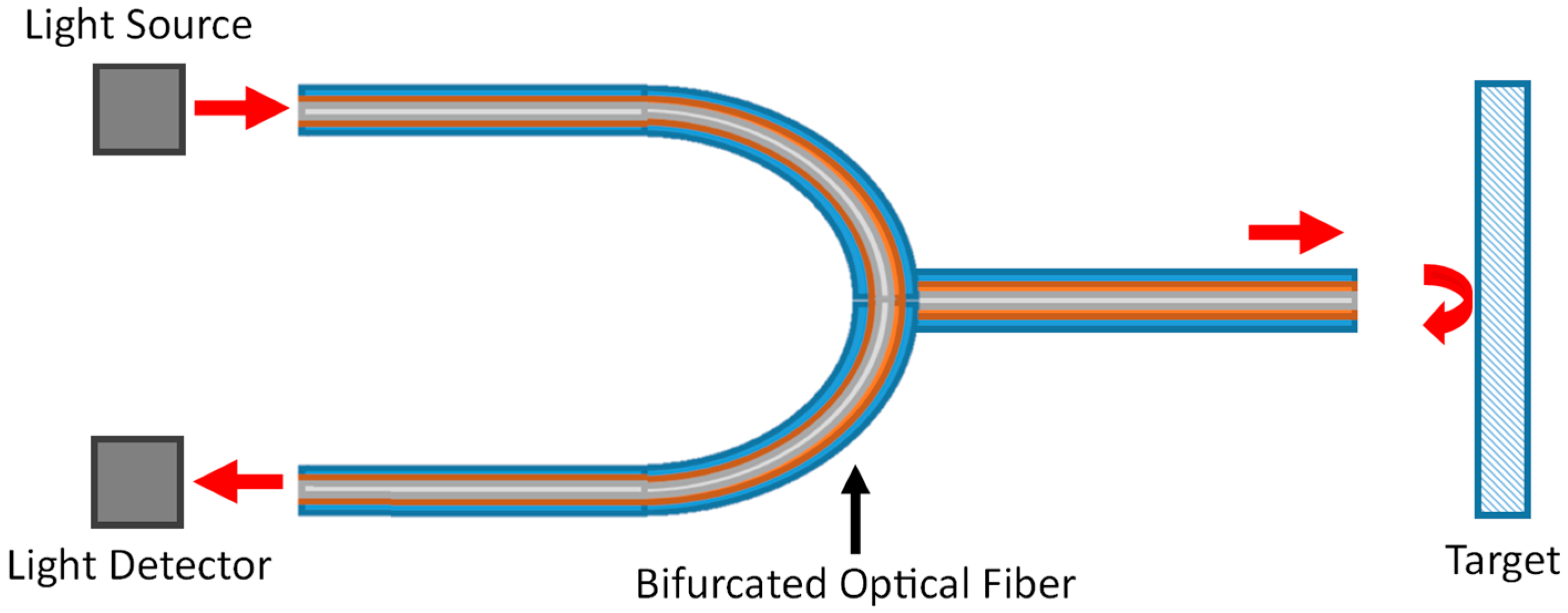
Disclaimer/Publisher’s Note: The statements, opinions and data contained in all publications are solely those of the individual author(s) and contributor(s) and not of MDPI and/or the editor(s). MDPI and/or the editor(s) disclaim responsibility for any injury to people or property resulting from any ideas, methods, instructions or products referred to in the content.

Article Metrics

Citations

Article Access Statistics

Article metric data becomes available approximately 24 hours after publication online.