2.1. Polarization Fading Mechanism
Taking the polarization diversity receiving architecture of the coherent detection Φ-OTDR system as the research object, the complex amplitude
Es of the Rayleigh backscattered light field detected at the optical fiber front end can be expressed as:
Among them, N denotes the total count of scattering bodies within the sensing optical fiber, c stands for the velocity of light in vacuum, α represents the fiber transmission loss coefficient, and nf corresponds to the refractive index of the optical fiber. Specifically, Ak and τk denote the amplitude and temporal delay associated with the kth Rayleigh backscattering event, ω is the central angular frequency of the laser source, and Δω refers to the frequency shift induced by the acousto-optic modulator. U(t/W) is a rectangular window function. When 0 ≤ t/W ≤ 1, this function is 1; otherwise, it is 0.
The Rayleigh Backward Scattering (RBS) light is projected onto two orthogonal polarization axes, respectively. Based on the different propagation rates of the light on these two axes, it can be classified into a P-axis and an S-axis, generating two orthogonal components Esp and Ess. Throughout the fiber-optic sensing procedure, the combined effects of external environmental perturbations and the inherent birefringent structure of the fiber lead to random evolution of the sensing light’s polarization state among elliptical, linear, and circular polarization modes. As a consequence, both the amplitude and phase of Esp and Ess exhibit stochastic fluctuations over time t.
In the coherent detection structure of Φ-OTDR, the reference light
ELO generated by the narrow linewidth laser can be expressed as:
The powers of the reference light projected onto the P-axis and the S-axis are ELOP and ELOS, respectively. Similar to the signal light, ELOP and ELOS also change randomly over time.
After the reference light and the Rayleigh backscattered light are frequency-modulated, the resulting frequency-modulated signal is as shown in Formula (3):
The beat frequency signals corresponding to the P-axis and S-axis components are designated as
EP and
ES, respectively. When the polarization matching coefficient of either axis approaches zero, the intensity of the associated beat frequency signal
EP and
ES will also decay to nearly zero, which is defined as the occurrence of polarization fading in the system [
5].
2.2. Polarization Diversity Mechanism
The principle of polarization diversity reception is as follows: At the receiving end, a polarization beam splitter is used to separate the local oscillator light and the signal light into two beams with mutually orthogonal polarization states. Then, frequency division is performed in these two polarization directions [
9]. After photoelectric detection, the signals are added together. Since squaring-law demodulation is performed before the addition, between the two orthogonal polarization states, the phase influence can be eliminated.
The signal light, the light signal passing through the 45° junction and the local oscillator light are respectively:
Here,
θm represents the field strength of the signal light in the
axis, and
δm is the phase discrepancy between the two optical axes. The output beam after passing through the coupler is:
Assuming that the balanced receiver is in an ideal matching state, the output photocurrent is:
Among them, Δω = ω1 − ω2, Δφ = φ1 − φm.
The polarization diversity receiving scheme requires special processing in the Φ-OTDR system. Due to the distributed reflection, the received signals
θm and
δm at different distances from the reference arm are different. This will cause Equation (7) to become:
Δφ(r) represents the phase difference caused by different reflection points, and δ(r,t) represents the difference in birefringence effect due to different reflection points and the surrounding environment of the fiber under test. It is worth noting that δ(r,t) has a lower frequency and will not have a significant impact on the spectrum. To eliminate the polarization fading caused by θm(r), the corresponding terms in Equation (8) can be squared and added together to eliminate the influence of θm(r). Obviously, it is impossible to achieve polarization diversity reception through analog circuits without introducing cross-interference. Based on the Φ-OTDR system, which only cares about the amplitude information in the frequency domain, a digital system can be considered to implement polarization diversity reception. The signals Ix and Iy obtained by the photodetector are respectively subjected to a fast Fourier transform to obtain amplitude spectra and . Then, by squaring and adding the and corresponding to each frequency point, the influence can be eliminated in the frequency domain.
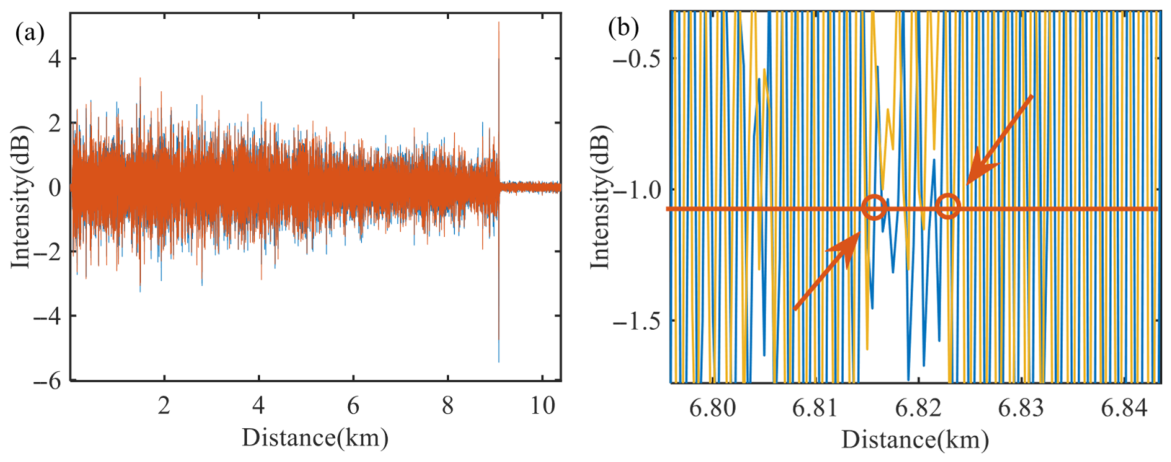
Figure 1a shows the original beat frequency curve obtained by dual-channel acquisition under the polarization diversity structure.
Figure 1b is a local magnification of the two beat frequency signals. From the figure, when the P-channel signal experiences a decline at 6.816 km, the S-channel signal does not show a significant decline. When the S-channel signal experiences a decline at 6.823 km, the P-channel signal does not experience a decline. The above results indicate that the two Rayleigh backscattering (RBS) signals with orthogonal polarization states are less likely to simultaneously experience a decline in space, thereby verifying the effectiveness of the polarization diversity structure in suppressing signal decline.
2.3. Noise Reduction Mechanism of VMD
Suppose the single-path detection signal is:
Here, s(t) is the useful signal and n1(t) is zero-mean Gaussian white noise.
In polarization diversity reception, the signals of the two orthogonal polarization channels can be expressed as:
Among them, the useful signal satisfies sx(t) = s(t)cosθm and sy(t) = s(t)sinθm. The two noise channels nx(t) and ny(t) are independent and identically distributed zero-mean Gaussian white noises, satisfying E[nx(t)] = E[ny(t)] = 0, , E[nx(t)ny(t)] = 0.
The core operation of polarization diversity is to square and add the two signals together to eliminate the influence of the polarization angle
θm. Therefore, there is
Expanding the signal term yields:
The signal consists of signal terms, noise self-multiplication terms and signal–noise cross-terms. When calculating the signal-to-noise ratio for a single-path detection, the following result is obtained:
When the squares of the two paths of polarization diversity are added together, the SNR is obtained:
Obviously, SNROUT < SNR1, representing the noise power after polarization diversity, significantly increases and the SNR decreases. Therefore, in this paper, the VMD algorithm is employed to process the demodulation phase curve in order to solve the noise problem caused by polarization diversity.
Variational mode decomposition (VMD) is an adaptive, completely non-recursive signal-processing technique rooted in modal variational principles, initially introduced by Dragomiretskiy K et al. The core mechanism of the VMD algorithm lies in solving a constrained variational problem, which enables the decomposition of the original input signal into K discrete modal components according to their respective frequency characteristics. Here, K denotes the predefined number of intrinsic mode function (IMF) components, and each extracted IMF corresponds to a distinct central frequency band, which will continuously change during the iterative process [
17]. The ultimate goal is to decompose the original signal into K modal numbers, and the bandwidth and center frequency of all IMF components are obtained through a cumulative search of the variational model to achieve the best solution [
18].
The original signal can be decomposed into K modes, and the resulting IMF components are individual amplitude-modulated and frequency-modulated signals, which can be expressed as follows:
In the formula, Ak(t) represents the instantaneous amplitude and Φk(t) represents the phase.
In the variational construction process of the VMD algorithm, an analytical signal framework is first established by introducing a unit impulse signal, and the Hilbert transform is used to calculate the unilateral spectrum for each intrinsic mode function (IMF). The core objective is as follows: On the one hand, by using the Hilbert transform, the real-valued mode components are converted into analytic signals. Essentially, this involves performing the Hilbert transform on the real-valued signal to obtain its orthogonal components and then combining these with the original real-valued signal to form a complex-form analytic signal. This completely eliminates the negative frequency components that are symmetrical to the positive frequency components in the frequency spectrum of the real-valued signal, resulting in a unilateral amplitude spectrum that only contains the positive frequencies. This avoids the energy aliasing and center frequency estimation errors caused by the bilateral spectrum, ensuring the accurate estimation of the center frequency of each mode. On the other hand, the ideal frequency domain characteristics of the unit impulse signal are utilized to construct a frequency domain constraint structure with compact support, making each intrinsic mode appear as a narrowband signal around the center frequency in the frequency domain. This ensures that the components are separated in the frequency domain and do not interfere with each other.
Based on this, the spectra of each intrinsic mode function are modulated by an exponential phase factor, and their center frequencies are successively shifted to the baseband range. Finally, the multi-component signal is adaptively separated, regularized, and expressed in the frequency domain. The final spectral expression is:
To determine the bandwidth of each modal function signal, the constrained variational model can be obtained through the following equation:
In this formula, uk represents the K individual IMF components of the signal, and ωk represents the center frequency of each IMF.
To acquire the optimal solution of the aforementioned variational model, the Lagrange operator
λ and the penalty factor
α are introduced into Equation (17) to construct the augmented Lagrange function. The constrained optimization problem corresponding to the variational model is converted into an unconstrained form, and the derived governing equation is given as follows:
For the augmentation of the Lagrange expression, update them using the alternating method of multiplication operators, and simultaneously update the multiplication operators. Stop the update process when the following condition is met, and obtain the iterative equations for
uk,
ωk, and
as follows:
In this formula, represents the residual component, represents the result after Wiener filtering, performing FFT, {uk(t)} is the real part of the value, and represents the power spectrum center of this iterative mode function.
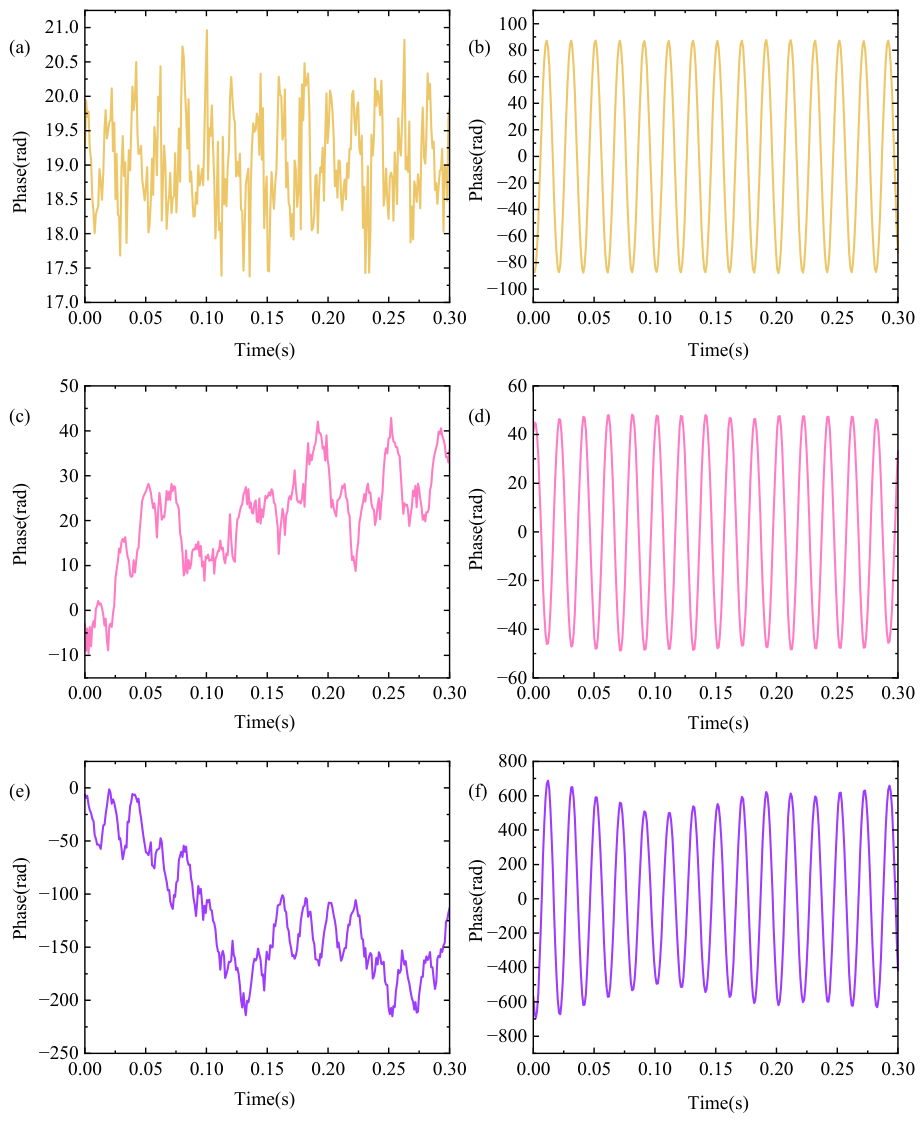
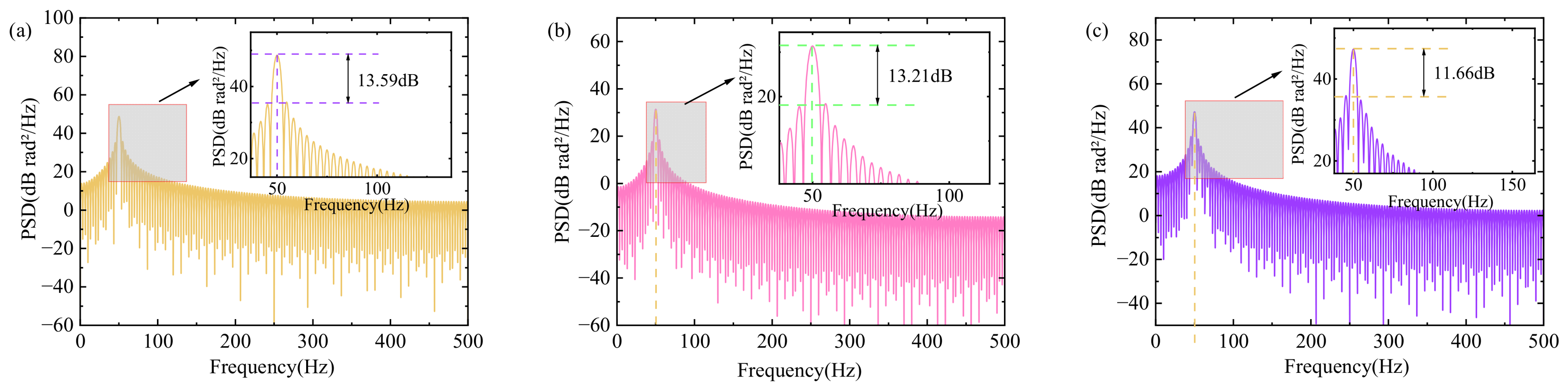
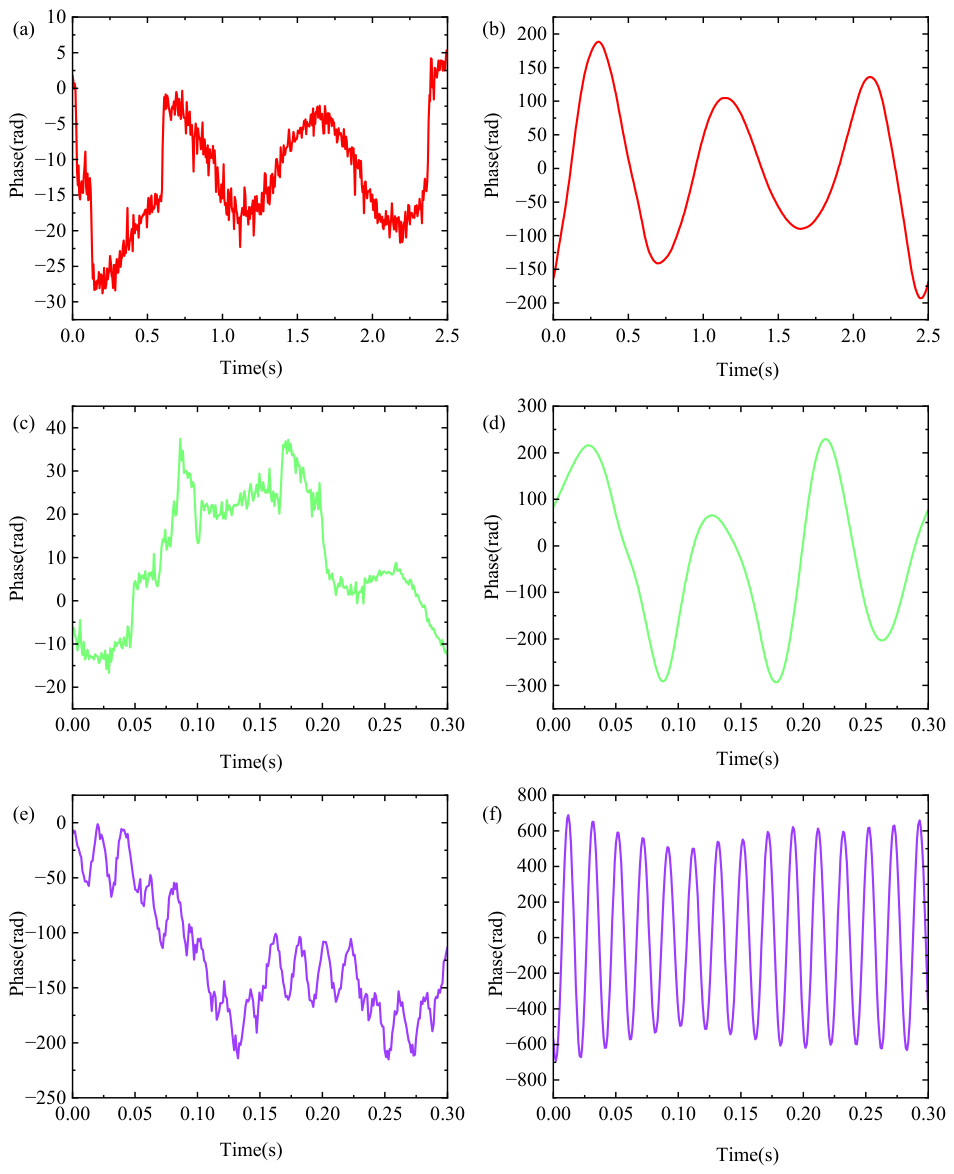
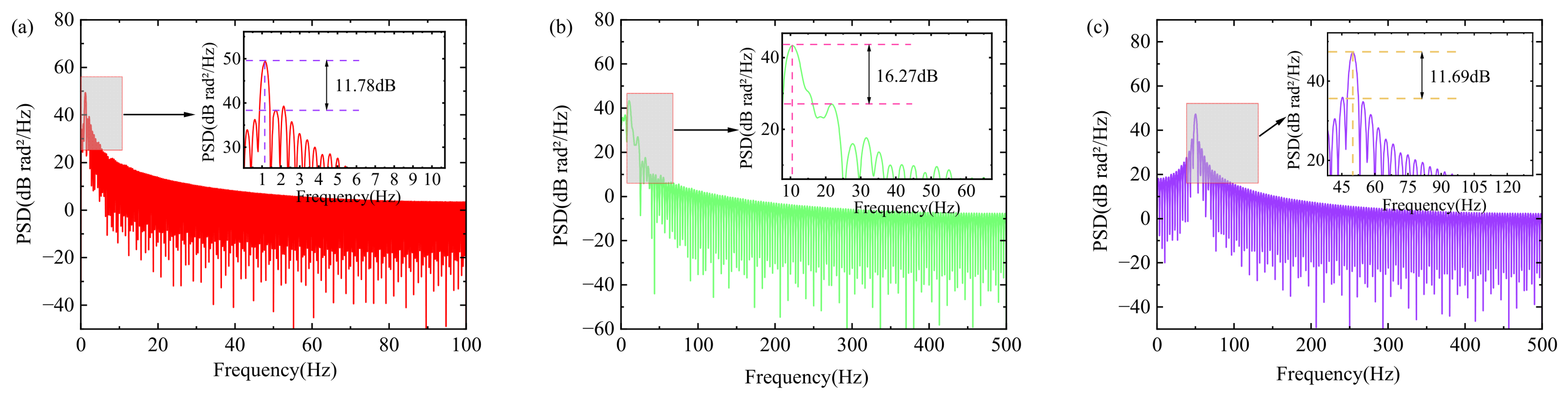
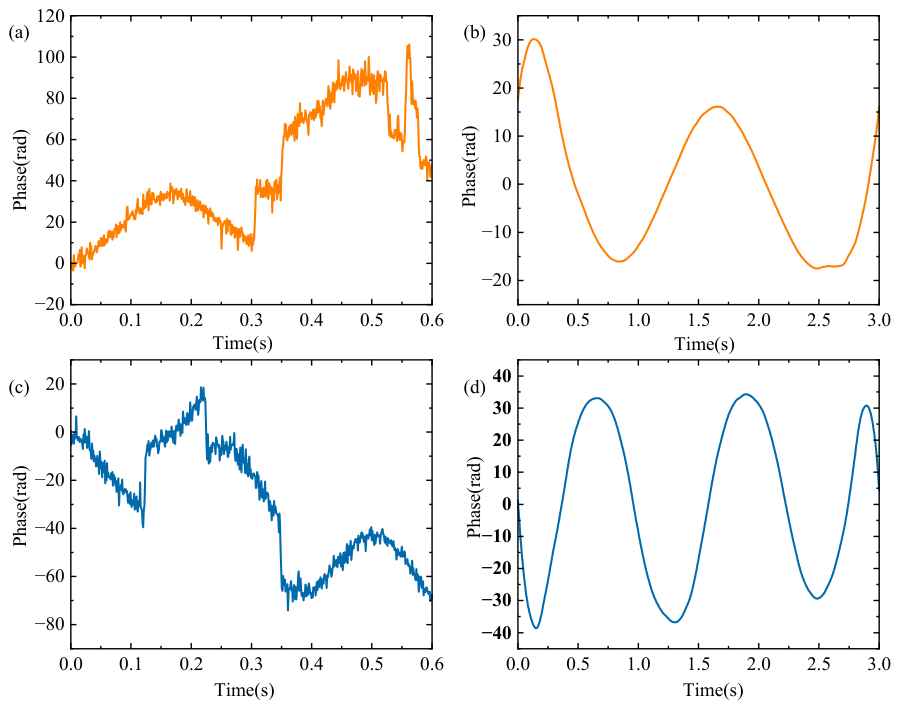
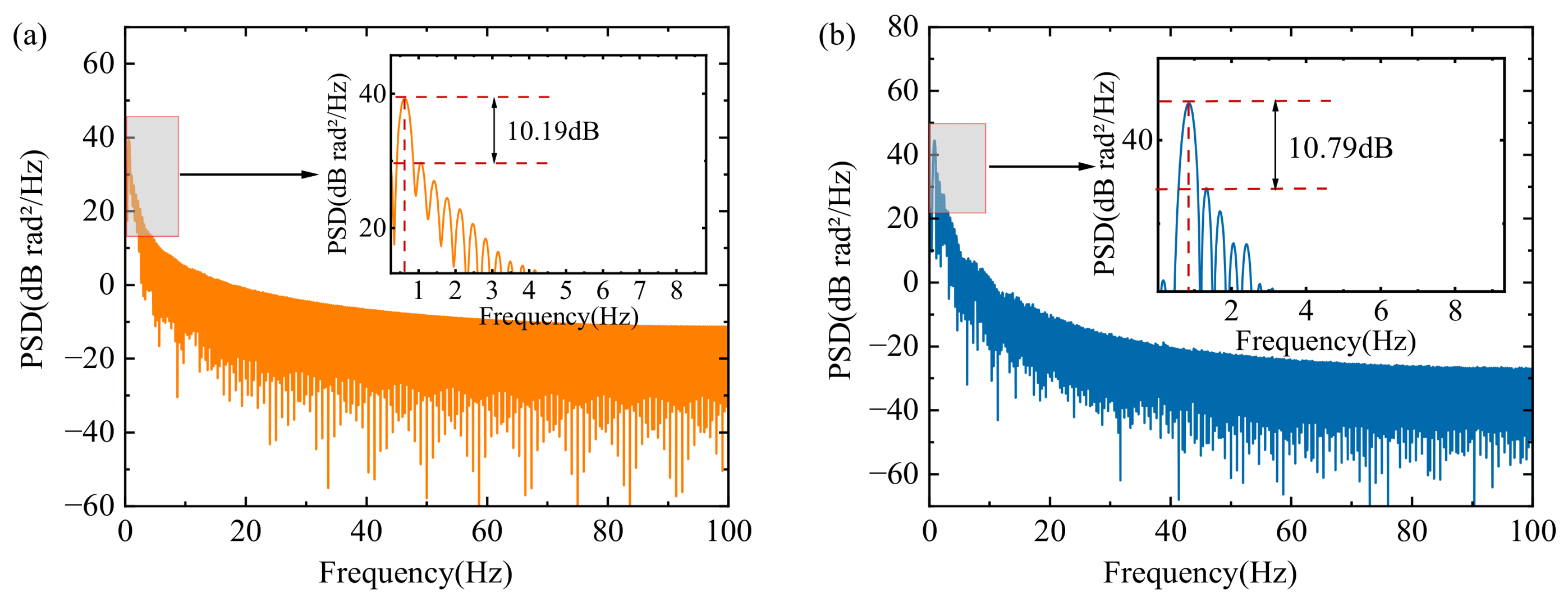
In this experiment, the number of modal decompositions K for the VMD algorithm is not a fixed value. Instead, it is adaptively selected based on the spectral complexity of the signal’s frequency spectrum under different transmission distances and vibration frequencies: For the double-channel summed phase signals of 0.6 Hz, 0.8 Hz, 1 Hz, 10 Hz, and 50 Hz at a 30 km sensing distance, K = 5, 7, 7, 6, 3 is set respectively; for the 50 Hz vibration signal, K = 5, 4, 3 is set respectively at 5 km, 10 km, and 30 km distances The waveform corresponding to the selected K value is the optimal waveform for phase demodulation, which will be used for further processing in the subsequent steps. This parameter selection fully considers the low-frequency drift, polarization noise, and the degree of aliasing of the target vibration signal under different working conditions, ensuring the effective separation of each frequency component, avoiding modal aliasing, and preventing the introduction of false modes and computational redundancy due to over-decomposition. The remaining parameters are set as follows: the bandwidth constraint penalty factor is set to α = 2000 to achieve optimal noise suppression; the DC component is set to 0; and spectrum initialization is set to init = 1.
At the same time, the algorithm adopts a uniform initialization strategy for the central frequency, avoiding the deviation caused by artificially presetting frequencies, allowing the algorithm to adaptively determine the center frequency of each mode based on the non-stationary and multi-frequency characteristics of the Φ-OTDR phase signal.
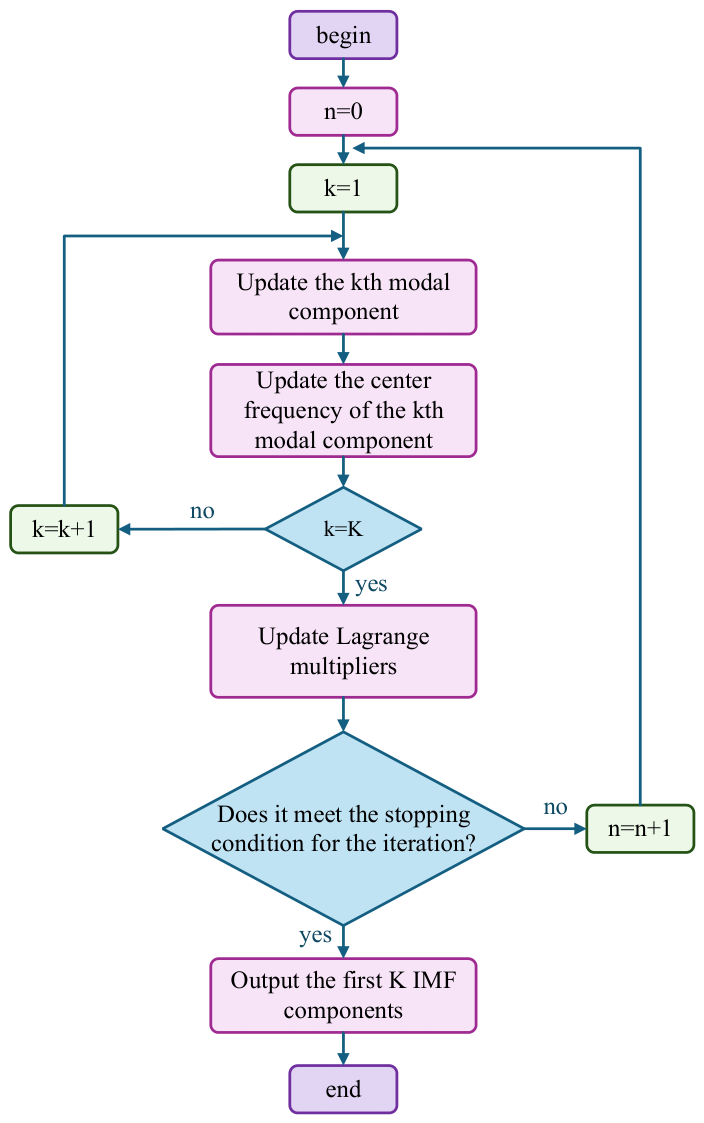
In summary, the process of the VMD algorithm is illustrated in the following figure:
Figure 2 illustrates the iterative optimization process of the VMD algorithm. The algorithm initially sets the number of iterations to zero, then enters the main loop, and successively processes the preset K modal components. In each iteration step, the kth IMF and its corresponding center frequency are updated separately, and the Lagrange multipliers are updated simultaneously to enhance the degree of satisfaction with the constraint conditions. The algorithm determines whether to terminate the iteration by checking whether the given convergence condition is met: if it is, the current K IMF components obtained through decomposition are output; otherwise, the iteration count is incremented by 1, and the update process is repeated in a loop until the convergence criterion is reached.
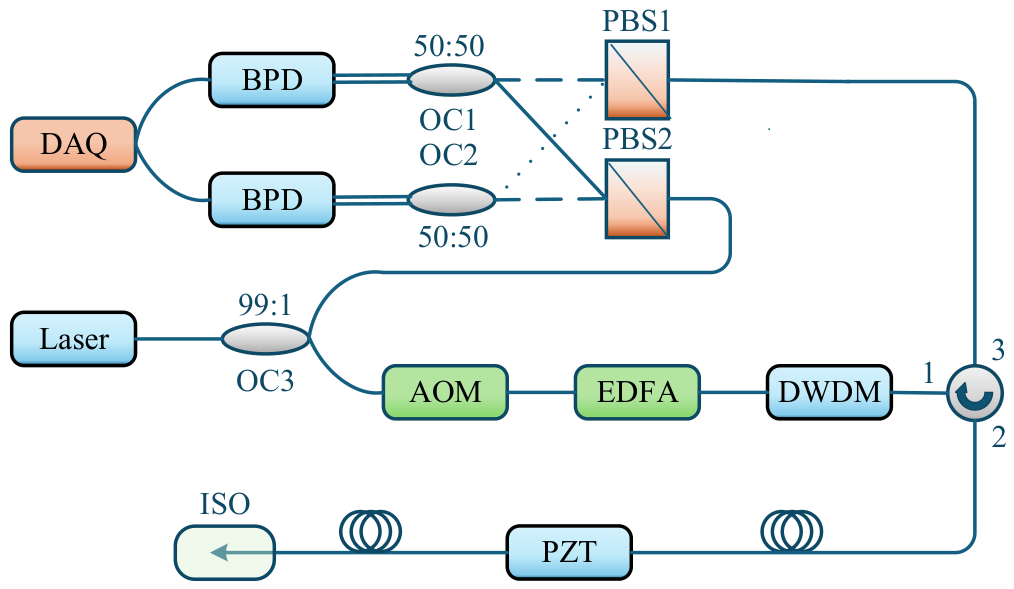
Figure 3 illustrates the polarization diversity receiving optical path configuration of the coherent detection Φ-OTDR system. In this setup, the narrow linewidth laser (Laser) serves as the light source, and its highly coherent output is split by a 99:1 optical coupler (OC3) into 1% of the reference light and 99% of the signal light. The signal light is modulated into a pulse form by an acousto-optic modulator (AOM), amplified by an erbium-doped fiber amplifier (EDFA), filtered by a dense wavelength division multiplexing (DWDM) filter to remove amplified spontaneous emission noise, and then injected into the sensing fiber through port 2 of the fiber circulator. A piezoelectric ceramic transducer (PZT) is set on the sensing fiber to apply external vibration excitation, and the fiber end is connected to an optical isolator (ISO) to eliminate the interference of end-face reflection. The returned Rayleigh backscattering (RBS) light from the sensing fiber is output through port 3 of the fiber circulator, and 1% of the reference light is input separately into two polarization beam splitters (PBS1, PBS2). After separation into orthogonal polarization components, they are then combined with the reference light through a 50:50 optical coupler (OC1, OC2), frequency-locked with the reference light, and sent to a balanced photodetector (BPD) for photoelectric conversion. Finally, the two signals are collected by the data acquisition card (DAQ).
The experimental parameters are set as follows: The narrow linewidth laser uses the Koheras Ajustik E15 by NKT Photonics, Birkerød, Denmark, with a central wavelength of 1550 nm, a linewidth of 100 Hz, and an output power of 40 mW; the working frequency offset of the AOM (acoustic-optic modulator) is fixed at 200 MHz, with repetition frequencies of 1 kHz and 200 Hz, and a pulse width of 100 ns; the center wavelength of the dense wavelength division multiplexing (DWDM) filter is 1550 nm; the bandwidth of the balanced photodetector (BPD) is 350 MHz; the sampling rate of the data acquisition system is 1 GS/s. The external vibration excitation uses a low-frequency sine waveform, with an amplitude of 2 V, and includes variable frequency components.



 and
and