Article

Dual-Mode Tunable Near-Perfect Terahertz Absorber Based on GST Micro-Cavity


1
Hangzhou Institute for Advanced Study, University of Chinese Academy of Sciences, Hangzhou 310024, China
2
School of Astronautics, Harbin Institute of Technology, Harbin 150080, China
3
Zhengzhou Advanced Research Institute, Harbin Institute of Technology, Zhengzhou 450000, China
4
Suzhou Laboratory, Suzhou 215000, China
*
Authors to whom correspondence should be addressed.
Photonics 2026, 13(5), 413; https://doi.org/10.3390/photonics13050413
Submission received: 14 March 2026 / Revised: 15 April 2026 / Accepted: 20 April 2026 / Published: 23 April 2026

Abstract

A micro-cavity based on phase-change material is a very important strategy for the realization of tunable absorption and conversion of terahertz waves. In this work, a tunable terahertz metamaterial absorber based on the phase-change material germanium–antimony–tellurium (GST) is demonstrated. The device features a metal–insulator–metal triple-layer structure, where the dynamic switching of absorption characteristics is achieved via thermally controlled GST phase transition. In the amorphous state, the absorber exhibits a single absorption peak at 7.7 THz. Upon crystallization, the absorption switches to dual peaks at 5.1 THz and 8.3 THz, achieving near-perfect absorption in both states. Full-wave electromagnetic simulations and theoretical analysis based on a multiple-reflection interference model indicate that this performance tuning originates from the GST-phase-transition-induced change in the equivalent optical cavity length. This corresponds to a switch between two resonant modes: coupled inner–outer ring resonance and independent outer ring resonance. These results provide a foundation for developing dynamically tunable terahertz devices with promising applications in terahertz communications, imaging, and sensing.

1. Introduction

Terahertz (THz) waves, typically defined as electromagnetic radiation within the 0.1–10 THz range, bridge the gap between microwaves and infrared light. They combine strong penetration capability, rich spectral information, and low photon energy, which endow them with significant application potential in fields such as high-speed communication, biomedical imaging, nondestructive testing, and high-sensitivity sensing [1,2,3,4,5,6,7,8,9]. However, most natural materials exhibit weak electromagnetic responses in this frequency band, which constrains the performance development of conventional terahertz devices. The emergence of metamaterials offers a new pathway to address this challenge [10,11,12,13]. Through artificially designed subwavelength unit structures, metamaterials can achieve electromagnetic responses—such as negative refraction, perfect absorption, and extraordinary transmission—that are difficult to obtain with natural materials. This capability drives in-depth research into functional devices such as terahertz filters, sensors, polarization converters, and absorbers [14,15,16].
In recent years, as terahertz technology advances toward dynamic applications, the demand for real-time performance tunability in terahertz devices has grown substantially [17,18,19,20,21,22]. Once fabricated, the response characteristics of conventional static metamaterial devices are typically fixed, which has shifted research focus toward the design of reconfigurable metamaterials [1,23,24,25,26]. Among various tuning mechanisms, approaches based on phase-change materials have garnered considerable attention due to their non-volatility, high tuning contrast, and relatively fast response speed [27,28,29,30]. In parallel with phase-change-material-based strategies, other active tuning approaches have also been extensively explored for terahertz absorbers, including graphene-based electrically tunable structures [31], thermally switchable metasurfaces employing materials such as VO2, and doped-silicon-based wideband absorbers [28,29]. Chalcogenide phase-change materials, represented by germanium–antimony–tellurium (Ge2Sb2Te5, GST), can undergo reversible transitions between amorphous and crystalline states under external thermal, optical, or electrical stimuli [29,32,33,34,35,36,37,38,39,40,41]. The significant differences in conductivity and dielectric constant between the two states provide an effective material foundation for dynamic performance control of terahertz devices [42]. For example, previous studies have demonstrated GST-based terahertz modulators and tunable filters via thermally induced phase transition, which enables control over parameters such as resonant frequency and transmission amplitude [29,43,44,45,46,47].
Herein, we propose such an absorber based on a temperature-controlled GST phase transition. The device adopts a metal–insulator–metal triple-layer configuration by integrating GST as the dielectric tuning layer and leveraging the difference in dielectric properties between its crystalline and amorphous states, thereby enabling active switching of the absorption characteristics. Unlike most previous GST-based tunable devices that focus on intensity modulation (on/off switching) or single-frequency tuning, the core contribution of the present work lies in the reconfigurability of the absorption mode—specifically, switching from a single peak to dual peaks within the target band—achieved through the synergy of the double-nested ring structure and the GST cavity effect. This work first optimizes the structural parameters via full-wave electromagnetic simulation and analyzes the absorption performance and angular stability under different GST phase states. Subsequently, a multiple-reflection interference theoretical model is established to clarify the physical relationship between the absorption peak shift and the modulation of the equivalent optical cavity length induced by the GST phase transition. By combining electromagnetic field and surface current distributions, the excitation mechanisms of different resonant modes are revealed. Finally, a summary and outlook are provided. Through the integration of systematic simulation and theoretical analysis, this study provides a research framework encompassing design, characterization, and mechanistic explanation for phase-change material-based reconfigurable terahertz absorbers, offering reference significance for the development of adaptive terahertz functional devices.

2. Design and Optimization

The proposed tunable terahertz metamaterial absorber adopts the classic metal–insulator–metal (MIM) triple-layer configuration. As shown in Figure 1, the structure consists, from top to bottom, of a top-patterned gold double-nested square-ring resonant layer, designed to efficiently excite localized surface plasmon resonance, and a middle composite dielectric layer, formed by a phase-change material GST thin film sandwiched between two low-loss dielectric spacer layers. The spacer material is a cyclic olefin copolymer (TOPAS), which exhibits stable and extremely low loss in the terahertz band, with a dielectric constant of approximately 2.35 and a loss tangent as low as 3 × 10⁻⁵ [37]. In contrast, the dielectric constant of GST varies significantly with its crystalline state, making it the key active element for dynamic tuning of the absorption performance. The bottom layer is a continuous metal reflective backplane, fabricated from a gold film. Its thickness is far greater than the skin depth of terahertz waves in the metal, thereby completely blocking transmission. Figure 1c further specifies the planar geometric parameters of the top resonant unit, including the outer square ring side length m, the inner square ring side length n, the metal line width a, and the unit period p. Through parameter optimization based on subsequent systematic simulations and by fully leveraging the phase-change characteristics of GST, high-performance dynamically tunable absorption performance as shown in Figure 1d has been ultimately achieved. When GST is amorphous (red curve, a-GST), a single and efficient absorption is achieved at f1 = 7.7 THz, with its peak absorptance also exceeding 90%. When GST is crystalline (blue curve, c-GST), two strong resonance peaks with absorptance above 90% appear at f2 = 5.1 THz and f3 = 8.3 THz. The results demonstrate that the resonant behavior of the structure can be effectively controlled through the phase transition of GST.
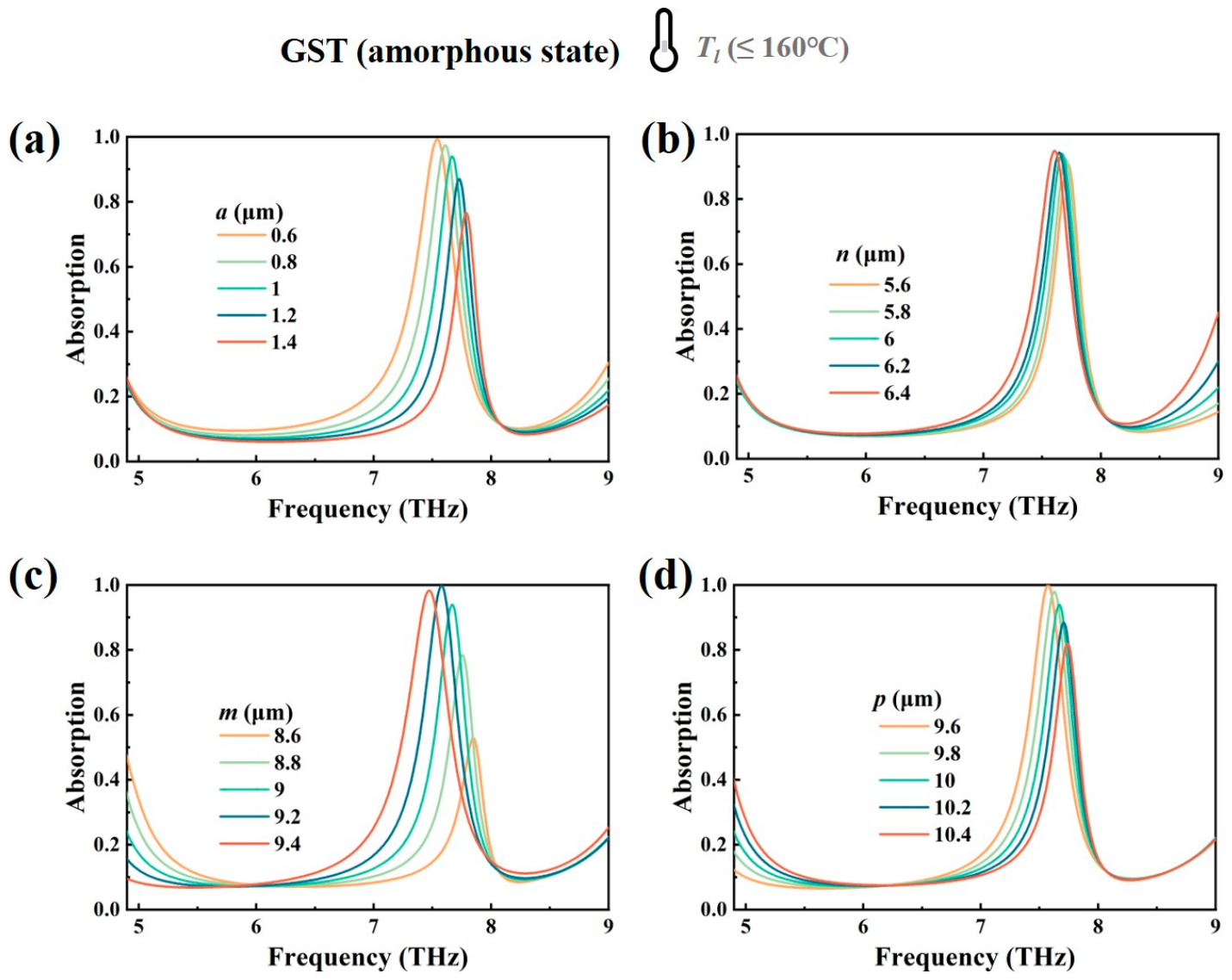
To optimize these key geometric parameters for achieving the target absorption performance and to clarify their control mechanism on absorption behavior, we employed the control variable method to analyze the independent influence of each structural parameter when GST is in different phase states. When GST is in the amorphous state (a-GST), the simulation results indicate that as the metal line width a of the resonant layer increases from 0.6 μm to 1.4 μm, the absorption peak gradually weakens and undergoes a blue shift (Figure 2a). When the side length n of the inner square ring increases within the range of 5.6 μm to 6.4 μm, the absorption peak intensity shows no significant change but shifts slowly toward lower frequencies (red shift, Figure 2b). As the side length m of the outer square ring varies between 8.6 μm and 9.4 μm, the absorption characteristics evolve noticeably: the absorption peak red-shifts with increasing m, and the absorption intensity begins to rise rapidly at m = 8.6 μm, reaching its maximum near m = 9 μm (Figure 2c). Furthermore, when adjusting the unit period p from 9.6 μm to 10.4 μm, the frequency of the absorption peak blue-shifts at approximately regular intervals, while the absorption intensity gradually decreases (Figure 2d).
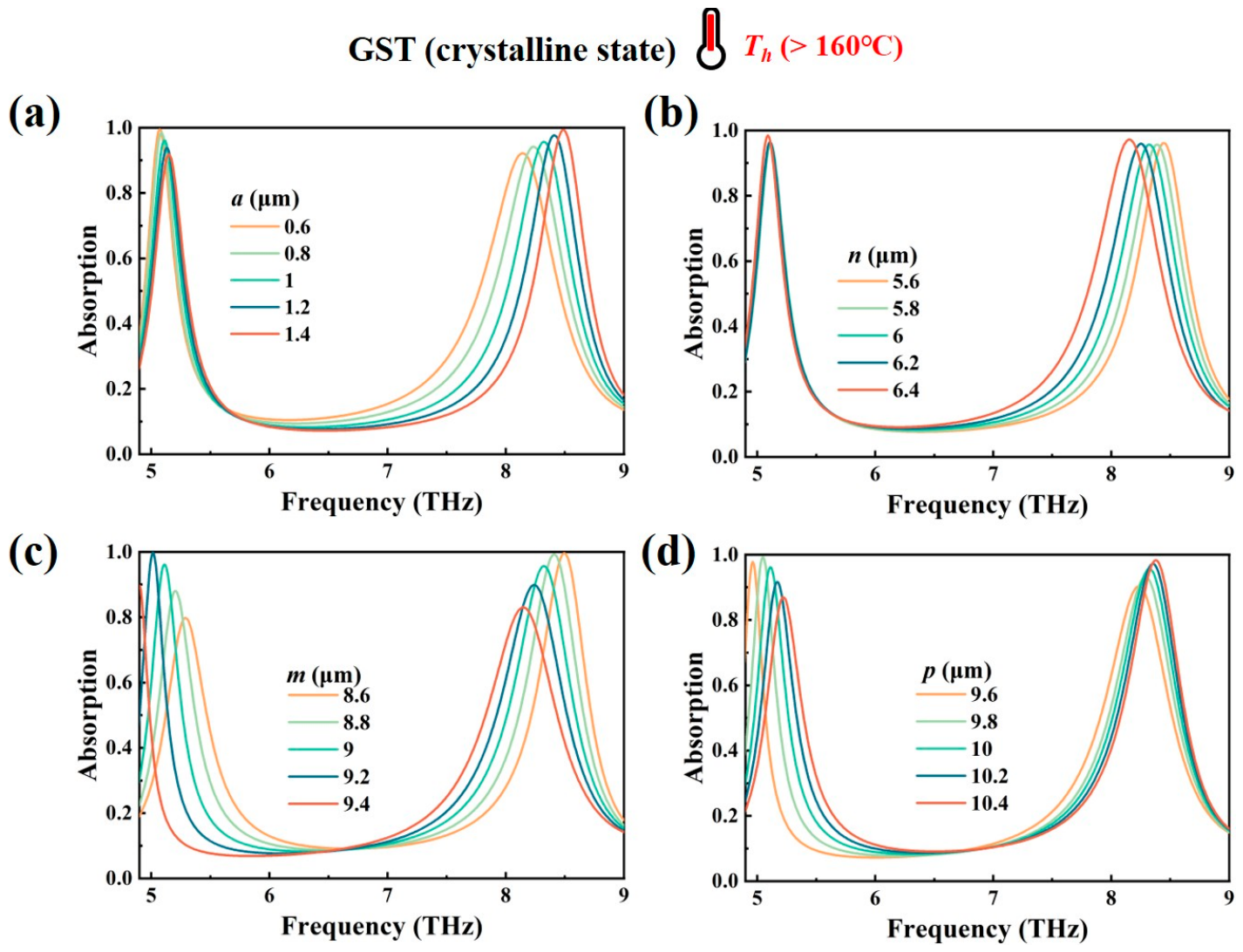
For the crystalline state of GST (c-GST), the influence of geometric parameters on the dual absorption peaks was likewise systematically investigated using the control variable method. The simulation results reveal that as the resonator line width a increases from 0.6 μm to 1.4 μm, the lower-frequency absorption peak exhibits only a slight blue shift, whereas the higher-frequency peak shows a pronounced blue shift; concurrently, the amplitude of the lower-frequency peak gradually decreases while that of the higher-frequency peak increases correspondingly (Figure 3a). When the inner-ring width n rises from 5.6 μm to 6.4 μm, only the higher-frequency absorption peak undergoes a noticeable red shift (Figure 3b). As the outer-ring width m varies between 8.6 μm and 9.4 μm, both peaks evolve significantly: the lower- and higher-frequency peaks collectively red-shift, with the amplitude of the lower-frequency peak gradually strengthening and that of the higher-frequency peak weakening accordingly (Figure 3c). During the adjustment of the unit period p from 9.6 μm to 10.4 μm, the blue shift and the attenuation in absorption intensity are more pronounced for the lower-frequency peak compared with the higher-frequency one (Figure 3d).
Based on the simulation analysis of various geometric parameters, the regulatory effects of each parameter on the absorption performance can be summarized as follows: the line width a primarily influences the absorption peak intensity, accompanied by a certain degree of frequency shift; the inner ring dimension n is most sensitive to the resonant frequency, effectively pulling the absorption peak; the outer ring dimension m and the unit period p jointly regulate the mode coupling strength and absorption bandwidth. Following these guidelines, an optimized set of geometric parameters that maintains good performance under different GST phase states was ultimately determined: a = 1 μm, n = 6 μm, m = 9 μm, p = 10 μm. The dielectric layer consists of a central GST layer and TOPAS spacer layers on both sides, with specific thicknesses as follows: the spacer from the top resonator to the GST layer h1 = 21 μm, and the spacer from the GST layer to the bottom metal reflector h2 = 2 μm. The GST layer thickness is set to 1 μm. It should be noted that the final parameters were determined by balancing the absorption performance in both GST states using the control variable method. For example, the outer ring side length m = 9 μm was selected because it represents the best compromise between maximizing the absorption intensity in the a-GST state (Figure 2c) and balancing the dual-peak intensities in the c-GST state (Figure 3c). All the parameters were chosen under the premise that the absorptance exceeds 90% in both the amorphous and crystalline states. Additional optimization details are provided in the Supplementary Materials.

3. Performance Characterization and Discussion

The absorber was simulated using the full-wave electromagnetic solver in CST Studio Suite 2022, systematically analyzing the terahertz response characteristics of GST in different phase states. In the numerical simulations, the incident terahertz wave is modeled as a linearly polarized plane wave with an infinite wavefront, which is realized by applying periodic boundary conditions in the x and y directions. This is a standard approach in metasurface simulations. Physically, this setup implies that the beam diameter is significantly larger than the unit cell dimensions (p = 10 μm), ensuring uniform illumination across the entire array. In practical terahertz experiments such as terahertz time-domain spectroscopy (THz-TDS), typical beam spot sizes range from 1 mm to 3 mm, which are sufficient to cover thousands of unit cells. Therefore, the plane-wave approximation used in this study accurately reflects experimental conditions where beam edge effects are negligible.
For the terahertz band of interest (5–9 THz), the dielectric response of GST is modeled as follows: For amorphous GST (a-GST), within the target band the permittivity exhibits negligible frequency dependence and behaves as a low-loss dielectric. We employed a constant conductivity and a constant refractive index based on the low conductivity of amorphous GST reported in the literature. For crystalline GST (c-GST), which exhibits metal-like behavior, its complex permittivity is described by the Drude model as a function of frequency:
ε ( ω ) = ε + i σ d c ε 0 ω ( 1 i ω τ )
where ε = 38.2 , τ = 1.61 × 10 15   s and σ d c = 3.82 × 10 4   S / m represent the high-frequency permittivity, carrier relaxation time and direct current conductivity of GST [37,48]. The conductivity contrast (four orders of magnitude) between the two states is a hallmark of GST phase-change materials and has been validated by recent terahertz GST metasurface simulations [37,49,50].
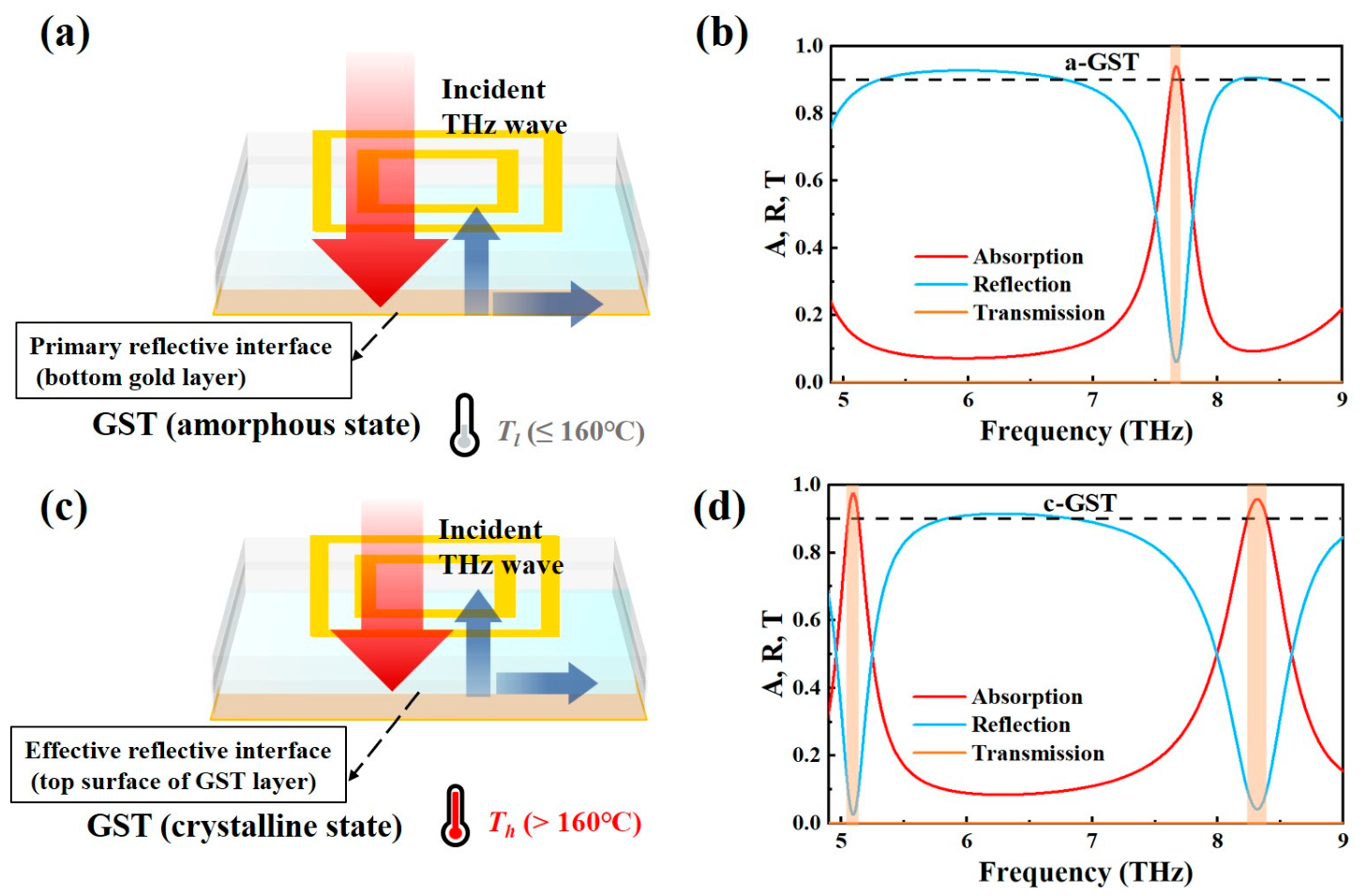
When the temperature is below 160 °C, GST is in the a-GST with low conductivity [37,38]. Vertically incident terahertz waves can penetrate the GST layer and couple with the underlying metal reflector, forming a Fabry–Perot cavity resonance mode. At this stage, the a-GST behaves as a low-loss dielectric, and the primary reflective interface is located at the bottom gold reflector, corresponding to the “long-cavity” model. The corresponding electromagnetic field distribution is shown in Figure 4a. The absorption, reflection, and transmission spectra in this state are shown in Figure 4b, where a prominent absorption peak with a peak absorptance exceeding 90% is observed within the 4.9–9 THz range. When the temperature rises above 160 °C, GST transforms into the c-GST, and its conductivity increases significantly [49]. Terahertz waves undergo strong reflection at the upper surface of the GST layer, leading to a substantial redistribution of the downward-propagating electromagnetic energy, as shown in Figure 4c. Due to the high conductivity of c-GST, it exhibits metal-like properties; the effective reflective interface shifts upward to the top surface of the GST layer, forming a “short-cavity” model. The corresponding spectra, presented in Figure 4d, exhibit a dual-absorption-peak structure within the same frequency band, with markedly enhanced absorption intensity and noticeable frequency shifts in the resonance peaks. This significant change in absorption characteristics directly stems from the reconstruction of the structural resonant behavior and field distribution induced by the GST phase transition, demonstrating the absorber’s dynamic and efficient performance tuning capability in the terahertz band.
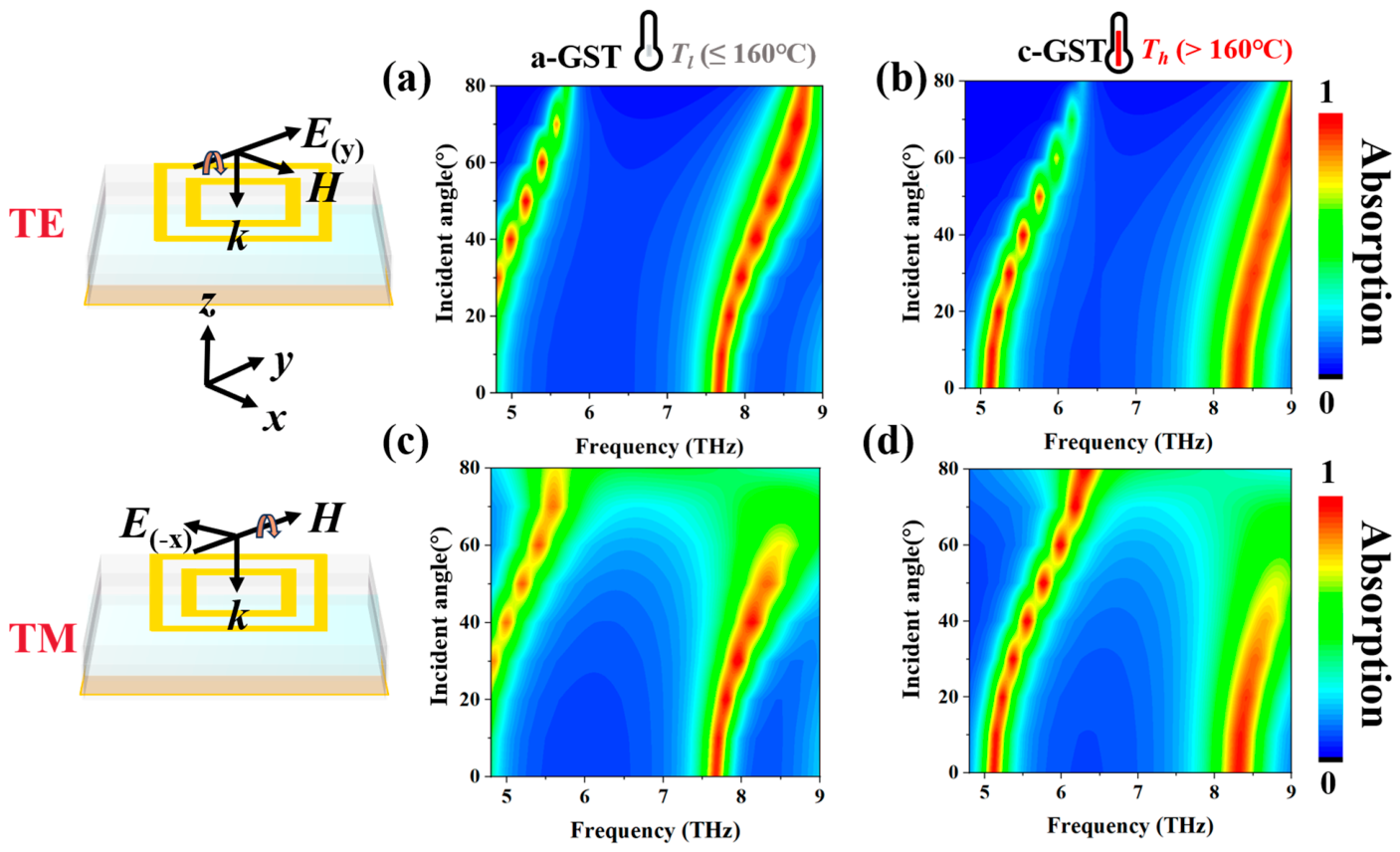
Due to the highly symmetric geometry of the top double-nested square-ring resonator, the proposed absorber exhibits perfect polarization-independent absorption at normal incidence (θ = 0°). As shown by the overlapping absorption spectra for TE and TM polarizations at θ = 0° in Figure 5, the structure indeed shows no polarization sensitivity under normal illumination. This fundamental characteristic is consistent with the symmetry of the unit cell. In practical electromagnetic environments, incident waves often arrive at the device surface at various angles, making it crucial to evaluate the performance stability of the absorber under oblique incidence. We systematically simulated and analyzed the angular response characteristics under both transverse electric (TE) and transverse magnetic (TM) polarization modes when GST is in the a-GST and c-GST states. The results are shown in Figure 5. Overall, under both material states and polarization modes, the absorption peaks shift toward higher frequencies (i.e., undergo a blue shift) as the incidence angle θ increases (Figure 5a–d). This general phenomenon arises from the increased effective optical path within the dielectric layer under oblique incidence, which is equivalent to an increase in the electromagnetic size of the resonant unit, thereby raising its intrinsic resonant frequency. The angular stability of the proposed absorber is polarization-dependent, as detailed below.
For the a-GST, its single absorption peak undergoes a stable blue shift with increasing angle, and enters the target 4.9–9 THz band at relatively large incidence angles (θ > 30°) under TE polarization (Figure 5a). In contrast, the dual-peak behavior under the c-GST is more complex. Under TM polarization (Figure 5d), its higher-frequency absorption peak is extremely sensitive to the angle, exhibiting a substantial blue shift and moving out of the target frequency band when θ increases to about 40°. Conversely, the lower-frequency peak demonstrates stronger angular stability with a relatively moderate blue shift. This difference can be attributed to the varying sensitivities of different-order resonant modes to changes in boundary conditions: higher-order modes are typically associated with stronger local electromagnetic coupling, making them more sensitive to phase variations induced by changes in incidence angle. Furthermore, the polarization mode significantly affects the performance degradation. Under TE polarization (Figure 5a,b), the attenuation rate of the absorption peak intensity with increasing angle is noticeably slower than under TM polarization (Figure 5c,d). This polarization dependence can be explained by the magnetic field component in the incident plane. For TM polarization, the magnetic field component in the incident plane is H x - y = H c o s   θ , which decreases with increasing θ, leading to weaker magnetic resonance. For TE polarization, the magnetic field component in the incident plane remains constant, so the resonance strength is less affected by the incidence angle.
Consequently, under TM wave incidence, the single absorption peak of a-GST can still maintain good performance at θ = 60°. The robustness of the c-GST lower-frequency peak is particularly outstanding, maintaining strong absorption even at θ = 80°, while its higher-frequency peak suffers severe performance degradation after θ > 40°. The physical mechanisms underlying the angular dependence can be summarized as follows: First, as the incident angle θ increases, the effective optical path length in the dielectric layer becomes longer (proportional to 1/cos θ), which shifts the resonance condition and causes the absorption peaks to blue shift. Second, impedance matching between the structure and free space deteriorates with increasing θ, and this effect is more severe for TM polarization because the magnetic field component in the incident plane decreases as cos θ, whereas for TE polarization, the in-plane magnetic field component remains constant. Third, for the crystalline state, the higher-frequency peak (coupled inner–outer ring mode) is more sensitive to angle variations than the lower-frequency peak (independent outer ring mode), because higher-order modes with stronger local electromagnetic coupling are more susceptible to phase changes induced by oblique incidence.

4. Preparation Method

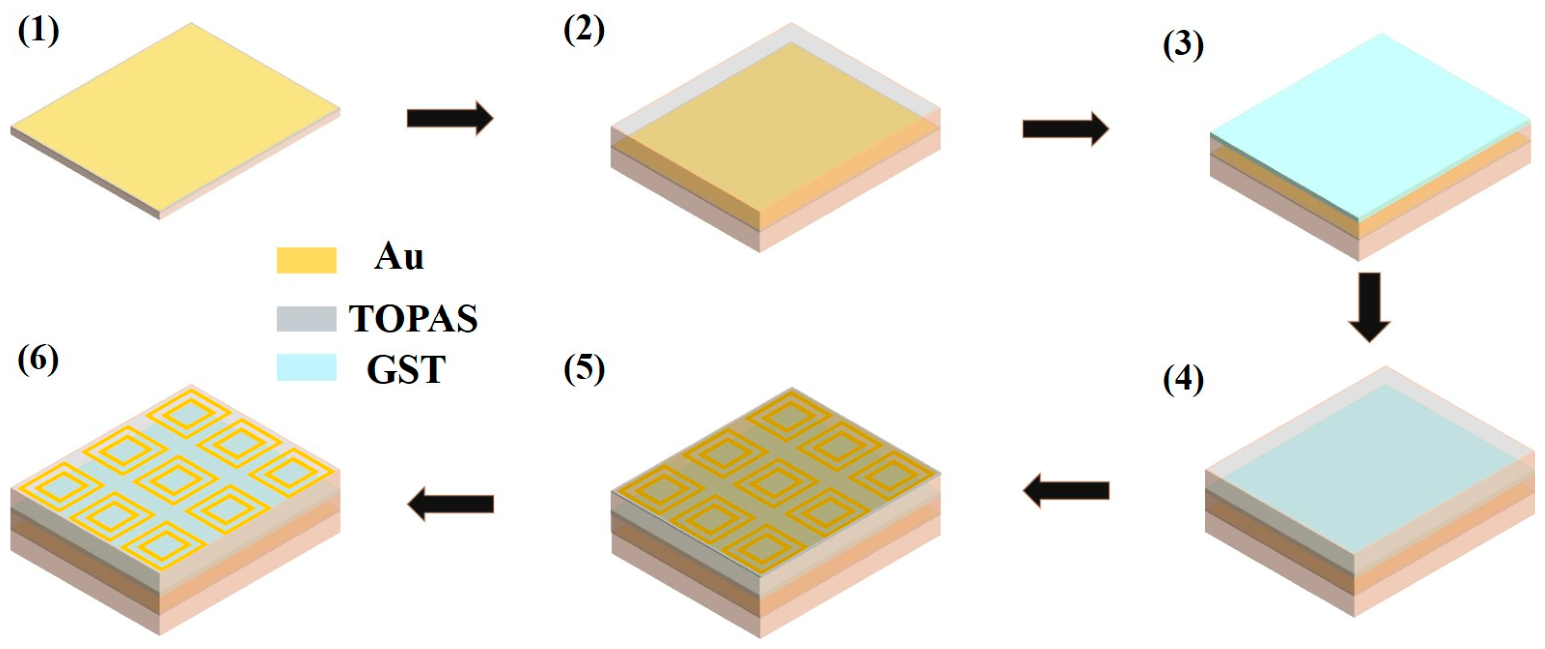
The following processes can be used to fabricate the proposed metasurface, as illustrated in Figure 6. Throughout the preparation process, in the first step, a ~200 nm thick gold film is deposited on a high-resistivity silicon substrate by electron-beam evaporation to serve as the bottom reflector. In the second step, TOPAS is dissolved in xylene, spin-coated, and baked to form the bottom spacer layer. In the third step, a GST film is deposited by magnetron sputtering. In the fourth step, the TOPAS solution is again spin-coated and baked to form the top spacer layer. In the fifth step, a standard photolithography process is employed: photoresist is spin-coated on the top spacer layer and patterned to form the double-nested square ring mask. In the sixth step, a gold film is deposited by electron-beam evaporation, followed by a lift-off process to remove the photoresist, leaving the patterned gold resonator on the top spacer layer. The entire preparation process of the absorber is then completed [37,51].

5. Mechanism Analysis of Tunable Dual-Mode Operation

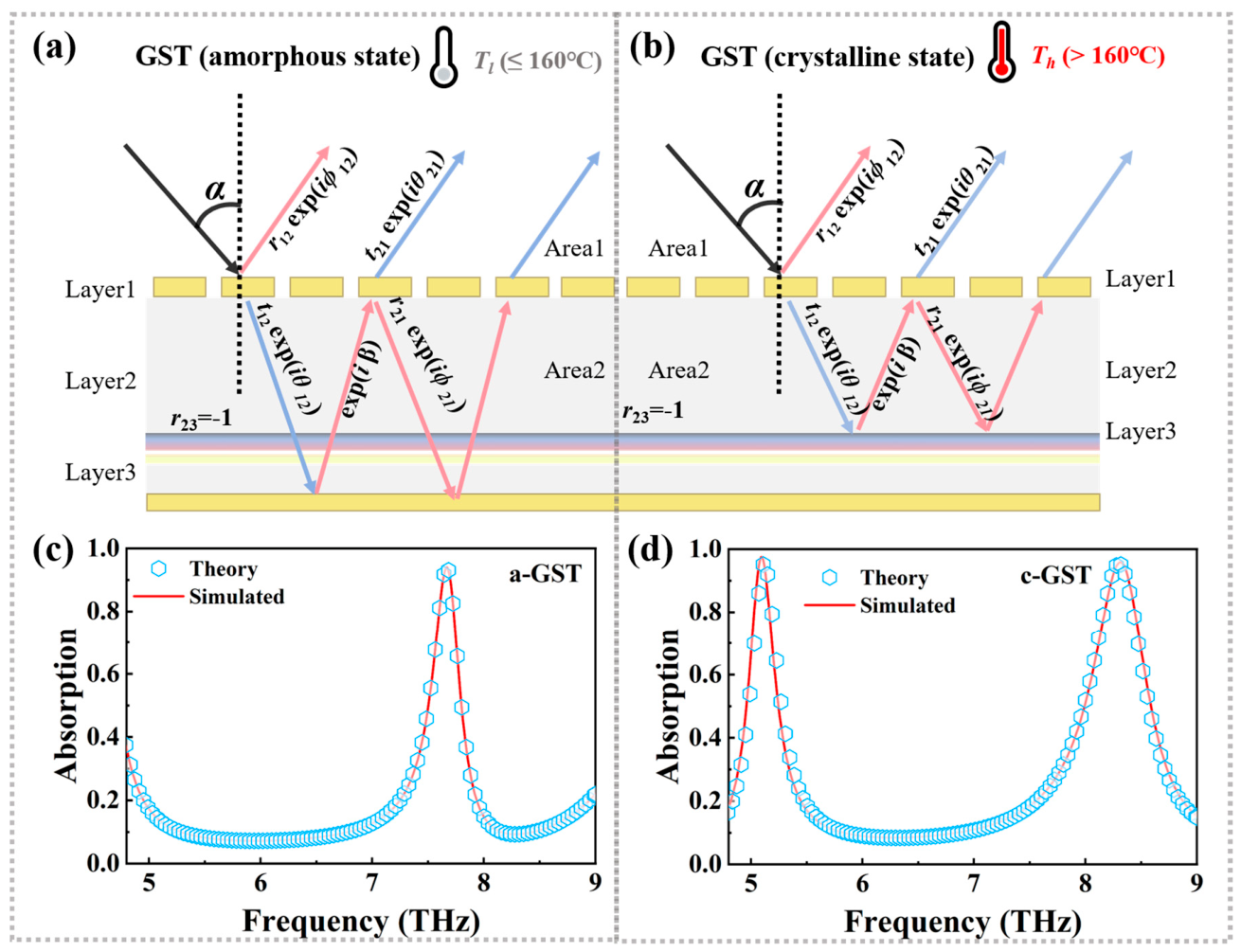
To elucidate the physical mechanism underlying the regulation of absorption behavior by the GST phase transition, we constructed a theoretical model based on the principle of multiple-reflection interference. In this model, the entire absorbing structure is abstracted as a Fabry–Perot resonant cavity [38,52]. The core physical principle is that the GST phase transition substantially alters the position of the dominant reflective interface within the cavity, thereby dynamically tuning the effective optical path length of the resonant cavity and ultimately enabling active reconfiguration of the absorption spectrum [52,53,54,55]. Given that the bottom metal layer can be considered a perfect reflector, the transmittance T ( ω ) 0 , and the absorptance is given by A ( ω ) = 1 R ( ω ) = 1 r total ( ω ) 2 . The total reflected field E r originates from multiple round-trip reflections of the incident wave between the top resonant layer and the bottom effective reflective surface, resulting from the coherent superposition of all the reflected sub-waves [55,56,57]. Its expression is
E r = E 0 r 12 + t 12 t 21 r 23 e i 2 β + t 12 t 21 r 21 r 23 2 e i 4 β +
where r i j and t i j denote the complex Fresnel coefficients at the interface between adjacent media (from medium i to medium j). Since the refractive index of the GST layer in the model is complex, n ~ = n + i κ , these coefficients are also complex, describing the amplitude change and phase shift in the electromagnetic wave at the interface. The key parameter β in the formula represents the single-pass phase delay of the electromagnetic wave within the equivalent resonant cavity:
β = k 0 n ~ eff d eff
where k 0 = 2 π / λ 0 is the vacuum wavenumber, and n ~ eff and d eff are the complex refractive index and equivalent geometric thickness of this equivalent cavity, respectively. The core physical role of the GST phase transition lies in the active control of the equivalent optical path length n ~ eff d eff : when GST is in the amorphous state, it has good transmittance, allowing electromagnetic waves to penetrate to the bottom metal reflector; at this point, the effective optical path is long, corresponding to a “long-cavity” model. When GST transforms into the crystalline state, it exhibits strong metal-like reflective characteristics; the effective reflective interface shifts to the upper surface of the GST layer, causing the effective optical path to shorten significantly, corresponding to a “short-cavity” model. Summing the aforementioned infinite geometric series yields the analytical expression for the system’s total reflection coefficient r total :
r total = r ~ 12 + t ~ 12 t ~ 21 r ~ 23 e i 2 β 1 r ~ 21 r ~ 23 e i 2 β
The formula indicates that an absorption peak, corresponding to a reflection minimum, occurs when the total accumulated phase 2β satisfies the destructive interference condition. Consequently, the GST phase transition precisely shifts the resonant frequency points by altering the optical path. To validate the effectiveness of this model, we compared the model calculation results with the full-wave electromagnetic simulation results. To validate the effectiveness of this model, we compared the model calculation results with the full-wave electromagnetic simulation results. The theoretical absorption curves were obtained by numerically evaluating the total reflection coefficient formula using the material parameters (refractive indices of GST, TOPAS, and gold) and layer thicknesses given in Section 2, sweeping the frequency from 5 to 9 THz. The optical constants of gold are taken from the CST built-in material library.
As shown in Figure 7, when GST is in the amorphous state (corresponding to the schematic in Figure 7a and the “long-cavity” model), the theoretical calculation curve (blue hexagonal dotted line in Figure 7c) shows good agreement with the simulation results in their main features. When GST is in the crystalline state (corresponding to the schematic in Figure 7b and the “short-cavity” model), the theoretical calculation results (blue hexagonal dotted line in Figure 7d) not only align with the overall trend of the simulation data but also clearly reproduce the characteristic dual absorption peaks. This comparison confirms that the established multiple-reflection interference model can reasonably elucidate the intrinsic physical process by which GST phase transition dynamically reconfigures the absorption spectrum through the switching of optical cavity length.
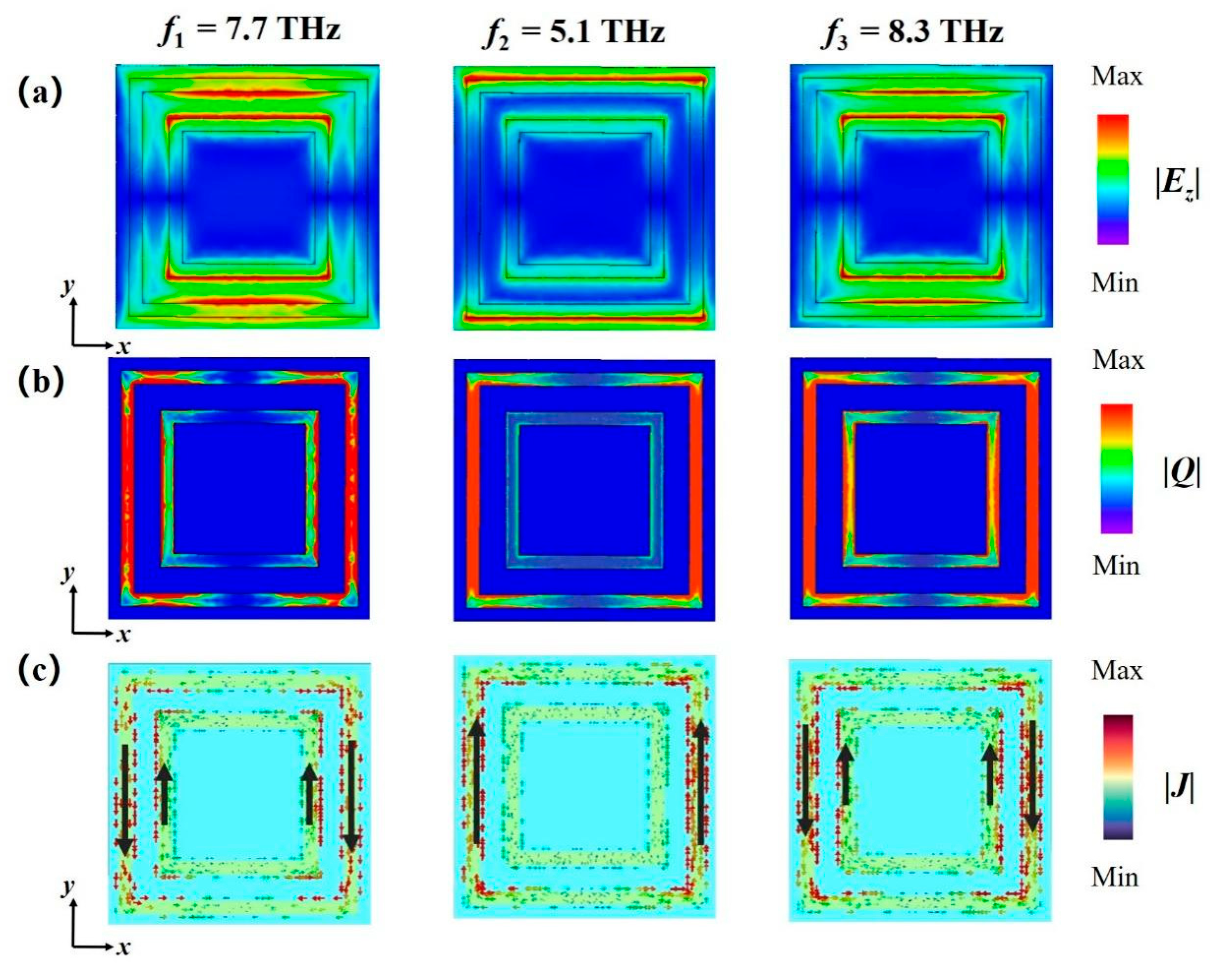
To further investigate the physical mechanism behind the narrowband absorption of this absorber, we conducted a detailed analysis of its electromagnetic field and energy distributions using electromagnetic simulation tools. As shown in Figure 8, the structure exhibits distinct narrowband absorption characteristics within the 4.9–9 THz frequency band under both GST phase states. Based on this, three characteristic resonant frequency points were selected for in-depth study: the absorption peak at f1 = 7.7 THz under the a-GST, and the dual absorption peaks at f2 = 5.1 THz and f3 = 8.3 THz under the c-GST.
The surface electric field distribution shown in Figure 8a reveals significant differences in electric field localization characteristics at different resonant frequencies: at the single absorption peak f1 = 7.7 THz corresponding to the a-GST, the electric field concentrates on both the inner and outer rings, with significantly stronger intensity on the outer ring. At the lower-frequency absorption peak f2 = 5.1 THz under the c-GST, the electric field is almost completely localized on the outer square ring; while at its higher-frequency absorption peak f3 = 8.3 THz, the electric field is again distributed across both rings, but the inner ring’s field strength dominates [55,56,57,58,59,60,61,62].
The power loss density distribution (Figure 8b) further illustrates the spatial characteristics of energy dissipation: the losses at f1 and f3 are mainly concentrated in the outer and inner ring regions, indicating that energy is dissipated through both rings jointly; whereas the loss at f2 is significant only in the outer ring, consistent with the electric field feature that only the outer ring mode is excited at this frequency.
The surface current distribution (Figure 8c) provides a more intuitive perspective for understanding the resonant modes: at frequencies f1 and f3, strong surface currents are excited on both the inner and outer rings, and their flow directions are opposite, forming a typical magnetic resonance response, which is the key mechanism for achieving efficient absorption, whereas at frequency f2, significant surface current is observed only on the outer ring, and its direction is opposite to the outer ring current direction at f1 and f3, indicating that this mode is a different-order resonance independently excited on the outer ring.
In summary, the frequency shifts and mode changes induced by the GST phase transition originate from the excitation and switching between different geometric resonance modes (the coupled inner–outer ring mode and the independent outer ring mode). These modes possess distinctly different field localization characteristics and current distributions, thereby manifesting as separable narrowband absorption peaks in the frequency spectrum. It should be further noted that the GST phase transition not only changes the equivalent cavity length but also modifies the local dielectric environment around the resonant rings. In the c-GST state, due to the shielding effect of the GST layer, the energy exchange path between the inner and outer rings is altered. Consequently, at f 2 = 5.1 THz, only the independent outer-ring mode is excited. In contrast, at f 3 = 8.3 THz, the change in impedance matching conditions switches the resonance to a strongly coupled mode dominated by the inner ring.

6. Conclusions

In this work, a tunable terahertz metamaterial absorber based on the phase-change material GST has been systematically investigated through full-wave simulations and theoretical modeling. By leveraging the reversible phase transition characteristics of GST between its amorphous and crystalline states, in combination with a metal–insulator–metal resonant structure, the design successfully achieves dynamic reconfiguration of absorption characteristics from a single peak at 7.7 THz to dual peaks at 5.1 THz and 8.3 THz within the 4.9–9 THz band, achieving near-perfect absorption in both states. Theoretical analysis reveals that this significant frequency shift and mode variation originate from the switching of the equivalent intra-cavity optical path induced by the GST phase transition—namely, the transition from a “long cavity” to a “short cavity”—and correspond to the excitation of two distinct localized resonance modes: the coupled inner–outer ring mode and the independently excited outer ring mode. This work elucidates the dynamic tuning mechanism of terahertz absorption performance, thereby providing a theoretical framework for the design of future reconfigurable terahertz devices.

Supplementary Materials

The following supporting information can be downloaded at https://www.mdpi.com/article/10.3390/photonics13050413/s1. Figure S1. Optimization of cavity layer thicknesses h1 and h2. (a,b) Absorption spectra as a function of h1 in the amorphous and crystalline states, respectively. (c,d) Absorption spectra as a function of h2 in the amorphous and crystalline states, respectively. Figure S2. Polarization-independent absorption at normal incidence. (a) Absorption spectra for different polarization angles (0°, 30°, 60°, 90°) when GST is in the amorphous state (a-GST). (b) Absorption spectra for different polarization angles when GST is in the crystalline state (c-GST). The perfect overlap of all curves demonstrates the polarization-independent behavior at normal incidence (θ = 0°), which is a direct consequence of the four-fold rotational symmetry of the double-nested square-ring resonator.

Author Contributions

Conceptualization, D.L. and P.M.; Methodology, D.L. and C.C.; Software, D.L. and C.C.; Validation, C.C. and P.M.; Formal analysis, D.L.; Investigation, D.L. and C.C.; Resources, F.G. and P.M.; Data curation, D.L. and C.C.; Writing—original draft, D.L.; Writing—review & editing, D.L., C.C., F.G. and P.M.; Visualization, D.L.; Supervision, F.G. and P.M.; Project administration, F.G. and P.M.; Funding acquisition, D.L., F.G. and P.M. All authors have read and agreed to the published version of the manuscript.

Funding

This research was funded by National Key R&D Program of China (grant number 2025YFF0520501) and Suzhou Association for Science& Technology Youth Science and Technology Talents Promotion Project.

Data Availability Statement

The original contributions presented in this study are included in the article/supplementary material. Further inquiries can be directed to the corresponding authors.

Conflicts of Interest

The authors declare no conflict of interest.

References

  1. Tonouchi, M. Cutting-Edge Terahertz Technology. Nat. Photonics 2007, 1, 97–105. [Google Scholar] [CrossRef]
  2. Dhillon, S.S.; Vitiello, M.S.; Linfield, E.H.; Davies, A.G.; Hoffmann, M.C.; Booske, J.; Paoloni, C.; Gensch, M.; Weightman, P.; Williams, G.P.; et al. The 2017 Terahertz Science and Technology Roadmap. J. Phys. D Appl. Phys. 2017, 50, 043001. [Google Scholar] [CrossRef]
  3. Ferguson, B.; Zhang, X.-C. Materials for Terahertz Science and Technology. Nat. Mater. 2002, 1, 26–33. [Google Scholar] [CrossRef] [PubMed]
  4. Akyildiz, I.F.; Jornet, J.M.; Han, C. Terahertz Band: Next Frontier for Wireless Communications. Phys. Commun. 2014, 12, 16–32. [Google Scholar] [CrossRef]
  5. Jornet, J.M.; Petrov, V.; Wang, H.; Popović, Z.; Shakya, D.; Siles, J.V.; Rappaport, T.S. The Evolution of Applications, Hardware Design, and Channel Modeling for Terahertz (THz) Band Communications and Sensing: Ready for 6G? Proc. IEEE 2025, 113, 920–951. [Google Scholar] [CrossRef]
  6. Duan, X.; Han, S.; Yuan, Y.; Shen, J.; Dai, Y.; Mi, J.; Wang, Z. Application of Terahertz Spectroscopy and Imaging Techniques in Biomedicine. iScience 2025, 28, 113990. [Google Scholar] [CrossRef]
  7. Hamza, M.N.; Tariqul Islam, M.; Lavadiya, S.; Ud Din, I.; Sanches, B.; Koziel, S.; Iffat Naqvi, S.; Farmani, A.; Islam, M.S. Ultra-Compact Quintuple-Band Terahertz Metamaterial Biosensor for Enhanced Blood Cancer Diagnostics. PLoS ONE 2025, 20, e0313874. [Google Scholar] [CrossRef]
  8. Bauer, M.; Hussung, R.; Matheis, C.; Mashkin, A.; Krane, S.; Pohlmann, F.; Friederich, F. Terahertz Non-Destructive Testing of Power Generator Bars with a Dielectric Waveguide Antenna. Int. J. Microw. Wireless Technol. 2023, 15, 1038–1047. [Google Scholar] [CrossRef]
  9. Hartman, A.L.; Bangaru, A.K.; Mølvig, B.H.; Johansen, N.F.-J.; Erives, R.I.; Lange, S.J. Terahertz Cross-Correlation Spectroscopy for Non-Destructive Testing of Thick Glass Fiber Epoxy Composites. IOP Conf. Ser. Mater. Sci. Eng. 2025, 1338, 012031. [Google Scholar] [CrossRef]
  10. Wang, W.; Sun, K.; Xue, Y.; Lin, J.; Fang, J.; Shi, S.; Zhang, S.; Shi, Y. A Review of Terahertz Metamaterial Sensors and Their Applications. Opt. Commun. 2024, 556, 130266. [Google Scholar] [CrossRef]
  11. Papamakarios, S.; Tsilipakos, O.; Katsantonis, I.; Koulouklidis, A.D.; Manousidaki, M.; Zyla, G.; Daskalaki, C.; Tzortzakis, S.; Kafesaki, M.; Farsari, M. Cactus-like Metamaterial Structures for Electromagnetically Induced Transparency at THz Frequencies. ACS Photonics 2025, 12, 87–97. [Google Scholar] [CrossRef]
  12. Zhou, Z.; Gan, Z.; Cao, L. Recent Progress in Terahertz Sensors Based on Graphene Metamaterials. Discov. Nano 2025, 20, 24. [Google Scholar] [CrossRef]
  13. Mokhtari, A.; Rezaei, M.H.; Zarifkar, A. Near-Perfect Wide-Band Absorbers Based on One-Dimensional Photonic Crystal Structures in 1–20  THz Frequencies. Appl. Opt. 2023, 62, 3660–3671. [Google Scholar] [CrossRef]
  14. Ebbesen, T.W.; Lezec, H.J.; Ghaemi, H.F.; Thio, T.; Wolff, P.A. Extraordinary Optical Transmission through Sub-Wavelength Hole Arrays. Nature 1998, 391, 667–669. [Google Scholar] [CrossRef]
  15. Chen, H.-T.; Taylor, A.J.; Yu, N. A Review of Metasurfaces: Physics and Applications. Rep. Prog. Phys. 2016, 79, 076401. [Google Scholar] [CrossRef]
  16. Acharyya, J.N.; Desai, N.R.; Gangineni, R.B.; Vijaya Prakash, G. Effect of Photonic Cavity Interactions on Femtosecond Multiphoton Optical Nonlinear Absorptions from Bi2 O3 -Based One-Dimensional Photonic Crystal. ACS Photonics 2022, 9, 2092–2100. [Google Scholar] [CrossRef]
  17. Xu, G.; Xue, Z.; Fan, J.; Lu, D.; Xing, H.; Shum, P.P.; Zhou, Y.; Cong, L. Flexible Terahertz Metasurface Absorbers Empowered by Bound States in the Continuum. Adv. Mater. 2024, 36, 2406526. [Google Scholar] [CrossRef] [PubMed]
  18. Chen, C.; Chen, S.; Ni, Y.; Xu, Y.; Yang, Y. Liquid Crystal Metasurface for On-Demand Terahertz Beam Forming Over 110° Field-of-View. Laser Photonics Rev. 2024, 18, 2400237. [Google Scholar] [CrossRef]
  19. Jin, Z.; Lou, J.; Shu, F.; Hong, Z.; Qiu, C.-W. Advances in Nanoengineered Terahertz Technology: Generation, Modulation, and Bio-Applications. Research 2025, 8, 0562. [Google Scholar] [CrossRef] [PubMed]
  20. Gezimati, M.; Singh, G. Terahertz Imaging Technology for Localization of Cancer Tumours: A Technical Review. Multimed. Tools Appl. 2023, 83, 33675–33711. [Google Scholar] [CrossRef]
  21. Wu, F.; Wu, X.; Xiao, S.; Liu, G.; Li, H. Broadband Wide-Angle Multilayer Absorber Based on a Broadband Omnidirectional Optical Tamm State. Opt. Express 2021, 29, 23976. [Google Scholar] [CrossRef] [PubMed]
  22. Xue, C.; Wu, F.; Jiang, H.; Li, Y.; Zhang, Y.; Chen, H. Wide-Angle Spectrally Selective Perfect Absorber by Utilizing Dispersionless Tamm Plasmon Polaritons. Sci. Rep. 2016, 6, 39418. [Google Scholar] [CrossRef]
  23. Xu, C.; Ren, Z.; Wei, J.; Lee, C. Reconfigurable Terahertz Metamaterials: From Fundamental Principles to Advanced 6G Applications. iScience 2022, 25, 103799. [Google Scholar] [CrossRef] [PubMed]
  24. Zhao, Y.; Liu, Z.; Li, C.; Jiao, W.; Jiang, S.; Li, X.; Duan, J.; Li, J. Mechanically Reconfigurable Metasurfaces: Fabrications and Applications. npj Nanophoton. 2024, 1, 16. [Google Scholar] [CrossRef]
  25. Saifullah, Y.; He, Y.; Boag, A.; Yang, G.; Xu, F. Recent Progress in Reconfigurable and Intelligent Metasurfaces: A Comprehensive Review of Tuning Mechanisms, Hardware Designs, and Applications. Adv. Sci. 2022, 9, 2203747. [Google Scholar] [CrossRef]
  26. Sim, J.; Lu, L.; Zhao, R.R. Electromagnetic (EM)-Driven Functional Materials. Adv. Mater. 2026, 38, e21268. [Google Scholar] [CrossRef]
  27. Pitchappa, P.; Kumar, A.; Prakash, S.; Jani, H.; Venkatesan, T.; Singh, R. Chalcogenide Phase Change Material for Active Terahertz Photonics. Adv. Mater. 2019, 31, 1808157. [Google Scholar] [CrossRef]
  28. Wuttig, M.; Bhaskaran, H.; Taubner, T. Phase-Change Materials for Non-Volatile Photonic Applications. Nat. Photonics 2017, 11, 465–476. [Google Scholar] [CrossRef]
  29. Hillger, P.; Grzyb, J.; Jain, R.; Pfeiffer, U.R. Terahertz Imaging and Sensing Applications With Silicon-Based Technologies. IEEE Trans. Terahertz Sci. Technol. 2019, 9, 1–19. [Google Scholar] [CrossRef]
  30. Shakiba, L.; Salehi, M.R.; Emami, F. A Multiband Perfect Metamaterial Absorber Based on Phase Change Material for Switching and Biosensing Applications. Opt. Commun. 2024, 560, 130498. [Google Scholar] [CrossRef]
  31. Huang, M.; Cheng, Y.; Cheng, Z.; Chen, H.; Mao, X.; Gong, R. Based on Graphene Tunable Dual-Band Terahertz Metamaterial Absorber with Wide-Angle. Opt. Commun. 2018, 415, 194–201. [Google Scholar] [CrossRef]
  32. Tao, W.; Wu, Y.; Zhao, F.; Li, C.; Fang, B.; Jing, X.; Yu, M. Research Progress in Metamaterials and Metasurfaces Based on the Phase Change Material Ge2Sb2Te5. Opt. Laser Technol. 2024, 177, 111064. [Google Scholar] [CrossRef]
  33. Gerislioglu, B.; Bakan, G.; Ahuja, R.; Adam, J.; Mishra, Y.K.; Ahmadivand, A. The Role of Ge2Sb2Te5 in Enhancing the Performance of Functional Plasmonic Devices. Mater. Today Phys. 2020, 12, 100178. [Google Scholar] [CrossRef]
  34. Cao, T.; Wang, R.; Simpson, R.E.; Li, G. Photonic Ge-Sb-Te Phase Change Metamaterials and Their Applications. Prog. Quantum Electron. 2020, 74, 100299. [Google Scholar] [CrossRef]
  35. Tian, Q.; Huang, G.; Li, X.; Li, J. Design and Measurement of a Terahertz Dual-Absorption Mode Metamaterial and Its Temperature Sensing Performance. Sens. Actuators A Phys. 2025, 396, 117226. [Google Scholar] [CrossRef]
  36. Linyang, G.; Xiaohui, M.; Zhaoqing, C.; Chunlin, X.; Jun, L.; Ran, Z. Tunable a Temperature-Dependent GST-Based Metamaterial Absorber for Switching and Sensing Applications. J. Mater. Res. Technol. 2021, 14, 772–779. [Google Scholar] [CrossRef]
  37. Ding, Z.; Su, W.; Ye, L.; Zhou, Y.; Li, W.; Zou, J.; Tang, B.; Yao, H. Thermal Controlled Multi-Functional Metasurface for Freely Switching of Absorption, Reflection, and Transmission. Phys. Chem. Chem. Phys. 2024, 26, 8460–8468. [Google Scholar] [CrossRef] [PubMed]
  38. Qiu, Z.; Jin, G.; Tang, B. Thermally Controlled Broadband Ge2Sb2Te5-Based Metamaterial Absorber for Imaging Applications. Photonics 2024, 11, 272. [Google Scholar] [CrossRef]
  39. Wu, J.; Qing, Y.M. Wide-Angle and Broadband Nonreciprocal Thermal Emitter with Cascaded Dielectric and Weyl Semimetal Grating Structure. Appl. Phys. Lett. 2023, 122, 012203. [Google Scholar] [CrossRef]
  40. Tian, J.; Li, Q.; Lu, J.; Qiu, M. Reconfigurable All-Dielectric Antenna-Based Metasurface Driven by Multipolar Resonances. Opt. Express 2018, 26, 23918–23925. [Google Scholar] [CrossRef]
  41. Qu, Y.; Li, Q.; Cai, L.; Pan, M.; Ghosh, P.; Du, K.; Qiu, M. Thermal Camouflage Based on the Phase-Changing Material GST. Light Sci. Appl. 2018, 7, 26. [Google Scholar] [CrossRef] [PubMed]
  42. Jeong, Y.; Bahk, Y.; Kim, D. Dynamic Terahertz Plasmonics Enabled by Phase-Change Materials. Adv. Opt. Mater. 2020, 8, 1900548. [Google Scholar] [CrossRef]
  43. Zhang, S.; Chen, X.; Liu, K.; Li, H.; Xu, Y.; Jiang, X.; Xu, Y.; Wang, Q.; Cao, T.; Tian, Z. Nonvolatile Reconfigurable Terahertz Wave Modulator. PhotoniX 2022, 3, 7. [Google Scholar] [CrossRef]
  44. Lyu, J.; Huang, L.; Chen, L.; Zhu, Y.; Zhuang, S. Review on the Terahertz Metasensor: From Featureless Refractive Index Sensing to Molecular Identification. Photon. Res. 2024, 12, 194. [Google Scholar] [CrossRef]
  45. Raeis-Hosseini, N.; Rho, J. Dual-Functional Nanoscale Devices Using Phase-Change Materials: A Reconfigurable Perfect Absorber with Nonvolatile Resistance-Change Memory Characteristics. Appl. Sci. 2019, 9, 564. [Google Scholar] [CrossRef]
  46. Jin, J.-S.; Ma, C.-J.; Zhang, Y.; Zhang, Y.-B.; Bao, S.-Q.; Li, M.; Li, D.-M.; Liu, M.; Liu, Q.-Z.; Zhang, Y.-X.; et al. Switchable multifunctional terahertz metamaterial with slow-light and absorption functions based on phase change materials. Acta Phys. Sin. 2023, 72, 084202. [Google Scholar] [CrossRef]
  47. Mou, N.; Liu, X.; Wei, T.; Dong, H.; He, Q.; Zhou, L.; Zhang, Y.; Zhang, L.; Sun, S. Large-Scale, Low-Cost, Broadband and Tunable Perfect Optical Absorber Based on Phase-Change Material. Nanoscale 2020, 12, 5374–5379. [Google Scholar] [CrossRef]
  48. Mendoza-Galván, A.; González-Hernández, J. Drude-like Behavior of Ge:Sb:Te Alloys in the Infrared. J. Appl. Phys. 2000, 87, 760–765. [Google Scholar] [CrossRef]
  49. Lee, B.-S.; Bishop, S.G. Optical and Electrical Properties of Phase Change Materials. In Phase Change Materials; Raoux, S., Wuttig, M., Eds.; Springer: Boston, MA, USA, 2009; pp. 175–198. [Google Scholar]
  50. Gavdush, A.A.; Komandin, G.A.; Bukin, V.V.; Zaytsev, K.I.; Ponomarev, D.S.; Tan, L.; Huang, W.; Shi, Q. Terahertz-Infrared Spectroscopy of Ge2Sb2Te5 Films on Sapphire: Evolution of Broadband Electrodynamic Response upon Phase Transitions. J. Appl. Phys. 2023, 134, 085103. [Google Scholar] [CrossRef]
  51. Zhao, M.; Li, Y.; He, X.; Zhang, Y. Graphene and Vanadium Dioxide Assisted Terahertz Metasurface for Broadband Absorption, Polarization Conversion, and Wavefront Manipulation. Plasmonics 2025, 20, 5417–5431. [Google Scholar] [CrossRef]
  52. Chen, H.-T. Interference Theory of Metamaterial Perfect Absorbers. Opt. Express 2012, 20, 7165. [Google Scholar] [CrossRef]
  53. Xiong, J.; Li, C.; Wang, D.; Gao, S.; Che, Y.; Wu, G.; Guo, M. A Bifunctional Tunable Terahertz Absorber Based on a Fabry–Perot Cavity: Enabling Broadband Perfect Absorption and Refractive Index Sensing. J. Mater. Chem. C 2025, 13, 4160–4169. [Google Scholar] [CrossRef]
  54. Gilchrist, L. Visibility Phenomena with Interference by Multiple Reflections. Phys. Rev. 1926, 27, 596–605. [Google Scholar] [CrossRef]
  55. Ge, J.; Zhang, Y.; Dong, H.; Zhang, L. Independently Tunable Infrared Absorber Using Stacked Molybdenum Disulfide Metasurfaces. Appl. Surf. Sci. 2022, 574, 151594. [Google Scholar] [CrossRef]
  56. Ge, J.; Zhang, Y.; Li, H.; Dong, H.; Zhang, L. Ultra-Broadband, Tunable, and Transparent Microwave Meta-Absorber Using ITO and Water Substrate. Adv. Opt. Mater. 2023, 11, 2202873. [Google Scholar] [CrossRef]
  57. Ge, J.; Zhang, Y.; Dong, H.; Zhang, L. Nanolayered VO2 -Based Switchable Terahertz Metasurfaces as Near-Perfect Absorbers and Antireflection Coatings. ACS Appl. Nano Mater. 2022, 5, 5569–5577. [Google Scholar] [CrossRef]
  58. Ge, J.; Wang, X.; Li, B.; Xue, H.; Zhang, C.; Song, C.; Lin, W.; Zhang, Y.; Wang, Y.; Chen, K.; et al. Optically Transparent Metasurface With Multispectral-Compatible Camouflage and Millimeter-Wave Transmission Window. IEEE Trans. Microw. Theory Tech. 2025, 73, 5686–5695. [Google Scholar] [CrossRef]
  59. Zhou, Q.; Ma, W.; Wu, T.; Li, Y.; Qiu, Q.; Duan, J.; Li, J.; Jiang, L.; Zhou, W.; Gao, Y.; et al. Metasurface Terahertz Perfect Absorber with Strong Multi-Frequency Selectivity. ACS Omega 2022, 7, 36712–36727. [Google Scholar] [CrossRef]
  60. Bakır, M.; Karaaslan, M.; Unal, E.; Akgol, O.; Sabah, C. Microwave Metamaterial Absorber for Sensing Applications. Opto-Electron. Rev. 2017, 25, 318–325. [Google Scholar] [CrossRef]
  61. Zhou, J.; Koschny, T.; Soukoulis, C.M. Magnetic and Electric Excitations in Split Ring Resonators. Opt. Express 2007, 15, 17881. [Google Scholar] [CrossRef] [PubMed]
  62. Naranjo, G.A.; Peralta, X.G. Lattice-Induced Modulators at Terahertz Frequencies. Opt. Lett. 2017, 42, 4780. [Google Scholar] [CrossRef] [PubMed]
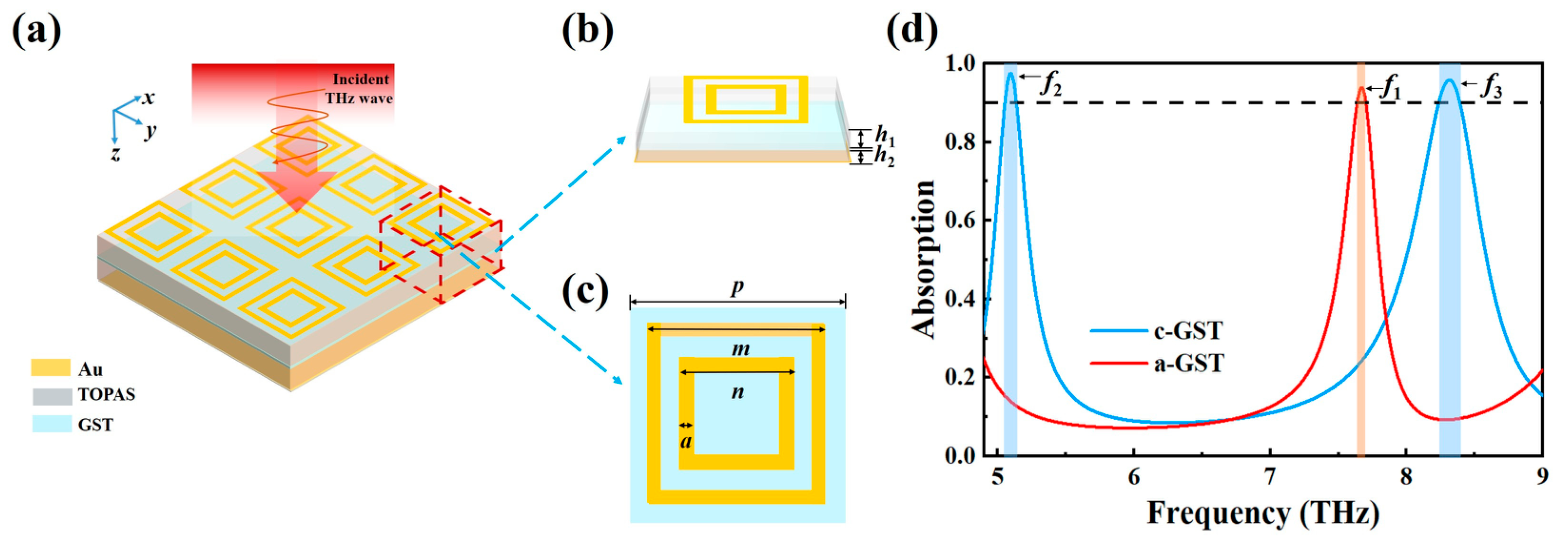
Figure 1. Schematic of the proposed tunable terahertz metamaterial absorber based on GST (a) 3D view of the unit cell; (b) side view, illustrating the metal–insulator–metal triple-layer configuration and material composition; (c) top resonant layer unit pattern and key geometric parameters; (d) absorption performance in the amorphous and crystalline states.
Photonics 13 00413 g001
Figure 2. Influence of structural geometric parameters on the absorption performance when GST is in the amorphous state: (a) resonant layer metal line width; (b) inner square ring side length; (c) outer square ring side length; (d) unit period.
Photonics 13 00413 g002
Figure 3. Influence of structural geometric parameters on absorption performance when GST is in the crystalline state: (a) resonant layer metal line width; (b) inner square ring side length; (c) outer square ring side length; (d) unit period.
Photonics 13 00413 g003
Figure 4. Absorption characteristics when GST is in different phase states: (a) schematic of electromagnetic wave incidence in the amorphous state; (b) corresponding spectra: absorptance A (red solid curve), reflectance R (blue solid curve), and transmittance T (orange solid curve); (c) schematic of electromagnetic wave incidence in the crystalline state; (d) corresponding spectra: absorptance A (red solid curve), reflectance R (blue solid curve), and transmittance T (orange solid curve).
Photonics 13 00413 g004
Figure 5. Angular dependence of absorption performance under different polarization modes. The incident angle θ is defined as the angle between the incident wave direction and the sample normal (θ = 0° for normal incidence): (a) amorphous GST, TE polarization; (b) crystalline GST, TE polarization; (c) amorphous GST, TM polarization; (d) crystalline GST, TM polarization.
Photonics 13 00413 g005
Figure 6. Fabrication processes of the proposed tunable terahertz absorber.
Photonics 13 00413 g006
Figure 7. Comparison between the theoretical absorption curves based on the multiple-reflection interference model and the full-wave simulation results: (a) schematic of the amorphous state (long-cavity model); (b) schematic of the crystalline state (short-cavity model); (c) absorption spectra for the amorphous state—the blue hexagonal dotted line represents the theoretical model, and the red solid line represents the full-wave simulation; (d) absorption spectra for the crystalline state—the blue hexagonal dotted line represents the theoretical model, and the red solid line represents the full-wave simulation.
Photonics 13 00413 g007
Figure 8. Characteristics of electromagnetic field and energy distributions at different resonant frequencies: (a) electric field intensity distribution; (b) power loss density distribution; (c) surface current distribution (arrows indicate direction).
Photonics 13 00413 g008
Disclaimer/Publisher’s Note: The statements, opinions and data contained in all publications are solely those of the individual author(s) and contributor(s) and not of MDPI and/or the editor(s). MDPI and/or the editor(s) disclaim responsibility for any injury to people or property resulting from any ideas, methods, instructions or products referred to in the content.