Article

Polarization Tailored Photonic Jets via Janus Microcylinders

Suzhou Institute of Biomedical Engineering and Technology, Chinese Academy of Sciences, Suzhou 215163, China
*
Authors to whom correspondence should be addressed.
Photonics 2026, 13(4), 340; https://doi.org/10.3390/photonics13040340
Submission received: 11 February 2026 / Revised: 13 March 2026 / Accepted: 25 March 2026 / Published: 31 March 2026
(This article belongs to the Special Issue Nanophotonics and Metasurfaces for Optical Manipulation)

Abstract

Photonic jets (PJs) generated from mesoscale dielectric particles can achieve sub-diffraction-scale light field constraints and significant near-field intensity enhancement, which have important application value in the fields of nanoimaging, optical sensing, and laser processing. Recent studies show that the axial-extension and transverse-focus characteristics of PJs can be effectively regulated through interface engineering methods, such as using double-layer structures and truncated geometries. Such structures can be referred to as Janus microstructures separated by surface refracted interfaces. However, systematic research on the effect of incident light polarization on the formation and regulation of PJs on the surface interfaces of Janus systems is lacking. In this study, the PJ characteristics under polarization regulation in curved-interface Janus microcylinders are systematically investigated by performing full-wave numerical simulations. The results show that polarization modulation introduces a new degree of freedom for regulating the energy flow distribution and morphology of PJs. An appropriate polarization state can be selected to effectively regulate key characteristic parameters, such as the length, peak intensity, and full width at half maximum of the nanojet, without changing the particle geometry or material composition. This study reveals the synergy between the surface-interface Janus structures and polarization engineering, providing a new physical method for the flexible regulation of PJs in near-field optics.

1. Introduction

Photonic jets (PJs) are highly localized and low-divergence optical beams generated in the near field of dielectric microstructures [1]. These are narrow high-intensity electromagnetic beams that propagate into the background medium from the shadow-side surface of a plane-wave-illuminated, lossless, and dielectric microcylinder or microsphere having a diameter greater than the illuminating wavelength, λ . Since 2004, a substantial literature has developed regarding the existence, properties, and potential applications of the photonic jets [2]. PJs have attracted considerable attention owing to their strong localization of light and high intensity and have found applications in various fields [3,4,5], including microsphere-assisted microscopy [6], optical signal enhancement [7], laser nanofabrication [8,9], optical trapping [10], and optical data storage [11,12]. The spatial characteristics of PJs, high-intensity subwavelength light beams, such as the focal length, effective propagation distance, and full width at half maximum (FWHM), are primarily determined based on the microstructure’s material composition (e.g., refractive index), geometric profile (e.g., diameter), and surrounding medium (e.g., air/water).
The enhancement of PJ performance has driven extensive structural engineering research, demonstrating that PJ behavior depends on particle material, geometry, environment, and illumination. Various engineered microstructures—including microcolumns [13], ellipsoids [14], non-spherical and non-symmetrical dielectric [15], microdisks [16], micro-axicons [17,18], cuboids [19], core-shell and multilayer particles [20,21,22,23,24,25], truncated geometries [26,27,28], and nanofibers [29]—exhibit strong field enhancement and subwavelength focusing. Notable advancements include multilayer microspheres generating PJs up to 40 λ [30], truncated microcolumns achieving 46.47 λ with a 0.77 λ FWHM [26], liquid-filled structures extending to 108 λ [31], and optimized multilayer or rectangular particles producing jets ranging from 107.5 λ to 123 λ or ultranarrow waists of 0.2 λ [24,25]. However, many current PJ designs involve fabrication challenges owing to structural complexity. By contrast, truncated dielectric microcylinders present a more practical solution because they can be produced using standard lithography or ion-beam-milling techniques. Remarkably, these simplified structures can still generate very long PJs, such as the 209.49 λ jet reported by Xing et al. [28]. Despite this advantage, PJs generated from such truncated geometries are typically characterized by an excessively large FWHM, demonstrating an inherent length–width trade-off [26,27].
Although plane-wave illumination is typically used in most PJ studies, pioneering research has confirmed that incident light properties fundamentally determine PNJ behavior. References [32,33,34], the authors of which applied generalized Lorenz–Mie theory to quantitatively prove that Gaussian beams can systematically control PJ formation. Barton et al. [35,36] demonstrated that Gaussian beam parameters (including directionality and beam waist) significantly alter both internal and scattered fields, even for non-spherical particles. Further advancing the field, Gašparić [37] showed that engineered beams (such as pre-focused Gaussians) can overcome the conventional refractive index limitation ( n s > 2, where n s is the refractive index) for microsphere-generated PJs [38]. Meanwhile, Kim et al. and Amartya and Venkata revealed that structured polarization, including azimuthally and radially polarized beams, can actively tailor PJ morphology [39]. Compared with metalenses that rely on complex subwavelength nanostructure arrays and high-resolution lithography, Janus microcylinders offer a structurally simple and potentially lower-cost approach for generating localized photonic jets, although their focusing functionality is generally less dynamically tunable.
The remainder of this paper is organized as follows: Section 2 describes the geometric model and simulation methods, Section 3 presents an analysis of PJ characteristics for different Janus microcylinders and illumination polarization engineering. Section 4 discusses the results, and Section 5 concludes the paper.

2. Theory and Numerical Models

2.1. Theory of Control Methods for PJ Intensity Distribution

It has been demonstrated by recent studies that the presence of two-material dielectric particles with curved internal interfaces has the capacity to greatly influence the formation of photonic jets. For example, Minin et al. [40,41] demonstrated time-domain photonic hook and jet effects in freezing water micro-droplets, where refractive index contrast and interface curvature govern near-field beam shaping. Microstructures exhibit distinctly different refraction and focus behaviors for light incident on different regions, a concept first proposed by Gu et al. [42,43].
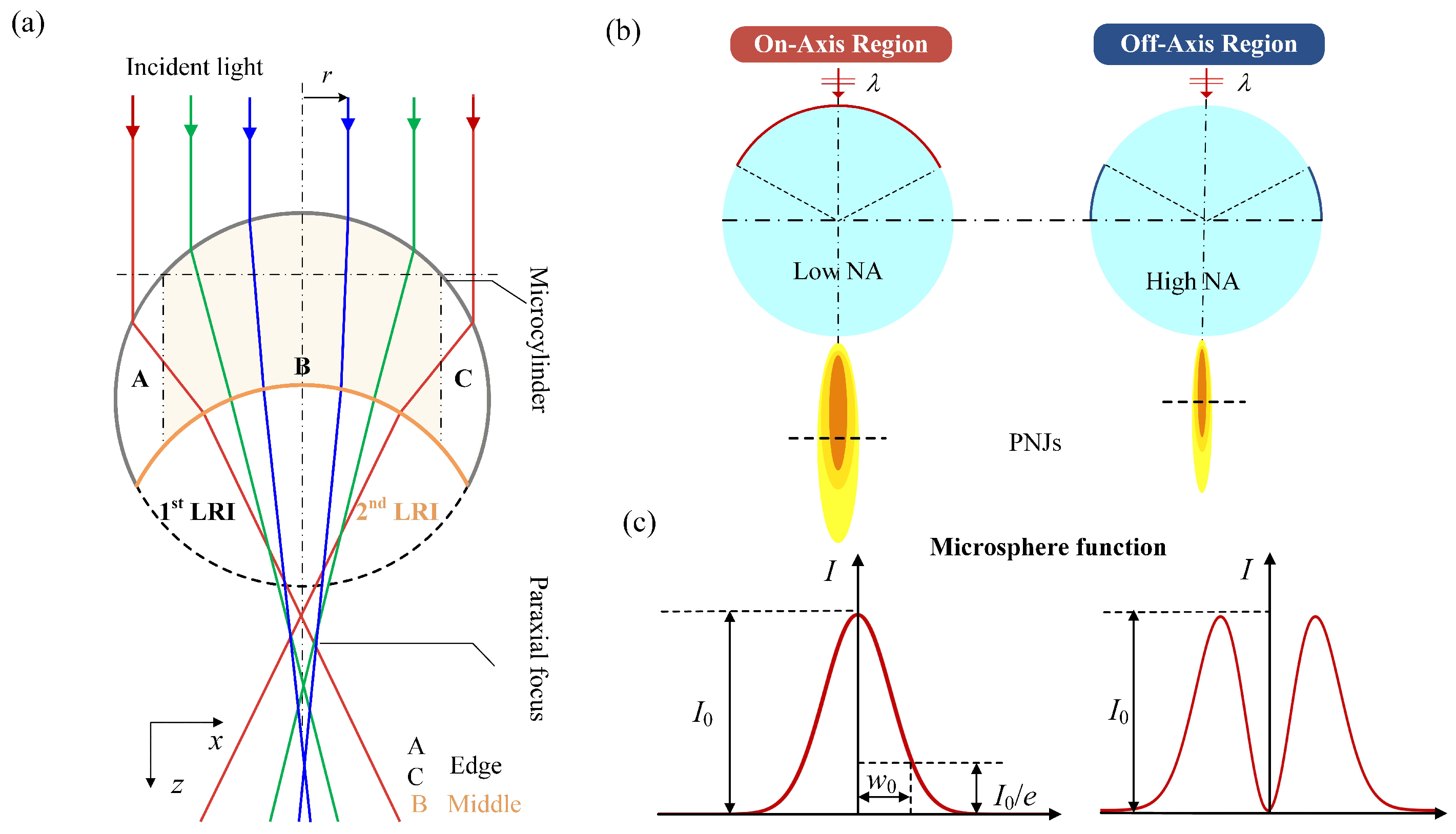
As shown in Figure 1b, we can spatially divide the microsphere’s first refractive interface into two key areas: a central near-axis low-numerical-aperture (NA) region and an edge high-NA region, each handling light differently. In the near-axis area, where incident angles are small similar to a low-NA lens, we observe only weak refraction that produces nearly parallel output. This generates PJs with broad profiles and long working distances (WDs). Conversely, the outer high-NA region with its steep incident angles behaves similar to a high-NA lens. Here, strong refraction creates a tight focus, resulting in considerably narrower PJs with significantly shorter WDs. These two optical regimes explain why we observe different PJ characteristics emerging from different parts of the microstructure.
In this study, as illustrated in Figure 1b, we use a curved-surface-truncated dielectric microcylindrical (CSTDM) structure to manipulate light propagation. The lateral curvature and truncation depth of the CSTDM influence how light interacts with regions A, B, and C, adjusting their relative contributions. Consequently, the “center–edge” effect described in the model proposed by Gu et al. aligns with the optical path contributions: B (low NA) versus A and C (high NA). Importantly, we can actively control PJ generation simply by tuning the incident light’s spatial intensity distribution. For instance, to achieve large-diameter PJs, we can enhance the B-region contribution while suppressing the A- and C-region contributions. This effect can be realized using a narrow-waist Gaussian beam with an optimized intensity distribution. The intensity distribution of a narrow-waist Gaussian beam is E = exp x 2 + y 2 ω 0 2 , where x and y are rectangular coordinates. In cases where the central light intensity predominates over the peripheral intensity ( I M > I E ), namely
W B = B I ( r ) d A W A + W C
This configuration concentrates most of the optical power at the central region, i.e., W B W A + W C . This light source characteristic of “central illumination–edge suppression” makes the output light of the CSTDM parallel after secondary refraction, which directly leads to the obvious enhancement of the WD and effective length of PJs.

2.2. Finite-Difference Time-Domain (FDTD) Simulation Models

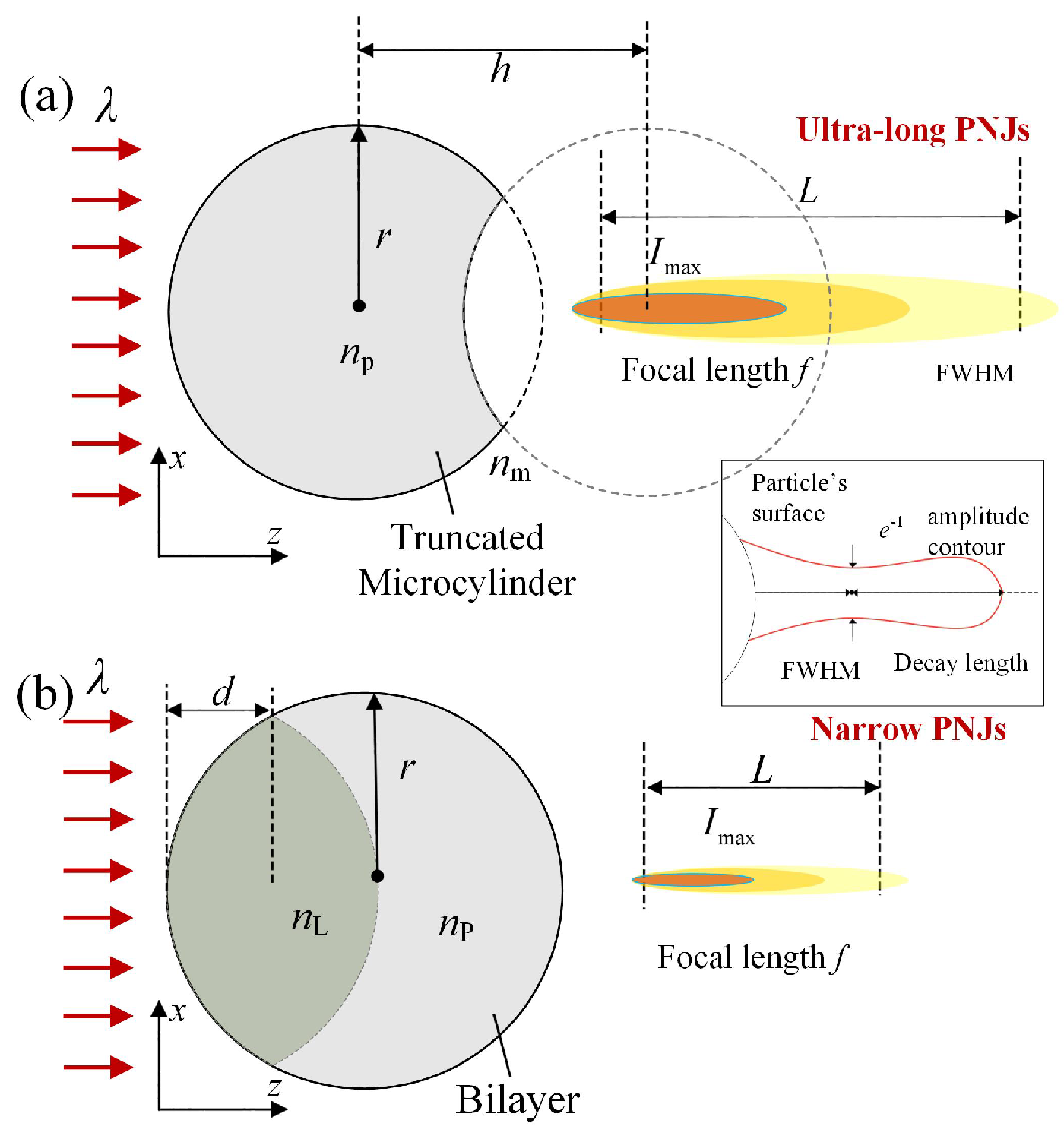
We investigate the light confinement produced from a Janus microcylinder illuminated by different beam profiles. As shown in Figure 2, we perform full-wave simulations using the FDTD method (Ansys Lumerical FDTD) to study how Janus microcylinders interact with structured illumination. The microcylinder is defined by its diameter (D = r) and truncation depth (h), with a lossless refractive index ( n p ), embedded in a surrounding medium of refractive index n m . Unless otherwise stated, the excitation wavelength is fixed at λ = 0.532 µm.
The definitions of the geometric parameters in Figure 2 are as follows: in Figure 2a, r is the radius of the truncated microcylinder, h is the truncation depth, n p is the refractive index of the particle, and n m is the refractive index of the surrounding medium. In Figure 2b, r again represents the radius of the cylinder, d represents the thickness (or axial position) of the internal layer of the bilayer structure, n p represents the refractive index of the host particle, and n L represents the refractive index of the inner layer.
For illumination, we consider three types of inputs along the +z direction: plane wave, Gaussian beam with an adjustable waist ( w 0 ), and generated using custom amplitude-phase profiles. The incident beam propagates along the positive z direction. Three illumination conditions are considered: (i) plane-wave excitation, (ii) linearly polarized Gaussian beam, and (iii) circularly polarized Gaussian beam. For Gaussian illumination, the transverse intensity distribution at the waist plane is defined as
I ( r ) = I 0 exp 2 r 2 w 0 2
where w 0 represents the beam waist radius, and r is the transverse radial coordinate. The beam waist center coincides with the particle center to ensure symmetric excitation.
The simulation domain is bounded by perfectly matched layers on all sides to minimize reflections. A nonuniform conformal mesh discretizes the space, refined down to λ /20 near the microcylinder and PJ region to ensure accuracy. Mesh-convergence tests confirm that key PJ parameters, such as the peak intensity, length, and FWHM, vary by less than 1% with further refinement, validating our resolution choice. In all cases, the illumination source is coherent and assumed to propagate along the z-axis.
The total electric-field intensity is defined as
E t 2 = E x 2 + E y 2 + E z 2
Vector-field decomposition is used to analyze the contributions of the transverse and longitudinal components to jet formation. All materials are assumed to be linear, isotropic, and lossless dielectrics.

3. Results

In this section, we analyze the PJs generated from a Janus microcylinder under two representative beam profiles: linearly and circularly polarized Gaussian beams. Unless specified otherwise, the cylinder radius, truncation height, refractive index, and wavelength are consistent with the parameters defined in Section 2. The jet characteristics are quantified in terms of the following metrics: effective length (L), focal distance (f), FWHM (w) of the transverse intensity profile, peak intensity ( I m a x ), and sidelobe behavior.

3.1. Characteristics of PJ Formation on Janus Microcylinders with a Curved Interface

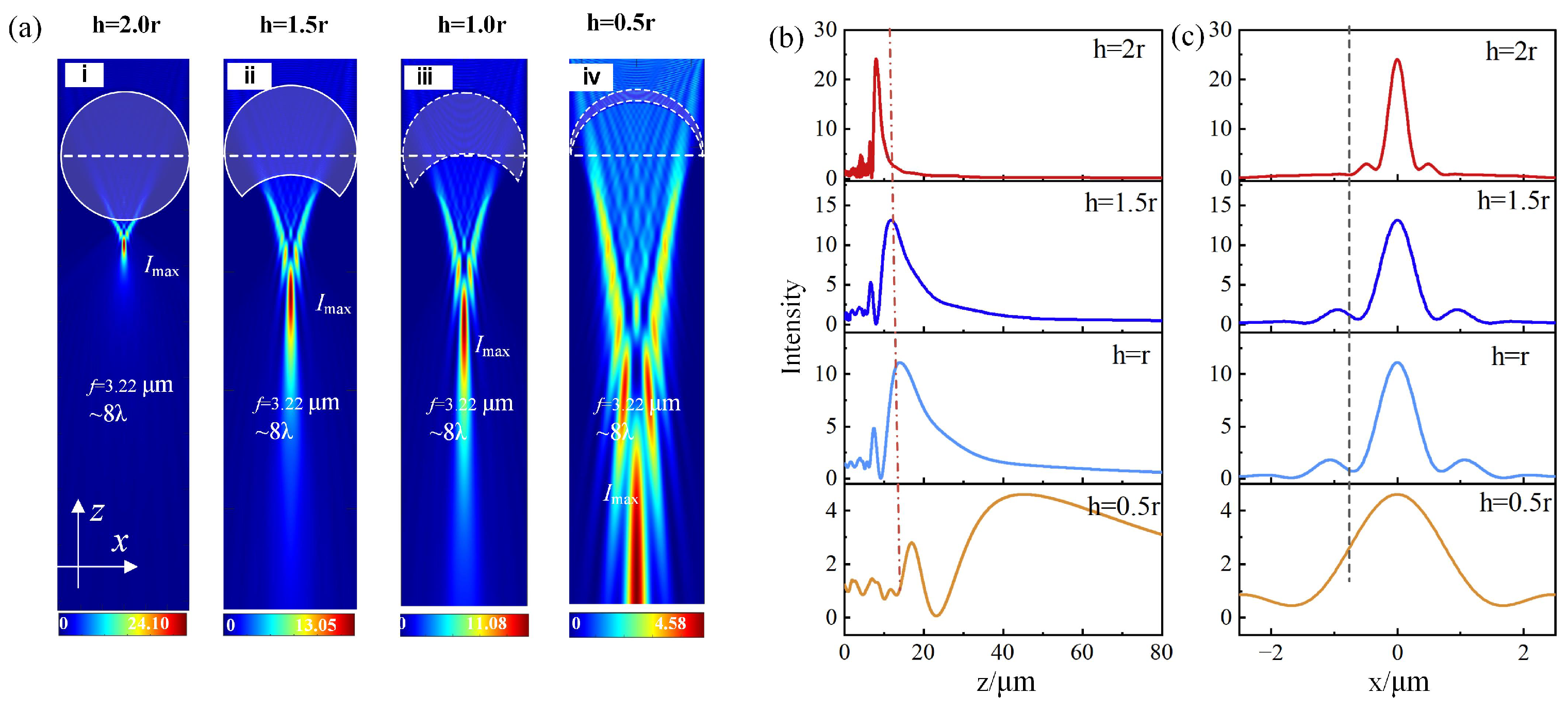
Figure 3 present the research progress on ultra-long PJs. Conventional ultra-long PJ schemes exhibit notable performance disparities. Previous research demonstrates that employing refractive-index engineering (e.g., gradient refractive index, double/multilayer, and liquid-immersed core-shell structures) and geometric-structure engineering (e.g., multi-layer optimized structures and truncated or prism interfaces) can significantly extend the effective length of PJs, from several wavelengths (as in traditional microspheres) to hundreds of wavelengths [25,44,45,46,47]. Notably, Xing et al. [28] proposed a CSTDM structure that achieved an unprecedented 209.49 λ PJs ( λ = 405 nm) in a single dielectric (fused silica) and air environment, where the optical path was controlled via geometric truncation, with the length being dynamically tunable through truncation distance h. This approach maintains material/process simplicity while significantly surpassing previous multilayer or immersion structures in terms of the PJ length; thus, it is a superior methodology for controllable ultra-long PJ generation.
First, we study the PJ characteristics generated from the curved-surface-interface Janus microcylinder under plane-wave incidence conditions to clarify the en-semic focus behavior determined based on the structural parameters. The geometric position of the surface interface can be adjusted to obtain two different jet states within the same Janus structural framework: ultra-long PJs and ultra-narrow PJs. The surface-interface Janus microcylinder is composed of two media having refractive indexes of n L and n p , separated by an arc interface having a radius of curvature of r. The overall radius of the microcylinder is denoted as r, and the relative position of the surface interface in the propagation direction is characterized by parameter h. The effective participation of the surface interface in the refraction process can be continuously adjusted by changing h, enabling the Janus microcylinder to operate in different focus states. The external medium is air, with a refractive index of n m = 1.0. Figure 3b,c illustrate the influence of the truncation distance (h) on the key characteristic parameters of the PJs: effective length L and FWHM w. We analyze three representative truncation distances, h = 0.5r, 1.0r, and 1.5r, to systematically investigate how geometric truncation modulates PJ behavior. At h = 0.5r, the PJ demonstrates excellent confinement, with an FWHM as narrow as w = 4.1 µm, while its effective length L reaches 200 µm. When h increases to r, the FWHM slightly decreases to 3.1 µm, accompanied by a PJ length reduction to 50 µm. Notably, at h = 1.5r, the corresponding effective length of the PJ L = 25 µm, but this comes at the cost of substantial FWHM broadening to 2.1 µm. In comparison, the complete microcylinder (h = 2r) produces an even narrower FWHM of 0.8 µm. The truncated structure exhibits clear tunability but reveals a fundamental performance limitation.
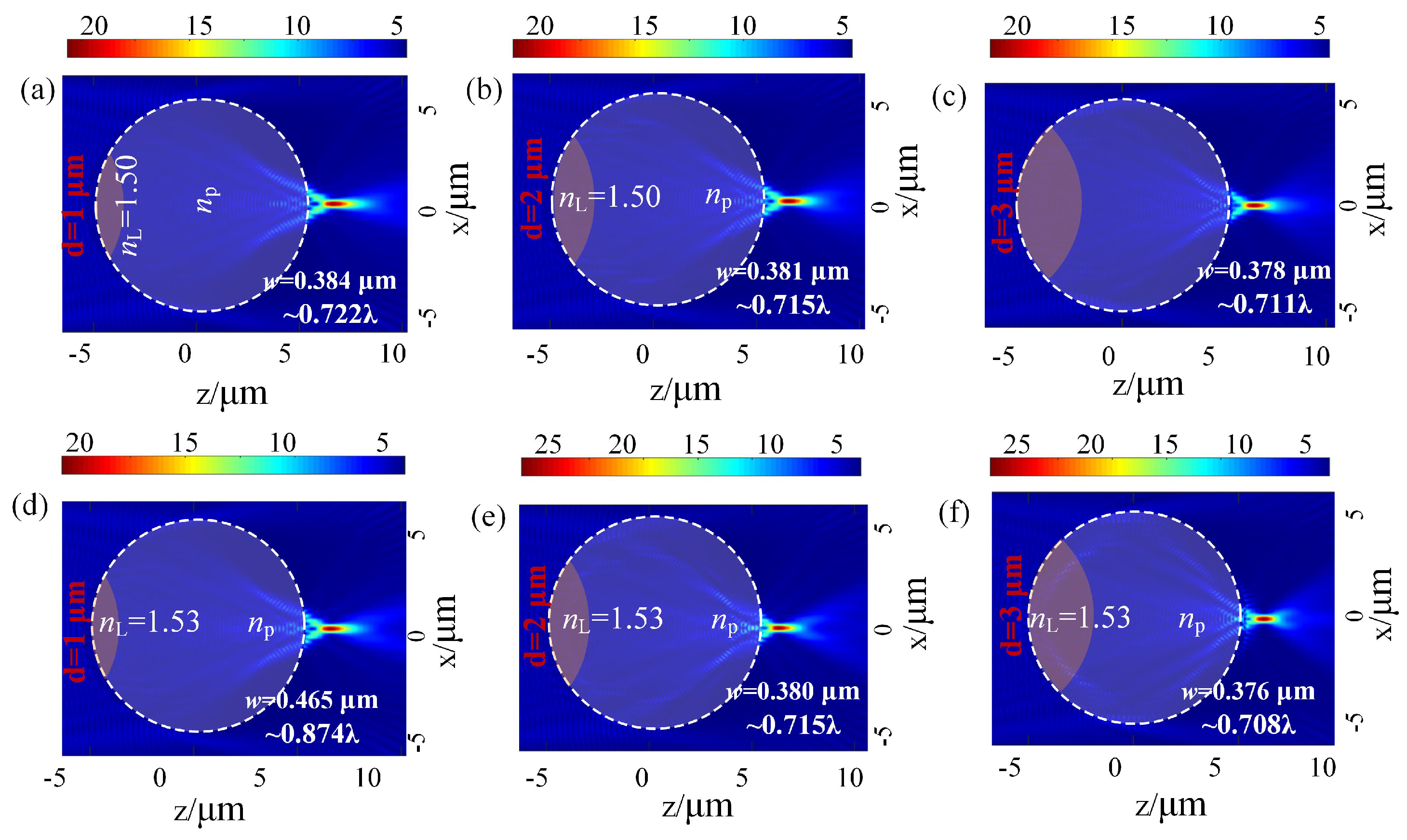
Figure 4 shows the intensity distribution of the curved-interface Janus microcylinder under plane-wave incidence in the ultra-narrow PJ regime. Figure 4a–c corresponds to the situation where the refractive index of the coating ( n L = 1.50) and the interface distance (d) are different. Figure 4d–f depicts the corresponding result for n L = 1.53. The dashed circle represents the outer boundary position of the microcylinder. The transverse-focus characteristics of ultra-narrow PJs can be quantitatively analyzed from Figure 4. For n L = 1.50, when d = 1 µm, w is 0.384 µm (∼0.722 λ ), and the incident wavelength is λ = 0.532 µm. When d = 2 and 3 µm, the FWHM values are w = 0.381 µm (∼0.715 λ ) and 0.378 µm (∼0.711 λ ), respectively. Within this parameter range, the transverse-focus size remains at the subwavelength scale with only minor variations. When n L is increased to 1.53, the transverse-focus characteristics are further enhanced. For d = 1 µm, w is 0.465 µm (∼0.874 λ ). When d = 2 and 3 µm, the FWHM is reduced to w = 0.380 µm (∼0.715 λ ) and 0.376 µm (∼0.708 λ ), respectively. Across the entire parameter range, the transverse size of the jets remains smaller than the incident wavelength, indicating stable operation in the ultra-narrow PNJ regime under plane-wave excitation.
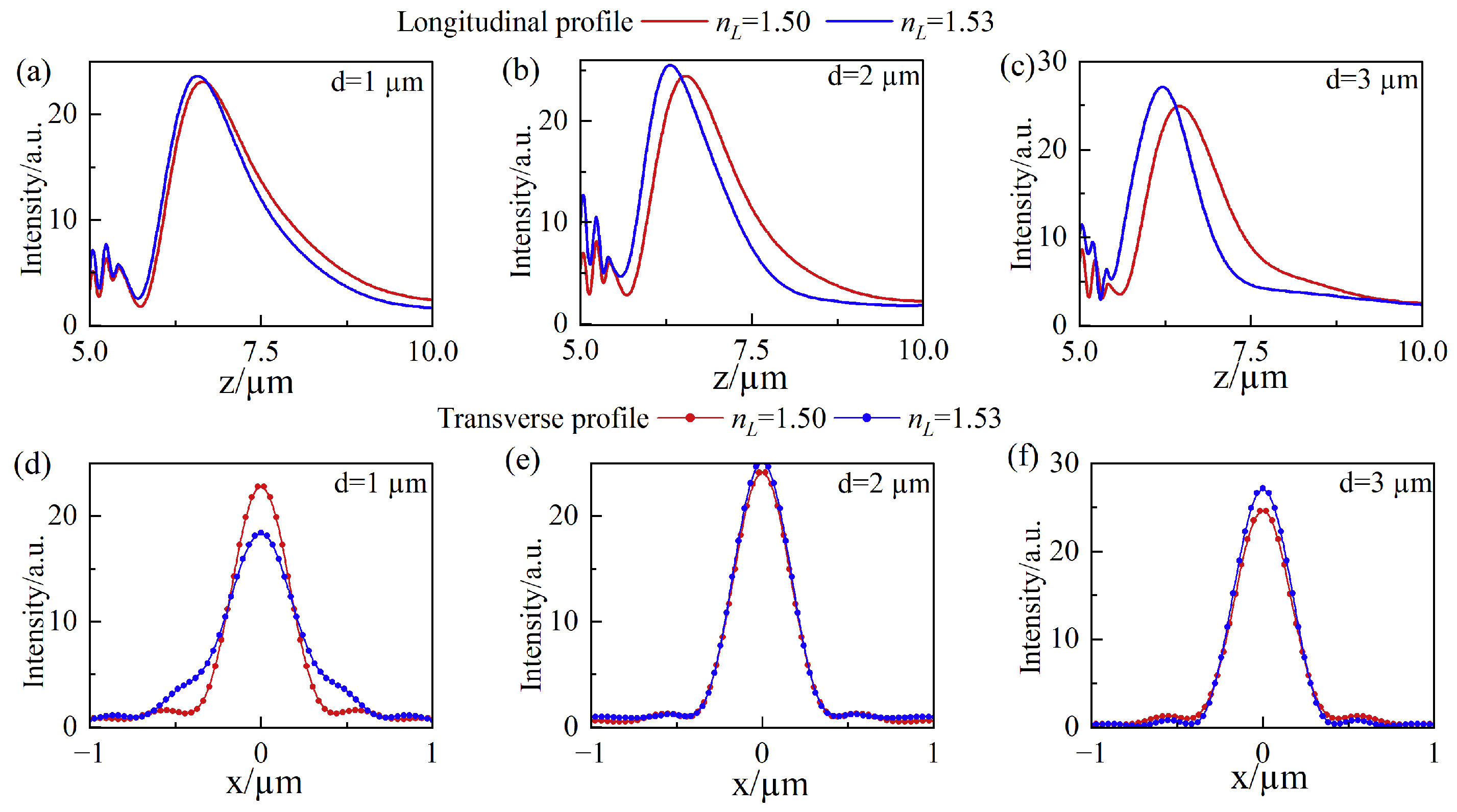
Figure 5 presents the longitudinal and transverse intensity profiles under varied conditions for the quantitative analysis of the spatial distribution of ultra-narrow PJs. Figure 5a–c displays the longitudinal intensity distribution along the propagation direction (z-axis) at interface distances of d = 1, 2, and 3 µm. Figure 5d–f shows the transverse intensity profile along the x-axis at the corresponding focal planes. In the plots, the red and blue curves represent coating refractive indices of n L = 1.50 and 1.53, respectively.
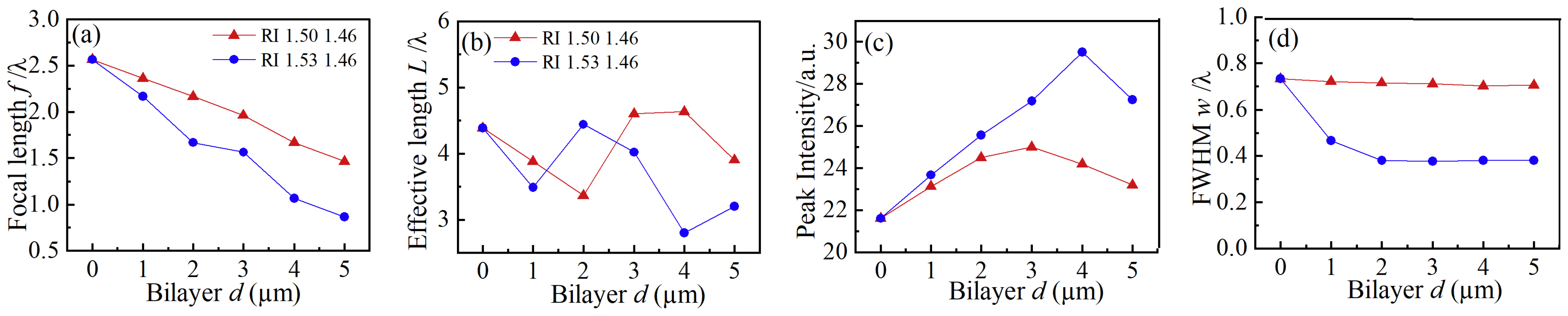
Figure 6a–d shows the evolution of PJ characteristics with various bilayer thicknesses (d) in a Janus microcylinder for two refractive-index configurations (1.50/1.46 and 1.53/1.46). The focal length (f) decreases monotonically with an increasing d for both refractive indices, as shown in Figure 6a, indicating a gradual forward shift of the focal position. The effective length (in λ ), shown in Figure 6b, exhibits non-monotonic behavior. This highlights the interplay between internal refractive index redistribution and external energy confinement. The peak intensity in Figure 6c initially increases with d, reaches a maximum, and then decreases. These results demonstrate that bilayer thickness and refractive index contrast collectively govern the focal position, energy localization, and beam confinement in Janus microcylinders.

3.2. Polarization-Tailored Ultra-Long PJs

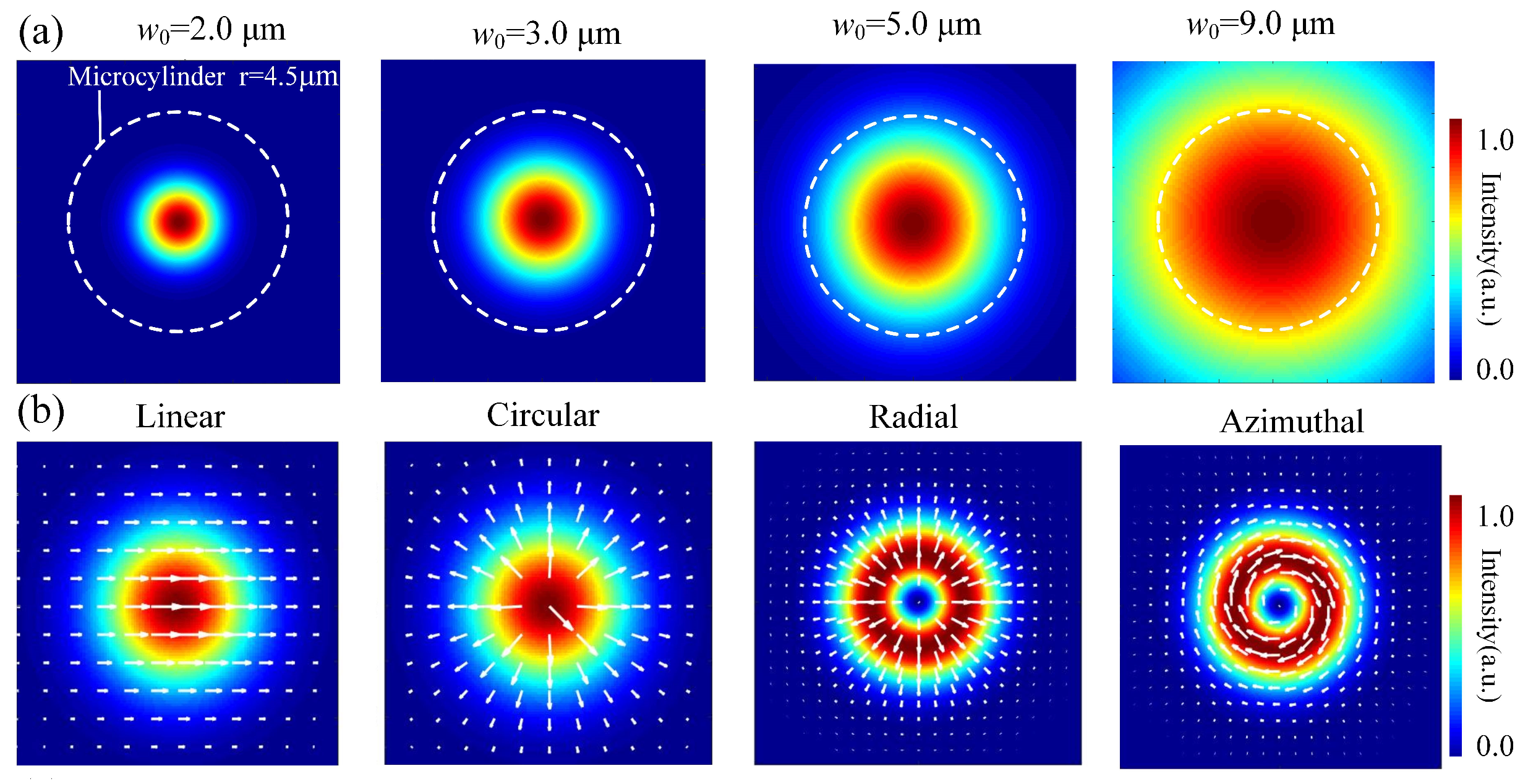
To study the influence of incident beam parameters and polarization state on the formation of PJs, Gaussian beams with different waist radii and polarization distributions are adopted as the excitation source, and their transverse intensity and polarization characteristics are shown in Figure 7. Figure 7a shows the transverse intensity distribution of the incident Gaussian beam under different waist radii ( w 0 ) of 2.0, 3.0, 5.0, and 9.0 µm, compared with the microcylinder radius of r = 4.5 µm. When the waist radius is relatively small, the incident light energy is mainly concentrated near the optical axis; with an increasing w 0 , the horizontal distribution of the beam gradually expands, approaching the uniform illumination of particles. Figure 7b shows the transverse intensity distribution of incident Gaussian beams under different polarization states and the corresponding polarization vector distribution, including four typical cases: linear polarization, circular polarization, radial polarization, and azimuthal polarization.
As mentioned previously, the formation of PJs in Janus microcylinders depends on not only structural geometry but also incident-light-field characteristics. Under Gaussian beam illumination, the beam’s spatial intensity distribution and polarization provide additional control parameters for PJ modulation. These factors directly influence the coupling of incident energy across different microcylinder regions. To quantitatively analyze the influence of incident light field distribution on PJ formation, we systematically studied the effects of the Gaussian beam waist radius and its axial position on PJ characteristics while keeping the truncated microcylinder geometry unchanged. We select Gaussian beam waist radii ( w 0 ) of 2, 3, 5, and 9 µm to represent different illumination conditions, ranging from strongly center-focused to more uniform illumination.
The following is a detailed analysis using the case of h = 1.5r as a representative example. The reason for choosing this truncation distance is that the PJ structure formed under this condition is relatively compact and stable, which is conducive to clearly revealing the specific regulatory effect of incident beam parameters on PJs under the premise of weakening the interference of strong geometric focus effect.
Under the condition of h = 1.5r, the dependence of PJ characteristics on the waist radius can be clearly observed. As the waist radius increases from 3 to 11 µm, the axial length of PJs decreases from 15.56 to 11.53 µm, and the transverse beam width decreases from 0.97 to 0.58 µm. At the same time, the maximum field strength shows a monotonous increase. This shows that the wider Gaussian beam enhances traverse field localization and intensity concentration but weakens the axial extension of the PJs. Various applications of radially polarized focused beams in high-resolution microscopy, nanoparticle manipulation, remote sensing, and material processing can be found in the literature [48,49,50].
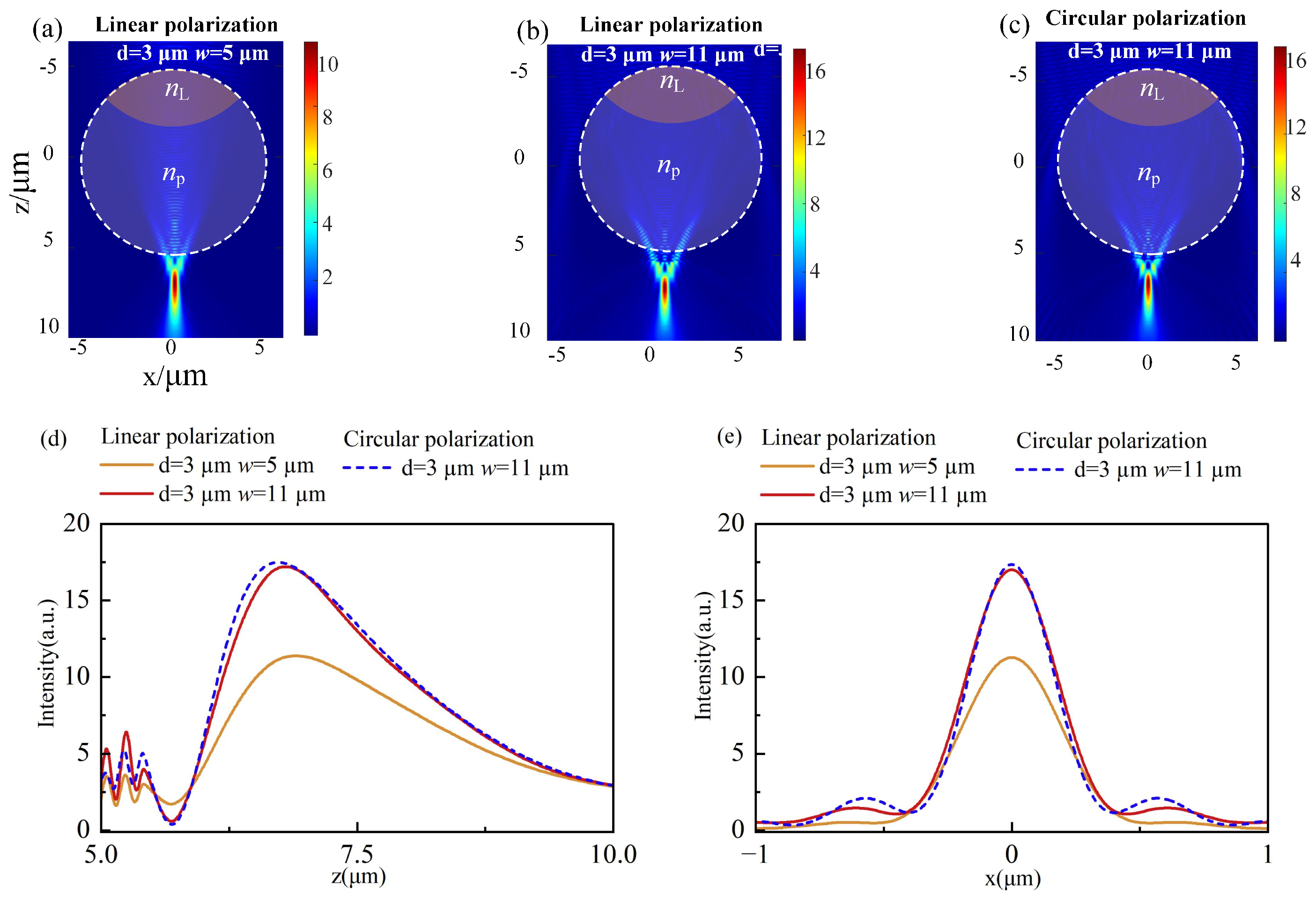
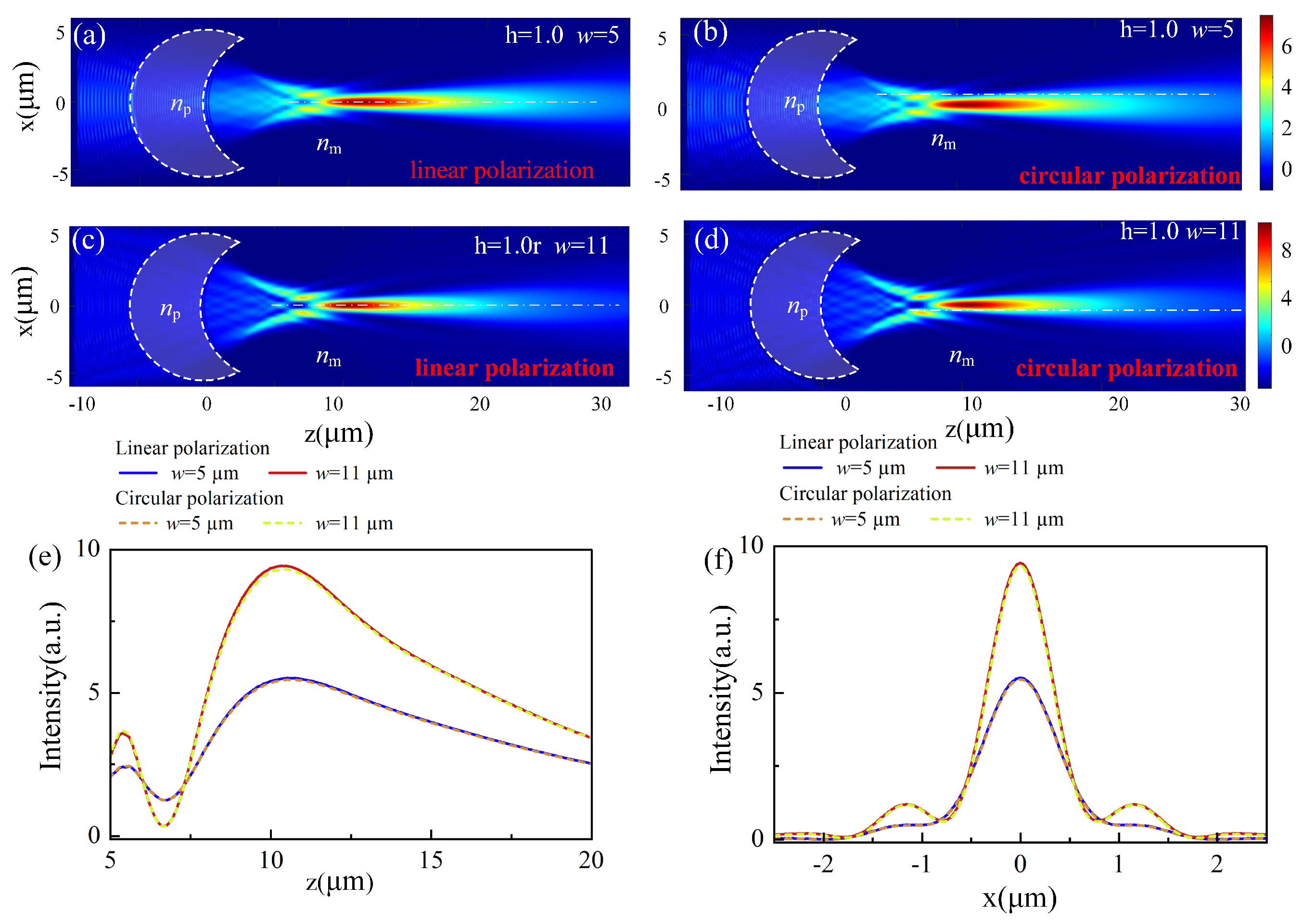
Figure 8a–d illustrate the two-dimensional intensity distribution for Janus microcylinders under various polarized Gaussian beams and beam waist widths. Figure 8a,b corresponds to w 0 = 5 µm, whereas Figure 8c,d corresponds to w 0 = 11 µm. Figure 8a,c presents linear polarization incidence, and Figure 8b,d reveals circular polarization incidence. Figure 8e shows the axial intensity profile in the direction of propagation. A larger beam waist corresponds to higher peaks and slower attenuation. Figure 8f depicts the horizontal intensity distribution at the focal plane.
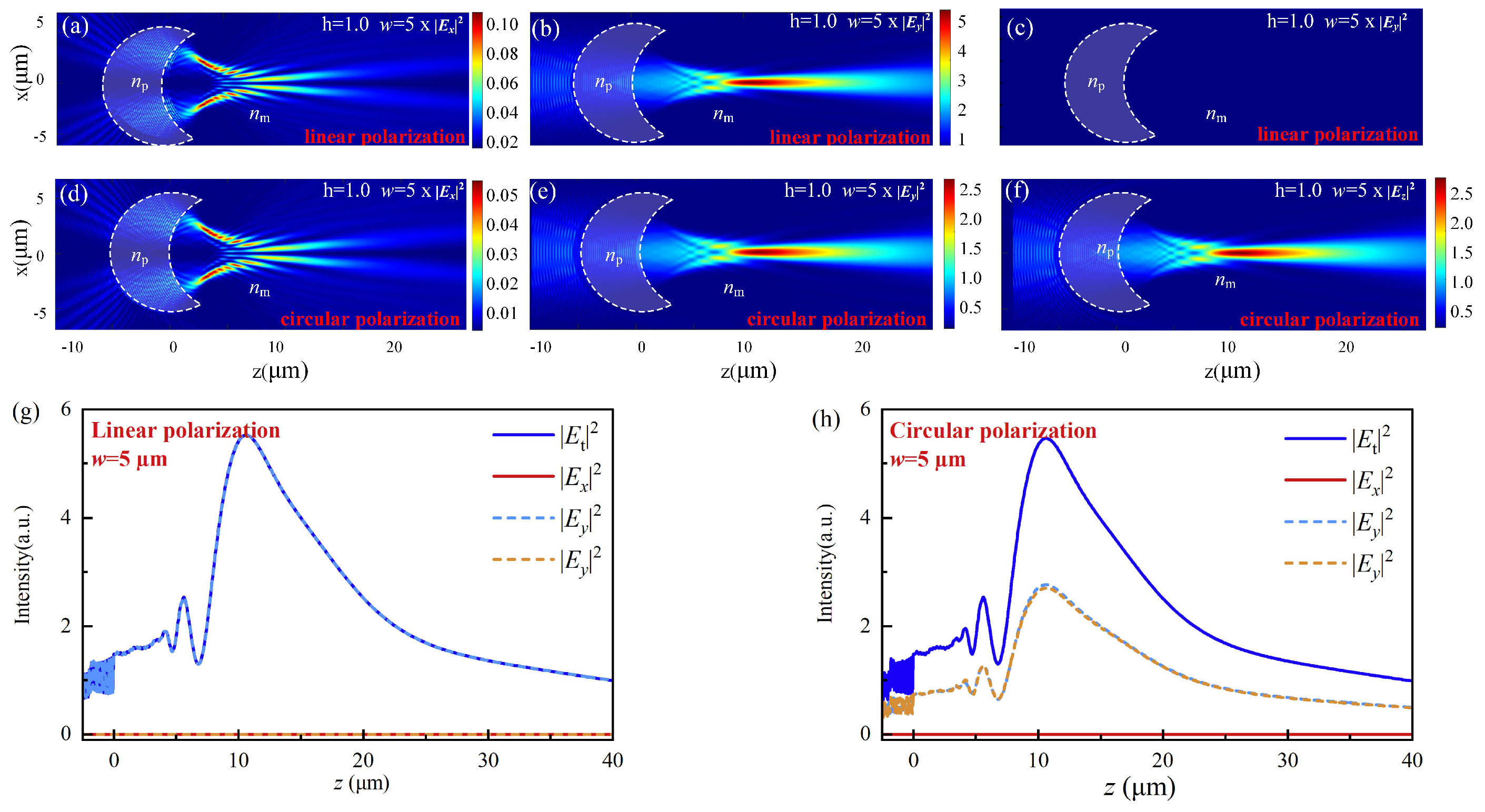
Figure 9 shows the spatial distribution of the electric-field intensity components E x 2 , E y 2 , and E z 2 inside and outside the truncated microcylinder for both linear and circular polarization at a wavelength of 5 µm. Figure 9a–c displays the results for linear polarization, and Figure 9d–f shows the results for circular polarization. For linear polarization, the total intensity E t 2 almost completely overlaps with E y 2 , confirming that the jet peak originates from the dominant transverse component aligned with the incident polarization direction. The E x 2 component remains close to zero along the axis and the E z 2 component contributes minimally. The axial peak emerges near the shadow-side boundary of the particle and gradually decays downstream. Figure 9g,h shows the axial intensity evolution of the total electric field ( E t 2 ) and its components along the propagation direction. Figure 9g corresponds to linear polarization, and Figure 9h corresponds to circular polarization. The results show that in this Janus microcylinder configuration, the PJ is primarily governed by transverse electric-field components, and the longitudinal component plays a less important role in intensity formation.

3.3. Polarization-Tailored Ultra-Narrow PJs

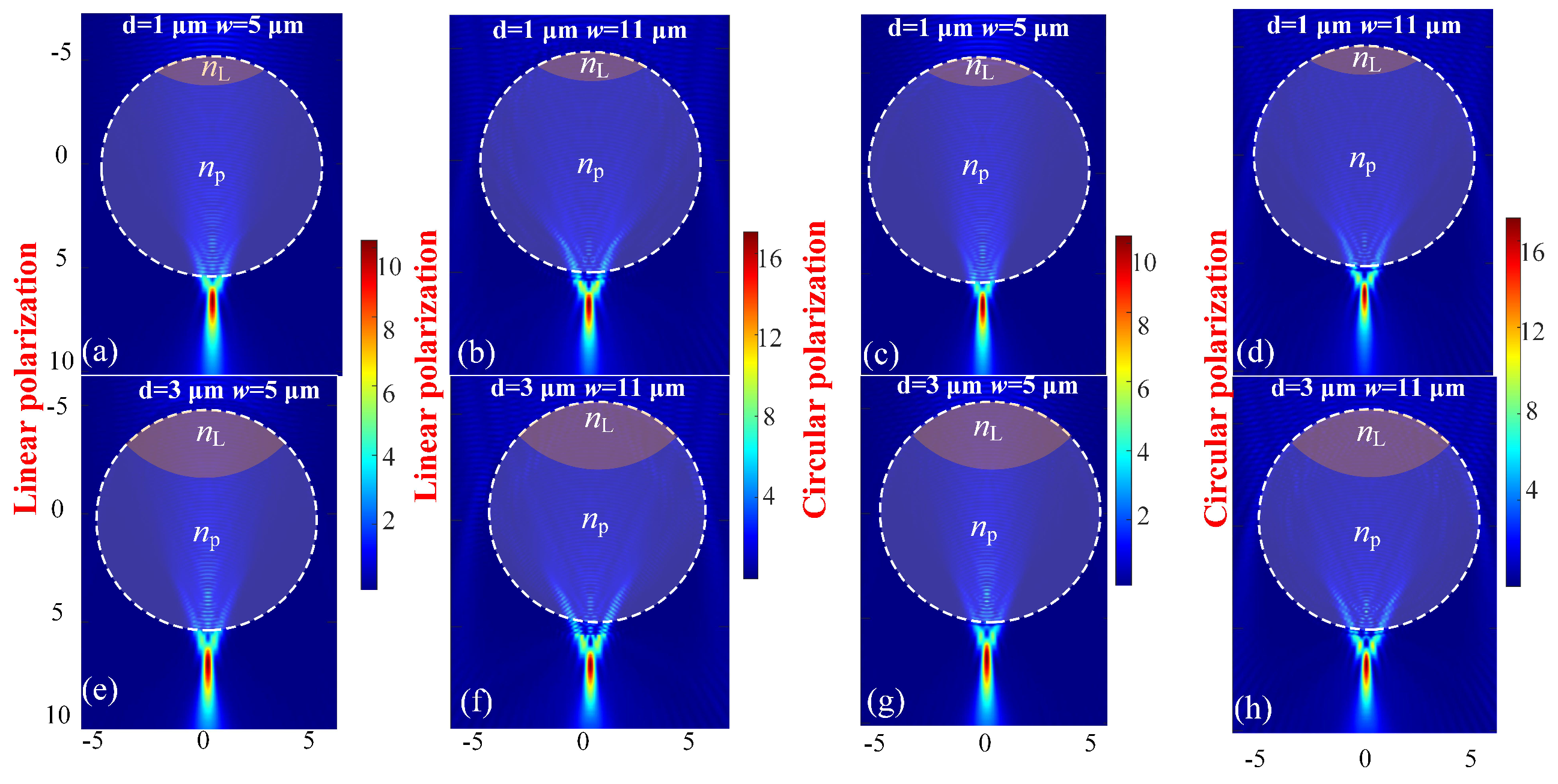
The intensity distributions of PJs generated from a Janus microcylinder with different bilayer thicknesses (d) and beam waists ( w 0 ) are presented in Figure 10 under linear and circular polarization. The top row corresponds to d = 1 µm, whereas the bottom row corresponds to d = 3 µm. The left and right halves show linear and circular polarizations, respectively. For d = 1 µm, the nanojet forms directly beneath the particle, demonstrating strong axial confinement. As the beam waist increases from w 0 = 5 µm to w 0 =11 µm, the peak intensity enhances and the nanojet elongates slightly along the propagation direction, suggesting enhanced forward energy accumulation.
Figure 11a–c show the two-dimensional intensity distribution under different beam waists and polarization states at a fixed bilayer thickness of d = 3 µm. Figure 11d,e corresponds to the axial and transverse intensity profiles, respectively. Under linear polarization, increasing the beam waist from w 0 = 5 µm to w 0 = 11 µm significantly enhances the peak intensity and improves energy concentration in the focal region. The two-dimensional distributions shows that the focus is always located near the subparticle interface. Although the axial elongation is slightly shortened, the intensity is significantly enhanced. Furthermore, the axial intensity profiles show that a larger beam waist corresponds to a higher peak intensity and a steeper ascending edge, and the decay becomes more gradual. This behavior indicates that increasing the transverse energy contribution strengthens the focus field.
Under circular polarization, the focal position remains nearly identical to that observed under linear polarization, but the horizontal distribution becomes more symmetric. For w 0 = 11 µm, the axial peak intensity under circular polarization is close to that of linear polarization. This indicates that for a large beam waist, the polarization state has a limited impact on axial energy concentration. The transverse intensity curve shows that the focal spot width changes less under circular polarization, but the side lobe structure is more symmetrical.
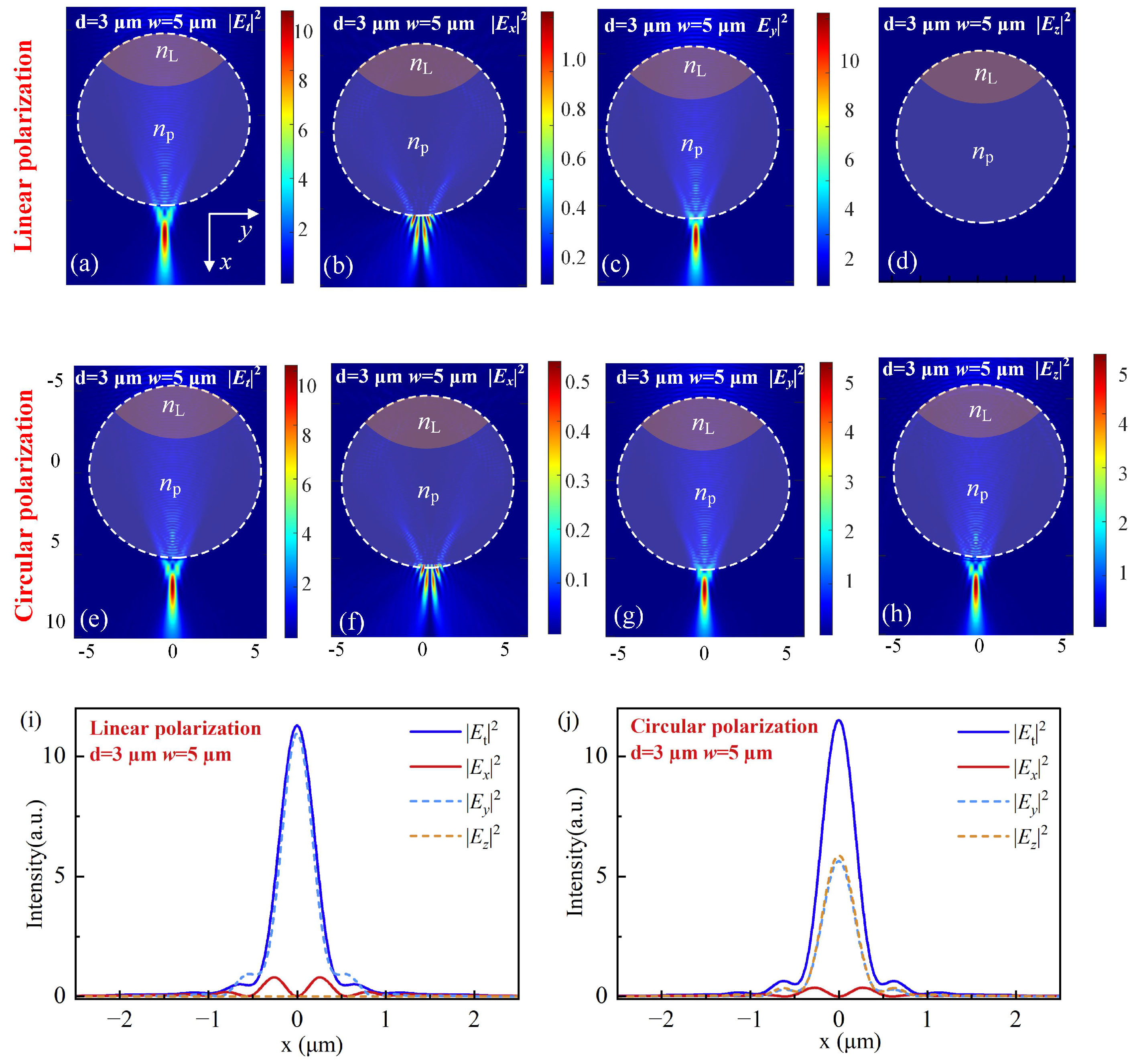
Figure 12a–h shows the spatial distributions of the total electric field intensity and its vector components for a bilayer microcylinder with d = 3 µm and w = 5 µm. The upper panels (a–d) correspond to linear polarization and the lower panels (e–h) correspond to circular polarization. Figure 12i,j shows the transverse intensity distributions along the x-axis at the focal plane for the same parameters. Panel (a) displays linear polarization, while panel (b) shows circular polarization. The solid blue curve indicates the total electric-field intensity E t 2 , whereas the red, dashed blue, and dashed orange curves represent E x 2 , E y 2 , and E z 2 , respectively.
For d = 3 µm and w 0 = 5 µm, vector field component decomposition reveals that the PJ is mainly dominated by the transverse electric field components. It can be seen from the two-dimensional intensity distribution that when online polarization is incident, the total field intensity E t 2 forms a highly confined axial nanojet under the particle. The comparison of field components shows that E y 2 and E t 2 in the focal area almost completely coincide, indicating that the focus energy mainly comes from the transverse component consistent with the direction of incident polarization. In contrast, E x 2 mainly forms local interference patterns near the particle-medium interface and has a negligible effect on the axial core. The longitudinal component E z 2 remains relatively weak and spatially limited, indicating that the axial energy concentration comes from the redistribution of the transverse fields at the interface rather than from enhancement of the longitudinal field component.

4. Discussion

The results show that the characteristics of PJs in Janus microcylinders are mainly determined by the redistribution of optical energy caused by structural asymmetry and refractive-index contrast. As indicated in Table 1, the relative contributions of the middle and edge regions significantly affect PJ behavior. When the middle region dominates, the refracted rays propagate nearly parallel to the optical axis, leading to a longer effective length and larger focal distance. In contrast, stronger edge contributions enhance focusing, resulting in higher peak intensity and smaller FWHM.
Compared with homogeneous particles, the Janus structure introduces additional degrees of freedom through internal interface engineering. Together with Gaussian-beam illumination, this configuration enables flexible control of PJ characteristics. As summarized in Table 2, the influence of polarization on ultra-long PJs is relatively small, while for ultra-narrow PJs the polarization state slightly modifies the effective length and transverse confinement due to the redistribution of transverse electric-field components.
These results indicate that combining structural interface engineering with polarization control provides an effective strategy for tuning PJ properties, which may be useful for near-field optical manipulation and high-resolution imaging applications.
From a practical perspective, the feasibility of fabricating such asymmetric multilayer dielectric structures warrants consideration. Previous studies have demonstrated that micro-scale particles with engineered geometries can be produced using established techniques. For example, isotropic full spheres and truncated particles have been experimentally validated for light focusing and nanojet-related applications, as demonstrated by Luk’yanchuk et al. [51] and Zhou et al. [52]. These findings confirm that precise micro-scale dielectric particle shaping is achievable through methods including laser processing, ion-beam milling, and lithographic structuring.
The proposed Janus bilayer microcylinder represents an extension of these fabricated geometries through internal interface engineering. Similar multilayer or Janus configurations could be realized via sequential material deposition, nanoimprint techniques, or optofluidic formation of liquid–liquid interfaces within microstructured environments. Although this study primarily examines optical-field modulation mechanisms, the structural design remains compatible with existing microfabrication approaches, suggesting practical applications in near-field imaging, beam shaping, and optical manipulation.

5. Conclusions

In this study, full-wave FDTD simulations and vector component analysis are used to systematically investigate the formation mechanism of polarization-controlled PJs at the surface interface of Janus microcylinders. By adjusting the interface position (h) and bilayer thickness (d), we continuously tune the focal length, effective length, peak intensity, and FWHM, achieving a trade-off between beam confinement and axial extension determined based on the refractive index. For Gaussian beam illumination, the beam waist and polarization state offer further control options. Increasing the beam waist enhances transverse confinement and peak intensity while reducing axial extension. Vector decomposition reveals that the jet is primarily governed by transverse electric-field components ( E x 2 , E y 2 ), with minimal contribution from the longitudinal component ( E z 2 ). Linear and circular polarizations primarily affect the transverse energy distribution, with negligible influence on the focal position. This study demonstrates the synergistic mechanism between Janus-interface engineering and polarization control, establishing a design model for tunable near-field applications, including beam shaping, imaging, optical trapping, and nanoprocessing.

Author Contributions

Conceptualization, Q.W. and Z.W.; methodology, Q.W. and Z.W.; software, Q.W.; validation, Q.W. and Z.W.; formal analysis, Q.W. and G.L.; investigation, Q.W. and Z.W.; data curation, Q.W. and Z.W.; writing—original draft preparation, Q.W.; writing—review and editing, Q.W. and and G.L.; visualization, Z.W.; supervision, Z.W.; project administration, Z.W. and G.L.; funding acquisition, Q.W. and and G.L. All authors have read and agreed to the published version of the manuscript.

Funding

This research was funded by the China Postdoctoral Science Foundation (Grant No: 2025M780793).

Data Availability Statement

The original contributions presented in this study are included in the article. Further inquiries can be directed to the corresponding authors.

Conflicts of Interest

The authors declare no conflicts of interest.

References

  1. Darafsheh, A. Photonic nanojets and their applications. J. Physics Photonics 2021, 3, 022001. [Google Scholar] [CrossRef]
  2. Chen, Z.; Taflove, A.; Backman, V. Photonic nanojet enhancement of backscattering of light by nanoparticles: A potential novel visible-light ultramicroscopy technique. Opt. Express 2004, 12, 1214–1220. [Google Scholar] [CrossRef]
  3. Astratov, V.N.; Sahel, Y.B.; Eldar, Y.C.; Huang, L.; Ozcan, A.; Zheludev, N.; Zhao, J.; Burns, Z.; Liu, Z.; Narimanov, E.; et al. Roadmap on Label-Free Super-Resolution Imaging. Laser Photon Rev. 2023, 17, 2200029. [Google Scholar] [CrossRef]
  4. Chen, L.; Zhou, Y.; Li, Y.; Hong, M. Microsphere enhanced optical imaging and patterning: From physics to applications. Appl. Phys. Rev. 2019, 6, 021304. [Google Scholar] [CrossRef]
  5. Minin, O.; Zhou, S.; Minin, I.; Renxian, L.; Jiao, Y.; Xiao, l.; Shi, Z.; Zhang, Y.; Wang, Z.; Yang, R.; et al. Photonic jet with tunable focus based on water droplets freezing from the outside in. In Nano-Optoelectronics and Micro/Nano-Photonics X; SPIE: Paris, France, 2024; p. 15. [Google Scholar]
  6. Wang, Z.; Guo, W.; Li, L.; Luk’yanchuk, B.; Khan, A.; Liu, Z.; Chen, Z.; Hong, M. Optical virtual imaging at 50 nm lateral resolution with a white-light nanoscope. Nat. Commun. 2011, 2, 218. [Google Scholar] [CrossRef]
  7. Yang, S.; Taflove, A.; Backman, V. Experimental confirmation at visible light wavelengths of the backscattering enhancement phenomenon of the photonic nanojet. Opt. Express 2011, 19, 7084–7093. [Google Scholar] [CrossRef]
  8. Münzer, H.J.; Mosbacher, M.; Bertsch, M.; Zimmermann, J.; Leiderer, P.; Boneberg, J. Local field enhancement effects for nanostructuring of surfaces. J. Microsc. 2001, 202, 129–135. [Google Scholar] [CrossRef]
  9. Muenzer, H.-J.; Mosbacher, M.; Bertsch, M.; Dubbers, O.; Burmeister, F.; Pack, A.; Wannemacher, R.; Runge, B.-U.; Baeuerle, D.; Boneberg, J.; et al. Optical near-field effects in surface nanostructuring and laser cleaning. In Second International Symposium on Laser Precision Microfabrication; SPIE: Paris, France, 2002; Volume 4426. [Google Scholar]
  10. Li, Y.; Xin, H.; Liu, X.; Zhang, Y.; Lei, H.; Li, B. Trapping and Detection of Nanoparticles and Cells Using a Parallel Photonic Nanojet Array. ACS Nano 2016, 10, 5800–5808. [Google Scholar] [CrossRef] [PubMed]
  11. Kong, S.C.; Sahakian, A.; Taflove, A.; Backman, V. Photonic nanojet-enabled optical data storage. Opt. Express 2008, 16, 13713–13719. [Google Scholar] [CrossRef]
  12. Kong, S.-C.; Sahakian, A.V.; Heifetz, A.; Taflove, A.; Backman, V. Robust detection of deeply subwavelength pits in simulated optical data-storage disks using photonic jets. Appl. Phys. Lett. 2008, 92, 211102. [Google Scholar] [CrossRef]
  13. Wang, Y.C.; Wang, X.H. Properties of photonic nanojets produced by layered semi-elliptical microcolumns. Opt. Eng. 2025, 64, 025101. [Google Scholar] [CrossRef]
  14. Liu, C.-Y. Ultra-elongated photonic nanojets generated by a graded-index microellipsoid. Prog. Electromagn. Res. Lett. 2013, 37, 153–165. [Google Scholar] [CrossRef]
  15. Minin, I.V.; Minin, O.V.; Geints, Y.E. Localized EM and photonic jets from non-spherical and non-symmetrical dielectric mesoscale objects: Brief review. Ann. Der Phys. 2015, 527, 491–497. [Google Scholar] [CrossRef]
  16. Zeng, X.; Su, N.; Zhang, W.; Ye, Z.; Wu, P.; Liu, B. Generation of Photonic Nanojet Using Gold Film Dielectric Microdisk Structure. Materials 2023, 16, 3146. [Google Scholar] [CrossRef] [PubMed]
  17. Geints, Y.E.; Zemlyanov, A.A.; Panina, E.K. Microaxicon-generated photonic nanojets. J. Opt. Soc. Am. B 2015, 32, 1570–1574. [Google Scholar] [CrossRef]
  18. Degtyarev, S.A.; Porfirev, A.P.; Khonina, S.N. Photonic nanohelix generated by a binary spiral axicon. Appl. Opt. 2016, 55, B44–B48. [Google Scholar] [CrossRef]
  19. Liu, C.-Y. Photonic jets produced by dielectric micro cuboids. Appl. Opt. 2015, 54, 8694–8699. [Google Scholar] [CrossRef]
  20. Liu, C.-Y. Superenhanced photonic nanojet by core-shell microcylinders. Phys. Lett. A 2012, 376, 1856–1860. [Google Scholar] [CrossRef]
  21. Liu, C.-Y. Tunable photonic nanojet achieved using a core–shell microcylinder with nematic liquid crystal. J. Mod. Opt. 2013, 60, 538–543. [Google Scholar] [CrossRef]
  22. Wu, P.; Li, J.; Wei, K.; Yue, W. Tunable and ultra-elongated photonic nanojet generated by a liquid-immersed core–shell dielectric microsphere. Appl. Phys. Express 2015, 8, 112001. [Google Scholar] [CrossRef]
  23. Geints, Y.E.; Panina, E.K.; Zemlyanov, A.A. Control over parameters of photonic nanojets of dielectric microspheres. Opt. Commun. 2010, 283, 4775–4781. [Google Scholar] [CrossRef]
  24. Huang, Y.; Zhen, Z.; Shen, Y.; Min, C.; Veronis, G. Optimization of photonic nanojets generated by multilayer microcylinders with a genetic algorithm. Opt. Express 2019, 27, 1310–1325. [Google Scholar] [CrossRef]
  25. Zhang, D.; Liu, Z.; Wei, G.; Hu, Z.; Xiao, J.J. Bayesian optimization of photonic nanojets generated by multilayer dielectric structures. In AOPC 2021: Micro-Optics and MOEMS; SPIE: Paris, France, 2021; Volume 12066. [Google Scholar]
  26. Chen, Y.; Wang, Y.; Zeng, X.; Pan, S.; Chen, M.; Zeng, Y.; Fu, B.; Wu, P.; Pan, M. Ultrahigh Quality Factor Photonic Nanojets Generated by Truncated Microtoroid Structures. IEEE Photonics J. 2021, 13, 2700106. [Google Scholar] [CrossRef]
  27. Liu, C.-Y. Photonic nanojet shaping of dielectric non-spherical microparticles. Phys.-Low-Dimens. Syst. Nanostruct. 2014, 64, 23–28. [Google Scholar] [CrossRef]
  28. Xing, Y.; Shu, F.; Xing, H.; Wu, Y. Dynamically tunable ultralong photonic nanojets by a curved surface truncated dielectric microcylinder. Jpn. J. Appl. Phys. 2022, 61, 022002. [Google Scholar] [CrossRef]
  29. Yue, L.; Yan, B.; Wang, Z. Photonic nanojet of cylindrical metalens assembled by hexagonally arranged nanofibers for breaking the diffraction limit. Opt. Lett. 2016, 41, 1336–1339. [Google Scholar] [CrossRef] [PubMed][Green Version]
  30. Ruiz, C.M.; Simpson, J.J. Detection of embedded ultra-subwavelength-thin dielectric features using elongated photonic nanojets. Opt. Express 2010, 18, 16805–16812. [Google Scholar] [CrossRef] [PubMed]
  31. Gu, G.; Zhou, R.; Chen, Z.; Xu, H.; Cai, G.; Cai, Z.; Hong, M. Super-long photonic nanojet generated from liquid-filled hollow microcylinder. Opt. Lett. 2015, 40, 625–628. [Google Scholar] [CrossRef]
  32. Han, L.; Han, Y.; Gouesbet, G.; Wang, J.; Gréhan, G. Photonic jet generated by spheroidal particle with Gaussian-beam illumination. J. Opt. Soc. Am. B 2014, 31, 1476–1483. [Google Scholar] [CrossRef]
  33. Wang, J.J.; Wriedt, T.; Han, Y.P.; Mädler, L.; Jiao, Y.C. Internal field distribution of a radially inhomogeneous droplet illuminated by an arbitrary shaped beam. J. Quant. Spectrosc. Radiat. Transf. 2018, 210, 19–34. [Google Scholar] [CrossRef]
  34. Huang, J.; Zhao, Y.; Yang, H.; Wang, J.; Briard, P.; Han, Y. Characteristics of photonic jets generated by a dielectric sphere illuminated by a Gaussian beam. Appl. Opt. 2020, 59, 6390–6398. [Google Scholar] [CrossRef] [PubMed]
  35. Barton, J.P. Internal and near-surface electromagnetic fields for a spheroidal particle with arbitrary illumination. Appl. Opt. 1995, 34, 5542–5551. [Google Scholar] [CrossRef] [PubMed]
  36. Barton, J.P. Internal, near-surface, and scattered electromagnetic fields for a layered spheroid with arbitrary illumination. Appl. Opt. 2001, 40, 3598–3607. [Google Scholar] [CrossRef]
  37. Gašparić, V.; Mayerhöfer, T.G.; Zopf, D.; Ristić, D.; Popp, J.; Ivanda, M. To generate a photonic nanojet outside a high refractive index microsphere illuminated by a Gaussian beam. Opt. Lett. 2022, 47, 2534–2537. [Google Scholar] [CrossRef]
  38. Luk’yanchuk, B.S.; Paniagua-Domínguez, R.; Minin, I.; Minin, O.; Wang, Z. Refractive index less than two: Photonic nanojets yesterday, today and tomorrow [Invited]. Opt. Mater. Express 2017, 7, 1820–1847. [Google Scholar] [CrossRef]
  39. Mandal, A.; Dantham, V.R. Photonic nanojets generated by single microspheres of various sizes illuminated by resonant and non-resonant focused Gaussian beams of different waists. J. Opt. Soc. Am. 2020, 37, 977–986. [Google Scholar] [CrossRef]
  40. Minin, O.V.; Cao, Y.; Minin, I.V. Future Green Technology: A Freezing Water Micro-Droplet as an Optical Switch Based on a Time-Domain Photonic Hook. Nanomaterials 2023, 13, 2168. [Google Scholar] [CrossRef]
  41. Minin, O.V.; Minin, I.V.; Cao, Y. Time domain self-bending photonic hook beam based on freezing water droplet. Sci. Rep. 2023, 13, 7732. [Google Scholar] [CrossRef] [PubMed]
  42. Gu, G.; Song, J.; Liang, H.; Zhao, M.; Chen, Y.; Qu, J. Overstepping the upper refractive index limit to form ultra-narrow photonic nanojets. Sci. Rep. 2017, 7, 5635. [Google Scholar] [CrossRef]
  43. Uenohara, T.; Mizutani, Y.; Takaya, Y. Comparison of intensity distribution of photonic nanojet according to Gaussian beam and radially polarization beam incidence. Precis. Eng. 2019, 60, 274–279. [Google Scholar] [CrossRef]
  44. Shen, Y.; Wang, L.V.; Shen, J.-T. Ultralong photonic nanojet formed by a two-layer dielectric microsphere. Opt. Lett. 2014, 39, 4120–4123. [Google Scholar] [CrossRef]
  45. Gu, G.; Shao, L.-Y.; Song, J.; Qu, J.; Zheng, K.; Shen, X.; Peng, Z.; Hu, J.; Chen, X.; Chen, M.; et al. Photonic hooks from Janus microcylinders. Opt. Express 2019, 27, 37771–37780. [Google Scholar] [CrossRef]
  46. Wang, Z.; Bai, Y.; Feng, W.; Tsubokawa, M. Tunable Ultralong Photonic Nanojets with Multilayer Dielectric Microcylinders. In Proceedings of the 2023 Light Conference, Changchun, China, 11–16 August 2023; pp. 1–4. [Google Scholar]
  47. Zhang, B.; Hao, J.; Shen, Z.; Wu, H.; Zhu, K.; Xu, J.; Ding, J. Ultralong photonic nanojet formed by dielectric microtoroid structure. Appl. Opt. 2018, 57, 8331–8337. [Google Scholar] [CrossRef]
  48. Zhan, Q. Cylindrical vector beams: From mathematical concepts to applications. Adv. Opt. Photonics 2009, 1, 1. [Google Scholar] [CrossRef]
  49. Fu, S.; Gao, C. Vector Beams and Vectorial Vortex Beams. In Optical Vortex Beams: Fundamentals and Techniques; Fu, S., Gao, C., Eds.; Springer Nature Singapore: Singapore, 2023; pp. 277–333. [Google Scholar]
  50. Maurer, C.; Jesacher, A.; Fürhapter, S.; Bernet, S.; Ritsch-Marte, M. Tailoring of arbitrary optical vector beams. New J. Phys. 2007, 9, 78. [Google Scholar] [CrossRef]
  51. Luk’yanchuk, B.; Arnold, N.; Huang, S.; Wang, Z.; Hong, M.H. Three-dimensional effects in dry laser cleaning. Appl. Phys. 2003, 77, 209–215. [Google Scholar] [CrossRef]
  52. Zhou, Y.; Ji, R.; Teng, J.; Hong, M. Ultralong light focusing via negative axicon microsphere. Eng. Res. Express 2020, 2, 015044. [Google Scholar] [CrossRef]
Figure 1. Schematic illustrating the control method for PJ intensity distribution. (a) Structural regions and key parameters of a cylindrical geometry. (b) Formation of PJs using a microcylinder, highlighting the intensity distribution in the on-axis and off-axis regions under low- and high-NA conditions. (c) Beam profiles of a Gaussian beam (top) and a radially polarized beam (bottom).
Photonics 13 00340 g001
Figure 2. Schematic of a truncated microcylinder structure illuminated by a plane wave to generate PJs.
Photonics 13 00340 g002
Figure 3. Characteristics of PJs. (a) Comparison between effective PJ lengths (L) at various h, (i)–(iv) for different truncation distances. (b) Longitudinal intensity distributions; (c)Transverse intensity profiles at various h.
Photonics 13 00340 g003
Figure 4. Photonic jet intensity distributions from a Janus bilayer microcylinder at different interface distances d. (ac) n L = 1.50, d = 1, 2, 3 µm; (df) n L = 1.53. Dashed circles mark the cylinder boundary; FWHM w and w/ λ are indicated.
Photonics 13 00340 g004
Figure 5. Longitudinal and transverse intensity profiles of PJs generated from a Janus bilayer microcylinder with different distances (d). (ac) show the longitudinal intensity distributions along the propagation direction (z-axis) for d = 1, 2, and 3 µm, respectively. (df) present corresponding transverse intensity profiles along the x-axis at the focal plane. Two refractive indices, n L = 1.50 (red curves) and n L = 1.53 (blue curves), are compared.
Photonics 13 00340 g005
Figure 6. Dependence of PJ characteristics on bilayer thickness in Janus microcylinders with different refractive indices: (a) focal distance f, (b) effective length L, (c) peak intensity I m a x , and (d) FWHM w.
Photonics 13 00340 g006
Figure 7. Influence of beam parameters and polarization states on PJ formation. (a) Intensity distributions of the incident Gaussian beam with different waist radii (2.0, 3.0, 5.0, and 9.0 µm) relative to a microcylinder of radius r = 4.5 µm. (b) Transverse intensity and corresponding polarization distributions of incident beams with linear, circular, radial, and azimuthal polarization states.
Photonics 13 00340 g007
Figure 8. Effect of polarization state on PJ formation for different beam waists. (a,b) Simulated electric-field intensity distributions generated by linearly and circularly polarized Gaussian beams with waist radius of w = 5 µm at a truncation distance of h = 1.0r. (c,d) Same as (a,b) but for a larger beam waist of w = 11 µm. (e,f) Axial and transverse intensity profiles corresponding to (ad). (e,f) Axial and transverse intensity profiles corresponding to (ad).
Photonics 13 00340 g008
Figure 9. Vector electric-field component distributions of the PJs under linear and circular polarization ( w 0 = 5 µm). (ac) E x 2 , E y 2 , and E z 2 under linear polarization; (df) E x 2 , E y 2 , and E z 2 under circular polarization. Longitudinal intensity evolution of electric-field components ( w 0 = 5 µm). (g) Linear polarization: E t 2 , E x 2 , E y 2 , and E z 2 . (h) Circular polarization: E t 2 , E x 2 , E y 2 , and E z 2 .
Photonics 13 00340 g009
Figure 10. Influence of bilayer thickness and beam waist on PJ formation under linear and circular polarizations: (a,b,e,f) linear polarization; (c,d,g,h) circular polarization.
Photonics 13 00340 g010
Figure 11. PJ characteristics with fixed bilayer thickness (d = 3 µm) under varied beam waists and polarization. (a,b) Linear polarization with w 0 = 5 µm and w 0 = 11 µm. (c) Circular polarization with w 0 = 11 µm. (d,e) Corresponding longitudinal and transverse intensity distributions.
Photonics 13 00340 g011
Figure 12. Vector electric-field component analysis of PJ formation at d = 3 µm and w 0 = 5 µm under linear and circular polarization. (ad) Linear polarization: E t 2 , E x 2 , E y 2 , and E z 2 . (ah) Circular polarization: E t 2 , E x 2 , E y 2 , and E z 2 . Transverse electric-field component distributions at the focal plane for d = 3 µm and w 0 = 5 µm under linear and circular polarization. (i) Linear polarization; (j) circular polarization. Curves represent total intensity E t 2 and component intensities E x 2 , E y 2 , and E z 2 .
Photonics 13 00340 g012
Table 1. The ratios of middle and edge in different regions correspond to the PJ characteristic parameters.
StructureComponentsEffective Length/µmFocal Distance/µmPeak Intensity/a.uFWHM/µm
η 1 Middle2.471.6319.370.41
Edge2.521.537.810.40
η 2 Middle3.531.7415.040.47
Edge2.571.537.990.39
η 3 Middle4.272.1611.440.54
Edge2.281.589.390.39
Table 2. Comparison of ultra-long and ultra-narrow PJ characteristics under different polarization.
ParametersPolarizationEffective Length/µmFocal Distance/µmPeak Intensity/a.uFWHM/µm
Ultra-long PJsLinear Polarization14.659.433.470.74
Circular Polarization14.769.313.420.73
Ultra-narrow PJsLinear Polarization3.486.8117.210.41
Circular Polarization4.556.7117.480.38
Disclaimer/Publisher’s Note: The statements, opinions and data contained in all publications are solely those of the individual author(s) and contributor(s) and not of MDPI and/or the editor(s). MDPI and/or the editor(s) disclaim responsibility for any injury to people or property resulting from any ideas, methods, instructions or products referred to in the content.