Article

Photoluminescence Enhancement from Semiconductor Quantum Dot/Polymer Composite Thin Films Using Ag Films


1
Department of Physics and Electronics, Osaka Metropolitan University, Osaka 599-8531, Japan
2
Equipment Sharing Center for Advanced Research and Innovation, Osaka Metropolitan University, Osaka 599-8531, Japan
*
Author to whom correspondence should be addressed.
Photonics 2026, 13(3), 299; https://doi.org/10.3390/photonics13030299
Submission received: 29 January 2026 / Revised: 13 March 2026 / Accepted: 17 March 2026 / Published: 19 March 2026
(This article belongs to the Special Issue Plasmonics for Advanced Photonic Applications)

Abstract

Semiconductor quantum dots (QDs) are attractive materials for light-emitting devices, and the photoluminescence (PL) from QDs can be enhanced near a metal surface due to surface plasmon (SP) resonance. To integrate QDs into metal structures, QD/poly(methyl methacrylate) (PMMA) composite thin films are generally used. However, it has been reported that QDs tend to aggregate in the PMMA matrix. In this study, we fabricated two types of QD/polymer composite thin films with different degrees of QD aggregation by additionally using poly(methyl methacrylate-co-methacrylic acid) (PMMA-co-MA), which is known to prevent QD aggregation. Furthermore, these two types of films were fabricated on Ag films, with the distance between the Ag films and the QDs controlled by Al2O3 spacer layers, and the PL enhancement was compared between the two film types. Finally, we reveal that QD aggregation in the polymer matrix significantly affects the PL enhancement. Although the aggregation trends differed between PMMA and PMMA-co-MA, the results suggest a possible increase in the internal quantum efficiency (IQE) in both film types.

1. Introduction

Semiconductor quantum dots (QDs) are promising light sources with distinct properties, such as wavelength controllability, narrow emission bandwidth, and high quantum yield [1,2,3,4,5,6]. Due to these advantageous features, QDs are expected to be applied to light-emitting devices such as displays [7,8]. On the other hand, surface plasmons (SPs) are known as a means of modifying the photoluminescence (PL) from light-emitting materials [9,10,11,12,13,14]. Some studies on SPs have shown that the properties of SPs can be controlled by the shape and type of metal [15,16,17,18], and that these properties directly affect the PL enhancement of QDs. However, the mechanism of this enhancement depends not only on the SP properties but also on the position of the QDs, as it involves both SP-induced PL enhancement [19] and PL quenching by Förster resonance energy transfer (FRET) [20,21].
For instance, Kim et al. prepared a multilayer structure consisting of a monolayer of Au nanoparticles (NPs), a monolayer of CdSe QDs, and a polyelectrolyte multilayer between the former two layers [22]. The distance between the CdSe QDs and the Au NPs was precisely controlled by the number of polyelectrolyte multilayers, and they revealed that the PL enhancement ratio of the CdSe QDs strongly depended on the distance from the Au NPs [22]. Takekuma et al. also fabricated a multilayer structure of CdSe/ZnS QD films on a gold substrate and showed the relationship between the number of CdSe/ZnS QD layers and the PL enhancement ratio of CdSe/ZnS QDs [23]. That study demonstrates that a high-refractive-index QD film functions as a metamaterial optical resonator [23]. Furthermore, Maoz et al. optimized SP resonance and avoided quenching caused via FRET by controlling the separation distance between CdSe/CdS QDs and Au NPs [24].
In some studies, QD/poly(methyl methacrylate) (PMMA) composite thin films are suggested as a way to incorporate QDs into complex metal structures, because PMMA provides high transparency and stability, and can also be fabricated on surfaces with high-aspect-ratio features [18,24,25,26,27]. It is also advantageous that its optical and electrical properties can be controlled by the concentration of QDs in the PMMA films [28]. However, it has been reported that QDs tend to aggregate in QD/PMMA composite thin films [29,30]. Such aggregation can be alleviated by using a PMMA-based copolymer containing carboxylic acid groups [29,30]. Tamborra et al. clearly showed, using TEM and SEM images, that CdSe/ZnS QDs embedded in a poly(methyl methacrylate-co-methacrylic acid) (PMMA-co-MA) matrix and a poly(methyl methacrylate-co-2-(dimethylamino)ethyl methacrylate) (PMMA-co-DMAEMA) matrix did not aggregate, and they argued that this is because the additional moieties of the copolymers are able to coordinate with the surfaces of the QDs [29]. Furthermore, Reitinger et al. also showed that CdSe/ZnS QDs embedded in a poly(methyl methacrylate-co-acrylic acid) (PMMA-co-AA) matrix did not aggregate, and they investigated the optical properties [30]. Compared with CdSe/ZnS QD/PMMA-co-AA composite thin films, a redshift of the PL peak energy and the emergence of wavelength dependence in the PL lifetime were observed in CdSe/ZnS QD/PMMA composite thin films, because QDs are closer to each other in the PMMA matrix than in the PMMA-co-AA matrix [30].
Considering that the PL enhancement of QDs is strongly influenced by the distance between the QDs and the metal surface, it is possible that aggregation affects the PL enhancement due to variations in the separation distance from the metal surface. However, this effect has not been systematically investigated in studies where QD/polymer composite thin films are fabricated on metal structures. Therefore, in this study, we fabricated two types of CdSe/ZnS QD/PMMA (hereinafter referred to as Type I) and CdSe/ZnS QD/PMMA-co-MA (hereinafter referred to as Type II) composite thin films. We then show that there is a difference in the PL properties between these films due to differences in the degree of QD aggregation. Finally, these films were fabricated on Ag films, with the distance between the Ag films and the QDs controlled by Al2O3 spacer layers, revealing differences in PL enhancement arising from their different interactions with propagating SP resonance.

2. Experimental Section

2.1. Fabrication of QD/Polymer Composite Thin Films on Sapphire Substrates

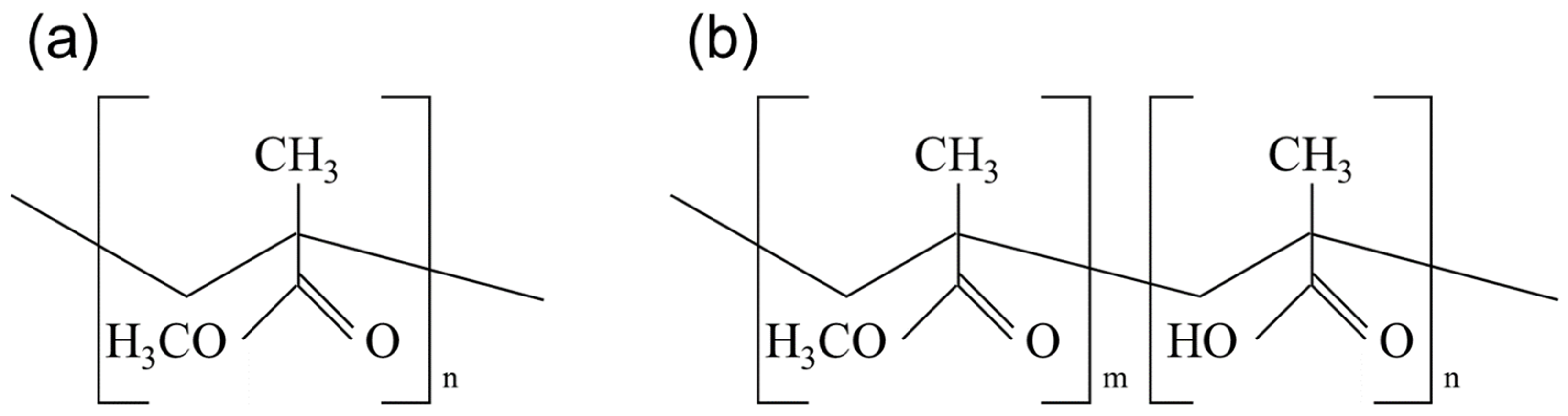
The chemical structures of two types of polymers, PMMA (KISHIDA CHEMICAL Co., Ltd., Osaka, Japan) and PMMA-co-MA (Sigma-Aldrich Co. LLC, St. Louis, MO, USA), are shown in Figure 1a,b. CdSe/ZnS QDs (Sigma-Aldrich Co. LLC, St. Louis, MO, USA) with a PL peak wavelength of approximately 510 nm and octadecylamine ligands were used. The QDs and the polymer (PMMA or PMMA-co-MA) were dissolved in n-butyl acetate (n-BA) (KISHIDA CHEMICAL Co., Ltd., Osaka, Japan) at concentrations of 0.025 wt.% and 0.5 wt.%, respectively, and stirred for a sufficient period of time. QD/polymer (PMMA or PMMA-co-MA) composite thin films on sapphire substrates were fabricated by spin coating. The substrates were cut into 1 cm × 1 cm pieces and ultrasonically cleaned in acetone for 5 min, followed by rinsing with ethanol. A 40 μL aliquot of the QD/polymer composite solution was dropped onto the substrates, and the samples were initially spread over the surface at 200 rpm for 30 s, and then spin-coated at 1000 rpm for 90 s. The coated samples were subsequently dried.

2.2. Fabrication of QD/Polymer Composite Thin Films on Ag Films Without Al2O3 Spacer Layers

An Ag layer with a thickness of 50 nm was deposited on each cleaned sapphire substrate by resistive thermal evaporation (SVC-700TM, Sanyu Electron Co., Ltd., Tokyo, Japan) at a rate of about 1.0 Å/s. After Ag deposition, QD/polymer (PMMA or PMMA-co-MA) composite thin films were spin-coated over the entire substrate at rotation speeds of 1000, 3000, or 5000 rpm for 90 s. The PL intensity was compared with that of a reference sample consisting of QD/polymer thin films formed on a sapphire substrate.

2.3. Fabrication of QD/Polymer Composite Thin Films on Ag Films with Al2O3 Spacer Layers

Samples with a 50 nm Ag layer deposited on a sapphire substrate were prepared following the procedure described in Section 2.2. Then, Al2O3 spacer layers with various thicknesses (ranging from 0 to 16 nm in steps of 2 nm) were deposited over the entire substrate by atomic layer deposition (ALD) (SAL1000, SUGA Co., Ltd., Hokkaido, Japan). Since the growth per cycle in ALD is nearly constant, the film thickness was controlled by adjusting the number of deposition cycles. QD/polymer composite thin films were subsequently spin-coated at 5000 rpm for 90 s. The PL intensity was compared with that of a reference sample consisting of QD/polymer thin films formed on a sapphire substrate.

2.4. Observations and Measurements

The sample surfaces were characterized using atomic force microscopy (AFM) (Nano Wizard, Bruker Japan K.K., Tokyo, Japan). The AFM images were obtained from samples spin-coated at 3000 rpm or 5000 rpm, as these conditions yielded smoother and more uniform films suitable for AFM observation, whereas films prepared at 1000 rpm were thicker and more inhomogeneous. The scan area was set to 2 µm × 2 µm.
The PL mappings were measured at room temperature using a fluorescence microscope (BX51TRF, OLYMPUS CORPORATION, Tokyo, Japan) with a mercury lamp and an excitation filter (390–410 nm). The detailed setup has been published in our previous work [23,31]. The size of the scanned area of the motorized stage of the fluorescence microscope was 5 mm × 5 mm, and PL spectra were obtained for each pixel (250 μm × 250 μm) using a multichannel spectrometer (SpectraPro 2300i, Roper Scientific GmbH (now Teledyne Princeton Instruments), Planegg, Germany) and a CCD camera (PIXIS 100B-3, Roper Scientific GmbH (now Teledyne Princeton Instruments), Planegg, Germany).
The PL spectra were also measured at room temperature using a He-Cd laser (IK3202R-D, Kimmon Koha Co., Ltd., Tokyo, Japan) with a wavelength of 325 nm and a power of 200 mW as the excitation source. This measurement setup was used specifically to evaluate PL enhancement, separately from the PL mapping measurements.
An InGaN pulsed laser (PLP-10, Hamamatsu Photonics K.K., Shizuoka, Japan) with a wavelength of 409 nm, a peak power of 117.5 mW, a pulse duration of 76.8 ps, and a repetition rate of 10 MHz was used for excitation, and time-resolved PL (TRPL) measurements were performed using a photomultiplier tube and a time-correlated single-photon counter (PicoHarp 300, PicoQuant GmbH, Berlin, Germany). The light emission from the sample caused by laser excitation was focused by two plano-convex lenses. To eliminate the excitation light, a long-pass filter that transmits only light beyond 420 nm was incorporated into the optical system, together with a neutral density (ND) filter to adjust the light intensity to an appropriate level. Furthermore, the measurements were performed in an environment in which external light was minimized.

3. Results and Discussion

3.1. QD/Polymer Composite Thin Films on Sapphire Substrates

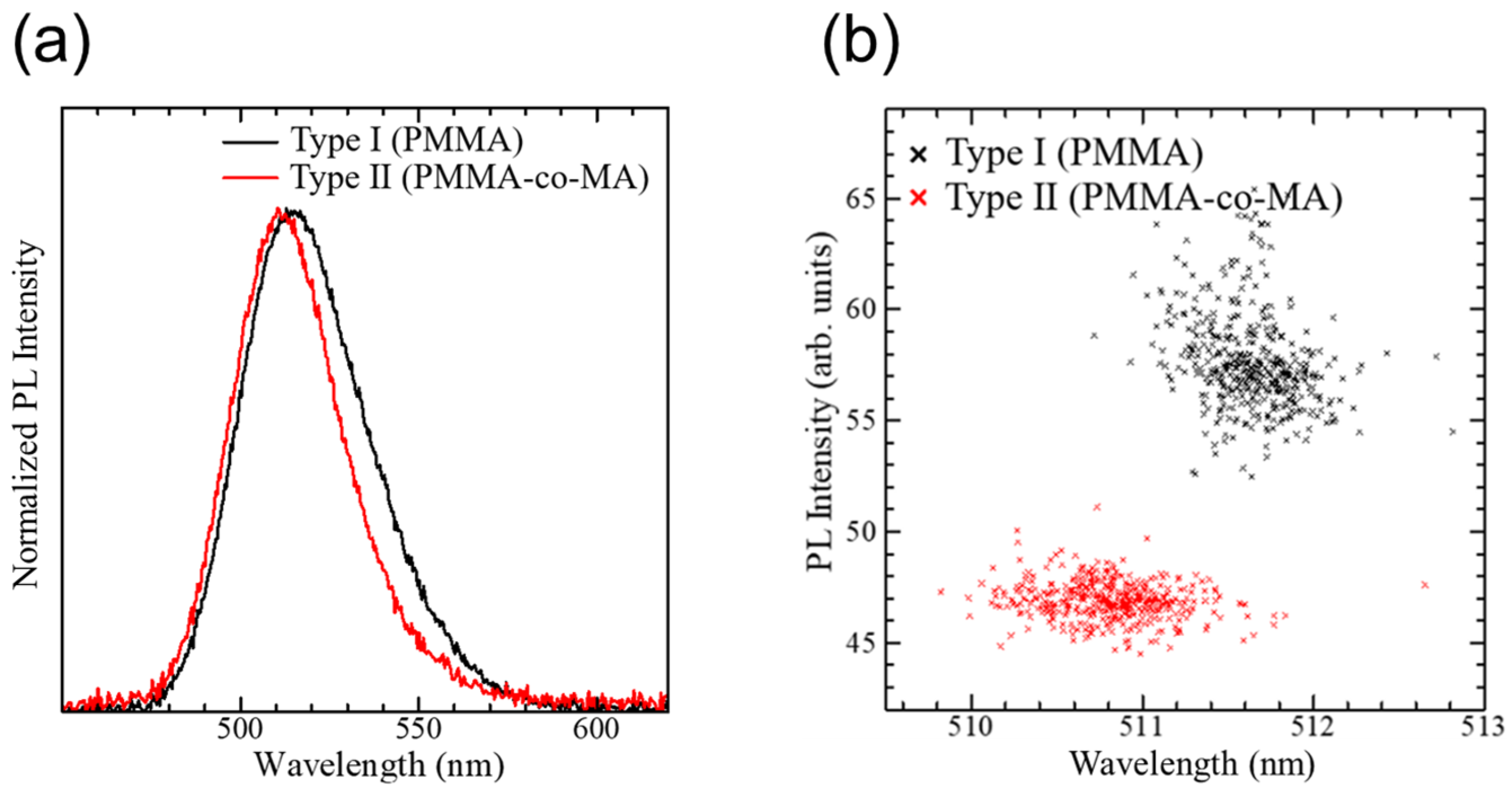
Type I and Type II thin films were prepared on sapphire substrates, and their optical properties revealed different degrees of QD aggregation in the two films. Figure 2a shows the normalized PL spectra, and Figure 2b shows plots of the PL mapping illustrating the relationship between the PL peak wavelength and PL intensity for Type I and Type II, respectively. The PL peak wavelength of Type I was longer than that of Type II. This redshift was attributed to FRET [20,29,30]. In Type I, QDs were more closely spaced, allowing higher-energy excitons in smaller QDs to transfer efficiently to larger QDs. As a result, the PL from larger QDs, which emit at longer wavelengths, was enhanced. On the other hand, in Type II, the PL peak wavelength was shorter, and the spectral width was narrower, as the effect of FRET was mitigated. Furthermore, it can be seen that the distribution range of the Type II PL intensity was narrower. This was attributed to the suppression of QD aggregation, resulting in a more uniform distribution of the QDs and a reduction in the spatial variation of the PL intensity.
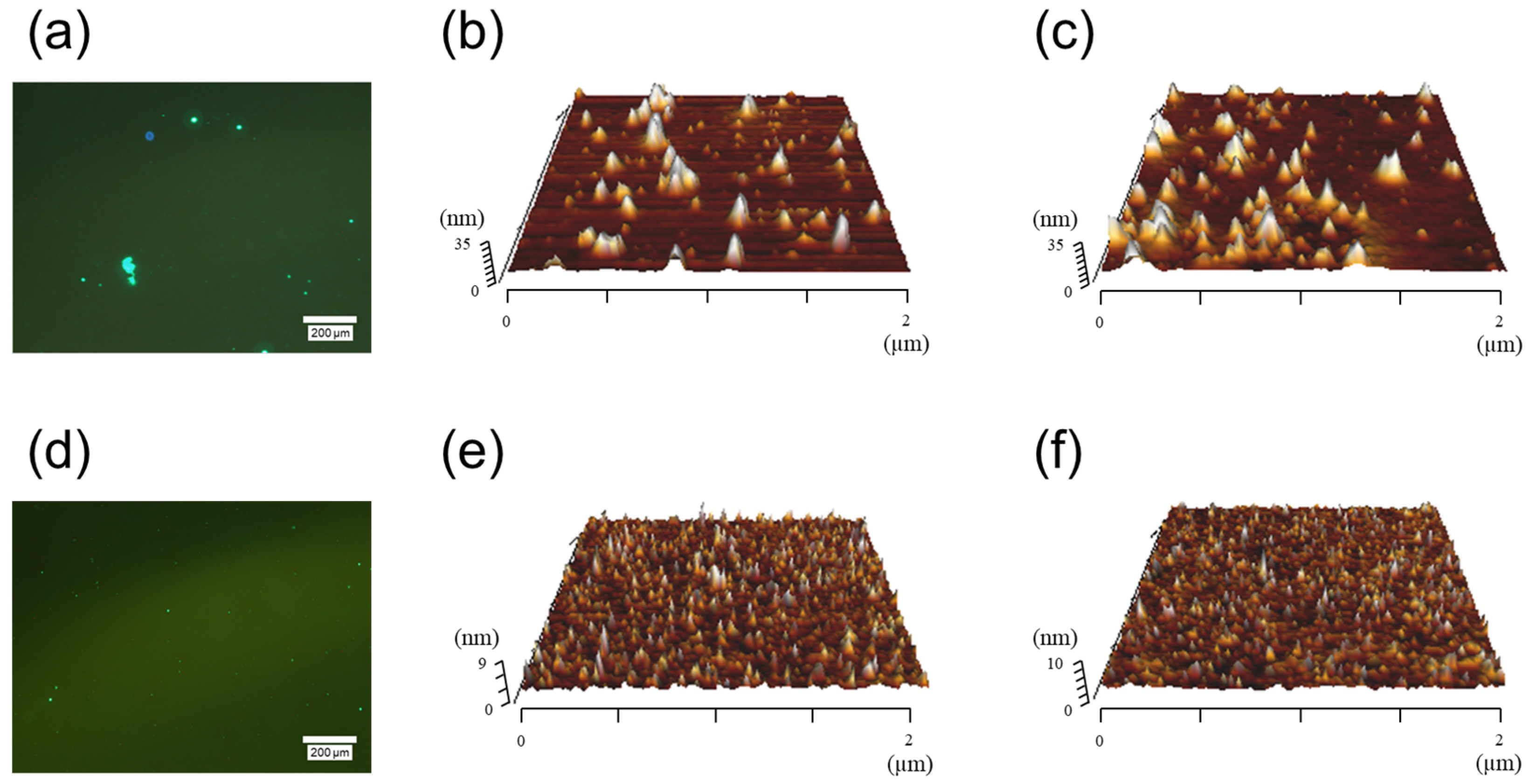
By acquiring fluorescence microscope images and AFM images, the difference in QD distribution between Type I and Type II was visually evident. The fluorescence microscope image in Figure 3a shows larger aggregates in Type I, whereas Type II exhibits a uniformly green emission overall as shown in Figure 3d. Furthermore, the AFM image in Figure 3b,c shows large protrusions in Type I due to QD aggregation, whereas Type II exhibits an overall flat surface morphology as shown in Figure 3e,f.
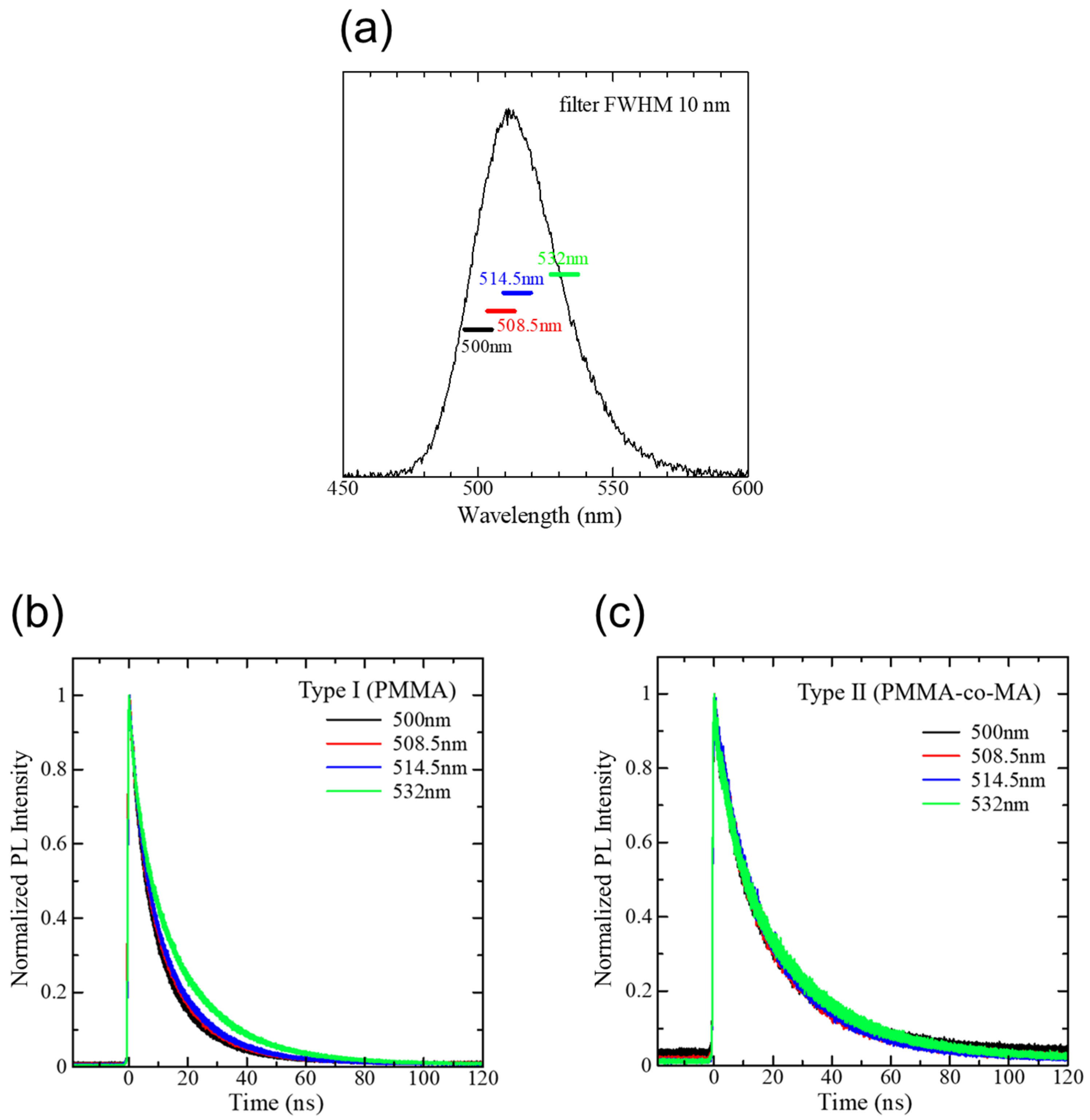
Specific emission wavelengths were selectively detected using band-pass filters, and TRPL measurements were performed at each emission wavelength. The band-pass filters used had a full width at half maximum (FWHM) of 10 nm and center wavelengths of 500 nm, 508.5 nm, 514.5 nm, and 532 nm. Their relative positions with respect to the emission spectrum are shown in Figure 4a. The TRPL profiles for Type I and Type II are shown in Figure 4b and Figure 4c, respectively. In Type II, where the QDs were dispersed, no wavelength dependence of the time-resolved emission was observed. In contrast, in Type I, where the QDs were aggregated, a clear wavelength dependence was observed. Moreover, the emission at higher energies became faster, while the emission at lower energies became slower. This was attributed to energy transfer from high-energy QDs to low-energy QDs via FRET. In addition to aggregation effects, differences in QD/polymer interfacial interactions and surface passivation between the two polymers may also influence non-radiative recombination pathways.

3.2. QD/Polymer Composite Thin Films on Ag Films Without Al2O3 Spacer Layers

The thickness of the QD/polymer composite thin films was controlled by adjusting the spin-coating speed and evaluated for uniform Type II samples using AFM step-height measurements on the Ag/QD/polymer samples, from which the 50 nm Ag thickness was subtracted to obtain the polymer layer thickness. The resulting thicknesses were approximately 25 nm at 1000 rpm, and about 20 nm at both 3000 and 5000 rpm. Although a higher spin speed (5000 rpm) would normally be expected to produce a thinner film than 3000 rpm, the measured thicknesses were similar. This discrepancy can be attributed to variations in the Ag layer thickness due to the position of the samples within the resistive thermal evaporation chamber during deposition. These thickness values are sufficiently larger than the QD diameter, ensuring that the QDs are embedded within the polymer matrix.
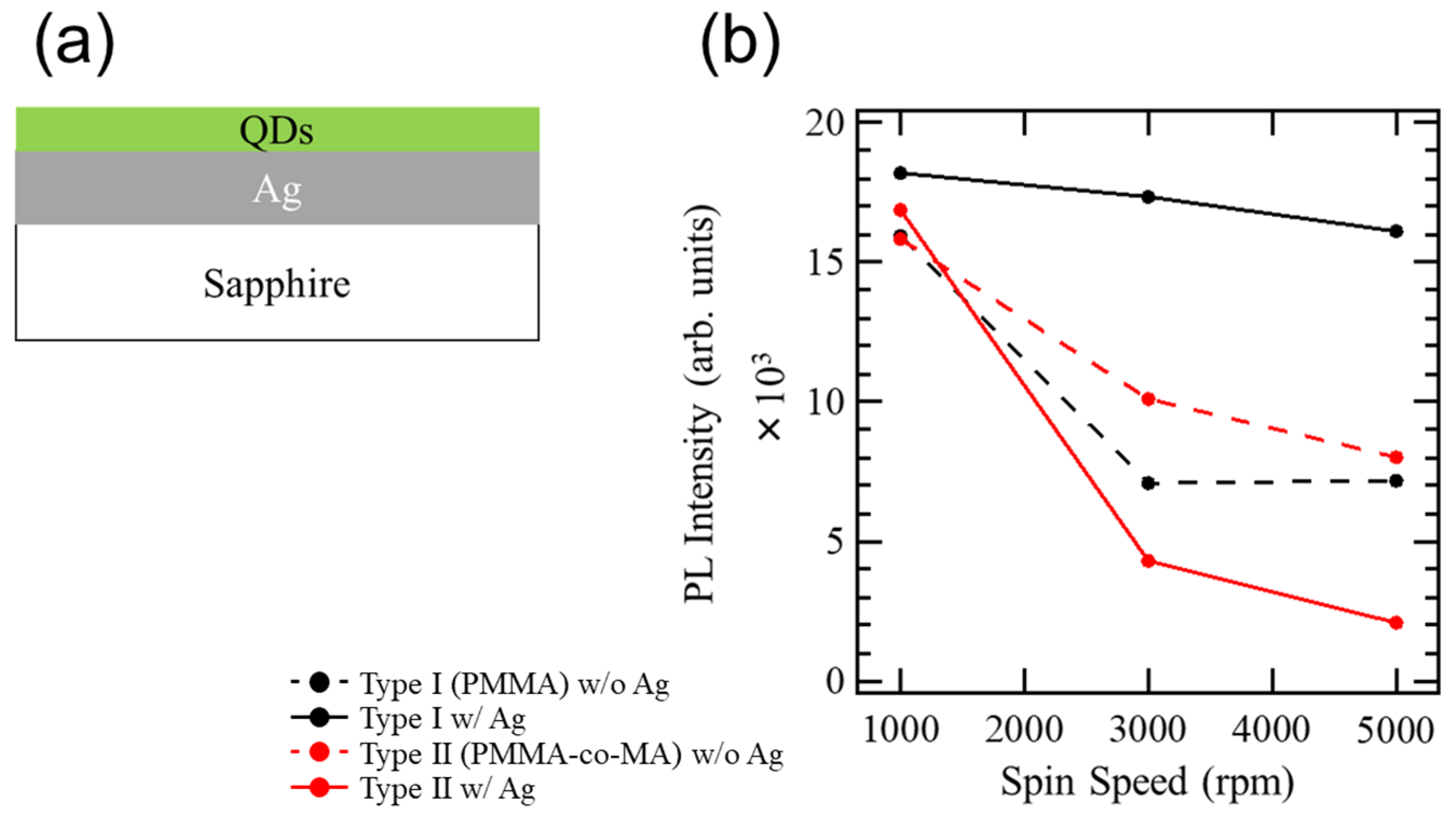
To simultaneously investigate the effects of PL enhancement by propagating SP resonance and PL quenching by FRET, Type I and Type II films were fabricated on 50 nm thick Ag films at spin speeds of 1000, 3000, and 5000 rpm, respectively. Figure 5a shows a cross-sectional view of the samples, and Figure 5b shows the relationship between the spin speeds and PL intensity. As shown in Figure 5b, the Ag films tended to cause quenching in Type II but enhancement in Type I. This difference was attributed to variations in the average distance between the QDs and the Ag films, which depended on the presence or absence of aggregates. As suggested by the AFM observations, the effective distribution of QDs relative to the Ag film may differ between Type I and Type II. In regions extremely close to the Ag films, the emission intensity decreased due to FRET to the Ag films [20,21], which was thought to be the cause of the reduced enhancement in Type II. In Type I, QDs could exist even far from the Ag films, and these were considered to contribute to the enhancement. In addition, the high reflectivity of the Ag films also contributes to the observed PL enhancement. The Ag films can act as a mirror, reflecting both excitation and emission light, thereby increasing the effective optical path length and the detected PL intensity. Therefore, part of the observed enhancement may originate from such optical interference or mirror effects in addition to SP resonance.

3.3. QD/Polymer Composite Thin Films on Ag Films with Al2O3 Spacer Layers

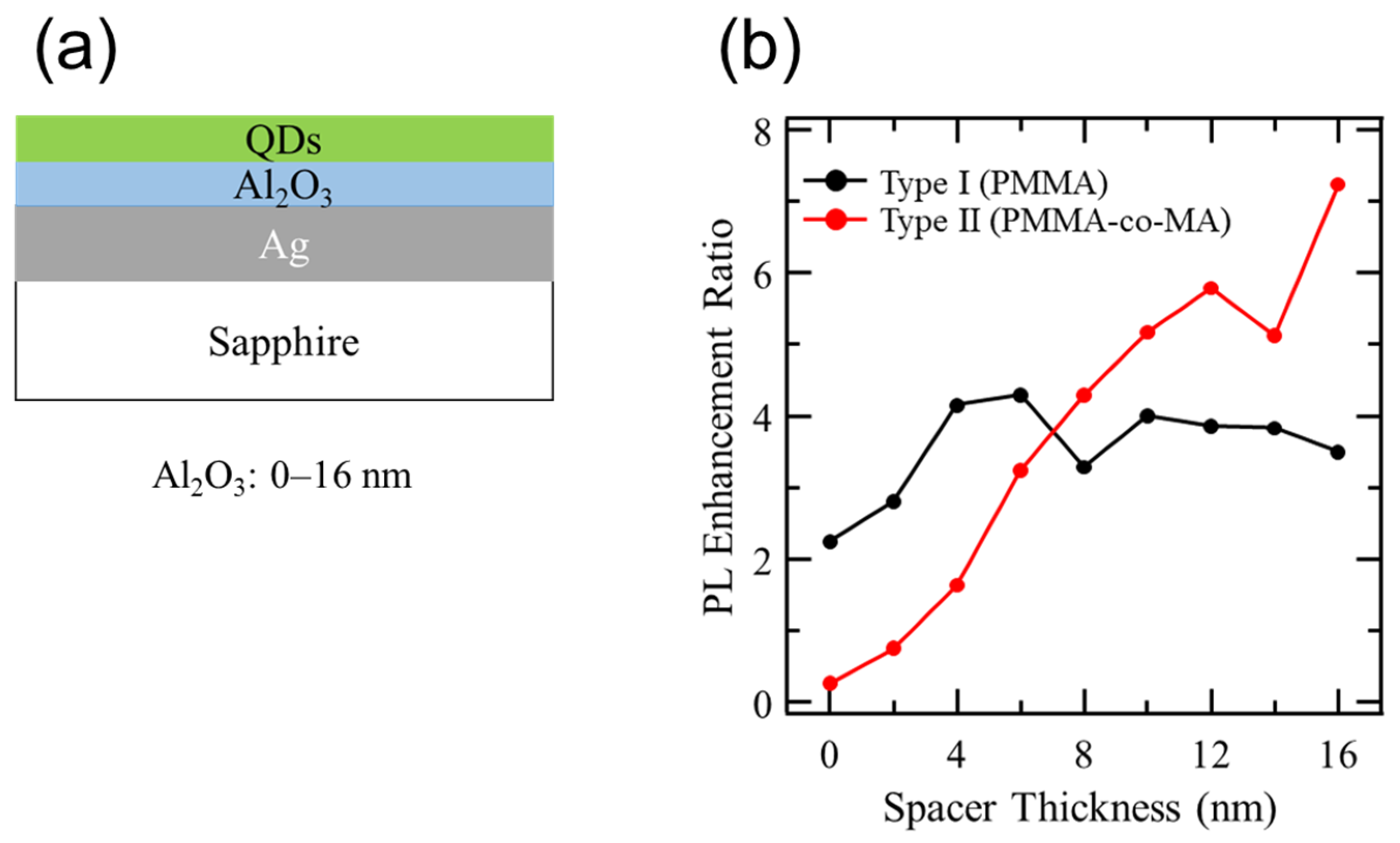
By reducing the quenching effect caused by FRET observed in Section 3.2, more optimal PL control can be achieved. Therefore, as shown in Figure 6a, samples were prepared with Al2O3 spacer layers with thicknesses ranging from 0 to 16 nm in steps of 2 nm inserted between the Ag films and the QD/polymer composite thin films, and the PL enhancement ratio was measured. Here, the PL enhancement ratio was evaluated by comparing the PL intensities of samples with and without Ag layers under identical Al2O3 thickness conditions. The results, shown in Figure 6b, exhibited a clear dependence on the spacer thickness. In Type I, an enhancement exceeding 4-fold was obtained when the spacer thickness was 6 nm. In contrast, in Type II, quenching occurred when the spacer thickness was 2 nm, but this subsequently transitioned to enhancement, with an enhancement exceeding 7-fold obtained at a spacer thickness of 16 nm. Thus, the insertion of spacer layers resulted in stronger PL intensity in both Type I and Type II samples with Ag layers compared to samples without Ag layers.
Compared with Type I, Type II is particularly advantageous. This enhancement is attributed to the more uniform distribution of QDs in Type II. Type II is thought to have a longer overall FRET distance compared to Type I. However, the sufficiently thick Al2O3 spacer layer suppresses this effect, allowing the uniform QD distribution to be utilized. Although the vertical distribution of QDs was not directly quantified, the observed enhancement and quenching can be qualitatively interpreted using a distance-dependent model that combines the electric-field enhancement by propagating SP resonance and the non-radiative energy transfer via FRET, as previously formulated using analytical expressions [23]. The penetration depth of the electromagnetic field of SPs is given by
d S P = λ 2 π ε m + ε d ε d 2
where λ is the wavelength, ε m is the complex permittivity of the metal, and ε d is the permittivity of the dielectric material. The distance-dependent enhancement factor I d I 0 of the PL intensity can then be expressed as
I d I 0 = α 1 + d F d 4 1 e x p 2 d d S P
where d F indicates the FRET distance, and α is a proportional constant representing the initial value of the enhancement factor. The first term represents FRET, while the second term describes the electric-field decay. Assuming an approximately uniform vertical distribution of QDs within the polymer layer, the measured PL intensity corresponds to the spatial average of this distance-dependent expression. The difference in PL behavior between Type I and Type II can therefore be interpreted in terms of differences in the effective vertical distribution of QDs.
The resonance wavelength of the propagating SP resonance occurs when ε m and ε d satisfy the following condition:
ε m + ε d = 0
Evaluating this condition using the dielectric functions at the Ag(bulk)/Al2O3(bulk) interface [32,33] and the Ag(bulk)/Air(bulk) interface [32] indicates that the resonance wavelengths at which the electromagnetic field enhancement at the interfaces is maximized are approximately 377 nm and 338 nm, respectively. The resonance wavelength in the Ag/Al2O3/PMMA/Air multilayer structure used in this study shifts toward a shorter wavelength compared to that in the Ag(bulk)/Al2O3(bulk) structure due to a decrease in the effective refractive index. However, it is expected to be longer than the resonance wavelength at the Ag(bulk)/Air(bulk) interface (338 nm). Therefore, the resonance wavelength of this structure is longer than the excitation wavelength (325 nm) of the He-Cd laser, and the 325 nm excitation photons do not couple to SPs within the Ag layers. Consequently, the PL enhancement observed in this study may be associated with improvements in the internal quantum efficiency (IQE) or the light extraction efficiency (LEE) induced by the SP resonance. The present data do not allow a quantitative separation of the IQE and LEE contributions.
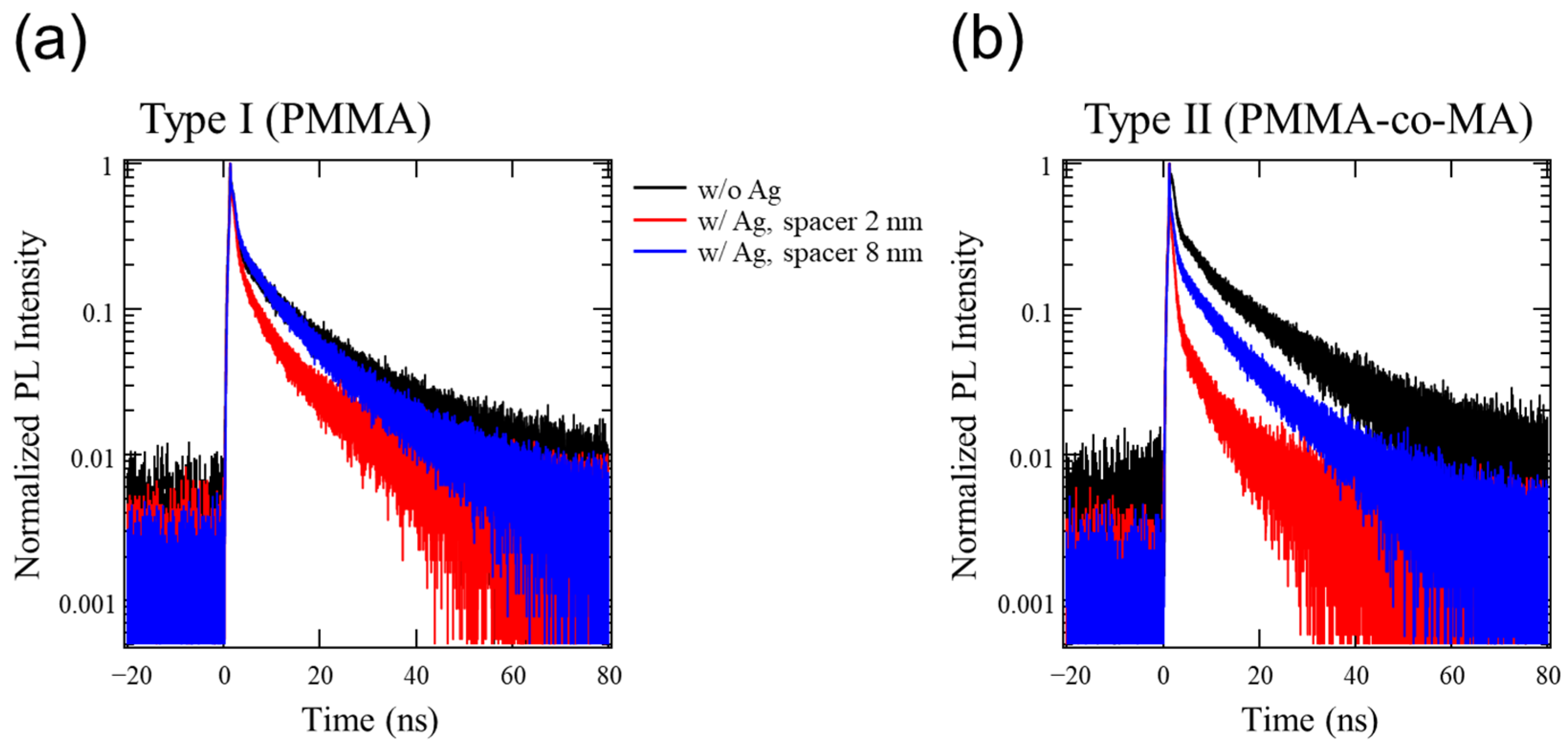
Figure 7a,b shows TRPL profiles for Type I and Type II samples without Ag and for samples with Ag with Al2O3 spacer thicknesses of 2 nm and 8 nm. When the spacer thickness is 2 nm, the QDs are in quite close proximity to the Ag layers. In this regime, the FRET from the QDs to the Ag is significantly dominant, leading to an increase in the non-radiative recombination rate. As a result, a pronounced shortening of the fast PL decay is observed. In contrast, when the spacer thickness is increased to 8 nm, the FRET to the Ag is substantially suppressed, and the PL decay becomes longer than that for the 2 nm spacer. However, the lifetime remains shorter than that of the sample without Ag. This residual lifetime shortening is consistent with an enhancement of the radiative recombination rate associated with the Purcell effect [34].
The total recombination rate k P L is expressed as
k P L = k r a d + k n o n
where k r a d is the radiative recombination rate and k n o n is the non-radiative recombination rate. The IQE η I Q E is defined as
η I Q E = k r a d k r a d + k n o n
In TRPL measurements, the observed lifetime τ is given by
τ = k P L 1
For the 8 nm spacer, the observed reduction in lifetime compared to the sample without Ag indicates an increase in the total recombination rate. Since the non-radiative recombination due to FRET is largely suppressed at this distance, this reduction is mainly attributed to an increase in k r a d caused by SPs, while the increase in k n o n is limited. Consequently, a possible improvement in the IQE is suggested. Although these results were obtained under optical excitation, an enhancement in the radiative recombination rate is also expected to be effective under current injection. Therefore, these results suggest that this approach can also be applied to current-injection-driven light-emitting devices.

4. Conclusions

Two types of polymers, PMMA and PMMA-co-MA, were used to fabricate QD/polymer composite thin films, demonstrating differences in QD aggregation. Furthermore, differences in the PL enhancement were observed between these two types of films formed on Ag films via propagating SP resonance, with the distance between the Ag films and the QDs controlled by Al2O3 spacer layers, yielding results that suggest the superiority of PMMA-co-MA in particular. In addition, TRPL results indicated an increase in the radiative recombination rate, suggesting a possible improvement in the IQE.

Author Contributions

Conceptualization and methodology, S.Y. and K.O.; validation, S.Y., T.N., T.T., T.M., K.W. and K.O.; formal analysis, investigation, resources, data curation, and writing—original draft preparation, S.Y.; writing—review and editing, K.O.; visualization, S.Y.; supervision, project administration, and funding acquisition, K.O. All authors have read and agreed to the published version of the manuscript.

Funding

This work was supported by the Japan Society for the Promotion of Science; JP24H00433, JP25H00889, JP25K01501 and JP25K21709.

Institutional Review Board Statement

Not applicable.

Informed Consent Statement

Not applicable.

Data Availability Statement

The raw data supporting the conclusions of this article will be made available by the authors on request.

Conflicts of Interest

The authors declare no conflicts of interest.

References

  1. Dabbousi, B.O.; Rodriguez-Viejo, J.; Mikulec, F.V.; Heine, J.R.; Mattoussi, H.; Ober, R.; Jensen, K.F.; Bawendi, M.G. (CdSe)ZnS Core–Shell Quantum Dots: Synthesis and Characterization of a Size Series of Highly Luminescent Nanocrystallites. J. Phys. Chem. B 1997, 101, 9463–9475. [Google Scholar] [CrossRef]
  2. Peng, X.; Schlamp, M.C.; Kadavanich, A.V.; Alivisatos, A.P. Epitaxial Growth of Highly Luminescent CdSe/CdS Core/Shell Nanocrystals with Photostability and Electronic Accessibility. J. Am. Chem. Soc. 1997, 119, 7019–7029. [Google Scholar] [CrossRef]
  3. Qu, L.; Peng, X. Control of Photoluminescence Properties of CdSe Nanocrystals in Growth. J. Am. Chem. Soc. 2002, 124, 2049–2055. [Google Scholar] [CrossRef] [PubMed]
  4. Reiss, P.; Bleuse, J.; Pron, A. Highly Luminescent CdSe/ZnSe Core/Shell Nanocrystals of Low Size Dispersion. Nano Lett. 2002, 2, 781–784. [Google Scholar] [CrossRef]
  5. Talapin, D.V.; Mekis, I.; Götzinger, S.; Kornowski, A.; Benson, O.; Weller, H. CdSe/CdS/ZnS and CdSe/ZnSe/ZnS Core–Shell–Shell Nanocrystals. J. Phys. Chem. B 2004, 108, 18826–18831. [Google Scholar] [CrossRef]
  6. Anikeeva, P.O.; Halpert, J.E.; Bawendi, M.G.; Bulović, V. Electroluminescence from a Mixed Red–Green–Blue Colloidal Quantum Dot Monolayer. Nano Lett. 2007, 7, 2196–2200. [Google Scholar] [CrossRef]
  7. Lee, J.H. QD Display: A Game-Changing Technology for the Display Industry. Inf. Disp. 2020, 36, 9–13. [Google Scholar] [CrossRef]
  8. Yang, K.; Zheng, H.; Zhong, C.; Huang, X.; Zhang, Q.; Yu, K.; Qie, Y.; Chen, T.; Hu, H.; Li, F. High-Resolution and High-Performance Full-Color Electroluminescent Quantum Dot Light-Emitting Diodes. Nano Energy 2025, 138, 110817. [Google Scholar] [CrossRef]
  9. Okamoto, K.; Niki, I.; Shvartser, A.; Narukawa, Y.; Mukai, T.; Scherer, A. Surface-Plasmon-Enhanced Light Emitters Based on InGaN Quantum Wells. Nat. Mater. 2004, 3, 601–605. [Google Scholar] [CrossRef] [PubMed]
  10. Kwon, M.; Kim, J.; Kim, B.; Park, I.; Cho, C.; Byeon, C.C.; Park, S. Surface-Plasmon-Enhanced Light-Emitting Diodes. Adv. Mater. 2008, 20, 1253–1257. [Google Scholar] [CrossRef]
  11. Cho, C.-Y.; Lee, S.-J.; Song, J.-H.; Hong, S.-H.; Lee, S.-M.; Cho, Y.-H.; Park, S.-J. Enhanced Optical Output Power of Green Light-Emitting Diodes by Surface Plasmon of Gold Nanoparticles. Appl. Phys. Lett. 2011, 98, 051106. [Google Scholar] [CrossRef]
  12. Gao, N.; Huang, K.; Li, J.; Li, S.; Yang, X.; Kang, J. Surface-Plasmon-Enhanced Deep-UV Light Emitting Diodes Based on AlGaN Multi-Quantum Wells. Sci. Rep. 2012, 2, 816. [Google Scholar] [CrossRef] [PubMed]
  13. Chen, S.-H.; Hsieh, W.-J.; Hong, Y.-W.; Ji Huang, H.; Chiang, L.-M.; Sheng Kao, T.; Shih, M.-H.; Chiang, H.-P. Gold Nanohole Arrays with Ring-Shaped Silver Nanoparticles for Highly Efficient Plasmon-Enhanced Fluorescence. Results Phys. 2023, 51, 106740. [Google Scholar] [CrossRef]
  14. Chen, S.-H.; Fang, J.-K.; Du, C.-H.; Shih, M.-H.; Liang, H.-C.; Chiang, H.-P. Enhanced Photoluminescence of DCJTB by Silver Nanohole Arrays with Ring-Shaped Silver Nanoparticles over Hyperbolic Metamaterials. Opt. Mater. 2024, 150, 115174. [Google Scholar] [CrossRef]
  15. Kulakovich, O.; Strekal, N.; Yaroshevich, A.; Maskevich, S.; Gaponenko, S.; Nabiev, I.; Woggon, U.; Artemyev, M. Enhanced Luminescence of CdSe Quantum Dots on Gold Colloids. Nano Lett. 2002, 2, 1449–1452. [Google Scholar] [CrossRef]
  16. Okamoto, K.; Vyawahare, S.; Scherer, A. Surface-Plasmon Enhanced Bright Emission from CdSe Quantum-Dot Nanocrystals. J. Opt. Soc. Am. B 2006, 23, 1674–1678. [Google Scholar] [CrossRef]
  17. Lu, L.; Xu, X.; Shi, C.; Ming, H. Localized Surface Plasmon Resonance Enhanced Photoluminescence of CdSe QDs in PMMA Matrix on Silver Colloids with Different Shapes. Thin Solid Film. 2010, 518, 3250–3254. [Google Scholar] [CrossRef]
  18. Jung, D.-R.; Kim, J.; Nahm, C.; Nam, S.; Kim, J.I.; Park, B. Surface-Plasmon-Enhanced Photoluminescence of CdS Nanoparticles with Au/SiO2 Nanocomposites. Mater. Res. Bull. 2012, 47, 453–457. [Google Scholar] [CrossRef]
  19. Okamoto, K.; Funato, M.; Kawakami, Y.; Tamada, K. High-Efficiency Light Emission by Means of Exciton–Surface-Plasmon Coupling. J. Photochem. Photobiol. C Photochem. Rev. 2017, 32, 58–77. [Google Scholar] [CrossRef]
  20. Forster, T. Energiewanderung und Fluoreszenz. Naturwissenschaften 1946, 33, 166–175. [Google Scholar] [CrossRef]
  21. Ueda, A.; Tayagaki, T.; Kanemitsu, Y. Energy Transfer from Semiconductor Nanocrystal Monolayers to Metal Surfaces Revealed by Time-Resolved Photoluminescence Spectroscopy. Appl. Phys. Lett. 2008, 92, 133118. [Google Scholar] [CrossRef]
  22. Kim, D.; Yokota, H.; Taniguchi, T.; Nakayama, M. Precise Control of Photoluminescence Enhancement and Quenching of Semiconductor Quantum Dots Using Localized Surface Plasmons in Metal Nanoparticles. J. Appl. Phys. 2013, 114, 154307. [Google Scholar] [CrossRef]
  23. Takekuma, H.; Leng, J.; Tateishi, K.; Xu, Y.; Chan, Y.; Ryuzaki, S.; Wang, P.; Okamoto, K.; Tamada, K. Layer Number-Dependent Enhanced Photoluminescence from a Quantum Dot Metamaterial Optical Resonator. ACS Appl. Electron. Mater. 2021, 3, 468–475. [Google Scholar] [CrossRef]
  24. Maoz, M.; Shah, S.A.B.; Lughi, V. Photoluminescence Enhancement in CdSe/CdS Quantum Dot Colloidal Films Induced by Gold Nanoparticles (AuNPs). ACS Omega 2025, 10, 42472–42479. [Google Scholar] [CrossRef] [PubMed]
  25. Al-Osaimi, J.; Al-Hosiny, N.; Abdallah, S.; Badawi, A. Characterization of Optical, Thermal and Electrical Properties of SWCNTs/PMMA Nanocomposite Films. Iran. Polym. J. 2014, 23, 437–443. [Google Scholar] [CrossRef]
  26. Zhai, Y.; Wang, Q.; Qi, Z.; Li, C.; Xia, J.; Li, X. Experimental Investigation of Energy Transfer between CdSe/ZnS Quantum Dots and Different-Sized Gold Nanoparticles. Phys. E Low-Dimens. Syst. Nanostruct 2017, 88, 109–114. [Google Scholar] [CrossRef]
  27. Xue, L.; Liu, Y.; Li, F.; Sun, K.; Chen, W.; Yang, K.; Hu, H.; Lin, J.; Chen, H.; Yang, Z.; et al. Highly Flexible Light Emitting Diodes Based on a Quantum Dots-Polymer Composite Emitting Layer. Vacuum 2019, 163, 282–286. [Google Scholar] [CrossRef]
  28. Tippo, T.; Thanachayanont, C.; Muthitamongkol, P.; Junin, C.; Hietschold, M.; Thanachayanont, A. The Effects of Solvents on the Properties of Ultra-Thin Poly (Methyl Methacrylate) Films Prepared by Spin Coating. Thin Solid Film. 2013, 546, 180–184. [Google Scholar] [CrossRef]
  29. Tamborra, M.; Striccoli, M.; Curri, M.L.; Alducin, J.A.; Mecerreyes, D.; Pomposo, J.A.; Kehagias, N.; Reboud, V.; Sotomayor Torres, C.M.; Agostiano, A. Nanocrystal-Based Luminescent Composites for Nanoimprinting Lithography. Small 2007, 3, 822–828. [Google Scholar] [CrossRef]
  30. Reitinger, N.; Hohenau, A.; Köstler, S.; Krenn, J.R.; Leitner, A. Radiationless Energy Transfer in CdSe/ZnS Quantum Dot Aggregates Embedded in PMMA. Phys. Status Solidi (A) 2011, 208, 710–714. [Google Scholar] [CrossRef]
  31. Tateishi, K.; Wang, P.; Ryuzaki, S.; Funato, M.; Kawakami, Y.; Okamoto, K.; Tamada, K. Micro-Photoluminescence Mapping of Surface Plasmon Enhanced Light Emissions from InGaN/GaN Quantum Wells. Appl. Phys. Lett. 2017, 111, 172105. [Google Scholar] [CrossRef]
  32. Johnson, P.B.; Christy, R.W. Optical Constants of the Noble Metals. Phys. Rev. B 1972, 6, 4370–4379. [Google Scholar] [CrossRef]
  33. Malitson, I.H. Refraction and Dispersion of Synthetic Sapphire. J. Opt. Soc. Am. 1962, 52, 1377–1379. [Google Scholar] [CrossRef]
  34. Purcell, E.M.; Torrey, H.C.; Pound, R.V. Resonance Absorption by Nuclear Magnetic Moments in a Solid. Phys. Rev. 1946, 69, 37–38. [Google Scholar] [CrossRef]
Figure 1. Chemical structures of two types of polymers: (a) PMMA and (b) PMMA-co-MA.
Photonics 13 00299 g001
Figure 2. (a) Normalized PL spectra and (b) plots of the PL mapping showing the relationship between the PL peak wavelength and PL intensity for Type I and Type II, respectively.
Photonics 13 00299 g002
Figure 3. (a) Fluorescence microscopic image, and AFM image of Type I film: (b) 3000 rpm and (c) 5000 rpm; (d) fluorescence microscope image, and AFM image of Type II film: (e) 3000 rpm and (f) 5000 rpm.
Photonics 13 00299 g003
Figure 4. (a) Wavelength range of the bandpass filters, and TRPL profiles of (b) Type I and (c) Type II.
Photonics 13 00299 g004
Figure 5. (a) Cross-sectional view of the samples, and (b) PL intensity as a function of rotation speed for Type I and Type II.
Photonics 13 00299 g005
Figure 6. (a) Cross-sectional view of the samples. (b) Spacer thickness dependence of PL enhancement ratio of Type I and Type II on Ag films.
Photonics 13 00299 g006
Figure 7. TRPL profiles for samples without Ag and for samples with Ag and Al2O3 spacer thicknesses of 2 nm and 8 nm of (a) Type I and (b) Type II.
Photonics 13 00299 g007
Disclaimer/Publisher’s Note: The statements, opinions and data contained in all publications are solely those of the individual author(s) and contributor(s) and not of MDPI and/or the editor(s). MDPI and/or the editor(s) disclaim responsibility for any injury to people or property resulting from any ideas, methods, instructions or products referred to in the content.