1. Introduction
Silicon photonics has emerged as a key enabling platform for on-chip integrated photonic systems, owing to its excellent compatibility with complementary metal–oxide–semiconductor (CMOS) fabrication processes, compact footprint, low manufacturing cost, and strong potential for large-scale integration [
1,
2,
3]. Benefiting from the pronounced thermo-optic effect of silicon, silicon-based photonic devices exhibit remarkable sensitivity to temperature variations, making them highly attractive for applications in optical interconnect thermal management, biomedical diagnostics, precision industrial control, and environmental monitoring [
4,
5,
6,
7,
8]. With the rapid development of photonic integrated circuits (PICs) toward higher integration density, functional complexity, and operational precision, increasingly stringent requirements have been imposed on the sensitivity, resolution, stability, and long-term reliability of on-chip temperature sensors [
9,
10,
11,
12].
Various silicon photonic temperature sensing architectures have been extensively investigated, including microring resonators (MRRs) [
13], Mach–Zehnder interferometers (MZIs) [
14,
15,
16], Bragg gratings [
17,
18,
19], photonic crystal cavities [
20,
21,
22], and cascaded interferometric configurations [
23,
24,
25]. Among them, MRR-based sensors can achieve high sensitivity and resolution owing to strong resonance enhancement. However, their performance is highly susceptible to fabrication imperfections and environmental perturbations, resulting in resonance drift, spectral instability, and limited operational robustness [
26]. In contrast, MZI-based sensors rely on the optical path-length difference between two interferometric arms, offering a relatively linear phase response and improved tolerance to fabrication variations. Nevertheless, the absence of resonance enhancement leads to relatively shallow spectral slopes, thereby restricting the achievable temperature sensitivity.
To mitigate these inherent limitations, ring-assisted Mach–Zehnder interferometer (RAMZI) configurations have been proposed, aiming to synergistically combine the resonance enhancement of microring resonators with the stability and linearity of interferometric modulation [
27]. In addition, reflective and asymmetric Mach–Zehnder interferometer configurations have also been widely investigated in integrated photonics for filtering, modulation, and sensing applications, providing compact device footprints and flexible phase manipulation capabilities [
28,
29,
30,
31]. Although notable sensitivity improvements have been reported, the underlying physical enhancement mechanisms, phase-to-wavelength conversion processes, and systematic parameter optimization strategies remain insufficiently explored, particularly in terms of simultaneously achieving high sensitivity, wide dynamic range, and long-term stability.
In this work, we propose and experimentally demonstrate a highly stable and sensitive on-chip temperature sensor based on a microring-coupled asymmetric Mach–Zehnder interferometer (AMZI). By properly engineering the resonance condition of the microring and adjusting the optical path-length difference between the two arms of the AMZI, the steep phase variation induced by the microring near resonance can be efficiently amplified during the interference process, resulting in a significantly enlarged wavelength shift and enhanced temperature sensitivity. Experimental results reveal a temperature sensitivity as high as 108.74 pm/K, representing an approximately 40% improvement compared with conventional AMZI sensors with identical structural parameters and chip footprint, while maintaining excellent long-term stability with a wavelength drift of only 18 pm over 45 min.
2. Principle and Analysis
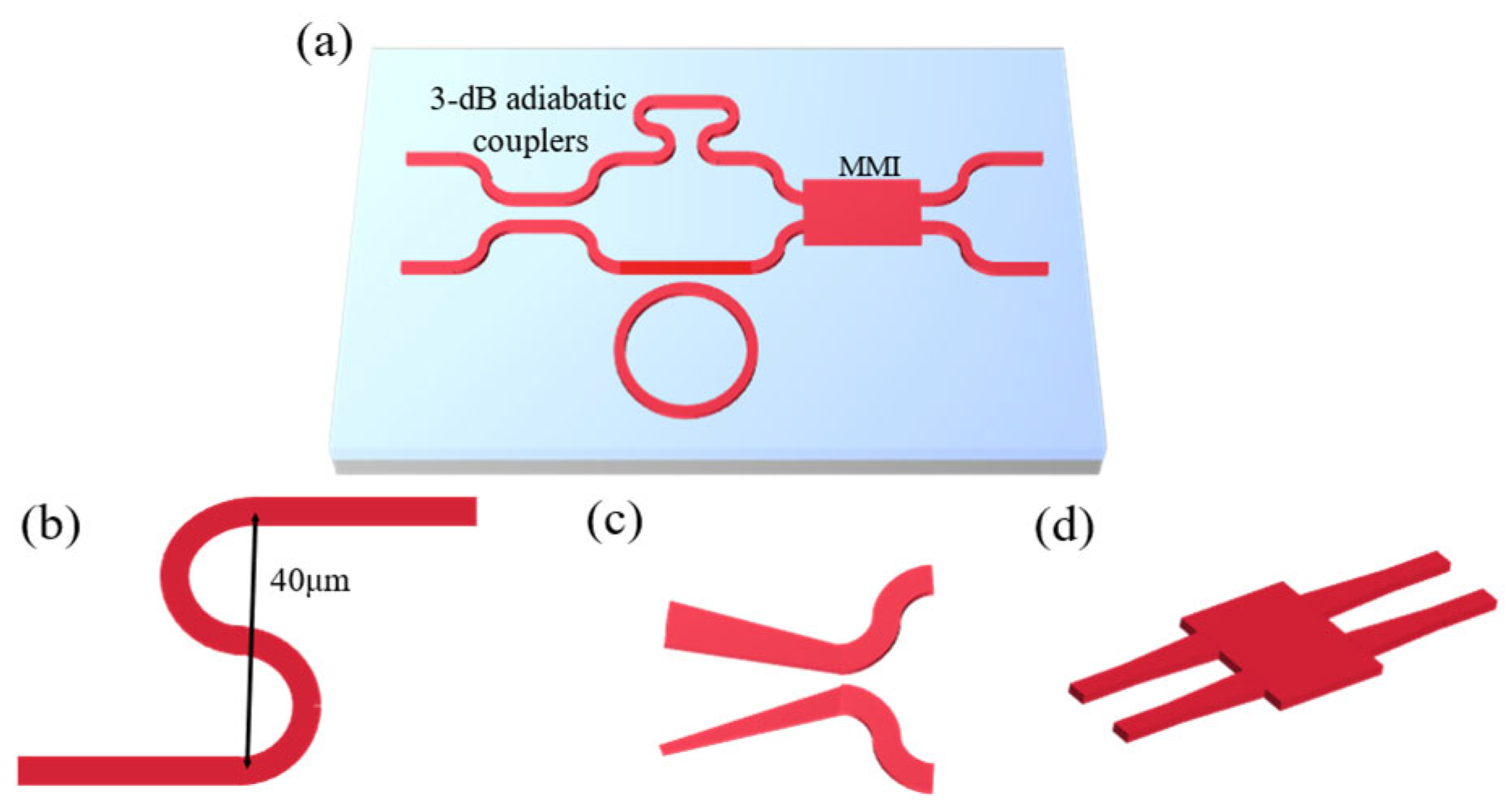
As illustrated in
Figure 1, the proposed device consists of an input 3 dB directional coupler, an AMZI, a microring resonator (MRR) side-coupled to the short arm of the AMZI, and an output multimode interference (MMI) coupler, forming a hybrid resonance–interference architecture for temperature sensing.
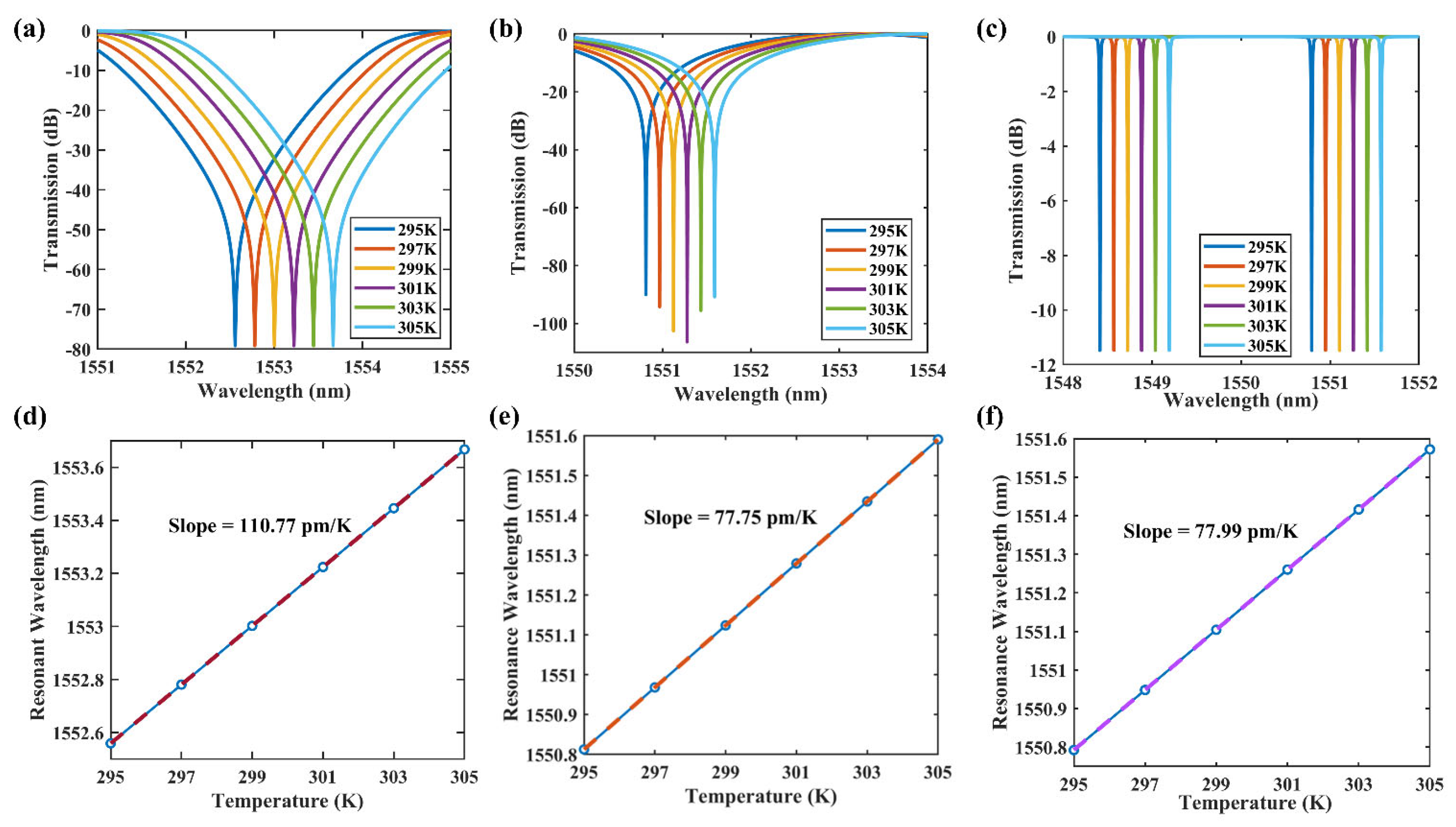
Furthermore, we investigated the optical response of the RAMZI under varying temperature conditions using the transfer matrix method. The transmission spectra are shown in
Figure 2a, with the temperature increased from 295 K to 305 K in 2 K increments. As the temperature rises, a pronounced redshift of the resonance wavelength is observed in the transmission spectra. Further extraction and analysis of the resonance wavelengths, presented in
Figure 2d, reveal an approximately linear dependence on temperature. Linear fitting yields a temperature sensitivity of 110.77 pm/K.
To evaluate the performance improvement of the proposed design, a comparative study was performed with a conventional AMZI having identical waveguide widths and arm lengths and the same chip footprint area as the proposed AMZI-Ring structure. The corresponding simulation results are shown in
Figure 2b,e. The conventional AMZI exhibits a temperature sensitivity of approximately 77.74 pm/K, significantly lower than that of the RAMZI structure. Quantitatively, the proposed design enhances the sensitivity by approximately 42% compared with the conventional AMZI of the same footprint, a performance metric typically constrained by the thermo-optic properties of silicon and the geometric configuration of the interferometer.
In addition, to further evaluate the sensing performance of different resonant structures, a single microring resonator with the same radius as that used in the AMZI-Ring configuration was also simulated. The transmission spectra under different temperature conditions are shown in
Figure 2c, while the extracted resonance wavelength shift is presented in
Figure 2f. The simulated temperature sensitivity of the single microring resonator is 77.99 pm/K, which is comparable to that of the conventional AMZI but still significantly lower than that of the proposed AMZI-Ring structure.
Such resonance-assisted interferometric enhancement has also been reported in previous studies. For example, it has been demonstrated that the integration of resonant structures with interferometric configurations can improve the sensitivity by approximately 30% compared with conventional designs. The results obtained in this work are consistent with this reported trend, further confirming the effectiveness of the proposed AMZI-Ring configuration for sensitivity enhancement [
31].
Based on the above simulation results, the optimized structural parameters exhibit excellent sensing performance. However, in practical fabrication processes, dimensional deviations are inevitable. Therefore, it is necessary to evaluate the fabrication tolerance of the proposed device.
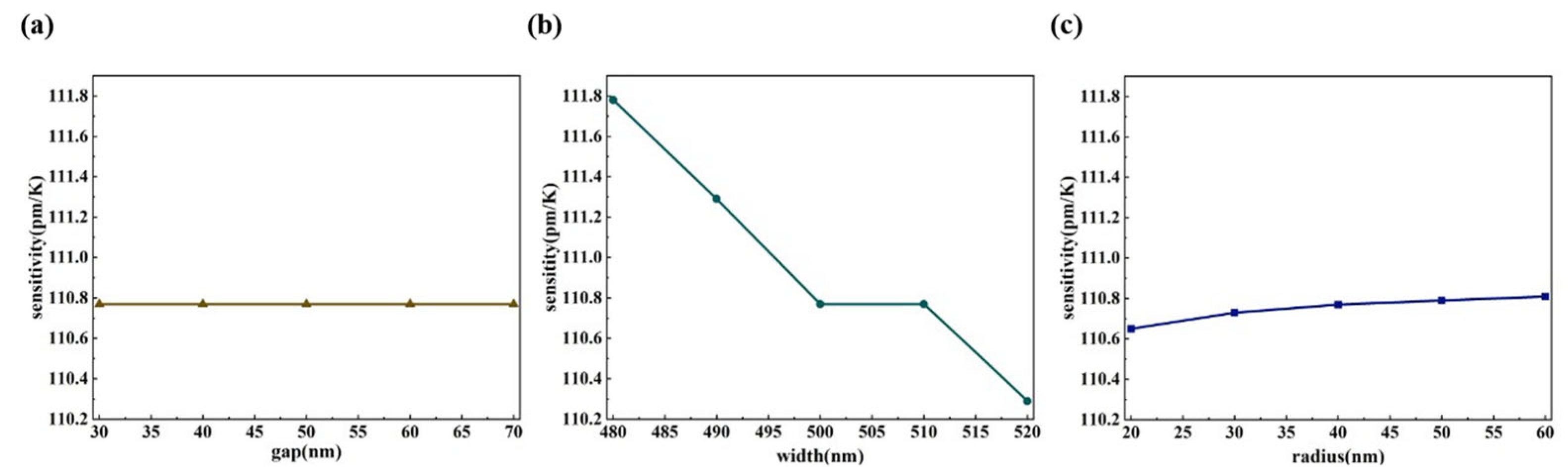
To investigate the robustness of the sensor against fabrication errors, the influences of variations in several key structural parameters on the sensitivity are analyzed. Specifically, the coupling gap between the microring resonator and one arm of the AMZI, the waveguide width, and the microring radius are considered. As shown in
Figure 3a, when the coupling gap varies by ±20 nm, the sensitivity remains nearly unchanged, indicating that the coupling gap has a negligible influence on the sensing performance.
Figure 3b illustrates the effect of waveguide width variation. When the waveguide width deviates by ±20 nm from the designed value, the sensitivity variation is approximately 9%. In addition, the influence of microring radius variation is presented in
Figure 3c. When the radius varies by ±20 nm, the corresponding sensitivity change is only about 0.1%, which can be considered negligible.
These results demonstrate that the proposed sensor exhibits good tolerance to typical fabrication deviations and can maintain stable sensing performance under realistic fabrication conditions.
To gain deeper physical insight into the origin of this remarkable sensitivity enhancement, the phase response characteristics of the microring resonator and its interaction with AMZI interference are further analyzed.
For a microring resonator, the single-pass propagation phase along the ring waveguide can be expressed as:
where
is the effective refractive index,
is the ring perimeter, and
is the wavelength of the transmission dip. Due to the large thermo-optic coefficient of silicon, even a small temperature variation can induce a pronounced change in
, resulting in a strong temperature dependence of the microring phase. Accordingly, the phase temperature sensitivity can be written as:
Near the resonance wavelength, such temperature-induced refractive index variations give rise to an extremely steep phase slope, which forms the physical basis of the phase-slope enhancement.
The AMZI consists of two optical paths that interfere at the output. When the microring introduces an additional phase shift in one arm near resonance, the original interference condition is disturbed. To restore destructive interference, the operating wavelength must shift accordingly, resulting in an amplified displacement of the spectral dip. Consequently, the steep phase variation generated by the microring resonance is transformed into a much larger wavelength shift of the transmission dip through AMZI interference, thereby significantly enhancing the overall temperature sensitivity of the proposed RAMZI device.
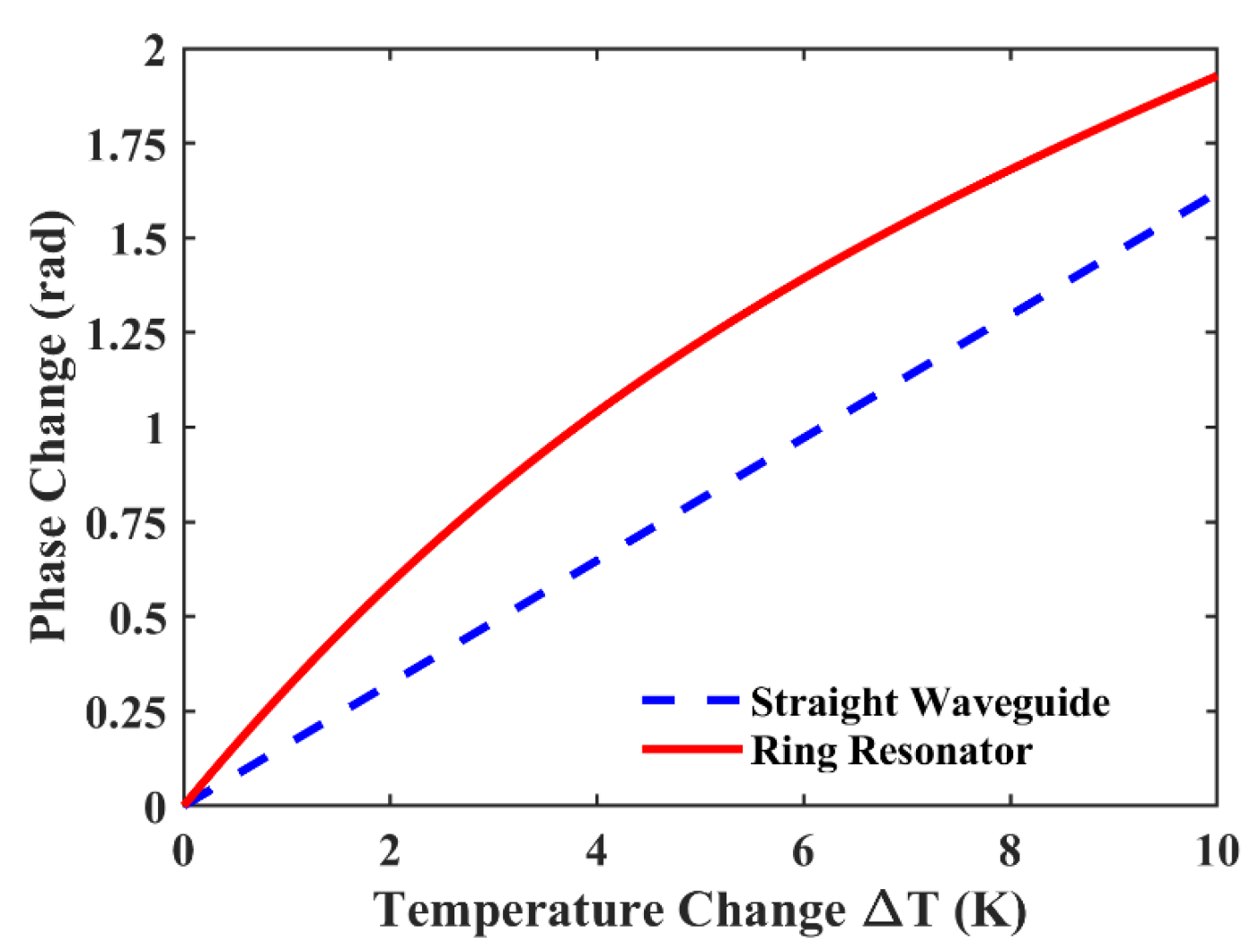
To directly reveal the physical origin of this phase-slope enhancement mechanism, the temperature-dependent phase responses at the resonant wavelength are calculated for a straight waveguide and a microring resonator with identical optical path lengths, as illustrated in
Figure 4. It can be clearly observed that, compared with the straight waveguide, the microring resonator exhibits a dramatically steeper phase slope near resonance, indicating a substantially enhanced phase sensitivity to temperature perturbations. This pronounced phase-slope enhancement provides the fundamental physical basis for the subsequent efficient phase-to-wavelength conversion in the AMZI, ultimately enabling high-sensitivity temperature sensing in the proposed RAMZI structure.
3. Device Fabrication and Test Analysis
The proposed device was fabricated on a commercial silicon-on-insulator (SOI) wafer, featuring a 340 nm thick top silicon layer and a 2 μm thick buried silicon dioxide (SiO
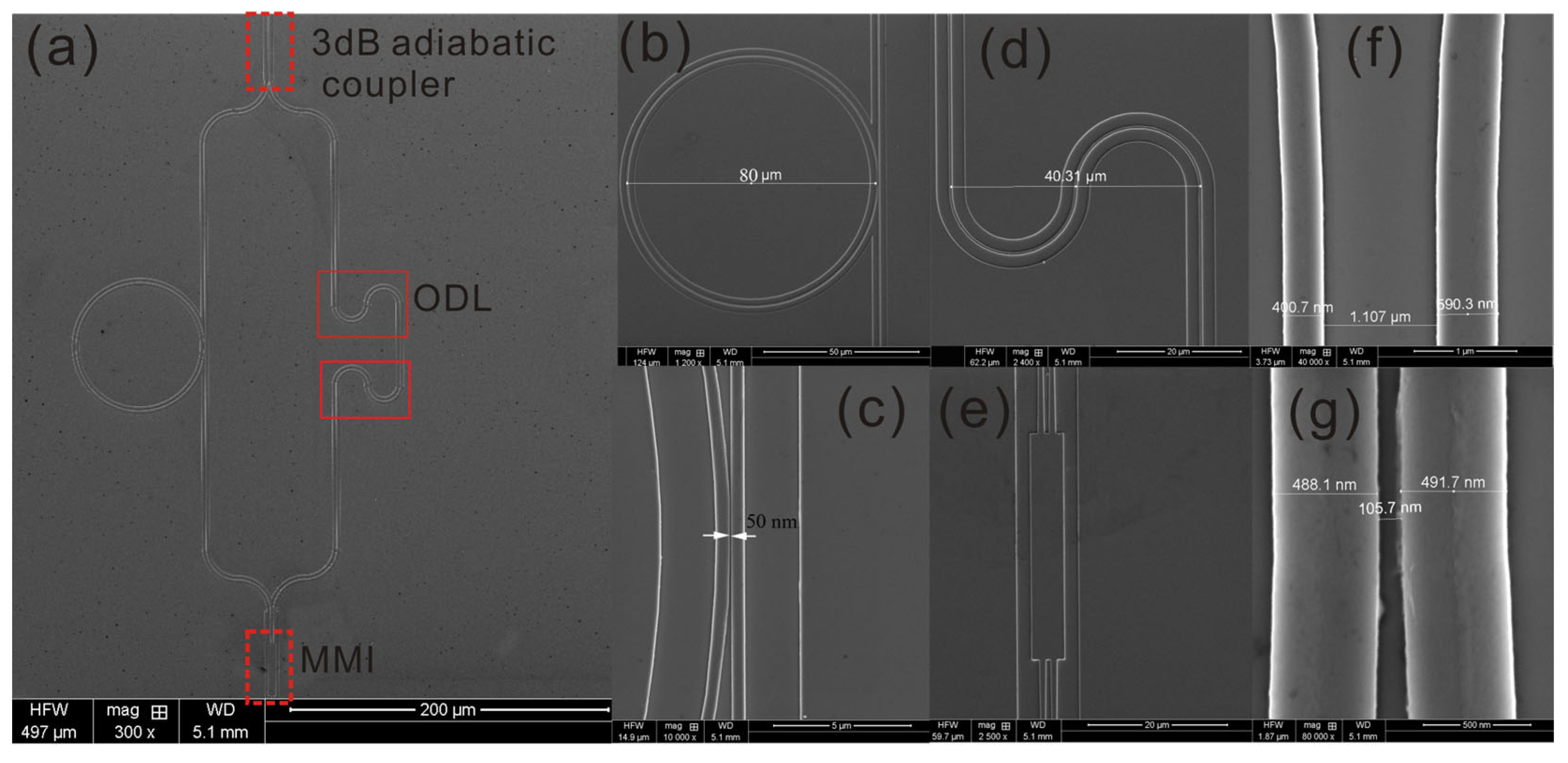
2) layer. For device patterning, a slab height of 130 nm and a ridge waveguide height of 210 nm were adopted. Electron-beam lithography (EBL) was employed for pattern transfer onto the SOI wafer, followed by inductively coupled plasma (ICP) etching to perform 210 nm-deep dry etching of the top silicon layer. As presented in
Figure 5, scanning electron microscope (SEM) micrographs of the etched structures are displayed separately, with the actual measured parameters labeled therein—exhibiting a slight deviation from the theoretical design values.
Figure 5a illustrates the global view of the fabricated device, where the silicon wire possesses a cross-sectional dimension of 210 nm × 500 nm. The microring resonator and the coupling region between the microring and the waveguide are shown in
Figure 5b and
Figure 5c, respectively; the microring has a perimeter of 80π µm. The coupling coefficient is primarily determined by the gap distance between the microring and the waveguide, which was set to 50 nm to fulfill the requirement of t = 0.3.
Figure 5d depicts the optical delay line (ODL) consisting of two 180° bending structures. To satisfy the optical path condition, the radius of the bends was optimized to 10 µm, resulting in a total length of 40π µm for the ODL.
Figure 5e,f present the structural parameters of the input and output ports of the fabricated 3 dB adiabatic splitter, which incorporates simultaneous tapering of velocity and coupling. The coupling gap of the splitter exhibits a linear variation from 1.1 µm to 100 nm, with a coupling length of 300 µm. Additionally, the broadband MMI-based combiner is illustrated in
Figure 5e, with the MMI section having a width of 4.8 µm and a length of 32.64 µm.
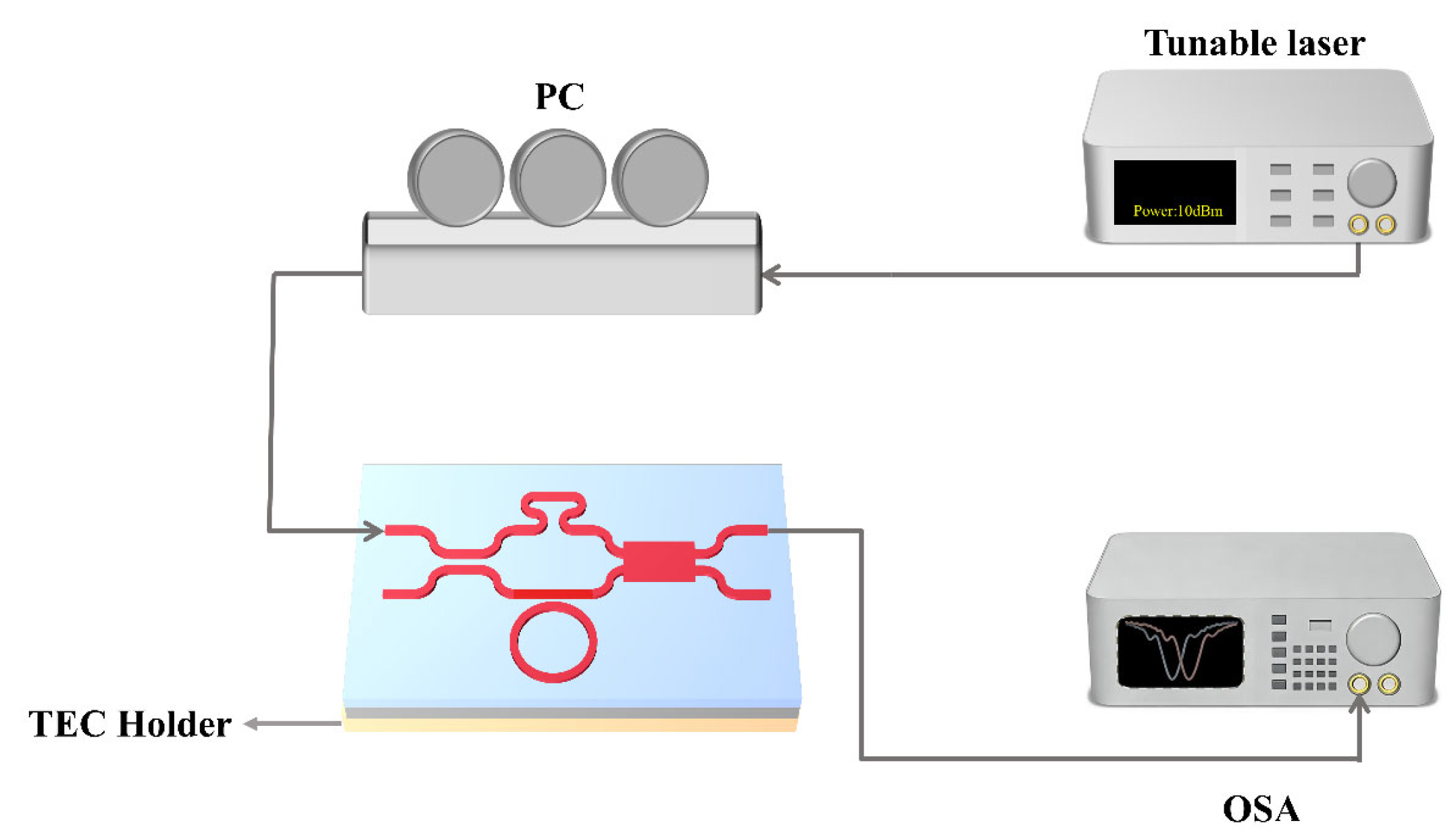
To characterize the proposed device, experiments were conducted with the setup depicted in
Figure 6. The sensor chip is mounted on a thermoelectric cooler (TEC) to precisely control and simulate the ambient temperature variations. A tunable laser source with a wavelength range from 1460 to 1640 nm is employed as the input light source. The polarization state of the incident light is adjusted by a polarization controller (PC). The output optical spectra are recorded using an optical spectrum analyzer (OSA) with a maximum wavelength resolution of 2 pm.
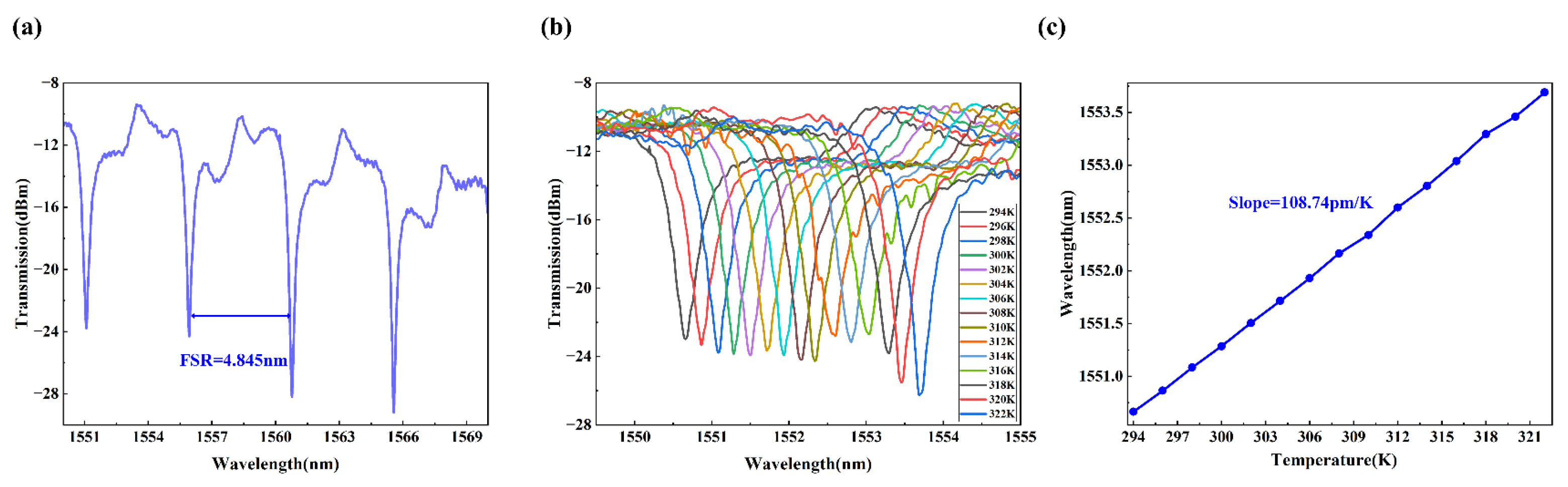
To further characterize the temperature sensitivity and operational range of the proposed sensor, the transmission spectra were experimentally measured over a temperature range from 294 K to 322 K, as shown in
Figure 7b. With increasing temperature, a clear redshift of the resonance dip is observed. The free spectral range (FSR) of the device is approximately 4.85 nm as shown in
Figure 7a, which ensures unambiguous resonance tracking within the measured temperature range.
Figure 7c depicts the extracted resonance wavelengths as a function of temperature. It can be seen that the resonance wavelength exhibits an approximately linear dependence on temperature over the entire measurement range. Based on linear fitting, a temperature sensitivity of 108.74 pm/K is obtained. Considering the available FSR, the corresponding measurable temperature range of the device is estimated to be approximately
, indicating a wide dynamic operating range.
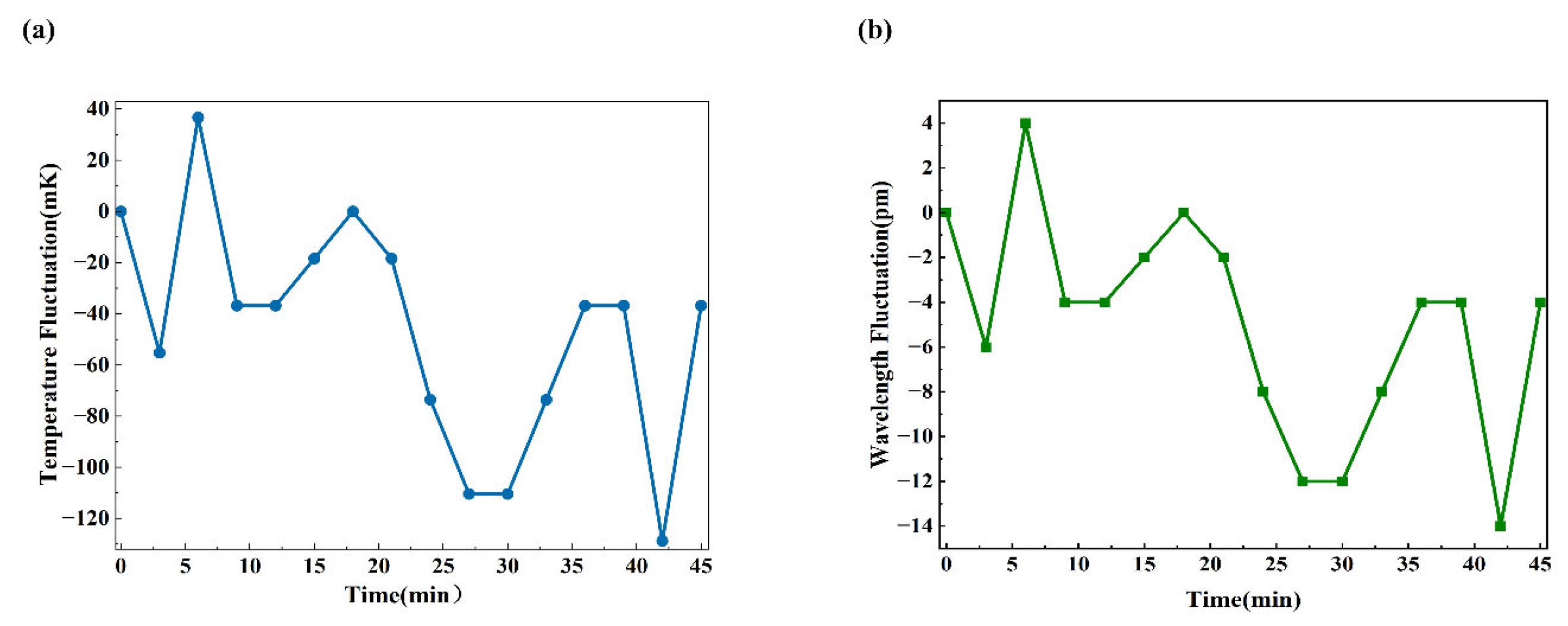
To evaluate the stability of the sensor, the resonant wavelength was continuously monitored for 45 min at 305 K.
Figure 8a shows the temperature variation during the measurement, while
Figure 8b presents the corresponding resonant wavelength fluctuation. As shown in
Figure 8, the wavelength fluctuation is merely 18 pm, indicating that the proposed structure exhibits excellent long-term stability and strong immunity to environmental disturbances, which thus ensures reliable performance for high-precision on-chip temperature sensing.
The observed wavelength drift corresponds to a temperature fluctuation of approximately 202 mK, calculated based on the nominal temperature sensitivity of the sensor. Such fluctuations may originate from multiple noise sources in the measurement system. Possible contributors include the finite resolution of the TEC temperature controller (Thorlabs CLD1015, 0.01 K), minor environmental temperature variations, and laser wavelength noise. Although the TEC actively stabilizes the temperature, quantization steps and transient overshoot may introduce small temperature perturbations. In addition, laser frequency jitter, linewidth, and relative intensity noise may contribute to apparent wavelength fluctuations, while ambient environmental disturbances can slightly modify the effective refractive index of the waveguide.
Another possible factor is the self-heating effect in the microring resonator induced by optical absorption. In the experiment, the optical power coupled into the chip is approximately 6 dBm. At this power level, part of the optical energy may be converted into heat through mechanisms such as linear absorption, two-photon absorption, and free-carrier absorption in the silicon waveguide. Since silicon possesses a relatively large thermo-optic coefficient, the resulting temperature increase can slightly change the effective refractive index of the waveguide, leading to a gradual resonance wavelength drift. During long-term measurements, this thermally induced effect may contribute to slow variations of the resonance wavelength.
To quantitatively evaluate the sensing accuracy, the limit of detection (
LOD) proposed by White et al. is adopted [
32]. According to this definition, the detection limit of a sensing system is determined by the system resolution and the sensor sensitivity, which can be expressed as
where
represents the temperature sensitivity of the sensor and
denotes the resolution of the measurement system.
The system resolution is affected by several factors in the sensing system, including the stability of the sensing signal, temperature cross-sensitivity, and the resolution of the detection instrument. By considering these contributions, the overall system resolution can be expressed as
where
denotes the wavelength fluctuation induced by the instability of the sensing signal,
corresponds to the wavelength variation caused by thermally induced fluctuations of the system, and
represents the wavelength error contributed by the spectral resolution of the detection instrument. In practical measurements, the system resolution is generally determined by the combined effect of multiple noise sources. However, in this work, a constant temperature control strategy was applied to the sensing system, leading to the wavelength drift caused by ambient temperature variations being much smaller than the minimum resolution of the optical spectrum analyzer (OSA); thus, the influence of thermally induced fluctuations on the system resolution is negligible. Meanwhile, the sensing signal exhibited excellent intensity stability with a high signal-to-noise ratio (SNR) in the experiments, resulting in the wavelength fluctuation induced by signal instability being far below the minimum measurable wavelength shift of the OSA, and this noise component is also negligible. Consequently, the spectral resolution of the OSA dominates the overall system resolution and thus determines the minimum detectable wavelength variation of the sensing system.
On this basis, the detection limit of the proposed temperature sensor was estimated using the wavelength resolution of the OSA employed in the experiments. The OSA has a nominal wavelength resolution of 0.002 nm, which is taken as the minimum measurable wavelength shift of the sensing system. Combining this parameter with the experimentally measured temperature sensitivity of 108.74 pm K−1, the temperature detection limit of the sensor is calculated to be approximately 0.018 K, which represents the minimum detectable temperature variation of the proposed sensor.
To further highlight the advantages of the proposed RAMZI sensor,
Table 1 presents a comparison with representative silicon photonic temperature sensors, including single microring resonators, cascaded Mach–Zehnder interferometers (MZI), and Fano resonance-based devices, in terms of sensitivity, chip footprint and detection limit.
Table 1 compares the performance of the proposed RAMZI temperature sensor with several representative silicon photonic temperature sensors. The cascaded AMZI structure achieves extremely high sensitivity but requires a much larger footprint. The Fano resonance sensor exhibits an ultra-low detection limit due to its sharp resonance line shape, but such structures are typically sensitive to fabrication variations. It should also be noted that the relatively low detection limit reported for the single microring sensor is largely attributed to the high resolution of the measurement instrument. In comparison, the proposed RAMZI sensor achieves improved sensitivity with a compact footprint while maintaining a competitive detection capability.