


Abstract
This work presents a compact broadband in-fiber polarization filter using gold-deposited square-lattice photonic crystal fiber (PCF) numerically. The finite element method (FEM) is utilized to analyze the transmission characteristics of this PCF. The simulation results indicate that when the cladding hole diameter is 1.5 μm, the large hole diameter is 2.1 μm, the long axis of elliptical holes is 1.96 μm, the short axis of elliptical holes is 0.98 μm, the pitch is 2 μm, and the gold layer thickness is 50 nm, the x-polarized mode can interact with two plasmonic modes, and two surface plasmon resonance (SPR) processes at two common communication windows can be achieved. The length of this PCF filter is set as 0.5 mm, exhibiting the maximum extinction ratio (ER) of −51.4 dB at 1.31 μm and −47.3 dB at 1.55 μm, and the operating bandwidth of >860 nm. Additionally, the estimated splice losses are ~2.22 dB at 1.31 μm and ~1.42 dB at 1.55 μm. It is expected that this small-size PCF-SPR filter, characterized by its efficient filtering performance and wide bandwidth, will serve as a promising candidate for building integrated networks that combine optical fiber communication, sensing, and computing capabilities.
1. Introduction
With the advent of the big data era, modern communication systems now have more rigorous requirements in some key applications, including high integration of entire communication lines, the miniaturization and nanoscale advancement of optical devices, and the integration of artificial intelligence (AI) into various domains [1]. Future communication will undoubtedly progress further, with higher speeds, greater integration levels, and enhanced reliability. Advanced technologies such as wavelength division multiplexing (WDM) and polarization division multiplexing (PDM) have created an urgent demand for the development of new polarizer components to support their practical application [2]. Polarization filters constitute one of the key components in polarization control devices. Their primary function lies in the precise regulation of the polarization state of light; specifically, they selectively transmit light waves aligned with a desired polarization direction while effectively attenuating or blocking light signals exhibiting other polarization orientations. Owing to these properties, polarization filters play an irreplaceable and pivotal role in modern optical communication technology. In the future, polarization filters will not be restricted to communication applications. For instance, they will find important applications in fiber lasers, optical sensing, quantum communication, and precision optical measurement [3].
After many years of extensive research, a diverse range of polarization filters has been developed, including micro-ring resonator-based polarization filters, Bragg grating-based polarization filters, on-chip silicon-based polarization filters, and meta-surface-based polarization filters and fiber-based polarization filters [4,5,6,7,8]. These polarization filters possess distinct advantages and disadvantages. Specifically, the resonator-type filter offers the merits of high integration level and dynamic adjustability, yet it is constrained by complex manufacturing processes and high susceptibility to interference. The grating-type filter exhibits excellent light-blocking performance and cost-effectiveness, while its drawback lies in its relatively large physical size. For the on-chip silicon-based filter, it boasts advantages of high integration and low loss; however, the process error remains a significant challenge. The meta-surface type filter features high versatility, a high integration level, and broad spectral adaptability. Nevertheless, it suffers from excessively high production costs and inadequate long-term stability. The optical fiber filter demonstrates strong anti-interference capability and can achieve seamless integration with optical fiber systems. But it is limited by a relatively low integration degree and insufficient polarization extinction capability. In communication systems that utilize optical fibers as the transmission medium, optical fibers possess inherent advantages when functioning as polarization control devices. However, their flexibility is constrained. Meanwhile, the application scenarios of optical fibers have been continuously expanding, encompassing fields such as wearable optical fiber sensing and biological sensing detection [9,10]. Thus, researchers aim to enhance the flexibility of optical fibers to meet diverse application requirements.
The advent of photonic crystal fibers (PCFs) can effectively address these challenges. PCFs integrate the principle of photonic crystals’ (PCs) light confinement and transmission modulation into optical fiber structures, and they possess the ability to modulate light transmission in PC waveguides, mainly based on the photonic bandgap (PBG) effect and defect-guided wave mechanism. The periodic refractive-index distribution creates forbidden frequency bands, preventing light of certain wavelengths from propagating. By introducing structural defects, light can be confined and guided along the defect region [11,12,13,14]. PCFs possess flexible and adjustable cladding structures. Through flexible design of the holes’ array, it is feasible to achieve optical properties that surpass conventional cognition, including endless single-mode transmission, ultra-high birefringence, anomalous dispersion characteristics, and high nonlinearity, among others. It is through the utilization of air holes within the cladding layer as microchannels, coupled with functional materials featuring distinct optical properties, that the full potential of PCFs is truly unleashed [15,16]. By integrating the inherent optical properties of PCFs with the physical characteristics of such materials, it becomes feasible to facilitate the development of a diverse range of photonic devices.
To achieve significant differences between distinct polarization signals in a PCF, the surface plasmon resonance (SPR) technique is typically prioritized. Lee et al. performed experiments involving the selective filling of a gold microwire into the internal hole in cladding. By exciting the SPR effect, they successfully determined the difference in the polarization signal intensities [17]. Generally, a large number of free electrons exist on the surface of a metal. When light is incident on the metal–dielectric interface, photons interact with the collective charge oscillations on the metal surface, thereby generating surface plasmons (SPs) and further leading to the formation of a surface plasmon wave (SPW). The excitation of SPW necessitates the simultaneous fulfillment of two fundamental conditions, including the law of conservation of energy and the law of conservation of momentum. These conditions are specifically manifested as the frequency-matching condition and the wave vector-matching condition, respectively. The SPR effect generally does not induce a change in the frequency of the electromagnetic wave involved. Thus, for the excitation of surface plasmon polariton waves, it is usually only necessary to focus on the momentum-matching condition. Specifically, when the wave vector component of the incident light along the interface between the medium and the metal matches the propagation constant of the surface plasmon polariton wave, the SPR effect is thereby excited [18,19]. In addition to the inherent characteristics of SPR technology, it exhibits prominent advantages, including a compact size, cost-effectiveness, high sensitivity, excellent anti-interference capability, and flexible dimension customization. Currently, this technology is widely applied in the fields of polarization control, sensing, and precision measurement [20,21].
Many typical PCF SPR filters have been proposed recently. In 2019, Qu et al. designed a V-shape PCF polarization filter operating at 1.55 μm. Their filter’s length is set as 4 mm, the minimum extinction ratio (ER) reaches −272 dB and the bandwidth of ER below −20 dB is 138 nm [22]. In 2020, Mollah et al. presented a high-birefringence copper microwires filled PCF single-polarization filter, which exhibits the maximum value of crosstalk of 601.37 dB and operating bandwidth of 650 nm ranging from 1.1 to 1.75 μm. Furthermore, when this PCF is 1 mm, the insertion loss of the guided mode is 0.142 dB [23]. In 2021, Gamal et al. proposed a highly efficient transverse-electric pass dual D-shaped PCF polarizer, exhibiting an insertion loss of −0.39 dB/cm and −0.57 dB/cm at 1300 nm and 1550 nm, respectively. Furthermore, the proposed device features a broad operating bandwidth ranging from 1.2 to 1.6 μm, within which the crosstalk remains below −21 dB [24]. In 2022, Yang et al. proposed the optimal structure of a PCF for polarization filters, which is determined via the genetic algorithm method. Their PCF polarizer of 1 mm length possesses the crosstalk value of 1845.3113 dB at 1.55 μm, and the bandwidth exceeds 800 nm [25]. In 2023, Wang et al. designed a D-shaped PCF filter with graphene coating on the polished flat surface operating in the terahertz band. This filter’s bandwidth of 23.46 GHz centered at 0.48 THz with crosstalk above 20 dB can be obtained when this PCF’s length is 0.5 cm [26]. In 2024, Zhang et al. proposed a tunable chalcogenide solid-core anti-resonant fiber (SC-ARF) SPR polarization filter running at 1.55 μm. When the thickness of the gold film is 30 nm and the fiber length is 4 mm, their filter bandwidth can reach 248 nm, covering the S + C + L band, and the ER value reaches −377.46 dB [27]. In 2025, Jing et al. demonstrated a tellurite glass hollow-core anti-resonant fiber SPR filter, realizing single-mode, single-polarization transmission with a bandwidth of 390 nm, ranging from 1.79 to 1.90 μm, at a significantly reduced effective filtering length of 6 mm [28].
Based on the above reports, various PCF structures, when combined with SPR technology, can produce a series of polarization filters characterized by a small size, high performance, and wide bandwidth. In modern WDM and PDM systems, 1.31 µm (O-band) and 1.55 µm (C-band) are the most critical windows for short-reach and long-haul transmissions, respectively. Traditional single-window filters require cascading multiple devices to cover both bands, which inevitably increases additional loss, system footprint, and cost. A dual-window filter simultaneously operates at both critical bands within a short length, which eliminates the need for redundant cascaded components, significantly promoting the integration and cost-effectiveness of multi-band optical networks. In recent years, hollow-core optical fibers, which feature ultra-low latency, low transmission loss, and weak nonlinear effects, have gradually emerged as the main structural body for polarizers [29]. But their size performance remains inferior to that of solid-core PCFs. In this work, a new square-lattice solid-core PCF polarization filter based on the SPR effect is proposed by employing the numerical finite element method (FEM) [30]. The rationale behind selecting the square-lattice structure is rooted in numerous studies demonstrating its ability to achieve exceptional filtering performance. Additionally, the square design facilitates higher energy output intensity, which is conducive to in-fiber photonic filtering [31,32,33]. In the Discussion Section, the influence of variations in structural parameters on the internal transmission characteristics of this PCF is analyzed, and the numerical results demonstrate that the proposed in-fiber polarizer achieves a high extinction performance and a wide operating bandwidth. Additionally, the splicing loss between this PCF and a standard single-mode fiber (SMF) is also estimated.
2. Numerical Modeling
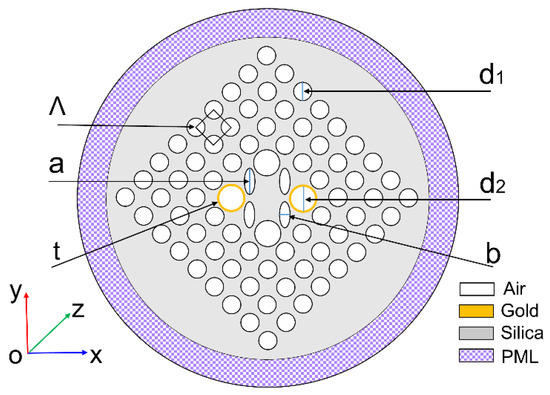
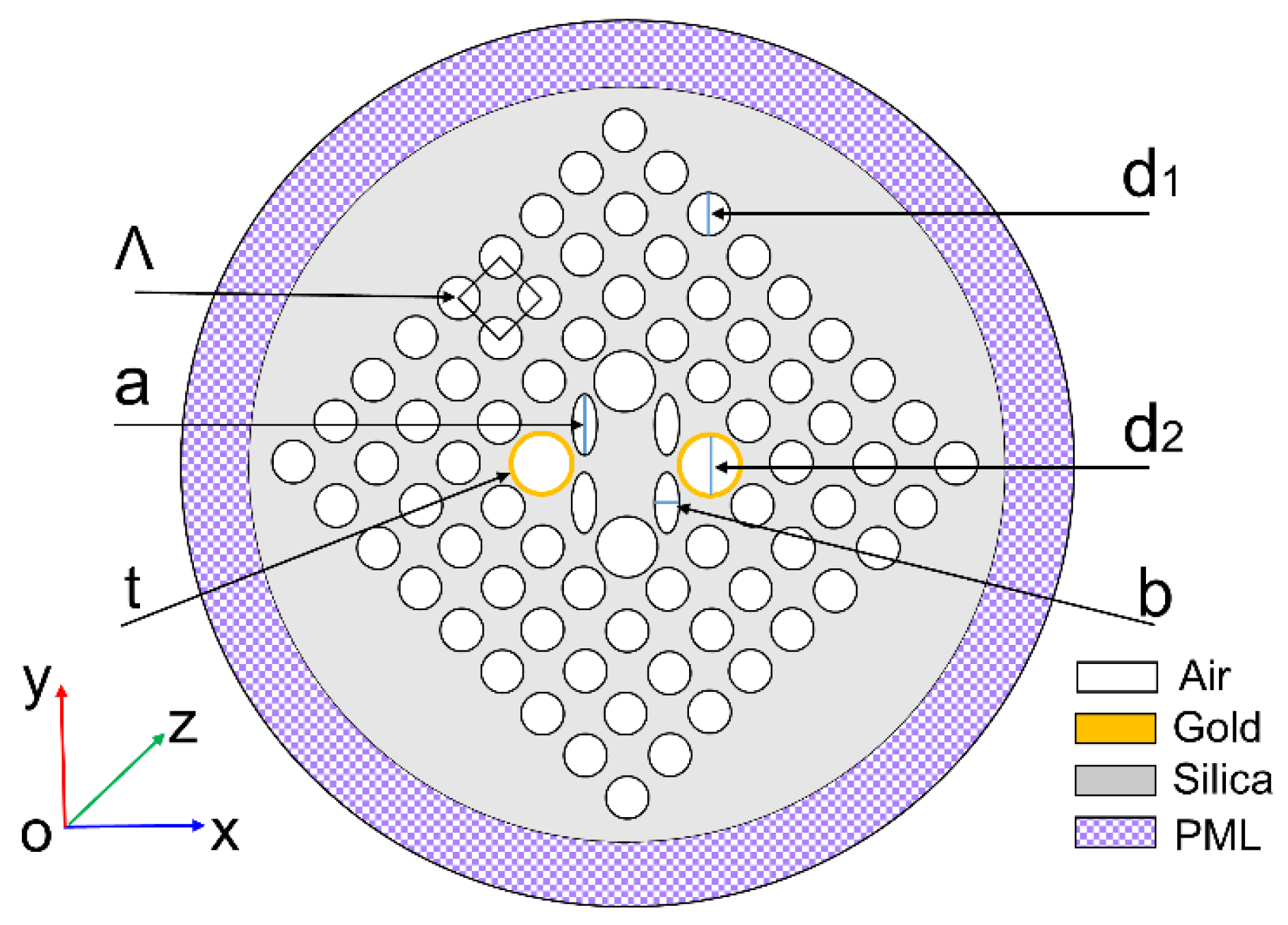
Figure 1 shows a cross-section diagram of the proposed PCF SPR filter. There are three kinds of holes distributed in cladding in the x-o-y plane. The uniform square-lattice constant is denoted by Λ. The diameter of the cladding holes is denoted by d1, and the diameter of the inner large holes is denoted by d2; here, set d2 = 1.4·d1. The long axis is denoted by a and the short axis is denoted by b. The gold thickness is denoted by t. Within the outer purple region of the proposed PCF geometric structure, there exists a layer with a thickness of 2 μm that serves as a perfect matching layer (PML) for absorbing boundary scattering, which helps to improve the accuracy of the calculation results [34]. In the commercial COMSOL 5.5 software environment, mixed polarized light is assumed to be incident vertically along the z-axis into this fiber. Firstly, we establish perfect electric conductor (PEC) and perfect magnetic conductor (PMC) boundaries around the proposed PCF. Subsequently, the finite-element solver discretizes this PCF structure into multiple small triangular areas, including 336 vertex elements, 2519 boundary elements, and 28,886 triangular elements, as shown in Figure S1 of the Supplementary Document. During the calculation process, the total number of degrees of freedom solved is 188,057. The mode analysis module is utilized to calculate the effective refractive index and mode profile. The reduction in the error value from 1 to ~10−9 in iterative convergence curves demonstrates that the simulation results of this model exhibit extremely high accuracy, as displayed in Figure S2 of the Supplementary Document. Finally, post-processing is carried out to assess its splitting performance.
Figure 1.
The cross-section diagram of the proposed PCF SPR filter.
The fabrication process of silica-based PCFs is currently the most technologically mature. The common stack-and-draw technique can be adopted [35,36]. In the stack stage, three kinds of glass capillaries are fabricated as the basic structural components. Subsequently, these capillaries are stacked in a glass sleeve in the configuration illustrated in Figure 1. After undergoing a heating treatment, the stacked assembly is sintered into a cane workpiece. Then, a jacket layer is coated around the outer surface of the cane, followed by a second heating process to ensure the jacket layer is integrated with the cane, thus completing the preform preparation. In the draw stage, the preform is placed into an optical fiber drawing tower and subjected to controlled heating. Finally, key process parameters, including internal pressure, heating temperature, and feeding speed, are precisely regulated to meet the design requirements. In fact, fabricating precise elliptical holes is challenging because surface tension leads them to naturally form a circular shape during the heating and drawing process. However, this challenge can be practically addressed using advanced fabrication techniques. Specifically, applying differential gas pressure to the specific capillaries intended for the elliptical holes can counteract the shrinkage. Combined with optimizing the drawing parameters, such as utilizing a relatively lower furnace temperature and higher drawing tension, the circularization effect can be effectively minimized to maintain the desired ellipticity [37]. Through the implementation of such precise parameter control, the proposed PCF is finally obtained. Thus, the silica glass is chosen to be background material, and the Sellmeier model is expressed as [38]
where λ denotes the wavelength of light in vacuum in micron (μm). And the detailed coefficients for A1–A3 and B1–B3 are shown in Table 1. Due to the temperature dependence of silica glass, the temperature condition in this numerical model is restricted to room temperature (~20 °C), with an operating wavelength range from 0.21 to 3.71 μm [39].
Table 1.
The detailed parameters of the silica glass Sellmeier model.
The gold is selected as the deposited material for exciting the SPR effect. And the gold film can be deposited into the inwalls of the desired holes using chemical vapor deposition (CVD). The Drude–Lorentz model of gold is expressed as [40,41]
where ε∞ denotes the permittivity of gold, ω denotes the angular frequency of incident light, ωD denotes the plasma frequency, γD denotes the damping frequency, Δε denotes a weight factor, ΩL denotes the frequency, and ΓL denotes the spectral width of the Lorentz oscillator, respectively. These detailed parameters can be seen in Table 2. Generally, the properties of gold films also exhibit temperature dependence. Several studies have investigated the effects of temperature on gold films. As the temperature rises, the SPR-matching conditions undergo slight variations [42,43]. In this work, we employ the gold Drude–Lorentz model under room temperature conditions. Furthermore, regarding the thermal effects that arise during the SPR processes of silica and gold, we assume that the temperature variation is negligible and the process occurs under steady-state conditions.
Table 2.
The detailed parameters of the gold Drude–Lorentz model.
The holes’ array within the cladding of PCFs is inherently constrained, a limitation that leads to the incomplete opening of the photonic bandgap. During the propagation of light signals, a portion of the optical field energy penetrates the confined cladding region and leaks into the outer cladding layer. This energy-leakage phenomenon ultimately gives rise to measurable energy loss in the system. This is the reason why confinement loss is generated in PCFs. The confinement loss α(x, y) can serve to quantify the intensity of the signal transmitted along the proposed PCF, which is given by [44]
where Im(neff) denotes the imaginary part of the effective refractive index of the transmission modes in the PCF.
The normalized output power (NOP) is utilized to evaluate the relative changes in different polarized signals. And the NOP in this polarizer is defined by [44]
where Pin(x, y) denotes the input power. It is assumed that 1 is used as a normalized input condition for calculation convenience, which indicates that the mode is almost fully transmitted.
Usually, the ER serves as a key metric to quantify the suppression of the undesired polarization mode in a polarizer, where a greater ER corresponds to enhanced polarization-maintaining performance. Thus, the ER is used to assess the filtering performance in this filter, which is defined by [44]
where Pout(x) and Pout(y) denote the output power in the x- and y-polarized direction, respectively.
3. Results and Discussion
3.1. Dispersion Relationship
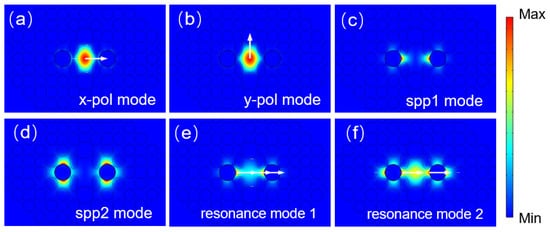
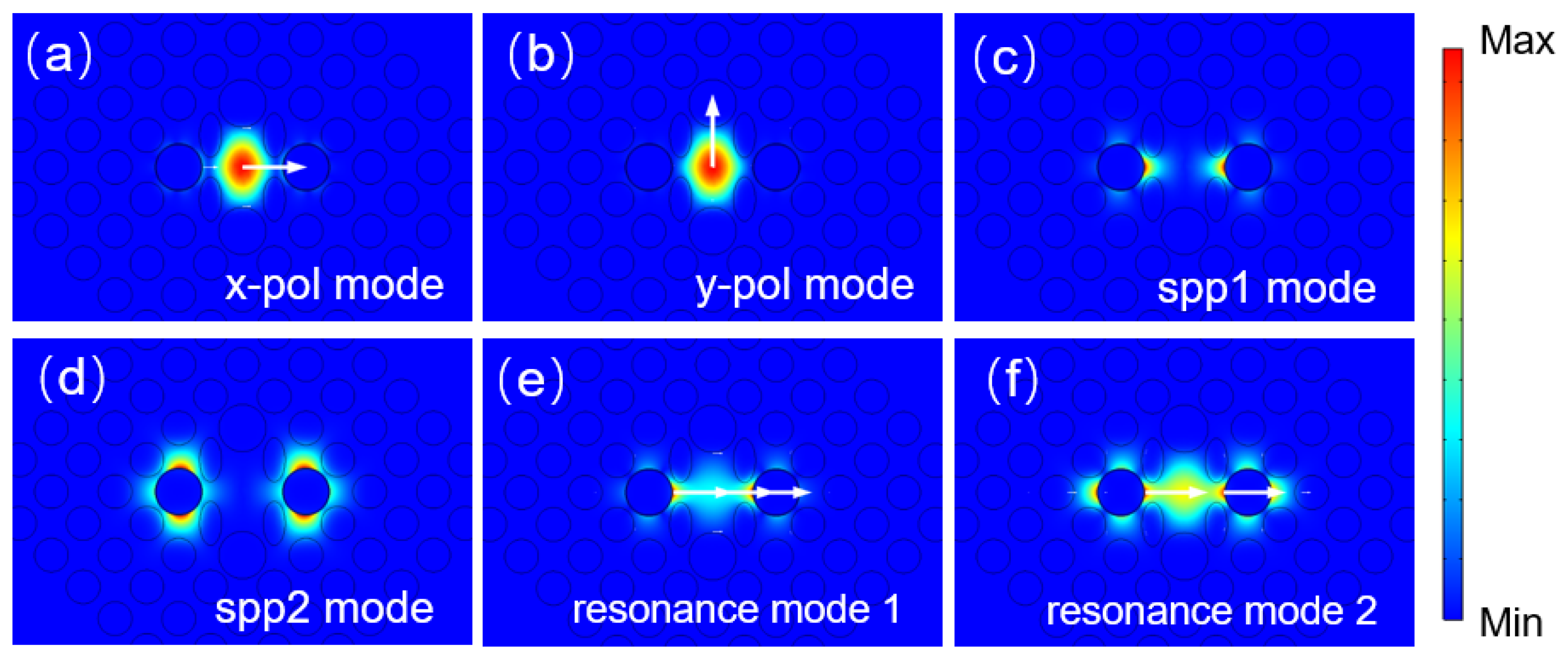
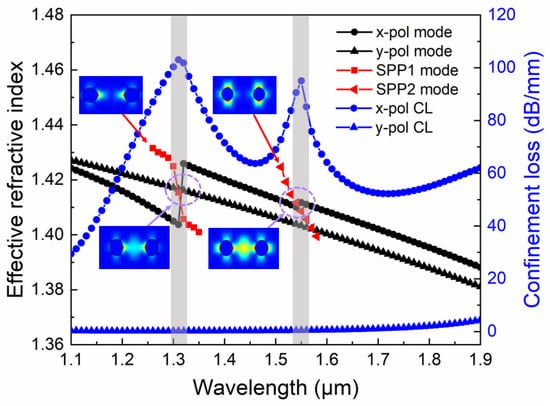
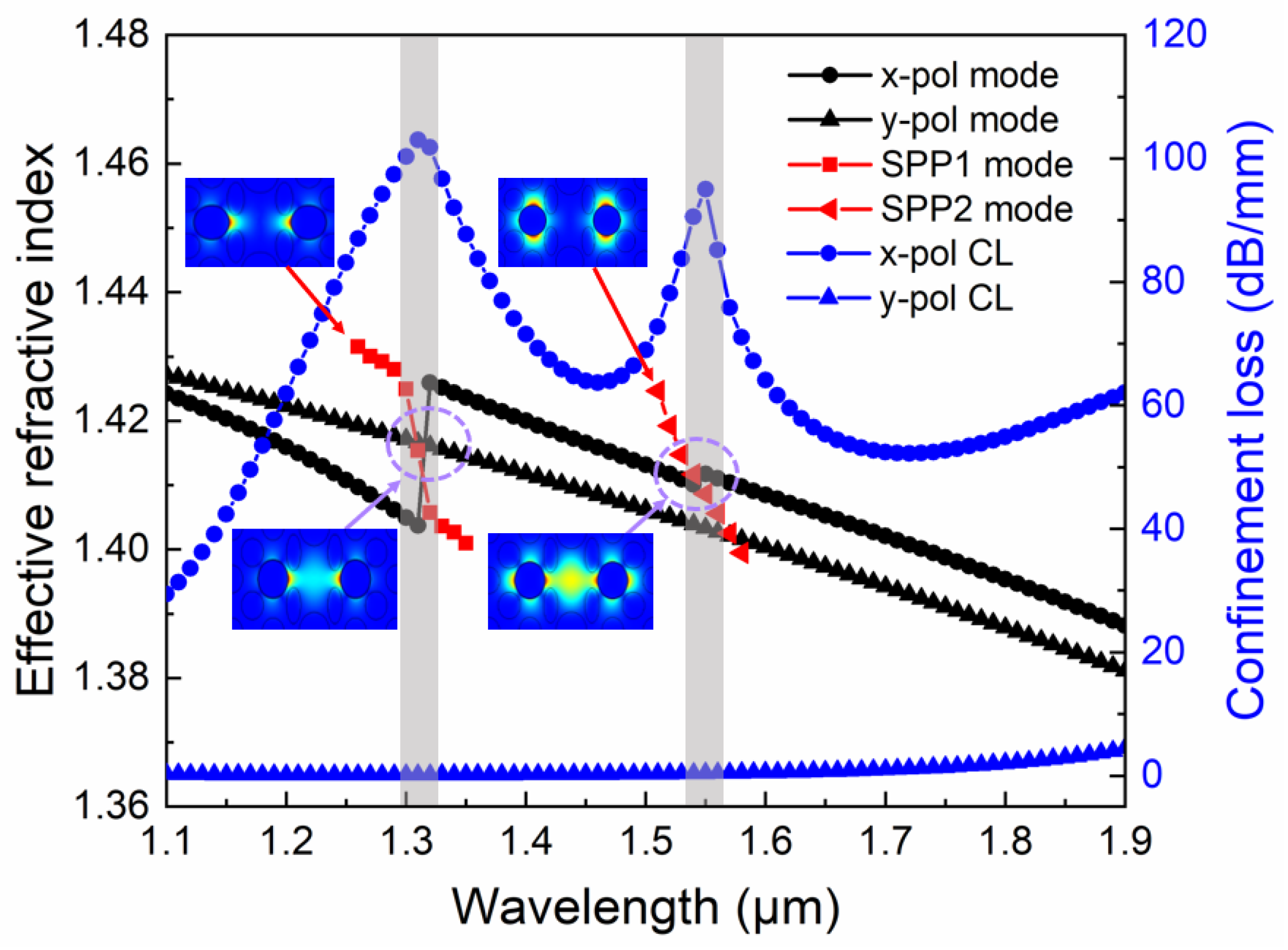
Figure 2 displays the supported electric field distributions in the proposed PCF SPR filter. Since the cutoff wavelength of the second-order mode is 0.9 μm, the proposed PCF supports endless single-mode transmission within the investigated wavelength range of 1.1–1.9 μm [45]. The details can be found in Figure S3 of the Supplementary Document. Upon launch into the PCF, the transmitted light exhibits several modes: (a) x-pol fundamental mode at 1.1 μm; (b) y-pol fundamental mode at 1.1 μm in the core region, and (c) SPP1 mode at 1.26 μm and (d) SPP2 mode at 1.5 μm excited on the gold layer surface, respectively. According to the coupled mode theory [46], when the distance between the waveguides is sufficiently small, the mode within one waveguide ceases to be independent. Instead, its energy will periodically couple with the mode of the other waveguide. In this PCF, two distinct resonant phenomena can be observed in the proposed PCF. Specifically, at different wavelength positions, the x-polarized mode undergoes coupling with the SPP1 mode and the SPP2 mode respectively. These coupling processes give rise to the formation of resonance mode 1 at 1.31 μm and resonance mode 2 at 1.55 μm, correspondingly, as displayed in Figure 2e,f. Figure 3 shows the dispersion relationship between fundamental polarized modes and plasmonic modes in the proposed PCF SPR filter with d1 = 1.5 μm, d2 = 1.4·d1 = 2.1 μm, a = 1.96 μm, b = 0.98 μm, Λ = 2 μm and t = 50 nm. The x-pol mode is capable of coupling with two plasmonic modes. Specifically, it satisfies the phase-matching condition at wavelengths of 1.31 μm and 1.55 μm, respectively, which consequently gives rise to two SPR signal peaks. In contrast, under the y-pol direction, no SPR process is observed within the investigated band of 1.1–1.9 μm. At 1.31 μm and 1.55 μm, the confinement losses are 103.0 dB/mm and 95.0 dB/mm for the x-pol mode, respectively, while those for the y-pol mode are only 0.2 dB/mm and 0.4 dB/mm. The corresponding confinement loss ratio can reach 515 and 237.5, respectively. This phenomenon establishes a foundation for polarization filtering applications, with a marked polarization-dependent signal contrast observed in both the second and third communication windows, thereby enabling the implementation of dual-window polarization filtering.
Figure 2.
The supported electric field distributions in the proposed PCF SPR filter. (a) x-pol fundamental mode at 1.1 μm; (b) y-pol fundamental mode at 1.1 μm; (c) SPP1 mode at 1.26 μm; (d) SPP2 mode at 1.5 μm; (e) resonance mode1 at 1.31 μm; (f) resonance mode2 at 1.55 μm.
Figure 3.
Dispersion relationship between fundamental modes and plasmonic modes in the proposed PCF SPR filter with d1 = 1.5 μm, d2 = 1.4·d1 = 2.1 μm, a = 1.96 μm, b = 0.98 μm, Λ = 2 μm and t = 50 nm. CL denotes confinement loss. The gray areas indicate the two resonance windows.
3.2. The Impact of Structural Parameters on Confinement Loss
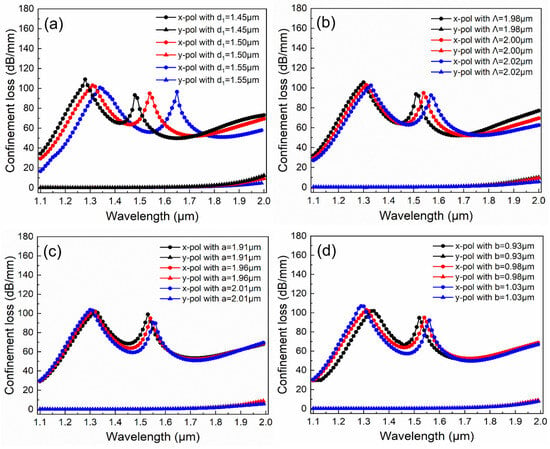
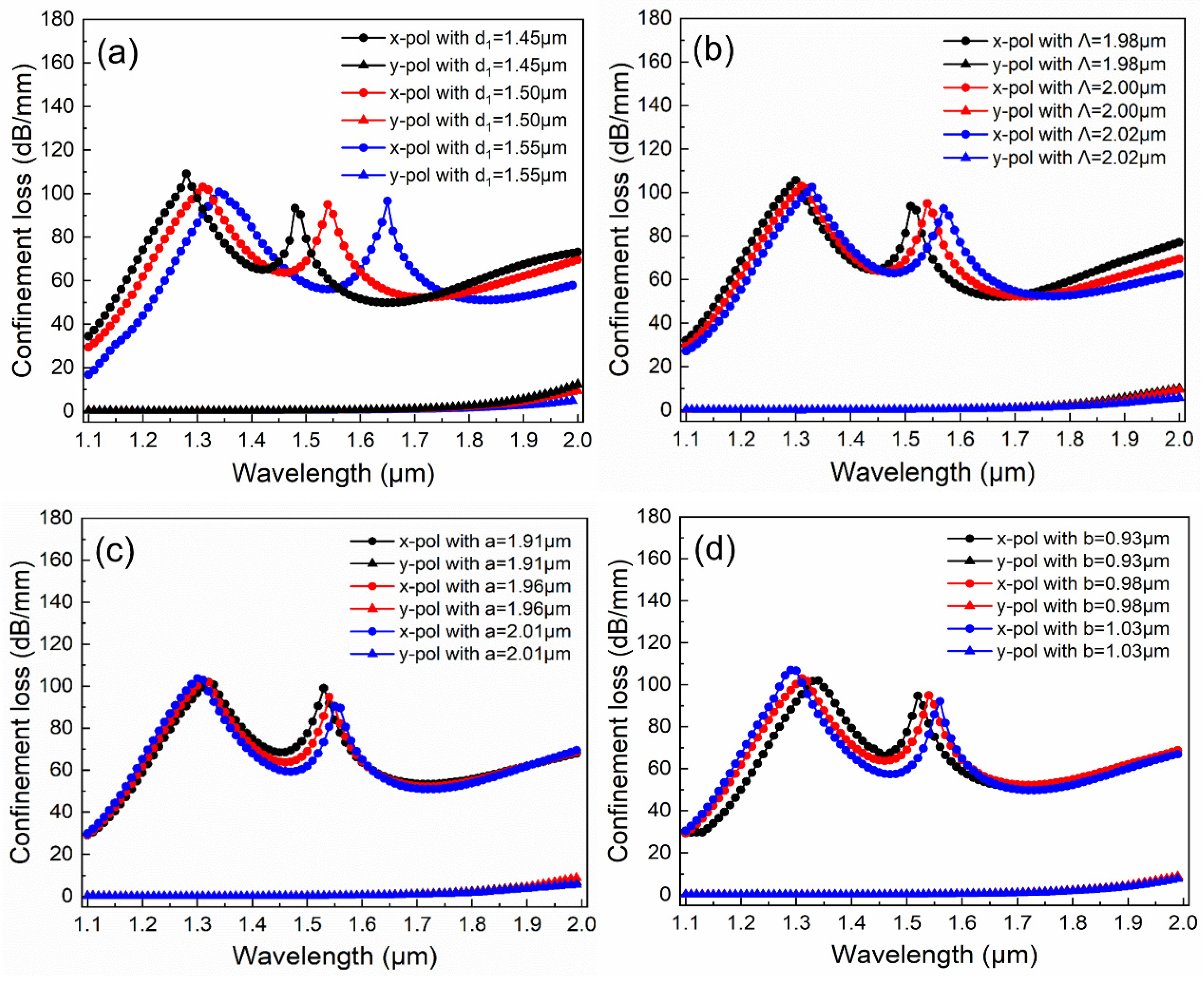
It is well established that fabricated errors tend to induce slight deviations in the predetermined structural parameters of the PCFs. Such deviations in structural parameters will affect the optical properties of the PCF and lead to alterations in its filtering performance. In this section, the influence of variations in the proposed PCF’s structural parameters on the confinement loss curve is analyzed using the control variate method, as illustrated in Figure 4 and Figure 5.
Figure 4.
The effect of the structural parameters on confinement loss curve. (a) The different diameter d1 versus confinement loss; (b) the different pitch Λ versus confinement loss; (c) the different long axis a versus confinement loss; (d) the different short axis b versus confinement loss.
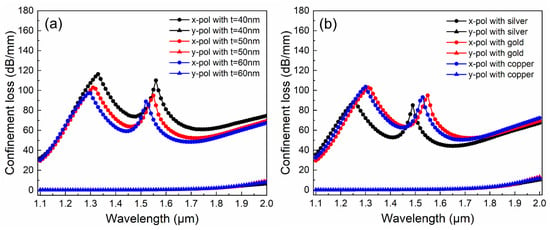
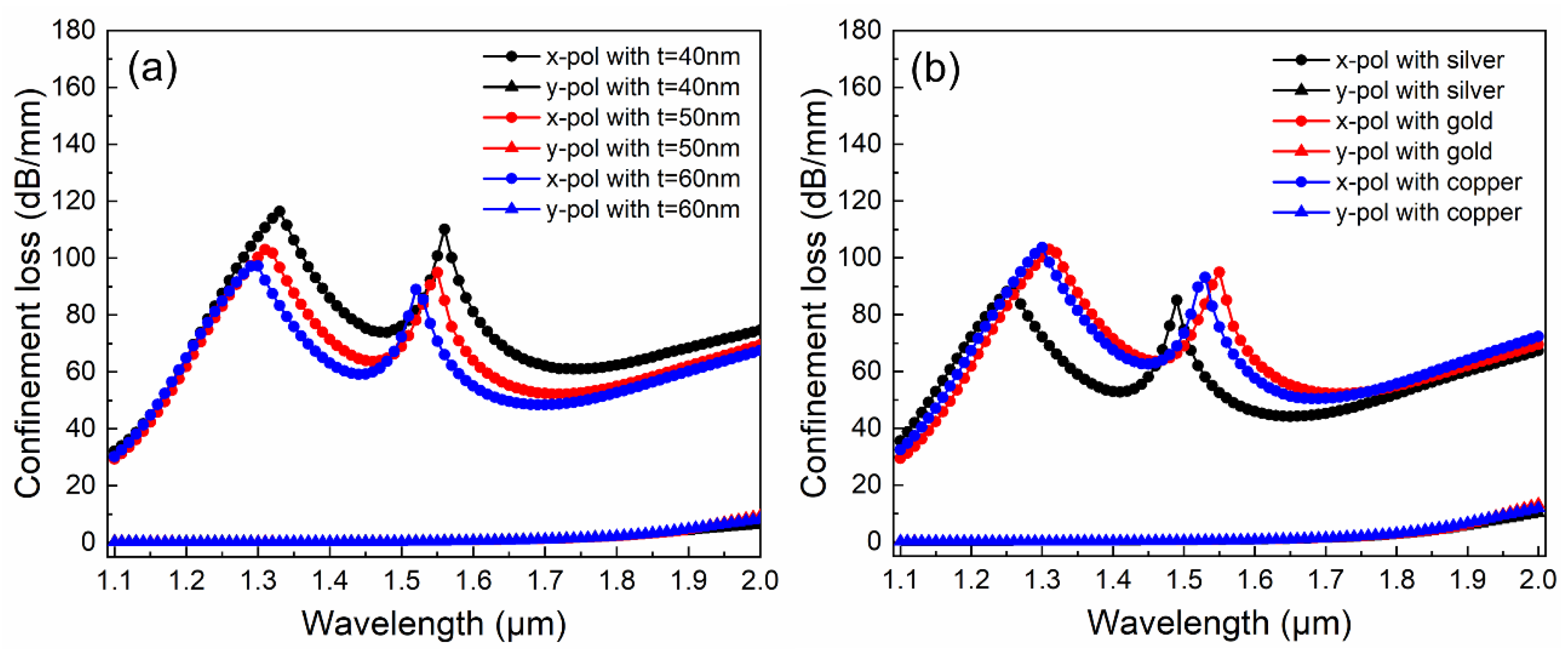
Figure 5.
The effect of plasmonic material factors on confinement loss curve. (a) The different gold layer thickness t versus confinement loss; (b) the different metal versus confinement loss.
Figure 4a displays the different diameter d1 versus confinement loss. The diameter d1 value is varied from 1.45 to 1.55 μm at 0.05 μm intervals. As d1 increases, the proportion of the silica medium gradually decreases, and the effective refractive index of the core mode exhibits an overall gradual decrease. Consequently, the phase-matching point redshifts, though the magnitude of this shift varies. For the left-side resonance features, three distinct peaks are observed at wavelengths of 1.28 μm, 1.31 μm, and 1.34 μm, which correspond to confinement losses of 109.1 dB/mm, 103.0 dB/mm, and 100.8 dB/mm, respectively. The right-side resonance peaks, occurring at 1.48 μm, 1.55 μm, and 1.65 μm, demonstrate confinement loss values of 93.2 dB/mm, 95.0 dB/mm, and 96.6 dB/mm.
Figure 4b shows the different pitch Λ versus confinement loss. The pitch Λ value is varied from 1.98 to 2.02 μm at 0.02 μm intervals. The operating principle of PCFs is closely linked to Λ, as it fundamentally governs the light guidance mechanism. Thus, the proposed PCF is extremely sensitive to variations in lattice constant, where minute changes can produce distinct alterations in their transmission characteristics. It can be observed that as Λ value increases, the confinement loss curve undergoes redshift gradually. For the left peak, three energy peaks are at wavelengths of 1.30 μm, 1.31 μm, and 1.33 μm, which correspond to confinement losses of 105.6 dB/mm, 103.0 dB/mm, and 102.5 dB/mm, respectively. The right-side resonance peaks, occurring at 1.51 μm, 1.55 μm, and 1.58 μm, demonstrate confinement loss values of 93.7 dB/mm, 95.0 dB/mm, and 92.7 dB/mm.
Figure 4c depicts the different long axis a versus confinement loss. The long axis a value is varied from 1.91 to 2.01 μm at 0.05 μm intervals. The length of the long axis directly influences the size of the SPR channel. Specifically, as long axis a increases, the opening of this SPR channel narrows. The primary effect of this change is to slightly reduce the spacing between the two resonance peaks, bringing them closer together. For the left peak, three resonance peaks appear at wavelengths of 1.32 μm, 1.31 μm, and 1.30 μm, corresponding to confinement loss values of 102.1 dB/mm, 103.0 dB/mm, and 103.8 dB/mm, respectively. The right-side resonance peaks, located at 1.53 μm, 1.55 μm, and 1.56 μm, demonstrate confinement loss values of 99.1 dB/mm, 95.0 dB/mm, and 90.5 dB/mm.
Figure 4d describes the different short axis b versus confinement loss. The short axis b value is varied from 0.93 to 1.03 μm at 0.05 μm intervals. Variations in the short axis b exert a direct influence on the size of the core region; furthermore, they also partially reshape the SPP modes. Consequently, the overall effect is that the two resonance peaks move closer to each other, with the degree of this change being slightly greater than that induced by variations in the long axis. For the left peak, three SPR peaks are at wavelengths of 1.34 μm, 1.31 μm, and 1.29 μm, which correspond to confinement loss values of 102.0 dB/mm, 103.0 dB/mm, and 107.0 dB/mm, respectively. The right SPR peaks, locating at 1.52 μm, 1.55 μm, and 1.57 μm, demonstrate confinement loss values of 94.7 dB/mm, 95.0 dB/mm, and 91.1 dB/mm.
Figure 5a presents the different gold layer thickness t versus confinement loss. The thickness t is varied from 40 to 60 nm at 10 nm intervals. An appropriate thickness of the gold layer facilitates critical coupling. Specifically, at this thickness, the energy of the incident light can be transferred most efficiently to the plasmon waves on the metal surface, thereby generating an extremely sharp resonance peak. Typically, the thickness of the gold layer is selected to be ~50 nm. Because of deposition-induced errors as well as material losses occurring during service, the thickness of the gold layer will exhibit a certain degree of fluctuation. It can be obtained that with the increment of t, the overall resonance peak exhibits a slight blue shift. When the thickness of the gold layer is reduced, specifically to approximately 40 nm, the SPR excitation efficiency becomes higher. As a result, the intensity of both resonance peaks is enhanced. For the left peak, three SPR peaks are at wavelengths of 1.33 μm, 1.31 μm, and 1.20 μm, corresponding to confinement loss values of 116.4 dB/mm, 103.0 dB/mm, and 97.2 dB/mm, respectively. The right resonance peaks, located at 1.56 μm, 1.55 μm, and 1.52 μm, demonstrate confinement loss values of 110.2 dB/mm, 95.0 dB/mm, and 89.0 dB/mm.
Figure 5b illustrates the different metal versus confinement losses. It can be found that other common plasmonic materials, such as silver and copper, can also achieve a significant difference in polarization signal intensity between different polarization directions. Three left-side resonance peaks are at wavelengths of 1.26 μm, 1.31 μm, and 1.30 μm, corresponding to confinement loss values of 88.2 dB/mm, 103.0 dB/mm, and 103.6 dB/mm, respectively. The right resonance peaks, located at 1.49 μm, 1.55 μm, and 1.53 μm, show confinement loss values of 85.1 dB/mm, 95.0 dB/mm, and 93.1 dB/mm. Additionally, the copper PCF can achieve a confinement loss ratio that is relatively close to that of the gold-coated PCF near the two common communication windows. However, when deposited as a thin film onto the inwall surface of the PCF microchannel and in direct contact with air, both silver and copper are prone to oxidation. This oxidation process will consequently compromise the long-term stability of the filter. In comparison, gold exhibits superior chemical stability. Therefore, it is evident that gold is a more suitable material choice for this application.
3.3. Filtering Performance Discussion
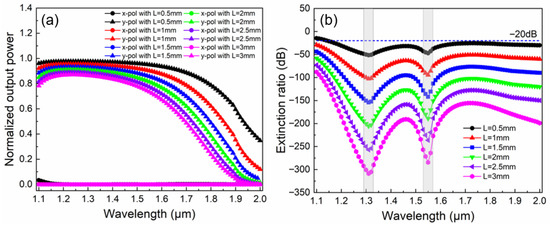
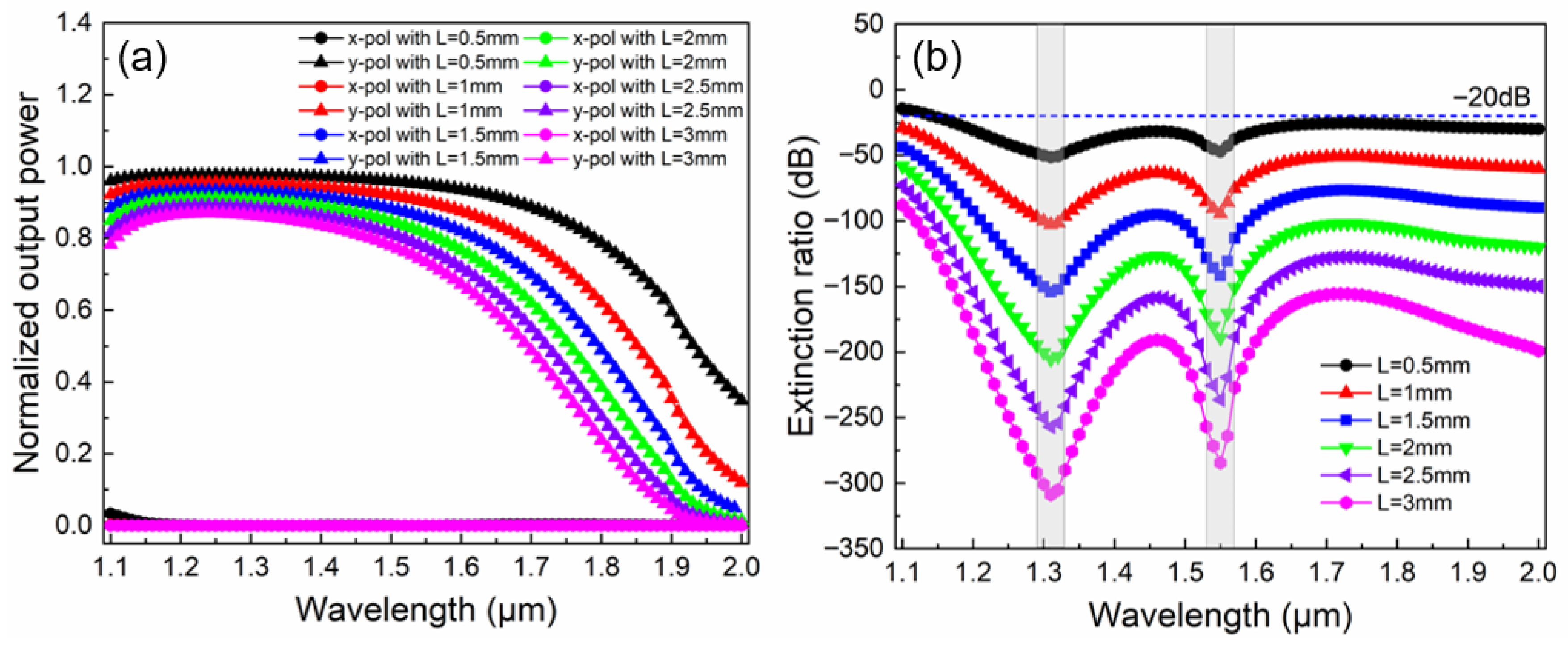
Based on the discussion in the previous section, the structural parameters are determined, including d1 = 1.5 μm, d2 = 1.4·d1 = 2.1 μm, a = 1.96 μm, b = 0.98 μm, Λ = 2 μm and t = 50 nm for the filtering performance analysis. Figure 6 shows the performance curves in the proposed PCF SPR filter. Generally, the length of this PCF directly affects its filtering performance. In this work, the effect of different PCF lengths, ranging from 0.5 to 3 mm at 0.5 mm intervals, on NOP and ER curves is analyzed. The NOP of the x-pol mode approaches 0. For different PCF lengths, the corresponding NOP curves almost overlap with one another. In fact, they exhibit a slight overall decrease and gradually converge toward 0. The NOP of the y-pol mode remains near 1, and as L increases, its corresponding NOP curve shows an overall downward trend, as shown in Figure 6a. Figure 6b shows the ER curves in this PCF with different length. Usually, the operating bandwidth is defined with the constraint of ER > 20 dB or ER < −20 dB. This specification is derived from engineering requirements, where 20 dB serves as a critical threshold to ensure optimal extinction capability. It is readily observed that the ER increases remarkably with the increase in PCF length. Notably, when the length exceeds 1 mm, the bandwidth completely covers the entire investigated wavelength range. Furthermore, to achieve filtering for the dual communication windows while considering the compactness of the polarizer, the length can be further reduced. When this PCF length L is 0.5 mm, the ER reaches −51.4 dB at 1.31 μm and −47.3 dB at 1.55 μm. Meanwhile, a bandwidth of over 860 nm is achievable, covering the investigated wavelength range of 1.14–2 μm. Therefore, by setting the length of this filter to 0.5 mm, three key performance metrics can be simultaneously achieved, including compact size, high extinction, and multi-wavelength selectivity.
Figure 6.
The performance curves in the proposed PCF SPR filter with d1 = 1.5 μm, d2 = 1.4·d1 = 2.1 μm, a = 1.96 μm, b = 0.98 μm, Λ = 2 μm and t = 50 nm. (a) The NOP curves in this PCF with different lengths; (b) the ER curves in this PCF with different lengths. The gray areas indicate the two resonance windows.
Table 3 lists performance variation in the proposed PCF filter with variations in structural parameters, and the corresponding performance curves can be found in the Supplementary Document. Here, the signal peaks near 1.31 μm and 1.55 μm are referred to as the left peak and the right peak, respectively. It can be determined that the slight variation in the structural parameters can lead to a maximum central wavelength shift of 0.11 μm for the left peak and 0.1 μm for the right peak, with the variation within a range of several dB in the maximum ER corresponding to the two signal peaks, and a maximum change of 50 nm in the operating bandwidth. Due to its sufficient ER and broad bandwidth, this PCF filter can still maintain a favorable extinction performance and multi-wavelength selectivity even under performance variations induced by structural parameter fluctuations.
Table 3.
Performance variation in the proposed PCF filter with variations in structural parameters.
Table 4.
Performance comparison between the proposed filter and the reported PCF filters.
To evaluate the overall performance of this PCF polarizer, Table 4 presents a comparison in terms of central wavelength, device length, extinction ratio (ER), and bandwidth. It can be observed that most PCF filters are designed around the second or third telecommunication window. Recently, research on polarization filters operating in the mid-infrared regime has also attracted increasing amounts of attention [54]. In contrast to the widely employed O, E, S, C, L, and U communication bands, the development potential of the mid-infrared band remains to be fully explored, and its stability and practical applicability still require further verification. In terms of device length, the length of the proposed filter can be tailored to 0.5 mm, which is shorter than that of most compared filters, making it more suitable for highly integrated optical systems. In terms of ER, although the ER values at the two target windows are not extremely high, specifically, the maximum ER values are −51.4 dB and −47.3 dB at 1.31 μm and 1.55 μm, respectively, they are still sufficient to achieve effective filtering performance. In terms of operating bandwidth, the proposed filter exhibits an operating bandwidth of over 860 nm, showing an increasing trend toward broader bandwidths. Consequently, depending on the above merits, it has the potential to serve as a key component in optical communication networks, thereby contributing to the realization of all-optical networks.
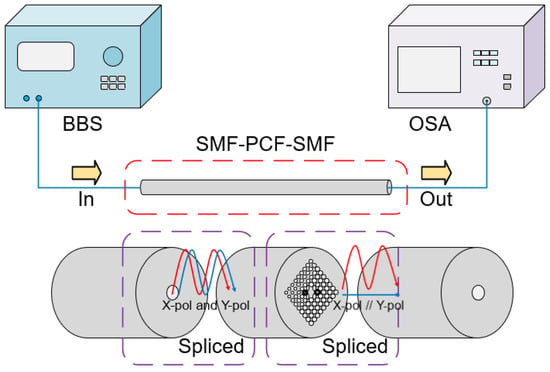
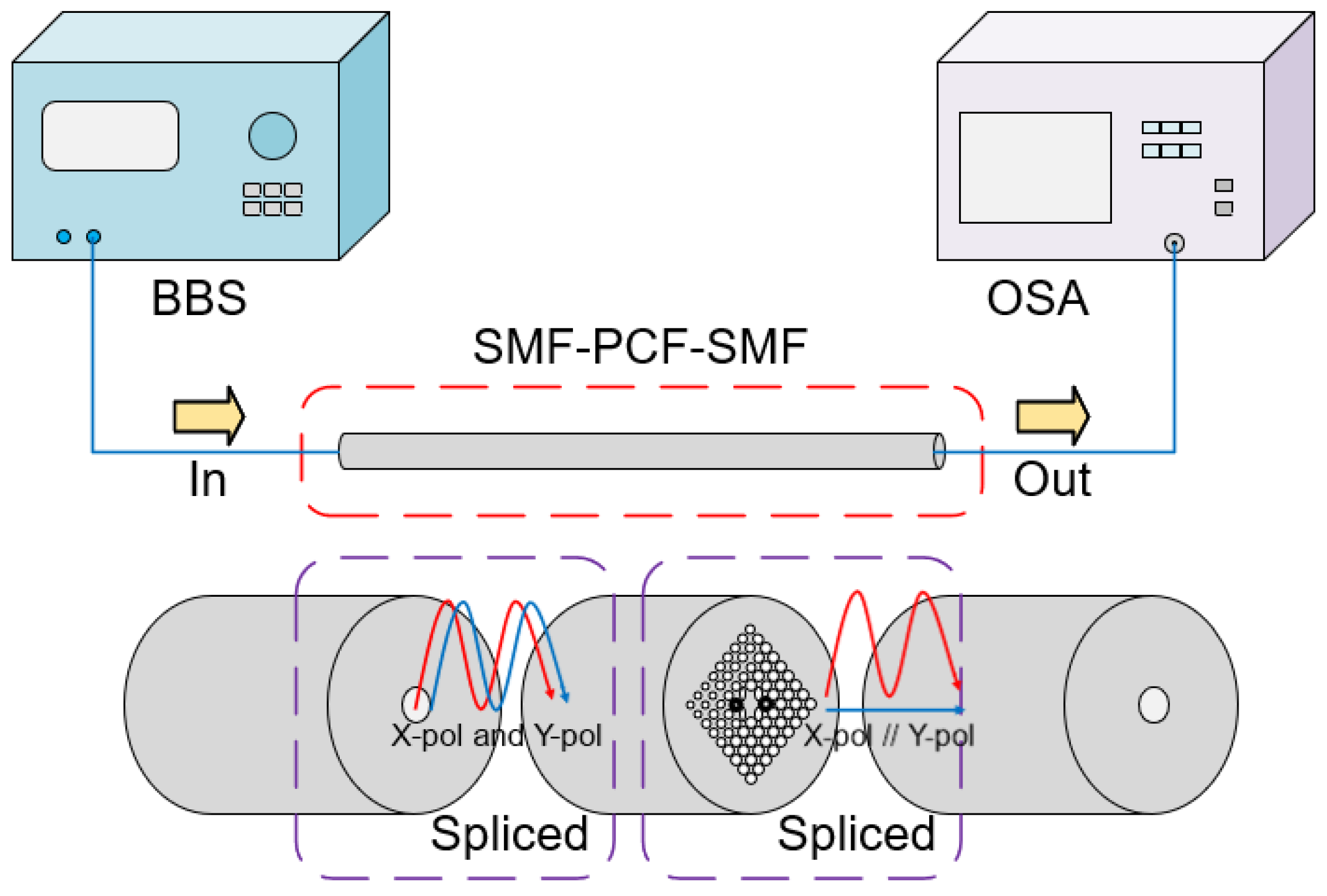
Owing to the typically small size of PCF-SPR devices, the pre-treated PCF used for metal film deposition can be set to a length of several centimeters via the advanced CVD technique. By introducing a precursor solution with a specific concentration of gold ions into the desired holes and precisely controlling the temperature and pressure, a compact gold film with the desired thickness can be formed on the inner wall of the microchannels. During the fusion splicing process, one end of the proposed PCF with gold film is first spliced to the SMF. Subsequently, this PCF is cleaved to a length of 0.5 mm and spliced again to another SMF, forming the “SMF-PCF-SMF” structure. Typically, this PCF polarization filter needs to be integrated into optical fiber links, as displayed in Figure 7. The fabrication of such a structure can be achieved using a high-precision optical fiber fusion splicer, such as FSM-100P. However, this integration process inevitably necessitates the investigation of fusion splicing loss. Here, the lateral deviation and axial tilt of the optical fiber during timing alignment are neglected, and the splice loss can be defined as [55,56]
where MFDPCF and MFDSMF are the mode field diameters of the proposed PCF and an SMF, respectively.
Figure 7.
The diagram of filtering performance verification for the proposed PCF filter.
MFDPCF can be expressed as [55,56]
where MFDx and MFDy are calculated based on the intensity field distribution along the two polarization directions based on COMSOL software. The MFDs of the proposed PCF are calculated from the effect mode area. And the effect mode area is defined by [55,56]
where Aeff is the effective mode area and r is the mode field radius which is half of MFDPCF. Here, it is assumed that the MFD of the chosen SMF is 5 μm. It can be calculated that the corresponding MDFPCF value is ~2.37 μm at 1.31 μm, from which the splice loss can be derived as ~2.22 dB. When the operating wavelength is located at 1.55 μm, the corresponding MDFPCF is ~2.78 μm, and the calculated splice loss is ~1.42 dB. The detailed calculation process can be found in Section S4 of the Supplementary Document [55,56]. To further reduce the fusion loss between the proposed PCF and the SMF, some strategies including the multiple discharge or improved fusion techniques can be adopted [57]. What is more, high-precision equipment is required to adjust the position of the proposed PCF filter in the experiment. This operation is intended to enhance the coupling efficiency of the spatial optical path and realize mode field matching, thereby achieving the optimal filtering effect [58,59].
4. Conclusions
In summary, this work demonstrates a compact broadband in-fiber polarization filter using gold-coated square-lattice PCF by the mature FEM. The simulation results indicate that when d1 = 1.5 μm, d2 = 1.4 d1 = 2.1 μm, a = 1.96 μm, b = 0.98 μm, Λ = 2 μm and t = 50 nm, the x-pol mode can interact with both SPP1 mode and SPP2 mode, and two SPR processes at two common communication windows can be achieved. The y-pol mode does not couple with the plasmonic modes, thereby establishing the prerequisite for a dual-window operation. To achieve a balance between integration degree and filtering performance, the length of this PCF filter is set to 0.5 mm, showing the maximum ER of −51.4 dB at 1.31 μm and −47.3 dB at 1.55 μm, and an operating bandwidth of >860 nm. Additionally, the estimated splice losses are ~2.22 dB at 1.31 μm and ~1.42 dB at 1.55 μm. Notably, this PCF filter, characterized by its compact size, excellent filtering performance, and wide bandwidth, is anticipated to play a crucial role in future all-optical network communications, sensing systems, and computing technologies. And it can effectively address the key challenges posed by the big data era.
Supplementary Materials
The following supporting information can be downloaded at https://www.mdpi.com/article/10.3390/photonics13040338/s1, Figure S1. The triangulation mesh of the proposed PCF. Figure S2. Iterative convergence curves during parametric sweeping in the simulation. Figure S3. The cutoff wavelength of the second-order mode. Figure S4. The effect of different d1 on ER curve. Figure S5. The effect of different Λ on ER curve. Figure S6. The effect of different a on ER curve. Figure S7. The effect of different b on ER curve. Figure S8. The effect of different t on ER curve. Figure S9. The mode profile for calculating the splice loss. Figure S10. The mode field area curves of the two polarized modes.
Author Contributions
Conceptualization: N.C. and C.L. (Cheng Lu); Methodology: N.C. and S.B.; Software: J.Z., X.H. and Z.S.; Validation: N.C. and S.B.; Formal analysis: N.C. and J.Z.; Investigation: X.H., J.Z. and Z.S.; Resources: C.L. (Cheng Lu); Data curation: N.C.; Writing—original draft preparation: N.C.; Writing—review and editing: F.Y., S.B. and N.C.; Visualization: F.Y. and C.L. (Chenxun Liu); Supervision: S.B. and C.L. (Cheng Lu); Project administration: C.L. (Cheng Lu) and N.C. All authors have read and agreed to the published version of the manuscript.
Funding
This research was funded by Natural Science Foundation for Colleges and Universities of Jiangsu Province (Grant No. 24KJB460023), and Cultivation Program for Young Academic Backbone of Shanghai Polytechnic University (Grant No. EGD24DS09).
Data Availability Statement
All data generated or analyzed during this study are included in this published article.
Conflicts of Interest
No potential conflicts of interest were reported by the authors.
References
- Guo, M.; Zhong, L.; Li, S.; Chen, Y.; Li, J.; Li, J.; Yang, D. Advances in On-Chip Polarization Multiplexing Devices: From Traditional Designs to Inverse Design and Hybrid Multiplexing. Laser Photonics Rev. 2025, 19, e00643. [Google Scholar] [CrossRef] [Scilit]
- Yang, S.J.; Pan, Y.M.; Shi, L.Y.; Zhang, X.Y. Millimeter-wave dual-polarized filtering antenna for 5G application. IEEE Trans. Antennas Propag. 2020, 68, 5114–5121. [Google Scholar] [CrossRef] [Scilit]
- Dai, D.; Liu, L.; Gao, S.; Xu, D.X.; He, S. Polarization management for silicon photonic integrated circuits. Laser Photonics Rev. 2013, 7, 303–328. [Google Scholar] [CrossRef] [Scilit]
- Hady, L.K.; Kajfez, D.; Kishk, A.A. Dielectric resonator antenna in a polarization filtering cavity for dual function applications. IEEE Trans. Microw. Theory Tech. 2008, 56, 3079–3085. [Google Scholar] [CrossRef] [Scilit]
- Pimbi, D.; Hasan, M.; Borhan Mia, M.; Jadye, N.; Kim, S. Polarization-independent photonic Bragg grating filter with cladding asymmetry. Opt. Lett. 2023, 48, 1192–1195. [Google Scholar] [CrossRef] [Scilit]
- Tan, Y.; Wu, H.; Wang, S.; Li, C.; Dai, D. Silicon-based hybrid demultiplexer for wavelength-and mode-division multiplexing. Opt. Lett. 2018, 43, 1962–1965. [Google Scholar] [CrossRef] [Scilit]
- Yang, W.; Huang, J.; Chen, D.; Yu, K.L.; Xue, Q.; Che, W. Broadband dual-polarized filtering metasurface-based antennas using characteristic mode analysis for 5G millimeter-wave applications. IEEE Trans. Antennas Propag. 2024, 72, 3912–3927. [Google Scholar] [CrossRef] [Scilit]
- Cui, Y.; Ye, J.; Li, Y.; Dai, P.; Qu, S. Vortex chirality-dependent filtering in helically twisted single-ring photonic crystal fibers. Opt. Express 2019, 27, 20816–20823. [Google Scholar] [CrossRef] [Scilit]
- Tu, D.; Tang, Y.; Huang, Y.; Tang, M.; Li, L.; Li, Y.; Lu, M.; Luo, Z.; Duan, Y. Next-Generation Wearable/Implanted Sensors Based on Fiber Optic and Its Application: From in Vitro to in Vivo. ACS Sens. 2025, 10, 3818–3839. [Google Scholar] [CrossRef] [Scilit]
- Chen, P.; Zhang, X.; Zhan, X.; Huang, Y.; Wu, H.; Zhao, C.; Xu, A.; Guan, B.O. Single-Molecule Amplification-Free Detection of Nucleic Acid Biomarkers from Body Fluids via an Optical Microfiber with a Nanointerface. Nano Lett. 2025, 25, 2978–2987. [Google Scholar] [CrossRef] [Scilit]
- Russell, P.S.J. Photonic-crystal fibers. J. Light. Technol. 2006, 24, 4729–4749. [Google Scholar] [CrossRef] [Scilit]
- Ozbay, E. Plasmonics: Merging photonics and electronics at nanoscale dimensions. Science 2006, 311, 189–193. [Google Scholar] [CrossRef] [Scilit] [PubMed]
- Tang, G.J.; He, X.T.; Shi, F.L.; Liu, J.W.; Chen, X.D.; Dong, J.W. Topological photonic crystals: Physics, designs, and applications. Laser Photonics Rev. 2022, 16, 2100300. [Google Scholar] [CrossRef] [Scilit]
- Zhu, B.; Hean, K.; Wong, S.; Wang, Y.; Banerjee, R.; Xue, H.; Wang, Q.; Cerjan, A.; Wang, Q.J.; Chang, W.; et al. Topological photonic crystal fiber. Sci. Adv. 2025, 11, eady1476. [Google Scholar] [CrossRef] [Scilit]
- Maleki, M.J.; Soroosh, M.; Akbarizadeh, G.; Parandin, F.; Haddadan, F. Photonic crystal resonators in designing optical decoders. J. Optoelectron. Nanostruct. 2023, 8, 1–24. [Google Scholar]
- Saghaei, H.; Soroosh, M.; Maleki, M.J.; Mondal, H.; Nurmohammadi, T.; Jafari, B.; Shahi, M.; Sepahvandi, V.; Adibnia, E. High-performance and compact photonic crystal channel drop filter using P-shaped ring resonator. Results Opt. 2025, 21, 100817. [Google Scholar] [CrossRef] [Scilit]
- Lee, H.W.; Schmidt, M.A.; Russell, R.F.; Joly, N.Y.; Tyagi, H.K.; Uebel, P.; Russell, P.S.J. Pressure-assisted melt-filling and optical characterization of Au nano-wires in microstructured fibers. Opt. Express 2011, 19, 12180–12189. [Google Scholar] [CrossRef] [Scilit]
- Lalanne, P.; Yan, W.; Vynck, K.; Sauvan, C.; Hugonin, J.P. Light interaction with photonic and plasmonic resonances. Laser Photonics Rev. 2018, 12, 1700113. [Google Scholar] [CrossRef] [Scilit]
- Ditlbacher, H.; Galler, N.; Koller, D.M.; Hohenau, A.; Leitner, A.; Aussenegg, F.R.; Krenn, J.R. Coupling dielectric waveguide modes to surface plasmon polaritons. Opt. Express 2008, 16, 10455–10464. [Google Scholar] [CrossRef] [Scilit]
- Hu, L.; Li, J.; Yin, Z.; Zhang, Z.; Li, H.; Li, S.; Wang, P.; Du, H.; Wang, R. A cascade SPR sensor based on Ag/Au coated coreless optical fiber for RI and pH measurement. Opt. Laser Technol. 2025, 180, 111452. [Google Scholar] [CrossRef] [Scilit]
- Guo, P.; Du, H.; Li, J.; Yin, Z.; Li, Y.; Li, H.; Zhang, L.; Li, S. Study on SPR sensors modulated by ZnO films of different thicknesses for dual-parameter measurement of ocean salinity and temperature. Measurement 2025, 251, 117331. [Google Scholar] [CrossRef] [Scilit]
- Qu, Y.; Yuan, J.; Zhou, X.; Li, F.; Mei, C.; Yan, B.; Wu, Q.; Wang, K.; Sang, X.; Long, K.; et al. A V-shape photonic crystal fiber polarization filter based on surface plasmon resonance effect. Opt. Commun. 2019, 452, 1–6. [Google Scholar] [CrossRef] [Scilit]
- Mollah, M.A.; Mazid, M.A.; Ahmed, K. Hi-Bi Photonic Crystal Fiber for Broadband Filter Realization Using Copper Microwires. Plasmonics 2020, 15, 1789–1797. [Google Scholar] [CrossRef] [Scilit]
- Gamal, Y.; Younis, B.M.; Hegazy, S.F.; Badr, Y.; Hameed, M.F.O.; Obayya, S.S.A. Highly efficient modified dual D-shaped PCF polarization filter. Opt. Fiber Technol. 2021, 62, 102459. [Google Scholar] [CrossRef] [Scilit]
- Yang, D.; Wei, Z.; Qin, H.; Xu, B.; Cheng, T. Optimization of structural parameters of PCF polarization filter by a genetic algorithm. IEEE Photonics J. 2022, 14, 7260009. [Google Scholar] [CrossRef] [Scilit]
- Wang, D.; Zhang, Y.; Tian, J.; Guo, W.; Ma, T. D-Shaped photonic crystal fiber with graphene coating for terahertz polarization filtering and sensing applications. Opt. Fiber Technol. 2023, 79, 103373. [Google Scholar] [CrossRef] [Scilit]
- Zhang, Z.; Li, J.; Guo, H.; Xu, Y.; Wang, R.; Li, S.; Zhang, H.; Chang, Y.; Zhao, Y. Tunable chalcogenide solid-core anti-resonant fiber polarization filter based on SPR effect. Opt. Lasers Eng. 2024, 181, 108371. [Google Scholar] [CrossRef] [Scilit]
- Jing, Y.; Du, J.; Hua, J.; Li, X.; Li, J.; Li, S. Polarization filter of hollow-core anti-resonant fiber in the 1550 nm band based on SPR effect. Opt. Laser Technol. 2025, 180, 111407. [Google Scholar] [CrossRef] [Scilit]
- Petrovich, M.; Numkam Fokoua, E.; Chen, Y.; Sakr, H.; Adamu, A.I.; Hassan, R.; Wu, D.; Ando, R.F.; Papadimopoulos, A.; Sandoghchi, S.R.; et al. Broadband optical fibre with an attenuation lower than 0.1 decibel per kilometre. Nat. Photonics 2025, 19, 1203–1208. [Google Scholar] [CrossRef] [Scilit]
- Wang, D.; Yu, Y.; Lu, Z.; Yang, J.; Yi, Z.; Bian, Q.; Zhang, J.; Qin, S.; Weng, J.; Yao, S.; et al. Design of photonic crystal fiber to excite surface plasmon resonance for highly sensitive magnetic field sensing. Opt. Express 2022, 30, 29271–29286. [Google Scholar] [CrossRef] [Scilit]
- Wang, Y.; Li, S.; Chen, H.; Shi, M.; Liu, Y. Ultra-wide bandwidth polarization filter based on gold-coated photonic crystal fiber around the wavelength of 1.55 µm. Opt. Laser Technol. 2018, 106, 22–28. [Google Scholar] [CrossRef] [Scilit]
- Dhanu Krishna, G.; Mahadevan Pillai, V.P.; Gopchandran, K.G. Characteristics of photonic crystal fibers with different lattices: Realization of constant air percentage by fixing air-filling fraction. Photonics Nanostruct.-Fundam. Appl. 2020, 39, 100785. [Google Scholar]
- Jiang, L.; Wang, C.; Zou, J.; Zhang, Y.P.; Qi, Y.; Wang, W.; Hou, L. Design of two miniaturized and broadband polarization filters based on two types of square-lattice gold-filled photonic crystal fibers. Opt. Fiber Technol. 2021, 61, 102454. [Google Scholar] [CrossRef] [Scilit]
- Islam, M.S.; Sultana, J.; Faisal, M.; Islam, M.R.; Dinovitser, A.; Ng, B.W.H.; Abbott, D. A modified hexagonal photonic crystal fiber for terahertz applications. Opt. Mater. 2018, 79, 336–339. [Google Scholar] [CrossRef] [Scilit]
- Tan, X.; Wang, Y.; Jiang, M.; Peng, W.; Sui, G.; Zhang, D.; Zhuang, S.; Gao, X. Improved genetic algorithm-based optimization of filler rod design in photonic crystal fiber packaging with an antagonism balance criterion. Opt. Express 2025, 33, 32749–32764. [Google Scholar] [CrossRef] [Scilit]
- Markos, C.; Travers, J.C.; Abdolvand, A.; Eggleton, B.J.; Bang, O. Hybrid photonic-crystal fiber. Rev. Mod. Phys. 2017, 89, 045003. [Google Scholar] [CrossRef] [Scilit]
- Sun, S.; Luo, Z.; Yin, R.; Jiang, W.; Zheng, Y.; Huang, J.; Pang, M.; Jiang, X. Endlessly single-mode, broadband polarization-maintaining solid-core photonic crystal fiber. Opt. Express 2025, 33, 48901–48911. [Google Scholar] [CrossRef] [Scilit]
- Liu, Q.; Li, S.; Li, J.; Dou, C.; Wang, X.; Wang, G.; Shi, M. Tunable fiber polarization filter by filling different index liquids and gold wire into photonic crystal fiber. J. Light. Technol. 2016, 34, 2484–2490. [Google Scholar] [CrossRef] [Scilit]
- Kitamura, R.; Pilon, L.; Jonasz, M. Optical constants of silica glass from extreme ultraviolet to far infrared at near room temperature. Appl. Opt. 2007, 46, 8118–8133. [Google Scholar] [CrossRef] [Scilit]
- Chen, N.; Guo, W.; Chen, H.; Ding, X.; Yang, F.; Zhu, Y.; Song, M.; Xu, Y. Multifunctional in-fiber polarization beam splitter using liquid crystal infiltrated dual-core photonic crystal fiber with gold layers and its temperature sensing characteristic. Opt. Laser Technol. 2025, 191, 11350. [Google Scholar] [CrossRef] [Scilit]
- Vial, A.; Grimault, A.S.; Macías, D.; Barchiesi, D.; Chapelle, M.L.D.L. Improved analytical fit of gold dispersion: Application to the modeling of extinction spectra with a finite-difference time-domain method. Phys. Rev. B-Condens. Matter Mater. Phys. 2005, 71, 085416. [Google Scholar] [CrossRef] [Scilit]
- Reddy, H.; Guler, U.; Kildishev, A.V.; Boltasseva, A.; Shalaev, V.M. Temperature-dependent optical properties of gold thin films. Opt. Mater. Express 2016, 6, 2776–2802. [Google Scholar] [CrossRef] [Scilit]
- Luo, W.; Meng, J.; Li, X.; Xie, Q.; Yi, D.; Wang, Y.; Hong, X. Temperature effects on surface plasmon resonance sensor based on side-polished D-shaped photonic crystal fiber. Measurement 2021, 181, 109504. [Google Scholar] [CrossRef] [Scilit]
- Liu, Q.; Li, S.; Li, H.; Zi, J.; Zhang, W.; Fan, Z.; An, G.; Bao, Y. Broadband single-polarization photonic crystal fiber based on surface plasmon resonance for polarization filter. Plasmonics 2015, 10, 931–939. [Google Scholar] [CrossRef] [Scilit]
- Chen, N.; Feng, Y.; Ren, Z.; Ding, X.; Cao, S.; Xu, Y.; Yang, F.; Song, M. Mid-infrared broadband in-fiber polarization beam splitter based on dual core photonic crystal fiber with dual aluminum wires. Opt. Commun. 2025, 586, 131920. [Google Scholar] [CrossRef] [Scilit]
- Uebel, P.; Günendi, M.C.; Frosz, M.H.; Ahmed, G.; Edavalath, N.N.; Ménard, J.M.; Russell, P.S.J. Broadband robustly single-mode hollow-core PCF by resonant filtering of higher-order modes. Opt. Lett. 2016, 41, 1961–1964. [Google Scholar] [CrossRef] [Scilit]
- Wang, Y.; Li, S.; Li, J.; Guo, Y.; Wang, M. Novel external gold-coated side-leakage photonic crystal fiber for tunable broadband polarization filter. J. Light. Technol. 2020, 39, 1791–1799. [Google Scholar] [CrossRef] [Scilit]
- Yu, Z.; Jin, Z.; Lv, T.; Liu, L. High extinction ratio and large bandwidth PCF polarization filter with gold-wires coated by monocrystalline silicon. IEEE Photonics J. 2022, 14, 6843806. [Google Scholar] [CrossRef] [Scilit]
- Wang, J.; Pei, L.; Li, Z.; Hu, K.; Xu, L. Wavelength-switchable polarization filter based on graphene-coated d-shaped photonic crystal fiber. Plasmonics 2024, 19, 2363–2370. [Google Scholar] [CrossRef] [Scilit]
- Chen, N.; Guo, L.; Xu, Y.; Huang, Y.; Ding, X.; Xu, Y.; Wang, L.; Liu, C.; Wu, T.; Zhu, Y.; et al. Design and simulation of a compact plasmonic photonic crystal fiber filter with wide band and high extinction ratio. Opt. Commun. 2024, 565, 130690. [Google Scholar] [CrossRef] [Scilit]
- Ullah, S.; Chen, H.; Gao, Z.; Li, Z.; Guo, P.; Wang, C.; Li, S. Dual-Side Polished Surface Plasmon Resonance-Based Photonic Crystal Fiber for Refractive Index Sensing and Polarization Filtering. Plasmonics 2024, 19, 2615–2625. [Google Scholar] [CrossRef] [Scilit]
- Chen, N.; Xiao, Y.; Xu, Y.; Ding, X.; Chen, H.; Guo, W.; Wu, T.; Xu, Y.; Zhu, Y.; Liu, C. Numerical simulation of an in-fiber broadband plasmonic polarization filter using photonic crystal fiber with dual elliptical gold layers. Phys. Lett. A 2024, 520, 129733. [Google Scholar] [CrossRef] [Scilit]
- Chen, N.; Zhu, Y.; Ding, X.; Chen, H.; Cao, S.; Xu, Y.; Yang, F.; Wu, T. Broadband and high-extinction plasmonic polarization filter using photonic crystal fiber with dual elliptical graphene-coated silver layers. Phys. Lett. A 2025, 533, 130706. [Google Scholar] [CrossRef] [Scilit]
- Chen, N.; Qin, Q.; Liu, C.; Gao, L.; Yang, F.; Chen, H.; Ding, X.; Sun, X. Broadband plasmonic in-fiber polarization filter based on gold-deposited silicon photonic crystal fiber operating in mid-infrared regime. Photonics 2025, 12, 1197. [Google Scholar] [CrossRef] [Scilit]
- Xu, Z.; Duan, K.; Liu, Z.; Wang, Y.; Zhao, W. Numerical analyses of splice losses of photonic crystal fibers. Opt. Commun. 2009, 282, 4527–4531. [Google Scholar] [CrossRef] [Scilit]
- Bala, A.; Chowdhury, K.R.; Mia, M.B.; Faisal, M. Highly birefringent, highly negative dispersion compensating photonic crystal fiber. Appl. Opt. 2017, 56, 7256–7261. [Google Scholar] [CrossRef] [Scilit]
- Xiao, L.; Demokan, M.S.; Jin, W.; Wang, Y.; Zhao, C.L. Fusion splicing photonic crystal fibers and conventional single-mode fibers: Microhole collapse effect. J. Light. Technol. 2007, 25, 3563–3574. [Google Scholar] [CrossRef] [Scilit]
- Yu, R.; Wang, C.; Benabid, F.; Chiang, K.S.; Xiao, L. Robust mode matching between structurally dissimilar optical fiber waveguides. ACS Photonics 2021, 8, 857–863. [Google Scholar] [CrossRef] [Scilit]
- Chen, Z.; Xi, X.; Zhang, W.; Hou, J.; Jiang, Z. Low-loss fusion splicing photonic crystal fibers and double cladding fibers by controlled hole collapse and tapering. J. Light. Technol. 2011, 29, 3744–3747. [Google Scholar] [CrossRef] [Scilit]

Disclaimer/Publisher’s Note: The statements, opinions and data contained in all publications are solely those of the individual author(s) and contributor(s) and not of MDPI and/or the editor(s). MDPI and/or the editor(s) disclaim responsibility for any injury to people or property resulting from any ideas, methods, instructions or products referred to in the content. |
© 2026 by the authors. Licensee MDPI, Basel, Switzerland. This article is an open access article distributed under the terms and conditions of the Creative Commons Attribution (CC BY) license.