Article

Integrating High-Capacity Self-Homodyne Transmission and High-Sensitivity Dual-Pulse ϕ-OTDR with an EO Comb over a 7-Core Fiber

1
State Key Laboratory of Photonics and Communications, School of Electronics, Peking University, Beijing 100871, China
2
Beijing International Center for Gas Hydrate, School of Earth and Space Sciences, Peking University, Beijing 100871, China
*
Author to whom correspondence should be addressed.
Photonics 2026, 13(3), 261; https://doi.org/10.3390/photonics13030261
Submission received: 27 January 2026 / Revised: 21 February 2026 / Accepted: 6 March 2026 / Published: 9 March 2026
(This article belongs to the Special Issue Next-Generation Optical Networks Communication)

Abstract

Beyond supporting ultra-high-capacity data transmission, metropolitan and access networks are expected to enable real-time infrastructure monitoring, driving the emergence of integrated sensing and communication (ISAC). Distributed acoustic sensing (DAS) has proven to be well-suited to urban sensing application requirements, yet its seamless integration into ISAC remains challenging—conventional high-peak-power sensing pulses in DAS induce nonlinear crosstalk in communication channels. DAS inherently suffers from interference fading due to single-frequency laser sources, which limits sensitivity. Here, we propose an ISAC architecture based on an electro-optic (EO) comb and a 7-core fiber, achieving nonlinearity-suppressed self-homodyne transmission and fading-suppressed DAS. Unmodulated comb lines and sensing pulses are polarization-multiplexed into orthogonal polarization states within the central core to minimize nonlinear crosstalk while delivering local oscillators (LOs) for wavelength division multiplexing (WDM) coherent transmission within six outer cores—achieving 10.56 Tbit/s capacity. In addition to supporting WDM transmission, the EO comb’s wavelength diversity is also exploited to enhance DAS performance. Specifically, a dual-pulse probe loaded onto four comb lines yields a 6 dB signal-to-noise ratio gain and a 64% reduction in fading occurrences, achieving a sensitivity of 1.72 p ε / Hz with 8 m spatial resolution. Moreover, our system supports simultaneous multi-wavelength backscatter detection in sensing and simplified digital signal processing in self-homodyne communication, reducing receiver complexity and cost. Our work presents a scalable, energy-efficient ISAC framework that unifies high-capacity communication with high-sensitivity sensing, providing a blueprint for future intelligent optical networks.

1. Introduction

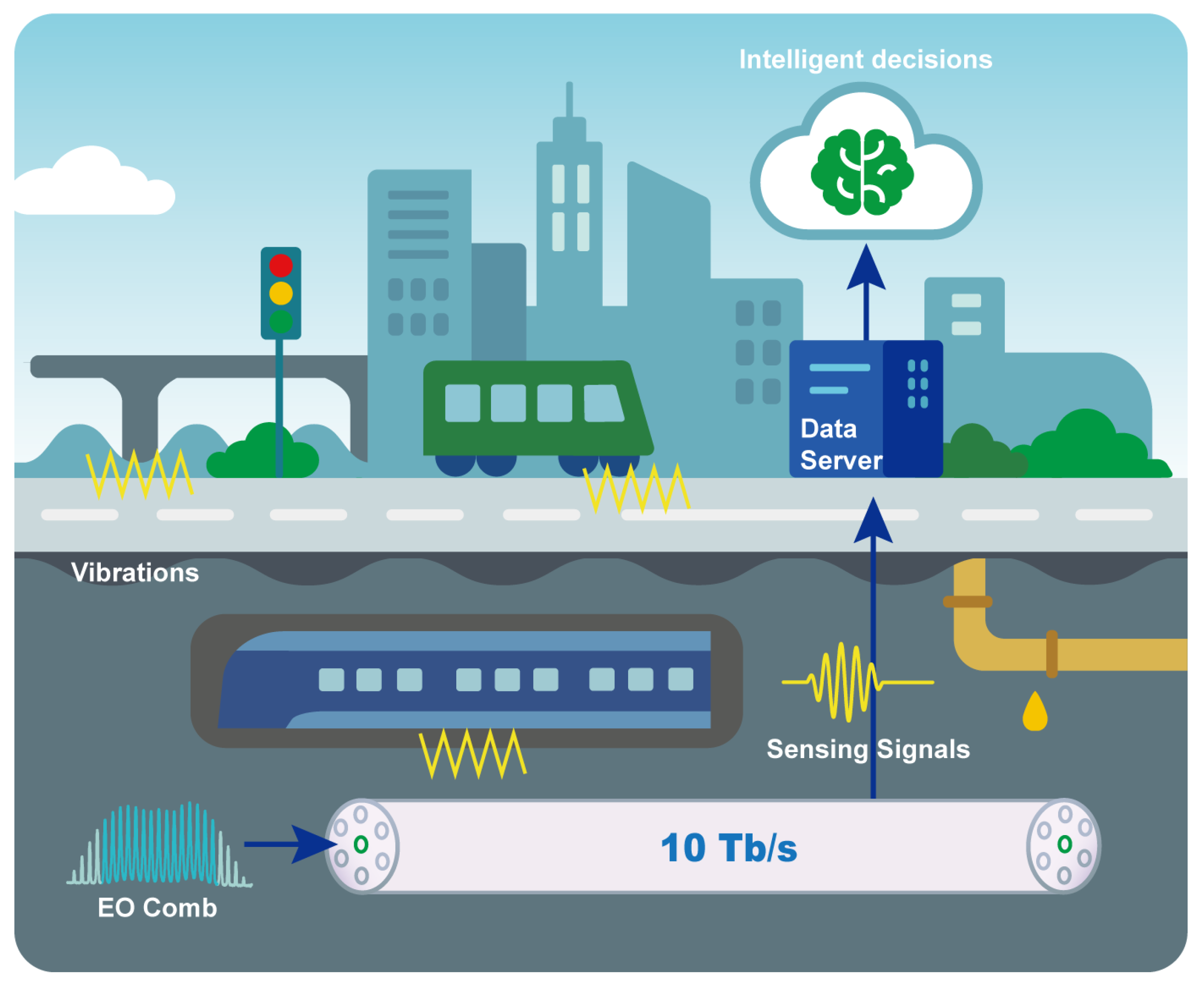
With the rapid development of smart infrastructure construction and emerging digital twins, metropolitan and access networks face a dual challenge: on the one hand, they need to accommodate the explosive growth of communication traffic to meet 5G/6G and cloud computing demands [1,2]; on the other hand, they are expected to provide high-precision, real-time monitoring of both fiber infrastructure security and surrounding environmental activities [3,4,5,6]. ISAC in short-to-medium-range fiber networks has emerged as a promising paradigm to address this dual requirement [7,8,9]. As conceptually illustrated in Figure 1, future ISAC architectures are anticipated to transform fiber assets from passive data links into multi-functional platforms that concurrently deliver various sensing services, such as cable fault inspection [10,11], underground pipeline integrity monitoring [12,13], seismic early warning [14,15], and traffic flow analysis [16,17]. This capability ensures the reliability and security of fiber assets and enhances the operational intelligence of critical infrastructures in short- and mid-haul scenarios. Nevertheless, achieving high-quality sensing without compromising communication performance and throughput remains challenging in ISAC systems.
Forward sensing is a straightforward scheme that can be readily combined with communication due to its low peak power and direct utilization of phase and polarization information from communication signals [18]. However, it demands strict time synchronization and does not support precise multi-point localization [19,20]. To overcome these limitations, distributed acoustic sensing (DAS) emerges as a promising solution. A widely adopted implementation of DAS is phase-sensitive optical time-domain reflectometry ( ϕ -OTDR), which exploits Rayleigh backscattering (RBS) to sense external perturbations [21,22]. Among the methods for extracting the RBS phase, the dual-pulse heterodyne ϕ -OTDR scheme stands out as one of the most promising [23,24]. By suppressing common-mode noise along the fiber through the interference of the co-propagating pulse pair, this scheme not only supports weak vibration detection but also enables simultaneous multi-event monitoring along the entire fiber, fulfilling the multitask sensing requirements of complex scenarios. However, integrating ϕ -OTDR efficiently with communication networks poses challenges, as its reliance on high-peak-power pulses induces nonlinear crosstalk in communication channels [25], hindering their coexistence. Additionally, single-wavelength ϕ -OTDR is inherently vulnerable to the fading effect due to the nature of coherent beam interference, limiting its sensing sensitivity and, consequently, its full potential within ISAC [26,27,28]. These issues degrade both communication quality and sensing performance, yet current co-integrated schemes struggle to resolve them—typically by preempting communication resources or increasing system complexity with additional algorithms [29,30]. Therefore, there remains a pressing need for ISAC designs that resolve these bottlenecks, enabling seamless, high-performance integration while preserving high spectral efficiency within a unified fiber infrastructure.
Recent advances in optical communication widely leverage wavelength and spatial multiplexing to meet escalating communication capacity demands [31,32], offering flexibility in multiplexing dimensions for implementing ISAC. In wavelength division multiplexing (WDM), electro-optic (EO) combs generate stable, equidistant, mutually coherent carriers that inherit the seed laser’s narrow linewidth, supporting dense WDM and enabling self-homodyne transmission without carrier phase or frequency offset estimation—thus reducing DSP complexity and cost [33,34]. Yet when high-peak-power sensing pulses co-propagate with data channels, wavelength separation alone cannot suppress nonlinear crosstalk [25]. In spatial division multiplexing (SDM) with multi-core fibers (MCFs), adding spatial paths expands capacity and allows for flexible core allocation for dedicated sensing, communication, or hybrid use, but several schemes dedicate an entire core to sensing or LO delivery [30,35], consuming spatial resources and reducing throughput. A joint MCF-EO comb architecture is envisioned to address these limitations, enabling efficient resource allocation and additional performance benefits for both functions. From the communication perspective, it supports high capacity through WDM–SDM integration and a cost-effective self-homodyne coherent communication system [36]. By polarization multiplexing unmodulated comb lines (as LOs) and the high-peak-power pulses, nonlinear crosstalk is suppressed while preserving other cores for self-homodyne data. From the sensing perspective, the inherent multi-wavelength capability of the EO comb, which aligns naturally with the needs of dense WDM communication, also facilitates high-fidelity ϕ -OTDR. The multi-wavelength dual-pulse probes increase the total dual pulse energy and introduce wavelength diversity, resulting in both an improved signal-to-noise ratio (SNR) and fading suppression [37]. This joint WDM-SDM design thus retains the multiplexing advantages while suppressing nonlinear crosstalk, achieving non-destructive and spectrally efficient ISAC.
In this work, we propose an ISAC system over a 7-core fiber that simultaneously achieves both high-capacity communication and high-fidelity ϕ -OTDR through EO comb-enabled self-homodyne coherent detection and multidimensional multiplexing. For effective ISAC integration, sensing pulses and communication LOs are polarization-multiplexed into orthogonal polarization states, occupying only one core while supporting enhanced dual-pulse ϕ -OTDR and self-heterodyne transmission. The remaining six cores occupy 11 × 25 GHz of the spectrum, transmitting polarization-multiplexed 16-ary quadrature amplitude modulation (PM-16-QAM) signals at 11 × 6 × 20 Gbaud, achieving a total line rate of 10.56 Tb/s. For sensing, we employ a multi-wavelength dual-pulse heterodyne ϕ -OTDR configuration, where dual pulses are encoded onto four comb lines. The Rayleigh backscattered signals from these pulses yield a 6 dB SNR improvement that scales with the number of comb lines, while wavelength diversity effectively reduces fading occurrences by 64.4%. This results in a high sensitivity of 1.72 p ε / Hz @1 kHz with a spatial resolution of 8 m. In addition to enabling the simultaneous detection of multi-wavelength RBS signals through the dual-pulse heterodyne structure, communication digital signal processing (DSP) is simplified by omitting carrier phase recovery (CPR) and frequency offset estimation (FOE), thereby significantly reducing the cost and complexity of the entire ISAC system receiver. Our work presents a framework for EO comb-driven MCF-based ISAC, providing a scalable, high-sensitivity, high-capacity solution that supports real-time infrastructure monitoring alongside 10-terabit-class communication services for future intelligent optical networks.

2. Experimental Setup and Principles

2.1. Experimental Setup of Multidimensionally Multiplexed ISAC System

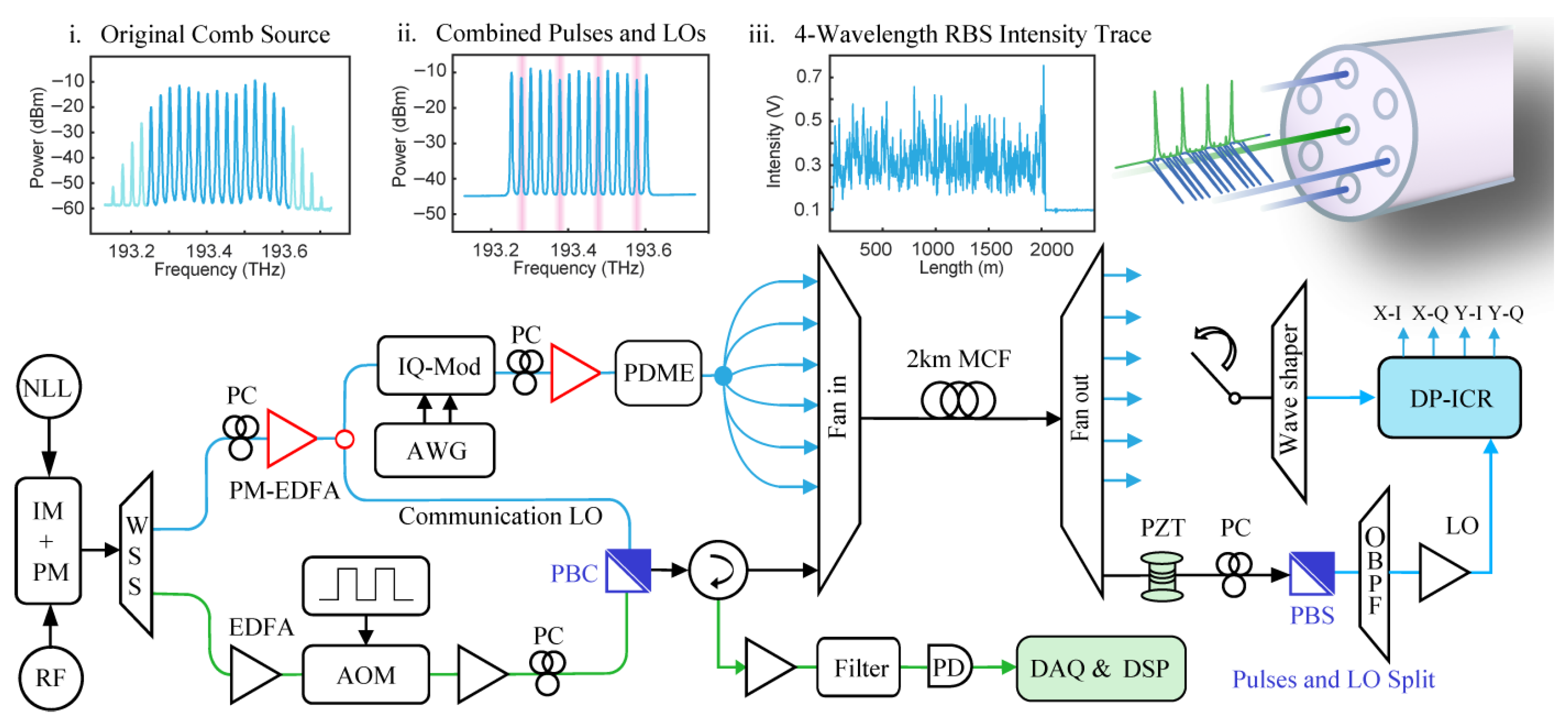
The experimental setup is illustrated in Figure 2. We utilize an EO comb that simultaneously supports forward data transmission (blue paths) and backward multi-wavelength sensing (green paths). To generate the comb, a narrow-linewidth laser (Koheras X15, NKT Photonics A/S, Birkerød, Denmark; ∼100 Hz linewidth) is injected into cascaded phase modulators and an intensity modulator, both driven by a low-noise radio frequency (RF) signal. The resulting EO comb is centered at 193.42 THz with a repetition frequency of 25 GHz and a total optical power of approximately 5 dBm, as shown in the embedded image in Figure 2i. The comb lines exhibit highly correlated phase noise, as their relative phase relationship is strictly locked by the common RF driving signal. This intrinsic coherence is a critical prerequisite for both self-homodyne communication and wavelength diversity enhanced sensing. We use a wavelength-selective switch (WSS) to flatten the EO comb, ensuring spectral uniformity, and to separate the comb lines into two sets: 4 lines spaced at 100 GHz for sensing and 11 lines for communication. Notably, the 4 sensing channels could also be reused for communication by loading signals onto them, and the current 11-wavelength transmission system is constrained by the limited number of available wavelength-selective devices.
The communication channels, labeled CH1 to CH11 from low to high frequency, pass through a polarization controller (PC) and are amplified by a polarization-maintaining erbium-doped fiber amplifier (PM-EDFA). A 30:70 polarization-maintaining coupler divides the communication lines into two branches, which serve as data channels and remote LOs. For signal modulation, the 11 carrier comb lines are fed into an IQ modulator and encoded with the 20 Gbaud 16-QAM signal (generated by Keysight M8195A, Keysight Technologies, Santa Rosa, CA, USA). The modulated signals are then polarization-multiplexed by a polarization division multiplexing emulator. These signals are amplified to 15 dBm and then coupled into the 6 outer cores of the 2 km 7-core fiber through a 1-to-6 coupler and a fan-in.
Meanwhile, the four comb lines for sensing are amplified and fed into an acoustic optical modulator (AOM) driven by dual-pulse waveform electrical signals, resulting in an optical dual-pulse sensing probe incorporating four wavelengths. After passing through a PC, the sensing probe and the communication LOs are combined into orthogonal polarization states through a polarization beam combiner (PBC). The dual-polarization combination is injected into the central core through a circulator, and its optical spectrum is depicted in Figure 2(ii), where the flattened and amplified comb lines exhibit an optical carrier-to-noise ratio (OCNR) exceeding 30 dB with 0.1 nm resolution. This high signal quality provides a sufficient link budget margin for the 16-QAM transmission and ensures reliable performance. After 2 km transmission and fan-out separation, the central core is connected to a 10 m fiber coiled around a piezoelectric transducer (PZT) to simulate environmental vibrations. The RBS signals from the four-wavelength probe, which carry vibration information, are amplified and filtered to suppress out-of-band noise before being detected by a photodetector (PD). The embedded illustration in Figure 2(iii) shows one sample of the recovered electrical RBS intensity trace from the PD. These detected signals are digitized and stored by a data acquisition card, after which a dedicated sensing DSP module processes them to demodulate the vibration signal.
At the communication receiver, a PC and a polarization beam splitter (PBS) are used to extract the comb lines serving as LOs from the central core. An optical bandpass filter (OBPF) is used to select the LO wavelength corresponding to each of the 11 data channels and to filter out out-of-band noise, improving the amplification efficiency for the specific LO lines. Each data channel is individually filtered by a Waveshaper and then mixed with its corresponding amplified LO at the coherent receiver. In this experiment, the received optical powers for data and LO channels are approximately −13 dBm and 3.5 dBm, respectively. The electrical outputs of the coherent receiver are sampled using an 80 GS/s real-time oscilloscope to capture the data signals for DSP.

2.2. DSP Simplification in Self-Homodyne Coherent Detection

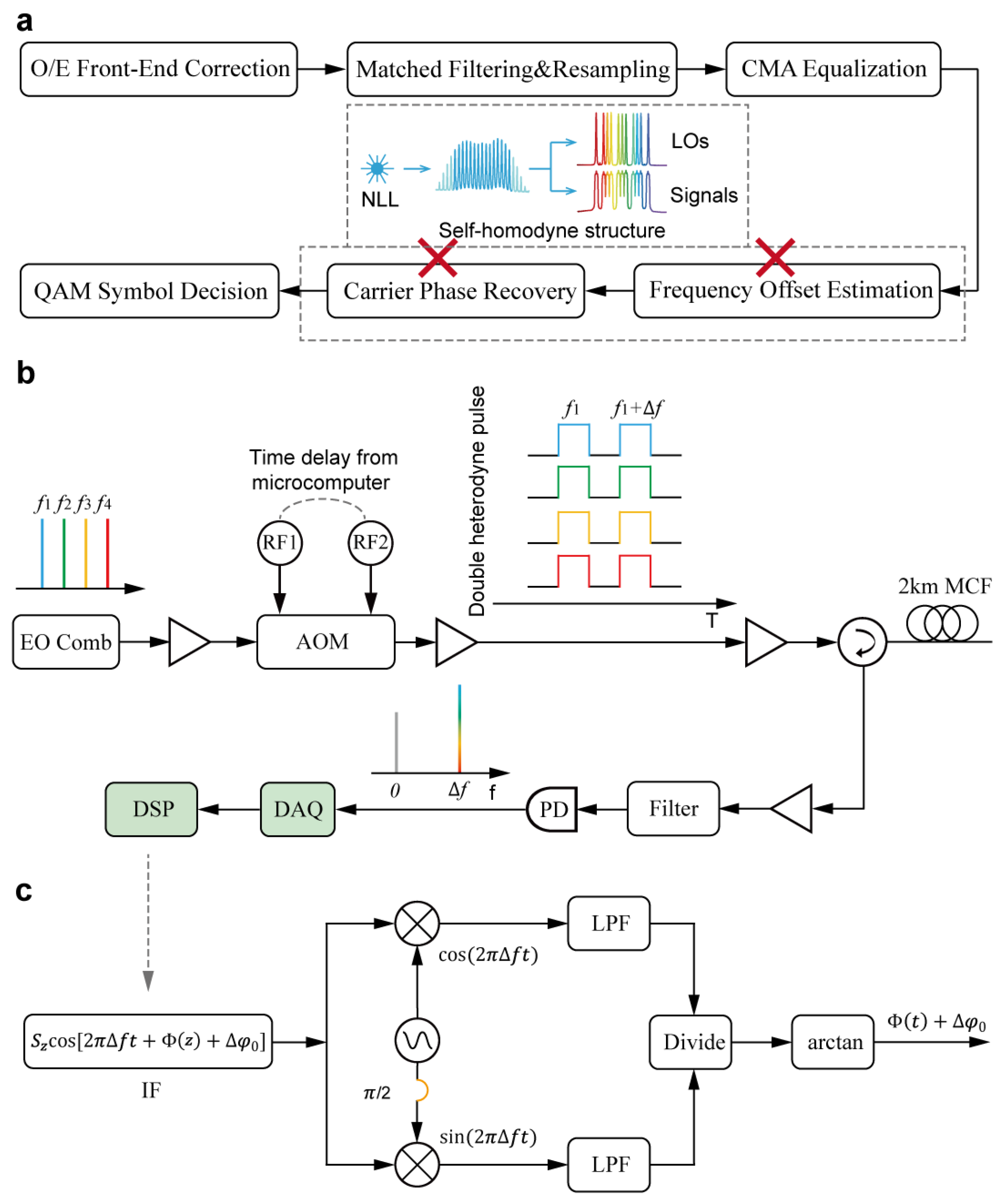
As shown in Figure 3a, self-homodyne coherent detection is applied here, where both the LO and signal originate from the same EO comb, inheriting the low noise of the seed laser. The LOs and signals pass through the adjacent cores of the same MCF, and this intrinsic coherence between them eliminates the need for frequency offset estimation or carrier phase recovery, simplifying the receiver DSP compared to conventional coherent detection schemes. The simplified DSP flow includes optical/electrical front-end imbalance compensation, resampling to 4 samples per symbol, a matched RRC filter, synchronization, equalization, down-sampling, and demodulation for final error correction.

2.3. Principle for EO Comb-Enhanced Dual-Pulse ϕ -OTDR Sensing

Figure 3b illustrates the multi-wavelength ϕ -OTDR principle based on the EO comb. An AOM is driven by dual-pulse waveform RF signals generated by direct digital synthesizers, operating at 100 MHz and 100.01 MHz to introduce a frequency difference Δ f = 10 kHz between pulses. The RF dual pulses are up-converted to sensing comb lines by the AOM, generating two optical pulses with a pulse width of τ = 30 ns and introducing a time delay Δ t = 50 ns between them. The pulse emission period is T = 25 μs, corresponding to a low duty cycle as ( τ + Δ t ) / T = 0.32 % . The spatial resolution is given by S R = v ( τ + Δ t ) / 2 8 m; here, v 2 × 10 8 m/s is the light velocity in the fiber. As the time-split pulses co-propagate along the fiber, the time delay Δ t corresponds to an optical path difference of Δ L 5 m, thereby separating the fiber into independent space units. When the dual pulses pass through a perturbed region at position z, their corresponding Rayleigh backscattered signals accumulate optical phases Φ z and Φ z + Δ L , reflecting vibration-induced phase changes at two spatially separated points. Separated by a frequency offset Δ f , the two backscattered signals mix at the PD. For a single wavelength channel, this yields a heterodyne beat signal expressed as [23]
I s ( z ) = S z c o s 2 π Δ f t + Φ ( z ) + Δ φ 0 ,
where S z is the fluctuating amplitude of the beat signal, and Δ f = 10 kHz is the heterodyne frequency. The vibration-induced phase difference is defined as Φ ( z ) = Φ z + Δ L Φ z , and Δ φ 0 is the initial phase difference between the dual pulses. To extract Φ ( z ) from the beat signal, the heterodyne demodulation algorithm shown in Figure 3c is applied. Specifically, the detected signal I s ( z ) is mixed with digital in-phase ( cos ( 2 π Δ f t ) ) and quadrature ( sin ( 2 π Δ f t ) ) local oscillators, and the phase term Φ ( z ) is then recovered using the arctangent operation. This enables the simultaneous detection of multiple events along the fiber, because the sensing information Φ ( z ) from each location (z) is directly encoded onto the heterodyne frequency band sequentially. Moreover, only one AOM is employed to generate the co-propagating dual pulses, ensuring that they experience the same laser phase noise, fiber loss fluctuations, and environmental interference (such as temperature drift, low-frequency mechanical vibration) [24]; thus, the dual-pulse ϕ -OTDR effectively suppresses the common-mode background noise through heterodyne demodulation.
However, in conventional single-wavelength systems, the beat amplitude S z follows a Rayleigh distribution and frequently drops to near-zero values due to the destructive interference of Rayleigh scattered fields, resulting in ‘fading’ zones where phase signal distorts and even demodulation fails [28,38]. To resolve this limitation and further enhance the SNR, we exploit the EO comb to implement a multi-wavelength interrogation scheme. In this configuration, the RBS signals from N = 4 comb-based pulse pairs are superposed in the optical domain and jointly heterodyne-detected by a single PD. The dual-pulse frequency shift is identical for all comb lines, so this results in a synthetic beat signal I Σ ( z ) that can be described as [39]
I Σ ( z ) = k = 1 N S z , k cos 2 π Δ f t + Φ k ( z ) + Δ φ Σ S s y n cos 2 π Δ f t + Φ s y n ( z ) + Δ φ Σ ,
where S z , k and Φ k ( z ) denote the amplitude and phase of the k-th comb line, respectively, and Δ φ Σ is the aggregate initial phase difference. S s y n and Φ s y n ( z ) represent the amplitude and phase of the resulting synthetic signal. This multi-wavelength architecture provides dual benefits. Firstly, regarding the SNR enhancement, the superposition enables the effective accumulation of signal power from independent comb lines. By distributing the probe energy across multiple wavelengths, the total launched power can be significantly increased beyond the single-frequency stimulated Brillouin scattering (SBS) threshold. The constructive aggregation of signal energy from four channels leads to a theoretical 6 dB improvement in the SNR [37]. Secondly, regarding fading suppression, we rely on the principle of frequency diversity. The 100 GHz frequency spacing of the EO comb far exceeds the correlation bandwidth of Rayleigh backscattering [40]. Considering the frequency diversity provided by the independent comb lines, the fading states ( S z , k ) of the four channels are statistically uncorrelated, and the fading locations vary across different wavelengths [39,41]. While the amplitude of a single channel may vanish, the probability that the resultant magnitude S s y n of the sum drops to zero is drastically reduced. Statistically, the components with higher amplitudes (high SNR) naturally dominate the sum process, ensuring that the synthetic carrier maintains a robust intensity profile along the fiber [28]. In this way, the entire 4-comb-line sensing process is executed simultaneously, eliminating the need for per-channel digital signal processing, which makes the system computationally efficient and highly scalable.

3. Results

3.1. Studying 10.56 Tbit/s WDM-SDM Transmission with Polarization-Multiplexed LOs and Sensing Pulses

In our ISAC system, self-homodyne detection is employed to reduce computational complexity and power consumption. This architecture also plays a critical role in enabling the integration of sensing and communication functionalities. As the unmodulated comb lines occupy only one polarization to deliver remote LOs, they enable the co-propagation of LOs and sensing probes within the same core. Polarization multiplexing then separates high-power sensing pulses and LOs into orthogonal polarization states, thereby suppressing pulse-induced nonlinearities such as cross-phase modulation (XPM).
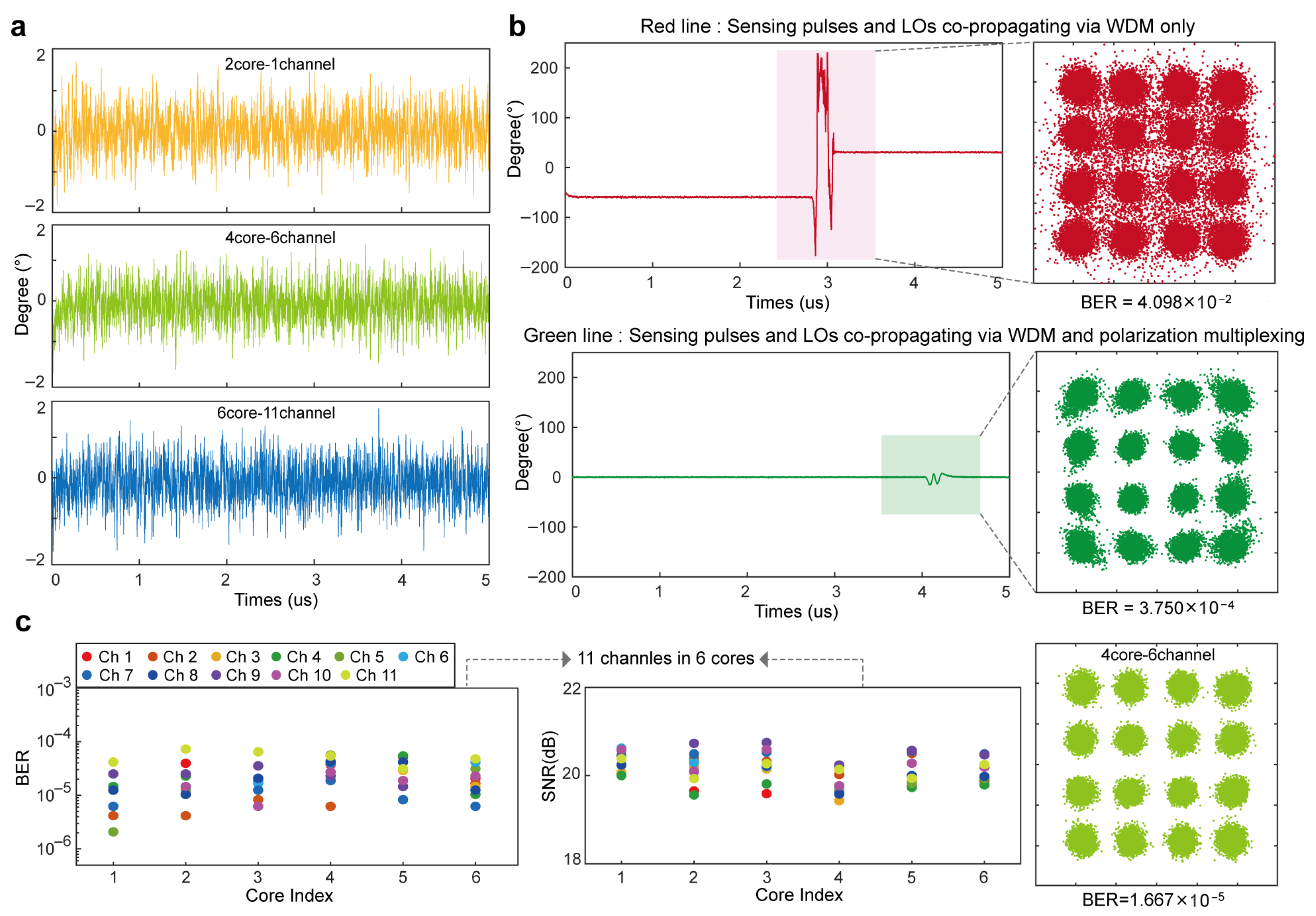
Given the sufficiently low inter-core crosstalk of our 7-core fiber (below -33 dB [36]), the high-power sensing pulses have negligible influence on the transmitted signals in outer cores. Therefore, we focus on assessing the phase rotation of co-propagating LOs within the same core arising from nonlinear effects. This is evaluated by calculating the residual phase difference between signal carriers and the LOs at the receiver. Since the LOs are only affected by pulses when they are present (but the pulse duty cycle is small), we first analyze LO phase performance during pulse-free intervals to establish a reference for subsequent analysis. Across all 6 × 11 channels, the residual phase differences during idle periods between pulses remain within ±2°. Figure 4a shows representative results for CH 1, 6, and 11 across three non-adjacent cores. These small phase deviations are primarily attributed to minor inter-core path length differences. The stable phase alignment observed during idle periods not only demonstrates the robustness of phase coherence between LOs and data carriers—a prerequisite for self-homodyne detection—but also provides a reference for analyzing pulse-induced phase fluctuations. Moreover, by demodulating data signals during the pulse-free intervals, we also establish a BER baseline of approximately 10 5 , serving as the target for high-quality data transmission in later comparisons. To evaluate the full-time phase performance of the LOs, we conduct two comparative experiments: (1) one where the pulses and LOs co-propagate in the same core via WDM without PBC and (2) one where pulses and LOs are polarization-multiplexed with PBC.
In the first scenario, where pulses and LOs co-propagate via WDM only (without PBC), the residual phase difference in LOs exhibits a severe phase jump exceeding 400° with pulse presence. The corresponding BER rises to ∼ 10 2 , a degradation by three orders of magnitude relative to the baseline, indicating unacceptably poor communication performance. The phase jump and the severely distorted constellation are shown in the red insets of Figure 4b. In contrast, when the sensing pulses and the LOs are polarization-multiplexed, the induced phase jump is suppressed by an order of magnitude to within 25°, and the BER improves by two orders of magnitude to the ∼ 10 4 level, as shown by the green insets in Figure 4b. During the pulse-free intervals, both configurations revert to the baseline BER of ∼ 10 5 ; the right column of Figure 4c provides a representative constellation under pulse-free conditions for the polarization-multiplexed case. Transmission experiments based on polarization multiplexing further confirm the robustness of this scheme: across 11 × 6 channels, all 66 channels achieve BERs well below the 3.8 × 10 3 threshold of binary hard-decision forward error correction (FEC) with a 7% overhead and SNRs exceeding 20 dB, as illustrated in Figure 4c. In summary, our ISAC system achieves a total data rate of 10.56 Tb/s, demonstrating high-capacity and reliable transmission and verifying the feasibility of the proposed co-propagating scheme for LOs and pulses.
While the overall communication performance of our proposed ISAC system is excellent, the periodic sensing pulses still cause minor phase rotations in the LO path. This effect is primarily attributed to the limited extinction ratios of the employed PBC and PBS. Nevertheless, the above results validate that the polarization multiplexing scheme effectively prevents communication performance degradation even under these device limitations. A more detailed analysis is provided in the Section 4.

3.2. Sensing Sensitivity Enhancement and Fading Suppression via Multi-Channel EO Comb Combination

In this section, we investigate the sensing performance enhancements enabled by using the EO comb as a multi-wavelength source, focusing on SNR improvement and fading suppression. From the 15 available EO comb lines, we select four for sensing with a 100 GHz spacing. This spacing is chosen to avoid four-wave mixing (FWM) effects, for which we observe performance degradation at smaller spacings (e.g., 50 GHz) [42]. By distributing optical power across multiple wavelengths, this scheme allows for a higher total sensing power for the dual pulses while maintaining the power per line below the stimulated Brillouin scattering (SBS) threshold [37]. Consequently, total sensing pulse power could be increased, and the SNR improved without incurring nonlinear penalties.
To evaluate the benefits of the multi-wavelength configuration in enhancing the SNR and suppressing fading, we compare the 4-comb-line dual-pulse setup with a conventional single-wavelength dual-pulse setup (Koheras X15). For a fair comparison, the input power per wavelength in the multi-wavelength case is kept equal to that of the single-wavelength configuration. After optimization, the single-wavelength laser is set to 6.2 dBm at the AOM input, resulting in an average power of −6 dBm for the dual pulse after amplification. In the multi-wavelength case, the four comb lines together deliver 12.2 dBm at the AOM input, producing multi-wavelength dual pulses with an average power of 0 dBm. This setting yields a 6 dB increase in pulse peak power relative to the single-wavelength case, consistent with the fourfold energy increase. Given the duty cycle of 0.32%, this corresponds to a peak pulse power of approximately 312 mW (∼25 dBm), whereas the single-wavelength case corresponds to a peak power of ∼78 mW (∼19 dBm). This high peak power also sufficiently compensates for the inherent optical loss (typically 2 to 3 dB per device) introduced by the fan-in/fan-out components in the 7-core fiber link.
It is worth noting that this high power level is intentionally configured in a ’stress test’ regime. Leveraging the power distribution capability of the multi-wavelength source [37], we aim to achieve a high SNR for weak vibration detection. Simultaneously, this high-power operation emulates a worst-case scenario for nonlinear crosstalk (e.g., XPM) to co-propagating communication LOs. By demonstrating stable operation under such high-power conditions, we validate the robustness of the proposed polarization-domain isolation. Attempts to further increase the launch power beyond this regime degrade performance primarily because the EDFA enters gain saturation, elevating amplified spontaneous emission (ASE) and inducing additional nonlinear penalties.
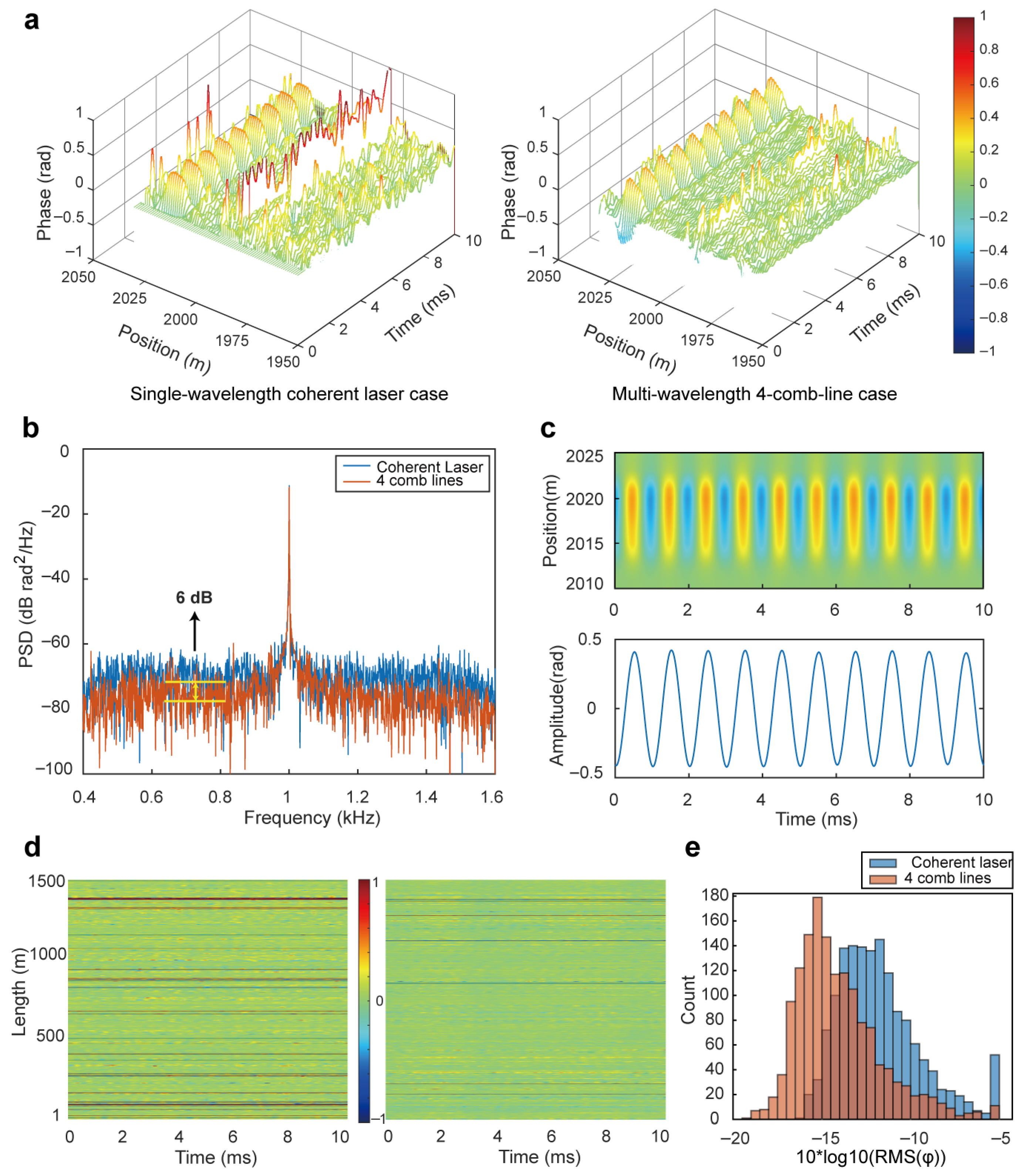
To simulate real-world disturbances, a 1 kHz sinusoidal vibration is applied to a PZT at the end of a 2 km 7-core fiber. We extract the vibration phase information Φ ( z ) along the entire fiber using both single-wavelength and 4-comb-line probings and demonstrate their 3D waterfall plots near the applied vibration in Figure 5a. The periodic patterns with fixed amplitude (∼0.5 rad) observed at the 2018 m position represent the applied vibration. In regions without applied vibration, the Φ ( z ) values primarily reflect fading-induced phase noise [28], with secondary noise from environmental disturbances. In the single-wavelength case, a pronounced fading zone appears around 1998 m, with irregular background phase excursions approaching ∼1 rad, indicating severe fading at this position. In contrast, the 4-comb-line configuration markedly suppresses this fading effect, yielding a flatter and more stable phase noise pattern at the same position. Figure 5b demonstrates the SNR improvement, with the power spectral density of Φ ( z ) revealing a 6 dB SNR increase through multi-wavelength probing—proportional to the number of comb lines. By simultaneously detecting multi-wavelength RBS signals, the system reduces the background noise floor to 1.28 × 10 4 rad/ Hz , which corresponds to a sensitivity of 1.72 p ε / Hz calculated with the formula [43]
ε = λ 4 π n L g ξ Δ φ n ,
where Δ φ n is the demodulated optical phase noise (phase floor) derived from the power spectrum of the phase signal, n is the effective refractive index of the fiber core (∼1.46), ξ is the photo-elastic scaling factor (∼0.78), L g is the gauge length (spatial resolution) of the sensing pulse, and λ is the optical wavelength. Finally, Figure 5c shows the 2D waterfall of Φ ( z ) in the vibration regions and the extracted vibration waveform at the determined position, which matches the 1 kHz input, confirming accurate localization and high waveform fidelity.
To further assess fading resilience over a wider range of fiber locations away from the vibration position, we analyze the background phase noise floor across a 1500 m span of the MCF within a 10 ms acquisition window. The fiber under test is divided into 1500 one-meter segments, consistent with the spatial sampling rate of the data acquisition card. As shown in Figure 5d, the darker horizontal bands mark positions with a raised noise floor, characteristic of fading. Compared with the single-wavelength case (left), the 4-comb-line sensing scheme substantially reduces the occurrence of such bands. For a clearer comparison, we calculate the root mean square (RMS) of the phase noise for each 1 m segment, convert the results to a dB scale for visualization, and plot a histogram in Figure 5e. Compared with the single-wavelength case, the histogram for the 4-comb-line configuration shifts toward lower RMS values, reflecting both a lower average phase noise floor and fewer segments severely impacted by fading. For clarity, all segments with RMS values exceeding −5 dB are grouped into a single bin. The single-wavelength case contains a larger fraction of such bins, showing a higher prevalence of strongly affected channels. Quantitatively, the proportion of segments with RMS phase noise >0.1 rad—our criterion for large fading errors [38]—drops from 19.47% to 6.93%, representing a 64.4% reduction in fading occurrence.
Overall, the EO comb-based multi-wavelength sensing configuration outperformed the conventional single-wavelength configuration under both static and dynamic conditions. The comb-enabled increased dual-pulse energy delivers a 6 dB SNR gain, and wavelength diversity suppresses fading, reducing demodulation failures and waveform distortion. These enhancements in DAS provide strong support for various urban sensing applications. The EO comb simultaneously supports dense WDM communication, bolstering the system’s communication capacity. Together, the results validate the robustness and scalability of the proposed scheme.

4. Discussion

In this work, we introduce a polarization multiplexing-based integration strategy for metropolitan ISAC, where sensing pulses are coupled into the orthogonal polarization state of communication LOs via a PBC. Beyond polarization orthogonality, system robustness relies on a multidimensional mitigation strategy. One factor is temporal sparsity: with a duty cycle of only 0.32%, the communication channels remain unperturbed for the vast majority of the transmission time. Furthermore, sensing pulses and LO signals operate on different comb lines in our experimental demonstration, and this isolation can be further optimized via pulse frequency shifting (e.g., single-sideband modulation). FWM contributions are strongly suppressed by large frequency detuning due to phase-matching constraints. Moreover, unlike stochastic noise, the residual pulse-induced phase kicks are periodic and sparse, allowing for algorithmic mitigation in the receiver DSP if required.
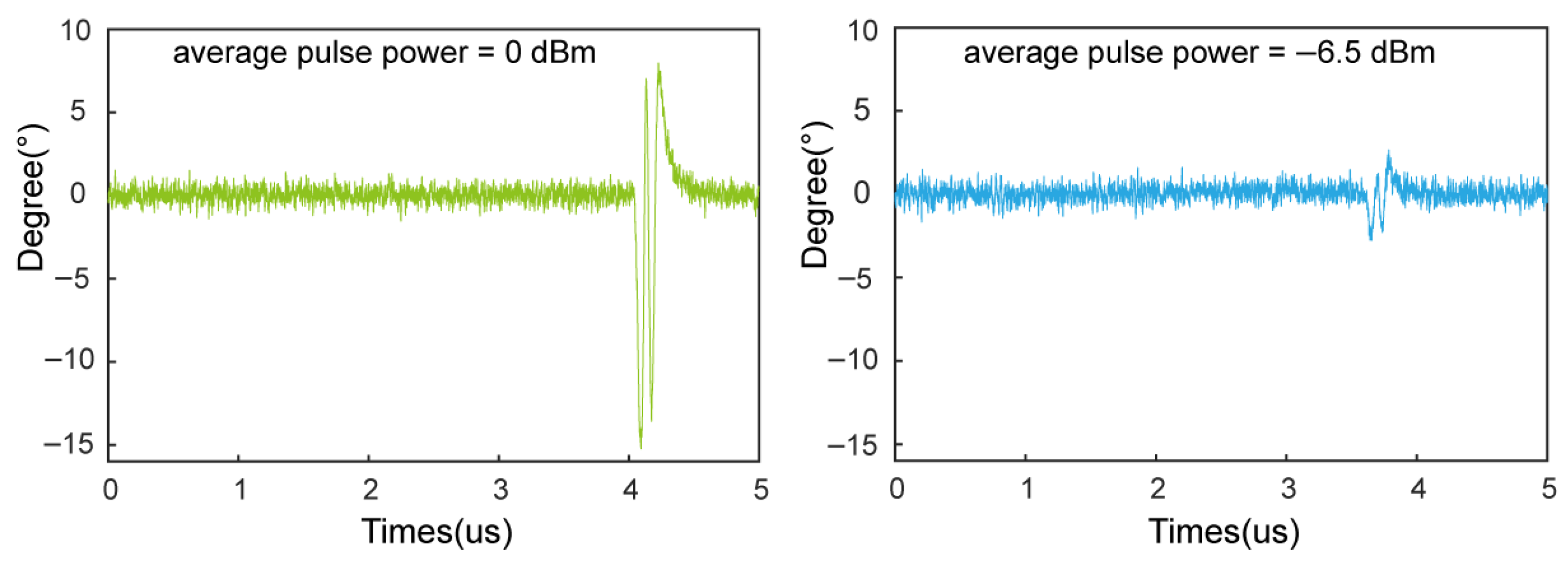
On the other hand, practical device imperfections—such as the finite extinction ratios of the PBC and PBS—lead to the partial leakage of the high-peak-power pulses into the LO path, introducing residual phase fluctuations that may degrade self-homodyne coherent demodulation. To address this concern and evaluate the feasibility of this architecture under higher-extinction-ratio conditions, we conducted an additional experiment by reducing the average power of sensing pulses from 0 dBm to −6.5 dBm while keeping the original PBC setup unchanged. This adjustment is equivalent to improving the effective PBC extinction ratio by approximately 6.5 dB. As shown in Figure 6, this effectively suppresses the pulse-induced residual phase difference jitter to a negligible level within 5°, enabling error-free demodulation with the BER restored to the baseline level of ∼ 10 5 , even in the presence of high-peak-power sensing pulses. This result confirms that, given sufficiently high extinction ratios, our polarization division multiplexing approach can support lossless and robust ISAC.
In our proof-of-concept experiment, manual polarization control was sufficient due to the stable laboratory environment. For practical field deployments, where environmental variations induce slow polarization drifts, this can be addressed by employing a standard automatic polarization stabilizer (APS) before the PBS at the receiver side. Regarding longer fiber spans, polarization-mode dispersion (PMD) primarily induces frequency-dependent state-of-polarization (SOP) rotation rather than destroying polarization orthogonality. Given that SOP evolution in buried metro access links is typically much slower than the sensing repetition rate, commercial APS modules can readily track and maintain the required polarization alignment, ensuring robust signal separation.
Considering the flexibility and scalability of our system design, more cascaded modulators can generate more comb lines. Together with additional wavelength divide devices, this allows any subset of comb lines to be dynamically allocated between sensing and communication without compromising communication bandwidth. Moreover, the proposed architecture maintains compatibility with standard commercial transceivers. For traditional systems employing direct detection (e.g., PAM4) or intradyne coherent detection with receiver-local LOs, the outer cores can serve as independent transmission channels, while the central core is dedicated to sensing. Nevertheless, the self-homodyne configuration offers a distinct advantage by eliminating the power-intensive carrier recovery DSP, thereby reducing latency and energy consumption for future metro access networks.
For extended link distances, inter-core crosstalk in our current setup is primarily limited by the fan-in/fan-out devices rather than the linear increased crosstalk of the fiber itself. With state-of-the-art trench-assisted weakly coupled MCFs, which exhibit ultra-low crosstalk (e.g., <−60 dB/km) [44], the accumulated crosstalk over metropolitan distances remains well below the penalty threshold for 16-QAM transmission, supporting scalability for metro-scale deployment. For the dispersive walk-off between the 100 GHz spaced sensing carriers, a typical dispersion of 17 ps/nm/km yields a differential delay of approximately 0.54 ns over a 40 km link, a magnitude negligible relative to the 30 ns sensing pulse width. The coherent summation condition is therefore preserved, making the proposed architecture well-suited for city-scale fiber networks [45]. Additionally, while inter-core skew and phase drift accumulate with distance, self-homodyne transmission remains feasible and robust over extended reaches [34,46,47]. The common cladding structure of MCFs ensures that cores experience identical environmental fluctuations, preserving the relative phase coherence essential for simplified DSP even over tens of kilometers.
It is worth noting that the sensing range in our system is constrained by the pulse repetition rate required to properly sample the heterodyne beat signal. In the dual-pulse configuration, the frequency offset between the two pulses produces a heterodyne frequency Δ f of 10 kHz. To avoid aliasing and to ensure stable phase recovery in our demodulation implementation, the pulse repetition rate must exceed the effective Nyquist requirement, leading to a repetition rate of 4 × Δ f = 40 kHz in our demodulation algorithm [23]. This limits the maximum unambiguous sensing range to approximately 2.5 km. In the current architecture, extending the sensing distance would impose stricter requirements on laser linewidth and frequency stability, since lower-frequency beat signals become increasingly sensitive to laser phase noise.

5. Conclusions

In summary, we experimentally demonstrated an ISAC architecture based on an EO comb and a seven-core fiber, achieving simultaneous 10.56 Tbit/s self-homodyne transmission and high-fidelity dual-pulse ϕ -OTDR sensing within a unified system. The system enables efficient coexistence without incurring significant nonlinear penalties by multiplexing the sensing pulses and the communication LOs into orthogonal polarization states within a single core. Moreover, by leveraging the EO comb as a unified multi-wavelength source, the system not only supports dense WDM communication but also improves the sensing SNR via wavelength-multiplexed dual-pulse probing while simultaneously suppressing fading through wavelength diversity. When combined with the spatial parallelism provided by the multi-core fiber, the system achieves large-scale parallel coherent transmission while seamlessly integrating high-performance sensing. Overall, this work demonstrates the feasibility and scalability of the proposed architecture, laying a solid foundation for future power-efficient, high-reliability metro-scale ISAC networks.

Author Contributions

Conceptualization, X.L. and C.Z.; Methodology, X.L., C.Z. and Y.Z.; Software, X.H.; Validation, X.L. and Y.Z.; Resources, Z.C., W.H., X.H. and X.X.; Writing—original draft preparation, X.L.; Writing—review and editing, C.Z., Y.Z., Z.C., W.H. and X.X.; Visualization, X.L.; Funding acquisition, C.Z. and X.X. All authors have read and agreed to the published version of the manuscript.

Funding

This work was supported by the Postdoctoral Fellowship Program of CPSF (GZB20250811) and the Key Laboratory of All Optical Network and Advanced Telecommunication Network, Ministry of Education, Beijing Jiaotong University (Project No. AON2024K01).

Institutional Review Board Statement

Not applicable.

Informed Consent Statement

Not applicable.

Data Availability Statement

The original contributions presented in this study are included in the article; further inquiries can be directed to the corresponding authors.

Conflicts of Interest

The authors declare no conflicts of interest.

Abbreviations

The following abbreviations are used in this manuscript:
ISACIntegrated Sensing and Communication
DASDistributed Acoustic Sensing
ϕ -OTDRPhase-Sensitive Optical Time-Domain Reflectometry
PMPolarization Modulation
QAMQuadrature Amplitude Modulation
WDM    Wavelength Division Multiplexing
SDMSpacial Division Multiplexing
MCFMulti-Core Fiber
SNRSignal-to-Noise Ratio
DSPDigital Signal Processing
CPRCarrier Phase Recovery
FOEFrequency Offset Estimation

References

  1. Liu, X. Enabling optical network technologies for 5G and beyond. J. Light. Technol. 2022, 40, 358–367. [Google Scholar] [CrossRef]
  2. Tang, X.; Cao, C.; Wang, Y.; Zhang, S.; Liu, Y.; Li, M.; He, T. Computing power network: The architecture of convergence of computing and networking towards 6G requirement. China Commun. 2021, 18, 175–185. [Google Scholar] [CrossRef]
  3. Hancke, G.P.; De Carvalho e Silva, B.; Hancke, G.P., Jr. The role of advanced sensing in smart cities. Sensors 2013, 13, 393–425. [Google Scholar] [CrossRef]
  4. Aono, Y.; Ip, E.; Ji, P. More than communications: Environment monitoring using existing optical fiber network infrastructure. In Proceedings of the Optical Fiber Communication Conference; Optica Publishing Group: Washington, DC, USA, 2020; pp. 1–3. [Google Scholar]
  5. Alkhateeb, A.; Jiang, S.; Charan, G. Real-time digital twins: Vision and research directions for 6G and beyond. IEEE Commun. Mag. 2023, 61, 128–134. [Google Scholar] [CrossRef]
  6. Wellbrock, G.A.; Xia, T.J.; Huang, M.F.; Han, S.; Chen, Y.; Wang, T.; Aono, Y. Explore benefits of distributed fiber optic sensing for optical network service providers. J. Light. Technol. 2023, 41, 3758–3766. [Google Scholar] [CrossRef]
  7. He, H.; Jiang, L.; Pan, Y.; Yi, A.; Zou, X.; Pan, W.; Willner, A.E.; Fan, X.; He, Z.; Yan, L. Integrated sensing and communication in an optical fibre. Light. Sci. Appl. 2023, 12, 25. [Google Scholar] [CrossRef] [PubMed]
  8. Huang, M.F.; Salemi, M.; Chen, Y.; Zhao, J.; Xia, T.J.; Wellbrock, G.A.; Huang, Y.K.; Milione, G.; Ip, E.; Ji, P.; et al. First field trial of distributed fiber optical sensing and high-speed communication over an operational telecom network. J. Light. Technol. 2019, 38, 75–81. [Google Scholar] [CrossRef]
  9. Boffi, P. Sensing applications in deployed telecommunication fiber infrastructures. In Proceedings of the European Conference and Exhibition on Optical Communication; Optica Publishing Group: Washington, DC, USA, 2022; pp. 1–4. [Google Scholar]
  10. Xia, T.J.; Wellbrock, G.A.; Huang, M.F.; Han, S.; Chen, Y.; Salemi, M.; Ji, P.N.; Wang, T.; Aono, Y. Field trial of abnormal activity detection and threat level assessment with fiber optic sensing for telecom infrastructure protection. In Proceedings of the 2021 Optical Fiber Communications Conference and Exhibition (OFC); IEEE: Piscataway, NJ, USA, 2021; pp. 1–3. [Google Scholar]
  11. Zuo, W.; Zhou, H.; Qiao, Y.; Zhao, Y.; Ye, B. Investigation of Co-Cable Identification Based on Ultrasonic Sensing in Coherent Systems. IEEE Photonics Technol. Lett. 2023, 35, 1155–1158. [Google Scholar] [CrossRef]
  12. Zuo, J.; Zhang, Y.; Xu, H.; Zhu, X.; Zhao, Z.; Wei, X.; Wang, X. Pipeline leak detection technology based on distributed optical fiber acoustic sensing system. IEEE Access 2020, 8, 30789–30796. [Google Scholar] [CrossRef]
  13. Ashry, I.; Mao, Y.; Wang, B.; Hveding, F.; Bukhamsin, A.Y.; Ng, T.K.; Ooi, B.S. A review of distributed fiber–optic sensing in the oil and gas industry. J. Light. Technol. 2022, 40, 1407–1431. [Google Scholar] [CrossRef]
  14. Jousset, P.; Reinsch, T.; Ryberg, T.; Blanck, H.; Clarke, A.; Aghayev, R.; Hersir, G.P.; Henninges, J.; Weber, M.; Krawczyk, C.M. Dynamic strain determination using fibre-optic cables allows imaging of seismological and structural features. Nat. Commun. 2018, 9, 2509. [Google Scholar] [CrossRef] [PubMed]
  15. Li, J.; Kim, T.; Lapusta, N.; Biondi, E.; Zhan, Z. The break of earthquake asperities imaged by distributed acoustic sensing. Nature 2023, 620, 800–806. [Google Scholar] [CrossRef]
  16. Huang, M.F.; Han, S.; Wellbrock, G.A.; Xia, T.J.; Narisetty, C.; Salemi, M.; Chen, Y.; Moore, J.M.; Ji, P.N.; Milione, G.; et al. Field trial of cable safety protection and road traffic monitoring over operational 5G transport network with fiber sensing and on-premise AI technologies. In Proceedings of the Optoelectronics and Communications Conference; Optica Publishing Group: Washington, DC, USA, 2021; pp. 1–3. [Google Scholar]
  17. Wellbrock, G.A.; Xia, T.J.; Huang, M.F.; Chen, Y.; Salemi, M.; Huang, Y.K.; Ji, P.; Ip, E.; Wang, T. First field trial of sensing vehicle speed, density, and road conditions by using fiber carrying high speed data. In Proceedings of the 2019 Optical Fiber Communications Conference and Exhibition (OFC); IEEE: Piscataway, NJ, USA, 2019; pp. 1–3. [Google Scholar]
  18. Ip, E.; Huang, Y.K.; Wellbrock, G.; Xia, T.; Huang, M.F.; Wang, T.; Aono, Y. Vibration detection and localization using modified digital coherent telecom transponders. J. Light. Technol. 2022, 40, 1472–1482. [Google Scholar] [CrossRef]
  19. Yan, Y.; Lu, L.; Wu, X.; Wang, J.; He, Y.; Chen, D.; Lu, C.; Lau, A.P.T. Simultaneous communications and vibration sensing over a single 100-km deployed fiber link by fiber interferometry. In Proceedings of the 2023 Optical Fiber Communications Conference and Exhibition (OFC); IEEE: Piscataway, NJ, USA, 2023; pp. 1–3. [Google Scholar]
  20. Tang, J.; Li, X.; Cheng, C.; Hao, Y.; Yang, B.; Li, J.; He, Z.; Yang, Y.; Hu, W. Forward-transmission based distributed fiber sensing compatible with C+ L unidirectional communication systems. In Proceedings of the 2024 Optical Fiber Communications Conference and Exhibition (OFC); IEEE: Piscataway, NJ, USA, 2024; pp. 1–3. [Google Scholar]
  21. Liu, S.; Yu, F.; Hong, R.; Xu, W.; Shao, L.; Wang, F. Advances in phase-sensitive optical time-domain reflectometry. Opto-Electron. Adv. 2022, 5, 200078. [Google Scholar] [CrossRef]
  22. Wang, Z.; Lu, B.; Ye, Q.; Cai, H. Recent progress in distributed fiber acoustic sensing with Φ-OTDR. Sensors 2020, 20, 6594. [Google Scholar] [CrossRef]
  23. He, X.; Xie, S.; Liu, F.; Cao, S.; Gu, L.; Zheng, X.; Zhang, M. Multi-event waveform-retrieved distributed optical fiber acoustic sensor using dual-pulse heterodyne phase-sensitive OTDR. Opt. Lett. 2017, 42, 442–445. [Google Scholar] [CrossRef]
  24. Ju, Z.; Yu, Z.; Hou, Q.; Lou, K.; Chen, M.; Lu, Y.; Meng, Z. Low-noise and high-sensitivity Φ-OTDR based on an optimized dual-pulse heterodyne detection scheme. Appl. Opt. 2020, 59, 1864–1870. [Google Scholar] [CrossRef]
  25. Jia, Z.; Campos, L.A.; Xu, M.; Zhang, H.; Gonzalez-Herraez, M.; Martins, H.F.; Zhan, Z. Experimental coexistence investigation of distributed acoustic sensing and coherent communication systems. In Proceedings of the 2021 Optical Fiber Communications Conference and Exhibition (OFC); IEEE: Piscataway, NJ, USA, 2021; pp. 1–3. [Google Scholar]
  26. Shimizu, K.; Horiguchi, T.; Koyamada, Y. Characteristics and reduction of coherent fading noise in Rayleigh backscattering measurement for optical fibers and components. J. Light. Technol. 2002, 10, 982–987. [Google Scholar] [CrossRef]
  27. Zhou, J.; Pan, Z.; Ye, Q.; Cai, H.; Qu, R.; Fang, Z. Characteristics and explanations of interference fading of a ϕ-OTDR with a multi-frequency source. J. Light. Technol. 2013, 31, 2947–2954. [Google Scholar] [CrossRef]
  28. He, X.; Xu, X.; Zhang, M.; Xie, S.; Liu, F.; Gu, L.; Zhang, Y.; Yang, Y.; Lu, H. On the phase fading effect in the dual-pulse heterodyne demodulated distributed acoustic sensing system. Opt. Express 2020, 28, 33433–33447. [Google Scholar] [CrossRef] [PubMed]
  29. Ip, E.; Fang, J.; Li, Y.; Wang, Q.; Huang, M.F.; Salemi, M.; Huang, Y.K. Distributed fiber sensor network using telecom cables as sensing media: Technology advancements and applications. J. Opt. Commun. Netw. 2022, 14, A61–A68. [Google Scholar] [CrossRef]
  30. Chen, Y.; Xiao, Y.; Chen, S.; Xie, F.; Liu, Z.; Wang, D.; Yi, X.; Lu, C.; Li, Z. Field trials of communication and sensing system in space division multiplexing optical fiber cable. IEEE Commun. Mag. 2023, 61, 182–188. [Google Scholar] [CrossRef]
  31. Puttnam, B.J.; Rademacher, G.; Luís, R.S.; Eriksson, T.A.; Klaus, W.; Awaji, Y.; Wada, N.; Maeda, K.; Takasaka, S.; Sugizaki, R. High data-rate and long distance MCF transmission with 19-core C+ L band cladding-pumped EDFA. J. Light. Technol. 2020, 38, 123–130. [Google Scholar] [CrossRef]
  32. Ruffini, M. Multidimensional convergence in future 5G networks. J. Light. Technol. 2016, 35, 535–549. [Google Scholar] [CrossRef]
  33. Zhang, C.; Zhu, Y.; He, B.; Lin, J.; Liu, R.; Xu, Y.; Yi, L.; Zhuge, Q.; Hu, W.; Hu, W.; et al. Clone-comb-enabled high-capacity digital-analogue fronthaul with high-order modulation formats. Nat. Photonics 2023, 17, 1000–1008. [Google Scholar] [CrossRef]
  34. Liu, X.; Zhang, C.; Lin, J.; He, B.; Chen, N.; He, X.; Chu, T.; Chen, Z.; Hu, W.; Xie, X. Thin-film lithium niobate-based electro-optic comb cloning for self-homodyne coherent communication. Opt. Lett. 2024, 49, 3238–3241. [Google Scholar] [CrossRef]
  35. Tang, J.; Li, X.; Cheng, C.; Fan, L.; Hao, Y.; Yue, B.; Li, J.; He, Z.; Yang, Y.; Hu, W. Distributed vibration sensing and simultaneous self-homodyne transmission of single-carrier net 5.36 Tb/s signal using 7-core fiber. In Proceedings of the 2024 Optical Fiber Communications Conference and Exhibition (OFC); IEEE: Piscataway, NJ, USA, 2024; pp. 1–3. [Google Scholar]
  36. Zhang, C.; Zhu, Y.; Lin, J.; He, B.; Liu, R.; Xu, Y.; Chen, N.; He, X.; Tao, J.; Zhang, Z.; et al. High-fidelity sub-petabit-per-second self-homodyne fronthaul using broadband electro-optic combs. Nat. Commun. 2024, 15, 6621. [Google Scholar] [CrossRef]
  37. Li, J.T.; Chang, B.; Du, J.T.; Tan, T.; Geng, Y.; Zhou, H.; Liang, Y.P.; Zhang, H.; Yan, G.F.; Ma, L.M.; et al. Coherently parallel fiber-optic distributed acoustic sensing using dual Kerr soliton microcombs. Sci. Adv. 2024, 10, eadf8666. [Google Scholar] [CrossRef]
  38. He, X.; Cao, Z.; Ji, P.; Gu, L.; Wei, S.; Fan, B.; Zhang, M.; Lu, H. Eliminating the Fading Noise in Distributed Acoustic Sensing Data. IEEE Trans. Geosci. Remote Sens. 2023, 61, 1–10. [Google Scholar] [CrossRef]
  39. Jiang, Y.; Gao, X.; He, W.; Shen, Y. Frequency multiplexed dual-pulse fiber-optic Φ-OTDR for a fading-free distributed fiber sound sensor. Appl. Opt. 2024, 63, F59–F66. [Google Scholar] [CrossRef]
  40. Mermelstein, M.D.; Posey, R.; Johnson, G.A.; Vohra, S.T. Rayleigh scattering optical frequency correlation in a single-mode optical fiber. Opt. Lett. 2001, 26, 58–60. [Google Scholar] [CrossRef] [PubMed]
  41. Hartog, A.; Liokumovich, L.; Ushakov, N.; Kotov, O.; Dean, T.; Cuny, T.; Constantinou, A.; Englich, F. The use of multi-frequency acquisition to significantly improve the quality of fibre-optic-distributed vibration sensing. Geophys. Prospect. 2018, 66, 192–202. [Google Scholar] [CrossRef]
  42. Ajmani, M.; Singh, P. FWM in WDM System, Effects and Techniques to Minimize: A Review. In Proceedings of the 2015 Fifth International Conference on Advanced Computing and Communication Technologies; IEEE: Piscataway, NJ, USA, 2015; pp. 385–389. [Google Scholar]
  43. Chen, D.; Liu, Q.; He, Z. 108-km Distributed Acoustic Sensor With 220-pε/Hz Strain Resolution and 5-m Spatial Resolution. J. Light. Technol. 2019, 37, 4462–4468. [Google Scholar] [CrossRef]
  44. Yang, Y.; Cheng, R.; Liu, J.; Zuo, M.; Gao, Y.; Shen, L.; Wang, L.; Zhu, X.; Chen, Z.; He, Y.; et al. Low-crosstalk laser-direct-writing FI/FO device for 8 × 100-Gbps optical interconnection. Opt. Express 2022, 30, 1675–1685. [Google Scholar] [CrossRef] [PubMed]
  45. Lundberg, L.; Karlsson, M.; Lorences-Riesgo, A.; Mazur, M.; Torres-Company, V.; Schröder, J.; Andrekson, P.A. Frequency Comb-Based WDM Transmission Systems Enabling Joint Signal Processing. Appl. Sci. 2018, 8, 718. [Google Scholar] [CrossRef]
  46. Feng, Z.; Xu, L.; Wu, Q.; Tang, M.; Fu, S.; Tong, W.; Shum, P.P.; Liu, D. Ultra-high capacity WDM-SDM optical access network with self-homodyne detection downstream and 32QAM-FBMC upstream. Opt. Express 2017, 25, 5951–5961. [Google Scholar] [CrossRef]
  47. Geng, Y.; Zhou, H.; Cui, W.; Han, X.; Zhang, Q.; Liu, B.; Deng, G.; Zhou, Q.; Qiu, K. Coherent optical communications using coherence-cloned Kerr soliton microcombs. Nat. Commun. 2022, 13, 1070. [Google Scholar] [CrossRef]
Figure 1. A conceptual illustration of the smart infrastructure sensing applications enabled by the proposed ISAC, combining an EO comb with a multi-core fiber for high-capacity transmission and diverse sensing scenarios. Note that these scenarios are illustrative and not part of the current experimental validation.
Photonics 13 00261 g001
Figure 2. Experimental setup for ISAC based on 7-core fiber and EO comb. The blue and green paths in the system framework denote the communication and sensing functions, respectively. The pink-highlighted comb lines in subfigure (ii) denote the wavelengths used for sensing. NLL, narrow-linewidth laser; IM, intensity modulator; PM, phase modulator; RF, radio frequency source; WSS, wavelength-selective switch; EDFA, erbium-doped fiber amplifier; PC, polarization controller; PM-EDFA, polarization-maintaining EDFA; IQ-Mod, in-phase and quadrature modulator; AWG, arbitrary waveform generator; PDME, polarization division-multiplexed emulator; AOM, acoustic optical modulator; PBC, polarization beam combiner; PD, photodetector; DAQ, data acquisition card; PZT, piezoelectric transducer; PBS, polarization beam splitter; OBPF, optical bandpass filter; DP-ICR, dual-polarization integrated coherent receiver.
Photonics 13 00261 g002
Figure 3. (a) Simplified transmission DSP flow via self-homodyne coherent detection. The red cross marks indicate DSP modules that can be omitted; NLL, narrow-linewidth laser. (b) Principle of 4-comb-line enhanced dual-pulse heterodyne ϕ -OTDR. (c) Heterodyne demodulation algorithm for dual-pulse ϕ -OTDR; LPF, low-pass filter.
Photonics 13 00261 g003
Figure 4. (a) Fluctuations in the phase difference between data carriers and the LOs for CH 1, CH 6, and CH 11 from three non-adjacent fiber cores. (b) The residual phase difference and the constellations of 16-QAM signals with a pulse-induced phase jump for two cases, where the red plots only used WDM, and the green plots used WDM and polarization multiplexing to co-propagate the LOs and the pulses. (c) The BER and SNR of 11 channels in 6 fiber cores, and the signal constellation at the baseline level. Some markers overlap due to identical or similar values among different channels.
Photonics 13 00261 g004
Figure 5. (a) 3D waterfall plots of Φ ( z ) near vibration location for single-wavelength coherent laser probing and 4-comb-line probing. (b) Power spectral density of vibration signals demodulated from both cases. (c) 2D waterfall plot near vibration position of approximately 15 m and recovered 1 kHz vibration waveform using 4-comb-line probing. The color scale is shared with the legend in the subfigure (a). (d) Demodulated Φ ( z ) over 1500 m span within 10 ms window for both cases. (e) Histogram of RMS phase amplitude over same span (converted to dB scale via 10 log 10 ( R M S ( Φ ( z ) ) ) ).
Photonics 13 00261 g005
Figure 6. Comparison of residual phase difference fluctuations in self-homodyne transmission under two different pulse powers in our ISAC using polarization multiplexing.
Photonics 13 00261 g006
Disclaimer/Publisher’s Note: The statements, opinions and data contained in all publications are solely those of the individual author(s) and contributor(s) and not of MDPI and/or the editor(s). MDPI and/or the editor(s) disclaim responsibility for any injury to people or property resulting from any ideas, methods, instructions or products referred to in the content.