1. Introduction
Optical coherence tomography (OCT) has been widely adopted in clinical practice, particularly in ophthalmology and dermatology [
1,
2], owing to its micrometer-scale resolution, real-time imaging capability, and noninvasive nature. In recent years, OCT has increasingly been extended from routine diagnosis to intraoperative monitoring and assessment of dynamic interventional procedures [
3]. Representative applications include real-time visualization of tissue morphological changes during laser surgery and catheter-based ablation for the treatment of cardiac arrhythmias [
4]. In these scenarios, real-time visualization of tissue microstructure and accurate monitoring of lesion depth are crucial for ensuring effective ablation while avoiding excessive thermal damage and severe complications such as tissue perforation [
5]. However, conventional point-scanning OCT relies on galvanometric scanners for lateral beam steering, and its imaging speed is fundamentally limited by mechanical bandwidth. In highly dynamic surgical environments, volumetric data acquisition often faces a trade-off between speed and stability, making the system susceptible to motion artifacts and reduced imaging reliability [
3].
To address these limitations, line-field spectral-domain OCT (LF-SD-OCT) offers a compelling alternative. Unlike conventional point-scanning or swept-source OCT architectures that require sequential beam steering or wavelength sweeping, LF-SD-OCT features single-shot B-scan acquisition. It enables simultaneous acquisition along one lateral dimension via parallel detection, thereby significantly increasing imaging speed without the need for lateral mechanical scanning. This architecture provides a promising route toward suppressing motion artifacts and achieving rapid cross-sectional imaging in intraoperative settings [
6,
7,
8]. Nevertheless, LF-SD-OCT faces an intrinsic performance trade-off: expanding the beam laterally into a line field substantially reduces the photon budget per spatial channel, rendering the system more vulnerable to noise and splitting losses, and consequently degrading sensitivity and image contrast [
9,
10]. Therefore, achieving high-performance LF-SD-OCT requires not only a broad optical bandwidth for high axial resolution but also, more critically, a light source capable of delivering sufficiently high average power with excellent spectral stability under parallel detection to maintain a high signal-to-noise ratio and imaging fidelity. Although supercontinuum sources can provide broadband output, they typically exhibit increased intensity noise and spectral instability at high power levels [
11], which can amplify background fluctuations and fringe noise in depth reconstruction, ultimately limiting high-quality parallel OCT imaging [
12].
To address these limitations, we demonstrate a high-speed LF-SD-OCT system driven by a 1 μm gain-managed nonlinear (GMN) fiber light source. Unlike supercontinuum generation that relies on noise-sensitive stochastic nonlinear processes, the GMN mechanism operates by dynamically balancing normal dispersion, self-phase modulation (SPM), and distributed gain along the active fiber. This precise interplay guides the pulse evolution toward an asymptotic attractor state, effectively preventing optical wave breaking and suppressing the amplification of intensity noise. Consequently, the GMN mechanism enables smooth, highly coherent, and broadband spectral generation at high average power levels [
13,
14,
15] (average power >200 mW with bandwidth >100 nm), making it well-suited to the photon budget and stability requirements of parallel detection [
16,
17,
18,
19,
20,
21]. Based on this source, we constructed and calibrated the key performance metrics of the LF-SD-OCT system, including axial resolution, depth response, and sensitivity preservation, and further validated its imaging capability in laser ablation experiments on biological tissues. The experimental results show that the system enables high-contrast cross-sectional visualization of ablated regions, and that the OCT-extracted structural profiles exhibit good agreement with surface morphology measured by optical microscopy, accurately delineating ablation boundaries and lesion depth. These results demonstrate that GMN-enabled LF-SD-OCT provides a promising technical route toward high-speed and precise intraoperative assessment of laser-induced tissue damage.
2. Materials and Methods
2.1. Optical Setup and Experimental Configuration
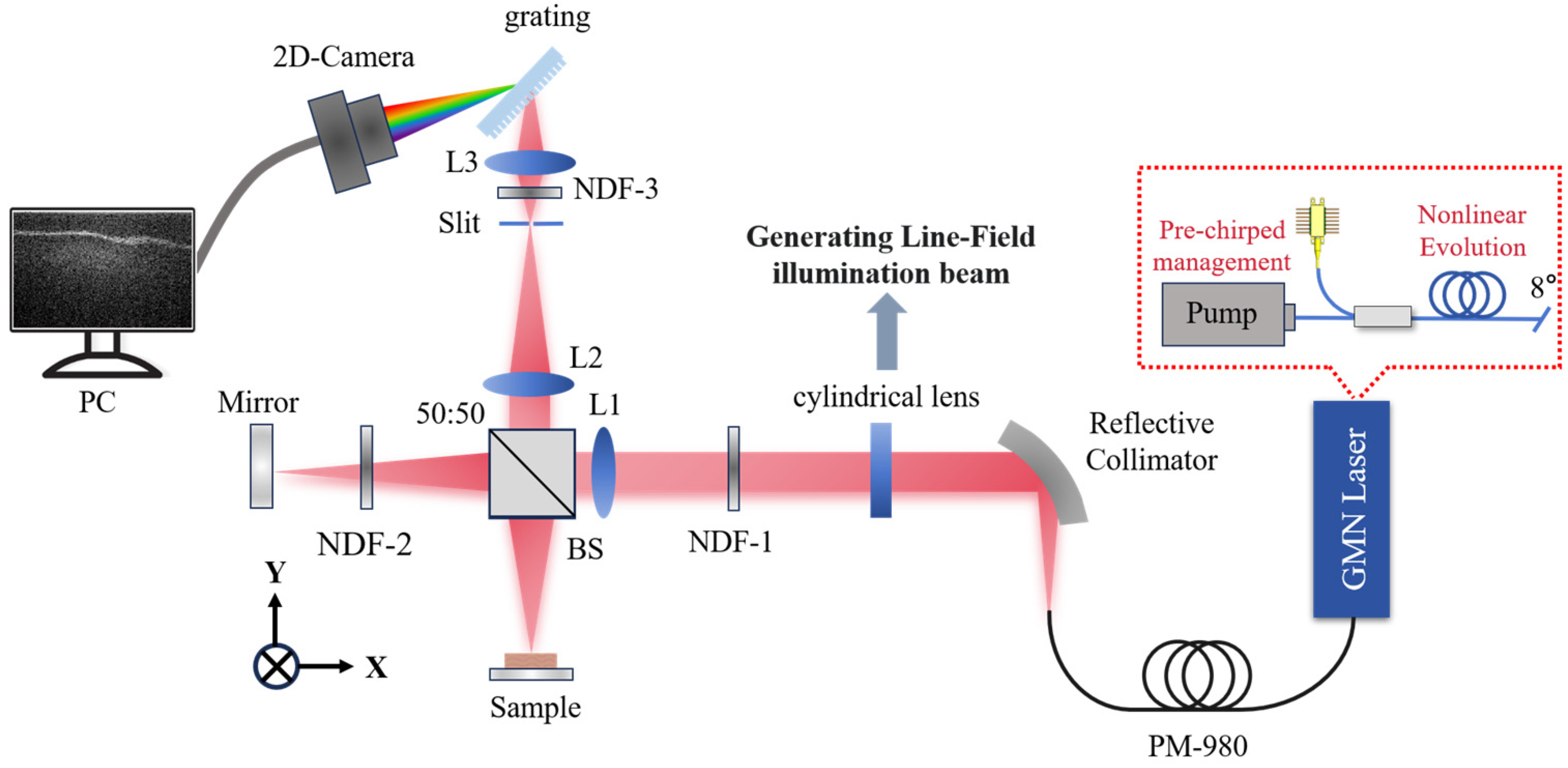
A line-field spectral-domain optical coherence tomography (LF-SD-OCT) system driven by a 1 μm gain-managed nonlinear (GMN) fiber source was constructed, as schematically illustrated in
Figure 1. To enable stable parallel imaging, a custom-developed all-fiber GMN broadband source was employed as the illumination source. The source was implemented in an all-polarization-maintaining fiber architecture, which significantly enhances environmental stability and suppresses polarization-induced fluctuations [
22,
23,
24]. The laser output from the GMN source is stably transmitted into the OCT system via a polarization-maintaining fiber (PM-980) to preserve the polarization state. The high-power broadband output from the fiber was collimated into a parallel beam using a reflective collimator. The collimated beam was then reshaped by a cylindrical lens to form a high-aspect-ratio sheet beam, providing line-field illumination for parallel OCT imaging. A continuously variable neutral density filter (NDF-1, which is identical in model and optical density range to NDF-2 and NDF-3 used elsewhere in the setup) was inserted to adjust the incident optical power, preventing detector saturation and minimizing photothermal exposure to biological samples.
The shaped beam was directed into a Michelson interferometer constructed with a non-polarizing beam splitter (BS), with a 50:50 splitting ratio between the sample and reference arms. In the sample arm, the sheet beam was focused onto the sample surface by an objective lens L1 (f = 65 mm), forming a narrow line-field illumination region that enables parallel sampling along one lateral dimension and eliminates the need for mechanical lateral scanning. The sample was mounted on a precision translation stage to ensure accurate positioning of the imaging region. In the reference arm, the beam was reflected by a planar mirror and returned along the same optical path. The reference power was adjusted using a neutral density filter (NDF-2), while the optical path length was matched to the sample arm via a translation stage.
The backscattered light from the sample arm and the reflected light from the reference arm were recombined at the beam splitter (BS) to generate interference. The combined interference signal was then focused by a lens L2 (f = 65 mm) and efficiently coupled into a spatial filtering slit. The slit effectively suppresses non-interferometric background and stray light, significantly reducing inter-channel crosstalk, while simultaneously defining the entrance aperture of the downstream spectrometer. After spatial filtering, the interferometric signal was delivered to a high-performance home-built spectrometer. Inside the spectrometer, a collimating lens L3 (f = 80 mm) collimates the diverging beam from the slit, and the incident angle onto the transmission grating was carefully optimized to achieve uniform and high-resolution spectral dispersion. The dispersed spectrum was finally captured by a high-sensitivity two-dimensional CCD camera. Owing to the 2D sensor architecture, the recorded data encode orthogonal information: one dimension corresponds to the spatial position along the line field, while the other corresponds to wavelength after grating dispersion. Consequently, two-dimensional information from the sample is acquired in a single exposure. The 2D CCD data were streamed to a computer in real time and processed using custom-developed algorithms.
2.2. Data Acquisition and Processing
To ensure consistent imaging quality, all measurements were performed under strictly controlled incident polarization states and stabilized optical power. To further improve the signal-to-noise ratio (SNR), multiple interferometric frames were acquired under identical conditions and averaged in the time domain. The raw spectral data were then imported into MATLAB R2020b for post-processing using custom-developed algorithms.
The core image reconstruction pipeline consisted of the following steps. First, background subtraction (DC removal) and intensity normalization were applied to the raw interferometric spectra to suppress the source spectral envelope. Second, linear resampling from pixel space to wavenumber (k-space) was performed based on pre-calibrated mapping parameters, with numerical dispersion compensation incorporated to correct residual dispersion and nonlinear phase errors introduced by the optical components. Finally, fast Fourier transforms (FFTs) were applied to the interferometric spectra for each lateral spatial channel to reconstruct depth-resolved reflectivity profiles (A-scans). After frequency-domain filtering and logarithmic dynamic range compression, high-contrast B-scan cross-sectional images were generated for subsequent quantitative analysis.
To ensure accurate k-space resampling, a high-precision spectrometer calibration method based on analytic signal phase extraction was employed. This approach establishes an accurate mapping between detector pixel indices and uniformly spaced wavenumbers. Specifically, interferometric fringes from a single mirror reflector were acquired and bandpass-filtered in the frequency domain to suppress noise. The analytic signal was then constructed using the Hilbert transform to extract the instantaneous phase of the fringes. By differentiating the phase curves and averaging over multiple measurements, the nonlinear pixel-to-wavenumber mapping was obtained. The resulting calibration curve was stored as a look-up table and applied to all subsequent datasets for linearized k-space resampling, thereby significantly suppressing point spread function (PSF) broadening and sidelobes.
3. Results and Discussion
3.1. Output Characteristics of the Light Source
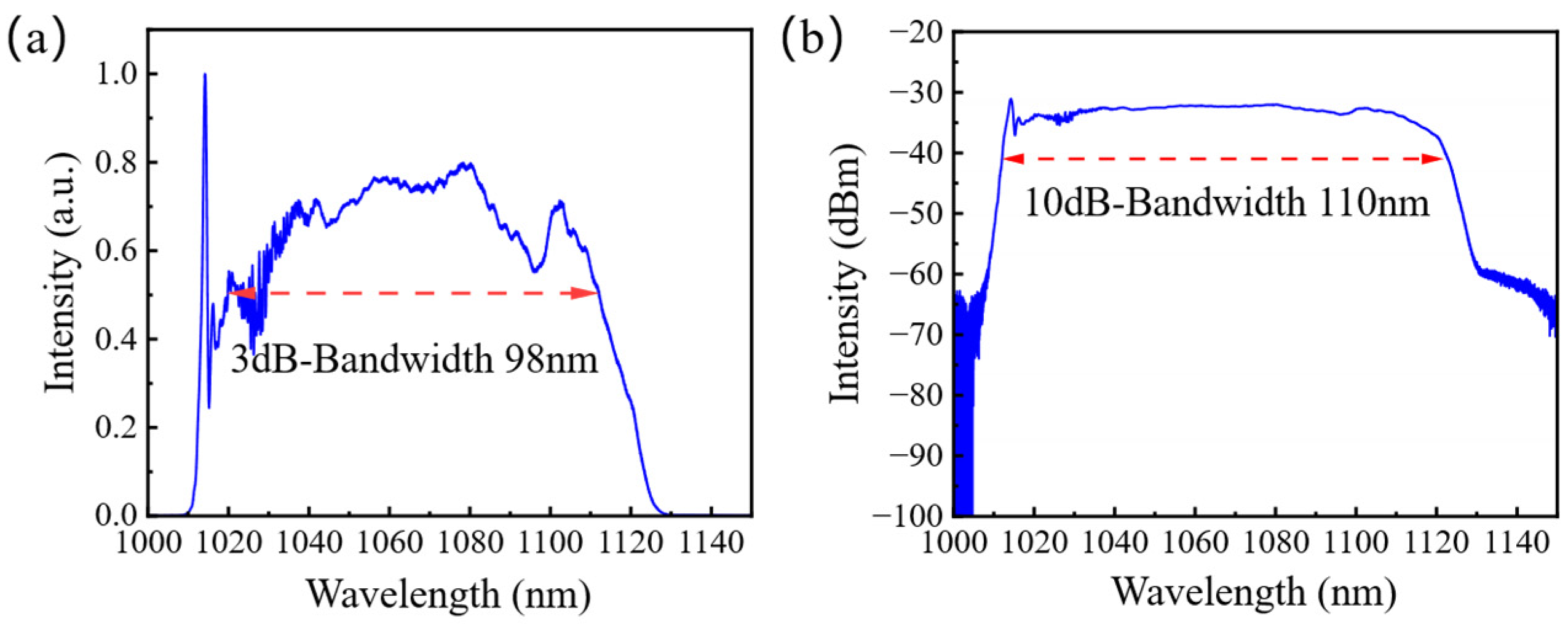
Figure 2 shows the spectral characteristics of the developed all-fiber GMN source at an output power of 269 mW. The output power was measured by a calibrated photodiode optical power meter from Thorlabs.
Figure 2a presents the spectrum on a linear scale and
Figure 2b on a logarithmic scale. The output spectrum exhibits excellent flatness and continuity over the wavelength range of 1020–1110 nm. The measured 3 dB bandwidth is 98 nm, while the 10 dB bandwidth is 110 nm. Notably, the close proximity of the 10 dB and 3 dB bandwidths indicates that the spectral energy is efficiently distributed over a broad wavelength range rather than being concentrated in narrow peaks, thereby ensuring favorable spectral coverage.
In contrast to conventional supercontinuum generation—which can generate thousands of nanometers of bandwidth but typically relies on noise-sensitive stochastic nonlinear processes such as soliton fission and modulation instability [
25]—the GMN mechanism operates in a fundamentally different regime. By dynamically balancing normal dispersion, self-phase modulation, and distributed gain, GMN enables the pulse to evolve into an asymptotic attractor state. This unique evolution helps move beyond the usual soliton-breaking limitation, allowing the source to accumulate massive nonlinear phase shifts for broadband generation while maintaining a strictly monotonic chirp and high temporal coherence. As a result, the GMN source concentrates most of its energy within the effective bandwidth without pronounced low-power sidelobes, ensuring both high spectral efficiency and the exceptional pulse-to-pulse stability required for low-noise parallel OCT imaging. Although minor spectral ripples are present at the top of the spectrum, the overall spectral envelope remains smooth and stable. Such a broadband spectrum with steep edges is highly desirable for OCT imaging: the broad bandwidth directly determines the theoretical axial resolution, while the high spectral rectangularity helps suppress sidelobes in the point spread function (PSF), thereby improving the image dynamic range.
To verify the source’s performance in the practical imaging system, axial point spread function (PSF) measurements using a standard mirror reflector are presented in the following section, alongside k-space linearization results to validate the accuracy of the image reconstruction pipeline.
3.2. Characterization of the Reconstruction Chain: Interferograms, Spectra, and Axial PSF
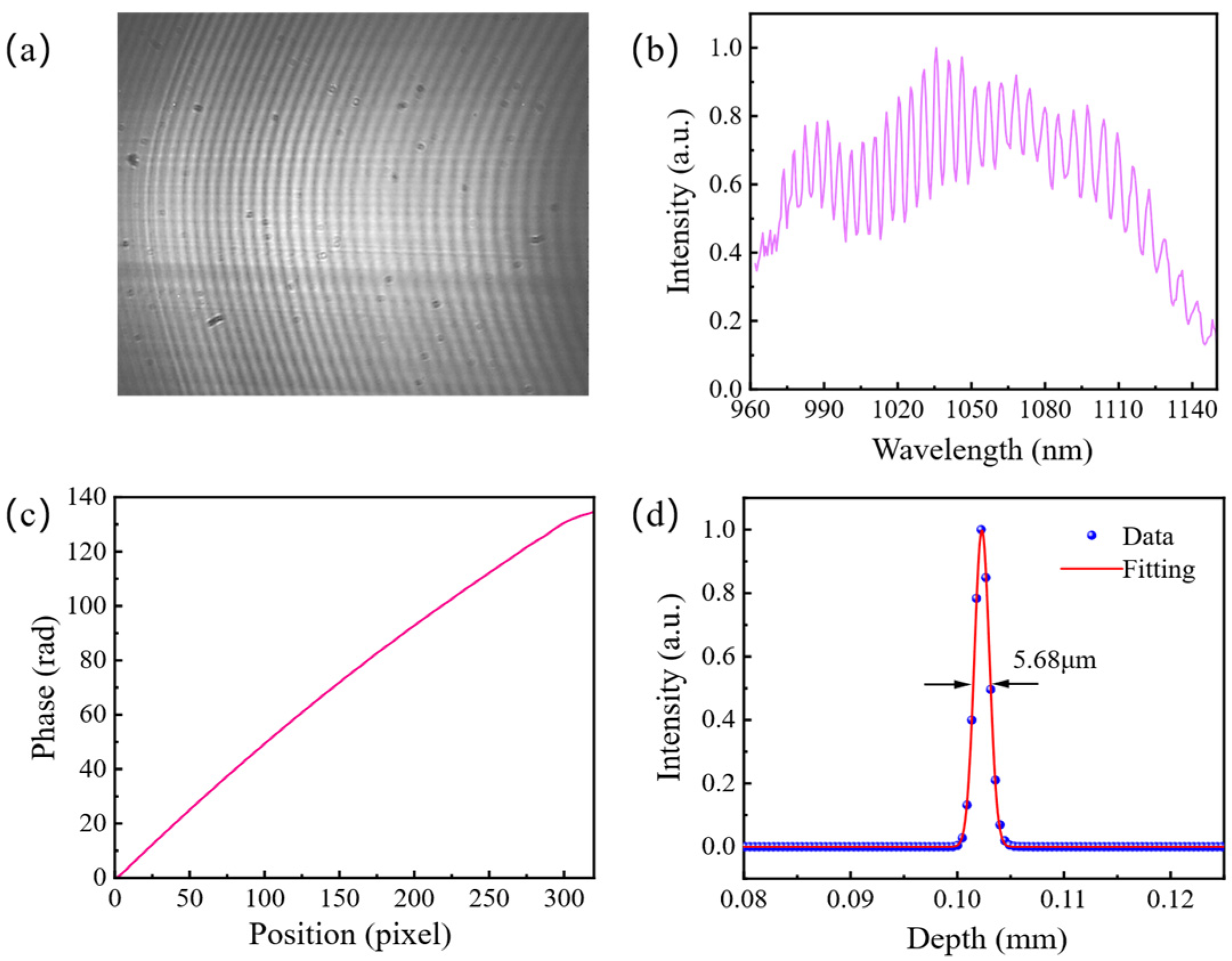
To evaluate the interferometric imaging quality and resolution of the developed LF-SD-OCT system, a series of calibration measurements were performed using a planar mirror reflector, as shown in
Figure 3.
Figure 3a presents a representative two-dimensional spectral interferogram acquired by the 2D camera. The interferometric fringes remain continuous with high visibility across the entire lateral field of view, indicating good optical power matching and mode overlap between the sample and reference arms. This provides a solid basis for high signal-to-noise ratio (SNR) depth reconstruction. The slight curvature of the fringes (the “smile” effect [
26]) is mainly attributed to minor aberrations between the spectrometer collimating lens and the diffraction grating, as well as residual beam alignment errors. Such low-order distortions can be effectively compensated by geometric correction in post-processing and therefore do not compromise the overall imaging quality.
Figure 3b shows the interferometric spectrum extracted from a single camera row. The spectral envelope closely matches the source spectrum shown in
Figure 2, confirming high-fidelity spectral transmission through the optical system. The periodic high-frequency modulations observed in the spectrum represent the fundamental interference fringes formed between the reference arm and the sample arm, which inherently encode the depth information of the sample. In the signal processing pipeline, this fixed-pattern noise is effectively suppressed by background subtraction and intensity normalization, thereby preventing the generation of artificial sidelobes in the reconstructed A-scans. Based on the calibration curve shown in
Figure 3c, an accurate mapping between detector pixel indices and wavenumbers was established. The pronounced nonlinearity of this mapping further confirms the necessity of rigorous k-space linearization in spectral-domain OCT, as the calibration accuracy directly determines PSF broadening and sidelobe suppression.
After k-space linearization and numerical dispersion compensation, Fourier transformation of the interferometric spectra yields the axial point spread function (PSF) of the system, as shown in
Figure 3d. The measured PSF exhibits a well-defined single main lobe with effectively suppressed sidelobes. A Gaussian fit yields a full width at a half maximum (FWHM) of approximately 5.68 μm in air. This measured axial resolution deviates slightly from the theoretical limit [
3] (~5.06 μm), which can be mainly attributed to the finite spectral resolution of the spectrometer and residual higher-order dispersion. Nevertheless, the achieved resolution is sufficient for resolving microstructural features in biological tissues.
3.3. Depth Performance and Sensitivity Roll-Off: Mirror Imaging
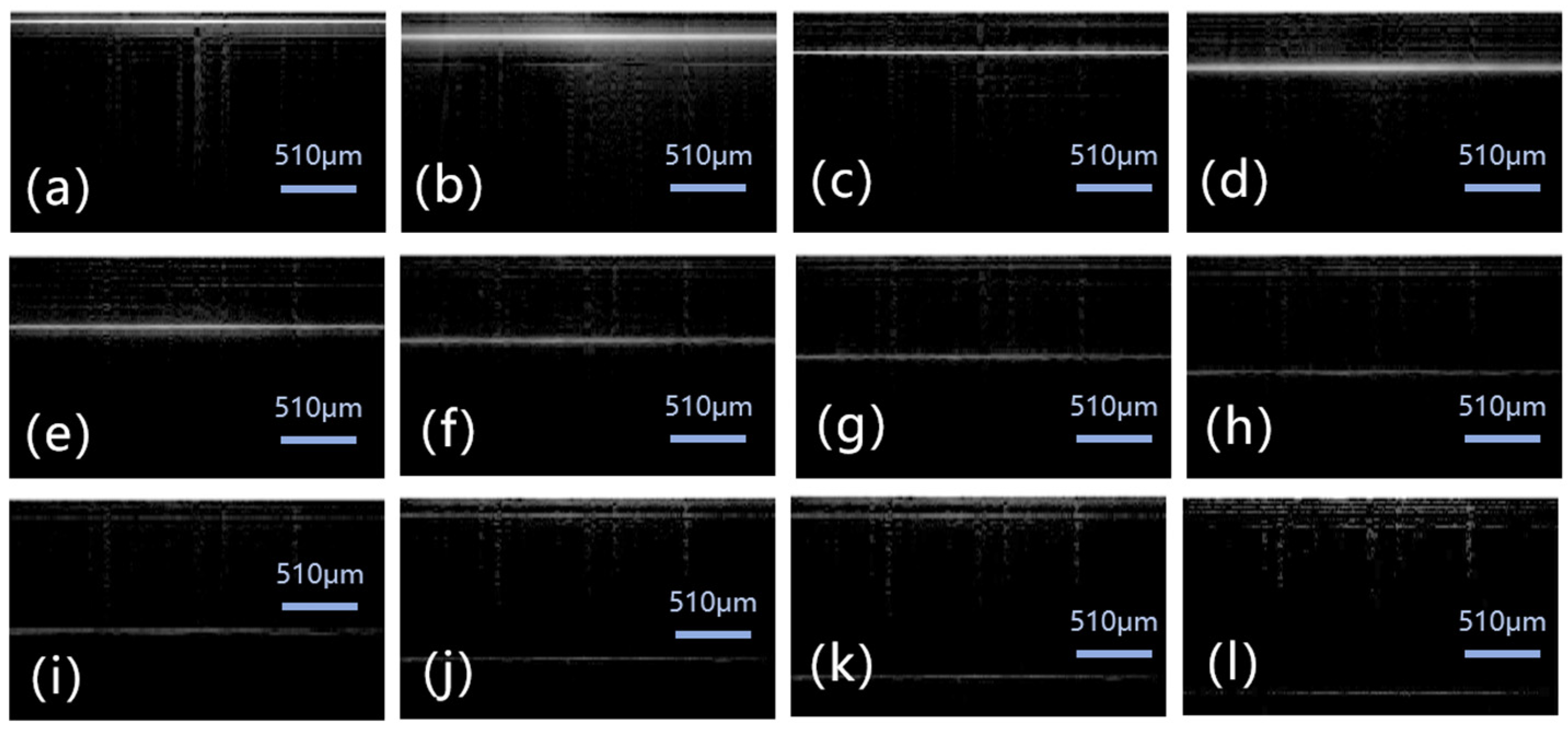
To quantitatively evaluate the sensitivity roll-off and dynamic range of the LF-SD-OCT system at different imaging depths, a series of discrete-depth measurements were performed using a planar mirror as a standard target over an optical path difference range of 0.1–1.2 mm, as shown in
Figure 4.
Figure 4a–l present the B-scan cross-sectional images of the mirror at different depths. All images are displayed with a normalized logarithmic dynamic range of 45 dB to directly visualize the contrast between the signal and the noise floor.
3.3.1. Shallow-Depth Performance (0.1–0.6 mm)
As shown in
Figure 4a–f, the system exhibits excellent imaging quality at shallow depths. The mirror signal appears as a bright, sharp line, while the background noise is effectively suppressed to a level close to the noise floor. This indicates a high effective signal-to-noise ratio (SNR) and high modulation depth in this range, enabling reliable detection of weak tissue backscattering signals.
3.3.2. Deep-Depth Performance (0.7–1.2 mm)
As the imaging depth increases to 0.7–1.2 mm [
Figure 4g–l], the mirror signal remains clearly discernible on a logarithmic scale. However, a pronounced reduction in peak intensity and a slight elevation of the noise floor are observed, leading to gradually reduced image contrast. This behavior primarily originates from the finite spectral resolution of the spectrometer (~0.3 nm, determined by dividing the ~98 nm effective bandwidth by the 320 active pixels of the linear array CCD), which causes a sensitivity roll-off by reducing the visibility of high-frequency interferometric fringes on the detector (the “washout” effect). Overall, a high-quality signal response and high SNR are maintained over a depth range of approximately 0.1–0.9 mm. Although unavoidable physical roll-off occurs at larger depths, the effective imaging range extends to ~1.2 mm under logarithmic compression, which is sufficient for resolving superficial microstructures in most biological tissues.
3.4. Tissue Validation: Morphological and Cross-Sectional Comparison Before and After Laser Ablation
To further validate the LF-SD-OCT system’s capability for resolving surface morphology and subsurface microstructures in soft biological tissues, experiments were performed on ex vivo porcine myocardial samples subjected to femtosecond laser ablation [
27]. Specifically, the ablation was performed using our custom-built all-fiber integrated femtosecond laser system [
15]. The laser operated at a repetition rate of 5.6 MHz, delivering ultrashort pulses with a duration of 45 fs and a peak power of 3.6 MW, corresponding to an average power of ~913 mW. Comparative imaging before and after ablation is shown in
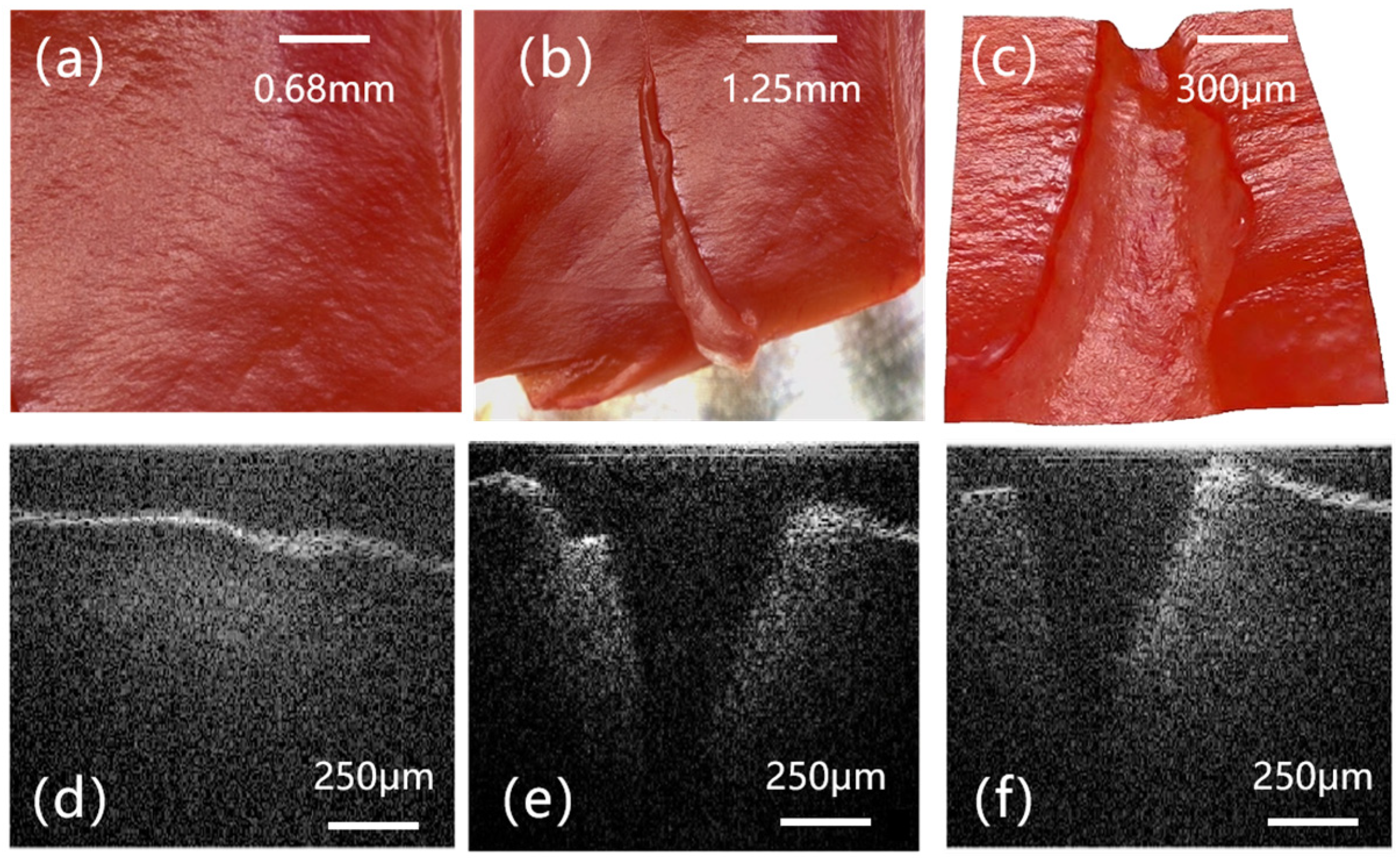
Figure 5. The top row [
Figure 5a–c] presents macroscopic surface morphologies acquired by optical microscopy, while the bottom row [
Figure 5d–f] shows the corresponding OCT B-scan cross-sectional images at the same locations (scale bar: 250 μm).
Figure 5a shows the surface of intact myocardial tissue prior to laser ablation, exhibiting a smooth and homogeneous texture. In the corresponding OCT cross-section [
Figure 5d], a continuous high-intensity band is clearly visible, originating from the strong scattering interface caused by the refractive index mismatch between air and the tissue. Below this interface, the signal intensity exhibits a characteristic exponential decay with depth, consistent with light propagation in highly scattering turbid media. This confirms the system’s adequate penetration depth and SNR for soft-tissue imaging.
After laser ablation, the macroscopic image [
Figure 5b] reveals pronounced groove-like thermal damage on the tissue surface. The corresponding OCT cross-sections [
Figure 5e,f] accurately capture this morphological disruption: the continuity of the tissue surface is interrupted, forming a distinct ablation crater. Notably, significant edge enhancement is observed at the crater rims. This can be attributed to increased scattering induced by thermal coagulation and/or specular reflections from steep geometric boundaries [
27]. In contrast, a pronounced signal depletion (or “shadowing artifact”) is observed directly beneath the ablation crater. This effect arises from the combined influence of reduced back-coupling efficiency due to steep crater walls and strong attenuation by the coagulated tissue above.
Figure 5c presents a three-dimensional microscopic reconstruction of the ablated region, providing an intuitive visualization of the damage distribution. Comparative analysis indicates that the cross-sectional depth profiles extracted from OCT are in excellent geometric agreement with the surface morphology trends revealed by optical microscopy. Collectively, these results demonstrate that the proposed system not only robustly resolves superficial microstructures in soft tissues but also enables accurate cross-sectional localization and assessment of micrometer-scale morphological changes induced by laser ablation. This lays a solid experimental foundation for future intraoperative real-time monitoring of tissue damage.
4. Conclusions
In this work, we developed a high-speed line-field spectral-domain OCT (LF-SD-OCT) system driven by a high-power, broadband gain-managed nonlinear (GMN) all-fiber light source operating at 1 μm, aiming to overcome the long-standing sensitivity limitations of parallel OCT imaging. The key contribution lies in leveraging the GMN amplification mechanism to simultaneously achieve high average power and smooth, spectrally stable broadband emission, thereby alleviating the inherent trade-off between photon budget and spectral quality in line-field OCT illumination.
Specifically, the GMN source delivers a stable output power of 269 mW with an effective spectral bandwidth of ~98 nm. Driven by this source, our LF-SD-OCT system achieves a high axial resolution of 5.68 μm and an imaging range of approximately 1.2 mm, which is sufficient for resolving superficial microstructures in biological tissues. Operating at an imaging speed of 40 frames per second (fps), the system successfully captured the highly dynamic, thermal-damage-free tissue ablation process induced by an ultrafast laser.
Despite these encouraging results, further optimization is feasible. The achievable imaging depth and sensitivity roll-off are currently constrained by the spectral resolution and aberrations of the spectrometer. Future improvements in detector pixel number, spectrometer dispersion design, and aberration correction are expected to further extend the usable imaging range and suppress sensitivity decay. Moreover, while the present study focuses on ex vivo tissue samples, future in vivo investigations will be essential to evaluate the impact of blood perfusion and physiological motion on imaging performance. Integration with faster acquisition hardware and advanced motion compensation or learning-based denoising algorithms may further enhance robustness in realistic intraoperative environments.
Overall, the GMN-enabled LF-SD-OCT system demonstrated here establishes a practical route toward combining high-speed parallel OCT imaging with high photon efficiency and spectral stability, offering a competitive solution for real-time, noninvasive cross-sectional assessment of laser-induced tissue damage during interventional procedures.
Author Contributions
Conceptualization, A.L. and S.Z.; data curation, T.Y. and S.Z.; funding acquisition, P.W.; investigation, T.Y. and S.Z.; methodology, T.X.; project administration, A.L.; software, T.Y. and S.Z.; supervision, S.P. and S.Z.; writing—original draft, T.Y.; writing—review and editing, C.Y. and P.W. All authors have read and agreed to the published version of the manuscript.
Funding
This work is supported by the National Natural Science Foundation of China under Grant 62035002 and 62405011.
Data Availability Statement
The data underlying the results presented in this paper are not publicly available at this time but may be obtained from the authors upon reasonable request.
Conflicts of Interest
The authors declare no conflicts of interest.
References
- Huang, D.; Swanson, E.A.; Lin, C.P.; Schuman, J.S.; Stinson, W.G.; Chang, W.; Hee, M.R.; Flotte, T.; Gregory, K.; Puliafito, C.A.; et al. Optical Coherence Tomography. Science 1991, 254, 1178–1181. [Google Scholar] [CrossRef]
- Drexler, W.; Liu, M.; Kumar, A.; Kamali, T.; Unterhuber, A.; Leitgeb, R.A. Optical coherence tomography today: Speed, contrast, and multimodality. J. Biomed. Opt. 2014, 19, 071412. [Google Scholar] [CrossRef]
- Bouma, B.E.; de Boer, J.F.; Huang, D.; Jang, I.K.; Yonetsu, T.; Leggett, C.L.; Leitgeb, R.; Sampson, D.D.; Suter, M.; Vakoc, B.J.; et al. Optical coherence tomography. Nat. Rev. Methods Primers 2022, 2, 79. [Google Scholar] [CrossRef]
- Kang, J.; Zhu, R.; Li, J.; Liu, H.; Ma, X.; Tao, L.; Sun, Y. Optical coherence tomography-surveilled laser ablation using multifunctional catheter and 355-nm optical pulses. Opt. Commun. 2021, 501, 127364. [Google Scholar] [CrossRef]
- Adler, D.C.; Chen, Y.; Huber, R.; Schmitt, J.; Connolly, J.; Fujimoto, J.G. Three-dimensional endomicroscopy using optical coherence tomography. Nat. Photonics 2007, 1, 709–716. [Google Scholar] [CrossRef]
- Lawman, S.; Zhang, Z.; Shen, Y.-C.; Zheng, Y. Line Field Optical Coherence Tomography. Photonics 2022, 9, 946. [Google Scholar] [CrossRef]
- Zuluaga, A.F.; Richards-Kortum, R. Spatially resolved spectral interferometry for determination of subsurface structure. Opt. Lett. 1999, 24, 519–521. [Google Scholar] [CrossRef] [PubMed]
- Nakamura, Y.; Makita, S.; Yamanari, M.; Itoh, M.; Yatagai, T.; Yasuno, Y. High-speed three-dimensional human retinal imaging by line-field spectral domain optical coherence tomography. Opt. Express 2007, 15, 7103–7116. [Google Scholar] [CrossRef] [PubMed]
- Chen, Y.; Huang, S.-W.; Zhou, C.; Potsaid, B.; Fujimoto, J.G. Improved detection sensitivity of line-scanning optical coherence microscopy. IEEE J. Sel. Top. Quantum Electron. 2011, 18, 1094–1099. [Google Scholar] [CrossRef] [PubMed][Green Version]
- Karamata, B.; Lambelet, P.; Laubscher, M.; Salathe, R.P.; Lasser, T. Spatially incoherent illumination as a mechanism for cross-talk suppression in wide-field optical coherence tomography. Opt. Lett. 2004, 29, 736–738. [Google Scholar] [CrossRef] [PubMed]
- Barrick, J.; Doblas, A.; Gardner, M.R.; Sears, P.R.; Ostrowski, L.E.; Oldenburg, A.L. High-speed and high-sensitivity parallel spectral-domain optical coherence tomography using a supercontinuum light source. Opt. Lett. 2016, 41, 5620–5623. [Google Scholar] [CrossRef]
- Lawman, S.; Dong, Y.; Williams, B.M.; Romano, V.; Kaye, S.; Harding, S.P.; Willoughby, C.; Shen, Y.-C.; Zheng, Y. High resolution corneal and single pulse imaging with line field spectral domain optical coherence tomography. Opt. Express 2016, 24, 12395–12405. [Google Scholar] [CrossRef]
- Sidorenko, P.; Fu, W.; Wise, F. Nonlinear ultrafast fiber amplifiers beyond the gain-narrowing limit. Optica 2019, 6, 1328–1333. [Google Scholar] [CrossRef]
- Sidorenko, P.; Wise, F. Generation of 1 µJ and 40 fs pulses from a large mode area gain-managed nonlinear amplifier. Opt. Lett. 2020, 45, 4084–4087. [Google Scholar] [CrossRef]
- Chen, Z.; Shen, Y.; Bao, W.; Li, P.; Wang, X.; Ding, Z. Identification of surface defects on glass by parallel spectral domain optical coherence tomography. Opt. Express 2015, 23, 23634–23646. [Google Scholar] [CrossRef] [PubMed]
- Endo, T.; Yasuno, Y.; Makita, S.; Itoh, M.; Yatagai, T. Profilometry with line-field Fourier-domain interferometry. Opt. Express 2005, 13, 695–701. [Google Scholar] [CrossRef] [PubMed]
- Yaqoob, Z.; Choi, W.; Oh, S.; Lue, N.; Park, Y.; Fang-Yen, C.; Dasari, R.R.; Badizadegan, K.; Feld, M.S. Improved phase sensitivity in spectral domain phase microscopy using line-field illumination and self phase-referencing. Opt. Express 2009, 17, 10681–10687. [Google Scholar] [CrossRef] [PubMed]
- Pizzurro, S.; Gotti, R.; Ypi, X.; Canella, F.; Giannotti, D.; Galzerano, G.; Agnesi, A.; Pirzio, F. Gain-managed nonlinear amplification and noise performance of an Yb-doped fiber amplifier seeded at different wavelengths. Opt. Laser Technol. 2026, 193, 114233. [Google Scholar] [CrossRef]
- Krakowski, M.; Soboń, G. Gain-managed nonlinear amplification in an erbium-doped fiber. Opt. Express 2024, 32, 48815–48823. [Google Scholar] [CrossRef]
- Gotti, R.; Pizzurro, S.; Ypi, X.; Giannotti, D.; Galzerano, G.; Laporta, P.; Agnesi, A.; Pirzio, F. Femtosecond Mamyshev fiber oscillator started by ultra-low power microchip laser seeder at two different wavelengths: A comparison. Opt. Express 2024, 32, 43635–43642. [Google Scholar] [CrossRef]
- Stoliarov, D.; Manuylovich, E.; Koviarov, A.; Galiakhmetova, D.; Rafailov, E. Gain-managed nonlinear amplification of ultra-long mode-locked fiber laser. Opt. Express 2023, 31, 43427–43437. [Google Scholar] [CrossRef] [PubMed]
- Xia, T.; Zhao, H.; Cheng, Z.; Hou, Y.; Zhang, Q.; Cao, S.; Chen, Y.; Zhang, P.; Wang, P. All-fiber integrated gain-managed nonlinear amplification system delivers ultrafast lasers with 3.6 MW peak power and 45 fs pulse duration. Opt. Laser Technol. 2025, 181, 111627. [Google Scholar] [CrossRef]
- Xia, T.; Zhao, H.; Zhu, S.; Cao, S.; Chen, Y.; Zhang, P.; Zhang, Q.; Wang, P. Generation of 8-fs and 13-nJ pulse from a Yb-fiber system with nonlinear-pulse-compression. Opt. Express 2024, 32, 32396–32407. [Google Scholar] [CrossRef]
- Zhang, P.; Zhao, H.; Xia, T.; Cao, S.; Ye, T.; Wang, P. Generation of an 86-fs and a 10.2-µJ pulse from an all-fiber integrated GMN system with spectral shaping. Opt. Lett. 2025, 50, 3293. [Google Scholar] [CrossRef]
- Dudley, J.M.; Taylor, J.R. (Eds.) Supercontinuum Generation in Optical Fibers; Cambridge University Press: Cambridge, UK, 2010. [Google Scholar]
- Mouroulis, P.; Green, R.O.; Chrien, T.G. Design of pushbroom imaging spectrometers for optimum recovery of spectroscopic and spatial information. Appl. Opt. 2000, 39, 2210–2220. [Google Scholar] [CrossRef] [PubMed]
- Xia, T.; Zhao, H.; Liu, A.; Ye, T.; Mai, M.; Pan, S.; Yan, C.; Wang, P. Tunable repetition-rate all-fiber femtosecond laser delivering 45 fs and 14.4 MW pulses for thermal-damage-free cardiac interventions. Photonics Res. 2025, 13, 3045–3055. [Google Scholar] [CrossRef]
| Disclaimer/Publisher’s Note: The statements, opinions and data contained in all publications are solely those of the individual author(s) and contributor(s) and not of MDPI and/or the editor(s). MDPI and/or the editor(s) disclaim responsibility for any injury to people or property resulting from any ideas, methods, instructions or products referred to in the content. |