2.1. Theoretical Models and Simulation Calculations
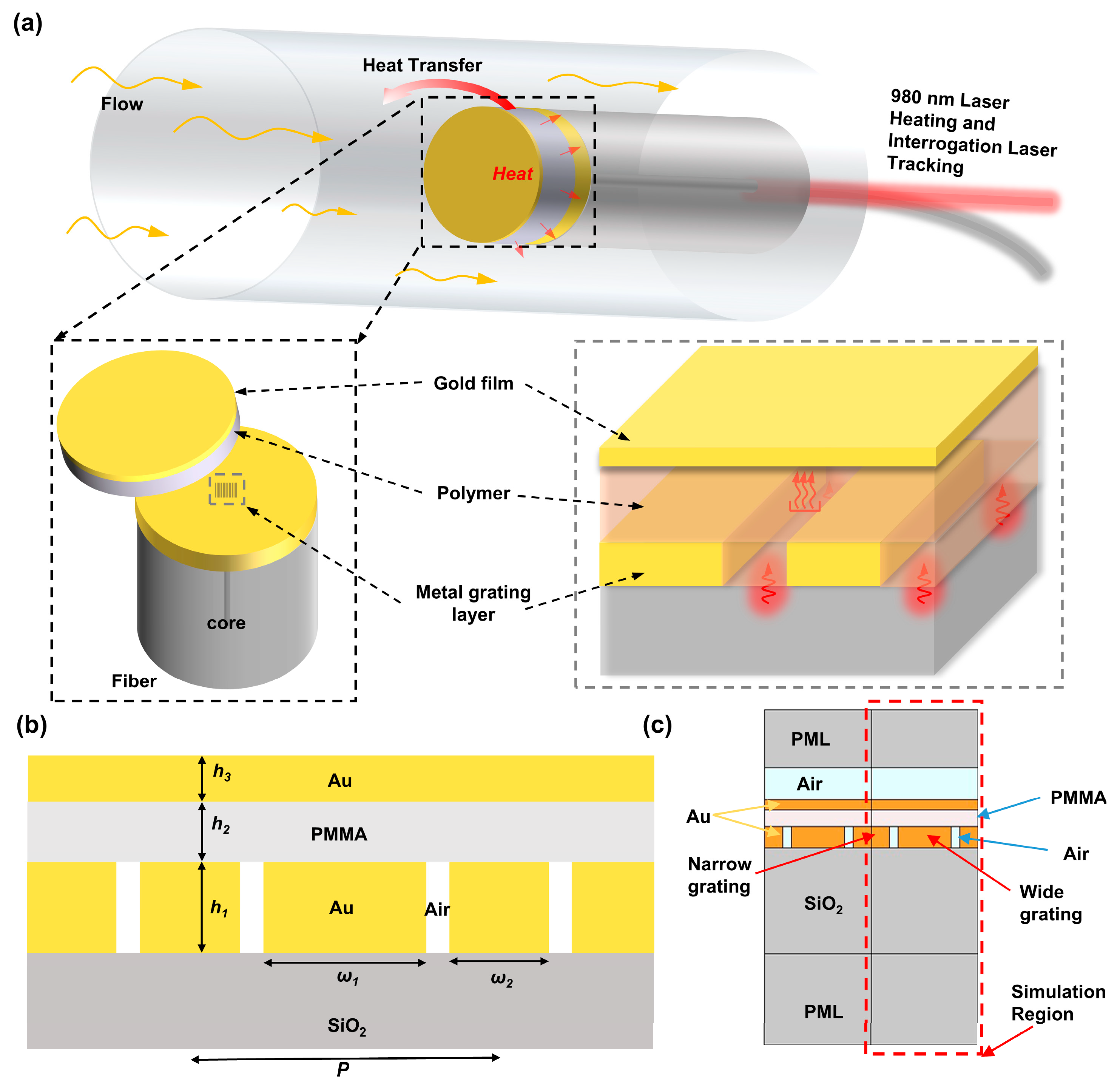
The operating principle and structural design of the proposed SPR-based fiber-optic thermal flowmeter are illustrated in
Figure 1a. Since gold nanostructures have been successfully fabricated in prior work using a preparation scheme demonstrating the experimental feasibility [
14], we primarily focus on the sensing mechanism and the structure design of the flowmeter. Conventional all-fiber thermal flowmeters typically require two light sources: a pump source serving as the heating mechanism to establish an initial temperature baseline in the sensor and an interrogation source to detect flow-induced shifts in the reflection spectrum. Typically, a single-frequency near-infrared laser, such as 980 nm or 1064 nm, serves as the pump source, while a broadband light source and a single-frequency laser function as the light source in a wavelength-based and intensity-based interrogation scheme, respectively. The pump laser source first irradiates the nanostructured sensing region with light at a specific wavelength for the excitation of the optical resonance mode, which propagates through the resonant cavity and undergoes energy conversion into heat due to ohmic losses in the metallic cavity. This process elevates the temperature of the sensing unit, which is kept constant after reaching thermal equilibrium with the external environment. With the presence of flow in the external medium, there is a temperature difference between the sensor and its surrounding environment, resulting in heat transfer. Since the nanostructure is comprised of three layers with a nanometer thick, the heat conduction among each layer is fast to obtain a thermal equilibrium. Crucially, the resultant temperature change induces both thermal expansion and an alteration in the thermo-optic coefficient of the polymer dielectric (i.e., PMMA) layer. Consequently, these combined effects lead to a spectral shift in the reflection spectrum of the sensing unit. This optical energy is converted to thermal energy, elevating the local temperature to a predetermined setpoint and establishing a stable thermal baseline for subsequent flow detection [
1]. When external fluid flows across the heated sensing region, convective heat exchange occurs. Higher flow velocities enhance heat dissipation from the sensor surface, resulting in significant temperature reduction within the sensing region. Conversely, lower flow velocities yield minimal thermal variation. Temperature-dependent changes in the optical properties of the structure induce a corresponding wavelength shift in the reflected spectrum, with the magnitude of this shift exhibiting a monotonic correlation with temperature variation. By quantifying the spectral shift magnitude via demodulation instrumentation and applying the calibrated chain of correlations from spectral shift to temperature change to flow velocity, the actual fluid flow velocity can be precisely determined.
The all-fiber thermal flowmeter developed in this study operates in the microflow regime. Within this range, wavelength shifts induced by fluid pressure effects are negligible. Consequently, spectral drift arising from thermal exchange between the external fluid and the sensor dominates the response [
15,
16]. We now analyze heat conduction between the sensor and its environment. Heat transfer at the solid-fluid interface must satisfy the thermal conductivity differential equation derived from the conservation of energy and Fourier’s Law [
4,
17]:
where
denotes the specific heat capacity (J/(kg·K)),
represents the density of thermosensitive materials (kg/m
3),
is the temperature (K),
is fluid velocity vector (m/s),
is the heat flux per unit volume (W/m
3),
is the heat exchange on the probe surface, and
is the thermal conductivity of thermosensitive materials (W/(m·K)).
During operation, the gold nanostructure absorbs incident pump laser power and generates heat, elevating the PMMA layer temperature. This shifts the cavity resonance toward longer wavelengths (redshift). Subsequent microfluidic flow extracts heat from the cavity, generating a flow-dependent blueshift in the resonance wavelength. This heat loss can be modeled as [
18,
19]:
where
is the microfluidic flow rate,
denotes the temperature of the sensing probe at airflow velocity of
,
is the external fluid temperature, and
is the heat loss due to fluid flow. When the fluctuations of fluid temperature and thermophysical property parameters are small,
and
are usually defined as constants, which are mainly related to the probe structure.
is the energy of the pump laser input into the optical fiber,
is the coupling efficiency of the probe structure at thermal equilibrium, and
is the absorption efficiency of the plasmonic nanocavity for laser energy at thermal equilibrium. The relationship equation between probe temperature and flow velocity can be derived as [
19]:
When a guided wave propagates laterally within the intermediate dielectric layer, reflection occurs at the interface due to the difference in effective refractive indices between the Au-PMMA-Au region and the Au-PMMA-Air region within the intermediate layer. Optical resonance emerges when the total phase shift accumulated during the propagation of a guided wave reaches an integer multiple of 2
π. Thus, we have [
20,
21,
22]:
where
is the phase of light after passing through the medium.
represents the wavelength of the optical resonance;
and
, respectively, denote the refractive index of the medium and the cavity length of the resonant cavity at the corresponding temperature.
represents the series of different resonance orders. Variations in refractive index and thickness can induce a change in the optical path length within the resonant cavity. When the temperature of the dielectric layer alters through heat transfer, the optical path of the resonant cavity changes. This shift causes displacement of the resonance peaks, thereby revealing the relationship between peak shift and flow rate:
2.2. Simulation Analysis
The sensitive region incorporates a nanostructured optical cavity positioned at the fiber end face, as illustrated in
Figure 1a,b. This architecture utilizes a multilayer subwavelength photonic configuration: The layer adjacent to the fiber facet comprises a metallic gold grating with a thickness
h1 = 200 nm. This grating layer features a periodic array with period
P = 950 nm, composed of two distinct resonant grating elements exhibiting precisely controlled width differentials—a primary element with width
w1 = 500 nm and a secondary element with width
w2 = 310 nm, to facilitate dual-frequency coupling. The width of the air gap between different gold strips is kept equal. Directly above the grating layer resides a dielectric spacer layer of PMMA, with a thickness
h2 = 160 nm. The topmost layer constitutes a gold Au mirror layer of thickness
h3 = 100 nm.
The inherent symmetry of the designed structure was leveraged to enhance computational efficiency, utilizing a two-dimensional (2-D) model simulated using finite element simulation software. As shown in
Figure 1c, periodic boundary conditions were applied to the left and right sides of the 2-D structure, while perfectly matched layers (PMLs) were implemented at the top and bottom boundaries to suppress boundary-induced reflections. For simulations, the refractive index of the PMMA spacer layer was set to 1.49 [
15], and the dielectric constant of gold was adopted from the experimental data reported by Johnson and Christy [
16].
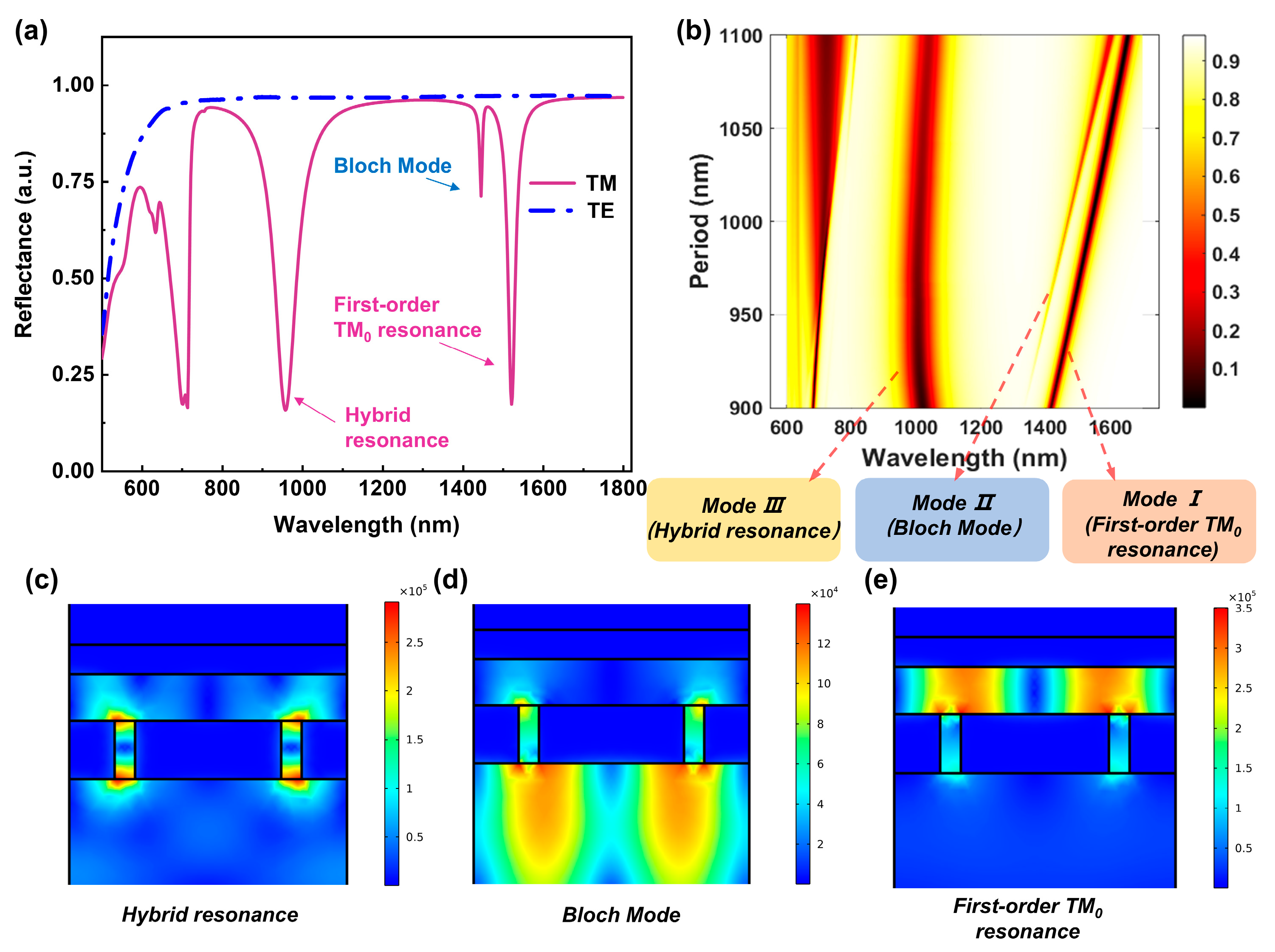
Under transverse magnetic (TM) polarization excitation, the reflection spectrum response of the nano-resonator at the fiber end face is presented in
Figure 2a. Numerical simulations reveal that the structure exhibits pronounced multi-order resonant characteristics across the broad spectral range of 600–1800 nm, featuring three distinct resonance peaks at wavelengths
λ1 = 1522.5 nm,
λ2= 1446.3 nm, and
λ3 = 958.1 nm. Mode-field analysis demonstrates that these resonances correspond to dual-path interference effects between SPR at the metal-dielectric interface and metal-dielectric-metal waveguide modes [
21,
22]. This multifrequency resonance phenomenon originates from the strong dependency relationship between the phase accumulation of TM
0 modes and the geometric parameters within the composite waveguide structure. The resonant mode near 980 nm exhibits a broader full-width at half-maximum (FWHM), with a reflection dip of approximately 0.1. Given that the 100-nm-thick gold mirror layer effectively eliminates optical transmission, the optical nanocavity achieves high optical absorption near 980 nm. This enables efficient plasmonic-thermal heating when illuminated by a pump laser source at this wavelength. Conversely, the resonant mode around 1550 nm displays a narrower linewidth, indicating a higher quality factor (Q-factor) and a greater extinction ratio. This combination confirms superior intensity-demodulation sensitivity and a wide linear dynamic range, establishing its suitability as a probe wavelength for demodulating flow-rate variations. When the structure is illuminated by TE light, no obvious resonance mode is observed in the wavelength range of 800–1800 nm.
The waterfall plots depicting interference peak positions versus grating period variations, as shown in
Figure 2b, further reveal distinct modal behaviors. Among the three modes (ordered right-to-left), Mode I and Mode II exhibit characteristic redshifts with increasing period. Conversely, Mode III demonstrates an initial blueshift followed by a redshift.
Figure 2d identifies Mode II as a Bloch mode [
23], evidenced by its electric field distribution where energy predominantly localizes within the substrate of the fiber, failing to penetrate the resonant cavity. This confinement renders the Bloch mode unsuitable for both functions of pumping and demodulation.
Figure 2c,e demonstrate that the electric fields of Modes III and I are strongly concentrated within the dielectric layer, exhibiting lateral propagation along the intermediate space, a hallmark of TM modes in nanocavity structures. When TM-polarized light is incident on the slits of a metallic grating, surface plasmons are excited. These plasmons couple through the grating slits into the intermediate dielectric layer, propagating within it as the TM
0 surface mode. In the waveguide structure formed by the gold film/dielectric layer/gold grating, the TM
0 mode waves excited by different slits propagate laterally. Interference between these co-propagating waves within the shared waveguide gives rise to resonances of different orders [
22,
24]. the fundamental TM
0 mode resonance corresponds to two bright fringes within a single grating period, while the second-order TM
0 mode resonance corresponds to four bright fringes across the intermediate dielectric layer. Based on this criterion, Mode I is unambiguously identified as the fundamental TM
0 mode. Electric-field analysis confirms that both Modes I and III are, respectively, supported by the two distinct-width gratings. Notably, Mode III exhibits hybrid characteristics, combining fundamental TM
0-like propagation with strong LSPR features evident in intense electric field enhancements at grating corners.
2.4. Temperature-Sensitive Property
Multiphysics simulations coupling fluid dynamics and heat transfer can effectively describe fluid flow and thermal convection phenomena, as described elsewhere [
28,
29,
30]. However, for the specific hot-wire anemometer under investigation, the range of temperature variation within the sensor is relatively constrained, and the nanometer thickness of each layer ensures the rapid thermal conduction to reach a thermal equilibrium. Here, heat exchange in the time domain among different components is ignored in our simulation, which permits a simplification of the model to focus on the thermal sensing mechanism. Within this constrained temperature fluctuation regime, Equations (4) and (6) establish the relationships between temperature and flow velocity, and flow velocity and spectral variations, respectively. The systematic analysis above comprehensively investigates how key structural parameters govern the resonant wavelength positions in the optical nanocavity. Results demonstrate that each parameter enables precise spectral manipulation of the resonant modes through controlled wavelength shifts in magnitude and direction. Consequently, targeted adjustment of these parameters facilitates active resonance wavelength control, establishing a foundation for optimizing the sensing performance of this architecture. Integrating the above analysis with the thermo-optic coefficient and coefficient of thermal expansion of the PMMA material, which are dn/dT = −1.3 × 10
−4 K
−1 and dh/dT = 2.2 × 10
−4 K
−1 [
14], we simulate and calculate the temperature sensitivity of the two primary resonant modes for comparison. The coefficient of thermal expansion of gold and the silicon dioxide substrate are 1.4 × 10
−5 K
−1 and 2.4 × 10
−7 K
−1 [
31,
32] and are smaller by one and two orders of magnitude, compared to that of PMMA. It should be noticed that the thermal deformation exhibits distinct temperature-dependent behavior divided at 102 °C; the deformation rate above this critical temperature demonstrates a substantially steeper slope than that below it [
33,
34]. Therefore, the temperature range of our simulation is set below 100 °C to ensure the stability of PMMA.
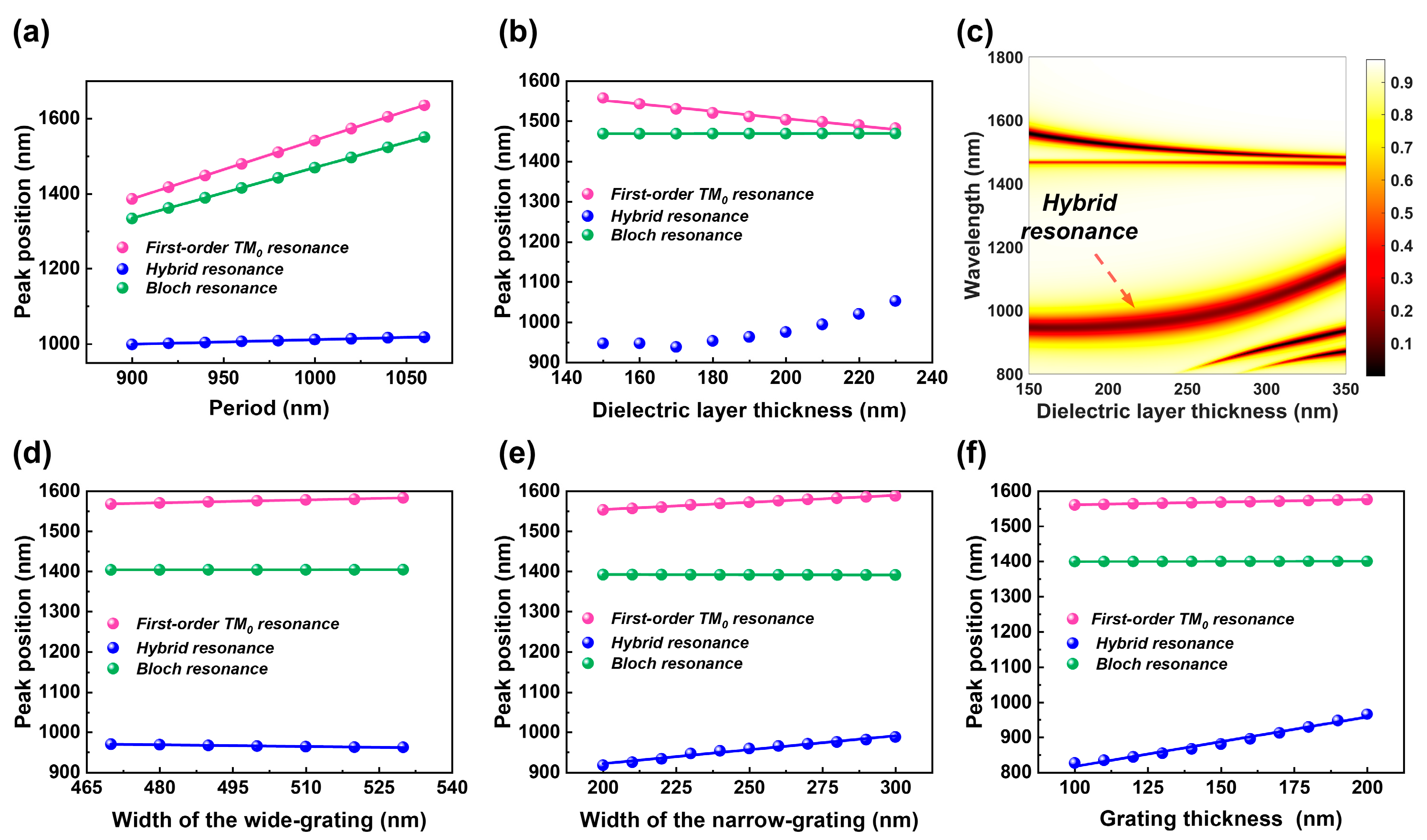
The core objective of this study focuses on suppressing the resonance shift at the heating wavelength while maximizing drift at the sensing wavelength. Parametric sweeps (
Figure 3) revealed minimal influence of period (
P), spacer thickness (
h2), and wide-grating width (
w1) on hybrid mode drift, prompting dedicated sensitivity simulations shown in
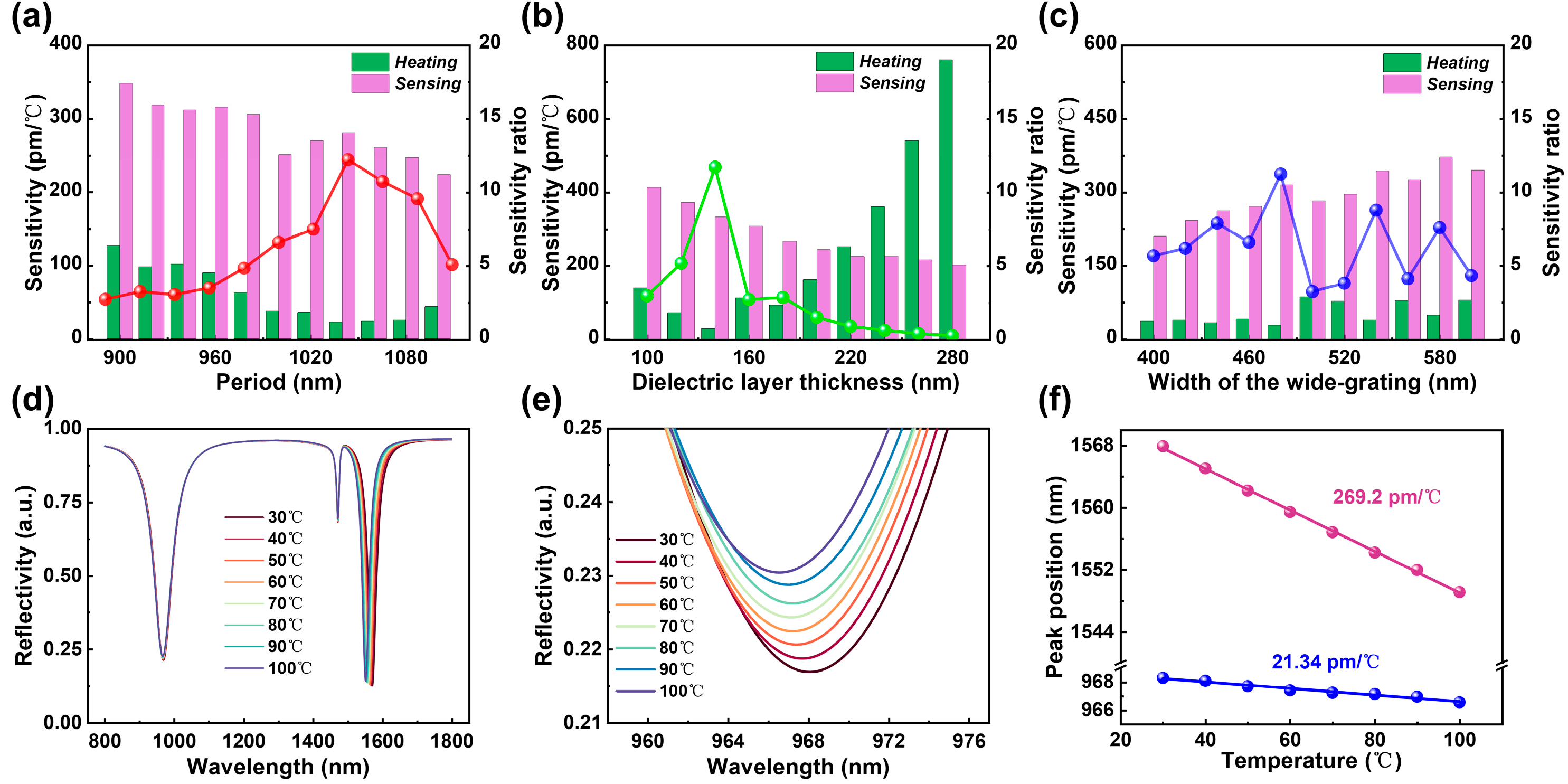
Figure 4a–c. Bar graphs denote absolute sensitivities, while line plots represent sensitivity ratios of sensing-to-heating wavelength. Regarding period variations (
Figure 4a), sensing sensitivity decreased monotonically with increasing
P, whereas heating sensitivity exhibited a non-monotonic behavior (initial decrease followed by an increase), with a minimum at
P = 1040 nm. Crucially, the sensitivity ratio peaked at 12.22 at this optimal period. As shown in
Figure 4b for spacer thickness, sensing sensitivity generally decreased with larger
h2, while heating sensitivity again showed non-monotonic variation, minimizing at
h2 = 140 nm where the sensitivity ratio reached its maximum of 11.72. In contrast,
Figure 4c demonstrates that
w1 variations exhibited distinct tuning characteristics: heating sensitivity attained its minimum at
w1 = 480 nm, concurrently yielding a peak sensitivity ratio of 11.25. These parameter-specific extrema collectively reveal targeted optimization pathways for dual-wavelength control.
Employing the parameter set optimized for maximum sensing-to-heating sensitivity ratios,
P = 1040 nm, spacer thickness
h2 = 140 nm, and primary grating width
w1 = 480 nm, with fixed
h1 = 200 nm and
w2 = 310 nm,
Figure 4d plots the temperature-dependent spectral shifts of the fundamental TM
0 mode, hybrid mode, and Bloch mode resonances. Both fundamental TM
0 and hybrid modes exhibit redshift with decreasing temperature due to the synergistic thermo-optic and thermal expansion effects. Under varying flow rates, the external sensing temperature decreases from 100 °C to 30 °C. The resulting sensitivity curves constitute absolute quantitative predictions of system performance. As quantified in
Figure 4f, the fundamental TM
0 resonance demonstrates superior temperature sensitivity of 269.2 pm/°C, exceeding the hybrid mode’s sensitivity of 21.34 pm/°C by a factor of 12.61. When utilizing the 980 nm pump wavelength targeting the hybrid mode and the single-frequency laser in the optical communication band as the probe wavelength targeting the fundamental TM
0 mode, spectral shifts induced by flow perturbations elicit significantly weaker temperature responses in the pump channel corresponding to the hybrid mode compared to the probe channel. Consequently, the plasmonic heating efficiency at the pump wavelength remains minimally affected by ambient temperature fluctuations during flow sensing.
2.5. Demodulation Scheme
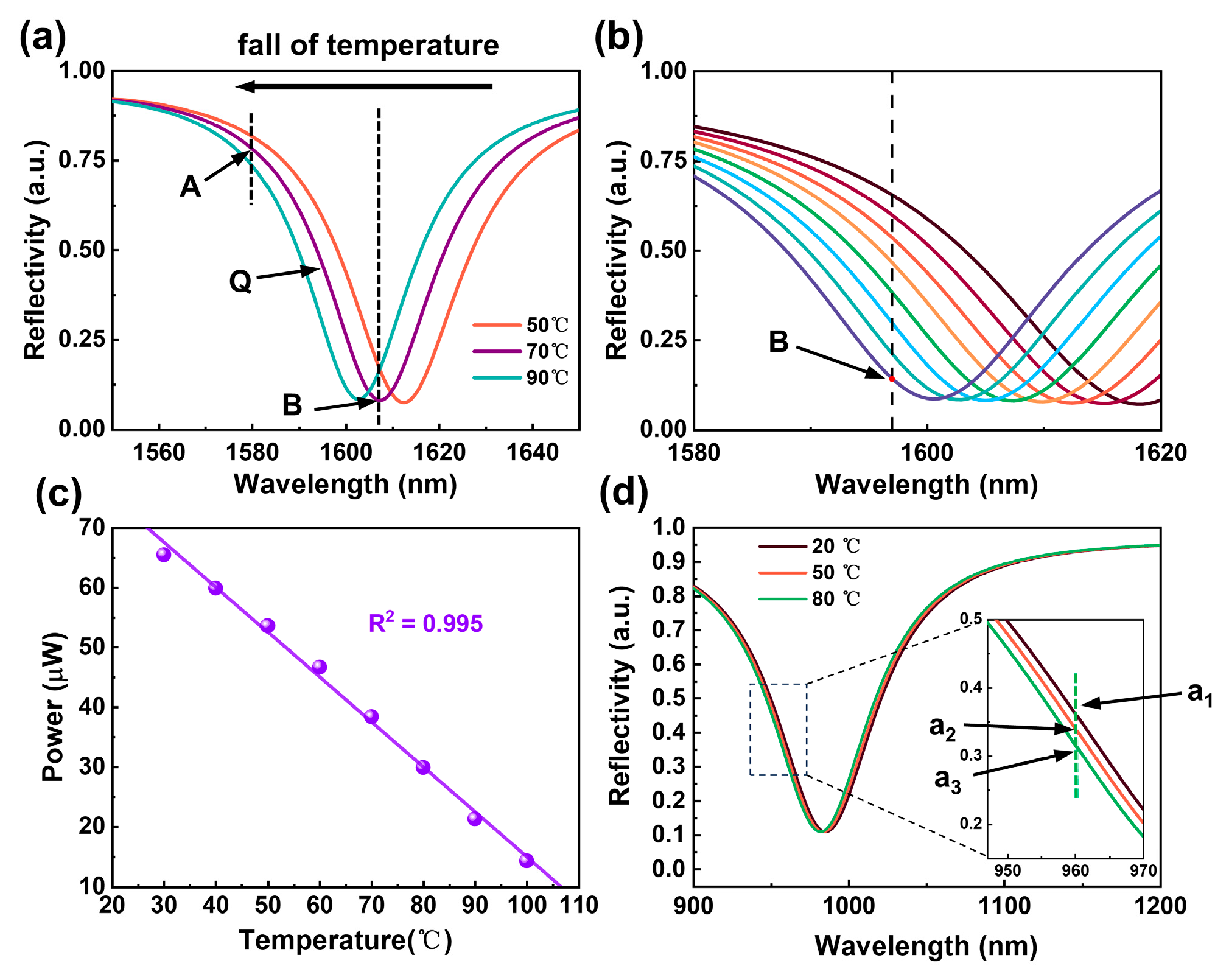
Spectral shift demodulation provides direct quantification of environmental changes in fiber sensors with relatively simple implementation, making it the predominant approach in most all-fiber thermal flowmeters for extracting flow-rate information. However, given the high cost and integration challenges of optical spectrum analyzers in practical applications, intensity demodulation by adopting a single-frequency laser offers a viable alternative. In traditional dynamic signal sensing based on an intensity demodulation scheme, optimal sensitivity is achieved by setting the laser wavelength at the phase quadrature point (Q-point), as illustrated in
Figure 5a. This operating point delivers theoretically maximum sensitivity. Through adaptive bias control that confines Q-point drift within predetermined limits, stable wavelength resolution detection can be maintained under dynamic conditions.
This study employs the B-point as the initial operating position, as shown in
Figure 5b. A decrease in temperature induces a spectral redshift, causing the operating point to migrate along the response curve. After delivering the heating laser with a central frequency identical to the reflection dip of the hybrid mode of the nanocavity, benefiting the optical absorption of the sensing unit, the reflection spectrum of the sensing mode of the fundamental TM
0 resonance mode will experience a redshift. When the sensing laser wavelength is set at the B-point of the reflection spectrum, environmental flow variation induces the temperature reduction and spectrum shift, which produces the optical power variations of the reflected sensing laser. It should also be noted that the optical power of the sensing laser should be low enough to minimize the heating effect in the nanocavity. Under 100 μW incident power of sensing laser,
Figure 5c plots the reflected power variation (ΔP) relative to the B-point reference baseline. Critically, ΔP demonstrates excellent linearity within the operational segment AB, and demodulation sensitivity is greatly dependent on the spectral slope or Q-factor of the sensing resonance mode, whereas substantial linearity degradation occurs outside this range (left of A or right of B). This approach simultaneously ensures sufficient sensitivity for flow-rate demodulation while significantly extending the effective dynamic range, thereby enhancing sensor applicability and operational stability across diverse flow conditions.
Moreover, by leveraging the temperature-dependent shifts of both resonant modes, we can achieve sensitivity amplification by fixing the pump wavelength at a strategic position on the rising edge of the hybrid mode resonance, as shown in
Figure 5d. This configuration establishes a positive feedback mechanism: When flow-induced cooling redshifts the reflection spectrum, the pump wavelength, 1initially positioned at point a
3, experiences increased reflectivity, migrating to point a
1. This increased reflectivity reduces the optical power absorbed for heating, thereby diminishing plasmonic heating efficiency. The resulting thermal deficit further exacerbates sensor cooling, creating a self-reinforcing cycle that dramatically amplifies flow-response sensitivity.
It is also necessary to mention that the noise of the sensing system is critical to the detection accuracy in the optical intensity-based demodulation scheme during its practical application. The fluctuation of the pump laser will induce the thermal drift and temperature variation in the fiber sensor, producing the reflectivity variation at the probe wavelength. Therefore, the intensity fluctuations of the pump and probe lasers can be regarded as the primary noise source, compared to the noise from the photodetector. Since the proposed nanostructure is comprised of gold and PMMA, the long-term stability of the sensor will be dependent on the polymer layer. Aging treatment of the sensor is necessary before practical application for improving its structural and optical stability.




 ,
,