Article

Investigating the Interplay of Absorption and Scattering in Phosphor-Converted LEDs Using a GPU-Accelerated Monte Carlo Framework


Institut für Lasertechnologien in der Medizin und Meßtechnik, Universität Ulm, Helmholtzstr. 12, 89081 Ulm, Germany
*
Author to whom correspondence should be addressed.
Photonics 2026, 13(2), 206; https://doi.org/10.3390/photonics13020206
Submission received: 5 January 2026 / Revised: 10 February 2026 / Accepted: 17 February 2026 / Published: 21 February 2026
(This article belongs to the Special Issue Advancements in Optical Measurement Techniques and Applications)

Abstract

Optimizing phosphor-converted light-emitting diodes is challenging due to the complex interplay of absorption, elastic scattering and luminescence. Unlike previous studies that focused on characterizing optical parameters, this work isolates their individual contributions in order to derive fundamental design limits. We present a comprehensive analysis using a GPU-accelerated Monte Carlo framework that solves the luminescent radiative transfer equation, including the full luminescence cascade. We systematically investigate the influence of the absorption ( μ a ) and scattering ( μ s ) coefficients by varying them over a range of 0.1 to 10 times the reference values of a standard phosphor (0.8 wt%). We found that transmitted luminescence saturates when absorption exceeds approximately three times the reference value ( μ a 1.2 mm 1 ) and peaks at an optimal μ s before backscattering losses dominate. In high-concentration regimes, mirror-assisted geometries are shown to enhance backward emission by a factor of 2.1 compared to open boundaries. Our findings provide model-based predictions for luminescence transport in phosphor–polymer composites.

1. Introduction

Phosphor-converted light-emitting diodes (pcLEDs), which consist of a blue LED chip combined with one or more phosphor layers, are the most widespread configuration for generating white light [1,2,3,4]. In this design, part of the incident blue light is absorbed by the phosphor and re-emitted at longer wavelengths via a down-conversion process, typically yielding a broad emission band in the green-to-red range. Despite their ubiquity, the design and optimization of pcLEDs largely relies on iterative trial-and-error approaches complemented by extensive measurements [1,5,6]. Modeling the optical behavior of phosphor layers is challenging due to the complex interplay between absorption, multiple scattering, and luminescence re-emission. Previous studies have shown that this interplay fundamentally determines the efficiency and color uniformity of pcLEDs [7,8,9]. Monte Carlo and hybrid ray-tracing approaches have been extensively used in device-level modeling to optimize packaging geometry and efficiency [6,10,11]. These investigations have quantified the impact of particle size [12], concentrations [13,14,15] and re-absorption [16], determining factors for color and angular homogeneity [17,18,19,20,21].
However, most existing models rely on simplifications, such as isotropic scattering and diffusion theory approximations [7], analytical assumptions that are only valid for weak absorption regimes [22], or two-wavelength treatments that neglect spectral overlap between excitation and emission [1,23,24].
Recent efforts have begun to address these limitations through spectral and multi-wavelength models of phosphor transport [6,25]. Nevertheless, a unified, quantitative analysis remains limited. A key challenge in experimental optimization is that absorption ( μ a ) and scattering ( μ s ) coefficients are inherently coupled by the phosphor concentration or particle size. Consequently, it is difficult to isolate the individual contributions of scattering and absorption to loss mechanisms or spatial energy distribution. Therefore, a rigorous simulation approach is necessary to decouple these parameters and identify fundamental design limits.
In our previous work, we focused on the inverse problem: developing and validating wavelength-resolved methods for determining the intrinsic optical properties, quantum yield, and emission probability of luminescent media from integrating sphere measurements [26,27,28]. While these studies established the accuracy of the underlying Monte Carlo framework for material characterization, they did not explore the forward problem of device optimization.
Our GPU-accelerated framework enables rapid parameter sweeps and detailed analysis of spectral and angular emission distributions. Unlike diffusion-based approximations or two-wavelength models, this framework solves the full luminescent radiative transfer equation (FRTE) without simplifying the spectral cascade, making it uniquely suitable to predict performance limits in regimes where analytical models fail.
In this study, we present a systemic parametric exploration using this previous developed and validated framework to investigate how the optical properties and phosphor concentration, specifically the balance between absorption and multiple scattering, govern the light transport and luminescence efficiency in pcLEDs. By numerically decoupling μ a and μ s , we go beyond experimental capabilities to identify characteristic trends, such as luminescence saturation at high absorption and optimal scattering conditions for maximal emission. We also calculate the predicted potential gain from mirror-assisted geometries. The results offer a comprehensive physical understanding of light redistribution within phosphor layers and provide practical guidelines for designing efficient LEDs operating in the linear transport regime. Furthermore, this computational approach allows for rapid, cost-effective, and precise parameter sweeps across extensive configurations, which would otherwise be time-consuming and expensive to achieve experimentally.

2. Method

2.1. Optical Properties

To ensure realistic input parameters for the simulation, we prepared and characterized a physical phosphor sample to determine the intrinsic optical properties. The phosphor used in this study was LP-N620-04-00, supplied by Leuchtstoffwerk Breitungen GmbH, Breitungen, Germany. To prepare the sample, the phosphor powder was dispersed homogeneously in a polydimethylsiloxane (PDMS) matrix (Elastosil M 4641 A/B, Wacker Chemie AG, Munich, Germany). The optical properties of this phosphor–PDMS composite were determined using a custom-made integrating sphere-based setup [26,27]. For this purpose, the mixture was cast into slabs of approximately 2 mm thickness, resulting in a phosphor concentration of 0.8 wt%. This thickness was chosen to minimize errors when determining the intrinsic optical properties.
The use of the integrating sphere-based setup yields the optical properties of both phosphor and matrix: wavelength-dependent absorption μ a ( λ ) and scattering μ s ( λ ) coefficients. At 420 nm, near the absorption maximum, the absorption coefficient was found to be μ a ( 420 nm ) 0.4 mm 1 and the reduced scattering coefficient μ s ( λ ) 0.6 mm 1 . The PDMS matrix contributes negligibly to scattering and exhibits a weak wavelength-dependent absorption of μ a 0.03 mm 1 and a refractive index of n ( λ ) 1.4 . The phase function was modeled using the Henyey–Greenstein distribution with an anisotropy factor g = 0.78 , which is representative for commercial phosphor–PDMS composites [29]. The anisotropy factor was assumed to be wavelength-independent, consistent with previous studies on similar materials [7,25]. This assumption is justified because the phosphor consists of particles with a mean diameter of d 50 = 7 µm, placing them well within the Mie regime, where the particle size exceeds the optical wavelength by an order of magnitude. Additionally, the refractive index mismatch between the phosphor and the surrounding matrix does not change a lot versus wavelength. Multiple scattering effects mask the influence of any small decrease in g at longer wavelengths. The intrinsic quantum yield and emission probability distribution were obtained following the method described in [28]. The intrinsic quantum yield was close to 1. Thermal quenching and temperature-dependent effects were excluded to isolate the impact of optical transport phenomena. To investigate the influence of absorption and scattering separately, the optical properties were changed independently and linearly. A change in both μ s and μ a represents a change in phosphor concentration. Although μ s and μ a are strongly correlated in real phosphor composites due to particle size and packing density, this theoretical decoupling enables us to isolate the impact of each transport parameter. The scaling factors, which range from 0.1 to 10, were chosen to cover the transition from the ballistic to the diffusive regime and to encompass the typical parameter space of commercial phosphor materials.

2.2. Monte Carlo Simulation Framework

Light transport and luminescence generation were simulated using a GPU-accelerated Monte Carlo framework that we developed very recently [28]. This framework solved the full luminescent radiative transfer equation. The algorithm accounted for wavelength-dependent absorption, scattering and re-emission, treating luminescent and non-luminescent components independently. The wavelength of each photon was sampled from the excitation spectrum. It then propagated through the medium until it was either absorbed, re-emitted, or scattered, or until it exited the geometry. Absorption events were probabilistically assigned to luminescent or non-luminescent components based on the relative absorption coefficients. If absorption occurred in a luminescent component, re-emission was determined by the quantum yield Φ f and the normalized emission probability distribution P f ( λ ) . Re-emitted photons were assigned a new wavelength λ and isotropic direction. To ensure energy conservation during the Stokes shift (where the photon energy E 1 / λ decreases), the photon weight is continually updated at each emission event according to [28,30]
w λ = w λ λ λ ,
where w λ and λ denoted the photon’s weight and wavelength prior to emission, and w λ and λ after emission. Photons could undergo multiple cycles of re-absorption and re-emission, enabling the full simulation of the luminescence cascade. Scattering was modeled using the Henyey–Greenstein phase function, and the scattering contribution of the PDMS matrix was neglected relative to the phosphor particles. The GPU kernel was implemented in OpenCL, with host-side control, preprocessing, and postprocessing in Python (version 3.13) and ISO C++ 14-Standard. All simulations were performed on a workstation equipped with an AMD Ryzen 9 7900X CPU (12 cores, 4.7 GHz) and an NVIDIA GeForce RTX 4070 Ti GPU. To allow comparison between an idealized laboratory excitation and a realistic pcLED configuration, two types of excitation sources with a beam diameter of 5 mm were simulated: a collimated beam incident at 8° to the surface normal, corresponding to the experimental setup [26] and a cosine-weighted diffuse source emitting into the half-space, representing LED emission.

2.3. Detection and Fluence Evaluation

The photons exiting the slab geometry were categorized by tracking their interaction history and exit boundary. During propagation, each photon was flagged whether it remained an excitation photon or was converted into a luminescence photon. After exciting the simulation volume, their direction was evaluated relative to the incident light. Those that left the medium in the forward direction (opposite to the source) were classified as transmission (T) and photons backscattered through the entrance plane were classified as reflection (R). The accumulated counts of excitation and luminescence photons in both directions were normalized by the total initial photon count. To evaluate angular emission profiles, the exit direction of each photon was transformed to spherical coordinates ( θ , ϕ ) . The polar angle θ [ 0 , π ] was discretized into bins of Δ θ = 1 ° , while full integration over ϕ yielded an axially symmetric distribution. Each bin was normalized by the corresponding solid angle
Δ Ω i = 2 π cos θ i Δ θ 2 cos θ i + Δ θ 2 ,
and by the total number of launched photons N 0 .
The volumetric fluence Φ ( x , y , z ) within the medium was computed using a Cartesian voxel grid with cell sizes Δ x , Δ y , and Δ z . At each scattering step, the photon’s contribution to the local fluence was estimated using a scattering-based collision estimator. The local contribution, Δ Φ , was calculated as
Δ Φ = w μ s ( λ ) ,
where w represents the current photon weight and μ s ( λ ) represents the wavelength-dependent scattering coefficient. The total local fluence in each voxel was then obtained by summing over all photon steps n within that voxel, for either the excitation or luminescence field, depending on the photon’s current state. The total accumulated value in each voxel is normalized by the voxel volume and the number of launched photons to yield the fluence. An input power of P in = 1 W was assumed. Because the Monte Carlo method is linear, the presented results can be arbitrarily scaled to other power levels.
We validated the Monte Carlo implementation and luminescence weighting scheme using our previously published digital optical twin of the integrating sphere setup and this was then benchmarked against experimental data [28].

3. Results

The following sections analyze the impact of optical properties on the efficiency and light distribution of pcLEDs. To prioritize physical interpretation, we present selected data that best demonstrate behaviors such as saturation effects and optimal scattering regimes. A comprehensive atlas of the complete simulation dataset, including full spectral data, sensitivity analyses, and comparative fluence maps for collimated and diffuse excitation sources, is provided in the Supplementary Information (Figures S1–S13).

3.1. Influence of the Absorption Coefficient μ a on Luminescence

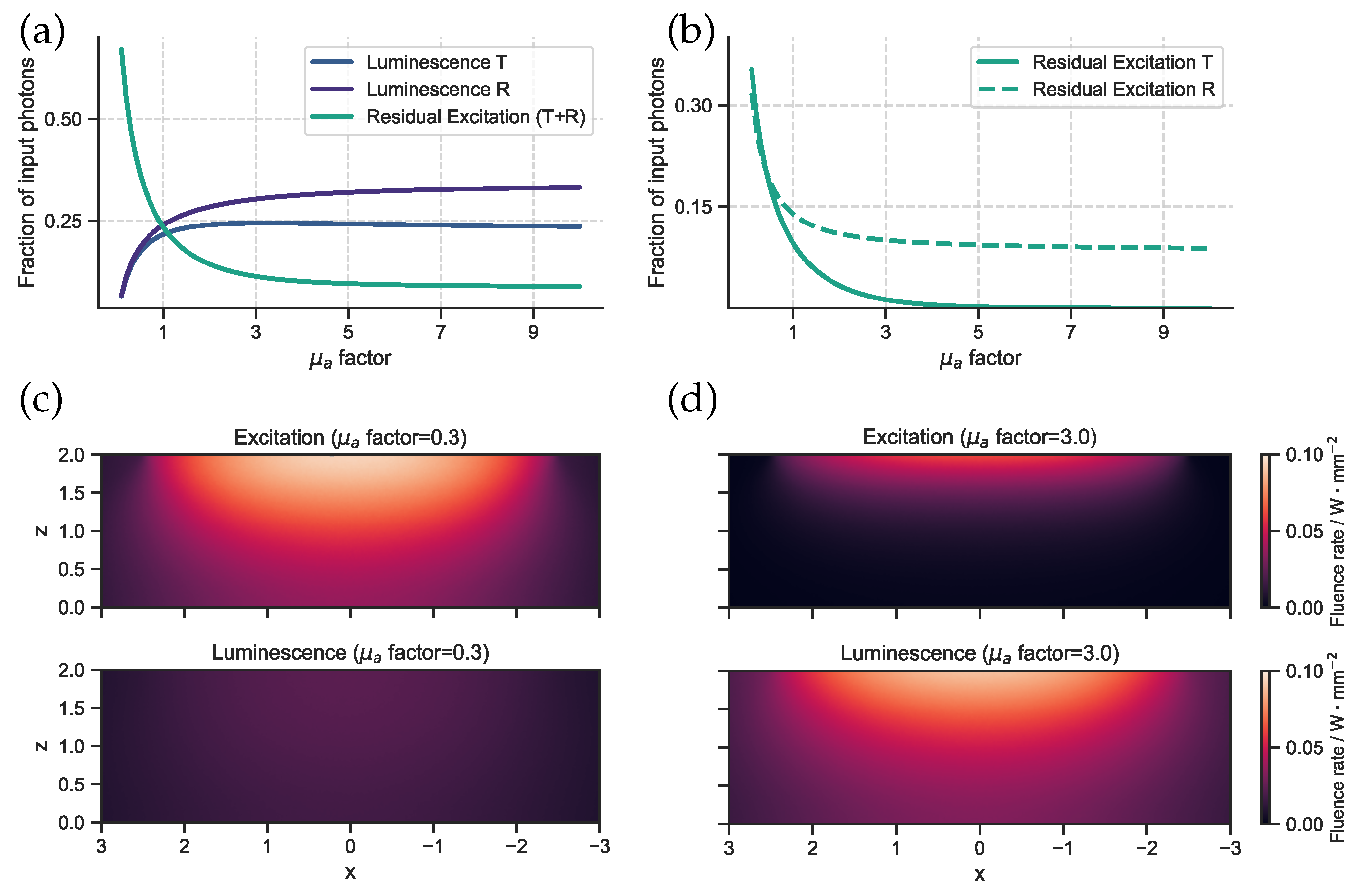
For efficient light conversion in phosphor layers, the phosphor particles must absorb the excitation photons. Therefore, an increase in the absorption coefficient μ a initially increases the amount of light converted into luminescence. The absorption measured at 0.8 wt% serves as the reference value for μ a . To isolate this effect, this reference value was scaled by a factor ranging from 0.1 to 10, while the scattering coefficient was kept constant. Figure 1a shows that the transmitted luminescence increases with μ a until it saturates at 3.3 times the reference absorption (corresponding to approximately 2.64 wt%, assuming a linear relationship between concentration and absorption). Beyond this point, further increases in μ a no longer improve the transmitted luminescence yield, but instead lead to a slight decline, whereas reflected luminescence continues to rise. Ideally, the total residual excitation, defined as the sum of the transmitted and reflected excitation fractions ( T ex + R ex ), should be minimized to ensure maximal conversion. The sensitivity analysis, defined as the change in the fraction of input photons F with respect to absorption coefficient ( Δ F / Δ μ a , see Figure S1b), demonstrates that the response is strongest for small μ a , indicating that small changes in absorption have a large impact when the excitation light still penetrates deeply into the phosphor layer. In contrast, at high μ a , the excitation is mostly absorbed near the surface, as illustrated by the fluence distributions in Figure 1c,d, which depict the LED light source case. This surface confinement prevents generated luminescence from escaping in transmission and increases reabsorption losses. Moreover, the high absorption density creates a substantial thermal load close to the chip surface, increasing the risk of thermal quenching. This behavior indicates a shift from an excitation-limited regime, where moderate absorption is advantageous for ensuring complete excitation conversion, to an emission-limited one, where excessive absorption becomes counterproductive. These findings align with the trade-off between excitation efficiency and reabsorption losses reported in earlier studies [31,32,33]. Comprehensive datasets supporting this analysis of the variation of μ a (Figure S1), as well as a comparison of the fluence distributions for the collimated source (Figure S2) and the LED source (Figure S3) at varying concentrations, are provided in the Supplementary Information.

3.2. Effect of the Scattering Coefficient μ s and Optimal Scattering Regime

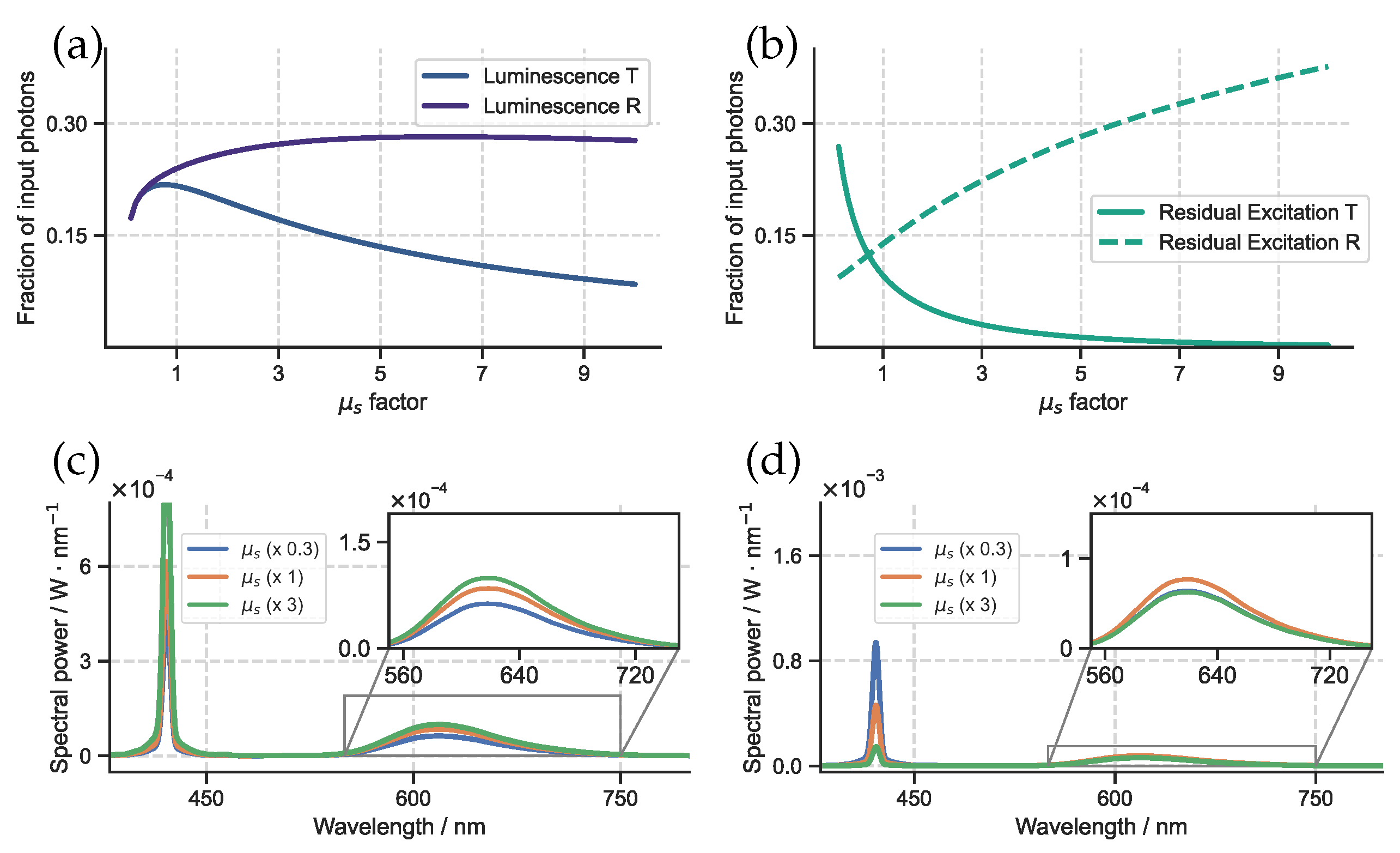
Scattering of the phosphor strongly impacts the probability that emitted luminescence photons can escape the layer [12]. To investigate this phenomenon, the absorption coefficient was kept constant while varying only the scattering coefficient μ s in the simulation. As Figure 2a shows, luminescence remains weak at very low μ s , because the excitation light propagates nearly ballistically, interacting with few phosphor particles. Moderate scattering improves the excitation distribution throughout the volume, increasing the probability of absorption and subsequent re-emission. However, as μ s increases further, this trend reverses. Strong multiple scattering limits the optical penetration depth and enhances backward scattering. For scattering coefficients above the optimal range, the residual excitation reflected from the entrance surface rises steadily (Figure 2b), accompanied by a strong 420 nm excitation peak and a higher luminescence yield in reflection (Figure 2c). In transmission, however, Figure 2d shows a drop in luminescence for higher μ s . Although the residual excitation light is reduced, this should not be misinterpreted as a higher conversion rate. The dominant backscattering reduces the transmitted luminescence. Based on our systematic parameter sweep, the model predicts a distinct maximum at 0.8 times the reference scattering in transmission that defines the optimal scattering regime for forward-emitting pcLEDs.
This maximum varies based on the phosphor’s scattering properties [34]. Several experimental works have reported similar conclusions. By reducing scattering through refractive index matching or using weakly scattering large phosphor particles, the overall efficiency can be increased [35,36,37,38]. Our simulations confirm that, while a certain degree of scattering is required for excitation homogenization, excessive scattering causes light trapping and reabsorption losses. From a practical perspective, achieving this optimal regime requires adjusting the particle size distribution and the refractive index contrast. Larger phosphors are generally preferable, because they have a lower scattering coefficient at the same weight concentration. Additionally, minimizing the refractive index mismatch reduces the scattering strength and shifts the system away from the loss-dominated, high- μ s regime. Designers should therefore aim for a balance by selecting particles that scatter just enough to ensure angular color homogeneity without surpassing the optimal scattering threshold. Extended datasets supporting these conclusions, including fluence distribution comparisons for collimated and LED sources, are provided in the Supplementary Information (Figures S4–S6).

3.3. Effect of Phosphor Concentration: Simultaneous Increase in μ a and μ s

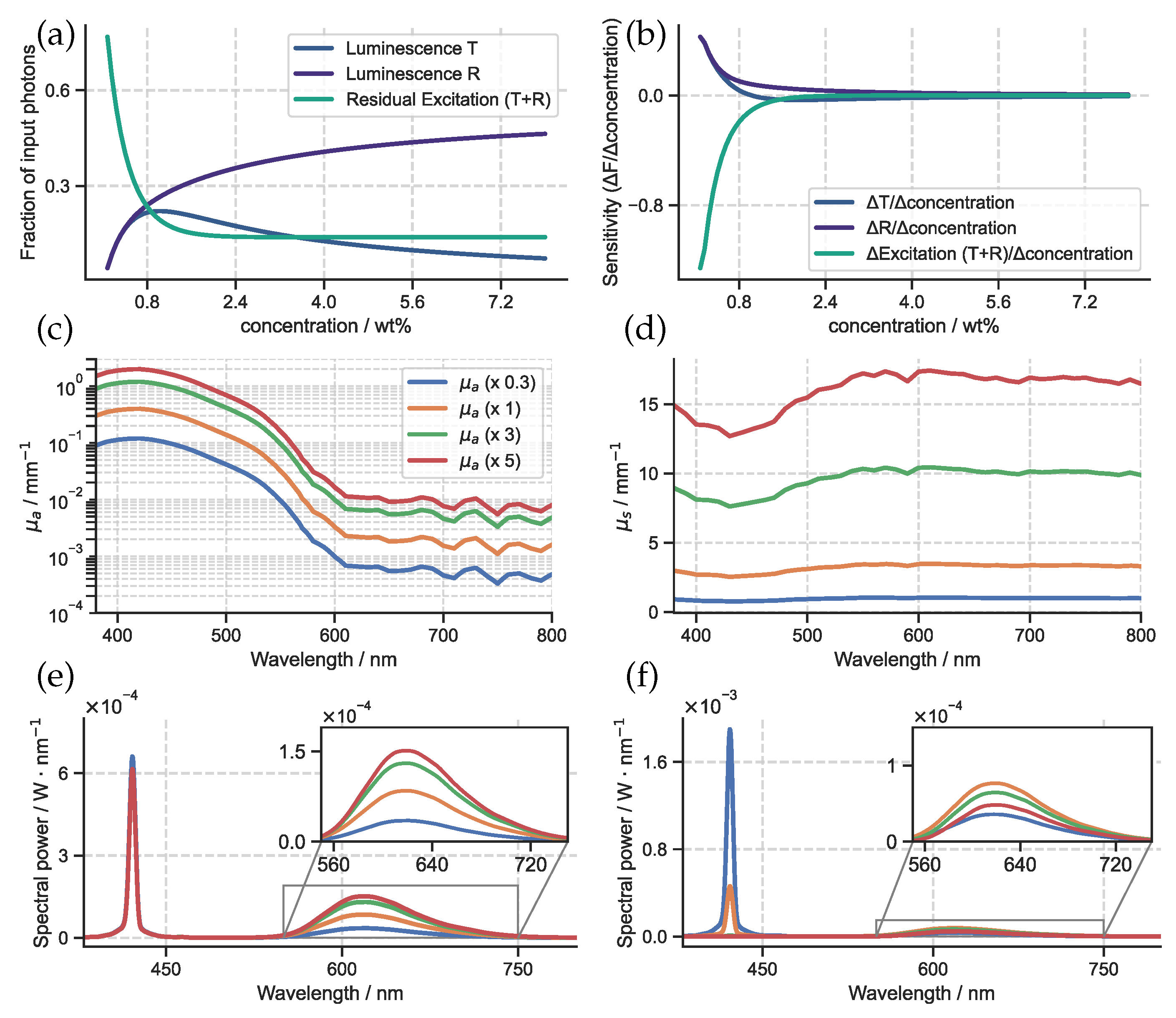
In practical phosphor composites, increasing the concentration of phosphors simultaneously raises μ a and μ s , because the absorption and scattering are dominated by the particles rather than the encapsulation matrix. As a result, the overall behavior represents a superposition of the individual trends observed in the previous sections: enhanced conversion efficiency from higher absorption and increased light redistribution from stronger scattering. In practice, the ratio of the scattering and absorption coefficients is largely determined by the particle size distribution of the phosphor [39,40]. Therefore, adjusting the particle size, by grinding or selecting specific fractions, offers a direct process parameter to tune the μ s / μ a ratio towards the ideal operating point identified in our simulations. At low concentrations, both μ a and μ s remain small. The excitation light therefore penetrates deeply into the phosphor layer. As visualized in the fluence maps in Supplementary Figures S7 and S8, only a fraction of this light is absorbed. While luminescence generation occurs throughout the volume, the absolute output is limited by the insufficient absorption probability. As the concentration increases, μ a rises, leading to more efficient excitation-to-luminescence conversion and a rapid increase in total luminescence emission. At the same time, moderate values of μ s improve the spatial distribution of the excitation within the layer, allowing photons to interact with more phosphor particles and further increasing the luminescence yield. This constructive combination of both effects drives the strong initial rise in transmitted luminescence shown in Figure 3a.
However, beyond this optimal regime, both coefficients become large enough to introduce cumulative loss mechanisms. As shown in the fluence distributions in Figure S8, the excitation field shifts from deep penetration at low concentrations to strong confinement within a thin, near-surface layer at high concentrations. This surface confinement, combined with high scattering, creates a barrier for forward propagation. Consequently, the transmitted luminescence saturates and eventually declines as the effective penetration depth becomes significantly smaller than the layer thickness. In contrast, the reflected luminescence continues to rise. Due to the isotropic nature of the emission, a large fraction of the generated luminescence near the surface immediately propagate backward. This effect is amplified by the high scattering coefficient, which effectively redirects potential forward-propagating photons back towards the entrance. This saturation behavior mirrors experimental findings [31]. These authors observed a similar saturation of the re-emitted flux above phosphor densities of 3–5 wt%. It is important to note that, while these trends are universal, the absolute concentration values scale with geometry. This requires a corresponding change in phosphor concentration when changing the slab thickness to maintain the same optical depth. In high-density regimes, non-linear effects such as quenching of luminescence due to high concentrations and dependent scattering, which are not included in this linear transport model, could become limiting factors. Nevertheless, from the standpoint of optical transport, backscattering remains the dominant limitation on transmission efficiency. Consequently, it becomes advantageous to either utilize this backward-propagating fraction directly in reflection geometry or redirect it using reflective cups and back-surface mirrors to improve overall efficiency [5,35].

3.4. Effect of Illumination Angle and Reflective Geometry

In conventional pcLEDs, the phosphor layer is typically placed directly on or above the die [4,41]. This leads to a transmission geometry where backward-propagating light is partially reflected, but also significantly absorbed by the chip and package, representing a significant loss factor. As our simulations in Section 3.3 show (Figure 3), reflected luminescence becomes the dominant component at high phosphor concentrations, making it more important to recover this light. Alternative designs have been proposed to address these limitations: remote–phosphor configurations primarily mitigate thermal issues by decoupling the phosphor layer from the heat source, while reflective geometries focus on maximizing light extraction [5,35,36,42].
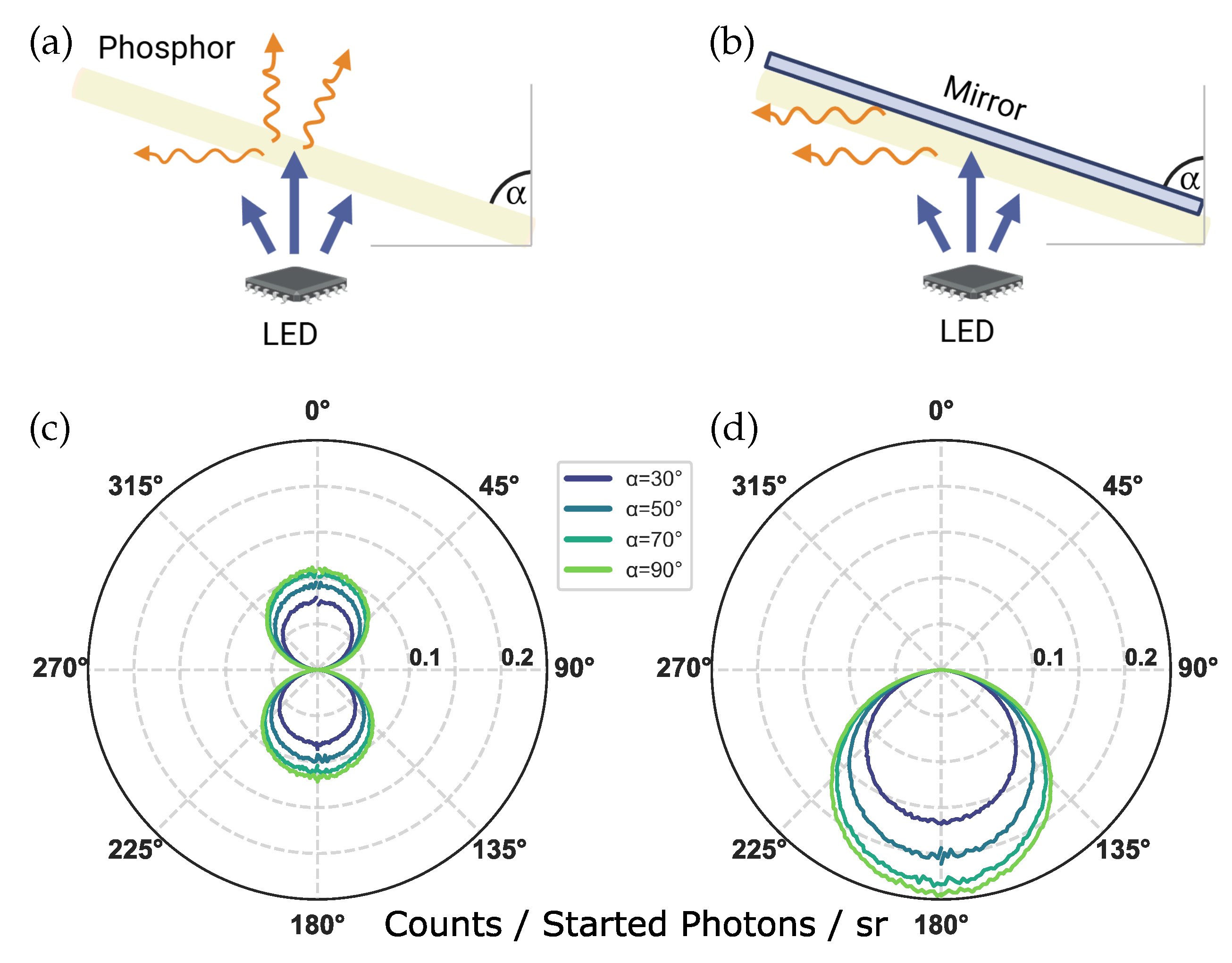
Motivated by these concepts, we investigated the potential of such reflective geometries under varying illumination angles α (defined in Figure 4a). We first analyzed the dependence of the luminescence with respect to the incident angle. Most LEDs emit approximately as Lambertian sources, with intensity following I ( θ ) cos ( θ ) . However, some real devices can deviate from this pattern and can be approximated as the sum of different Gaussians or cosine-power functions [43]. The simulation results, detailed in the Supplementary Information (Figures S9 and S10), revealed that for a collimated beam, the total luminescence yield in reflection remained robust and nearly constant for incident angles ranging from normal incidence (90°) down to 20°. A significant drop in yield was observed only at grazing angles below 20°.
To quantify the potential for light recycling, we then simulated a “mirror-assisted” geometry by introducing a reflective back surface behind the phosphor layer (Figure 4b). The back surface was modeled as a physical silver mirror with complex refractive index values ( n = 0.05 , k = 3.9 ), resulting in a realistic reflectivity of R 98.3 % . As shown in Figure 4c,d, the addition of this mirror effectively redirects light that would otherwise be lost through transmission. The backward detected luminescence is enhanced by a factor of more than two.
In addition to improving photon recycling, reflective geometries combined with oblique incidence can more uniformly spread the absorption region, as indicated by the fluence distributions in Figures S12 and S13. Since the local heat generation is directly proportional to the absorbed excitation energy density, this spatial homogenization helps to mitigate local hotspots near the entrance plane. This is particularly critical at high irradiance, where material saturation and thermal quenching are relevant issues [44]. Although considerations for building such a source have been made in the past [42,45], the design has received less attention than transmission geometries. This could open up opportunities for more efficient pcLEDs. Although this study uses a planar mirror to illustrate the increase in extraction efficiency, practical applications frequently necessitate directional beam shaping. The broad, Lambertian-like emission profile observed in the reflection geometry (Figure 4d) is ideal for secondary optics, such as parabolic or concave reflectors. This is particularly relevant for high-luminance applications, such as automotive headlamps, unmanned aerial vehicle (UAV) lighting, and high-intensity flashlights, where the total optical throughput is limited by source efficiency.

3.5. Physical Validity and High-Power Limitations

It is important to contextualize these results within the fundamental assumptions of the RTE. Our framework solves the RTE in the linear regime by treating the quantum yield as constant and intrinsic material property. However, in real-world device operation, non-linear mechanisms, can act as additional loss channels or alter optical properties. Therefore, the efficiency values and optimal geometries identified in this work effectively serve as a robust baseline determined by photon transport and linear material characteristics. In high-power applications, ground-state depletion and thermal quenching become critical at high irradiances. While mid-power LEDs typically operate at irradiances below 0.5 W / mm 2 , automotive high-power LEDs reach densities of 2– 5 W / mm 2 , and laser-driven lighting can exceed 10 W / mm 2 [46,47]. For the parameters used in this study (1 W distributed over a 5 mm spot), the resulting irradiance is approximately 0.05 W / mm 2 . This value is orders of magnitude below the saturation threshold I 10 % (irradiance causing a 10% efficiency drop), which is reported at ≈1.4 W/mm2 for red nitride phosphors and up to 7.5 W / mm 2 for YAG:Ce [44,48,49]. Regarding particle density, the assumption of independent scattering should remain valid for the investigated phosphor loads. We simulated concentrations up to 8 wt%, which corresponds to a volume fraction of approximately 2 vol%. This is significantly below the thresholds, where dependent scattering and near-field coupling should have an influence (typically > 10 vol%) [50,51,52]. Similarly, inter-particle concentration quenching is negligible at these low volume fractions [48]. Further sensitivity checks revealed that changing the anisotropy factor g from 0.5 to values approaching 1.0 alters the total transmitted luminescence yield by less than 0.9 percentage points. While our results characterize the efficiency in the absence of non-linear losses, the low-excitation investigated here ensures that these linear predictions are close approximations of realistic device performance for general lighting and remote-phosphor applications. For ultra-high-luminance architectures, however, the effective quantum yield would likely decrease due to the aforementioned saturation effects, necessitating a correction of the optima towards lower phosphor loads or larger spot sizes. Although the underlying physical framework has been rigorously validated through material characterization [26,27,28], applying it to specific pcLED geometries depends on the transitivity of the radiative transfer model. We acknowledge that full device-level performance is influenced by package-specific boundary conditions, such as chip-level self-absorption and additional optics. However, these conditions are not the focus of this study. Therefore, the quantitative trends identified here establish a theoretical baseline, and comprehensive device-level benchmarking is a goal for future work.

4. Conclusions

The quantitative findings presented in this study, including the identified μ s saturation points and mirror-assisted gain factors, are intended as model-based predictions under the conditions investigated. We used an established, validated spectral Monte Carlo framework to simulate luminescence transport in phosphor–polymer composites and conduct a thorough parametric analysis of phosphor layers in pcLEDs.
Our simulations identify three characteristic design regimes.
First, increasing absorption enhances excitation–luminescence conversion only until a maximum is reached. Beyond moderate values, excitation becomes confined near the entrance surface, and reabsorption suppresses forward extraction. For the specific phosphor system investigated, this physical limit manifests as a saturation threshold at a concentration of 2.64 wt%, with scaling factor of 3.3.
Second, scattering plays a dual role. Moderate scattering homogenizes excitation and enhances emission yield. Excessive multiple scattering, on the other hand, increases backscattering and reduces transmission. This defines an optimal scattering window for transmission-based pcLEDs, observed here at 0.8 times the reference scattering level. Consequently, optimization in practice requires tuning the μ s / μ a ratio, for example, through the selection of suitable particle sizes, in order to match this window.
Third, when absorption and scattering increase simultaneously, as occurs with higher phosphor concentrations, their effects combine. Transmitted luminescence exhibits a pronounced maximum followed by a decline, while reflected luminescence continues to rise due to near-surface excitation confinement. Mirror-assisted and remote–phosphor geometries could partially recover luminescence that would otherwise be lost to backscattering. Our simulations showed that such photon-recycling designs can more than double the reflection signal. This suggests that for high-concentration phosphors, geometric optimization (e.g., mirrors) is more effective than material optimization alone. However, the current model disregards non-linear phenomena relevant under high irradiance, such as absorption saturation (ground-state depletion) and thermal quenching. Future work could integrate thermal coupling and concentration quenching models to refine the optimization of high-power devices.

Supplementary Materials

The following supporting information can be downloaded at: https://www.mdpi.com/article/10.3390/photonics13020206/s1, Figure S1: Impact of the absorption coefficient μ a on luminescence efficiency, sensitivity, and emission spectra; Figure S2: Fluence rate distribution Φ ( x , z ) for varying μ a under collimated illumination (e.g., laser); Figure S3: Fluence rate distribution Φ ( x , z ) for varying μ a under diffuse LED illumination (cosine distribution); Figure S4: Impact of the scattering coefficient μ s on luminescence efficiency, sensitivity, and emission spectra; Figure S5: Fluence rate distribution Φ ( x , z ) for varying μ s with a collimated light source; Figure S6: Fluence rate distribution Φ ( x , z ) for varying μ s with an LED source; Figure S7: Fluence rate distribution Φ ( x , z ) for different phosphor concentrations under collimated illumination; Figure S8: Fluence rate distribution Φ ( x , z ) for different phosphor concentrations under LED illumination (cosine distribution); Figure S9: Simulation results for different incident angles with a collimated light source (e.g., laser) for a standard phosphor layer geometry (non-mirrored); Figure S10: Impact of incident angle α on luminescence efficiency and emission spectra (diffuse LED source); Figure S11: Simulation results for different incident angles α , with a collimated light source (e.g., laser) for a phosphor layer with a mirror; Figure S12: Fluence rate distribution Φ ( x , z ) for different incident angles α (LED source, no mirror); Figure S13: Fluence rate distribution Φ ( x , z ) for different incident angles α in a mirror-assisted setup (LED source).

Author Contributions

Conceptualization, P.G., J.J. and F.F.; methodology, P.G.; software, P.G. and F.F.; validation, P.G., J.J. and F.F.; formal analysis, P.G.; investigation, P.G.; resources, A.K.; data curation, P.G.; writing—original draft preparation, P.G.; writing—review and editing, P.G., J.J., F.F. and A.K.; visualization, P.G.; supervision, A.K. and F.F.; project administration, A.K.; funding acquisition, A.K. All authors have read and agreed to the published version of the manuscript.

Funding

This research was funded by Invest BW (VDI/VDE Innovation + Technik GmbH) within the project AdelPhos (BW1-5125/0). This research is part of the Zentrum zur Bestimmung der optischen Eigenschaften (ZOE, Center of the Determination of Optical Properties of Scattering Media) at the ILM Ulm.

Data Availability Statement

The data that support the findings of this study are available from the corresponding author, P.G., upon reasonable request due to privacy.

Acknowledgments

We thank David Hevisov and Dominik Reitzle for fruitful discussions and helpful suggestions throughout the project.

Conflicts of Interest

The authors declare that this study received funding from Invest BW (VDI/VDE Innovation + Technik GmbH). The funder was not involved in the study design, collection, analysis, interpretation of data, the writing of this article or the decision to submit it for publication.

References

  1. Sommer, C.; Wenzl, F.P.; Hartmann, P.; Pachler, P.; Schweighart, M.; Tasch, S.; Leising, G. Tailoring of the Color Conversion Elements in Phosphor-Converted High-Power LEDs by Optical Simulations. IEEE Photonics Technol. Lett. 2008, 20, 739–741. [Google Scholar] [CrossRef]
  2. Islam, N.U.; Usman, M.; Rasheed, S.; Jamil, T. Review—White Light-Emitting Diodes: Past, Present, and Future. ECS J. Solid State Sci. Technol. 2021, 10, 106004. [Google Scholar] [CrossRef]
  3. Karmakar, A.; Li, J. Luminescent MOFs (LMOFs): Recent advancement towards a greener WLED technology. Chem. Commun. 2022, 58, 10768–10788. [Google Scholar] [CrossRef]
  4. Diana, F.S.; DenBaars, S.P.; Nakamura, S. Optical Designs for High-Efficacy White-Light Emitting Diodes. U.S. Patent 9,219,205B2, 22 December 2015. [Google Scholar]
  5. Kim, J.K.; Luo, H.; Schubert, E.F.; Cho, J.; Sone, C.; Park, Y. Strongly Enhanced Phosphor Efficiency in GaInN White Light-Emitting Diodes Using Remote Phosphor Configuration and Diffuse Reflector Cup. Jpn. J. Appl. Phys. 2005, 44, L649. [Google Scholar] [CrossRef]
  6. Wang, B.; She, M.; Zhang, B.; Wang, X. Modeling and Monte Carlo simulation of photon transmission in glass-packaged WLEDs. Displays 2023, 78, 102431. [Google Scholar] [CrossRef]
  7. Leung, V.Y.F.; Lagendijk, A.; Tukker, T.W.; Mosk, A.P.; IJzerman, W.L.; Vos, W.L. Interplay between multiple scattering, emission, and absorption of light in the phosphor of a white light-emitting diode. Opt. Express 2014, 22, 8190–8204. [Google Scholar] [CrossRef][Green Version]
  8. Wu, H.; Jenkins, D.R. Phosphor modeling and characterization. Opt. Eng. 2014, 53, 114107. [Google Scholar] [CrossRef][Green Version]
  9. Sandilands, L.J. Modeling fluorescence reemission in the one-dimensional radiative transfer problem using the P3 approximation. J. Opt. Soc. Am. A 2021, 38, 1631. [Google Scholar] [CrossRef] [PubMed]
  10. Chen, H.M.; Zhu, F.Y.; Lin, Y.; Zhang, H.Y.; Li, Q.Y.; Liu, B.J.; Xue, X.T.; Ke, S.R.; Jin, R.T.; Zheng, X.; et al. Influence of Phosphor Particle Size on Visual and Non-Visual Performances of White Light-Emitting Diodes for General Lighting. IEEE Photonics Technol. Lett. 2022, 34, 603–606. [Google Scholar] [CrossRef]
  11. Bois, C.; Bodrogi, P.; Khanh, T.Q.; Winkler, H. Measuring, simulating and optimizing current LED phosphor systems to enhance the visual quality of lighting. J. Solid State Light. 2014, 1, 5. [Google Scholar] [CrossRef]
  12. Sommer, C.; Krenn, J.R.; Hartmann, P.; Pachler, P.; Schweighart, M.; Tasch, S.; Wenzl, F.P. The Effect of the Phosphor Particle Sizes on the Angular Homogeneity of Phosphor-Converted High-Power White LED Light Sources. IEEE J. Sel. Top. Quantum Electron. 2009, 15, 1181–1188. [Google Scholar] [CrossRef]
  13. Hu, R.; Wang, Y.; Zou, Y.; Chen, X.; Liu, S.; Luo, X. Study on phosphor sedimentation effect in white light-emitting diode packages by modeling multi-layer phosphors with the modified Kubelka-Munk theory. J. Appl. Phys. 2013, 113, 063108. [Google Scholar] [CrossRef]
  14. Li, J.S.; Tang, Y.; Li, Z.T.; Chen, J.X.; Ding, X.R.; Yu, B.H. Precise Optical Modeling of Phosphor-Converted LEDs With Arbitrary Concentration and Thickness Using Bidirectional Scattering Distribution Function. IEEE Photonics J. 2018, 10, 8201117. [Google Scholar] [CrossRef]
  15. Wenzl, F.P.; Fulmek, P.; Sommer, C.; Schweitzer, S.; Nemitz, W.; Hartmann, P.; Pachler, P.; Hoschopf, H.; Schrank, F.; Langer, G.; et al. Impact of extinction coefficient of phosphor on thermal load of color conversion elements of phosphor converted LEDs. J. Rare Earths 2014, 32, 201–206. [Google Scholar] [CrossRef]
  16. Sun, C.C.; Peng, Y.N.; Chang, Y.Y.; Chen, H.X.; Lee, T.X. Re-Absorption Effect Modeling for Dual-Layer Phosphor Package of White LEDs. IEEE Photonics J. 2021, 13, 8200110. [Google Scholar] [CrossRef]
  17. Sommer, C.; Hartmann, P.; Pachler, P.; Schweighart, M.; Tasch, S.; Leising, G.; Wenzl, F.P. A detailed study on the requirements for angular homogeneity of phosphor converted high power white LED light sources. Opt. Mater. 2009, 31, 837–848. [Google Scholar] [CrossRef]
  18. Li, Z.; Tang, Y.; Li, J.; Wu, C.; Ding, X.; Yu, B. High Color Uniformity of White Light-Emitting Diodes Using Chip-Scaled Package. IEEE Photonics Technol. Lett. 2018, 30, 989–992. [Google Scholar] [CrossRef]
  19. Liu, J.; Wang, W.; Lu, X.; Zhang, C.; Gong, Z.; Su, Z.; Liu, S.; Zheng, H. Controlling Phosphor Particle Distribution for High-Angular-Color-Uniformity and Low-Cost LEDs Based on Thermalcapillary Flow. IEEE Trans. Electron Devices 2021, 68, 592–596. [Google Scholar] [CrossRef]
  20. Tao, X. Performance Characterization and Theoretical Modeling of Emitted Optical Power for High-Power White-LED Devices. IEEE Trans. Electron Devices 2015, 62, 1511–1515. [Google Scholar] [CrossRef]
  21. Vu, T.H.T.; Nguyen, Q.K. Precision optical model of asymmetry emission band of red light emitting diodes and its application in improving the color rendering index of white LEDs. Results Opt. 2025, 21, 100825. [Google Scholar] [CrossRef]
  22. Meretska, M.L.; Uppu, R.; Vissenberg, G.; Lagendijk, A.; Ijzerman, W.L.; Vos, W.L. Analytical modeling of light transport in scattering materials with strong absorption. Opt. Express 2017, 25, A906–A921. [Google Scholar] [CrossRef] [PubMed]
  23. Sun, C.C.; Chen, C.Y.; He, H.Y.; Chen, C.C.; Chien, W.T.; Lee, T.X.; Yang, T.H. Precise optical modeling for silicate-based white LEDs. Opt. Express 2008, 16, 20060–20066. [Google Scholar] [CrossRef] [PubMed]
  24. Ma, Y.; Wang, M.; Sun, J.; Hu, R.; Luo, X. Phosphor modeling based on fluorescent radiative transfer equation. Opt. Express 2018, 26, 16442–16455. [Google Scholar] [CrossRef] [PubMed]
  25. Ma, Y.; Sun, J.; Luo, X. Multi-wavelength phosphor model based on fluorescent radiative transfer equation considering re-absorption effect. J. Lumin. 2019, 209, 109–115. [Google Scholar] [CrossRef]
  26. Jelken, J.; Brall, T.; Gelbing, P.; Foschum, F.; Kienle, A. Characterization of the Optical Properties of Photoluminescent Turbid Media Using an Integrating Sphere and Monte Carlo Simulations. Materials 2024, 17, 6072. [Google Scholar] [CrossRef]
  27. Foschum, F.; Bergmann, F.; Kienle, A. Precise determination of the optical properties of turbid media using an optimized integrating sphere and advanced Monte Carlo simulations. Part 1: Theory. Appl. Opt. 2020, 59, 3203–3215. [Google Scholar] [CrossRef]
  28. Gelbing, P.; Jelken, J.; Foschum, F.; Kienle, A. Determination of Quantum Yield in Scattering Media Using Monte Carlo Photoluminescence Cascade Simulation and Integrating Sphere Measurements. Materials 2025, 18, 3710. [Google Scholar] [CrossRef]
  29. Liu, Z.; Liu, S.; Wang, K.; Luo, X. Measurement and numerical studies of optical properties of YAG:Ce phosphor for white light-emitting diode packaging. Appl. Opt. 2010, 49, 247–257. [Google Scholar] [CrossRef]
  30. Welch, A.J.; Gardner, C.; Richards-Kortum, R.; Chan, E.; Criswell, G.; Pfefer, J.; Warren, S. Propagation of fluorescent light. Lasers Surg. Med. 1997, 21, 166–178. [Google Scholar] [CrossRef]
  31. Meretska, M.L.; Vissenberg, G.; Lagendijk, A.; IJzerman, W.L.; Vos, W.L. Systematic Design of the Color Point of a White LED. ACS Photonics 2019, 6, 3070–3075. [Google Scholar] [CrossRef]
  32. Tan, C.M.; Singh, P.; Zhao, W.; Kuo, H.C. Physical Limitations of Phosphor layer thickness and concentration for White LEDs. Sci. Rep. 2018, 8, 2452. [Google Scholar] [CrossRef] [PubMed]
  33. Tran, N.T.; Shi, F.G. Studies of Phosphor Concentration and Thickness for Phosphor-Based White Light-Emitting-Diodes. J. Light. Technol. 2008, 26, 3556–3559. [Google Scholar] [CrossRef]
  34. Ryckaert, J.; Leyre, S.; Hanselaer, P.; Meuret, Y. Determination of the optimal amount of scattering in a wavelength conversion plate for white LEDs. Opt. Express 2015, 23, A1629–A1641. [Google Scholar] [CrossRef]
  35. Allen, S.C.; Steckl, A.J. A nearly ideal phosphor-converted white light-emitting diode. Appl. Phys. Lett. 2008, 92, 143309. [Google Scholar] [CrossRef]
  36. Allen, S.C.; Steckl, A.J. ELiXIR-Solid-State Luminaire With Enhanced Light Extraction by Internal Reflection. J. Disp. Technol. 2007, 3, 155–159. [Google Scholar] [CrossRef]
  37. Park, H.K.; Oh, J.H.; Do, Y.R. Toward scatter-free phosphors in white phosphor-converted light-emitting diodes. Opt. Express 2012, 20, 10218–10228. [Google Scholar] [CrossRef]
  38. Wu, C.Y.; Hong, D.C. An Improved Model for Light Transport in the Color Conversion Element of Light-Emitting Diodes. J. Comput. Theor. Transp. 2022, 51, 101–111. [Google Scholar] [CrossRef]
  39. Jang, M.S.; Kim, W.H.; Kang, Y.R.; Song, S.B.; Kim, J.P.; Kim, J.H. Effect of Particle Size on the Optical Properties of Yellow Silicate Phosphor in Light-Emitting Diodes. Int. J. Appl. Ceram. Technol. 2013, 10, 617–624. [Google Scholar] [CrossRef]
  40. Sinclair, D.; La Mer, V.K. Light Scattering as a Measure of Particle Size in Aerosols. The Production of Monodisperse Aerosols. Chem. Rev. 1949, 44, 245–267. [Google Scholar] [CrossRef]
  41. Anh, N.D.Q.; Le, P.X.; Lee, H.Y. Selection of a Remote Phosphor Configuration to Enhance the Color Quality of White LEDs. Curr. Opt. Photonics 2019, 3, 78–85. [Google Scholar]
  42. Chen, L.C.; Lan, W.H.; Chien, F.K. White Light Emitting Diode Using Phosphor Excitation. U.S. Patent 7,382,091B2, 3 June 2008. [Google Scholar]
  43. Moreno, I.; Sun, C.C. Modeling the radiation pattern of LEDs. Opt. Express 2008, 16, 1808–1819. [Google Scholar] [CrossRef]
  44. van de Haar, M.A.; Tachikirt, M.; Berends, A.C.; Krames, M.R.; Meijerink, A.; Rabouw, F.T. Saturation Mechanisms in Common LED Phosphors. ACS Photonics 2021, 8, 1784–1793. [Google Scholar] [CrossRef]
  45. Sorg, J. Converter, Laser-Activated Remote Phosphor (LARP) System and Headlights. DE Patent 102017210512A1, 20 December 2018. [Google Scholar]
  46. Lumileds. High Power LEDs. 2026. Available online: https://lumileds.com/products/high-power-leds/ (accessed on 22 January 2026).
  47. Shchekin, O.B.; Schmidt, P.J.; Jin, F.; Lawrence, N.; Vampola, K.J.; Bechtel, H.; Chamberlin, D.R.; Mueller-Mach, R.; Mueller, G.O. Excitation dependent quenching of luminescence in LED phosphors. Phys. Status Solidi (RRL) Rapid Res. Lett. 2016, 10, 310–314. [Google Scholar] [CrossRef]
  48. Garcia-Santamaria, F.; Murphy, J.E.; Setlur, A.A.; Sista, S.P. Concentration Quenching in K2SiF6:Mn4+ Phosphors. ECS J. Solid State Sci. Technol. 2017, 7, R3030. [Google Scholar] [CrossRef]
  49. Lenef, A.; Raukas, M.; Wang, J.; Li, C. Phosphor Performance under High Intensity Excitation by InGaN Laser Diodes. ECS J. Solid State Sci. Technol. 2019, 9, 016019. [Google Scholar] [CrossRef]
  50. Li, D.; Xu, B.; Huang, Z.; Jin, X.; Zhang, Z.; Zhang, T.; Wang, D.; Liu, X.; Li, Q. Optical Properties and Concentration Quenching Mechanism of Er3+ Heavy Doped Gd2(MoO4)3 Phosphor for Green Light-Emitting Diode. Nanomaterials 2022, 12, 3641. [Google Scholar] [CrossRef] [PubMed]
  51. Piao, X.; Horikawa, T.; Hanzawa, H.; Machida, K.i. Characterization and luminescence properties of Sr2Si5N8:Eu2+ phosphor for white light-emitting-diode illumination. Appl. Phys. Lett. 2006, 88, 161908. [Google Scholar] [CrossRef]
  52. Peng, X.; Li, S.H.; Liu, X.J.; Huang, Z.-R.; Li, H.-L. Syntheses and Photoluminescence Properties of Sr2Si5N8:Eu2+ Phosphors. J. Inorg. Mater. 2014, 29, 1281. [Google Scholar] [CrossRef]
Figure 1. Simulation of absorption coefficient variation. (a) Fraction of input photons converted to luminescence (transmission T, reflection R) and the total residual excitation as a function of the μ a scaling factor. (b) Breakdown of the residual excitation into transmitted and reflected components. (c,d) Spatial distributions of the normalized fluence Φ ( x , z ) for μ a scaling factors of 0.3 and 3.0, respectively. The top panels display the excitation field, while the bottom panels show the generated luminescence.
Photonics 13 00206 g001
Figure 2. Simulation of scattering coefficient variation. (a) Luminescence as a function of μ s factor. (b) Excitation as a function of μ s factor. (c) Resulting spectra for different μ s scaling factors in reflection. (d) Resulting spectra for different μ s scaling factors in transmission.
Photonics 13 00206 g002
Figure 3. (a) Luminescence (transmission T, reflection R) and total residual excitation as a function of concentration. (b) Sensitivity analysis, showing the change in the fraction of input photons Δ F with change in concentration. This is shown for transmitted luminescence Δ T , reflected luminescence Δ R , and total residual excitation Δ Excitation (T+R). (c,d) Wavelength-dependent input parameters for absorption coefficient μ a ( λ ) and scattering coefficient μ s ( λ ) . A scaling factor of 1.0 corresponds to a concentration of 0.8 wt% (orange). Comparative concentrations are color-coded: 0.24 wt% (blue), 2.4 wt% (green), and 4.0 wt% (red). (e,f) Simulated spectra for reflection and transmission, respectively.
Photonics 13 00206 g003
Figure 4. Comparison of standard and mirror-assisted geometries under varying incident angles α . (a) Schematic of the standard phosphor layer geometry, defining α as the angle between the excitation beam (blue arrows) and the phosphor surface. Orange arrows indicate the re-emitted light. (b) Schematic of the mirror-assisted geometry with a reflective back surface. (c,d) Angular luminescence distribution visualized as polar plots. The upper hemisphere (270–90°) corresponds to transmission (forward direction), while the lower hemisphere (90–270°) corresponds to reflection (backward direction) (c) Standard geometry showing emission in both directions. (d) Mirror-assisted geometry showing a significant increase in reflection due to the redirection of transmitted light.
Photonics 13 00206 g004
Disclaimer/Publisher’s Note: The statements, opinions and data contained in all publications are solely those of the individual author(s) and contributor(s) and not of MDPI and/or the editor(s). MDPI and/or the editor(s) disclaim responsibility for any injury to people or property resulting from any ideas, methods, instructions or products referred to in the content.