Skip to Content
PhotonicsPhotonics
  • Article
  • Open Access

26 January 2026

Alignment of Large-Aperture Infrared Refractive Optical Systems Utilizing Multi-Zone CGH-Assisted Centering


,
,
,
and
1
Academy of Astronautics, Nanjing University of Aeronautics and Astronautics, Nanjing 210006, China
2
Beijing Institute of Space Mechanics & Electricity, Beijing 100094, China
*
Author to whom correspondence should be addressed.

Abstract

High-precision centering alignment of the lens is crucial for ensuring the imaging quality of refractive optical systems. A multi-zone computer-generated hologram (MZ-CGH) was designed and utilized for centering a large-aperture refractive infrared lens. Different from traditional methods that use the line connecting the geometric centers of lens spheres as the optical axis for alignment, the minimization of transmitted wavefront aberrations detected via interferometry is employed as the target for lens centering. According to the structure design, the large-aperture lens is divided into a front barrel integrated with lenses 1–3, a back barrel integrated with lenses 4–5, and a separated lens 6. An MZ-CGH contains three main zones with compensation information for testing the transmitted wavefront of lenses 1–3, according to the alignment and centering sequence. The method is applied to align and analyze errors in an infrared optical system with a clear aperture of 400 mm, achieving lens decenter errors better than 5 μm. After alignment, the wavefront errors of the infrared optical system within ±7° of the field of view are better than RMS 0.07λ, with an average MTF higher than 0.5, demonstrating significant value for engineering applications.

1. Introduction

Refractive infrared optical systems, characterized by a large field of view, are widely used in remote sensing, detection, and reconnaissance applications, with a trend towards increasingly larger apertures [1,2,3]. As the aperture of refractive infrared systems expands, rapid and accurate alignment and testing methods are becoming core technology for their development.
Traditional alignment of refractive optical systems often involves aligning the geometric centers of individual lens elements to a common system optical axis [4,5], followed by transmitted wavefront testing using an interferometer. For large-aperture infrared systems, surface errors induced by structure supports and transmitted wavefront errors induced by material inhomogeneity result in significant residual aberrations after using the geometric center as the alignment reference. Consequently, traditional methods, especially for lenses comprising multiple elements, often require iterative compensation adjustments based on residual transmitted wavefront errors after initial centering. This process involves repeated disassembly and reassembly, leading to high development difficulty and long cycles for large-aperture infrared systems. To address the issue of iterative alignment for infrared lenses, Huang Yang et al. proposed an online centering alignment and transmitted wavefront testing technique, integrating an infrared interferometer with centering equipment at the same station, thereby reducing disassembly times and improving efficiency and consistency [6,7]. However, this method is more suitable for small-aperture, mass-produced infrared lenses, as large-aperture systems are constrained by the size of centering equipment, making it difficult to co-locate the transmitted wavefront test path.
CGHs modulate the phase of an incident wavefront through diffraction, enabling the generation of specific wavefronts. CGHs are widely used in aspheric surface testing and off-axis reflective system alignment [8,9,10,11]. In refractive system alignment, H. Thiele et al. utilized CGHs to interferometrically measure the surface figures of lenses via reflection, achieving the centering alignment of three near-infrared lenses for the EUCLID space telescope [12,13,14]. Although an MZ-CGH has been used during lens alignment for the EUCLID space telescope, the MZ-CGH was used to compensate the reflected wavefront of the optical lenses. In this paper, an MZ-CGH was designed and used to center infrared lenses with compensation information of the transmitted wavefront of the infrared lenses. And the minimization of transmitted wavefront aberrations detected via interferometry was employed as the target for lens centering. Additionally, transmitted wavefront errors caused by surface errors and material inhomogeneity can be compensated for during the centering process by adjusting element decenters based on the measured wavefront, significantly improving the alignment efficiency and final wavefront quality of large-aperture infrared refractive lenses.
The principles of infrared lens alignment and interferometric centering are elaborated on in Section 2. In Section 3, the design of the infrared optical system and the alignment methodology are described. Section 4 presents the experimental results of the system alignment, and Section 5 provides the discussion.

2. Principle

2.1. Principle of Refractive Optical System Alignment

During the alignment of a refractive optical system, positional errors such as decenter and the axis position for each lens element significantly impact the system’s low-order aberrations. According to computer-aided alignment theory [15], the functional relationship between the aberrations of an ideal optical system and the positional parameters of its elements can be represented by the approximate linear system of Equation (1).
F 01 F 0 m + f 1 d 1 ( d 1 d 01 ) + + f 1 d n ( d n d 0 n ) f m d 1 ( d 1 d 01 ) + + f m d n ( d n d 0 n ) = F 1 F m
where Fi and F0i (i = 1, 2, …, m) are the measured and design residual aberrations of the system, respectively; fi (i = 1, 2, …, m) are the functions relating system aberrations to the positions of optical elements; and dj and d0j (j = 1, 2, …, n) are the actual and design positional parameters of the optical elements, respectively.
In matrix form, Equation (1) can be written as
A Δ d = Δ F
where A is the sensitivity matrix of the optical elements in the system, determined from optical design data and primarily sensitive to the system’s primary aberrations, as shown in Equation (3); Δd is the vector of positional adjustment errors for the lens elements, including tilt, decenter, and spacing, as shown in Equation (4); and ΔF is the deviation between the measured and theoretical aberrations of the optical system, as shown in Equation (5).
A = f 1 d 1 , , f 1 d n f m d 1 , , f m d n
Δ d = d 1 d n d 01 d 0 n
Δ F = F 1 F m F 01 F 0 m
For a refractive optical system composed of multiple lens elements, each element has 5 degrees of freedom for adjustment: X/Y tilt, X/Y decenter, and Z axis position. Considering only the five low-order aberrations relevant to alignment, X/Y astigmatism, X/Y coma, and spherical aberration, the number of aberrations m is much smaller than the total number of adjustment variables n. The underdetermined system in Equation (2) typically has infinitely many solutions. To minimize the impact on the optical system’s parameters and structure after adjustment, the solution to Equation (2) is found by minimizing the evaluation function ψd), as shown in Equation (6).
ψ Δ d = Δ d T Δ d = i = 1 n d i d 0 i 2
By compensating the positions of optical elements based on the measured residual aberrations, the primary aberrations of the optical system can be reduced, making the performance of the aligned system similar to that of the theoretical design.

2.2. Principle of Interferometric Testing for Optical Element Centering

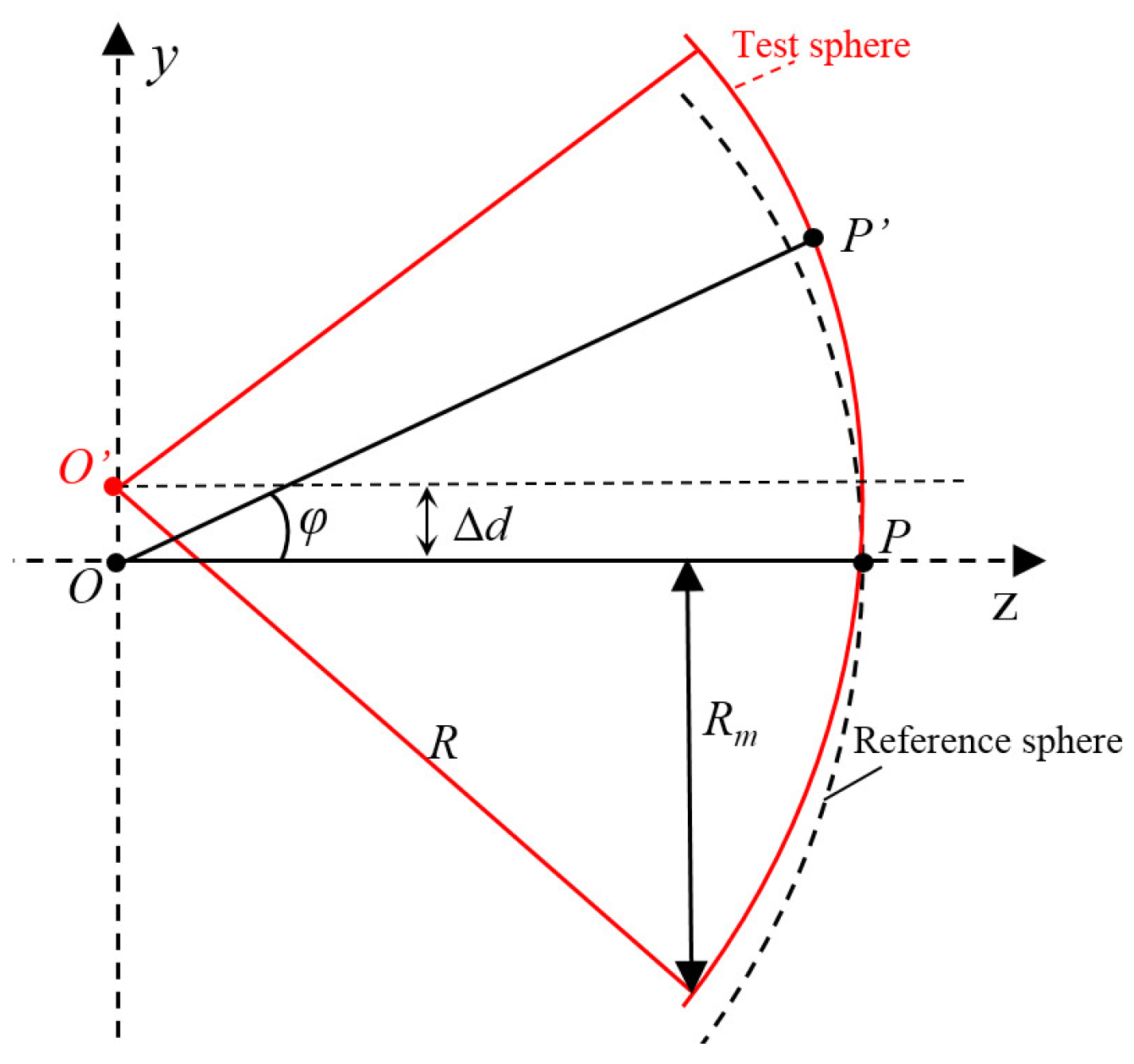
In an interferometric test setup, when the element under test has no lateral displacement, the centers of curvature of the test and reference spherical waves coincide. When lateral displacement Δd exists between the test sphere and the reference sphere, as shown in Figure 1, where O is the center of curvature for the reference sphere and O’ is the center for the test sphere, the optical path difference (OPD) between any point P’ on the test sphere and the corresponding point P on the reference sphere can be expressed by Equation (7) [16].
OPD =   2 ( O P O P ) =   2 ( R ( x Δ d x ) 2 + ( y Δ d y ) 2 + z 2 )
where Δdx and Δdy are the components of Δd along the x and y axes, respectively.
Δ d = Δ d x 2 + Δ d y 2
Figure 1. Aberration analysis for optical element with lateral displacement.
Converting Equation (7) to polar coordinates yields
x = R sin φ cos θ y = R sin φ sin θ z = R cos φ
where R is the curvature radius of the test sphere, φ is the aperture angle, and θ is the azimuth angle. Substituting Equation (8) into Equation (7) and simplifying yields
OPD = 2 ( R R 1 2 Δ d x R sin φ cos θ 2 Δ d y R sin φ sin θ + Δ d R 2 )
Since the lateral displacement Δd is very small compared to the curvature radius R, the OPD can be approximated as
OPD = 2 N A ( Δ d x ρ cos θ + Δ d y ρ sin θ ) = 2 N A ( Δ d x Z 2 + Δ d y Z 3 )
By denoting the radius of the exit pupil within measurement NA as Rm, the normalized radius of the exit pupil can be expressed as ρ = R sin φ/Rm = sin φ/NA (ρ ∈ [0, 1]). Here, Z2 and Z3 are the Zernike polynomial terms representing tilt in the x and y directions, respectively. This analysis shows that lateral displacement of the test spherical wavefront in the interferometric setup introduces tilt aberrations. Therefore, during lens alignment, by designing the interferometric test appropriately, the centering error of optical elements can be controlled based on the measured tilt aberration.

3. Centering Alignment Design for the Infrared Optical System

3.1. Infrared Optical System Design

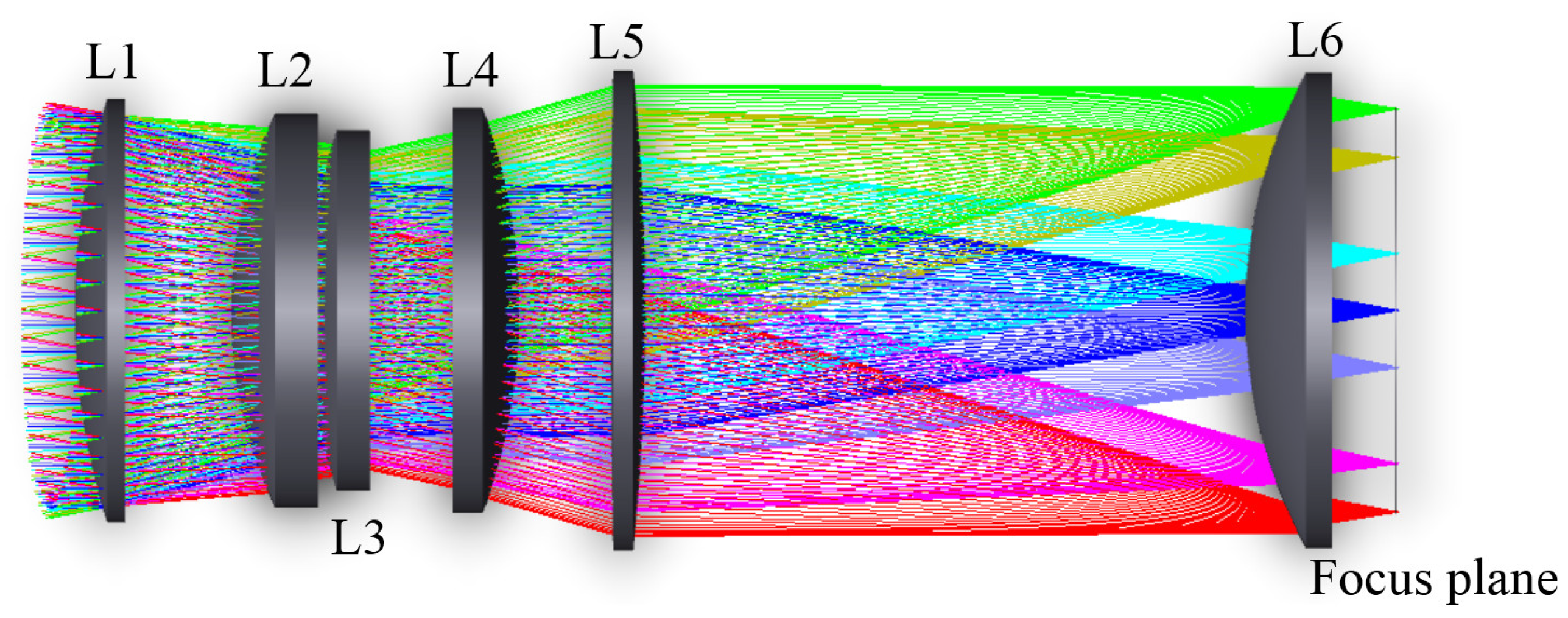
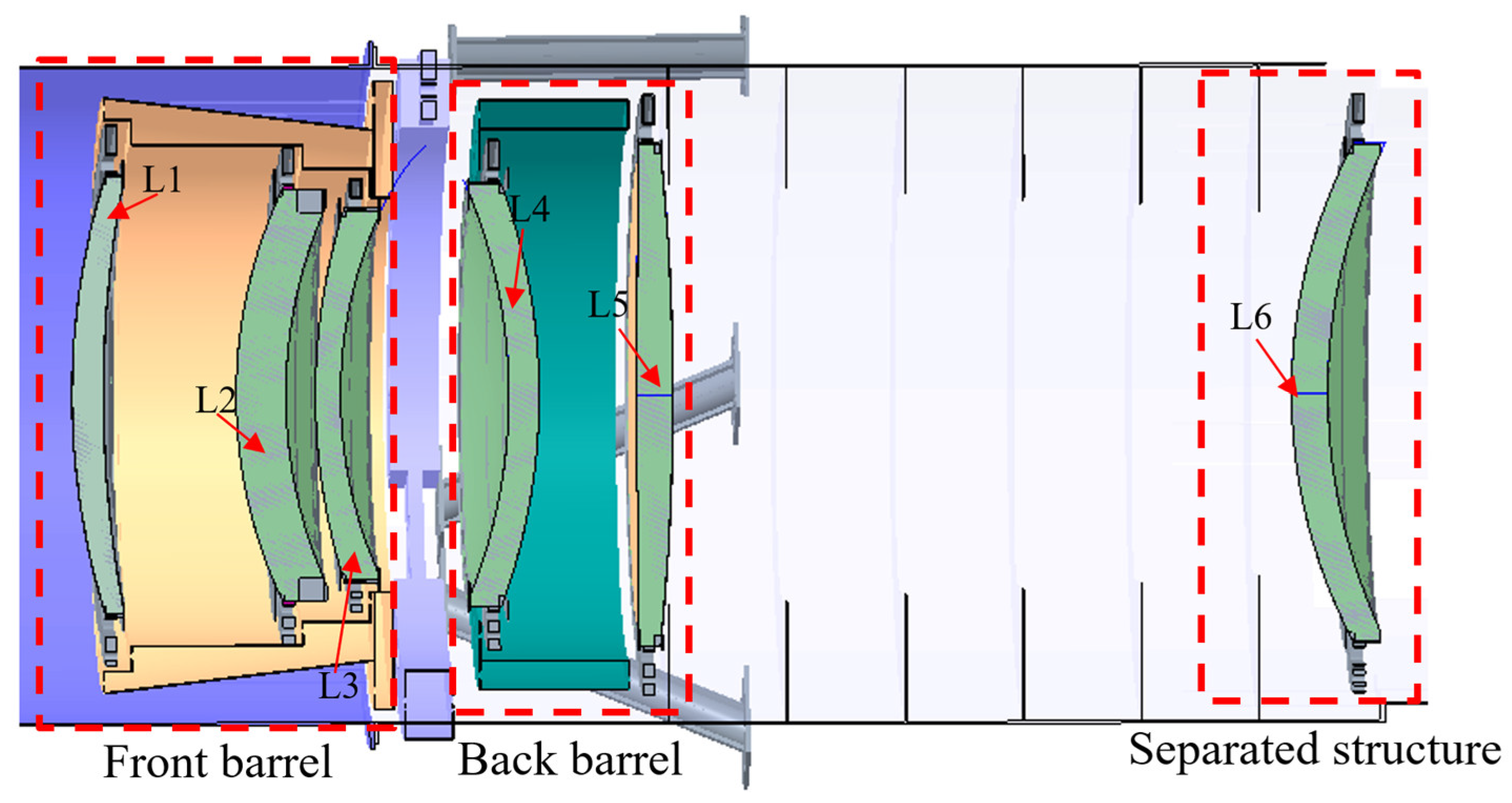
The large-aperture infrared lens designed in this work has an entrance pupil diameter of 400 mm, a field of view of ±7°, and a focal length of 1150 mm and employs an image-space telecentric design. The lens comprises six elements, with the optical model shown in Figure 2. The mechanical layout is shown in Figure 3, consisting primarily of a front barrel and a back barrel. Lenses 1–3 are housed in the front barrel, lenses 4 and 5 are in the back barrel, and lens 6 is a correction lens mounted independently on the main camera frame using a separate structure.
Figure 2. Optical design of the large-aperture infrared lens.
Figure 3. Mechanical structure of the large-aperture infrared lens.
Each lens features a planar chamfer outside the clear aperture and perpendicular to its optical axis. During the lens gluing procedure, the planar chamfer allows the optical axis to be aligned perpendicular to its adaption ring using a coordinate measuring machine. This process controls the tilt of each lens to better than 5 arcseconds. Axial shims between the adaption rings and the lens barrel define the precise position of the lens vertices along the optical axis. The thickness of the axial shims and lateral position for each lens are managed during the centering alignment process.

3.2. Lens Centering Alignment Design

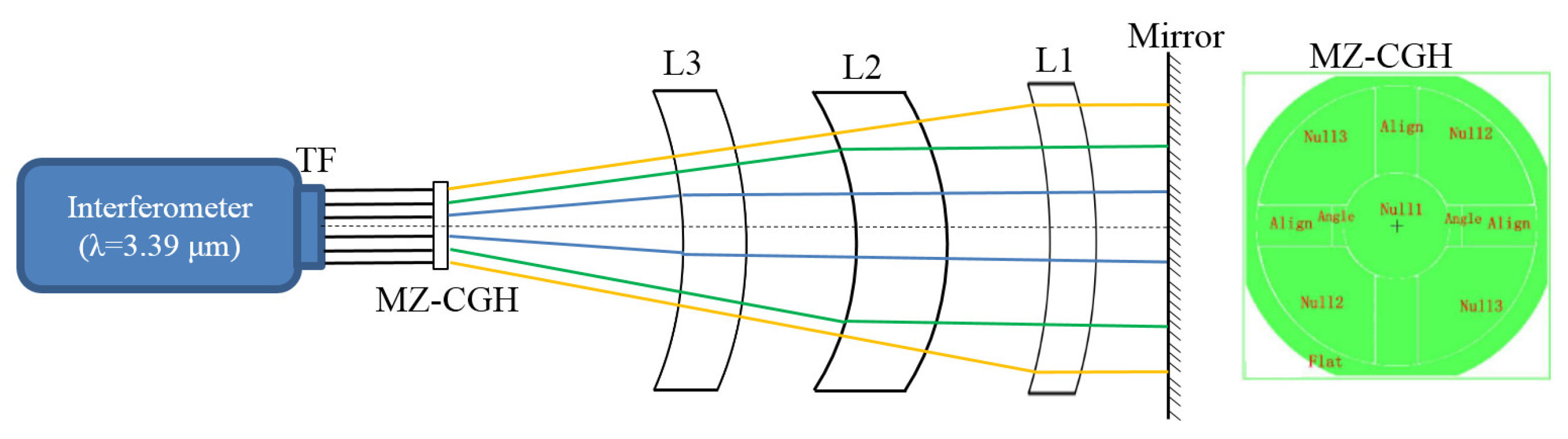
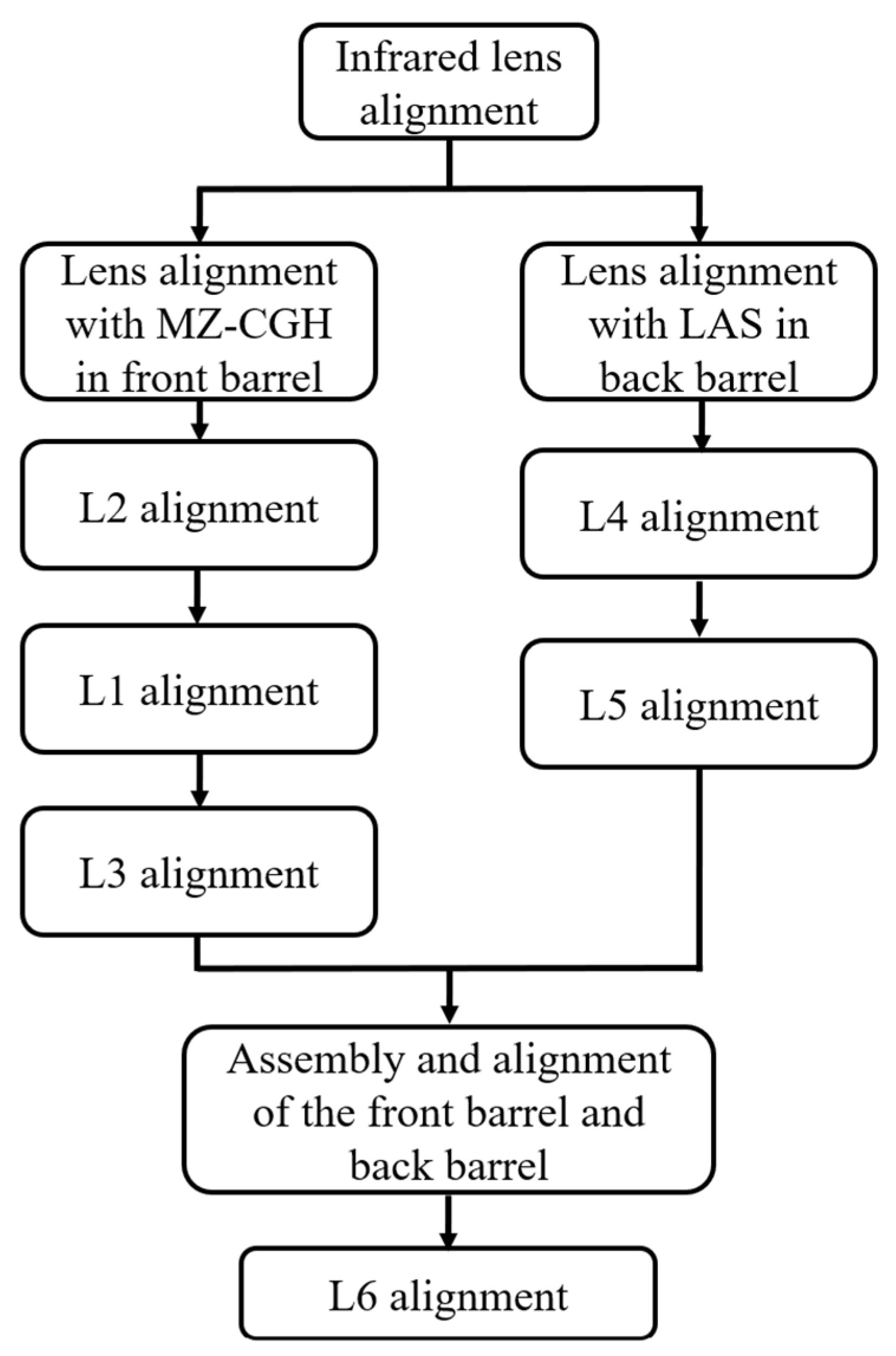
Based on the optical system design, the alignment process for the described infrared lens involves separately aligning lenses 1–3 in the front barrel and lenses 4–5 in the back barrel, followed by integrating the front and back barrels, and finally aligning lens 6 and performing final performance testing. Lenses 1–3 in the front barrel are aligned using an MZ-CGH. The infrared interferometer, equipped with a standard transmission flat, outputs a planar wavefront that is phase-modulated by the CGH. This shaped wavefront passes through lenses 1–3, is collimated again, reflected by a flat mirror, and retraces its path to form interference fringes, as shown in Figure 4. The MZ-CGH consists of six regions: Null1 for aligning lens 1; Null2 for lens 2; Null3 for lens 3; an ‘align’ region for positioning the interferometer relative to the CGH; an ‘angle’ region to assist the interferometer in locating the third diffraction order from the ‘align’ region for precise angular alignment; and a ‘Flat’ region for positioning the standard reference flat mirror.
Figure 4. Schematic of MZ-CGH centering alignment.
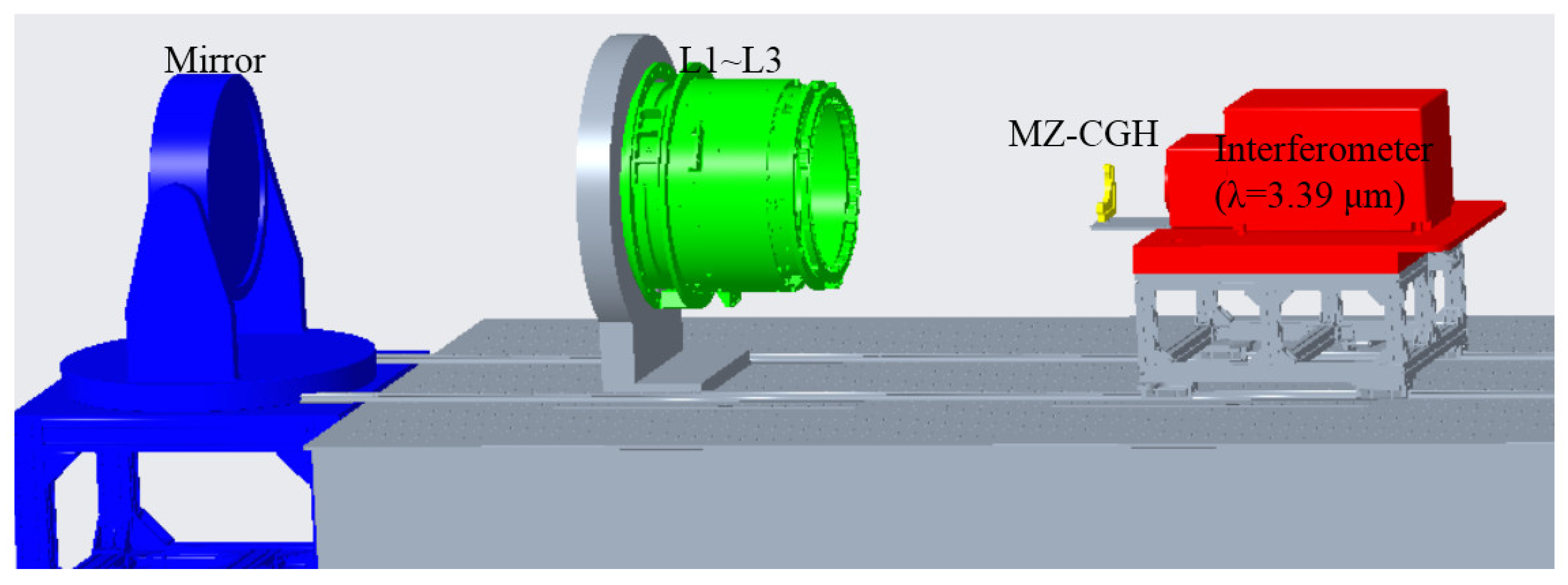
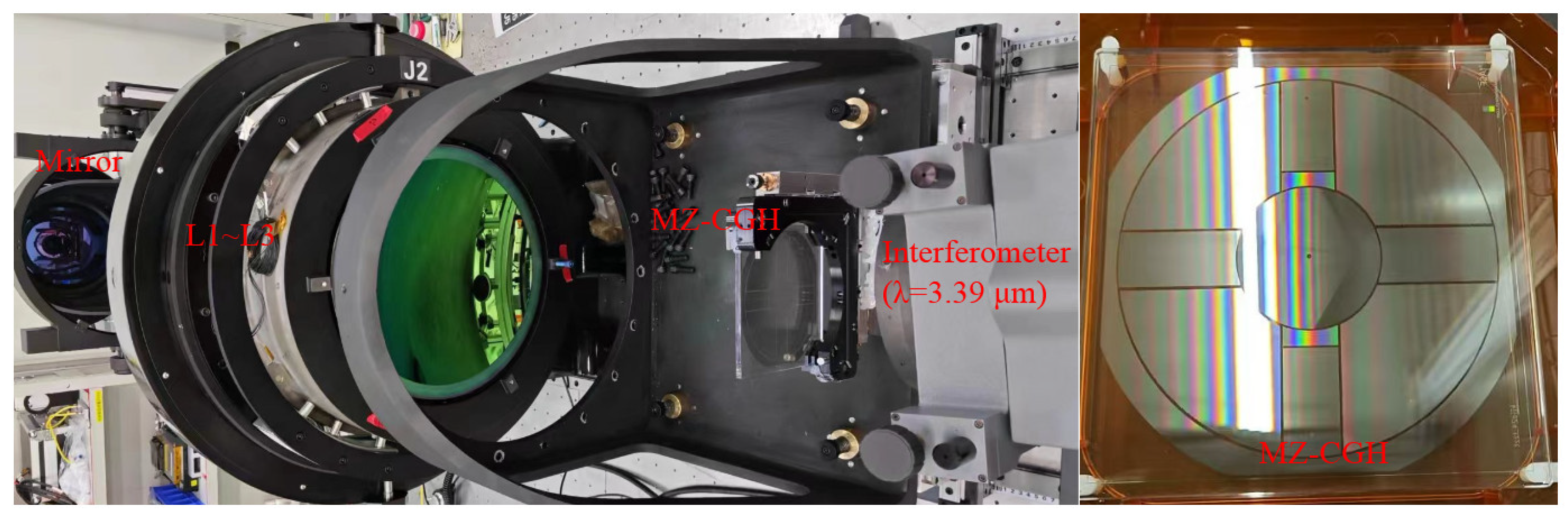
The system layout for aligning lenses 1–3 using the MZ-CGH is shown in Figure 5. A 3.39 μm wavelength interferometer and the MZ-CGH are fixed on the same platform. Lenses 1–3 of the infrared lens are mounted on a fixture. A 500 mm diameter flat mirror is positioned over 1 m away from the lens fixture to effectively avoid stray light.
Figure 5. System layout for MZ-CGH centering alignment.
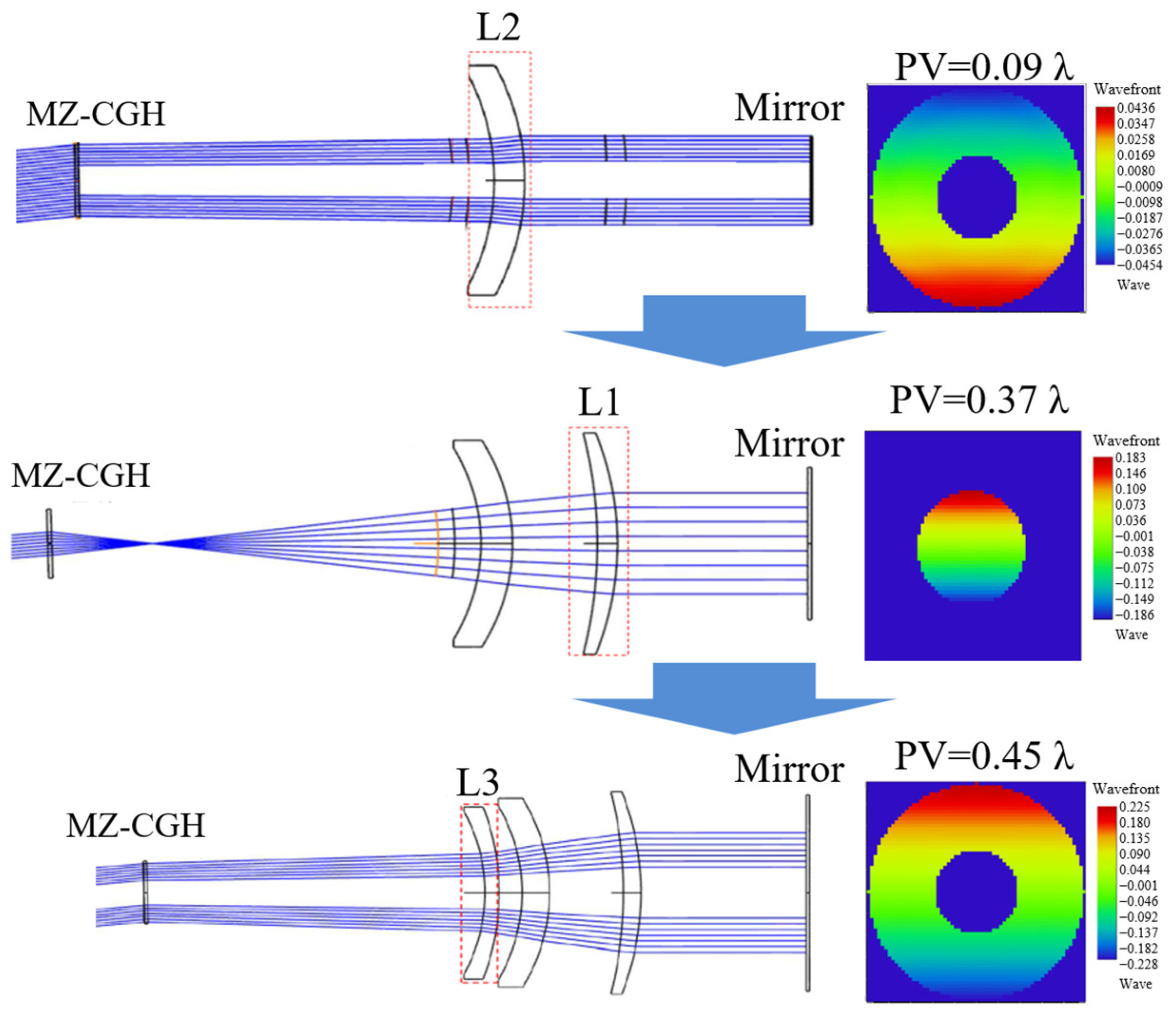
The alignment procedure using the MZ-CGH first involves aligning the interferometer, CGH, and mirror. Lens 2 is aligned first, followed by lens 1, and then lens 3, completing the alignment of the front group (lenses 1–3). The CGH alignment optical path design and the aberration distributions for a 5 μm lateral displacement of each lens are shown in Figure 6. A 5 μm lateral displacement of lens 2 induces a PV tilt aberration of 0.09λ. For lens 1, it induces 0.74λ PV and for lens 3, 0.90λ PV. Since the designed optical path for lens 2 is insensitive to the axis displacement between lens 2 and the CGH, an absolute portable arm coordinate measuring machine (CMM), which possesses a distance measurement capability of 1.2 m and a measurement accuracy of 17 μm, is sufficient to precisely control the axial positions for lens 2. The axial positions of lenses 1 and 3 are defined according to the pre-compensation information of the MZ-CGH, since a 10 μm axial displacement between lens 2 and lens 1 induces a PV power aberration of 0.12λ. A 10 μm axial displacement between lens 3 and lens 2 induces a PV power aberration of 0.08λ. Thus, this MZ-CGH enables high-precision alignment.
Figure 6. MZ-CGH alignment optical design and aberration analysis for lateral displacement.
Lenses 4 and 5 in the back barrel are aligned using a traditional centering instrument, resulting in a centering tolerance of 10 μm. After aligning the back barrel, the transmitted wavefront error of lenses 1–5 is measured interferometrically. Equation (6) is used to calculate the lateral and axial displacement between the front and back barrels for final adjustment. Following the integration of the front and middle/back barrels, the transmitted wavefront error of lenses 1–6 is measured, and the decenter error of lens 6 is calculated using Equation (6) and adjusted, finalizing the alignment of the large-aperture infrared transmission lens. The overall alignment flowchart is shown in Figure 7.
Figure 7. Infrared lens alignment flowchart.

4. Alignment Experiment for the Large-Aperture Infrared Lens

4.1. MZ-CGH-Assisted Centering Alignment

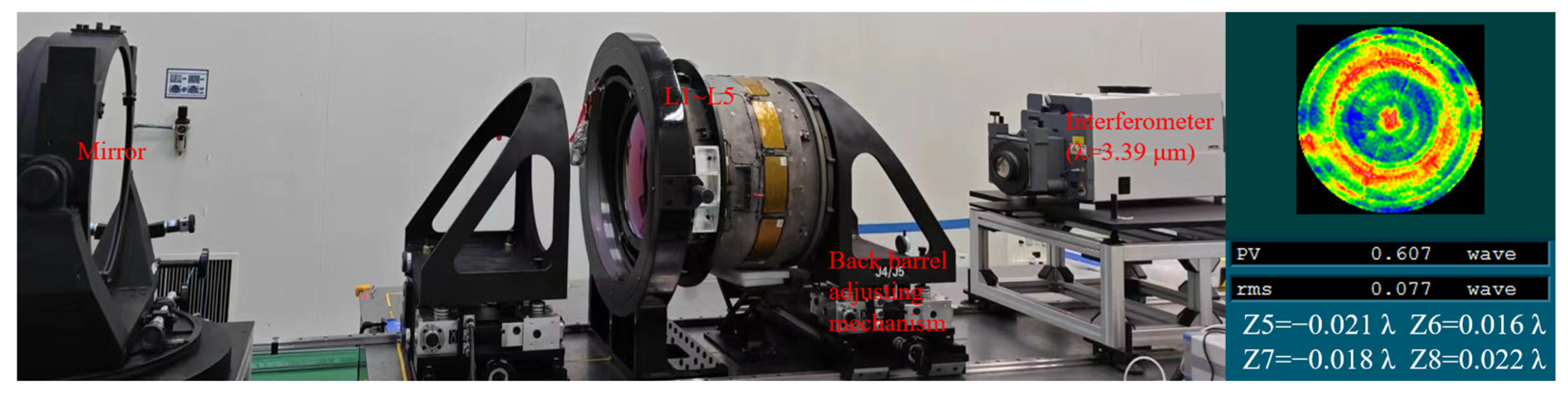
The MZ-CGH-assisted centering alignment technique was employed in an experiment to align the 400 mm clear aperture infrared lens. The experimental setup is shown in Figure 8. The interferometer was a commercial 6-inch infrared model operating at 3.39 μm. The reference flat mirror, with a 500 mm aperture and surface figure RMS better than 9 nm, had a negligible impact on the infrared lens transmitted wavefront error. The MZ-CGH was fabricated on fused silica substrate with a surface figure error better than 12 nm. It was an amplitude-type CGH with a line width error better than 0.1 μm and introduced a phase error better than 10 nm and a negligible value for the infrared transmitted wavefront error.
Figure 8. MZ-CGH centering alignment experiment.
During the alignment process, as the light source of the interferometer belongs to invisible light, auxiliary equipment is needed for optical path alignment. The interferometer, MZ-CGH, and the mirror are aligned through a theodolite and then precisely aligned with the ‘Flat’ region of the MZ-CGH. The angles of the flat mirror are monitored by theodolites during the whole alignment process. The mounting surface of lens 2 is the benchmark for aligning the front barrel into the optical path. Accurate displacement between the mounting surface of lens 2 and the MZ-CGH are ensured with the CMM. The tip-tilt angles between the mounting surface of lens 2 and the optical axis of the interferometer are ensured by placing a flat crystal on the mounting surface of lens 2 and the tip-tilt angles can be measured using a theodolite. Then lenses 1–3 can be installed to the front barrel and aligned according to the wavefront measurement results.
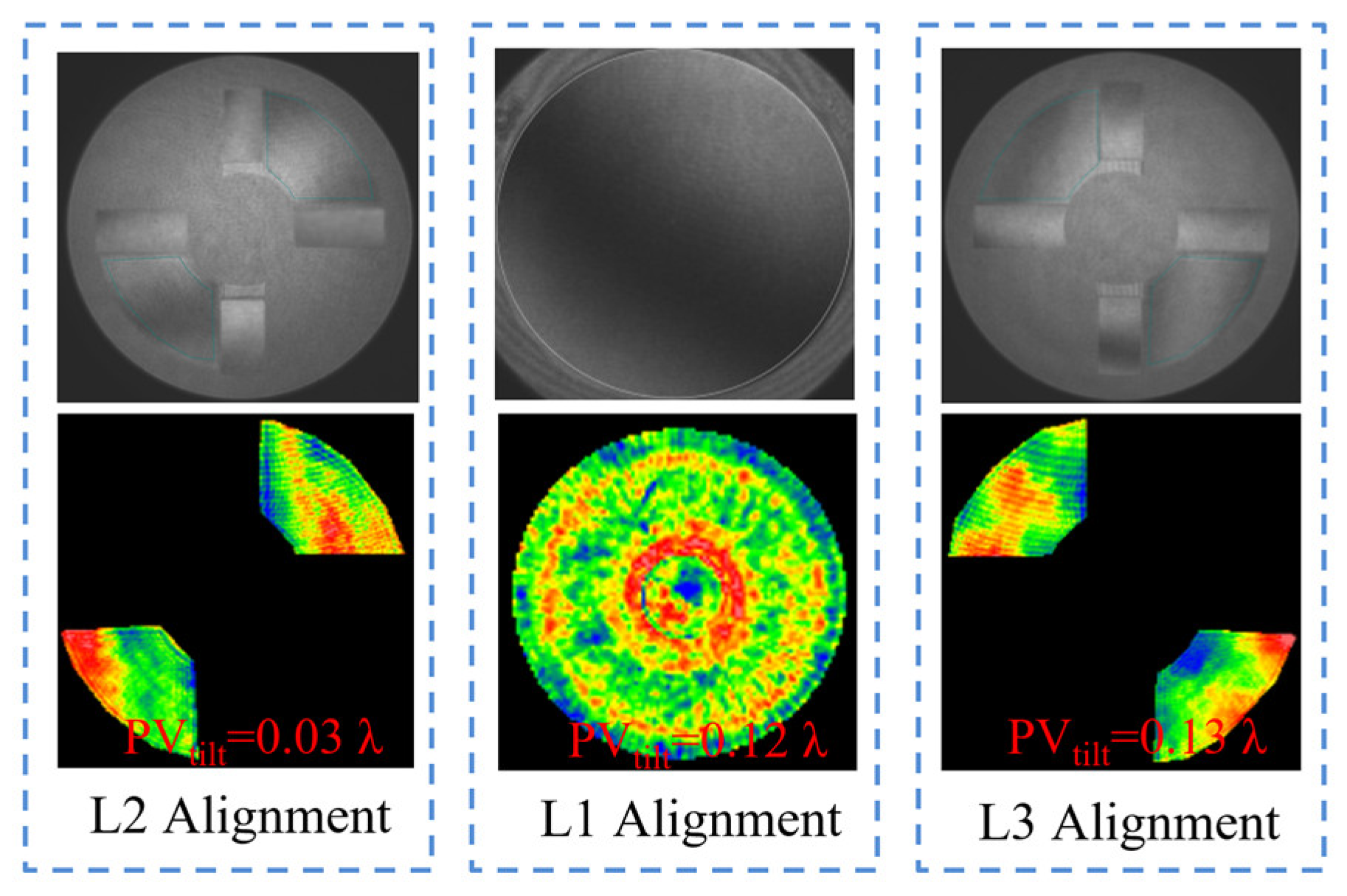
The centering alignment results for lenses 1–3 using the MZ-CGH are shown in Figure 9. The residual tilt error (PV) after alignment was 0.03λ (λ = 3.39 μm) for lens 2, 0.12λ for lens 1, and 0.13λ for lens 3. Comparing these values with the transmitted wavefront errors induced by a 5 μm decenter shown in Figure 6, it is evident that the decenter errors for lenses 1–3 are all better than 5 μm.
Figure 9. Centering alignment results for Lenses 1–3.

4.2. Lens Transmitted Wavefront Testing

After aligning lenses 1–3 using the CGH technique and lenses 4–5 using the centering instrument, the decenter between the front and back barrel assemblies was adjusted by measuring the wavefront error of lenses 1–5 and calculating the required correction using Equation (6), as illustrated in Figure 10. The transmitted wavefront error for lenses 1–5 after this adjustment was PV = 0.607λ and RMS = 0.077λ at 0° field. The wavefront error was fitted using 36 Zernike polynomials. The astigmatism terms (Z5 and Z6) were −0.021λ and 0.016λ, respectively, and the coma terms (Z7 and Z8) were −0.018λ and 0.022λ, respectively. This indicates that the alignment-sensitive aberrations (astigmatism and coma) are small, with residual errors primarily consisting of system spherical aberrations and lens surface fabrication errors.
Figure 10. Alignment for decenter adjustment between front and back barrel assemblies.
The alignment process for lens 6 was similar to the barrel integration step. The wavefront error across various fields of view for lenses 1–6 was measured interferometrically with the lens mounted in the main camera frame. The decenter error of lens 6 was calculated using Equation (6) and adjusted to complete the lens alignment. The final measured wavefront and MTF (@33 lp/mm) results for the fully assembled lens are presented in Table 1.
Table 1. Image quality measurement results for the infrared lens.
The wavefront measurement results show that the +5° field exhibits a relatively larger wavefront error. This is likely due to localized surface errors and optical inhomogeneity of the infrared lens at this field point. Nonetheless, the image quality at this field still meets the application requirements. The average RMS wavefront error across the full field of view is better than 0.07λ, and the average MTF is higher than 0.5, indicating high image quality for the aligned lens.

5. Discussion

This paper utilizes a MZ-CGH-assisted alignment method to address the requirement for high-precision lens centering in the development of a 400 mm large-aperture infrared lens. The MZ-CGH compensates for the transmitted wavefront of lenses 1–3 in the interference testing optical path, achieving a centering accuracy better than 5 μm for aligning the lenses. The transmitted wavefront error of the lens system was measured interferometrically to calculate and adjust the decenter errors of lenses 4–5 and separated lens 6. The fully aligned large-aperture infrared lens achieved an average MTF better than 0.5 across the full field of view, consistent with theoretical design values, demonstrating high alignment quality.
A large amount of work has demonstrated the application of CGHs in reflective optical systems, and the MZ-CGH has also been reported in the alignment of refractive systems. But in the above works, CGHs are used to compensate for and test the reflected wavefront of optical components. In this paper, an MZ-CGH was designed to compensate for and test the transmitted wavefront of lenses in an infrared refractive system. According to the system testing results, the alignment with an MZ-CGH can achieve high precision. Through the research in this paper, we demonstrate that an MZ-CGH can be widely applied to the alignment and testing of complex optical systems.

Author Contributions

Conceptualization, C.Z.; methodology, W.L. and Y.H.; validation, C.Z., W.L. and S.Z.; formal analysis, S.Z.; investigation, W.L.; resources, Y.H.; data curation, Y.H.; writing—original draft preparation, C.Z.; writing—review and editing, J.Y.; visualization, C.Z.; supervision, J.Y.; project administration, C.Z.; funding acquisition, C.Z. All authors have read and agreed to the published version of the manuscript.

Funding

This research was funded by National Key Research and Development Program of China, grant number 2021YFF0701300.

Institutional Review Board Statement

The study was conducted in accordance with the Declaration of Helsinki and approved by the Institutional Review Board of Nanjing University of Aeronautics and Astronautics. (Committee code: 7919. Approved date: 29 December 2025).

Data Availability Statement

The original contributions presented in this study are included in the article. Further inquiries can be directed to the corresponding author.

Conflicts of Interest

The authors declare no conflicts of interest.

Abbreviations

The following abbreviations are used in this manuscript:
MZ-CGHMulti-zone computer-generated hologram
LLens

References

  1. Fang, L.; Zhang, H.; Cheng, X.; Fan, Z.; Liao, Z.; Zhang, Q.; Zhao, R. Detection Capability Analysis of Field of View-Gated Optical Imaging System for All-Time Star Sensor. Photonics 2024, 11, 1118. [Google Scholar] [CrossRef]
  2. Shao, M.; Guo, J.; Qi, H.; Pang, X.; Li, Y. Research on Support Structure of Rectangular Cryogenic Infrared Lens with Large Aperture. Photonics 2024, 11, 1084. [Google Scholar] [CrossRef]
  3. Cao, Y.; Shen, Z. Design of Long-wave Infrared Athermalized Optical System with Large Aperture and Long Focal Length. Acta Photonica Sin. 2024, 53, 0322004. [Google Scholar] [CrossRef]
  4. Wang, F.; Yang, Y. High-precision automatic centering method for aspheric optical elements based on machine vision. Opt. Contin. 2022, 1, 1248–1262. [Google Scholar] [CrossRef]
  5. Ingalls, A.L.; Pestrecov, K. Centering of Optical Systems. J. Opt. Soc. Am. 1948, 38, 343–349. [Google Scholar] [CrossRef] [PubMed]
  6. Huang, Y.; Zhang, C.; Zhang, Z.; Zhang, S.; Cui, C. Design and Verification of Automatic Alignment System for Batch Space Refractive Lenses. Acta Photonica Sin. 2023, 52, 1122002. [Google Scholar] [CrossRef]
  7. Huang, Y.; Zhao, Y.; Zhang, S.; Du, X.; Zhang, C. Alignment technology for infrared refractive lens based on high performance. Infrared Laser Eng. 2023, 52, 20220790. [Google Scholar] [CrossRef]
  8. Cui, J.P.; Zhang, N.; Liu, J.; Wu, D.L.; Xu, H.; Yan, D.Y.; Ma, P. Testing the mid-spatial frequency error of a large aperture long-focal-length lens with CGH. Opt. Express 2020, 28, 9454–9463. [Google Scholar] [CrossRef] [PubMed]
  9. Cui, J.P.; Zhang, N.; Liu, J.; Wu, D.L.; Xu, H.; Yan, D.Y.; Ma, P. Testing the transmitted wavefront of large aperture and long-focal-length lens with computer-generated hologram. Opt. Express 2018, 26, 28067–28077. [Google Scholar] [CrossRef] [PubMed]
  10. Zhang, X.; Xue, D.; Ming, L. Testing and alignment strategy for large field-of-view multi-mirror telescopes. In Classical Optics 2014, OSA Technical Digest (Online); Optica Publishing Group: Washington, DC, USA, 2014; paper OTh2B.2. [Google Scholar] [CrossRef]
  11. Burge, J.H.; Mihill, A.; Pullen, W.; Walker, Z.; Zhao, C.; Valente, M. Alignment and Testing of Large Lenses using Computer Generated Holograms. In Optical Design and Fabrication 2019 (Freeform, OFT), OSA Technical Digest; Optica Publishing Group: Washington, DC, USA, 2019; paper OM3A.4. [Google Scholar] [CrossRef]
  12. Asfour, J.-M.; Weidner, F.; Bodendorf, C.; Bode, A.; Poleshchuk, A.G.; Nasyrov, R.K.; Grupp, F.; Bender, R. Diffractive optics for precision alignment of Euclid space telescope optics. In Astronomical Optics: Design, Manufacture, and Test of Space and Ground Systems; SPIE: Bellingham, WA, USA, 2017; Volume 10401. [Google Scholar]
  13. Bodendorf, C.; Grupp, F.; Bode, A.; Asfour, J.-M. Multi-zonal computer-generated holograms for high-precision optical adjustment purposes: Part I: Sensitivity and optical performance. Opt. Express 2019, 27, 13637–13652. [Google Scholar] [CrossRef] [PubMed]
  14. Grupp, F.; Bender, R.; Thiele, H.; Mottaghibonab, A.; Gal, C.; Gawlik, K.; Dubowy, M.; Penka, D.; Bode, A. Mounting, metrology and verification of Euclid near infrared spectro-photometer optical assembly NI-OA. In Proceedings of the International Conference on Space Optics—ICSO 2016, Biarritz, France, 18–21 October 2016; SPIE: Bellingham, WA, USA, 2017; Volume 10562. [Google Scholar]
  15. Kim, Y.; Yang, H.-S.; Lee, Y.-W. Computer-aided alignment method using RMS WFE value as an optimization criterion. In Optical System Alignment, Tolerancing, and Verification VI; SPIE: Bellingham, WA, USA, 2012; Volume 8491. [Google Scholar]
  16. Wang, D.; Yang, Y.; Chen, C.; Zhuo, Y. Calibration of geometrical systematic error in high-precision spherical surface measurement. Opt. Commun. 2011, 284, 3878–3885. [Google Scholar] [CrossRef]
Disclaimer/Publisher’s Note: The statements, opinions and data contained in all publications are solely those of the individual author(s) and contributor(s) and not of MDPI and/or the editor(s). MDPI and/or the editor(s) disclaim responsibility for any injury to people or property resulting from any ideas, methods, instructions or products referred to in the content.

Article Metrics

Citations

Article Access Statistics

Multiple requests from the same IP address are counted as one view.