Article

FPGA-Based 509 nm Laser Frequency Stabilization to Cesium Atomic Transition: Modulation-Free Rydberg Two-Color Polarization Spectroscopy (TCPS) Versus Frequency-Modulated Rydberg–EIT Spectroscopy


1
State Key Laboratory of Quantum Optics Technologies and Devices, and Institute of Opto-Electronics, Shanxi University, Taiyuan 030006, China
2
Collaborative Innovation Center of Extreme Optics, Shanxi University, Taiyuan 030006, China
*
Author to whom correspondence should be addressed.
Photonics 2026, 13(2), 180; https://doi.org/10.3390/photonics13020180
Submission received: 26 December 2025 / Revised: 24 January 2026 / Accepted: 26 January 2026 / Published: 11 February 2026
(This article belongs to the Special Issue Advanced Spectral Technology and Imaging)

Abstract

Frequency stability of a 509-nm single-frequency laser, a core component combined with an 852-nm single-frequency laser for two-step cesium Rydberg transitions, is critical for quantum control and metrology precision. Utilizing atomic transition as the absolute reference, we achieved laser frequency locking via modulation-free Rydberg two-color polarization spectroscopy (Rydberg–TCPS) and frequency-modulated Rydberg electromagnetically-induced transparency (Rydberg–EIT) spectroscopy with discrete instruments combination and with Red Pitaya FPGA module. The results show that the Red Pitaya FPGA module matches discrete instruments combination in stability, being more compact and only one-tenth the cost. Rydberg–TCPS scheme avoids modulation-induced noise and linewidth broadening, outperforming Rydberg–EIT scheme. The Red Pitaya FPGA module provides a cost-effective, compact solution for Rydberg research, lowering experimental barriers.

1. Introduction

Rydberg atom has one valence electron in a highly excited state with a large principal quantum number ( n 10 , even upto the hundreds). In Rydberg state, outer electron occupies orbital far from the atomic nucleus, a configuration that endows the atom with characteristics such as a large volume, weak binding energy, large polarizability and strong interactions. Alkali-metal atomic Rydberg states exhibit properties markedly different from lower excited states, making them critically valuable for applications in atomic physics, quantum manipulation, and precision measurement. Due to the extremely high energy of Rydberg states, their excitation typically requires short-wavelength lasers; for instance, single-step cesium atom excitation needs UV laser at 319 nm, while two-step cascaded Rydberg excitation requires using lasers at 852 nm and 509 nm simultaneously. The 509-nm laser—which possesses mature technology and whose photon energy matches cesium transition from the excited state 6 P 3 / 2 to a Rydberg state n S 1 / 2 (or n D 3 / 2 and n D 5 / 2 ) in a ladder-type three-level system—alongside the 852-nm laser serving as probe for driving the ground state 6 S 1 / 2 to excited state 6 P 3 / 2 transition, collectively form the core optical field for cesium Rydberg atoms manipulation. This system plays an irreplaceable role in quantum computing and simulation [1], microwave electric field detection [2,3], and high-resolution atomic spectroscopy with cesium Rydberg atoms [4]. The frequency stability of excitation lasers impacts the quantum bit fidelity, microwave electric field measurement sensitivity, and precision in resolving hyperfine levels in atomic spectroscopy. The most common laser frequency-locking techniques, including saturated absorption spectroscopy [5], polarization spectroscopy [6,7], and modulation transfer spectroscopy [8], all achieve frequency stability by locking to atomic ground-state transitions, but cannot be applied to most short-wavelength lasers, because of lacking such transitions. Cavity-locking technologies do not require atomic transitions, but cannot achieve absolute frequency standards and are susceptible to environmental factors such as temperature and pressure. In 1991, Harris group demonstrated the electromagnetic-induced transparency (EIT) phenomenon [9], which suppresses probe laser resonant absorption through destructive interference between atomic quantum states. Since then, extensive theoretical and experimental studies have been conducted [10,11,12,13]. In 2004, Moon et al. reported on the coupling laser frequency stabilization with atomic in EIT system [14]; In 2009, Abel et al. proposed a method for locking EIT frequency-modulated spectra in cascaded three-level systems [15]. For cesium atomic system targeting Rydberg state transitions, Jiao et al. further verified the feasibility of Rydberg–EIT locking and provided direct performance benchmarks for similar schemes in the same atomic system [16]. Moreover, EIT-based locking can be extended to Zeeman sublevel transitions by introducing external magnetic fields: Bao et al. achieved tunable frequency stabilization for cesium atoms by splitting EIT spectra into sub-peaks via the Zeeman effect, verifying the potential of magnetic field-assisted locking in Rydberg cascade systems [17].
In 1976, Hänsch et al. pioneered modulation-free polarization spectroscopy [6], a technique that achieved high-resolution spectroscopic measurements without Doppler effects by utilizing laser-induced dichroism and birefringence, finding widespread application in frequency stabilization for lasers corresponding to atomic ground-state transitions. For short-wavelength lasers (400–600 nm) used to excite atoms from the intermediate state to Rydberg states with high principal quantum numbers, our research group has stabilized the 509-nm laser frequency using Rydberg two-color polarization spectroscopy (Rydberg–TCPS) technique in a ladder-type three-level system [18]. We further narrowed the Rydberg–TCPS linewidth to enhance frequency stability by employing a Laguerre–Gaussian mode coupling laser beam [19]. Based on the Rydberg blockade effect [20,21], Rydberg–EIT is crucial for core quantum devices, such as quantum logic gates and single-photon sources [22,23,24]. The proposed 509-nm laser frequency stabilization technique lays a critical foundation for cesium Rydberg atom research in frontier fields like quantum information science, while drawing on advances in EIT locking, Zeeman-assisted tuning, and modulation-free spectroscopy [16,17,25,26].
In this paper, we study the frequency stability of a 509-nm laser using a cesium atomic ladder-type three-level system ( 6 S 1 / 2 6 P 3 / 2 52 S 1 / 2 ). The system is driven with both 852-nm and 509-nm single-frequency lasers. Two experimental methods are used to frequency-locking of the 509 nm laser: a traditional setup with a discrete instruments combination, such as a signal generator, lock-in amplifier, PID controller, and oscilloscope, and the other is the Red Pitaya Field-Programmable Gate Array (FPGA) module (STEMlab 125-14). Both methods rely on two Rydberg spectroscopy techniques. The first one is modulation-free Rydberg-TCPS. By exploiting the dielectric optical anisotropy arising from the interaction between the 509-nm laser and cesium atoms, this method enhances the 852-nm laser’s polarization evolution signal, enabling a locking reference without modulation to be established. The second one employs a frequency-modulated Rydberg–EIT. By frequency-modulating the laser and utilizing quantum interference effect within a cesium atomic ladder-type three-level system with Rydberg state, a narrow linewidth transmission peak is generated as the frequency reference. On this basis, we conduct a systematic comparative analysis of the two schemes’ experimental results from the perspective of key metrics, including frequency stability and system complexity. This work provides technical references for selecting and optimizing laser frequency-locking schemes in the two-step Rydberg excitation experiments.

2. Experimental Principle and Setup

2.1. Principles of Two Frequency-Locking Technologies

2.1.1. Principle of Frequency-Modulated Rydberg–EIT Frequency Locking

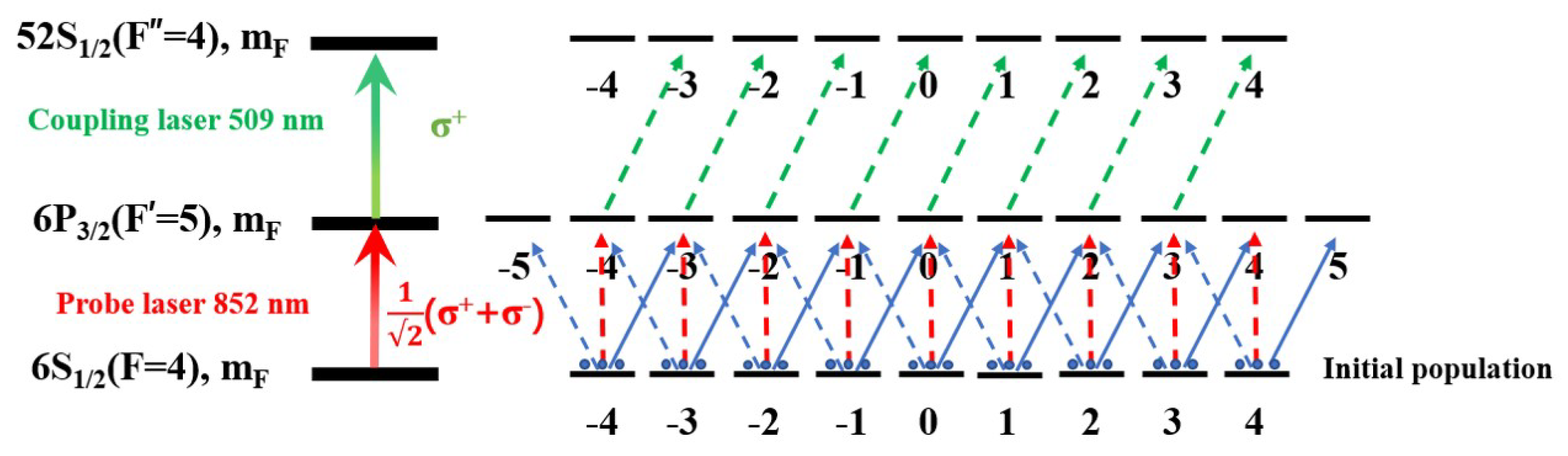
Figure 1 shows a schematic diagram of a ladder-type cesium three-level system ( 6 S 1 / 2 6 P 3 / 2 52 S 1 / 2 ) involving Rydberg states. In the experiment, the 852-nm probe laser is locked to the cesium D2 line modulation-free polarization spectroscopy, specifically corresponding to the 6 S 1 / 2 ( F = 4 ) 6 P 3 / 2 ( F = 5 ) transition, while the 509-nm coupling laser scans over the 6 P 3 / 2 ( F = 5 ) 52 S 1 / 2 transition. When scanning across the resonance frequency, different experimental setups induce corresponding Rydberg–EIT or Rydberg–TCPS.
We analyze the frequency-modulated Rydberg–EIT scheme using a ladder-type three-level system as an example. The three levels are defined as | 1 = | 6 S 1 / 2 ( F = 4 ) , | 2 = | 6 P 3 / 2 ( F = 5 ) , | 3 = | 52 S 1 / 2 ( F = 4 ) , and the density matrix evolution equation is:
ρ ˙ = i [ H ^ , ρ ] + L ^ ( ρ ) ,
Among these, the Hamilton operator H ^ (considering the rotating-wave approximation) is:
H ^ = 2 0 Ω p 0 Ω p 2 Δ p Ω c 0 Ω c 2 ( Δ p + Δ c ) ,
Ω p and Ω c are the Rabi frequencies of the probe and coupling beams, respectively; ω p and ω c are the optical field angular frequencies; and Δ p = ω p ( ω 2 ω 1 ) , Δ c = ω c ( ω 3 ω 2 ) are the frequency detuning.
The dissipation term L ^ ( ρ ) incorporates the spontaneous emission rate Γ i j between energy levels, primarily involving relaxation processes such as Γ 21 ( | 2 | 1 ) and Γ 32 ( | 3 | 2 ) .
L ^ ( ρ ) = Γ 21 ρ 22 Γ 21 2 ρ 12 Γ 32 2 ρ 13 Γ 21 2 ρ 21 Γ 21 ρ 22 + Γ 32 ρ 33 Γ 21 + Γ 32 2 ρ 23 Γ 32 2 ρ 31 Γ 21 + Γ 32 2 ρ 32 Γ 32 ρ 33 ,
Based on the relationship between the polarizability and density matrix, μ 21 N ρ 21 ( ω p ) = ε 0 χ ( ω p ) E p , the former can be derived as:
χ = χ + i χ = μ 21 N ε 0 E p ρ 21 ,
The real part χ corresponds to dispersion, while the imaginary part χ corresponds to absorption. Directly adding sinusoidal frequency modulation to the coupling laser can obtains the following modulated coupling laser angular frequency:
ω c ( t ) = ω c 0 + δ ω sin ( Ω m t ) ,
Here, ω c 0 is the central angular frequency of the coupling laser, δ ω is the modulation amplitude, and Ω m is the modulation angular frequency. At this time, the frequency detuning of the coupling laser becomes a time-varying form:
Δ c ( t ) = Δ c 0 + δ ω sin ( Ω m t ) ,
Here, Δ c 0 = ω c 0 ( ω 3 ω 2 ) .
Modulation makes the dispersion and absorption characteristics change periodically over time. This lets the transmission signal carry the Δ c 0 information:
χ ( Δ c ( t ) ) = χ ( Δ c 0 ) + d χ d Δ c Δ c 0 · δ ω sin ( Ω m t ) + i χ ( Δ c 0 ) + d χ d Δ c Δ c 0 · δ ω sin ( Ω m t ) .
The modulation induces periodic variations in both properties, which jointly modulate the transmission signal.
I ( t ) = I 0 · e α total + I 1 · sin ( Ω m t ) + I 2 · sin ( Ω m t + ϕ α ) ,
where, I 0 is the initial light intensity without absorption; α total χ ( Δ c 0 ) is the average absorption coefficient (minimum at resonance); I 1 k · d χ d Δ c Δ c 0 · δ ω is the dispersion-modulated term; I 2 k · d χ d Δ c Δ c 0 · δ ω is the absorption-modulated term ( k is a coefficient related to the probe laser power); ϕ α π / 2 is the phase difference between dispersion and absorption modulation (determined by the Kramers-Kronig relation).
V demod = V demod , χ + V demod , χ = A · d χ d Δ c Δ c 0 · δ ω + B · χ ( Δ c 0 ) ,
where, A and B are proportional coefficients; V demod , χ is associated with frequency detuning and used for feedback locking; V demod , χ is the absorption monitoring term.
V demod Δ c 0 · δ ω + C · χ ( Δ c 0 ) ,
where, the first term is proportional to Δ c 0 , providing the core error signal for frequency locking. The second term (C is a proportional coefficient) reflects the absorption intensity, serving as a resonance criterion.
This shows the relationship between the demodulated frequency discrimination curve’s frequency offset and the output voltage.

2.1.2. Principle of Modulation-Free Rydberg–TCPS Frequency Locking

We theoretically analyze the formation of Rydberg–TCPS by assuming z is the probe laser’s wave vector direction, ω is its angular frequency, and x is its polarization direction. It can then be expressed as
E 0 e i ( ω t k 0 z ) , E 0 = E 0 x , 0 , 0 ,
Here, k 0 represents the magnitude of the probe laser’s wave vector. The 852-nm polarized laser can be decomposed into σ + and σ circularly polarized components due to the cesium atomic vapor’s differing absorption and refraction properties for these two components, with the component forms expressed as
E + = 1 2 E 0 x ^ + i y ^ e i ω t k + z α + L 2 ,
E = 1 2 E 0 x ^ i y ^ e i ω t k z α L 2 ,
where k ± = ω c n ± is the wave vector in the medium; α is the absorption coefficient; σ + corresponds to + i y ^ ; and σ corresponds to i y ^ .
Since the 509-nm coupling laser beam turns the cesium vapor cell into an anisotropic medium, the n (refractive index) and α (absorption coefficient) values for the 852-nm probe laser of σ + and σ are different. We define
n = n + + n 2 , Δ n = n + n .
α = α + + α 2 , Δ α = α + α .
After the laser passes through the vapor cell with a length L, the total optical field formed by the superposition of components σ + and σ is
E ( z = L ) = E + + E = E 0 e i Δ + e i Δ x ^ + i E 0 e i Δ e i Δ y ^ ,
where E 0 = 1 2 E 0 e i ω t ω 0 L n c e ( L α / 2 ) , the phase difference caused by the difference, is
Δ = ω 0 L 2 c Δ n i L 4 Δ α .
This term is the core source of subsequent polarization rotation and intensity changes. The outgoing probe laser beam passed through a polarization beam splitter cube, and the transmitted intensity I ( θ ) at an angle θ to the y is measured. Since Δ n and Δ α are very small, the intensity retained to the quadratic term is
I ( θ ) = I 0 e L α sin 2 θ + ω 0 L Δ n 2 c sin 2 θ + ω 0 L Δ n 2 c 2 + L Δ α 4 2 cos 2 ϕ ,
where I 0 = 1 2 c ε 0 | E 0 | 2 ; the value of θ can be adjusted by rotating a half-wave plate. When θ = π / 4 , the output intensity is
Δ I = I ( θ ) I θ π 2 = I π 2 I π 4 = ω 0 L Δ n c I 0 e L α ,
Substituting the Kramers–Kronig dispersion relation Δ n = Δ α 0 c ω 0 · χ 1 + χ 2 into the above equation gives
Δ I = I 0 e L α L Δ α 0 χ 1 + χ 2 ,
where χ = ( ω 0 ω ) / γ , Δ α 0 = Δ α ( ω = ω 0 ) ; γ is the natural linewidth. At this time, Δ I is a fully dispersive function.

2.2. Frequency-Locking System Experimental Setup Based on Discrete Instruments Combination

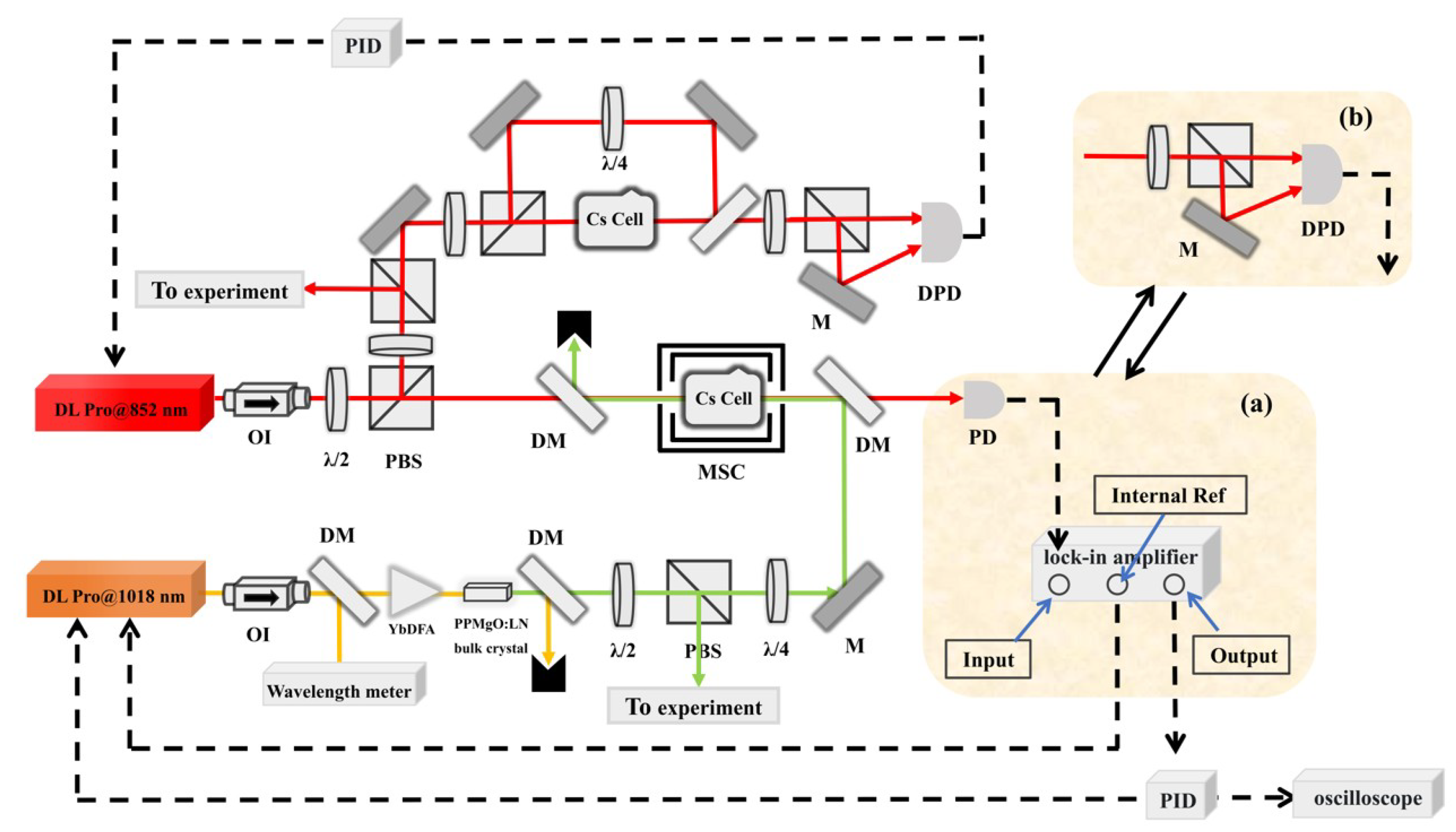
Figure 2 shows the experimental setup, in which the 852-nm probe laser radiation is emitted by the TOPICA DL Pro laser system. After optical isolation, the beam passes through an optical assembly consisting of a half-wave plate and a polarization beam splitter cube. One beam is used for polarization spectroscopy to lock the laser frequency, while the other serves as the probe beam for Rydberg–EIT or Rydberg–TCPS. The coupling laser radiation is emitted by the 1018-nm TOPICA DL Pro laser system, amplified by an ytterbium-doped fiber amplifier (YbDFA), and then undergoes single-pass second harmonic generation (SHG) through a periodically-poled magnesium oxide-doped lithium niobate crystal (PPMgO:LN). This process converts the 1018-nm IR laser into a 509-nm green laser, which is then split using another half-wave plate and polarization beam splitter cube set: one sub-beam acts as the coupling beam to produce Rydberg–EIT or Rydberg–TCPS signals, and the other is used for supporting experiments. Figure 2a shows the frequency-locking setup for the frequency-modulated Rydberg–EIT scheme. The signal from the photodetector is sent to a lock-in amplifier, which modulates the laser with an internal modulation signal. Phase-sensitive detection is carried out to obtain the frequency discrimination signal needed to lock the 509-nm laser frequency. Figure 2b shows the Rydberg–TCPS frequency-locking setup; unlike that in Figure 2a, this method does not require laser frequency modulation, so a lock-in amplifier is not needed anymore. In addition, the photodetector is replaced with a differential photodetector (DPD), making this setup simpler and cheaper than that in Figure 2a.
In Rydberg–TCPS scheme, Cs atoms around room temperature in the vapor cell follow a Maxwell–Boltzmann distribution and are evenly spread across the different Zeeman sublevels of the ground state 6 S 1 / 2 ( F = 3 , 4 ). The combined use of an 852-nm linearly polarized beam and a 509-nm circularly polarized beam first excites the atoms to the excited state 6 P 3 / 2 ( F = 5 , m F = 5 , 4 , , 4 , 5 ) and then to the 52 S 1 / 2 Rydberg state. Because the 509-nm beam is circularly polarized and atomic transition selection rules limit the excitation process, atoms in the 6 P 3 / 2 state ( F = 5 , m F = 4 , 5 ) cannot be excited to the Rydberg state, creating an uneven atom distribution across the Zeeman sublevels, turning the cesium vapor into an anisotropic medium. The linearly polarized 852-nm probe beam can be split into left- and right-handed circularly polarized parts, which, when traveling through the anisotropic medium, have different refractive indices and absorption coefficients. The resulting polarization-dependent signal is then detected by the DPD and turned into a polarization-sensitive spectral signal. In addition, external magnetic fields can affect the polarization spectroscopy signal. Therefore, in our experimental setup, we have equipped a magnetic shielding cylinder to suppress external magnetic field interference.

2.3. Frequency-Locking System Experimental Setup Based on Red Pitaya FPGA Module

The Red Pitaya relies on a Zynq system-on-chip (SoC) as its core processing module. High-speed analog-to-digital and digital-to-analog converters (ADC and DAC), communication interfaces, and FPGA functions are all integrated into a single unit, which uses software to run professional instruments, such as oscilloscopes, spectrum analyzers, and signal generators. It also supports connecting external devices via expansion interfaces, helping to build customized measurement and control systems [28,29,30,31]. The Red Pitaya model used in our experiment is STEMlab 125-14, with a sampling rate of 125 Msps and a resolution of 14 bits.
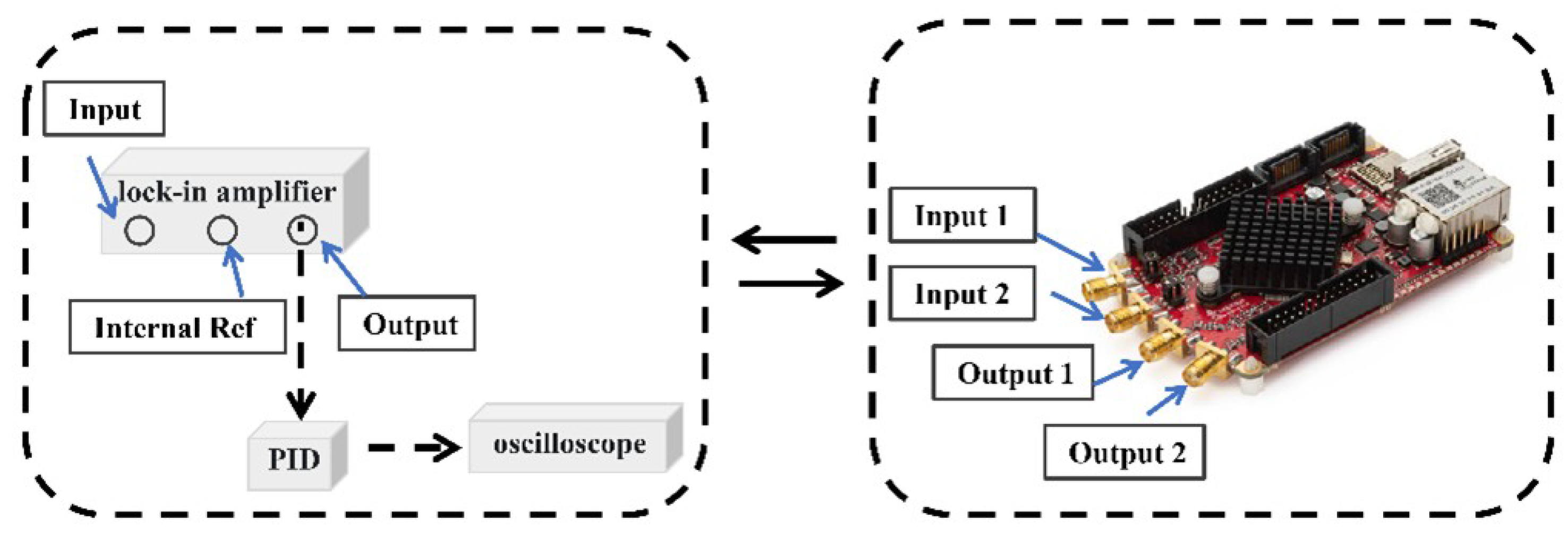
Figure 3 illustrates the Red Pitaya module replacing the discrete instruments combination. Its frequency-locking function relies on the open-source PyRPL library, which integrates four core modules: IQ (replacing the lock-in amplifier for modulation and demodulation), Scope (replacing the oscilloscope for real-time signal visualization), PID (replacing the dedicated PID controller for closed-loop feedback), and ASG (replacing the function generator for programmable waveforms). These modules enable one-click configuration of key parameters like modulation amplitude and PID gain. For the frequency-modulated Rydberg–EIT setup in Figure 2a, the Red Pitaya module uses its IQ, PID, and Scope modules to replace the lock-in amplifier, PID controller, and oscilloscope, respectively, completing signal modulation, feedback control, and detection. For the modulation-free Rydberg–TCPS setup in Figure 2b, only the PID and Scope modules are required to replace the corresponding discrete instruments. The FPGA-based architecture makes the entire experimental system low-cost and compact.

3. Experimental Results and Analysis

3.1. Frequency-Locking 852 nm Laser Based on Polarization Spectroscopy

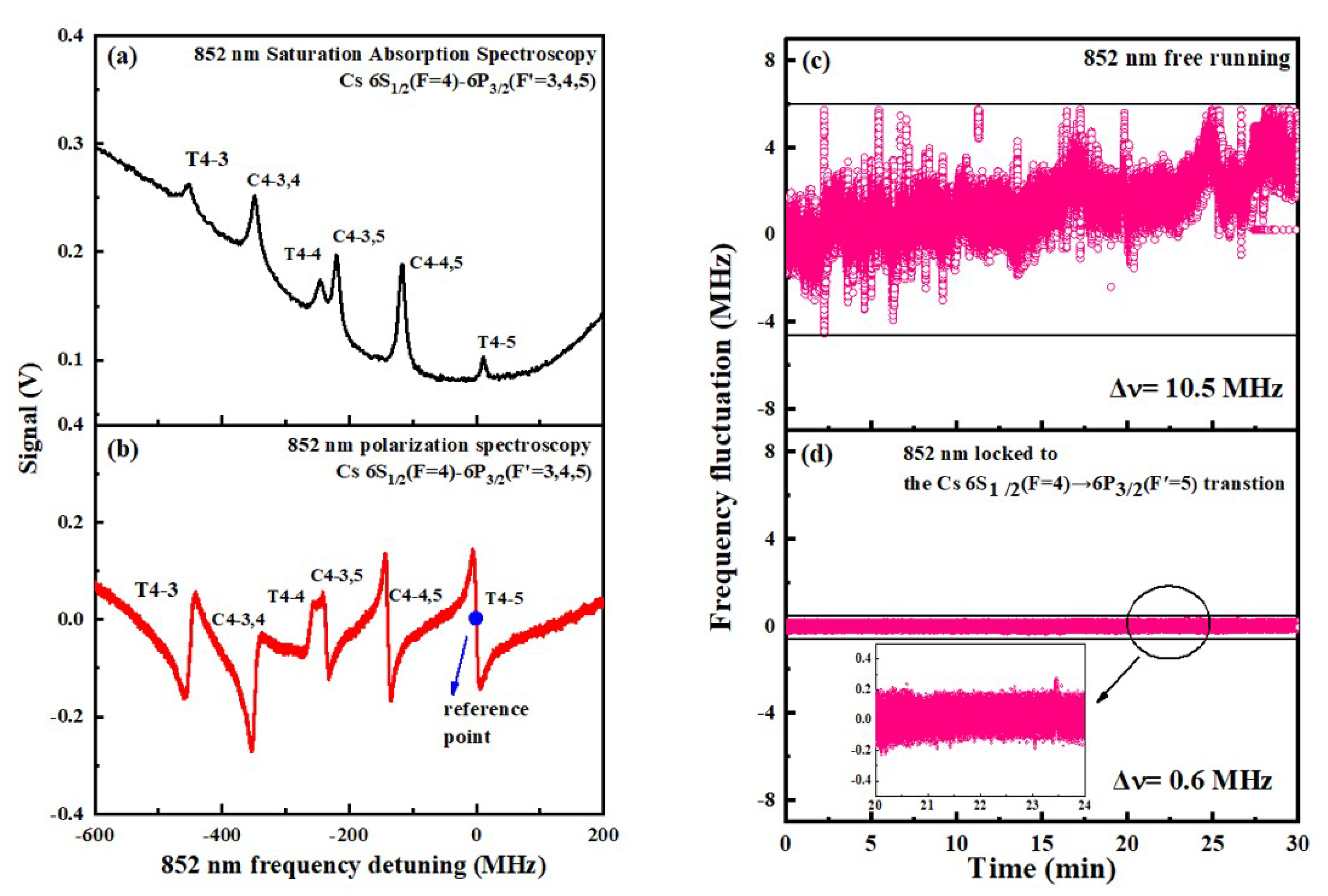
We lock the 509-nm laser’s frequency based on a ladder-type three-level system of Rydberg states ( 6 S 1 / 2 6 P 3 / 2 52 S 1 / 2 ). The 509-nm laser beam drives the 6 P 3 / 2 52 S 1 / 2 transition, while the 852-nm laser beam acts as the probe beam for the 6 S 1 / 2 6 P 3 / 2 transition. Together, they generate Rydberg–EIT or Rydberg–TCPS signals, so locking the 509-nm laser frequency requires locking the 852-nm laser frequency to the atomic transition first. As shown in Figure 4b, the 852-nm laser frequency is locked to 6 S 1 / 2 ( F = 4 ) 6 P 3 / 2 ( F = 5 ) transition, and a digital multimeter is then used to record the frequency fluctuations during free running and after locking over 30 min, with the results shown in Figure 4c,d. The frequency fluctuation during free running is ∼10.5 MHz, while the residual frequency fluctuation after locking is ∼0.6 MHz, representing a nearly 20 times frequency fluctuation suppression. Polarization spectroscopy is affected by environmental temperature and humidity. However, the frequency fluctuation measurement lasts for 30 min, during which there will be no significant changes in environmental temperature and humidity.

3.2. Frequency-Locking 509 nm Laser Based on Discrete Instruments Combination

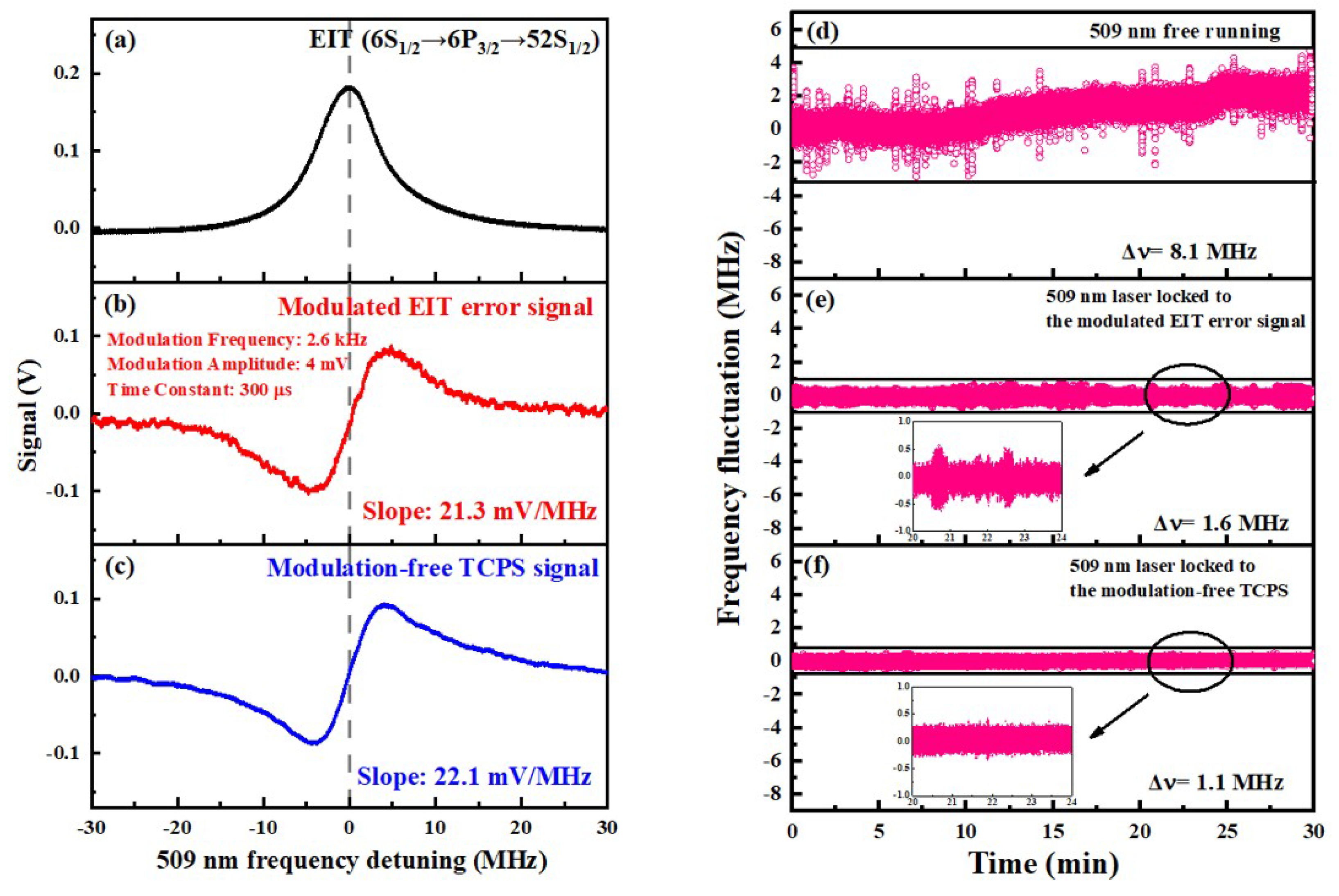
After locking the laser frequency at 852-nm, the 509-nm frequency was scanned across the 6 P 3 / 2 52 S 1 / 2 transition to obtain the Rydberg–EIT and Rydberg–TCPS spectra, as shown in Figure 5a,c. In the experiment, we employed two schemes to lock the laser frequency, frequency-modulated Rydberg–EIT and modulation-free Rydberg–TCPS. For the former, we applied frequency-modulation to the laser and leveraged the Rydberg–EIT window’s narrow linewidth feature. We then generated an error signal via a lock-in amplifier and compensated for laser frequency drift through feedback control, thus achieving stable locking of the laser frequency to the atomic transition. The residual frequency fluctuation after locking is shown in Figure 5e,f. The laser exhibited a frequency fluctuation of ∼8.1 MHz under free-running condition. Using the frequency-modulated Rydberg–EIT error signal for frequency locking, the residual frequency fluctuation was reduced to ∼1.6 MHz. In contrast, the modulation-free Rydberg–TCPS scheme resulted in a lower residual frequency fluctuation of ∼1.1 MHz. These results indicate that the modulation-free Rydberg–TCPS outperforms the frequency-modulated Rydberg–EIT in frequency-locking performance, and the underlying reasons are analyzed below.
Additional noise introduced by frequency modulation, linewidth broadening, and residual intensity modulation disturbances directly contributes to demodulation voltage noise. Noise arises from random perturbations of modulation parameters, along with inherent fluctuations in modulation amplitude δ ω and modulation frequency Ω m , coupling into the demodulation voltage:
δ V noise , mod ( t ) d χ d Δ c Δ c 0 + κ · d χ d Δ c Δ c 0 · δ ω n ( t ) + δ ω · d ϕ d Ω m Ω m , n ( t ) ,
where δ ω n ( t ) is random noise in modulation amplitude, Ω m , n ( t ) is random noise in modulation frequency, ϕ is the phase difference between the modulation signal and the lock-in amplifier reference signal, d ϕ d Ω m denotes the phase difference’s sensitivity to modulation frequency, and κ is the proportional coefficient relating the absorption term’s contribution (consistent with the coefficient B / A in Equation (9), reflecting the weight of absorption-induced fluctuations in the demodulation voltage).
The fluctuation in modulation parameters directly causes random variations in the demodulation voltage, serving as a primary source of additional noise. Furthermore, frequency modulation broadens both the laser linewidth and Rydberg–EIT linewidth.

3.3. Frequency-Locking 509 nm Laser Based on Red Pitaya FPGA Module

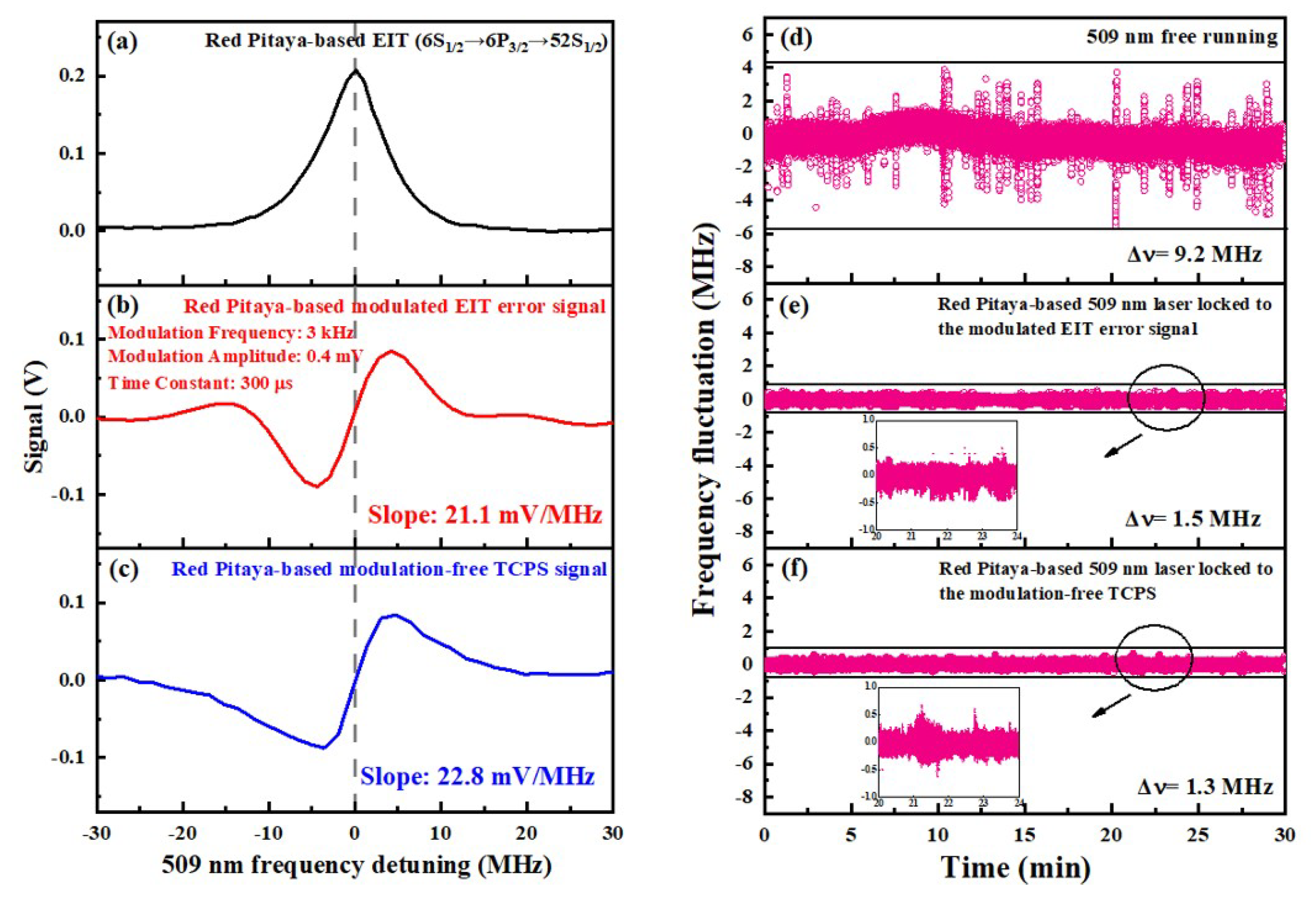
In frequency-locking experiments based on Rydberg–EIT and Rydberg–TCPS, conventional schemes rely on discrete instruments combination including function generators, lock-in amplifiers, and PID controllers. Such discrete architectures suffer from additional electromagnetic interference introduced by wiring between multiple instruments; meanwhile, the entire set of instruments is bulky and costly. The Red Pitaya FPGA module can replace the above conventional discrete instruments combination, acting as an efficient solution for laser frequency locking. With FPGA as its core unit, the module integrates multiple functions into one, including modulation signal generation, frequency discrimination signal digital demodulation, PID feedback control, and data analysis. In the experiment, we compared the frequency-locking performance of the Red Pitaya module and conventional discrete instruments combination for the 509-nm laser. The results are shown in Figure 6, which displays the signals collected by the Scope module of the Red Pitaya. The frequency-modulated Rydberg–EIT error signal was obtained via modulation and demodulation with the IQ module, followed by feedback with the PID module. We measured the locking performance of the two schemes for 30 min using a digital multimeter; the residual frequency fluctuation was ∼1.5 MHz with frequency-modulated Rydberg–EIT locking and ∼1.3 MHz with modulation-free Rydberg–TCPS locking. By comparing the frequency-locking performance of the conventional discrete instruments combination and Red Pitaya FPGA module, we find that the latter has a relatively weak anti-interference ability. However, the residual frequency fluctuation statistical distributions for the two setups are basically consistent, which meets the requirements of Rydberg-related experiments. The main advantages of the Red Pitaya FPGA module lie in its high integration and low cost.

4. Discussion

This study focuses on the frequency stabilization of the 509-nm laser using cesium Rydberg transitions, with results outperforming existing research in technical performance and system integration. Regarding frequency-locking schemes, Jiao et al. [16] verified Rydberg–EIT-based locking but relied on frequency modulation. In contrast, our proposed modulation-free Rydberg–TCPS avoids modulation-induced noise and linewidth broadening, achieving a residual frequency fluctuation of ∼1.1 MHz with discrete instruments combination. This extends modulation-free polarization spectroscopy [6], originally for atomic ground state transitions, to the intermediate state to Rydberg state ( 6 P 3 / 2 52 S 1 / 2 ) transition, filling the gap in modulation-free stabilization for short-wavelength Rydberg excitation lasers (400–600 nm). For system integration, traditional frequency-locking setups depend on bulky, costly discrete instruments (∼CNY 40,000). Our Red Pitaya FPGA module (∼CNY 3500) integrates modulation, demodulation and PID control reducing cost to 1/10 of discrete instruments combination while maintaining comparable stability (∼1.3 MHz residual fluctuation for Rydberg–TCPS versus ∼1.1 MHz with discrete instruments combination), resolving the long standing performance-size-cost trade-off in Rydberg laser stabilization.
Notably, the combined Rydberg–TCPS and Red Pitaya FPGA module provides a cost-effective, compact solution for 509-nm laser stabilization, which is crucial for Rydberg–based quantum computing [1] and microwave electric field detection [2,3].

5. Conclusions

A 509-nm single-frequency laser, the core laser source, combined with an 852-nm single-frequency laser for driving the two-step cesium Rydberg transitions, directly dictates precise quantum manipulation and precision measurement with cesium Rydberg atoms. In this paper, we compared modulation-free Rydberg–TCPS and frequency-modulated Rydberg–EIT schemes frequency-locking performance for a 509-nm laser using conventional discrete instruments and the Red Pitaya FPGA module. The results shown that the modulation-free Rydberg–TCPS avoids extra noise and linewidth broadening, thus outperforming the frequency-modulated Rydberg–EIT scheme in frequency stabilization. The Red Pitaya FPGA module (STEMlab 125-14, ∼CNY 3500) achieves high integration and drastically reduced cost, and maintains precision comparable to the conventional discrete instruments combination (∼CNY 40,000), fully meeting the cesium Rydberg atoms experimental demands. Combining the Red Pitaya FPGA module and Rydberg–TCPS scheme resolves both the frequency-modulated Rydberg–EIT’s frequency disturbance and the high cost and complexity of traditional schemes, forming a cost-effective compact frequency stabilization solution that lowers the threshold for cesium Rydberg atoms applications in quantum computing and precision measurement.

Author Contributions

Conceptualization, J.W.; methodology, J.W. and R.C.; validation, R.C. and T.W.; investigation, R.C., T.W., Y.W. (Yuewei Wang), Y.W. (Yirong Wei), Y.Y. (Yuhui Yang), R.S., Y.Y. (Yuzhi Yan), Z.W. and J.H.; data curation, R.C.; writing—original draft preparation, R.C.; writing—review and editing, J.W.; supervision, J.W.; project administration, J.W.; funding acquisition, J.W. All authors have read and agreed to the published version of the manuscript.

Funding

This work is supported by the National Key Research and Development Program of China (2021YFA1402002), the National Natural Science Foundation of China (12474483), and the Fundamental Research Program of Shanxi Province of China (202403021211013).

Data Availability Statement

The original contributions presented in this study are included in the article. Further inquiries can be directed to the corresponding author.

Conflicts of Interest

The authors declare no conflicts of interest.

References

  1. Picken, C.J.; Legaie, R.; McDonnell, K.; Pritchard, J.D. Entanglement of neutral-atom qubits with long ground-Rydberg coherence times. Quantum Sci. Technol. 2018, 4, 015011. [Google Scholar] [CrossRef]
  2. Sedlacek, J.A.; Schwettmann, A.; Kübler, H.; Löw, R.; Pfau, T.; Shaffer, J.P. Microwave electrometry with Rydberg atoms in a vapour cell using bright atomic resonances. Nat. Phys. 2012, 8, 819–824. [Google Scholar] [CrossRef]
  3. Zhang, L.H.; Liu, Z.K.; Liu, B.; Zhang, Z.Y.; Guo, G.C.; Ding, D.S.; Shi, B.S. Rydberg microwave-frequency-comb spectrometer. Phys. Rev. Appl. 2022, 18, 014033. [Google Scholar] [CrossRef]
  4. Saßmannshausen, H.; Merkt, F.; Deiglmayr, J. High-resolution spectroscopy of Rydberg states in an ultracold cesium gas. Phys. Rev. A 2013, 87, 032519. [Google Scholar] [CrossRef]
  5. Wieman, C.E.; Hollberg, L. Using diode lasers for atomic physics. Rev. Sci. Instrum. 1991, 62, 1–20. [Google Scholar] [CrossRef]
  6. Wieman, C.; Hänsch, T.W. Doppler-free laser polarization spectroscopy. Phys. Rev. Lett. 1976, 36, 1170–1173. [Google Scholar] [CrossRef]
  7. Pearman, C.P.; Adams, C.S.; Cox, S.G.; Griffin, P.F.; Smith, D.A.; Hughes, I.G. Polarization spectroscopy of a closed atomic transition: Applications to laser frequency locking. J. Phys. B At. Mol. Opt. Phys. 2002, 35, 5141–5150. [Google Scholar] [CrossRef]
  8. Noh, H.R.; Park, S.E.; Li, L.Z.; Park, J.D.; Cho, C.H. Modulation transfer spectroscopy for 87Rb atoms: Theory and experiment. Opt. Express 2011, 19, 23444–23452. [Google Scholar] [CrossRef]
  9. Boller, K.J.; Imamoğlu, A.; Harris, S.E. Observation of electromagnetically induced transparency. Phys. Rev. Lett. 1991, 66, 2593–2596. [Google Scholar] [CrossRef]
  10. Kash, M.M.; Sautenkov, V.A.; Zibrov, A.S.; Hollnerg, L.; Welch, G.R.; Luckin, M.D.; Rostovtsev, Y.; Fry, E.S.; Scully, M.O. Ultraslow group velocity and enhanced nonlinear optical effects in a coherently driven hot atomic gas. Phys. Rev. Lett. 1999, 82, 5229–5232. [Google Scholar] [CrossRef]
  11. Schmidt, O.; Wynands, R.; Hussein, Z.; Meschede, D. Steep dispersion and group velocity below c/3000 in coherent population trapping. Phys. Rev. A 1996, 53, R27–R30. [Google Scholar] [CrossRef] [PubMed]
  12. Gea-Banacloche, J.; Li, Y.; Jin, S.; Xiao, M. Electromagnetically induced transparency in ladder-type inhomogeneously broadened media: Theory and experiment. Phys. Rev. A 1995, 51, 576–584. [Google Scholar] [CrossRef] [PubMed]
  13. Mohapatra, A.K.; Jackson, T.R.; Adams, C.S. Coherent optical detection of highly excited Rydberg states using electromagnetically induced transparency. Phys. Rev. Lett. 2007, 98, 113003. [Google Scholar] [CrossRef] [PubMed]
  14. Moon, H.S.; Lee, L.; Kim, K.; Kim, J.B. Laser frequency stabilizations using electromagnetically induced transparency. Appl. Phys. Lett. 2004, 84, 3001–3003. [Google Scholar] [CrossRef]
  15. Abel, R.P.; Mohapatra, A.K.; Bason, M.G.; Pritchard, J.D.; Weatherill, K.J.; Raitzsch, U.; Adams, C.S. Laser frequency stabilization to excited state transitions using electromagnetically induced transparency in a cascade system. Appl. Phys. Lett. 2009, 94, 071107. [Google Scholar] [CrossRef]
  16. Jiao, Y.C.; Li, J.K.; Wang, L.M.; Zhang, H.; Zhang, L.J.; Zhao, J.M.; Jia, S.T. Laser frequency locking based on Rydberg electromagnetically induced transparency. Chin. Phys. B 2016, 25, 053201. [Google Scholar] [CrossRef]
  17. Bao, S.X.; Zhang, H.; Zhou, J.; Zhang, L.J.; Zhao, J.M.; Xiao, L.T.; Jia, S.T. Tunable frequency stabilization to Zeeman sublevel transitions between an intermediate state and Rydberg states. Laser Phys. 2017, 27, 015701. [Google Scholar] [CrossRef]
  18. Niu, Q.Q.; Su, N.; Liu, Y.; Ban, X.J.; He, J.; Wang, J.M. Rydberg atomic two-color polarization spectroscopy laser frequency stabilization. J. Quantum Opt. 2023, 29, 031001. (In Chinese) [Google Scholar]
  19. Chang, R.; Wang, T.; Yang, Y.; Hao, L.; He, J.; Wang, J. Effect of the coupling beam with different intensity profile upon Rydberg EIT and Rydberg two-color polarization spectroscopy with Cesium ladder-type level. Adv. Quantum Technol. 2025, 8, 2400469. [Google Scholar] [CrossRef]
  20. Tong, D.; Farooqi, S.M.; Stanojevic, J.; Krishnan, S.; Zhang, Y.P.; Côté, R.; Eyler, E.E.; Gould, P.L. Local blockade of Rydberg excitation in an ultracold gas. Phys. Rev. Lett. 2004, 93, 063001. [Google Scholar] [CrossRef]
  21. Vogt, T.; Viteau, M.; Zhao, J.; Chotia, A.; Comparat, D.; Pillet, P. Dipole blockade at Förster resonances in high resolution laser excitation of Rydberg states of cesium atoms. Phys. Rev. Lett. 2006, 97, 083003. [Google Scholar] [CrossRef] [PubMed]
  22. Isenhower, L.; Urban, E.; Zhang, X.L.; Gill, A.T.; Henage, T.; Johnson, T.A.; Walker, T.G.; Saffman, M. Demonstration of a neutral atom controlled-NOT quantum gate. Phys. Rev. Lett. 2010, 104, 010503. [Google Scholar] [CrossRef]
  23. Dudin, Y.O.; Kuzmich, A. Strongly interacting Rydberg excitations of a cold atomic gas. Science 2012, 336, 887–889. [Google Scholar] [CrossRef]
  24. Peyronel, T.; Firstenberg, O.; Liang, Q.Y.; Hofferberth, S.; Gorshkov, A.V.; Pohl, T.; Lukin, M.D.; Vuletić, V. Quantum nonlinear optics with single photons enabled by strongly interacting atoms. Nature 2012, 488, 57–60. [Google Scholar] [CrossRef] [PubMed]
  25. Vylegzhanin, A.; Nic Chormaic, S.; Brown, D.J. Rydberg electromagnetically induced transparency based laser lock to Zeeman sublevels with 0.6 GHz scanning range. Rev. Sci. Instrum. 2024, 95, 113001. [Google Scholar] [CrossRef] [PubMed]
  26. Wang, Y.X.; Zhang, Q.Y.; Liu, Y.Q.; Zhang, J.N.; Jia, F.D.; Zhong, Z.P. Continuous tunability of Rydberg laser frequency after stabilization via the Zeeman effect by DC and AC magnetic fields. Rev. Sci. Instrum. 2025, 96, 043005. [Google Scholar] [CrossRef]
  27. Jia, F.D.; Zhang, J.; Zhang, L.; Wang, F.; Mei, J.; Yu, Y.H.; Zhong, Z.P.; Xie, F. Frequency stabilization method for transition to a Rydberg state using Zeeman modulation. Appl. Opt. 2020, 59, 2108–2113. [Google Scholar] [CrossRef]
  28. Su, W.J.; Wei, Y.R.; Hou, X.K.; Wang, Y.W.; He, J.; Wang, J.M. Application of FPGA in frequency locking of 319-nm ultraviolet single-frequency laser system. J. Quantum Opt. 2025, 31, 011001. (In Chinese) [Google Scholar]
  29. Preuschoff, T.; Schlosser, M.; Birkl, G. Digital laser frequency and intensity stabilization based on the STEMlab platform (originally Red Pitaya). Rev. Sci. Instrum. 2020, 91, 083107. [Google Scholar] [CrossRef]
  30. Wiegand, B.; Leykauf, B.; Jördens, R.; Krutzik, M. Linien: A versatile, user-friendly, open-source FPGA-based tool for frequency stabilization and spectroscopy parameter optimization. Rev. Sci. Instrum. 2022, 93, 063109. [Google Scholar] [CrossRef]
  31. Zhang, P.; Wang, C.X.; Song, L.J.; Hu, Y.D.; Li, G.; Zhang, P.F.; Zhang, T.C. Frequency stabilization system of semiconductor laser based on FPGA. J. Quantum Opt. 2024, 30, 011001. (In Chinese) [Google Scholar]
Figure 1. Schematic diagram of the relevant energy level and transitions in the Rydberg ladder-type three-level system ( 6 S 1 / 2 6 P 3 / 2 52 S 1 / 2 ). The 852-nm probe laser is locked to the 6 S 1 / 2 ( F = 4 ) 6 P 3 / 2 ( F = 5 ) transition in Cs D 2 line, while the 509-nm coupling laser scans across the 6 P 3 / 2 ( F = 5 ) 52 S 1 / 2 transition. Rydberg states are commonly represented in the uncoupled representation because the electronic orbital radius is extremely large, leading to very weak interaction between the electron and the atomic core, and the influence of nuclear spin on electron motion is significantly weakened. However, the coupled representation is more convenient for describing the quantum state evolution from low-lying excited states to Rydberg states, so the coupled representation is adopted here for labeling as in ref. [27].
Photonics 13 00180 g001
Figure 2. Experimental setup of Rydberg–EIT and Rydberg–TCPS. (a) Lock-in amplifier-based key device for frequency-modulated Rydberg–EIT frequency locking. The frequency-modulated EIT signal collected by the photodetector (PD) is transmitted to the lock-in amplifier. After internal demodulation, the frequency discrimination curve is obtained and sent to the proportional–integral–derivative (PID) controller, which finally provides feedback to the laser for frequency stabilization. (b) Differential photodetector (DPD)-based key device for modulation-free Rydberg–TCPS frequency locking. The 852-nm probe laser beam propagates through the anisotropic medium (Cs vapor cell). Due to the distinct refractive indices and absorption coefficients for different polarization components, the probe laser beam is detected by the DPD and converted into a polarization-dependent spectral signal. This signal is then sent to the PID controller for feedback to stabilize the laser frequency. YbDFA = ytterbium-doped fiber amplifier; OI = optical isolator; PBS = polarization beam splitter cube; DM = dichroic mirror; λ / 2 = half-wave plate; λ / 4 = quarter-wave plate; PD = photodetector; DPD = differential photodetector; MSC = magnetic shielding cylinder.
Photonics 13 00180 g002
Figure 3. Frequency-locking device based on the Red Pitaya FPGA module. The integrated Red Pitaya system (∼CNY 3500) replaces the discrete instruments combination in the frequency-locking section of Figure 2: the IQ module (modulation and demodulation) replaces the model SRS company SR-830 lock-in amplifier (∼CNY 35,000); the PID module in Red Pitaya replaces the SIM960 PID controller (∼CNY 14,000).
Photonics 13 00180 g003
Figure 4. Frequency locking an 852 nm laser to the 6 S 1 / 2 ( F = 4 ) 6 P 3 / 2 ( F = 5 ) transition via polarization spectroscopy. (a) Saturated absorption spectroscopy of the Cs atomic 6 S 1 / 2 ( F = 4 ) 6 P 3 / 2 ( F = 3 , 4 , 5 ) transitions, which is used for calibrating polarization spectroscopy. T denotes the hyperfine transitions, and C denotes the crossovers. (b) Polarization spectroscopy of the Cs atomic 6 S 1 / 2 ( F = 4 ) 6 P 3 / 2 ( F = 3 , 4 , 5 ) transition. (c) The free-running 852-nm laser exhibits a frequency fluctuation of ∼10.5 MHz. (d) The residual fluctuation is ∼0.6 MHz after locking to the 6 S 1 / 2 ( F = 4 ) 6 P 3 / 2 ( F = 5 ) transition.
Photonics 13 00180 g004
Figure 5. Spectra of the cesium atomic Rydberg ladder-type three-level system ( 6 S 1 / 2 6 P 3 / 2 52 S 1 / 2 ) measured with conventional discrete instrument combination. (a) Rydberg–EIT spectroscopy. (b) The error signal obtained by modulating and demodulating Rydberg–EIT signal via a lock-in amplifier. (c) Modulation-free Rydberg–TCPS signal. (d) The frequency fluctuation of the 509-nm laser under free-running case is 8.1 MHz. (e) The residual frequency fluctuation of the 509-nm laser after frequency locking using the modulated EIT error signal is ∼1.6 MHz. (f) The residual frequency fluctuation of the 509-nm laser after frequency locking using the modulation-free Rydberg–TCPS is ∼1.1 MHz. We can optimize the signal-to-noise ratio and error signal slope by adjusting the lock-in amplifier’s modulation frequency, amplitude, and time constant. Optimal performance depends on matching between these parameters.
Photonics 13 00180 g005
Figure 6. Spectra of the cesium atomic Rydberg ladder-type three-level system ( 6 S 1 / 2 6 P 3 / 2 52 S 1 / 2 ) measured with the Red Pitaya FPGA module. (a) Rydberg–EIT spectroscopy. (b) The error signal obtained by modulating and demodulating the Rydberg–EIT signal via the Red Pitaya IQ module. (c) The Red Pitaya FPGA-based modulation-free Rydberg–TCPS signal. (d) The frequency fluctuation of the 509 nm laser under free running case is ∼9.2 MHz. (e) The residual frequency fluctuation of the 509-nm laser after frequency locking using the modulated Rydberg–EIT error signal is ∼1.5 MHz. (f) The residual frequency fluctuation of the 509-nm laser after frequency locking using the modulation-free Rydberg–TCPS signal is ∼1.3 MHz.
Photonics 13 00180 g006
Disclaimer/Publisher’s Note: The statements, opinions and data contained in all publications are solely those of the individual author(s) and contributor(s) and not of MDPI and/or the editor(s). MDPI and/or the editor(s) disclaim responsibility for any injury to people or property resulting from any ideas, methods, instructions or products referred to in the content.