Article

A Wide-Angle and Polarization-Insensitive Graphene-Based Optically Transparent Terahertz Metasurface Absorber for Biosensing Applications


1
Institute of Environment and Health, South China Hospital, Medical School, Shenzhen University, Shenzhen 518116, China
2
School of Biomedical Engineering, Medical School, Shenzhen University, Shenzhen 518061, China
3
Marshall Laboratory of Biomedical Engineering, Shenzhen University, Shenzhen 518061, China
4
The State Key Laboratory of Radio Frequency Heterogeneous Integration, Shenzhen University, Shenzhen 518060, China
*
Author to whom correspondence should be addressed.
Photonics 2026, 13(2), 181; https://doi.org/10.3390/photonics13020181
Submission received: 9 January 2026 / Revised: 10 February 2026 / Accepted: 10 February 2026 / Published: 11 February 2026
(This article belongs to the Section Optoelectronics and Optical Materials)

Abstract

Terahertz (THz)-based metasurface biosensors have garnered considerable interest owing to their strong electromagnetic (EM) resonance-based sensing methods. Nonetheless, the majority of published designs exhibit constrained optical transparency and angular sensitivity, hence limiting their integration with optoelectronic systems and reducing sensing reliability at oblique angles. This study introduces a graphene-based optically transparent terahertz metasurface that demonstrates wide-angle stability for biosensing applications to address these challenges. The proposed metasurface utilizes a patterned graphene resonator integrated with an optically transparent silicon dioxide (SiO2) dielectric substrate and a conductive indium–tin–oxide (ITO) ground configuration, enabling efficient THz absorption at the resonant frequency while maintaining optical transparency. Due to its structural symmetry, the suggested structure exhibits polarization insensitivity and angular stability up to 60° for both transverse electric (TE) and transverse magnetic (TM) modes. Furthermore, the comprehensive operating mechanism is explained by impedance matching theory, surface current distribution, and analysis of electric field distributions. A thorough numerical analysis of the proposed metasurface was conducted by incorporating analytes with varying refractive indices using CST Microwave Studio, demonstrating its effective sensing capabilities, with a sensitivity of 0.69 THz/RIU and a quality factor of 24.67. A comparative examination with existing designs reveals that the proposed device, due to its optical transparency, angular stability, and high sensitivity, demonstrates significant potential for terahertz biosensing applications.

1. Introduction

Biosensors are essential in modern healthcare and medical diagnostics, facilitating rapid, precise, and noninvasive identification of biological analytes such as proteins, cells, and infections [1,2]. Additionally they are essential for early disease diagnosis, monitoring physiological conditions, and guiding medication interventions, therefore enhancing health outcomes [3,4]. Conventional biosensing methods include multiple techniques such as optical and electrochemical sensors [5]. Nevertheless, each of these approaches has particular limitations; for instance, optical biosensors, including surface plasmon resonance (SPR) and fluorescence-based sensors, provide high sensitivity and label-free detection but frequently necessitate intricate instrumentation, difficult configurations, and labeling processes that might affect the biological sample [6,7,8,9]. On the other hand, electrochemical biosensors identify analytes by measuring alterations in current, voltage, or impedance, offering compact and inexpensive solutions; however, they often exhibit sensitivity to external variables [10,11]. These limitations highlight the necessity for biosensing systems that are label-free, highly sensitive, robust under diverse environments, and appropriate for real-time or point-of-care applications [12,13].
The terahertz (THz) spectrum, which spans the spectral window from 0.1 to 10 THz, has emerged as an attractive platform for biosensing due to its non-ionizing nature, label-free functioning, and high sensitivity to biological matter’s dielectric characteristics [14,15,16]. The interaction of THz waves with biomolecular vibrational and rotational modes facilitates the identification of minor pathogenic changes in tissues, cells, and biomolecules, prompting significant investigation into THz-based biosensing for cancer diagnostics and biomedical analysis [17,18]. Numerous techniques, including frequency domain imaging, thermal imaging, optical coherence tomography (OCT), radio immunoassays (RIA), magnetic resonance imaging (MRI), computed tomography (CT), sonography, and Near Infrared Fluorescence Imaging (NIRF), have been effectively utilized; however, each method possesses distinct limitations [19,20,21,22]. For example, CT involves ionizing radiation, while MRI, sonography, OCT, and NIRF are constrained by inadequate spatial resolution or low detection sensitivity, and RIA necessitates sampling or biopsy. To address the aforementioned limitations, researchers have recently investigated metasurface-based sensors in the THz regime due to their unprecedented control over EM wave propagation and their support for highly confined resonant modes [23,24,25]. These resonances enhance interactions within subwavelength dimensions; thus, minor alterations in the refractive index of the surrounding analyte result in detectable changes in the resonance frequency or absorption amplitude [26,27]. Consequently, THz metasurface absorbers have been extensively studied for refractive index sensing, label-free biosensing, and early disease detection [28,29,30]. Yet, numerous high-sensitivity devices depend on metallic resonators or opaque ground planes, which naturally limit their integration with optoelectronic systems [31,32,33]. In addition to optical transparency, angular instability remains a persistent challenge for practical THz biosensing as well. Therefore, integrating the characteristics of optical transparency, high-sensitivity, and angular stability within a single biosensor remains a challenge.
Herein, the presented work aims to design a graphene-based optically transparent THz metasurface that overcomes the limitations of conventional THz biosensors, including angular sensitivity, polarization dependence, and limited transparency. The proposed design employs a graphene resonant surface to attain strong resonance and efficient THz absorption, enabling improved sensitivity. Through comprehensive numerical simulations, the working mechanism is demonstrated. Furthermore, the structure’s ability to discriminate between analytes with different refractive indices, including healthy and deseased samples, is demonstrated, establishing its potential for use in practical biomedical applications.

2. Structural Design and Modeling

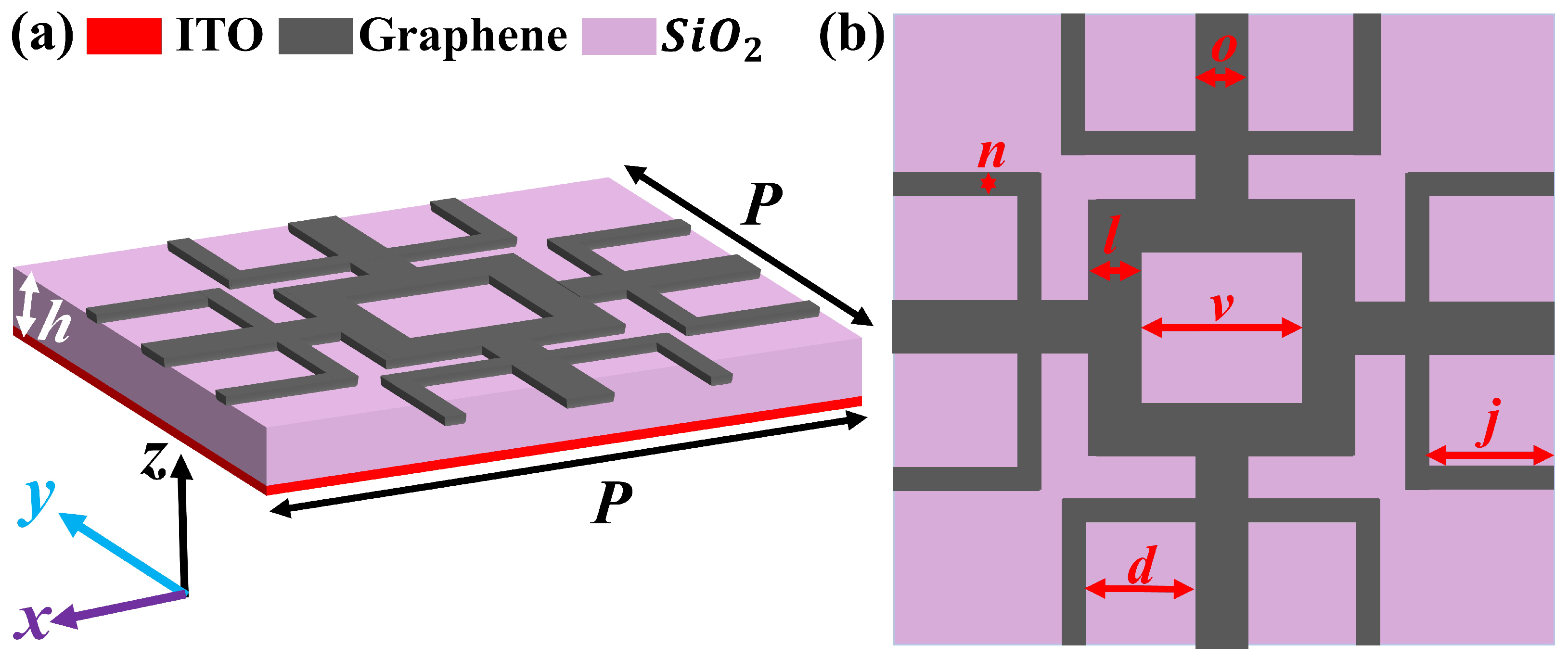
Efficient EM absorption is crucial in metasurface-based biosensing, as it facilitates the high field confinement necessary for detecting minor alterations in the dielectric characteristics of biological samples. Therefore, this study presents a graphene-based metasurface perfect absorber designed to attain near-unity absorption and improved biosensing efficiency. The proposed biosensor employs a metal-free configuration, a well-established approach in optically transparent metasurface. The layout of the proposed structure is illustrated in Figure 1. This structure consists of graphene resonators positioned over a transparent SiO2 dielectric layer, with a continuous ITO ground plane on the back side. The ITO ground, modeled with a thickness of 1 μm and sheet resistance of 1 Ω/sq, ensures zero transmission. The surface conductivity of the graphene layer is calculated using the Kubo formula, which characterizes conductivity by analyzing the electronic band structure and Fermi energy ( E f ) of the graphene layer, particularly in the THz frequency range, thereby enabling the design of the proposed absorber with optimized absorptive and reflective properties [34]. The conductivity of graphene is calculated by considering both intra-band and inter-band contributions as follows: [35]
σ = σ intra + σ inter ,
where the intra-band conductivity is given by
σ intra = 2 k B T e 2 π 2 ln 2 cosh E f 2 k B T j ω j τ 1 ,
and the inter-band conductivity is expressed as
σ inter = e 2 4 H ω 2 j 4 ω π 0 H ( Ω ) H ω 2 ω 2 4 Ω 2 d Ω ,
where
H ( Ω ) = sinh Ω k B T cosh Ω k B T + cosh E f k B T .
Here, k B represents the Boltzmann constant, E f is the electrochemical potential (Fermi energy), e is the electron charge, is the reduced Planck constant, ω is the angular frequency of the electromagnetic wave, T = 300 K is the temperature, and τ = 10 13 s is the relaxation time [36]. In this study, the chemical potential is set at 0.4 eV with a thickness of 0.3 μm to achieve strong plasmonic confinement, which enables efficient absorption. Moreover, the optical properties of the SiO2 substrate are also vital for accurately modeling the biosensor absorber. In the simulations, SiO2 is modeled as a dielectric medium with a relative permittivity ( ε r ) of 3.9, consistent with the reported values for SiO2 at optical frequencies over the operational terahertz range of 1.2–1.8 THz [37]. Although SiO2 exhibits weak dispersion within this frequency range, the corresponding variation in permittivity is negligible; therefore, a constant permittivity value is adopted for simplicity without sacrificing the accuracy of the results. Additionally, SiO2 exhibits very low intrinsic loss in the terahertz regime; hence, it is modeled as a low-loss dielectric with a loss tangent ( tan δ ) of 0.0005. Table 1 presents the detailed parameters of the proposed structure. Full-wave electromagnetic simulations were performed using CST Microwave Studio, employing unit-cell boundary conditions along the x- and y-directions and open boundary conditions along the z-direction. The incident EM wave propagates in the negative z-direction.

3. Absorption Performance and Analysis

3.1. Evolution of Optimized Structure

The absorption performance of a proposed structure can be evaluated from S-parameters as [38]
A ( ω ) = 1 R ( ω ) T ( ω ) = 1 | S 11 | 2 | S 21 | 2 ,
where A ( ω ) is the absorption, R ( ω ) = S 11 2 and T ( ω ) = S 21 2 are the reflectivity and transmittance, respectively. The transmittance T ( ω ) for a suggested design is equal to zero due to the use of continuous ITO film as a bottom layer. Thus, Equation (5) is simplified as
A ( ω ) = 1 R ( ω ) = 1 | S 11 | 2 .
To obtain the optimized design (shown in Figure 1) to achieve efficient results in terms of absorptivity, the structure undergoes three distinct stages as follows:
  • Type-I: Central square patch;
  • Type-II: Strip lines along the four sides;
  • Type-III: Half square patches at the corner.
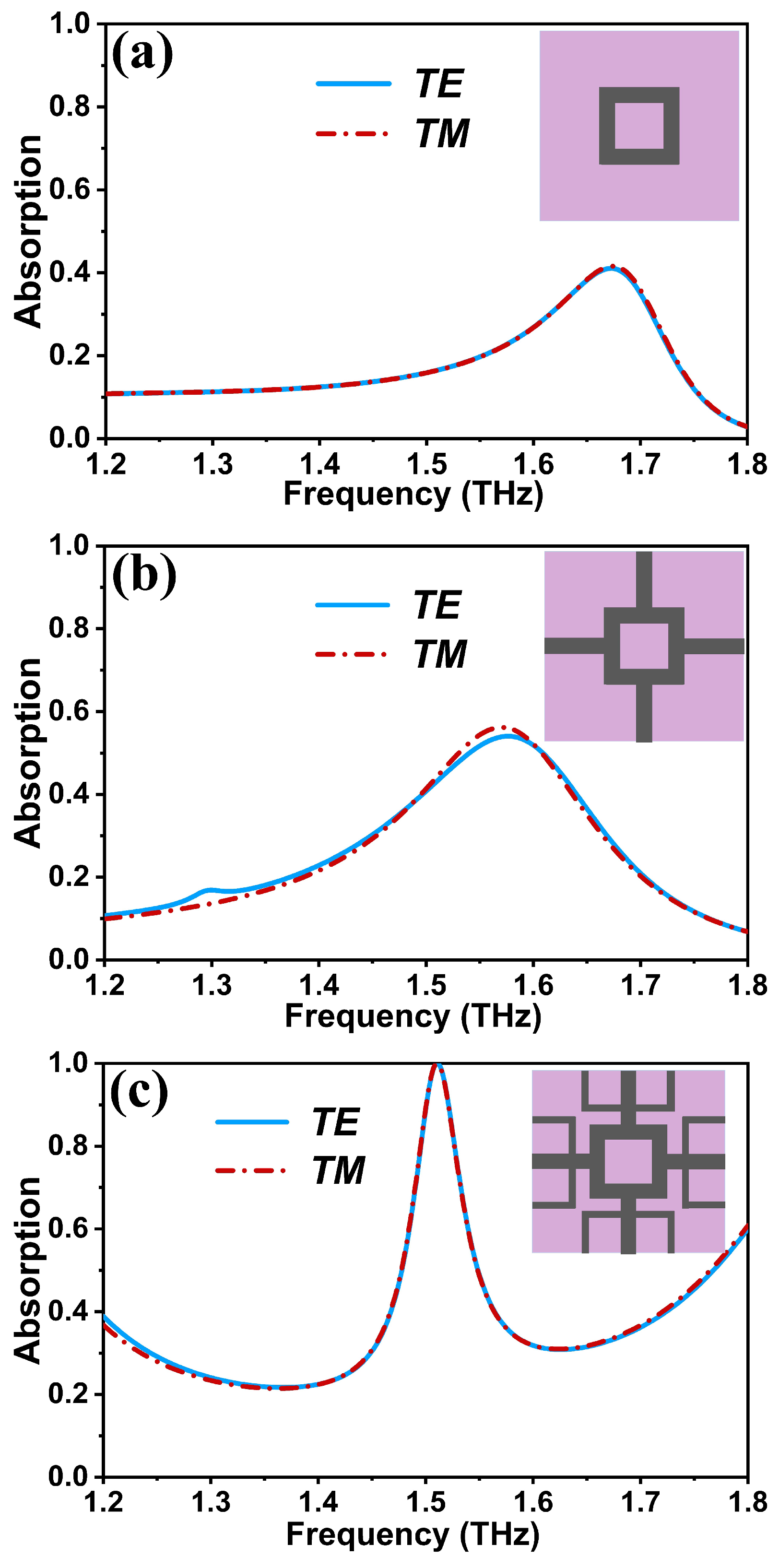
The absorptivity of the suggested design was analyzed as it progressed from Type-I to Type-III in response to a normal TE- and TM-modes, as shown in Figure 2. The TE-mode represents an incident wave with its electric field orientation along the y-direction, while the orientation of the electric field is along the x-direction for the TM-mode. Type-I features a singular square graphene patch structure. This structure permits only a feeble electric dipole resonance owing to restricted surface current confinement. The lack of robust antiparallel currents between the graphene layer and the ITO ground plane results in a diminished magnetic response and inadequate impedance matching with free space. Consequently, the majority of the incident energy is reflected, resulting in low absorptivity, as illustrated in Figure 2a. For Type-II, four conductive strips are introduced from the patch towards the edge of the unit cell. These strips augment the effective current route length, hence improving the equivalent inductance and reinforcing capacitive coupling at the strip edges. As a result, a more powerful LC resonance is established. Furthermore, the elongated current pathways facilitate the emergence of antiparallel currents between the patterned graphene layer and the metallic ground plane, resulting in a significant magnetic dipole resonance. This enhances the impedance matching situation, resulting in an increased absorption of nearly 0.55, as depicted in Figure 2b. Finally, Type-III incorporates additional corner half-square patches. These components generate several closed current loops and markedly improve the capacitive field confinement in the interstices between adjacent resonators, thus allowing the effective impedance of the metasurface to approximate that of free space. Under this impedance-matching, the reflection is significantly minimized, resulting in near-perfect absorption of 99.99% at 1.51 THz, as illustrated in Figure 2c. Note that as the structure exhibits similar responses for TE- and TM-modes, the remaining discussion will primarily focus on the results corresponding to the TE-mode.

3.2. Impedance Matching and Surface Current Distribution

This section elaborates on the absorption mechanism of the proposed structure, mainly through the principles of impedance matching and surface current distributions. According to EM wave theory, when the impedances of two media are identical, an EM wave moving from one medium to another passes through without reflection. Accordingly, if the equivalent impedance of the absorber matches the impedance of free space, the reflection is minimized, enabling significant absorption. The normalized input impedance (Z) of the absorber with a continuous ITO ground layer can be calculated as
Z = 1 + S 11 1 S 11 2 .
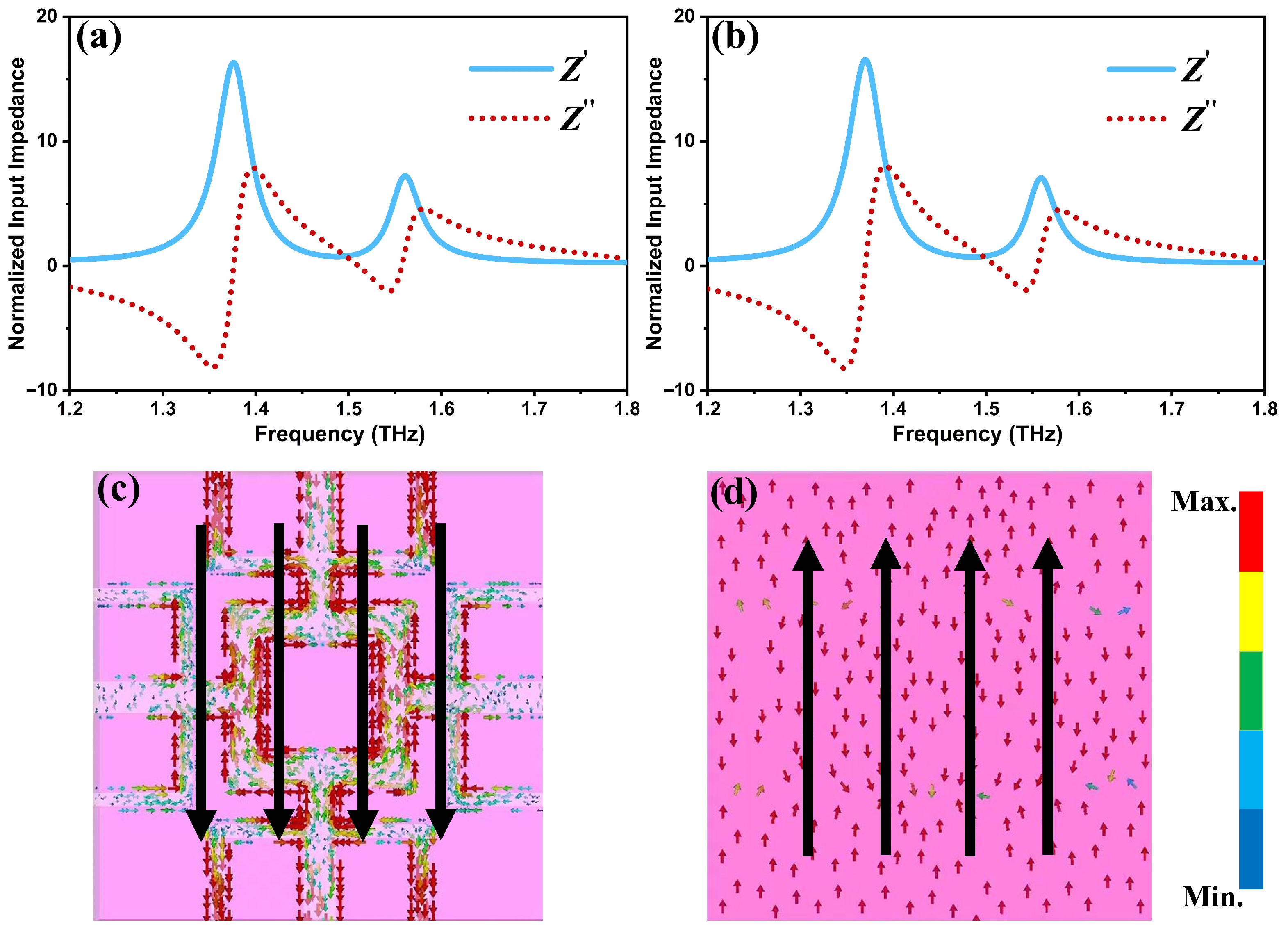
The normalized input impedance of the designed structure is shown in Figure 3a,b for the TE- and TM-modes, respectively. In the frequency range of 1.50 to 1.52 THz, the real (Z′) component of the normalized impedance approaches unity, while the imaginary (Z″) component is nearly zero, indicating that the proposed structure exhibits an effective match with free space. Therefore, near-perfect absorption is attained between 1.50 and 1.52 THz. In addition to impedance matching, magnetic resonance significantly influences the absorption process. When the incident EM wave excites the metasurface, oscillating surface currents are induced on both the patterned graphene resonator and the metallic ground plane. Due to the dielectric between them, these currents flow in opposite directions at resonance, forming a closed current loop across the thickness of the structure. This loop generates a magnetic dipole moment perpendicular to the metasurface, which is referred to as magnetic resonance. This magnetic dipole response effectively tailors the permeability of the metasurface and complements the electric resonance produced by charge accumulation on the graphene pattern. When the magnetic and electric responses are properly balanced at the resonance frequency, the effective impedance of the structure approaches that of free space, thereby minimizing reflection and enabling strong absorption. Figure 3c,d depict the surface current distribution on the upper resonator and the ground plane, respectively. As can be seen, the antiparallel currents were created on these surfaces, thereby producing strong magnetic fields that enhance the localization of EM energy within the absorber. The magnetic resonance together with the impedance-matched condition, ensures that the majority of the incident energy is absorbed and converted into heat, leading to high absorption efficiency across the working frequency range. Consequently, this dual mechanism guarantees minimum reflection at the absorber interface and efficient energy dissipation within the absorber, rendering the structure highly suitable for radar absorption, THz sensing, and EM shielding applications.

3.3. Electric Field Distribution Analysis

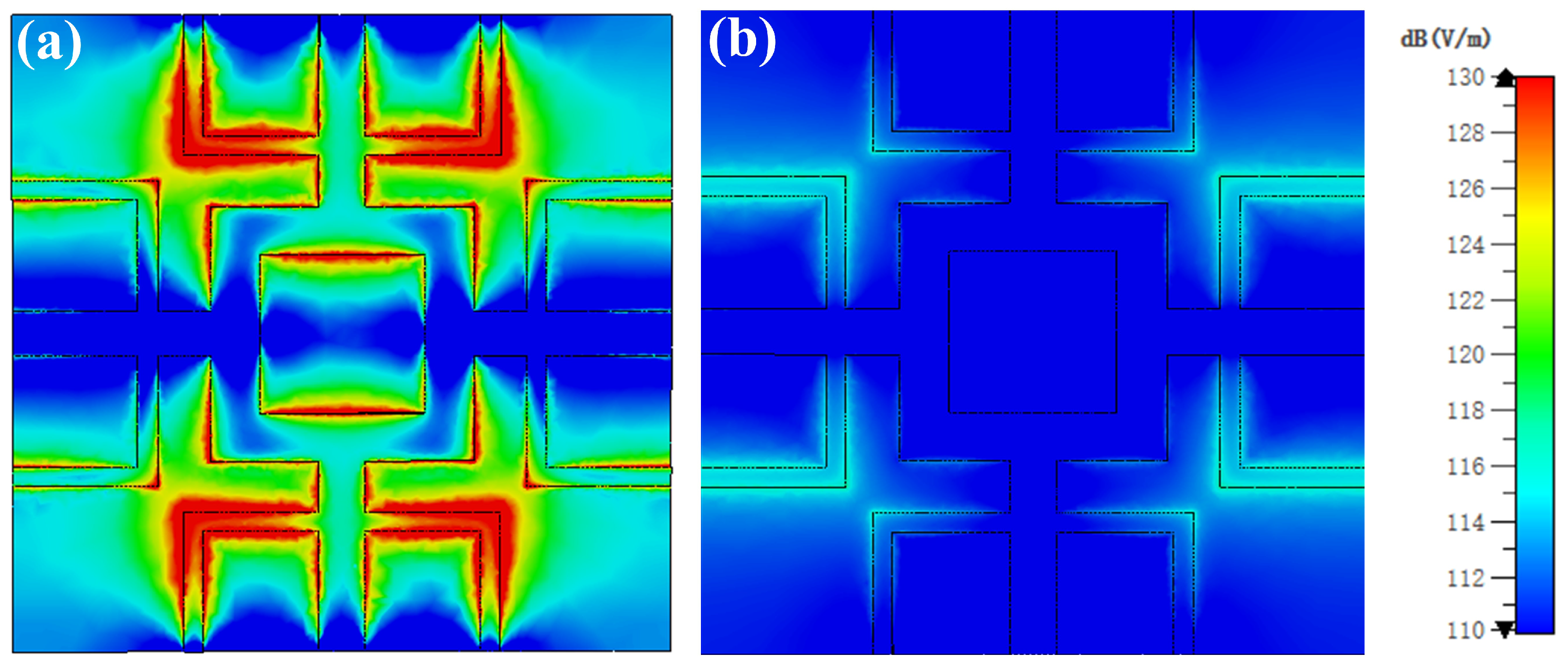
To obtain a physical insight into the resonance mechanism and absorption characteristics of the proposed metasurface, the electric field distribution is examined at the resonance frequency of 1.51 THz and non-resonance frequency of 1.1 THz, as seen in Figure 4a,b, respectively. The field pattern demonstrates significant localization of the electric field around the patterned resonator at the resonance frequency, while absent at 1.1 THz, exhibiting significant field confinement. The significant enhancement of the electric field signifies effective coupling between the incoming EM wave and the graphene resonator, which is essential for attaining strong absorption at the specified frequency. The intensity of the electric field in these areas amplifies the interaction between the metasurface and the adjacent sensing medium, thus enhancing the device sensitivity to changes in the dielectric characteristics of the analyte. Furthermore, the elevated electric field density recorded at 1.51 THz validates the efficacy of the suggested design in facilitating an efficient resonant mode, vital to biomedical sensing applications. Such localized field amplification enhances the identification of minor alterations in biological materials, as even little variations in permittivity can result in significant changes in resonance characteristics. The electric field distributions offer critical insight into the absorption mechanism and confirm the enhanced sensing capability of the proposed biosensor. The shown field confinement and enhancement highlight the suitability of the proposed metasurface for advanced biomedical sensing applications.

3.4. Angular Stability

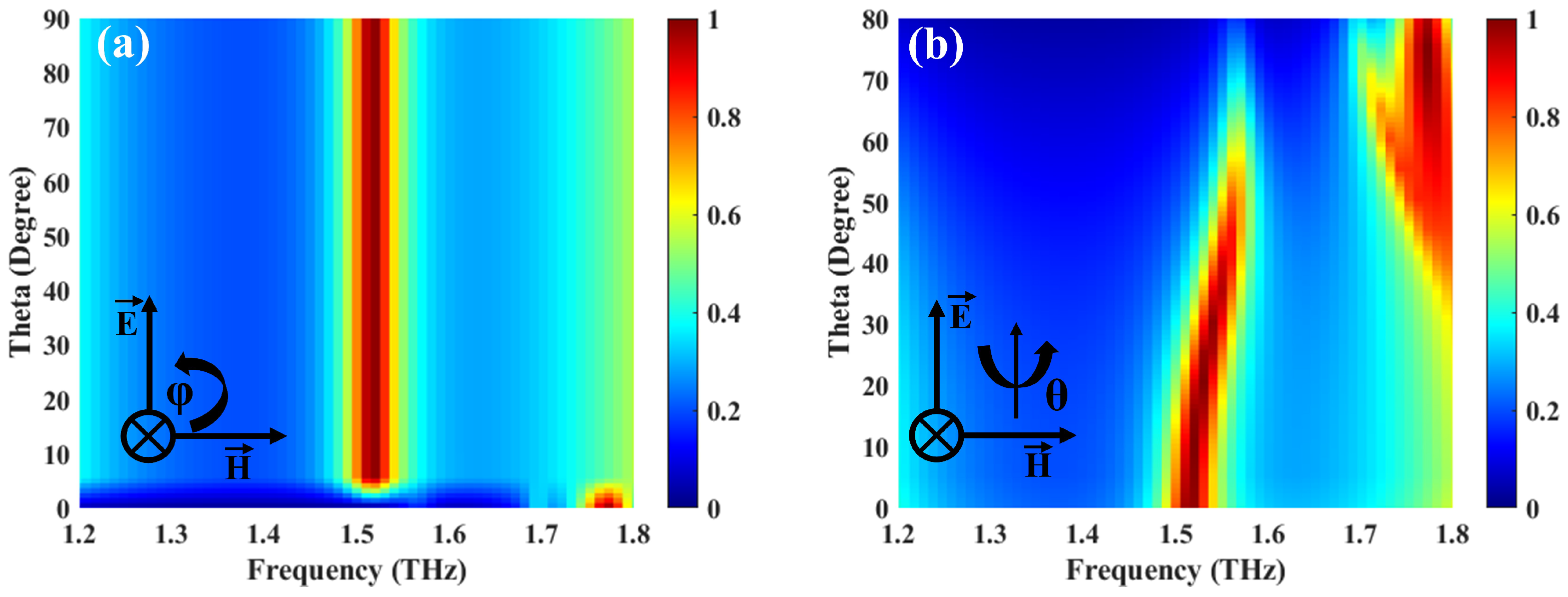
Angular stability is a vital performance standard for metasurface-based biosensors, especially in practical sensing situations where the incident EM wave can penetrate the structure at various angles and polarizations. The stability of the proposed biosensor under realistic illumination conditions is systematically assessed by examining the absorption response across various polarization angles ( ϕ ) and oblique incidence angles ( θ ), as depicted in Figure 5. The effect of the polarization angle is analyzed by rotating both the electric and magnetic field vectors relative to the metasurface plane, while maintaining the propagation direction parallel to the structure ( θ =   0 ° ). As illustrated in Figure 5a, the absorption spectrum exhibits no variation over polarization angles ranging from 0° to 90°. The polarization-independent behavior is attributed to the geometrical symmetry of the structure, which offers a uniform EM response for orthogonal field orientations. This resistance to polarization is very advantageous for biosensing applications, as it eliminates the necessity for strict control over the polarization state of the incident wave. Furthermore, the angular response is examined by altering the incidence angle θ from normal to oblique incidence. Figure 5b illustrates that the position of the absorption peak remains mostly unchanged with increasing θ , although a minor decrease in absorption amplitude is noted at higher angles. This behavior is mainly associated with enhanced reflection at oblique incidence, an understood feature in planar EM structures. Nonetheless, significant absorption is maintained between 1.2 and 1.6 THz up to an incidence angle of θ = 60 ° , validating the outstanding angular stability of the proposed design.
The mentioned angular insensitivity is especially beneficial for biosensing applications, where achieving precise alignment between the sensor and the incident electromagnetic wave can be challenging. The uniform angular response guarantees that the sensing mechanism, which relies on resonance frequency shifts caused by alterations in the dielectric characteristics of the biological sample, stays impervious to slight fluctuations in incidence environment. Thus, fluctuations in the observed response can be accurately associated to alterations in the analyte rather than to angular artifacts. The angular stability of the metasurface does not limit the application of multiangle interrogation techniques. The suggested biosensor enables more precise data interpretation by offering a consistent baseline response, regardless of the sample observing direction. The decoupling of the sensor response from fluctuations in the incident angle improves the measurement reliability and increases the applicability of the proposed metasurface for practical and clinical biosensing conditions. The polarization-independent and angle-stable absorption properties validate the durability of the proposed metasurface biosensor, setting it as a strong candidate for terahertz sensing in practical operating environments.

4. Comparative Analysis of the Proposed Biosensor for Refractive-Index Variations in Biological Analytes

4.1. Performance Metrics for Refractive-Index-Based Sensing

To accurately evaluate the performance of the suggested biosensor, many existing sensing metrics are utilized to deliver a comprehensive and quantitative evaluation of its detection efficacy. The performance indicators are sensitivity (S), figure of merit (FOM), and quality factor (Q), which together define the sensor’s responsiveness, resonance sharpness, and overall detection efficiency, respectively [39]. Sensitivity represents the essential detection capacity of the system and measures its proficiency in identifying subtle changes in the surrounding dielectric environment caused by various analytes. It is defined as the ratio of the resonance shift ( Δ f ), in either wavelength or frequency, to the equivalent alteration in the refractive index ( Δ n ) of the sensing medium. Increased sensitivity signifies a stronger interaction between the evanescent electromagnetic field and the target analyte, essential for precise differentiation between healthy and infectious biological samples. Sensitivity is defined as [40]
Sensitivity = Δ f Δ n ( THz / RIU ) .
While sensitivity indicates the magnitude of the spectral response, it does not fully describe the overall sensing performance. Therefore, the FOM is introduced as a comprehensive performance indicator that accounts for both the sensitivity and the spectral linewidth of the resonance. By incorporating the resonance bandwidth, the FOM effectively balances the extent of resonance shift with spectral selectivity, providing a more realistic measure of detection efficiency. A higher FOM signifies improved sensing resolution and robustness, making it particularly critical for biosensing applications that demand high precision and repeatability. It can be defined as the ratio between the sensitivity and the full width at half maximum (FWHM) of the resonance peak, which describes the sharpness of the resonance curve [41]:
Figure of Merit ( FOM ) = Sensitivity FWHM ( RIU 1 ) .
The Q-factor is utilized to define the sharpness of the resonance and is directly associated with the energy confinement and inherent loss processes of the resonant mode. A high Q-factor is associated with a small resonant linewidth, which augments the sensor’s capacity to discern closely spaced spectral characteristics and enhances the detection accuracy, particularly in complex biological conditions. It is determined by the ratio of the resonance frequency to the FWHM: [42]
Q f a c t o r = f res FWHM .

4.2. Analyte-Based Simulation and Sensing Performance Analysis

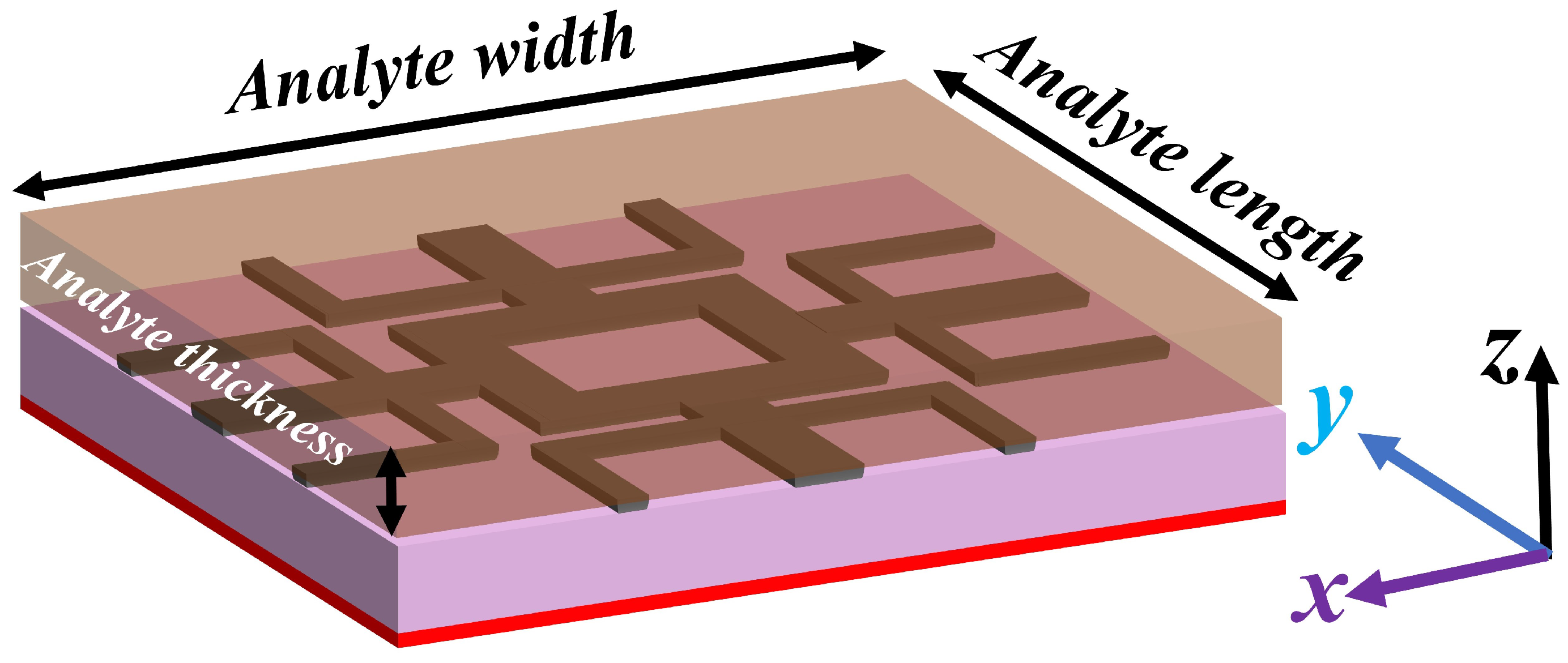
To evaluate the practical sensing capabilities of designed metasurface biosensor, we conducted a comparative dielectric property analysis between normal blood and diseased blood samples within the simulation framework, as shown in Figure 6. The blood sample will distribute over the upper surface of the biosensor, forming a layer with a thickness of 10 µm. The refractive index of the analyte is systematically varied from 1.52 to 1.60, maintaining a constant loss tangent of 0.0005 to ensure low-loss dielectric properties. This variation enables the investigation of resonance shifts resulting from changes in the permittivity of both healthy and diseased analytes, thereby confirming the sensor’s sensitivity to refractive index variations. The suggested low-loss tangent ensures that the observed frequency changes are predominantly attributable to variations in the dielectric constant, rather than material absorption, thus explaining the sensor’s detection accuracy and efficiency. This configuration precisely replicates real-world conditions for material characterization in the THz domain.
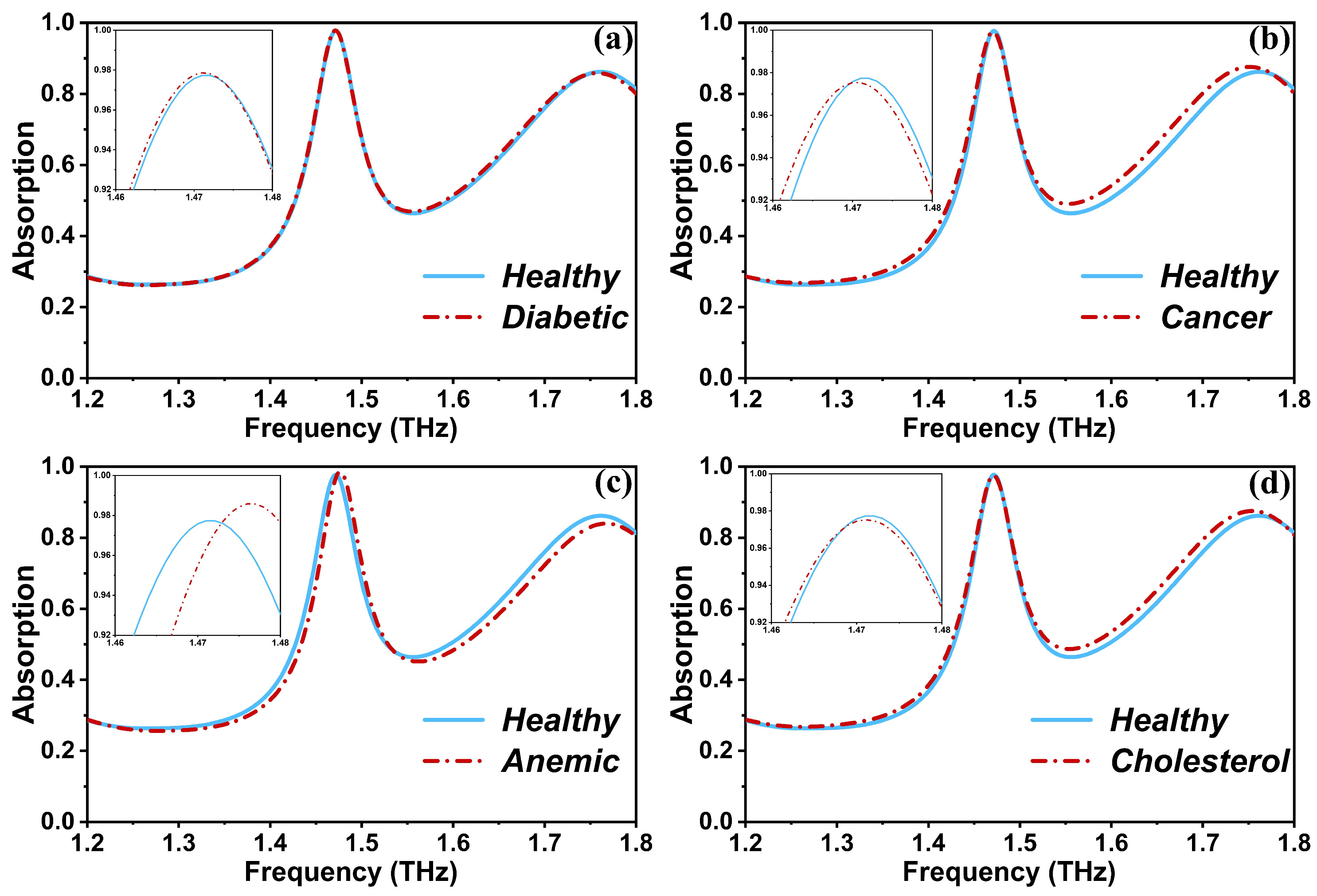
Figure 7 depicts the comparison between the absorption spectra for both healthy and diseased blood samples, which clearly demonstrate the sensing ability of the proposed metasurface-based sensor. Figure 7a clearly demonstrates that the diabetes type has a peak absorptivity at 1.4709 THz, whereas the normal cell resonates at 1.4719 THz. As a result, quality factors of 18.4 THz and 21.01 THz, together with sensitivities of 0.69 THz/RIU and 0.68 THz/RIU, are obtained for normal and diabetic blood, respectively. The maximium absorptivity of jurkat blood cancer cells and normal cells are at 1.4705 THz and 1.4719 THz, respectively, with sensitivities of 0.6 and 0.69 THz/RIU, as illustrated in Figure 7b. Furthermore, Figure 7c clearly indicates that the resonance frequency of 1.4763 THz is attained for the anemic blood cell type, exhibiting frequency shifts of 4.4 GHz. The investigation of high cholesterol cells reveals a quality factor of 20.72 for high cholesterol cells, with sensitivities of 0.67 THz/RIU, as depicted in Figure 7d. The comprehensive results are displayed in Table 2. It should be noted that the reported sensitivity, Q-factor, and FOM are extracted under ideal simulation conditions and, therefore, represent the upper performance limits of the proposed sensor. In practical implementations (see Section 5.2), several factors such as material losses and fabrication error may slightly influence these metrics. Furthermore, the key performance metrics of the proposed biosensor, including sensitivity, Q-factor, and FOM, are systematically compared with previously reported metasurface-based terahertz biosensors, as summarized in Table 3. The proposed structure demonstrates significant performance enhancements compared with previous studies, primarily due to the combination of a graphene resonator with an indium–tin–oxide (ITO) ground plane on a SiO2 substrate. This arrangement facilitates a highly compact structure while demonstrating high optical transparency. The suggested biosensor exhibits stable sensing capabilities under wide-angle incidence, essential to integrate with optoelectronic devices. Due to its miniaturized structure and efficient EM response, the proposed metasurface shows promise for sensitive detection of refractive-index changes in biological samples, indicating its potential utility in biomedical sensing applications.

5. Fabrication and Tolerance Analysis

5.1. Fabrication Method

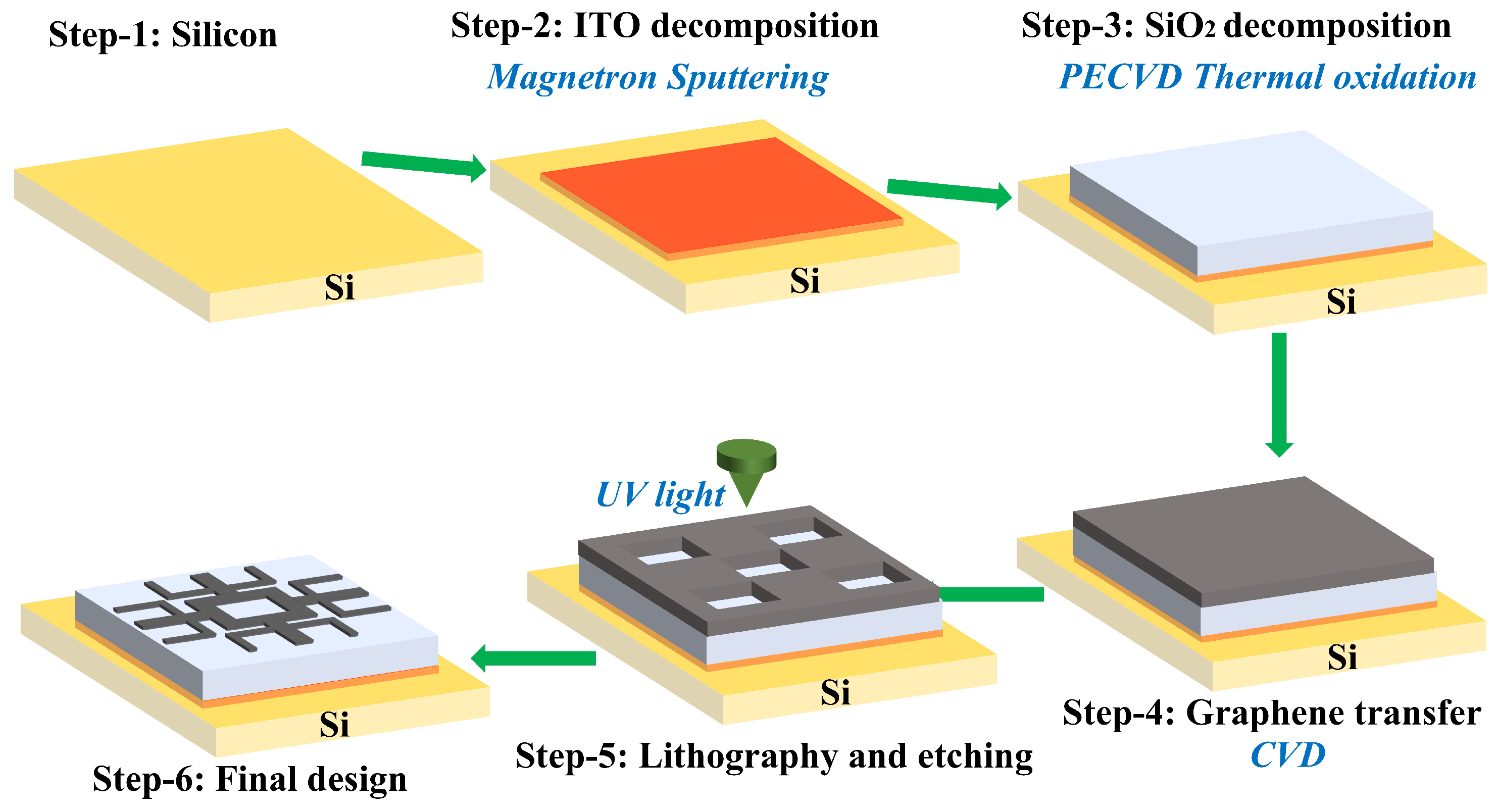
The suggested graphene-based optically transparent THz metasurface absorber is experimentally feasible through established microfabrication and nanofabrication processes typically utilized in THz and optoelectronic device production. The architecture comprises three functional layers: a continuous indium–tin–oxide (ITO) ground plane, a SiO2 dielectric spacer, and a patterned graphene resonator, generated sequentially to ensure optimal dimensional control and structural integrity, as schematically depicted in Figure 8. The fabrication process starts with a flat silicon or quartz substrate, which is thoroughly cleaned using ultrasonic treatment in acetone, ethanol, and deionized water and then followed by nitrogen drying to eliminate surface impurities. A continuous ITO coating is subsequently produced on the substrate either through radio-frequency magnetron sputtering or electron-beam evaporation. ITO is chosen due to its significant optical transparency in the visible spectrum. The ITO layer thickness is selected as 1 μm, guaranteeing minimal transmission and maximum absorption. A SiO2 dielectric layer with the specified thickness is subsequently produced over the ITO ground plane through plasma-enhanced chemical vapor deposition (PECVD) or thermal oxidation. These approaches ensure superior thickness uniformity, minimal surface roughness, and excellent adherence to the underlying conductive layer. Post-deposition thermal annealing is utilized to diminish the residual stress and improve the mechanical stability of the dielectric film. Next, a monolayer graphene sheet is generated using chemical vapor deposition (CVD), which is attached to the SiO2 surface utilizing conventional wet or dry transfer methods. The graphene resonator pattern can be drawn by electron-beam lithography or deep ultraviolet photolithography, followed by oxygen plasma etching to precisely form the resonant geometry at the micrometer and sub-micrometer scale. These lithographic resolutions are entirely compatible with the dimensional specifications of the THz metasurface implementations. This whole fabrication cycle generally necessitates about 2–3 weeks to manufacture a fully operational device. Possible fabrication defects, including graphene grain boundaries, edge irregularities, and slight dielectric thickness fluctuations, are expected to cause minimal perturbations in the resonance characteristics, owing to the design’s structural symmetry and broad angular stability. Although experimental verification is not within scope of this study, the fabricated metasurface can be analyzed by scanning electron microscopy (SEM) and optical microscopy to confirm its accuracy. The final performance evaluation can be performed by subjecting the device to analytes with differing refractive indices and measuring resonance shifts in the THz spectrum, thus validating its biosensing capacity.

5.2. Parametric Variation and Fabrication Tolerance Analysis

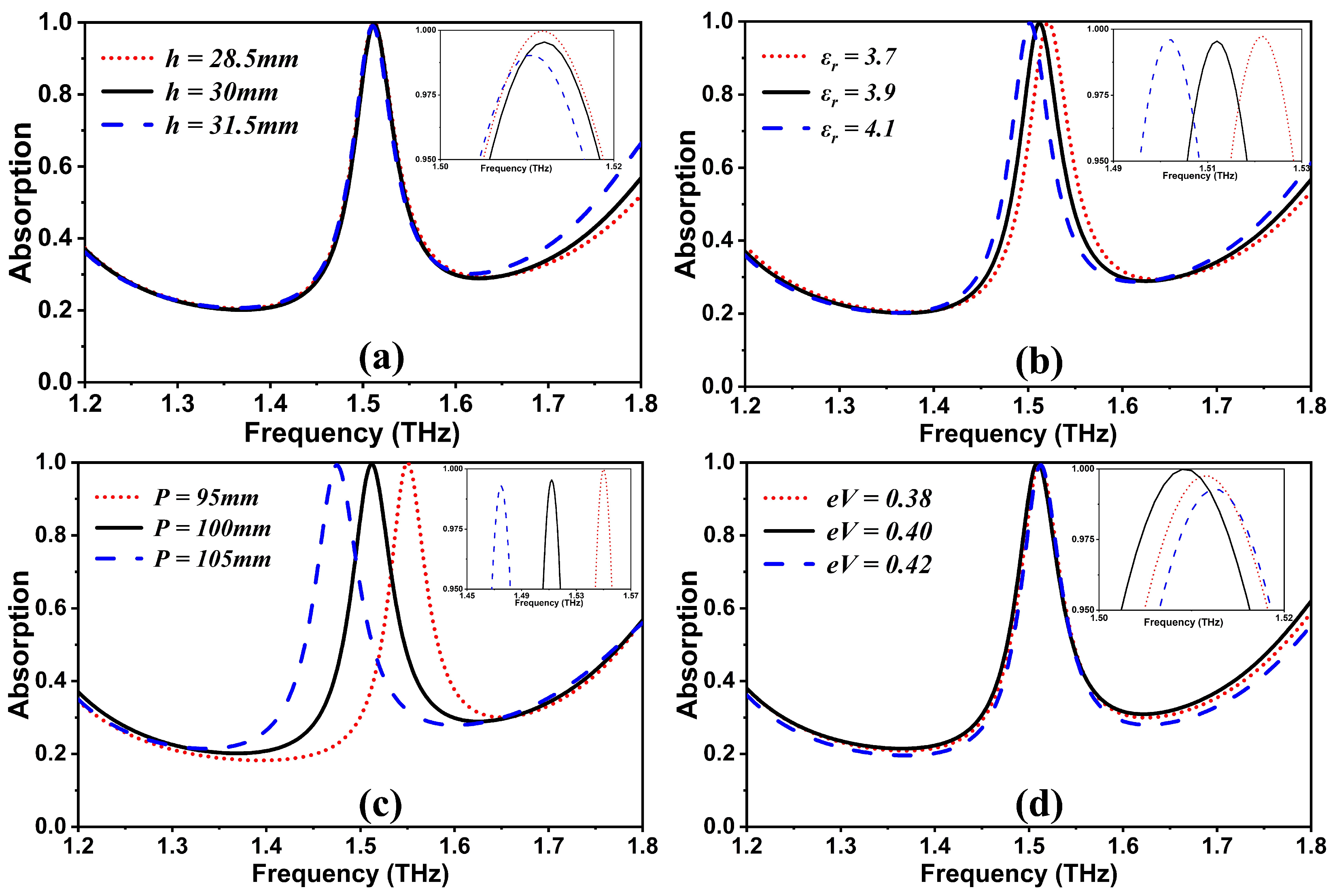
A detailed tolerance study was performed to assess the robustness of the proposed metasurface absorber in light of the fabrication and material variation. In practical fabrication scenarios, deviations in geometric dimensions, substrate thickness, dielectric properties, and graphene electrical parameters are expected, due to inherent limitations in lithography resolution, deposition nonuniformity, and intrinsic material variability. Therefore, the key design parameters were independently varied by ± 5 % around their optimized values, and the corresponding absorption spectra were numerically analyzed. Firstly, The SiO2 dielectric thickness (h) was adjusted by ± 5 % to accommodate thickness nonuniformity throughout deposition procedures like PECVD or sputtering. Figure 9a illustrates slight fluctuation in the resonance frequency corresponding to variations in the substrate thickness. Nonetheless, the bandwidth and the absorption magnitude remain similar. This suggests that the impedance matching condition of the metasurface is only marginally influenced by minor thickness variations. Next, to analyze errors in the dielectric constant ( ε r ) of SiO2 due to fabrication dispersion, the relative permittivity was adjusted from 3.7 to 4.1, as shown in Figure 9b. It exhibits slight changes in resonance frequency, whereas the overall absorption intensity and spectral pattern remain consistent. This verifies that the sensing response is not significantly affected by slight variations in substrate permittivity. Moreover, lithographic irregularities may result in discrepancies in the periodicity of the metasurface (P) and the chemical potential of graphene (eV). As seen in Figure 9c,d, the absorption peak is still near unity, but the resonance position shows some tunability. Overall, the tolerance analysis demonstrates that although small resonance frequency shifts occur under ± 5 % variations of key structural and material parameters, these fluctuations are minor and do not significantly degrade the absorption strength, resonance sharpness, or sensing functionality.

6. Conclusions

In this work, a graphene-based optically transparent THz metasurface with wide-angle stability and polarization-insensitivity was proposed and thoroughly examined as a proof-of-concept platform for refractive-index-based biosensing applications. The designed structure consists of a patterned graphene resonator, SiO2 dielectric substrate, and ITO ground plane and demonstrates strong THz absorption, polarization insensitivity, and angular stability up to 60° for both TE and TM modes. Numerical simulations with analytes of various refractive indices demonstrated high sensing efficiency. These findings validate the proposed design as a promising platform for high-performance THz biosensing, specifically in early disease detection and biomedical diagnostics.

Author Contributions

Paper Writing—Original Draft Preparation, U.F.; Writing—Review and Editing, H.A.K., M.A. and U.F.; Methodology, U.F., H.A.K. and N.L.; Software, H.A.K. and U.F.; Formal Analysis, M.A. and N.L.; Validation, N.L.; Data Curation, H.A.K.; Investigation, H.A.K. and N.L. All authors have agreed to submit this article for publication in MDPI. All authors have read and agreed to the published version of the manuscript.

Funding

The work was supported by the National Natural Science Foundation of China (81872584), Natural Science Foundation of Shenzhen (No. JCYJ20250604182049064) and Sanming Project of Medicine in Shenzhen (SZSM202211009).

Data Availability Statement

The data that supports the findings of this study is available from the corresponding author upon reasonable request.

Conflicts of Interest

The authors declare no conflicts of interest.

References

  1. Hemdan, M.; Ali, M.A.; Doghish, A.S.; Mageed, S.S.A.; Elazab, I.M.; Khalil, M.M.; Mabrouk, M.; Das, D.B.; Amin, A.S. Innovations in biosensor technologies for healthcare diagnostics and therapeutic drug monitoring: Applications, recent progress, and future research challenges. Sensors 2024, 24, 5143. [Google Scholar] [CrossRef] [PubMed]
  2. Andryukov, B.G.; Besednova, N.N.; Romashko, R.V.; Zaporozhets, T.S.; Efimov, T.A. Label-free biosensors for laboratory-based diagnostics of infections: Current achievements and new trends. Biosensors 2020, 10, 11. [Google Scholar] [CrossRef] [PubMed]
  3. Kulanthaivel, J.; Ashok, N. A Tamm Plasmon Refractive Index Sensor for Cancer Cell Detection Based on TiN and Semi-Porous Si3N4 Distributed Bragg Reflector. Plasmonics 2024, 19, 2493–2506. [Google Scholar] [CrossRef]
  4. Car, J.; Tan, W.S.; Huang, Z.; Sloot, P.; Franklin, B.D. eHealth in the future of medications management: Personalisation, monitoring and adherence. BMC Med. 2017, 15, 73. [Google Scholar] [CrossRef]
  5. Juan-Colás, J.; Johnson, S.; Krauss, T.F. Dual-mode electro-optical techniques for biosensing applications: A review. Sensors 2017, 17, 2047. [Google Scholar] [CrossRef]
  6. Zanchetta, G.; Lanfranco, R.; Giavazzi, F.; Bellini, T.; Buscaglia, M. Emerging applications of label-free optical biosensors. Nanophotonics 2017, 6, 627–645. [Google Scholar] [CrossRef]
  7. Peltomaa, R.; Glahn-Martínez, B.; Benito-Peña, E.; Moreno-Bondi, M.C. Optical biosensors for label-free detection of small molecules. Sensors 2018, 18, 4126. [Google Scholar] [CrossRef]
  8. Hamza, M.E.; Othman, M.A.; Swillam, M.A. Plasmonic biosensors. Biology 2022, 11, 621. [Google Scholar] [CrossRef]
  9. Majdinasab, M.; Lamy de la Chapelle, M.; Marty, J.L. Recent progresses in optical biosensors for interleukin 6 detection. Biosensors 2023, 13, 898. [Google Scholar] [CrossRef]
  10. Randviir, E.P.; Banks, C.E. A review of electrochemical impedance spectroscopy for bioanalytical sensors. Anal. Methods 2022, 14, 4602–4624. [Google Scholar] [CrossRef]
  11. Brett, C.M. Electrochemical impedance spectroscopy in the characterisation and application of modified electrodes for electrochemical sensors and biosensors. Molecules 2022, 27, 1497. [Google Scholar] [CrossRef] [PubMed]
  12. Shrivastava, S.; Trung, T.Q.; Lee, N.E. Recent progress, challenges, and prospects of fully integrated mobile and wearable point-of-care testing systems for self-testing. Chem. Soc. Rev. 2020, 49, 1812–1866. [Google Scholar] [CrossRef] [PubMed]
  13. Zheng, L.; Tonouchi, M.; Serita, K. A Terahertz Point Source Meta-Sensor in Reflection Mode for Trace-Amount Bio-Sensing Applications. Photonics 2024, 11, 766. [Google Scholar] [CrossRef]
  14. Gezimati, M.; Singh, G. Terahertz imaging and sensing for healthcare: Current status and future perspectives. IEEE Access 2023, 11, 18590–18619. [Google Scholar] [CrossRef]
  15. Akter, N.; Hasan, M.M.; Pala, N. A review of THz technologies for rapid sensing and detection of viruses including SARS-CoV-2. Biosensors 2021, 11, 349. [Google Scholar] [CrossRef]
  16. Sun, Y.; Wang, S.; Gong, Y. Terahertz’s silent revolution in physics, engineering, and life science: Beyond the spectrum. Fundam. Res. 2025, 5, 1930–1932. [Google Scholar] [CrossRef]
  17. Shamim, S.; Mohsin, A.S.; Rahman, M.M.; Bhuian, M.B.H. Recent advances in the metamaterial and metasurface-based biosensor in the gigahertz, terahertz, and optical frequency domains. Heliyon 2024, 10, e33272. [Google Scholar] [CrossRef]
  18. Abdulkarim, Y.I.; Altintas, O.; Karim, A.S.; Awl, H.N.; Muhammadsharif, F.F.; Alkurt, F.O.; Bakir, M.; Appasani, B.; Karaaslan, M.; Dong, J. Highly sensitive dual-band terahertz metamaterial absorber for biomedical applications: Simulation and experiment. ACS Omega 2022, 7, 38094–38104. [Google Scholar] [CrossRef]
  19. Santarelli, M.F.; Giovannetti, G.; Hartwig, V.; Celi, S.; Positano, V.; Landini, L. The core of medical imaging: State of the art and perspectives on the detectors. Electronics 2021, 10, 1642. [Google Scholar] [CrossRef]
  20. Varghese, M.; Varghese, S.; Preethi, S. Revolutionizing medical imaging: A comprehensive review of optical coherence tomography (OCT). J. Opt. 2025, 54, 1178–1195. [Google Scholar] [CrossRef]
  21. Zheng, S.; Bai, Y.; Xu, Z.; Liu, P.; Ni, G. Optical coherence tomography for three-dimensional imaging in the biomedical field: A review. Front. Phys. 2021, 9, 744346. [Google Scholar] [CrossRef]
  22. Jabbar, A.; Asgari, S.; Fabritius, T. A Graphene Metasurface-Based Narrowband THz Biosensor for Non-Invasive Early Cancer Detection. IEEE Access 2025, 13, 158098–158107. [Google Scholar] [CrossRef]
  23. Zhou, Y.; Liu, Y.; Zong, Z.; Huang, H.; Liang, L.; Yang, X.; Xin, M.; Tian, H.; Xie, F.; Jin, W.; et al. Rapid and sensitive detection of exosomal microRNAs by terahertz metamaterials. Spectrochim. Acta Part A Mol. Biomol. Spectrosc. 2025, 330, 125745. [Google Scholar] [CrossRef] [PubMed]
  24. Wang, Q.; Chen, Y.; Mao, J.; Yang, F.; Wang, N. Metasurface-assisted terahertz sensing. Sensors 2023, 23, 5902. [Google Scholar] [CrossRef]
  25. Wang, Y.; Zhang, X.; Wang, Y.; Liu, Y.; Li, J.; Chen, X.; Cui, Z.; Burokur, S.N.; Zhang, J.; Zhao, X.; et al. Recent advances in metasurfaces: From THz biosensing to microwave wireless communications. Research 2025, 8, 0820. [Google Scholar] [CrossRef]
  26. Chatterjee, S.; Mukherjee, R.; Chandra, S.; Maity, A.R.; Kumar, S.; Maji, P.S. Harnessing Tamm-plasmon polaritons in cantor sequence photonic quasicrystals for enhanced cancer cell detection. Plasmonics 2025, 20, 221–232. [Google Scholar] [CrossRef]
  27. Li, D.; Wu, X.; Chen, Z.; Liu, T.; Mu, X. Surface-enhanced spectroscopy technology based on metamaterials. Microsyst. Nanoeng. 2025, 11, 60. [Google Scholar] [CrossRef]
  28. Sidhireddy, S.; Ashok, N. Design and Analysis of a Tri-layer Reflective Structure–Based Tamm Plasmon Sensor for Cancer Cell Detection. Plasmonics 2025, 20, 9237–9245. [Google Scholar] [CrossRef]
  29. Lee, S.H.; Choe, J.H.; Kim, C.; Bae, S.; Kim, J.S.; Park, Q.H.; Seo, M. Graphene assisted terahertz metamaterials for sensitive bio-sensing. Sens. Actuators B Chem. 2020, 310, 127841. [Google Scholar] [CrossRef]
  30. Sheheryar, T.; Tian, Y.; Lv, B.; Gao, L. High-sensitivity refractive index based terahertz metasurface biosensor for detecting multiple cancers and infectious diseases. Photonics Nanostruct.-Fundam. Appl. 2025, 65, 101399. [Google Scholar] [CrossRef]
  31. Lay-Ekuakille, A.; Massaro, A.; Singh, S.P.; Jabłoński, I.; Rahman, M.Z.U.; Spano, F. Optoelectronic and nanosensors detection systems: A review. IEEE Sens. J. 2021, 21, 12645–12653. [Google Scholar] [CrossRef]
  32. Yan, S.; Zhu, X.; Dong, J.; Ding, Y.; Xiao, S. 2D materials integrated with metallic nanostructures: Fundamentals and optoelectronic applications. Nanophotonics 2020, 9, 1877–1900. [Google Scholar] [CrossRef]
  33. Peng, M.; Cheng, J.; Zheng, X.; Ma, J.; Feng, Z.; Sun, X. 2D-materials-integrated optoelectromechanics: Recent progress and future perspectives. Rep. Prog. Phys. 2023, 86, 026402. [Google Scholar] [CrossRef] [PubMed]
  34. Ferreira, A.; Viana-Gomes, J.; Nilsson, J.; Mucciolo, E.R.; Peres, N.M.; Castro Neto, A.H. Unified description of the dc conductivity of monolayer and bilayer graphene at finite densities based on resonant scatterers. Phys. Rev. B—Condens. Matter Mater. Phys. 2011, 83, 165402. [Google Scholar] [CrossRef]
  35. Tola, P.; Wardhani, P.; Islamiyah, S. Initial Finite-Difference Time-Domain (FDTD) modeling of graphene based on intra-band surface conductivity. J. Phys. Conf. Ser. 2023, 2623, 012011. [Google Scholar] [CrossRef]
  36. Anonymous. Complex conductivity model of graphene. SN Appl. Sci. 2022, 4, 114. [Google Scholar]
  37. Nsengiyumva, W.; Li, G.; Mwizerwa, J.P.; Thirunavukkarasu, N.; Wu, L.; Zheng, L. Terahertz time-domain spectroscopy and effective medium theory for evaluation of optical and dielectric properties of silicon dioxide nanoparticle-reinforced epoxy composites. Opt. Mater. 2025, 170, 117701. [Google Scholar] [CrossRef]
  38. Khan, H.A.; Majeed, A.; Zahra, H.; Kakepoto, F.G.; Abbas, S.M.; Alathbah, M. Transparent conformal metasurface absorber for ultrawideband radar cross section reduction. J. Phys. D Appl. Phys. 2024, 57, 135105. [Google Scholar] [CrossRef]
  39. Li, M.; Chen, Z.; Huo, Y.X. Application evaluation and performance-directed improvement of the native and engineered biosensors. ACS Sens. 2024, 9, 5002–5024. [Google Scholar] [CrossRef]
  40. Zhang, H.; Sun, Z.; Sun, K.; Liu, Q.; Chu, W.; Fu, L.; Dai, D.; Liang, Z.; Lin, C.T. Electrochemical impedance spectroscopy-based biosensors for label-free detection of pathogens. Biosensors 2025, 15, 443. [Google Scholar] [CrossRef]
  41. Zhang, Z.; Li, S.; Yin, Z.; Ullah, S.; Cui, X.; Li, G.; Li, K.; Wang, C.; Liu, Y. Dual-core photonic crystal fiber surface plasmon resonance sensor with high sensitivity and narrow FWHM. Plasmonics 2024, 19, 495–504. [Google Scholar] [CrossRef]
  42. Schmid, S.; Villanueva, L.G.; Roukes, M.L. Quality factor. In Fundamentals of Nanomechanical Resonators; Springer: Berlin/Heidelberg, Germany, 2016; pp. 57–90. [Google Scholar]
  43. Janneh, M.; De Marcellis, A.; Palange, E.; Tenggara, A.; Byun, D. Design of a metasurface-based dual-band Terahertz perfect absorber with very high Q-factors for sensing applications. Opt. Commun. 2018, 416, 152–159. [Google Scholar] [CrossRef]
  44. Hamza, M.N.; Tariqul Islam, M.; Lavadiya, S.; ud Din, I.; Sanches, B.; Koziel, S.; Islam, M.S. Design and validation of ultra-compact metamaterial-based biosensor for non-invasive cervical cancer diagnosis in terahertz regime. PLoS ONE 2025, 20, e0311431. [Google Scholar] [CrossRef] [PubMed]
  45. Patel, S.K.; Surve, J.; Parmar, J. Detection of cancer with graphene metasurface-based highly efficient sensors. Diam. Relat. Mater. 2022, 129, 109367. [Google Scholar] [CrossRef]
  46. Tan, C.; Wang, S.; Li, S.; Liu, X.; Wei, J.; Zhang, G.; Ye, H. Cancer diagnosis using terahertz-graphene-metasurface-based biosensor with dual-resonance response. Nanomaterials 2022, 12, 3889. [Google Scholar] [CrossRef]
  47. Lang, T.; Yu, Z.; Zhang, J.; Hong, Z.; Liu, J.; Wang, P. Bovine serum albumin detection based on electromagnetically induced transparency in terahertz metamaterial. Sens. Actuators A Phys. 2023, 360, 114522. [Google Scholar] [CrossRef]
  48. Wertani, H.; Krid, H.B.; Hlali, A.; Zairi, H. Advanced Optimization of THz Biosensor for Breast Cancer Detection Through Machine Learning. Res. Sq. 2026; preprint. [Google Scholar] [CrossRef]
  49. Kumar, A.; Saxena, G.; Kumar, Y.; Awasthi, Y.K. Wideband graphene-based THz metasurface absorber with cylindrical dielectric resonator for biomedical refractive index sensing. Opt. Quantum Electron. 2026, 58, 37. [Google Scholar] [CrossRef]
  50. Sheheryar, T.; Dong, X.; Wang, X.; Lv, B.; Gao, L.; Xie, B. Multispectral terahertz metasurface biosensor supporting multi-disease identification and chemical sensing. Opt. Quantum Electron. 2026, 58, 44. [Google Scholar] [CrossRef]
Figure 1. Schematic geometry of a unit cell. (a) The 3D view and (b) top graphene pattern.
Photonics 13 00181 g001
Figure 2. Step-by-step absorption results of evolution: (a) Type-I, (b) Type-II, and (c) Type-III.
Photonics 13 00181 g002
Figure 3. (a,b) Normalized input impedance spectra under the normal TE- and TM-mode. Surface current distribution on the (c) top and (d) bottom layer at 1.51 THz.
Photonics 13 00181 g003
Figure 4. Electric field distribution at (a) 1.51 THz and (b) 1.1 THz.
Photonics 13 00181 g004
Figure 5. Variation in the absorption spectrum with (a) oblique incidence and (b) polarization angle.
Photonics 13 00181 g005
Figure 6. Biosensing setup of a proposed metasurface for diagnosing healthy and affected blood.
Photonics 13 00181 g006
Figure 7. Variation in the absorptivity between normal blood cells and various affected cells: (a) diabetic, (b) cancer cell, (c) anemic cell, and (d) high cholesterol cell.
Photonics 13 00181 g007
Figure 8. The step-by-step fabrication feasibility of the proposed sensor design.
Photonics 13 00181 g008
Figure 9. Fabrication tolerance analysis of the proposed metasurface absorber under (a) dielectric thickness, (b) substrate permittivity, (c) periodicity, and (d) graphene chemical potential.
Photonics 13 00181 g009
Table 1. Geometrical parameters of the proposed structure.
ParametersPholjnvd
Values (μm)10030782232517
Table 2. Biosensor characteristics of healthy and deseased blood.
Analyte TypeResonance Frequency (THz)Absorption PeakSensitivity (THz/RIU)FOM (RIU−1)Quality Factor
Healthy blood1.47190.9770.690.8618.4
Diabetic blood1.47090.9780.680.9721.01
Cancer blood1.47050.9750.600.8621.00
Anemic blood1.47630.9850.500.8324.67
High cholesterol blood1.47100.9750.670.9420.72
Table 3. Comparison of biosensing performance of various THz metasurface based-sensors.
Electrical Size ( λ )Analyte Thickness (μm)S (THz/RIU)Q-FactorFOM (RIU−1)Measured ModeAngular Stability (°)Optically TransparentReference
0.60 × 0.60N/A0.187947.2ReflectionN/ANo[43]
0.52 × 0.52N/A0.049413.0Reflection50No[44]
0.23 × 0.23N/A0.207133.8TransmissionN/ANo[45]
0.33 × 0.33191.2122.7TransmissionN/ANo[46]
0.52 × 0.52N/A0.27N/A2.9TransmissionN/ANo[47]
0.36 × 0.36N/A0.1936.660.637ReflectionN/ANo[48]
0.83 × 0.83456.0N/A24Reflection30No[49]
0.58 × 0.5820.933122.63Reflection40No[50]
0.5 × 0.5100.6924.670.97Reflection60YesThis work
Disclaimer/Publisher’s Note: The statements, opinions and data contained in all publications are solely those of the individual author(s) and contributor(s) and not of MDPI and/or the editor(s). MDPI and/or the editor(s) disclaim responsibility for any injury to people or property resulting from any ideas, methods, instructions or products referred to in the content.