1. Introduction
Lasers, owing to their high directionality, monochromaticity, and brightness, have been widely deployed in laser communication, lidar, ranging, and other high-energy laser applications. During propagation through the atmosphere, however, laser beams are inevitably distorted by turbulence and other environmental inhomogeneities, leading to beam spreading, intensity scintillation, and spot drift. These effects degrade far-field beam quality and severely constrain the achievable propagation performance and system effectiveness [
1,
2], and it is an important issue in the study of laser atmospheric transmission and its practical engineering applications [
3,
4]. Fast and reliable prediction of beam spreading under realistic atmospheric conditions is therefore essential, particularly for slant-path propagation scenarios that are typical of laser communication and laser radar links.
With the development of computational capabilities, numerical wave-optics simulations based on the Generalized Huygens–Fresnel principle have become a powerful tool for analyzing beam-quality evolution in turbulent atmospheres. Such simulations can describe the spatiotemporal evolution of laser fields with high fidelity but must explicitly account for many factors, including initial beam quality, atmospheric conditions, system jitter, and obscuration ratio [
5,
6]. As a result, the associated computational cost is high, and the approach is not well suited to rapid performance evaluation. To overcome this limitation, a series of scaling laws for the 63.2% encircled-power radius (root mean square sum radius) have been proposed for horizontal propagation in turbulence [
7,
8,
9]. For example, Smith [
10] and Gebhardt [
11] derived empirical formulas for the peak intensity of a high-energy laser beam after propagation through turbulence and thermal blooming interaction, respectively. Wang et al. [
12] established a scaling relation for focused flat-topped beams by combining numerical simulation and experimental measurements. Huang et al. [
13] quantified the influence of tracking jitter on beam spreading of flat-topped beams. Chen et al. [
14] derived a scaling model for Gaussian beams using genetic algorithms, while Sun et al. [
15], Zhang et al. [
16], and Zhou et al. [
17] further investigated the dependence of scaling exponents and received intensity statistics on atmospheric and beam parameters. These studies significantly advanced our understanding of beam spreading, but they are mainly restricted to horizontal propagation.
In many practical systems, the laser propagates along a slant path, where the refractive-index structure constant Cₙ
2 exhibits a pronounced vertical profile. The cumulative turbulence strength along the path and thus the beam spreading and wander sensitively depend on the elevation angle. Numerical studies have shown that at higher altitudes the turbulence-induced beam spreading and drift are considerably weakened [
18,
19,
20,
21]. Lu et al. [
22] analyzed slant-path propagation of random-phase beam arrays, and Ke et al. [
23] examined the broadening and wander of partially coherent beams in slant-path turbulence. Although these works provide useful physical insight, they do not yield a compact, generally applicable scaling law that can be directly used for rapid engineering prediction across a wide range of propagation geometries and beam parameters.
Another limitation of existing scaling laws is methodological. The coefficients in the scaling expressions are usually obtained using a controlled-variable strategy: one first fixes all but a single parameter to determine one coefficient and then iteratively adjusts other parameters to determine additional coefficients [
13,
15]. This procedure cannot efficiently traverse the full multidimensional parameter space and therefore struggles to capture the coupled influence of propagation distance, elevation angle, initial beam quality, and turbulence strength. Consequently, the resulting scaling laws have a limited domain of validity and reduced accuracy when applied to realistic systems that operate across diverse atmospheric and geometric conditions.
In this work, we investigate the scaling law for beam spreading of 1.064 μm laser beams propagating along horizontal and slant paths in atmospheric turbulence by combining the Generalized Huygens–Fresnel principle, partially coherent beam theory, large-scale numerical simulations, and neural network modeling. A comprehensive wave-optics database is generated by traversing propagation distance L, elevation angle θ, initial beam quality β0, and Cₙ2, leading to 46,800 turbulence-only propagation scenarios. Based on these data, we analyze the coupled dependence of the turbulence term coefficient A on L, θ, and β0. A compact 3–10–1 feedforward neural network is then trained to predict A with high accuracy. Subsequently, additional simulations without turbulence are carried out to evaluate the tracking-jitter contribution and to determine an effective constant coefficient B. Finally, a unified scaling law that incorporates diffraction, turbulence, and tracking jitter is established and validated against full wave-optics simulations for both horizontal and slant-path propagation. The proposed model significantly improves prediction accuracy at non-zero elevation angles and extends the applicability of scaling-law approaches for engineering design and performance evaluation of atmospheric laser systems.
2. Theoretical Analysis
Generally, the variation in beam quality of laser beams in the far field after atmospheric propagation can be evaluated using parameters such as the beam quality factor, which characterizes the beam expansion factor on the focal plane. It is generally believed that various disturbance sources causing beam spreading are independent of each other. Therefore, when considering the effects of laser system jitter and linear effects such as atmospheric absorption, scattering, and turbulence, it is generally assumed that the square of the beam expansion spot radius at the focal plane under the combined action of multiple effects is equal to the sum of the squares of the effective radii of different effects; that is, it satisfies the root mean square sum relationship:
where:
denotes the beam quality factor after beam spreading caused by linear effects in laser propagation;
denotes the beam quality factor characterizing beam spreading caused by diffraction;
denotes the beam quality factor characterizing beam spreading caused by turbulence;
denotes the beam quality factor characterizing beam spreading caused by tracking jitter.
According to the literature [
1,
15], as shown in
Appendix A, Equation (1) can be expressed as
where:
denotes the laser emission aperture;
denotes the system tracking jitter error;
denotes the diffraction angle of the emission system;
denotes the atmospheric coherence length. The first and second terms on the right-hand side of Equation (2) characterize the beam spreading caused by diffraction and turbulence [
7], and the third term characterizes the beam spreading caused by tracking jitter.
The diffraction angle
of the emission system corresponding to the 63.2% encircled energy radius is expressed as
The expression for the atmospheric correlation length
is expressed as
where:
denotes the emitted laser wavelength,
denotes the wave number, and
denotes the refractive index structure constant. When a laser beam propagates along a slant path at an elevation angle
θ, it satisfies the geometric relationship expressed in Equation (5).
Then, Equation (5) can be rewritten as
Based on the scaling law expressions reported in Refs. [
12,
13,
15], it can be seen that under different scenario conditions, the turbulence term
and jitter term
in Equation (2) have different coefficient values. This indicates that these coefficients are not fixed values but vary with the system and propagation conditions. Therefore, the coefficients A and B are correlated with laser parameters, system parameters, and propagation parameters, and the relevant laws are obtained through numerical simulation, while their feasibility and accuracy are verified simultaneously.
3. Numerical Simulation Results and Analysis
In the numerical simulation calculations, a truncated Gaussian beam with a wavelength AA of approximately 1 μm is selected. The laser emission aperture D ranges from 0.5 to 1 m, the initial beam quality
ranges from 1 to 10, the horizontal atmospheric propagation distance
L ranges from 1 to 9 km, the elevation angle
θ ranges from 0° to 90°, the laser system tracking jitter error
is selected in the range of 2.5 to 7.5 μrad, and the refractive index structure constant
is in the range of 1 × 10
−16 m
−2/3 to 1 × 10
−14 m
−2/3. The average wind speed is 2 m/s, and the laser propagation time is 10 s. The phase screen is generated by using the spectral inversion method [
24,
25], with the phase screen calculation grid number being 256 × 256 and the number of propagation steps (i.e., the number of phase screens) being 50. The statistical results of 30 times of laser propagation long exposure are adopted for analysis.
In the case where system jitter is not considered, the beam spreading law adopts the scaling relationship of
, and thus the coefficient is
. The input parameters for the simulation calculations in this paper are obtained by traversing combinations of the main parameters of laser atmospheric propagation (such as propagation distance, propagation elevation angle, initial beam quality, and atmospheric turbulence intensity), i.e., all laser propagation scenarios under the set conditions are considered, with a total of 46,800 combinations.
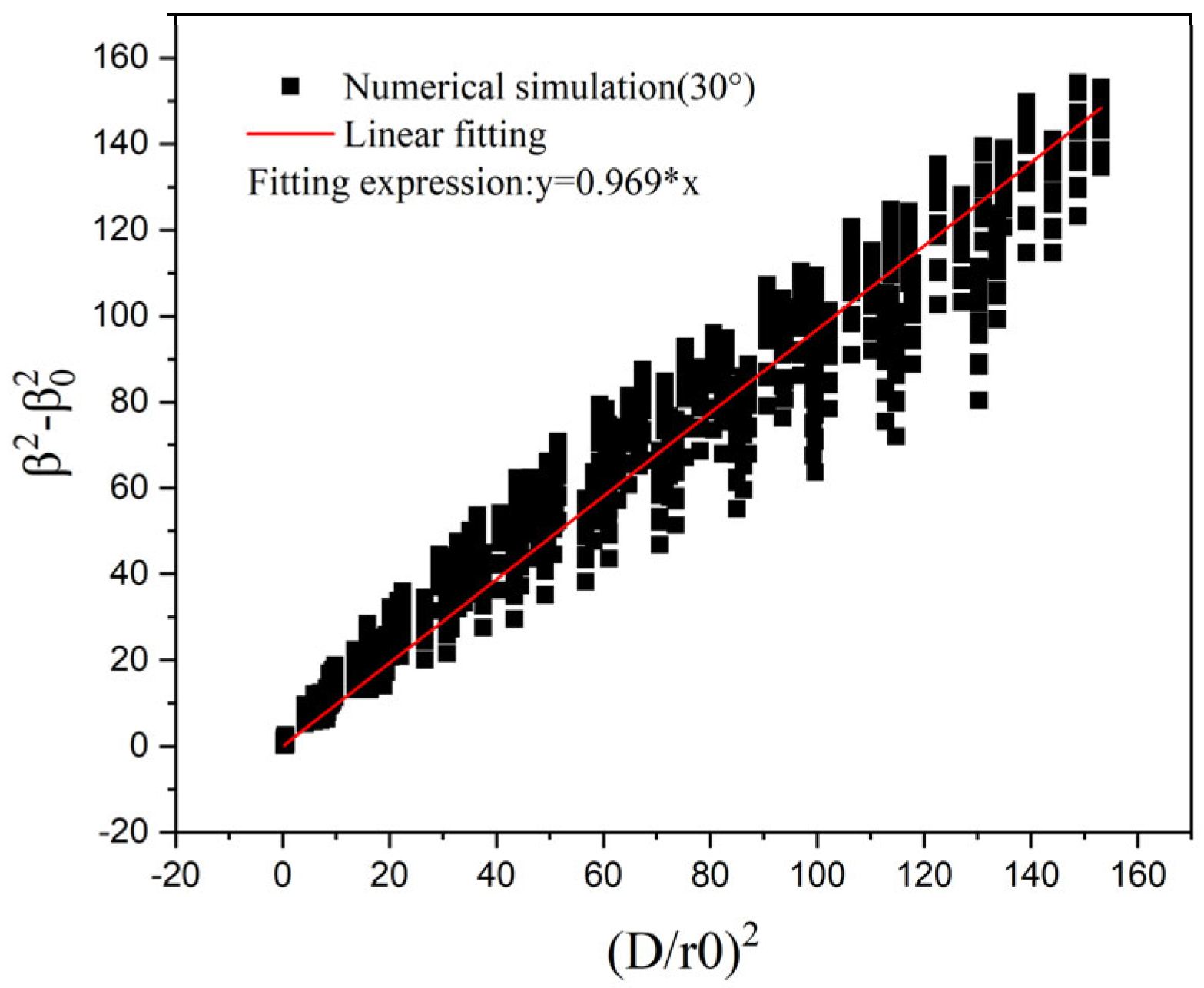
Figure 1 shows the variation relationship between the expansion factor
of the 63.2% encircled energy radius on the focal plane caused by turbulence effects and the turbulence term
under the condition that the laser propagation elevation angle
θ is 30°. In the figure, the variation in the turbulence term
is calculated by changing parameters such as the initial beam quality
, propagation distance
L, and turbulence intensity (i.e., the value of
), where the value range of
is 0.402–12.374.
Since the change in initial beam quality
does not cause a variation in the atmospheric correlation length
, and under the condition of the same atmospheric turbulence intensity, the magnitude of the
term remains unchanged when the propagation elevation angle and propagation distance are fixed, while
increases with the increase in
, the phenomenon that
corresponds to multiple groups of values when
takes a certain fixed value appears in
Figure 1, and this value-taking phenomenon is mainly caused by the different values of
. The k values under different propagation elevation angles obtained by fitting with the linear expression
are shown in
Table 1.
It can be seen from
Table 1 that as the laser propagation elevation angle
θ increases from 0° to 90°, the fitting coefficient
k gradually decreases from 1.034 to 0.888, showing an overall linear decreasing trend with a reduction of approximately 14% in the value of
k. This indicates that the variation in the propagation elevation angle has a relatively significant effect on turbulence effects, i.e., as the propagation elevation angle increases gradually, the influence of the turbulence term
on the expansion factor
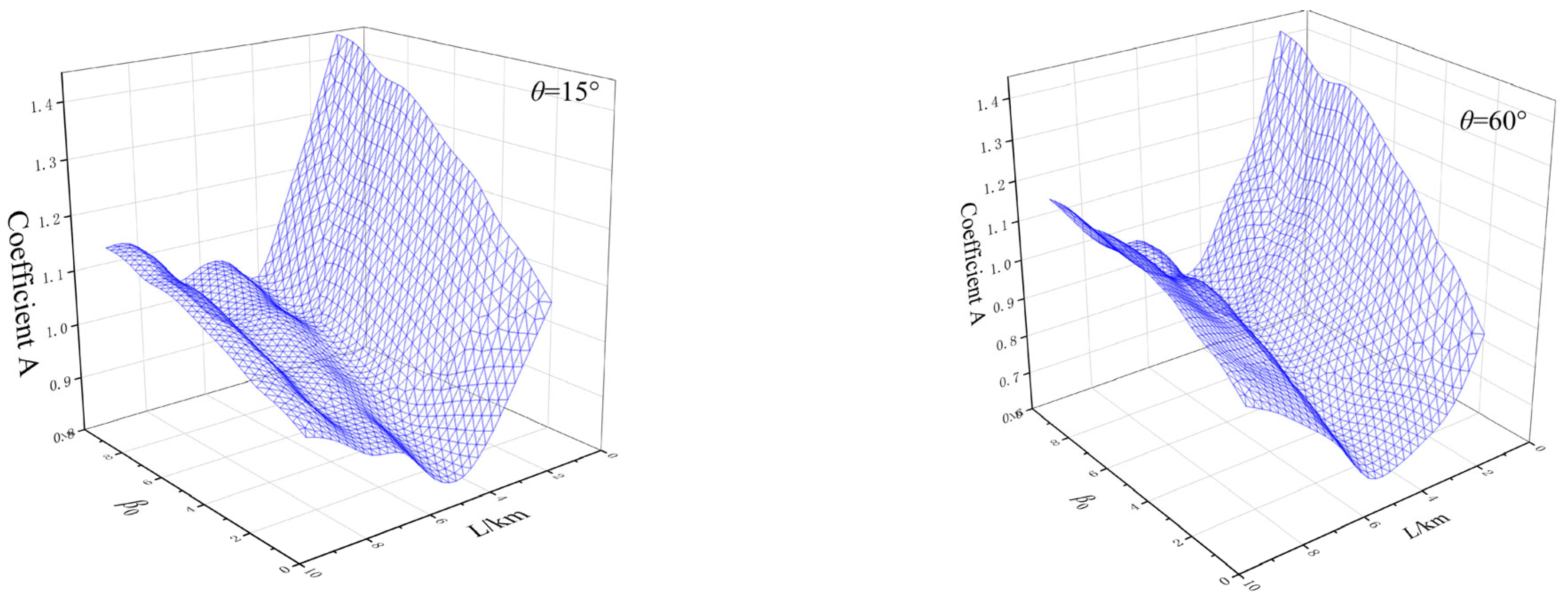
decreases gradually. To more accurately grasp the scaling laws under different parameter conditions, traversal combinations of propagation distance, propagation elevation angle, initial beam quality, and atmospheric turbulence intensity are carried out, and the propagation data under different transmission scenarios are fitted and analyzed, with 630 sets of coefficient A values obtained via simulation. The distribution of the coefficient A results obtained from simulations with propagation elevation angles
θ of 15° and 60°, respectively, is shown in
Figure 2.
In
Figure 2, the grid surface is generated from the coefficient A values calculated via simulation using the four-dimensional program. The propagation simulation results exhibit obvious fluctuation characteristics; as the propagation elevation angle
θ increases, the initial beam quality
and propagation distance
L induce significant numerical fluctuations and amplitude variations in coefficient A. When
θ is 15°, the surface undulation is gentle with no significant numerical drop. The value range of coefficient A is concentrated between 0.8 and 1.44 with a relatively small fluctuation amplitude, and the coverage of the high-value region (where A is close to 1.4) is wide. This means that most combinations of
L and
can maintain A at a relatively high level. When
θ is 60°, the surface undulation is intense with distinct numerical troughs (A can drop to around 0.6). The value range of coefficient A is concentrated between 0.6 and 1.44, with its lower limit notably reduced, and the coverage of the high-value region (where A is close to 1.4) is narrowed. This indicates that only a few combinations of
L and
can keep A at a relatively high level. Overall, this demonstrates that as the propagation elevation angle
θ increases, the sensitivity of coefficient A to the parameter combinations of
L and
is substantially enhanced, and minor changes in these parameters will lead to large fluctuations in the value of A.
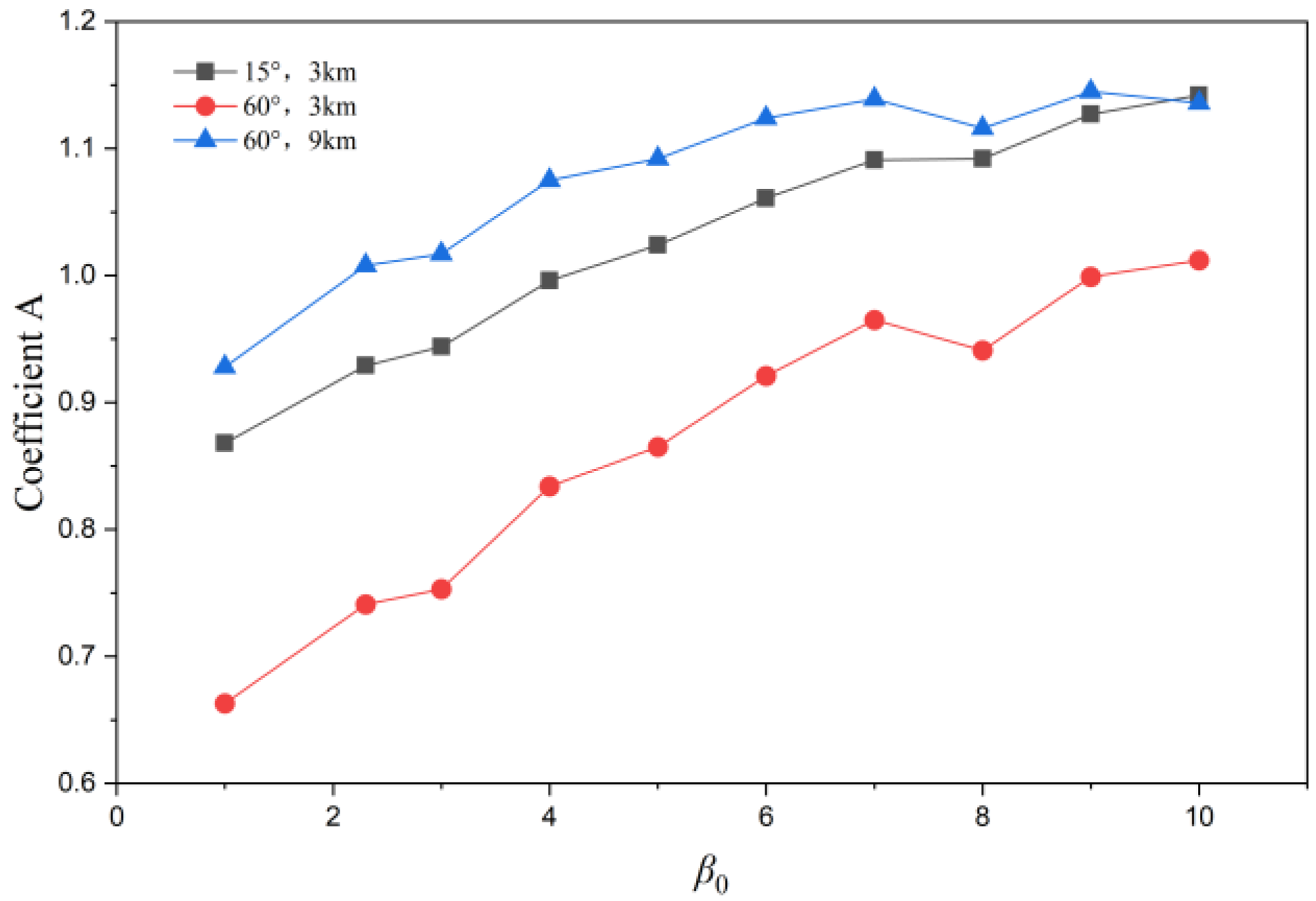
The variation in the turbulence term coefficient A with initial beam quality
under three propagation scenarios (
θ = 15° and
L = 3 km,
θ = 60° and
L = 3 km,
θ = 60° and
L = 9 km) is shown in
Figure 3.
When the initial beam quality is relatively low, the laser beam has a small divergence and a small cross-sectional area. This reduces, to a certain extent, the beam spreading caused by turbulence effects, thereby preserving the energy density at the beam center such that it remains unchanged or decreases slowly during propagation. Consequently, the variation in beam spreading induced by turbulence effects is slow, and the coefficient A is small. When the initial beam quality is relatively high, the laser beam exhibits large divergence and a large cross-sectional area, making it more susceptible to turbulence during propagation. This leads to intensified beam spreading and deterioration of beam quality, resulting in a rapid variation in beam spreading caused by turbulence effects and an increase in coefficient A. As continues to increase, turbulence-induced beam spreading becomes more severe, and the corresponding coefficient A increases continuously. When the propagation elevation angle θ is fixed, the coefficient A decreases with an increase in θ. Moreover, under different elevation angle and propagation distance conditions, the overall variation in coefficient A shows a nonlinear increasing trend.
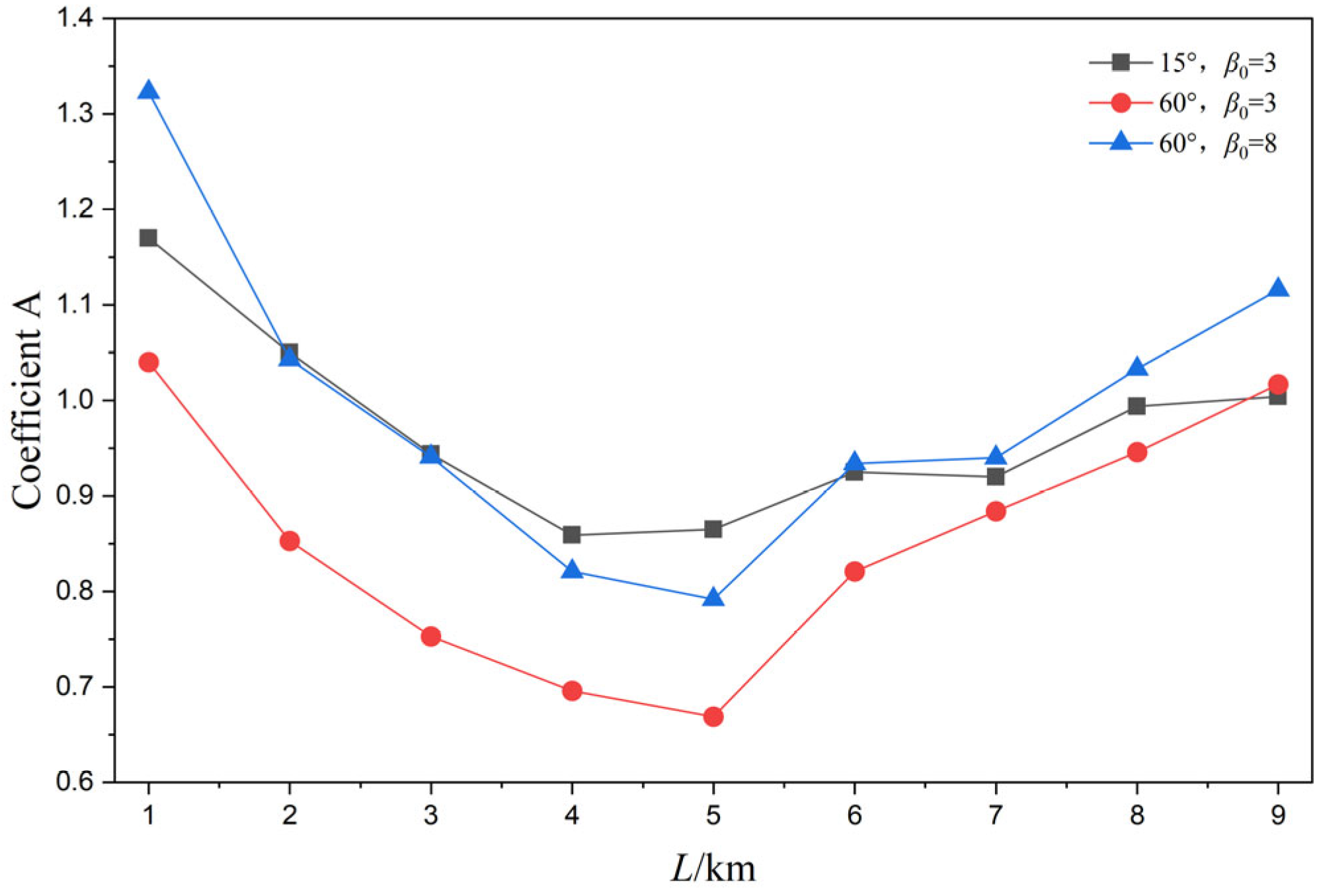
The variation in the turbulence term coefficient A with propagation distance
L under three propagation scenarios (
θ = 15° and
= 3,
θ = 60° and
= 3,
θ = 60° and
= 8) is shown in
Figure 4.
When the propagation elevation angle is small, the initial beam size is small over short distances, making the turbulence-induced disturbance to the beam spatial distribution more significant and the spreading rate faster. As the propagation distance increases, the beam has already undergone natural spreading, the relative disturbance effect of turbulence weakens, and the spreading rate gradually slows down. As shown by the curve under the condition of θ = 15° and = 3 in the figure, the coefficient A shows a slow decreasing trend with L, dropping from 1.15 to 0.95. When the propagation elevation angle θ is 60°, the value of A at = 8 is consistently higher than that at = 3, indicating that better beam quality can mitigate turbulence-induced beam spreading. When = 3, the overall value of A at high propagation elevation angles is lower than that at low propagation elevation angles, which demonstrates that high-elevation propagation can reduce the rate of turbulence-induced beam spreading. In addition, the coefficient A exhibits a U-shaped trend of “decreasing first and then increasing” with L, dropping to a minimum value of 0.65 at 5 km. In the short-distance segment (L < 5 km), the buffering effect of natural beam spreading dominates, causing A to decrease with increasing L. In the long-distance segment (L > 5 km), the thickness of the turbulence layer traversed by the propagation path continues to increase, and the cumulative disturbance effect of turbulence exceeds the buffering effect, leading to a slight rise in A. When = 8, the variation trend of A with L is consistent with that at = 3, but the value of A at L = 9 km (≈1.1) is significantly higher than that at = 3 (≈0.9). This indicates that the poorer the initial beam quality, the faster the rate of turbulence-induced beam spreading under long-distance and high-elevation propagation conditions.
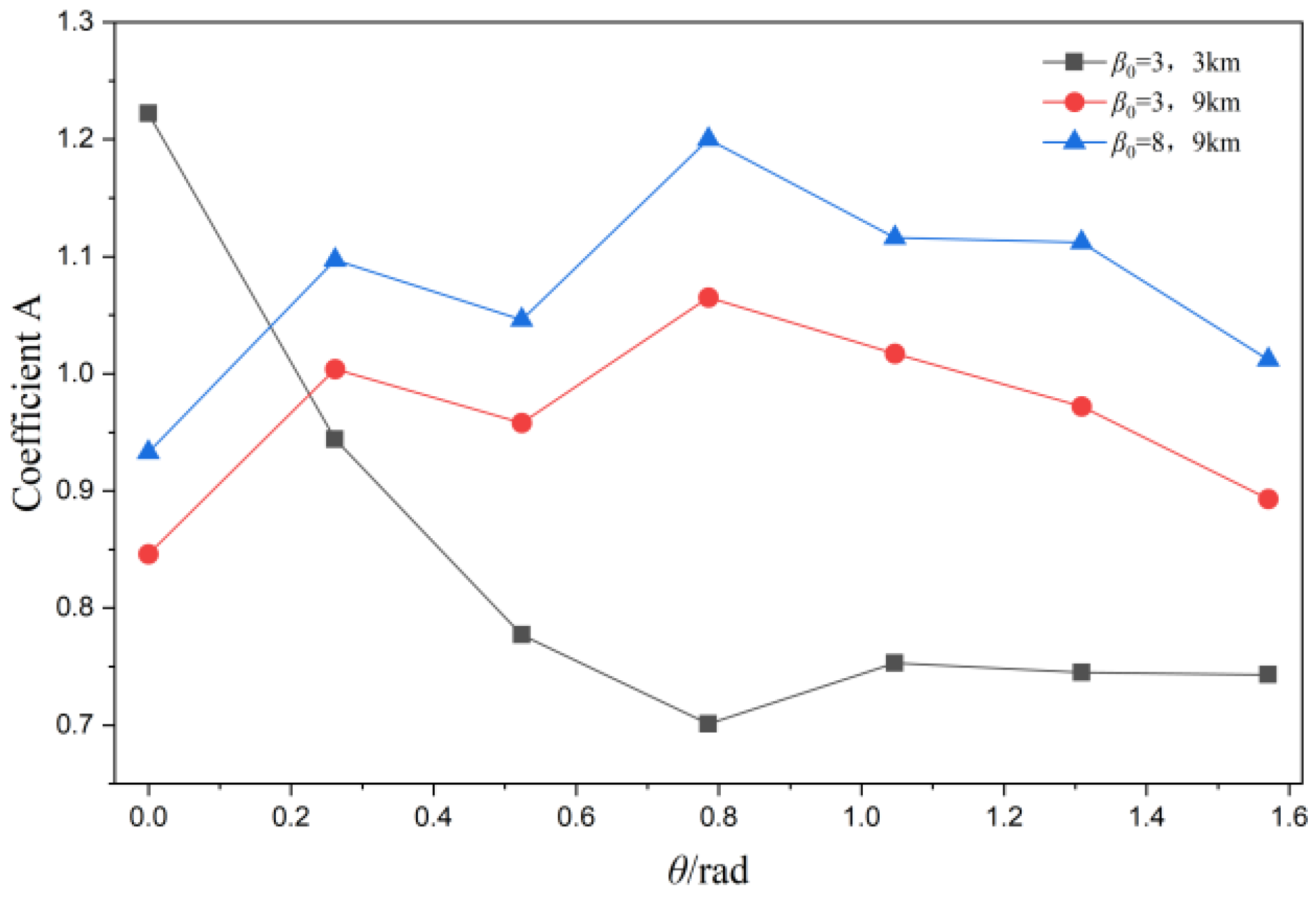
The variation in the turbulence term coefficient A with propagation elevation angle
θ under three propagation scenarios (
= 3 and
L = 3 km,
= 3 and
L = 9 km,
= 8 and
L = 9 km) is shown in
Figure 5.
As shown in
Figure 5, when the laser propagates over a distance of 3 km, low propagation elevation angles (
θ ≈ 0) correspond to the near-ground strong turbulence region, leading to a fast turbulence-induced spreading rate. As the elevation angle increases, the propagation path moves away from the near-ground strong turbulence region, and the spreading rate gradually decreases. When the propagation elevation angle further increases (
θ > 0.6 rad), the thickness of the high-altitude turbulence layer traversed by the propagation path increases; meanwhile, atmospheric turbulence intensity has a vertical distribution characteristic of decreasing with height, causing the beam spreading variation to increase again. Therefore, as
θ increases from 0 rad to 1.57 rad, the coefficient A generally exhibits a trend of “decreasing first and then increasing”, dropping to a minimum value of 0.7 at
θ = 0.6 rad. Under the condition of a longer propagation distance (
L = 9 km), the total turbulence integral intensity of the propagation path corresponding to low elevation angles is high, resulting in a fast spreading rate. As the propagation elevation angle increases, the equivalent turbulence integral of the propagation path decreases relatively, and the spreading rate gradually slows down. The variation trend of coefficient A with
θ turns into a “rising first and then falling” pattern (with the peak value appearing near
θ = 0.8 rad), which is opposite to the variation law under short-distance propagation conditions. In addition, the peak value of coefficient A at
= 8 (≈1.2) is significantly higher than that at
= 3 (≈1.05), indicating that the poorer the beam quality, the higher the peak value of the turbulence-induced spreading rate regulated by the elevation angle.
It can be concluded from the above analysis that the coefficient A is affected by the coupling effect of propagation distance L, propagation elevation angle θ, and initial beam quality . Among these factors, the improvement of can systematically reduce the sensitivity of turbulence-induced beam spreading, while the influences of L and θ exhibit nonlinear interaction characteristics.
4. Parameter Modeling and Numerical Analysis Based on Neural Networks
A neural network is an information-processing model that mimics the structure and function of biological nervous systems, with strong nonlinear mapping capability. The Feedforward Neural Network (FNN) is one of the most basic neural network structures; its information flow direction is strictly transmitted from the input layer through the hidden layer to the output layer, without any feedback connections.
A two-layer feedforward neural network (a single hidden layer structure) is adopted in this paper, with a topology of 3–10–1. Specifically, it includes the following components:
The input layer contains three nodes, corresponding to the dimensions of the input vector (propagation distance, propagation elevation angle, initial beam quality).
The hidden layer contains 10 nodes, using a nonlinear activation function (hyperbolic tangent function).
The output layer contains one node (coefficient A) and adopts a linear activation function, which is suitable for regression prediction tasks.
This structure theoretically satisfies the Universal Approximation Theorem, i.e., as long as the number of hidden layer neurons is sufficient, a feedforward neural network with a single hidden layer can approximate any continuous function with arbitrary precision [
26].
The specific calculation steps are as follows and dataset is provided in
Appendix B.
- (1)
Input Preprocessing (Normalization)
The input vector
is first subjected to Min-Max normalization, which is expressed as follows:
where:
,
,
.
- (2)
Hidden Layer
The hidden layer contains 10 neurons and adopts the hyperbolic tangent activation function, which is expressed as follows:
where:
is the weight matrix from the input layer to the hidden layer, and
is the hidden layer bias vector. The hyperbolic tangent activation function satisfies the following expression:
- (3)
Output Layer
The output layer is a linear layer, which is expressed as follows:
where:
is the weight vector from the hidden layer to the output layer, and
is the output layer bias.
- (4)
Output Postprocessing (Denormalization)
By combining the above steps, the complete network mapping is expressed as follows:
The final output is subjected to denormalization to obtain
where:
,
,
.
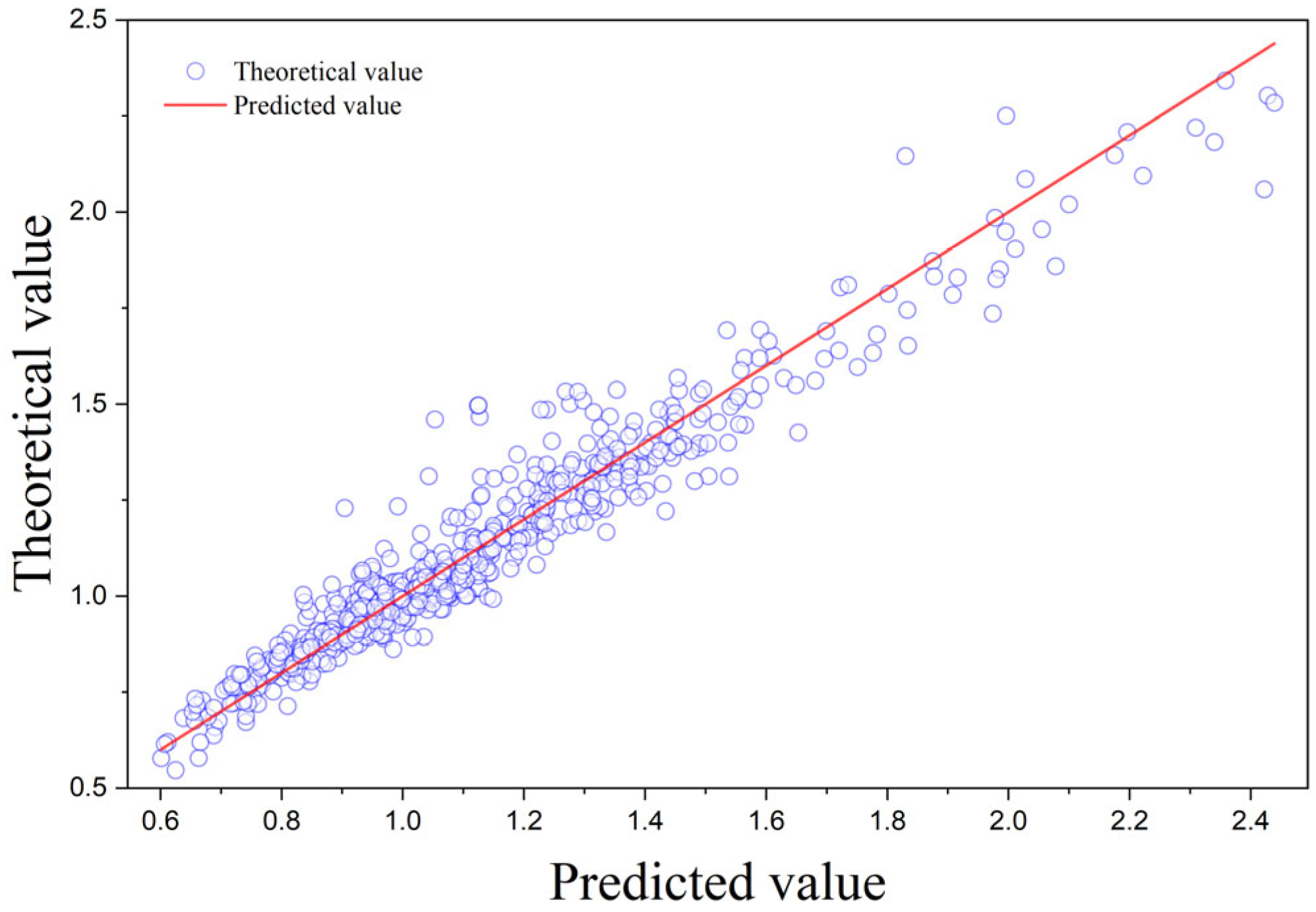
After training, the coefficient of determination (R
2) of the model reaches 0.94832, indicating high credibility. The model is used to predict coefficient A, and the prediction results are shown in
Figure 6. The predicted values are in high agreement with the theoretical values, and the model can accurately reflect the relationships between variables, i.e., it can effectively characterize the correlation between coefficient A and initial beam quality
, propagation distance
L, and propagation elevation angle
θ.
When the system tracking jitter error is considered, the turbulence intensity is set to 0 (i.e., the influence of the turbulence effect is not taken into account), and the numerical simulation results adopt the statistical values of 30 long-exposure laser propagation experiments. According to Equation (3), the calculation of the beam spreading term
caused by the system tracking jitter error is mainly related to parameters such as wavelength and emission aperture and is irrelevant to propagation distance and propagation elevation angle. Therefore, under the condition of fixed wavelength and emission aperture, the value of
can be calculated as 1.622 μrad. The far-field beam quality under the conditions of initial beam quality
ranging from 1 to 10 and tracking jitter error
ranging from 2.5 to 7.5 μrad was simulated and calculated. The values of coefficient B under different conditions obtained by fitting are shown in
Table 2, with an average value of 3.69.
As shown in
Table 2, under the condition of fixed initial beam quality, an increase in the system tracking jitter error does not cause a significant change in the rate of beam spreading variation, and their values are close to each other, indicating that the system tracking jitter error only leads to a steady increase in the amount of beam spreading. As the initial beam quality increases, the value of the beam spreading variation rate B still fluctuates around 3.69. Under the condition of fixed system tracking jitter error, with the gradual increase in initial beam quality, the degree of beam spreading gradually increases, while the proportion of beam spreading caused by the system tracking jitter error gradually decreases. When
is 2.5 μrad, 5 μrad, and 7.5 μrad, the corresponding proportions of beam spreading caused by the system tracking jitter error decrease from 88.6% to 11.3%, 42.2% to 33.5%, and 42.2% to 36.6%, respectively. When the beam spreading caused by the turbulence effect is taken into account, the proportion of beam spreading caused by the system tracking jitter error will be even smaller, and the impact of the value error of the corresponding coefficient B will also be smaller. Therefore, taking B as 3.69 can characterize the variation law of beam spreading caused by the system jitter error.
In summary, for a laser with a wavelength of 1 μm, an emission aperture of 1 m, a propagation distance ranging from 1 to 9 km, and an initial beam quality ranging from 1 to 10, the beam spreading within the 63.2% encircled power radius caused by linear effects during atmospheric laser propagation satisfies the following scaling relationship:
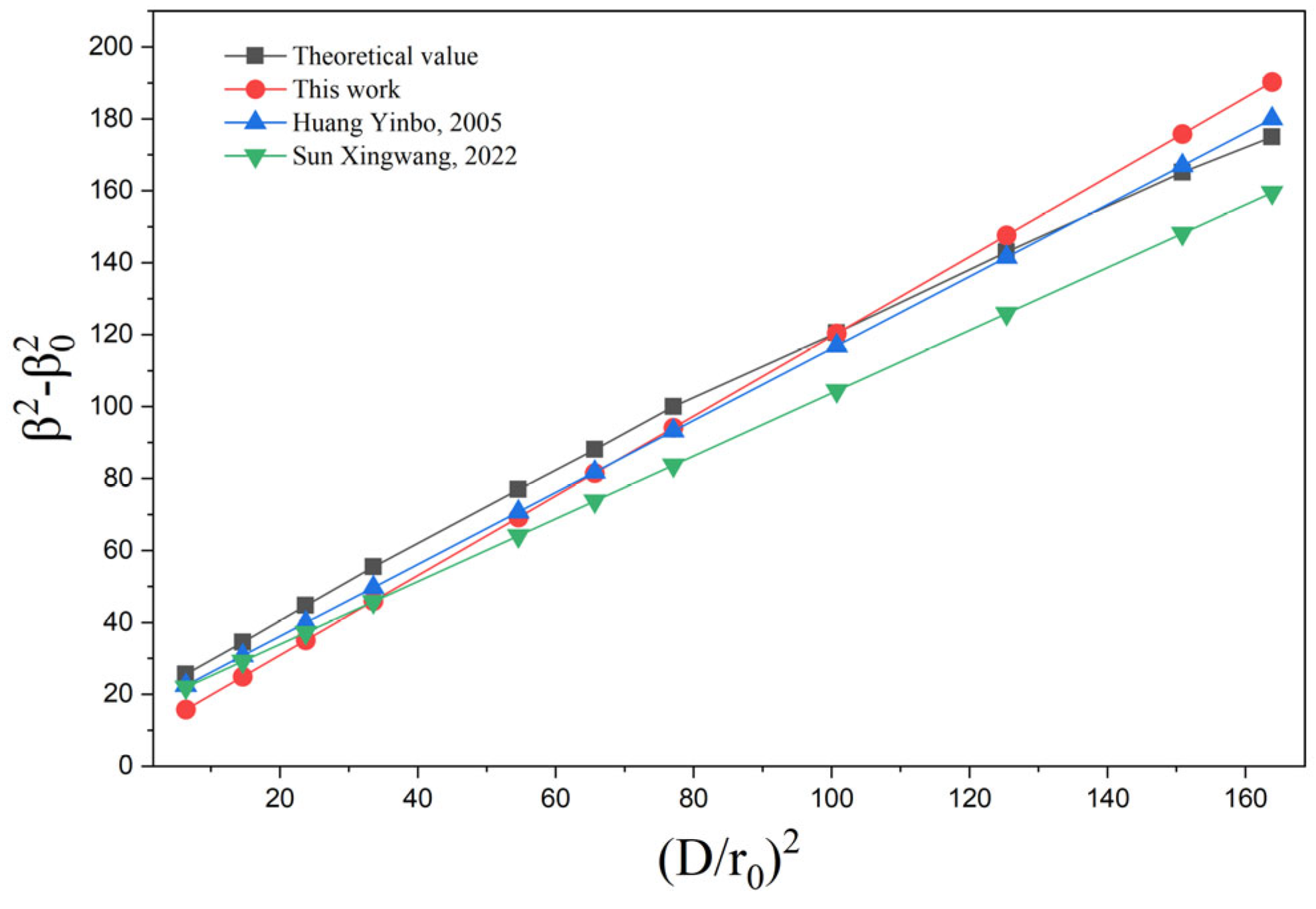
To further verify the accuracy of the scaling law for laser propagation under slant-path conditions, further validation is performed on Equation (13). Under horizontal laser propagation conditions, when
= 2.5 μrad,
= 3, and
L = 6 km, the scaling effects of Equation (13), as well as the scaling relations in Refs. [
13,
15], are shown in
Figure 7.
As can be seen from
Figure 7, Equation (10) and the scaling relations in Refs. [
13,
15] are basically consistent with the variation trend of the numerical simulation results and are in good agreement with them. Compared with the calculation results of Ref. [
15], the results obtained by Equation (13) are closer to the numerical simulation results. It can be concluded that the scaling expression proposed in this paper can relatively accurately characterize the variation law of beam spreading during horizontal laser propagation.
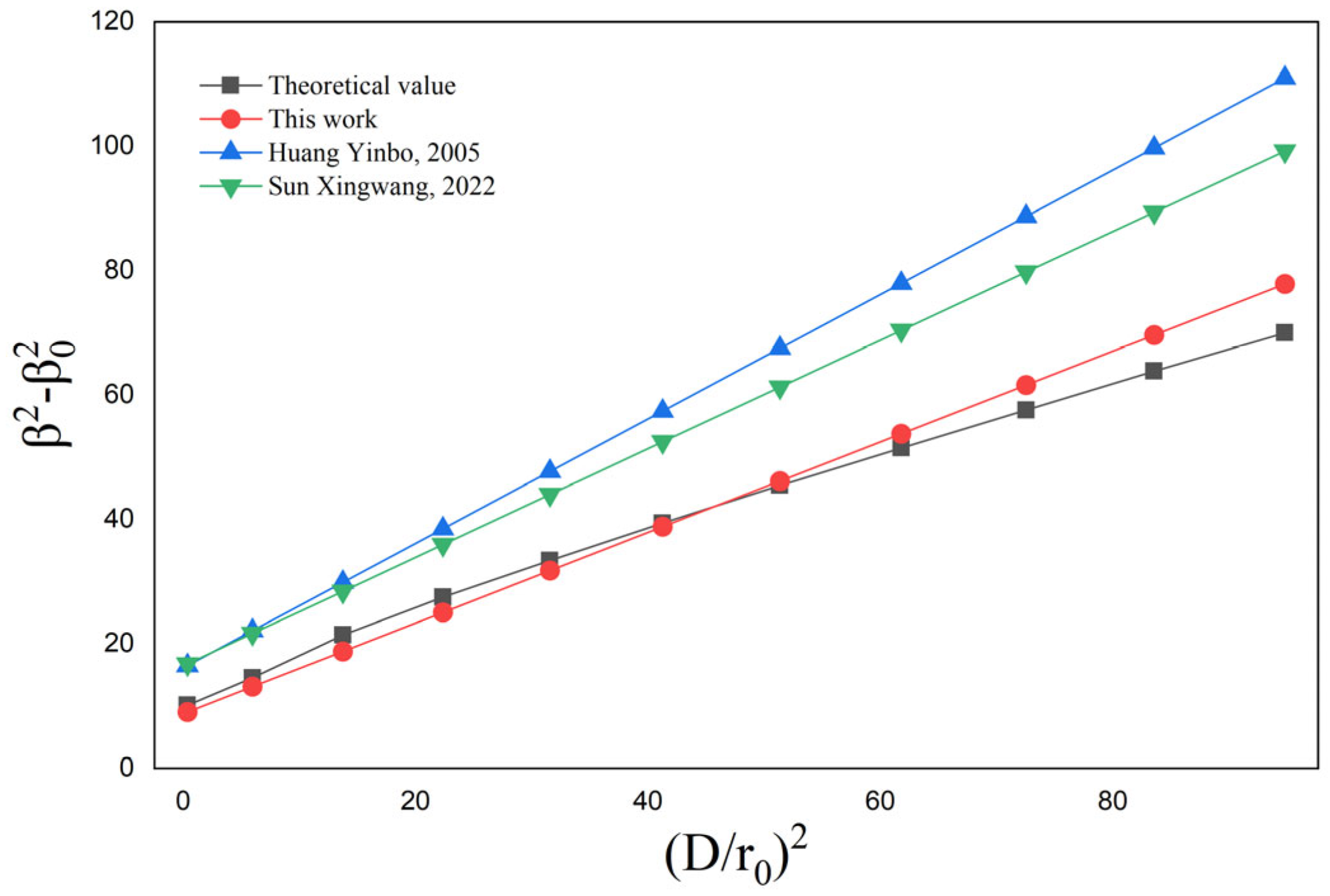
Under slant-path laser propagation conditions, when θ = 60°,
= 2.5 μrad,
= 3, and L = 5 km, the scaling effects of Equation (13), together with the scaling relations in Refs. [
13,
15], are shown in
Figure 8.
As can be seen from
Figure 8, when the laser propagates at an elevation angle of 60°, there are certain deviations between the calculation results of the scaling relations in Refs. [
13,
15] and the numerical simulation results. Moreover, with the gradual increase in
(i.e., the gradual enhancement of turbulence intensity), the deviation of the scaling results of Ref. [
13] increases progressively, with the
deviation rising from 6.4 to 41, and the deviation of the scaling results of Ref. [
15] increasing from 6.6 to 29.2. This indicates that the scaling expressions of Refs. [
13,
15] have large deviations in predicting and evaluating the beam spreading of lasers during partial slant-path propagation. In contrast, the
deviation between the calculation results of Equation (13) and the numerical simulation results is generally small, with the deviation range being 1.1–7.85. It can be concluded that the scaling expression proposed in this paper can relatively accurately predict and evaluate the variation law of beam spreading during laser slant-path propagation, which expands the effective application range of the scaling law.
5. Conclusions
In this work, we numerically investigated beam spreading induced by diffraction, atmospheric turbulence, and tracking jitter for 1.064 μm truncated Gaussian beams with a 1 m aperture propagating along horizontal and slant paths. A large wave-optics database was constructed by jointly varying the initial beam quality β0, propagation distance L, elevation angle θ, and turbulence strength Cₙ2. From 46,800 turbulence-only cases, we extracted the 63.2% encircled-power expansion factor and identified the coupled dependence of the turbulence term coefficient A on β0, L, and θ.
To efficiently represent these multidimensional effects, a compact 3–10–1 feedforward neural network was trained to map (β0, L, θ) to A, achieving high agreement with the simulation results and providing a fast surrogate for full wave-optics calculations. Additional simulations without turbulence showed that the tracking-jitter term coefficient B is nearly invariant over the investigated parameter range, with an effective constant value B ≈ 3.69. Combining the neural-network model for A with the constant B, we established a unified scaling law for the 63.2% encircled-power radius that simultaneously accounts for diffraction, turbulence, and tracking jitter.
Validation against independent wave-optics simulations confirms that the proposed scaling law accurately reproduces beam spreading for horizontal paths and, more importantly, substantially improves prediction accuracy for slant-path propagation (e.g., θ = 60°) compared with existing scaling models. The resulting expression offers a practical and computationally efficient tool for predicting beam-quality degradation and supporting the design, optimization, and performance assessment of laser systems operating in realistic atmospheric environments. Future work will extend the numerical database and scaling framework to other wavelengths and aperture sizes, incorporate non-Kolmogorov and anisotropic turbulence models, and include additional linear and nonlinear effects such as thermal blooming. Experimental validation under representative atmospheric conditions will further enhance the robustness and engineering value of the proposed scaling law.