Article

Integrated All-Optical De-Aggregation of Circular-32QAM Signals in a Hybrid Nonlinear Waveguide

1
School of Electronic Engineering, Xi’an University of Posts and Telecommunications, Xi’an 710121, China
2
School of Science, Xi’an University of Posts and Telecommunications, Xi’an 710121, China
3
State Key Laboratory of Ultrafast Optical Science and Technology, Xi’an Institute of Optics and Precision Mechanics, Chinese Academy of Sciences, Xi’an 710119, China
*
Author to whom correspondence should be addressed.
Photonics 2026, 13(2), 171; https://doi.org/10.3390/photonics13020171
Submission received: 14 January 2026 / Revised: 3 February 2026 / Accepted: 9 February 2026 / Published: 10 February 2026
(This article belongs to the Section Optical Communication and Network)

Abstract

This paper proposes an advanced all-optical de-aggregation scheme based on cascaded phase-sensitive amplification (PSA) for high-fidelity hierarchical information extraction from circular-32QAM signals. The proposed architecture systematically decomposes complex high-order modulation into three fundamental components: PAM4, QPSK, and BPSK. The first PSA stage performs amplitude normalization to equalize power fluctuations, followed by quadrant phase classification through phase-dependent gain mapping, and final intra-quadrant phase resolution via a cascaded dual-PSA configuration with a 90° phase offset. Through meticulous numerical simulations, we demonstrate that the optimized normalization depth effectively suppresses both amplitude and phase noise. Results indicate a high quadrant classification accuracy of 92%, which leads to a significant cumulative error reduction from 22% to 8% across the PSA chain. These findings demonstrate the theoretical feasibility of the proposed scheme in processing complex modulation formats entirely in the optical domain, which offers a potential framework for future high-capacity optical networks.

1. Introduction

The rapid advancement of coherent optical communication has brought modulation formats to unprecedented complexity, as higher spectral efficiency requires multiple bits to be encoded per symbol through both amplitude and phase dimensions. While high-order constellations such as Pulse Amplitude Modulation (PAM), Quadrature Amplitude Modulation (QAM) and Phase-Shift Keying (PSK) have become standard in modern transceivers, their implementation is still largely confined to the electronic domain, where digital signal processors perform demodulation and compensation after coherent detection [1,2]. However, the analog-to-digital conversion and digital computation required for these operations impose severe bottlenecks on speed, power consumption, and latency [3,4]. To overcome these constraints, all-optical signal processing has emerged as a promising direction, offering the possibility of performing modulation decomposition, regeneration, and routing directly in the optical domain without any electrical conversion [5].
Among various nonlinear optical techniques, PSA based on four-wave mixing (FWM) provides a unique mechanism that naturally couples amplitude equalization with phase-dependent gain control [6]. The gain of a PSA depends on the relative phase between the input signal and the pump waves, which enables it to selectively enhance or suppress specific phase components while simultaneously compressing amplitude fluctuations through gain saturation [7,8]. When implemented in a high-nonlinearity integrated waveguide, PSA can operate with low noise and broad bandwidth, which achieves ultrafast, power-efficient signal transformations [9]. These characteristics make PSA a promising basis for implementing all-optical de-aggregation of complex modulation formats [10].
In recent years, research on all-optical processing has expanded from simple on–off keying and BPSK regeneration toward complex modulation management involving multi-level constellations [11]. Experimental demonstrations of PSA have verified its ability to reduce phase noise in coherent communication links and to enhance signal-to-noise ratio through nonlinear phase-sensitive gain [12,13]. However, most previous works have been limited to single-stage configurations or low-order modulation formats, and as a result, the hierarchical treatment of both amplitude and phase dimensions has not been sufficiently explored [14]. In particular, the optical decomposition of multi-ring and multi-phase constellations, such as circular-32QAM (cir-32QAM), still lacks an integrated theoretical model capable of addressing amplitude normalization and phase separation in a unified framework [15,16].
From a device perspective, the development of hybrid integrated platforms has opened new possibilities for compact, high-nonlinearity waveguides that can sustain efficient FWM [17]. Materials such as silicon, chalcogenide, and graphene oxide (GO) have been widely studied for their large Kerr nonlinearity and design flexibility [18,19]. In particular, GO-integrated waveguides have demonstrated both high nonlinear response and low two-photon absorption, which provides an ideal balance between power efficiency and phase stability [20]. These advances have made it feasible to simulate and optimize all-optical systems capable of realizing complex modulation management entirely within the optical domain [21].
In this work, we present a purely simulation-based study of an all-optical de-aggregation scheme designed for cir-32QAM signals. The proposed system hierarchically separates a six-bit-per-symbol constellation into three optical sub-channels that correspond to amplitude, quadrant phase, and intra-quadrant phase information, and it produces PAM4, QPSK, and BPSK outputs, respectively. All processes are realized within cascaded PSA stages integrated on a high-nonlinearity hybrid waveguide, where both amplitude normalization and phase clustering are achieved through parametric gain control. The numerical simulations confirm that the system performs complete optical-domain decomposition of high-order constellations, which provides a compact and scalable model for future all-optical receivers and photonic processing systems.

2. Design of a-Si:H–Graphene Oxide Hybrid Waveguide

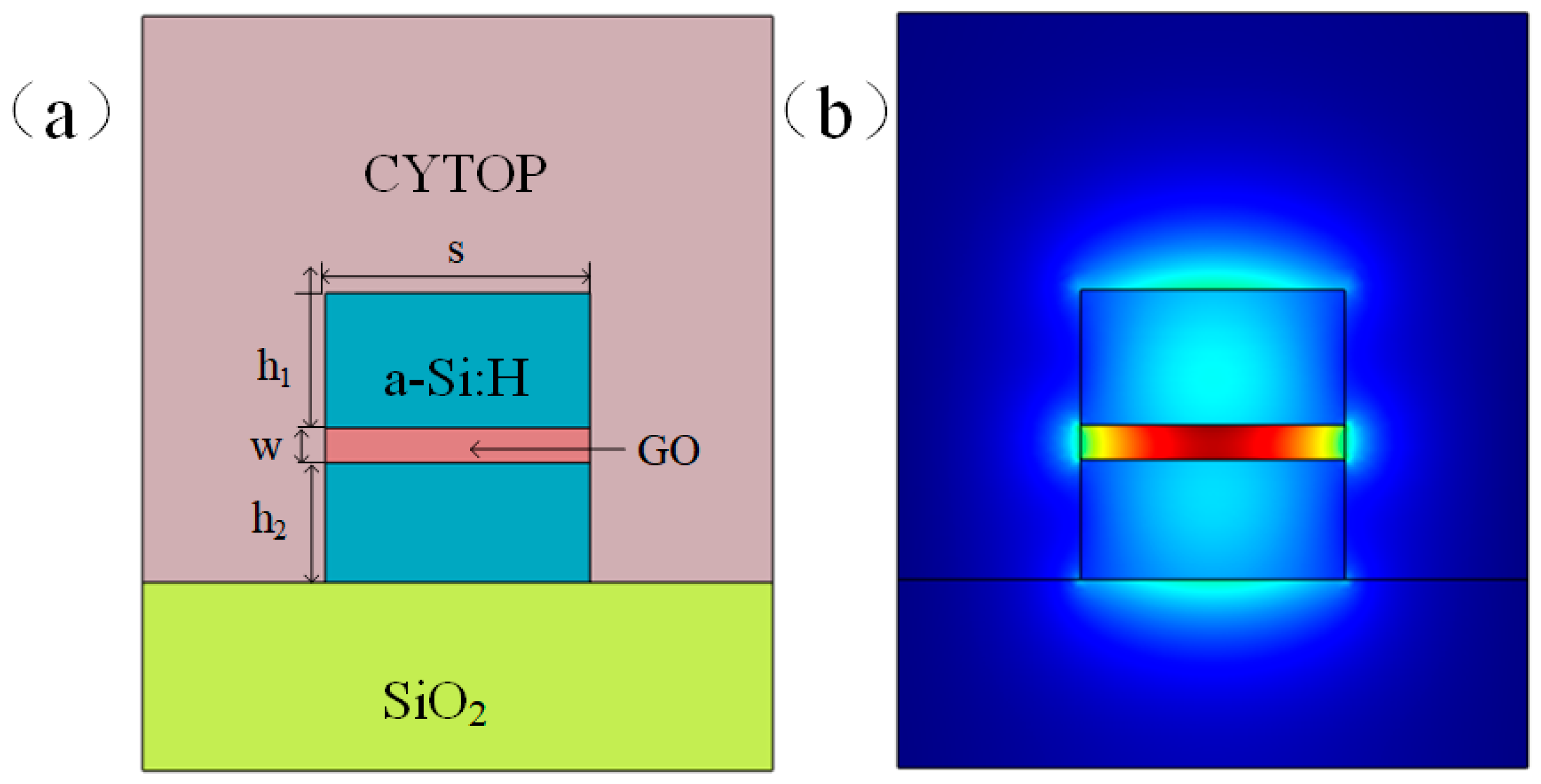
An a-Si:H (hydrogenated amorphous silicon)–GO hybrid waveguide is designed to achieve strong optical nonlinearity, as shown in Figure 1a. The GO layer with a nonlinear refractive index of n2 = 4.5 × 10⁻¹⁴ m2W−1 forms the core and is sandwiched between upper and lower a-Si:H layers. The device is fabricated on a thermally oxidized silicon dioxide substrate. The lower a-Si:H layer is deposited by plasma-enhanced chemical vapor deposition and patterned using electron beam lithography and reactive ion etching [22,23,24]. The compatibility of a-Si:H deposition with complex multilayer photonic integration has been widely verified [25,26]. The GO film is deposited by a solution-based coating method to ensure uniform layer-by-layer formation. An upper a-Si:H layer is then deposited by a second plasma-enhanced chemical vapor deposition step, which forms an asymmetric sandwich structure. The device is finally encapsulated with a CYTOP [27] (cyclic transparent amorphous fluoropolymer) cladding by spin coating and post-baking to improve environmental stability [28]. The refractive indices of all materials are listed in Table 1. This process is compatible with standard photonic integration and provides strong optical confinement for efficient nonlinear interaction [29,30].
The fundamental TE mode at 1550 nm is calculated using the finite element method (FEM), as shown in Figure 1b. The simulated optical field is mainly confined within the GO core due to the electric field enhancement in the sub-wavelength low-index slot. However, it exhibits intrinsic evanescent leakage to satisfy the boundary continuity conditions and shows a slightly asymmetric distribution along the vertical axis, which confirms that the nonlinear response is dominated by the central GO layer while it is still influenced by the thickness difference in the a-Si:H claddings.

2.1. Waveguide Geometry and Dispersion Engineering

The dispersion characteristic of the a-Si:H–GO hybrid waveguide governs its ability to maintain phase matching in nonlinear optical processes. To achieve efficient energy exchange among the interacting waves, the group velocity dispersion (GVD) must be carefully engineered so that the zero-dispersion wavelength (ZDW) coincides with the operating wavelength of 1550 nm. The general expression for the propagation constant is:
β = 2 π n eff λ
where neff is the effective refractive index, and λ is the wavelength. The wavelength dependence of β can be expanded through higher-order derivatives, where the n-th order dispersion coefficient is defined as:
β n = d n β d ω n ω = ω 0
Among these terms, the second-order coefficient β2 dominates pulse broadening and determines the group velocity dispersion. It can be expressed as:
β 2 = λ 3 2 π c 2 d 2 n eff d λ 2 λ 2 2 π c 2 d n eff d λ + λ 2 π c 2 n eff = d 2 β d ω 2
where c denotes the speed of light in vacuum. The dispersion parameter Dλ, which is more practical in fiber and waveguide analysis, is related to β2 by:
D λ = 2 π c λ 2 β 2
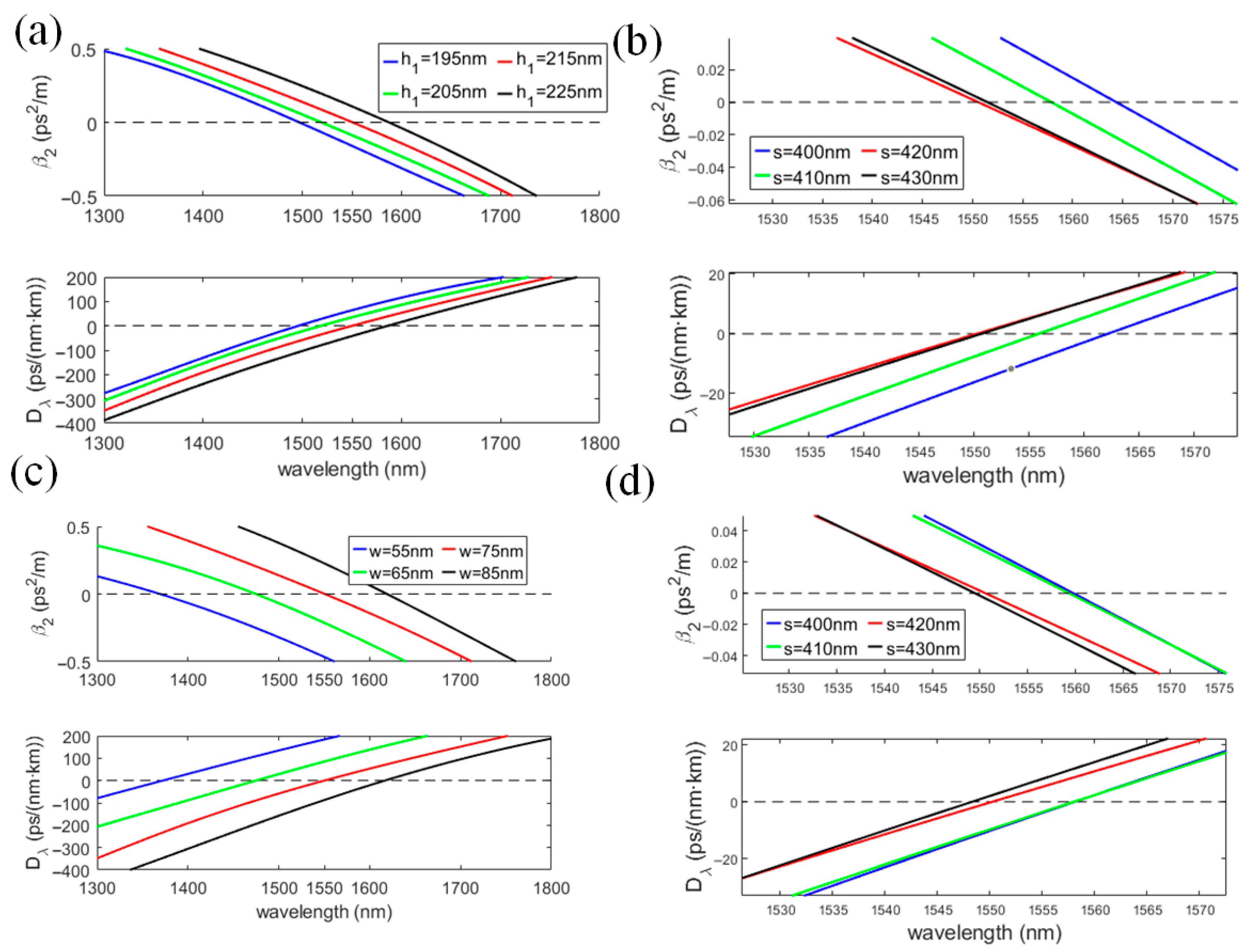
These relations together provide a complete description of the chromatic dispersion characteristics of the waveguide. Finite element simulations were performed to analyze how the geometrical parameters affect the dispersion curve. The upper a-Si:H layer height h1, the lower a-Si:H layer height h2, the total waveguide width w, and the slot width s were varied independently while maintaining all other parameters constant. Figure 2a–d illustrate the influence of these parameters on the zero-dispersion wavelength. The red reference curves indicate the configuration that aligns the ZDW near 1550 nm, which ensures efficient phase matching within the PSA process. The optimized dimensions were determined as h1 = 215 nm, h2 = 190 nm, w = 75 nm, and s = 420 nm.

2.2. Nonlinear Properties and Phase Mismatch Analysis

The nonlinear behavior of the a-Si:H–GO hybrid waveguide is mainly determined by the nonlinear coefficient γ and the effective mode area Aeff. A large γ implies stronger FWM efficiency and lower required pump power, while a smaller Aeff enhances the light–matter interaction within the GO core. These two parameters together reflect the capability of the structure to support high-efficiency all-optical signal processing. The effective mode area and nonlinear coefficient are defined as:
A eff = | F x , y | 2 d x d y 2 | F x , y | 4 d x d y
γ = 2 π λ n 2 ( x , y ) | F ( x , y ) | 4 d x d y | F x , y | 2 d x d y 2 = 2 π n 2 λ A eff
where F(x,y) denotes the normalized transverse electric field distribution, and n2 is the nonlinear refractive index of the active material. Since the optical field is highly confined within the core region and the contribution from the surrounding layers is negligible, the nonlinear parameters are approximated by considering only the core region. For efficient phase-sensitive amplification, the phase mismatch Δβ must be minimized, which is expressed as
Δ β = k p 1 + k p 2 2 k s = n p 1 ω p 1 + n p 2 ω p 2 2 n s ω s c
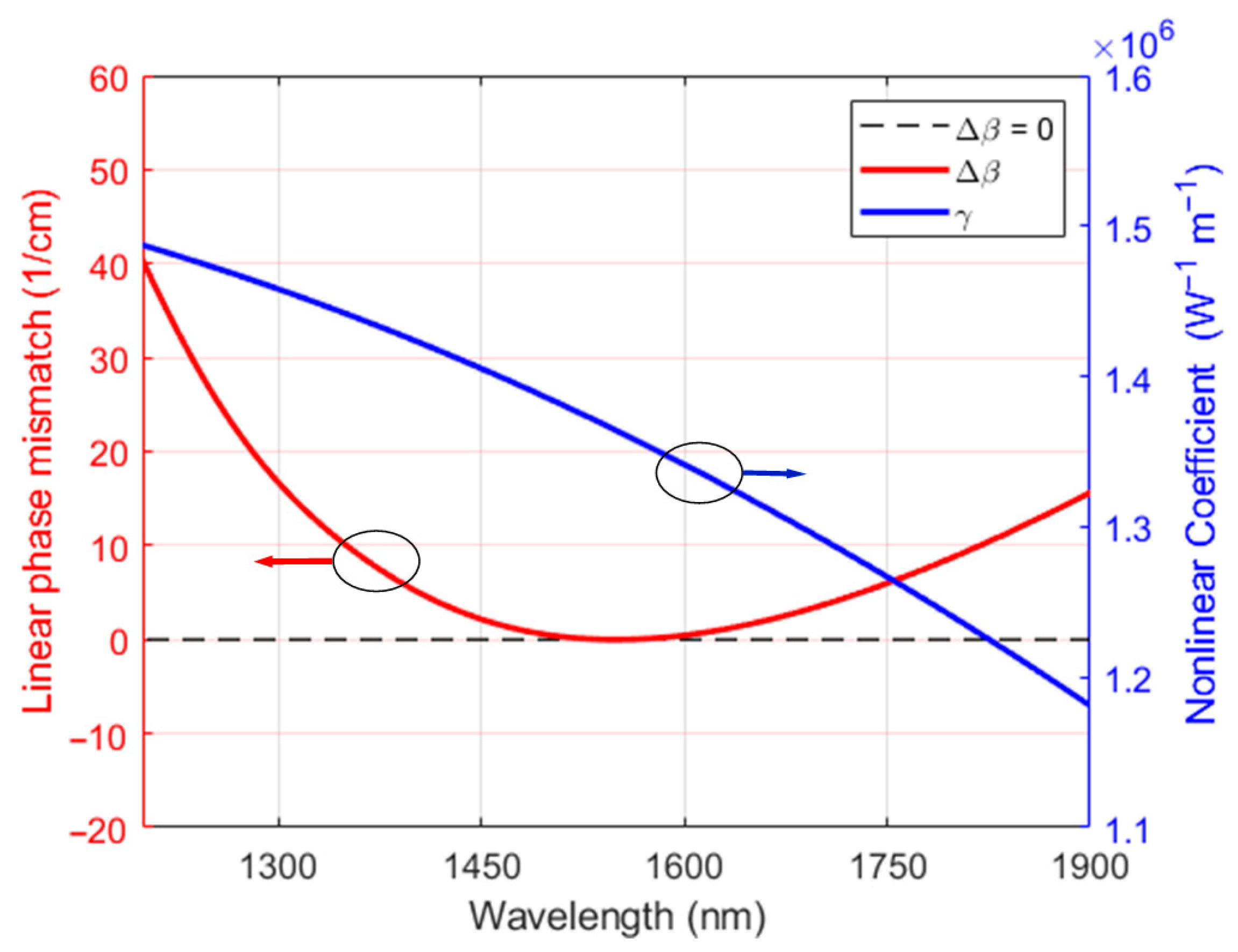
Figure 3 shows the simulated phase mismatch Δβ (red curve) and the nonlinear coefficient (blue curve) as functions of wavelength. The red curve remains nearly zero across the 1450–1750 nm range, which indicates that the structure provides broadband phase matching within the C-band. However, it is acknowledged that this theoretical bandwidth represents an ideal upper limit; in practical fabrication, geometric tolerances and thermal drift will inevitably constrain the effective phase-matching window. This flat phase-matching region ensures efficient nonlinear interaction and stable PSA gain. The calculated effective mode area is 0.0134 μm2 and corresponds to a nonlinear coefficient of 1.364 × 10⁶ W−1·m−1, which confirms that the designed waveguide exhibits a strong nonlinear response suitable for compact all-optical functional devices. Practically, this ultra-high nonlinearity enables the realization of functional all-optical devices within a micrometer-scale footprint.
While the simulation results demonstrate the theoretical viability of the proposed waveguide design, practical deployment must address several physical constraints. First, regarding fabrication tolerances, the dispersion profile is sensitive to geometric variations; deviations in layer thickness (e.g., >±5 nm) may shift the zero-dispersion wavelength, necessitating precise nanofabrication. Second, PSA performance relies on strict phase coherence. In a real system, pump phase jitter must be mitigated using Optical Phase-Locked Loops or carrier recovery techniques. Third, due to the high thermo-optic coefficient of silicon, thermal drift could induce phase mismatch, making active temperature stabilization via Thermal Electric Coolers essential. Finally, polarization controllers are required to ensure TE-mode operation to minimize polarization-dependent impairments.

3. All-Optical De-Aggregation Scheme

3.1. Overall Architecture and Operating Principle

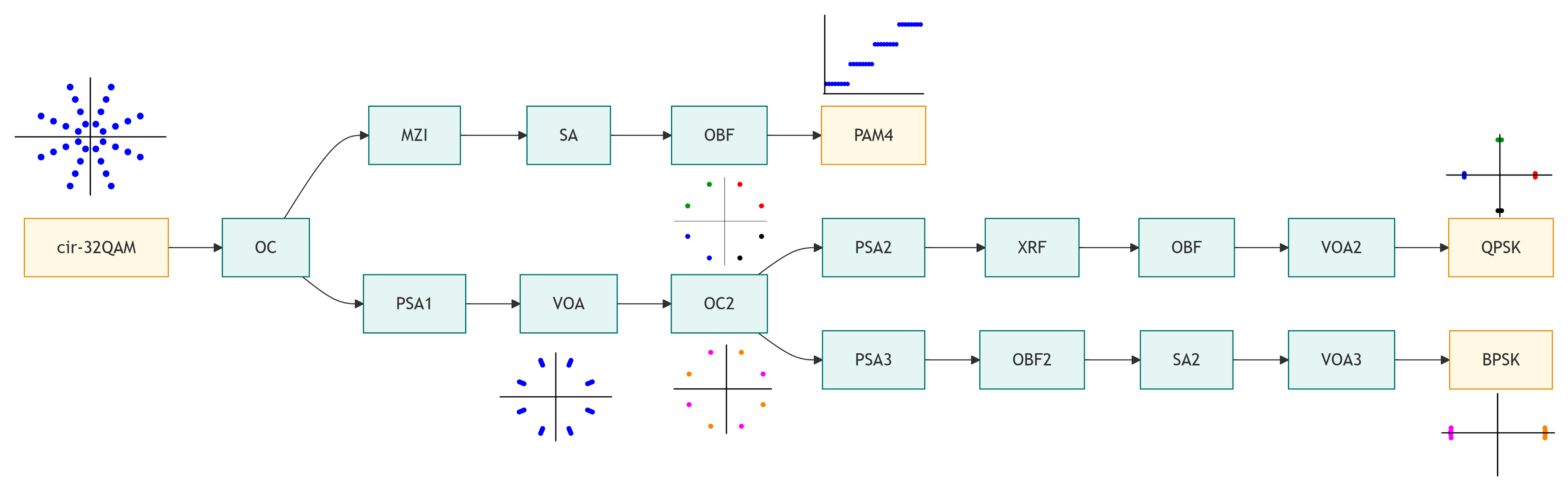
The overall configuration of the proposed all-optical de-aggregation system is shown in Figure 4. The system performs hierarchical processing of the cir-32QAM signal entirely in the optical domain. The input signal is first divided by an Optical Coupler (OC) into two primary branches. The upper branch is responsible for amplitude discrimination, while the lower branch carries out phase-based processing after normalization.
In the amplitude branch, a Mach–Zehnder Interferometer (MZI) functions as an optical threshold comparator that separates the amplitude levels of the cir-32QAM constellation. Its output passes through a Saturable Absorber (SA) for nonlinear limiting and an Optical Bandpass Filter (OBF) for noise suppression, which yields a stable PAM4 signal that represents the outer amplitude bits [31,32,33]. The lower branch begins with a PSA1, which performs amplitude normalization through phase-dependent gain compression. The equalized signal is adjusted by a Variable Optical Attenuator (VOA) and then divided by a secondary OC2 into two phase-processing paths [34]. In the upper path, PSA2 provides quadrant-phase discrimination, selectively amplifying four stable phase states to form a QPSK constellation. This signal passes through a Cross-Gain Regenerative Filter (XRF) to improve amplitude uniformity, then through OBF and VOA for power stabilization. In the lower path, PSA3 introduces a fine phase bias to separate the two remaining phase states within each quadrant, which generates the BPSK output after passing through OBF2, SA2, and VOA3 for filtering, limiting, and equalization. The detailed mechanisms of each branch will be discussed in the following sections [35].

3.2. Amplitude Decision and Normalization

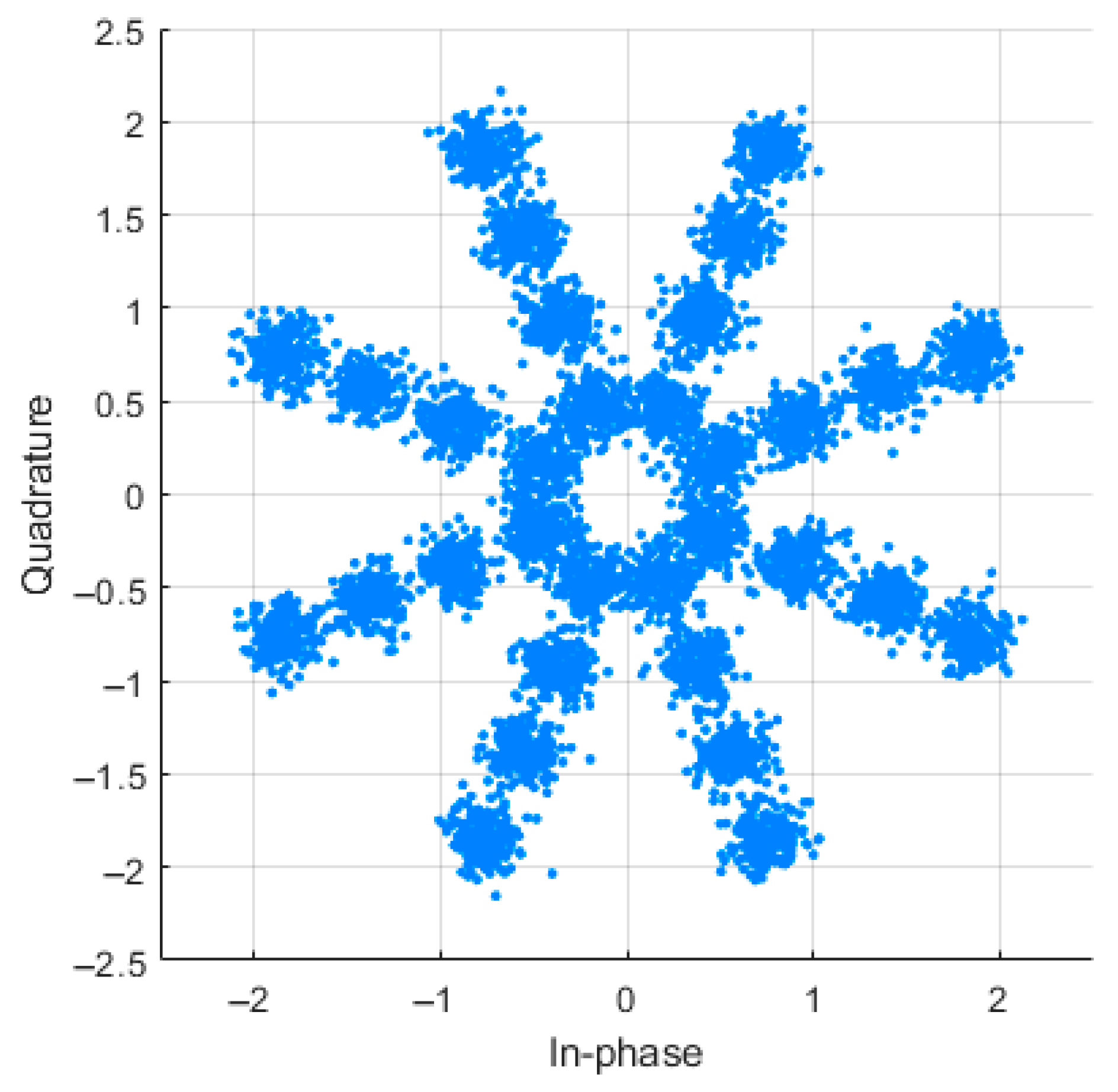
The amplitude decision stage forms the first layer of the optical de-aggregation chain. It directly receives the unprocessed cir-32QAM signal, whose constellation, shown in Figure 5, exhibits four concentric amplitude rings with sixteen points per circle. Each ring corresponds to a discrete power level, yet the amplitude overlap caused by modulation noise makes direct classification unreliable. Therefore, an optical thresholding method is introduced to perform level discrimination entirely in the optical domain without electrical sampling.
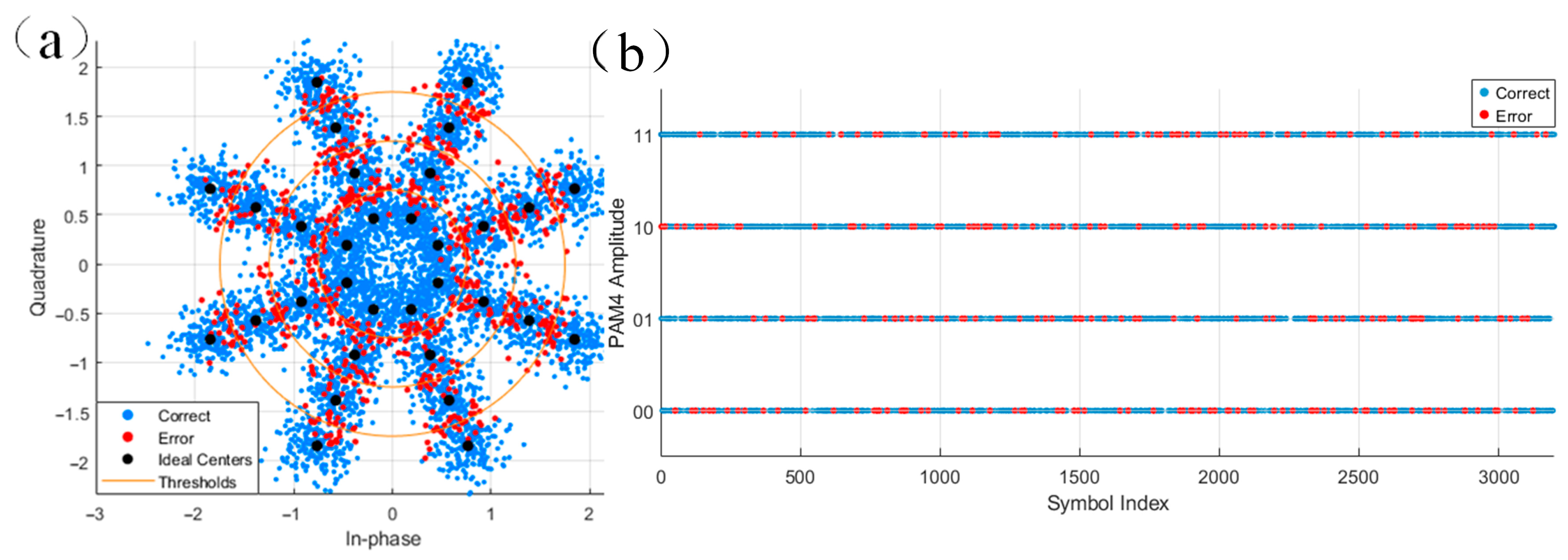
As illustrated by the second constellation in Figure 6a, the incoming signal is processed through an MZI array acting as an amplitude comparator. Three amplitude thresholds are pre-set according to the mid-power values between the four rings. The MZI converts small optical power differences into interferometric intensity variations. Mechanistically, the amplitude decision is realized through a cascaded Nonlinear Mach-Zehnder Interferometer (NMZI) structure, which utilizes the Self-Phase Modulation (SPM) effect within the high-nonlinearity a-Si:H–GO hybrid waveguide arms. The optical power P(t) induces a nonlinear phase shift ΦNL(t) = γP(t)Leff, where Leff is the effective length. By cascading multiple NMZI units with distinct static phase biases, we establish a multi-threshold transfer function that maps the four continuous input amplitude rings to discrete output levels.
In this decision stage, correctly identified points are marked in blue, while misclassified ones appear in red, and the black dots represent the nominal constellation centers. The circular contours indicate the judgment boundaries between adjacent power levels, which form a four-region optical partition equivalent to PAM4 modulation. This decision process establishes the first sub-channel of the system and extracts the two amplitude bits of the cir-32QAM signal. The resulting PAM4 signal shown in Figure 6b confirms the successful first-step de-aggregation of the composite signal.
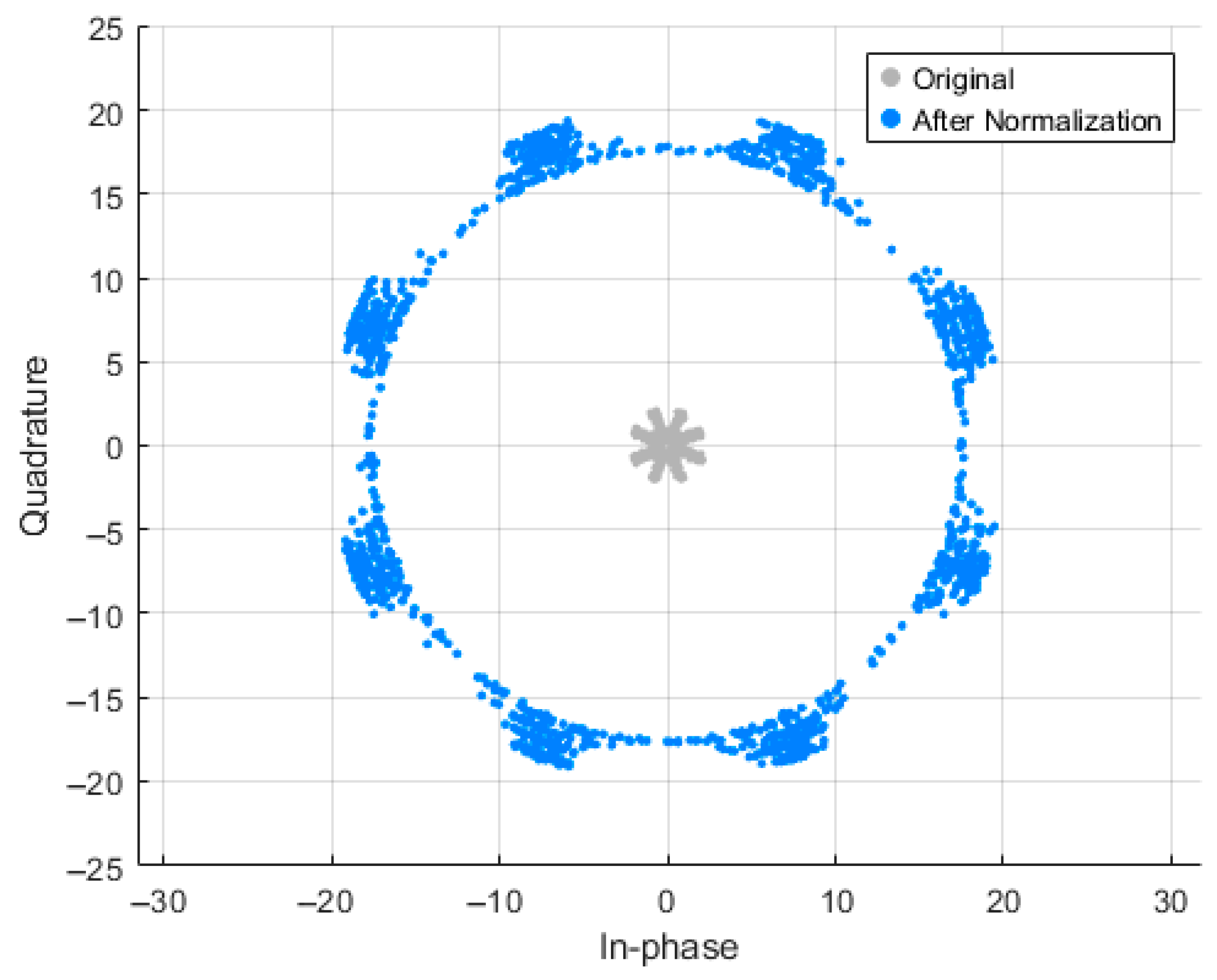
To prepare the signal for subsequent phase-domain processing, amplitude normalization is performed through PSA1. As shown in Figure 7, the original constellation (gray) is transformed into a nearly uniform ring (blue) after normalization, where amplitude fluctuation is largely eliminated. Physically, this process relies on the phase-dependent gain property of PSA, where high-power components experience reduced amplification due to gain saturation, while low-power components are boosted through nonlinear energy transfer among the pump and signal waves. This self-balancing mechanism equalizes the optical field amplitude without distorting its phase relationship. The output of PSA1 thus provides a uniform and coherent optical carrier for the following PSA2 and PSA3 operations, which handle quadrant-phase and fine-phase de-aggregation, respectively.

3.3. Quadrant Phase Classification

The second stage of the optical de-aggregation process performs quadrant phase discrimination based on the nonlinear interaction within PSA2. In terms of physical implementation, this is realized through a dual-pump Four-Wave Mixing (FWM) configuration. Two high-power, coherent pumps are generated and coupled with the input signal into the a-Si:H–GO hybrid waveguide. The frequencies of the two pumps, ωp1 and ωp2, are arranged symmetrically around the signal center frequency to satisfy the phase-matching condition.
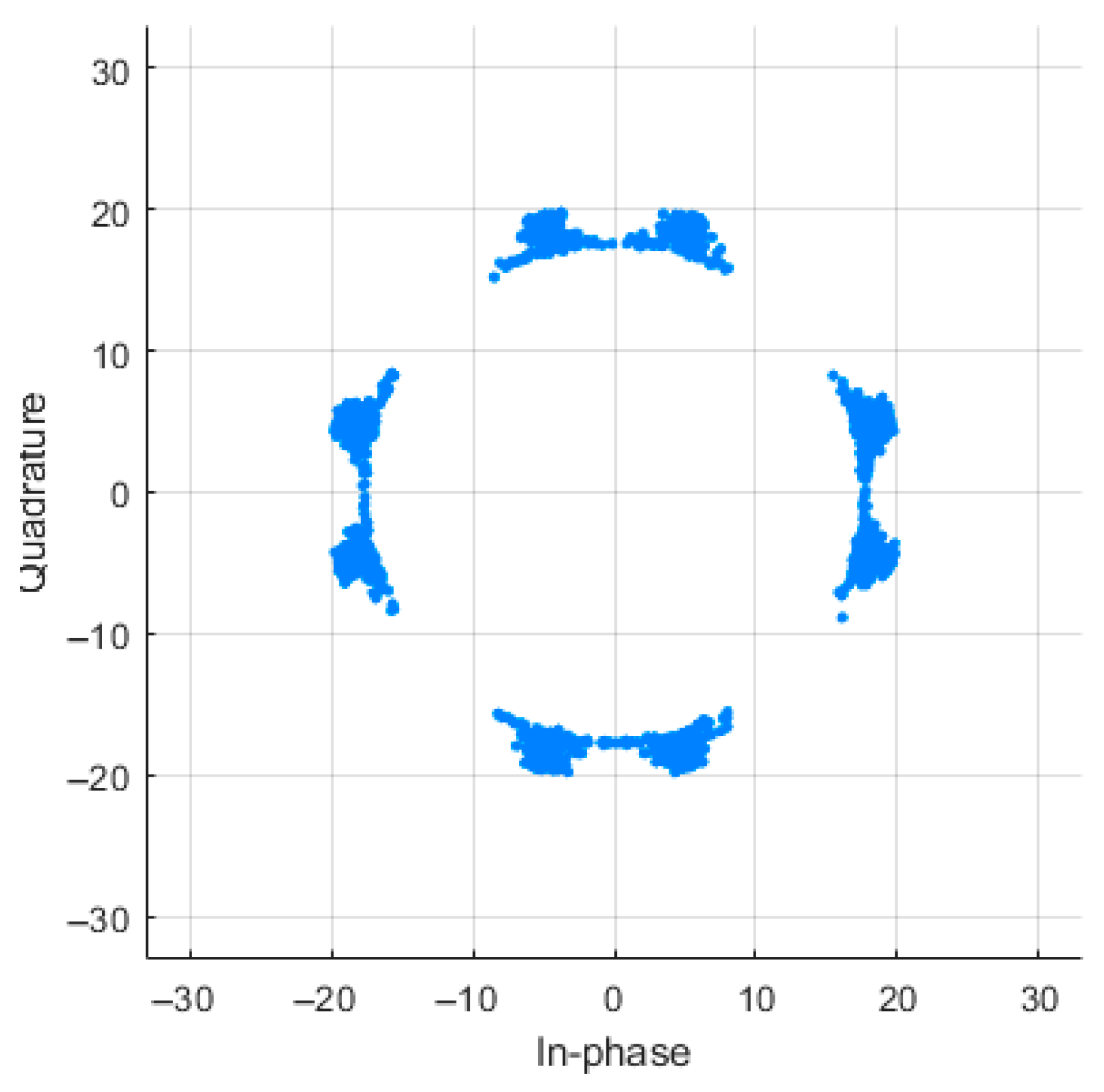
This stage converts the normalized circular constellation into four phase-clustered groups corresponding to 0°, 90°, 180°, and 270°, which generates the QPSK output. The classification originates from the intrinsic phase-dependent gain of PSA2, realized through degenerate FWM in a high-nonlinearity hybrid waveguide pumped by two coherent sources.
The nonlinear evolution of the optical fields along the propagation axis z can be described by the coupled-wave equations:
d A p 1 d z = α 2 A p 1 + j γ ( | A p 1 | 2 + 2 | A p 2 | 2 + 2 | A s | 2 + 2 | A i | 2 ) A p 1   + j γ A p 2 * A s A i e j Δ k z β T P A 2 | A p 1 | 2 A p 1 , d A p 2 d z = α 2 A p 2 + j γ ( | A p 2 | 2 + 2 | A p 1 | 2 + 2 | A s | 2 + 2 | A i | 2 ) A p 2 + j γ A p 1 * A s A i e j Δ k z β T P A 2 | A p 2 | 2 A p 2 , d A s d z = α 2 A s + j γ ( | A s | 2 + 2 | A i | 2 + 2 | A p 1 | 2 + 2 | A p 2 | 2 ) A s + j γ A s * A p 1 A p 2 e j Δ k z β T P A 2 | A s | 2 A s , d A i d z = α 2 A i + j γ ( | A i | 2 + 2 | A s | 2 + 2 | A p 1 | 2 + 2 | A p 2 | 2 ) A i + j γ A s * A p 1 A p 2 e j Δ k z β T P A 2 | A i | 2 A i .
where the Ap1 and Ap2 represent the complex amplitudes of the two pump waves, As denotes the signal field, and Ai corresponds to the idler generated through FWM. The linear loss coefficient is α = 0.0055 dB/μm, and the two-photon absorption coefficient is βTPA = 2.2 × 10⁻¹¹ m/W [36,37]. The waveguide length is z = 16 μm, and Δk = 2kpkski describes the phase mismatch. The pump wave powers are both set to 35 mW, and the signal wave power is 100 μW. The overall gain of PSA2 depends on the relative phase ϕ = ϕs + ϕiϕp1ϕp2 between the interacting waves. When ϕ = 0 or π, the interference is constructive, which leads to maximum amplification; when ϕ = ±π/2, destructive interference suppresses amplification, thereby introducing a 90° periodic gain profile. It is important to emphasize that these coupled-wave equations rigorously incorporate the pump depletion effect by solving the spatial evolution of the pump fields simultaneously with the signal.
After PSA2, the signal enters a fine conditioning chain designed to stabilize its amplitude and suppress residual noise. The first element is the XRF, which enhances gain uniformity by coupling energy between locally over-amplified and under-amplified regions, effectively compressing amplitude variations across the QPSK clusters. The filtered signal then passes through an OBF to remove high-frequency sidebands generated during the nonlinear process, followed by a VOA2 that adjusts output power to match the following detection or de-aggregation stage. As shown in Figure 8, the final constellation exhibits four compact clusters positioned symmetrically at 0°, 90°, 180°, and 270°, which correspond to the constructive gain regions of PSA2. It should be noted that the slight angular broadening is a residual effect from the previous stage. Although the PSA mechanism provides phase squeezing and reduces phase noise, it does not compress the signal to a single ideal point. However, the achieved phase compression is sufficient for the receiver to perform accurate QPSK demodulation. The overall effect of this branch is a coherent phase classification that converts the normalized cir-32QAM signal into a clean QPSK pattern with reduced intra-cluster noise and well-preserved inter-cluster separation.

3.4. Intra-Quadrant Phase De-Aggregation

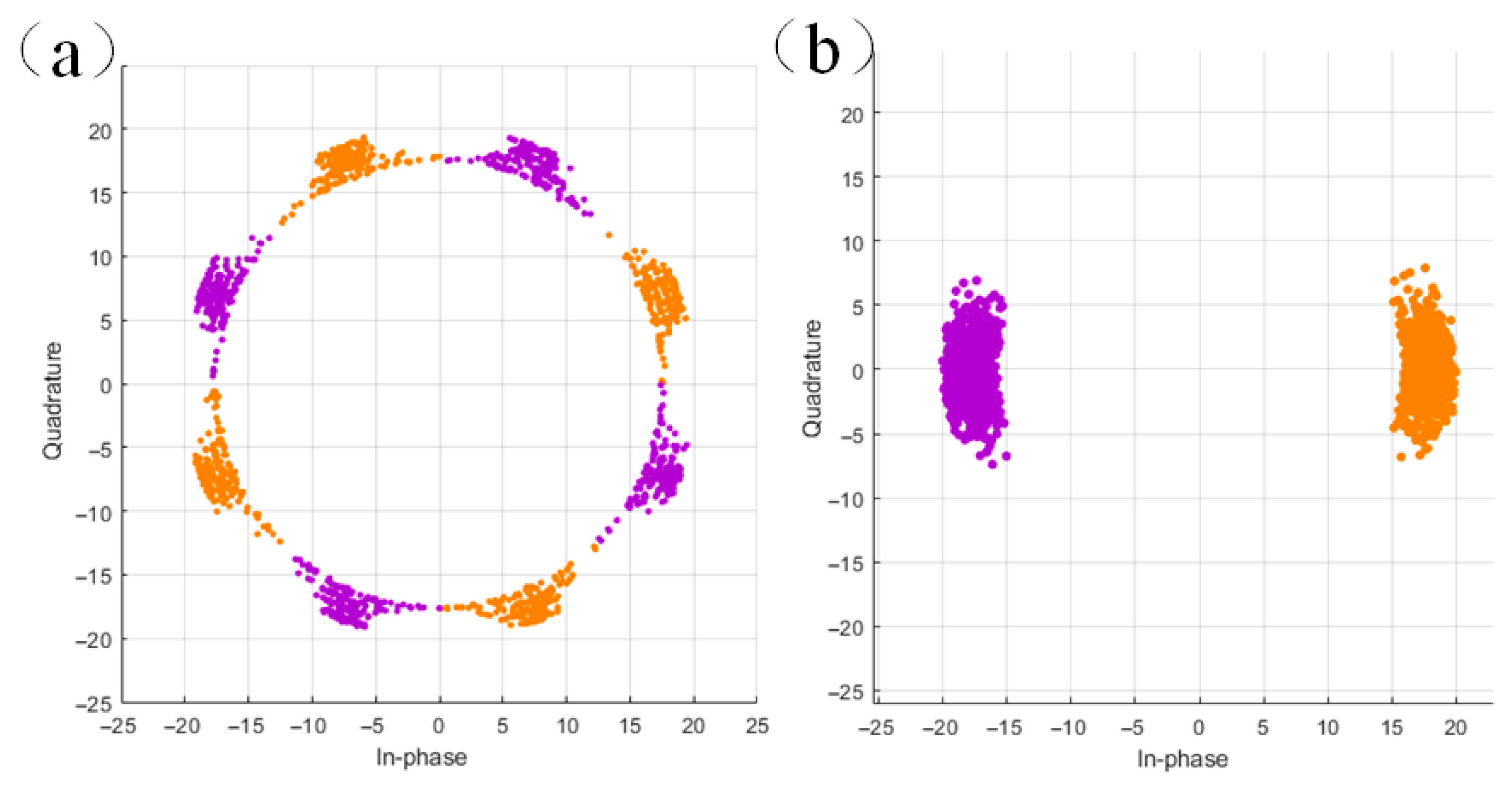
The final stage of the optical de-aggregation system performs fine phase discrimination using a cascaded PSA3 configuration. The purpose of this stage is to resolve the residual phase ambiguity within each quadrant of the QPSK constellation, which transforms the four quadrature clusters into two binary phase states separated by 180°, thereby yielding the BPSK output. As shown in Figure 9a, the two sets of points within each quadrant are pre-labeled by color, with orange and purple markers indicating the signals that will be directed toward the positive and negative phase lobes of the cascaded PSA, respectively.
The cascaded PSA3 consists of two consecutive PSA units whose pump phases are intentionally offset by 90°. Each PSA provides a phase-dependent gain following the standard form:
G ϕ = cosh 2 g L + sinh 2 g L + 2 s i n h g L c o s h g L c o s ϕ
where g represents the parametric gain factor. When the second PSA introduces a 90° phase bias, the overall gain becomes:
G t o t a l ϕ = G 1 ϕ × G 2 ϕ + π 2
By introducing a second PSA stage with a controlled phase offset, the overall phase response of the cascaded structure becomes denser, effectively reducing the gain periodicity from 180° to 90° [38]. This dual-stage amplification introduces two alternating gain peaks within each quadrant, thereby enabling phase-selective amplification of signals spaced by 90°. The constructive interference between the two PSA stages enhances one sub-group of phase points (orange), while the other group (purple) experiences weaker amplification, which results in optical separation corresponding to the BPSK states.
Following PSA3, the signal passes through an OBF2 to suppress residual FWM sidebands and amplified spontaneous noise, then through a SA2 that equalizes amplitude variations and eliminates transient peaks, and finally a VOA3 for output power balancing. The resulting constellation, shown in Figure 9b, displays two coherent clusters symmetrically distributed on opposite sides of the phase plane, corresponding to the binary phase states of the BPSK output. This stage completes the full optical de-aggregation process, which achieves a 90° phase-periodic mapping that allows precise intra-quadrant discrimination without any electrical assistance. This hierarchical process functions as a physical entropy-reduction mechanism, where the phase-squeezing dynamics of the PSA chain effectively compress the stochastic noise distribution. By reducing phase uncertainty through nonlinear gain saturation, the system enhances the information fidelity of the de-aggregated sub-channels.

4. Analysis and Discussion

The performance of the proposed all-optical de-aggregation system was evaluated from three perspectives: amplitude-dependent behavior, phase classification accuracy, and overall system-level error suppression. The results presented in Figure 10, Figure 11, Figure 12, Figure 13 and Figure 14 collectively reveal the internal coherence among these stages, which shows how each PSA-assisted process contributes to noise reduction and signal purification across the hierarchical amplitude and phase decomposition.
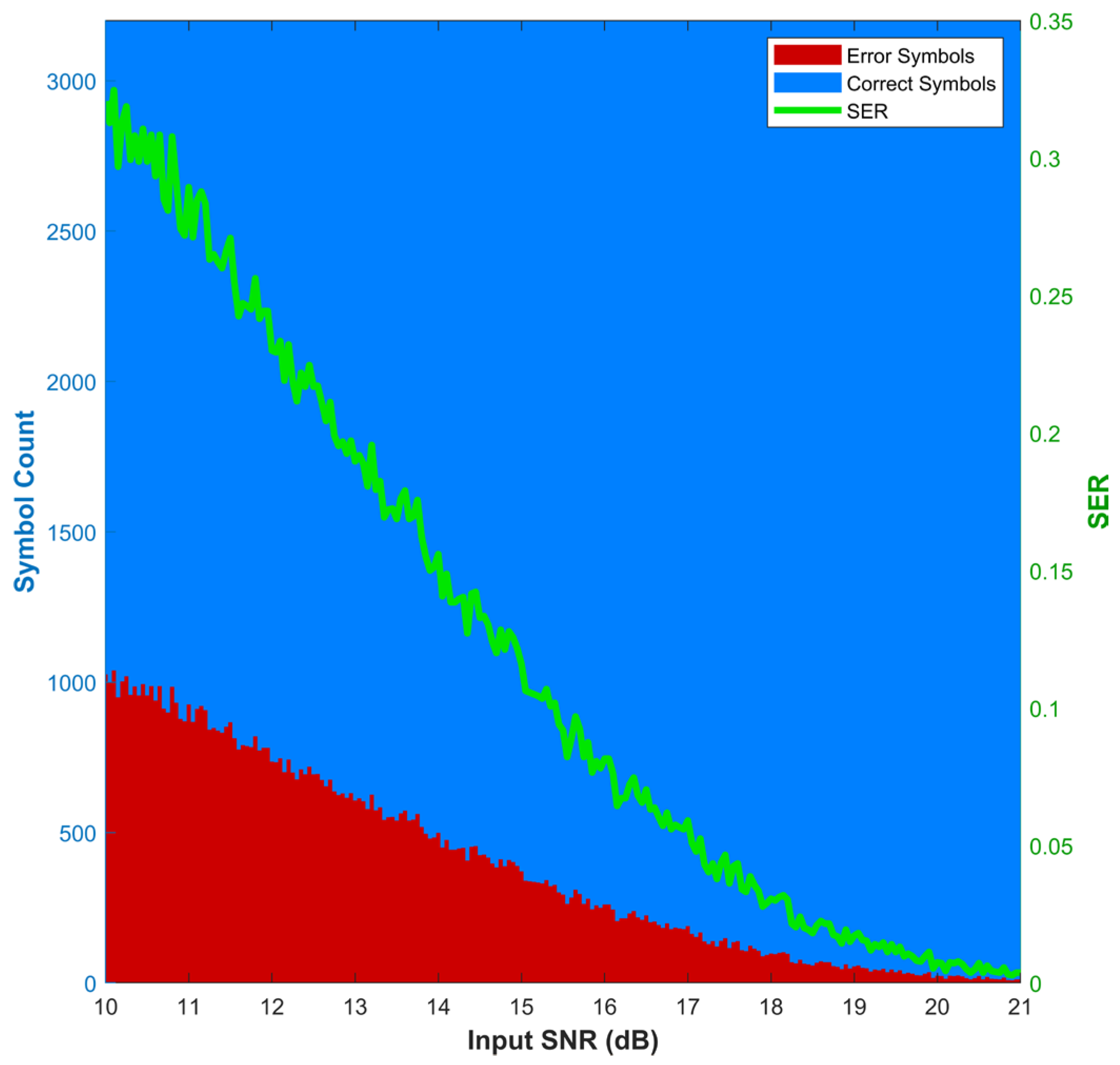
At the amplitude level, the behavior of the PAM4 decision under different input SNRs is illustrated in Figure 10. Each SNR point corresponds to approximately 3200 input symbols, with blue and red regions representing correctly and incorrectly detected symbols, respectively. The green curve shows the symbol error rate (SER), which is calculated directly from the ratio of incorrectly detected symbols to the total symbol count. The statistical trend indicates a rapid decline of error symbols as SNR increases from 10 dB to 21 dB. When SNR exceeds 20 dB, nearly all amplitude decisions converge to the correct levels, and the SER drops below 10−3. This behavior verifies the robustness of the amplitude quantization process and highlights the system’s ability to maintain decision consistency even under moderate optical noise conditions.
Beyond the impact of SNR, the normalization depth α also plays a decisive role in determining the stability of the amplitude domain. The PSA-induced normalization process can be phenomenologically modeled as [39]:
A o u t = A i n 1 α δ P
E V M % = 1 I i = 1 I E r , i E t , i 2 E t , m a x
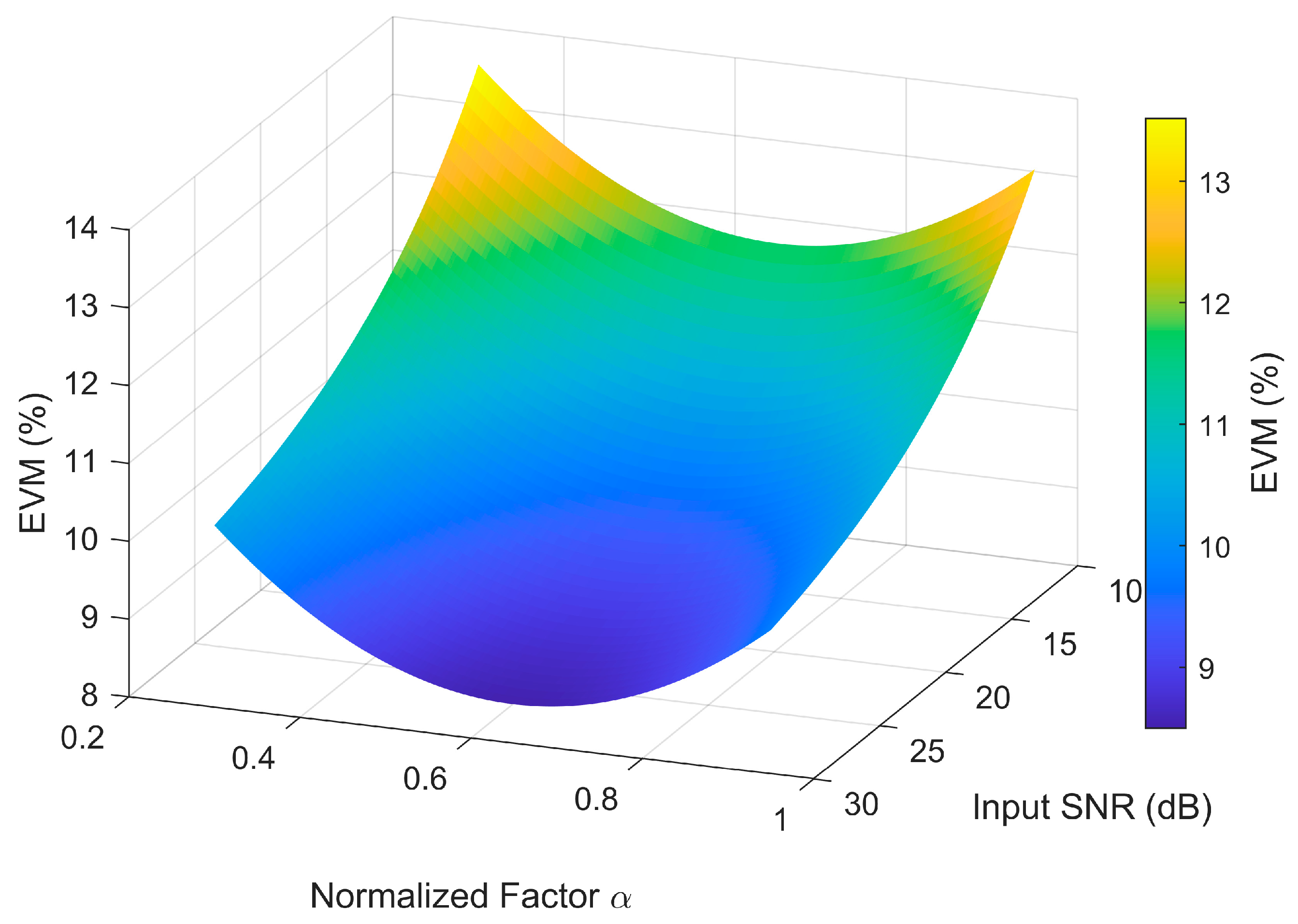
where A i n and A o u t denote the input and output amplitudes, and δ P represents the relative power fluctuation. Er,i denotes the extracted signal point after processing, while Et,i corresponds to the ideal constellation point of the same symbol. The term ∣Et,max represents the amplitude of the longest ideal constellation vector and is used as the normalization reference. I indicate the total number of transmitted symbols. Figure 11 presents the three-dimensional relationship among normalization depth, input SNR, and output EVM. As the normalization factor increases from 0.3 to 1.0, the EVM first decreases and then rises, which shows a distinct valley at α ≈ 0.65. This nonmonotonic behavior reveals that excessive normalization—though capable of suppressing power fluctuations—introduces secondary distortion due to nonlinear compression of the signal envelope. When α < 0.5, residual amplitude fluctuation dominates, while α > 0.8 results in partial loss of modulation contrast. Therefore, the optimum normalization depth is not at the maximum compression but at a balanced point (α ≈ 0.65) where amplitude uniformity and phase integrity are simultaneously preserved. Such trade-off illustrates that nonlinear compensation must remain moderate to avoid over-correction effects inherent in parametric gain saturation.
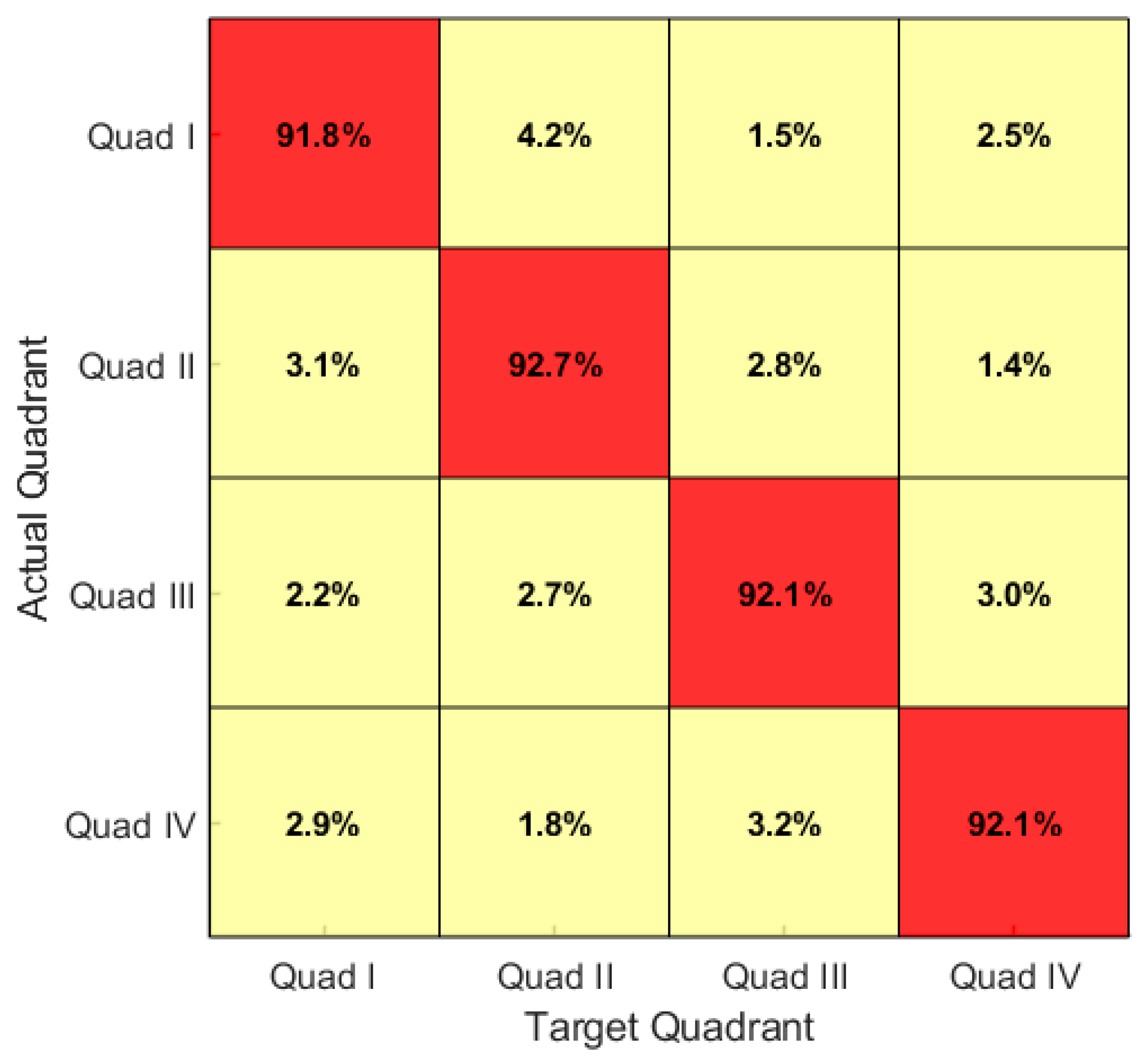
The improvement in amplitude consistency translates directly to higher phase-classification reliability. Figure 12 displays the confusion matrix for the QPSK output, which evaluates the accuracy of the PSA2-based quadrant classification. The diagonal elements show that the correct identification rates for the four quadrants (I–IV) reach 91.8%, 92.7%, 92.1%, and 92.1%, respectively. The off-diagonal components remain below 4.2%, which implies that most classification errors occur near quadrant boundaries where the signal phase difference approaches ±45°. This confirms that amplitude normalization and phase-sensitive gain jointly enhance the stability of phase clustering, which yields nearly uniform decision accuracy across all quadrants.
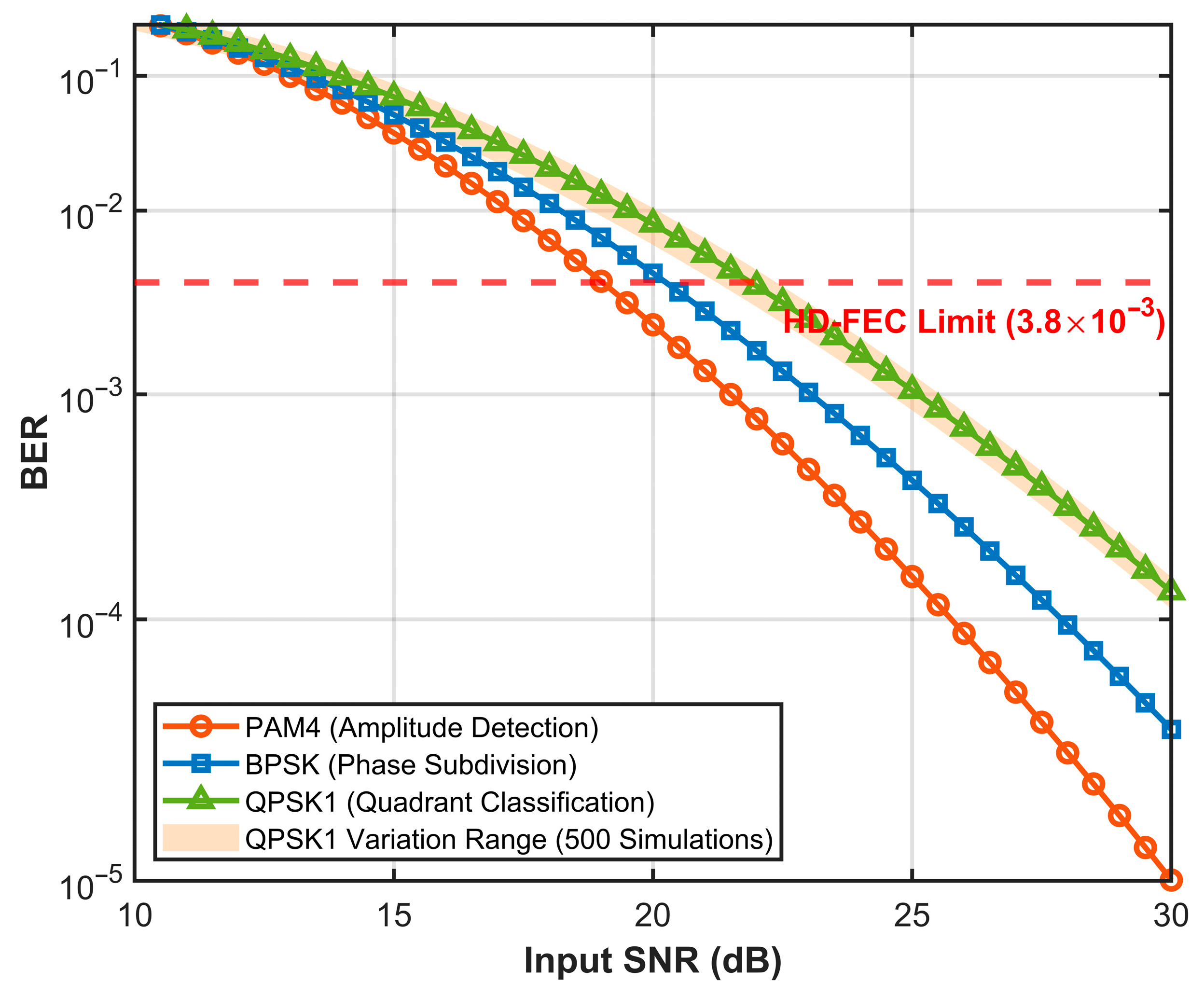
System-level performance is summarized in Figure 13 and Figure 14. The Bit Error Rate (BER) curves in Figure 13 compare three output channels under the same input SNR range (10–30 dB). The red line representing PAM4 exhibits the lowest BER due to its purely amplitude-based detection, while the blue BPSK curve follows closely, which shows higher resilience than the green QPSK line. It is worth noting that, for all three de-aggregated channels, the BER drops below the standard hard-decision forward error correction (HD-FEC) threshold of 3.8 × 10⁻³ when the input SNR exceeds 20 dB. This indicates that the proposed all-optical scheme can support error-free transmission in practical optical networks with the aid of standard FEC codes. It is important to note that conventional DSP-based receivers and this all-optical scheme possess distinct advantages. While conventional receivers generally achieve lower raw BERs through robust digital compensation, the proposed scheme offers a complementary solution characterized by superior energy efficiency and micrometer-scale integration. By avoiding O-E-O conversion, it provides a compact and low-latency alternative suitable for applications where footprint and power consumption are the primary constraints.
The orange shaded region denotes the 500-run statistical variation in QPSK, which reflects the random fluctuation of its phase-dependent PSA gain. Since all results are derived from theoretical simulations rather than experimental data, multiple independent simulation runs were conducted to ensure statistical convergence and improve the reliability of the observed trends. The overall behavior demonstrates that hierarchical decomposition distributes information content among multiple channels, which enables each to operate within a lower-noise subspace.
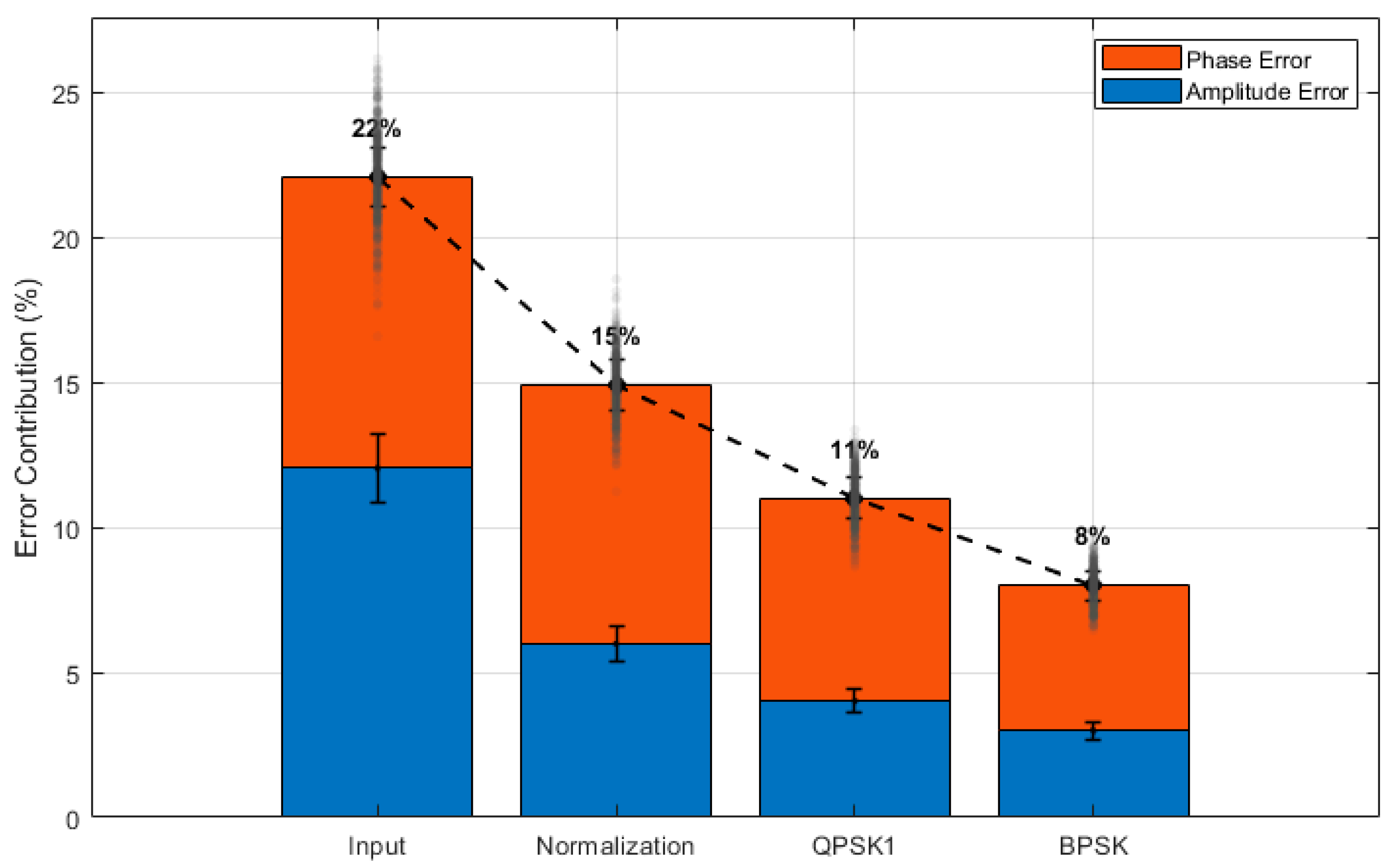
Correspondingly, Figure 14 decomposes the total error contribution along the signal path. The combined amplitude and phase errors decrease sequentially from 22% at the input to 15% after normalization, 11% at the QPSK stage, and finally 8% at the BPSK output. This progressive reduction reveals that the cascaded PSA structure not only enhances phase selectivity but also functions as a self-adaptive optical filter that suppresses amplitude and phase noise simultaneously.
These results demonstrate a consistent improvement in both amplitude and phase precision throughout the de-aggregation process. The multi-stage PSA chain transforms the circular-32QAM input into three low-order modulation outputs while maintaining the fidelity of each information component. The observed BER and EVM evolution confirm that the all-optical processing scheme achieves stable de-aggregation and error suppression entirely within the optical domain, which avoids any O-E-O bottleneck and enables a scalable route toward multi-level optical de-aggregation.
The proposed architecture exhibits potential scalability to higher-order formats by integrating additional PSA modules to resolve denser constellation points. However, practical deployment involves an inherent trade-off between the benefits of all-optical transparency and the increased hardware complexity of managing multiple pump sources.

5. Conclusions

An all-optical de-aggregation architecture for circular-32QAM signals was demonstrated using a cascaded PSA configuration that integrates amplitude normalization, phase clustering, and intra-quadrant resolution within a unified nonlinear optical framework. The system decomposed the 32QAM constellation into three complementary modulation channels, represented by PAM4, QPSK, and BPSK, with all processes performed purely in the optical domain. The a-Si:H–GO hybrid waveguide exhibited a high nonlinear coefficient γ = 1.36 × 10⁶ W−1·m−1, while both material and waveguide dispersion remained near zero around 1550 nm, which forms a flat phase-mismatch region spanning 1450–1750 nm that ensured broadband PSA operation. Simulations confirmed that an optimal normalization depth of α ≈ 0.65 minimized EVM to 8.2% and achieved 92% quadrant classification accuracy. The cascaded PSA maintained stable gain over a 20 dB input dynamic range and reduced BER from 1.8 × 10⁻² at the input to 4.2 × 10⁻⁴ at the final BPSK output. The overall error contribution decreased from 22% to 8% across the PSA chain, which verifies that the proposed architecture effectively suppresses both amplitude and phase noise to enable broadband, low-error, and fully optical de-aggregation of high-order modulation formats.

Author Contributions

Conceptualization, H.W., X.L. and H.L.; methodology, H.W. and M.L.; software, H.W.; validation, H.W. and H.L.; formal analysis, H.W. and H.L.; investigation, M.L.; resources, X.L. and H.L.; data curation, M.L.; writing—original draft preparation, H.W.; writing—review and editing, H.L.; visualization, M.L.; supervision, H.L.; project administration, X.L. and H.L.; funding acquisition, X.L. and H.L. All authors have read and agreed to the published version of the manuscript.

Funding

This research received no external funding.

Data Availability Statement

The original contributions presented in this study are included in the article. Further inquiries can be directed to the corresponding authors.

Conflicts of Interest

The authors declare no conflicts of interest.

References

  1. Karar, A.S.; Falou, A.R.E.; Barakat, J.M.H.; Gürkan, Z.N.; Zhong, K. Recent advances in coherent optical communications for short-reach: Phase retrieval methods. Photonics 2023, 10, 308. [Google Scholar] [CrossRef]
  2. Fang, X.; Zhu, Y.; Cai, X.; Hu, W.; He, Z.; Yu, S.; Zhang, F. Overcoming laser phase noise for low-cost coherent optical communication. Nat. Commun. 2024, 15, 6339. [Google Scholar] [CrossRef]
  3. Morichetti, F. High-performance analog signal processing with photonic integrated circuits. Light Sci. Appl. 2025, 14, 141. [Google Scholar] [CrossRef] [PubMed]
  4. Liu, L.; Liu, F.; Peng, C.; Xue, B.; Shieh, W. DSP-free coherent receivers in frequency-synchronous optical networks for next-generation data center interconnects. Adv. Photonics Nexus 2025, 4, 036013. [Google Scholar] [CrossRef]
  5. Gu, Z.; Shi, Y.; Zhu, Z.; Li, Z.; Zou, M.; Yang, C.; Liu, Y.; Yu, Y.; Zhang, X. All-integrated multidimensional optical sensing with a photonic neuromorphic processor. Sci. Adv. 2025, 11, eadu7277. [Google Scholar] [CrossRef]
  6. Chatterjee, D.; Sunder, S.; Krishna, M.; Yadav, S.; Sysoliatin, A.; Gochelashvili, K.; Semjonov, S.; Venkitesh, D.; Konyukhov, A. A Comprehensive Study on Phase Sensitive Amplification and Stimulated Brillouin Scattering in Nonlinear Fibers with Longitudinally Varying Dispersion. Photonics 2023, 11, 3. [Google Scholar] [CrossRef]
  7. Larsson, R.; Vijayan, K.; Schröder, J.; Andrekson, P.A. Low-noise phase-sensitive optical parametric amplifier with local pump generation using digital frequency and phase control. In 2023 Optical Fiber Communications Conference and Exhibition (OFC); Th1B.4; IEEE: New York, NY, USA, 2023. [Google Scholar]
  8. Andrekson, P.A. Applications of nonlinear four-wave mixing in optical communication. Optik 2023, 279, 170740. [Google Scholar] [CrossRef]
  9. Zhao, P.; Karlsson, M.; Andrekson, P.A. Low-noise integrated phase-sensitive waveguide parametric amplifiers. J. Lightwave Technol. 2022, 40, 128–135. [Google Scholar] [CrossRef]
  10. Chen, Z.; Guo, X.; Chen, Y.; Xiao, Y.; Pan, J.; Liu, Z.; Lu, C.; Li, Z. High-capacity phase-sensitively amplified transmission in a field-deployed fiber cable. Commun. Eng. 2025, 4, 133. [Google Scholar] [CrossRef]
  11. Han, X.; Geng, Y.; Ke, H.; Qiu, K. Phase regeneration of QPSK signals based on Kerr soliton combs. Photonics 2023, 10, 701. [Google Scholar] [CrossRef]
  12. Gong, X.; Zhong, J.; Zhang, Q.; Li, R.; Guo, L. Reconfigurable all-optical format conversion for 16QAM/8QAM by employing PSA in HNLF. Opt. Express 2023, 31, 22802–22816. [Google Scholar] [CrossRef] [PubMed]
  13. Li, Q.; Yang, X.; Wen, H.; Xu, Q.; Yang, J.; Li, Y.; Yang, H.; Leeson, M.S.; Xu, T. Flexible all-optical 8QAM signal format conversion using pump assisted nonlinear optical loop mirror. J. Lightwave Technol. 2023, 41, 6446–6456. [Google Scholar] [CrossRef]
  14. Cui, J.; Tan, Y.; Lu, G.-W.; Ji, Y.; Wen, H.; Zhai, K.; Li, M.; Zhu, N. Across-dimensional optical constellation de-aggregations from QAMs to PAMs in optical transparent networks. Opt. Laser Technol. 2024, 175, 110737. [Google Scholar] [CrossRef]
  15. Sun, F.; Wu, B.; Zhang, S.; Wen, F. All-optical rectangular-QAM regenerators based on phase-preserving I/Q shaping. Opt. Commun. 2020, 467, 125634. [Google Scholar] [CrossRef]
  16. Chen, B.; Lei, Y.; Liga, G.; Liang, Z.; Ling, W.; Xue, X.; Alvarado, A. Geometrically-shaped multi-dimensional modulation formats in coherent optical transmission systems. J. Lightwave Technol. 2022, 41, 897–910. [Google Scholar] [CrossRef]
  17. Zhang, B.; Xia, D.; Zhao, X.; Wan, L.; Li, Z. Hybrid-integrated chalcogenide photonics. Light Adv. Manuf. 2023, 4, 503–518. [Google Scholar] [CrossRef]
  18. Zhang, Y.; Wu, J.; Jia, L.; Qu, Y.; Yang, Y.; Jia, B.; Moss, D.J. Graphene oxide for nonlinear integrated photonics. Laser Photonics Rev. 2023, 17, 2200512. [Google Scholar] [CrossRef]
  19. Jia, L.; Wu, J.; Zhang, Y.; Qu, Y.; Jia, B.; Moss, D.J. Third-Order Optical Nonlinearities of 2D Materials at Telecommunications Wavelengths. Micromachines 2023, 14, 307. [Google Scholar] [CrossRef]
  20. Zhao, P.; Shekhawat, V.; Girardi, M.; He, Z.; Torres-Company, V.; Andrekson, P.A. Ultra-broadband optical amplification using nonlinear integrated waveguides. Nature 2025, 640, 918–923. [Google Scholar] [CrossRef] [PubMed]
  21. Lei, K.; Sun, B.; Bao, K.; Tang, B.; Tang, Y.; Zhu, H.; Jian, J.; Sun, C.; Shieh, W.; Lin, H.; et al. Hybrid silicon-chalcogenide glass-integrated photonic platform for EDFA-free four-wave mixing. Opt. Lett. 2025, 50, 5426–5429. [Google Scholar] [CrossRef] [PubMed]
  22. Takei, R.; Manako, S.; Omoda, E.; Sakakibara, Y.; Mori, M.; Kamei, T. Sub-1 dB/cm submicrometer-scale amorphous silicon waveguide for backend on-chip optical interconnect. Opt. Express 2014, 22, 4779–4788. [Google Scholar] [CrossRef]
  23. Matres, J.; Ballesteros, G.C.; Gautier, P.; Fedeli, J.M.; Marti, J.; Oton, C.J. High nonlinear figure-of-merit amorphous silicon waveguides. Opt. Express 2013, 21, 3932–3940. [Google Scholar] [CrossRef]
  24. Singh, C.B.; Bhattacharya, S.; Prayogi, S.; Patel, U.S.; Bhargav, P.B.; Ahmed, N. A new look at an explanation of band gap of PECVD grown a-Si: H thin films using absorption spectra, spectroscopic ellipsometry, Raman, and FTIR spectroscopy. Opt. Mater. 2024, 154, 115809. [Google Scholar] [CrossRef]
  25. De Vita, C.; Toso, F.; Pruiti, N.G.; Klitis, C.; Ferrari, G.; Sorel, M.; Melloni, A.; Morichetti, F. Amorphous-silicon visible-light detector integrated on silicon nitride waveguides. Opt. Lett. 2022, 47, 2598–2601. [Google Scholar] [CrossRef]
  26. Akritidis, K.; Billet, M.; Kiewiet, M.; Fricke, J.; Wenzel, H.; Koester, J.; Knigge, A.; Neutens, P.; Jansen, R.; Brouckaert, J.; et al. Transfer Printing of GaAs-based Amplifiers on a-Si:H Waveguides for Evanescently-Coupled Light Amplification in the Near-Infrared Band. In Proceedings of the CLEO: Science and Innovations 2024, Charlotte, NC, USA, 5–10 May 2024; Paper SM3G.4. [Google Scholar] [CrossRef]
  27. Leosson, K.; Agnarsson, B. Integrated biophotonics with CYTOP. Micromachines 2012, 3, 114–125. [Google Scholar] [CrossRef]
  28. Zhao, Y.; Hu, F.; Tenhaeff, W.E. Control of Fluoropolymer Crystallinity for Flexible, Transparent Optical Thin Films with Low Refractive Indexes. Macromolecules 2025, 58, 1265–1278. [Google Scholar] [CrossRef]
  29. Leal-Junior, A.; Theodosiou, A.; Diaz, C.; Marques, C.; Pontes, M.J.; Kalli, K.; Frizera-Neto, A. Polymer Optical Fiber Bragg Gratings in CYTOP Fibers for Angle Measurement with Dynamic Compensation. Polymers 2018, 10, 674. [Google Scholar] [CrossRef]
  30. Rafique, M.Z.E.; Basiri, A.; Bai, J.; Zuo, J.; Yao, Y. Ultrafast Graphene-Plasmonic Hybrid Metasurface Saturable Absorber with Low Saturation Fluence. ACS Nano 2023, 17, 10431–10441. [Google Scholar] [CrossRef] [PubMed]
  31. Zhao, X.; Sun, J.; Wang, Y.; Wang, X.; Fu, B. Ag/MXene as saturable absorber for Tm: Ho co-doped Q-switched fiber laser. Nanomaterials 2024, 14, 951. [Google Scholar] [CrossRef] [PubMed]
  32. Li, M.; Zhang, Y.; Jiang, H.; Wang, H.; Luo, D.; Yang, J.; Li, Y.; Zhang, Z. Polarization-Insensitive Silicon Photonic Variable Optical Attenuator. Photonics 2025, 12, 549. [Google Scholar] [CrossRef]
  33. Zhang, S.; Yin, Y.; Wang, Z.; Li, Y.; Zhang, Y.; Yao, M.; Zhang, D.; Li, Y. Low-power-consumption and broadband 16-channel variable optical attenuator array based on polymer/silica hybrid waveguide. Photonics 2024, 11, 547. [Google Scholar] [CrossRef]
  34. Ji, H.; He, L.; Huang, Y.; Shi, J.; Gao, F. Variable optical attenuator on the thin-film lithium niobate platform. J. Opt. Soc. Am. B 2025, 42, 2698–2703. [Google Scholar] [CrossRef]
  35. Han, X.; Chao, M.; Su, X.; Wang, W.; Fu, S.; Wu, Z.; Zhao, M. Multiband Signal Receiver by Using an Optical Bandpass Filter Integrated with a Photodetector on a Chip. Micromachines 2023, 14, 331. [Google Scholar] [CrossRef] [PubMed]
  36. Luo, Z.; Vora, P.M.; Mele, E.J.; Johnson, A.; Kikkawa, J.M. Photoluminescence and band gap modulation in graphene oxide. Appl. Phys. Lett. 2009, 94, 111909. [Google Scholar] [CrossRef]
  37. Yang, Y.; Wu, J.; Xu, X.; Liang, Y.; Chu, S.; Little, B.; Morandotti, R.; Jia, B.; Moss, D. Enhanced four-wave mixing in waveguides integrated with graphene oxide. APL Photonics 2018, 3, 120803. [Google Scholar] [CrossRef]
  38. Ye, B.; Du, J.; Wang, Z.; Shen, W.; Chen, X.; Guo, X.; He, Z. Mode-division multiplexing phase-sensitive amplification for mode selective and mode equalized phase regenerative amplifications. J. Opt. Soc. Am. B 2021, 38, F69–F80. [Google Scholar] [CrossRef]
  39. Anchal, A.; Kumar Krishnamurthy, P.; Landais, P. A novel scheme of cascaded four-wave mixing for phase-sensitive amplification in nonlinear optical fibre. J. Mod. Opt. 2018, 65, 1750–1758. [Google Scholar] [CrossRef]
Figure 1. (a) Schematic of the proposed symmetric a-Si:H–GO hybrid waveguide with CYTOP cladding. (b) Simulated fundamental TE-mode profile at 1550 nm.
Photonics 13 00171 g001
Figure 2. GVD and second-order dispersion versus wavelength for different structural parameters: (a) Upper a-Si:H layer height. (b) Lower a-Si:H layer height. (c) Waveguide width. (d) Slot width.
Photonics 13 00171 g002
Figure 3. Phase mismatch and nonlinear coefficient as a function of signal wavelength.
Photonics 13 00171 g003
Figure 4. Overall schematic of the all-optical de-aggregation system.
Photonics 13 00171 g004
Figure 5. Input circular-32QAM constellation.
Photonics 13 00171 g005
Figure 6. (a) PAM4 amplitude decision under fixed thresholds and (b) PAM4 signal after decision.
Photonics 13 00171 g006
Figure 7. Constellation after amplitude normalization.
Photonics 13 00171 g007
Figure 8. Extracted QPSK constellation after PSA2.
Photonics 13 00171 g008
Figure 9. (a) Color-coded input: orange/purple points map to positive/negative BPSK. (b) BPSK constellation obtained after cascaded PSA3.
Photonics 13 00171 g009
Figure 10. Symbol statistics and SER performance in PAM4 decision as a function of input SNR (single-run simulation).
Photonics 13 00171 g010
Figure 11. EVM as a function of normalization factor α and input SNR in QPSK decision.
Photonics 13 00171 g011
Figure 12. QPSK quadrant classification matrix.
Photonics 13 00171 g012
Figure 13. BER comparison among PAM4, QPSK, and BPSK.
Photonics 13 00171 g013
Figure 14. Error contribution evolution across PSA stages.
Photonics 13 00171 g014
Table 1. Refractive index of waveguide at 1550 nm.
MaterialRefractive Index
GO2
a-Si:H3.48
SiO21.44
CYTOP1.34
Disclaimer/Publisher’s Note: The statements, opinions and data contained in all publications are solely those of the individual author(s) and contributor(s) and not of MDPI and/or the editor(s). MDPI and/or the editor(s) disclaim responsibility for any injury to people or property resulting from any ideas, methods, instructions or products referred to in the content.