Article

An Approach for Spectrum Extraction Based on Canny Operator-Enabled Adaptive Edge Extraction and Centroid Localization

1
National Laboratory on Adaptive Optics, Chengdu 610209, China
2
Institute of Optics and Electronics, Chinese Academy of Sciences, Chengdu 610209, China
3
University of Chinese Academy of Sciences, Beijing 100049, China
4
Facility Design and Instrumentation Institute, China Aerodynamics Research and Development Center, Mianyang 621000, China
*
Authors to whom correspondence should be addressed.
Photonics 2026, 13(2), 169; https://doi.org/10.3390/photonics13020169
Submission received: 14 January 2026 / Revised: 4 February 2026 / Accepted: 5 February 2026 / Published: 10 February 2026

Abstract

In adaptive optics systems, high spatial resolution detection is a core prerequisite for achieving accurate wavefront correction. High spatial resolution wavefront measurement based on the traditional Shack-Hartmann technique is limited by the density of the microlens array. In contrast, off-axis digital holography technology is applied in wavefront measurement systems of adaptive optics systems due to its advantages of high spatial resolution, non-contact measurement, and full-field measurement. However, during the demodulation of its interference fringes, the accurate extraction of the complex amplitude of the +1st-order diffraction order directly determines the precision of wavefront reconstruction. Traditional frequency-domain filtering methods suffer from drawbacks such as reliance on manual threshold setting, poor adaptability to irregular spectra, and localization deviations caused by multi-region interference, making it difficult to meet the dynamic application requirements of adaptive optics. To address these issues, this study proposes a spectrum extraction method based on the Canny operator for adaptive edge extraction and centroid localization. The method first locks the rough range of the +1st-order spectrum through multi-stage peak screening, then achieves complete segmentation of spectrum spots by combining adaptive histogram equalization with edge closing and filling, resolves centroid indexing errors via maximum connected component screening, and ultimately accomplishes accurate extraction through Gaussian window filtering. Simulation experimental results show that, in comparison with two classical spectrum filtering methods, the centroid estimation error of the proposed method remains below 0.245 pixels under different noise intensity conditions. Moreover, the root mean square error of the residual wavefront corresponding to the reconstructed wavefront of the proposed method is reduced by 89.0% and 87.2% compared with those of the two classical methods, respectively. We further carried out measurement experiments based on a self-developed atmospheric turbulence test bench. The experimental results demonstrate that the proposed method exhibits higher-precision spectral centroid localization capability, which provides a reliable technical support for the high-precision measurement of dynamic distortion induced by atmospheric turbulence.

1. Introduction

Adaptive optics (AO) technology detects wavefront information via wavefront sensors and utilizes control systems to drive deformable mirrors for compensation, thereby effectively eliminating wavefront distortions caused by factors such as atmospheric turbulence and optical system aberrations. It has been widely applied in fields including astronomical observation, laser communication, biomedical imaging, and high-energy laser propagation [1]. Atmospheric turbulence induces refractive index fluctuations, whose characteristics can be described by the refractive index structure parameter [2]. Due to its rapid evolution over temporal and spatial scales [3], atmospheric turbulence results in random fluctuations in the received optical power, which constitutes the key cause of wavefront distortion. As the “sensing core” of AO systems, wavefront sensing’s precision and real-time performance serve as the prerequisite and foundation for AO system correction. However, off-axis digital holography (OADH) has emerged as a key technical pathway for dynamic wavefront sensing in AO, leveraging inherent advantages such as eliminating the need for reference beam calibration, enabling full-field recording of wavefront phase and amplitude information, and having a detection speed limited only by the image acquisition frame rate [4,5].
The OADH wavefront sensing technology [6] mainly consists of hologram recording and numerical reconstruction. Hologram recording involves illuminating the measured object with object light, which—after transmission or reflection—carries the object’s amplitude and phase information and interferes with the reference light on a photoelectric detector, manifesting specifically as interferometric fringes. Numerical reconstruction refers to the process of demodulating the obtained interferometric fringes for subsequent wavefront reconstruction: specifically, Fourier transformation of the interferometric fringes yields a spectral distribution comprising the 0th-order DC component, +1st-order, and −1st-order diffraction components. Among these, the +1st-order complex amplitude fully carries the phase and amplitude information of the object wavefront, serving as the sole valid component for wavefront reconstruction.
When measuring wavefront distortions caused by atmospheric turbulence using AO systems, the spectrum spots of holographic interferometric fringes often exhibit irregular distributions. Additionally, they are prone to multi-region interference due to noise and background stray light, rendering most +1st-order complex amplitude extraction methods inadequate for this scenario. Takeda first applied the rectangular window filtering method to the extraction of the +1st-order component in digital holography in 1982 [7]. This method features simplicity in principle and high computational efficiency but relies on manual region delineation—it not only fails to respond in real time to dynamic wavefront changes in AO systems but also tends to truncate irregular spectrum spots, leading to the loss of wavefront information. In 1999, Philippe Cuche’s team proposed the fixed-threshold filtering method and applied it to holographic measurements of microstructures [8]. This method achieves binarization segmentation of spectrum spots by setting a global gray-scale threshold, eliminating the need for manual region delineation but requiring manual threshold adjustment. It is prone to noise contamination in low signal-to-noise ratio AO scenarios. With the continuous improvement of requirements for filtering performance, in addition to rectangular filtering windows, various filters have been successively developed, including Hanning filter windows [9,10], Hamming filter windows [11], and Gaussian filter windows [12]. Different filter window functions possess unique characteristics and applicable scenarios. Another target localization method [13] achieves further improvement in localization accuracy by fusing the data of two distinct target localization approaches; this fusion strategy can extend our proposed method to a broader range of application scenarios. With the continuous development of deep learning technology, its applications have been gradually extended to various fields including phase retrieval, filtering, phase unwrapping and distortion compensation [14]. However, deep learning-based neural network methods are highly dependent on training with large-scale annotated datasets. Once the imaging scene is switched, which leads to the invalidation or loss of the physical prior information relied on in the training process, the model is often unable to stably and efficiently accomplish the intended tasks. For the problems of irregular spectral spots and multi-region interference encountered when AO systems measure atmospheric turbulence-induced wavefront distortion, the size of traditional fixed-shape window functions fails to adapt to the time-varying characteristics of turbulence, resulting in inherent limitations. Moreover, the inherent defects in the characteristics of different types of fixed windows will be further exacerbated under the conditions of multi-region interference and irregular spot morphologies, thus it is necessary to optimize their application by integrating adaptive strategies.
To address the requirements of wavefront sensing in AO systems, this paper integrates the adaptive processing concept into the +1st-order complex amplitude extraction process of off-axis holography, proposing a spectrum extraction method based on Canny operator-enabled adaptive edge extraction and centroid localization. This method resolves the issues of “manual dependency” and “poor adaptability to irregular light spots” of traditional methods in AO scenarios, achieving high-precision, robust +1st-order complex amplitude extraction without manual intervention, thereby providing technical support for real-time wavefront sensing in AO systems. Its core innovations are as follows: Adopting a combination of multi-stage peak screening and distance thresholding to automatically locate the rough region of the +1st-order spectrum, eliminating the need for manual threshold setting or coordinate marking; Implementing edge closure filling technology to achieve complete segmentation of irregular spectrum spots, addressing the truncation issue inherent in traditional methods; Employing maximum connected component selection to resolve centroid indexing errors caused by multi-region interference, thereby improving localization accuracy; Introducing multi-level smoothing and adaptive enhancement to mitigate the impact of noise on spectrum segmentation, enabling applicability to interferometric fringe images with low peak signal-to-noise ratio ( S N R P ) . Simulation experimental analyses demonstrate that the centroid estimation error of the proposed method remains below 0.245 pixels under varying noise intensities, verifying the algorithm’s excellent performance in resisting noise interference.

2. Methods

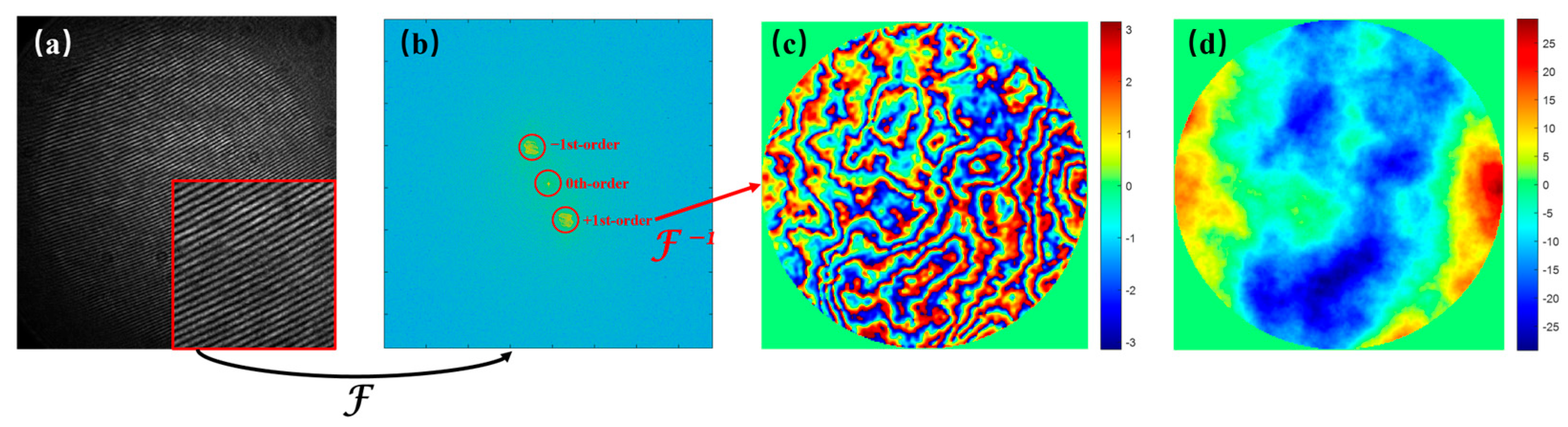
Figure 1 illustrates the basic principle of OADH. By introducing a specific spatial carrier frequency between the reference light and the object light, the complex amplitude information of the object light can be migrated to the ±1st-order diffraction regions in the frequency domain. Under ideal optical conditions, the 0th-order (DC component) of the spectrum is located at the center of the frequency domain, while the ±1st-order (diffraction components) are symmetrically distributed on both sides of the off-axis direction. The typical model is as follows:
I x , y = R ( x , y ) 2 + O ( x , y ) 2 + R x , y O x , y e j 2 π f x x + f y y +   R x , y O x , y e j 2 π f x x + f y y ,
where R ( x , y )   denotes the reference light, O ( x , y ) represents the object light, and ( f x , f y ) stands for the spatial carrier frequency. Performing a two-dimensional Fourier transform on I ( x , y ) yields F ( u , v ) = F { I ( x , y ) } , where F {⋅} denotes the Fourier transform operator. The amplitude spectrum A u , v   =   F u , v is typically characterized by the 0th-order component concentrated at the center coordinates of the spectrum ( u c , v c ) , while the ±1st-order components are respectively localized near u c ± Δ f x , v c ± Δ f y .
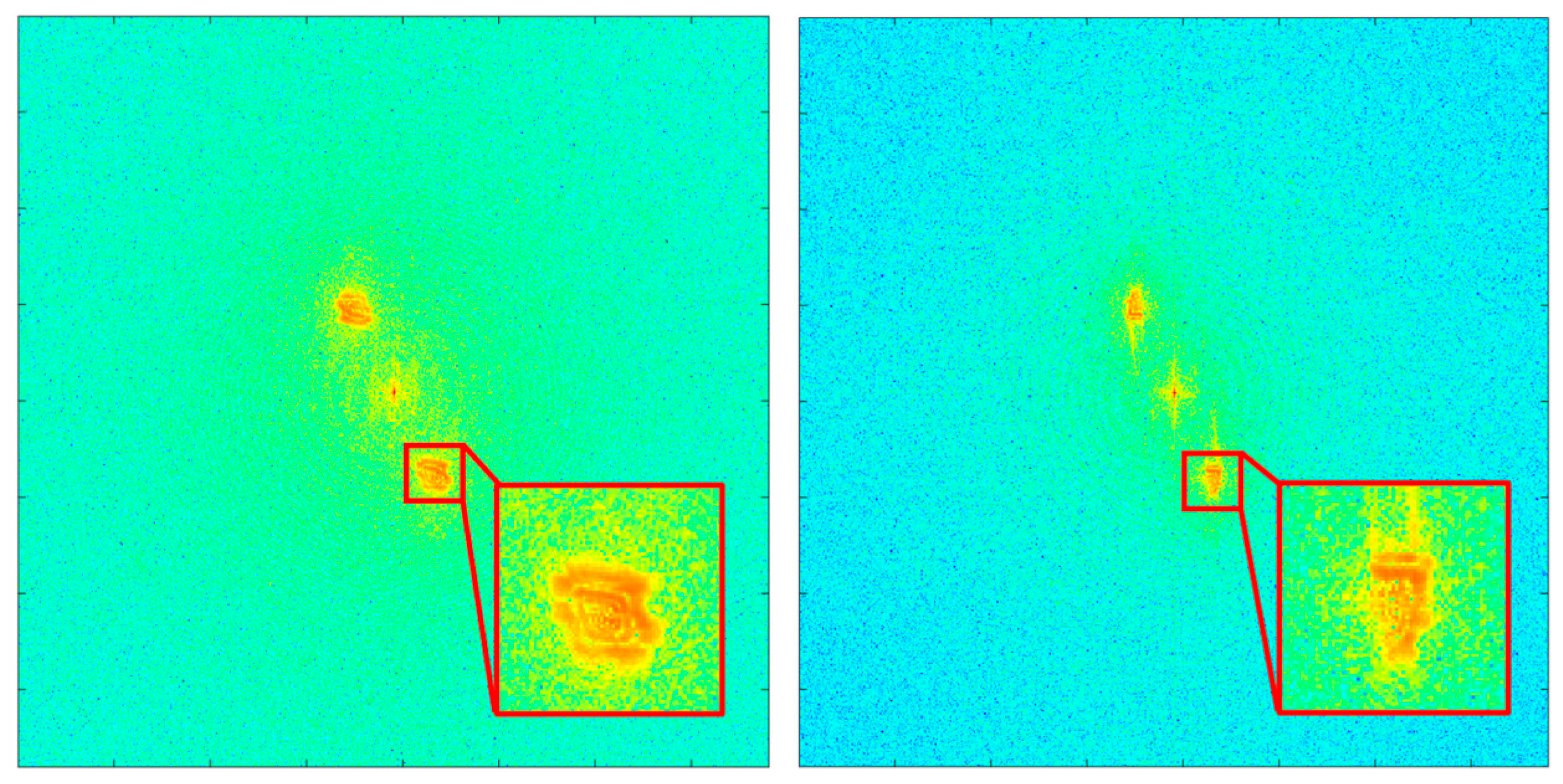
When measuring wavefront distortions caused by atmospheric turbulence using an OADH measurement system in AO application scenarios, the spectrum spots of the holographic interferometric fringes often exhibit irregular distributions. Furthermore, they are prone to multi-region interference due to the influence of noise and background stray light, as shown in Figure 2. As the core component carrying valid information of the measured object, the accurate initial localization of the +1st-order spectrum is a prerequisite for the subsequent precise extraction of complex amplitude. Traditional +1st-order spectrum extraction methods rely on manual annotation of spectral regions and exhibit poor adaptability to irregularly distorted spots in AO scenarios, which easily leads to localization deviations or failures. Meanwhile, during the detection process, the camera’s readout noise, background photon noise, and signal photon noise in the spot region exert a significant adverse effect on the extraction accuracy of the +1st-order spectrum.
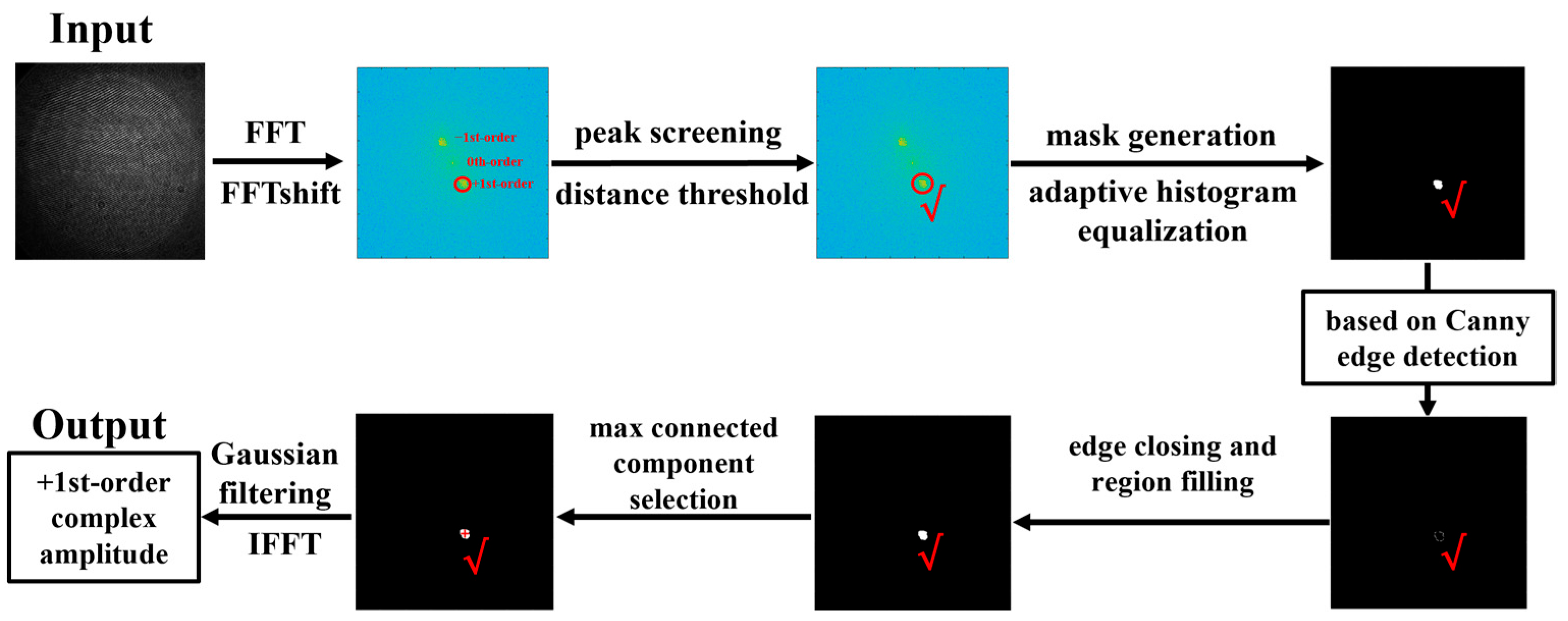
To address these challenges, this paper proposes a spectrum extraction method based on Canny operator-enabled adaptive edge extraction and centroid localization. The method first determines the rough region of the +1st-order spectrum through multi-stage peak screening. It then achieves complete segmentation of the spectrum spots by integrating adaptive histogram equalization and edge closure filling technology. Subsequently, centroid indexing errors caused by multi-region interference are resolved via maximum connected component selection. Finally, Gaussian window filtering is employed to accomplish the extraction of the +1st-order complex amplitude. The detailed flowchart of the method is shown in Figure 3.

2.1. Peak Screening-Based +1st-Order Spectrum Region Estimation Algorithm

First, a peak screening-based +1st-order spectrum region estimation algorithm is proposed to process the holographic spectrum, thereby realizing the rough region estimation of the +1st-order spectrum and laying a solid foundation for subsequent refined processing. In practical AO scenarios, the holographic spectrum contains a large amount of high-frequency noise, and irregular light spots are prone to causing local pixel value fluctuations. Direct peak detection under such conditions would generate numerous false peaks, which severely degrades localization accuracy. To enhance the robustness of peak detection, Gaussian smoothing filtering is adopted to preprocess the spectral amplitude map, highlighting the true spectral peaks by suppressing noise and local fluctuations:
A s u , v = ( A G σ ) u , v , G σ x , y = 1 2 π σ 2 exp x 2 + y 2 2 σ 2 ,
where σ denotes the Gaussian standard deviation, which determines the smoothing degree. According to the characteristics of irregular light spots, with all other parameters kept constant, the test scenarios cover S N R P of varying intensities, and its mathematical expression can be expressed as follows:
S N R P = I P μ n σ n
Among them, I p denotes the peak value of the spot signal, μ n the gray-scale mean value of the background region, and σ n the variance. S N R P = 8 to 500. The results demonstrate that the centroid estimation error of the algorithm remains consistently stable for σ [ 3 , 7 ] . In this paper, σ is set to 5 to achieve an optimal balance between noise suppression and peak preservation. After smoothing processing, 8-neighborhood [15] connected component local maximum detection is adopted to extract local peak points in the spectrum. These peak points correspond to regions with relatively concentrated energy in the spectrum, providing a candidate set for +1st-order spectrum screening:
P = u i , v i | A s u i , v i A s u , v , u , v N 8 u i , v i ,
Peak intensity may be expressed as:
p i = A s u i , v i ,
After regional maximum detection, the candidate peak set may contain a number of redundant false peaks that are relatively close to each other, which is particularly prominent in irregular light spot regions. These false peaks will increase the complexity of subsequent screening and reduce localization efficiency. To address this issue, redundancy elimination is performed based on the Euclidean distance between peaks [16], retaining independent peak points with significant energy. Let P 1   ( u 1 , v 1 ) and P 2   ( u 2 , v 2 ) be any two peak points; the calculation formula for their Euclidean distance is:
d P 1 , P 2 = ( u 1 u 2 ) 2 + ( v 1 v 2 ) 2 ,
A minimum peak spacing threshold d m i n is set. The screening rule is as follows: sort the candidate peaks in descending order of gray value and retain them sequentially. If the minimum Euclidean distance between a new peak point and the already retained peak points is greater than d m i n , the new peak is retained; otherwise, it is eliminated. Via this step, a redundancy-removed screened peak set is obtained, which effectively reduces the subsequent computational load and eliminates the interference of dense false peaks.
In the off-axis holographic spectrum, the 0th-order spectrums typically located at the spectrum center and has the highest energy. However, it is not the target valid signal and needs to be eliminated from the candidate peak set. First, the redundancy-removed peaks are sorted in descending order of gray value, and the top 10 peaks with the largest gray values are extracted. This is because the +1st-order spectrum, as a valid signal, exhibits high energy concentration and is highly likely to be included in these top 10 peaks. Let the center coordinates of the spectrum image be ( c u , c v ) (where c u = N / 2 , c v = M / 2 , and N and M denote the width and height of the spectrum image, respectively). For each strong peak point u , v , the Euclidean distance to the spectrum center is calculated as:
d c e n t e r u , v = ( u c u ) 2 + ( v c v ) 2 ,
When all other parameters are fixed, d c e n t e r m i n is set to vary within the range of m i n ( M , N ) / 20 to m i n ( M , N ) / 12 . When d c e n t e r m i n ∈ [ m i n ( M , N ) / 18 , m i n ( M , N ) / 14 ], the algorithm can accurately distinguish the +1st-order spectral order from the 0th-order/–1st-order spectral orders without localization deviation, and the spectral extraction performance remains stable. Therefore, the minimum central distance threshold is defined as d c e n t e r m i n = m i n ( M , N ) / 16 ; If d c e n t e r u , v d c e n t e r m i n , the peak is determined to correspond to the 0th-order spectrum and eliminated; otherwise, it is retained, yielding a valid peak candidate set. If the valid peak candidate set is empty, the algorithm will prompt to adjust the threshold parameters, ensuring robustness in AO scenarios. This step achieves manual-intervention-free 0th-order spectrum elimination through quantitative distance measurement, addressing the limitation of traditional methods that require manual distinction between the 0th-order and +1st-order spectra.
Based on the characteristic that the +1st-order spectrum is typically located on the right side of the x-axis relative to the spectrum center, directional screening is performed on the valid peak candidate set:
P + = u i , v i P u i > c u ,
Finally, the rough center of the +1st-order spectrum is determined as the point with the largest peak value in the right half-plane:
( u + 1 , v + 1 ) = a r g   m a x ( p i ) , ( ( u i , v i ) P + ) ,
The output ( u + 1 , v + 1 ) serves as the rough center coordinates of the +1st-order spectrum. This step ultimately achieves the automatic rough localization of the +1st-order spectrum region.

2.2. Mask-Constrained +1st-Order Spectrum Enhancement and Binarization

After obtaining the rough center of the +1st-order spectrum through the Section 2.1 steps, a mask-constrained frequency-domain filtering method for +1st-order spectrum enhancement and binarization is proposed to further enhance the signal in the +1st-order spectrum region. This method further improves the algorithm’s adaptability to irregular light spots.
First, with the rough center coordinates u + 1 , v + 1 of the +1st-order spectrum as the center, an adaptive circular mask is constructed to only process the +1st-order candidate region within the mask coverage. The mask radius sufficiently covers the maximum extension range of irregular light spots. Let the size of the spectrum image be M × N. The mask radius R m a s k is defined as:
R m a s k = m i n ( M , N ) 8 ,
Generate the two-dimensional coordinate grid of the spectrum image as u g , v g | u g 1 , N , v g 1 , M . For any pixel point u g , v g in the coordinate grid, the mask determination rule is:
m a s k u g , v g = 1 , ( u g u + 1 ) 2 + ( v g v + 1 ) 2 R m a s k 2 0 , e l s e
After construction, the spectral region within the mask is first extracted via element-wise multiplication:
A m a s k u , v = A u , v m a s k u , v ,
To enhance the local gray value differences of irregular light spots and make the energy distribution contour inside the spots more distinct, A m a s k u , v needs to be normalized to the [0, 1] gray scale range to obtain a normalized spectral map. Although ambient light can degrade the localization accuracy and robustness of optical sensing systems [17], the proposed method implements adaptive histogram equalization [18] processing to eliminate the influence of ambient light. This method divides the image into multiple non-overlapping local sub-blocks, performs histogram equalization on each sub-block independently, and further avoids excessive noise amplification by limiting contrast. After processing, an enhanced spectral map A e u , v is obtained.
Then, the enhanced spectral map A e u , v is subjected to secondary Gaussian smoothing. The calculation formula for the secondary smoothing is consistent with the initial Gaussian smoothing, i.e., A s 2 u , v = ( A e G σ ) u , v , with only the Gaussian standard deviation adjusted to σ = 2 . Subsequently, the optimal binarization threshold T is calculated using Otsu’s method [19] (maximum inter-class variance method), which maximizes the inter-class variance between the foreground and background. Then, binarization processing is performed based on the optimal threshold to obtain the binary map A b i n a r y of the +1st-order spectrum spot. The determination rule is:
A b i n a r y u , v = 1 , A s 2 u , v T 0 , A s 2 u , v < T ,
In the binarized result, the regions with a value of 1 correspond to the distinct contour of the +1st-order spectrum spot. This region completely shields against noise interference while fully preserving the morphological characteristics of the irregular light spot, providing an accurate and reliable regional constraint for the subsequent precise extraction of the +1st-order complex amplitude.

2.3. Canny Operator-Based Spot Edge Detection and Region Filling

After obtaining the binary map of the +1st-order spectrum spot via adaptive threshold binarization, it is prone to issues such as edge breakages and discontinuous contours due to the distortion of irregular spots. Directly using this map as the complex amplitude extraction region will result in the loss of valid signals. To address this problem, a spot edge detection and region filling method based on the Canny operator is proposed to achieve the completion of the spot contour, providing an accurate and complete regional constraint for the subsequent precise extraction of the +1st-order complex amplitude.
To extract the contour edges of the irregular spot, the Canny edge detection algorithm [20,21] is adopted to obtain the edge image e d g e s ( u , v ) , where pixel points with a value of 1 constitute the contour edges of the spot, and those with a value of 0 correspond to the background region. This algorithm achieves edge extraction with a low false detection rate and high localization accuracy through multi-stage processing, adapting to the complex contour characteristics of irregular spots. After Canny edge detection, minor edge breakages caused by uneven gray distribution of the spot may still exist. Therefore, morphological closing operation [22] is used to repair the edge image, realizing the connection of broken edges and the closure of the contour. Morphological closing operation is defined as a composite morphological operation consisting of dilation followed by erosion, and its mathematical expression is:
A · S = A S S ,
where A denotes the input edge image e d g e s ( u , v ) , S represents the morphological structuring element, ⊕ denotes the morphological dilation operation, ⊖ denotes the morphological erosion operation, and “∙” denotes the morphological closing operation.
Considering the arc-shaped contour characteristics of irregular light spots, a disk structuring element S d i s k with a radius of 2 is selected. The disk structuring element exhibits an isotropic property, enabling uniform repair of edge breakages in all directions while avoiding directional deviations caused by rectangular and cross-shaped structuring elements. This makes it better adapted to the irregular edge morphology of distorted light spots.
The closed edges form a complete closed contour. Subsequently, a regional hole-filling algorithm is employed to seamlessly fill all holes inside the closed edges. Taking the closed edges as boundaries, all connected regions within the edges are traversed. After filling, a fracture-free, hole-free, and complete-contour +1st-order spectrum spot region is obtained. This region accurately corresponds to the effective distribution range of the +1st-order complex amplitude, completely shielding against the interference of background noise and irrelevant regions while preserving the complete morphological characteristics of the irregular light spot.

2.4. Maximum Connected Region Selection-Based Precise Centroid Calculation of the +1st-Order Spectrum

First, connected region analysis [23] is performed on the filled spot image, with the simultaneous extraction of two core features of each connected region. By quantifying the geometric features of connected regions, this step provides a quantifiable judgment basis for subsequent maximum region selection, avoiding the limitation of manual distinction between valid spots and false spots.
Based on the energy distribution characteristics of the OADH spectrum, the +1st-order spectrum spot, as the core region carrying the valid information of the measured object, exhibits the highest energy concentration and corresponds to the largest connected region area. Therefore, the valid spot region is screened using the area maximization criterion, and adaptive processing is performed in two scenarios:
(a)
Multi-Connected Region Scenario:
When there are multiple connected regions in the filled image, first extract the areas of all regions to form an area array A = A 1 , A 2 , , A K , then find the maximum value in the array and its corresponding index. The mathematical description is:
A m a x = max A = m a x A 1 , A 2 , , A K , k o p t = a r g m a x k 1 , 2 , , K A K ,
where A m a x denotes the area of the maximum connected region, k o p t is the corresponding index of the maximum connected region, and K represents the number of disjoint foreground regions in the filled image. The centroid u ¯ k o p t , v ¯ k o p t of this region is selected as the precise centroid coordinates of the +1st-order spectrum.
After identifying the maximum connected region corresponding to the +1st-order spectrum, the centroid of this region u ¯ k o p t , v ¯ k o p t is selected as the accurate centroid coordinate of the +1st-order spectrum. This selection is mathematically justified by the approximation of the continuous-domain energy centroid in the discrete domain of digital images, with the centroid calculation weighted by the spectral energy. The area maximization criterion is only used to screen the valid +1st-order spectral region (where Ω denotes the set of pixels in this maximum connected region), and the formula for its gray-value weighted centroid is given by:
u ¯ k o p t = ( u , v ) Ω u I ( u , v ) ( u , v ) Ω I ( u , v ) , v ¯ k o p t = ( u , v ) Ω v I ( u , v ) ( u , v ) Ω I ( u , v )
(b)
Simply Connected Region Scenario:
When only one connected region exists in the filled image, this region is exactly the +1st-order spectrum spot region. Its centroid u ¯ 1 , v ¯ 1 is directly extracted as the precise centroid coordinates. After selection, the centroid coordinates are decomposed into two-dimensional components, yielding the precise core coordinates of the +1st-order spectrum:
c u 1 = u ¯ k o p t , c v 1 = v ¯ k o p t ,
where ( c u 1 , c v 1 ) denotes the optimized precise centroid of the +1st-order spectrum. Compared with the previous rough center coordinates ( u + 1 , v + 1 ) , this coordinate more accurately reflects the geometric center of the +1st-order spectrum spot, providing a high-precision reference for the subsequent regional extraction of complex amplitude and phase correction.


3. Simulation Experiments and Comparative Analysis

3.1. Algorithm Simulation Validation and Performance Comparison Based on Centroid Estimation Error

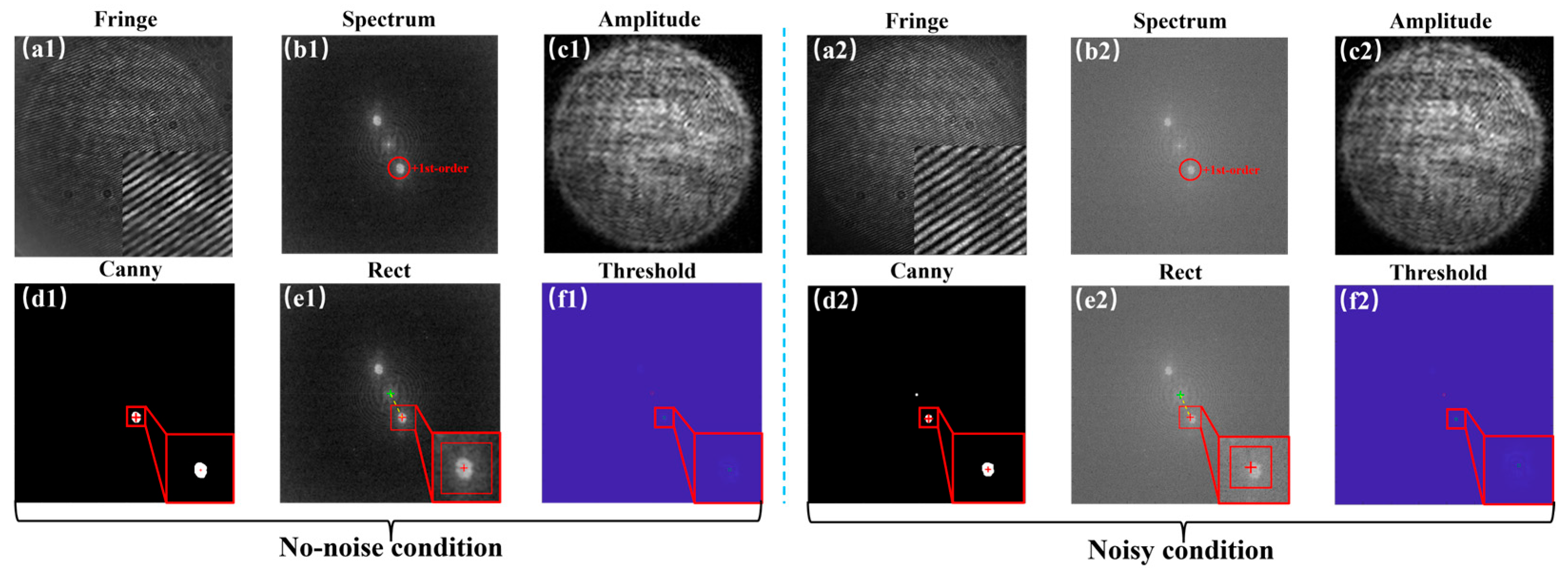
To verify the accuracy of the proposed spectrum extraction algorithm based on Canny operator for adaptive edge extraction and centroid localization, this study establishes OADH interferograms through simulation by combining actual AO measurement scenarios and OADH simulation models. Different intensities of the S N R P are introduced into the interferograms. In both noisy and noise-free conditions, the proposed method is compared with the classical rectangular window filtering method and the fixed threshold filtering method for interferogram processing, as shown in Figure 4.
From Figure 4, it can be observed that noise exerts a significant influence on the two classical extraction methods for the +1st-order spectral spot. In the noise-free condition (left of Figure 4), all three methods can effectively extract the +1st-order spectral spot. In the noisy condition (right of Figure 4). Figure 4a(2) presents the holographic interferogram under the influence of strong noise; Figure 4b(2) shows the holographic spectrum obtained after Fourier transform, where the spectrum spot exhibits an irregular shape with residual strong background noise; Figure 4c(2) is the amplitude map; Figure 4d(2) displays the centroid of the +1st-order spectrum spot extracted by the proposed method, an adaptive dynamic window is adopted with no fixed pixel size, whose dimension is adaptively determined by the actual contour of the +1st-order spectral spot obtained via edge extraction using the Canny operator. The window boundary coincides perfectly with the effective edge of the spot and can be adjusted in real time according to the spot’s irregular morphology. This method eliminates the interference of noise while preserving the complete structural information of the +1st-order spectral spot. Figure 4e(2) illustrates the centroid extracted by rectangular window filtering, where a window size of one-tenth of the image size is adopted and can be adaptively adjusted according to the image size. This window is a conventional rectangular size matching the +1st-order spectral spot, ensuring that it is entirely within the +1st-order spectral spot region. However, it yields unsatisfactory accuracy in localizing the centroid of the +1st-order spectral spot, the irregular morphology of the spot is observed to degrade the centroid localization accuracy, and the method is also highly susceptible to noise interference.; Figure 4f(2) shows the centroid extracted by the fixed threshold filtering method, where threshold selection is highly sensitive to background noise, and an excessively high threshold leads to the loss of useful information.
To further quantify the centroid localization accuracy of the three methods for the +1st-order spectrum, this study adopts the Centroid Estimation Error (CEE) as the core quantitative index to conduct a comparative analysis of the +1st-order spectrum centroid coordinates extracted by these three methods. Assuming the true center coordinates of the spectrum spot are x 0 , y 0 , and the actually calculated centroid coordinates are x 1 , y 1 , the distance between them is defined as the centroid estimation error:
C E E = ( x 1 x 0 ) 2 + ( y 1 y 0 ) 2 ,
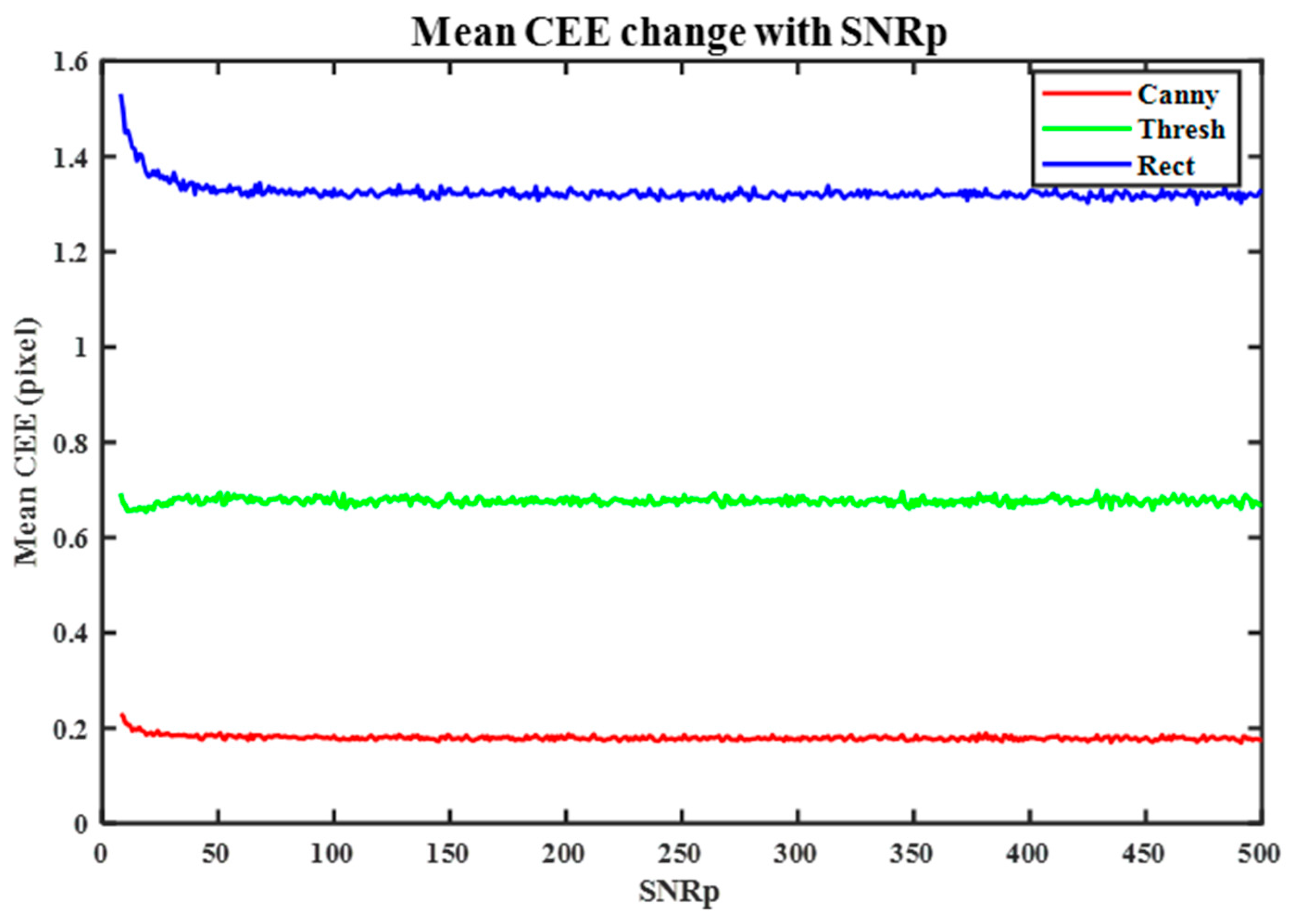
A comparison is conducted on the centroid estimation errors of the three +1st-order spectrum centroid extraction methods under different S N R P conditions, and the performance comparison results are presented in Figure 5. We add S N R P values ranging from 8 to 500 to the holographic interferograms, then performed Fourier transform on them to obtain the holographic spectra. The three +1st-order spectrum centroid extraction methods are adopted to process the holographic spectra. It can be observed that the centroid estimation error of the proposed spectrum extraction algorithm based on Canny operator for adaptive edge extraction and centroid localization is below 0.245 pixels under different noise intensity conditions, and is consistently lower than the CEE values corresponding to the other two algorithms. The results demonstrate the excellent performance of the proposed algorithm in resisting noise interference.

3.2. Qualitative Comparison of Processing Irregular Spectrum Spot Morphology

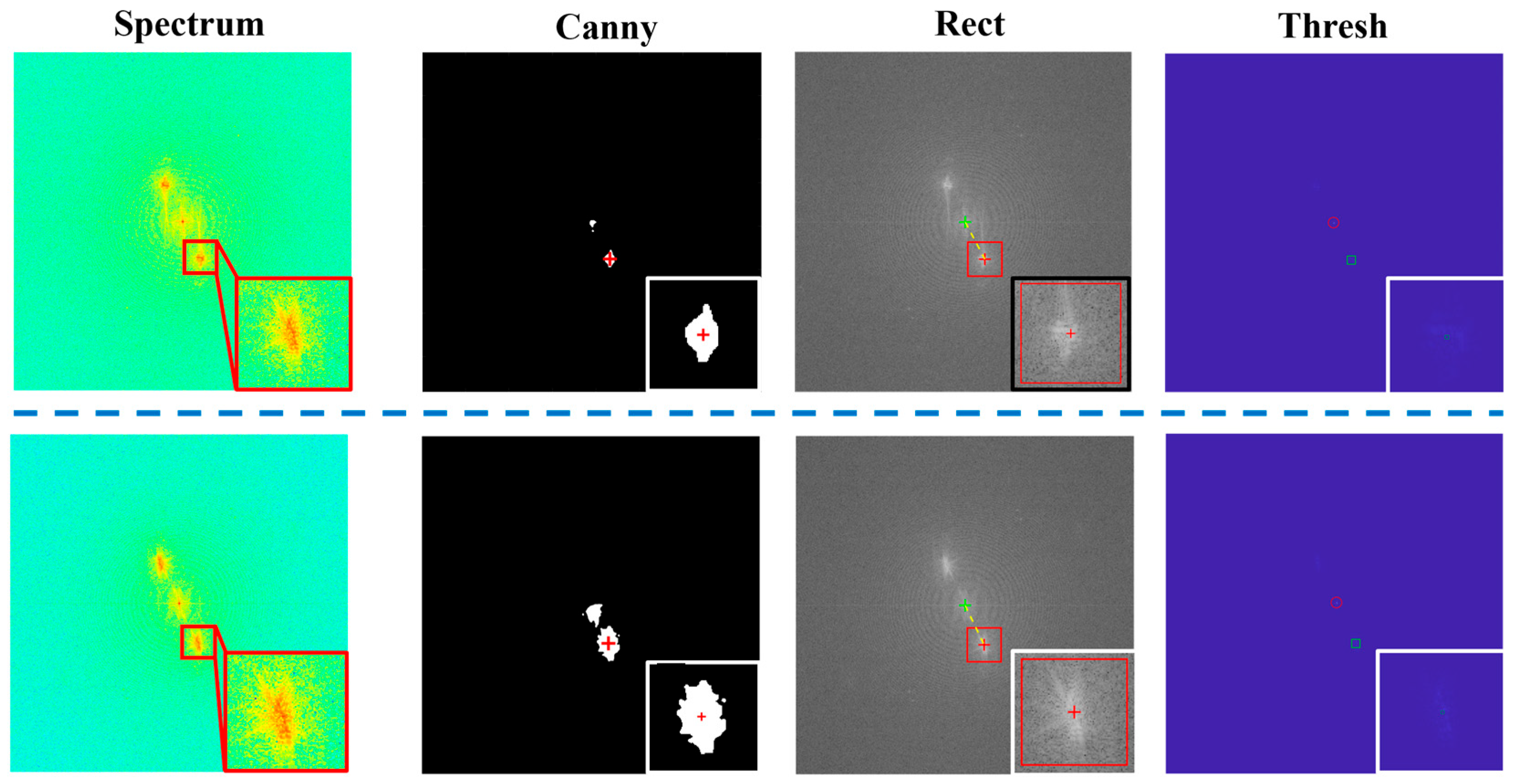
To verify the adaptive, irregularity-adaptive and automated performance of the proposed spectrum extraction algorithm, a comparative experiment is conducted between this algorithm and two typical +1st-order spectrum extraction methods. Calculations and qualitative analysis are performed for two types of irregular spectrum spot morphologies, namely asymmetric offset and overlap interference between the 0th-order and +1st-order spectra. The experimental dataset of irregular spectrum spot morphologies is derived from field experimental data, which are obtained by processing holographic interference fringes collected using the OADH experimental system to generate holographic spectra. The size of all spectral images is 780 × 780 pixels. The three methods are adopted to process these images, and the results are presented in Figure 6.
Figure 6 presents the +1st-order spectrum extraction results of the three methods under two irregular scenarios, respectively. For spectra with asymmetric offset and overlap interference between the 0th-order and +1st-order spectra, the proposed method can accurately identify the boundary contour of asymmetric spectra, achieving complete and non-redundant spectrum extraction, and successfully realizing interference suppression and valid spectrum preservation. The rectangular window filtering method suffers from inaccurate region selection. Due to its inability to distinguish the gray-level difference between the 0th-order and +1st-order spectra in overlapping regions during processing, the extracted results contain a large amount of 0th-order spectral noise, leading to inaccurate localization of the +1st-order spectrum spot. The threshold of the fixed threshold filtering method is severely affected by noise, resulting in the loss of spectral edge information during extraction. In addition, this method has a low degree of automation as it relies on global gray-level distribution characteristics, and thus exhibits insufficient robustness against spectral morphological distortion and overlapping interference. The results of the comparative experiments demonstrate that the proposed method effectively addresses the problems of precise localization and complete extraction of irregular spectrum spots, eliminates the influence of noise, and preserves the complete morphological features of spectrum spots.

3.3. Performance Comparison Based on Wavefront Reconstruction

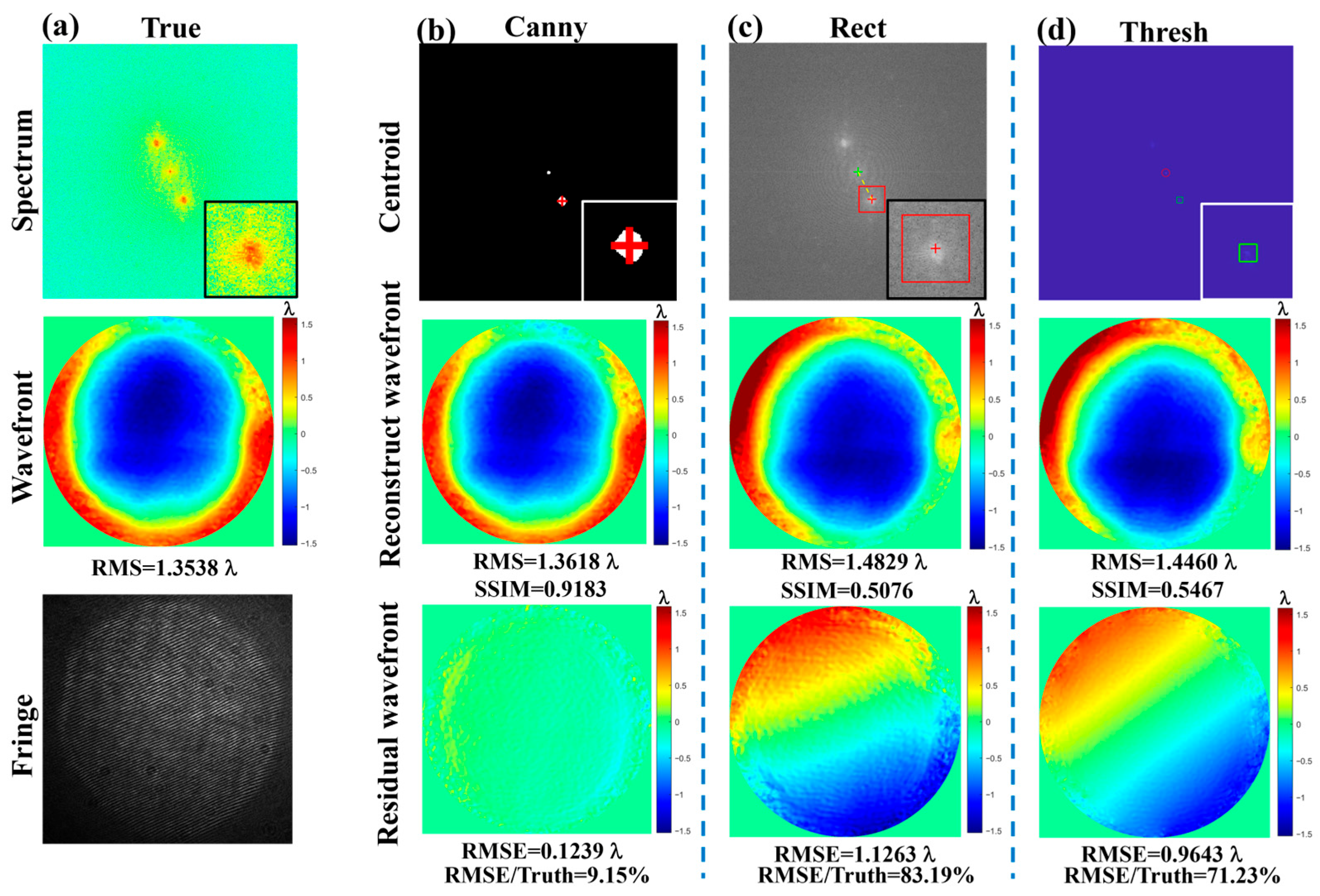
The spectrum extraction algorithm based on the Canny operator for adaptive edge extraction and centroid localization can accurately extract the coordinates of the +1st-order spectrum spot, which also provides a guarantee and prerequisite for the accuracy of subsequent wavefront reconstruction. To further verify the effectiveness of the proposed method, we perform Gaussian window filtering based on the +1st-order spectrum centroid coordinates calculated by the three methods to obtain the +1st-order spectrum, and then conducted inverse Fourier transform on it to derive the +1st-order complex amplitude. The same wavefront reconstruction algorithm is adopted for wavefront reconstruction, and the root mean square error (RMSE) and structural similarity index measure (SSIM) are used as metrics to further quantify the wavefront reconstruction results. The specific results are shown in Figure 7.
It can be observed from Figure 7 that the reconstructed wavefront derived from the Canny-based +1st-order spectrum centroid extraction method exhibits high similarity to the true-value wavefront, with the SSIM of 0.9183 and the RMSE of 0.1239 λ for the residual wavefront, corresponding to an RMSE-to-true-value ratio of 9.15%. In contrast, the SSIM between the reconstructed wavefront obtained via the Rect rectangular window filtering method and the true-value wavefront is only 0.5076; the residual wavefront suffers from aberration with tilt components, with the RMSE of 1.1263 λ and an RMSE-to-true-value ratio of 83.19%, and this result indicates a significant deviation between the wavefront reconstruction result and the true wavefront. For the thresh fixed threshold filtering method, the SSIM between its reconstructed wavefront and the true-value wavefront is 0.5467, and its residual wavefront also contains aberration with tilt components, yielding an RMSE of 0.9643 λ and an RMSE-to-true-value ratio of 71.23%.
Quantitative analysis demonstrates that, compared with the RMSE of the residual wavefronts obtained by the “Rect” and “Thresh” methods, the proposed method reduces the average RMSE of the residual wavefronts by 89.0% and 87.2%, respectively, further verifying the feasibility and effectiveness of this method. The results demonstrate that the accuracy of +1st-order spectrum centroid localization directly determines the precision of wavefront reconstruction. The proposed method can adapt to irregular spectrum spot morphologies, further verifying its superior capability for high-precision centroid localization.

4. Experimental Verification and Comparative Analysis

To further verify the applicability of the proposed method in practical engineering scenarios, this section conducts experimental verification for the AO measurement scenario under dynamic atmospheric turbulence distortion. Based on a self-developed atmospheric turbulence test bench, a complete experimental dataset of off-axis holographic interference fringes is collected, and the wavefront distortion results independently measured by the Shack-Hartmann wavefront sensor (SHWFS) are incorporated as an auxiliary reference. This study further validates the performance of the proposed method in AO measurement in terms of wavefront reconstruction accuracy, and conducts a comparative analysis with the calculation results of the classical rectangular window filtering method and the fixed threshold filtering method.

4.1. Experimental System Setup

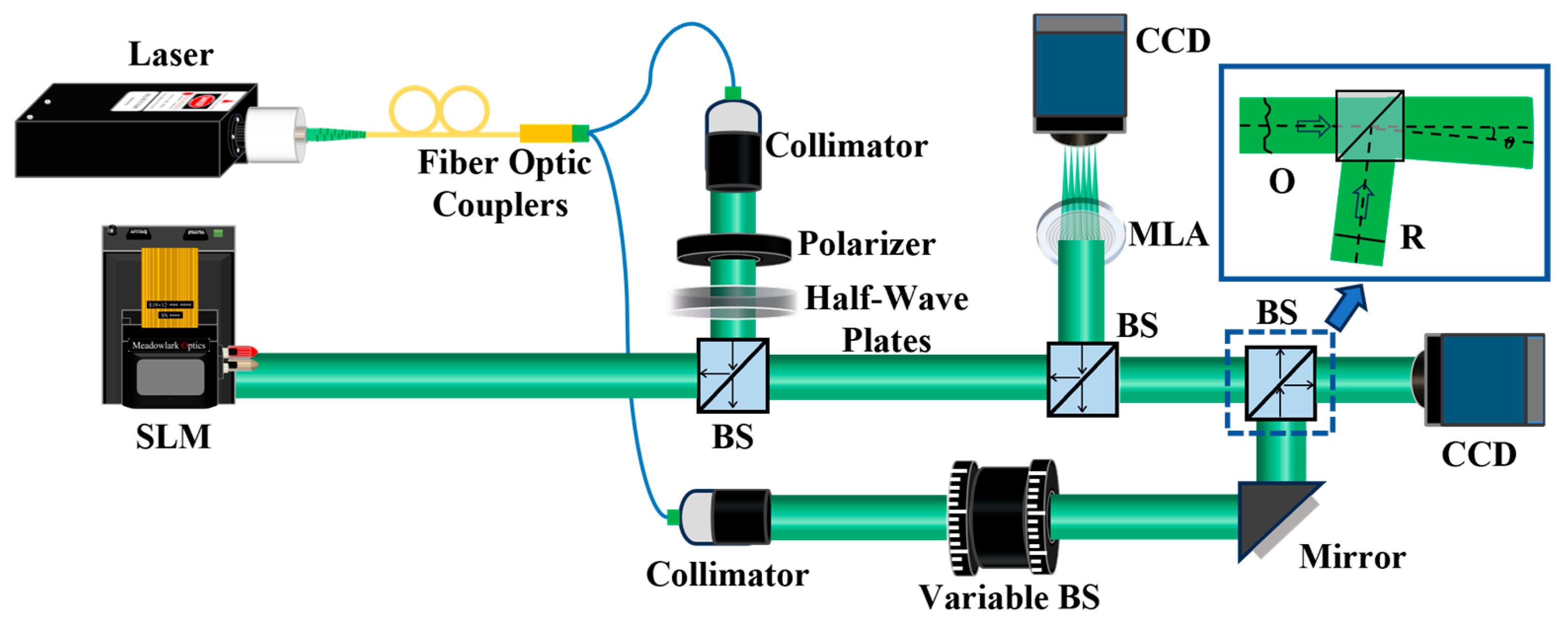
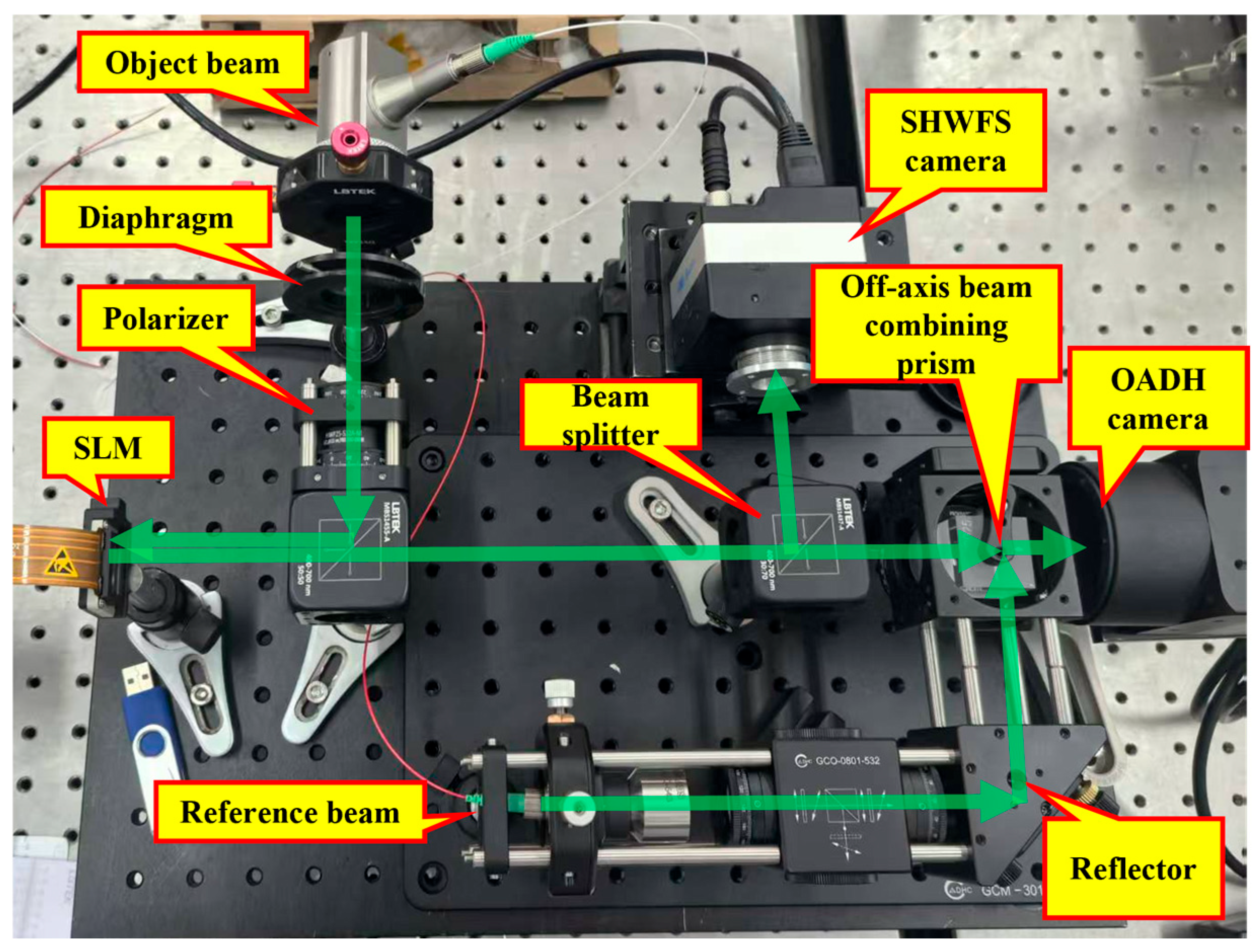
Figure 8 first presents the schematic diagram of the optical path of the experimental system for measuring dynamic atmospheric turbulence distortion. A hybrid sensing mode is adopted in this system, where the SHWFS and the OADH are integrated into a single hybrid measurement system in the form of a common optical path. Specifically, dynamic atmospheric turbulence distortion is generated by loading on a spatial light modulator (SLM). The laser beam is incident on the SLM after passing through a polarizer, and the beam carrying the aberrations induced by atmospheric turbulence is reflected to a beam splitter prism. The distorted beam is split into two beams by the beam splitter: one beam is directly directed to the SHWFS, yielding a Hartmann spot array image for subsequent aberration detection; the other beam enters an off-axis beam combining prism to interfere with the reference beam, and alternating bright and dark interference fringes are formed on the OADH camera.
Figure 9 shows the experimental system for dynamic atmospheric turbulence distortion measurement. A 532 nm single longitudinal mode fiber laser is adopted as the light source, which meets the light source requirements for interferometric measurements; the SLM is employed to generate controllable dynamic atmospheric turbulence distortion aberrations, and the aberration types can cover the typical aberrations under actual atmospheric turbulence conditions; the SHWFS sensing branch and the OADH sensing branch are synchronously integrated, with both branches conducting data acquisition via a synchronous trigger signal.

4.2. Experimental Results and Analysis

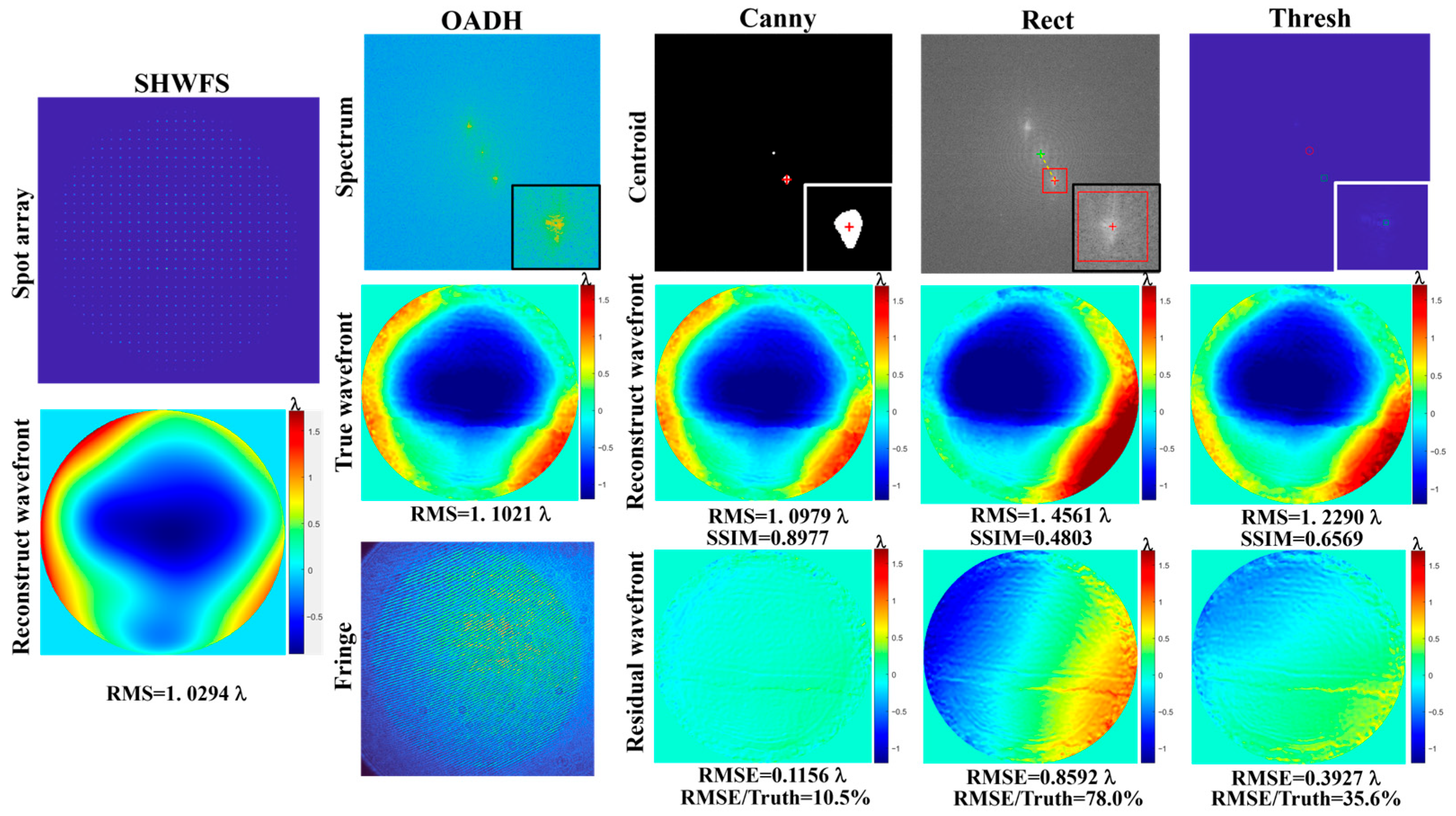
To verify the performance of the proposed adaptive edge extraction and centroid localization spectrum extraction method based on the Canny operator in practical complex scenarios, an experimental measurement of dynamic atmospheric turbulence distortion is conducted. In the experiment, the sampling frame rates of both the SHWFS and OADH are set to 50 Hz to ensure the accurate capture of dynamic atmospheric turbulence distortion. Figure 10 presents the wavefront restoration results of a randomly selected frame of data in the experiment, where the wavefront reconstructed by the SHWFS is used as the reference benchmark for quantitative and qualitative comparison with the wavefront restored by the OADH to evaluate the wavefront restoration performance of different spectral centroid extraction methods, and the aberration loaded onto the SLM is regarded as the true value.
From the restoration performance shown in Figure 10, the reconstructed wavefront obtained by the proposed +1st-order spectral centroid extraction method based on the Canny operator in this paper exhibits an extremely high degree of similarity with the reference true wavefront. Quantitative analysis results show that its SSIM value reaches 0.8977; meanwhile, the RMSE of the residual wavefront obtained by this method is only 0.1156 λ, and the ratio of the residual RMSE to the true value is merely 10.5%. This indicates that the proposed method can effectively restore the wavefront of dynamic atmospheric turbulence distortion with excellent restoration accuracy.
To further highlight the superiority of the proposed method, a comparative verification is conducted between it and the traditional spectral centroid extraction methods. Specifically, for the +1st-order spectral centroid extraction results of the rectangular window filtering method (Rect), the SSIM between its restored wavefront and the reference true wavefront is only 0.4803, which is significantly lower than that of the proposed method. In addition, its residual wavefront exhibits distinct tilt aberration characteristics, with the RMSE as high as 0.8592 λ; the ratio of the residual RMSE to the reference true value reaches 78.0%. This indicates that the rectangular window filtering method has completely lost its wavefront restoration capability under the dynamic atmospheric turbulence distortion scenario, resulting in invalid restoration performance. The fixed threshold filtering method (Thresh) outperforms the Rect method yet has obvious limitations: the SSIM between its restored wavefront and the reference true wavefront is 0.6569, the RMSE of its residual wavefront is 0.3927 λ, and the ratio of the residual RMSE to the reference true value is 35.6%, leaving considerable room for improvement in its restoration accuracy.
The above quantitative and qualitative comparative analysis results further verify the feasibility and effectiveness of the proposed adaptive edge extraction and centroid localization spectrum extraction method based on the Canny operator in this paper. Meanwhile, the experimental results fully demonstrate that the centroid localization accuracy of the +1st-order spectrum is the key factor determining the wavefront reconstruction accuracy. By virtue of the adaptive edge detection capability of the Canny operator, the proposed method can accurately adapt to the irregularly shaped spectral spots under atmospheric turbulence, effectively overcome the drawback of traditional methods with poor adaptability to spot morphologies, and exhibit a higher-precision spectral centroid localization capability, which provides a reliable technical support for the high-precision measurement of dynamic atmospheric turbulence distortion.

5. Conclusions

Aiming at the problems of poor adaptability to irregular spots and multi-region interference encountered during the demodulation of OADH interference fringes, this study proposes a spectrum extraction algorithm based on the Canny operator for adaptive edge extraction and centroid localization. This method automatically locates the rough region of the +1st-order spectrum through multi-stage peak screening, achieves complete segmentation of irregular spots combined with edge closing and filling, resolves the issue of centroid indexing errors by means of maximum connected component screening, and ultimately completes the extraction of complex amplitude via Gaussian window filtering. Under complex scenarios with different S N R P and irregular spectrum spots, compared with the classical rectangular window filtering method and fixed threshold filtering method, the CEE of the proposed method for the +1st-order spectrum is consistently below 0.245 pixels, which is lower than the CEE values corresponding to the other two algorithms. Furthermore, wavefront reconstruction is performed on the extracted complex amplitude. The proposed method reduces the RMSE of the residual wavefront by 89.0% and 87.2% compared with the rectangular window filtering method and fixed threshold filtering method, respectively, further verifying the feasibility and effectiveness through laboratory experiments. The results demonstrate that the proposed method can adapt to complex scenarios with low S N R P and irregular spectrum spots, providing a new technical approach for the automated and high-precision demodulation of off-axis digital holography.
This algorithm adopts an adaptive threshold and an automated processing workflow throughout the entire process, eliminating the need for manual intervention in parameter adjustment. It effectively enhances the automation level of off-axis digital holography reconstruction, addresses the issues of manual setting of window function parameters, thresholds and other parameters in traditional algorithms, reduces operational complexity, and thus facilitates subsequent engineering applications. Nevertheless, this algorithm has certain limitations: insufficient real-time performance, inadequate adaptability to extreme low S N R P scenarios, the lack of coordinated optimization for the phase unwrapping module, and the absence of comparative analysis with deep learning-based algorithms. In the future, this algorithm can be widely applied in fields such as optical inspection, biomedical imaging and precision metrology; it will drive the system integration and engineering implementation of off-axis digital holography reconstruction systems, and provide technical support for high-precision detection in relevant research fields.

Author Contributions

All authors contributed to the study conception, design, material preparation, data collection, and analysis. The first draft of the manuscript was written by A.L. and other authors (X.G., Z.G., Q.Y., Y.C., C.Y., L.Z., S.M., S.W. and P.Y.) commented on previous versions of the manuscript. All authors have read and agreed to the published version of the manuscript.

Funding

This work was funded by the National Natural Science Foundation of China (62305343).

Data Availability Statement

The data presented in this study are cited within the article.

Conflicts of Interest

The authors declare no conflicts of interest.

References

  1. Hardy, J.W. Adaptive optics: A progress review. Act. Adapt. Opt. Syst. 1991, 1542, 2–17. [Google Scholar]
  2. Li, M.; Hong, Y.; Zeng, C.; Song, Y.; Zhang, X. Investigation on the UAV-to-satellite optical communication systems. IEEE J. Sel. Areas Commun. 2018, 36, 2128–2138. [Google Scholar] [CrossRef]
  3. Guo, Y.; Hao, Y.; Wan, S.; Zhang, H.; Zhu, L.; Zhang, Y.; Wu, J.; Dai, Q.; Fang, L. Direct observation of atmospheric turbulence with a video-rate wide-field wavefront sensor. Nat. Photonics 2024, 18, 935–943. [Google Scholar] [CrossRef]
  4. Kim, M.K. Incoherent digital holographic adaptive optics. Appl. Opt. 2012, 52, 117–130. [Google Scholar] [CrossRef]
  5. Zepp, A.; Gladysz, S.; Stein, K.; Osten, W. Simulation-based design optimization of the holographic wavefront sensor in closed-loop adaptive optics. Light Adv. Manuf. 2022, 3, 384–399. [Google Scholar] [CrossRef]
  6. Shaked, N.T.; Micó, V.; Trusiak, M.; Kuś, A.; Mirsky, S.K. Off-axis digital holographic multiplexing for rapid wavefront acquisition and processing. Adv. Opt. Photonics 2020, 12, 556–611. [Google Scholar] [CrossRef]
  7. Takeda, M.; Ina, H.; Kobayashi, S. Fourier-transform method of fringe-pattern analysis for computer-based topography and interferometry. J. Opt. Soc. Am. 1982, 72, 156–160. [Google Scholar] [CrossRef]
  8. Cuche, E.; Bevilacqua, F.; Depeursinge, C. Digital holography for quantitative phase-contrast imaging. Opt. Lett. 1999, 24, 291–293. [Google Scholar] [CrossRef]
  9. Chuan, S.; Qing, Z.; Lei, W.; Xing, X.; Ping, G. Analysis and improvement of reconstruction phase error in the image plane digital holography. Acta Phys. Sin. 2014, 63, 244201. [Google Scholar] [CrossRef]
  10. Gautam, G.; Shrestha, S.; Cho, S. Spectral Analysis of Rectangular, Hanning, Hamming and Kaiser Window for Digital Fir Filter. Int. J. Adv. Smart Converg. 2015, 4, 138–144. [Google Scholar] [CrossRef]
  11. Podder, P.; Khan, T.Z.; Khan, M.H.; Rahman, M.M. Comparative performance analysis of hamming, hanning and blackman window. Int. J. Comput. Appl. 2014, 96, 1–7. [Google Scholar] [CrossRef]
  12. Amraish, N.; Reisinger, A.; Pahr, D.H. Robust Filtering Options for Higher-Order Strain Fields Generated by Digital Image Correlation. Appl. Mech. 2020, 1, 174–192. [Google Scholar] [CrossRef]
  13. Wang, L.; Fu, Q.; Zhu, R.; Liu, N.; Shi, H.; Liu, Z.; Li, Y.; Jiang, H. Research on high precision localization of space target with multi-sensor association. Opt. Lasers Eng. 2025, 184, 108553. [Google Scholar] [CrossRef]
  14. Jiang, W.; Liu, L.; Bu, Y. Application of Deep Learning in the Phase Processing of Digital Holographic Microscopy. Photonics 2025, 12, 810. [Google Scholar] [CrossRef]
  15. Chen, D.; Cao, W.; Rao, S.; Luo, L. Eight-neighborhood sparse contour extraction in binary images. In Proceedings of the 2024 27th International Conference on Computer Supported Cooperative Work in Design (CSCWD), Tianjin, China, 8–10 May 2024; pp. 2840–2845. [Google Scholar]
  16. Sun, Y.; Wang, J.; Sun, Y.; Zhang, P.; Wang, T. Graph distance and adaptive k-nearest neighbors selection-based density peak clustering. IEEE Access 2024, 12, 71783–71796. [Google Scholar] [CrossRef]
  17. Yang, X.; Zhuang, Y.; Shi, M.; Sun, X.; Cao, X.; Zhou, B. RatioVLP: Ambient light noise evaluation and suppression in the visible light positioning system. IEEE Trans. Mob. Comput. 2023, 23, 5755–5769. [Google Scholar] [CrossRef]
  18. Härtinger, P.; Steger, C. Adaptive histogram equalization in constant time. J. Real-Time Image Process. 2024, 21, 93. [Google Scholar] [CrossRef]
  19. Su, H.; Wang, X.; Han, T.; Wang, Z.; Zhao, Z.; Zhang, P. Research on a U-Net bridge crack identification and feature- calculation methods based on a CBAM attention mechanism. Buildings 2022, 12, 1561. [Google Scholar] [CrossRef]
  20. Agrawal, H.; Desai, K. Canny edge detection: A comprehensive review. Int. J. Tech. Res. Sci. 2024, 9, 27–35. [Google Scholar] [CrossRef]
  21. Guo, L.; Wu, S. FPGA Implementation of a Real-Time Edge Detection System Based on an Improved Canny Algorithm. Appl. Sci. 2023, 13, 870. [Google Scholar] [CrossRef]
  22. Prakash, S.; Kakarla, J. Three level automatic segmentation of optic disc using LAB color space contours and morphological operation. Int. J. Imaging Syst. Technol. 2023, 33, 1796–1813. [Google Scholar] [CrossRef]
  23. Wang, L.; Gu, X.; Liu, Z.; Wu, W.; Wang, D. Automatic detection of asphalt pavement thickness: A method combining GPR images and improved Canny algorithm. Measurement 2022, 196, 111248. [Google Scholar] [CrossRef]
Figure 1. Schematic diagram of off-axis digital holography. (a) Holographic interferometric fringes. (b) Holographic spectrum. (c) Wrapped phase. (d) Continuous wavefront.
Photonics 13 00169 g001
Figure 2. Diagram of irregular spectrum spots. The area within the large red box in the figure is the magnified region corresponding to the +1st-order spectrum.
Photonics 13 00169 g002
Figure 3. Flowchart of the Canny Operator-Based +1st-Order Spectrum Extraction Algorithm.
Photonics 13 00169 g003
Figure 4. Comparison of centroid extraction for the +1st-order spectral spot under noise-free and noisy conditions. (a1,a2) Holographic interferogram; (b1,b2) Holographic spectrum obtained from (a1,a2) via Fourier transform, with the approximate position of the +1st-order spectrum marked; (c1,c2) Collected amplitude map; (d1f2) Spectra of the centroid extraction for the +1st-order spectrum spot using the proposed method, the rectangular window filtering method, and the rectangular window filtering method, respectively.
Photonics 13 00169 g004
Figure 5. Corresponding CEE of the three methods under different S N R P Conditions. S N R P ranges from 8 to 500, where the red line denotes the proposed method.
Photonics 13 00169 g005
Figure 6. Comparison of irregular spectrum spot extraction. Comparison of extraction performance for two different types of irregular spectral spots among three methods.
Photonics 13 00169 g006
Figure 7. Comparison of wavefront reconstruction based on the three +1st-order spectrum extraction methods. (a) Ground truth column, in turn: spectral map, ground truth wavefront, interference fringe pattern; (bd) respectively present the +1st-order spectrum extraction results of the three methods, along with the corresponding wavefront reconstruction results and residual wavefront results.
Photonics 13 00169 g007
Figure 8. Optical path schematic of the experimental system for measuring dynamic atmospheric turbulence distortion.
Photonics 13 00169 g008
Figure 9. Experimental system for dynamic atmospheric turbulence distortion measurement.
Photonics 13 00169 g009
Figure 10. Comparison of wavefront restoration results for dynamic atmospheric turbulence distortion measurement system. On the left are the Hartmann wavefront measurement data and wavefront reconstruction results, provided for comparison.
Photonics 13 00169 g010
Disclaimer/Publisher’s Note: The statements, opinions and data contained in all publications are solely those of the individual author(s) and contributor(s) and not of MDPI and/or the editor(s). MDPI and/or the editor(s) disclaim responsibility for any injury to people or property resulting from any ideas, methods, instructions or products referred to in the content.