Article

Systematic Measurement and Analysis of Beam Degree of Polarization Under Diverse Atmospheric Turbulence Conditions


1
School of Information Engineering, Xi’an University, Xi’an 710048, China
2
School of Automation and Information Engineering, Xi’an University of Technology, Xi’an 710048, China
3
Xianyang Key Laboratory of Intelligent Manufacturing Equipment Technology, Xi’an 712000, China
*
Author to whom correspondence should be addressed.
Photonics 2026, 13(1), 82; https://doi.org/10.3390/photonics13010082
Submission received: 9 December 2025 / Revised: 12 January 2026 / Accepted: 16 January 2026 / Published: 18 January 2026

Abstract

Atmospheric turbulence-induced random fluctuations in the refractive index can lead to the degradation of the polarization of polarized light. In accordance with the unified theory of coherent polarization, a comprehensive investigation was undertaken to explore the variation in the degree of polarization (DOP) of laser beams propagating through atmospheric turbulence channels under diverse weather conditions. This investigation involved both theoretical analyses and experimental validations, providing a multifaceted approach to understanding the dynamics of laser beam propagation in atmospheric turbulence. To this end, numerical simulations were performed to analyze the polarization-maintaining characteristics of laser beams with varying wavelengths, turbulence intensities, and initial DOP values. To validate the simulation results for various weather scenarios, three experimental links with different propagation distances were constructed. The experimental results demonstrated that as the turbulence intensity increased, the average DOP of the beam continuously decreased until it reached a threshold value. Furthermore, the polarization fluctuations exhibited a distance-threshold effect, wherein the polarization parameters tended to saturate beyond a critical propagation distance.

1. Introduction

Coherent optical communication is a transmission technique in which coherent modulation is employed at the transmitter, and coherent detection is applied at the receiver [1]. This approach requires the beam polarization state to be highly stable because optimal coherent mixing efficiency, and thus high-sensitivity detection, can only be achieved when the signal light and local oscillator (LO) light have identical or closely aligned polarization states. However, random fluctuations in the refractive index induced by atmospheric turbulence can cause polarization degradation, leading to a polarization mismatch between the signal and LO beams. This mismatch reduces the heterodyne detection efficiency and severely degrades the overall performance of the communication system. Therefore, investigating the impact of atmospheric turbulence on the polarization properties of optical beams is important for the design and optimization of coherent free-space optical communication systems [2,3,4].
In the early 21st century, foreign researchers, based on Rytov perturbation theory [5], derived both theoretically and experimentally the probability density function and variance of polarization angle fluctuations in optical communication links [6]. The main advantage of this theory lies in its ability to simplify the nonlinear inverse scattering problem into a linear integral problem, thereby enabling the derivation of all relevant statistical parameters and distributions of the received optical field. However, the limitations of this approach are also evident: it is only applicable to laser propagation with weak irradiance fluctuations, and more importantly, it introduces simplifications regarding depolarization effects, rendering it unsuitable for analyzing turbulence-induced depolarization effects. An alternative approach to studying polarization is the Extended Huygens–Fresnel (EHF) principle. Using this framework, O. Korotkova [7,8] and H. T. Eyyuboğlu [9] theoretically investigated the far-field polarization properties of partially coherent beams propagating through atmospheric turbulence, based on two classical turbulence spectral models, Tatarskii and Kolmogorov.
In 2009, Ji et al. [10] derived an analytical expression for the DOP of partially coherent, atmospheric turbulence-propagating, Hermite-Gaussian electromagnetic beams and investigated their polarization characteristics. The study demonstrated that, under sufficiently long propagation distances, the DOP approached a limiting value in an asymptotic and steady manner. In 2012, Gao et al. [11] analyzed the effects of parameters such as wavelength, initial beam waist, and polarization angle on the depolarization phenomenon. In 2013, Tao et al. [12] combined the extended Huygens-Fresnel integral with the coherent polarization matrix to derive an analytical expression for the polarization degree of a focused vector laser beam propagating through atmospheric turbulence. A systematic analysis was conducted to investigate the impact of varying beam parameters on the spatial distribution of the DOP and the central depolarization. The findings suggest that turbulence leads to substantial disruption of the polarization structure of focused vector beams. In the far-field limit, the propagation characteristics of vector beams approach those of Gaussian beams. In 2014, Li et al. [13] employed the Stokes parameter formalism to investigate the evolution of the polarization state during beam propagation. In 2017, Zhang et al. [14] developed a statistical polarization model incorporating both first- and second-order moments. By integrating the second- and fourth-order EHF theories, they provided a unified analysis of the mean and variance of the polarization parameters, thereby overcoming the limitation of the conventional Rytov perturbation theory, which is applicable only under weak fluctuation conditions. In 2019, Wang et al. [15] proposed an electromagnetic Gaussian Schell-model vortex (EGSMV) to analyze the polarization characteristics of partially coherent vortex beams in atmospheric turbulence. The study revealed the critical influence of topological charge and wavelength on the polarization distribution characteristics by deriving analytical expressions for the DOP and the orientation angle of polarization (OAOP). In 2024, Xu et al. [16] systematically analyzed the spectral coherence distribution (SDOC) evolution characteristics of certain coherent radial and azimuthal polarization vortex beams propagating through atmospheric turbulence. The study revealed that the SDOC distribution gradually forms a dark ring structure during propagation, ultimately evolving into a quasi-Gaussian distribution. This conclusion was validated through numerical simulations employing a multi-phase screen approach.
A substantial body of research has previously been dedicated to the study of the propagation characteristics of optical beams through atmospheric turbulence. The majority of these studies have focused on turbulence theories based on the Kolmogorov power-spectral model. However, recent research has shown that the Kolmogorov spectrum does not always accurately capture the statistical properties of atmospheric turbulence in the real world. Therefore, investigating the influence of non-Kolmogorov turbulence models on beam propagation is becoming increasingly important. In 2011, Wang [17] studied the non-classical polarization characteristics of beams propagating through non-Kolmogorov turbulence and derived an analytical expression for the DOP of linearly polarized light. In 2016, Zhao et al. [18] established a polarization state model for Elliptical Gaussian Schell-model (EGSM) beams propagating through anisotropic non-Kolmogorov turbulence in both oceanic and terrestrial environments. In 2021, Li et al. [19] showed that radially polarized partially coherent vortex beams propagating in anisotropic plasma turbulence exhibit a central zero in polarization degree and a radial increase, with small-scale anisotropic turbulence having a limited effect on overall polarization behavior. In 2025, Li et al. [20] derived the spectral density matrix for the polarization evolution of partially coherent radially polarized elliptical vortex beams in non-Kolmogorov turbulence. His research elucidated the underlying mechanisms governing turbulence-induced polarization decay and the transition from linear to elliptical polarization.
In atmospheric turbulence environments, variations in humidity and the presence of suspended particulate matter, such as aerosols, can also significantly affect the evolution of a laser beam’s DOP. In 2016, Zhang et al. [21] revealed a quantitative relationship between humidity and polarization characteristics in soot-laden environments, demonstrating the superior stability of linearly polarized light under high-humidity conditions. In 2023, Ma et al. [22] investigated the modulation mechanism of aerosol scattering polarization properties influenced by visibility and summarized the distribution patterns of polarization characteristics under different visibility conditions.
Most existing studies have focused on partially polarized laser beams, whereas investigations on fully polarized lasers remain limited. Moreover, the statistical behavior of the DOP under strong turbulence conditions ( C n 2 10 14   m 2 / 3 ) and long-distance propagation links (>5 km) has yet to be systematically validated through experiments. In this study, based on the unified polarization–coherence theory, we conducted numerical simulations to analyze the evolution of the beam DOP in atmospheric turbulence. Furthermore, three laser transmission experimental platforms with different link lengths were constructed to systematically measure and analyze the statistical characteristics of the beam DOP under turbulent conditions.
The results indicate that the mean DOP is strongly correlated with turbulence strength, exhibiting a continuous decline with increasing propagation distance and approaching a stable value beyond a certain threshold. At short distances, turbulence-induced polarization fluctuations are more pronounced, resulting in larger deviation values. Under different weather conditions, environments with relatively homogeneous and weak turbulence, such as overcast or foggy conditions, lead to higher DOP means and smaller fluctuations. In contrast, under strong scattering conditions, such as sandstorms and rainfall, the beam’s polarization-maintaining capability degrades significantly, resulting in a lower mean DOP and increased variability.

2. Basic Theory

2.1. Cross-Spectral Density Matrix

This section provides a brief review of theoretical models of polarization during laser propagation in atmospheric turbulence to support subsequent numerical simulations and experimental analysis. The analytical expressions presented here are derived primarily from established theoretical frameworks, ensuring the completeness and clarity of the theoretical description. These expressions have been adapted from previous studies [23,24,25,26], and no new theoretical derivations have been introduced.
Assuming the wavefront propagates from source plane z = 0 to plane z > 0 within atmospheric turbulence, a cross-spectral density matrix (CSDM) of order 2 × 2 is employed to characterize the second-order coherent properties of the partially coherent Gaussian-Schell model (GSM) beam [23]
W ( ρ 1 , ρ 2 ; L ) W i j ( ρ 1 , ρ 2 ; L ) = E i ( ρ 1 ; L ) E j * ( ρ 2 ; L ) , i , j = x , y
In the equation, ρ 1 , ρ 2 denotes the two-dimensional plane coordinate vector whose receiving surface is perpendicular to the direction of beam propagation; L represents the propagation path length; * denotes complex conjugation; indicates statistical averaging; E i , E j refers to two mutually orthogonal fields perpendicular to the beam propagation direction. In atmospheric turbulence, these two mutually orthogonal transverse fields can be described by the generalized Huygens-Fresnel principle
E ( ρ , L ) = i k 2 π L exp ( i k L ) d r E 0 ( r , 0 ) × exp [ i k 2 L ρ r 2 + ψ ]
In the equation, E ( ρ , L ) and E 0 ( r , 0 ) represent the field distributions at the receiver location ( ρ , L ) and the source plane ( r , 0 ) , respectively; ψ denotes the phase perturbation dependent on the medium properties; i denotes the imaginary part.
From Equations (1) and (2), the CSDM of partially coherent GSM beams in atmospheric turbulence can be expressed as
W i j ( ρ 1 , ρ 2 ; L ) = 1 ( λ L ) 2 d r 1 d r 2 W i j ( 0 ) ( r 1 , r 2 ) × exp [ ψ ( r 1 , ρ 1 ) + ψ * ( r 2 , ρ 2 ) ] m   × exp { i k 2 L [ ( ρ 1 r 1 ) 2 ( ρ 2 r 2 ) 2 ] }
In the equation, k = 2 π / λ and λ denote the beam wavelengths; r 1 , r 2 represents the two-dimensional plane coordinate vector of the source plane; W i j ( 0 ) ( r 1 , r 2 ) is the CSDM at point z = 0 on the source plane;   m denotes the global average of the turbulent medium [24], and it holds that
exp [ ψ ( r 1 , ρ 1 ) + ψ * ( r 2 , ρ 2 ) ] m exp [ ( r d 2 + r d ρ d + ρ d 2 ) / ρ 0 2 ]
where r d = r 1 r 2 ,   ρ d = ρ 1 ρ 2 ,   ρ 0 = [ 0.545 C n 2 k 2 L ] 3 / 5 is the coherent length of spherical waves in atmospheric turbulence [25], and C n 2 is the atmospheric refractive index structure constant.
For the GSM beam, the CSDM at source plane z = 0 is expressed as [24]
W i j ( 0 ) ( r 1 , r 2 ) = A i A j B i j exp [ ( r 1 2 4 σ i 2 + r 2 2 4 σ j 2 ) ] exp [ ( r 2 r 1 ) 2 2 δ i j ]
In the equation, A i , A j , B i j is the coefficient; σ i 2 , σ j 2 represents the beam radius dimensions in the x and y directions, respectively; δ i j is the coherence length at the source plane z = 0 . Parameter A i , B i j , σ i , δ i j satisfies the following relationship [26]
B i j = 1 ( i = j ) ; B i j 1 ( i j ) ; B i j = B j i * ; δ i j = δ j i
In the equation, B x y = B y x * = a exp ( i φ ) , a represent amplitudes, while φ denotes the electrical vector phase delay of direction y relative to direction x .
Substituting Equation (5) into Equation (3) and setting ρ 1 = ρ 2 = ρ , we obtain by integration
W i j ( ρ , ρ ; L ) = A i A j B i j ( λ L ) 2 π a i j χ i j exp [ ρ 2 Δ i j 2 ]
In the formula,
a i j = 1 16 σ i 2 + 1 16 σ j 2 + 1 2 δ i j + 1 ρ 0 2 ; β i j = 1 8 ( 1 σ i 2 1 σ j 2 ) ; χ i j = ( 1 4 σ i 2 + 1 4 σ j 2 β i j 2 a i j + k 2 4 a i j L 2 ) + i β i j k a i j L ; Δ i j = 2 k ( L 2 k 2 4 a i j χ i j + L 2 a i j χ i j ) i k L a i j χ i j
The polarization matrix of partially coherent GSM beams in atmospheric turbulence can be expressed in the following form
W = W x x W x y W y x W y y
In the equation, the element W x x , W x y , W y x , W y y of matrix W is given by Equation (7).

2.2. Degree of Polarization

The Degree of Polarization (DOP) is a quantitative metric used to describe the proportion of polarized components within a beam of light; the valid range is 0 D O P 1 . For any light field, the Stocks vector is defined as
S = ( S 0 , S 1 , S 2 , S 3 )
where S 0 is the total light intensity; S 1 , S 2 , S 3 is a parameter containing polarization state information. DOP is defined as
D O P = S 1 2 + S 2 2 + S 3 2 S 0
In the case of fully polarized light, the D O P = 1 , indicating that the polarization state within the light field is definitive and consists exclusively of the polarized component. In the context of partially polarized light, where 0 < D O P < 1 , the light field comprises both polarized and non-polarized components. The polarization state manifests random fluctuations in a time-statistical sense.
Stocks parameters containing DOP information can be represented using elements from the CSDM [27]
s 0 = W x x ( ρ , ρ , L ) + W y y ( ρ , ρ , L ) ; s 1 = W x x ( ρ , ρ , L ) W y y ( ρ , ρ , L ) ; s 2 = W x y ( ρ , ρ , L ) + W y x ( ρ , ρ , L ) ; s 3 = i [ W y x ( ρ , ρ , L ) W x y ( ρ , ρ , L ) ] ;
From Equations (11) and (12), the Stocks parameter and the DOP at plane z > 0 are given by
P = S 1 2 + S 2 2 + S 3 2 S 0
Substituting Equation (12) into Equation (13) yields the relationship between DOP and the polarization coherence function
P = ( W x x - W y y ) 2 + 4 W x y W y x W x x + W y y

3. Numerical Simulations

3.1. Atmospheric Turbulence Refractive Index Structure Constant

Since the 1970s, researchers such as Wyngaard, Hufnagel, and Abahamid have summarized C n 2 profiles at different altitudes and locations. Considering the generality required for simulation, this study adopts the atmospheric turbulence structure model proposed by the International Telecommunication Union (ITU-R), which is expressed as follows
C n 2 ( H ) = 8.148 × 10 56 v H 2 H 10 e H / 1000 + 2.7 × 10 16 e H / 1500 + C n 0 2 e H / 100
Here, H denotes the altitude in meters; v H is the wind speed along the vertical path, which relates to the near-ground wind speed v g as follows v H 2 = v g 2 + 30.69 v g + 348.91 . C n 0 2 represents the numerical value of the near-surface atmospheric refractive index structure constant C n 2 . In numerical simulations, we adopt three typical values: 1.7 × 10 13 , 1.7 × 10 14 , and 1.7 × 10 15 , with units of m 2 / 3 .
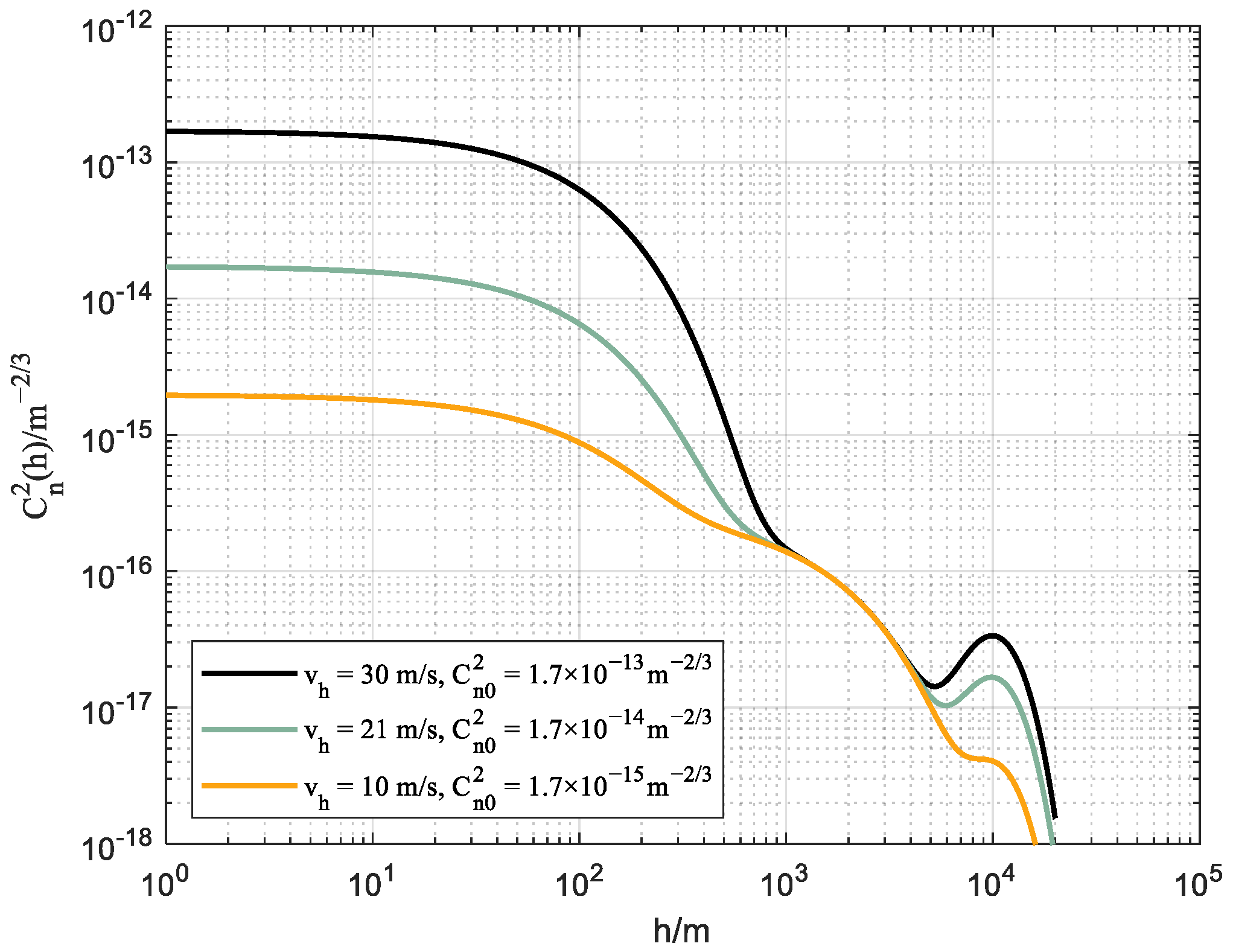
Figure 1 shows the distribution of the atmospheric structure constant C n 2 as a function of vertical altitude H under different wind speeds v H and near-ground atmospheric structure constants C n 0 2 .
As shown in Figure 1: C n 2 reaches its maximum near the ground surface and then decreases gradually with increasing altitude. At height 1   k m ~ 4   k m , C n 2 is largely unaffected by C n 0 2 and v h . Above height 10   k m , the influence of v H on C n 2 becomes significant, causing C n 2 to increase slightly before rapidly decaying. Within the near-surface altitude range, C n 2 demonstrates relatively minor variations in altitude and does not exhibit substantial changes in magnitude. This finding suggests that, for near-surface horizontal propagation links, the impact of altitude differences on C n 2 is significantly less pronounced than the effects of atmospheric turbulence along the propagation path. Despite the variation in altitude among the three experimental links examined in Chapter 4 below, they are all situated within the near-surface atmospheric layer. Consequently, in subsequent analyses, variations in C n 2 are primarily attributed to differences in propagation distance and atmospheric conditions, while the influence of altitude can be reasonably neglected under the experimental conditions of this study.

3.2. Simulation of DOP Evolution of Coherent Beams in Atmospheric Turbulence Channels

This paper first analyzes the evolution of DOP for beams with identical initial DOP but different wavelengths over varying transmission distances, taking parameters B i j = 0.5 exp ( i π / 4 ) , δ x y = δ y x = 4   m m , δ x x = 0.25   m m , δ y y = 0.2   m m , λ i = 532   n m , 650   n m , 1550   n m , H = 0.2   k m , z = 10 0 ~ 10 8   m , l 0 = 0.01   m , L 0 = 10   m . To study the evolution at different transmission distances, C n 2 is fixed at 1 × 10 15   m 2 / 3 . Initially, the polarization coherence matrix must be calculated. Subsequently, the Stocks parameters are to be computed from the polarization coherence matrix. Finally, the DOP variation must be derived from the Stocks parameters.
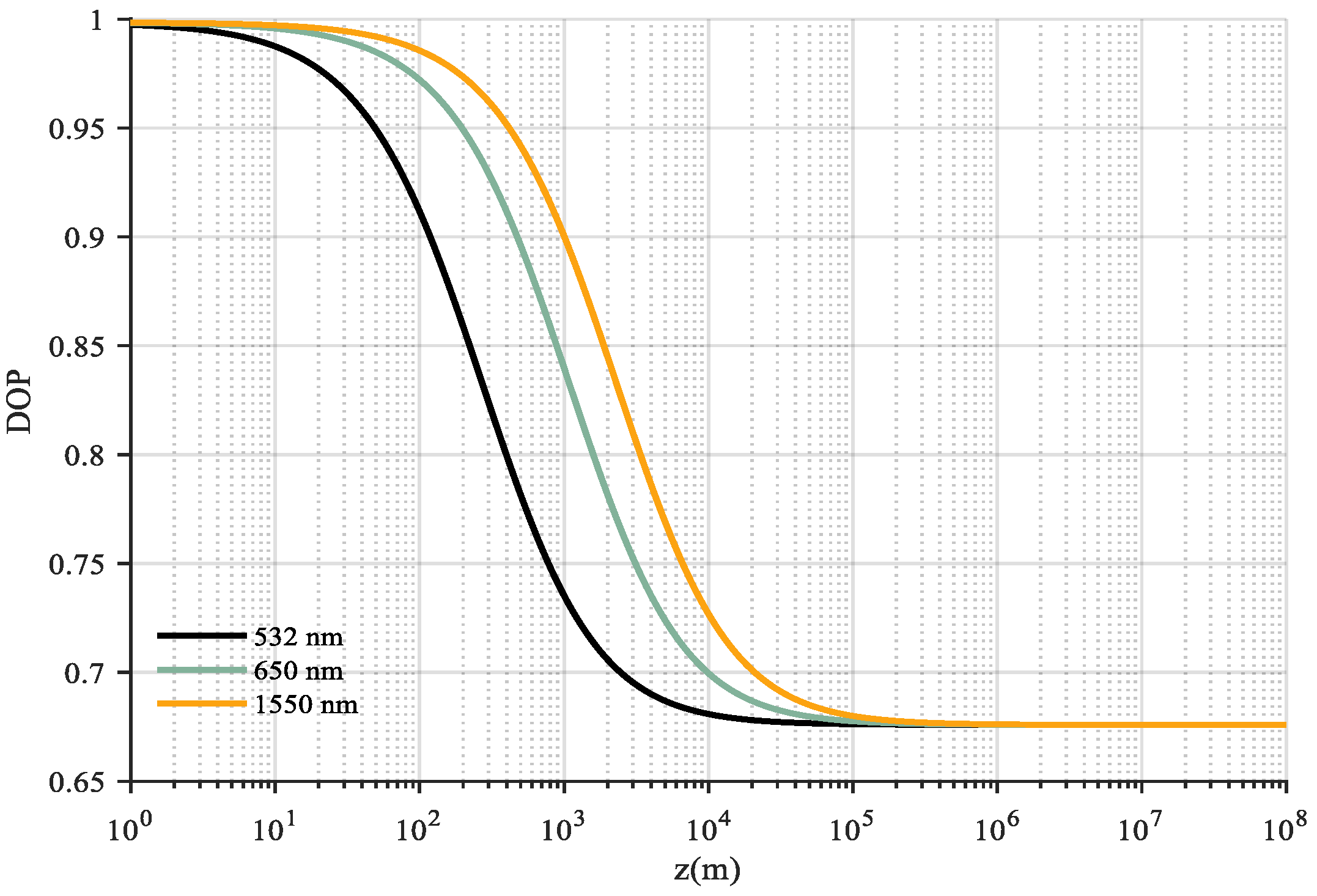
Figure 2 compares the attenuation trends of the DOP versus propagation distance for linearly polarized light at wavelengths of 532 nm, 650 nm, and 1550 nm under identical turbulence intensity ( C n 2 = 1 × 10 15   m 2 / 3 ). The figure shows that the DOP of all three wavelengths monotonically decreases with increasing transmission distance, exhibiting typical polarization degradation behavior. The polarization retention capability of the longer wavelength (1550 nm) beam is significantly superior to that of the shorter wavelength (532 nm) beam, exhibiting higher DOP over the same transmission distance. This phenomenon arises because random phase perturbations in atmospheric turbulence exert a greater influence on shorter wavelengths, leading to more pronounced randomization of the polarization state.
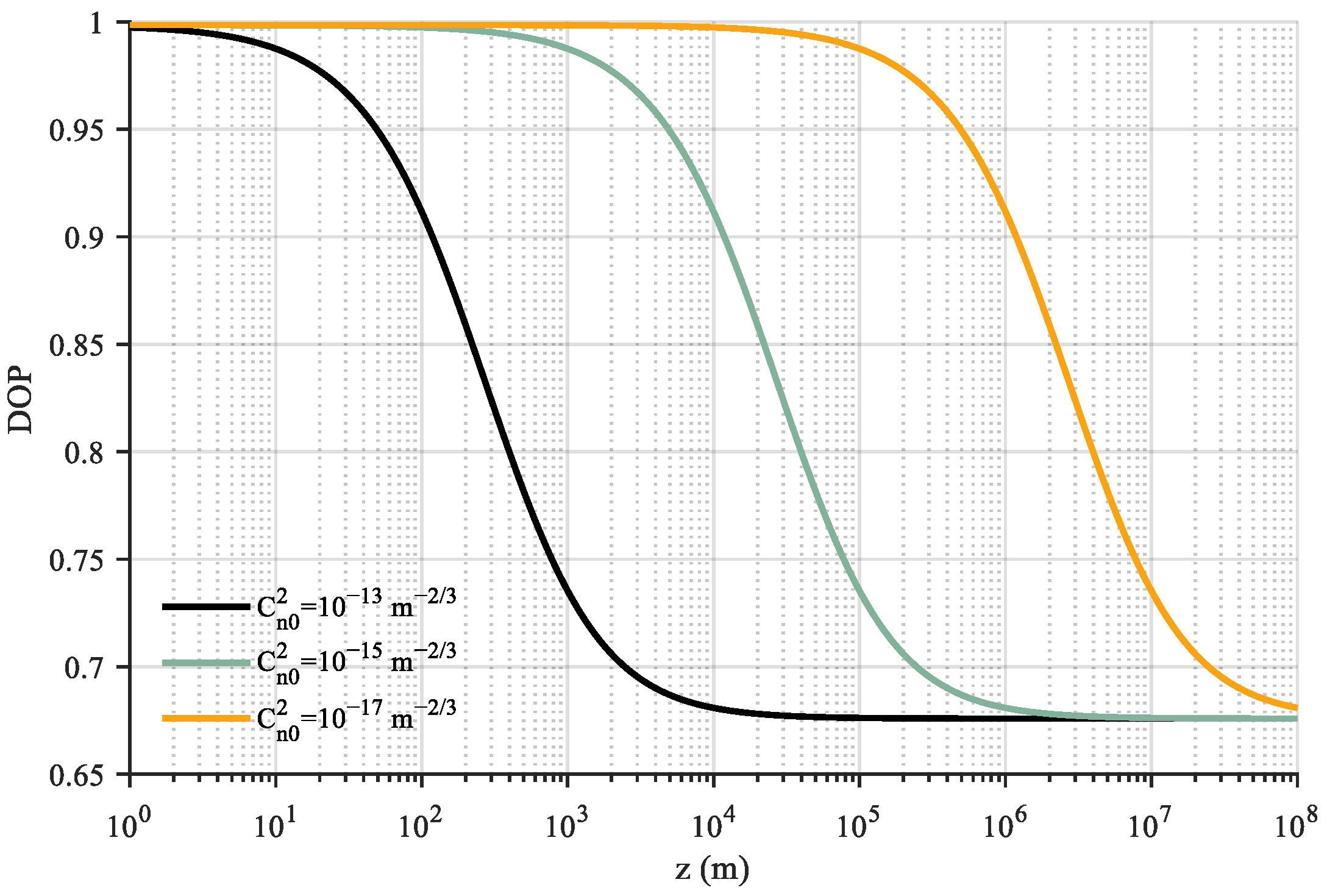
The following analysis examines the evolution of DOP with transmission distance for light beams of identical wavelength under varying atmospheric structure constants, with parameters λ = 532   n m and C n 2 = 1 × 10 13   m 2 / 3 , 10 15   m 2 / 3 , 10 17   m 2 / 3 selected while all other parameters remain constant. Figure 3 illustrates the polarization degree variation of a laser beam propagating through atmospheric turbulence, quantitatively analyzing the effects of wavelength and turbulence intensity on polarization maintenance capability. With a fixed wavelength of 532 nm, the evolution of DOP versus transmission distance is compared under three different turbulence structure constant conditions. As turbulence intensity increases, the rate of DOP decay accelerates, causing the beam’s polarization state to degrade toward depolarization more rapidly. For C n 2 = 1 × 10 13   m 2 / 3 , the DOP decays to approximately 0.68 at z = 10 4   m , while for C n 2 = 1 × 10 17   m 2 / 3 , it maintains a high polarization degree over tens of kilometers.
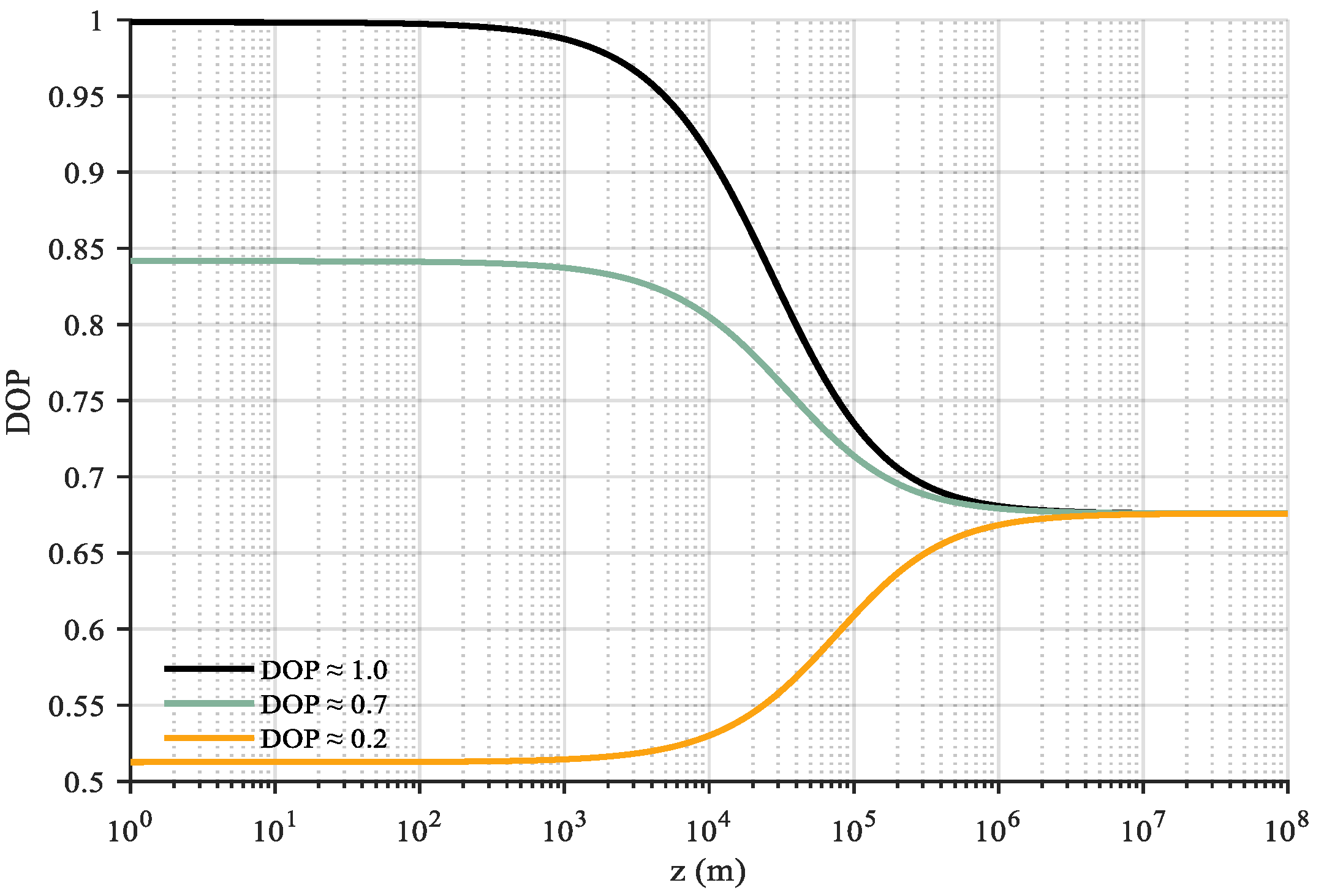
Figure 4 shows how the DOP of three beams with different initial values changes over time in an atmospheric turbulence channel. As the propagation distance increases, all three beams exhibit a pronounced trend towards convergence in DOP, ultimately approaching similar steady-state values. The greater the initial DOP, the more significant the impact of atmospheric turbulence, resulting in a more pronounced depolarization process. Conversely, beams with a lower initial DOP value demonstrate a certain degree of recovery after propagation. The effect of atmospheric turbulence on DOP is most pronounced within the range of 1 to 10 km. As transmission distance increases, the de-biasing effect of the atmospheric channel on DOP approaches saturation and ultimately stabilizes at a steady-state value.
As demonstrated in Figure 4, beams with low initial polarization demonstrate a slight rebound in their DOP during propagation. This phenomenon can be qualitatively explained from the perspective of statistical polarization. It has been established that partially polarized beams can be decomposed into a superposition of fully polarized and non-polarized components. Under atmospheric turbulence, random fluctuations in the refractive index impose phase perturbations on the two orthogonally polarized components, leading to statistical fluctuations in their correlation. For beams with low initial DOP, their initial polarization correlation is below the statistical equilibrium value formed during turbulent propagation. This phenomenon may result in an enhancement of the correlation during the initial propagation phase, as evidenced by a minor recovery in DOP. As the propagation distance increases, the polarization statistics gradually stabilize, and DOP ultimately converges to its asymptotic value.
Concurrently, an examination of Figure 2, Figure 3 and Figure 4 reveals that the substantial variations in DOP are predominantly concentrated within the propagation distance range of 103–106 m. This phenomenon can be elucidated by comparing the characteristic scales within the system, including the Fried parameter ρ 0 , Fresnel scale λ L , and beam width ω ( z ) . In the near-field region, ρ 0 generally exceeds the lateral beam scale. Turbulence-induced phase perturbations demonstrate a strong correlation within the beam aperture, while polarization degradation effects remain weak. As the propagation distance increases, the system enters the transition region where the ρ 0 becomes comparable to, or even smaller than ω ( z ) . Wavefronts at different lateral positions experience random perturbations that are approximately independent of one another. These perturbations cause rapid decay in correlation between orthogonal polarization components. This, in turn, results in rapid DOP variations. As the propagation distance extends into the far-field region, the polarization statistics gradually saturate, and the amplitude of DOP variations significantly diminishes.

4. Experimental Measurements

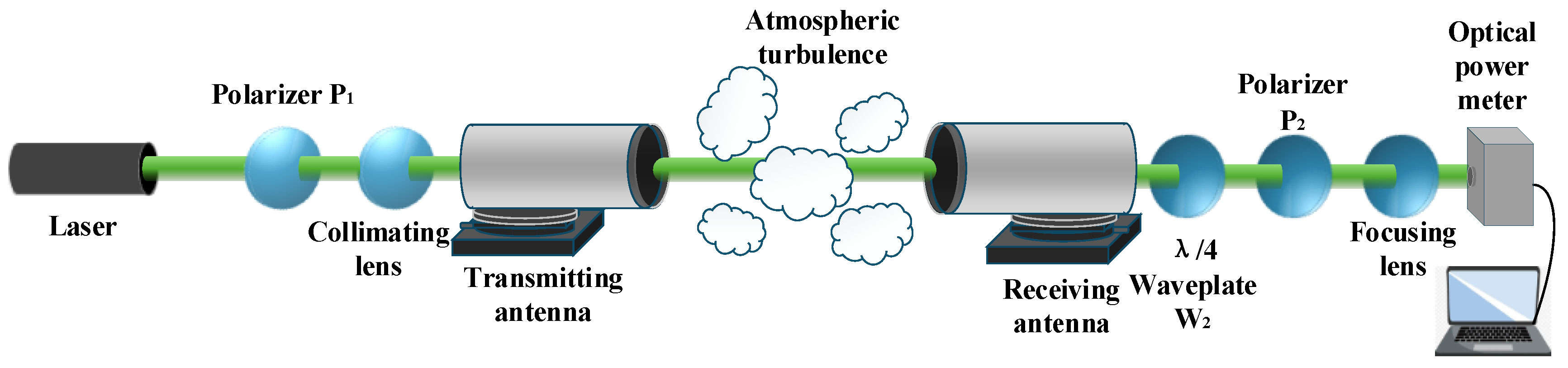
Figure 5 shows the detailed configuration of the experimental setup. At the transmitting end, a semiconductor laser with a wavelength of 532 nm, output power of 500 mW, and beam diameter of 5 mm was used as the light source. After passing through a polarizer P 1 to generate a linearly polarized beam and collimated by the collimating lens, the laser was emitted via a Cassegrain antenna with an aperture of 105 mm. The laser beam propagated through the atmospheric channel and was collected and focused by the receiving Cassegrain antenna (BOMSA, Guangzhou, China). The polarization characteristics of the received beam were measured using a self-developed Polarization Analysis System (PAS). The PAS consists of a rotating quarter-wave plate, fixed linear polarizer, optical power meter, and measurement platform for data storage and analysis. The PD300 optical power meter used in the PAS had a spectral response range of 430~1000 nm and an aperture size of 10 mm × 10 mm. Its noise level is 100 fW/s, with an accuracy of ±3%, and it offers a DOP resolution of 0.5%. By employing narrowband optical filters to eliminate background light, environmental radiative noise can be neglected, ensuring that the measurement accuracy satisfies the experimental requirements. Meteorological parameters were recorded during each experiment.
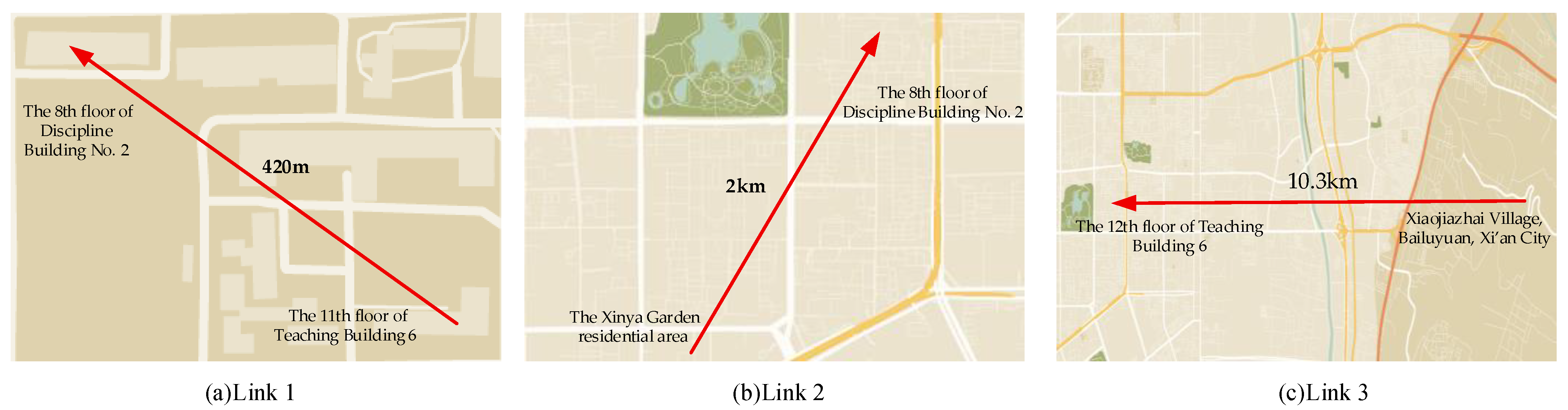
From July 2024 to July 2025, three laser transmission measurement experimental links with different distances were established in Xi’an, Shaanxi Province. Over 50 measurement experiments were conducted. The three experimental links are shown in Figure 6:
Link 1: The transmitter was located on the 11th floor of Teaching Building 6 at the Jinhua Campus of Xi’an University of Technology, and the receiver was positioned on the 8th floor of Discipline Building No. 2 within the same campus. The link length was 0.42 km, with a link height above ground of approximately 40 m. The elevation difference between the transmitter and receiver was 2 m. The propagation path passes through the terrain, including buildings and trees.
Link 2: The transmitter was located in the Xinya Garden residential area, and the receiver was situated on the 8th floor of Discipline Building No. 2 at the Jinhua Campus of Xi’an University of Technology. The link length was 2 km, with an average height of 100 m above the ground. The elevation difference between the transmitter and receiver was 43 m. The propagation path mainly traverses areas with streets and buildings.
Link 3: The transmitter was located in Xiaojiazhai Village, Bailuyuan, Xi’an City, and the receiver was situated on the 12th floor of Teaching Building 6 at the Jinhua Campus of Xi’an University of Technology. The link length was 10.3 km, with an average height of 391 m above ground. The elevation difference between the transmitter and receiver was 363 m. The propagation path passed through complex terrain, including buildings, forests, and streets. Such complex terrain leads to atmospheric inhomogeneities, which may affect experimental measurements.

5. Data Analysis

5.1. Refractive Index Structure Constant of the Atmosphere

The temperature in the atmosphere fluctuates randomly, leading to random variations in air density, which in turn causes irregular changes in the atmospheric refractive index. These variations result in significant inhomogeneity within the atmosphere. The atmospheric refractive index structure constant C n 2 is a key parameter characterizing optical turbulence in the atmosphere. It quantitatively describes the strength of optical turbulence [28]. According to Davis’ theory, turbulence can be divided into three categories: C n 2 > > 2.5 × 10 13   m 2 / 3 is strong turbulence; 6.4 × 10 17   m 2 / 3 C n 2 < 2.5 × 10 13   m 2 / 3 is moderate turbulence; C n 2 6.4 × 10 17   m 2 / 3 is weak turbulence [29].
This paper uses the scintillation method to measure C n 2 , whose expression is [30]
C n 2 = 4.48 C D t 7 / 3 L 3 σ X 2
Here, C = D r / D t , D r and D t are the transmit aperture size and receive aperture size, respectively; L is the link length; σ X 2 can be expressed as [31]
σ X 2 = 0.25 ln ( 1 + ( s I ) 2 )
Here, s is the standard deviation of light intensity; I is the mean value of light intensity. This study employs a large-aperture receiver that leverages the aperture smoothing effect to suppress saturation phenomena effectively. The core principle of this method is that, when the receiving aperture D t is significantly larger than the Fresnel scale λ L , the large aperture averages out high-frequency, small-scale fluctuations. Consequently, the received logarithmic amplitude variance σ X 2 still maintains an approximate linear relationship with C n 2 , even under conditions of moderate turbulence. This extends the effective measurement range of C n 2 [32]. Equation (16) has been demonstrated in [32] to measure C n 2 under varying turbulence intensities.
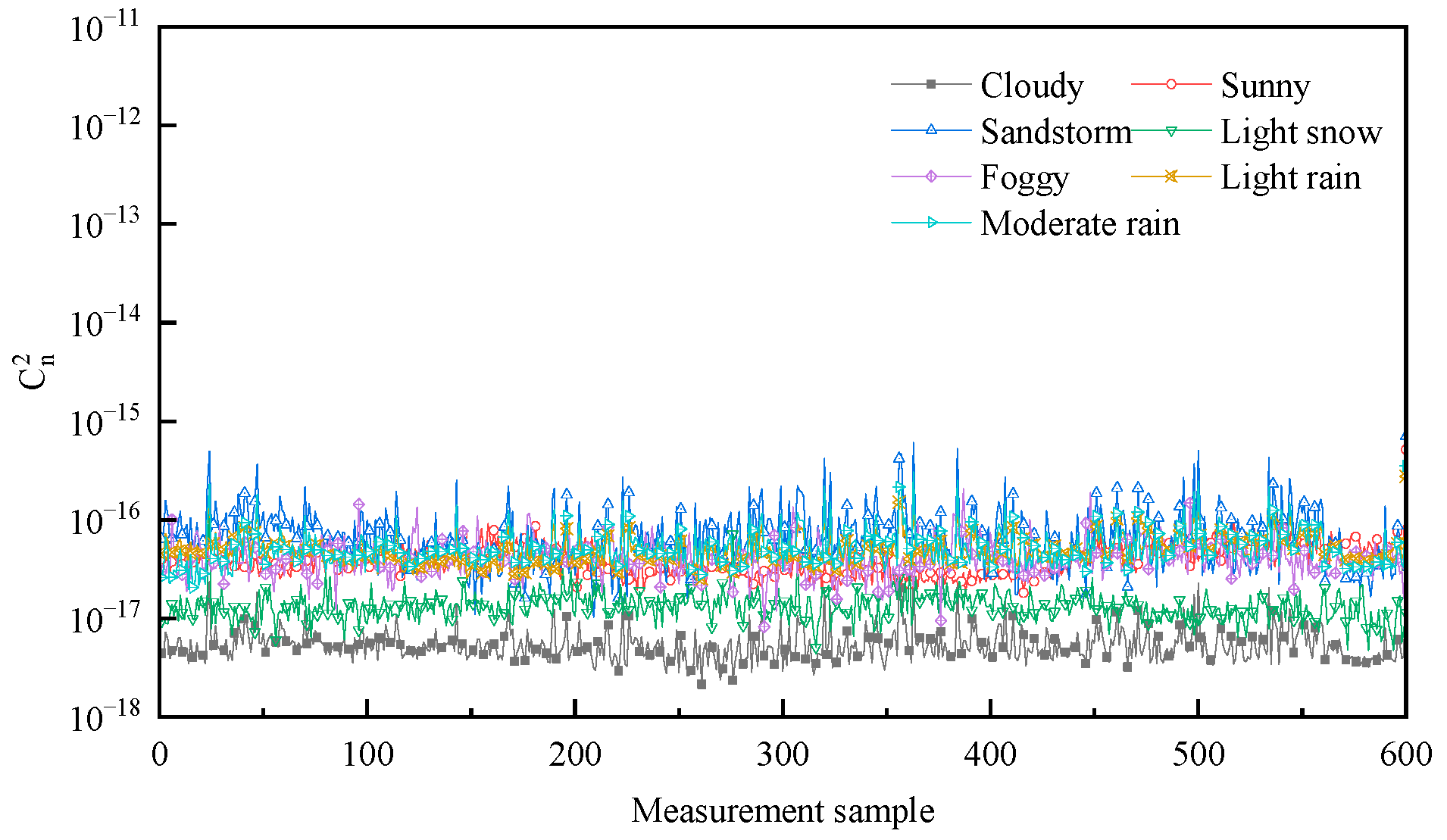
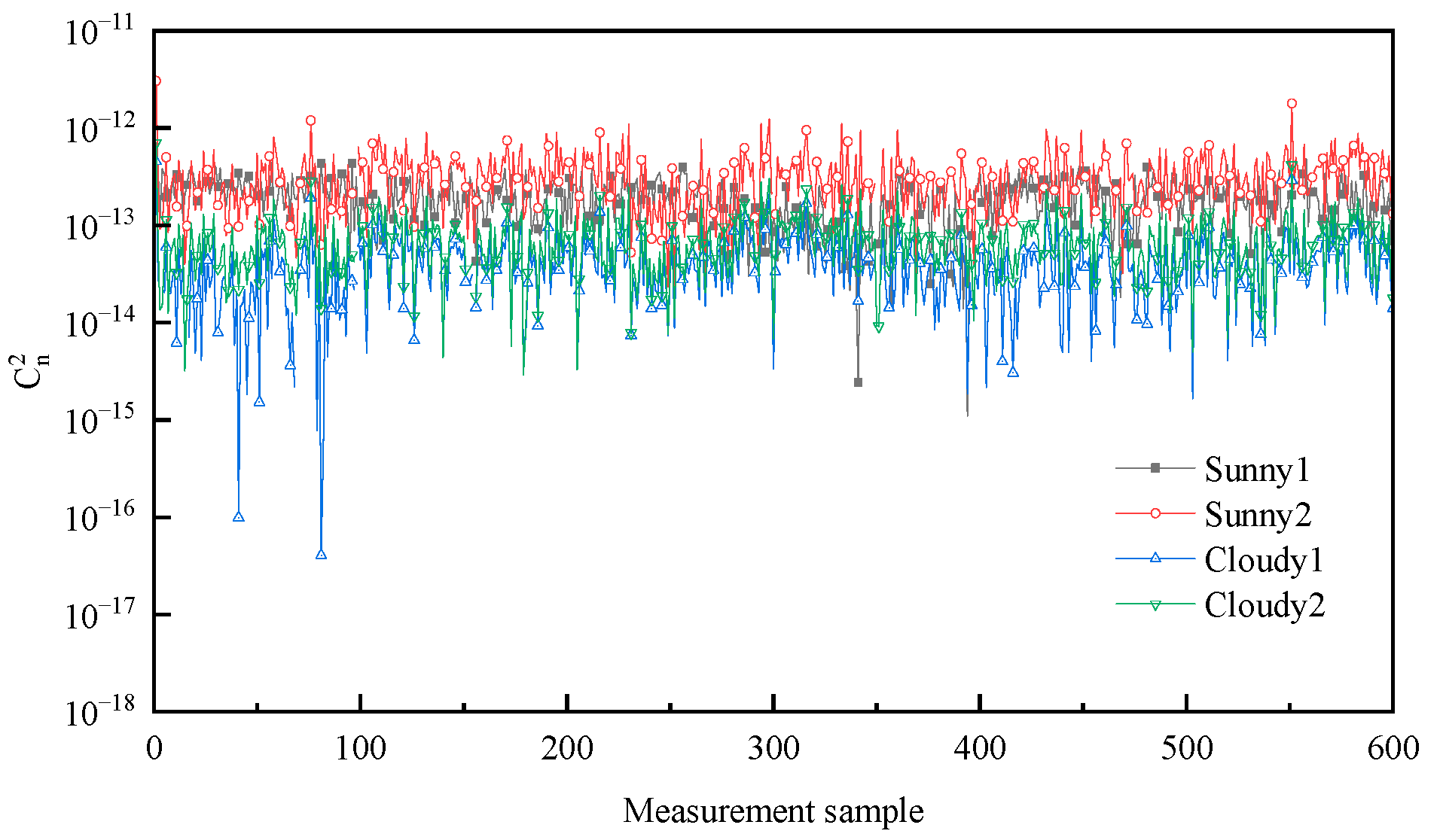
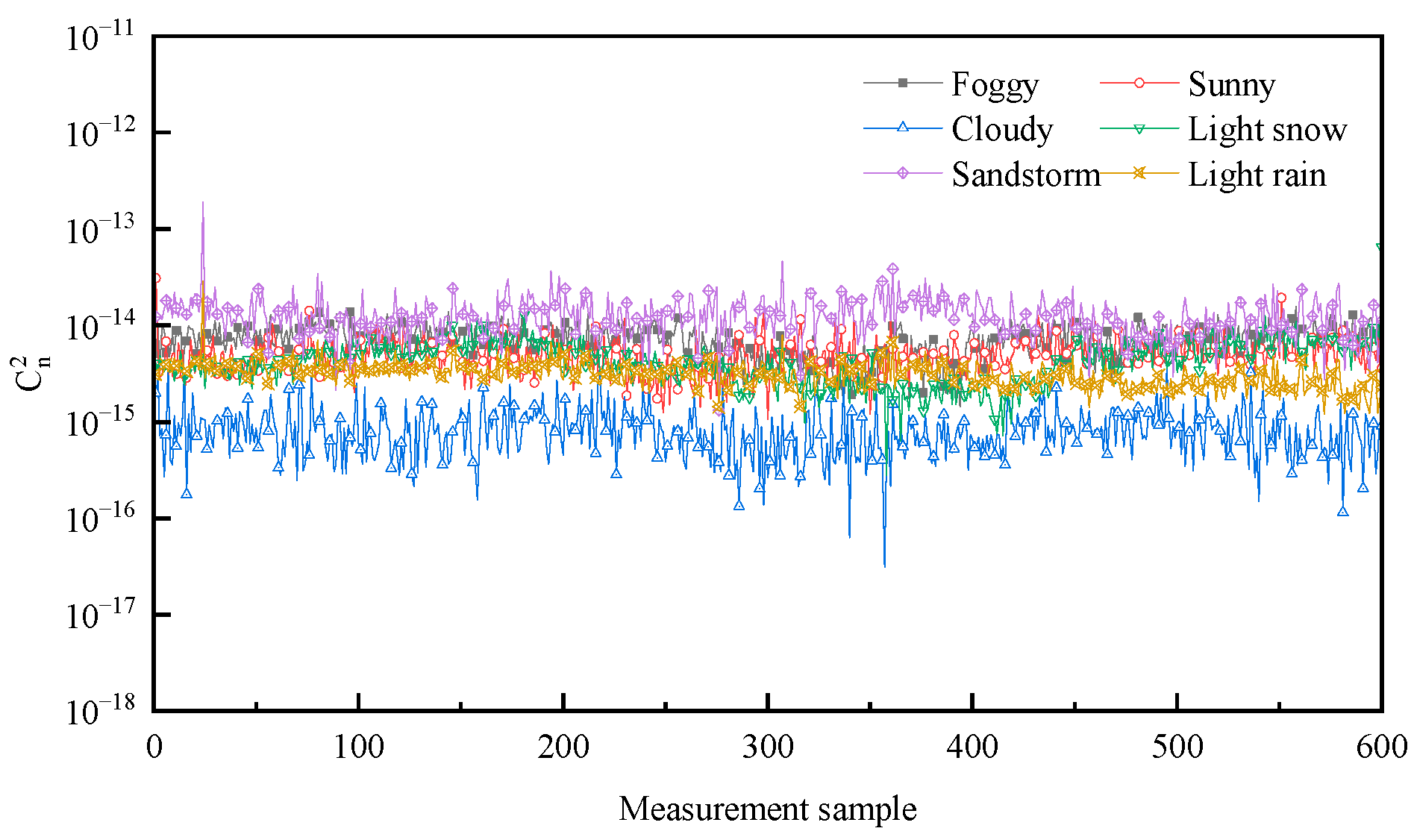
Figure 7, Figure 8 and Figure 9 show the C n 2 measurements for three different experimental links.
As shown in Figure 7, Figure 8 and Figure 9 and the statistical distribution of C n 2 in the Table 1, Table 2 and Table 3, the C n 2 values of the measurement samples from Link 1 are mainly concentrated in 1 × 10 18   m 2 / 3 ~ 1 × 10 16   m 2 / 3 ; the C n 2 values of the measurement samples from Link 2 are mainly concentrated in 1 × 10 16   m 2 / 3 ~ 1 × 10 15   m 2 / 3 ; and the C n 2 values of the measurement samples from Link 3 are mainly concentrated in 1 × 10 13 m 2 / 3 ~ 1 × 10 12 m 2 / 3 , This indicates that turbulence intensity increases with increasing link distance. In the samples measured from Link 1 and Link 2, the C n 2 values on clear, hazy, and snowy days are significantly higher than those on overcast days; in the samples from Link 3, the C n 2 value on clear days is also significantly higher than that on overcast days.

5.2. Statistical Distribution of the Degree of Polarization

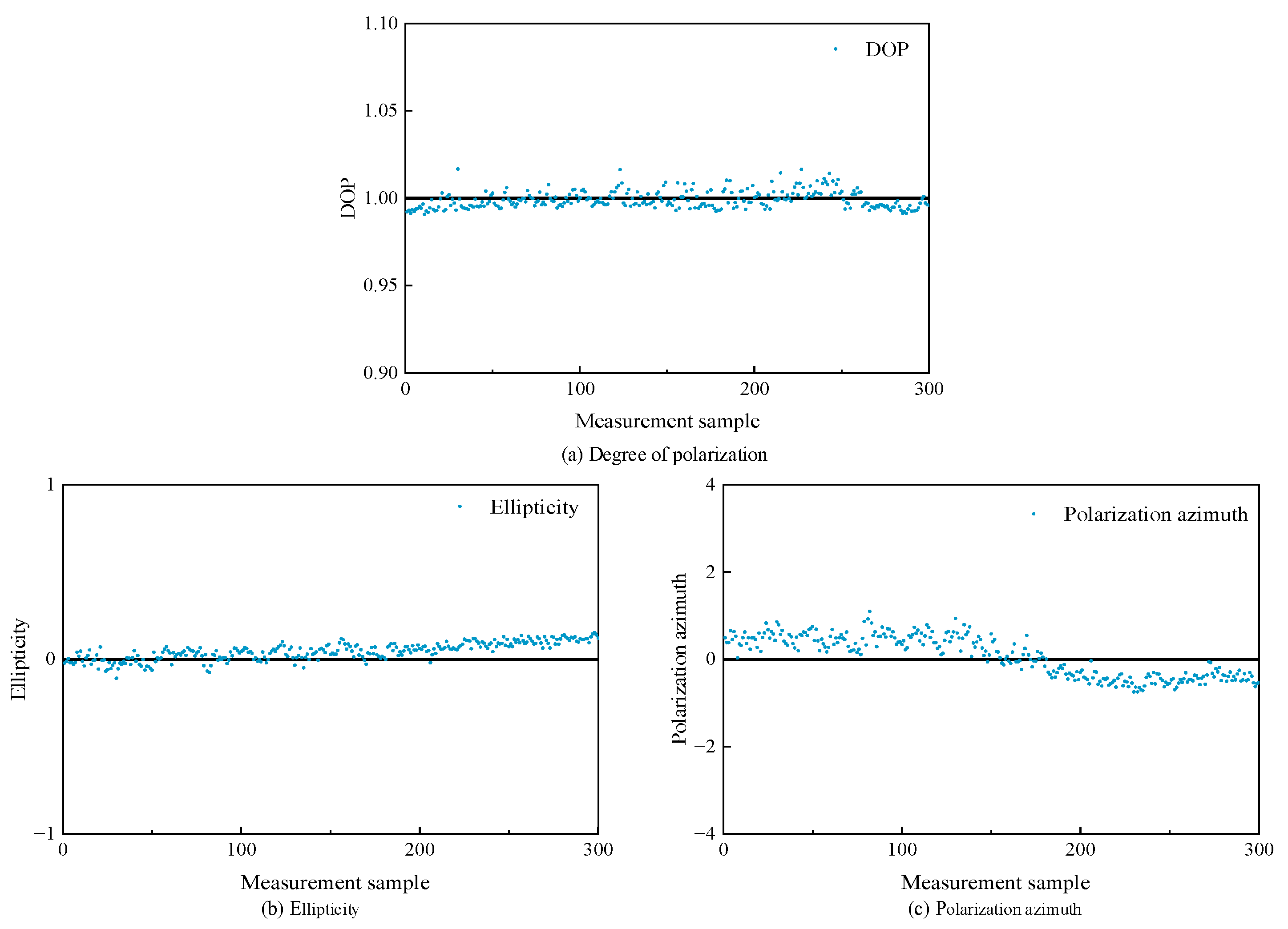
Prior to conducting the experimental measurements of beam DOP variations in atmospheric turbulence, the initial DOP, polarization azimuth, and ellipticity of the transmitted beam were measured in an indoor environment devoid of turbulence.
Figure 10a–c shows the variations in the DOP, polarization azimuth angle, and ellipticity of the polarized beam at the transmitter, respectively. Statistical analysis of the sampled data yielded a mean DOP of 0.99917 with a standard deviation of 0.00505, a mean polarization azimuth of 0.06923 with a standard deviation of 0.46420, and a mean ellipticity of 0.04635 with a standard deviation of 0.05040. Therefore, it can be concluded that the transmitted beam is nearly fully polarized and approximates a linearly polarized beam.

5.2.1. 420 m Experimental Link

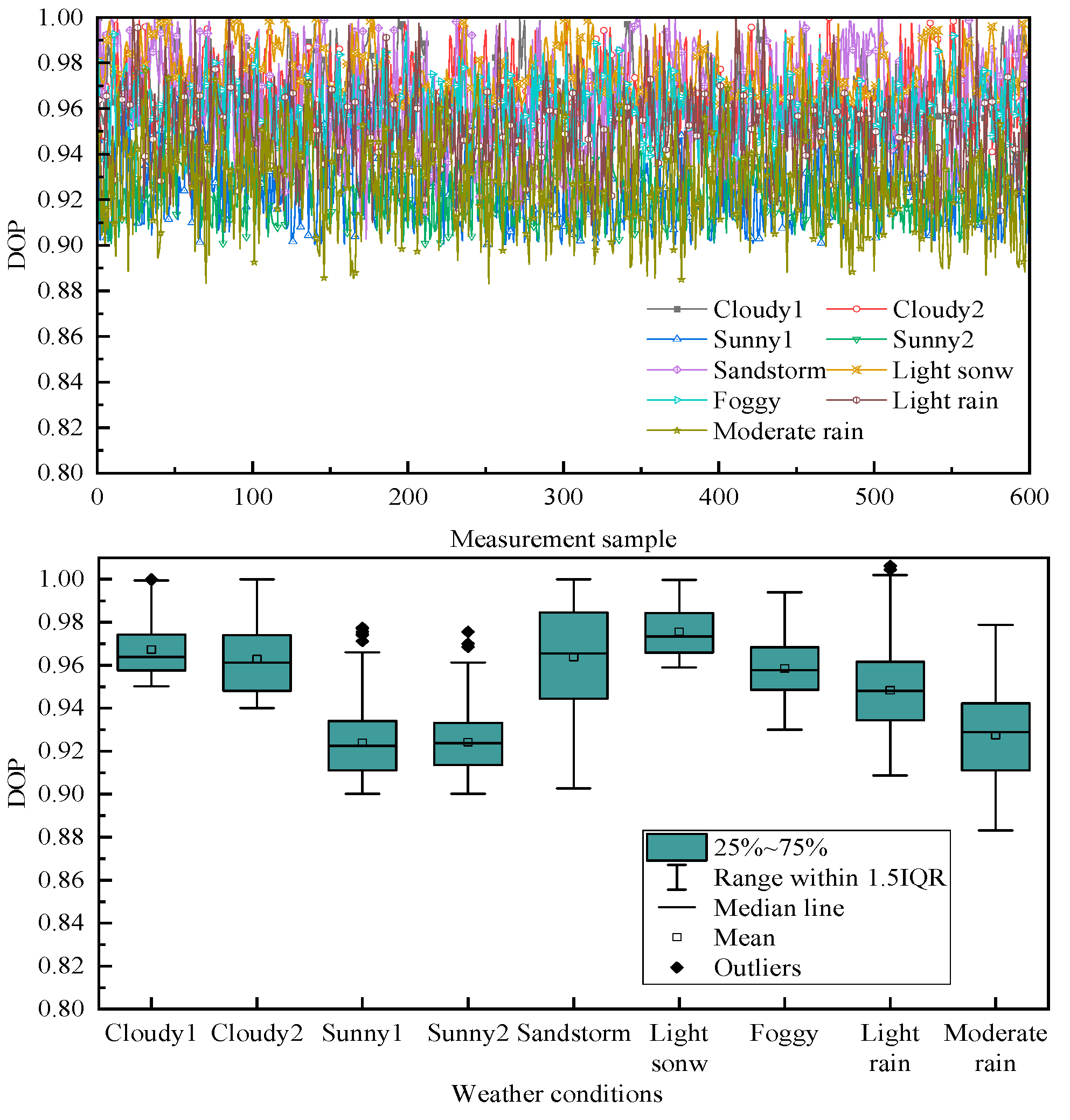
As shown in Table 4 and Figure 11, the mean DOP remained at a relatively high level under various weather conditions, with values ranging from 0.92387 to 0.97555. The mean DOP under overcast, foggy, and light-snow conditions was notably higher than that under other weather conditions.
Regarding data variability, the standard deviation of the DOP was the largest during dust storm conditions, indicating that the uneven concentration and distribution of aerosol particles caused more significant disturbances to the beam polarization. Conversely, the DOP standard deviation was the smallest under overcast conditions. The influence of different weather conditions on the polarization characteristics of the beam was evident. Specifically, under relatively uniform atmospheric conditions, such as cloudy and foggy weather, the DOP exhibits higher mean values and lower fluctuations, whereas weather conditions such as dust storms and rainfall lead to increased instability in the polarization degree.

5.2.2. 2 km Experimental Link

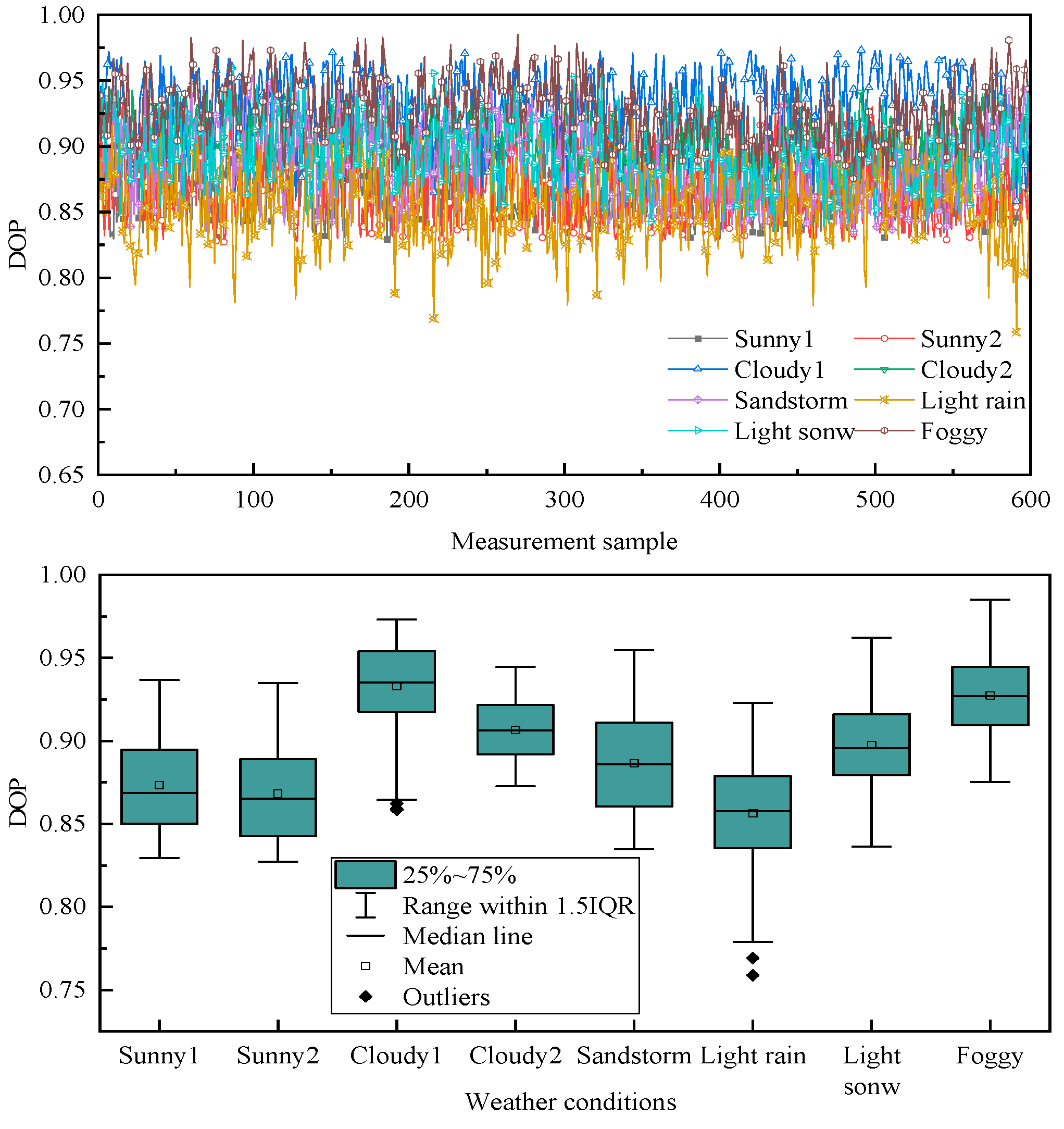
As shown in Figure 12 and Table 5, the mean DOP generally decreased under all weather conditions as the link distance increased from 420 m to 2 km, indicating that longer transmission distances exacerbate the depolarization effects caused by atmospheric turbulence. Regarding variability, both dust storms and rainy conditions exhibited relatively large standard deviations, with the minimum value during rain dropping to 0.75881, demonstrating strong polarization instability. Overall, the data from the 2.2 km link suggest that increasing the link length amplifies the influence of weather conditions on the DOP, and relatively high mean DOP values are maintained under meteorological conditions such as cloudy and foggy weather, while more pronounced polarization fluctuations and lower mean values occur under rain and dust storm conditions.

5.2.3. 10.3 km Experimental Link

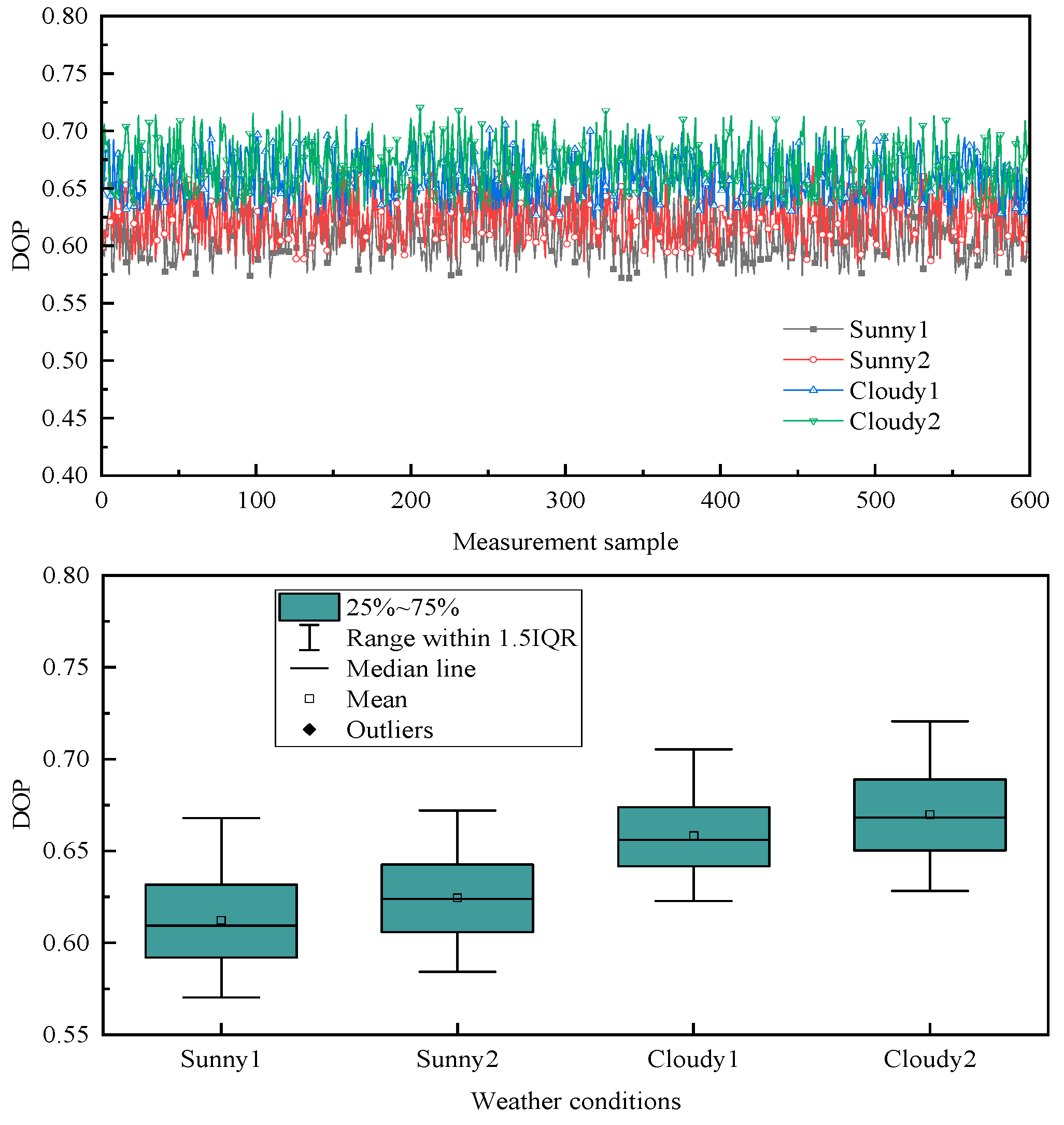
As shown in Figure 13 and Table 6, the mean DOP significantly decreased as the link distance reached 10.3 km. Compared to clear sky conditions, the mean DOP value under overcast conditions was relatively higher. Overall, the depolarization effect of atmospheric turbulence on the polarization characteristics of the beam was notably enhanced in the 10.3 km link. However, compared to the 2 km link, the standard deviation of the DOP distribution did not increase significantly, indicating a distance threshold effect of atmospheric turbulence on polarization fluctuations. When the propagation distance exceeded a certain limit, the polarization parameters tended to saturate.

5.3. Comparison of Experimental Results with Simulation Results

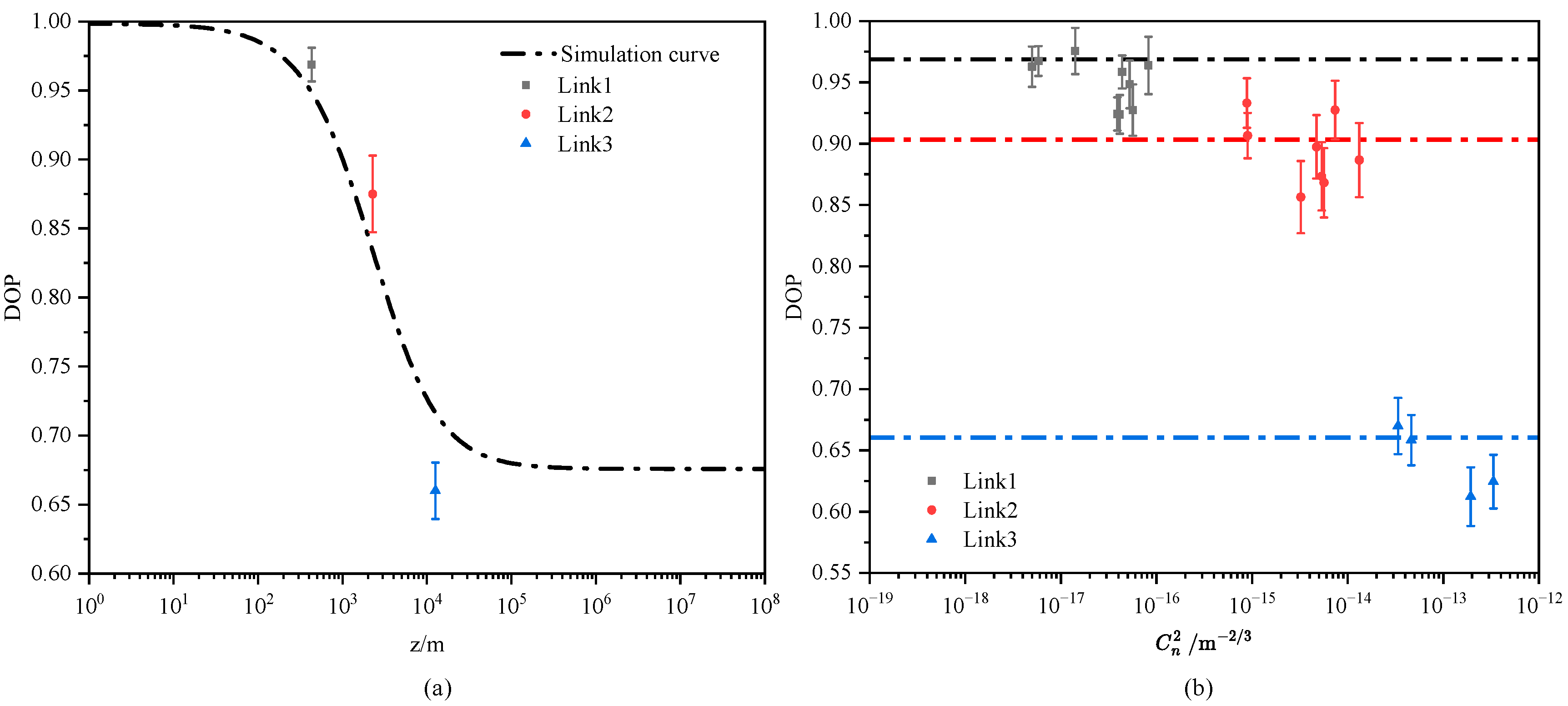
In numerical simulations, key parameters include the propagation distance z , the atmospheric refractive index structure constant C n 2 , the height H , and the wavelength λ . These parameters are selected based on experimental conditions to ensure consistency between numerical simulations and experimental scenarios to the greatest extent possible. The three experimental links set up for actual measurement: Link 1, Link 2, and Link 3 correspond to the propagation distance z and height h in the numerical simulation. The three experimental links in the measurement setup: Link 1 ( z = 420   m , H = 40   m ), Link 2 ( z = 2   k m , H = 100   m ), and Link 3 ( z = 10   k m , H = 391   m ) correspond to the propagation distance z and height H in the numerical simulation, the beam wavelength selected for the experiment is λ = 532   n m . It is imperative to acknowledge that the C n 2 values employed in numerical simulations do not represent instantaneous measurements. Instead, they are equivalent parameters that symbolize distinct atmospheric turbulence conditions. Consequently, the comparison between numerical and experimental results is primarily conducted in terms of statistical significance, with a focus on the overall trend of change. The figure below illustrates the comparison between experimental results and simulation results.
As illustrated in Figure 14a,b, a comparison is made between the numerical simulation and the experimental measurement of DOP results. As illustrated in Figure 14a, the simulated DOP demonstrates a significant decline with increasing propagation distance, suggesting that atmospheric turbulence induces a depolarization effect. The DOP data obtained at three different transmission distances correspond to distinct propagation regions and align with the simulated trends. Figure 14b provides further elucidation on the relationship between DOP and the atmospheric refractive index structure constant C n 2 . For each transmission link, despite quantitative discrepancies arising from experimental errors and the idealized assumptions of the numerical model, the experimental DOP values consistently fluctuate around the corresponding simulated average DOP levels.

6. Discussion

During free-space propagation, random fluctuations in atmospheric refractive index cause degradation of laser beam polarization when the beams traverse turbulent air. This phenomenon poses challenges for polarization-sensitive optical systems. In coherent optical communication systems, it is imperative that the polarization states of the signal and local-oscillator beams remain aligned to ensure efficient coherent detection. Polarization degradation, induced by atmospheric turbulence, gives rise to polarization mismatch, which in turn reduces heterodyne efficiency and degrades communication performance. Consequently, the investigation of the effects of atmospheric turbulence on beam polarization characteristics is significant. A substantial body of research has been dedicated to theoretical and experimental analyses of laser polarization evolution under turbulent conditions. For instance, Refs. [7,8,9] investigated the far-field polarization characteristics of partially coherent beams after turbulent propagation under two classical turbulence spectrum models: Tatarskii and Kolmogorov [10] derived an analytical formula for the DOP of partially coherent Hermitian-Gaussian electromagnetic beams propagating through turbulence, demonstrating that beam DOP approaches a limiting value with distance. Ref. [11] analyzed the effects of beam parameters such as wavelength, initial waist width, and polarization angle on depolarization phenomena. The polarization state evolution and first- and second-order statistical properties of transmitted beams were analyzed using the Stokes parameter method. A comprehensive review of extant literature reveals a systematic exposition of the depolarization patterns exhibited by partially coherent beams within the context of turbulence. However, the paucity of field measurements is striking, and the absence of systematic experiments conducted under varying weather conditions is particularly noteworthy.
This paper systematically combines experiments, theoretical analysis, and numerical simulations to validate the polarization evolution patterns of GSM beams under varying weather conditions and propagation distances. To this end, three experimental links were established at varying distances (420 m, 2 km, and 10.3 km), and a series of measurements was conducted under diverse weather conditions. These measurements were then compared with the results of the simulation to verify the accuracy of the experimental results. This study not only corroborates theoretical predictions but also establishes reference guidelines for the design of free-space optical communication systems. This phenomenon underscores the imperative for real-time adaptation of polarization compensation methodologies at the receiver end, contingent on prevailing weather conditions. Moreover, it establishes the foundation for subsequent research endeavors that seek to achieve a more profound quantitative analysis of the effects of turbulence on beam polarization.

7. Conclusions

Based on the polarization-coherence unified theory, this study established a polarization degradation model for Gaussian-Schell (GSM) beams propagating through atmospheric turbulence. To validate the model, we used the derived analytical expressions to compute the theoretical DOP evolution and compared it with the experimentally measured DOP under identical beam and turbulence conditions. The experimental results showed a high degree of agreement with the theoretical predictions in terms of trend, confirming the model’s validity. An in-depth analysis was conducted using numerical simulations and outdoor field experiments to clarify the differences in beam polarization retention capability under varying wavelengths, turbulence intensities, and initial DOP conditions. Three experimental links with distinct transmission distances (420 m, 2 km, and 10.3 km) were set up, and over 50 DOP measurement experiments were conducted under varying weather conditions. The results indicate:
(1) The mean DOP shows a strong correlation with turbulence intensity and decreases continuously with increasing transmission distance. Turbulent perturbations have a greater influence on polarization fluctuations at short distances, resulting in higher standard deviations. However, when the transmission distance reaches 10.3 km, the DOP stabilizes and the amplitude of the fluctuations decreases. Polarization fluctuations exhibit a distance threshold effect: beyond a critical distance, polarization parameters tend toward saturation.
(2) Under overcast or foggy weather conditions, when the atmosphere is relatively homogeneous and turbulence is weak, the mean value of DOP is higher, and its volatility is lower. Conversely, weather conditions such as sandstorms or rainfall significantly reduce the spatial coherence and polarization-maintaining capability of light beams due to increased particulate matter in the atmosphere and enhanced scattering and attenuation effects. This results in a decrease in the mean DOP value and a marked increase in its standard deviation.
The present study delineates the fundamental parameters for the design of free-space optical communication systems. These parameters include the prioritization of a 1550 nm wavelength beam at the transmitter to enhance polarization stability and the dynamic adjustment of polarization compensation strategies at the receiver based on weather parameters. The present study is not without its limitations, which require further refinement in subsequent research. Firstly, the experimental links primstandarily included horizontal and oblique paths, without systematically investigating the impact of atmospheric turbulence on beam polarization characteristics under vertical propagation conditions. Secondly, with respect to the DOP recovery phenomenon and its characteristic propagation distance range, as illustrated in Figure 4, the present study principally offers a qualitative analysis from a statistical perspective. The necessity for additional investigation is indicated by the presence of more rigorous theoretical derivations. Moreover, due to the constraints imposed by experimental limitations, this study was unable to systematically vary beam parameters (e.g., coherence length and beam waist radius) while maintaining consistent atmospheric conditions for comprehensive numerical simulations and experimental comparisons.

Author Contributions

Conceptualization, X.K.; Methodology, C.K. and X.K.; Software, Y.S.; Validation, Y.S.; Formal analysis, Y.S.; Investigation, Y.S.; Data curation, M.H.; Writing—original draft, C.K.; Writing—review & editing, C.K., Y.S. and X.K.; Visualization, M.H.; Supervision, C.K. and X.K.; Funding acquisition, C.K. All authors have read and agreed to the published version of the manuscript.

Funding

Natural Science Basic Research Program of Shaanxi [Program No. 2024JC-YBMS-562], Shaanxi Fundamental Science Research Project for Mathematics and Physics [Grant No. 23JSQ024], the Xi’an Science and Technology Plan [22GXFW0115].

Data Availability Statement

Data are contained within the article.

Conflicts of Interest

The authors declare no conflict of interest.

References

  1. Khalighi, M.A.; Uysal, M. Survey on free space optical communication: A communication theory perspective. IEEE Commun. Surv. Tutor. 2014, 16, 2231–2258. [Google Scholar] [CrossRef]
  2. Cvijetic, N.; Qian, D.; Yu, J.; Huang, Y.K.; Wang, T. Polarization-multiplexed optical wireless transmission with coherent detection. J. Light. Technol. 2010, 28, 1218–1227. [Google Scholar] [CrossRef]
  3. Cai, J.Y.; Sun, J.; Li, G.; Zhang, G.; Xu, M.; Zhang, B.; Yue, C. Self-homodyne free-space optical communication system based on orthogonally polarized binary phase shift keying. Appl. Opt. 2016, 55, 4514–4521. [Google Scholar] [CrossRef] [PubMed]
  4. Tang, X.; Xu, Z.; Ghassemlooy, Z. Coherent polarization modulated transmission through MIMO atmospheric optical turbulence channel. J. Light. Technol. 2013, 31, 3221–3228. [Google Scholar] [CrossRef]
  5. Strohbehn, J.; Clifford, S. Polarization and angle-of-arrival fluctuations for a plane wave propagated through a turbulent medium. IEEE Trans. Antennas Propag. 1967, 15, 416–421. [Google Scholar] [CrossRef]
  6. Zhang, J.; Ding, S.; Zhai, H.; Dang, A. Theoretical and experimental studies of polarization fluctuations over atmospheric turbulent channels for wireless optical communication systems. Opt. Express 2014, 22, 32482–32488. [Google Scholar] [CrossRef]
  7. Korotkova, O.; Salem, M.; Wolf, E. The far-zone behavior of the degree of polarization of electromagnetic beams propagating through atmospheric turbulence. Opt. Commun. 2004, 233, 225–230. [Google Scholar] [CrossRef]
  8. Korotkova, O.; Wolf, E. Changes in the state of polarization of a random electromagnetic beam on propagation. Opt. Commun. 2005, 246, 35–43. [Google Scholar] [CrossRef]
  9. Eyyuboğlu, H.T.; Baykal, Y.; Cai, Y. Degree of polarization for partially coherent general beams in turbulent atmosphere. Appl. Phys. B 2007, 89, 91–97. [Google Scholar] [CrossRef]
  10. Ji, X.; Yang, F. Influence of Atmospheric Turbulence on the Propagation of Partially Coherent Electromagnetic Flat-topped Beams. Acta Photon. Sin. 2009, 38, 2948–2952. [Google Scholar]
  11. Wang, F.; Gao, M. Depolarization characteristics of polarized and partially coherent laser beam propagated in turbulent atmosphere. Infrared Laser Eng. 2012, 41, 994–998. [Google Scholar]
  12. Tao, R.; Wang, X.; Si, L.; Zhou, P.; Liu, Z. Propagation of focused vector laser beams in turbulent atmosphere. Opt. Laser Technol. 2013, 54, 62–67. [Google Scholar] [CrossRef]
  13. Li, Y.Q.; Wu, Z.S.; Wang, M.J. Partially coherent Gaussian—Schell model pulse beam propagation in slant atmospheric turbulence. Chin. Phys. B 2014, 23, 064216. [Google Scholar] [CrossRef][Green Version]
  14. Zhang, J.; Ding, S.; Dang, A. Polarization property changes of optical beam transmission in atmospheric turbulent channels. Appl. Opt. 2017, 56, 5145–5155. [Google Scholar] [CrossRef]
  15. Wang, J.; Ke, X.; Wang, M. Influence of source parameters and atmospheric turbulence on the polarization properties of partially coherent electromagnetic vortex beams. Appl. Opt. 2019, 58, 6486–6494. [Google Scholar] [CrossRef]
  16. Xu, Q.; Xu, Y.; An, B. Coherent properties of partially coherent vortex beam with nonuniform polarization propagating in turbulent atmosphere. Results Phys. 2024, 56, 107227. [Google Scholar] [CrossRef]
  17. Wang, Y.; Zhang, Y.; Wang, J.; Jia, J. Degree of polarization for quantum light field propagating through non-Kolmogorov turbulence. Opt. Laser Technol. 2011, 43, 776–780. [Google Scholar] [CrossRef]
  18. Zhao, Y.; Zhang, Y.; Wang, Q. Average polarization of electromagnetic Gaussian Schell-model beams through anisotropic non-Kolmogorov turbulence. Radioengineering 2016, 25, 652–657. [Google Scholar] [CrossRef]
  19. Li, J.; Li, J.; Guo, L.; Cheng, M.; Xi, L. Polarization characteristics of radially polarized partially coherent vortex beam in anisotropic plasma turbulence. Waves Random Complex Media 2021, 31, 1931–1944. [Google Scholar] [CrossRef]
  20. Li, B.; Xu, Y.; Tian, F.; Huang, K.; Zhai, D.; Li, Y. Dynamics of polarization characteristics of partially coherent beams featuring radial polarization and elliptical vortex phase in non-Kolmogorov atmospheric turbulence. Opt. Express 2025, 33, 34996–35010. [Google Scholar] [CrossRef]
  21. Zhang, S.; Fu, Q.; Duan, J.; Zhan, J. Research of influence of humidity on transmission characteristics of polarized light. Infrared Laser Eng. 2016, 45, 511001. [Google Scholar] [CrossRef]
  22. Ma, Y.; Gao, C.; Zhu, J. Scattering Polarization Characteristics of Aerosols in Actual Weather Conditions. Laser Optoelectron. Prog. 2023, 60, 2101001. [Google Scholar]
  23. Salem, M.; Korotkova, O.; Dogariu, A.; Wolf, E. Polarization changes in partially coherent electromagnetic beams propagating through turbulent atmosphere. Waves Random Media 2004, 14, 513. [Google Scholar] [CrossRef]
  24. Clifford, S.F.; Yura, H.T. Equivalence of two theories of strong optical scintillation. J. Opt. Soc. Am. 1974, 64, 1641–1644. [Google Scholar] [CrossRef]
  25. Ghafary, B.; Alavinejad, M. Changes in the state of polarization of partially coherent flat-topped beam in turbulent atmosphere for different source conditions. Appl. Phys. B 2011, 102, 945–952. [Google Scholar] [CrossRef]
  26. Zhao, X.; Yao, Y.; Sun, Y.; Liu, C. Condition for Gaussian Schell-model beam to maintain the state of polarization on the propagation in free space. Opt. Express 2009, 17, 17888–17894. [Google Scholar] [CrossRef]
  27. Golmohammady, S.; Ghafary, B. Stokes parameters of phase-locked partially coherent flat-topped array laser beams propagating through turbulent atmosphere. Laser Phys. 2016, 26, 066201. [Google Scholar] [CrossRef]
  28. Wang, H.; Li, Y.; Hu, Q. Experimental Investigation on Light Intensity Fluctuation at Night in Lanzhou Area. Acta Photon. Sin. 2018, 47, 194–201. [Google Scholar]
  29. Andrews, L.C.; Beason, M.K. Laser Beam Propagation in Random Media: New and Advanced Topics; SPIE Press: Bellingham, WA, USA, 2023. [Google Scholar]
  30. Wang, T.; Ochs, G.R.; Clifford, S.F. A saturation-resistant optical scintillometer to measure C n 2 . J. Opt. Soc. Am. 1978, 68, 334–338. [Google Scholar] [CrossRef]
  31. El Saghir, B.M.; El Mashade, M.B.; Aboshosha, A.M. Performance analysis of modulating retro-reflector FSO communication systems over Málaga turbulence channels. Opt. Commun. 2020, 474, 126160–126165. [Google Scholar] [CrossRef]
  32. Tunick, A. Optical turbulence parameters characterized via optical measurements over a 2.33 km free-space laser path. Opt. Express 2008, 16, 14645–14654. [Google Scholar] [CrossRef]
Figure 1. Distribution of C n 2 with altitude under different wind speeds and near-ground atmospheric structure constants.
Photonics 13 00082 g001
Figure 2. Variation in DOP with Transmission Distance at Different Wavelengths.
Photonics 13 00082 g002
Figure 3. Variation in DOP with Transmission Distance under Different Atmospheric Turbulence Intensities.
Photonics 13 00082 g003
Figure 4. Variation Trends of Different Initial DOP Values.
Photonics 13 00082 g004
Figure 5. Experimental flow chart.
Photonics 13 00082 g005
Figure 6. Experimental link (a) Link 1; (b) Link 2; (c) Link 3.
Photonics 13 00082 g006
Figure 7. Link 1 C n 2 distribution.
Photonics 13 00082 g007
Figure 8. Link 2 C n 2 distribution.
Photonics 13 00082 g008
Figure 9. Link 3 C n 2 distribution.
Photonics 13 00082 g009
Figure 10. Initial Polarization Parameters of the Transmitted Polarized Beam (a) Degree of polarization; (b) Ellipticity; (c) Polarization azimuth.
Photonics 13 00082 g010
Figure 11. Link 1 DOP Distribution.
Photonics 13 00082 g011
Figure 12. Link 2 DOP Distribution.
Photonics 13 00082 g012
Figure 13. Link 3 DOP Distribution.
Photonics 13 00082 g013
Figure 14. Comparison of DOP in Numerical Simulation and Experimental Results (a) The relationship between DOP and propagation distance: the dashed curve represents numerical simulation results for continuous propagation distances, while the discrete symbols denote experimental measurement data for Link 1, Link 2, and Link 3, respectively; (b) The relationship between DOP and C n 2 is shown. The dashed horizontal lines represent the simulated average DOP values for each propagation link, while the symbols with error bars denote experimental results under different turbulence conditions.
Photonics 13 00082 g014
Table 1. Link 1 C n 2 statistical analysis.
Measurement
Sample
MeanStandard
Deviation
Minimum
Value
Maximum
Value
Sunny 4.13 × 10 17 2.40 × 10 17 1.74 × 10 17 5.14 × 10 16
Cloudy 5.83 × 10 18 3.13 × 10 17 2.16 × 10 18 3.39 × 10 17
Foggy 4.38 × 10 17 2.05 × 10 17 8.22 × 10 18 2.07 × 10 16
Snowy 1.41 × 10 17 9.27 × 10 18 4.77 × 10 18 2.04 × 10 16
Sandstorm 8.24 × 10 17 7.41 × 10 17 1.04 × 10 17 7.09 × 10 16
Light rain 5.23 × 10 17 2.40 × 10 17 2.52 × 10 17 2.75 × 10 16
Moderate rain 5.65 × 10 17 3.40 × 10 17 1.98 × 10 17 3.54 × 10 16
Table 2. Link 2 C n 2 statistical analysis.
Measurement
Sample
MeanStandard
Deviation
Minimum
Value
Maximum
Value
Sunny 5.33 × 10 15 2.38 × 10 15 1.20 × 10 15 3.17 × 10 14
Cloudy 8.83 × 10 16 5.46 × 10 16 8.53 × 10 17 3.95 × 10 15
Foggy 7.38 × 10 15 2.53 × 10 15 2.26 × 10 15 1.51 × 10 14
Light snow 4.71 × 10 15 3.25 × 10 15 8.21 × 10 16 6.76 × 10 14
Sandstorm 1.32 × 10 14 9.31 × 10 15 1.19 × 10 15 1.91 × 10 13
Light rain 3.24 × 10 15 1.40 × 10 15 1.39 × 10 15 2.97 × 10 14
Table 3. Link 3 C n 2 statistical analysis.
Measurement
Sample
MeanStandard
Deviation
Minimum
Value
Maximum
Value
Sunny 1 1.94 × 10 13 9.46 × 10 14 1.18 × 10 14 4.88 × 10 13
Sunny 2 3.33 × 10 13 2.38 × 10 13 1.67 × 10 14 2.92 × 10 12
Cloudy 1 4.63 × 10 14 4.31 × 10 14 5.68 × 10 17 5.37 × 10 13
Cloudy 2 3.36 × 10 14 6.53 × 10 14 9.46 × 10 15 7.88 × 10 13
Table 4. Link 1 DOP distribution statistical analysis.
WeatherMeanStandard
Deviation
Minimum
Value
Maximum
Value
Cloudy 10.967330.012150.950250.99999
Cloudy 20.962840.016410.940030.99988
Sunny 10.923870.015820.900200.97745
Sunny 20.924180.013500.900120.97550
Sandstorm0.963800.023350.902730.99476
Light snow0.975550.018900.959060.99972
Foggy0.958460.013530.940030.99988
Light rain0.948400.019420.908710.98234
Moderate rain0.927400.020920.883100.97871
Table 5. Link 2 DOP distribution statistical analysis.
WeatherMeanStandard
Deviation
Minimum
Value
Maximum
Value
Sunny 10.873430.027800.829430.93674
Sunny 20.868160.028240.827310.93486
Cloudy 10.933130.020280.858450.97309
Cloudy 20.906510.018460.872670.94461
Sandstorm0.886590.030240.834900.95448
Light rain0.856400.029420.758810.92300
Light snow0.897400.025920.836240.96225
Foggy0.927400.023920.875170.98521
Table 6. Link 3 DOP distribution statistical analysis.
WeatherMeanStandard
Deviation
Minimum
Value
Maximum
Value
Sunny 10.612320.023990.570190.66795
Sunny 20.624540.021980.584220.67211
Cloudy 10.658450.020480.622750.70533
Cloudy 20.669860.022930.628250.72058
Disclaimer/Publisher’s Note: The statements, opinions and data contained in all publications are solely those of the individual author(s) and contributor(s) and not of MDPI and/or the editor(s). MDPI and/or the editor(s) disclaim responsibility for any injury to people or property resulting from any ideas, methods, instructions or products referred to in the content.