2.1. Overview of Quantum Imaging Landscape
Quantum imaging (QI) is an emerging field that leverages nonclassical properties of light—such as entanglement, photon antibunching, and quantum correlations—to surpass the performance limits of classical imaging systems. Unlike traditional imaging, which relies on direct intensity measurements, quantum imaging exploits second-order correlations and two-photon interference to extract spatial, spectral, or temporal information under ultra-low-light conditions. Representative techniques include ghost imaging, quantum holography, sub-shot noise microscopy, and entangled-photon interferometry, each offering unique advantages in resolution, contrast, or background suppression. Over the past decade, QI has evolved from table-top demonstrations toward more application-oriented architectures, such as quantum LiDAR, quantum-enhanced biomedical sensing, and single-photon remote imaging. Despite these advances, several persistent challenges hinder its practical deployment: low photon flux due to inefficient entangled photon sources, signal degradation from optical loss and decoherence, sensitivity to misalignment and environmental drift, and the reliance on bulky modulation elements like spatial light modulators (SLMs), interferometers, or tunable filters. These limitations restrict the scalability and real-time adaptability of QI systems. Furthermore, most current platforms lack integrated control over multiple optical degrees of freedom—phase, polarization, orbital angular momentum, and spectral content—within a compact footprint. As a result, light-field engineering remains fragmented across discrete components, leading to photon losses and mode mismatch. In this context, metasurfaces have emerged as a promising enabler for quantum imaging, offering subwavelength-scale control over wavefront shaping with ultrathin, low-loss, multifunctional designs. Their capacity to engineer spatial modes, encode polarization, and implement dispersive or nonlinear transformations paves the way toward chip-scale quantum imaging systems with enhanced robustness and functional density.
2.2. Fundamental Concepts and Core Challenges
Quantum imaging (QI) aims to exceed classical imaging limits in terms of resolution, sensitivity, and noise suppression by utilizing nonclassical properties of light, such as entanglement, quantum correlations, and photon antibunching effects. A typical QI system consists of three core components: quantum light sources, single-photon detection schemes, and optical field modulation elements, all of which collectively determine image fidelity, spatial resolution, and robustness against environmental noise [
1,
12].
Detection schemes play a crucial role in converting quantum correlations into spatially resolved images. State-of-the-art single-photon avalanche diodes (SPADs) and intensified CCD (ICCD) cameras offer temporal resolution down to tens of picoseconds, supporting coincidence counting and second-order correlation measurements, which are critical for nonlocal image reconstruction [
3,
16].
Optical field modulation, particularly wavefront control in intensity, phase, polarization, and multimode coupling (the interaction between different spatial or polarization modes), governs how the information encoded in quantum states is preserved and transmitted to detectors [
4,
13,
14]. Metasurfaces and other structured optical elements enable customized transformations of entangled photon modes, enhancing interference visibility and facilitating multifunctional imaging modalities. Without precise light-field engineering (the deliberate design and control of the electromagnetic field across all relevant degrees of freedom), quantum advantages can be significantly diminished due to mode mismatch, phase noise, or information loss during propagation.
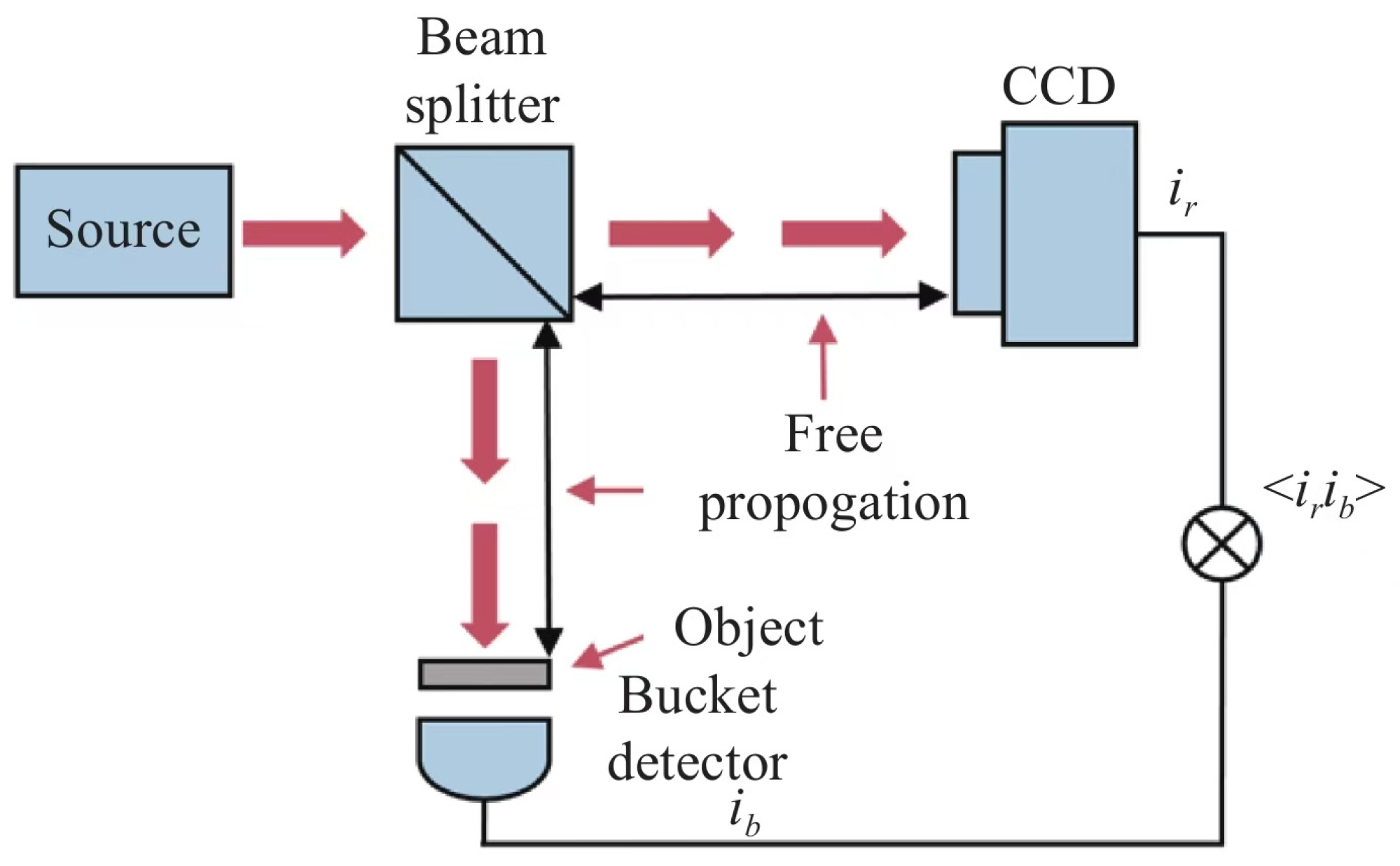
Figure 2 illustrates the principle of correlation-based ghost imaging, where spatial information is reconstructed by analyzing second-order intensity correlations between a reference beam and a bucket-detected signal arm. This schematic highlights the crucial role of quantum light sources, detection schemes, and field modulation in achieving high-fidelity image reconstruction beyond classical limits.
Despite recent advances, key bottlenecks persist. Optical loss and scattering within nonlinear crystals, transmission optics, or metasurface interfaces reduce the signal-to-noise ratio (SNR), limiting the advantage over classical imaging in real-world scenarios [
19,
22]. Mode crosstalk, unwanted coupling between optical modes—and decoherence, the loss of quantum phase information due to external perturbations or imperfections, degrade quantum interference and visibility [
24]. Furthermore, most quantum imaging systems remain bulky and alignment-sensitive, relying on centimeter-scale bulk optics that are not suitable for scalable or field-deployable systems [
31]. These challenges collectively hinder the transition of quantum imaging from laboratory demonstrations to practical, scalable devices.
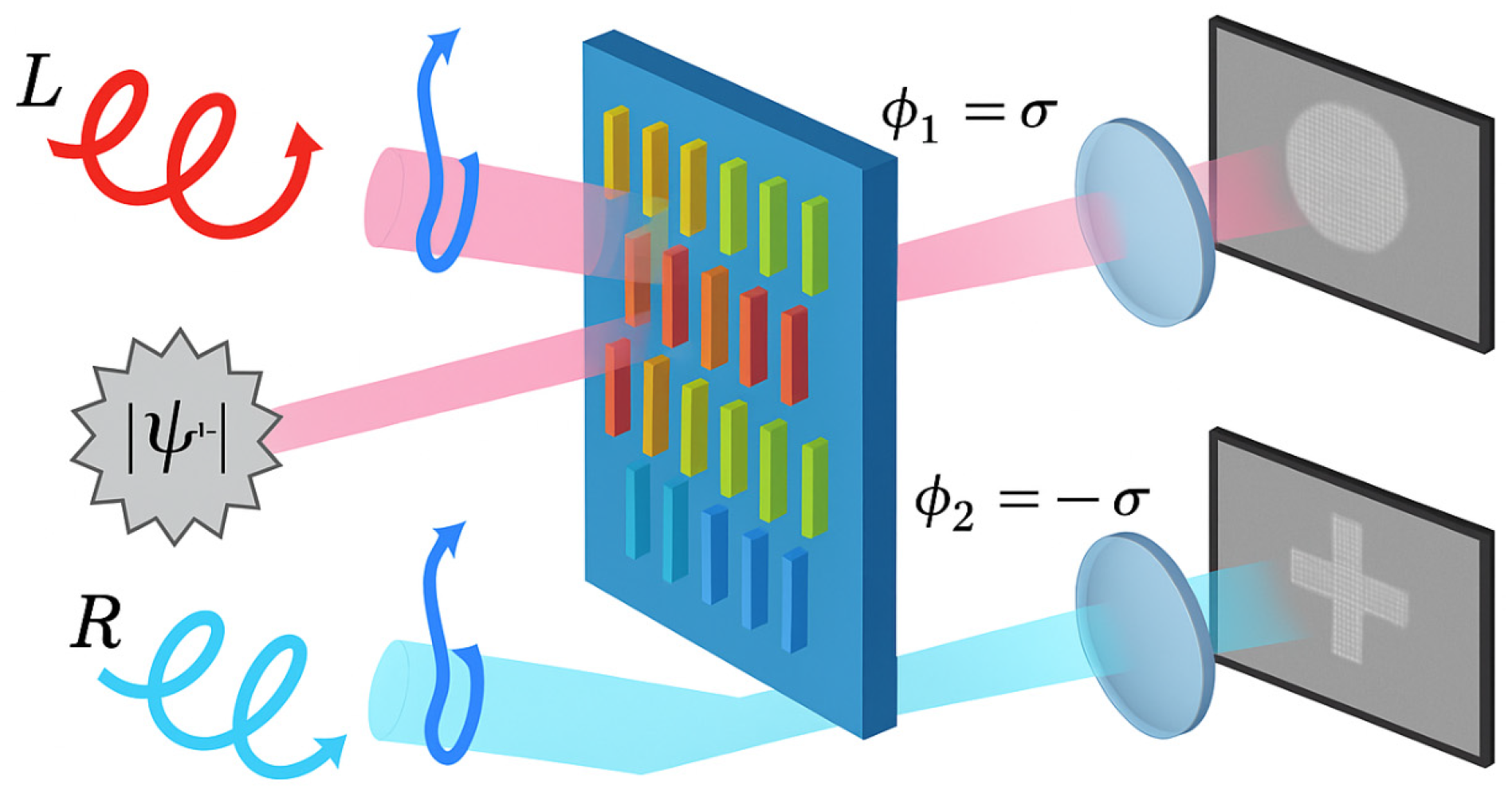
Figure 3 illustrates how metasurfaces directly address these limitations. By engineering subwavelength nanostructures to impart spin-dependent geometric phases, a dielectric metasurface can simultaneously manipulate amplitude, phase, and polarization within a few hundred nanometers of thickness. In the context of quantum imaging, this enables polarization-multiplexed encoding, spatial-mode conversion, and wavefront shaping—all crucial for maintaining quantum coherence and improving image visibility under compact configurations. Integrated metasurfaces thus replace multiple macroscopic components, reducing optical path complexity and alignment sensitivity while enhancing photon-mode fidelity [
32].
2.3. Principal Architectures and Contributions
Metasurfaces provide ultrathin, highly versatile platforms for modulating quantum light fields at subwavelength scales. One of the key mechanisms they exploit is spin–orbit interaction, which couples the polarization (spin) of light to its spatial propagation characteristics (orbit).
Among various designs, geometric-phase metasurfaces (also known as Pancharatnam–Berry or PB metasurfaces) utilize this effect by encoding phase through the orientation of anisotropic nanostructures, enabling polarization-dependent wavefront shaping.
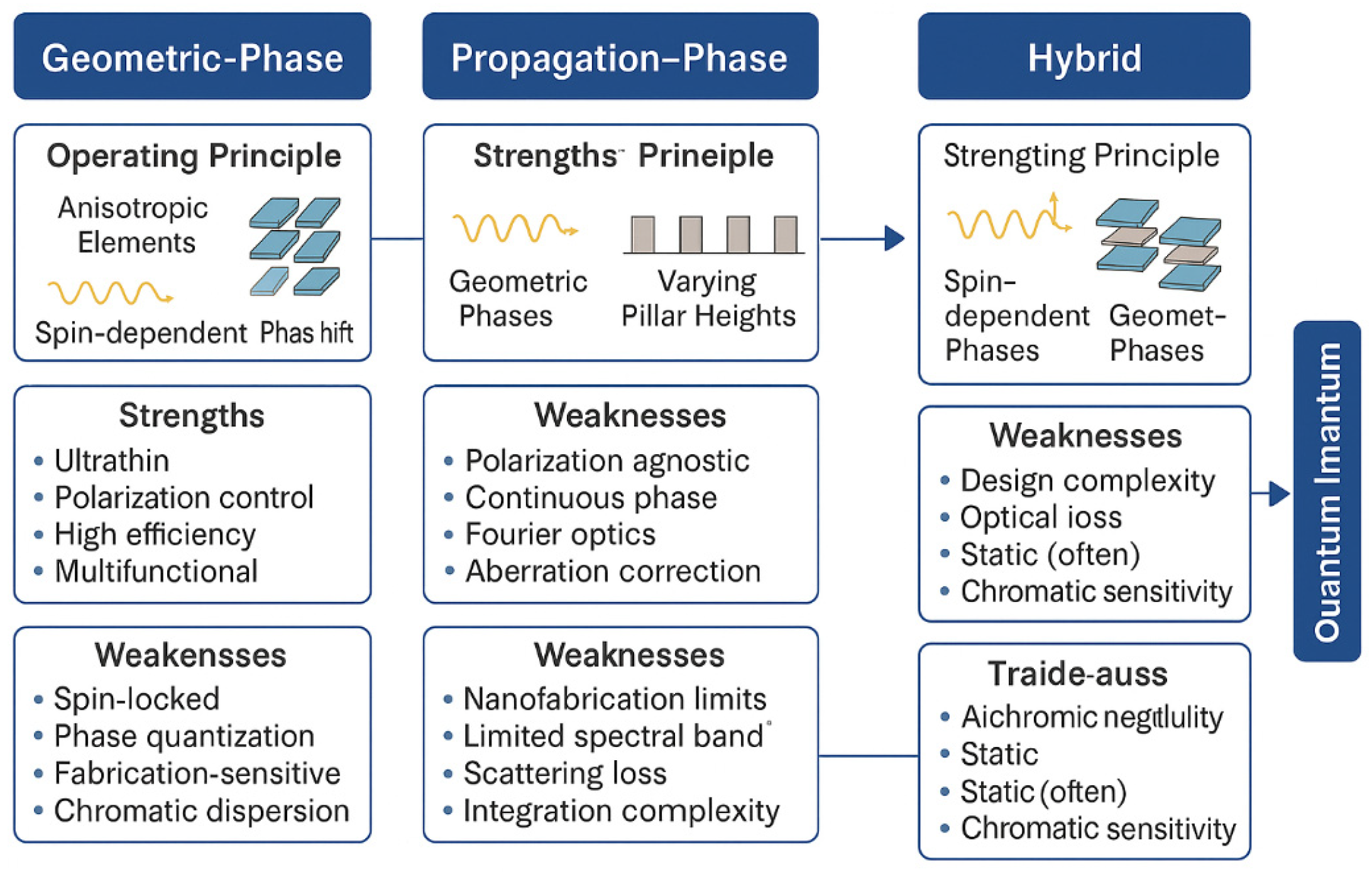
Different design philosophies have emerged, each offering distinct advantages in manipulating entangled photon states for improved quantum imaging performance. We summarize three principal architectures—geometric-phase, propagation-phase, and hybrid metasurfaces—and discuss their demonstrated contributions to ghost imaging, quantum holography, and single-photon microscopy [
33].
2.3.1. Geometric-Phase (Pancharatnam–Berry) Metasurfaces
(1) Operating Principle
Geometric-phase (also called Pancharatnam–Berry, PB) metasurfaces manipulate wavefronts through spin–orbit coupling by spatially varying the orientation of anisotropic nanostructures, such as dielectric nanobricks or nanopillars. Instead of modifying physical path length or refractive index, the PB effect encodes phase purely through the in-plane rotation angle θ(r) of each nano-element, yielding a polarization-dependent phase shift:
Here, σ = ±1 denotes the helicity of incident circularly polarized light. This phase shift arises from the geometric path traced on the Poincaré sphere of polarization states.
Such metasurfaces can implement a variety of polarization-selective optical functions, including vortex beam generation, holography, and spatial mode conversion. Because they rely solely on orientation patterns, PB metasurfaces are typically ultrathin (<λ/2) and do not require index modulation, which makes them ideal for miniaturized quantum photonic systems [
33].
(2) Relevance to Quantum Imaging
Quantum imaging techniques such as ghost imaging and quantum holography rely on preserving second-order correlations between entangled photon pairs. In this context, PB metasurfaces contribute in three main aspects: enhancing correlation visibility, enabling polarization-multiplexed imaging, and reducing system bulk.
Enhancing Correlation Visibility:
In a typical ghost imaging configuration, one photon of a pair (the signal) probes the object and is bucket-detected, while the other (idler) goes to a spatially resolved detector. The image is reconstructed from the second-order correlation function:
The quality of the image depends on the normalized visibility, defined as:
where C denotes coincidence counts. Mode mismatch and birefringence reduce mode overlap, degrading heralding efficiency (i.e., the probability that a detected idler photon corresponds to a signal photon from the same entangled pair). PB metasurfaces correct such distortions by introducing spatially variant birefringence that preserves phase coherence across spin-dependent channels. Experiments have shown visibility improvements up to 85–88%, surpassing conventional birefringent optics [
4].
Polarization Multiplexing and Functional Routing:
Liu et al. [
31] demonstrated a PB metasurface capable of producing two polarization-dependent image channels. The idler photon’s polarization determines which image is reconstructed in the signal arm, effectively enabling remotely switchable imaging. This dual-channel encoding enhances information capacity and supports quantum-secure multiplexing strategies.
Reducing Coupling Loss and System Bulk:
Conventional polarimetric components like quarter-wave plates or interferometric analyzers are bulky and alignment-sensitive. PB metasurfaces can consolidate these functions into a single subwavelength layer, reducing optical coupling loss and increasing integration density. This compactness supports scalable, chip-based quantum sensors envisioned for field deployment.
(3) Strengths and Trade-offs
PB metasurfaces offer compelling features:
Ultrathin integration: Compact, subwavelength-thick designs simplify alignment and enable on-chip fabrication [
34].
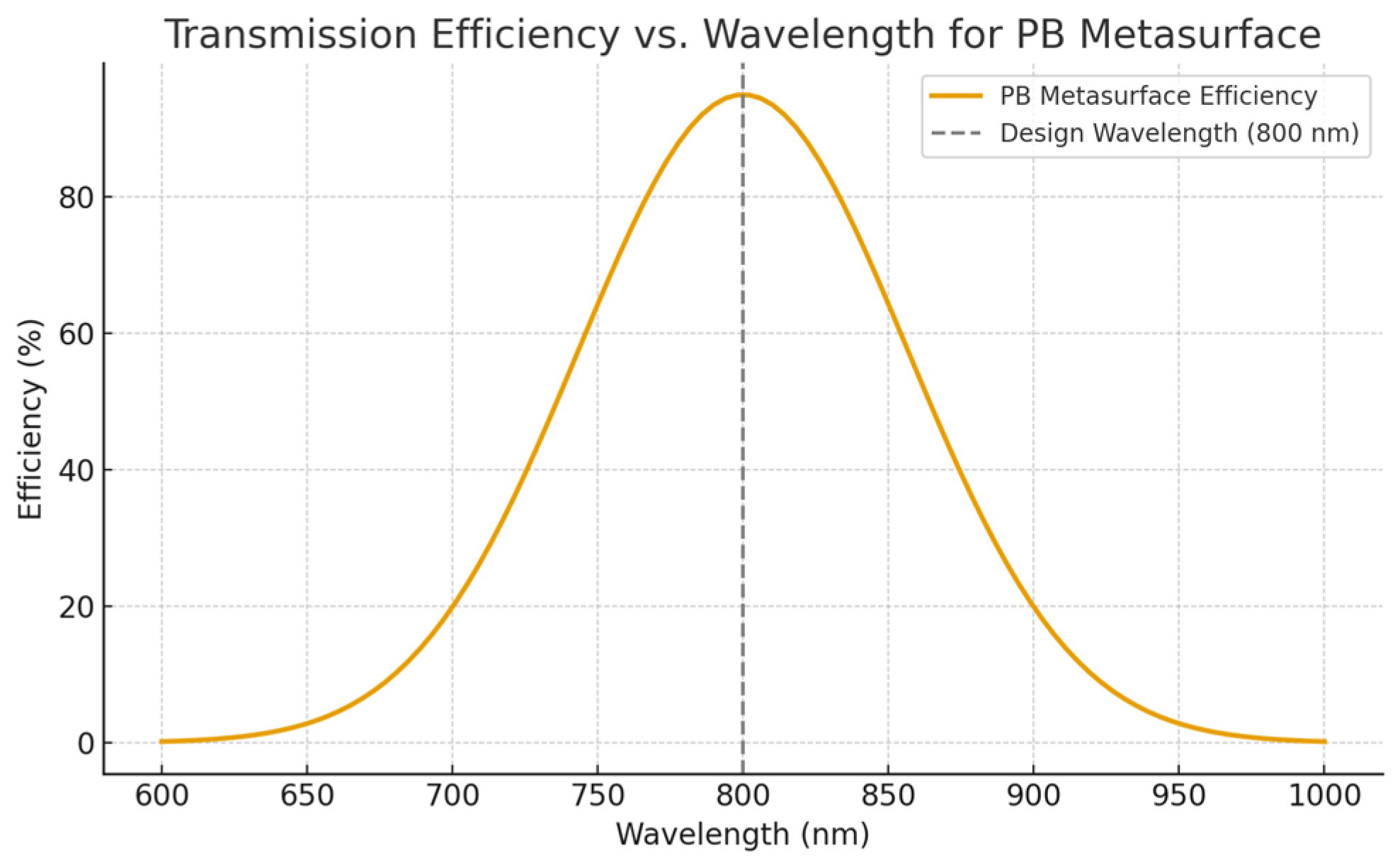
High efficiency: Dielectric PB metasurfaces based on TiO
2 or Si
3N
4 report transmission efficiencies > 90% at design wavelengths [
35].
Polarization selectivity: Naturally suited for manipulating polarization-entangled states.
Multifunctionality: A single metasurface layer can simultaneously focus, split beams, or project holographic images.
Figure 4: Schematic and functional demonstration of a PB metasurface performing simultaneous focusing and beam-splitting for entangled photon pairs. The spatial phase pattern is encoded through in-plane nano-element rotations, achieving multifunctional light control within a subwavelength-thick layer.
However, several constraints exist:
Spin-locking: PB metasurfaces work only for specific helicities. In scattering media, depolarization reduces fidelity.
Quantization artifacts: Discrete nanostructure orientations approximate continuous phase shifts, introducing phase errors. For high-resolution imaging, this becomes critical when desired phase accuracy is <λ/20 [
12].
Chromatic sensitivity: Although geometric phase is intrinsically achromatic, amplitude responses of elements are wavelength-dependent.
Fabrication limits: Achieving <10 nm tolerance across large areas is difficult, affecting reproducibility and scalability [
20].
(4) Design Considerations and Future Directions
Several strategies are being explored to improve PB metasurfaces for quantum imaging:
Hybrid-phase metasurfaces: Stack PB elements with propagation-phase layers to enable continuous phase control with spin selectivity [
5].
High-NA orientation patterns: Support wider angular spreads from SPDC/SPWM sources, improving collection efficiency.
On-chip photon sources: Direct deposition on nonlinear crystals or quantum emitters can minimize spatial coupling loss [
36].
Tunable PB metasurfaces: Emerging designs using phase-change or liquid crystal materials enable dynamic reconfiguration in real time.
2.3.2. Propagation-Phase Metasurfaces
(1) Operating Principle
Propagation-phase metasurfaces control the wavefront by modulating the optical path length through subwavelength dielectric nanoresonators that act as effective waveguides or Fabry–Pérot cavities. The accumulated phase delay at each position rrr depends on both the resonator’s effective refractive index n
eff(r) and physical height h(r), and is given by:
where k
0 = 2π/λ is the free-space wavevector. By spatially tailoring n
eff and h, these metasurfaces can implement continuous phase profiles without relying on polarization selectivity [
33]. Compared to Pancharatnam–Berry (PB) designs, propagation-phase metasurfaces offer polarization-independent operation and avoid discretization artifacts, which is beneficial for high-fidelity quantum imaging.
It is important to clarify, however, that while height variation in dielectric pillars is a widely adopted design concept in classical metasurface optics, its implementation in subwavelength metasurfaces for high-resolution quantum imaging remains technically challenging. Such height-tuned phase control approaches are not yet compatible with mainstream nanofabrication methods—whether top-down lithography or bottom-up self-assembly—particularly when sub-10 nm vertical precision is required across large-scale arrays [
20,
33].
(2) Relevance to Quantum Imaging
In quantum imaging modalities such as quantum holography, ghost imaging, and correlation-based microscopy, maintaining coherence of multiphoton spatial modes is crucial. Propagation-phase metasurfaces can reshape these modes with high spatial fidelity while preserving entanglement visibility. For instance, Fourier-plane phase engineering with these devices has demonstrated improved edge sharpness and background suppression under photon-starved or turbulent conditions [
4].
However, a common misconception is that all propagation-phase metasurfaces are inherently polarization-independent. In practice, the use of anisotropic or rectangular nanoresonators (e.g., elongated nanobricks) can result in polarization-sensitive responses, especially when symmetry is broken in-plane. Such effects can reduce spatial coherence and lead to polarization-selective diffraction, thus degrading quantum interference visibility [
20,
33].
(3) Strengths and Trade-offs
Strengths
Propagation-phase metasurfaces offer:
Continuous phase control across the full 0–2π range;
Compatibility with broadband and multi-mode photon fields;
Compact realization of Fourier optical elements such as flat lenses, beam deflectors, or holograms for quantum states [
36].
Trade-offs
Fabrication tolerances are critical: ±10 nm variations in dimensions can induce phase noise that reduces correlation visibility by up to 10% [
33].
Most designs are narrowband due to material dispersion and resonator geometry;
Surface roughness, etch defects, and misalignment with quantum emitters or detectors degrade heralding efficiency;
Polarization crosstalk may arise if design symmetry is not carefully enforced.
(4) Experimental Validation and Design Metrics
The spatial phase transformation ϕ(x,y) performed by a metasurface defines the modified quantum state. The fidelity FmF_mFm between the ideal mode Φm\Phi_mΦm and the actual output can be calculated as:
Optimized propagation-phase metasurfaces have achieved F
m > 0.9, significantly surpassing conventional diffractive optics (typically F
m∼0.7) in entangled-photon mode discrimination [
36].
Experimental demonstrations include:
Mode Sorting: Sorting of Laguerre–Gaussian modes with >90% efficiency and CAR improvements from 18 to 32;
Quantum Holography: Hybrid metasurfaces combining PB and propagation layers yielded 6 μm resolution with high visibility under low flux [
31];
Edge Enhancement: 30% contrast improvement in ghost imaging under atmospheric disturbance [
4].
(5) Outlook and Recommendations
To advance the practical deployment of propagation-phase metasurfaces in quantum imaging, future work should prioritize:
Tolerance-aware inverse design: Leverage machine learning or adjoint optimization to enhance resilience to fabrication errors [
31];
Symmetric meta-atom design: Avoid polarization-selective effects via circular or square cross-sections;
Hybrid stacking: Combine PB and propagation-phase layers for multifunctional and multidimensional imaging [
5];
Dynamic tuning: Integrate MEMS or low-loss phase-change materials for task-adaptive imaging under real-time feedback [
8].
2.3.3. Hybrid Metasurfaces
(1) Operating Principle
Hybrid metasurfaces represent an advanced category of flat-optical devices that integrate Pancharatnam–Berry (PB) geometric-phase control with propagation-phase modulation within a single platform. This dual-phase mechanism can be achieved in two main architectures:
Co-patterned unit cells: Within each spatial pixel, anisotropic nanobricks (PB elements) are interlaced with dielectric nano-pillars (propagation elements). Each contributes distinct phase contributions:
where ϕ
PB provides spin-dependent polarization control, while ϕ
prop imparts continuous spatial phase modulation.
Stacked metasurface layers: Separate PB and propagation-phase metasurfaces are fabricated on consecutive planes (tens of microns apart) or bonded in multilayer assemblies, forming meta-lens stacks with complementary phase responses.
The core idea is to simultaneously leverage the advantages of both phase control schemes:
PB components optimize polarization-selective correlations, essential for entanglement visibility and multi-channel information encoding.
Propagation-phase components provide smooth, high-fidelity spatial wavefront shaping, minimizing diffraction artifacts and enabling mode sorting for high-resolution quantum imaging.
The synergy allows hybrid metasurfaces to outperform single-phase devices, offering higher quantum contrast, reduced mode crosstalk, and improved system tolerance to alignment errors or environmental perturbations.
(2) Relevance to Quantum Imaging
Hybrid metasurfaces effectively combine the strengths of geometric and propagation phase control, offering a compelling solution for quantum imaging scenarios that require both high visibility and fine spatial resolution. They have been shown to improve correlation contrast and reduce mode crosstalk under low photon flux, which is vital for entanglement-based systems. For instance, in quantum holography, hybrid devices achieved ~6 μm resolution with visibility up to 90%, outperforming single-phase designs [
5]. Polarization-multiplexed setups have demonstrated dual-channel imaging with CAR exceeding 35 [
31], while ghost imaging implementations using hybrid metasurfaces achieved a >40% reduction in system length and improved mechanical robustness [
33].
(3) Strengths
Hybrid metasurfaces enable:
High entanglement visibility, with PB layers preserving spin-dependent coherence from SPDC or SFWM sources.
Improved spatial resolution, leveraging continuous propagation-phase control for sub-diffraction feature discrimination.
System compactness, consolidating multiple bulk optics into one planar element for easier alignment.
Noise resilience, maintaining performance despite angular misalignment (±2°) or fabrication errors (±20 nm), with visibility loss < 5%.
(4) Trade-offs and Limitations
Challenges include:
Design complexity, requiring co-optimization of anisotropic and geometric parameters across phase channels.
Optical loss, especially from interfaces in stacked structures, which can degrade heralding efficiency.
Limited tunability, since most devices are static, and dynamic versions often introduce further losses or structural complexity.
Spectral sensitivity, as maintaining achromatic phase behavior across 5–20 nm entangled photon bandwidth remains technically demanding.
(5) Mathematical Framework and Metrics
The transformation performed by a hybrid metasurface on a two-photon quantum state |Ψ
in〉 can be modeled as:
where s denotes the spin (polarization) index. The correlation visibility V and mode fidelity F
m are given by:
Experiments report V ≈ 0.88–0.90 and Fm > 0.92 for optimized hybrid metasurfaces, both exceeding single-phase metasurfaces by 5–10%, highlighting the synergistic effect of dual-phase control.
(6) Design Notes and Future Perspectives
Algorithmic co-design: Combining metasurface phase maps with computational post-processing (e.g., compressive sensing, machine learning reconstruction) can further enhance noise tolerance and reduce photon requirements.
Programmable hybrids: Embedding phase-change materials (GST, VO2) or electro-optic tuning layers could allow real-time reconfiguration, enabling adaptive imaging under changing scene conditions.
Monolithic integration: Co-fabricating hybrid metasurfaces with quantum light sources (SPDC waveguides, quantum dot emitters) and SPAD arrays on a single chip will reduce coupling losses and improve scalability.
Multi-dimensional imaging: Extending hybrid designs to encode not only spatial and polarization information but also orbital angular momentum (OAM) could unlock high-capacity quantum information channels with simultaneous imaging capability.
2.3.4. Cross-Study Performance Summary
Across experiments and system-level studies, metasurfaces deliver consistent advantages over bulk optics for quantum imaging: higher correlation visibility (via PB control), better spatial resolution and mode orthogonality (via propagation-phase sorting), and substantially increased compactness and mechanical stability (by collapsing multi-element relays into a single ultrathin plate). Representative, cross-study performance figures are summarized below in
Table 1.
(1) Interpretation and practical guidance:
PB metasurfaces are the go-to choice when the priority is maximizing correlation visibility or implementing polarization-multiplexed control of heralded photons (e.g., switching, channel tagging), provided that the scene does not demand the finest spatial detail.
Propagation-phase designs should be preferred when resolution and Fourier-plane accuracy are paramount (e.g., quantum holography, structured-illumination recovery), with attention to dispersion control and fabrication-tolerance budgeting to maintain visibility and heralding efficiency [
37].
Hybrid metasurfaces offer the best overall balance—they are favored for portable, noise-resilient quantum imagers that must maintain high visibility and high resolution simultaneously, especially under alignment drift or mild turbulence [
33].
(2) System-Level Considerations
Across all metasurface types, three device-level factors dominate quantum imaging performance: (i) insertion loss, which directly limits photon flux, SNR, and heralding efficiency; (ii) phase fidelity, where fabrication errors or dispersion reduce interference visibility and coherent reconstruction accuracy; (iii) mode crosstalk or unequal transmission, which degrades resolution and edge sharpness.
High-performance systems therefore require not only optimized metasurface designs but also tolerance-aware fabrication, dispersion management, and co-design with detectors and coincidence electronics to preserve quantum correlations effectively.
2.4. Open Questions and Research Gaps
Despite rapid progress, metasurface-enabled quantum imaging (QI) still faces several bottlenecks that limit reproducibility, scale-up, and deployment outside controlled laboratories. Below we distill the most persistent challenges, explain why they arise at the physics–engineering interface, and outline concrete research thrusts that could close the gap between demonstrations and robust systems.
2.4.1. Low Photon Flux and Poor Coupling Efficiency
Quantum imaging systems operate under extremely low photon flux, where each coincidence event is precious. Photon pair generation rates from SPDC or SFWM are typically limited to 10
4–10
6 pairs/s, and any optical loss drastically reduces the useful signal [
19]. Among the most pressing challenges is low coupling efficiency between the emitted quantum states and the designed metasurface structures.
(1) Why coupling efficiency matters
In classical optics, signal loss can be offset by boosting intensity—but this approach fails in quantum systems due to strict limits on pump power, detector saturation, and the risk of multi-pair emissions that degrade entanglement quality [
23]. Moreover, many QI techniques rely on heralding, where photon loss in either arm reduces both signal and visibility, compromising image reconstruction fidelity [
8,
9,
10,
11,
12,
13,
14,
15,
16,
17,
18,
19,
20,
21,
22,
23,
24,
25,
26,
27,
28,
29,
30,
31,
32,
33,
34,
35,
36,
37,
38,
39,
40,
41,
42,
43,
44,
45].
(2) Key Sources of Inefficiency
Wavefront mismatch between quantum sources and metasurface eigenmodes leads to distorted spatial entanglement and photon wastage.
Spectral mismatch occurs when broadband biphoton spectra are transmitted through narrowband-optimized metasurfaces, inducing chromatic dispersion and phase errors [
1,
4].
Polarization misalignment degrades performance for PB metasurfaces, which rely on well-defined spin states.
Surface/interface scattering from roughness and fabrication imperfections introduces additional losses.
High alignment sensitivity during free-space coupling exacerbates instability in real-world or long-duration setups.
(3) Impact on imaging performance
These inefficiencies manifest as reduced heralding efficiency, higher accidental coincidence rates, and lowered image contrast. The quantum advantage—extracting maximum information per photon—is undermined, especially in noisy or photon-starved regimes.
(4) Promising Strategies for Improvement
Source-metasurface co-design has shown up to 30–40% improvement in mode overlap by matching emission profiles to metasurface eigenmodes.
Inverse design optimization enables metasurfaces to tolerate fabrication imperfections and better match detector acceptance angles.
Broadband dispersion engineering mitigates chromatic loss by supporting wider biphoton spectra.
In-/out-coupling layers like metagratings or AR coatings reduce interface reflections and enhance throughput.
Near-field/on-chip integration, including metasurface-on-SPDC schemes, eliminates alignment drift and boosts coupling to over 50% in simulations [
28].
These strategies collectively aim to close the gap between lab-scale demonstrations and scalable, high-fidelity quantum imaging systems.
2.4.2. Lack of Dynamic Reconfigurability
Quantum imaging (QI) is inherently task-adaptive: the optimal wavefront transformation or spatial mode basis depends on scene complexity, turbulence, photon flux, and specific imaging goals (e.g., extended-object ghost imaging vs. fine-detail holography). However, most metasurfaces used in current QI experiments are static—fabricated with a fixed phase profile and lacking real-time tunability. This rigidity limits the system’s adaptability to environmental fluctuations or multi-functional sensing tasks, constraining QI’s potential for field-deployable applications.
(1) Why dynamic reconfigurability matters
Environmental robustness: Atmospheric turbulence, scattering, and background noise unpredictably distort spatial correlations. Without dynamic correction, these distortions degrade visibility and spatial resolution.
Task versatility: Switching between spatial mode bases (e.g., Hermite–Gaussian, Laguerre–Gaussian, Hadamard) is essential for adapting to varying targets or motion tracking requirements.
Multifunctional imaging: Practical QI systems should support multiple modes such as phase-contrast, edge-enhanced, and quantum spectroscopic imaging without requiring physical realignment.
Conventional adaptive optics, such as deformable mirrors or spatial light modulators (SLMs), offer reconfigurability but are bulky, lossy, and poorly suited to single-photon-level systems. Static metasurfaces therefore remain limited to controlled laboratory conditions.
(2) Causes of limited reconfigurability
Dynamic metasurface research faces several performance and scalability constraints:
Liquid crystals (LCs): While capable of large phase shifts, LC-based metasurfaces typically operate on millisecond response times and introduce significant absorption and scattering, thereby reducing photon detection rates and coincidence fidelity.
Phase-change materials (PCMs): Materials like GST enable non-volatile tuning but suffer from thermal instability, high insertion loss, and flicker noise—a low-frequency temporal fluctuation that introduces unpredictable phase errors, undermining quantum interference visibility.
MEMS-actuated metasurfaces: These offer mechanical tuning through nanostructure displacement but are susceptible to vibration and insufficient for high-speed operation, especially in mobile or real-time sensing scenarios.
Carrier injection (e.g., TCOs, semiconductors): Electrical tuning via carrier density modulation enables sub-microsecond response, but introduces free-carrier absorption that significantly lowers quantum efficiency.
Scaling constraints: Most large-aperture, high-NA dynamic metasurface prototypes cannot yet achieve MHz-rate tuning, limiting applicability in real-time or video-rate quantum imaging. This claim requires further support through experimental benchmarks [
8].
Mode fidelity degradation: Any active tuning mechanism that introduces random phase noise, partial decoherence, or thermal fluctuation can compromise photon indistinguishability, reducing entanglement visibility and affecting coincidence-based detection [
38].
(3) Impact on QI performance
Without dynamic reconfiguration, quantum imaging systems face several fundamental limitations. Narrow operational bandwidth confines static metasurfaces to specific wavelengths, making them unsuitable for broadband or mixed photon-state experiments. Single-mode operation prevents flexible mode switching, restricting use in compressive or adaptive quantum sensing. Additionally, environmental fluctuations—such as thermal drift or vibration—can gradually degrade phase fidelity and alignment, increasing acquisition times or even halting operation altogether [
46]. Collectively, these limitations constrain the adaptability and robustness required for practical deployment in complex real-world conditions.
(4) Emerging Strategies
To overcome static constraints, multiple approaches are under exploration. Quantum-compatible tunables such as lithium niobate, barium titanate, graphene, and MoS2 exhibit low insertion loss and ultrafast response, though uniform large-area performance remains challenging. Hybrid static–dynamic architectures, combining propagation-phase backplanes with tunable PB overlays, balance high efficiency with reconfigurability. Programmable metasurface arrays enable localized, high-frame-rate updates to phase profiles, enhancing adaptability without excessive complexity. All-optical control leverages nonlinear or photo-switchable meta-atoms for ultrafast, low-loss modulation using control photons instead of electronics. Finally, integrated photonic meta-circuits embedding active phase shifters and control elements on-chip promise compact, fully reconfigurable quantum imagers capable of real-time adaptation to diverse imaging scenarios.
2.4.3. Incomplete Resilience to Environmental Noise
Metasurface-enabled quantum imaging systems, though powerful in controlled settings, remain vulnerable to environmental fluctuations such as turbulence, thermal gradients, or mechanical vibrations—particularly in outdoor, biomedical, or mobile scenarios [
22,
23,
24,
25,
26,
27,
28,
29,
30,
47]. These disturbances introduce random phase shifts, path-length fluctuations, and alignment errors, which collectively reduce second-order correlation visibility and coincidence-to-accidental ratios (CAR), ultimately degrading spatial resolution and quantum advantage.
One core issue lies in the static nature of metasurfaces: they are typically designed under fixed wavefront and coherence assumptions and lack any adaptive correction mechanism. Unlike classical adaptive optics or deformable mirrors, current metasurfaces cannot self-correct for anisoplanatic distortions or platform-induced jitter, making them highly sensitive to even minor misalignments or wavefront perturbations. Without dynamic feedback, environmental noise causes temporal mode mismatches, spatial blur, and reduced heralding efficiency—especially in long-path or free-space quantum imaging deployments.
To address these challenges, recent work has explored meta-adaptive optics, where metasurfaces are co-designed with tunable layers (e.g., LC, EO materials) to enable kHz-level phase correction with low loss [
33]. Other strategies include correlation-aware feedback control based on real-time CAR/visibility monitoring, as well as computational ghost imaging with turbulence-robust reconstruction algorithms. Combining metasurfaces with MEMS isolation platforms or thermally stabilized photonic integrated circuits (PICs) is also emerging as a viable route toward deployable, noise-resilient quantum imaging platforms [
48].
2.4.4. Fabrication Imperfections and Phase Noise
(1) Why fabrication imperfections matter
Metasurfaces rely on nanometer-scale geometries to control photon phase and polarization with subwavelength precision. Unlike classical optics, even slight deviations—such as etch depth nonuniformity or critical-dimension variation—can significantly distort the intended phase profile. In quantum imaging systems, these errors directly impair key metrics such as visibility and coincidence-to-accidental ratio (CAR), often lowering entanglement fidelity below the threshold needed for quantum advantage [
24].
(2) What causes fabrication-induced phase noise
Fabrication-induced errors arise from lithographic roughness, RIE etch fluctuations, and material inhomogeneities. In PB metasurfaces, sidewall tapering and anisotropy loss can introduce polarization leakage, while in propagation-phase devices, ±10 nm etch errors can cause phase shifts exceeding λ/20 [
33]. In hybrid PB–propagation designs, even minimal misalignment across layers disrupts phase continuity, degrading both spatial resolution and polarization performance.
(3) Impact on quantum imaging performance
These imperfections lead to several measurable consequences: reduced visibility in ghost imaging setups due to random phase noise; spatial blurring in mode-sorting applications where modal crosstalk increases; lower CAR and SNR due to scattering-induced background detections; and degraded polarization contrast from anisotropy errors. As such, fabrication fidelity is not just a technical issue—it defines whether quantum imaging with metasurfaces can meet real-world deployment standards [
4,
24].
(4) Promising directions for mitigation
Fabrication imperfections such as critical dimension (CD) variation, etch depth nonuniformity, and surface roughness remain a major source of phase errors in quantum metasurfaces. These can degrade visibility, introduce modal crosstalk, and reduce device yield. To address these issues, recent approaches span the entire pipeline—from design and fabrication to post-correction:
Inverse design with built-in tolerance uses Monte Carlo simulations and multi-objective optimization to ensure phase robustness under ±10 nm deviations. Dispersion-compensated unit cells are also being explored to maintain phase accuracy over broader fabrication windows.
Redundant phase geometries, where multiple unit-cell shapes realize the same phase delay, help suppress error accumulation. Supercell tiling further improves local error averaging.
Closed-loop manufacturing employs real-time feedback: SEM and ellipsometry data guide adaptive lithography, while scatterometry retrieves phase information for pre-deployment calibration.
Hybrid integration—e.g., monolithic fabrication on SPDC or SNSPD substrates—reduces alignment errors. Self-aligned imprinting techniques avoid overlay drift in multilayer designs.
Post-fabrication correction, including algorithmic phase retrieval and tunable overlays (e.g., LC or EO films), compensates for slow-varying spatial phase noise in the final system.
Together, these strategies mark a shift toward error-tolerant metasurface engineering, crucial for maintaining entanglement fidelity and image quality in real-world quantum imaging platforms.
2.5. Prospective Directions and Application Roadmap
Metasurface-enabled quantum imaging (QI) is poised to move from elegant table-top demonstrations to compact, fieldable instruments that can operate in photon-starved, noise-dominated environments. Below we outline near- to mid-term research directions and a scenario-based roadmap that aligns device physics with application requirements, drawing on the literature and domain consensus [
20].
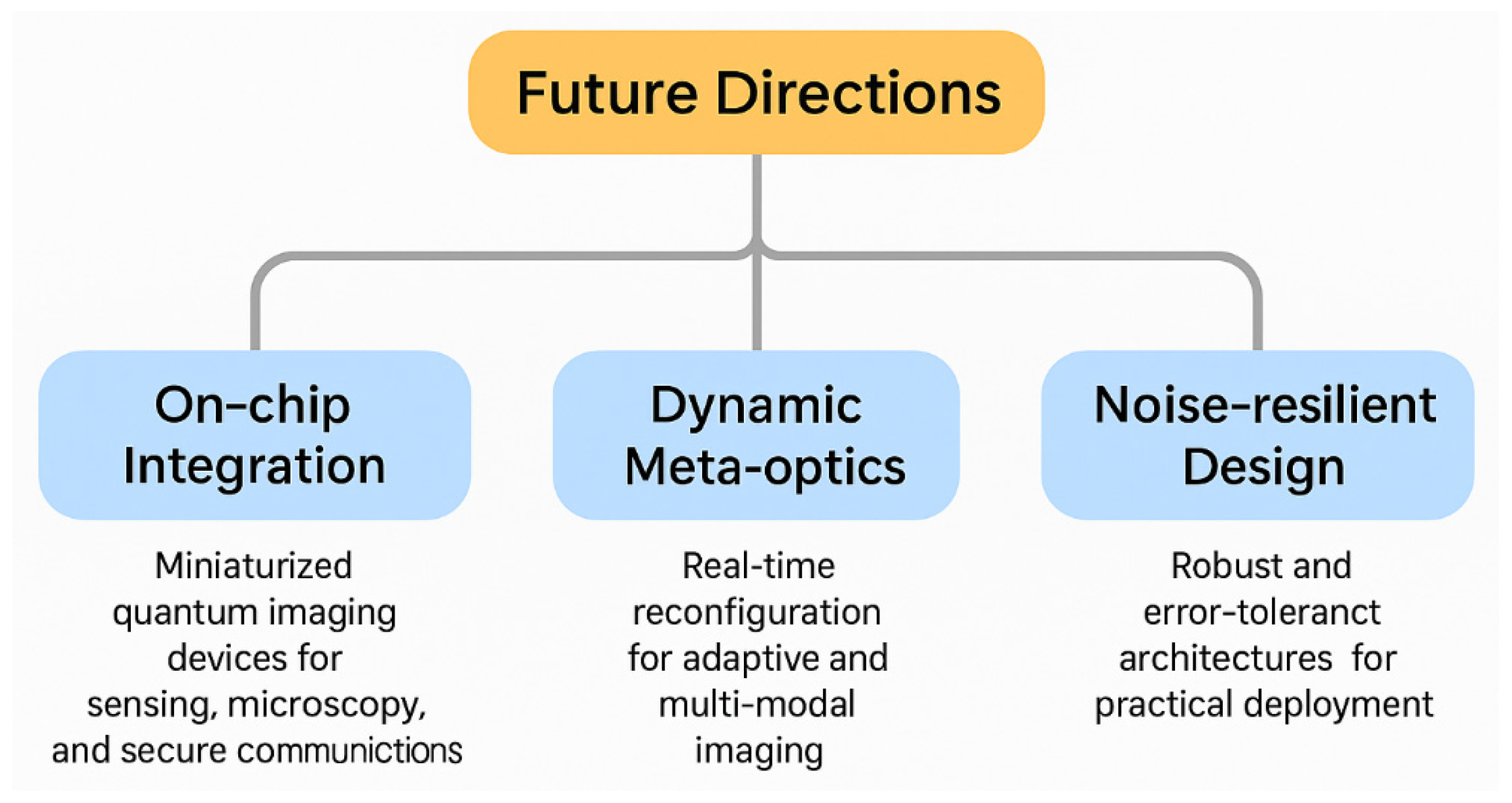
2.5.1. On-Chip Integration for Scalable Quantum Imaging
The dominant barriers to deployment—alignment sensitivity, optical loss at interfaces, and large form factors—are system-level, not purely algorithmic. The co-packaging (or monolithic co-fabrication) of quantum light sources (e.g., SPDC in nonlinear waveguides, SFWM in silicon nitride, quantum dots), metasurface phase engines, and single-photon detectors (SPAD/SiPM/InGaAs SPAD, SNSPD) on a CMOS-compatible stack would collapse free-space paths, boost stability, and shrink size and power budgets [
40].
2.5.2. Multimodal Quantum Sensing
Many high-value use cases require more than spatial contrast: spectral–temporal discrimination for chemistry, field-sensitivity for magnetoneurography, or range/Doppler for remote sensing. Metasurfaces can simultaneously engineer phase, polarization, dispersion, and mode basis, enabling joint spatial–spectral quantum imaging [
15], quantum magnetic field imaging with optically pumped magnetometers or solid-state defects [
22], and quantum radar/quantum LiDAR concepts for low-SNR scenes [
30]. There are several design patterns:
Spectro-spatial quantum imaging:
Use dispersion-engineered metasurfaces to map wavelength to spatial positions while preserving second-order photon correlations. Such designs can integrate with Hadamard or DMD-based coding for compressive acquisition, enabling spectral imaging at the quantum level. Ma et al. already demonstrated a metasurface-based protocol in which tuning pump wavelength steers the photon emission angle for ghost + scanning imaging modalities [
41].
Magneto-QI (quantum magnetic imaging):
By employing polarization-multiplexed PB metasurfaces, one can convert small field-dependent phase imprints (from a magnetometer sensor) into a polarization basis optimized for correlated photon detection. This allows the extraction of magnetic field maps via coincidence measurements. While this exact scheme has been less explored, the broader concept of metasurfaces coupled with quantum sensors (e.g., NV centers, atomic magnetometers) is discussed in recent reviews of metasurfaces in quantum technologies [
41].
Entanglement-assisted ranging/quantum LiDAR:
Propagation-phase metasurfaces can perform Fourier-plane mode sorting and angular dispersion while maintaining tight timing synchronization budgets in the coincidence circuits. This enables range discrimination combined with entangled photon correlation. The concept of metasurface-enabled beam steering in quantum imaging contexts has been proposed in the nonlinear metasurface quantum imaging work, where spatial steering is achieved via tuning the pump wavelength [
5].
2.5.3. AI-Driven Metasurface Design and Adaptive Operation
Static, manually designed metasurfaces often suffer from limited tolerance to fabrication deviations and inability to adapt to dynamic noise sources (turbulence, motion). Machine-learning based inverse design methods—such as physics-informed neural networks or adjoint-gradient optimizers—can help generate robust, dispersion-engineered phase encoders optimized for metrics like Fisher information under constraints of loss and manufacturability [
33].
There are two complementary implementation pathways:
Design-time robustness: During offline design, multi-objective training can incorporate fabrication process variations (critical dimension, etch depth, side-wall angle) and environmental priors (e.g., turbulence strength or background noise) as constraints. These constraints guide the AI to favor metasurface layouts that maximize expected visibility, CAR, and photon-information throughput across real-world conditions.
Run-time adaptivity: Hybrid static–dynamic meta-optics architectures—such as a fixed propagation-phase backbone supplemented by a low-stroke PB tuner—can be driven by feedback from coincidence-based correlation metrics. In practice, a controller perturbs local phase values to maximize instantaneous correlation contrast without introducing significant additional photon loss. One proof-of-principle demonstration of remote switching in quantum phase-imaging via a polarization-multiplexed metasurface supports the viability of this adaptive approach [
33].
2.5.4. Scenario-Based Application Roadmap
The
Table 2 below maps representative application contexts to performance targets, preferred sources/detectors, and metasurface architectures. The intent is to guide co-design choices rather than prescribe a single solution.
2.5.5. Cross-Cutting R&D Agenda (What to Build Next)
Source–metasurface–detector co-design. Optimize the joint spectral–spatial amplitude of biphotons to the metasurface transfer function; enforce mode-matching to detector acceptance (pixel fill factor, NA) to raise Klyshko efficiency.
Quantum-compatible tunability. Pursue low-loss tunables (electro-optic dielectrics, TCOs, 2D materials, phase-change with anneal-free cycles) and hybrid static–dynamic stacks for kHz-class corrections without visibility penalties.
Standardized benchmarks. Establish open protocols for resolution (MTF), visibility, CAR, photon information efficiency, dose-normalized SNR, and turbulence stress tests to enable fair cross-lab comparisons [
12,
30].
Manufacturing readiness. Build tolerance-aware inverse designs and closed-loop fabrication (scatterometry-calibrated phase maps, digital twins) to suppress phase noise and modal loss at scale [
37].
Ethics & safety for biomed. Define dose and timing constraints, thermal budgets, and sterility pathways for clinical translation; prioritize schemes that retain QI benefits at clinically acceptable flux.
2.5.6. Expected Impact
If the above directions are executed, metasurface-enabled QI can realize:
Order-of-magnitude system miniaturization (co-packaged modules) with visibility ≥ 0.85 in non-ideal environments.
Task-adaptive imaging via modest tunability guided by coincidence-aware feedback, sustaining high contrast in turbulence or motion.
Multimodal instruments that fuse spatial, spectral, and field information at photon budgets untenable for classical counterparts—opening routes in low-dose biomicroscopy, secure remote sensing, and dual-use comms + imaging.
This roadmap is intentionally co-design oriented: progress will be fastest where optical hardware, quantum sources/detectors, and reconstruction algorithms are developed together, and validated under shared, open benchmarks.