Article

Interpretation of Mode-Coupled Localized Plasmon Resonance and Sensing Properties


1
Department of Electrical and Electronic Engineering, National Institute of Technology (NIT), Oita College, 1666 Maki, Oita 870-0152, Japan
2
Faculty of Advanced Technology and Engineering, VNU Vietnam–Japan University, Vietnam National University, Luu Huu Phuoc Street, Tu Liem Ward, Hanoi 12016, Vietnam
*
Authors to whom correspondence should be addressed.
Photonics 2026, 13(1), 68; https://doi.org/10.3390/photonics13010068

Submission received: 25 November 2025 / Revised: 23 December 2025 / Accepted: 7 January 2026 / Published: 12 January 2026
(This article belongs to the Special Issue Optical Metasurface: Applications in Sensing and Imaging)

Abstract

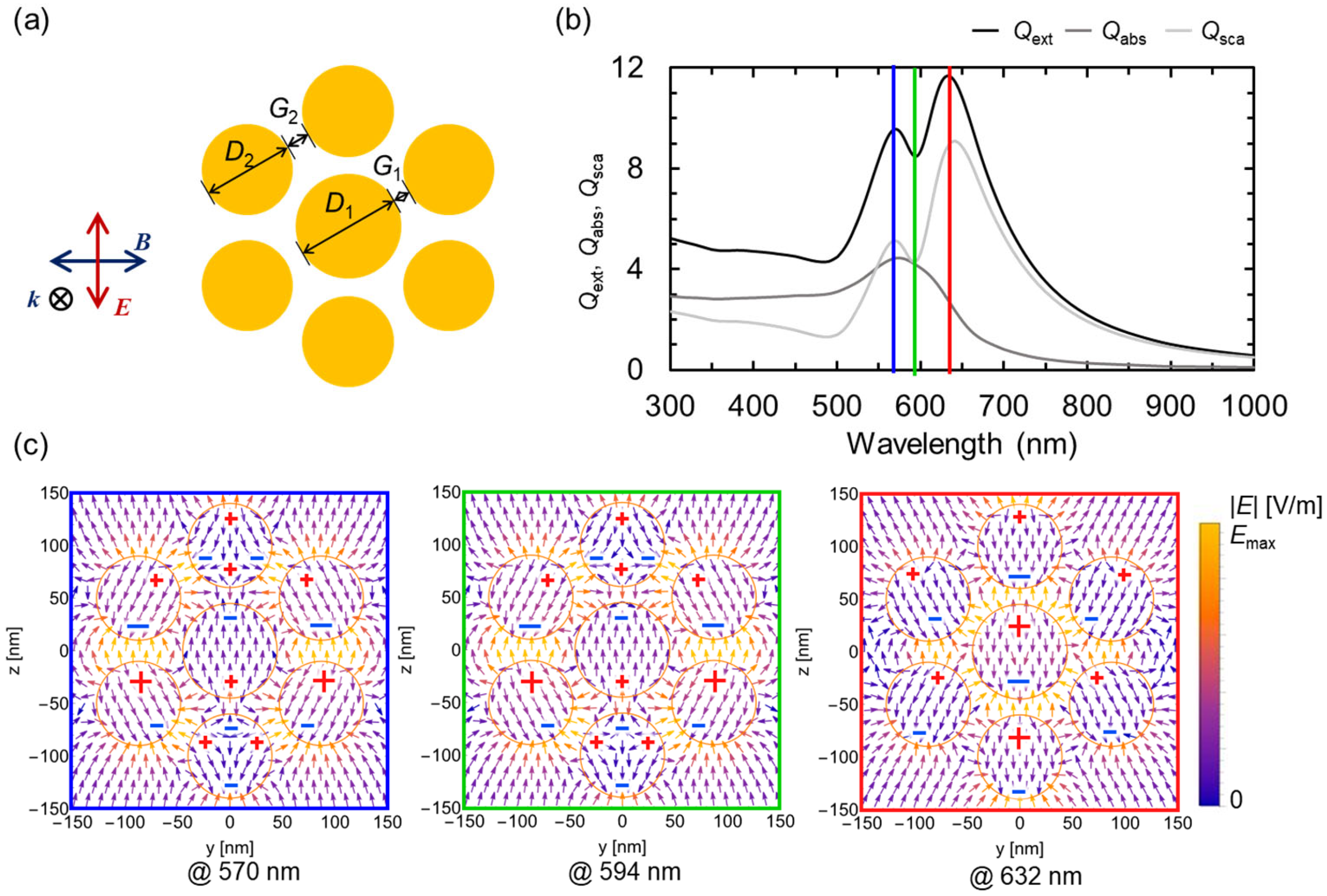
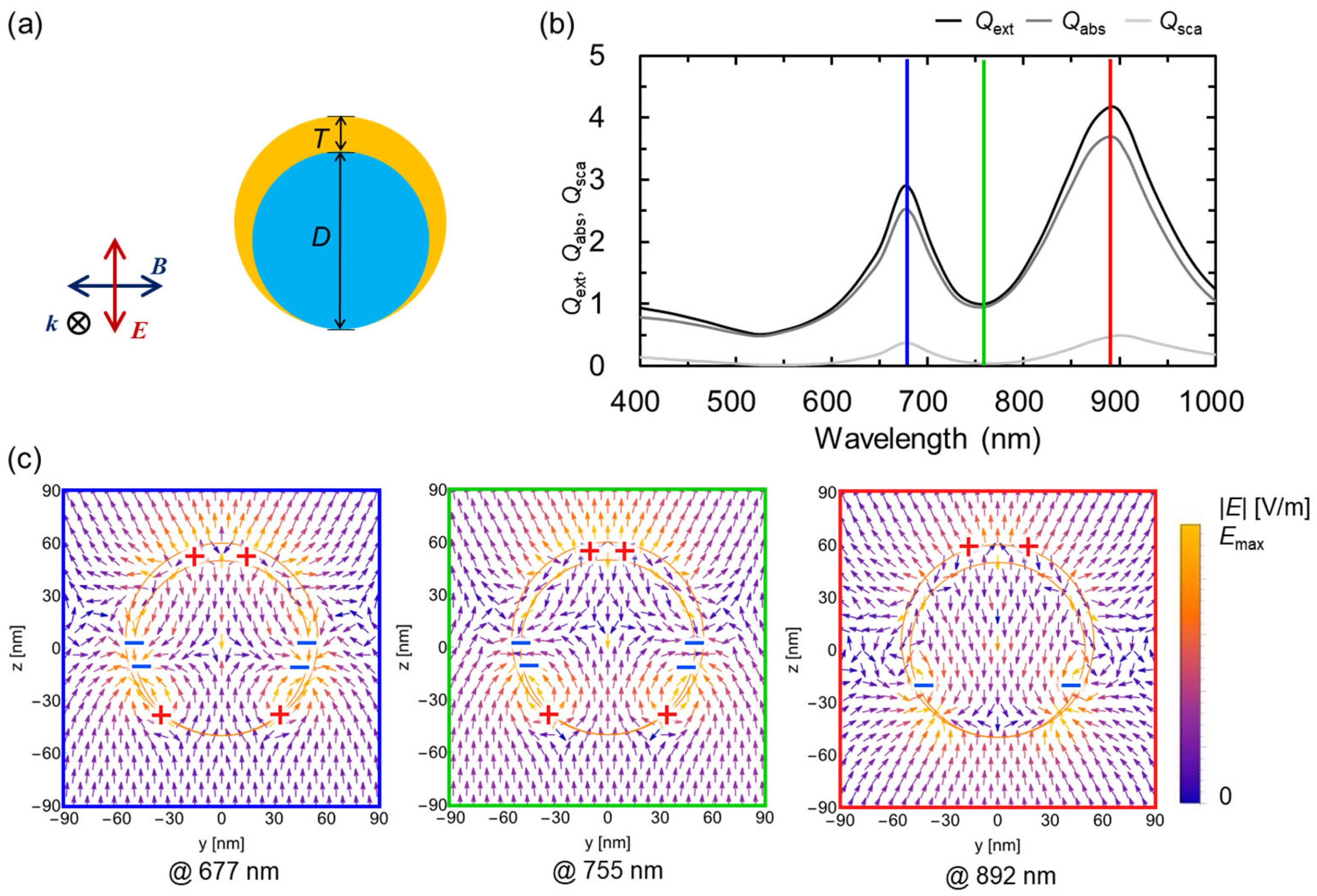
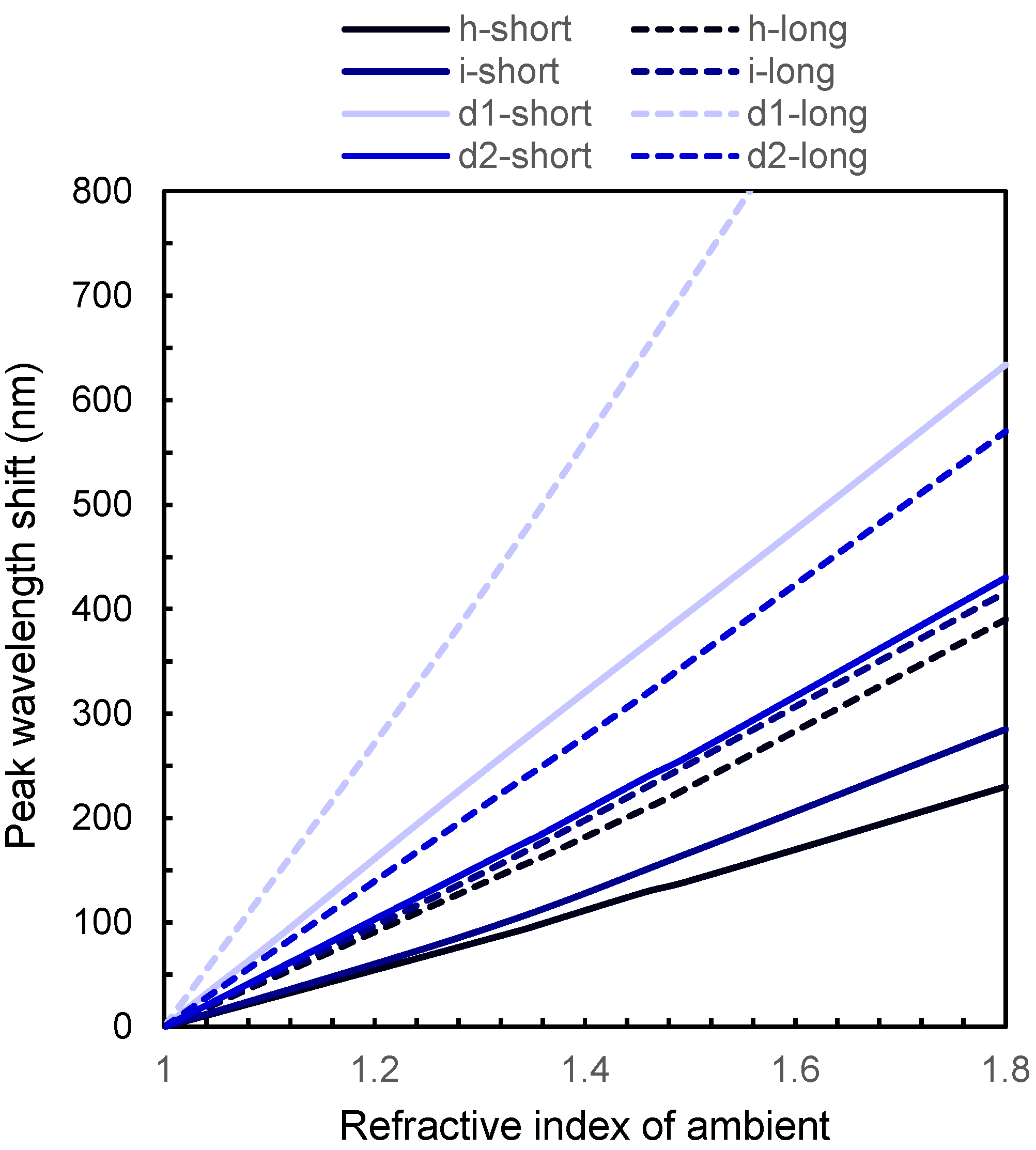
Plasmonic nanostructures support localized surface plasmon resonances (LSPRs) which exhibit intense light–matter interactions, producing unique optical features such as high near-field enhancements and sharp spectral signatures. Among these, plasmon hybridization (PH) and Fano resonance (FR) are two key phenomena that enable tunable spectral responses, yet their classification is often ambiguous when based only on geometry or extinction spectra. In this study, we systematically investigate four representative nanostructures: a simple nanogap dimer (i-type structure), a dolmen structure, a heptamer nanodisk cluster, and a nanoshell particle. We utilize discrete dipole approximation (DDA) to analyze these structures. By separating scattering and absorption spectra and introducing quantitative spectral metrics together with near-field electric-field vector mapping, we provide a unified procedure to interpret resonance origins beyond intensity-only near-field plots. The results show that PH-like behavior can emerge in a dolmen structure commonly regarded as a Fano resonator, while FR-like characteristics can appear in the i-type structure under specific conditions, underscoring the importance of scattering/absorption decomposition and vector-field symmetry. We further evaluate refractive-index sensitivities and discuss implications for plasmonic sensing design.
Keywords: plasmon hybridization; Fano resonance; discrete dipole approximation plasmon hybridization; Fano resonance; discrete dipole approximation