Article

Red-Pitaya-Based Frequency Stabilization of 1560-nm Fiber Laser to 780-nm Rubidium Atomic Transition via Single-Pass Frequency Doubling

1
State Key Laboratory of Quantum Optics Technologies and Devices, and Institute of Opto-Electronics, Shanxi University, Taiyuan 030006, China
2
Collaborative Innovation Center of Extreme Optics, Shanxi University, Taiyuan 030006, China
*
Author to whom correspondence should be addressed.
Photonics 2026, 13(1), 57; https://doi.org/10.3390/photonics13010057
Submission received: 9 December 2025 / Revised: 29 December 2025 / Accepted: 6 January 2026 / Published: 7 January 2026
(This article belongs to the Special Issue Advanced Lasers and Their Applications, 3rd Edition)

Abstract

The single-step Rydberg excitation of cesium atoms requires a 319 nm ultraviolet laser with a narrow laser linewidth, high frequency stability, and high output power. To meet these requirements, in this work, we construct a high-power, single-frequency UV laser system at this wavelength. In this system, the frequency stabilization of the 1560.492 nm seed laser is critical to the performance of the ultraviolet laser. We employ nonlinear frequency conversion technology, the 1560.492 nm laser is frequency-doubled to 780.246 nm via a single pass through a PPLN crystal, and function integration is realized based on the modular parameter adjustment interface provided by the PyRPL software. Subsequently, the 1560.492 nm laser is stabilized to the D 2 hyperfine transition line of Rb-87 atoms using polarization spectroscopy (PS) and radio-frequency-modulated saturation absorption spectroscopy (RF-SAS). A comparative study of these two techniques shows that RF-SAS achieves superior stabilization performance, with the residual frequency fluctuation of the frequency-doubled laser being 1.07 MHz over 30 min. According to frequency doubling theory, the actual residual frequency fluctuation of the 1560.492 nm fundamental-frequency laser can be calculated as 0.535 MHz. Compared with our earlier scheme that utilized an ultra-low-expansion (ULE) optical cavity as a frequency reference, the present scheme eliminates the long-term drift induced by environmental factors. In contrast to frequency stabilization relying on discrete instruments, this integrated scheme significantly reduces the cost, simplifies the system architecture, saves space, and greatly enhances the flexibility and controllability of the system. It therefore provides a reliable and cost-effective solution to ensure the portability and practicability of high-performance UV laser sources. This high-precision frequency stabilization scheme directly guarantees the performance of the 319 nm UV laser, suppressing its linewidth below 10 kHz. Thus, it fully meets the stringent laser linewidth and frequency stability requirements for the single-step Rydberg excitation of cesium atoms and provides a reliable light source foundation for subsequent precision spectroscopic measurements.

1. Introduction

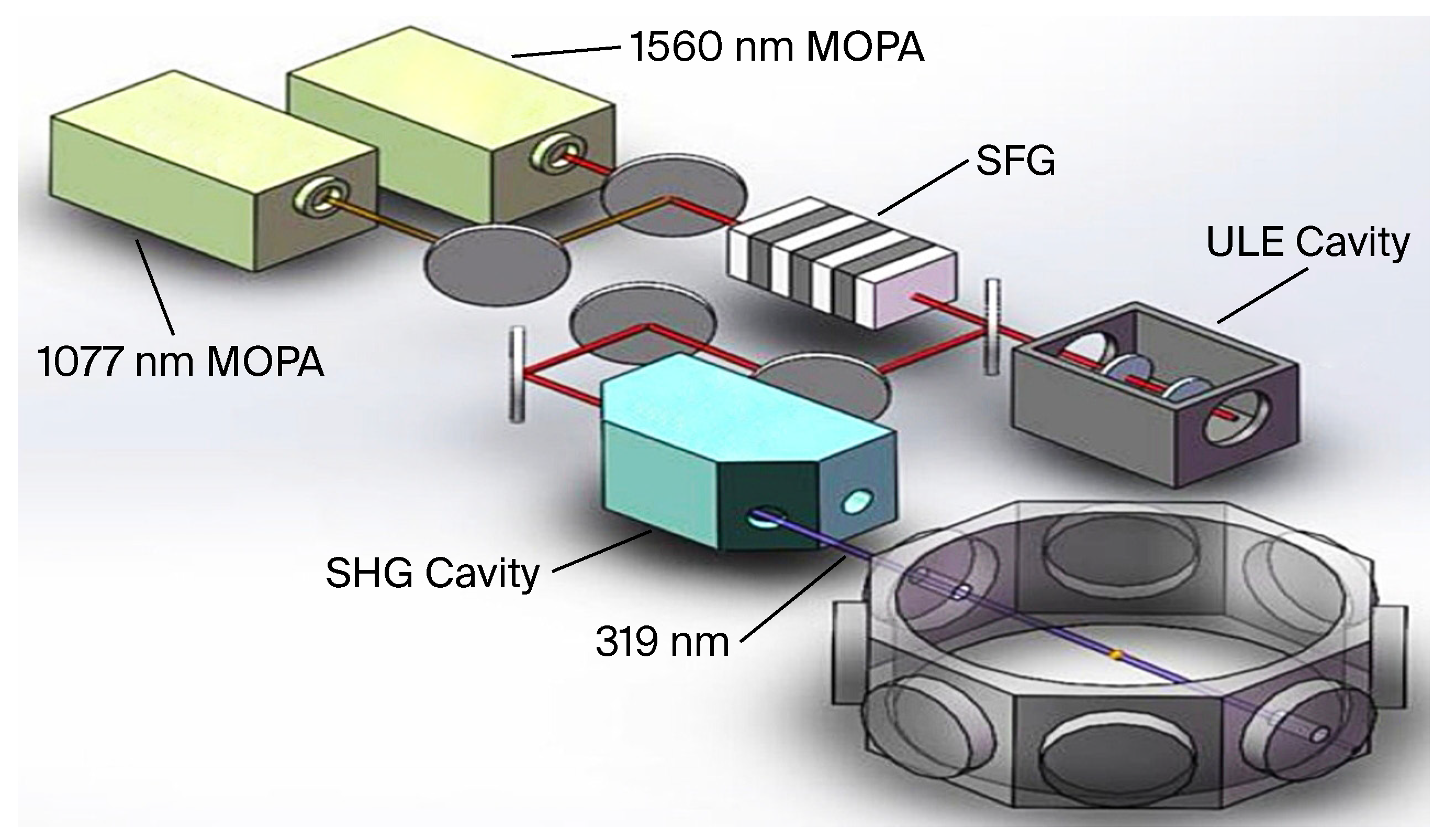
High-power, narrow-linewidth, continuously tunable, single-frequency ultraviolet (UV) lasers are of great significance in the field of atomic, molecular, and optical (AMO) physics [1,2,3,4]. In 2011, Wilson et al. successfully output 750 mW using a 313 nm UV laser by combining two infrared lasers and employing nonlinear crystal-based sum-frequency generation and cavity-enhanced second-harmonic generation technology [5]. Since then, UV laser generation technology has advanced rapidly. Based on this, we construct a 319 nm high-power, single-frequency UV laser system (as illustrated in Figure 1) [6]. Narrow-linewidth 1560 nm and 1077 nm Master-Oscillator Power Amplifier (MOPA) fiber lasers, operating at an output power of 10 W, are employed to produce a 638 nm red laser with an output power of 4.3 W via single-pass sum-frequency generation (SFG) with a PPMgO:LN crystal. Cavity-enhanced second-harmonic generation (SHG) with a BBO crystal is utilized to prepare a tunable single-frequency 319 nm UV laser for the single-step Rydberg excitation of cesium atoms. When the input power of the 638 nm laser is 2.3 W, the output power of the 319 nm laser is 1.1 W. The frequency stability of the 1560 nm and 1077 nm lasers, as fundamental frequency lights, is of great significance to the stability of the 319 nm ultraviolet laser system. For the 1077 nm laser, we achieve its stabilization by preparing 319 nm Rydberg spectra. In the previous version, an ultra-low-expansion (ULE) optical cavity was used as a frequency reference to lock the 1560 nm fiber laser [7]. Although this scheme can offer exceptionally high short-term frequency stability, as a relative frequency standard, it has certain limitations. In particular, the resonant frequency of the ULE optical cavity is susceptible to slow drift due to environmental factors such as temperature fluctuations and vacuum degree variations, leading to the long-term frequency drift of the stabilized laser. To solve this problem, we improve the stabilization scheme to an absolute atomic frequency standard. In the new version, the 780 nm hyperfine transition line of rubidium-87 atoms is used as an absolute frequency reference to lock the 1560 nm fiber laser to 780 nm via single-pass SHG. This frequency reference standard has already been established and is employed in the calibration of fiber-optic communication channels and optical wavemeters.
Laser frequency doubling technology has matured over the past several decades. In 1968, Boyd et al. laid the theoretical foundation for efficient frequency doubling by analytically studying the focusing conditions of Gaussian beams in nonlinear crystals and calculating the optimal focusing parameters [8]. Since then, the field has witnessed an increase in second-harmonic generation experiments. The technical route using PPLN crystals for high-efficiency conversion from 1560 nm to 780 nm has seen substantial progress, resulting in consistently increasing conversion efficiencies [9,10,11]. In 2013, Shanlong Guo et al. from our group implemented and compared three different Quasi-Phase-Matching (QPM) frequency doubling configurations using PPLN crystals, producing 780 nm light output at various power levels, with stabilization achieved via Modulation Transfer Spectroscopy (MTS) [12].
Since their inception, polarization spectroscopy (PS) and RF saturation absorption spectroscopy (RF-SAS) have been widely applied in high-precision laser frequency stabilization. Wieman and Hänsch first proposed the PS stabilization technique in 1976 [13]. In 1980, Gary C. Bjorklund et al. demonstrated a novel wavelength modulation laser spectroscopy technique using an external phase modulator [14]. In 2003, Yutaka Yoshikawa et al. applied PS to the hyperfine transition of 87-Rb atoms [15]. In 2007, Shin Masuda et al. used radio-frequency-modulated saturation absorption spectroscopy to stabilize a 1560 nm semiconductor laser to the rubidium atom transition line [16].
In this study, we establish a highly stable laser system referenced directly to the center frequency of an atomic transition line. We frequency-double the 1560.492 nm laser to 780.246 nm, which precisely corresponds to the 87-Rb atom D 2 hyperfine transition line (5 S 1 / 2 , F = 2 → 5 P 3 / 2 , F’ = 3). Based on highly integrated, programmable Red Pitaya FPGA boards, two sets of digital feedback control systems are built in order to compare two highly sensitive laser frequency stabilization schemes, PS and RF-SAS, achieving the frequency stabilization of the 1560.492 nm laser. Experimental results show that, under identical test conditions, the stabilization scheme based on RF-SAS exhibits superior performance compared to the PS scheme in terms of long-term frequency stability and robustness against environmental perturbations. In contrast to frequency stabilization relying on discrete benchtop instruments, this integrated scheme requires a single compact platform, which significantly reduces the hardware costs, streamlines the system’s architecture, minimizes the spatial footprint, and substantially enhances the system’s flexibility and controllability. By integrating core functions such as signal generation, lock-in amplification, and proportional–integral–derivative (PID) feedback control into the Red Pitaya FPGA board, this scheme eliminates the signal transmission losses and electromagnetic interference that are inherent in discrete instrument setups, while enabling convenient digital programming and parameter optimization. This advancement provides a reliable, cost-effective, and miniaturized solution to ensure the portability and practicability of high-performance ultraviolet laser sources. Notably, this high-precision frequency stabilization scheme directly guarantees the performance of the terminal 319 nm UV laser. Leveraging the stable output of the 1560.492 nm fundamental laser, the 319 nm UV laser achieves a linewidth suppressed below 10 kHz, fully meeting the stringent laser linewidth and frequency stability requirements in the single-step Rydberg excitation of cesium atoms. This provides a strong foundation for subsequent high-precision spectroscopic measurements and quantum optics experiments. Given its excellent output characteristics, including a narrow linewidth, high frequency stability, and high power, the 319 nm UV laser holds broad application potential in cutting-edge fields such as laser cooling and trapping of Be + ions [1], Rydberg excitation [6,17], interaction experiments with 4-He cold atoms [18], etc., where ultra-stable and high-performance UV light sources are indispensable.

2. Experimental Principles

2.1. Selection of the Frequency-Doubling Crystal

The PPLN crystal is a representative material for the QPM technique. Through the precise design of different poling periods, the same PPLN crystal can be adapted to lasers of different wavelengths, significantly expanding its applicability in nonlinear frequency conversion. The most prominent advantage of this type of crystal is its large second-order nonlinear conversion coefficient ( d e f f = 17–18 pm/V), enabling notably higher frequency conversion efficiencies under identical optical powers, crystal lengths, and beam quality compared to most common nonlinear crystals. Furthermore, PPLN crystals offer advantages such as a simple phase matching method and no walk-off angle. In this study, we utilize a 5% magnesium oxide-doped PPLN (PPMgO:LN) crystal; it effectively suppresses the inherent photorefractive effect in lithium niobate crystals, increases the optical damage threshold, and fundamentally avoids the decline in conversion efficiency and beam waveform distortion caused by light-induced refractive index inhomogeneities. Additionally, it significantly reduces the phase matching temperature, providing a reliable hardware foundation for the long-term, stable, and efficient operation of the experimental system under high-power conditions. The nonlinear conversion coefficient for a single pass through the crystal is
E N L = 8 π l d e f f 2 c λ 2 n 2 ε 0 k 1 h m σ m , B , ξ
where h m represents the focusing factor [8], expressed as
h m σ m , B , ξ = 1 4 ξ ξ ξ d τ d τ × exp i σ m ( τ τ ) ξ 1 ( τ τ ) 2 B 2 ( 1 + i τ ) ( 1 i τ )
Here, σ m is the phase shift parameter, which can be written as
σ m = b k 2
where l is the crystal length, d e f f is the effective nonlinear coefficient of the crystal, c is the speed of light in a vacuum, and λ is the fundamental wavelength. Meanwhile, n is the refractive index of the crystal for the fundamental light, ε 0 is the vacuum permittivity, k 1 is the magnitude of the wave vector of the fundamental light in the nonlinear crystal, b = 2 π w 0 2 / λ is the confocal parameter, w 0 is the beam waist radius in the crystal, Δ k is the phase mismatch, and ξ = l / b is the focusing parameter.
A small ξ ( l b ) signifies weak focusing, where the beam remains nearly parallel in the crystal and the interaction length is long but the power density is low; A large ξ ( l b ) signifies strong focusing, where the beam diverges rapidly in the crystal, although the power density at the focus is high, the effective interaction volume is very small. When the beam satisfies the optimal focusing condition, ξ = 2.84 [8], it achieves the best balance between a long effective nonlinear interaction length and high power density, maximizing the nonlinear conversion efficiency of the crystal.

2.2. Polarization Spectroscopy

The core aspect of polarization spectroscopy lies in the use of a powerful, circularly polarized pump light to induce optical pumping effects at atomic energy levels. This process enables the conversion of the laser frequency detuning relative to the atomic transition center frequency into changes in the polarization state of a probe laser, thereby producing an error signal for feedback control. In the typical polarization spectroscopy setup, a weak probe beam and a strong counterpropagating pump beam pass through a rubidium atomic vapor cell. Without the pump beam, atoms are uniformly populated across different Zeeman sublevels of the ground state. When a strong, circularly polarized pump beam interacts with the atoms, differences in the Clebsch–Gordan (CG) coefficients between different Zeeman states affect the population distributions of ground-state atoms. The pump light preferentially excites atoms at specific magnetic sublevels, selectively pumping atoms to different excited states. The different populations of atoms at various energy levels cause the atomic medium to exhibit different refractive indices and absorption coefficients for the σ + and σ circular polarization components of the probe light [19]. The probe light, which is initially linearly polarized, can be regarded as the coherent superposition of the σ + and σ + components. After passing through the atomic cell, the action of the pump light causes differences in absorption for the two light components; their propagation speeds also differ, generating a phase difference between them and ultimately changing the polarization of the probe light. By placing a half-waveplate ( λ / 2 ) followed by a polarizing beam splitter (PBS) in the probe path after the cell, the orthogonal polarization components can be separated and directed by a balanced differential photodetector. The obtained differential signal exhibits a standard dispersion-shaped curve centered precisely at the atomic resonance frequency, which serves as the error signal for frequency stabilization. For the 87-Rb 5 S 1 / 2 , F = 2 → 5 P 3 / 2 , F’ = 3 transition, the CG coefficient is the largest, indicating the highest transition probability. Furthermore, this transition is a closed cycling transition, which manifests as the strongest dispersion signal in polarization spectroscopy. As a frequency stabilization technology, polarization spectroscopy has the advantages of a high resolution, zero background, and high signal-to-noise ratio.

2.3. RF Saturation Absorption Spectroscopy

Saturation absorption spectroscopy (SAS) uses the nonlinear saturation effect to eliminate Doppler broadening. In this setup, a strong pump beam and a weak probe beam counterpropagate through an atomic vapor cell. When the laser frequency is scanned to the atomic resonance frequency, the beams interact with atoms having a “zero” velocity component along the beam direction in the cell due to the Doppler effect. The pump beam resonantly excites these atoms to the excited state, reducing the population of ground-state atoms and creating a “spectral hole” in the Doppler-broadened absorption line. When the probe beam interacts with the atoms, the absorption is reduced, and its transmission intensity shows a sharp peak at the resonance frequency, known as the saturation absorption peak. For frequency stabilization using SAS, low-frequency modulation is typically applied directly to the laser. Subsequently, phase-sensitive detection technology is employed to extract a dispersion-like error signal with a zero point at the resonance center. This error signal is finally fed into a closed-loop negative feedback control system to stabilize the laser frequency. In contrast, RF-SAS introduces external modulation via an electro-optic modulator (EOM) or an acousto-optic modulator (AOM). The modulation frequency is chosen to be significantly higher than the 1/f noise region. This approach avoids perturbing the laser’s intrinsic properties, thereby substantially reducing the system’s noise floor. Consequently, as well as maintaining an ultra-high spectral resolution, this method greatly enhances the sensitivity, precision, and long-term stability of the frequency stabilization system. In corresponding experiments, a beam at frequency ω c passes through an EOM, generating sidebands at ω c ± ω m . Under a shallow modulation depth, only first-order sidebands are considered. The electric field vector of the modulated beam is described as follows [16]:
E = E 0 sin t ω c + δ sin ω m t
This expression can be expanded using the Bessel functions
E = E 0 [ n = 0 J n ( δ ) sin ( ω c + n ω m ) t + n = 1 ( 1 ) n J n ( δ ) sin ( ω c n ω m ) t ]
where E 0 is the amplitude of the electric field vector, J n ( δ ) is the n-th order Bessel function, δ is the modulation depth, and t is time. The probe beam, carrying modulation information, is detected by a photodetector. The signal is then mixed with the original RF modulation signal to extract the error signal required for frequency stabilization.

3. Experimental Setup

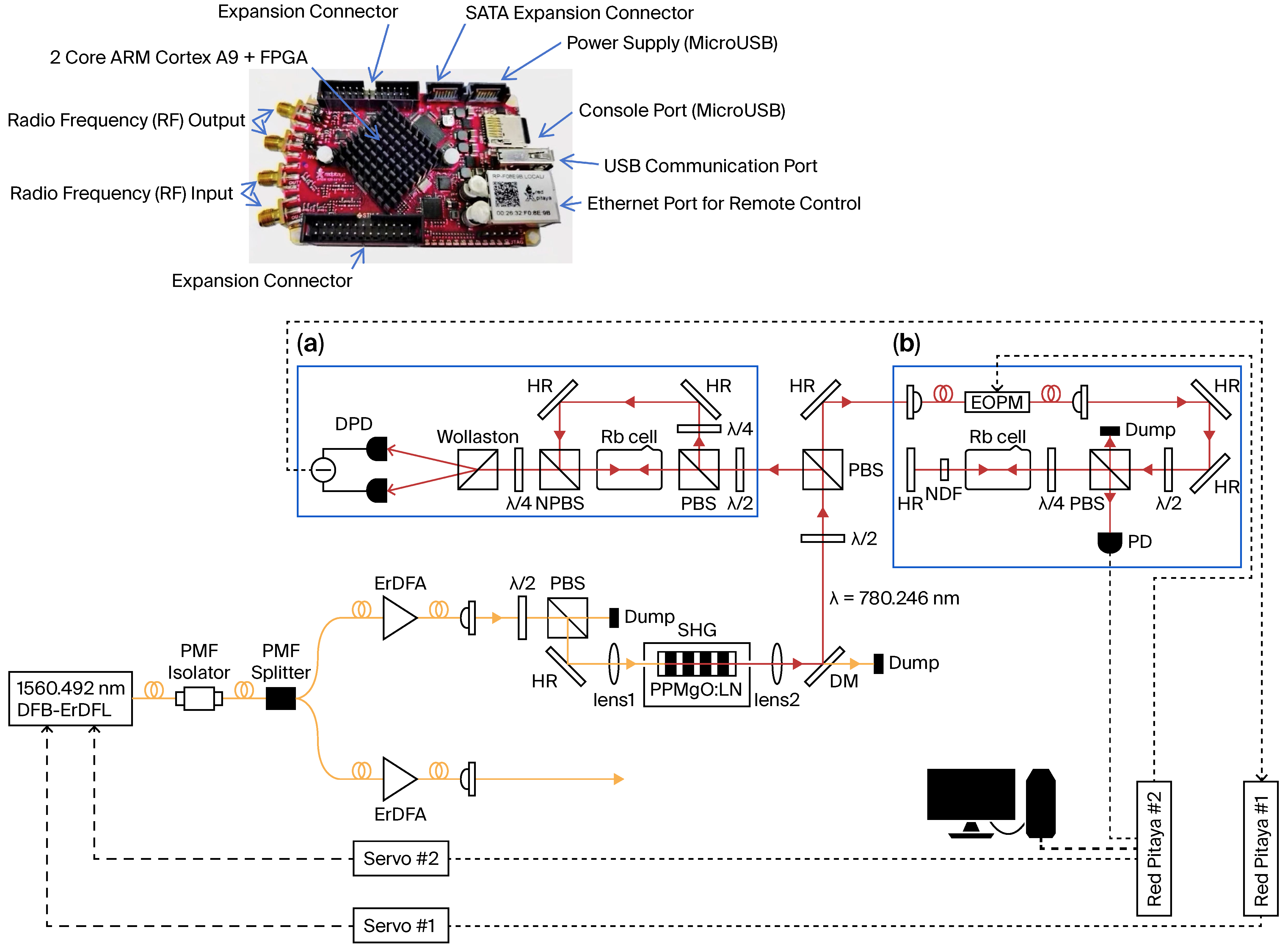
The experimental setup is illustrated in Figure 2. DFB-ErDFL@1560.492 nm serves as the seed source. To eliminate optical feedback, the source is split into two beams via a polarization-maintaining fiber splitter. The beams are then individually injected into separate ErDFA@1560.492 nm sources, constituting two independent MOPA systems. The output laser from the first MOPA system is combined with the output from a MOPA@1076.956 nm system, this combined beam undergoes single-pass sum-frequency generation in a bulk PPMgO:LN crystal to produce 638 nm red light. This red light is then frequency-doubled to 319 nm ultraviolet light using a dual-Brewster-cut BBO crystal. The output laser from the second 1560.492 nm MOPA system is converted into s-polarized light using a λ / 2 waveplate and a PBS. It is then focused into a bulk PPMgO:LN crystal (dimensions: 25 mm × 3.4 mm × 1 mm) using a 75 mm plano-convex lens. The laser’s operating temperature is precisely adjusted to 38.850 °C, monitored by a wavemeter, resulting in a frequency-doubled output wavelength of 780.246 nm. This 780.246 nm laser beam is subsequently split by another λ / 2 waveplate and PBS. The reflected portion is directed into the PS setup for rubidium atoms, while the transmitted portion is directed into the RF-SAS setup for rubidium atoms. In both optical paths, the first λ / 2 waveplate is used to adjust the power splitting ratio between the probe and pump beams. Figure 2a shows the PS apparatus. The weak p-polarized component light after the λ / 2 and PBS serves as the probe beam, with power of 310 μW, while the strong s-polarized component light serves as the pump beam, with power of 1.02 mW. The pump beam passes through a quarter-waveplate ( λ / 4 ), where it is converted from linearly polarized to circularly polarized light. The two beams interact in a natural abundance rubidium atomic vapor cell. After the cell, the probe beam passes through another λ / 4 waveplate and a Wollaston prism, which separates it into two orthogonally polarized components. These are detected by a balanced differential photodetector. Figure 2b illustrates the RF-SAS setup. The 780.246 nm laser is frequency-modulated via a polarization-maintaining fiber pig-tailed electro-optic frequency modulator (EOPM). The spectroscopic signal is detected using the SAS configuration. Two independent Red Pitaya boards (model STEMlab 125-14, sampling rate of 125 Msps, 14-bit resolution) are utilized across the entire system to stabilize the 1560.492 nm laser.
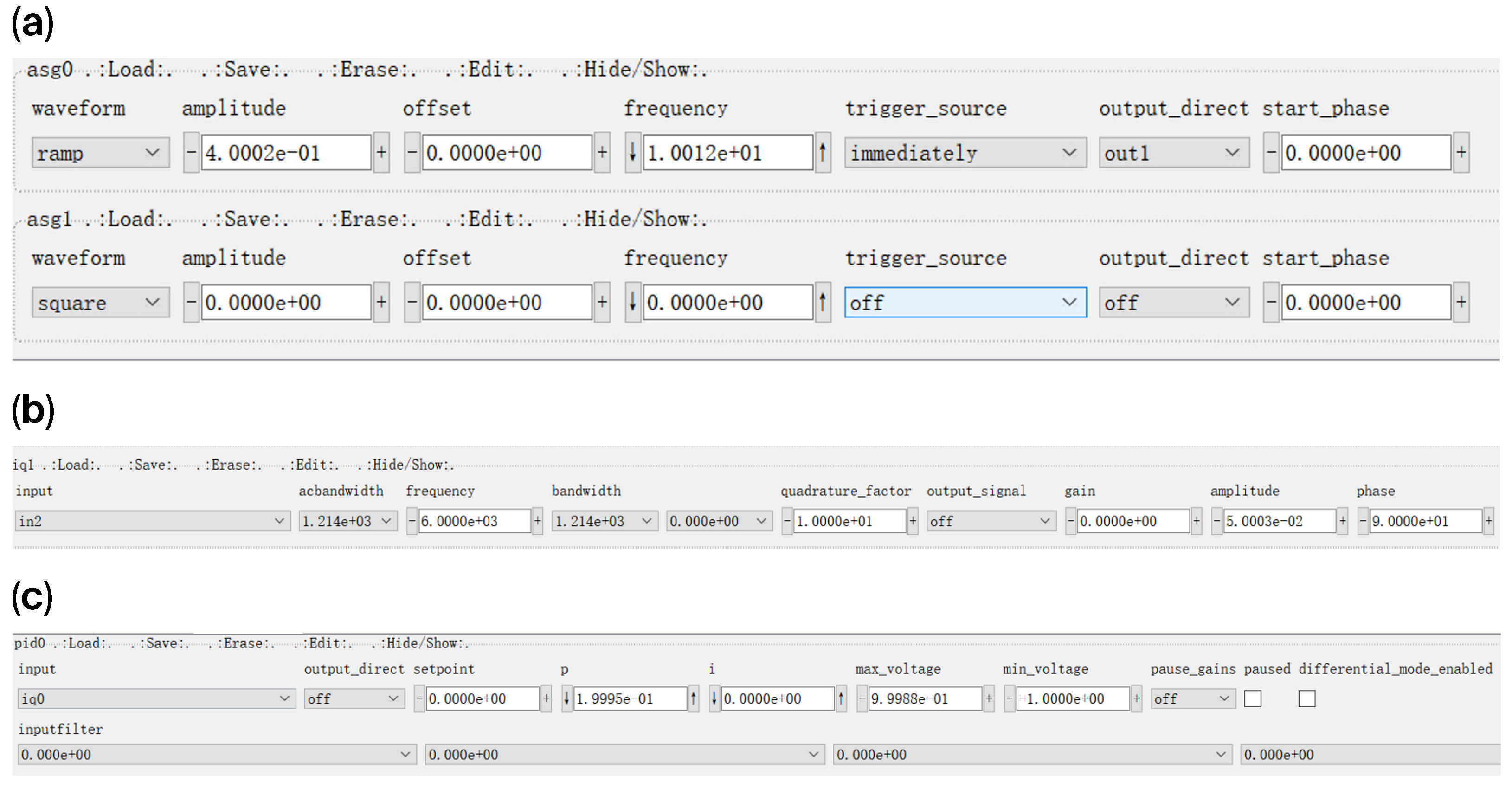
The inset shows the Red Pitaya FPGA module. This integrated device functionally replaces the signal generator, lock-in amplifier, PID controller, oscilloscope, etc. The synchronous control of multiple boards by a single computer is achieved through a switch, significantly improving system integration and operational flexibility [7,20,21,22,23]. The Red Pitaya modules adopted in this system can be replaced by other FPGA-based boards with similar functions (such as NI VirtualBench, Zynq SoC, etc.). The selection of different hardware can be flexibly adjusted according to experimental budget, development cycle, and performance requirements. Figure 3 displays the PyRPL software’s parameter configuration interface. Figure 3a shows the arbitrary signal generator (asg) module, which allows the generation of various waveform signals (such as triangle waves, sine waves, and sawtooth waves) and allows users to precisely set the signal frequency, amplitude, offset, etc., meeting various requirements. Figure 3b shows the in-phase and quadrature (iq) module. The modulation frequency can reach up to 62 MHz, with an adjustable amplitude within the range of 0 to 1 V. After setting the frequency, amplitude, and phase, the modulation signal is output. The raw signal from the photodetector is input into the Red Pitaya and mixed with this modulation signal. Demodulation is performed by adjusting parameters including the acbandwidth (high-pass filter), bandwidth (low-pass filter), and quadrature factor and ultimately extracting the error signal. Figure 3c shows the proportional–integral–derivative (pid) controller module. The error signal is fed into this module, where the user can calculate and generate the corresponding feedback control signal in real time after setting parameters such as the setpoint, proportional gain (P), and integral gain (I). By integrating these modules for system frequency stabilization, we achieve a reduction in cost, significant space savings, and a simplified experimental setup.

4. Experimental Results and Discussion

4.1. Quasi-Phase-Matching Single-Pass Frequency Doubling Using a PPMgO:LN Crystal

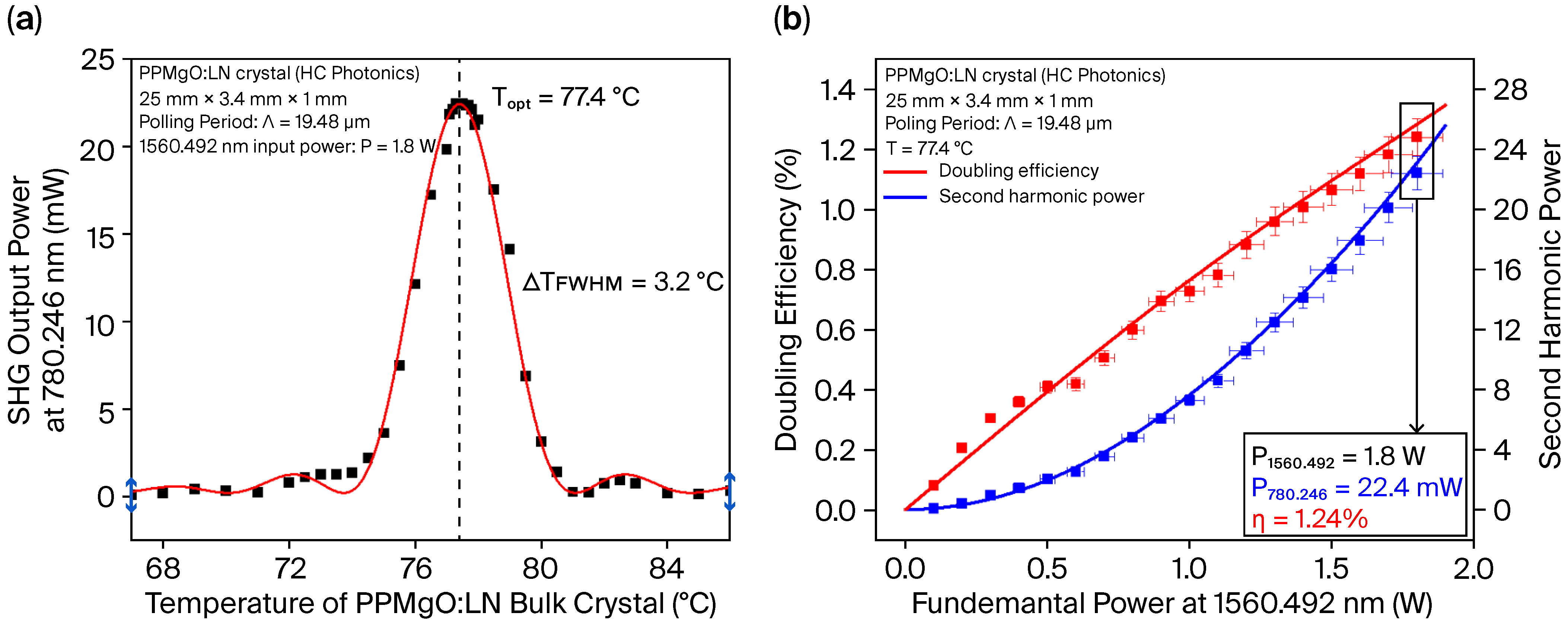
Figure 4 shows the experimental results obtained through quasi-phase-matching single-pass frequency doubling using a PPMgO:LN crystal. Figure 4a shows the experimentally measured single-pass frequency doubling output power at 780.246 nm with a PPMgO:LN crystal. Square points are experimental data points, and the solid line is the theoretical fitting curve obtained using the s i n c 2 function. The crystal length is 25 mm and the poling period is 19.48 μm. With the fundamental power at 1560.492 nm maintained at 1.8 W and input into the crystal, the maximum second-harmonic output power is achieved at a temperature of 77.4 ° C , corresponding to conversion efficiency of 1.24%. The full width at half-maximum (FWHM) of the fitted curve determines the temperature acceptance bandwidth of the crystal, which is Δ T = 3.2   ° C . Figure 4b shows the dependence of the second-harmonic power on the fundamental power. Square points represent experimental data points, and the solid line indicates the conversion efficiency. The data show that the conversion efficiency increases continuously with the fundamental power, with no significant saturation effect observed within this power range.

4.2. Frequency Stabilization of the 1560.492 nm Laser

4.2.1. Free-Running Case

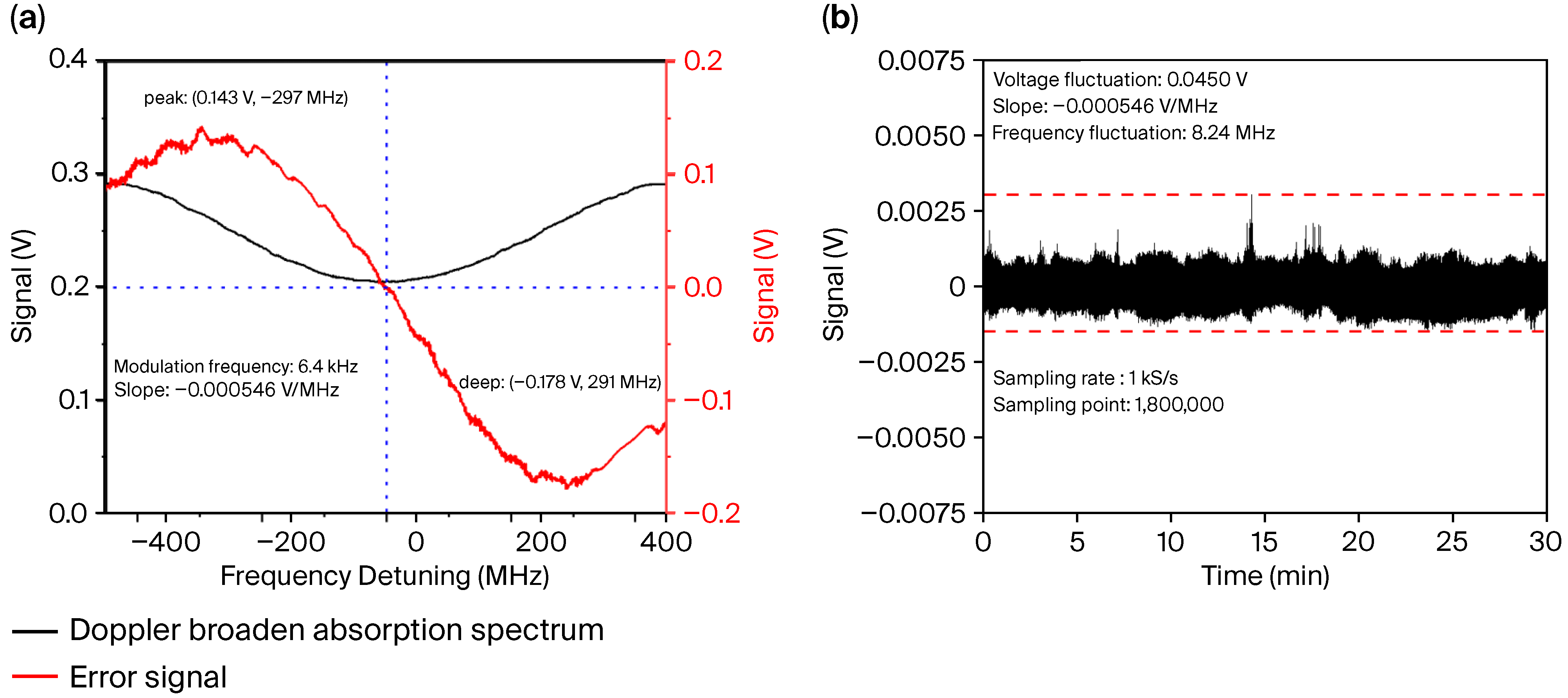
In the PS setup, only the probe beam transmitted through the atomic vapor cell is allowed to enter the photodetector. The Doppler-broadened background is obtained by scanning the laser cavity length, as shown by the black solid line in Figure 5a. The asg module of the Red Pitaya board outputs a triangular wave with a scan frequency of 10 Hz and an amplitude of 0.4 V. Sinusoidal modulation at 6.4 kHz with an amplitude of 9 mV is applied to the laser via the iq module. After processing, the demodulated error signal, displayed as the red solid line in Figure 5a, exhibits a dispersion-like lineshape with a relatively high signal-to-noise ratio. Its zero-crossing point corresponds precisely to the center of the atomic transition line. The output signal from the iq module is fed internally within the Red Pitaya to the pid controller. The output signal is continuously monitored using a high-precision digital multimeter connected to the Output2 port. The resulting characteristic residual frequency fluctuation of the free-running laser, measured over 30 min, is approximately 8.24 MHz, as shown in Figure 5b.

4.2.2. Frequency Stabilization Using Polarization Spectroscopy

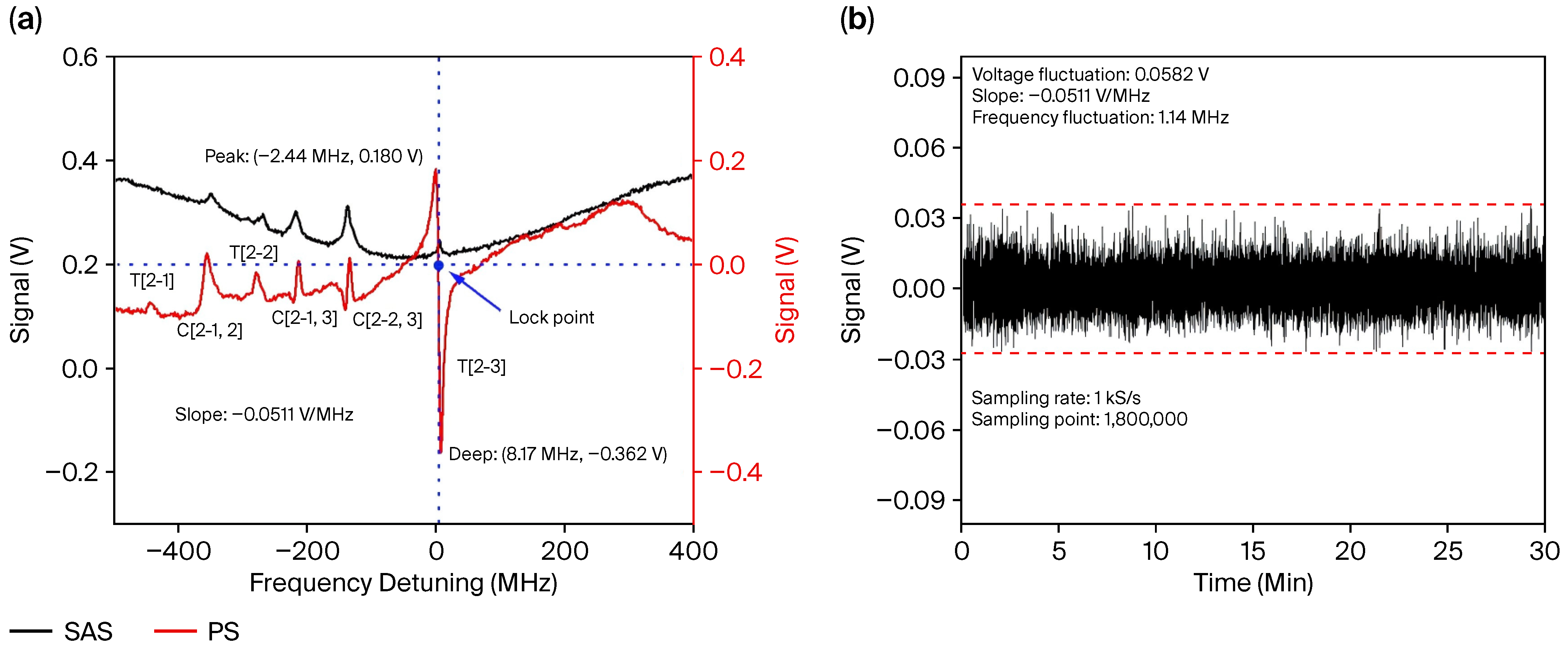
Based on polarization spectroscopy, the 780.246 nm laser, which is generated by the frequency-stabilized 1560 nm laser, is stabilized to the 5 S 1 / 2 , F = 2 → 5 P 3 / 2 , F’ = 3 hyperfine transition line of 87-Rb atoms using a Red Pitaya board. In the experiment, the dispersion-shaped signal extracted by a balanced differential detector (as shown in Figure 6a) is input into the Red Pitaya board via Input1 and enters the pid control module. After optimizing the pi parameters, the processed signal is fed back to the piezoelectric transducer (PZT) of the laser, constituting a frequency servo control loop, to achieve the frequency stabilization of the laser. After stabilization, the typical residual frequency fluctuation of the laser over 30 min is approximately 1.14 MHz, as illustrated in Figure 6b.

4.2.3. Frequency Stabilization Using RF Saturation Absorption Spectroscopy

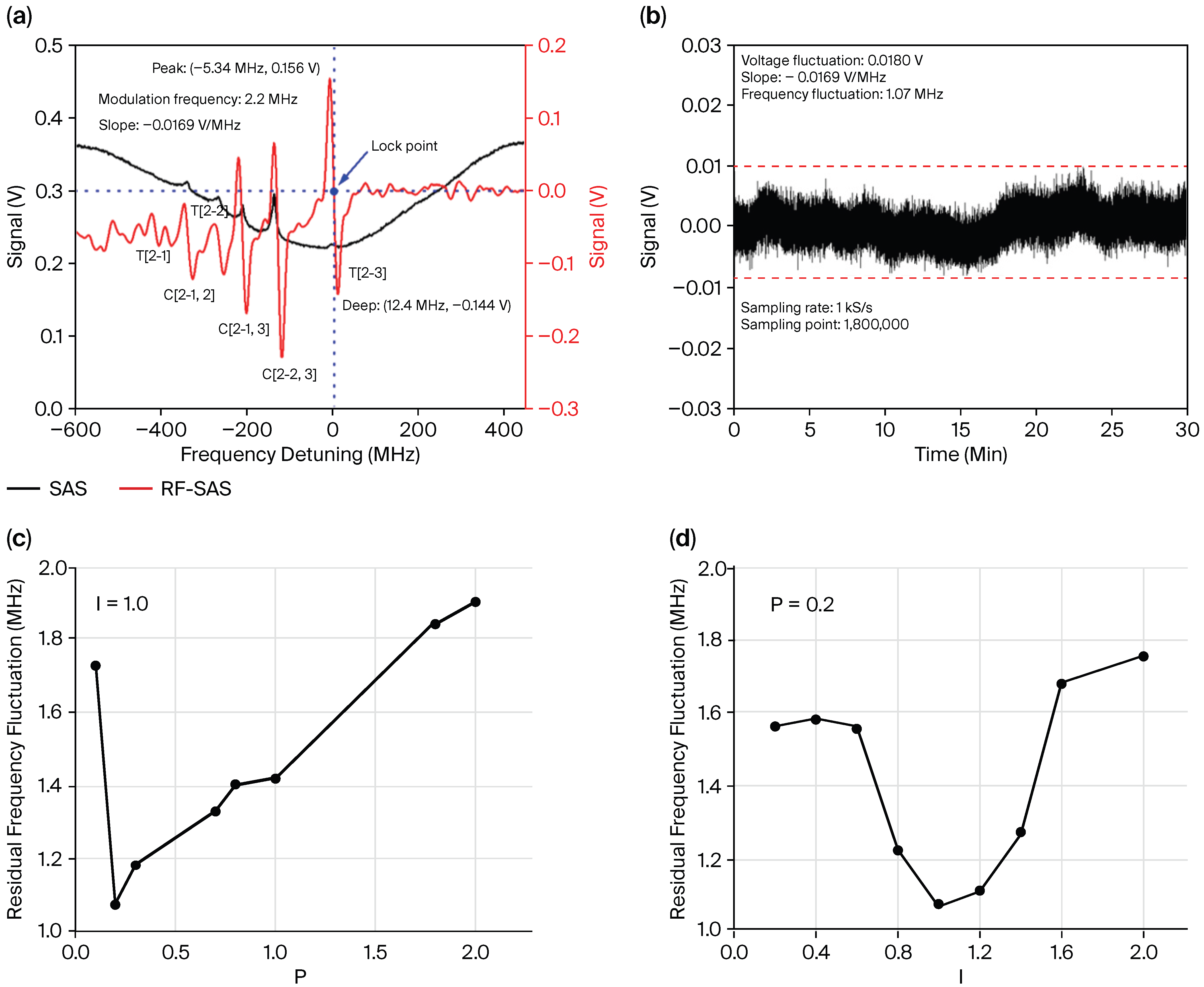
Based on RF saturation absorption spectroscopy, the 780.246 nm laser, which is generated by the frequency-stabilized 1560 nm laser, is stabilized to the 5 S 1 / 2 , F = 2 → 5 P 3 / 2 , F’ = 3 hyperfine transition line of 87-Rb atoms using a Red Pitaya board. When the modulation frequency is set to 2.2 MHz with a modulation amplitude of 0.8 V, the extracted error signal is as shown in Figure 7a. The stabilization performance is critically dependent on the P and I settings of the PID controller. Figure 7c,d present the residual frequency fluctuations under various PI parameter values. When optimized to P = 0.2 and I = 1, the laser’s residual frequency fluctuation over 30 min is minimized to approximately 1.07 MHz, as shown in Figure 7b. Ignoring additional noise introduced by the frequency doubling process, the residual frequency fluctuation of the second-harmonic light ( Δ ω 2 ) and the fundamental- frequency light ( Δ ω 1 ) satisfy: Δ ω 1 = Δ ω 2 / 2 . Substituting 1.07 MHz into the formula directly yields the residual frequency fluctuation of the 1560.492 nm fundamental-frequency light as 0.535 MHz.

4.3. Comparison of the Two Frequency Stabilization Methods

Based on the comparative analysis of the above experimental data, it can be concluded that, in the context of this study, the laser frequency stabilization achieved through RF-SAS is more effective than that in the polarization spectroscopy scheme in terms of long-term stability. In terms of residual frequency fluctuations, the frequency stabilization system based on RF-SAS exhibits a fluctuation of 1.07 MHz over 30 min, while the result for the PS scheme is 1.14 MHz. Compared to the typical residual frequency fluctuation of the free-running laser, the former achieves an approximately 7.7-times improvement.
The essential difference in the two spectroscopic techniques lies in their distinct working mechanisms in terms of long-term stability. Under ideal conditions, polarization spectroscopy yields an extremely high signal-to-noise ratio (SNR) because it is a “zero-background” technique. However, polarization spectroscopy relies on atomic-level population changes induced by optical pumping effects. During experiments, it is highly susceptible to disturbances such as laser intensity fluctuations and temperature variations in the atomic vapor cell, resulting in low-frequency noise in the error signal baseline. In contrast, although the configuration of the RF-SAS system requires additional radio-frequency generators and modulators, leading to a slight increase in system complexity, it shifts signal spectroscopy to the high-frequency region through RF modulation, effectively avoiding the low-frequency noise (1/f noise) region of the laser. Consequently, the acquired signal is less affected by environmental perturbations. In summary, RF saturation absorption spectroscopy, with its excellent noise suppression and higher signal quality, achieved higher frequency stability in this study. This work demonstrates the advantages of RF saturation absorption spectroscopy in the field of precision laser frequency stabilization, being particularly suitable for cutting-edge research applications such as quantum information processing and optical clocks, which carry stringent requirements in terms of laser frequency noise and long-term drift.

5. Conclusions and Perspectives

In this work, we describe a laser frequency stabilization system based on quasi-phase-matching nonlinear frequency conversion technology. Using a 1560.492 nm laser as the seed source, the output beam passes through a bulk PPMgO:LN crystal in a single pass. With a fundamental-frequency light injection power of 1.8 W and an optimized crystal temperature, 22.4 mW is generated by the 780.246 nm laser via frequency doubling, corresponding to conversion efficiency of approximately 1.24%.
To achieve the long-term frequency stabilization of the fundamental-frequency laser, the previously used scheme consisting of discrete PDH stabilization to an optical reference cavity is replaced with a highly integrated, programmable Red Pitaya FPGA module. In this study, two frequency stabilization schemes based on 87-Rb atomic polarization spectroscopy and RF saturation absorption spectroscopy were implemented and compared. This type of scheme has already been proposed and is employed in the calibration of fiber-optic communication channels and optical wavemeters [19,24]. Our experimental results show that both schemes can effectively stabilize the laser frequency, with RF-SAS achieving superior performance: the residual frequency fluctuation over 30 min is 1.07 MHz. According to frequency doubling theory, the actual residual frequency fluctuation of the 1560.492 nm fundamental-frequency laser can be calculated as 0.535 MHz. With the 1560 nm laser being frequency-locked, the 1077 nm laser adopts a two-stage tuning scheme (“temperature coarse tuning and Piezoelectric Transducer fine tuning”): 0.784 nm wavelength tuning (20–50 ° C , 1.87 GHz) via temperature adjustment, and 18 pm wavelength tuning (4.66 GHz) via 0–200 V triangular wave-driven PZT. Under continuous SHG cavity locking, the 638 nm laser achieves a 1.95 GHz continuous tuning range, and the 319 nm UV laser reaches a 3.9 GHz tuning range. This tuning range not only fully covers the resonant frequency interval required for 319 nm Rydberg excitation but also reserves sufficient redundancy to compensate for minor frequency drifts induced by environmental perturbations, thereby meeting the stringent requirements regarding laser frequency tunability in the single-step Rydberg excitation of cesium atoms. In addition, by employing the beat note technique, the linewidths of the DFB-ErDFL@1560.492 nm and YbDFL@1076.956 nm lasers were measured and found to be 368 Hz and 1.54 kHz, respectively. The linewidth of the resulting 638 nm laser is estimated to be, at most, 1.91 kHz. Based on this, the linewidth of the 319 nm ultraviolet laser is inferred to be below 10 kHz, thus meeting the requirements for single-step Rydberg excitation.
In this work, we successfully implemented the multifunctional Red Pitaya platform for the atomic spectroscopy-based frequency stabilization of a 1560.492 nm laser. By replacing traditional setups comprising multiple discrete instruments, it achieves the uniform integration of key functions such as lock-in amplification, modulation signal generation, and PID feedback control. This advancement not only significantly reduces the hardware costs and physical footprint but also enhances the flexibility and controllability of the stabilization system through its digitally programmable architecture. Its major significance lies in the provision of a high-performance, highly reliable, and cost-effective laser stabilization solution for experiments in precision spectroscopy and quantum optics. Endowed with this frequency stabilization scheme, the ultraviolet laser, with its excellent output performance, is expected to provide critical light source support for groundbreaking research in cutting-edge fields such as precision atomic physics and quantum metrology.


Author Contributions

Conceptualization, J.W.; methodology, J.W.; validation, Y.W. (Yirong Wei) and Z.W.; investigation, Y.W. (Yirong Wei), Z.W., Y.W. (Yuewei Wang), Y.Y., T.W., and R.C.; data curation, Y.W. (Yirong Wei); writing—original draft preparation, Y.W. (Yirong Wei); writing—review and editing, J.W.; supervision, J.W.; project administration, J.W.; funding acquisition, J.W. All authors have read and agreed to the published version of the manuscript.

Funding

This work was supported by the National Key Research and Development Program of China (2021YFA1402002), the National Natural Science Foundation of China (Grant No. 12474483), and the Fundamental Research Program of Shanxi Province of China (Grant No. 202403021211013).

Institutional Review Board Statement

Not applicable.

Informed Consent Statement

Not applicable.

Data Availability Statement

The data underlying the results presented in this paper are not publicly available at this time but may be obtained from the authors upon reasonable request.

Conflicts of Interest

The authors declare no conflicts of interest.

References

  1. Vasilyev, S.; Nevsky, A.; Ernsting, I. Compact all-solid-state continuous-wave single-frequency UV source with frequency stabilization for laser cooling of Be+ ions. Appl. Phys. B 2011, 103, 27–33. [Google Scholar] [CrossRef]
  2. Thoumany, P.; Hänsch, T.; Stania, G. Optical spectroscopy of rubidium Rydberg atoms with a 297 nm frequency doubled dye laser. Opt. Lett. 2009, 34, 1621–1623. [Google Scholar] [CrossRef]
  3. Koelemeij, J.C.J.; Hogervorst, W.; Vassen, W. High-power frequency-stabilized laser for laser cooling of metastable helium at 389 nm. Rev. Sci. Instrum. 2005, 76, 033104. [Google Scholar] [CrossRef]
  4. Tong, D.; Farooqi, S.M.; Stanojevic, J. Local blockade of Rydberg excitation in an ultra-cold gas. Phys. Rev. Lett. 2004, 93, 063001. [Google Scholar] [CrossRef]
  5. Wilson, A.C.; Ospelkaus, C.; VanDevender, A.P. A 750 mW, continuous-wave, solid-state laser source at 313 nm for cooling and manipulating trapped 9 Be+ ions. Appl. Phys. B 2011, 105, 741–748. [Google Scholar] [CrossRef]
  6. Wang, J.Y.; Bai, J.D.; He, J.; Liu, S.; Wang, J.M. Single-photon cesium Rydberg excitation spectroscopy using 318.6-nm UV laser and room-temperature vapor cell. Opt. Express 2017, 25, 22510–22518. [Google Scholar] [CrossRef]
  7. Su, W.J.; Wei, Y.R.; Hou, X.K.; Wang, J.M.; He, J. Application of FPGAs in frequency locking of the 319-nm ultraviolet single-frequency laser system. J. Quantum Opt. 2025, 31, 11001. (In Chinese) [Google Scholar]
  8. Boyd, G.D.; Kleinman, D.A. Parametric interaction of focused Gaussian light beams. J. Appl. Phys. 1968, 39, 3597–3639. [Google Scholar] [CrossRef]
  9. Thompson, R.J.; Tu, M.; Aveline, D.C.; Lundblad, N.; Maleki, L. High power single frequency 780 nm laser source generated from frequency doubling of a seeded fiber amplifier in a cascade of PPLN crystals. Opt. Express 2003, 11, 1709–1713. [Google Scholar] [CrossRef] [PubMed]
  10. Sané, S.S.; Bennetts, S.; Debs, J.E.; McDonald, G.D. 11 W narrow linewidth laser source at 780 nm for laser cooling and manipulation of rubidium. Opt. Express 2012, 20, 8915–8919. [Google Scholar] [CrossRef]
  11. Chiow, S.W.; Kovachy, T.; Hogan, J.M.; Kasevich, M.A. Generation of 43 W of quasi-continuous 780 nm laser light via high-efficiency, single-pass frequency doubling in periodically poled lithium niobate crystals. Opt. Lett. 2012, 37, 3861–3863. [Google Scholar] [CrossRef]
  12. Guo, S.L.; Wang, J.M.; Han, Y.S.; He, J. Frequency doubling of continuous-wave 1560 nm laser with single-pass, double-pass and cascaded MgO:PPLN crystals and frequency locking to Rb D2 line. Proc. SPIE 2013, 8772, 164–170. [Google Scholar]
  13. Wieman, C.; Hänsch, T.W. Doppler-free laser polarization spectroscopy. Phys. Rev. Lett. 1976, 36, 1170–1173. [Google Scholar] [CrossRef]
  14. Bjorklund, G.C. Frequency-modulation spectroscopy: A new method for measuring weak absorptions and dispersions. Opt. Lett. 1980, 5, 15–17. [Google Scholar] [CrossRef]
  15. Yoshikawa, Y.; Umeki, T.; Mukae, T.; Torii, Y.; Kuga, T. Frequency stabilization of a laser diode with use of light-induced birefringence in an atomic vapor. Appl. Opt. 2003, 42, 6645–6649. [Google Scholar] [CrossRef]
  16. Masuda, S.; Seki, A.; Niki, S. Optical frequency standard by using a 1560 nm diode laser locked to saturated absorption lines of rubidium vapor. Appl. Opt. 2007, 46, 4780–4785. [Google Scholar] [CrossRef]
  17. Bai, J.D.; Liu, S.; Wang, J.Y.; He, J.; Wang, J.M. Single-photon Rydberg excitation and trap-loss spectroscopy of cold cesium atoms in a magneto-optical trap by using a 319-nm ultraviolet laser system. IEEE J. Sel. Top. Quantum Electron. 2020, 26, 1600106. [Google Scholar] [CrossRef]
  18. Rengelink, R.J.; van der Werf, Y.; Notermans, R.P.M.J.W.; Jannin, R.; Eikema, K.S.; Hoogerland, M.D.; Vassen, W. Precision spectroscopy of helium in a magic wavelength optical dipole trap. Nat. Phys. 2018, 14, 1132–1137. [Google Scholar] [CrossRef]
  19. Polin, M.; Cry, N.; Latrasse, C.; Tétu, M. Progress in the realization of a frequency standard at 192.1 THz (1560.5 nm) using 87Rb-D2-line and second harmonic generation. IEEE Trans. Instrum. Meas. 1997, 46, 157–161. [Google Scholar] [CrossRef]
  20. Preuschoff, T.; Schlosser, M.; Birkl, G. Digital laser frequency and intensity stabilization based on the STEMlab platform (originally Red Pitaya). Rev. Sci. Instrum. 2020, 91, 083001. [Google Scholar] [CrossRef] [PubMed]
  21. Wiegand, B.; Leykauf, B.; Jördens, R.; Krutzik, M. A versatile, user-friendly, open-source FPGA-based tool for frequency stabilization and spectroscopy parameter optimization. Rev. Sci. Instrum. 2022, 93, 063001. [Google Scholar] [CrossRef] [PubMed]
  22. Zhang, P.; Wang, C.X.; Song, L.J.; Zhou, J.; Guo, C.Z. Frequency stabilization system of semiconductor laser based on FPGA. J. Quantum Opt. 2024, 30, 011001. (In Chinese) [Google Scholar]
  23. Guo, C.Z.; Wang, C.X.; Zhou, J.; Zhang, P.; Song, L.J. Frequency locking of fiber ring resonator based on FPGA. J. Quantum Opt. 2025, 31, 041001. (In Chinese) [Google Scholar]
  24. Mahal, V.; Arie, A.; Arbore, M.A.; Fejer, M.M. Quasi-phase-matched frequency doubling in a waveguide of a 1560-nm diode laser and locking to the rubidium D2 absorption lines. Opt. Lett. 1996, 21, 1217–1219. [Google Scholar] [CrossRef] [PubMed]
Figure 1. Schematic illustration of the 319 nm ultraviolet (UV) single-frequency laser system. Narrow-linewidth 1560 nm and 1077 nm MOPA fiber lasers are employed to produce a 638 nm red laser via single-pass sum-frequency generation (SFG) with a PPMgO:LN crystal. Cavity-enhanced second-harmonic generation (SHG) with a BBO crystal is utilized to prepare a tunable single-frequency 319 nm UV laser for the single-step Rydberg excitation of cesium atoms. In the previous version, an ultra-low-expansion (ULE) optical cavity was used as a frequency reference to lock the 1560 nm fiber laser. Meanwhile, in the new version, the 780 nm hyperfine transition line of rubidium-87 atoms is used as an absolute frequency reference to lock the 1560 nm fiber laser to 780 nm via single-pass SHG.
Photonics 13 00057 g001
Figure 2. Experimental setup. DFB-ErDFL: distributed-feedback erbium-doped fiber laser; PMF isolator: polarization-maintaining fiber isolator; PMF splitter: polarization-maintaining fiber splitter; ErDFA: erbium-doped fiber amplifier; λ / 2 : half-waveplate; PBS: polarized beam splitter cube; Dump: optical dump; HR: high-reflectivity mirror; DM: dichroic mirror; λ / 4 : quarter-waveplate; Wollaston: Wollaston prism; DPD: differential photodiode; EOPM: polarization-maintaining fiber pig-tailed electro-optic phase modulator; PD: photodiode; NDF: neutral density filter.
Photonics 13 00057 g002
Figure 3. Parameter configuration interface in PyRPL software: (a) asg module interface; (b) iq module interface; (c) pid module interface.
Photonics 13 00057 g003
Figure 4. Experimental results of quasi-phase-matching single-pass frequency doubling using a PPMgO:LN crystal. (a) Single-pass frequency doubling output power at 780.246 nm with a 25 mm long PPMgO:LN crystal and a fixed 1560.492 nm fiber laser input power vs. the temperature of the PPMgO:LN crystal. The optimized quasi-phase-matching temperature is 77.4 ° C with a temperature acceptance bandwidth of 3.2 ° C . (b) Single-pass frequency doubling output power (on the right-hand vertical axis) at 780.246 nm with a 25 mm long PPMgO:LN crystal at a fixed temperature of 77.4 ° C and the doubling efficiency (on the left-hand vertical axis) vs. the input power of the 1560.492 nm fundamental frequency laser in front of the crystal.
Photonics 13 00057 g004
Figure 5. Free-running condition of the 780.246 nm laser. (a) Rb atomic Doppler-broadened absorption spectroscopy and error signal; (b) typical frequency fluctuation of the 780.246 nm laser in the free-running case.
Photonics 13 00057 g005
Figure 6. Frequency stabilization of the 780.246 nm laser based on polarization spectroscopy technology. (a) Results of Rb saturation absorption spectroscopy (SAS) and PS; (b) typical residual frequency fluctuations of the 780.246 nm laser after frequency stabilization.
Photonics 13 00057 g006
Figure 7. Frequency stabilization of the 780.246 nm laser based on RF-SAS technology. (a) Results of Rb saturation absorption spectroscopy and RF-SAS; (b) typical residual frequency fluctuations of the 780.246 nm laser after frequency stabilization; (c) effects of the P parameter on the laser frequency; (d) effects of the I parameter on the laser frequency.
Photonics 13 00057 g007
Disclaimer/Publisher’s Note: The statements, opinions and data contained in all publications are solely those of the individual author(s) and contributor(s) and not of MDPI and/or the editor(s). MDPI and/or the editor(s) disclaim responsibility for any injury to people or property resulting from any ideas, methods, instructions or products referred to in the content.