
Article

IQ-Modulation Using Phase and Amplitude Modulators and Multimode Interference


by
Frank H. Peters
1,2
1
School of Physics, University College Cork, T12 K8AF Cork, Ireland
2
Integrated Photonics Group, Tyndall National Institute, T12 R5CP Cork, Ireland
Photonics 2026, 13(1), 44; https://doi.org/10.3390/photonics13010044
Submission received: 4 December 2025 / Revised: 23 December 2025 / Accepted: 24 December 2025 / Published: 31 December 2025
(This article belongs to the Special Issue Advances in Photonic–Electronic Integration)

Abstract

Optical amplitude and phase modulators are an integral part of modern optical communications systems. As optical data formats transitioned from encoding amplitude exclusively to both amplitude and phase, several different methods for creating the quadrature amplitude modulation (QAM) have been proposed, demonstrated and employed. This paper will provide an overview and analysis of current techniques for creating these signals and will then show how a more elegant and efficient design is possible by taking advantage of the phase properties of multimode interference devices (MMIs). Using two 2 × 2 MMIs in a Mach Zehnder configuration is a well-known technique for creating a BPSK signal using phase modulators and has also been shown to work with amplitude modulators. This paper will also show how two 4 × 4 MMIs can be used to create QAM signals using either phase or amplitude modulation.

1. Introduction

The continuous growth of data heavy applications, such as artificial intelligence, quantum processing and online video streaming has resulted in an ever-increasing demand for more bandwidth in data centers and the internet. Optical fiber communication enables the highest data rates and has come to dominate high bandwidth communication links. Optical fibers require space, and for long haul communications, significant but finite infrastructure. It has been practical for economic reasons to increase the information spectral density in the fiber as much as possible and as a result data is being encoded into the amplitude, phase and polarization of the optical signal. Polarization multiplexing is accomplished using a polarization preserving splitter or combiner [1]. In comparison, there are multiple techniques that can be used to vary amplitude and/or phase.
The Kerr [2] or Pockels [3] effect is used in electro-optic materials such as Lithium Niobate for phase modulation [4]; the Franz–Keldysh [5] or quantum confined Stark effect [6] is used in most semiconductors for either phase [7] or amplitude [6] modulation; and carrier injection/depletion [8] is used in group IV semiconductors for amplitude [9] or phase modulation [10]. The individual amplitude or phase modulation elements can then be combined to create larger modulators that can create signals using both amplitude and phase (IQ-Modulators) [11]. IQ-Modulators built as photonic integrated circuits (PICs) provide substantial size and cost advantages over free space versions and will be the subject of this paper. Different PIC designs of IQ-Modulators will be compared, and it will be shown that by using multimode interference devices (MMIs) [12], simpler and more efficient IQ-Modulators can be formed.

2. Categorization and Description of IQ Modulators

IQ-Modulators are large photonic integrated circuits (PICs) formed from several different photonic device components including amplitude or phase modulators, splitters, combiners and phase adjusters. In this paper, IQ-Modulator will be used to describe these larger PICs. Typically, an IQ-Modulator is made from two Mach Zehnder modulators (MZMs) [13,14], each of which can create a binary phase shift keying (BPSK), or more generally, a M-ary pulse amplitude modulation (M-PAM) signal. These components will be referred to in this paper as intensity modulators, or I-Modulators, since they create signals along a single axis of the constellation diagram. The words amplitude or phase modulator will then be used to describe a single device that generates either amplitude or phase modulation. Thus, a typical I-Modulator is made using two phase modulators in parallel between a splitter and combiner in a MZM configuration [13].
Splitters as used in photonic integrated circuits (PICs) can be formed using directional couplers [15], Y-branch couplers [16], star couplers [17] and multimode interference devices (MMIs) [12]. When the splitting or combining ratio is uniform, the function of all splitters or combiners is the same, so in this paper MMIs will often be used for simplicity and convenience. However, when a specific, non-uniform splitting or combining ratio is required, a star coupler will be used.
The initial treatment will assume mathematically perfect devices that have no excess loss, even though an accurate simulation will often predict an insertion loss that is non-zero. Once those ideal (zero excess loss) devices are analyzed, more realistic devices will be considered.

2.1. I-Modulator Building Blocks

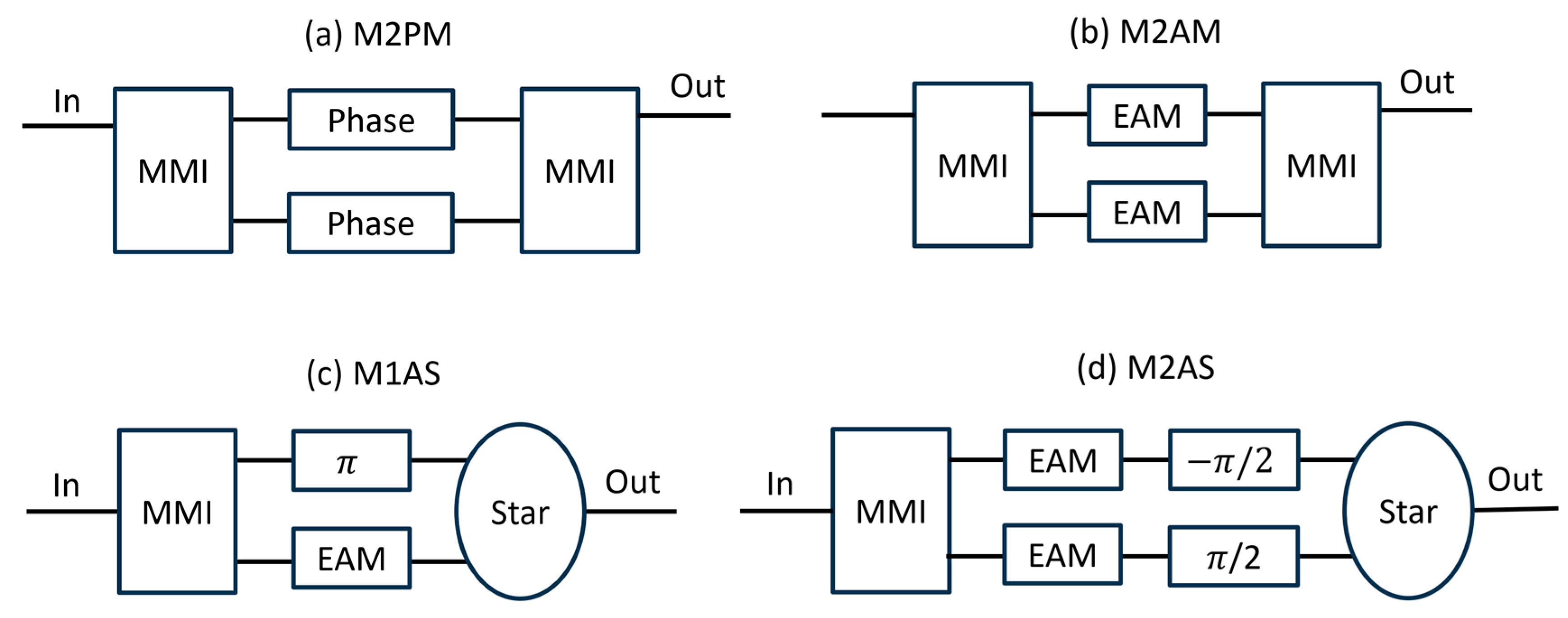
In this paper, one general method will be considered for building an I-Modulator using phase modulation and three methods using amplitude modulation. These are shown in Figure 1. Figure 1a incorporates an MMI as a splitter (M) followed by two phase modulators in parallel (2P) and then another MMI as a coupler (M). Thus, this I-Modulator design is referred to as a M2PM I-Modulator. Note that this configuration does not require an MMI and can be made using any optical splitter or combiner. Figure 1b describes an M2AM I-Modulator design using a 2 × 2 MMI followed by two amplitude modulators in parallel and then another MMI [18,19]. Figure 1c shows an M1AS I-Modulator [20] using an MMI followed by an amplitude modulator in parallel with a waveguide that has a π phase shift and then a star coupler as a combiner. Finally, Figure 1d shows an M2AS I-Modulator that uses an MMI followed by two amplitude modulators in parallel, which have a phase difference of π , and then a star coupler to combine the signals [20].
Note that the input and output MMIs can be replaced by star couplers or any other splitter and combiner for all but the M2AM version (where the MMI phase is required). This change will have no effect on the ideal (i.e., zero excess loss) theoretical performance of the devices, but will reduce the efficiency of a practical device, since the excess loss in a typical 1 × 2 or 2 × 2 MMI is less than from a typical star, Y-branch or directional coupler. Similarly, the output star couplers can be replaced by a 2 × 2 or 2 × 1 MMI.

2.2. IQ-Modulator Building Blocks

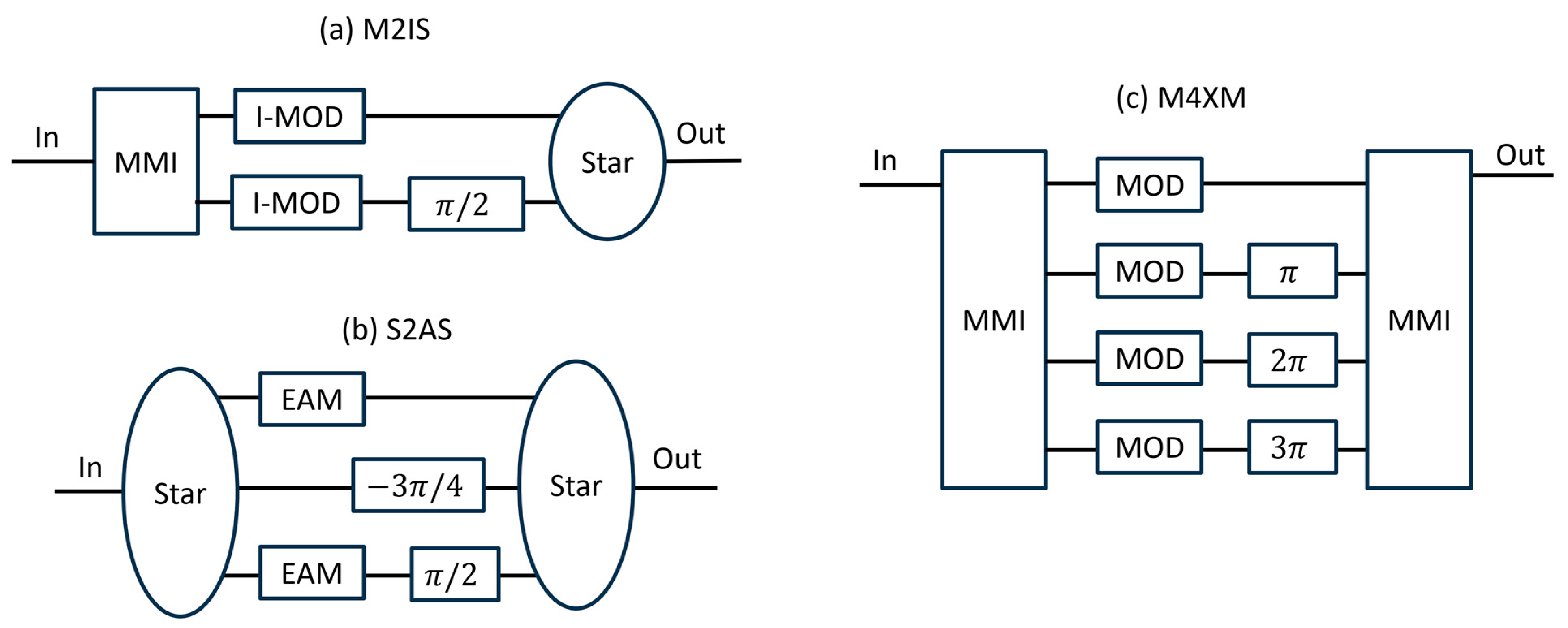
The general design of an IQ-Modulator uses two I-Modulators in parallel, with a π / 2 phase shift between the I-Modulators [11]. This general structure is shown in Figure 2a and described as a M2IS IQ-Modulator as it uses an MMI splitter at the input and an output star coupler with two I-Modulators in parallel between that have a phase difference of π / 2 . This design can be used with any of the I-Modulators described in Section 2.1. A second method for making an IQ-Modulator is shown in Figure 2b [21], which uses an initial star coupler followed by, in parallel: an amplitude modulator, a waveguide with a 3 π / 4 phase shift and a second amplitude modulator with a π / 2 phase shift. These are then combined using a second star coupler. This design is therefore referred to here as an S2AS IQ-Modulator. Figure 2c shows a new design that uses four modulators (either phase or amplitude) between two 4 × 4 MMIs, each of which has a phase shift of π compared to the previous. Thus, it is referred to as an M4XM IQ-Modulator, where the X can refer to either a phase modulator section (M4PM) or an amplitude modulator section (M4AM). Other similar versions of the M4AM modulator have been proposed, but use more MMIs (examples given used three, four and six MMIs) [22], resulting in an IQ-Modulator with higher expected losses than the one proposed here.

2.3. Mathematical Building Blocks

To analyze and compare the different IQ modulator designs, a series of variables and matrices will be used to represent the different transfer functions. For the analysis, all devices will initially be assumed to have no excess loss as the effect of the excess loss can be added after the analysis is complete. For example, an individual EAM used as an amplitude modulator will use a simple scalar transmission value— t .
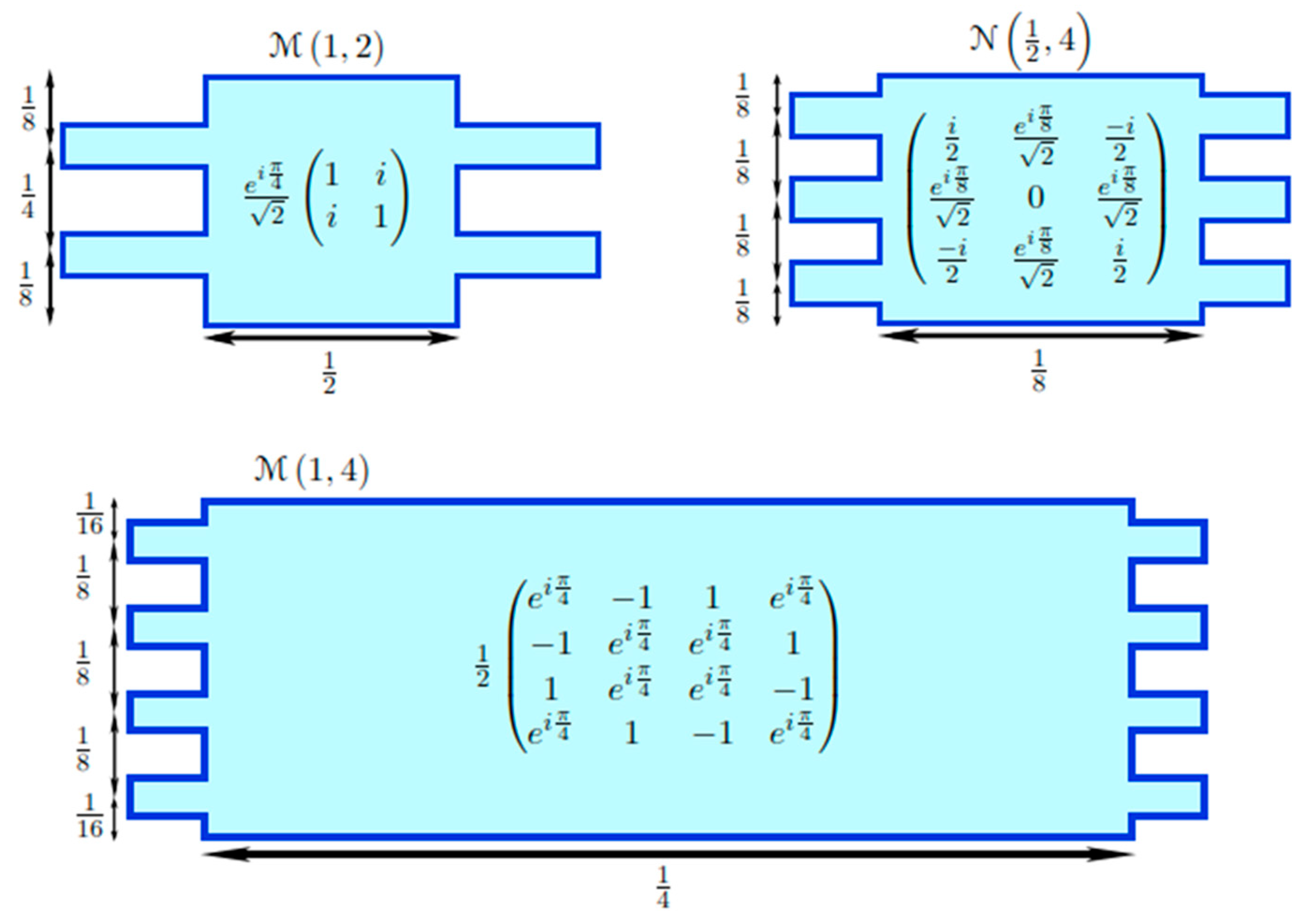
The transfer functions for the MMI were calculated based on the work by Cooney [23], such that 1 × 2 (which is a special case of a 3 × 3 MMI), 2 × 2 and 4 × 4 MMIs have the transfer functions as shown in Figure 3. Thus, for an N × N MMI, there are N input waveguides. Using the transfer function, the amplitude and phase for each output waveguide can then be calculated, as will be demonstrated in the next section.
The star coupler is used to split light from one waveguide into multiple waveguides or combine light from multiple waveguides into a single waveguide. The transfer functions for both versions with arbitrary split ratios are shown in Equation (1), where M S is the transfer matrix of the star coupler, and s a , b is the proportion of light that goes through each output of the star coupler.
M S s p l i t = s a s b , M S c o m b i n e = s a s b ;    where :    s a 2 + s b 2 = 1
The remaining components: phase modulators, amplitude modulators and phase adjustment regions will all have a transfer function that takes the following form (examples given for two or three parallel waveguides) as described by Equation (2), where t a , b , c represents the transmission coefficient through each waveguide region.
t a 0 0 t b , t a 0 0 0 t b 0 0 0 t c
The full set of transfer functions can be combined to calculate and compare the outputs of each design, using the formalism shown in Equation (3):
E o u t = · · · M 3 M 2 M 1 E i n
where E i n and E o u t describes the input and output Electric field; 1 , 2 , 3 represent the order of the transfer matrices- M i , which may be a selection of: 1 × 2 , 2 × 2 or 4 × 4 for an MMI, P for a phase modulator, ϕ for a phase adjustment region or A for an amplitude modulator.

3. Comparison of IQ Modulators

Since an IQ-Modulator can be built using two I-Modulators in parallel (as in Figure 2a), an analysis of the I-Modulators will be completed first.

3.1. Output Equations for I-Modulators

As a first example, the output of the M2PM modulator from Figure 1a is provided in Equation (4), where M 2 × 2 is the transfer function of a 2 × 2 MMI, and M P is the transfer function of a phase modulator region:
E M 2 P M = M 2 × 2 M P M 2 × 2 E i n
The transmission through the phase modulator sections can be written as: t a , t b = e i Δ ϕ a ,   e i Δ ϕ b . Then Equation (4) can be expanded to calculate the transmission result, using a normalized input electric field.
E M 2 P M = e i π 4 2 1 i i 1 e i Δ ϕ a 0 0 e i Δ ϕ b e i π 4 2 1 i i 1 1 0 = i 2 e i Δ ϕ a e i Δ ϕ b i e i Δ ϕ a + e i Δ ϕ b
As a result, the output of the top waveguide (designated ‘a’) for different phase modulations will be:
Δ ϕ a = Δ ϕ b = π 2 : E M 2 P M a = 1 Δ ϕ a = Δ ϕ b = π 2 : E M 2 P M a = 1
This indicates that the mathematical design of an ideal M2PM I-Modulator is lossless since the output Electric field retains the same amplitude as the input. The output power in a constellation is therefore also the same as the input power ( P M 2 P M = P i n E i n 2 ) for this design of a mathematically ideal I-Modulator. The input power will be normalized through the remainder of the analysis, giving a constellation power of P M 2 P M = P i n = 1 for this design. The expected losses can be added to this ideal result according to the components used in the design. Thus, the output power of a constellation would be expected to be: P M 2 P M = T 2 × 2 2 T P , where T x indicates the transmission through the element x due to excess loss, and this design uses two 2 × 2 MMIs ( T 2 × 2 2 ) and a phase modulation region ( T P ).
Other I-Modulator designs are evaluated in Appendix A, and Table 1 includes a summary of those results for the I-Modulators shown in Figure 1. For the M1AS I-Modulator, there is a phase adjustment region in parallel with an amplitude modulator. But since the excess loss of an amplitude modulator is larger (so the transmission is smaller) than that of a phase adjustment region ( T A < T ϕ ), the amplitude modulation region dominates. The ideal results shown in the table are calculated when all excess losses are set to zero.

3.2. Output Equations for IQ-Modulators

An IQ-Modulator can be formed using the designs provided in Figure 2. The analysis of the M2IS and S2AS modulators from Figure 2a,b have been provided in Appendix B, while the new IQ-Modulator design shown in Figure 2c is described here using a general form that can be used with either phase or amplitude modulation.
The output of the M4AM modulator is:
E M 2 P M = M 4 × 4 M ϕ M P / A M 4 × 4 E i n
Using the transfer functions, Equation (7) can be expanded to become:
E M 4 X M = 1 2 e i π 4 1 1 e i π 4 1 e i π 4 e i π 4 1 1 e i π 4 e i π 4 1 e i π 4 1 1 e i π 4 1 0 0 1 0 0 0 0 0 0 0 0 1 0 0 1 t a 0 0 t b 0 0 0 0 0 0 0 0 t c 0 0 t d 1 2 e i π 4 1 1 e i π 4 1 e i π 4 e i π 4 1 1 e i π 4 e i π 4 1 e i π 4 1 1 e i π 4 1 0 0 0 E M 4 A M = 1 4 t c t b + i t a t d e i π 4 t a + t b + t c t d e i π 4 t a + t b + t c + t d t c t b i t a t d ; E M 4 P M = 1 4 e i Δ ϕ c e i Δ ϕ b + i e i Δ ϕ a e i Δ ϕ d e i π 4 e i Δ ϕ a + e i Δ ϕ b + e i Δ ϕ c e i Δ ϕ d e i π 4 e i Δ ϕ a + e i Δ ϕ b + e i Δ ϕ c + e i Δ ϕ d e i Δ ϕ c e i Δ ϕ b i e i Δ ϕ a e i Δ ϕ d
Here, the result using phase modulators was generated by changing t i e i Δ ϕ i . Using this design, a QPSK (or QAM) signal can be generated from the top (a) or bottom (d) waveguide when the initial signal was inserted into the top (a) waveguide. These two output signals are phase conjugated and can be used to provide additional advantages compared to a simple IQ-Modulator design [24]. Based on symmetry, a QPSK signal would also be generated from the top (a) or bottom (d) waveguide if the bottom (d) waveguide was used for the input signal. Similarly, if the input signal was inserted into one of the middle waveguides (b or c), a QPSK signal would be generated in either of the middle output waveguides (b or c). To provide one example, four QPSK constellations can be shown in the top waveguide (a) as shown in Equation (9):
Δ ϕ a = Δ ϕ c = 0 ;   Δ ϕ b = Δ ϕ d = π : E M 4 P M a = 1 2 1 + i Δ ϕ a = Δ ϕ c = π ;   Δ ϕ b = Δ ϕ d = 0 : E M 4 P M a = 1 2 1 i Δ ϕ a = Δ ϕ b = 0 ;   Δ ϕ c = Δ ϕ d = π : E M 4 P M a = 1 2 1 + i Δ ϕ a = Δ ϕ b = π ;   Δ ϕ c = Δ ϕ d = 0 : E M 4 P M a = 1 2 1 i
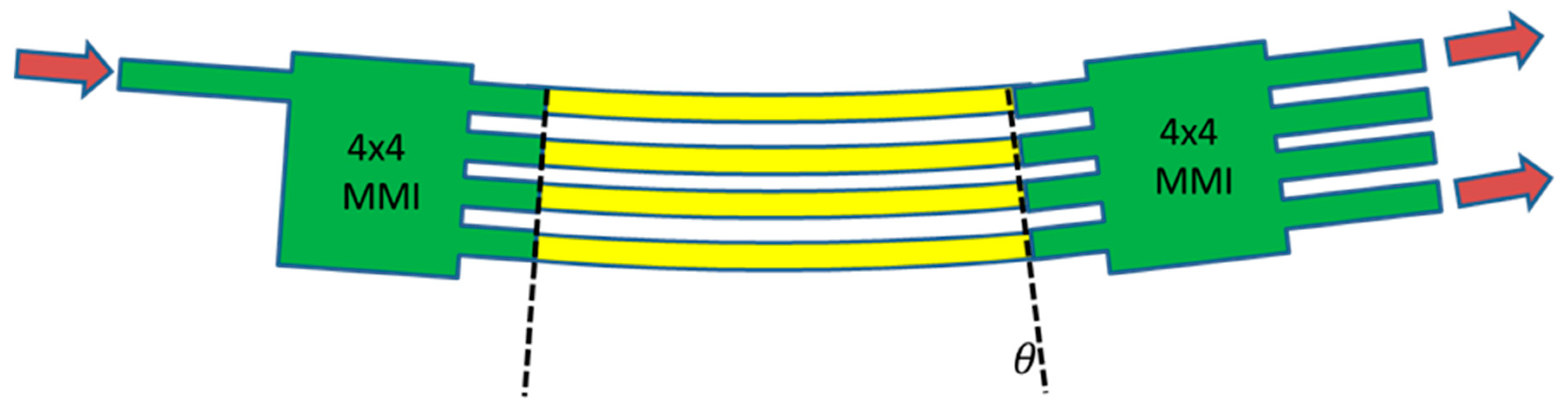
The ideal output power for a constellation is therefore: P M 4 P M = 1 / 2 , and by adding losses through transmission elements, this becomes: P M 4 P M = 0.5   T 4 × 4 2 T P . Here it has been assumed that adding the extra π phase for each waveguide will have a negligible loss, since this can be done by ensuring that the four parallel waveguides connecting the two 4 × 4 MMIs are formed into a circular arc. Based on the separation between the waveguides, an angle can be chosen that will result in the desired π phase change between each waveguide, as shown in Figure 4. The required angle can be calculated according to Equation (10), where λ is the operating wavelength, n e f f is the effective index of the waveguide and d is the distance between waveguides.
Δ ϕ = π = 2 π n e f f λ θ d θ = λ 2 d n e f f
Thus, for a waveguide separation of 5   μ m , an effective index of n e f f = 3 and an operating waveguide of 1.55   μ m , the angle θ ~ 3 ° . With such a small angle, the change in the mode shape is negligible, thus minimizing the loss. Any mode mismatch losses can be further eliminated by using waveguide designs that use continuous curvature [25] or even more optimized waveguide bends [26]. The analysis of the IQ-Modulator (shown in Figure 4) utilizes Equations (8) and (9), which are used to calculate the output amplitude and phase in each of the four output waveguides based on an optical input into the top waveguide (a). Equation 8 uses the transfer function for the 4 × 4 MMI as shown in Figure 3.
Using amplitude modulation, four QPSK constellations can also be created, as shown in Equation (11):
t b = t d = 0 ;   t c = t a = 1 : E M 4 A M a = 1 4 1 + i t c = t a = 0 ;   t b = t d = 1 : E M 4 A M a = 1 4 1 i t c = t d = 0 ;   t b = t a = 1 : E M 4 A M a = 1 4 1 + i t b = t a = 0 ;   t c = t d = 1 : E M 4 A M a = 1 4 1 i
The ideal output power for a constellation is therefore: P M 4 A M = 1 / 8 , and by adding losses through transmission elements, this becomes: P M 4 A M = 0.125   T 4 × 4 2 T P .
Table 2 includes a summary of the results for the different designs of IQ-Modulators.

4. Discussion

The previous section has outlined a mathematical comparison of different IQ-Modulator designs using both phase and amplitude modulator elements. These fit into three conceptual designs, which were shown in Figure 2. Characteristic excess losses as shown in Table 3 will be used to further compare the different IQ-Modulator designs.

4.1. IQ-Modulators Using Phase Modulation

It is well known that using phase modulation is advantageous in terms of insertion loss (while typically showing a disadvantage in terms of size), and this is clear from the equations provided. Both designs that used phase modulation (M2IS:M2PM and M4PM) resulted in an ideal or excess loss-free output of P o u t = 0.5 . When losses are added, the designs diverge, since in the standard IQ-Modulator design, M2IS:M2PM has six serial loss elements, while M4PM only has three. In addition, as previously pointed out, the M4PM design has the advantage of naturally creating two phase conjugated QPSK (or QAM) signals. This increase in useful output signal is made possible by using the phase properties of the output MMI, instead of using a star coupler or MMI merely as an output combiner. Using the characteristic losses from silicon photonics ( S i P h o ), thin film Lithium Niobate ( L i N b O 3 ) and InP based ( I n P ) PICs, the two different IQ-Modulator designs based on phase modulation are now compared in Table 4. The highest performance IQ-Modulator based on phase modulation will use L i N b O 3 , although this will come at the expense of size and difficulty in integrating with silicon.

4.2. IQ-Modulators Using Amplitude Modulation

When building an IQ-Modulator using amplitude modulation, the differences between the different designs are more significant. Three of the designs (M2IS:M2AM, M2IS:M2AS, and M4AM) all show an ideal output of P o u t = 1 / 8 . Yet, as with the previous comparison, the M2IS designs have six or seven loss elements, compared to the three loss elements of M4AM. The S2AS and M2IS:M1AS designs have inherent ideal losses that are considerably higher, yielding idea outputs of P o u t = 1 / 15 and P o u t = 1 / 20 , respectively. The M4AM design also produces two phase conjugated twin waves signals, just like the M4PM (phase modulation) design. The use of phase with MMIs as input and output couplers in the M4AM design provides this extra signal compared to the other designs that do not use the phase of the output coupler. A comparison of these different IQ-Modulator designs using amplitude modulation is provided in Table 5.

4.3. IQ-Modulator Design Challenges and Limitations

For practical implementations of an IQ-Modulator, there are additional design challenges due to unintended effects such as imperfect lithography and unexpected phase or amplitude changes. The extra losses due to phase adjustment regions have already been accounted for in the previous analysis. Of particular concern is additional amplitude modulation in a phase modulator region (or phase modulation in an amplitude modulation region). This can be easily accounted for using the formalism introduced in this paper by starting with regions of amplitude modulation where the individual transfer function was given by a scalar transmission coefficient: t . An additional phase change can then be added giving a new transmission through the modulator section of: t e i Δ ϕ .
The addition of unintended bias-dependent loss in a phase adjustment region is well known to degrade the extinction ratio performance of an I, or IQ-Modulator. In comparison, the addition of a bias-dependent phase change in an amplitude modulator region will have less adverse effects, since the amplitude of the signal has been reduced in the amplitude modulator region and any additional phase change will have little effect. In addition, a phase modulation region is typically more than an order of magnitude longer than an amplitude modulation region using silicon or III-V materials, so any extra phase change will be small.
If star couplers are used in the IQ-Modulator design, they will add an additional challenge, since it is very difficult to achieve a star coupler with the designed coupling ratios. As a result, the demonstrated S2AS IQ-Modulator design required power adjustment regions, which further increased the insertion loss beyond what was theoretically possible [21].
MMIs may also lead to an implementation challenge. When used as simple splitters or combiners, as in the M2PM, M1AS or M2AS designs, the MMIs can be used as expected. However, when relying on the phase relationships in the MMIs, as required for the M2AM or M4AM designs, the requirements of the MMIs are significantly higher. These 2 × 2 or 4 × 4 MMIs will need to be based on a deep etched waveguide to produce the expected response.
One of the most important performance metrics of an IQ-Modulator is the frequency response, or baud rate. None of the designs provided in this paper has any speed advantage, as the speed is governed by the material platform (e.g., s i l i c o n , L i N b O 3 ,   I n P ) used.

5. Conclusions

This paper provides a summary and analysis of different IQ-Modulator designs and introduces a new, simpler IQ-Modulator design that requires less photonic components. The new design is based on a pair of 4 × 4 MMIs and uses the phase relationships inherent in the MMIs to match the ideal throughput of the best IQ-Modulator designs, while providing two phase conjugated signals. When expected losses are considered, the new design shows the potential to be lower loss than existing designs.

Funding

This publication has emanated from research funded by Taighde Éireann—Research Ireland under Grant Number SFI SFI12/RC/2276_2.

Data Availability Statement

The original contributions presented in this study are included in the article. Further inquiries can be directed to the corresponding author.

Acknowledgments

The author would like to thank the anonymous reviewers for their valuable suggestions.

Conflicts of Interest

The author declares no conflicts of interest.

Abbreviations

The following abbreviations are used in this manuscript:
MMIMultimode interference
MZMMach Zehnder modulator
PAMPulse amplitude modulation
QAMQuadrature amplitude modulation
BPSKBinary phase shift keying
QPSKQuadrature phase shift keying
PICPhotonic integrated circuit

Appendix A. I-Modulator Analysis

The M2PM I-Modulator was analyzed in Section 3, while the other I-Modulators will be analyzed below.

Appendix A.1. M2AM I-Modulator

The output of the M2AM modulator from Figure 1b is:
E M 2 A M = M 2 × 2 M A M 2 × 2 E i n
The amplitude modulator sections will remain as provided, so Equation (A1) is expanded to calculate the result, using the normalized input electric field.
E M 2 A M = e i π 4 2 1 i i 1 t a 0 0 t b e i π 4 2 1 i i 1 1 0 = i 2 t a t b i t a + t b
As a result, the output of the top waveguide (designated ‘a’) for different amplitude modulations will be:
t a = 1 ;   t b = 0 : E M 2 A M a = 1 2 t a = 0 ;   t b = 1 : E M 2 A M a = 1 2
Thus, the ideal output power for a constellation would be: P M 2 A M = 1 / 4 .

Appendix A.2. M1AS I-Modulator

The output of the M1AS modulator from Figure 1c is:
E M 1 A S = M S M A P M 1 × 2 E i n
The first part of this equation will be evaluated separately, thus only including the 1 × 2 MMI, E = M 1 × 2 E i n :
E = i 2 e i π 8 2 i 2 e i π 8 2 0 e i π 8 2 i 2 e i π 8 2 i 2 0 1 0 = e i π 8 2 1 0 1
Since the common phase term is not important for the calculation, and only two output waveguides are used for a 1 × 2 MMI, this transfer function can be simplified for this special case to the following:
M 1 × 2 = 1 2 1 1 E = 1 2 1 1 1 = 1 2 1 1
Equation (A4) can be now expanded to calculate the result, using the normalized input electric field.
E M 1 A S = 1 5 1 2 1 0 0 t b 1 2 1 1 1 = 1 10 1 2 t b
where in an ideal structure: t b = 0 1 , giving the following output:
t b = 0 : E M 1 A S = 1 10 t b = 1 : E M 1 A S = 1 10
The output power for a constellation would then be: P M 1 A S = 1 / 10 .

Appendix A.3. M2AS I-Modulator

The output of the M2AS modulator from Figure 1d is:
E M 2 A S = M S M P M A M 1 × 2 E i n
Equation (A9) can be now expanded to calculate the result, using the normalized input electric field.
E M 2 A S = 1 2 1 1 i 0 0 i t a 0 0 t b 1 2 1 1 1 = i 2 t a t b
The output of the device will then be:
t a = 1 ;   t b = 0 : E M 2 A S = i 2 t a = 0 ;   t b = 1 : E M 2 A S = i 2
The output power for a constellation would then be: P M 2 A S = 1 / 4 .

Appendix B. IQ-Modulator Analysis

The M4PM and M4AM IQ-Modulators shown in Figure 2c have been analyzed earlier in the text. Here the remaining IQ-Modulators will be analyzed.

Appendix B.1. M2IS IQ-Modulator

First the general M2IS IQ-Modulator will be considered, which can be made using any of the I-Modulators previously evaluated in Section 3.1 and Appendix A.
The output of the M2IS IQ-Modulator from Figure 2a is:
E M 2 I S = M S M P M I M 1 × 2 E i n
Expanding this equation while using I 1 , I 2 to represent the transmission through the two parallel I-Modulators yields:
E M 2 I S = 1 2 1 1 1 0 0 i I 1 0 0 I 2 1 2 1 1 1 = 1 2 I 1 + i I 2
Since I a and I b represent the output from identical I-Modulators, the full output becomes that of an IQ-Modulator. For example, using the results from Equations (3) and (4), the full output will be:
E M 2 I S ( M 2 P M ) = i 4 e i Δ ϕ a e i Δ ϕ b 1 + i e i Δ ϕ a e i Δ ϕ b 2
Four QPSK constellations can be created using Δ ϕ = ± π 2 . The output power of this structure will be: P M 2 I S = 1 2 P M 2 P M = 1 2 . For any I-Modulator with an output of P I , within an IQ-Modulator, the output will be: P M 2 I S = 1 2 P I , and when losses are added this can be expanded to: P M 2 I S = 1 2 T 1 × 2 T P T S P I . Then, the results for all variations of the M2IS IQ-Modulators can be found without any additional calculations.

Appendix B.2. S2AS IQ-Modulator

The output of the S2AS IQ-Modulator from Figure 2b is:
E S 2 A S = M S M P M A M S E i n
This equation is expanded using t a , t b to represent the transmission through the two amplitude modulation sections to yield:
E S 2 A S = 1 3 1 1 1 1 0 0 0 e 3 i π 4 0 0 0 i t a 0 0 0 1 0 0 0 t c 1 5 2 1 2 1 = 1 30 2 t a 1 + i 2 t c 1
The output of this structure will then be: P S 2 A S = 1 / 15 , which is then expanded to be: P S 2 A S = T S 2 T A T P / 15 .

References

  1. Evangelides, S.G.; Mollenauer, L.F.; Gordon, J.P.; Bergano, N.S. Polarization multiplexing with solitons. J. Light. Technol. 1992, 10, 28–35. [Google Scholar] [CrossRef]
  2. Kerr, J. Experiments on a fundamental question in electro-optics: Reduction of relative retardations to absolute. Proc. Royal Soc. Lond. 1894, 55, 252–265. [Google Scholar] [CrossRef]
  3. Pockels, F. Über den Einfluß des Elektrostatischen Feldes auf das Optische Verhalten Piezoelektrischer KRYSTALLE; Abhandlungen der Gesellschaft der Wissenschaften in Göttingen. Mathematisch-Physikalische Klasse; Dieterichsche Verlags-Buchhandlung: Wiesbaden, Germany, 1894; Volume 39, pp. 1–204. [Google Scholar]
  4. Kaminow, I.P.; Turner, E.H. Electrooptic light modulators. Proc. IEEE 1966, 54, 1374–1390. [Google Scholar] [CrossRef]
  5. Miller, D.A.B.; Chemla, D.S. Relation between electroabsorption in bulk semiconductors and in quantum wells: The quantum-confined Franz-Keldysh effect. Phys. Rev. B 1986, 33, 6976–6982. [Google Scholar] [CrossRef] [PubMed]
  6. Miller, D.A.B.; Chemla, D.S.; Damen, T.C.; Gossard, A.C.; Wiegmann, W.; Wood, T.H.; Burrus, C.A. Band-Edge Electroabsorption in Quantum Well Structures: The Quantum-Confined Stark Effect. Phys. Rev. Lett. 1984, 53, 2173–2176. [Google Scholar] [CrossRef]
  7. Soole, J.B.D.; Tsang, H.K.; White, I.H.; Leblanc, H.P.; Bhat, R.; Koza, M.A. High-performance qcse phase modulator for the 1.5–1.55 pm fiber band. Electron. Lett. 1990, 26, 1421–1423. [Google Scholar] [CrossRef]
  8. Soref, R.; Bennett, B. Electrooptical effects in silicon. IEEE J. Quan. Electron. 1987, 23, 123–129. [Google Scholar] [CrossRef]
  9. Jeong, U.; Kim, K.; Lee, K.; Kim, J.; Park, J.H. Low-voltage 12 GHz silicon optical electro-absorption modulator (EAM) using a Schottky diode. In Silicon Photonics XV; SPIE: Bellingham, WA, USA, 2020. [Google Scholar]
  10. Liu, A.; Liao, L.; Rubin, D.; Nguyen, H.; Ciftcioglu, B.; Chetrit, Y.; Izhaky, N.; Paniccia, M. High-speed optical modulation based on carrier depletion in a silicon waveguide. Opt. Express 2007, 15, 660–668. [Google Scholar] [CrossRef]
  11. Griffin, R.A.; Carter, A.C. Optical differential quadrature phase-shift key (oDQPSK) for high capacity optical transmission. In Proceedings of the Optical Fiber Communication Conference, Anaheim, CA, USA, 17–22 March 2002. [Google Scholar]
  12. Soldano, L.B.; Pennings, E.C.M. Optical multi-mode interference devices based on self-imaging: Principles and applications. J. Light. Technol. 1995, 13, 615–627. [Google Scholar] [CrossRef]
  13. Ohmachi, Y.; Noda, J. Electro-optic light modulator with branched ridge waveguide. Appl. Phys. Lett. 1975, 27, 544–546. [Google Scholar] [CrossRef]
  14. Izutsu, M.; Yamane, Y.; Sueta, T. Broad-band traveling-wave modulator using a LiNbO3 optical waveguide. IEEE J. Quantum Electron. 1977, 13, 287–290. [Google Scholar] [CrossRef]
  15. Marcatili, E.A.J. Dielectric rectangular waveguide and directional coupler for integrated optics. Bell Syst. Tech. J. 1969, 48, 2071–2102. [Google Scholar] [CrossRef]
  16. Izutsu, M.; Enokihara, A.; Sueta, T. Optical-waveguide hybrid coupler. Opt. Lett. 1982, 7, 549–551. [Google Scholar] [CrossRef]
  17. Hudson, M.C.; Thiel, F.L. The Star Coupler: A Unique Interconnection Component for Multimode Integrated Optics. Appl. Opt. 1974, 13, 2540–2545. [Google Scholar] [CrossRef]
  18. Shin, M.; Lim, J.; Park, C.Y.; Kim, J.; Kim, J.S.; Pyun, K.E.; Hong, S. A novel BPSK method using multiple quantum well electroabsorption modulator integrated with MMI couplers. In Proceedings of the International Topical Meeting on Microwave Photonics. MWP’99, Melbourne, VIC, Australia, 17–19 November 1999; Volume 1, pp. 149–152. [Google Scholar]
  19. Kazmierski, C.; Carrara, D.; Ławniczuk, K.; Aubin, G.; Provost, J.; Guillamet, R. 12.5GB Operation of a Novel Monolithic 1.55µm BPSK Source Based on Prefixed Optical Phase Switching. In Proceedings of the Optical Fiber Communication Conference 2013, Anaheim, CA, USA, 17–21 March 2013. [Google Scholar]
  20. Melikyan, A.; Kaneda, N.; Kim, K.; Baeyens, Y.; Dong, P. Differential Drive I/Q Modulator Based on Silicon Photonic Electro-Absorption Modulators. J. Light. Technol. 2020, 38, 2872–2876. [Google Scholar] [CrossRef]
  21. Doerr, C.R.; Zhang, L.; Winzer, P.J.; Sinsky, J.H.; Adamiecki, A.L.; Sauer, N.J.; Raybon, G. Compact High-Speed InP DQPSK Modulator. IEEE Photonics Technol. Lett. 2007, 19, 1184–1186. [Google Scholar] [CrossRef]
  22. Kazmierski, C.; Garreau, A. Device for Transmitting and/or Modulating Optical Signals with Passive Phase Shifters. U.S. Patent US9547214B2, 17 January 2017. [Google Scholar]
  23. Cooney, K.; Peters, F.H. Analysis of multimode interferometers. Opt. Express 2016, 24, 22481–22515. [Google Scholar] [CrossRef]
  24. Liu, X.; Chraplyvy, A.R.; Winzer, P.J.; Tkach, R.W.; Chandrasekhar, S. Phase-conjugated twin waves for communication beyond the Kerr nonlinearity limit. Nat. Photonics 2013, 7, 560–568. [Google Scholar] [CrossRef]
  25. Sheehan, R.N.; Peters, F.H. Bends in the Plane with Variable Curvature. Bull. Ir. Math. Soc. 2016, 78, 61–80. [Google Scholar] [CrossRef]
  26. Song, J.H.; Kongnyuy, T.D.; De Heyn, P.; Lardenois, S.; Jansen, R.; Rottenberg, X. Low-Loss Waveguide Bends by Advanced Shape for Photonic Integrated Circuits. J. Light. Technol. 2020, 38, 3273–3279. [Google Scholar] [CrossRef]
  27. Mulcahy, J.; Peters, F.H.; Dai, X. Modulators in Silicon Photonics—Heterogenous Integration & and Beyond. Photonics 2022, 9, 40. [Google Scholar] [CrossRef]
  28. Li, Y.; Sun, M.; Miao, T.; Chen, J. Towards High-Performance Pockels Effect-Based Modulators: Review and Projections. Micromachines 2024, 15, 865. [Google Scholar] [CrossRef]
  29. Ozaki, J.; Ogiso, Y.; Nakano, S. High-speed modulator for next-generation large-capacity coherent optical networks. NTT Tech. Rev. 2018, 16, 49–56. [Google Scholar] [CrossRef]
  30. Harris, N.C.; Ma, Y.; Mower, J.; Baehr-Jones, T.; Englund, D.; Hochberg, M.; Galland, C. Efficient, compact and low loss thermo-optic phase shifter in silicon. Opt. Express 2014, 22, 10487–10493. [Google Scholar] [CrossRef] [PubMed]
  31. Wu, R.; Gao, L.; Liang, Y.; Zheng, Y.; Zhou, J.; Qi, H.; Yin, D.; Wang, M.; Fang, Z.; Cheng, Y. High-Production-Rate Fabrication of Low-Loss Lithium Niobate Electro-Optic Modulators Using Photolithography Assisted Chemo-Mechanical Etching (PLACE). Micromachines 2022, 13, 378. [Google Scholar] [CrossRef] [PubMed]
  32. Wang, R.; Bhardwaj, A.; Ristic, S.; Coldren, L.; Bowers, J.; Herczfeld, P.; Li, Y. Highly linear InP phase modulator for high dynamic range RF/photonic links. In Proceedings of the 2010 IEEE MTT-S International Microwave Symposium, Anaheim, CA, USA, 23–28 May 2010. [Google Scholar]
  33. Feng, N.N.; Feng, D.; Liao, S.; Wang, X.; Dong, P.; Liang, H.; Kung, C.C.; Qian, W.; Fong, J.; Shafiiha, R.; et al. 30GHz Ge electro-absorption modulator integrated with 3 μm silicon-on-insulator waveguide. Opt. Express 2011, 19, 7062–7067. [Google Scholar] [CrossRef]
  34. Trajkovic, M. High Speed Electro-Absorption Modulators in Indium Phosphide Generic Integration Technologies. Ph.D. Thesis, Electrical Engineering, Technische Universiteit Eindhoven, Eindhoven, The Netherlands, 2019. [Google Scholar]
  35. Cao, W.; Liu, S.; Littlejohns, C.G.; Thomson, D.J.; Nedeljkovic, M.; Zhang, W.; Li, K.; Banakar, M.; Tran, Y.; Yan, X.; et al. High-speed silicon Michelson interferometer modulator and streamlined IMDD PAM-4 transmission of Mach-Zehnder modulators for the 2 μm wavelength band. Opt. Express 2021, 29, 14438–14451. [Google Scholar] [CrossRef]
  36. Sunder Meetei, T.; Lee, Y.T.; Ei Yu, N. Compact CMOS-compatible 1 × 2 MMI coupler based on a hybrid silicon-rich nitride-thin-film lithium niobate platform. Opt. Lett. 2025, 50, 1548–1551. [Google Scholar] [CrossRef]
  37. Abdul-Majid, S.; Hasan, I.; Maldonado-Basilio, R.; Hall, T.J.; Ye, W. Photonic integrated interferometer based on silicon-on-insulator nano-scale MMI couplers. In Proceedings of the 2013 IEEE Photonics Conference, Bellevue, WA, USA, 8–12 September 2013; pp. 337–338. [Google Scholar]
  38. Song, L.; Liu, W.; Guo, Z.; Zhao, S.; Li, H.; Dai, D.; Shi, Y. High-performance thin-film lithium niobate optical 90° hybrid with a novel CMRR assessment method. Opt. Laser Technol. 2024, 179, 111315. [Google Scholar] [CrossRef]
Figure 1. I-Modulator designs, based on (a) two 2 × 2 MMIs with two phase modulation regions in parallel (M2PM), (b) two 2 × 2 MMIs with two parallel EAMs representing amplitude modulation regions (M2AM), (c) a 2 × 2 MMI followed by a single amplitude modulation region in parallel with a phase adjustment region and then a combiner represented by a star coupler (M1AS), (d) a 2 × 2 MMI followed by two parallel amplitude modulation regions, phase adjustment and a combiner (M2AS).
Photonics 13 00044 g001
Figure 2. IQ-Modulator designs based on (a) a 2 × 2 MMI followed by parallel I-Modulators and a phase adjustment region followed by a star coupler combiner (M2IS), (b) a 1 × 3 star coupler followed by two parallel EAMs representing amplitude modulation regions and phase adjustment regions ending with a 3 × 1 star coupler (S2AS), (c) two 4 × 4 MMIs surrounding four parallel phase or amplitude modulation regions including a π phase adjustment between each waveguide (M4XM, thus M4PM for phase or M4AM for amplitude modulation).
Photonics 13 00044 g002
Figure 3. MMI transfer functions.
Photonics 13 00044 g003
Figure 4. Using a circular arc to create the π phase difference between each waveguide.
Photonics 13 00044 g004
Table 1. I-Modulator output equations and constellation power.
I-Modulator Design P o u t (Ideal) P o u t
Figure 1a M2PM 1   ( 0   d B ) T 2 × 2 2 T P
Figure 1b M2AM 1 4   6   d B 1 4 T 2 × 2 2 T A
Figure 1c M1AS 1 10   10   d B 1 10 T 1 × 2 T A T S
Figure 1d M2AS 1 4   6   d B 1 4 T 1 × 2 T A T ϕ T S
Table 2. IQ-Modulator output equations and constellation power.
IQ-Modulator Design P o u t (Ideal) P o u t
Figure 2a M2IS:M2PM 1 2   ( 3   d B ) 1 2 T 1 × 2 T ϕ T P T S T 2 × 2 2
Figure 2a M2IS:M2AM 1 8   9   d B 1 8 T 1 × 2 T ϕ T A T S T 2 × 2 2
Figure 2a M2IS:M1AS 1 20   ( 13   d B ) 1 20 T 1 × 2 2 T ϕ T A T S 2
Figure 2a M2IS:M2AS 1 8   ( 9   d B ) 1 8 T 1 × 2 2 T ϕ 2 T A T S 2
Figure 2b S2AS 1 15   11.8   d B 1 15 T S 2 T A T ϕ
Figure 2c M4PM 1 2   3   d B 1 4 T 4 × 4 2 T P
Figure 2c M4AM 1 8   9   d B 1 8 T 4 × 4 2 T A
Table 3. Estimated losses for different sections of the IQ-Modulators.
IQ-Modulator Section S i P h o L i N b O 3 I n P
Phase   modulator :   T P 0.4   d B [27] 0.5   d B [28] 2   d B [29]
Phase   adjuster :   T ϕ 0.2   d B [30] 0.1   d B [31] 0.5   d B [32]
Amplitude   modulator :   T A 2.5   d B [33]N/A 3   d B [34]
1 × 2 / 2 × 2   MMI :   T 1 × 2 / T 2 × 2 0.2   d B [35] 0.2   d B [36]0.5   d B [12]
4 × 4   MMI :   T 4 × 4 0.3   d B [37]0.4 [38] 1   d B   [ 12 ]
Star   coupler   T S 0.1 0.2   d B  1 0.2 0.4   d B  1 0.3 0.7   d B  1
1 Star coupler losses are based on MMIs, which can typically be used to replace a star coupler.
Table 4. IQ-Modulator constellation power estimates using phase modulation.
IQ-Modulator Design S i P h o L i N b O 3 I n P
M2IS:M2PM 7.9   d B 4.4   d B 7.3   d B
M4PM 2 7.6   d B 4.3   d B 7   d B
2 Lowest loss design.
Table 5. IQ-Modulator constellation power estimates using amplitude modulation.
IQ-Modulator Design S i P h o I n P
M2IS:M2AM 12.4   d B 14.3   d B
M2IS:M1AS 16.3   d B 18.1   d B
M2IS:M2AS 12.5   d B 14.6   d B
S2AS 14.9   d B 16.7   d B
M4AM 3 12.1   d B 14   d B
3 Lowest loss design.
Disclaimer/Publisher’s Note: The statements, opinions and data contained in all publications are solely those of the individual author(s) and contributor(s) and not of MDPI and/or the editor(s). MDPI and/or the editor(s) disclaim responsibility for any injury to people or property resulting from any ideas, methods, instructions or products referred to in the content.