
Physical Layer Security Techniques for Terahertz Communications Above 100 GHz: A Review


Abstract
1. Introduction
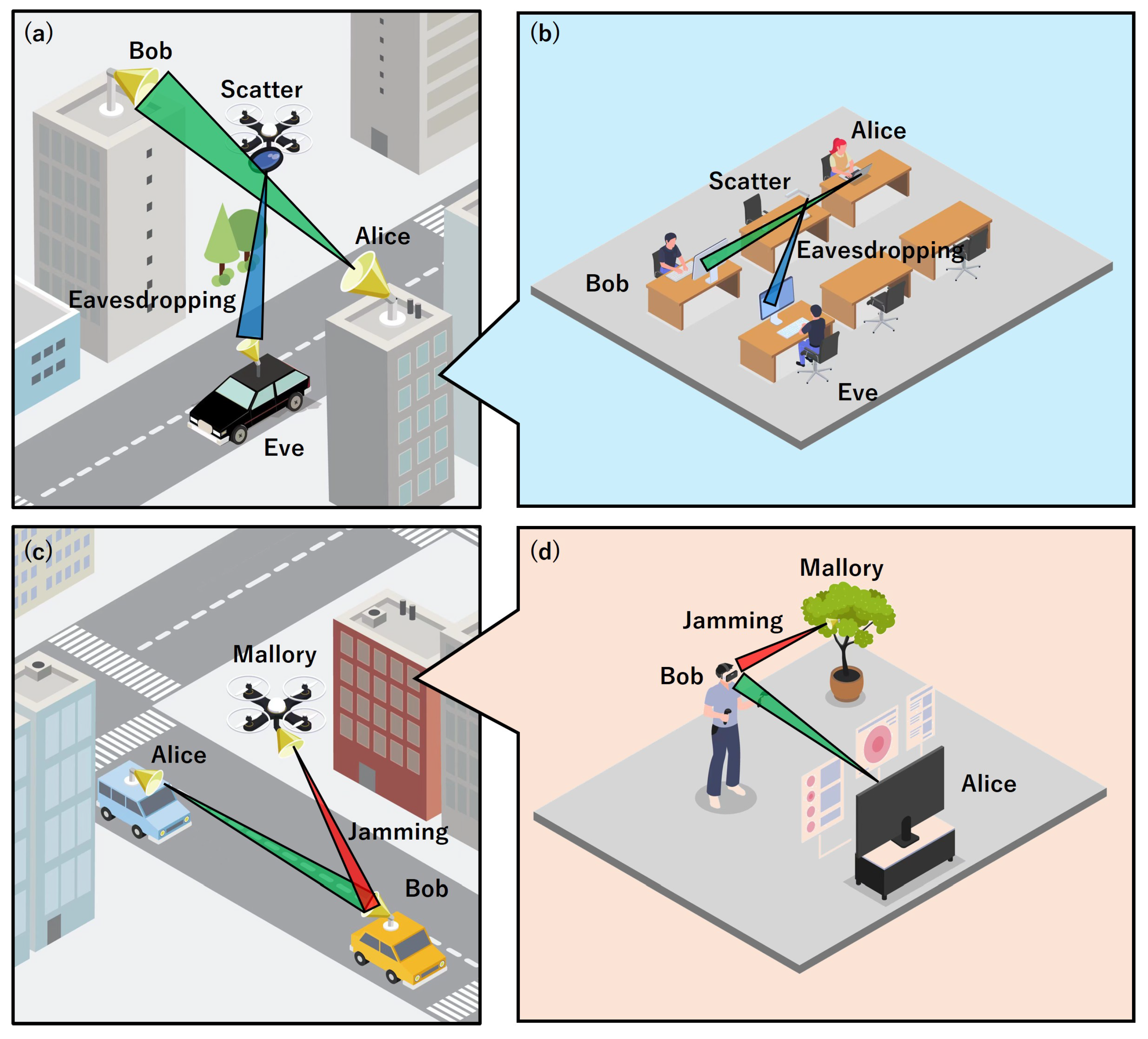
- Outdoor Long-Distance Scenarios: THz links can serve as wireless fiber extenders to interconnect base stations or buildings over distances of several hundred meters, establishing high-capacity, private wireless links with exceptional directionality. Moreover, vehicles exchange sensor data in high-mobility scenarios. When deployed in stadiums, these links facilitate the real-time broadcasting of mega-scale sporting events, enabling ultra-high-definition video transmission and immersive virtual reality (VR) broadcasting. Furthermore, they are instrumental in establishing temporary high-capacity networks for multi-unmanned aerial vehicle (multi-UAV) and multi-person collaboration during large-scale disaster relief operations.
- Indoor Short-Distance Scenarios: In these environments, high-speed THz links enable users to instantaneously exchange massive files at close range, such as facilitating the real-time collaborative editing of complex 3D engineering models. The technology also supports critical applications like telesurgery that demand high-resolution data transmission with ultra-low latency. Moreover, the ultra-large capacity of THz bands offers a robust solution for scenarios requiring temporary access points with surging traffic demands, such as establishing temporary indoor local area networks (LANs) for large-scale exhibitions and crowded commercial events.
2. Threats in THz Communication
2.1. Eavesdropping
2.2. Jamming
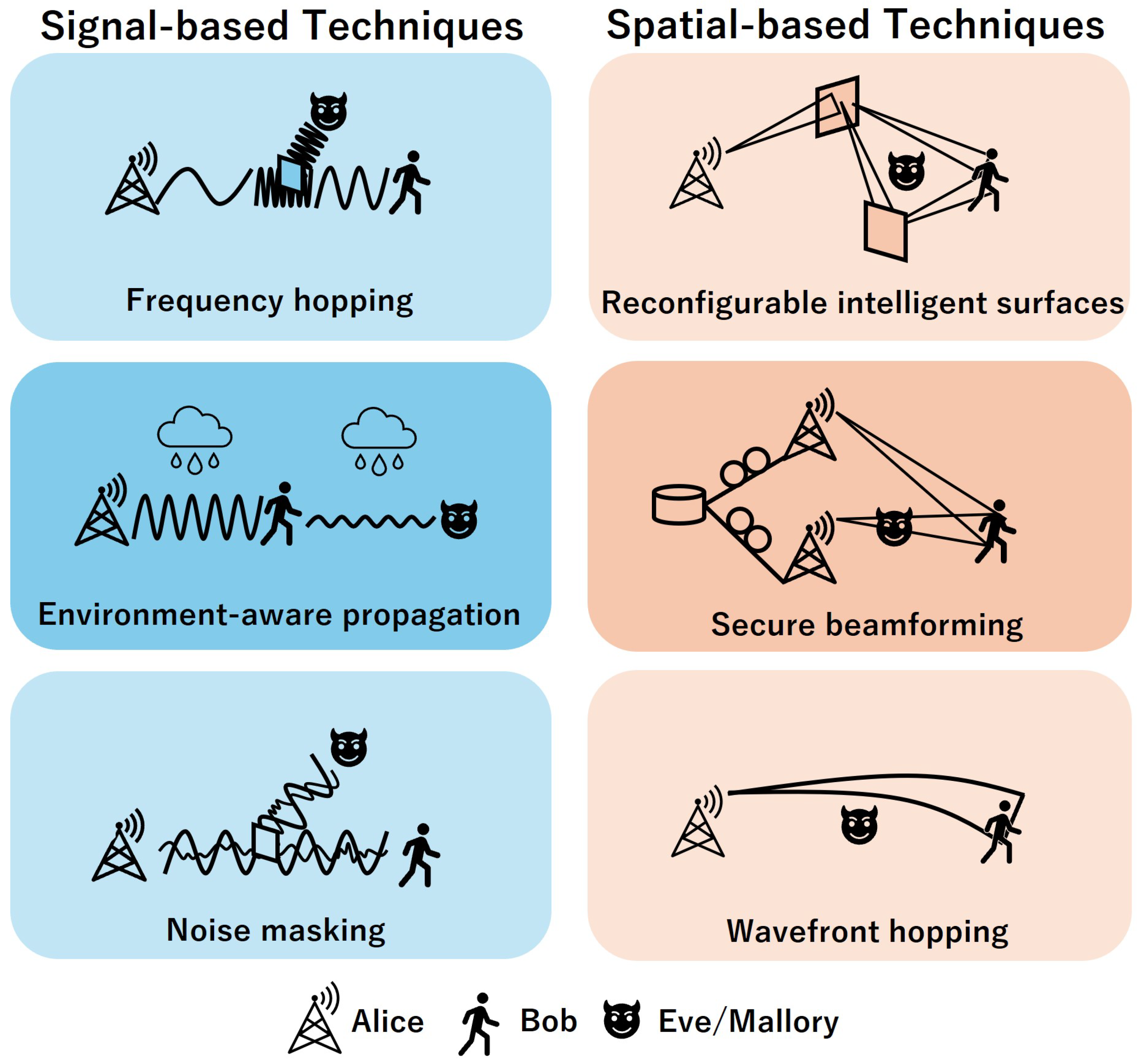
3. Signal-Based PLS Techniques
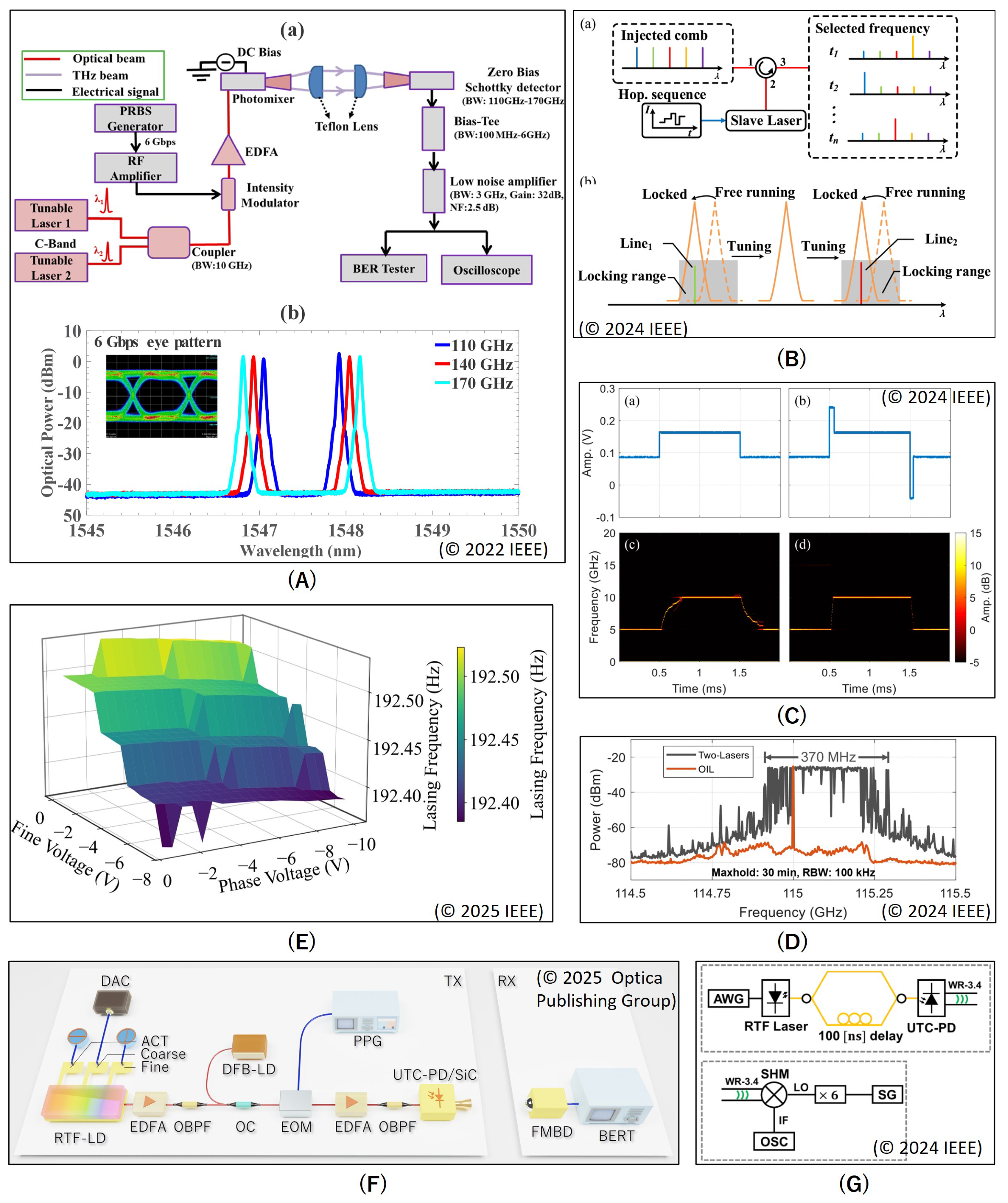
3.1. Frequency Hopping (FH)
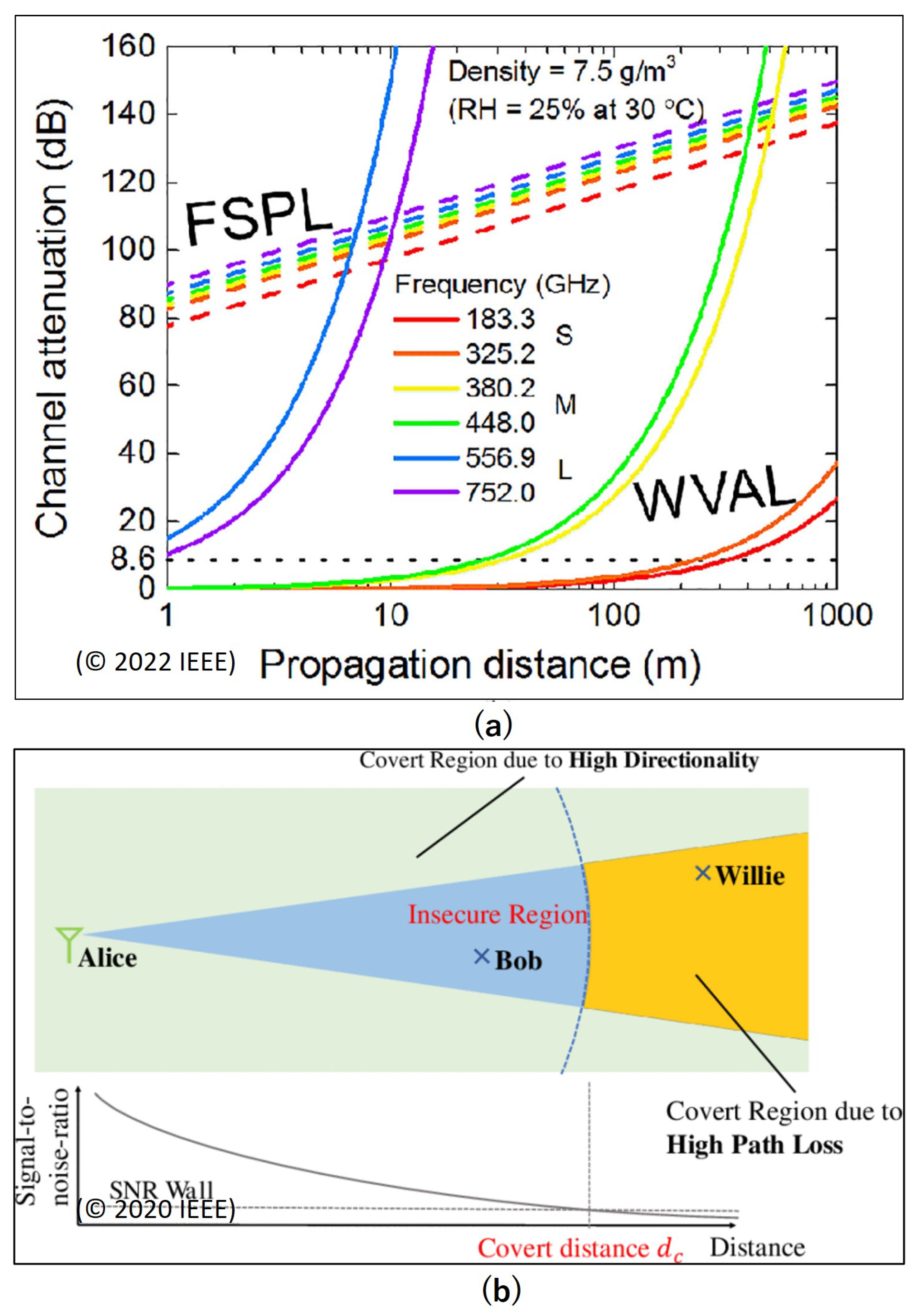
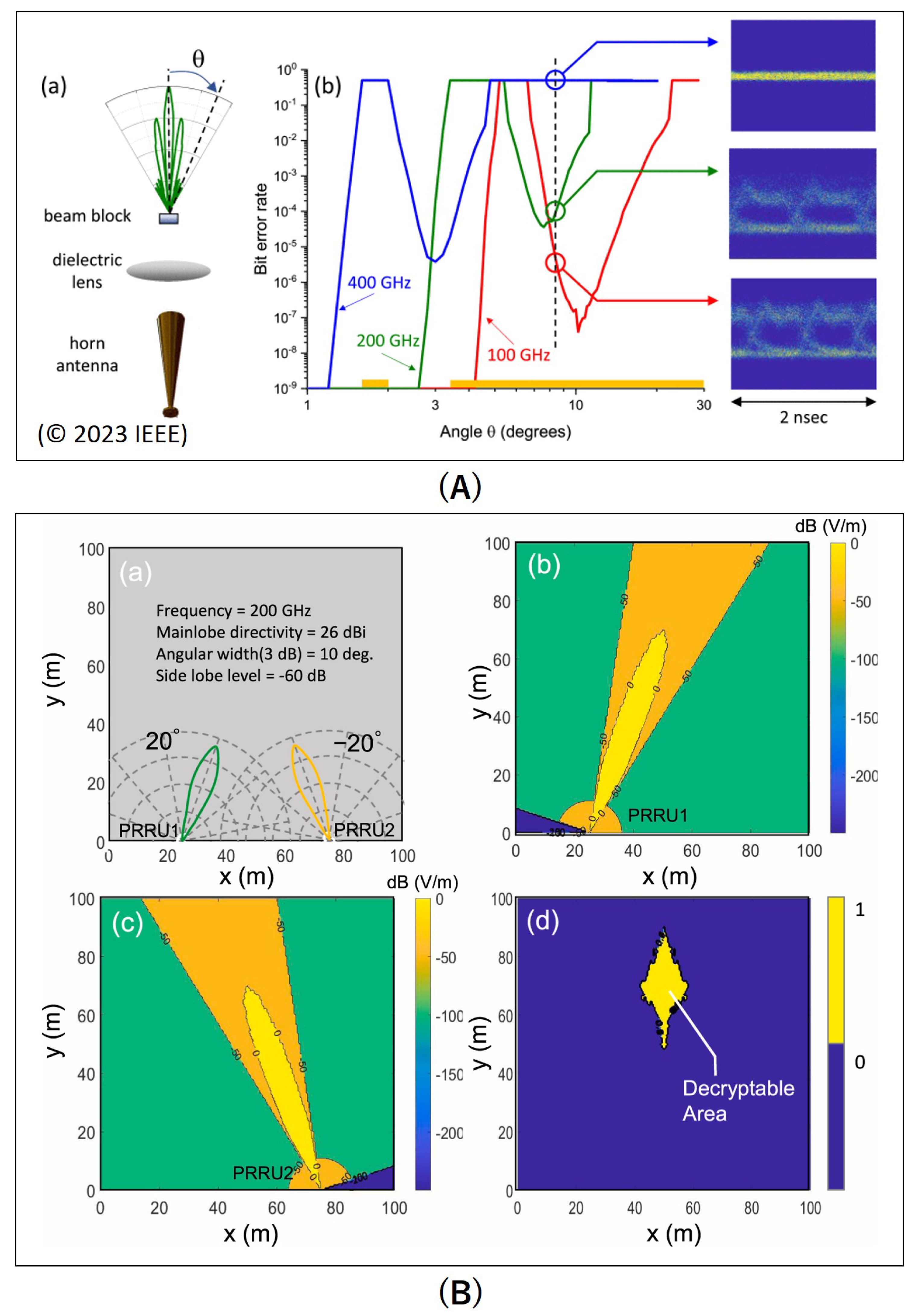
3.2. Environment-Adaptive Propagation
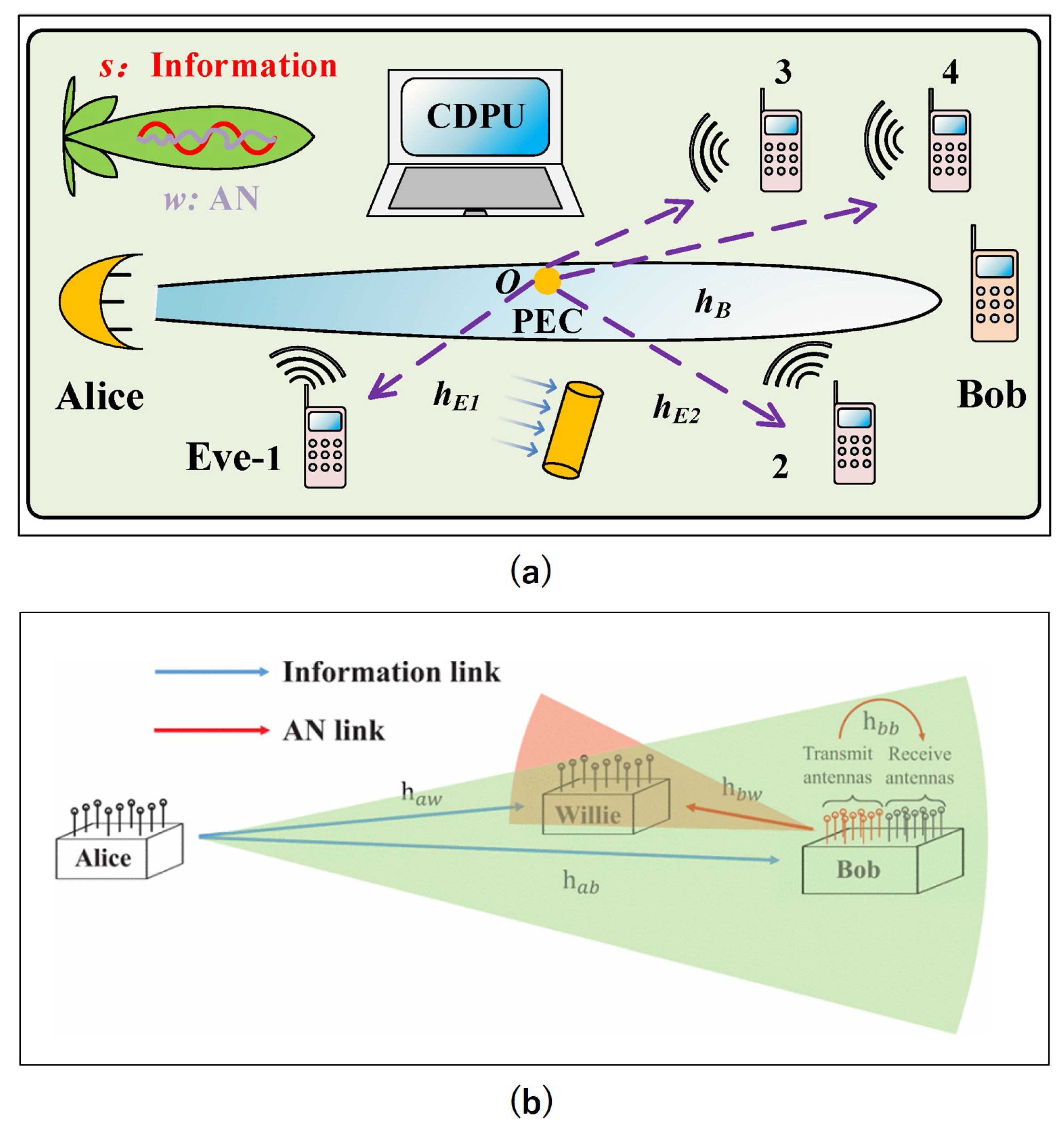
3.3. Noise Masking
3.4. Comparative Analysis of Signal-Based Techniques
- Implementation complexity and real-time feasibility: FH imposes strict requirements on hardware agility. Achieving Gbit/s-level secure transmission requires tunable lasers with nanosecond-level switching speeds and precise synchronization between Alice and Bob. AN, particularly receiver-based schemes, faces high complexity due to the need for SIC hardware and high-precision ADCs to prevent the noise from overwhelming the legitimate signal. In contrast, environment-aware propagation is the most hardware-efficient, as it primarily relies on intelligent carrier frequency selection and power control algorithms without requiring additional active optical components.
- Mobility and robustnes: FH exhibits high robustness against mobility because the rapid switching of frequencies inherently provides frequency diversity, mitigating the fading effects caused by user movement. Environment-aware propagation techniques are moderately sensitive to mobility. Since absorption loss is distance-dependent, a moving user changes the secure transmission window, requiring adaptive modulation updates. AN is the most sensitive to mobility, especially in near-field scenarios, as the movement of the receiver can alter the channel correlation properties, potentially rendering the pre-calculated null-space noise ineffective or even harmful to the legitimate user.
4. Spatial-Based PLS Techniques
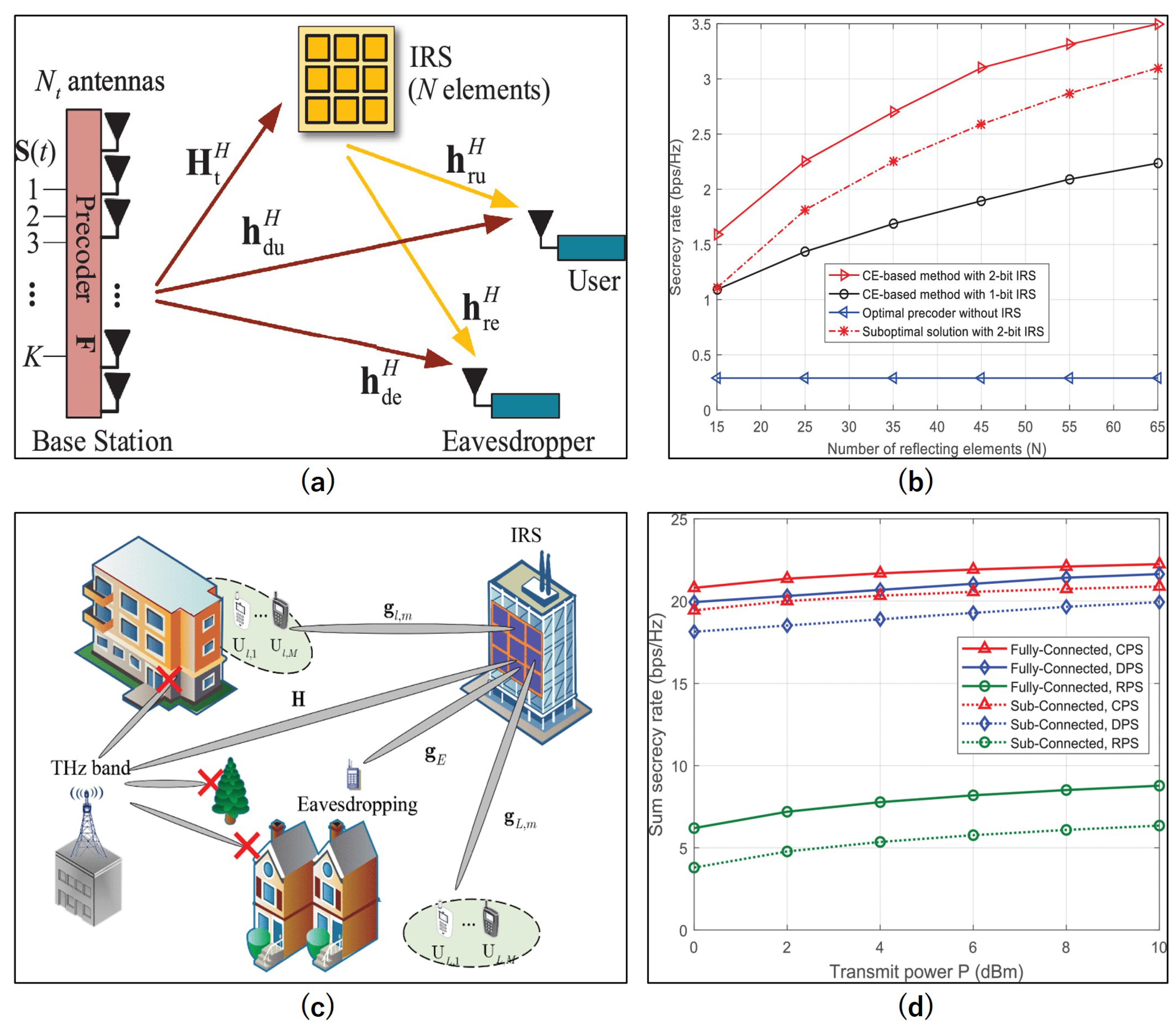
4.1. Reconfigurable Intelligent Surfaces (RIS)
4.2. Secure Beamforming
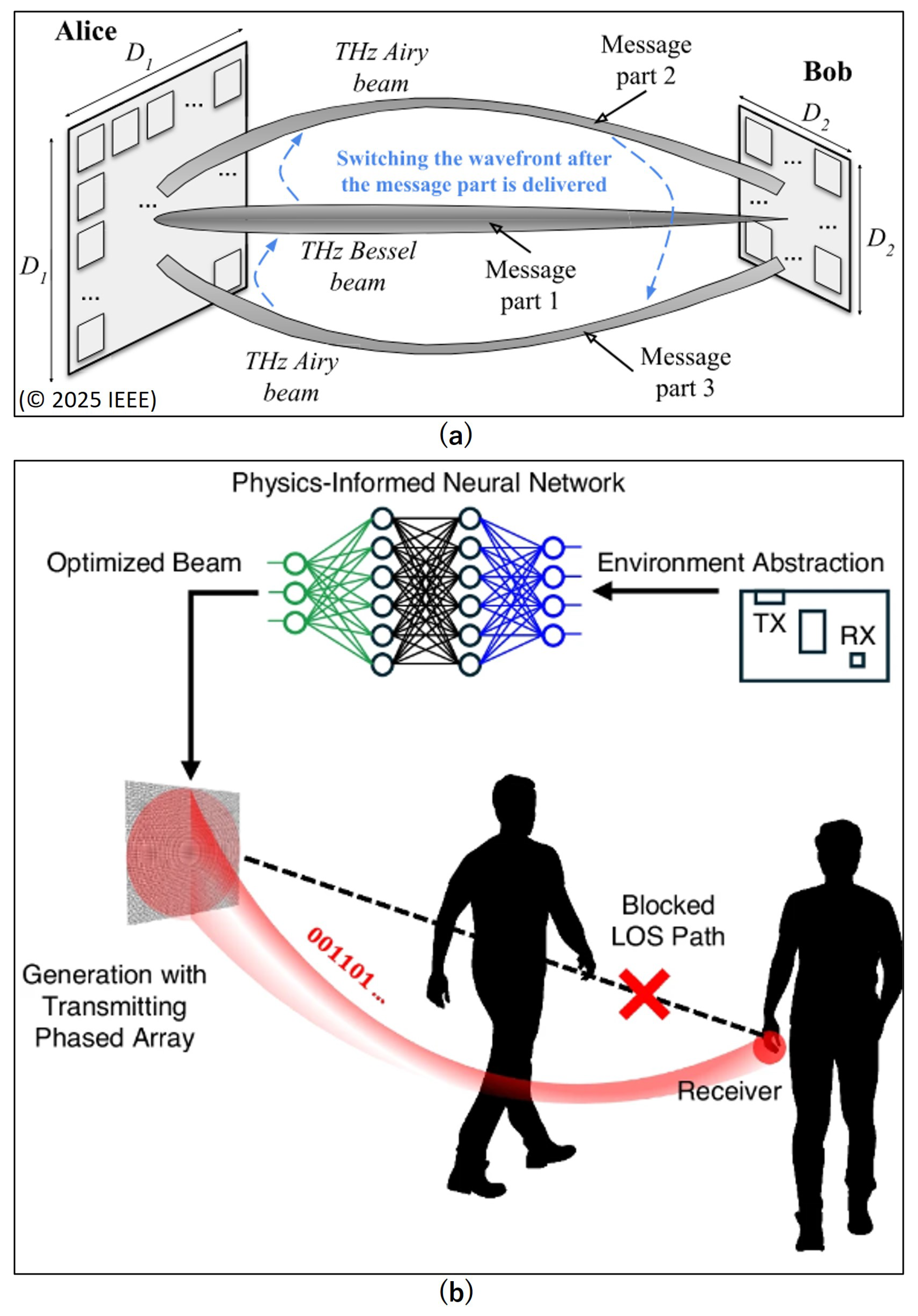
4.3. Wavefront Hopping
4.4. Comparative Analysis of Spatial-Based Techniques
- Implementation complexity: RIS offer a cost-effective solution with passive elements, but the “implementation complexity” shifts to the channel estimation phase, which creates significant signaling overhead. Secure beamforming is the most mature technology, balancing complexity and performance through standard phased arrays or lens antennas. Wavefront hopping offers high theoretical security by utilizing multi-dimensional beam structures (e.g., Airy/Bessel beams). However, it incurs high complexity in holographic beamforming generation and requires computationally intensive optimization for trajectory planning, while being restricted to near-field applications.
- Mobility Challenges: All spatial techniques are inherently sensitive to alignment errors. RIS and secure beamforming are particularly vulnerable to user mobility. A slight positional shift can move the user out of the narrow high-gain beam or the “quiet zone”, leading to outages or leakage. To address this, beam-tracking is required [106,114]. Wavefront hopping, particularly with self-bending Airy beams, offers a unique advantage in bypassing obstacles, providing better robustness in dynamic, obstacle-rich environments compared to rigid line-of-sight beamforming.
5. Conclusions
Author Contributions
Funding
Data Availability Statement
Conflicts of Interest
References
- Jiang, W.; Zhou, Q.; He, J.; Habibi, M.A.; Melnyk, S.; El-Absi, M.; Han, B.; Di Renzo, M.; Schotten, H.D.; Luo, F.L.; et al. Terahertz communications and sensing for 6G and beyond: A comprehensive review. IEEE Commun. Surv. Tutorials 2024, 26, 2326–2381. [Google Scholar] [CrossRef]
- Ducournau, G.; Nagatsuma, T. Wireless communications in the THz range. In Fundamentals of Terahertz Devices and Applications; John Wiley & Sons, Inc.: Hoboken, NJ, USA, 2021; pp. 479–510. [Google Scholar]
- Dat, P.T.; Akahane, K. Photonic Technology for Millimeter-Wave and Terahertz-Wave Communications in IMT-2030 and Beyond. IEEE Commun. Stand. Mag. 2025; early access. [Google Scholar] [CrossRef]
- Lee, S.; Hara, S.; Yoshida, T.; Amakawa, S.; Dong, R.; Kasamatsu, A.; Sato, J.; Fujishima, M. An 80-Gb/s 300-GHz-band single-chip CMOS transceiver. IEEE J. Solid-State Circuits 2019, 54, 3577–3588. [Google Scholar] [CrossRef]
- Ding, J.; Yu, J.; Li, W.; Wang, K.; Zhou, W.; Zhang, J.; Zhu, M.; Xie, T.; Yu, J.; Zhao, F. High-speed and long-distance photonics-aided terahertz wireless communication. J. Light. Technol. 2023, 41, 3417–3423. [Google Scholar] [CrossRef]
- Zhang, J.; Zhu, M.; Hua, B.; Lei, M.; Cai, Y.; Zou, Y.; Tong, W.; Ding, J.; Tian, L.; Ma, L.; et al. Real-time demonstration of 100 GbE THz-wireless and fiber seamless integration networks. J. Light. Technol. 2022, 41, 1129–1138. [Google Scholar] [CrossRef]
- Dat, P.T.; Kanno, A.; Yamamoto, N.; Kawanishi, T. Seamless Convergence of Fiber and Wireless Systems for 5G and Beyond Networks. J. Light. Technol. 2019, 37, 592–605. [Google Scholar] [CrossRef]
- Nagatsuma, T.; Gao, W.; Kawamoto, Y.; Ohara, T.; Ito, H.; Ishibashi, T. InP-based Integrated Circuits on SiC/Si Substrates for Terahertz Communications. J. Light. Technol. 2025, 43, 9765–9774. [Google Scholar] [CrossRef]
- Liu, C.; Li, Z.; Yamazaki, Y.; Herdian, H.; Wang, C.; Tian, A.; Sakamaki, J.; Nie, H.; Fu, X.; Kato, S.; et al. A 640-Gb/s 4 × 4-MIMO D-Band CMOS Transceiver Chipset. IEEE J. Solid-State Circuits 2024, 60, 1132–1149. [Google Scholar] [CrossRef]
- Che, M.; Kondo, K.; Kato, K. Generating and enhancing THz pulses via an antenna-coupled unitraveling-carrier photodiode array. IEEE Trans. Terahertz Sci. Technol. 2023, 13, 280–285. [Google Scholar] [CrossRef]
- Ichikawa, D.; Gao, W.; Ngo, N.H.; Ohara, T.; Tanaka, M.; Murakami, S.; Yamada, Y.; Yamane, H.; Nishida, Y.; Fujita, M.; et al. Terahertz On-Chip Communications With Hybrid Electronic-Photonic Interconnects. IEEE Trans. Terahertz Sci. Technol. 2025, 15, 751–762. [Google Scholar] [CrossRef]
- Qian, C.; Che, M.; Kamiura, Y.; Doi, R.; Ishibashi, T.; Mikami, Y.; Kato, K. 3-mW-output 300-GHz ultra-compact photonic THz-wave generator. In Proceedings of the 2024 IEEE Opto-Electronics and Communications Conference (OECC), Melbourne, Australia, 30 June–4 July 2024; pp. 1–3. [Google Scholar]
- John, L.; Tessmann, A.; Leuther, A.; Neininger, P.; Merkle, T.; Zwick, T. Broadband 300-GHz power amplifier MMICs in InGaAs mHEMT technology. IEEE Trans. Terahertz Sci. Technol. 2020, 10, 309–320. [Google Scholar] [CrossRef]
- Che, M.; Kanaya, H.; Kato, K. Optically controlled THz power tuning based on interference at transmission line. Opt. Express 2021, 29, 20034–20044. [Google Scholar] [CrossRef]
- Li, L.; Long, T.; Yang, X.; Zhang, Z.; Wang, L.; Wang, J.; Wang, M.; Lu, J.; Yu, J.; Chen, B. Modified uni-travelling-carrier photodiodes with 206 GHz bandwidth and 0.81 AW−1 external responsivity. Nat. Photonics 2025, 19, 1301–1308. [Google Scholar] [CrossRef]
- Malevich, Y.; Ergoktas, M.S.; Bakan, G.; Steiner, P.; Kocabas, C. Very-large-scale reconfigurable intelligent surfaces for dynamic control of terahertz and millimeter waves. Nat. Commun. 2025, 16, 2907. [Google Scholar] [CrossRef]
- Abdo, I.; Jyo, T.; Pander, A.; Wakita, H.; Shiratori, Y.; Muto, M.; Hamada, H.; Nagatani, M.; da Gomez, C.; Wang, C.; et al. 300-ghz-band four-element cmos-inp hybrid phased-array transmitter with 36circ steering range. IEEE Microw. Wirel. Technol. Lett. 2023, 33, 887–890. [Google Scholar] [CrossRef]
- Long, J.; Yu, J.; Wang, C.; Zhang, L.; Sang, B.; Wu, Y.; Yang, X.; Wei, Y.; Wang, K.; Zhou, W.; et al. 510-Gbps 322-GHz Photonics-Aided Terahertz Wireless Transmission System With MIMO Embedded Adaptive Phase Recovery Equalizer. IEEE Trans. Microw. Theory Tech. 2024, 73, 3597–3607. [Google Scholar] [CrossRef]
- Wang, M.; Yu, J.; Zhao, X.; Bian, C.; Zhou, W.; Wang, K. K-means non-uniform-quantization digital–analog radio-over-fiber scheme for THz-band photonics-aided wireless fronthaul. Opt. Lett. 2024, 49, 2801–2804. [Google Scholar] [CrossRef] [PubMed]
- Yu, J.; Wang, Y.; Ding, J.; Zhang, J.; Li, W.; Wang, F.; Wang, C.; Wang, K.; Tan, Y.; Zhu, M.; et al. Broadband photon-assisted terahertz communication and sensing. J. Light. Technol. 2023, 41, 3332–3349. [Google Scholar] [CrossRef]
- Wei, Y.; Yu, J.; Zhao, X.; Yang, X.; Wang, M.; Li, W.; Tian, P.; Han, Y.; Zhang, Q.; Tan, J.; et al. Demonstration of a photonics-aided 4600-m wireless transmission system in the sub-THz band. J. Light. Technol. 2024, 42, 8564–8576. [Google Scholar] [CrossRef]
- Li, W.; Yu, J.; Zhu, B.; Wang, F.; Ding, J.; Zhang, J.; Zhu, M.; Zhao, F.; Xie, T.; Wang, K.; et al. Photonic terahertz wireless communication: Towards the goal of high-speed kilometer-level transmission. J. Light. Technol. 2023, 42, 1159–1172. [Google Scholar] [CrossRef]
- Kamiura, Y.; Doi, R.; Ssali, H.; Che, M.; Mikami, Y.; Kato, K. 300-GHz Beam-Steering Wireless Communication Enabled by 4-Array InGaAs UTC-PD on SiC Substrate and Optical Phased Array. J. Light. Technol. 2025, 43, 6050–6057. [Google Scholar] [CrossRef]
- Webber, J.; Oshiro, A.; Iwamatsu, S.; Nishida, Y.; Fujita, M.; Nagatsuma, T. 48-Gbit/s 8K video-transmission using resonant tunnelling diodes in 300-GHz band. Electron. Lett. 2021, 57, 668–669. [Google Scholar] [CrossRef]
- Liu, K.; Feng, Y.; Han, C.; Chang, B.; Chen, Z.; Xu, Z.; Li, L.; Zhang, B.; Wang, Y.; Xu, Q. High-speed 0.22 THz communication system with 84 Gbps for real-time uncompressed 8K video transmission of live events. Nat. Commun. 2024, 15, 8037. [Google Scholar] [CrossRef]
- IEEE Std 802.15.3-2023; IEEE Standard for Wireless Multimedia Networks. Institute of Electrical and Electronics Engineers (IEEE): Piscataway, NJ, USA, 2024; pp. 1–684.
- Petrov, V.; Kurner, T.; Hosako, I. IEEE 802.15. 3d: First standardization efforts for sub-terahertz band communications toward 6G. IEEE Commun. Mag. 2020, 58, 28–33. [Google Scholar] [CrossRef]
- Ma, J.; Shrestha, R.; Adelberg, J.; Yeh, C.Y.; Hossain, Z.; Knightly, E.; Jornet, J.M.; Mittleman, D.M. Security and eavesdropping in terahertz wireless links. Nature 2018, 563, 89–93. [Google Scholar] [CrossRef] [PubMed]
- Doeker, T.; Herold, C.; Eckhardt, J.M.; Kürner, T. Eavesdropping measurements for applications in office environments at low THz frequencies. IEEE Trans. Microw. Theory Tech. 2023, 71, 2748–2757. [Google Scholar] [CrossRef]
- Taleb, F.; Hernandez-Cardoso, G.G.; Castro-Camus, E.; Koch, M. Transmission, reflection, and scattering characterization of building materials for indoor THz communications. IEEE Trans. Terahertz Sci. Technol. 2023, 13, 421–430. [Google Scholar] [CrossRef]
- Li, P.; Wang, J.; Zhao, L.; Gao, X.; Song, F.; Sun, H.; Ma, J. Scattering and eavesdropping in terahertz wireless link by wavy surfaces. IEEE Trans. Antennas Propag. 2023, 71, 3590–3597. [Google Scholar] [CrossRef]
- Li, P.; Liu, W.; Zhao, J.; Cui, J.; Ge, Y.; Niu, Q.; Yang, Y.; Meng, X.; Sun, H.; Ma, J. Eavesdropping risk in terahertz channels by coverings on wavy surfaces. Opt. Express 2025, 33, 48451–48465. [Google Scholar] [CrossRef] [PubMed]
- Li, P.; Liu, W.; Li, D.; Zhang, M.; Wang, X.; Sun, H.; Ma, J. Eavesdropping risk evaluation for non-line-of-sight terahertz channels by a metallic wavy surface in rain. J. Opt. Soc. Am. B 2024, 41, 1995–2002. [Google Scholar] [CrossRef]
- Shrestha, R.; Guerboukha, H.; Fang, Z.; Knightly, E.; Mittleman, D.M. Jamming a terahertz wireless link. Nat. Commun. 2022, 13, 3045. [Google Scholar] [CrossRef]
- Priyadarshani, R.; Ata, Y.; Alouini, M.S. Jamming intrusions in extreme bandwidth communication: A comprehensive overview. IEEE Open J. Commun. Soc. 2025, 6, 7125–7149. [Google Scholar] [CrossRef]
- Nallappan, K.; Skorobogatiy, M. Photonics based frequency hopping spread spectrum system for secure terahertz communications. Opt. Express 2022, 30, 27028–27047. [Google Scholar] [CrossRef] [PubMed]
- Li, Z.; Guan, L.; Li, C.; Radwan, A. A secure intelligent spectrum control strategy for future THz mobile heterogeneous networks. IEEE Commun. Mag. 2018, 56, 116–123. [Google Scholar] [CrossRef]
- Yang, Z.; Yang, F.; Wen, Z.; Wang, H.; Liu, Y.; Jiang, H.; Chen, F.; Liu, Y.; Li, M.; Zhang, J. Ultra-wideband photonic frequency-hopping waveform generator enabled by optical injection locking for secure terahertz wireless communications. J. Light. Technol. 2024, 42, 6788–6797. [Google Scholar] [CrossRef]
- Ye, S.; Kaide, R.; Kamiura, Y.; Masutomi, N.; Li, B.; Wang, Y.; Che, M.; Mikami, Y.; Ueda, Y.; Kato, K. Photonic Frequency Hopping and De-Hopping System by Ultra-Fast Wavelength Tunable Laser for Secure Terahertz Wireless Communication. J. Light. Technol. 2025, 43, 9901–9911. [Google Scholar] [CrossRef]
- Ye, S.; Masutomi, N.; Li, B.; Kamiura, Y.; Kaide, R.; Doi, R.; Wang, Y.; Che, M.; Mikami, Y.; Ueda, Y.; et al. Ultra-fast photonic frequency hopping driven by reflection-type transversal filter laser for anti-jamming terahertz communications. Opt. Lett. 2025, 50, 3070–3073. [Google Scholar] [CrossRef]
- Masutomi, N.; Ye, S.; Li, B.; Kaide, R.; Che, M.; Mikami, Y.; Ueda, Y.; Kato, K. Cost-Effective and Energy-Efficient Photonics-Based Frequency Hopping by Single Wavelength-Tunable Laser for Secure THz Communication. Photonics 2025, 12, 76. [Google Scholar] [CrossRef]
- Han, C.; Wu, Y.; Chen, Z.; Chen, Y.; Wang, G. THz ISAC: A physical-layer perspective of terahertz integrated sensing and communication. IEEE Commun. Mag. 2024, 62, 102–108. [Google Scholar] [CrossRef]
- Lyu, Z.; Zhang, L.; Deng, Q.; Fang, X.; Bai, L.; Ozolins, O.; Zhang, H.; Liu, G.; Pang, X.; Yu, X. Photonic Chirp Spread Spectrum THz-ISAC: Constraints and Design Considerations. IEEE Trans. Microw. Theory Tech. 2025. [Google Scholar] [CrossRef]
- Li, B.; Ye, S.; Che, M.; Tang, H.; Kato, K. Demonstration of Frequency Hopping in 300-GHz Band by Photomixing using Tunable DFB Laser Array. In Proceedings of the 2023 28th Microoptics Conference (MOC), Miyazaki, Japan, 24–27 September 2023; pp. 1–2. [Google Scholar]
- Li, B.; Ye, S.; Che, M.; Tang, H.; Masutomi, N.; Mikami, Y.; Kato, K. Demonstration of THz frequency hopping in the 300 GHz band based on UTC-PD and tunable DFB laser array. Jpn. J. Appl. Phys. 2024, 63, 04SP86. [Google Scholar] [CrossRef]
- Yang, Z.; Yang, F.; Zhang, J. Photonic-assisted THz Wideband Frequency Hopping and Secure Communication Based on Optical Injection Locking. In Proceedings of the CLEO: Science and Innovations, Charlotte, NC, USA, 5–10 May 2024; p. JTu2A–68. [Google Scholar]
- Ye, S.; Masutomi, N.; Li, B.; Matsumoto, R.; Kaide, R.; Tang, H.; Kamiura, Y.; Che, M.; Mikami, Y.; Ueda, Y.; et al. Photonic Frequency Hopping Driven by High-Speed Wavelength Tunable Laser for Secure Terahertz-wave Communication. In Proceedings of the Optical Fiber Communication Conference, San Diego, CA, USA, 24–28 March 2024; p. W4A–3. [Google Scholar]
- Ye, S.; Kamiura, Y.; Li, B.; Kaide, R.; Wang, Y.; Che, M.; Mikami, Y.; Ueda, Y.; Kato, K. Self-coherent Photonic Terahertz Link at 300-GHz-band Against Modulated Jamming. Opt. Lett. 2025; in press. [Google Scholar] [CrossRef]
- Ye, S.; Kaide, R.; Kamiura, Y.; Li, B.; Wang, Y.; Che, M.; Mikami, Y.; Ueda, Y.; Kato, K. Highly Secure Photonics-Based Terahertz Frequency Hopping System for Jamming Avoidance With Ultra-Fast Hopping-Rate. J. Light. Technol. 2025, 1–9. [Google Scholar] [CrossRef]
- Ye, S.; Matsutomi, N.; Matsumoto, R.; Kaide, R.; Li, B.; Che, M.; Mikami, Y.; Ueda, Y.; Kato, K. Eavesdropping Avoid Terahertz-Wave Frequency Hopping Spread Spectrum FSK System Driven by Ultra-Fast Wavelength Tunable Laser. In Proceedings of the 2024 International Topical Meeting on Microwave Photonics (MWP), Pisa, Italy, 7–20 September 2024; pp. 1–4. [Google Scholar]
- Masutomi, N.; Ye, S.; Li, B.; Kaide, R.; Che, M.; Mikami, Y.; Ueda, Y.; Kato, K. 300-GHz-band Frequency Hopping with a Single Tunable Laser Diode for Secure THz Communication. In Proceedings of the 50th European Conference on Optical Communication (ECOC 2024), Frankfurt, Germany, 22–26 September 2024; pp. 1204–1207. [Google Scholar]
- Lin, H.W.W.; Sung, C.A.; Hung, Y.H. Microwave frequency switching delays in phase-locked period-one dynamics of semiconductor lasers. Opt. Lett. 2024, 49, 258–261. [Google Scholar] [CrossRef] [PubMed]
- Yu, X.; Zhang, F.; Yan, X.; Wu, G.; Han, X.; Pan, S.; Wang, K. Microwave Generation by P2 Dynamics of Optically Injected Semiconductor Laser. J. Light. Technol. 2025, 43, 4895–4902. [Google Scholar] [CrossRef]
- Liu, Y.; Yang, F.; Yang, Z.; Wen, Z.; Jiang, H.; Chen, F.; Liu, Y.; Li, M.; Zhang, J. Ultra-wideband and Multi-octave Tunable Millimeter Wave Generation based on Photonic Multiplication and Delay-matched Heterodyne. J. Light. Technol. 2024, 42, 8109–8116. [Google Scholar] [CrossRef]
- Liu, X.; Lu, Q.; Cheng, T.; Li, R.; Cheng, M.; Liu, D.; Deng, L. Ultra-Short Period, Wideband, and Uninterrupted Microwave Photonic Frequency-Hopping Communication. In Proceedings of the 2025 Optical Fiber Communications Conference and Exhibition (OFC), San Francisco, CA, USA, 30 March–3 April 2025; p. Th2A.25. [Google Scholar]
- Fang, Z.; Guerboukha, H.; Shrestha, R.; Hornbuckle, M.; Amarasinghe, Y.; Mittleman, D.M. Secure communication channels using atmosphere-limited line-of-sight terahertz links. IEEE Trans. Terahertz Sci. Technol. 2022, 12, 363–369. [Google Scholar] [CrossRef]
- Gao, W.; Chen, Y.; Han, C.; Chen, Z. Distance-adaptive absorption peak modulation (DA-APM) for terahertz covert communications. IEEE Trans. Wirel. Commun. 2020, 20, 2064–2077. [Google Scholar] [CrossRef]
- Gao, W.; Chen, Y.; Han, C.; Chen, Z. Distance-adaptive absorption-peak hopping (DA-APH) modulation for terahertz covert communications. In Proceedings of the 2019 IEEE Global Communications Conference (GLOBECOM), Waikoloa, HI, USA, 9–13 December 2019; pp. 1–6. [Google Scholar]
- Hall, J.; Jornet, J.M.; Thawdar, N.; Melodia, T.; Restuccia, F. Deep learning at the physical layer for adaptive terahertz communications. IEEE Trans. Terahertz Sci. Technol. 2023, 13, 102–112. [Google Scholar] [CrossRef]
- He, Y.; Zhang, L.; Liu, S.; Zhang, H.; Yu, X. Secure transmission of terahertz signals with multiple eavesdroppers. Micromachines 2022, 13, 1300. [Google Scholar] [CrossRef] [PubMed]
- Gao, W.; Han, C.; Chen, Z. Receiver artificial noise aided terahertz secure communications with eavesdropper in close proximity. In Proceedings of the GLOBECOM 2020—2020 IEEE Global Communications Conference, Taipei, Taiwan, 7–11 December 2020; pp. 1–6. [Google Scholar]
- Gao, W.; Han, C.; Chen, Z. DNN-powered SIC-free receiver artificial noise aided terahertz secure communications with randomly distributed eavesdroppers. IEEE Trans. Wirel. Commun. 2021, 21, 563–576. [Google Scholar] [CrossRef]
- Tian, S.; Ju, Y.; Liu, L.; Pei, Q.; Zhang, N.; Wu, C.; Mumtaz, S. Secure terahertz indoor communications using blockage feature-based artificial noise in 6G. In Proceedings of the GLOBECOM 2023—2023 IEEE Global Communications Conference, Kuala Lumpur, Malaysia, 4–8 December 2023; pp. 7261–7266. [Google Scholar]
- He, Y.; Zhang, L.; Yang, H.; Zhang, H.; Yu, X. Impacts of sampling on the artificial noise-assisted terahertz secure communication systems. Phys. Commun. 2024, 67, 102507. [Google Scholar] [CrossRef]
- Deng, Q.; Zhang, L.; Lyu, Z.; Pang, X.; Ozolins, O.; Yu, X. Private communication with photonic terahertz chaos. Adv. Photonics 2024, 6, 066004. [Google Scholar] [CrossRef]
- Chen, Q.; Peng, C.; Zhao, L.; You, W.; Wen, H.; Li, J. Physical layer encryption based on digital chaos in THz wireless communication. Opt. Fiber Technol. 2025, 90, 104118. [Google Scholar] [CrossRef]
- Ottaviani, C.; Woolley, M.J.; Erementchouk, M.; Federici, J.F.; Mazumder, P.; Pirandola, S.; Weedbrook, C. Terahertz quantum cryptography. IEEE J. Sel. Areas Commun. 2020, 38, 483–495. [Google Scholar] [CrossRef]
- Zhang, L.; Deng, Q.; Zhang, H.; Yang, Z.; Pang, X.; Bobrovs, V.; Popov, S.; Wu, Y.; Yu, X.; Ozolins, O.; et al. Quantum noise secured terahertz communications. IEEE J. Sel. Top. Quantum Electron. 2022, 29, 8400110. [Google Scholar] [CrossRef]
- Xu, J.; Yuen, C.; Huang, C.; Ul Hassan, N.; Alexandropoulos, G.C.; Di Renzo, M.; Debbah, M. Reconfiguring wireless environments via intelligent surfaces for 6G: Reflection, modulation, and security. Sci. China Inf. Sci. 2023, 66, 130304. [Google Scholar] [CrossRef]
- You, X.; Fumeaux, C.; Withayachumnankul, W. Tutorial on broadband transmissive metasurfaces for wavefront and polarization control of terahertz waves. J. Appl. Phys. 2022, 131, 061101. [Google Scholar] [CrossRef]
- You, X.; Fumeaux, C.; Withayachumnankul, W. Circuit-based design and optimization for broadband terahertz metasurfaces. In Proceedings of the 2021 46th International Conference on Infrared, Millimeter and Terahertz Waves (IRMMW-THz), Chengdu, China, 29 August–3 September 2021; pp. 1–2. [Google Scholar]
- Chen, W.; Chen, Z.; Ma, X.; Chi, Y.; Li, Z. Secrecy rate optimization for intelligent reflecting surface aided multi-input-single-output terahertz communication. Microw. Opt. Technol. Lett. 2020, 62, 2760–2765. [Google Scholar] [CrossRef]
- Ning, B.; Chen, Z.; Chen, W.; Li, L. Improving security of THz communication with intelligent reflecting surface. In Proceedings of the 2019 IEEE Globecom Workshops (GC Wkshps), Waikoloa, HI, USA, 9–13 December 2019; pp. 1–6. [Google Scholar]
- Xu, J.; Zhu, Z.; Chu, Z.; Niu, H.; Xiao, P.; Lee, I. Sum secrecy rate maximization for IRS-aided multi-cluster MIMO-NOMA terahertz systems. IEEE Trans. Inf. Forensics Secur. 2023, 18, 4463–4474. [Google Scholar] [CrossRef]
- Youn, J.; Son, W.; Jung, B.C. Physical-layer security improvement with reconfigurable intelligent surfaces for 6G wireless communication systems. Sensors 2021, 21, 1439. [Google Scholar] [CrossRef] [PubMed]
- Kiran, A.; Sonker, A.; Jadhav, S.; Jadhav, M.M.; Naga Ramesh, J.V.; Muniyandy, E. Secure communications with THz reconfigurable intelligent surfaces and deep learning in 6G systems. Wirel. Pers. Commun. 2024, 1–17. [Google Scholar] [CrossRef]
- Qiao, J.; Zhang, C.; Dong, A.; Bian, J.; Alouini, M.S. Securing intelligent reflecting surface assisted terahertz systems. IEEE Trans. Veh. Technol. 2022, 71, 8519–8533. [Google Scholar] [CrossRef]
- Kim, D.; Jeong, S.; Kang, J. Energy-efficient secure offloading system designed via UAV-mounted intelligent reflecting surface for resilience enhancement. IEEE Internet Things J. 2023, 11, 3768–3778. [Google Scholar] [CrossRef]
- Zhu, Y.; Mao, B.; Kato, N. Intelligent reflecting surface in 6G vehicular communications: A survey. IEEE Open J. Veh. Technol. 2022, 3, 266–277. [Google Scholar] [CrossRef]
- Yuan, J.; Chen, G.; Wen, M.; Tafazolli, R.; Panayirci, E. Secure transmission for THz-empowered RIS-assisted non-terrestrial networks. IEEE Trans. Veh. Technol. 2022, 72, 5989–6000. [Google Scholar] [CrossRef]
- Wu, Y.; Khisti, A.; Xiao, C.; Caire, G.; Wong, K.K.; Gao, X. A survey of physical layer security techniques for 5G wireless networks and challenges ahead. IEEE J. Sel. Areas Commun. 2018, 36, 679–695. [Google Scholar] [CrossRef]
- Niu, H.; Xiao, Y.; Lei, X.; Chen, J.; Xiao, Z.; Li, M.; Yuen, C. A survey on artificial noise for physical layer security: Opportunities, technologies, guidelines, advances, and trends. IEEE Commun. Surv. Tutor. 2025. [Google Scholar] [CrossRef]
- Fu, H.; Zhang, X.; Peng, L. Performance Analysis of Artificial Noise-Assisted Location-Based Beamforming in Rician Wiretap Channels. Entropy 2023, 25, 1626. [Google Scholar] [CrossRef]
- Shehadeh, Y.E.H.; Hogrefe, D. A survey on secret key generation mechanisms on the physical layer in wireless networks. Secur. Commun. Netw. 2015, 8, 332–341. [Google Scholar] [CrossRef]
- Xia, E.; Hu, B.J.; Shen, Q. A survey of physical layer secret key generation enhanced by intelligent reflecting surface. Electronics 2024, 13, 258. [Google Scholar] [CrossRef]
- Xiao, Q.; Zhao, J.; Feng, S.; Li, G.; Hu, A. Securing NextG networks with physical-layer key generation: A survey. Secur. Saf. 2024, 3, 2023021. [Google Scholar]
- Li, J.; Ye, N.; Ma, S.; Bu, X.; An, J. Multi-user hybrid beamforming design for physical layer secured mmWave LOS communications. Electronics 2021, 10, 2635. [Google Scholar]
- Sanenga, A.; Mapunda, G.A.; Jacob, T.M.L.; Marata, L.; Basutli, B.; Chuma, J.M. An overview of key technologies in physical layer security. Entropy 2020, 22, 1261. [Google Scholar] [CrossRef] [PubMed]
- Ansari, O.; Amin, M. Directional modulation techniques for secure wireless communication: A comprehensive survey. EURASIP J. Wirel. Commun. Netw. 2022, 2022, 93. [Google Scholar] [CrossRef]
- Chen, J.; Xiao, Y.; Lei, X.; Ding, Y.; Niu, H.; Liu, K.; Zhong, Y.; Yang, S.; Fusco, V.; Xiang, W. A Survey on Directional Modulation: Opportunities, Challenges, Recent Advances, Implementations, and Future Trends. IEEE Internet Things J. 2025, 12, 32581–32615. [Google Scholar] [CrossRef]
- Qiu, B.; Cheng, W.; Zhang, W. Decomposed and distributed directional modulation for secure wireless communication. IEEE Trans. Wirel. Commun. 2023, 23, 5219–5231. [Google Scholar] [CrossRef]
- Liu, Z.; Shang, Y.; Zhang, R.; Xiang, H. Relay selection based on coalitional game for secure wireless networks. IET Commun. 2014, 8, 1355–1363. [Google Scholar] [CrossRef]
- Jameel, F.; Wyne, S.; Kaddoum, G.; Duong, T.Q. A comprehensive survey on cooperative relaying and jamming strategies for physical layer security. IEEE Commun. Surv. Tutor. 2018, 21, 2734–2771. [Google Scholar] [CrossRef]
- Atallah, M.; Kaddoum, G.; Kong, L. A survey on cooperative jamming applied to physical layer security. In Proceedings of the 2015 IEEE International Conference on Ubiquitous Wireless Broadband (ICUWB), Montreal, QC, Canada, 4–7 October 2015; pp. 1–5. [Google Scholar]
- Cohen, A.; D’Oliveira, R.G.; Yeh, C.Y.; Guerboukha, H.; Shrestha, R.; Fang, Z.; Knightly, E.; Médard, M.; Mittleman, D.M. Absolute security in high-frequency wireless links. In Proceedings of the 2022 IEEE Conference on Communications and Network Security (CNS), Austin, TX, USA, 3–5 October 2022; pp. 46–54. [Google Scholar]
- Cohen, A.; D’Oliveira, R.G.; Yeh, C.Y.; Guerboukha, H.; Shrestha, R.; Fang, Z.; Knightly, E.W.; Médard, M.; Mittleman, D.M. Absolute security in terahertz wireless links. IEEE J. Sel. Top. Signal Process. 2023, 17, 819–833. [Google Scholar] [CrossRef]
- Akyildiz, I.F.; Jornet, J.M.; Han, C. Terahertz band: Next frontier for wireless communications. Phys. Commun. 2014, 12, 16–32. [Google Scholar] [CrossRef]
- Han, C.; Akyildiz, I.F. Distance-aware multi-carrier (DAMC) modulation in terahertz band communication. In Proceedings of the 2014 IEEE International Conference on Communications (ICC), Sydney, NSW, Australia, 10–14 June 2014; pp. 5461–5467. [Google Scholar]
- Han, C.; Bicen, A.O.; Akyildiz, I.F. Multi-wideband waveform design for distance-adaptive wireless communications in the terahertz band. IEEE Trans. Signal Process. 2015, 64, 910–922. [Google Scholar] [CrossRef]
- Che, M.; Chen, H.; Ueda, Y.; Kato, K. Secured THz communication in photonic microcell networks based on spatial wave mixing of steered beams. Opt. Switch. Netw. 2024, 54, 100773. [Google Scholar] [CrossRef]
- Yamauchi, K.; Kawai, Y.; Che, M.; Ito, H.; Ishibashi, T.; Kato, K. Terahertz heterodyne AND operation for physically encrypted wireless communication. In Proceedings of the 2020 European Conference on Optical Communications (ECOC), Brussels, Belgium, 6–10 December 2020; pp. 1–4. [Google Scholar]
- Yamauchi, K.; Kato, K. Optical heterodyne AND operation as emulation of physical layer security at wireless communication. IEICE Electron. Express 2021, 18, 20210008. [Google Scholar] [CrossRef]
- Kato, K. Photonics-assisted terahertz-wave beam steering and its application in secured wireless communication. Photonics 2021, 9, 9. [Google Scholar] [CrossRef]
- Chen, H.; Che, M.; Seiki, N.; Shiramizu, T.; Yano, T.; Mikami, Y.; Ueda, Y.; Kato, K. Physically Encrypted Wireless Transmission Based on XOR between Two Data in Terahertz Beams. Electronics 2023, 12, 2629. [Google Scholar] [CrossRef]
- Kamiura, Y.; Iwamoto, S.; Mikami, Y.; Kato, K. Physical-Layer Encryption for Terahertz Wireless Communication via Logical AND Operation of Dual Beams. Electronics 2025, 14, 3762. [Google Scholar] [CrossRef]
- Li, B.; Che, M.; Ye, S.; Yang, D.; Tang, H.; Mikami, Y.; Kato, K. Photonic-Assisted Frequency-Independent Beam Steering for Wideband Terahertz Wireless Applications. J. Light. Technol. 2025, 43, 9950–9958. [Google Scholar] [CrossRef]
- Méndez-Rial, R.; Rusu, C.; González-Prelcic, N.; Alkhateeb, A.; Heath, R.W. Hybrid MIMO architectures for millimeter wave communications: Phase shifters or switches? IEEE Access 2016, 4, 247–267. [Google Scholar] [CrossRef]
- Attaoui, W.; Bouraqia, K.; Sabir, E. Initial access & beam alignment for mmWave and terahertz communications. IEEE Access 2022, 10, 35363–35397. [Google Scholar] [CrossRef]
- Madhekwana, S.; Usman, M.A.; Ayyub, A.; Politis, C. Beam alignment for mmWave and THz: Systematic review: S. Madhekwana et al. Telecommun. Syst. 2025, 88, 87. [Google Scholar] [CrossRef]
- Petrov, V.; Guerboukha, H.; Mittleman, D.M.; Singh, A. Wavefront hopping: An enabler for reliable and secure near field terahertz communications in 6G and beyond. IEEE Wirel. Commun. 2024, 31, 48–55. [Google Scholar] [CrossRef]
- Petrov, V.; Guerboukha, H.; Singh, A.; Jornet, J.M. Wavefront hopping for physical layer security in 6G and beyond near-field THz communications. IEEE Trans. Commun. 2025, 73, 2996–3012. [Google Scholar] [CrossRef]
- Guerboukha, H.; Zhao, B.; Fang, Z.; Knightly, E.; Mittleman, D.M. Curving THz wireless data links around obstacles. Commun. Eng. 2024, 3, 58. [Google Scholar] [CrossRef]
- Chen, H.; Kludze, A.; Ghasempour, Y. A physics-informed Airy beam learning framework for blockage avoidance in sub-terahertz wireless networks. Nat. Commun. 2025, 16, 7387. [Google Scholar] [CrossRef] [PubMed]
- Li, B.; Che, M.; Ye, S.; Mikami, Y.; Kato, K. Demonstration of Optoelectronic THz Beam Tracking Using Real-time Phase Optimization. IEEE Photonics Technol. Lett. 2025, 37, 1109–1112. [Google Scholar] [CrossRef]



| Reference | Year | Frequency (GHz) | FH Interval (GHz) | Number of FH Carrier | Hopping Rate (hops/s) | Communication |
|---|---|---|---|---|---|---|
| [36] | 2022 | 110–170 | – | – | – | Per-carrier OOK |
| [45] | 2024 | 288–331 | 8 | 10 | 100 | Per-carrier OOK |
| [46] | 2024 | 115–140 | 5 | 5 | 1 k | Off-line OOK |
| [38] | 2024 | 115–140 | 5 | 5 | 1 k | Off-line QPSK |
| [47] | 2024 | 301.0–305.5 | 0.6 | 8 | 20 M | – |
| [41] | 2024 | 286–321 | 35 | 2 | 5 M | – |
| [40] | 2025 | 240–320 | 40 | 3 | 5 M | Per-carrier OOK |
| [39] | 2025 | 230–310 | 40 | 3 | 5 M | Per-carrier FSK |
| [49] | 2025 | 235–275 | 40 | 2 | 75 M | Real-time OOK |
| Technique | Primary Security Mechanism | Implementation Complexity | Real-Time Feasibility | Mobility Tolerance |
|---|---|---|---|---|
| FH | Rapidly changing carrier frequency to avoid jamming or eavesdropping. | High: Requires ultra-fast tunable lasers and strict synchronization. | Medium: OOK achieved but high-order modulation remains challenging. | High: Frequency diversity mitigates fading; less sensitive to pointing errors. |
| Environment-adaptive propagation | Utilizing molecular absorption to limit range. | Medium: Relies primarily on carrier frequency selection and power control. | High: Feasible with standard adaptive modulation schemes. | Medium: Distance changes require dynamic updates to modulation schemes. |
| Noise masking | Injecting noise to degrade Eve’s SINR and Signal mimics noise characteristics. | High: complex SIC and synchronization of chaotic maps required. | Medium: Constraints on ADC precision and SIC latency limits speed. | Low: Highly sensitive to channel correlation changes caused by movement. |
| Technique | Primary Security Mechanism | Implementation Complexity | Real-Time Feasibility | Mobility Tolerance |
|---|---|---|---|---|
| RIS | Programmable reflection and multipath. | High: Passive hardware, but high overhead for channel estimation. | Medium: Latency in channel estimation limits fast adaptation. | Low: Requires continuous beam tracking. |
| Secure beamforming | Spatial energy concentration and sidelobe suppression. | Low: Standard phased antenna arrays or lens. | High: Mature technology. | Low: Requires continuous beam tracking. |
| Wavefront hopping | Switching between varying spatial modes. | High: Requires complex holographic beamforming and optimization. | Low: Computationally intensive for trajectory planning. | Medium: Self-bending beams can bypass obstacles, offering robustness in NLoS. |
Disclaimer/Publisher’s Note: The statements, opinions and data contained in all publications are solely those of the individual author(s) and contributor(s) and not of MDPI and/or the editor(s). MDPI and/or the editor(s) disclaim responsibility for any injury to people or property resulting from any ideas, methods, instructions or products referred to in the content. |
© 2025 by the authors. Licensee MDPI, Basel, Switzerland. This article is an open access article distributed under the terms and conditions of the Creative Commons Attribution (CC BY) license.
Share and Cite
Ye, S.; Che, M.; Mikami, Y.; Kato, K. Physical Layer Security Techniques for Terahertz Communications Above 100 GHz: A Review. Photonics 2026, 13, 42. https://doi.org/10.3390/photonics13010042
Ye S, Che M, Mikami Y, Kato K. Physical Layer Security Techniques for Terahertz Communications Above 100 GHz: A Review. Photonics. 2026; 13(1):42. https://doi.org/10.3390/photonics13010042
Chicago/Turabian StyleYe, Shenghong, Ming Che, Yuya Mikami, and Kazutoshi Kato. 2026. "Physical Layer Security Techniques for Terahertz Communications Above 100 GHz: A Review" Photonics 13, no. 1: 42. https://doi.org/10.3390/photonics13010042
APA StyleYe, S., Che, M., Mikami, Y., & Kato, K. (2026). Physical Layer Security Techniques for Terahertz Communications Above 100 GHz: A Review. Photonics, 13(1), 42. https://doi.org/10.3390/photonics13010042