Review

Principle and Recent Development in Photonic Time-Stretch Imaging


1
School of Microelectronics, Shenzhen Institute of Information Technology, Shenzhen 518172, China
2
Department of Periodontology, Shenzhen Stomatological Hospital, Southern Medical University, Shenzhen 518005, China
3
Center for Cognition and Neuroergonomics, State Key Laboratory of Cognitive Neuroscience and Learning, Beijing Normal University at Zhuhai, Zhuhai 519087, China
4
School of Engineering and Digital Arts, University of Kent, Canterbury, CT2 7NT, UK
*
Authors to whom correspondence should be addressed.
Photonics 2023, 10(7), 817; https://doi.org/10.3390/photonics10070817

Submission received: 29 May 2023 / Revised: 15 June 2023 / Accepted: 18 June 2023 / Published: 13 July 2023

Abstract

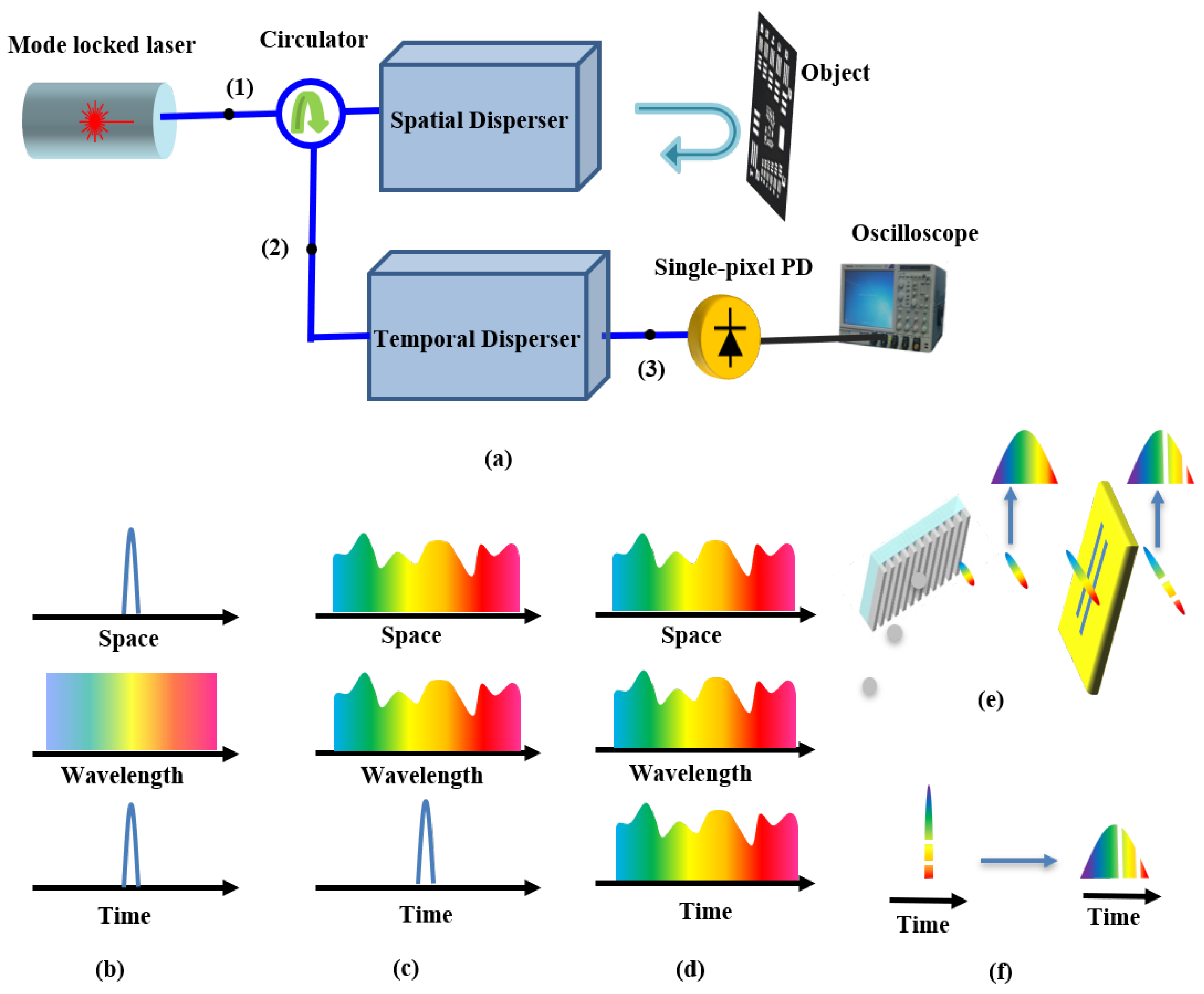
Inspiring development in optical imaging enables great applications in the science and engineering industry, especially in the medical imaging area. Photonic time-stretch imaging is one emerging innovation that attracted a wide range of attention due to its principle of one-to-one-to-one mapping among space-wavelength-time using dispersive medium both in spatial and time domains. The ultrafast imaging speed of the photonics time-stretch imaging technique achieves an ultrahigh frame rate of tens of millions of frames per second, which exceeds the traditional imaging methods in several orders of magnitudes. Additionally, regarding ultrafast optical signal processing, it can combine several other optical technologies, such as compressive sensing, nonlinear processing, and deep learning. In this paper, we review the principle and recent development of photonic time-stretch imaging and discuss the future trends.
Keywords: microscopy; time-stretch imaging; compressive sensing; optical imaging microscopy; time-stretch imaging; compressive sensing; optical imaging