
The Combination of Micro-Nano Bubbles and Other Technologies for Emerging Contaminants’ Elimination in Water Treatment
Abstract
1. Introduction
2. Review Methodology
3. Generation and Characteristics of Micro-Nano Bubbles
3.1. Primary Generation Techniques for Micro-Nano Bubbles
3.2. Physicochemical Properties of Micro-Nano Bubbles
4. ECs’ Elimination by MNBs with Other Technologies
4.1. Adsorption Enhancement by MNBs
4.2. Advanced Oxidation Processes’ Enhancement by MNBs
4.2.1. Ozonation Enhancement by MNBs
4.2.2. Persulfate Activation Enhancement by MNBs
4.2.3. Photocatalysis Enhancement by MNBs
4.2.4. Zero-Valent Nano-Iron Catalysis Enhancement by MNBs

| Category | Processes | Pollutants | Efficiency | Role of MNBs | Ref. |
|---|---|---|---|---|---|
| Advanced oxidation processes | MNBs with Ozone | Butylated hydroxytoluene (BHT) | BHT: 70% | Strengthening ozone gas–liquid mass transfer and promoting pollutant oxidative decomposition. | [28] |
| MNBs with Ozone | Organic-polluted wastewater | COD: more than 63% at 14 h | Solubilizing ozone, improving its stability and increasing oxidation efficiency. | [30] | |
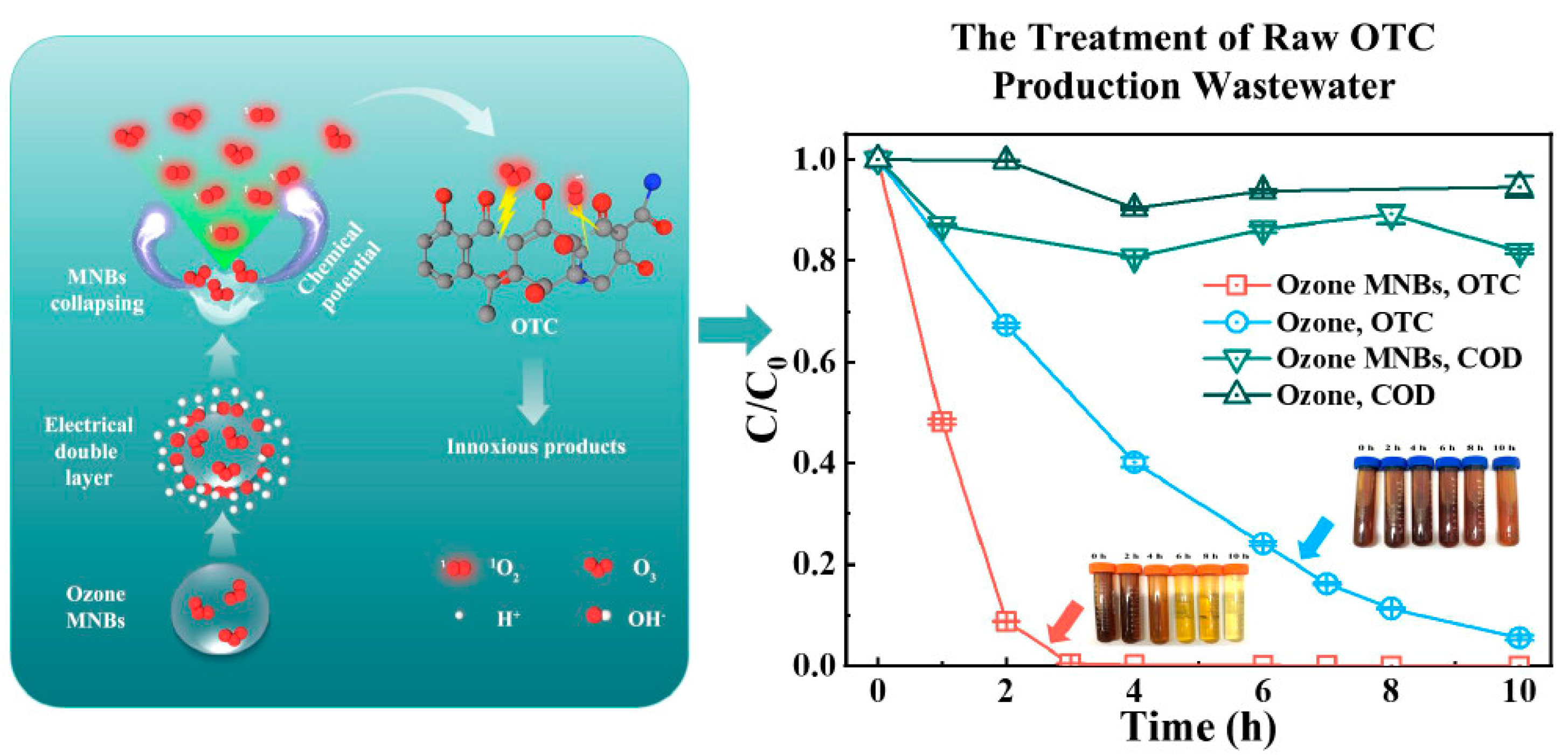
| MNBs with Ozone | Oxycline (OTC) | OTC: 99.5% | Generating singlet oxygen, intensifying ozone mass transfer and promoting targeted degradation. | [31] | |
| MNBs with Ozone | Photoresist | Enhancing the removal rate by more than 30% | Improving ozone stability, increasing dissolution efficiency and facilitating reactive species generation. | [32] | |
| MNBs with Fe(II)/persulfate with sludge membrane system | Acetochlor | AC: 92.3%, the removal rate has increased by 32% | Dispersing Fe(II), enriching pollutants, and alleviating membrane fouling. | [34] | |
| MNBs with thermally activated persulfate | Azo dye (100 vmg/L) | Removal rate: 94.7% (an increase of 28%) | Improving persulfate solubility, prolonging contact time and intensifying mineralization. | [35] | |
| MNBs with persulfate | Tetracycline (20 mg/L) | The removal rate within 60 min was 92.3% (up 31%) | Enriching pollutants and catalysts, enhancing metal ion leaching, and promoting cycling. | [36] | |
| MNBs with photocatalysis | Small-molecule organic substances in municipal secondary effluent | COD was 68% and UV254 decreased by 57% | Increasing O2 solubilization, concentrating organics and suppressing charge carrier recombination. | [37] | |
| MNBs with TiO2/Graphene Photocatalysis (Pilot) | Rhodamine B (50 mg/L) | Removal rate > 90% (for 8 consecutive hours) | Optimizing gas–liquid contact, minimizing mass-transfer resistance, and cutting energy consumption. | [38] | |
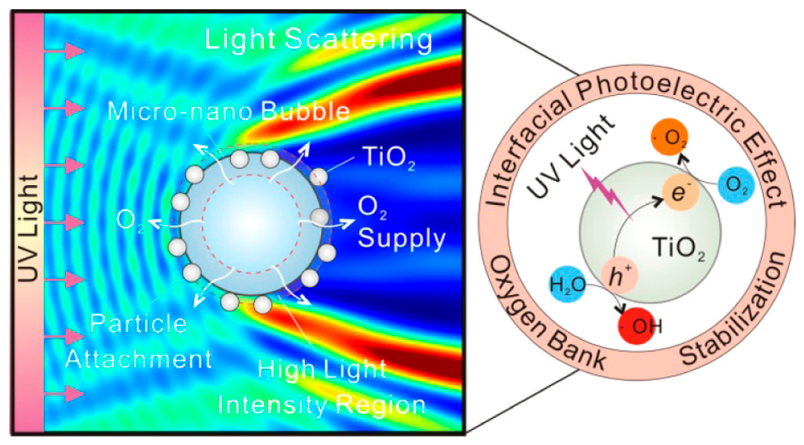
| MNBs with photocatalysis | Bisphenol A | The degradation rate has increased by 2.3 times | Establishing a “Dual-Capture” synergy and intensifying mineralization. | [40] | |
| MNBs with Zero-valent nano-iron biochar | Tetracycline | The removal rate within 2 h was 82.81% | Dispersing nanoscale iron, generating radicals through particle decomposition, and enhancing triphase contact. | [46] | |
| MNBs system | Tetracycline | TC: 82.66% at 100 min Efficient degradation | Intensifying mass-transfer–oxidation synergy and boosting degradation stability. | [47] |
4.3. Microbial Synergy Processes by MNBs
5. Conclusions
Author Contributions
Funding
Data Availability Statement
Acknowledgments
Conflicts of Interest
Abbreviations
| ECs | Emerging contaminants |
| PFAS | Per- and polyfluoroalkyl substances |
| MNBs | Micro-nano bubbles |
| PPCPs | Pharmaceuticals and personal care products |
| EDCs | Endocrine-disrupting chemicals |
| MPs | Microplastics |
| nZVI | Zero-valent iron nanoparticles |
| DO | Dissolved oxygen |
| COD | Chemical Oxygen Demand |
| PFOS | Perfluorooctane sulfonate |
| PFOA | Perfluorooctanoic Acid |
| GAC | Coal-based granular activated carbon |
| OTC | Oxytetracycline |
| PL spectroscopy | Photoluminescence spectroscopy |
| CB | Conventional bubble |
| BHT | Butylated hydroxytoluene |
| ARB | Antibiotic-resistant bacteria |
| ARG | Antibiotic resistance genes |
| EPS | Expandable Polystyrene |
| MBBR | Moving-Bed Biofilm Reactors |
| TOC | Total Organic Carbon |
| PMS/PDS | Peroxymonosulfate/Peroxydisulfate |
| BC | Biochar |
| TC | Tetracycline |
| ROS | Reactive oxygen species |
| qPCR | Quantitative Real-time Polymerase Chain Reaction |
References
- Noorani, K.R.P.M.; Flora, G.; Surendarnath, S.; Stephy, G.M.; Amesho, K.T.; Chinglenthoiba, C.; Thajuddin, N. Recent advances in remediation strategies for mitigating the impacts of emerging pollutants in water and ensuring environmental sustainability. J. Environ. Manag. 2024, 351, 119674. [Google Scholar]
- Wang, J.; Wang, S. Removal of pharmaceuticals and personal care products (PPCPs) from wastewater: A review. J. Environ. Manag. 2016, 182, 620–640. [Google Scholar] [CrossRef]
- Chen, Q.; Xin Jie, Z.; Guo, Y.; Zhou, Q. Research progress of micro-nano-bubbles in environmental remediation field. Front. Environ. Sci. 2025, 13, 1623566. [Google Scholar]
- Zheng, T.; Wang, J.; Wang, Q.; Nie, C.; Shi, Z.; Wang, X.; Gao, Z. A bibliometric analysis of micro/nano-bubble related research: Current trends, present application, and future prospects. Scientometrics 2016, 109, 53–71. [Google Scholar] [CrossRef]
- Zhao, S.; Wu, J.; Li, Y. Advances in the Research on the Properties and Applications of Micro-Nano Bubbles. Processes 2025, 13, 2106. [Google Scholar] [CrossRef]
- Khuntia, S.; Majumder, S.K.; Ghosh, P. Microbubble-aided water and wastewater purification: A review. Chem. Rev. 2012, 28, 91–221. [Google Scholar] [CrossRef]
- Agarwal, A.; Ng, W.J.; Liu, Y. Principle and applications of microbubble and nanobubble technology for water treatment. Chemosphere 2011, 84, 1175–1180. [Google Scholar] [CrossRef] [PubMed]
- Xiong, Y.; Peng, F. Optimization of cavitation venturi tube design for pico and nano bubbles generation. J. Min. Sci. Technol. 2015, 25, 523–529. [Google Scholar] [CrossRef]
- Cho, S.-H.; Kim, J.-Y.; Chun, J.-H.; Kim, J.-D. Ultrasonic formation of nanobubbles and their zeta-potentials in aqueous electrolyte and surfactant solutions. Colloids Surf. A Physicochem. Eng. Asp. 2005, 269, 28–34. [Google Scholar] [CrossRef]
- Levitsky, I.; Tavor, D.; Gitis, V. Generation of Two-Phase Air-Water Flow with Fine Microbubbles. Chem. Eng. Technol. 2016, 39, 1537–1544. [Google Scholar] [CrossRef]
- Parmar, R.; Majumder, S.K. Terminal rise velocity, size distribution and stability of microbubble suspension. Asia-Pac. J. Chem. Eng. 2015, 10, 450–465. [Google Scholar] [CrossRef]
- Fan, M.; Tao, D.; Luo, Z. Nanobubble generation and its application in froth flotation (part I): Nanobubble generation and its effects on properties of microbubble and millimeter scale bubble solutions. Min. Sci. Technol. 2010, 20, 1–19. [Google Scholar] [CrossRef]
- Finch, J.A.; Nesset, J.E.; Acuna, C. Role of frother on bubble production and behaviour in flotation. Miner. Eng. 2008, 21, 949–957. [Google Scholar] [CrossRef]
- Michailidi, E.D.; Bomis, G.; Varoutoglou, A.; Kyzas, G.Z.; Mitrikas, G.; Mitropoulos, A.C.; Efthimiadou, E.K.; Favvas, E.P. Bulk nanobubbles: Production and investigation of their formation/stability mechanism. J. Colloid Interface Sci. 2020, 564, 371–380. [Google Scholar] [CrossRef] [PubMed]
- Haris, S.; Qiu, X.; Klammler, H.; Mohamed, M.M. The use of micro-nano bubbles in groundwater remediation: A comprehensive review. Groundw. Sustain. Dev. 2020, 11, 100463. [Google Scholar] [CrossRef]
- Marui, T. An introduction to micro/nano-bubbles and their applications. Syst. Cybern. Inform. 2013, 11, 68–73. [Google Scholar]
- Monira, S.; Pramanik, B.K. Micro-Nanobubble Integrated Dissolved Air Flotation: A High-Efficiency Strategy for Microplastic Mitigation in Wastewater. ACS ES T Water 2026, 6, 3153–3161. [Google Scholar] [CrossRef]
- You, K.; Liu, E.; Wu, X.; Cheng, D. Progress of researches on synergetic mechanism of micro-nano-bubble-assisted ozonation. Water Sci. Technol. 2025, 92, 340–362. [Google Scholar] [CrossRef] [PubMed]
- Kyzas, G.Z.; Bomis, G.; Kosheleva, R.I.; Efthimiadou, E.K.; Favvas, E.P.; Kostoglou, M.; Mitropoulos, A.C. Nanobubbles effect on heavy metal ions adsorption by activated carbon. Chem. Eng. J. 2019, 356, 91–97. [Google Scholar] [CrossRef]
- Luo, Y.; Fu, K.; Wang, D.; Luo, J. Nanobubble-Driven Interfacial Interactions of Carbon-Based Adsorbents with Legacy PFAS: Impact of Concentration, pH, and Coexisting Ions. Environ. Sci. Technol. 2025, 59, 6900–6914. [Google Scholar] [CrossRef] [PubMed]
- Xiao, Z.; Aftab, T.B.; Li, D. Applications of micro-nano bubble technology in environmental pollution control. Micro Nano Lett. 2019, 14, 782–787. [Google Scholar] [CrossRef]
- Jiang, X.; Wang, W.; Yu, G.; Deng, S. Contribution of nanobubbles for PFAS adsorption on graphene and OH-and NH2-functionalized graphene: Comparing simulations with experimental results. Environ. Sci. Technol. 2021, 55, 13254–13263. [Google Scholar] [PubMed]
- Kang, Y.; Song, F.; Lin, J.; Wang, N.; Zhu, L. Enhanced selective adsorption of perfluoroalkyl substances through an integration of quaternized cellulose nonwoven and micro-nano-bubbles. Sep. Purif. Technol. 2025, 365, 132598. [Google Scholar] [CrossRef]
- Wang, J.; Wang, Z.; Pei, F.; Wang, X. Enrichment of microplastic pollution by micro-nanobubbles. Chin. Phys. B 2022, 31, 118104. [Google Scholar] [CrossRef]
- Sakr, M.; Mohamed, M.M.; Maraqa, M.A.; Hamouda, M.A.; Hassan, A.A.; Ali, J.; Jung, J. A critical review of the recent developments in micro–nano bubbles applications for domestic and industrial wastewater treatment. Alex. Eng. J. 2022, 61, 6591–6612. [Google Scholar] [CrossRef]
- Ova, D.; Ovez, B. 2,4-Dichlorophenoxyacetic acid removal from aqueous solutions via adsorption in the presence of biological contamination. J. Environ. Chem. Eng. 2013, 1, 813–821. [Google Scholar] [CrossRef]
- Malik, S.N.; Ghosh, P.C.; Vaidya, A.N.; Mudliar, S.N. Hybrid ozonation process for industrial wastewater treatment: Principles and applications: A review. J. Water Process Eng. 2020, 35, 101193. [Google Scholar] [CrossRef]
- Achar, J.; Nam, G.; Jung, J.; Klammler, H.; Mohamed, M.M. Microbubble ozonation of the antioxidant butylated hydroxytoluene: Degradation kinetics and toxicity reduction. Environ. Res. 2020, 186, 109496. [Google Scholar] [CrossRef] [PubMed]
- Yan, P.; Feng, C.; Li, M.; Shen, J.; Chen, Z.; Ma, F.; Kang, J.; Zhu, X.; Li, Y.; Cheng, Y. Enhanced durable water purification via UV-triggered ozone micro-nano bubbles process: Exposure of free radicals and control of disinfection byproducts. Chem. Eng. J. 2025, 526, 171258. [Google Scholar]
- Xia, Z.; Hu, L. Treatment of Organics Contaminated Wastewater by Ozone Micro-Nano-Bubbles. Water 2019, 11, 55. [Google Scholar]
- Tang, L.; Zhou, S.; Li, F.; Sun, L.; Lu, H. Ozone Micronano-bubble-Enhanced Selective Degradation of Oxytetracycline from Production Wastewater: The Overlooked Singlet Oxygen Oxidation. Environ. Sci. Technol. 2022, 57, 18550–18562. [Google Scholar] [CrossRef] [PubMed]
- Takahashi, M.; Ishikawa, H.; Asano, T.; Horibe, H. Effect of microbubbles on ozonized water for photoresist removal. Phys. Chem. 2012, 116, 12578–12583. [Google Scholar] [CrossRef]
- Takahashi, M.; Chiba, K.; Li, P. Formation of hydroxyl radicals by collapsing ozone microbubbles under strongly acidic conditions. Phys. Chem. 2007, 111, 11443–11446. [Google Scholar] [CrossRef]
- Zhang, B.; Yue, X.; Tang, H.; Qi, R.; Shi, W. Enhanced Fe (II)/persulfate process with micro-nano bubbles for highly efficient mitigation of membrane fouling and synergistic removal of acetochlor in an aerobic granular sludge membrane system. Sep. Purif. Technol. 2025, 379, 135098. [Google Scholar] [CrossRef]
- Yang, Y.; Yao, X.; Wu, S.; Wang, X.; Feng, L.; Feng, X.; Ma, Y. Enhanced treatment of azo dyes in wastewater using heat-activated persulfate with micro-nano bubble aeration. Chem. Eng. Res. Des. 2023, 197, 24–37. [Google Scholar] [CrossRef]
- Ye, J.; Ling, Z.; Li, C.; Dai, M.; Chen, Q.; Gu, Y.; Yang, C. Micro-nanobubble-assisted tetracycline degradation by biochar-supported FeCo-metal-organic framework derivatives/persulfate system. Colloids Surf. A Physicochem. Eng. Asp. 2025, 718, 136911. [Google Scholar] [CrossRef]
- Fan, W.; Zhou, Z.; Wang, W.; Huo, M.; Zhang, L.; Zhu, S.; Yang, W.; Wang, X. Environmentally friendly approach for advanced treatment of municipal secondary effluent by integration of micro-nano bubbles and photocatalysis. J. Clean. Prod. 2019, 237, 117828. [Google Scholar] [CrossRef]
- Zhao, M.; Cui, H.; Wang, C.; Song, Q. Development of a 10-litre pilot scale micro-nano bubble (MNB)-enhanced photocatalytic system for wastewater treatment. Environ. Technol. 2024, 45, 6200–6209. [Google Scholar] [CrossRef] [PubMed]
- Fan, W.; Li, Y.; Wang, C.; Duan, Y.; Huo, Y.; Januszewski, B.; Sun, M.; Huo, M.; Elimelech, M. Enhanced photocatalytic water decontamination by micro-nano bubbles: Measurements and mechanisms. Environ. Sci. Technol. 2021, 55, 7025–7033. [Google Scholar] [CrossRef] [PubMed]
- Rivas, F.J.; Encinas, Á.; Acedo, B.; Beltrán, F.J. Mineralization of bisphenol A by advanced oxidation processes. J. Chem. Technol. Biotechnol. Int. Res. Process Environ. Clean Technol. 2009, 84, 589–594. [Google Scholar]
- Molinari, R.; Argurio, P.; Szymański, K.; Darowna, D.; Mozia, S. Photocatalytic membrane reactors for wastewater treatment. In Current Trends and Future Developments on (Bio-) Membranes; Elsevier: Amsterdam, The Netherlands, 2020; pp. 83–116. [Google Scholar]
- Wang, X.; Zhang, B.; Ma, J.; Ning, P. Novel synthesis of aluminum hydroxide gelcoated nano zero-valent iron and studies of its activity in flocculation-enhanced removal of tetracycline. Environ. Sci. 2020, 89, 194–205. [Google Scholar] [CrossRef]
- Zhang, L.; Song, Z.; Dong, T.; Fan, X.; Peng, Y.; Yang, J. Mitigating mechanism of nZVI-C on the inhibition of anammox consortia under long-term tetracycline hydrochloride stress: Extracellular polymeric substance properties and microbial community evolution. J. Hazard. Mater. 2023, 452, 131035. [Google Scholar] [CrossRef] [PubMed]
- Song, M.; Hu, X.; Gu, T.; Zhang, W.-X.; Deng, Z. Nanocelluloses affixed nanoscale zero-valent iron (nZVI) for nickel removal: Synthesis, characterization and mechanisms. J. Environ. Chem. Eng. 2022, 10, 107466. [Google Scholar] [CrossRef]
- Li, S.; Wang, W.; Liang, F.; Zhang, W.-X. Heavy metal removal using nanoscale zero-valent iron (nZVI): Theory and application. J. Hazard. Mater. 2017, 322, 163–171. [Google Scholar] [CrossRef] [PubMed]
- Chi, C.; Huo, B.; Liang, Z.; Hu, C.; Sun, Q.; Zhou, S. Study on tetracycline degradation in wastewater based on zero-valent nano iron assisted micro-nano bubbles. Alex. Eng. J. 2024, 86, 577–583. [Google Scholar] [CrossRef]
- Evode, N.; Zhang, X.; Chai, X.; Gu, J.; Zhao, S.; Yutao, L. Performance test and analysis of tetracycline degradation using a Micro-Nano Bubble system. J. Environ. Manag. 2024, 363, 121328. [Google Scholar] [CrossRef]
- Duan, Y.; Han, P.; Zhang, R.; Ren, P.; Shi, W.; Wong, N.H.; Sunarso, J.; Liu, S.; Yu, J. A CuO-modified ultrafiltration ceramic membrane inducing micro-nano bubble collapse to generate hydroxyl radicals for enhancing pollutant removal. Appl. Surf. Sci. 2024, 651, 159271. [Google Scholar] [CrossRef]
- Zhao, K.; Padervand, M.; Ren, H.; Jia, T.; Guo, Q.; Yang, L.; Wang, C. Enhancing tetracycline removal efficiency through ozone micro-nano bubbles: Environmental implication and degradation pathway. ACS ES T Eng. 2024, 4, 1860–1870. [Google Scholar] [CrossRef]
- Cao, J.; Xiong, Z.; Lai, B. Effect of initial pH on the tetracycline (TC) removal by zero-valent iron: Adsorption, oxidation and reduction. Chem. Eng. J. 2018, 343, 492–499. [Google Scholar] [CrossRef]
- Shao, S.; Wu, X. Microbial degradation of tetracycline in the aquatic environment: A review. Crit. Rev. Biotechnol. 2020, 40, 1010–1018. [Google Scholar] [CrossRef] [PubMed]
- Zhang, M.; Liao, C.; Zhang, Z.; Lu, L.; Chen, J.; Chen, D. Enhancing biodegradation of gaseous chlorobenzene by introducing micro-nano bubbles (MNBs): Performance and mechanisms. J. Hazard. Mater. 2025, 494, 138745. [Google Scholar] [CrossRef] [PubMed]
- Zhou, S.; Qiao, L.; Jia, Y.; Khanal, S.K.; Sun, L.; Lu, H. Micro-nano bubble ozonation for effective treatment of ibuprofen-laden wastewater and enhanced anaerobic digestion performance. Water Res. 2025, 273, 123006. [Google Scholar] [CrossRef] [PubMed]
- Xu, Q.; Zhou, Z.; Chai, X. Micro-and nano-bubbles enhanced the treatment of an urban black-odor river. Sustainability 2023, 15, 16695. [Google Scholar] [CrossRef]
- You, X.; Yang, L.; Chu, H.; Zhang, L.; Hong, Y.; Lin, Y.; Zhou, X.; Zhang, Y. Micro-nano-bubbles and their application in microalgae production: Wastewater treatment, carbon capture and microalgae separation. Algal Res. 2024, 78, 103398. [Google Scholar] [CrossRef]
- Jing, M.; Zhang, J.; Li, G.; Zhang, D.; Liu, F.; Yang, S. Micro-nano bubbles enhanced immobilized Chlorella vulgaris to remove ofloxacin from groundwater. J. Contam. Hydrol. 2025, 268, 104458. [Google Scholar] [CrossRef] [PubMed]
- Zhou, Y.; Bastida, F.; Zhou, B.; Sun, Y.; Gu, T.; Li, S.; Li, Y. Soil fertility and crop production are fostered by micro-nano bubble irrigation with associated changes in soil bacterial community. Soil Biol. Biochem. 2020, 141, 107663. [Google Scholar] [CrossRef]


| Hydraulic Shear Method | Gas Dissolution–Release Method | Ultrasonic Cavitation Method | |
|---|---|---|---|
| Principle | Using a Venturi tube and high-speed rotating shear force to tear gas into MNBs. | Under high pressure, the gas is supersaturated and dissolved in water, and rapid pressure reduction causes the gas to precipitate in MNBs. | Ultrasonic waves generate local negative pressure, causing bubbles to oscillate, grow, rupture and split into MNBs. |
| Bubble size | 100 nm–50 μm | 50 nm–5 μm | 20 nm–800 nm |
| Application | Municipal sewage, aquaculture wastewater and large-scale continuous aeration. | Precision water treatment, efficient dissolution of ozone or oxygen and medical or industrial wastewater. | Laboratory research, small-batch special wastewater and mechanism research. |
| Costs | Simple equipment, low energy consumption, and low operating costs. Suitable for large-scale engineering. | Simple equipment, low energy consumption, and low operating costs. Suitable for large-scale engineering. | High controllability and fine particle size. Low production capacity, high energy consumption, not suitable for large-scale production. |
| Category | Processes | Pollutants | Efficiency | Role of MNBs | Ref. |
|---|---|---|---|---|---|
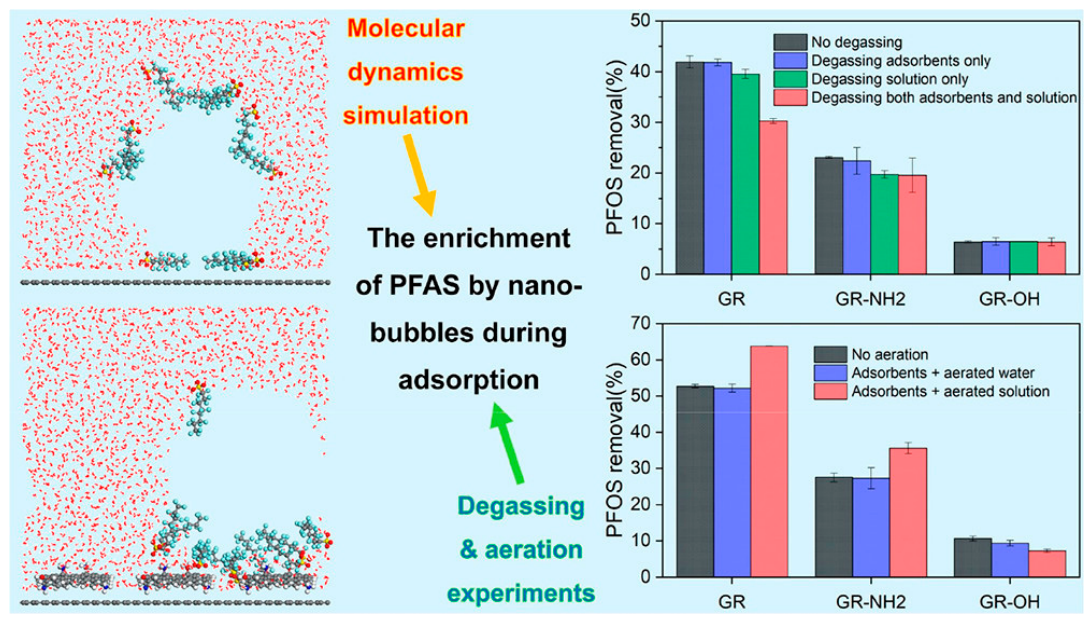
| Adsorption | Adsorption on carbon-based adsorbents in MNBs | PFAS | For PFOS, the capacities significantly improved from 73.3 to 161.7 mg g−1 for CNTs, from 199.8 to 369.6 mg g−1 for graphene, and from 147.6 to 231.7 mg g−1 for GAC. | Boosting the interfacial aggregation and molecular transfer of PFAS onto the adsorbent surfaces. | [20] |
| MNBs with amino-functionalized graphene | PFAS | PFAS removal rate: 90.3%. | Enrichment of pollutants, enhancement of electrostatic synergy, and optimization of adsorption stability. | [22] | |
| Quaternized cellulose nonwoven adsorption and MNBs | PFAS | Boosting the PFAS removal rate from 68% to 95% and raising the adsorption capacity to 272.5 mg/g−1 . | The dual action of electrostatic attraction by the quaternized cellulose and hydrophobic enrichment at the MNBs’ gas–liquid interface. | [23] | |
| Micro-nano bubble flotation adsorption for removal of microplastics | Microplastics | MNB collaboration: 68.9% −73.3%; 62% achieved in 16 min. | Adsorption of hydrophobic microplastics and synergistic buoyancy with large bubbles enhance enrichment efficiency. | [24] |
| Category | Processes | Pollutants | Efficiency | Role of MNBs | Ref. |
|---|---|---|---|---|---|
| Microbial synergy processes | MNBs with Microorganisms | Gaseous chlorobenzene | Reduction in start-up time by 2 days and a 13.5% increase in overall degradation rate. | Boosting mass-transfer efficiency and activating microbial metabolism. | [52] |
| MNBs with ozone and anaerobic digestion | Ibuprofen | IBU: 99% at 70 min | Promoting ibuprofen degradation and ameliorating the subsequent digestion conditions. | [53] | |
| MNBs | Pollutants from urban black and odorous river water | Biological oxygen demand: 54.4% chemical oxygen demand: 39.0%. | Replenishing dissolved oxygen and boosting natural pollutant degradation. | [54] | |
| MNBs with Microalgae | Wastewater pollutants and CO2 | COD: 42% NH3-N: 21% UV: 42%. | Enhancing the microalgal growth environment, boosting photosynthetic efficiency, and strengthening pollutant removal. | [55] | |
| MNBs with immobilized Chlorella | Ofloxacin | The removal rate increased from 55.3% to 89.5%. | Stimulating EPS secretion via elevating CO2 supply, thereby establishing a toxicity buffer. | [56] | |
| MNB irrigation | Thiamethoxam in the soil | The degradation rate within 30 days increased from 52% to 88%. | Increasing soil dissolved oxygen, stimulating degrading microorganisms, and enhancing soil aeration. | [57] |
Disclaimer/Publisher’s Note: The statements, opinions and data contained in all publications are solely those of the individual author(s) and contributor(s) and not of MDPI and/or the editor(s). MDPI and/or the editor(s) disclaim responsibility for any injury to people or property resulting from any ideas, methods, instructions or products referred to in the content. |
© 2026 by the authors. Licensee MDPI, Basel, Switzerland. This article is an open access article distributed under the terms and conditions of the Creative Commons Attribution (CC BY) license.
Share and Cite
Liu, Z.; Wang, J.; Zhu, S.; Li, S. The Combination of Micro-Nano Bubbles and Other Technologies for Emerging Contaminants’ Elimination in Water Treatment. Separations 2026, 13, 199. https://doi.org/10.3390/separations13070199
Liu Z, Wang J, Zhu S, Li S. The Combination of Micro-Nano Bubbles and Other Technologies for Emerging Contaminants’ Elimination in Water Treatment. Separations. 2026; 13(7):199. https://doi.org/10.3390/separations13070199
Chicago/Turabian StyleLiu, Zilong, Jiawei Wang, Shuyuan Zhu, and Shangyi Li. 2026. "The Combination of Micro-Nano Bubbles and Other Technologies for Emerging Contaminants’ Elimination in Water Treatment" Separations 13, no. 7: 199. https://doi.org/10.3390/separations13070199
APA StyleLiu, Z., Wang, J., Zhu, S., & Li, S. (2026). The Combination of Micro-Nano Bubbles and Other Technologies for Emerging Contaminants’ Elimination in Water Treatment. Separations, 13(7), 199. https://doi.org/10.3390/separations13070199