Article

Simultaneous Optimization of Polyphenol Content and Antioxidant Capacity of Extracts from Habanero Pepper Leaves Obtained with Green Technologies: NADES and Ultrasound

by
Yajaira Cecilia Torruco-Ortiz
,
Kevin Alejandro Avilés-Betanzos
,
Manuel Octavio Ramírez-Sucre
and
Ingrid Mayanin Rodríguez-Buenfil
*
Centro de Investigación y Asistencia en Tecnología y Diseño del Estado de Jalisco A.C., Subsede Sureste, Tablaje Catastral 31264, Km. 5.5 Carretera Sierra Papacal-Chuburná Puerto, Parque Científico Tecnológico de Yucatán, Mérida C.P. 97302, Yucatán, Mexico
*
Author to whom correspondence should be addressed.
These authors contributed equally to this work and shared first authorship.
Separations 2026, 13(5), 143; https://doi.org/10.3390/separations13050143
Submission received: 9 April 2026 / Revised: 5 May 2026 / Accepted: 6 May 2026 / Published: 9 May 2026
(This article belongs to the Special Issue Novel Solvents and Methods for Extraction of Chemicals)

Abstract

Habanero pepper leaf, annually discarded as a by-product, is a source of phenolic compounds with functional activity. However, their recovery requires sustainable strategies that overcome the limitations of conventional organic solvents and low extraction yields. In this study, a sustainable and adjustable approach for phenolic compound recovery was developed using natural deep eutectic solvents (NADES) combined with ultrasound-assisted extraction and optimized by response surface methodology. Initially, different hydrogen bond donors (HBDs) like glycerol, glucose, and fructose (Fru), molar ratios (MR) of choline chloride (ChCl):HBD (1:1 mol/mol–1:2 mol/mol), and added water (Aw, 50–70%) were evaluated. The ChCl:Fru system (1:1 mol/mol, 70% Aw) was identified as the most efficient, showing the highest total polyphenol content (TPC) and antioxidant capacity (Ax). Simultaneous optimization yielded 147.30 ± 2.71 mg gallic acid equivalent/100 g dry leaf (DL) and 93.00 ± 0.14% Ax (predictive capacity, error < 5%). UPLC analysis identified protocatechuic acid (1285.98 ± 2.83 mg/100 g DL) and catechin (131.82 ± 0.99 mg/100 g DL) as the major compounds during the optimization process with Fru. These results position NADES as a sustainable tool for habanero pepper leaf valorization and targeted phenolic recovery, while designing greener extraction processes for agro-industrial residues.

1. Introduction

Mexico is one of the world’s most biodiverse countries, a richness that highlights a longstanding tradition of plant-based medicine. It is estimated that approximately 4500 plant species in Mexico are used medicinally and have been employed for therapeutic purposes across generations. These effects (antidiabetic, anti-inflammatory, antioxidant, etc) are attributed to their bioactive compounds, some of which are associated with the secondary metabolism of plants and are synthesized as a defense mechanism against stressful situations or adverse conditions (biotic and abiotic factors) [1]. These secondary metabolites can be present in different parts of the plant, such as fruit, seed, stem, peduncles, flowers, or leaves. Nowadays, there is a growing interest in valorizing bioactive compounds from resources that for many years were considered waste or non-−edible plant parts [2]. Habanero pepper (Capsicum chinense Jacq.) is recognized worldwide for its fruit and its distinctive color, aroma, flavor, and pungency. On the other hand, its leaves have begun to gain recognition for their content of bioactive compounds such as carotenoids, vitamin C, and polyphenols. Individual polyphenols have also been identified, such as catechin, quercetin, rutin, gallic acid, cinnamic acid, and chlorogenic acid, which are notable mainly for their antioxidant, anti-inflammatory, anticarcinogenic, cytoprotective, and hypoglycemic effects [3].
The state of Yucatán stands out for its annual production of habanero pepper, exceeding 5000 tons and generating a value of more than $131 million Mexican pesos ($7 million USD approximately), according to data reported by the Mexican Agri-Food and Fisheries Information Service (SIAP) [4]. However, only approximately 20% of the crop is destined for industrial processing. This biomass, composed of leaves and stems, is typically discarded after fruit harvest [5].
Given the strong presence of habanero pepper in regional identity, the use of these by-products represents a strategically relevant alternative to maximize the economic value of the crop and reduce environmental impact, while also exploring new sources of bioactive compounds with potential applications in the pharmaceutical, food, and nutraceutical industries.
For example, quercetin, in addition to showing an antioxidant effect, exhibits antineoplastic activity and potential antidiabetic effects by improving glucose transport and protecting pancreatic cells. In the same context, protocatechuic acid is also noteworthy because it exhibits antioxidant and anti-inflammatory properties and has been associated with antidiabetic and chemopreventive potential, partly through the reinforcement of endogenous antioxidant defenses and the regulation of redox-sensitive pathways [6]. Also, catechin can modulate inflammatory processes by inhibiting two proteins that regulate inflammatory gene expression in cells, NF−κB and AP−1, thereby decreasing the production of pro-inflammatory cytokines and cyclooxygenase−2 (COX−2), an enzyme involved in pain and inflammation via its chemical by-products. This contributes to the reduction of systemic and tissue inflammatory responses [7]. In addition to these properties, they significantly contribute to protecting the cardiovascular system by inhibiting platelet activation and inducing blood vessel dilation, primarily due to an increase in the level of nitric oxide present, which results in a reduction in the formation of atherosclerotic plaques [7]. Several flavonoids, such as quercetin, genistein, and kaempferol, have demonstrated therapeutic effects in mild to moderate Alzheimer’s disease. These compounds act primarily by inhibiting acetylcholinesterase (AChE), which increases acetylcholine levels and promotes signal transmission in the nervous system [8,9].
Nevertheless, the efficient recovery of biocompounds from plants has historically been limited by using conventional organic solvents. Their application presents several disadvantages, including high toxicity, elevated operational costs, prolonged extraction times, and the potential degradation of compounds sensitive to factors such as pH and high temperatures. In addition, solvent residues may compromise the quality and safety of the extracts, preventing their incorporation into food formulations and also generating a negative environmental impact [10]. Therefore, it is essential to explore safer and more sustainable alternatives for valorization by employing techniques aligned with the 12 principles of green chemistry, which include the use of low-toxicity solvents that minimize costs, environmental impact, and risks to personnel involved in extraction processes [11].
Natural deep eutectic solvents (NADES) have attracted attention due to their physicochemical properties and non-toxicity compared to conventional organic solvents such as methanol, ethanol, hexane, dichloromethane, among others. Some of their advantages are their versatility and ease of preparation, which is safe, simple, and economical, making them an exceptional option for the extraction of valuable biocompounds. Another advantage is its supramolecular structure, which exhibits a high extraction affinity towards different types of polar molecules, such as polyphenols, favoring the selective extraction [12]. Also, they are generally recognized as safe (GRAS), as they are composed of natural compounds like salts, sugars, alcohol, amino acids, and others [12].
To obtain a NADES, it is necessary to mix two or more reactants (primary or secondary metabolites) consisting of one hydrogen bond acceptor (HBA) and one or more HBDs in a specific molar ratio at a constant temperature above 80 °C for at least 2 h. Once a liquid-phase mixture has been obtained, it cools down at room temperature, and water is added to modify its polarity and viscosity and to facilitate handling of the NADES [13].
The molar ratio between the hydrogen bond acceptor and the HBD, together with the percentage of added water, is a critical factor in the preparation of NADES; high viscosity in the NADES can significantly limit its extraction capacity, as it hinders mass transfer between the sample and the solvent [14].
The percentage of water, in turn, plays an important role in the physicochemical properties of the system, as its incorporation weakens the hydrogen bonds within the eutectic mixture, thereby reducing viscosity and increasing polarity, thus improving extraction efficiency. However, an excess of water (>70% added water) may compromise the stability of the system by considerably weakening the supramolecular bonding network, resulting in an aqueous solution of the components [11].
Several studies have employed NADES alongside other green technologies, such as ultrasound-assisted extraction (UAE). This methodology is used for the extraction of bioactive compounds, as it provides high yield recovery with lower solvent consumption and shorter extraction times without generating a negative environmental impact [15]. UAE consists of the application of high-frequency ultrasonic waves between 20 and 100 kHz to a mixture containing the plant matrix and extraction solvent. These waves generate cavitation, small bubbles that contract and collapse, releasing a large amount of energy in the form of heat. This cavitation causes fragmentation of the cell wall, reduction in particle size, and erosion of the plant matrix, thereby improving the contact surface between the solvent and the matrix and facilitating the release of bioactive compounds [10].
However, the use and combination of green extraction technologies do not inherently guarantee higher yields of bioactive compounds. Therefore, statistical approaches are needed to evaluate the influence of process variables and to establish the most suitable extraction conditions. In this regard, response surface methodology (RSM) emerges as a fundamental mathematical and statistical tool in the optimization of NADES-based systems. Through simultaneous optimization, it is possible to identify optimal conditions that allow maximizing the recovery of phenolic compounds without compromising their antioxidant capacity, since the different physicochemical parameters of NADES directly influence extraction efficiency [5,6].
Therefore, the objective of this study was to evaluate the effect of different NADES, based on choline chloride as hydrogen bond acceptor and different HBDs (glucose, glycerol, and fructose), its molar ratio (with choline chloride as hydrogen bond acceptor) and percentage of added water to de NADES system, for the simultaneous optimization of total polyphenol content and antioxidant capacity through ultrasound-assisted extraction from habanero pepper leaves (Capsicum chinense Jacq.).

2. Materials and Methods

2.1. Raw Material

The habanero pepper leaves were obtained from a greenhouse located in the town of Chablekal, Yucatán, México (21°06′02.3″ N, 89°33′40.5″ W). Only those leaves that were uniformly green in color and had no deformities in their structure were considered.

2.2. Processing of Habanero Pepper Leaves

Habanero pepper leaves were dried by lyophilization for 72 h using a LABCONCO freeze dryer (FreeZone™, Kansas city, MO, USA) at a pressure of 0.280 millibars (mBar) and a temperature of −52 °C. Subsequently, the samples were ground using a Braun® coffee grinder (model KSM−2, Treviso, Italy). The obtained powder was sieved through a mesh (<500 µm, No. 35, Fisher Scientific, Boston, MA, USA) to obtain uniformly sized particles. Finally, the samples were stored at room temperature in resealable bags, protected from light by covering them with aluminum foil [16].

2.3. Preparation of Natural Deep Eutectic Solvent (NADES)

Following the methodology described by Avilés-Betanzos et al. [12], each NADES component was individually weighed: choline chloride as the hydrogen bond acceptor (HBA), and glycerol, D-fructose, or D-glucose as HBDs. All NADES components were purchased from Sigma-Aldrich (St. Louis, MO, USA). Subsequently, the two components were mixed at different molar ratios and water percentages according to the experimental designs, 3 × 22 factorial design (Table 1) and Central composite design (CCD) (Table 2). The mixtures were then heated at a constant temperature of 90 °C for 2 h under continuous stirring until a homogeneous, viscous liquid was obtained. After cooling to room temperature, the corresponding volume of water was added according to the established percentage.

2.4. Selection of the Best Hydrogen Donor for Polyphenol Extraction

A 3 × 22 factorial design was performed to evaluate the main effects and interactions of hydrogen bond donor type, HBA/HBD molar ratio, and added water percentage on the response variables. The factors and levels were: (A) HBD type: fructose (−1), glucose (0), and glycerol (1); (B) HBA/HBD molar ratio: 1:1 mol/mol (−1) and 1:2 mol/mol (1); and (C) added water: 50% (−1) and 70% (1) (Table 1).
The selection of these factors and levels was based on literature data, food-compatible criteria, physicochemical considerations, and previous experience from our research group. Choline chloride was selected as the HBA because it is widely used in NADES formulation due to its availability, low cost, hydrophilic nature, and ability to form stable eutectic systems with different HBDs [12,13,17]. Glycerol, fructose, and glucose were selected as HBDs to compare polyol- and sugar-based systems, since the HBD strongly influences NADES polarity, viscosity, mass transfer, solvent–solute interactions, and extraction selectivity [13,18].
The HBA/HBD molar ratios of 1:1 and 1:2 were chosen because they are commonly reported for choline chloride-based NADES and allow evaluation of the effect of increasing the donor proportion on extraction performance [12,13,19]. Likewise, 50% and 70% added water were selected to reduce viscosity, improve solvent handling and mass transfer, and modulate NADES polarity while preserving the functional characteristics of the eutectic system [13,20]. The results of this design were used to select the most suitable HBD for the subsequent optimization stage.

2.5. Individual Optimization of Total Polyphenol Content and Antioxidant Capacity

The hydrogen bond donor (HBD) selected in Section 2.4 as the most suitable for polyphenol extraction was subsequently used to optimize the extraction conditions for total polyphenol content (TPC) and antioxidant capacity (Ax) by means of a central composite design (CCD). The initial 22 factorial design consisted of two factors evaluated at two levels, with four central points, resulting in a total of eight experiments. The first factor was the molar ratio (X1), ranging from choline chloride:fructose 1:1 mol/mol (−1) to 1:3 mol/mol (1). The second factor was the percentage of added water (X2), with 60% (−1) as the lowest level and 80% (1) as the highest level. The central points were established at a molar ratio of 1:2 mol/mol (0) and 70% added water (0). After verifying the lack of fit of the first-order model (p > 0.05), axial (“star”) points were incorporated; for the molar ratio, the axial points were 1:3.4 mol/mol (1.414) and 1:0.6 mol/mol (−1.414) choline chloride: fructose, both with 70% added water (0). For added water, the axial points were 84% (1.414) and 56% (−1.414), both at a molar ratio of 1:2 mol/mol (0) (Table 2). The results of these additional experiments were analyzed together with those obtained from the first CCD to evaluate their fit to a second-order model (p < 0.05) and thus proceed with the canonical analysis, obtaining the prediction equations, response surfaces, and the optimal conditions and values for TPC and Ax in habanero pepper leaf extracts obtained using NADES.

Individual Optimization of Polyphenolic Compounds

After selection of the most suitable HBD in Section 2.4, the optimization of individual polyphenolic compounds was carried out using only extracts obtained with this donor. For this purpose, the same 22 CCD with axial (“star”) points described in Section 2.5 was applied. Specifically, the effects of molar ratio and percentage of added water on the concentration of the individual polyphenols previously identified and quantified according to Section 2.9 were evaluated in habanero pepper leaf extracts, and the resulting data were analyzed as described above to determine the corresponding optimal extraction conditions.

2.6. Establishment of Simultaneous Optimization Conditions of Total Polyphenol Content and Antioxidant Capacity

Simultaneous optimization of total polyphenol content (TPC) and antioxidant capacity (Ax) was performed after the individual optimization of each response. No additional experimental design was conducted; instead, the data obtained from the CCD and the fitted second-order models for TPC and Ax were analyzed jointly using Statgraphics Centurion software (XVII.II-X64). This analysis enabled the identification of the extraction conditions that provided the best compromise between both responses, establishing the optimal molar ratio and percentage of added water for the NADES system.

2.7. Extraction of Polyphenols from Habanero Pepper Leaves (Capsicum chinense Jacq.) Using Ultrasound-Assisted Extraction

For each sample, 1 g of the obtained leaf flour was weighed, and 10 mL of the corresponding NADES was added. After homogenization by vortex (Thermolyne Maxi Mix PlusTM, Model M63215, Dubuque, IA, USA), the samples were subjected to an ultrasonic bath (BRANSON®, model 351, Danbury, CT, USA) for 30 min at 42 kHz. The obtained extracts were centrifuged twice: first at 4700 rpm for 30 min at 4 °C (Thermo ScientificTM, Heraeus MegafugeTM 40 centrifuge, Waltham, MA, USA), and then the recovered supernatant was centrifuged at 13,000 rpm for 20 min at 4 °C using a benchtop centrifuge (Hettich® Mikro 22R, Beverly, MA, USA). The extracts were filtered through 0.2 µm nylon filters and diluted 1:20 (v/v) with distilled water before being stored in chromatographic|. vials. The samples were kept under refrigeration (<18 °C) for subsequent analysis [12].

2.8. Spectrophotometric Measurements of NADES Extracts from Habanero Pepper Leaf

2.8.1. Determination of the Total Polyphenol Content

The quantification of total polyphenols in extracts from habanero pepper leaves (Capsicum chinense Jacq.) was performed using the Folin–Ciocalteu method [21]. Initially, the extract was diluted (1:1 v/v) with distilled water; subsequently, 3 mL of distilled water and 250 µL of Folin–Ciocalteu reagent (Sigma−Aldrich®, St. Louis, MO, USA) were added. After 5 min of incubation, 750 µL of 20% sodium carbonate (Na2CO3, Sigma−Aldrich®) and 950 µL of distilled water were incorporated. The resulting preparations were homogenized using a vortex (Thermolyne Maxi Mix PlusTM, Model M63215), then allowed to stand for 30 min in darkness at room temperature. Absorbance was measured at a wavelength of 765 nm using a UV–Vis spectrophotometer (Genesys 140 model, Thermo Scientific®, Waltham, MA, USA). For quantification, a calibration curve was prepared using gallic acid within a concentration range of 0.005–0.1 mg/mL, showing good linearity (R2 = 0.9973). All measurements were performed in triplicate, and results were expressed as milligrams of gallic acid equivalents per 100 g of dry sample (mg GAE/100 g DS).

2.8.2. Evaluation of Antioxidant Capacity

The antioxidant capacity was evaluated using the DPPH (2,2-diphenyl-1-picrylhydrazyl) assay, according to the methodology described by Chel-Guerrero et al. [5]. Briefly, 3.3 mg of DPPH were dissolved in 100 mL of methanol (MeOH); both DPPH and methanol were purchased from Sigma-Aldrich (St. Louis, MO, USA). The DPPH solution was adjusted to an absorbance of 0.700 ± 0.02. Subsequently. For each treatment, 3.9 mL of the adjusted DPPH solution was added to 100 µL of the NADES extract sample, which was allowed to stand for 30 min. Ten minutes before incubation ended, the mixture was centrifuged at 4700 rpm at 4 °C (Thermo Scientific™, Heraeus MegafugeTM 40 centrifuge). The absorbance was measured at 515 nm using a UV/Vis spectrophotometer (Genesys 140 model, Thermo Scientific®, Waltham, MA, USA). Antioxidant capacity was documented as the percentage of inhibition calculated using the following equation:
% I n h i b i t i ó n = 100 [ ( a d j u s t e d   D P P H   a b s o r b a n c e S a m p l e   a b s o r b a n c e   × 100 a d j u s t e d   D P P H   a b s o r b a n c e   ) × 100 ]  

2.9. Determination of the Individual Polyphenol Profile

The individual quantification of polyphenols in habanero pepper leaf extracts was performed according to the methodology reported by Chel-Guerrero et al. [22]. An Acquity UPLC H-Class system (Waters Corporation, Milford, MA, USA) equipped with a diode array detector (DAD) (Waters Corporation, Milford, MA, USA), an Acquity UPLC HSS C18 column (Waters Corporation, Wexford, Leinster, Ireland), and Empower 3 Feature Release 3 chromatography data software (Waters Corporation, Milford, MA, USA) was used. Initially, a calibration curve was prepared using a stock solution at a concentration of 1 mg/mL (prepared in a range from 1 to 75 μg/mL), which included 17 polyphenol standards (Sigma−Aldrich, St. Louis, MO, USA), containing phenolic acids: gallic acid, protocatechuic acid, vanillin, chlorogenic acid, coumaric acid, cinnamic acid, ferulic acid) and flavonoids (catechin, rutin, naringenin, diosmetin, apigenin, kaempferol, quercetin + luteolin, and diosmin + hesperidin (quantified together due to chromatographic overlap). During the analysis, the column was maintained at 45 °C, with an injection volume of 2 μL, and wavelength detection was set at 280 nm. For each phase, a combination of mobile phases was used: water with 0.2% acetic acid (A) and acetonitrile with 0.1% acetic acid (B). The elution gradient began with 1% B (99% A), progressively increasing to 30% B (70% A) between 0–10 min. Between 10 and 12 min, a constant segment was maintained at 30% B (70% A), and finally the system returned to the initial conditions (1% B, 99% A) during the last 3 min. Only those individual polyphenols detected in each sample and matched according to the retention times of the 17 available reference standards were quantified.

2.10. Statistical Analysis

All experiments were performed in triplicate, and the results were expressed as mean ± standard deviation. For the optimization of extraction conditions using NADES and ultrasound, response surface methodology was applied through a 22 CCD. The data obtained from the 22 CCD were fitted to first- and second-order polynomial models. Model fitting, including first- and second-order analyses, canonical and simultaneous optimization analyses, estimation of regression coefficients, principal component analysis (PCA), Pareto chart, and overall data processing, was carried out using Statgraphics Centurion XVII.II-X64 software (Statgraphics Technologies Inc., Virgin, UT, USA) and R software version 4.3.0 (The R Foundation for Statistical Computing, Vienna, Austria).

3. Results

3.1. Hydrogen Bond Donor Selection Based on Extraction Data

When comparing the effect of the HBD, statistically significant differences (p < 0.05) were observed among the treatments (Table 1). At a molar ratio (MR) of 1:1, increasing the added water (AW) from 50% to 70% reduced the total polyphenol content in glycerol-based NADES from 150.68 ± 3.58 mg GAE/100 g DW to 132.99 ± 0.51 mg GAE/100 g DW; the same trend is observed at fructose-based NADES, going from 128.72 ± 0.51 mg GAE/100 g DW to 121.52 ± 0.51 mg GAE/100 g DW. In contrast, at MR 1:2, increasing the percentage of added water from 50% to 70% significantly enhanced extraction efficiency, particularly in the fructose-based NADES, where TPC goes from 120.75 ± 1.53 mg GAE/100 g DW to 168.44 ± 7.87 mg GAE/100 g DW. The lowest concentration (112.08 ± 0.89 mg GAE/100 g DW) was obtained with the glucose-based NADES (MR 1:2, AW 50%). Table 1 shows the results from the factorial design 3 × 22.
Fructose-based NADES exhibited the highest (p < 0.05) antioxidant capacity (99.21 ± 0.07%), followed by glycerol-based (97.71 ± 1.29%) and glucose-based systems (98.07 ± 0.36%). The highest inhibition percentage (99.21 ± 0.07%) was achieved with the fructose-based NADES (MR 1:2 mol/mol, AW 70%), whereas the lowest value (85.96 ± 0.43%) was recorded for the glucose-based NADES (MR 1:1 mol/mol, AW 70%).
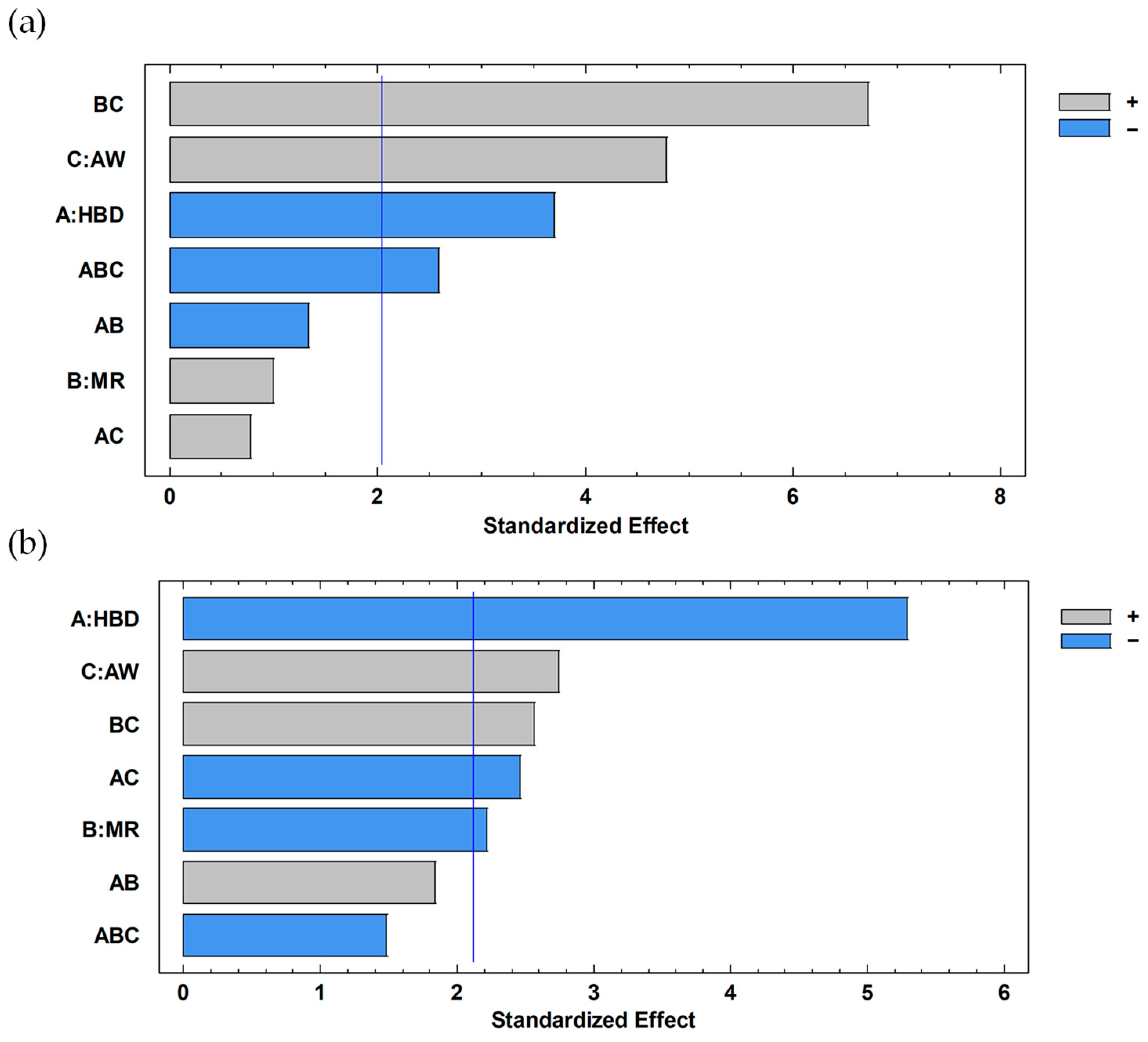
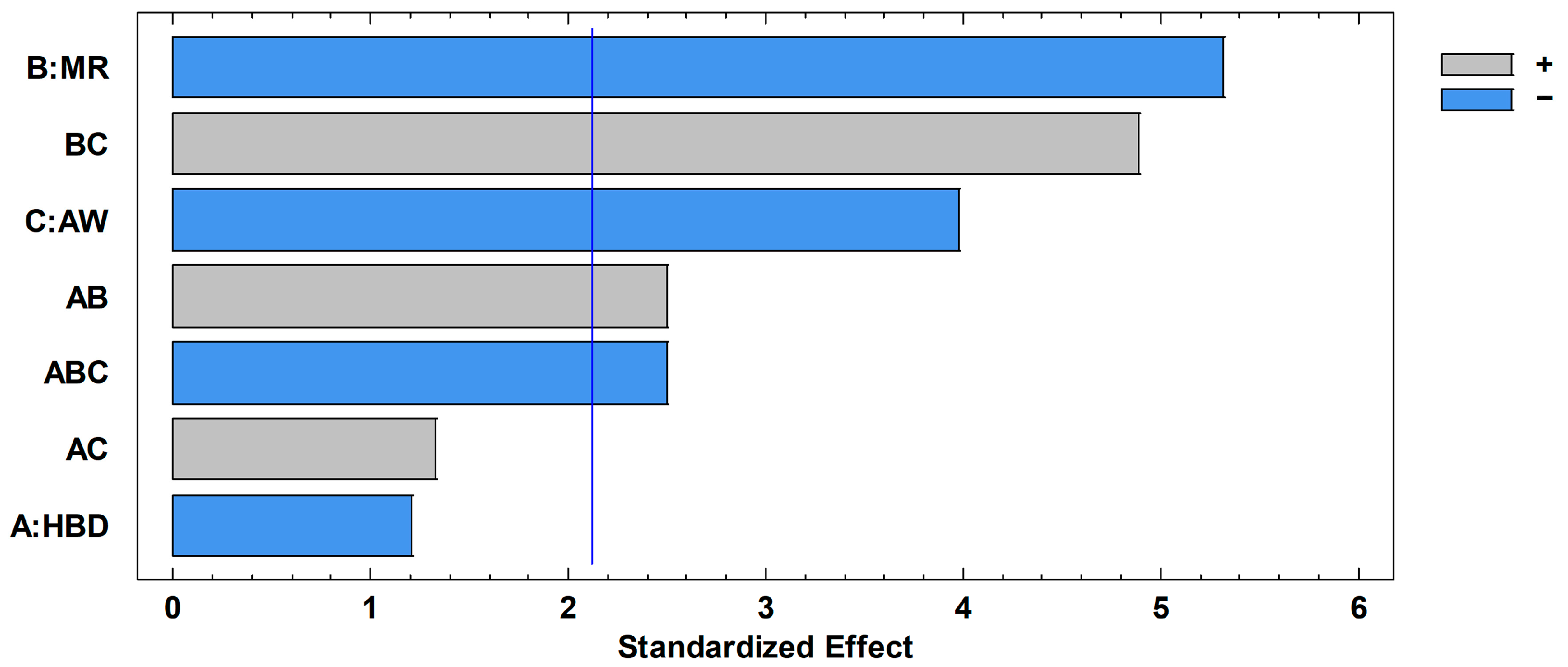
In Figure 1a, the multifactorial ANOVA showed that the three-way interaction among hydrogen bond donor type, molar ratio, and added water (A × B × C) had the greatest significant effect on the response variable (p < 0.05). Among the two-factor interactions, the interaction between molar ratio and added water (B × C) also showed a significant effect. Regarding the main factors, added water (factor C) and hydrogen bond donor type (factor A) significantly affected the response.
In turn, antioxidant capacity (Figure 1b) was significantly influenced (p < 0.05) by all three main factors, as well as by the two-factor interactions MR × AW and HBD × AW, with HBD (factor A) showing the strongest effect on Ax.

Individual Polyphenol Profile During Hydrogen Bon Donor Selection

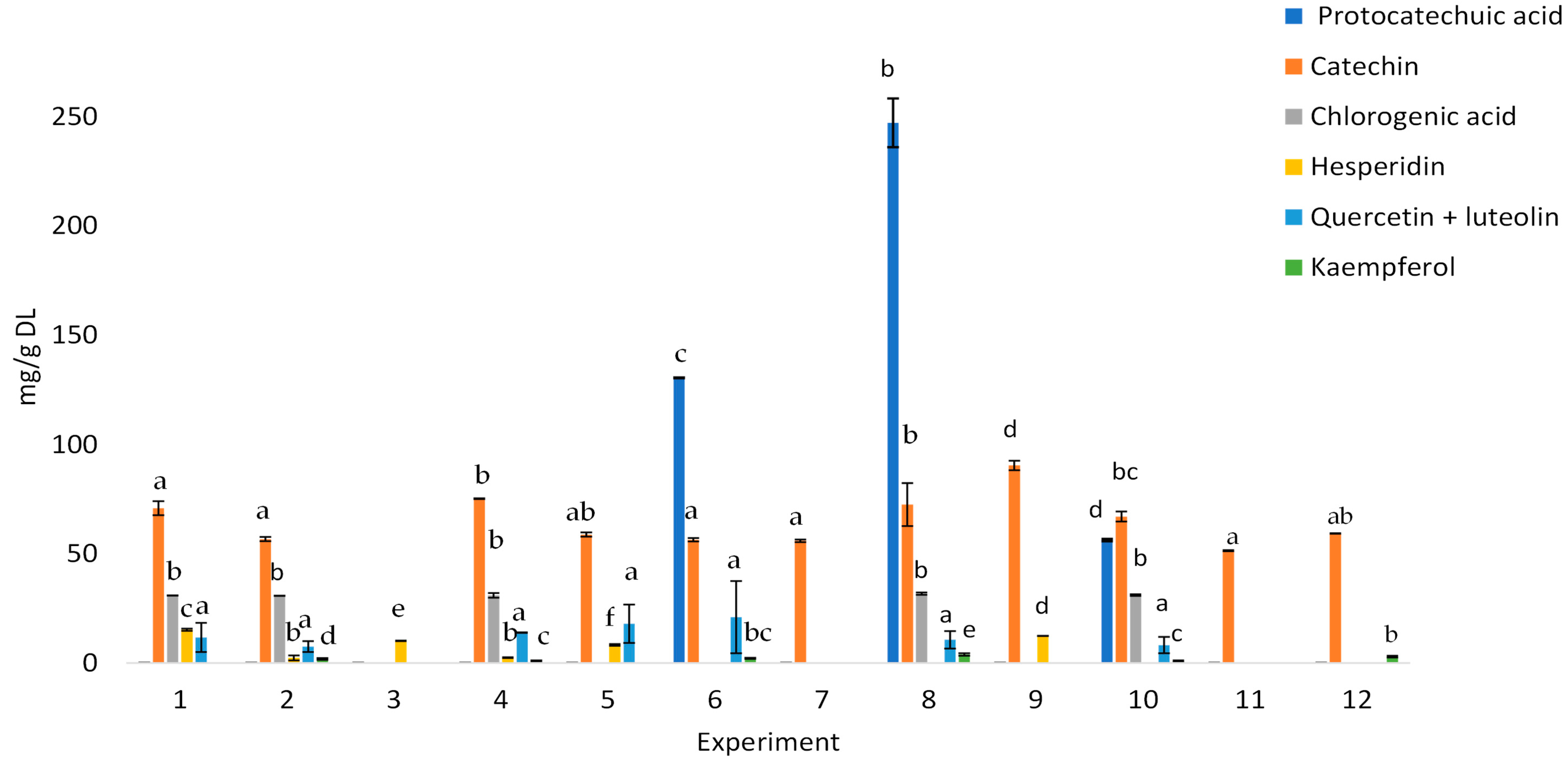
As shown in Figure 2, protocatechuic acid was detected only in three treatments and reached its highest concentration in the fructose-based NADES at MR 1:2 and AW 70% (Treatment 8) with 247.15 ± 11.16 mg/100 g DL, followed by the fructose-based system at MR 1:1 and AW 70% (Treatment 6) with 130.40 ± 0.18 mg/100 g DL and the glucose-based NADES at MR 1:1 and AW 70% (Treatment 10) with 56.32 ± 0.51 mg/100 g DL.
Catechin was the predominant compound in most extracts, with the highest value obtained (90.43 ± 2.20 mg/100 g DL) in the glucose-based NADES at MR 1:1 and AW 50% (Treatment 9), followed by the glycerol-based NADES at MR 1:2 and AW 70% (Treatment 4) with 75.23 ± 0.24 mg/100 g DL and the fructose-based NADES obtained 72.50 ± 9.82 mg/100 g DL at MR 1:2 and AW 70% (Treatment 8).
Chlorogenic acid was detected only in selected treatments, with the highest concentration in the fructose-based NADES at MR 1:2 and AW 70% (Treatment 8) with 31.74 ± 0.54 mg/100 g DL, followed by the glucose-based NADES at MR 1:1 and AW 70% (Treatment 10) with 31.15 ± 0.43 mg/100 g DL. Hesperidin reached its maximum value in the glycerol-based NADES at MR 1:1 and AW 50% (Treatment 1) with 15.24 ± 0.51 mg/100 g DL, followed by the glucose-based NADES obtained 12.47 ± 0.09 mg/100 g DL at MR 1:1 and AW 50% (Treatment 9) and the glycerol-based NADES at MR 1:2 and AW 50% (Treatment 3) with 10.17 ± 0.16 mg/100 g DL.
Kaempferol was the least abundant compound overall, with the highest concentration 3.93 ± 0.53 mg/100 g DL, in the fructose-based NADES at MR 1:2 and AW 70% (Treatment 8), followed by the glucose-based NADES at MR 1:2 and AW 70% (Treatment 12) with 2.92 ± 0.40 mg/100 g DL.
Figure 3 shows the standardized Pareto chart obtained for catechin (the major compound), in which it was identified that the extraction of this compound from habanero pepper leaves was significantly affected by the three-way interaction among the factors (A × B × C, p = 0.0238).
Similarly to catechin, chlorogenic acid (p = 0.0125) and kaempferol (p = 0.0491) were also significantly affected by the three-way interaction among the factors. In contrast, hesperidin (p = 0.0003) was significantly affected by the interaction between MR and AW. Finally, neither the main factors nor their interactions had a significant effect on the extraction of protocatechuic acid or quercetin + luteolin (p > 0.05).
These results indicate that the extraction conditions influenced not only the TPC but also the selective enrichment of individual polyphenols depending on the NADES composition.
With these data, together with the more diverse individual polyphenol profile, including protocatechuic acid (at a higher concentration than that obtained with the other donors), catechin, chlorogenic acid, quercetin + luteolin, and kaempferol, as well as the higher TPC and Ax values obtained from the experimental design, fructose was selected as the most suitable HBD and was therefore used to initiate the optimization process.

3.2. Individual Optimization of Total Polyphenol Content, Polyphenol Profile, and Antioxidant Capacity in Fructose-Based NADES Extracts

3.2.1. Individual Optimization of TPC and Ax

For the optimization of the NADES prepared with fructose as the most suitable HBD, a 22 CCD with center points (8 experiments) was implemented.
The TPC and Ax values obtained from the first experimental design (the first 8 experiments) are shown in Table 2. To determine whether the data fitted a first-order model, a multiple linear regression analysis was performed. The results indicated a lack of fit for TPC, with a p-value of 0.9889, whereas for Ax, the p-value was 0.6076.
According to response surface methodology, the next step was to add the axial points (second design, last 4 experiments). The results of the multiple linear regression analysis of the complete design (12 experiments) showed that both TPC (p = 0.0028) and Ax (p = 0.0074) fitted a second-order model.
The coefficients obtained through regression analysis allowed the establishment of Equations (2) and (3) to predict the total polyphenol content and antioxidant capacity, respectively. The equation incorporated the factors MR (X1) and AW (X2).
TPC = −1130.91 + 98.742 X1 + 34.311 X2 − 20.5402 X12 − 0.24289 X22 − 0.202875 X1X2
Ax = 168.907 − 6.53517 X1 − 2.28388 X2 +2.36195 X12 + 0.017969 X12 − 0.042875 X1X2
Note: TPC = Total polyphenol content; Ax = antioxidant capacity (% Inhibition); X1 = molar ratio of fructose to 1 mol of choline chloride; X2 = percentage of water added to the NADES.
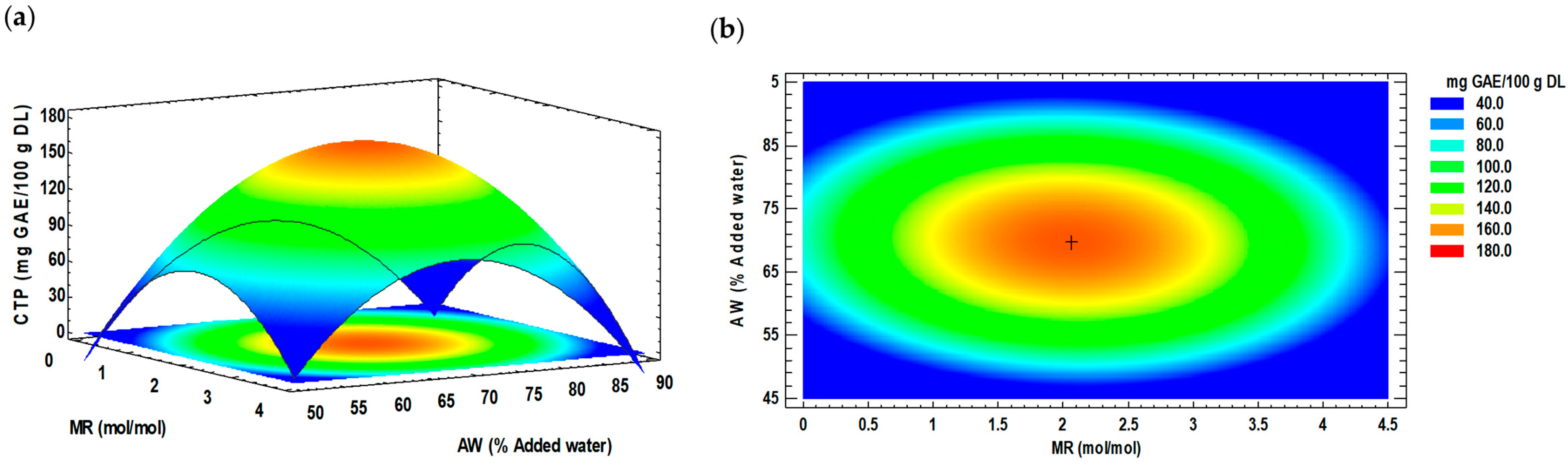
The optimal conditions to achieve the maximum predicted concentration of phenolic compounds (167.69 mg GAE/100 g dry sample) according to the statistical analysis in habanero pepper leaf extracts obtained using NADES combined with UAE corresponded to a molar ratio of 1:2.1 (mol/mol choline chloride: fructose) and 69.8% added water.
The response surface characterization (Figure 4a) for TPC exhibited a plateau region corresponding to maximum values. The blue color indicates the lowest total polyphenol content, whereas the red color represents the highest response. In the contour plot (Figure 4b), the cross symbol (+) denotes the maximum predicted response according to the mathematical model.
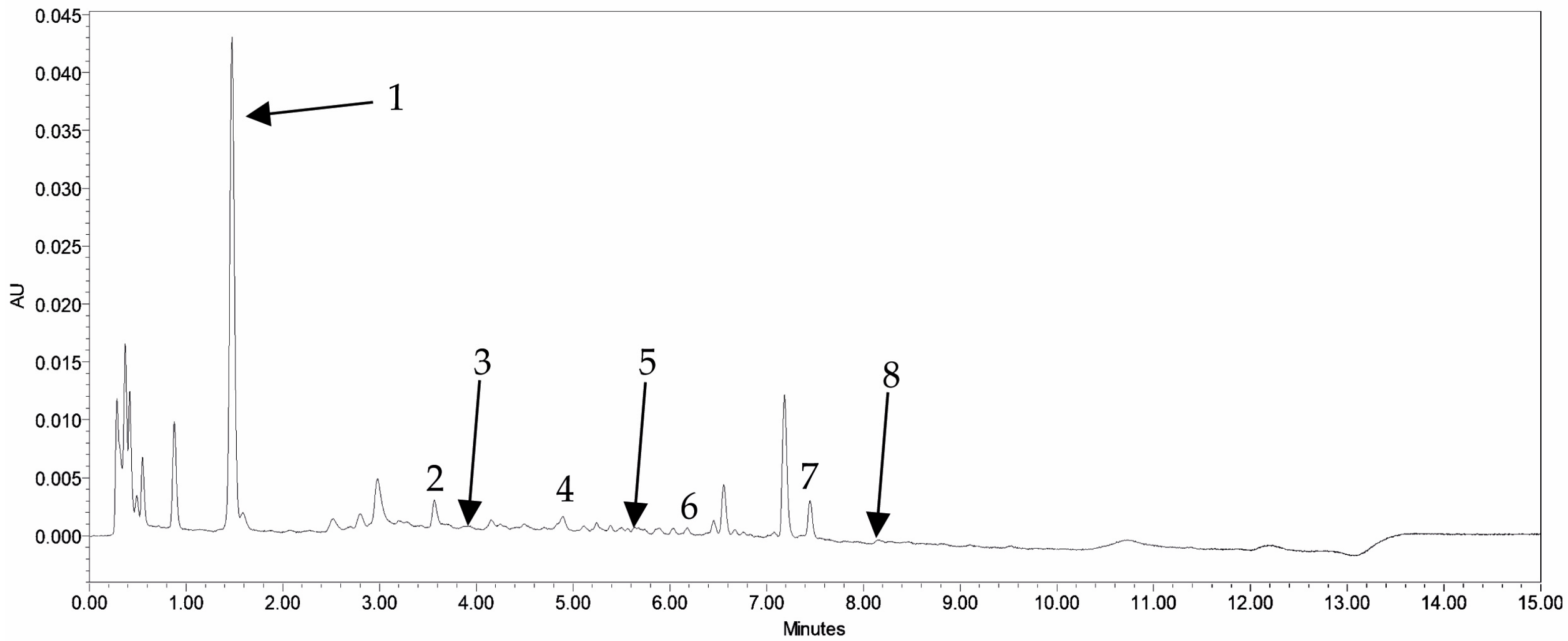
Under these optimal conditions, individual polyphenols were identified and quantified (Figure A1), including protocatechuic acid, catechin, chlorogenic acid, coumaric acid, cinnamic acid, rutin, hesperidin, and quercetin + luteolin. Protocatechuic acid and Catechin were the predominant polyphenols, with a concentration of 643.50 ± 17.68 mg/100 g DL and 69.64 ± 1.48 mg/100 g DL, respectively.
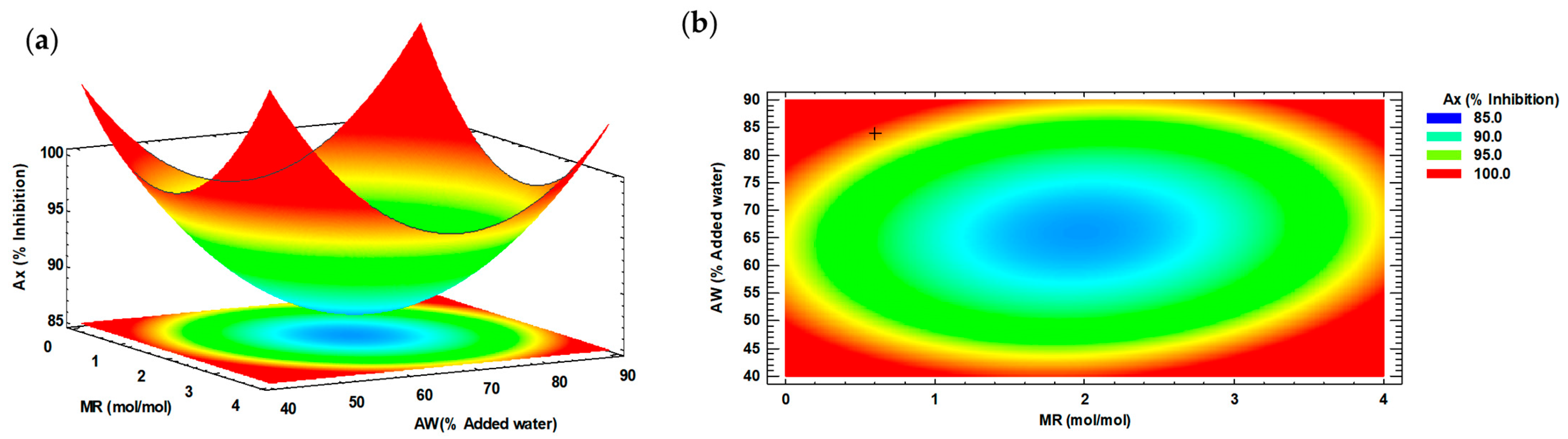
According to the mathematical model, the optimal value for antioxidant capacity (98.61% inhibition) was predicted at a molar ratio of 1:0.6 mol/mol (choline chloride: fructose) with 84% added water.
The response surface obtained corresponded to a minimum plateau region (Figure 5a). The red-colored area indicates the highest antioxidant capacity, whereas the light blue region represents the lowest response. In the contour plot (Figure 5b), the cross symbol (+) denotes the maximum predicted antioxidant capacity according to the mathematical model.
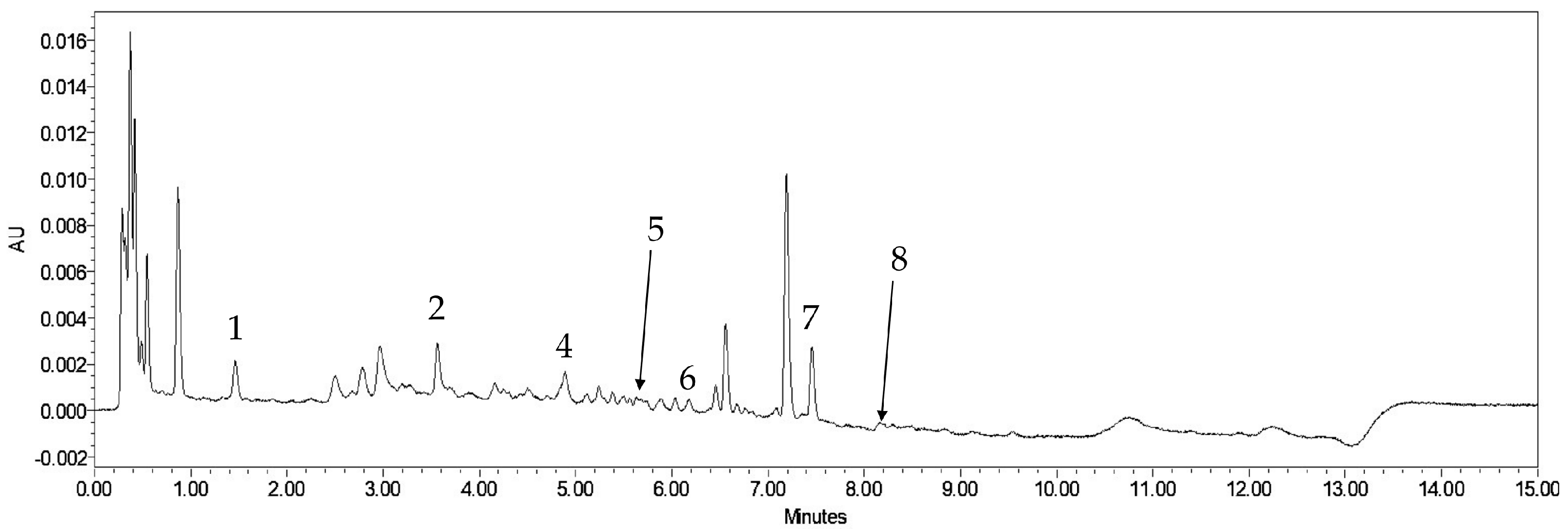
Similarly to TPC, the optimal conditions for Ax were evaluated to identify and quantify the polyphenol profile (Figure A2). The main difference was that, under these conditions, protocatechuic acid was identified and quantified as the predominant polyphenol, with a concentration of 75.89 ± 0.89 mg/100 g DL, followed by catechin with 63.20 ± 1.19 mg/100 g DL.

3.2.2. Individual Optimization of Polyphenol Profile

After the identification and quantification of individual polyphenols in extracts from habanero pepper leaves obtained under different molar ratio (MR) and water content (AW) conditions using a CCD, it was observed (Table 3) that the highest concentration of protocatechuic acid (1285.98 ± 2.83 mg/100 g DW) was achieved using a NADES with a molar ratio of 1:3.4 (choline chloride: fructose) and 70% water.
In turn, the highest concentrations of catechin (131.82 ± 0.99 mg/100 g DW), chlorogenic acid (33.92 ± 0.17 mg/100 g DW), and kaempferol (5.38 ± 0.64 mg/100 g DW) were recorded in experimental run 4 (MR = 1:3 mol/mol choline chloride: fructose; AW = 80%). Finally, the greatest levels of quercetin + luteolin (28.45 ± 3.19 mg/100 g DW) were found in experimental run 12 (MR = 1:2 mol/mol choline chloride: fructose; AW = 56%).
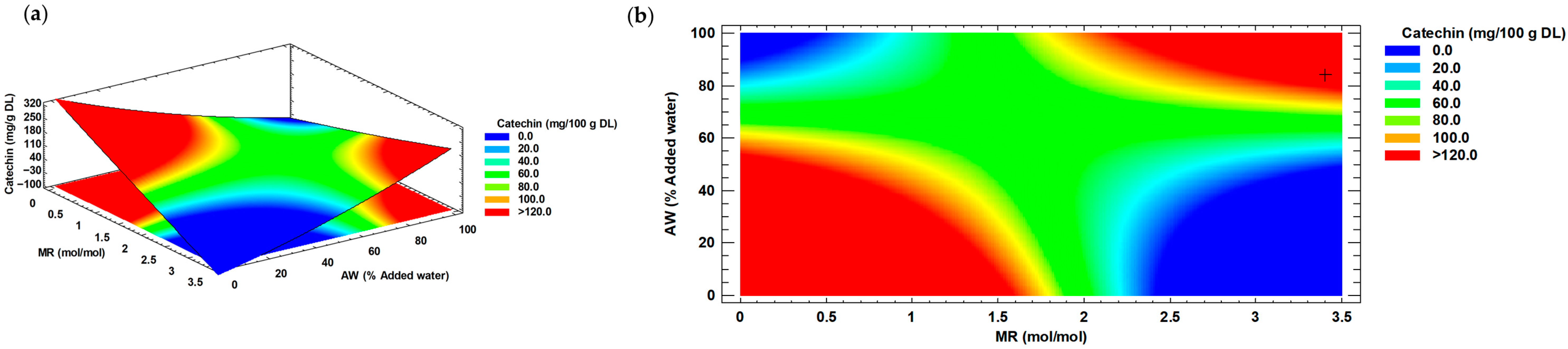
All individual polyphenols identified in the optimization design were analyzed to determine whether they fitted a second-order model. Although protocatechuic acid was the predominant individual polyphenol detected throughout the CCD, only catechin showed an adequate fit to a quadratic model. Therefore, canonical analysis was performed using statistical software to determine the optimal conditions, generate the response surface, and estimate the optimal catechin concentration.
The resulting quadratic model for catechin showed an adequate predictive performance (p = 0.0014). The optimal conditions corresponded to a molar ratio of 1:3.4 (choline chloride: fructose) with 84% water, predicting a maximum concentration of 139.22 mg/100 g DW of catechin:
Catechin (mg/100 g DW) = 353.42 − 150.997 X1 − 5.01 X2 + 2.08 X12 + 0.01 X22 + 2.14 X1X2
Note: DW = Dry Weight; X1 = molar ratio of fructose to 1 mol of choline chloride; X2 = percentage of added water.
The response surface for catechin corresponded to a saddle shape (Figure 6a), in which the red regions indicate the areas of maximum achievable response, obtained from the intersection of the optimal NADES composition conditions (MR, AW) for the highest catechin extraction from habanero pepper leaves. The “+” symbol shown in the contour diagram (Figure 6b) represents the maximum response predicted by the mathematical model, estimating a catechin concentration of 139.33 mg/100 g DL using a molar ratio of 1:3.4 mol/mol (choline chloride: fructose) and 84% water.

3.3. Simultaneous Optimization for Total Polyphenol Content and Antioxidant Capacity

With the aim of achieving individual optismal values for both responses (TPC, Ax) under the same operating conditions, simultaneous optimization was performed, promoting the efficient recovery of phenolic compounds without compromising antioxidant capacity.
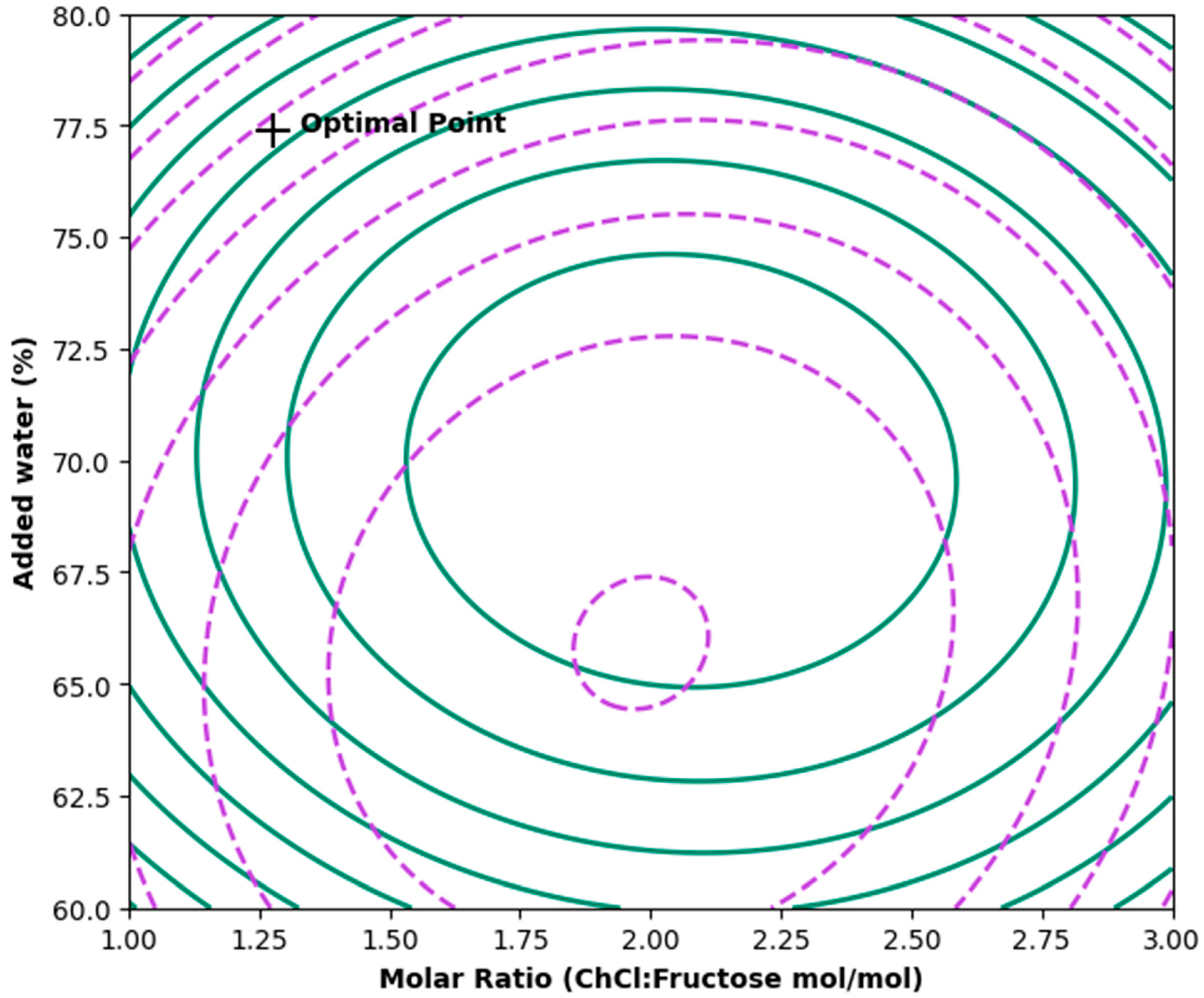
The mathematical model predicted as optimal conditions a molar ratio of 1:1.3 (mol/mol choline chloride/fructose) with 77.4% added water, estimating values of 142.23 mg GAE/100 g dry sample for TPC and 91.05% inhibition for Ax.
In Figure 7, the overlaid contour plot illustrates the behavior of TPC and Ax as a function of AW and MR. The cross symbol (+) denotes the intersection point of the optimal value for both variables simultaneously.

Polyphenol Profile from Simultaneous Optimization

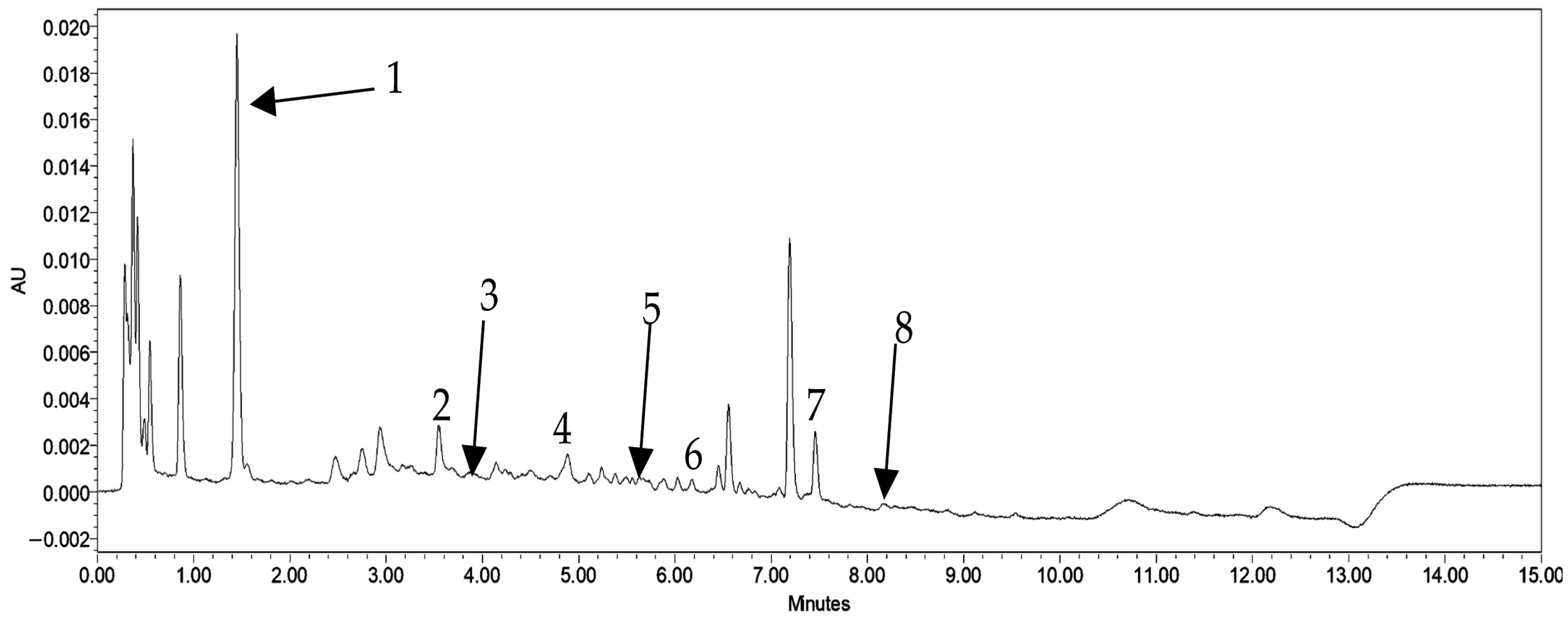
Under the simultaneous optimization conditions for TPC and Ax, corresponding to a choline chloride:fructose NADES with a molar ratio of 1:1.3 and 77.4% added water, the individual polyphenol profile (Figure A3) of the habanero pepper leaf extract showed that protocatechuic acid was the major compound, with a concentration of 322.85 ± 0.99 mg/100 g. Catechin was the second most abundant compound, with 62.61 ± 0.66 mg/100 g, followed by quercetin + luteolin, with 16.76 ± 11.60 mg/100 g. Hesperidin was detected at a lower concentration, with a value of 2.98 ± 0.02 mg/100 g. Overall, these results indicate that, under the optimal conditions established for the simultaneous recovery of TPC and Ax, the extract exhibited a phenolic profile mainly dominated by protocatechuic acid and catechin.

3.4. Validation of the Individual and Simultaneous Mathematical Model for Polyphenol Content and Antioxidant Capacity

The experimental values determined under the individual and simultaneous optimal conditions for total polyphenol content and antioxidant capacity showed percentage errors below 10% when compared to their predicted values, indicating good agreement between the predicted and observed values (Table 4).
In the case of simultaneous optimization, the percentage error was below 5% for both responses, confirming the statistical validity of the model and ensuring the efficient recovery of phenolic compounds while maintaining antioxidant capacity, thereby strengthening the application of the NADES–UAE system as a green technology for the valorization of habanero pepper leaves.

3.5. Principal Component Analysis (PCA)

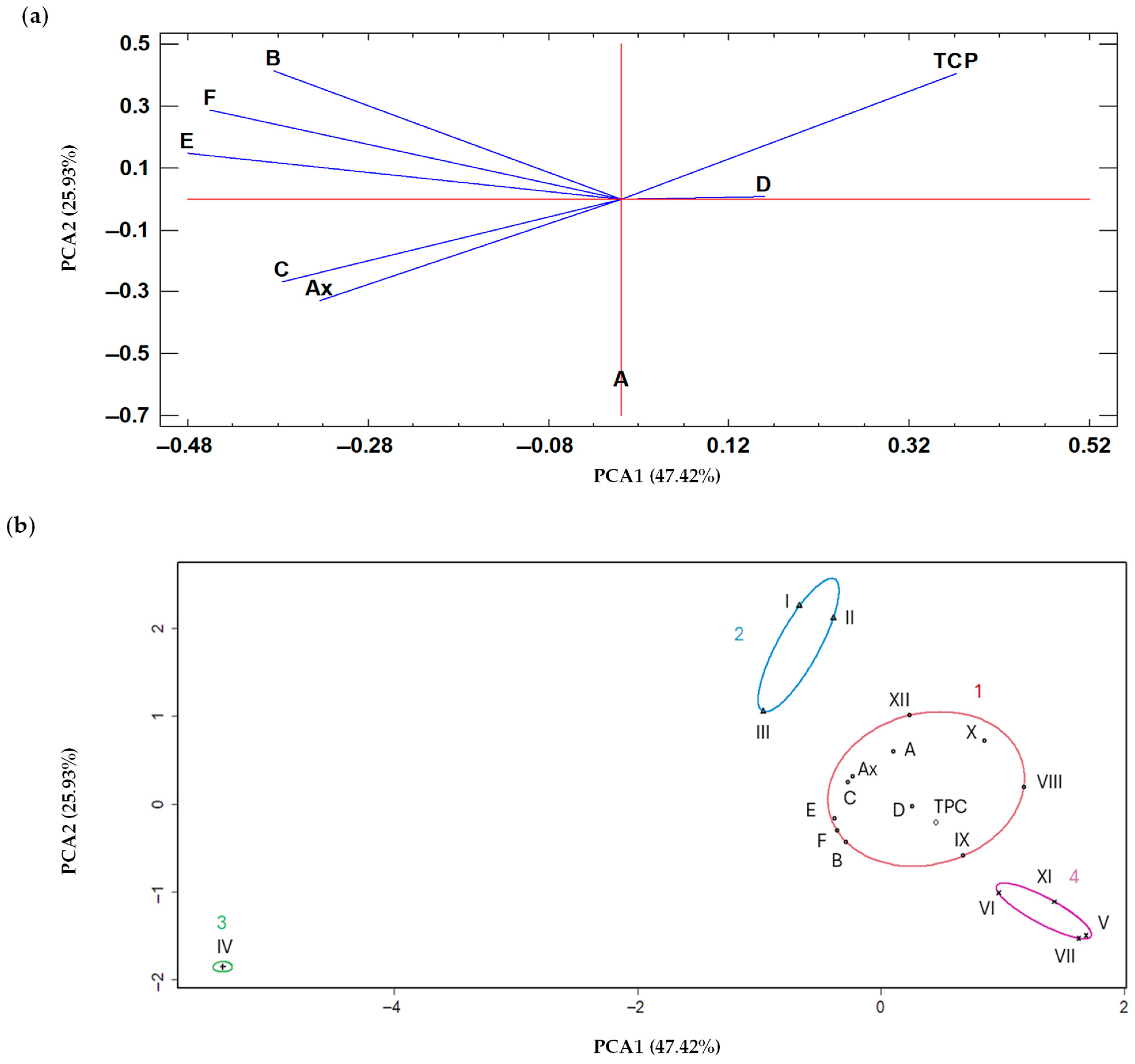
Principal component analysis (PCA), combined with k-means clustering, was applied to the experimental conditions of the CCD. The first two principal components explained 73.35% of the total variance, indicating an adequate representation of the dataset.
As shown in Figure 8a, quercetin + luteolin (D) showed a positive association with total polyphenol content (TPC), suggesting that higher concentrations of these metabolites contribute to increased values of TPC. Likewise, kaempferol (E), coumaric acid (F), and catechin (B) were positively associated with each other and showed a slight relationship with antioxidant capacity. Chlorogenic acid (C) was the metabolite most strongly associated with antioxidant capacity (Ax), whereas protocatechuic acid (A) did not show a clear correlation with the evaluated response variables.
An inverse relationship was also observed between TPC and Ax, possibly due to the differential contribution of specific compounds in the extract.
In Figure 8b, each Roman numeral corresponds to the same experimental condition identified by its equivalent Arabic numeral in the CCD, and three well-defined clusters can be distinguished without overlapping. The central cluster grouped most of the bioactive compounds and included experiments VIII (1:2 choline chloride:fructose, 70% water), IX (1:0.6 choline chloride:fructose, 70% water), X (1:3.4 choline chloride:fructose, 70% water), and XII (1:2 choline chloride:fructose, 84% water), indicating that these fructose-based NADES conditions were associated with a greater presence of individual polyphenols. Experiment XII showed a strong association with protocatechuic acid (A), while chlorogenic acid (C) was closely associated with Ax, suggesting an important contribution of this metabolite to the antioxidant activity of the extracts. The remaining clusters showed a lower contribution of bioactive compounds, although they included different operating conditions that may lead to similar response patterns.
These findings agree with the previous selection of fructose as the most suitable HBD and further support its use for optimization, as the fructose-based NADES conditions were associated with the most favorable polyphenolic profile within the evaluated experimental domain.

4. Discussion

To the best of our knowledge, no studies have reported the simultaneous optimization of total polyphenol content and antioxidant capacity from freeze-dried habanero pepper leaves using a choline chloride:fructose NADES combined with ultrasound-assisted extraction. Previous work on Capsicum chinense leaves employed a different strategy based on a glucose-derived NADES, ultrasonic probe-assisted extraction, and oven drying, reporting higher TPC and antioxidant capacity values under those specific conditions [11]. However, direct comparison between both studies should be interpreted with caution because the solvent system, water content, drying method, and ultrasound configuration differed substantially. In contrast, the present study used an ultrasonic bath instead of an ultrasonic probe, which offers practical advantages such as the simultaneous processing of a larger number of samples, a milder acoustic treatment that may reduce the risk of degradation of sensitive compounds, and greater affordability and accessibility than probe-based systems. More importantly, this study demonstrated that fructose was the most suitable hydrogen bond donor, as it provided the highest TPC and Ax values during screening, together with a broader and more favorable individual polyphenol profile. In addition, unlike previous extraction-focused approaches, the present work incorporated a simultaneous optimization strategy, allowing the definition of a single operational condition that balanced both responses while supporting selective recovery of individual polyphenols.
The results of the 3 × 22 experimental design showed that both the nature of the HBD and the interaction between the molar ratio (MR) and water content (Aw) significantly influenced (p < 0.05) the TPC and Ax. Among the donors evaluated (glycerol, fructose, and glucose), the fructose-based NADES (1:2, 70% water) exhibited the highest values for both response variables (TPC = 161.39 ± 3.79 mg GAE/100 g DL, Ax = 99.21 ± 0.07% Inhibition). Mechanistically, the higher extraction efficiency observed with the choline chloride:fructose NADES may be attributed to the balance between solvent–solute interactions and mass-transfer improvement. Although direct physicochemical characterization of the NADES, such as FTIR, NMR, viscosity measurements, or molecular interaction analysis, was not performed in the present study, previous reports have associated ChCl–fructose systems with favorable hydrogen-bonding networks and enhanced extraction performance for polar phenolic compounds. Therefore, the interpretation proposed here should be understood as a literature-supported mechanistic explanation consistent with the extraction responses observed experimentally. Fructose, as a polyhydroxylated hydrogen bond donor, may contribute to the formation of an extensive hydrogen-bonding network with choline chloride, favoring the solubilization of phenolic acids and flavonoids through hydrogen bonding, dipole–dipole interactions, and polarity matching. At the same time, the addition of water likely reduced viscosity and improved solvent diffusion into the plant matrix; however, excessive dilution may progressively weaken the characteristic hydrogen-bonding network of the NADES. Ultrasound-assisted extraction may further enhance this process through acoustic cavitation, which promotes cell-wall disruption, solvent penetration, and the release of intracellular metabolites. Therefore, the significant effect of HBD type and the MR × AW interaction suggests that extraction was governed not only by bulk solvent polarity and mass transfer, but also, plausibly, by the composition-dependent interaction capacity of the NADES with specific phenolic compounds [23,24,25].
These findings are consistent with those reported in previous studies. For example, Razboršek et al. [16] evaluated different HBDs (sugars, organic acids, and urea) for the extraction of phenolic compounds from Black chokeberry (Aronia melanocarpa). In their study, the NADES system based on choline chloride: fructose, combined with ultrasound-assisted extraction (UAE), produced the highest values for both total phenolic content (36.15 ± 3.39 mg GAE by dry simple) and total flavonoid content (4.71 ± 0.33 mg de rutin g−1 DW), achieving an extraction capacity 33% higher than that obtained with methanol (80%).
Similarly, Ramos-Hernández et al. [26] reported that the conventional extraction of total phenolic compounds from mango (Mangifera indica L. cv. Manila) peels using a NADES composed of citric acid: fructose (1:1 mol/mol) with 40% water yielded 6525.80 ± 214.35 mg GAE/100 g dry sample and antioxidant capacity of 998.08 ± 2.89 mg Trolox/100 g dry sample. This yield was approximately 1.7 times higher than that obtained with ethanol extraction (3761.58 ± 170.11 mg GAE/100 g dry sample), and up to eight times higher in terms of antioxidant capacity (161.338 ± 1.480 mg Trolox/100 g dry sample).
The differences observed with respect to the glucose-based NADES may be attributed to structural characteristics inherent to the sugars used as HBDs. Fructose can adopt relatively more flexible conformations, which favor the formation of extensive intermolecular networks within the eutectic system. The presence of multiple hydroxyl groups promotes hydrogen bonding interactions, as well as van der Waals and electrostatic forces, thereby enhancing the solubilization of polar metabolites. This behavior is supported by the findings of Nurhidayati et al. [27], who reported the highest polyphenol concentration (3111 mg GAE /g dry extract) in extracts obtained from stems, trunks, and leaves using a choline chloride: fructose NADES (1:2 mol/mol, 20% water) from Spilanthes acmella.
This behavior, also, has been supported by Ma et al. [28], who observed through FT-IR spectroscopy that the system based on choline chloride: fructose (ChCl: Fru) exhibited the greatest spectral shift, a phenomenon associated with stronger intermolecular interactions and, consequently, with higher polyphenol extraction yields. In addition, using scanning electron microscopy (SEM), the authors demonstrated that this system promoted greater structural disruption and increased porosity of the plant tissue, which facilitated the release of intracellular compounds.
According to Koh et al. [29], sugar-based NADES typically exhibit a pH close to neutrality, a condition that favors the stability of various bioactive compounds during extraction processes. Furthermore, these systems tend to display relatively high viscosities (138–720 mPa·s), reflecting the presence of strong molecular interactions between the hydrogen bond acceptor and donor (HBA–HBD).
Although high viscosity may represent a limitation for mass transfer and the diffusion of compounds from the plant matrix into the solvent, the addition of water to the NADES system significantly reduces viscosity and modifies the medium’s polarity, thereby enhancing compound mobility and improving the interaction between the solvent and the extracted metabolites. In this aspect, Rente et al. [13] reported ranges from 10% to 80% of added water that is generally used for these systems.
However, as the water content increases, the characteristic interactions of the eutectic system are progressively weakened until the mixture behaves as an aqueous solution. Several authors have indicated that this limit is usually around 40–50% water, as reported by Coscarella et al. [11]. However, in highly viscous systems, higher water contents may be required to mitigate mass transfer limitations. In this context, Tejero-Martínez et al. [30] reported that water levels up to 70% enhance both the extraction efficiency and the stability of polar bioactive compounds from citrus residues, such as orange peels. The application of response surface methodology (RSM) enables the determination of the optimal conditions for the extraction of biocompounds from Capsicum chinense Jacq. leaves.
For example, Demuner et al. [18] applied response surface methodology (RSM) for the extraction of betaine from beetroot (Beta vulgaris) using a NADES based on choline chloride: citric acid (1:2 mol/mol) with 44% water, combined with ultrasound-assisted extraction for 38 min. Under these conditions, the authors maximized the recovery of the target compound (111.93 mg/100 g). However, they observed that a higher betaine content in the extracts did not necessarily translate into greater antioxidant capacity, which was attributed to possible synergistic effects among other bioactive compounds present in beetroot extracts.
The validation of the mathematical model indicates that extraction conditions not only influence the amount of total phenolic compounds obtained, but also the selectivity of the system toward specific metabolites with different properties that contribute to antioxidant capacity [5,31].
These behaviors can be explained based on the physicochemical properties of NADES. Serna-Vázquez et al. [32] reported that an increase in the molar ratio between the hydrogen bond acceptor (HBA) and the HBD increases the number of hydroxyl groups available in the system, favoring the formation of a more extensive hydrogen bonding network. This generates a highly polar medium capable of establishing multiple intermolecular interactions, facilitating the diffusion and mobilization of polar metabolites from the plant matrix into the solvent, which is reflected in an increase in phenolic compounds. Likewise, Xu et al. [33] demonstrated that the addition of water can adjust the polarity of the NADES system, thereby improving the extraction yield of different flavonoids.
Therefore, the antioxidant capacity of an extract also depends on the structural characteristics of each molecule. In particular, the presence of a catechol system in the B ring (–OH at positions 3′ and 4′), the C2=C3 double bond conjugated with the carbonyl group at C4, as well as hydroxylation at position 3 of the C ring, significantly enhances the reducing potential and free-radical-scavenging capacity of flavonoids. For this reason, certain extraction conditions may favor the selective recovery of compounds with higher antioxidant activity (such as flavonols or catechins) without necessarily producing a proportional increase in total polyphenol content [19,20].
From a compositional perspective, however, protocatechuic acid emerged as the predominant individual phenolic acid across a substantial part of the experimental domain. During the CCD, protocatechuic acid again reached the highest concentrations among the identified compounds, with values of 1273.89 ± 0.31 mg/100 g DL at 1:1 and 60% water, 959.76 ± 1.29 mg/100 g DL at 1:2 and 70% water, and a maximum of 1285.98 ± 2.83 mg/100 g DL at 1:3.4 and 70% water. Even under the simultaneous optimum established to balance TPC and Ax, protocatechuic acid remained the major metabolite (322.85 ± 0.99 mg/100 g), above catechin (62.61 ± 0.66 mg/100 g). These results indicate that fructose-based NADES favored the extraction of this low-molecular-weight hydroxybenzoic acid over a broad compositional window, even though its response could not be formally optimized by canonical analysis. [34].
This behavior is consistent with previous studies showing that eutectic systems can selectively enrich protocatechuic acid depending on donor identity, molar ratio, and water content. Fernández-Cabal et al. [20] reported that protocatechuic acid in Citrus aurantium by-products was detected only in fructose-based NADES, reaching its maximum at 1:2 mol/mol and 70% added water (62.82 ± 7.6 mg/100 g DM), which closely matches the fructose selectivity observed in the present study. In Capsicum chinense by-products extracted with eutectic solvents, Avilés-Betanzos et al. [35] reported protocatechuic concentrations of 59.63 ± 0.13 mg/100 g in stems, while in habanero pepper leaves extracted with a glucose-based NADES and an ultrasonic probe, the same research line reported a maximum of 26.46 ± 0.13 mg/100 g DL, both substantially lower than the values obtained here. Likewise, Cañadas et al. [36] observed solvent-dependent extraction of protocatechuic acid from white grape waste during NAES-based extraction, particularly with Pro:2But [1:3], whereas Lee and Yoon [37] reported 6.92 mg/g protocatechuic acid in maca leaf extracts obtained by DES-UAE.
At the same time, PCA in the present study did not show a clear association between protocatechuic acid and antioxidant capacity, unlike chlorogenic acid, suggesting that its relevance here lies less in directly explaining the DPPH response and more in defining the selective phenolic profile of the extract. Taken together, these findings support the interpretation that protocatechuic acid is not merely a secondary metabolite accompanying catechin in habanero pepper leaf extracts, but a major compositional marker of the selective extraction capacity of fructose-based NADES.
Beyond its role as a compositional marker in the present extracts, the recurrent enrichment of protocatechuic acid may also be relevant from an application-oriented perspective. Previous studies have shown that protocatechuic acid enhances endogenous antioxidant defenses in vitro through JNK-mediated Nrf2 activation [38], while in vivo it has shown hepatoprotective and anti-atherosclerotic effects associated with attenuation of oxidative stress and inflammation [39,40]. In addition, from a technological perspective, protocatechuic acid has been proposed as a natural antioxidant for meat preservation and as a functional component of antioxidant chitosan-based films [41,42]. Therefore, the protocatechuic-acid-rich extracts obtained in the present study could be considered promising candidates for future application in nutraceutical, functional food, or natural preservation systems [43].
Although protocatechuic acid emerged as the predominant individual phenolic acid under several extraction conditions, catechin also deserves particular attention because it was one of the most consistently detected compounds throughout both the preliminary screening and the CCD. In the first experimental stage, catechin was the predominant compound in most extracts, whereas during the CCD, it remained detectable across all evaluated conditions, confirming its broad distribution in habanero pepper leaf extracts. Therefore, even though catechin was not the major compound in quantitative terms, its continuous presence across the experimental domain and its adequate fit to a quadratic model made it the most suitable candidate for targeted optimization. In this sense, protocatechuic acid can be interpreted as a major marker of the selective extraction capacity of fructose-based NADES, whereas catechin represents the individual polyphenol that could be statistically modeled and optimized within the evaluated design space.
The simultaneous optimization of these variables using response surface methodology (RSM) represents an efficient and sustainable strategy for enhancing the recovery of biocompounds from Capsicum chinense Jacq. leaves. This approach enables high yields of both total polyphenol content (TPC) and antioxidant capacity (Ax), while simultaneously reducing the need for conventional organic solvents. These findings are consistent with those reported by Khalid et al. [44], who applied a simultaneous optimization approach to maximize polyphenol extraction, total flavonoid content, and antioxidant capacity from chickpea sprouts (Cicer arietinum L.). Their results showed that a ternary mixture of citric acid, glycerol, and water in equal proportions (33:33:33 v/v/v) was the most effective combination for polyphenol recovery (128.03 ± 0.30 mg GAE/100 g) and antioxidant activity (2117.1 ± 0.70 µmol Trolox equivalent/100 g), whereas a different solvent ratio (66:16:16 v/v/v) was optimal for maximizing flavonoid content (38.61 ± 0.20 mg catechin equivalent/100 g). Furthermore, the characterization of the optimized extracts allowed the identification of individual phenolic compounds, with catechin identified as the predominant metabolite, followed by chlorogenic acid, epicatechin, syringic acid, rutin, gallic acid, kaempferol-3-glucoside, ferulic acid, and coumaric acid.
In many extraction processes, improving one response may negatively affect another; therefore, simultaneous optimization represents a key strategy for identifying compromise conditions that enable the global maximization of all relevant responses [45].
According to the PCA analysis, chlorogenic acid was the compound that showed the greatest influence on the antioxidant capacity of the extracts. This result is consistent with previous reports. For instance, Wu et al. [46] identified and purified this compound from Flos Lonicerae extracts using 70% ethanol and, when compared with ascorbic acid, demonstrated that it is a key contributor to antioxidant activity. Similarly, Oney-Montalvo et al. [47] identified chlorogenic acid (79.97 ± 2.02 mg/100 g) as one of the predominant polyphenols in mature peppers, showing a strong correlation with antioxidant activity (R2 > 0.8). In addition, Reddivari et al. [48] reported that this compound contributes between 28 and 45% to total antioxidant capacity, followed by other compounds such as gallic acid, catechin, and caffeic acid. Overall, these findings have been supported by recent reviews, such as that of Nguyen et al. [49], who highlighted that compounds belonging to the chlorogenic acid family (CGA) exhibit high antioxidant activity. This effect is attributed to several mechanisms, including the inhibition of reactive oxygen species (ROS) generation through suppression of NADPH oxidase (NOX) activity, as well as the increase in nitric oxide (NO) bioavailability.
However, phenolic profile analysis also revealed the presence of catechin as one of the relevant bioactive compounds in Capsicum chinense Jacq. leaves, which enabled the targeted optimization of this compound. Although its contribution to antioxidant capacity may not be as predominant as that of chlorogenic acid, it stands out due to its biological significance. The presence of this flavanol in the species has been previously reported by Oney-Montalvo et al. [47], who identified catechin as the main phenolic compound (355.30 ± 5.81 mg/100 g) in Capsicum chinense fruits, showing a strong linear correlation (r2 > 0.7) with antioxidant capacity at different maturity stages (immature and mature). Similarly, Chel-Guerrero et al. [5] reported high concentrations of this compound in peduncles of Capsicum chinense plants grown in black and red soils, reaching values of 47.11 ± 0.33 and 26.13 ± 0.16 mg/100 g DL, respectively. In the present study, the mathematical model predicted a concentration of 139.33 mg/100 g DL obtained using natural deep eutectic solvents, which is higher than those reported by the authors.
The extraction system and sample pretreatment are key factors determining the efficiency of phenolic compound recovery, which has promoted the incorporation of emerging technologies aimed at improving these processes. In this context, the combination of natural deep eutectic solvents and ultrasound-assisted extraction (NADES-UAE) emerges as an innovative and sustainable alternative to conventional methods, enhancing the selective extraction of individual polyphenols from leaf matrices.
This approach is supported by previous studies, such as that of Fujioka et al. [14], who reported significant increases in flavonol yield from green tea leaves through the combined application of microwave and ultrasound, achieving improvements of 80–90% in epigallocatechin gallate (EGCG) content, with values close to 142.80 ± 0.13 mg/g of extract, using green solvents based on chitosan/ascorbic acid. Similarly, Mir-Cerdà et al. [50] evaluated the recovery of phenolic compounds from extra virgin olive leaves (Olea europaea L.) using a eutectic system based on choline chloride: glycerol (1:5 mol/mol) with 30% water. Under these conditions, the authors observed a significant increase in extraction efficiency, identifying luteolin-7-O-glucoside, oleuropein, hydroxytyrosol, rutin, and luteolin as the main metabolites.
These behaviors, according to Chatterjee et al. [25], can be attributed to the intrinsic microheterogeneity of NADES. This characteristic is manifested in the formation of nanodomains with distinct structural and dynamic properties, arising from a complex and non-uniform hydrogen-bonding network between HBDs and acceptors. The continuous reorganization of this network contributes to the formation and stability of these nanodomains, allowing the system to adapt to different types of compounds and thereby promoting their selective extraction.
To the best of current knowledge, the present study represents one of the first to integrate a NADES system based on choline chloride: fructose (1:3.4 mol/mol, 84% water) combined with ultrasound-assisted extraction for the targeted recovery of catechin from Capsicum chinense leaves. In general, the recovery of catechins from leaf matrices has been mainly documented in Camellia sinensis, using conventional methods such as hot water extraction, hydroethanolic systems, maceration, or infusion, as well as intensification technologies including ultrasound, microwave, and high-pressure processing. In this context, the extraction efficiency of this flavanol largely depends on the optimization of process conditions, highlighting the need to further explore technological strategies that maximize its recovery [51].
In this context, Martinović et al. [52] reported that, in green tea leaves (Camellia sinensis (L.)), conventional extraction yielded relatively low concentrations of catechins, including epigallocatechin (36.85 ± 0.59 mg/g DW), epicatechin (4.51 ± 0.07 mg/g DW), and epigallocatechin gallate (36.76 ± 0.67 mg/g DW). However, when natural deep eutectic solvents such as betaine: urea (1:2 mol/mol), malic acid: glycerol (1:2 mol/mol), and citric acid: sorbitol (1:2 mol/mol) were employed, a significant increase in extraction capacity was observed, reaching ranges of 32.08–60.88 mg/g DW for epigallocatechin, 19.18–42.33 mg/g DW for epigallocatechin gallate, and 5.63–17.79 mg/g DW for epicatechin gallate. These results demonstrate the superiority of NADES over conventional solvents such as ethanol, not only in terms of extraction yield but also in obtaining extracts with higher phenolic content and comparable or even superior antioxidant activity.
The relevance of this compound lies in its high antioxidant activity, as well as its reported biological effects. Neuroprotective properties associated with the prevention of neurodegenerative disorders have been described, along with cardiovascular benefits related to improved vascular function and reduced cholesterol levels, Cioanca et al. [53]. Furthermore, Fujioka et al. [14] demonstrated in vivo that the administration of catechin-rich green tea extracts significantly reduced total cholesterol and LDL-C levels in models fed high-fat diets, in addition to modulating inflammatory processes and oxidative responses. It has also been reported that catechin content varies with leaf age, being higher in young leaves, while mature leaves retain exploitable phenolic profiles as by-products, reinforcing their valorization potential [25].
Overall, although catechin extraction still relies predominantly on conventional methods, the application of emerging technologies such as ultrasound and deep eutectic solvents has been shown to enhance extraction yield. This supports their use as functional ingredients in food matrices and highlights their relevance in the development of more sustainable extraction processes.
This study advances the field by showing that NADES-based extraction should not be interpreted only as a green replacement for conventional solvents, but as a tunable extraction platform capable of shaping the phenolic composition of plant-derived extracts. Unlike previous NADES-based extraction studies, mainly focused on improving global extraction yield, the present work integrates solvent screening, controlled water addition, molar ratio adjustment, ultrasound-assisted extraction, simultaneous optimization, and individual phenolic profiling. The combination of choline chloride:fructose, optimized water content, and molar ratio allowed the simultaneous improvement of total polyphenol content and antioxidant capacity while promoting the selective recovery of specific phenolic compounds. This is particularly relevant for Capsicum chinense Jacq. leaves, an underutilized agro-industrial by-product for which limited information is available regarding targeted NADES-based recovery of individual polyphenols. By distinguishing between protocatechuic acid as a major marker of selective extraction and catechin as an optimizable target compound, the present study provides a more refined strategy for designing phenolic-rich extracts with defined compositional and functional attributes. Thus, the main contribution of this work is the development of a mechanistically informed, sustainable, and experimentally supported extraction approach that links NADES composition, process optimization, and phenolic selectivity.

5. Conclusions

Fructose-based natural deep eutectic solvents combined with ultrasound-assisted extraction proved to be an effective and sustainable strategy for the recovery of phenolic compounds from habanero pepper leaves (Capsicum chinense Jacq.). Among the HBDs evaluated, fructose was identified as the most suitable, as it provided the highest total polyphenol content and antioxidant capacity, together with a broader and more favorable individual polyphenol profile. In particular, fructose-based NADES promoted the recurrent recovery of protocatechuic acid as the major individual phenolic acid across a substantial part of the experimental domain, indicating that this compound is a characteristic compositional marker of the selective extraction capacity of the system. At the same time, catechin was consistently detected throughout the preliminary screening and the CCD and was the only individual polyphenol that showed an adequate fit to a quadratic model, which enabled its targeted optimization. The simultaneous optimization approach represented a major advantage of this study, since it allowed the identification of a single operating condition that balanced phenolic recovery and antioxidant capacity while preserving a phenolic profile mainly dominated by protocatechuic acid and catechin. In addition, model validation showed errors below 5%, confirming the robustness and predictive capacity of the proposed strategy. Overall, these findings support the use of fructose-based NADES as a promising platform for the valorization of habanero pepper by-products and for the development of greener extraction processes aimed at obtaining phenolic-rich extracts with potential application as functional ingredients, nutraceutical formulations, and natural antioxidant systems, while also supporting future studies on scale-up, safety, bioaccessibility, and bioavailability.

Author Contributions

Conceptualization, I.M.R.-B. and Y.C.T.-O.; methodology, I.M.R.-B., K.A.A.-B. and Y.C.T.-O.; validation, I.M.R.-B. and M.O.R.-S.; formal analysis, Y.C.T.-O., I.M.R.-B. and K.A.A.-B.; investigation, Y.C.T.-O., K.A.A.-B. and I.M.R.-B.; resources, I.M.R.-B.; data curation, I.M.R.-B. and K.A.A.-B.; writing—original draft preparation, Y.C.T.-O.; writing—review and editing, Y.C.T.-O., I.M.R.-B., K.A.A.-B. and M.O.R.-S.; visualization, I.M.R.-B.; supervision, I.M.R.-B. and K.A.A.-B.; project administration, I.M.R.-B.; funding acquisition, I.M.R.-B. All authors have read and agreed to the published version of the manuscript.

Funding

Thanks to CIATEJ for funding the ALIFUNEXTFSH_UE_PIICs2023 project.

Data Availability Statement

The original contributions presented in the study are included in the article; any additional questions can be directed to the corresponding author.

Conflicts of Interest

The authors declare no conflicts of interest.

Appendix A

Figure A1. Chromatogram of the individual optimization of total polyphenol content for the identification and quantification of individual polyphenols. 1 = Protocatechuic acid (1.457 min); 2 = Catechin (3.566 min); 3 = Chlorogenic acid (3.938 min); 4 = Coumaric acid (4.897 min); 5 = Cinnamic acid (5.641 min); 6 = Rutin (6.180); 7 = Hesperidin (7.449 min); 8 = Quercetin + luteolin (8.149 min).
Separations 13 00143 g0a1
Figure A2. Chromatogram of the individual optimization of antioxidant capacity for the identification and quantification of individual polyphenols. 1 = Protocatechuic acid (1.461 min); 2 = Catechin (3.564 min); 4 = Coumaric acid (4.890 min); 5 = Cinnamic acid (5.633 min); 6 = Rutin (6.1676 min); 7 = Hesperidin (7.455 min); 8 = Quercetin + luteolin (8.160 min).
Separations 13 00143 g0a2
Figure A3. Chromatogram of the simultaneous optimization of TPC and Ax for the identification and quantification of individual polyphenols. 1 = Protocatechuic acid (1.450 min); 2 = Catechin (3.564 min); 3 = Chlorogenic acid (3.873 min); 4 = Coumaric acid (4.890 min); 5 = Cinnamic acid (5.633 min); 6 = Rutin (6.1676 min); 7 = Hesperidin (7.455 min); 8 = Quercetin + luteolin (8.160 min).
Separations 13 00143 g0a3

References

  1. Delgado, T.H.; Villagómez-Guzmán, A.K.; Arreaga-González, H.M. Plantas medicinales mexicanas: Extraordinarios laboratorios para el desarrollo terapéutico. Rev. Digit. Univ. 2025, 26, 5–15. [Google Scholar] [CrossRef] [Scilit]
  2. Hikmawanti, N.P.E.; Ramadon, D.; Jantan, I.; Mun’im, A. Natural deep eutectic solvents (NADES): Phytochemical extraction performance enhancer for pharmaceutical and nutraceutical product development. Plants 2021, 10, 2091. [Google Scholar] [CrossRef] [Scilit]
  3. Varela-Esquer, A.; Ruiz-Cruz, S.; Cira-Chávez, L.A.; Estrada-Alvarado, M.I.; Márquez-Ríos, E.; Valenzuela-Melendres, M. Phenolic compounds derived from chili pepper (Capsicum sp.) for controlling oxidation and bacterial spoilage in meat and meat products: Revisión. Acta Agronómica 2025, 73, 25–39. [Google Scholar] [CrossRef] [Scilit]
  4. Servicio de Información Agroalimentaria y Pesquera (SIAP). Available online: https://nube.agricultura.gob.mx/avance_agricola/ (accessed on 2 December 2025).
  5. Chel-Guerrero, L.D.; Oney-Montalvo, J.E.; Rodríguez-Buenfil, I.M. Phytochemical characterization of by-products of habanero pepper grown in two different types of soils from Yucatán, Mexico. Plants 2021, 10, 779. [Google Scholar] [CrossRef] [Scilit]
  6. Cadena-Iñiguez, J.; Santiago-Osorio, E.; Sánchez-Flores, N.; Salazar-Aguilar, S.; Soto-Hernández, R.M.; Riviello-Flores, M.d.l.L.; Macías-Zaragoza, V.M.; Aguiñiga-Sánchez, I. The Cancer-Protective Potential of Protocatechuic Acid: A Narrative Review. Molecules 2024, 29, 1439. [Google Scholar] [CrossRef] [Scilit] [PubMed]
  7. Mangels, D.R.; Mohler, E.R. Catechins as potential mediators of cardiovascular health. Arterioscler. Thromb. Vasc. Biol. 2017, 37, 757–763. [Google Scholar] [CrossRef] [Scilit]
  8. Panche, A.N.; Diwan, A.D.; Chandra, S.R. Flavonoids: An overview. J. Nutr. Sci. 2016, 5, e47. [Google Scholar] [CrossRef] [Scilit]
  9. Wong-Paz, J.E.; Aguilar-Zárate, P.; Veana, F.; Muñiz-Márquez, D.B. Impacto de las tecnologías de extracción verdes para la obtención de compuestos bioactivos de los residuos de frutos cítricos. TIP Rev. Esp. Cienc. Quím.-Biol. 2020, 23. [Google Scholar] [CrossRef] [Scilit]
  10. Shahidi, F.; Yeo, J. Bioactivities of phenolics by focusing on suppression of chronic diseases: A review. Int. J. Mol. Sci. 2018, 19, 1573. [Google Scholar] [CrossRef] [Scilit] [PubMed]
  11. Ferreira, C.; Sarraguça, M.A. Comprehensive review on deep eutectic solvents and its use to extract bioactive compounds of pharmaceutical interest. Pharmaceuticals 2024, 17, 124. [Google Scholar] [CrossRef] [Scilit]
  12. Coscarella, M.; Nardi, M.; Alipieva, K.; Bonacci, S.; Popova, M.; Procopio, A.; Scarpelli, R.; Simeonov, S. Alternative assisted extraction methods of phenolic compounds using NaDESs. Antioxidants 2023, 13, 62. [Google Scholar] [CrossRef] [Scilit] [PubMed]
  13. Avilés-Betanzos, K.A.; Cauich-Rodríguez, J.V.; González-Ávila, M.; Scampicchio, M.; Morozova, K.; Ramírez-Sucre, M.O.; Rodríguez-Buenfil, I.M. Natural deep eutectic solvent optimization to obtain an extract rich in polyphenols from Capsicum chinense leaves using an ultrasonic probe. Processes 2023, 11, 1729. [Google Scholar] [CrossRef] [Scilit]
  14. Rente, D.; Paiva, A.; Duarte, A.R. The role of hydrogen bond donor on the extraction of phenolic compounds from natural matrices using deep eutectic systems. Molecules 2021, 26, 2336. [Google Scholar] [CrossRef] [Scilit]
  15. Fujioka, K.; Salaheldin, T.A.; Godugu, K.; Meyers, H.V.; Mousa, S.A. Edible green solvent for optimized catechins extraction from green tea leaves: Anti-hypercholesterolemia. J. Pharm. Pharmacol. Res. 2022, 6, 80–92. [Google Scholar] [CrossRef] [Scilit]
  16. Mendoza-Osorno, A.E.; Avilés-Betanzos, K.A.; Uc-Varguez, A.; Carballo-Castañeda, R.; Moreno-Ulloa, A.; Ramírez-Sucre, M.O.; Rodríguez-Buenfil, I.M. Metabolomic Profiling (LC–MS2) of Flowers and Bee Honey of Dzidzilche (Gymnopodium floribundum Rolfe) and Jabin (Piscidia piscipula L. Sarg.) from Yucatán, México. Processes 2023, 11, 3028. [Google Scholar] [CrossRef] [Scilit]
  17. Razboršek, M.I.; Ivanović, M.; Krajnc, P.; Kolar, M. Choline chloride based natural deep eutectic solvents as extraction media for extracting phenolic compounds from chokeberry (Aronia melanocarpa). Molecules 2020, 25, 1619. [Google Scholar] [CrossRef] [Scilit]
  18. Gómez-Urios, C.; Viñas-Ospino, A.; Puchades-Colera, P.; Blesa, J.; López-Malo, D.; Frígola, A.; Esteve, M.J. Choline Chloride-Based Natural Deep Eutectic Solvents for the Extraction and Stability of Phenolic Compounds, Ascorbic Acid, and Antioxidant Capacity from Citrus sinensis Peel. LWT 2023, 177, 114595. [Google Scholar] [CrossRef] [Scilit]
  19. Demuner, A.; Dias, A.; Blank, D.; Cerceau, C.; Sousa, R.; Reis, C.; Santos, M.; Stringheta, P. Ultrasound-assisted extraction of active compounds from Beta vulgaris using deep eutectic solvents. Food Sci. Technol. 2023, 43, e107022. [Google Scholar] [CrossRef] [Scilit]
  20. Fernández-Cabal, J.; Avilés-Betanzos, K.A.; Ramírez-Sucre, M.O.; Cauich-Rodríguez, J.V.; Rodríguez-Buenfil, I.M. Influence of Natural Deep Eutectic Solvent Compositions on the Polyphenol Profile of Citrus aurantium By-Products from Yucatán, México. Molecules 2025, 30, 4551. [Google Scholar] [CrossRef] [Scilit] [PubMed]
  21. Singleton, V.L.; Orthofer, R.; Lamuela-Raventós, R.M. Analysis of total phenols and other oxidation substrates and antioxidants by means of folin-ciocalteu reagent. In Methods in Enzymology; Academic Press: Cambridge, MA, USA, 1999; pp. 152–178. [Google Scholar]
  22. Chel-Guerrero, L.D.; Castañeda-Corral, G.; López-Castillo, M.; Scampicchio, M.; Morozova, K.; Oney-Montalvo, J.E.; Ferrentino, G.; Acevedo-Fernández, J.J.; Rodríguez-Buenfil, I.M. In Vivo Anti-Inflammatory Effect, Antioxidant Activity, and Polyphenolic Content of Extracts from Capsicum chinense By-Products. Molecules 2022, 27, 1323. [Google Scholar] [CrossRef] [Scilit]
  23. Dai, Y.; Witkamp, G.J.; Verpoorte, R.; Choi, Y.H. Tailoring properties of natural deep eutectic solvents with water to facilitate their applications. Food Chem. 2015, 187, 14–19. [Google Scholar] [CrossRef] [Scilit] [PubMed]
  24. Chemat, F.; Rombaut, N.; Sicaire, A.G.; Meullemiestre, A.; Fabiano-Tixier, A.S.; Abert-Vian, M. Ultrasound assisted extraction of food and natural products. Mechanisms, techniques, combinations, protocols and applications. A review. Ultrason. Sonochemistry 2017, 34, 540–560. [Google Scholar] [CrossRef] [Scilit]
  25. Chatterjee, S.; Chowdhury, T.; Bagchi, S. Solvation dynamics and microheterogeneity in deep eutectic solvents. J. Phys. Chem. B 2024, 128, 12669–12684. [Google Scholar] [CrossRef] [Scilit]
  26. Ramos Hernández, H.S. Aplicación de un Disolvente Eutéctico Profundo Natural en la Extracción Asistida con Ultrasonido Para la Obtención de Compuestos Fenólicos: Optimización del Proceso y Caracterización de Los Productos. Bachelor’s Thesis, Benemérita Universidad Autónoma de Puebla, Puebla, Mexico, 2024. Available online: https://repositorioinstitucional.buap.mx/items/0ac47b0e-f76c-4b79-9ee2-357e4470b405 (accessed on 2 March 2026).
  27. Nurhidayati, I.; Maimulyanti, A.; Mellisani, B.; Puspita, F.; Putri, F.A.R.; Widarsih, W.; Prihadi, A.R. Development of green extraction using natural deep eutectic solvent (NADES) for separation polyphenolic compounds from Spilanthes acmella. Period. Polytech. Chem. Eng. 2024, 68, 620–629. [Google Scholar] [CrossRef] [Scilit]
  28. Ma, W.; Tang, M.; Li, S.; Ma, Y.; Ling, M.; Sheng, W. The effect of hydrogen bonding strength in natural deep eutectic solvents on the extraction efficiency of polyphenols. Microchem. J. 2024, 208, 112379. [Google Scholar] [CrossRef] [Scilit]
  29. Koh, Q.Q.; Kua, Y.L.; Gan, S.; Tan, K.W.; Lee, T.Z.E.; Cheng, W.K.; Lau, H.L.N. Sugar-based natural deep eutectic solvent (NADES): Physicochemical properties, antimicrobial activity, toxicity, biodegradability and potential use as green extraction media for phytonutrients. Sustain. Chem. Pharm. 2023, 35, 101218. [Google Scholar] [CrossRef] [Scilit]
  30. Tejero Martínez, A.; Martín Esparza, M.E.; López Malo, D.; Esteve, M.J.; Frigola, A.; Blesa Jarque, J. Assessment of the use of a selection of natural deep eutectic solvents in the extraction of polar bioactive compounds from orange peel. Biol. Life Sci. Forum 2021, 6, 14. [Google Scholar] [CrossRef] [Scilit]
  31. Ristivojević, P.; Ristivojević, M.K.; Stanković, D.; Cvijetić, I. Advances in extracting bioactive compounds from food and agricultural waste and by-products using natural deep eutectic solvents: A circular economy perspective. Molecules 2024, 29, 4717. [Google Scholar] [CrossRef] [Scilit]
  32. Serna-Vázquez, J.; Ahmad, M.Z.; Boczkaj, G.; Castro-Muñoz, R. Latest insights on novel deep eutectic solvents (DES) for sustainable extraction of phenolic compounds from natural sources. Molecules 2021, 26, 5037. [Google Scholar] [CrossRef] [Scilit]
  33. Xu, M.; Ran, L.; Chen, N.; Fan, X.; Ren, D.; Yi, L. Polarity-dependent extraction of flavonoids from citrus peel waste using a tailor-made deep eutectic solvent. Food Chem. 2019, 297, 124970. [Google Scholar] [CrossRef] [Scilit]
  34. Zagoskina, N.V.; Zubova, M.Y.; Nechaeva, T.L.; Kazantseva, V.V.; Goncharuk, E.A.; Katanskaya, V.M.; Baranova, E.N.; Aksenova, M.A. Polyphenols in plants: Structure, biosynthesis, abiotic stress regulation, and practical applications (Review). Int. J. Mol. Sci. 2023, 24, 13874. [Google Scholar] [CrossRef] [Scilit]
  35. Avilés-Betanzos, K.A.; Oney-Montalvo, J.E.; Cauich-Rodríguez, J.V.; González-Ávila, M.; Scampicchio, M.; Morozova, K.; Ramírez-Sucre, M.O.; Rodríguez-Buenfil, I.M. Antioxidant Capacity, Vitamin C and Polyphenol Profile Evaluation of a Capsicum chinense By-Product Extract Obtained by Ultrasound Using Eutectic Solvent. Plants 2022, 11, 2060. [Google Scholar] [CrossRef] [Scilit]
  36. Cañadas, R.; Sáenz de Miera, B.; Méndez, P.; González, E.J.; González-Miquel, M. Enhanced Recovery of Natural Antioxidants from Grape Waste Using Natural Eutectic Solvents-Based Microwave-Assisted Extraction. Molecules 2023, 28, 1153. [Google Scholar] [CrossRef] [Scilit]
  37. Lee, E.J.; Yoon, K.Y. Optimization of Deep Eutectic Solvent-Based Ultrasound-Assisted Extraction of Bioactive Compounds from Maca Leaves Using the Taguchi Method. Molecules 2025, 30, 1635. [Google Scholar] [CrossRef] [Scilit]
  38. Varì, R.; D’Archivio, M.; Filesi, C.; Carotenuto, S.; Scazzocchio, B.; Santangelo, C.; Giovannini, C.; Masella, R. Protocatechuic Acid Induces Antioxidant/Detoxifying Enzyme Expression through JNK-Mediated Nrf2 Activation in Murine Macrophages. J. Nutr. Biochem. 2011, 22, 409–417. [Google Scholar] [CrossRef] [Scilit]
  39. Liu, C.-L.; Wang, J.-M.; Chu, C.-Y.; Cheng, M.-T.; Tseng, T.-H. In Vivo Protective Effect of Protocatechuic Acid on tert-Butyl Hydroperoxide-Induced Rat Hepatotoxicity. Food Chem. Toxicol. 2002, 40, 635–641. [Google Scholar] [CrossRef] [Scilit] [PubMed]
  40. Zheng, J.; Li, Q.; He, L.; Weng, H.; Su, D.; Liu, X.; Ling, W.; Wang, D. Protocatechuic Acid Inhibits Vulnerable Atherosclerotic Lesion Progression in Older Apoe-/- Mice. J. Nutr. 2020, 150, 1167–1177. [Google Scholar] [CrossRef] [Scilit]
  41. Deuchande, T.; Fundo, J.F.; Pintado, M.E.; Amaro, A.L. Protocatechuic Acid as an Inhibitor of Lipid Oxidation in Meat. Meat Sci. 2024, 213, 109519. [Google Scholar] [CrossRef] [Scilit] [PubMed]
  42. Liu, J.; Meng, C.-G.; Liu, S.; Kan, J.; Jin, C.-H. Preparation and Characterization of Protocatechuic Acid Grafted Chitosan Films with Antioxidant Activity. Food Hydrocoll. 2017, 63, 457–466. [Google Scholar] [CrossRef] [Scilit]
  43. Mahfuz, S.; Mun, H.-S.; Dilawar, M.A.; Ampode, K.M.B.; Yang, C.-J. Potential Role of Protocatechuic Acid as Natural Feed Additives in Farm Animal Production. Animals 2022, 12, 741. [Google Scholar] [CrossRef] [Scilit] [PubMed]
  44. Khalid, W.; Koraqi, H.; Benmebarek, I.E.; Moreno, A.; Alsulami, T.; Mugabi, R.; Nayik, G.A. Optimization of UAE-NADES green extraction of bioactive compounds from chickpea (Cicer arietinum L.) sprouts using simplex lattice mixture design methodology. Ultrason. Sonochem. 2024, 112, 107186. [Google Scholar] [CrossRef] [Scilit]
  45. Gutiérrez Pulido, H.; De La Vara Salazar, R.; Carrasco, A.C.; Sánchez, M.O. Análisis y Diseño de Experimentos, 2nd ed.; McGraw-Hill Interamericana: Mexico City, Mexico, 2008; p. 434. Available online: https://gc.scalahed.com/recursos/files/r161r/w19537w/analisis_y_diseno_experimentos.pdf (accessed on 5 March 2026).
  46. Wu, L. Effect of chlorogenic acid on antioxidant activity of Flos Lonicerae extracts. J. Zhejiang Univ. Sci. B 2007, 8, 673–679. [Google Scholar] [CrossRef] [Scilit] [PubMed]
  47. Oney-Montalvo, J.E.; Avilés-Betanzos, K.A.; De Jesús Ramírez-Rivera, E.; Ramírez-Sucre, M.O.; Rodríguez-Buenfil, I.M. Polyphenols content in Capsicum chinense fruits at different harvest times and their correlation with the antioxidant activity. Plants 2020, 9, 1394. [Google Scholar] [CrossRef] [Scilit] [PubMed]
  48. Reddivari, L.; Hale, A.L.; Miller, J.C. Determination of phenolic content, composition and their contribution to antioxidant activity in specialty potato selections. Am. J. Potato Res. 2007, 84, 275–282. [Google Scholar] [CrossRef] [Scilit]
  49. Nguyen, V.; Taine, E.G.; Meng, D.; Cui, T.; Tan, W. Chlorogenic acid: A systematic review on the biological functions, mechanistic actions, and therapeutic potentials. Nutrients 2024, 16, 924. [Google Scholar] [CrossRef] [Scilit] [PubMed]
  50. Mir-Cerdà, A.; Granados, M.; Saurina, J.; Sentellas, S. Green extraction of antioxidant compounds from olive tree leaves based on natural deep eutectic solvents. Antioxidants 2023, 12, 995. [Google Scholar] [CrossRef] [Scilit]
  51. Ayele, G.; Admassu, H.; Mosisa, G.; Desalegn, A.; Abeje, M. Emerging techniques for catechin extraction from green tea (Camellia sinensis): Extraction technologies, functional potential, toxicology, and food-industry applications: A systematic review. Cogent Food Agric. 2025, 11, 2598723. [Google Scholar] [CrossRef] [Scilit]
  52. Martinović, M.; Krgović, N.; Nešić, I.; Žugić, A.; Tadić, V.M. Conventional vs. green extraction using natural deep eutectic solvents—Differences in the composition of soluble unbound phenolic compounds and antioxidant activity. Antioxidants 2022, 11, 2295. [Google Scholar] [CrossRef] [Scilit]
  53. Cioanca, O.; Lungu, I.; Mita-Baciu, I.; Robu, S.; Burlec, A.F.; Hancianu, M.; Crivoi, F. Extraction and purification of catechins from tea leaves: An overview of methods, advantages, and disadvantages. Separations 2024, 11, 171. [Google Scholar] [CrossRef] [Scilit]
Figure 1. Pareto chart for (a) Total polyphenol content and (b) Antioxidant capacity. HBD = Hydrogen bond donor; MR = Molar ratio; AW = Added water. The vertical blue line indicates the critical standardized effect value at the 95% confidence level (p < 0.05); bars extending beyond this line represent statistically significant effects.
Separations 13 00143 g001
Figure 2. Individual polyphenol profile from factorial design to evaluate 3 × 22 the effect of type of HBD, molar ratio, and added water. Different letters above bars of the same color indicate statistically significant differences among treatments for the same individual polyphenol (LSD, p < 0.05). Experiment 1–12 represent the experimental conditions evaluated in the design: treatments 1–4 correspond to the factorial points combining MR 1:1 or 1:3 mol/mol with AW 60 or 80%; treatments 5–8 correspond to the central points of the design, all performed at MR 1:2 mol/mol and AW 70%; treatments 9 and 10 represent the axial points for MR, corresponding to MR 1:3.4 and 1:0.6 mol/mol, respectively, both at AW 70%; and treatments 11 and 12 represent the axial points for AW, corresponding to AW 84 and 56%, respectively, both at MR 1:2 mol/mol. Although quercetin + luteolin showed no significant differences among treatments, its highest value was 21.07 ± 16.51 mg/100 g DL, observed in the fructose-based NADES at MR 1:1 and AW 70% (Treatment 6).
Separations 13 00143 g002
Figure 3. Pareto chart of catechin. HBD = Hydrogen bond donor; MR = Molar ratio (Choline chloride: Hydrogen bond donor, mol/mol); AW = % Added water. The vertical blue line indicates the critical standardized effect value at the 95% confidence level (p < 0.05); bars extending beyond this line represent statistically significant effects.
Separations 13 00143 g003
Figure 4. Characterization of the (a) response surface and (b) contour plot for total polyphenol content. MR = molar ratio, choline chloride: fructose (mol/mol); AW = percentage of water added to the NADES; DL = Dry Leaf.
Separations 13 00143 g004
Figure 5. Characterization of the (a) response surface and (b) contour plot for antioxidant capacity. MR = molar ratio, choline chloride: fructose (mol/mol); AW = percentage of water added to the NADES; DL = Dry Leaf.
Separations 13 00143 g005
Figure 6. Catechin response surface (a,b) contour plots by factors of input molar ratio of fructose and percentage of added water. MR = molar ratio, choline chloride: fructose (mol/mol); AW = percentage of water added to the NADES; DL = Dry Leaf.
Separations 13 00143 g006
Figure 7. Simultaneous optimization of total polyphenol content and antioxidant capacity of habanero pepper leaf extracts, NADES−Fructose Based. TPC = dark turquoise (continuous line); Ax = bright violet (dotted line); ChCl = Choline Chloride.
Separations 13 00143 g007
Figure 8. (a) Principal component analysis (PCA) and (b) Cluster k-means of total polyphenol content, antioxidant capacity, and polyphenol profile of Capsicum chinense leaf extracts. Letters at panel (a) correspond to the identified individual polyphenols: A = protocatechuic acid, B = catechin, C = chlorogenic acid, D = quercetin + luteolin, E = kaempferol, and F = coumaric acid. Roman numerals in panel (b) correspond to the same experimental conditions reported as Exp. 1–12: I–IV represent the factorial points combining MR 1:1 or 1:3 mol/mol with AW 60 or 80%; V–VIII correspond to the central points of the design, all performed at MR 1:2 mol/mol and AW 70%; IX and X represent the axial points for MR, corresponding to MR 1:3.4 and 1:0.6 mol/mol, respectively, both at AW 70%; and XI and XII represent the axial points for AW, corresponding to AW 84 and 56%, respectively, both at MR 1:2 mol/mol. Numbers 1–4 inside panel (b) indicate the generated clusters. TPC = total polyphenol content (mg GAE/100 g DL); Ax = antioxidant capacity (% inhibition).
Separations 13 00143 g008
Table 1. Factorial design to evaluate 3 × 22 the effect of type of HBD, molar ratio, and added water on total polyphenol content and antioxidant capacity in freeze-dried habanero pepper leaf extracts.
Exp.Encoded ValuesReal ValuesResponse Variable
X1X2X3HBDMR (mol/mol)Aw (%)TPC
(mg GAE/100 g DL)
Ax
(%)
1−1−1−1Glycerol1:150%150.68 ± 3.58 e89.18 ± 0.02 b
2−1−11Glycerol1:170%132.99 ± 0.51 cd97.71 ± 1.29 fg
3−11−1Glycerol1:250%124.04 ± 3.86 bc97.42 ± 0.14 efg
4−111Glycerol1:270%159.10 ± 6.41 e95.49 ± 0.07 cde
50−1−1Fructose1:150%128.72 ± 0.51 bcd98.35 ± 0.50 fg
60−11Fructose1:170%121.52 ± 0.51 b95.20 ± 1.79 cd
701−1Fructose1:250%120.75 ± 1.53 ab94.63 ± 0.07 c
8011Fructose1:270%168.44 ± 7.87 f99.21 ± 0.07 g
91−1−1Glucose1:150%129.46 ± 9.20 bcd96.28 ± 0.00 cdef
101−11Glucose1:170%136.69 ± 1.35 d85.96 ± 0.43 a
1111−1Glucose1:250%112.08 ± 0.89 a98.07 ± 0.36 fg
12111Glucose1:270%133.73 ± 4.06 d97.21± 0.07 defg
Note: 3 × 22 factorial design with three factors: hydrogen bond donor (HBD), molar ratio of hydrogen bond acceptor (HBA) to hydrogen bond donor (HBD), and percentage of added water. Values are expressed as mean ± standard deviation of triplicate measurements (n = 3). Different superscript lowercase letters within the same column indicate statistically significant differences among treatments according to the LSD test (p < 0.05). Exp = experiment number; HBD = hydrogen bond donor; MR = molar ratio; AW = percentage of water added to the NADES; TPC = total polyphenol content (mg GAE/100 g dry leaf); Ax = antioxidant capacity (% inhibition); GAE = gallic acid equivalent; DL = dry leaf.
Table 2. Central composite design (CCD) 22 (with axial points) for the optimization of polyphenol extraction using a fructose-based NADES.
ExpValuesResponse Variable
EncodedReal
X1X2MR
(mol/mol)
Aw
(%)
TPC
(mg GAE/100 g DL)
Ax
(% Inhibition)
1−1−11:16093.63 ± 1.0891.63 ± 0.07
2−111:18099.10 ± 2.1790.99 ± 0.72
31−11:360106.61 ± 4.3496.07 ± 0.07
4111:380103.96 ± 7.0593.71 ± 0.86
5001:270166.22 ± 1.0885.19 ± 0.21
6001:270168.40 ± 1.0890.84 ± 0.14
7001:270161.98 ± 5.4284.98 ± 0.14
8001:270162.51 ± 0.5491.06 ± 0.21
91.41403.470155.49 ± 0.0091.40 ± 0.00
10−1.41400.670144.04 ± 7.0589.76 ± 0.21
1101.414284133.24 ± 10.3091.05 ± 0.64
120−1.414256151.60 ± 0.5487.89 ± 0.64
Note: Exp = Experiment, MR = molar ratio, choline chloride: fructose (mol/mol); AW = percentage of added water to NADES; TPC = total polyphenol content (mg GAE/100 g dry sample); Ax = antioxidant capacity (% inhibition); GAE = gallic acid equivalent; DL = dry leaf.
Table 3. Individual Polyphenols of the Habanero Pepper Leaf Extract.
FactorsIndividual Polyphenols *
(mg/100 g DL)
ExpMR (mol/mol)AW (%)Protocatechuic AcidCatechinChlorogenic AcidQuercetin + LuteolinKaempferol
11:1601273.89 ± 0.31 f60.42 ± 0.81 b31.19 ±0.21 b24.42 ± 4.13 bc0.84 ± 0.42 ab
21:180617.46 ± 1.09 c60.01 ± 1.68 bND11.32 ± 6.94 ab2.57 ± 2.01 b
31:360965.53 ± 0.09 e46.43 ± 0.07 a30.69 ± 0.83 b7.45 ± 3.13 aND
41:380ND131.82 ± 0.99 f33.92 ± 0.17 c10.37 ± 3.21 ab5.38 ± 0.64 c
51:270ND64.57 ± 1.34 cdND15.18 ± 9.44 abcND
61:270ND68.68 ± 0.59 eND11.51 ± 5.44 abND
71:270ND68.14 ± 1.27 eND16.93 ± 10.05 abcND
81:270959.76 ± 1.29 e67.93 ± 1.01 eND24.27 ± 2.28 bcND
91:3.4701285.98 ± 2.83 f67.54 ± 0.25 deND14.71 ± 0.31 abcND
101:0.670125.77 ± 0.59 b66.60 ± 1.97 deND5.54 ± 0.40 aND
111:284934.90 ± 15.73 d61.42 ± 0.61 bcND11.12 ± 1.58 abND
121:256ND69.21± 0.00 eND28.45 ± 3.19 cND
Note: Exp = Experiment; MR = Choline chloride: fructose (mol/mol); Aw = percentage of water added to the NADES, ND = Not detected; * Coumaric acid and Hesperidin was only identified under the conditions of experiment 4 with a concentration of 6.84 ± 0.70 mg/100 g DL and 12 with a concentration of 2.51 ± 0.31 mg/100 g DL respectively; Different letters within the same column indicate significant statistical differences (LSD, p < 0.05).
Table 4. Experimental validation results of the optimal conditions and predicted values.
OptimizationResponse
Variable
FactorsPVEVEP
(%)
MR
(mol/mol)
AW
(%)
IndividualTPC1:2.169167.69169.55± 1.081.11
Ax1:0.68498.6193.29 ± 0.005.40
SimultaneousTPC1:1.377.4142.22147.30 ± 2.713.57
Ax91.047993.00 ± 0.142.15
Note: MR = molar ratio, choline chloride: fructose (mol/mol); AW = percentage of water added to the NADES; TPC = total polyphenol content (mg GAE/100 g DL); Ax = antioxidant capacity (% inhibition); GAE = gallic acid equivalent; DL = dry leaf; PV = predicted values; EV = experimental values; EP = error percentage.
Disclaimer/Publisher’s Note: The statements, opinions and data contained in all publications are solely those of the individual author(s) and contributor(s) and not of MDPI and/or the editor(s). MDPI and/or the editor(s) disclaim responsibility for any injury to people or property resulting from any ideas, methods, instructions or products referred to in the content.