Article

Environmental Heat Harvesting in 3D Gel–Sponge Evaporators for Efficient High-Salinity Solar Desalination

College of Environmental Science and Engineering, Donghua University, Shanghai 201620, China
*
Authors to whom correspondence should be addressed.
Separations 2026, 13(5), 133; https://doi.org/10.3390/separations13050133
Submission received: 30 March 2026 / Revised: 22 April 2026 / Accepted: 25 April 2026 / Published: 28 April 2026
(This article belongs to the Section Environmental Separations)

Abstract

Solar interfacial evaporation is promising for freshwater production, yet thermodynamic energy limits and mass transfer attenuation in high-salinity environments restrict practical applications. To address these challenges, a 3D high-efficiency evaporator is developed by cross-linking a hydrophilic composite gel onto a macroporous sponge scaffold. This spatially decoupled architecture enables fundamental water-state regulation and efficient environmental heat harvesting. Specifically, hydrophilic functional groups in the gel network reduce the equivalent enthalpy of vaporization of water to 1181.8 J g−1. Simultaneously, the 3D columnar structure induces a sidewall cold sink effect to extract additional ambient thermal energy. Through this synergy, the PCPH delivers a remarkable apparent evaporation rate of 8.59 kg m−2 h−1 under one standard sun. Furthermore, interconnected macropores within the sponge establish excellent convective pathways for rapid ion diffusion. Consequently, the device operated continuously for 8 h in a 10 wt% NaCl solution without significant blockage and decreased key metal ion concentrations in 3.5 wt% simulated seawater by 4 to 5 orders of magnitude. The purified water fully satisfies World Health Organization standards. This study offers an innovative strategy to surpass conventional photothermal bottlenecks and design highly durable water treatment materials.

1. Introduction

The increasing scarcity of global freshwater resources and the extensive discharge of high-salinity wastewater, including industrial brine and desalination concentrate, pose severe environmental and energy challenges [1,2,3,4,5]. Solar interfacial evaporation (SIE) technology concentrates thermal energy at the gas–liquid interface via photothermal conversion materials [6,7,8,9]. This localized heating effectively minimizes the heat loss associated with warming bulk water, establishing it as a highly promising desalination strategy [10,11,12]. However, conventional two-dimensional (2D) planar evaporators are constrained by the absolute energy input of standard solar irradiance (1 kW m−2) and the high theoretical latent vaporization of liquid water at room temperature, which is approximately 2450 J g−1 [13,14]. Consequently, their evaporation rate is restricted to a theoretical limit of approximately 1.46 kg m−2 h−1 under 1 sun [15,16]. Although recent advancements have continuously approached this limit by enhancing broad-spectrum light absorption and optimizing the bottom thermal barrier layer, achieving a substantial increase in water production solely by minimizing heat loss remains highly challenging [17,18,19]. To surpass this thermodynamic bottleneck, the synergistic integration of microscopic water-state regulation to reduce the equivalent enthalpy of vaporization and macroscopic structural design to harvest ambient thermal energy has emerged as a fundamental research direction [20,21,22].
Beyond energy efficiency constraints, salt crystallization remains a primary obstacle hindering the transition of SIE technology from laboratory-scale research to practical, continuous industrial operation [23,24]. During the treatment of conventional saline water bodies and extremely high-salinity brines, such as a 10 wt% NaCl solution, the rapid evaporation of water inevitably disrupts the local mass transfer equilibrium [25,26]. Specifically, the accelerated vaporization rate far outpaces the sluggish diffusion rate of salt ions back into the bulk water, causing the interfacial salt concentration to swiftly reach a supersaturated state [27,28]. This severe concentration polarization inevitably triggers irreversible salt crystallization at the vapor–liquid interface [26,28]. In prolonged practical operations, the continuously deposited salt layers reflect sunlight and severely impede optical absorption [23,27]. Furthermore, these solid deposits obstruct the vapor escape channels and the capillary pathways required for upward water replenishment, ultimately leading to a drastic deterioration or complete failure of the evaporation performance [24,25,26,27,28].
To address these challenges, extensive investigations have been conducted to improve energy efficiency [29,30,31]. Breaking the geometric limitations of planar systems, the construction of three-dimensional (3D) macroscopic evaporators, including conical, cylindrical, and origami-inspired biomimetic structures, effectively enlarges the evaporation area and utilizes sidewall temperature gradients to recover ambient thermal energy [32,33,34,35]. Simultaneously, at the microscale, the introduction of polymer gel networks rich in hydrophilic groups (such as polyvinyl alcohol and hydrogel composites) to modulate the state of water molecules and reduce the vaporization enthalpy of vaporization has also become an effective means of increasing the evaporation rate [36,37,38,39]. However, when the system utilizes these mechanisms to achieve high evaporation rates, the rapid vaporization of water significantly increases the risk of salt crystallization at the interface [23,25]. Conventional anti-salt designs frequently fail to maintain long-term stability under conditions of high evaporation rate and extreme salinity, such as concentrations exceeding 10 wt%, because the rate of salt diffusion within the microscopic pores is lower than the rate of vaporization [26,27]. Therefore, a critical challenge for practical implementation lies in integrating macroscale and microscale mechanisms for energy harvesting within a unified system while simultaneously establishing convective salt removal pathways that dynamically match the accelerated evaporation rates [40,41,42].
To address this challenge, this study presents the development of a spatially decoupled 3D gel–sponge composite evaporator (PCPH) using an in situ thermal cross-linking strategy. At the microscopic level, the polyvinyl alcohol (PVA) gel enveloping the scaffold surface utilizes its abundant hydroxyl groups (-OH) to induce hydrogen bond restructuring in water molecules. This interaction significantly reduces the equivalent enthalpy of vaporization to 1181.8 J g−1. At the macroscopic level, the synergistic doping of carbon black (CB) and poly(3,4-ethylenedioxythiophene):poly(sodium-p-styrenesulfonate) (PEDOT:PSS) provides excellent broad-spectrum light absorption [43,44]. Coupled with the 3D columnar structure, this optical property induces a cold-trap effect on the side walls where the side temperature is lower than the ambient temperature. To elucidate the driving mechanism behind the remarkable evaporation rate, the energy balance model is introduced to quantitatively validate and linearly fit the reverse collection of environmental thermal energy at the sidewalls, thereby unambiguously clarifying the systemic energy source. Furthermore, utilizing commercial polyurethane (PU) sponge as a structural support provides a network of interconnected macroporous channels that act as a convective mass transfer pathway. This configuration facilitates the rapid return of locally concentrated salt ions to the bulk water driven by concentration gradients. Enabled by this synergistic combination of structural and energetic mechanisms, the pure water evaporation rate of PCPH reaches 8.59 kg m−2 h−1 under one standard solar irradiation. Concurrently, no significant crystallization was observed during 8 h of continuous operation in 10 wt% NaCl brine. During the desalination of 3.5 wt% simulated seawater, the concentrations of key metal ions are reduced by 4 to 5 orders of magnitude, yielding purified water that fully complies with World Health Organization (WHO) drinking water standards. Ultimately, this study provides a feasible engineering reference for designing highly durable water treatment materials under high-salinity conditions.

2. Materials and Methods

2.1. Materials

Polyvinyl alcohol (PVA, 88% hydrolyzed) was purchased from Aladdin Biochemical Technology Co., Ltd. (Shanghai, China). Carbon black (CB) and poly(3,4-ethylenedioxythiophene) polystyrene sulfonate (PEDOT:PSS) were obtained from Adamas Reagent, Ltd. (Shanghai, China). Sodium dodecyl sulfate (SDS), used as a surfactant, was sourced from Phygene Reagent (Shanghai, China). Glutaraldehyde (GA, 25 wt%) was purchased from Macklin Biochemical Co., Ltd. (Shanghai, China). Hydrochloric acid (HCl) and various inorganic salts, including sodium chloride (NaCl), potassium chloride (KCl), magnesium chloride (MgCl2), and calcium chloride (CaCl2), were provided by Sinopharm Chemical Reagent Co., Ltd. (Shanghai, China). Commercial polyurethane (PU) sponges and expanded polystyrene (EPS) foams were purchased from a local commercial retailer (Zhejiang, China). Deionized (DI) water was utilized throughout all experiments. All chemicals were of analytical grade and used exactly as received without any further purification.

2.2. Preparation of Gel–Sponge Evaporators

First, a 12.5 wt% PVA aqueous solution was prepared by continuously stirring the PVA powder in DI water at 90 °C for 6 h. The well-dissolved PVA solution was then left to stand at room temperature for 6 h to thoroughly cool and naturally degas. Meanwhile, a mixed aqueous dispersion containing 0.2 wt% CB and 0.5 wt% SDS was prepared, where SDS acted as the surfactant to ensure the homogeneous distribution of CB nanoparticles. Subsequently, 30 g of the previously prepared PVA solution and 30 g of the CB-SDS dispersion were mixed together and stirred vigorously for 15 min. Following this, 5 g of PEDOT:PSS solution was added to the mixture, and stirring continued for an additional 15 min to obtain a uniform, dark photothermal polymer blend.
Separately, a dedicated cross-linking solution was formulated to initiate the acetalization reaction. Specifically, 6 g of concentrated hydrochloric acid (HCl, serving as the catalyst) and 15 g of glutaraldehyde (GA) solution were sequentially added to 79 g of absolute ethanol. This mixture was stirred at room temperature for 15 min to ensure complete homogenization.
To prepare the 3D evaporators, commercial PU sponges (pre-cut into cylinders) were placed in a polytetrafluoroethylene (PTFE) container and immersed in the prepared PVA/CB/SDS/PEDOT:PSS mixture. The sponges were repeatedly squeezed to ensure they were fully saturated with the solution. Then, the cross-linking agent solution was poured into the container. After that, the saturated sponges were transferred into a vacuum oven and heated at 70 °C for 6 h to complete the cross-linking. Finally, the prepared 3D PCPH sponges were taken out, washed thoroughly with DI water to remove unreacted chemicals, and stored in DI water for subsequent solar evaporation tests (Figure 1).

2.3. Characterization of Evaporators

The surface morphologies of the PU sponge and PCPH evaporator were examined using a field-emission scanning electron microscope (FE-SEM, Hitachi SU8600, Hitachi High-Tech Corporation, Tokyo, Japan). The temperatures of the evaporator during operation were continuously monitored and recorded using thermocouples and an infrared (IR) camera. A UV-Vis-NIR spectrometer (Shimadzu UV-3600i Plus, Shimadzu, Kyoto, Japan) was utilized to measure the optical absorption of the evaporator over a broad wavelength range (250–2500 nm). The thermal conductivities of the PU and PCPH samples in both dry and wet states were determined using a thermal conductivity analyzer (HotDisk TPS2500S, Hot Disk AB, Gothenburg, Sweden). Furthermore, a Raman spectrometer (Horiba LabRAM HR Evolution, Horiba Scientific, Kyoto, Japan) equipped with a 532 nm excitation laser was employed to investigate the state of water confined within the evaporator. The surface hydrophilicity of the samples was evaluated using a water contact angle meter (Kino SL200KS, KINO, New York, NY, USA). The intrinsic enthalpy of vaporization for the water confined within the samples was measured using a differential scanning calorimeter (DSC 1 STARe System, Mettler Toledo, Zurich, Switzerland). The concentrations of various ions in the condensed water were quantified using an inductively coupled plasma mass spectrometer (ICP-OES, Agilent 7500, Agilent Technologies, Inc., Santa Clara, CA, USA).

2.4. Solar Evaporation Performance Evaluation

The solar evaporation performance of the 3D PCPH evaporators was evaluated using a solar simulator (YM-GHX-XE-300, Yuming Instrument, Shanghai, China) equipped with an AM 1.5 G optical filter. The simulated solar intensity was calibrated to 1 kW m−2 (1 sun) using a solar power meter (HANDY FZ-A, Beijing Shida Photoelectric Technology, Beijing, China). During the test, the evaporator was placed in a beaker filled with DI water and supported by a 1 cm thick EPS foam to minimize conductive heat loss to the bulk water. The real-time mass change of the water was continuously monitored using a high-precision electronic analytical balance (JA31002, Shanghai Hengping Instrument, Shanghai, China) connected to a computer. All experiments were conducted under ambient conditions with a temperature of ~25 °C and a relative humidity of ~45%. The system was allowed to stabilize under irradiation for 30 min to reach a thermal steady state. The steady-state evaporation rate was calculated via Equation (1):
m = Δ m A Δ T
where m, Δm, A, and ΔT are the steady-state evaporation rate (kg m−2 h−1), the mass change of water (kg), the top projected area of the evaporator illuminated by the incident light (m2), and the corresponding evaporation time interval (h), respectively.

2.5. Light Absorption Test

The optical absorption (A) of the PCPH evaporator was calculated based on the measured reflectance (R) and transmittance (T) spectra using the following conservation equation:
A = 1 R T
where A, R, and T are absorption, reflectance, and transmittance, respectively.

2.6. Thermodynamic Analysis and Energy Reconstruction

To determine the equivalent vaporization enthalpy of water in the hydrogel network, dark evaporation experiments were conducted. Pure water and the PCPH sample with identical top surface areas were placed in a closed chamber at ~25 °C and ~45% relative humidity. The exposed height of the 3D PCPH sample was set to 0 mm to eliminate the environmental energy input from the side walls. The equivalent vaporization enthalpy (Hequ) was calculated using Equation (3):
U i n = H 0 m 0 = H e q u m e q u
where Uin is the total energy input during the evaporation process, and m0 and H0 (2450 J g−1) are the mass change and the theoretical vaporization enthalpy of pure water, respectively. mequ is the mass change of the PCPH evaporator under the same dark conditions.
Based on the calculated equivalent enthalpy, the solar-to-vapor conversion efficiency (η) of the system was evaluated via Equation (4):
η = m ˙ · H e q u C o p t q s o l a r
where is the steady-state water evaporation rate under 1 sun illumination (normalized by the projected area) minus the dark evaporation rate. The parameters Copt and qsolar represent the optical concentration (Copt = 1 in this work) and the standard solar irradiance (1 kW m−2), respectively.
To quantify the energy distribution and the environmental energy harvesting of the 3D PCPH evaporator, a detailed thermodynamic analysis was performed based on the energy balance. The total energy input is consumed by water vaporization (Qvap) and partially dissipated through three parasitic heat losses: conduction (Qcond), convection (Qconv), and radiation (Qrad).
The conductive heat loss to the bulk water was calculated using Equation (5):
Q c o n d = k · T t o p T b u l k L
where k is the wet-state thermal conductivity of the PCPH evaporator, and Ttop and Tbulk are the steady-state temperatures of the evaporator top surface and the underlying bulk water, respectively. The parameter L is the downward heat conduction distance, which includes the exposed height of the evaporator and the thickness of the underlying insulating foam.
The convective heat loss from the top surface to the ambient air was estimated via Equation (6):
Q c o n v = h · ( T t o p T e n v )
where h is the convective heat transfer coefficient (taken as 5 W m−2 K−1 for natural convection in a windless environment), Ttop is the steady-state temperature of the evaporator top surface, and Tenv is the ambient temperature.
The radiative heat loss was determined via Equation (7):
Q r a d = ε · σ · ( T t o p 4 T e n v 4 )
where ε is the surface emissivity of the carbon-based evaporator (0.95), and σ is the Stefan-Boltzmann constant (5.67 × 10⁻⁸ W m−2 K−4). The temperatures in this calculation are expressed in Kelvin.
Finally, the energy harvested from the environment (Qenv) by the 3D side walls was deduced from the overall energy conservation, as described by Equation (8):
Q e n v = Q v a p + Q r a d + Q c o n v + Q c o n d Q s o l a r
where Qvap is the total energy consumed for water vaporization under illumination (Qvap = m·Hequ), and Qin is the effective solar energy absorbed by the top surface (Qin = A·Copt·qsolar). Specifically, m represents the overall steady-state evaporation rate without subtracting the dark evaporation rate. This absolute energy balance approach is employed to accurately quantify the total environmental energy harvested by the 3D side walls during the actual solar evaporation process.

2.7. Water Purification and Separation Evaluation

The actual desalination performance of the 3D evaporator was assessed utilizing actual seawater collected from the East China Sea. Upon exposure to 1 sun irradiation, the generated clean vapor was captured by a transparent condensation dome. To quantify the purification effect, the primary metal cations (Na+, Mg2+, Ca2+, and K+) present in both the feed brine and the collected condensate were analyzed via ICP-OES. The salt rejection rate (φ) was subsequently determined according to Equation (9):
φ = C 0 C 1 C 0 × 100 %
where C0 (mg L−1) and C1 (mg L−1) represent the concentrations of the metal ions in the initial synthetic seawater and the purified condensate, respectively.

3. Results and Discussion

3.1. Fabrication and Structural Characterization of PCPH Evaporator

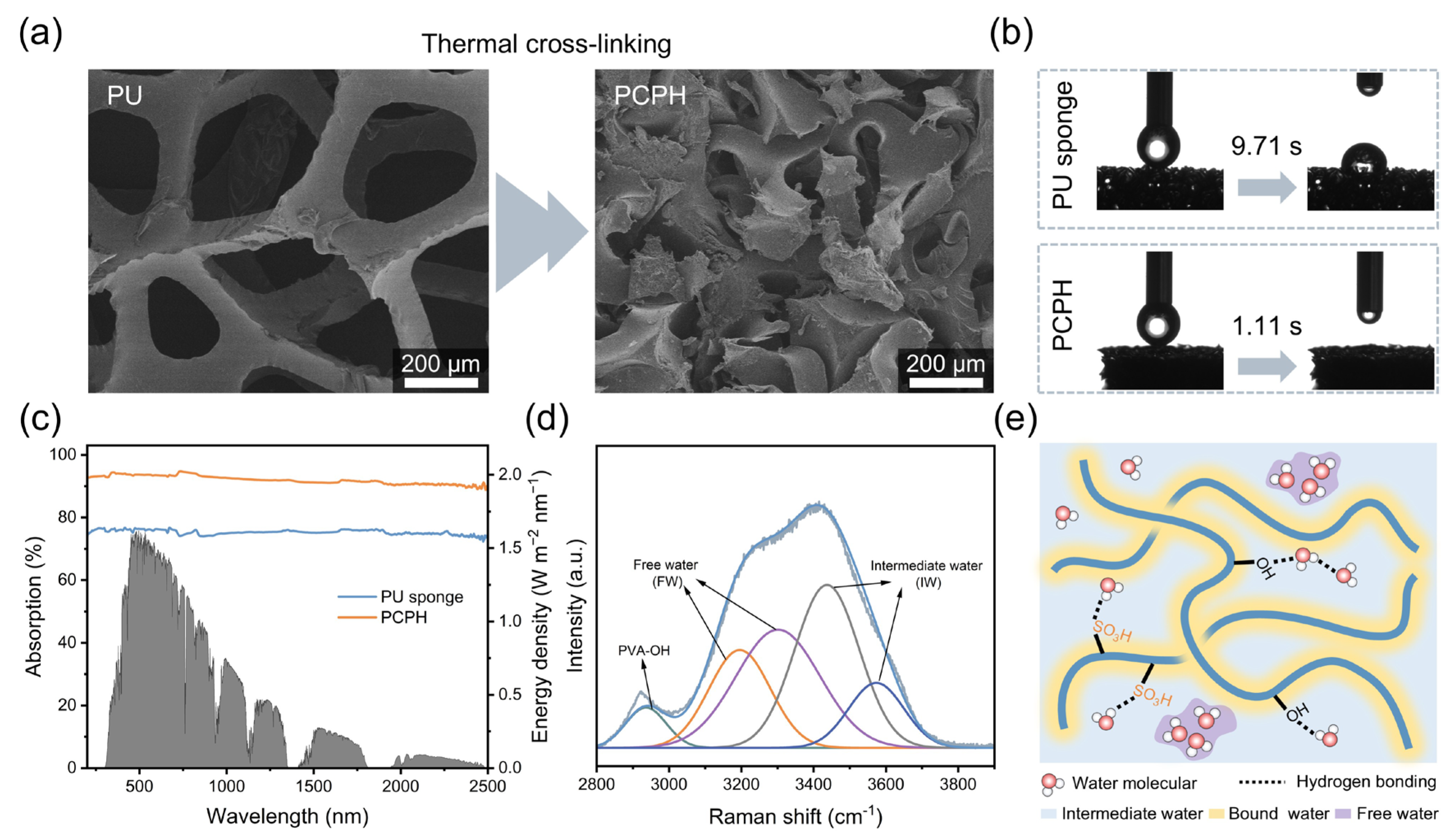
As illustrated in Figure 1, an in situ thermal cross-linking strategy was employed to prepare a 3D evaporator featuring a skeleton–skin architecture (PCPH). This synthetic route utilizes a commercially available macroporous PU sponge as the macroscopic support skeleton. A mixed precursor solution consisting of PVA, CB/SDS, and PEDOT:PSS was dip-coated onto the surface of the skeleton, followed by cross-linking and curing through direct heating. In this system, PVA not only serves as the backbone of the hydrophilic gel network, but its abundant hydroxyl groups also provide active sites for the cross-linking reaction; meanwhile, the synergistic doping of CB and PEDOT:PSS endows the resulting evaporator with excellent photothermal conversion capabilities. The SEM images reveal that the pristine PU sponge exhibits a smooth surface and a 3D interconnected network with pore sizes on the scale of hundreds of micrometers. After the cross-linking process, the PCPH retains this macroporous structure, with the hydrophilic gel layer uniformly and tightly adhering to the surface of the PU scaffold to form a microscopic skin layer, without causing blockage or collapse of the macroscopic channels (Figure 2a). This spatially decoupled design offers dual hydrodynamic advantages: first, the rough gel cortex provides a large effective surface area for evaporation and light absorption; second, the unobstructed macroscopic 3D pore channels significantly reduce the viscous resistance of water transport, preserving unimpeded physical pathways for subsequent efficient salt ion reflux and continuous fluid supply. Surface contact angle testing (Figure 2b) further validates the interfacial wettability of PU and PCPH. Upon contact with the surface of PCPH, a water droplet spreads completely and is absorbed within 1.11 s. This rapid absorption indicates that the composite structure possesses exceptional capillary water pumping capability, driven by the combined action of the hydrophilic network and capillary forces, thus ensuring an adequate water supply for high-throughput evaporation at the upper interface [45].

3.2. Optical Properties and Microscopic Regulation of Water States

Efficient and broadband absorption is a prerequisite for driving interfacial solar evaporation. The UV-Vis-NIR absorption spectrum (Figure 2c) indicates that the PCPH exhibits excellent light absorption properties across the full solar spectrum, ranging from 250 to 2500 nm, achieving an average absorption of approximately 92%. This highly efficient light trapping is primarily attributed to the synergistic effect between the broad-band intrinsic absorption of CB and the near-infrared localized surface plasmon resonance effect of PEDOT:PSS, coupled with the multiple internal light scattering induced by the 3D rough porous network, which effectively extends the path length of photons within the material.
In addition to photothermal conversion, the confined state of water molecules (intermediate water, IW; bound water, BW; free water, FW) within the gel network plays a decisive role in the thermodynamic phase transition process of the system [41]. Raman spectroscopy and its Gaussian fitting results (Figure 2d) reveal the restructuring mechanism of the hydrogen bond network among water molecules within the PCPH. Within the polymer network, densely distributed hydrophilic functional groups (such as hydroxyl and sulfonic acid groups) on the PVA and PEDOT:PSS segments form strong dipole–dipole interactions and hydrogen bonds with water molecules entering the channels. These strong interfacial interactions effectively disrupt and break down the original strong hydrogen-bond network within the bulk water clusters, facilitating the transformation of a substantial amount of free water located near the hydration layer of the polymer chains into intermediate water characterized by weaker intermolecular forces (Figure 2e). Quantitative analysis indicates that the peak area ratio of intermediate water to free water (IW/FW) in the system reaches 0.88. Since the energy required for intermediate water to escape the polymer network is significantly lower than that required to break the hydrogen bonds in bulk water, this mechanism of microscopic water molecule state regulation provides a fundamental physicochemical basis for reducing the overall equivalent latent heat of vaporization of the system.

3.3. Solar Evaporation Performance of the 3D Evaporator

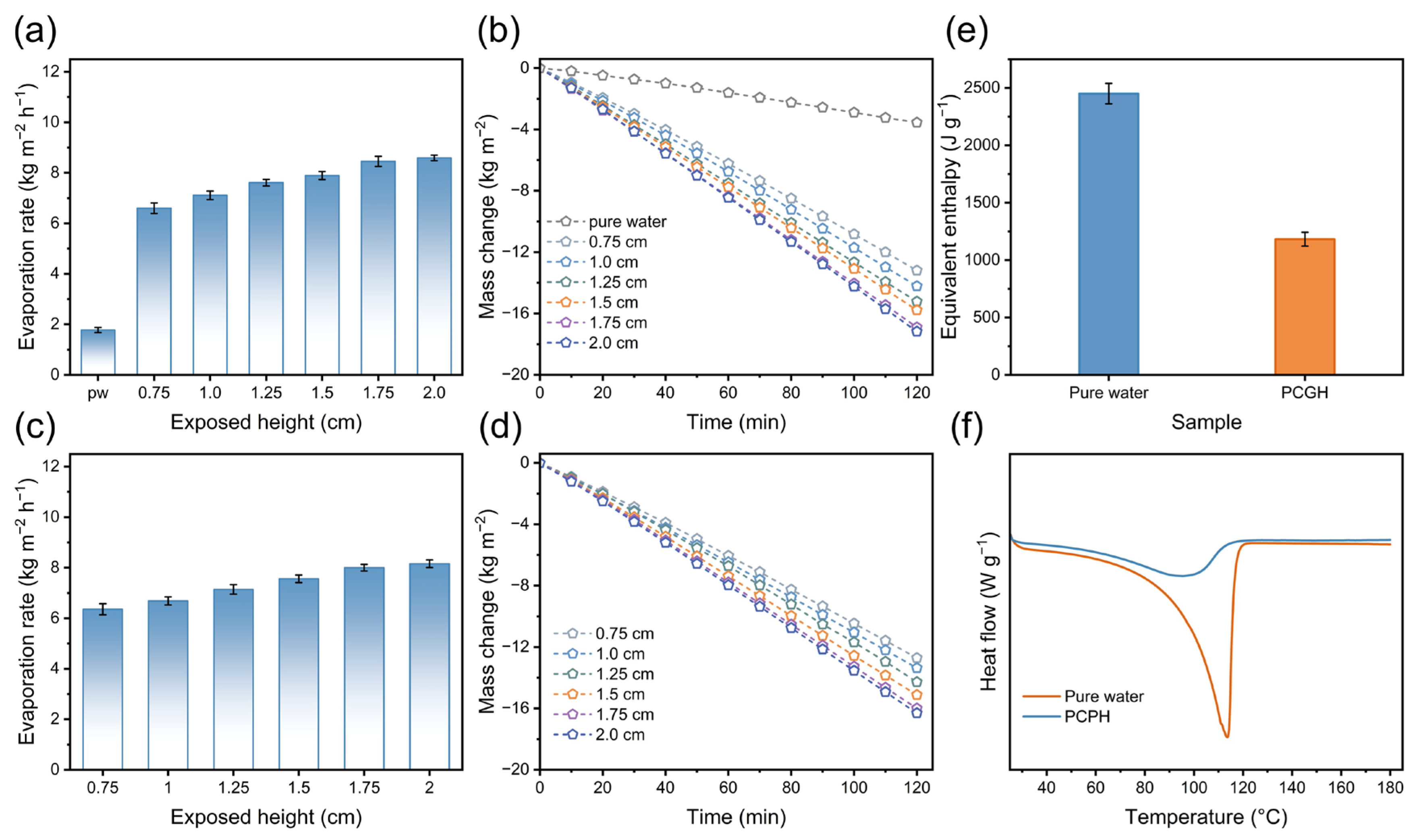
Under standard solar irradiance (1 kW m−2), the influence of the exposure height (ranging from 0.75 to 2.0 cm) on the apparent evaporation performance of the 3D PCPH evaporator was systematically investigated. In a pure water environment (Figure 3a,b), the slope of the water mass loss curve exhibited a pronounced steepening with increasing exposure height. Consequently, the evaporation rate of pure water rose steadily from 6.60 kg m−2 h−1 at 0.75 cm to 8.59 kg m−2 h−1 at 2.0 cm. Notably, the optimal rate of 8.59 kg m−2 h−1 is approximately 4.8 times higher than that of pure water (1.776 kg m−2 h−1), demonstrating exceptional solar evaporation performance. This performance leap indicates that enlarging the lateral surface area of the 3D columnar structure not only expands the effective gas–liquid exchange interface but also diminishes the local vapor partial pressure at the interface, thereby accelerating the diffusion and escape of vapor into the open environment.
In practical applications, high-concentration saline solutions frequently induce severe mass transfer attenuation. However, during tests with the highly challenging 10 wt% NaCl solution (Figure 3c,d), PCPH demonstrated exceptional resistance to performance degradation. The evaporation rates for samples of all heights remained at a high level (e.g., 8.16 kg m−2 h−1 at a height of 2.0 cm), with no evidence of channel blockage or vapor flux disruption caused by salt accumulation. This further confirms that the skeleton–skin macroporous structure described earlier supports rapid fluid convection and concentration gradient-driven ion diffusion, facilitating a dynamic equilibrium between desalination and evaporation. Furthermore, dark-field evaporation tests (Figure S1) indicate that the system can still maintain a considerable evaporation rate under non-illuminated conditions, suggesting a strong potential to extract thermal energy from the ambient air. To verify the influence of microscale water state reconstruction (Section 3.2) on macroscale evaporation, the equivalent enthalpy of vaporization for the system was calculated via inversion based on the apparent evaporation data (Figure 3e). The results demonstrate that, driven by the intermediate water mechanism, the equivalent evaporation enthalpy of water molecules within the PCPH is significantly reduced to 1181.8 J g−1. It should be noted that this represents an apparent value, as the high porosity of the 3D PCPH foam provides a larger effective evaporation area than the projected top surface, which inherently enhances the dark evaporation rate. Therefore, to accurately quantify the intrinsic energy requirement independent of the area effect, standard DSC measurements were performed. The results reveal an intrinsic enthalpy of 1109.6 J g−1 for PCPH (Figure 3f), which is notably lower than that of bulk water (2450 J g−1). Remarkably, the intrinsic value obtained from the DSC measurement is highly consistent with the apparent value derived from the dark evaporation test. This mutual verification not only confirms the reliability of the thermodynamic calculations but also provides direct confirmation for the mechanistic analysis derived from Raman spectroscopy and explains the intrinsic driving force behind the ultra-high apparent evaporation rate of the system.

3.4. Absolute Energy Balance and Heat Absorption Mechanisms

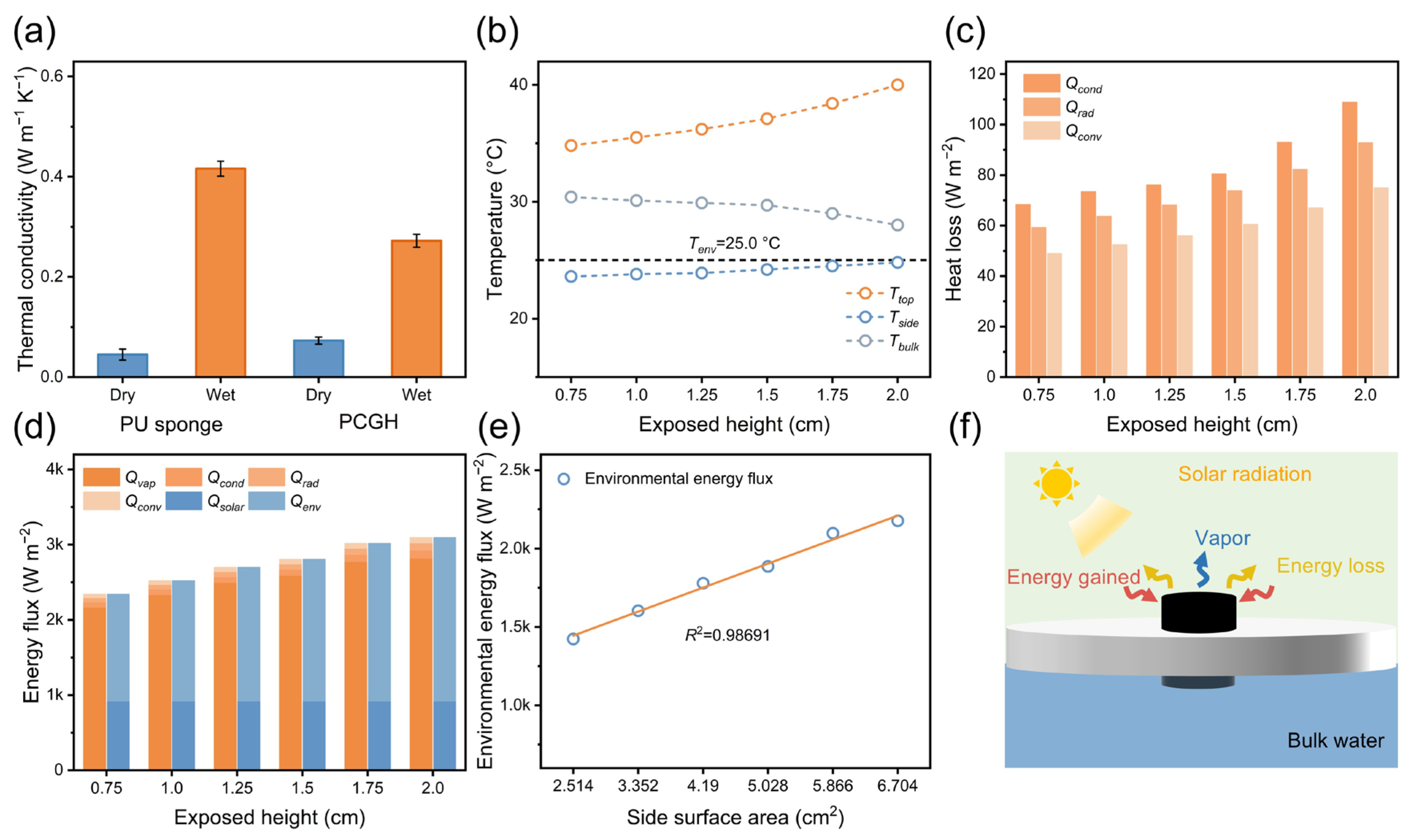
To elucidate the energy source enabling the 3D evaporator to surpass the theoretical evaporation limit, a detailed thermodynamic flow reconstruction of the steady-state evaporation system was carried out based on the principle of absolute energy conservation. The dry and wet thermal conductivity tests indicate that even under fully wetted conditions, the thermal conductivity of the PCPH remains as low as 0.272 W m−1 K−1 (Figure 4a). This excellent thermal insulation effectively blocks the conduction pathway for heat dissipation from the vapor–liquid interface to the underlying bulk water, thereby ensuring that energy is highly localized at the evaporation interface. An analysis of multi-point temperature monitoring distributions during steady-state evaporation (Figure 4b), coupled with calculations based on heat transfer equations, reveals that parasitic heat losses via downward conduction (Qcond), surface convection (Qconv), and surface radiation (Qrad) are successfully suppressed to an extremely low proportion (Figure 4c). More crucially, as the 3D exposure height increases, intense endothermic water vaporization occurs on the sidewall surfaces, leading to a significant drop in the local surface temperature on the sides, which eventually falls below the ambient air temperature (Tside < Tenv). This cold-sink effect reverses the conventional direction of convective heat transfer, blocking outward heat loss from the side walls and creating a favorable temperature gradient for heat extraction from the external environment. Further macroscopic energy flux calculations reveal that the total energy consumption due to vaporization (Qvap), calculated based on the steady-state evaporation rate and the equivalent enthalpy of vaporization (1181.8 J g−1), is significantly greater than the effective solar radiation energy (Qsolar) absorbed at the top of the system. As shown in Figure 4d, the key to bridging this substantial energy gap lies in the additional heat (Qenv) collected by the 3D side walls from the surrounding warmer environment. A mathematical fitting of the Qenv values at different heights against the corresponding exposed area of the 3D side walls confirms a highly positive linear correlation (R2 = 0.9869) (Figure 4e). This conclusive linear result rules out interference from other variables and confirms that the increase in apparent evaporation flux is the inevitable thermodynamic outcome of the highly efficient coupling of two mechanisms: the microscopic enthalpy reduction mechanism and the macroscopic 3D sidewall environmental energy harvesting (Figure 4f).

3.5. Salt Resistance and Desalination Performance

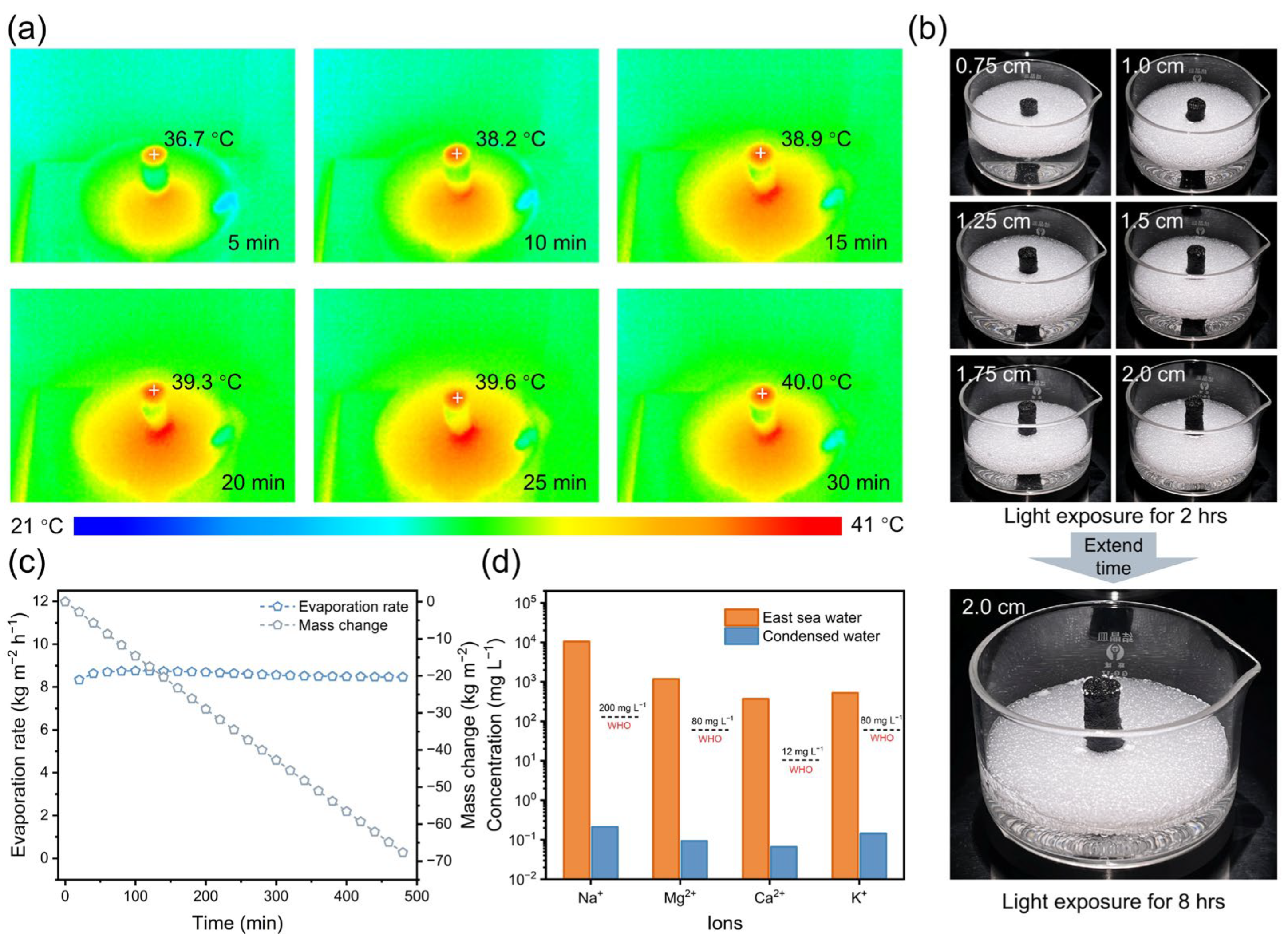
Although efficient thermal localization provides sufficient energy for the phase transition, it also increases the risk of salt ion precipitation at the gas–liquid interface. Infrared thermal imaging (Figure 5a) shows that, under continuous illumination, the temperature at the top of the 2.0 cm sample, which featured the maximum exposure height, increased rapidly and stabilized at approximately 40.0 °C. This intense localized evaporation causes a rapid supersaturation of the salt concentration at the interface. However, a 2 h routine salt resistance test conducted in a 10 wt% NaCl solution indicates that the surfaces of the PCPH samples across all heights (0.75–2.0 cm) remained black and pristine, with no observable salt crystallization (Figure 5b, top). This indicates that during a conventional operating cycle, the internal macroporous skeletal structure provides sufficient channels for salt diffusion driven by advection and concentration gradients, thereby enabling the prompt return of salt ions transported to the surface back into the bulk water.
To investigate the operational limits of the system, an 8 h test was conducted on the 2.0 cm sample. Towards the end of the test, only trace amounts of salt crystallization appeared at the top edge of the sample (Figure 5b, bottom). Crucially, continuous monitoring reveals that the water mass decreased linearly throughout the entire 8 h test, with the real-time evaporation rate remaining highly stable even when approaching the crystallization threshold. This steady performance confirms that the minor localized crystallization did not cause widespread channel blockages, thereby demonstrating the exceptional long-term operational stability of the 3D network (Figure 5c). Finally, to evaluate the practical potential, desalination experiments were conducted using actual seawater from the East China Sea. As shown in Figure 5d, the concentrations of Na+, Mg2+, Ca2+, and K+ were reduced by 4 to 5 orders of magnitude, meeting WHO standards. Furthermore, since only trace amounts of salt crystallization occurred at the edges, even at the extremely high-concentration limit of the 10 wt% NaCl test discussed above, it is inherently evident that the PCPH evaporator is fully capable of handling the lower salinity of real seawater (~3.5 wt%) without long-term crystallization risks. This series of results not only validates the robustness of the system under high-salinity exposure but also highlights its engineering value in the fields of high-salinity wastewater reduction and freshwater resource recovery.

4. Conclusions

In this study, a highly efficient 3D interfacial solar evaporator (PCPH) was developed by cross-linking a hydrophilic composite gel onto a macroporous sponge. This design effectively integrates microscopic water state regulation with macroscopic environmental energy harvesting to mitigate mass transfer attenuation in highly concentrated brine. At the microscale, hydrophilic functional groups within the gel network promote the conversion of free water into intermediate water (IW/FW ratio of 0.88), significantly reducing the equivalent enthalpy of vaporization of the system to 1181.8 J g−1. Macroscopically, the 3D columnar structure expands the effective gas–liquid exchange area and induces a local cold sink effect (Tside < Tenv) at the side walls, spontaneously absorbing ambient thermal energy. Driven by this dual mechanism, the PCPH achieved a remarkable evaporation rate of 8.59 kg m−2 h−1 under one standard solar irradiance. Furthermore, the unobstructed sponge framework provides excellent convective mass transfer pathways, ensuring long-term stability. The system exhibited no significant channel blockage during an 8 h continuous test in a 10 wt% NaCl solution. Additionally, it reduced key metal ion concentrations in 3.5 wt% simulated seawater by 4 to 5 orders of magnitude, fully satisfying WHO drinking water standards. This work provides a promising strategy for efficient desalination and high-salinity wastewater treatment.

Supplementary Materials

The following supporting information can be downloaded at: https://www.mdpi.com/article/10.3390/separations13050133/s1, Figure S1: Dark evaporation rates of PCPH with different exposure heights in pure water.

Author Contributions

Conceptualization, Y.B., X.Z., D.L. and F.L.; methodology, Y.B.; experiments and characterizations, Y.B.; writing—original draft, Y.B.; writing—review and editing, Y.B., X.Z., D.L. and F.L.; data curation, Y.B., X.Z., D.L. and F.L.; funding acquisition, F.L. All authors have read and agreed to the published version of the manuscript.

Funding

The work has been supported by the Fundamental Research Funds for the Central Universities (No. 2232025A-11).

Data Availability Statement

The original contributions presented in this study are included in the article/Supplementary Material. Further inquiries can be directed to the corresponding authors.

Acknowledgments

The authors gratefully acknowledge the funding support from the Fundamental Research Funds for the Central Universities (No. 2232025A-11).

Conflicts of Interest

The authors declare no conflicts of interest.

References

  1. Shannon, M.A.; Bohn, P.W.; Elimelech, M.; Georgiadis, J.G.; Marinas, B.J.; Mayes, A.M. Science and technology for water purification in the coming decades. Nature 2008, 452, 301–310. [Google Scholar] [CrossRef] [PubMed]
  2. Elimelech, M.; Phillip, W.A. The Future of Seawater Desalination: Energy, Technology, and the Environment. Science 2011, 333, 712–717. [Google Scholar] [CrossRef]
  3. Mekonnen, M.M.; Hoekstra, A.Y. Four billion people facing severe water scarcity. Sci. Adv. 2016, 2, e1500323. [Google Scholar] [CrossRef]
  4. Voeroesmarty, C.J.; McIntyre, P.B.; Gessner, M.O.; Dudgeon, D.; Prusevich, A.; Green, P.; Glidden, S.; Bunn, S.E.; Sullivan, C.A.; Liermann, C.R.; et al. Global threats to human water security and river biodiversity. Nature 2010, 467, 555–561, Correction in Nature 2010, 468, 334. [Google Scholar] [CrossRef]
  5. Oki, T.; Kanae, S. Global hydrological cycles and world water resources. Science 2006, 313, 1068–1072. [Google Scholar] [CrossRef]
  6. Ghasemi, H.; Ni, G.; Marconnet, A.M.; Loomis, J.; Yerci, S.; Miljkovic, N.; Chen, G. Solar steam generation by heat localization. Nat. Commun. 2014, 5, 4449. [Google Scholar] [CrossRef]
  7. Ni, G.; Li, G.; Boriskina, S.V.; Li, H.; Yang, W.; Zhang, T.; Chen, G. Steam generation under one sun enabled by a floating structure with thermal concentration. Nat. Energy 2016, 1, 16126. [Google Scholar] [CrossRef]
  8. Liu, Y.; Yu, S.; Feng, R.; Bernard, A.; Liu, Y.; Zhang, Y.; Duan, H.; Shang, W.; Tao, P.; Song, C.; et al. A Bioinspired, Reusable, Paper-Based System for High-Performance Large-Scale Evaporation. Adv. Mater. 2015, 27, 2768–2774. [Google Scholar] [CrossRef]
  9. Zhou, L.; Tan, Y.; Wang, J.; Xu, W.; Yuan, Y.; Cai, W.; Zhu, S.; Zhu, J. 3D self-assembly of aluminium nanoparticles for plasmon-enhanced solar desalination. Nat. Photonics 2016, 10, 393–398. [Google Scholar] [CrossRef]
  10. Chen, C.; Li, Y.; Song, J.; Yang, Z.; Kuang, Y.; Hitz, E.; Jia, C.; Gong, A.; Jiang, F.; Zhu, J.Y.; et al. Highly Flexible and Efficient Solar Steam Generation Device. Adv. Mater. 2017, 29, 1701756. [Google Scholar] [CrossRef] [PubMed]
  11. Wang, P. Emerging investigator series: The rise of nano-enabled photothermal materials for water evaporation and clean water production by sunlight. Environ. Sci.-Nano 2018, 5, 1078–1089. [Google Scholar] [CrossRef]
  12. Tao, P.; Ni, G.; Song, C.; Shang, W.; Wu, J.; Zhu, J.; Chen, G.; Deng, T. Solar-driven interfacial evaporation. Nat. Energy 2018, 3, 1031–1041. [Google Scholar] [CrossRef]
  13. Ni, G.; Zandavi, S.H.; Javid, S.M.; Boriskina, S.V.; Cooper, T.A.; Chen, G. A salt-rejecting floating solar still for low-cost desalination. Energy Environ. Sci. 2018, 11, 1510–1519. [Google Scholar] [CrossRef]
  14. Cui, L.; Wang, P.; Che, H.; Chen, J.; Liu, B.; Ao, Y. Solar-driven interfacial water evaporation for wastewater purification: Recent advances and challenges. Chem. Eng. J. 2023, 477, 147158. [Google Scholar] [CrossRef]
  15. Zhao, F.; Zhou, X.; Shi, Y.; Qian, X.; Alexander, M.; Zhao, X.; Mendez, S.; Yang, R.; Qu, L.; Yu, G. Highly efficient solar vapour generation via hierarchically nanostructured gels. Nat. Nanotechnol. 2018, 13, 489–495. [Google Scholar] [CrossRef] [PubMed]
  16. Li, S.; Xi, Z.; Yu, L.; Yan, H.; Chen, M. Thermal Management of the Solar Evaporation Process. Langmuir 2023, 39, 8900–8907. [Google Scholar] [CrossRef]
  17. Zhu, J.; Zhang, J.; Zha, J.; Zhao, S.; Ren, W.; Wang, B.; Xiao, L.-P.; Hao, S.; Shao, C.; Yang, J.; et al. Engineering Renewable Lignocellulosic Biomass as Sustainable Solar-Driven Interfacial Evaporators. Nano-Micro Lett. 2026, 18, 174. [Google Scholar] [CrossRef]
  18. Peng, Y.; Shao, Y.; Zheng, L.; Li, H.; Zhu, M.; Chen, Z. Nature-Inspired Upward Hanging Evaporator with Photothermal 3D Spacer Fabric for Zero-Liquid-Discharge Desalination. Nano-Micro Lett. 2025, 18, 22. [Google Scholar] [CrossRef]
  19. Zhao, X.; Zhang, H.; Chan, K.-Y.; Huang, X.; Yang, Y.; Shen, X. Tree-Inspired Structurally Graded Aerogel with Synergistic Water, Salt, and Thermal Transport for High-Salinity Solar-Powered Evaporation. Nano-Micro Lett. 2024, 16, 222. [Google Scholar] [CrossRef]
  20. Hou, L.; Li, S.; Qi, Y.; Liu, J.; Cui, Z.; Liu, X.; Zhang, Y.; Wang, N.; Zhao, Y. Advancing Efficiency in Solar-Driven Interfacial Evaporation: Strategies and Applications. ACS Nano 2025, 19, 9636–9683. [Google Scholar] [CrossRef]
  21. Li, H.; Zhang, W.; Liao, X.; Xu, L. Kirigami enabled reconfigurable three-dimensional evaporator arrays for dynamic solar tracking and high efficiency desalination. Sci. Adv. 2024, 10, eado1019. [Google Scholar] [CrossRef]
  22. Mao, P.; Bi, W.; Lv, J.; Zhang, Z.; Wang, B.; Zhong, Y. Decoding Buried Interfaces in Perovskite Solar Cells: Core Issues, Strategic Engineering, and Prospects for High-Efficiency Stable Devices. Adv. Sci. 2025, 12, e12523. [Google Scholar] [CrossRef]
  23. Xia, Y.; Hou, Q.; Jubaer, H.; Li, Y.; Kang, Y.; Yuan, S.; Liu, H.; Woo, M.W.; Zhang, L.; Gao, L.; et al. Spatially isolating salt crystallisation from water evaporation for continuous solar steam generation and salt harvesting. Energy Environ. Sci. 2019, 12, 1840–1847. [Google Scholar] [CrossRef]
  24. Kuang, Y.; Chen, C.; He, S.; Hitz, E.M.; Wang, Y.; Gan, W.; Mi, R.; Hu, L. A High-Performance Self-Regenerating Solar Evaporator for Continuous Water Desalination. Adv. Mater. 2019, 31, e1900498. [Google Scholar] [CrossRef] [PubMed]
  25. Shi, Y.; Li, R.; Jin, Y.; Zhuo, S.; Shi, L.; Chang, J.; Hong, S.; Ng, K.-C.; Wang, P. A 3D Photothermal Structure toward Improved Energy Efficiency in Solar Steam Generation. Joule 2018, 2, 1171–1186. [Google Scholar] [CrossRef]
  26. Zhang, J.; Wang, Y.; Guo, W.; Wang, R.; Li, H.; He, H. Multi-functional polyelectrolyte materials in photothermal interfacial evaporation for clean water production. Green Chem. 2025, 27, 946–958. [Google Scholar] [CrossRef]
  27. Zhang, Y.; Xiong, T.; Nandakumar, D.K.; Tan, S.C. Structure Architecting for Salt-Rejecting Solar Interfacial Desalination to Achieve High-Performance Evaporation With In Situ Energy Generation. Adv. Sci. 2020, 7, 1903478. [Google Scholar] [CrossRef]
  28. He, F.; Wu, X.; Gao, J.; Wang, Z. Solar-driven interfacial evaporation toward clean water production: Burgeoning materials, concepts and technologies. J. Mater. Chem. A 2021, 9, 27121–27139. [Google Scholar] [CrossRef]
  29. Li, X.; Lin, R.; Ni, G.; Xu, N.; Hu, X.; Zhu, B.; Lv, G.; Li, J.; Zhu, S.; Zhu, J. Three-dimensional artificial transpiration for efficient solar waste-water treatment. Natl. Sci. Rev. 2018, 5, 70–77. [Google Scholar] [CrossRef]
  30. Li, T.; Gou, K.; Zhang, C.; Wu, D.; Zhu, H. Downward design of solar-driven interfacial evaporators: Beyond the limitation of vertical water delivery in conventional upward evaporators. J. Environ. Chem. Eng. 2024, 12, 111683. [Google Scholar] [CrossRef]
  31. Song, H.; Liu, Y.; Liu, Z.; Singer, M.H.; Li, C.; Cheney, A.R.; Ji, D.; Zhou, L.; Zhang, N.; Zeng, X.; et al. Cold Vapor Generation beyond the Input Solar Energy Limit. Adv. Sci. 2018, 5, 1800222. [Google Scholar] [CrossRef]
  32. Wang, Y.; Wu, X.; Yang, X.; Owens, G.; Xu, H. Reversing heat conduction loss: Extracting energy from bulk water to enhance solar steam generation. Nano Energy 2020, 78, 105269. [Google Scholar] [CrossRef]
  33. Hou, Y.; Gao, M.; Bai, X.; Zhao, L.; Du, H.; Zhou, K. 3D printing of bio-inspired porous polymeric solar steam generators for efficient and sustainable desalination. Appl. Phys. Rev. 2024, 11, 031407. [Google Scholar] [CrossRef]
  34. Hu, X.; Zhu, J. Tailoring Aerogels and Related 3D Macroporous Monoliths for Interfacial Solar Vapor Generation. Adv. Funct. Mater. 2020, 30, 1907234. [Google Scholar] [CrossRef]
  35. Zhang, X.; Guo, J.; Zou, Z.; Luo, B.; Li, N.; Yang, Z.; Xiong, S.; Wang, X.; Xu, Y.; Li, Y. Bioinspired and 3D-printed solar evaporators for highly efficient freshwater-electricity co-generation. Mater. Horiz. 2025, 12, 5211–5224. [Google Scholar] [CrossRef] [PubMed]
  36. Li, W.; Li, J.; Ding, L.; Zhu, X.; Sun, R.; Chang, K. Interfacial Assembled Hydrogel Evaporator for Highly Efficient Thermal Management and Photothermal Coupled Water Splitting Reaction. Adv. Funct. Mater. 2024, 34, 2411387. [Google Scholar] [CrossRef]
  37. Chen, Y.-Q.; Zhu, Y.-J.; Wang, Z.-Y.; Yu, H.-P.; Xiong, Z.-C. A Fish-Gill-Inspired Biomimetic Multiscale-Ordered Hydrogel-Based Solar Water Evaporator for Highly Efficient Salt-Rejecting Seawater Desalination. ACS Appl. Mater. Interfaces 2025, 17, 8158–8170. [Google Scholar] [CrossRef]
  38. Shu, L.; Zhang, X.-F.; Wang, Z.; Liu, J.; Yao, J. Cellulose-based bi-layer hydrogel evaporator with a low evaporation enthalpy for efficient solar desalination. Carbohydr. Polym. 2024, 327, 121695. [Google Scholar] [CrossRef]
  39. Wan, H.; Fu, X.; Chen, Y.; Zhao, L.; Wang, T.; Liu, Y. Biochar-based hydrogel evaporator with vertically arranged channels for efficient solar steam generation, desalination and water purification. Sep. Purif. Technol. 2025, 359, 130795. [Google Scholar] [CrossRef]
  40. Zhou, X.; Guo, Y.; Zhao, F.; Shi, W.; Yu, G. Topology-Controlled Hydration of Polymer Network in Hydrogels for Solar-Driven Wastewater Treatment. Adv. Mater. 2020, 32, e2007012. [Google Scholar] [CrossRef]
  41. Wu, M.; Wei, Y.; Zhu, Y.; Bai, Y.; Wang, Y.; Wang, X.; Ho, S.-H.; Wang, W.; Li, R. Hydrophilic Polymer Foam as a Monolithic Interfacial Solar Evaporator With Rapid Self-Cleaning, High Evaporation Efficiency, and Salt Resistance. Adv. Funct. Mater. 2024, 34, 2410729. [Google Scholar] [CrossRef]
  42. Zhou, X.; Zhao, F.; Guo, Y.; Rosenberger, B.; Yu, G. Architecting highly hydratable polymer networks to tune the water state for solar water purification. Sci. Adv. 2019, 5, eaaw5484. [Google Scholar] [CrossRef] [PubMed]
  43. Xu, W.; Hu, X.; Zhuang, S.; Wang, Y.; Li, X.; Zhou, L.; Zhu, S.; Zhu, J. Flexible and Salt Resistant Janus Absorbers by Electrospinning for Stable and Efficient Solar Desalination. Adv. Energy Mater. 2018, 8, eaaw5484. [Google Scholar] [CrossRef]
  44. Li, C.; Zhu, B.; Liu, Z.; Zhao, J.; Meng, R.; Zhang, L.; Chen, Z. Polyelectrolyte-based photothermal hydrogel with low evaporation enthalpy for solar-driven salt-tolerant desalination. Chem. Eng. J. 2022, 431, 134224. [Google Scholar] [CrossRef]
  45. Yang, H.; Sun, Y.; Peng, M.; Cai, M.; Zhao, B.; Li, D.; Liang, Z.; Jiang, L. Tailoring the Salt Transport Flux of Solar Evaporators for a Highly Effective Salt-Resistant Desalination with High Productivity. ACS Nano 2022, 16, 2511–2520. [Google Scholar] [CrossRef] [PubMed]
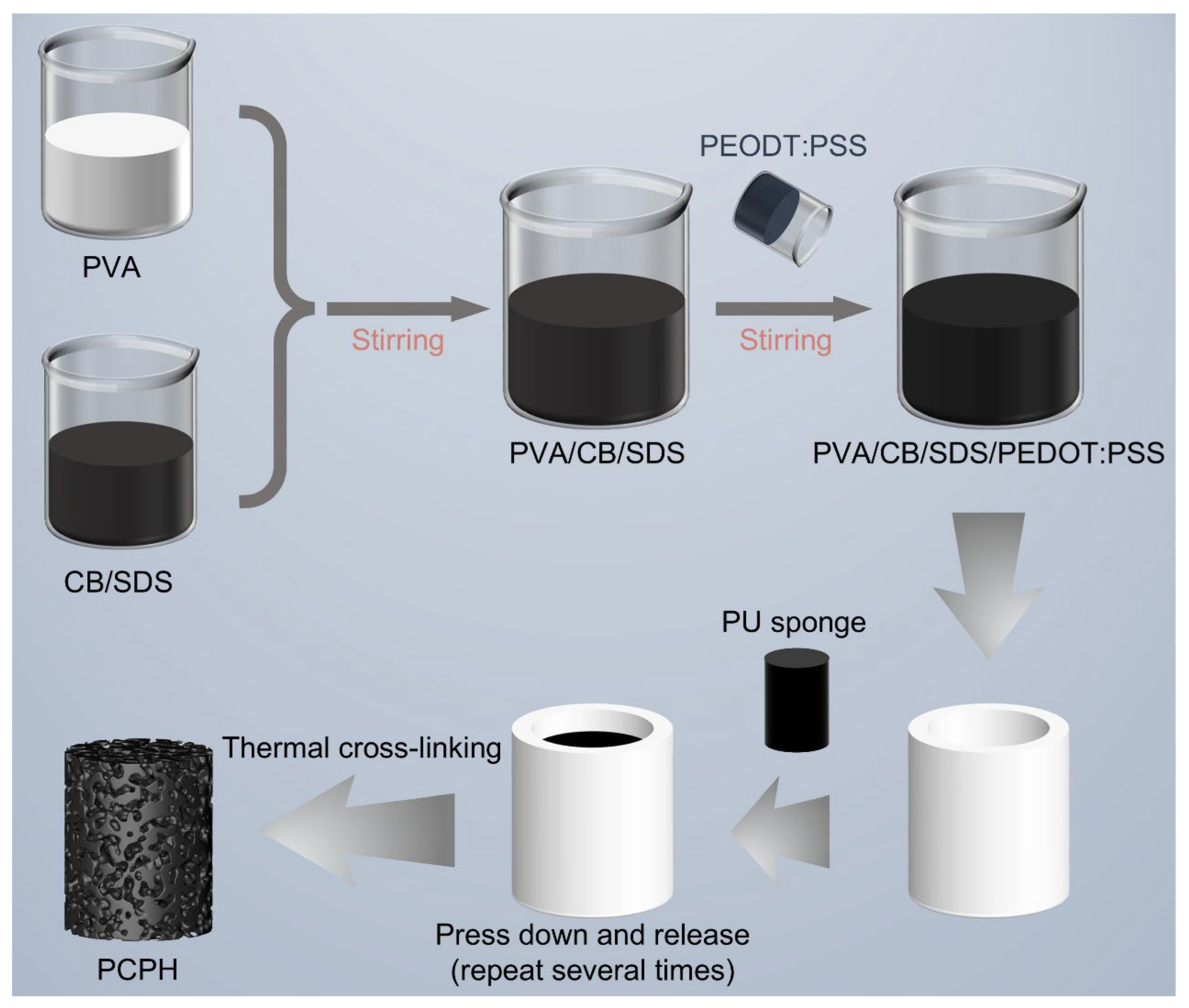
Figure 1. Preparation process of the gel precursor solution and the detailed preparation process of the evaporators.
Separations 13 00133 g001
Figure 2. (a) SEM images of PU sponge and PCPH; (b) water contact angle photographs of PU sponge and PCPH; (c) absorption spectra of PU sponge and PCPH in the entire solar spectrum (250–2500 nm); (d) Raman spectrum with fitting curves of PCPH after immersion in pure water; (e) the schematic illustration of three types of water (IW, BW, and FW) in PCPH.
Separations 13 00133 g002
Figure 3. (a,b) Evaporation rates and mass change curves of PCPH with different exposure heights in pure water under 1 sun; (c,d) evaporation rates and mass change curves of PCPH with different exposure heights in 10 wt% NaCl solution under 1 sun; (e) comparison of the apparent equivalent evaporation enthalpy between pure water and PCPH; (f) DSC curves and the intrinsic enthalpy of vaporization for bulk water and PCPH.
Separations 13 00133 g003
Figure 4. (a) Thermal conductivity of PU sponge and PCPH in dry and wet states; (b) surface and sidewall temperatures of PCPH with different exposure heights during evaporation and the steady-state temperature of the bulk water; (c) distribution of energy loss during evaporation for PCPH with different exposure heights; (d) the total energy distribution of PCPH during evaporation at different exposure heights; (e) the linear relationship between the sidewall area of the PCPH and the environmental energy flux; (f) schematic diagram of energy distribution during PCPH evaporation.
Separations 13 00133 g004
Figure 5. (a) Infrared thermal image of PCPH with a 2 cm exposed height during the evaporation of pure water over a 30 min period under 1 sun of radiation; (b) surface salt crystallization in PCPH with varying exposure heights after evaporation of a 10 wt% NaCl solution for 2 h (top) and surface salt crystallization in PCPH with a 2 cm exposed height after 8 h of evaporation of a 10 wt% NaCl solution (bottom); (c) evaporation rate and mass change curves for PCPH with a 2 cm exposed height during the evaporation of a 10 wt% NaCl solution; (d) concentrations of different ions before and after evaporation (East Sea water).
Separations 13 00133 g005
Disclaimer/Publisher’s Note: The statements, opinions and data contained in all publications are solely those of the individual author(s) and contributor(s) and not of MDPI and/or the editor(s). MDPI and/or the editor(s) disclaim responsibility for any injury to people or property resulting from any ideas, methods, instructions or products referred to in the content.