
Article

Preferential Lithium Recovery and Temperature-Regulated Stepwise Desorption of Transition Metals from Simulated Spent NCM111 Leachate Using NaA Zeolite

School of Environmental Science and Engineering, Xiamen University of Technology, Xiamen 361024, China
*
Author to whom correspondence should be addressed.
Separations 2026, 13(5), 132; https://doi.org/10.3390/separations13050132
Submission received: 24 March 2026 / Revised: 22 April 2026 / Accepted: 24 April 2026 / Published: 28 April 2026
(This article belongs to the Special Issue Solid Waste Recycling and Strategic Metal Extraction)

Abstract

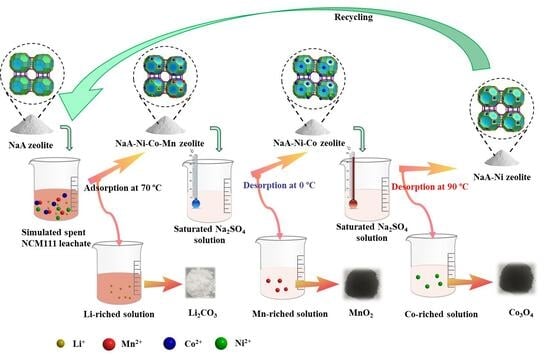
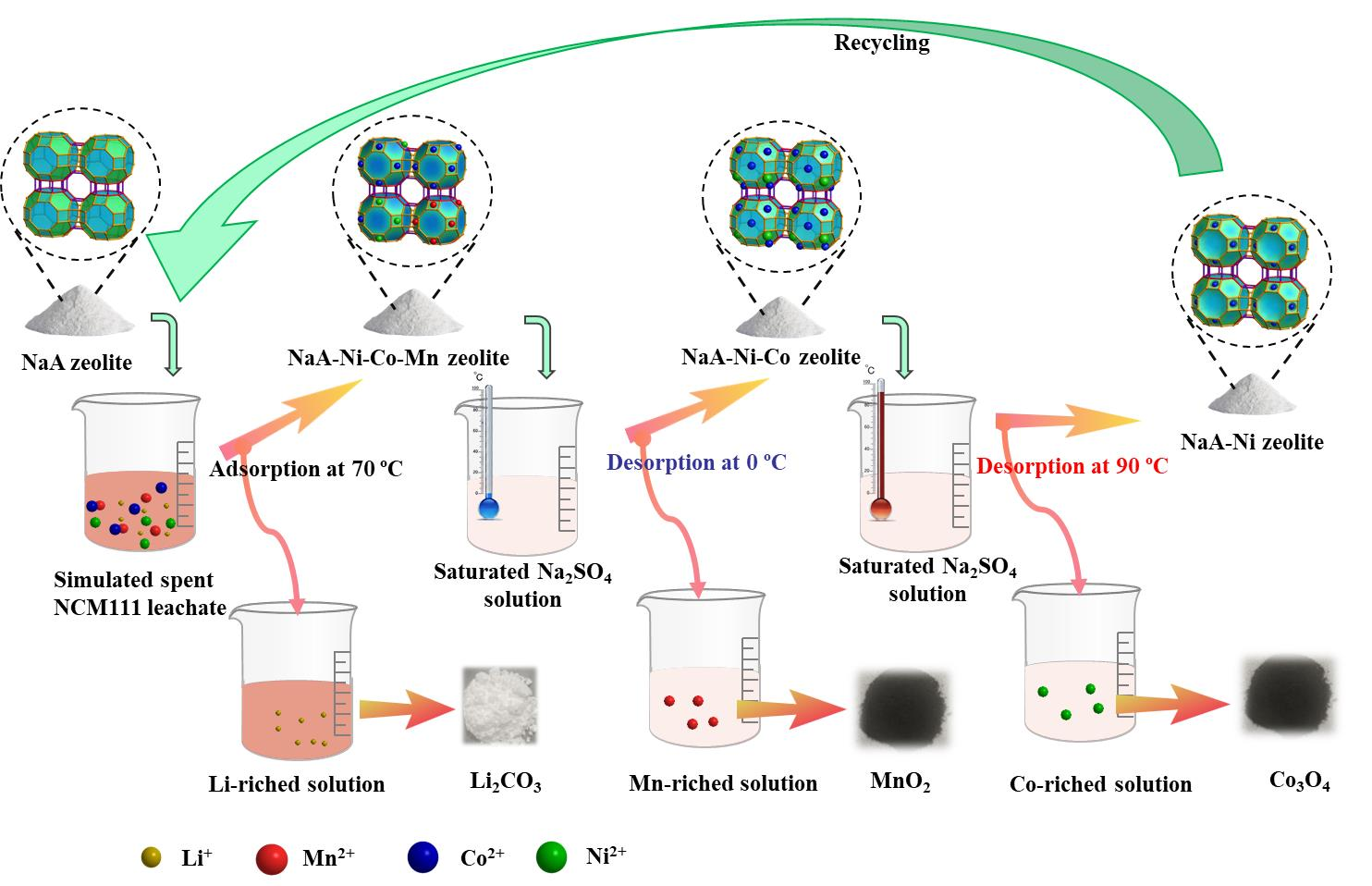
Recycling spent lithium-ion batteries (LIBs) is critical for resource sustainability and carbon neutrality. This work presents a green strategy in which NaA zeolite is used to preferentially recover lithium from leachate of spent NCM111 batteries, combined with temperature-regulated stepwise separation of transition metals. Benefiting from the distinct hydrated ionic radii and charge density between Li+ and divalent metal ions, NaA zeolite selectively adsorbs Ni2+, Co2+ and Mn2+, leaving Li+ in the raffinate. Under optimized conditions, two-stage adsorption achieves 95.6%, 96.7% and 99.7% removal of Ni2+, Co2+ and Mn2+, respectively, with 11% Li+ co-adsorption. Thermodynamic analysis reveals that the adsorption process is endothermic and thermodynamically spontaneous. The interaction strength between metal ions and NaA zeolite follows the order Ni2+ > Co2+ > Mn2+, and ion exchange is identified as the dominant mechanism. It is determined that 96.8% of Mn2+ can be recovered at 0 °C, followed by the desorption of 93.5% of Co2+ at 90 °C, and the sequential separation of Mn, Co and Ni is realized. Three consecutive adsorption–desorption cycles demonstrate the acceptable reusability of the Ni-loaded NaA adsorbent. High-purity Li2CO3 (purity 96.7%, yield 93.5%), MnO2 (purity 99.3%, yield 98.4%) and Co3O4 (purity 98.8%, yield 97.6%) are obtained from the corresponding solutions. This approach provides a scalable closed-loop pathway for full-component recovery of valuable metals from spent LIBs.

Graphical Abstract

1. Introduction

The rapid proliferation of electric vehicles (EVs) and portable electronic devices has driven exponential growth in the global demand for lithium-ion batteries (LIBs). However, LIBs have a finite service life, with a typical operational lifespan of 5–8 years for EV applications; thus, there has been an unprecedented surge in the generation of spent LIBs. They contain substantial quantities of valuable metals, including Li (5–10 wt.%), Co (5–20 wt.%), Ni (5–10 wt.%), and Mn (10–15 wt.%), with concentrations greatly exceeding those in natural ores [1,2]. It is estimated that recycling spent LIBs could individually supply over 50% of the global demand for Li, Ni, Co, and Mn by 2040 [3]. As a critical strategic resource, Li is facing mounting supply pressure amid the booming EV market [4]. Consequently, recycling spent LIBs is not only integral to the sustainable management of battery resources, but is also a key pathway for achieving “carbon peak” and “carbon neutrality” goals [5,6]. Nevertheless, conventional recycling processes typically recover Li+ in the final treatment stage, resulting in unavoidable lithium loss, compromised product purity, and inefficient resource utilization. Therefore, developing sustainable and cost-effective technologies for the preferential extraction of Li+, coupled with the efficient recovery of coexisting transition metals from spent LIB leachate, is an urgent priority for both environmental protection and strategic resource security.
Hydrometallurgical processes, consisting of leaching, purification, and separation unit operations, are widely used to recover valuable metals from spent LIBs due to their high leaching efficiency and scalability [7,8]. These processes break down the crystal lattice of cathode materials and allow valuable components to be recovered using methods such as solvent extraction and chemical precipitation [9,10]. Despite their inherent advantages, these conventional techniques present significant limitations for Li+-first separation. Solvent extraction usually employs toxic organic extractants and faces challenges with regard to the co-extraction of Li+ with transition metals (Ni2+, Co2+, Mn2+), while chemical precipitation lacks sufficient selectivity, often requiring excessive reagent consumption and generating large amounts of secondary sludge [7,11]. Another drawback is that non-prioritized Li+ recovery leads to its dilution in downstream processing steps, reducing its recovery efficiency and product purity. This has become a major bottleneck for the sustainable recycling of LIBs, highlighting the critical challenge of achieving preferential Li+ extraction coupled with efficient separation of transition metals from leachate.
Adsorptive separation technology, characterized by high selectivity and environmental benignity, has emerged as a competitive alternative for metal ion recovery [12]. Among the various adsorbents, zeolite materials have attracted a great deal of attention due to their excellent adsorption performance, low cost, robust chemical and thermal stability, and good reusability [13,14]. The selective adsorption mechanism of zeolites is based on pore-size exclusion and ion–framework interactions: hydrated metal ions must undergo partial dehydration to enter the zeolite pores, while the negatively charged [AlO4] tetrahedral sites enable ion exchange via electrostatic interactions [15]. These unique properties make zeolites promising candidates for recovering critical metals (e.g., Li+, Ni2+, Co2+, Mn2+) from spent LIB leachates. However, most current research on zeolite-based adsorption focuses on single or binary heavy metal ion systems (e.g., Ni2+, Co2+, or Mn2+ combined with ions such as Pb2+ or Cu2+) [16,17,18], with very limited application in complex LIB leachates containing multiple valuable metals. For example, Wang et al. [19] used GIS zeolite to preferentially extract Li+ at 0 °C, followed by temperature-induced adsorption with Mn2+/Co2+. While this work demonstrated the divalent ion selectivity of the zeolite, the method required multiple zeolite additions and strict temperature control, and thus proved complicated to perform. Moreover, 90% of Ni2+ remained unrecovered, and the absence of impurity removal and adsorbent regeneration steps prevented the establishment of a closed-loop system. Huo et al. [20] developed a multi-step temperature-controlled adsorption process for selective metal separation, achieving high recovery rates for Mn2+, Co2+, and Ni2+ in the form of zeolite products (MnA, CoA, NiA). However, the complexity of the process and the repeated zeolite additions aggravated Li+ loss in the solution, and the lack of integrated regeneration routes for Mn2+, Co2+, and Ni2+ limited its practical scalability. Therefore, a simplified, integrated adsorption–regeneration strategy is urgently required to achieve the full-component recovery of all valuable metals from spent LIB leachate.
In this work, we propose a novel NaA zeolite-based adsorptive separation strategy featuring selective adsorption and temperature-regulated stepwise desorption for the treatment of spent LIB leachate, with the aim of achieving efficient, resource-oriented, and green full-component recovery of valuable metals. Considering the difference in hydrated ionic radii between Li+ and the divalent ions (Ni2+, Co2+, Mn2+), 4A zeolite with a pore diameter of 4 Å was selected as the adsorbent. We systematically investigated the selective adsorption performance and underlying mechanisms of NaA zeolite for Li+, Ni2+, Co2+, and Mn2+ in a simulated NCM111 leachate system, with a focus on the adsorption behavior and kinetics of the divalent ions. In particular, the effect of temperature on the stepwise desorption of Mn2+, Co2+, and Ni2+ was explored to realize their sequential separation. The cyclic reusability of NaA-Ni adsorbent was evaluated via three consecutive adsorption–desorption cycles to verify its practical application potential. The separated metal ions were recovered via targeted precipitation and the structural stability and reusability of the NaA zeolite adsorbent were evaluated. This strategy integrates adsorption, desorption, and regeneration into a closed-loop system, minimizing waste generation and maximizing resource utilization efficiency. This study provides a green and scalable pathway for the full-component recovery of Li+, Ni2+, Co2+, and Mn2+ from spent LIBs and promotes the practical application of zeolite-based adsorption technology in critical metal recycling.

2. Materials and Methods

2.1. Materials and Apparatus

NaA zeolite samples were supplied by a local auxiliary agent manufacturer. Their specific surface area, Al/Si molar ratio, and pore size are summarized in Supplementary Table S1. All chemical reagents were purchased from Sinopharm Chemical Reagent Co., Ltd. (Shanghai, China) and used as received without further purification. Simulated leachate was formulated to mimic the typical concentration ratio of Li+, Ni2+, Co2+, and Mn2+ in the acid leachate derived from spent NCM111 batteries, with LiCl·H2O (99.0%), MnSO4 (99.2%), NiSO4·6H2O (99.0%), and CoSO4·7H2O (99.6%) as metal precursors.
Na2CO3 (99.0%) was employed as the lithium precipitant, NaOH (96.2%) served as the pH-adjusting agent, and both Na2S2O8 (97.5%) and H2O2 (30 vol%) were used as oxidizing agents. Concentrated hydrochloric acid (HCl, 37 wt.%) was diluted 100-fold and utilized to regulate the solution pH. A saturated Na2SO4 (99.5%) solution was adopted as the desorbent for metal ions adsorbed on the NaA zeolite. All aqueous solutions were prepared using deionized water with 18.2 MΩ·cm resistivity.

2.2. Batch Adsorption and Desorption Experiments

Batch adsorption experiments were carried out in 100 mL round-bottom flasks immersed in a thermostatic water bath equipped with a magnetic stirrer (HH-S4, Gongyi Yuhua Instrument Co., Ltd., Gongyi, China). For each adsorption test, a predetermined amount of NaA zeolite was added to the simulated leachate, with continuous stirring at 300 rpm until adsorption equilibrium was reached. The effects of key operational parameters, including NaA zeolite dosage (5–105 g/L), initial solution pH (2–7), adsorption temperature (30–90 °C), and contact time (0–240 min), were systematically investigated. After the adsorption experiment, the liquid phase was separated from the solid adsorbent via vacuum filtration. The metal-loaded adsorbent was denoted as NaA-Ni-Co-Mn. The adsorption efficiency of each metal ion and the equilibrium adsorption capacity (qe) per unit mass of NaA zeolite were calculated using the following equations:
Adsorption efficiency ( % ) = ( C 0 C e ) C 0 × 100 %
q e = V ( C 0 C e ) m
where c0 and ce (g/L) are the initial and equilibrium concentrations of the target metal ion in the solution, respectively; m (g) is the mass of the NaA zeolite adsorbent; and V (mL) is the volume of the aqueous solution.
To better elucidate the adsorption mechanism of Mn2+, Co2+, and Ni2+ onto NaA zeolite, experimental data for adsorption isotherms, kinetics, and thermodynamics were collected under the optimal conditions identified from simulated leachate systems.
During the batch desorption experiments, the metal-loaded NaA zeolite was added to saturated Na2SO4 solution (pH = 4.5) at a solid-to-liquid ratio of 10 g/L, followed by continuous stirring at 300 rpm until desorption equilibrium was achieved. Stepwise desorption was performed via a two-stage temperature-controlled process: the first stage was conducted at 0 °C for 72 h, after which the mixture was filtered, and the collected solid was dried at 105 °C for 4 h to obtain the intermediate product (NaA-Co-Ni). The second stage was carried out at 90 °C for 2 h using the intermediate product, followed by filtration and drying at 105 °C for 4 h to obtain the final solid product (NaA-Ni). To quantify the amount of metal ions retained on the zeolite after each stage, the solid samples were completely dissolved in aqua regia at 80 °C for 30 min. The desorption efficiency of each metal ion was calculated using Equation (3):
Desorption efficiency % = m a d s o r b e d m r e t a i n e d m a d s o r b e d × 100 %
where madsorbed represents the amount of metal ions adsorbed on the zeolite before desorption and mretained indicates the amount of metal ions remaining on the zeolite after desorption.

2.3. Recovery of Valuable Metals

The Li+-enriched raffinate obtained after adsorption (in which Li+ was selectively excluded from zeolite pores) was evaporated and concentrated until the Li+ concentration exceeded 10 g/L. Saturated Na2CO3 solution was then added to precipitate lithium in the form of Li2CO3. The solution collected following the 0 °C desorption step, which was rich in Mn2+ with a small amount of Co2+, was treated for manganese recovery with Na2S2O8 as the oxidizing agent. The solution obtained after the 90 °C desorption step, mainly containing Co2+ with trace Mn2+, was processed for cobalt recovery with NaOH as the pH regulator and H2O2 as the oxidant. The resulting precipitates were filtered and dried at 105 °C for 4 h to obtain the final solid products, which underwent qualitative and quantitative analysis to determine their phase composition and purity.
To ensure the reliability and reproducibility of the experimental results, all adsorption, desorption, and precipitation experiments were performed in triplicate, and the average values were recorded.

2.4. Characterization and Analytical Methods

The concentrations of metal ions in aqueous solutions were determined using an inductively coupled plasma optical emission spectrometer (ICP-OES, iCAP PRO X, Thermo Fisher Scientific, Waltham, MA, USA). A 1000 mg/L standard stock solution (Sinopharm Chemical Reagent Co., Ltd., Shanghai, China) was serially diluted to create five standard solutions with the following gradient concentrations: Li+ at 0.1, 0.25, 0.5, 1, and 2 mg/L; Ni2+, Co2+, and Mn2+ each at 0.1, 1, 2, 4, and 8 mg/L. A blank sample of deionized water was used as the control for calibration. All samples were diluted with deionized water (18.2 MΩ·cm) to ensure that they fell within the linear detection range of the instrument, which was 0.1–10 mg/L for Li+, Ni2+, Co2+, and Mn2+. The surface potential of NaA zeolite in mixed solutions with different pH values was measured using a Zeta potential analyzer (NanoBrook Omni, Brookhaven Instruments Corporation, Holtsville, NY, USA). Specifically, NaA zeolite was added to ultrapure water at a solid–liquid ratio of 2.5 g/L, and the pH value of the mixed solution was adjusted to gradients of 2, 3, 4, 5, 6, and 7, respectively. The crystal phases of the NaA zeolite-based samples and recovered precipitates were characterized by X-ray diffraction (XRD, X’Pert Powder, PANalytical, Almelo, The Netherlands) with Cu Kα radiation (λ = 1.5418 Å) operated at 40 kV and 40 mA. The scanning parameters were set as follows: 2θ range of 5–80°, step size of 0.02°, and scanning speed of 10°/min. Prior to testing, all samples were ground to a particle size of less than 10 μm and evenly spread on a glass sample holder. The surface morphology and elemental distribution of solid samples were analyzed using scanning electron microscopy–energy dispersive X-ray spectroscopy (SEM-EDS, ZEISS EVO18, Carl Zeiss AG, Oberkochen, Germany). The SEM parameters included an accelerating voltage of 15 kV, a working distance (WD) of 8 mm, and magnification ranging from 500× to 10,000×. EDS analysis was performed under the same parameters as SEM, with elemental mapping conducted at a scanning speed of 100 ms/pixel. Fourier transform infrared spectroscopy (FT-IR, Nicolet 3800, Thermo Fisher Scientific, Waltham, MA, USA) was used to identify the functional groups in zeolite samples. The following testing parameters were used: 200 scans (to improve the signal-to-noise ratio, S/N) and a resolution of 8 cm−1. For sample preparation, the zeolite samples were mixed with spectroscopic-grade KBr at a mass ratio of 1:100, thoroughly ground, and pressed into pellets. The FT-IR spectra were recorded in the range of 4000–400 cm−1 with pure KBr pellets as the background.

3. Results

3.1. Selective Adsorption of Ni2+, Co2+, and Mn2+ for Preferential Li+ Separation

3.1.1. Effect of Initial Metal Ion Concentration and Zeolite Dosage

Batch adsorption experiments were conducted to evaluate the selectivity of NaA zeolite towards Li+, Ni2+, Co2+, and Mn2+ in simulated NCM111 leachate, with a particular focus on the effects of initial Li+ concentration and adsorbent dosage. All experiments were conducted at pH 4, 70 °C for 2 h, with a fixed molar ratio of n(Li+):n(Ni2+):n(Co2+):n(Mn2+) = 3:1:1:1. The initial Li+ concentration varied from 0.025 to 0.125 mol/L and the zeolite dosage ranged from 5 to 105 g/L. The equilibrium concentrations of the metal ions were analyzed to calculate the corresponding adsorption efficiencies.
The results shown in Figure 1 demonstrate a clear and consistent preferential adsorption of divalent transition metal ions (Ni2+, Co2+, Mn2+) over Li+ under all tested conditions. At low zeolite dosages, the adsorption efficiencies of Ni2+, Co2+, and Mn2+ rapidly exceeded 90%, while Li+ adsorption remained below ~10%. For instance, at an initial Li+ concentration of 0.025 mol/L and a zeolite dosage of 25 g/L, the adsorption efficiencies reached 93.5% for Ni2+, 93.6% for Co2+, and 95.9% for Mn2+, compared with 10.3% for Li+. A distinct adsorption trend was observed as the zeolite dosage increased. Beyond a certain threshold, the adsorption capacities of divalent metal ions showed no obvious variation, indicating the saturation of primary adsorption sites on the zeolite. In contrast, Li+ adsorption increased significantly under the same conditions. For the system with an initial Li+ concentration of 0.025 mol/L, increasing the zeolite dosage from 25 to 95 g/L raised Li+ adsorption from 10.3% to 31.0%, while the adsorption efficiencies of transition metals remained stable with a variation of ±2%. This trend indicates that Li+ can only access the available adsorption sites after the high-affinity sites for divalent ions are showing signs of occupation. Similar competitive adsorption behavior was observed at higher initial Li+ concentrations, where an increased zeolite dosage preferentially enhanced Li+ uptake. The observed selectivity is driven by the stronger electrostatic interaction between the divalent cations and the negatively charged [AlO4] tetrahedra in the zeolite framework [21]. The higher charge density of Ni2+, Co2+, and Mn2+ enables their preferential occupation of exchange sites at lower adsorbent loadings, effectively excluding Li+. The subsequent rise in Li+ adsorption at higher dosages corresponds to the availability of secondary sites once the primary sites have been saturated with transition metals, confirming the presence of a site-limited adsorption mechanism.
Given that the Li+ concentration in industrial acid leachates of actual spent NCM111 batteries is approximately 0.1 mol/L, a simulated solution with a Li+ concentration of 0.1 mol/L and a molar ratio of Li+:Ni2+:Co2+:Mn2+ = 3:1:1:1 was selected for subsequent experiments based on the aforementioned systematic evaluation. At a zeolite dosage of 85 g/L, the adsorption efficiencies of Ni2+, Co2+, and Mn2+ reached 84.9%, 83.6%, and 91.5%, respectively. The co-adsorption efficiency of Li+ was 7.2%.

3.1.2. Effect of Initial Solution pH

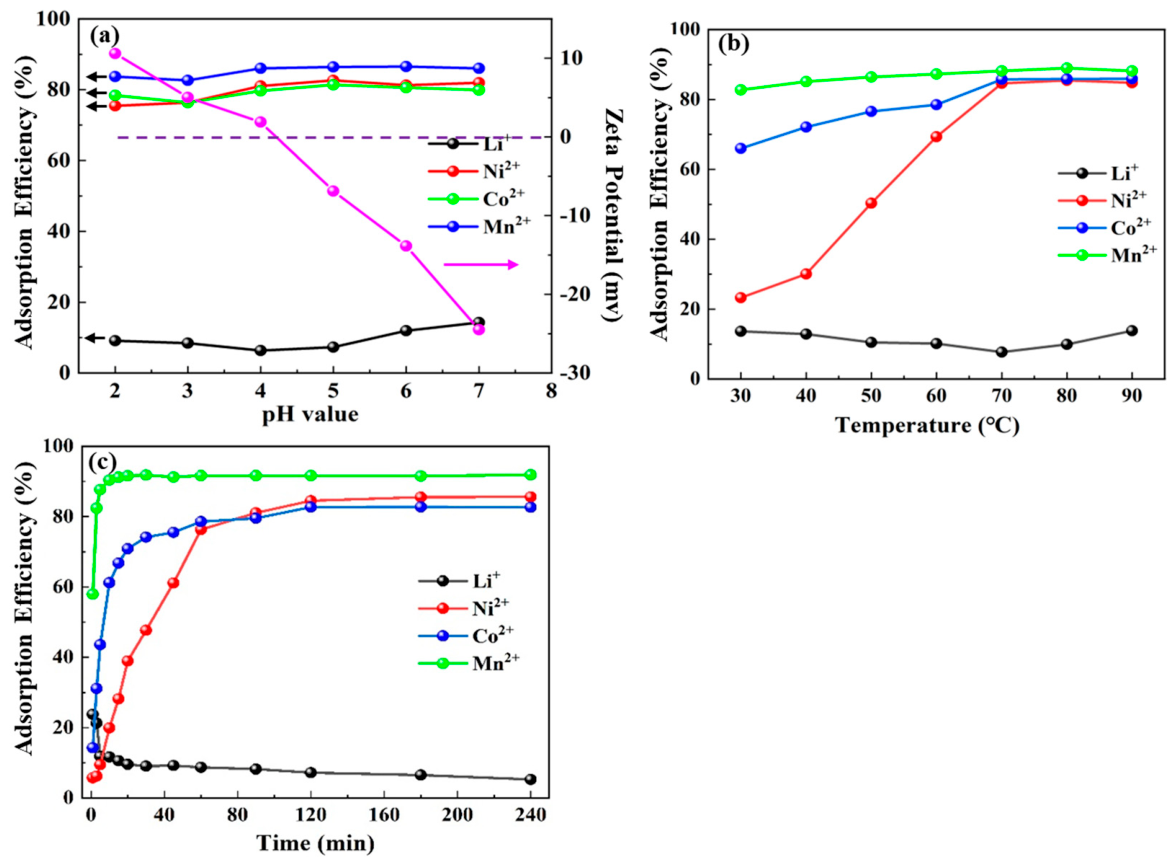
The influence of solution pH (from 2 to 7) on the zeta potential of NaA zeolite and on the adsorption efficiency of Li+, Ni2+, Co2+, and Mn2+ was investigated under the following conditions: 0.1 mol/L Li+ (with a fixed molar ratio of n(Li+):n(Ni2+):n(Co2+):n(Mn2+) = 3:1:1:1), 85 g/L NaA zeolite, and a contact time of 2 h. As shown in Figure 2a, the zeta potential of NaA zeolite decreased as the pH increased. The point of zero charge (pHpzc, marked by the dashed line) of NaA zeolite was 4.2. Li+ adsorption was strongly pH-dependent: it remained at a low level (~7%) at pH ≤ 5, but increased to 14.3% at pH 7. This transition is closely correlated with pHpzc of NaA zeolite. When the solution pH is below the pHpzc, the zeolite surface carries a net positive charge, leading to electrostatic repulsion of Li+ cations. In addition, the high concentration of H+ ions in the acidic range significantly exhibits Li+ adsorption. When the solution pH exceeds 4.2, the zeolite surface becomes negatively charged due to enhanced hydroxylation, promoting Li+ uptake via favorable electrostatic attraction, while the reduced H+ concentration weakens the competitive inhibition effect [22]. In contrast, the adsorption efficiencies of Ni2+, Co2+, and Mn2+ showed a similar trend, increasing progressively with increasing pH and then stabilizing at a pH above 4. This may be due to their higher charge density, stronger affinity toward the NaA zeolite, and weakened competitive adsorption against H+. The stabilization of their adsorption efficiencies above pH ~4 suggests the establishment of adsorption–desorption equilibrium between the multivalent ions in the solution and those adsorbed on the zeolite framework.
To optimize the transition metal and Li+ separation process, an initial solution pH of 4.5 was selected for subsequent experiments. This condition not only enhances the negative charge on the zeolite surface while effectively minimizing Li+ co-adsorption but also prevents the hydrolysis and precipitation of divalent metal ions that may occur at higher pH values.

3.1.3. Effect of Adsorption Temperature

The influence of adsorption temperature on the separation selectivity was evaluated over a temperature range of 30 to 90 °C under the following optimized conditions: 0.1 mol/L Li+ (n(Li+):n(Ni2+):n(Co2+):n(Mn2+) = 3:1:1:1), 85 g/L NaA zeolite, pH 4.5, and 2 h of contact time. As shown in Figure 2b, Li+ adsorption remained low across the entire temperature range, exhibiting only minor fluctuations. This weak temperature dependence is attributed to the near-neutral surface charge of the NaA zeolite at pH 4.5 (close to its pHpzc), which results in a minimal electrostatic driving force for Li+ uptake. The slight increase in Li+ adsorption observed above 70 °C may be attributed to a minor thermally activated contribution to the adsorption process. In stark contrast, the adsorption efficiencies of the divalent ions (Ni2+, Co2+, Mn2+) showed a strong positive correlation with temperature in the range of 30 °C to 70 °C. Their uptake increased significantly as the temperature rose, reaching 84.6% for Ni2+, 85.8% for Co2+, and 90.9% for Mn2+ at 70 °C. This pronounced temperature dependence confirms that the adsorption of these ions is primarily governed by an ion-exchange process. Elevated temperatures enhance the kinetic energy and diffusion rates of the hydrated divalent cations, facilitating their migration into the zeolite pores and exchange with Na+ ions. Above 70 °C, the adsorption efficiencies plateaued, indicating that the adsorption sites were approaching saturation and the adsorption–desorption equilibrium had been established.
As a result of this finding, 70 °C was selected as the optimal adsorption temperature for subsequent experiments. This condition maximized the adsorption of Ni2+, Co2+, and Mn2+ while maintaining effective separation from Li+, thus achieving the highest selectivity for preferential transition metal recovery.

3.1.4. Effect of Adsorption Time

The effect of adsorption time on the separation performance was investigated under the following optimized conditions: 0.1 mol/L Li+ (n(Li+):n(Ni2+):n(Co2+):n(Mn2+) = 3:1:1:1), 85 g/L NaA zeolite, pH 4.5, and 70 °C. As shown in Figure 2c, Li+ and divalent metal ions exhibited distinct temporal adsorption profiles.
Li+ adsorption reached 23.8% within the first 1 min but gradually decreased to a stable low value of 7.2% at 120 min. In contrast, the adsorption of Ni2+, Co2+, and Mn2+ increased progressively with the contact time, achieving equilibrium adsorption efficiencies of 84.5%, 82.7%, and 91.6%, respectively, after 120 min. This distinct adsorption behavior is attributed to the differences in the physicochemical properties of the hydrated ions. The small hydrated radius of Li+ (0.382 nm) facilitates its rapid diffusion and initial occupation of the surface adsorption sites on the zeolite. However, its low charge density results in weak binding affinity to the negatively charged framework. In comparison, divalent ions (Ni2+, Co2+, Mn2+) have larger hydrated radii and higher charge densities [21]. Their adsorption requires partial dehydration and slower diffusion into the internal pores of the zeolite, leading to the observed gradual uptake. The superior adsorption performance of Mn2+ is due to its lower electronegativity (1.55 V for Mn2+ vs. 1.88 V for Co2+ and 1.91 V for Ni2+), which reduces the diffusion resistance into the zeolite pores [23,24].
The temporal evolution of the adsorption process confirms the existence of a competitive ion-exchange mechanism. The adsorbed Li+ is gradually displaced from the zeolite framework by divalent cations, which have a stronger electrostatic affinity for the negatively charged adsorption sites. At equilibrium (~120 min), the primary adsorption sites are predominantly occupied by transition metal ions, thus achieving effective separation from Li+.
In summary, under the optimized single-stage adsorption conditions (0.1 mol/L Li+, 85 g/L zeolite dosage, pH 4.5, 70 °C, 2 h contact time), NaA zeolite exhibits excellent selectivity for divalent transition metals (Ni2+, Co2+, Mn2+) over Li+. The underlying separation mechanism is governed by the combined effects of hydrated ion size exclusion and charge density-dependent electrostatic interactions.
Based on the stoichiometric relationship between the initial metal ion concentrations and the adsorption capacity of the zeolite, a two-step adsorption strategy was employed to enhance the total adsorption efficiencies of Ni2+, Co2+, and Mn2+. A proportional amount of fresh NaA zeolite was added to the raffinate after the first adsorption stage under identical conditions (pH 4.5, 70 °C, 2 h per stage). The adsorption efficiencies reached 95.6% for Ni2+, 96.7% for Co2+, and 99.7% for Mn2+, while Li+ co-adsorption was effectively suppressed at 11%. This remarkable improvement confirms the effectiveness of the two-stage adsorption process in maximizing both the recovery efficiency and separation selectivity of transition metals.

3.2. Adsorption Mechanism of Ni2+, Co2+, and Mn2+ on NaA Zeolite

3.2.1. Adsorption Isotherm Analysis

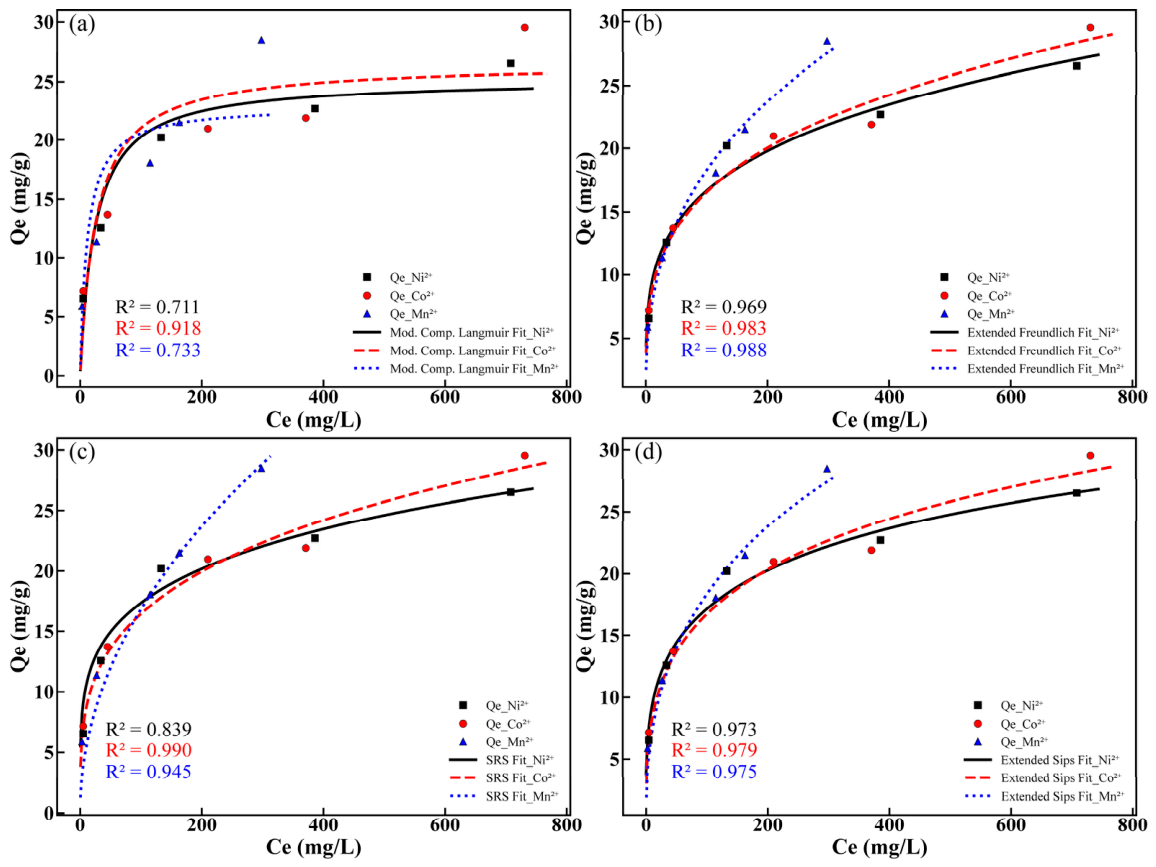
The equilibrium adsorption behaviors of Ni2+, Co2+, and Mn2+ onto zeolite were evaluated using four multi-component competitive isotherm models [25,26,27]: Modified competitive Langmuir, Extended Freundlich, Sheindorf–Rebuhn–Sheintuch (SRS), and Extended Sips. The corresponding Equations (S1)–(S4) are provided in the Supplementary Material. The experimental data obtained under the optimized conditions (85 g/L zeolite, pH 4.5, 70 °C, 2 h) were fitted, and the results are displayed in Figure 3. The fitting performance was comprehensively assessed by the coefficient of determination (R2), root mean square error (RMSE), and chi-square statistic (χ2), which are presented in Table 1, and the corresponding Equations (S5)–(S7) provided in the Supplementary Material.
Among the four multi-component competitive adsorption isotherm models, the Modified Competitive Langmuir model exhibited a poor overall fitting performance, with low R2 values for Ni2+ and Mn2+, as well as the highest RMSE and χ2 errors. The SRS model achieved outstanding fitting for Co2+ yet suffered from remarkable deviation for Ni2+; this originated from the inherent equivalent competition coefficient hypothesis (aij = 1) that was unable to accurately describe the asymmetric competitive interactions among different cations [25]. The Extended Sips model, it delivered favorable correlation coefficients and the heterogeneity parameter β < 1 verified the energetic heterogeneity of adsorption sites on zeolite [25]. Nevertheless, the extrapolated Qm values were abnormally large due to the absence of an adsorption saturation plateau in experimental data, weakening its comprehensive applicability. In contrast, the Extended Freundlich model was identified as optimal for describing the ternary competitive adsorption system. Based on heterogeneous surface adsorption theory, this model is capable of characterizing multi-ion competitive adsorption behaviors, matching the disordered active site distribution and complex pore structure of zeolite. It displayed the most balanced fitting accuracy across all three metal ions, with high R2 values of 0.969, 0.983 and 0.988 for Ni2+, Co2+ and Mn2+, respectively, and all corresponding χ2 values below 0.57. All nonlinear adsorption exponents for ni were greater than 1 (1/n < 1), demonstrating that all three metal ions showed favorable adsorption under competitive conditions. According to the adsorption constant sequence of KF(Ni2+) > KF(Co2+) > KF(Mn2+), Ni2+ possessed the strongest adsorption affinity and preferential occupation of active sites on NaA zeolite surface under identical equilibrium concentrations, followed by Co2+, while Mn2+ exhibited relatively weak competitive adsorption capacity. Additionally, the minimum n value of Mn2+ reflected that its adsorption capacity increased moderately and steadily along with the equilibrium concentration, exhibiting weaker concentration dependence compared with other ions [25,27].

3.2.2. Adsorption Dynamics

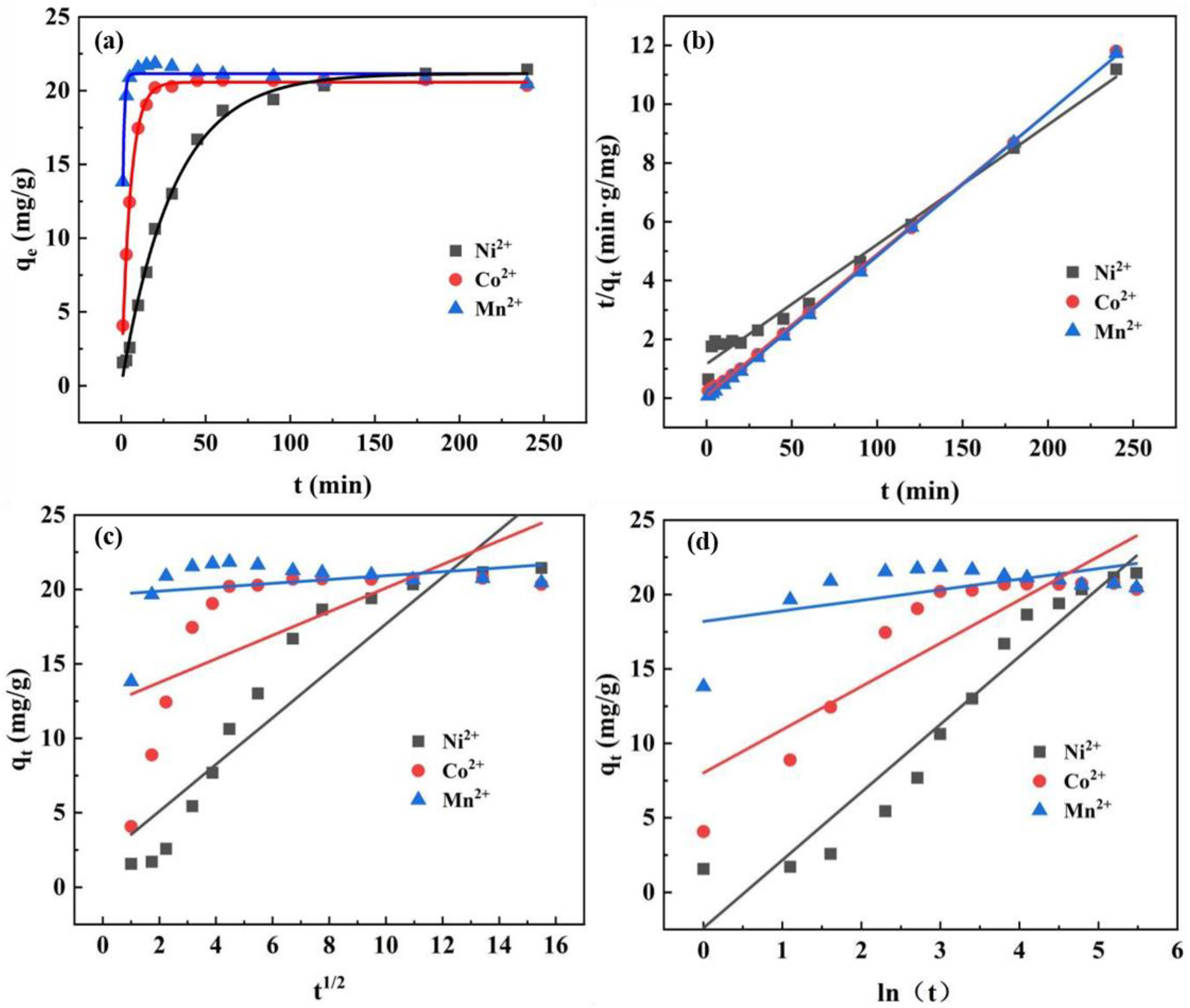
To elucidate the adsorption mechanism and identify the potential rate-limiting steps, the kinetic data obtained under the optimized conditions were fitted with four commonly used kinetic models: pseudo-first-order [28], pseudo-second-order [29], intraparticle diffusion [30], and Elovich models [31]. The corresponding Equations (S8)–(S11) are provided in the Supplementary Material. As shown in Figure 4 and summarized in Table 2, the adsorption processes of Co2+ and Mn2+ were best fitted by the pseudo-second-order model (R2 ≈ 1), indicating that chemisorption, which involves surface chemical reactions (i.e., ion exchange between the metal cations and Na+ in the zeolite framework), is the rate-controlling step. This is consistent with the relatively quick adsorption efficiencies of Co2+ and Mn2+ observed in the experiments.
In contrast, the adsorption of Ni2+ was best described by the pseudo-first-order kinetic model, suggesting that the process is dominated by a diffusion-controlled mechanism [26,32]. This distinct behavior is attributed to the unique physicochemical properties of Ni2+. Although it has the smallest hydrated radius among the three divalent ions, its exceptionally high hydration energy creates a significant kinetic barrier for dehydration prior to entering the zeolite pores, and thus it is the slowest to adsorb among the three ions.

3.2.3. Thermodynamic Analysis

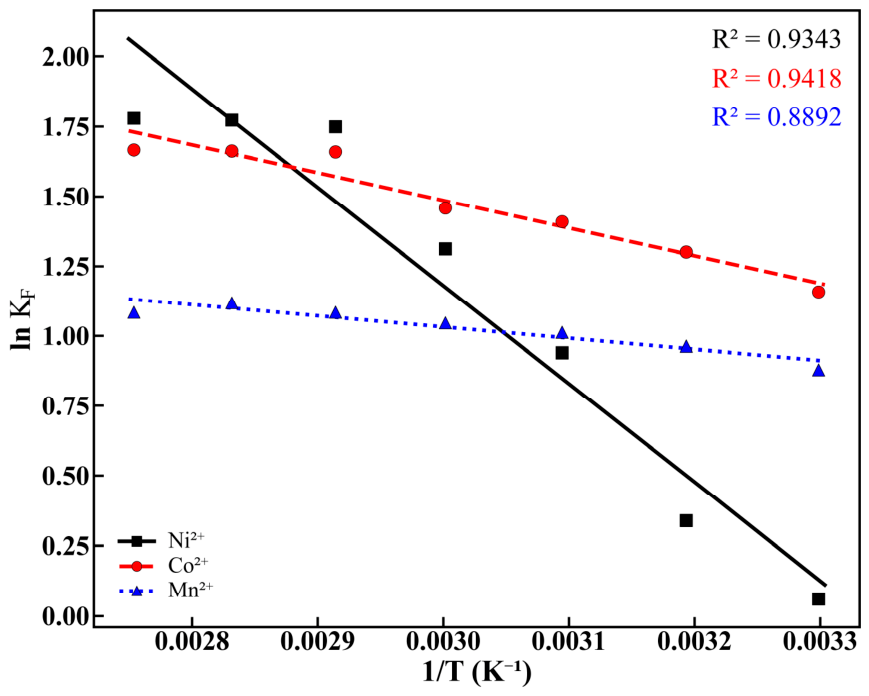
The equilibrium adsorption capacities of Mn2+, Co2+, and Ni2+ solution on NaA at different temperatures were measured, and the linear fitting results are shown in Figure 5. Based on these results, the thermodynamic parameters, including standard enthalpy (ΔH°), standard entropy (ΔS°) and standard free energy (ΔG°), can be estimated from the following equations [33,34].
l n K F = S ° R H ° R T
G ° = H ° T S °
where T(K) is the temperature of the solution, R [8.314 J/(mol·K)] is the ideal gas constant, and Freundlich adsorption constant KF is defined as KF = (qe/ce)(1/n), and n is the nonlinear adsorption exponent.
The values of ΔH° and ΔS° were calculated via linear fitting of lnKF versus 1/T, and the obtained thermodynamic parameters are summarized in Table 3.
All adsorption processes of Mn2+, Co2+, and Ni2+ on NaA zeolite exhibited positive ΔH° values, demonstrating that the three divalent ions all adsorbed through endothermic processes. The magnitude of ΔH° change followed the order of Ni2+ > Co2+ > Mn2+, showcasing the strongest interaction between Ni2+ and the zeolite framework, while the temperature dependence of Mn2+ adsorption was the weakest.
In addition, the positive entropy changes (ΔS°) revealed that Ni2+, Co2+, and Mn2+ in solution undergo ion exchange with Na+ within the zeolite. The Na+ originally confined in the NaA zeolite is released into the solution, leading to increased freedom and disorder of the system [33]. The ΔS° values also follow the order Ni2+ > Co2+ > Mn2+, implying that the ion-exchange process involving Ni2+ contributes the most to the increased system disorder, confirming that the interaction between Ni2+ and the zeolite is the strongest.
Within the experimental temperature range (303.15–363.15 K), the Gibbs free energy changes (ΔG°) were all negative, supporting the thermodynamically spontaneous nature of all adsorption reactions. Moreover, the absolute value of ΔG° increased continuously with the rising temperature, revealing that a higher temperature significantly improved the spontaneous tendency of adsorption. At low temperature, the spontaneous adsorption capacity followed Mn2+ > Co2+ > Ni2+, while the difference among three ions gradually reduced at high temperature. Such distinct thermodynamic property differences among metal ions provided robust theoretical support for the subsequent temperature-regulated stepwise desorption strategy.

3.3. Temperature-Regulated Stepwise Desorption for Sequential Separation of Mn2+, Co2+, and Ni2+

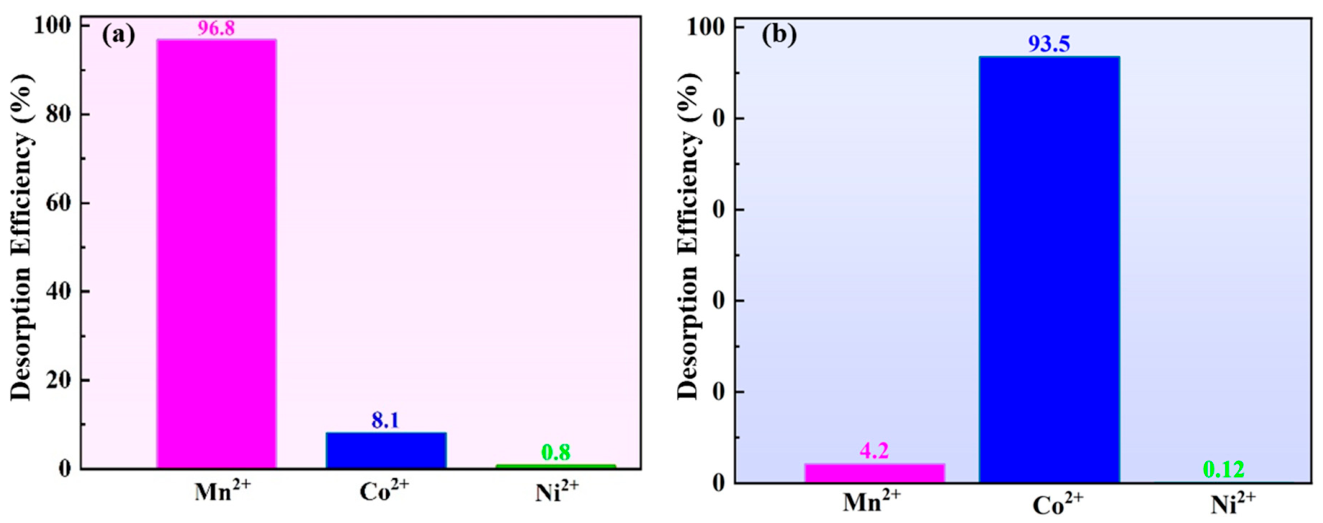
Considering the differences in the adsorption thermodynamics and kinetics of Mn2+, Co2+, and Ni2+ on NaA zeolite, the effect of temperature on the desorption performance of each metal ion was systematically investigated to achieve efficient sequential separation and recovery of Mn, Co, and Ni. As shown in Figure 6a, after desorption at 0 °C for 72 h, 96.8% of the adsorbed Mn2+ was desorbed from the zeolite, while only 8.1% of Co2+ and 0.8% of Ni2+ were synchronously desorbed. The intermediate product NaA-Co-Ni obtained after the first desorption stage was then subjected to the second desorption step at 90 °C for 2 h. As shown in Figure 6b, 93.5% of the adsorbed Co2+ was desorbed in this stage, with only 4.2% of the residual Mn2+ synchronously desorbed, while Ni2+ remained almost completely adsorbed on the zeolite. Therefore, the sequential separation of Mn2+, Co2+, and Ni2+ was successfully achieved via this temperature-regulated stepwise desorption strategy, with the final solid product NaA-Ni obtained after the second stage.

3.4. Structural and Morphological Characterization of NaA Zeolite at Different Stages

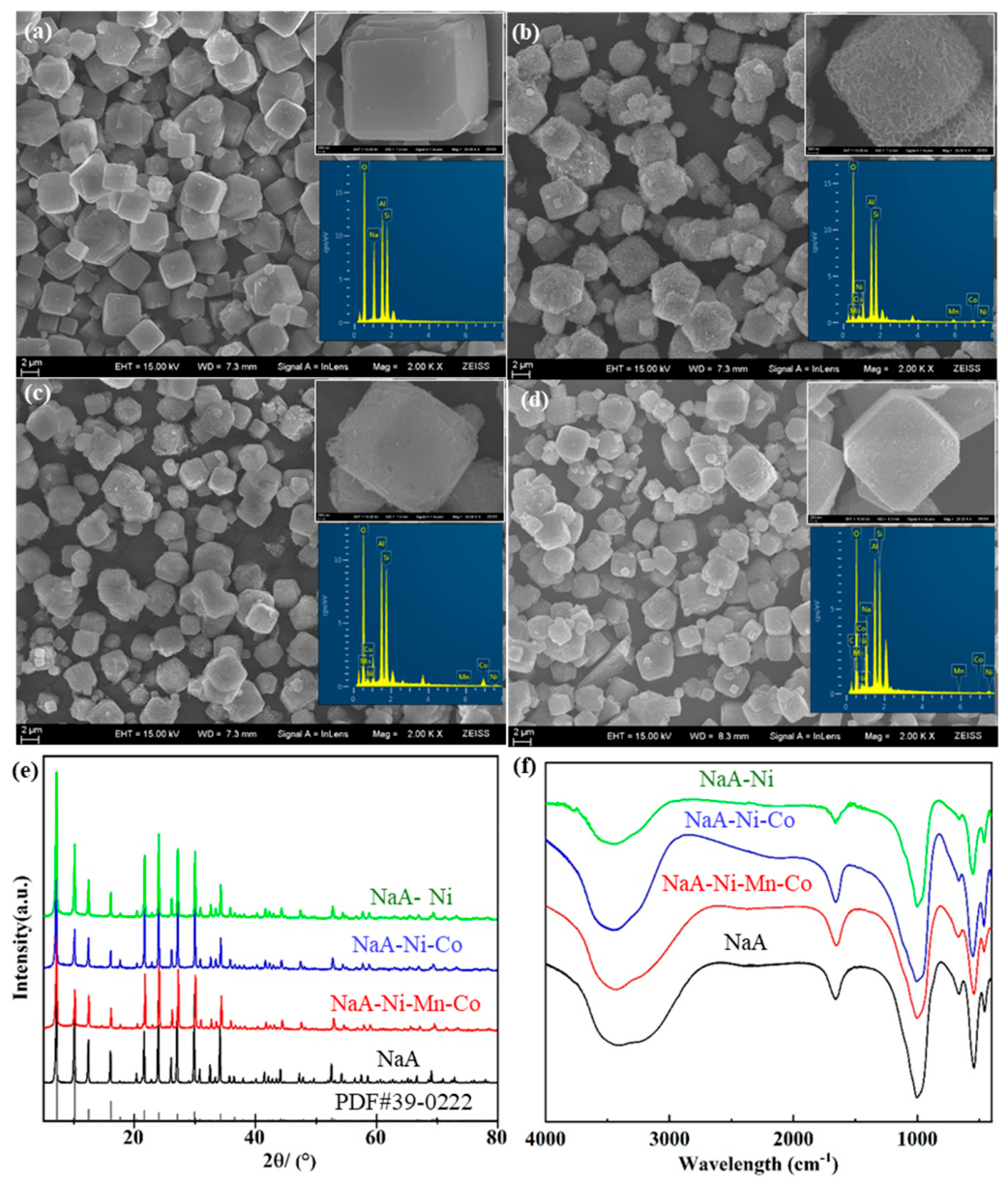
To investigate the morphological and structural changes in NaA zeolite during the adsorption and stepwise desorption processes, SEM-EDS, XRD, and FTIR characterization were performed on the pristine NaA zeolite, metal-loaded NaA-Ni-Co-Mn, intermediate NaA-Ni-Co, and final NaA-Ni samples.
The SEM-EDS images of the four samples are shown in Figure 7a–d. The pristine NaA zeolite (Figure 7a) exhibits a well-defined cubic crystal morphology with uniform particle size and smooth surfaces. After the selective adsorption of divalent metal ions (Figure 7b), a layer of flocculent deposits was observed on the surface of the NaA-Ni-Co-Mn sample, and the corresponding EDS spectra confirmed the successful adsorption of Mn, Co, and Ni on the zeolite. After Mn desorption occurred at 0 °C (Figure 7c), the surface of the NaA-Ni-Co sample became smoother than that of NaA-Ni-Co-Mn, and there was a significant decrease in the Mn content. After Co desorption at 90 °C (Figure 7d), the NaA-Ni sample exhibited a relatively smooth surface, and the EDS spectra showed a marked reduction in the Co content. Further SEM-EDS analysis revealed that all samples retained the fundamental cubic crystal structure of the parent NaA zeolite throughout the adsorption and desorption processes, with the Si/Al atomic ratio of the zeolite framework maintained at approximately 1. These results confirm that the ion-exchange process only alters the surface composition of the zeolite, without damaging its main crystal structure, demonstrating the excellent structural robustness of NaA zeolite.
The XRD patterns of the four samples are shown in Figure 7e. All the diffraction peaks of the samples at different stages are consistent with the standard diffraction peaks of NaA zeolite (JCPDS PDF#39-0222), with no new impurity peaks or significant peak attenuation observed. This indicates that the crystal structure of NaA zeolite remains intact after the adsorption and stepwise desorption processes. Figure 7f depicts the comparative FTIR spectra of the four samples. The characteristic vibrational peaks of the zeolite framework were observed in all samples: the peak at 467 cm−1 is attributed to the T-O stretching vibration (T = Al/Si); the peak at 998 cm−1 corresponds to the asymmetric stretching vibration of the T-O-T tetrahedron; the peaks at 560 cm−1 and 671 cm−1 are assigned to the double-ring vibration of the four-membered ring skeleton in the NaA zeolite framework and the bending vibration of the Si-O-Na bond, respectively; and the peak at 1008 cm−1 corresponds to the asymmetric stretching vibration of the Si-O-Si bond [35]. Additionally, the characteristic peak at 1646 cm−1 and the broad peak at 3440 cm−1 are attributed to the bending vibration of hydroxyl groups and the antisymmetric stretching vibration of O-H bonds from adsorbed water molecules on the zeolite surface, respectively [36]. The FTIR spectra of the zeolite samples at different stages are almost identical, confirming that the adsorption and desorption processes do not change the fundamental framework structure of NaA zeolite; this is consistent with the XRD results.

3.5. Recycling of NaA-Ni

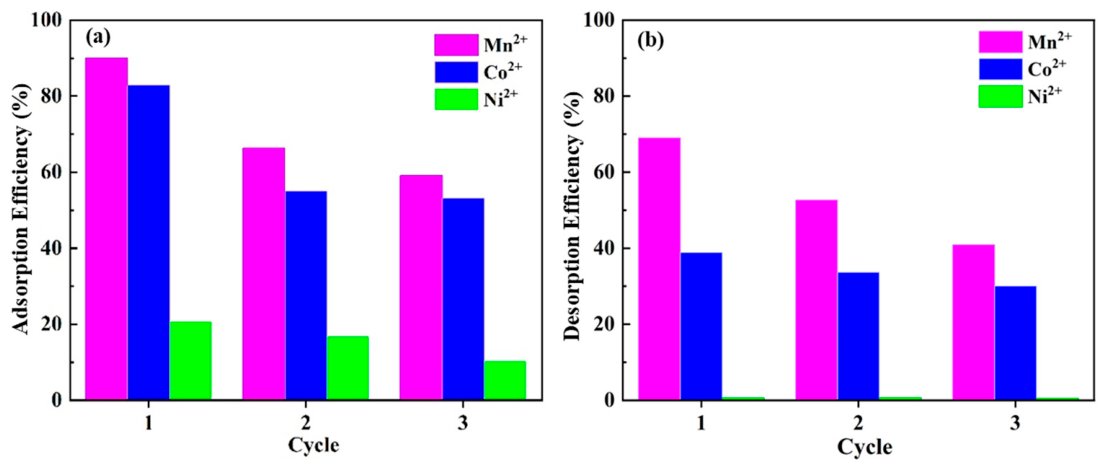
To evaluate the practical application potential of the adsorbent, three consecutive adsorption–desorption cycles were conducted under optimized experimental conditions. As shown in Figure 8, the adsorption efficiencies of Mn2+, Co2+, and Ni2+ all showed a gradual decreasing trend with the increase in cycle times. During the first cycle, their adsorption efficiencies were approximately 90.2%, 83.3%, and 21.1%, respectively, whereas after three cycles, the adsorption efficiencies decreased to 59.6%, 53.2%, and 10.3%, correspondingly. Correspondingly, the desorption efficiencies of Mn2+ and Co2+ decreased from the initial 69.8% and 39.3% to 41.4% and 30.2%, respectively. Ni2+ exhibited negligible desorption throughout the entire cyclic process.
The attenuation of the adsorbent’s cyclic performance is mainly attributed to two core factors. Firstly, some active adsorption sites on the surface of the NaA zeolite were blocked by incompletely desorbed metal ions and their reaction products during the cyclic process, resulting in a reduction in the number of effective active sites available for adsorption. Secondly, partial metal ions (especially Ni2+) formed irreversible bonds with the zeolite framework due to their high hydration energy and strong interaction with the zeolite, which could not be completely desorbed during the desorption process, further reducing the effective adsorption capacity of the adsorbent.
Despite the gradual attenuation of the adsorption–desorption performance after three cycles, the adsorption efficiencies of Mn2+ and Co2+ remained above 50%, while their desorption efficiencies stayed above 30%. This indicates that the adsorbent still retains acceptable cyclic separation potential.

3.6. Recovery of Valuable Metals from the Separated Streams

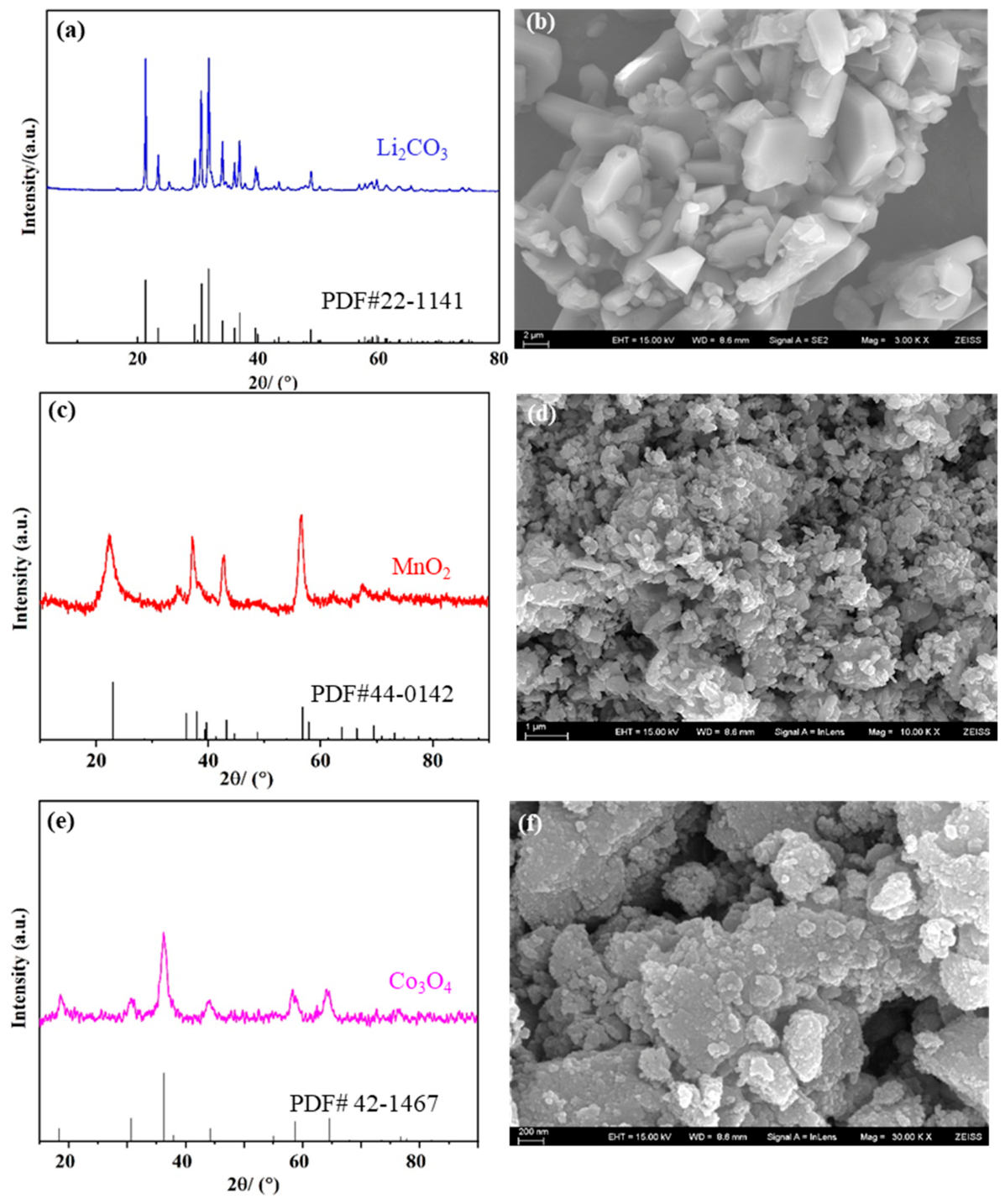
The Li+-containing raffinate obtained via the two-stage adsorption process was concentrated and precipitated to produce the lithium product. As shown in Figure 9a, the XRD pattern of the obtained white precipitate shows excellent agreement with the standard diffraction peaks of Li2CO3 (JCPDS PDF#22-1141). ICP-OES analysis confirmed that the recovered Li2CO3 has a high purity of 96.7% with a recovery yield of 93.5%, validating the theory that efficient preferential recovery of lithium can be achieved using this strategy. The SEM image (Figure 9b) shows that the obtained Li2CO3 crystals exhibit a rod-like morphology with varying aspect ratios.
The Mn-rich solution obtained from the 0 °C desorption stage was treated to recover manganese via oxidative precipitation. The XRD pattern of the obtained black precipitate (Figure 9c) matches well with the standard diffraction peaks of MnO2 (JCPDS PDF#44-0142). ICP-OES analysis confirmed a product purity of 99.3% and a recovery yield of 98.4%. As shown in the SEM image (Figure 9d), the MnO2 precipitate consists of stacked nanosheets.
The Co-rich solution from the 90 °C desorption stage was processed for cobalt recovery via oxidative precipitation. The XRD pattern of the obtained black product (Figure 9e) is consistent with the standard diffraction peaks of Co3O4 (JCPDS PDF#42-1467). ICP-OES analysis confirmed that it had a purity of 98.8% and a recovery yield of 97.6%. The SEM image (Figure 9f) shows that the Co3O4 product is composed of irregular bulk particles.

4. Conclusions

In this work, we developed a novel NaA zeolite-based adsorptive separation strategy featuring selective adsorption of divalent transition metals and temperature-regulated stepwise desorption in order to achieve preferential Li+ recovery and full-component valuable metal recycling from simulated leachate of spent NCM111 batteries. NaA zeolite with a 0.4 nm pore size facilitated excellent separation between Li+ and divalent Ni2+, Co2+, Mn2+ via the combined effects of hydrated ion size exclusion and charge density-dependent electrostatic interactions. Under the optimized two-stage adsorption conditions, the total adsorption efficiencies reached 95.6% for Ni2+, 96.7% for Co2+, and 99.7% for Mn2+, while Li+ co-adsorption was effectively suppressed at 11%, resulting in efficient preferential separation of Li+ in the raffinate. The adsorption of Ni2+, Co2+ and Mn2+ on NaA zeolite conformed to the Extended Freundlich isotherm model. Co2+ and Mn2+ adsorption processes followed the pseudo-second-order kinetic model, while Ni2+ adsorption was dominated by pseudo-first-order kinetics. According to the adsorption affinity and thermodynamic parameters, the adsorption binding strength of three metal ions followed the sequence of Ni2+ > Co2+ > Mn2+, and ion exchange was identified as the dominant mechanism throughout the adsorption process. Based on the differences in adsorption thermodynamics and kinetics, a temperature-regulated stepwise desorption process was developed: 96.8% of Mn2+ was desorbed at 0 °C, followed by 93.5% of Co2+ at 90 °C, realizing the sequential separation of Mn2+, Co2+, and Ni2+. Three consecutive adsorption–desorption cycles confirmed that the NaA-Ni adsorbent has acceptable cyclic reusability. High-purity Li2CO3 (96.7%, 93.5% yield), MnO2 (99.3%, 98.4% yield), and Co3O4 (98.8%, 97.6% yield) were successfully recovered from the corresponding separated streams. Structural characterization confirmed that the NaA zeolite maintains excellent structural stability throughout the adsorption and desorption processes.
From the perspective of practical applicability and green chemistry, this integrated strategy relies on an aqueous medium, avoids toxic organic reagents, operates under mild conditions, and uses low-cost and stable zeolite adsorbent, thus conforming to the principles of green chemistry and sustainable separation technology. Although the current system allows preferential Li+ recovery with approximately 11% Li+ remaining in solution, this level of Li+ co-adsorption still provides a high-purity Li-rich raffinate that is suitable for downstream conversion to Li2CO3. For industrial scale-up, further improvements such as multi-stage adsorption or adsorbent modification could be adopted to further reduce residual Li+ and improve separation sharpness. Overall, this strategy integrates selective adsorption, stepwise desorption, and targeted product recovery into a closed-loop system, providing a green, efficient, and scalable pathway for the full-component recovery of valuable metals from simulated spent LIB leachate, which shows great potential for practical industrial application.

Supplementary Materials

The following supporting information can be downloaded at: https://www.mdpi.com/article/10.3390/separations13050132/s1, Table S1: The basic properties of NaA zeolite.

Author Contributions

Conceptualization, Q.C.; methodology, Q.C. and P.G.; investigation, X.L., Y.W. and W.Z.; data curation, Q.C.; writing—original draft preparation, Q.C.; writing—review and editing, Q.C. and P.G.; visualization, X.L., Y.W. and W.Z. All authors have read and agreed to the published version of the manuscript.

Funding

This research received no external funding.

Data Availability Statement

The original contributions presented in this study are included in the article/Supplementary Material. Further inquiries can be directed to the corresponding author.

Conflicts of Interest

The author declares no conflicts of interest.

References

  1. Jung, J.C.Y.; Sui, P.C.; Zhang, J.J. A review of recycling spent lithium-ion battery cathode materials using hydrometallurgical treatments. J. Energy Storage 2021, 35, 102217. [Google Scholar] [CrossRef]
  2. Qiao, Y.; Wang, H.; Liu, C.; Luo, S. Recovery of high-quality iron phosphate from acid-leaching tailings of laterite nickel ore. Sep. Purif. Technol. 2025, 353, 128634. [Google Scholar] [CrossRef]
  3. Richter, J.L. A circular economy approach is needed for electric vehicles. Nat. Electron. 2022, 5, 5–7. [Google Scholar] [CrossRef]
  4. Zhang, Q.; Huang, Z.; Liu, B.; Ma, T. Sustainable lithium supply for electric vehicle development in China towards carbon neutrality. Energy 2025, 320, 135243. [Google Scholar] [CrossRef]
  5. Li, X.-L.; Zhu, X.-N.; Li, X.-G.; Zhao, X.-T.; Wei, G.-L.; Gao, W.-H.; Nie, C.-C.; Yan, S.; Ge, L.-H.; Wang, Z.-Y. Recent advances in the extraction of critical metals from spent lithium-ion batteries: Challenges and solutions- a review. Sep. Purif. Technol. 2025, 376, 134070. [Google Scholar] [CrossRef]
  6. Bin Abu Sofian, A.D.A.; Majid, S.R.; Kang, K.; Kim, J.-K.; Show, P.L. Upcycling and recycling of spent battery waste for a sustainable future: Progress and perspectives. Prog. Mater. Sci. 2025, 153, 101478. [Google Scholar] [CrossRef]
  7. Zhang, H.; Dong, S.; Chen, W.; Shi, X.; Li, H.; Jin, X.; Guo, H.; Long, H. A sustainable hydrometallurgy protocol of ultrasonic-assisted leaching and multi-stage separation for recovery of critical metals from spent NCM lithium-ion batteries. Process Saf. Environ. Prot. 2025, 202, 107716. [Google Scholar] [CrossRef]
  8. Biswal, B.K.; Zhang, B.; Thi Minh Tran, P.; Zhang, J.; Balasubramanian, R. Recycling of spent lithium-ion batteries for a sustainable future: Recent advancements. Chem. Soc. Rev. 2024, 53, 5552–5592. [Google Scholar] [CrossRef]
  9. Shuai, J.; Liu, W.; Rohani, S.; Wang, Z.; He, M.; Ding, C.; Lv, X. Efficient extraction and separation of valuable elements from spent lithium-ion batteries by leaching and solvent extraction: A review. Chem. Eng. J. 2025, 503, 158114. [Google Scholar] [CrossRef]
  10. Huang, Y.; Han, G.; Liu, J.; Chai, W.; Wang, W.; Yang, S.; Su, S. A stepwise recovery of metals from hybrid cathodes of spent Li-ion batteries with leaching-flotation-precipitation process. J. Power Sources 2016, 325, 555–564. [Google Scholar] [CrossRef]
  11. Zhang, K.; Wei, B.; Zeng, B.; Qiu, S.; Zhong, X.; Wang, R. Recovery of transition metals (Ni, Co, and Mn) and Li from the sulfate leach solutions of spent ternary lithium-ion batteries by stepwise solvent extraction and precipitation. Hydrometallurgy 2025, 236, 106519. [Google Scholar] [CrossRef]
  12. Shi, Z.; Jiao, Y.; Han, J.; Liu, Z.; Zhao, X. Metal-organic frameworks for adsorptive separation of metal ions. Coord. Chem. Rev. 2026, 552, 217528. [Google Scholar] [CrossRef]
  13. Mahmoodi, N.M.; Dastgerdi, H. Zeolite nanoparticle as a superior adsorbent with high capacity: Synthesis, surface modification and pollutant adsorption ability from wastewater. Microchem. J. 2019, 145, 74–83. [Google Scholar] [CrossRef]
  14. Roshanfekr Rad, L.; Anbia, M. Zeolite-based composites for the adsorption of toxic matters from water: A review. J. Environ. Chem. Eng. 2021, 9, 106088. [Google Scholar] [CrossRef]
  15. Chen, L.; Shi, G.; Shen, J.; Peng, B.; Zhang, B.; Wang, Y.; Bian, F.; Wang, J.; Li, D.; Qian, Z.; et al. Ion sieving in graphene oxide membranes via cationic control of interlayer spacing. Nature 2017, 550, 380–383. [Google Scholar] [CrossRef]
  16. Aly, M.I.; Gamal, R. Kinetics and equilibrium studies for sorption of cobalt (II) and nickel (II) ions from aqueous solution using zeolite-Y. J. Dispers. Sci. Technol. 2024, 46, 973–985. [Google Scholar] [CrossRef]
  17. Li, Z.; Lei, Y.; Dong, L.; Yu, L.; Yin, C. Enhanced Ni(II) removal from wastewater using novel molecular sieve-based composites. Materials 2024, 17, 3211. [Google Scholar] [CrossRef]
  18. Ávila, F.G.; Cabrera-Sumba, J.; Valdez-Pilataxi, S.; Villalta-Chungata, J.; Valdiviezo-Gonzales, L.; Alegria-Arnedo, C. Removal of heavy metals in industrial wastewater using adsorption technology: Efficiency and influencing factors. Clean. Eng. Technol. 2025, 24, 100879. [Google Scholar] [CrossRef]
  19. Wang, J.; Hao, Y.; Li, J.; Yang, J. Priority extraction of Li+ and sequential recovery of divalent metals from retired LiNixCoyMn1–x–yO2 batteries using GIS zeolite. ACS Sustain. Chem. Eng. 2025, 13, 6113–6120. [Google Scholar] [CrossRef]
  20. Huo, X.; Wang, J.; Tang, X.; Li, J.; Yang, J. Stepwise separation and recovery of metal ions from waste LiNi0.5Co0.2Mn0.3O2 batteries using a NaA zeolite. ACS Sustain. Resour. Manag. 2024, 1, 970–977. [Google Scholar] [CrossRef]
  21. Persson, I. Structure and size of complete hydration shells of metal ions and inorganic anions in aqueous solution. Dalton Trans. 2024, 53, 15517–15538. [Google Scholar] [CrossRef]
  22. Conte, N.; Gómez, J.M.; Díez, E.; Sáez, P.; Monago, J.I.; Espinosa, A.; Rodríguez, A. Sequential separation of cobalt and lithium by sorption: Sorbent set selection. Sep. Purif. Technol. 2022, 303, 122199. [Google Scholar] [CrossRef]
  23. Hong, M.; Yu, L.; Wang, Y.; Zhang, J.; Chen, Z.; Dong, L.; Zan, Q.; Li, R. Heavy metal adsorption with zeolites: The role of hierarchical pore architecture. Chem. Eng. J. 2019, 359, 363–372. [Google Scholar] [CrossRef]
  24. Jamil, T.S.; Youssef, H.F. Microwave synthesis of zeolites from Egyptian kaolin: Evaluation of heavy metals removal. Sep. Sci. Technol. 2016, 51, 2876–2886. [Google Scholar] [CrossRef]
  25. Danat, B.T.; Wuana, R.A.; Chahul, H.F.; Iorungwa, M.S. Review of adsorption isotherms models. Appl. Water Sci. 2026, 16, 72. [Google Scholar] [CrossRef]
  26. Al-Ghouti, M.A.; Da’ana, D.A. Guidelines for the use and interpretation of adsorption isotherm models: A review. J. Hazard. Mater. 2020, 393, 122383. [Google Scholar] [CrossRef]
  27. Amrutha; Jeppu, G.; Girish, C.R.; Prabhu, B.; Mayer, K. Multi-component adsorption isotherms: Review and modeling studies. Environ. Process. 2023, 10, 38. [Google Scholar] [CrossRef]
  28. Ahmad, M.; Lee, S.S.; Oh, S.E.; Mohan, D.; Moon, D.H.; Lee, Y.H.; Ok, Y.S. Modeling adsorption kinetics of trichloroethylene onto biochars derived from soybean stover and peanut shell wastes. Environ. Sci. Pollut. Res. Int. 2013, 20, 8364–8373. [Google Scholar] [CrossRef]
  29. Rajapaksha, A.U.; Vithanage, M.; Zhang, M.; Ahmad, M.; Mohan, D.; Chang, S.X.; Ok, Y.S. Pyrolysis condition affected sulfamethazine sorption by tea waste biochars. Bioresour. Technol. 2014, 166, 303–308. [Google Scholar] [CrossRef] [PubMed]
  30. Vithanage, M.; Mayakaduwa, S.S.; Herath, I.; Ok, Y.S.; Mohan, D. Kinetics, thermodynamics and mechanistic studies of carbofuran removal using biochars from tea waste and rice husks. Chemosphere 2016, 150, 781–789. [Google Scholar] [CrossRef] [PubMed]
  31. Zhang, H.; Wang, Y.; Bai, P.; Guo, X.; Ni, X. Adsorptive separation of acetic acid from dilute aqueous solutions: Adsorption kinetic, isotherms, and thermodynamic studies. J. Chem. Eng. Data 2015, 61, 213–219. [Google Scholar] [CrossRef]
  32. Vashishtha, M.; Kumar, K.V. Insights into solid–liquid adsorption kinetics: Theory, mechanisms, and practical guidelines. ACS ES&T Water 2026, 5c00497. [Google Scholar] [CrossRef]
  33. Lin, Z.; Yuan, P.; Yue, Y.; Bai, Z.; Zhu, H.; Wang, T.; Bao, X. Selective adsorption of Co(II)/Mn(II) by zeolites from purified terephthalic acid wastewater containing dissolved aromatic organic compounds and metal ions. Sci. Total Environ. 2020, 698, 134287. [Google Scholar] [CrossRef] [PubMed]
  34. Salvestrini, S.; Ambrosone, L.; Kopinke, F.-D. Some mistakes and misinterpretations in the analysis of thermodynamic adsorption data. J. Mol. Liq. 2022, 352, 118762. [Google Scholar] [CrossRef]
  35. Surya Murali, R.; Ismail, A.F.; Rahman, M.A.; Sridhar, S. Mixed matrix membranes of Pebax-1657 loaded with 4A zeolite for gaseous separations. Sep. Purif. Technol. 2014, 129, 1–8. [Google Scholar] [CrossRef]
  36. Zavareh, S.; Farrokhzad, Z.; Darvishi, F. Modification of zeolite 4A for use as an adsorbent for glyphosate and as an antibacterial agent for water. Ecotoxicol. Environ. Saf. 2018, 155, 1–8. [Google Scholar] [CrossRef]
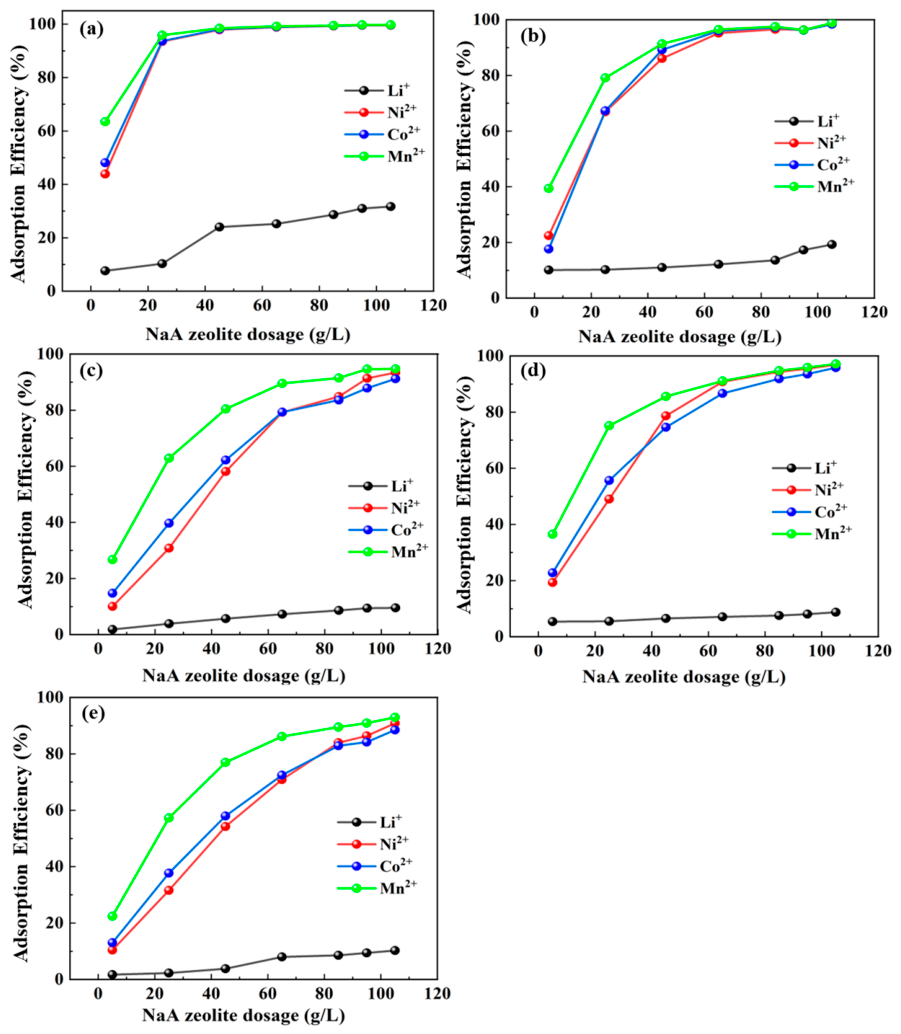
Figure 1. Correlation between the adsorption efficiency of each metal ion and NaA zeolite dosage in simulated leachate with different initial Li+ concentrations (n(Li+):n(Ni2+):n(Co2+):n(Mn2+) = 3:1:1:1): (a) 0.025 mol/L, (b) 0.05 mol/L, (c) 0.075 mol/L, (d) 0.1 mol/L, (e) 0.125 mol/L.
Separations 13 00132 g001
Figure 2. Effect of operational parameters on the adsorption efficiencies of metal ions in simulated leachate: (a) initial solution pH, (b) adsorption temperature, and (c) adsorption time.
Separations 13 00132 g002
Figure 3. Fitting results of adsorption isotherm models for Ni2+, Co2+, and Mn2+ on NaA zeolite: (a) Modified Competitive Langmuir; (b) Extended Freundlich; (c) SRS; (d) Extended Sips.
Separations 13 00132 g003
Figure 4. Fitting results of adsorption kinetic models for Ni2+, Co2+, and Mn2+ on NaA zeolite: (a) pseudo-first-order kinetic model, (b) pseudo-second-order kinetic model, (c) intraparticle diffusion model, and (d) Elovich mode.
Separations 13 00132 g004
Figure 5. Linear fitting results for the adsorption thermodynamics of Mn2+, Co2+, and Ni2+ solution on NaA.
Separations 13 00132 g005
Figure 6. Sequential separation and selective recovery of Mn2+ and Co2+ via temperature-regulated desorption: desorption efficiencies of Li+, Mn2+, Co2+, and Ni2+ at (a) 0 °C and (b) 90 °C.
Separations 13 00132 g006
Figure 7. Characterization of NaA zeolite at different stages: (ad) SEM-EDS images of pristine NaA, NaA-Mn-Co-Ni, NaA-Co-Ni, and NaA-Ni, respectively; (e) XRD patterns; and (f) FTIR spectra.
Separations 13 00132 g007
Figure 8. Adsorption (a) and desorption (b) efficiencies of Mn2+, Co2+, and Ni2+ on NaA-Ni zeolite during three consecutive adsorption–desorption cycles.
Separations 13 00132 g008
Figure 9. Characterization of the recovered metal products: (a) XRD pattern and (b) SEM image of the recovered Li2CO3; (c) XRD pattern and (d) SEM image of the recovered MnO2; (e) XRD pattern and (f) SEM image of the recovered Co3O4.
Separations 13 00132 g009
Table 1. Fitting parameters of multi-component isotherm models for the competitive adsorption of Ni2+, Co2+ and Mn2+ onto zeolite.
IonsModelsQm
(mg/g)
KnβR2RMSEχ2
Ni2+Modified Competitive Langmuir0.0020540.7113.8736.200
Extended Freundlich5.32094.0350.9691.2610.568
SRS13.38814.6250.8392.8923.001
Extended Sips190.81.00 × 10−50.3180.9731.1920.466
Co2+Modified Competitive Langmuir0.0020110.9182.1823.031
Extended Freundlich4.65083.6280.9830.9940.212
SRS8.57703.6060.9900.7500.144
Extended Sips248.11.00 × 10−50.3570.9791.0950.297
Mn2+Modified Competitive Langmuir25.6340.0762140.7334.0624.410
Extended Freundlich3.23142.6580.9880.8460.327
SRS4.11942.0370.9451.8502.479
Extended Sips378.92.90 × 10−50.4720.9751.2460.862
Table 2. Fitting parameters of the adsorption kinetic models.
Kinetic ModelParametersNi2+Co2+Mn2+
Pseudo-first-orderk1 (min−1)0.032−0.188−1.030
R20.9960.9980.953
Pseudo-second-orderk2 (g/mg·min)0.0010.0020.002
qe (mg/g)24.5820.7620.53
R20.9880.9990.999
Elovich modelα (mg/g·min)2.70145.9711.033 × 1011
β(g/mg)0.2190.3441.412
R20.9290.7560.251
kI (mg/g·min0.5)1.5710.7930.130
Intraparticle diffusionCI (mg/g)1.97112.16819.627
R20.8430.3960.002
Table 3. Thermodynamic parameters for the adsorption of Mn2+, Co2+, and Ni2+ on NaA zeolite.
Adsorbate T (K)
303.15313.15323.15333.15343.15353.15363.15
Ni2+qe (mg/g)6.358.2013.7418.1123.0923.3223.38
H° (kJ/mol)29.25
ΔS° (J/ (mol∙K))97.57
ΔG° (kJ/mol)−0.15−0.88−2.52−3.64−4.99−5.21−5.37
Co2+qe (mg/g)18.8220.5521.8322.3824.4524.4824.51
H° (kJ/mol)8.25
ΔS° (J/ (mol∙K))37.11
ΔG° (kJ/mol)−2.92−3.39−3.79−4.04−4.74−4.88−5.03
Mn2+qe (mg/g)19.7120.2820.5820.7821.0521.1821.12
H° (kJ/mol)3.33
ΔS° (J/ (mol∙K))18.57
ΔG° (kJ/mol)−2.22−2.51−2.72−2.90−3.09−3.29−3.28
Disclaimer/Publisher’s Note: The statements, opinions and data contained in all publications are solely those of the individual author(s) and contributor(s) and not of MDPI and/or the editor(s). MDPI and/or the editor(s) disclaim responsibility for any injury to people or property resulting from any ideas, methods, instructions or products referred to in the content.