
Article

Intelligent Pulsed Electrochemical Activation of NaClO2 for Sulfamethoxazole Removal from Wastewater Driven by Machine Learning

1
School of Environmental Sciences, Sichuan Agricultural University, Chengdu 611130, China
2
School of Mathematics and Statistics, Beijing Institute of Technology, Beijing 102401, China
*
Author to whom correspondence should be addressed.
Separations 2026, 13(1), 31; https://doi.org/10.3390/separations13010031 (registering DOI)
Submission received: 14 November 2025 / Revised: 16 December 2025 / Accepted: 19 December 2025 / Published: 15 January 2026

Abstract

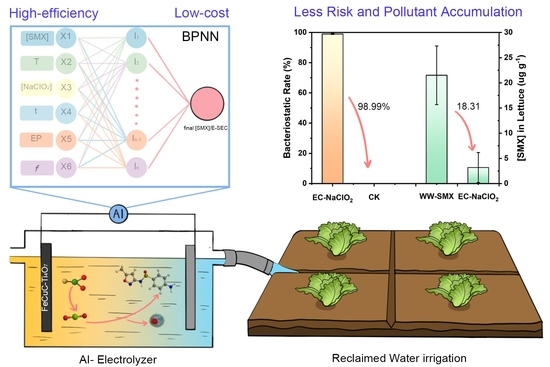
Sulfamethoxazole (SMX), a widely used antibiotic, poses potential threats to ecosystems and human health due to its persistence and residues in aquatic environments. This study developed a novel intelligent water treatment system, namely Intelligent Pulsed Electrochemical Activation of NaClO2 (IPEANaClO2), which integrates a FeCuC-Ti4O7 composite electrode with machine learning (ML) to achieve efficient SMX removal and energy consumption optimization. Six key operational parameters—initial SMX concentration, NaClO2 dosage, reaction temperature, reaction time, pulsed potential, and pulsed frequency—were systematically investigated to evaluate their effects on removal efficiency and electrical specific energy consumption (E-SEC). Under optimized conditions (SMX 10 mg L−1, NaClO2 60~90 mM, pulsed frequency 10 Hz, temperature 313 K) for 60 min, the IPEANaClO2 system achieved an SMX removal efficiency of 89.9% with a low E-SEC of 0.66 kWh m−3. Among the ML models compared (back-propagation neural network, BPNN; gradient boosting decision tree, GBDT; random forest, RF), BPNN exhibited the best predictive performance for both SMX removal efficiency and E-SEC, with a coefficient of determination (R2) approaching 1 on the test set. Practical application tests demonstrated that the system maintained excellent stability across different water matrices, achieved a bacterial inactivation rate of 98.99%, and significantly reduced SMX residues in a simulated agricultural irrigation system. This study provides a novel strategy for the intelligent control and efficient removal of refractory organic pollutants in complex water bodies.

1. Introduction

SMX, a broad-spectrum antibiotic widely used for anti-infective therapy, has become an emerging environmental contaminant due to its persistence and bioaccumulation [1,2,3,4]. Its stable molecular structure and low biodegradability enable long-term retention in aquatic environments. Globally, about 11% of farmland is irrigated with municipal wastewater, exposing agroecosystems to antibiotics such as SMX [5]. SMX has been reported in irrigation water, reclaimed water, and contaminated surface waters at concentrations of tens to hundreds of ng L−1, reaching several thousand ng L−1 in heavily polluted sites [6]. Soil concentrations ranged from 2.39 to 13.4 µg kg−1, while crop concentrations were reported in the ng g−1 range [7]. Persistent SMX promotes the dissemination of antibiotic-resistant bacteria and genes and alters microbial community structures [8,9,10]. Its bioaccumulation through food chains also poses potential endocrine-disrupting risks to humans. These findings highlight the urgent necessity of developing effective treatment technologies for SMX removal, making it a major focus in current environmental remediation research [11,12,13].
Conventional treatments—e.g., adsorption and biological methods—often perform poorly against persistent contaminants such as SMX [14,15]. Adsorption is attractive because of its operational simplicity and rapid uptake, but it does not destroy the contaminant; moreover, adsorbent regeneration often incurs high energy costs, incomplete desorption, and potential secondary pollution from spent sorbents [16,17]. Biological treatments rely on microbial degradation, yet the introduction of antibiotics into biologically active systems can destabilize microbial consortia, reduce treatment efficiency, and create selective pressure that favors resistant strains. Even if low concentrations of antibiotic stress can be tolerated, the risk of horizontal transfer of resistance genes remains a serious problem and may exacerbate the spread of resistance [18,19]. These limitations have driven interest in advanced oxidation processes (AOPs) [20] that are capable of mineralizing or transforming recalcitrant contaminants while minimizing secondary pollution and energy consumption.
Among AOPs, electrocatalytic technology exhibits distinct advantages by enabling both direct electron-transfer oxidation and precursor oxidant activation through the regulation of electrode potential and interfacial charge distribution, thereby facilitating the removal of refractory organic pollutants [21,22]. Electrocatalytic systems are typically classified into direct and indirect oxidation modes. Direct electro-oxidation removes pollutants through electron transfer at the electrode surface and usually has a high removal efficiency for electroactive substances [23,24,25], but often less so for non-electroactive compounds [26]. Indirect oxidation, by contrast, relies on electrochemically activated oxidants (such as persulfate or peracetic acid) or the electrolysis of water to produce reactive intermediates in the vicinity of the electrode; these intermediates then attack target contaminants [27,28]. NaClO2 has attracted attention as a precursor for selective oxidants, including chlorine dioxide (ClO2), during electroactivation [29]. Its relatively low standard reduction potential (0.954 V vs. SHE) [30] allows it to participate in oxidative attack on aromatic moieties (such as the SMX benzene ring) at comparatively low overpotentials, thereby enabling efficient degradation under milder electrochemical conditions [31]. Nevertheless, conventional electrochemical oxidation frequently suffers from competition with the oxygen evolution reaction (OER), which consumes current, lowers energy efficiency, and can destabilize the system [32]; balancing active species generation against OER suppression is therefore central to the design of effective electrochemical treatment systems.
Pulsed electrochemical operation has emerged as a promising strategy to address this tradeoff [33,34,35]. By periodically modulating the electrode potential, pulsed operation rapidly toggles the electrode surface between oxidizing and reducing states, altering interfacial charge distributions and transient adsorption/desorption kinetics so as to favor active species formation while mitigating parasitic OER. Existing studies have demonstrated that pulsed potential operation, in comparison with constant potential mode, can effectively reduce energy consumption—with reductions reaching up to 50%—and concurrently enhance electrode stability [36,37]. However, pulsed electrochemical systems are intrinsically complex: pulse waveform, frequency, voltage, solution pH, electrolyte composition, ionic strength, and the presence of coexisting ions all interact in nonlinear ways to control radical generation and contaminant degradation kinetics [38].
Previous studies have shown that the combination of operating parameters strongly influences both radical generation efficiency and pollutant degradation rates [39,40]. In pulsed electrocatalytic degradation, parameters such as frequency and duty cycle regulate the production of interfacial reactive species (·OH, ·O2) and alter electrode microstructures (e.g., Pt grain size and dispersion), thereby determining whether direct electron transfer or radical attack dominates the degradation process [39]. In pulsed electrocoagulation, significant interactions occur among electrode type, polarity-reversal frequency, and current density: polarity reversal mitigates Al electrode passivation and enhances Faradaic efficiency, whereas excessive reversal frequency in Fe electrodes hampers ion migration and promotes side reactions (e.g., oxidation of adsorbed hydrogen), reducing efficiency to below 10% [40]. These results indicate that traditional linear or single-factor regression models cannot accurately describe the multi-parameter coupling behavior inherent to pulsed electrochemical degradation systems [41].
Given these challenges, machine learning (ML) methods capable of identifying and exploiting nonlinear relationships represent an attractive toolset for modeling and optimizing pulsed electrochemical degradation processes [42]. Among ML models, artificial neural networks (ANNs) are particularly well suited for multivariate, nonlinear systems and have been widely applied to water-quality prediction and process control in wastewater treatment [43,44]. BPNN, a class of multilayer feedforward ANNs trained by gradient-based error propagation, can learn complex input–output mappings without prespecifying a mechanistic mathematical model; this flexibility renders BPNN advantageous over traditional regression when dealing with noisy, high-dimensional experimental data [45]. Successful applications of BPNN and other ML algorithms to electrochemical water treatment include predictive modeling of COD removal in Fenton processes, optimization of electrochemical sludge oxidation, and adsorption kinetics modeling, where these approaches have achieved high accuracy and robustness [46,47,48].
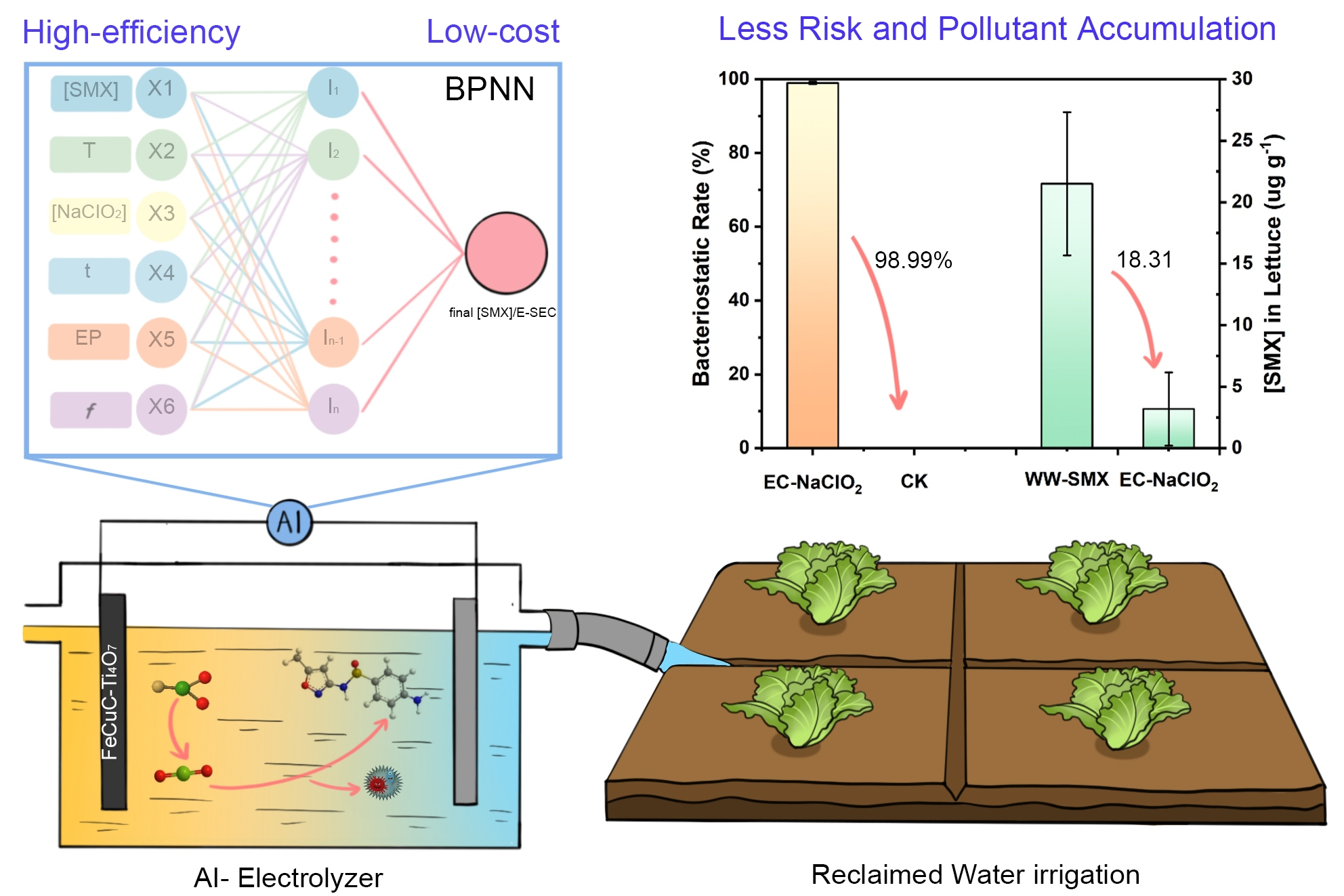
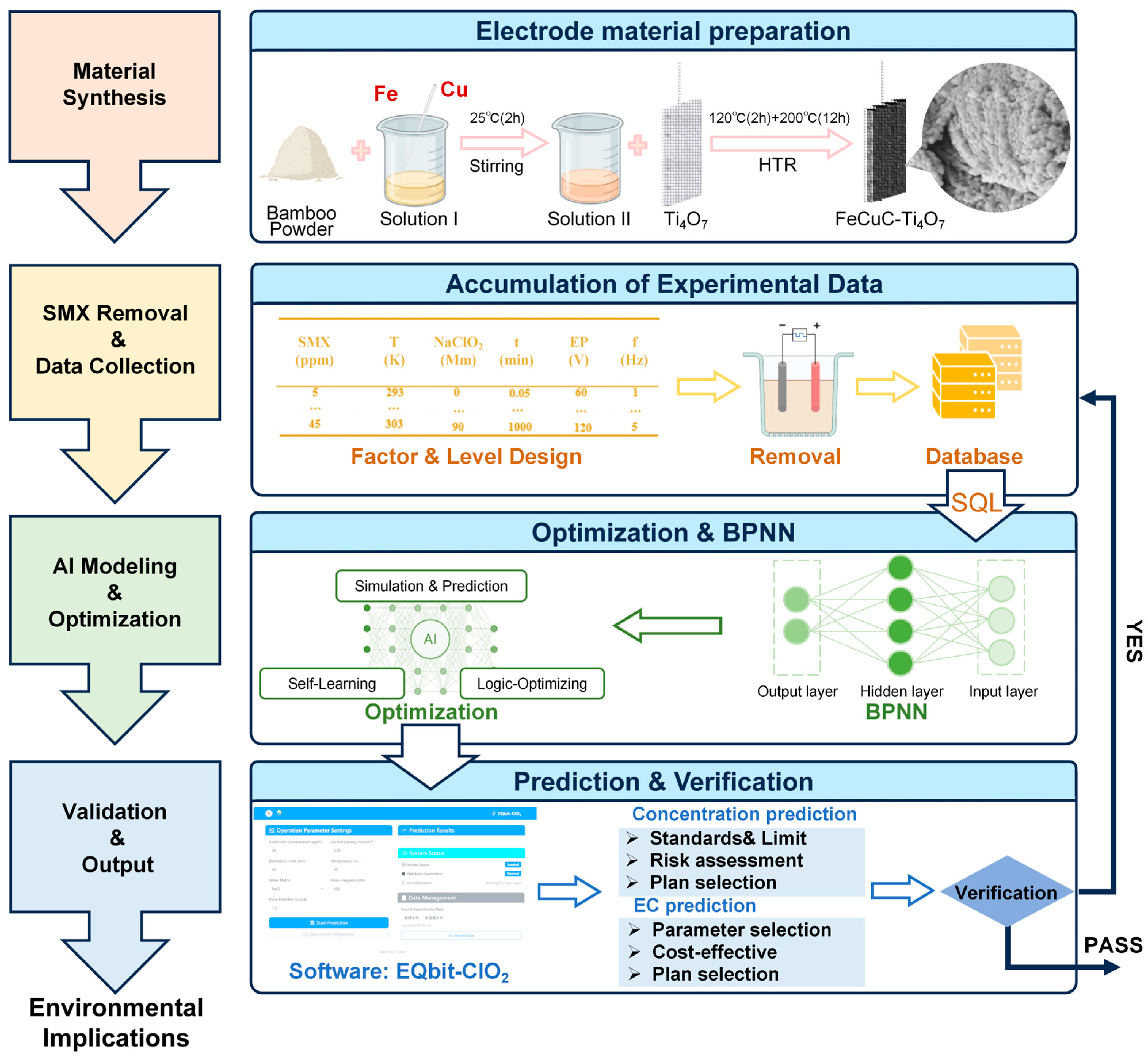
Building on this background, the present study hypothesizes that systematic optimization of key operational parameters in Intelligent pulsed electrochemical activation via ML approaches can achieve highly efficient removal of SMX coupled with low-energy consumption. To test this hypothesis (Figure 1), a FeCuC composite catalyst was synthesized via a hydrothermal method in this study. After briefly comparing the removal efficiencies of conventional electrodes (Ti and Pt) with that of a Ti4O7 electrode, the catalyst was immobilized on a Ti4O7 electrode substrate (Figure S8) to fabricate a highly active composite anode [49]. A series of pulsed electrochemical experiments—centered on NaClO2 electroactivation—were conducted to evaluate SMX removal as a function of key process variables, including initial SMX concentration, initial NaClO2 concentration, reaction time, temperature, pulse frequency, and pulse potential. Single-factor tests were complemented by trials using real water matrices to assess applicability, including comparative measurements of SMX residues in treated water, irrigated soils, and crops, as well as disinfection performance. Experimental data were used to train and compare multiple ML models (BPNN; GBDT; RF), and BPNN was selected as the optimal predictor. Finally, a software prediction platform was developed to enable rapid estimation of SMX removal performance under varied water-quality and operational scenarios. If successful, this integrated approach offers a practical pathway to improve the removal of SMX and related recalcitrant organics and to advance intelligent, energy-efficient strategies for water treatment.

2. Materials and Methods

2.1. Chemicals

All chemicals were of analytical grade and used as received without further purification. Copper(II) nitrate trihydrate (Cu(NO3)2·3H2O, purity ≥ 98.0%) was purchased from Macklin Biochemical Technology Co., Ltd. (Shanghai, China). Iron(III) nitrate nonahydrate (Fe(NO3)3·9H2O, purity ≥ 98.5%) and anhydrous sodium sulfate (Na2SO4) were obtained from Kelong Chemical Reagent Co., Ltd. (Chengdu, China). Sodium chlorite (NaClO2, purity ≥ 80.0%) was supplied by Yien Chemical Technology Co., Ltd. (Shanghai, China). Sulfamethoxazole (C10H11N3O3S, purity ≥ 98.0%) and sodium thiosulfate (Na2S2O3, 99%) were provided by InnoChem Technology Co., Ltd. (Beijing, China) Tetratitanium heptoxide (Ti4O7) was purchased from a commercial supplier. Escherichia coli. (E. coli.) ATCC 25922 (non-receptor strain) was obtained from Sangon Biotech Co., Ltd. (Shanghai, China) for biological assays. Ultrapure water (Milli-Q, 18.2 MΩ cm) was used for all chemical experiments, while triply distilled water was used for biological experiments.

2.2. Synthesis and Characterization of Electrode Materials

2.2.1. Synthesis of FeCuC Composite

Stoichiometric amounts of Fe(NO3)3·9H2O and Cu(NO3)2·3H2O were dissolved in deionized water under magnetic stirring to form a homogeneous solution. Bamboo powder was selected as the carbon precursor owing to its abundant availability and low cost. As a fast-growing lignocellulosic material, bamboo is rich in cellulose, hemicellulose, and lignin, which, upon pyrolysis, yield a carbon-rich char with high carbon yield and readily tunable pore structure. The powder was then introduced in 3~5 batches under continuous stirring for 2 h to achieve uniform dispersion. The resulting suspension was transferred into a 100 mL PTFE-lined stainless-steel autoclave, preheated at 393 K for 2 h, then heated to 473 K at 5 K min−1 and maintained for 12 h under hydrothermal conditions. After cooling to room temperature, the product was collected, washed repeatedly with deionized water and ethanol until the filtrate reached neutral pH, and dried at 343 K overnight.

2.2.2. Synthesis of FeCuC-Ti4O7 Composite Electrode

The previously prepared FeCuC powder and Ti4O7 were placed together in a new 100 mL PTFE-lined autoclave, followed by the addition of deionized water as the reaction medium. The mixture was sealed and subjected to a second hydrothermal process following the same temperature profile as above (393 K for 2 h, ramp 5 K min−1 to 473 K, then held 12 h). The autoclave was cooled naturally to room temperature, and the product was washed alternately with deionized water and ethanol until neutral, then dried at 343 K overnight to obtain the FeCuC-Ti4O7 composite electrode.

2.2.3. Characterization

The crystalline structure of the composite was examined by X-ray diffraction (XRD, D8 Advance, Bruker, Karlsruhe, Germany). Surface morphology was observed using scanning electron microscopy (SEM, Sigma 360, ZEISS, Oberkochen, Germany), and elemental chemical states of Fe, Cu, C and O were analyzed via X-ray photoelectron spectroscopy (XPS, K-Alpha, Thermo Fisher Scientific, Waltham, MA, USA).

2.3. Electrochemical Removal Experiments

Unless otherwise specified, all experiments were performed at 298 ± 1 K. Sodium chlorite was accurately weighed according to the target concentration and dissolved in 100 mL of SMX solution (10 mg L−1) prepared in a 250 mL glass beaker. A 90 mL portion of the solution was transferred into a 100 mL electrochemical cell equipped with a three-electrode configuration: FeCuC-Ti4O7 as the working electrode, a glassy carbon counter electrode, and a saturated calomel electrode (SCE) as the reference. The pulsed electrochemical process was initiated using an electrochemical workstation by applying a square wave potential. The waveform was generated by a programmable pulsed DC power supply, with the high level set at the pulse potential E, a duty cycle of 1:1, and the low level held at 0 V (i.e., no applied potential). At predefined time intervals, 1.0 mL samples were collected through 0.45 μm filters and immediately quenched with 0.4 mL of 200 mM Na2S2O3 solution to neutralize residual oxidants. SMX concentrations were determined via HPLC (Agilent 1260, Santa Clara, CA, USA) on a Waters BEH C18 column (2.1 × 100 mm2, 1.7 μm). Mobile phase A was 0.1% formic acid aqueous solution and mobile phase B was acetonitrile, with a flow rate of 0.3 mL/min. Mass spectra were recorded on an Agilent QTOF-6550 (USA) for exact mass confirmation. The chromatographic peak at ~7.05 min was integrated to calculate SMX removal efficiency.
The effects of six operational parameters were systematically investigated: initial SMX concentration (5~45 mg L−1), NaClO2 concentration (0~90 mM), reaction temperature (287~313 K), reaction time (30~90 min), pulsed potential (1~5 V), and pulsed frequency (0.01~1000 Hz). Each parameter was varied independently while others were kept constant. All removal and energy-consumption experiments were performed in triplicate (n = 3), yielding a total of 255 experimental runs for comprehensive evaluation of process efficiency and energy consumption.

2.4. Electrochemical Test

Electrochemical performance of the electrodes was evaluated using a CHI 760E electrochemical workstation (CH Instruments, Shanghai, China) in 0.1 M Na2SO4 electrolyte. Cyclic voltammetry (CV), linear sweep voltammetry (LSV), and electrochemical impedance spectroscopy (EIS) were performed under controlled conditions.
CV scans were recorded at scan rates of 0.01~0.1 mV s−1 (increments of 0.01 mV s−1) to estimate the electrochemically active surface area (ECSA). LSV experiments examined (1) the effect of NaClO2 concentration (0, 1, 5, 10, 25, and 50 mM) on redox behavior at 0.1 mV s−1; (2) various scan rates 0.7~0.9 mV s−1 in steps of 0.05 mV s−1 to estimate the number of electron transfers involved in the electrochemical process; and (3) temperature-dependent kinetics between 298 and 318 K with 5 K intervals. EIS measurements were acquired over 0.01~1000 Hz for electrodes immersed in 0.1 M Na2SO4 and in a mixed electrolyte of 50 mM NaClO2 + 0.1 M Na2SO4 to investigate interfacial charge-transfer resistance.

2.5. Neural Network Model Development

A total of 255 experimental datasets were used to construct machine-learning models. The data were split into a training set (205 samples) and a test set (50 samples). Pulsed-frequency data were log10-transformed, and all variables were normalized using min–max scaling (see Equation (1)).
z - = z z min z max z min
Six operational parameters served as input variables, while the final SMX concentration and E-SEC were used as output targets.
Two BPNN models with a 6-n-1 architecture were constructed for predicting SMX concentration and E-SEC, respectively. The number of hidden neurons was determined empirically (Equation (2)) and optimized to 7 and 12 for the two models.
m = p + q + a
Networks were trained using the Levenberg–Marquardt algorithm in MATLAB (R2023a) Neural Network Toolbox.
A GBDT model was also developed using the fitrensemble function, employing least-squares boosting with a minimum leaf size of 5 to mitigate overfitting. In addition, a RF model was constructed. The RF model was implemented via MATLAB’s TreeBagger function. Model hyperparameters were optimized through grid search. Model performance was assessed by mean squared error (MSE), root mean squared error (RMSE), and coefficient of determination (R2).

2.6. Practical Application

Four application tests were carried out to evaluate the practical feasibility of the developed technology (All experiments were performed in triplicate). The stability of the FeCuC-Ti4O7 electrode was examined in various water matrices containing common coexisting species (CO32−, Cl, and humic acid), and SMX removal efficiency was quantified under each condition. Meanwhile, disinfection performance for reclaimed irrigation water was tested using E. coli. as the target microorganism under four conditions—raw water, electric field alone, NaClO2 alone, and the synergistic electrocatalytic system. Bacterial concentrations were determined via the plate counting method. Furthermore, lettuce was cultivated using irrigation water treated before and after the IPEANaClO2 system process to assess SMX accumulation in plant tissues and soil. Finally, the predictive accuracy of the BPNN, DT, and GBDT models was validated by comparing predicted and experimental results under fixed operating parameters, thereby comprehensively verifying the system’s performance and reliability for practical wastewater treatment applications.

3. Results and Discussion

3.1. Construction of the Pulsed Electrochemical System

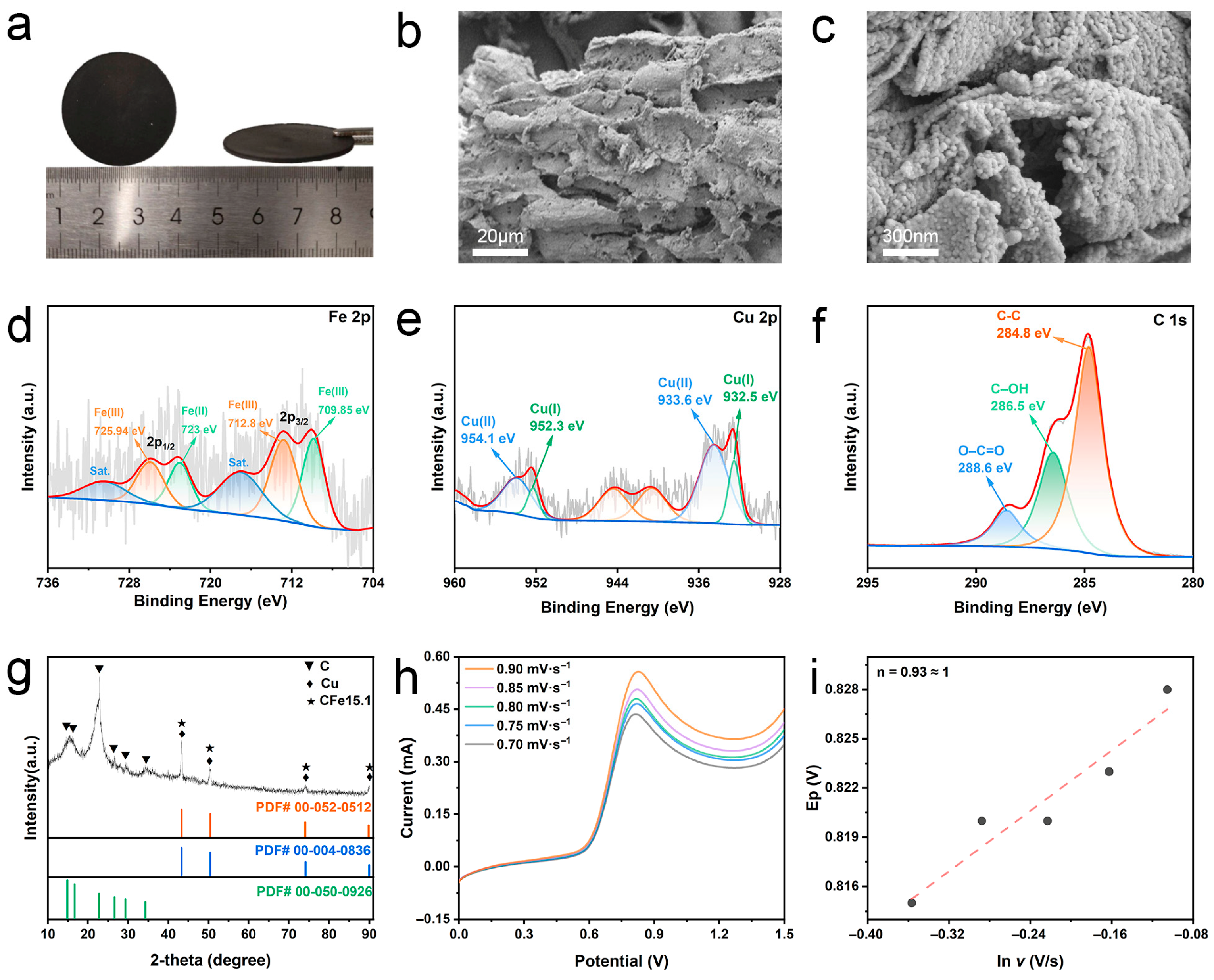
To establish the pulsed electrochemical system, the synthesized FeCuC-Ti4O7 working electrode was first characterized. As shown in Figure 2a, the electrode exhibits a geometric diameter of approximately 3 cm and a thickness of about 2 mm, with a metallic luster and black surface. The SEM image (Figure 2b) reveals a cellulose-like porous skeleton structure that provides a high specific surface area, facilitating electrolyte permeation and mass transfer. An enlarged image (Figure 2c) reveals that the porous framework is composed of well-dispersed nanoparticles with diameters ranging from 20 to 30 nm. The electrochemical surface area (ECSA) characterization (Figure S1) demonstrated a value as high as 5.82 mF cm−2, providing a favorable interface for SMX removal.
XPS survey spectra (Figure S2) confirmed that the electrode surface contains C, O, Cu, and Fe elements, aligning with the designed composition. The Fe 2p spectrum (Figure 2d) exhibits a main Fe 2p3/2 peak at 710.8 eV, characteristic of Fe(III), along with the Fe 2p1/2 peak at 724.5 eV. A broad satellite peak near 716.5 eV, assigned to Fe(II), is also observed. These features confirm that iron is predominantly present as Fe(III) oxides, with possible trace presence of Fe(II) species. In Figure 2e, the 2p3/2 peak (at ~932.5–933.6 eV) and 2p1/2 peak (at ~952.3–954.1 eV) reflect the spin-orbit splitting of Cu 2p. The obvious satellite peak (at ~944 eV) confirms the presence of Cu(II), while the 2p3/2 peak at ~932.5 eV implies the existence of Cu(I) (no satellite peak). Thus, the sample contains mixed Cu(I)/Cu(II) species [50,51]. In the C 1s spectrum (Figure 2f), the major peak at 284.8 eV corresponds to sp2-hybridized C–C bonds, while additional peaks at 286.5 eV and 288.6 eV are assigned to C–OH and O–C=O, respectively. The O 1s spectrum (Figure S3) shows a broad band at 531~534 eV, confirming the existence of oxygen-containing groups. These surface hydroxyl and carboxyl functionalities enhance the hydrophilicity of the electrode, promoting reactant transport through the porous structure and thus accelerating the electrochemical reactions.
X-ray diffraction (XRD) analysis (Figure 2g) was further conducted to determine the crystalline composition. The diffraction peaks match well with those of graphite carbon, iron carbide, and metallic copper, indicating that the composite consists of graphitic carbon, Fe–C phases, and Cu crystallites. The broad diffuse peak within 20~30° corresponds to amorphous carbon. The overlapping and slightly broadened peaks of copper and iron carbide suggest nanoscale particles highly dispersed within the carbon matrix. These results confirm that FeCuC consists of a carbon framework doped with a small amount of copper and iron, forming the CFe15.1 phase, signifying successful composite formation of Fe and Cu on the carbon substrate.
Moreover, the electrochemical analysis in Figure 2h,i reveals that the number of transferred electrons during NaClO2 activation is approximately one, consistent with the expected redox way. This suggests a single-electron transfer activation of NaClO2 to ClO2 via Equation (1):
NaClO2 − e → Na+ + ClO2(aq.)

3.2. Effects of Experimental Parameters

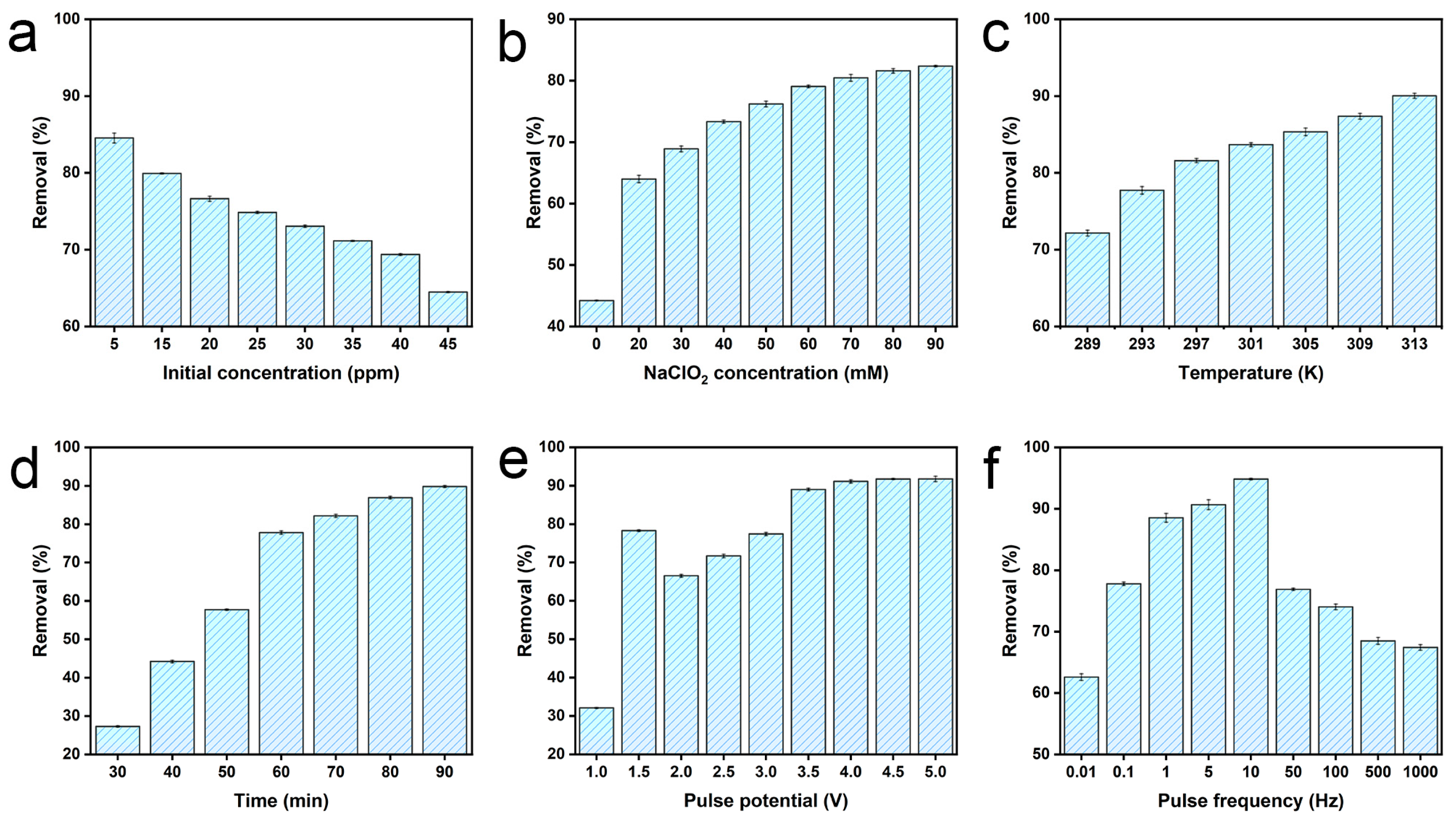
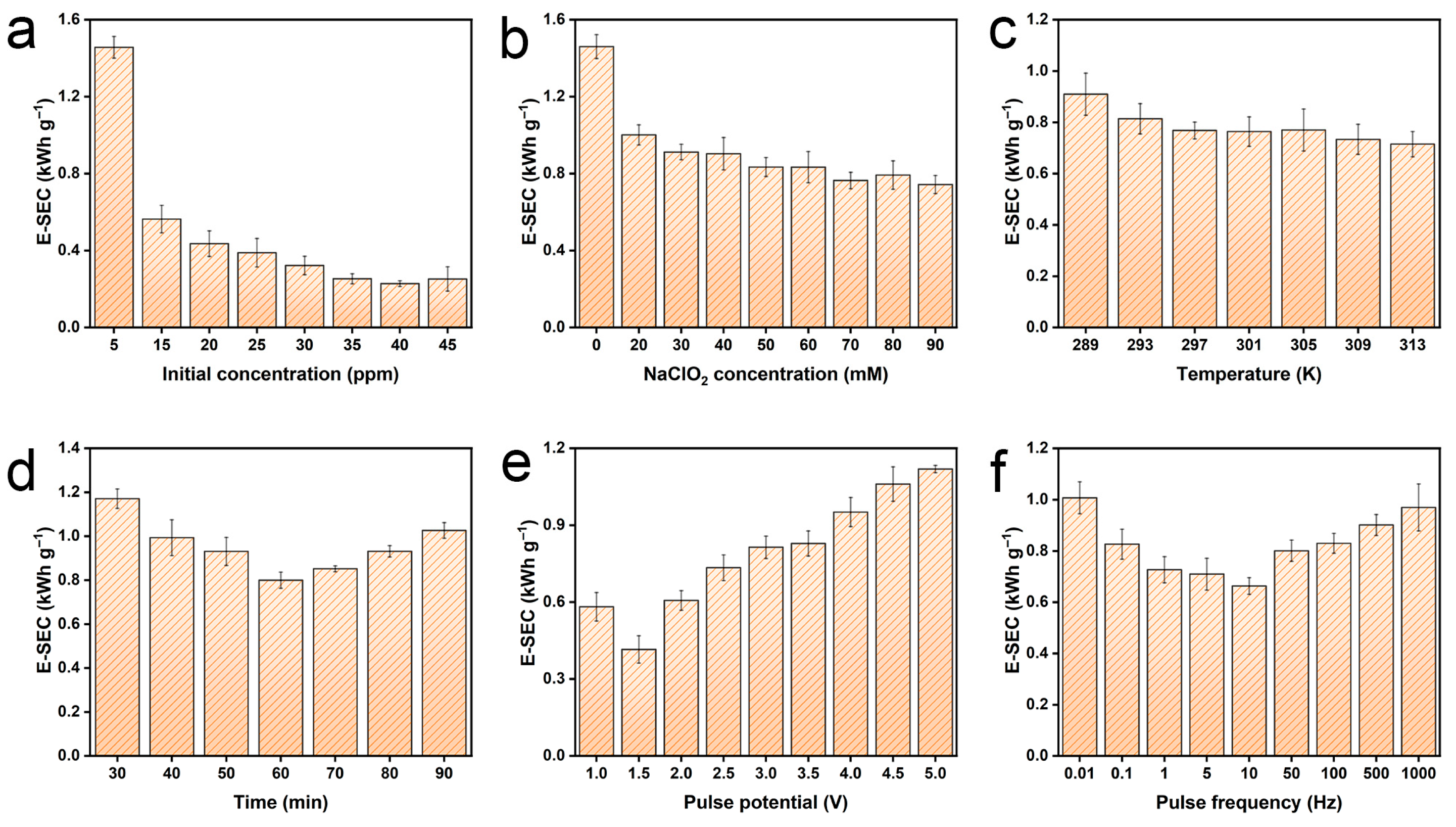
To systematically evaluate the influence of operational parameters on SMX removal (Equation (3)) and E-SEC (Equation (4)), several key factors were analyzed. As illustrated in Figure 3a, when the initial SMX concentration increased from 5 to 45 ppm, the 60 min removal efficiency decreased from (84.53 ± 0.64)% to (64.48 ± 0.07)%. This can be attributed to the same generation of reactive species (such as ClO2) within a fixed reaction time and initial NaClO2. As concentration rises, fewer reactive species are available per SMX molecule, and mass transfer limitations become more significant, causing diffusion control to dominate. Nevertheless, the E-SEC decreased significantly from (1.46 ± 0.06 kWh m−3) to (0.25 ± 0.06 kWh m−3) (Figure 4a) because the total mass of SMX removed increased while total energy consumption remained nearly constant. As shown in Figure S4, extending the reaction time from 60 to 90 min slightly improved the removal efficiency (from 84.53% to 89.93%), yet the overall trend remained unchanged. Beyond 60 min, the marginal benefit diminishes, and the E-SEC correspondingly increases (0.8 ± 0.04 kWh m−3) to (1.03 ± 0.04 kWh m−3), reflecting reduced energy efficiency during the late reaction stage (Figure 4d).
η ( % ) = ( 1 ω 1 ω 2 ) × 100 %
E S E C ( k W h   m 3 ) = V × I × t m S M X , r e m o v a l
where η represents the removal efficiency of SMX, ω 1 the final concentration, ω 2 the initial concentration, V the pulse potential, I the current, t the removal time, and mSMX,removal the amount of SMX removed.
When the initial NaClO2 concentration increased from 0 to 90 mM (Figure 3b), SMX removal efficiency first rose sharply and then reached a plateau at (82.4 ± 0.1)% around 90 mM. Below 60 mM, ClO2 generation correlates positively with NaClO2 concentration, whereas beyond 60 mM, excessive ClO2 escape, side reactions (e.g., ClO2 → ClO3), and saturation of active sites slow further enhancement. Meanwhile, E-SEC decreased continuously from (1.46 ± 0.06 kWh m−3) to (0.74 ± 0.05 kWh m−3) (Figure 4b) due to a higher pollutant removal rate per unit time.
Temperature also significantly affected removal performance (Figure 3c). As the temperature increased from 287 to 313 K, the removal efficiency improved from (72.17 ± 0.38)% to (90.03 ± 0.32)%, primarily due to enhanced mass transfer and accelerated intrinsic kinetics. However, above 313 K, thermal decomposition of NaClO2 and electrode passivation hindered further improvement. The lowest E-SEC (0.71 ± 0.05 kWh m−3) was observed at 313 K (Figure 4c), as higher temperature enhanced conductivity and kinetic rate, but further heating raised energy demand, causing a rebound in E-SEC.
The influence of pulsed potential is presented in Figure 3e. As the potential increased from 1 to 1.5 V, the removal efficiency rose sharply from (32.1 ± 0.1)% to (78.3 ± 0.2)%. It is noteworthy that further raising the potential led to a pronounced decline in the removal rate (at 2 V pulse potential, the removal efficiency decreased by approximately 12% compared to that at 1.5 V), likely due to the synergistic effect between direct electron transfer and indirect oxidation by reactive chlorine species. Moderate increases in potential enhance ClO2 → ClO2 activation and pollutant oxidation, while excessive potentials trigger parasitic reactions such as oxygen evolution (OER) and ClO2 → ClO3, decreasing current efficiency and possibly causing electrode corrosion. As the voltage increased, the E-SEC reached its minimum value of (0.42 ± 0.05 kWh m−3) at 1.5 V and subsequently rose gradually to (1.12 ± 0.01 kWh m−3), since energy consumption scales quadratically with voltage and competing side reactions reduce energy utilization.
ClO2 → ClO3,
H2O → O2,
As shown in Figure 3f, the optimal pulsed frequency range was 5~50 Hz, consistent with Figure 5d. At frequencies below 10 Hz, increasing frequency reduces ROS self-decay during intervals, enhancing removal. Above 100 Hz, double-layer discharge, mass transfer limitations, and side reactions dominate, reducing performance. E-SEC reached its minimum (0.66 ± 0.03 kWh m−3) near 10 Hz (Figure 4f); lower frequencies improved efficiency, while higher ones increased Joule heating and switching losses.
Overall, the effects of frequency and potential on contaminant removal efficiency exhibit distinct nonlinear characteristics: a series of complex potential-dependent electrochemical processes occur under different potential conditions (as shown in Equations (3), (6) and (7)), while pulse frequency acts on mass transfer and charge transfer processes through intricate mechanisms. Additionally, the limitations of single-factor experiments make it difficult to eliminate the interference of interaction effects between variables; thus, it is often challenging to screen out energy-efficient optimal process parameters that meet specific removal efficiency requirements. Beyond energy consumption, considerations of practical applicability led us to further evaluate the economic impact of sodium chlorite reagent costs. The associated consumption cost per unit of SMX removed was calculated using Equation (8) (see Figure S10). This further highlights the necessity of optimizing the parameters of this electrochemical process using machine learning techniques in the subsequent sections.
W ( y u a n / g   S M X ) = D × 90.44 ω 2 ω 1 × 0.0118
where W represents the sodium chlorite consumption cost, D represents the initial sodium chlorite concentration, ω 2 is the initial SMX concentration, and ω 1 is the final SMX concentration.

3.3. Electrochemical Analysis

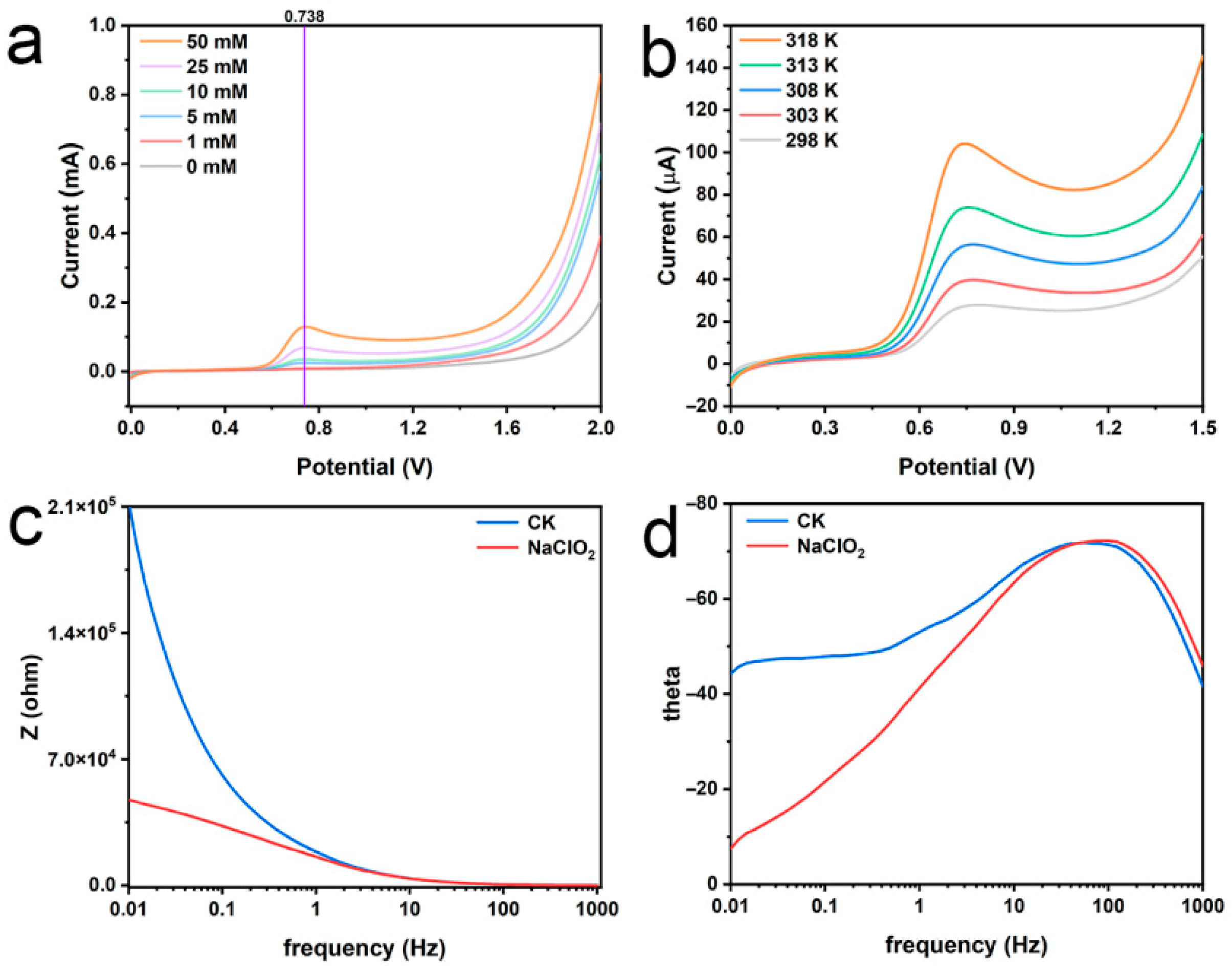
To gain an electrochemical perspective on the reaction mechanism underlying SMX removal, LSV, CV, and EIS measurements were conducted. Figure 5a demonstrates that, at the same potential, current density at 0.738 V increases markedly with rising NaClO2 concentration, indicating that NaClO2 undergoes electrochemical activation at the FeCuC-Ti4O7 electrode and that the reaction rate escalates with reactant concentration; these observations confirm the significant catalytic activity of the electrode toward ClO2 activation. However, the OER and ClO3 generation may occur beyond about 1.6 V, which may decrease the efficiency of the target activation reaction. These LSV curves explained the peak removal of SMX at 1.5 V in Figure 3e. For temperature, Figure 5b further shows that current density increases overall as temperature rises, and the onset potential for the reaction shifts slightly, signifying that elevated temperature favorably impacts the electrochemical reaction kinetics, which matches the removal results in Figure 3c. EIS spectra of magnitude and phase angle versus frequency are presented in Figure 5c and Figure 5d, respectively; upon addition of NaClO2, both the low-frequency impedance magnitude and the phase angle decrease significantly compared with the blank condition (magnitude reduced from 2.1 × 10⁵ to 4.7 × 10⁴ Ω; phase angle shifted from −44.3° to −7.5°), indicating that introduction of NaClO2 substantially ameliorates the electrode surface state and reduces both mass-transfer and charge-transfer resistances associated with the electrode reaction. Collectively, these electrochemical test results demonstrate that the FeCuC-Ti4O7 electrode exhibits excellent electrocatalytic reduction activity toward NaClO2 in the tested system; thermal activation further enhances the reaction kinetics, and the electrode interfacial properties are significantly optimized upon addition of the reactant—characteristics that jointly promote high-efficiency electrochemical removal of SMX in this pulsed system. While electrochemical analysis has inherent limitations, these findings still partially elucidate how various factors within this system impact both the contaminant removal efficiency and energy consumption outcomes.

3.4. Artificial Intelligence Optimization

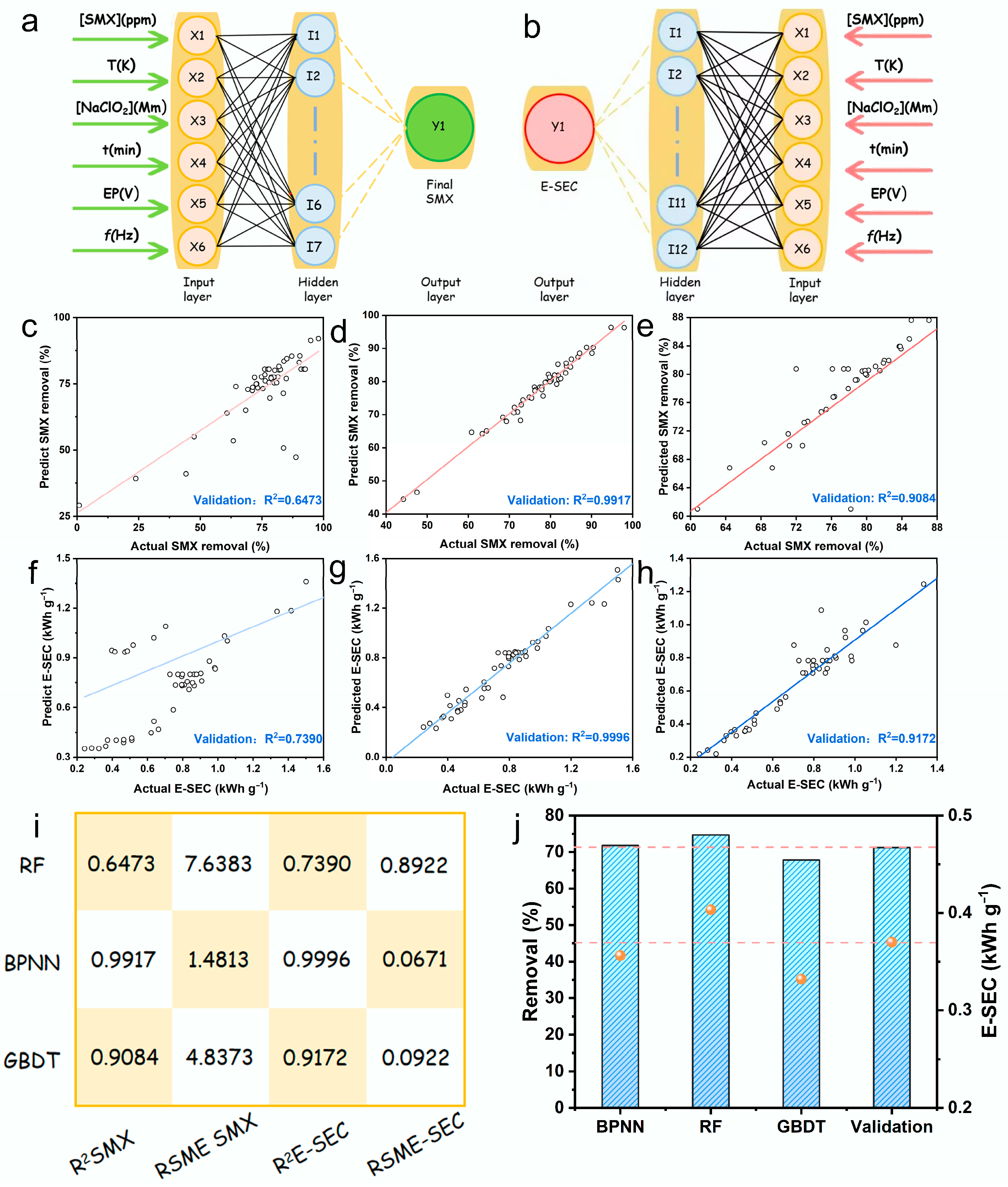
As described in Section 3.2, both SMX removal efficiency and E-SEC are nonlinearly influenced by multiple operational parameters (initial concentration, NaClO2 dosage, temperature, potential, and frequency), and a trade-off exists between pollutant removal and energy cost. The complex behavior—featuring nonlinear kinetics (e.g., polarization and pathway switching), strong parameter coupling (e.g., temperature–side reaction interactions), and multi-objective optimization—renders linear models (such as LASSO regression) inadequate. Therefore, a BPNN was introduced to capture high-dimensional nonlinear correlations based on the universal approximation theorem. This approach enables precise prediction of removal performance and energy efficiency, providing an intelligent optimization framework that surpasses empirical parameter tuning. The BPNN’s architecture is presented in Figure 6a,b. The model was initially developed using 255 historical datasets and has been iteratively refined to enhance its performance.
The accuracy and reliability of the established BPNN model were assessed using the testing dataset. The RMSE and R2 were employed as evaluation metrics, calculated as follows:
RMSE = i = 1 n ( y i y i ^ ) 2 n
R 2 = i = 1 n ( y i ¯ y i ^ ) 2 i = 1 n ( y i ¯ y i ) 2
where y i represents the input value, y i ^ the output value, y i ¯ the mean of inputs, and n the number of test samples. The results confirmed the high fitting accuracy of the BPNN model, further validating its predictive robustness and suitability for multi-parameter electrochemical systems.
Model evaluation results consistently confirmed that the BPNN model delivered the most accurate predictions for both SMX removal efficiency and E-SEC across all metrics. As illustrated in Figure 6i, the BPNN’s prediction of E-SEC achieved an R 2 value of 0.9996—approaching unity—signaling an almost perfect alignment between the model’s outputs and the experimental measurements, a level of precision rarely achieved by conventional regression methods. To contextualize this performance, Figure 6c–e compare the predictive capabilities of the BPNN, GBDT, and RF models for SMX removal: the BPNN (with an R 2 of 0.9917) outperformed the GBDT (0.9084) and RF (0.6473) by a substantial margin, reflecting its ability to capture the subtle nonlinear relationships between operational parameters and pollutant degradation. A parallel trend emerged for E-SEC predictions (Figure 6f–h): the BPNN’s R 2 of 0.9996 far exceeded the GBDT’s 0.9172 and the RF’s 0.7390, further validating its superiority in modeling energy consumption dynamics. Figure 6i synthesizes these metrics, highlighting that the BPNN not only secured the highest R 2 values for both SMX removal (0.9917) and E-SEC (0.9996) but also minimized prediction errors: its RMSE for SMX removal (1.4813) and E-SEC (0.0671) were the lowest among the three models, while the GBDT performed moderately and the RF lagged notably. Finally, Figure 6j benchmarks model predictions against actual operational data: the BPNN’s predicted SMX removal (71.795) and E-SEC (0.3562) closely mirrored the real-world values (71.225 and 0.37), whereas the RF overestimated both metrics and the GBDT underestimated them. Collectively, these results underscore the BPNN’s unparalleled predictive reliability for optimizing both treatment efficacy and energy efficiency in this system.

3.5. Practical Application Assessment

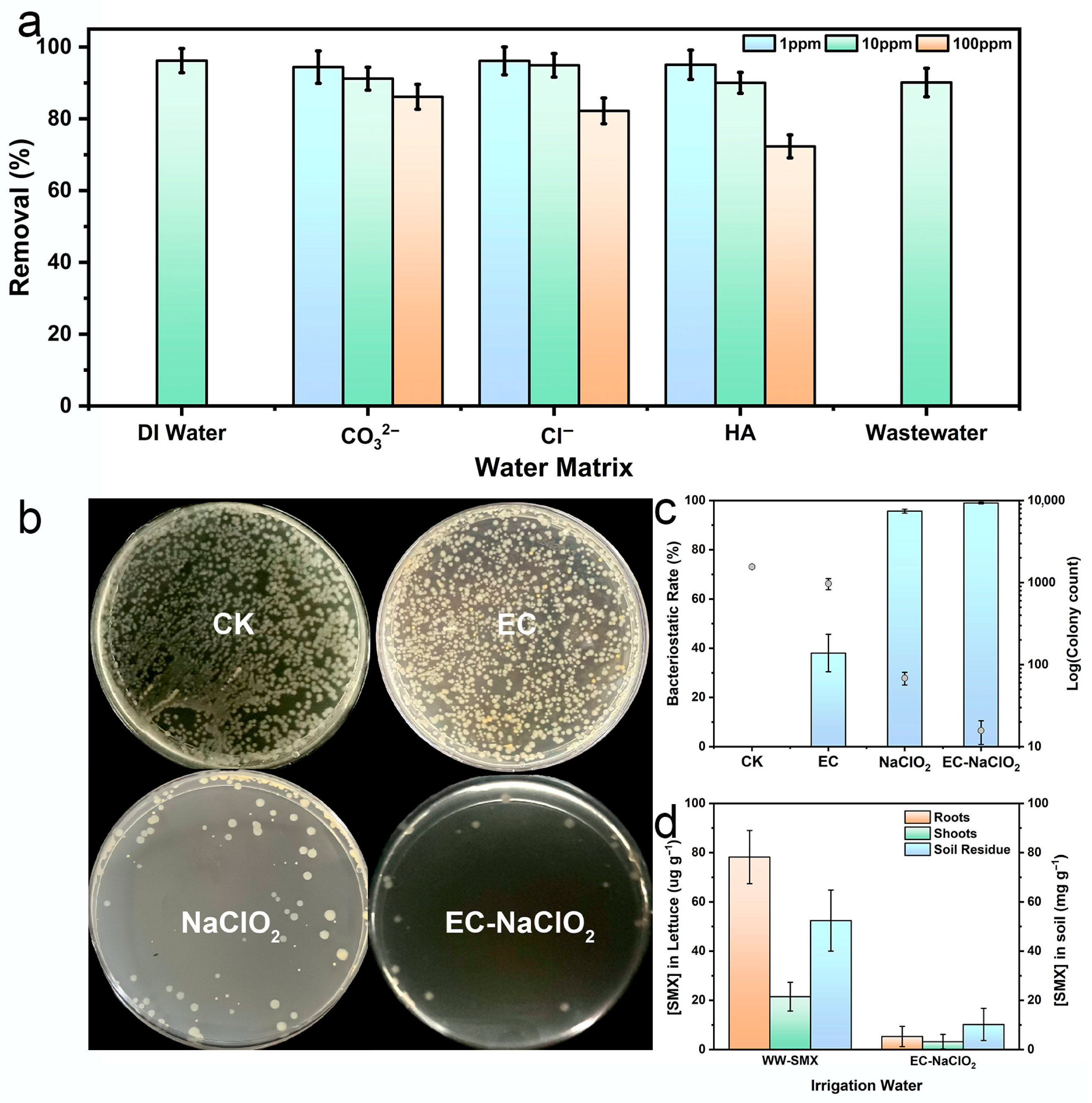
For practical wastewater treatment applications, the stability of the removal process, compliance of the effluent with reuse standards, and potential ecological risks are key evaluation indicators. As shown in Figure 7a, when the water matrix composition varies, the removal efficiency for high initial SMX concentrations (100 ppm) declines to some extent; in particular, the presence of chloride ions (Cl) and humic substances in the water reduces the SMX removal efficiency by approximately 14.22% and 19.66%, respectively. Nevertheless, because the concentrations of these matrix constituents in real wastewater are typically lower than the levels used in these controlled experiments, the IPEANaClO2 system is predicted to exhibit relatively stable removal performance under field conditions, with SMX removal efficiencies reaching 92.53% in the tested practical scenario. Figure 7b demonstrates that the total E. coli. counts (ATCC 25922) in the wastewater were significantly reduced after treatment with the IPEANaClO2 system, and plate colony counting (Figure 7c) further verifies that the microbial inhibition (inactivation) rate achieved by this treatment can reach 98.99%, meeting the microbial indices required for reclaimed irrigation water. Moreover, as shown in Figure 7d, compared to untreated wastewater, the use of IPEANaClO2-treated water for agricultural irrigation substantially decreases SMX residues in lettuce root tissues (reduced by ~72.89 μg g−1), in aboveground parts (~18.31 μg g−1 reduction), and in soil (~42.21 mg g−1 reduction), indicating the technology’s potential to markedly lower ecological accumulation and associated environmental risk. Collectively, these findings demonstrate that the IPEANaClO2 system exhibits favorable stability for real wastewater treatment, delivers effective disinfection performance, and substantially reduces SMX residues in agricultural contexts—supporting its feasibility for large-scale implementation and application in reclaimed-water irrigation systems. Simultaneously, to evaluate its practical feasibility, long-term stability tests were further conducted (Figure S9). The results indicate that the composite electrode maintains stable performance over extended periods, which not only prevents secondary environmental pollution but also effectively reduces the operational cost of removal.
However, this study only took the removal of SMX and energy consumption as optimization objectives, without considering the formation of intermediates and TOC removal. This limitation can be addressed in future research. In more practical application scenarios, advanced AI should be capable of predicting multi-dimensional water treatment outcomes, such as TOC removal and the generation of toxic byproducts. Furthermore, it should adapt to variations in influent water quality, such as different water matrix conditions.

4. Conclusions

This study successfully developed an efficient removal system based on pulsed electrochemical activation of NaClO2, integrating a FeCuC-Ti4O7 composite electrode with ML to achieve high-efficiency SMX removal and energy consumption optimization. Under optimized operational conditions (NaClO2 concentration 60~90 mM, pulsed frequency 10 Hz, temperature 313 K), the system achieved an SMX removal efficiency of nearly 90% while maintaining a low E-SEC of 0.66 kWh m−3. Comparative analysis of multiple ML models confirmed that the BPNN outperformed GBDT and RF in predicting SMX removal efficiency and E-SEC, with an R2 value approaching 1, demonstrating its high-precision modeling capability for complex electrochemical processes. Practical water matrix tests further verified that the IPEANaClO2 system exhibited robust removal stability across varying water qualities, efficient disinfection performance (bacterial inactivation rate > 98%), and significant reduction in SMX residues in simulated agricultural irrigation scenarios. These results highlight the technology’s potential to mitigate the ecological risks associated with SMX accumulation. Overall, this study provides a feasible technical pathway and methodological support for the intelligent control and efficient removal of refractory organic pollutants. Although additional data, as well as the incorporation of potential environmental variables and water matrix parameters, are still required to train the system for enhanced practical applicability, the integrated IPEANaClO2 system has initially established its framework and shows promising application prospects in reclaimed water reuse and environmental pollution control—offering a potential solution for addressing persistent antibiotic contamination in aquatic environments.

Supplementary Materials

The following supporting information can be downloaded at https://www.mdpi.com/article/10.3390/separations13010031/s1. Figure S1: Double-Layer Capacitance (Cdl) and Derived Electrochemically Active Surface Area of the FeCuC-Ti4O7 Electrode; Figure S2: XPS survey spectrum of FeCuC-Ti4O7; Figure S3: XPS spectrum of FeCuC-Ti4O7 (O1s); Figure S4: Removal of SMX under various times; Figure S5: The AI Software screenshot (Copyright has been obtained: 2025SR1724567); Figure S6: A comparative analysis between the predicted and actual values of removal efficiency is presented; Figure S7: The typical chromatogram (top: before degradation; mid: after degradation) and mass spectrum at 7.05 min (bottom); Figure S8: Comparison of the removal efficiencies of the four electrodes (FeCuC-Ti4O7, Ti, Pt, and Ti4O7); Figure S9: Electrode Stability Test; Figure S10: Cost of sodium chlorite consumed per unit SMX removed.

Author Contributions

J.C. and N.T. contributed to conceptualization, funding acquisition, and methodology; Y.S. contributed to software and formal analysis; N.T., W.Y., C.Z. and X.W. contributed to investigation, data curation, and manuscript writing. All authors have read and agreed to the published version of the manuscript.

Funding

This work was funded by the China National Undergraduate Training Program for Innovation and Entrepreneurship (NUTPIE, Nos. 202510626023 and 202410626001X).

Data Availability Statement

The original contributions presented in this study are included in the article. Further inquiries can be directed to the corresponding author.

Conflicts of Interest

The authors declare no conflicts of interest.

References

  1. Grenni, P.; Patrolecco, L.; Rauseo, J.; Spataro, F.; Di Lenola, M.; Aimola, G.; Zacchini, M.; Pietrini, F.; Di Baccio, D.; Stanton, I.C.; et al. Sulfamethoxazole Persistence in a River Water Ecosystem and Its Effects on the Natural Microbial Community and Lemna minor Plant. Microchem. J. 2019, 149, 104010. [Google Scholar] [CrossRef]
  2. Cai, J.; Liu, J.; Man, Y.B.; Chen, J.; Li, L.; Xu, X.; Huang, C.; Xu, C.; Lv, G.; Qi, X.; et al. Point-of-Use Water Treatment: Energy-Autonomous Synergistic Solar Photothermal-Piezocatalysis on MXene/Bi2WO6 Membranes for Distributed Removal of Sulfonamide Antibiotics. Water Res. 2025, 287, 123456. [Google Scholar] [CrossRef]
  3. Ai, T.; Yao, S.; Yu, Y.; Peng, K.; Jin, L.; Zhu, X.; Zhou, H.; Huang, J.; Sun, J.; Zhu, L. Transformation Process and Phytotoxicity of Sulfamethoxazole and N4-Acetyl-sulfamethoxazole in Rice. Sci. Total Environ. 2024, 918, 170857. [Google Scholar] [CrossRef]
  4. Tang, J.; Wang, J. Iron-Copper Bimetallic Metal-Organic Frameworks for Efficient Fenton-like Degradation of Sulfamethoxazole under Mild Conditions. Chemosphere 2020, 241, 125002. [Google Scholar] [CrossRef]
  5. Thebo, A.L.; Drechsel, P.; Lambin, E.F.; Nelson, K.L. A Global, Spatially-Explicit Assessment of Irrigated Croplands Influenced by Urban Wastewater Flows. Environ. Res. Lett. 2017, 12, 074008. [Google Scholar] [CrossRef]
  6. Straub, J.O. Aquatic Environmental Risk Assessment for Human Use of the Old Antibiotic Sulfamethoxazole in Europe. Environ. Toxicol. Chem. 2016, 35, 767–779. [Google Scholar] [CrossRef]
  7. Camacho-Arévalo, R.; García-Delgado, C.; Mayans, B.; Antón-Herrero, R.; Cuevas, J.; Segura, M.L.; Eymar, E. Sulfonamides in Tomato from Commercial Greenhouses Irrigated with Reclaimed Wastewater: Uptake, Translocation and Food Safety. Agronomy 2021, 11, 1016. [Google Scholar] [CrossRef]
  8. Mu, X.; Chen, C.; Fan, Q.; Zhang, W.; Liu, F.; Guo, J.; Qi, W.; Liu, H. Removal and Ecological Impact of Sulfamethoxazole and N-Acetyl Sulfamethoxazole in Mesocosmic Wetlands Dominated by Submerged Plants: Plant Tolerance, Microbial Response, and Nitrogen Transformation. Sci. Total Environ. 2025, 958, 176820. [Google Scholar] [CrossRef] [PubMed]
  9. Narciso, A.; Grenni, P.; Spataro, F.; De Carolis, C.; Rauseo, J.; Patrolecco, L.; Garbini, G.L.; Rolando, L.; Iannelli, M.A.; Bustamante, M.A.; et al. Effects of Sulfamethoxazole and Copper on the Natural Microbial Community from a Fertilized Soil. Appl. Microbiol. Biotechnol. 2024, 108, 112. [Google Scholar] [CrossRef]
  10. Neyrot, S.; Acha, D.; Morales-Belpaire, I. The Fate of Sulfamethoxazole in Microcosms of the Macrophyte Schoenoplectus californicus and Its Impact on Microbial Communities. Environ. Pollut. 2024, 362, 124898. [Google Scholar] [CrossRef]
  11. De Montmollin, N.; Letavernier, E.; Fartoukh, M.; Vincent, L. Acute Sulfamethoxazole-Induced Crystal Nephropathy. Intensive Care Med. 2018, 44, 1575–1576. [Google Scholar] [CrossRef] [PubMed]
  12. Hai, H.; Xing, X.; Li, S.; Xia, S.; Xia, J. Electrochemical Oxidation of Sulfamethoxazole in BDD Anode System: Degradation Kinetics, Mechanisms and Toxicity Evaluation. Sci. Total Environ. 2020, 738, 139909. [Google Scholar] [CrossRef]
  13. Suzuki, N.; Okazaki, A.; Takagi, K.; Serizawa, I.; Hirami, Y.; Noguchi, H.; Pitchaimuthu, S.; Terashima, C.; Suzuki, T.; Ishida, N.; et al. Complete Decomposition of Sulfamethoxazole during an Advanced Oxidation Process in a Simple Water Treatment System. Chemosphere 2022, 287, 132054. [Google Scholar] [CrossRef]
  14. Chen, Z.; Li, C.; Su, J.; He, Z.; Xu, J.; Bian, Y.; Kim, H.; Guan, X. Enhanced Sulfamethoxazole Removal in Water and Wastewater by Ferrate(VI)/Perborate System via Borate Buffering. J. Hazard. Mater. 2025, 492, 135681. [Google Scholar] [CrossRef]
  15. Prasannamedha, G.; Kumar, P.S. A Review on Contamination and Removal of Sulfamethoxazole from Aqueous Solution Using Cleaner Techniques: Present and Future Perspective. J. Clean. Prod. 2020, 250, 119553. [Google Scholar] [CrossRef]
  16. Bagotia, N. Regeneration Strategies for Exhausted Adsorbents Used in Water Treatment—A Critical Review. J. Water Process Eng. 2025, 69, 106442. [Google Scholar] [CrossRef]
  17. Khurana, P.; Pulicharla, R.; Kaur Brar, S. Antibiotic-Metal Complexes in Wastewaters: Fate and Treatment Trajectory. Environ. Int. 2021, 157, 106863. [Google Scholar] [CrossRef] [PubMed]
  18. Li, Z.; Wang, X.; Zhang, B.; Li, B.; Du, H.; Wu, Z.; Rashid, A.; Oppong Mensah, C.; Lei, M. Transmission Mechanisms of Antibiotic Resistance Genes in Arsenic-Contaminated Soil under Sulfamethoxazole Stress. Environ. Pollut. 2023, 326, 121484. [Google Scholar] [CrossRef]
  19. Tang, Z.; Huang, C.; Li, W.; Li, W.; Tan, W.; Xi, B.; Tian, Y.; Zhu, L. Horizontal Transfer of Intracellular and Extracellular ARGs in Sludge Compost under Sulfamethoxazole Stress. Chem. Eng. J. 2023, 454, 140079. [Google Scholar] [CrossRef]
  20. Tulková, T.; Fučík, J.; Kozáková, Z.; Procházková, P.; Krčma, F.; Zlámalová Gargošová, H.; Mravcová, L.; Sovová, K. Impact of Various Oxidation Processes Used for Removal of Sulfamethoxazole on the Quality of Treated Wastewater. Emerg. Contam. 2023, 9, 100200. [Google Scholar] [CrossRef]
  21. Wang, J.; Wang, S. Activation of Persulfate (PS) and Peroxymonosulfate (PMS) and Application for the Degradation of Emerging Contaminants. Chem. Eng. J. 2018, 334, 1502–1517. [Google Scholar] [CrossRef]
  22. Niu, B.; Wang, Z.; Wu, J.; Cai, J.; An, Z.; Sun, J.; Li, Y.; Huang, S.; Lu, N.; Xie, Q.; et al. Photoelectrocatalytic Selective Removal of Group-Targeting Thiol-Containing Heterocyclic Pollutants. J. Hazard. Mater. 2023, 452, 131307. [Google Scholar] [CrossRef] [PubMed]
  23. Tao, N.; Tian, Y.; Wang, J.; Teng, J. Enhanced Electrochemical Removal of Sulfamethazine on Sm-Doped Ti4O7 Anode: Mechanisms and Toxicity Evaluation. J. Hazard. Mater. Adv. 2025, 17, 100522. [Google Scholar] [CrossRef]
  24. Misal, S.N.; Lin, M.-H.; Mehraeen, S.; Chaplin, B.P. Modeling Electrochemical Oxidation and Reduction of Sulfamethoxazole Using Electrocatalytic Reactive Electrochemical Membranes. J. Hazard. Mater. 2020, 384, 121420. [Google Scholar] [CrossRef]
  25. Trellu, C.; Chaplin, B.P.; Coetsier, C.; Esmilaire, R.; Cerneaux, S.; Causserand, C.; Cretin, M. Electro-Oxidation of Organic Pollutants by Reactive Electrochemical Membranes. Chemosphere 2018, 208, 159–175. [Google Scholar] [CrossRef]
  26. Najafinejad, M.S.; Chianese, S.; Fenti, A.; Iovino, P.; Musmarra, D. Application of Electrochemical Oxidation for Water and Wastewater Treatment: An Overview. Molecules 2023, 28, 4208. [Google Scholar] [CrossRef]
  27. Scaria, J.; Nidheesh, P.V. Comparison of Hydroxyl-Radical-Based Advanced Oxidation Processes with Sulfate Radical-Based Advanced Oxidation Processes. Curr. Opin. Chem. Eng. 2022, 36, 100830. [Google Scholar] [CrossRef]
  28. Giannakis, S.; Lin, K.-Y.A.; Ghanbari, F. A Review of the Recent Advances on the Treatment of Industrial Wastewaters by Sulfate Radical-Based Advanced Oxidation Processes (SR-AOPs). Chem. Eng. J. 2021, 406, 127083. [Google Scholar] [CrossRef]
  29. Hao, R.; Dong, X.; Song, Y.; Tian, Q.; Zhao, Y.; Yuan, B. Microwave-Ultraviolet Co-Catalysis of Chlorite-Oxygen Mixture for Highly Cost-Efficient Simultaneous Removal of NO and Hg0. Fuel 2022, 326, 125067. [Google Scholar] [CrossRef]
  30. Chiang, M.K.; Su, L.; Raman, K.; Chiang, Y.-M.; Woodford, W.H. Reversible Chlorite Anion/Chlorine Dioxide Redox Couple for Low-Cost Energy Storage. J. Phys. Chem. C 2023, 127, 3921–3927. [Google Scholar] [CrossRef]
  31. Willach, S.; Lutze, H.V.; Eckey, K.; Löppenberg, K.; Lüling, M.; Terhalle, J.; Wolbert, J.-B.; Jochmann, M.A.; Karst, U.; Schmidt, T.C. Degradation of Sulfamethoxazole Using Ozone and Chlorine Dioxide—Compound-Specific Stable Isotope Analysis, Transformation Product Analysis and Mechanistic Aspects. Water Res. 2017, 122, 280–289. [Google Scholar] [CrossRef]
  32. Bairaghi, A.S. Electrochemical Abatement of Diclofenac with Various Electrode Systems for Water Treatment Applications. Sustain. Chem. Environ. 2025, 10, 100186. [Google Scholar] [CrossRef]
  33. Gunther, E.; Burda, C.; Horn, J.B.; Tan, R.; Niese, S.; Gkika, E.; Agarwal, S.; Schäfer, A. Drastic Enhancement of H2O2 Electro-Generation by Pulsed Current for Ibuprofen Degradation: Strategy Based on Decoupling Study on H2O2 Decomposition Pathways. Chem. Eng. J. 2018, 338, 709–718. [Google Scholar]
  34. Zhou, W.; Gao, J.; Ding, Y.; Zhao, H.; Meng, X.; Wang, Y.; Kou, K.; Xu, Y.; Wu, S.; Qin, Y. Green Electrochemical Modification of RVC Foam Electrode and Improved H2O2 Electrogeneration by Applying Pulsed Current for Pollutant Removal. Environ. Sci. Pollut. Res. 2018, 25, 6015–6025. [Google Scholar] [CrossRef] [PubMed]
  35. Liu, F.; Zhou, R.; Zhang, C.; Wu, Z.; Ren, H.; Ng, H.Y. Critical Review on the Pulsed Electrochemical Technologies for Wastewater Treatment: Fundamentals, Current Trends, and Future Studies. Chem. Eng. J. 2024, 479, 147653. [Google Scholar] [CrossRef]
  36. Cai, J.; Liu, S.; Man, Y.B.; Xu, X.; Yang, Z.; Xu, C.; Wang, G.; Huang, C.; Yang, G.; Lv, G.; et al. Sequential Adsorption-Oxidation Pulses for Alternating Electrochemical Advanced Pretreatment of Wastewater Containing Tetracyclines. Chem. Eng. J. 2025, 507, 151847. [Google Scholar] [CrossRef]
  37. Zhang, K.; Crittenden, J.C. Increased Energy Efficiency Using Pulse-Potential Electrochemical Advanced Oxidation Processes. Chemosphere 2024, 362, 142645. [Google Scholar] [CrossRef]
  38. Ye, K.; Jiang, T.-W.; Jung, H.D.; Shen, P.; Jang, S.M.; Weng, Z.; Back, S.; Cai, W.-B.; Jiang, K. Molecular Level Insights on the Pulsed Electrochemical CO2 Reduction. Nat. Commun. 2024, 15, 2769. [Google Scholar] [CrossRef]
  39. Zeng, Y.; Zhang, S.; Yin, L.; Dai, Y. Electrocatalytic Degradation of Pesticide Micropollutants in Water by High Energy Pulse Magnetron Sputtered Pt/Ti Anode. Chin. Chem. Lett. 2022, 33, 5196–5199. [Google Scholar] [CrossRef]
  40. Chow, H.; Pham, A.L.-T. Mitigating Electrode Fouling in Electrocoagulation by Means of Polarity Reversal: The Effects of Electrode Type, Current Density, and Polarity Reversal Frequency. Water Res. 2021, 197, 117090. [Google Scholar] [CrossRef] [PubMed]
  41. Cao, C.; Xu, X.; Wang, G.; Yang, Z.; Cheng, Z.; Zhang, S.; Li, T.; Pu, Y.; Lv, G.; Xu, C.; et al. Characterization of Ionic Liquids Removing Heavy Metals from Electroplating Sludge: Influencing Factors, Optimisation Strategies and Reaction Mechanisms. Chemosphere 2023, 324, 138309. [Google Scholar] [CrossRef] [PubMed]
  42. Jia, S.; Deng, M.; Mu, Y.; Li, J.; Tian, X.; Xie, Q.; Zhang, J. Applying Stacked Machine Learning Models to Guide Electrochemical Oxidation of Antibiotics: Key Parameter Identification and Process Optimization Insights. J. Environ. Manag. 2025, 392, 123829. [Google Scholar] [CrossRef]
  43. Serna-Carrizales, J.C.; Zárate-Guzmán, A.I.; Flores-Ramírez, R.; Díaz de León-Martínez, L.; Aguilar-Aguilar, A.; Warren-Vega, W.M.; Bailón-García, E.; Ocampo-Pérez, R. Application of Artificial Intelligence for the Optimization of Advanced Oxidation Processes to Improve the Water Quality Polluted with Pharmaceutical Compounds. Chemosphere 2024, 351, 141173. [Google Scholar] [CrossRef]
  44. Majumder, A.; Mandal, P.; Yadav, M.K.; T, A.L.; B, L.; Majumder, A. Machine Learning-Powered Estimation of Simultaneous Removal of Sulfamethoxazole, 17-β Estradiol, and Carbamazepine via Photocatalytic Degradation with M-Al@ZnO. Environ. Res. 2025, 286, 121441. [Google Scholar] [CrossRef]
  45. Bai, B.; Wang, L.; Guan, F.; Cui, Y.; Bao, M.; Gong, S. Prediction Models for Bioavailability of Cu and Zn during Composting: Insights into Machine Learning. J. Hazard. Mater. 2024, 471, 134392. [Google Scholar] [CrossRef]
  46. Elmolla, E.S.; Chaudhuri, M.; Eltoukhy, M.M. The Use of Artificial Neural Network (ANN) for Modeling of COD Removal from Antibiotic Aqueous Solution by the Fenton Process. J. Hazard. Mater. 2010, 179, 127–134. [Google Scholar] [CrossRef]
  47. Guimarães, O.L.; dos Reis Chagas, M.H.; Villela Filho, D.N.; Siqueira, A.F.; Izário Filho, H.J.; de Aquino, H.O.; Silva, M.B. Discoloration Process Modeling by Neural Network. Chem. Eng. J. 2008, 140, 71–76. [Google Scholar] [CrossRef]
  48. Aghav, R.M.; Kumar, S.; Mukherjee, S.N. Artificial Neural Network Modeling in Competitive Adsorption of Phenol and Resorcinol from Water Environment Using Some Carbonaceous Adsorbents. J. Hazard. Mater. 2011, 188, 67–77. [Google Scholar] [CrossRef] [PubMed]
  49. Li, T.; Hu, A.; Li, Y.; Yang, B.; Li, K.; Chen, K.; Jiang, J.; Li, F.; Seh, Z.W.; Wang, J.; et al. Multifunctional Polyfluoride Ionogel-Encapsulated Lithium Anodes for Durable and Safe Pouch Cells under Harsh Conditions. Adv. Funct. Mater. 2025, 35, 2508008. [Google Scholar] [CrossRef]
  50. Joshi, N.; Sivachandiran, L. Exploring the Feasibility of Liquid Fuel Synthesis from CO2 under Cold Plasma Discharge: Role of Plasma Discharge in Binary Metal Oxide Surface Modification. RSC Adv. 2021, 11, 27757–27766. [Google Scholar] [CrossRef] [PubMed]
  51. Joshi, N.; Loganathan, S. In Situ Modification of CuO–Fe2O3 by Nonthermal Plasma: Insights into the CO2-to-CH3OH Hydrogenation Reaction. ACS Omega 2023, 8, 13410–13420. [Google Scholar] [CrossRef] [PubMed]
Figure 1. Schematic diagram of the process of SMX removal and electrode material preparation based on BPNN optimization.
Separations 13 00031 g001
Figure 2. Characterizations. (a) Digital image of FeCuC electrode; (b,c) SEM micrographs of FeCuC; XPS analysis of (d) Fe 2p, (e) Cu 2p and (f) C 1s of the FeCuC; (g) XRD for FeCuC; (h) LSV curves of the FeCuC-Ti4O7 in 50 mM NaClO2 containing 0.1 M Na2SO4 at different scan rates; (i) a corresponding linear relationship was observed between the redox peak potential and the logarithmic value of the scan rate.
Separations 13 00031 g002
Figure 3. Removal of SMX under various conditions. (a) Initial concentration; (b) NaClO2 concentration; (c) reaction temperature; (d) reaction time; (e) pulse potential; (f) pulse frequency. Besides various parameters, the others were maintained at fixed values (initial SMX concentration = 10 ppm, initial NaClO2 concentration = 50 mM, reaction temperature = 293 K, reaction time = 60 min, pulse potential = 3 V, frequency = 0.1 Hz).
Separations 13 00031 g003
Figure 4. E-SEC of SMX under various conditions. (a) Initial concentration; (b) NaClO2 concentration; (c) reaction temperature; (d) reaction time; (e) pulse potential; (f) pulse frequency. Besides various parameters, the others were maintained at fixed values (initial SMX concentration = 10 ppm, initial NaClO2 concentration = 50 mM, reaction temperature = 293 K, reaction time = 60 min, pulse potential = 3 V, frequency = 0.1 Hz).
Separations 13 00031 g004
Figure 5. (a) LSV curves recorded at various concentrations of NaClO2; (b) LSV curves recorded at various temperatures; (c) Bode plot of impedance modulus (|Z|) versus log(frequency) for FeCuC; (d) Bode plot of phase angle (θ) versus log(frequency) for FeCuC.
Separations 13 00031 g005
Figure 6. Optimal BPNN architecture (a) SMX removal and (b) E-SEC; regression scatter plot of removal validation set for (c) RF, (d) BPNN and (e) GBDT; regression scatter plot of E-SEC across validation sets for (f) RF, (g) BPNN and (h) GBDT; (i) comparison of different model predictions for SMX and E-SEC; (j) comparison of the prediction accuracy of various models under fixed parameters.
Separations 13 00031 g006
Figure 7. (a) Removal of SMX under various water matrices; (b) comparison of antibacterial effects of recycled irrigation water after different treatments; (c) comparison of antibacterial rate and colony count; (d) SMX concentration accumulation in various parts of lettuce and soil irrigated with wastewater before and after treatment.
Separations 13 00031 g007
Disclaimer/Publisher’s Note: The statements, opinions and data contained in all publications are solely those of the individual author(s) and contributor(s) and not of MDPI and/or the editor(s). MDPI and/or the editor(s) disclaim responsibility for any injury to people or property resulting from any ideas, methods, instructions or products referred to in the content.