Review

Current Research on NO2 Removal from Flue Gas Using Adsorption Methods

1
Department of Radiochemistry, China Institute of Atomic Energy, Beijing 102413, China
2
College of Carbon Neutrality Future Technology, Sichuan University, Chengdu 610064, China
*
Authors to whom correspondence should be addressed.
Separations 2026, 13(1), 24; https://doi.org/10.3390/separations13010024
Submission received: 8 December 2025 / Revised: 4 January 2026 / Accepted: 5 January 2026 / Published: 8 January 2026

Abstract

Nitrogen dioxide (NO2) is a major atmospheric pollutant and also a recoverable nitrogen resource, for which adsorption offers a promising technical pathway. This review systematically summarizes the recent progress in the removal of NO2 from flue gas by adsorption methods, with a focus on material-level and process-level advancements. From the material perspective, three representative adsorbents—zeolites, activated carbons, and metal oxides—are comparatively evaluated in terms of their physicochemical properties, active sites, and adsorption mechanisms. Emphasis is placed on their adsorption capacity, selectivity, and hydrothermal stability, supported by both experimental and theoretical insights. From the process perspective, four adsorption-based technologies—Pressure Swing Adsorption (PSA), Temperature Swing Adsorption (TSA), Vacuum Pressure Swing Adsorption (VPSA), and Vacuum Temperature Swing Adsorption using multiple Gas circulations (GVTSA)—are analyzed regarding their principles, operational workflows, and engineering applications, with particular attention to the process intensification potential of GVTSA. The review identifies existing challenges in terms of material stability under complex conditions and process scalability, especially for severe environments such as nuclear reprocessing tail gases. Finally, future research directions are proposed toward developing multifunctional composite adsorbents with high capacity, strong environmental tolerance, and excellent regenerability, along with optimized and integrated adsorption processes, to achieve efficient NO2 abatement and high-value recovery.

1. Introduction

Nitrogen oxides (NOx) primarily consist of NO and NO2, commonly found in industrial emissions, motor vehicle exhaust, biomass combustion exhaust, thermal power plant emissions, and nuclear fuel reprocessing exhaust. They represent one of the major sources of atmospheric pollution. In 2024, China’s mobile sources emitted 9.019 million tons of NOx, while non-road mobile sources emitted 4.867 million tons. Research indicates that prolonged exposure to nitrogen oxides significantly increases the risk of respiratory and cardiovascular diseases, as well as mortality rates [1]. Furthermore, nitrogen oxides contribute to smog formation, exacerbate ozone layer depletion [2], promote acid rain formation [3], and cause photochemical smog pollution [4]. Consequently, effective nitrogen oxide removal has become a critical research focus. NO readily oxidizes to NO2 in the atmosphere, while NO2 is a high-value chemical feedstock, with high-purity liquid NO2 products in China priced at approximately $6000 per ton. It finds applications in sulfuric acid production catalysts, nitric acid synthesis, and plutonium reprocessing in nuclear fuel backend operations. Consequently, large-scale NO2 recovery can effectively treat exhaust gases, reduce treatment costs, and yield significant economic benefits.
To control NO2 emissions from stationary sources, treatment strategies such as liquid absorption, Selective Catalytic Reduction (SCR), Selective Non-Catalytic Reduction (SNCR), biological denitrification, plasma activation, and adsorption can be employed. Selective Catalytic Reduction (SCR) [5] requires a catalyst to reduce NO2 using reducing gases within the 250–450 °C range. This method is widely adopted as a commercial denitrification technology [6], but suffers from high costs and susceptibility to catalyst poisoning. Selective Non-Catalytic Reduction (SNCR) [7] operates without catalysts, promoting the reaction between NO2 and reducing agents to form nitrogen gas at temperatures exceeding 950 °C, which is characterized by extremely high energy consumption. Liquid absorption methods [8] are primarily categorized into acid absorption and alkali absorption based on the type of absorbent solution. While treating large volumes of NOx with low oxidation states, these methods exhibit low treatment efficiency and impose stringent requirements on the absorption cycle equipment. Biological denitrification [9] converts NO2 into N2 or HNO3 through microbial metabolic activity. Its drawback lies in the sensitivity of microorganisms to environmental conditions, resulting in significantly reduced denitrification efficiency under high-temperature, high-dust, and high-load industrial scenarios, which limits its large-scale application. Plasma method [10] generates high-energy active particles via a plasma generator, which chemically react with NO2 to convert it into HNO3 or N2. However, this approach consumes substantial electrical energy under high-frequency and high-voltage conditions. Increased oxygen concentration reduces denitrification efficiency, and equipment costs remain high. Among the above technologies, SCR and SNCR are most commonly applied in industrial settings. Their fundamental principle involves converting NO2 into harmless N2, aiming for complete pollution elimination. These methods are suitable for scenarios with stringent emission standards but no NO2 recovery requirements. Meanwhile, NO2 serves as a core intermediate in producing chemical raw materials such as nitric acid and nitrates. By recovering it and converting it into high-value-added products, we can reduce environmental treatment costs while achieving the circular utilization of nitrogen resources. Therefore, adsorption-based NO2 recovery has emerged as a key technological pathway for efficient capture and resource utilization of NO2 in industrial exhaust gases [11]. This approach leverages advantages such as mild operating conditions, recyclable adsorbents, and strong adaptability to low-concentration NO2 systems.
Current research on NO2 treatment primarily focuses on industrial waste gases and automotive exhaust, with extensive studies conducted under diverse operational conditions. In contrast, the purification of NO2 generated from nuclear fuel reprocessing remains underexplored, despite its distinct and severe challenges. These tail gases typically contain not only moisture and CO2, but also radioactive species such as RuO4 and UO3 particulates, leading to a highly corrosive and radiolytic environment [12]. Conventional adsorbents often exhibit inadequate radiation resistance and acid stability under such conditions, while existing NO2 separation processes lack validated engineering parameters for radioactive service. Furthermore, the propensity of NO2 to react with water to form corrosive acids, combined with its low boiling point and tendency to liquefy, complicates the recovery process in mixed gas streams. Currently, systematic studies on the development of radiation-resistant adsorbents and the adaptation of adsorption processes for nuclear off-gas treatment are scarce, highlighting a critical research gap that must be addressed to enable safe and efficient NOx management in the nuclear fuel cycle.
This paper systematically reviews recent advancements in the performance evaluation of NO2 adsorption materials and the process configurations of mainstream NO2 recovery technologies, with a targeted focus on their application in the treatment of nuclear fuel reprocessing off-gases. The study specifically examines three major categories of adsorbents alongside four key adsorption processes. Through a detailed analysis of the physicochemical properties and adsorption behaviors of these materials under conditions such as high humidity, and the presence of corrosive species—this work elucidates the molecular-level mechanisms governing NO2 capture, including the roles of active sites, surface modifications, and structural defects. Emphasis is placed on evaluating material performance based on critical metrics such as stability, adsorption capacity, and regenerability. Furthermore, the review identifies existing challenges in the long-term stability, selectivity, and engineering adaptability of adsorbents in radioactive and chemically aggressive gas streams. Finally, it outlines future research directions aimed at developing tailored adsorption materials and optimized processes for the efficient recovery and reuse of NO2 from nuclear reprocessing tail gases, thereby contributing to safer and more sustainable waste management.

2. Research on NO2 Adsorbent Materials

Currently, various promising NO2 adsorbent materials have been investigated, including zeolites [11], activated carbons (ACs) [13] and metal oxides [14]. Each adsorbent material exhibits considerable NO2 adsorption capacity. The selection of adsorbents requires comprehensive consideration of NO2 concentration, temperature, flue gas composition, and regeneration costs. In the future, multifunctional composites represent a key direction for enhancing performance. The adsorption mechanism of adsorbents is primarily categorized into physical adsorption and chemical adsorption. Physical adsorption primarily relies on van der Waals forces to preferentially adsorb polar molecules such as NO2 and H2O. Chemical adsorption achieves adsorption by forming coordination bonds between acidic sites on the adsorbent surface and NO2, or through reactions between metal ions and NO2.
When evaluating the performance of NO2 adsorbents, adsorption capacity, regeneration capability, stability, and selectivity are key indicators. These metrics reflect the feasibility and efficacy of the adsorbent in practical applications from different dimensions. Adsorption capacity serves as a fundamental indicator for evaluating adsorbent performance, defined as the maximum amount of NO2 that can be adsorbed per unit mass or volume of adsorbent under specified conditions, typically measured in or mmol/g. It is influenced by the adsorbent’s specific surface area, pore structure, and the quantity and nature of active sites [15]. A high specific surface area and abundant pore structure provide greater attachment space for NO2, resulting in superior adsorption capacity. Active sites can undergo chemical reactions with NO2. In certain metal oxide-supported adsorbents, the metal active centers can form chemical bonds with NO2, thereby enhancing adsorption capacity. Adsorption capacity for NO2 is highly temperature-dependent and varies between physisorption and chemisorption mechanisms. For physisorption, which is an exothermic process governed by van der Waals forces, increased temperature typically reduces equilibrium adsorption capacity due to enhanced molecular desorption. In contrast, chemisorption, involving chemical bond formation, may exhibit an increase in adsorption capacity within a certain temperature range if thermal energy aids in overcoming activation barriers for surface reactions. However, excessively high temperatures can lead to adsorbent degradation or undesirable side reactions. Regeneration refers to the process of restoring the adsorption capacity of saturated adsorbents through physical or chemical methods [16]. This process must consider energy consumption, regeneration efficiency, and the effects on the adsorbent’s structure and properties. An efficient regeneration method should achieve a good recovery of adsorption performance and structural stability while minimizing energy consumption. Stability refers to an adsorbent’s ability to maintain its performance over extended periods under complex operational conditions, encompassing thermal stability, hydrothermal stability, and resistance to poisoning [17]. Thermal stability denotes the adsorbent’s capacity to retain its structure and properties without significant degradation under high temperatures. Elevated temperatures may cause structural collapse and sintering of active sites, thereby diminishing adsorption performance. Hydrothermal stability is critical for adsorbents treating waste gases containing water vapor. Water vapor presence may interfere with the NO2 adsorption process or even react with the adsorbent, altering its structure and performance. Selectivity refers to the property of adsorbents to preferentially adsorb NO2, while adsorbing minimal amounts of other gases such as O2 and CO2 present in exhaust gases [15]. By modifying the adsorbent surface or loading specific active components, its selectivity toward NO2 can be adjusted, making it more suitable for applications with varying exhaust gas compositions.

2.1. Zeolites

Zeolite is a crystalline silicoaluminate material featuring a regular pore structure and strong adsorption properties. It primarily consists of SiO2, Al2O3, and metal cations (such as Na+, K+, and Ca2+), represented by the chemical formula (Mx·[(AlO2)m(SiO2)n]·pH2O), where M represents the metal ion. The channels are filled with water molecules; upon heating and dehydration, a porous structure forms, enabling selective adsorption of substances based on molecular size and polarity. Zeolite synthesis typically employs hydrothermal, solvothermal, or ionothermal methods [18]. The shape of the zeolite framework and pore size can be adjusted by varying the type of structural directing agent used. Additionally, the number of framework cations can be adjusted by altering the Si/Al ratio, and the types of these cations can be modified through ion exchange processes.
Zhengming Wang and co-workers [19] systematically investigated the adsorption and separation performance of A-type, FAU-type, and MOR-type zeolites for low-concentration CO2-NO2 mixtures in 1998, establishing the structure-activity relationship between molecular sieve structure and adsorption performance under adsorption and TPD experimental conditions at 333 K. Low-concentration CO2 adsorption primarily depends on the polarity of the molecular sieve surface, while NO2 adsorption is synergistically regulated by the number of cation sites and the pore geometry. Among these, 13X exhibits the highest NO2 adsorption capacity due to its abundant cation sites and large pore size, but its thermal stability of adsorption sites is insufficient, leading to a decline in cycling performance. Zeolite A exhibited limited NO2 adsorption capacity due to its smaller pore size; HM, obtained by protonation modification of mordenite, not only effectively suppressed CO2 adsorption at low concentrations but also maintained high NO2 adsorption capacity. It featured a mild desorption temperature of 409 K and excellent thermal stability, effectively preventing nitrate species formation at elevated temperatures. Considering separation selectivity, desorption energy consumption, and cycling stability, HM is proven to be the optimal adsorbent for separating low-concentration CO2-NO2 mixtures via temperature-swing adsorption. This study provides crucial experimental evidence and theoretical support for adsorbent selection in separating low-concentration acidic gases, such as those from nuclear waste treatment exhaust.
F. Delachaux and co-workers [20] investigated the effects of oxygen content, water vapor, and other factors on NO2 adsorption by NaY zeolite. The presence of Al in the NaY zeolite framework imparts a negative charge to its surface, with Na+ serving as the charge-compensating cation. The high charge density of Na+ generates a strong Coulombic field around the pores, enabling the robust electrostatic adsorption of the polar molecule NO2, resulting in physical adsorption. The chemical adsorption of NO2 relies on Lewis acidic sites of Na+ on NaY, forming coordinate bonds with the lone pair electrons of NO2. This promotes the chemical transformation of NO2: on one hand, some NO2 directly combines with Na+ to form stable NO3 species; on the other hand, NO2 molecules form dimers N2O4 mediated by Na+, further enhancing adsorption stability. This process is particularly pronounced in experiments where dry NaY adsorbs NO2. For fresh, undried NaY samples, NO2 adsorption capacity reached 3.31 mmol/g without O2 presence, with breakthrough occurring at 400 min. In the presence of 8.5% O2, adsorption capacity was 2.89 mmol/g, with breakthrough at 350 min. Residual moisture causes partial conversion of NO2 to NO, yielding 1.06–0.89 mmol/g and reducing NO2 yield. For dried NaY samples, NO2 adsorption capacity reached 2.03 mmol/g at 8.5% O2 with a breakthrough time of 250 min, and almost no NO was generated. Drying reduced adsorption capacity by 38% but eliminated reverse conversion of NO2, enabling high-purity NO2 enrichment and better suitability for industrial regeneration scenarios.
In 2003, Joël Desprès’s team synthesized ion-exchange-modified Cu-ZSM-5 zeolite to investigate the adsorption behavior of NO2 under dry and wet conditions at elevated temperatures [21]. Results indicated that at 200 °C, NO2 undergoes a disproportionation reaction (3NO2 + [CuO] ⇌ NO + Cu(NO3)2) to form nitrate species, enabling NO storage and release. This process exhibited a broad storage temperature range and was effective under both dry and wet conditions. The presence of 5% H2O reduced both NO2 storage capacity and NO2 desorption, with the desorption decreasing from 0.116 mmol/g in the dry state to 0.078 mmol/g in the wet state. The NO2 adsorption capacity of Cu-ZSM-5 decreases with increasing temperature. This is attributed to the thermal stability of the Cu(NO3)2 species formed via the disproportionation reaction, which remains stable below 380 °C, but decomposes into NO2 above 400 °C. Consequently, NO2 adsorption and storage become impossible above 400 °C. After adsorption-desorption cycles, the crystal structure remains stable with no significant degradation.
Mingzhe Sun and colleagues prepared CuO, Cu+, and Cu2+-containing Cun+SSZ-13 zeolite by reducing Cun+SSZ-13 with H2, aiming to develop an adsorbent for efficient NO2 removal at ambient temperatures [22]. NO2 adsorption performance tests were conducted on samples prepared via reduction at different temperatures. Results indicated that at 190 °C, Cu+ dominated in Cu+-SSZ-13. The smaller Cu2+ ion radius (0.72 Å) imposes stronger d-orbital electron confinement, hindering coordination with NO2 π* orbitals. At 250 °C, Cu2+ ions (0.96 Å) exhibit weaker d-orbital electron confinement, enabling efficient π-coordination. Consequently, Cu2+ demonstrates strong affinity for NO2, synergizing with residual H+ sites to enhance NO2 adsorption. However, when the reduction temperature is elevated to 250 °C, Cu0 becomes predominant in Cun+SSZ-13. After NO2 adsorption, increased NO release indicates that Cu0 catalyzes the decomposition of NO2 into NO, significantly reducing adsorption efficiency. Mingzhe Sun’s team similarly investigated the NO2 adsorption performance of various transition metal ion-exchanged (Cu2+, Co2+, Ni2+, etc.) chlorophyllite (CHA) at ambient temperature [11]. They found that Co2+-exchanged low Si/Al ratio CHA (Co2+-2-L) exhibited outstanding adsorption capacity, with a capacity of 4.65 mmol/g. This reversible adsorption was achieved through π-bond coordination, resulting in NO2 release below 14%.
Zeyu Tao and co-workers investigated the NO2 adsorption performance of various divalent transition metal-modified molecular sieves [23]. Under dry and humid (RH = 70%) conditions, Ca-LTA-3 (Si/Al = 3) demonstrated optimal performance, achieving an NO2 adsorption capacity of 3.94 mmol/g with NO release as low as 0.08%—significantly lower than the 20–30% observed in conventional adsorbents. Employing thermal regeneration, the regeneration efficiency remained above 97% after 10 cycles. Mechanistically, divalent cations stabilize the NO2–H2O reaction intermediate HNO2, inhibiting its decomposition into NO. This strategy is applicable across zeolite frameworks including CHA, MOR, and FAU. Notably, under 500 ppm NO2 and 70% RH humidification conditions, the modified material achieves 132 min of zero NOx emissions, providing a practical and economical solution for NO2 purification.
Haiyang Tao and colleagues systematically investigated the effects of zeolite Si/Al ratio, compensating cations, and topological structures on NO2 adsorption performance for deep purification and recovery of NOx in humid gases, elucidating the adsorption mechanism and optimizing strategies [24]. Mechanistically, Brønsted acid sites (BAS) on H-type decagonal linear zeolites (e.g., MFI-topology HZSM-5, FER topology ZSM-35) drive the NO-NO2 catalytic cycle. Their one-dimensional linear channels (pore diameter ≈ 0.55 nm) eliminate diffusion bottlenecks, facilitating rapid NO and O2 diffusion to active sites and ensuring continuous adsorption-oxidation cycles. The resulting NO2 dimer (N2O4, size ≈ 0.58 nm) exhibits high channel compatibility. Combined with the strong NO3 binding derived from BAS, this significantly enhances adsorption stability and capacity. In contrast, cage-type zeolites like FAU-topology HY are prone to blockage of their supercage-window structures by H2O or NOx agglomerates. Their dispersed BAS distribution hinders continuous catalytic cycles, markedly reducing adsorption efficiency. Conclusions indicate: HZSM-5 adsorption capacity increases with decreasing Si/Al ratio, while HY achieves synergistic optimization of capacity and NO2 recovery purity at Si/Al ≈ 5.5. H-type linear zeolites (HZSM-5, ZSM-35) exhibit outstanding water resistance, regenerability, NOx breakthrough capacity (0.038–0.045 mmol/g), and NO2 enrichment ratios (8.3–12.6) even at 90% humidity, outperforming Na-type and cage-type zeolites. Accordingly, HZSM-5 with a low Si/Al ratio is preferred when prioritizing adsorption capacity, while HY molecular sieves with a Si/Al ratio ≈ 5.5 are recommended when balancing capacity and NO2 recovery purity.
Table 1 shows the NO2 adsorption capacities of different zeolite types. Zeolite crystal structures are highly defined, enabling the determination of ideal configurations and the optimal types and quantities of cations for achieving adsorption and separation. The adsorption mechanism of NO2 on zeolites primarily relies on its coordination with metal cations within the pore channels. Zeolites exhibit outstanding adsorption performance for NO2 in dried exhaust gases. However, in practical applications, ambient humidity significantly impacts their efficiency—water molecules compete with NO2 for metal active sites, leading to reduced adsorption capacity. Consequently, developing zeolite materials with hydrophobic modifications or water-stable metal sites that maintain high NO2 adsorption capacity and selectivity under humid conditions represents a key challenge in current research.

2.2. Activated Carbons

Activated carbons (ACs), as a typical porous carbonaceous material, has been extensively developed and applied as a filtration material in air purification fields [25]. Its preparation primarily involves two methods: physical activation and chemical activation [26,27], with specific process characteristics as follows. Physical activation is achieved by pyrolyzing carbon precursors under oxygen-limited or anaerobic conditions. Within the 200–600 °C temperature range, the precursor decomposes and volatilizes its volatile components. As temperature increases, chemical bonds between carbon atoms in the organic material rearrange, forming SP2-hybridized carbon atom layers—these layered structures resemble graphite and can stack via π bonds to form a layered architecture. Unlike high-purity graphite, the graphite-like layers in activated carbon often exhibit structural defects and distortions. Subsequent high-temperature controlled gasification of the pyrolyzed material under oxidizing agents (such as steam, carbon dioxide, or air) is required to refine the pore structure and adjust chemical properties. Chemical activation involves impregnating the precursor with chemical reagents, commonly including NaOH, KOH, ZnCl2, and H3PO4, which can be applied either before or after pyrolysis. The interaction between these reagents and the carbonaceous material promotes pore formation and expansion. Compared to physical activation methods, chemical activation offers greater control over pore size distribution and surface chemical properties.
Zhongwei Li [13] and colleagues investigated the characteristics and mechanisms of NO2 adsorption by activated carbon. NO2 binds to saturated carbon atoms via chemical adsorption, forming C-NO2 structures; another portion adsorbs physically, primarily attaching to saturated carbon atoms, hydroxyl groups, ether bonds, and ester groups. When the temperature was lowered from 30 °C to −20 °C, the adsorption capacity for 200 ppm NO2 increased from 1.26 mmol/g to 2.16 mmol/g. Li Zhongwei also studied the adsorption capacity for NO at the same concentration and found that its value was consistently lower than that of NO2. Density functional theory calculations indicate that the physical adsorption energy of NO2 on activated carbon surfaces ranges from −38.5 to −82.7 kJ/mol, while NO ranges from −5.2 to +44.5 kJ/mol. This demonstrates that NO2 exhibits significantly stronger binding affinity to activated carbon surfaces than NO.
Zohra Belala [28] and colleagues prepared activated carbon using date pits as precursors via CO2 physical activation (activated at 850 °C for 30, 60, and 120 min, respectively) and investigated its NO2 adsorption performance at low temperatures in a fixed-bed reactor. Results indicated that extended activation time increased the charcoal’s specific surface area and micropore volume. The C120 sample activated for 120 min exhibited an adsorption capacity of 2.32 mmol/g, outperforming multiple traditional woody lignocellulosic biomass-derived activated carbons. Adding 10% O2 to the feed gas slightly increased adsorption capacity, while raising the temperature from 20 °C to 60 °C caused a significant decrease in adsorption capacity. TPD and TGA analyses revealed that NO2 could be directly adsorbed or reduced to NO. The adsorption mechanism was related to the microporous structure and surface oxygen-containing functional groups, confirming that date pit-based activated carbon is an efficient NO2 adsorbent.
Imen Ghouma with co-workers utilized industrial waste olive pomace as a precursor to prepare three types of activated carbon—AC-H3PO4, AC-CO2, and AC-H2O—via three activation methods: CO2 physical activation, steam physical activation, and H3PO4 chemical activation [29]. Adsorption performance testing was conducted under low NO2 concentrations of 5 ppm. Among these, AC-H2O exhibited the highest adsorption capacity due to its abundant basic surface groups and mesoporous structure. AC-H3PO4, possessing more acidic surface groups, demonstrated the strongest activity in reducing NO2 to NO but the lowest adsorption capacity. This demonstrates that the surface chemistry and pore structure of activated carbon jointly determine its adsorption performance: basic groups promote NO2 adsorption, while acidic groups tend to reduce NO2 to NO, which has weaker affinity for activated carbon than NO2. Mesoporous structures enhance NO2 diffusion efficiency within the carbon, thereby improving adsorption efficiency.
To enhance the adsorption performance of activated carbon, Kiman with co-workers prepared Co3O4-loaded activated carbon [30]. Activated carbon loaded with 15% Co3O4 proved optimal for NO2 adsorption, exhibiting a saturation capacity of 4.06 mmol/g. After five adsorption-desorption cycles, its capacity retention remained at 89.2%, with significantly higher selectivity toward NO2 compared to the ACs matrix and other loading samples. Eleni’s team modified wood-based activated carbon with dimethylamine to investigate the effect of organic amines on the denitrogenation performance of activated carbon materials [31]. Results indicate that samples pre-oxidized with nitric acid followed by dimethylamine modification (BOA) achieved optimal performance at 1.07 mmol/g, demonstrating a fivefold increase in NO2 adsorption capacity compared to oxidized but unmodified carbon (BO). Characterization via elemental analysis and FTIR confirmed that pre-oxidation promoted the introduction of nitrogen-containing functional groups—such as amide groups and amine carboxylates—into the carbon matrix through acid-base reactions. These functional groups react with NO2 to form nitrosamines and other products, while the carbon matrix undergoes re-oxidation by NO2 and releases NO. This reveals the core mechanism of reactive NO2 adsorption by the modified activated carbon.
Aleksandra B.W. and co-workers prepared nitrogen-rich activated carbon using direct coking coal as raw material through the following process: hydrochloric acid-hydrofluoric acid demineralization → pyrolysis (500 °C) → NaOH activation (800 °C) → ammonia oxidation (300/350 °C, ammonia-air mixture) [32]. They conducted a systematic study on the physicochemical properties of the adsorbent and its NO2 adsorption performance. Results indicate that the ammonia oxidation stage significantly influences nitrogen content and adsorption performance. Samples undergoing ammonia oxidation at 350 °C after activation exhibited optimal performance, achieving dry NO2 adsorption capacities of 0.51 mmol/g and wet (70% relative humidity) capacities of 1.63 mmol/g. The material simultaneously exhibits a high specific surface area of 2153 m2/g and abundant basic functional groups. In the wet environment, the reaction between NO2 and water to form nitric acid (3NO2 + H2O → 2HNO3 + NO) significantly enhances adsorption capacity. The Langmuir model (R2 > 0.989) indicates monolayer adsorption of iodine, confirming the material’s outstanding adsorption properties and enabling high-value utilization of coal-based waste.
Table 2 shows the NO2 adsorption capacities of different activated carbons. Activated carbons, as a widely available porous material with high specific surface area and ease of functionalization, exhibits excellent adsorption capacity for NO2 under low-temperature, atmospheric-pressure conditions. Research indicates that its adsorption performance is jointly determined by physical structure and surface chemistry. However, current research still faces bottlenecks. Addressing the insufficient water resistance and interference tolerance of activated carbon, its susceptibility to poisoning in complex industrial flue gases, and the design and development of materials tailored for specific scenarios represent key challenges that need to be overcome in the future.

2.3. Metal Oxides

Metal oxides serve as adsorbents primarily due to their highly reactive surface atoms, which readily interact with other substances. This capability stems from key characteristics: first, the metal cations and oxygen anions on the surface form Lewis acid-base pairs. Their acidity or basicity depends on the metal ion’s electronegativity, valence state, and coordination environment. Basic sites are mainly provided by surface crystalline O2 or OH. These sites are electron-rich and exhibit strong chemical affinity for acidic gases like NO2, forming stable surface species through chemisorption. Appropriate synthesis methods enable the preparation of metal oxides with high specific surface areas and controllable pore structures. High specific surface area ensures sufficient exposure of active sites, while suitable pore structures facilitate gas molecule diffusion and transport, enabling effective utilization of internal active sites. Oxygen vacancies represent intrinsic, ubiquitous point defects on metal oxide surfaces. They serve not only as high-energy adsorption sites but also significantly alter the electronic structure of the material surface. The formation of oxygen vacancies increases the electron density around surrounding metal ions, enhancing their electron-donating ability and thereby strengthening surface basicity. These vacancies themselves act as highly active sites, capable of directly activating small molecules like O2 and H2O or serving as initiation sites for adsorption reactions, effectively capturing and dissociating target gas molecules. Metal oxides typically exhibit excellent thermal stability and mechanical strength, maintaining structural integrity under high temperatures and harsh chemical environments—a critical factor for sustained operation in industrial adsorption processes. Furthermore, through elemental doping, composite oxide construction, or morphology control, their surface acidity/basicity, redox capabilities, and pore structures can be precisely tuned to achieve highly selective, high-capacity adsorption for specific adsorbates. Table 3 shows the NO2 adsorption capacities of different metal oxides.
Yaying Ji together with co-workers prepared Pt/Al2O3 and Pt/La-Al2O3 using γ-Al2O3 as the substrate via the impregnation method [33]. They investigated their NOx adsorption and desorption performance in the low-temperature range of 80–160 °C to evaluate their suitability as passive NOx adsorbents (PNA). The addition of 1 wt% La created new NOx storage sites, nearly doubling the initial NOx storage efficiency (NSE). However, the NOx desorption efficiency (NDE) below 250 °C was slightly lower than that of Pt/Al2O3. After five adsorption-desorption cycles, the enhancing effect of La disappeared because the strong storage sites could not be regenerated at 250 °C. In contrast, the equilibrium adsorption and desorption performance of unreduced Pt/Al2O3 exhibits a maximum NOx desorption amount of 0.029 mmol/g at 250 °C, making it a preferred material for low-temperature NOx adsorption.
Xinyu Li and colleagues investigated the low-temperature desorption performance of CeO2/γ-Al2O3 materials with Ce loading ranging from 0.5 to 5.0 wt% as passive NOx adsorbents (PNA) [34]. Characterization via XRD, TEM, and UV-vis spectroscopy confirmed Ce dispersion as CeO2 nanoparticles on the γ-Al2O3 surface, with particle size increasing with Ce loading (reaching 8.0–9.3 nm at 4.0–5.0 wt%). PNA performance testing and in situ NO-DRIFTS indicate two NOx adsorption pathways: rapid direct NO capture (forming nitrite, 1204–1225 cm1) and slow NO2 capture (forming nitrates, 1350–1605 cm1), where nitrites decompose at 200–300 °C to release NO, meeting PNA requirements; The 3.0 wt% Ce-loaded 3.0 CA sample exhibited optimal comprehensive performance, achieving a NOx storage capacity of 0.0297 mmol/g at 120 °C. After 16 h of hydrothermal aging at 750 °C, the capacity retention reached 79.8%, and after 5 CO cycles, it retained 94%. Although the specific surface area of the 3.0 wt% Ce-loaded sample exhibited a specific surface area (122.3 m2/g) slightly lower than pure Al2O3 (142.1 m2/g), but it decreased by only 11% after hydrothermal aging, significantly less than the 27% reduction observed in pure Al2O3. This indicates that Ce stabilizes the pore structure of Al2O3, preventing site failure due to structural collapse during adsorption.
Kim and the co-workers also used γ-Al2O3 as the support and employed the co-impregnation method to prepare a Cu/Ba bimetallic modified adsorbent (Cu10Ba10), investigating its NOx storage and regeneration performance at 150 °C [35]. Results indicate that Cu10Ba10 exhibits a NO storage capacity (NSC) of 0.078 mmol/g (5.6 times higher than the Ba-modified adsorbent Ba20) and superior initial NO2 storage efficiency (NSE) compared to Ba20. Regarding desorption performance, the peak desorption temperature for NO2 on Cu10Ba10 decreased to 350 °C (lower than Ba20’s 500 °C), and it retained 79% of its initial NSC after 5 cycles (compared to only 57% for Ba20). Mechanistically, DRIFTS and DFT confirm that NO preferentially adsorbs onto the CuO surface (forming nitrite/nitrate) before migrating to the BaCO3 surface to convert into stable double nitrate (1315–1400 cm1). while NO2 strongly adsorbs at CuO oxygen vacancies, promoting the formation of stable nitrate ions on BaCO3. This synergistic mechanism enables efficient storage and low-temperature regeneration.
Gupta and the co-workers developed a low-cost, environmentally friendly sodium manganese oxide (NaxMnO2, abbreviated as NMO) material [14]. This material exhibits outstanding chemical adsorption performance for acidic gases at room temperature under humid conditions, with an adsorption capacity of 0.53 mmol/g for NO2. It can be regenerated by soaking in a NaOH-H2O2 mixed solution for 8 h. Characterization via XRD, XPS, FTIR, and other techniques confirmed that adsorbed NO2 is converted into NO2 and NO3. The adsorption process relies on Mn3+/Mn4+/Mn2+ cycling and the synergistic interaction between lattice oxygen and surface hydroxyl (-OH) groups. One year later, orthorhombic Na0.4MnO2 microrods were synthesized via solid-phase calcination (using sodium acetate and manganese acetate precursors, calcined at 800 °C for 12 h) [36]. With a specific surface area of 7.8 m2/g, it exhibited outstanding chemical adsorption performance toward 100 ppm NO2 under humid conditions at room temperature, achieving a maximum adsorption capacity of 0.92 mmol/g, whereas under dry conditions, the capacity was only 0.62 mmol/g. XPS and DFT calculations confirmed that NO2 is converted into 43.7% nitrite (404.1 eV) and 56.3% nitrate (407.1 eV), with the adsorption process relying on surface hydroxyl neutralization and Mn2+/Mn3+/Mn4+ cycling. DFT calculations further validated strong interactions between gas molecules and Mn-O/Na-O sites on the Na0.4MnO2 surface (with adsorption energies as high as −4.03 eV). This study provides theoretical and experimental support for the room-temperature removal of low-concentration acidic gases. Gupta further utilized black powder extracted from discarded Zn-Mn alkaline batteries (primarily containing ZnO, MnO2, ZnMn2O4, and other phases) as an adsorbent, achieving efficient removal of 100 ppm SO2 and NO2 at 20 °C and 80% relative humidity [37]. At room temperature 20 °C and 80% relative humidity, the optimal material (Ene_R from Energizer batteries) exhibited an adsorption capacity of 0.26 mmol/g for 100 ppm NO2, and 0.22 mmol/g when dry. Regeneration of the saturated adsorbent using a NaOH-H2O2 mixed solution maintained stable NO2 adsorption capacity after three adsorption-desorption cycles, with an average adsorption capacity of 0.30 mmol/g, demonstrating its potential as a renewable adsorbent.
Toso and colleagues investigated key performance parameters of 1 wt% Pd/CeO2 materials as passive NOx adsorbents [38]. Samples with distinct structural characteristics were synthesized via different methods including isovolumetric impregnation, dry grinding, and solution combustion. The study revealed that specific surface area is the core factor determining NOx storage capacity (exhibiting a linear positive correlation, ranging from 0.017 to 0.387 mmol/g), while pore structure (pore size, pore volume) and carrier morphology showed no significant influence. Pd loading mode dominates NOx desorption kinetics rather than specific surface area. Samples synthesized via dry grinding and initial wet impregnation exhibited strong Pd-Ce interactions (Pd-O-Ce structure), enabling over 60% of NOx desorption above 523 K. In contrast, impregnation-synthesized samples showed higher desorption rates between 373–523 K, exceeding 40%. As shown in Figure 1, NO desorption is significantly lower on the milled sample, and NO2 becomes dominant above 523 K. In situ DRIFTS confirmed that strong Pd-Ce interactions promote the oxidation of nitrite (1170–1310 cm1) to more stable nitrate (1500–1590 cm1). This study provides a clear direction for structural optimization of Pd/CeO2 PNA: high specific surface area enhances storage capacity, while strong Pd-Ce interactions optimize the desorption temperature window.
Yeji’s team employed a hydrothermal method using urea as a precipitant to directly synthesize Co-Mg-Al layered double hydroxides (LDHs) on spherical γ-Al2O3 surfaces, investigating changes in adsorption performance [39]. At 150 °C under 400 ppm NO + 10% O2 (N2 equilibrium), NSE reached 85% (initial 10 min) with a storage capacity of 0.218 mmol/g. In the presence of 10% H2O, storage capacity decreased by only 12%, demonstrating excellent water resistance. During thermal desorption, all samples exhibited NOx desorption peaks below 400 °C (meeting PNA requirements). MMO/Al2O3-1U showed two desorption peaks: 250 °C corresponding to nitrite decomposition and 380 °C corresponding to nitrate decomposition. The high-temperature peak area accounted for 65%, indicating increased formation of stable nitrates. After five cycles, MMO/Al2O3-1U retained 79% of its initial storage capacity, whereas the conventional Ba-based material retained only 57%. This result provides novel insights for NOx adsorption.
Table 3. Adsorption capacity of NO2 by different metal oxides.
Metal OxidesWeight Fraction (wt%)Adsorption Test ConditionsNO2 Adsorption Capacity (mmol/g)Refs.
Pt/Al2O31wt% Pt300 ppm NO, 5% O2, Ar, 0.12 L/min, 393 K0.16[33]
Pt/La-Al2O31wt% Pt+1wt% La300 ppm NO, 5% O2, Ar, 0.12 L/min, 393 K0.11
NaxMnO2/100–500 ppm NO2, N2, 0.1 L/min, 298 K0.53[14]
Na0.4MnO2/100 ppm NO2, wet air, 0.2 L/min, 298 K0.92[36]
Na0.4MnO2/100 ppm NO2, air, 0.2 L/min, 298 K0.62
ZnO+MnO2+ZnMn2O4+Mn3O4/100 ppm NO2, air, 0.2 L/min, 293 K0.22[37]
ZnO+MnO2+ZnMn2O4+Mn3O4/100 ppm NO2, 80%RH air, 0.2 L/min, 293 K0.26
Pd/CeO21wt% Pd100 ppm NO, 100 ppm NO2, 8% O2, 10% CO2, 5% H2O, N2, 0.4 L/min, 373 K0.39[38]

3. Application Research on the NO2 Purification Process Using the Adsorption Method

NO exhibits low chemical reactivity and is difficult to capture directly and effectively by most adsorbents. Conversely, NO2 is more readily physically adsorbed or chemically fixed due to its stronger polarity and reactivity. Furthermore, liquid NO2 is a high-value chemical product (nitric acid production and rocket propellants) with a boiling point of 21.2 °C, whereas NO possesses comparatively lower commercial value. Consequently, in adsorption recovery processes, catalytic oxidation of NO to NO2 is typically prioritized. This approach not only enhances overall removal efficiency but also enables high-value resource recovery. NO2 common adsorption processes include Pressure Swing Adsorption (PSA), Temperature Swing Adsorption (TSA), and Vacuum Pressure Swing Adsorption (VPSA). PSA achieves separation through periodic pressure changes with relatively short cycles; TSA relies on temperature regulation for adsorption and desorption, with heating and cooling taking longer; VPSA incorporates a vacuum environment to reduce desorption pressure and enhance efficiency.

3.1. Pressure Swing Adsorption

Pressure Swing Adsorption (PSA) is a physical adsorption separation technology that utilizes the differences in equilibrium adsorption capacity or adsorption kinetics of various components within a mixed gas, based on porous solid adsorbents, and achieves separation through periodic pressure changes. Its core mechanism is founded on the thermodynamic principle that the adsorption phase equilibrium undergoes significant changes with system pressure, combining the selective separation function of the adsorbent with a cyclic pressure regulation operating mode.
A typical PSA unit consists of two or more adsorption towers, which perform strictly sequenced cyclic operations through program-controlled valves. A basic PSA process cycle includes the following stages:
  • Adsorption: Under elevated pressure, feed gas is introduced into the adsorption bed. Strongly adsorbed (or rapidly diffusing) components are selectively captured, while weakly adsorbed components elute as product. An adsorption front forms within the bed and advances over time.
  • Pressure Reduction: Upon adsorption saturation, the bed pressure is reduced to a lower level through pressure equalization recovery or direct venting. Partially adsorbed components are desorbed. This stage may incorporate co-current venting, counter-current venting, or multi-stage pressure equalization steps to recover energy.
  • Desorption/Regeneration: Under low pressure, the partial pressure of the adsorbed components is further reduced through countercurrent flushing or vacuum extraction, enabling complete desorption and restoring the adsorbent’s adsorption capacity.
  • Pressure Build-up: The bed pressure is raised to adsorption pressure using feed gas or product gas to prepare for the next cycle. In multi-bed systems, pressure is often initially increased using vent gas from other beds to enhance energy efficiency.
A. Sultana and colleagues employed NaY zeolite in 2004 to separate NOx-containing gases with SO2 using pressure swing adsorption (PSA) [40]. This study systematically elucidates the microscopic mechanism of NaY zeolite PSA for NOx removal. Through engineering parameter optimization, it successfully establishes an operational window that effectively resists SO2 poisoning. The core approach involves leveraging a rapid reversible process dominated by physical adsorption of N2O3 at elevated temperatures. By controlling oxygen concentration and shortening contact time, irreversible chemical adsorption and oxidation of SO2 are suppressed, enabling efficient NOx adsorption and material regeneration. This study simulated lean-burn exhaust gas using 500 ppm NO, 500 ppm NO2, 200 ppm SO2, 5% H2O, 5% CO2, 10% O2, and He balance. It compared operating conditions at various temperatures (215 °C, 255 °C) and cycle durations (adsorption/desorption cycles of 30 min/30 min, 10 min/10 min, 20 min/15 min, and 45 min/30 min). Through experimental comparison, process parameters were determined as shown in Table 4.
Under the aforementioned process conditions, NaY zeolite exhibits outstanding resistance to sulfur poisoning. After cumulative exposure to a dose of 360 mg/g SO2, its NOx adsorption capacity remains stable at approximately 6.0 mg/g, comparable to its performance in the absence of SO2. The coexistence of SO2 competes with NOx for adsorption sites and reaction-required water molecules by forming species such as bisulfite.
PSA process demonstrates potential for flexible operation and relatively low energy consumption in treating low-concentration, complex-component NO2 waste gases due to its rapid adsorption/desorption characteristics based on pressure cycling. This section demonstrates that precisely controlling operating temperature, cycle duration, and regeneration gas composition can effectively optimize the performance of adsorbents like zeolites in PSA processes. Particularly in complex flue gases containing competitive gases such as SO2, process parameter design can suppress adsorbent poisoning to some extent and maintain selective NO2 adsorption capacity. However, traditional PSA processes still face challenges due to limited desorption driving forces. To enhance desorption efficiency and product recovery concentration, further reducing the partial pressure of the adsorbate beyond pressure reduction has become a key direction for process intensification. This directly leads to vacuum pressure swing adsorption (VPSA) technology, which integrates a vacuum desorption step into the PSA process.

3.2. Vacuum Pressure Swing Adsorption

Vacuum Pressure Swing Adsorption (VPSA) is a gas separation and purification process that builds upon Pressure Swing Adsorption (PSA) by incorporating a vacuum regeneration step to significantly enhance separation efficiency and product recovery rates. Compared to PSA, the distinction in VPSA lies solely in the desorption cycle phase, where the pressure within the desorption tower is reduced to vacuum. This enables gases adsorbed by the adsorbent to be released more thoroughly under vacuum conditions, achieving highly efficient separation applications.
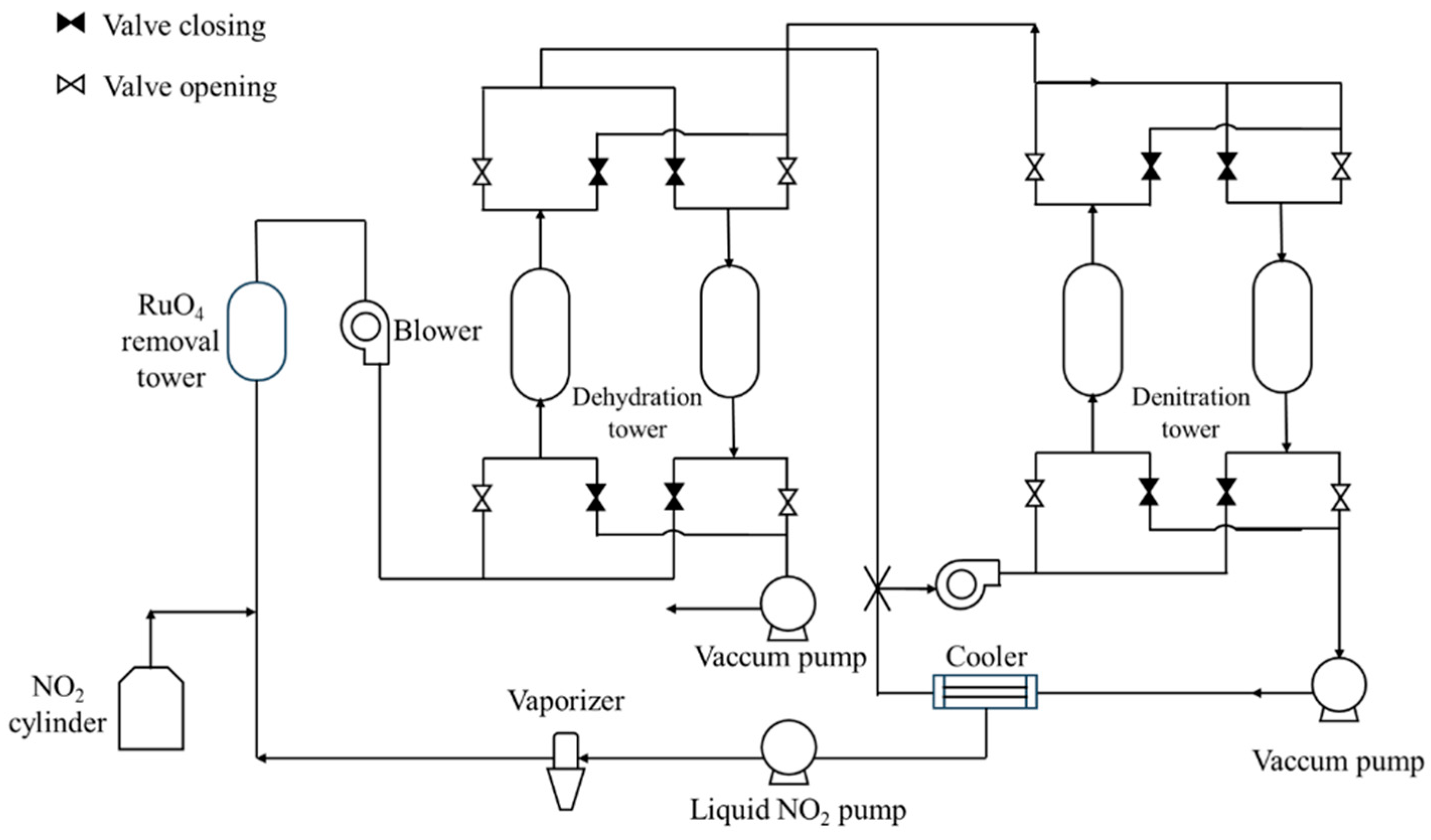
The Rokkasho Reprocessing Plant in Japan employed VPSA technology in 2003 to recycle NOx generated at the facility [41]. The plant’s exhaust gas composition comprised 8.9% NOx, 24.8% H2O, 4.8 ppb RuO4, with air making up the balance. The NOx was recovered in the form of NO2. The pilot plant operated for 100 days without failure [12]. At 338 K, the denitrification unit achieved over 95% recovery of nitrogen oxides from the exhaust gas, with a processing capacity of 500 kg/d. The recovered NOx exhibited a purity exceeding 99.8% (with less than 0.2% H2O). The process flow diagram for the nitrogen oxide unit is shown in Figure 2.
The parameters of the adsorbent used in this process are shown in Table 5. For the ruthenium tetroxide adsorbent, USY200 was selected due to its strong hydrophobicity and excellent acid resistance. It exhibits the highest RuO4 retention rate, with a breakthrough of only 2%, a decontamination factor >5000, and an adsorption capacity matched to the RuO4 half-life (1 year), eliminating the need for frequent replacement. For the water adsorbents, silica-gel underwent preliminary dehydration, while synthetic mordenite zeolite underwent deep drying. The final product contained <0.2% H2O. The synthetic mordenite zeolite demonstrated high stability and acid tolerance. For NOx adsorbents, Pentasil (3000) zeolite was selected for its high NO2 adsorption selectivity, balanced hydrophobicity and acid resistance, and suitability for VPSA cycling conditions.
Table 6 lists the parameters for several adsorption towers in the VPSA process. In this study, NOx gas reacts with condensate to form HNO3, which corrodes pipelines and equipment. Therefore, SUS 304 stainless steel is used for the adsorption towers, making it suitable for this scenario. The adsorbents loaded are all monolithic adsorbents, replacing traditional spherical adsorbents to reduce the risk of adsorbent fragmentation clogging pipelines. The operating temperature is 343 K, maintained above the gas dew point of 338 K to prevent condensation of HNO3. During desorption, dry air is used for countercurrent purging to rapidly remove moisture or NO2 from the adsorbate phase, minimizing acid residue.
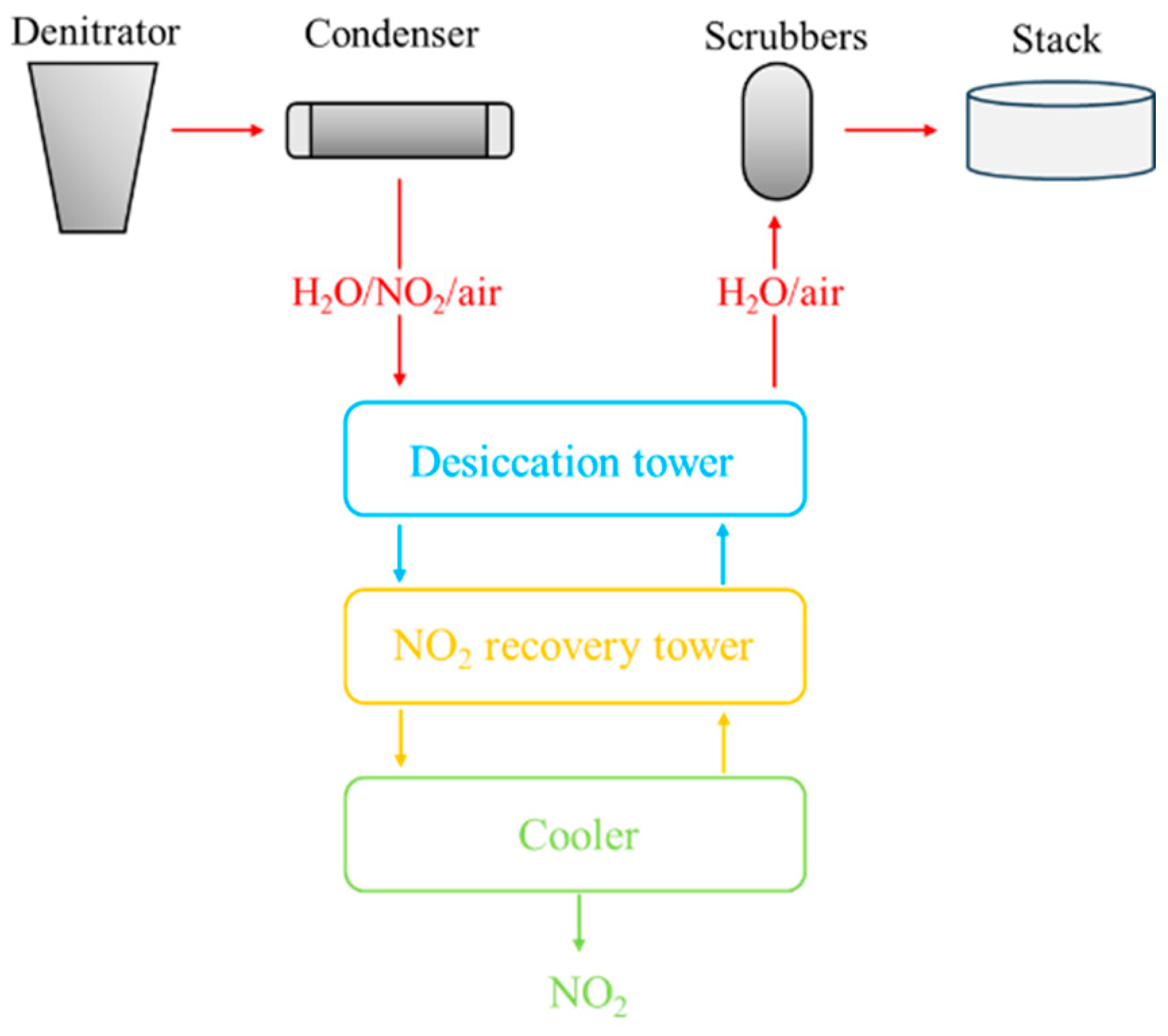
During this process, the adsorbent can be recycled. The vacuum pressure swing adsorption process flow for NOx treatment at Rokkasho Reprocessing Plant is shown in Figure 3.
Step 1: Drying the exhaust gas using acid-resistant adsorbents, with no significant loss of NOx. Given the overall humid atmosphere containing NOx, acid formation is highly likely. To prevent degradation of the adsorbent’s activity, the required adsorbent must possess strong acid resistance. The mixed atmosphere generated at this plant has a dew point of 338K. To minimize acid’s impact on adsorbent activity, adsorption is conducted at 343K. This adsorption process primarily dries the gas by adsorbing water vapor, with a small amount of NOx also adsorbed. It is essential to maintain the NOx concentration above a certain threshold to ensure minimal loss of this target collection material.
Step 2: Concentrate NOx in the dry exhaust gas using a suitable adsorbent. Since atmospheric NO rapidly converts to NO2, the NOx in this process is primarily NO2. Given the presence of moisture in the system, the adsorbent must be acid-resistant. This step adsorbs a significant amount of NOx, facilitating the subsequent cooling and liquefaction process to enhance NOx yield and improve purity.
Step 3: The desorbed gas containing high concentrations of NO2 is sent to the condenser. Since NO2 boils at 21.2 °C, it is recovered as a liquid product at this stage. Over 95% of the NO2 in the feed gas is recovered as a liquid product.
During desorption, over half of the NO2 is liquefied in the cooler, while the unliquefied NO2 is returned to the denitrification tower for recovery. The volume fraction of lost NO2 is <1%, achieving a NOx recovery rate exceeding 95%. Regarding dynamic adsorption capacity, PSA typically achieves only a fraction of the capacity of TSA. This characteristic enables significant downsizing of PSA units for equivalent treatment requirements, effectively conserving space and reducing capital investment. However, current research remains confined to laboratory scale, employing simulated gases under non-radioactive conditions, with neither scale nor parameters meeting industrial application standards. For nuclear reprocessing operations, process variations result in significant differences in NOx tail gas composition and concentration. Consequently, adaptive optimization of this PSA process based on actual operating conditions is urgently needed.

3.3. Temperature Swing Adsorption

Temperature Swing Adsorption (TSA) is a cyclic adsorption process that utilizes the characteristic of adsorbents where their adsorption capacity for gas components changes significantly with temperature. By periodically altering the temperature of the adsorption bed, it achieves gas separation and purification. Its thermodynamic foundation lies in the inherently exothermic nature of the physical adsorption process of gases, where the adsorption equilibrium constant decreases as temperature increases. TSA is typically configured with dual or multiple beds to enable continuous processing. A complete cycle comprises the following core steps:
  • Adsorption: The pretreated feed gas passes through the adsorption bed at ambient or lower temperatures. Strongly adsorbable impurities (such as water, organic solvents, and high-boiling-point components) are selectively retained, with the purified gas discharged as product. This stage constitutes an isothermal or near-isothermal exothermic process, requiring careful consideration of the bed temperature rise’s impact on adsorption performance.
  • Heating Desorption: When the adsorption front approaches the bed outlet, the process switches. High-temperature regeneration gas (such as hot nitrogen, steam, or superheated air) is introduced into the saturated adsorption bed. Heat is transferred to the adsorbent, providing the energy required for desorption. This imparts sufficient kinetic energy to the impurity molecules to dislodge them from the adsorption sites. The desorbed impurities are carried out of the bed by the regeneration gas stream.
  • Cooling: After thermal regeneration, the bed temperature remains significantly higher than the adsorption temperature. Clean gas at ambient or low temperatures must be introduced to cool the bed down to the required adsorption temperature. This cooling process also serves to purge residual desorbed components.
  • Pressure Adjustment and Standby: Following cooling, pressure adjustment may be necessary to match adsorption conditions. The bed then enters standby mode, awaiting transition to the next adsorption cycle.
Zhiqiang Wang and colleagues developed a closed-loop deep purification process for high-concentration, highly volatile NOx tail gas (270–2700 ppm, the concentration ratio of NO to NO2 is approximately 9:1) emitted from nuclear facilities [42]. This process centers on ZSM-5 zeolite temperature-swing adsorption technology coupled with urea absorption pretreatment, and its engineering feasibility was validated through a 200 Nm3/h pilot plant. The study proposed an innovative adsorption-concentration-return-reabsorption closed-loop process, as illustrated in Figure 4.
  • Pre-treatment: High-concentration, fluctuating raw tail gas undergoes primary denitrification in a urea absorption tower with >90% efficiency, significantly reducing inlet concentration.
  • Deep purification: Post-urea-treated tail gas, still at elevated concentration, undergoes cooling and deep drying using 3A molecular sieves before entering a ZSM-5 zeolite adsorption tower for deep adsorption purification.
  • Regeneration and Closed-Loop: After adsorption saturation, the ZSM-5 bed undergoes optimized variable-temperature desorption at 200 °C with system pressure reduced to −50 kPa, yielding high-concentration NOx desorption gas (>40,000 mg/m3).
Material accounting indicates that the recycled desorbed gas is mainly NO2, accounting for only 2% of the total original NOx. After a 24-h stable operation test in a 200 Nm3/h pilot-scale system, the breakthrough time reached 12.5 h, demonstrating the adsorption bed’s excellent pollutant-holding capacity and long-term operational stability. The NOx concentration at the outlet of the adsorption tower remained stably ≤ 10 ppm, with a purification efficiency > 99.88% and a desorption efficiency ≥ 95%. The dynamic adsorption capacity of ZSM-5 zeolite reached as high as 0.36 mmol/g, and after 16 adsorption-desorption cycles, the adsorption capacity decay rate was <2%, entering a stable phase. However, for the pilot-scale stability test, the 24-h duration is excessively short, and the feed gas was simulated tail gas after urea absorption, which failed to fully replicate the complexity and harshness of real nuclear tail gas. Although 16 cycles can illustrate short-term stability, key engineering issues such as the long-term decay trend of adsorbent performance, adsorbent pulverization caused by high-temperature regeneration, and the increase in bed pressure drop have not been verified for nuclear industry devices that require continuous operation for months or even years. This verification experiment was conducted in a non-radioactive environment, and the irradiation effects and contamination of the adsorbent by trace radioactive aerosols, iodine isotopes, etc., which may be present in real nuclear tail gas, were not mentioned—these are also urgent research gaps that need to be addressed in domestic and international studies.
TSA process exhibits unique advantages in treating NOx in exhaust gas due to its specific operational mode. However, during the temperature swing adsorption process, the heating and cooling of the adsorbent bed are slow, so a complete TSA cycle may take several hours. Additionally, repeated heating and cooling cycles may lead to adsorbent aging and deactivation. These factors have somewhat limited the widespread industrial application of temperature swing adsorption.

3.4. Temperature-Pressure Synergistic Strategy

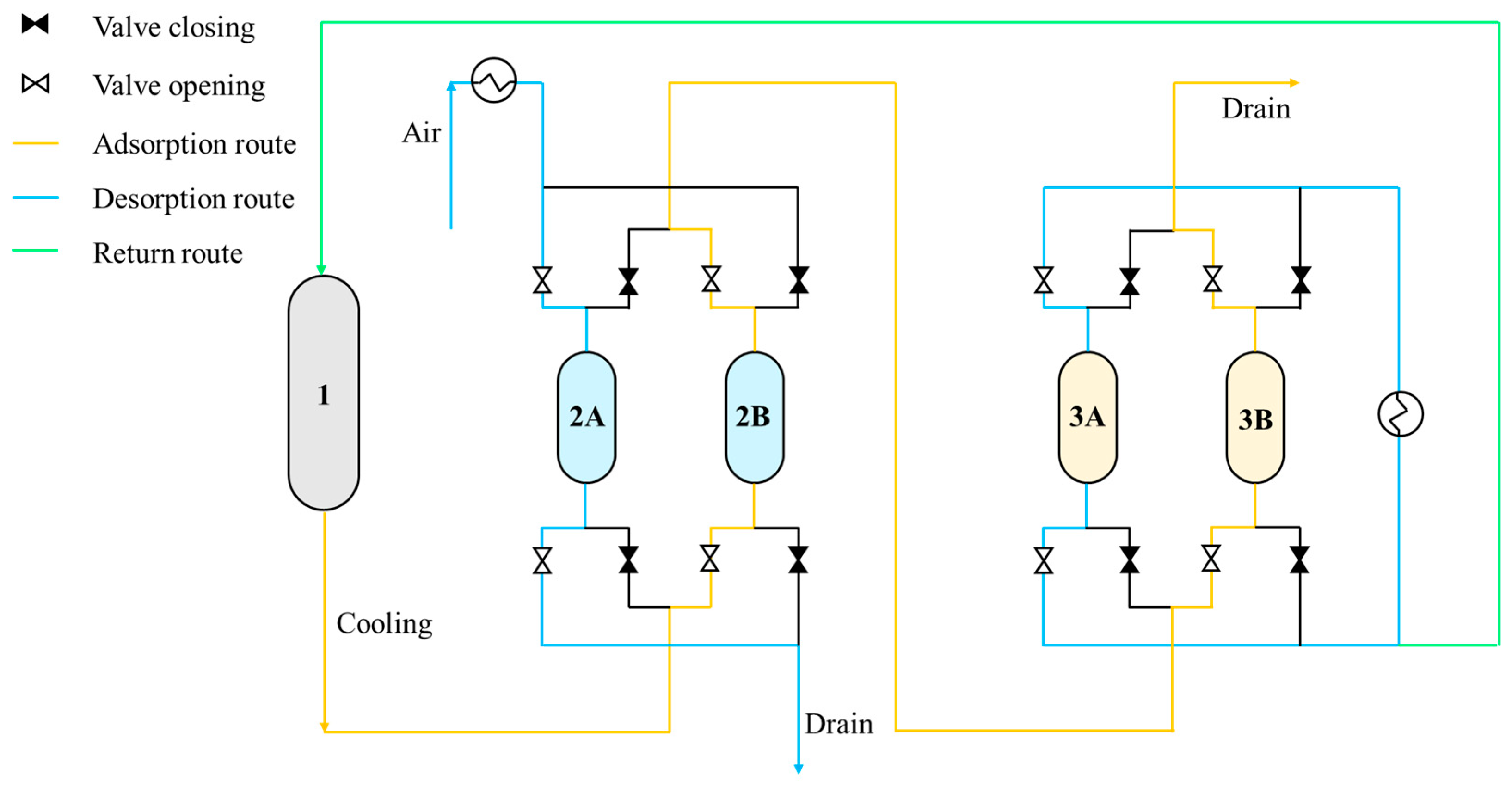
Liu’s team proposed a novel temperature-and-pressure swing cyclic adsorption process, namely Vacuum Temperature Swing Adsorption using multiple Gas circulations (GVTSA), which integrates dual regulation of temperature and pressure to optimize the efficiency and performance of the adsorption process [43]. Employing self-prepared granular Na-ZSM-5 zeolite as the adsorbent, the authors conducted adsorption-recovery experiments and scale-up studies of NOx from sintering flue gas. The core innovation of the GVTSA process lies in the combination of vacuum temperature swing adsorption (VTSA) and closed hot gas circulation technology, coupled with the innovative adoption of a segmented gas chromatography (GC) analytical strategy. Field tests were performed using dual-tower setups at two scales (small tower, ST; large tower, LT) to validate the process feasibility. Based on the experimental results, a conceptual triple-tower process design for continuous production was further proposed, laying a foundation for the industrial application of the GVTSA technology in NOx capture and recovery from sintering flue gas. The dual-tower GVTSA system incorporates controlled multiple hot gas recirculation cycles supplemented by purging steps, as shown in Figure 5.
  • Adsorption: Flue gas passes through the adsorption tower, where Na-ZSM-5 catalyzes the oxidation of NO to NO2 and adsorbs it.
  • Heating: Close the tower inlet and outlet, activate the closed-loop system, and heat the circulating gas via the heat exchanger to raise the bed temperature to the target desorption temperature of 493K.
  • Gas Circulation: During the first gas circulation (GC), the thermal circulation gas flows continuously while desorption occurs at a constant standard pressure of −50 kPa within the system. When the NO2 concentration in the desorption gas exceeds 2%, the desorbed NO2 gas passes through a buffer tank and heat exchanger for temperature adjustment. The high-concentration NO2 exceeding 2% is then recovered as desorption gas. For the nth GC, fresh NOx-free gas from another tower in the adsorption phase is introduced to initiate a new cycle, further driving deep desorption.
  • Purge: Slowly purge the bed with a small volume of dry, cold purified gas to cool and carry out residual high-concentration NOx gas for recovery.
  • Purification: Rapidly purge with a large volume of purified gas to cool the bed to the adsorption temperature of 308 K. The purge gas is directly vented.
In the dual-tower GVTSA process research, the self-developed NaZSM-5 zeolite exhibited a saturated adsorption capacity as high as 1.496 mmol/g, with a working adsorption capacity stabilizing at approximately 0.10 mmol/g, meeting the emission standard of ≤50 mg/m3. NOx recovery exceeded 92%, with NO2 concentrations enriched from approximately 20 ppm at the inlet to an average of >2.5%. This represents an enrichment factor exceeding 1000-fold, meeting feed requirements for subsequent low-temperature condensation recovery processes. After 16 consecutive adsorption-desorption cycles, the adsorbent’s working capacity remained stable, demonstrating the process and adsorbent’s excellent cycling and regeneration capabilities. The dual-tower GVTSA process employs a closed-loop system to prevent significant NO2 dilution caused by hot air/steam purging in conventional TSA systems. It maintains desorption drive through multiple fresh gas injections, achieving high desorption efficiency and high NO2 concentration enrichment. However, the dual-tower GVTSA process inherently operates intermittently—one tower adsorbing while the other desorbs—preventing continuous operation. To meet the demand for treating high-flow, continuously emitted sintering flue gas from steel mills, a triple-tower GVTSA process was designed to enable continuous NO2 output.
The key steps in NOx adsorption using the triple-tower GVTSA process are as follows:
  • Adsorption Stage: Flue gas (308 K) treated for desulfurization and dehydration (RH < 1%) enters the denitrification tower. Na-ZSM-5 zeolite catalyzes the oxidation of NO to NO2 and selectively adsorbs it, maintaining outlet NO2 concentration below ultra-low emission standards (≤25 ppm) for approximately 14 h.
  • Desorption Stage: Includes heating (HT) and multi-stage gas circulation (GC), with the core being enhanced NO2 desorption through closed-loop circulation.
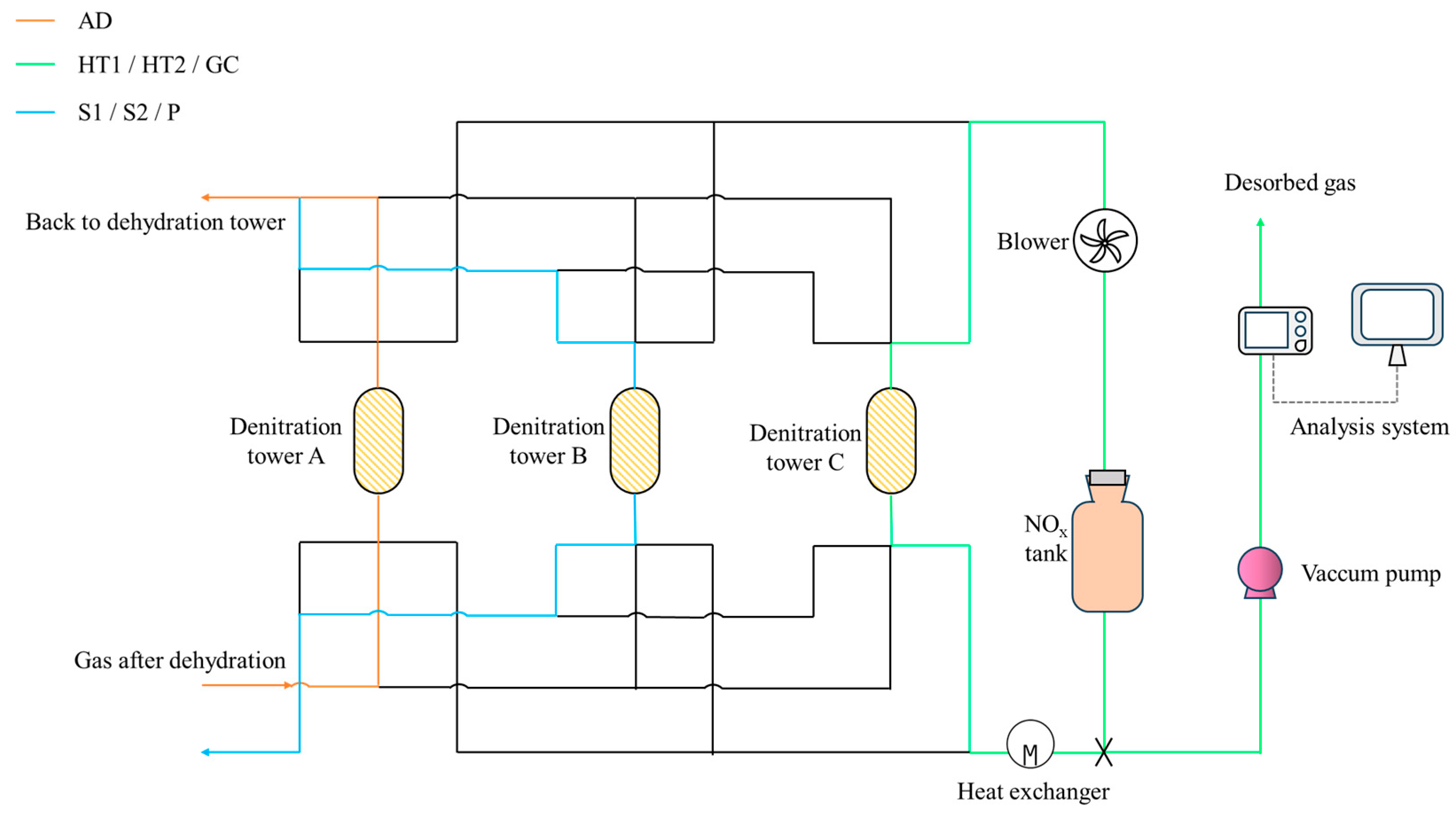
  • Heating (HT, 3 h): Gas circulating within the closed loop is heated via a heat exchanger to 493 K. This preheats the bed (HT1, 2 h) before maintaining temperature for initial NO2 enrichment (HT2, 1 h).
  • Gas Circulation (GC, 3 h): Comprises three 60-min cycles (G1–G3). Circulating gas is drawn from the exhaust of another denitrification tower in adsorption phase (NOx-free), supplemented into the closed loop for continuous circulation. This disrupts NOx adsorption equilibrium, promoting desorption of strongly adsorbed NO2 from zeolite into the gas phase. Part of the desorbed NO2 enrichment gas is diverted to the condensation recovery system, with the remainder recycled.
  • Cooling stage: Includes purging (S) and purification (P), balancing bed cooling with residual NO2 recovery.
  • Purge (S, 3 h): Low-flow (1/5 feed gas volume) clean gas is introduced into the bed to gradually cool it and purge residual NO3. Enriched gas is diverted for recovery (S1 phase), while subsequent makeup gas is used for desorption in the next tower (S2 phase).
  • Purification (P, 3 h): High-flow (≥1/2 feed gas volume) clean gas rapidly cools the bed to adsorption temperature (308 K). Tail gas is directly vented, and the bed enters the next adsorption cycle.
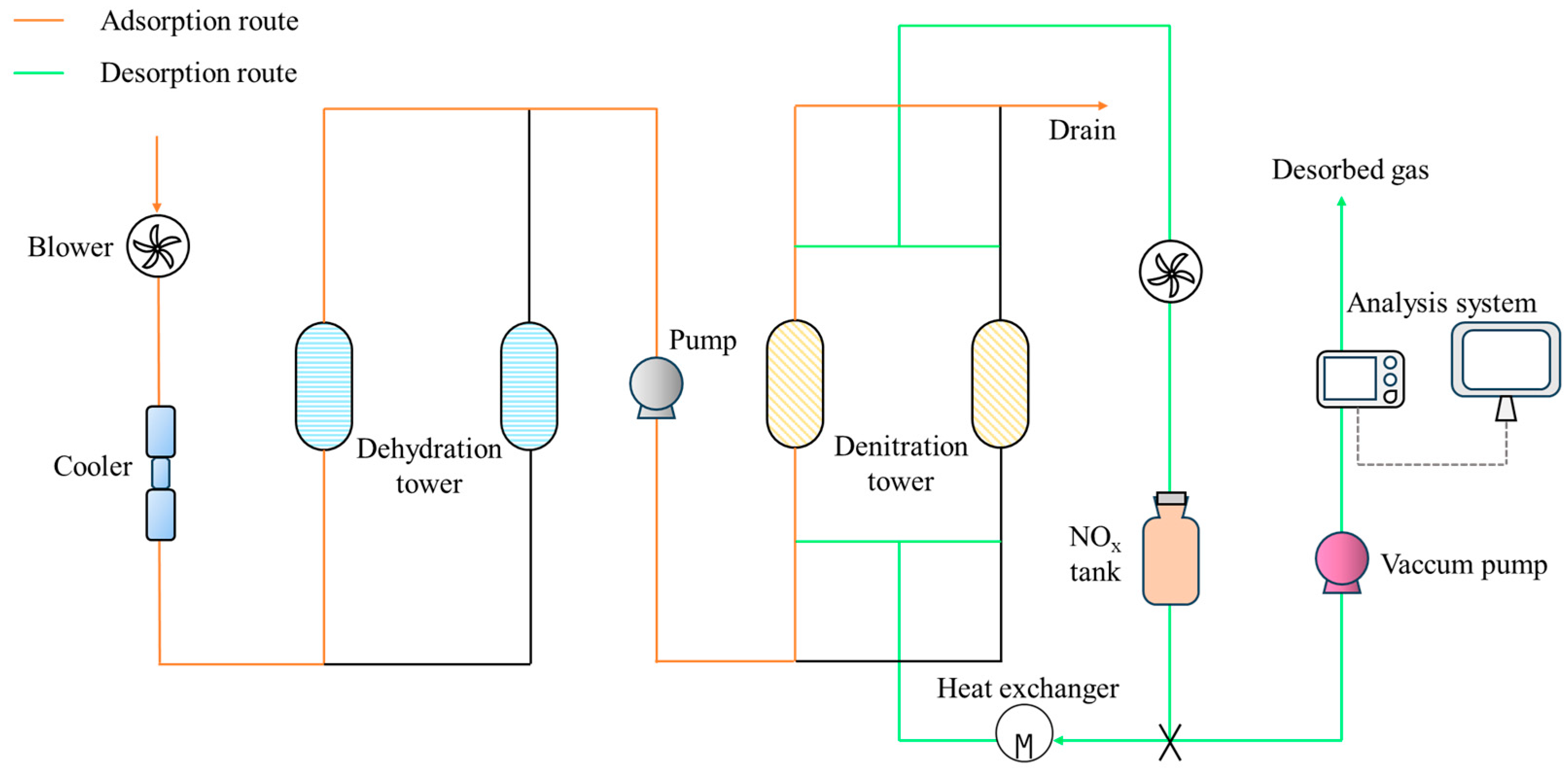
The triple-tower GVTSA process flow diagram is shown in Figure 6. Through sequential switching between three denitrification towers (A/B/C), the system simultaneously completes three stages: adsorption (AD) → heating/circulation (HT1/HT2/GC) → purging/purification (S1/S2/P), achieving continuous NOx removal and recovery. During the adsorption phase (AD), dehydrated flue gas enters the corresponding tower (Tower A), where the adsorbent captures NOx. The purified dry tail gas is then sent to the dehydration tower for reuse. During the desorption phase (HT1/HT2/GC), the saturated tower (Tower C) switches to the green pathway shown in the diagram. Driven by a fan, the gas is heated via heat exchangers (HT1/HT2) while a vacuum pump maintains vacuum conditions. Gas recirculation (GC) facilitates NOx desorption and enrichment. Finally, during the regeneration phase (S1/S2/P), the desorbed tower (Tower B) switches to the blue pathway. Purge gas cools and pressurizes the tower, completing tower cooling and adsorbent regeneration to prepare for the next adsorption cycle.
The optimized GVTSA process recovers NOx primarily as NO2, achieving a recovery rate of up to 92%. From the feed gas’s original 200 ppm NOx concentration, approximately 2% NO2 is enriched, meeting the requirements for low-temperature condensation recovery. The Na-ZSM-5 zeolite catalyzes the oxidation of NO to NO2, achieving a NO2 to NO ratio of 9:1 in the product stream. With 88.9% of NO converted, this process resolves the challenges of NO’s poor adsorption and recovery. Designed for steel sintering flue gas, a single triple-tower system can process 3 × 10⁴ m3/h of flue gas, recovering approximately 86.25 tons of NO2 annually. The entire system consumes approximately 600 kW of energy.
Although this study proposes a triple-tower optimization strategy, the long-term operational data for the triple-tower process is limited to performance degradation testing over 16 cycles. The equipment scaling effect has not been fully demonstrated, and further validation is required for industrial implementation. Furthermore, this study focuses on iron ore sintering flue gas treatment, where NOx concentrations are approximately 200 ppm. However, NOx concentrations in nuclear fuel reprocessing tail gases can reach thousands or even tens of thousands of ppm. The desorption efficiency under higher concentration conditions, the stability of NO2 enrichment concentrations, and the stability of the adsorbent under radioactive conditions have not been investigated. Therefore, further experimental design and research are particularly important.
The advantages and disadvantages of the four NO2 purification processes are shown in Table 7. In this study, process selection requires comprehensive consideration of exhaust gas characteristics (such as concentration, flow rate, and composition), product purity and concentration requirements, site conditions, and investment and operating costs. For demanding scenarios like nuclear reprocessing, GVTSA demonstrates significant potential due to its high-efficiency concentration and interference resistance. For lower-concentration, smaller-scale applications, optimized VPSA or TSA may offer greater economic viability. The selection of process technology requires comprehensive consideration of exhaust gas characteristics (such as concentration, flow rate, and composition), product purity and concentration requirements, site conditions, and investment and operational costs. For demanding scenarios like nuclear reprocessing, GVTSA demonstrates significant potential due to its high-efficiency concentration and interference resistance. For lower-concentration, smaller-scale applications, optimized VPSA or TSA may offer greater economic viability.

4. Conclusions and Outlook

This study systematically reviews research progress in adsorption methods for NO2 purification. Compared to traditional technologies such as liquid absorption, SCR/SNCR, biological methods, and plasma methods, adsorption offers significant advantages in NO2 resource recovery, atmospheric pressure and low-temperature operation, and minimal secondary pollution. It is suitable for scenarios requiring NO2 reuse, such as the nitric acid industry and nuclear fuel reprocessing. Regarding adsorbent materials, zeolites demonstrate outstanding performance in selective NO2 adsorption due to their tunable pore structures and surface acidic sites; metal modification can further enhance their adsorption capacity and hydrothermal stability. Activated carbon and biochar exhibit promising potential for low-temperature NO2 adsorption based on their high specific surface area and diverse surface functional groups; alkali modification and metal loading can improve their performance. Metal oxides achieve efficient NO2 adsorption through surface alkaline sites, oxygen vacancies, and redox properties. At the process level, PSA and TSA are the current mainstream technologies. Engineering examples of VPSA in Rokkasho Reprocessing Plant and TSA in China have validated the feasibility of adsorption methods for industrial-scale NOx recovery. The novel GVTSA process enhances desorption efficiency and regenerative performance by intensifying the desorption concentration gradient through multi-stage gas cycling, offering a new pathway for process optimization.
Although significant progress has been made in NO2 purification via adsorption, high-concentration and high-volume NO2 tail gases still pose challenges, such as the need for large quantities of adsorbent, which increases equipment investment and operating costs. Meanwhile, energy optimization during adsorbent regeneration and the efficient recovery of desorbed NO2 have yet to yield economically viable integrated solutions. In addition, NO2 in nuclear fuel reprocessing tail gases contains complex components such as radioactive impurities and corrosive gases, placing extremely high demands on adsorbent radiation resistance and acid tolerance. Currently, research in this field remains extremely limited, with a lack of specialized adsorbent materials and process systems tailored for this specific scenario. Therefore, future research on NO2 purification via adsorption should focus on material innovation and process optimization. Efforts should be strengthened in the development of large-scale adsorbent production technologies, implementation of industrial demonstration projects, collection of process operation data in nuclear industrial scenarios, optimization of equipment design and operational parameters, and promotion of adsorption technology from laboratory research to large-scale engineering practice, so as to provide more competitive technical solutions for NO2 emission reduction and resource utilization in nuclear fuel reprocessing plants.

Author Contributions

Conceptualization, X.M. and G.L.; methodology, B.W.; validation, H.H., S.C. and Y.C.; formal analysis, Z.S.; investigation, X.M.; resources, H.T.; data curation, Y.T.; writing—original draft preparation, X.M.; writing—review and editing, B.W. and G.L.; visualization, X.M.; supervision, H.H.; project administration, H.T. All authors have read and agreed to the published version of the manuscript.

Funding

This research received no external funding.

Data Availability Statement

No new data were created or analyzed in this study.

Conflicts of Interest

The authors declare no conflict of interest.

References

  1. Wang, Q.; Liu, Y.; Pan, X. Atmosphere pollutants and mortality rate of respiratory diseases in Beijing. Sci. Total Environ. 2008, 391, 143–148. [Google Scholar] [CrossRef]
  2. Jion, M.M.M.F.; Jannat, J.N.; Mia, M.Y.; Ali, M.A.; Islam, M.S.; Ibrahim, S.M.; Pal, S.C.; Islam, A.; Sarker, A.; Malafaia, G.; et al. A critical review and prospect of NO2 and SO2 pollution over Asia: Hotspots, trends, and sources. Sci. Total Environ. 2023, 876, 162851. [Google Scholar] [CrossRef]
  3. Zheng, C.; Zhao, C.; Li, Y.; Wu, X.; Zhang, K.; Gao, J.; Qiao, Q.; Ren, Y.; Zhang, X.; Chai, F. Spatial and temporal distribution of NO2 and SO2 in Inner Mongolia urban agglomeration obtained from satellite remote sensing and ground observations. Atmos. Environ. 2018, 188, 50–59. [Google Scholar] [CrossRef]
  4. Wei, S.; Hong, Q.; Tan, W.; Chen, J.; Li, T.; Wang, X.; Xue, J.; Fang, J.; Liu, C.; Tanvir, A.; et al. Spatiotemporal Distribution, Sources, and Impact on Atmospheric Oxidation of Reactive Nitrogen Oxides in the North China Plain Agricultural Regions in Summer. Remote Sens. 2024, 16, 3192. [Google Scholar] [CrossRef]
  5. Elkaee, S.; Phule, A.D.; Yang, J.H. Advancements in (SCR) technologies for NOx reduction: A comprehensive review of reducing agents. Process Saf. Environ. Prot. 2024, 184, 854–880. [Google Scholar] [CrossRef]
  6. Mao, Y.; Wang, H.-F.; Hu, P. Theoretical investigation of NH3-SCR processes over zeolites: A review. Int. J. Quantum Chem. 2015, 115, 618–630. [Google Scholar] [CrossRef]
  7. Anichkov, S.N.; Zykov, A.M.; Tumanovskii, A.G.; Kulish, O.N.; Zaporozhski, K.I. Development of SNCR Technology and Prospects of Its Application. Therm. Eng. 2021, 68, 510–515. [Google Scholar] [CrossRef]
  8. Yang, W. Summary of flue gas denitration technology for coal-fired power plants. IOP Conf. Ser. Earth Environ. Sci. 2019, 300, 032054. [Google Scholar] [CrossRef]
  9. Zhang, S.; Liu, F.; Zhu, H.; Lv, S.; Wang, B. Simultaneous nitrate and phosphorus removal in novel steel slag biofilters: Optimization and mechanism study. J. Environ. Manag. 2024, 349, 119558. [Google Scholar] [CrossRef] [PubMed]
  10. Chen, P. Desulfurization and Denitrification of Ship Exhaust Gas with Low Temperature Plasma. IOP Conf. Ser. Earth Environ. Sci. 2020, 558, 042011. [Google Scholar] [CrossRef]
  11. Sun, M.; Ku, C.; Tao, Z.; Wang, T.; Wen, C.; Aamir, H.; Wang, C.; Gu, Q.; Sit, P.; Shang, J. Ambient temperature NO2 removal by adsorption on transition metal ion-exchanged chabazite zeolites. Results Eng. 2023, 18, 101134. [Google Scholar] [CrossRef]
  12. Matsuoka, S.; Kodama, T.; Izumi, J.; Tsutaya, H.; Kurosu, K.; Someya, H. Development of NOx Recycle Process for Practical Use at Reprocessing Plant. J. Nucl. Sci. Technol. 2004, 41, 466–472. [Google Scholar] [CrossRef]
  13. Li, Z.; Yang, X.; Wang, Y.; Yang, H.; Song, Q. Characteristics and mechanism of low-temperature NO adsorption by activated carbon. Chem. Eng. J. 2024, 495, 153639. [Google Scholar] [CrossRef]
  14. Gupta, N.K.; Achary, S.N.; Viltres, H.; Bae, J.; Kim, K.S. Novel application of sodium manganese oxide in removing acidic gases in ambient conditions. Sci. Rep. 2023, 13, 2330. [Google Scholar] [CrossRef] [PubMed]
  15. Wang, Y.; Wang, T.; Gu, Q.; Shang, J. Adsorption Removal of NO2 Under Low-Temperature and Low-Concentration Conditions: A Review of Adsorbents and Adsorption Mechanisms. Adv. Mater. 2025, 37, 2401623. [Google Scholar] [CrossRef] [PubMed]
  16. Gupta, N.K.; Vikrant, K.; Kim, K.S.; Kim, K.-H.; Giannakoudakis, D.A. Regeneration strategies for metal–organic frameworks post acidic gas capture. Coord. Chem. Rev. 2022, 467, 214629. [Google Scholar] [CrossRef]
  17. Fang, M.-L.; Chang, H.-Y.; Chen, C.-H.; Chang, H.-Y.; Chen, C.-H.; Lin, S.-L.; Hsieh, Y.-K. Chemical Adsorption of Nitrogen Dioxide with an Activated Carbon Adsorption System. Aerosol Air Qual. Res. 2019, 19, 2568–2575. [Google Scholar] [CrossRef]
  18. Salahudeen, N. A Review on Zeolite: Application, Synthesis and Effect of Synthesis Parameters on Product Properties. Chem. Afr. 2022, 5, 1889–1906. [Google Scholar] [CrossRef]
  19. Zheng, M.W.; Tsuyoshi, A.; Kumagai, M. Adsorption Separation of Low Concentrations of CO2 and NO2 by Synthetic Zeolites. Energy Fuels 1998, 12, 1055–1060. [Google Scholar] [CrossRef]
  20. Delachaux, F.; Vallières, C.; Monnier, H.; Lecler, M.-T. Experimental study of NO and NO2 adsorption on a fresh or dried NaY zeolite: Influence of the gas composition by breakthrough curves measurements. Adsorption 2019, 25, 95–103. [Google Scholar] [CrossRef]
  21. Despres, J.; Koebel, M.; Kröcher, O.; Elsener, M.; Wokaun, A. Adsorption and desorption of NO and NO2 on Cu-ZSM-5. Microporous Mesoporous Mater. 2003, 58, 175–183. [Google Scholar] [CrossRef]
  22. Sun, L.M.; Wang, T.; Ku, C.; Hanif, A.; Tian, T.; Johannessen, B.; Gu, Q.; Li, Z.; Sit, P.; Shang, J. Regulating NO2 adsorption at ambient temperature by manipulating copper species as binding sites in copper-modified SSZ-13 zeolites. J. Mater. Chem. A 2024, 12, 30329. [Google Scholar] [CrossRef]
  23. Tao, Z.; Tian, Y.; Wang, R.; Zhang, T.; Wang, T.; Zhang, H.; Li, M.; Qiao, J.; Kong, M.; Feng, S.; et al. Zero-emission NO2 capture using divalent metal cation-exchanged zeolites for air purification. Nat. Commun. 2025, 16, 10102. [Google Scholar] [CrossRef]
  24. Tao, H.; Liu, Y.; Li, J.; Zhang, C.; Zhao, C.; Yang, X.; Yang, R.T.; Li, Z. Oxidative adsorption mechanism-based screening of zeolites for deep purification and recycling of NOx from humid gases. Chem. Eng. J. 2023, 475, 146148. [Google Scholar] [CrossRef]
  25. Tan, X.-F.; Liu, S.-B.; Liu, Y.-G.; Gu, Y.-L.; Zeng, G.-M.; Hu, X.-J.; Wang, X.; Liu, S.-H.; Jiang, L.-H. Biochar as potential sustainable precursors for activated carbon production: Multiple applications in environmental protection and energy storage. Bioresour. Technol. 2017, 227, 359–372. [Google Scholar] [CrossRef] [PubMed]
  26. Denmark, I.; Alam, A.; Ahsan, R.; Watanabe, F.; Viswanathan, T.; Siraj, N. Comparative Study of Chemical Activation and Physical Activation Approach to Optimize Biomass-Based Doped Carbons for Energy Applications. ECS J. Solid State Sci. Technol. 2024, 13, 061003. [Google Scholar] [CrossRef]
  27. Pasadakis, N.; Romanos, G.; Perdikatsis, V.; Foscolos, A.E. The Production of Activated Carbons Using Greek Lignites by Physical and Chemical Activation Methods: A Comparative Study. Energy Sources Part A Recovery Util. Environ. Eff. 2011, 33, 713–723. [Google Scholar]
  28. Belala, Z.; Belhachemi, M.; Jeguirim, M. Activated Carbon Prepared from Date Pits for the Retention of NO2 at Low Temperature. Int. J. Chem. React. Eng. 2014, 12, 717–726. [Google Scholar] [CrossRef]
  29. Ghouma, I.; Jeguirim, M.; Sager, U.; Limousy, L.; Bennici, S.; Däuber, E.; Asbach, C.; Ligotski, R.; Schmidt, F.; Ouederni, A. The Potential of Activated Carbon Made of Agro-Industrial Residues in NOx Immissions Abatement. Energies 2017, 10, 1508. [Google Scholar] [CrossRef]
  30. Silas, K.; Ghani, W.A.W.A.K.; Choong, T.S.Y.; Rashid, U. Breakthrough studies of Co3O4 supported activated carbon monolith for simultaneous SO2/NOx removal from flue gas. Fuel Process. Technol. 2018, 180, 155–165. [Google Scholar] [CrossRef]
  31. Deliyanni, E.; Bandosz, T.J. Effect of Carbon Surface Modification with Dimethylamine on Reactive Adsorption of NOx. Langmuir 2011, 27, 1837–1843. [Google Scholar] [CrossRef]
  32. Bazan-Wozniak, A.; Nosal-Wiercińska, A.; Cielecka-Piontek, J.; Yilmaz, S.; Pietrzak, R. Adsorption of Nitrogen Dioxide on Nitrogen-Enriched Activated Carbons. Int. J. Mol. Sci. 2024, 25, 4421. [Google Scholar] [CrossRef]
  33. Ji, Y.; Bai, S.; Crocker, M. Al2O3-based passive NOx adsorbers for low temperature applications. Appl. Catal. B Environ. 2015, 170, 283–292. [Google Scholar] [CrossRef]
  34. Li, X.; Gao, F.; Li, W.; Shen, M.; Wang, J.; Shen, G. Mechanistic insights and application potentials for CeO2-Al2O3 passive NOx adsorber (PNA) materials. J. Environ. Chem. Eng. 2024, 12, 113468. [Google Scholar] [CrossRef]
  35. Kim, H.; Jung, H.; Han, J.W.; Lee, K.B. Experimental and density functional theory studies on Cu/Ba-coimpregnated γ-Al2O3 for low-temperature NOx storage and adsorbent regeneration. Chem. Eng. J. 2022, 429, 132112. [Google Scholar] [CrossRef]
  36. Gupta, N.K.; Rajput, K.; Achary, S.N.; Dhavale, R.P.; Mehta, B.R.; Roy, D.R.; Kim, K.S. Chemisorption of SO2 and NO2 gas over Na0.4MnO2 in ambient conditions: An experimental and theoretical study. New J. Chem. 2024, 48, 4670–4674. [Google Scholar] [CrossRef]
  37. Gupta, N.K.; Rajput, K.; Achary, S.N.; Kim, E.J.; Mehta, B.R.; Roy, D.R.; Kim, K.S. Reactive Adsorption of SO2 and NO2 Gases over Black Mass Derived from Discarded Alkaline Batteries. Energy Fuels 2024, 38, 545–554. [Google Scholar] [CrossRef]
  38. Toso, A.; Danielis, M.; De Leitenburg, C.; Boaro, M.; Trovarelli, A.; Colussi, S. Key Properties and Parameters of Pd/CeO2 Passive NOx Adsorbers. Ind. Eng. Chem. Res. 2022, 61, 3329–3341. [Google Scholar] [CrossRef]
  39. Choi, Y.; Mun, S.; Lee, K.B. Direct synthesis of vertically oriented Co-Mg-Al layered double hydroxide on spherical γ-Al2O3 for passive NOx adsorber. Appl. Surf. Sci. 2025, 687, 162248. [Google Scholar] [CrossRef]
  40. Sultana, A.; Habermacher, D.D.; Kirschhock, C.E.A.; Martens, J.A. Adsorptive separation of NOx in presence of SOx from gas mixtures simulating lean burn engine exhaust by pressure swing process on Na–Y zeolite. Appl. Catal. B Environ. 2004, 48, 65–76. [Google Scholar] [CrossRef]
  41. Matsuoka, S.; Kodama, T.; Kumagai, M.; Tamura, T.; Izumi, J.; Someya, H. Development of Adsorption Process for NOx Recycling in a Reprocessing Plant. J. Nucl. Sci. Technol. 2003, 40, 410–416. [Google Scholar] [CrossRef][Green Version]
  42. Wang, Z.; Jiang, Z.; Tang, Y.; Shen, Y.; Sun, N.; Li, Z.; Liu, J. Pilot-Scale Study on Advanced Purification of High-Concentration NOx Exhaust from Nuclear Facilities Using ZSM-5 Temperature-Swing Adsorption. Chem. Ind. Eng. Prog. 2025, 12, 1113. (In Chinese) [Google Scholar]
  43. Liu, Y.; You, Y.; Li, Z.; Yang, X.; Wu, X.; Zhao, C.; Xing, Y.; Yang, R.T. NOx removal with efficient recycling of NO2 from iron-ore sintering flue gas: A novel cyclic adsorption process. J. Hazard. Mater. 2021, 407, 124380. [Google Scholar] [CrossRef] [PubMed]
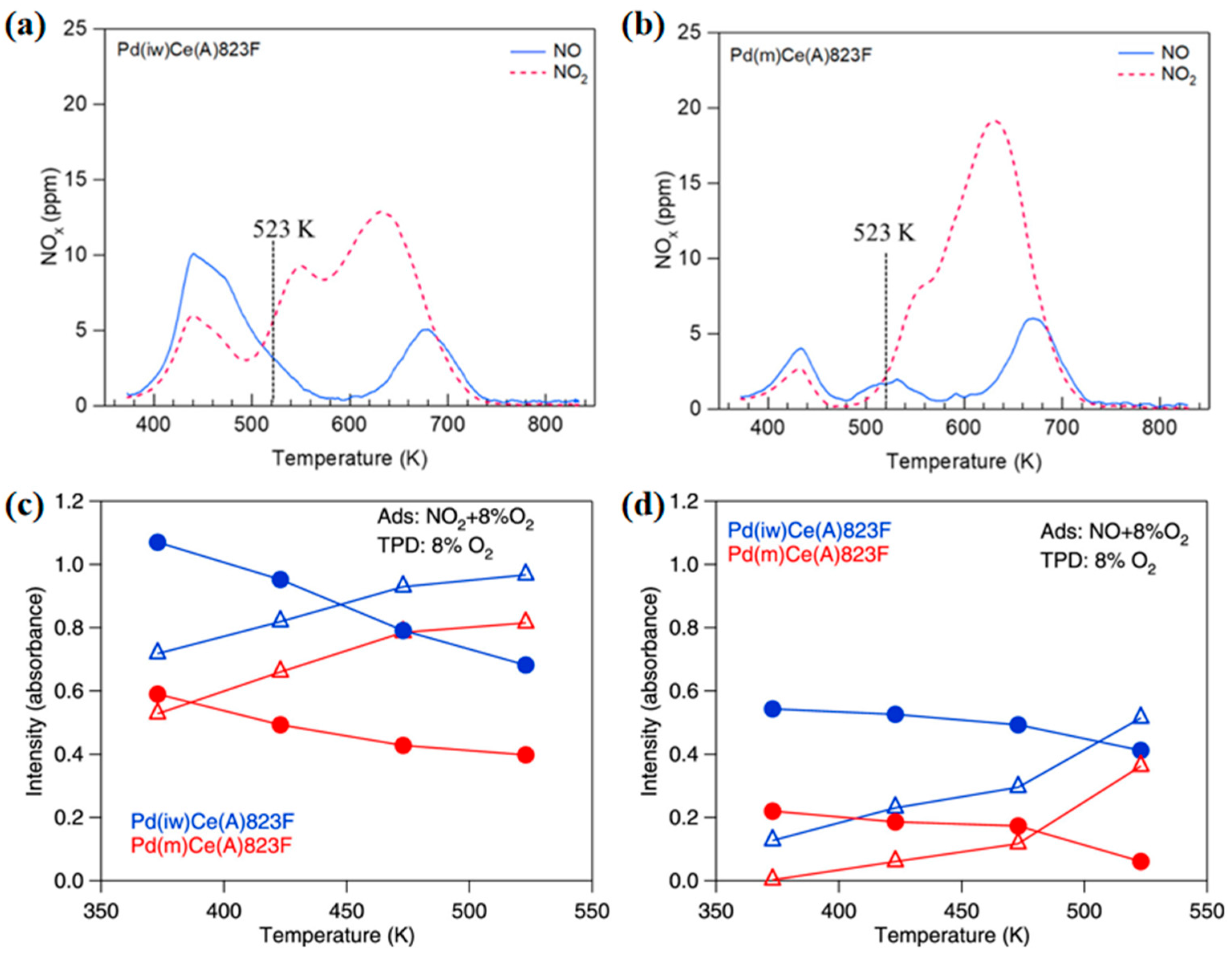
Figure 1. (a) NO and NO2 release curves of Pd (iw) Ce (A) 823F and (b) Pd (m) Ce (A) 823F samples during TPD; Evolution of (●) nitrites (1350–1050 cm−1) and (△) nitrates (1500–1590 cm−1) as a function of temperature during TPD (8 vol % O2) on Pd(iw)Ce(A)823F and Pd(m)Ce(A)823F after (c) NO2 and (d) NO adsorption. (Here, iw denotes samples prepared by initial wet impregnation, and m denotes samples prepared by dry grinding.) Reproduced from ref. [38].
Separations 13 00024 g001
Figure 2. Process flow diagram of the Nitrogen Oxide treatment facility at the Rokkasho Reprocessing Plant (Adapted from ref. [12]).
Separations 13 00024 g002
Figure 3. Existing and proposed exhaust gas treatment designs for NOx recovery (Adapted from ref. [41]).
Separations 13 00024 g003
Figure 4. Schematic diagram of the TSA process for treating high-concentration NOx. 1: Urea absorption tower; 2A and 2B: Dehydration towers; 3A and 3B: Denitrification tower (Adapted from ref. [42]).
Separations 13 00024 g004
Figure 5. Schematic diagram of the dual-tower GVTSA NOx recovery process (Adapted from ref. [43]).
Separations 13 00024 g005
Figure 6. Schematic diagram of the triple-tower GVTSA process for adsorption recovery of NOx and sequence of operations for each tower (Adapted from ref. [43]).
Separations 13 00024 g006
Table 1. Adsorption capacity of NO2 by zeolites with different Si/Al ratios and frameworks.
ZeoliteSi/Al RatioFrameworkAdsorption Test ConditionsNO2 Adsorption Capacity (mmol/g)Refs.
4A1LTA800 ppm NO2, 950 ppm CO2, 0.11 L/min, 333 K0.36[19]
5A1LTA800 ppm NO2, 950 ppm CO2, 0.11 L/min, 333 K0.87
13X1.6FAU800 ppm NO2, 950 ppm CO2, 0.11 L/min, 333 K2.99
HM5MOR800 ppm NO2, 950 ppm CO2, 0.11 L/min, 333 K1.24
NaM5MOR800 ppm NO2, 950 ppm CO2, 0.11 L/min, 333 K1.78
NaY2.4FAU800 ppm NO2, 950 ppm CO2, 0.11 L/min, 333 K1.78
USY6.1FAU800 ppm NO2, 950 ppm CO2, 0.11 L/min, 333 K0.43
NaY(wet)2.55FAU350 ppm NO2, 8.5% O2, N2, 1.17 L/min, 303 K3.31[20]
NaY(wet)2.55FAU350 ppm NO2, N2, 1.17 L/min, 303 K2.89
NaY(dry)2.55FAU350 ppm NO2, 8.5% O2, N2, 1.17 L/min, 303 K2.03
CuZSM-540MFI500 ppm NO2, 10% O2, N2, 5.0 L/min, 473 K0.165[21]
CuZSM-540MFI500 ppm NO2, 5% H2O, 10% O2, N2, 5.0 L/min, 473 K0.139
Cun+SSZ-13-190-R12CHA1000 ppm NO2, He, 0.06 L/min, 298 K1.79[22]
HSSZ-1312CHA1000 ppm NO2, He, 0.06 L/min, 298 K1.17
Ca-LTA3LTA500 ppm NO2, Air, 0.2 L/min, 298 K3.94[23]
Mn-LTA3LTA500 ppm NO2, Air, 0.2 L/min, 298 K3.13
Na-LTA3LTA500 ppm NO2, Air, 0.2 L/min, 298 K3.87
Table 2. Adsorption capacity and stability of NO2 by activated carbon prepared from different precursors and different preparation methods.
PrecursorPreparation MethodAdsorption Test ConditionsNO2 Adsorption Capacity (mmol/g)Refs.
/Degassing at 200 °C for 2 h200 ppm NO2, N2, 0.5 L/min, 303 K1.26[13]
/Degassing at 200 °C for 2 h200 ppm NO2, N2, 0.5 L/min, 253 K2.16
Date pitsActivated for 2 h at 850 °C500 ppm NO2, N2, 0.33 L/min, 293 K2.32[28]
Date pitsActivated for 2 h at 850 °C500 ppm NO2, N2, 0.33 L/min, 333 K1.85
Olive pomace50% phosphoric acid solution stirred at 110 °C for 9 h5 ppm NO2, 50%RH air, 23.5 L/min, 296 K0.183[29]
Olive pomacePure CO2 gas flow, 750 °C activation for 6 h5 ppm NO2, 50%RH air, 23.5 L/min, 296 K0.313
Olive pomaceWater vapor flow, activated at 750 °C for 6 h5 ppm NO2, 50%RH air, 23.5 L/min, 296 K0.348
WoodDimethylamine (DMA)-modified commercial BAX-15001000 ppm NO2, air, 0.45 L/min, 296 K1.07[31]
Orthocoking
coal
Chemical activation with NaOH at 800 °C, accompanied by ammonia oxidation1000 ppm NO2, air, 0.45 L/min, 298 K0.51[32]
Orthocoking
coal
Chemical activation with NaOH at 800 °C, accompanied by ammonia oxidation1000 ppm NO2, air, 0.45 L/min, 298 K1.63
Table 4. Process parameters for PSA separation of NOx resistant to SO2 poisoning [40].
ConditionsTemperature (℃)Adsorption/Desorption Cycle (min)Adsorption/Desorption Space Velocity (h−1)Regenerated Gas
Parameters25510/1030,000/15,0005%H2O+ 10%O2+ He
Table 5. Adsorbents Used in Rokkasho Nuclear Fuel Reprocessing Plant [12].
RouteAdsorbentsSpecifications
Remove RuO4USY200Si/Al ratio = 200
DesiccationSilica-gel + H-type MordeniteSi/Al ratio = 20
NOx RecoveryPentasil (3000) zeoliteSi/Al ratio = 3000
Table 6. Specific process parameters for VPSA NOx recovery at Rokkasho Fuel Reprocessing Plant [12].
Chemical Engineering DeviceAdsorption/Desorption
Pressure (kPa)
Temperature (K)
Ruthenium removal Tower120343
Desiccation tower120/60343
NOx recovery tower120/5298
Cooler110260
Table 7. Comparison of Primary NO2 Adsorption Processes.
ProcessAdvantagesDisadvantages
PSAHigh cycle rate and automation levelThe desorption driving force is limited
VPSAComplete desorption, high product purity, suitable for complex mixturesLong cycle times and potential thermal aging of adsorbents
TSAMore thorough than PSA desorption with higher recovery ratesRequires a vacuum system, increasing equipment investment and energy consumption
GVTSAHigh desorption efficiencyComplex manufacturing processes, challenging control requirements, and high equipment investment costs
Disclaimer/Publisher’s Note: The statements, opinions and data contained in all publications are solely those of the individual author(s) and contributor(s) and not of MDPI and/or the editor(s). MDPI and/or the editor(s) disclaim responsibility for any injury to people or property resulting from any ideas, methods, instructions or products referred to in the content.