


Abstract
Horseradish (Armoracia rusticana L.) root (HRP) and leaf (HLP) pomaces, by-products of juice production by cold-pressing, were analyzed as a novel potential source of natural antioxidants. Chromatography analysis (UHPLC Q-ToF MS) of the bioactive compounds of pomaces was performed along with spectrophotometric determination of total phenolic content (TPC), total flavonoid content (TFC), total phenolic acid (hydroxycinnamic) content (TPAC), and antioxidant capacity (via 1,1-diphenyl-2-picrylhydrazyl (DPPH•) and 2,2′-azino-bis(3-ethylbenzothiazoline-6-sulphonic-acid) (ABTS•+) radicals’ scavenging activity and ferric reducing antioxidant power (FRAP)). The concentrations of TPC, TFC, and TPAC differed among the pomaces, significantly favoring HLP. However, both horseradish pomaces (HRP and HLP) contained a considerable amount of various phenolics, with kaempferol and its glucosides dominating. In addition, they exhibit pronounced antioxidant activity, which is confirmed by all three methods used (DPPH, ABTS, and FRAP). These results highlight the potential of valorizing horseradish processing waste as a natural, reliable source of health-promoting bioactive compounds and functional ingredients in food products, thereby fortifying food, preventing oxidation, and prolonging shelf-life. In addition, this study supports endeavors to reduce food waste by providing new insights into the valorization of horseradish pomace, thus contributing to sustainable development and environmental protection.
1. Introduction
Waste management is one of the major global problems of the 21st century, caused by increasing globalization and industrialization, inadequate management of raw materials, and insufficient infrastructure. Food waste occurs along the entire food supply chain at every stage of production: from harvesting, transport, storage, and sorting to retail and end consumer households [1]. Large amounts of food waste and by-products generated in the agri-food industry are disposed of in landfills and have a negative impact on the environment. In addition, unsustainable waste disposal can lead to high economic costs for food companies [2].
Strategies for managing food loss and waste have evolved over the years to minimize environmental impact and optimize production costs. Long-known approaches include using plant by-products as livestock feed, fertilizer, compost component or as an ingredient in alcoholic and soft beverages [3]. However, some new sustainable approaches for regulating this type of waste provide both economic and substantial functional value, including the valorization of plant biowaste rich in biologically active compounds as natural quality-maintaining and oxidative-stability-enhancing ingredients in various food products [3]. Large amounts of pomace (10–35% of the raw mass) generated during fruit and vegetable processing could be used as an entirely new ingredient or as a substitute for various synthetic food-improving agents on an industrial scale, thus enriching food with additional bioactive and nutritious components [4]. This would also meet the growing consumer trend towards a more conscious and healthier lifestyle, as evidenced by the increasing exploration and selection of naturally sourced food ingredients.
The majority of waste from the fruit and vegetable processing industry can still be reused, especially pomace from juice production [1]. Horseradish (Armoracia rusticana L.) is a vegetable from the Brassicaceae family, rich in glucosinolates, isothiocyanates, and phenolics [5,6,7], which provide a broad range of biological activities and health benefits, including both antimicrobial and antioxidant activities, as well as anticoagulant properties and protective effects on the gastrointestinal system [8]. Recently, this plant has gained increasing scientific interest precisely due to its richness in valuable bioactive compounds, which may be potential components for innovative applications in various fields (e.g., as anti-cancer components or as natural bactericides, fungicides, insecticides, antioxidants, etc.) [9]. As a source of phenolics and other bioactives possessing antioxidant activity, horseradish roots and leaves have found nutritional and consumer applications as a salad, as an ingredient in various dishes, or pressed into juice [5,10]. Thanks to their proven functionality and health benefits, the trend of using horseradish root and leaf juices and extracts is increasing. As we have investigated in our previous publications, [11,12] encapsulated horseradish root and leaf juices have been used to prevent the oxidation of mayonnaise. However, a significant environmental issue arises from inadequate post-processing, management, and disposal of the large amounts of pomaces that accumulate as organic waste during the production of cold-pressed vegetable juices [5]. To address these challenges and enable waste-free production, this generated side stream could also have promising potential as a nutrient-enriching and/or bioactive ingredient in human foods due to its richness in highly valuable bioactive compounds with health-promoting effects [13].
Therefore, this study aimed to investigate the potential for valorizing horseradish juice processing waste as a natural, under-researched, health-beneficial, and cost-effective functional food ingredient. For this purpose, a detailed insight into phytochemical composition and antioxidant properties of the horseradish root and leaf pomaces was performed by spectrophotometric and UHPLC Q-ToF-MS characterization. This study aligns with high consumer awareness and growing interest in green and ecological solutions by promoting zero-waste production and contributing to environmentally sustainable development.
2. Materials and Methods
2.1. Chemicals
Chemicals were purchased as follows: phenolic standards—catechin from dr Ehrenstorfer (Augsburg, Germany), quercetin and gentisic acid from Wuhan ChemFaces Biochemical Co. (Wuhan, China), caffeic acid and gallic acid from Sigma Chemicals Co. (St. Louis, MO, USA), antioxidant activity standard—Trolox from Acros Organics (Geel, Belgium); solvents—acetonitrile, formic acid, and methanol (LC-MS grade) from CARLO ERBA Reagents GmbH (Cornaredo, Italy), hydrochloric acid, acetic acid, ethanol, and methanol from Zorka Pharma (Šabac, Serbia); salts—NaNO2, NaOH, K2S2O8, and AlCl3 from Sigma Chemicals Co. (St. Louis, MO, USA), NaCl from Zorka Pharma (Šabac, Serbia), Na2HPO4 from Hemos (Belgrade, Serbia), Na2CO3 from LOBA Chemie (Mumbai, India), NaH2PO4 and CH3COONa from ALKALOID AD (Skopje, North Macedonia), Na2MoO4 from VWR International (Leuven, Belgium), FeCl3 from NRK Inženjering (Belgrade, Serbia); reagents—Folin–Ciocalteu, TPTZ, and DPPH from Sigma Chemicals Co. (St. Louis, MO, USA), ABTS from ThermoFisher GmbH (Kandel, Germany); and ultrapure water—obtained using a basic water purification system BBPS-508 (Biolab Scientific, Markham, ON, Canada).
2.2. Horsereadish Root and Leaf By-Products
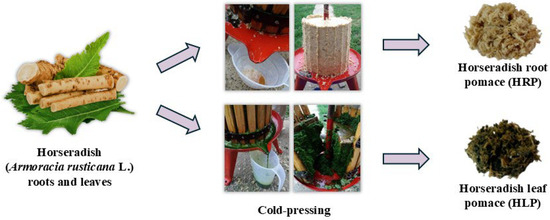
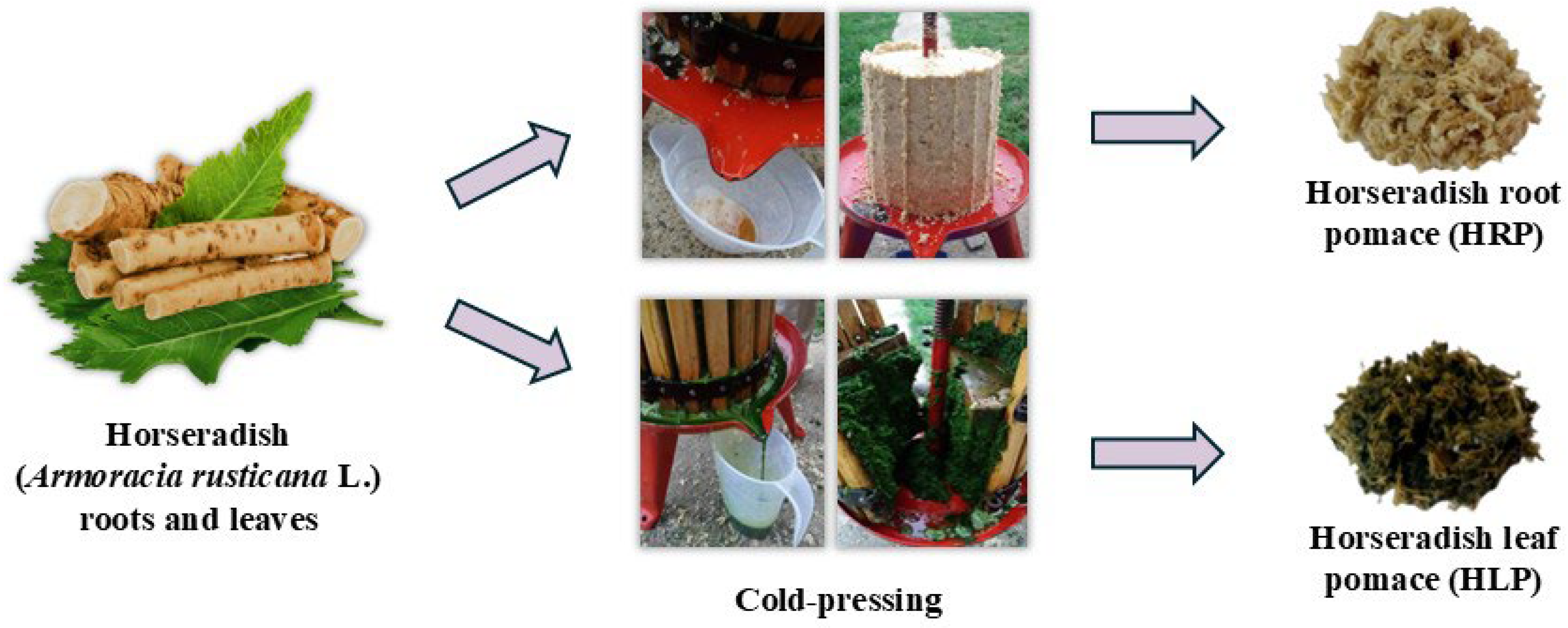
Fresh horseradish (Armoracia rusticana L.) was cultivated in Velika Plana, Serbia (44.347161, 21.135060), where it is grown over large areas and is characteristic of the region. First, 15 kg of leaves was collected in May, and 25 kg of roots was collected in October. The roots are characterised by a distinctly white colour, moderate pungency, a diameter of 1.5 to 5 cm, a length of 30 to 50 cm, and a weight of 150 to 200 g. The leaves are large and elongated (50 to 70 cm long), dark green, upright, arranged in a rosette, with a notched lamina, strong innervation, and slight creases. They were thoroughly washed with still water to remove impurities and left to air dry at room temperature for 3 h. To prepare the samples for cold-pressing, the horseradish roots and leaves were cut into smaller pieces (approximately 5 cm) and ground in a mill at room temperature to facilitate juice extraction. The horseradish roots and leaves were then cold-pressed using a mechanical wooden basket press (Enoitalia, Italy) to extract juice for further use (described in Marković et al. [11,12]). Large amounts of horseradish root pomace (HRP) and horseradish leaf pomace (HLP) remained as by-products (Figure 1). In order to fully utilize the plant raw material, the pomaces were stored in plastic bags at −18 °C and further analyzed.
Figure 1.
Process flow diagram for the production of horseradish root (HRP) and leaf (HLP) pomace by cold-pressing.
2.3. Moisture Content
The moisture content (MC) of HRP and HLP was measured by standard gravimetric analysis using the AOAC method [14]. Pomaces (approximately 3.0 g) were placed in a laboratory air oven (Memmert UF-55, Schwabach, Germany) and dried at 105 °C until a constant mass was achieved. The moisture content was calculated as the ratio of the mass of the samples after and before drying and expressed as a percentage.
2.4. Chromatographic Analysis of the Pomaces
2.4.1. Preparation of the Pomaces for Chromatographic Analysis
The horseradish root (HRP) and leaf (HLP) pomaces (1 g) were extracted prior to UHPLC Q-ToF-MS analysis by mixing with 80% (v/v) methanol containing 0.1% HCl (1:10 w/v) and shaking on an orbital shaker for 1 h, at room temperature. The extraction mixtures were then centrifuged at 3000× g for 10 min. After centrifugation and immediately before the chromatographic analysis, the supernatants were separated by filtration through 0.22 µm syringe filters.
2.4.2. UHPLC Q-ToF-MS Analysis
An Agilent 1290 Infinity ultra-high-performance liquid chromatography (UHPLC) system coupled to a quadrupole time-of-flight mass spectrometer (6530C Q-ToF-MS) (Agilent Technologies, Inc., Santa Clara, CA, USA) was used to analyze the bioactive compounds of HRP and HLP, following the same method and operating parameters as previously described by Kostić et al. [15] and Marković et al. [11]. Chromatographic separation of the bioactive compounds was performed at 40 °C on a Zorbax C18 column (2.1 × 50 mm, 1.8 µm) (Agilent Technologies, Inc., Santa Clara, CA, USA). The mobile phase consisted of (A) ultrapure water and (B) acetonitrile (MS grade), both containing 0.1% formic acid (v/v) (MS grade). The flow rate of the mobile phase was set to 0.3 mL/min and the injection volume was 5 μL. The gradient elution program started with 2% solvent B for the first 2 min, then 2–98% B for 2–17 min, and for the next 5 min the gradient was returned to initial conditions (2% B) to re-equilibrate the column.
Analysis of the bioactive compounds (phenolic compounds and glucosinolates) was performed using the QToF-MS system, which recorded spectra in auto MS/MS acquisition mode over the m/z range of 100 to 1700 in negative ionization (ESI−) mode with a fixed collision energy of 30 eV. Instrument control, data evaluation, and analysis were conducted using Agilent MassHunter software version 12.1 (Agilent Technologies, Santa Clara, CA, USA). Previously reported literature data [7,16,17], along with MS fragmentation and monoisotopic mass, were used to identify the analyzed bioactive compounds. The identified phenolic acid and flavonoid derivatives were semi-quantified using available standards and expressed as mg equivalents of the standard per 100 g of HRP or HLP calculated on a dry weight (dw) basis of the pomace. The standards used for the semi-quantification of the phenolic compounds (gentisic acid and quercetin), their equation parameters and correlation coefficients (R2), limit of detection (LOD) and limit of quantification (LOQ) were previously reported by Fotirić Akšić et al. [18] and are listed in Table S1 [18]. ChemDraw software version 12.0, (CambridgeSoft, Cambridge, MA, USA) was used to calculate the exact masses of the compounds.
2.5. Spectrophotometric Analysis of the Pomaces
2.5.1. Preparation of the Pomaces for Spectrophotometric Analysis
Preparation of horseradish root (HRP) and leaf (HLP) pomaces for spectrophotometric analysis included the conventional extraction method (maceration). Namely, the 5 g of pomace was poured with 50 mL of 80% (v/v) ethanol. The glass container was then closed and the extraction was performed by stirring on a magnetic stirrer at 700 rpm for 60 min at room temperature in the dark. The pomace extracts were then filtered through a six-layer cotton gauze and stored in the dark at 4 °C until further use (up to a maximum of 72 h). The total phenolic content, total flavonoid content, and antioxidative activity of the filtered extracts were determined using a HALO DB-20S UV/VIS spectrophotometer (Dinamica Scientific Ltd., Livingston, UK), as described in our previous study [11].
2.5.2. Total Phenolics, Flavonoids, and Phenolic (Hydroxycinnamic) Acids in Pomaces
Total phenolic content (TPC) of the HRP and HLP extracts was quantified using the Folin–Ciocalteu method as described by Singleton et al. [19], with some modifications. Briefly, 0.5 mL of pomace extract was mixed with 2.5 mL of Folin–Ciocalteu reagent (10% v/v) and left in the dark for 5 min, followed by the addition of 2.0 mL of Na2CO3 (7.5%). The reaction mixture was incubated in the dark, at room temperature, for 2 h, and absorbance readings were performed at 760 nm, in triplicate. Distilled water was used as a blank. Gallic acid was used as a standard to generate the calibration curve, and results were expressed as mg gallic acid equivalents (GAE) per 100 g dry weight (dw) of the pomace.
Total flavonoid content (TFC) of the HRP and HLP extracts was determined according to Kim et al. [20], with some modifications. Briefly, 0.5 mL of pomace extract was mixed with 2 mL of distilled water and reacted with 0.15 mL of NaNO2 (5% w/v), 0.15 mL of AlCl3 (10% w/v), 1 mL of NaOH (1 M), and 1.2 mL of distilled water. The reaction mixture was incubated in the dark, at room temperature, for 15 min and absorbance readings were performed at 415 nm, in triplicate. Distilled water was used as a blank. Catechin was used as a standard to generate the calibration curve, and the results were expressed as mg catechin equivalents (CE) per 100 g dw of the pomace.
Total phenolic (hydroxycinnamic) acid content (TPAC) of the HRP and HLP extracts was quantified using the Arno reagent method according to Matkowski et al. [21]. Briefly, 0.5 mL of pomace extract, 1 mL of HCl (0.5 M), 1 mL of Arno reagent (10 g NaNO2 and 10 g Na2MoO4 in 100 mL distilled water), and 1 mL of NaOH (8.5%) were pipetted into a test tube and made up to 5 mL with distilled water. The absorbance of the reaction mixture was measured at 490 nm, in triplicate. Distilled water was used as a blank. Caffeic acid was used as a standard to generate the calibration curve, and the results were expressed as mg caffeic acid equivalents (CAE) per 100 g dw.
2.5.3. Antioxidant Properties of the Pomaces
The antioxidant activities of the HRP and HLP extracts were determined spectrophotometrically through the application of three different assays: 2,2-diphenyl-1-picrylhydrazyl (DPPH•) radical scavenging activity [22], 2,2′-azino-bis(3-ethylbenzothiazoline-6-sulphonic-acid) (ABTS•+) radical cation scavenging activity [23,24], and ferric reducing antioxidant power (FRAP) [25], as described in our previous study [11]. All antioxidant activity results in the current research were expressed as mmol Trolox equivalents (TE) per 100 g dw of the pomace.
DPPH assay was performed by mixing 0.1 mL of pomace extract and 1.9 mL of DPPH• methanolic solution (0.094 mmol/L) and incubating the mixture in the dark for 30 min at room temperature. Absorbance measurements of the samples after incubation were performed at 517 nm, in triplicate. Distilled water was used as a blank. The percentage of inhibition I (%) of DPPH• radicals was calculated using Equation (1):
where Ab is the absorbance of the blank and As is the absorbance of the sample.
ABTS assay was performed by mixing 0.03 mL of pomace extract and 3 mL of ABTS•+ working solution and incubating the mixture in the dark for 6 min at room temperature. The ABTS•+ working solution with an absorbance of 0.70 ± 0.02 at 734 nm was prepared by adding phosphate buffer (pH 7.4) to the ABTS•+ stock solution (equal amounts of 14 mmol ABTS and 4.9 mmol K2S2O8, both in 5 mmol phosphate buffer (pH 7.4), were mixed and incubated in the dark for 18 h). Absorbance measurements of the samples after incubation was performed at 734 nm, in triplicate. Distilled water was used as a blank. The percentage of inhibition of ABTS•+ radical cations was calculated according to Equation (1).
FRAP assay was performed by mixing 0.1 mL of pomace extract, 0.3 mL of distilled water, and 3 mL of FRAP reagent (prepared by mixing acetate buffer (pH 3.6), 10 mmol 2,4,6-tris(2-pyridyl)-s-triazine (TPTZ) solution in 40 mmol HCl, and 20 mmol FeCl3 × 6H2O solution in distilled water in a volume ratio of 10:1:1), followed by incubation at 37 °C in the dark. Distilled water was used as a blank. Absorbance measurements were performed after incubation at 593 nm, in triplicate.
2.6. Statistical Analysis
Total phenolics, flavonoids, and phenolic acids in the pomaces, as well as their antioxidant activity, were statistically analyzed using the SPSS Statistics 25.0 software package (IBM, Armonk, NY, USA). The results were expressed as mean value ± standard deviation of three measurements. Statistically significant differences between means were assessed using a one-way analysis of variance (ANOVA) with post hoc Duncan’s multiple range test or a non-parametric Kruskal–Wallis test at a 95% confidence level (p < 0.05), depending on the homogeneity of variances (tested with Levene’s test; p < 0.05).
3. Results and Discussion
3.1. Moisture Content
The moisture content of vegetables varies depending on the type and part of the plant. Since vegetables from the Brassicaceae family have a high water content, their pomace also tends to retain a significant amount of moisture, especially when fresh or minimally processed [26]. Furthermore, roots generally have a lower moisture content than leaves, which is confirmed by the moisture content determination of root and leaf pomaces analyzed in this study: HRP 64.20 ± 0.56% and HLP 77.86 ± 0.21%. This is important for the food processing industry, as it is a crucial parameter for maintaining physical and biological stability, directly impacting the storability of pomaces. The results indicate that HRP is potentially more resistant to microbial spoilage and physicochemical degradation due to its lower moisture. In addition, a higher moisture content makes the pomace bulky, leading to high transportation costs [27]. After the production of fresh juice by cold-pressing, the resulting horseradish pomace still has a high percentage of water that could be transformed into juice. Similar results for moisture content (70–75%) have been reported for other fruit and vegetable pomaces: oranges, apples, carrots, beetroots, and celery roots [28]. These results can be explained by the possible presence of fibers in the pomace that keep the available water bound, which is not released by the force generated during pressing [26,28,29].
3.2. UHPLC Q-ToF-MS Analysis
Identification, characterization and semi-quantification of phenolic compounds detected in the methanolic HRP and HLP extracts are presented in Table 1. Untargeted analysis revealed a total of 17 compounds, which can be divided into two subclasses: (1) hydroxybenzoic acids and their monoglycosides (6 compounds), and (2) flavonol aglycones, glycosides, and acyl derivatives (11 compounds). As can be seen, HRP and HLP have a similar total content of all identified phenolic compounds, i.e., 526.56 and 507.21 mg/100 g dw, respectively. However, HRP and HLP samples differed in the presence, distribution, and abundance of phenolic compounds, especially flavonols.
Table 1.
Characterization and semi-quantification (mg/100 g dw) of phenolic compounds and their derivatives in the horseradish root (HRP) and leaf (HLP) pomace, using UHPLC Q-ToF-MS. Target compounds, mean expected retention time (RT), molecular formula, calculated mass, m/z exact mass, mean mass accuracy (mDa), and MS2 fragments are presented.
Phenolic acids and glycosides were mostly detected in the HRP extract, with their total content being three times higher than in HLP, primarily due to isomers of dihydroxybenzoic acid hexoside (7.98 and 46.61 mg GA/100 g dw) and hydroxybenzoic acid (18.11 and 21.64 mg GA/100 g dw). Isomers of hydroxybenzoic acid (3 and 6) and dihydroxybenzoic acid (5) were identified based on their monoisotopic mass and typical fragmentation patterns. Moreover, dihydroxybenzoic acid was found in low amounts or traces in both HRP and HLP, and it predominantly exists in the form of monohexosides. Isomers of dihydroxybenzoic acid hexoside have the same monoisotopic mass and fragments obtained by the loss of a hexosyl unit (−162 Da) and the neutral loss of CO2 (−44 Da), but differ in their elution times. Syringic acid hexoside was found only in HLP. This compound showed typical fragments obtained by cleavage of the syringic acid aglycone, including neutral losses of CO2 (−44 Da) and/or CH3 group(s) (−15 Da). Similar phenolic acid profiles have previously been reported for horseradish root and leaf juices obtained by cold-pressing and for their formulations encapsulated within various biopolymers [11,12]. On the other hand, Tomsone et al. [30] reported a lower content of p-hydroxybenzoic acid (0.26 mg/100 g dw) in HLP, as well as the presence of sinapic, coumaric, chlorogenic and ferulic acids, which were not found in our study. These differences in profiles could be influenced by the cultivation and processing conditions of the horseradish.
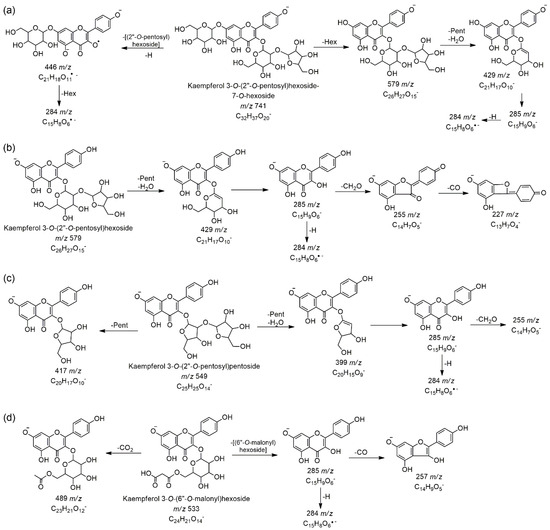
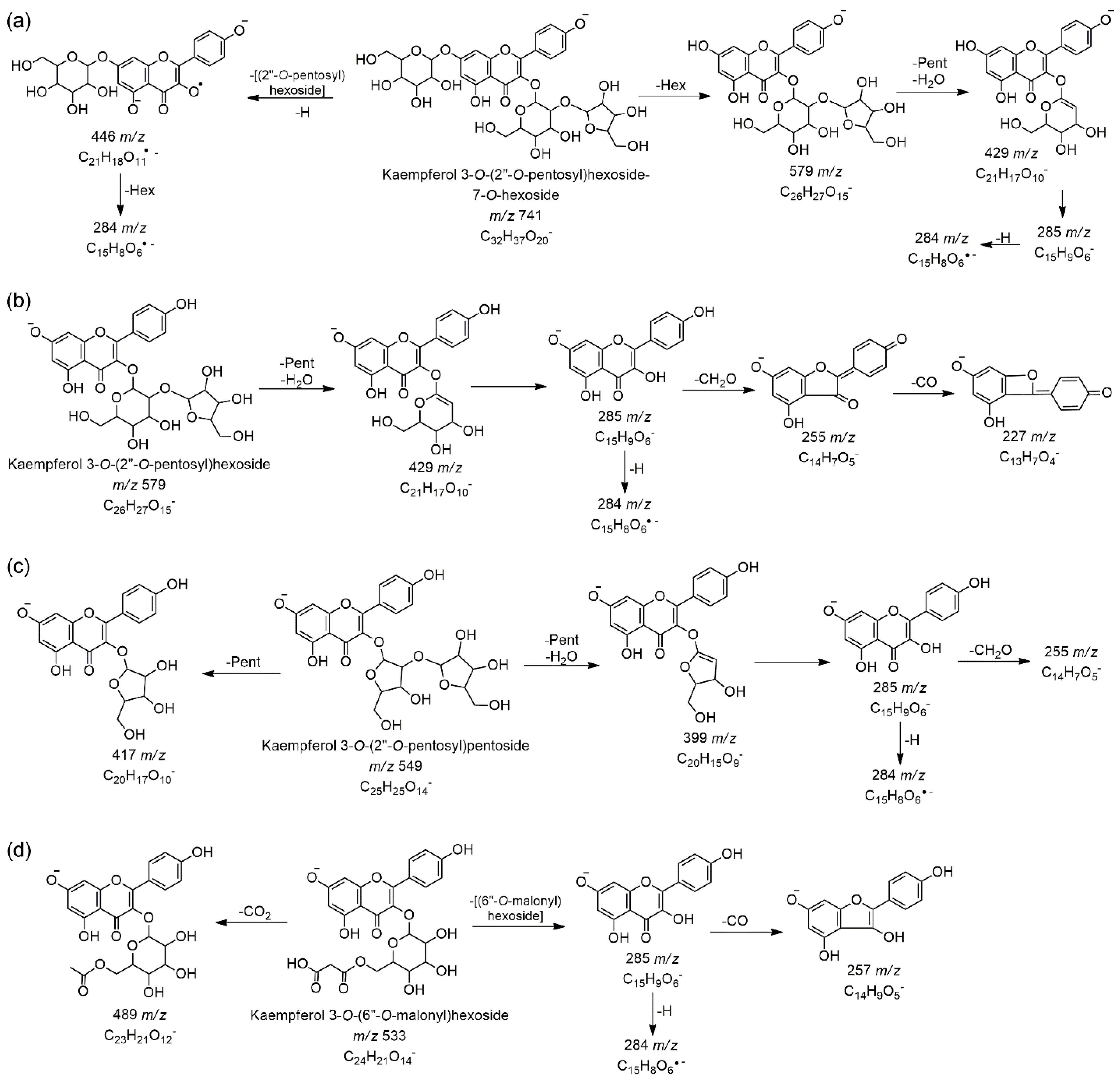
The total content of all detected flavonols was similar for HRP (430.02 mg QE/100 g dw) and HLP (476.90 mg QE/100 g dw). However, HLP mostly contains various kaempferol glycosides, while HRP predominantly contains flavonol aglycones. Kaempferol was the main compound in HRP (236.09 mg QE/100 g dw), followed by morin, while quercetin and isorhamnetin were present in low amounts or traces. Flavonol aglycones were absent in HLP, or present only in traces. Flavonol aglycones were identified based on typical fragments obtained by: a) neutral loss of CH2O, CO, CO2, H2O and/or CH3; and b) retro-Diels–Alder (RDA) cleavage. Quercetin was additionally confirmed by an available standard (Category 1#—confirmed by available standard). Several kaempferol glycosides (7, 9, and 10) and quercetin 3-O-(6″-O-pentosyl)hexoside (8) were predominantly found in HLP, while their content in HRP was significantly lower or completely absent. Moreover, kaempferol-3-O-(2″-pentosyl)hexoside (10) was the most abundant flavonol and generally prevalent HLP phenolic compound (376.30 mg QE/100 g dw). Contrary to the glycosides mentioned above, kaempferol 3-O-(6″-O-rhamnosyl)hexoside (12) and kaempferol 3-O-(2″-O-pentosyl)pentoside (13) were confirmed in HRP at signifficantly higher content than in HLP. All identified kaempferol polyglycosides showed typical fragments resulting from sequential loss of hexosyl (−162 Da), rhamnosyl (−146 Da), and/or pentosyl (−132 Da) unit(s). In addition, some low-intensity fragments were obtained by the loss of sugar moieties and H2O, indicating a 1→2 interglycosidic linkage between sugars in the structure of flavonol glycosides. Compound 14 was recognised as kaempferol 3-O-(6″-O-malonyl)hexoside, with a specific fragment at 489 m/z obtained by the loss of CO2 [M–H–44 Da]–, indicating the presence of a carboxylic group (malonyl moiety). To clarify the identification of flavonol glycosides, fragmentation pathways for compounds 7, 10, 13, and 14 were proposed (Figure 2a–d). Fragmentation patterns for the mentioned compounds are shown in Figure S1a–d. This flavonol profile (except compound 7) is consistent with our previous study on cold-pressed horseradish leaf juice characterized by UHPLC Q-ToF MS [11]. In this case, compound 7 was tentatively recognised as kaempferol 3-O-(2″-pentosyl)hexoside-7-O-hexoside due to low intensity fragment at 429 m/z [m/z 741→ 579 m/z (-Hex)→ 429 m/z (-Pent-H2O)] (Figure S1a) indicating a 1 → 2 interglycosidic linkage between sugars (pentosyl-hexosyl linkage) (Figure 2). Kaempferol and quercetin derivatives were also detected in different processed horseradish roots [7,31], horseradish leaf ethanolic extract [32], dried pomace [13,30], and encapsulated juice [10]. Considering the obtained results, it can be concluded that horseradish by-products (HRP and HLP) are a rich source of various phenolic compounds, which are retained in the matrices after processing.
Figure 2.
Proposed fragmentation pathways of: (a) Kaempferol 3-O-(2″-O-pentosyl)hexoside-7-O-hexoside (7); (b) Kaempferol 3-O-(2″-O-pentosyl)hexoside (10); (c) Kaempferol 3-O-(2″-O-pentosyl)pentoside (13); (d) Kaempferol 3-O-(6″-O-malonyl)hexoside (14).
The possible presence of glucosinolates in HRP and HLP was also analyzed, as it is known that horseradish leaves and especially roots are a good source of these compounds [7,16]. However, glucosinolates were not detected in these samples, which is probably due to the activity of the enzyme myrosinase [9]. This enzyme is physically separated from the glucosinolates in the intact plant tissue. Upon tissue disruption during cold-pressing, the myrosinase came into contact with the glucosinolates, rapidly converting them into bioactive isothiocyanates [17,33], which signifficantly contribute to the strong antioxidant and antimicrobial activity of HRP and HLP [9].
3.3. Total Phenolic, Flavonoid, and Phenolic (Hydroxycinnamic) Acid Contents
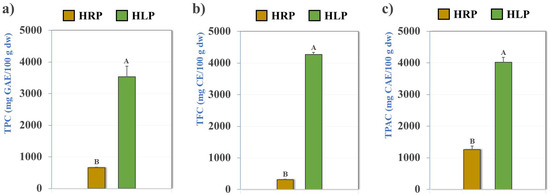
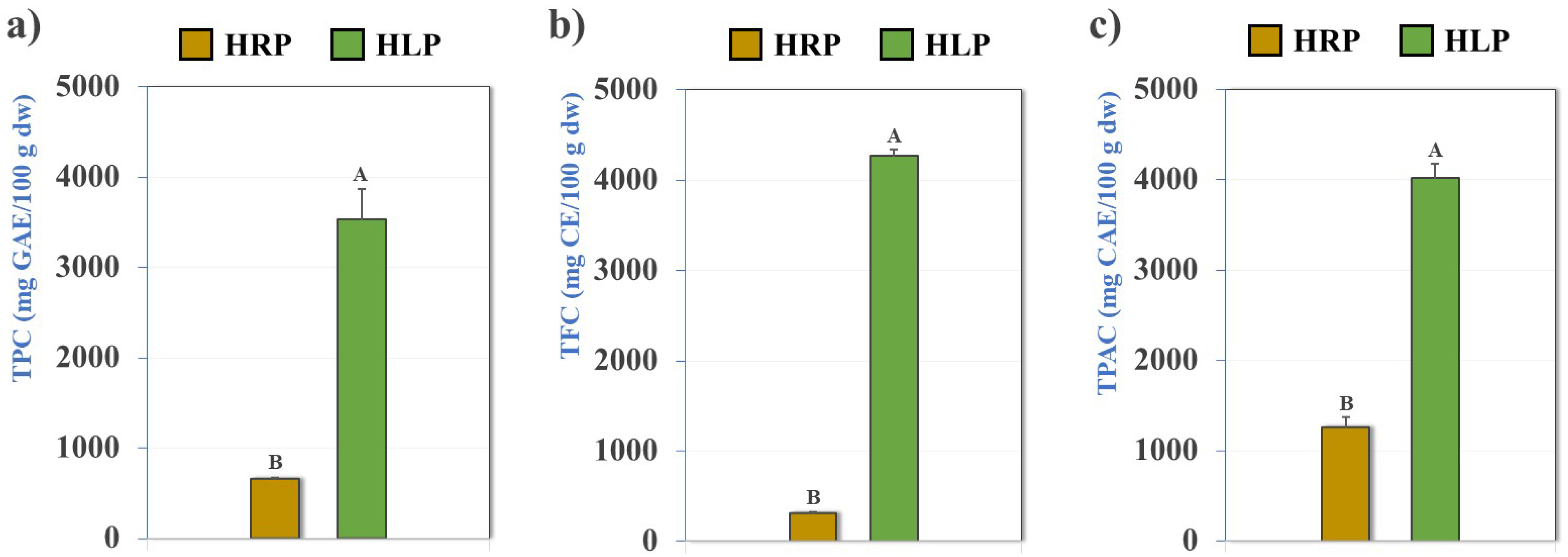
The contents of total phenolics, total flavonoids, and total phenolic (hydroxycinnamic) acids of horseradish root and leaf by-products (HRP and HLP) are presented in Figure 3a–c.
Figure 3.
(a) Total phenolic content (TPC), (b) total flavonoid content (TFC), and (c) total phenolic (hydroxycinnamic) acid content (TPAC) of horseradish root (HRP) and leaf (HLP) pomace (A, B Different uppercase letters within the same method indicate significant differences; p < 0.05).
The total phenolic content (TPC) determined by the Folin–Ciocalteu assay showed that horseradish pomace is generally a rich source of phenolic compounds, with HLP having five times more TPC (3534.55 ± 338.40 mg GAE/100 g dw) than HRP (655.59 ± 15.28 mg GAE/100 g dw). This is consistent with the results of TPC determination in the juices of horseradish roots and leaves reported in our previous studies [11,12]. A higher TPC in the horseradish leaf than in the root was also reported by other authors [6,10,13]. In addition, a greater amount of TPC in the leaves than in the roots of other plant species, such as white and red radish [34,35], wasabi [36], sweet potato [37], etc., has also been reported in the literature. This may be due to the damage of cell components by toxic ions at the root level and/or the priority use of energy for the synthesis of phenolic compounds in the leaves to protect the photosynthetically active leaves of the plants [38].
On the other hand, chlorophyll present in the leaves could have contributed to the significant differences in TPC between HRP and HLP [30]. It can interact with phenolics or other reagents used for determination, and also absorb light in the UV/VIS region of the spectrum, thereby interfering with the reaction and increasing the absorbance value. Different chemical compositions and phenolic profiles of HRP and HLP could also have influenced TPC differences, as the Folin–Ciocalteu reagent gives a positive reaction with all reducing agents (phenolic or non-phenolic) able to participate in electron transfer reactions. Nevertheless, the TPC of HRP and HLP was consistent with the values reported by Kuppusamy et al. [39] for various extracts from the following vegetable by-products: radish peels, onion and garlic peels, potato peels, and carrot pulp (4.7–105.2 mg GAE/g dw). Furthermore, the HLP analyzed in this study contained TPC within the range of values reported by Ademoyegun et al. [40] for various leafy vegetables (8.83–164.52 mg GAE/g dw).
As in the case of TPC, the content of total flavonoids (TFC) in the HRP (467.78 ± 22.39 mg CE/100 g dw) was significantly lower (p < 0.05) than in the HLP (4272.81 ± 62.58 mg CE/100 g dw). This can be explained by the synthesis and accumulation of flavonoids in the aerial parts of the plant, mainly in the leaves, from where they are translocated to other organs over time. Their final content in the different plant organs therefore depends on the regulation of this synthesis-transport relationship [41]. The analyzed HLP contained TFC within the range reported for various leafy vegetables (6.86–67.72 mg CE/g dw) [40]. The TFC results obtained were similar to those reported for different biowastes (peels, leaves, stems) from onions (1.72–2.13 mg CE/g dw), garlic (0.62–0.83 mg CE/g dw), and cauliflower (0.24–0.35 mg CE/g dw) [42]. Based on the results obtained, it can be concluded that horseradish root and leaf pomaces are very rich natural sources of flavonoids. Due to pronounced antioxidant properties of flavonoids, these raw materials are very suitable for industrial exploitation in order to reduce the use of synthetic antioxidants and reduce the amount of waste from the agricultural sector.
Total phenolic (hydroxycinnamic) acid content (TPAC) followed the same trend as TPC and TFC. Significantly higher TPAC were present in the HLP (4022.36 ± 152.16 mg CAE/100 g dw) than in the HRP (2487.57 ± 104.97 mg CAE/100 g dw). Tomsone et al. [30] reported lower TPAC levels in HLP (3214 mg CAE/100 g dw), which may have been influenced by different horseradish cultivation and processing conditions (a certain amount of phenolic acids could be degraded by polyphenoloxidase during cutting and grinding of horseradish samples in a mill). Compared to TPAC in horseradish root and leaf juices (3963.91 and 7943.71 mg CAE/100 g dw, respectively) [11,12], the pomaces contained lower but still significant amounts of total phenolic acids. Therefore, the valorization of this potent residual biomass, rich in phenolic acids and other antioxidants, is very important in terms of economic efficiency and waste minimization in the food industry.
3.4. Antioxidant Activity
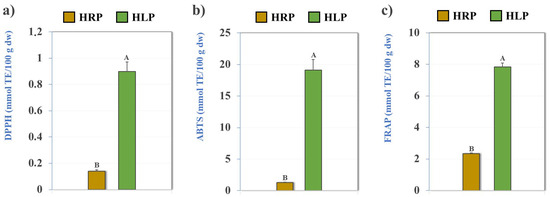
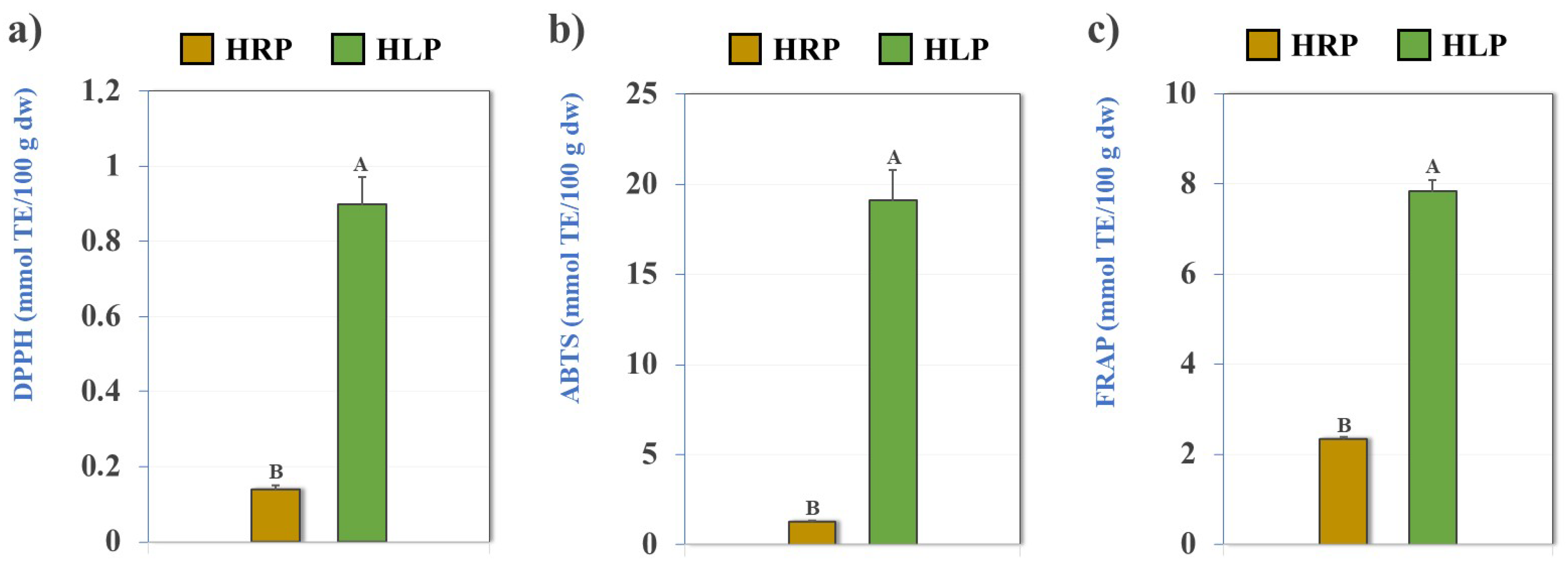
The antioxidant potential of the HRP and HLP was evaluated using the DPPH, ABTS, and FRAP methods, and the results are shown in Figure 4a–c.
Figure 4.
Antioxidant activity of horseradish root (HRP) and leaf (HLP) pomace: (a) DPPH method, (b) ABTS method, and (c) FRAP method (A, B Different uppercase letters within the same method indicate significant differences; p < 0.05).
The significantly lower antioxidant capacity of HRP (mmol TE/100 g dw: 0.14 ± 0.01 (DPPH), 1.27 ± 0.06 (ABTS) and 2.65 ± 0.16 (FRAP)) compared to HLP (mmol TE/100 g dw: 0.90 ± 0.07 (DPPH), 19.11 ± 1.70 (ABTS) and 7.83 ± 0.26 (FRAP)) was confirmed by all three methods used. Horseradish roots and leaves are thought to contain more hydrophilic than hydrophobic antioxidants, resulting in higher values of antioxidant activity estimated by the ABTS method than by the DPPH method. This could be due to the preference of DPPH• radical to interact with hydrophobic components and its lower susceptibility to hydrophilic ones or large-size antioxidants [43]. Although the ABTS method is based on the radical scavenging capacity and the FRAP method is based on the metal-reducing power, both methods rely on the same electron transfer mechanism [44]. In addition, the values obtained by these two methods differed, probably due to the different reaction conditions used to measure the antioxidant activities, especially in terms of pH value (FRAP: 3.6; ABTS: 7.4) and oxidizing molecules (Fe(II)-TPTZ vs. ABTS) [45]. Higher antioxidant activity values (DPPH: 36 mmol TE/100 g dw; ABTS: 359 mmol TE/100 g dw) have been reported for leaf pomace of horseradish grown in Latvia [30], compared with the HLP analysed in our study. This could be influenced by various factors, such as differences in climate for growing horseradish, agrotechnical and agroecological conditions, extraction procedures and agents used, and the phenolic compounds present in the composition of horseradish leaf pomaces, which contribute differently to their antioxidant activity. However, the antioxidant activities of HRP and HLP analysed in our study were comparable to the reported antioxidant activities of various plant residues, such as cocoa pod husks (DPPH: 35.80–70.80 μmol TE/g dw; ABTS: 64.50–112.40 μmol TE/g dw) [46] and tomato pomace (DPPH: 11.18–21.44 μmol TE/g; FRAP: 12.02–43.37 μmol TE/g) [47]. It can therefore be concluded that HRP and HLP, as by-products of the horseradish cold-pressing, can also be used in the food industry as a source of antioxidants. The implementation of this valuable raw material in food products could bring numerous benefits, such as delaying the formation of primary and secondary oxidation products, contributing to the sensory properties of the product, improving the quality and extending the shelf-life of the product, reducing biological waste and reducing the use of synthetic antioxidants in the food industry.
4. Conclusions
The results of this study suggest that horseradish root and leaf pomaces remaining after fresh juice production are an under-researched natural source of phenolic bioactive compounds, such as flavonoids and phenolic acids, which are well-known for their beneficial effects on human health and play a key role in disease prevention. The pomaces exhibited strong antioxidant activity, reflected in their ability to scavenge free radicals and reduce metals. Overall, horseradish leaf pomace contained higher levels of bioactive compounds and exhibited stronger antioxidant capacity than root pomace. Nevertheless, the findings highlight the potential of these valuable horseradish processing residues to be used as natural, quality-preserving antioxidant ingredients in foods, thereby reducing environmental effects and optimizing production costs. Further research on the nutrients quantification of horseradish pomaces would be necessary to better demonstrate the benefits of their use in the production of novel, value-added food products. This study is expected to serve as a useful starting point for the further development of innovative functional food products with enhanced health properties by promoting and expanding the use of horseradish root and leaf by-products in the food industry and among other agribusiness stakeholders. Furthermore, this study offers a potential solution to the environmental and economic challenges faced by food companies due to the accumulation, management, and disposal of plant-processing by-products. Future research should therefore focus on incorporating horseradish pomaces into fat-containing, emulsified, and oxidation-prone foods, and investigating their effects on preventing oxidative degradation, enhancing quality, and influencing the shelf-life of these foods as potential natural alternatives for synthetic antioxidants, whose potentially toxic and carcinogenic decomposition products could negatively affect human health.
Supplementary Materials
The following supporting information can be downloaded at: https://www.mdpi.com/article/10.3390/separations12120330/s1, Table S1: Equation parameters and correlation coefficient (R2) of the used phenolic standards for semi-quantification (Fotirić Akšić et al., 2024 [18]); Figure S1: MS/MS fragmentation patterns of: (a) Kaempferol 3-O-(6″-O-pentosyl)hexoside-7-O-hexoside (7); (b) Kaempferol 3-O-(2″-O-pentosyl)hexoside (10); (c) Kaempferol 3-O-(2″-O-pentosyl)pentoside (13); (d) Kaempferol 3-O-(6″-O-malonyl)hexoside (14).
Author Contributions
Conceptualization, J.M.M., D.M.M., and V.A.N.; methodology, J.M.M., A.S.S., D.D.M., U.M.G., V.B.Đ., and S.M.L.; software, J.M.M., and S.M.L.; validation, A.S.S., D.D.M., U.M.G., and S.M.L.; formal analysis, J.M.M., A.S.S., and D.D.M.; investigation, J.M.M., A.S.S., and D.D.M.; resources, V.A.N.; data curation, U.M.G., B.B.R., M.B.P., S.M.L., D.M.M., and V.A.N.; writing—original draft preparation, J.M.M.; writing—review and editing, A.S.S., D.M.M., U.M.G., V.B.Đ., B.B.R., M.B.P., S.M.L., D.D.M., and V.A.N.; visualization, J.M.M., A.S.S., and D.D.M.; supervision, A.S.S., S.M.L., D.M.M., and V.A.N.; project administration, A.S.S., D.M.M., and V.A.N.; funding acquisition, V.A.N. All authors have read and agreed to the published version of the manuscript.
Funding
This work was supported by the Ministry of Science, Technological Development and Innovation of the Republic of Serbia (grant numbers 451-03-137/2025-03/200116, 451-03-136/2025-03/200007, and 451-03-136/2025-03/200135) and the Science Fund of the Republic of Serbia (grant number 7744714, FUNPRO).
Data Availability Statement
The original contributions presented in this study are included in the article/Supplementary Material. Further inquiries can be directed to the corresponding authors.
Conflicts of Interest
The authors declare no conflicts of interest.
References
- Kultys, E.; Moczkowska-Wyrwisz, M. Effect of using carrot pomace and beetroot-apple pomace on physicochemical and sensory properties of pasta. LWT-Food Sci. Technol. 2022, 168, 113858. [Google Scholar] [CrossRef] [Scilit]
- Skwarek, P.; Karwowska, M. Fruit and vegetable processing by-products as functional meat product ingredients-a chance to improve the nutritional value. LWT-Food Sci. Technol. 2023, 189, 115442. [Google Scholar] [CrossRef] [Scilit]
- Luca, M.I.; Ungureanu-Iuga, M.; Mironeasa, S. Carrot pomace characterization for application in cereal-based products. Appl. Sci. 2022, 12, 7989. [Google Scholar] [CrossRef] [Scilit]
- Majerska, J.; Michalska, A.; Figiel, A. A review of new directions in managing fruit and vegetable processing by-products. Trends Food Sci. Technol. 2019, 88, 207–219. [Google Scholar] [CrossRef] [Scilit]
- Agneta, R.; Möllers, C.; Rivelli, A.R. Horseradish (Armoracia rusticana), a neglected medical and condiment species with a relevant glucosinolate profile: A review. Genet. Resour. Crop Evol. 2013, 60, 1923–1943. [Google Scholar] [CrossRef] [Scilit]
- Calabrone, L.; Larocca, M.; Marzocco, S.; Martelli, G.; Rossano, R. Total phenols and flavonoids content, antioxidant capacity and lipase inhibition of root and leaf horseradish (Armoracia rusticana) extracts. Food Nutr. Sci. 2015, 6, 64–74. [Google Scholar] [CrossRef]
- Negro, E.J.; Sendker, J.; Stark, T.; Lipowicz, B.; Hensel, A. Phytochemical and functional analysis of horseradish (Armoracia rusticana) fermented and non-fermented root extracts. Fitoterapia 2022, 162, 105282. [Google Scholar] [CrossRef] [Scilit]
- Papp, N.; Gonda, S.; Kiss-Szikszai, A.; Plaszkó, T.; Lőrincz, P.; Vasas, G. Ethnobotanical and ethnopharmacological data of Armoracia rusticana P. Gaertner, B. Meyer et Scherb. in Hungary and Romania: A case study. Genet. Resour. Crop Evol. 2018, 65, 1893–1905. [Google Scholar] [CrossRef] [Scilit]
- Nguyen, N.M.; Gonda, S.; Vasas, G. A Review on the phytochemical composition and potential medicinal uses of horseradish (Armoracia rusticana) root. Food Rev. Int. 2013, 29, 261–275. [Google Scholar] [CrossRef] [Scilit]
- Tomsone, L.; Galoburda, R.; Kruma, Z.; Durrieu, V.; Cinkmanis, I. Microencapsulation of horseradish (Armoracia rusticana L.) juice using spray-drying. Foods 2020, 9, 1332. [Google Scholar] [CrossRef] [Scilit]
- Marković, J.; Salević-Jelić, A.; Milinčić, D.; Gašić, U.; Pavlović, V.; Rabrenović, B.; Pešić, M.B.; Lević, S.M.; Mihajlović, D.M.; Nedović, V. Horseradish (Armoracia rusticana L.) leaf juice encapsulated within polysaccharides-blend-based carriers: Characterization and application as potential antioxidants in mayonnaise production. Food Chem. 2025, 464, 141777. [Google Scholar] [CrossRef] [Scilit]
- Marković, J.M.; Salević-Jelić, A.S.; Milinčić, D.D.; Gašić, U.M.; Pavlović, V.B.; Rabrenović, B.B.; Pešić, M.B.; Lević, S.M.; Nedović, V.A.; Mihajlović, D.M. Encapsulated horseradish (Armoracia rusticana L.) root juice: Physicochemical characterization and the effects of its addition on the oxidative stability and quality of mayonnaise. J. Food Eng. 2024, 381, 112189. [Google Scholar] [CrossRef] [Scilit]
- Tomsone, L.; Galoburda, R.; Kruma, Z.; Majore, K. Physicochemical properties of biscuits enriched with horseradish (Armoracia rusticana L.) products and bioaccessibility of phenolics after simulated human digestion. Pol. J. Food Nutr. Sci. 2020, 70, 419–428. [Google Scholar] [CrossRef] [Scilit]
- AOAC. Determination of moisture, ash, protein and fat. In Official Method of Analysis of the Association of Analytical Chemists, 18th ed.; Association of Analytical Chemists: Washington, DC, USA, 2005. [Google Scholar]
- Kostić, A.; Milinčić, D.D.; Špirović Trifunović, B.; Nedić, N.; Gašić, U.M.; Tešić, Ž.L.; Pešić, M. Monofloral corn poppy bee-collected pollen—A detailed insight into its phytochemical composition and antioxidant properties. Antioxidants 2023, 12, 1424. [Google Scholar] [CrossRef] [Scilit]
- Agneta, R.; Lelario, F.; De Maria, S.; Möllers, C.; Bufo, S.A.; Rivelli, A.R. Glucosinolate profile and distribution among plant tissues and phenological stages of field-grown horseradish. Phytochemistry 2014, 106, 178–187. [Google Scholar] [CrossRef] [Scilit]
- Tomsone, L.; Kruma, Z.; Galoburda, R.; Talou, T. Composition of volatile compounds of horseradish roots (Armoracia rusticana L.) depending on the genotype. Rural Sustain. Res. 2013, 29, 1–10. [Google Scholar] [CrossRef] [Scilit]
- Fotirić Akšić, M.; Pešić, M.; Pećinar, I.; Dramićanin, A.; Milinčić, D.; Kostić, A.; Gašić, U.; Jakanovski, M.; Kitanović, M.; Meland, M. Diversity and Chemical Characterization of Apple (Malus sp.) Pollen: High Antioxidant and Nutritional Values for Both Humans and Insects. Antioxidants 2024, 13, 1374. [Google Scholar] [CrossRef] [Scilit] [PubMed]
- Singleton, V.L.; Orthofer, R.; Lamuela-Raventós, R.M. Analysis of total phenols and other oxidation substrates and antioxidants by means of Folin-Ciocalteu reagent. Methods Enzymol. 1999, 299, 152–178. [Google Scholar] [CrossRef] [Scilit]
- Kim, D.O.; Jeong, W.; Lee, C.Y. Antioxidant capacity of phenolic phytochemicals from various cultivars of plums. Food Chem. 2003, 81, 321–326. [Google Scholar] [CrossRef] [Scilit]
- Matkowski, A.; Tasarz, P.; Szypuła, E. Antioxidant activity of herb extracts from five medicinal plants from Lamiaceae, subfamily Lamioideae. J. Med. Plants Res. 2008, 2, 321–330. [Google Scholar]
- Brand-Williams, W.; Cuvelier, M.E.; Berset, C. Use of a free radical method to evaluate antioxidant activity. LWT-Food Sci. Technol. 1995, 28, 25–30. [Google Scholar] [CrossRef] [Scilit]
- Re, R.; Pellegrini, N.; Proteggente, A.; Pannala, A.; Yang, M.; Rice-Evans, C. Antioxidant activity applying an improved ABTS radical cation decolorization assay. Free Radic. Biol. Med. 1999, 26, 1231–1237. [Google Scholar] [CrossRef] [Scilit]
- Salević, A.; Stojanović, D.; Lević, S.; Pantić, M.; Ðordević, V.; Pešić, R.; Bugarski, B.; Pavlović, V.; Uskoković, P.; Nedović, V. The structuring of Sage (Salvia officinalis L.) extract-incorporating edible zein-based materials with antioxidant and antibacterial functionality by solvent casting versus electrospinning. Foods 2022, 11, 390. [Google Scholar] [CrossRef] [Scilit]
- Benzie, I.F.F.; Strain, J.J. The ferric reducing ability of plasma (FRAP) as a measure of “antioxidant power”: The FRAP assay. Anal. Biochem. 1996, 239, 70–76. [Google Scholar] [CrossRef] [Scilit]
- Knez, E.; Kadac-Czapska, K.; Dmochowska-Ślęzak, K.; Grembecka, M. Root vegetables—Composition, health effects, and contaminants. Int. J. Environ. Res. Public Health 2022, 19, 15531. [Google Scholar] [CrossRef] [Scilit]
- Bhushan, S.; Kalia, K.; Sharma, M.; Singh, B.; Ahuja, P.S. Processing of apple pomace for bioactive molecules. Crit. Rev. Biotechnol. 2008, 28, 285–296. [Google Scholar] [CrossRef] [Scilit] [PubMed]
- Muntean, M.V.; Fărcaş, A.C.; Medeleanu, M.; Salanţă, L.C.; Borşa, A. A sustainable approach for the development of innovative products from fruit and vegetable by-products. Sustainability 2022, 14, 10862. [Google Scholar] [CrossRef] [Scilit]
- Charles, D.J. Antioxidant Properties of Spices, Herbs and Other Sources; Springer Science & Business Media: Heidelberg, Germany, 2013. [Google Scholar] [CrossRef] [Scilit]
- Tomsone, L.; Galoburda, R.; Kruma, Z.; Cinkmanis, I. Characterization of dried horseradish leaves pomace: Phenolic compounds profile and antioxidant capacity, content of organic acids, pigments and volatile compounds. Eur. Food Res. Technol. 2020, 246, 1647–1660. [Google Scholar] [CrossRef] [Scilit]
- Karafyllaki, D.; Narwojsz, A.; Kurp, L.; Sawicki, T. Effects of different processing methods on the polyphenolic compounds profile and the antioxidant and anti-glycaemic properties of horseradish roots (Armoracia rusticana). Eur. Food Res. Technol. 2023, 249, 1739–1747. [Google Scholar] [CrossRef] [Scilit]
- Tomsone, L.; Kruma, Z. Stability of rapeseed oil with horseradish Amorica rusticana L. and lovage Levisticum officinale L. extracts under medium temperature accelerated storage conditions. Agron. Res. 2015, 13, 1120–1130. [Google Scholar]
- Gimsing, A.L.; Kirkegaard, J.A. Glucosinolates and biofumigation: Fate of glucosinolates and their hydrolysis products in soil. Phytochem. Rev. 2009, 8, 299–310. [Google Scholar] [CrossRef] [Scilit]
- Goyeneche, R.; Roura, S.; Ponce, A.; Vega-Gálvez, A.; Quispe-Fuentes, I.; Uribe, E.; Di Scala, K. Chemical characterization and antioxidant capacity of red radish (Raphanus sativus L.) leaves and roots. J. Funct. Foods 2015, 16, 256–264. [Google Scholar] [CrossRef] [Scilit]
- Rathi, M.H.; Molan, A.L.; Ismail, M.H. The free radical scavenging activities and total phenolic contents of extracts from leaves and roots of two radish varieties grown in Iraq. Biochem. Cell. Arch. 2019, 19, 1313. [Google Scholar]
- Shin, S.W.; Ghimeray, A.K.; Park, C.H. Investigation of total phenolic, total flavonoid, antioxidant and allyl isothiocyanate content in the different organs of Wasabi Japonica grown in an organic system. Afr. J. Tradit. Complement. Altern. Med. 2014, 11, 38–45. [Google Scholar] [CrossRef] [Scilit]
- Truong, V.D.; McFeeters, R.F.; Thompson, R.T.; Dean, L.L.; Shofran, B. Phenolic acid content and composition in leaves and roots of common commercial sweetpotato (Ipomea batatas L.) cultivars in the United States. J. Food Sci. 2007, 72, C343–C349. [Google Scholar] [CrossRef] [Scilit] [PubMed]
- Petridis, A.; Therios, I.; Samouris, G.; Tananaki, C. Salinity-induced changes in phenolic compounds in leaves and roots of four olive cultivars (Olea europaea L.) and their relationship to antioxidant activity. Environ. Exp. Bot. 2012, 79, 37–43. [Google Scholar] [CrossRef] [Scilit]
- Kuppusamy, S.; Venkateswarlu, K.; Megharaj, M. Examining the polyphenol content, antioxidant activity and fatty acid composition of twenty-one different wastes of fruits, vegetables, oilseeds and beverages. SN Appl. Sci. 2020, 2, 673. [Google Scholar] [CrossRef] [Scilit]
- Ademoyegun, O.T.; Akin-Idowu, P.E.; Ibitoye, D.O.; Adewuyi, G.O. Phenolic contents and free radical scavenging activity in some leafy vegetables. Int. J. Veg. Sci. 2013, 19, 126–137. [Google Scholar] [CrossRef] [Scilit]
- Del Baño, M.J.; Lorente, J.; Castillo, J.; Benavente-García, O.; Marín, M.P.; Del Río, J.A.; Ortuño, A.; Ibarra, I. Flavonoid distribution during the development of leaves, flowers, stems, and roots of Rosmarinus officinalis. Postulation of a biosynthetic pathway. J. Agric. Food Chem. 2004, 52, 4987–4992. [Google Scholar] [CrossRef] [Scilit]
- Munir, A.; Sultana, B.; Bashir, A.; Ghaffar, A.; Munir, B.; Shar, G.A.; Nazir, A.; Iqbal, M. Evaluation of antioxidant potential of vegetables waste. Pol. J. Environ. Stud. 2018, 27, 947–952. [Google Scholar] [CrossRef] [Scilit]
- Solaberrieta, I.; Jiménez, A.; Cacciotti, I.; Garrigós, M.C. Encapsulation of bioactive compounds from aloe vera agrowastes in electrospun poly (ethylene oxide) nanofibers. Polymers 2020, 12, 1323. [Google Scholar] [CrossRef] [Scilit]
- Tiwari, S.; Upadhyay, N.; Singh, A.K.; Meena, G.S.; Arora, S. Organic solvent-free extraction of carotenoids from carrot bio-waste and its physico-chemical properties. J. Food Sci. Technol. 2019, 56, 4678–4687. [Google Scholar] [CrossRef] [Scilit]
- Müller, L.; Fröhlich, K.; Böhm, V. Comparative antioxidant activities of carotenoids measured by ferric reducing antioxidant power (FRAP), ABTS bleaching assay (αTEAC), DPPH assay and peroxyl radical scavenging assay. Food Chem. 2011, 129, 139–148. [Google Scholar] [CrossRef] [Scilit]
- Valadez-Carmona, L.; Plazola-Jacinto, C.P.; Hernández-Ortega, M.; Hernández-Navarro, M.D.; Villarreal, F.; Necoechea-Mondragón, H.; Ortiz-Moreno, A.; Ceballos-Reyes, G. Effects of microwaves, hot air and freeze-drying on the phenolic compounds, antioxidant capacity, enzyme activity and microstructure of cacao pod husks (Theobroma cacao L.). Innov. Food Sci. Emerg. Technol. 2017, 41, 378–386. [Google Scholar] [CrossRef] [Scilit]
- Chada, P.S.N.; Santos, P.H.; Rodrigues, L.G.G.; Goulart, G.A.S.; Azevedo dos Santos, J.D.; Maraschin, M.; Lanza, M. Non-conventional techniques for the extraction of antioxidant compounds and lycopene from industrial tomato pomace (Solanum lycopersicum L.) using spouted bed drying as a pre-treatment. Food Chem. X 2022, 13, 100237. [Google Scholar] [CrossRef] [Scilit] [PubMed]

Disclaimer/Publisher’s Note: The statements, opinions and data contained in all publications are solely those of the individual author(s) and contributor(s) and not of MDPI and/or the editor(s). MDPI and/or the editor(s) disclaim responsibility for any injury to people or property resulting from any ideas, methods, instructions or products referred to in the content. |
© 2025 by the authors. Licensee MDPI, Basel, Switzerland. This article is an open access article distributed under the terms and conditions of the Creative Commons Attribution (CC BY) license (https://creativecommons.org/licenses/by/4.0/).