Article

Impact of Using Organic Yeast in the Fermentation Process of Wine


1
Faculty of Horticultural Science Department of Oenology, Szent István University, 1118 Budapest, Hungary
2
Faculty of Horticultural Science Department of Viticulture, Szent István University, 1118 Budapest, Hungary
*
Author to whom correspondence should be addressed.
Processes 2021, 9(1), 155; https://doi.org/10.3390/pr9010155
Submission received: 12 November 2020 / Revised: 11 January 2021 / Accepted: 12 January 2021 / Published: 15 January 2021
(This article belongs to the Special Issue Role of Yeast in Wine Fermentation Processes)

Abstract

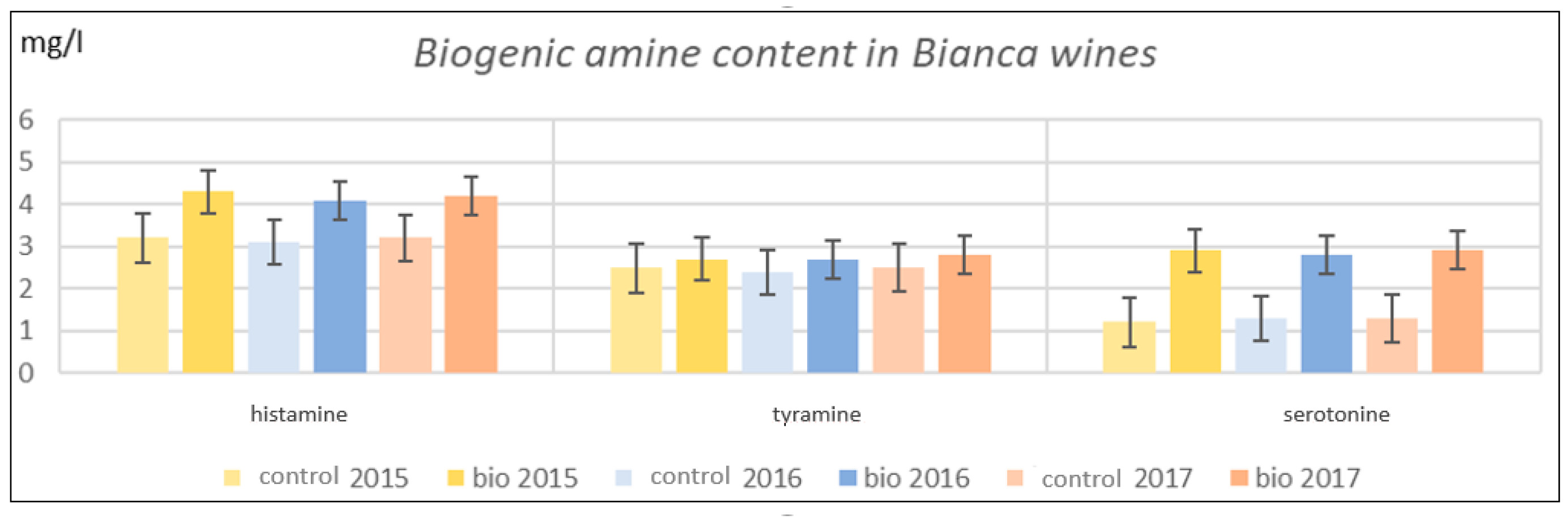
The aim of this study was to find out what kind of “Bianca” wine could be produced when using organic yeast, what are the dynamics of the resulting alcoholic fermentation, and whether this method is suitable for industrial production as well. Due to the stricter rules and regulations, as well as the limited amount and selection of the permitted chemicals, resistant, also known as interspecific or innovative grape varieties, can be the ideal basic materials of alternative cultivation technologies. Well-designed analytical and organoleptic results have to provide the scientific background of resistant varieties, as these cultivars and their environmentally friendly cultivation techniques could be the raw materials of the future. The role of the yeast in wine production is crucial. We fermented wines from the “Bianca” juice samples three times where model chemical solutions were applied. In our research, we aimed to find out how organic yeast influenced the biogenic amine formation of three important compounds: histamine, tyramine, and serotonin. The main results of this study showed that all the problematic values (e.g., histamine) were under the critical limit (1 g/L), although the organic samples resulted in a significantly higher level than the control wines. The glycerin content correlated with the literature values, since it is well known that the glycerin-pyruvic acid transformation results in a 6–10 g/L concentration.
Keywords: wine fermentation; organic yeast; innovative grape varieties; organic wine; biogenic amine; polyphenol content wine fermentation; organic yeast; innovative grape varieties; organic wine; biogenic amine; polyphenol content