Review

Revisiting the Role of Mass and Heat Transfer in Gas–Solid Catalytic Reactions

by
Riccardo Tesser
1 and
Elio Santacesaria
2,*
1
NICL—Naples Industrial Chemistry Laboratory, Department of Chemical Science, University of Naples Federico II, 80126 Naples, Italy
2
CEO of Eurochem Engineering Ltd., 20139 Milan, Italy
*
Author to whom correspondence should be addressed.
Processes 2020, 8(12), 1599; https://doi.org/10.3390/pr8121599
Submission received: 14 October 2020 / Revised: 23 November 2020 / Accepted: 2 December 2020 / Published: 4 December 2020

Abstract

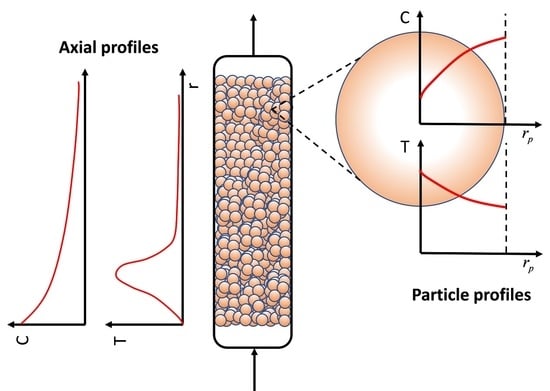
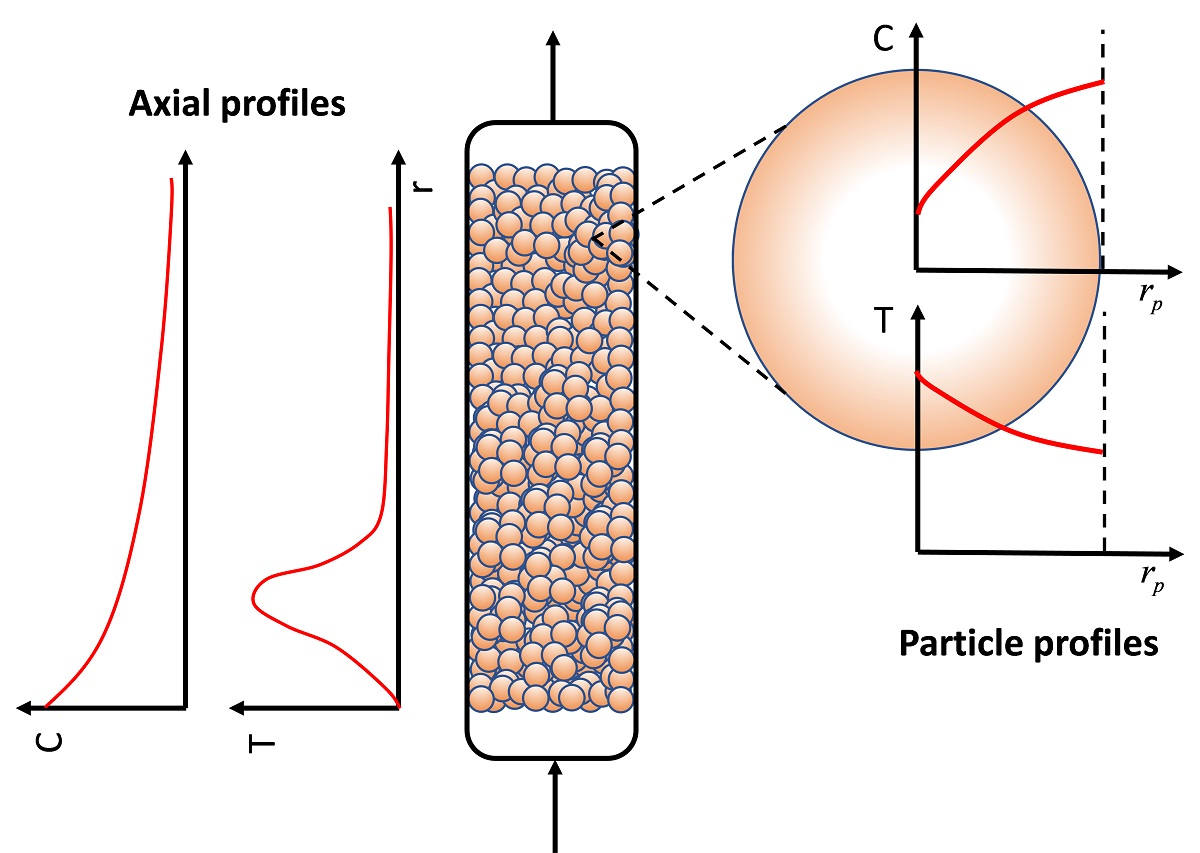
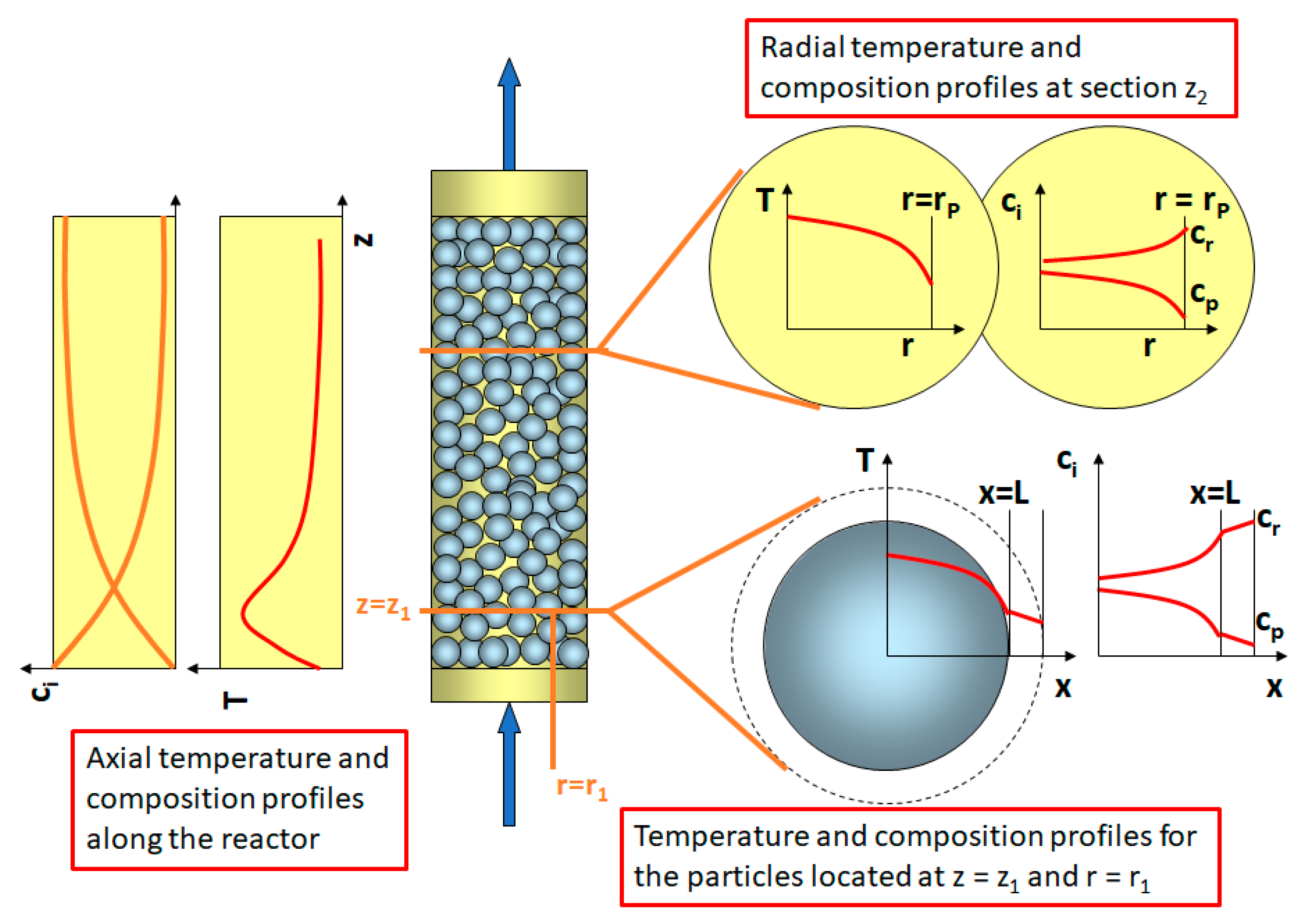
The tremendous progress in the computing power of modern computers has in the last 20 years favored the use of numerical methods for solving complex problems in the field of chemical kinetics and of reactor simulations considering also the effect of mass and heat transfer. Many classical textbooks dealing with the topic have, therefore, become quite obsolete. The present work is a review of the role that heat and mass transfer have in the kinetic studies of gas–solid catalytic reactions. The scope was to collect in a relatively short document the necessary knowledge for a correct simulation of gas–solid catalytic reactors. The first part of the review deals with the most reliable approach to the description of the heat and mass transfer outside and inside a single catalytic particle. Some different examples of calculations allow for an easier understanding of the described methods. The second part of the review is related to the heat and mass transfer in packed bed reactors, considering the macroscopic gradients that derive from the solution of mass and energy balances on the whole reactor. Moreover, in this second part, some examples of calculations, applied to chemical reactions of industrial interest, are reported for a better understanding of the systems studied.
Keywords: gas–solid catalytic reactions; chemical kinetics; heat and mass transfer gas–solid catalytic reactions; chemical kinetics; heat and mass transfer
Graphical Abstract