

A Review of Thermochemical, Physical, and Chemical Conversion Pathways of Coconut and Açaí Residues: Technological Progress and Readiness Assessment




Abstract
1. Introduction
2. Methods
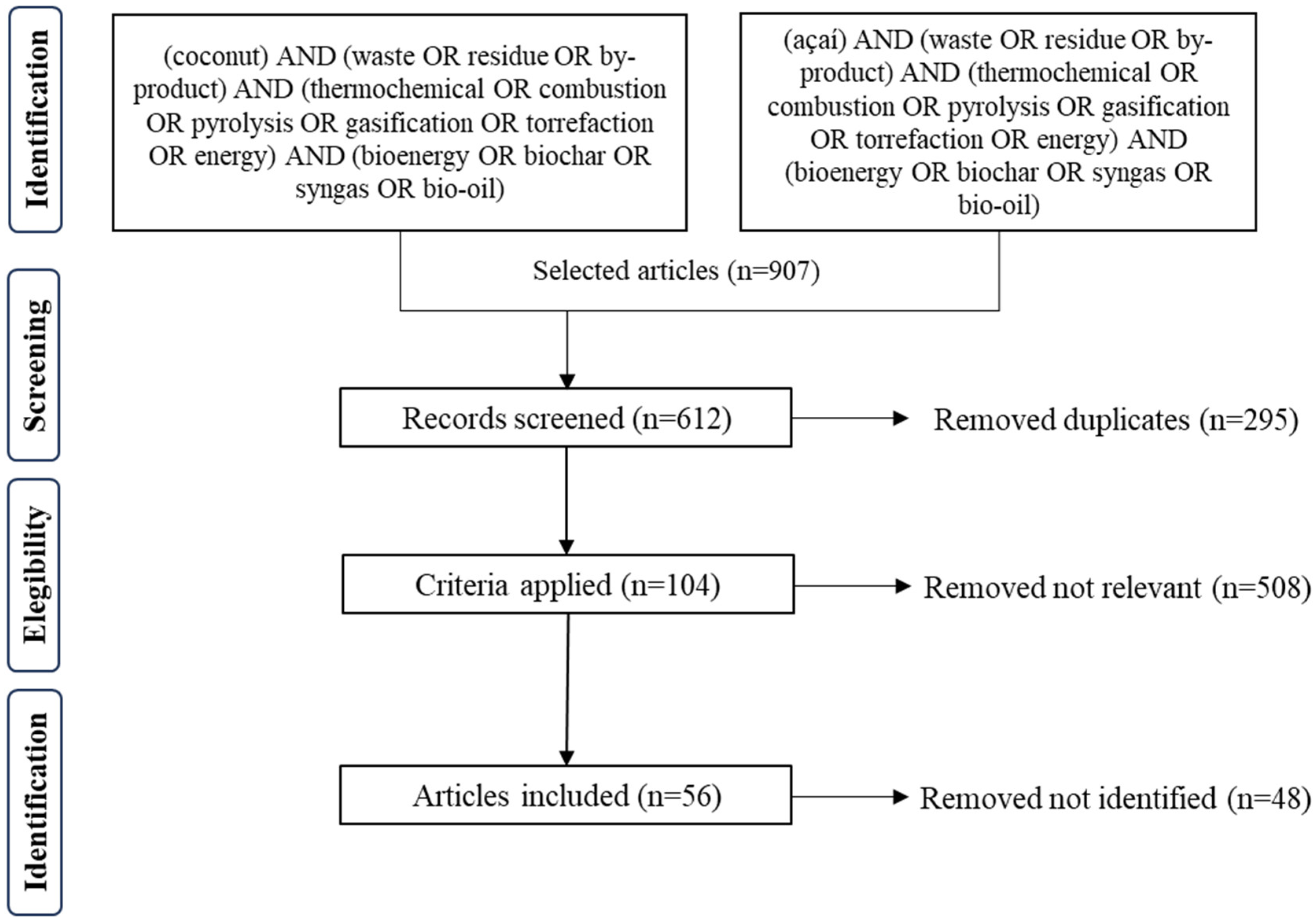
2.1. Literature Search Strategy and Scope Definition
2.2. Eligibility Criteria and Study Selection
2.3. Data Extraction and Classification
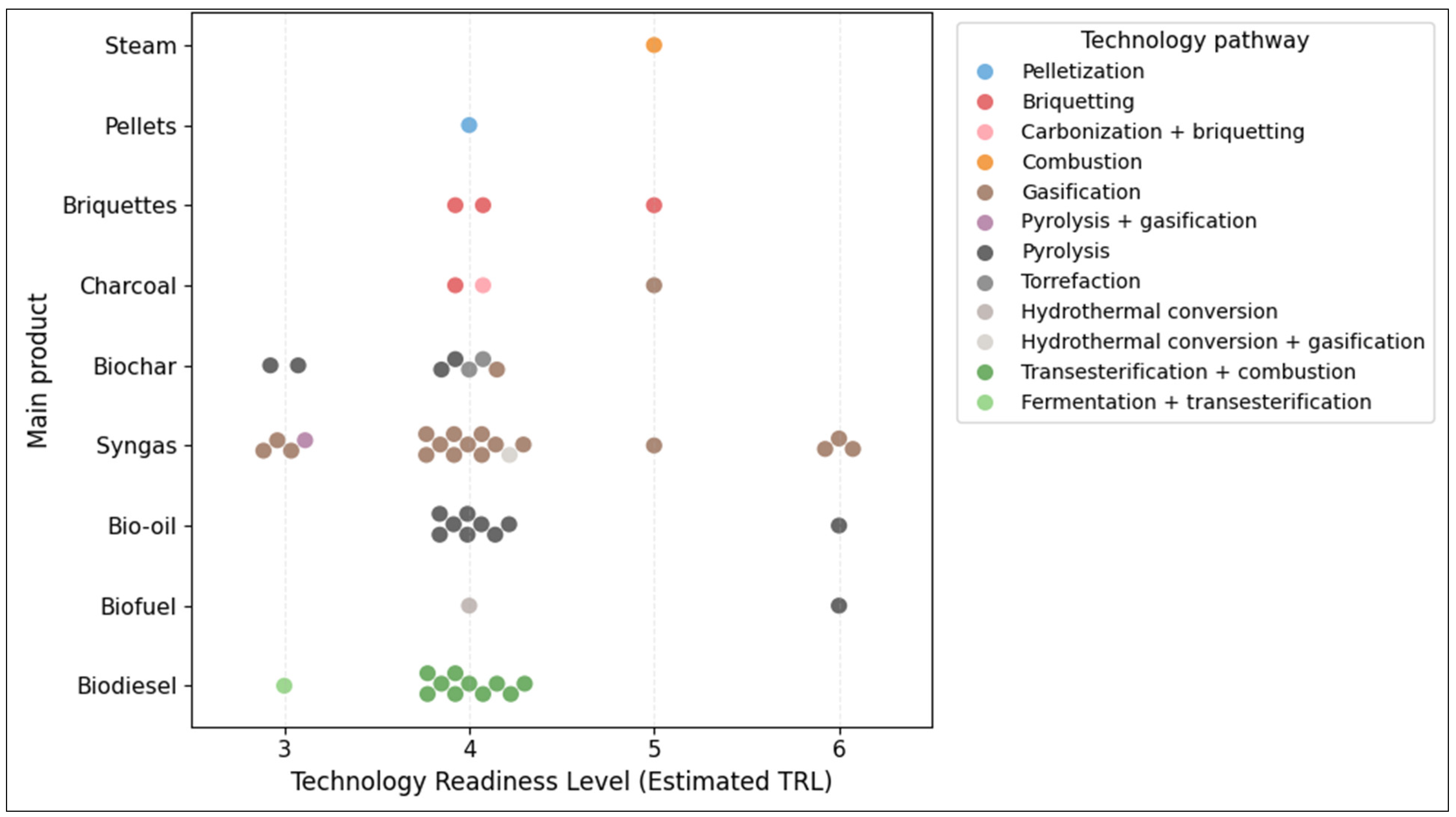
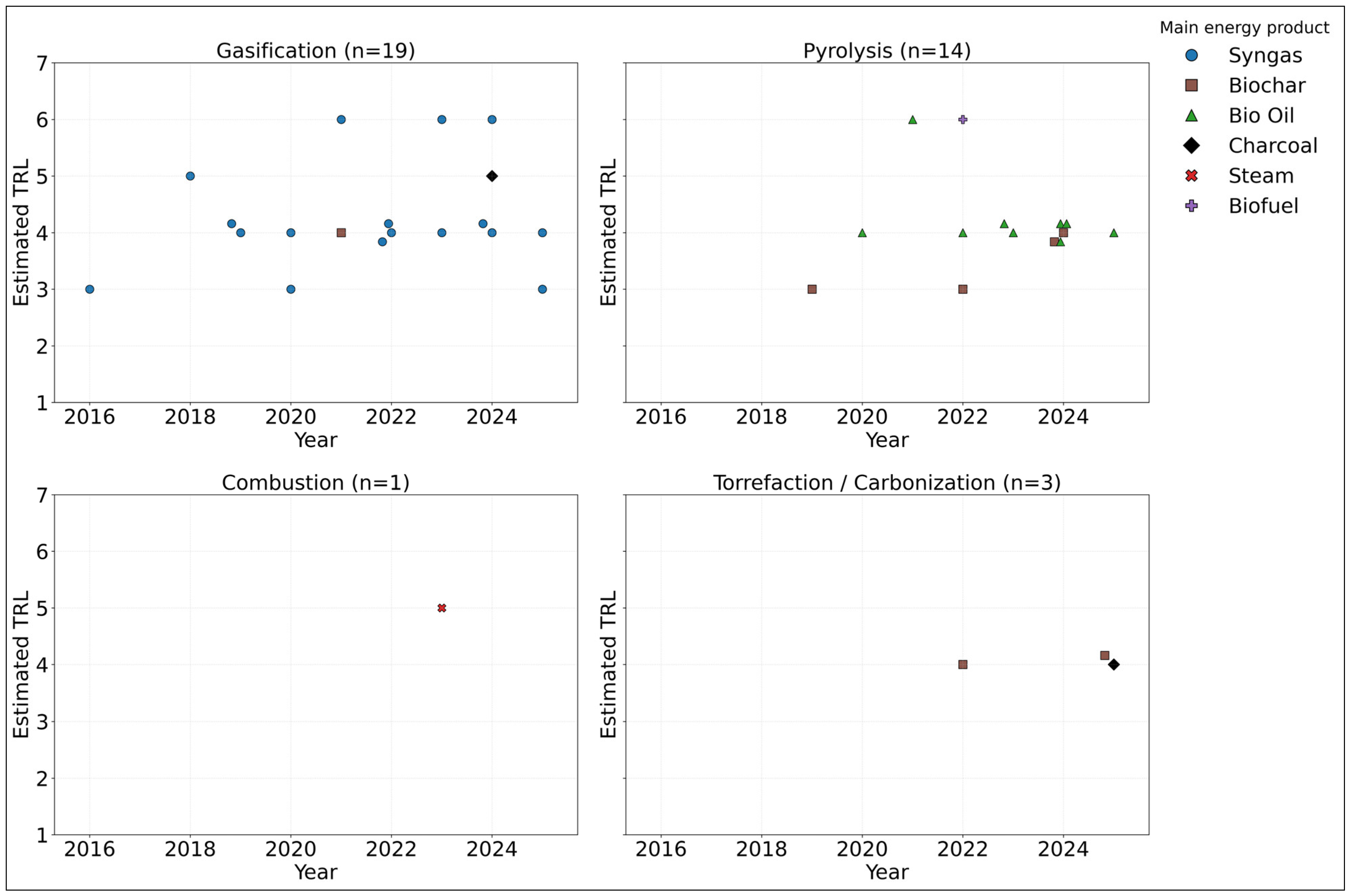
2.4. Technology Readiness Level Assessment
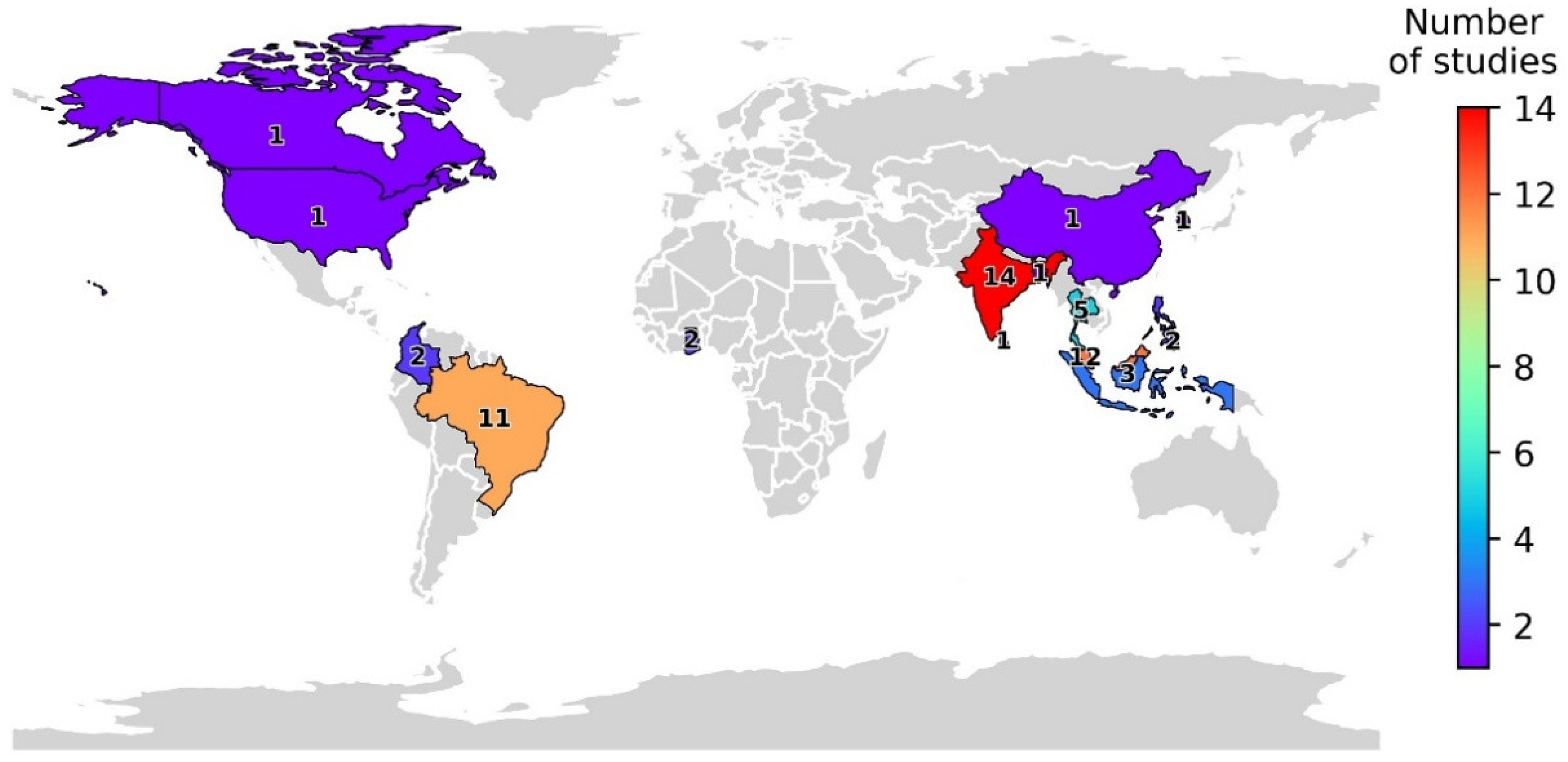
2.5. Geographic Distribution Analysis
2.6. Methodological Considerations
3. Discussion
3.1. Socio-Economic Relevance of Coconut and Açaí in Tropical Regions
3.2. Physicochemical Properties of Coconut and Açaí and Implications for Energy Conversion
3.3. Thermochemical Conversion Pathways
3.3.1. Gasification
3.3.2. Pyrolysis
3.3.3. Direct Combustion
3.3.4. Carbonization and Torrefaction
3.4. Physical and Mechanical Transformation
3.5. Chemical Transformation
3.6. Hybrid and Emerging Conversion Pathways
3.7. Insights into Energy Products and Technological Maturity
4. Future Directions for Coconut and Açaí Residue Energetic Valorization
5. Conclusions
Supplementary Materials
Author Contributions
Funding
Data Availability Statement
Acknowledgments
Conflicts of Interest
Abbreviations
| TRL | Technology Readiness Level |
| PRISMA | Preferred Reporting Items for Systematic Reviews and Meta-Analyses |
| WoS | Web of Science |
| CO | Carbon monoxide |
| CO2 | Carbon dioxide |
| H2 | Hydrogen |
| MJ/kg | Megajoules per kilogram |
| MJ/Nm3 | Megajoules per normal cubic meter |
| kW | Kilowatt |
| mm | Millimeter |
| m | Meter |
| °C | Degrees Celsius |
| % (v/v) | Volume percentage |
| % (w/w) | Mass percentage |
| HTC | Hydrothermal carbonization |
| LCA | Life cycle assessment |
References
- Yaashikaa, P.R.; Senthil Kumar, P.; Varjani, S. Valorization of Agro-Industrial Wastes for Biorefinery Process and Circular Bioeconomy: A Critical Review. Bioresour. Technol. 2022, 343, 126126. [Google Scholar] [CrossRef]
- Cruz Reina, L.J.; Durán-Aranguren, D.D.; Forero-Rojas, L.F.; Tarapuez-Viveros, L.F.; Durán-Sequeda, D.; Carazzone, C.; Sierra, R. Chemical Composition and Bioactive Compounds of Cashew (Anacardium occidentale) Apple Juice and Bagasse from Colombian Varieties. Heliyon 2022, 8, e09528. [Google Scholar] [CrossRef] [PubMed]
- Laurindo, L.F.; Barbalho, S.M.; Araújo, A.C.; Guiguer, E.L.; Mondal, A.; Bachtel, G.; Bishayee, A. Açaí (Euterpe oleracea Mart.) in Health and Disease: A Critical Review. Nutrients 2023, 15, 989. [Google Scholar] [CrossRef] [PubMed]
- Rodríguez-Castro, R.; Guerrero, R.; Valero, A.; Franco-Rodriguez, J.; Posada-Izquierdo, G. Cocoa Mucilage as a Novel Ingredient in Innovative Kombucha Fermentation. Foods 2024, 13, 1636. [Google Scholar] [CrossRef] [PubMed]
- G, G.; S, K.; R, Y.K.; Bhatia, S.K.; S, A.K.; M, R.; Kumar, G.; Pugazhendhi, A.; Chi, N.T.L.; J, R.B. Valorization of Agricultural Residues: Different Biorefinery Routes. J. Environ. Chem. Eng. 2021, 9, 105435. [Google Scholar] [CrossRef]
- Qian, X.; Xue, J.; Yang, Y.; Lee, S.W. Thermal Properties and Combustion-Related Problems Prediction of Agricultural Crop Residues. Energies 2021, 14, 4619. [Google Scholar] [CrossRef]
- Arumugam, T.; Hatta, M.A.M. Improving Coconut Using Modern Breeding Technologies: Challenges and Opportunities. Plants 2022, 11, 3414. [Google Scholar] [CrossRef]
- Brondízio, E.S.; Safar, C.A.M.; Siqueira, A.D. The Urban Market of Açaí Fruit (Euterpe oleracea Mart.) and Rural Land Use Change: Ethnographic Insights into the Role of Price and Land Tenure Constraining Agricultural Choices in the Amazon Estuary. Urban Ecosyst. 2002, 6, 67–97. [Google Scholar] [CrossRef]
- Vieira, F.; Santana, H.E.P.; Jesus, M.; Santos, J.; Pires, P.; Vaz-Velho, M.; Silva, D.P.; Ruzene, D.S. Coconut Waste: Discovering Sustainable Approaches to Advance a Circular Economy. Sustainability 2024, 16, 3066. [Google Scholar] [CrossRef]
- Elgarahy, A.M.; Hammad, A.; El-Sherif, D.M.; Abouzid, M.; Gaballah, M.S.; Elwakeel, K.Z. Thermochemical Conversion Strategies of Biomass to Biofuels, Techno-Economic and Bibliometric Analysis: A Conceptual Review. J. Environ. Chem. Eng. 2021, 9, 106503. [Google Scholar] [CrossRef]
- Rastogi, P.M.; Kumar, N.; Sharma, A. Use of Response Surface Methodology Approach for Development of Sustainable Jojoba Biodiesel Diesel Blend with CuO Nanoparticles for Four Stroke Diesel Engine. Fuel 2023, 339, 127367. [Google Scholar] [CrossRef]
- Dovichi Filho, F.B.; Castillo Santiago, Y.; Silva Lora, E.E.; Escobar Palacio, J.C.; Almazan del Olmo, O.A. Evaluation of the Maturity Level of Biomass Electricity Generation Technologies Using the Technology Readiness Level Criteria. J. Clean. Prod. 2021, 295, 126426. [Google Scholar] [CrossRef]
- Alouw, J.C.; Wulandari, S. Present Status and Outlook of Coconut Development in Indonesia. IOP Conf. Ser. Earth Environ. Sci. 2020, 418, 012035. [Google Scholar] [CrossRef]
- Sato, M.K.; de Lima, H.V.; Costa, A.N.; Rodrigues, S.; Pedroso, A.J.S.; de Freitas Maia, C.M.B. Biochar from Acai Agroindustry Waste: Study of Pyrolysis Conditions. Waste Manag. 2019, 96, 158–167. [Google Scholar] [CrossRef] [PubMed]
- Filho, L.A.B.; Sampaio, P.d.T.B.; Matos, M.; Blair, C. Updating the Economic Profile of Açaí (Euterpe precatoria Mart. and E. oleraceae) Fruit in the states of Amazonas and Pará. Int. J. Adv. Eng. Res. Sci. 2021, 8, 302–308. [Google Scholar] [CrossRef]
- Costa, J.E.B.; Barbosa, A.S.; Melo, M.A.F.; Melo, D.M.A.; Medeiros, R.L.B.A.; Braga, R.M. Renewable Aromatics through Catalytic Pyrolysis of Coconut Fiber (Cocos nucífera Linn.) Using Low Cost HZSM-5. Renew. Energy 2022, 191, 439–446. [Google Scholar] [CrossRef]
- Melo, P.S.; Selani, M.M.; Gonçalves, R.H.; de Oliveira Paulino, J.; Massarioli, A.P.; de Alencar, S.M. Açaí Seeds: An Unexplored Agro-Industrial Residue as a Potential Source of Lipids, Fibers, and Antioxidant Phenolic Compounds. Ind. Crops Prod. 2021, 161, 113204. [Google Scholar] [CrossRef]
- Ajien, A.; Idris, J.; Md Sofwan, N.; Husen, R.; Seli, H. Coconut Shell and Husk Biochar: A Review of Production and Activation Technology, Economic, Financial Aspect and Application. Waste Manag. Res. 2023, 41, 37–51. [Google Scholar] [CrossRef]
- Inseemeesak, B.; Areeprasert, C. Fiber Extraction and Energy Recovery from Cocos nucifera Linn Mesocarp Residues Employing Steam Explosion and Anaerobic Digestion. Ind. Crops Prod. 2020, 147, 112180. [Google Scholar] [CrossRef]
- Queiroz, L.S.; de Souza, L.K.C.; Thomaz, K.T.C.; Leite Lima, E.T.; da Rocha Filho, G.N.; do Nascimento, L.A.S.; de Oliveira Pires, L.H.; do Carmo Freitas Faial, K.; da Costa, C.E.F. Activated Carbon Obtained from Amazonian Biomass Tailings (Acai Seed): Modification, Characterization, and Use for Removal of Metal Ions from Water. J. Environ. Manage. 2020, 270, 110868. [Google Scholar] [CrossRef] [PubMed]
- Barlina, R.; Dewandari, K.T.; Mulyawanti, I.; Herawan, T. Chapter 30—Chemistry and Composition of Coconut Oil and Its Biological Activities. In Multiple Biological Activities of Unconventional Seed Oils; Mariod, A.A., Ed.; Academic Press: Cambridge, MA, USA, 2022; pp. 383–395. ISBN 978-0-12-824135-6. [Google Scholar]
- Atabani, A.E.; Silitonga, A.S.; Badruddin, I.A.; Mahlia, T.M.I.; Masjuki, H.H.; Mekhilef, S. A Comprehensive Review on Biodiesel as an Alternative Energy Resource and Its Characteristics. Renew. Sustain. Energy Rev. 2012, 16, 2070–2093. [Google Scholar] [CrossRef]
- Barbosa, J.R.; Carvalho Junior, R.N. de Food Sustainability Trends—How to Value the Açaí Production Chain for the Development of Food Inputs from Its Main Bioactive Ingredients? Trends Food Sci. Technol. 2022, 124, 86–95. [Google Scholar] [CrossRef]
- Menon, S.D.; Sampath, K.; Kaarthik, S.S. Feasibility Studies of Coconut Shells Biomass for Downdraft Gasification. Mater. Today Proc. 2021, 44, 3133–3137. [Google Scholar] [CrossRef]
- Yahaya, A.Z.; Somalu, M.R.; Muchtar, A.; Sulaiman, S.A.; Wan Daud, W.R. Effect of Particle Size and Temperature on Gasification Performance of Coconut and Palm Kernel Shells in Downdraft Fixed-Bed Reactor. Energy 2019, 175, 931–940. [Google Scholar] [CrossRef]
- Sulaiman, S.A.; Roslan, R.; Inayat, M.; Yasin Naz, M. Effect of Blending Ratio and Catalyst Loading on Co-Gasification of Wood Chips and Coconut Waste. J. Energy Inst. 2018, 91, 779–785. [Google Scholar] [CrossRef]
- Khaeso, K.; Sukhuna, B.; Katekaew, S.; Junsiri, C.; Monatrakul, W.; Srichat, A.; Senawong, K.; Laloon, K. Sustainable Conversion of Agricultural Waste into Solid Fuel (Charcoal) via Gasification and Pyrolysis Treatment. Energy Convers. Manag. X 2024, 24, 100693. [Google Scholar] [CrossRef]
- Raj, R.; Tirkey, J.V.; Jena, P. Gasification of Briquette, Mahua Wood, and Coconut Shell and Application to CI Engines: Comparative Performance and Optimisation Analysis. Ind. Crops Prod. 2023, 199, 116758. [Google Scholar] [CrossRef]
- Raj, R.; Tirkey, J.V.; Jena, P.; Prajapati, L.K. Comparative Analysis of Gasifier-CI Engine Performance and Emissions Characteristics Using Diesel with Producer Gas Derived from Coal– Briquette-Coconut Shell-Mahua Feedstock and Its Blends. Energy 2024, 293, 130708. [Google Scholar] [CrossRef]
- Ram, M.; Mondal, M.K. Investigation on Fuel Gas Production from Pulp and Paper Waste Water Impregnated Coconut Husk in Fluidized Bed Gasifier via Humidified Air and CO2 Gasification. Energy 2019, 178, 522–529. [Google Scholar] [CrossRef]
- Tamilmani, T.; Ganesan, P. Experimental Investigation on Co-Gasification Characteristics of Coconut Shell and Medical Plastic Waste in Fluidized Bed Gasifier. Biomass Convers. Biorefin. 2024, 14, 25263–25278. [Google Scholar] [CrossRef]
- Chommontha, N.; Phongphiphat, A.; Wangyao, K.; Patumsawad, S.; Towprayoon, S. Effects of Operating Parameters on Co-Gasification of Coconut Petioles and Refuse-Derived Fuel. Waste Manag. Res. 2022, 40, 575–585. [Google Scholar] [CrossRef]
- Saini, R.; M Mahajani, S.; Deb Barma, S.; Srinivas Rao, D. Valorization of Coconut and Banana Wastes with Petcoke and Coal via Steam Gasification in a Fluidized Bed Reactor. J. Clean. Prod. 2024, 434, 139955. [Google Scholar] [CrossRef]
- Ram, M.; Mondal, M.K. Conversion of Unripe Coconut Husk into Refined Products Using Humidified Air in Packed Bed Gasification Column. Biomass Convers. Biorefin. 2020, 10, 409–421. [Google Scholar] [CrossRef]
- Inayat, M.; Sulaiman, S.A.; Shahbaz, M.; Bhayo, B.A. Application of Response Surface Methodology in Catalytic Co-Gasification of Palm Wastes for Bioenergy Conversion Using Mineral Catalysts. Biomass Bioenergy 2020, 132, 105418. [Google Scholar] [CrossRef]
- Kumar, R.; Mondal, M.K. Two-Step Feeding Pyro-Gasification of Coconut Husk: Effects of Ni-Fe Impregnation on Products Yields and Quality. Renew. Energy 2025, 248, 123164. [Google Scholar] [CrossRef]
- Wiyono, A.; Aziz, M.; Sholehudin, A.; Sukrawan, Y.; Purnawan; Anggrainy, R.; Kadja, G.T.M.; Pambudi, N.A. Syngas Optimization and Tar Reduction via Multistage Catalytic Gasification: Effects of Catalyst Pore, Catalyzer Stage, and Temperature Profile. S. Afr. J. Chem. Eng. 2024, 48, 246–253. [Google Scholar] [CrossRef]
- Monir, M.U.; Aziz, A.A.; Yousuf, A. Integrated Technique to Produce Sustainable Bioethanol from Lignocellulosic Biomass. Mater. Lett. X 2022, 13, 100127. [Google Scholar] [CrossRef]
- Romero Millán, L.M.; Sierra Vargas, F.E.; Nzihou, A. Characterization of Steam Gasification Biochars from Lignocellulosic Agrowaste Towards Soil Applications. Waste Biomass Valorization 2021, 12, 4141–4155. [Google Scholar] [CrossRef]
- Nanda, S.; Isen, J.; Dalai, A.K.; Kozinski, J.A. Gasification of Fruit Wastes and Agro-Food Residues in Supercritical Water. Energy Convers. Manag. 2016, 110, 296–306. [Google Scholar] [CrossRef]
- Agrizzi, T.; Oliveira, M.A.; Faria, E.V.; Santos, K.G.; Xavier, T.P.; Lira, T.S. Assessing Coconut Shell Pyrolysis: Biomass Characterization, Activation Energy Estimation, and Statistical Analysis of Operating Conditions. Bioresour. Technol. Rep. 2024, 26, 101831. [Google Scholar] [CrossRef]
- Durango Padilla, E.R.; Hansted, F.A.S.; Luna, C.M.R.; de Campos, C.I.; Yamaji, F.M. Biochar Derived from Agricultural Waste and Its Application as Energy Source in Blast Furnace. Renew. Energy 2024, 220, 119688. [Google Scholar] [CrossRef]
- Sarkar, J.K.; Wang, Q. Different Pyrolysis Process Conditions of South Asian Waste Coconut Shell and Characterization of Gas, Bio-Char, and Bio-Oil. Energies 2020, 13, 1970. [Google Scholar] [CrossRef]
- Valois, F.P.; Bezerra, K.C.A.; Assunção, F.P.D.C.; Bernar, L.P.; da Paz, S.P.A.; Santos, M.C.; Feio, W.P.; Silva, R.M.P.; Mendonça, N.M.; de Castro, D.A.R.; et al. Improving the Antioxidant Activity, Yield, and Hydrocarbon Content of Bio-Oil from the Pyrolysis of Açaí Seeds by Chemical Activation: Effect of Temperature and Molarity. Catalysts 2024, 14, 44. [Google Scholar] [CrossRef]
- Valdez, G.D.; Valois, F.P.; Bremer, S.J.; Bezerra, K.C.A.; Guerreiro, L.H.H.; Santos, M.C.; Bernar, L.P.; Feio, W.P.; Moreira, L.G.S.; Mendonça, N.M.; et al. Improving the Bio-Oil Quality of Residual Biomass Pyrolysis by Chemical Activation: Effect of Alkalis and Acid Pre-Treatment. Energies 2023, 16, 3162. [Google Scholar] [CrossRef]
- Conrado, N.M.; dos Santos, N.C.T.; dos Santos, A.L.; Farrapeira, R.O.; Andrade, Y.B.; dos Santos, P.N.A.; Krause, L.C.; Freitas, L.D.S.; Caramão, E.B.; Polidoro, A.S. Innovative Açaí Seed Pre-Treatment: Energized Dispersive Guided Extraction for Small-Scale Fixed-Bed Reactor Fast-Pyrolysis. Waste Biomass Valorization 2025, 16, 1241–1252. [Google Scholar] [CrossRef]
- Gunasekar, N.; Mohan, C.G.; Prakash, R.; Saravana Kumar, L. Utilization of Coconut Shell Pyrolysis Oil Diesel Blends in a Direct Injection Diesel Engine. Mater. Today Proc. 2021, 45, 713–717. [Google Scholar] [CrossRef]
- Gowthaman, S.; Thangavel, K. Performance, Emission and Combustion Characteristics of a Diesel Engine Fuelled with Diesel/Coconut Shell Oil Blends. Fuel 2022, 322, 124293. [Google Scholar] [CrossRef]
- Amaral, A.R.; Bernar, L.P.; Ferreira, C.C.; de Oliveira, R.M.; Pereira, A.M.; Pereira, L.M.; Santos, M.C.; Assunção, F.P.D.C.; Bezerra, K.C.A.; Almeida, H.D.S.; et al. Economic Feasibility Assessment of the Thermal Catalytic Process of Wastes: Açaí Seeds (Euterpe oleracea) and Scum from Grease Traps. Energies 2022, 15, 7718. [Google Scholar] [CrossRef]
- Kwon, D.; Kim, Y.; Choi, D.; Jung, S.; Tsang, Y.F.; Kwon, E.E. Enhanced Thermochemical Valorization of Coconut Husk through Carbon Dioxide Integration: A Sustainable Approach to Agricultural Residue Utilization. Appl. Energy 2024, 369, 123576. [Google Scholar] [CrossRef]
- Arantes, H.T.L.; Machado, M.A.; Santoro, M.C.; Freitas, J.C.C.; Ronconi, C.M.; Ligiero, C.B.P.; Cassini, S.T.A.; Sampaio, I.C.F.; Luz, P.P. Effect of Activated Biochar as a Low-Cost Catalyst on the Quality of Catalytic Intermediate Co-Pyrolysis Oil from Waste Polystyrene and Green Coconut Pericarp. Fuel Process. Technol. 2023, 240, 107539. [Google Scholar] [CrossRef]
- Yulianto, M.; Hartulistiyoso, E.; Nelwan, L.O.; Agustina, S.E.; Gupta, C. Thermal Characteristics of Coconut Shells as Boiler Fuel. Int. J. Renew. Energy Dev. 2023, 12, 227–234. [Google Scholar] [CrossRef]
- Madhusanka, L.; Nilmalgoda, H.; Wijethunga, I.; Ampitiyawatta, A.; Koswattage, K. Agri-Eco Energy: Evaluating Non-Edible Binders in Coconut Shell Biochar and Cinnamon Sawdust Briquettes for Sustainable Fuel Production. AgriEngineering 2025, 7, 132. [Google Scholar] [CrossRef]
- Manatura, K.; Samsalee, N.; Kaewtrakulchai, N.; Jadsadajerm, S.; Muangklang, E.; Jaruwongwittaya, T.; Huang, C. Optimization of Torrefaction Parameters for Coconut Shell Using Taguchi Method: Impact on Torrefaction Performances, Combustion Characteristics, and Thermal Stability. Therm. Sci. Eng. Prog. 2025, 57, 103137. [Google Scholar] [CrossRef]
- Brojolall, N.; Surroop, D. Improving Fuel Characteristics through Torrefaction. Energy 2022, 246, 123359. [Google Scholar] [CrossRef]
- Dos Santos, G.R.; de Sousa, A.M.; Lima, B.K.; Moreira, F.L.; Gondim, F.L.; da Silva, G.M.; Ratts, M.G.; Serra, D.S.; de Oliveira, M.L.; Cavalcante, F.S. Combustion of Pellets Produced from the Powders of Coconut and Cashew Nut Shells: Chemical, Thermal and Emission Analyses. Waste Manag. Res. 2022, 40, 420–428. [Google Scholar] [CrossRef]
- Rudiyanto, B.; Agustina, I.R.; Ulma, Z.; Prasetyo, D.A.; Hijriawan, M.; Piluharto, B.; Prasetyo, T. Utilization of Cassava Peel (Manihot Utilissima) Waste as an Adhesive in the Manufacture of Coconut Shell (Cocos nucifera) Charcoal Briquettes. Int. J. Renew. Energy Dev. 2023, 12, 270–276. [Google Scholar] [CrossRef]
- Nikiema, J.; Asamoah, B.; Egblewogbe, M.N.Y.H.; Akomea-Agyin, J.; Cofie, O.O.; Hughes, A.F.; Gebreyesus, G.; Asiedu, K.Z.; Njenga, M. Impact of Material Composition and Food Waste Decomposition on Characteristics of Fuel Briquettes. Resour. Conserv. Recycl. Adv. 2022, 15, 200095. [Google Scholar] [CrossRef]
- Sofán-Germán, S.J.; Doria-Oviedo, M.E.; Rhenals-Julio, J.D. Mechanical and Energy Assessment of Hybrid Biofuels: Integrating Agro-Industrial Coconut and Rice Husk Biomass with Mineral Coal for Sustainable Energy in Córdoba, Colombia. S. Afr. J. Chem. Eng. 2025, 52, 303–310. [Google Scholar] [CrossRef]
- Kongprasert, N.; Wangphanich, P.; Jutilarptavorn, A. Charcoal Briquettes from Madan Wood Waste as an Alternative Energy in Thailand. Procedia Manuf. 2019, 30, 128–135. [Google Scholar] [CrossRef]
- Muhammed Niyas, M.; Shaija, A. Performance Evaluation of Diesel Engine Using Biodiesels from Waste Coconut, Sunflower, and Palm Cooking Oils, and Their Hybrids. Sustain. Energy Technol. Assess. 2022, 53, 102681. [Google Scholar] [CrossRef]
- Teoh, Y.H.; How, H.G.; Balakrishnan, N.K.; Le, T.D.; Nguyen, H.T. Performance, Emissions, Combustion and Vibration Analysis of a CI Engine Fueled with Coconut and Used Palm Cooking Oil Methyl Ester. Processes 2020, 8, 990. [Google Scholar] [CrossRef]
- Sharma, V.; Hossain, A.K.; Duraisamy, G. Experimental Investigation of Neat Biodiesels’ Saturation Level on Combustion and Emission Characteristics in a CI Engine. Energies 2021, 14, 5203. [Google Scholar] [CrossRef]
- Muhammed Niyas, M.; Shaija, A. Biodiesel Production from Coconut Waste Cooking Oil Using Novel Solar Powered Rotating Flask Oscillatory Flow Reactor and Its Utilization in Diesel Engine. Therm. Sci. Eng. Prog. 2023, 40, 101794. [Google Scholar] [CrossRef]
- Yakovlieva, A.; Andoga, R.; Főző, L.; Zubenko, S.; Konovalov, S. Development and Turbine Engine Testing of Coconut Oil-Based Biojet Fuel. Fuel Process. Technol. 2025, 274, 108252. [Google Scholar] [CrossRef]
- Kalam, M.A.; Rashed, M.M.; Imdadul, H.K.; Masjuki, H.H. Property Development of Fatty Acid Methyl Ester from Waste Coconut Oil as Engine Fuel. Ind. Crops Prod. 2016, 87, 333–339. [Google Scholar] [CrossRef]
- Teoh, Y.H.; Masjuki, H.H.; How, H.G.; Kalam, M.A.; Yu, K.H.; Alabdulkarem, A. Effect of Two-Stage Injection Dwell Angle on Engine Combustion and Performance Characteristics of a Common-Rail Diesel Engine Fueled with Coconut Oil Methyl Esters-Diesel Fuel Blends. Fuel 2018, 234, 227–237. [Google Scholar] [CrossRef]
- Chiong, M.C.; Chong, C.T.; Ng, J.-H.; Tran, M.-V.; Lam, S.S.; Valera-Medina, A.; Mohd Jaafar, M.N. Combustion and Emission Performances of Coconut, Palm and Soybean Methyl Esters under Reacting Spray Flame Conditions. J. Energy Inst. 2019, 92, 1034–1044. [Google Scholar] [CrossRef]
- Hidegh, G.T.; Csemány, D.; DarAli, O.; Rizvi, S.A.H.; Ng, J.-H.; Chong, C.T.; Józsa, V. Comparison of Thermophysical Properties and Combustion Characteristics of Various Biodiesels in a Non-MILD Ultra-Low Emission Swirl Burner. Fuel 2023, 334, 126583. [Google Scholar] [CrossRef]
- Leesing, R.; Somdee, T.; Siwina, S.; Ngernyen, Y.; Fiala, K. Production of 2G and 3G Biodiesel, Yeast Oil, and Sulfonated Carbon Catalyst from Waste Coconut Meal: An Integrated Cascade Biorefinery Approach. Renew. Energy 2022, 199, 1093–1104. [Google Scholar] [CrossRef]
- Paczkowski, S.; Sarquah, K.; Yankyera, J.; Sarfo Agyemang Derkyi, N.; Empl, F.; Jaeger, D.; Pelz, S. Hydrothermal Treatment (HTT) Improves the Combustion Properties of Regional Biomass Waste to Face the Increasing Sustainable Energy Demand in Africa. Fuel 2023, 351, 128928. [Google Scholar] [CrossRef]
- Mateo, R.S.G.; Mosqueda, A.O.; Kuttin, K.W.; Yu, H.; Dy Pico, A.P.V.; Abesamis, M.F.A.; Ding, L.; Yu, G. Computational Fluid Dynamics Study of Sequential Hydrothermal Carbonization and CO2-Gasification of Municipal Solid Waste-Coconut Husk-Derived Hydrochar for Tunable Syngas Production. Fuel 2025, 388, 134421. [Google Scholar] [CrossRef]
- Abdallah, M.; Ni, D.; Simson, A. Evaluation of Biochars Derived from Food Waste for Synthesis Gas Production via Pyrolysis and CO2 Gasification. Biomass Bioenergy 2020, 143, 105883. [Google Scholar] [CrossRef]
- Bichang’a, D.O.; Oladele, I.O.; Alabi, O.O.; Aramide, F.O.; Oluseye, O.; Borisade, S.G.; Githinji, D.N.; Ojemaye, M.O. Comparative Property Investigation of Raw and Treated Coconut Shell Biomass for Potential Polymer Composite Application. Heliyon 2024, 10, e40704. [Google Scholar] [CrossRef] [PubMed]
- Puspaningrum, T.; Haris, Y.H.; Sailah, I.; Yani, M.; Indrasti, N.S. Physical and Mechanical Properties of Binderless Medium Density Fiberboard (MDF) from Coconut Fiber. IOP Conf. Ser. Earth Environ. Sci. 2020, 472, 012011. [Google Scholar] [CrossRef]
- Virmond, E.; De Sena, R.F.; Albrecht, W.; Althoff, C.A.; Moreira, R.F.P.M.; José, H.J. Characterisation of Agroindustrial Solid Residues as Biofuels and Potential Application in Thermochemical Processes. Waste Manag. 2012, 32, 1952–1961. [Google Scholar] [CrossRef]
- da Costa, J.S.; da Silva, M.G.; Scatolino, M.V.; Lima, M.D.R.; de Assis, M.R.; Bufalino, L.; Numazawa, S.; Trugilho, P.F.; de Paula Protásio, T. Relating Features and Combustion Behavior of Biomasses from the Amazonian Agroforestry Chain. Biomass Convers. Biorefinery 2023, 13, 321–341. [Google Scholar] [CrossRef]
- Alves, J.L.F.; Da Silva, J.C.G.; Di Domenico, M.; Galdino, W.V.D.A.; Andersen, S.L.F.; Alves, R.F.; De Sena, R.F. Exploring Açaí Seed (Euterpe Oleracea) Pyrolysis Using Multi-Component Kinetics and Thermodynamics Assessment Towards Its Bioenergy Potential. BioEnergy Res. 2021, 14, 209–225. [Google Scholar] [CrossRef]
- de Paula Protásio, T.; da Costa, J.S.; Scatolino, M.V.; Lima, M.D.R.; de Assis, M.R.; da Silva, M.G.; Bufalino, L.; Dias Junior, A.F.; Trugilho, P.F. Revealing the Influence of Chemical Compounds on the Pyrolysis of Lignocellulosic Wastes from the Amazonian Production Chains. Int. J. Environ. Sci. Technol. 2022, 19, 4491–4508. [Google Scholar] [CrossRef]
- Thangaraja, J.; Srinivasan, V. Techno-Economic Assessment of Coconut Biodiesel as a Potential Alternative Fuel for Compression Ignition Engines. Environ. Sci. Pollut. Res. 2019, 26, 8650–8664. [Google Scholar] [CrossRef]
- Sathish, T.; Karthikeyan, S.; sathyamurthy, R.; Kumar, A.; Rajaram, K.; Kumar, S.S.; Al-Kahtani, A.A.; Pandit, B.; Gupta, M.; Senthilkumar, N.; et al. Waste Coconut Oil Meal to Hydrogen Production through Combined Steam/Water Gasification with Varying Operating Parameters and NaCl Additions. Int. J. Hydrog. Energy 2025, 107, 350–358. [Google Scholar] [CrossRef]
- Janakiraman, T.; Pathy, A.; Poosari Kumaravel, S.; Paramasivan, B. Effect of Coconut Shell in Gasification Kinetics of Palm Kernel Shells at Various Blending Ratios. Environ. Dev. Sustain. 2022, 24, 8333–8350. [Google Scholar] [CrossRef]
- John, V.; Braga, A.R.d.O.; Danielli, C.K.A.d.O.; Sousa, H.M.; Danielli, F.E.; de Araujo, R.O.; Marques-dos-Santos, C.S.d.C.; Falcão, N.P.d.S.; Guerra, J.F.C. Characterization of Biochar Produced in a Mobile Handmade Kiln from Small-Sized Waste Biomass for Agronomic and Climate Change Benefits. Agronomy 2024, 14, 1861. [Google Scholar] [CrossRef]
- Song, G.; Wang, Y.; Huang, D.; Li, H.; Abdullahi, S.A.; Xu, J.; Jiang, L.; Wang, Y.; Su, S.; Hu, S.; et al. The Heating Rate and Final Temperature Impacts on the Coconut Shell Char Structure Characteristics during Photo-Thermal Pyrolysis. J. Anal. Appl. Pyrolysis 2022, 167, 105695. [Google Scholar] [CrossRef]



| TRL | Description Adapted to This Study | Description Adapted to Biomass Conversion Technologies | Classification Criteria Used in This Review |
|---|---|---|---|
| 3 | Experimental proof of concept | Initial demonstration of scientific feasibility of a biomass conversion pathway under laboratory conditions. | Bench-scale experiments confirming the basic feasibility of the conversion route. Experiments focus on concept verification rather than process optimization or system validation. |
| 4 | Laboratory validation | The conversion process or fuel application is validated under controlled laboratory conditions with defined operating parameters and basic product characterization. | Batch laboratory reactors or controlled experimental rigs used to evaluate conversion efficiency reaction performance, or fuel properties. Laboratory engine, burner, or combustion tests using biomass- |
| 5 | Validation in a relevant environment | The technology is validated under conditions that begin to represent realistic operational environments. | Pilot-scale reactors, semi-continuous systems, or experimental platforms processing realistic biomass feedstocks. Experiments may involve partial integration of subsystems and extended operation, but full system demonstration is not yet achieved. |
| 6 | Demonstration in a relevant environment | Integrated demonstration of the technology under representative operating conditions. | Continuous or semi-continuous pilot systems integrating conversion technology and energy generation (e.g., pilot gasifiers coupled with engines, pilot biofuel production units supplying energy systems). Demonstration focuses on operational stability and system integration. |
| 7 | Demonstration in an operational environment | The technology is demonstrated under near-commercial conditions with integrated subsystems. | Pre-commercial demonstration plants or field-scale energy systems operating with biomass-derived fuels or products under real operating conditions. Performance and operational reliability are evaluated over extended periods. |
Disclaimer/Publisher’s Note: The statements, opinions and data contained in all publications are solely those of the individual author(s) and contributor(s) and not of MDPI and/or the editor(s). MDPI and/or the editor(s) disclaim responsibility for any injury to people or property resulting from any ideas, methods, instructions or products referred to in the content. |
© 2026 by the authors. Licensee MDPI, Basel, Switzerland. This article is an open access article distributed under the terms and conditions of the Creative Commons Attribution (CC BY) license.
Share and Cite
Cruz-Reina, L.J.; Velásquez, F.; Espitia, J.; Villagrán, E.; Rodríguez, J. A Review of Thermochemical, Physical, and Chemical Conversion Pathways of Coconut and Açaí Residues: Technological Progress and Readiness Assessment. Processes 2026, 14, 1314. https://doi.org/10.3390/pr14081314
Cruz-Reina LJ, Velásquez F, Espitia J, Villagrán E, Rodríguez J. A Review of Thermochemical, Physical, and Chemical Conversion Pathways of Coconut and Açaí Residues: Technological Progress and Readiness Assessment. Processes. 2026; 14(8):1314. https://doi.org/10.3390/pr14081314
Chicago/Turabian StyleCruz-Reina, Luis J., Fabian Velásquez, John Espitia, Edwin Villagrán, and Jader Rodríguez. 2026. "A Review of Thermochemical, Physical, and Chemical Conversion Pathways of Coconut and Açaí Residues: Technological Progress and Readiness Assessment" Processes 14, no. 8: 1314. https://doi.org/10.3390/pr14081314
APA StyleCruz-Reina, L. J., Velásquez, F., Espitia, J., Villagrán, E., & Rodríguez, J. (2026). A Review of Thermochemical, Physical, and Chemical Conversion Pathways of Coconut and Açaí Residues: Technological Progress and Readiness Assessment. Processes, 14(8), 1314. https://doi.org/10.3390/pr14081314