Article

Physicochemical Characterization of Biochar Sorbents Produced at Different Temperatures from Malt Spent Rootlets


by
Andreas Tzachristas
1,
Panagiota D. Natsi
2,
Panagiota E. Politi
1,
Nikolaos Mourgkogiannis
1,
Ioannis D. Manariotis
3 and
Hrissi K. Karapanagioti
1,*
1
Department of Chemistry, University of Patras, 26504 Patras, Greece
2
Department of Chemical Engineering, University of Patras, 26504 Patras, Greece
3
Department of Civil Engineering, Environmental Engineering Laboratory, University of Patras, 26504 Patras, Greece
*
Author to whom correspondence should be addressed.
Processes 2026, 14(6), 1012; https://doi.org/10.3390/pr14061012 (registering DOI)
Submission received: 29 November 2025 / Revised: 10 March 2026 / Accepted: 19 March 2026 / Published: 21 March 2026
(This article belongs to the Special Issue Biomass Pyrolysis Characterization and Energy Utilization)

Abstract

Biochars are currently proposed as soil amendments or sorbent materials. There is an extensive scientific literature that deals with biochars originating from different raw materials. However, a holistic physicochemical characterization with simple analytical techniques is needed to provide insights on the characteristics of the biochars produced from malt spent rootlets (MSRs) and how they vary using different pyrolysis temperatures. This way, their properties can be fully understood, and they can be used for commercial purposes more effectively. Initially, the texture of the biochars were visualized by SEM and was quantified by the adsorption/desorption of nitrogen and the Brunauer, Emmett, and Teller (BET) equation. Additionally, the moisture content, the ash content and the pH of each sample were measured. Furthermore, the electrical conductivity of each sample was measured. Different techniques were used to determine the properties of carbon and of the surface functional groups (Total Carbon, XRD, ATR-FTIR) and leachable organic matter. Also, sorption of the methylene blue dye solution has been studied, which is an indication of mesopores for each biochar. Molasses number was also determined, as this is an indicator of macropores. Finally, the chlorine removal rate was determined for each type of biochar. The experiments marked that the change in mass of biochars has stopped after three hours at 50 °C in the drying oven. The measured moisture content ranged from 6 to 11%. The specific surface area of our materials, calculated through the BET equation, for low temperature biochars (e.g., 28 m2/g, at 350 °C), is much lower than that of high temperature pyrolyzed biochar (e.g., 286 m2/g, at 850 °C). The pH value ranged from 7 to 10. The electrical conductivity values of samples ranged from 800 μS/cm to 2.55 mS/cm, and these decreased during the measurement after the second wash with deionized water. Crystallinity increased with increasing pyrolysis temperature whereas the number of functional groups decreased. MSR biochars produced at temperatures equal or higher than 750 °C demonstrate different characteristics to the ones produced at lower temperatures.

1. Introduction

Biochar is a carbon-rich material produced through the thermal decomposition of biomass under oxygen-limited (pyrolytic) conditions [1,2,3]. Pyrolysis is a thermochemical process in which organic materials undergo decomposition under limited or nearly oxygen-free conditions, typically within a temperature range of 300 to 1300 °C. Biochar can be incorporated into soil as a conditioner to improve soil fertility, owing to its high sorptive capacity for water and nutrients [4,5,6]. The incorporation of biochar into soil has been shown to increase soil pH, cation exchange capacity, and organic matter and nutrient content, while simultaneously reducing CO2 emissions [7,8,9,10].
A wide variety of waste biomasses have been converted into biochar and evaluated as sorbents for metal removal, including those derived from plant residues and animal wastes [11,12,13,14]. From a catalytic perspective, biochars have attracted considerable attention due to their inherent inorganic constituents primarily phosphorus (P), calcium (Ca), magnesium (Mg), and potassium (K) which can function as active modifiers or promoters in supported catalytic systems. These elements, either individually or synergistically, influence the physicochemical properties of the catalyst, thereby enhancing its activity, selectivity, and stability in various chemical reactions [15,16]. Previous studies have demonstrated that the physicochemical properties of biochar are strongly influenced by the pyrolysis temperature [17]. Biochars produced at higher temperatures (750–900 °C) generally exhibit greater surface area and porosity compared to those obtained at lower temperatures (300–600 °C) [18,19,20]. However, the overall biochar yield tends to decrease as the pyrolysis temperature increases [21]. Rasa et al. further emphasized that pyrolysis temperature is a critical factor governing the structural and compositional characteristics of the resulting biochar [22].
The influence of pyrolysis parameters such as temperature and heating rate on biochar properties has been extensively investigated. For instance, the effect of pyrolysis temperature (300–600 °C) and heating rate (10–50 °C min−1) on biochar derived from safflower seed press cake was examined, revealing that fixed carbon, pH, ash, and carbon contents increased significantly at 600 °C [23]. In another study, the evolution of pyrolysis gas composition and the structural characteristics of biochars produced from various agricultural residues were analyzed across a temperature range of 600–1000 °C [24]. The results indicated that maximum porosity was achieved at 900 °C, accompanied by a more than 23% increase in carbon skeleton shrinkage between 600 and 1000 °C. Similarly, the impact of pyrolysis temperature (200–800 °C) on the physicochemical characteristics of biochar produced from Conocarpus wastes was investigated [25]. Biochars produced at lower temperatures exhibited lower pH and electrical conductivity, as well as higher concentrations of unstable and dissolved organic carbon, compared to those generated at higher temperatures.
Besides pyrolysis temperature, the type of biomass is another key factor influencing the production of biochar with desirable properties. Both the chemical composition and physical characteristics such as pore size, surface area, and porosity of biochar are determined by production conditions, including pyrolysis temperature, atmosphere, and residence time, as well as the inherent properties of the feedstock [26,27,28,29,30,31].
Among potential biomass sources, malt spent rootlets (MSRs), a major byproduct of the brewing industry, present a management challenge despite being non-toxic, with a significant portion currently used as animal feed; however, developing cost-effective, high-value products from MSRs would be highly desirable. The use of such agricultural and industrial residues highlights the potential for converting biowastes into valuable products while considering both their chemical composition and physical properties [32]. MSRs are characterized as malting by-products with great potential. Conversion of this by-product into other/new applications would reduce waste production from their industry origin and reduce some of the impending environmental concerns associated with by-product production [32]. Until now our laboratory has explored the use of raw MSR as a sorbent for mercury and phenanthrene [18]. While raw MSR is effective at adsorbing mercury, its performance for phenanthrene is limited. Interestingly, pyrolyzed MSR exhibits roughly double the sorption capacity for mercury and a two-order-of-magnitude increase in sorption capacity for phenanthrene compared to untreated MSR. These results suggest that pyrolyzing MSR can produce materials with significantly enhanced sorptive properties [18].
So far, MSR biochars produced at different temperatures have been tested for their surface properties such as the Brunauer, Emmett, and Teller (BET) surface area, surface functional groups determined with Fourier Transform Infra-Red (FTIR) spectroscopy, acid-base behavior and the determination of the point of zero charge using differential potentiometric mass titration and mass addition, surface topography) of the biochar using a scanning electron microscope (SEM) along with spectrometers energy dispersion X-ray (EDS) [18]. Nevertheless, MSR biochars, being promising materials for different applications, require more detailed physicochemical characterization considering both the inorganic and the nature of carbon, as well as the nature of sorbent behavior in the different size pores.
In this study, biochar materials were systematically characterized to determine the optimum pyrolysis conditions and understand their structural and surface properties. Finding correlations among the various properties provides more insights into the importance of each characterization. The specific surface area and porosity were measured using nitrogen adsorption–desorption isotherms and the BET equation to evaluate the influence of pyrolysis temperature on the development of the porosity. Moisture content was determined by heating the samples and recording weight loss, while ash content, volatile matter, and the percentage of fixed carbon were also measured. The pH of each biochar was assessed in deionized water, as well as in calcium chloride and sodium nitrate solutions, and electrical conductivity was measured to estimate the salt content [33]. Sorption of methylene blue was evaluated to provide information on mesopore structure, and the molasses number was determined to indicate macroporosity. Additionally, the pore size distribution of different biochars was analyzed, and the chlorine removal efficiency of each biochar type was determined. These analyses are expected to assist in the identification of the pyrolysis conditions that produce biochars with high surface area, optimal porosity, and favorable sorptive properties [34].

2. Materials and Methods

2.1. Material Production

MSR (malt spent rootlets) were obtained from the Athenian Brewery S.A. (Patras, Greece). The proximate and chemical composition of the material was as follows: 32% protein, 11% fiber, 8.7% ash, 2.5% reducing sugars, 0.9% non-reducing sugars, 27% starch, 0.02% phytic acid, 0.4% polyphenols, 2% calcium (Ca), 1% phosphorus (P), 0.2% potassium (K), 0.1% sodium (Na), 0.01% iron (Fe), 0.01% magnesium (Mg), and 0.01% zinc (Zn) [35,36].
The method used for the production of biochar was based on a previous study, covering the entire range of pyrolysis temperatures (300–900 °C) [18] in a gradient temperature furnace (LH 60/12, Nabertherm GmbH, Lilienthal, Germany) with a heating range of 30–1200 °C. The efficiency of production is calculated as follows:
% E f f i c i e n c y = w e i g h t   o f   t h e   b i o c h a r   s a m p l e   a f t e r   p y r o l y s i s   ( g ) i n i t i a l   w e i g h t   o f   t h e   r a w   M S R   s a m p l e   ( g ) × 100 %
The characterization methods applied to the produced biochar are listed in Table 1. In cases where replicate samples were used, the results are presented as the average value ± the standard deviation.

2.2. Inorganic Properties

For moisture content, a representative 1 g biochar sample was placed in a closed (but not sealed) container. The sample was then heated in a furnace (LH 60/12, Nabertherm GmbH, Lilienthal, Germany) at 110 °C for 120 min (until no further weight loss was observed). After heating, the sample was left in a desiccator for approximately 30 min under moisture free conditions until it reached room temperature, and then it was reweighed. The same procedure was performed for all samples.
The moisture content of each sample was calculated based on the mass loss during drying. Specifically, the moisture content (%) was defined as the ratio of the mass of water contained in the sample to the total mass of the solid, expressed as a percentage:
m o i s t u r e   c o n t e n t   % =   i n i t i a l   w e i g h t   o f   t h e   s a m p l e   g f i n a l   w e i g h t   o f   t h e   s a m p l e   a f t e r   d r y i n g   ( g ) i n i t i a l   w e i g h t   o f   t h e   s a m p l e   ( g ) × 100 %
The ash content of the raw MSR and biochar samples was determined following a standard procedure based on Mourgkogiannis et al. [28]. For each sample, 1 g of biochar was placed in a pre-calcined crucible and calcined in a furnace (LH 60/12, Nabertherm GmbH, Lilienthal, Germany) at 750 °C for 2 h. After calcination, the crucible was cooled to room temperature and weighed again. The ash content (%) was calculated as follows:
a s h   c o n t e n t   % =   m a s s   o f   a s h   ( g ) d r y   m a s s   o f   s a m p l e   ( g ) × 100 %
Biochar samples were dried in a furnace (LH 60/12, Nabertherm GmbH, Lilienthal, Germany) at 50 °C, and 0.2 g of each was dispersed in 10 mL of distilled (1D) water to allow for electrode immersion. The suspension was equilibrated for 60 min and gently stirred before each measurement to ensure homogeneity. Electrical conductivity was measured using a multi-parameter analyzer (Consort C862, Turnhout, Belgium). Electrodes were rinsed with 1D water after each measurement to remove adhering particles and maintain measurement accuracy.
Biochar pH was measured in 1D water at a 1:5 w/w ratio. Samples (0.2 g) were mixed with 1 mL of 1D water to form a homogeneous paste, and pH was recorded using pH paper. Stability was assessed after 60 and 1440 min of equilibration. For ion interaction studies, samples were treated with 1 mL of 0.01 M CaCl2 or 0.1 M NaNO3 [18,37,38,39].
The surface morphology and elemental composition of the biochar surface were examined using a Zeiss Supra 35VP FEG (Oberkochen, Germany). The instrument was equipped with a Brucker energy-dispersive microanalyzer (EDS) detector (Berlin, Germany) for elemental analysis.

2.3. Carbon Nature

Total carbon (TC) in the samples was determined by a Carlo Erba (Milan, Italy) Elemental Analyzer CHNS, EO 1108 after calibration with standard solution.
Samples of 0.1 and 0.6 g were dried in an oven at 50 °C. Each weighed sample was transferred to a 250 mL conical flask, and 20 mL of 1D water was added. The suspension was allowed to equilibrate for 60 min. The samples were then filtered under vacuum using a cellulose filter. The light absorbance of the filtrate was quantified spectrophotometrically at 270 nm. The residue (solid material remaining on the filter) was dried again in the same oven at 50 °C for 240 min. Fresh 1D water of the same volume was added, allowed to equilibrate, and the suspension was filtered and analyzed spectrophotometrically once more. This washing procedure was repeated until the material was effectively cleaned, and the peaks were decreased to <10% of their initial value in the spectrum of each sample.
X-ray diffraction (XRD) analysis was carried out to investigate the crystalline phases present in the studied materials. The diffraction patterns were recorded over a 2θ range of 5–70° using a Bruker D8 (Karlsruhe, Germany) Advance diffractometer equipped with a nickel-filtered Cu Kα radiation source (λ = 1.5418 Å). The obtained diffractograms were analyzed to identify possible crystalline phases and assess the structural characteristics of the samples.
The functional groups of the samples were analyzed using a Nicolet iS20 Fourier Transform Infra-Red FTIR Spectrometer (Thermo Fisher Scientific, Waltham, MA, USA) equipped with a diamond Attenuated Total Reflectance ATR crystal. Samples were placed directly onto the diamond ATR crystal, and spectra were recorded in the wavenumber range of 4000–400 cm−1 with a resolution of 4 cm−1. Each spectrum was obtained by averaging multiple scans to improve the signal-to-noise ratio. Background spectra were collected prior to sample measurements under identical conditions, and data acquisition and processing were performed using the instrument’s dedicated software.

2.4. Texture and Sorption Properties

The specific surface area (SSA), pore volume, and average pore size of each sample were determined from N2 adsorption–desorption isotherms using a Micromeritics TriStar 3000 Analyzer (Norcross, GA, USA). Prior to analysis, biochar samples were degassed at 250 °C under mild nitrogen flow for 1 h.
For methylene blue sorption tests, biochar samples (0.003 g for samples pyrolyzed at ≥750 °C, 0.005 g for samples pyrolyzed at <750 °C) were placed in glass containers. A working solution of 32 mg/L methylene blue in 1D water was used, and 20 mL of solution was added to the samples. Suspensions were equilibrated for 1320 min, and pH was recorded. After equilibration, solids were separated by vacuum filtration, and methylene blue concentration in the filtrates was measured photometrically at 664 nm using a DR/2400 HACH spectrophotometer (Loveland, CO, USA).
For the molasses number test, biochar samples (0.1 g) were dried at 50 °C. A 0.614 g/L molasses solution was prepared in 1D water. Twenty milliliters of the solution were added to each biochar sample, and suspensions were equilibrated for 60 min. The mixtures were vacuum-filtered through cellulose filters, and molasses concentrations in the filtrates were determined photometrically at 270 nm using a Cary 3 double-beam UV–Visible spectrophotometer (Varian, Melbourne, Australia). Blank samples were also prepared in the same manner as the other samples but without the biochar in the solution.
To study chlorine removal efficiency, glass columns (4 mm diameter) supported at the bottom with glass wool were packed with 10 g of each biochar. A 50 mL burette above each column delivered 260 mL of 5 mg/L free chlorine solution prepared by diluting sodium hypochlorite in deionized water. The solution was passed through the column in doses at a flow rate of 10 mL/min. The influent and the effluent (the last 10 mL of each sample) were analyzed for free chlorine using a DR/2400 HACH photometer (Loveland, CO, USA).with DPD reagent. The Half Value Length (HVL) was calculated as:
H V L = 0.301   × h l o g a b
where h is the biochar height and α and b are the influent and the effluent free chlorine concentration, respectively, 0.301 is a constant derived from log 2 ≈ 0.301 corresponding to the bed depth required to reduce the chlorine concentration by 50%.
For chlorine removal kinetics study, a 1-litter volumetric flask was filled with 1D water and sodium hypochlorite (NaClO, 10% w/v) was added dropwise to achieve an initial free chlorine concentration of ~2 mg/L. The concentration of residual free chlorine in the stock solutions was confirmed by measuring a 10 mL aliquot with a spectrophotometer using standard colorimetric methods. Six series of duplicate blank samples were prepared by transferring 20 mL of the stock solution into individual vials. For each biochar, six series of duplicate samples were prepared by adding 20 mL of stock solution and 3.0 ± 0.2 mg of biochar per vial. All vials were sealed and incubated on a rotary shaker in the dark at room temperature for 10, 30, 60, and 120 min, as well as 24 and 48 h. Residual free chlorine was measured spectrophotometrically at the end of each incubation using a DR/2400 HACH photometer (Loveland, CO, USA) with DPD reagent. All measurements were performed in duplicate.

3. Results

The physicochemical characterization techniques used in the present study can be grouped and provide information on (a) the inorganic properties, (b) the carbon nature, (c) the texture of the material and the sorptive properties, as well as (d) the chlorine removal ability of the biochars produced under different pyrolysis temperatures.

3.1. Inorganic Properties

The moisture content of the pyrolyzed samples increased from 6.1 to 12% as the pyrolysis temperature rose from 300 to 900 °C (Table 2). This increase is attributed to the higher specific surface area developed at elevated temperatures, which generates a larger number of smaller pores. Biochar produced at higher temperatures contains a higher number of micropores, which facilitate the retention and capture of moisture. As a result, the samples exhibit greater water adsorption capacity, leading to higher moisture content. This enhanced moisture uptake may influence the material’s physical and chemical properties, such as porosity, reactivity, and potential performance in adsorption or catalytic applications.
The properties of the biochar samples studied are largely determined by the inorganic constituents present in the material.
These properties include ash content, electrical conductivity, and pH, as presented in Table 2 and Table 3. The ash content of the raw MSR was measured equal to 6.3 ± 0.21% and of the biochar samples, it ranged from 13 to 37%. If the efficiency of biochar production is taken into consideration and the ash of the biochar is used, the value of the ash in the raw material can be extrapolated according to the following equation:
Calculated ash in the raw material = Ash in the biochar (% Efficiency/100)
If the calculated ash of all samples is considered, then the value calculated for the raw MSR is 6.2 ± 0.30%, whereas if the calculated ash of the biochar pyrolyzed at 900 °C is excluded, the calculated value for raw MSR is 6.3 ± 0.11%. This is not statistically different but in the second case, it is closer to the value measured for raw MSR. The lower calculated ash value for raw MSR based on the biochar produced at 900 °C suggests that at this high temperature some of the inorganic material is lost to the air.
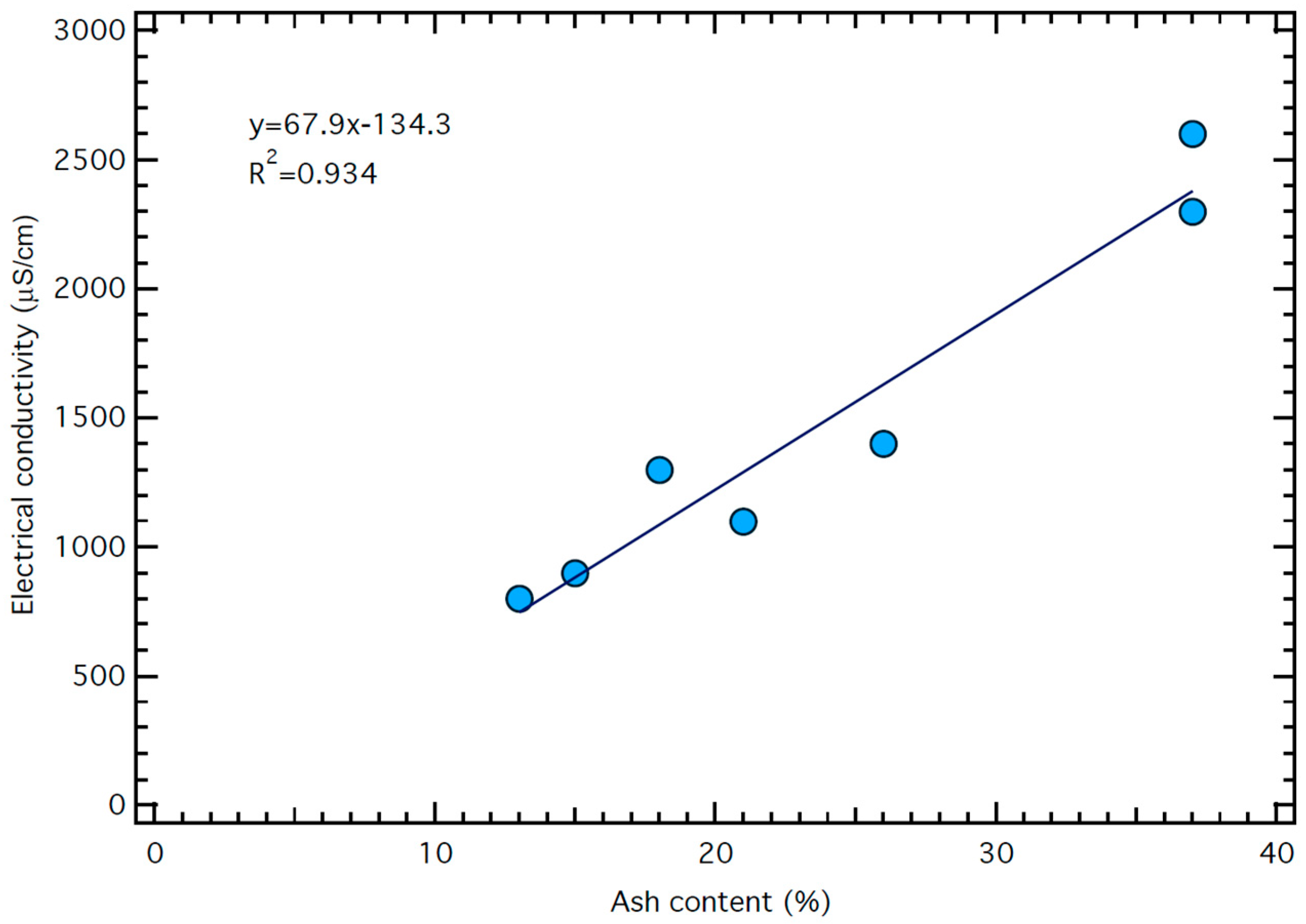
Electrical conductivity, measured with an electrode, varied between 800 and 2300 μS/cm. This parameter, commonly used to estimate the total dissolved salts in the samples, showed a slight increase with pyrolysis temperature but generally remained at low levels. A clear trend was observed, indicating that higher pyrolysis temperatures correspond to increased electrical conductivity in the biochar samples, reflecting a gradual rise in the content of soluble mineral components.
Studying the relationship between ash content and electrical conductivity (Figure 1), a linear dependence is observed. Electrical conductivity begins to appear once the ash content exceeds approximately 4%. According to the equation of the linear fit, this corresponds to a value of 2.9% ash content for y = 0. Below this threshold, the ions contributing to electrical conductivity are largely trapped within the organic fraction of the material.
The pH of the materials was measured using pH indicator strips in 1D water, as well as in CaCl2 and NaNO3 solutions. Measurements were taken after one hour and again after one day, respectively. For all samples, an increase in pyrolysis temperature corresponded to a rise in pH, indicating the presence of alkaline ash and/or the removal of acidic surface groups due to condensation and polymerization reactions during pyrolysis. The pH values of the biochar samples ranged from 7.0 to 10 (Table 3).
Elements observed on biochar surfaces through SEM-EDS besides C and O include Mg, Si, S, Cl, K, with K having higher occurrence. The elemental analysis of the surface of the biochar produced at 350 °C also includes Na whereas the one for the biochar produced at 850 °C includes Al and Ca with Ca having an equal percentage with K. It seems that the presence of Ca on the surface of the biochar can also be correlated to high pyrolysis temperature and can explain the high pH observed for this sample (Table 3).

3.2. Carbon Nature

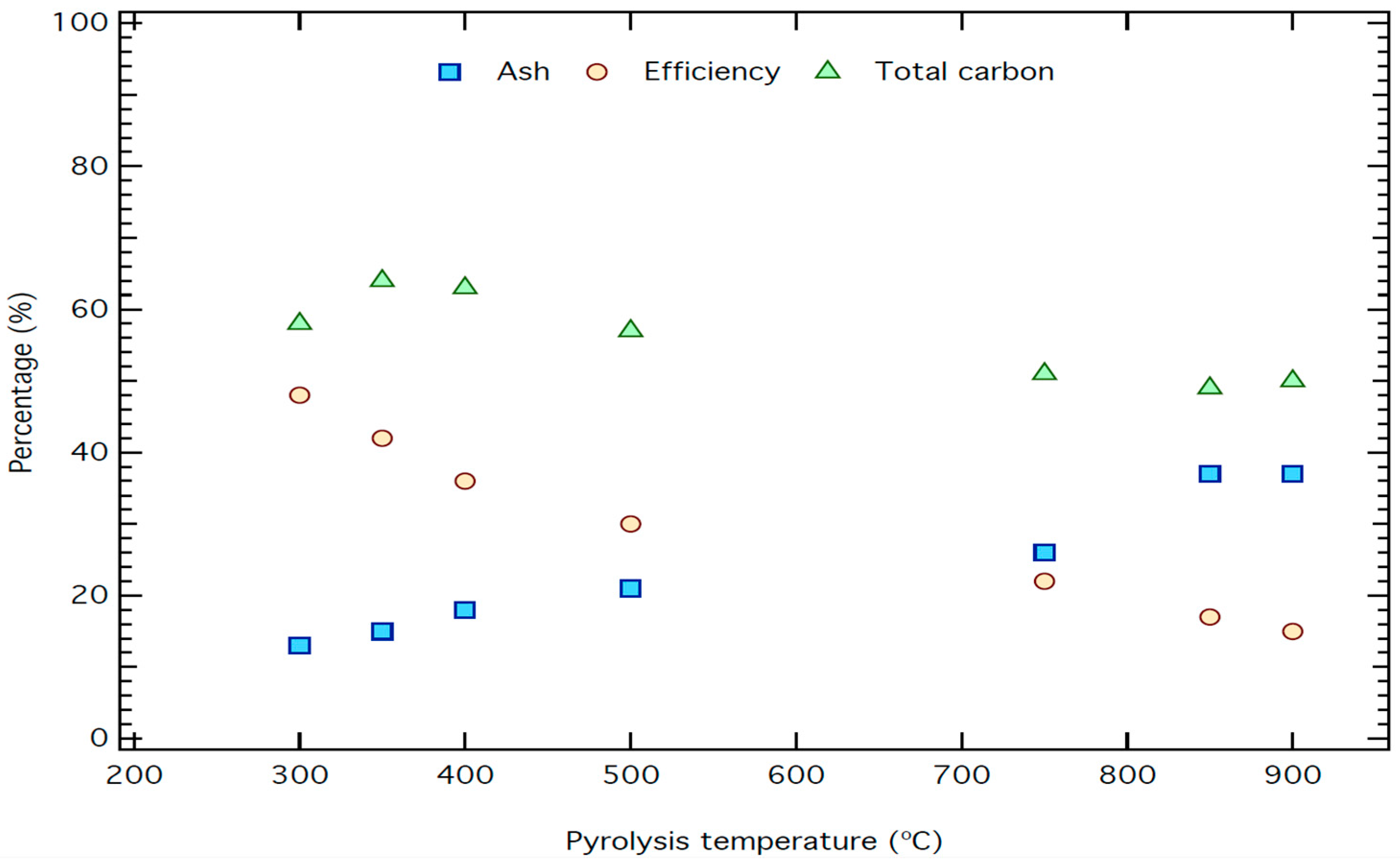
The properties of the biochar samples are also largely determined by their organic constituents, including total carbon content and behavior during water leaching. These were measured and presented in Table 2. Total carbon content ranges from 49 to 64%. The optimal pyrolysis temperature range for producing biochar with the highest total carbon content is 350–400 °C (Figure 2), whereas the optimum efficiency for biochar production from the raw MSR material is observed at 300 °C.
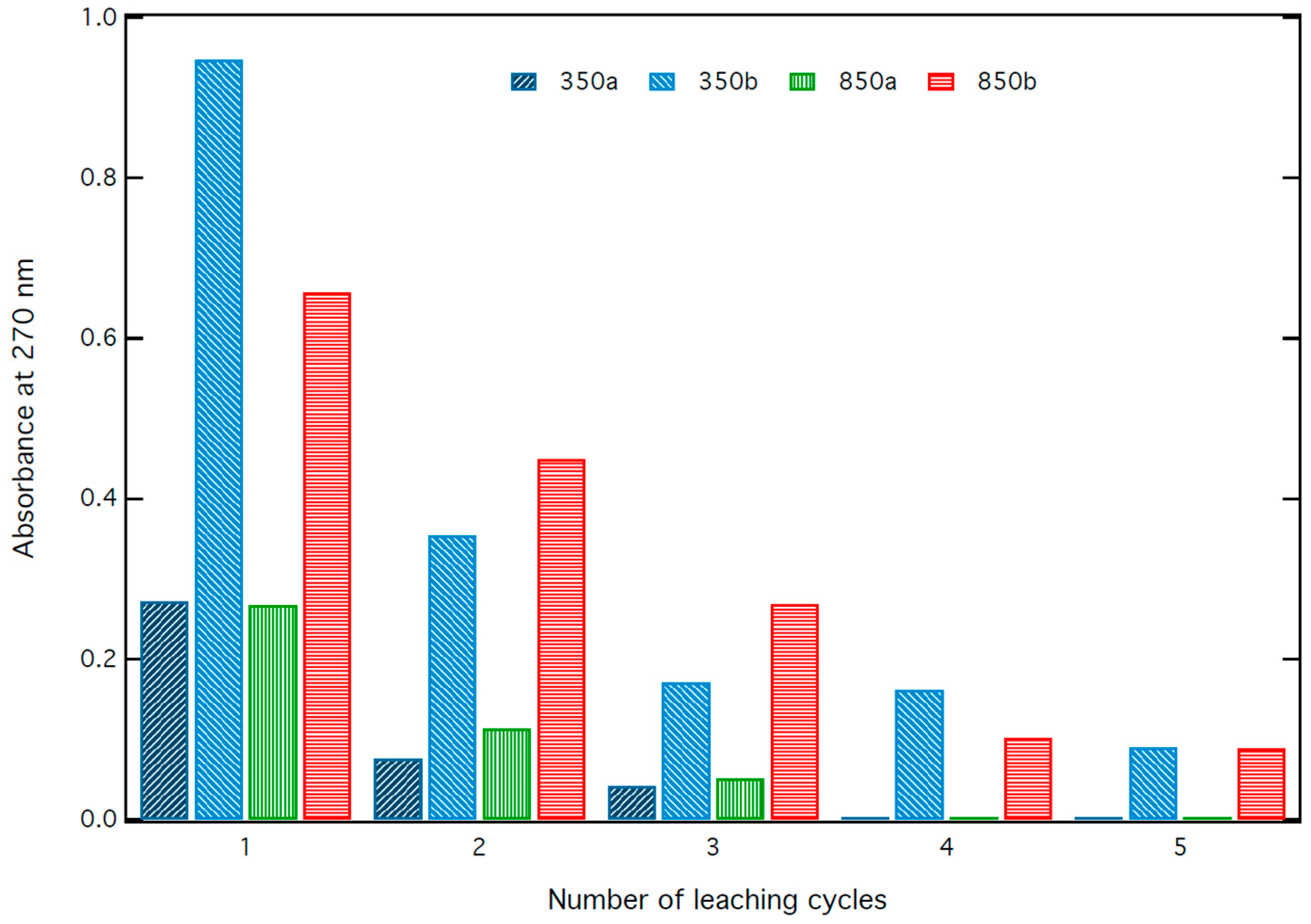
Water leaching experiments were performed on two biochar samples pyrolyzed at 350 and 850 °C, using two different sample masses (a = 0.1 g and b = 0.6 g). Absorbance measurements at 270 nm, as this wavelength corresponds to the maximum absorption of the organic compounds (compounds that contain aromatic rings or conjugated π-electron systems) as shown in Figure 3, indicate that in the lower-mass samples, the easily extractable organic compounds were no longer detectable after the third water leaching. In contrast, the higher mass samples required a total of five leaching cycles for these compounds to fall below detectable levels in the spectrophotometer. These results suggest that the extractable organic fraction is directly influenced by the sample mass, with larger masses retaining detectable amounts of organic compounds for more leaching cycles.
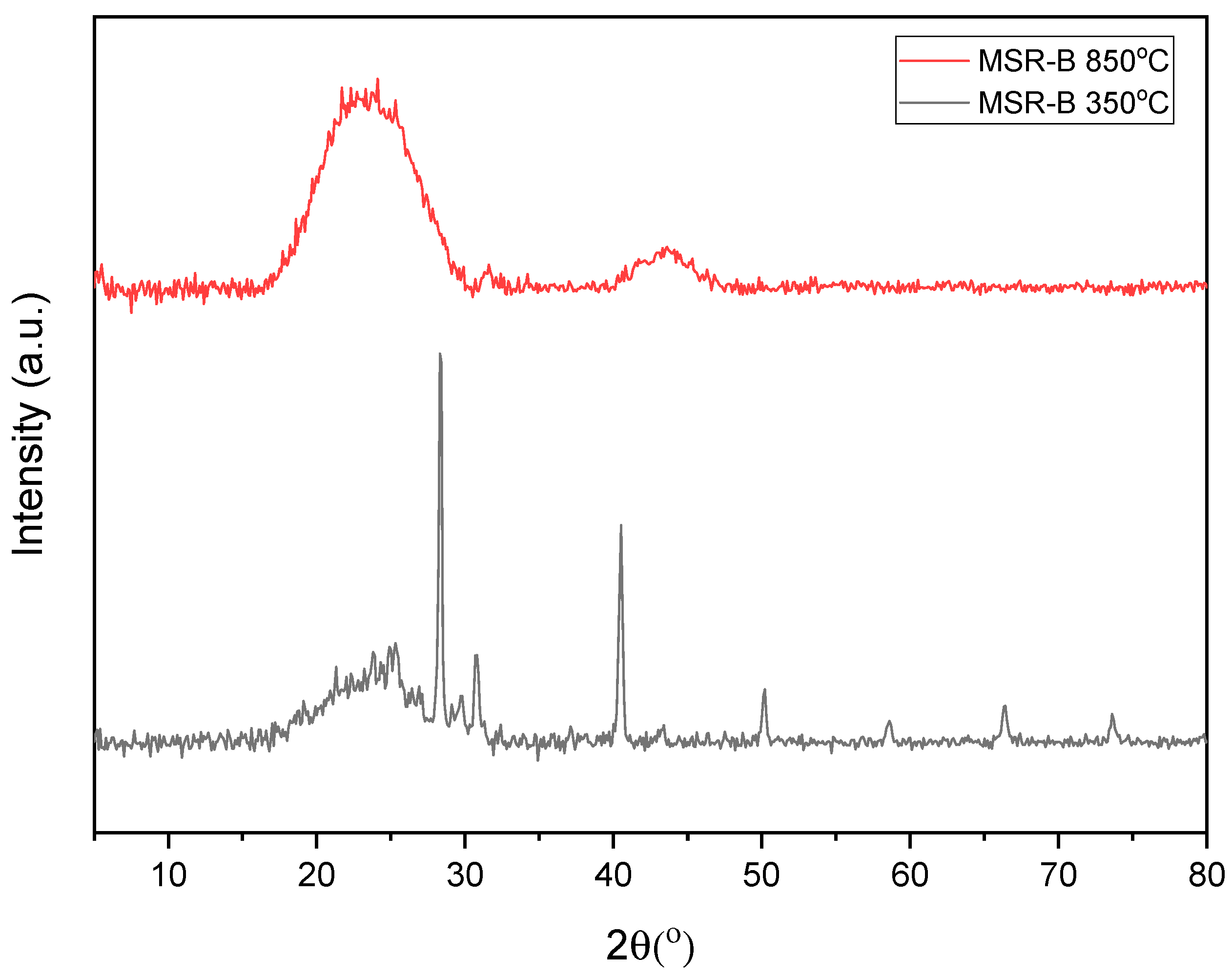
The XRD patterns of biochars produced at 350 and 850 °C are presented in Figure 4 and reveal the progressive structural transformation induced by pyrolysis temperature. The biochar produced at 350 °C exhibits a broad diffraction band in the 2θ range of 20–30°, characteristic of amorphous carbon structures originating from the partial decomposition of lignocellulosic biomass components. The absence of distinct crystalline reflections indicates low structural ordering and preservation of disordered organic domains. In contrast, the biochar produced at 850 °C shows a more pronounced broad peak centered at approximately 24–26°, accompanied by a weak reflection near 43–45°, attributed to the (002) and (100) planes of turbostratic carbon. These features indicate increased aromatization and partial graphitic ordering resulting from dehydration, devolatilization, and carbon condensation reactions during high-temperature pyrolysis. Similar structural evolution has been reported for other lignocellulosic biochar subjected to elevated pyrolysis temperatures [40,41]. Overall, increasing the pyrolysis temperature promotes the transition from an amorphous biomass structure toward a more condensed sp2-carbon network, indicating enhanced structural ordering and thermal stability of the produced biochar.
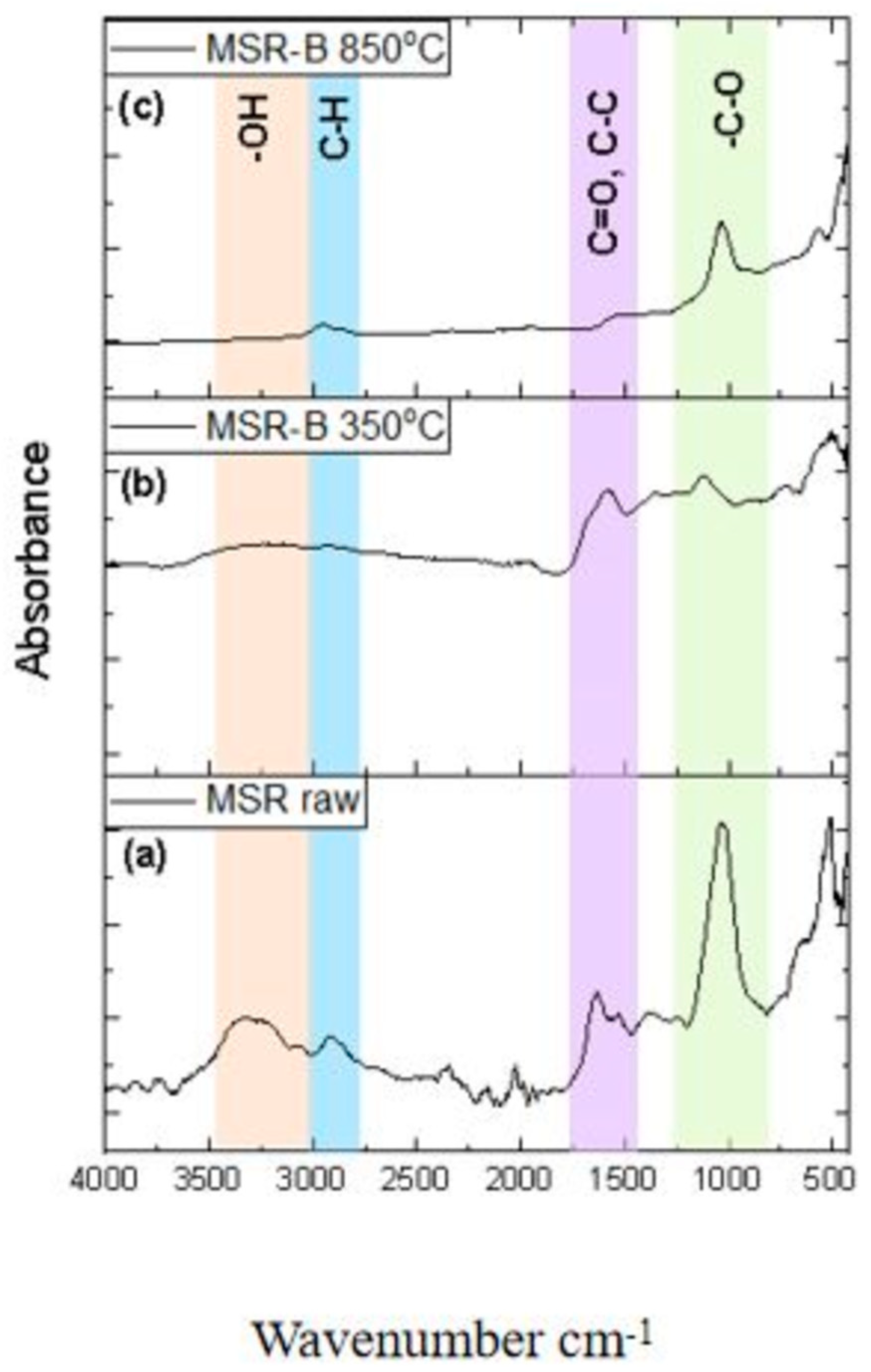
In addition, the surface functional group evolution during pyrolysis was investigated by ATR-FTIR spectroscopy and the spectra of raw MSR together with biochar produced at 350 and 850 °C are presented in Figure 5. The spectrum of raw MSR exhibits a broad absorption band in the 3200–3500 cm−1 region, attributed to O-H stretching vibrations originating from hydroxyl groups of cellulose, hemicellulose and lignin, as well as adsorbed moisture. Bands observed at 2920–2850 cm−1 correspond to aliphatic C-H stretching vibrations associated with polysaccharide and lipid components. The intense absorption in the 1650–1540 cm−1 region is assigned to C=O stretching and amide I-II vibrations, reflecting the significant protein content of malt rootlets [36], which differentiates this residue from typical lignocellulosic agricultural biomasses. Following pyrolysis at 350 °C, a noticeable reduction in the intensity of hydroxyl and aliphatic bands is observed, indicating dehydration reactions and thermal decomposition of hemicellulose and extractive fractions. Simultaneously, the relative enhancement of bands in the 1600–1500 cm−1 region suggests the formation of aromatic structures resulting from initial carbonization processes. The persistence of oxygen-containing functional groups demonstrates incomplete devolatilization and the retention of surface functionalities. At 850 °C, substantial spectral simplification occurs, characterized by the disappearance of O-H and aliphatic C-H vibrations and the strong dominance of bands associated with aromatic C=C stretching. The attenuation of carbohydrate-related absorptions in the 1200–1000 cm−1 region confirms extensive decomposition of cellulose and hemicellulose structures. These changes indicate progressive aromatization and the development of condensed carbonaceous domains typical of highly carbonized biochar. Overall, the FTIR results confirm the transition from a protein and polysaccharide-rich biomass toward an increasingly aromatic and carbon-dominated structure with increasing pyrolysis temperature.

3.3. Texture and Sorption Properties

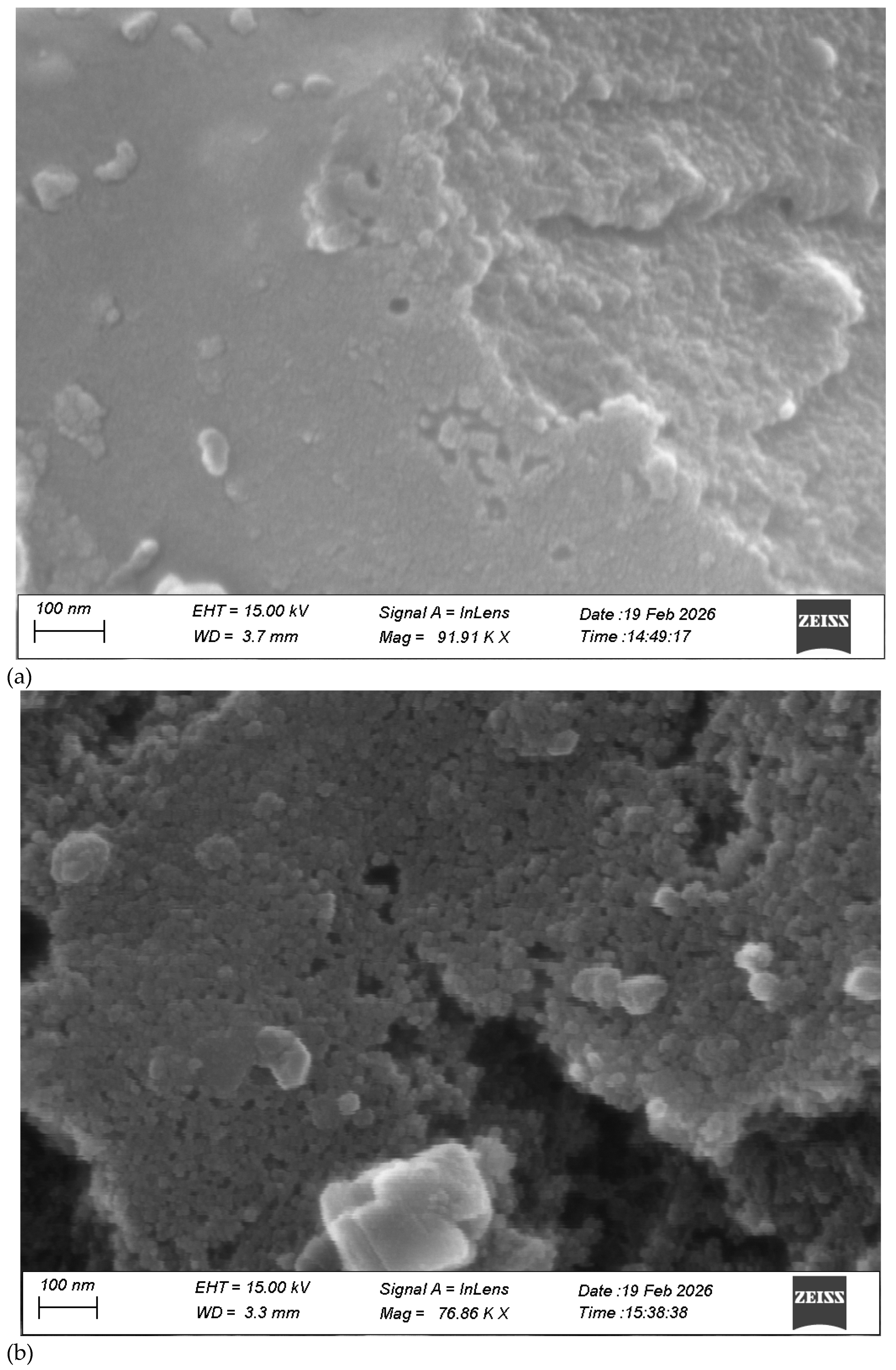
The visualization of the texture of selected biochars is performed with SEM and selected pictures are presented in Figure 6. While both biochars maintain the initial structure of MSR, it is obvious that the biochar produced at 850 °C demonstrates a much more densely porous texture than the one produced at 350 °C. The magnification of the photos presented in Figure 6 are the highest that have been presented in the literature related to biochars produced from MSR and allow for the visual observation of mesopores as well as some hints on the presence of micropores.
The surface area of the materials increases by three orders of magnitude after pyrolysis at 750 °C, as shown in Table 4. This table also presents the total surface area, pore volume, and average pore size of the various biochars produced at different temperatures. The specific surface area of the materials, measured by the BET method, ranges from 0.50 to 294 m2/g. A clear trend of increasing specific surface area with higher pyrolysis temperatures is observed. Analysis of the data indicates that the optimal temperature range for producing biochar with the highest specific surface area is between 750 and 850 °C.
The properties of the biochar were investigated using both methylene blue solution and molasses number, providing an indication of the type of porosity present. The methylene blue sorption experiment highlights the presence of mesopores in the material, whereas the molasses number reflects the presence of macropores.
Table 4 presents the values of Ce (mg/L) and qe (mg/g) for each sample, corresponding to both the methylene blue and molasses sorption experiments. Here, Ce represents the equilibrium concentration of the sorbate in the solution, while qe represents the equilibrium concentration of the sorbate per mass of biochar and is calculated as follows:
q e   =   C o C e × V m
where Co is the initial concentration measured based on the concentration of the blank samples, V is the volume of the solution, and m is the mass of the biochar.
Based on these results, the biochars demonstrate satisfactory sorption performance, confirming their potential as efficient sorbent materials. Among the samples studied, the biochar produced at a pyrolysis temperature of 850 °C exhibited the highest sorption capacity per mass of biochar, indicating that higher pyrolysis temperatures enhance the development of a porous structure and increase the availability of active sites for sorption.

3.4. Chlorine Removal Ability

The chlorine removal performance of four selected biochars, one obtained at 350 °C and three produced at higher pyrolysis temperatures (750, 850, and 900 °C) was evaluated. According to Table 5, the lowest measured concentration of chlorine in the effluent corresponds to the biochar pyrolyzed at 850 °C. This material exhibits the highest chlorine removal capacity, almost completely removing chlorine from the solution. Initially, the chlorine concentration in the solution was 5 mg/L. However, after passing through the 850 °C biochar, the measured concentration decreased dramatically, indicating nearly complete chlorine removal. Consequently, biochar pyrolyzed at 850 °C can be considered a highly effective material for chlorine removal. This conclusion is further supported by its lowest HVL value, as HVL represents a measure of the chlorine removal rate of the material (the lower the value, the better the efficiency).
Kinetic experiments were also conducted for the biochar produced at 350, 750, 850, and 900 °C, in both granular and powdered forms, with the results presented in Table 5. As shown, higher rate constant (k) values correspond to faster chlorine removal. The results indicate that chlorine is removed more rapidly when biochar produced at higher pyrolysis temperatures are used. Therefore, the biochar produced at 850 °C exhibits the most efficient chlorine removal performance. This behavior can be attributed to the larger specific surface area and the more developed pore structure formed at higher pyrolysis temperatures, which increase the number of available active sites and facilitate faster chlorine uptake. Moreover, powdered biochar exhibited higher rate constants compared to their granular counterparts, suggesting that the greater available surface area and improved contact with the solution accelerate the chlorine removal process.
Biochars contain a diverse array of surface functional groups capable of reacting with free chlorine. The dominant pathway involves electrophilic substitution at α-carbon sites adjacent to carbonyl functionalities, where hydrogen atoms are progressively replaced by chlorine, resulting in the formation of covalent C–Cl bonds [42].
In [42], activated carbon was used in similar studies in comparison with biochars. The activated carbon samples showed faster adsorption kinetics, with higher free chlorine removal after 1 h of contact. After 24 h, the removal efficiency was similar for both activated carbon and biochar.

4. Discussion

Most of the techniques presented above have been used by other researchers. Nevertheless, the information presented here and the combination of techniques to determine the results for the suitability of each MSR biochar is the innovation of this study. The following discussion presents examples of how the information provided in the Section 3 can be interpreted in order to couple the correct temperature with the appropriate application.
Pyrolysis temperature affects MSR biochar properties since various biomass alterations take place at different temperatures. At low pyrolysis temperatures, early degradation of biomass, resulting in water vapor, light volatiles, and the beginning of biochar formation. Extremely light volatile materials are removed from the pores and surface of the biochar [43]. Partial pyrolysis occurs due to problems with heat and mass transfer. At intermediate pyrolysis temperatures, biomass decomposes rapidly, releasing heavy tars and intermediate volatiles. Biochar efficiency decreases. At high temperatures, pyrolysis is complete, and complex liquid vapors break down into lighter, non-condensable gases that allow the formation of micropores and high surface area. At temperatures higher than 850 °C, there seems to be a breakdown of the structure of the biomass and micropores break to create larger pores with lower volume (Table 4).
Comparison of biochar derived from malt spent rootlets with previous studies [18,28,44] indicates that biochars produced at elevated pyrolysis temperatures (750–900 °C) exhibit comparable physicochemical characteristics, including specific surface area, inorganic content, and total carbon fraction. These high-pyrolysis-temperature (750–900 °C) biochars can be used as filtering materials whereas the lower-pyrolysis-temperature (300–500 °C) biochars are suitable for soil amendments.
In the present study, the characterization of inorganic properties is significant for providing insights into the behavior of the biochars related to their ability to retain moisture which is significant for soil amendments. Biochars produced at temperatures < 400 °C do not affect the solution pH and thus, they are suitable for soil amendments. The other biochars (500–900 °C) can be used for creating alkaline solutions (Table 3) that may be suitable for some reactions or catalytic processes [45]. The ash content and the electrical conductivity are important related to the leaching of inorganic ions in the solution. This also provides information on alkaline nature and on the treatment that it is required to make the biochar leachate less toxic related to its inorganic nature [46].
The carbon nature also provides information on the stability of the biochars when introduced in aqueous systems in terms of the leaching of organic constituents from the biochars. Figure 3 suggests that washing the biochar five times results in materials that are stable and do not leach any more organics in the aqueous solution. The same number of washings has also been identified for removing toxic leachates based on metals [46]. The stability and volatility of carbon provide information for the stability of the biochar once used in these different applications. This information has not been discussed before for MSR biochars.
The surface functional groups found in the two biochars (Figure 5) indicate that if the desired material application requires both high surface and functional groups, then further treatment would be required for the high temperature biochar to obtain more functional groups [47].
The characterization of biochar texture is important to determine the ability to use these materials as sorbent materials. The MSR biochars produced in the present study at elevated pyrolysis temperatures (750–900 °C) demonstrate high surface areas (Table 4). These biochars also have more mesopores based on the methylene blue sorption results and more macropores based on molasses sorption (Table 4) compared to biochars produced at lower pyrolysis temperatures.
The characterization of the ability of biochar to remove chlorine from water is one new application [42,44] that has not been effective yet commercially. Nevertheless, based on the use of activated carbon for this application, biochar seems a rather promising, cheaper alternative which has many active sites due to the increased surface area.

5. Conclusions

The main conclusions from the present study are as follows:
  • Malt spent rootlets can be successfully pyrolyzed at temperatures up to 900 °C to produce biochar with different textural and chemical properties.
  • Based on the application and the desired characteristics of the material to be produced, one can pick the desired pyrolysis temperature and select simple analytical techniques that are presented in the present study to determine the suitability of each biochar.
  • Increasing the pyrolysis temperature leads to a significant increase in the surface area and pore volume, mainly due to the development of micro and mesopores. Biochars pyrolyzed at 750–850 °C exhibit the highest specific surface area, making them the most promising sorbents.
  • Sorption experiments using methylene blue and molasses number demonstrated that higher pyrolysis temperatures enhance both mesopore and macropore development, making biochar a diverse sorptive material suitable for different applications.
  • Chlorine removal experiments revealed that biochar pyrolyzed at 850 °C has the highest chlorine removal capacity and the lowest half value length, confirming its efficiency. Higher pyrolysis temperatures and powdered forms increase the removal rate constants, indicating faster chlorine removal due to increased surface area and accessibility of active sites.

Author Contributions

Conceptualization, H.K.K. and I.D.M.; methodology, H.K.K.; software, A.T., P.E.P. and N.M.; validation, H.K.K.; formal analysis, A.T., P.D.N., P.E.P. and N.M.; investigation, A.T., P.E.P. and N.M.; resources, I.D.M. and H.K.K.; data curation, H.K.K.; writing—original draft preparation, A.T. and P.D.N.; writing—review and editing, H.K.K. and I.D.M.; visualization, I.D.M. and H.K.K.; supervision, H.K.K.; project administration, H.K.K.; funding acquisition, H.K.K. All authors have read and agreed to the published version of the manuscript.

Funding

This research received no external funding.

Data Availability Statement

The original contributions presented in this study are included in the article. Further inquiries can be directed to the corresponding author.

Acknowledgments

We would like to thank Dimitrios Tzivras from the University of Patras for technical assistance in the laboratory.

Conflicts of Interest

The authors declare no conflicts of interest.

Abbreviations

The following abbreviations are used in this manuscript:
1DDistilled water
ATR-FTIRAttenuated Total Reflectance-Fourier Transform Infra-Red
BETBrunauer, Emmett, and Teller equation
ECElectrical Conductivity
EDSEnergy Dispersive microanalyzer detector
HVLHalf Value Length
MSRMalt Spent Rootlets
SEMScanning Electron Microscopy
XRDX-ray Diffraction

References

  1. Lehmann, J.; Joseph, S. (Eds.) Biochar for Environmental Management: Science, Technology and Implementation, 2nd ed.; Routledge: London, UK, 2015; 976p. [Google Scholar] [CrossRef]
  2. Mohan, D.; Sarswat, A.; Ok, Y.S.; Pittman, C.U., Jr. Organic and inorganic contaminants removal from water with biochar, a renewable, low cost and sustainable adsorbent—A critical review. Bioresour. Technol. 2014, 160, 191–202. [Google Scholar] [CrossRef]
  3. Sun, L.M.; McIntyre, S.R.; Iacomi, P.; Everden, K.; Williams, P.T.; Zong, S.; Liu, X.; Zhu, X.; Yang, Y.; Li, S.; et al. Biochar production, activation, and applications: A comprehensive technical review. Carbon Capture Sci. Technol. 2025, 16, 100421. [Google Scholar] [CrossRef]
  4. Chan, K.Y.; Van Zwieten, L.; Meszaros, I.; Downie, A.; Joseph, S. Agronomic values of greenwaste biochar as a soil amendment. Aust. J. Soil Res. 2007, 45, 629–634. [Google Scholar] [CrossRef]
  5. Yang, B.; Li, D.; Yuan, S.; Jin, L. Role of biochar from corn straw in influencing crack propagation and evaporation in sodic soils. Catena 2021, 204, 105457. [Google Scholar] [CrossRef]
  6. Liang, L.; Xi, F.; Tan, W.; Meng, X.; Hu, B.; Wang, J. Review of organic and inorganic pollutants removal by biochar and biochar-based composites. Biochar 2021, 3, 255–281. [Google Scholar] [CrossRef]
  7. Novak, J.M.; Lima, I.; Xing, B.; Gaskin, J.W.; Steiner, C.; Das, K.C.; Ahmedna, M.A.; Rehrah, D.; Watts, D.W.; Busscher, W.J.; et al. Characterization of designer biochar produced at different temperatures and their effects on a loamy sand. Ann. Environ. Sci. 2009, 3, 195. [Google Scholar] [CrossRef]
  8. Hossain, M.K.; Strezov, V.; Chan, K.Y.; Nelson, P.F. Agronomic properties of wastewater sludge biochar and bioavailability of metals in production of cherry tomato (Lycopersicon esculentum). Chemosphere 2010, 78, 1167. [Google Scholar] [CrossRef]
  9. Woolf, D.; Amonette, J.E.; Street-Perrott, F.A.; Lehmann, J.; Joseph, S. Sustainable biochar to mitigate global climate change. Nat. Commun. 2010, 1, 56. [Google Scholar] [CrossRef] [PubMed]
  10. Major, J.; Rondon, M.; Molina, D.; Riha, S.J.; Lehmann, J. Maize yield and nutrition during 4 years after biochar application to a Colombian savanna oxisol. Plant Soil 2010, 333, 117. [Google Scholar] [CrossRef]
  11. Cao, X.D.; Ma, L.Q.; Gao, B.; Harris, W. Dairy-manure derived biochar effectively sorbs lead and atrazine. Environ. Sci. Technol. 2009, 43, 3285. [Google Scholar] [CrossRef]
  12. Chen, X.C.; Chen, G.C.; Chen, L.G.; Chen, Y.X.; Lehmann, J.; McBride, M.B.; Hay, A.G. Adsorption of copper and zinc by biochars produced from pyrolysis of hardwood and corn straw in aqueous solution. Bioresour. Technol. 2011, 102, 8877. [Google Scholar] [CrossRef]
  13. Paschalidou, P.; Pashalidis, I.; Manariotis, I.D.; Karapanagioti, H.K. Hyper sorption capacity of raw and oxidized biochars from various feedstocks for U(VI). J. Environ. Chem. Eng. 2020, 8, 103932. [Google Scholar] [CrossRef]
  14. Ahmad, M.; Rajapaksha, A.U.; Lim, J.E.; Zhang, M.; Bolan, N.; Mohan, D.; Vithanage, M.; Lee, S.S.; Ok, Y.S. Biochar as a sorbent for contaminant management in soil and water: A review. Chemosphere 2014, 99, 19–33. [Google Scholar] [CrossRef]
  15. Wang, S.; Shan, R.; Wang, Y.; Lu, L.; Yuan, H. Synthesis of calcium materials in biochar matrix as a highly stable catalyst for biodiesel production. Renew. Energy 2019, 130, 41–49. [Google Scholar] [CrossRef]
  16. Nikolopoulos, I.; Kordouli, E.; Mourgkogiannis, N.; Karapanagioti, H.K.; Lycourghiotis, A.; Kordulis, C. Valorization of pyrolyzed biomass residues for the transformation of waste Cooking Oil into Green Diesel. Catalysts 2023, 13, 1004. [Google Scholar] [CrossRef]
  17. Sathyabama, K.; Firdous, S. Effect of pyrolysis temperature on the physicochemical properties and structural characteristics of agricultural wastes-derived biochar. ACS Omega 2025, 10, 37013–37024. [Google Scholar] [CrossRef]
  18. Manariotis, I.D.; Fotopoulou, K.N.; Karapanagioti, H.K. Preparation and characterization of biochar sorbents produced from malt spent rootlets. Ind. Eng. Chem. Res. 2015, 54, 9577–9584. [Google Scholar] [CrossRef]
  19. Khater, E.S.; Bahnasawy, A.; Hamouda, R.; Ali, S.A.; Hassan, M. Biochar production under different pyrolysis temperatures with different types of agricultural wastes. Sci. Rep. 2024, 14, 2625. [Google Scholar] [CrossRef] [PubMed]
  20. Moya, R.; Tenorio, C.; Quesada-Kimzey, J.; Másis-Meléndez, F. Pyrogenic carbonaceous materials production of four tropical wood produced by slow pyrolysis at different temperatures: Charcoal and biochar properties. Energies 2024, 17, 1953. [Google Scholar] [CrossRef]
  21. Demirbas, A. Effects of temperature and particle size on bio-char yield from pyrolysis of agricultural residues. J. Anal. Appl. Pyrolysis 2004, 72, 243–248. [Google Scholar] [CrossRef]
  22. Rasa, K.; Viherä-Aarnio, A.; Rytkönen, P.; Hyväluoma, J.; Kaseva, J.; Suhonen, H.; Jyske, T. Quantitative analysis of feedstock structural properties can help to produce willow biochar with homogenous pore system. Ind. Crops Prod. 2021, 166, 113475. [Google Scholar] [CrossRef]
  23. Angin, D. Effect of pyrolysis temperature and heating rate on biochar obtained from pyrolysis of safflower seed press cake. Bioresour. Technol. 2013, 128, 593. [Google Scholar] [CrossRef]
  24. Fu, P.; Yi, W.; Bai, X.; Li, Z.; Hu, S.; Xiang, J. Effect of temperature on gas composition and char structural features of pyrolyzed agricultural residues. Bioresour. Technol. 2011, 102, 8211. [Google Scholar] [CrossRef]
  25. Al-Wabel, M.I.; Al-Omran, A.; El-Naggar, A.H.; Nadeem, M. Pyrolysis temperature induced changes in characteristics and chemical composition of biochar produced from conocarpus wastes. Bioresour. Technol. 2013, 131, 374. [Google Scholar] [CrossRef]
  26. Wang, S.; Gao, B.; Zimmerman, A.R.; Li, Y.; Ma, L.; Harris, W.G.; Migliaccio, K.W. Physicochemical and sorptive properties of biochars derived from woody and herbaceous biomass. Chemosphere 2015, 134, 257–262. [Google Scholar] [CrossRef]
  27. Uchimiya, M.; Wartelle, L.H.; Klasson, K.T.; Fortier, C.A.; Lima, I.M. Influence of pyrolysis temperature on biochar property and function as a heavy metal sorbent in soil. J. Agric. Food Chem. 2011, 59, 2501. [Google Scholar] [CrossRef] [PubMed]
  28. Mourgkogiannis, N.; Nikolopoulos, I.; Kordouli, E.; Lycourghiotis, A.; Kordulis, C.; Karapanagioti, H.K. The influence of biowaste type on the physicochemical and sorptive characteristics of corresponding biochar used as sustainable sorbent. Sustainability 2024, 16, 2889. [Google Scholar] [CrossRef]
  29. Đukanović, N.; Apostolović, T.; Anojčić, J.; Mutić, S.; Marjanović Srebro, T.; Kozma, G.; Deák, C.; Maletić, S.; Beljin, J. Comparative study of biochar from different biomass feedstocks: Toward sustainable resource utilization and environmental applications. Molecules 2026, 31, 37. [Google Scholar] [CrossRef]
  30. An, X.; Zhu, Z.; Luo, X.; Chen, C.; Liu, T.; Zou, L.; Li, S.; Liu, Y. Effects of raw materials and pyrolysis temperatures on physicochemical properties of biochars derived from hemp stalks. Plants 2025, 14, 2564. [Google Scholar] [CrossRef]
  31. Tripathi, M.; Sahu, J.N.; Ganesan, P. Effect of process parameters on production of biochar from biomass waste. Renew. Sustain. Energy Rev. 2016, 55, 467–481. [Google Scholar] [CrossRef]
  32. Neylon, E.; Arendt, E.K.; Lynch, K.M.; Zannini, E.; Bazzoli, P.; Monin, T.; Sahin, A.W. Rootlets, a Malting By-Product with Great Potential. Fermentation 2020, 6, 117. [Google Scholar] [CrossRef]
  33. Morais, E.G.; Silva, C.A.; Gao, S.; Melo, L.C.A.; Lago, B.C.; Teodoro, J.C.; Guilherme, L.R.G. Empirical correlation between electrical conductivity and nitrogen content in biochar as influenced by pyrolysis temperature. Nitrogen 2024, 5, 288–300. [Google Scholar] [CrossRef]
  34. Beljin, J.; Đukanović, N.; Anojčić, J.; Simetić, T.; Apostolović, T.; Mutić, S.; Maletić, S. Biochar in the remediation of organic pollutants in water: A review of polycyclic aromatic hydrocarbon and pesticide removal. Nanomaterials 2025, 15, 26. [Google Scholar] [CrossRef]
  35. Salama, A.-R.A.; El-Sahn, M.A.; Mesallam, A.S.; Shehata, A.M.E.-T. The chemical composition, the nutritive value and the functional properties of malt sprout and its components (Acrospires, Rootlets and Husks). J. Sci. Food Agric. 1979, 75, 50. [Google Scholar] [CrossRef]
  36. Bekatorou, A.; Kopsahelis, N.; Mallouchos, A.; Plessas, S.; Droushiotis, N.; Kanellaki, M.; Komaitis, M.; Koutinas, A.A.; Nigam, P. Biotechnological Exploitation of Brewery Solid Wastes; Current topics on Bioprocesses in Food Industry Volume III; Rao, L.V., Pandey, A., Larroche, C., Soccol, C.R., Dussap, C.G., Eds.; Asiatech Publishers Inc.: Delhi, India, 2010; pp. 193–209. [Google Scholar]
  37. Xu, R.K.; Xiao, S.C.; Yuan, J.H.; Zhao, A.Z. Adsorption of methyl violet from aqueous solutions by the biochars derived from crop residues. Bioresour. Technol. 2011, 102, 10293–10298. [Google Scholar] [CrossRef]
  38. Mukherjee, A.; Zimmerman, A.R.; Harris, W. Surface chemistry variations among a series of laboratory-produced biochars. Geoderma 2011, 163, 247–255. [Google Scholar] [CrossRef]
  39. EBC. European Biochar Certificate—Guidelines for a Sustainable Production of Biochar, Version 6.2E; European Biochar Foundation (EBC): Arbaz, Switzerland, 2012; Available online: http://www.european-biochar.org/en/download (accessed on 25 July 2025).
  40. Keiluweit, M.; Nico, P.S.; Johnson, M.G.; Kleber, M. Dynamic molecular structure of plant biomass-derived black carbon (biochar). Environ. Sci. Technol. 2010, 44, 1247–1253. [Google Scholar] [CrossRef] [PubMed]
  41. Santos, D.C.; Evaristo, R.B.; Dutra, R.C.; Suarez, P.A.; Silveira, E.A.; Ghesti, G.F. Advancing Biochar Applications: A Review of Production Processes, Analytical Methods, Decision Criteria, and Pathways for Scalability and Certification. Sustainability 2025, 17, 2685. [Google Scholar] [CrossRef]
  42. Tzachristas, A.; Manariotis, I.D.; Dailianis, S.; Karapanagioti, H.K. Decreasing Drinking Water Toxicity by Chlorine Removal Using Activated Carbons, Biomaterials and Biochars from Agro-industrial By-products. Water Air Soil Pollut. 2026, 237, 346. [Google Scholar] [CrossRef]
  43. Rambhatla, N.; Panicker, T.F.; Mishra, R.K.; Manjeshwar, S.K.; Sharma, A. Biomass pyrolysis for biochar production: Study of kinetics parameters and effect of temperature on biochar yield and its physicochemical properties. Results Eng. 2025, 25, 103679. [Google Scholar] [CrossRef]
  44. Sklivaniotis, L.N.; Economou, P.; Karapanagioti, H.K.; Manariotis, I.D. Chlorine Removal from Water by Biochar Derived from Various Food Waste Natural Mater. Environ. Proc. 2023, 10, 4. [Google Scholar] [CrossRef]
  45. Pantiora, D.; Karapanagioti, H.K.; Manariotis, I.D.; Lycourghiotis, A.; Kordulis, C. Evaluation of malt spent rootlets biochar as catalyst for biodiesel production. Geophys. Res. Abstr. 2014, 16, EGU2014–EGU6508. Available online: https://meetingorganizer.copernicus.org/EGU2014/EGU2014-6508.pdf (accessed on 8 January 2026).
  46. Tsouloufa, A.; Dailianis, S.; Karapanagioti, H.K.; Manariotis, I.D. Physicochemical and Toxicological Assay of Leachate from Malt Spent Rootlets Biochar. Bull. Environ. Contam. Toxicol. 2020, 104, 634–641. [Google Scholar] [CrossRef]
  47. Ntaflou, M.; Vakros, J. Transesterification activity of modified biochars from spent malt rootlets using triacetin. J. Clean. Prod. 2020, 259, 120931. [Google Scholar] [CrossRef]
Figure 1. Relationship between ash content and electrical conductivity of the samples. Blue dots are experimental data and the solid line is the best linear fit.
Processes 14 01012 g001
Figure 2. Percentage (%) of ash content (blue markers), efficiency (orange markers) and total carbon (green markers) as a function of pyrolysis temperature.
Processes 14 01012 g002
Figure 3. Absorbance at 270 nm of biochar samples pyrolyzed at 350 and 850 °C, measured for different sample masses (a = 0.1 g and b = 0.6 g), as a function of the number of leaching cycles for each sample.
Processes 14 01012 g003
Figure 4. XRD patterns of selected biochars produced from MSR at 350 and 850 °C.
Processes 14 01012 g004
Figure 5. ATR-FTIR spectra of raw malt spent rootlets (MSRs) and biochar samples produced at different pyrolysis temperatures: (a) MSR raw, (b) MSR-B 350 °C, and (c) MSR-B 850 °C.
Processes 14 01012 g005
Figure 6. The surface topography of malt spent rootlet (MSR) biochar samples produced at different pyrolysis temperatures, as visualized by SEM: (a) 350 °C and (b) 850 °C. Note the scale bar at the bottom of each image; scale bar 100 nm.
Processes 14 01012 g006
Table 1. Analytical and characterization techniques used for biochar.
Characterization MethodProperty Determined
Inorganic properties
Moisture ContentPercentage of contained moisture
Ash ContentPercentage of inorganic constituents
Electrical Conductivity (EC)Concentration and mobility of cations and anions in solution
pH MeasurementDetermination of acidity/alkalinity
Carbon nature
Total CarbonPercentage of total carbon
Washing (Leaching Tests)Easily extractable organic substances
XRDOrganic matter crystallinity
FTIRSurface functional groups
Texture and sorption properties
SEMSurface texture
Surface Area and PorositySpecific surface area
Methylene Blue SorptionSorption capacity of methylene blue
Molasses NumberMolasses concentration determination
Chlorine Removal EfficiencyRate of chlorine removal in a column
Chlorine Removal KineticsKinetics of chlorine removal in batch systems
Table 2. Pyrolysis temperature (T), moisture, ash content, efficiency, calculated ash in the raw material, electrical conductivity, and total carbon of the biochar.
T
°C
Moisture
(%)
Ash Content
(%)
Efficiency
(%)
Calculated Ash in the Raw Material (%)Electrical
Conductivity (μS/cm)
Total
Carbon
(%)
3006.113486.2800 58
3506.115426.3900 64
4006.918366.51300 63
5006.821306.31100 57
7509.426226.21400 51
8501137176.32600 49
9001237155.62300 50
Table 3. Pyrolysis temperature (T) and pH measurements using distilled (1D) water, as well as CaCl2 and NaNO3 solutions.
T,
°C
pH with 1DpH with CaCl2pH with NaNO3
After 1 hAfter 1 dayAfter 1 hAfter 1 dayAfter 1 hAfter 1 day
300777777
350777777
400777777
500999988
7501010101088
8501010101099
9001010101099
Table 4. Material properties after charring at different pyrolysis temperatures (T), the equilibrium concentration (Ce, mg/L) and the sorption capacity (qe, mg/g) of each sample were determined for both the methylene blue sorption and the molasses number experiments (some values are expressed as average ± SD, where SD stands for standard deviation).
T,
°C
ΒΕΤ
(m2/g)
Pore
Volume
(cm3/g)
Average
Pore Size
(Å)
Methylene
Blue
Molasses
Number
Ce
(mg/L)
qe
(mg/g)
Ce
(mg/L)
qe
(mg/g)
3000.50 ± 0.100.000860 ± 9.2 12796003.8
3500.730.0089119.5905709.2
4003.40.016 ± 0.002170 ± 155.71105807.7
5005.50.00275089653018
7501670.15 ± 0.02050 ± 2.11313053018
8502300.18 ± 0.01046 ± 1.7915044035
9002460.16 ± 0.04052 ± 7.13.419032058
Table 5. Influent and effluent chlorine concentrations, HVL values, and kinetic rate constants for granular and powdered biochar.
T
°C
Chlorine Concentration in the Influent Solution (a) (mg/L)Chlorine Concentration in the Effluent Solution (b)
(mg/L)
HVL1st Order Rate Constant for the Granular Biochar (k) (1/min)1st Order Rate Constant for the Powder Biochar (k) (1/min)
3505 0.85 3.10.00060.0146
7505 0.82 3.10.00080.0093
8505 0.05 1.20.00090.0110
9005 0.13 1.50.00100.0146
Disclaimer/Publisher’s Note: The statements, opinions and data contained in all publications are solely those of the individual author(s) and contributor(s) and not of MDPI and/or the editor(s). MDPI and/or the editor(s) disclaim responsibility for any injury to people or property resulting from any ideas, methods, instructions or products referred to in the content.