Article

Valorization of Pumpkin Peels as Agro-Food Processing Waste for Sustainable Biochar and Hydrochar Production: Environmental Assessment and Structural Characterization


by
Mürüvet H. Uysal
1,*,
Monika Sharma
2,3,
Sema H. Y. Çoban
2,
Ahsen A. Uludağ
4,
Hüseyin Altundağ
5,6,
Grazyna S. Martynkova
7,
Tuğrul Çetinkaya
1,7,8,9,*,
Aliye S. E. Yay
3,4 and
Ali O. Kurt
1
1
Department of Metallurgical and Materials Engineering, Engineering Faculty, Sakarya University, Esentepe Campus, 54187 Sakarya, Türkiye
2
Department of Nanoscience and Nanoengineering, Sakarya University, Esentepe Campus, 54187 Sakarya, Türkiye
3
Natural Resource and Waste Assessment Research Center (NRAWA-RC), SARGEM, Esentepe Campus, 54187 Sakarya, Türkiye
4
Department of Environmental Engineering, Engineering Faculty, Sakarya University, Esentepe Campus, 54187 Sakarya, Türkiye
5
Department of Chemistry, Faculty of Science, Sakarya University, Esentepe Campus, 54187 Sakarya, Türkiye
6
Biomedical, Magnetic and Semiconductor Materials Research Center (BIMAS-RC), Sakarya University, 54187 Sakarya, Türkiye
7
Nanotechnology Centre, CEET, VŠB-Technical University of Ostrava, 70800 Ostrava-Poruba, Czech Republic
8
Research, Development, and Application Center (SARGEM), Sakarya University, Esentepe Campus, 54187 Sakarya, Türkiye
9
NESSTEC Energy & Surface Technology A.S., Technology Development Zones, Esentepe, 54050 Sakarya, Türkiye
*
Authors to whom correspondence should be addressed.
Processes 2026, 14(8), 1297; https://doi.org/10.3390/pr14081297
Submission received: 19 March 2026 / Revised: 9 April 2026 / Accepted: 15 April 2026 / Published: 18 April 2026
(This article belongs to the Section Sustainable Processes)

Abstract

The valorization of agricultural wastes such as pumpkin peel generated from the food processing industry through thermochemical conversion offers sustainable solutions for both waste management and carbon cycling. This study aims to evaluate the physicochemical properties and environmental impacts of charcoals produced from pumpkin peel waste (PPW), without the use of chemicals or pre-washing. In this context, pumpkin peel hydrochar (PPH) was produced by hydrothermal carbonization (HTC) and pumpkin peel biochar (PPB) by pyrolysis. The systems were modeled according to a pilot-scale scenario based on the processing of 100 kg of PPW, and the functional unit was defined as the processing of this amount. The properties of the products were determined by various physicochemical characterization techniques, and environmental impacts were analyzed using Life Cycle Assessment (LCA). The results showed that PPH has a higher specific surface area (16.35 m2 g−1) than PPB (9.80 m2 g−1), as well as a higher carbon content (76.18% for PPH and 66.07% for PPB). Furthermore, the environmental impact of PPH (16.42 kg CO2-equivalent/FU) is lower than that of PPB (32.33 kg CO2-equivalent/FU). Based on the obtained physicochemical properties, the potential of both materials as soil conditioners has been evaluated. The lower environmental impact values suggest that PPH may be a more advantageous alternative in terms of sustainability. However, this evaluation is not based on direct soil application experiments, and further applied studies are needed to confirm this potential.

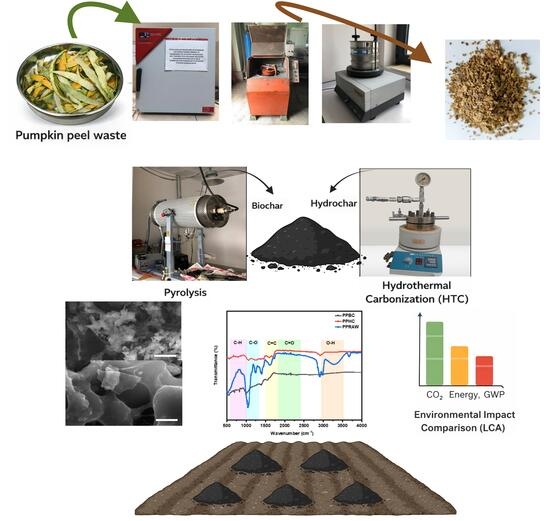
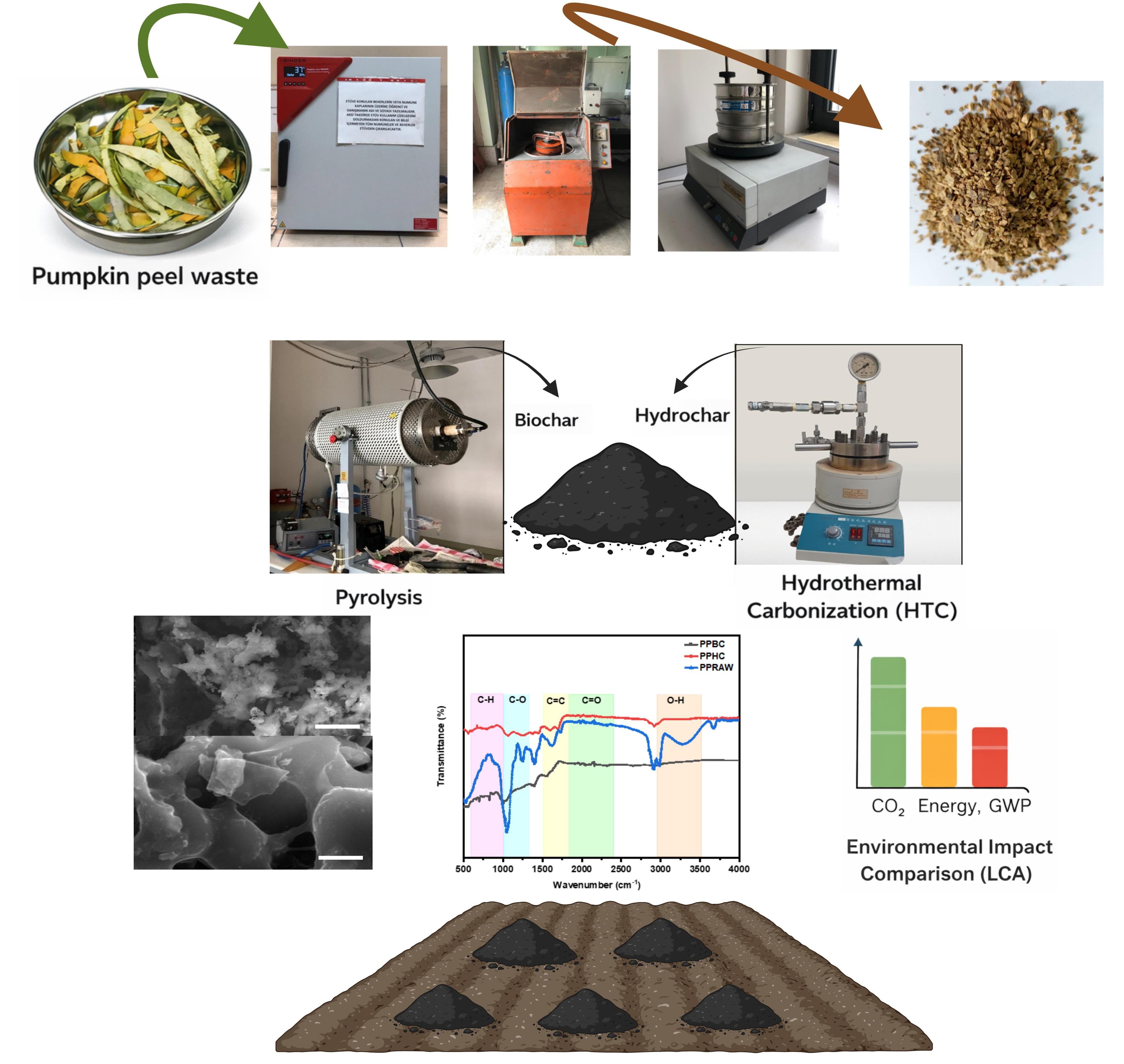
Graphical Abstract

1. Introduction

The increasing emphasis on green transformation and circular economy goals in recent years has significantly increased research interest in chemical additive-free production and waste management approaches [1,2]. This trend encourages technological approaches to transforming agricultural and organic waste into valuable products that reduce process complexity, minimise chemical input requirements, and limit secondary environmental burdens [3,4,5].
Organic and agricultural wastes cause significant environmental problems in both rural and urban areas. These wastes, which can accumulate in heaps, especially in rural areas, can cause odour formation, pathogen spread, water pollution, and greenhouse gas emissions due to uncontrolled disposal or incineration [6]. However, these wastes are important biomass resources due to their high organic matter content and nutrient element composition. Numerous studies have shown that these types of waste can be used as soil conditioners or growing media and can serve as alternatives to natural soil and peat [7,8]. Therefore, the controlled conversion of these wastes into value-added products is of strategic importance in terms of both waste management and resource efficiency. Through thermochemical conversion processes, such as pyrolysis and hydrothermal carbonisation (HTC), lignocellulosic biomass is converted into carbon-rich materials, including biochar and hydrochar. These materials are characterised by aromatic structures, improved porosity, and relative stability, and these properties are associated with long-term carbon sequestration in soils. Studies in the literature have shown the potential of lignocellulosic carbonised materials for adsorption, soil improvement, and environmental remediation [9,10].
The structural properties of carbonaceous materials such as pumpkin peel hydrochar (PPH) and pumpkin peel biochar (PPB) vary significantly depending on both the conversion method employed and the nature of the biomass. Biochars produced via pyrolysis (including pre-treatments such as chemical impregnation) are generally characterized by higher aromaticity, higher carbon content, and well-developed porosity, whereas hydrochars obtained through hydrothermal carbonization typically exhibit lower surface area. In contrast, gasification processes, which operate at high temperatures under partial oxidation conditions and are primarily aimed at syngas production, result in lower biochar yields and less developed pore structures [11]. In addition, physical or chemical activation treatments (e.g., CO2, KOH) can significantly enhance specific surface area and microporosity; however, these processes require additional chemical and energy inputs, and the resulting products are generally referred to as activated carbon [12,13]. Furthermore, studies on different biomass types (e.g., rice husk, sawdust, and fruit peels) have shown that, in addition to the conversion pathway, biomass composition (cellulose, hemicellulose, and lignin content) plays a critical role in determining pore development morphology and surface chemistry [14]. These findings demonstrate that both the conversion method and feedstock characteristics are key factors in defining the structural properties of PPH and PPB. In light of these findings, the literature indicates that pumpkin peel, due to its similar lignocellulosic content, may also be a suitable raw material for carbonised material production [15].
Carbonised products derived from agricultural waste contribute to environmental sustainability by reducing waste volume and providing carbon-sequestration potential. However, a significant portion of the literature focuses on production scenarios involving chemical activation, impregnation, or surface modification to improve material performance [16,17]. Such processes require additional energy and chemical inputs and can increase environmental impacts. In this context, it is necessary to quantitatively demonstrate the environmental impact performance of processes carried out under lean manufacturing conditions. In this context, “lean” refers to production without chemical activation, impregnation, or pre-treatment steps, which are commonly used in the literature but introduce additional environmental burdens. For this purpose, Life Cycle Assessment (LCA) is a widely used method that allows for the analysis of the environmental impacts of production systems within a holistic framework. While LCA studies on biochar and hydrochar production have increased in recent years, most of the current research focuses on specific applications, different types of raw materials, or production scenarios involving chemical additives [18,19,20,21,22].
In contrast, studies that evaluate biochar and hydrochar produced under lean manufacturing conditions from the same raw material without chemical additives or pretreatment, and integrate detailed material characterisation with comparative LCA analysis, are limited [2,23]. Furthermore, many existing LCA studies focus on selected impact categories, and comprehensive assessments that qualitatively correlate process conditions with product textural/physicochemical properties are insufficient. This indicates a research gap in revealing the relationship between production parameters and environmental performance.
To address this research gap, the present study is designed with a distinct and integrative approach. Unlike most existing studies, this work focuses on the comparative evaluation of biochar and hydrochar produced from the same biomass under chemical-free and pre-treatment-free conditions. The novelty of this study lies in three main aspects: (i) the use of a single raw material to enable a direct and consistent comparison between HTC and pyrolysis, (ii) the integration of detailed physicochemical characterisation with life cycle assessment, and (iii) the modelling of both processes under harmonised pilot-scale conditions. This integrated approach allows for a more comprehensive understanding of the relationship between process conditions, material properties, and environmental performance.
In addition to environmental impacts related to application areas, the environmental safety of charcoal products is also an important research topic. Studies show that the elemental composition and environmental risk profile of biochar depend on raw material properties and production parameters, and that potential risks from heavy metals may arise under certain conditions [2]. In the context of the pumpkin peel raw material selected in this study, the literature data show that heavy metals in pumpkin plants are mainly retained in root tissues, while accumulation is relatively low in fruit and peel tissues [24]. This suggests that charcoal obtained from both the lean process and pumpkin peel may potentially carry a lower heavy metal risk. However, a systematic environmental performance assessment is still necessary.
This study provides a comparative investigation of biochar and hydrochar obtained from the same waste raw material under lean production conditions using two different processes, combining physicochemical characterisation and life cycle assessment within a unified framework. The results reveal the effects of two different thermochemical production processes on both the performance of the resulting material and its impact on environmental effects, showing that hydrochar offers more advantageous properties with a lower environmental burden compared to biochar. This approach emphasises the importance of considering environmental sustainability as well as technical performance in product selection and application perspectives. Accordingly, this study contributes to the literature by providing a harmonised evaluation framework linking process conditions, material properties, and environmental performance.

2. Materials and Methods

2.1. Raw Materials and Sample Preparation

Raw materials for producing biochar and hydrochar from pumpkin peel waste (PPW) were sourced locally from the Tunatan Facilities in Sakarya, Türkiye.
Raw materials for biochar and hydrochar production, namely PPW, were sourced locally from Tunatan Facilities in Sakarya, Türkiye. No pre-washing step was applied prior to thermochemical conversion, in accordance with similar char production approaches reported in the literature [25,26], in order to minimize water consumption and simplify the process.
The collected peels were first air-dried under ambient conditions for one week. Subsequently, the samples were oven-dried (Binder GmbH, Tuttlingen, Germany), at 70 °C for 24 h until constant weight was achieved. Biomass drying is commonly performed at 105 °C for 24 h according to standard methods (ASTM D1762-84; 28 ISO 589) [27,28]; however, a lower temperature was selected in this study to reduce energy consumption while ensuring sufficient moisture removal. Similar temperature ranges (60–105 °C) have been reported in the literature [29,30,31]. The samples were weighed before and after drying using a precision analytical balance.
For hydrochar samples obtained after hydrothermal carbonization, drying was carried out at 105 °C for 6 h to ensure complete removal of residual moisture [27,28,32]. Due to the smaller sample quantity and finer structure compared to raw biomass, a shorter drying time was sufficient to reach constant weight, consistent with previous studies [33,34].
The dried biomass was then subjected to a two-stage grinding process. Initially, coarse grinding was performed to obtain particles of approximately 3 mm using a prototype grinder. This was followed by fine grinding using a ring mill (Fritsch, Idar-Oberstein, Germany) for up to 45 s in 200 g batches. The ground material was subsequently homogenized and sieved using a vibrating sieve shaker (Retsch AS-200, Haan, Germany), yielding particle sizes between 1 mm and 150 µm. The prepared samples were stored in airtight glass containers prior to thermochemical processing.
The dried biomass (pumpkin peel waste) was then subjected to a two-stage grinding process. First, the material was coarsely ground to approximately 3 mm using a prototype coarse grinder. Then, fine grinding was performed using a ring mill (model Fritsch) for up to 45 s in batches of 200 g. The ground biomass was then homogenized and sieved using a vibrating sieve shaker (model Retsch AS-200), resulting in particle sizes ranging from 1 mm to 150 µm. The sieved samples were stored in airtight glass jars to preserve their physicochemical integrity prior to thermochemical processing.

2.2. Description of Pumpkin Peel Wastes Pyrolysis and Htc Process

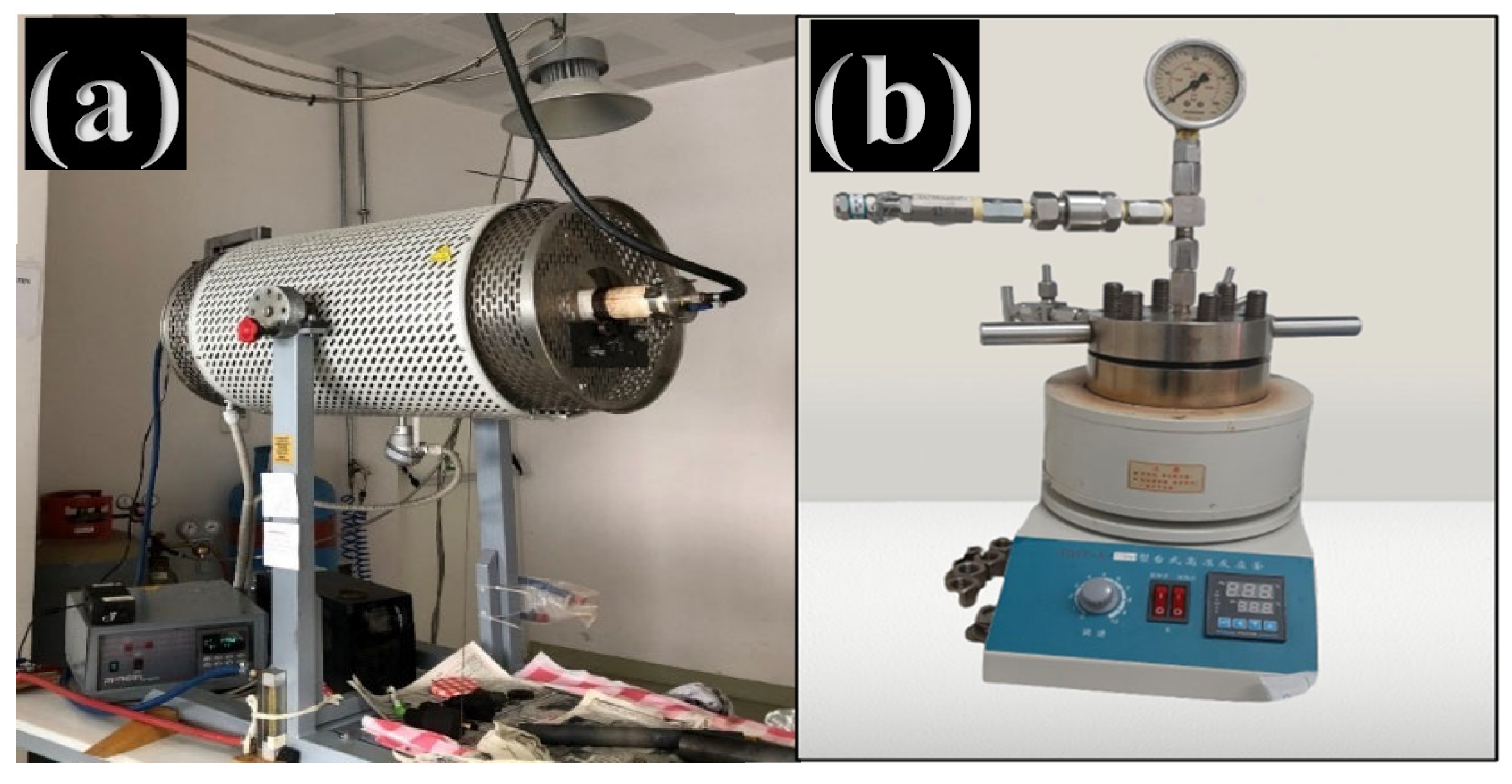
Biochar production from PPW via pyrolysis was carried out in a high-temperature horizontal mullite tube furnace (Protherm Furnaces, Ankara, Türkiye) with controlled heating and cooling rates, as shown in Figure 1a.
The pyrolysis process was carried out at a constant nitrogen (N2) gas flow of 12 L/h, with a heating rate of 10 °C/min until 600 °C, where it was maintained for 2 h. This was followed by increasing the temperature to 800 °C and holding for 0.5 h. The resulting product was cooled to 100 °C under continuous N2-flow, then stored in a desiccator in a moisture-free, airtight environment.
To produce PPH from PPW via HTC, a total of 5 g of dried and prepared pumpkin peel was mixed with 100 mL of ultrapure water and stirred using a magnetic stirrer for 4 h to ensure homogeneity. The mixture was then transferred into a high-pressure reactor used for HTC (TGYF-A, 250 mL, Zhengzhou Keda Machinery and Instrument Equipment Co., Ltd., Zhengzhou, China) and heated at 250 °C for 4 h. After completion, the reactor was automatically switched off and allowed to cool to room temperature.
In this study, a two-stage heating strategy was applied within a single continuous process to balance energy efficiency and structural development, rather than prolonged exposure to high temperatures [35]. The first stage at 600 °C for 2 h ensures substantial decomposition of cellulose and hemicellulose and the completion of primary carbonization. This temperature range (550–650 °C) is widely reported in the literature as sufficient for devolatilization and initial char formation [36,37,38].
Subsequently, a short residence time at 800 °C (0.5 h) was applied to enhance aromaticity, increase carbon stability, and remove residual volatile compounds while avoiding excessive energy consumption [39,40]. This staged heating approach is consistent with recent studies highlighting controlled high-temperature treatment to improve biochar quality [32,39,41,42].
The resulting HTC product was separated by vacuum filtration using a vacuum filtration pump (model K48ZZFFD3780, Leuven, Belgium), and the solid fraction was collected. To eliminate residual impurities, the solid product was thoroughly washed with distilled water and dried in a vacuum oven (model SH-VDO-70NH, SH Scientific, Sejong, Republic of Korea) at 105 °C for 6 h.
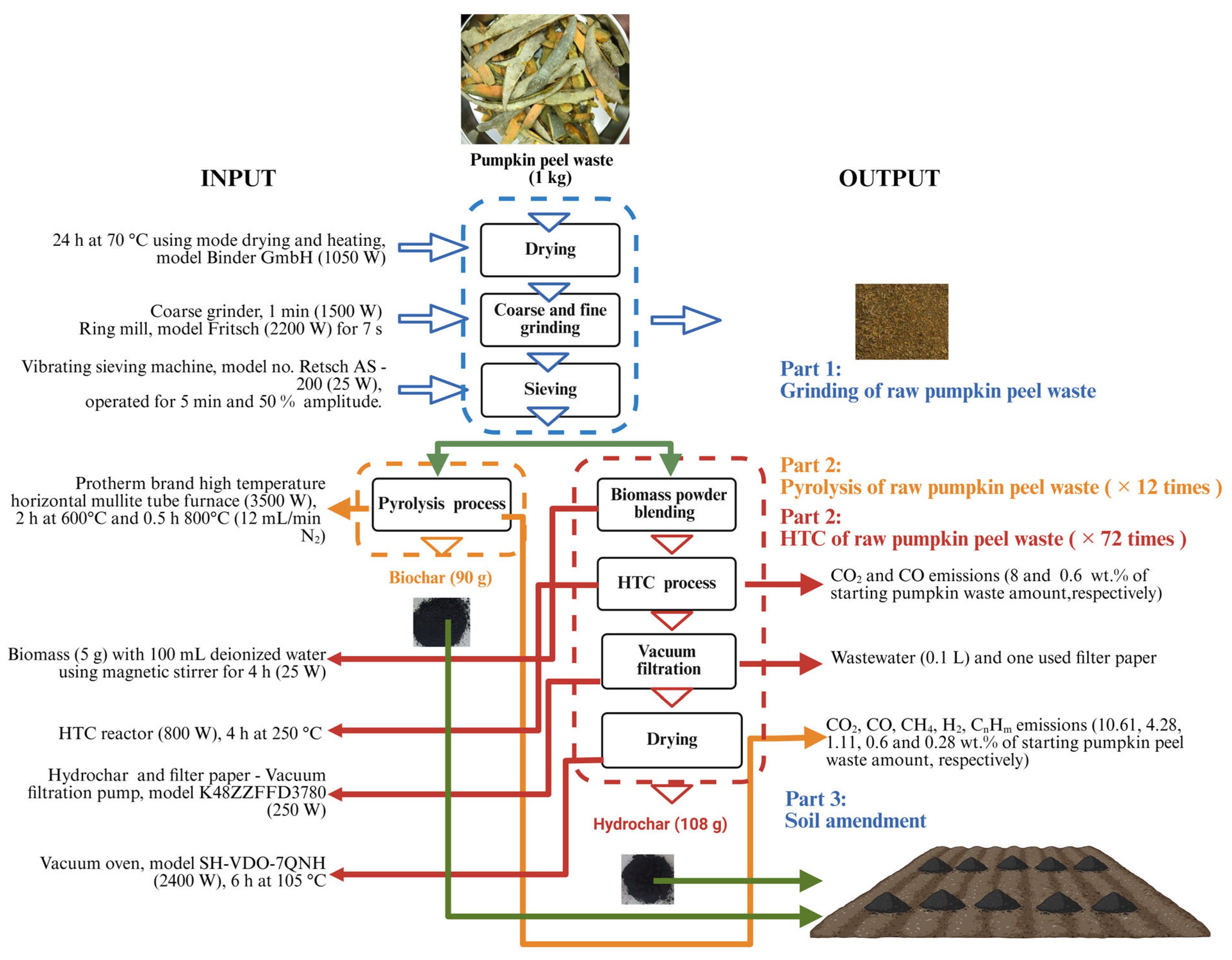
For hydrothermal carbonization, a temperature of 250 °C and a residence time of 4 h were selected. This temperature lies within the commonly reported optimal range for lignocellulosic biomass (180–280 °C), while the selected residence time ensures sufficient carbonization [43,44,45]. The process was carried out in a sealed reactor under autogenous pressure conditions, reaching approximately 35–40 bar at the operating temperature [46]. Finally, the obtained PPB and PPH samples were collected and stored under appropriate conditions for subsequent physicochemical characterization. The flow chart of the whole process of obtaining biochar and hydrochar from PPW via pyrolysis and HTC, respectively, is given in Figure 2.

2.3. Characterization Techniques

The surface morphologies and structures of PPR (pumpkin peel waste-derived pumpkin peel powder), PPB, and PPH were examined by Field Emission Scanning Electron Microscope (FESEM) (Quanta FEG 450, Hillsboro, OR, USA) and the Scanning Electron Microscope (SEM) (JEOL JSM-6060LV, Tokyo, Japan). The elemental distribution on the surface and pore structure was semi-quantitatively analyzed using EDS coupled with a SEM (JEOL JSM-6060LV). The elemental composition (C, H, N, and S contents) of the PPR was quantitatively determined also using an ultimate analyzer (LECO TruSpec Micro, St. Joseph, MI, USA).
The specific surface area, total pore volume, and pore size distributions of the PPR, PPB and PPH samples were determined using the Brunauer–Emmett–Teller (BET) method based on nitrogen adsorption–desorption isotherms, using a surface area analyzer (Gemini VII 2390t, Norcross, GA, USA).
Furthermore, FTIR spectra of PPR, PPB, and PPH were recorded using a Shimadzu IRPrestige-21 FTIR spectrophotometer (IRPrestige-21, Kyoto, Japan) equipped with an ATR accessory in the range of 4000–400 cm−1 to evaluate functional groups.

2.4. Life Cycle Assessment Methodology

The environmental impacts of pumpkin disposal using HTC and pyrolysis methods were analysed using LCA methodology. LCA studies were conducted in accordance with ISO 14040 and 14044 standards [47,48]. The environmental impacts of pumpkin peel waste management via HTC and pyrolysis were analysed using LCA. The assessment was conducted in accordance with ISO 14040 and ISO 14044 standards.
In this study, pumpkin peels were selected as the raw material, and two thermochemical conversion processes (pyrolysis and hydrothermal carbonisation) were applied under lean production conditions. The resulting PPB and PPH were comparatively evaluated through physicochemical characterisation (SEM, FESEM, SEM-EDS, FTIR, BET, and elemental analysis) and life cycle environmental impact assessment.
In waste management-focused LCA studies, the use of mass-based functional units (e.g., processing 100 kg of organic/food waste) is widely adopted to ensure comparability between systems [49,50]. Accordingly, in this study, the functional unit was defined as the management of 100 kg of pumpkin peel waste.
Although char products are obtained as a result of waste treatment processes, there are significant uncertainties regarding their subsequent use. In particular, additional activation processes (e.g., steam or chemical activation, washing, and drying) require extra energy and chemical inputs. Due to the lack of reliable life cycle inventory data for these processes, it was assumed in the baseline scenario that the produced char is applied to soil, providing long-term carbon sequestration, consistent with previous studies [17].
Accordingly, the system boundary was defined as gate-to-grave, assuming carbon sequestration benefits from char application. Sensitivity analysis was conducted based on the BET-specific surface area results. Environmental impacts were assessed using life cycle impact assessment indicators, with particular emphasis on global warming potential (GWP). A visual representation of the laboratory-scale system boundaries is presented in Figure 2.

2.4.1. Goal and Scope

In this LCA study, a laboratory-scale comparison was not performed. Instead, a hypothetical pilot-scale scenario was developed based on the management and processing of 100 kg of pumpkin peel waste, and the life cycle inventory was constructed accordingly.
The functional unit of the study is defined as the treatment of 100 kg of pumpkin peel waste. All material and energy flows, as well as the associated environmental impacts, were calculated based on this reference in order to ensure a consistent and comparable evaluation of the biochar and hydrochar production systems.
The main objective of the study is to compare the environmental impacts of biochar and hydrochar production processes applied to the same biomass input, which yield products with very similar physical and chemical properties, and to identify the production route associated with the lower environmental burden for the management of pumpkin peel waste.
This study aimed to obtain a usable product at the end of the disposal processes. However, there are significant uncertainties regarding the further use of the resulting char. For example, the activation processes (steam/chemical activation, washing, drying, etc.) required to convert char into activated carbon require additional energy and chemical inputs. Due to uncertainties encountered in the development of the life cycle inventory for these processes, the base scenario assumes that the produced char is land-applied for soil amendment and carbon storage, similar to the study in the literature [17].
Thus, the gate-to-grave system boundary is adopted, and the char is assumed to provide carbon storage. A visual representation of the system boundaries is provided in Figure 2. Transport data is not included in the system boundaries. The activated carbon substitution potential of the char is presented in the sensitivity analysis based on the BET analysis.
Two different impact assessment methods were used for life cycle impact assessment. IPCC 2021 GTP100 (including CO2 uptake, total) was specifically chosen to assess the carbon sequestration benefit of char because it accounts for biogenic CO2 emissions and carbon storage effects. Global Temperature Potential (GTP) impacts are calculated in this impact category. Conceptually, GTP differs from GWP (Global Warming Potential) in that it is based on the impact of greenhouse gases on global temperature increase over a specific time horizon. However, both metrics are widely used in LCA studies to assess climate change impact, and the results mostly show similar trends. Another impact method used, the ReCiPe 2016 Midpoint (H) method, was chosen because it offers broader impact categories. Since the ReCiPe method has a characterisation factor of zero for biogenic CO2, carbon sequestration effects cannot be observed in this method. Thus, the impacts of GTP were comprehensively assessed using the IPCC 2021 method, while other environmental categories were comprehensively assessed using the ReCiPe 2016 method. Life cycle assessment was performed using SimaPro 9.5.0.0 PhD software.

2.4.2. Life Cycle Inventory (LCI)

The HTC and pyrolysis processes employed in the study are laboratory-scale processes. However, to represent potential impacts in a pilot-scale application, the disposal processes were modelled for the pilot-scale disposal of 100 kg of pumpkin peel waste. For modelling purposes, the scale-up procedures reported in the literature were applied [51]. The formulas used for energy calculations are given below. The dominant contributors to energy demand differ between the two processes. In the HTC system, energy consumption is mainly associated with heating the high-moisture reaction mixture to the target temperature and maintaining reaction conditions. In contrast, in the pyrolysis process, the primary energy demand arises from high-temperature thermal treatment, including multi-stage heating up to 800 °C. For this purpose, a pilot-scale scenario corresponding to an initial input of 100 kg of pumpkin peel waste was defined for each of the HTC and pyrolysis processes. The scale-up procedures suggested by Piccinno et al. were applied, and the life cycle inventory estimating the energy requirements for both waste processing routes based on engineering calculations and literature data was reported in the same study [51]. It should be noted that the modeled system represents a hypothetical pilot-scale scenario rather than a real industrial operation. The selected functional unit of 100 kg of pumpkin peel waste was chosen as an intermediate scale to allow consistent comparison between processes while avoiding assumptions related to full industrial implementation. Laboratory-scale methods were modelled using industrially equivalent process steps, allowing laboratory data to be consistently transferred to a pilot-scale representation in the life cycle assessment.
In the scale-up of pyrolysis and HTC processes, drying, grinding, mixing, heated reaction, and solid–liquid separation are the key unit operations. The drying step, which is carried out at laboratory scale by vacuum drying or rotary evaporation, becomes critical at the industrial scale due to the need for energy recovery and control of volatile compounds. The required energy for this step can be calculated considering the specific heat and vaporisation enthalpy of the liquid as [51].
Q dry = C p , l i q m l i q T b o i l T 0 + H v a p m v a p η h e a t
Qdry: Total heat energy required for the drying process (J/kJ/MJ)
Cp,liq: Specific heat capacity of the liquid (kJ/kg·K)
mliq: Mass of te liquid being heated (kg)
Tboil: Boiling temperature of the liquid (K or °C)
T0: Initial temperature of the liquid (K or °C)
H v a p : Latent heat of vaporization (kJ/kg)
mvap: Mass of the evaporated liquid (kg)
ηheat: Heating system efficiency (dimensionless, typically between 0 and 1)
Particle size reduction is essential for both technologies, with typical energy consumption in the range of 8–16 kWh/ton [49]. In HTC, total energy demand is calculated as [51].
E s t i r = N p ρ m i x 1 d ( N d 2 ) 3 t η s t i r
Estir: Energy consumption for stirring (kJ or MJ)
Np: Power number (dimensionless, impeller-dependent)
ρmix: Density of the mixture (kg/m3)
d: Impeller diameter (m)
N: Rotational speed of the impeller (s−1)
T: Mixing time (s)
ηstir: Stirring efficiency (dimensionless, typically between 0 and 1)
During the heated batch reaction step, both the heating of the mixture to the target temperature and the heat losses must be taken into account, which can be expressed as [51].
Q react = C p m m i x T r T 0 + A k a s T r T o u t t η h e a t
Qdry: total heat energy required for the reaction process (kJ or MJ)
Cp: Specific heat capacity of the reaction mixture (kJ/kh.K)
mmix: Mass of the reaction mixture (g)
Tr: Reaction temperature (K or °C)
T0: Initial temperature of the mixture (K or °C)
A: Heat transfer area (m2)
ka: Overall heat transfer coefficient (W/m2·K)
s: Thickness of the reactor wall or heat transfer medium (m)
Tout: External or ambient temperature (K or °C)
t: Reaction time (s)
ηheat: Heating system efficiency (dimensionless, typically between 0 and 1)
Finally, solid–liquid separation is particularly critical for HTC, where filtration and centrifugation are the most common methods, with typical energy requirements ranging from 1 to 10 kWh/ton of dry material [51]. Therefore, when moving from laboratory to industrial scale, the energy demand, equipment selection, and process efficiency of each unit operation should be considered in conjunction.
Emissions related to pumpkin production were calculated based on literature data. It is assumed that in the HTC process, approximately 8% of 1 kg of pumpkin peel is converted into CO2 and 0.6% into CO [52,53]. For pyrolysis, the bio-oil yield was assumed to be 28%, which is consistent with reported values for lignocellulosic biomass under high-temperature or non-optimized pyrolysis conditions. Literature indicates that bio-oil yields can reach 60–70 wt% under fast pyrolysis conditions, while significantly lower yields (typically 20–40 wt%) are observed at higher temperatures and longer residence times due to enhanced secondary cracking reactions [54,55]. The gas phase composition was estimated based on experimental data reported in the literature [54,56,57,58,59]. Considering the two-stage pyrolysis (600 °C/2 h and 800 °C/0.5 h), the gas composition was calculated as CO (25.05%), CO2 (38.56%), CH4 (11.90%), H2 (23.35%) and CnHm (0.73%). These values were included in the model as direct emissions within the LCI. While CO and CO2, which constitute 90% of the total gas mass, dominate the climate change impact, the contribution of gases such as CH4 and H2 to other environmental categories was also taken into account. Furthermore, increased H2 formation at higher temperatures [59] demonstrates the potential advantage of pyrolysis in terms of energy recovery and greenhouse gas reduction.
The LCI results summarising the inputs and outputs of the HTC and pyrolysis processes per functional unit (100 kg pumpkin peel waste) are listed in Table 1 and Table 2.
The results of this study are subject to uncertainties related to the scale-up approach and process assumptions. Energy consumption values were estimated based on literature-derived engineering calculations, and actual values may vary depending on equipment design, insulation efficiency, heat losses, mixing performance, and separation efficiency.
In industrial-scale systems, energy demand may be reduced through process optimization, heat recovery, and improved reactor design. Conversely, additional energy requirements such as pumping, process control, and emissions treatment may increase total energy consumption. Therefore, the presented results should be interpreted as comparative estimates under harmonized pilot-scale conditions rather than exact predictions for industrial applications.
To improve clarity, the overall mass and energy flows of both processes were evaluated based on the functional unit of 100 kg of pumpkin peel waste.
For the HTC process, the total electricity demand was calculated as 49.67 kWh, resulting in 10.8 kg hydrochar, along with wastewater, water vapor, and minor gaseous emissions. In contrast, the pyrolysis process required 80.79 kWh of electricity and produced 9 kg biochar and 10.08 kg bio-oil, in addition to gaseous emissions and water vapor.
This comparison indicates that pyrolysis is more energy-intensive than HTC under the selected conditions. However, pyrolysis provides additional energy recovery potential through bio-oil and combustible gases, which partially compensates for its higher energy demand. In contrast, HTC shows lower direct energy consumption but does not offer comparable energy recovery pathways.
These findings are further supported by the life cycle inventory (LCI) results, which summarise the inputs and outputs of the HTC and pyrolysis processes per functional unit (100 kg pumpkin peel waste), as presented in Table 1 and Table 2.
Bio-oil obtained during the pyrolysis process was accepted as a process product due to its energy potential. The lower calorific value of bio-oil was accepted as 17 MJ/kg, which is consistent with reported heating values of biomass-derived pyrolysis oils, typically ranging between 16 and 19 MJ/kg due to their high oxygen content [60,61]. The “light fuel oil” unit process was selected as the representative product in the life cycle model. The lower heating value of light fuel oil was assumed to be 42 MJ/kg. Based on this assumption, conversion was performed using energy equivalence. Assuming that the 10.08 kg of bio-oil obtained from the pyrolysis of 100 kg of pumpkin is equivalent to 4.08 kg of light fuel oil, the environmental benefits of bio-oil to the system were reflected in the model. Additionally, heat generation from pyrolysis gases is a well-known practice. The environmental benefit provided by heat generation from pyrolysis gases was calculated using lower calorific values reported in the literature. The lower calorific values were accepted as 10.1 MJ/kg, 50 MJ/kg, 120 MJ/kg, and 45 MJ/kg for CO, CH4, H2, and CnHm, respectively [62]. Taking into account the emission amounts listed in Table 2, the total energy content was calculated as 145.50 MJ. To reflect real operating conditions, an efficiency of 85% was assumed, and a net heat output of 123.67 MJ was included in the model. This energy is included in the life cycle inventory as heat generated.
The carbon sequestration potential of biochar and hydrochar when buried was calculated based on their measured elemental carbon content. Biochar contains 66.07% carbon, while hydrochar contains 76.18%. This carbon was converted to CO2-equivalent using a 44/12 conversion factor. Therefore, the CO2-equivalent of 1 kg of biochar is calculated as 2.42 kg CO2-eq, while the CO2-equivalent of 1 kg of hydrochar is calculated as 2.79 kg CO2-eq. In the literature, long-term soil stability is reported as an average of 80% for biochar [63] and 60% for hydrochar [64]. Carbon degradation was modeled using a first-order decay kinetic model over a 100- year time horizon [63,64]. According to the literature, the half-life of biochar ranges from several hundred to over a thousand years [63], whereas the half-life of hydrochar ranges from a few years to several decades [64]. According to these assumptions, the net carbon sequestration amounts of biochar and hydrochar produced as a result of the processes initiated with 100 kg of pumpkin were calculated to be 17.44 kg CO2-eq and 18.10 kg CO2-eq, respectively. These were included in the life cycle model by giving a negative value.
The Ecoinvent 3.9.1 database, within the SimaPro 9.5.0.0 PhD software was used for the unit processes required for the life cycle inventory. Medium voltage and TR grid mix were used to provide the electrical energy required for the processes, in accordance with the pilot-scale production profile.

2.4.3. Sensitivity Analysis

As an alternative to applying coal to the soil, the environmental impacts of increased use of biochar and hydrochar instead of activated carbon (AC) were assessed through sensitivity analysis. The potential for biochar and hydrochar to replace activated carbon was estimated based on specific surface areas obtained from BET analyses. The BET surface area of hydrochar was measured as 16.35 m2/g, while the surface area of biochar was determined to be 9.80 m2/g. For comparison, the BET surface area of commercial activated carbon was assumed to be 1000 m2/g, as reported in the literature [65,66]. Based on surface area equivalence, the substitution potentials for activated carbon were calculated as 0.045 kg AC per kilogram of biochar and 0.065 kg AC per kilogram of hydrochar. This scenario represents an optimistic substitution assumption, as the environmental burdens associated with the activation process required to achieve activated carbon-like properties have not been considered. However, this assumption has been deliberately adopted within the sensitivity analysis to investigate the upper limit of environmental benefits achievable through material substitution. In addition, it should be noted that the substitution potential based solely on surface area equivalence represents a simplified approach. In practical applications, the adsorption performance of biochar and hydrochar depends not only on surface area but also on pore size distribution, surface chemistry, and activation conditions. Therefore, the direct substitution of activated carbon may not always be feasible without additional processing.

3. Results and Discussion

3.1. SEM-FESEM Analysis

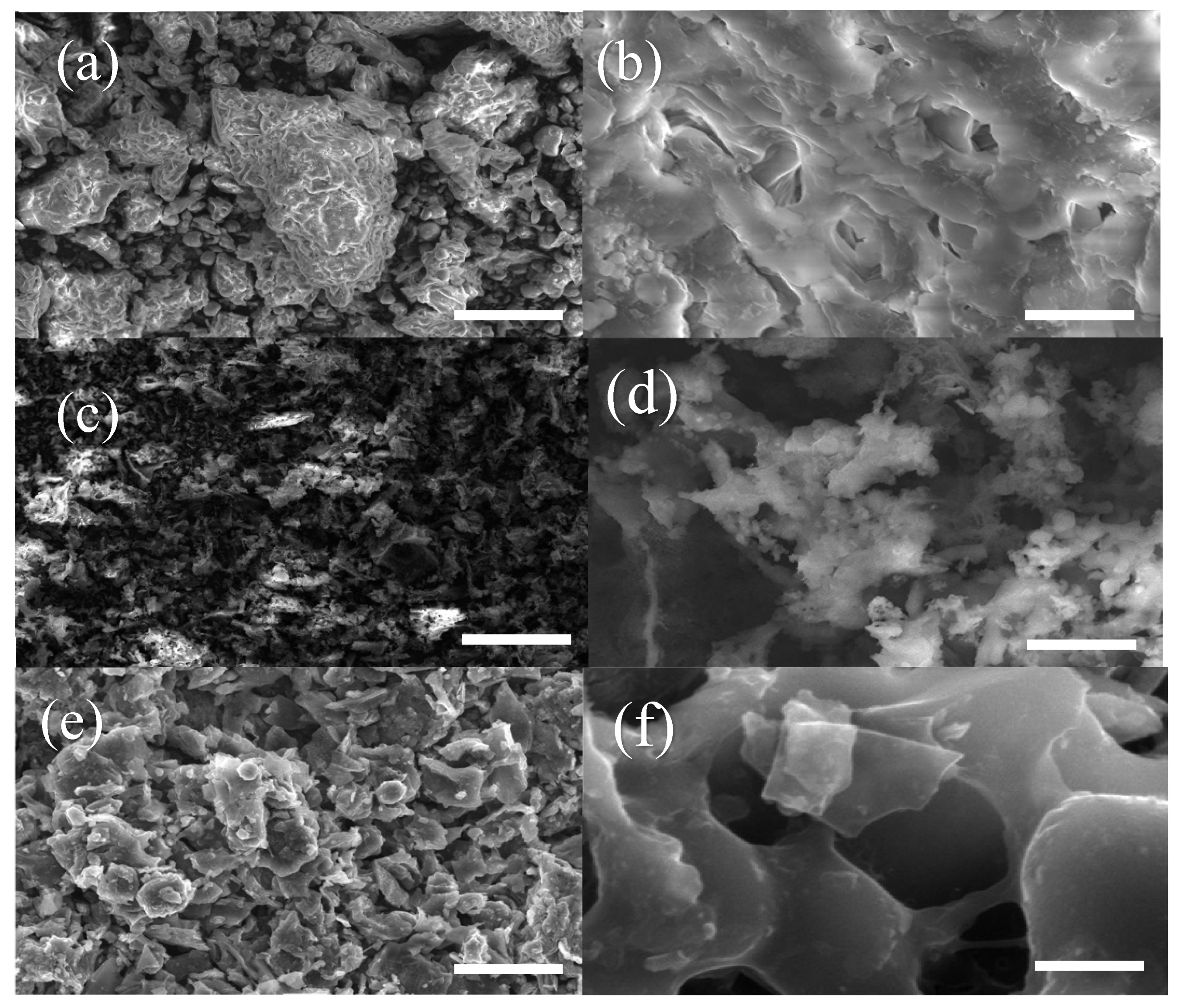
The surface morphologies of the PPW and PPH were evaluated using FESEM, and the PPB were evaluated using SEM images. Significant structural changes were observed compared to the waste raw material (Figure 3). Raw pumpkin peel powder (Figure 3a,b) exhibits an irregular and flaky morphology, with no obvious porosity observed on the surface. This morphological structure reflects the natural structural characteristics of lignocellulosic biomass, indicating a limited surface area. According to the literature, pumpkin peel consists of approximately 27.4% cellulose, 34.1% hemicellulose, 4.0% lignin, and 6.4% ash [65,66,67]. The predominance of cellulose and hemicellulose, together with the relatively low lignin content, explains the observed structural features [67,68,69].
FESEM images of PPH obtained via hydrothermal carbonization (Figure 3c,d) exhibit a more compact, partially porous, and regular morphology compared to raw biomass. This morphological transformation indicates that the HTC process reorganises the biomass structure, increases carbon content, and reduces oxygen-containing functional groups, as reported in previous studies [70,71,72,73]. However, porosity remains limited, which is attributed to the incomplete removal of volatile components due to the relatively low temperatures employed in the HTC process [71,72,73,74]. The resulting hydrochar can be used as a coal-like fuel with high energy density and can also be considered for environmental applications, such as soil amendment or adsorption, as reported in previous studies [75,76,77].
The partial porosity observed in the SEM images of PPB produced by pyrolysis can be attributed to the volatilization of organic components and the collapse of cell walls, as reported in previous studies [78,79,80,81]. Similar porous structures have also been reported in char and activated carbon products obtained from pumpkin peel and similar feedstocks rich in cellulose and hemicellulose [82,83,84,85]. However, these pores are limited and sparsely distributed, indicating that pore development remains restricted under the applied process conditions for both materials. This observation is consistent with the BET results, which show relatively low specific surface areas of 9.8 m2/g for PPB and 16.35 m2/g for PPH, confirming the limited development of porosity.
Based on the literature on biochar production from pumpkin peel biomass, in this study, unlike previous works, the production was carried out without the use of any chemicals and through a simple process that does not require pre-washing [82]. As a result, the surface area (<20 m2/g) and porosity were found to be limited and similar for both materials [82]. This has been reported in the literature to be related to process type and carbonization/activation conditions [86]. However, coals with surface areas in this range (<20 m2/g) can be obtained using simplified methods such as low-temperature pyrolysis, short-term heat treatment and/or pre-activation; this can be considered consistent with the PPB obtained in this study, as reported in the literature [87,88].
The macrostructure images in Figure 3 are also supported by the BET analysis results of PPB, PPH and PPR and the potential application areas of coal products similar to PPB and PPH found in the literature are shown in Table 3. Considering that surface morphologies, together with SEM, FESEM, SEM-EDS, elemental (ultimate) analysis, and BET results, play a decisive role in determining functional properties, these characteristics are presented along with their application areas in Table 3. In this context, carbon products with characteristics similar to the materials synthesized in this study can be effectively utilized in the applications presented in Table 3. In addition, as the potential application areas of char products [46,89,90] are an important criterion in defining the scope of LCA [23], these applications are briefly summarized here in relation to the present study.

3.2. Elemental Transformation/Analysis of Biochar and Hydrochar Obtained from Pumpkin Peel

The elemental chemical composition values of the raw material are presented in Table 4. According to the EDS and ultimate analysis results, a significant elemental transformation was observed in the carbonisation products of pumpkin peel. While the carbon content in the raw peel was 49.50%, this ratio increased to 76.18% in hydrochar and 66.07% in biochar. This increase indicates that more dense carbon structures were formed by eliminating volatile components. Likewise, the oxygen content decreased to 20.90% in hydrochar and 30.08% in biochar compared to the raw material, revealing the effect of carbonisation in removing oxygenated functional groups. The higher carbon content and relatively lower oxygen content in hydrochar indicate a more advanced degree of carbonisation [66,67]. Consequently, biomass sources such as pumpkin peels with a carbon content greater than 40%, as reported in the literature, offer a high-quality biochar product for various applications, including its use as an adsorbent for pollutants [82,91,92,93].
All the values are reported as measured weight percent (% w/w) and do not include hydrogen, which cannot be detected by EDS.
When EDS analyses are examined, it is seen that pumpkin peel and its products contain mainly C and O. It is thought that trace amounts of substances such as K, Ca, and Mg originate from the natural structure of the pumpkin peel. The findings obtained in this study (Table 4) are also supported by the results of the final EDS analysis in the studies reported in the literature, which are based on semi-quantitative analyses similar to those in this study [95,96]. Furthermore, they are also consistent with the results of the ultimate analysis in the studies reported in the literature [82,94], which are also mentioned in Table 4 and based on more quantitative analyses [82,86]. This supports the structural transformation of the obtained products.

3.3. Bet Analysis of Raw Materials and Final Products

The BET analysis results reported in Table 4 within the scope of this study show that the hydrochar and biochar samples produced by HTC and pyrolysis processes exhibit similar properties in terms of surface textural properties (specific surface area, total pore volume, and mean pore diameter). Compared to PPH, PPB exhibits a relatively lower BET surface area, which can be explained by the absence of chemical activation and pre-treatment steps. In contrast, in the HTC process, water acts as both a reactant and a solvent, promoting the hydrolysis of biomass components (hemicellulose and cellulose) followed by repolymerization reactions [25,97]. As a result of these reactions, the formation of carbon microspheres and a developed pore structure contributes to an increase in the specific surface area of the material even without external chemical activation [98,99]. Accordingly, the relatively higher surface area and carbon content of PPH can be associated with these hydrothermal transformation mechanisms.
The low surface area and pore volume of the PPB and PPH obtained in this study are related to the fact that they were produced without any pretreatment or chemical activation in both processes. While the surface area in unactivated biochars is generally below 20 m2/g, as in this study, these values can increase to 1000 m2/g and above with chemical activation [100,101]. For example, the surface area of biochar produced from tangerine peel was 8.5 m2/g without chemical activation, while it was reported to reach 1085 m2/g after activation with ZnCl2 [102]. The obtained surface area values (<20 m2/g) are significantly lower than those of typical activated carbons (generally >500–1000 m2/g), indicating limited adsorption capacity but consistent with non-activated biochars reported in the literature [103,104]. This suggests that these materials are less suitable for high-performance adsorption applications, but may still be applicable in low-cost or less demanding environmental applications, as summarized in Table 3.
In this context, the results were compared with the literature, and the potential application areas of these materials have been evaluated according to the literature. In this study, the surface area of hydrocarbon and biochar was higher than that of biochar samples obtained from PPW in the literature, which have a lower surface area (3.9 m2/g) and are used for methylene blue removal [82] and heavy metal removal [105]. Products were also produced using sustainable approaches that require lower costs and include more environmentally friendly processes. Both methods used in this study were carried out without the use of chemicals or pre-washing. In a previous study, hydrochar was produced using pomegranate peel as the raw material, exhibiting a surface area of 19.97 m2/g [46], differing only in the source of the raw material from the hydrochar used in this study. They reported that they successfully applied this material as an additive in cement-based composites. When studies with similar textural properties were examined, the BET surface area of hydrochars produced from corn stalks was reported as 5–12 m2/g in the literature ([106] Liu et al., 2020), as 3–10 m2/g for hydrochars derived from watermelon peel, banana peel and bay leaf [107], as 1–8 m2/g for iron-supported hydrochars [108], as 0.93–2.91 m2/g for biochar produced from sunflower seed shells [109] and as 5–12 m2/g for biochar obtained from corn cob and stalk [110]. These materials can be effectively used in various environmental applications, including solid acid catalysis, removal of DDT from Malachite Green, heavy metal adsorption or the removal of organic pollutants. In this context, a comparative evaluation with the literature was conducted, and the potential application areas of these materials were assessed accordingly. These findings indicate that even hydrochars/biochars with low or medium surface area have significant potential in applications such as environmental pollutant removal and water treatment.
From an LCA perspective, the material’s limited functionality, characterised by its low surface area, may result in lower benefits per unit impact during the use phase, thereby leading to a higher environmental impact per unit product. However, PPB and PPH, which have not undergone any additional processing such as chemical activation, have limited application potential due to their low surface area; nevertheless, they can be used in certain niche areas because they are obtained with environmentally friendly, sustainable and economical production methods, making these products valuable.

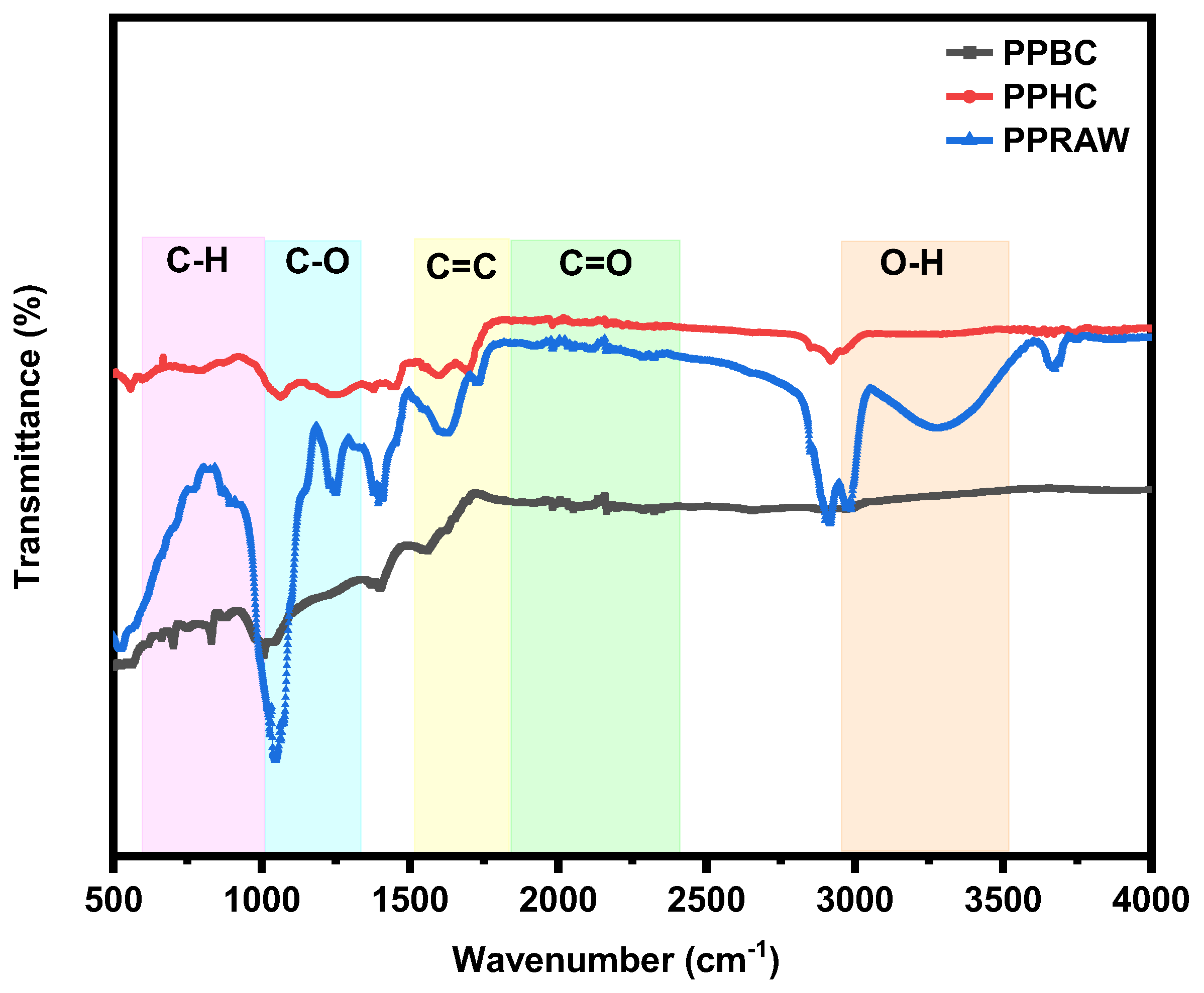
3.4. Ftir Analysis of Raw Materials and Char Products

FTIR spectra reveal differences in the surface functional groups of pumpkin peel waste-derived pumpkin peel powder (PPR), PPB and PPH samples obtained from pumpkin peel waste (Figure 4). In the PPR sample, broad O–H stretching bands (~3200–3600 cm−1), C–H bonds (~2850–2950 cm−1) and C–O vibrations (~1000–1200 cm−1) were clearly observed. After carbonisation, a marked decrease in the intensity of these hydroxyl and aliphatic groups occurred in both PPB and PPH samples. In contrast, the relative intensity of bands associated with aromatic C=C bonds (~1500–1600 cm−1) and carbonyl (C=O) groups (~1650–1750 cm−1) increased. Consistent with the literature, it was observed that the intensity of the O–H, aliphatic C–H, carboxyl C=O, and C–O bands decreased, while the aromatic C=C and aromatic C–H bands strengthened, which is related to the increased aromaticity and degree of carbonisation resulting from pyrolysis and hydrothermal carbonisation processes [111,112,113]. Therefore, this situation indicates that the functional groups have been partially removed, aromatisation has increased, and the surface chemistry has transformed into a more stable carbon structure, which is consistent with previous similar studies [37,79,114]. Furthermore, more intense aromatic carbon (decrease in H/C and O/C molar ratios) is commonly used as an indicator of high carbon stability; the aromatic regions in FTIR spectra are closely related to these ratios [115,116,117]. Furthermore, the literature reports that the density of the aromatic structure and the number of aromatic peaks show a positive correlation with the half-life, oxidation resistance, and carbon sequestration potential of biochar carbon [100,118].
In the case of PPH, the observation of relatively more pronounced O–H and C–O bands compared to PPB indicates that the HTC process preserves oxygen-containing functional groups on the surface to a greater extent. This situation is associated with HTC-derived carbon materials containing more oxygen-rich functional groups (such as hydroxyl, carboxyl, and carbonyl groups), as reported in the literature [119,120,121]. This situation can also be explained by the higher weight percentage of oxygen content in hydrochar (22.90%) compared to biochar (14.16%), as reported in the elemental analysis results in Table 4. In conclusion, it has been relatively assessed that the more dominant aromatic C=C bonds and stable carbon structure, along with the reduced polar group structure observed in the FTIR spectrum of biochar and hydrochar compared to the raw material, may enable it to remain stable in the soil for a long time.

3.5. Life Cycle Impact Assessment (Lcia) Results

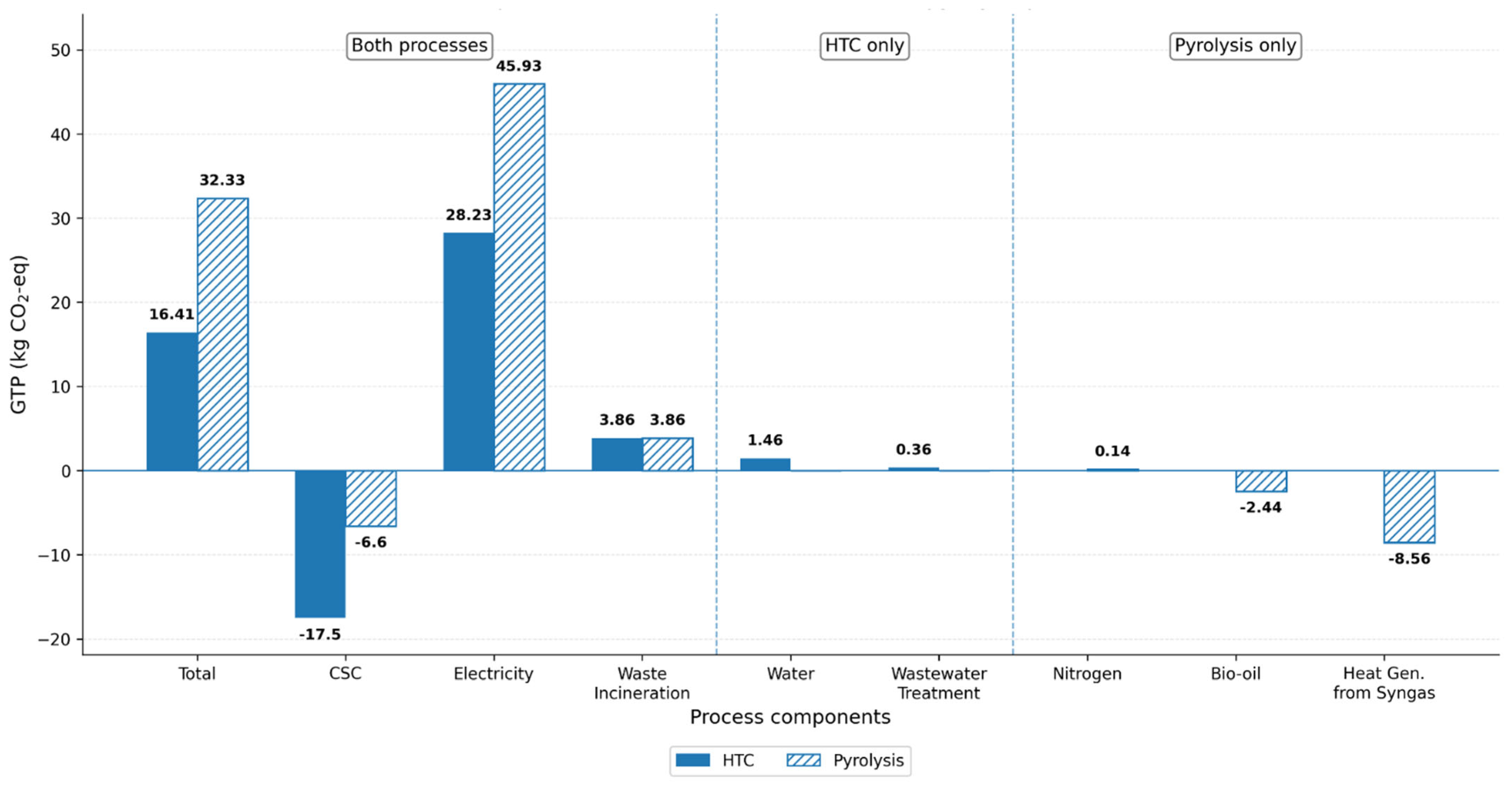
Life cycle impact assessment (LCIA) results were obtained using the IPCC 2021 GTP100 (incl. CO2 uptake, total) and ReCiPe 2016 Midpoint (H) methods. Comparative GTP results obtained according to the IPCC 2021 GTP100 method are given for HTC and pyrolysis in Figure 5.
The GTP impact of the HTC process was found to be 16.41 kg CO2-eq/FU in total, while this value was analysed as 32.33 kg CO2-eq/FU for the pyrolysis process. The high electricity consumption in the pyrolysis process was the main source of this impact. This result is strongly influenced by the Turkish electricity mix, which includes a significant share of fossil-based energy sources such as lignite, thereby increasing the associated environmental burdens. Furthermore, the higher char production, higher carbon sequestration capacity (CSC), and lower electricity consumption in the HTC process resulted in lower HTC-related impacts.
Potential impacts in key impact categories such as Global Warming Potential (GWP), Terrestrial Acidification Potential (TAP), Freshwater Eutrophication Potential (FWEP), Freshwater Ecotoxicity Potential (FWETP), Human Carcinogenic Toxicity Potential (HTPcancer), Mineral Resource Scarcity (MRS), Fossil Resource Scarcity (FRS), and Water Consumption (WC) were assessed using the ReCiPe 2016 Midpoint (H) method. The results obtained for the HTC and Pyrolysis processes are presented comparatively in Table 5.
The differences between the GWP results obtained with the ReCiPe method and the GTP results from the IPCC method arise from the different ways these indicators account for greenhouse gas emissions. While GWP reflects the cumulative warming effect over time, GTP focuses on the temperature change at a specific time horizon. In addition, the treatment of biogenic CO2 differs between the methods; for example, it is often considered neutral in the ReCiPe method, contributing to the observed variations. An examination of Table 5 reveals that pyrolysis has a higher impact than HTC in the GWP, TAP, FWETP, HTPcancer, and WC impact categories, while pyrolysis has an advantage over HTC in the FWEP, MRS, and FRS impact categories. This can be attributed to the Turkish electricity mix, where lignite-based electricity generation plays a significant role in increasing environmental burdens, particularly in acidification and toxicity-related categories.
The high impact of HTC on the depletion of fossil and mineral resources, as well as eutrophication, also stems from electricity generation processes. Although pyrolysis consumes more electrical energy, the use of products such as bio-oil and syngas as substitutes for heat generation from light fuel oil and natural gas, as explained in the inventory analysis section, has reduced the impacts in these areas. In particular, the mining required for electricity infrastructure is reduced in this way. This leads to differences between the two methods in the impact categories. A more detailed examination of the impact categories reveals that LHV and heat substitution provide reductions of 10.8% and 27.2%, respectively, in the GWP impact category. In the MRS impact category, these reductions are analysed as 41.1% and 56.1% for LHV and heat substitution, respectively. This makes pyrolysis more advantageous in the FWEP, MRS, FRS, and WC impact categories, while HTC appears to be more advantageous in the other impact categories mentioned. These results highlight a clear trade-off between impact categories: while HTC performs better in terms of global warming, acidification, and toxicity-related impacts, pyrolysis shows advantages in resource-related categories due to energy recovery and substitution effects.
The observed trends are consistent with numerous previous LCA studies on thermochemical conversion processes. Similar to the findings of this study, hydrothermal carbonisation has been reported to exhibit lower global warming impacts compared to pyrolysis due to its lower energy requirements and more efficient carbon retention [122]. Conversely, when energy recovery from by-products such as bio-oil and syngas is considered, pyrolysis-based systems have been shown to perform better in resource-related impact categories and techno-economic indicators [123,124].
These findings support the trade-offs identified in this study between climate-related (emissions) and resource-related (raw material and energy consumption) impact categories [125]. As also emphasised in the literature, such trade-offs necessitate a multi-criteria decision analysis that considers the full range of environmental impacts rather than isolated indicators [126,127]. This approach enables the management of complex and sometimes conflicting outcomes that arise throughout the life cycle of thermochemical processes, rather than focusing on a single metric [122,124]. In this context, the results obtained in this study are consistent with the literature and highlight the critical importance of evaluating the balance between different impact categories.

3.6. Sensitivity Analysis Results

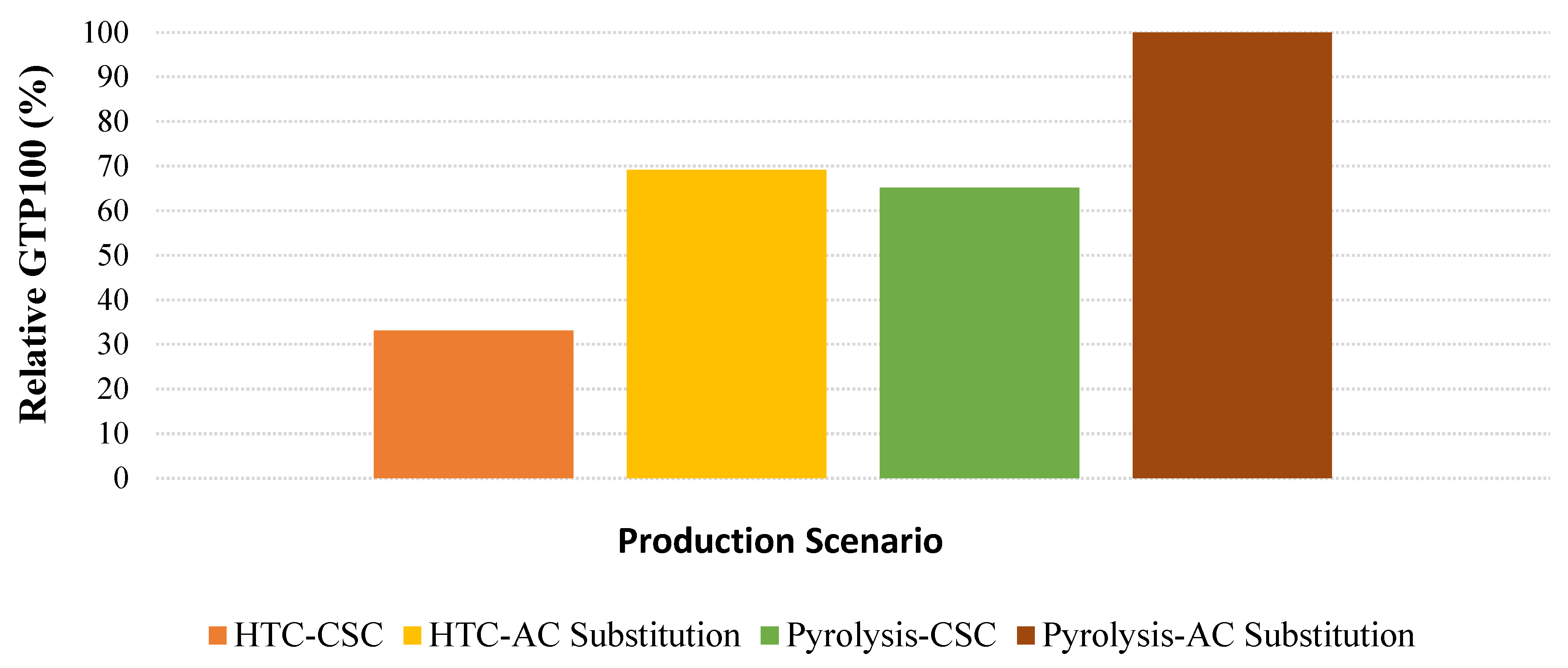
The sensitivity analysis GTP results for using the produced char for AC substitution instead of burying it in the soil were calculated according to the IPCC 2021 method. Figure 6 compares the GTP results for the burial and AC substitution scenarios for HTC and the pyrolysis process.
Accordingly, AC substitution exhibits a higher GTP effect for both the HTC and the pyrolysis processes. The GTP effect for the pyrolysis process is 35% higher than that for the burial option. In the HTC process, the GTP effect is 36% higher with AC substitution than for burial.
The substitution scenario is based on theoretical assumptions and represents an upper-bound estimate. In real-world applications, additional activation or modification processes may be required to achieve comparable performance to commercial activated carbon, which could significantly influence the overall environmental impacts. These results indicate that, under the current assumptions, carbon sequestration through burial remains more advantageous than the substitution scenario.
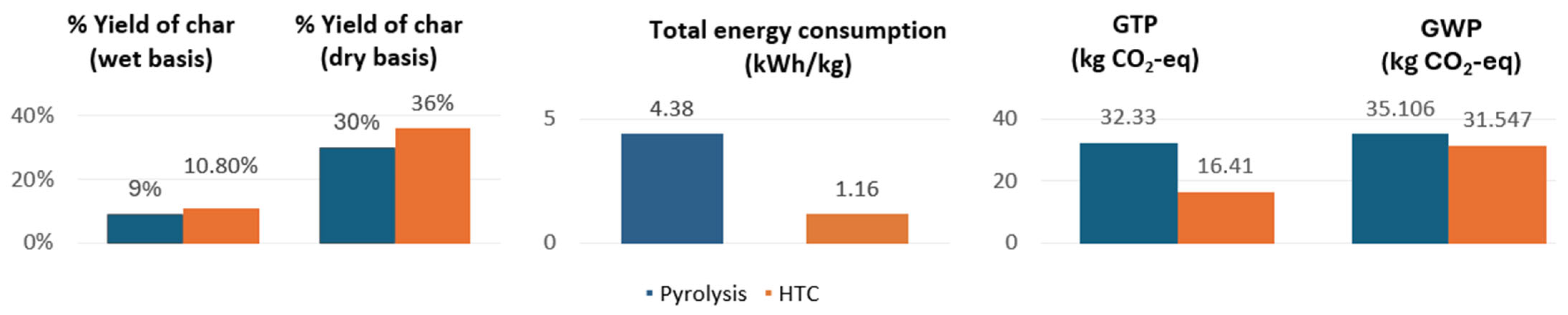
As shown in Figure 7, the yields of the HTC and pyrolysis processes were determined based on mass balance calculations. Under the applied process conditions, the PPH yield was calculated as 10.8 wt%, while the PPB yield was found to be 9 wt% (on a wet matter basis). When evaluated on a dry matter basis, the yields of PPH and PPB were 36% and 30%, respectively. Within the LCA framework, all flows were re-evaluated within the defined system boundaries, and only the fraction considered as the functional product was included, taking into account the feedstock moisture content and process-related losses.
The obtained results are consistent with findings reported in the literature, where HTC generally yields higher solid products compared to pyrolysis under similar process conditions [128]. This indicates that the HTC process retains a greater fraction of the feedstock carbon in the solid phase, whereas pyrolysis promotes the formation of gaseous and liquid products due to more extensive thermal degradation at elevated temperatures.
This trend is also consistent with the LCA results, where the HTC process demonstrated a more favorable environmental performance. The higher solid yield obtained in HTC enhances resource efficiency, whereas the lower yield in pyrolysis indicates increased volatilization and gas formation. These differences are further highlighted in Figure 7, which presents a comprehensive visual comparison of the pyrolysis and HTC systems across key performance indicators, including char yield, total energy demand, GTP, and GWP.

3.7. Comparison with Literature

In the literature, a study on pumpkin peel processing by microwave pyrolysis reported greenhouse gas emissions related to electricity generation as 0.14 kg CO2-eq/1000 kg, a biochar efficiency of 11%, and an energy consumption of 0.9 kWh/kg [94]. In another study on HTC of date waste, an emission value of 0.08 kg CO2-eq/100 kg was calculated. It was determined that HTC and drying processes, in particular, contributed the most to the environmental impact, with fossil fuel consumption being the dominant effect. It was also reported that a 94% reduction in fossil fuel consumption could be achieved with optimisation [90].
In a laboratory-scale study where bone meal and rice hulls were processed using HTC, greenhouse gas emissions of 9.85 and 9.93 kg CO2-eq/100 g were calculated, respectively. Energy consumption in these processes was 9.7 kWh/kg, and hydrochar efficiencies were reported as 74% (for bone meal) and 68% (for rice hull) [129]. Significantly lower emissions were observed in the pyrolysis processing of the same raw materials, with values of 0.68 kg CO2-eq/100 g for bone meal and 0.70 kg CO2-eq/100 g for rice hulls. Under these conditions, energy consumption was 0.83 and 0.75 kWh/kg, respectively, and the biochar efficiencies were reported as 64% and 49%, respectively [129]. In the co-pyrolysis of a mixture of food waste and low-density polyethene (LDPE) using a microwave, greenhouse gas emissions of 38.92 kg CO2-eq were calculated for 100 kg of mixed waste, energy consumption was 0.54 kWh/kg, and biochar efficiency was found to be 42% [130]. Similarly, microwave catalytic pyrolysis of switchgrass raw material yielded greenhouse gas emissions in the range of 159–223 kg CO2-eq for 1000 kg of dry biomass, with biochar yields ranging from 28.59% to 44.23% [131]. It should be noted that the literature studies employ different functional units and system boundaries; therefore, the comparison is intended to highlight general trends and order-of-magnitude differences rather than provide a direct quantitative comparison. Comparing these literature findings with the results obtained in our study reveals striking differences. According to the IPCC 2021 GTP100 method, the total impact for the HTC process was calculated as 16.41 kg CO2-eq/FU, while for the pyrolysis process, this value was found to be 32.33 kg CO2-eq/FU. While higher electricity consumption during the pyrolysis process is the primary source of the increase in emissions, the HTC process exhibited lower impacts due to its higher char yield (30% on a dry basis, 10.8% on a wet basis), stronger carbon sequestration capacity, and lower electricity consumption. These results are also consistent with the reporting of low GWP values in some HTC studies reported in the literature [90,131].

4. Conclusions

In this study, the physicochemical properties and environmental impacts of PPB and PPH samples via pyrolysis and hydrothermal carbonisation methods were compared without the use of chemicals or catalysts and without pre-washing with water. The findings showed that PPH exhibited superior properties compared to PPB. With a 36% yield, 16.35 m2/g BET surface area, and 76% elemental carbon content, PPH offered higher process yield, higher carbonisation degree, and more advanced surface properties compared to PPB, which had a 30% yield, 9.80 m2/g surface area, and 66% carbon content. LCA results also supported these findings; under the basic assumptions used in this study, the environmental impact potential of PPH production was determined to be lower at 16.41 kg CO2-eq./FU than PPB’s at 32.33 kg CO2-eq./FU. Furthermore, it was found that the energy requirement of the HTC process is approximately four times lower than that of the pyrolysis process and, consistent with the literature, lower energy requirements are associated with lower environmental impacts. Accordingly, it was assessed that the lower environmental burden of the HTC process is primarily related to its lower energy requirement.
This study contributes to the literature by providing a systematic comparison of biochar and hydrochar produced from the same biomass under chemical-free conditions, combining material characterisation with life cycle assessment at a pilot-scale modelling level. This approach enables a direct evaluation of how process selection influences both environmental performance and material properties.
The resulting products exhibit properties comparable to those reported in the literature for soil-related applications, indicating their potential applicability in environmental systems.
It should be noted that these results are based on pilot-scale modeling assumptions and should be validated in future studies under real industrial conditions.

Author Contributions

M.H.U. conducted the research and review process and wrote the original draft. She was involved in obtaining, analysing and interpreting the data for the study, as well as editing and designing the article. M.S., S.H.Y.Ç. and A.A.U. made contributions to obtaining, analysing and interpreting the data for the study and revised and edited the article. A.S.E.Y. assisted in the experimental work and analysis and reviewed and edited the article. H.A. co-supervised the doctoral thesis and made contributions to the concept of the work. A.O.K. supervised the doctoral thesis and made contributions to the concept of the work, providing a critical revision in terms of intellectual content. T.Ç. and G.S.M. supervised, revised and edited the article. All authors have read and agreed to the published version of the manuscript.

Funding

The Article Processing Charge for the publication of this research was funded by REFRESH-Research Excellence For Region Sustainability and High-tech Industries (project reg. No. CZ.10.03.01/00/22_003/0000048) via the Operational Program “Just Transition”.

Data Availability Statement

The data that support the findings of this study are openly available in [Zenodo] at https://doi.org/10.5281/zenodo.17696548 [132].

Acknowledgments

The first author (Mürüvet Hazel Uysal) gratefully acknowledges the PhD scholarship provided by TÜBİTAK BİDEB 2211-A and Higher Education Institution (YÖK) 100/2000 project programme. This work was also supported by the project the European Union under the REFRESH Research Excellence for Region Sustainability and High-tech Industries project number CZ.10.03.01/00/22_003/0000048 via the Operational Program Just Transition and by the project MATUR—Materials and Technologies for Sustainable Development, funded within the Jan Amos Komenský Operational Programme (Project Reg. No. CZ.02.01.01/00/22_008/0004631). During the preparation of this work, the authors used ChatGPT Plus to correct grammatical mistakes and enhance the fluency of the manuscript. After using this tool, the authors reviewed and edited the content as needed and take full responsibility for the content of the publication.

Conflicts of Interest

Author Tuğrul Çetinkaya is a co-founder of NESSTEC Energy & Surface Technology A.S., Technology Development Zones, Esentepe, 54050, Sakarya, Türkiye. The remaining authors declare that the research was conducted in the absence of any commercial or financial relationships that could be construed as a potential conflict of interest.

Abbreviations

The following abbreviations are used in this manuscript:
PPWPumpkin peel waste
BETBrunauer–Emmett–Teller
FESEM Field Emission Scanning Electron Microscope
SEMScanning Electron Microscope
EDSEnergy Dispersive X-ray Spectroscopy
PPRPumpkin peel waste-derived pumpkin peel powder
PPBBiochar obtained from pumpkin peel
PPHHydrochar obtained from pumpkin peel
HTCHydrothermal carbonisation
LCALife cycle assessment
LCIALifecycle impact assessment
GWPGlobal Warming Potential
TAPTerrestrial Acidification Potential
FWEPFreshwater Eutrophication Potential
FWETPFreshwater Ecotoxicity Potential
HTPcancerHuman Carcinogenic Toxicity Potential Mineral Resource Scarcity
MRSMineral Resource Scarcity
FRSFossil Resource Scarcity
WCWater Consumption

References

  1. Kirchherr, J.; Reike, D.; Hekkert, M. Conceptualizing the circular economy: An analysis of 114 definitions. Resour. Conserv. Recycl. 2017, 127, 221–232. [Google Scholar] [CrossRef]
  2. Li, J.; Sun, W.; Lichtfouse, E.; Maurer, C.; Liu, H. Life cycle assessment of biochar for sustainable agricultural application: A review. Sci. Total Environ. 2024, 951, 175448. [Google Scholar] [CrossRef]
  3. Yılmaz, A.E. Çevresel sürdürülebilirlik açısından tarımsal atıkların değerlendirilmesi. J. Ecol. Harmon. 2025, 1, 32–39. [Google Scholar]
  4. Polipalli, K.; Suraboyina, S.; Kashimalla, M.; Polumati, A. A review on value addition of agricultural residues by chemical and biochemical processes to abate environmental pollution. Green Technol. Sustain. 2025, 3, 100241. [Google Scholar] [CrossRef]
  5. Sharma, M.; Bains, A.; Goksen, G.; Dhull, S.B.; Ali, N.; Rashid, S.; Elossaily, G.M.; Chawla, P. A review of valorization of agricultural waste for the synthesis of cellulose membranes: Separation of organic, inorganic, and microbial pollutants. Int. J. Biol. Macromol. 2024, 277, 134170. [Google Scholar] [CrossRef]
  6. Dede, Ö.H.; Özdemir, S.; Dede, G. Effects of organic wastes substrates on the growing of Impatiens. Turk. J. Agric. For. 2006, 30, 375–381. [Google Scholar]
  7. Hamilton, A.N.; Bertucci, M.B.; Gibson, K.E.; Savin, M.C.; Kirkpatrick, D.E.; Woody-Pumford, R.C. Assessing food waste compost as a substrate amendment for tomato and watermelon seedlings. HortTechnology 2025, 35, 125–136. [Google Scholar] [CrossRef]
  8. Mahish, P.K.; Verma, D.K.; Ghritlahare, A.; Arora, C.; Otero, P. Microbial bioconversion of food waste to bio-fertilizers. Sustain. Food Technol. 2024, 2, 689–708. [Google Scholar] [CrossRef]
  9. Mergbi, M.; Galloni, M.; Aboagye, D.; Elimian, E.; Su, P.; Ikram, B.; Nabgan, W.; Bedia, J.; Amor, H.; Contreras, S.; et al. Valorization of lignocellulosic biomass into sustainable materials for adsorption and photocatalytic applications in water and air remediation. Environ. Sci. Pollut. Res. Int. 2023, 30, 74544–74574. [Google Scholar] [CrossRef]
  10. Kaur, K.; Kaur, R.; Kaur, H. A systematic review of lignocellulosic biomass for remediation of environmental pollutants. Appl. Surf. Sci. Adv. 2024, 19, 100547. [Google Scholar] [CrossRef]
  11. Zhu, H.; Li, J.; Wu, D.; Zhang, G.; Sun, Y.; Wang, A.; Sun, K. Construction of the hierarchical porous biochar with an ultrahigh specific surface area for application in high-performance lithium-ion capacitor cathode. Biochar 2024, 5, 46. [Google Scholar] [CrossRef]
  12. Jedynak, K.; Charmas, B. Adsorption properties of biochars obtained by KOH activation. Adsorption 2023, 30, 167–183. [Google Scholar] [CrossRef]
  13. Zhou, Y.; Huang, J.; Feng, Y.; Xie, H.; Wu, P.; Wang, B.; Zhang, S. A bibliographic study reviewing the last decade of hydrochar in environmental application: History, status quo, and trending research paths. Biochar 2023, 5, 12. [Google Scholar] [CrossRef]
  14. Edeh, I.; Mašek, O.; Fusseis, F. 4D structural changes and pore network model of biomass during pyrolysis. Sci. Rep. 2023, 13, 22863. [Google Scholar] [CrossRef]
  15. Valadez-Renteria, E.; Ibarra-Escamilla, L.; Robles-Gomez, L.; Robledo-Trujillo, G.; Rodriguez-Gonzalez, V. Characterization of cellulose extracted from pumpkin shell waste. Mater. Lett. 2026, 406, 139985. [Google Scholar] [CrossRef]
  16. González-Domínguez, J.; Fernández-González, C.; Alexandre-Franco, M.; Gómez-Serrano, V. Surface Chemistry of Cherry Stone-Derived Activated Carbon Prepared by H3PO4 Activation. Processes 2024, 12, 149. [Google Scholar] [CrossRef]
  17. Li, Y.; Gupta, R.; Zhang, Q.; You, S. Review of biochar production via crop residue pyrolysis: Development and perspectives. Bioresour. Technol. 2022, 369, 128423. [Google Scholar] [CrossRef] [PubMed]
  18. Hoque, M.M.; Saha, B.K.; Scopa, A.; Drosos, M. Biochar in agriculture: A review on sources, production, and composites related to soil fertility, crop productivity, and environmental sustainability. Carbon 2025, 11, 50. [Google Scholar] [CrossRef]
  19. Hu, Z.-Y.; Chen, X.; Jiang, H. A Life Cycle Assessment of the Combined Utilization of Biomass Waste-Derived Hydrochar as a Carbon Source and Soil Remediation. ACS ES T Eng. 2022, 3, 165–173. [Google Scholar] [CrossRef]
  20. Haddad, N.; Al Tawaha, A.R.; Alassaf, R.; Alkhoury, W.; Abusalem, M.; Al-Sharif, R. A review for the potential of biochar from agricultural waste for soil and crop improvement. J. Ecol. Eng. 2024, 25, 190–202. [Google Scholar] [CrossRef]
  21. Patel, M.R.; Panwar, N.L. Biochar from agricultural crop residues: Environmental, production, and life cycle assessment overview. Results Chem. Eng. 2023, 7, 200173. [Google Scholar] [CrossRef]
  22. Saharudin, D.M.; Jeswani, H.K.; Azapagic, A. Biochar from agricultural wastes: Environmental sustainability, economic viability and the potential as a negative emissions technology. Sci. Total Environ. 2024, 837, 170266. [Google Scholar] [CrossRef] [PubMed]
  23. Carvalho, J.; Nascimento, L.; Soares, M.; Valério, N.; Ribeiro, A.; Faria, L.; Silva, A.; Pacheco, N.; Araújo, J. Life cycle assessment (LCA) of biochar production from a circular economy perspective. Processes 2022, 10, 2684. [Google Scholar] [CrossRef]
  24. Huang, X.; Yu, Q.; Zhou, M.; Ma, C.; Li, H. Field scale screening of pumpkin cultivars for cost effectiveness of “repairing while producing” in cadmium arsenic co contaminated agricultural land. Food Chem. X 2025, 25, 102079. [Google Scholar] [CrossRef]
  25. Burguete, P.; Corma, A.; Hitzl, M.; Modrego, R.; Ponce, E.; Renz, M. Fuel and chemicals from wet lignocellulosic biomass waste streams by hydrothermal carbonization. Green Chem. 2015, 18, 1051–1060. [Google Scholar] [CrossRef]
  26. Liu, X.; Yang, H. A state-of-the-art review of N self-doped biochar development in supercapacitor applications. Front. Energy Res. 2023, 11, 1135093. [Google Scholar] [CrossRef]
  27. ASTM D1762 84; Standard Test Method for Chemical Analysis of Wood Charcoal. ASTM International: West Conshohocken, PA, USA, 1984. Available online: https://store.astm.org/d1762-84r21.html (accessed on 3 February 2026).
  28. ISO 589; Hard Coal—Determination of Total Moisture. International Organization for Standardization: Geneva, Switzerland, 2008.
  29. Jagodziński, A.M.; Dyderski, M.K.; Gęsikiewicz, K.; Horodecki, P. Consequences of different sample drying temperatures for accuracy of biomass inventories in forest ecosystems. Sci. Rep. 2020, 10, 16009. [Google Scholar] [CrossRef] [PubMed]
  30. Repola, J. Biomass equations for birch in Finland. Silva Fenn. 2008, 42, 605–624. [Google Scholar] [CrossRef]
  31. Uri, V.; Lõhmus, K.; Kiviste, A.; Aosaar, J.; Varik, M. Biomass production and carbon sequestration in a fertile silver birch (Betula pendula Roth) forest chronosequence. For. Ecol. Manag. 2012, 267, 117–126. [Google Scholar] [CrossRef]
  32. Gheorghe-Bulmau, C.; Volceanov, A.; Stănciulescu, I.; Ionescu, G.; Marculescu, C.; Radoiu, M. Production and properties assessment of biochars from rapeseed and poplar waste biomass for environmental applications in Romania. Environ. Geochem. Health 2022, 44, 1683–1696. [Google Scholar] [CrossRef]
  33. Masoumi, S.; Borugadda, V.B.; Nanda, S.; Dalai, A.K. Hydrochar: A review on its production technologies and applications. Catalysts 2021, 11, 939. [Google Scholar] [CrossRef]
  34. Diaz, E.; Sanchis, I.; Coronella, C.; Mohedano, Á. Activated carbons from hydrothermal carbonization and chemical activation of olive stones: Application in sulfamethoxazole adsorption. Resources 2022, 11, 43. [Google Scholar] [CrossRef]
  35. Johnson, R.; Castillo, K.; Castillo, C.; Wang, L.; Skreiberg, Ø.; Turn, S. Use of plasticized biochar ıntermediate for producing biocarbons with ımproved mechanical properties. ACS Sustain. Chem. Eng. 2023, 11, 5845–5857. [Google Scholar] [CrossRef]
  36. Varol, E.; Mutlu, Ü. TGA-FTIR analysis of biomass samples based on the thermal decomposition behavior of hemicellulose, cellulose, and lignin. Energies 2023, 16, 3674. [Google Scholar] [CrossRef]
  37. Li, Y.; Liu, P.; Dong, L.; Lang, P.; Lei, T. Evolution of oxygen-containing functional groups during torrefaction and its effect on pyrolysis behaviors and hydrogen production from different lignocellulosic biomasses. Appl. Energy Combust. Sci. 2025, 24, 100421. [Google Scholar] [CrossRef]
  38. Zhang, L.; Yao, Z.; Zhao, L.; Yu, F.; Li, Z.; Yi, W.; Fu, P.; Jia, J.; Zhao, Y. Effects of various pyrolysis temperatures on the physicochemical characteristics of crop straw-derived biochars and their application in tar reforming. Catal. Today 2024, 433, 114663. [Google Scholar] [CrossRef]
  39. Kujawska, J.; Cel, W.; Charmas, B.; Szala, D. Effect of pyrolysis temperature on chemical structure and thermal stability of digestate-based biochar. Energies 2026, 19, 1043. [Google Scholar] [CrossRef]
  40. Roshan, A.; Ghosh, D.; Maiti, S. How temperature affects biochar properties for application in coal mine spoils? A meta-analysis. Carbon Res. 2023, 2, 3. [Google Scholar] [CrossRef]
  41. Mahmoud, E.; Aly, H.; Hassan, N.; Aljabri, A.; Khan, A.; El-Labban, H. Biochar from date palm waste via two-step pyrolysis: A modified approach for cu (ıı) removal from aqueous solutions. Processes 2024, 12, 1189. [Google Scholar] [CrossRef]
  42. Shao, Z.S.; Wu, S.; Gao, Y.; Liu, X.; Dai, Y. Two-step pyrolytic preparation of biochar for the adsorption study of tetracycline in water. Environ. Res. 2023, 242, 117566. [Google Scholar] [CrossRef] [PubMed]
  43. Ighalo, J.; Akaeme, F.; Georgin, J.; de Oliveira, J.; Franco, D. Biomass hydrochar: A critical review of process chemistry, synthesis methodology, and applications. Sustainability 2025, 17, 1660. [Google Scholar] [CrossRef]
  44. Basso, D.; Patuzzi, F.; Castello, D.; Baratieri, M.; Rada, E.; Weiss-Hortala, E.; Fiori, L. Agro-industrial waste to solid biofuel through hydrothermal carbonization. Waste Manag. 2015, 47, 114–121. [Google Scholar] [CrossRef]
  45. Sevilla, M.; Maciá-Agullo, J.; Fuertes, A. Hydrothermal carbonization of biomass as a route for the sequestration of CO2: Chemical and structural properties of the carbonized products. Biomass Bioenergy 2011, 35, 3152–3159. [Google Scholar] [CrossRef]
  46. Sharma, M.; Öztürk, İ.Ş.; Emiroğlu, M.; Yay, A.S.E. Performance Evaluation of Biomass-Derived Hydrothermal Carbonaceous Material in Cement Based Composites. Case Stud. Constr. Mater. 2025, 22, e04291. [Google Scholar] [CrossRef]
  47. ISO 14040; Environmental Management—Life Cycle Assessment—Principles and Framework. International Organization for Standardization: Geneva, Switzerland, 2006.
  48. ISO 14044; Environmental Management—Life Cycle Assessment—Requirements and Guidelines. International Organization for Standardization: Geneva, Switzerland, 2006.
  49. Rotthong, M.; Takaoka, M.; Oshita, K.; Rachdawong, P.; Gheewala, S.H.; Prapaspongsa, T. Life Cycle Assessment of Integrated Municipal Organic Waste Management Systems in Thailand. Sustainability 2023, 15, 90. [Google Scholar] [CrossRef]
  50. Hauschild, M.Z.; Rosenbaum, R.K.; Olsen, S.I. Life Cycle Assessment: Theory and Practice; Springer: Berlin/Heidelberg, Germany, 2018. [Google Scholar]
  51. Piccinno, F.; Hischier, R.; Seeger, S.; Som, C. From Laboratory to Industrial Scale: A Scale-Up Framework for Chemical Processes in Life Cycle Assessment Studies. J. Clean. Prod. 2016, 135, 1085–1097. [Google Scholar] [CrossRef]
  52. Yin, C.; El-Harbawi, M.; Jiang, Z. Life Cycle Assessment of Production of Hydrochar via Hydrothermal Carbonization of Date Palm Fronds Biomass. Materials 2023, 16, 6653. [Google Scholar] [CrossRef]
  53. Hoekman, S.; Broch, A.; Robbins, C. Hydrothermal Carbonization (HTC) of Lignocellulosic Biomass. Energy Fuels 2011, 25, 1802–1810. [Google Scholar] [CrossRef]
  54. Jenkins, R.W.; Sutton, A.D.; Robichaud, D.J. Pyrolysis of biomass for aviation fuel. In Biofuels for Aviation; Academic Press: Cambridge, MA, USA, 2016; pp. 191–215. ISBN 978-0-12-804568-8. [Google Scholar] [CrossRef]
  55. Yang, H.; Yan, R.; Chen, H.; Lee, D.-H.; Zheng, C. Characteristics of hemicellulose, cellulose and lignin pyrolysis. Fuel 2007, 86, 1781–1788. [Google Scholar] [CrossRef]
  56. Yuan, H.; Li, C.; Shan, R.; Zhang, J.; Chen, Y. Nitrogen Containing Species Evolution During Co-Pyrolysis of Gentamicin Residue and Biomass. J. Anal. Appl. Pyrolysis 2023, 169, 105812. [Google Scholar] [CrossRef]
  57. Oktem, A.; Oktem, A. Biomass and Dry Matter Yield Potential of Some Early Sweet Sorghum (Sorghum bicolor var. saccharatum (L.) Mohlenbr.) Genotypes. Asian J. Res. Crop Sci. 2022, 7, 148. [Google Scholar] [CrossRef]
  58. Noh, N.; Karim, L.; Omar, S. Value-Added Products from Pumpkin Wastes: A Review. Malays. J. Sci. Health Technol. 2022, 231, 77–84. [Google Scholar] [CrossRef]
  59. Yao, X.; Liu, Q.; Kang, Z.; An, Z.; Zhou, H.; Xu, K. Quantitative Study on Thermal Conversion Behaviours and Gas Emission Properties of Biomass in Nitrogen and in CO2/N2 Mixtures by TGA/DTG and a Fixed-Bed Tube Furnace. Energy 2023, 270, 126904. [Google Scholar] [CrossRef]
  60. Bridgwater, A. Review of Fast Pyrolysis of Biomass and Product Upgrading. Biomass Bioenergy 2012, 38, 68–94. [Google Scholar] [CrossRef]
  61. Lachos-Perez, D.; Martins-Vieira, J.C.; Missau, J.; Anshu, K.; Siakpebru, O.K.; Thengane, S.K.; Morais, A.R.C.; Tanabe, E.H.; Bertuol, D.A. Review on biomass pyrolysis with a focus on bio-oil upgrading techniques. Analytica 2023, 4, 182–205. [Google Scholar] [CrossRef]
  62. Basu, P. Biomass Gasification and Pyrolysis: Practical Design and Theory; Academic Press: Burlington, MA, USA, 2010. [Google Scholar]
  63. Azzi, E.; Li, H.; Cederlund, H.; Karltun, E.; Sundberg, C. Modelling Biochar Long-Term Carbon Storage in Soil with Harmonized Analysis of Decomposition Data. Geoderma 2024, 441, 116761. [Google Scholar] [CrossRef]
  64. De Jager, M.; Schröter, F.; Wark, M.; Giani, L. The Stability of Carbon from a Maize-Derived Hydrochar as a Function of Fractionation and Hydrothermal Carbonization Temperature in a Podzol. Biochar 2022, 4, 52. [Google Scholar] [CrossRef]
  65. Li, G.; Iakunkov, A.; Boulanger, N.; Lazar, O.; Enăchescu, M.; Grimm, A.; Talyzin, A. Activated Carbons with Extremely High Surface Area Produced from Cones, Bark and Wood Using the Same Procedure. RSC Adv. 2023, 13, 14543–14553. [Google Scholar] [CrossRef]
  66. Kuptajit, P.; Sano, N.; Nakagawa, K.; Suzuki, T. A Study on Pore Formation of High Surface Area Activated Carbon Prepared by Microwave-Induced Plasma with KOH (MiWP-KOH) Activation: Effect of Temperature-Elevation Rate. Chem. Eng. Process. 2021, 167, 108511. [Google Scholar] [CrossRef]
  67. Košťáľová, Z.; Hromádková, Z.; Ebringerová, A. Chemical Evaluation of Seeded Fruit Biomass of Oil Pumpkin (Cucurbita pepo L. var. Styriaca). Chem. Pap. 2009, 63, 406–413. [Google Scholar] [CrossRef]
  68. Mithra, M.G.; Padmaja, G. Comparative Alterations in the Compositional Profile of Selected Root and Vegetable Peels Subjected to Three Pretreatments for Enhanced Saccharification. Int. J. Environ. Agric. Biotechnol. 2017, 2, 238846. [Google Scholar] [CrossRef]
  69. Nansikombi, N.; Muyonga, J.; Byaruhanga, Y. Association Between Fruit Characteristics and Postharvest Stability of Different Pumpkin (Cucurbita) Species. J. Food Res. 2019, 8, 131. [Google Scholar] [CrossRef]
  70. Yu, S.; He, J.; Zhang, Z.; Sun, Z.; Xie, M.; Xu, Y.; Bie, X.; Li, Q.; Zhang, Y.; Sevilla, M.; et al. Towards Negative Emissions: Hydrothermal Carbonization of Biomass for Sustainable Carbon Materials. Adv. Mater. 2024, 36, 2307412. [Google Scholar] [CrossRef]
  71. Khan, T.; Saud, A.; Jamari, S.; Rahim, M.; Park, J.; Kim, H. Hydrothermal Carbonization of Lignocellulosic Biomass for Carbon Rich Material Preparation: A Review. Biomass Bioenergy 2019, 130, 105384. [Google Scholar] [CrossRef]
  72. Pauline, A.; Joseph, K. Hydrothermal Carbonization of Organic Wastes to Carbonaceous Solid Fuel—A Review of Mechanisms and Process Parameters. Fuel 2020, 279, 118472. [Google Scholar] [CrossRef]
  73. Shen, Y. A Review on Hydrothermal Carbonization of Biomass and Plastic Wastes to Energy Products. Biomass Bioenergy 2020, 134, 105479. [Google Scholar] [CrossRef]
  74. Supee, A.; Zaini, M. Hydrothermal Carbonization of Biomass: A Commentary. Fuller. Nanotub. Carbon Nanostruct. 2023, 32, 119–127. [Google Scholar] [CrossRef]
  75. González-Arias, J.; Sánchez, M.; Cara-Jiménez, J.; Baena-Moreno, F.; Zhang, Z. Hydrothermal Carbonization of Biomass and Waste: A Review. Environ. Chem. Lett. 2021, 20, 211–221. [Google Scholar] [CrossRef]
  76. Cavali, M.; Junior, N.L.; De Sena, J.; Woiciechowski, A.; Soccol, C.; Filho, P.; Bayard, R.; Benbelkacem, H.; De Castilhos Júnior, A. A Review on Hydrothermal Carbonization of Potential Biomass Wastes, Characterization and Environmental Applications of Hydrochar, and Biorefinery Perspectives of the Process. Sci. Total Environ. 2022, 857, 159627. [Google Scholar] [CrossRef]
  77. Singh, A.; Bin Abu Sofian, A.; Chan, Y.; Chakrabarty, A.; Selvarajoo, A.; Abakr, Y.; Show, P. Hydrothermal Carbonization: Sustainable Pathways for Waste-to-Energy Conversion and Biocoal Production. GCB Bioenergy 2024, 16, e13150. [Google Scholar] [CrossRef]
  78. Tong, W.; Liu, Q.; Yang, C.; Cai, Z.; Wu, H.; Ren, S. Effect of Pore Structure on CO2 Gasification Reactivity of Biomass Chars Under High-Temperature Pyrolysis. J. Energy Inst. 2020, 93, 105007. [Google Scholar] [CrossRef]
  79. Chen, S.; Xia, Y.; Zhang, B.; Chen, H.; Chen, G.; Tang, S. Disassembly of Lignocellulose into Cellulose, Hemicellulose, and Lignin for Preparation of Porous Carbon Materials with Enhanced Performances. J. Hazard. Mater. 2020, 408, 124956. [Google Scholar] [CrossRef] [PubMed]
  80. Muhammad, N.; Ge, L.; Chan, W.; Khan, A.; Nafees, M.; Lisak, G. Impacts of Pyrolysis Temperatures on Physicochemical and Structural Properties of Green Waste Derived Biochars for Adsorption of Potentially Toxic Elements. J. Environ. Manag. 2022, 317, 115385. [Google Scholar] [CrossRef]
  81. Tsai, W.; Ayestas, R.; Tsai, C.; Lin, Y. Preparation and Characterization of Porous Materials from Pineapple Peel at Elevated Pyrolysis Temperatures. Materials 2022, 15, 4686. [Google Scholar] [CrossRef]
  82. Bal, D.; Özer, Ç.; Imamoglu, M. Green and Ecofriendly Biochar Preparation from Pumpkin Peel and Its Usage as an Adsorbent for Methylene Blue Removal from Aqueous Solutions. Water Air Soil Pollut. 2021, 232, 474. [Google Scholar] [CrossRef]
  83. Lai, R.; Hu, J.; Sun, Y.; Lu, P. Physicochemical and Adsorption Characteristics of Activated Carbons from Cellulose, Xylan and Lignin. J. Anal. Appl. Pyrolysis 2023, 173, 106067. [Google Scholar] [CrossRef]
  84. Dai, B.; Ding, Z. An Evaluation of the Contribution of Cellulose, Hemicellulose and Lignin to Bio-Char Combustion and Adsorption Properties. J. Biobased Mater. Bioenergy 2024, 18, 2338. [Google Scholar] [CrossRef]
  85. Wan, J.; Liu, L.; Ayub, K.; Zhang, W.; Shen, G.; Hu, S.; Qian, X. Characterization and Adsorption Performance of Biochars Derived from Three Key Biomass Constituents. Fuel 2020, 269, 117142. [Google Scholar] [CrossRef]
  86. Tran, H.; Lee, C.; Nguyen, T.; Chao, H. Saccharide-Derived Microporous Spherical Biochar Prepared from Hydrothermal Carbonization and Different Pyrolysis Temperatures: Synthesis, Characterization, and Application in Water Treatment. Environ. Technol. 2018, 39, 2747–2760. [Google Scholar] [CrossRef]
  87. Švábová, M.; Bičáková, O.; Vorokhta, M. Biochar as an Effective Material for Acetone Sorption and the Effect of Surface Area on the Mechanism of Sorption. J. Environ. Manag. 2023, 348, 119205. [Google Scholar] [CrossRef] [PubMed]
  88. Subagio, A.; Umiati, N.; Kholil, M.; Ratih, S.; Purbalisa, W.; Wahyuni, S.; Paputri, D. Effect of Variations in Milling Speed with High Energy Milling Treatment on Surface Area of Biochar Material. J. Phys. Conf. Ser. 2021, 1943, 012024. [Google Scholar] [CrossRef]
  89. Essandoh, M.; Wolgemuth, D.; Pittman, C.; Mohan, D.; Mlsna, T. Adsorption of metribuzin from aqueous solution using magnetic and nonmagnetic sustainable low-cost biochar adsorbents. Environ. Sci. Pollut. Res. 2017, 24, 4577–4590. [Google Scholar] [CrossRef]
  90. Gowthami, D.; Sharma, R.K.; Khalid, M.; Ismail, M.Y. Enhancing Surface Properties of Circular Carbon Biochar Derived from Spent Coffee Beans through ZnCl2/KOH Activation. BioEnergy Res. 2025, 18, 2. [Google Scholar] [CrossRef]
  91. Sivaranjanee, R.; Senthil Kumar, P.; Rangasamy, G. A Critical Review on Biochar for Environmental Applications. Carbon Lett. 2023, 33, 1407–1432. [Google Scholar] [CrossRef]
  92. Kapoor, R.T.; Ahmad, P.; Rafatullah, M. Insights into Biochar Applications: A Sustainable Strategy Toward Carbon Neutrality and Circular Economy. In Biochar for Environmental Management; Kapoor, R.T., Ahmad, P., Rafatullah, M., Eds.; American Chemical Society: Washington, DC, USA, 2024; Chapter 1. [Google Scholar] [CrossRef]
  93. Rizwan, M.; Murtaza, G.; Zulfiqar, F.; Moosa, A.; Iqbal, R.; Ahmed, Z.; Irshad, S.; Khan, I.; Li, T.; Chen, J.; et al. Sustainable Manufacture and Application of Biochar to Improve Soil Properties and Remediate Soil Contaminated with Organic Impurities: A Systematic Review. Front. Environ. Sci. 2023, 11, 1277240. [Google Scholar] [CrossRef]
  94. Allende, S.; Brodie, G.; Jacob, M. Energy Recovery from Pumpkin Peel Using Microwave-Assisted Pyrolysis. Energies 2023, 16, 6438. [Google Scholar] [CrossRef]
  95. Ambika, S.; Kumar, M.; Pisharody, L.; Malhotra, M.; Kumar, G.; Sreedharan, V. Modified Biochar as a Green Adsorbent for Removal of Hexavalent Chromium from Various Environmental Matrices: Mechanisms, Methods, and Prospects. Chem. Eng. J. 2022, 446, 135716. [Google Scholar] [CrossRef]
  96. Vassilev, S.V.; Baxter, D.; Andersen, L.K.; Vassileva, C.G. An overview of the chemical composition of biomass. Fuel 2010, 89, 913–933. [Google Scholar] [CrossRef]
  97. Smith, A.M.; Singh, S.; Ross, A.B. Fate of inorganic material during hydrothermal carbonisation of biomass: Influence of feedstock on combustion behaviour of hydrochar. Fuel 2015, 169, 153–160. [Google Scholar] [CrossRef]
  98. Gao, X.; Yang, S.; Hu, L.; Cai, S.; Wu, L.; Kawi, S. Carbonaceous materials as adsorbents for CO2 capture: Synthesis and modification. Carbon Capture Sci. Technol. 2022, 3, 100039. [Google Scholar] [CrossRef]
  99. Ruksathamcharoen, S.; Ajiwibowo, M.W.; Chuenyam, T.; Surjosatyo, A.; Yoshikawa, K. Effect of hydrothermal treatment on grindability and fuel characteristics of empty fruit bunch derived hydrochar. Int. J. Technol. 2018, 9, 1246–1255. [Google Scholar] [CrossRef]
  100. Leng, L.; Xiong, Q.; Yang, L.; Li, H.; Zhou, Y.; Zhang, W.; Jiang, S.; Li, H.; Huang, H. An Overview on Engineering the Surface Area and Porosity of Biochar. Sci. Total Environ. 2020, 763, 144204. [Google Scholar] [CrossRef] [PubMed]
  101. Lv, L.; Huang, S.; Zhou, H. Effect of Introducing Chemically Activated Biochar as Support Material on Thermal Properties of Different Organic Phase Change Materials. Sol. Energy Mater. Sol. Cells 2024, 264, 112617. [Google Scholar] [CrossRef]
  102. Park, H.; Kim, J.; Lee, Y.; Chon, K. Enhanced Adsorptive Removal of Dyes Using Mandarin Peel Biochars via Chemical Activation with NH4Cl and ZnCl2. Water 2021, 13, 1495. [Google Scholar] [CrossRef]
  103. Liu, Z.; Zeng, F.; Jiang, H.; Zhang, X. Preparation of high adsorption capacity bio-chars from waste biomass. Bioresour. Technol. 2011, 102, 8247–8252. [Google Scholar] [CrossRef]
  104. Saleem, J.; Shahid, U.; Hijab, M.; Mackey, H.; Mckay, G. Production and applications of activated carbons as adsorbents from olive stones. Biomass Convers. Biorefinery 2019, 9, 775–802. [Google Scholar] [CrossRef]
  105. Šabanović, E.; Memić, M.; Sulejmanović, J.; Huremović, J. Sorption of Metals on Pulverized Pumpkin (Cucurbita pepo L.) Peels. Anal. Lett. 2016, 49, 2446–2460. [Google Scholar] [CrossRef]
  106. Liu, Z.; Liu, Z. Comparison of Hydrochar- and Pyrochar-Based Solid Acid Catalysts from Cornstalk: Physiochemical Properties, Catalytic Activity and Deactivation Behavior. Bioresour. Technol. 2020, 297, 122477. [Google Scholar] [CrossRef]
  107. Yabalak, E.; Elneccar, F. Evaluation of Watermelon Peel, Banana Peel and Bay Leaves Hydrochars as Green Catalysts in the Degradation of Malachite Green by Thermally Activated Persulfate Oxidation Method. J. Environ. Manag. 2022, 304, 114311. [Google Scholar] [CrossRef]
  108. Dang, M.; Chen, D.; Lu, P.; Xu, G. Enhanced Degradation of DDT Using a Novel Iron-Assisted Hydrochar Catalyst Combined with Peroxymonosulfate: Experiment and Mechanism Analysis. Chemosphere 2022, 307, 135893. [Google Scholar] [CrossRef]
  109. Negiş, H.; Gümüş, İ.; Şeker, C. The Properties of Biochars Derived from Different Plant Residue and Different Pyrolysis Temperatures. Akad. Ziraat Derg. 2019, 8, 319–322. [Google Scholar] [CrossRef]
  110. Yıldız Uzun, Z. Tavuk Çiftliği Atıklarının Pirolizinden Biyokömür Üretiminin Optimizasyonu ve Uygulama Alanlarının Araştırılması. Ph.D. Thesis, Hitit Üniversitesi Fen Bilimleri Enstitüsü, Çorum, Turkey, 2020. [Google Scholar]
  111. Liu, Y.; He, Z.; Uchimiya, M. Comparison of biochar formation from various agricultural by-products using FTIR spectroscopy. Mod. Appl. Sci. 2015, 9, 246. [Google Scholar] [CrossRef]
  112. Uchimiya, M.; Orlov, A.; Ramakrishnan, G.; Sistani, K. In situ and ex situ spectroscopic monitoring of biochar’s surface functional groups. J. Anal. Appl. Pyrolysis 2013, 102, 53–59. [Google Scholar] [CrossRef]
  113. Nair, R.; Mondal, M.; Weichgrebe, D. Biochar from co-pyrolysis of urban organic wastes—Investigation of carbon sink potential using ATR-FTIR and TGA. Biomass Convers. Biorefinery 2020, 12, 4729–4743. [Google Scholar] [CrossRef]
  114. Wen, H.; Li, J.; Wang, X.; Mao, W.; He, Y.; Cao, X.; Yang, H.; Zhang, J.; Xu, S.; Gu, L. Comparative study on combustion characteristics of biomass digestate-derived pyrochar and hydrochar: Insights from structural composition and oxygen-containing groups. Fuel 2025, 389, 134627. [Google Scholar] [CrossRef]
  115. McCall, M.; Watson, J.; Sephton, M. Predicting Stability of Barley Straw-Derived Biochars Using Fourier Transform Infrared Spectroscopy. ACS Sustain. Resour. Manag. 2024, 1, 1975–1983. [Google Scholar] [CrossRef]
  116. McCall, M.; Watson, J.; Tan, J.; Sephton, M. Biochar Stability Revealed by FTIR and Machine Learning. ACS Sustain. Resour. Manag. 2025, 2, 842–852. [Google Scholar] [CrossRef]
  117. Hassan, M.; Liu, Y.; Naidu, R.; Parikh, S.; Du, J.; Qi, F.; Willett, I. Influences of feedstock sources and pyrolysis temperature on the properties of biochar and functionality as adsorbents: A meta-analysis. Sci. Total Environ. 2020, 744, 140714. [Google Scholar] [CrossRef]
  118. Adhikari, S.; Moon, E.; Paz-Ferreiro, J.; Timms, W. Comparative analysis of biochar carbon stability methods and implications for carbon credits. Sci. Total Environ. 2023, 914, 169607. [Google Scholar] [CrossRef]
  119. Dang, H.; Xu, R.; Zhang, J.; Wang, M.; Ye, L.; Jia, G. Removal of oxygen-containing functional groups during hydrothermal carbonization of biomass: Experimental and DFT study. Energy 2023, 276, 127436. [Google Scholar] [CrossRef]
  120. Wu, S.; Wang, Q.; Cui, D.; Wu, D.; Bai, J.; Qin, H.; Xu, F.; Wang, Z. Insights into the chemical structure evolution and carbonisation mechanism of biomass during hydrothermal treatment. J. Energy Inst. 2023, 108, 101257. [Google Scholar] [CrossRef]
  121. Lotz, K.; Wütscher, A.; Düdder, H.; Berger, C.; Russo, C.; Mukherjee, K.; Schwaab, G.; Havenith, M.; Muhler, M. Tuning the Properties of Iron-Doped Porous Graphitic Carbon Synthesized by Hydrothermal Carbonization of Cellulose and Subsequent Pyrolysis. ACS Omega 2019, 4, 4448–4460. [Google Scholar] [CrossRef]
  122. Jorge, L.; Consuelo, A.; Juan, P.; Sebastian, V.; Francisco, C.; Luis, D.; Fidel, V. Multi-objective optimization using life cycle assessment for biomass utilization in hydrothermal carbonization and gasification. Clean Energy Sci. Technol. 2025, 3, 493. [Google Scholar] [CrossRef]
  123. Gerber, L.; Gassner, M.; Maréchal, F. Systematic integration of LCA in process systems design: Application to combined fuel and electricity production from lignocellulosic biomass. Comput. Chem. Eng. 2011, 35, 1265–1280. [Google Scholar] [CrossRef]
  124. Hussain, M.S.; Shi, M.; Zhang, S.; Zhang, Y.; Bie, X.; Li, Q.; Zhang, Y.G.; Lubjuhn, S.; Venghaus, S.; Zhou, H. Techno-economic and life-cycle assessments of biomass thermochemical conversion into gaseous fuels. Energy Environ. Nexus 2025, 1, e014. [Google Scholar] [CrossRef]
  125. Mehmeti, A.; Angelis-Dimakis, A.; Muñoz, C.; Graziadio, M.; McPhail, S. Eco-thermodynamics of hydrogen production by high-temperature electrolysis using solid oxide cells. J. Clean. Prod. 2018, 199, 723–736. [Google Scholar] [CrossRef]
  126. Gargalo, C.; Yu, H.; Vollmer, N.; Arabkoohsar, A.; Gernaey, K.; Sin, G. A process systems engineering view of environmental impact assessment in renewable and sustainable energy production: Status and perspectives. Comput. Chem. Eng. 2023, 180, 108504. [Google Scholar] [CrossRef]
  127. Sun, X.; Durkin, A.; Guo, M. Life cycle optimisation tool development for process systems and supply chain design. RSC Sustain. 2023, 1, 2224–2240. [Google Scholar] [CrossRef]
  128. Wang, Y.; Ling, Q.; Zhu, M.; Sun, G.; Zhang, T.; Kang, K. Comparative evaluation of hydrothermal carbonization and low temperature pyrolysis of Eucommia ulmoides Oliver for the production of solid biofuel. Sci. Rep. 2019, 9, 5535. [Google Scholar] [CrossRef] [PubMed]
  129. Biswas, P.P.; Chen, W.-H.; Chang, J.-S.; Nguyen, T.-B.; Culaba, A.B. Assessing the carbon footprint and environmental impact of bone hydrochar for arsenic remediation: A life cycle approach to hydrothermal waste recycling. Waste Manag. 2025, 206, 115054. [Google Scholar] [CrossRef] [PubMed]
  130. Neha, S.; Ramesh, K.; Remya, N. Techno-Economic Analysis and Life Cycle Assessment of Microwave Co-Pyrolysis of Food Waste and Low-Density Polyethylene. Sustain. Energy Technol. Assessments 2022, 52, 102356. [Google Scholar] [CrossRef]
  131. Mohamed, B.; Bilal, M.; Salama, E.; Periyasamy, S.; Fattah, I.; Ruan, R.; Awasthi, M.; Leng, L. Phenolic-Rich Bio-Oil Production by Microwave Catalytic Pyrolysis of Switchgrass: Experimental Study, Life Cycle Assessment, and Economic Analysis. J. Clean. Prod. 2022, 366, 132668. [Google Scholar] [CrossRef]
  132. Uysal, M.H.; Sharma, M.; Çoban, S.H.Y.; Uludağ, A.A.; Altundağ, H.; Martynkova, G.S.; Çetinkaya, T.; Yay, A.S.E.; Kurt, A.O. Valorization of Pumpkin Peels as Agro-Food Processing Waste for Sustainable Biochar and Hydrochar Production: Environmental Assessment and Structural Characterization. Zenodo 2026. [Google Scholar] [CrossRef]
Figure 1. (a) Laboratory-scale high-temperature, atmosphere-controlled horizontal tube furnace used in the pyrolysis experiment, with a maximum operating temperature of 1300 °C. (b) Laboratory-scale HTC reactor used in the experiment, with a capacity of 250 mL and a maximum operating temperature of 300 °C.
Processes 14 01297 g001
Figure 2. Flow diagram of the biochar and hydrochar production processes from pumpkin peel waste, showing input and output streams. “Created in BioRender. Uysal, M.H. (2026) (https://BioRender.com/9yfq453, accessed on 8 April 2026) is licensed under CC BY 4.0”.
Processes 14 01297 g002
Figure 3. FESEM images of (a,b) pumpkin peel powder and (c,d) hydrochar produced via hydrothermal carbonisation, and SEM images of (e,f) biochar obtained via pyrolysis, at magnifications of ×1000 and ×10,000. Scale bars: FESEM—100 µm (×1000) and 10 µm (×10,000); SEM—10 µm (×1000) and 1 µm (×10,000).
Processes 14 01297 g003
Figure 4. FTIR spectra of PPR, PPB and PPH derived from PPW.
Processes 14 01297 g004
Figure 5. GTP results in the HTC and Pyrolysis process per functional unit (100 kg PPW). (IPCC 2021 GTP100 method).
Processes 14 01297 g005
Figure 6. Comparison of the Global Temperature Potential (GTP) results for the HTC and pyrolysis processes per functional unit (100 kg of pumpkin peel waste), showing the contributions of carbon sequestration credit (CSC) and activated carbon (AC) substitution scenarios.
Processes 14 01297 g006
Figure 7. Comparison of Pyrolysis and HTC systems in terms of total energy consumption, char yields (dry and wet basis), and GTP and GWP (kg CO2-eq).
Processes 14 01297 g007
Table 1. Life cycle inventory of the HTC process for 100 kg of PPW.
InventoryAmountUnitDescription
Inputs
Materials100kgPumpkin peel waste
576kgWater
Energy49.67kWhElectricity
Outputs
Product10.8kgHydrochar
Wastes574.15kgWater
7kgPumpkin powder
Emissions to air58.44kgWater vapor
8kgCO
0.6kgCO2
Table 2. Life cycle inventory of the pyrolysis process for 100 kg of PPW.
InventoryAmountUnitDescription
Inputs
Materials100kgPumpkin peel waste
0.69kgNitrogen
Energy80.79kWhElectricity
Outputs
Product9kgBiochar
10.08kgBio-oil
Wastes7kgPumpkin powder
Emissions to air57kgWater vapor
4.49kgCO
10.84kgCO2
1.22kgCH4
0.07kgCnHm
0.30kgH2
Table 3. Comparison of BET surface area and characterization data of PPW, PPH, and PPB with literature values for biowaste-derived chars produced via HTC and Pyrolysis.
Sample/
Biowaste
Temperature
(°C)
BET
(m2/g)
Total Pore Volume
(cm3/g)
Average Pore
Size (nm)
Production
Method
Process
Yield (%)
ApplicationRef.
Agricultural
residues
250---HTC-Soil conditioning[17]
Spent coffee
grounds
5501.10--Pyrolysis-Thermal energy storage[90]
Switch grass4254.20--Pyrolysis-Aqueous contaminant removal[89]
Pomegranate
peel
25019.97--HTC-Supplementary material in cement composites[46]
PPW-0.790.00733.60--This study
PPH25016.350.01722HTC36Soil amendmentThis study
PPB600–8009.800.01216Pyrolysis30Soil amendmentThis study
Table 4. Comparison of Ultimate Analysis of biochars obtained from pumpkin peel wastes in the literature and PPR and Energy Dispersive Spectroscopy (EDS) Elemental Composition of PPR, PPB, and PPH.
ElementPPR
(Ultimate) 1
PPR
(EDS) 1
PPH
(EDS) 1
PPB
(EDS) 1
Biochar
(Ultimate) [94]
Biochar
(Ultimate) [82]
C44.1549.5076.1866.0760.1063.50
O46.7720.3022.9014.1635.5030.30
N2.46n.a.n.a.n.a.1.601.70
H6.56n.a.n.a.n.a.2.804.50
Othersn.a.30.200.9219.77n.a.n.a.
Total≈100≈100≈100≈100≈100≈100
1: Current study. [94]: Biochar ultimate data adapted from the literature. [82]: Biochar ultimate data adapted from Bal et al. (2021). Notes: “n.a.” indicates not applicable or not detectable by that method. Others: K, Si, P, Mg, S, Ca, Na, Cl for EDS (not applicable in ultimate analysis). All the ultimate analysis data are given on a dry and ash-free basis and include calculated oxygen values: O (%) = 100 − (C + H + N + S).
Table 5. Comparative Recipe 2016 Midpoint (H) impact assessment results for the HTC and pyrolysis processes per functional unit (100 kg of PPW).
Impact CategoryUnitHTCPyrolysis
GWPkg CO2-eq31.54735.106
TAPkg SO2 eq0.1490.217
FWEPkg P eq0.0620.054
FWETPkg 1.4-DCB1.2671.793
HTPcancerkg 1.4-DCB2.5003.134
MRSkg Cu eq0.0280.017
FRSkg oil eq7.5623.547
WCm30.2600.495
Disclaimer/Publisher’s Note: The statements, opinions and data contained in all publications are solely those of the individual author(s) and contributor(s) and not of MDPI and/or the editor(s). MDPI and/or the editor(s) disclaim responsibility for any injury to people or property resulting from any ideas, methods, instructions or products referred to in the content.