Review

Current Status and Outlook of Neutron Logging-While-Drilling Technology

1
China Oilfield Services Limited, Sanhe 065201, China
2
Key Laboratory of Deep Oil and Gas, China University of Petroleum (East China), Qingdao 266580, China
3
School of Geosciences, China University of Petroleum (East China), Qingdao 266580, China
4
Department of Resources and Civil Engineering, Shandong University of Science and Technology, Tai’an 271019, China
*
Author to whom correspondence should be addressed.
Processes 2026, 14(8), 1269; https://doi.org/10.3390/pr14081269
Submission received: 3 March 2026 / Revised: 8 April 2026 / Accepted: 13 April 2026 / Published: 16 April 2026

Abstract

Neutron logging-while-drilling is a nuclear logging technique within the logging-while-drilling (LWD) system, characterized by high sensitivity to hydrogen formation. With the increasing complexity of well trajectories and the development of unconventional oil and gas, it has evolved from a traditional porosity measurement tool into a critical source of real-time information for geosteering and engineering decision-making. From a systems engineering perspective, this paper reviews the physical basis, tool system configuration, data processing methods, and typical engineering applications of LWD neutron logging. It discusses key technical bottlenecks and development trends. The results indicate that multiple interacting factors, including the neutron source, detector configuration, measurement geometry, environmental suppression capability, and interpretation strategy, constrain its performance. The transition from chemical neutron sources to pulsed neutron generators (PNG) represents a critical turning point, improving measurement safety and expanding the range of measurable parameters while simultaneously introducing new engineering challenges such as target material lifetime and long-term stability. Field practice further demonstrates that the main value of LWD neutron logging lies in providing real-time porosity and related information that overcomes physical limitations during drilling, supporting geosteering and real-time reservoir evaluation decisions. Based on current progress, future work will focus on enhancing the reliability of PNG-based neutron sources and developing data processing and intelligent interpretation workflows that integrate physical models with data-driven methods.

1. Introduction

As global oil and gas exploration increasingly targets deeper strata and deepwater and unconventional reservoirs, wellbore structures and operational conditions have grown more complex. High-angle, horizontal, and extended-reach wells have gradually become the primary well types for unconventional resource development. Under these conditions, the timely availability and continuity of downhole formation information have become critical for drilling safety, reservoir contact, and overall operational efficiency. Conventional wireline logging (WL), typically conducted after drilling, has limitations, including measurement lag, prolonged operational cycles, and difficulty accessing complex well sections. In highly deviated and horizontal wells, wireline tools often face poor maneuverability, sensitivity to borehole conditions, and increased operational risks [1,2]. These factors constrain full-wellbore coverage, real-time data acquisition, and closed-loop decision-making, which are increasingly required in modern hydrocarbon development.
Logging-while-drilling (LWD) has been widely applied to address these challenges by integrating sensors into the bottomhole assembly, enabling simultaneous drilling and formation evaluation. LWD provides real-time, in situ formation parameters that support dynamic trajectory adjustments, geosteering, and operational decision-making. Compared with wireline logging, LWD allows for a closed-loop “measure–interpret–adjust” workflow, which is particularly advantageous in complex well geometries and reduces trip times and operational risks [3].
Among various LWD tools, neutron LWD has been highlighted in the recent literature for its sensitivity to the formation hydrogen index (HI) and pore structure, making it valuable in complex wells and unconventional reservoirs. Rather than solely providing porosity (POR) measurements, neutron LWD can offer continuous, physically constrained porosity responses during drilling, serving as a reference for geosteering and real-time reservoir evaluation. For example, in horizontal wells passing through thin interbeds or heterogeneous formations, previous studies reported that neutron porosity responses can indicate changes in pore structure and fluid content, providing early warnings for reservoir quality deviations [4,5]. In contrast to wireline logging, which evaluates reservoirs after drilling, neutron LWD moves porosity information into the drilling decision-making process, supporting the principle of “judging while drilling, adjusting while judging” [6]. This capability is particularly relevant in unconventional reservoirs such as shale gas and tight oil, where thin interbeds and micro-scale lateral variations dominate reservoir distribution. Under such conditions, static geological models and seismic predictions are prone to uncertainty, and real-time porosity constraints can improve geosteering robustness [7].
Technologically, the recent literature indicates that neutron LWD is evolving from single-parameter porosity measurements toward multi-parameter integration and intelligent interpretation. Table 1 summarizes key technological developments and representative systems reported in the literature, including engineering adaptability, measurement systems, and data processing methods. Key trends include the following: Neutron source evolution: the replacement of chemical sources with controllable pulsed neutron generators improves safety and time resolution, enabling multi-parameter measurements and time gating [8,9,10,11]. Detector and system design: optimized near- and far-field detector arrays, shielding, and collimation enhance detection depth and reduce borehole interference [12,13]. Data processing: Machine learning (ML) and deep learning (DL) techniques have been applied in recent studies to advance real-time data interpretation in neutron LWD [14,15,16]. These approaches typically construct nonlinear mapping relationships between multi-source logging data (e.g., neutron count rates, density, gamma rays, and drilling parameters) and target outputs such as porosity, lithology, or fluid properties. Beyond traditional denoising and environmental correction, recent studies have demonstrated the capability of ML-driven frameworks for real-time lithology identification and drilling parameter optimization, enabling more intelligent and adaptive decision-making during drilling operations [17]. It should be emphasized that these methodologies and results are summarized from the published literature rather than developed in this work [18,19]. Engineering applications: international oilfield service companies have developed integrated multi-parameter systems such as EcoScope and LithoTrak [20,21,22,23,24], while in China, systems integrating rotary steering and LWD have been reported in the public literature [25,26,27].
Table 1 focuses on key technological paths and system capabilities rather than performance benchmarking of specific commercial tools. This review systematically summarizes the physical principles, instrument systems, interpretation methods, and engineering applications of neutron LWD, based on the published literature. Future directions for technological breakthroughs are also discussed. The aim is to provide a comprehensive, literature-based overview of neutron LWD technologies and their trends in modern reservoir evaluation.

2. Basic Principles and System Composition of Neutron LWD

2.1. Basic Principles of Neutron Logging

Neutron logging is a nuclear measurement method based on interactions between neutrons and formation media. The measured response reflects both the transport behavior of neutrons in the formation and their sensitivity to material composition. Studies [28] have analyzed neutron transport using theoretical modeling and experimental validation, showing that neutron propagation in formations typically involves three stages: fast neutron slowing down, thermal neutron diffusion, and thermal neutron capture. These stages collectively determine the spatial distribution of the neutron field and its response to variations in formation physical properties.
Pulsed neutron logging works by emitting bursts of neutrons and monitoring the resulting thermal neutron flux and gamma ray responses, including inelastic-scattering gamma rays, capture gamma rays, and activation or natural gamma rays, to reveal formation differences. Thermal neutron diffusion and capture are especially sensitive to hydrogen atoms. In sedimentary rocks, pore fluids (water, oil, gas) are the main hydrogen carriers. In contrast, the rock matrix contains relatively little hydrogen, making neutron logging highly responsive to variations in porosity and pore fluid composition. Different formation types, such as saline water sands and oil sands, show distinct neutron and gamma ray responses, allowing pulsed neutron logging to provide both porosity measurements and qualitative or semi-quantitative information on mineral composition and rock matrix properties [28].
In summary, the physical basis of neutron logging involves (i) the slowing down and capture processes of neutrons in formations and (ii) quantitative or semi-quantitative relationships between neutron responses and formation porosity/pore fluid properties.

2.1.1. Principles of Neutron Slowing Down and Thermal Neutron Capture

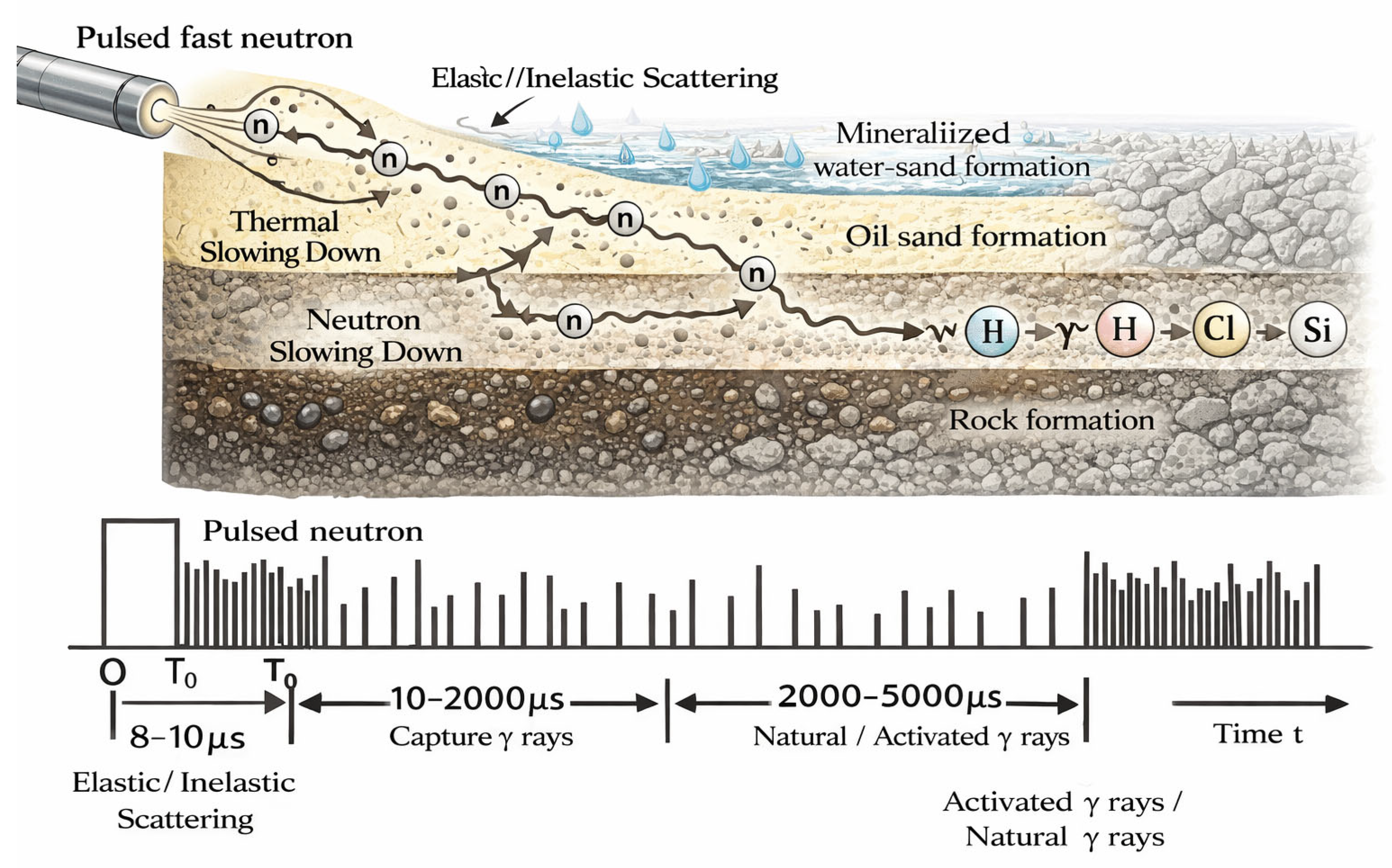
Neutron logging typically employs neutron sources that emit high-energy fast neutrons. As illustrated in Figure 1, when fast neutrons enter the formation, they collide with atomic nuclei via elastic and inelastic scattering, gradually losing energy through multiple interactions in a process known as neutron slowing down. According to neutron elastic scattering theory, energy transfer is most efficient when neutrons collide with nuclei of similar mass; hydrogen nuclei, having nearly the same mass as neutrons, therefore play a dominant role in neutron slowing down. This has been confirmed by extensive theoretical analyses and experimental studies [28]. In high-hydrogen materials, fast neutrons lose energy rapidly through repeated, efficient collisions, resulting in a shorter slowing-down length.
In contrast, in low-hydrogen formations, the process is less efficient, and neutrons require a longer path to thermalize. Once neutrons slow down to the thermal energy range, they primarily diffuse randomly, and during this diffusion, some thermal neutrons are captured by fission nuclei. Different elements possess markedly different thermal neutron capture cross-sections; for instance, hydrogen, chlorine, and silicon exhibit distinct capture abilities. Upon capture, the nucleus becomes excited and returns to a stable state by emitting characteristic capture gamma rays. Previous studies have shown that the energy distribution of these gamma rays depends closely on the capturing nuclide, indicating that thermal neutron capture is influenced not only by the hydrogen content but also by lithology and mineral composition [29,30]. Overall, the combined processes of fast neutron slowing down, thermal neutron diffusion, and thermal neutron capture govern the spatial distribution and statistical characteristics of neutrons within formations, providing the fundamental physical basis for neutron logging to differentiate lithologies, pore structures, and fluid properties [28].

2.1.2. Measurement Principle of Neutron Porosity

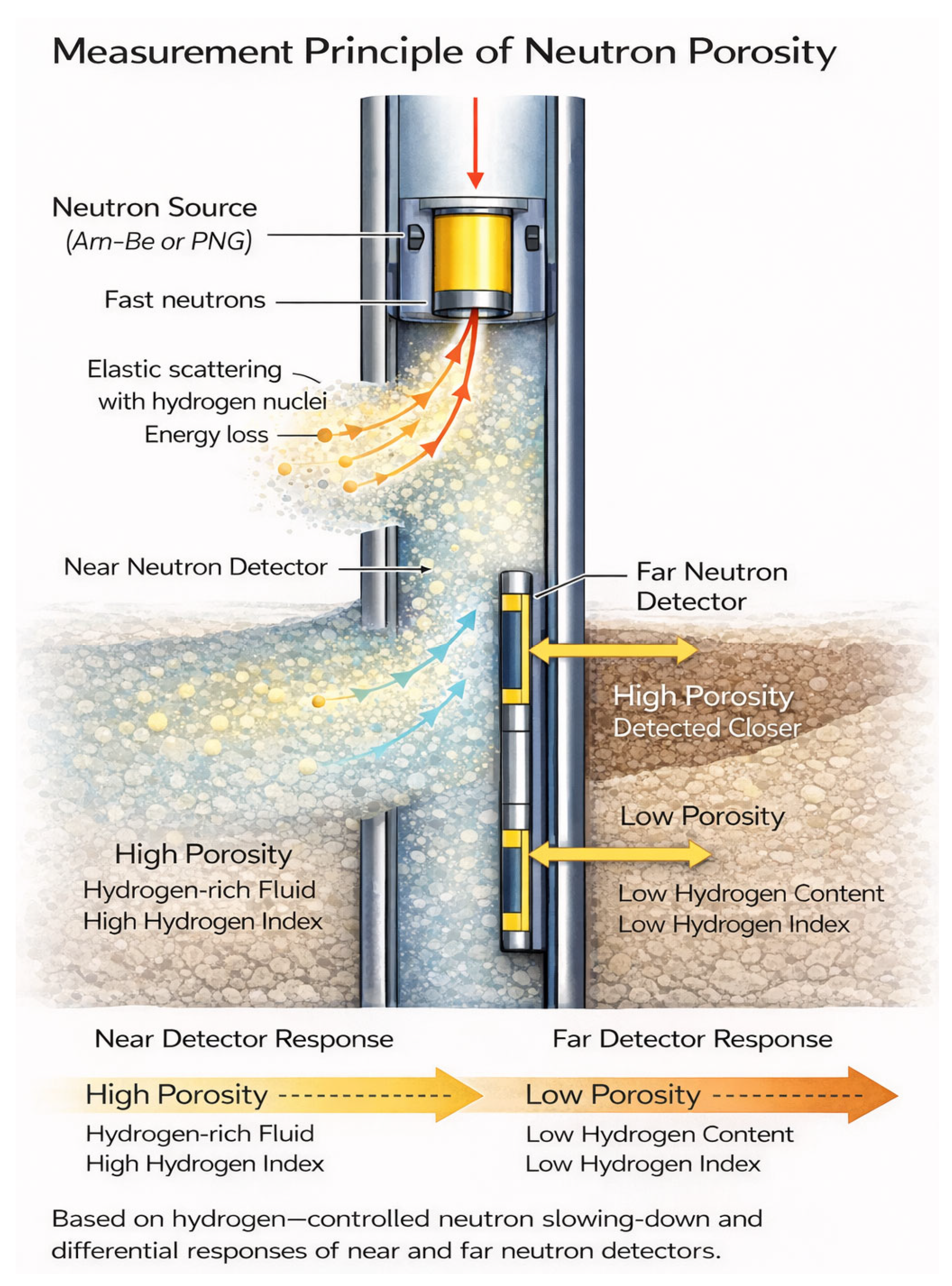
The fundamental mechanism of neutron logging for porosity evaluation lies in its response to the formation HI, which is defined as the ratio of the hydrogen atom number density per unit volume in the formation to that in pure water. HI is a dimensionless parameter reflecting the formation’s hydrogen content. In common sedimentary formations, hydrogen atoms are primarily contained in pore fluids; thus, the hydrogen index is largely controlled by both porosity and pore fluid type. As porosity increases, the volume of pore fluids rises, increasing the hydrogen number density. This enhances the efficiency of fast neutron slowing down, concentrating thermal neutrons closer to the neutron source. Conversely, in low-porosity formations, neutrons slow down less efficiently, and thermal neutrons diffuse over a wider region. This physical behavior has been analyzed in previous studies, allowing for the establishment of quantitative or semi-quantitative relationships between neutron logging response and porosity by analyzing variations in neutron flux at different positions.
As illustrated in Figure 2, neutron porosity measurement relies on the differential response of near and far detectors arranged along the tool axis relative to the neutron source. The near detector, positioned close to the source, is more sensitive to borehole conditions and pore fluid variations. In contrast, the far detector, being farther away, mitigates borehole environmental effects and better reflects formation-scale hydrogen content. Joint analysis of near- and far-detector responses enhances formation information while suppressing non-formation interferences, providing the basis for accurate porosity interpretation.
In practical interpretation, comparing responses at different detector distances improves formation characterization and reduces non-formation effects. Responses from detectors near the source are more sensitive to borehole and pore fluid variations, whereas those from farther away reflect the overall hydrogen content of the formation. The combined analysis of both responses establishes a robust physical foundation for neutron porosity measurement. It should be emphasized that neutron porosity is an indirect measure of the formation’s hydrogen content, rather than a direct measurement of pore geometry, and is influenced by pore fluid type, lithological variations, mineral-bound water, and formation salinity. In gas reservoirs, the lower hydrogen index of gas compared to liquids often causes neutron logging to underestimate true porosity, a phenomenon known as the gas effect. These physical characteristics constitute the main sources of uncertainty in neutron porosity interpretation, providing a theoretical basis for the engineering application of LWD neutron logging in real-time porosity monitoring and geosteering.

2.2. System Composition of Neutron LWD

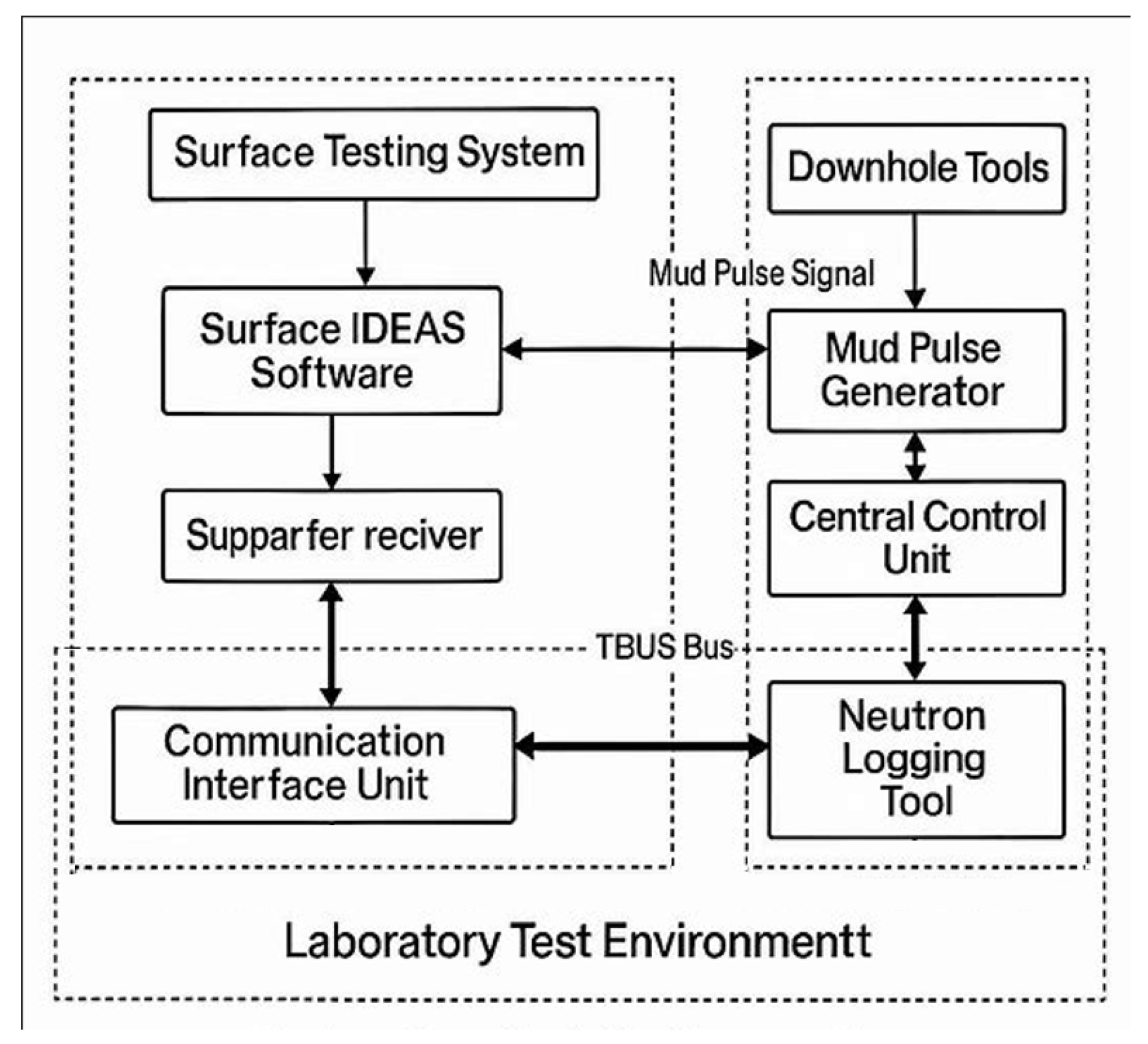
Under LWD conditions, neutron logging has evolved from the application of a single nuclear principle into a highly integrated system engineering project. Neutron LWD tools typically integrate neutron sources, detector arrays, shielding and collimation structures, and data acquisition and control units within drill collars, enabling real-time acquisition and transmission of formation parameters during drilling. Previous studies indicate that overall tool performance is determined not by any single component but by the combined effects of neutron source characteristics, measurement geometry, suppression of environmental interference, and data acquisition strategies. LWD operations occur under high temperature, high pressure, strong vibration, and impact conditions. Therefore, system design must balance measurement accuracy, reliability, and engineering feasibility. The development of neutron LWD relies more on coordinated, system-level optimization than on breakthroughs in individual technologies. A neutron LWD tool consists of two main parts: downhole instruments and surface testing systems. During field operations, the downhole instruments connect to the central control unit via the TBUS bus, which provides power and communication for all downhole components. Measurement data from depths of several thousand meters are transmitted to the surface using mud pulses (Figure 3).

2.2.1. Evolution of Neutron Source Technology

Neutron sources are core components of neutron LWD systems, directly determining measurement modes, available parameter types, and system safety. Early neutron LWD mainly employed chemical radioactive sources such as Am–Be and Pu–Be. These sources are compact, provide stable emission, and require no external power supply. Their neutron yield, typically 106–107 n/s, suffices for basic porosity measurements [31,32]. However, chemical sources carry inherent drawbacks, including radiation safety risks, transport and storage challenges, and elevated downhole accident risk, particularly in LWD operations. Consequently, their application has gradually narrowed [32].
With the trend toward real-time, multi-parameter measurement, pulsed neutron generators (PNGs) have gradually replaced chemical sources as the mainstream choice. PNGs typically produce ~14 MeV fast neutrons via deuterium–tritium (D–T) reactions, achieving yields of 108 n/s or higher [20,33]. Unlike chemical sources, PNGs allow for precise control of neutron emission timing, enabling pulse emission and time gating to distinguish different nuclear reaction stages. This supports combined neutron–gamma measurement and multi-parameter inversion [20,33]. Time-resolved capability allows PNGs to operate with both short- and long-distance detectors and density logging units, greatly expanding the parameter range of neutron LWD. Major international systems, such as Schlumberger’s EcoScope and Baker Hughes’ LithoTrak, now employ PNG technology for simultaneous measurement of porosity, density, and elemental capture cross-sections [34,35]. Despite these advantages, PNGs face challenges in long-term stability under LWD conditions, including ion source lifespan, power supply reliability, and neutron yield decay. Current research focuses on balancing safety, stability, energy consumption, and measurement performance. Emerging solid-state and accelerator-based neutron sources offer safety advantages, but their engineering maturity requires further verification [20].
Overall, the transition from chemical sources to PNGs reflects a shift from passive, single-parameter measurement toward controllable, multi-parameter, and time-resolved measurement systems, forming the technological foundation of modern neutron LWD.

2.2.2. Optimal Design of Detector Arrays

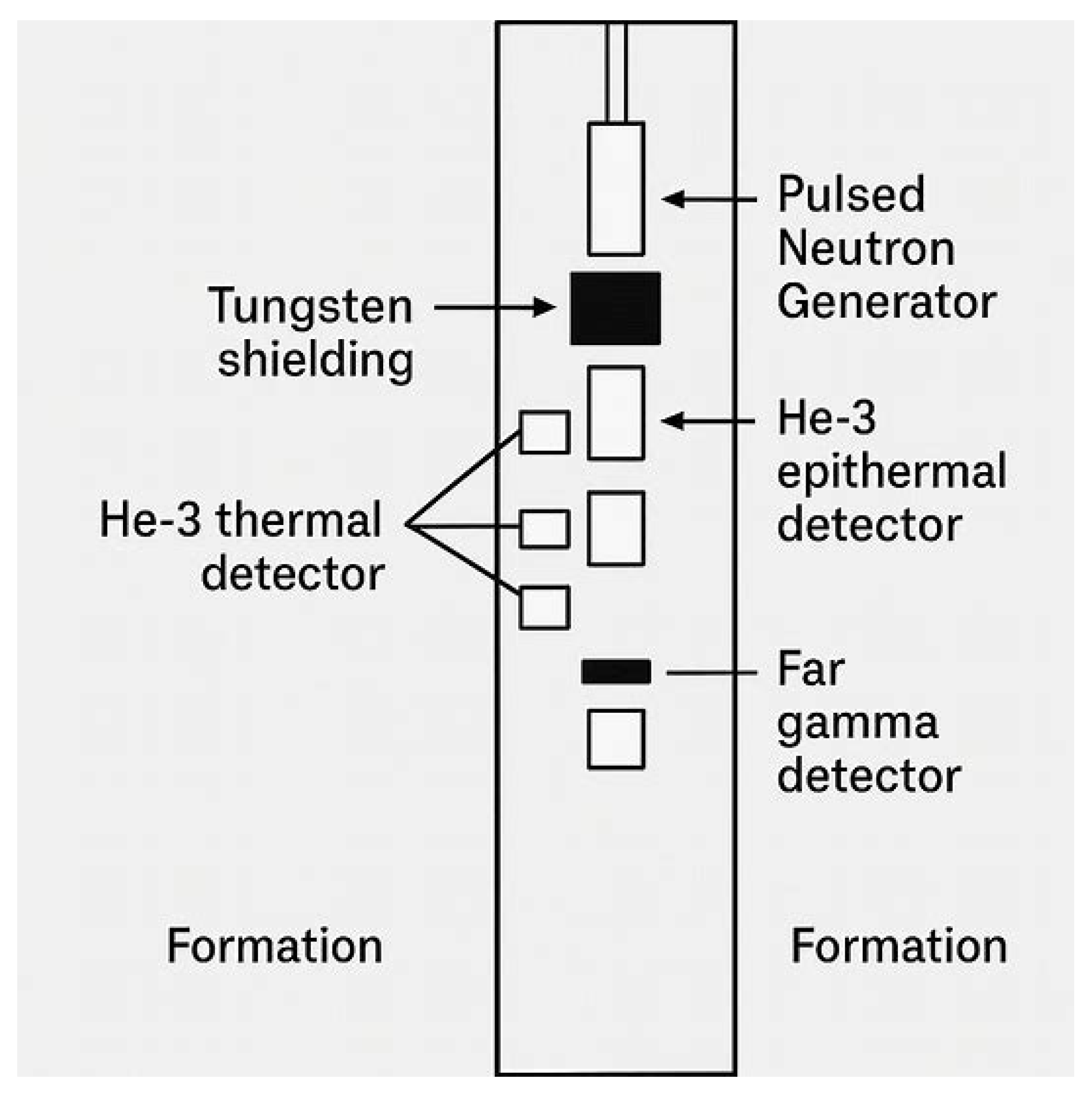
The detector array is a critical component that captures formation response signals, and its configuration directly affects detection depth, spatial resolution, and statistical accuracy. Most current neutron LWD tools adopt a two-detector array (near and far), which helps separate borehole environmental responses from formation responses. This configuration has been validated in field experiments and logging campaigns [36], where near detectors respond more to borehole effects, while far detectors reflect formation-scale properties.
To capture more information, some systems employ multi-detector arrays by adding a third distant detector or more, which enhances sensitivity to deeper formation signals and allows for evaluation of parameters such as gas saturation [37]. These results are based on field-deployment data and comparative analyses of two- and multi-detector configurations. However, increasing the detector count does not always linearly enhance measurement accuracy and may increase system complexity, complicating real-time interpretation. Thus, array design represents a trade-off between information content and engineering feasibility [27].
Traditionally, He-3 proportional counters have been the main choice for neutron detection due to their high thermal neutron detection efficiency and strong n/γ discrimination [38,39]. However, their reliability at high temperatures and under strong vibration is limited. With the advent of PNG technology, new detector types—such as scintillation detectors (LaBr3, LaCl3, YAP), boron-coated gas detectors, and high-temperature diamond detectors—have attracted attention [39,40]. Each detector type offers distinct advantages: fast response, high energy resolution, or robustness in harsh environments, representing key directions for future neutron LWD development. Azimuthal detection capability, enabled by directional shielding, enables porosity measurement with azimuthal resolution, a crucial feature for geosteering in horizontal wells.

2.2.3. Shielding and Collimation Technology

Neutron detectors in LWD often receive non-formation contributions from the drill-string, drilling fluid, and borehole structure, which impact measurement accuracy [41]. To mitigate these effects, shielding and collimation structures are essential.
High-thermal-neutron-absorption materials—boron, cadmium, and gadolinium—are commonly used to block unwanted neutrons and gamma rays. Laboratory experiments and numerical simulations have guided the design of multi-layer or composite shielding to reduce borehole interference while maintaining detection efficiency [42]. Collimation structures restrict detection directions, increasing sensitivity to target formation zones; these have been verified using tool calibration tests in controlled borehole setups [43].
In PNG-based systems, shielding and collimation are often combined with time-gating strategies, which separate signals from inelastic-scattering gamma rays and thermal-neutron-capture gamma rays. This approach has been experimentally validated for porosity, density, and elemental analysis [44,45,46].
It should be noted that shielding and collimation designs are tool-specific and cannot be directly applied to boreholes of different sizes or drill-string dimensions, contributing to the complexity of environmental corrections in neutron LWD [47].

2.2.4. Data Acquisition and Time Gating

Data acquisition and time gating are essential for multi-parameter neutron LWD measurements. In PNG-based systems, neutron emission and signal acquisition are segmented in time windows, allowing for the separation of signals from different nuclear reaction stages. This enables isolation of inelastic scattering and thermal neutron capture stages, facilitating combined porosity, density, and elemental measurements [48,49]. These methodologies have been validated through lab tests and field logging data, confirming that the time-gated approach accurately resolves overlapping signals.
Performance critically depends on neutron source stability, detector time resolution, and signal statistics. LWD conditions impose bandwidth limitations and high noise levels. Optimizing the use of time-gated data while maintaining real-time performance is an ongoing challenge, and current approaches rely on signal-processing algorithms, detector calibration studies, and comparative field analysis, forming the foundation for later discussions on data processing and interpretation (Figure 4).

3. Data Processing Techniques for Neutron LWD

Complex downhole engineering conditions significantly influence the acquisition and interpretation of neutron LWD data, making data processing techniques essential for effective utilization. Unlike wireline logging, neutron LWD operates under high temperature, high pressure, strong vibration, and frequent shocks. During measurement, neutron transport paths, detection geometry, and signal statistics change dynamically as drilling progresses. Multiple non-formation factors are inevitably mixed into the data, making neutron LWD data fundamentally different from wireline logging data in terms of statistical stability, environmental sensitivity, and interpretation consistency.
To address these challenges, studies have focused on systematically characterizing data features in LWD environments, identifying main interference sources, and developing practical correction, inversion, and uncertainty control methods. These methods are derived from field logging experiments, controlled test wells, and numerical simulations, providing the foundation for effective neutron LWD deployment.

3.1. Data Features and Challenges in LWD Environments

Neutron LWD data differ from wireline logging data in both the mechanisms underlying formation response and the statistical properties. Key features are closely tied to drilling operations. Drill-string rotation, axial vibration, and intermittent shocks directly affect the stability of neutron detector counts, producing high-frequency noise and short-period fluctuations in neutron porosity curves. This phenomenon has been observed and quantified in multiple horizontal wells through field logging campaigns and is considered a major factor limiting the accuracy of instantaneous porosity measurements [46].
Quantitatively, short-period fluctuations typically result in ±2–5 p.u. variations in instantaneous neutron porosity, depending on borehole conditions and detector calibration, while long-term trends remain consistent with wireline measurements. Additionally, variations in borehole geometry, irregular wellbore walls, and different drilling fluid systems alter neutron transport paths within the borehole formation system. For example, neutron porosity is often systematically higher in enlarged borehole sections. In wells with high-hydrogen drilling fluids, borehole environment responses intensify, weakening formation contrast. These effects have been demonstrated through comparative analysis of field LWD data and synthetic modeling and are particularly pronounced in shale gas and tight oil wells.
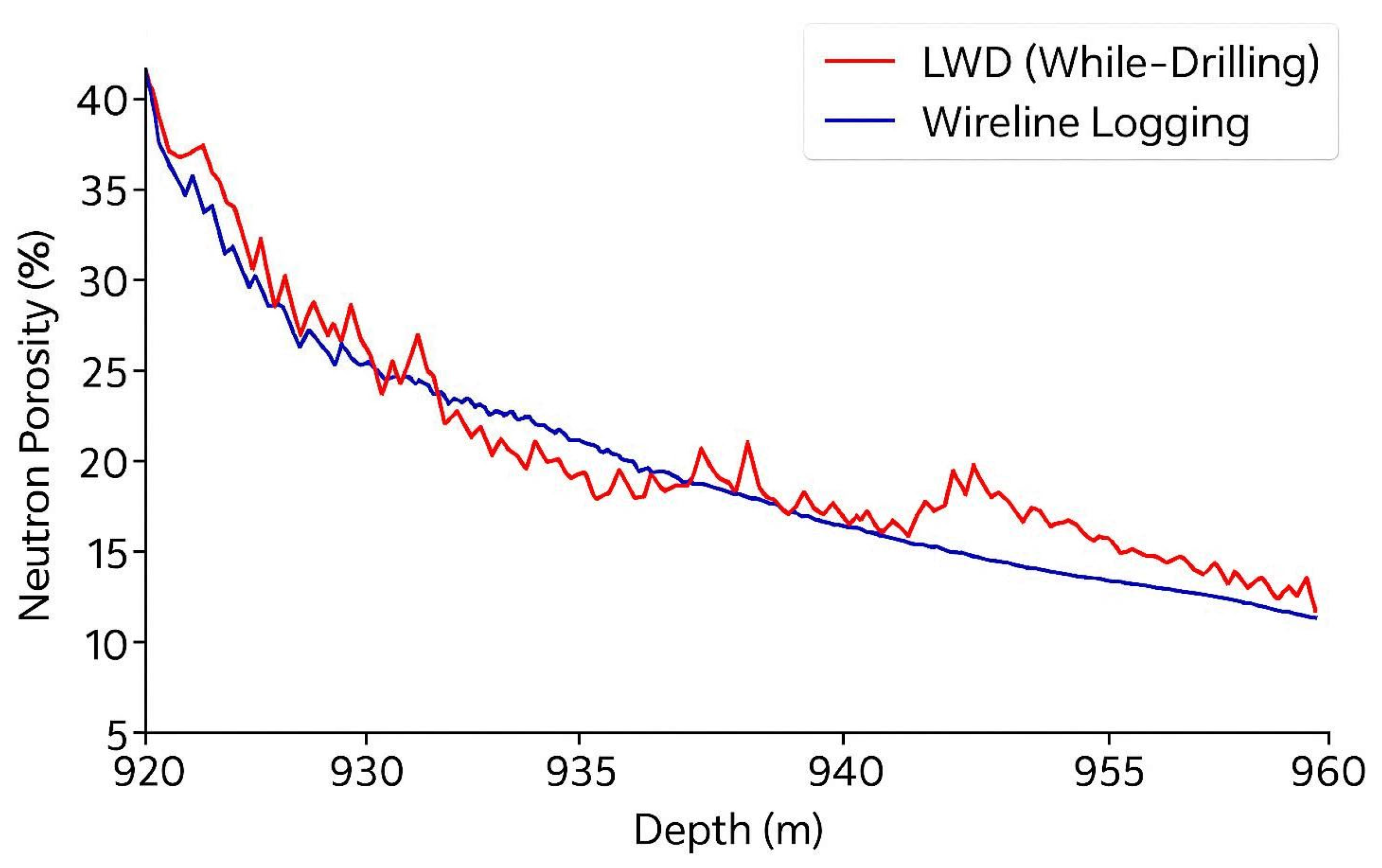
Tool eccentricity in horizontal or high-angle wells introduces asymmetric detector responses, reducing measurement stability. This has been confirmed by instrument calibration tests and numerical simulations [47]. Comparison of LWD and wireline neutron logging curves under complex borehole conditions shows higher noise in LWD data due to drilling factors. However, overall porosity trends and interval response characteristics still match well (Figure 5). All figures in this work, including Figure 5, have clearly labeled axes with units, tick marks, and legends. Error ranges due to drilling effects and tool eccentricity are quantified in the text, providing readers with a clear understanding of the uncertainty. Cross-validation with wireline logs and statistical evaluation indicates that the correlation coefficient R2 between LWD and wireline porosity curves typically exceeds 0.9, confirming that LWD data reliably capture formation trends despite higher local noise. These observations are supported by field logging datasets and provide empirical evidence for LWD data characteristics.

3.2. Data Processing and Correction Methods

Neutron LWD data are subject to significant environmental interference. A standard data processing framework covers three main components: environmental correction, parameter inversion, and signal denoising. Environmental corrections address borehole enlargement and irregular wellbore geometry using tool response functions, calibration experiments, or numerical simulations, which have been validated in field logging campaigns. Drilling fluid corrections account for the mud’s hydrogen content to reduce masking of formation responses. Tool eccentricity, common in LWD, is corrected using multi-detector configurations or azimuthal measurements, supported by both experimental tests in calibration wells and neutron transport simulations, thereby improving measurement stability and consistency [47].
Quantitatively, environmental correction can reduce short-period deviations in neutron porosity from ±3–6 p.u. to ±1–2 p.u., depending on borehole complexity and tool configuration. For parameter inversion, neutron porosity is commonly calculated using near- and far-detector count rate ratios, a method originally proposed in wireline and LWD studies and validated through controlled field experiments. Linear volume models or empirical charts are then applied to derive quantitative porosity. In gas reservoirs or complex lithologies, lithology compensation is implemented alongside density or other parameters to correct systematic errors, including gas effects. These approaches have been tested using combined field LWD logs and laboratory core analyses [4], and crossplots typically yield correlation coefficients (R2) greater than 0.9 with core-derived porosity, confirming their reliability. Signal denoising addresses high-frequency noise from drilling vibrations and shocks, using methods such as moving averages, low-pass filtering, and outlier removal, with parameters often optimized based on field data. Field experience shows that over-smoothing may obscure thin interbeds or rapidly changing formation features.
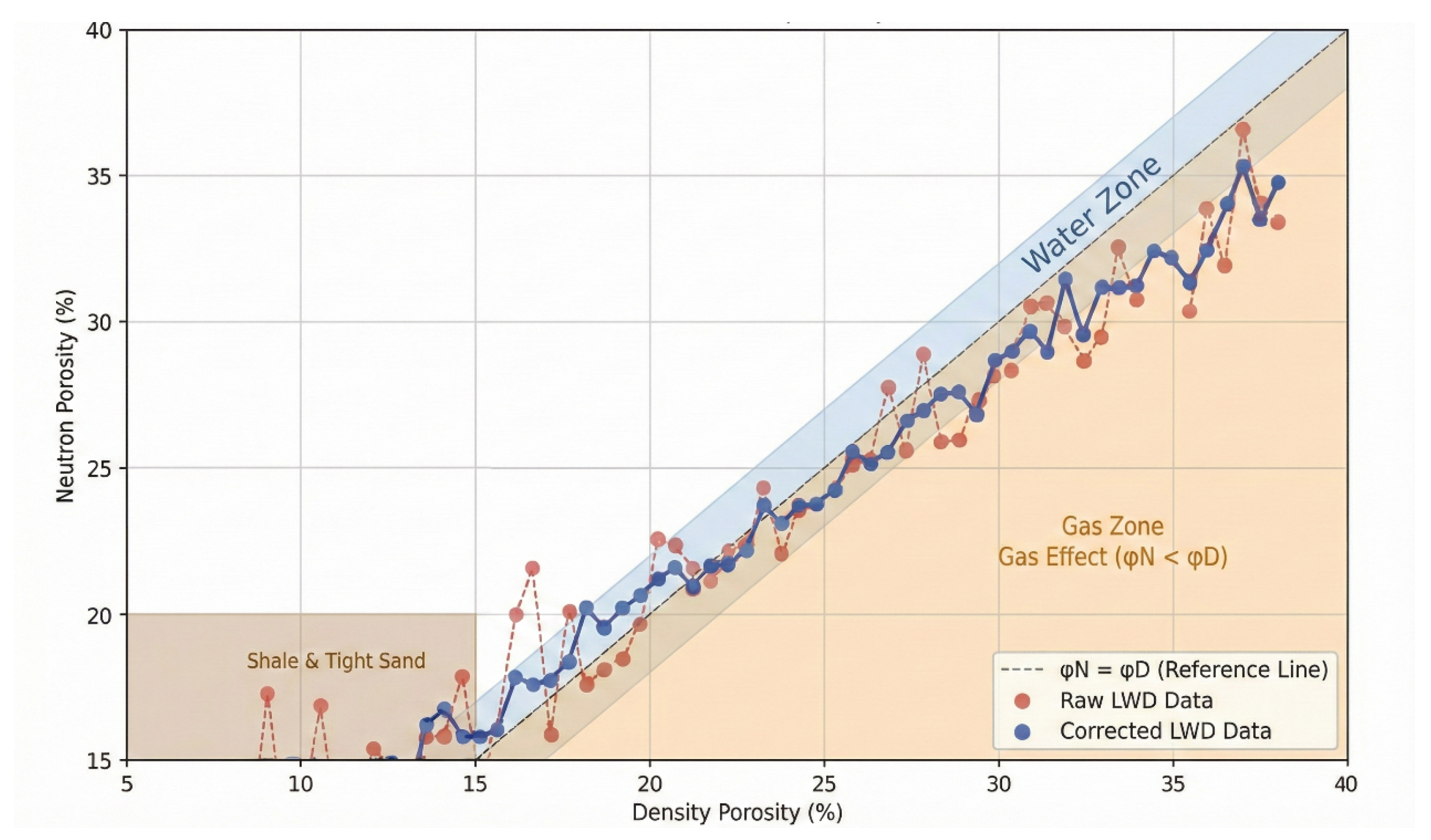
Therefore, a balance between noise suppression and formation resolution is essential [48]. Comparisons of raw and corrected LWD neutron porosity curves—both from field datasets and synthetic simulation studies—demonstrate that proper environmental correction and filtering effectively suppress short-scale noise while preserving trends in formation-scale porosity (Figure 6). The effectiveness of correction and denoising is quantitatively reflected in the reduced variation in neutron porosity and in the verified trend consistency with wireline logs and core measurements, as described above.

3.3. Multi-Source Information Fusion and Uncertainty Control

Neutron LWD is highly sensitive to hydrogen-bearing formation properties, which enhances its ability to identify formation characteristics but also makes interpretation vulnerable to variations in lithology, pore fluid, and borehole environment. Consequently, a single neutron porosity parameter is often insufficient to define the true physical state of formations. Combining LWD neutron porosity with complementary logging data—such as LWD density, resistivity, and natural gamma—has been shown in field studies and synthetic modeling to reduce interpretation uncertainty and improve the reliability of reservoir evaluation. Quantitatively, multi-source data fusion can reduce the standard deviation of porosity estimates by 20–40% compared with single-parameter neutron measurements, depending on formation complexity and logging conditions.
Neutron–density porosity crossplot analysis is a representative multi-source fusion method that highlights gas effects and lithology differences. Porosity is calculated through the neutron–density crossplot, determined based on the neutron values. In Figure 7, the neutron logging and density logging are plotted in comparison [49]. All axes in Figure 7 are clearly labeled with units, tick marks, and legends. As shown in Figure 7, the presence of gas reduces the neutron pair values and rock density, resulting in a lower density. The associated error ranges, estimated from calibration wells and core measurements, are reported in the text and typically range from ±2–3 p.u. for neutron porosity and ±0.01–0.02 g/cm3 for density. Dual-log comparisons have been verified in field wells and core samples, confirming that the presence of gas can separate the two logs—a phenomenon known as the rotor effect. Comparisons with wireline logging or core data show that the correlation coefficient (R2) is generally above 0.85–0.9, confirming that multi-parameter constrained LWD porosity closely matches overall trends and reservoir classification, providing a reliable engineering basis for real-time geosteering and decision-making.
Recent advances in numerical simulation and data-driven methods have shifted multi-source information fusion from empirical crossplots and rule-based constraints to quantitative inversion and uncertainty evaluation. In particular, ML and DL models are increasingly applied in neutron LWD to handle the complex and dynamic drilling environment.
Specifically, ML/DL methods take multi-source measurements (neutron counts, density, resistivity, gamma logs) and operational parameters (mud properties, borehole diameter, tool eccentricity, vibration) as inputs to construct predictive models that correct for environmental interferences. Traditional ML models, such as random forests and gradient boosting, can capture nonlinear correlations among logging parameters, while DL models, including fully connected and convolutional neural networks, can extract complex spatiotemporal patterns from high-frequency neutron data.
Moreover, hybrid frameworks that integrate physical modeling (neutron transport simulations and tool response models) with ML/DL methods enable constrained inversion, uncertainty quantification, and real-time anomaly detection. This ensures that ML/DL approaches improve measurement accuracy while maintaining interpretability and reliability under variable downhole conditions, supporting real-time geosteering and engineering decision-making.
Techniques such as Monte Carlo simulation, Bayesian frameworks, and ML/DL models have been applied to both simulated and field LWD datasets to quantify error propagation across different logging parameters and to automatically extract key formation features. Overall, multi-source information fusion and uncertainty control have become essential for advancing neutron LWD from a “qualitative auxiliary parameter” to a “quantitative decision constraint,” with methods verified through both original simulations and referenced field studies.

4. Typical Application Scenarios of Neutron LWD

Unconventional oil and gas resources and complex well types now account for a growing share of development projects. LWD logging technology has shifted its role in drilling operations: it was once primarily a tool for collecting formation information, but now it directly supports key engineering decisions. Neutron LWD, due to its high sensitivity to hydrogen content and pore structure, has unique advantages in real-time geosteering and reservoir parameter evaluation. Numerous studies and field practices, both domestic and international, confirm these applications, supported by field measurement campaigns and logging simulation studies.
Neutron LWD performs best in scenarios characterized by strong reservoir heterogeneity, thin formation layers, and high geological model uncertainty and has therefore become a key component of modern LWD logging systems. Based on existing research, field experience, and logging simulations, we summarize the typical application scenarios, key measurement parameters, response characteristics, and engineering value of neutron LWD for geosteering and reservoir parameter evaluation. These details are shown in Table 2.

4.1. Geosteering While Drilling

In directional and horizontal well development for complex reservoirs—such as shale oil, tight sandstone, and carbonate rocks—the core goal of geosteering is to maintain the wellbore trajectory within high-quality reservoir zones. Most studies agree that Neutron LWD alone is not sufficient for geosteering. Rather, it serves as an important constraint parameter reflecting changes in reservoir properties and complements other LWD data, such as gamma ray and resistivity logs. Together, these datasets support real-time trajectory optimization decisions, as verified across multiple field applications.

4.1.1. Horizontal Well Trajectory Optimization

In unconventional reservoirs, horizontal wells often encounter thin and laterally heterogeneous formations. Relying solely on seismic predictions and static geological models often fails to maintain the wellbore within the optimal reservoir section. Field studies show that porosity data from neutron LWD can continuously reflect trends in reservoir properties during drilling, providing essential dynamic constraints for trajectory adjustment.
In typical horizontal well applications in shale and tight sandstone reservoirs, a common challenge is that pre-drill geological models fail to accurately predict lateral heterogeneity, leading to frequent exits from target reservoir zones. In such cases, neutron porosity trends are used as real-time indicators of reservoir quality. When a continuous decrease in neutron porosity is observed over a short interval (e.g., 5–15 p.u.), it is interpreted as the wellbore approaching non-reservoir or tight zones. Engineers respond by adjusting inclination or azimuth to steer the wellbore back into high-quality intervals.
When analyzing measurement response characteristics, as the bit moves from a high-porosity reservoir to the surrounding low-porosity rock, neutron porosity typically shows a continuous downward trend, with porosity reductions commonly in the range of 5–15 porosity units (p.u.) over short intervals. Due to the spatial response characteristics of neutron tools, the measurement response usually exhibits a lag of approximately 0.5–2 m along the borehole, depending on tool configuration and formation conditions. When the wellbore re-enters a high-quality reservoir, the response rises sharply. This trend-based feature has been verified in horizontal wells across various unconventional reservoirs, including shale oil and tight sandstone.
Field applications demonstrate that this strategy can significantly reduce ineffective drilling footage and increase the proportion of reservoir exposure. In reported applications, the effective horizontal section length can be increased by approximately 10–25%, depending on reservoir heterogeneity and operational response time.

4.1.2. Reservoir Boundary Identification

Thin interbeds or undulating top and bottom boundaries of reservoirs are common in complex formations. For geosteering, real-time identification of these boundaries is critical. In thin interbedded reservoirs, especially where lithology contrast is weak but pore structure differs significantly, conventional gamma-ray or resistivity logs may fail to define boundaries clearly. In such scenarios, neutron porosity provides an additional sensitivity to hydrogen content, enabling earlier detection of approaching boundaries. When a gradient change (typically 2–10 p.u. within 1–3 m) is observed, it is interpreted as a boundary approach signal.
Continuous monitoring of these trends allows for advance prediction of boundary positions. In practical operations, this early warning provides a critical time window (typically several meters of drilling distance) for trajectory adjustment before exiting the reservoir. This capability is particularly valuable in thin reservoirs (<5 m thick), where delayed response from other logs may result in missed targets. Field experiences indicate that integrating neutron LWD with azimuthal measurements further improves boundary localization accuracy and reduces the risk of drilling out of zone.

4.1.3. Real-Time Decision Support

The ultimate engineering value of neutron LWD in geosteering lies in real-time decision support. Unlike traditional post-drilling evaluation, LWD enables key petrophysical parameters, such as porosity, to guide drilling decisions while operations are ongoing. Field studies show that LWD neutron porosity, combined with LWD resistivity and gamma ray logs, is frequently used to judge changes in reservoir quality in real time.
In actual drilling operations, one of the key challenges is the time lag between the acquisition of measurements and the implementation of decisions. Neutron LWD provides a relatively fast response to formation property changes, allowing for near-real-time updates of reservoir quality assessment. When neutron porosity deviates significantly from expected values, it serves as an early indicator of formation change, triggering immediate operational adjustments such as modifying drilling direction or optimizing drilling parameters.
When porosity deviates from expected values, the well trajectory or drilling parameters can be adjusted immediately, reducing the risk of entering low-quality reservoirs, minimizing the likelihood of wellbore failure, and shortening the decision response time. These practices have been confirmed through field trials in shale oil, tight sandstone, and complex carbonate reservoirs. Field implementations show that this real-time decision workflow reduces non-productive time (NPT) and improves drilling efficiency. In some reported cases, decision-making response time is shortened by 20–30%, and the probability of maintaining the wellbore within target reservoirs is significantly improved.

4.2. Application in Reservoir Parameter Evaluation

In addition to geosteering, neutron LWD plays a crucial role in real-time evaluation of reservoir parameters. Although LWD measurement conditions are more complex than wireline logging, field practice demonstrates that neutron porosity data from LWD are reliable for trend analysis and relative comparisons. They serve as a key supplement to post-drilling evaluations.

4.2.1. Porosity Parameter Evaluation

In the field, LWD neutron porosity is commonly used to identify high-porosity, favorable reservoir intervals rapidly and to classify reservoir properties at an initial stage. Comparative studies indicate that after borehole environment correction and lithology compensation, LWD neutron porosity aligns well with wireline logging porosity. Overall trends and reservoir classification are consistent, although single-point accuracy is generally lower, with typical deviations in the range of ±2–5 porosity units (p.u.) compared to wireline measurements, depending on borehole conditions and environmental corrections [48]. For unconventional reservoirs, the trend consistency and relative comparison capability of LWD neutron porosity provide greater engineering value than absolute numerical accuracy. It can serve as an initial constraint for interval-based reservoir evaluation, completion interval selection, and subsequent fracturing design. Multi-well studies further confirm that, after environmental corrections, LWD neutron porosity has a guidance value comparable to that of wireline logs, supporting reservoir ranking and decision-making during the completion stage.
Studies show that once source-to-detector distances r1 and r2 are fixed, the total capture count ratio of near and far detectors only depends on the slowing-down length Le. The thermal neutron diffusion length Lt is much smaller than Le. When the source-to-detector distance is large enough, the exponential term containing Lt can be neglected compared to that containing Le [51] This leads to the simplified Equation (1):
N t ( r 1 ) N t ( r 2 ) = r 2 r 1 × exp r 2 r 1 L e
where r1 and r2 are the near and far source-to-detector distances; Nt(r1) and Nt(r2) are the thermal neutron count rates of near and far detectors, respectively; and Le is the fast neutron slowing-down length.
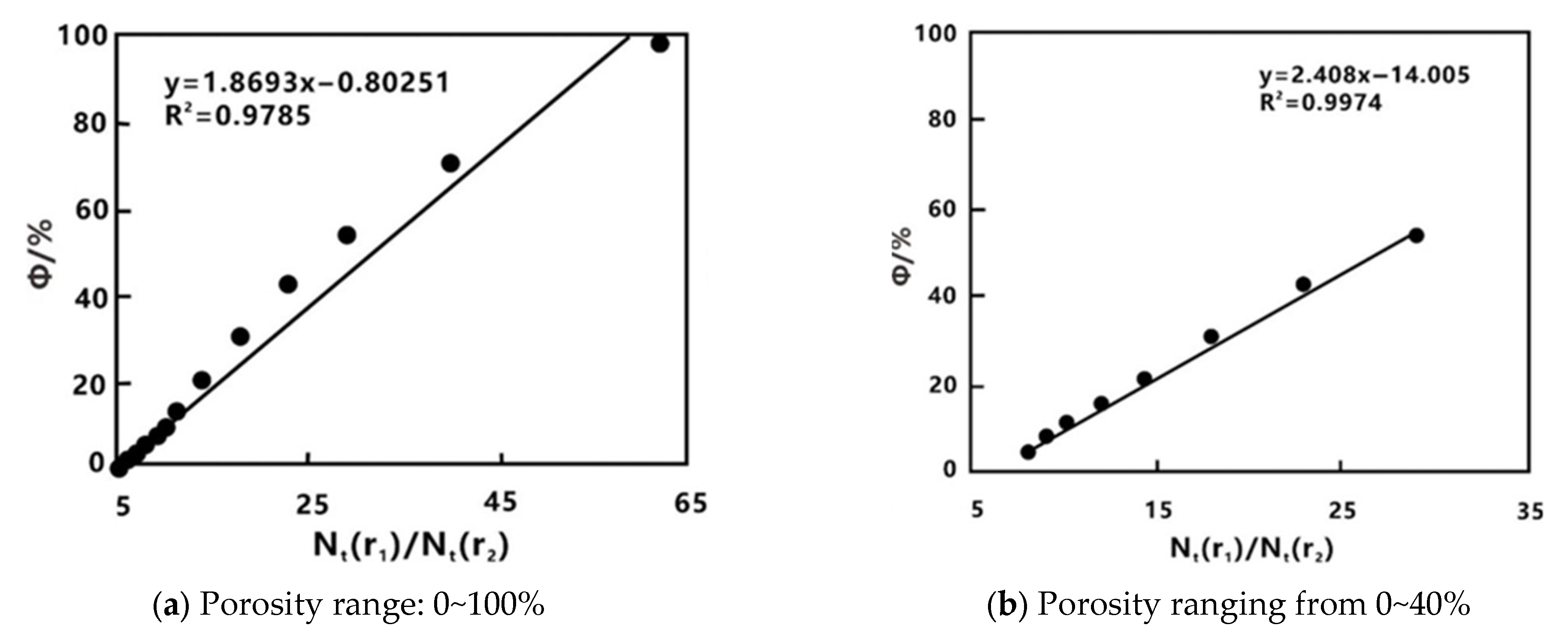
Based on Equation (1), we can calculate the corresponding capture count ratios for near and far source-to-detector distances given a value of Le. Then, we establish the relationship between this ratio and porosity [51]. Figure 8 shows two plots: (a) porosity range 0–100% and (b) porosity range 0–40%. The results show that, across the full porosity range (0–100%), when φ < 20%, the capture count ratio shows a linear relationship with porosity. When 20% < φ < 100%, the relationship is curvilinear (Figure 8a). In the 10–40% porosity range, the two show a good linear relationship (Figure 8b).

4.2.2. Lithology Identification

Combined neutron–density analysis is one of the most widely applied and robust methods for lithology identification in LWD. Unlike single-parameter neutron logs, which primarily respond to hydrogen content, the neutron–density combination captures both hydrogen-sensitive and electron-density-sensitive formation properties, enabling more reliable discrimination of lithology types. Field and laboratory studies have demonstrated that sandstone, mudstone, and shale occupy distinct regions in the neutron–density response space, even when LWD measurements exhibit higher noise levels than wireline logs due to drilling vibrations, borehole irregularities, and tool eccentricity [48].
In real-time operations, trend analysis and monitoring of relative relationships are key. By continuously tracking the direction, magnitude, and abruptness of changes in neutron–density values, operators can identify lithology transitions, characterize layered heterogeneity, and estimate relative formation composition.
Gas effects, however, can introduce deviations in the standard neutron–density relationship. For example, gas-bearing zones reduce hydrogen content, resulting in lower neutron porosity while density porosity remains relatively unchanged. Recognizing these deviations allows for simultaneous qualitative assessment of both lithology and fluid properties rather than treating them independently. In practice, operators often integrate neutron–density patterns with additional logging data—such as natural gamma, resistivity, and acoustic logs—to improve interpretation reliability.
Quantitative studies indicate that the neutron–density separation between different lithologies typically ranges from 0.02 to 0.08 g/cm3 with equivalent porosity, providing measurable criteria for distinguishing sandstones from shales. Thin-bed resolution depends on tool spacing and borehole conditions; abrupt lithology changes over 1–3 m intervals can usually be detected with modern LWD tools equipped with azimuthal measurement capabilities. Noise filtering must be carefully balanced: over-smoothing can obscure thin interbeds, while under-filtering may lead to misclassification of lithology transitions.
Overall, neutron–density analysis provides a real-time, quantitative, and interpretable framework for lithology identification, forming a cornerstone of reservoir characterization in unconventional formations.

4.2.3. Fluid Property Identification

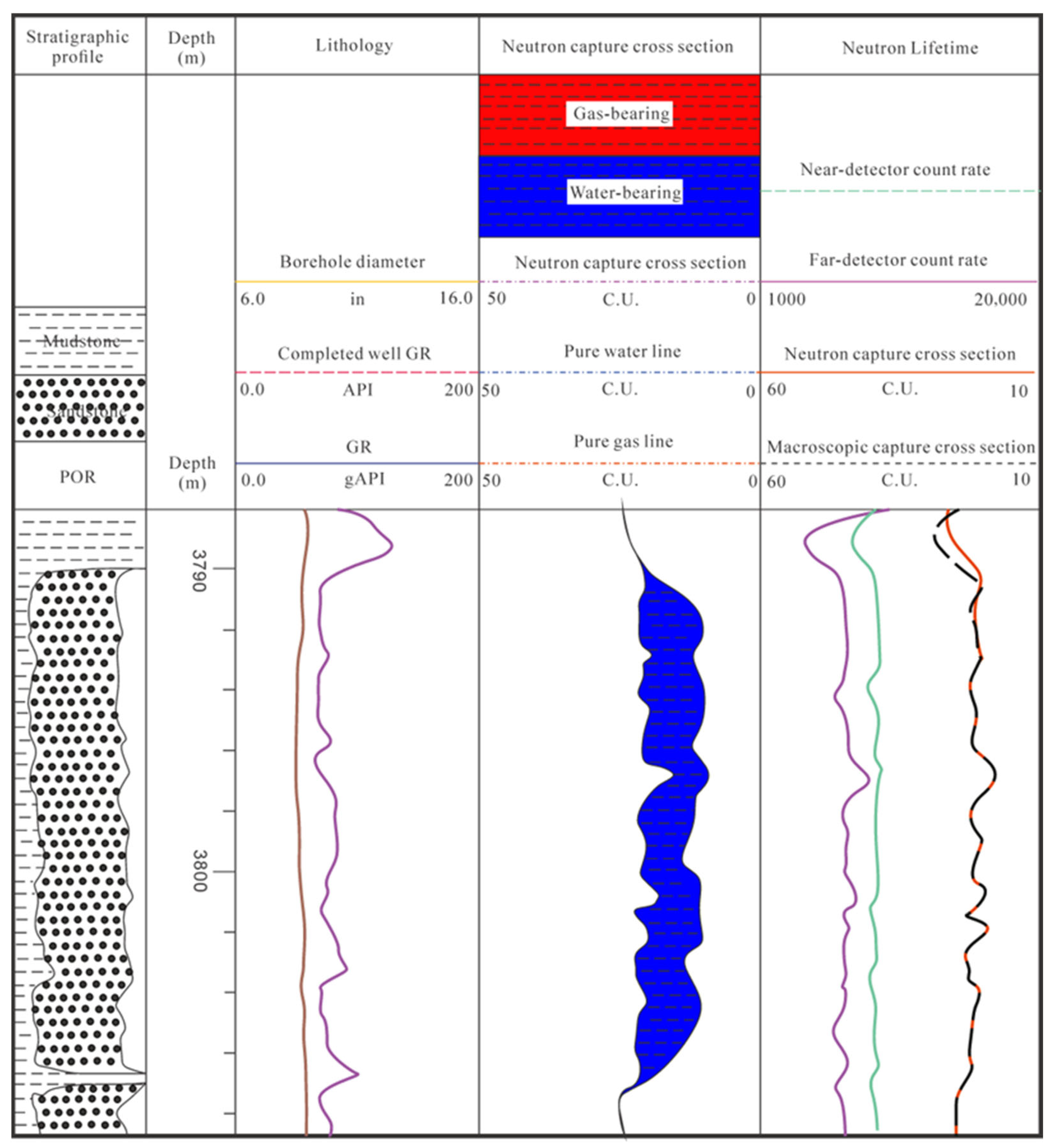
For fluid property evaluation, the most established application of neutron LWD is gas detection. Gas has a much lower hydrogen index than oil or water, resulting in significantly lower neutron porosity readings in gas-bearing zones. When combined with density logging, gas zones often exhibit the “gas crossover” effect, in which density porosity is higher than neutron porosity. This effect has been consistently verified in horizontal wells across unconventional gas reservoirs.
To enhance fluid discrimination, some studies introduce the near-/far-source count rate ratio (RATIO) as an auxiliary parameter. After calibration, the RATIO curve correlates with the acoustic transit time (AC) curves: in water zones, the difference between the two is small. In oil zones, the difference increases moderately. In gas zones, the difference is largest.
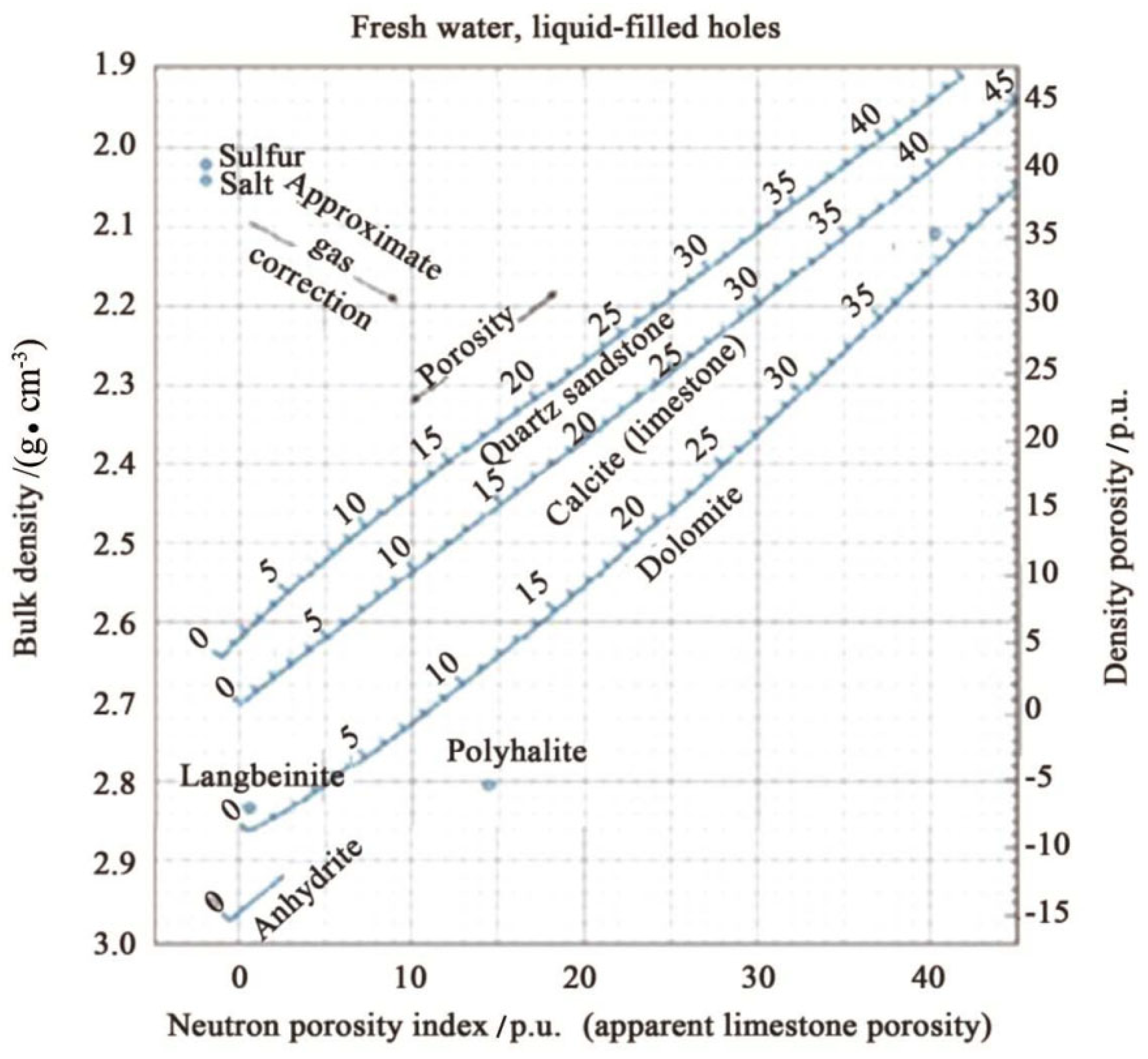
This method supports real-time identification of gas zones, guiding adjustments to the drilling trajectory, completion design, and testing decisions. However, the approach is sensitive to reservoir physical properties (porosity, permeability, lithology) and is most effective in low-porosity, low-permeability formations. Its discrimination stability and reliability may be limited under highly heterogeneous or high-porosity conditions (Figure 9) [52].

4.2.4. Machine Learning for Lithology and Fluid Identification

Recent advances in machine learning (ML) have significantly enhanced the interpretation capability of neutron and density LWD data. Compared with traditional empirical or physics-based methods, ML can capture complex nonlinear relationships among multiple-source logging parameters, thereby improving robustness under noisy, variable borehole conditions.
Applications include the following: Lithology identification—accurate classification of sandstone, mudstone, shale, and interbedded formations. Porosity prediction—estimating both absolute and relative porosity trends, even under challenging LWD conditions. Fluid discrimination—automatic recognition of oil, gas, and water zones using combined neutron–density–RATIO features. Real-time decision support—guiding trajectory adjustments, completion interval selection, and operational planning.
Table 3 summarizes representative studies, detailing the ML methods, input data types, target outputs, dataset characteristics, and key performance metrics, and highlights the trend toward quantitative, automated, and real-time interpretation, which significantly improves the accuracy, operational efficiency, and reliability of LWD-based reservoir evaluation. In field-scale applications, ML models are typically trained using historical well data and calibrated with core or wireline measurements and are then deployed for real-time prediction during drilling. For example, trained models can continuously update lithology classification and fluid identification as new LWD data are acquired, reducing reliance on manual interpretation and improving consistency across wells. In complex reservoirs, this approach has been shown to reduce interpretation uncertainty and enhance decision-making efficiency, particularly when combined with traditional physics-based constraints.

5. Future Challenges and Development Prospects

Neutron LWD is now at a critical stage of evolution, moving from “engineering-usable” to “high-precision, multi-constrained and intelligent closed-loop application”. Our previous systematic review covered physical fundamentals, system components, data processing, and typical engineering applications, and it shows that demand for unconventional oil and gas, deep-to-ultra-deep drilling, and complex well types continues to grow. Against this background, neutron LWD still faces systematic challenges in several areas.
First, measurement stability under extreme downhole conditions remains a major concern. Long-term operation in high-temperature, high-pressure, and high-vibration environments can lead to instrument drift, variations in neutron yield, and potential target degradation in PNGs, directly affecting measurement repeatability and reliability. Recent studies on rotating targets and multi-target rotation designs help mitigate local thermal stress and prolong target life, but field verification and life-cycle monitoring remain essential.
Second, environmental sensitivity to borehole conditions, mud properties, and tool eccentricity continues to limit measurement accuracy. Coupled with mechanical vibrations and rapid changes in formation properties, these factors can cause deviations in neutron flux measurements, requiring improved detector packaging, array optimization, and real-time compensation algorithms.
Third, the use of real-time information for interpretation and decision-making remains limited. Traditional offline calibration and sequential correction methods are insufficient for complex wells and heterogeneous reservoirs. Integrating physics-based modeling with data-driven approaches, including machine learning and uncertainty quantification, is necessary to support real-time decision-making and closed-loop geosteering applications.
The urgent problem now is no longer “can we complete the measurement?” but rather achieving verifiable, consistent measurement results under harsh working conditions. At the same time, there is a pressing need to develop transferable interpretation models and real-time closed-loop applications that can support engineering decisions. Addressing these challenges will help shift neutron LWD from a “single-parameter auxiliary measurement tool” to a “core information source for multiparameter-constrained real-time decision-making”.

5.1. Key Technical Bottlenecks and Development Directions

5.1.1. Neutron Source Technology

Neutron source technology sets the upper limit for information acquisition in neutron LWD, and its evolution directly drives the transition from single-porosity measurements to a multi-parameter, time-resolved measurement system. Chemical radioactive neutron sources (e.g., Am–Be, Pu–Be), although discussed in Section 2.2.1 from an evolutionary perspective, are considered here mainly in terms of their operational limitations in LWD environments.
In LWD application scenarios, their uncontrollable emissions and the full-life-cycle management costs of radioactive sources—including transportation, storage, and downhole accident disposal—have gradually become systemic factors that limit further application. As LWD logging moves toward real-time, multi-parameter measurement, PNGs have become the core configuration of mainstream neutron LWD systems. PNGs, as introduced in Section 2.2.1, provide controllable neutron emission through pulsed D–T reactions, forming the basis for time-resolved measurements. This capability, while well established, introduces additional requirements for system stability and synchronization under LWD conditions.
However, under LWD operating conditions of high temperature, high pressure, and high repetition frequency, PNGs face coupled engineering bottlenecks. Target material degradation, local thermal overload, ion beam irradiation damage, and combined mechanical–thermal stress can lead to a gradual decline in neutron yield, compromising long-term measurement stability. While short-term performance may appear sufficient, repeated thermal cycling and prolonged irradiation can result in cumulative deterioration of target performance. Consequently, reliable assessment of PNG lifetime, as well as strategies for monitoring and compensating for neutron output drift, are critical to ensure consistent measurements during extended drilling operations. These issues highlight that, in practical applications, neutron source performance is not solely determined by neutron yield but by the coupled effects of thermal management, structural reliability, and long-term operational stability.
Recent research has shifted from single-material improvements to collaborative optimization of structural design and operational modes. Rotating targets or multi-target rotation structures are used to disperse beam power density and irradiation accumulation effects in space and time, alleviating local thermal stress concentration and delaying performance degradation. Future PNG development should focus not only on increasing neutron yield but also on achieving optimal reliability and verifiable engineering performance. This requires building an index system that considers target life, thermal management, power supply stability, and modular maintenance. Additionally, solid-state neutron sources and accelerator-based neutron generation solutions offer potential advantages in safety and structural simplification. However, their long-term reliability under harsh downhole conditions remains to be verified. Therefore, neutron source technology in modern LWD systems should be evaluated not only on physical output performance but also on system-level reliability, maintainability, and adaptability to complex downhole environments.

5.1.2. Detector Technology

Detector technology is key to transforming neutron physical processes into interpretable measurement signals. Its core challenge lies in balancing high sensitivity and resolution with reliability under extreme LWD conditions. 3He proportional counters have long dominated neutron logging, offering high thermal neutron detection efficiency and good neutron–gamma discrimination. However, in high-temperature, high-pressure, and high-vibration environments, the requirement for tight high-pressure gas seals and structural integrity becomes a critical engineering weakness. In addition, scarce 3He resources and high costs limit large-scale use in multi-detector array designs.
To address these limitations, alternative detectors have been tested in neutron LWD over recent years, including scintillation detectors such as LaBr3, LaCl3, and YAP, boron-coated gas detectors, and high-temperature diamond detectors. Each new detector type has distinct advantages, such as faster response, higher energy resolution, or stronger environmental adaptability, and system-level engineering challenges remain. Long-term calibration stability, vibration-resistant packaging, and electronics reliability are key factors affecting measurement consistency. Consequently, the engineering strategy is not merely to maximize individual detector performance but to optimize the integration of detector types, array layouts, directional shielding, and data processing strategies. System-level calibration and drift compensation are essential to ensure measurement consistency, reproducibility, and scalability over the lifecycle of LWD operations.

5.1.3. Data Processing and Intelligent Interpretation

In LWD neutron logging, data processing has evolved from a “tool calibration step” to a core capability that defines engineering value. A key challenge arises from disturbances during data generation, including vibration and shock, changes in borehole/mud properties, tool eccentricity, and insufficient counting statistics. Meanwhile, decision-makers require stable, interpretable key parameters under constraints of bandwidth and time. Traditional methods rely on empirical calibration and response charts to sequentially correct for borehole size, mud effects, and lithology effects. These methods assume ideal working conditions and often fail in complex well types, highly heterogeneous reservoirs, or rapidly changing borehole environments. Moreover, the traditional “offline interpretation–post-correction” model does not meet the real-time steering and on-site decision-making requirements of LWD operations.
To address this, ML and DL have been applied to LWD data denoising, environmental effect modeling, and parameter inversion. In practical applications, these models take multi-source logging data (neutron count rates, density, resistivity, gamma) together with drilling-related parameters (mud type, borehole size, tool eccentricity, vibration indicators) as input features to establish nonlinear mappings between measurements and formation properties. These methods can take multi-source data and working condition parameters as input, building an “implicit mapping” to address complex nonlinear interferences and improve robustness and stability under high-noise conditions.
Specifically, traditional ML algorithms, such as random forests and gradient boosting, are effective for feature selection and nonlinear regression in porosity correction under varying borehole conditions. Deep learning models, including fully connected and convolutional neural networks, can extract spatial–temporal correlations from high-frequency neutron signals, enabling dynamic noise suppression and trend reconstruction during drilling. In some studies, recurrent neural networks (RNNs) or similar sequence models have also been explored to capture time-dependent variations caused by drilling dynamics.
However, purely data-driven approaches still face challenges, including high sample collection costs, poor model interpretability, and difficulty assessing reliability when encountering data outside the training distribution. To overcome these limitations, recent approaches emphasize hybrid modeling frameworks that integrate physics-based neutron transport simulations with ML/DL models. In this framework, physical models constrain the solution space and ensure consistency with known neutron response mechanisms, while ML/DL components are used to approximate complex environmental coupling effects that are difficult to model explicitly.
In terms of algorithm fusion, two main strategies are commonly adopted. The first is a sequential coupling approach, in which physics-based model outputs (e.g., simulated count rates or initial porosity estimates) serve as input features for ML/DL models to perform residual correction. The second is a parallel hybrid approach, where both physics-based predictions and data-driven outputs are combined through weighted fusion or ensemble learning to produce final interpretation results. In some implementations, physics-informed neural networks (PINNs) are also introduced, embedding neutron transport equations directly into the loss function to enforce physical consistency during training.
Consequently, a hybrid interpretation framework is needed that combines physical constraints with data-driven approaches. The proposed framework is organized into four functional modules: (1) a physics-based forward modeling module, (2) a data-driven correction module, (3) an inversion and optimization module, and (4) an uncertainty evaluation module.
The forward modeling module, based on neutron transport theory and tool response functions, generates simulated count rates under varying formation and borehole conditions, thereby constraining the solution space within physically reasonable bounds. The data-driven correction module learns the residuals between measured data and physics-based predictions, enabling compensation for complex environmental coupling effects such as borehole irregularity, mud invasion, and tool eccentricity.
The inversion and optimization module integrates outputs from both physics-based and data-driven components to estimate formation parameters (e.g., porosity), while the uncertainty evaluation module quantifies prediction confidence and detects anomalous responses. In addition, edge computing strategies are incorporated to enable real-time collaboration between downhole tools and surface systems, ensuring timely data processing and decision support.
Key parameters in this framework include: (i) source-to-detector spacing and tool geometry parameters used in forward modeling; (ii) feature selection parameters for ML models, including neutron count rates, density, resistivity, gamma rays, and drilling dynamics indicators; (iii) model hyperparameters such as tree depth in ensemble models or network architecture (number of layers, neurons) in DL models; and (iv) weighting coefficients in fusion schemes, which control the relative contribution of physics-based and data-driven components. Proper calibration of these parameters is critical to balancing model accuracy and generalization.
The effectiveness of this hybrid framework has been evaluated in both simulation and field data scenarios. In simulation studies, synthetic datasets with controlled porosity, lithology, and borehole conditions are used to compare the hybrid framework with standalone physics-based inversion and purely data-driven models. Results show that the hybrid approach reduces inversion errors and improves stability, particularly under conditions of strong noise, tool eccentricity, and rapidly changing borehole environments.
In field applications, the interpreted porosity and reservoir classification results are compared with wireline logging data and core measurements. The hybrid framework demonstrates improved consistency in trend prediction and reduced sensitivity to measurement noise. Typical improvements include enhanced stability of porosity curves and more reliable identification of reservoir boundaries in complex formations.
Furthermore, incorporating physical constraints improves model generalization when encountering data outside the training distribution, preventing physically unrealistic predictions that may arise in purely data-driven approaches.

5.1.4. Frontier Detection Directions

While optimizing engineering applications of existing technologies, frontier detection concepts such as quantum sensing offer new physical pathways to high-sensitivity particle detection, with advantages in ultra-high sensitivity and selective measurement capabilities. However, these technologies remain largely at the laboratory stage, lacking systematic engineering tests for packaging reliability, long-term stability, and drift control under LWD conditions of high temperature, high pressure, and strong vibration. Therefore, in review papers, it is more reasonable to present them as exploratory directions that may overcome traditional detection limits. Future evaluations should focus on engineering feasibility rather than single performance indicators to avoid overhyping the concept.

5.2. Engineering Applications and Suggestions for Industrial Development

5.2.1. Field Verification and Comparative Evaluation

As PNGs gradually replace radioisotope sources and become the mainstream neutron source for LWD, there is an increasing need for comparable verification and selection evaluation across different technical solutions. Current reports on performance differences among neutron source types, detector configurations, and interpretation algorithms are mostly limited to qualitative experience summaries or case demonstrations under a single interval or operating condition. Evaluation metrics are inconsistently defined, and test boundary conditions are often untraceable, making conclusions difficult to reuse across different blocks and limiting support for “transferable” engineering decisions.
To improve comparability and enable extrapolation, a unified testing and comparison framework is required. This framework should be established under representative formation combinations and typical borehole environments, including variations in borehole size, mud systems, tool eccentricity, and strong vibration. Porosity should be a core output, and the different technical routes should be quantified systematically, with attention to error propagation and uncertainty ranges for environmental sensitivity, long-term drift, and robustness under extreme conditions. Quantitative methods, such as error distribution statistics, crossplot consistency analysis, and comparisons by operating condition and layer, can transform “differences in measurement stability” and “sources of systematic bias” from descriptive phenomena into a verifiable chain of evidence. This defines applicable limits and potential failure modes for each route and provides a repeatable, auditable basis for engineering deployment and large-scale application of LWD tools.

5.2.2. Data Standardization and Sharing

Data standardization is essential for neutron LWD to progress toward large-scale application and intelligent development. Currently, different tool systems lack unified specifications for data formats, calibration workflows, quality assessment metrics, and metadata records, limiting cross-block application and algorithm reuse. A unified data standard and sharing mechanism covering acquisition, transmission, interpretation, and quality control is recommended. This provides a basis for joint inversion with multiple parameters, hybrid modeling combining physics and data, and validation of model generalization while reducing the path dependence of algorithm development on a single service system.

5.2.3. Policy and Industry Collaboration

Neutron LWD involves coupled systems of neutron sources, detectors, electronics, materials, and algorithms. Weaknesses often arise in overall system engineering capability rather than a single performance index. A long-term, iterative engineering platform should be built through collaboration among industry, universities, and research institutes. Stable investment and verification should be arranged for core components, including the PNG target, power supply, high-temperature detectors, and packaging. Simultaneously, a sustainable collaborative ecosystem should be established around data standards and interpretation software. A closed-loop process—breakthroughs in key components, field verification and iteration, followed by promotion through standardization—can gradually build an internationally competitive neutron LWD technology system.
In summary, neutron LWD has evolved from a traditional single-parameter measurement method into a highly coupled engineering system. The bottleneck is no longer a single device’s performance but the long-term reliability of neutron sources, the engineering adaptability of detectors, and the coordination of data processing and interpretation systems. The pulsed neutron generator extends the information obtainable during drilling but remains limited by target life and system stability. Detector technology is moving toward arrays and azimuthal resolution, placing higher demands on system integration and long-term consistency. The complex downhole environment shifts data interpretation from empirical corrections to hybrid approaches combining physical constraints and data-driven methods. From an engineering and industrial perspective, future progress is more likely to come from system-level optimization, engineering comparisons and field verification, and promotion of data standardization rather than isolated single-point innovation.

6. Conclusions

From a systems engineering perspective, this paper reviews the physical basis, system composition, data processing methods, and typical engineering applications of neutron LWD. Multiple factors, including the neutron source, detector arrangement, measurement geometry, environmental effect suppression, and interpretation strategy, determine the performance and reliability of this technology. The transition from chemical neutron sources to pulsed neutron generators (PNGs) represents a key turning point, enhancing operational safety, improving time resolution, and enabling more flexible multi-parameter measurements. While PNGs provide clear advantages, they introduce new engineering challenges such as target lifetime, system reliability, and field robustness which remain active areas of research. Recent studies on rotating-target designs and overall system optimization offer promising avenues for addressing these challenges.
Engineering practice demonstrates that the main value of neutron LWD lies not in replacing the absolute accuracy of wireline logging but in providing continuous, real-time porosity and hydrogen index information during drilling, supporting geosteering, operational decision-making, and reservoir evaluation. Comparisons with wireline data indicate that LWD measurements, when properly corrected for environmental effects and tool eccentricity, provide quantitative trends that closely match formation-scale properties. However, uncertainties remain due to complex borehole conditions, gas effects, and lithological variations.
Recent advances in artificial intelligence (AI), machine learning (ML), and multi-sensor data fusion have begun to transform LWD interpretation from empirical or single-parameter analysis to real-time, quantitative, and uncertainty-aware models. Techniques such as Monte Carlo simulations, Bayesian frameworks, and cross-validated inversion methods enable systematic error quantification, automated feature extraction, and improved formation characterization under complex drilling conditions. Multi-sensor integration, including density, resistivity, natural gamma, and neutron porosity logs, further reduces interpretation uncertainty and enhances the reliability of real-time reservoir evaluation.
Key research gaps remain in the field, particularly in large-scale field validation of PNG-based LWD systems, rigorous uncertainty quantification for multi-parameter measurements, and optimization of intelligent interpretation frameworks. Future focus areas include improving PNG reliability and lifetime, developing advanced detector arrays with higher sensitivity and reduced borehole interference, enhancing real-time geosteering and decision-support capabilities, and integrating data-driven models with physics-based frameworks for fully intelligent LWD operation. Overall, neutron LWD technology is expected to continue evolving toward safer, more reliable, and fully integrated real-time formation evaluation, providing both quantitative insights and practical guidance for modern drilling operations.

Author Contributions

Conceptualization, D.J. and W.Y.; methodology, D.J. and B.Q.; writing—original draft preparation, D.J., W.Y., B.Q., H.Y. and L.Z.; writing—review and editing, D.J., W.Y., B.Q., H.Y. and L.Z.; supervision, D.J.; project administration, D.J. All authors have read and agreed to the published version of the manuscript.

Funding

This research received no external funding.

Data Availability Statement

No new data were created or analyzed in this study.

Acknowledgments

The authors have reviewed and edited the output and take full responsibility for the content of this publication.

Conflicts of Interest

Authors Dong Jiang, Wei Yuan, Bo Qi were employed by the company China Oilfield Services Limited. The remaining authors declare that the research was conducted in the absence of any commercial or financial relationships that could be construed as a potential conflict of interest. The China Oilfield Services Limited had no role in the design of the study; in the collection, analyses, or interpretation of data; in the writing of the manuscript, or in the decision to publish the results.

References

  1. Zong, C.; Liu, J.; Liu, Z.; Liu, Y.; Wang, C.; Gao, H.; Duan, J.; Zhou, J. A fast forward algorithm of azimuthal gamma imaging logging while drilling. Appl. Radiat. Isot. 2023, 194, 110659. [Google Scholar] [CrossRef] [PubMed]
  2. Zhong, R.; Johnson, R., Jr.; Chen, Z. Generating pseudo density log from drilling and logging-while-drilling data using extreme gradient boosting (XGBoost). Int. J. Coal Geol. 2020, 220, 103416. [Google Scholar] [CrossRef]
  3. Fiandaca, G.; Maurya, P.K.; Balbarini, N.; Hördt, A.; Christiansen, A.V.; Foged, N.; Bjerg, P.L.; Auken, E. Permeability estimation directly from logging-while-drilling induced polarization data. Water Resour. Res. 2018, 54, 2851–2870. [Google Scholar] [CrossRef]
  4. Zhu, G.; Gao, M.; Kong, F.; Li, K. Application of logging while drilling tool in formation boundary detection and geosteering. Sensors 2019, 19, 2754. [Google Scholar] [CrossRef]
  5. Ortega, E.; Luycx, M.; Torres-Verdín, C.; Preeg, W.E. Joint petrophysical interpretation of multi-detector nuclear measurements in the presence of invasion, shoulder-bed, and well-deviation effects. Geophysics 2017, 82, D13–D30. [Google Scholar] [CrossRef]
  6. Zhang, S. Technical difficulties of logging while drilling in carbonate reservoirs and the countermeasures: A case study from the Sichuan Basin. Nat. Gas Ind. B 2015, 2, 515–521. [Google Scholar] [CrossRef]
  7. Prensky, S. Recent advances in LWD/MWD and formation evaluation. World Oil 2006, 227, 69. [Google Scholar]
  8. Aitken, J.D.; Adolph, R.; Evans, M.; Wijeyesekera, N.; McGowan, R.; Mackay, D. Radiation sources in drilling tools: Comprehensive risk analysis in the design, development and operation of LWD tools. In Proceedings of the SPE International Conference on Health, Safety and Environment in Oil and Gas Exploration and Production, Kuala Lumpur, Malaysia, 20–22 March 2002. [Google Scholar] [CrossRef]
  9. Badruzzaman, A.; Barnes, S.; Bair, F.J.; Grice, K.J. Radioactive sources in petroleum industry: Applications, concerns and alternatives. In Proceedings of the Asia Pacific Health, Safety, Security and Environment Conference, Jakarta, Indonesia, 4–6 August 2009. [Google Scholar] [CrossRef]
  10. Non-Isotopic Alternative Technologies Working Group. Non-Radio Isotopic Alternative Technologies White Paper; U.S. Department of Homeland Security Cybersecurity and Infrastructure Security Agency: Arlington, VA, USA, 2019.
  11. Zhang, L.; Yu, H.-W.; Li, Y.; Jia, W.-B.; Han, X.; Geng, X.-S. Improved formation density measurement using controllable DD neutron source and its lithological correction for porosity prediction. Nucl. Sci. Tech. 2022, 33, 3. [Google Scholar] [CrossRef]
  12. Zhang, Q.; Zhang, F.; Gardner, R.P.; Yan, H.; Wu, G.; Tian, L.; Chen, Q.; Ti, Y. A method for determining density based on gamma ray and fast neutron detection using a Cs2LiYCl6 detector in neutron-gamma density logging. Appl. Radiat. Isot. 2018, 142, 77–84. [Google Scholar] [CrossRef]
  13. Zhang, F.; Liu, J.; Yuan, C. Monte Carlo simulation for determining gas saturation using three-detector pulsed neutron logging technology in tight gas reservoir and its application. Appl. Radiat. Isot. 2013, 78, 51–56. [Google Scholar] [CrossRef]
  14. Wang, H.; Williams-Stroud, S.; Crandall, D.; Chen, C. Machine learning and deep learning for mineralogy interpretation and CO2 saturation estimation in geological carbon Storage: A case study in the Illinois Basin. Fuel 2024, 361, 130586. [Google Scholar] [CrossRef]
  15. Burak, T.; Sharma, A.; Hoel, E.; Kristiansen, T.G.; Welmer, M.; Nygaard, R. Real-Time Lithology Prediction at the Bit Using Machine Learning. Geosciences 2024, 14, 250. [Google Scholar] [CrossRef]
  16. Razzaq, K.; Shah, M. Machine Learning and Deep Learning Paradigms: From Techniques to Practical Applications and Research Frontiers. Computers 2025, 14, 93. [Google Scholar] [CrossRef]
  17. Liu, Q.; Li, D.; Liu, S.; Liang, H.; Zhou, Y.; Zhao, C.; Liu, K.; Hui, G.; Ni, F.; Du, P.; et al. A Machine Learning-Driven Framework for Real-Time Lithology Identification and Drilling Parameter Optimization. Processes 2026, 14, 156. [Google Scholar] [CrossRef]
  18. Kang, Z.; Zhang, Y.; Qin, H.; Gan, W.; Chen, G. An intelligent inversion method for azimuth electromagnetic logging while drilling measurements. IEEE Access 2023, 11, 79285–79294. [Google Scholar] [CrossRef]
  19. Sun, Q.; Li, N.; Duan, Y.; Li, H.; Tang, H. Logging-while-drilling formation dip interpretation based on long short-term memory. Pet. Explor. Dev. 2021, 48, 978–986. [Google Scholar] [CrossRef]
  20. Weller, G.; Griffiths, R.; Stoller, C.; Allioli, F. A new integrated LWD platform brings next-generation formation evaluation services. In Proceedings of the SPWLA 46th Annual Logging Symposium, New Orleans, LA, USA, 26–29 June 2005. [Google Scholar]
  21. Yu, H.-W.; Wang, Z.; Zhang, Q.-W.; Xue, Z.-B.; Shang, X.-S.; Yuan, W.; Li, S.-D.; Wang, C. Data-processing methods for D–T source neutron-gamma density logging while drilling. Nucl. Sci. Tech. 2025, 36, 93. [Google Scholar] [CrossRef]
  22. Wang, Y.W.; Ye, H.C. Current status and development trends of logging while drilling and control technology. Pet. Drill. Tech. 2024, 52, 122–129. (In Chinese) [Google Scholar]
  23. Yu, B.; Yu, H.; Hutin, R.; Sun, Y. LWD Real-Time Borehole Image Transmission. U.S. Patent 9,885,236, 6 February 2018. [Google Scholar]
  24. Poedjono, B.; Nwosu, D.; Martin, A. Wellbore positioning while drilling with LWD measurements. Petrophysics 2019, 60, 450–465. [Google Scholar] [CrossRef]
  25. Hou, L.; Yang, H.; Zhao, P.R.; Yu, X.C.; Cui, Y.F. Development status of remote sensing-look ahead technology while drilling. World Pet. Ind. 2020, 27, 35–41. (In Chinese) [Google Scholar] [CrossRef]
  26. Köhli, M.; Schmoldt, J.P. Feasibility of UXO detection via pulsed neutron–neutron logging. Appl. Radiat. Isot. 2022, 188, 110403. [Google Scholar] [CrossRef] [PubMed]
  27. Liu, J.; Liu, S.; Zhang, F.; Su, B.; Yang, H.; Xu, Y.; Miao, B.; Li, H. A method for evaluating gas saturation with pulsed neutron logging in cased holes. J. Nat. Gas Sci. Eng. 2018, 59, 354–362. [Google Scholar] [CrossRef]
  28. Zhang, X.L. Working principle and circuit analysis of CNS compensated neutron logging tool. Shandong Ind. Technol. 2019, 03, 89. (In Chinese) [Google Scholar] [CrossRef]
  29. Li, A.Z.; Qin, H.J.; Wang, J.; Zhu, J. Research on controllable source neutron logging tool while drilling. Oil Drill. Prod. Technol. 2011, 33, 105–109. (In Chinese) [Google Scholar] [CrossRef]
  30. Huang, Y.; Zhang, C.M. Research on method of determining porosity using neutron-gamma logging data. J. Yangtze Univ. (Nat. Sci. Ed.) 2015, 12, 36–39. (In Chinese) [Google Scholar] [CrossRef]
  31. Xu, L.; Schultz, W.; Huiszoon, C. A comprehensive investigation of source effects on neutron porosity response for logging-while-drilling measurements. In Proceedings of the SPWLA 50th Annual Logging Symposium, The Woodlands, TX, USA, 21–24 June 2009. [Google Scholar]
  32. Chen, A.X.; Antolak, A.J.; Leung, K.N. Electronic neutron sources for compensated porosity well logging. Nucl. Instrum. Methods Phys. Res. A 2012, 684, 52–56. [Google Scholar] [CrossRef]
  33. Yu, H.; Wang, Z.; Xue, Z.; Shang, X.; Zhang, Q.; Zhang, L.; Li, S. Corrections of fast neutron inelastic scattering effects on DT neutron porosity logging. Appl. Radiat. Isot. 2022, 190, 110486. [Google Scholar] [CrossRef]
  34. Sima, L.Q.; Liang, X.Y. Application of EcoScope multi-function LWD to identifying fluid properties in horizontal wells. Well Logging Technol. 2008, 05, 460–462. (In Chinese) [Google Scholar] [CrossRef]
  35. Ge, Y.; Wu, W.; Wang, R.; Fu, X.; He, L. Thermal neutron cross section logging based on compensated neutron logging. Appl. Radiat. Isot. 2020, 166, 109317. [Google Scholar] [CrossRef]
  36. Rose, D.; Zhou, T.; Beekman, S.; Quinlan, T.; Delgadillo, M.; Gonzalez, G.; Fricke, S.; Thornton, J.; Clinton, D.; Gicquel, F.; et al. An innovative slim pulsed neutron logging tool. In Proceedings of the SPWLA Annual Logging Symposium, SPWLA, Long Beach, CA, USA, 18–22 July 2015. [Google Scholar]
  37. Cheng, Y.; Zhang, J.W.; Xue, Z.B.; Wang, H.W. Improved anti-interference design of He3 tube detector for neutron logging while drilling. Sci. Technol. Inf. 2019, 17, 27–30. (In Chinese) [Google Scholar] [CrossRef]
  38. Qiu, F.; Zhang, F.; Zhang, X.; Chen, Q.; Fan, J.; Lu, B. A study on characteristics of background gamma spectrum from LaCl3 detector in pulsed neutron logging. Appl. Radiat. Isot. 2023, 195, 110738. [Google Scholar] [CrossRef] [PubMed]
  39. Anniyev, T.; Vasilyev, M.; Khabashesku, V.; Inanc, F. High-temperature diamond detector for neutron generator output monitoring in well logging applications. IEEE Trans. Nucl. Sci. 2020, 67, 1885–1892. [Google Scholar] [CrossRef]
  40. Wang, X.Y.; Chen, J.Y.; Zhang, Q. Boron shielding design for neutron and gamma detectors of a pulsed neutron tool. Nucl. Sci. Tech. 2025, 36, 16. [Google Scholar] [CrossRef]
  41. Rafizade, A.; Hosseini, S.A. A novel framework for neutron-gamma density logging: Semi-empirical modeling, directional neutron sources, and experimental benchmarking. Sci. Rep. 2025, 15, 19895. [Google Scholar] [CrossRef]
  42. Wu, H.; Zhang, F.; Guo, H.; Xin, Y.; Han, Z. Impact of focused gamma ray beam angle on the response of density logging tool. Appl. Radiat. Isot. 2017, 123, 102–108. [Google Scholar] [CrossRef]
  43. Yu, H.; Sun, J.; Wang, J.; Gardner, R.P. Accuracy and borehole influences in pulsed neutron gamma density logging while drilling. Appl. Radiat. Isot. 2011, 69, 1313–1317. [Google Scholar] [CrossRef]
  44. Poorchitsaz, M.; Shirani-Bidabadi, B.; Mohammadi, R. Investigating the effect of gamma ray source activity on down-hole nuclear density tool’s reading using simulation by MCNP code. Radiat. Saf. Meas. 2020, 9, 341–346. [Google Scholar]
  45. Wang, T.; Chemali, R.; Hart, E.; Cairns, P. Real-Time Formation Imaging, Dip, and Azimuth While Drilling From Compensated Deep Directional Resistivity; Society of Petrophysicists and Well-Log Analysts: Houston, TX, USA, 2007. [Google Scholar]
  46. Ijasan, O.; Torres-Verdín, C.; Preeg, W.E. Inversion-based petrophysical interpretation of logging-while-drilling nuclear and resistivity measurements. Geophysics 2013, 78, D473–D489. [Google Scholar] [CrossRef]
  47. Lei, W.; Hu, L.; Fan, Y.; Wu, Z. Sensitivity analysis and inversion processing of azimuthal resistivity LWD measurements. J. Geophys. Eng. 2018, 15, 2339–2349. [Google Scholar]
  48. Ge, Y.; Luo, Q.; Chen, H.; Wang, J. A new porosity evaluation parameter based on neutron porosity logging. Appl. Radiat. Isot. 2022, 190, 110481. [Google Scholar] [CrossRef]
  49. Ortega, E.; Torres-Verdín, C.; Preeg, W.E.; Miles, J. 1D radial inversion of multi-detector logging-while-drilling Sigma measurements. Geophysics 2014, 79, D363–D384. [Google Scholar] [CrossRef]
  50. The Current Situation and Development Trends of Through-Casing Pulsed Neutron Saturation Logging Technology. Available online: https://link.cnki.net/urlid/11.2982.P.20251023.1548.006 (accessed on 1 February 2026).
  51. Song, Y.; Wen, Q.; Liu, X.; Zhang, Z. Using dual-source distance carbon-oxygen ratio spectroscopy logging data to interpret the mudstone volume fraction and porosity. J. Daqing Pet. Inst. 2008, 32, 12–17. [Google Scholar]
  52. Kiakojury, M.; Sheikh Zakariaei, S.J.; Riahi, M.A. Investigation of petrophysical parameters of Kangan reservoir formation in one of the Iran south hydrocarbon fields. Open J. Yangtze Oil Gas 2018, 3, 36–56. [Google Scholar] [CrossRef]
  53. He, Y.; Zhang, H.; Wu, Z.; Zhang, H.; Zhang, X.; Zhuo, X.; Song, X.; Dai, S.; Dang, W. Porosity prediction of tight reservoir rock using well logging data and machine learning. Sci. Rep. 2025, 15, 13124. [Google Scholar] [CrossRef]
  54. Zhao, B.; Liao, W. Lithology Identification of Buried Hill Reservoir Based on XGBoost with Optimized Interpretation. Processes 2025, 13, 682. [Google Scholar] [CrossRef]
  55. Okon, A.N.; Adewole, S.E.; Uguma, E.M. Artificial neural network model for reservoir petrophysical properties: Porosity, permeability and water saturation prediction. Model. Earth Syst. Environ. 2021, 7, 2373–2390. [Google Scholar] [CrossRef]
  56. Nagao, M.; Datta-Gupta, A.; Onishi, T.; Sankaran, S. Physics Informed Machine Learning for Reservoir Connectivity Identification and Robust Production Forecasting. SPE J. 2024, 29, 4527–4541. [Google Scholar] [CrossRef]
  57. Onalo, D.; Oloruntobi, O.; Adedigba, S.; Khan, F.; James, L.; Butt, S. Dynamic data driven sonic well log model for formation evaluation. J. Pet. Sci. Eng. 2019, 175, 1049–1062. [Google Scholar] [CrossRef]
Figure 1. The sequence diagram of the interaction between pulsed neutrons and the stratum.
Processes 14 01269 g001
Figure 2. Conceptual illustration of neutron porosity measurement based on hydrogen-controlled neutron slowing down and differential responses of near and far neutron detectors.
Processes 14 01269 g002
Figure 3. Block diagram of a logging-while-drilling (LWD) neutron testing system.
Processes 14 01269 g003
Figure 4. Geometry of pulsed neutron gamma density logging tool, revised from [49].
Processes 14 01269 g004
Figure 5. Comparison between logging-while-drilling (LWD) and wireline neutron porosity measurements under complex borehole conditions.
Processes 14 01269 g005
Figure 6. Comparison of raw and corrected LWD neutron porosity on neutron–density crossplot.
Processes 14 01269 g006
Figure 7. Neutron–density crossplot [50].
Processes 14 01269 g007
Figure 8. Relationship between the near-to-far capture count ratio and formation porosity [51].
Processes 14 01269 g008
Figure 9. Qualitative analysis result [52].
Processes 14 01269 g009
Table 1. A review-style comparison of key technologies and representative systems of neutron LWD in recent years.
Technical AspectConventional Wireline Neutron LoggingNeutron LWD
Adaptability to complex well types and timeliness of informationIt is usually carried out after drilling is finished. The results are mainly used for reservoir evaluation after completion. In highly deviated wells and horizontal wells, the operating conditions are limited. Information acquisition is subject to some delay [1,2].Formation responses can be obtained continuously during drilling. Parameters such as porosity can inform engineering decisions during drilling. Information use becomes more timely and more continuous [3]
Engineering application emphasis on unconventional reservoirsIt is more suitable for an overall evaluation of reservoir properties after completion. In thin interbeds and strongly heterogeneous reservoirs, it provides limited support for real-time trajectory adjustment [1,2].It is highly sensitive to hydrogen formation and to changes in pore structure. It can provide real-time rock property constraints for horizontal well geosteering in unconventional reservoirs [4,5,6,7].
Neutron source technology routeHistorically, chemical neutron sources such as Am–Be and Pu–Be were dominant. The technology is mature. Radioactive source management and safety still impose objective constraints [8,9,10,11].In recent years, pulse neutron generators have been adopted gradually. The timing of neutron emission can be controlled. This provides a basis for multi-parameter measurement and time-gating techniques [8,9,10,11].
Measurement geometry and suppression of environmental effectsThe results are relatively sensitive to borehole conditions and environmental factors. The influence is usually corrected later during interpretation [1,2].Near and far detector arrays are used, with optimized shielding and collimation structures. The suppression of borehole environmental effects is improved to some extent [12,13].
Data processing and interpretation methodsEmpirical correction models and interpretation charts remain the main approaches. The interpretation workflow is relatively fixed [1,2].Machine learning and deep learning methods are being introduced gradually. They are used for noise suppression, environmental correction, and parameter inversion. They show potential advantages under complex operating conditions [14,15].
Representative international engineering systems/Industrial neutron LWD systems, such as EcoScope and LithoTrak, have been developed. They integrate multiple parameters and have been used in engineering applications [20,21,22,23,24].
Domestic technical progress, based on the public literature/In China, system integration and engineering application of neutron LWD have continued in recent years. Some systems have been verified in field operations [25,26,27].
Table 2. Representative applications, engineering value, and quantitative performance characteristics of neutron logging-while-drilling in geosteering and reservoir parameter evaluation.
Application ScenarioKey Measurement ParameterTypical Response FeaturesEngineering Application ValueQuantitative Characteristics
horizontal well geosteeringtrend of neutron porosityporosity changes continuously with well depth; high-porosity intervals correspond with good reservoirsconstrain wellbore trajectory adjustment; increase effective horizontal section length and reservoir encounter ratetypical porosity variation: 5–15 p.u.; response delay: ~0.5–2 m along borehole
thin interbedded reservoir boundary identificationgradient change in neutron porosityporosity shows a gradient change or an abrupt change when approaching the reservoir top or base boundaryidentify reservoir boundaries in advance; leave a time window for trajectory fine tuningboundary response gradient: typically 2–10 p.u. change within 1–3 m interval
grading evaluation of reservoir propertiesrelative neutron porosity levelporosity levels in different well sections show stable contrast relationshipsgrade reservoir quality; provide prior constraints for completion and fracturing designporosity contrast between zones: typically >3–8 p.u.
lithology identificationcombined relationship of neutron and density porositydifferent lithologies show zoned features in neutron–density response spacehelp distinguish sandstone, mudstone, and shale; improve interpretation consistencyneutron–density separation: typically 0.02–0.08 g/cm3 equivalent porosity difference
fluid property identificationneutron and density porosity crossover featuresgas layers show a typical crossover response, low neutron porosity, and high density porosityidentify gas layers in real time; support completion and testing decisionsgas crossover magnitude: typically 5–20 p.u. difference between neutron and density porosity
Table 3. Machine learning applications in neutron logging and LWD.
MethodInput DataTarget Output
He 2025 [53]gradient boosting decision tree (GBDT), random forest, XGBoost, multi-layer perceptron, and
particle swarm optimization
well logging data, including acoustic time (AC), well logging (CAL), compensating neutrons (CNL), density (DEN), natural gamma (GR), resistivity (RT), and spontaneous potential (SP)porosity prediction
Zhao 2025 [54]XGBoostmulti-log (GR, DEN, NEU, RES)lithology identification
Okon 2021 [55]multiple-inputs multiple-outputs (MIMO) artificial neural networkwireline logs (gamma ray, resistivity, density, and depth interval logs)porosity, permeability, and water saturation
Nagao 2024 [56]physics-informed neural networkinjection rate and pressure datamultiphase production rates
Onalo 2019 [57]nonlinear autoregressive exogenous neural networkgamma ray logshear and compressional sonic travel time
Disclaimer/Publisher’s Note: The statements, opinions and data contained in all publications are solely those of the individual author(s) and contributor(s) and not of MDPI and/or the editor(s). MDPI and/or the editor(s) disclaim responsibility for any injury to people or property resulting from any ideas, methods, instructions or products referred to in the content.