Review

Biochar-Driven Synergistic Adsorption and Catalytic Degradation of Triazine Herbicides in Aquatic Systems: Mechanisms, Pathways, and Sustainable Water Remediation

School of Environmental Science and Engineering, Suzhou University of Science and Technology, Suzhou 215000, China
*
Author to whom correspondence should be addressed.
Processes 2026, 14(8), 1270; https://doi.org/10.3390/pr14081270
Submission received: 18 March 2026 / Revised: 5 April 2026 / Accepted: 13 April 2026 / Published: 16 April 2026
(This article belongs to the Special Issue Environmental Protection and Remediation Processes)

Abstract

In recent decades, triazine herbicides (THs), one of the most widely used agrochemicals, have been extensively applied to enhance crop yields. However, their persistent nature and high mobility have resulted in pervasive contamination of aquatic ecosystems, posing significant risks to non-target organisms and human health through bioaccumulation and endocrine disruption. Addressing THs pollution in water bodies has thus emerged as a critical environmental challenge. This study reviews the efficacy of biochar, a carbon-rich material derived from biomass pyrolysis, for TH removal due to its high surface area, hierarchical porosity, and tunable surface functionality. The maximum reported adsorption capacities are up to 260.5 mg·g−1; with degradation efficiencies, they can exceed 99.5% in advanced oxidation systems. Mechanistic investigations reveal that TH removal primarily involves π–π interactions, hydrogen bonding, pore filling, and electrostatic attraction during adsorption, while degradation proceeds via radical pathways (e.g., •OH, SO4•−) and nonradical routes (e.g., 1O2, direct electron transfer) in processes such as persulfate activation, photocatalysis, and Fenton-like reactions. By analyzing degradation intermediates and pathways, this review underscores the necessity of coupling adsorption with advanced oxidation to achieve complete mineralization and mitigate secondary ecological risks. Furthermore, it emphasizes the importance of tailoring biochar’s physicochemical properties through feedstock selection, pyrolysis conditions, and chemical modifications to optimize THs’ removal performance. This work advocates for the integration of biochar-based technologies into sustainable water treatment frameworks, aligning with carbon neutrality goals and circular economy principles. Future research should prioritize scalable synthesis methods, long-term stability assessments, and field-scale validations to translate laboratory insights into practical solutions for safeguarding global water resources. However, realizing this potential requires that we overcome challenges related to matrix interference, catalyst deactivation, and incomplete mineralization, which are often overlooked in laboratory-scale studies.

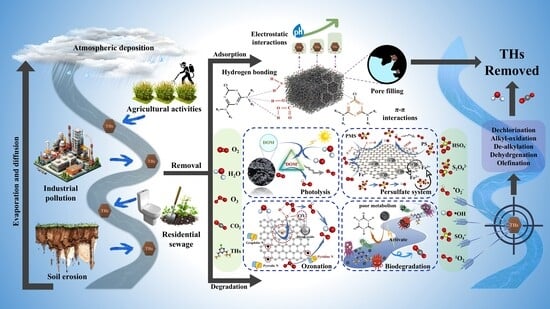
Graphical Abstract

1. Introduction

Triazine herbicides (THs), a dominant class of broad-spectrum agrochemicals, are ranked among the top five most heavily applied herbicides worldwide. Global herbicide expenditures currently surpass USD 30 billion annually [1], with projected increases in usage intensity driven by escalating agricultural demands. First commercialized in the 1950s [2], seven principal TH compounds remain in widespread use: atrazine (ATZ), ametryn (AMT), terbuthylazine (TET), terbutryn (TEZ), prometon (PRT), prometryn (PRZ), and simazine (SIZ). Their mode of action involves competitive inhibition of the D1 protein in the photosystem II (PSII) reaction center, effectively blocking electron transport and photosynthesis—a mechanism that is critical for crop protection but which has profound environmental implications [3]. Quantitative assessments highlight staggering application volumes: ATZ, the archetypal TH compound, is deployed at 70,000–90,000 metric tons annually [4], while PRT usage averages 30,000 metric tons/year [5]. Crucially, <10–30% of field-applied THs are retained by crops or adsorbed to soil matrices [6], resulting in substantial hydrological mobilization. Approximately 70–90% enters aquatic systems via irrigation return flows and precipitation-driven runoff, establishing pervasive contamination pathways. Monitoring data from Chinese coastal ecosystems confirm these transport dynamics. Maximum concentrations of PRT and TEZ in Dalian mariculture zones reached 2100 ng/L and 140 ng/L, respectively [7], while Yellow and Bohai Sea surface waters contained ATZ (554.2 ng/L), PRT (627.5 ng/L), and TET (248.5 ng/L) [4]. Strikingly, TH contamination now permeates remote marine reserves: Antarctic seawater samples revealed THs concentrations of 20–790 pg/L (mean 31 ± 66 pg/L), with source contributions traced to sugarcane farming (55%), algicide applications (28%), and corn/sorghum cultivation (16%) [8]. The environmental recalcitrance of TH stems from their stable s-triazine core, which confers extended half-lives (t1/2 = 35–150 days in aerobic soils) and elevated partition coefficients (log Kow = 2.0–3.5) [9]. These properties drive significant bioconcentration factors (BCFs: 50–200 in aquatic biota) and soil organic carbon adsorption coefficients (Koc = 100–500 mL/g), enabling both bioaccumulation and long-range transport. While such persistence enhances herbicidal efficacy, it concurrently elevates risks of trophic magnification and ecotoxicological impacts across aquatic–terrestrial interfaces.
The increasing use of THs raises concerns for aquatic ecosystems, as these compounds exhibit both targeted phytotoxicity and off-target effects via bioaccumulation and biomagnification [10,11]. These properties enable THs to propagate through trophic levels, posing significant toxicity risks to non-target organisms and potentially humans [12]. The lipophilic nature of prominent THs like ATZ, SIZ, and PRT facilitates their action as endocrine-disrupting chemicals (EDCs), with documented carcinogenic potential in mammalian models [13,14]. Experimental evidence reveals substantial ecotoxicological impacts: exposure to 3.2 μg/L ATZ induces 48% reduction in chlorophyll-a content of marine diatoms (Phaeodactylum tricornutum), accompanied by ultrastructural chloroplast damage and population growth inhibition [4]. Chronic THs exposure at environmental concentrations (≥1 μg/L) disrupts aquatic fauna development, as demonstrated by prometryn-induced embryotoxicity in marine medaka (Oryzias melastigma) larvae, showing 37% mortality and 22% teratogenesis rates [15]. Human health implications emerge through dietary bioaccumulation, with epidemiological studies correlating TH exposure with hormonal dysregulation and impaired auditory development in neonates [16]. Risk quantification studies establish concerning thresholds: Moore et al. [17] derived a probabilistic concern level (LOC) of 23.6 μg/L for ATZ using the Plant Community Toxicity Index and integrated aquatic system modeling, aligning with Giddings et al.’s [18] 60-day LOC of 21.2 μg/L based on species sensitivity distributions. These values frequently exceed THs concentrations detected in contaminated water bodies, particularly given the inadequacy of conventional water treatment processes in TH removal (<40% efficiency for most triazines) [19,20]. The confluence of expanding TH usage, environmental persistence, and inefficient remediation technologies underscores the critical need for advanced water treatment solutions capable of addressing these recalcitrant contaminants.
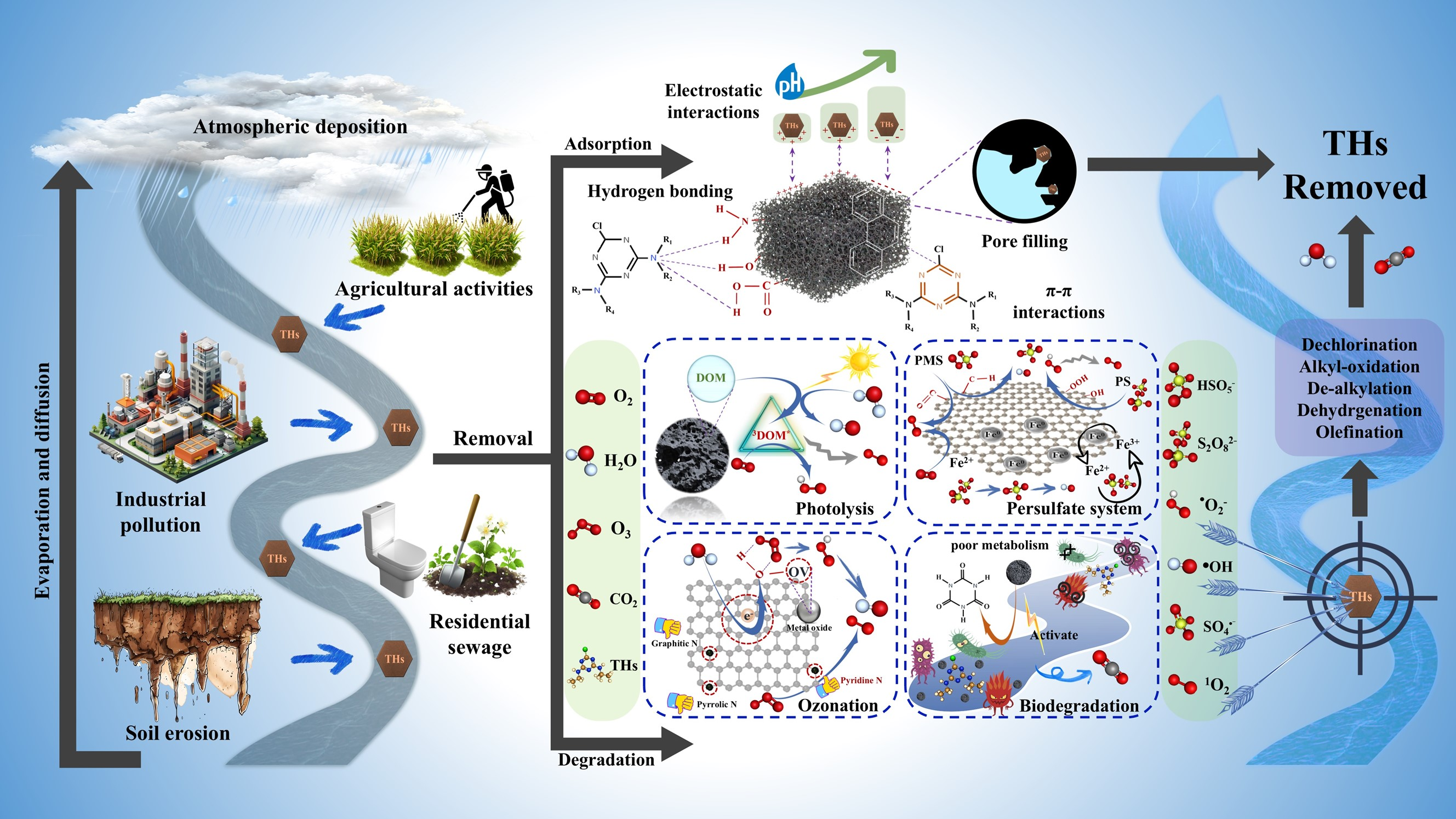
Biochar, a carbon-rich material produced through pyrolysis of organic biomass under anaerobic or oxygen-limited conditions [21,22], has emerged as a promising environmental remediation technology. Since Lehmann’s seminal advocacy for its carbon sequestration potential in agricultural soils [23], biochar research and applications have undergone exponential growth. Characterized by a highly porous matrix, substantial specific surface area (SSA), and abundant surface functional groups (-OH, -COOH, phenolic moieties) [24], biochar demonstrates exceptional adsorption capacities for aqueous and soil contaminants. These properties underpin its tripartite applications in water pollution control (e.g., heavy metal removal efficiency > 85%), soil remediation (PAHs reduction by 40–70%), and sustainable agriculture (crop yield increase of 10–25%) [25,26]. The removal of THs in aquatic environments primarily occurs through adsorption and oxidative degradation processes. Biochar has emerged as an effective solution to mitigate THs migration and transformation in water systems while reducing their environmental impacts [27,28]. The mechanism of TH removal by biochar in aquatic environments is schematically illustrated in Figure 1.
In this comprehensive review, we systematically analyze the effects of various pyrolysis techniques and modification methods on biochar’s adsorption performance. Furthermore, given the paucity of existing reviews addressing biochar-mediated removal of THs from aquatic environments, we elucidate the underlying mechanisms governing TH adsorption and oxidative degradation by biochar. By bridging this critical research gap, our work identifies key determinants for TH decontamination in water systems and provides actionable insights to guide future research directions.
Biochar effectively removes THs from aquatic systems through direct adsorption mechanisms, including π–π electron donor–acceptor (EDA) interactions, hydrogen bonding, pore-filling mechanisms, and electrostatic interactions. Furthermore, advanced oxidation processes (AOPs) involving biochar—particularly ozonation, photocatalytic degradation, and persulfate activation—significantly enhance TH degradation. Nevertheless, the reported high removal efficiencies are predominantly derived from idealized batch experiments, and their translation to continuous-flow, real-water systems remains a significant hurdle.
For the purpose of this review, ‘triazine herbicides’ encompass both classical s-triazines (e.g., atrazine, simazine) and structurally related heterocyclic herbicides (e.g., metribuzin) that share a triazine or triazinone ring and undergo similar adsorption and degradation mechanisms. This inclusion broadens the scope without compromising mechanistic relevance.

2. Design and Synthesis of Biochar

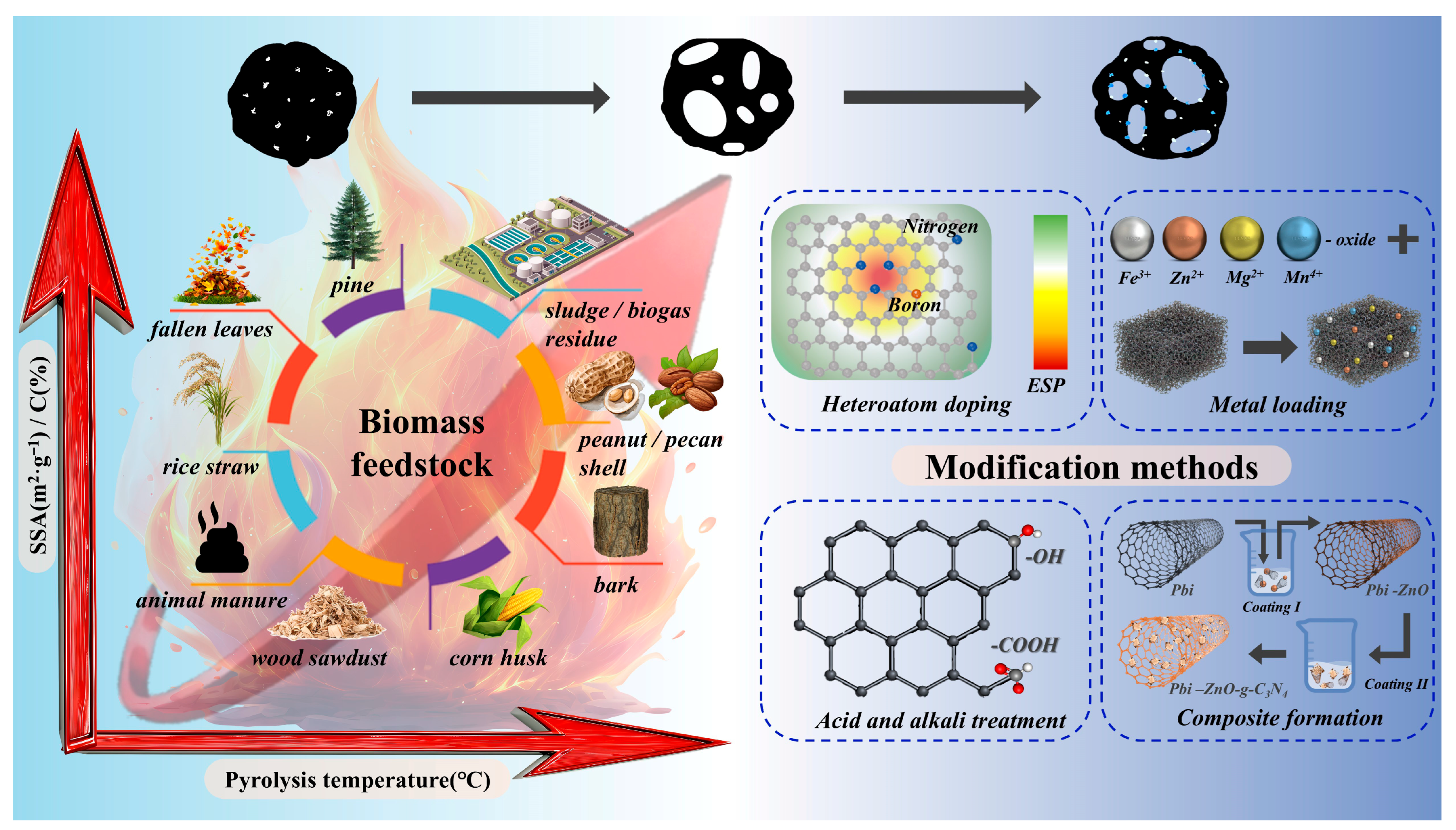
The physicochemical properties of biochar are governed by two primary determinants: (1) pyrolysis techniques employed during production, and (2) post-synthesis modification methods. The pollutant removal efficacy of biochar is critically dependent on its unique physicochemical characteristics, particularly SSA, hierarchical porous structure, and surface functional group composition [29,30,31]. However, even optimally engineered biochars face performance degradation in complex water matrices due to competing solutes and fouling, a point often underemphasized in the literature.

2.1. Pyrolysis Technology

The five principal thermochemical processes for biochar production—conventional carbonization/slow pyrolysis, fast pyrolysis, flash carbonization, gasification, and microwave-assisted pyrolysis—exhibit significant dependence on feedstock composition and pyrolysis temperature [32]. Systematic investigations reveal distinct reaction mechanisms across thermal regimes: in the 100–300 °C range, biomass undergoes dehydration and bond cleavage, accompanied by radical formation and development of carbonyl/carboxylic functional groups. The intermediate temperature range (300–600 °C) governs depolymerization, primary cracking, and secondary recombination reactions. Elevated temperatures (600–800 °C) promote extensive dehydration and deoxygenation, yielding biochar with reduced H/C and O/C ratios, diminished ion-exchange capacity, and enhanced aromaticity through well-organized graphitic carbon domains [33,34]. This engineered heterogeneity in physical structure (e.g., hierarchical porosity) and surface chemistry (e.g., oxygen functional group diversity) underpins the exceptional contaminant sequestration capabilities of biochar via multiple adsorption mechanisms [35].

2.1.1. Effect of Feedstocks

Feedstock selection critically governs the architectural design and structure–property relationships of biochar, with cascading effects on its physicochemical functionality [36]. While conventional and microwave-assisted pyrolysis predominantly utilize lignocellulosic biomass, the cellulose/hemicellulose/lignin triad dictates product distribution among bio-oil, syngas, and biochar. Fushimi et al. [37] demonstrated lignin-rich feedstocks achieve maximum biochar yields (~35–40%) under intermediate pyrolysis temperatures (500 °C), attributable to lignin’s thermal recalcitrance. Feedstock provenance further modulates adsorption performance: wood-derived biochars exhibit superior nutrient (phosphate/nitrate) affinity via oxygenated functional groups, whereas rice husk variants leverage inherent silica content to achieve enhanced surface area (190 m2/g) and mineral retention [38]. Comparative analysis reveals divergent ecological tradeoffs: manure-derived biochars outperform plant-based counterparts in stimulating soil microbial proliferation—a critical determinant of agroecosystem resilience [39]. However, plant feedstocks enable superior pore structure engineering, as evidenced by corn stover biochar’s tripled specific surface area (151.0 m2/g vs. 49.2 m2/g for swine manure biochar) at equivalent pyrolysis temperatures (700 °C) [40]. This disparity stems from cellulose/lignin-derived crosslinked carbon matrices that foster hierarchical porosity during thermal reorganization. Feedstock particle physics further modulates microwave pyrolysis efficiency. Smaller particle sizes (<2 mm) and higher bulk densities enhance dielectric coupling with microwave radiation, promoting rapid volumetric heating through dipole rotation and ionic conduction mechanisms [41]. Optimized particle geometry improves intergranular heat transfer uniformity, minimizing thermal gradients that compromise carbonization homogeneity [42]. Strategic feedstock selection thus constitutes a dual optimization lever—enhancing both production energetics (20–30% shorter processing times) and adsorption site accessibility. The surface-engineered biochars demonstrate amplified THs sequestration via electron donor–acceptor interactions, followed by radical or nonradical degradation pathways [43].

2.1.2. Effect of Pyrolysis Temperature

The structural evolution of biochars derived from identical feedstocks exhibits pronounced temperature dependence, governed by thermally driven carbon matrix reorganization. Systematic studies reveal a nonlinear response in SSA to pyrolysis temperature: bamboo-derived biochar demonstrates incremental SSA growth from 2.7 to 9.2 m2/g across 350–550 °C [44], while miscanthus biochar achieves a 42.2-fold SSA increase when pyrolyzed at 700 °C versus 400 °C [45]. This thermal expansion of porosity initiates through volatile release-induced pore development, followed by structural stabilization above critical temperature thresholds—a phenomenon exemplified by apricot shell biochar’s invariant SSA (ΔT = 190–240 °C) [46], indicating feedstock-specific activation energies for pore evolution. Comparative analysis of plant- versus manure-derived biochars highlights inherent carbonization disparities. Bamboo biochars maintain elevated carbon content (68.5–70.9%) across thermal regimes, contrasting sharply with swine manure counterparts (33.7–59.1%) under equivalent conditions. This divergence originates from plant biomass’s lignin–cellulose framework, which facilitates progressive graphitization and carbon retention (>70% at >600 °C) through aromatization and lateral growth of polycyclic aromatic domains [33,47,48]. Surface oxygen functionality undergoes temperature-dependent modulation, with carboxyl, hydroxyl, and quinone groups predominating below 400 °C, transitioning to thermally stable carbonyl/ester moieties at elevated temperatures [49,50]. These oxygenic sites confer pH-dependent surface charge (CEC = 12–45 cmol·kg−1) and mediate contaminant adsorption via hydrogen bonding and surface complexation. Notably, mesoporosity (2–50 nm) governs THs sequestration efficiency through three-dimensional confinement effects and π–π EDA interactions at aromatic carbon edges [28]. The synergistic interplay between hierarchical pore architecture (micro–meso–macro distribution) and surface redox activity establishes biochar as a tunable adsorptive–catalytic platform for agrochemical remediation.
Biochars produced from identical biomass feedstock exhibit distinct TH adsorption mechanisms depending on pyrolysis temperatures. Previous studies identify two primary pathways for ATZ adsorption: (1) linear isotherms governed by amorphous domain partitioning’ (2) nonlinear isotherms mediated through specific interactions with condensed aromatic structures [51]. The coexistence of moderately nonlinear (1/n = 0.4–0.5) and weakly nonlinear (1/n = 0.7–0.9) isotherms suggests dual contributions from partition and surface adsorption processes [21]. Notably, Li et al. [52] observed moderate nonlinearity in 650 °C pyrolyzed biochars, attributing this to enhanced carbonization that creates charcoal-like materials with elevated porosity and surface area, thereby favoring adsorption dominance. Principal component analysis reveals strong correlations between ATZ adsorption capacity and total pore volume. Cao et al. [53] further demonstrated that ATZ adsorption correlates positively with biochar aromatization degree, which escalates with pyrolysis temperature. However, this positive correlation is not universally applicable across all temperature ranges or feedstock types. For instance, Zhang et al. [46] studied apricot kernel shell biochar prepared via hydrothermal carbonization at 190–240 °C and found that, while adsorption capacity increased with temperature, a critical threshold (approximately 230–240 °C) existed; beyond this, further temperature elevation yielded diminishing returns due to limited additional aromatization. Notably, the temperature windows in [53] (500–700 °C, conventional pyrolysis) and [46] (190–240 °C, hydrothermal carbonization) are fundamentally different, suggesting that the relationship between pyrolysis temperature and adsorption performance is method-dependent. In low-temperature hydrothermal carbonization, surface oxygen-containing functional groups (e.g., –OH, –COOH) play a dominant role in atrazine adsorption via hydrogen bonding and hydrophobic interactions [46]; in contrast, at high pyrolysis temperatures, the loss of these groups is compensated by enhanced π–π electron donor–acceptor interactions from increased aromaticity. Therefore, the effect of temperature on biochar’s adsorption capacity must be interpreted within the context of the specific production method and temperature range. Highly aromatized biochars exhibit shortened molecular distances, increased adsorption energy, and enhanced π–electron conjugation with ATZ molecules. Crucially, high-temperature pyrolysis induces aromatic ring fragmentation, generating structural defects that improve redox activity through electron-deficient holes and lone-pair electrons [54]. These defect-mediated electronic configurations regulate radical/nonradical pathways, as biochar’s redox properties inherently reflect its functional group ensemble [55]. Radicals derived from these functional groups demonstrate superior oxidative capacity for TH degradation [43].
Collectively, elevated pyrolysis temperatures intensify physical mechanisms (π–π EDA, hydrogen bonding, hydrophobic interactions) while reducing their proportional contribution to overall adsorption. Concurrently, modified pore structures and aromatization promote radical formation, enhancing catalytic TH removal. Table 1 systematically illustrates how feedstock–temperature combinations govern biochar’s pore architecture and elemental composition (C/O ratios).

2.2. Modification Method

While biochar inherently exhibits considerable capacity for adsorbing THs from aqueous contaminants, its performance remains relatively limited compared to established biosorbents such as activated carbon [68,69]. Conventional modification strategies for raw biochar aim to achieve three interconnected objectives—(1) surface area amplification, (2) functional group engineering, and (3) magnetic/catalytic property enhancement—collectively elevating TH removal efficiency in aquatic environments. The augmented adsorption capacity arises from the modified biochar’s elevated specific surface area and enriched surface functionalities, which increase active site availability. Concurrently, the optimized pore architecture not only accommodates THs molecules but also modulates catalytic pathways by facilitating oxidant accessibility. These interdependent structural improvements underscore the criticality of selecting appropriate modification techniques to maximize THs sequestration efficiency. Nevertheless, the practical application of modified biochars must consider economic and energy constraints. Pyrolysis at 600–800 °C requires 5–20 MJ·kg−1 of energy input, and chemical modifications (e.g., acid/alkali activation, metal loading) add further costs. Moreover, most studies are batch-scale; continuous-flow reactor designs and long-term operational data remain scarce.

2.2.1. The Effect of Modification Methods on the Adsorption of THs by Biochar

The specific surface area (SSA) and pore structure of biochar play critical roles in governing its adsorption performance and hydrophilicity/hydrophobicity regulation [70,71]. As an intuitive parameter for elucidating pore structure characteristics, SSA serves as a primary indicator for evaluating adsorbent capacity [62,72]. Consequently, various modification methods have been investigated to enhance biochar’s SSA, thereby significantly improving its adsorption efficiency toward triazine herbicides (THs). Suo et al. [73] developed a phosphorus-doped biochar catalyst through H3PO4 activation (1:2 w/w ratio) of corn stover at 300 °C, achieving exceptional SSA (638.1 m2·g−1) with rapid equilibrium (20 min) and high removal efficiency (>96%) for ATZ. The study revealed that metaphosphate groups on modified biochar provided additional adsorption sites, addressing previous limitations in removal efficiency. Similarly, Cao et al. [66] demonstrated that citric-acid-modified biogas residue biochar (CA-BC) enhanced TH removal by 25% through tripled SSA improvement (96.6–266.2 m2·g−1), attributed to pore structure preservation and increased hydrophilicity via pH reduction. Although both studies demonstrate that chemical modification enhances biochar’s adsorption performance, direct comparison of their reported capacities is complicated by substantially different experimental conditions. Suo et al. [73] reported a Langmuir maximum adsorption capacity of 79.6 mg·g−1 for atrazine on H3PO4-activated corn stover biochar, using an initial atrazine concentration range of 1–120 mg·L−1 and a biochar dosage of 2 g·L−1. In contrast, Cao et al. [66] obtained an equilibrium capacity of only 5.94 mg·g−1 for citric-acid-modified biogas residue biochar, but under a much higher biochar dosage (4 g·L−1) and a single initial concentration of 25 mg·L−1. The higher adsorbent dosage in [66] would lower the calculated capacity per gram, and the use of maximum capacity (Langmuir Qₘ) vs. single-point equilibrium capacity further limits comparability. Thus, the superior SSA of [73] (638 m2·g−1) does not solely explain its higher adsorption; the differences in feedstock, modification chemistry, and experimental protocols preclude a simple ranking. This example underscores the urgent need for standardized adsorption reporting (e.g., Langmuir Qₘ with full isotherm, initial concentration range, and adsorbent dosage) to enable meaningful cross-study comparisons. Notably, thermal treatment conditions exert divergent effects on biochar performance. Wood-waste-derived biochar showed inverse correlation between SSA (1.5–3.6 m2·g−1 at 350–550 °C) and ATZ removal efficiency (26.0–7.5%) [74]. Conversely, Jiang et al. [75] reported 6-fold enhancement in ATZ adsorption capacity (4.1–24 mg·g−1) for Fe-modified corn stover biochar (nZVI@CS-800) with increasing pyrolysis temperature (600–800 °C). These contradictory trends highlight that the effect of pyrolysis temperature on adsorption is not universal but depends critically on feedstock composition and the presence of metal modification. In [74], the unmodified wood waste biochar lost oxygen-containing functional groups (e.g., –OH, C=O) at higher temperatures, as confirmed by FTIR, and the reduction in these active sites outweighed any benefit from the modest increase in specific surface area (from 1.467 to 3.565 m2/g). Consequently, atrazine removal decreased from 26.0% at 350 °C to 7.5% at 550 °C. In contrast, the biochar in [75] was prepared with potassium oxalate activation and Fe (nZVI) loading. The potassium oxalate etching generated a graphene-like carbon sheet with an ultrahigh specific surface area (1253 m2/g at 800 °C), while the nZVI particles provided additional adsorption and catalytic sites that became more accessible with increasing temperature. Moreover, the Fe species themselves enhanced adsorption via surface complexation, overriding any loss of surface functionality. Thus, the opposite temperature–adsorption relationships can be reconciled by recognizing that metal modification and advanced activation methods can fundamentally alter the temperature dependence, turning a negative correlation into a positive one. This comparison underscores the necessity of tailoring biochar design (e.g., metal loading, pore engineering) when targeting specific temperature windows for optimal TH adsorption, accompanied by SSA elevation. Surface functional groups significantly influence adsorption mechanisms through electronic interactions and cation exchange capacity [62,76]. Polar oxygen-containing groups (-COOH, C-O, -OH) and amino groups (-NH2) enhance TH adsorption via electrostatic/hydrogen bonding interactions, with functional group density showing positive correlation with adsorption capacity [77]. MgO-modified biochar (MgO-LBC) achieved 92.8% ATZ removal through oxygen-rich surface groups (-COOH, -OH) providing abundant binding sites [57,78]. Chemical activation strategies further demonstrated effectiveness: KOH/HNO3/H2SO4 modification increased oxygen-containing groups (C=O, -OH, C-O) and aromaticity, achieving remarkable AMT adsorption (487.64 mg·g−1) [79]. Similarly, polyaniline (PA)-polystyrene sulfonic acid (PSS) composite biochar exhibited enhanced ATZ specificity through synergistic interactions involving sulfonic (-SO3H), amino (-NH2), and quinone groups [80]. Direct comparison of the adsorption capacities reported in [73] (79.6 mg·g−1 for atrazine) and [79] (487.6 mg·g−1 for ametryn) is complicated by markedly different experimental conditions. Suo et al. [73] used an initial atrazine concentration range of 1–120 mg·L−1 and a biochar dosage of 2 g·L−1, whereas Wang et al. [79] employed a much narrower initial ametryn range (5–40 mg·L−1) and an extremely low biochar dosage of 0.0625 g·L−1—a factor that artificially inflates the calculated capacity. Additionally, the two studies used different target molecules (atrazine vs. ametryn) and different pH optima (pH 5–7 vs. pH 4). Thus, the higher value in [79] does not necessarily indicate superior biochar performance; rather, it reflects differences in experimental design.
These findings underscore the pivotal role of adsorption complexation involving surface functional groups as the central mechanism governing THs molecular adsorption processes. Modification approaches directly influence biochar’s adsorption capacity through structural and chemical tailoring of pore architecture and surface-active functionalities. Distinct modification techniques can be strategically employed to achieve target-specific enhancements. For instance, phosphoric acid and citric acid treatments demonstrate dual effectiveness in optimizing both pore structure and surface functional group distribution. Moreover, metal loading with elements like Fe and Mg simultaneously enhances porosity and enriches surface functionalities. Both strategies effectively improve biochar adsorption performance while ensuring environmental safety, as proper modification protocols prevent metallic leaching and secondary contamination during application. This dual optimization of physicochemical properties and environmental compatibility positions modified biochars as sustainable adsorbents for THs remediation. However, the environmental sustainability of modified biochars involves trade-offs. Metal loading (e.g., Fe, Co, Mn) risks metal leaching into treated water, yet most studies do not report leaching concentrations under realistic flow conditions. Chemical modifications using strong acids (H3PO4, H2SO4) or alkalis (KOH, NaOH) generate corrosive waste. Green alternatives, such as natural acid treatment or co-pyrolysis with metal-rich biomass, are emerging but require further validation. A recent example is the H3PO4-activated hydrochar derived from passion fruit residues via hydrothermal carbonization at 126 °C [81]; this mild-condition, low-energy process valorizes agro-industrial waste and achieves 52–72% removal of triazine herbicides at environmentally relevant concentrations, illustrating a promising green modification route. These trade-offs are further addressed in Section 4.

2.2.2. The Effect of Modification Methods on the Degradation of THs by Biochar in AOPs

The specific surface area (SSA) and surface functional group density of biochar critically govern TH degradation efficiency in AOPs by enhancing contaminant/oxidant adsorption and modulating catalytic mechanisms [82,83]. Iron-enriched corn stover biochar pyrolyzed at 800 °C demonstrated superior persulfate activation capacity, achieving a 93.8% ATZ removal rate within 30 min compared to 45.8% for non-metallized counterparts [84]. This enhancement stems from transition metals (Fe, Zn, Mn) inherent in biomass precursors forming electron-transfer-active sites during pyrolysis, which catalyze persulfate activation and reactive oxygen species (ROS) generation [84]. Similarly, hemin-doped rice husk biochar (RBC@Hemin20%) pyrolyzed at 700 °C achieved 99.5% ATZ removal within 120 min, as hemin decomposition created Fe-N active sites and promoted pore structure development [85]. Both [77,85] report near-complete removal of triazine herbicides via biochar-catalyzed advanced oxidation, but direct comparison of their reported efficiencies is limited by differing experimental conditions. Aryee et al. [85] used hemin-doped rice husk biochar (RBC@Hemin20%) to activate peroxymonosulfate (PMS, 2.0 mM) for simazine degradation (0.5 ppm, catalyst 0.2 g·L−1, pH 5.84), achieving 99.5% removal in 120 min. Liang et al. [77] employed a cobalt–iron alloy/oxide on defect-rich biochar (CoFe@DBC2.0-700) to activate peroxyacetic acid (PAA, 0.5 mM) for atrazine degradation (5.0 mg·L−1, catalyst 0.10 g·L−1, pH 4.1), reaching 100% removal in 60 min. The tenfold higher initial concentration and the use of a different oxidant (PAA vs. PMS) preclude direct comparison of removal percentages. Nevertheless, both studies confirm that introducing heteroatoms (Fe/N in [85], Co/Fe in [77]) into biochar enhances catalytic activity. Beyond metal doping, non-metal heteroatom co-doping has also been explored to induce structural defects and improve persulfate activation, as exemplified by the following works. Zhang et al. [86] further amplified SSA in Auricularia auricula residue biochar (650 °C) through N/B co-doping, leveraging atomic radius mismatches to induce structural defects. Pyrolysis temperature critically regulates catalytic performance through metal speciation control. Li et al. [82] observed complete ATZ removal (100%) by Fe nanoparticle-loaded biochar (FeNPs@BC) at 800 °C, versus 50.5% at 600 °C, attributing this to temperature-dependent Fe0 formation. However, direct efficiency comparison between [82] and [84] requires accounting for their different reaction conditions: The authors of [82] used a higher persulfate concentration (3 mM vs. 1 mM) and catalyst loading (2 wt% vs. 0.25 g·L−1), and a soil matrix instead of aqueous solution, which collectively accelerate degradation. Notably, direct comparison of the catalytic efficiencies reported by Zhang et al. [84] and Li et al. [82] reveals that the latter achieved complete removal within 10 min (kobs = 0.19023 min−1), whereas the former required 30 min to reach 93.8% removal under similar persulfate activation conditions. This discrepancy can be attributed to at least three key factors. First, the Fe0 content on the catalyst surface differs substantially: Li et al. [82] reported 43.7% Fe0 in their FeNPs@BC (800 °C), while Zhang et al. [84] found only 23% Fe0 on the surface of their nZVI@BC prepared at the same temperature, as revealed by XPS analysis. Given that Fe0 is the primary species responsible for persulfate activation via electron transfer, a higher Fe0 content directly translates to faster radical generation and consequently faster ATZ degradation. Second, the reaction conditions differ: Li et al. [82] employed a higher persulfate concentration (3 mmol/L) and a catalyst dosage of 2 wt% relative to soil, whereas Zhang et al. [84] used 1 mM PS and 0.25 g/L catalyst in aqueous solution. The higher oxidant and catalyst loading in [82] likely accelerated the activation kinetics. Third, the reaction matrices are not directly comparable: was conducted in soil, where mass transfer limitations may differ from the aqueous system in. Nevertheless, both studies confirm that optimizing pyrolysis temperature (≥800 °C) is essential to maximize Fe0 formation, and that the Fe0 content, rather than specific surface area alone, is the dominant factor governing catalytic persulfate activation efficiency. These findings underscore the importance of metal speciation control over porosity engineering when designing biochar-based catalysts for advanced oxidation processes. Diao et al. [87] highlighted AOPs system specificity using nZVI-modified kenaf biochar (BC-nZVI): The peroxymonosulfate (PMS) system achieved 96.0% ATZ removal in 240 min via multi-ROS pathways (SO4•−, •OH, 1O2), outperforming other oxidants. These findings emphasize the necessity of synergistic optimization of metal selection (Fe, N, B), pyrolysis parameters (600–800 °C), biomass feedstocks, and AOPs systems (persulfate/PMS) when engineering biochar catalysts for targeted TH remediation.
Recent research advancements focus on sustainable post-application processes of biochar, particularly highlighting the dual environmental functionality of phosphorus-incorporated composite biochar (Pbi-ZnO-g-C3N4). To address concurrent challenges in photocatalysis and nutrient management, researchers developed this hybrid material by integrating KH2PO4 into the biochar matrix followed by sequential coating with ZnO and graphitic carbon nitride (g-C3N4) [88]. The composite establishes a Z-scheme heterojunction structure that enhances charge carrier separation efficiency, generating abundant reactive oxygen species (ROS, e.g., •OH and O2•−) for accelerated atrazine (ATZ) degradation [89,90]. This innovation bridges critical knowledge gaps by simultaneously boosting photocatalytic performance and enabling controlled phosphorus release, thereby mitigating eutrophication risks associated with conventional phosphate fertilizers. The successful incorporation of g-C3N4 not only amplifies light-harvesting capabilities but also regulates phosphorus leaching through slow-release mechanisms, effectively reducing aqueous phosphate pollution. Current investigations predominantly concentrate on biochar-mediated TH removal in aquatic systems, with Figure 2 succinctly illustrating key influencing factors governing these processes. This integrated approach demonstrates the potential of multifunctional biochar composites to address both contaminant degradation and nutrient cycle management in water remediation applications.

3. Mechanism of Triazine Herbicides Removal by Biochar

3.1. Adsorption Mechanism

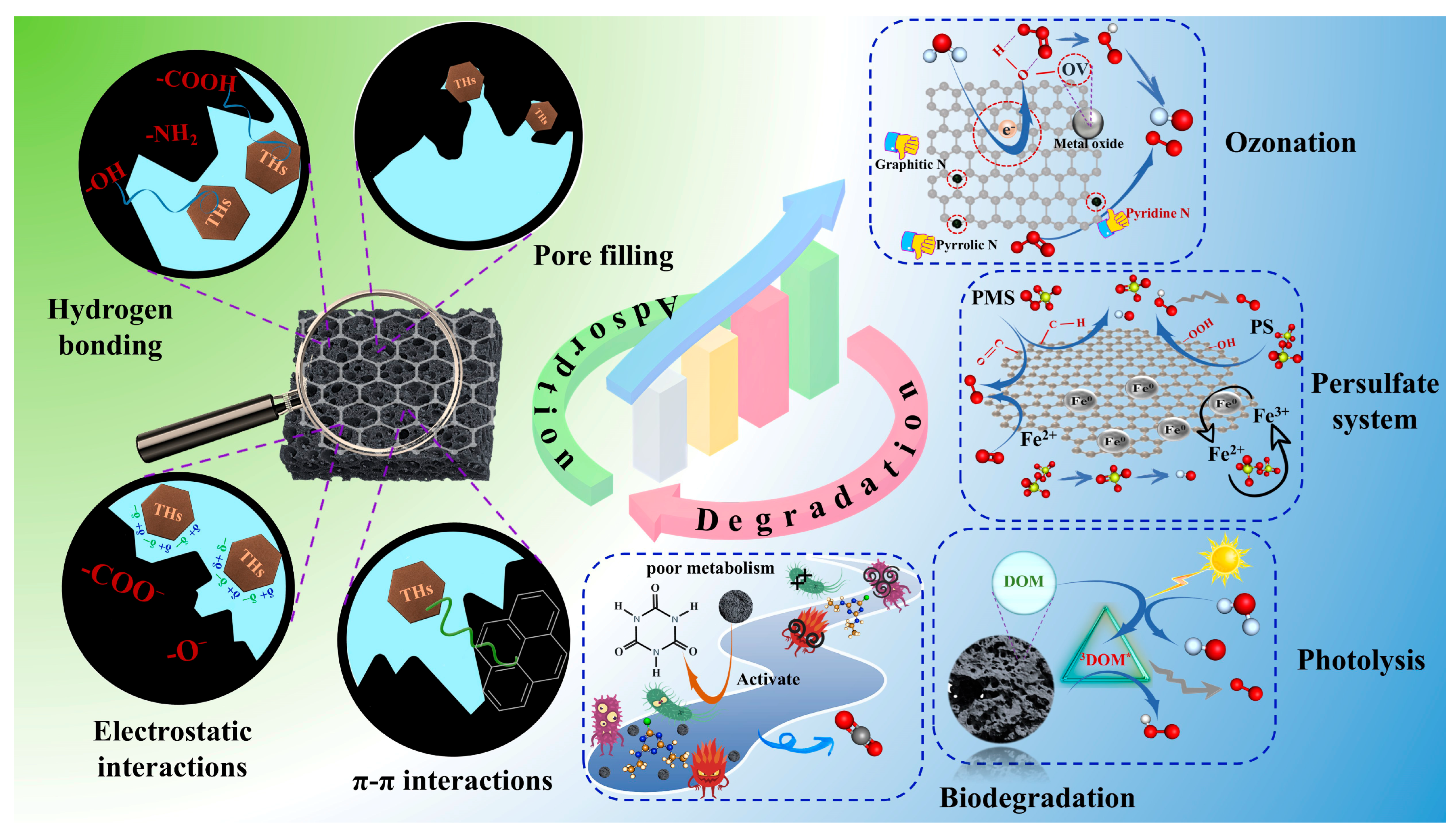
Adsorption, a separation technology governed by physicochemical interactions, operates through contaminant transfer and immobilization onto adsorbent surfaces or active sites. As a predominant carbon-based adsorbent, biochar demonstrates exceptional efficacy in aqueous TH removal via three-phase sequence: (1) mass transfer from bulk solution to biochar interface, (2) intra-particle diffusion through porous networks, and (3) stabilization at active binding sites through specific interactions [62,72,73,91], though its performance in real waters may be substantially lower due to competing ions and natural organic matter. The adsorption of triazine herbicides onto biochar involves multiple concurrent mechanisms that can be categorized into physical interactions (pore filling, hydrophobic effects, van der Waals forces) and chemical interactions (π–π electron donor–acceptor, hydrogen bonding, electrostatic attraction). These mechanisms rarely operate in isolation; rather, their relative contributions depend on biochar properties (e.g., aromaticity, surface functional groups, pore size distribution) and solution chemistry (e.g., pH, ionic strength). The following subsections critically evaluate the evidence for each mechanism, highlighting study-specific conditions and unresolved contradictions.
The surface adsorption mechanisms of THs can be categorized into specific and nonspecific interactions [92]. Specific adsorption predominantly involves hydrogen bonding and electrostatic interactions, whereas nonspecific adsorption is governed by hydrophobic effects. Both mechanisms play critical roles in determining THs sequestration behaviors across diverse biochar materials within complex environmental matrices. Previous studies have validated biochar as an effective and environmentally sustainable remediation strategy, demonstrating significant potential for TH removal. Nevertheless, to achieve optimized treatment for target-specific contaminants, further systematic investigation is required to elucidate THs’ chemical structural features and establish structure–activity relationships for selecting optimal biochar-based catalysts with enhanced adsorption efficiency [93,94]. This knowledge-driven approach will enable precise tailoring of biochar functionalities to match contaminant molecular characteristics, thereby advancing the development of high-performance adsorption systems.
The distinction between physical and chemical adsorption mechanisms is conventionally defined by adsorption free energy thresholds, with physical interactions (e.g., van der Waals forces, Coulombic interactions) typically demonstrating energy changes <40.0 kJ·mol−1, while chemical bonding involves stronger energetic alterations [95]. Biochar outperforms conventional adsorbents through its unique combination of polar surface functionalities and extended specific surface area, enabling dual adsorption pathways: (1) reversible physisorption driven by weak intermolecular forces, and (2) irreversible chemisorption via stable covalent/coordinate bonds under specific conditions [96]. For triazine herbicides, the adsorption process on biochar involves multiple concurrent mechanisms including hydrogen bonding, electrostatic attraction, π–π EDA interactions, and pore-filling effects [62,76,97]. While these mechanisms collectively determine adsorption efficacy in complex matrices, the dominance of particular mechanisms depends critically on biochar’s surface chemistry (O/N-containing groups, aromaticity) and THs’ molecular properties (polarity, pKa, π–electron density). Systematic evaluation of biochar’s surface charge distribution, functional group density, and pore size hierarchy relative to THs’ molecular dimensions is essential for identifying the predominant adsorption pathway in specific environmental scenarios.

3.1.1. Hydrogen Bonding

Duan et al. [80] employed cyclic voltammetry (CV) to evaluate the electrochemical activity of polyaniline–polystyrene sulfonic-acid-modified biochar nanocomposites (PA-PSS-BCs), coupled with differential pulse voltammetry (DPV) for ATZ quantification. The PA-PSS-BCs exhibited robust electrochemical responsiveness and stability under neutral pH conditions, attributed to synergistic interactions between sulfonic groups (-SO3H) from PSS and amino groups (-NH2) from PA. These interactions facilitated hydrogen bonding with biochar’s hydroxyl groups (-OH), effectively increasing active adsorption sites. Complementarily, Wang et al. [98] visualized non-covalent interactions between jujube shell biochar (CS) and four THs (ATZ, AMT, TET, TEZ) through reduced density gradient (RDG) analysis, identifying hydrogen-bond-associated color domains between CS’s H atoms and ATZ’s N atoms. Multiple studies have systematically investigated TH adsorption mechanisms on functionalized biochars. Jia et al. [99] utilized FTIR spectroscopy to track surface functional group variations in Acanthopanax biochar (ASBC) pre-/post-ATZ adsorption, revealing hydroxyl (-OH) and aromatic ring (C=C) participation in hydrogen bonding and π–π interactions. Similarly, Hu et al. [100] compared four modification strategies (H3PO4, H2SO4, FeCl3, KOH) on corn stover biochar, identifying H2SO4-treated biochar as the most effective ATZ adsorbent due to hydroxyl/carboxyl group enrichment. These findings align with observations in chitosan-modified jujube shell biochar [98], NaOH-activated coconut shell biochar [97], FeCl3/phenol-co-modified camphor leaf biochar [101], and KOH-treated jujube pit biochar [79], collectively underscoring hydrogen bonding’s universal role in TH adsorption. However, its practical relevance in aquatic environments is constrained by competing ionic effects; coexisting anions/cations may competitively occupy binding sites or alter THs solvation states, modulating hydrogen bonding efficacy [73].

3.1.2. Electrostatic Interactions

Electrostatic adsorption and repulsion, governed by Coulombic interactions between charged entities (ions or polar molecules), constitute fundamental physical adsorption mechanisms. The ionization states of functional groups on both biochar and THs, which dictate surface charge characteristics, exhibit pronounced pH dependence [57,98]. The point of zero charge (pHzpc) serves as a critical determinant of biochar’s surface charge dynamics: functional groups undergo protonation (positive charge) when the solution has pH < pHzpc, while deprotonation (negative charge) predominates at pH > pHzpc. Given THs’ pKa range (1.7–4.3), optimal electrostatic attraction occurs at pH 1.7–4.3, where protonated THs molecules are efficiently adsorbed onto positively charged biochar surfaces (pH < pHzpc). Beyond pH 4.3, progressive surface charge reversal in biochar induces electrostatic repulsion, significantly constraining adsorption efficiency [73]. Ionic strength further modulates electrostatic interactions through competitive adsorption. High Ca2+ concentrations, for instance, suppress TH adsorption by preferentially occupying negatively charged sites. The relatively weak interaction energy (typically <40 kJ·mol−1) restricts effectiveness against high-concentration or large-molecular-weight pollutants, where stronger chemisorption mechanisms become essential.

3.1.3. π–π Interactions

The π–π electron donor–acceptor (EDA) interactions between biochar’s aromatic carbon matrix and THs emerge as a pivotal adsorption mechanism, driven by the conjugated π–electron systems inherent to both components. Biochar’s graphitic domains, formed through sp2-hybridized carbon networks during pyrolysis, create delocalized π–electron clouds that interact with electron-deficient regions of THs molecules, particularly their triazine rings, containing electronegative substituents (e.g., Cl, N) [80,97,98]. This electron complementarity facilitates π–π EDA interactions through either parallel-displaced or face-to-face stacking configurations, generating substantial non-covalent binding forces critical for THs sequestration [78,79].
Jiang et al. [75] demonstrated enhanced π–π interactions in corn stover biochar (CS-800) with increasing pyrolysis temperature (600–800 °C), where elevated aromaticity (sp2 carbon ratio) improved ATZ adsorption capacity by 6-fold. Complementary DFT analyses revealed strengthened π-conjugation effects in 700 °C-derived camphor leaf biochar (700 LBC), evidenced by reduced ATZ–biochar molecular distance (3.31 Å vs. 3.39 Å at 500 °C) and widened HOMO-LUMO gap (ΔE = 3.446 eV), confirming the intensified electron transfer dynamics [53]. Surface functional groups further modulate these interactions: Oxygen/nitrogen-containing moieties (e.g., -OH, -NH2) serve as electron donors, while THs’ electron-withdrawing groups (e.g., NO2, Cl) act as acceptors, creating bidirectional π–π EDA pathways [78]. Modification strategies systematically optimize this mechanism through structural and chemical tuning. Acid treatment (e.g., H3PO4 activation) enhances π–π interactions by removing mineral impurities and increasing sp2–carbon content, as shown by Cao et al. [66], where citric-acid-modified biochar achieved doubled ATZ adsorption capacity through combined micropore filling and π–π EDA. Nevertheless, the relative contribution of π–π EDA interactions under environmentally relevant pH and ionic strength conditions has not been systematically quantified, and its dominance may diminish in the presence of competing aromatic compounds.

3.1.4. Pore Filling

The hierarchical pore architecture of biochar, comprising micropores (<2 nm), mesopores (2–50 nm), and macropores (>50 nm), critically determines its adsorption potential for THs through size-selective mechanisms [102,103,104]. While micropores provide exceptional specific surface area and preferential adsorption for small molecules like ATZ (0.72–0.76 nm diameter), excessively narrow pores may induce steric hindrance against larger TH derivatives [105]. Mesopores serve as vital transport channels enabling molecular access to adsorption sites, with macropores facilitating rapid bulk diffusion—though oversized pores risk contaminant re-release through weak physical retention [106,107]. Optimizing the micropore-to-mesopore ratio emerges as a key strategy for balancing adsorption capacity and kinetic efficiency, as demonstrated by Suo et al. [73], where phosphoric acid modification transformed corn stover biochar (CSWP) from macropore-dominant (8.36 nm average width) to micro/mesoporous structure (3.18 nm), achieving a 95-fold surface area increase (638.1 vs. 6.678 m2·g−1) and remarkable ATZ adsorption capacity (79.6 mg·g−1).
Pore-filling mechanisms are further modulated by surface chemistry and mass transfer dynamics. The Weber–Morris model revealed mesopore-mediated boundary layer diffusion enables 80% ATZ uptake within 1 min in modified biochars [73]. However, such rapid kinetics are not universally observed. Xiao and Pignatello [28] systematically compared the adsorption rates of triazine herbicides on hardwood biochars and found that the characteristic diffusion rate constant ( D b a p p / a 2 ) decreased with increasing molecular volume of the solute (prometon > atrazine > simazine) and with decreasing mesoporosity of the biochar. In particular, the largest triazine (terbutryn, molecular volume 265.6 Å3) required >30 min to reach 80% uptake on a microporous biochar (B700), whereas the same compound reached equilibrium within 10 min on a mesopore-rich biochar (B500) [28]. Advanced modification techniques like ultrasonic cavitation [108] and citric acid etching [66] enhance pore development. Despite advances, reconciling molecular-scale interactions with macroscopic performance remains challenging; DFT simulations assume idealized surfaces, while real aqueous complexities limit accuracy. Across all adsorption mechanisms, several knowledge gaps persist: (i) the relative contribution of each mechanism under environmentally relevant pH and ionic strength has not been systematically quantified; (ii) competitive effects of coexisting organic matter on specific interactions remain poorly understood; and (iii) most DFT simulations assume idealized biochar surfaces, whereas real biochars are heterogeneous. Future work should combine in situ spectroscopy with site-specific modeling to deconvolute mechanism contributions. Numerous reports currently exist showcasing effective TH adsorption by biochar in aquatic environments (Table 2). Even among unmodified biochars, direct comparison of reported adsorption capacities is complicated by differing experimental conditions. Liu et al. [72] reported an atrazine adsorption capacity of 1.4 mg·g−1 for soybean straw biochar pyrolyzed at 450 °C (initial atrazine concentration 2 mg·L−1, biochar dosage 2 g·L−1). In contrast, Mandal et al. [62] studied rice straw biochar at 600 °C but presented adsorption only as a percentage range (37.5–70.7% removal at initial concentration 1–10 mg·L−1 and a much lower biochar dosage of 1 g·L−1), precluding direct capacity comparison. The higher pyrolysis temperature in typically increases carbonization and reduces oxygen functional groups, yet the lower adsorbent dosage would artificially elevate removal percentages. This example illustrates that feedstock effects cannot be isolated from variations in pyrolysis temperature, initial concentration, and adsorbent dosage—factors rarely reported in a standardized manner across studies.
The influence of preparation method extends beyond pyrolysis temperature to the choice between pyrolysis and hydrothermal carbonization. De Almeida et al. [81] recently prepared a hydrochar from passion fruit residues via hydrothermal carbonization at 126 °C with 0.5 M H3PO4 activation. This material exhibited adsorption capacities of 18.05 μg·g−1 for atrazine, 10.83 μg·g−1 for ametryn, and 5.05 μg·g−1 for metribuzin at initial concentrations of 0.33, 0.25, and 0.15 mg·L−1, respectively—three orders of magnitude lower than those of high-temperature pyrolytic biochars (e.g., 79.6 mg·g−1 in [73]). This stark difference reflects the limited porosity and surface area developed under mild hydrothermal conditions. Nevertheless, the hydrochar achieved 52–72% removal at environmentally relevant concentrations, and the low desorption of ametryn (13%) suggests strong π–π and hydrogen bonding interactions. This case illustrates that while hydrothermal carbonization offers a lower-energy route (126 °C vs. >600 °C) and can valorize agro-industrial waste, the resulting materials are better suited for trace contaminant polishing rather than high-concentration bulk removal. The choice between production methods should therefore be guided by the target concentration and desired removal efficiency.

3.2. Degradation Mechanism

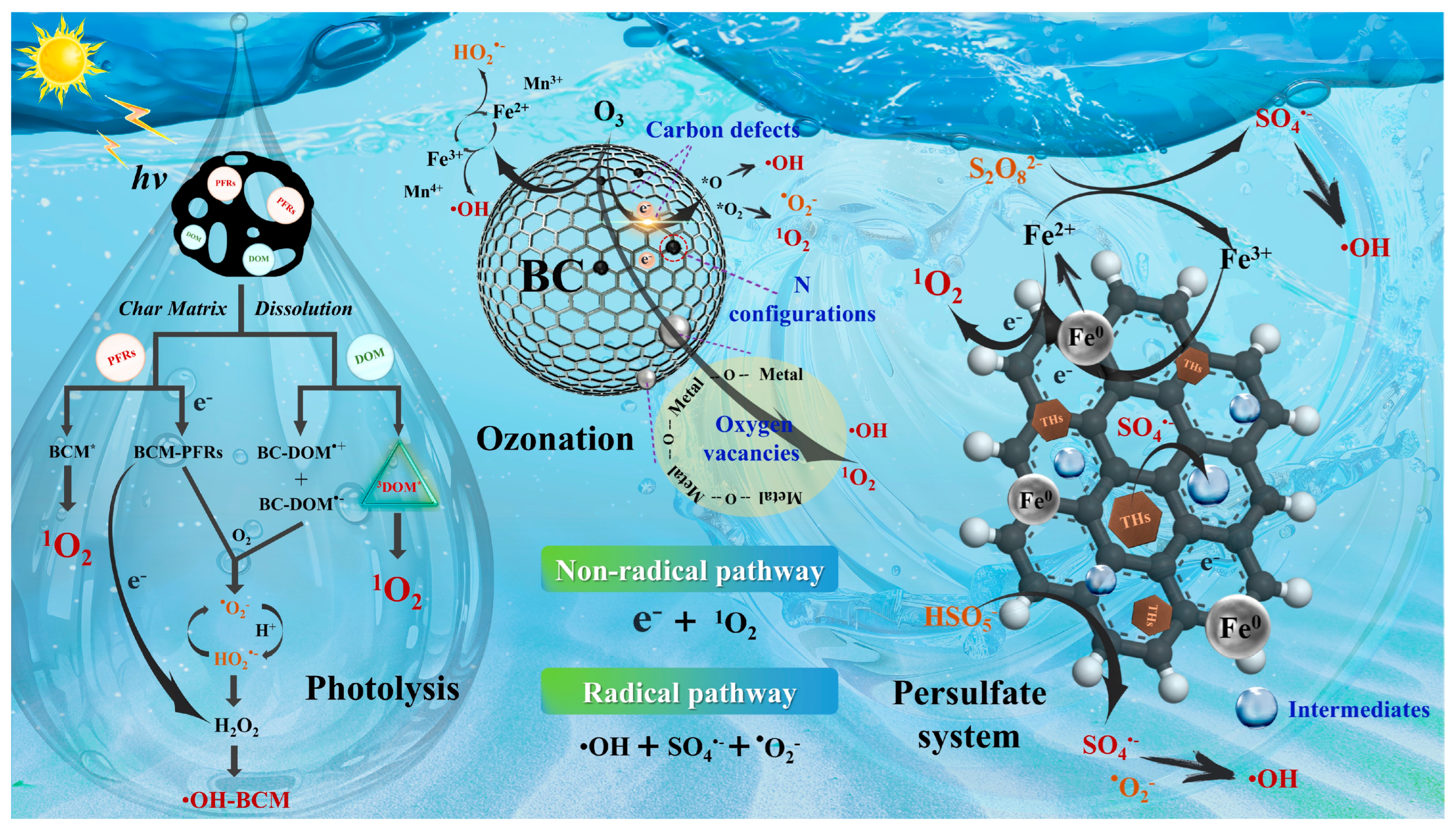
Biochar-based catalysts have demonstrated significant potential in TH removal from aquatic environments over the past decade. However, this adsorption-driven approach fundamentally achieves only phase transfer of contaminants from aqueous solutions to solid matrices, failing to accomplish complete mineralization. Residual THs, retained within biochar’s porous networks and surface sites, remain susceptible to desorption under environmental perturbations such as pH fluctuations, temperature variations, or microbial activity, posing risks of secondary contamination. In this context, AOPs have emerged as a transformative solution through radical-mediated chain reactions capable of mineralizing recalcitrant organic pollutants [111]. By generating highly reactive oxygen species, including hydroxyl radicals (•OH) and sulfate radicals (SO4•−), AOPs effectively cleave covalent bonds in THs molecules, achieving contaminant destruction rather than mere phase relocation. The integration of biochar with AOPs systems (e.g., ozonation, Fenton oxidation, photocatalysis, persulfate activation) capitalizes on its hierarchical porosity and oxygen-rich surface functionalities (-OH, -COOH, C=O) to create synergistic remediation platforms [82,86,87,112]. Biochar’s three-dimensional pore networks enhance oxidant-contact efficiency by preconcentrating THs near reactive sites, while its graphitic domains facilitate electron transfer between oxidants and target molecules. Surface functional groups further participate in ROS generation through metal-free activation pathways or by stabilizing transition metal catalysts. This dual-action mechanism—combining adsorption enrichment with catalytic degradation—addresses the limitations of standalone adsorption technologies while leveraging biochar’s structural advantages, establishing a robust strategy for sustainable THs elimination with minimized environmental risks. Figure 3 clearly delineates the distinct degradation mechanisms across different systems, while Table 3 summarizes key performance metrics of biochar-mediated TH degradation under varied operational conditions.

3.2.1. Ozonation

Conventional AOPs in water treatment primarily rely on the generation of ROS, including hydroxyl radicals (•OH), superoxide radicals (O2•−), and hydroperoxyl radicals (HO2), which contain unpaired electrons capable of initiating oxidative reactions [111]. Among these, ozone (O3)-based systems leverage •OH-mediated pathways through direct molecular ozone reactions or indirect radical chain mechanisms, exploiting O3’s high oxidation potential (1.8–2.7 V) [120,121]. However, standalone O3 application suffers from non-selective oxidation of pollutants and incomplete mineralization under specific conditions [122]. To enhance oxidative efficiency, researchers have combined O3 with auxiliary oxidants such as hydrogen peroxide (H2O2) and ultraviolet (UV) irradiation [123,124], though these hybrid systems often entail substantial energy consumption and risk generating toxic byproducts, thereby compromising environmental sustainability (Equations (1)–(3)). In response to these limitations, heterogeneous catalytic ozonation (HCO) has emerged as an innovative advancement, employing metal oxide catalysts to optimize ozone utilization. This technology addresses key challenges of traditional O3 systems by enhancing ROS generation selectivity and reducing secondary pollution risks through controlled reaction pathways. The catalytic interface facilitates ozone decomposition into targeted radicals while suppressing undesirable side reactions, representing a strategic evolution in AOPs design for sustainable water treatment applications.
O3 + H2O → O2 + •OH + H+
O3 + H2O2 → O2 + •OH + H2O
O3 + UV → O2 + •OH
To address these challenges, Dong et al. [78] developed a lychee shell-derived biochar composite loaded with magnesium oxide (BC@MgO) pyrolyzed at 700 °C, demonstrating exceptional catalytic ozonation efficiency for ATZ degradation. Oxygen vacancies (OVs) on MgO surfaces exposed Mg2+ sites that adsorbed and dissociated water molecules to form surface hydroxyl groups, establishing catalytic active centers (Equations (4)–(6)). These OVs simultaneously modulated local electronic distributions to enhance O3 chemisorption and accelerate electron transfer for ozone activation. The synergistic effects between carbon defects (physical O3 enrichment) and OVs (chemical O3 activation) achieved 92.8% ATZ degradation within 30 min, with complete removal under alkaline conditions (Equations (7)–(14)). Complementarily, nitrogen-doped biochars derived from soybean residue pyrolysis (900 °C) introduced nitrogen configurations that facilitated nonradical pathways. DFT calculations by Wang et al. [125] revealed preferential O3 adsorption on pyridinic nitrogen sites, where elongated O-O bonds (1.285 Å) promoted dissociation into adsorbed oxygen species (Oad*) and free superoxide radicals (O2*) (Equation (15)). Both strategies—OV-mediated radical pathways and N-doped nonradical mechanisms—exhibited robust stability while aligning with waste-to-resource principles. The tailored biochars effectively minimized operational costs associated with conventional ozonation systems through synergistic interactions among OVs, nitrogen dopants, and carbon defects, achieving efficient TH degradation via optimized ROS generation pathways.
H2O → OH + H+
OV ≡ Mg + OH → OV ≡ Mg–OH
Mg + OH → Mg–OH
OV ≡ Mg–OH + O3 → OV ≡ MgHO2 + O2
Mg–OH + O3 → MgHO2 + O2
Carbon–π + H2O → Carbon–HO3+ + OH
O3 + OH → HO2 + O2•−
HO2 → O2•− + H+
O2•− + O3 → O3•− + O2
O3•− + H2O → HO3 + OH
HO3 → •OH + O2•−
O3 + Pyridine N → Oad*+ O2*
Compared with conventional ozonation processes, the HCO system co-doped with potassium permanganate and potassium ferrate developed by Tian et al. [113] demonstrated superior atrazine (ATZ) removal efficiency, achieving complete elimination (100.0%) within 30 min in aqueous environments. Although both systems achieved high ATZ removal, their optimal pH ranges differ markedly. The BC@MgO system [78] relies on oxygen vacancies on MgO to dissociate water into surface hydroxyl groups, a process favored under alkaline conditions (pH 9–11), where the catalyst achieved >90% degradation within 30 min. In contrast, the Mn/Fe oxide-loaded biochar system was evaluated exclusively at neutral pH (7.0), where its abundant Lewis acid sites effectively decompose ozone into •OH regardless of solution pH; however, the authors did not examine performance under alkaline or acidic conditions. Consequently, direct comparison of pH dependence is limited by the lack of systematic pH variation in [113]. Nevertheless, the available evidence suggests that MgO-based catalysts are more suitable for alkaline wastewaters, whereas Mn/Fe-loaded biochars offer robust activity at circumneutral pH without the need for adjustment. The incorporation of MnOx and FeOx substantially enhanced the density of Lewis acid sites on biochar surfaces, facilitating ozone enrichment on catalytic interfaces. The multivalent characteristics of MnOx and FeOx enabled the formation of redox pairs through interconversion between different oxidation states, thereby accelerating ozone decomposition and subsequent •OH generation (Equations (16) and (17)). Electron paramagnetic resonance (EPR) analysis revealed detectable O2•− signals in both MnOx-biochar/O3 systems, suggesting that superoxide radicals serve as intermediate species during ozone decomposition and subsequently contribute to enhancing •OH predominance through chain reactions (Equation (18)). Cheng et al. [115] synthesized nitrogen-doped biochar (NBC700) at 700 °C, exhibiting optimized textural properties with a specific surface area of 544 m2·g−1 and elevated defect density (ID/IG = 1.165), which achieved 97.1% ATZ removal within 15 min. The enhanced catalytic performance originated from electron-rich domains on NBC700 surfaces, created through electronic structure modulation by pyridinic N and graphitic N species introduced through urea doping. This electronic perturbation promoted in-situ ozone decomposition into reactive oxygen species (•OH and O2•−) (Equations (15), (19) and (20)). Notably, NBC700 maintained stable catalytic performance with negligible interference from coexisting inorganic anions (NO3, Cl, PO43−, SO42−, and HCO3), demonstrating remarkable robustness of the HCO system under complex water matrices.
Mn3+ + O3 → Mn4+ + •OH + O2
Fe2+ + O3 → Fe3+ + •OH + O2
O2•− + H2O → •OH + OH + O2
Oad* + H2O → •OH + OH
O2* + H+ → HO2 → O2•− + H+
While biochar in HCO technology effectively mitigates metal agglomeration, its surface functional groups are susceptible to oxidative consumption, potentially triggering structural collapse. Moreover, the presence of coexisting anions (e.g., HCO3, Cl) and natural organic matter in real waters can significantly suppress catalytic ozonation efficiency, as these species either scavenge •OH or compete for ozone adsorption on catalyst surfaces [113,115]. Consequently, the >90% removal reported in deionized water may drop to 50–70% in tap or river water, highlighting the need for matrix-specific optimization. For instance, NBC700 exhibited a 20% decline in ATZ removal efficiency after five consecutive operational cycles. Furthermore, pH significantly governs ozone decomposition pathways and radical generation mechanisms. Neutral to alkaline conditions enhance •OH production through promoted ozone chain reactions, whereas acidic environments favor direct ozone oxidation of THs via nonradical pathways. Consequently, despite the high degradation efficiency of catalytic ozonation systems, strategic optimization of catalyst design and operational parameters is essential to address these intrinsic limitations and ensure long-term operational stability.

3.2.2. Photocatalytic Oxidation

The slow degradation of THs under simulated natural light has driven the exploration of semiconductor-based photocatalytic technologies, with materials such as TiO2 [126,127], Bi2O3 [128], and ZnO [129] demonstrating significant potential as efficient remediation strategies [130]. Experimental studies reveal that TH degradation primarily involves the partial or complete loss of side-chain structures, particularly the substitution of heteroatom-containing side chains by hydroxyl groups. This process follows first-order kinetics, though degradation rates vary markedly among different TH compounds [131]. Under light irradiation, photocatalysts generate electron–hole pairs through charge separation between the conduction and valence bands. Conduction band electrons reduce O2 to superoxide radicals (O2•−), while valence band holes oxidize water molecules to hydroxyl radicals (•OH) (Equations (21) and (22)). These ROSs collectively drive the degradation of adsorbed organic pollutants.
e + O2 → O2•− → H2O2 → •OH
h+ + H2O → •OH + H+
Despite the integration of photocatalysis with other AOPs, research on biochar-enhanced TH degradation remains limited. Metribuzin (MBZ), a triazinone herbicide structurally analogous to the s-triazines that are the primary focus of this review, is included in the following study as a representative case to illustrate photodegradation mechanisms transferable to the broader THs family. Serelis et al. [112] demonstrated that biochar (BC) suspensions and their dissolved organic matter (DOM) extracts significantly enhance •OH and singlet oxygen (1O2) generation under simulated sunlight compared to hydrochar (HC) systems. At low DOM concentrations, dual mechanisms dominate: (1) intramolecular electron transfer within DOM generates •OH, and (2) energy transfer from photoexcited DOM triplet states (3DOM*) to ground-state oxygen (3O2) produces 1O2, both critical for degrading metribuzin (MBZ). However, exceeding a critical DOM threshold induces light-shielding effects through increased absorbance and scattering, suppressing 3DOM* formation and reducing MBZ degradation efficiency. This concentration-dependent behavior underscores the need for optimized DOM utilization in photocatalytic systems.
The photocatalytic performance is further enhanced by structural engineering of semiconductors. Mesoporous architectures promote exciton delocalization, improve light absorption, and delay electron–hole recombination, thereby increasing surface-active sites and charge transfer efficiency [132]. For instance, An et al. [88] developed a phosphorus-loaded biochar composite (PbI-ZnO-g-C3N4) with a core–shell structure, achieving 85.3% ATZ degradation within 260 min. The biochar component expanded visible-light absorption to 515 nm, while its porous structure and surface functional groups facilitated photogenerated carrier formation. Acting as an electron-transfer bridge in a Z-scheme heterojunction, biochar suppressed charge recombination, enhancing ROS generation. Additionally, C-O-P bonds formed during rice husk-phosphorus co-pyrolysis-stabilized phosphorus species, while the dense pore structure of biochar and the g-C3N4 coating synergistically retarded phosphorus leaching, highlighting its potential for agricultural water remediation. Nevertheless, the interference of coexisting ions (e.g., Cl, HCO3) in complex water matrices on ROS dynamics requires systematic evaluation.
Current studies, though limited, suggest biochar’s promise in tailored photocatalytic systems. Strategies such as coupling biochar with photosensitizers to accelerate electron transfer or integrating sequential AOPs (e.g., H2O2/UV, O3/UV) could overcome the rate limitations of single oxidation systems. These hybrid approaches have demonstrated enhanced TH removal efficiency in drinking water, natural waters, and industrial effluents, emphasizing the importance of multifunctional design in scaling up environmental applications.

3.2.3. Advanced Persulfate Oxidation

Persulfate-driven advanced oxidation processes (PS-AOPs), utilizing persulfate (PS), peroxydisulfate (PDS), and peroxymonosulfate (PMS) as precursors for sulfate radicals (SO4•−), have gained prominence in water treatment due to their high redox potential (2.5–3.1 V), extended half-life (30–40 μs), and broad pH adaptability (pH 2–8) compared to hydroxyl radical (•OH)-dominated systems [133]. Activation via heat, UV irradiation, or transition metals efficiently generates SO4•−, enabling effective degradation of THs [75]. For instance, Hu et al. [134] demonstrated that a UV/PS system achieved 92.2% PRT removal within 10 min, with degradation kinetics strongly correlated to PS dosage. However, subsequent chlorination in such systems risks forming toxic disinfection byproducts (DBPs), including dibromochloromethane and trihalomethanes, posing secondary contamination hazards. Although this review focuses exclusively on triazine herbicides (THs), a limited number of non-triazine pollutants appear in cited studies. These examples are retained only where they illustrate mechanistic principles—such as SO4•−/•OH radical pathways, 1O2 nonradical routes, or electron transfer processes—that have been independently validated in THs systems and are essential for understanding biochar-catalyzed persulfate activation. Their inclusion does not expand the scope of this review; rather, it leverages well-characterized model systems to elucidate transferable mechanisms. Readers should not, however, directly equate degradation rates or efficiencies between different pollutant classes without TH-specific validation.
Recent advances highlight biochar as a synergistic catalyst to enhance TH degradation while mitigating DBP formation. Biochar’s porous structure adsorbs reactive intermediates, while its surface functional groups regulate radical chain reactions. Jia et al. [99] pioneered ultrasound (US)-assisted almond shell biochar (ASBC) for PMS activation, achieving 70.0% ATZ degradation in 50 min under optimal 45 kHz frequency. Suboptimal frequencies (20 kHz) reduced cavitation efficiency, whereas higher frequencies (100–200 kHz) induced energy dispersion due to smaller cavitation bubbles. The US-generated localized high-temperature/high-pressure microenvironments facilitated PMS decomposition into SO4•− and •OH, forming radical-rich active zones (Equations (23)–(26)). This transition-metal-free strategy offers a sustainable approach for persistent pollutant remediation. Further innovation involves hemin-embedded rice husk biochar (RBC@Hemin20%), which activates PMS via high-valent iron species (Fe(IV)/Fe(V)) (Equations (26)–(28)). This system achieved 99.5% simazine (SIZ) degradation and 97.3% total organic carbon (TOC) removal within 120 min (initial SIZ: 0.5 mg/L), retaining 74.1% efficiency after four cycles [85]. ECOSAR modeling confirmed reduced acute/chronic toxicity of degradation intermediates, underscoring its environmental compatibility. Similarly, biochar-supported nano zero-valent iron (BC-nZVI) activated PMS to generate SO4•−, •OH, and 1O2, achieving >96% removal of ATZ, AMT, and TEZ within 240 min [87]. Structural analysis revealed that AMT’s lone-pair electrons enhanced electrophilic attacks by radicals, while TEZ’s tert-butyl side chain underwent rapid deethylation and deisopropylation [135].
S2O82− + US → 2SO4•−
S2O82− + Heat → 2SO4•−
S2O82− + 2H2O → HO2 + 2SO4•− + 3H+
SO4•− + H2O → H+ + SO42− + •OH
Fe2+ + HSO5 → Fe3+ + SO4•− + OH
Fe3+ + HSO5 → Fe4+ = O + SO42− + H+
Recent studies have demonstrated the effectiveness of biochar-supported iron catalysts synthesized via one-step pyrolysis for PS activation and TH degradation. Li et al. [82] and Zhang et al. [84] independently developed iron oxide (Fe2O3)-derived catalysts, where Fe2O3 precursors were partially reduced to metallic iron (Fe0) during pyrolysis. The resulting Fe0-loaded biochar exhibited enhanced PS activation efficiency, generating reactive species including SO4•−, •OH, and 1O2 through synergistic radical and nonradical pathways. The Fe0 particles facilitated direct electron transfer to PS, while persistent free radicals (PFRs) formed on the biochar matrix interacted with molecular oxygen to yield 1O2 (Equations (26), (29)–(34)). This multi-pathway mechanism promoted the cleavage of chemical bonds in ATZ, leading to its mineralization into inorganic ions. Further advancements in catalyst design were achieved by Jiang et al. [75], who engineered a graphene-like biochar (CS-800) through co-pyrolysis of corn stover and potassium oxalate at 800 °C. The CS-800 material exhibited an ultrahigh specific surface area (1253 m2·g−1), abundant lattice defects, and oxygen-rich surface functional groups (–OH, C=O). When integrated with nano zero-valent iron (nZVI), the composite demonstrated exceptional catalytic performance, achieving 97.2% ATZ removal within 20 min. Mechanistic analysis revealed that the potassium oxalate–HCl modification strategy simultaneously enhanced two critical properties: (1) directional anchoring of oxygen-containing functional groups optimized PS adsorption configurations, and (2) etching-induced defect structures improved mass transfer efficiency. These structural features regulated the interplay between radical (•OH, SO4•−) and nonradical (1O2, direct electron transfer) pathways, thereby maximizing active site accessibility and reaction kinetics.
Fe0 + PS → Fe2+ + SO42−
Fe2+ + PS → Fe3+ + SO4•− + SO42−
Fe0 + Fe3+ → Fe2+
Fe0 + H2O + O2 → Fe2+ + 4OH
Fe2+ + O2 → O2•− + Fe3+
O2•− + H+1O2 + H2O2
However, traditional nZVI catalysts encounter significant practical limitations, including severe self-agglomeration and parasitic hydrogen evolution through undesirable side reactions with water, which collectively restrict their industrial scalability [136]. To address these challenges, Jiang et al. [83] developed sulfur-modified nZVI (S-nZVI) through sulfur doping, achieving simultaneous enhancement in catalytic activity and stability. The incorporated S2− species promoted Fe3+/Fe2+ redox cycling during PS activation by facilitating electron transfer (Equation (35)) [137]. At an optimal sulfur-to-iron molar ratio of 0.15, the S-nZVI system demonstrated complete ATZ degradation within 45 min with a remarkably low apparent activation energy of 47.63 kJ·mol−1. Biochar-supported S-nZVI (S-nZVI@BC) exhibited exceptional cyclic stability, retaining 96.8% activity after three consecutive runs, whereas conventional nZVI suffered a 55.5% efficiency loss under identical conditions [83]. However, the decline in activity after three cycles (from 100% to 96.8%) still indicates gradual deactivation, likely due to surface oxidation of Fe0 and FeS, or pore blockage by degradation intermediates. Moreover, most reusability tests are conducted in deionized water with fresh oxidant addition; under real wastewater conditions, the presence of competing solutes would likely accelerate deactivation. Long-term (>10 cycles) stability data are scarce in the literature. The enhanced stability of S-nZVI@BC arises from two synergistic effects. First, sulfidation forms a core–shell Fe/FeS structure (confirmed by TEM and XPS in [83]), where the FeS shell is less susceptible to rapid oxidation by water and dissolved oxygen than metallic Fe0, thereby suppressing the parasitic hydrogen evolution reaction and reducing iron dissolution. Second, biochar support disperses S-nZVI nanoparticles and prevents their agglomeration, preserving active sites. However, potential risks remain unaddressed. The oxidation of S2− species during persulfate activation may release sulfate and generate acidic intermediates, and under reducing conditions, toxic H2S gas could potentially be formed. Moreover, the long-term fate of sulfur species in treated water and their impact on aquatic organisms have not been evaluated. Thus, while S-nZVI@BC shows superior reusability, its environmental safety requires further investigation before field application. This contrast highlights the critical role of biochar in stabilizing reactive iron species through spatial confinement and surface functionalization.
S2− + Sn2− + Fe3+ → S0 + SO42− + Fe2+
Both [83,87] demonstrate enhanced degradation of triazine herbicides using biochar-supported iron-based catalysts, but direct comparison of their reported efficiencies is complicated by substantial differences in experimental conditions. Diao et al. [87] used biochar-supported nZVI (BC-nZVI) to activate peroxymonosulfate (PMS) for atrazine removal, achieving >96% removal of ATZ, AMT, and TEZ within 240 min under unspecified catalyst/oxidant dosages. In contrast, Jiang et al. [83] employed sulfur-modified nZVI on biochar (S-nZVI@BC) to activate PS, achieving complete ATZ degradation in 45 min with a catalyst dosage of 0.1 g·L−1 and PS concentration of 1 mM. The faster degradation in may be attributed to the use of PS instead of PMS, the higher reactivity of S-nZVI due to its Fe/FeS core–shell structure, and a higher catalyst dosage. However, the lack of detailed kinetic parameters (e.g., rate constants) and the different target molecules (ATZ in [83] vs. three herbicides in [87]) limit quantitative cross-comparison. Notably, both studies highlight the importance of biochar as a support to prevent nZVI agglomeration, and [83] further demonstrates that sulfur doping significantly enhances catalyst stability (96.8% activity retention after three cycles). These findings collectively underscore that both the choice of oxidant (PMS vs. PS) and the sulfidation state of nZVI critically influence degradation kinetics and stability. Building on these metal-based strategies, recent work has also explored metal-free or heteroatom-doped biochars for persulfate activation, as discussed below. Parallel advancements in biochar design have expanded its utility in persulfate activation. El-Bestawy et al. [116] reported that spinach-derived biochar synthesized at 500 °C effectively activated PS through surface oxygen-containing functional groups, generating sulfate (SO4•−) and hydroxyl (•OH) radicals (Equations (26), (36)–(38)). Notably, this system achieved 51.7% reduction in ammonia nitrogen (NH3-N) alongside a 98.8% increase in nitrate (NO3-N), indicating sequential oxidation of NH3-N to nitrite and ultimately nitrate. Such nitrogen speciation control demonstrates the dual functionality of biochar-PS systems in simultaneous organic pollutant removal and nutrient regulation, positioning them as promising candidates for tertiary wastewater treatment.
BCsurface − OOH + S2O82− → BCsurface − OO• + SO4•− + HSO4
BCsurface − OH + S2O82− → BCsurface − O• + SO4•− + HSO4
SO4•− + OH → SO42− + •OH
A recent breakthrough by Zhang et al. [86] employed nitrogen-boron co-doping strategy on Auricularia auricula-derived biochar (NBC) to manipulate the electronic structure of carbon matrices. Electrochemical analyses revealed that N/B dual doping reduced charge transfer resistance from 157.1 Ω to 99.7 Ω, establishing efficient electron transport channels. DFT calculations further elucidated the dominance of nonradical electron transfer pathways, with NBC exhibiting stronger PDS adsorption energy (ΔEads = −6.46 eV) and a narrowed HOMO-LUMO gap (1.013 eV) compared to undoped counterparts. These findings provide atomic-level insights into how heteroatom doping regulates interfacial electron transfer, offering a blueprint for precision engineering of carbon-based catalysts.
Despite these advancements, critical challenges persist in transitioning biochar-persulfate systems from laboratory to industrial applications. Key limitations include insufficient catalyst recyclability due to active site deactivation, reduced performance robustness under complex water matrices containing competing ions, and long-term operational instability caused by surface passivation. Machine learning approaches integrating structural descriptors (dopant species, defect density) with performance metrics (degradation kinetics, mineralization efficiency) could enable predictive catalyst design. Furthermore, systematic ecotoxicological assessments of transformation products remain imperative, as biochar’s heterogeneous surface properties may alter degradation pathways and generate intermediates with varying biological impacts. Addressing these interdisciplinary challenges will require concerted efforts in materials engineering, computational modeling, and environmental toxicology to realize the full potential of biochar-based advanced oxidation processes. It should be noted, however, that most studies report removal efficiencies rather than complete mineralization; residual intermediates may retain toxicity and require post-treatment.

3.2.4. Challenges for Practical Application

Despite the high removal efficiencies reported under idealized laboratory conditions (deionized water, controlled pH, single pollutant), translating biochar-based AOPs to real-world applications faces several critical challenges.
First, complex water matrices significantly affect performance. Coexisting natural organic matter (NOM), such as humic acid, can scavenge reactive oxygen species (e.g., •OH, SO4•−) or compete for adsorption sites, leading to reduced degradation efficiency. For instance, the presence of 10 mg·L−1 humic acid inhibited atrazine degradation by 20–40% in several persulfate activation systems [84,86]. Similarly, inorganic anions (HCO3, Cl, HPO42−) commonly found in natural waters react with radicals to form less reactive species, as demonstrated in [77,83,85,87].
Second, catalyst stability and deactivation over multiple cycles remain unresolved. While some studies report reusability (e.g., 74.1% activity retention after 4 cycles [85], 96.8% after 3 cycles [83]), these tests are typically conducted under fresh, controlled conditions. In real wastewater, fouling by organic matter, accumulation of intermediates, and metal leaching (e.g., Fe2+, Co2+) gradually deactivate the catalyst. Most studies do not report metal leaching concentrations or the long-term fate of leached metals in treated water.
Third, regeneration strategies are underdeveloped. Thermal reactivation (e.g., recalcination at 800 °C) can restore catalyst activity [84], but this consumes energy and may alter surface functionality. Chemical rinsing with solvents generates secondary liquid waste. The trade-off between regeneration efficiency and environmental footprint is rarely quantified.
Fourth, long-term performance under continuous flow conditions is seldom evaluated. The majority of studies are batch experiments lasting minutes to hours. Only a few have employed fixed-bed columns or continuous reactors [66,77], and these typically run for less than 100 h. Field-scale validation in agricultural drainage or municipal wastewater remains absent.
Therefore, while biochar-based AOPs show promise, future research must prioritize systematic evaluation under realistic conditions, including long-term stability tests, cost–benefit analyses, and pilot-scale demonstrations.

3.3. Microbial Synergistic Degradation

Biodegradation serves as a vital pathway for organic pollutant elimination in environmental systems, playing a pivotal role in the transformation of THs. Microbial-mediated remediation technologies, such as bioaugmentation and plant–microbe combined systems, are recognized as cost-effective and eco-friendly strategies for soil pollution control due to their capacity to minimize secondary contamination [138]. Extensive studies have identified diverse fungal and bacterial strains exhibiting significant TH degradation capabilities [139,140,141,142]. However, the efficacy of biodegradation processes is inherently constrained by environmental variables. Notably, biochar application has emerged as a promising strategy to enhance microbial viability and metabolic functions through microenvironment modulation. For instance, nano-hydroxyapatite-modified biochar (HBC) was found to increase system pH, organic matter content, and humic acid levels while elevating the abundance of ATZ-degrading functional genes [143]. Within this system, ATZ was ultimately converted into hydroxyl-atrazine (HYA), deisopropyl-atrazine (DIA), and deethyl-atrazine (DEA), with metabolite accumulation attributed to HBC-induced activation of complete metabolic pathways. Experimental results demonstrated that HBC amendment significantly enhanced ATZ degradation efficiency, achieving 85.1% removal within 40 days.
Despite these advances, the pollutant degradation capacity of native microbial communities often exhibits an inverse correlation with contaminant concentrations [144]. To address this limitation, the introduction of exogenous high-efficiency microbial consortia has become a critical engineering strategy. Biochar, with its hierarchical porous structure and high surface area, provides dual advantages in this context: it acts as both an adsorbent to reduce pollutant bioavailability and a functional carrier for microbial immobilization. Wahla et al. [145] developed a biochar-based microbial immobilization system for MBZ remediation by anchoring MB3R degraders onto biochar. The three-dimensional network of biochar pores established physical barriers against environmental stressors, while its surface adsorption sites facilitated a three-phase synergistic mechanism involving “pollutant–carrier–microbial consortia.” This system achieved 96.1% MBZ removal over 90 days—a 3.3-fold enhancement compared to free-cell systems (29.3%)—and reduced MBZ half-life from 179 days to 19 days, demonstrating biochar’s pivotal role in prolonging microbial activity and optimizing interfacial mass transfer. Parallel innovations by Yu et al. [146] yielded a self-immobilized biohybrid (SIB) system integrating biochar, fungal pellets, and Arthrobacter sp. ZXY-2. By mitigating electrostatic repulsion, SIB enhanced bacterial adhesion to fungal surfaces, combining biosorption and biodegradation functions. The system achieved complete ATZ removal (50 mg/L) within 1 h, outperforming conventional methods by 61.0%, thereby highlighting its technical superiority for rapid contaminant elimination.
The synergistic integration of biochar and microbial consortia offers an innovative and sustainable approach for THs remediation. Yet, the long-term stability of immobilized microbes on biochar surfaces under fluctuating environmental conditions (e.g., temperature, pH, nutrient availability) remains largely unexplored, and the potential for biofilm-induced pore clogging may reduce adsorption capacity over time. Such systems leverage biochar’s adsorption capacity and microbial specificity to achieve enhanced pollutant removal. Future research should prioritize the screening and cultivation of high-performance microbial strains to refine synergistic interactions with biochar matrices, particularly through targeted modulation of carrier surface properties and metabolic pathway optimization.

3.4. Degradation Pathway and Degradation Product Analysis

The degradation pathways of THs involve multi-step reaction mechanisms, including alkyl hydroxylation, alkenylation, dealkylation, dichlorination, hydroxylation, and alkyl oxidation. Radical-mediated pathways (SO4•− and •OH) predominantly drive alkyl oxidation, alkenylation, and dichlorination, while nonradical species (1O2 and persistent free radicals) govern dealkylation processes [146,147]. Feng et al. [119] demonstrated this mechanistic complexity through a NiCo2O4@BC composite synthesized via one-step hydrothermal growth of NiCo2O4 nanosheets on rice straw biochar. In synergy with sulfite (SO32−), the system achieved efficient ATZ degradation via dynamic Ni2+/Ni3+ and Co2+/Co3+ redox cycling. X-ray photoelectron spectroscopy confirmed metal active site regeneration through continuous redox reactions, sustaining sulfite activation capacity. Crucially, sulfite formed stable inner-sphere complexes with metal sites via ligand exchange, shortening electron transfer pathways and promoting sustained generation of SO4•− and SO3•− radicals (Equations (39)–(43)). The system attained 82.0% ATZ degradation (1 mg/L) within 10 min, reaching near-complete removal (≈100.0%) after sulfite replenishment (3 mmol/L) at 20 min.
≡ Ni2+/Co2+–OH + SO32− → ≡ Ni2+/Co2+–SO32− + OH
≡ Ni2+/Co2+–SO32− + O2 → ≡ Ni3+/Co3+–SO32−
≡ Ni3+/Co3+–SO32− + SO32− → ≡ Ni2+/Co2+–SO32− + SO3•−
SO3•− + O2 → SO5•−
SO5•− + SO32− → SO4•− + SO3•−
DFT calculations provided atomic-level insights into degradation pathways. Fukui function analysis, quantifying electrophilic (f), nucleophilic (f+), and radical (f0) reactivities, identified the chlorine atom in 2-chloro-4-isopropylamino-6-amino-s-triazine (CIAT) as the most vulnerable site for SO4•− attack [148,149,150]. Natural population analysis (NPA) revealed substantial negative charge on the Cl atom, aligning with electrostatic attraction mechanisms for radical-induced dechlorination. These theoretical predictions correlated strongly with experimental degradation kinetics, establishing a robust framework for reaction site engineering. Biological degradation pathways primarily involve dechlorination and dealkylation (deethylation/deisopropylation) [148,149]. Chen et al. [143] revealed that hydroxyapatite-modified biochar (HBC) upregulated functional genes (atzD, atzE, atzF) encoding enzymes for cyanuric acid hydrolysis into NH3 and CO2, synchronizing dual metabolic pathways. Metagenomic analysis demonstrated selective enrichment of Proteobacteria (Bradyrhizobiaceae, Rhodospirillaceae) and Actinobacteria (Micrococcaceae) families, whose abundances inversely correlated with residual ATZ concentrations but positively linked to dechlorination intermediate (HYA) levels. This microbial community restructuring confirms biochar’s capacity to steer metabolic flux toward specific detoxification routes.
Ozone (O3) oxidation systems achieve THs detoxification through reactive oxygen species (ROS) synergy, where •OH and O2•− radicals drive molecular skeleton breakdown, while 1O2 mediates selective functional group conversion [78,113,114,115]. The resultant low-toxicity intermediates (LC50 > 100.0 mg·L−1) undergo sequential dichlorination, deamination, and hydroxylation. Similarly, persulfate (PDS) activation by modified biochar operates via dual mechanisms: Lewis acid sites enhance radical generation (SO4•−/•OH), while surface-confined metastable complexes enable direct electron transfer from ATZ to oxidant through nonradical pathways. The synergistic interplay of radicals and nonradical species ensures complete mineralization into H2O and CO2. This catalytic versatility extends to PMS/PS systems, demonstrating broad-spectrum efficacy against SIZ, AMT, and TEZ [85,86,87,116].
Ultimately, TH degradation represents a concerted chemical-biological detoxification process involving radical attack, enzymatic catalysis, and electron transfer. Effective implementation requires rational design of advanced catalysts (e.g., engineered biochar, metal oxides) coupled with functional microbiome modulation to ensure complete pollutant mineralization and ecological risk mitigation.

4. Limitations

It is important to acknowledge that the majority of studies summarized in this review were conducted under idealized laboratory conditions (deionized water, controlled pH, single-pollutant systems). In real aquatic environments, the presence of dissolved organic matter, inorganic anions, and coexisting micropollutants can profoundly affect both adsorption and degradation efficiencies. Moreover, catalyst stability over extended operation, the risk of toxic intermediate formation, and the economic feasibility of biochar production and regeneration remain underexplored. Readers should therefore interpret the reported high removal efficiencies as proof-of-concept rather than direct predictions of field performance. Specifically, only a handful of studies have evaluated catalyst performance in real water matrices (e.g., tap water, river water, groundwater), and these typically report 20–50% lower removal efficiencies compared to deionized water. The economic feasibility of biochar production (pyrolysis at 600–800 °C) and the cost of oxidant replenishment (e.g., persulfate, PMS) are rarely factored into life-cycle assessments. Without addressing these gaps, the gap between laboratory innovation and field deployment will persist. As highlighted in Section 2.2 and Section 2.2.1, the sustainability of biochar-based technologies involves multiple trade-offs: energy-intensive pyrolysis (5–20 MJ·kg−1), additional costs of chemical modifications and oxidants, risks of metal leaching, and the environmental footprint of strong acid/alkali treatments. Most studies lack long-term leaching data, continuous-flow reactor designs, and life-cycle assessments that weigh performance gains against environmental costs. Green modification strategies are promising but remain underdeveloped. Addressing these gaps is essential before large-scale deployment.

5. Conclusions and Future Perspectives

5.1. Conclusions

Biochar has emerged as a promising material for addressing THs contamination in aquatic environments, leveraging its multifunctionality and sustainable attributes to drive significant research interest. Current studies demonstrate that the physicochemical properties and removal efficiency of biochar are critically influenced by preparation parameters, including pyrolysis temperature, feedstock selection, and modification strategies. The synergistic effects of high-temperature pyrolysis and plant-derived feedstocks enhance pore structure optimization and surface chemical reactivity, providing abundant active sites for TH adsorption and degradation. Biochar achieves efficient TH removal through multiple mechanisms, such as pore filling, π–π EDA interactions, and hydrogen bonding mediated by oxygen-containing functional groups. Furthermore, biochar serves as a catalyst or electron shuttle in AOPs, facilitating synergistic degradation pathways involving both radical and nonradical species, thereby improving mineralization efficiency. Its unique role in regulating DOM and promoting microbial synergism further extends its applicability in complex environmental remediation scenarios. However, challenges persist in adapting biochar to multicomponent pollutant systems, overcoming limitations in modification techniques, and evaluating long-term ecological risks. Addressing these gaps necessitates interdisciplinary innovation and technological integration to transition biochar from laboratory-scale research to scalable environmental applications. By bridging fundamental insights with practical implementation, biochar-based strategies hold substantial potential to deliver universally applicable solutions for safeguarding global water security and advancing sustainable development goals. Nevertheless, translating these laboratory findings into field applications faces substantial hurdles. First, the high removal efficiencies reported in deionized water are often compromised by coexisting natural organic matter, inorganic anions, and pH fluctuations in real water matrices, which can scavenge reactive oxygen species or compete for adsorption sites. Second, catalyst deactivation over multiple cycles—due to surface passivation, metal leaching, or pore blockage—remains a critical issue, as demonstrated by the 20–55% efficiency loss after 3–5 cycles in many studies. Third, incomplete mineralization of triazine herbicides may generate intermediates (e.g., deethylatrazine, hydroxyatrazine) that retain ecotoxicity or even exhibit higher persistence than the parent compound. These challenges underscore that biochar-based technologies, while promising, are not yet a turnkey solution. Future scale-up must prioritize long-term stability assessments, toxicity profiling of degradation products, and cost–benefit analyses under realistic environmental conditions.

5.2. Future Perspectives

Despite the demonstrated potential of biochar in removing triazine herbicides (THs) from aquatic environments, several critical challenges must be addressed to advance its practical application. Future research should prioritize the following directions to enhance the efficiency, sustainability, and scalability of biochar-based technologies:
(1)
Prioritizing the development of biochar from region-specific agricultural residues (e.g., sugarcane bagasse, rice husk) requires that we refine pyrolysis protocols and functional modifications to enhance TH adsorption while aligning with carbon neutrality goals. Integrating biochar production into circular economy frameworks could reduce costs and improve scalability for large-scale deployment. However, the optimal trade-off between biochar yield and surface functionality remains contested, with some studies advocating lower pyrolysis temperatures for functional group retention [49] and others favoring higher temperatures for porosity development [53].
(2)
Investigating the interplay between pyrolysis temperature, feedstock composition, and modification methods (e.g., metal loading, acid activation) is critical to tailor biochar’s physicochemical properties. Implementing life cycle assessments (LCAs) to evaluate risks of secondary pollution (e.g., heavy metal leaching) and promoting green modification strategies (e.g., natural acid treatment, co-pyrolysis) will ensure eco-compatibility. A key unresolved question is whether the enhanced adsorption capacity from metal loading justifies the long-term risk of metal leaching, as current studies rarely report metal release under realistic flow conditions or over extended operational periods.
(3)
Combining advanced in situ techniques (e.g., operando EPR, Raman spectroscopy) with computational modeling (e.g., density functional theory) can clarify radical and nonradical mechanisms in TH degradation. Concurrently, employing ecotoxicological assays (e.g., ECOSAR, zebrafish embryo tests) is essential to assess the bioaccumulation potential and genotoxicity of transformation products. Controversy exists regarding whether computational toxicity predictions (e.g., ECOSAR) adequately capture the synergistic effects of intermediate mixtures, given that real degradation produces complex cocktails whose joint toxicity may exceed the sum of individual components.
(4)
Expanding research scope to include TH degradation intermediates (e.g., deethylatrazine, hydroxylated metabolites) necessitates that we engineer biochar composites with molecularly imprinted surfaces or defect-rich active sites (e.g., N-doping, metal–organic frameworks). Such designs enhance specificity toward chlorinated or polar intermediates, enabling end-to-end contaminant control. An unresolved issue is whether molecularly imprinted or defect-rich biochars can maintain their selectivity in the presence of competing natural organic matter, which is ubiquitous in real waters but rarely included in laboratory validation.
(5)
Leveraging machine learning and multiphysics simulations to correlate biochar structural parameters (e.g., surface area, functional groups), operational conditions (e.g., pH, oxidant dosage), and TH removal kinetics will accelerate material design. Predictive frameworks can optimize treatment protocols for complex matrices containing co-pollutants (e.g., heavy metals, microplastics). A major challenge is the lack of standardized, high-quality datasets across diverse biochar types and water matrices; current machine learning models are often trained on fragmented literature data with inconsistent experimental conditions, limiting their predictive generalizability.
(6)
Conducting systematic studies on biochar aging under environmental stressors (e.g., UV exposure, microbial activity) is crucial to identify structural degradation pathways (e.g., pore collapse, functional group loss). Developing regeneration strategies (e.g., thermal reactivation, chemical rinsing) and employing accelerated aging experiments coupled with spectroscopic analyses (e.g., XPS, FTIR) will enhance material durability. It remains unclear whether chemical regeneration (e.g., solvent rinsing) or thermal reactivation is more sustainable, as the former generates secondary liquid waste while the latter consumes energy and may alter surface functionality—a trade-off rarely quantified in existing studies.
(7)
Scaling up biochar-based reactors (e.g., packed-bed columns, constructed wetlands) for pilot trials in agricultural drainage or wastewater treatment plants will validate TH removal efficiency. Hybrid systems integrating biochar with microbial consortia could exploit adsorption–biodegradation synergies for sustainable mineralization. Techno-economic analyses and LCAs must concurrently assess scalability, energy efficiency, and cost-effectiveness. A critical controversy is whether biochar-based AOPs can compete with activated carbon systems on a life-cycle cost basis; existing LCAs often ignore the energy penalty of biochar production (pyrolysis at 600–800 °C) and the frequent need for oxidant replenishment in AOPs, which may offset the lower material cost of biochar.
By addressing these priorities, biochar can transition from laboratory innovation to a scalable solution for THs contamination. Bridging fundamental research with practical engineering will advance global water security and support the United Nations Sustainable Development Goals (SDGs), particularly Clean Water and Sanitation (Goal 6) and Climate Action (Goal 13).

Funding

This research received no external funding.

Data Availability Statement

No new data were created or analyzed in this study.

Conflicts of Interest

The authors declare no conflicts of interest.

References

  1. Gu, L.L.; Wang, X.X. The global market, development, trend of herbicide (I). Mod. Agrochem. 2016, 15, 8–12. Available online: https://qikan.cqvip.com/Qikan/Article/Detail?id=669070056 (accessed on 10 June 2016).
  2. Crafts, A.S. The chemistry and mode of action of herbicides. J. Assoc. Off. Agric. Chem. 1961, 44, 801. [Google Scholar]
  3. Ge, H.; Lin, Z.; Yao, Z.; Gao, Y.; Cong, Y.; Yu, H. Balance between herbicidal activity and toxicity effect: A case study of the joint effects of triazine and phenylurea herbicides on Selenastrum capricornutum and Photobacterium phosphoreum. Aquat. Toxicol. 2014, 150, 165–174. [Google Scholar] [CrossRef] [Scilit] [PubMed]
  4. Yang, L.; Li, H.; Zhang, Y.; Jiao, N. Environmental risk assessment of triazine herbicides in the Bohai Sea and the Yellow Sea and their toxicity to phytoplankton at environmental concentrations. Environ. Int. 2019, 133, 105175. [Google Scholar] [CrossRef] [Scilit]
  5. Wang, D.; Yang, G.; Ru, S.; Zhang, Z.; Li, Y.; Wang, J. Herbicide prometryn adversely affects the development and reproduction of Tigriopus japonicus by disturbing the ecdysone signal pathway and chitin metabolic pathway. Aquat. Toxicol. 2023, 254, 106378. [Google Scholar] [CrossRef] [Scilit]
  6. Kroon, F.J.; Thorburn, P.; Schaffelke, B.; Whitten, S. Towards protecting the Great Barrier Reef from land-based pollution. Glob. Change Biol. 2016, 22, 1985–2002. [Google Scholar] [CrossRef] [Scilit]
  7. Zhang, R.; Du, J.; Dong, X.; Huang, Y.; Xie, H.; Chen, J.; Li, X.; Kadokami, K. Occurrence and ecological risks of 156 pharmaceuticals and 296 pesticides in seawater from mariculture areas of Northeast China. Sci. Total Environ. 2021, 792, 148375. [Google Scholar] [CrossRef] [Scilit]
  8. Shi, D.; Ma, Y.; Zhu, J.; Zhang, L.; Cai, M. Occurrence, sources and transport of triazine herbicides in the Antarctic marginal seas. Mar. Pollut. Bull. 2024, 207, 116820. [Google Scholar] [CrossRef] [Scilit]
  9. Li, Q.; Fu, D.; Zhou, Y.; Li, Y.; Chen, L.; Wang, Z.; Wan, Y.; Huang, Z.; Zhao, H. Individual and combined effects of herbicide prometryn and nitrate enrichment at environmentally relevant concentrations on photosynthesis, oxidative stress, and endosymbiont community diversity of coral Acropora hyacinthus. Chemosphere 2023, 339, 139729. [Google Scholar] [CrossRef] [Scilit]
  10. Castanha, R.F.; Santo Pereira, A.E.; Villarreal, G.P.U.; Vallim, J.H.; Pertrini, F.S.; Jonsson, C.M.; Fraceto, L.F.; de Castro, V.L.S.S. Ecotoxicity studies of two atrazine nanoformulations: From the evaluation of stability in media to the effects on aquatic organisms. Environ. Pollut. 2023, 335, 122235. [Google Scholar] [CrossRef] [Scilit]
  11. Ma, Q.; Li, Q.; Wang, J.; Parales, R.E.; Li, L.; Ruan, Z. Exposure to three herbicide mixtures influenced maize root-associated microbial community structure, function and the network complexity. Environ. Pollut. 2023, 336, 122393. [Google Scholar] [CrossRef] [Scilit] [PubMed]
  12. Ma, R.; Zhou, G.; Feng, D.; Fang, W.; Chen, T.; Hu, K. Transcriptome analysis of Penaeus vannamei hepatopancreas reveals differences in toxicity mechanisms between phoxim and prometryne. Fish Shellfish. Immunol. 2020, 105, 274–285. [Google Scholar] [CrossRef] [Scilit] [PubMed]
  13. Liu, Q.; Wang, L.; Chen, H.; Huang, B.; Xu, J.; Li, Y.; Héroux, P.; Zhu, X.; Wu, Y.; Xia, D. Prometryn induces apoptotic cell death through cell cycle arrest and oxidative DNA damage. Toxicol. Res. 2019, 8, 833–841. [Google Scholar] [CrossRef] [Scilit] [PubMed]
  14. de Souza, A.J.; de Araújo Pereira, A.P.; Pedrinho, A.; Andreote, F.D.; Tornisielo, V.L.; Tizioto, P.C.; Coutinho, L.L.; Regitano, J.B. Land use and roles of soil bacterial community in the dissipation of atrazine. Sci. Total Environ. 2022, 827, 154239. [Google Scholar] [CrossRef] [Scilit]
  15. Zhang, X.; Wang, J.; Li, Y.; Li, X.; Zheng, Y.; Arif, M.; Ru, S. Environmental relevant herbicide prometryn induces developmental toxicity in the early life stages of marine medaka (Oryzias melastigma) and its potential mechanism. Aquat. Toxicol. 2022, 243, 106079. [Google Scholar] [CrossRef] [Scilit]
  16. Silver, M.K.; Shao, J.; Li, M.; Ji, C.; Chen, M.; Xia, Y.; Lozoff, B.; Meeker, J.D. Prenatal exposure to the herbicide 2, 4-D is associated with deficits in auditory processing during infancy. Environ. Res. 2019, 172, 486–494. [Google Scholar] [CrossRef] [Scilit]
  17. Moore, D.R.J.; Greer, C.D.; Manning, G.; Wooding, K.; Beckett, K.J.; Brain, R.A.; Marshall, G. A weight-of-evidence approach for deriving a level of concern for atrazine that is protective of aquatic plant communities. Integr. Environ. Assess. Manag. 2016, 13, 686–701. [Google Scholar] [CrossRef] [Scilit]
  18. Giddings, J.M.; Campana, D.; Nair, S.; Brain, R. Data quality scoring system for microcosm and mesocosm studies used to derive a level of concern for atrazine. Integr. Environ. Assess. Manag. 2018, 14, 489–497. [Google Scholar] [CrossRef] [Scilit]
  19. Jiang, H.; Adams, C. Treatability of chloro-s-triazines by conventional drinking water treatment technologies. Water Res. 2006, 40, 1657–1667. [Google Scholar] [CrossRef] [Scilit]
  20. Guillon, A.; Videloup, C.; Leroux, C.; Bertin, H.; Philibert, M.; Baudin, I.; Bruchet, A.; Esperanza, M. Occurrence and fate of 27 triazines and metabolites within French drinking water treatment plants. Water Supply 2019, 19, 463–471. [Google Scholar] [CrossRef] [Scilit]
  21. Chen, B.; Zhou, D.; Zhu, L. Transitional adsorption and partition of nonpolar and polar aromatic contaminants by biochars of pine needles with different pyrolytic temperatures. Environ. Sci. Technol. 2008, 42, 5137–5143. [Google Scholar] [CrossRef] [Scilit]
  22. Aller, M.F. Biochar properties: Transport, fate, and impact. Crit. Rev. Environ. Sci. Technol. 2016, 46, 1183–1296. [Google Scholar] [CrossRef] [Scilit]
  23. Lehmann, J. A handful of carbon. Nature 2007, 447, 143–144. [Google Scholar] [CrossRef] [Scilit]
  24. Mohan, D.; Kumar, H.; Sarswat, A.; Alexandre-Franco, M.; Pittman, C.U., Jr. Cadmium and lead remediation using magnetic oak wood and oak bark fast pyrolysis bio-chars. Chem. Eng. J. 2014, 236, 513–528. [Google Scholar] [CrossRef] [Scilit]
  25. Cao, X.; Ma, L.; Gao, B.; Harris, W. Dairy-manure derived biochar effectively sorbs lead and atrazine. Environ. Sci. Technol. 2009, 43, 3285–3291. [Google Scholar] [CrossRef] [Scilit] [PubMed]
  26. Mohamed, B.A.; Ellis, N.; Kim, C.S.; Bi, X. The role of tailored biochar in increasing plant growth, and reducing bioavailability, phytotoxicity, and uptake of heavy metals in contaminated soil. Environ. Pollut. 2017, 230, 329–338. [Google Scholar] [CrossRef] [Scilit] [PubMed]
  27. Deng, X.; Teng, F.; Chen, M.; Du, Z.; Wang, B.; Li, R.; Wang, P. Exploring negative emission potential of biochar to achieve carbon neutrality goal in China. Nat. Commun. 2024, 15, 1085. [Google Scholar] [CrossRef] [Scilit]
  28. Xiao, F.; Pignatello, J.J. Interactions of triazine herbicides with biochar: Steric and electronic effects. Water Res. 2015, 80, 179–188. [Google Scholar] [CrossRef] [Scilit]
  29. Webb, D.T.; Nagorzanski, M.R.; Powers, M.M.; Cwiertny, D.M.; Hladik, M.L.; LeFevre, G.H. Differences in neonicotinoid and metabolite sorption to activated carbon are driven by alterations to the insecticidal pharmacophore. Environ. Sci. Technol. 2020, 54, 14694–14705. [Google Scholar] [CrossRef] [Scilit]
  30. Zhang, X.; Bhattacharya, T.; Wang, C.; Kumar, A.; Nidheesh, P.V. Straw-derived biochar for the removal of antibiotics from water: Adsorption and degradation mechanisms, recent advancements and challenges. Environ. Res. 2023, 237, 116998. [Google Scholar] [CrossRef] [Scilit]
  31. Chen, N.; Huang, Y.; Hou, X.; Ai, Z.; Zhang, L. Photochemistry of hydrochar: Reactive oxygen species generation and sulfadimidine degradation. Environ. Sci. Technol. 2017, 51, 11278–11287. [Google Scholar] [CrossRef] [Scilit]
  32. Manyà, J.J. Pyrolysis for biochar purposes: A review to establish current knowledge gaps and research needs. Environ. Sci. Technol. 2012, 46, 7939–7954. [Google Scholar] [CrossRef] [Scilit] [PubMed]
  33. Uchimiya, M.; Chang, S.C.; Klasson, K.T. Screening biochars for heavy metal retention in soil: Role of oxygen functional groups. J. Hazard. Mater. 2011, 190, 432–441. [Google Scholar] [CrossRef] [Scilit] [PubMed]
  34. Ahmad, M.; Rajapaksha, A.U.; Lim, J.E.; Zhang, M.; Bolan, N.; Mohan, D.; Vithanage, M.; Lee, S.S.; Ok, Y.S. Biochar as a sorbent for contaminant management in soil and water: A review. Chemosphere 2014, 99, 19–33. [Google Scholar] [CrossRef] [Scilit] [PubMed]
  35. Rajapaksha, A.U. Mechanisms of antimony adsorption onto soybean stover-derived biochar in aqueous solutions. J. Environ. Manag. 2015, 151, 443–449. [Google Scholar] [CrossRef] [Scilit]
  36. Lataf, A.; Jozefczak, M.; Vandecasteele, B.; Viaene, J.; Schreurs, S.; Carleer, R.; Yperman, J.; Marchal, W.; Cuypers, A.; Vandamme, D. The effect of pyrolysis temperature and feedstock on biochar agronomic properties. J. Anal. Appl. Pyrolysis 2022, 168, 105728. [Google Scholar] [CrossRef] [Scilit]
  37. Fushimi, C.; Araki, K.; Yamaguchi, Y.; Tsutsumi, A. Effect of heating rate on steam gasification of biomass. 1. Reactivity of char. Ind. Eng. Chem. Res. 2003, 42, 3922–3928. [Google Scholar] [CrossRef] [Scilit]
  38. Sahoo, D.; Remya, N. Influence of operating parameters on the microwave pyrolysis of rice husk: Biochar yield, energy yield, and property of biochar. Biomass Convers. Biorefinery 2020, 12, 3447–3456. [Google Scholar] [CrossRef] [Scilit]
  39. Lawal, A.A.; Hassan, M.A.; Zakaria, M.R.; Yusoff, M.Z.M.; Norrrahim, M.N.F.; Mokhtar, M.N.; Shirai, Y. Effect of oil palm biomass cellulosic content on nanopore structure and adsorption capacity of biochar. Bioresour. Technol. 2021, 332, 125070. [Google Scholar] [CrossRef] [Scilit]
  40. Zhang, P.; Sun, H.; Ren, C.; Min, L.; Zhang, H. Sorption mechanisms of neonicotinoids on biochars and the impact of deashing treatments on biochar structure and neonicotinoids sorption. Environ. Pollut. 2018, 234, 812–820. [Google Scholar] [CrossRef] [Scilit]
  41. Wang, M.J.; Huang, Y.F.; Chiueh, P.T.; Kuan, W.H.; Lo, S.L. Microwave-induced torrefaction of rice husk and sugarcane residues. Energy 2012, 37, 177–184. [Google Scholar] [CrossRef] [Scilit]
  42. Lei, H.; Ren, S.; Julson, J. The effects of reaction temperature and time and particle size of corn stover on microwave pyrolysis. Energy Fuels 2009, 23, 3254–3261. [Google Scholar] [CrossRef] [Scilit]
  43. Zhu, H.; Ma, H.; Zhao, Z.; Xu, L.; Li, M.; Liu, W.; Lai, B.; Vithanage, M.; Pu, S. Electron transfer tuning for persulfate activation via the radical and non-radical pathways with biochar mediator. J. Hazard. Mater. 2025, 486, 136825. [Google Scholar] [CrossRef] [Scilit]
  44. Sbizzaro, M.; Sampaio, S.C.; dos Reis, R.R.; Beraldi, F.d.A.; Rosa, D.M.; Maia, C.M.B.d.F.; Cordovil, C.S.d.C.M.d.S.; Nascimento, C.T.D.; da Silva, E.A.; Borba, C.E. Effect of production temperature in biochar properties from bamboo culm and its influences on atrazine adsorption from aqueous systems. J. Mol. Liq. 2021, 343, 117667. [Google Scholar] [CrossRef] [Scilit]
  45. Lee, S.; Han, J.; Ro, H.M. Interpreting the pH-dependent mechanism of simazine sorption to Miscanthus biochar produced at different pyrolysis temperatures for its application to soil. Korean J. Chem. Eng. 2018, 35, 1468–1476. [Google Scholar] [CrossRef] [Scilit]
  46. Zhang, Z.; Zhou, C.; Yang, J.; Yan, B.; Liu, J.; Wang, S.; Li, Q.; Zhou, M. Preparation and Characterization of Apricot Kernel Shell Biochar and Its Adsorption Mechanism for Atrazine. Sustainability 2022, 14, 4082. [Google Scholar] [CrossRef] [Scilit]
  47. Aldana, G.O.; Hazlerigg, C.; Lopez-Capel, E.; Werner, D. Agrochemical leaching reduction in biochar-amended tropical soils of Belize. Eur. J. Soil Sci. 2021, 72, 1243–1255. [Google Scholar] [CrossRef] [Scilit]
  48. Li, S.; Lü, J.; Zhang, T.; Cao, Y.; Li, J. Relationship between biochars’ porosity and adsorption of three neutral herbicides from water. Water Sci. Technol. 2017, 75, 482–489. [Google Scholar] [CrossRef] [Scilit]
  49. Huang, H.; Niu, Z.; Shi, R.; Tang, J.; Lv, L.; Wang, J.; Fan, Y. Thermal oxidation activation of hydrochar for tetracycline adsorption: The role of oxygen concentration and temperature. Bioresour. Technol. 2020, 306, 123096. [Google Scholar] [CrossRef] [Scilit]
  50. Li, L.; Yang, M.; Lu, Q.; Zhu, W.; Ma, H.; Dai, L. Oxygen-rich biochar from torrefaction: A versatile adsorbent for water pollution control. Bioresour. Technol. 2019, 294, 122142. [Google Scholar] [CrossRef] [Scilit]
  51. Yan, Y.; Sarkar, B.; Zhou, L.; Zhang, L.; Li, Q.; Yang, J.; Bolan, N. Phosphorus-rich biochar produced through bean-worm skin waste pyrolysis enhances the adsorption of aqueous lead. Environ. Pollut. 2020, 266, 115177. [Google Scholar] [CrossRef] [Scilit]
  52. Li, X.; Huang, Y.; Liang, X.; Huang, L.; Wei, L.; Zheng, X.; Assa Albert, H.; Huang, Q.; Liu, Z.; Li, Z. Characterization of biochars from woody agricultural wastes and sorption behavior comparison of cadmium and atrazine. Biochar 2022, 4, 27. [Google Scholar] [CrossRef] [Scilit]
  53. Cao, Y.; Wang, L.; Kang, X.; Song, J.; Guo, H.; Zhang, Q. Insight into atrazine removal by fallen leaf biochar prepared at different pyrolysis temperatures: Batch experiments, column adsorption and DFT calculations. Environ. Pollut. 2023, 317, 120832. [Google Scholar] [CrossRef] [Scilit] [PubMed]
  54. Yang, H.; Qiu, R.; Tang, Y.; Ye, S.; Wu, S.; Qin, F.; Xiang, L.; Tan, X.; Zeng, G.; Yan, M. Carbonyl and defect of metal-free char trigger electron transfer and O2•− in persulfate activation for Aniline aerofloat degradation. Water Res. 2023, 231, 119659. [Google Scholar] [CrossRef] [Scilit]
  55. Tang, X.; Ma, S.; Xu, S.; Pei, C.; Dong, T.; Yang, Q.; Huang, Y.; Wang, J.; Gao, B.; Hua, D.; et al. Boosted persulfate activation by hierarchically porous carbonaceous materials: Pivotal role of pore structure and electron-accepting capacity. Chem. Eng. J. 2023, 471, 144765. [Google Scholar] [CrossRef] [Scilit]
  56. Gaffar, S.; Dattamudi, S.; Baboukani, A.R.; Chanda, S.; Novak, J.M.; Watts, D.W.; Wang, C.; Jayachandran, K. Physiochemical characterization of biochars from six feedstocks and their effects on the sorption of atrazine in an organic soil. Agronomy 2021, 11, 716. [Google Scholar] [CrossRef] [Scilit]
  57. Cao, Y.; Jiang, S.; Zhang, Y.; Xu, J.; Qiu, L.; Wang, L. Investigation into adsorption characteristics and mechanism of atrazine on nano-MgO modified fallen leaf biochar. J. Environ. Chem. Eng. 2021, 9, 105727. [Google Scholar] [CrossRef] [Scilit]
  58. Wang, P.; Cao, J.; Mao, L.; Zhu, L.; Zhang, Y.; Zhang, L.; Jiang, H.; Zheng, Y.; Liu, X. Effect of H3PO4-modified biochar on the fate of atrazine and remediation of bacterial community in atrazine-contaminated soil. Sci. Total Environ. 2022, 851, 158278. [Google Scholar] [CrossRef] [Scilit]
  59. Hernandes, P.T.; Franco, D.S.P.; Georgin, J.; Salau, N.P.; Dotto, G.L. Adsorption of atrazine and 2,4-D pesticides on alternative biochars from cedar bark sawdust (Cedrella fissilis). Environ. Sci. Pollut. Res. 2022, 29, 22566–22575. [Google Scholar] [CrossRef] [Scilit]
  60. Penn, C.J.; Gonzalez, J.M.; Chagas, I. Investigation of atrazine sorption to biochar with titration calorimetry and flow-through analysis: Implications for design of pollution-control structures. Front. Chem. 2018, 6, 307. [Google Scholar] [CrossRef] [Scilit]
  61. Chan, C.C.V.; Lari, K.; Soulsbury, K. An intermittently operated biochar filter to remove chemical contaminants from drinking water. Int. J. Environ. Sci. Technol. 2020, 17, 3119–3130. [Google Scholar] [CrossRef] [Scilit]
  62. Mandal, A.; Singh, N.; Purakayastha, T.J. Characterization of pesticide sorption behaviour of slow pyrolysis biochars as low cost adsorbent for atrazine and imidacloprid removal. Sci. Total Environ. 2017, 577, 376–385. [Google Scholar] [CrossRef] [Scilit] [PubMed]
  63. Hussain, N. Magnetically recoverable Fe3O4/graphene nanocomposite towards efficient removal of triazine pesticides from aqueous solution: Investigation of the adsorption phenomenon and specific ion effect. Chemosphere 2017, 168, 1058–1067. [Google Scholar] [CrossRef] [Scilit]
  64. Zhang, P.; Sun, H.; Yu, L.; Sun, T. Adsorption and catalytic hydrolysis of carbaryl and atrazine on pig manure-derived biochars: Impact of structural properties of biochars. J. Hazard. Mater. 2013, 244, 217–224. [Google Scholar] [CrossRef] [Scilit]
  65. Zhang, L.; Wang, K.; Yu, L.; Luo, K.; Guo, S.; Chen, H.; Li, X.; Chen, Y.; Yu, X.; Qian, Y.; et al. Why does sludge-based hydochar activate peroxydisulfate to remove atrazine more efficiently than pyrochar? Appl. Catal. B Environ. 2021, 299, 120663. [Google Scholar] [CrossRef] [Scilit]
  66. Cao, B.; Li, M.; Zhang, T.; Gong, T.; Yang, T.; Xi, B.; Lu, H.; Wang, Z. Dynamics and mechanisms of atrazine adsorption on biogas-residue biochar with citric acid modification. Sep. Purif. Technol. 2024, 337, 126151. [Google Scholar] [CrossRef] [Scilit]
  67. Jin, J.; Kang, M.; Sun, K.; Pan, Z.; Wu, F.; Xing, B. Properties of biochar-amended soils and their sorption of imidacloprid, isoproturon, and atrazine. Sci. Total Environ. 2016, 550, 504–513. [Google Scholar] [CrossRef] [Scilit]
  68. Qu, J.; Meng, Q.; Peng, W.; Shi, J.; Dong, Z.; Li, Z.; Hu, Q.; Zhang, G.; Wang, L.; Ma, S.; et al. Application of functionalized biochar for adsorption of organic pollutants from environmental media: Synthesis strategies, removal mechanisms and outlook. J. Clean. Prod. 2023, 423, 138690. [Google Scholar] [CrossRef] [Scilit]
  69. Wang, J.; Wang, S. Preparation, modification and environmental application of biochar: A review. J. Clean. Prod. 2019, 227, 1002. [Google Scholar] [CrossRef] [Scilit]
  70. Tan, X.F.; Zhu, S.S.; Wang, R.P.; Chen, Y.D.; Show, P.L.; Zhang, F.F.; Ho, S.H. Role of biochar surface characteristics in the adsorption of aromatic compounds: Pore structure and functional groups. Chin. Chem. Lett. 2021, 32, 2939–2946. [Google Scholar] [CrossRef] [Scilit]
  71. Sheng, X.; Wang, J.; Cui, Q.; Zhang, W.; Zhu, X. A feasible biochar derived from biogas residue and its application in the efficient adsorption of tetracycline from an aqueous solution. Environ. Res. 2022, 207, 112175. [Google Scholar] [CrossRef] [Scilit]
  72. Liu, N.; Charrua, A.B.; Weng, C.H.; Yuan, X.; Ding, F. Characterization of biochars derived from agriculture wastes and their adsorptive removal of atrazine from aqueous solution: A comparative study. Bioresour. Technol. 2015, 198, 55–62. [Google Scholar] [CrossRef] [Scilit]
  73. Suo, F.; You, X.; Ma, Y.; Li, Y. Rapid removal of triazine pesticides by P doped biochar and the adsorption mechanism. Chemosphere 2019, 235, 918–925. [Google Scholar] [CrossRef] [Scilit] [PubMed]
  74. Fruehwirth, M.; Sbizzaro, M.; Rosa, D.M.; Sampaio, S.C.; Reis, R.R.D. Adsorption of atrazine by biochars produced from byproducts of the wood industry. Eng. Agrícola 2020, 40, 769–776. [Google Scholar] [CrossRef] [Scilit] [PubMed]
  75. Jiang, Q.; Zhang, Y.; Jiang, S.; Wang, Y.; Li, H.; Han, W.; Qu, J.; Wang, L.; Hu, Y. Graphene-like carbon sheet-supported nZVI for efficient atrazine oxidation degradation by persulfate activation. Chem. Eng. J. 2021, 403, 126309. [Google Scholar] [CrossRef] [Scilit]
  76. Yang, F.; Gao, Y.; Sun, L.; Zhang, S.; Li, J.; Zhang, Y. Effective sorption of atrazine by biochar colloids and residues derived from different pyrolysis temperatures. Environ. Sci. Pollut. Res. 2018, 25, 18528–18539. [Google Scholar] [CrossRef] [Scilit]
  77. Liang, X.; Li, X.; Zhao, Y.; Li, J.; Liu, B.; Yang, Q.; Cui, L.; Yang, Z.; Yang, Q. Efficient activation of peroxyacetic acid by cobalt-iron alloy/oxide heterojunctions anchored in defect-rich biochar for pesticide degradation in water: Unravelling the radical-unradical mechanism. Chem. Eng. J. 2024, 500, 156810. [Google Scholar] [CrossRef] [Scilit]
  78. Dong, S.; Liu, L.; Xu, W.; Cheng, H.; He, Z.; Dong, F.; Wang, D.; Wang, L.; Song, S.; Ma, J. Explore synergistic catalytic ozonation by dual active sites of oxygen vacancies and defects in MgO/biochar for atrazine degradation. J. Environ. Chem. Eng. 2024, 12, 114221. [Google Scholar] [CrossRef] [Scilit]
  79. Wang, Q.; Ren, X.; Tang, S.F. Three-dimensional hierarchical porous biochar as an efficient adsorbent for simultaneous extraction of ametryn and benzo [a] pyrene from tea beverages. J. Mol. Struct. 2024, 1318, 139415. [Google Scholar] [CrossRef] [Scilit]
  80. Duan, P.; Mao, D.; Zhang, D.; Wang, X.; Kong, X.; Piao, Y. Polyaniline and polystyrene sulfonic acid modified on conductive biochar nanoparticle with strong signal enhancement for trace atrazine detection. Electrochim. Acta 2023, 468, 143198. [Google Scholar] [CrossRef] [Scilit]
  81. Almeida, A.H.B.d.; Freitas, D.V.d.; Silva, C.A.D.d.; Bezerra, V.G.d.S.; Costa, A.C.L.d.; Silva, M.A.B.; Silva, F.D.d.; Bandeira, J.N.; Hernandez, M.C.R.; Batista, L.P.; et al. Removal of Triazine Herbicides Using Passion Fruit Waste-Derived Hydrochar. AgriEngineering 2026, 8, 135. [Google Scholar] [CrossRef] [Scilit]
  82. Li, R.; Shen, X.; Zhang, J.; Jiang, Q.; Wang, L.; Zhang, Y. Tailoring biochar supported iron nanoparticles to activate persulfate for atrazine degradation in soil. J. Environ. Chem. Eng. 2024, 12, 111967. [Google Scholar] [CrossRef] [Scilit]
  83. Jiang, Q.; Jiang, S.; Li, H.; Zhang, R.; Jiang, Z.; Zhang, Y. A stable biochar supported S-nZVI to activate persulfate for effective dichlorination of atrazine. Chem. Eng. J. 2022, 431, 133937. [Google Scholar] [CrossRef] [Scilit]
  84. Zhang, Y.; Jiang, Q.; Jiang, S.; Li, H.; Zhang, R.; Qu, J.; Zhang, S.; Han, W. One-step synthesis of biochar supported nZVI composites for highly efficient activating persulfate to oxidatively degrade atrazine. Chem. Eng. J. 2021, 420, 129868. [Google Scholar] [CrossRef] [Scilit]
  85. Aryee, A.A.; Al Masud, M.A.; Shin, W.S. Enhanced simazine degradation via peroxymonosulfate activation using hemin-doped rice husk biochar as a novel Fe/N–C catalyst. Chemosphere 2024, 366, 143549. [Google Scholar] [CrossRef] [Scilit] [PubMed]
  86. Zhang, T.; Yu, H.; Han, Z.; Xu, S.; Dong, Z.; Zhou, K.; Zhang, S.; Cheng, Z. Remediation of atrazine in environment by persulfate activation via N/B co-doped Si-rich biochar: Performance, mechanisms, degradation pathways and phytotoxicity. Chem. Eng. J. 2023, 477, 147131. [Google Scholar] [CrossRef] [Scilit]
  87. Diao, Z.H.; Zhang, W.X.; Liang, J.Y.; Huang, S.T.; Dong, F.X.; Yan, L.; Qian, W.; Chu, W. Removal of herbicide atrazine by a novel biochar based iron composite coupling with peroxymonosulfate process from soil: Synergistic effect and mechanism. Chem. Eng. J. 2021, 409, 127684. [Google Scholar] [CrossRef] [Scilit]
  88. An, X.; Wang, H.; Dong, C.; Jiang, P.; Wu, Z.; Yu, B. Core-shell P-laden biochar/ZnO/g-C3N4 composite for enhanced photocatalytic degradation of atrazine and improved P slow-release performance. J. Colloid Interface Sci. 2022, 608, 2539–2548. [Google Scholar] [CrossRef] [Scilit]
  89. An, X.; Wu, Z.; Qin, H.; Liu, X.; He, Y.; Xu, X.; Li, T.; Yu, B. Integrated co-pyrolysis and coating for the synthesis of a new coated biochar-based fertilizer with enhanced slow-release performance. J. Clean. Prod. 2021, 283, 124642. [Google Scholar] [CrossRef] [Scilit]
  90. An, X.; Wu, Z.; Yu, J.; Cravotto, G.; Liu, X.; Li, Q.; Yu, B. Copyrolysis of biomass, bentonite, and nutrients as a new strategy for the synthesis of improved biochar-based slow-release fertilizers. ACS Sustain. Chem. Eng. 2020, 8, 3181–3190. [Google Scholar] [CrossRef] [Scilit]
  91. Giori, F.G.; Tornisielo, V.L.; Regitano, J.B. The role of sugarcane residues in the sorption and leaching of herbicides in two tropical soils. Water Air Soil Pollut. 2014, 225, 1935. [Google Scholar] [CrossRef] [Scilit]
  92. Piccolo, A.; Conte, P.; Scheunert, I.; Paci, M. Atrazine Interactions with Soil Humic Substances of Different Molecular Structure; American Society of Agronomy: Madison, WI, USA; Crop Science Society of America: Madison, WI, USA; Soil Science Society of America: Madison, WI, USA, 1998. [Google Scholar] [CrossRef] [Scilit]
  93. Graber, E.R.; Borisover, M.D. Hydration-facilitated sorption of specifically interacting organic compounds by model soil organic matter. Environ. Sci. Technol. 1998, 32, 258–263. [Google Scholar] [CrossRef] [Scilit]
  94. Zheng, W.; Guo, M.; Chow, T.; Bennett, D.N.; Rajagopalan, N. Sorption properties of greenwaste biochar for two triazine pesticides. J. Hazard. Mater. 2010, 181, 121–126. [Google Scholar] [CrossRef] [Scilit] [PubMed]
  95. Carter, M.C.; Kilduff, J.E.; Weber, W.J. Site energy distribution analysis of preloaded adsorbents. Environ. Sci. Technol. 1995, 29, 1773–1780. [Google Scholar] [CrossRef] [Scilit]
  96. Wang, J.; Wang, S. Activation of persulfate (PS) and peroxymonosulfate (PMS) and application for the degradation of emerging contaminants. Chem. Eng. J. 2018, 334, 1502–1517. [Google Scholar] [CrossRef] [Scilit]
  97. Ma, M.; Niu, Z.; Tang, Z.; Bai, J.; Li, B.; Zhou, Y.; Wen, Y. Coconut shell biochar application in liquid-solid microextraction of triazine herbicides from multi-media environmental samples. Anal. Chim. Acta 2023, 1261, 341225. [Google Scholar] [CrossRef] [Scilit]
  98. Wang, Q.; Wang, T.; Zhang, Y.; Ma, J.; Tuo, Y. Preparation and evaluation of a chitosan modified biochar as an efficient adsorbent for pipette tip-solid phase extraction of triazine herbicides from rice. Food Chem. 2022, 396, 133716. [Google Scholar] [CrossRef] [Scilit]
  99. Jia, W.; Wang, H.; Wu, Q.; Sun, L.; Si, Q.; Zhao, Q.; Wu, Y.; Ren, N.; Guo, W. Insight into Chinese medicine residue biochar combined with ultrasound for persulfate activation in atrazine degradation: Acanthopanax senticosus precursors, synergistic effects and toxicity assessment. Sci. Total Environ. 2023, 880, 163054. [Google Scholar] [CrossRef] [Scilit]
  100. Hu, Y.; Xiao, R.; Kuang, B.; Hu, Y.; Wang, Y.; Bai, J.; Wang, C.; Zhang, L.; Wei, Z.; Zhang, K.; et al. Application of modified biochar in the treatment of pesticide wastewater by constructed wetland. Water 2022, 14, 3889. [Google Scholar] [CrossRef] [Scilit]
  101. Cao, Y.; Jiang, S.; Kang, X.; Zhang, H.; Zhang, Q.; Wang, L. Enhancing degradation of atrazine by Fe-phenol modified biochar/ferrate (VI) under alkaline conditions: Analysis of the mechanism and intermediate products. Chemosphere 2021, 285, 131399. [Google Scholar] [CrossRef] [Scilit]
  102. Mishra, R.K.; Singh, B.; Acharya, B. A comprehensive review on activated carbon from pyrolysis of lignocellulosic biomass: An application for energy and the environment. Carbon Resour. Convers. 2024, 7, 100228. [Google Scholar] [CrossRef] [Scilit]
  103. Gęca, M.; Wiśniewska, M.; Nowicki, P. Biochars and activated carbons as adsorbents of inorganic and organic compounds from multicomponent systems–A review. Adv. Colloid Interface Sci. 2022, 305, 102687. [Google Scholar] [CrossRef] [Scilit] [PubMed]
  104. Feng, D.; Li, Y.; Yan, P.; Zhang, Y.; Wu, C.; Zhang, Y.; Gao, J.; Sun, S. Functionalized cross-linking mechanism of biochar “adsorption-reaction microunit” on the promotion of new ammonia-based CO2 capture. Sep. Purif. Technol. 2023, 317, 123865. [Google Scholar] [CrossRef] [Scilit]
  105. Daffalla, S.B.; Mukhtar, H.; Shaharun, M.S.; Hassaballa, A.A. Fixed-bed adsorption of phenol onto microporous activated carbon set from rice husk using chemical activation. Appl. Sci. 2022, 12, 4354. [Google Scholar] [CrossRef] [Scilit]
  106. Qu, J.; Huang, H.; Yang, Q.; Gong, W.; Li, M.; Chang, L.; Cao, B.; Zhang, G.; Zhou, C. Preparation and Application of a Magnetic Oxidized Micro/Mesoporous Carbon with Efficient Adsorption for Cu (II) and Pb (II). Polymers 2022, 14, 4888. [Google Scholar] [CrossRef] [Scilit]
  107. Guo, Y.; Qi, J.; Yang, S.; Yu, K.; Wang, Z.; Xu, H. Adsorption of Cr (VI) on micro-and mesoporous rice husk-based active carbon. Mater. Chem. Phys. 2003, 78, 132–137. [Google Scholar] [CrossRef] [Scilit]
  108. Yang, L.; Xue, J.; He, L.; Wu, L.; Ma, Y.; Chen, H.; Zhang, Z. Review on ultrasound assisted persulfate degradation of organic contaminants in wastewater: Influences, mechanisms and prospective. Chem. Eng. J. 2019, 378, 122146. [Google Scholar] [CrossRef] [Scilit]
  109. Zhang, G.; Zhang, Q.; Sun, K.; Liu, X.; Zheng, W.; Zhao, Y. Sorption of simazine to corn straw biochars prepared at different pyrolytic temperatures. Environ. Pollut. 2011, 159, 2594–2601. [Google Scholar] [CrossRef] [Scilit]
  110. Hernandes, P.T.; Franco, D.S.; Georgin, J.; Salau, N.P.; Dotto, G.L. Investigation of biochar from Cedrella fissilis applied to the adsorption of atrazine herbicide from an aqueous medium. J. Environ. Chem. Eng. 2022, 10, 107408. [Google Scholar] [CrossRef] [Scilit]
  111. Jazić, J.M.; Gross, A.; Glaser, B.; Agbaba, J.; Simetić, T.; Nikić, J.; Maletić, S. Boosting advanced oxidation processes by biochar-based catalysts to mitigate pesticides and their metabolites in water treatment: A meta-analysis. J. Environ. Chem. Eng. 2024, 12, 114260. [Google Scholar] [CrossRef] [Scilit]
  112. Serelis, K.; Mantzos, N.; Meintani, D.; Konstantinou, I. The effect of biochar, hydrochar particles and dissolved organic matter on the photodegradation of metribuzin herbicide in aquatic media. J. Environ. Chem. Eng. 2021, 9, 105027. [Google Scholar] [CrossRef] [Scilit]
  113. Tian, S.Q.; Qi, J.Y.; Wang, Y.P.; Liu, Y.L.; Wang, L.; Ma, J. Heterogeneous catalytic ozonation of atrazine with Mn-loaded and Fe-loaded biochar. Water Res. 2021, 193, 116860. [Google Scholar] [CrossRef] [Scilit] [PubMed]
  114. Dong, S.; Shen, X.; Guo, Q.; Cheng, H.; Giannakis, S.; He, Z.; Wang, D.; Wang, L.; Song, S.; Ma, J. Valorization of soybean plant wastes in preparation of N-doped biochar for catalytic ozonation of organic contaminants: Atrazine degradation performance and mechanistic considerations. Chem. Eng. J. 2023, 472, 145153. [Google Scholar] [CrossRef] [Scilit]
  115. Cheng, Y.; Wang, B.; Yan, P.; Shen, J.; Kang, J.; Zhao, S.; Zhu, X.; Shen, L.; Wang, S.; Shen, Y.; et al. In-situ formation of surface reactive oxygen species on defective sites over N-doped biochar in catalytic ozonation. Chem. Eng. J. 2023, 454, 140232. [Google Scholar] [CrossRef] [Scilit]
  116. El-Bestawy, E.A.; Gaber, M.; Shokry, H.; Samy, M. Effective degradation of atrazine by spinach-derived biochar via persulfate activation system: Process optimization, mechanism, degradation pathway and application in real wastewater. Environ. Res. 2023, 229, 115987. [Google Scholar] [CrossRef] [Scilit]
  117. Jiang, Z.; Li, J.; Jiang, D.; Gao, Y.; Chen, Y.; Wang, W.; Cao, B.; Tao, Y.; Wang, L.; Zhang, Y. Removal of atrazine by biochar-supported zero-valent iron catalyzed persulfate oxidation: Reactivity, radical production and transformation pathway. Environ. Res. 2020, 184, 109260. [Google Scholar] [CrossRef] [Scilit]
  118. Annamalai, S.; Kumar, A.V.N.; Shin, W.S. Revisiting the persulfate activation performance of seaweed derived biochars: The composition and origin of pollutant degradation activity. Process Saf. Environ. Prot. 2025, 193, 195–204. [Google Scholar] [CrossRef] [Scilit]
  119. Feng, L.; Yuan, Y.; He, X.; Wu, M.; Zhang, L.; Gong, J. Efficient degradation of atrazine through in-situ anchoring NiCo2O4 nanosheets on biochar to activate sulfite under neutral condition. J. Environ. Sci. 2023, 126, 81–94. [Google Scholar] [CrossRef] [Scilit]
  120. Hassaan, M.A.; El Nemr, A.; Madkour, F.F. Advanced oxidation processes of Mordant Violet 40 dye in freshwater and seawater. Egypt. J. Aquat. Res. 2017, 43, 1–9. [Google Scholar] [CrossRef] [Scilit]
  121. Hassaan, M.A.; El Nemr, A.; Madkour, F.F. Testing the advanced oxidation processes on the degradation of Direct Blue 86 dye in wastewater. Egypt. J. Aquat. Res. 2017, 43, 11–19. [Google Scholar] [CrossRef] [Scilit]
  122. Rodríguez, J.L.; Poznyak, T.; Valenzuela, M.A.; Tiznado, H.; Chairez, I. Surface interactions and mechanistic studies of 2, 4-dichlorophenoxyacetic acid degradation by catalytic ozonation in presence of Ni/TiO2. Chem. Eng. J. 2013, 222, 426–434. [Google Scholar] [CrossRef] [Scilit]
  123. El Nemr, A.; Hassaan, M.A.; Madkour, F.F. Advanced oxidation process (AOP) for detoxification of acid red 17 dye solution and degradation mechanism. Environ. Process. 2018, 5, 95–113. [Google Scholar] [CrossRef] [Scilit]
  124. Hassaan, M.A.; El Nemr, A.; El-Zahhar, A.A.; Idris, A.M.; Alghamdi, M.M.; Sahlabji, T.; Said, T.O. Degradation mechanism of Direct Red 23 dye by advanced oxidation processes: A comparative study. Toxin Rev. 2022, 41, 38–47. [Google Scholar] [CrossRef] [Scilit]
  125. Wang, Y.; Chen, L.; Chen, C.; Xi, J.; Cao, H.; Duan, X.; Xie, Y.; Song, W.; Wang, S. Occurrence of both hydroxyl radical and surface oxidation pathways in N-doped layered nanocarbons for aqueous catalytic ozonation. Appl. Catal. B Environ. 2019, 254, 283–291. [Google Scholar] [CrossRef] [Scilit]
  126. Wang, W.K.; Chen, J.J.; Gao, M.; Huang, Y.X.; Zhang, X.; Yu, H.Q. Photocatalytic degradation of atrazine by boron-doped TiO2 with a tunable rutile/anatase ratio. Appl. Catal. B Environ. 2016, 195, 69–76. [Google Scholar] [CrossRef] [Scilit]
  127. Sacco, O.; Vaiano, V.; Han, C.; Sannino, D.; Dionysiou, D. Photocatalytic removal of atrazine using N-doped TiO2 supported on phosphors. Appl. Catal. B Environ. 2015, 164, 462–474. [Google Scholar] [CrossRef] [Scilit]
  128. Sudrajat, H.; Sujaridworakun, P. Correlation between particle size of Bi2O3 nanoparticles and their photocatalytic activity for degradation and mineralization of atrazine. J. Mol. Liq. 2017, 242, 433–440. [Google Scholar] [CrossRef] [Scilit]
  129. Fenoll, J.; Hellin, P.; Martinez, C.M.; Flores, P.; Navarro, S. Semiconductor-sensitized photodegradation of s-triazine and chloroacetanilide herbicides in leaching water using TiO2 and ZnO as catalyst under natural sunlight. J. Photochem. Photobiol. A Chem. 2012, 238, 81–87. [Google Scholar] [CrossRef] [Scilit]
  130. Lányi, K.; Dinya, Z. Photodegradation study of some triazine-type herbicides. Microchem. J. 2003, 75, 1–13. [Google Scholar] [CrossRef] [Scilit]
  131. Evgenidou, E.; Fytianos, K. Photodegradation of triazine herbicides in aqueous solutions and natural waters. J. Agric. Food Chem. 2002, 50, 6423–6427. [Google Scholar] [CrossRef] [Scilit]
  132. Yarbay, R.Z.; Şimşek, V.; Bogdan, L.; Tomašić, V. Photocatalytic Degradation of Neonicotinoids—A Comparative Study of the Efficacy of Hybrid Photocatalysts. Processes 2024, 12, 489. [Google Scholar] [CrossRef] [Scilit]
  133. Yang, Q.; Ma, Y.; Chen, F.; Yao, F.; Sun, J.; Wang, S.; Yi, K.; Hou, L.; Li, X.; Wang, D. Recent advances in photo-activated sulfate radical-advanced oxidation process (SR-AOP) for refractory organic pollutants removal in water. Chem. Eng. J. 2019, 378, 122149. [Google Scholar] [CrossRef] [Scilit]
  134. Hu, C.Y.; Liu, H.; Xu, L.; Lin, Y.L.; Wang, Q.B.; Huang, D.D.; Ji, S.J. Degradation of prometryn during UV/persulfate process: Kinetics and disinfection by-product formation. J. Water Process Eng. 2024, 60, 105246. [Google Scholar] [CrossRef] [Scilit]
  135. Chen, L.; Hu, X.; Yang, Y.; Jiang, C.; Bian, C.; Liu, C.; Zhang, M.; Cai, T. Degradation of atrazine and structurally related s-triazine herbicides in soils by ferrous-activated persulfate: Kinetics, mechanisms and soil-types effects. Chem. Eng. J. 2018, 351, 523–531. [Google Scholar] [CrossRef] [Scilit]
  136. Xie, Y.; Dong, H.; Zeng, G.; Tang, L.; Jiang, Z.; Zhang, C.; Deng, J.; Zhang, L.; Zhang, Y. The interactions between nanoscale zero-valent iron and microbes in the subsurface environment: A review. J. Hazard. Mater. 2017, 321, 390–407. [Google Scholar] [CrossRef] [Scilit]
  137. Anipsitakis, G.P.; Dionysiou, D.D. Radical generation by the interaction of transition metals with common oxidants. Environ. Sci. Technol. 2004, 38, 3705–3712. [Google Scholar] [CrossRef] [Scilit]
  138. Pandey, J.; Chauhan, A.; Jain, R.K. Integrative approaches for assessing the ecological sustainability of in situ bioremediation. FEMS Microbiol. Rev. 2009, 33, 324–375. [Google Scholar] [CrossRef] [Scilit]
  139. Tonelli, A.F.; Santos, V.; Bauermeister, A.; Rizzato, J.A.; Peporine, N.; Guedes, E. Degradation of atrazine by Pseudomonas sp. and Achromobacter sp. isolated from Brazilian agricultural soil. Int. Biodeterior. Biodegrad. 2018, 130, 17–22. [Google Scholar] [CrossRef] [Scilit]
  140. Marinho, G.; Barbosa, B.C.A.; Rodrigues, K.; Aquino, M.; Pereira, L. Potential of the filamentous fungus Aspergillus niger AN 400 to degrade Atrazine in wastewaters. Biocatal. Agric. Biotechnol. 2017, 9, 162–167. [Google Scholar] [CrossRef] [Scilit]
  141. Zhao, X.; Wang, L.; Ma, F.; Bai, S.; Yang, J.; Qi, S. Pseudomonas sp. ZXY-1, a newly isolated and highly efficient atrazine-degrading bacterium, and optimization of biodegradation using response surface methodology. J. Environ. Sci. 2017, 54, 152–159. [Google Scholar] [CrossRef] [Scilit]
  142. Zhang, J.; Wu, X.; Zhang, X.; Pan, H.; Shearer, J.E.; Zhang, H.; Sun, F. Zn2+-dependent enhancement of Atrazine biodegradation by Klebsiella variicola FH-1. J. Hazard. Mater. 2021, 411, 125112. [Google Scholar] [CrossRef] [Scilit]
  143. Chen, Y.; Zhen, Z.; Wu, W.; Yang, C.; Yang, G.; Li, X.; Li, Q.; Zhong, X.; Yin, J.; Lin, Z.; et al. Biochar modification accelerates soil atrazine biodegradation by altering bacterial communities, degradation-related genes and metabolic pathways. J. Hazard. Mater. 2024, 479, 135693. [Google Scholar] [CrossRef] [Scilit] [PubMed]
  144. Archana Chauhan, A.C.; Fazlurrahman, F.; Oakeshott, J.G.; Jain, R.K. Bacterial metabolism of polycyclic aromatic hydrocarbons: Strategies for bioremediation. Indian J. Microbiol. 2008, 48, 95–113. [Google Scholar] [CrossRef] [Scilit] [PubMed]
  145. Wahla, A.Q.; Anwar, S.; Mueller, J.A.; Arslan, M.; Iqbal, S. Immobilization of metribuzin degrading bacterial consortium MB3R on biochar enhances bioremediation of potato vegetated soil and restores bacterial community structure. J. Hazard. Mater. 2020, 390, 121493. [Google Scholar] [CrossRef] [Scilit] [PubMed]
  146. Wang, Q.; Zhang, A.; Li, P.; Héroux, P.; Zhang, H.; Yu, X.; Liu, Y. Degradation of aqueous atrazine using persulfate activated by electrochemical plasma coupling with microbubbles: Removal mechanisms and potential applications. J. Hazard. Mater. 2021, 403, 124087. [Google Scholar] [CrossRef] [Scilit]
  147. Aggelopoulos, C.A.; Tataraki, D.; Rassias, G. Degradation of atrazine soil by dielectric barrier discharge plasma–potential singlet oxygen mediation. Chem. Eng. J. 2018, 347, 682–694. [Google Scholar] [CrossRef] [Scilit]
  148. Luo, S.; Ren, L.; Wu, W.; Chen, Y.; Li, G.; Zhang, W.; Wei, T.; Liang, Y.; Zhang, D.; Wang, X.; et al. Impacts of earthworm casts on atrazine catabolism and bacterial community structure in laterite soil. J. Hazard. Mater. 2022, 425, 127778. [Google Scholar] [CrossRef] [Scilit]
  149. Briceño, G.; Jorquera, M.A.; Demanet, R.; Mora, M.L.; Durán, N.; Palma, G. Effect of cow slurry amendment on atrazine dissipation and bacterial community structure in an agricultural Andisol. Sci. Total Environ. 2010, 408, 2833–2839. [Google Scholar] [CrossRef] [Scilit]
  150. Huang, H.; Zhang, C.; Rong, Q.; Li, C.; Mao, J.; Liu, Y.; Chen, J.; Liu, X. Effect of two organic amendments on atrazine degradation and microorganisms in soil. Appl. Soil Ecol. 2020, 152, 103564. [Google Scholar] [CrossRef] [Scilit]
Figure 1. Biochar-mediated removal of triazine herbicides from aquatic environments.
Processes 14 01270 g001
Figure 2. Key factors influencing biochar properties. Anaerobic pyrolysis of biomass at elevated temperatures produces biochar with increasing specific surface area and carbon content as pyrolysis temperature rises. Subsequent modifications through heteroatom doping, metal oxide loading, acid/alkali treatment, or composite formation yield engineered biochar with enhanced pore development, enriched surface functional groups, and higher metal loading capacities.
Processes 14 01270 g002
Figure 3. Mechanisms of biochar-mediated ROS formation in AOPs. In biochar-involved photolytic systems, persulfate-based AOPs, and ozonation systems, THs undergo oxidative degradation through radical pathways (•OH, O2•−, SO4•−) and nonradical pathways (1O2). (concepts based on [78,82,86,87,112,113]).
Processes 14 01270 g003
Table 1. Effect of different feedstock and pyrolysis temperature on pore structure and C and O content of biochar used for TH removal.
Biochar Feedstock PT (°C)SSA (m2⋅g−1)C (%)O (%)O/CReference
Plant-based soil wasteCamphor tree fallen leaves5002.769.722.60.3[53]
6004.478.014.00.2
7005.783.89.80.1
Miscanthus4005.670.525.30.4[45]
700236.379.219.20.2
Apricot shell1909.266.822.00.3[46]
2309.470.717.70.3
2409.472.416.60.2
Bamboo culm3502.768.526.70.4[44]
4504.970.924.90.4
5509.273.822.40.3
Australian pine5002.666.715.70.2[56]
Brazilian pepper 2.377.411.80.2
Coconut husk 1.967.018.30.3
Cypress 4.283.611.10.1
Loblolly pine 5.279.513.00.2
Pecan shell 2.179.012.10.2
Fallen leaves5004.161.927.10.4[57]
Peanut shell450980.285.58.80.1[58]
Cedar bark sawdust80047.31---[59]
Oak425332.8683.3--[60]
Mix of spruce, pine, fir wood chips45023088.65.10.1[61]
Mixed softwood pellets700162.390.26.00.1[47]
Bamboo chips600246.781.28.30.1[62]
Eucalyptus bark 188.279.112.20.2
Populus euramericana shavings55030276.413.80.2[48]
Pinus radiate shavings80041894.34.30.1
60030189.84.40.1
Animal manure and solid wastePoultry manure45015.443.812.80.3[63]
Cattle manure 13.555.614.90.3
Pig manure 13.441.211.70.3
Pig manure35023.859.120.30.3[64]
70032.654.823.00.3
Sludge600-18.676.84.1[65]
Biogas residue750266.249.514.40.3[66]
Swine manure350-36.514.90.4[67]
450-33.710.20.3
600-35.67.90.2
PT: pyrolysis temperature; SSA: specific surface area.
Table 2. Different modification methodologies of biochar for adsorption of THs.
FeedstockPT (°C)Modification ReagentsSSA (m2⋅g−1)THsRemoval/Recover Efficiency/CapacityMechanisms and RemarksReference
Soybean straw450-17.5ATZ1.4 mg⋅g−1Physical adsorption (better fitting of Freundlich model)[72]
Rice straw600-220.2ATZ0.3 mg⋅g−1Electrostatics, H-bonding, hydrophobic interaction[62]
Corn straw600-297.1ATZ0.02 mg⋅g−1π–π EDA, H-bonding (better fitting of pseudo-second-order kinetic model)[76]
Corn straw300H3PO4638.1ATZ79.6 mg⋅g−1van der Waals force, H-bonding, electrostatic interaction and pore filling.[73]
Zizyphus jujuba shell400H3PO4, NaOH, acetic acid, glutaraldehyde154.1ATZ89.3%Electrostatics, π–π EDA, H-bonding, halogen-bonding, pore filling, hydrophobic interaction and van der Waals force[98]
AMT93.4%
TET99.5%
TEZ107.1%
Coconut shell700NaOH, H3PO4321.7PRT80.4%π–π EDA and van der Waals force (better fitting of Langmuir model)[97]
PRZ82.5%
ATZ91.1%
Acanthopanax senticosus600-7.7ATZ70.0%H-bonding, π–π EDA and pore filling[99]
Biogas residue750Citric acid266.2ATZ5.9 mg⋅g−1Micropore filling, electrostatic adsorption, and interactions with functional groups[66]
-96.6 3.7 mg⋅g−1
Peanut shell450H3PO4980.2ATZ-Hydrophobic partition, π–π EDA, H-bonding, and pore-filling (better fitting of Freundlich model)[58]
-13.7 -
Bagasse900Polystyrene sulfonic acid, aniline monomer and hydrochloric acid-ATZ92.9%H-bonding, π–π EDA and in-situ polymerization[80]
Camphor tree leaves500FeCl3·6H2O, phenol-ATZ94.0%H-bonding, hydrophobic interaction[101]
-- 10.0%
Camphor tree leaves500-2.7ATZ10.9 mg⋅g−1π–π EDA, H-bonding (better fitting of Langmuir model)[53]
600 4.4 52.8 mg⋅g−1
700 5.7 84.3 mg⋅g−1
Zizyphus jujuba seed600KOH, HNO3, H2SO47.4AMT235.4 mg·g−1Hydrophobic, π–π EDA, and H-bonding interactions[79]
700 11.1 250.4 mg·g−1
800 17.1 260.5 mg·g−1
900 16.9 220.7 mg·g−1
Byproducts of sawmills350-1.5ATZ26.0%Organic functional groups (better fitting of pseudo-second-order and Freundlich model)[74]
450 2.4 9.7%
550 3.6 7.5%
Corn straw600HCl329.0SIZ3.4 mg⋅g−1Hydrophobic effect, charge transfer interaction and pore-filling[109]
Corn stalks600HCl, FeSO4·7H2O, NaBH4-ATZ4.1 mg⋅g−1Pseudo-first-order kinetic model[75]
700 - 16.6 mg⋅g−1
800 365.0 24.0 mg⋅g−1
Lychee shell powder700Methanol, NaOH, HClO4254.0ATZ92.8%π–π EDA, pore filling[78]
Cedrella fissilis sawdust800HCl, NaOH28.0ATZ77.0%Van der Waals interactions or hydrogen bonds[110]
Fallen leaves500HCl4.1ATZ22.4 mg⋅g−1Electrostatics and H-bonding (better fitting of the second-order kinetic and Elovich model)[57]
Rice husk700Hemin30.7SIZ99.5%Electrostatics and functional groups (better fitting of Langmuir model)[85]
Rice husk700Co(NO3)2·6H2O, Fe(NO3)3·9H2O, K3[Fe(CN)6]153.0ATZ100.0%Electrostatics and pore-filling[77]
Epicarp and mesocarp126H3PO4-ATZ18.05 μg·g−1Elovich model[81]
-AMT10.83 μg·g−1Better fitting of the second-order kinetic
-MBZ10.83 μg·g−1
ATZ: atrazine; AMT: ametryn; TET: terbutryn; TEZ: terbuthylazine; PRT: prometryn; PRZ: propazine; SIZ: simazine; PT: pyrolysis temperature; SSA: specific surface area.
Table 3. The degradation of THs by biochar in different scenarios.
Degradation ScenariosFeedstocksModification ReagentsPT (°C)THsMain Reactive Oxygen SpeciesDegradation CapacityReference
Biochar aloneCorn stalksH3PO4, FeCl3, H2SO4, KOH600ATZ-83.3% (estimation)[100]
OzoneLychee shellsMethanol700ATZ•OH, 1O2, O2•−92.8% (30 min)[78]
Soybean shells-900ATZ•OH, 1O2, O2•−>90.0% (1 min)[114]
Commercial biochar--ATZ•OH48.0% (30 min)[113]
KMnO4 •OH, O2•−83.0% (30 min)
K2FeO4 •OH, O2•−100.0% (30 min)
Corn strawsUrea700ATZ•OH, O2•−97.1% (15 min)[115]
SSIRice strawKH2PO4, ZnAc2500ATZ•OH, O2•−85.3% (260 min)[88]
SSI/DOMOlive pomaceBall-milled220MBZ•OH, 1O291.0% (estimation)[112]
US/PMSAcanthopanax senticosus-600ATZ•OH, SO4•−70.0% (50 min)[99]
PMSRice huskHemin700SIZ•OH, SO4•−, 1O299.5% (120 min)[85]
Kenaf barFeSO4·7H2O ATZSO4•−, •OH, 1O296.0% (240 min)[87]
AMT 99.0% (240 min)
TEZ 100.0% (240 min)
PSSoybean stalksFeCl3·6H2O, NaBH4, Na2S2O4800ATZSO4•−, •OH, 1O2100.0% (45 min)[83]
Spinach remnants-500ATZ•OH, SO4•−, 1O299.8% (120 min)[116]
Soybean strawFe2O3800ATZ•OH, SO4•−, 1O293.8% (30 min)[84]
Corn strawK2C2O4, HCl800ATZ•OH, SO4•−97.2% (20 min)[75]
Corn stalksFeSO4·7H2O, NaBH4450ATZ•OH, SO4•−83.8% (30 min)[117]
Corn stalksFe2O3600ATZSO4•−, •OH, 1O250.5% (30 min)[82]
700 80.8% (30 min)
800 100.0% (10 min)
PDSCapsosiphon fulvescens-800SIZ•OH, SO4•−, 1O2, O2•−90.0% (90 min)[118]
Auricularia auricula fungus chaffDiatomite, urea and H3BO3650ATZ•OH, SO4•−98.0% (420 min)[86]
Sulfite/biocharRice strawCo(NO3)2·6H2O, NiCl2·6H2O, H2SO4600ATZ•OH, SO4•−82.0% (10 min)[119]
ATZ: atrazine; MBZ: metribuzin; SIZ: simazine; AMT: ametryn; TEZ: terbuthylazine; PS: persulfate; PMS: peroxymonosulfate; PDS: peroxodisulfate; DOM: dissolved organic matter; SSI: simulated sunlight irradiation; US: ultrasonic; PT: pyrolysis temperature.
Disclaimer/Publisher’s Note: The statements, opinions and data contained in all publications are solely those of the individual author(s) and contributor(s) and not of MDPI and/or the editor(s). MDPI and/or the editor(s) disclaim responsibility for any injury to people or property resulting from any ideas, methods, instructions or products referred to in the content.