1. Introduction
Seismic data play a fundamental role in modern oil and natural gas exploration, providing critical information for imaging subsurface geological structures, identifying stratigraphic interfaces, and delineating potential hydrocarbon reservoirs. In seismic interpretation workflows, laterally continuous reflection events often correspond to impedance contrasts at geological boundaries, such as sedimentary layering, unconformities, or structural traps. Accurate identification of these reflection horizons is therefore essential for structural mapping, reservoir characterization, and hydrocarbon prospect evaluation [
1].
With the rapid growth of seismic acquisition technologies, exploration projects now generate massive volumes of seismic data with increasing spatial resolution and coverage. Traditional manual interpretation methods, which rely heavily on expert knowledge and interactive horizon picking, have become increasingly inefficient for processing such large datasets. Consequently, developing automated or semi-automated techniques for seismic reflection event extraction has become an important research topic in seismic data processing and computer-assisted interpretation [
2,
3,
4].
Existing approaches include attribute-based methods that utilize amplitude, gradient, or coherency information to enhance reflection structures. Although these techniques can highlight seismic events to some extent, they are often sensitive to noise and may produce unstable results in low signal-to-noise ratio (SNR) environments or structurally complex regions. In recent years, deep learning-based approaches have become an important direction in seismic interpretation, particularly for tasks such as seismic image segmentation, structural interpretation, and horizon tracking. Representative studies have shown that convolutional neural networks, encoder–decoder architectures, and more recent attention- or transformer-enhanced models can learn multi-scale contextual features and achieve strong performance in supervised settings. However, such methods typically require substantial labeled training data, considerable computational resources, and careful adaptation across different surveys or geological settings. Therefore, despite the rapid progress of data-driven approaches, achieving a balance among extraction accuracy, computational efficiency, interpretability, and deployment flexibility remains a key challenge for practical automated seismic interpretation systems [
5,
6,
7,
8,
9].
Inspired by the B-COSFIRE framework, which enhances specific spatial structures through the combination of local filter responses, this study proposes a simplified and computationally efficient workflow for seismic reflection extraction. The proposed approach integrates Difference-of-Gaussians (DoG) structural enhancement with a morphological closing-based Spatial Consistency Constraint (SCC), while retaining the core idea of spatial response aggregation in B-COSFIRE. Experiments on synthetic and real post-stack seismic datasets demonstrate that the method can effectively highlight coherent reflection features, suppress noise interference, and provide a lightweight solution for automated seismic horizon extraction under low-SNR conditions. These characteristics make the proposed framework particularly suitable for large-scale seismic data preprocessing and computer-assisted interpretation in industrial oil and gas exploration.
The main contributions of this work are summarized as follows:
- (1)
A geological continuity prior is formally encoded as a morphological spatial constraint, reframing seismic extraction as geometry-driven topology reconstruction rather than generic edge detection.
- (2)
All framework parameters carry direct geophysical interpretability, enabling expert configuration without labeled data.
- (3)
The proposed method fills a practical gap between computationally expensive data-driven models [
10] and overly simplistic local detectors, achieving competitive extraction quality at a fraction of the computational and deployment cost.
1.1. Description of Seismic Profile Data
The focus of this study is on two-dimensional (2D) post-stack seismic profiles. The seismic profile uses time as the vertical axis and seismic trace number as the horizontal axis, where variations in grayscale or amplitude reflect the reflection characteristics of subsurface media interfaces. Due to the effects of absorption attenuation, scattering, and external noise during propagation, actual seismic profiles typically contain both effective reflection information and a certain degree of random noise.
Physically, seismic reflection events correspond to stratigraphic interfaces with different acoustic impedances in the subsurface. In the image domain, these events manifest as local linear, ridge-like highlighted structures with grayscale values significantly higher than the background region.
In this paper, the seismic profile is treated as a 2D grayscale image. To facilitate subsequent algorithm implementation, the raw seismic data are first subjected to amplitude normalization to eliminate the influence of amplitude range differences between profiles. Normalization unifies the amplitude scale without altering the spatial distribution characteristics of the reflection structures [
11,
12].
1.2. Feature Analysis of Seismic Reflection Structures
In 2D seismic profiles, reflection events are the most intuitive mapping of subsurface structural interfaces, typically appearing as strip-like structures that are distributed in a laterally continuous manner along the trace direction. These features exhibit obvious regularity within a local range, showing strong directional consistency and spatial continuity, making them the most important tracking targets in seismic data interpretation. However, during actual processing, due to the complexity of stratigraphic structures and the impact of the acquisition environment on the SNR, reflection events often exhibit energy weakening, waveform curvature, or even physical breakage. Furthermore, random noise, interference waves, and anomalous amplitudes prevalent in the profile further obscure true geological contours. This makes traditional methods relying solely on local gradient or amplitude information difficult to obtain stable extraction results in areas with poor reflection continuity [
13].
The automatic extraction of seismic events is fundamentally different from conventional computer vision edge detection; it faces challenges specific to geoscience. First is the interference of noise sensitivity. Traditional Sobel or Canny operators primarily locate edges by capturing local mutations in pixel intensity. However, in low SNR environments, high-frequency responses triggered by noise points are easily misidentified as valid edges, generating numerous fragmented false positive artifacts. Second, and more profound, is the difficulty in satisfying geological continuity requirements. From a sedimentological perspective, valid reflection horizons should be laterally continuous sedimentary interfaces. This implies that spatially isolated high-response spots often belong to random interference, while weak responses with linear spatial support are more likely to be real signals [
14].
Based on the above analysis, the research focus of this paper shifts from mere high-amplitude pixel detection to the identification and extraction of linear structures with significant spatial support. This requires the algorithm to introduce a spatial consistency constraint mechanism while enhancing ridge-like features, bridging signal breaks caused by background interference from a geometric correlation perspective, so that the final extraction result can truly restore the structural morphology of the strata [
15].
3. Experiments and Results
3.1. Experimental Setup
To verify the effectiveness of the proposed lightweight B-COSFIRE-inspired framework in seismic reflection contour extraction, experiments were conducted on 2D seismic profile data. All algorithm steps were implemented in the MATLAB 2021 environment, and the same data preprocessing flow was used to ensure the comparability of results.
To ensure objective and fair comparison, the parameters of the proposed method and the benchmark Canny operator were experimentally optimized multiple times. The final experimental parameter configuration for the proposed method is as follows:
Structure Enhancement Module: The standard deviations for DoG were set to σ1 = 1.2 and σ2 = 2.5, with a convolution kernel size of 11 × 11.
Spatial Consistency Constraint (SCC): A linear structuring element was used, with a length parameter L set to 21 pixels and an orientation angle θ consistent with the main horizon direction of the profile (set to 0° in this paper).
Adaptive Thresholding and Denoising: The threshold weighting coefficient was set to 1.5; the denoising threshold for Area Opening was set to 40 pixels to ensure high purity of the extraction results.
Canny Operator: The dual thresholds were set to 0.1 and 0.3, a configuration that maximizes the balance between edge detection sensitivity and robustness in noisy environments.
Since the synthetic data are generated by construction, the ground truth reflection positions are analytically defined and require no manual annotation, enabling reliable quantitative evaluation.
3.1.1. Description of Experimental Data
The experiments utilized two types of datasets:
Synthetic Data: Generated by convolving a Ricker wavelet with a preset reflection coefficient model. To simulate a realistic subsurface environment, Gaussian random noise with a standard deviation of was added to the synthetic profile.
Real Data: An actual field post-stack seismic profile was used. The real dataset has a low SNR, and the events exhibit energy weakening and breakage locally due to noise interference.
3.1.2. Quantitative Evaluation Metrics
To objectively evaluate the performance of seismic event extraction, we employ standard metrics including Precision, Recall, and F1-score. However, these pixel-wise metrics do not fully capture the spatial topological connectivity essential for geological interpretation. Therefore, we formally define the Continuity Index (CI) as a specialized metric to quantify the geometric coherence of the extracted horizons.
Precision and Recall measure the pixel-level detection accuracy. Precision measures the proportion of extracted pixels that correspond to true reflection events, while Recall measures the proportion of true reflection events successfully detected. Both metrics are computed at a tolerance radius of τ = 2 pixels to account for positional uncertainty and minor localization offsets in reference labels.
F1-Score is the harmonic mean of Precision and Recall, providing a balanced measure of detection accuracy:
Definition 1 (Continuity Index). Let be the binary image resulting from the extraction process. We define as the set of all 8-connected components (skeletons) in . Each connected component ci is a set of coordinates . The length of a component, denoted by L(), is the total number of pixels it contains.
To eliminate the bias introduced by isolated noise points and segmentation fragments, we apply a length threshold τ. The Continuity Index (CI) is formulated as the weighted average length of the significant connected structures:
where
represents the subset of connected components whose length exceeds the threshold
. In this study,
is empirically set to 5 pixels to filter out stochastic spikes while preserving subtle seismic reflections. The sensitivity of CI to the choice of
is discussed in
Section 3.4.
A higher CI value indicates that the algorithm successfully bridges discontinuities caused by noise, producing more geologically plausible and continuous reflection horizons. Unlike standard pixel-level metrics such as Precision and Recall, CI captures the structural integrity of extraction results from a geometric perspective, making it particularly suited for evaluating seismic horizon extraction tasks where continuity is a primary interpretation criterion.
3.2. Quantitative Analysis of Synthetic Data
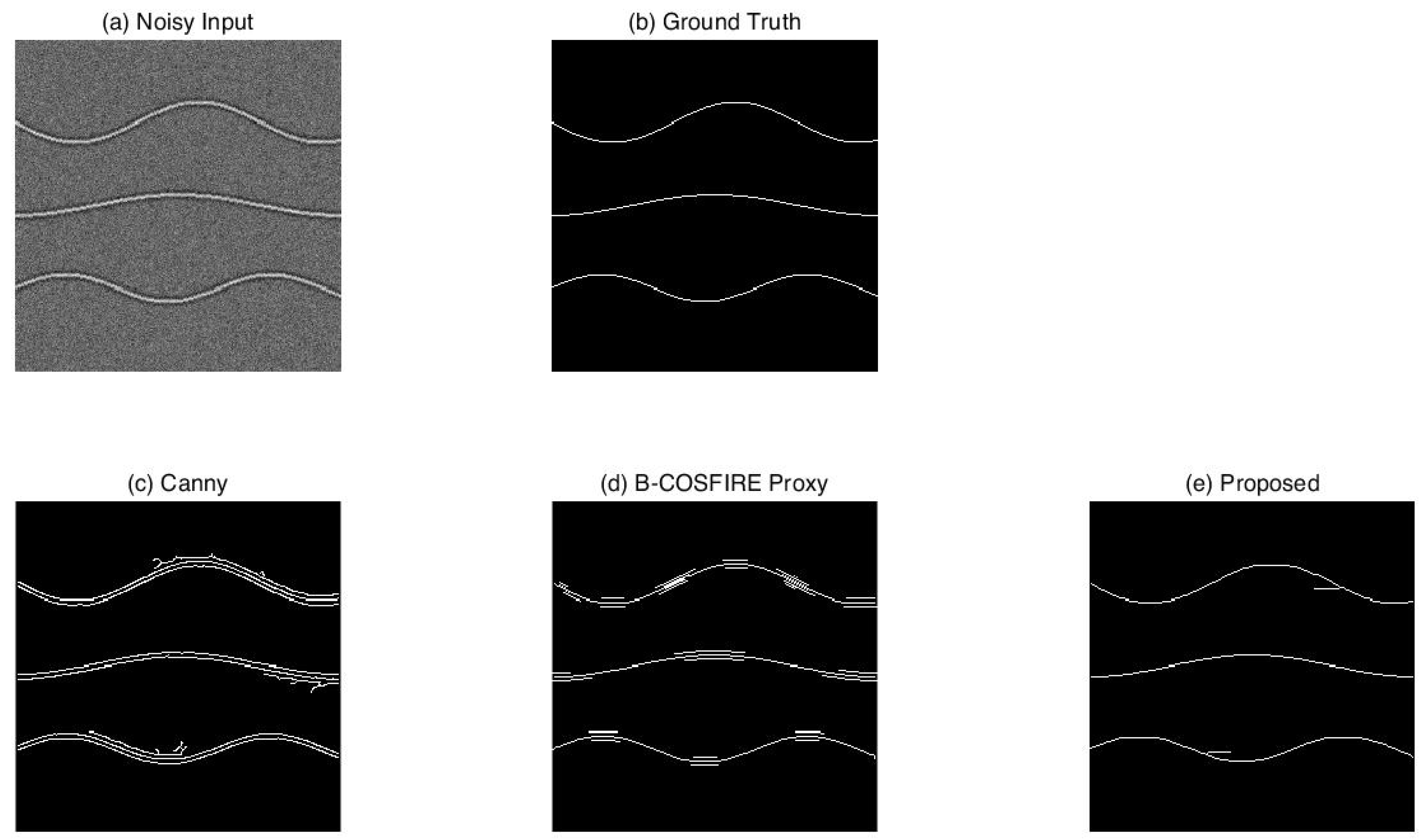
To quantitatively verify algorithm performance, the noisy synthetic seismic profile was processed first (
Figure 1).
Table 1 summarizes the comparison of quantitative metrics at a noise level of
.
As shown in
Table 1, the proposed method achieves the highest F1-score of 0.9758, outperforming the standard Canny detector (0.8972) by 8.76% and B-COSFIRE (0.7311) by 33.47%. In terms of Precision, the proposed method achieves 0.9527, substantially higher than B-COSFIRE (0.5762), indicating significantly fewer false positive detections. Both the proposed method and B-COSFIRE achieve a perfect Recall of 1.000, while Canny reaches 0.9960, confirming that all three methods successfully detect the majority of true reflection events under the tested noise conditions.
The Continuity Index reveals a critical distinction between methods. Despite B-COSFIRE achieving perfect Recall, its CI of only 66.86 pixels—far below Canny (223.67) and the proposed method (261.00)—exposes a fundamental weakness: B-COSFIRE detects a large number of isolated pixel responses that lack lateral coherence, rendering them geologically meaningless for horizon tracking. This pattern of high Recall but low Precision and CI indicates systematic over-detection rather than accurate structural extraction.
In contrast, the proposed method achieves the highest CI of 261.00 pixels alongside the highest Precision, confirming that the SCC module successfully enforces lateral continuity while suppressing false detections. Furthermore, the proposed method achieves the lowest runtime of 0.024 s per profile, representing a 44× speedup over B-COSFIRE (1.039 s) and also faster than Canny (0.039 s), demonstrating the computational advantage of the lightweight DoG-SCC pipeline.
A systematic robustness analysis across varying noise levels is presented in
Section 3.3, further confirming the stability of these performance advantages.
3.3. Robustness Analysis Under Varying Noise Levels
To evaluate the generalizability and stability of the proposed lightweight framework, we conducted a systematic robustness analysis by extending the synthetic dataset to include a gradient of noise intensities. Beyond the specific case (σ = 0.15) discussed in
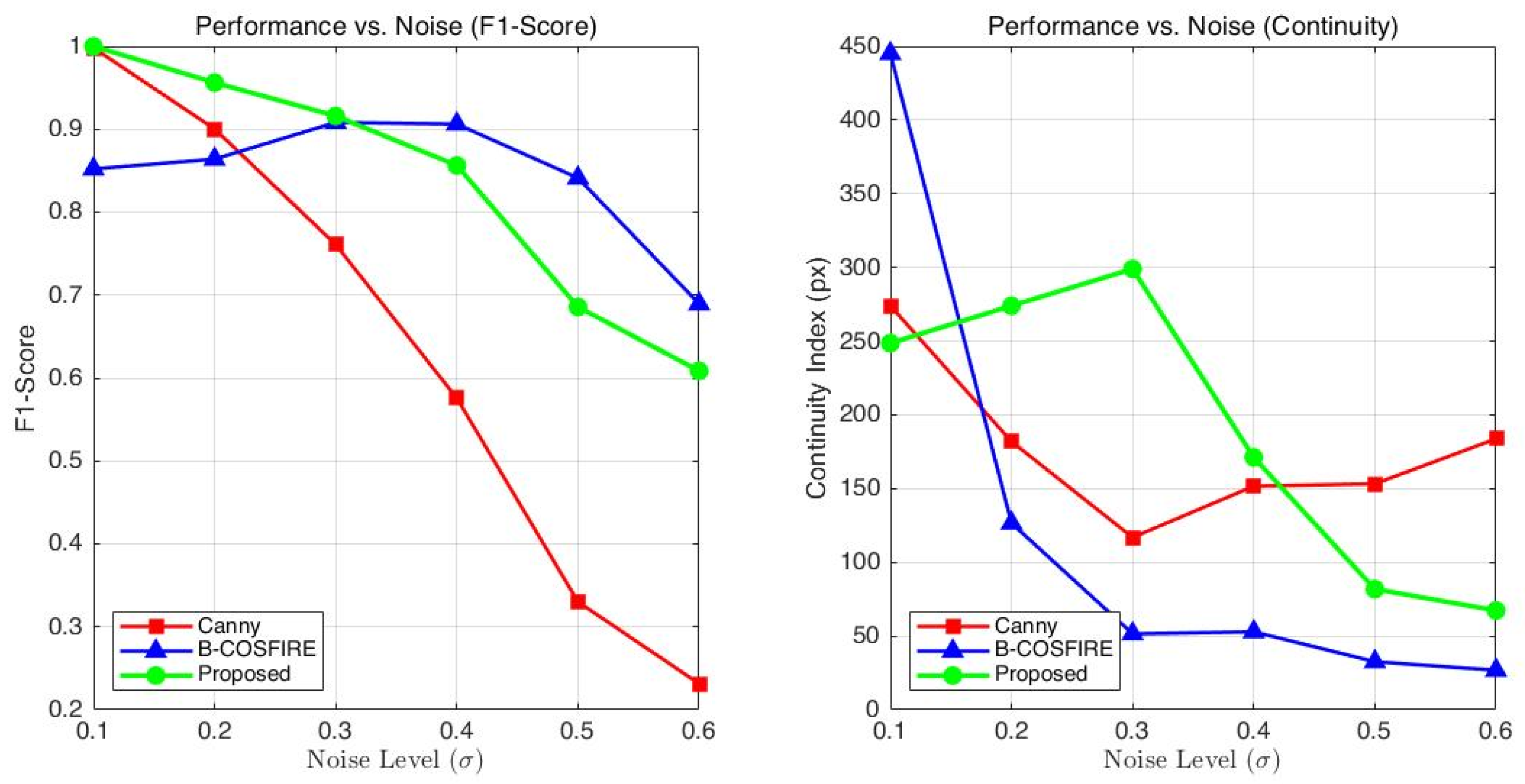
Section 3.1, Gaussian noise with standard deviations ranging from σ = 0.1 to σ = 0.6 was applied to the synthetic seismic profiles. This rigorous testing aims to quantify how the proposed SCC module sustains performance under deteriorating Signal-to-Noise Ratio (SNR) conditions, as compared to the baseline Canny and B-COSFIRE operators. The quantitative metrics for this expanded dataset are summarized in
Table 2, and the corresponding performance trends are visualized in
Figure 2.
As σ increases, the CI of the proposed method remains relatively stable or decreases gracefully compared to the baseline methods, demonstrating the efficacy of the SCC module in maintaining topological connectivity under high noise.
Note that the apparent increase in Canny’s CI at σ = 0.6 is due to the high density of random noise pixels forming spurious connections, rather than meaningful geological structures.
As shown in the F1-score curves, the proposed method achieves the highest F1-score across the low-to-moderate noise range (σ = 0.1–0.4), with scores of 1.0000, 0.9562, 0.9160, and 0.8564 respectively, consistently outperforming both Canny and B-COSFIRE in this range. At σ = 0.1, Canny also achieves near-perfect F1 (0.998), but its performance degrades sharply beyond σ = 0.3, collapsing to 0.576 at σ = 0.4 and 0.231 at σ = 0.6. B-COSFIRE maintains relatively stable F1 across the full noise range, but at the cost of significantly lower performance under low noise conditions (F1 = 0.852 at σ = 0.1). At extreme noise levels (σ ≥ 0.5), all three methods experience substantial performance degradation, with B-COSFIRE achieving the highest F1 in this range.
The Continuity Index curves reveal complementary insights. The proposed method achieves the highest CI across σ = 0.2–0.4 (274.00, 299.00, and 171.17 pixels respectively), demonstrating that the SCC module provides systematic continuity preservation under moderate noise conditions. Notably, B-COSFIRE exhibits a sharp CI collapse between σ = 0.1 and σ = 0.2 (from 445.00 to 126.56 pixels), suggesting that its multi-orientation filter responses become highly fragmented even under moderate noise, despite maintaining acceptable F1-scores. At σ ≥ 0.5, Canny exhibits anomalously high CI values relative to its F1-scores. This apparent paradox is explained by the fact that under extreme noise conditions, Canny’s gradient-based detection connects noise-induced false edges into spurious long segments—a form of false continuity that does not correspond to true geological horizons, and is therefore geologically meaningless.
Overall, these results confirm that the proposed method provides the most reliable performance in the practically relevant low-to-moderate noise range (σ = 0.1–0.4), where both detection accuracy and spatial continuity are simultaneously optimized. The performance advantage is most pronounced in the moderate noise regime (σ = 0.2–0.4), where the SCC module’s continuity enforcement becomes critical for maintaining geologically meaningful extraction results.
3.4. Parameter Sensitivity Analysis
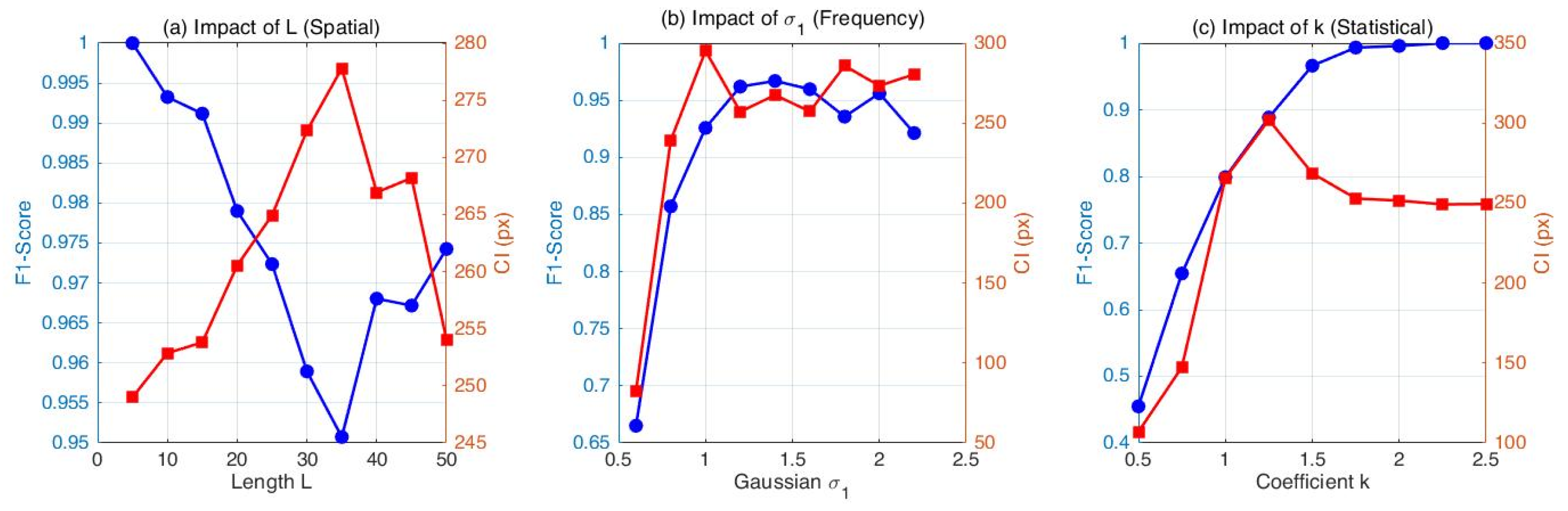
To evaluate the algorithmic stability and provide parameter selection guidelines, a comprehensive sensitivity analysis was conducted on the core parameters: structuring element length (L), Gaussian standard deviation (σ
1), and threshold coefficient (k). σ
2 was set proportionally to σ
1 throughout the analysis. To eliminate the interference of stochastic noise, the metrics were averaged over five independent Monte Carlo runs under moderate noise conditions. The results are illustrated in
Figure 3.
Spatial Scale (L): The F1-score achieves its peak performance at small L values (L = 5–15), with a gradual decline as L increases beyond 20, reflecting the trade-off between continuity enforcement and positional accuracy. The selected value of L = 21 represents a practical balance between these competing objectives.
Frequency Scale (σ1): The F1-score reaches its peak in the range σ1 ∈ [1.0, 1.75], with the selected value σ1 = 1.2 falling within this optimal region, confirming that the default setting is well-calibrated for matching the dominant half-wavelength of seismic reflection events.
Statistical Threshold (k):
Figure 3c reveals that the framework maintains exceptionally robust performance across a wide plateau of k ∈ [1.25, 2.0]. The utilized default value of k = 1.5 falls squarely in this optimal range, demonstrating that the proposed SCC module significantly reduces the algorithm’s sensitivity to rigid threshold tuning.
3.5. Application to Real Data
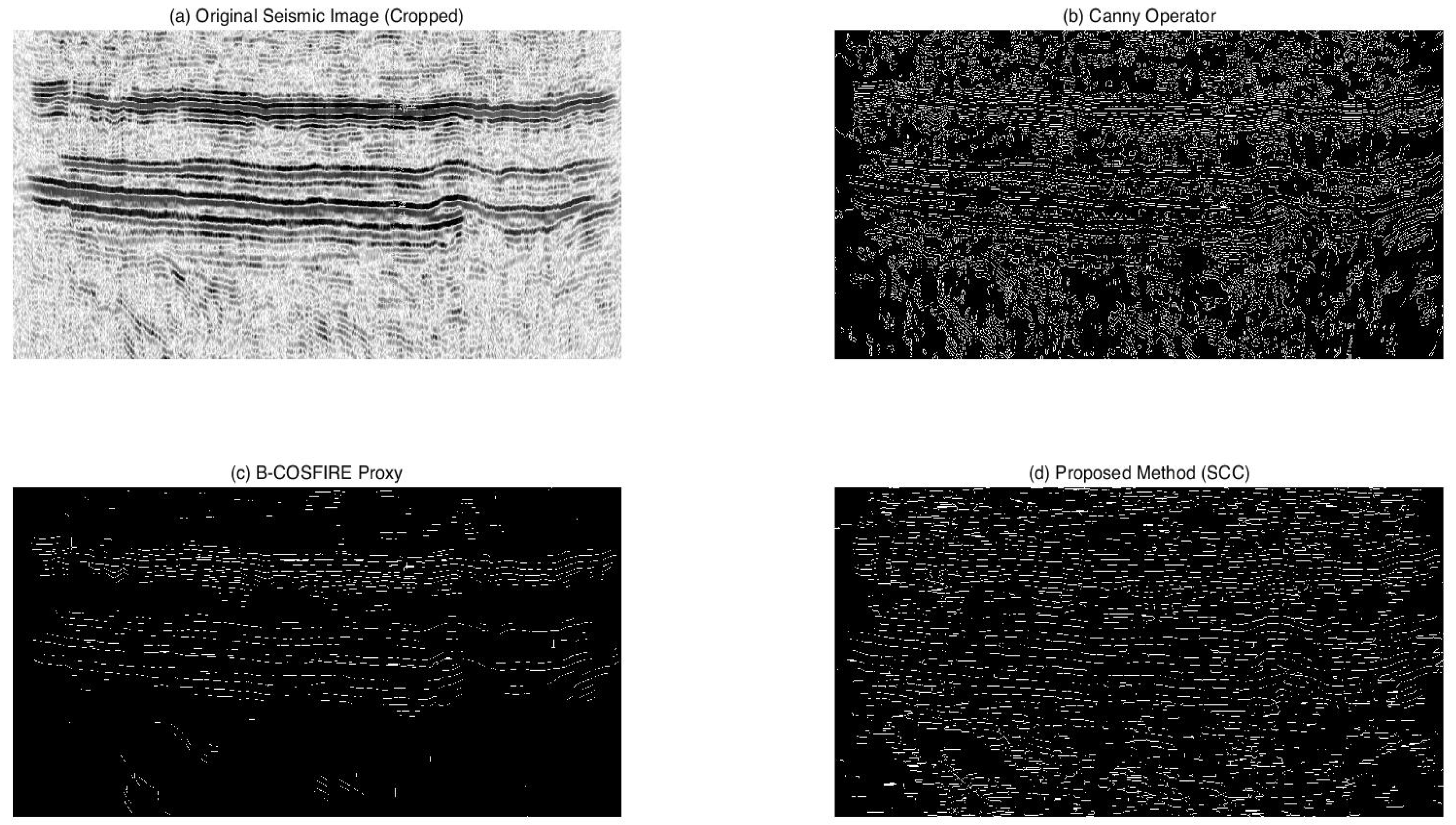
To further verify the engineering applicability of the method, it was applied to an actual field post-stack 2D seismic profile. The processing results are shown in
Figure 4.
As no expert-annotated ground truth is available for the real seismic profile, this experiment serves as a qualitative validation of the proposed method’s applicability to field data conditions, rather than a quantitative evaluation.
Figure 4 displays the extraction effects of three methods on the real post-stack seismic profile. Due to the low SNR of the raw data, the Canny operator (
Figure 4b) misdetects a large amount of incoherent background noise as edge responses, producing results filled with geologically meaningless fragmented points. B-COSFIRE (
Figure 4c), while capturing more structural information, similarly generates excessive fragmented responses with poor lateral coherence, consistent with its low CI observed in the synthetic experiments. In contrast, the proposed method (
Figure 4d) demonstrates superior signal–noise separation capability. By introducing the SCC module, the algorithm effectively suppresses isolated background noise and reconstructs local breaks based on the lateral continuity of seismic signals, producing reflection contours with high structural integrity that accurately reflect the geometric morphology of subsurface strata.
The real-data results are consistent with the trends observed in the quantitative synthetic experiments. Combined with the data in
Table 1, the proposed method maintains an execution efficiency (approx. 0.024 s) substantially faster than both Canny (0.039 s) and B-COSFIRE (1.039 s), while introducing spatial consistency constraints to enhance geological continuity. This efficient and robust characteristic demonstrates strong potential for practical deployment in the real-time preprocessing and assisted interpretation of large-scale seismic data.
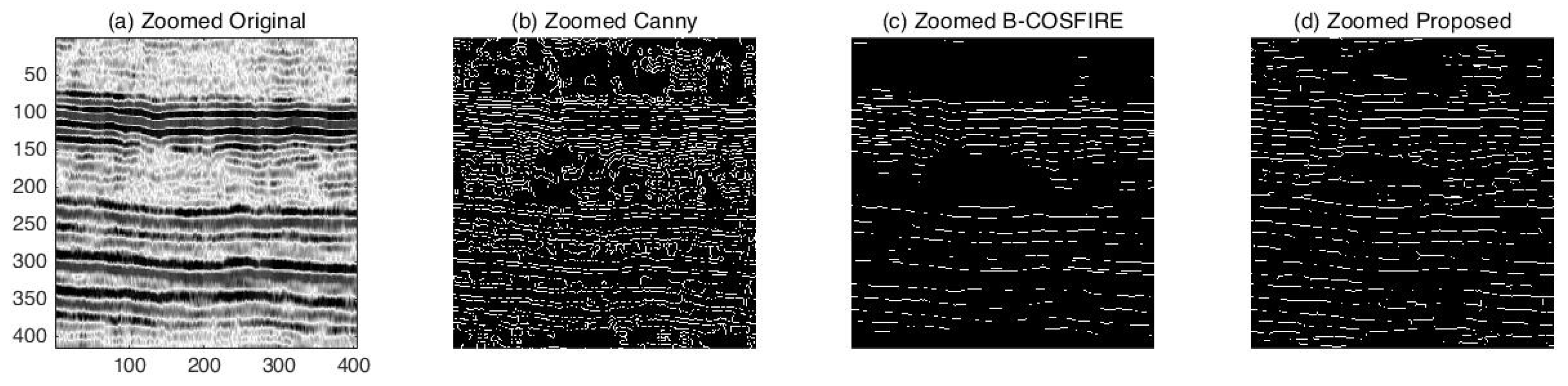
For a more detailed comparison,
Figure 5 presents local zoomed-in views of a representative region from the real seismic profile. In the zoomed original image (
Figure 5a), multiple near-horizontal reflection events are visible against a noisy background, providing a challenging test for event continuity preservation.
Under magnification, the fundamental differences between methods become clearly apparent. The Canny operator (
Figure 5b) produces heavily fragmented responses, decomposing what should be continuous horizons into densely scattered isolated points. This behavior confirms that local gradient-based detection is fundamentally inadequate for preserving the lateral coherence of reflection events under field noise conditions.
B-COSFIRE (
Figure 5c) partially recovers some structural information compared to Canny, but still exhibits significant fragmentation and poor lateral coherence at fine scales. The extracted responses lack the smooth, continuous character required for reliable horizon tracking, consistent with its low Continuity Index (66.86 pixels) observed in the quantitative synthetic experiments.
In contrast, the proposed method (
Figure 5d) produces noticeably more continuous and laterally coherent reflection contours. The directional SCC module effectively bridges local discontinuities, reconstructing smooth linear structures that closely follow the true stratigraphic geometry. These zoomed results further confirm that the SCC-based spatial continuity enforcement translates directly into improved fine-scale interpretation quality under real field conditions [
25].
In summary, when processing low SNR real seismic data, the proposed method shows superior continuity and noise suppression but also possesses high computational efficiency.
Despite the encouraging qualitative results, it should be noted that the real-data validation in this study is based on a single seismic profile, which may limit the statistical generalizability of the conclusions. However, the proposed framework is fundamentally data-independent and does not rely on training or dataset-specific optimization. Combined with the consistent performance observed across a wide range of synthetic noise levels (
Section 3.3), this suggests that the method possesses a degree of robustness to varying signal conditions. Nevertheless, further validation on multiple field datasets with diverse geological settings will be necessary to fully establish its generalization capability.
3.6. Comparison and Discussion
Necessity of Spatial Constraints: The traditional Canny operator relies solely on local gradient variations. In the complex background interference environment of seismic data, this point-to-point detection method is easily misled by random noise, resulting in “fragmented points.” The SCC module proposed in this paper introduces prior geometric constraints of geological horizons through morphological closing. The quantitative results reveal a clear hierarchy across the three methods. The proposed method achieves superior performance in F1-score (0.9758), Precision (0.9527), and CI (261.00 pixels), while matching B-COSFIRE’s perfect Recall. Critically, B-COSFIRE’s extremely low CI (66.86 pixels) despite its perfect Recall demonstrates that high sensitivity alone is insufficient for seismic horizon extraction—spatially coherent linear structures, enforced by the SCC module, are essential for geologically meaningful results. This quantitatively validates the shift from pixel-level detection to geometry-driven topology reconstruction as the core design principle of the proposed framework [
26,
27,
28].
Balance between Detection Accuracy and Noise Robustness: The Precision–Recall profiles of the three methods reflect fundamentally different detection strategies. Canny achieves a well-balanced profile (p = 0.8162, R = 0.9960) but fails to enforce spatial continuity, resulting in fragmented outputs. B-COSFIRE exhibits severely imbalanced detection (p = 0.5762, R = 1.000), indicating that its multi-orientation filter bank generates excessive false positives in noisy conditions—a critical limitation for practical deployment. The proposed method achieves the optimal balance (p = 0.9527, R = 1.000), combining high sensitivity with high Precision through the complementary action of DoG enhancement and SCC.
Complementarity with Deep Learning-Based Approaches: Recent deep learning methods have demonstrated strong performance in seismic interpretation by learning hierarchical and multi-scale features from labeled data. However, to provide a more rigorous evaluation beyond qualitative discussion, a quantitative comparison with a representative deep learning model (U-Net) is presented in
Table 3.
As shown in
Table 3, U-Net achieves a competitive F1-score of 0.9680 under the low-noise condition (σ = 0.15), which is close to that of the proposed method (0.9758). This indicates that deep learning-based approaches can perform well when sufficient labeled data are available and the data distribution is relatively favorable. However, the proposed method still achieves a higher Continuity Index (261.00 vs. 240.00), demonstrating superior preservation of long and coherent seismic structures.
Under the higher-noise condition (σ = 0.4), U-Net attains a higher F1-score (0.8100 vs. 0.7564), reflecting its strong pixel-level detection capability. Nevertheless, the proposed method produces significantly better structural continuity, with a CI of 171.17 compared to 135.00 for U-Net. This suggests that while deep learning models may optimize pixel-wise accuracy, they do not explicitly enforce topological consistency, which is critical for seismic horizon interpretation.
This distinction is particularly important in geophysical applications, where the continuity and structural integrity of reflection events are often more important than isolated pixel accuracy. The SCC module directly addresses this requirement by embedding geological continuity as a geometric constraint.
In addition, the proposed method requires no labeled samples, no training stage, and no GPU support, while achieving the fastest inference time (0.024 s). In contrast, U-Net requires 100 labeled samples, approximately 10 min of training, GPU resources, and a longer inference time (0.12 s).
Therefore, rather than directly replacing deep learning approaches, the proposed framework provides a complementary solution that is particularly advantageous in data-limited or resource-constrained scenarios. It is well-suited for rapid first-pass extraction, large-scale preprocessing, and deployment in industrial workflows where efficiency, interpretability, and robustness are critical [
29,
30].
4. Discussion
4.1. Efficiency Analysis
In modern seismic exploration production, 3D seismic data volumes often contain thousands of 2D profiles; thus, algorithm efficiency directly impacts engineering usability. The proposed method avoids model training and iterative optimization, consisting only of convolution and morphological operations, facilitating parallel acceleration on CPU/GPU. Taking the experimental setup as an example, the proposed method processes a single profile in approximately 0.024 s—faster than both Canny (0.039 s) and B-COSFIRE (1.039 s). Processing 1000 profiles would require approximately 24 s, compared to 39 s for Canny and over 17 min for B-COSFIRE. This efficiency advantage becomes operationally decisive in large-scale 3D seismic surveys containing thousands of profiles. Under further parallelization or more efficient implementation, it can meet the efficiency demands of batch preprocessing and interactive interpretation. Compared with deep learning pipelines, this efficiency advantage is further amplified by the absence of offline training, large-scale annotation preparation, and repeated hyperparameter optimization, which are often necessary for supervised deployment.
From an engineering application perspective, the proposed method maintains high simplicity and interpretability in parameter design. Unlike methods relying on complex non-linear structures or massive manually labeled samples, this framework involves only a few parameters with clear geological meanings. For example, the structuring element length can be directly understood as the expected continuous scale of the extracted horizon. This parameterization not only reduces debugging costs when migrating between different work areas but also helps maintain system stability during large-scale automated batch processing, making it more suitable as an engineering tool in the seismic data-assisted interpretation workflow.
This efficiency allows geoscientists to conduct preliminary, large-scale investigations across extensive areas—particularly in regions where hydrocarbon potential has not been fully mapped or where previous surveys were fragmented. For example, in large-scale basins such as the Ordos Basin, historical surveys were often performed in isolated segments without an integrated overview. The present method provides a practical solution for such scenarios, offering a first-pass, region-wide assessment that can guide more detailed follow-up studies.
4.2. Robustness in Low-Knowledge Areas
Another significant advantage of the method is its robustness in areas with limited prior exploration. By relying on spatially consistent ridge detection rather than extensive training data or iterative parameter tuning, the framework can generate coherent reflection contours even in low-exploration regions. This feature is especially valuable in preliminary exploration campaigns, where comprehensive data coverage is lacking and traditional manual interpretation is impractical. The ability to provide a cohesive, basin-scale structural overview enhances decision-making for subsequent detailed exploration and reservoir characterization.
4.3. Limitations and Future Work
The proposed framework has several limitations that should be noted.
First, the current real-data validation is based on a single post-stack seismic profile. Although the qualitative results are consistent with the synthetic experiments, this setting is insufficient to fully support broad generalization across different geological settings, acquisition conditions, and data qualities. The synthetic experiments partially compensate for this limitation by covering a range of noise levels (σ = 0.1–0.6), which provides evidence of robustness under varying SNR conditions. However, further validation on multiple field datasets is still necessary to confirm the transferability of the method in practical applications.
Second, the present experiments consider only isotropic Gaussian random noise. In real seismic data, coherent noise such as linear interference, ground roll, and air waves may exhibit directional patterns similar to true reflection events, which could reduce precision. Multiple reflections may also be difficult to distinguish from primary reflections using morphological features alone. For these cases, the proposed framework would benefit from coupling with preprocessing modules such as directional filtering, dip-guided noise suppression, or multiple attenuation.
Third, the SCC module assumes that valid reflection events are laterally continuous within a dominant structural direction. This assumption is appropriate for relatively simple to moderately complex stratigraphic settings, but it may be less reliable in faulted zones, intersecting reflection systems, or areas with rapidly varying dips. In such cases, directional closing may over-connect discontinuous events or fail to preserve crossing structures.
Future work will therefore focus on three directions: expanding validation to multiple real seismic datasets, incorporating more realistic structured-noise models into the synthetic tests, and developing adaptive multi-orientation SCC operators that can better handle complex geological geometries. These improvements would strengthen the generalization capability of the framework while preserving its efficiency and interpretability.
5. Conclusions
This study presents a lightweight and computationally efficient framework for seismic reflection event extraction, combining Difference-of-Gaussian (DoG) enhancement with a morphological closing–based Spatial Consistency Constraint (SCC). The proposed method effectively enhances ridge-like reflection structures while enforcing lateral continuity, resulting in significant improvements in both detection accuracy and structural coherence.
Experimental results on synthetic data demonstrate that the proposed method achieves superior performance compared to conventional approaches, including Canny and B-COSFIRE, in terms of F1-score and Continuity Index. In addition, a quantitative comparison with a representative deep learning model (U-Net) shows that, while deep learning methods can achieve competitive pixel-level accuracy, the proposed framework provides stronger structural continuity and significantly lower computational and deployment costs.
The method is particularly advantageous for large-scale seismic data processing, as it requires no labeled data, no training stage, and minimal computational resources, while maintaining high efficiency and interpretability. These characteristics make it well-suited for rapid first-pass analysis and computer-assisted interpretation in industrial oil and gas exploration workflows.
It should be noted that the current real-data validation is limited to a single seismic profile, which may constrain the generalization of the conclusions. Future work will focus on extending validation to multiple datasets with diverse geological conditions, as well as incorporating more realistic noise models and adaptive directional constraints to further improve robustness in complex environments.