


Abstract
Hot-air drying is widely adopted for herbs because it is robust and easy to control, yet it is often energy-intensive and may operate far from optimal conditions when industrial dryers rely on fixed airflow paths and large air recirculation rates. This work investigates a conventional basket-type, adiabatic hot-air dryer through an instrumented 30 h drying campaign and a psychrometric energy analysis. The hot-air drier is designed to reduce the relative humidity of herbs from the environmental value (highly variable as a function of the species, the weather conditions, and, mostly, the seasonality) to 20%. Temperature and relative humidity were measured at four positions to characterize the shelf-by-shelf drying sequence and to identify process phases. A mass balance indicated that approximately 3.8 t of water was removed during the trial. Based on the measured thermodynamic states of the moist air and estimated airflow rates (35,000–53,000 m3/h), the baseline configuration was analyzed and an upgrade strategy was proposed to improve dehumidification and overall efficiency while preserving the conventional hot-air-drying concept. The alternative solution integrates a refrigeration-based dehumidification loop (heat pump) to decouple moisture removal from sensible heating; three plant layouts and seasonal boundary conditions (summer/winter) were simulated. For the most favorable configurations, the specific final–primary energy demand and the associated CO2-equivalent emissions were reduced by about 70–85% compared with the baseline, depending on the airflow rate and recirculation strategy. The results highlight practical retrofit options for existing herb dryers and provide a transparent framework for translating measured psychrometric states into energy and emission indicators. The results, achieved and discussed in this study, were used to optimize the utilization of an already existing and operative hot-air dryer. Based on the proposed working configuration, the dryer now allows achieving the fixed target for herb mixtures of the previous configuration and, at the same time, reducing the energy consumption and associated equivalent CO2 emitted, as well as achieving process completion in less time.
1. Introduction
In the agri-food sector, which also extends to the nutraceutical field, there is an increasing use of herbs for processing and subsequent consumption.
Herbs, which are plants with leaves, seeds, or flowers utilized for flavoring, culinary purposes, medicinal uses, or perfume production, are highly perishable foods because of their high moisture content and sensitivity to cold temperatures [1].
So, herbs require a preservation phase, i.e., a reduction in their water content, to extend their shelf life [2] and facilitate other necessary physico-chemical treatments for their transformation into foods, nutritional supplements, and others. Herbs are known to be an excellent source of essential oils and antioxidants. The essential oils extracted from herbs possess potent antimicrobial properties, making them effective against a wide range of bacteria, yeast, and molds. Additionally, the high antioxidant content in herbs contributes to their ability to counteract oxidative stress, thereby promoting overall health and reducing the risk of chronic diseases [3,4].
Proper herb preservation is a goal shared by both traditional cooking and the food industry, differing only in the methods and equipment used [5,6].
In general, food preservation, through specific processes, aims to maintain its organoleptic and hygienic–nutritional characteristics for extended periods by inhibiting the agents of spoilage that could compromise its safety [7]. Food spoilage is caused by both microorganisms and enzymes present in commodities, as well as by contact with atmospheric agents [8]. Consequently, to avoid these issues, it is necessary to apply specific preservation techniques to preserve herbs while minimally altering their characteristics. A preservation process is considered valid if (1) the nutritional value of the product is not excessively reduced; (2) the organoleptic characteristics are not significantly altered; (3) no relevant changes in the food are caused that could result in harmful substances for the consumer’s health [9].
There are numerous methods for food preservation [10]. Based on the nature of the medium used for preservation, they can be categorized into (1) physical methods, (2) chemical methods, and (3) physico-chemical and biological methods.
Physical preservation methods are further divided into several main types: (1) temperature control; (2) water control; (3) modified environments; (4) irradiation [11].
Water removal preservation aims to almost eliminate the water content in foods. Drying traditionally reduces the water content from 65–95% in fresh foods to 10–15% in finished products, thereby inhibiting the growth of microorganisms [12]. The methods for drying food can be natural or artificial [13,14]. Natural methods involve exposing products such as fruits, vegetables, meats, and fish to the sun and air for prolonged periods [15].
Artificial methods originated in the early 20th century with the creation of the first dryers, artificially heated environments where the product was circulated or left to stand. Today, various types of equipment are used for drying, which can be achieved through heated gases (hot air), radiation, and contact with hot surfaces [16].
Concerning herb drying methods, the most well-known conventional drying methods are (1) sun drying, (2) shade drying, (3) freeze drying, and (4) hot-air drying [9].
As mentioned before, the sun and shade drying methods, also called solar-powered drying methods, have been almost entirely abandoned by modern industries since they employ excessively long drying times to remove the moisture content from the herbs [17].
Freeze drying (or lyophilization) involves dehydration by sublimation of previously frozen herbs under specific conditions of temperature (below zero degrees) and pressure (vacuum) [18]. Hot air drying, also called convective drying, is the most widely used method [19]. The hot air has a dual purpose: it transfers heat to the food and removes the vapor released from it. The absolute humidity of the air, which is the amount of vapor it can absorb until saturation, increases with rising temperatures. Therefore, the food will dry faster as the temperature and the air circulation speed—which allows the replacement of moist air with drier air—increase. However, drying should not occur too quickly to prevent the surface layers from forming a barrier to the moisture in the underlying layers, thereby compromising the success of the drying process.
Apart from traditional herb-drying techniques, the industry is already employing alternative methods that offer potential advantages. These include solar-assisted drying, microwave drying, microwave–vacuum drying, infrared-assisted drying, heat pump drying, and contact drying.
The drying method is one of the main factors affecting the quality of dried herbs, particularly in terms of their aroma and color. Its influence has been extensively studied, and both conventional and newly developed drying methods’ effects on the quality of dried herbs have been comprehensively reviewed [20].
The most common hot-air herb dryers are as follows: (1) cabinet dryers, (2) tunnel dryers, (3) fluidized bed dryers, (4) spray dryers, and (5) rotary drum dryers.
The major advantage of hot-air drying is the controllability of the process since it is possible to adjust parameters such as drying temperature, drying time, and air velocity to achieve the desired product properties. Nevertheless, it comes with some disadvantages, such as the following: (1) loss of volatile compounds, which can affect the aroma of the herbs, (2) degradation of aroma and pigments, (3) heat-sensitive compounds (to preserve heat-sensitive compounds, lower drying temperatures (35–50 °C) are recommended [21,22], with consequent longer residence times), (4) oxidation reactions, (5) high shrinkage, and (6) high energy consumption.
Therefore, the hot-air process must ensure the loss of water content, whose percentage depends on the type of herb and the desired final product, as well as the temperature and pressure conditions that must be maintained to preserve the nutritional and organoleptic properties of the product. Consequently, the hot-air process plays a critical role, and certain previously mentioned conditions must be meticulously upheld.
In parallel, it is also necessary to adopt low-energy consumption strategies to reduce costs and minimize the product’s environmental impact.
While several advanced drying technologies have been proposed (e.g., microwave-assisted, infrared-assisted, vacuum, or freeze drying), many industrial operators rely on existing hot-air dryers.
According to this, the present study focuses on improving a traditional batch hot-air dryer rather than replacing it. The hot-air dryer selected for this study is thought to bring the relative humidity of herbs below 20%. The objective is to identify retrofit-compatible process and plant solutions that reduce the energy demand and the environmental impact while keeping the operating principle of the conventional dryer, thus reaching the target value of final relative humidity.
Specifically, the study (a) instruments a basket-type batch dryer to resolve non-uniform shelf-by-shelf drying dynamics, (b) reconstructs the psychrometric cycle and quantifies the air recirculation ratio, (c) performs mass and energy balances to identify dominant losses and bottlenecks, and (d) evaluates a refrigeration-based dehumidification (heat pump) upgrade under different operating scenarios.
The alternative procedure, proposed and discussed in this study, was thought to reach the same targets of the traditional configuration with lower energy consumption, ensuring at the same time that the same quality requirements set for the process were met. Those requirements had to be respected in order to ensure the plant operating function and were consequently checked and approved by the quality system of the owner and user of the dryer studied in the present research. However, the present study is entirely focused on process optimization and, consequently, on energy consumption minimization, while the qualitative description of herbs before and after treatment will be of interest for future reports.
After verifying that the target relative humidity value was achieved, the reduction in primary energy consumed and the lowering in equivalent CO2 emissions produced were calculated and discussed.
2. Materials and Methods
A conventional, industrial batch hot-air herb dryer was considered. The monitored batch consisted of Malva spp. processed under regular industrial operating conditions. During the 30 h drying cycle, approximately 3800 kg of water was removed, as estimated from the moist-air mass balance and corroborated by natural gas consumption data.
Exact initial and final moisture contents and total wet biomass load are confidential industrial parameters; however, the quantified removed-water mass provides a robust thermodynamic basis for the subsequent mass and energy balance analysis.
The dryer consists of adiabatic chambers in which baskets containing the product are placed; each basket includes four shelves. The hot-air dryer was designed to operate with mixtures of herbs and to reduce the humidity content from saturation conditions to 20% or lower values. The dryer operates on a heating cycle where the humidity is reduced by removal. Therefore, the energy spent on biomass drying is considered the average energy demand, mainly a function of the overall amount of biomass treated in the dryer and the target parameters to be reached. The measurement of these parameters allows us to calculate the portion of the total energy spent that is effectively absorbed from the biomass. The latter value depends, in fact, on the energy absorbed from water, when still present in liquid phase, and the energy associated with its transition to the vapor phase, then removed from the dryer via air circulation.
Lower temperature values result in longer drying times and, consequently, higher associated electric and thermal energy consumption. The dryer has a heating system that introduces air, extracts air, and recirculates some of the dried air.
Since moisture removal is governed by heat and mass transfer limitations within the biomass bed, the overall drying time can become significantly long, typically on the order of several tens of hours; in the investigated case, the complete drying cycle required approximately 30 h.
The proposed retrofit effect was thought and structured in order to achieve the same target as the actual hot-air herb dryer, without producing any qualitative change in the final product and, at the same time, reducing the overall energy requirements.
2.1. Instrumentation and Data Acquisition
Temperature and relative humidity were measured using Tinytag Plus 2 Dual Channel Temperature/Relative Humidity data loggers (model TGP-4500, Gemini Data Loggers Ltd., Chichester, UK). The measurement range is −25 to +85 °C for temperature and 0 to 100%RH for relative humidity.
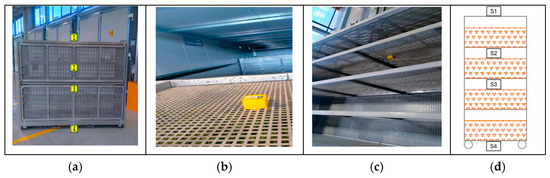
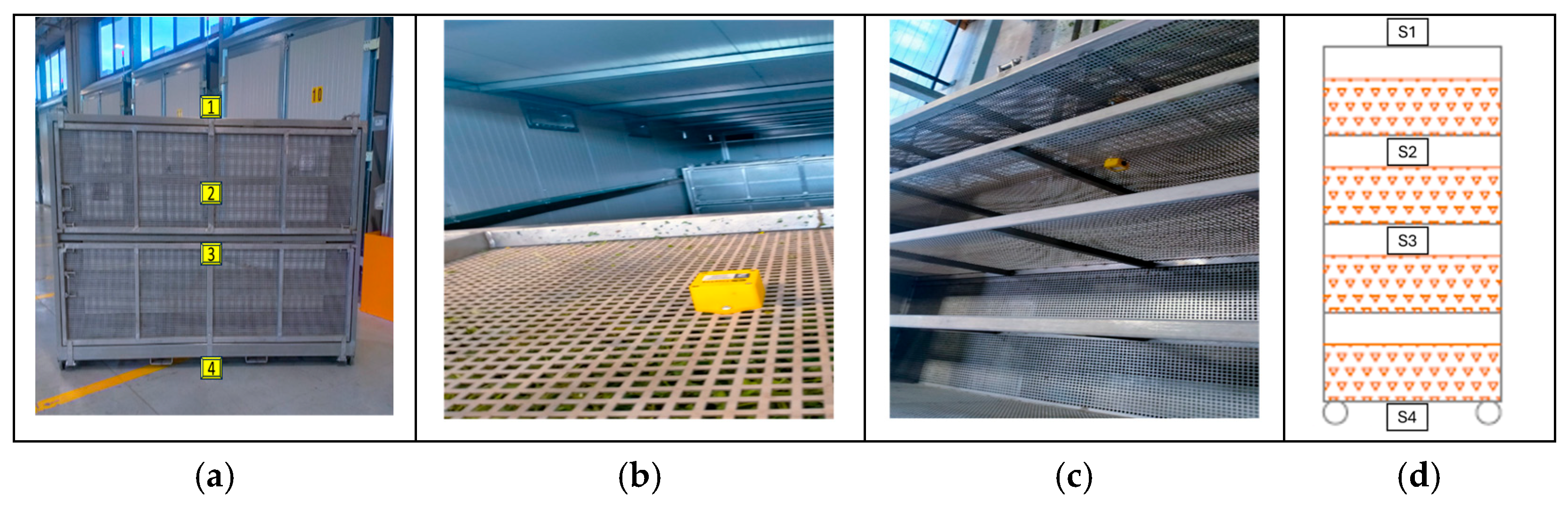
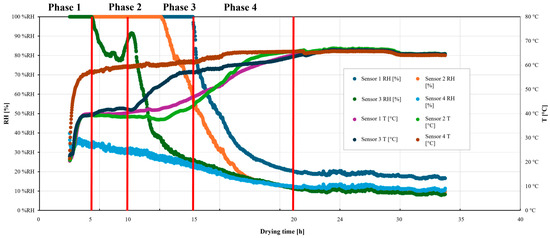
Four sensors were installed at the positions shown in Figure 1: sensor 1 (S1) above the basket (outlet region), sensor 4 (S4) below the basket (inlet region), and sensors 2–3 (S2 and S3) inside the basket on the upper side of shelves 2 and 3, respectively. Data were recorded continuously throughout the 30 h drying campaign.
Figure 1.
Location temperature and relative humidity sensors in the basket and installation details: (a) location of four sensors in the basket; (b) S1 above the basket (outlet region); (c) S2 inside the basket on the upper side of shelf 2; (d) scheme of the shelves to clearly visualize the positioning of each sensor (S1–S4).
Prior to the experimental campaign, the devices were verified against a reference thermo-hygrometer under laboratory conditions to ensure consistency of readings.
2.2. Data Processing and Phase Identification
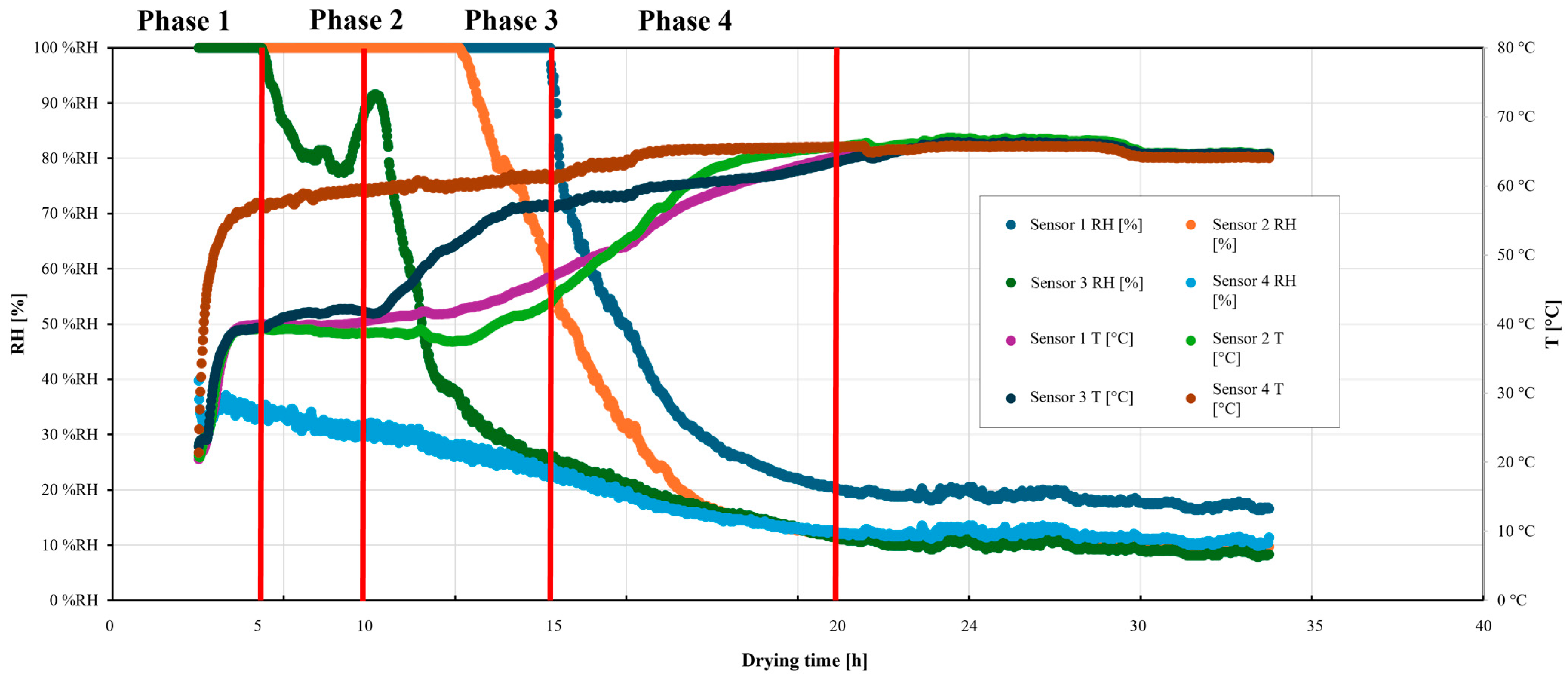
Temperature and relative humidity time series were used to characterize the shelf-by-shelf drying process (Figure 2). The target for the process was to keep the relative humidity below 20% in the treated air. The selected operating targets (inlet air temperature around 65 °C and relative humidity below 20%) reflect established industrial practice for convective drying of aromatic herbs. Nurhaslina et al. 2022 [23] summarized the different drying methods for herbal plants, showing how selecting an appropriate drying method is crucial to preserving the essential oil yield, antioxidant content, antimicrobial activity, health benefits, color, and aroma of dried goods. Selecting the right drying temperatures is crucial for herbs and medicinal plants [24]; this choice depends on the desired balance between drying speed and product quality: lower temperatures are usually employed when it is important to preserve volatile compounds, color, and bioactive components, while higher temperatures can speed up drying but may harm quality and increase thermal stress on the product.
Figure 2.
Combined temperature and relative humidity trends during the 30 h drying trial (sensors 1–4); the four process phases are identified by red lines.
Therefore, the present study viewed the chosen process goal, which combines low supply air relative humidity with an inlet temperature close to the industrial benchmark, as a practical compromise between drying efficiency, batch duration, and product preservation. In the present study, these parameters are treated as fixed operational constraints of the existing process rather than optimization variables. Based on the onset of humidity reduction observed on each shelf, four process phases were identified; these phases are marked by red lines in Figure 2 and are reported in Table 1. For each phase, the moist-air specific humidity ω (g/kg of dry air) was computed.
Table 1.
Identified phases in the drying process. Each phase describes the system as soon as the target RH% condition was achieved for one of the four shelves. The time elapsed to achieve the target conditions for each shelf is shown in Figure 1; this table shows the measured and calculated parameters of interest for each phase fixed in the diagram corresponding to Figure 1.
The drying airflow follows a sequential path, initially passing through the bottom shelf (i.e., shelf no. 4) and progressively reaching the upper shelves. This sequential exposure results in temporally distinct drying profiles for each shelf.
The bottom shelf goes through an immediate temperature increase exceeding 50 °C, asymptotically approaching the target temperature of 65 °C. The rapid temperature rise can be attributed to its direct exposure to the incoming hot air. Subsequently, the temperature of the upper shelves gradually increases as the drying airflow advances upward.
The primary objective of the drying process is to maintain the relative humidity below 20%. As shown in Figure 2, this condition is largely achieved within approximately two-thirds of the total test duration.
Based on the data presented in Figure 2, four distinct phases of the drying process can be identified. These phases, delineated by red lines, are further detailed in Table 1. The onset of each phase corresponds to the beginning of humidity reduction in a specific shelf. Accordingly, during the first phase, a lowering of humidity is observed only for shelf 4, which is positioned lower than the others. In the second phase, the biomass contained in shelf 3 also begins to dry, while the residual moisture in shelf 4 continues to decrease, although less markedly than in the previous phase, and so on for the subsequent phases.
The data reported in Figure 2 allow for two key observations: (1) each shelf undergoes a substantial reduction in relative humidity (approximately 30–35%) over a timeframe that is significantly shorter than the total duration of the drying process; (2) the top shelf consistently exhibits a higher relative humidity compared to the lower three shelves. As a result, it requires a considerably longer time to reach the target humidity level.
Figure 2 and Table 1 highlight sequential drying behavior across shelves, with the upper shelf reaching the target conditions later than the lower shelves. In batch operation, this non-uniformity directly hinders energy efficiency because the cycle must continue until the slowest-drying shelf meets the target (30 h), while other shelves remain exposed to hot air longer than necessary. This mechanism contributes to the high final energy demand of the baseline configuration.
2.3. Air and Water Mass Balance and Airflow Estimation
The water balance, based on the measured specific humidity, indicated that approximately 3800 kg of water was removed during the 30 h test. Using an average ω = 40 g/kg, this corresponds to an extracted air volume of about 87,000 m3 over the test duration. To estimate the total airflow rate supplied to the dryer (including recirculation), fan operating curves were used together with the measured pressure rise (650 Pa) and electrical power (18 kW). This approach yielded a total airflow rate of approximately 53,000 m3/h (16.2 kg/s), corresponding to a low fan efficiency (0.53). For comparison, a second operating regime, corresponding to the maximum fan efficiency, was also considered (35,000 m3/h equal to 10.7 kg/s; a mean air density of approximately 1.1 kg/m3, consistent with the average temperature and humidity conditions of the process air, was assumed to convert volumetric flow rates into mass flow rates).
2.4. Psychrometric Cycle and Energy Balance
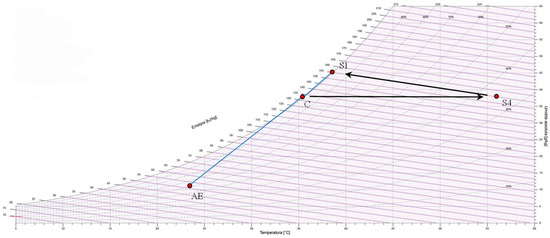
In Figure 3, the thermodynamic states of moist air are represented on psychrometric charts for the initial phase of the process. Four characteristic points were defined:
Figure 3.
Psychrometric diagram related to Phase 1.
- AE: outdoor air;
- S4: air entering the basket at the bottom shelf, consisting of a mixture of recirculated air and fresh air drawn from outside (this parameter was measured by sensor 4, located on the lowest shelf, i.e., the shelf directly exposed to the incoming airflow);
- S1: air leaving the basket at the top shelf;
- C: mixed air before the heating coil, composed of recirculated air and outside air.
While point AE remains fixed during the process, points S1 and S4 shift within the diagram as the overall humidity decreases over time. Consequently, the recirculated air progressively contains less water per unit volume.
With reference to Phase 1, point AE is characterized by a temperature of 23.5 °C and a relative humidity of 61%, corresponding to an enthalpy of 51.7 kJ/kg. In contrast, point S4 is associated with a temperature of 56 °C and a relative humidity of 35.2%, yielding an enthalpy of 155 kJ/kg and an absolute humidity of 38 g/kg.
The air transformation across the biomass bed was approximated as adiabatic humidification since moisture uptake is dominated by evaporation during air–biomass contact. Possible nonadiabatic effects (e.g., wall heat exchange) do not alter the comparative trends discussed in this work. Therefore, assuming adiabatic humidification, point S1 is obtained at 38.6 °C and 100% relative humidity, with enthalpy equal to 155 kJ/kg and an absolute humidity of 45 g/kg, in agreement with the values detected by the sensors at the furnace head during this phase. Finally, point C is identified by a temperature of 35.6 °C and an enthalpy of 133.4 kJ/kg.
The psychrometric diagram referring to Phase 4 clearly indicates that the flow rate of recirculated air is greater than that of the fresh air drawn from the outdoor environment. This can be inferred from the ratio between segments S1C and AEC, which suggests that the recirculated airflow rate is approximately five times higher than the outdoor air intake. These segments are defined by connecting points AE and S1 and then dividing this line into two parts using the horizontal secant passing through point S4.
In Phase 4, point AE is again characterized by a temperature of 23.5 °C and a relative humidity of 61%, corresponding to an enthalpy of 51.7 kJ/kg, similar to Phase 1. For points S4 and S1, values measured at mid-treatment were considered. Specifically, for S4, an average temperature of 64.5 °C and an average relative humidity of 17.8% were assumed, corresponding to an enthalpy of 138.2 kJ/kg and an absolute humidity of 27.9 g/kg. For S1, values of 52.8 °C and 44.5% relative humidity were assumed, yielding an enthalpy of 160.4 kJ/kg and an absolute humidity of 41.3 g/kg. Point C is identified by a temperature of 40 °C and an enthalpy of 113 kJ/kg.
As the biomass dries, the relative humidity of the recirculated airflow decreases, while its temperature remains nearly constant. At the same time, the temperature of the exhaust airflow tends to increase. The combined effect of these phenomena causes points S1 and S4 to progressively move apart. The psychrometric diagram allows visualization of the enthalpy associated with each point and, consequently, enables the evaluation of enthalpy differences between different states. By multiplying this enthalpy variation by the corresponding airflow rate, the energy required to transition from one state to another can be determined.
Therefore, the increasing separation between points S4 and S1 implies a change in the energy consumption per unit mass of air processed during drying.
An energy balance can be established by considering that the amount of heat the fluid inside the dryer must absorb to transition from the thermodynamic conditions represented by point C (post-mixing) to those at point S4 must be lower than the heat supplied by the hot coil fed by the boiler.
Expressed in terms of heat input, the energy required to raise the outdoor/recirculated air mixture to the dryer inlet temperature can be estimated using the following relationship (Equation (1)):
where:
q1 = mwa × (ΔH)
- ∆H = enthalpy variation, calculated from the psychrometric diagram for each identified drying phase [kJ/kg];
- mwa = mass flow rate of the moist air mixture [kg/s].
The amount of heat transferred from the hot coil to the humid air, i.e., the useful heat output of the exchanger, can be expressed as shown in Equation (2):
where:
q2 = ηhe × mH2O × γH2O × ΔTexc
- ηhe = heat exchanger efficiency;
- mH2O = boiler water mass flow rate;
- γH2O = specific heat capacity of water [kJ/kg K];
- ΔTexc = temperature difference between water entering and leaving the exchanger [°C].
The analysis of the initial stage of the process, during which the lowest shelf of the basket is dried, yields kW, assuming kJ/kg and kg/s. For the alternative airflow regime of 35,000 m3/h ( kg/s), kW.
At the higher airflow regime, the early-phase heating demand can approach or exceed the useful heat rate delivered by the existing coil, leaving a limited operating margin and increasing reliance on recirculation and transient effects. This supports retrofit solutions that enhance dehumidification rather than simply increasing heating capacity. A comparison with the useful heat output provided by the hot coil indicates that its capacity is insufficient to sustain the heating demand during this phase.
The average heat absorbed by biomass was calculated according to the equation below (Equation (3)):
where:
Average heat absorbed = (H2O × CH2O × ΔT)/h + (H2O × LHVAP)/h = 940 KW
- H2O = initial water content (3800 kg);
- CH2O = specific heat capacity of water (4.186 kJ/kg·K);
- ΔT = temperature difference (40°);
- t = hours of operation (30 h);
- LHVAP = latent heat of vaporization (2400 kJ/kg).
The value shown in Equation (3) consists of the power required to achieve the complete vaporization of the total amount of water initially present within the four shelves; consequently, it has to be considered as the maximum required power value and does not consider transients and variations in latent heat demand during the various process phases. As previously stated, the latter variables were considered by measuring and characterizing the relative humidity profiles of each shelf and were consequently used to define the various steps in which the overall process has been divided.
The heat absorbed by the biomass is predominantly latent heat, which corresponds to the energy required for phase change. The sensible heat needed to raise the temperature of the dry biomass is less than 10% of the latent heat contribution. Accordingly, two distinct contributions can be identified: the first term represents the sensible heat required to raise the water from ambient temperature to the vaporization temperature, while the second term accounts for the energy associated with the phase transition.
In this context, heat-pump-based dehumidification provides an additional degree of freedom by decoupling moisture removal from sensible heating, enabling lower humidity supply air without increasing boiler capacity.
3. Results and Discussion
To improve the performance of the conventional dryer, without changing its fundamental hot-air operating principle, a retrofit solution based on a refrigeration machine (heat pump) was evaluated. The concept is to remove moisture by cooling and condensing water vapor in a cold coil (evaporator), then recover the heat of condensation and compressor work in a hot coil (condenser) to reheat the drying air. This approach decouples dehumidification from sensible heating and can reduce or eliminate the need for the boiler-fed coil, shifting the energy supply toward electricity.
3.1. Retrofit Concept: Refrigeration-Based Dehumidification (Heat Pump)
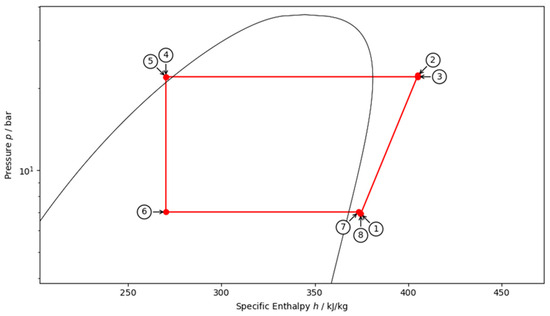
A refrigerant blend R449A was considered as a representative low-GWP alternative to legacy fluids for medium-temperature applications. The cycle was defined assuming an evaporating temperature of 5 °C and a condensing temperature of 50 °C, yielding a theoretical COP ≈ 4.14 under the adopted boundary conditions (Figure 4). This selection represents a typical retrofit-oriented solution and should not be regarded as the sole optimal choice. The current scientific literature [25] highlights a broad range of low-GWP refrigerants and refrigerant blends being evaluated for heat pump applications, encompassing hydrocarbons, HFOs, and zeotropic mixtures, each presenting distinct compromises in terms of energy efficiency, safety requirements, operating range, and compatibility with existing systems. Within this context, R449A was chosen as a lower-GWP substitute representative of medium-temperature retrofit scenarios, with the understanding that alternative fluids such as R290, R1234yf, or other blends are equally documented in the literature [26]. Similarly, the evaporating and condensing temperatures were defined as practical engineering values aimed at achieving a balance among moisture extraction at the evaporator, effective air reheating at the condenser, and overall thermodynamic cycle performance. As a general trend, higher drying-medium temperatures result in elevated condenser surface temperatures and increased compressor energy consumption, potentially lowering the COP, while precise temperature and humidity regulation plays a critical role in determining dehumidification effectiveness [25,26,27].
Figure 4.
Refrigeration (heat pump) cycle on the Mollier diagram for R449A under the adopted evaporating and condensing temperatures.
The refrigeration machine was sized to provide at least the same condenser heat rate as the baseline heating coil; with a refrigerant mass flow rate of 1.9 kg/s, the resulting compressor power is approximately 63 kWel and the condenser heat output is about 256 kW.
The values of temperature, pressure, and specific enthalpy of the points defined in the diagram are given below:
- Point 1: T = 13.00 °C, p = 7.346 bar, h = 375.67 kJ/kg;
- Point 2: T = 66.81 °C, p = 23.374 bar, h = 408.74 kJ/kg;
- Point 3: T = 66.43 °C, p = 23.109 bar, h = 408.74 kJ/kg;
- Point 4: T = 48.00 °C, p = 23.109 bar, h = 273.72 kJ/kg;
- Point 5: T = 48.00 °C, p = 23.109 bar, h = 273.72 kJ/kg;
- Point 6: T = 4.71 °C, p = 7.458 bar, h = 273.72 kJ/kg;
- Point 7: T = 12.00 °C, p = 7.458 bar, h = 374.38 kJ/kg;
- Point 8: T = 13.00 °C, p = 7.346 bar, h = 375.67 kJ/kg.
The enthalpy changes defined in the diagram take on the following meaning:
- (h2 − h5) = 135 kJ/kg change in capacitor enthalpy;
- (h1 − h6) = 102 kJ/kg change in evaporator enthalpy;
- (h3 − h1) = 33 kJ/kg change in compressor enthalpy.
3.2. Evaluated Plant Layouts and Boundary Conditions
Three plant layouts were considered:
- CASE 1: air recirculation (ratio equal to 5:1) with dehumidification at the evaporator followed by reheating at the condenser;
- CASE 2: 100% outdoor air (no recirculation), dehumidified then reheated by the refrigeration unit;
- CASE 3: CASE 1 or CASE 2 plus a post-heating section downstream of the condenser (hot-water coil) to increase inlet air temperature.
Each layout was evaluated for two airflow rates (53,000 and 35,000 m3/h) and for representative summer (Table 2) and winter outdoor-air conditions (Table 3).
Table 2.
Specific energy consumption for the same wet biomass load (summer period).
Table 3.
Specific energy consumption for the same wet biomass load (winter period).
In the baseline configuration, final energy demand is mainly provided as boiler-supplied heat to the heating coil. In the heat pump retrofit, moisture is removed by condensation and the process air is reheated by the condenser; therefore, the main final-energy input becomes the electricity required by the heat pump. In Table 2 and Table 3, electricity consumption refers to the heat pump electrical input, while thermal energy consumption refers only to boiler-supplied heat, including post-heating when present. The reduction in boiler heat demand relative to the baseline corresponds to the thermal saving.
Research indicates that optimizing airflow distribution can greatly improve uniformity in final products and decrease energy usage in extensive tray systems [28]. Regarding upgrades based on dehumidification, drying assisted by heat pumps has been thoroughly examined as an effective method to lower total energy usage in comparison to traditional hot-air drying [29].
The proposed heat pump retrofit configurations were assessed through simulation and were not experimentally validated on the investigated dryer. Full-scale experimental testing would require major plant modifications and extended downtime, which are not feasible in continuous industrial operation. The simulation framework is grounded on the measured operating conditions of the baseline cycle (air temperature and relative humidity trends, airflow estimates, and recirculation ratio) recorded during the 30 h campaign. However, uncertainties remain in the predicted retrofit performance, mainly related to (i) the effective COP under real operating conditions, (ii) airflow distribution and interactions within ducts and across shelves, and (iii) transient effects and control strategies during different drying phases. Therefore, the reported performance improvements should be interpreted as a first-order assessment supporting retrofit planning; specific site design and commissioning tests are recommended as a next step.
4. Environmental Impact (CO2-Equivalent Emissions)
The plant configuration proposed in this paper enables a reduction in the environmental impact of the process, expressed in terms of carbon dioxide emissions associated with energy consumption. Once the energy demand of the plant was determined, the corresponding CO2 emissions were calculated using average emission factors per unit of energy, as reported in the literature.
To accurately estimate CO2 emissions, it is necessary to distinguish between electrical and thermal energy. For this reason, the previous section clearly differentiates between electrical energy (kWhel) and thermal energy (kWhth).
For electrical energy, the emission factor published by ISPRA was adopted as a reference. This factor accounts for the contribution of renewable energy sources to national electricity generation. Based on this reference, the equivalent emission factor is 257.2 gCO2/kWhel [30].
For thermal energy, emission factors were taken from the National Standard Parameters table, published annually by the Ministry of the Environment and derived from UNFCCC data for the three years preceding the reference year. According to these data, the equivalent emission factor is 373.6 gCO2/kWhth [31].
The adopted emission factors refer to the national context applicable to the plant location (Italy).
The evaluation of the environmental impact reduction associated with the proposed solution was carried out by comparing the following:
- The energy consumption of the current plant configuration;
- The energy consumption during summer operation of the proposed solution, considering only the most favourable operating condition (CASE 1);
- The energy consumption during winter operation of the proposed solution, again considering only the most favourable operating condition (CASE 1).
Table 4 and Table 5 present the comparison results in terms of the environmental impact for the same amount of wet biomass processed in the dryer during the summer and winter periods, respectively.
Table 4.
Specific CO2-equivalent emissions during the summer period.
Table 5.
Specific CO2-equivalent emissions during the winter period.
The energy and CO2 reductions estimated in the present retrofit scenarios are consistent in magnitude with the ranges and mechanisms discussed in studies from the literature, while the present work specifically addresses retrofit-compatible solutions grounded on full-scale baseline measurements [32].
5. Conclusions
This study analyzed a conventional batch hot-air herb dryer and identified practical retrofit options to improve its energy efficiency while preserving the traditional hot-air operating principle. Instrumented measurements highlighted a strong non-uniformity across shelves, with the top shelf governing the overall batch time. Psychrometric reconstruction and airflow estimation suggested a high recirculation ratio (5:1) and a mismatch between the heating power required in early phases and the useful heat output of the existing coil.
A refrigeration-based dehumidification retrofit (heat pump) was then evaluated under different airflow rates, recirculation strategies, and seasonal boundary conditions. For the most favorable configurations, the specific energy demand and associated CO2-equivalent emissions were reduced by 70–85% compared with the baseline. These results support the adoption of heat-pump-assisted dehumidification as a retrofit-compatible pathway to electrify and decarbonize existing drying facilities, potentially further enhanced by on-site renewable electricity generation.
The findings identify practical, retrofit-ready solutions for conventional herb dryers and present a transparent method to convert measured psychrometric conditions into final-energy and CO2 emission indicators. The approach developed and discussed in this work was applied to improve the operation of an existing industrial hot-air dryer. Under the proposed operating configuration, the unit can still meet the same fixed process targets adopted in the baseline setting for herb mixtures, while simultaneously reducing energy consumption and the associated CO2-equivalent emissions and shortening the overall drying time.
The proposed solution is suitable for industrial scale-up because it can be retrofitted to existing hot-air dryers with limited plant modifications. Its economic feasibility will mainly depend on operating hours, local energy prices, and the seasonal COP of the heat pump.
Author Contributions
Conceptualization, A.D.G. and A.M.G.; methodology, A.D.G. and A.M.G.; validation, A.M.G.; formal analysis, A.D.G.; investigation, A.D.G. and A.M.G.; resources, A.D.G. and A.M.G.; data curation, A.D.G.; writing—original draft preparation, A.D.G. and A.M.G.; writing—review and editing, A.D.G. and A.M.G.; visualization, A.D.G.; supervision, A.D.G. and A.M.G.; project administration, A.D.G. and A.M.G.; funding acquisition, A.D.G. and A.M.G. All authors have read and agreed to the published version of the manuscript.
Funding
This research received no external funding.
Data Availability Statement
The original contributions presented in this study are included in the article. Further inquiries can be directed to the corresponding author.
Conflicts of Interest
The authors declare no conflicts of interest.
References
- Pirbalouti, A.G.; Mahdad, E.; Craker, L. Effects of drying methods on qualitative and quantitative properties of essential oil of two basil landraces. Food Chem. 2013, 141, 2440–2449. [Google Scholar] [CrossRef] [Scilit] [PubMed]
- Goulas, V.; Orphanides, A.; Gekas, V. Drying technologies: Vehicle to high-quality herbs. Food Eng. Rev. 2015, 8, 164–180. [Google Scholar] [CrossRef] [Scilit]
- Bor, T.; Aljaloud, S.O.; Gyawali, R.; Ibrahim, S.A. Antimicrobials from herbs, spices, and plants. In Fruits, Vegetables, and Herbs; Watson, R.R., Preedy, V.R., Eds.; Academic Press: London, UK, 2016; pp. 551–578. [Google Scholar] [CrossRef] [Scilit]
- Embuscado, M.E. Herbs and spices as antioxidants for food preservation. In Handbook of Antioxidants for Food Preservation; Shahidi, F., Ed.; Woodhead Publishing: Cambridge, UK, 2015; pp. 251–283. [Google Scholar] [CrossRef] [Scilit]
- Rahimmalek, M.; Goli, S.A.H. Evaluation of six drying treatments with respect to essential oil yield, composition and color characteristics of Thymus daenensis subsp. daenensis Celak leaves. Ind. Crops Prod. 2013, 42, 613–619. [Google Scholar] [CrossRef] [Scilit]
- Ebadi, M.T.; Azizi, M.; Sefidkon, F.; Ahmadi, N. Influence of different drying methods on drying period, essential oil content and composition of Lippia citriodora Kunth. J. Appl. Res. Med. Aromat. Plants 2015, 2, 182–187. [Google Scholar] [CrossRef] [Scilit]
- Sun, X. Food preservation: Ensuring safety, quality, and longevity. Afr. J. Food Sci. Technol. 2024, 15, 01–02. [Google Scholar] [CrossRef]
- Alegbeleye, O.; Odeyemi, O.A.; Strateva, M.; Stratev, D. Microbial spoilage of vegetables, fruits and cereals. Appl. Food Res. 2022, 2, 100122. [Google Scholar] [CrossRef] [Scilit]
- Landi, F.F.A.; Di Giuseppe, A.; Gambelli, A.M.; Palliotti, A.; Nicolini, A.; Pisello, A.L.; Rossi, F. Life cycle assessment of an innovative technology against late frosts in vineyard. Sustainability 2021, 13, 5562. [Google Scholar] [CrossRef] [Scilit]
- De Corato, U. Improving the shelf-life and quality of fresh and minimally-processed fruits and vegetables for a modern food industry: A comprehensive critical review from the traditional technologies into the most promising advancements. Crit. Rev. Food Sci. Nutr. 2019, 60, 940–975. [Google Scholar] [CrossRef] [Scilit] [PubMed]
- Gomes, B.A.F.; Alexandre, A.C.S.; de Andrade, G.A.V.; Zanzini, A.P.; de Barros, H.E.A.; dos Santos Ferraz e Silva, L.M.; Costa, P.A.; de Barros Vilas Boas, E.V. Recent advances in processing and preservation of minimally processed fruits and vegetables: A review—Part 2: Physical methods and global market outlook. Food Chem. Adv. 2023, 2, 100304. [Google Scholar] [CrossRef] [Scilit]
- Alp, D.; Bulantekin, Ö. The microbiological quality of various foods dried by applying different drying methods: A review. Eur. Food Res. Technol. 2021, 247, 1333–1343. [Google Scholar] [CrossRef] [Scilit]
- Asrate, D.A.; Ali, A.N. Review on the recent trends of food dryer technologies and optimization methods of drying parameters. Appl. Food Res. 2025, 5, 100927. [Google Scholar] [CrossRef] [Scilit]
- Xie, Y.; Lin, Y.; Li, X.; Yang, H.; Han, J.; Shang, C.; Li, A.; Xiao, H.; Lu, F. Peanut drying: Effects of various drying methods on drying kinetic models, physicochemical properties, germination characteristics, and microstructure. Inf. Process. Agric. 2023, 10, 447–458. [Google Scholar] [CrossRef] [Scilit]
- Ertekin, C.; Firat, M.Z. A comprehensive review of thin-layer drying models used in agricultural products. Crit. Rev. Food Sci. Nutr. 2017, 57, 701–717. [Google Scholar] [CrossRef] [Scilit]
- Chen, C.; Pan, Z. An overview of progress, challenges, needs and trends in mathematical modeling approaches in food drying. Dry. Technol. 2023, 41, 2586–2605. [Google Scholar] [CrossRef] [Scilit]
- Janjai, S.; Bala, B.K. Solar drying technology. Food Eng. Rev. 2012, 4, 16–54. [Google Scholar] [CrossRef] [Scilit]
- Liu, Y.; Zhang, Z.; Hu, L. High efficient freeze-drying technology in food industry. Crit. Rev. Food Sci. Nutr. 2022, 62, 3370–3388. [Google Scholar] [CrossRef] [Scilit]
- Hadibi, T.; Mennouche, D.; Boubekri, A.; Arıcı, M.; Wang, Y.; Li, M.; Hassanien, R.H.E.; Shirkole, S.S. Experimental investigation, performance analysis, and optimization of hot air convective drying of date fruits via response surface methodology. Renew. Energy 2024, 226, 120404. [Google Scholar] [CrossRef] [Scilit]
- Thamkaew, G.; Sjöholm, I.; Galindo, F.G. A review of drying methods for improving the quality of dried herbs. Crit. Rev. Food Sci. Nutr. 2021, 61, 1763–1786. [Google Scholar] [CrossRef] [Scilit] [PubMed]
- Antal, T.; Figiel, A.; Kerekes, B.; Sikolya, L. Effect of drying methods on the quality of the essential oil of spearmint leaves (Mentha spicata L.). Dry. Technol. 2011, 29, 1836–1844. [Google Scholar] [CrossRef] [Scilit]
- Müller, J.; Reisinger, G.; Kisgeci, J.; Kotta, E.; Tesic, M.; Mühlbauer, W. Development of a greenhouse-type solar dryer for medicinal plants and herbs. Sol. Wind Technol. 1989, 6, 523–530. [Google Scholar] [CrossRef] [Scilit]
- Nurhaslina, C.R.; Bacho, S.A.; Mustapa, A.N. Review on drying methods for herbal plants. Mater. Today Proc. 2022, 63, S122–S139. [Google Scholar] [CrossRef] [Scilit]
- Nakra, S.; Tripathy, S.; Srivastav, P.P. Drying as a preservation strategy for medicinal plants: Physicochemical and functional outcomes for food and human health. Phytomed. Plus 2025, 5, 100762. [Google Scholar] [CrossRef] [Scilit]
- Sefidgar, Z.; Khazaei, A.; Javaherian, A.; Mahmoudi, S.M.S.; Elmegaard, B.; Arabkoohsar, A. Heat pumps using zeotropic mixtures for heating and cooling applications: A literature review. Appl. Therm. Eng. 2025, 276, 126794. [Google Scholar] [CrossRef] [Scilit]
- Mota-Babiloni, A.; Giménez-Prades, P.; Makhnatch, P.; Rogstam, J.; Fernández-Moreno, A.; Navarro-Esbrí, J. Semi-empirical analysis of HFC supermarket refrigeration retrofit with advanced configurations from energy, environmental, and economic perspectives. Int. J. Refrig. 2022, 137, 257–271. [Google Scholar] [CrossRef] [Scilit]
- Höges, C.; Klingebiel, J.; Venzik, V.; Brach, J.; Roy, P.; Neumann, K.; Vering, C.; Müller, D. Low-GWP refrigerants in heat pumps: An experimental investigation of the influence of an internal heat exchanger. Energy Convers. Manag. X 2024, 24, 100704. [Google Scholar] [CrossRef] [Scilit]
- Margaris, D.P.; Ghiaus, A.-G. Dried product quality improvement by air flow manipulation in tray dryers. J. Food Eng. 2006, 75, 542–550. [Google Scholar] [CrossRef] [Scilit]
- Colak, N.; Hepbasli, A. A review of heat pump drying: Part 1—Systems, models and studies. Energy Convers. Manag. 2009, 50, 2180–2186. [Google Scholar] [CrossRef] [Scilit]
- xclimate.net. kg CO2 per kWh Elettrico. Available online: https://www.xclimate.net/blog/kg-co2-per-kwh-elettrico/ (accessed on 9 February 2026).
- Ministry of the Environment. Tabella dei Parametri Standard Nazionali per Emissioni 1990–2022. Available online: https://ets.minambiente.it/Download/225/Tabella_coefficienti_standard_nazionali_2020-2022_v1.pdf (accessed on 9 February 2026).
- Bobbo, S.; Lombardo, G.; Menegazzo, D.; Vallese, L.; Fedele, L. A Technological Update on Heat Pumps for Industrial Applications. Energies 2024, 17, 4942. [Google Scholar] [CrossRef] [Scilit]

Disclaimer/Publisher’s Note: The statements, opinions and data contained in all publications are solely those of the individual author(s) and contributor(s) and not of MDPI and/or the editor(s). MDPI and/or the editor(s) disclaim responsibility for any injury to people or property resulting from any ideas, methods, instructions or products referred to in the content. |
© 2026 by the authors. Licensee MDPI, Basel, Switzerland. This article is an open access article distributed under the terms and conditions of the Creative Commons Attribution (CC BY) license.