Numerical Study on Pore-Scale Flow Characteristics and Flame Front Morphology of Premixed Methane/Air Combustion in a Randomly Packed Bed


Abstract
1. Introduction
2. Physical and Mathematical Model
2.1. Construction of Packed Bed Model
2.2. Validation of Packing Model
2.3. Governing Equations
- (1)
- The alumina pellets are inert.
- (2)
- The flow inside the packed bed is modeled using the standard k-ε turbulence model to capture the intense inertial mixing and velocity fluctuations under the present operating conditions. The gas mixture is assumed to be a non-radiative ideal gas, and radiative heat transfer in the solid phase is neglected.
- (3)
- The combustion reaction is modeled as a constant-pressure reaction, neglecting gas dispersion effects.
- (4)
- The chemical reaction is described as single-step kinetics provided by the commercial software Fluent.
- (5)
- In the present simulations, the external burner wall is treated as adiabatic, and the heat exchange between the wall and the surroundings is neglected in order to focus on the dominant pore-scale coupling among flow, heat transfer, and reaction inside the packed bed.
2.4. Boundary and Initial Conditions
- (1)
- Burner inlet
- (2)
- Burner outlet
2.5. Numerical Details
2.6. Definitions of Dimensionless Parameters
3. Mesh Generation
3.1. Meshing Scheme
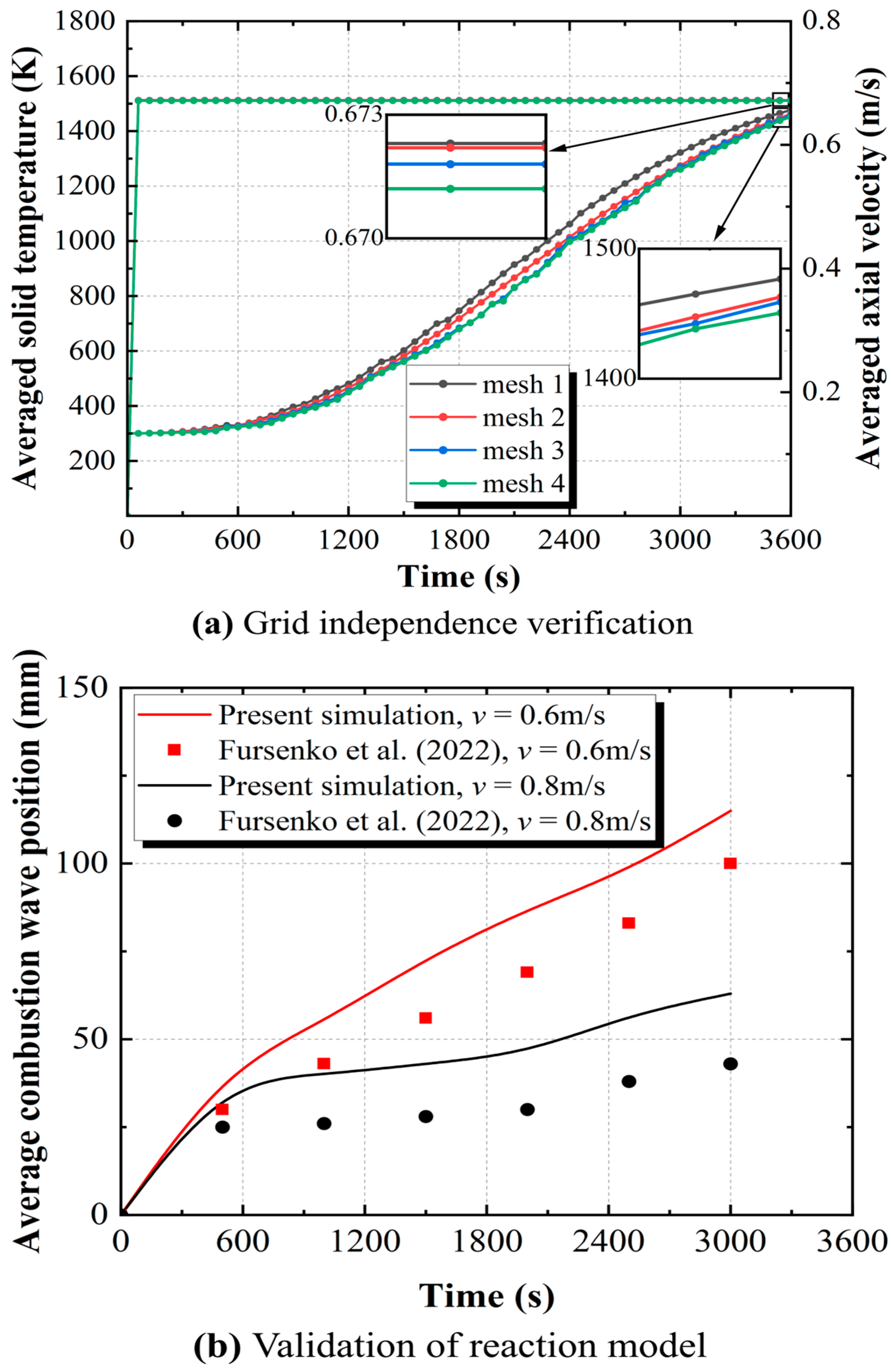
3.2. Validation of Grid Independence and Reaction Model
4. Results and Discussion
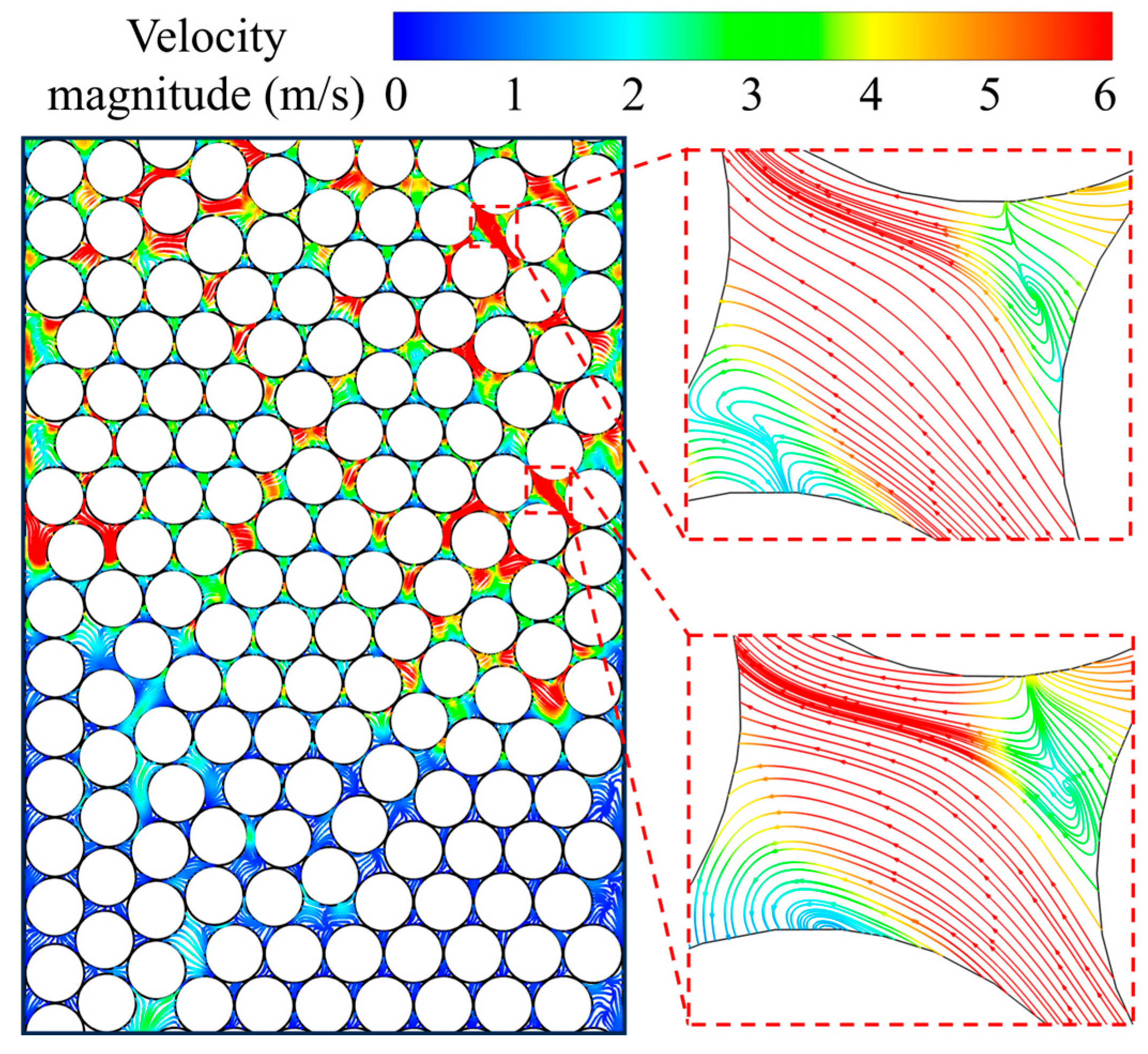
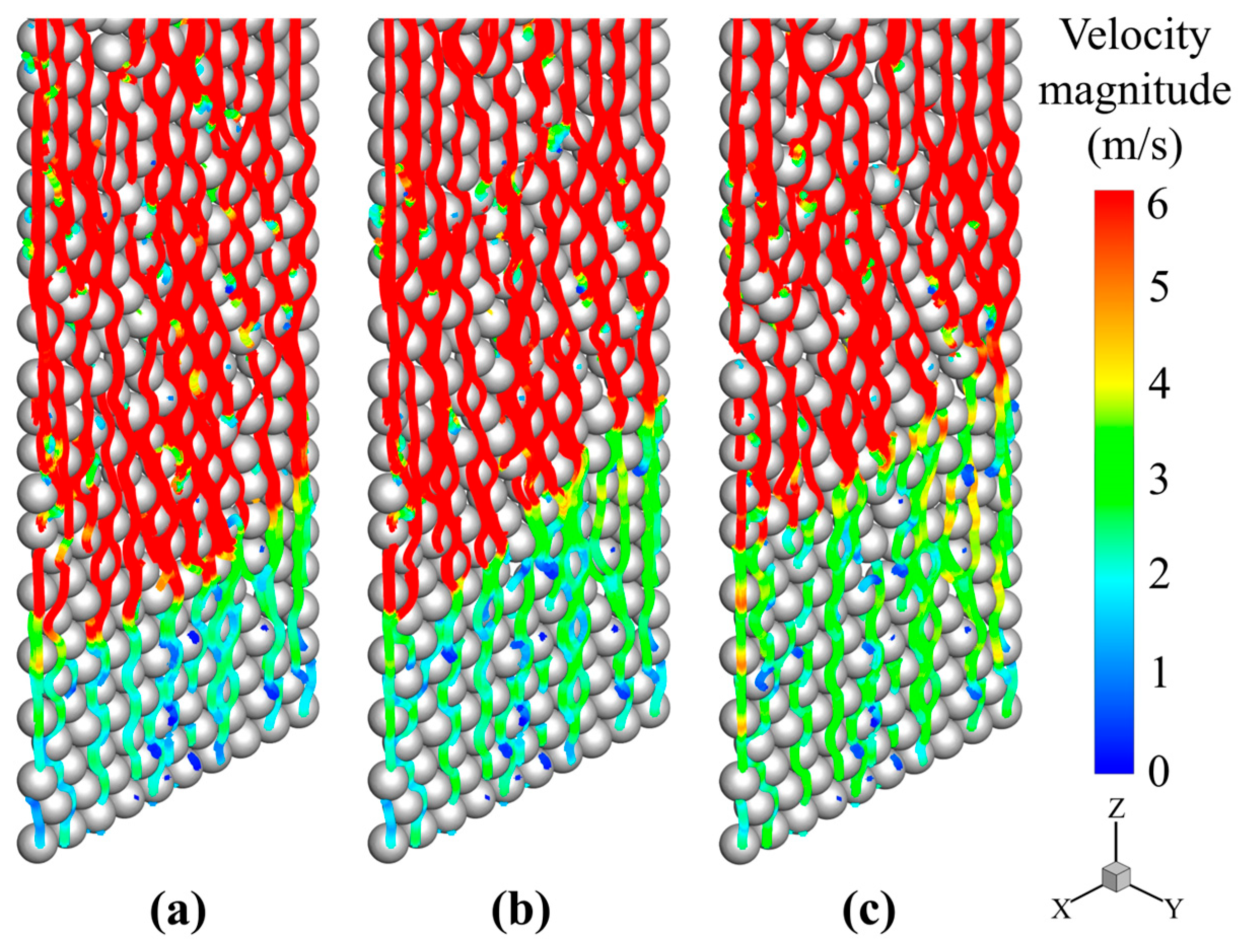
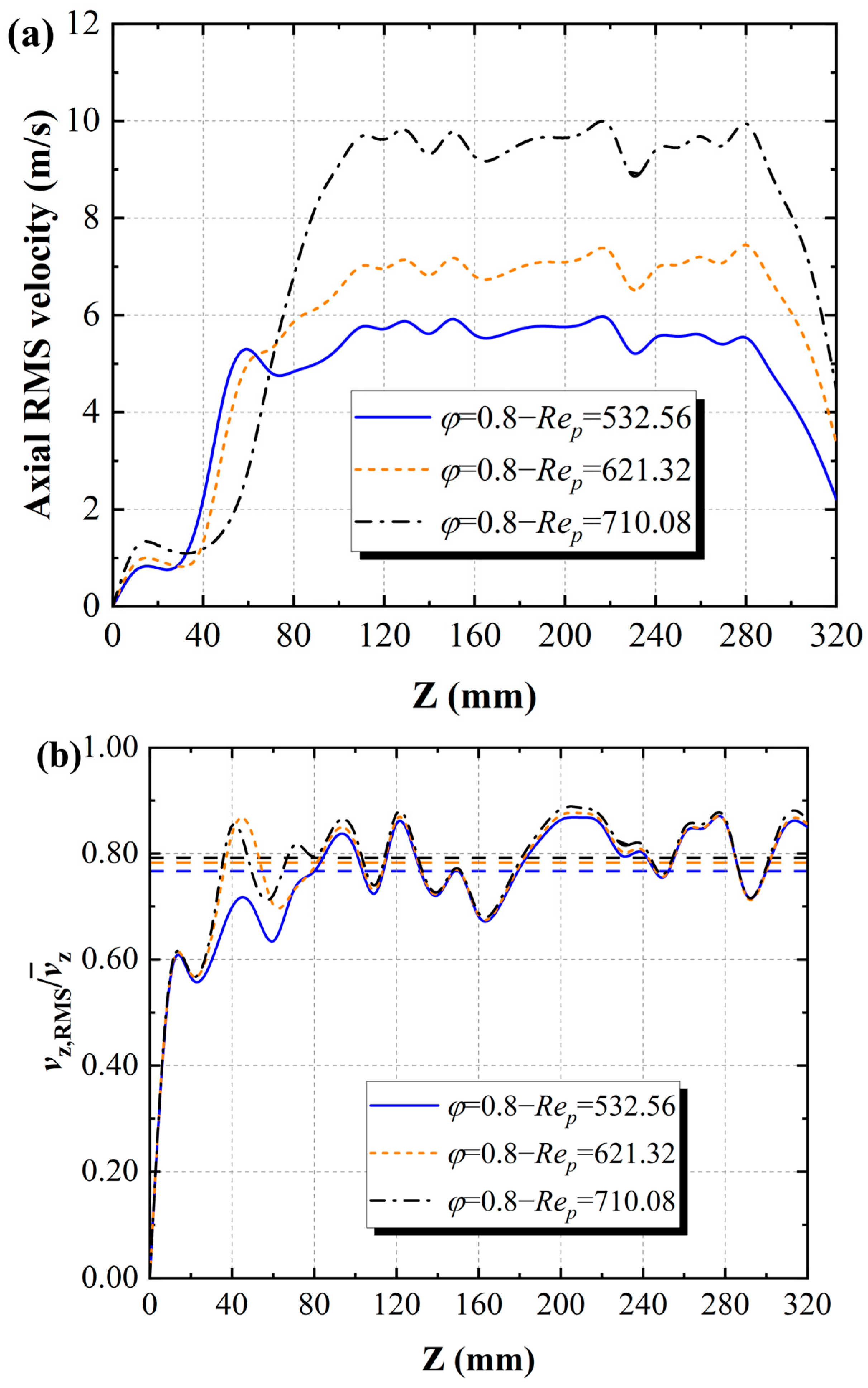
4.1. Characteristics of Flow Field in Packed Bed
4.2. Characteristics of Temperature Field in Packed Bed
4.3. Characteristics of Fluid–Solid Heat Transfer in the Packed Bed
4.4. Pore-Scale Flame Front Morphology in the Packed Bed
4.5. Comparisons of Flame Reaction Volume
5. Conclusions
- (1)
- During combustion in the packed bed, the pronounced increase in flow velocity within the reaction zone originates from a strong coupling between internal energy release and momentum transfer, that is, the conversion of internal energy to kinetic energy. The heat generated by exothermic reactions raises the local enthalpy and temperature, leading to density reduction and volumetric expansion that induce pressure gradients and accelerate the fluid flow. This process manifests as a rapid rise in velocity and intensified flow fluctuations near the flame front.
- (2)
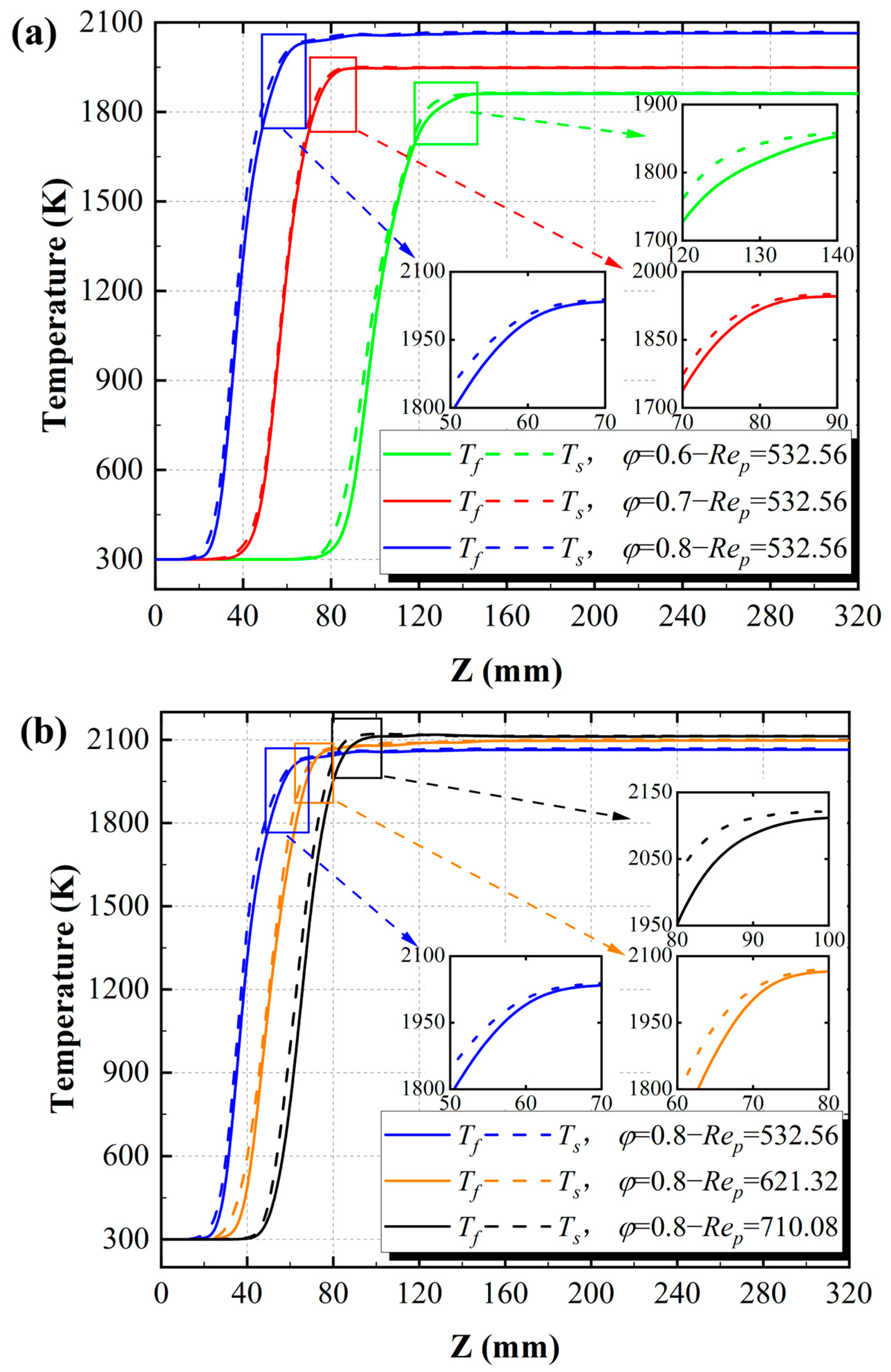
- As a pivotal parameter governing combustion intensity and temperature distribution within packed beds, the equivalence ratio exerts a profound influence on multiple combustion-related processes. Increasing it from 0.6 to 0.8 raises the localized peak fluid temperature from about 1860 K to 2060 K, while the temperature differential between the two phases drops to less than 10 K, indicating strong thermal coupling at the pore scale. Higher equivalence ratios also expand high-temperature zones, improve heat transfer and flame stability, and make combustion more efficient overall.
- (3)
- The pore Reynolds number has a significant influence on flow structure and heat transfer through enhanced inertial mixing, vortex-induced flow disturbances, and stronger convective transport. As it increases, the downstream redistribution of energy is promoted, which lowers the axial temperature gradient and makes the thermal field more uniform. However, excessive flow may also strengthen convective sweeping, indicating that a moderate flow rate provides a better balance between reaction stability and heat transfer efficiency.
- (4)
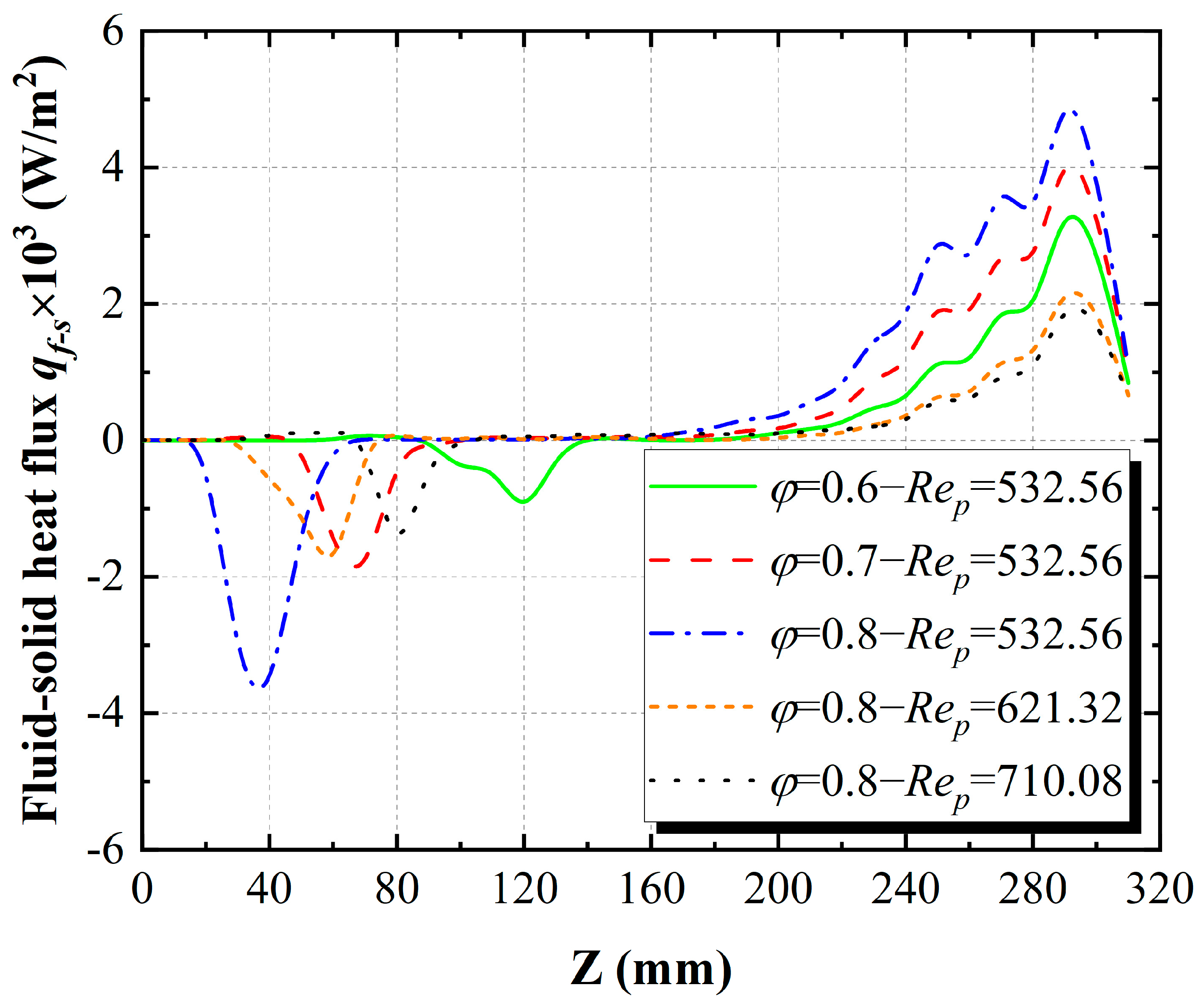
- A two-stage heat transfer mechanism of “solid preheating followed by fluid heating” occurs during pore-scale combustion. In the ignition and propagation stages, the solid matrix acts as the primary heat source, quickly transferring heat to the colder fluid with a negative heat flux density ranging from 1 × 10³ W/m2 to 4 × 10³ W/m2. In the downstream area, a positive heat flux density develops within the range of 2 × 10³ W/m2 to 5 × 10³ W/m2, indicating heat transfers from the hot fluid to the solid and between particles. This process highlights strong fluid–solid energy coupling at the pore scale.
- (5)
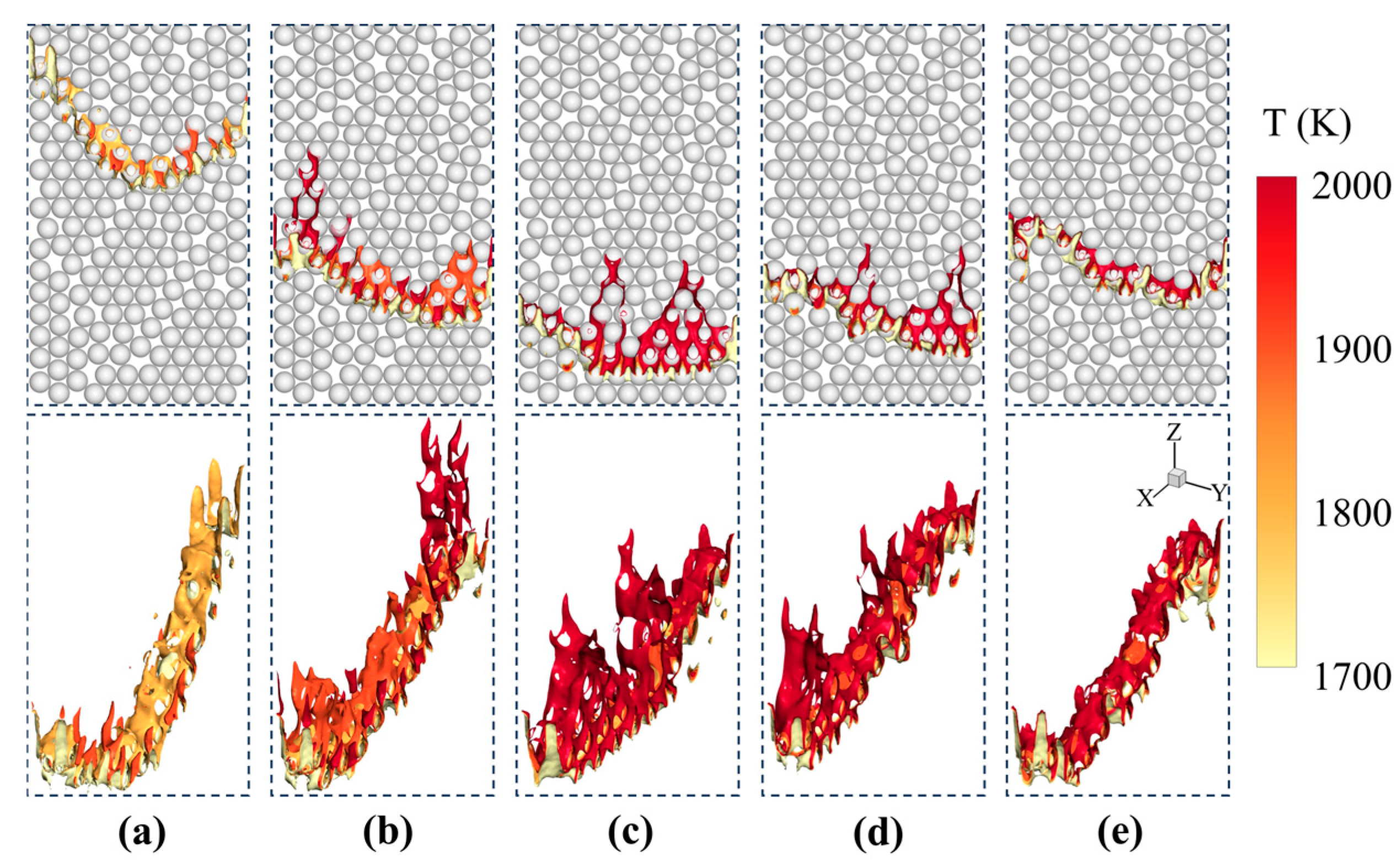
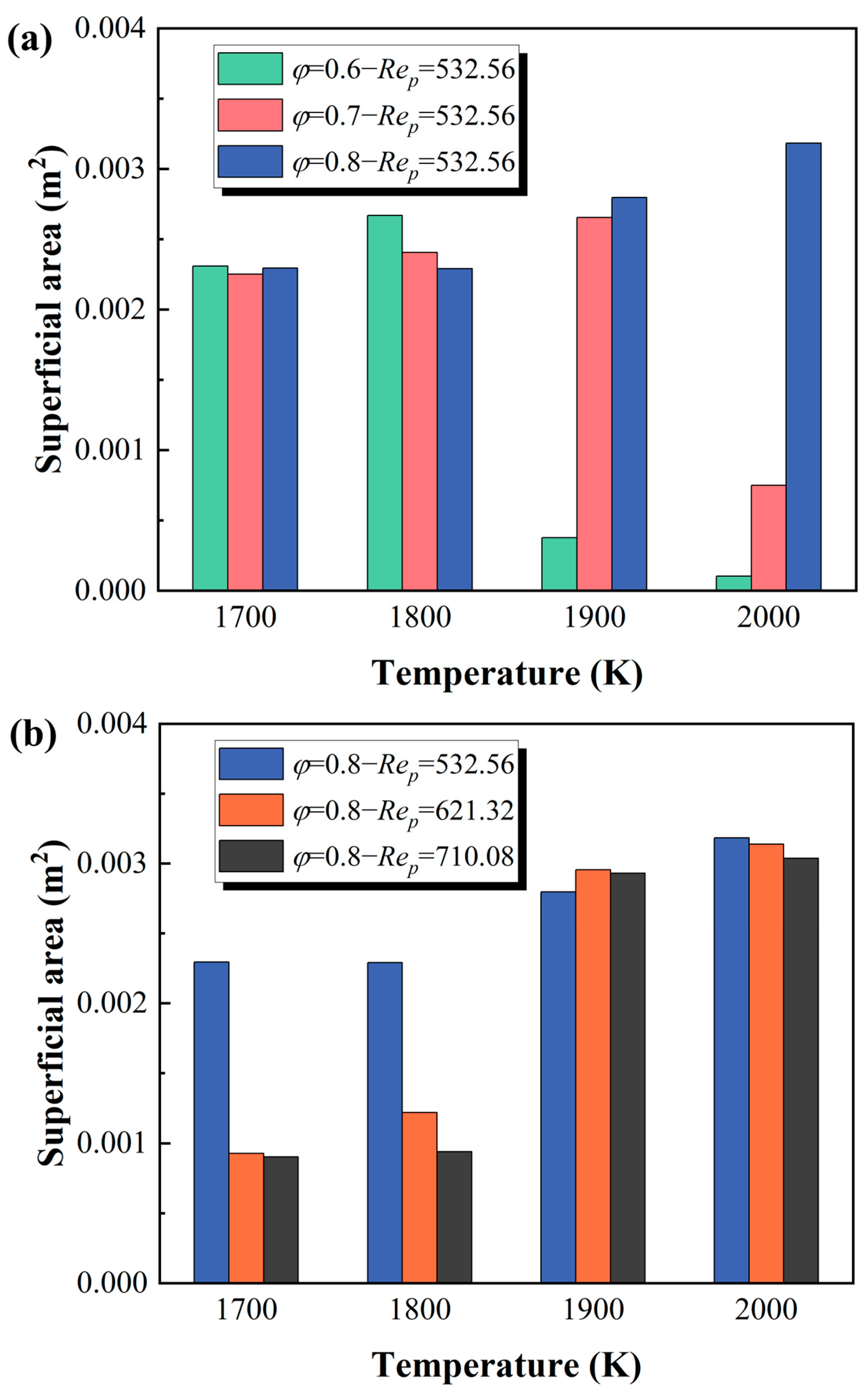
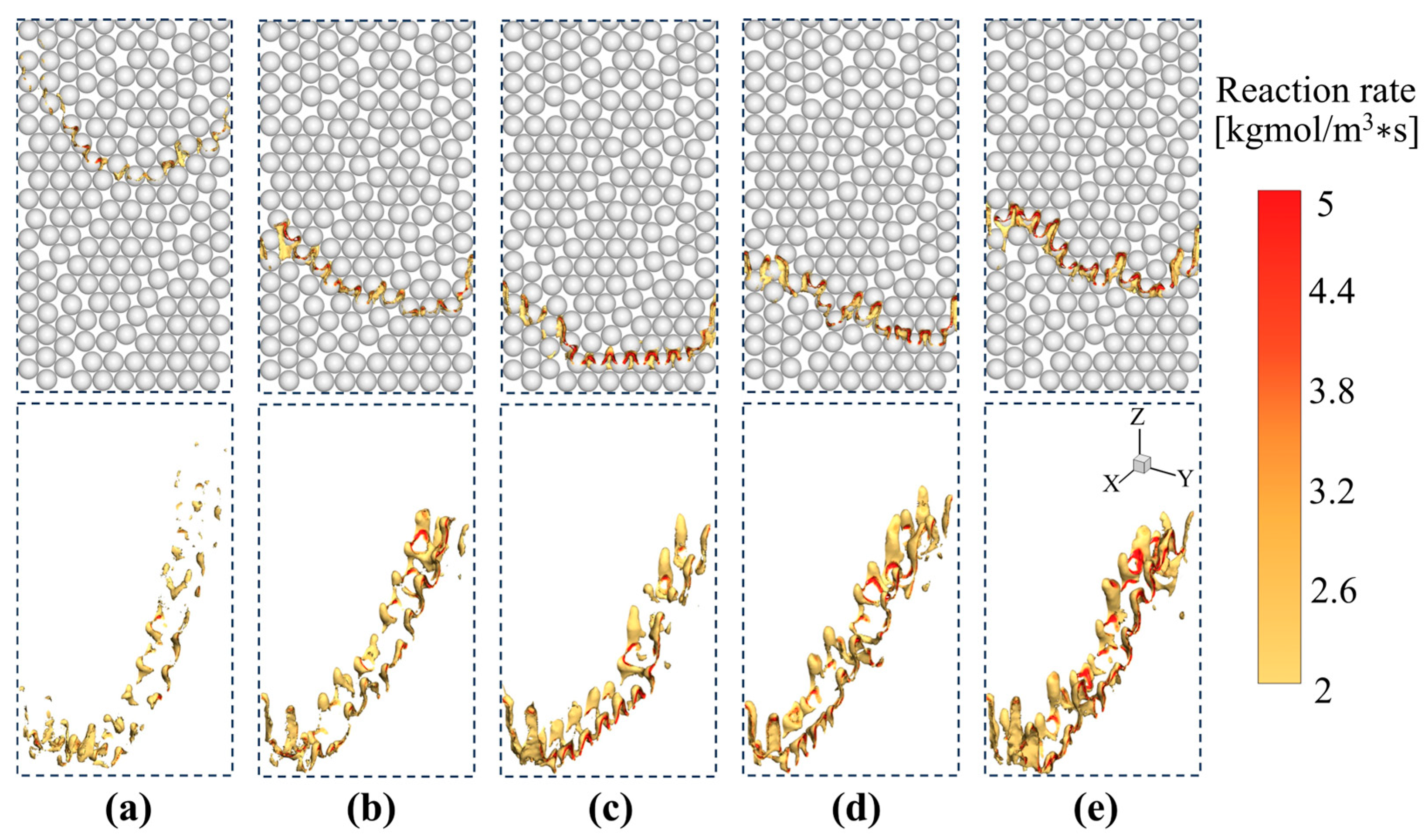
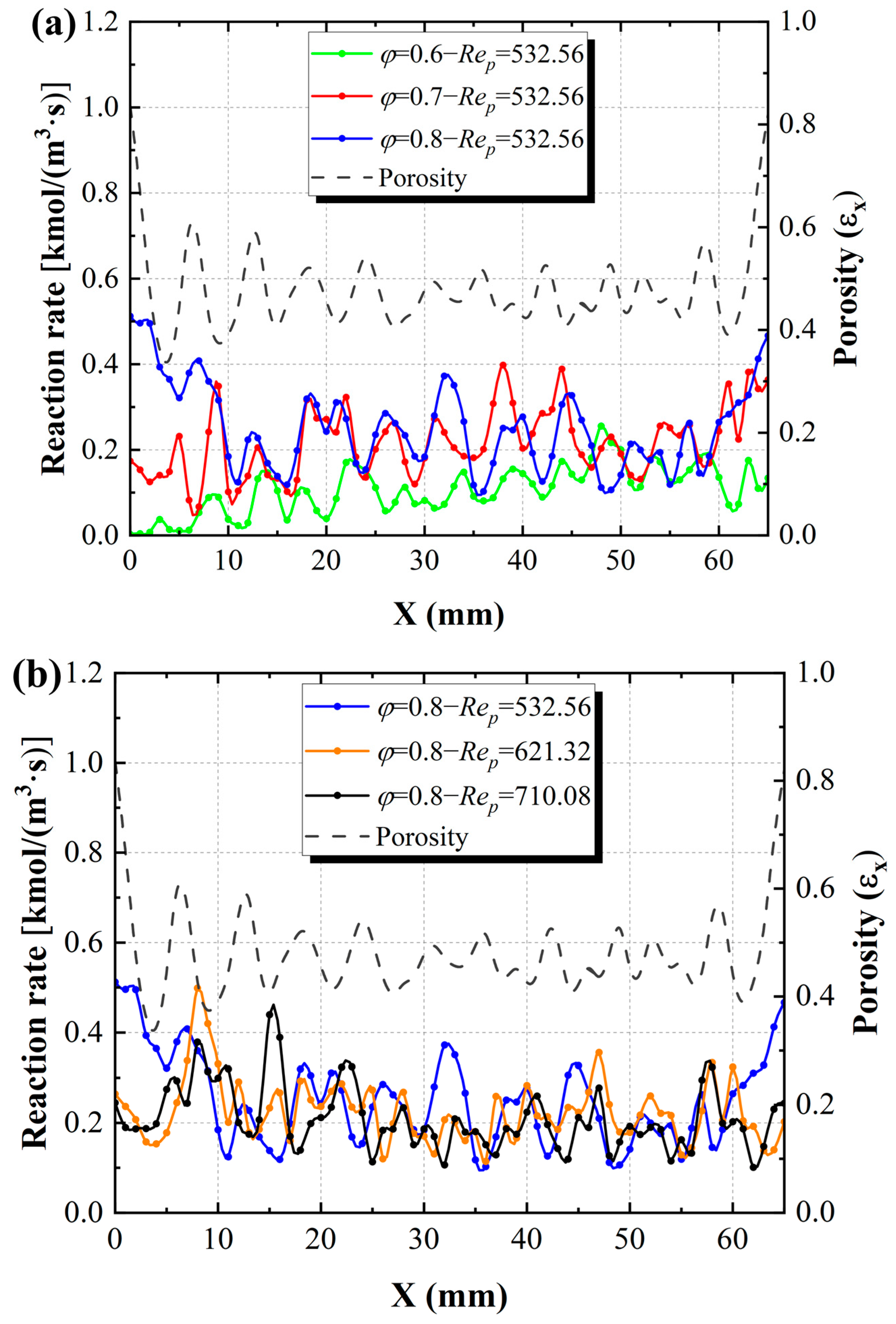
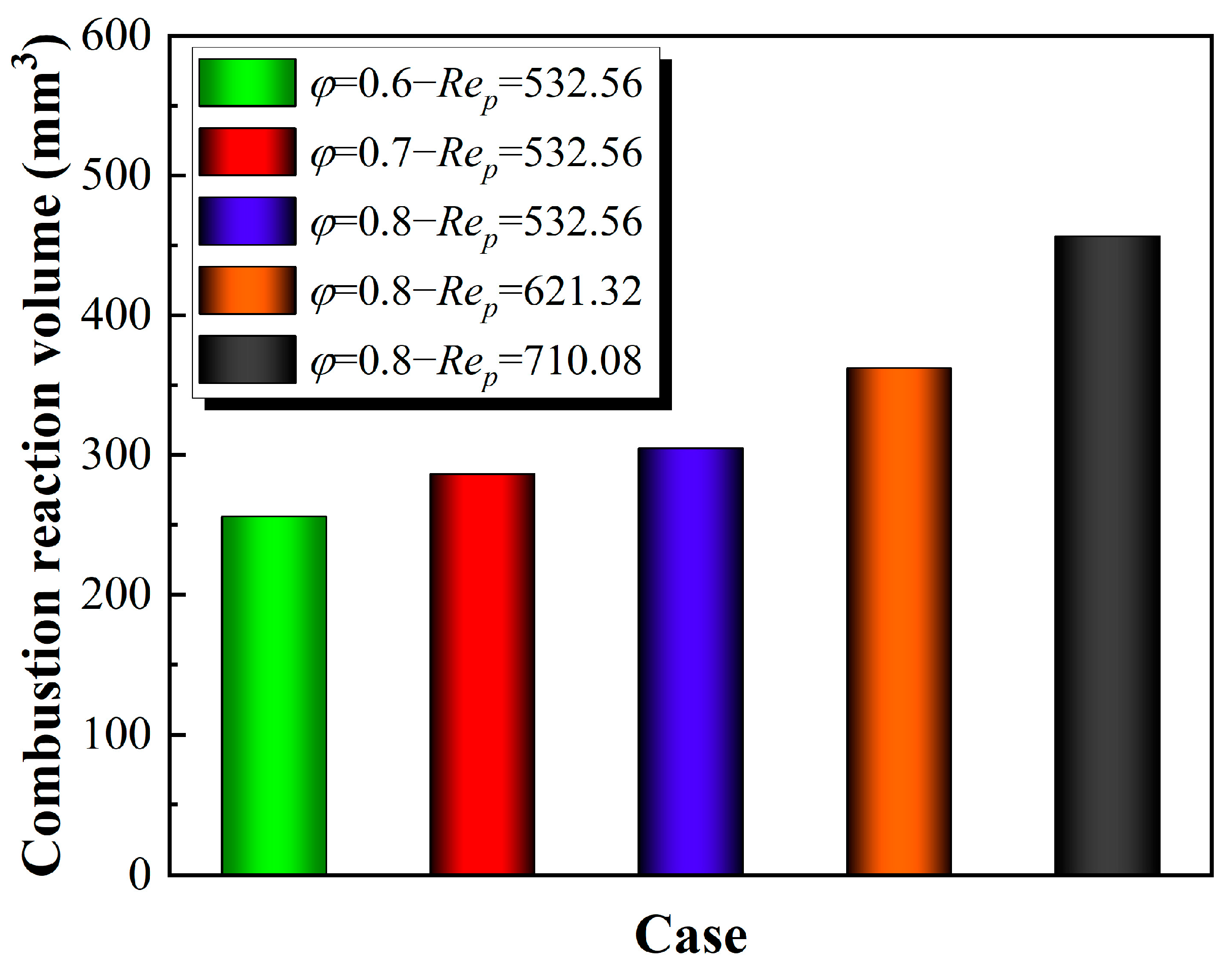
- Positive feedback between reaction rate and temperature promotes mutual reinforcement of heat release and flame propagation. The flame thickness is approximately 1.5dp–2dp. In high-porosity regions, enhanced diffusion and lower resistance raise reaction rates by about 0.8–1.2 times compared to dense areas. Enhanced mixing helps maintain field uniformity, and higher equivalence ratios or flow rates enlarge the combustion zone by approximately 50%. These effects together sustain a balanced combustion state with stable flames and efficient energy coupling.
Author Contributions
Funding
Data Availability Statement
Conflicts of Interest
Nomenclature
| Model Parameters | Greek symbols | ||
| D | tube diameter (m) | λ | thermal conductivity (W/(m·K)) |
| dp | particle diameter (m) | μ | dynamic viscosity (Pa·s) |
| dh | hydraulic diameter (m) | ρ | density (kg/m3) |
| L1 | length of entrance region (m) | ωi | reaction rate of species i (kmol/m3·s) |
| L2 | length of packing region (m) | ε | porosity |
| L3 | length of outlet region (m) | average porosity | |
| Physical parameters | ΔT | temperature difference between fluid and solid (K) | |
| c | specific heat capacity (kJ/(kg∙K)) | φ | equivalence ratio |
| Di | diffusion coefficient of species i, (m2/s) | k | turbulent kinetic energy |
| p | pressure (Pa) | εt | turbulent dissipation rate |
| t | time (s) | Dimensionless parameters | |
| Tf | fluid temperature (K) | N | tube-to-particle diameter ratio |
| Ts | solid temperature (K) | Rep | pore Reynolds number |
| qf-s | fluid–solid heat flux (W/m2) | relative values of the RMS of the velocity | |
| vz,RMS | root mean square of axial velocity (m/s) | δ | average thermal flame thickness |
| u | velocity in x direction (m/s) | Abbreviations | |
| v | velocity in y direction (m/s) | CFD | computational fluid dynamics |
| w | velocity in z direction (m/s) | DEM | discrete element method |
| velocity component in the i direction | FREI | flame with repetitive extinction and ignition | |
| velocity component in the j direction | PMC | porous media combustion | |
| v | velocity vector | RMS | root mean square |
| Wi | molecular weight of species i | Subscripts | |
| x | coordinate (m) | f | fluid |
| y | coordinate (m) | s | solid |
| z | coordinate (m) | in | inlet |
| Y | mass fraction | max | maximum value |
References
- Shah, H.H.; Piso, G.; Mancusi, E.; Bareschino, P.; Pepe, F. Roadmap toward carbon neutrality in Pakistan: Policy challenges and strategic measures. Energy Sustain. Dev. 2025, 89, 101861. [Google Scholar] [CrossRef]
- Liu, S.; Feng, M.; Xie, L.; Chan, F.K.S. Challenges and solutions for achieving carbon neutrality through urban green infrastructure in China’s future cities. Nat. Based Solut. 2025, 8, 100263. [Google Scholar] [CrossRef]
- Mujeebu, M.A.; Abdullah, M.Z.; Bakar, M.Z.A.; Mohamad, A.A.; Abdullah, M.K. Applications of porous media combustion technology—A review. Appl. Energy 2009, 86, 1365–1375. [Google Scholar] [CrossRef]
- Gharehghani, A.; Ghasemi, K.; Siavashi, M.; Mehranfar, S. Applications of porous materials in combustion systems: A comprehensive and state-of-the-art review. Fuel 2021, 304, 121411. [Google Scholar] [CrossRef]
- Hanamura, K.; Kumano, T.; Iida, Y. Electric power generation by super-adiabatic combustion in thermoelectric porous element. Energy 2005, 30, 347–357. [Google Scholar] [CrossRef]
- Schurr, J.L.; Bhattacharya, A.; Konnov, A.A.; Kaario, O. Super adiabatic combustion of H2/Air and H2/N2O mixtures. Combust. Flame 2024, 263, 113397. [Google Scholar] [CrossRef]
- Ellzey, J.L.; Belmont, E.L.; Smith, C.H. Heat recirculating reactors: Fundamental research and applications. Prog. Energy Combust. Sci. 2019, 72, 32–58. [Google Scholar] [CrossRef]
- Ni, S.; Zhao, D.; Becker, S.; Tang, A. Thermodynamics and entropy generation studies of a T-shaped micro-combustor: Effects of porous medium and ring-shaped ribs. Appl. Therm. Eng. 2020, 175, 115374. [Google Scholar] [CrossRef]
- Cao, Y.; Su, T.; Ding, Y.; Song, W.; Yang, L.; Liu, F.; Zhai, C. Enhanced combustion stability of low-concentration methane though a flame buffer zone in a variable pore-density porous media burner. Appl. Therm. Eng. 2025, 265, 125546. [Google Scholar] [CrossRef]
- Zhu, H.; Dai, H.; Song, Z.; Wang, X.; Wang, Z.; Dai, H.; He, S. Improvement of hollow cylinders on the conversion of coal mine methane to hydrogen in packed bed burner. Int. J. Hydrog. Energy 2021, 46, 31439–31451. [Google Scholar] [CrossRef]
- Shafiey Dehaj, M.; Arab Solghar, A. Study of natural gas/air combustion in the three-region porous medium burner. J. Braz. Soc. Mech. Sci. Eng. 2019, 41, 137. [Google Scholar] [CrossRef]
- Quaye, E.K.; Pan, J.; Lu, Q.; Zhang, Y.; Wang, Y.; Alubokin, A.A. Study on Combustion Characteristics of Premixed Methane-Oxygen in a Cylindrical Porous Media Combustor. Chem. Eng. Process. Process Intensif. 2021, 159, 108207. [Google Scholar] [CrossRef]
- Tolouei, A.; Gharehghani, A. Effect of hydrogen enrichment and catalytic porous media on the combustion characteristics of methane/ammonia. Int. J. Hydrogen Energy 2025, 146, 149986. [Google Scholar] [CrossRef]
- Dai, H.; Zhang, B.; Li, Z.; Wu, J. Combustion characteristics of a porous media burner with partial hydrogen injection. Int. J. Hydrogen Energy 2022, 47, 1092–1102. [Google Scholar] [CrossRef]
- Shi, J.; Liu, Y.; Mao, M.; Lv, J.; Wang, Y.; He, F. Experimental and numerical studies on the effect of packed bed length on CO and NOx emissions in a plane-parallel porous combustor. Energy 2019, 181, 250–263. [Google Scholar] [CrossRef]
- Banerjee, A.; Paul, D. Developments and applications of porous medium combustion: A recent review. Energy 2021, 221, 119868. [Google Scholar] [CrossRef]
- Makaryan, I.A.; Sedov, I.V.; Munoz-Herrera, C.; Toledo, M.; Salgansky, E.A. Combustion of ammonia-blended fuels in porous media burners, with storage and distribution implications: A review. Renew. Sustain. Energy Rev. 2025, 220, 115884. [Google Scholar] [CrossRef]
- Vahidhosseini, S.M.; Esfahani, J.A.; Kim, K.C. Experimental study on the radiative heat transfer in a multi-hole porous radiant burner with internal combustion regime. Appl. Therm. Eng. 2022, 201, 117732. [Google Scholar] [CrossRef]
- Quaye, E.K.; Pan, J.; Zhang, Y.; Lu, Q.; Wang, Y.; Alubokin, A.A. Effects of influencing factors on premixed CH4-O2 combustion in a cylindrical porous media combustor. Chem. Eng. Process. Process Intensif. 2021, 161, 108320. [Google Scholar] [CrossRef]
- Wang, Y.; Cai, S.; Yang, W.; Li, X.-y.; Wang, T.; Wan, J. Combustion and thermal performance of a novel preheated miniature combustor with a flame holder and various porous medium materials. J. Energy Inst. 2024, 115, 101677. [Google Scholar] [CrossRef]
- Bubnovich, V.; Hernandez, H.; Toledo, M.; Flores, C. Experimental investigation of flame stability in the premixed propane-air combustion in two-section porous media burner. Fuel 2021, 291, 120117. [Google Scholar] [CrossRef]
- Chen, Z.; Guo, S.; Qin, C. Experimental research on porous media combustion of SOFC exhaust gas. Case Stud. Therm. Eng. 2020, 22, 100796. [Google Scholar] [CrossRef]
- Vignat, G.; Zirwes, T.; Boigné, É.; Ihme, M. Experimental demonstration of a two-stage porous media burner for low-emission ammonia combustion. Proc. Combust. Inst. 2024, 40, 105491. [Google Scholar] [CrossRef]
- Tolouei, A.; Gharehghani, A. Numerical investigation of premixed methane-ammonia combustion in a mesoscale porous combustor. Fuel 2024, 366, 131427. [Google Scholar] [CrossRef]
- Li, Q.; Li, J.; Shi, J. Fully-resolved 3D premixed H2/air flames in a micro-combustor partially filled with porous media: Effects of detailed pore structures. Proc. Combust. Inst. 2023, 39, 5571–5580. [Google Scholar] [CrossRef]
- Chen, Z.; Shi, J.; Xie, M.; Yue, M. A Numerical Investigation on the Rapid Turbulent Filtration Combustion under High Background Pressure. Combust. Sci. Technol. 2021, 194, 3039–3063. [Google Scholar] [CrossRef]
- Zirwes, T.; Vignat, G.; Toro, E.R.; Boigné, E.; Younes, K.; Trimis, D.; Ihme, M. Improving volume-averaged simulations of matrix-stabilized combustion through direct X-ray µCT characterization: Application to NH3/H2-air combustion. Combust. Flame 2023, 257, 113020. [Google Scholar] [CrossRef]
- Shi, J.; Zhou, D.; Lv, J.; Mao, M.; Ma, X. Self-sustained stable combustion of off-gas from Solid Oxide Fuel Cell in a cone-shaped porous burner with preheaters. Energy 2024, 312, 133566. [Google Scholar] [CrossRef]
- Liao, M.; He, Z.; Jia, S.; Liang, X.; Chan, T.L.; Li, Y.; Xu, X.; Liu, T. Comparison of the flame stabilities during oxy-methane and air-methane combustion in a two-layer porous burner. Case Stud. Therm. Eng. 2023, 51, 103657. [Google Scholar] [CrossRef]
- Liao, M.; He, Z.; Liang, X.; Chan, T.L.; Li, Y.; Xu, X. Study on Oxy-Methane Flame Stability in a Cylindrical Porous Medium Burner. Processes 2023, 11, 2182. [Google Scholar] [CrossRef]
- Liao, M.; Jia, S.; Wang, Q.; Chan, T.L.; Li, Y.; Xu, X.; He, Z. Numerical Simulation of Methane Combustion in Two-Layer Porous Media Under Oxy-Fuel Condition. Flow Turbul. Combust. 2022, 110, 649–670. [Google Scholar] [CrossRef]
- Hashemi, S.M.; Hashemi, S.A. Flame stability analysis of the premixed methane-air combustion in a two-layer porous media burner by numerical simulation. Fuel 2017, 202, 56–65. [Google Scholar] [CrossRef]
- Shi, J.; Chen, Z.; Li, H.; Lv, J.; Mao, M. Pore-scale study of thermal nonequilibrium in a two-layer burner formed by staggered arrangement of particles. Appl. Therm. Eng. 2020, 176, 115376. [Google Scholar] [CrossRef]
- Yakovlev, I.; Fursenko, R.; Astakhov, D.; Zambalov, S.; Maznoy, A. Transition to oscillatory instability of lean methane–air flames in microchannels. Combust. Flame 2024, 267, 113570. [Google Scholar] [CrossRef]
- Yakovlev, I.; Astakhov, D.; Zambalov, S.; Fursenko, R.; Li, J.; Maznoy, A. Transition to unstable oscillatory flames in porous media combustion. Combust. Flame 2023, 252, 112752. [Google Scholar] [CrossRef]
- Ferguson, J.C.; Sobhani, S.; Ihme, M. Pore-resolved simulations of porous media combustion with conjugate heat transfer. Proc. Combust. Inst. 2021, 38, 2127–2134. [Google Scholar] [CrossRef]
- Billerot, P.-L.; Dufresne, L.; Lemaire, R.; Seers, P. 3D CFD analysis of a diamond lattice-based porous burner. Energy 2020, 207, 118160. [Google Scholar] [CrossRef]
- Yakovlev, I.; Zambalov, S. Three-dimensional pore-scale numerical simulation of methane-air combustion in inert porous media under the conditions of upstream and downstream combustion wave propagation through the media. Combust. Flame 2019, 209, 74–98. [Google Scholar] [CrossRef]
- Shi, J.; Lv, J.; Behrendt, F.; Liu, Y.; Mao, M.; He, F. 3D pore-scale simulations and 1D volume-averaged calculations of the flow and thermal non-equilibrium for low-velocity filtration combustion. Int. J. Heat Mass Transf. 2021, 177, 121532. [Google Scholar] [CrossRef]
- Masset, P.-A.; Duchaine, F.; Pestre, A.; Selle, L. Modelling challenges of volume-averaged combustion in inert porous media. Combust. Flame 2023, 251, 112678. [Google Scholar] [CrossRef]
- Chen, Z.; Wu, Z.; Liu, H.; Shi, J.; Xie, M. Numerical investigation on the error of volume-averaged reaction rate model for the low-velocity filtration combustion with hybrid-scale method. Int. Commun. Heat Mass Transf. 2025, 161, 108457. [Google Scholar] [CrossRef]
- Yakovlev, I.; Maznoy, A.; Zambalov, S. Pore-scale study of complex flame stabilization phenomena in thin-layered radial porous burner. Combust. Flame 2021, 231, 111468. [Google Scholar] [CrossRef]
- Fursenko, R.V.; Yakovlev, I.A.; Odintsov, E.S.; Zambalov, S.D.; Minaev, S.S. Pore-scale flame dynamics in a one-layer porous burner. Combust. Flame 2022, 235, 111711. [Google Scholar] [CrossRef]
- Fursenko, R.V.; Odintsov, E.S.; Zakharov, A.D.; Yakovlev, I.A.; Li, J. Pore-scale flame oscillations and patterns of upstream combustion wave propagation in a one-layer porous burner. Combust. Flame 2024, 270, 113730. [Google Scholar] [CrossRef]
- Dang, M.; Wang, F.; Jia, X. DEM-CFD Analysis of Fluid Flow in Packed Bed Under the Small Column-to-Particle-Diameter Ratios. Korean J. Chem. Eng. 2024, 41, 697–713. [Google Scholar] [CrossRef]
- Jeschar, R. Druckverlust in Mehrkornschüttungen aus Kugeln. Arch. Eisenhüttenwes. 1964, 35, 91–108. [Google Scholar] [CrossRef]
- Klerk, A.d. Voidage variation in packed beds at small column to particle diameter ratio. AIChE J. 2003, 49, 2022–2029. [Google Scholar] [CrossRef]
- Kuwahara, F.; Yamane, T.; Nakayama, A. Large eddy simulation of turbulent flow in porous media. Int. Commun. Heat Mass Transf. 2006, 33, 411–418. [Google Scholar] [CrossRef]
- Donoso-García, P.; Henríquez-Vargas, L. Numerical study of turbulent porous media combustion coupled with thermoelectric generation in a recuperative reactor. Energy 2015, 93, 1189–1198. [Google Scholar] [CrossRef]
- Gao, H.B.; Zong, S.C.; Feng, X.B.; Zhang, C.W. Two-Dimensional Numerical Study of Methane-Air Combustion Within Catalytic and Non-catalytic Porous Medium. Front. Chem. 2020, 8, 511792. [Google Scholar] [CrossRef]
- Akbari, M.H.; Riahi, P.; Roohi, R. Lean flammability limits for stable performance with a porous burner. Appl. Energy 2009, 86, 2635–2643. [Google Scholar] [CrossRef]
- Lv, J.; Shi, J.; Mao, M.; He, F. Three-Dimensional Pore-Scale Simulation of Flow and Thermal Non-Equilibrium for Premixed Gas Combustion in a Random Packed Bed Burner. Energies 2021, 14, 6939. [Google Scholar] [CrossRef]
- Launder, B.E.; Spalding, D.B. The numerical computation of turbulent flows. Comput. Methods Appl. Mech. Eng. 1974, 3, 269–289. [Google Scholar] [CrossRef]
- Guo, Z.; Sun, Z.; Zhang, N.; Ding, M. Influence of confining wall on pressure drop and particle-to-fluid heat transfer in packed beds with small D/d ratios under high Reynolds number. Chem. Eng. Sci. 2019, 209, 115200. [Google Scholar] [CrossRef]


| Category | Representative Studies | Main Contribution | Remaining Gap |
|---|---|---|---|
| Experimental studies | [21,22,23] | Revealed flame stability, temperature evolution, and emissions in porous burners | Limited to macroscopic observations |
| Volume-averaged models | [29,30,31,32] | Predicted heat transfer and combustion-wave behavior efficiently | Unable to resolve pore-scale non-uniformity and flame structure |
| Pore-scale simulations | [36,37,38,39,40,41,42] | Captured local flow, thermal non-equilibrium, and flame wrinkling | Insufficient research on extreme working conditions |
| One-layer burner studies | [43,44] | Identified complex flame patterns | Lack of pore-scale analysis for standing combustion |
| Parameter | Unit | Value |
|---|---|---|
| Tube diameter | mm | 65 |
| Particle diameter | mm | 6.5 |
| Shear Modulus | Pa | 1.37 × 10⁹ |
| Poisson ratio | - | 0.24 |
| Particle–particle restitution coefficient | - | 0.5 |
| Particle–wall restitution coefficient | - | 0.3 |
| Static friction coefficient | - | 0.154 |
| Rolling friction coefficient | - | 0.1 |
| Properties | Density, ρ (kg/m3) | Specific Heat Capacity, c (kJ/(kg∙K)) | Thermal Conductivity, λ (W/(m∙K)) |
|---|---|---|---|
| Al2O3 | 3750 | 0.8 | 25 |
| SiC | 3070 | 0.71 | 120 |
| quartz | 2200 | 0.96 | 1.4 |
Disclaimer/Publisher’s Note: The statements, opinions and data contained in all publications are solely those of the individual author(s) and contributor(s) and not of MDPI and/or the editor(s). MDPI and/or the editor(s) disclaim responsibility for any injury to people or property resulting from any ideas, methods, instructions or products referred to in the content. |
© 2026 by the authors. Licensee MDPI, Basel, Switzerland. This article is an open access article distributed under the terms and conditions of the Creative Commons Attribution (CC BY) license.
Share and Cite
Wang, H.; Xia, Y.; Fang, T.; Xu, H.; Guan, X.; Zhang, Z. Numerical Study on Pore-Scale Flow Characteristics and Flame Front Morphology of Premixed Methane/Air Combustion in a Randomly Packed Bed. Processes 2026, 14, 1061. https://doi.org/10.3390/pr14071061
Wang H, Xia Y, Fang T, Xu H, Guan X, Zhang Z. Numerical Study on Pore-Scale Flow Characteristics and Flame Front Morphology of Premixed Methane/Air Combustion in a Randomly Packed Bed. Processes. 2026; 14(7):1061. https://doi.org/10.3390/pr14071061
Chicago/Turabian StyleWang, Haiyang, Yongfang Xia, Tingyong Fang, Huanyu Xu, Xiaohu Guan, and Zhi Zhang. 2026. "Numerical Study on Pore-Scale Flow Characteristics and Flame Front Morphology of Premixed Methane/Air Combustion in a Randomly Packed Bed" Processes 14, no. 7: 1061. https://doi.org/10.3390/pr14071061
APA StyleWang, H., Xia, Y., Fang, T., Xu, H., Guan, X., & Zhang, Z. (2026). Numerical Study on Pore-Scale Flow Characteristics and Flame Front Morphology of Premixed Methane/Air Combustion in a Randomly Packed Bed. Processes, 14(7), 1061. https://doi.org/10.3390/pr14071061