Article

Numerical Study on Pore-Scale Flow Characteristics and Flame Front Morphology of Premixed Methane/Air Combustion in a Randomly Packed Bed


1
School of Environment and Energy Engineering, Anhui Jianzhu University, Hefei 230601, China
2
Fuyang Normal University, Fuyang 236037, China
*
Author to whom correspondence should be addressed.
Processes 2026, 14(7), 1061; https://doi.org/10.3390/pr14071061
Submission received: 3 March 2026 / Revised: 23 March 2026 / Accepted: 24 March 2026 / Published: 26 March 2026
(This article belongs to the Section Energy Systems)

Abstract

Porous medium combustion technology, renowned for high efficiency and low emissions, is widely applied in industrial and heating fields. This study numerically investigates pore-scale heat transfer, flame morphology, reaction rate distribution during standing combustion in a one-layer randomly packed bed, and flow parameter effects on flame behavior. A 3D randomly packed model (tube-to-particle diameter ratio D/d = 10) is developed using the discrete element method (DEM) and coupled with computational fluid dynamics (CFD) to resolve pore-scale transport processes. Results show that exothermic combustion converts internal energy to kinetic energy, significantly accelerating pore-scale flow velocity in the combustion zone. Increasing the equivalence ratio enhances flame stability, elevating solid–fluid temperatures by 200 K and expanding the combustion zone volume by 20%. The pore Reynolds number promotes inertial mixing and heat redistribution, limiting the solid–fluid temperature difference to 10 K. Local flames evolve from dispersed to wrinkled and undulating. These findings elucidate pore-scale combustion dynamics and guide packed-bed reactor design and optimization.

1. Introduction

In response to international carbon-neutrality targets, ongoing transformations in energy utilization have intensified research efforts toward combustion systems with improved efficiency and reduced environmental impact [1,2]. Porous media combustion (PMC) has emerged as a distinct combustion method in which the reacting flow interacts strongly with inert solid matrices. The presence of porous structures fundamentally alters heat transfer processes within the combustion zone, leading to enhanced internal heat recirculation, improved flame stabilization, and reduced emissions under appropriate operating conditions [3]. When combustion occurs within inert porous structures, such as packed beds or ceramic foams, the solid matrix plays an active role in mediating heat transfer between reaction products and incoming reactants. Under suitable operating conditions, including filtration velocity, equivalence ratio, and pressure, the porous skeleton promotes intense internal heat exchange, substantially modifying the thermal field of the reacting flow [4].
Super-adiabatic combustion occurs when the actual flame temperature in the burning region exceeds the theoretical adiabatic flame temperature [5,6]. Such temperature increases are largely caused by radiative and conductive heat transport within the solid phase, which allows for the partial recovery of thermal energy from hot combustion products and its transfer to unburned areas, thus improving reactant preheating [7]. Porous media combustion has several advantages over free-flame combustion due to these coupled thermal and chemical effects, including increased reaction intensities [8], improved flame stability [9,10], expanded flammability limits [11,12], and suppression of pollutant formation [13,14,15]. As a result, PMC is widely regarded as a potential technique for high-efficiency energy conversion systems [16], low-emission fuel utilization [17], and high-intensity radiant burners [18].
In recent years, substantial progress has been made in the study of porous media combustion. Experimental studies have mainly focused on macroscopic combustion characteristics, including flame propagation, temperature evolution, stability limits, and pollutant emissions [19]. These studies have confirmed the engineering potential of PMC, but their observations are mainly limited to the macroscopic scale [20]. Bubnovich et al. [21] investigated axial temperature profiles, the extent of the reaction zone, peak flame temperatures, as well as CO and NOx emission characteristics during the combustion of lean propane–air mixtures flowing through various ceramic materials in a double-layer porous burner. Their results indicated that an increase in inlet velocity or a reduction in equivalence ratio leads to a higher combustion wave propagation speed. Chen et al. [22] developed an experimental apparatus to evaluate the combustion stability of solid oxide fuel cell (SOFC) exhaust gases in porous burners, demonstrating that standing combustion is greatly affected by both the equivalence ratio and the corresponding adiabatic flame temperature. More recently, Vignat et al. [23] proposed a two-stage porous burner employing open-cell ceramic foams with graded porosity to enable staged ammonia combustion under fuel-rich and fuel-lean conditions. This apparatus achieved marked reductions in NOx and NH3 emissions, while simultaneously improving flame stability compared with conventional burner designs.
Beyond experimental investigations, numerical modeling has become an indispensable approach for analyzing combustion behavior in porous media [24,25,26]. Existing studies encompass a wide range of modeling resolutions, extending from simplified one-dimensional or two-dimensional volume-averaged models to fully resolved three-dimensional pore-scale simulations. In volume-averaged approaches, the porous structure is represented as a continuum at the macroscopic scale, allowing the coupled effects of fluid transport, species diffusion, heat transfer between phases, chemical reactions, and radiative exchange within the framework of numerical simulations.
Zirwes et al. [27] introduced an open-source simulation framework based on X-ray computed microtomography, in which integrated structural features into a 1D volume-averaged model and added a thermal recirculation sub-model, successfully predicting exhaust composition and stability limits of NH3/H2–air burners. Shi et al. [28] developed a novel divergent porous burner integrating three internal preheating sections to recover thermal energy from SOFC to combust ultra-low-calorific waste gases. Coupled numerical simulations based on two-dimensional continuum models and detailed structure were performed to assess the burner performance, demonstrating stable operation for gas mixtures with a lower heating value as low as 0.908 MJ/kg without any external heating. Liao et al. [29,30,31] developed an OpenFOAM-based numerical model for a cylindrical double-layer porous burner and applied a two-dimensional dual-temperature formulation to investigate premixed methane combustion. Their results revealed that variations in effective thermal conductivity, convective heat transfer coefficient, and radiative properties can substantially broaden the flammability limits. Hashemi et al. [32] utilized a two-dimensional non-equilibrium model to demonstrate the dominant role of equivalence ratio on flame temperature and combustion stability. Collectively, these studies have demonstrated the significant value of volume-averaged models in elucidating macroscopic combustion behaviors.
Nevertheless, their assumption that porous media are homogeneous continuous materials overlooks local flow and thermal interactions at the pore scale, resulting in limitations for predicting flame microstructure [33]. For this reason, increasing attention has been given to pore-scale simulations, which have revealed the importance of conjugate heat transfer, thermal non-equilibrium, and wrinkled flame front structures in porous combustion [34,35].
Using pore-resolved numerical frameworks, Ferguson et al. [36] demonstrated that conjugate heat transfer exerts a pronounced influence on the flame stability and temperature distribution by varying solid thermal conductivity and inlet flow velocity. Billerot et al. [37] investigated combustion within diamond lattice structures and showed that ordered geometries promote more spatially uniform energy release and suppress temperature fluctuations compared with random structures. These studies indicate that ordered packed structures tend to produce more uniform heat release and temperature distributions than random packed beds. However, real packed-bed burners consist of randomly packed particles, and the local irregular porosity leads to significantly different pore-scale flame behaviors compared with regular packed structures. Yakovlev et al. [38] performed unsteady simulations of flame filtration in irregular spherical packed beds, successfully reproducing thermal non-equilibrium effects and heat recovery mechanisms in low-velocity regions, in agreement with experimental observations. Subsequently, Shi et al. [39] investigated the non-equilibrium combustion behavior of low-velocity filtered lean methane/air mixtures through combined three-dimensional pore-scale simulations and one-dimensional volume-averaged calculations. Their pore-scale framework employed the gap method for meshing the computational domain. Masset et al. [40] further revealed highly wrinkled and sharp flame-front structures, highlighting discrepancies with the smooth flame representations assumed in volume-averaged models. More recently, Chen et al. [41] proposed a hybrid-scale numerical strategy for low-velocity filtration combustion in double-layer packed beds, coupling volume-averaged descriptions in the preheating and post-flame regions with pore-scale resolution within the reaction zone.
It is now well recognized that flame propagation in porous media fundamentally differs from that of free flames, with thermal recirculation playing a central role in shaping flame dynamics. Pore-scale simulations have revealed unsteady and pulsating flame behaviors that cannot be captured by continuum models. For example, Yakovlev et al. [42] identified three typical flame patterns in thin-layer radial burners under varying mixture compositions and flow conditions: internal flame, submerged flame, and surface flame. In experiments with a novel one-layer porous burner, Fursenko et al. [43] observed two types of oscillatory propagation phenomena. One mode exhibited FREI-like pulsations associated with repetitive extinction and ignition, while the other corresponded to small-amplitude oscillations representing a transitional regime between steady combustion and fully developed FREI dynamics. Subsequent experiments further confirmed that interactions between pore-scale and macroscale processes led to the repeated occurrence of multiple filtration combustion wave propagation patterns, significantly influencing the temperature characteristics of the combustion waves [44].
To further contextualize the present work, Table 1 summarizes representative studies on porous media combustion. Although extensive efforts have been devoted to characterizing pore-scale flow and heat transfer in solid skeletons and packed beds, the influence of flow parameters on flame morphology and local reaction intensity within single-layer packed beds remains insufficiently explored, which constitutes the main focus of this study. Accordingly, motivated by the one-layer burner experiments of Fursenko et al. [43,44], the present study develops a three-dimensional pore-scale model of a randomly packed bed generated by the DEM. This work does not aim to demonstrate the universal superiority of random packing over regular packing, but to clarify how the realistic geometric disorder in a one-layer packed bed affects pore-scale heat transfer and combustion characteristics under various equivalence ratios and inlet velocities. The insights gained from this work are expected to provide guidance for the design and optimization of porous media combustion systems.

2. Physical and Mathematical Model

2.1. Construction of Packed Bed Model

This study uses the Discrete Element Method (DEM) to numerically construct a three-dimensional model of a randomly packed bed. The geometric schematic of the model is shown in Figure 1. The related parameters required to generate the randomly packed bed are listed in Table 2. The particle material is ceramic alumina, and the tube material is quartz. To fix the structure of the packed particle bed and prevent flashback caused by abnormal combustion conditions, a 5 mm-thick premixed silicon carbide layer is installed above the recirculation zone in this study. The thermal properties of these materials are shown in Table 3. An established number of particles are initialized to fall randomly from the top surface to the bottom under gravitational force. The steady state is reached when the velocity of each particle approaches zero, at which point the DEM simulation stops. Finally, the central positions of each particle are recorded to determine the random packing structure.
The total axial length of the computational tube is approximately 500 mm. This numerical domain is not intended to replicate the total length of the experimental burner directly. Instead, it is constructed from a DEM-generated single-layer randomly packed bed containing 500 particles, which results in a packed-bed section of approximately 315 mm. To reduce the direct influence of the imposed inlet and outlet boundary conditions on the reactive packed region, the lengths of the inlet section (L1) and outlet section (L3) are designed to be approximately 65 mm and 115 mm. Such upstream/downstream extensions are commonly used in CFD studies [45] of packed beds to alleviate boundary condition effects and to allow the inflow to adjust before interacting with the internal bed structure.

2.2. Validation of Packing Model

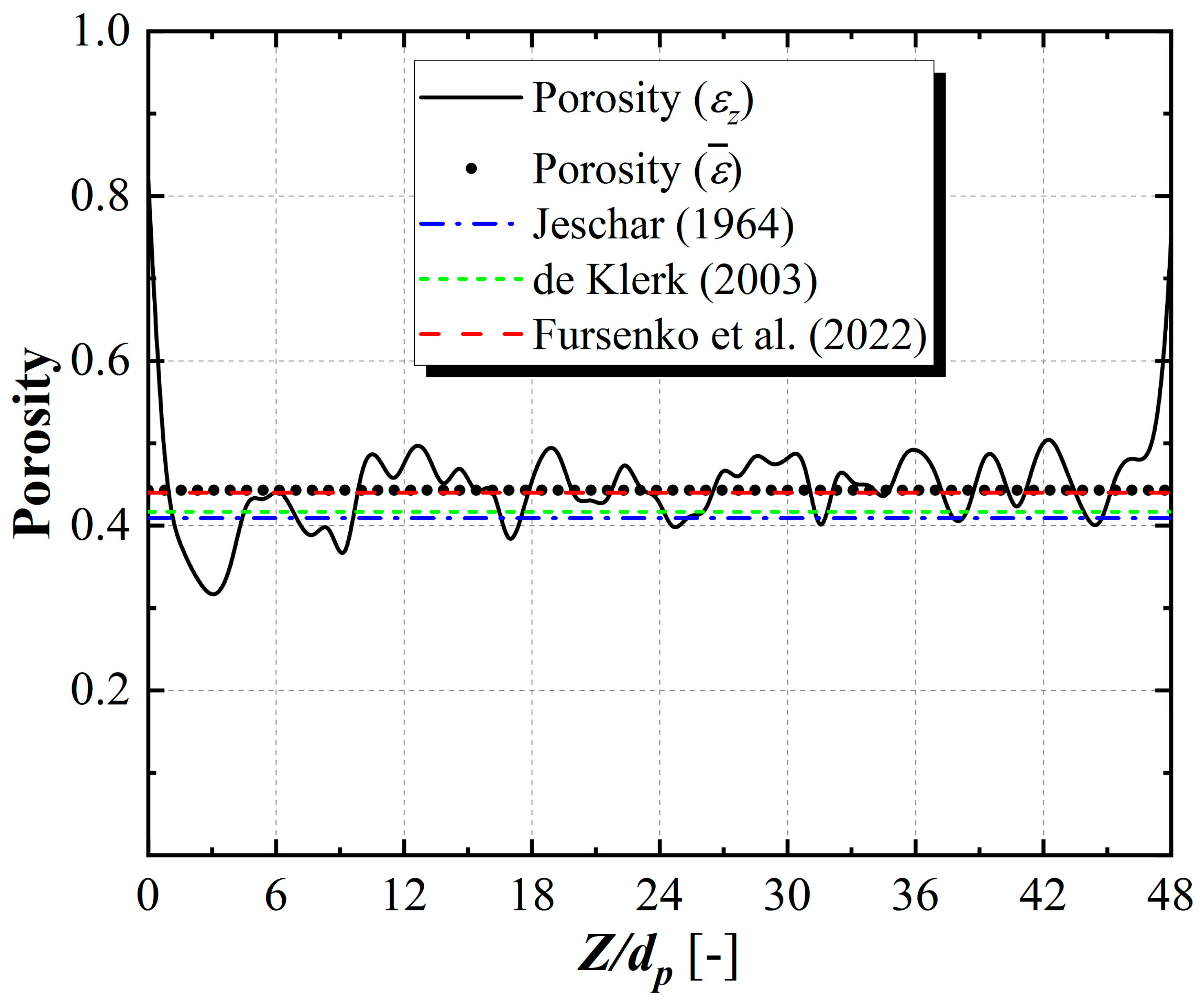
An important characteristic of the structural properties of packed beds is the distribution of their porosity. To validate the authenticity of randomly generated packed bed structures in DEM simulations, the packed bed is divided into multiple axial cylindrical cross-sections along the axial coordinate. The porosity of each axial cross-section is calculated from the local void fraction, and the resulting axial porosity distribution is then used to determine the overall average porosity of the packed bed. Subsequently, the average porosity of the packed bed is compared with two experimentally determined correlations provided by Jeschar [46] and de Klerk [47].
ε ¯ = 0.375 + 0.34 / N
ε ¯ = 0.41 + 0.35   exp ( 0.39 N )
where N = D/d is the tube-to-particle diameter ratio.
As shown in Figure 2, the average porosity of the packed bed is calculated to be 0.443. This value deviates by 8.3% from the correlation of Jeschar [46] and by 6.2% from that of de Klerk [47], while the deviation is only 0.6% compared with the experiment of Fursenko et al. [43]. The presence of slight deviations is mostly due to the stochastic nature of the random packing, as well as correlation-based estimates of axial porosity distribution.

2.3. Governing Equations

In this study, the computational domains for pore-scale simulations are composed of fluid-phase zones and solid-phase zones. The fluid flows through pores surrounded by solid surfaces. The Navier–Stokes equations explain the flow, reaction, heat, and mass transport inside the fluid phase. The solid energy equation regulates solid conduction inside the solid phase, with interfacial convective heat transfer taking place near particle surfaces. The standard k-ɛ model provides accurate macroscopic turbulent kinetic energy [48] and may be used to evaluate the macroscopic field of turbulent flow in porous media [49]. This work integrates the standard k-ε turbulence model with the coupling method, resulting in substantial fluid–solid coupling and heat transmission between the fluid domain and solid particles inside the packed bed. The single-step chemical reaction model is adopted for methane combustion, as also used in previous studies [50,51]. Considering the spatial complexity of random structures, which significantly increases computational difficulty and computational load, the following model simplification assumptions are as follows [39,52]:
(1)
The alumina pellets are inert.
(2)
The flow inside the packed bed is modeled using the standard k-ε turbulence model to capture the intense inertial mixing and velocity fluctuations under the present operating conditions. The gas mixture is assumed to be a non-radiative ideal gas, and radiative heat transfer in the solid phase is neglected.
(3)
The combustion reaction is modeled as a constant-pressure reaction, neglecting gas dispersion effects.
(4)
The chemical reaction is described as single-step kinetics provided by the commercial software Fluent.
(5)
In the present simulations, the external burner wall is treated as adiabatic, and the heat exchange between the wall and the surroundings is neglected in order to focus on the dominant pore-scale coupling among flow, heat transfer, and reaction inside the packed bed.
These assumptions are introduced to make the fully resolved three-dimensional pore-scale simulation computationally tractable. They are expected to preserve the dominant pore-scale transport and combustion mechanisms, although some quantitative deviations from the experiment may remain. Based on the above assumptions, a three-dimensional numerical model is established with the corresponding governing equations as follows:
Continuity equation
ρ f t + ρ f v = 0
where ρf is the fluid density, v is the fluid velocity vector.
Momentum equation
ρ f v t + ρ f v v = p + μ v + S m
where p is static pressure, μ is dynamic viscosity, Sm is the momentum source term.
Species conservation equation
ρ f Y i t + ρ f v Y i = ρ f D i Y i + ω i W i
where Yi is the mass fraction of species i, Di is the diffusion coefficient of species i, ωi is the reaction rate of species i, Wi is the molecular weight of species i.
Fluid-phase energy equation
ρ f c p T f t + ρ f c p v T f = λ f T f + S e
where cp is the specific heat capacity of the fluid, Tf is the fluid temperature, λf is the thermal conductivity of the fluid, Se is the energy source term.
Solid-phase energy equation
ρ s c s T s t + λ s T s = 0
where cs is the specific heat capacity of the solid, Ts is the solid temperature, λs is the thermal conductivity of the solid.
The fluid–solid heat transfer is resolved through the coupled wall condition at the fluid–solid interface, where both temperature continuity and heat-flux continuity are enforced. Therefore, the interphase heat transfer is obtained directly from the conjugate solution of the fluid and solid energy equations.
Turbulence model
This paper employs the standard k-ε equations (including turbulent kinetic energy k and turbulent dissipation rate ε):
ρ k t + ρ u j ¯ k x j = x j μ + μ t σ k k x j + μ t u i ¯ x j u i ¯ x j + u j ¯ x i ρ ε
ρ ε t + ρ u j ¯ ε x j = x j μ + μ t σ ε ε x j + C 1 ε k μ t u i ¯ x j u i ¯ x j + u j ¯ x i C 2 ρ ε 2 k
where μ t = c u ρ k 2 ε , cu = 0.09, c1 = 1.44, c2 = 1.92, σk = 1.0, σε = 1.3. The standard k-ε model coefficients used in this work are taken from the classical formulation of Launder and Spalding [53], which is also the default form widely adopted in engineering CFD software such as ANSYS Fluent 2024 R1.

2.4. Boundary and Initial Conditions

This study explores the standing combustion process of methane in a randomly packed bed under different operating conditions. The inlet velocity is set to 0.5, 0.6, and 0.8 m/s, while the inlet temperature is at 300 K. The composition of the methane-oxygen mixture (YCH4,in and YO2,in) is determined by the equivalence ratio (φ), which is the molar fuel-to-air ratio relative to its stoichiometric value.
The outlet boundary is maintained at ambient atmospheric pressure. At the solid–fluid interface, the non-slip and coupled wall boundary conditions are applied. At the burner wall, non-slip and adiabatic boundary conditions are imposed as an idealized thermal boundary treatment for the model. Accordingly, external convective and radiative heat losses from the wall to the surroundings are not resolved in the present simulations. The corresponding boundary conditions are summarized as follows:
(1)
Burner inlet
T g = 300   K ,   u = v = 0 ,   w = w 0 Y C H 4 = Y C H 4 , i n ,   Y O 2 = Y O 2 , i n
where u, v, and w represent the fluid velocities in the x, y, and z directions, respectively.
(2)
Burner outlet
p = p a t m ,   u z = v z = w z = k z = ε z = T f z = Y i z = 0
To facilitate the numerical simulation of the premixed methane-air filtration combustion process, the initial state of the system is obtained through the cold flow simulation method. First, a cold flow field is established. After the steady-state calculation is complete, the temperature of the particulate solid layer—approximately 5dp in height and 3dp in thickness—is adjusted to 1700 K to begin the ignition process (see the red dashed box in Figure 1a).

2.5. Numerical Details

In this study, all solution procedures have been performed using the commercial software package ANSYS Fluent 2024R1, which is based on the finite volume method. Spatial discretization of the pressure, momentum, energy, and species transport equations is performed using the second-order upwind scheme. The iterative calculations are considered to have converged when the residual of the energy equation is less than 10−6 and the other equations are less than 10−5. The time step is set to 0.001 s for all computational cases, and the simulation results are verified to be mesh-independent.

2.6. Definitions of Dimensionless Parameters

In this study, the pore Reynolds number Rep is introduced as a dimensionless parameter to characterize the pore-scale flow conditions. The flow in a randomly packed bed is controlled by both the flow rate and the pore-scale geometry. Therefore, Rep can better reflect the relative importance of inertial and viscous effects in the pore network, making it a more appropriate governing parameter for analyzing flow disturbances, convective transport, and combustion structure evolution in randomly packed beds. It should be noted that Rep differs from the conventional Reynolds number for smooth pipe flow, as it is defined based on the inlet velocity and the pore-scale hydraulic diameter. The corresponding expression is defined as follows [54]:
R e p = ρ f v i n d h μ f ε
d h = 4 ε 6 1 ε + 4 / N d p
where vin is the inlet velocity, dh is the hydraulic diameter.
The root mean square (RMS) velocity is introduced to characterize the magnitude of local velocity fluctuations in the packed bed. It provides a useful indicator of the fluctuation intensity and mixing behavior of the pore-scale flow field. The relevant definition is as follows:
v z , R M S = 1 n 1 i = 1 n 1 v z v ¯ z 2
where vz is the cell value of the axial velocity at each facet of the section, v ¯ z is the mean value of vz, n is the total number of facets in the section.
v ¯ z , R M S is the relative values of the RMS of the velocity that is expressed as follows:
v ¯ z , R M S = v z , R M S v ¯ z
where vz,RMS is the RMS of the velocity.
The average thermal flame thickness δ is expressed as follows [38]:
δ = T ¯ f , max T i n T ¯ f z max
where T ¯ f , max is the maximum averaged fluid temperature, T ¯ f is averaged fluid temperature.

3. Mesh Generation

3.1. Meshing Scheme

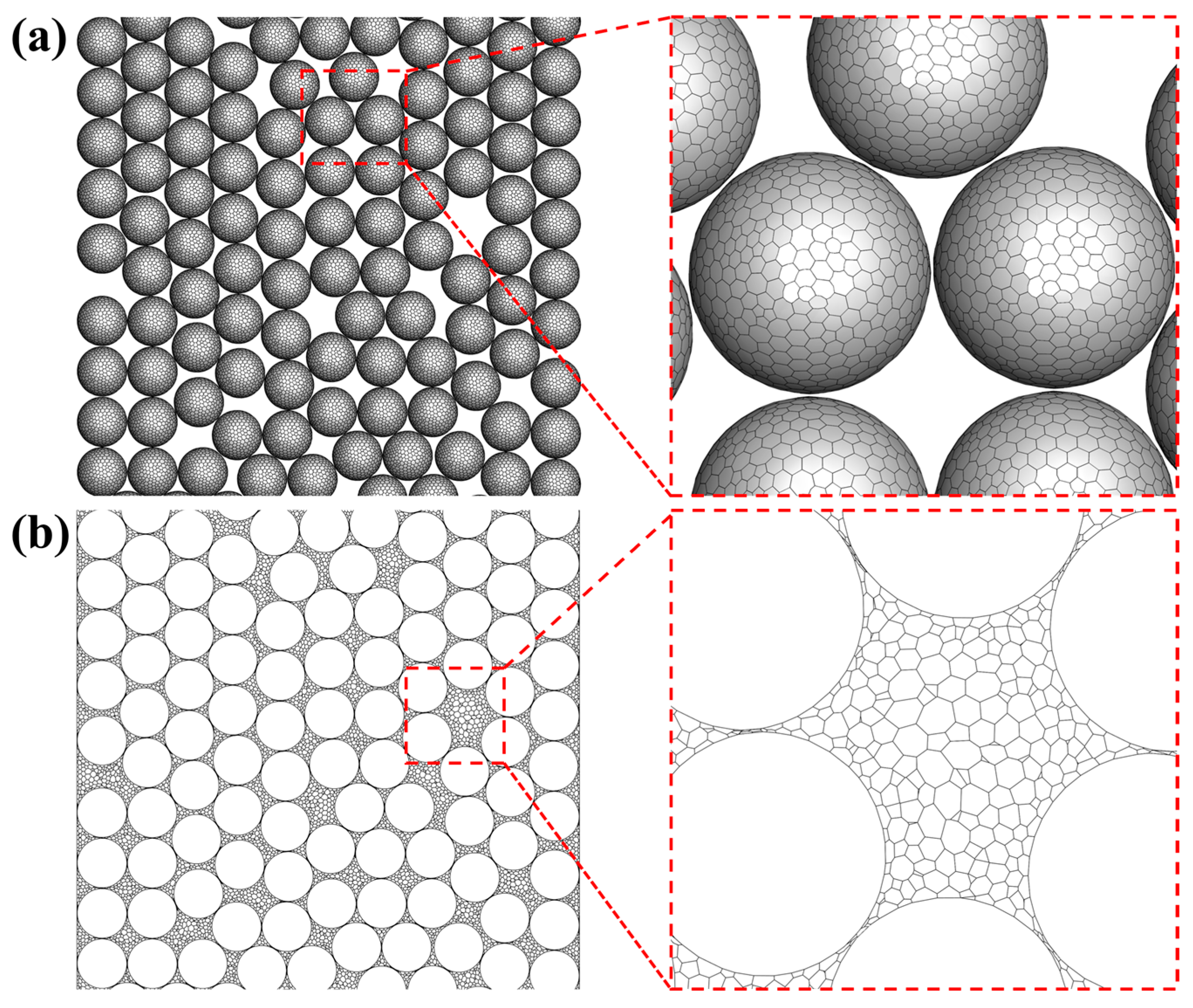
To generate the packed bed geometry model, the parametric information of all particles, including their centers of location and diameters, is imported into the tool (Unigraphics NX). Afterward, the regenerated physical model is then imported into the meshing tool (Fluent meshing). Considering that contact points between spheres have a modest influence on the flow field, and to solve the difficulties of meshing contact points while accommodating computational constraints, the gap approach is used to handle particle contact problems. After generating the randomly packed bed, Shi et al. [39] reduced the diameter of all particles by a factor of 0.99 to mesh the computational domain using the gap method. Fursenko et al. [43] also scaled particles down by a factor of 0.875, resulting in the minimum gap between the particles about 1 mm. Therefore, the diameter of particles is decreased by 1% dp in order to remove direct contact in the process of remodeling. Owing to the structural complexity of the randomly packed bed, unstructured meshing is performed using a polyhedral subdivision method (see Figure 3). The mesh is refined locally on the spherical surfaces to ensure mesh quality and better capture heat transfer properties at pore-scale contact locations.

3.2. Validation of Grid Independence and Reaction Model

The reliability of the numerical results is inherently tied to the mesh convergence study, as the mesh must be sufficiently refined to yield a solution that is independent of further mesh refinement. To verify grid independence, this study simulates the heat transfer process of the pore structure under the action of hot air with reference to the method proposed by Yakovlev et al. [38], without considering chemical reactions. Other solution parameters, including the solution procedure, are consistent with those used for the full problem.
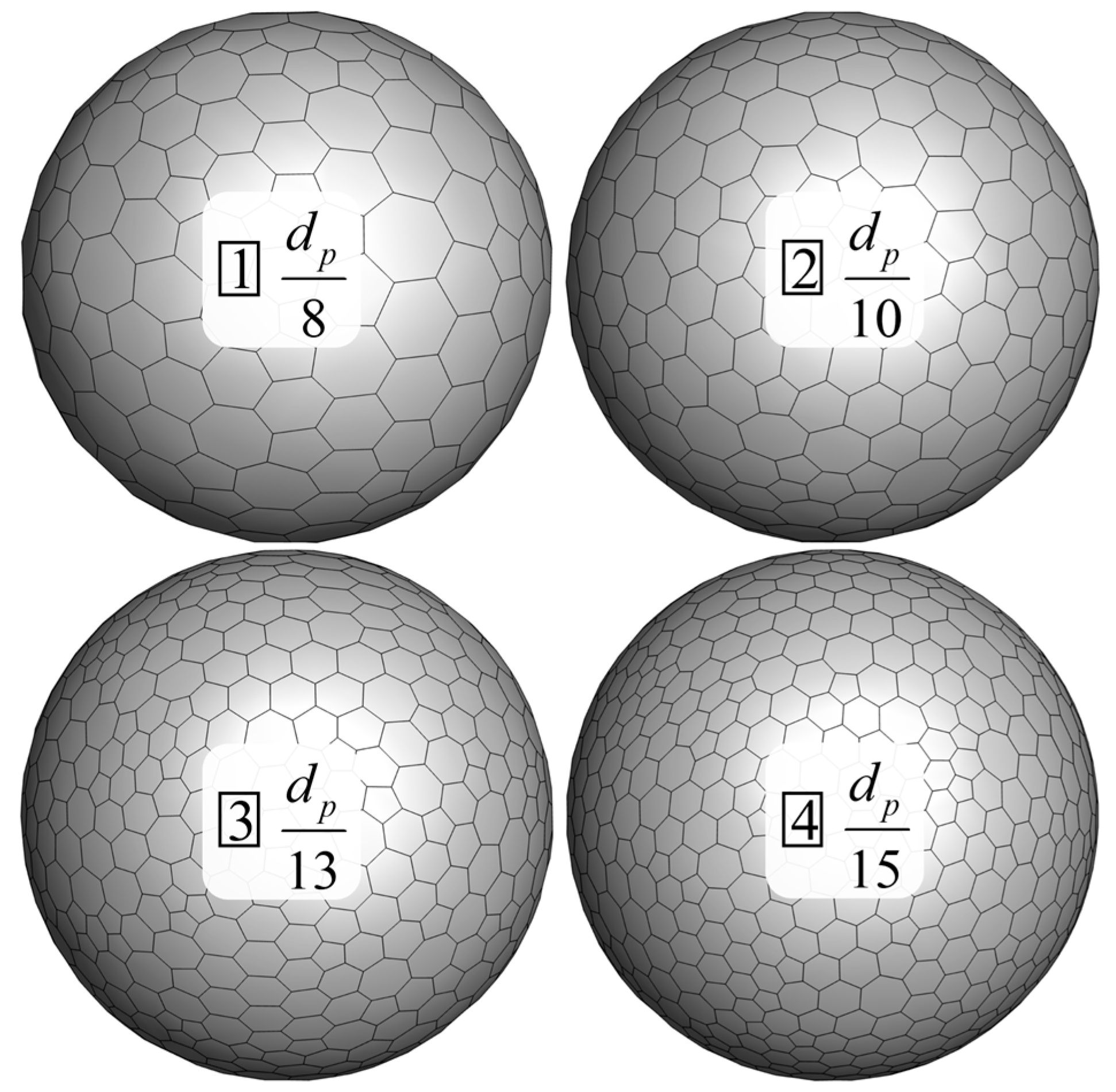
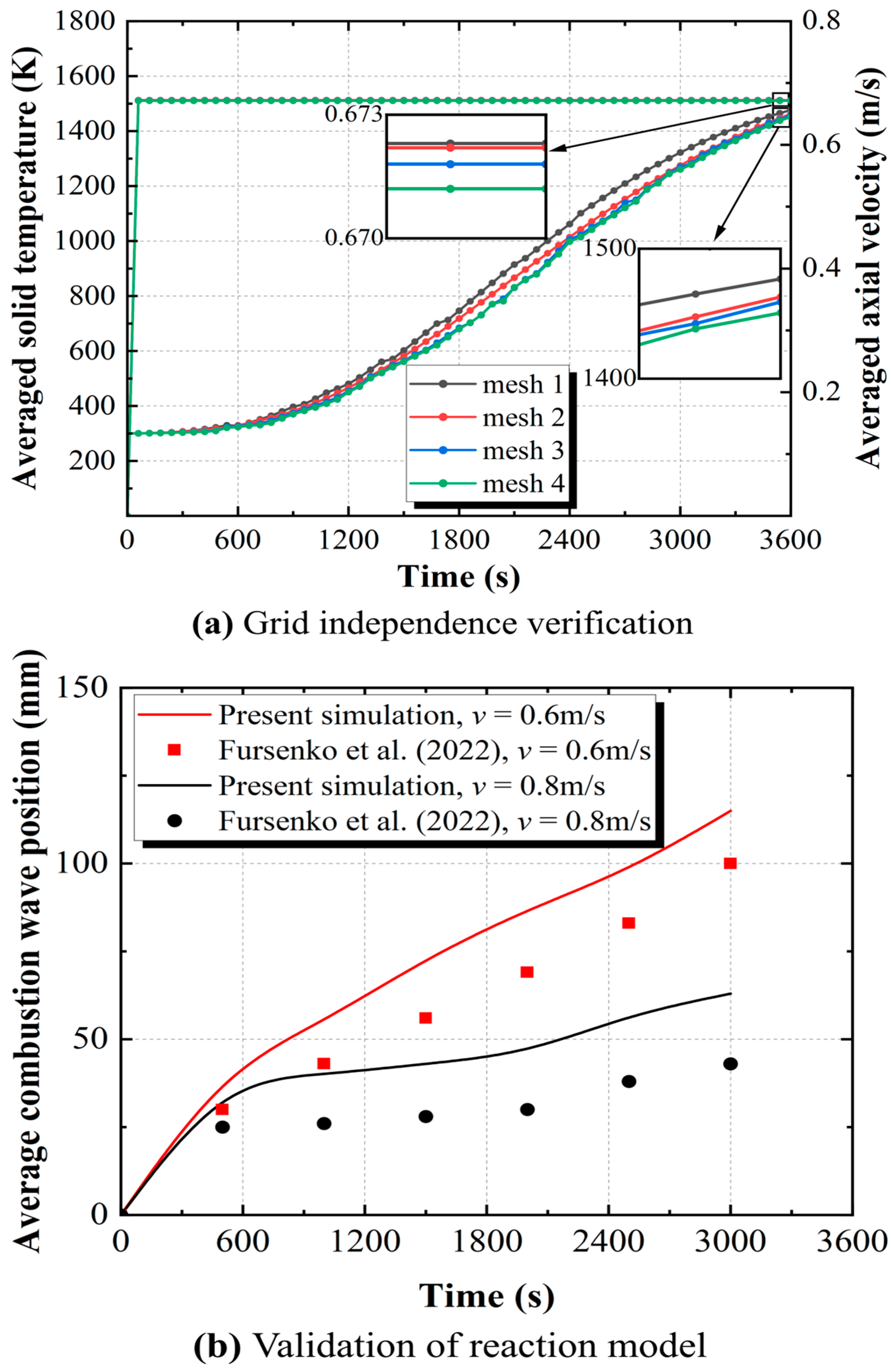
To this end, four mesh resolutions are analyzed in the convergence study. Figure 4 presents four meshed spheres with different sizes of the cells, facilitating visual comparison. These mesh resolutions are denoted numerically from 1 (1/8dp) to 4 (1/15dp). A comparative analysis of the distribution and temporal evolution of flow and heat transfer parameters, under identical inlet velocities, is carried out to evaluate the impact of mesh resolution. Figure 5a shows how the average solid temperature and axial velocity change at the central radial cross-section of the model. The results indicate that there are minimal differences between the meshes, with no significant variation compared to the previous scheme. Taking into account both computational accuracy and cost, the 1/13dp mesh is ultimately selected as the optimal meshing scheme. The final computational domain consists of approximately 13.2 million mesh elements.
In addition, besides validating the physical model of the packed bed itself, the verification of the reaction model is also indispensable, and its results provide important reference value for mechanism analysis in subsequent studies. To further verify the reliability of the model, this study investigates the macroscopic characteristics of methane filtration combustion waves in the packed bed under different inlet velocities, based on the experimental apparatus proposed by Fursenko et al. [43]. The comparison results are shown in Figure 5b, where a certain deviation is observed between the numerical simulation results and the experimental data. This deviation is attributed to the combined effects of several model simplifications and numerical approximations.
The present simulations neglect radiative heat transfer and external wall heat loss, leading to a simulated thermal wave propagation velocity higher than the experimental result. The simulations also adopt a single-step methane oxidation mechanism that oversimplifies ignition kinetics. In addition, the gap method slightly modifies the geometry near particle contact points, and only one representative randomly packed structure is employed. These simplifications may influence the quantitative prediction of combustion-wave velocity, local temperature peaks, and flame front details. Despite these limitations, the present numerical model reproduces the same increasing trend as the experimental measurements and reasonably captures the dominant combustion wave characteristics. Accordingly, the current model should be regarded as a pore-scale framework for revealing the dominant coupling among flow, heat transfer, and chemical reaction.

4. Results and Discussion

4.1. Characteristics of Flow Field in Packed Bed

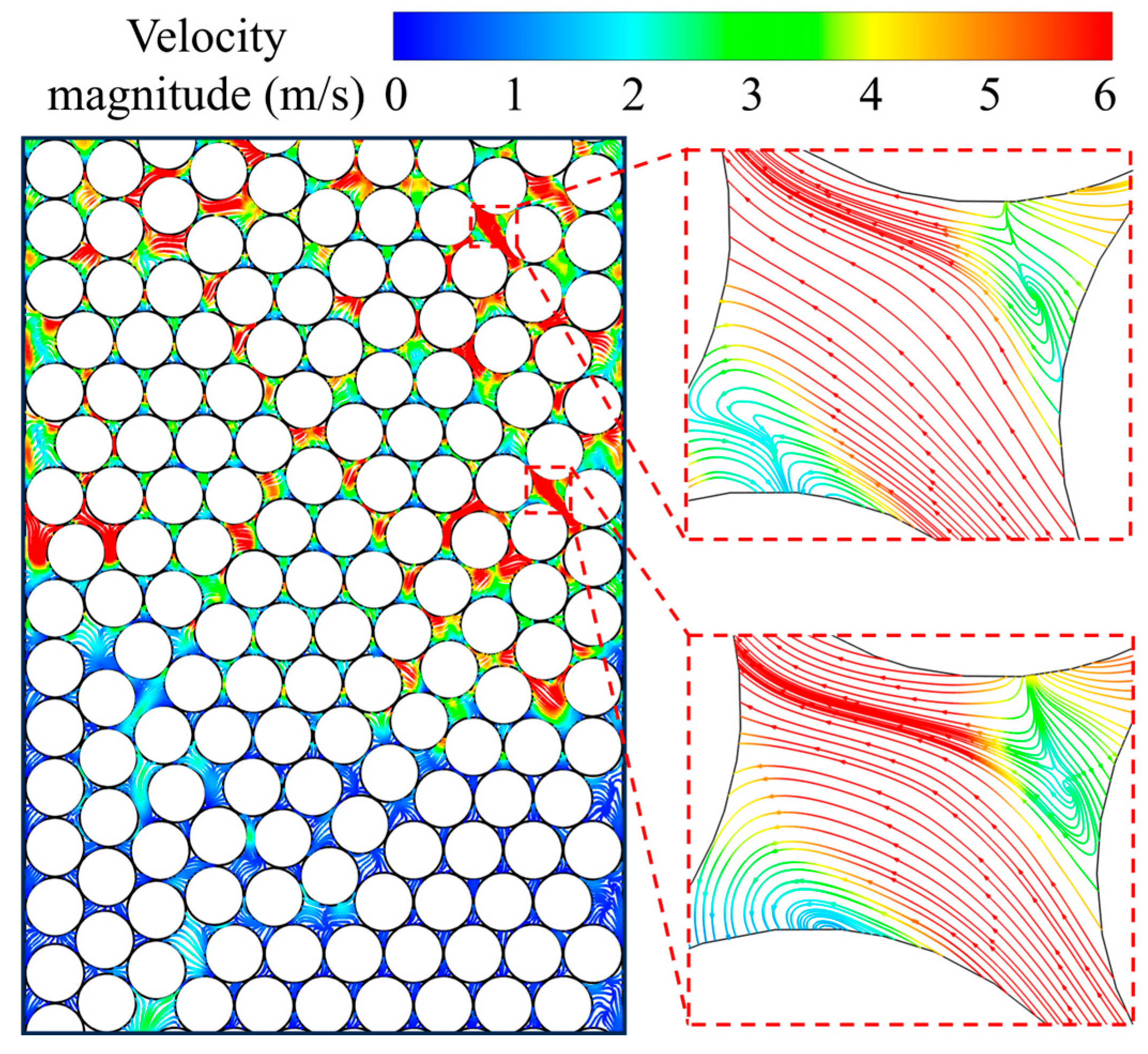
Owing to the complexity of random particle packing in the packed bed, fluid flowing through narrow and intricate pores readily generates vortex structures, as shown in Figure 6. The primary cause of vortex formation is the inhomogeneous distribution of fluid within the pore channel, influenced by factors such as particle size and shape, packing structure, and Reynolds number. As the fluid passes through inter-particle gaps, resistance at particle surfaces reduces local velocity and alters flow direction, inducing rotational motion and ultimately generating vortices near particle surfaces. These vortices lead to pronounced flow fluctuations and local disturbance enhancement, further intensifying the non-uniformity of the flow field. At the same time, however, they enhance mixing and agitation, facilitate effective energy exchange within the fluid, and promote faster, more uniform energy transfer. This phenomenon has significant implications for enhancing the heat transfer efficiency in fluid flow.
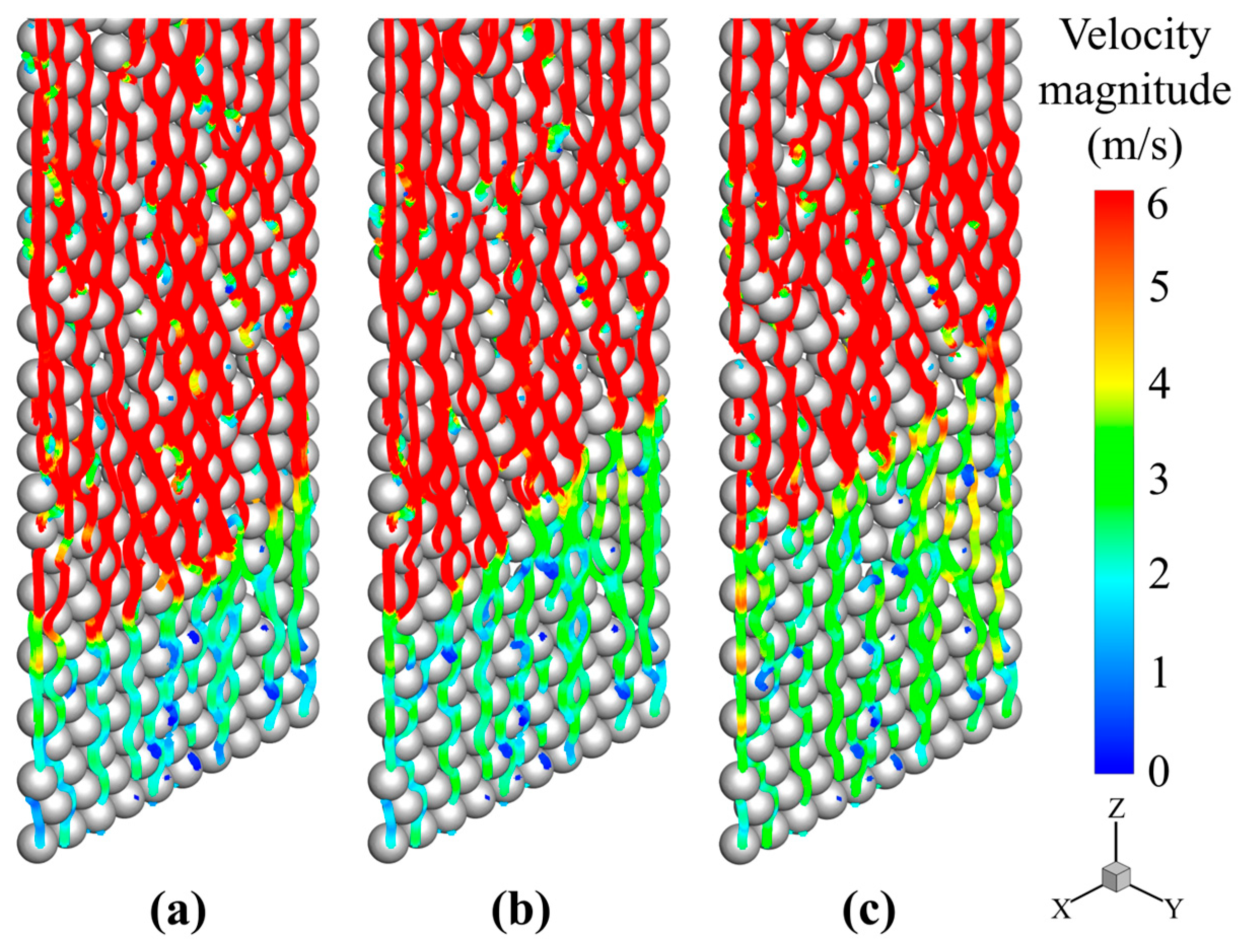
Figure 7 shows the three-dimensional velocity streamline distribution at different pore Reynolds numbers under an equivalence ratio of φ = 0.8. Overall, the flow exhibits a combination of high-speed channels and low-speed stagnation zones. The high-velocity mainstreams form continuous flow bands along the narrow gaps between particles, while low-speed regions and localized vortices develop within the interstitial areas. This property signifies that the internal energy created during combustion is directionally transformed into kinetic energy by thermal expansion and pressure gradients within the porous media, propelling the fluid to preferentially travel swiftly along the larger pore channels. Because of the unique structure of the packed bed, the high enthalpy zone causes the fluid to flow downstream via the pores or along the surface of the particles. This result further demonstrates that the spatial inhomogeneity of energy release during pore-scale combustion, coupled with geometric constraints imposed by the model, jointly determines the highly non-uniform flow field structure.
Such local flow inhomogeneity leads to variations in the local heat transfer coefficient, which in turn results in temperature inhomogeneity and a non-uniform heat release rate distribution at the pore scale. When Rep = 532.56 (see Figure 7a), streamlines are relatively concentrated, with only a few dominant flow channels. In this regime, high-velocity flow bands primarily develop along direct pathways between particles, while extensive low-velocity regions persist, resulting in insufficient local mixing of reactants. As the inlet velocity increases, the number of high-velocity channels grows and the overall flow distribution becomes more uniform. Consequently, a greater proportion of particle surfaces are exposed to the high-speed fluid, thereby enhancing local heat and mass transfer efficiency.
With the increase in the pore Reynolds number, the flow field within the packed bed transitions gradually from a locally concentrated pattern to a more dispersed and uniformly distributed network of high-velocity channels. The high-velocity region gradually shifts downstream, from an initial position at z = 50 mm (8 dp) to z = 80 mm (12 dp), as shown in Figure 7a–c. This transformation enhances overall flow permeability and the transport capacity of reactants. However, higher pore Reynolds numbers also lead to stronger flow instabilities and wake effects. More pronounced wake structures develop behind some particles, intensifying local flow instability and potentially affecting the stability of the reaction zone. Thus, these flow dynamics are the foundation for the subsequent spatial evolution of temperature distribution, reaction rates, and combustion reaction zones.
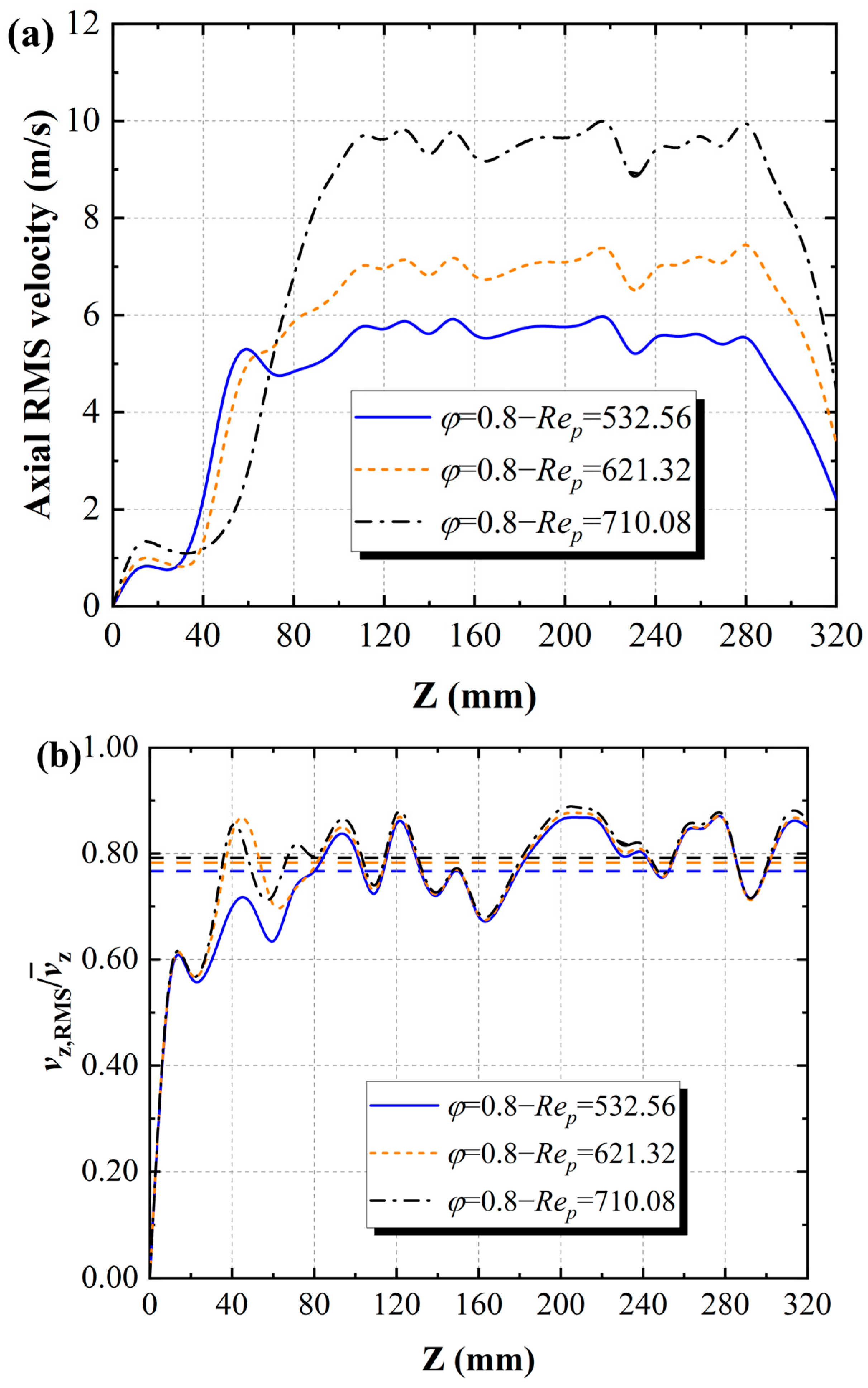
To estimate the variation in axial velocity along the z-axis, the fluid region is divided into cross-sections spaced 5 mm apart. The first section is equivalent to the inlet surface of the packing zone (z = 0 mm), while the last section is equivalent to the outlet surface (z = 320 mm). As shown in Figure 8a, the axial root mean square (RMS) velocity increases dramatically as the pore Reynolds number increases, peaking at around 5.5 m/s, 7.0 m/s, and 10.0 m/s before remaining rather steady at a high value. This suggests that the local fluid expansion generated by the heat release of combustion considerably increases the flow disturbance intensity, resulting in a rapid rise in the kinetic energy of the combustion zone. The overall velocity level rises upward as the Reynolds number increases, showing that the increased input flow rate accentuates the phenomena of fluid acceleration induced by the exothermic expansion pressure gradient. This is consistent with the flow characteristics observed in Figure 7. Increased flow rates enhance lateral fluid mixing, which intensifies combustion reactions, leading to higher chemical reaction rates and thereby driving an increase in the overall fluid velocity within the bed. Meanwhile, the RMS velocity gradually increases in the axial direction before stabilizing, which suggests that the high-intensity flow fluctuations and inertial mixing become progressively more stable downstream. In contrast, the relative RMS velocity displayed in Figure 8b varies just a little across different pore Reynolds numbers, ranging from 0.7 to 0.85. Increasing the pore Reynolds number leads to increased flow disturbances, mixing, and flame rippling. However, the proportion of the fluctuation intensity relative to the mainstream flow remains of the same order. Overall, the influence of the pore Reynolds number on methane flame propagation and stability is mainly reflected in enhanced flow disturbances and inertial mixing, rather than in a fundamental change in the global flow structure.

4.2. Characteristics of Temperature Field in Packed Bed

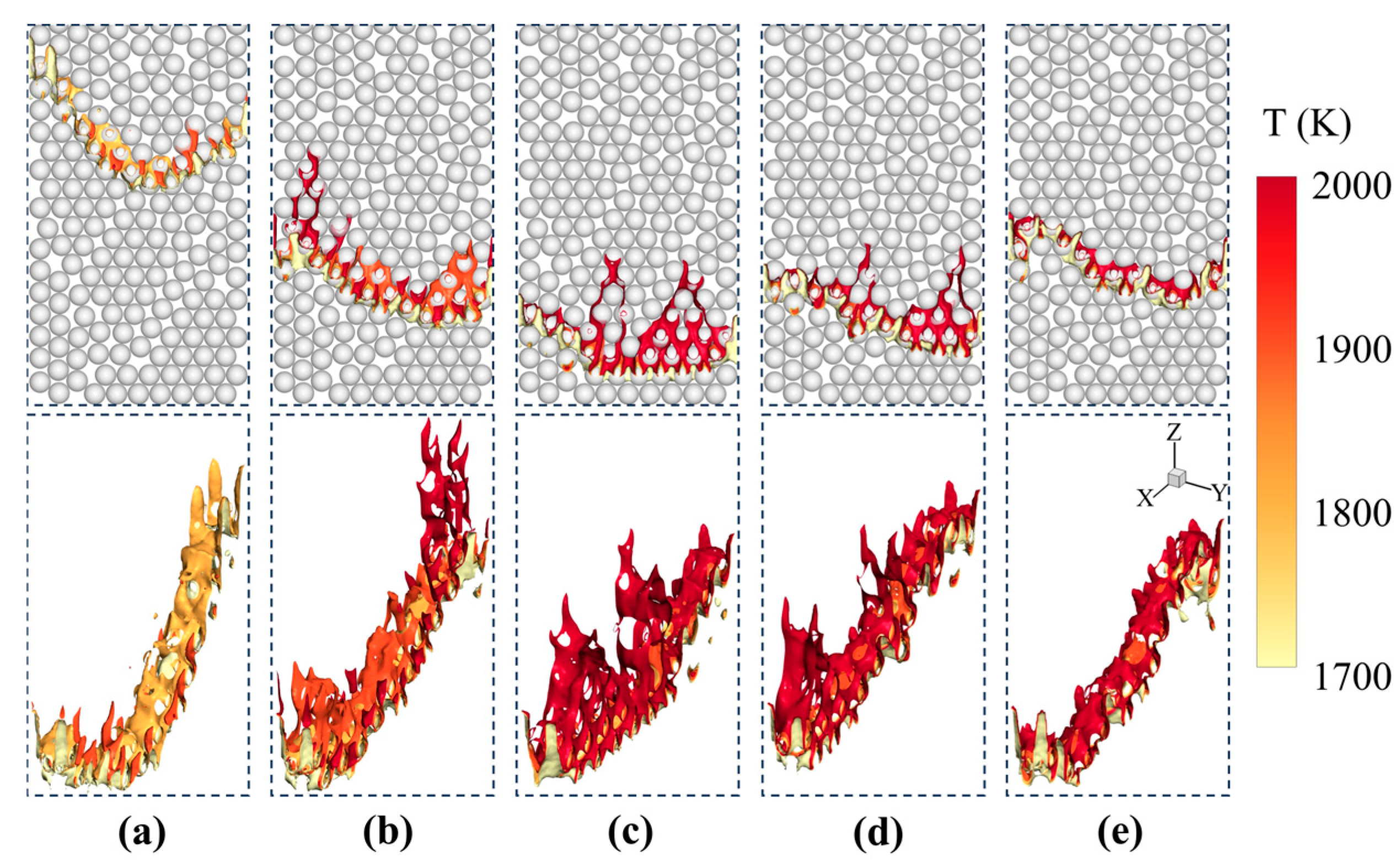
Figure 9 shows selected three-dimensional high-temperature isothermal surfaces under different operating conditions, rather than the volume-averaged temperature of the entire packed bed. As the equivalence ratio increases from 0.6 to 0.8, the high-temperature isothermal surface evolves from a sparse and discontinuous distribution to a more continuous and compact hot-zone structure (see Figure 9a–c), indicating a marked enhancement in heat release intensity and lateral uniformity. Conversely, under identical equivalence-ratio conditions (see Figure 9c–e), increasing the pore Reynolds number from 532.56 to 710.08 causes progressive elongation and downstream displacement of the hot zone, which reflects stronger convective transport and more effective downstream energy redistribution. Enhanced inertial mixing and stronger convective heat transfer accelerate flame propagation downstream, while stronger convective heat transfer promotes the development of a more uniform temperature field, thereby reducing localized overheating. These findings also suggest that the optimal combination of equivalence ratio and pore Reynolds number is essential for maximizing combustion efficiency and avoiding localized temperature peaks.
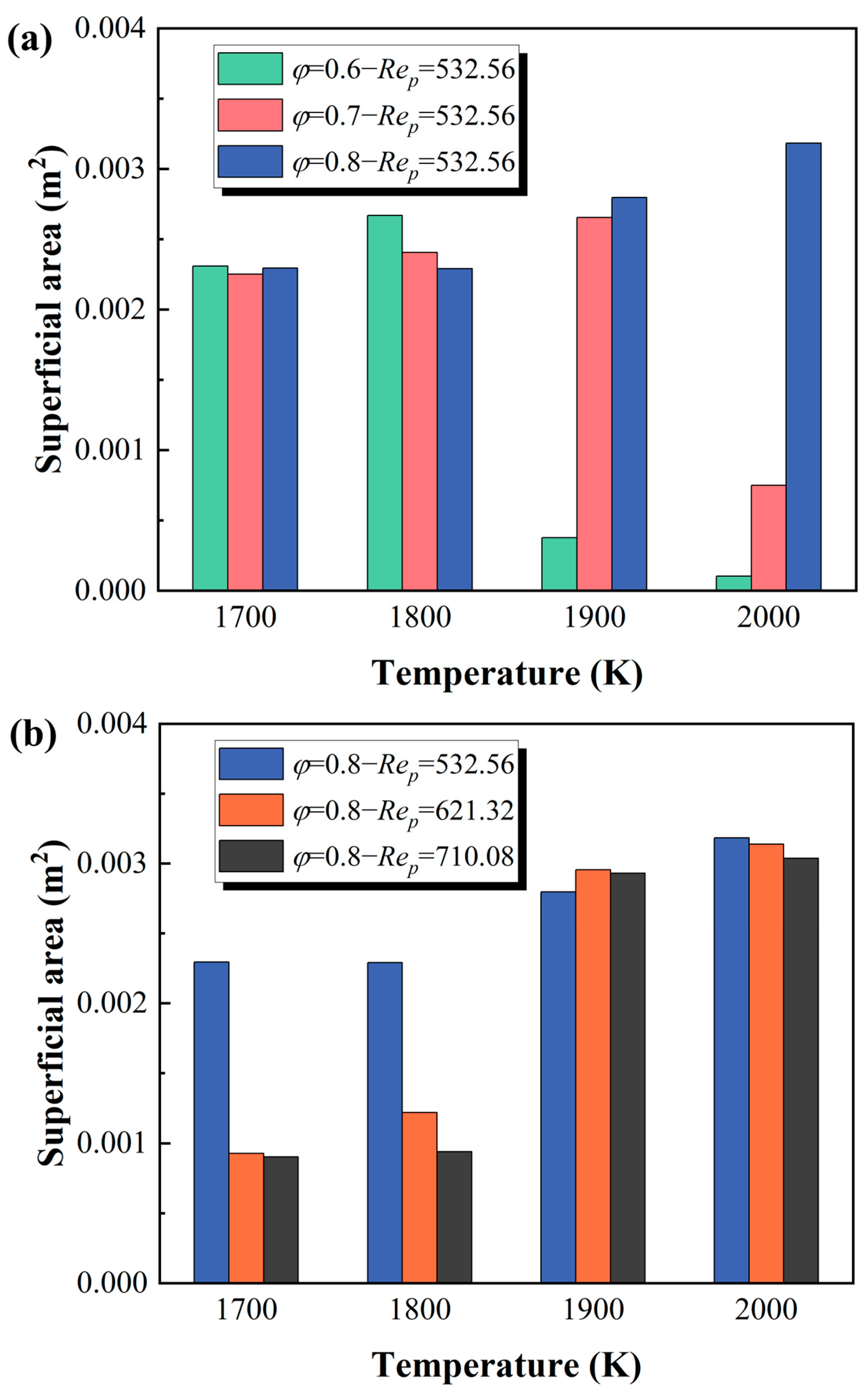
In order to provide further quantitative insight into the characteristics of the temperature field distribution, Figure 10 presents the variation in the surface area of high-temperature isothermal surfaces under different equivalence ratios and pore Reynolds numbers during standing combustion conditions. In one aspect, increasing the equivalence ratio significantly expands the surface areas of high-temperature iso-surfaces, especially within the temperature range of 1900–2000 K. This phenomenon reflects the enhanced heat release and hot zone expansion driven by an increased fuel supply. In contrast, under lean combustion conditions, insufficient equivalence ratio limits the chemical heat release, resulting in inadequate thermal intensity to establish or maintain continuous high-temperature regions. The surface area of the high-temperature region (Tf = 2000 K) is only 0.0002 m2 at φ = 0.6. The temperature field distribution is highly inhomogeneous, with a marked reduction in the total surface areas of the high-temperature zones.
In another aspect, the influence of pore Reynolds number on isothermal surface area exhibits a greater degree of complexity. At lower flow velocities and weaker flow disturbances, convective heat transfer and fluid mixing are constrained, which impedes downstream heat transport and confines the high-temperature zone to the vicinity of the ignition region. As shown in Figure 10b, when Rep = 532.56, the areas of each temperature zone remain between 0.002 m2 and 0.003 m2. Conversely, as the pore Reynolds number increases, the surface areas of higher-temperature iso-surfaces expand substantially, indicating a more concentrated energy release process. However, intense convection simultaneously triggers a sweeping effect, promoting heat transfer downstream and shifting the reaction zone backward. For instance, the area of high-temperature surfaces at 1700 K shrinks or stabilizes as heat flows downstream. This finding is consistent with the temperature distribution evolution depicted in Figure 9, yet it provides more robust quantitative support through geometric quantification. In addition, it is imperative to note that this preliminary study establishes a fundamental foundation for subsequent analyses of fluid–solid heat transfer characteristics and reaction surface distribution.
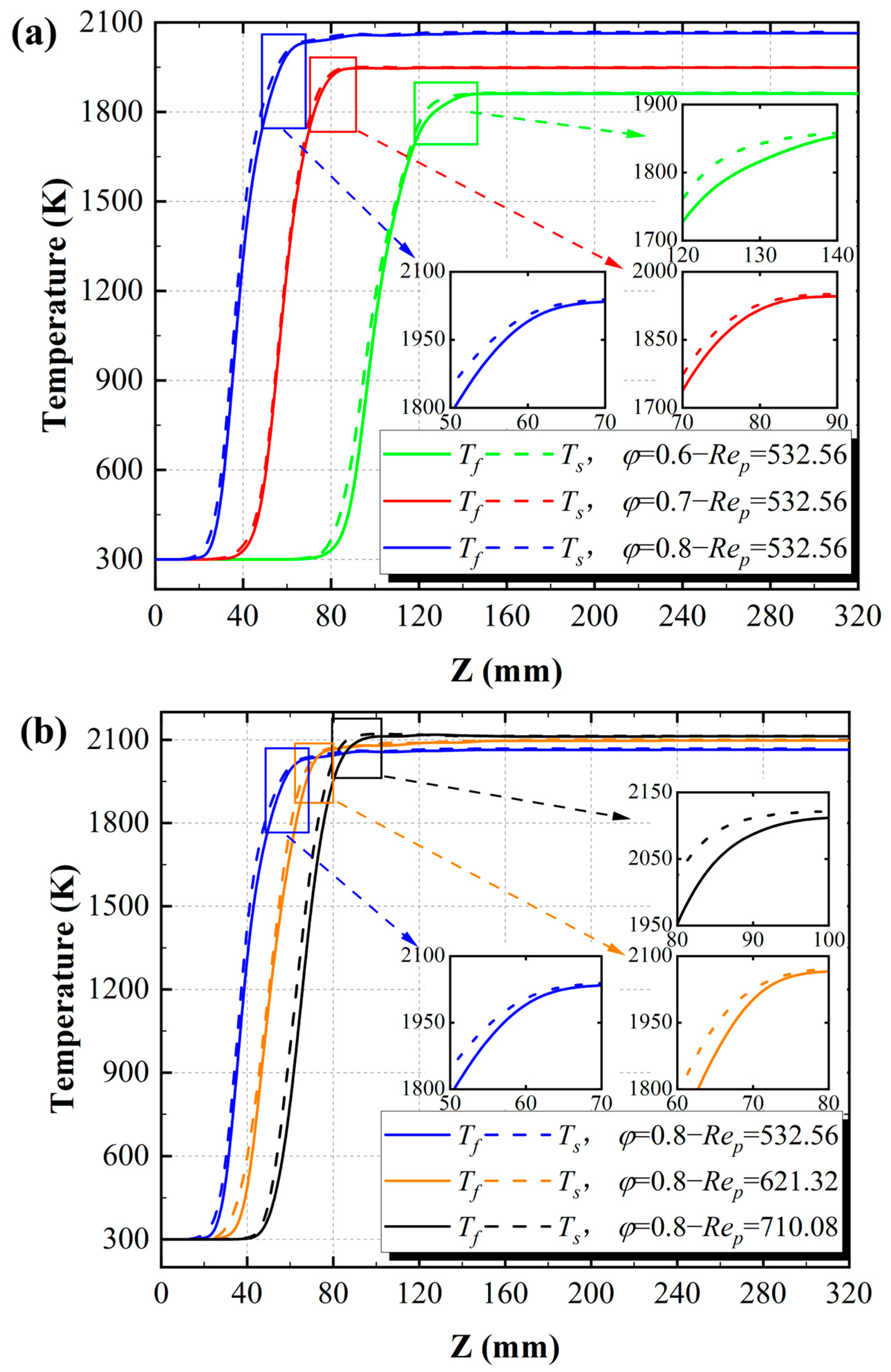
To further quantitatively investigate the pore-scale temperature distribution, Figure 11 shows the axial temperature variations in both the fluid and solid phases during standing combustion conditions. Generally, the temperatures of the two phases increase rapidly along the axial direction before stabilizing, which is consistent with the heat transfer characteristics of packed bed combustion. During the rapid temperature rise phase, the solid temperature (Ts) is approximately 50 to 100 K higher than the fluid temperature (Tf), reflecting that heat conduction in the solid matrix dominates the heat absorption process when fuel combustion is initiated. As the mixture flows downstream, both phases exhibit a pronounced temperature rise, with Tf increasing more rapidly once chemical reactions intensify.
In addition, as shown in Figure 11a, the peak fluid temperature reaches 2060 K at φ = 0.8, compared with approximately 1860 K at φ = 0.6, indicating stronger heat release and broader flame coverage. It should be emphasized that these temperatures correspond to localized peak fluid temperatures rather than spatially averaged bed temperatures. Such values are not inherently unreasonable for methane/air combustion, because the adiabatic flame temperature of methane–air mixtures is already on the order of 2200 K near stoichiometric conditions and varies strongly with equivalence ratio. Moreover, porous media combustion may exhibit excess enthalpy or super-adiabatic behavior due to internal heat recirculation. Nevertheless, the present baseline model adopts an adiabatic-wall treatment and neglects external heat losses, so the predicted local peak temperatures should be interpreted cautiously and may be somewhat overestimated relative to experimental measurements. During flame stabilization, the temperatures of the two phases gradually converge (ΔT < 10 K), suggesting that thermal equilibrium is nearly established within the porous medium. The evolution of fluid–solid temperature at high φ demonstrates the efficiency of convective heat transfer following the complete development of reactions.
As shown in Figure 11b, under constant equivalence ratio conditions, variations in pore Reynolds number primarily affect the early stage of flame propagation. At the pore Reynolds number of 532.56, relatively weak thermal convection limits fluid–solid energy exchange, with the solid temperature near the inlet being only about 10 to 50 K higher than the fluid temperature. When the pore Reynolds number increases to 710.08, enhanced convective transport and mixing facilitate more efficient downstream energy redistribution. This resulted in a significant rise in fluid temperature and the formation of a nearly uniform fluid–solid phase temperature field throughout the packed bed when the combustion flame stabilized. Additionally, the peak fluid temperature increases slightly (by approximately 30 to 50 K) due to enhanced reaction rates and intensity. With the increase in velocity, the region in which temperatures rise rapidly moves downstream. These findings collectively demonstrate that both mixture richness and flow intensity critically determine the spatial extent and uniformity of the combustion zone within the packed bed.

4.3. Characteristics of Fluid–Solid Heat Transfer in the Packed Bed

This section focuses on the pore-scale combustion heat propagation process from the standpoint of temperature field distribution, with a view of investigating the heat transfer characteristics at the fluid–solid interface during packed-bed combustion. As shown in the temperature distribution above, standing combustion of the fuel mixture causes the creation of localized high-temperature regions. These areas form as a result of the quick oxidation of methane after ignition, which emits significant heat from both the particle walls and the fluid zones within high-velocity cavities. Owing to the strong thermo-mechanical coupling between the fluid and solid phases, the heat release rate field exhibits a highly intricate and irregular morphology. However, the thickness of the flame front remains within approximately 2dp. This form of instability is caused by localized combustion in the mixture as well as the geometric structure of the packed bed. The present study investigates steady-state combustion, in which the methane-air mixture is completely consumed. The strong thermal coupling between the fluid and solid matrices ultimately sustains the formation of the continuous and stable flame front.
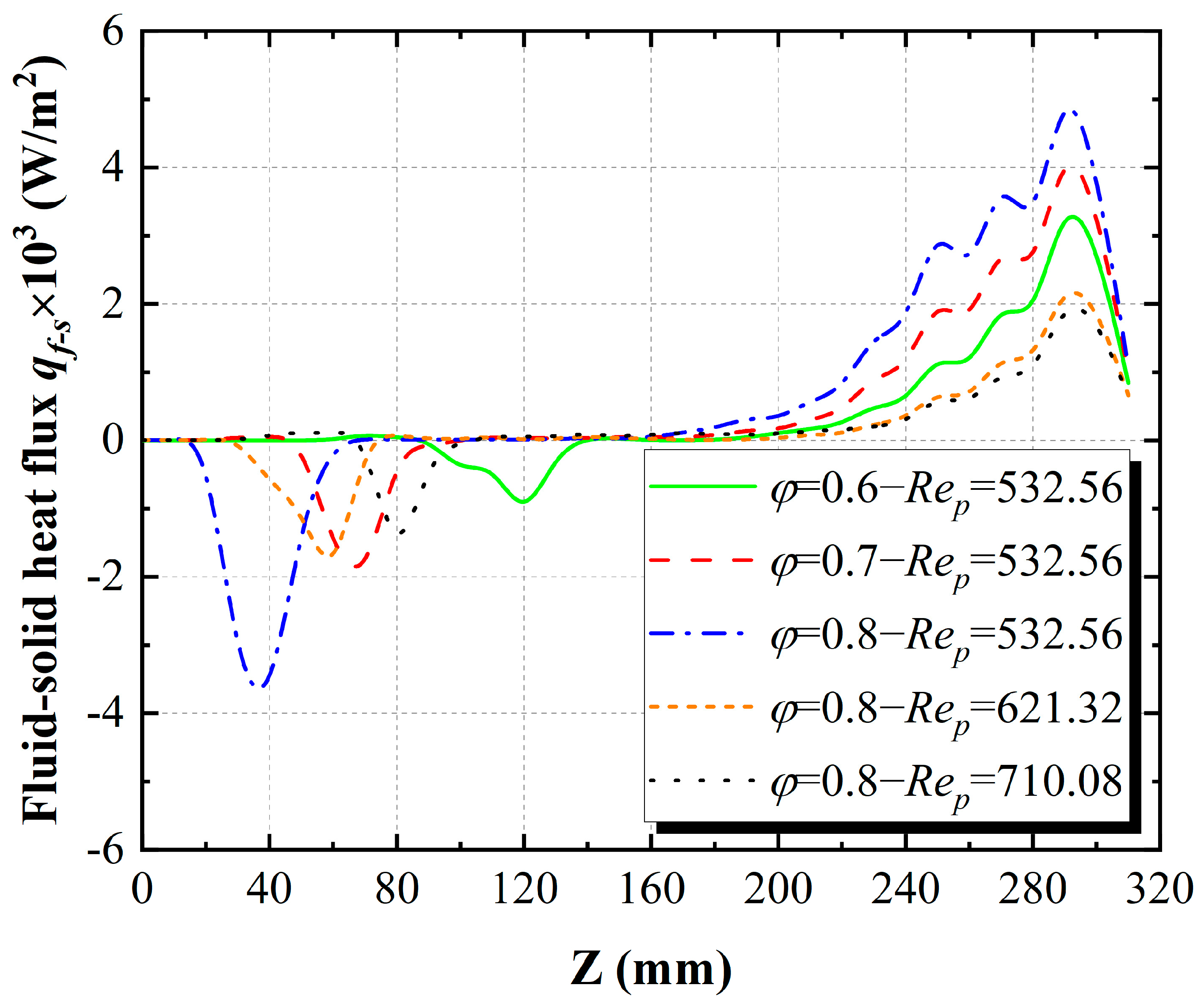
The mechanism of heat recirculation can be effectively characterized by examining the heat flux at the fluid–solid interface. Figure 12 shows the axial distribution of stabilizing combustion heat flux (qf−s) under different operating conditions. While qf−s < 0, it implies that the solid heat is transferred to the fluid. Yet if qf−s > 0, it suggests heat transfer from the fluid to the solid. Overall, the results reveal a significant asymmetry between the upstream and downstream regions of the packed bed, which corresponds to local reaction heat generation and convective heat transfer effects. At the fixed flow rate, the upstream heat flux intensity under a lower equivalence ratio (φ = 0.6) is relatively weak, remaining within the range of 1000 W/m2. This indicates a reverse heat transfer from the solid matrix to the fluid due to insufficient chemical heat release and reduced thermal stability. When φ increases to 0.8, the dominant positive heat flux region expands significantly, with a peak value of approximately 5000 W/m2, signifying intense exothermic activity and enhanced convective energy propagation downstream. Similarly, the pore Reynolds number has a marked influence on the intensity and directionality of the heat flux. At Rep = 532.56, heat transfer is dominated by thermal conduction, forming a localized high heat exchange zone near the ignition region. As the pore Reynolds number increases, thermal convection becomes the dominant mechanism, causing the high heat flux core to shift downstream. Additionally, a portion of the heat is carried away by the fluid, resulting in a relatively small magnitude of positive heat flux (only 2000 W/m2) under this condition.
Moreover, the comparison under different operating conditions reveals that the equivalent ratio exerts the most significant influence on fluid–solid heat transfer. At the constant pore Reynolds number, an increase in the equivalent ratio has been shown to lead to a significant elevation in peak heat flux and an expansion of the heat transfer zone. This reflects more vigorous combustion reactions and stronger fluid–solid thermal coupling, consistent with the three-dimensional temperature field distributions. In addition, the equivalence ratio is identified as the critical parameter governing both heat release intensity and heat transfer efficiency within the packed bed. In contrast, the effect of the pore Reynolds number is primarily expressed through the downstream shift in the negative heat flux peak and the axial extension of the positive heat flux zone. The mechanism of heat recirculation generates a concentration of energy in the combustion zone, influencing heat transfer between the fluid and solid. This phenomenon also suggests that stronger flow disturbances suppress the formation of localized temperature fields while simultaneously enhancing the process of heat diffusion propagating outward.

4.4. Pore-Scale Flame Front Morphology in the Packed Bed

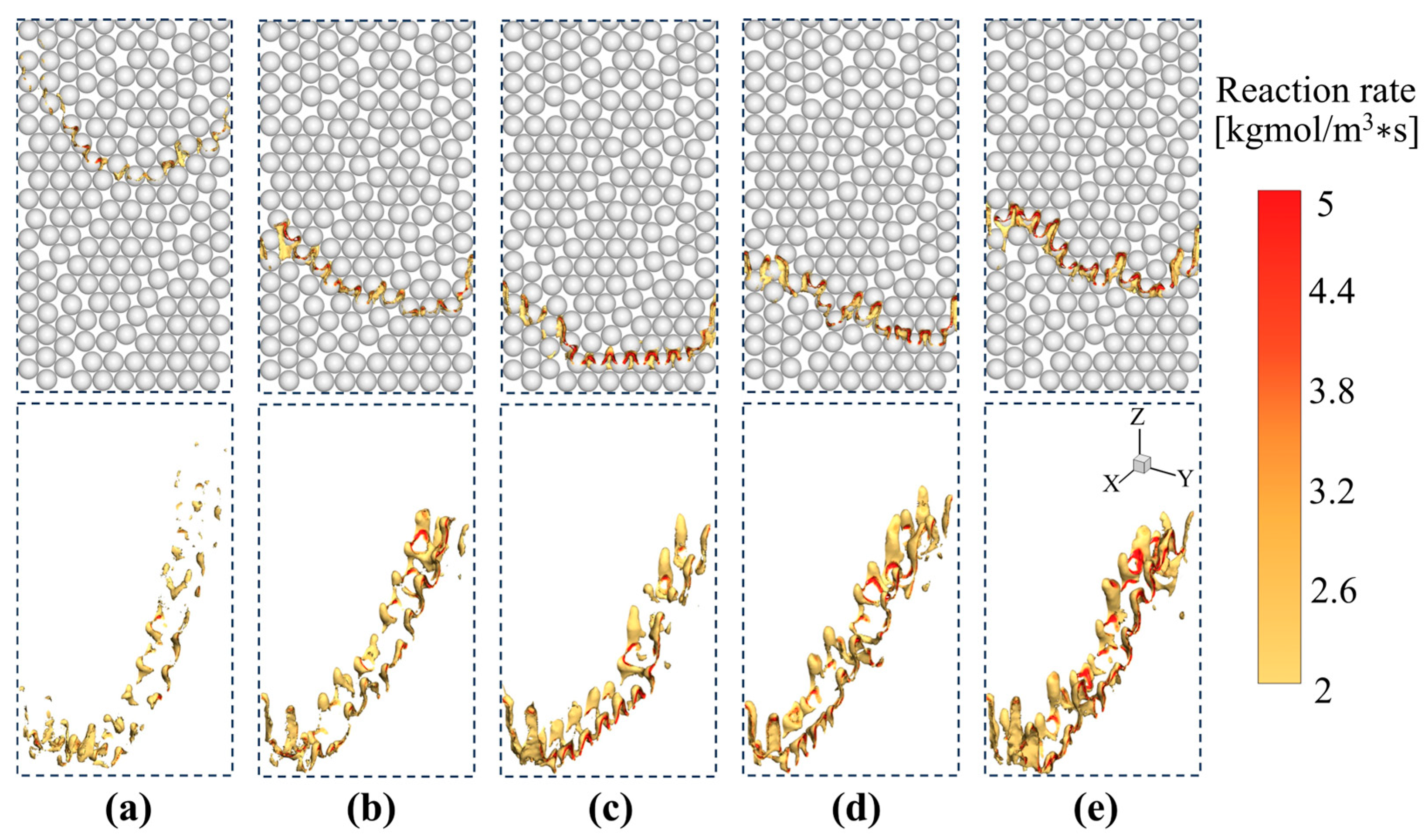
This section builds upon the heat flux analysis to provide a more detailed examination of the combustion characteristics of the packed bed from the reaction kinetics perspective. As shown in Figure 13, the reaction rate distribution is presented under varying equivalence ratios and the pore Reynolds numbers. The morphology of the flame front can be interpreted as the spatial structure of the reaction rate distribution. Figure 13a–c shows that the equivalence ratio has a substantial influence on the reaction rate distribution. The high-rate regions appear to be scattered and discontinuous, with the flame front exhibiting a discrete, patchy structure when φ = 0.6. This is indicative of reaction limitations due to insufficient fuel, resulting in overall low combustion intensity. By contrast, at φ = 0.8, the flame front evolves into a more continuous structure with a distinctly wrinkled and undulating morphology. The high-reaction-rate zones undergo significant expansion, indicating enhanced reactivity, increased combustion intensity, and more stable flame propagation.
Changes in the pore Reynolds number primarily affect the geometric morphology of the flame and the intensity of flow disturbances. As demonstrated in Figure 13c–e, at Rep = 532.56, the flame front exhibits a relatively smooth appearance, with the thermal reaction process dominated by diffusion and thermal release. Conversely, as the pore Reynolds number increases to Rep = 710.08, the flame surface becomes distinctly wrinkled, forming a complex three-dimensional irregular structure. The high-reaction-rate region is observed to expand, indicating that stronger inertial mixing effects enhance the reaction kinetics and significantly increase the local combustion intensity. A correlation analysis of the temperature distribution results, as depicted in Figure 9, reveals a substantial degree of concurrence between the high-reaction-rate regions and areas of significant temperature gradients. This finding indicates a positive feedback mechanism. Specifically, high-temperature zones provide the activation energy required for chemical reactions, while intensified reactions in turn accelerate heat release and diffusion. This mutual reinforcement promotes flame propagation and strengthens combustion stability. Therefore, the kinetic process of packed-bed combustion can be understood as a synergistic interaction between energy release and reaction rate, where enhanced mixing and local flow disturbances regulate flame structure and stability.
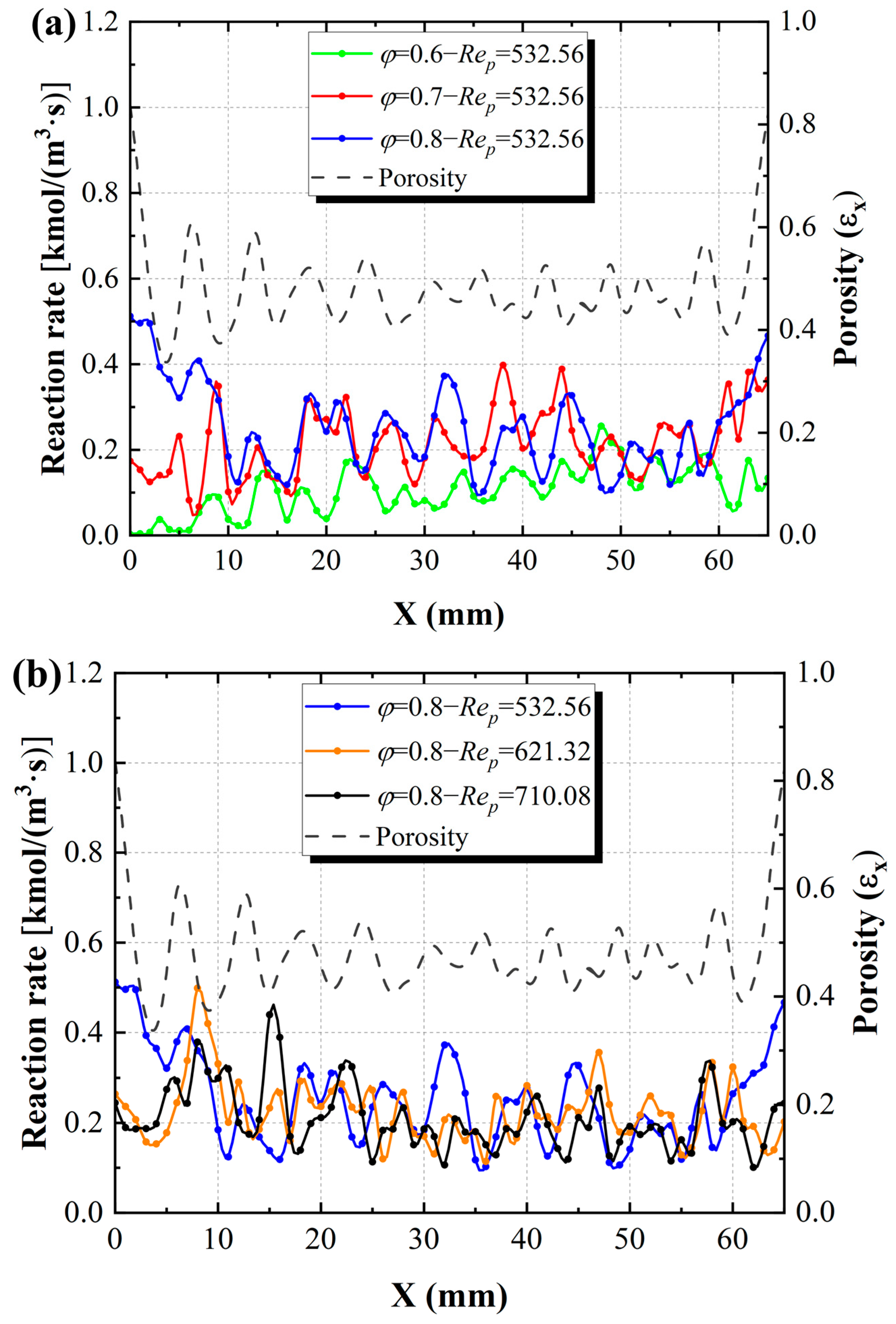
The coupling mechanism between porosity distribution and reaction rate is further elucidated as shown in Figure 14. Under conditions of an identical pore Reynolds number (see Figure 14a), the overall reaction rate increases significantly as the equivalence ratio rises from 0.6 to 0.8, with periodic fluctuations that mirror the porosity distribution. Local regions of elevated porosity facilitate enhanced fluid flow and mass transfer, thereby generating distinct peaks in the reaction rate. It can be observed that both the overall reaction rate and its radial gradient are significantly reduced at φ = 0.6, with the maximum value decreasing by approximately 20%. The enhanced reactivity in the middle and downstream regions under high φ conditions is attributed to the thorough mixing of oxygen and fuel within the pore channels. Conversely, with increasing pore Reynolds number (see Figure 14b), the position of the peak reaction rate shifts to varying degrees, with an overall trend toward the wall region. However, it has a negligible effect on the reaction rate in the central region. This reflects that intense thermal convection, conversely, modulates the local heat release rate, leading to a smoother radial reaction distribution. When considered in conjunction with the distribution of the flame front, high reaction rate regions are consistently observed to be concentrated within flow channels that exhibit higher porosity. This further validates the strong correlation between structural porosity and reaction rate.

4.5. Comparisons of Flame Reaction Volume

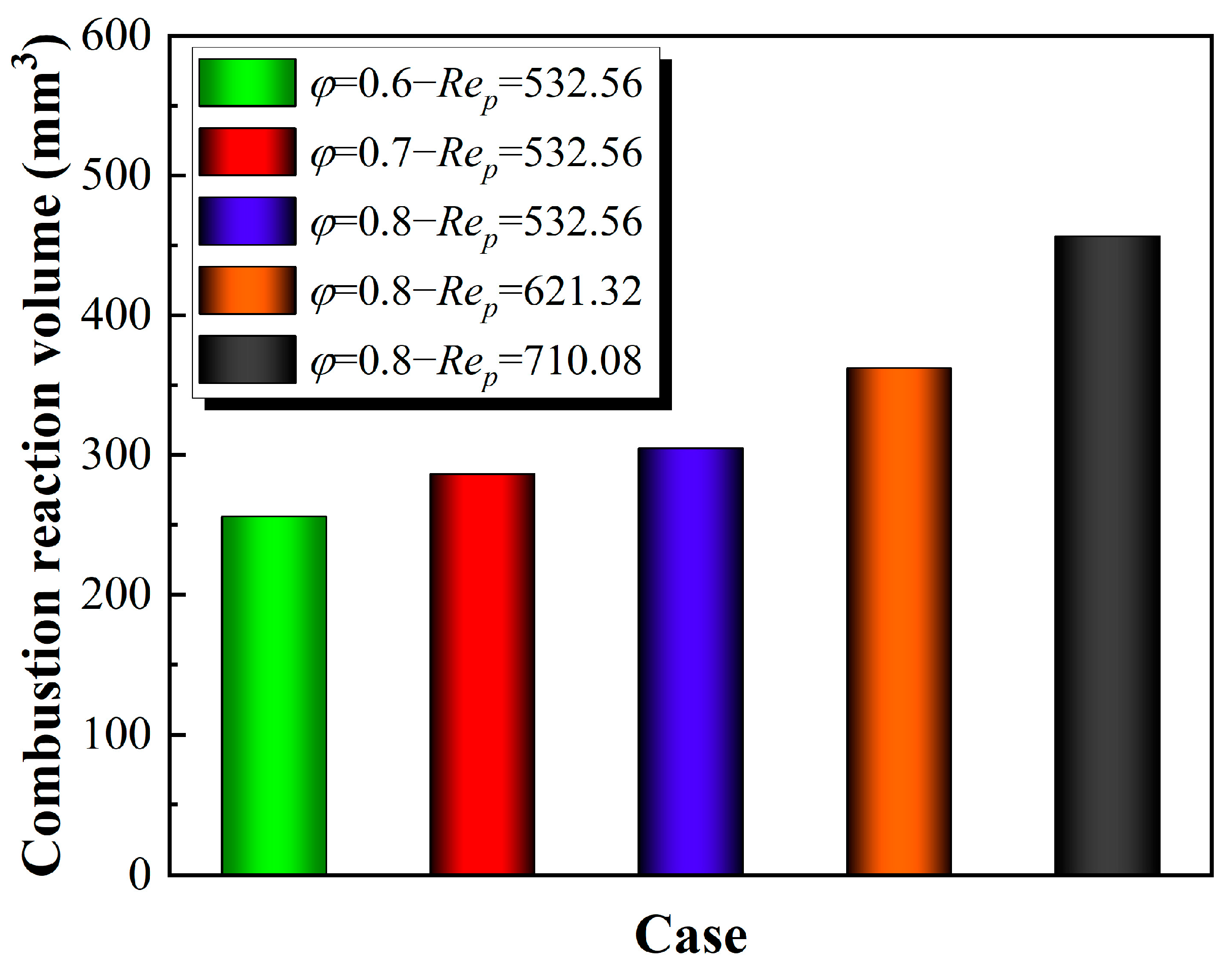
As shown in Figure 15, the variation trend of the flame reaction volume is clearly evident under different working conditions. To identify the flame stabilization region, we investigate a specific range of reaction rates (as indicated in the legend of Figure 13) and determine the volume distribution of the flame reaction zone by quantifying the volume of the selected region. The findings suggest that at the constant pore Reynolds number, an increase in the equivalence ratio from 0.6 to 0.8 leads to substantial expansion of the reaction volume. Such expansion indicates that a higher equivalence ratio provides a more abundant fuel supply, intensifies combustion, and promotes the spatial growth of the flame zone. When φ = 0.8, the region with high reaction rates accounts for approximately 0.7% of the bed volumes, while the flame front becomes thinner and more compact. This structure indicates intense localized combustion, characterized by rapid heat release and efficient fuel utilization. In contrast, under the lean combustion condition (φ = 0.6), the reaction zone occupies only about 0.4% of the bed volumes, which is accompanied by the dispersed and wrinkled diffused flame front, signifying incomplete combustion and reduced flame stability.
It also has been shown that when the equivalence ratio is fixed, raising the pore Reynolds number from 532.56 to 710.08 also results in an enlarged reaction volume. This enlargement is primarily attributed to the strengthening of inertial mixing and mass transfer processes. Moreover, these processes result in a promotion of the overall expansion of the reaction zone, as well as an acceleration in the expansion of the flame front. This observation is supported by the preceding analysis of reaction rate and porosity distribution, which indicates that regions with high porosity promote optimal conditions for flow and mass transfer, resulting in increased reaction rates and the formation of localized high reaction rate zones. Stronger flow disturbances help alleviate the restrictions imposed by geometric inhomogeneity, allowing these high-reaction-rate zones to extend more broadly and eventually increase the overall reaction volume.

5. Conclusions

In this paper, a one-layer randomly packed bed with a high equivalent ratio is generated by three-dimensional pore-scale numerical simulation, and the accuracy of the packed bed model as well as the computational methods is validated. Subsequently, the characteristics of premixed standing combustion of methane-air mixtures in this one-layer randomly packed bed are systematically investigated. Based on the detailed pore-scale structure of the packed bed, the characteristics of flame front morphology, axial heat transfer, and local combustion reaction rates are analyzed and discussed. The main findings are summarized as follows:
(1)
During combustion in the packed bed, the pronounced increase in flow velocity within the reaction zone originates from a strong coupling between internal energy release and momentum transfer, that is, the conversion of internal energy to kinetic energy. The heat generated by exothermic reactions raises the local enthalpy and temperature, leading to density reduction and volumetric expansion that induce pressure gradients and accelerate the fluid flow. This process manifests as a rapid rise in velocity and intensified flow fluctuations near the flame front.
(2)
As a pivotal parameter governing combustion intensity and temperature distribution within packed beds, the equivalence ratio exerts a profound influence on multiple combustion-related processes. Increasing it from 0.6 to 0.8 raises the localized peak fluid temperature from about 1860 K to 2060 K, while the temperature differential between the two phases drops to less than 10 K, indicating strong thermal coupling at the pore scale. Higher equivalence ratios also expand high-temperature zones, improve heat transfer and flame stability, and make combustion more efficient overall.
(3)
The pore Reynolds number has a significant influence on flow structure and heat transfer through enhanced inertial mixing, vortex-induced flow disturbances, and stronger convective transport. As it increases, the downstream redistribution of energy is promoted, which lowers the axial temperature gradient and makes the thermal field more uniform. However, excessive flow may also strengthen convective sweeping, indicating that a moderate flow rate provides a better balance between reaction stability and heat transfer efficiency.
(4)
A two-stage heat transfer mechanism of “solid preheating followed by fluid heating” occurs during pore-scale combustion. In the ignition and propagation stages, the solid matrix acts as the primary heat source, quickly transferring heat to the colder fluid with a negative heat flux density ranging from 1 × 10³ W/m2 to 4 × 10³ W/m2. In the downstream area, a positive heat flux density develops within the range of 2 × 10³ W/m2 to 5 × 10³ W/m2, indicating heat transfers from the hot fluid to the solid and between particles. This process highlights strong fluid–solid energy coupling at the pore scale.
(5)
Positive feedback between reaction rate and temperature promotes mutual reinforcement of heat release and flame propagation. The flame thickness is approximately 1.5dp–2dp. In high-porosity regions, enhanced diffusion and lower resistance raise reaction rates by about 0.8–1.2 times compared to dense areas. Enhanced mixing helps maintain field uniformity, and higher equivalence ratios or flow rates enlarge the combustion zone by approximately 50%. These effects together sustain a balanced combustion state with stable flames and efficient energy coupling.
Overall, although the present study is subject to some limitations, including the idealized adiabatic wall treatment, the simplified chemical reaction mechanism and random packing configuration, it successfully captures the main flame structure characteristics and heat-transfer behavior in the randomly packed bed. Future work will focus on improving the boundary conditions and incorporating experimental validation, thereby providing a more reliable theoretical and technical reference for the design, operation, and optimization of porous media combustion systems.

Author Contributions

H.W.: software, data curation, visualization, writing—original draft, writing–review and editing. Y.X.: resources, conceptualization, methodology, data curation, formal analysis, writing—original draft, project administration, supervision. T.F.: conceptualization, supervision. H.X.: validation, software, formal analysis. X.G.: software, data curation. Z.Z.: supervision, methodology, formal analysis. All authors have read and agreed to the published version of the manuscript.

Funding

This study was supported by the University Synergy Innovation Program of Anhui Province (No. GXXT-2022-017), the Key Project of Anhui Provincial University Research and Development (No. 2023AH050188) and the Project of Doctor’s Funding of Anhui Jianzhu University (No. 2020QDZ42).

Data Availability Statement

The original/processed data required to reproduce these findings cannot be shared at this time as the data also forms part of an ongoing study.

Conflicts of Interest

The authors declare that they have no known competing financial interests or personal relationships that could have appeared to influence the work reported in this paper.

Nomenclature

Model ParametersGreek symbols
Dtube diameter (m)λthermal conductivity (W/(m·K))
dpparticle diameter (m)μdynamic viscosity (Pa·s)
dhhydraulic diameter (m)ρdensity (kg/m3)
L1length of entrance region (m)ωireaction rate of species i (kmol/m3·s)
L2length of packing region (m)εporosity
L3length of outlet region (m) ε ¯ average porosity
Physical parametersΔTtemperature difference between fluid and solid (K)
cspecific heat capacity (kJ/(kg∙K))φequivalence ratio
Didiffusion coefficient of species i, (m2/s)kturbulent kinetic energy
ppressure (Pa)εtturbulent dissipation rate
ttime (s)Dimensionless parameters
Tffluid temperature (K)Ntube-to-particle diameter ratio
Tssolid temperature (K)Reppore Reynolds number
qf-sfluid–solid heat flux (W/m2) v ¯ z , R M S relative values of the RMS of the velocity
vz,RMSroot mean square of axial velocity (m/s)δaverage thermal flame thickness
uvelocity in x direction (m/s)Abbreviations
vvelocity in y direction (m/s)CFDcomputational fluid dynamics
wvelocity in z direction (m/s)DEMdiscrete element method
u i ¯ velocity component in the i directionFREIflame with repetitive extinction and ignition
u j ¯ velocity component in the j directionPMCporous media combustion
vvelocity vectorRMSroot mean square
Wimolecular weight of species iSubscripts
xcoordinate (m)ffluid
ycoordinate (m)ssolid
zcoordinate (m)ininlet
Ymass fractionmaxmaximum value

References

  1. Shah, H.H.; Piso, G.; Mancusi, E.; Bareschino, P.; Pepe, F. Roadmap toward carbon neutrality in Pakistan: Policy challenges and strategic measures. Energy Sustain. Dev. 2025, 89, 101861. [Google Scholar] [CrossRef]
  2. Liu, S.; Feng, M.; Xie, L.; Chan, F.K.S. Challenges and solutions for achieving carbon neutrality through urban green infrastructure in China’s future cities. Nat. Based Solut. 2025, 8, 100263. [Google Scholar] [CrossRef]
  3. Mujeebu, M.A.; Abdullah, M.Z.; Bakar, M.Z.A.; Mohamad, A.A.; Abdullah, M.K. Applications of porous media combustion technology—A review. Appl. Energy 2009, 86, 1365–1375. [Google Scholar] [CrossRef]
  4. Gharehghani, A.; Ghasemi, K.; Siavashi, M.; Mehranfar, S. Applications of porous materials in combustion systems: A comprehensive and state-of-the-art review. Fuel 2021, 304, 121411. [Google Scholar] [CrossRef]
  5. Hanamura, K.; Kumano, T.; Iida, Y. Electric power generation by super-adiabatic combustion in thermoelectric porous element. Energy 2005, 30, 347–357. [Google Scholar] [CrossRef]
  6. Schurr, J.L.; Bhattacharya, A.; Konnov, A.A.; Kaario, O. Super adiabatic combustion of H2/Air and H2/N2O mixtures. Combust. Flame 2024, 263, 113397. [Google Scholar] [CrossRef]
  7. Ellzey, J.L.; Belmont, E.L.; Smith, C.H. Heat recirculating reactors: Fundamental research and applications. Prog. Energy Combust. Sci. 2019, 72, 32–58. [Google Scholar] [CrossRef]
  8. Ni, S.; Zhao, D.; Becker, S.; Tang, A. Thermodynamics and entropy generation studies of a T-shaped micro-combustor: Effects of porous medium and ring-shaped ribs. Appl. Therm. Eng. 2020, 175, 115374. [Google Scholar] [CrossRef]
  9. Cao, Y.; Su, T.; Ding, Y.; Song, W.; Yang, L.; Liu, F.; Zhai, C. Enhanced combustion stability of low-concentration methane though a flame buffer zone in a variable pore-density porous media burner. Appl. Therm. Eng. 2025, 265, 125546. [Google Scholar] [CrossRef]
  10. Zhu, H.; Dai, H.; Song, Z.; Wang, X.; Wang, Z.; Dai, H.; He, S. Improvement of hollow cylinders on the conversion of coal mine methane to hydrogen in packed bed burner. Int. J. Hydrog. Energy 2021, 46, 31439–31451. [Google Scholar] [CrossRef]
  11. Shafiey Dehaj, M.; Arab Solghar, A. Study of natural gas/air combustion in the three-region porous medium burner. J. Braz. Soc. Mech. Sci. Eng. 2019, 41, 137. [Google Scholar] [CrossRef]
  12. Quaye, E.K.; Pan, J.; Lu, Q.; Zhang, Y.; Wang, Y.; Alubokin, A.A. Study on Combustion Characteristics of Premixed Methane-Oxygen in a Cylindrical Porous Media Combustor. Chem. Eng. Process. Process Intensif. 2021, 159, 108207. [Google Scholar] [CrossRef]
  13. Tolouei, A.; Gharehghani, A. Effect of hydrogen enrichment and catalytic porous media on the combustion characteristics of methane/ammonia. Int. J. Hydrogen Energy 2025, 146, 149986. [Google Scholar] [CrossRef]
  14. Dai, H.; Zhang, B.; Li, Z.; Wu, J. Combustion characteristics of a porous media burner with partial hydrogen injection. Int. J. Hydrogen Energy 2022, 47, 1092–1102. [Google Scholar] [CrossRef]
  15. Shi, J.; Liu, Y.; Mao, M.; Lv, J.; Wang, Y.; He, F. Experimental and numerical studies on the effect of packed bed length on CO and NOx emissions in a plane-parallel porous combustor. Energy 2019, 181, 250–263. [Google Scholar] [CrossRef]
  16. Banerjee, A.; Paul, D. Developments and applications of porous medium combustion: A recent review. Energy 2021, 221, 119868. [Google Scholar] [CrossRef]
  17. Makaryan, I.A.; Sedov, I.V.; Munoz-Herrera, C.; Toledo, M.; Salgansky, E.A. Combustion of ammonia-blended fuels in porous media burners, with storage and distribution implications: A review. Renew. Sustain. Energy Rev. 2025, 220, 115884. [Google Scholar] [CrossRef]
  18. Vahidhosseini, S.M.; Esfahani, J.A.; Kim, K.C. Experimental study on the radiative heat transfer in a multi-hole porous radiant burner with internal combustion regime. Appl. Therm. Eng. 2022, 201, 117732. [Google Scholar] [CrossRef]
  19. Quaye, E.K.; Pan, J.; Zhang, Y.; Lu, Q.; Wang, Y.; Alubokin, A.A. Effects of influencing factors on premixed CH4-O2 combustion in a cylindrical porous media combustor. Chem. Eng. Process. Process Intensif. 2021, 161, 108320. [Google Scholar] [CrossRef]
  20. Wang, Y.; Cai, S.; Yang, W.; Li, X.-y.; Wang, T.; Wan, J. Combustion and thermal performance of a novel preheated miniature combustor with a flame holder and various porous medium materials. J. Energy Inst. 2024, 115, 101677. [Google Scholar] [CrossRef]
  21. Bubnovich, V.; Hernandez, H.; Toledo, M.; Flores, C. Experimental investigation of flame stability in the premixed propane-air combustion in two-section porous media burner. Fuel 2021, 291, 120117. [Google Scholar] [CrossRef]
  22. Chen, Z.; Guo, S.; Qin, C. Experimental research on porous media combustion of SOFC exhaust gas. Case Stud. Therm. Eng. 2020, 22, 100796. [Google Scholar] [CrossRef]
  23. Vignat, G.; Zirwes, T.; Boigné, É.; Ihme, M. Experimental demonstration of a two-stage porous media burner for low-emission ammonia combustion. Proc. Combust. Inst. 2024, 40, 105491. [Google Scholar] [CrossRef]
  24. Tolouei, A.; Gharehghani, A. Numerical investigation of premixed methane-ammonia combustion in a mesoscale porous combustor. Fuel 2024, 366, 131427. [Google Scholar] [CrossRef]
  25. Li, Q.; Li, J.; Shi, J. Fully-resolved 3D premixed H2/air flames in a micro-combustor partially filled with porous media: Effects of detailed pore structures. Proc. Combust. Inst. 2023, 39, 5571–5580. [Google Scholar] [CrossRef]
  26. Chen, Z.; Shi, J.; Xie, M.; Yue, M. A Numerical Investigation on the Rapid Turbulent Filtration Combustion under High Background Pressure. Combust. Sci. Technol. 2021, 194, 3039–3063. [Google Scholar] [CrossRef]
  27. Zirwes, T.; Vignat, G.; Toro, E.R.; Boigné, E.; Younes, K.; Trimis, D.; Ihme, M. Improving volume-averaged simulations of matrix-stabilized combustion through direct X-ray µCT characterization: Application to NH3/H2-air combustion. Combust. Flame 2023, 257, 113020. [Google Scholar] [CrossRef]
  28. Shi, J.; Zhou, D.; Lv, J.; Mao, M.; Ma, X. Self-sustained stable combustion of off-gas from Solid Oxide Fuel Cell in a cone-shaped porous burner with preheaters. Energy 2024, 312, 133566. [Google Scholar] [CrossRef]
  29. Liao, M.; He, Z.; Jia, S.; Liang, X.; Chan, T.L.; Li, Y.; Xu, X.; Liu, T. Comparison of the flame stabilities during oxy-methane and air-methane combustion in a two-layer porous burner. Case Stud. Therm. Eng. 2023, 51, 103657. [Google Scholar] [CrossRef]
  30. Liao, M.; He, Z.; Liang, X.; Chan, T.L.; Li, Y.; Xu, X. Study on Oxy-Methane Flame Stability in a Cylindrical Porous Medium Burner. Processes 2023, 11, 2182. [Google Scholar] [CrossRef]
  31. Liao, M.; Jia, S.; Wang, Q.; Chan, T.L.; Li, Y.; Xu, X.; He, Z. Numerical Simulation of Methane Combustion in Two-Layer Porous Media Under Oxy-Fuel Condition. Flow Turbul. Combust. 2022, 110, 649–670. [Google Scholar] [CrossRef]
  32. Hashemi, S.M.; Hashemi, S.A. Flame stability analysis of the premixed methane-air combustion in a two-layer porous media burner by numerical simulation. Fuel 2017, 202, 56–65. [Google Scholar] [CrossRef]
  33. Shi, J.; Chen, Z.; Li, H.; Lv, J.; Mao, M. Pore-scale study of thermal nonequilibrium in a two-layer burner formed by staggered arrangement of particles. Appl. Therm. Eng. 2020, 176, 115376. [Google Scholar] [CrossRef]
  34. Yakovlev, I.; Fursenko, R.; Astakhov, D.; Zambalov, S.; Maznoy, A. Transition to oscillatory instability of lean methane–air flames in microchannels. Combust. Flame 2024, 267, 113570. [Google Scholar] [CrossRef]
  35. Yakovlev, I.; Astakhov, D.; Zambalov, S.; Fursenko, R.; Li, J.; Maznoy, A. Transition to unstable oscillatory flames in porous media combustion. Combust. Flame 2023, 252, 112752. [Google Scholar] [CrossRef]
  36. Ferguson, J.C.; Sobhani, S.; Ihme, M. Pore-resolved simulations of porous media combustion with conjugate heat transfer. Proc. Combust. Inst. 2021, 38, 2127–2134. [Google Scholar] [CrossRef]
  37. Billerot, P.-L.; Dufresne, L.; Lemaire, R.; Seers, P. 3D CFD analysis of a diamond lattice-based porous burner. Energy 2020, 207, 118160. [Google Scholar] [CrossRef]
  38. Yakovlev, I.; Zambalov, S. Three-dimensional pore-scale numerical simulation of methane-air combustion in inert porous media under the conditions of upstream and downstream combustion wave propagation through the media. Combust. Flame 2019, 209, 74–98. [Google Scholar] [CrossRef]
  39. Shi, J.; Lv, J.; Behrendt, F.; Liu, Y.; Mao, M.; He, F. 3D pore-scale simulations and 1D volume-averaged calculations of the flow and thermal non-equilibrium for low-velocity filtration combustion. Int. J. Heat Mass Transf. 2021, 177, 121532. [Google Scholar] [CrossRef]
  40. Masset, P.-A.; Duchaine, F.; Pestre, A.; Selle, L. Modelling challenges of volume-averaged combustion in inert porous media. Combust. Flame 2023, 251, 112678. [Google Scholar] [CrossRef]
  41. Chen, Z.; Wu, Z.; Liu, H.; Shi, J.; Xie, M. Numerical investigation on the error of volume-averaged reaction rate model for the low-velocity filtration combustion with hybrid-scale method. Int. Commun. Heat Mass Transf. 2025, 161, 108457. [Google Scholar] [CrossRef]
  42. Yakovlev, I.; Maznoy, A.; Zambalov, S. Pore-scale study of complex flame stabilization phenomena in thin-layered radial porous burner. Combust. Flame 2021, 231, 111468. [Google Scholar] [CrossRef]
  43. Fursenko, R.V.; Yakovlev, I.A.; Odintsov, E.S.; Zambalov, S.D.; Minaev, S.S. Pore-scale flame dynamics in a one-layer porous burner. Combust. Flame 2022, 235, 111711. [Google Scholar] [CrossRef]
  44. Fursenko, R.V.; Odintsov, E.S.; Zakharov, A.D.; Yakovlev, I.A.; Li, J. Pore-scale flame oscillations and patterns of upstream combustion wave propagation in a one-layer porous burner. Combust. Flame 2024, 270, 113730. [Google Scholar] [CrossRef]
  45. Dang, M.; Wang, F.; Jia, X. DEM-CFD Analysis of Fluid Flow in Packed Bed Under the Small Column-to-Particle-Diameter Ratios. Korean J. Chem. Eng. 2024, 41, 697–713. [Google Scholar] [CrossRef]
  46. Jeschar, R. Druckverlust in Mehrkornschüttungen aus Kugeln. Arch. Eisenhüttenwes. 1964, 35, 91–108. [Google Scholar] [CrossRef]
  47. Klerk, A.d. Voidage variation in packed beds at small column to particle diameter ratio. AIChE J. 2003, 49, 2022–2029. [Google Scholar] [CrossRef]
  48. Kuwahara, F.; Yamane, T.; Nakayama, A. Large eddy simulation of turbulent flow in porous media. Int. Commun. Heat Mass Transf. 2006, 33, 411–418. [Google Scholar] [CrossRef]
  49. Donoso-García, P.; Henríquez-Vargas, L. Numerical study of turbulent porous media combustion coupled with thermoelectric generation in a recuperative reactor. Energy 2015, 93, 1189–1198. [Google Scholar] [CrossRef]
  50. Gao, H.B.; Zong, S.C.; Feng, X.B.; Zhang, C.W. Two-Dimensional Numerical Study of Methane-Air Combustion Within Catalytic and Non-catalytic Porous Medium. Front. Chem. 2020, 8, 511792. [Google Scholar] [CrossRef]
  51. Akbari, M.H.; Riahi, P.; Roohi, R. Lean flammability limits for stable performance with a porous burner. Appl. Energy 2009, 86, 2635–2643. [Google Scholar] [CrossRef]
  52. Lv, J.; Shi, J.; Mao, M.; He, F. Three-Dimensional Pore-Scale Simulation of Flow and Thermal Non-Equilibrium for Premixed Gas Combustion in a Random Packed Bed Burner. Energies 2021, 14, 6939. [Google Scholar] [CrossRef]
  53. Launder, B.E.; Spalding, D.B. The numerical computation of turbulent flows. Comput. Methods Appl. Mech. Eng. 1974, 3, 269–289. [Google Scholar] [CrossRef]
  54. Guo, Z.; Sun, Z.; Zhang, N.; Ding, M. Influence of confining wall on pressure drop and particle-to-fluid heat transfer in packed beds with small D/d ratios under high Reynolds number. Chem. Eng. Sci. 2019, 209, 115200. [Google Scholar] [CrossRef]
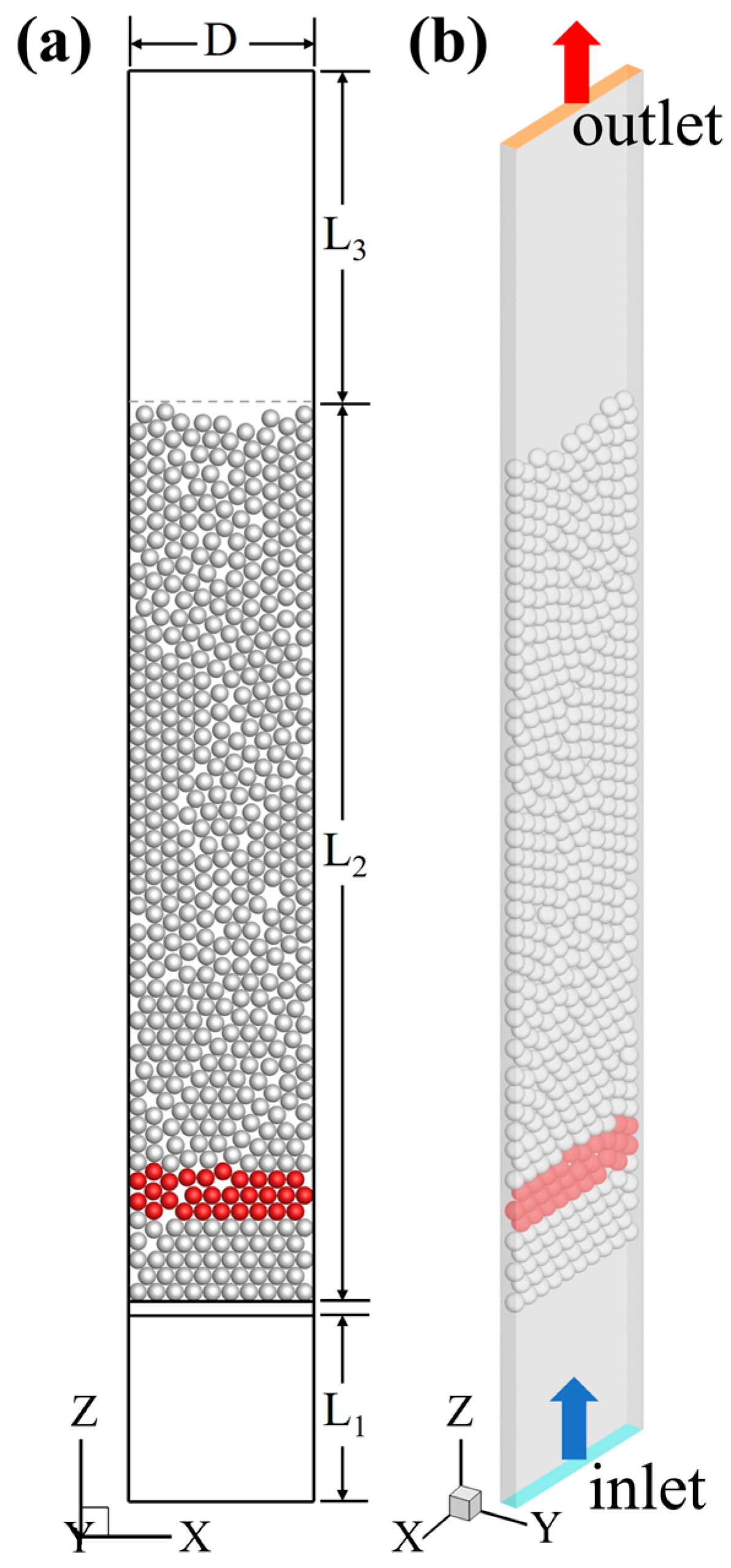
Figure 1. Illustration of geometrical model of randomly packed bed: (a) 2D model, (b) 3D fluid domain model.
Processes 14 01061 g001
Figure 2. Axial porosity and averaged porosity distribution in packed bed.
Processes 14 01061 g002
Figure 3. Meshing generation and refinement: (a) mesh refining at the gap contact points, (b)internal mesh distribution.
Processes 14 01061 g003
Figure 4. Schematic of the mesh resolutions at the single-sphere scale.
Processes 14 01061 g004
Figure 5. Grid and reaction model validation.
Processes 14 01061 g005
Figure 6. Distribution of velocity contour and local vortex structures at the y = 0 cross-section for the packed bed at Rep = 710.08.
Processes 14 01061 g006
Figure 7. 3D streamlines in the packed bed at (a) Rep = 532.56, (b) Rep = 621.32 and (c) Rep = 710.08.
Processes 14 01061 g007
Figure 8. Axial velocity profile along the z-axis in the packed bed at different pore Reynolds numbers: (a) RMS of the velocity, (b) relative values of the RMS of the velocity.
Processes 14 01061 g008
Figure 9. Characteristics of 3D high-temperature isothermal surfaces under different working conditions: (a) Rep = 532.56, φ = 0.6, (b) Rep = 532.56, φ = 0.7, (c) Rep = 532.56, φ = 0.8, (d) Rep = 621.32, φ = 0.8, (e) Rep = 710.08, φ = 0.8.
Processes 14 01061 g009
Figure 10. Surface areas of high temperature iso-surface under different working conditions: (a) φ = 0.6, 0.7, 0.8 at Rep = 532.56, (b) Rep = 532.56, 621.32, 710.08 at φ = 0.8.
Processes 14 01061 g010
Figure 11. Axial fluid and solid temperature profiles under different working conditions: (a) φ = 0.6, 0.7, 0.8 at Rep = 532.56, (b) Rep = 532.56, 621.32, 710.08 at φ = 0.8.
Processes 14 01061 g011
Figure 12. Variation profiles of overall fluid–solid heat flux in the packed bed.
Processes 14 01061 g012
Figure 13. Characteristics of the flame front morphology colored with the reaction rate under different working conditions: (a) Rep = 532.56, φ = 0.6, (b) Rep = 532.56, φ = 0.7, (c) Rep = 532.56, φ = 0.8, (d) Rep = 621.32, φ = 0.8, (e) Rep = 710.08, φ = 0.8.
Processes 14 01061 g013
Figure 14. Comparisons of radial reaction rate curves under different working conditions with radial porosity profile: (a) φ = 0.6, 0.7, 0.8 at Rep = 532.56, (b) Rep = 532.56, 621.32, 710.08 at φ = 0.8.
Processes 14 01061 g014
Figure 15. Comparisons of combustion reaction volume under different working conditions.
Processes 14 01061 g015
Table 1. Summary of the main categories of previous studies and the research gap.
CategoryRepresentative StudiesMain ContributionRemaining Gap
Experimental studies[21,22,23]Revealed flame stability, temperature evolution, and emissions in porous burnersLimited to macroscopic observations
Volume-averaged models[29,30,31,32]Predicted heat transfer and combustion-wave behavior efficientlyUnable to resolve pore-scale non-uniformity and flame structure
Pore-scale simulations[36,37,38,39,40,41,42]Captured local flow, thermal non-equilibrium, and flame wrinklingInsufficient research on extreme working conditions
One-layer burner studies[43,44]Identified complex flame patternsLack of pore-scale analysis for standing combustion
Table 2. DEM simulation parameters.
ParameterUnitValue
Tube diametermm65
Particle diametermm6.5
Shear ModulusPa1.37 × 109
Poisson ratio-0.24
Particle–particle restitution coefficient-0.5
Particle–wall restitution coefficient-0.3
Static friction coefficient-0.154
Rolling friction coefficient-0.1
Table 3. The thermo-physical of Al2O3 pellets, quartz tube and silicon carbide foam.
PropertiesDensity, ρ (kg/m3)Specific Heat Capacity, c (kJ/(kg∙K))Thermal Conductivity, λ (W/(m∙K))
Al2O337500.825
SiC30700.71120
quartz22000.961.4
Disclaimer/Publisher’s Note: The statements, opinions and data contained in all publications are solely those of the individual author(s) and contributor(s) and not of MDPI and/or the editor(s). MDPI and/or the editor(s) disclaim responsibility for any injury to people or property resulting from any ideas, methods, instructions or products referred to in the content.