Next Article in Journal
A Regenerative Braking Strategy for Battery Electric Vehicles Based on PSO-Optimized Fuzzy Control
Previous Article in Journal
Integrated Design and Performance Validation of an Advanced VOC and Paint Mist Recovery System for Shipbuilding Robotic Spraying
Previous Article in Special Issue
Nondestructive Detection of Submillimeter Air Cavities in Alumina-Doped Epoxy Resin Composites Using the Infrared Thermography
 
 
Due to scheduled maintenance work on our servers, there may be short service disruptions on this website between 11:00 and 12:00 CEST on March 28th.
Article

Carbon Dots–TiO2 Hybrid Nanomaterials with Enhanced Photochemical Properties and Photodynamic Therapy Activity

by
Alexandra Karagianni
1,
Adamantia Zourou
1,
Afroditi Ntziouni
1,*,
Conghang Qu
2,
Mauricio Terrones
2,3,4,
Christos Argirusis
1,
Eleni Alexandratou
5,* and
Konstantinos V. Kordatos
1,*
1
School of Chemical Engineering, National Technical University of Athens, Zografou Campus, 9 Iroon Polytechniou St., 15780 Athens, Greece
2
Department of Materials Science and Engineering and Center for 2-Dimensional and Layered Materials, The Pennsylvania State University, University Park, PA 16802, USA
3
Department of Physics, The Pennsylvania State University, University Park, PA 16802, USA
4
Department of Chemistry and Materials Research Institute, The Pennsylvania State University, University Park, PA 16802, USA
5
School of Electrical and Computer Engineering, National Technical University of Athens, Zografou Campus, 15780 Athens, Greece
*
Authors to whom correspondence should be addressed.
Processes 2026, 14(7), 1048; https://doi.org/10.3390/pr14071048
Submission received: 21 December 2025 / Revised: 16 March 2026 / Accepted: 23 March 2026 / Published: 25 March 2026

Abstract

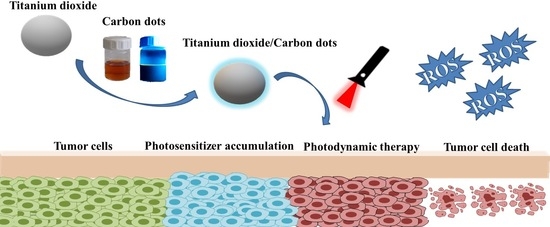
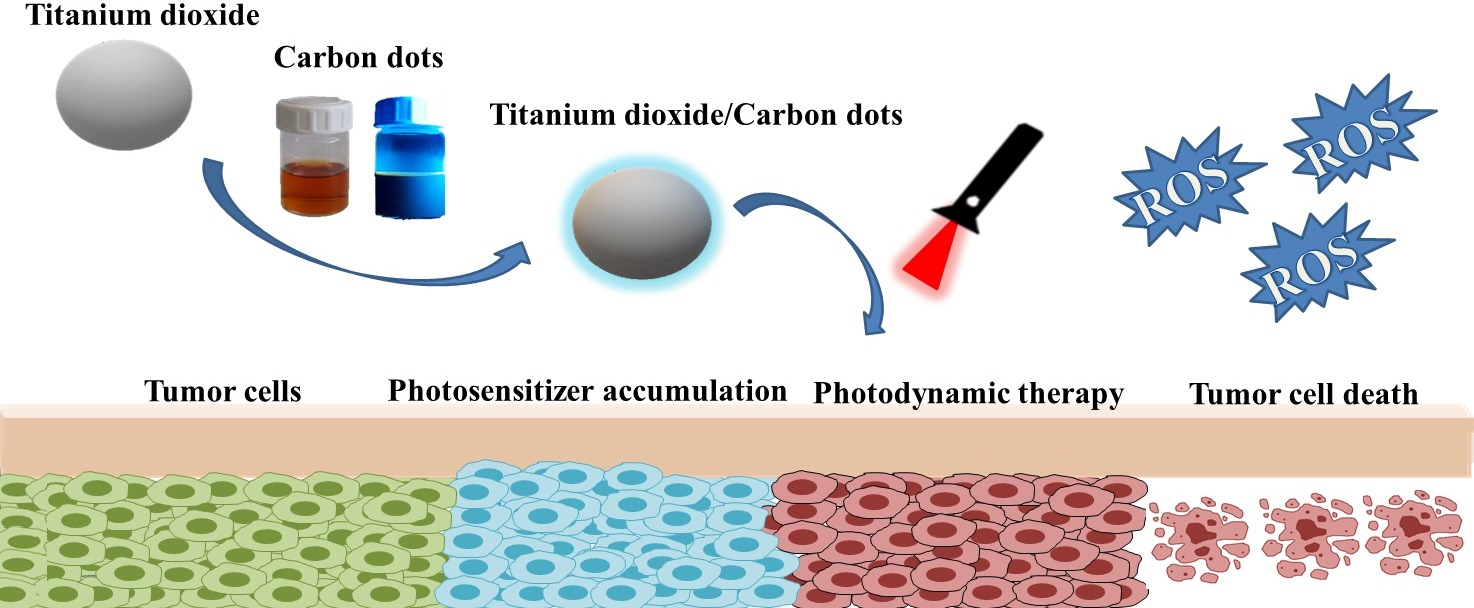
Photodynamic therapy (PDT) is a promising cancer treatment employing photo-induced reactive oxygen species (ROS) generation by a photosensitizer (PS). Titanium dioxide (TiO2) is a potential PS due to its superb photocatalytic features and biocompatibility. However, its clinical potential is restricted by its predominant ultraviolet (UV) absorption. To address this limitation, this work introduces TiO2/carbon dots (CDs) nanohybrid materials for improving the photophysical properties of TiO2 and its photodynamic performance. TiO2 and CDs were synthesized through wet chemical and hydrothermal techniques, and subsequently combined via a facile ex situ solvothermal process to produce hybrid materials containing 1–50% w/w CDs. The materials were characterized using XRD, Raman, TEM, FT-IR, zeta potential, TGA, UV-Vis and PL. PDT studies on A431 skin cancer cells indicated improved photosensitizing ability of TiO2/CDs, with TiO2/CDs (10%) inducing 47% cell toxicity, versus 20% for TiO2 after 10 min of red-light irradiation (661 nm, 18 mW/cm2, 12.96 J/cm2). Intracellular localization studies revealed enhanced cellular uptake of TiO2/CDs (10%), compared with TiO2. In vitro studies on 3T3 healthy fibroblasts confirmed PSs’ safety both with and without light. Overall, this study elucidates the key role of CDs in the photophysical and photodynamic behavior of TiO2-based systems, providing design guidelines for the next-generation inorganic PSs.

1. Introduction

Photodynamic therapy (PDT) is an alternative therapeutic modality for cancer treatment relying on the combined action of light, oxygen, and a photosensitizer (PS) [1,2]. Upon light irradiation at a specific wavelength, PS undergoes photophysical and photochemical reactions with oxygen and within the cellular environment, producing reactive oxygen species (ROS), capable of inducing cancer cell death. Owing to its high selectivity, minimal invasiveness, and favorable cosmetic outcomes, PDT has attracted considerable attention, particularly for early-stage and superficial cancers [2,3]. Nevertheless, the clinical translation of PDT remains limited due to the lack of efficient PSs that combine increased tumor selectivity, adequate water solubility, minimal dark toxicity and enhanced ROS generation efficiency. In this context, current research efforts focus on the development of advanced PSs with these attributes, based on time- and cost-efficient raw materials and synthesis routes [4,5,6].
Semiconductor nanomaterials have emerged as promising alternatives to conventional organic PSs due to their photostability, tunable electronic structure, and ability to generate ROS upon light irradiation [4]. Among them, titanium dioxide (TiO2) stands out as a semiconductor nanomaterial owing to its intense photocatalytic properties, chemical stability, biocompatibility, and low cost [7,8]. Upon irradiation, TiO2 can produce electron-hole pairs, which interact with oxygen and water at its surface and subsequently produce ROS, a key requirement for PDT [9]. Despite these advantages, pristine TiO2 can be efficiently activated only by UV light. The limited tissue penetration of UV light severely restricts its effectiveness in biomedical applications. This limitation intensified research efforts toward visible-light-responsive TiO2-based systems through doping and hybridization strategies [7,10,11].
Under this point of view, advances in materials science and nanotechnology facilitate the production of engineered hybrid nanoparticles, in which semiconductors are coupled with complementary light-harvesting components to enhance their optical and electronic properties. Such hybrid architectures promote improved charge separation, leading to enhanced ROS generation and fully unlocking the photodynamic potential of semiconductor-based PSs [8,12,13,14]. This rationale has driven the growing interest in hybrid nanomaterials for PDT and related biomedical applications, as these systems offer versatile platforms for combining the complementary properties of individual components and tailoring their photodynamic performance. In this framework, hybrid materials based on carbon nanostructures (e.g., fullerenes, carbon nanotubes, graphene oxide, carbon-based dots, etc.) have been employed for biologically related applications, owing to their tunable optical behavior, rich surface chemistry, and efficient electron-transfer ability [2,8,15].
Among these carbon-based nanostructures, carbon dots (CDs) represent a novel kind of carbon nanostructure known for their small size, biocompatibility, and remarkable fluorescence properties. CDs can be prepared through facile synthetic procedures from inexpensive starting materials, facilitating their large-scale production. CDs are quasi-spherical nanoparticles under 10 nm in size [3,16]. Their structure can be crystalline or amorphous, featuring a central carbon core encased by several surface functional groups, including carboxylic acids, alcohols, and amine moieties. These groups render CDs water-soluble, non-toxic, and facilitate their interaction with other components, allowing the formation of hybrid materials [2,17]. Furthermore, their tunable optical properties and their ability to promote electron transfer process render CDs promising candidates for improving the photochemical performance of semiconductor materials, such as TiO2 [15,17,18].
In TiO2/CDs hybrid systems, CDs enhance light absorption in the visible region and promote electron transfer processes, resulting in improved charge separation and ROS generation efficiency. For instance, Madrid et al. presented increased ROS production and photodynamic performance of TiO2/CDs hybrid materials towards glioblastoma cells (U251-MG) employing near-infrared (NIR) light (740 nm, 30 min). In this case, nitrogen-doped CDs (N-CDs) derived from the pyrolysis of pyridine, and the resultant nanomaterials were assembled onto commercially obtained P25 nanoparticles [19]. Some other studies present the photodynamic performance of nitrogen-doped graphene quantum dots (N-GQDs) with TiO2 against the breast cancer cell line MDA-MB-231. Ramachandran et al. produced in situ TiO2/N-GQDs hydrothermally, using citric acid and ethylenediamine and titanium isopropoxide. The incorporation of GQDs resulted in reduced dark toxicity compared with pristine TiO2 and improved photo-induced toxicity upon NIR irradiation (700–900 nm, 55 mW/cm2, 5–20 min) towards MDA-MB-231 cells, in comparison with healthy cells (HS27 cells) [20,21]. In another study, CDs were produced via a green synthesis route based on the hydrothermal carbonization of orange juice, whereas TiO2 NPs as well as TiO2/CDs hybrid materials were synthesized via a sol–gel technique. The resultant hybrid materials were examined as potential toxic agents for hepatocellular carcinoma (HepG2 cells), proving that hybrid materials showed an increased inhibition rate compared with pure TiO2. Additionally, elevated CDs’ content led to a rise in the cancer cells’ inhibition rate [22]. Although TiO2/CDs hybrid systems have already been explored as photodynamic agents, most of the reported studies examine only a single loading amount of CDs or focus on demonstrating PDT potential, without correlating the role of CDs’ content in structural, optical, photochemical, and photodynamic properties of the hybrid nanomaterials. Specifically, the influence of CDs’ content on charge transfer processes, ROS generation efficiency and cytotoxicity with and without irradiation remains insufficiently understood. Moreover, the application of TiO2/CDs hybrid materials in comparative PDT under red-light irradiation in skin cancer cells, together with parallel assessment in healthy cells, is still limited.
Here, we report the development of TiO2/CDs hybrid materials based on a facile ex situ hydrothermal approach with varying loading amounts of CDs, aiming to investigate the role of CDs’ content in chemical, optical, and photochemical properties, as well as the photodynamic action towards skin cancer cells. In this study, N-CDs were produced hydrothermally, using citric acid and urea, whereas nitrogen-doped TiO2 was synthesized through a wet chemical method. Nanomaterials were characterized using various techniques, including X-ray Diffraction (XRD) analysis, micro-Raman Spectroscopy, Fourier Transform Infrared (FT-IR) Spectroscopy, High-Resolution Transmission Electron Microscopy (HR-TEM), zeta potential measurements, and Thermogravimetric (TG) analysis. The as-synthesized nanomaterials were then characterized regarding their optical properties with Ultraviolet-Visible (UV-Vis) and photoluminescence (PL) spectroscopy, as well as their ROS generation ability. In vitro cell studies were performed in the A431 human skin cancer cells in terms of dark toxicity and light toxicity upon red light laser irradiation. Furthermore, intracellular localization of the proposed nanophotosensitizers was also investigated. Finally, the cytotoxic effects of the PSs were examined in 3T3 healthy fibroblasts under dark and light conditions. Overall, this study provides new insights into the structure–property–PDT activity relationship of TiO2/CDs hybrid nanophotosensitizers, elucidating the critical role of CDs’ loading amount in tailoring their optical and biological properties. To the best of our knowledge, this is among the few reports that systematically demonstrate how controlled CDs content can be exploited to optimize photodynamic efficiency under red-light irradiation, offering key design considerations for TiO2-based hybrid PSs.

2. Materials and Methods

2.1. Chemicals

Titanium isopropoxide (Ti(OCH(CH3)2)4, 97%) was purchased from Sigma-Aldrich (St. Louis, MO, USA). Ammonia (NH3, 25%) was acquired by Panreac (Barcelona, Spain). Ethanol (C2H6O, 99.8%) was obtained from Thermo Fisher Scientific (Waltham, MA, USA). Citric acid (C6H8O7, 99.5%) and urea (CH4N2O, 98%) were acquired by Sigma-Aldrich (St. Louis, MO, USA). Deionized water was used in the synthetic procedure. Molecular Probes (Eugene, OR, USA) provided 5-(and-6)-chloromethyl-2′-7′dichlorodi-hydrofluorescein diacetate acetyl ester (CM-H2DCFDA). High glucose Dulbecco’s Modified Eagle Medium (DMEM) was acquired by Biosera (Cholet, France). PAN Biotech (Aidenbach, Germany) provided Dulbecco’s phosphate buffered saline (DPBS), without CaCl2 and MgCl2, pH 7.4, Trypsin-EDTA and fetal bovine serum (FBS). Antibiotic-antimycotic and gentamycin were obtained from Gibco (Waltham, MA, USA). Sigma-Aldrich (St. Louis, MO, USA) provided dimethyl sulfoxide (DMSO), and 3-(4,5-dimethylthiazol-2-yl)-2,5-diphenyl-2H-tetrazolium bromide (MTT). For in vitro studies, TiO2 and TiO2/CDs were dispersed in water for injection, acquired by DEMO S.A (Athens, Greece). American Type Culture Collection (ATCC) (Manassas, VA, USA) supplied A431 cancer cell line and 3T3 healthy fibroblasts.

2.2. Synthesis of Titanium Dioxide (TiO2)

Nitrogen-doped TiO2 was synthesized based on a wet chemical method (Figure 1). Titanium isopropoxide (TTIP), a titanium alkoxide, and ammonia, were employed as titanium and nitrogen precursors, respectively. An aqueous ammonia solution (25%) provided a strongly alkaline environment (initial pH ≈ 11–12), and no external pH adjustment was applied during the synthesis. In a typical synthesis procedure, 12 mL of TTIP were added dropwise at a constant rate (~1 drop every 2–3 s) to 50 mL of the aqueous ammonia solution at room temperature without stirring. Upon each drop of titanium isopropoxide contacting the ammonia solution, a white precipitate immediately formed. The precipitate was filtered after 1 h and thoroughly rinsed with deionized water to obtain pH 7. Then, sample was left to dry for 24 h and subjected to calcination for 5 h at 400 °C. Following calcination, a light-yellow powder was obtained, denoted in the following as TiO2.

2.3. Synthesis of Carbon Dots (CDs) and TiO2/CDs Hybrid Materials

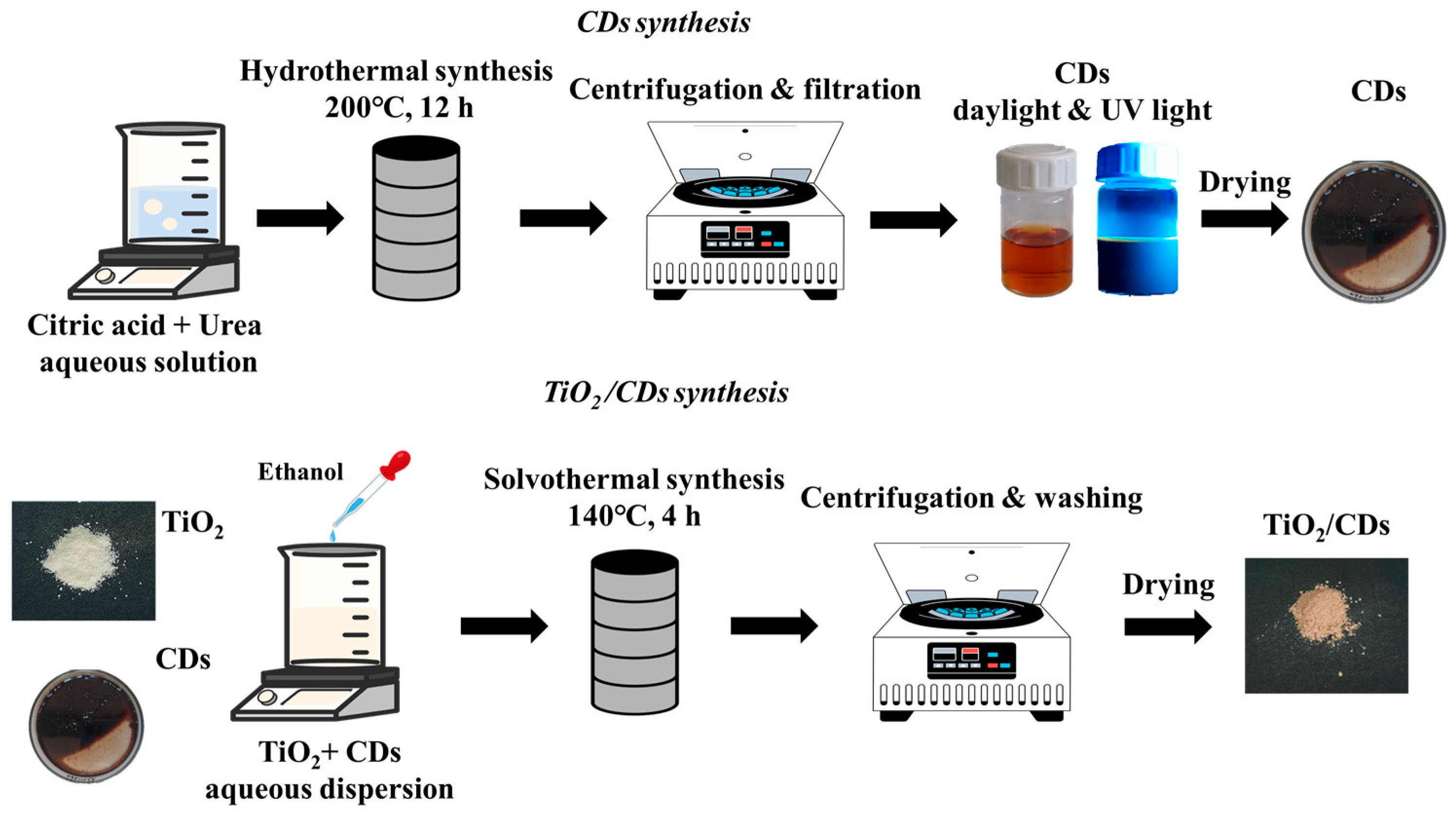
A facile hydrothermal technique was employed to produce N-CDs, in which citric acid was the carbon source and urea contributed both as nitrogen and carbon source. Citric acid and urea were dissolved in deionized water in a mass ratio of 1:2 with the aid of magnetic stirring. Then, the solution was placed in a Teflon-lined stainless-steel autoclave and hydrothermally treated at 200 °C for 12 h. Following synthesis, the product underwent centrifugation and filtration with a 0.22 μm pore-sized PET filter to eliminate by-products and aggregates. N-CDs were then dried overnight at 60 °C. For simplicity, the N-CDs are referred to as ‘CDs’ throughout the manuscript.
For the fabrication of TiO2/CDs hybrid materials, a simple solvothermal method was employed. Specifically, 200 mg of TiO2 powder, 20 mL of deionized water and 6 mL of ethanol were mixed with varying CDs’ loading amounts to obtain hybrid materials with various mass percentages in CDs. Following vigorous stirring, synthesis took place in a Teflon stainless-steel autoclave, in which the mixture was subjected to heating at 140 °C for 4 h. Then, the resulting material was dried under vacuum, rinsed repeatedly with ethanol and allowed to dry at 60 °C. Hereafter, the hybrid samples containing x% (w/w) of CDs will be denoted as TiO2/CDs (x%), where x corresponds to 1, 2, 5, 10, 20 or 50%. Figure 2 depicts the synthesis procedure for CDs and TiO2/CDs.

2.4. Characterization Methods

XRD measurements were performed in a Bruker D8 Advance diffractometer with Cu-Kα radiation (Bruker, Madison, WI, USA). A Renishaw inVia Raman microscope (Renishaw, Wotton-under-Edge, Gloucestershire, UK) equipped with a laser at 785 nm was employed for micro-Raman Spectroscopy. FT-IR analysis was carried out on a Jasco FT-IR 4200 spectrometer (Jasco, Tokyo, Japan) in wavenumbers ranging from 400 to 4000 cm−1 and a resolution of 4 cm−1, using KBr pellets. HR-TEM was performed on a Technai G2 20 X-TWIN TEM (FEI, Hillsboro, OR, USA) equipped with EDS. Particle size distributions were obtained by measuring 100 particles from HR-TEM images using ImageJ software (version 1.54g, NIH, Bethesda, MD, USA). The zeta-potential of the nanomaterials was assessed, employing the Zetasizer Nano ZS Malvern (Malvern Instruments, Malvern, UK). A TGA/SDTA 851e analyzer (Mettler Toledo, Columbus, OH, USA) was used for the TG analysis. Measurements were performed in an air atmosphere with temperatures ranging from 25 to 800 °C. Ultraviolet-Visible (UV-Vis) spectroscopy was studied with a Varian Cary 50 UV-Vis spectrophotometer (Agilent Technologies, Santa Clara, CA, USA). Samples’ absorbance was measured at 60 μg/mL in deionized water. Photoluminescence (PL) spectra were recorded with a Perkin-Elmer LS 45 Luminescence Spectrometer (Perkin Elmer, Waltham, MA, USA). PL was measured in deionized water at 0.5 μg/mL for all the samples. For the PL analysis, a common excitation wavelength of 200 nm was used for all materials, corresponding to an absorption region common to TiO2 and TiO2/CDs. Additionally, upconversion photoluminescence (UCPL) spectra were recorded under excitation at 660 nm, with the emission monitored in the 350–640 nm range. Samples were freshly prepared and measurements were performed at room temperature under identical instrumental settings.

2.5. Irradiation Device

Irradiation was carried out employing a 661 nm diode laser system equipped with an optical fiber and a light diffuser (GCSLS-10-1500 m, China Daheng Group, Beijing, China) to produce a uniform circular illumination area. Output power at sample level was determined with a power meter, both before irradiation and afterward. The laser beam was positioned at the center of the target region, ensuring homogeneous irradiation with a power variation of less than 2%.

2.6. Reactive Oxygen Species (ROS) Studies

ROS formation was assessed, employing the fluorescent probe CM-H2DCFDA. It is a chloromethyl-modified analogue of H2DCFDA, indicating general oxidative stress without discriminating specific ROS types. Fluorescence is produced only after deacetylation and subsequent oxidation by ROS. Sodium hydroxide (NaOH) is used to secure the hydrolysis of CM-H2DCFDA. After hydrolysis, the product at a concentration of 0.25 μM, was mixed with PBS, in which the proposed PS (TiO2 or TiO2/CDs) was present at 0.5 μg/mL. The samples were irradiated at 661 nm (18 mW/cm2) for a total irradiation time of 30 min. Fluorescence spectra (λexc = 490 nm) were collected, using a Perkin-Elmer LS 45 Luminescence Spectrometer, directly post-irradiation every minute for 10 min and subsequently every 5 min until 30 min. Samples were kept under constant magnetic stirring during irradiation.

2.7. In Vitro Cell Studies

2.7.1. Cell Culture

Human epidermoid carcinoma (A431 cells) and mice skin 3T3 healthy fibroblasts were employed for in vitro studies. Cell culture conditions include the cultivation of cells in 75 cm2 culture flasks (Corning Inc., Corning, NY, USA) with high glucose in Dulbecco’s Modified Eagle Medium (DMEM), supplemented with 10% heat inactivated fetal bovine serum (FBS), 1% Antibiotic-antimycotic, and 0.07% gentamicin. Cultures were maintained at 37 °C in 5% CO2 with 85% relative humidity. For washing, PBS was used, and 0.05% Trypsin-EDTA was used to detach the cells from the culture flask, followed by seeding into fresh medium at 3-day intervals.

2.7.2. Cell Viability Evaluation

The MTT assay was utilized to evaluate cell viability by detecting mitochondrial dehydrogenase activity, which converts MTT into purple formazan. This assay provides an estimate of the number of viable cells. A431 and 3T3 cells were seeded in 96-well plates at 6 × 10³ cells per well and allowed 24 h for attachment. Subsequently, the treatment (dark toxicity, light toxicity, photodynamic therapy) was applied, followed by 24 h-incubation. The medium was replaced with MTT solution (0.65 mg/mL in DMEM), followed by cells’ incubation for 3 h to enable metabolic reduction in MTT. Then, formazan crystals were dissolved in 200 μL of DMSO, prior to absorbance measurement. Absorbance was recorded at 570 nm with an Epoch 2 Microplate Reader (BioTek Instruments Inc., Winooski, VT, USA). Relative cell viability was calculated as the percentage of surviving cells compared to control cells maintained in complete medium. Experiments were carried out three times and results are shown as mean values ± standard deviation.

2.7.3. Dark Toxicity Studies

The nanomaterials’ toxicity was examined in the absence of light following 24 h of incubation in A431 and 3T3 cells with several concentrations (1, 3, 5, 10 and 20 μg/mL) in 0.5% water for injection. Cell survival was assessed via MTT assay.

2.7.4. Light Toxicity Studies

Light toxicity was evaluated to determine the light effect on A431 and 3T3 cells. Following 24 h incubation in 96-well plates, each well received 40 μL of PBS, replacing cell cultures’ medium to form a thin layer over the cells’ monolayer. Afterwards, cells were subjected to laser irradiation at 661 nm with a power output of 18 mW/cm2 for 3, 5, and 10 min, which correspond to fluence rates of 3.2, 5.4, and 10.8 J/cm2. Following removal of PBS, fresh medium (100 μL) was introduced per well. After 24 h, MTT assay determined cell viability.

2.7.5. PDT Studies

A431 cells and 3T3 cells were treated for 4 h with the nanomaterials at the maximum non-toxic concentration according to the findings of dark toxicity studies. Then, culture medium with the PSs was discarded and PBS (40 μL) was introduced per well. Cells were exposed to irradiation at 661 nm with fluence rates of 3.2, 5.4, and 10.8 J/cm2, according to light toxicity studies. Post-irradiation, PBS was removed, cells were supplied with a fresh medium and were incubated for 24 h. Cell survival was determined through MTT assay.

2.7.6. Intracellular Localization

A431 cells at a density of 2.5 × 10⁵ cells were cultured in glass coverslips in 2.5 mL of DMEM and incubated for 24 h. PSs were then added to cells at the maximum safe concentration for 4 h under dark conditions. Following incubation, PBS was used to wash the cells and microscopic imaging was performed with an epifluorescent upright microscope Olympus BX-50 307 (Olympus BX50, Olympus Optical Co., Ltd., Tokyo, Japan) with a 40 × objective lens (UPlanFl, N.A. = 0.75) equipped with a CCD camera (XC-30, Olympus, Tokyo, Japan). Image acquisition was carried out with the analySIS getIT version 5.1 software (Olympus Soft Imaging Solutions GmbH, Hamburg, Germany). The filter cube configuration for fluorescence imaging was U-WBV (excitation: BP400–440 nm, dichroic mirror: DM455, emission: BA475 nm).

2.7.7. Statistical Analysis

Data were analyzed with the PRISM software (version Prism 10.4.1). A two-way analysis of variance (two-way ANOVA) was used to assess the effects of PS’s concentration or irradiation time on cell survival. To compare each treated group to its respective control (0 μg/mL for dark toxicity studies or 0 min and 0 μg/mL for PDT studies), Dunnett’s multiple comparisons test was applied. A p-value of less than 0.05 was considered statistically significant. Four levels of statistical significance were reported using the following notation: p < 0.05 (*), p < 0.01 (**), p < 0.001 (***), and p < 0.0001 (****).

3. Results and Discussion

3.1. Characterization of the Photosensitizers TiO2 and TiO2/CDs

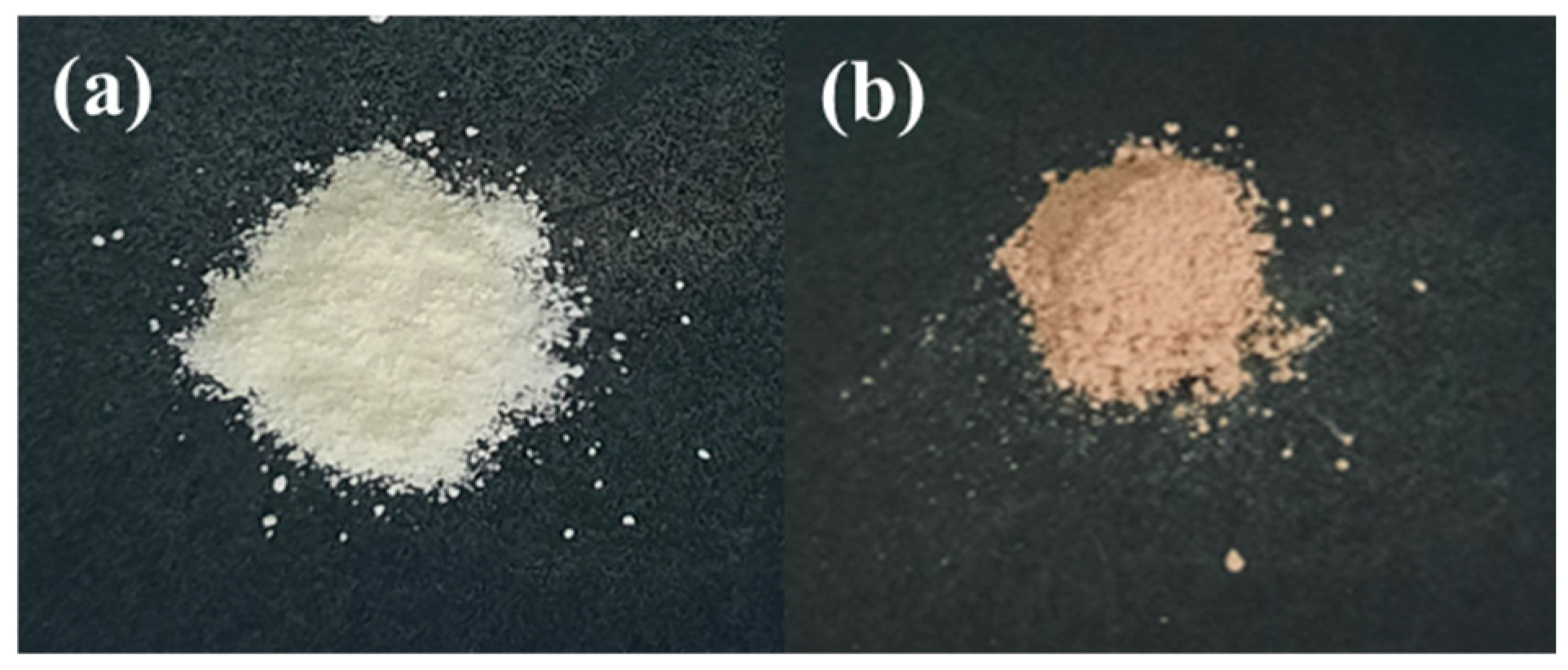
Nitrogen-doped TiO2 was synthesized via a wet chemical method and nitrogen doping is suggested based on synthesis conditions. The nanohybrid materials TiO2/CDs were produced based on a solvothermal procedure by varying the loading amounts of CDs. There is a gradual change in the color from TiO2 to TiO2/CDs (50%) (Figure 3). TiO2 exhibits a light-yellow color, whereas the addition of CDs in the TiO2 results in a brown powder, which darkens when CDs’ content is increased. TiO2, as well as its hybrid materials with CDs were characterized using XRD, micro-Raman, TEM, FT-IR, zeta potential measurements and TG analysis.

3.1.1. X-Ray Diffraction Analysis

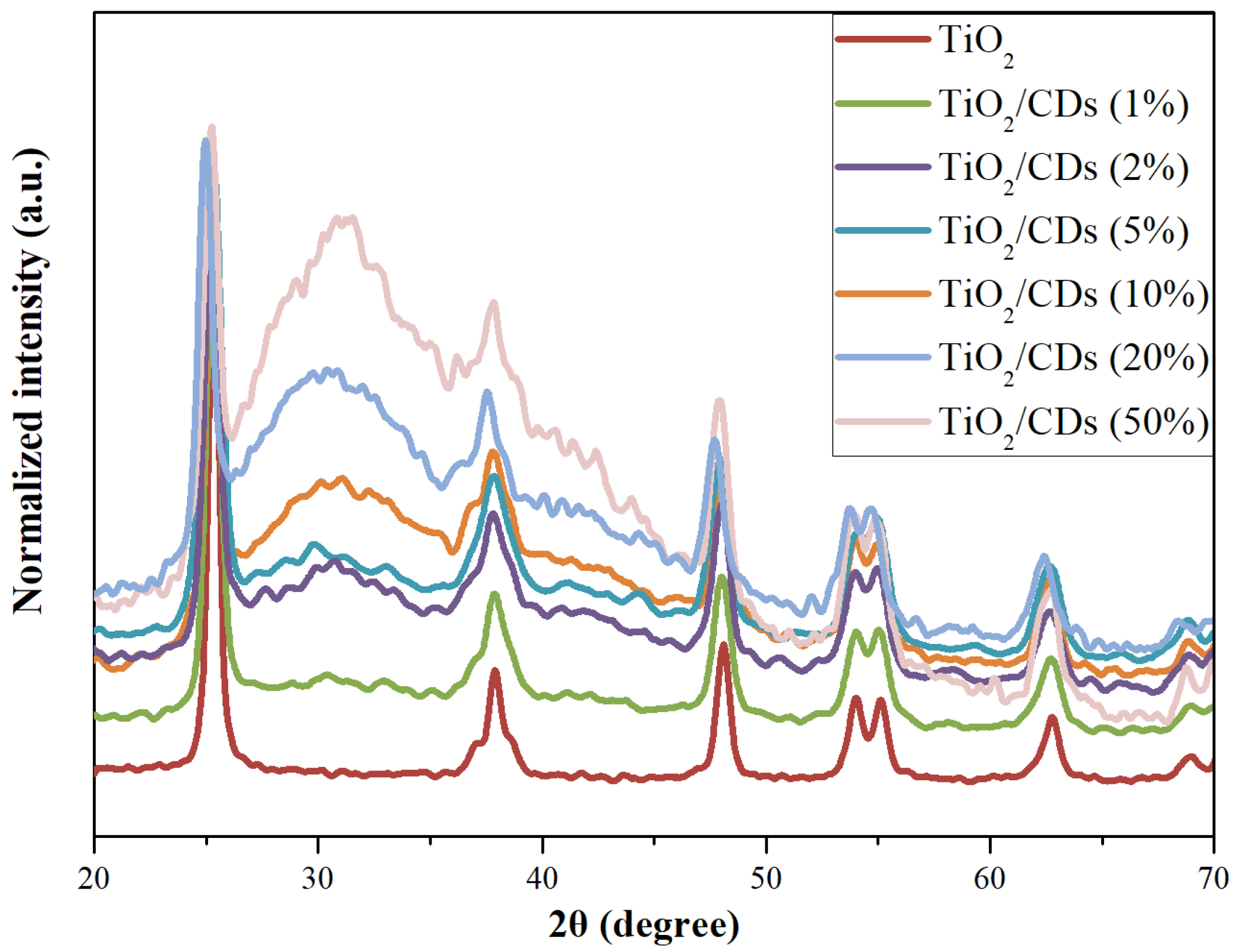
X-ray Diffraction (XRD) analysis was employed to study the products, as well as to examine the role of CDs’ addition to the crystal structure of TiO2. Figure 4 presents the XRD patterns of TiO2 and its hybrid materials with CDs. For comparative purposes, the XRD patterns were normalized to the intensity of the anatase (101) peak at approximately 25° (2θ). All the materials possessed the typical diffraction peaks of anatase phase observed at 25.34°, 37.87°, 48.07°, 53.98°, 55.14°, 62.78° and 68.97°, which correspond to the (101), (004), (200), (105), (211), (204), and (116) crystal planes, respectively. It should be noted that all hybrid materials maintain these diffraction peaks regardless of the addition of CDs [23].
Additionally, no new diffraction peak of the (002) crystal plane of CDs at around 2θ = 26° was recorded, mainly due to overlapping with the (101) crystal plane diffraction peak of the anatase phase TiO2 [21,23,24]. The XRD spectra of the hybrid materials displayed a broad feature around 30°, which is related with the graphitic-like species of CDs. The intensity of this peak is enhanced with the increase in CDs’ content [25,26]. The increased intensity of the broad feature at 30° further reflects the higher content of graphitic-like domains interacting with TiO2. Upon CDs’ incorporation, peak broadening is observed in the XRD patterns of the hybrid materials. To further investigate this effect, the crystallite size was estimated using Scherrer’s equation: D = 0.89 ∙ λ/(Β ∙ cosθ), where D represents the crystallite size, λ signifies the X-ray wavelength, which is 0.15406 nm, Β denotes the full width at half maximum (FWHM), and θ is Bragg’s diffraction angle [22,23]. In particular, calculations proved that crystallite size of TiO2 was 18.4 nm and an increase in CDs’ content resulted in decreased crystallite size. In particular, D values of TiO2/CDs (1%), TiO2/CDs (2%), TiO2/CDs (5%), TiO2/CDs (10%), TiO2/CDs (20%) and TiO2/CDs (50%) were 14.2 nm, 13.7 nm, 12.9 nm, 12.3 nm, 12.2 nm and 9.6 nm, correspondigly. The observed reduction in the crystallite size may be related to increased peak broadening induced by surface interactions between TiO2 and the amorphous CDs phase. These interactions may induce surface microstrain and partial surface disorder at the TiO2 surface, which cannot be unambiguously resolved by XRD alone [21,27,28,29].

3.1.2. Micro-Raman Spectroscopy

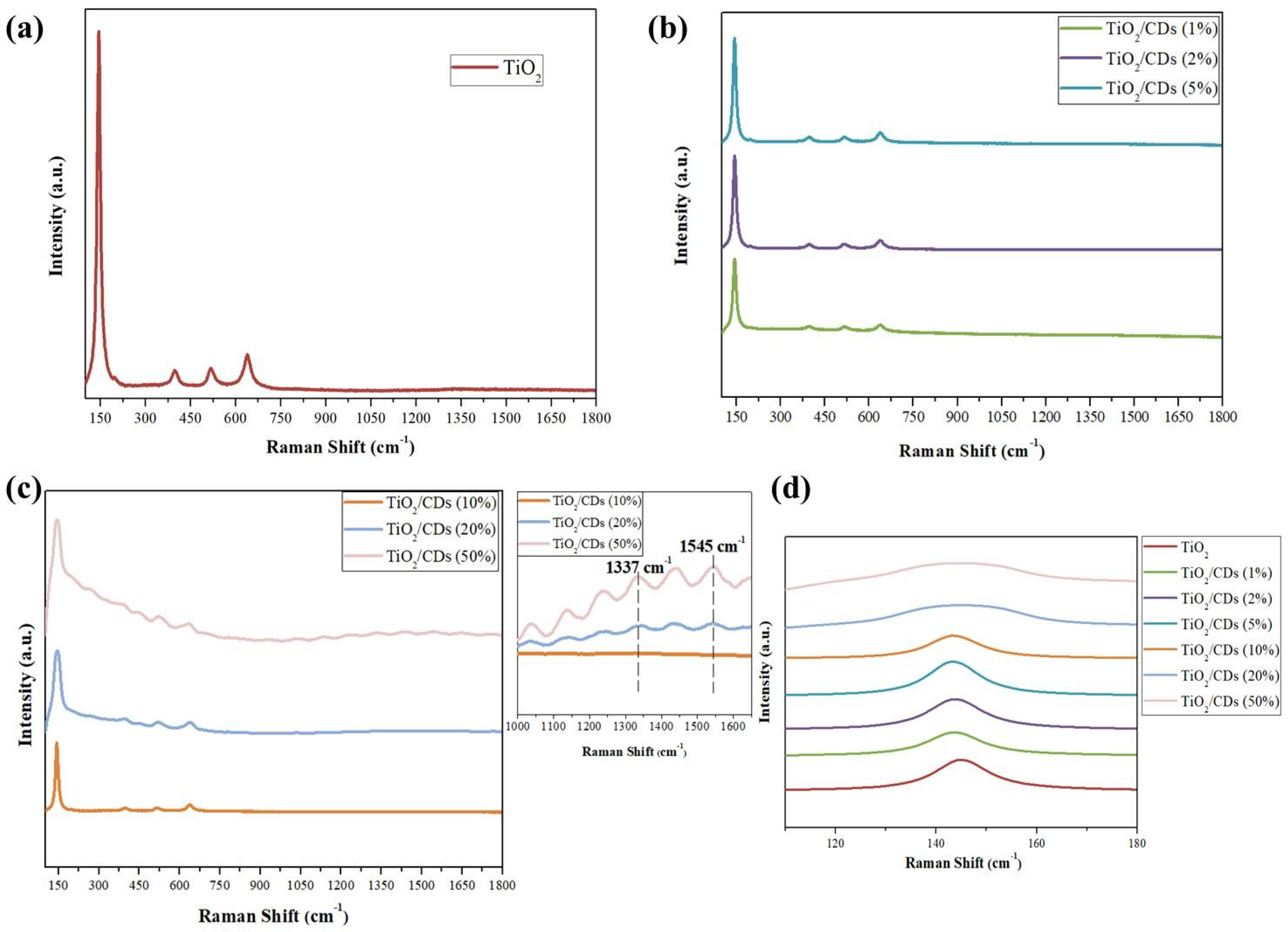
Micro-Raman Spectroscopy was exploited to explore the crystallinity of TiO2 further, as well as of the hybrid materials of TiO2 with CDs in varying loading amounts. Figure 5 shows the micro-Raman spectra of all the synthesized nanomaterials. Both TiO2 and TiO2/CDs exhibit the typical Raman peaks of anatase TiO2. Specifically, peaks appeared at 145 cm−1 (Eg, symmetrical streching vibration of O-Ti-O), 197 cm−1 (Eg, symmetrical streching vibration of O-Ti-O), 399 cm−1 (B1g, symmetrical bending vibration O-Ti-O), 519 cm−1 (B1g και A1g, symmetrical and assymetrical bending vibration of O-Ti-O), and at 639 cm−1 (E1g, symmetrical streching vibration of O-Ti-O) [30,31].
However, a closer inspection of the main anatase peak at around 145 cm−1 (Figure 5d) reveals that this peak is red-shifted to 143 cm−1 for TiO2/CDs containing up to 10% CDs. This red-shift observed for TiO2/CDs hybrids with up to 10% CDs may arise from surface interactions between TiO2 and CDs, such as Ti–O–C bonding or local modifications at the particle surface, without indications of bulk lattice modification. For these samples, the main anatase peak at 143 cm−1 remains relatively sharp and symmetric, and the FWHM was calculated by fitting the peak with a single Lorentzian function. In contrast, TiO2/CDs (20%) and TiO2/CDs (50%) exhibit a broader and less symmetric Raman peak at 145 cm−1, which likely originates from increased surface disorder or heterogeneous local environments induced by higher CDs loadings, without implying bulk lattice changes.
These observations, along with the results of Table 1 indicate that the addition of CDs in TiO2 even at low concentration results in localized interfacial interactions and modification of the surface bonding environment. The significant peak broadening and the shift toward higher wavenumbers at high CDs loadings may also be attributed to the phonon confinement effect. The lowest FWHM was recorded for TiO2/CDs (5%) and TiO2/CDs (10%), indicating an optimal CDs surface coverage that enhances surface interactions without inducing excessive vibrational disorder or phonon confinement effects [23,32,33,34,35,36,37].
Furthermore, a loading amount of CDs in TiO2 at 10% is possibly a critical threshold for the hybrid’s material properties, since new additional peaks are observed for TiO2/CDs (20%) and TiO2/CDs (50%). In particular, the characteristic peaks for D band (1337 cm−1) and G band (1545 cm−1), along with other peaks at 815, 936, 1035, 1131, 1228, 1441, 1649, 1753, και 1860 cm−1 were observed for CDs’ percentages at 20% and 50%. These peaks are related with carbon polymorphs and the addition of CDs to the TiO2’s lattice [26,38,39,40,41,42]. The G band (graphene band) is attributed to sp2 hybridization, which is a feature of the hexagonal arrangement of carbon atoms with a typical crystalline structure. On the other side, D band (defect band) arises from disorder and defects in the carbon material and it is a result of the sp3 hybridization. The quantification of the extent of the disorder is carried out by the calculation of the ratio of the intensity of these bands, ID/IG, which results as 0.99 and 0.82 for the hybrid materials TiO2/CDs (20%) and TiO2/CDs (50%), respectively [43,44]. These values indicate that a rise in CDs’ content in the hybrid materials enhances the graphitic order or otherwise reduces the surface functional defects. Additionally, the ratio reduction may be related to CDs’ aggregation when present in larger quantities.

3.1.3. High-Resolution Transmission Electron Microscopy (HR-TEM) Analysis

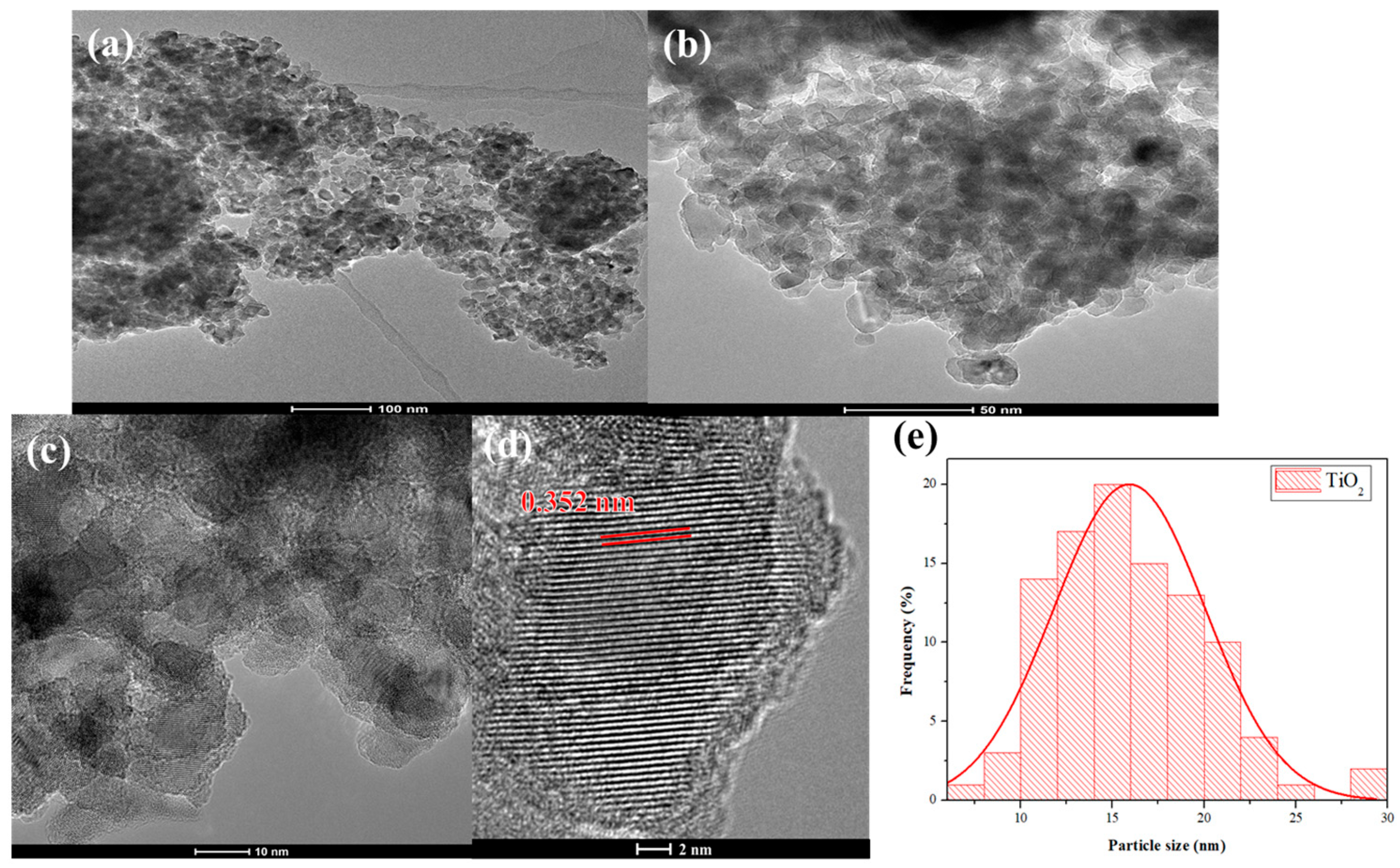
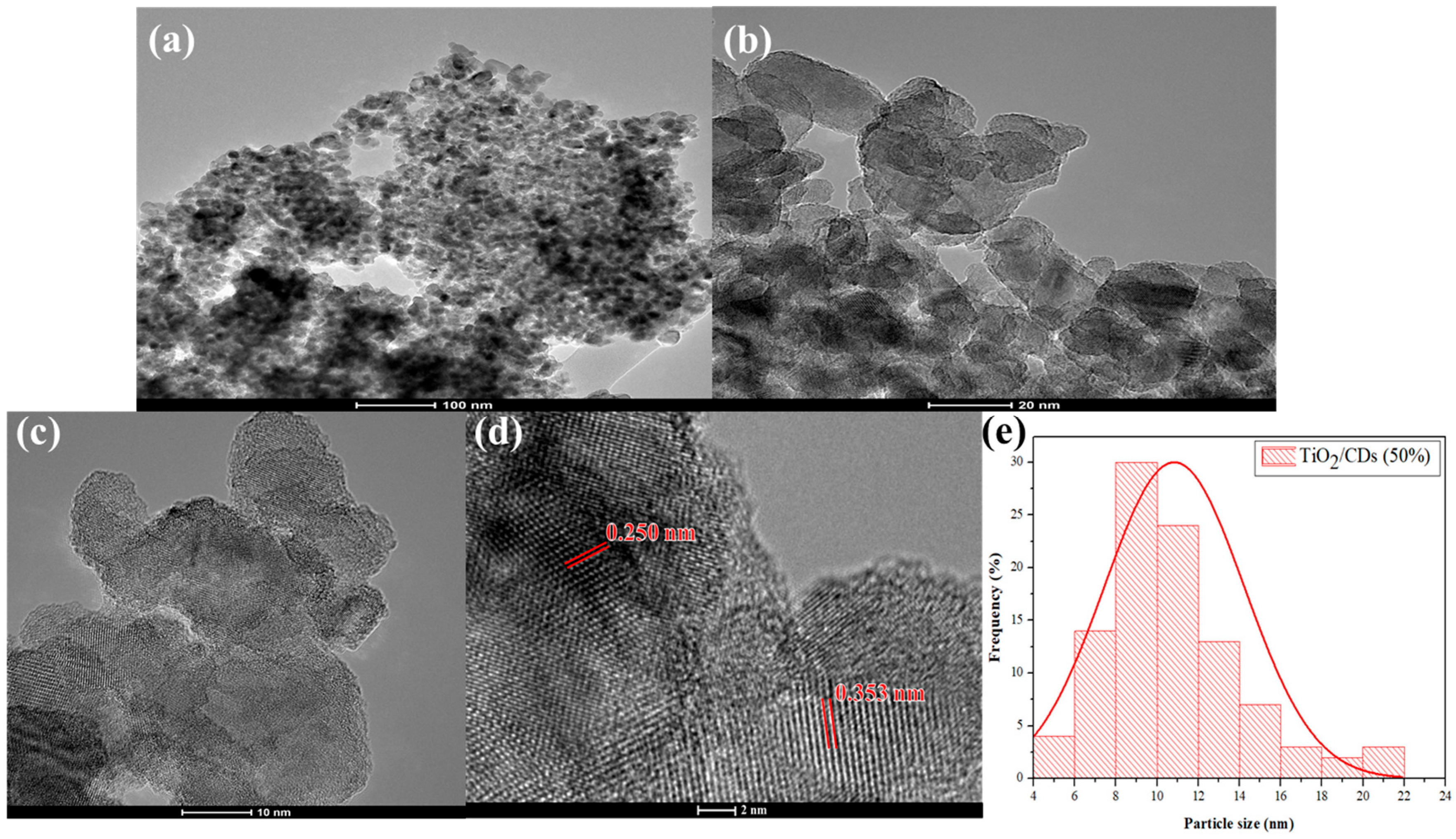
The morphology and size of TiO2 and TiO2/CDs hybrid samples were evaluated through HR-TEM analysis. Figure 6 depicts TEM images of TiO2, showing approximately spherical-shaped particles with an average size of 15.92 ± 4.13 nm. The crystal lattice spacing around 0.352 nm agrees well with the (101) plane of anatase TiO2 [20]. EDS elemental analysis was performed to study the distribution of the compositional elements (Figure S1). Ti and O elements were observed throughout the sample, demonstrating that TiO2 is evenly distributed.
After the incorporation of CDs in TiO2, HR-TEM analysis proved that CDs were uniformly deposited on the TiO2’s surface, as can be seen in Figure 7 and Figures S2–S6. The mean particles’ size of hybrid materials was calculated as 13.89 ± 4.61 nm, 13.09 ± 4.86 nm, 12.79 ± 4.19 nm, 11.35 ± 3.49 nm, 11.10 ± 4.18 nm, 10.84 ± 3.39 nm, for TiO2/CDs 1%, TiO2/CDs 2%, TiO2/CDs 5%, TiO2/CDs 10%, TiO2/CDs 20%, TiO2/CDs 50%, respectively. The interplanar spacing of 0.250 nm attributed to the CDs can be detected in Figure 7, along with the spacing of 0.353 nm of anatase TiO2, verifying the effective integration of the CDs to TiO2. EDS elemental maps further confirm the successful addition of CDs to TiO2 with good dispersion (Figures S7 and S8). The presence of Ti, O, C and N across the entire sample indicates a uniform distribution of TiO2 and CDs [20,45].

3.1.4. Fourier Transform Infrared Spectroscopy (FT-IR Spectroscopy)

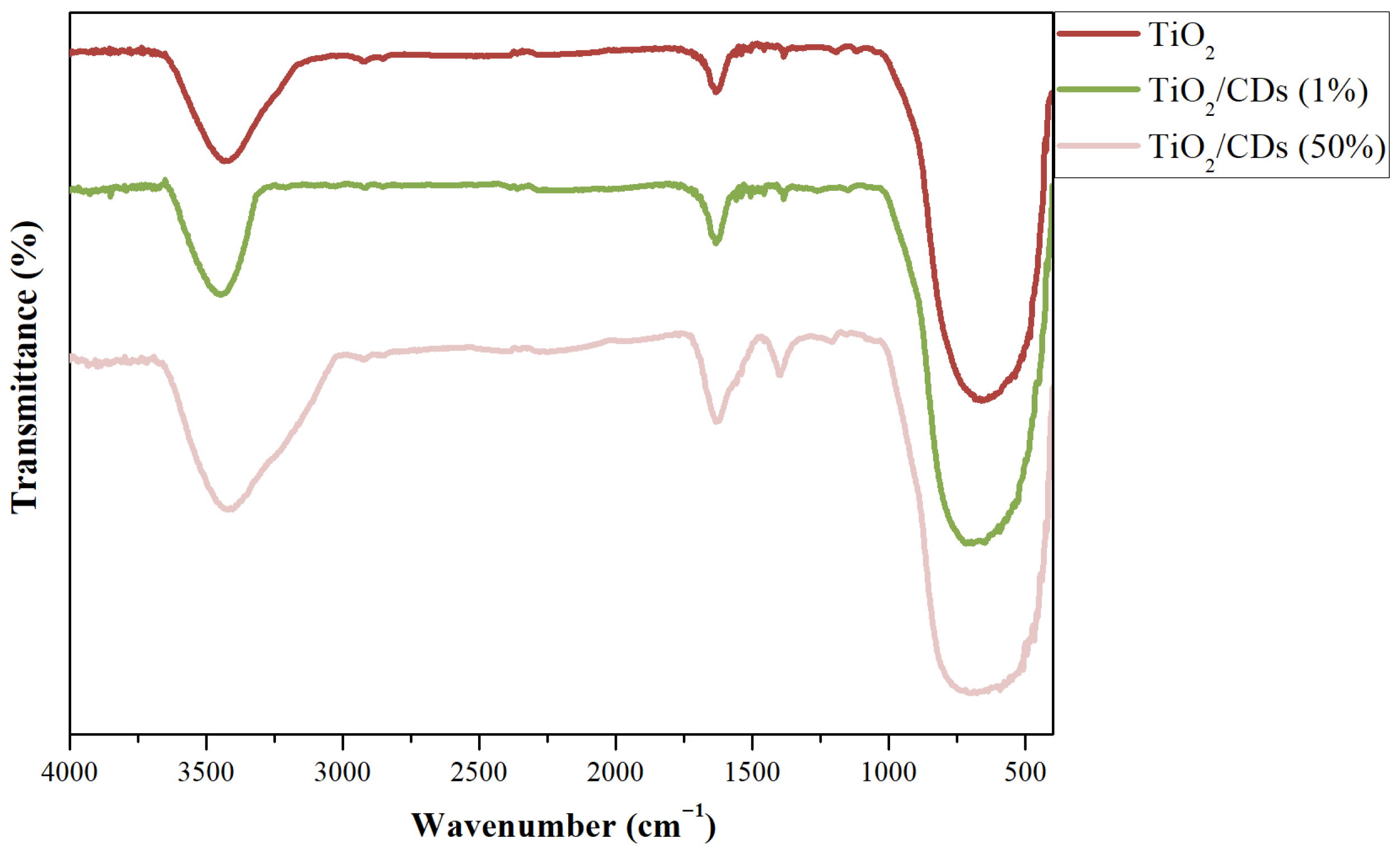
To investigate the chemical information on the surface functional groups of TiO2 and TiO2/CDs hybrid materials, the FT-IR spectra were recorded, as shown in Figure 8 and Figure S9. All examined materials exhibited three main peaks at 3430, 1640 and 640 cm−1. The first peak can be attributed to stretching vibrations of O–H groups, due to water molecules adsorption. The peak observed at 1640 cm−1 is the result of the bending vibration of O–H groups, whereas the stretching vibration of the Ti–O–Ti bond accounts for the peak at 640 cm−1. The addition of CDs does not cause a shift in any of these peaks. However, an increase in the intensity of the peaks at 3430 and 1640 cm−1 was observed even in CDs’ loading amount of 1%. These intensity changes may reflect a minor contribution from N–H and C=N groups of CDs, although the characteristic N–H stretching of CDs (~3140 cm−1) is not distinctly visible in the hybrid materials due to overlap with the broad O–H band of TiO2 (Figure S10). Furthermore, all the hybrid materials possess an additional peak at 1390 cm−1 as a result of bending vibrations of O–H and C–H bonds and stretching vibrations of C–N bonds arising from CDs’ addition. Notably, the intensity of this peak is increased by rising the CDs’ content in the hybrid materials [18,46,47,48].

3.1.5. Zeta Potential

Zeta potential measurements further reveal the influence of CDs’ on the colloidal stability of the examined PSs, as can be seen in Figure S11 and Table 2. TiO2 exhibits low stability with a zeta potential value of 1.33 mV, whereas a relatively low loading amount of CDs in the hybrid materials improves materials’ stability with a maximum zeta potential value of 18.7 mV for TiO2/CDs (10%). The high positive zeta potential at relatively low CDs’ loading amount implies enhanced electrostatic repulsion between nanoparticles, which limits aggregation and improves dispersibility, contributing to the observed size reduction in TEM analysis [49]. As CDs’ content increases further, a reverse surface charge on the hybrid materials is recorded, approaching −9.86 mV and −16.5 mV for TiO2/CDs (20%) and TiO2/CDs (50%), respectively. This result may be associated with the dominance of negatively charged carboxylic groups on the materials’ surface, due to increased presence of CDs [50]. These findings indicate that a CD loading amount of 10% provides optimal colloidal stability and surface charge characteristics, whereas a rise in CDs content leads to charge reversal and reduced electrostatic stabilization, potentially promoting aggregation. Zeta potential measurement clearly indicates that the addition of CDs enhances the dispersibility of TiO2 nanoparticles in aqueous media, by steric repulsion of TiO2 nanoparticles [51]. This behavior leads to reduced aggregation, which is a desirable feature for hybrid nanomaterials intended for biological purposes. These observations underline the dual role of CDs in modulating both the surface charge and steric environment of TiO2, which is critical for designing nanosystems with controlled aggregation and optimal performance in biomedical applications.

3.1.6. Thermogravimetric (TG) Analysis

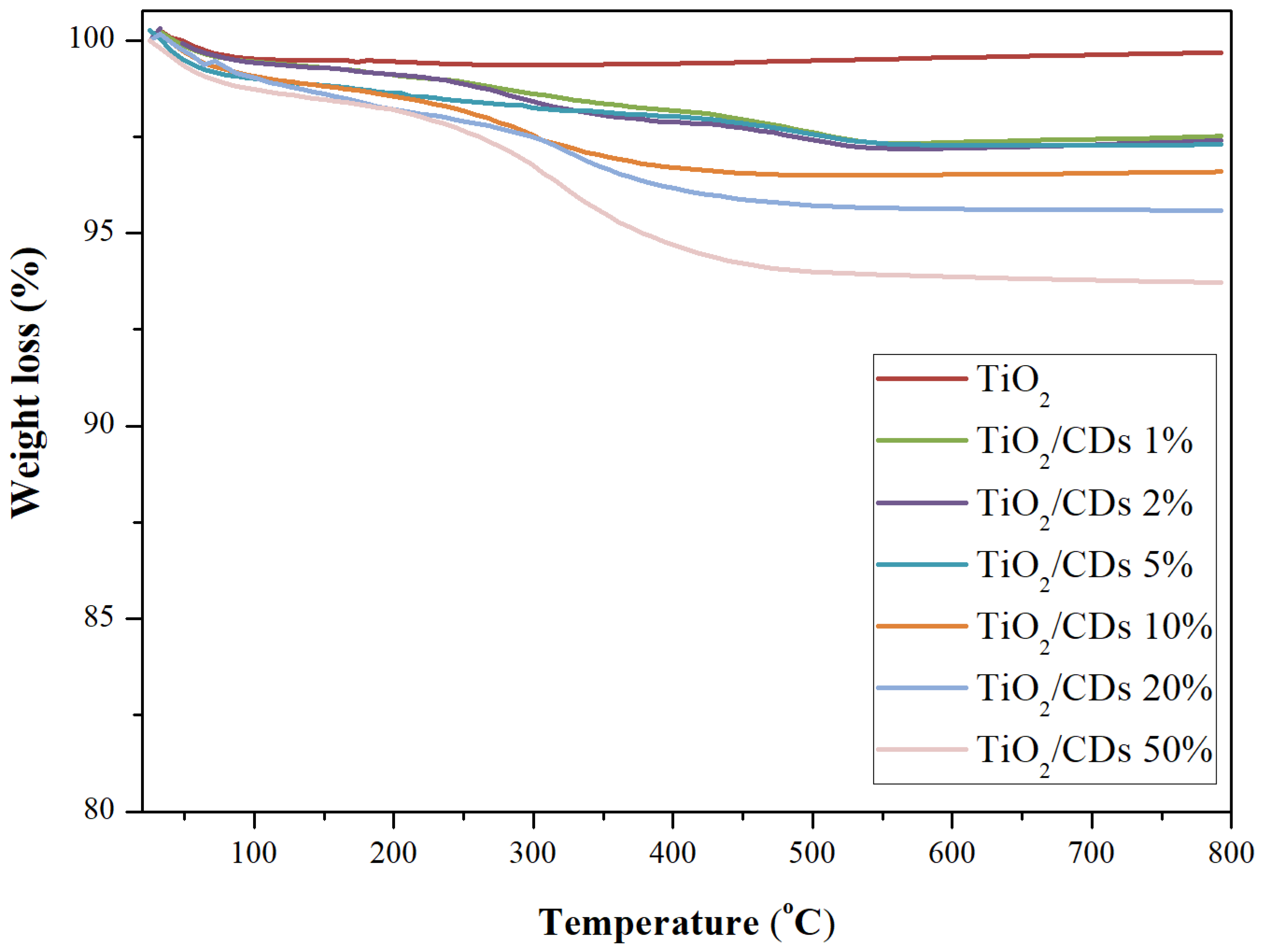
TG analysis was utilized for studying the thermal stability of the as-synthesized nanomaterials. As depicted in Figure 9, the addition of even 1% of CDs in the TiO2 leads to an increase in the total mass loss, compared with TiO2. The rise in CDs’ content in the hybrid materials results in a gradual increase in the total weight mass loss. Specifically, total mass losses of 0.3%, 2.5%, 2.6%, 2.7%, 3.4%, 4.4%, and 6.3% were recorded for TiO2, TiO2/CDs (1%), TiO2/CDs (2%) TiO2/CDs (5%), TiO2/CDs (10%), TiO2/CDs (20%) and TiO2/CDs (50%), respectively. In each sample, a weight loss at around 150 °C as a result of adsorbed water was observed. This reduction in weight loss is enhanced by increasing CDs’ content in the hybrid materials and reaches 5.1% for TiO2/CDs (50%). The progressively greater weight loss observed in the hybrid materials with increasing CDs’ content is likely related to the enhanced ability to adsorb water. In the temperature range of 200–350 °C, a weight loss is recorded due to the desorption of surface functional groups of the CDs, including -COOH, -OH, and -NH2. At higher temperatures, carbon oxidation takes place, while the residual mass at 800 °C corresponds to TiO2. For CDs’ loading amount above 20%, a pronounced weight loss is recorded above 200 °C, which is associated with the thermal decomposition of oxygen-containing surface groups and the oxidation of the carbonaceous fraction of the CDs. The TG analysis confirmed the presence of CDs in the hybrid materials. Overall, it is worth noting that all the examined nanomaterials exhibit high thermal stability, as only a relatively small weight loss is detected at temperatures below 800 °C [52].

3.1.7. Ultraviolet-Visible (UV-Vis) and Photoluminescence (PL) Spectroscopy

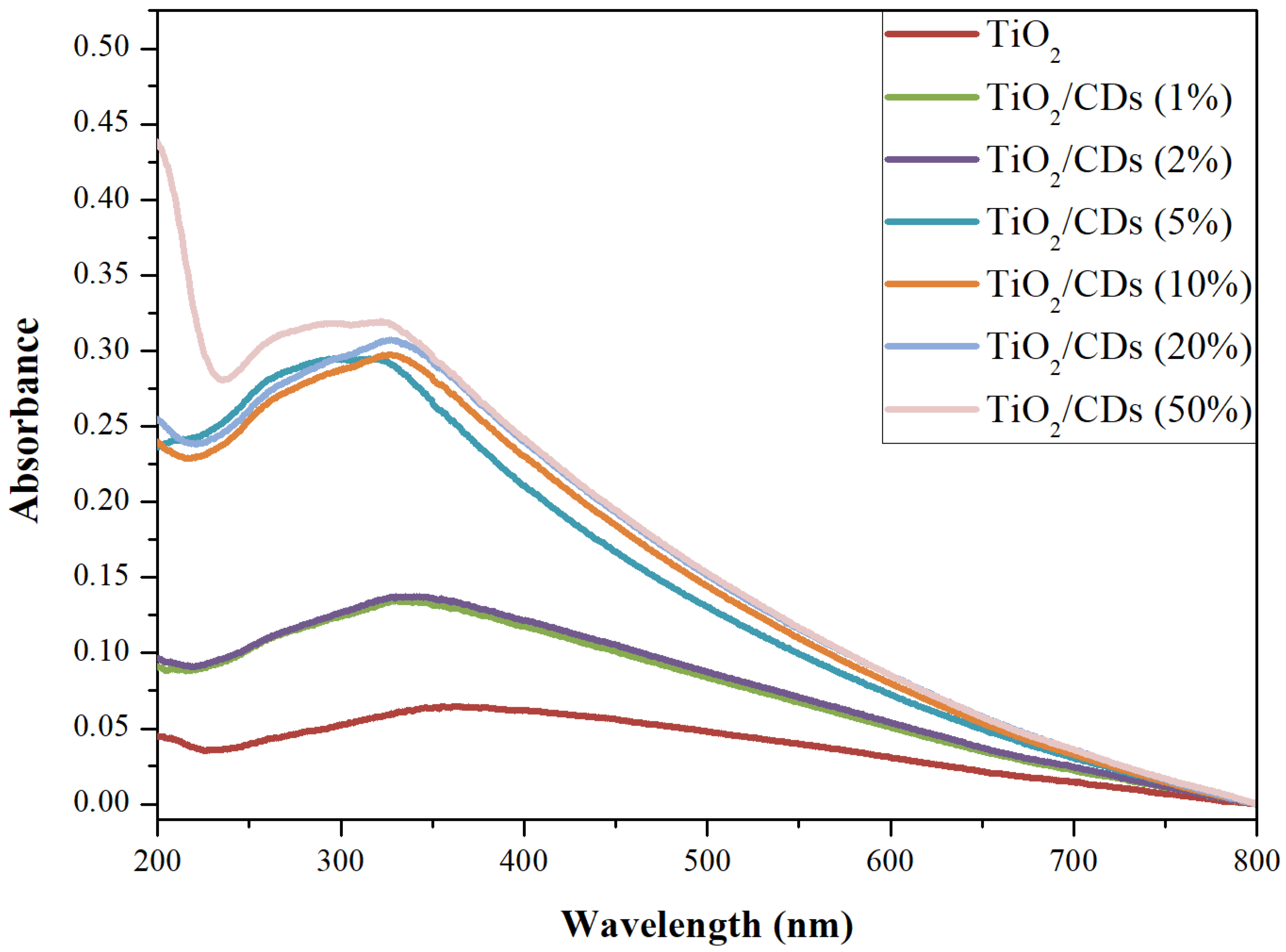
UV-Vis and PL spectroscopies were employed to evaluate the optical properties of TiO2 and its hybrid materials with various loading amounts of CDs. To start with, the UV-Vis spectra of the as-prepared nanomaterials in aqueous solutions (60 μg/mL) are presented in Figure 10.
Initially, TiO2 exhibits strong absorption in the ultraviolet region, while only a weak absorption tail extending toward the near-visible region is observed. In contrast, TiO2/CDs hybrid materials display enhanced absorption toward longer wavelengths. This feature is advantageous for PDT applications, since absorption at longer wavelengths facilitates the treatment of deeper-seated lesions. In all samples, an absorption peak is observed at 200 nm, which is attributed to charge-transfer transitions of low energy from π-bonding orbitals of the O(2p) states to the anti-bonding π* orbitals of the Ti(3d) conduction band [53]. An additional absorption peak for the examined materials is recorded at 330 nm for the hybrid materials and at 350 nm for the TiO2. This shift can be attributed to the main absorption peak of CDs located at 330 nm (Figure S12), as a result of n-π* transition of the C=O and C=N bonds in CDs’ surface. Notably, a rise in CDs’ content leads to an increase in the absorbance of the TiO2/CDs hybrid materials. This behavior is associated with the ability of CDs to transfer electrons upon excitation and enhance the electron density of TiO2’s surface. This increase in the absorbance of hybrid materials is evident even upon the addition of CDs at a percentage of 1%, whereas strong variations in absorption intensity were recorded for CDs’ content equal or higher than 5% [18,54]. The spectra of TiO2 and the hybrid materials show a scattering contribution from the TiO2 nanoparticles, which is commonly observed in UV-Vis spectra of similar systems reported in the literature [55,56,57,58].
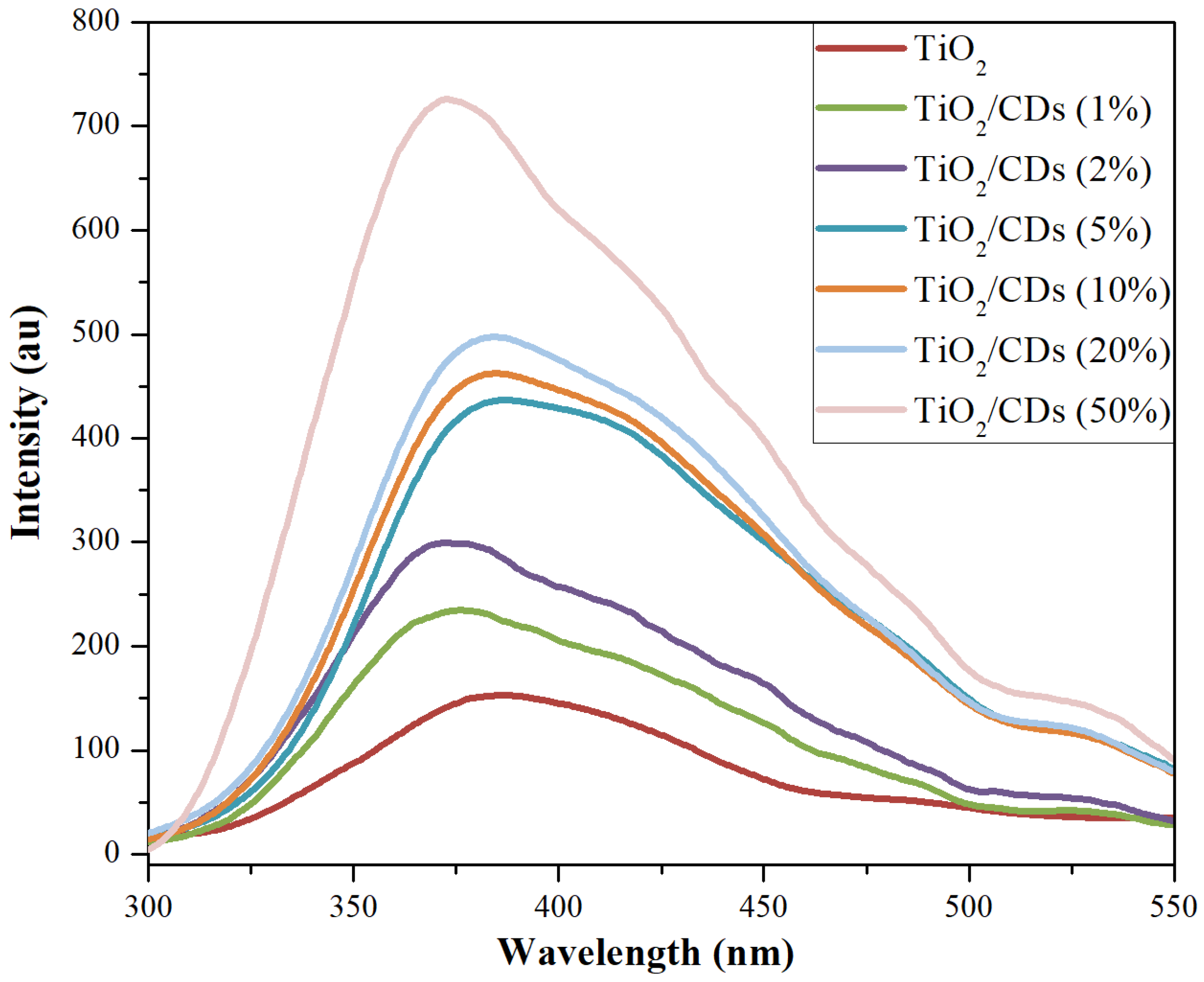
Figure 11 presents the results of PL analysis for aqueous solutions of TiO2 and TiO2/CDs, recorded at a concentration of 0.5 μg/mL, using a common excitation wavelength of 200 nm, which corresponds to high absorption values for all the materials. TiO2 exhibited an emission peak at 380 nm due to transitions between the conduction band of Ti(3d) and valence band of O(2p). Any change in this peak was not evident for hybrid materials of up to 2% content in CDs. However, a red shift at 390 nm was observed in a higher loading amount of CDs in the hybrid materials. This observation is highly related to the PL spectrum of CDs (Figure S13), which exhibits an emission peak at 415 nm upon excitation at 200 nm. Additionally, hybrid materials possess increased emission intensity, compared with the correspondent of TiO2. Increasing the amount of CDs improved their ability to fluoresce. Taking into account, the PL spectra of TiO2 and CDs, as well as their hybrid materials, the fluorescence of CDs is quenched, indicating that electrons are transferred from CDs to TiO2 [45,59]. The above PL behavior, in combination with the ROS generation results discussed below, is further rationalized through the proposed charge transfer mechanism (see Figure 14).

3.2. Reactive Oxygen Species (ROS) Generation Studies

Within the framework of PDT, the ability of a PS to produce ROS is crucial for inducing intense oxidative stress in cancer cells and ultimately promoting their elimination. Therefore, a preliminary assessment of the potent photodynamic activity of the proposed PSs was conducted by measuring ROS production with the aid of the fluorescent probe CM-H2DCFDA upon photoexcitation. This probe is a chloromethyl derivative of 2′,7′-dichlorodihydrofluorescein diacetate (H2DCFDA) and is widely used as a general indicator of intracellular oxidative stress. Although it does not enable discrimination between different types of ROS, an increase in fluorescence reflects elevated overall oxidative activity through the oxidation of CM-H2DCFDA. Consequently, the fluorescence signals observed in this study are interpreted as indicative of general ROS generation rather than of specific reactive species formation.
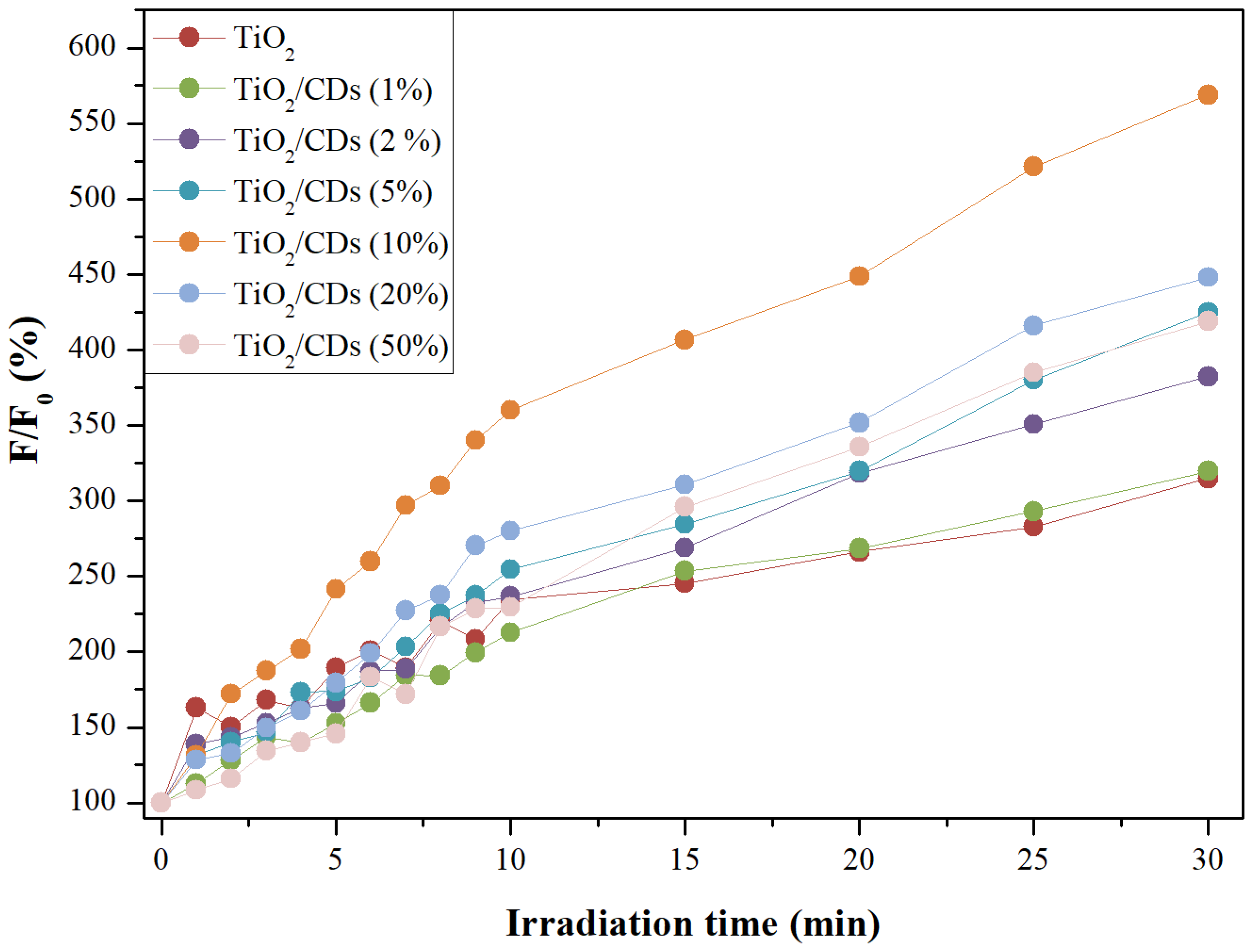
Fluorescence emission at 520 nm was recorded for various time points of irradiation at 661 nm with a total irradiation time of 30 min per sample. Τhis wavelength was chosen due to its higher tissue penetration depth, allowing irradiation to reach not only superficial tumors but also deep-seated lesions. Although TiO2 and the hybrid materials exhibit intrinsically weak absorption around 660 nm, it should be noted that absorbance is defined on a logarithmic scale. Therefore, even relatively low values correspond to effective photon harvesting. Results are given as the percentage of fluorescence intensity relative to the initial intensity value prior to irradiation. Figure 12 depicts the results of ROS generation studies for both TiO2 and its hybrid materials with CDs at various percentages.
An initial inspection of Figure 12 shows a rise in fluorescence intensity at 520 nm over time for all the tested nanomaterials, underlining their potential to generate ROS. This enhancement reflects the levels of ROS produced upon irradiation, as it results from CM-H2DCFDA oxidation. TiO2/CDs hybrid materials exhibit improved ability to generate ROS compared with pure TiO2, mainly for CDs’ loading amount above 2%. However, an increase in CDs’ content in the hybrid materials does not necessarily imply an increase in ROS production. The highest fluorescence variation was recorded for the hybrid material TiO2/CDs (10%), followed by TiO2/CDs (20%) and then TiO2/CDs (50%). These findings indicate that while CDs enhance ROS generation by improving charge transfer at low to moderate loadings, excessive CDs content reduces ROS production due to optical shielding and blockage of TiO2 active sites.
Τhe ROS generation trend does not correlate directly with the optical features of the hybrid materials, since higher CDs loadings (20–50%) exhibit stronger optical signals but lower ROS production. Instead, TiO2/CDs (10%) demonstrated the highest ability to produce ROS. This observation indicates that ROS generation activity is not governed solely by light harvesting, but also by how efficiently the absorbed energy is utilized at the TiO2/CDs interface. At higher CDs contents, aggregation, light scattering, and partial surface coverage of TiO2 active sites may reduce the fraction of incident light to the PS that effectively contributes to ROS generation and thus lead to reduced successful photoactivation despite increased optical density [60,61].
The ROS generation performance necessitates the finding of an optimal CD concentration in the hybrid material, in order to achieve maximum utilization of the available light. ROS generation results suggest the existence of an optimal CD loading amount, with 10% representing the most efficient balance between enhanced photoactivation and minimized physicochemical limitations. Additionally, the ability of the tested materials to generate ROS upon irradiation makes them promising candidates as PSs in PDT and encourages further studies in cellular environments.
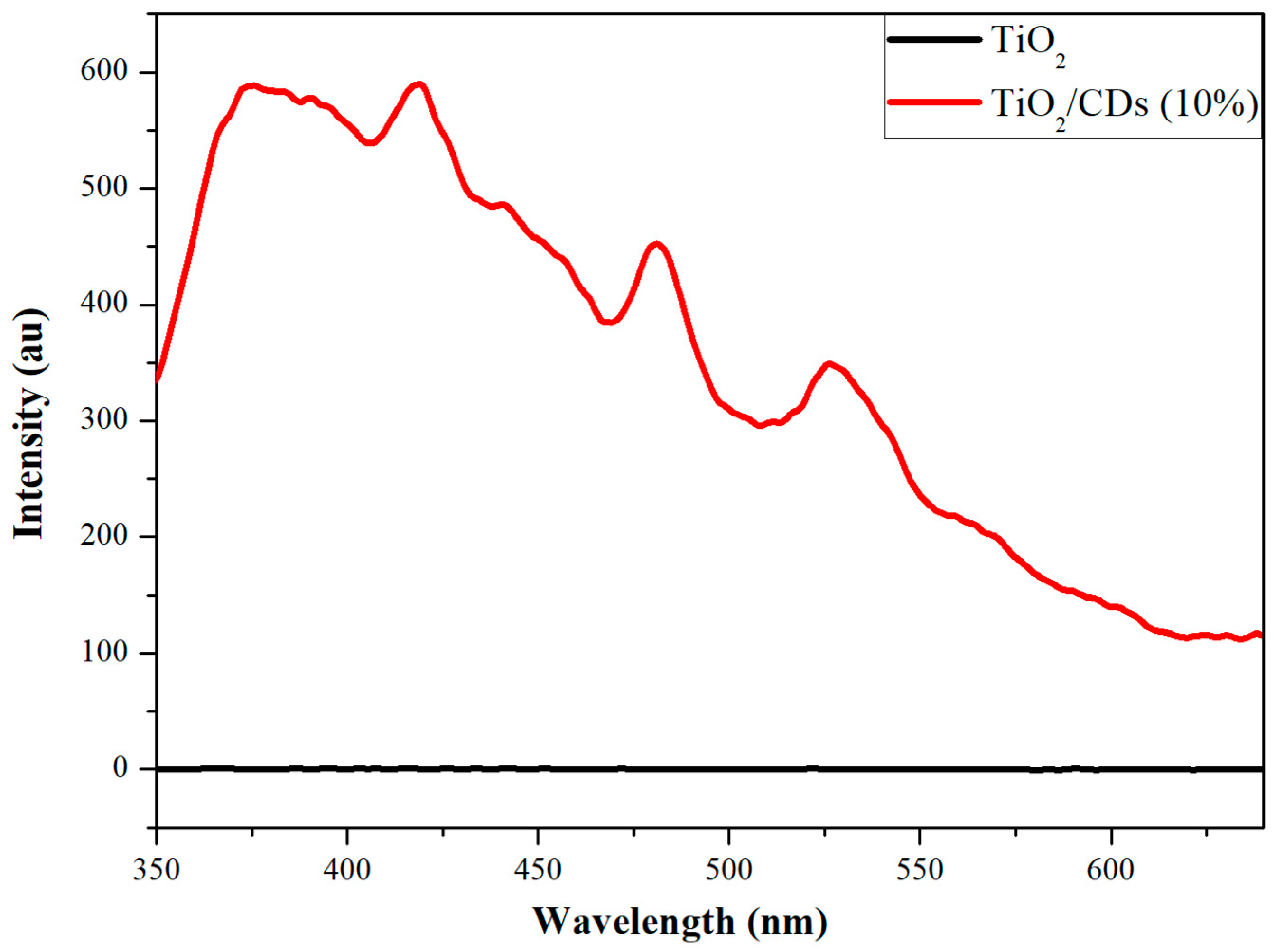
Two complementary mechanisms can account for the enhanced ROS generation observed for the TiO2/CDs hybrid materials upon red-light irradiation. One possible contribution arises from the upconversion photoluminescence (UPCL) properties of the CDs. Upon excitation at 660 nm, CDs can emit higher-energy photons and thus act as spectral converters (Figure S14), as also observed in several TiO2/CD hybrid systems [61,62,63,64]. Figure 13 reveals that the TiO2/CD (10%) hybrid material presents increased upconversion photoluminescence, which is possibly related with the indirect excitation of TiO2 or the facilitation of photochemical reactions, including ROS generation [65]. This mechanism provides an explanation for ROS generation ability under red-light irradiation, despite the limited intrinsic absorption of the materials in this spectral region.
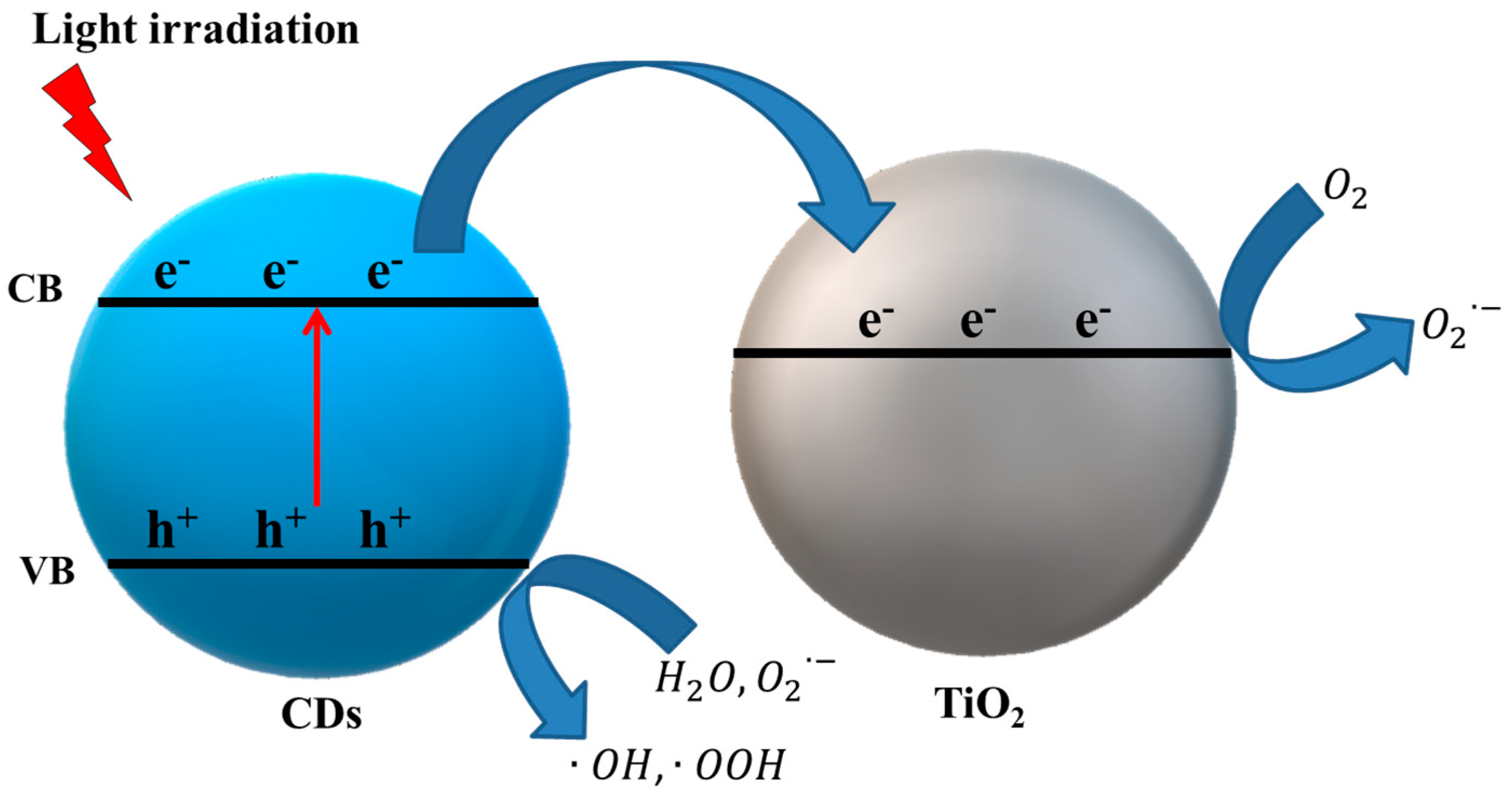
In parallel, the PL and ROS generation results indicate that the photo-induced behavior of the TiO2/CDs hybrid materials arises from interfacial charge transfer processes. While an overall increase in PL intensity is observed for the hybrid systems compared to bare TiO2, changes in the emission features compared to pristine CDs (Figure S13) are consistent with the occurrence of interfacial electronic interactions that may favor non-radiative pathways and ROS generation. Additionally, this efficient interfacial charge transfer separation hinders the recombination of electron-hole pairs and prolongs charge carrier lifetimes. This physicochemical behavior facilitates their participation in reactions, generating ROS and thereby promotes enhanced photodynamic activity. A schematic illustration summarizing the proposed charge transfer and ROS generation mechanism is presented in Figure 14. Therefore, the enhanced ROS generation under red-light irradiation can be attributed to the synergistic contribution of upconversion photoluminescence and charge transfer processes in theTiO2/CDs hybrid materials.

3.3. In Vitro Studies in Cancer Cells

3.3.1. Dark Cytotoxicity

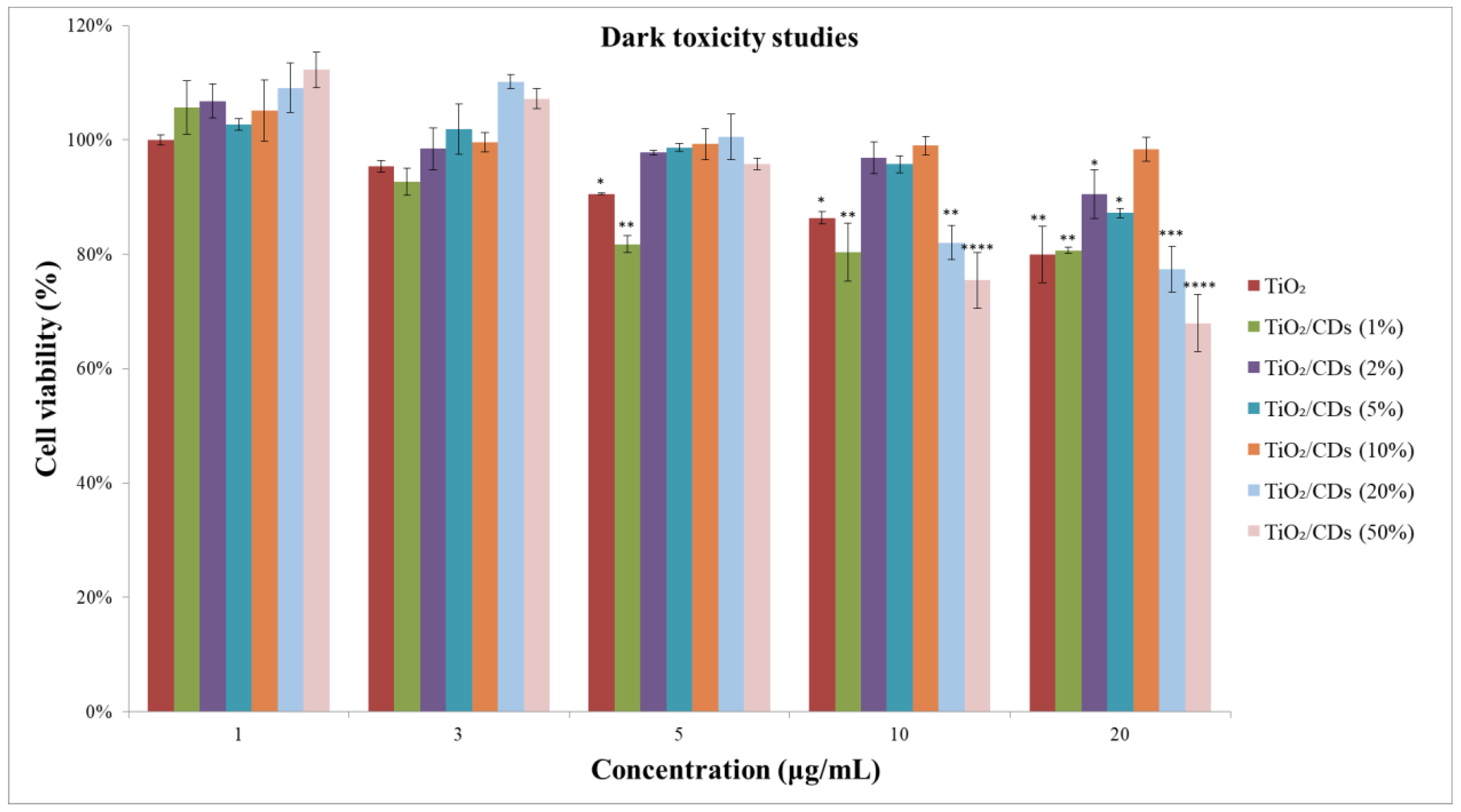
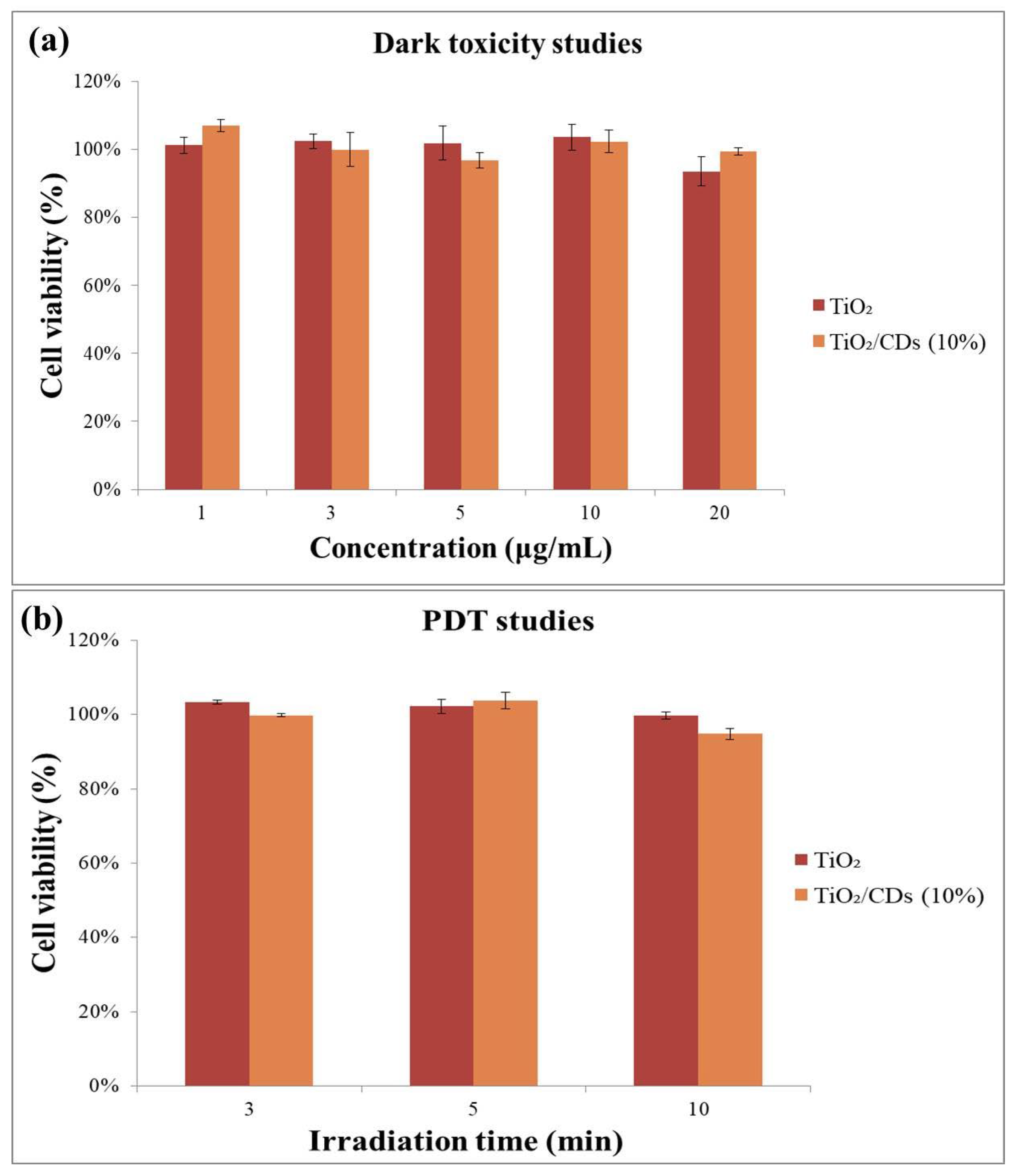
The photodynamic action of a PS should rely exclusively on light activation, so it is a critical step to verify its safety under dark conditions. Therefore, toxicity studies were conducted in A431 cancer cells for various concentrations of TiO2 and TiO2/CDs hybrid materials upon 24 h incubation without light to identify the maximum safe accepted concentration for each sample, using the MTT assay to monitor metabolic activity. The results of the dark toxicity studies are presented in Figure 15.
As shown in Figure 15, all the examined nanomaterials exhibited a dose-dependent reduction in metabolic activity, except for TiO2/CDs (10%). This nanohybrid material maintains 100% cell viability even at its highest tested concentration of 20 μg/mL, indicating that a CD’s content of 10% represents the optimum loading amount in terms of cytocompatibility. The addition of CDs to TiO2 in percentages equal to or higher than 2% leads to an increase in the accepted concentration for PDT, compared to pure TiO2. For instance, both TiO2 and TiO2/CDs (1%) can be further used as PDT agents in a concentration of 3 μg/mL. At higher concentrations (5 μg/mL), cell survival reaches 91% and 82% for TiO2 and TiO2/CDs (1%), respectively, values that differ statistically significantly from the control samples. Both TiO2 and TiO2/CDs (1%) lead to a cell viability of 80% at the highest examined concentration of 20 μg/mL. However, cell tolerance increases for TiO2/CDs (2%) and TiO2/CDs (5%), since they can be applied for PDT at a 10 μg/mL concentration with 97% cell viability. Furthermore, CDs’ loading at 20% and 50% can be used up to 5 μg/mL with safety. At higher concentrations (10 μg/mL) of TiO2/CDs (20%) and TiO2/CDs (50%), cell viability drops to 82% and 75%, respectively.

3.3.2. Light Cytotoxicity

Light-induced cytotoxicity was also assessed to determine irradiation conditions that are harmless to the cells. For this purpose, cells were exposed to 661 nm laser light at an irradiance of 18 mW/cm2 for various illumination times (3, 5, and 10 min). No significant reduction in metabolic activity was observed under any of these conditions, confirming that the selected energy doses are safe and can therefore be applied in the subsequent PDT experiments.

3.3.3. Photodynamic Therapy (PDT) Efficiency

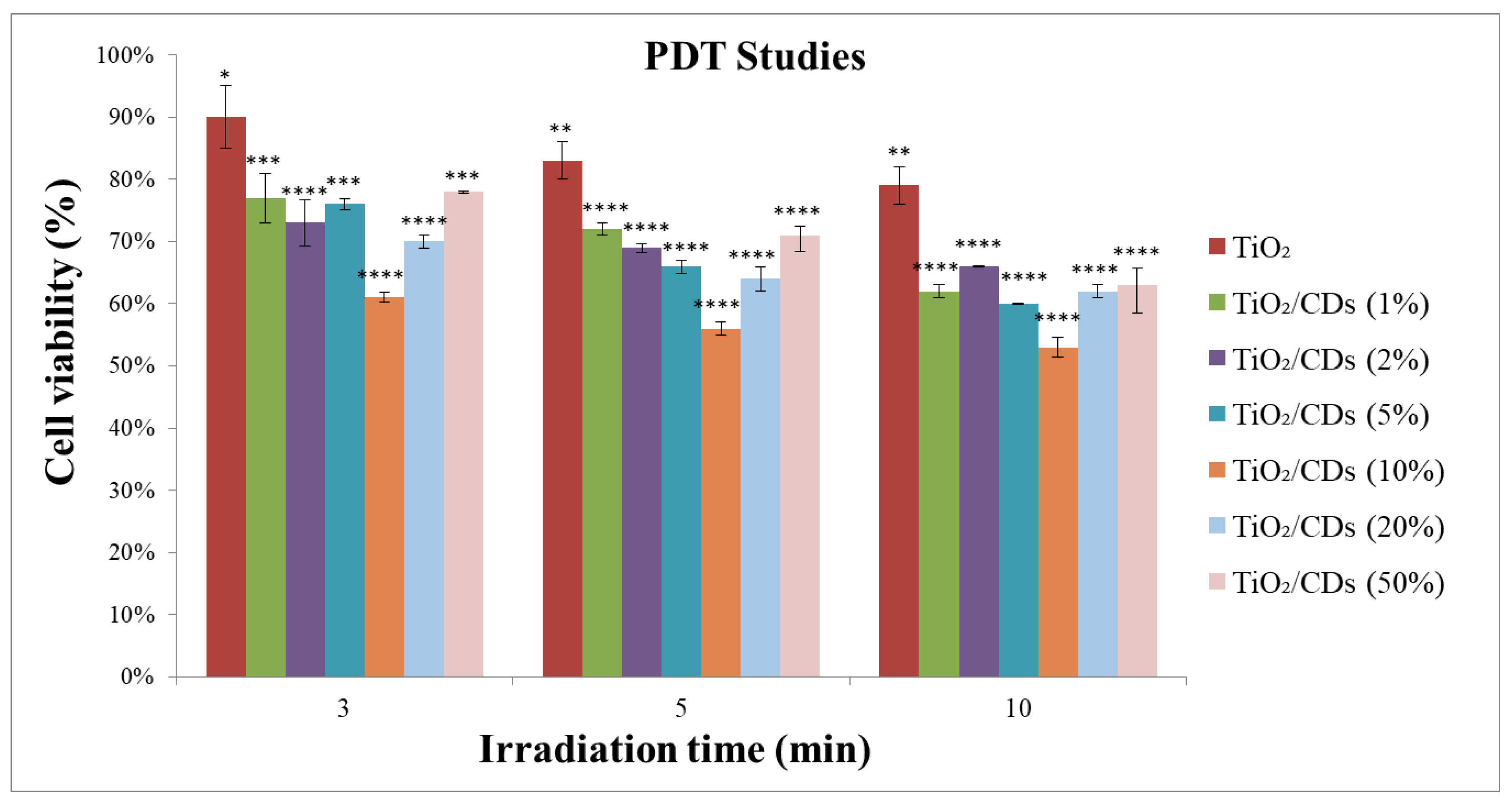
Taking into account the results of both dark and light toxicity studies, TiO2 and its hybrid materials with CDs were evaluated as potential PSs against A431 cancer cells at the selected concentrations upon 4 h incubation and subsequent irradiation at red-light laser irradiation (661 nm, 18 mW/cm2) for 3, 5, and 10 min. Results are shown in Figure 16.
The addition of CDs to TiO2 leads to a variation in photodynamic response in comparison with pure TiO2. Hybrid materials with CDs’ percentages ranging from 1 to 5% showed greater reduction in metabolic activity compared with the correspondent of TiO2 even from the 3rd minute of irradiation. This behavior implies that a relatively small amount of CDs could act synergistically with TiO2 in the light-induced toxicity by facilitating charge carriers’ separation or improving energy transfer to TiO2. This improved charge separation can suppress recombination losses and enhance ROS generation, which is directly related to increased light-induced cytotoxicity in cancer cells. In particular, a cell toxicity of 40% is recorded for TiO2/CDs (5%) towards 20% for pure TiO2 for 10 min of light irradiation. The phototoxicity of TiO2/CDs (10%) is noteworthy, since it presented the lowest cell viability at each irradiation time point among all the materials tested. The CDs’ loading of 10% to the hybrid material seems to lead to the optimum combination of light absorbance and energy transfer, further improving ROS generation and rendering TiO2/CDs (10%) the most efficient PS of the presented materials. This finding aligns with the ROS generation studies, in which the increased ability of this material was highlighted. Moreover, the strong correlation observed between ROS production and PDT-induced cytotoxicity further supports that the measured oxidative activity directly reflects the photodynamic mechanism of the hybrid materials. Additionally, the improved phototoxicity of TiO2/CDs (10%) can be rationalized in light of its favorable surface charge and colloidal stability, as revealed by zeta potential measurements, which likely contributes to its enhanced cellular uptake and optimal photodynamic performance, minimizing aggregation-related artifacts.
However, further increase in CDs’ content to 20% and 50% caused a reduction in phototoxicity. TiO2/CDs (20%) and TiO2/CDs (50%) showed cell toxicity of 27% and 37%, respectively, compared to a cell toxicity of 47% for TiO2/CDs (10%) upon 10 min irradiation. This decrease in PDT efficiency is attributed to physicochemical limitations such as light scattering, inner filter effects, and surface site blocking, which reduce effective photoactivation and ROS formation at higher CD concentrations. The findings indicate that the addition of CDs is an efficient approach towards the functionalization of TiO2, resulting in a strong photodynamic response, even in small amounts of CDs and upon relative mild irradiation in red light. Future studies will focus on evaluating the long-term photostability and performance of TiO2/CDs hybrid materials under repeated irradiation cycles, as well as potential material degradation, to further support their practical applicability in potential clinical PDT applications.
Considering ROS production studies in solution and PDT studies, there is consistent evidence that the addition of CDs to hybrid materials with TiO2 favors the generation of ROS and photodynamic action. However, a constant increase in CDs’ concentration does not imply a rise in ROS production in solution or in the cellular environment. In fact, an enhanced photodynamic response up to a certain level of CDs’ loading has been observed, and a reduction in efficiency is recorded in higher concentrations. This performance is associated with the shield effect of CDs, which describes a series of optical and physicochemical limitations. In particular, CDs accumulate on the surface of TiO2 and block its active centers in increased concentrations, resulting in inhibition of photo-induced ROS generation. Furthermore, increased CDs’ content leads to elevated light scattering and effectively reduces the light intensity absorbed by TiO2. Another possible explanation is the inner filter effect, in which competitive light absorption occurs between CDs and TiO2. Specifically, CDs absorb a large portion of photons, reducing the available excitation energy for the photosensitizer and consequently limiting its ability to form ROS [66,67]. To our knowledge, this is the first study to observe these phenomena in CDs–semiconductor hybrid materials during ROS production and PDT. In the literature, the role of CDs’ shield effect has been mentioned in hybrid systems with TiO2 [68] and other semiconductors, such as graphitic carbon nitride (g-C3N4) [69] and bismuth oxychloride (BiOCl) [70] in photocatalysis studies for water remediation, by degrading Cr(VI) [68] or dyes like methyl orange [61], rhodamine B [71], as well as drugs, including Naproxen [72], Indomethacin [73] and Diclofenac [69,74].
Comparable studies on N-doped carbon nanodots (N-CNDs) hybridized with P25 TiO2 via a drying-vacuum step at 90 °C have demonstrated similar mechanistic trends under NIR irradiation (740 nm). In particular, Madrid et al. [19] reported that Ν-CNDs were able to sensitize TiO2 towards ROS generation beyond the UV range. The upconversion properties of N-CNDs, together with the creation of additional electronic states below the conduction band of TiO2, were suggested to facilitate photon harvesting and electron transfer, enhancing the photodynamic response. The biological evaluation of the hybrid materials in glioblastoma cells (U251-MG) showed significant ROS-induced cytotoxicity under NIR activation compared to the negligible effect of bare P25. In particular, N-CND@P25 NPs induced phototoxicity up to 50% at 96 h after NIR irradiation of 30 min, since 10 min irradiation did not result in a PDT effect. These observations align with our results for TiO2/CDs (10%) under 661 nm irradiation, supporting the notion that optimal hybridization enables efficient ROS formation and enhanced PDT activity through a combination of upconversion and interfacial charge transfer. This comparison provides a literature benchmark for our biological findings, highlighting that the performance of the proposed hybrid materials is consistent with previously reported CDs-sensitized TiO2 systems.

3.3.4. Intracellular Localization

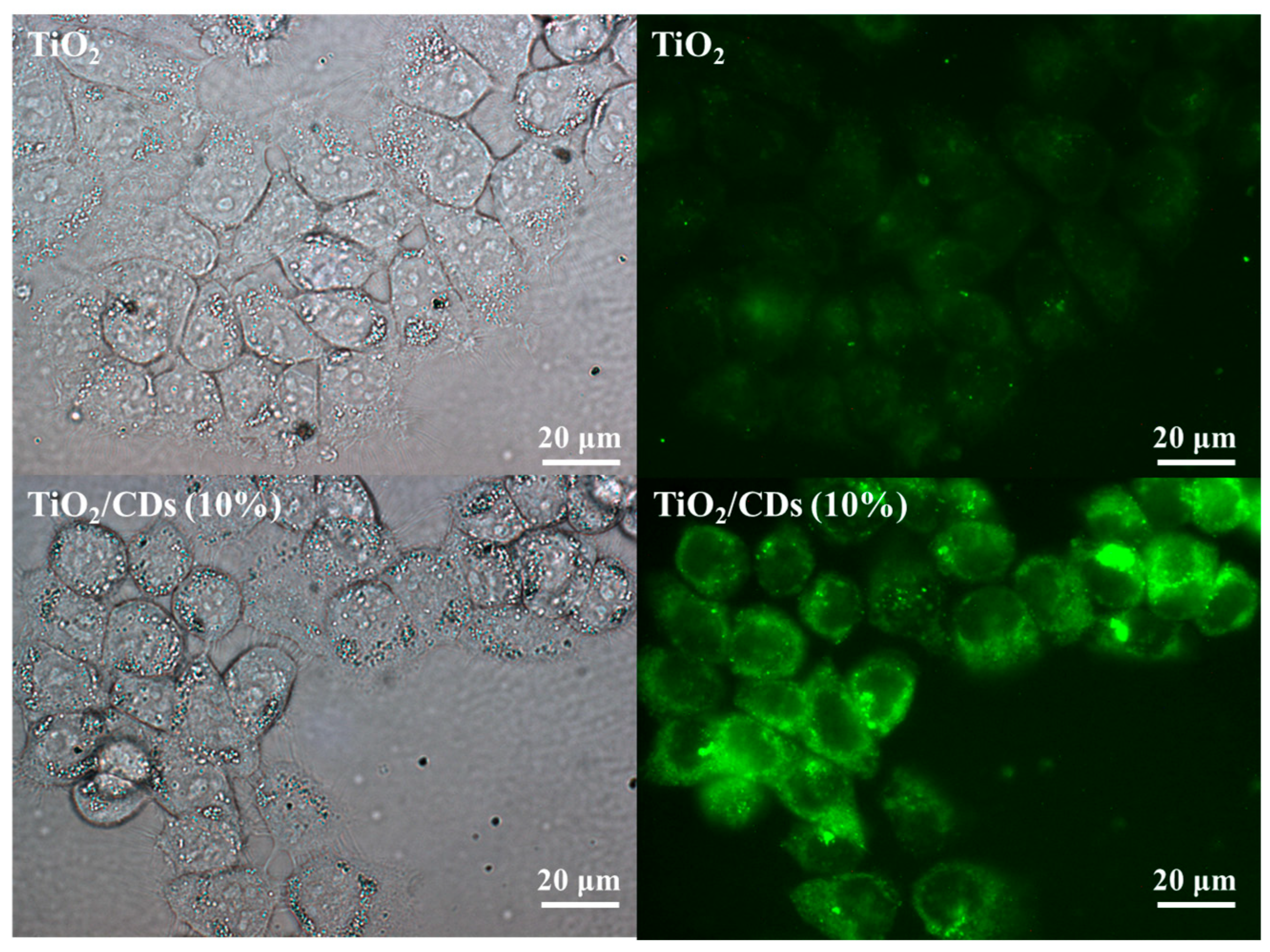
Photodynamic action is a combined outcome of the ability of the PS to efficiently enter and localize within cells, as well as its capacity to generate ROS upon light activation. The intracellular localization experiments were conducted to clarify the mechanistic origin of the enhanced PDT efficacy observed for the TiO2/CDs hybrid material compared to TiO2. In particular, these experiments were designed to evaluate whether the improved PDT activity could be attributed to increased cellular uptake and intracellular availability of the drug.
Fluorescence microscopy was employed to investigate the intracellular localization of TiO2 and TiO2/CDs (10%) hybrid material qualitatively in the absence of light irradiation. Figure 17 depicts representative images of the A431 cancer cells incubated with the PS at 3 μg/mL for 4 h. Cell structure remained intact after incubation, whereas nuclear localization was not observed. Additionally, cells incubated with TiO2/CDs (10%) exhibited stronger fluorescence compared with the correspondent of TiO2.
Although our results are qualitative, they suggest that TiO2/CDs (10%) hybrid material significantly enhances intracellular accumulation compared to the free TiO2, thereby increasing its bioavailability at the cellular level. This higher intracellular concentration combined with the increased ROS production ability leads to more efficient photoactivation during irradiation and, consequently, to enhanced ROS generation and photodynamic efficacy.
Therefore, the intracellular localization studies provide preliminary insight by directly linking TiO2/CDs (10%) hybrid material delivery to both increased cellular uptake and improved PDT performance.

3.4. In Vitro Studies in Healthy Cells

Furthermore, 3T3 healthy fibroblasts were employed to investigate the potential cytotoxicity of both TiO2 and TiO2/CDs (10%) under dark and light conditions. Initially, 3T3 cells were incubated for 24 h with varying concentrations (1, 3, 5, 10 and 20 μg/mL) of TiO2 and TiO2/CDs (10%) in the absence of light, with the results presented in Figure 18a. Both PSs showed no statistically significant growth inhibitory effect on fibroblast viability. Based on these results, 3T3 cells were incubated with TiO2 and TiO2/CDs (10%) for 4 h at the concentration used in the PDT experiments on A431 cells, followed by laser irradiation at 661 nm (18 mW/cm2) for 3, 5, and 10 min. The resulting data are presented in Figure 18b. No reduction in fibroblast metabolic activity was recorded even after 10 min of light irradiation, regardless of whether the cells were treated with TiO2 or TiO2/CDs (10%). Both PSs did not exhibit photodynamic cytotoxicity to healthy cells, while demonstrating significant phototoxic efficacy against cancer cells. Although these findings suggest a degree of selectivity toward cancer cells, the present biological evaluation cannot be generalized to other cancer types and future investigations involving multiple cancer and noncancerous cell lines will be required to assess the selectivity and broader biological applicability of the TiO2/CDs system. While 3T3 fibroblasts are murine cells and do not fully replicate human noncancerous cells, they provide relevant information on cytotoxicity, and future studies in human healthy cell lines could further validate these findings. Nevertheless, the lack of detectable toxicity in fibroblasts provides initial evidence of cytocompatibility and supports the proof-of-concept potential of the TiO2/CDs system for PDT applications.

4. Conclusions

In this study, TiO2 and TiO2/CDs hybrid nanomaterials with varying CDs’ loadings were successfully synthesized to evaluate the influence of CDs on structural, chemical and photophysical properties, as well as on the photodynamic performance of TiO2. Nanomaterials were characterized using several techniques, including XRD, Raman, TEM, FT-IR, and TG, demonstrating that CDs were effectively incorporated into TiO2. CDs improved aqueous dispersibility and reduced aggregation of TiO2. The addition of CDs modulated the optical characteristics of TiO2 by enhancing its absorption and photoluminescence features. ROS generation studies revealed that all hybrid materials outperformed pristine TiO2 with the 10% of CDs loading exhibiting the highest ROS production. PDT studies on A431 skin cancer cells further validated the beneficial role of CDs, showing that TiO2/CDs (10%) achieved 47% cell toxicity upon 10 min red-light irradiation (18 mW/cm2), compared to 20% for TiO2. In accordance with ROS generation studies, the improvement of photodynamic response increased with CDs content up to the optimal 10%, whereas higher loading amounts led to decreased photodynamic activity. This behavior is attributed to an increase in TiO2’s surface coverage and the shield effect of CDs, which restrict TiO2’s light absorption and block its active sites. Based on intracellular localization studies in A431 cancer cells, TiO2/CDs (10%) entered cells more efficiently than TiO2. Furthermore, in vitro studies in 3T3 healthy fibroblasts demonstrated the absence of dark and PDT toxicity, reinforcing the potential suitability of TiO2 and TiO2/CDs (10%) for PDT. Collectively, the findings of this work underscore the beneficial role of CDs in regulating photophysical features and photodynamic activity of TiO2 and provide meaningful insights for the engineering of advanced carbon-based nanomaterials as PSs. The facile and scalable synthesis of TiO2, CDs and TiO2/CD hybrid materials supports their future development beyond laboratory-scale studies. The biological findings should be considered as a proof-of-concept in vitro demonstration of the photodynamic potential of TiO2/CD hybrids and further investigation is necessary to address critical challenges related to clinical translation, including in vivo biodistribution, long-term biocompatibility, and photodynamic efficacy in complex tissue environments. Furthermore, clinical PDT applications involve the treatment of deeply seated tumors, making a careful consideration of nanomaterial accumulation in these regions as well as light penetration necessary. Overall, this study provides a rational design strategy for CDs-based PSs with optimized photophysical and photodynamic performance.

Supplementary Materials

The following supporting information can be downloaded at: https://www.mdpi.com/article/10.3390/pr14071048/s1, Figure S1: EDS elemental maps for TiO2; Figure S2: (a–c) HR-TEM analysis of TiO2/CDs (1%), (d) Particle size distribution of TiO2/CDs (1%); Figure S3: (a–c) HR-TEM analysis of TiO2/CDs (2%), (d) Particle size distribution of TiO2/CDs (2%); Figure S4: (a–c) HR-TEM analysis of TiO2/CDs (5%), (d) Particle size distribution of TiO2/CDs (5%); Figure S5: (a–c) HR-TEM analysis of TiO2/CDs (10%), (d) Particle size distribution of TiO2/CDs (10%); Figure S6: (a–c) HR-TEM analysis of TiO2/CDs (20%), (d) Particle size distribution of TiO2/CDs (20%); Figure S7: EDS elemental maps for TiO2/CDs (1%); Figure S8: EDS elemental maps for TiO2/CDs (50%); Figure S9: FT-IR spectra of TiO2/CDs hybrid materials with 2%, 5%, 10% and 20% CDs’ content; Figure S10: FT-IR spectrum of CDs; Figure S11: Zeta potential measurements for (a) TiO2, (b) TiO2/CDs (1%), (c) TiO2/CDs (2%), (d) TiO2/CDs (5%), (e) TiO2/CDs (10%), (f) TiO2/CDs (20%), (g) TiO2/CDs (50%); Figure S12: UV-Vis spectrum of CDs; Figure S13: PL spectrum of CDs; Figure S14: Upconversion photoluminescence spectrum of CDs upon excitation at 660 nm.

Author Contributions

Conceptualization, A.K., E.A. and K.V.K.; Methodology, A.K., A.Z., A.N. and C.Q.; Validation, A.K.; Formal Analysis, A.K.; Resources, M.T., E.A. and K.V.K.; Data Curation, A.K.; Writing—Original Draft Preparation, A.K.; Writing—Review and Editing, C.A., E.A. and K.V.K.; Visualization, A.K.; Supervision, E.A. and K.V.K.; Project Administration, E.A. and K.V.K. All authors have read and agreed to the published version of the manuscript.

Funding

Alexandra Karagianni acknowledges funding from the Special Account for Research Funding (E.L.K.E.) of the National Technical University of Athens (N.T.U.A.) of Greece.

Data Availability Statement

The original contributions presented in this study are included in the article. Further inquiries can be directed to the corresponding author.

Conflicts of Interest

The authors declare no conflicts of interest.

References

  1. Niculescu, A.-G.; Grumezescu, A.M. Photodynamic Therapy—An Up-to-Date Review. Appl. Sci. 2021, 11, 3626. [Google Scholar] [CrossRef]
  2. Karagianni, A.; Alexandratou, E.; Terrones, M.; Kordatos, K.V. Carbon-based nanomaterials in photodynamic therapy of cancer. Carbon 2025, 238, 119986. [Google Scholar] [CrossRef]
  3. Karagianni, A.; Tsierkezos, N.G.; Prato, M.; Terrones, M.; Kordatos, K.V. Application of carbon-based quantum dots in photodynamic therapy. Carbon 2023, 203, 273–310. [Google Scholar] [CrossRef]
  4. Chen, J.; Fan, T.; Xie, Z.; Zeng, Q.; Xue, P.; Zheng, T.; Chen, Y.; Luo, X.; Zhang, H. Advances in nanomaterials for photodynamic therapy applications: Status and challenges. Biomaterials 2020, 237, 119827. [Google Scholar] [CrossRef] [PubMed]
  5. Aebisher, D.; Rogóż, K.; Myśliwiec, A.; Dynarowicz, K.; Wiench, R.; Cieślar, G.; Kawczyk-Krupka, A.; Bartusik-Aebisher, D. The use of photodynamic therapy in medical practice. Front. Oncol. 2024, 14, 1373263. [Google Scholar] [CrossRef] [PubMed]
  6. Correia, J.H.; Rodrigues, J.A.; Pimenta, S.; Dong, T.; Yang, Z. Photodynamic Therapy Review: Principles, Photosensitizers, Applications, and Future Directions. Pharmaceutics 2021, 13, 1332. [Google Scholar] [CrossRef] [PubMed]
  7. Anucha, C.B.; Altin, I.; Bacaksiz, E.; Stathopoulos, V.N. Titanium dioxide (TiO2)-based photocatalyst materials activity enhancement for contaminants of emerging concern (CECs) degradation: In the light of modification strategies. Chem. Eng. J. Adv. 2022, 10, 100262. [Google Scholar] [CrossRef]
  8. Mojgan, R.; Ehsan, S.; Mostafa, Z. High photoluminescence and afterglow emission of nitrogen-doped graphene quantum dots/TiO2 nanocomposite for use as a photodynamic therapy photosensitizer. Appl. Phys. A 2024, 130, 144. [Google Scholar] [CrossRef]
  9. Pelaez, M.; Nolan, N.T.; Pillai, S.C.; Seery, M.K.; Falaras, P.; Kontos, A.G.; Dunlop, P.S.M.; Hamilton, J.W.J.; Byrne, J.A.; O’Shea, K.; et al. A review on the visible light active titanium dioxide photocatalysts for environmental applications. Appl. Catal. B Environ. 2012, 125, 331–349. [Google Scholar] [CrossRef]
  10. Kang, X.; Liu, S.; Dai, Z.; He, Y.; Song, X.; Tan, Z. Titanium Dioxide: From Engineering to Applications. Catalysts 2019, 9, 191. [Google Scholar] [CrossRef]
  11. Sargazi, S.; Simge, E.; Gelen, S.S.; Rahdar, A.; Bilal, M.; Arshad, R.; Ajalli, N.; Khan, M.F.A.; Pandey, S. Application of titanium dioxide nanoparticles in photothermal and photodynamic therapy of cancer: An updated and comprehensive review. J. Drug Deliv. Sci. Technol. 2022, 75, 103605. [Google Scholar] [CrossRef]
  12. Siwińska-Stefańska, K.; Jesionowski, T.; Siwińska-Stefańska, K.; Jesionowski, T. Advanced Hybrid Materials Based on Titanium Dioxide for Environmental and Electrochemical Applications. In Titanium Dioxide; IntechOpen: London, UK, 2017. [Google Scholar] [CrossRef]
  13. Khmiri, Y.; Attia, A.; Jallouli, N.; Chabanon, E.; Charcosset, C.; Mahouche-Chergui, S.; Dammak, L.; Algieri, C.; Chakraborty, S.; Ben Amar, R. Synthesis of a cost-effective ZnO/zeolite photocatalyst for paracetamol removal. Emergent Mater. 2025, 8, 7715–7731. [Google Scholar] [CrossRef]
  14. Attia, A.; Elboughdiri, N.; Ghernaout, D.; Carbonnier, B.; Amar, R.B.; Mahouche-Chergui, S. Enhancing the generation and stabilization of ZnO nanoparticles on modified clay with polyethylenimine to improve the photodegradation of dyes in textile wastewater. J. Water Process Eng. 2025, 73, 107711. [Google Scholar] [CrossRef]
  15. Reddy, K.R.; Hassan, M.; Gomes, V.G. Hybrid nanostructures based on titanium dioxide for enhanced photocatalysis. Appl. Catal. A General. 2015, 489, 1–16. [Google Scholar] [CrossRef]
  16. Falara, P.P.; Zourou, A.; Kordatos, K.V. Recent advances in Carbon Dots/2-D hybrid materials. Carbon 2022, 195, 219–245. [Google Scholar] [CrossRef]
  17. Sargin, I.; Yanalak, G.; Arslan, G.; Patir, I.H. Green synthesized carbon quantum dots as TiO2 sensitizers for photocatalytic hydrogen evolution. Int. J. Hydrogen Energy 2019, 44, 21781–21789. [Google Scholar] [CrossRef]
  18. Yan, Y.; Kuang, W.; Shi, L.; Ye, X.; Yang, Y.; Xie, X.; Shi, Q.; Tan, S. Carbon quantum dot-decorated TiO2 for fast and sustainable antibacterial properties under visible-light. J. Alloys Compd. 2019, 777, 234–243. [Google Scholar] [CrossRef]
  19. Madrid, A.; Martín-Pardillos, A.; Bonet-Aleta, J.; Sancho-Albero, M.; Martinez, G.; Calzada-Funes, J.; Martin-Duque, P.; Santamaria, J.; Hueso, J.L. Nitrogen-doped carbon nanodots deposited on titania nanoparticles: Unconventional near-infrared active photocatalysts for cancer therapy. Catal. Today 2023, 419, 114154. [Google Scholar] [CrossRef]
  20. Ramachandran, P.; Lee, C.Y.; Doong, R.-A.; Oon, C.E.; Thanh, N.T.K.; Lee, H.L. A titanium dioxide/nitrogen-doped graphene quantum dot nanocomposite to mitigate cytotoxicity: Synthesis, characterisation, and cell viability evaluation. RSC Adv. 2020, 10, 21795–21805. [Google Scholar] [CrossRef]
  21. Ramachandran, P.; Khor, B.-K.; Lee, C.Y.; Doong, R.-A.; Oon, C.E.; Thanh, N.T.K.; Lee, H.L. N-Doped Graphene Quantum Dots/Titanium Dioxide Nanocomposites: A Study of ROS-Forming Mechanisms, Cytotoxicity and Photodynamic Therapy. Biomedicines 2022, 10, 421. [Google Scholar] [CrossRef] [PubMed]
  22. Jabbar, M.S.; Mahmood, O.A.; Jameel, Z.N.; Jamal, N.J. Synthesis and Characterization of TiO2-CQDs Nanocomposites and Testing of Their Anticancer Potential. Int. J. Nanoelectron. Mater. (IJNeaM) 2024, 17, 627–633. [Google Scholar] [CrossRef]
  23. Liu, J.; Chen, K.-Y.; Wang, J.; Du, M.; Gao, Z.-Y.; Song, C.-X. Preparation and Photocatalytic Properties of N-Doped Graphene/TiO2 Composites. J. Chem. 2020, 2020, 2928189. [Google Scholar] [CrossRef]
  24. Shen, K.; Xue, X.; Wang, X.; Hu, X.; Tian, H.; Zheng, W. One-step synthesis of band-tunable N, S co-doped commercial TiO2/graphene quantum dots composites with enhanced photocatalytic activity. RSC Adv. 2017, 7, 23319–23327. [Google Scholar] [CrossRef]
  25. Mi, Y.; Wang, N.; Fang, X.; Cao, J.; Tao, M.; Cao, Z. Interfacial polymerization nanofiltration membrane with visible light photocatalytic self-cleaning performance by incorporation of CQD/TiO2. Sep. Purif. Technol. 2021, 277, 119500. [Google Scholar] [CrossRef]
  26. Mintz, K.J.; Bartoli, M.; Rovere, M.; Zhou, Y.; Hettiarachchi, S.D.; Paudyal, S.; Chen, J.; Domena, J.B.; Liyanage, P.Y.; Sampson, R.; et al. A deep investigation into the structure of carbon dots. Carbon 2021, 173, 433–447. [Google Scholar] [CrossRef]
  27. Shafique, M.; Mahr, M.S.; Yaseen, M.; Bhatti, H.N. CQD/TiO2 nanocomposite photocatalyst for efficient visible light-driven purification of wastewater containing methyl orange dye. Mater. Chem. Phys. 2022, 278, 125583. [Google Scholar] [CrossRef]
  28. Gao, Y.; Pu, X.; Zhang, D.; Ding, G.; Shao, X.; Ma, J. Combustion synthesis of graphene oxide–TiO2 hybrid materials for photodegradation of methyl orange. Carbon 2012, 50, 4093–4101. [Google Scholar] [CrossRef]
  29. Zhang, Q.; Bao, N.; Wang, X.; Hu, X.; Miao, X.; Chaker, M.; Ma, D. Advanced Fabrication of Chemically Bonded Graphene/TiO2 Continuous Fibers with Enhanced Broadband Photocatalytic Properties and Involved Mechanisms Exploration. Sci. Rep. 2016, 6, 38066. [Google Scholar] [CrossRef]
  30. Falara, P.P.; Ibrahim, I.; Zourou, A.; Sygellou, L.; Sanchez, D.E.; Romanos, G.E.; Givalou, L.; Antoniadou, M.; Arfanis, M.K.; Han, C.; et al. Bi-functional photocatalytic heterostructures combining titania thin films with carbon quantum dots (C-QDs/TiO2) for effective elimination of water pollutants. Environ. Sci. Pollut. Res. 2023, 30, 124976–124991. [Google Scholar] [CrossRef]
  31. Wang, J.; Zhu, W.; Zhang, Y.; Liu, S. An Efficient Two-Step Technique for Nitrogen-Doped Titanium Dioxide Synthesizing:  Visible-Light-Induced Photodecomposition of Methylene Blue. J. Phys. Chem. C 2007, 111, 1010–1014. [Google Scholar] [CrossRef]
  32. Raseel Rahman, M.K.; Riscob, B.; Bhatt, R.; Bhaumik, I.; Ganesamoorthy, S.; Vijayan, N.; Bhagavannarayana, G.; Kumar Kumal, A.; Nair, L. Investigations on Crystalline Perfection, Raman Spectra and Optical Characteristics of Transition Metal (Ru) Co-Doped Mg:LiNbO3 Single Crystals. ACS Omega 2021, 6, 10807–10815. [Google Scholar] [CrossRef]
  33. Inoue, F.; Ando, R.A.; Corio, P. Raman evidence of the interaction between multiwalled carbon nanotubes and nanostructured TiO2. J. Raman Spectrosc. 2011, 42, 1379–1383. [Google Scholar] [CrossRef]
  34. Chanda, A.; Rout, K.; Vasundhara, M.; Joshi, S.R.; Singh, J. Structural and magnetic study of undoped and cobalt doped TiO2 nanoparticles. RSC Adv. 2018, 8, 10939–10947. [Google Scholar] [CrossRef]
  35. Choudhury, B.; Choudhury, A. Local structure modification and phase transformation of TiO2 nanoparticles initiated by oxygen defects, grain size, and annealing temperature. Int. Nano Lett. 2013, 3, 55. [Google Scholar] [CrossRef]
  36. Hirata, T.; Kitajima, M.; Nakamura, K.G.; Asari, E. Infrared and Raman spectra of solid solutions Ti1−xZrxO2 (x ≤ 0.1). J. Phys. Chem. Solids 1994, 55, 349–355. [Google Scholar] [CrossRef]
  37. Bersani, D.; Lottici, P.P.; Ding, X.-Z. Phonon confinement effects in the Raman scattering by TiO2 nanocrystals. Appl. Phys. Lett. 1998, 72, 73–75. [Google Scholar] [CrossRef]
  38. Stepanidenko, E.A.; Skurlov, I.D.; Khavlyuk, P.D.; Onishchuk, D.A.; Koroleva, A.V.; Zhizhin, E.V.; Arefina, I.A.; Kurdyukov, D.A.; Eurov, D.A.; Golubev, V.G.; et al. Carbon Dots with an Emission in the Near Infrared Produced from Organic Dyes in Porous Silica Microsphere Templates. Nanomaterials 2022, 12, 543. [Google Scholar] [CrossRef] [PubMed]
  39. Ferrari, A.C.; Robertson, J. Resonant Raman spectroscopy of disordered, amorphous, and diamondlike carbon. Phys. Rev. B 2001, 64, 075414. [Google Scholar] [CrossRef]
  40. Ji, C.; Han, Q.; Zhou, Y.; Wu, J.; Shi, W.; Gao, L.; Leblanc, R.M.; Peng, Z. Phenylenediamine-derived near infrared carbon dots: The kilogram-scale preparation, formation process, photoluminescence tuning mechanism and application as red phosphors. Carbon 2022, 192, 198–208. [Google Scholar] [CrossRef]
  41. Luo, Y.; Cui, C.; Zhang, X.; Jiang, Y.; Xiang, Z.; Ji, C.; Peng, Z. Carbon Dots-Based Fluorescence Assay for the Facile and Reliable Detection of Ag+ in Natural Water and Serum Samples. Molecules 2023, 28, 1566. [Google Scholar] [CrossRef] [PubMed]
  42. Sadezky, A.; Muckenhuber, H.; Grothe, H.; Niessner, R.; Pöschl, U. Raman microspectroscopy of soot and related carbonaceous materials: Spectral analysis and structural information. Carbon 2005, 43, 1731–1742. [Google Scholar] [CrossRef]
  43. Fawaz, W.; Hasian, J.; Alghoraibi, I. Synthesis and physicochemical characterization of carbon quantum dots produced from folic acid. Sci. Rep. 2023, 13, 18641. [Google Scholar] [CrossRef]
  44. Prasannan, A.; Imae, T. One-Pot Synthesis of Fluorescent Carbon Dots from Orange Waste Peels. Ind. Eng. Chem. Res. 2013, 52, 15673–15678. [Google Scholar] [CrossRef]
  45. Wang, X.; Zhao, W.; Lin, H.; Yao, C.; He, Y.; Ran, X.; Guo, L.; Li, T. Facet-dependent photocatalytic and photoelectric properties of CQDs/TiO2 composites under visible irradiation. J. Alloys Compd. 2022, 920, 165896. [Google Scholar] [CrossRef]
  46. Choi, D.; Ham, S.; Jang, D.-J. Visible-light photocatalytic reduction of Cr(VI) via carbon quantum dots-decorated TiO2 nanocomposites. J. Environ. Chem. Eng. 2018, 6, 1–8. [Google Scholar] [CrossRef]
  47. Saud, P.S.; Pant, B.; Alam, A.-M.; Ghouri, Z.K.; Park, M.; Kim, H.-Y. Carbon quantum dots anchored TiO2 nanofibers: Effective photocatalyst for waste water treatment. Ceram. Int. 2015, 41, 11953–11959. [Google Scholar] [CrossRef]
  48. Ren, P.; Fu, X.; Zhang, Y. Carbon Quantum Dots-TiO2 Nanocomposites with Enhanced Catalytic Activities for Selective Liquid Phase Oxidation of Alcohols. Catal. Lett. 2017, 147, 1679–1685. [Google Scholar] [CrossRef]
  49. Hazarika, D.; Karak, N. Unprecedented Influence of Carbon Dot@TiO2 Nanohybrid on Multifaceted Attributes of Waterborne Hyperbranched Polyester Nanocomposite. ACS Omega 2018, 3, 1757–1769. [Google Scholar] [CrossRef] [PubMed]
  50. Rajendran, K.; Ganesan, S.; Manikandan, V.; Sivaselvam, S.; AlSalhi, M.S.; Asemi, N.N.; Angayarkanni, J.; Rajendiran, N.; Lo, H.-M. Facile synthesis of carbon/titanium oxide quantum dots from lignocellulose-rich mandarin orange peel extract via microwave irradiation: Synthesis, characterization and bio-imaging application. Int. J. Biol. Macromol. 2023, 241, 124546. [Google Scholar] [CrossRef] [PubMed]
  51. Nia, M.H.; Rezaei-tavirani, M.; Nikoofar, A.R.; Masoumi, H.; Nasr, R.; Hasanzadeh, H.; Jadidi, M.; Shadnush, M. Stabilizing and dispersing methods of TiO2 nanoparticles in biological studies. Arch. Adv. Biosci. 2015, 6, 96–105. [Google Scholar] [CrossRef]
  52. Mahmood, A.; Shi, G.; Wang, Z.; Rao, Z.; Xiao, W.; Xie, X.; Sun, J. Carbon quantum dots-TiO2 nanocomposite as an efficient photocatalyst for the photodegradation of aromatic ring-containing mixed VOCs: An experimental and DFT studies of adsorption and electronic structure of the interface. J. Hazard. Mater. 2021, 401, 123402. [Google Scholar] [CrossRef]
  53. Vasconcelos, H.C.; Meirelles, M.; Özmenteş, R.; Korkut, A. Vacuum Ultraviolet Spectroscopic Analysis of Structural Phases in TiO2 Sol–Gel Thin Films. Coatings 2025, 15, 19. [Google Scholar] [CrossRef]
  54. Yu, H.; Zhao, Y.; Zhou, C.; Shang, L.; Peng, Y.; Cao, Y.; Wu, L.-Z.; Tung, C.-H.; Zhang, T. Carbon quantum dots/TiO2 composites for efficient photocatalytic hydrogen evolution. J. Mater. Chem. A 2014, 2, 3344–3351. [Google Scholar] [CrossRef]
  55. Song, F.; Sun, H.; Ma, H.; Gao, H. Porous TiO2/Carbon Dot Nanoflowers with Enhanced Surface Areas for Improving Photocatalytic Activity. Nanomaterials 2022, 12, 2536. [Google Scholar] [CrossRef] [PubMed]
  56. Usenko, E.; Glamazda, A.; Svidzerska, A.; Valeev, V.; Laguta, A.; Petrushenko, S.; Karachevtsev, V. DNA: TiO2 nanoparticle nanoassemblies: Effect of temperature and nanoparticle concentration on aggregation. J. Nanoparticle Res. 2023, 25, 113. [Google Scholar] [CrossRef]
  57. He, Z.; Que, W. Surface scattering and reflecting: The effect on light absorption or photocatalytic activity of TiO2 scattering microspheres. Phys. Chem. Chem. Phys. 2013, 15, 16768–16773. [Google Scholar] [CrossRef] [PubMed]
  58. Li, X.Z.; Li, F.B. Study of Au/Au3+-TiO2 Photocatalysts toward Visible Photooxidation for Water and Wastewater Treatment. Environ. Sci. Technol. 2001, 35, 2381–2387. [Google Scholar] [CrossRef]
  59. Sun, M.; Qu, S.; Ji, W.; Jing, P.; Li, D.; Qin, L.; Cao, J.; Zhang, H.; Zhao, J.; Shen, D. Towards efficient photoinduced charge separation in carbon nanodots and TiO2 composites in the visible region. Phys. Chem. Chem. Phys. 2015, 17, 7966–7971. [Google Scholar] [CrossRef]
  60. Falara, P.P.; Chatzikonstantinou, N.; Zourou, A.; Tsipas, P.; Sakellis, E.; Alexandratou, E.; Nasikas, N.K.; Kordatos, K.V.; Antoniadou, M. Optimizing Carbon Dot—TiO2 Nanohybrids for Enhanced Photocatalytic Hydrogen Evolution. Materials 2025, 18, 1023. [Google Scholar] [CrossRef]
  61. Deng, Y.; Chen, M.; Chen, G.; Zou, W.; Zhao, Y.; Zhang, H.; Zhao, Q. Visible–Ultraviolet Upconversion Carbon Quantum Dots for Enhancement of the Photocatalytic Activity of Titanium Dioxide. ACS Omega 2021, 6, 4247–4254. [Google Scholar] [CrossRef]
  62. Ke, J.; Li, X.; Zhao, Q.; Liu, B.; Liu, S.; Wang, S. Upconversion carbon quantum dots as visible light responsive component for efficient enhancement of photocatalytic performance. J. Colloid. Interface Sci. 2017, 496, 425–433. [Google Scholar] [CrossRef] [PubMed]
  63. Khojiev, S.; Hojiyeva, G.; Tursunkulov, O.; Chen, D.; Mohamed, H.S.H.; Kholikov, A.; Akbarov, K.; Liu, J.; Li, Y. Red Emissive Upconversion Carbon Quantum Dots Modifying TiO2 for Enhanced Photocatalytic Performance. ACS Appl. Nano Mater. 2023, 6, 14669–14679. [Google Scholar] [CrossRef]
  64. Zhang, X.; Huang, H.; Liu, J.; Liu, Y.; Kang, Z. Carbon quantum dots serving as spectral converters through broadband upconversion of near-infrared photons for photoelectrochemical hydrogen generation. J. Mater. Chem. A 2013, 1, 11529–11533. [Google Scholar] [CrossRef]
  65. Pan, J.; Sheng, Y.; Zhang, J.; Wei, J.; Huang, P.; Zhang, X.; Feng, B. Preparation of carbon quantum dots/TiO2 nanotubes composites and their visible light catalytic applications. J. Mater. Chem. A 2014, 2, 18082–18086. [Google Scholar] [CrossRef]
  66. Zourou, A.; Ntziouni, A.; Karagianni, A.; Alizadeh, N.; Argirusis, N.; Antoniadou, M.; Sourkouni, G.; Kordatos, K.V.; Argirusis, C. Recent Advances in Carbon Dots-Based Photocatalysts for Water Treatment Applications. Inorganics 2025, 13, 286. [Google Scholar] [CrossRef]
  67. Rasheed, T.; Anwar, M.T.; Ferry, D.B.; Ali, A.; Imran, M. Zero-dimensional luminescent carbon dots as fascinating analytical tools for the treatment of pharmaceutical based contaminants in aqueous media. Environ. Sci. Water Res. Technol. 2023, 10, 12–28. [Google Scholar] [CrossRef]
  68. Ma, R.; Xu, Z.; Zhang, C.; Li, H.; Chen, J.; Fan, J.; Shi, Q. Highly efficient reduction of Cr(VI) from industries sewage using novel biomass-driven carbon dots modified TiO2 under sunlight. Chem. Eng. J. 2024, 500, 157480. [Google Scholar] [CrossRef]
  69. Liu, W.; Li, Y.; Liu, F.; Jiang, W.; Zhang, D.; Liang, J. Visible-light-driven photocatalytic degradation of diclofenac by carbon quantum dots modified porous g-C3N4: Mechanisms, degradation pathway and DFT calculation. Water Res. 2019, 151, 8–19. [Google Scholar] [CrossRef]
  70. Li, J.; Li, X.; Li, X. Carbon quantum dots modified 3D flower-like BiOCl nanostructures with enhanced visible light photocatalytic degradation of rhodamine B. Discov. Mater. 2019, 5, 30. [Google Scholar] [CrossRef]
  71. Jourshabani, M.; Long, N.V.D.; Asrami, M.R.; Pho, Q.H.; Lee, B.-K.; Hessel, V. Nitrogen-doped carbon quantum dot as electron acceptor anchored on graphitic carbon nitride nanosheet for improving rhodamine B degradation. Mater. Sci. Eng. B 2024, 305, 117417. [Google Scholar] [CrossRef]
  72. Wang, F.; Wang, Y.; Feng, Y.; Zeng, Y.; Xie, Z.; Zhang, Q.; Su, Y.; Chen, P.; Liu, Y.; Yao, K.; et al. Novel ternary photocatalyst of single atom-dispersed silver and carbon quantum dots co-loaded with ultrathin g-C3N4 for broad spectrum photocatalytic degradation of naproxen. Appl. Catal. B Environ. 2018, 221, 510–520. [Google Scholar] [CrossRef]
  73. Wang, F.; Chen, P.; Feng, Y.; Xie, Z.; Liu, Y.; Su, Y.; Zhang, Q.; Wang, Y.; Yao, K.; Lv, W.; et al. Facile synthesis of N-doped carbon dots/g-C3N4 photocatalyst with enhanced visible-light photocatalytic activity for the degradation of indomethacin. Appl. Catal. B Environ. 2017, 207, 103–113. [Google Scholar] [CrossRef]
  74. Awang, H.; Peppel, T.; Strunk, J. Photocatalytic Degradation of Diclofenac by Nitrogen-Doped Carbon Quantum Dot-Graphitic Carbon Nitride (CNQD). Catalysts 2023, 13, 735. [Google Scholar] [CrossRef]
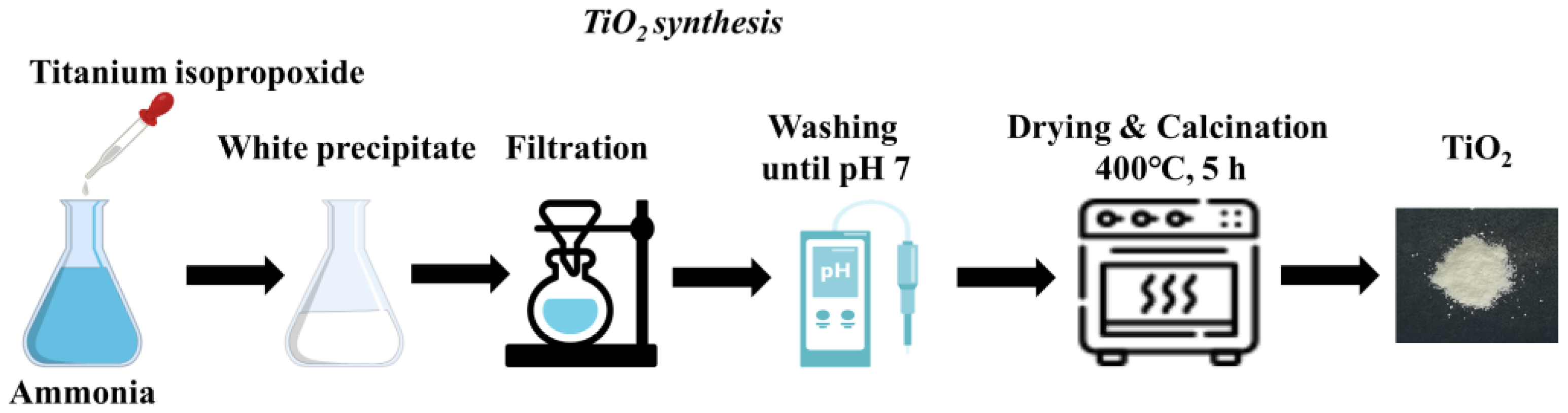
Figure 1. Schematic illustration of the synthesis of TiO2.
Processes 14 01048 g001
Figure 2. Schematic illustration of the synthesis of CDs and TiO2/CDs.
Processes 14 01048 g002
Figure 3. Images of TiO2 (a) and TiO2/CDs (50%) (b).
Processes 14 01048 g003
Figure 4. XRD spectra of TiO2 and TiO2/CDs. Patterns are normalized to the anatase (101) peak (~25° 2θ).
Processes 14 01048 g004
Figure 5. (a) Micro-Raman spectra of TiO2. (b) Micro-Raman spectra of TiO2/CDs with 1%, 2% and 5% loading amount of CDs. Inset contains expanded spectra in the range of 100–700 cm−1. (c) Micro-Raman spectra of TiO2/CDs with 10%, 20% and 50% loading amount of CDs. Inset contains expanded spectra in the range of 1000–1650 cm−1. (d) Expanded micro-Raman spectra of TiO2 and TiO2/CDs for the Eg mode at around 145 cm−1.
Processes 14 01048 g005
Figure 6. (ad) HR-TEM analysis of TiO2, (e) particle size distribution of TiO2.
Processes 14 01048 g006
Figure 7. (ad) HR-TEM analysis of TiO2/CDs (50%), (e) particle size distribution of TiO2/CDs (50%).
Processes 14 01048 g007
Figure 8. FT-IR spectra of TiO2 and TiO2/CDs hybrid materials with 1% and 50% CDs’ content.
Processes 14 01048 g008
Figure 9. TG curves of TiO2 and TiO2/CDs in air atmosphere.
Processes 14 01048 g009
Figure 10. UV-Vis spectra of TiO2 and TiO2/CDs hybrid materials.
Processes 14 01048 g010
Figure 11. PL spectra of TiO2 and TiO2/CDs hybrid materials.
Processes 14 01048 g011
Figure 12. Time course studies of normalized fluorescence intensity variation at 520 nm in relation with irradiation time for TiO2 and TiO2/CDs with various percentages in CDs at a concentration of 0.5 μg/mL.
Processes 14 01048 g012
Figure 13. Upconversion photoluminescence spectra of TiO2 and TiO2/CDs (10%) upon 660 nm excitation.
Processes 14 01048 g013
Figure 14. Schematic illustration of the photo-induced charge transfer and ROS generation mechanism in the TiO2/CDs hybrid materials.
Processes 14 01048 g014
Figure 15. Dark toxicity studies of TiO2 and TiO2/CDs hybrid materials at various concentrations (1, 3, 5, 10, 20 μg/mL) upon 24 h incubation in A431 cancer cells. Error bars present standard deviation. Statistically significant differences between treated groups with PSs and the non-treated control group are shown as follows: p < 0.05 (*), p < 0.01 (**), p < 0.001 (***), and p < 0.0001 (****).
Processes 14 01048 g015
Figure 16. PDT studies of TiO2 and TiO2/CDs upon 4 h incubation in A431 cancer cells, followed by red-light irradiation at 661 nm, 18 mW/cm2 for 3, 5 and 10 min. Error bars present standard deviation. Statistically significant differences between treated groups with PSs and the non-treated control group are shown as follows: p < 0.05 (*), p < 0.01 (**), p < 0.001 (***), and p < 0.0001 (****).
Processes 14 01048 g016
Figure 17. Intracellular localization studies in A431 cells after 4 h incubation under dark conditions with TiO2 and TiO2/CDs (10%) at the concentration of 3 μg/mL. Brightfield images (left column) and fluorescence images (right column).
Processes 14 01048 g017
Figure 18. In vitro studies in 3T3 healthy fibroblasts: (a) Dark toxicity studies of TiO2 and TiO2/CDs (10%) at various concentrations (1, 3, 5, 10, 20 μg/mL) upon 24 h incubation, (b) PDT studies of TiO2 and TiO2/CDs (10%) upon 4 h incubation, followed by red-light irradiation at 661 nm, 18 mW/cm2 for 3, 5 and 10 min. Error bars present standard deviation. Statistical analysis revealed that there is no statistically significant difference among treated and non-treated groups.
Processes 14 01048 g018
Table 1. FWHM calculated for TiO2 and the TiO2/CDs hybrid materials.
NanomaterialFWHM (cm−1)
TiO213.29 ± 0.09
TiO2/CDs (1%)13.40 ± 0.20
TiO2/CDs (2%)13.27 ± 0.07
TiO2/CDs (5%)12.45 ±0.08
TiO2/CDs (10%)12.51 ± 0.07
Table 2. Zeta potential values for TiO2 and TiO2/CDs hybrid materials.
NanomaterialZeta Potential (mV)
TiO21.33
TiO2/CDs (1%)5.18
TiO2/CDs (2%)13.4
TiO2/CDs (5%)17.2
TiO2/CDs (10%)18.7
TiO2/CDs (20%)−9.37
TiO2/CDs (50%)−16.5
Disclaimer/Publisher’s Note: The statements, opinions and data contained in all publications are solely those of the individual author(s) and contributor(s) and not of MDPI and/or the editor(s). MDPI and/or the editor(s) disclaim responsibility for any injury to people or property resulting from any ideas, methods, instructions or products referred to in the content.