Article

Multi-Objective Optimization and K-Means Clustering Analysis of Green Hydrogen Production Routes via Biomass Gasification and Water Electrolysis


by
Carlos Antonio Padilla-Esquivel
,
Thelma Posadas-Paredes
,
Heriberto Alcocer-García
*,
César Ramírez-Márquez
and
José María Ponce-Ortega
*
Chemical Engineering Department, Universidad Michoacana de San Nicolás de Hidalgo, Francisco J. Múgica S/N, Ciudad Universitaria, Morelia 58060, Michoacán, Mexico
*
Authors to whom correspondence should be addressed.
Processes 2026, 14(6), 946; https://doi.org/10.3390/pr14060946
Submission received: 23 February 2026 / Revised: 9 March 2026 / Accepted: 13 March 2026 / Published: 16 March 2026
(This article belongs to the Special Issue Optimization and Analysis of Energy System)

Abstract

Green hydrogen is a key energy carrier for industrial decarbonization; however, its large-scale deployment requires the optimization of production routes from both energetic and economic perspectives. In this study, green hydrogen production via biomass gasification and water electrolysis is comparatively evaluated using a multi-objective optimization framework based on the Differential Evolution Tabu List (DETL) algorithm. The optimization simultaneously maximizes hydrogen production while minimizing specific energy consumption and total annualized cost, explicitly capturing the trade-offs between competing technologies. Results indicate that biomass gasification outperforms water electrolysis in both energetic and economic terms. The optimal gasification configuration achieves 3625.95 kg/h of H2 with a specific energy consumption of 39.63 kWh/kg H2 and a total annualized cost of 2.45 MUSD/yr, whereas water electrolysis reaches 3156.78 kg/h of H2 with 68.7 kWh/kg H2 and a cost of 3.72 MUSD/yr. To support the interpretation of results, K-means clustering is integrated into the methodological framework, enabling the identification of representative regions within the Pareto fronts. Overall, biomass gasification provides more balanced and flexible solutions, highlighting its potential as a competitive route for sustainable hydrogen production.

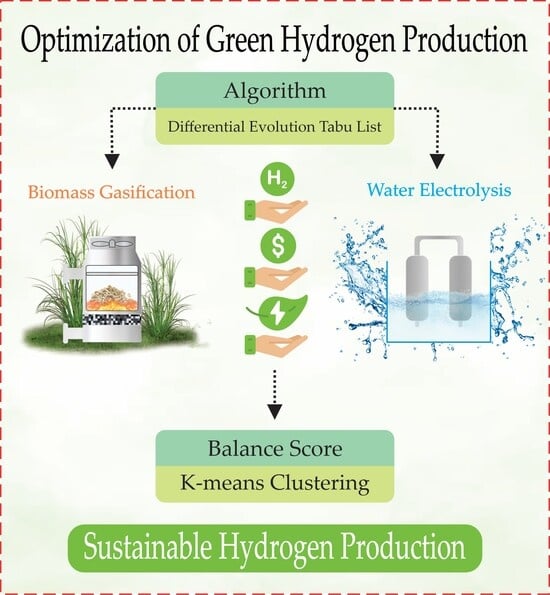
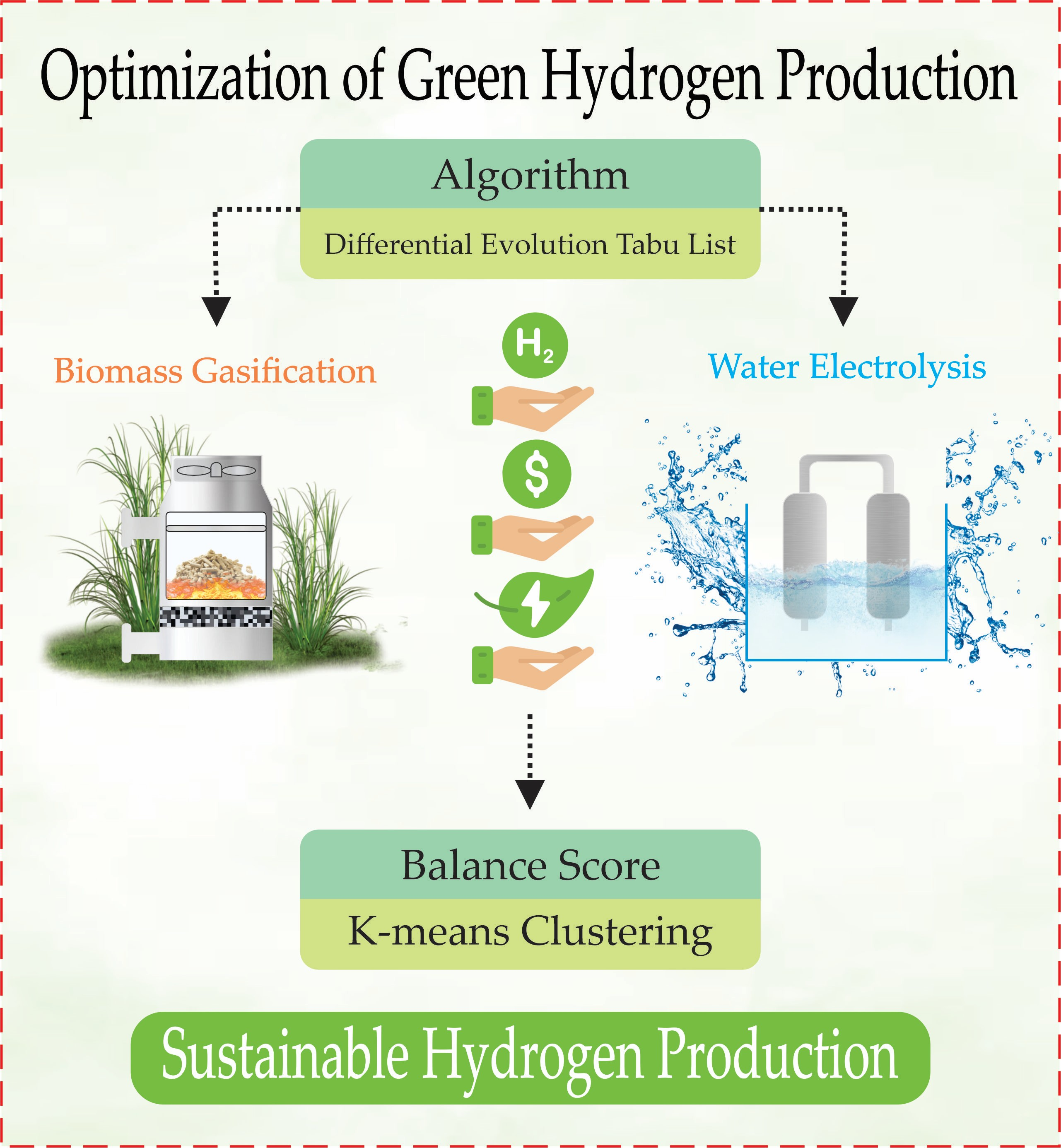
Graphical Abstract

1. Introduction

The decarbonization of the industrial and energy sectors is one of the main challenges for meeting global climate objectives, particularly in applications where direct electrification is technically or economically limited [1]. In this context, green hydrogen has emerged as a strategic energy carrier due to its versatility, high energy content, and potential to be integrated into low-carbon industrial value chains [2,3,4]. In recent years, its fundamental role in the decarbonization of energy-intensive industries and in sectoral integration between renewable electricity systems and industrial processes has been recognized [5,6]. Despite the growing interest, the large-scale viability of green hydrogen continues to face barriers associated with energy efficiency and high production costs, which makes it essential to benchmark and optimize the different technological routes available [7].
The electrolysis of water with electricity from renewable energy is currently the most promoted technology to produce green hydrogen due to its direct compatibility with decarbonized electricity systems and its ability to integrate with variable renewable sources such as solar and wind energy [8]. However, studies have indicated that its large-scale economic competitiveness continues to be constrained by the high capital costs of electrolyzers, as well as by the specific energy consumption of the process, which represents the main component of the levelized cost of hydrogen produced [7,9]. Techno-economic analyses indicate that the typical energy consumption of commercial electrolyzers is in the range of 50–55 kWh kg−1 H2, depending on the technology used (alkaline, PEM, or solid oxide), which implies a strong dependence on the price of renewable electricity to achieve competitive costs [8,10]. Schmidt et al. [7] demonstrated through an expert elicitation study that, even under optimistic technological learning scenarios, the costs of hydrogen production by electrolysis will remain sensitive to both system efficiency and reductions in electrolyzer investment costs. Similarly, Glenk and Reichelstein [9] showed that the economic viability of green hydrogen requires significantly low renewable electricity prices and high-capacity factors, introducing additional challenges for its integration into real energy systems with high temporal variability [10,11,12]. In addition, comparative studies between electrolysis technologies have indicated that, although PEM electrolyzers offer advantages in terms of operational flexibility and dynamic response, their capital costs and critical material requirements continue to be higher than those of alkaline systems, limiting their large-scale adoption in the short term [10,11]. Although emerging technologies such as solid oxide electrolysis offer higher electrical efficiencies, their technological maturity remains limited, and they continue to face challenges associated with durability and high-temperature operation [12]. It is also important to mention that the efficiency of hydrogen production by water electrolysis is determined by the hydrogen evolution reaction (HER). However, effective electrocatalysts for the HER reaction are required, which should be stable and long-lasting under adverse operating conditions to achieve reliable yields for industrial-scale hydrogen production. In that regard, the development of Transition Metal Phosphide-based electrocatalysts offers a promising balance between affordability, long-term stability, and activity, driving the development of competitive and sustainable technologies for hydrogen production [13]. Together, these works show that, despite its central role in decarbonization strategies, water electrolysis requires substantial improvements in efficiency, cost reduction, and optimization of system design and operation to achieve large-scale competitive implementation. Another developing method for splitting water to obtain green hydrogen is photocatalytic hydrogen production, which offers a promising solution to environmental challenges through the conversion of solar energy into chemical energy [14]. However, progress in photocatalysis is limited by the availability of effective semiconductors sensitive to visible light. Given this limitation, ongoing research is focused on the development of novel nanostructured semiconductors made of materials capable of improving photocatalytic performance [15,16].
In parallel, biomass gasification has emerged as a complementary renewable alternative to produce green hydrogen, particularly attractive for its ability to valorize lignocellulosic resources and organic waste of agricultural, forestry, and industrial origin, while reducing dependence on high-quality renewable electricity [17,18,19]. Several studies have pointed out that this thermochemical route offers greater flexibility for integration within hybrid energy systems, including combined heat and power generation and the production of advanced biofuels, enabling improved overall energy efficiency under specific system configurations [20,21]. Biomass has been widely recognized as a renewable source with high potential for sustainable hydrogen production using thermochemical routes, provided that appropriate sustainability criteria are adopted in resource management, supply logistics, and process design [22]. Recent reviews highlight that gasification, combined with water–gas shift and purification stages, can achieve competitive hydrogen yields, especially when fluidized bed gasifiers or optimized pressurized systems are employed [23]. Patra and Banu [24] highlight that emerging approaches focus on improving carbon conversion and energy efficiency through thermal integration and CO2 capture technologies, reinforcing the sustainability of the process. Kumar et al. [25] underline the role of modeling, sustainability assessments, and power-to-X applications in identifying optimal gasification configurations. Likewise, Jena and Vuthaluru [26] emphasize the influence of the type of gasifier and operating conditions on the composition of the syngas, while Kaur et al. [27] point out that the variability of the biomass and the complexity of the process make it necessary to simultaneously optimize multiple operating variables.
Moreover, techno-economic analyses have shown that the levelized costs of hydrogen produced from biomass can be competitive with electrolysis in regions with high availability of lignocellulosic residues and moderate biomass costs [28]. However, biomass gasification presents significant technical challenges associated with the complexity of the process and the inherent variability of the feedstock, including fluctuations in moisture content, elemental composition, and calorific value, which directly impact the operational stability and overall efficiency of the system [29]. Recent studies have shown that the simultaneous optimization of operating variables (such as the gasifying agent-to-biomass ratio, operating temperature, pressure, and thermal integration) is critical to maximizing hydrogen production and minimizing specific energy consumption and total system costs [30,31].
In this sense, both water electrolysis and biomass gasification involve intrinsic trade-offs between efficiency, cost, and scalability, arising from their underlying technological principles as well as their energy and operational requirements. While electrolysis relies heavily on the availability of low-cost renewable electricity, biomass gasification faces challenges associated with the complexity of the thermochemical process and the optimization of its operating conditions. These differences reinforce the need for comprehensive and comparative analytical approaches that allow the evaluation, under a common methodological framework, of the energy and economic performance of both technological routes. In this context, metaheuristic algorithms have demonstrated high performance in exploring nonlinear and high-dimensional design spaces, characteristic of integrated energy systems and thermochemical processes [32]. Among them, methods based on Differential Evolution (DE) have established themselves as an effective tool for the optimization of energy systems and complex engineering processes, characterized by multiple design variables, operational constraints, and conflicting objective functions [33,34]. Recent studies have shown that the hybridization of evolutionary algorithms with strategies aimed at preserving memory and solution diversity, such as tabu lists, significantly improves the quality and representativeness of the Pareto fronts obtained in complex multi-objective problems [35,36]. These characteristics make this type of approach particularly suitable for the optimization of green hydrogen production systems, in which multiple design variables, operational constraints, and energy and economic performance criteria interact.
In this work, a multi-objective optimization framework is proposed for the comparative analysis of green hydrogen production via biomass gasification and water electrolysis, considering both routes as independent processes evaluated under the same methodological scheme. Unlike previous studies that analyze these technologies in isolation or under mono-objective approaches, the present work proposes the simultaneous optimization of energy and economic criteria through a metaheuristic algorithm based on the Differential Evolution Tabu List (DETL). The problem is formulated using sustainability-oriented objective functions, including maximizing hydrogen production, minimizing specific energy consumption, and reducing the total annualized cost of the system, thereby explicitly capturing the trade-offs between technical performance, energy efficiency, and economic viability. Within the same framework, the resulting Pareto fronts are analyzed using K-means clustering techniques, enabling a structured characterization of the solution space, the identification of representative compromise solutions, and a clearer interpretation of the results to support decision-making.

2. Methodology

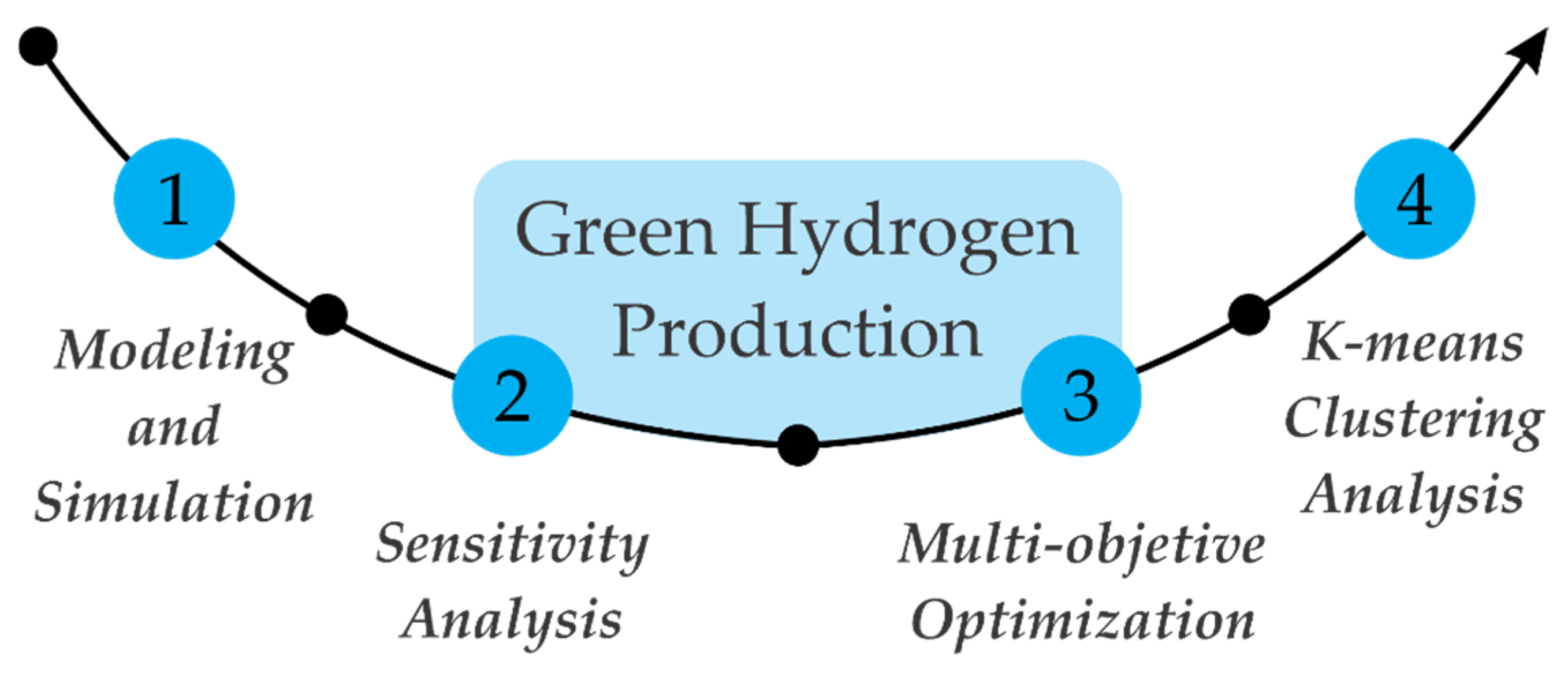
The proposed methodology shown in Figure 1 presents a systematic framework for modeling, simulation, multi-objective optimization, and the application of the K-means clustering algorithm for the two green hydrogen production routes.
The methodology is structured in four stages:
  • Modeling and simulation: the modeling and simulation of hydrogen production are implemented through two technological routes: biomass gasification and water electrolysis, using Aspen Plus™ V15 software. The models developed incorporate the main process units, material, and energy streams, as well as the necessary auxiliary operations, ensuring technically feasible operating conditions consistent with real industrial scenarios.
  • Sensitivity analysis: in this stage, the influence of the main operating parameters on the technical and economic performance of the plants is evaluated. Based on these results, the key decision variables for each technological route are identified.
  • Multi-objective optimization: this stage is formulated as a multi-objective optimization problem, simultaneously considering the maximization of green hydrogen production, the minimization of specific energy consumption, and the total annual cost. Optimization is implemented by integrating Aspen PlusTM with the Differential Evolution Tabu List (MODE) algorithm, using Visual Basic for Applications (VBA) in Microsoft ExcelTM as the integration platform. The results obtained are normalized using the Min-Max scaling technique to bring the target functions to a common scale. Based on these values, a Balance Score (BS) is calculated to identify the most balanced solution [37] to be identified by simultaneously considering the maximization of hydrogen production and the minimization of energy consumption and total annual cost.
  • K-means clustering analysis: to deepen the interpretation of the solutions obtained, the K-means algorithm, an unsupervised machine learning clustering method, is applied to the results generated by MODE, using Python™ (version 3.14.x) as the programming language. Previously, the data were standardized using the Standard Scaler technique of the scikit-learn library, normalizing each variable according to its mean and standard deviation. Subsequently, the optimal number of clusters is determined using the elbow method, identifying three representative groups from the inflection point in the square Euclidean distances curve. Finally, the K-means algorithm is executed to segment the solutions, allowing configurations with similar behaviors in terms of hydrogen production, energy consumption, and total annual cost to be grouped. It is worth highlighting that clustering methods have a wide variety of applications, not only in multi-objective optimization, but also in Process Systems Engineering (PSE) for data classification to improve processes, operational monitoring, system failure detection, and time-dependent process modeling, among many other purposes.

2.1. Modeling and Simulation

Two production routes are considered: biomass gasification and water electrolysis. The models are developed and simulated using Aspen Plus™ software, ensuring a rigorous representation of the mass and energy balances associated with each route.
As part of the sustainability considerations adopted in this study, biomass is assumed to be sourced from sustainable lignocellulosic residues, and water is considered as the feedstock for the electrolysis process. In addition, the electricity supply required for process operation is assumed to originate from renewable energy sources, specifically solar and wind power. These assumptions establish the environmental framework under which both production pathways are evaluated and support their classification as green hydrogen routes within the defined system boundaries.

2.1.1. Biomass Gasification

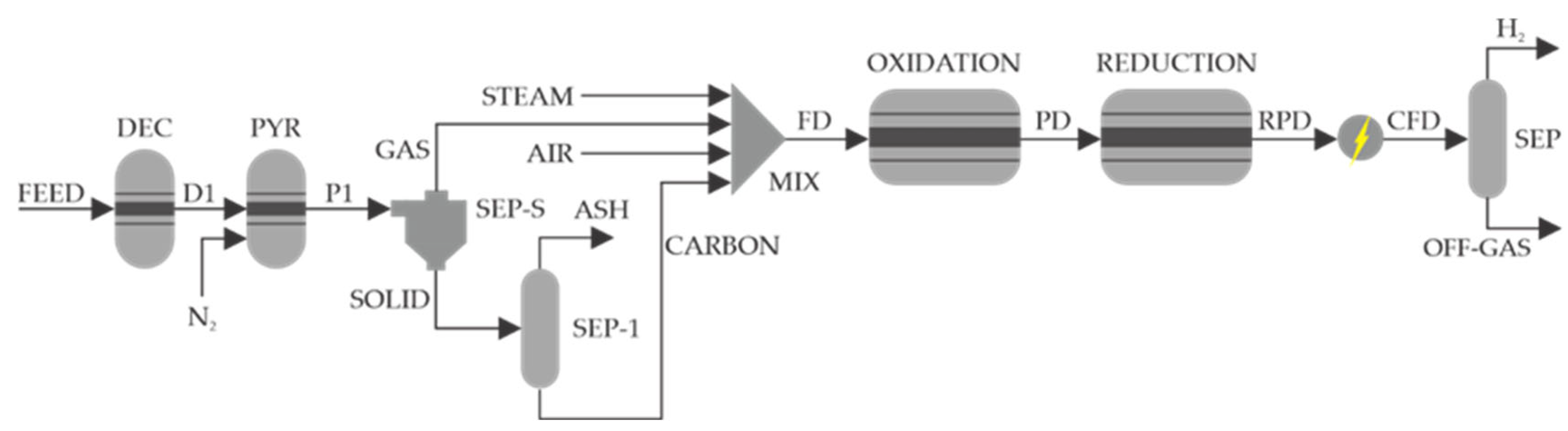
The gasification process was adapted from Zina and Gogoro [38]; it begins with the feeding of dry biomass to the gasification system (Figure 2), which is characterized by proximate and ultimate analysis, and then is introduced into a decomposition reactor operating at 500 °C. In this stage, the biomass is transformed from its elemental components (C, H, O, N, S, Cl, and Ash) into pseudo-components (H2, N2, O2, H2O, S, Cl2, C solid, and Ash). The D1 stream is fed, together with an N2 stream under ambient conditions, to a pyrolysis reactor operating at 780 °C, where the biomass is heated in the absence of oxygen, causing its thermal decomposition into volatile gases (H2, CO, CO2, CH4, H2O, and N2), char, and condensable compounds.
The stream from the pyrolysis reactor (P1) enters a gas–solid separator (GAS-SOLID), where the generated phases are separated. The SOLID stream contains char and ash, which are sent to an additional separation step, while the CARBON stream, rich in solid carbon, is recycled to the gasification stage. Subsequently, the GAS, STEAM, and AIR streams are fed to the MIX unit; steam is supplied at 100 °C and 1 bar, and air at 60 °C and 1 bar. The resulting FD stream is fed to an oxidation reactor operating at 800 °C, where the partial combustion of carbon and combustible gases occurs, described by the reactions (Equations (1) and (2)):
C O + 0.5 O 2 C O 2
C H 4 + 0.5 O 2 C O + 2 H 2
The stream from the oxidation reactor enters a reduction and gasification reactor operating at 800 °C, where the following reactions (Equations (3)–(6)) predominate:
C ( s o l i d ) + H 2 O C O + H 2
C H 4 + H 2 O C O + 3 H 2
C O + H 2 O C O 2 + H 2
C ( s o l i d ) + C O 2 2 C O
These reactions lead to the formation of a synthesis gas rich in hydrogen and carbon monoxide. The RPD stream then passes through a conditioning stage (CFD), where its temperature is reduced to 25 °C and 1 bar. Finally, under these conditions, the stream is sent to a separation unit (SEP) where a hydrogen-rich stream and a residual stream (OFF-GAS) are obtained as the main product, composed mainly of CO, CO2, and CH4, which can be recovered for energy generation or recirculated within the process.

2.1.2. Water Electrolysis

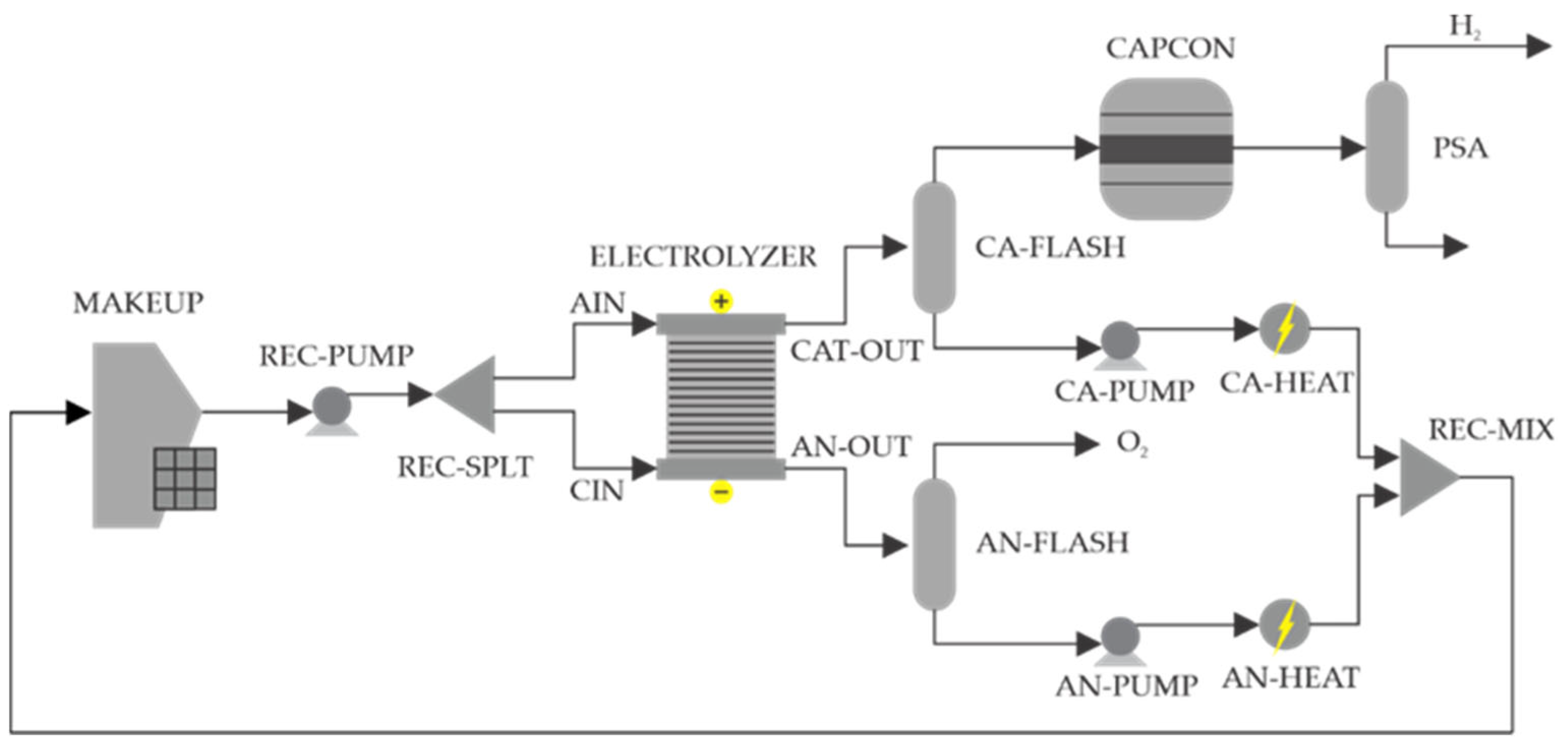
The electrolysis process was adapted from Serrano-Arevalo et al. [39] and Padilla-Esquivel et al. [40], where alkaline water electrolysis is used for hydrogen production (Figure 3). The process begins with an electrochemically driven electrolysis stage in which water is split to generate green hydrogen using an alkaline electrolyte (KOH). The water is supplied at 25 °C and 8 bar, followed by a pressure increase of 0.2 bar using a pump, and then directed to a splitter with a separation fraction of 0.25, producing the AIN and CIN streams. This division allows the adjustment of the amount of water available in each compartment of the electrolyzer. In particular, the CIN stream requires a higher proportion of water to maintain adequate ionic conductivity, prevent overheating, and control the concentration of the electrolyte (KOH) during the process. These streams are fed to an alkaline electrolyzer. The anodic stream (AN-OUT) is composed of oxygen with water, while the cathodic stream (CAT-OUT) is mainly composed of hydrogen with the traces of water.
The AN-OUT stream is sent to a flash tank (AN-FLASH) operating at 7 bar and 75 °C, where oxygen is separated from the water, generating a vapor stream and a liquid stream containing water. Similarly, the CAT-OUT stream is processed in a flash tank (CA-FLASH) under the same operating conditions to separate hydrogen from water, producing a vapor stream and a liquid stream containing water.
The water-rich liquid streams from both flash units are pressurized to 7.3 bar and cooled to 72.8 °C by a heat exchanger before being recycled to the MAKEUP unit, which ensures a constant and stable water supply to the electrolyzer. The hydrogen-rich stream is then passed to a Rstoic reactor (CAPCON) to remove residual oxygen (Equation (7)).
0.5 O 2 + H 2 H 2 O

2.2. Sensitivity Analysis

To identify the most relevant parameters that affect hydrogen production, energy consumption, and total annual cost, as well as to define their corresponding operating ranges, a sensitivity analysis was carried out using the Aspen Plus™ software through the Model Analysis Tools module for both hydrogen production routes. The operating ranges of the decision variables were defined considering only those scenarios in which the model converged, since non-convergent cases imply inconsistencies in mass and energy balances and the absence of numerical solutions, and were therefore excluded from the search space.
The results of this analysis establish the decision variables considered in the processes studied, which are summarized in Table 1. Additionally, this analysis enables the determination of the feasible operating bounds for each decision variable, thereby defining the admissible search space and constraining the optimization domain to regions where optimal solutions can be consistently attained for each plant configuration.

2.3. Multi-Objective Optimization

Equation (8) establishes the multi-objective optimization framework applied to both processes. In this scheme, the objective function (O.F.) consists of: (i) maximizing the rate of hydrogen production ( m a x   F i H 2 ), in order to improve the use of available resources, whether biomass or water, and increase the overall productivity of the system; (ii) minimizing the total annual cost ( m i n   T A C i ), which was estimated using the Aspen PlusTM Economic Evaluation tool and which allows the evaluation of the economic viability of the process considering both investment costs and operating and profit costs; and (iii) minimizing specific energy consumption ( m i n   E i s p e c i f i c ), given that both biomass gasification and water electrolysis are energy-intensive processes, which directly impact operating costs and the environmental sustainability of the system.
O . F . = m a x   F i H 2 ,   m i n   T A C i ,   m i n   E i s p e c i f i c
Together, these three objectives enable the establishment of a balanced trade-off between technical performance, energy efficiency, and economic profitability in both hydrogen production processes. Therefore, the objective functions for the gasification process and the electrolysis route are given by Equation (9) and Equation (10), respectively.
F G a s i f i H 2 E G a s i f i E s p e c i f i c T A C G a s i f i = f F G a s i f i B i o m a s s ,   F G a s i f i N 2 , T G a s i f i P y r o , F   G a s i f i S t e a m , F G a s i f i A i r
F E l e c t r o H 2 E E l e c t r o E s p e c i f i c T A C E l e c t r o = f P E l e c t r o S t a c k ,   E E l e c t r o S t a c k , T E l e c t r o C a F l a s h , P E l e c t r o C a f l a s h
Equation (9) presents the mathematical model of the biomass gasification process for hydrogen production, in which the objective functions F G a s i f i H 2 , E G a s i f i E s p e c i f i c , and T A C G a s i f i are expressed as functions of five decision variables: the biomass feed rate F G a s i f i B i o m a s s , nitrogen flow F G a s i f i N 2 , pyrolysis reactor temperature T G a s i f i P y r o , steam flow rate F G a s i f i S t e a m , and airflow rate F G a s i f i A i r .
Equation (10) presents the mathematical model of the water electrolysis process for hydrogen production, in which the objective functions ( F E l e c t r o H 2 , E E l e c t r o E s p e c i f i c , and T A C E l e c t r o ) are expressed as functions of four decision variables: the electrolyzer stack power P E l e c t r o S t a c k , electrolyzer efficiency ( E E l e c t r o S t a c k ), flash tank temperature ( T E l e c t r o C a F l a s h ), and flash tank pressure P E l e c t r o C a f l a s h .
The economic evaluation of the process was performed using the Aspen V15 Process Economic Analyzer (APEA), which estimates capital and operating costs based on equipment sizing, material and energy balances, and utility consumption obtained from the process simulation. The software automatically calculates the Total Capital Cost and the Total Operating Cost by considering equipment purchase costs, installation factors, utilities, raw materials, and other operational expenses associated with the process units.
Based on these results, the TA was determined by combining the Annualized Capital Investment and the Annual Operating Cost. The capital investment was annualized considering the Desired Rate of Return of 20 Percent/yr specified in the APEA, while the operating cost includes utilities, maintenance, raw materials, and other process-related expenses estimated by the software.
The cost of the main raw materials used in the process was assumed on a per-unit basis, based on values typically reported in the literature for similar processes. According to these studies, the cost of biomass was estimated at 32.7 USD/ton [41], while the cost of alkaline water was considered 0.66 USD/m3 [42].
The electricity price used in the utilities cost calculation was selected based on ranges reported in the literature for renewable energy sources to represent realistic operating conditions within the scope of this study. The levelized cost of electricity (LCOE) has been reported to be approximately 30 USD/MWyr for wind energy [43] and 55 USD/MWyr for solar energy [44]. Therefore, an average electricity cost of 42.5 USD/MWyr was assumed for the evaluation of the case study. Although electricity prices can vary depending on the geographical location of the plant [45], this average value was adopted to provide a representative estimate for the analysis.
To ensure a consistent comparison between objective functions with different units and magnitudes, the optimization results are normalized before analysis. Data normalization (Equations (11)–(13)) allows all target functions to be represented on a common dimensionless scale, preventing a single objective from dominating the analysis due to its numerical range.
F N o r m H 2 = F H 2 m i n F H 2 m a x   F H 2 m i n   F H 2
T A C n o r m = T A C i m í n T A C m á x   T A C m í n   T A C
E N o r m S p e c i f i c = E s p e c i f i c m í n E s p e c i f i c m á x   E s p e c i f i c m í n   E s p e c i f i c
In this way, the normalized expressions are subsequently used in the evaluation using the Balance Score (BS), which allows the simultaneous evaluation of hydrogen production, total annual cost, and specific energy consumption within a unified performance framework.
Equation (14) integrates these criteria into a single performance indicator using the Balance Score. Hydrogen production, originally defined as a maximization goal, is transformed into a minimization term through the expression 1   F n o r m a H 2 . Meanwhile, the normalized specific energy consumption and the normalized total annual cost are directly incorporated as minimization objectives. This indicator allows the identification of balanced solutions among the different performance criteria, such that the lowest values of the Balance Score correspond to alternatives with a better overall trade-off and, therefore, represent the most favorable solutions within the results obtained.
B S = 1 F n o r m a H 2 + T A C n o r m a + E n o r m a s p e c i f i c
In addition, quality constraints are established for both processes that require hydrogen purity greater than 0.90, ensuring that the optimal solutions are technically and economically competitive while meeting minimum product specifications. In both biomass gasification and water electrolysis, hydrogen produced in the initial stages does not reach ultra-high purity by itself; additional purification steps (e.g., PSA, membranes, cryogenic separation) are required to achieve purities ≥99.9% [46]. In this study, separation units were included to attain a hydrogen purity ≥0.90 for both pathways, providing a consistent and fair basis for comparison. This constraint was selected to avoid being overly restrictive, allowing both processes to be represented with a single separation stage and enabling the multi-objective analysis to capture trade-offs between production, energy consumption, and cost without introducing the complexity of multiple purification stages.
Furthermore, to ensure a consistent and comparable optimization framework for both plant configurations, an additional production capacity constraint was imposed, limiting the hydrogen production rate to the range between 3000 and 4000 kg/h. This constraint defines a common feasible production domain, avoids scale-related bias in the objective functions, and ensures that the Pareto-optimal solutions are evaluated under equivalent production throughput conditions.

2.3.1. Integration of Simulation and Optimization Environments

The multi-objective optimization problem addressed in this study presents a significant level of complexity. Both biomass gasification and water electrolysis involve multiple reactions, equilibria, and balances that generate a strongly non-linear behavior of the system. In addition, complexity also arises from the thermodynamic models used to describe the process, since their formulation directly influences property prediction and the interaction between variables. Moreover, variables such as temperature, pressure, and feed ratios simultaneously affect hydrogen production, energy consumption, and total cost, generating strongly coupled interactions that are difficult to resolve with conventional methods. Finally, the existence of operational and product-quality constraints reduces the feasible solution space, further increasing the difficulty of the problem.
Therefore, a hybrid multi-objective optimization approach based on the Multi-Objective Differential Evolution with Tabu List algorithm originally proposed by Sharma and Rangaiah [47] is adopted. The algorithm has been widely applied in various engineering case studies. For example, Quiroz-Ramírez et al. [48] used it for the simulation and optimization of acetone, butanol, and ethanol production from lignocellulosic biomass, considering environmental, economic, and energy objectives. Likewise, Errico et al. [49] proposed alternative hybrid configurations based on liquid-liquid extraction and distillation for biobutanol purification, simultaneously optimizing the total annual cost and the environmental indicator Eco-indicator 99, achieving significant reductions in total annual cost and improvements in environmental performance compared to the conventional hybrid configuration. More recently, Martínez-Lomovskoi et al. [50] applied this algorithm to optimize a post-combustion carbon capture plant, integrating environmental and economic objectives under a sustainable design approach with green solvents.
The selection of the MODE algorithm for this study was motivated by its robustness and efficiency in solving multi-objective optimization problems, where multiple criteria such as production cost and energy efficiency must be optimized simultaneously. MODE is particularly suitable for complex, non-linear process models, as it effectively explores the global solution space while maintaining diversity, thereby reducing the risk of convergence to local optimality.
Monsef et al. [51] applied three well-known multi-objective optimization algorithms, NSGA II, MODE, and MOPSO, to benchmark mathematical test functions, evaluating their performance in terms of accuracy and computational time. While all three algorithms generated accurate Pareto fronts, MODE achieved optimal solutions with lower computational time compared to NSGA II and MOPSO. Subsequently, the algorithms were applied to the optimal design of water distribution networks, where MODE produced a faster and more accurate Pareto front, demonstrating its efficiency and reliability for complex engineering optimization problems. Furthermore, Fakhfakh et al. [52] reported that MODE outperforms NSGA II in terms of solution quality, Pareto front diversity, and computing time, confirming its suitability for multi-objective optimization in engineering applications.
In this method, an initial population of individuals is randomly generated within the limits of the decision variables associated with the biomass gasification and water electrolysis processes. For each individual, the objective functions related to hydrogen production, specific energy consumption, and total annual cost are evaluated. Test solutions are generated for each target individual by the mutation and crossover operators of the Differential Evolution algorithm, applied to selected individuals from the current population. During this process, a Tabu mechanism is incorporated to avoid the generation of solutions in the vicinity of previously explored regions, thus maintaining the diversity of the population by using a predefined Tabu radius in the space of normalized decision variables.
Accepted test solutions are evaluated and stored in the offspring population. Subsequently, a non-dominated sorting procedure is carried out on the combined populations of parents and offspring, followed by the calculation of the crowding distance to select the best individuals that will form the population of the next generation. This iterative procedure continues until the convergence criterion is satisfied, which occurs when the objective functions no longer show significant variations, providing optimal solutions with improved overall performance [53,54].
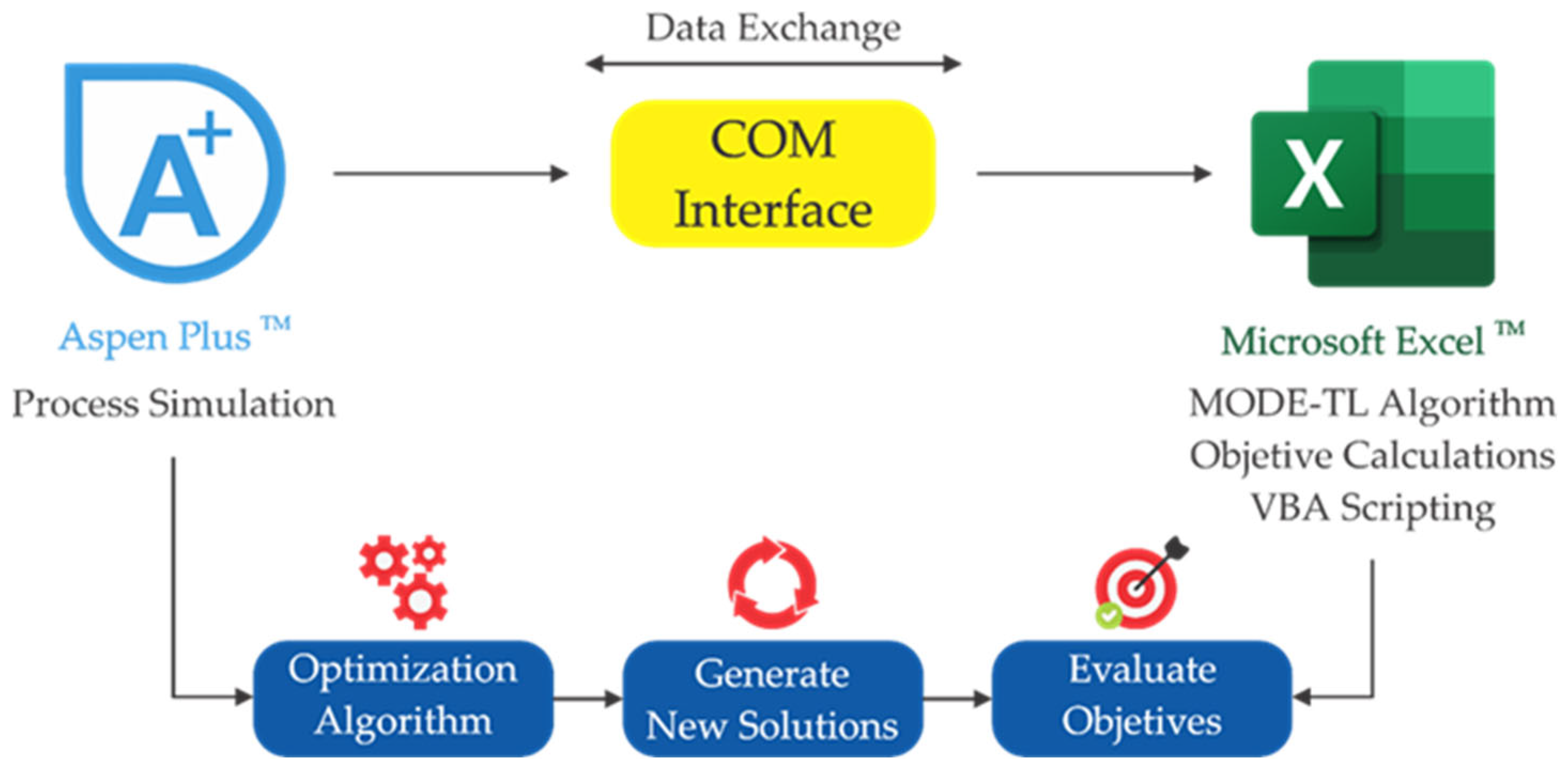
The implementation of the multi-objective optimization algorithm was carried out using a hybrid platform that integrates Aspen Plus™ and Microsoft Excel™ (Microsoft 365) using COM technology (see Figure 4). During the optimization process, the data generated in Microsoft Excel™ is sent to Aspen Plus™, where rigorous simulations of the processes under consideration are performed. In Aspen Plus™, the mass and energy balances of each unit in the system are solved to obtain the necessary performance indicators. This information is then returned and stored in Microsoft Excel™, where the objective functions related to hydrogen production, specific energy consumption, and total annual cost are calculated. Based on these results, new solutions are generated according to the stochastic procedure of the MODE-TL algorithm, thus closing the optimization cycle.
For the optimization process, the parameters of the MODE-TL algorithm used in this study were the following: a population size of 100 individuals; maximum number of generations of 50; size of the Tabu List of 50 individuals; a Tabu radius of 0.00001; crossover fraction of 0.8; and mutation fraction of 0.6 [55,56].

2.3.2. Balance Score

To ensure a consistent and comparable optimization framework for both plant configurations, a production capacity constraint was imposed, limiting the hydrogen production rate to a bounded range of 3000–4000 kg/h. This establishes a common feasible production domain, avoiding scale-related biases in the objective functions and ensuring that the Pareto-optimal solutions are evaluated under equivalent throughput conditions. The optimization results were normalized using the Min-Max Scaling technique, which allows variables with different magnitudes to be compared on a common scale. This normalization improves the robustness of optimization and enables the use of the Balance Score indicator to identify compromise solutions that fairly balance economic, energetic, and environmental objectives. By constraining both gasification and electrolysis within the same production window, the analysis ensures a fair comparison, as differences in efficiency, energy consumption, and costs reflect the inherent characteristics of each process rather than variations in production scale.
Using the Balance Score (BS) methodology (Equation (14)), a numerical analysis is carried out that quantifies the performance of each resulting Pareto front configuration, allowing the identification of various representative cases, as well as the best compromise solution for each plant. This facilitates a clear comparison of the performance of the gasification and electrolysis processes under the operating conditions considered. Padilla-Esquivel et al. [40] optimized the green urea production process considering environmental, economic, and product-related benefits. These objectives are normalized and integrated through the Balance Score methodology to identify the most balanced solution. The configuration with the lowest Balance Score showed a relative error of only 0.002% compared with Aspen Plus™ results, confirming the accuracy of the approach.

2.3.3. Greenhouse Gas Emissions

To evaluate the environmental performance of the proposed processes, the greenhouse gas emissions (GHG) indicator is applied [57]. This indicator quantifies the indirect CO2 emissions associated with the energy consumption of the processes, considering that the electricity supply is provided by renewable energy sources. GHG emissions are calculated according to Equation (15) [58].
G H G = E S p e c i f i c · F E
where E S p e c i f i c is the specific energy required by the process per unit of product generated (kWh/kg H2), and F E is the emission factor per source expressed in kg CO2-eq/kg H2.
Furthermore, the GHG assessment is performed only for the best solutions obtained from the multi-objective optimization of each production route. This approach allows for a representative environmental comparison between the most favorable configurations of biomass gasification and water electrolysis

2.4. K-Means Clustering Analysis

K-means clustering is an unsupervised machine learning clustering algorithm that was first proposed in 1957 by Stuart Lloyd [59]. It is widely accepted among alternative algorithms (e.g., k-medoids, fuzzy clustering, density-based clustering, etc.) for solving clustering problems across a variety of fields due to its flexibility, efficiency, simplicity, and low computational complexity [60]. The K-means algorithm divides a dataset into a predefined number of clusters (k), grouping data by minimizing the similarity of data between clusters and maximizing the similarity of data within clusters [61]. This feature makes this clustering technique a powerful tool for analyzing complex and heterogeneous datasets.
In process optimization, the functionality of K-means clustering relies in its ability to analyze extensive industrial data, enabling strategic decision-making [62]. In this study, the k-means algorithm was implemented to analyze the different results obtained from multi-objective optimization, facilitating the analysis of trade-offs between the objectives of interest (H2 production, energy consumption per unit of product, and TAC). However, the implementation of clustering techniques in Process Systems Engineering also includes:
  • Operational monitoring and system fault detection, assisting in distinguishing between various system states and detecting anomalies in complex processes [63].
  • Data classification for system enhancement, identifying persistent operating patterns that can be utilized to optimize system performance and minimize material waste [64,65].
  • Design for sustainability, enabling environmentally conscious designs by classifying balanced high-performance alternatives [66].
  • Modeling time-dependent processes, allowing dynamic data to be arranged into structured categories, which provide a basis for creating forecasting and decision-making models essential for real-time process optimization and control [67].
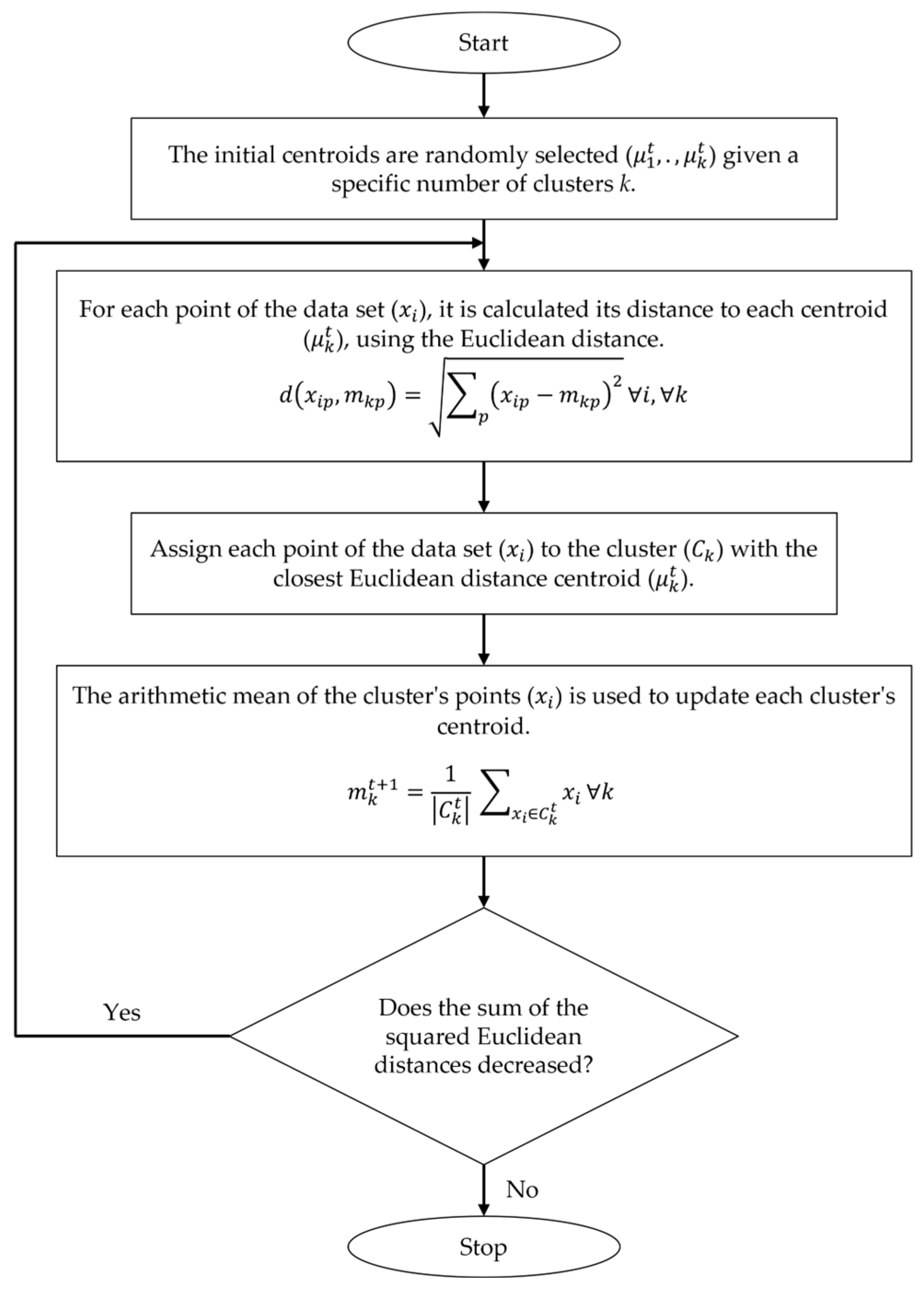
Python™ (version 3.14.x) was used as the programming language for the implementation of the k-means algorithm. The k-means algorithm consists of the following steps, which are summarized in Figure 5 [68]:
  • The initial centroids ( μ 1 t , . , μ k t ) are selected arbitrarily, once a specific number of clusters ( k ) has been defined. The iteration number is denoted as, so that for the first iteration t = 0 .
  • For each point in the database ( x i ) in the p-dimensional space R p ( X = { x i | x i R p ,   i = 1,2 , . , n } ), the distance to each centroid ( μ k t ) is calculated, using in this case the Euclidean distance as a dissimilarity metric, as presented in Equation (16). In addition, each dimension represents a feature of the dataset.
    d x i p , m k p = p x i p m k p 2 i , k
  • Each point in the dataset ( x i ) is assigned to the cluster ( C k ) with the closest centroid ( μ k t ) according to the Euclidean distance.
  • The arithmetic mean of the members that make up each cluster is used to update the corresponding centroid, as described in Equation (17).
    m k t + 1 = 1 C k t x i C k t x i k
  • Until the sum of the squares of the Euclidean distances (SED) is minimized, steps 2–4 are repeated. In this way, the objective function to be minimized is established as indicated in Equation (18).
    S E D = i k d x i μ k 2
There is no single objective criterion for determining the optimal number of clusters ( k ) [69]. However, there are several methods that can be used to estimate the optimal number of clusters; that is, the number of clusters that allows the members of each group to be as similar as possible to each other and as different from the members of other groups. In this case, the elbow method was used, which is a graphical method that represents the distortion versus the number of clusters on a line graph. The optimal number of clusters was identified at the inflection point of the curve. The term “distortion” is used to refer to the sum of the squares Euclidean distances between each of the members of a cluster and its corresponding centroid, as stated in Equation (18) [70].
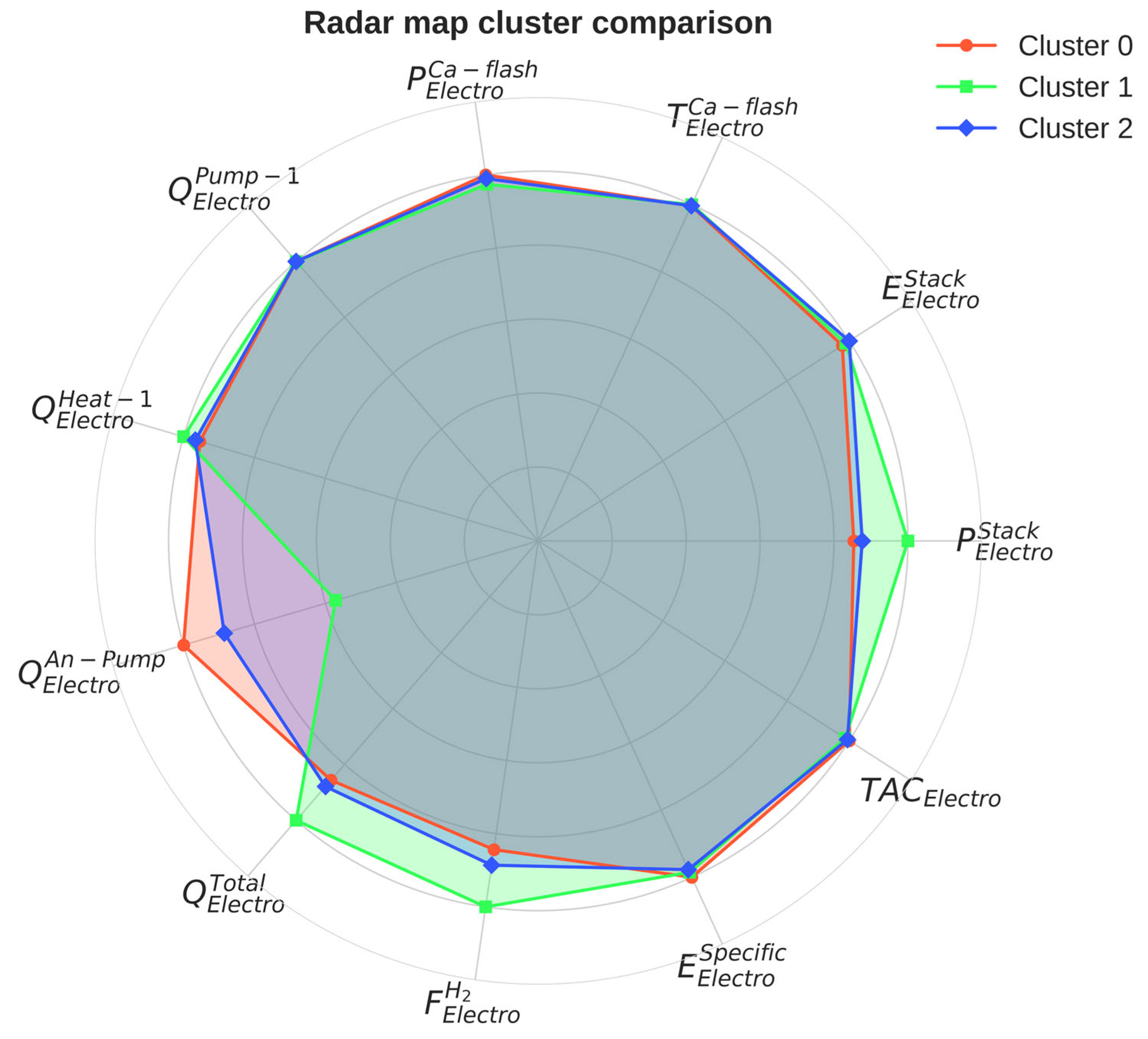
Finally, the clusters resulting from the application of the k-means algorithm were analyzed and compared, assigning colors for identification and creating radar graphs through the normalized values of hydrogen production, specific energy consumption, and total annual cost, which made it possible to visualize the trade-offs between objectives and clearly evaluate the performance of each plant.

3. Results and Discussion

In this section, the results obtained from the multi-objective optimization of green hydrogen production are presented and analyzed in detail, as well as the results of the application of the K-means algorithm to these results. For both green hydrogen production routes analyzed, biomass gasification and water electrolysis, the multi-objective optimization was carried out on a HPE ProLiant server (Hewlett Packard Enterprise, Houston, TX, USA) equipped with an Intel® Gold 6230 processor (2.10 GHz) and 256 GB of RAM.
The designs were simulated using Aspen PlusTM using the following thermodynamic models:
  • Biomass gasification. The model used was the PENG-ROB [29] due to its adequate ability to represent complex reactive systems at elevated temperatures, typical of the thermochemical conversion of biomass [71]. This model allows a more precise estimation of the phase equilibria and thermodynamic behavior of multicomponent mixtures that include light gases (H2, CO, CO2, CH4), water vapor, and unconventional compounds, ensuring numerical stability and consistency under severe operating conditions.
  • Water electrolysis. The ENRTL-RK model [72] was used, as it combines the Electrolyte-NRTL model [73], which is suitable for describing highly non-ideal electrolyte solutions and the behavior of electrolytes in aqueous solutions at low pressure levels [74].
The simulation models can be validated based on previous studies. Sreejith et al. [75] reported biomass gasification results validated against pilot-scale plants, with RMSE values between 2.4% and 5.2% depending on temperature (690–770 °C). Kombe et al. [76] modeled sugarcane bagasse gasification using a thermodynamic equilibrium approach and validated against experimental data, achieving RMSE between 0.99 and 2.38 for CO, H2, CO2, CH4, and N2 at 900–1000 °C. Similarly, Gao et al. [77] validated a Gibbs reactor model for volatile gasification with experimental data and Aspen Plus simulations, obtaining good agreement and RMSE between 3.72% and 8.30% for all gaseous components except methane.
For water electrolysis, Jang et al. [78] developed a numerical model of an alkaline electrolysis system in Aspen PlusTM, validating the cell model by comparing the current-voltage curve with experimental data, which demonstrates that the model accurately reproduces the real behavior of the electrolyzer. Gonçalvez et al. [79] reported that the largest differences between experimental data and model predictions occurred in the electrical power and cell voltage, with deviations of 21% for the batch model and 23% for the continuous model, noting that these discrepancies can be improved in future studies. Therefore, the present case study may serve as a validation alternative for future projects.

3.1. Biomass Gasification Results

3.1.1. Optimization and Balance Score Results

The evaluation was limited to 50 generations, a criterion defined to balance the quality of the solutions obtained with the computational efficiency of the procedure. This number allowed the observation of the initial dispersion of the objective functions and decision variables, as well as the formation of trade-offs along the Pareto front. Although the system did not reach complete convergence, the analysis of these generations was sufficient to identify the main trends and coupled interactions among the objectives without incurring an excessive computational cost [80,81]. Although the convergence was verified by following the evolution of the target functions and the BS, observing that after approximately 30–40 generations, the best compromise solutions stabilized. This indicates that the main trends and coupled interactions among the objectives were captured without incurring excessive computational cost. This choice is supported by studies in multi-objective optimization of energy systems and complex chemical processes, where trade-offs tend to stabilize before formal convergence is reached, even when the total number of individual evaluations is relatively low (e.g., 3000–4000) [82,83].
It is important to mention that a sensitivity analysis allowed the establishment of appropriate limits within which feasible solutions satisfying the constraints are obtained. Therefore, by implementing the algorithm, it was possible to obtain 5000 solutions for each of the two green hydrogen production routes analyzed. Subsequently, an analysis of all designs was carried out, using BS to ensure that the most balanced solutions were identified. In this way, through the calculation of the BS, several representative cases of the optimized solutions were identified. In the case of biomass gasification, the values of the objectives analyzed for the representative cases are presented in Table 2 and Figure 6.
Additionally, Table 3 shows in detail the configurations of each of the representative cases identified for the biomass gasification route, presenting the values of the decision variables corresponding to each of them.
Case G is identified as the compromise solution, as it presents the lowest value of the BS (0.33) and a consistent production-economic performance. This solution achieves a hydrogen production of 3625.95 kg/h, ranking among the highest in the set of cases, without incurring severe energy penalties. Thus, its specific energy consumption (39.63 kWh/kg H2) remains in a competitive range, lower than that of solutions with similar production, such as cases H and I. From an economic point of view, the TAC of case G (2.45 MUSD/yr) remains at an intermediate level, with a trade-off between the economic objective and the energy consumption of the process. Overall, these results show that case G achieves an adequate balance between production, energy efficiency, and costs, which justifies its selection as the compromise solution for the biomass gasification route.
It is important to note that, among the representative cases, case G stands out for incorporating the lowest air flow into the process (67,987.72 kg/h of biomass and 724.47 kg/h of air) and for presenting the highest pyrolysis temperature (782 °C), very close to that proposed by Zina and Gogoro (780 °C) [38]. Although case D processes a similar amount of biomass (67,467.41 kg/h of biomass and 6751.47 kg/h of air), it uses 89.3% less air flow than case G. This could indicate that, in some representative cases, air flow higher than necessary is used to achieve an adequate balance among the objectives of interest (H2 production, specific energy consumption, and TAC). On the other hand, although a higher pyrolysis temperature does not ensure higher H2 production in all representative cases, in most of them, production increases with temperature. In addition, it has been identified that an increase in pyrolysis temperature does not significantly affect the specific energy consumption, which allows case G to avoid excessive energy consumption despite having the highest pyrolysis temperature of all representative cases (see Table 3).
On the other hand, the configurations of cases H and I, although they allow higher H2 production and present low BS values, imply an energy consumption per unit of product up to 54% and 74% higher, compared with case G. It is important to identify that case H, despite having the highest biomass feed to the process among all the representative cases, shows a lower hydrogen production compared to case I. This highlights the influence of the specific configuration of all the decision variables on production efficiency.
In the case of the pairs of scenarios A&F and B&D, they present relatively comparable magnitudes of both specific energy and costs (see Table 2). However, the analysis using the BS makes it possible to identify those with greater viability, namely those that allow a greater production of hydrogen and require a lower flow of N2 (cases D and F). Finally, for cases C and E, although they have a very similar BS (0.51 and 0.50, respectively), the lower BS value highlights case E as the one that allows greater hydrogen production with lower energy consumption per unit of product mass (3315.24 kg/h, 41.38 kWh/kg H2), compared to case C (3099.49 kg/h, 46.74 kWh/kg H2). However, it is important to highlight that case E processes 6.5% more product than case C, requiring higher flows of N2 and air (see Table 3). In this way, the usefulness of the BS for the analysis of the different solutions obtained is highlighted, allowing for the differentiation of their viability for decision-making, even in the presence of conflicting trade-offs.

3.1.2. K-Means Clustering Results

Unlike BS analysis, k-means clustering cannot identify a specific operational configuration as a compromise solution. However, the significance of k-means clustering analysis stems from the fact that it allows a comprehensive analysis of the 5000 solutions obtained by multi-objective optimization while considering all the decision variables involved in each process path. K-means clustering classifies the solutions into clusters with specific operational characteristics, allowing the identification of trade-offs between objectives (hydrogen production, specific energy consumption, and TAC), based on the arithmetic means of the decision variables for the solutions that comprise each cluster (centroid). Although the centroid of each cluster represents its features on average, it does not correspond to a single solution and so is not associated with a certain BS value. Nevertheless, for both production routes evaluated, it is identified that the compromise solution based on BS is part of the cluster with an advantageous trade-off of the objectives analyzed, indicating a general correlation between both BS and k-means clustering analysis.
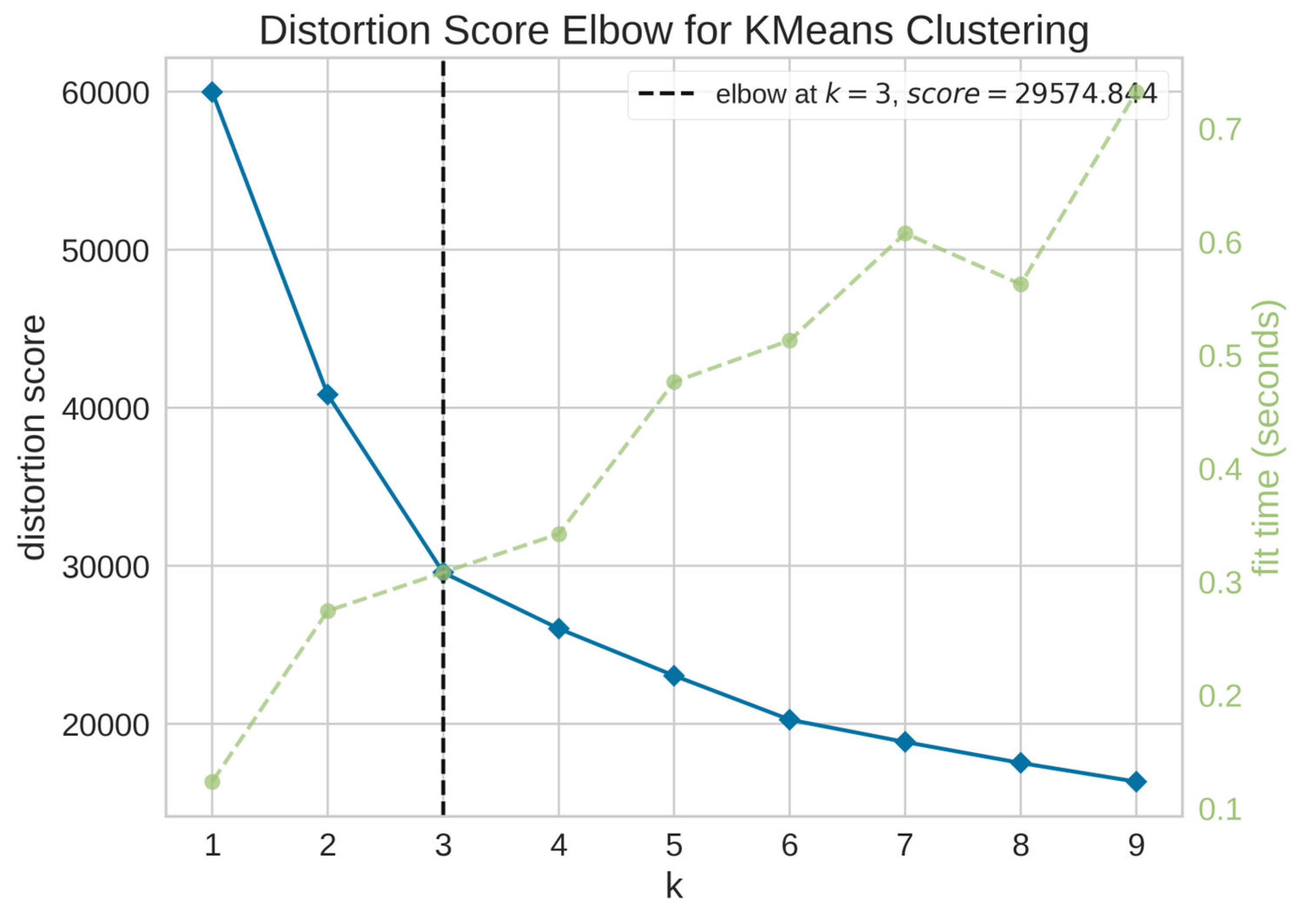
For the identification of the optimal number of clusters ( k ), the elbow method presented in Figure 7 was used. The x-axis shows the number of clusters ( k ) , and the y-axis represents the distortion, defined as the sum of the squared Euclidean distances. The dotted green line indicates the computation time required to train the clustering model, while the dotted vertical black line marks the selected optimal number of clusters ( k ) .
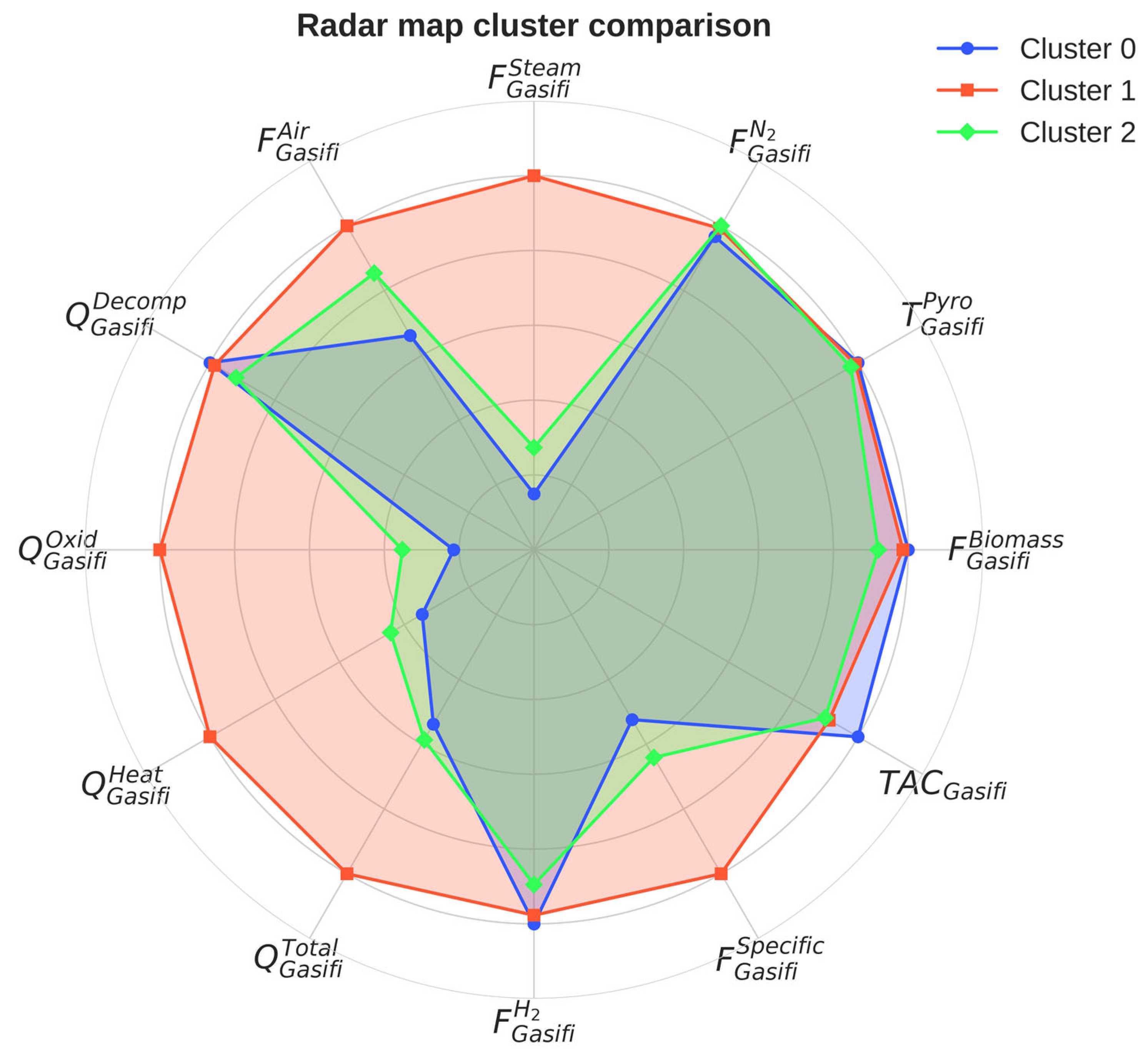
The optimal number of clusters ( k ) was determined to be k = 3 , as this configuration ensures maximum similarity among members within each cluster and maximum differentiation between clusters. In this way, through the implementation of the K-means algorithm, the 5000 optimized solutions were segmented into three clusters, assigning each of them a color for identification (blue, red, or green). Table 4 shows the average values of the variables of each resulting cluster, which in turn are represented in the radar graphs in Figure 8.
From Table 4 and Figure 8, three clusters with clearly differentiated characteristics are identified. The blue cluster is associated with the highest levels of hydrogen production (3984.22 kg/h), which is achieved at the expense of a significant increase in the total annualized cost (2.50 MUSD/yr), with an increase of 10.1% compared with the red cluster and 11.6% compared with the green cluster. This reflects configurations aimed at maximizing production capacity rather than economic efficiency. In addition, the blue cluster exhibits the lowest specific energy consumption, which suggests that the increase in TAC may be associated with higher operating costs influenced by decision variables not directly linked to energy consumption, such as a lower N2 supply to the process. Considering that N2 is used to achieve the absence of oxygen in the pyrolysis reactor, a reduction in this could cause problems that result in increased operating costs.
On the other hand, the red cluster represents a more balanced compromise between the variables analyzed, presenting a high hydrogen production of 3892.35 kg/h with TAC values (2.27 MUSD/yr) not so far from those of the green cluster (2.24 MUSD/yr). However, this group is characterized by having the highest specific energy consumption (61.46 kWh/kg H2), around 47.6% and 55.9% higher compared with the blue and green clusters, respectively. This is directly related to an energy requirement that is 3.7 and 1.8 times higher for the oxidation reactor, and a steam requirement that is 5.7 and 2.7 times higher, both compared with the blue and green clusters, respectively (see Table 4).
For its part, the green cluster groups scenarios with the lowest hydrogen production (3565.45 kg/h), but also with the lowest TAC (2.24 MUSD/yr) and an intermediate specific energy consumption (39.40 kWh/kg H2), which makes it a set of solutions aimed at economic and energy efficiency. This cluster is particularly attractive for applications where the main objective is to minimize costs and reasonable energy consumption, even when production capacity is more limited (see Table 4). It is important to note that the compromise solution (case G) identified through the evaluation of the BS indicator is part of the green cluster. This is even though, unlike case G, the green cluster does not have the highest pyrolysis temperature or the lowest air flow. This is because the magnitudes of these variables associated with the green cluster (see Table 4) represent the average value of all the solutions that constitute each of the clusters. However, a correlation was observed, where both the calculation of the BS indicator and the k-means algorithm, indicate a favorable compensation of the objectives analyzed, for the multi-objective optimization solutions that are part of the green cluster.

3.2. Water Electrolysis

3.2.1. Optimization and Balance Score Results

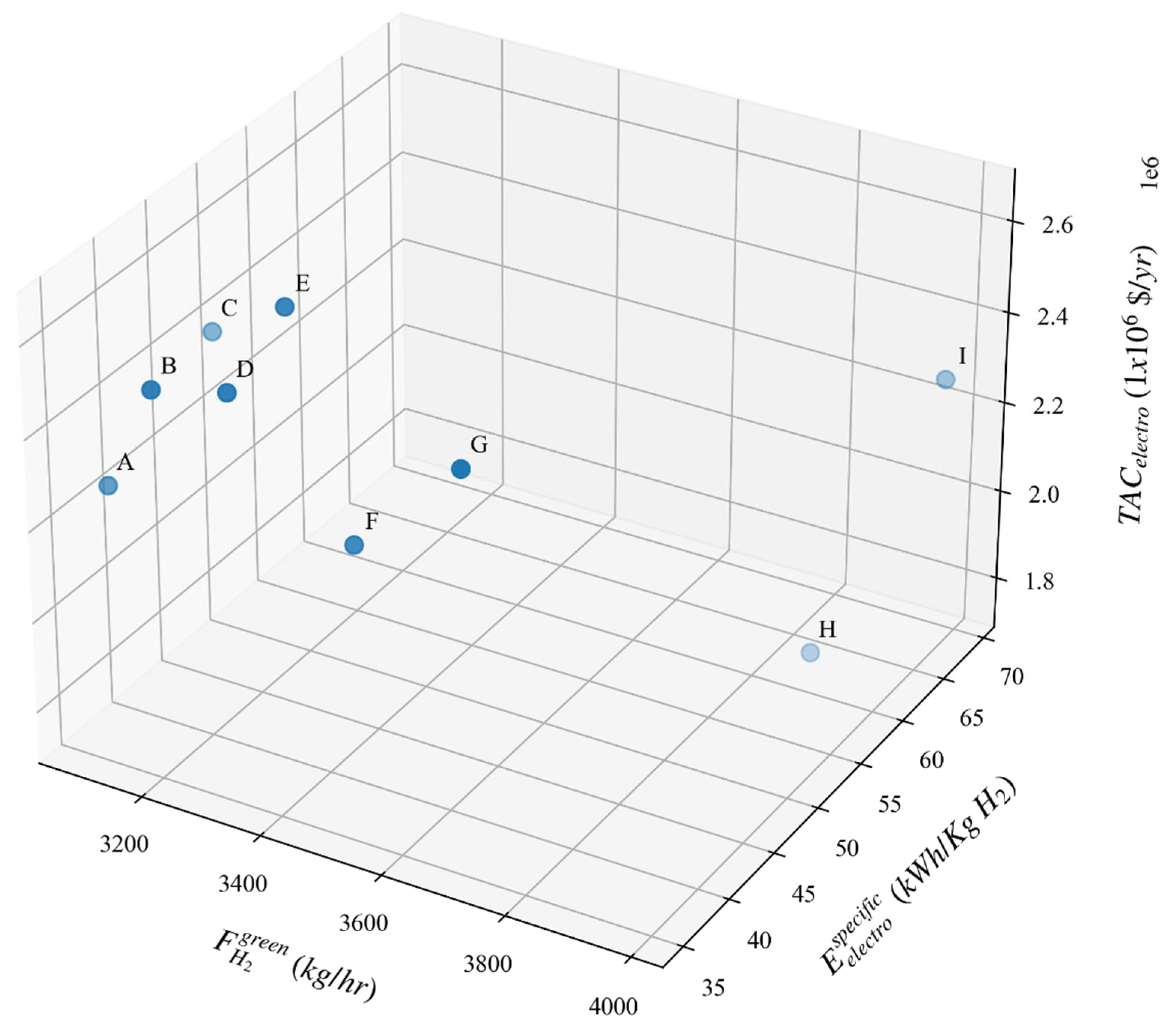
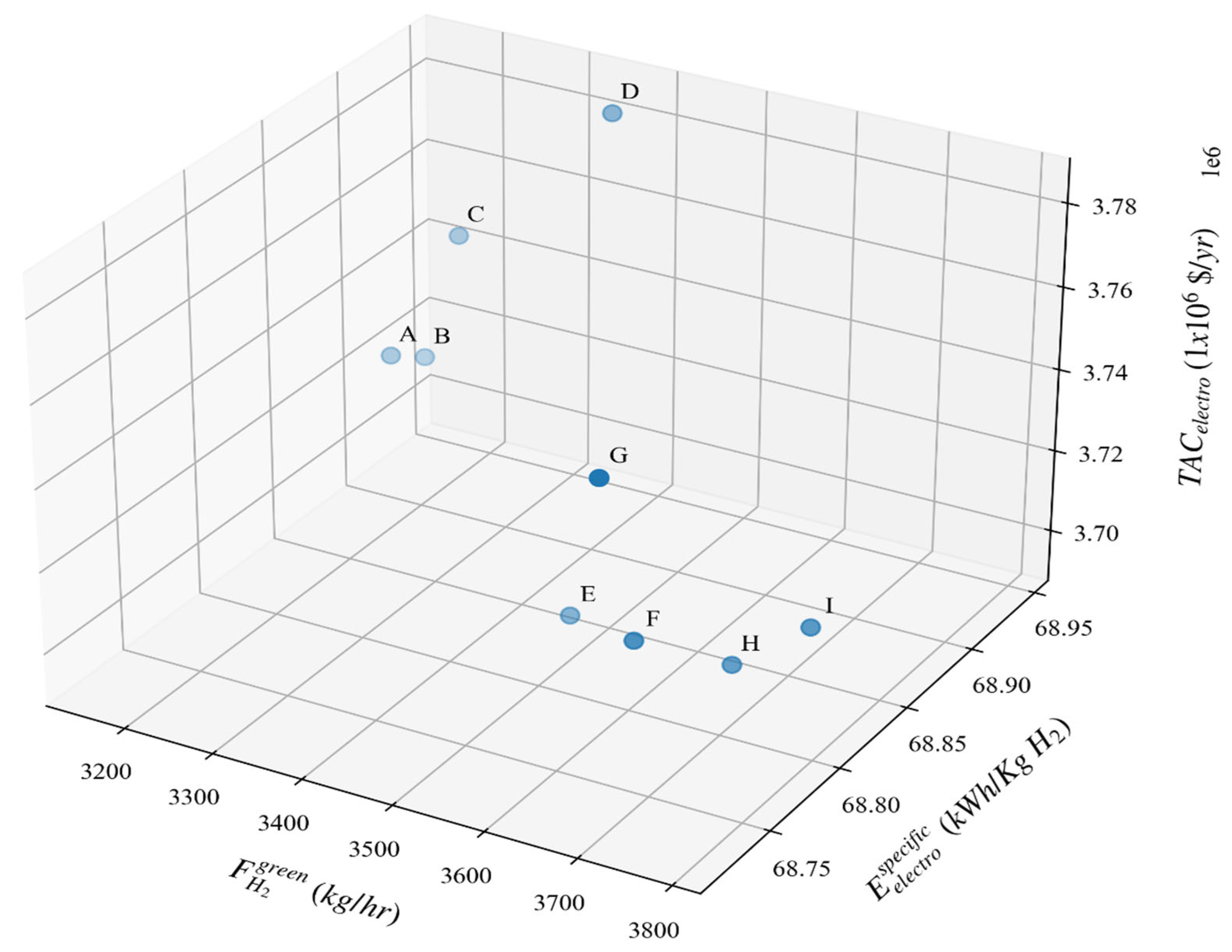
As for the biomass gasification route, for obtaining hydrogen by water electrolysis, the multi-objective optimization generated 5000 solutions. The magnitudes of the objectives analyzed for the representative cases, identified through the BS evaluation, are presented in the following table and figure (Table 5 and Figure 9).
In addition, Table 6 details the configurations of each of the representative cases identified for the water electrolysis pathway, presenting the corresponding decision variables for each case.
From the representative cases corresponding to the multi-objective optimization of water electrolysis, a nearly constant specific energy consumption is identified in all solutions (68.71–68.94 kWh/kg H2), which indicates a low energy flexibility of the process. When evaluating the corresponding BS indicator, it is possible to distinguish case I as the compromise solution, as it presents the lowest value of BS (0.25). This configuration, in turn, achieves the highest production of H2 of all the cases analyzed for water electrolysis, with a production of 3783.83 kg/h, and a specific energy consumption of 68.80 kWh/kg H2. In addition, the associated TAC (3.72 MUSD/yr) remains at a competitive level, compared to cases with similar energy consumption but lower production as case E (3480.83 kg/h H2, 68.83 kWh/kg H2, 3.69 MUSD/yr). This justifies the selection of case I as the most viable alternative for the electrolysis route.
Cases F, G, and H have a BS very close to that of case I (0.29, 0.27, and 0.29, respectively), also with similar energy consumption and costs. However, case I enables the production of up to 110 kg/h of additional hydrogen. Moreover, cases F, G, H, and I are identified as having the highest energy requirements for the electrolyzer, which highlights the influence of this equipment characteristic on H2 production.
On the other hand, cases D and E have the highest and lowest TAC (3.78 MUSD/yr and 3.69 MUSD/yr, respectively), in case D, despite showing lower production than cases F, G, H, and I. Finally, cases A, B, and C have the lowest productions, as well as the highest BS values, given their high energy consumption per unit mass of H2 produced. Although cases A, B, and C require the lowest energy consumption for the electrolyzer; however, their high specific energy is associated with the energy requirement of the An-Pump (see Table 6).

3.2.2. K-Means Clustering Results

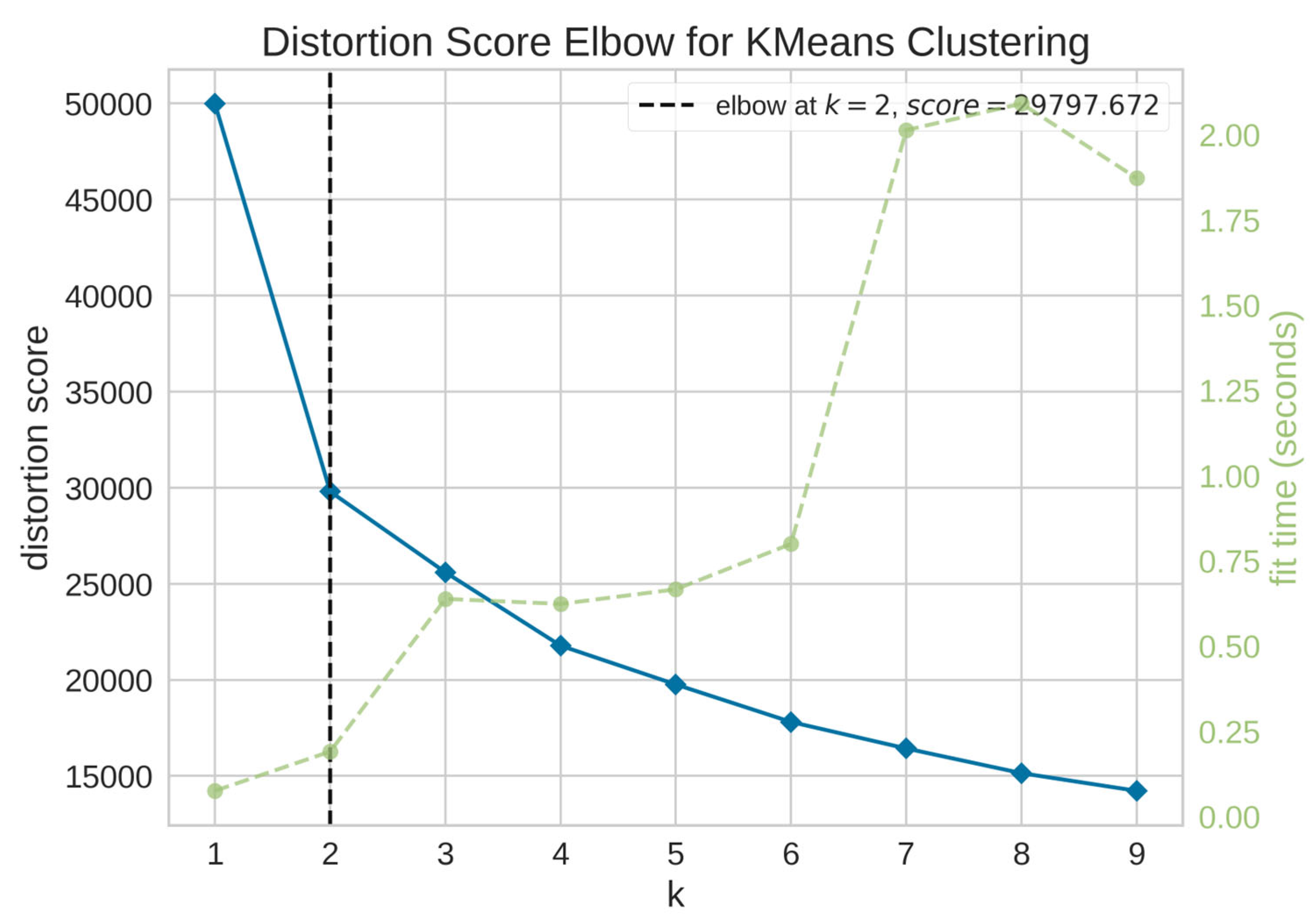
The use of the elbow method for the water electrolysis pathway results in an optimal number of clusters of k = 2, as shown in Figure 10. However, k = 2 is regarded as a very small number of clusters to accomplish the segmentation, and it is recognized that there is no objective criterion for determining the optimal number of clusters [69]. Therefore, the immediately higher value of k (k = 3) was chosen as suggested by different authors in similar cases [69,70], to obtain a comparable analysis for both hydrogen production routes analyzed.
For the biomass gasification pathway, each of the three clusters formed was assigned a color for identification (blue, red, or green). Table 7 shows the average values of the variables of each resulting cluster, which are also depicted in Figure 11.
Figure 11 and Table 7 present the results of the application of the k-means algorithm to the production of hydrogen by water electrolysis. In this case, the clusters show a smaller difference in magnitudes compared to the biomass gasification process. In particular, the specific energy consumption and TAC present similar magnitudes for the three groups, which confirms that the performance of the process is strongly conditioned by the intrinsic characteristics of the electrolyzer (such as its energy requirement), indicating limited operational flexibility.
However, clear differences are observed in hydrogen production, with the green cluster reaching the highest production levels (3943.98 kg/h), followed by the blue cluster (3494.56 kg/h) and, finally, the red cluster (3326.50 kg/h). This segmentation indicates that, although specific energy consumption and costs do not vary significantly, the energy requirement of the electrolyzer influences the production capacity, serving as a differentiating factor between the configurations analyzed (see Table 7). Importantly, differences in total energy requirement, observed in Figure 11, do not affect the specific energy, since, given the differences in production for each cluster, the energy consumption per unit of mass remains considerably similar for the three groups.
The compromise solution (case I) identified for water electrolysis through the BS analysis belongs to the solutions that are part of the blue cluster. Although this cluster has intermediate values of hydrogen production and TAC, this is compensated with a reduction in specific energy consumption. The blue cluster’s energy consumption per unit of product mass (68.0934 kWh/kg H2) is the lowest compared to that corresponding to the red (69.6723 kWh/kg H2) and green (68.6544 kWh/kg H2) clusters. Therefore, the solutions belonging to the blue cluster are identified as those presenting the most favorable balance among the analyzed trade-offs, achieving higher energy efficiency while maintaining hydrogen production and TAC at competitive levels compared with the other clusters. Furthermore, the functionality and relevance of using the k-means clustering algorithm for analyzing multi-objective optimization solutions is highlighted, allowing the identification of variables that condition process performance even when objectives such as specific energy consumption and TAC vary only slightly.

3.3. General Results

When comparing the compromise solutions identified based on the BS indicator for each of the process routes (see Table 8), it is observed that the compromise solution for the case of biomass gasification (case G) results in slightly lower hydrogen production of H2. However, this is compensated by a reduction in specific energy consumption of up to 42% compared to the compromise solution of the water electrolysis pathway (case I). This, in turn, leads to a proportional reduction in greenhouse gas emissions. It should be noted that greenhouse gas emissions were calculated for each compromise solution based on CO2 emission factors per kWh of specific energy consumption, as reported by Rezaei et al. [57] and Klaimi et al. [58], considering renewable energy such as solar and wind power. Additionally, unlike water electrolysis, the compromise solution of the biomass gasification route allows savings of up to 1.27 MUSD/yr. This shows that biomass gasification has better energy and economic performance compared to the production of H2 by water electrolysis.
The specific energy consumption obtained for the electrolyzer in the compromise solution (Case I) through the electrolysis route is 65.93 kWh/kg H2. Although this value is slightly higher than the commonly cited ideal range of 50–55 kWh/kg H2, it remains consistent with values reported in the literature when different operating conditions and system configurations are considered. For example, Zhang et al. [84] reported that the specific energy consumption of water electrolysis systems can vary between 48 and 67.5 kWh/kg H2, depending on the efficiency of the electrolyzer and the operating parameters. Similarly, Fragiacomo and Genovese [85] analyzed the performance of a hydrogen production system and reported a specific energy consumption of 56.3 kWh/kg H2, with a system efficiency of approximately 52.9%, highlighting that the electrolyzer represents the largest energy demand within the process.
Furthermore, Arunachalam and Han [86] demonstrated that electrolyzer performance is strongly influenced by key operating parameters such as cell voltage, current density, and operating temperature, which directly affect system efficiency and energy consumption. In their experimental study, specific energy requirements in the range of 43.46–45.8 kWh/kg H2 were reported, with improved efficiency observed at higher operating temperatures.
Therefore, the value obtained in this study falls within the broader range reported in previous works, indicating that the results are consistent with the available literature. These studies show that electrolyzer energy performance is strongly influenced by key operating parameters such as supplied power, system efficiency, cell voltage, and operating temperature. While optimizing these variables can improve efficiency, it may also increase energy requirements due to higher operating temperatures or voltages.
For the biomass gasification process, the comparison was based on the hydrogen yield. In the present study, a hydrogen production of 0.053 kg H2/kg biomass was obtained. Hydrogen yields from biomass gasification typically range between 0.05 and 0.16 kg H2/kg biomass, depending on feedstock composition and operating conditions, with a commonly reported average value of approximately 0.10 kg H2/kg biomass [87]. These values have been reported based on both theoretical modeling and experimental studies available in the literature. Therefore, the value obtained in this study falls within the lower bound of the range reported for hydrogen production from biomass.
Comparing these results with previous studies, Nan et al. [88] reported a maximum hydrogen yield of 0.347 kg H2/kg biomass, with a hydrogen production efficiency of 65.71%. Similarly, Niu et al. [89] developed a biomass gasification model and validated their results against experimental data, obtaining a root mean square error (RMSE) of 5.3% and a hydrogen yield of 0.107 kg H2/kg biomass.
Overall, these comparisons indicate that the hydrogen yield obtained in this study is consistent with values reported in previous biomass gasification studies, confirming that the modeled process provides realistic and comparable performance results.

4. Conclusions

This study implemented a multi-objective optimization framework to produce hydrogen via biomass gasification and water electrolysis, simultaneously maximizing production while minimizing energy consumption and annual cost. The incorporation of the Balance Score and K-means clustering enhanced the methodology by enabling the identification of compromise solutions with a more balanced distribution among heterogeneous objectives, as well as the grouping of solutions into representative clusters that revealed relevant regions within the solution space. The results show that, although electrolysis achieves a slightly higher production of hydrogen (3783.83 kg/h), biomass gasification offers a more favorable overall performance, with a production of 3625.95 kg/h, a specific energy consumption of 39.63 kWh/kg H2 compared with 68.7 kWh/kg H2 for electrolysis, and a total annual cost of 2.45 MUSD/yr compared with 3.72 MUSD/yr for electrolysis. In addition, gasification exhibits lower greenhouse gas emissions (1.17 kg CO2-eq/kg H2), establishing it as the most balanced and competitive alternative from a technical, economic, and environmental perspective. Finally, the flexibility and scalability of the proposed methodology enable its application to complex energy and chemical systems, constituting a robust framework for benchmarking and the informed selection of sustainable technologies.
It is important to note that this study focuses on the process-level optimization of hydrogen production routes. Therefore, aspects related to the biomass supply chain, such as transportation distance, logistics costs, moisture content variability, and seasonal availability of biomass, were not explicitly considered in the present model. These factors may influence the practical deployment of biomass gasification systems and should be addressed in future studies to provide a more comprehensive assessment of their real-world feasibility.

Author Contributions

C.A.P.-E.: Writing—review and editing, Writing—original draft, Methodology, Investigation, Formal analysis, Data curation, Conceptualization. T.P.-P.: Writing—review and editing, Writing—original draft, Methodology, Investigation, Formal analysis, Data curation, Conceptualization. H.A.-G.: Writing—review and editing, Writing—original draft, Methodology, Investigation, Formal analysis, Data curation, Conceptualization. C.R.-M.: Writing—review and editing, Writing—original draft, Methodology, Investigation, Formal analysis, Data curation, Conceptualization. J.M.P.-O.: Writing—review and editing, Writing—original draft, Methodology, Investigation, Formal analysis, Data curation, Conceptualization. All authors have read and agreed to the published version of the manuscript.

Funding

This research received no external funding.

Data Availability Statement

All data generated or analyzed during this study are included in this published article.

Acknowledgments

The authors acknowledge the financial support from SECIHTI (Mexico) and CIC-UMSNH.

Conflicts of Interest

The authors declare that they have no known competing financial interests or personal relationships that could have appeared to influence the work reported in this paper.

Nomenclature

The following nomenclature is used in this manuscript.
Biomass gasification
E G a s i f i E s p e c i f i c Specific energy, energy required by the process per unit mass (kWh/kg H2)
F G a s i f i A i r Air flow rate (kg/h)
F G a s i f i B i o m a s s Feed flow rate (kg/h)
F G a s i f i N 2 N2 flow rate (kg/h)
F G a s i f i S t e a m Steam flow rate (kg/h)
F G a s i f i H 2 H2 production flow rate (kg/h)
Q G a s i f i H e a t Heat exchanger energy requirement (kW)
Q G a s i f i D e c o m p Decomposition reactor energy requirement (kW)
Q G a s i f i O x i d Oxidation reactor energy requirement (kW)
Q G a s i f i T o t a l Total energy requirement (kW)
T G a s i f i P y r o Pyrolysis temperature (°C)
T A C G a s i f i Total annual cost (USD/yr)
Water electrolysis
E E l e c t r o S p e c i f i c Specific energy, energy required by the process per unit mass produced (kWh/kg H2)
F E l e c t r o H 2 H2 production flow rate (kg/h)
E E l e c t r o S p e c i f i c Efficiency fraction
P E l e c t r o C a F l a s h   Flash Ca tank pressure (bar)
Q E l e c t r o A n p u m p Pump An energy requirement (kW)
Q E l e c t r o P u m p 1 Pump 1 energy requirement (kW)
P E l e c t r o S t a c k Electrolyzer energy requirement (kWh)
Q E l e c t r o H e a t 1 Heat exchanger 1 energy requirement (kW)
Q E l e c t r o T o t a l Total energy requirement (kW)
T E l e c t r o C a F l a s h   Flash Ca tank temperature (°C)
T A C E l e c t r o Total annual cost (USD/yr)
Object function
E N o r m a S p e c i f i c Specific energy, energy required by the process per unit of normalized mass produced
F N o r m a H 2 Normalized H2 production flow rate
T A C N o r m a Normalized total annual cost
K-means algorithm
k K-means algorithm
x i Database point i
μ k t Initial centroids of cluster k
m k t + 1 Recalculated centroids of cluster k
C k Cluster k
S E D Square of Euclidean distances

References

  1. Davis, S.J.; Lewis, N.S.; Shaner, M.; Aggarwal, S.; Arent, D.; Azevedo, I.L.; Benson, S.M.; Bradley, T.; Brouwer, J.; Chiang, Y.-M.; et al. Net-zero emissions energy systems. Science 2018, 360, eaas9793. [Google Scholar] [CrossRef]
  2. Noyan, O.F.; Hasan, M.M.; Pala, N. A Global Review of the Hydrogen Energy Eco-System. Energies 2023, 16, 1484. [Google Scholar] [CrossRef]
  3. Kouchaki-Penchah, H.; Bahn, O.; Bashiri, H.; Bedard, S.; Bernier, E.; Elliot, T.; Hammache, A.; Vaillancourt, K.; Levasseur, A. The role of hydrogen in a net-zero emission economy under alternative policy scenarios. Int. J. Hydrogen Energy 2024, 49, 173–187. [Google Scholar] [CrossRef]
  4. Bianco, E.; Blanco, H. Green Hydrogen: A Guide to Policy Making; International Renewable Energy Agency: Abu Dhabi, United Arab Emirates, 2020. [Google Scholar]
  5. Wolfram, P.; Kyle, P.; Fuhrman, J.; O’rOurke, P.; McJeon, H. The hydrogen economy can reduce costs of climate change mitigation by up to 22%. One Earth 2024, 7, 885–895. [Google Scholar] [CrossRef]
  6. Hordvei, E.; Hummelen, S.E.; Petersen, M.; Backe, S.; del Granado, P.C. From policy to practice: Upper bound cost estimates of Europe ’s green hydrogen ambitions. Clean. Energy Syst. 2025, 12, 100206. [Google Scholar] [CrossRef]
  7. Schmidt, O.; Gambhir, A.; Staffell, I.; Hawkes, A.; Nelson, J.; Few, S. Future cost and performance of water electrolysis: An expert elicitation study. Int. J. Hydrogen Energy 2017, 42, 30470–30492. [Google Scholar] [CrossRef]
  8. Frieden, F.; Leker, J. Future costs of hydrogen: A quantitative review. Sustain. Energy Fuels 2024, 8, 1806–1822. [Google Scholar] [CrossRef]
  9. Glenk, G.; Reichelstein, S. Economics of converting renewable power to hydrogen. Nat. Energy 2019, 4, 216–222. [Google Scholar] [CrossRef]
  10. Buttler, A.; Spliethoff, H. Current status of water electrolysis for energy storage, grid balancing and sector coupling via power-to-gas and power-to-liquids: A review. Renew. Sustain. Energy Rev. 2018, 82, 2440–2454. [Google Scholar] [CrossRef]
  11. Sebbahi, S.; Assila, A.; Belghiti, A.A.; Laasri, S.; Kaya, S.; Hlil, E.K.; Rachidi, S.; Hajjaji, A. A comprehensive review of recent advances in alkaline water electrolysis for hydrogen production. Int. J. Hydrogen Energy 2024, 82, 583–599. [Google Scholar] [CrossRef]
  12. Acar, C.; Dincer, I. Review and evaluation of hydrogen production options for better environment. J. Clean. Prod. 2019, 218, 835–849. [Google Scholar] [CrossRef]
  13. Kandel, M.R.; Dhakal, P.P.; Chapagain, K.R.; Thapa, J.R.; Kandel, L.; Bhatt, T.D.; Karki, B.; Ghimire, M.; Bhandari, D. Recent advances in HER electrocatalysis derived from Fe, Co, Ni, and Mo-based phosphides. Discov. Electrochem. 2026, 3, 8. [Google Scholar] [CrossRef]
  14. Bratovčić, A.; Tomašić, V. Hydrogen Production Through Newly Developed Photocatalytic Nanostructures and Composite Materials. Processes 2025, 13, 1813. [Google Scholar] [CrossRef]
  15. Ullah, I.; Habib, S.; Lu, X.-J.; Li, J.-H.; Chen, S.; Habib, A.; Xu, A.-W. Bimetallic nitride NiMoN loaded on graphitic carbon nitride for plasmon-enhanced visible light-driven photocatalytic hydrogen evolution from water splitting. Catal. Sci. Technol. 2024, 14, 912–918. [Google Scholar] [CrossRef]
  16. Lu, X.-J.; Ullah, I.; Li, J.-H.; Chen, S.; Yuan, C.-Z.; Xu, A.-W. A bimetallic CoZn metal–organic-framework derived CoZnS@NSC Co-catalyst loaded on g-C3N4 for significantly augmented photocatalytic H2 evolution. Inorg. Chem. Front. 2024, 11, 3435–3445. [Google Scholar] [CrossRef]
  17. Rubinsin, N.J.; Karim, N.A.; Timmiati, S.N.; Lim, K.L.; Isahak, W.N.R.W.; Pudukudy, M. An overview of the enhanced biomass gasification for hydrogen production. Int. J. Hydrogen Energy 2024, 49, 1139–1164. [Google Scholar] [CrossRef]
  18. Kim, S.-H.; Kumar, G.; Chen, W.-H.; Khanal, S.K. Renewable hydrogen production from biomass and wastes (ReBioH2-2020). Bioresour. Technol. 2021, 331, 125024. [Google Scholar] [CrossRef]
  19. Yan, M.; Afxentiou, N.; Fokaides, P.A. The State of the Art Overview of the Biomass Gasification Technology. Curr. Sustain./Renew. Energy Rep. 2021, 8, 282–295. [Google Scholar] [CrossRef]
  20. Lapuerta, M.; Hernández, J.J.; Pazo, A.; López, J. Gasification and co-gasification of biomass wastes: Effect of the biomass origin and the gasifier operating conditions. Fuel Process. Technol. 2008, 89, 828–837. [Google Scholar] [CrossRef]
  21. Erdem, K.; Han, D.G.; Midilli, A. A parametric study on hydrogen production by fluidized bed co-gasification of biomass and waste plastics. Int. J. Hydrogen Energy 2024, 52, 1434–1444. [Google Scholar] [CrossRef]
  22. Alcocer-García, H.; Sánchez-Ramírez, E.; García-García, E.; Ramírez-Márquez, C.; Ponce-Ortega, J.M. Unlocking the potential of biomass resources: A review on sustainable process design and intensification. Resources 2025, 14, 143. [Google Scholar] [CrossRef]
  23. Babatabar, M.A.; Saidi, M. Hydrogen production via integrated configuration of steam gasification process of biomass and water-gas shift reaction: Process simulation and optimization. Int. J. Energy Res. 2021, 45, 19378–19394. [Google Scholar] [CrossRef]
  24. Patra, N.; Banu, S.S. Emerging Approaches in Hydrogen Production from Biomass. In Engineering Materials; Springer Science and Business Media Deutschland GmbH: Berlin/Heidelberg, Germany, 2025; pp. 117–135. [Google Scholar] [CrossRef]
  25. Kumar, S.; Palange, R.; De Blasio, C. Advancements in gasification technologies: Insights into modeling studies, power-to-X applications and sustainability assessments. Sustain. Energy Fuels 2025, 9, 4793–4831. [Google Scholar] [CrossRef]
  26. Jena, M.K.; Vuthaluru, H.B. Gasification Technology: Transforming Waste into Clean Energy; Springer Nature: Durham, NC, USA, 2024. [Google Scholar] [CrossRef]
  27. Kaur, P.; Kaur, G.; Singh, A.; Kaur, K.; Bhatia, B.; Singh, S. Process of biomass gasification: A review. AIP Conf. Proc. 2025, 3261, 020009. [Google Scholar]
  28. Guler, N.U.; Yumurtaci, Z. Techno-economic evaluation of hydrogen production via biomass gasification: The role of carbon capture and storage in steam and oxygen gasification routes. Int. J. Hydrogen Energy 2025, 188, 152134. [Google Scholar] [CrossRef]
  29. Mutlu, Ö.Ç.; Zeng, T. Challenges and opportunities of modeling biomass gasification in Aspen Plus: A review. Chem. Eng. Technol. 2020, 43, 1674–1689. [Google Scholar] [CrossRef]
  30. Bhuiyan, S.M.Y.; Chowdhury, A.; Hossain, M.S.; Mobin, S.M.; Parvez, I. AI-driven optimization in renewable hydrogen production: A review. Am. J. Interdiscip. Stud. 2025, 6, 76–94. [Google Scholar] [CrossRef]
  31. Nogueira Nakashima, R.; Oliveira, S., Jr. Multi-objective optimization of biogas systems producing hydrogen and electricity with solid oxide fuel cells. Int. J. Hydrogen Energy 2023, 48, 11806–11822. [Google Scholar] [CrossRef]
  32. Rangaiah, G.P.; Feng, Z.; Hoadley, A.F. Multi-objective optimization applications in chemical process engineering: Tutorial and review. Processes 2020, 8, 508. [Google Scholar] [CrossRef]
  33. Eltaeib, T.; Mahmood, A. Differential Evolution: A Survey and Analysis. Appl. Sci. 2018, 8, 1945. [Google Scholar] [CrossRef]
  34. Ahmad, M.F.; Isa, N.A.M.; Lim, W.H.; Ang, K.M. Differential evolution: A recent review based on state-of-the-art works. Alex. Eng. J. 2022, 61, 3831–3872. [Google Scholar] [CrossRef]
  35. Alcocer-García, H.; Segovia-Hernández, J.G.; Sánchez-Ramírez, E.; Caceres-Barrera, C.R.; Hernández, S. Sequential synthesis methodology in the design and optimization of sustainable distillation sequences for Levulinic Acid purification. BioEnergy Res. 2024, 17, 1724–1738. [Google Scholar] [CrossRef]
  36. Sánchez-Ramírez, E.; Sun, S.; Sim, J.Y.; Yang, A.; Kong, Z.Y.; Segovia-Hernández, J.G. A more appropriate way to optimize the hybrid reactive-extractive distillation system. Sep. Purif. Technol. 2024, 344, 127184. [Google Scholar] [CrossRef]
  37. Zamora-Aguirre, B.T.; López-Flores, F.J.; Ramírez-Márquez, C.; Nápoles-Rivera, F.; Ponce-Ortega, J.M. Modeling and optimization of an integrated system for the green dimethyl ether production: Process simulation, modeling with artificial intelligence, and optimization methods. Chem. Eng. Process.-Process. Intensif. 2025, 216, 110383. [Google Scholar] [CrossRef]
  38. Zina, J.; Gogoro, G.B. Sensitivity analysis of biomass gasification reactors using Aspen Plus. Int. J. Res. Innov. Appl. Sci. 2025, 10, 117–130. [Google Scholar] [CrossRef]
  39. Serrano-Arévalo, T.I.; Padilla-Esquivel, C.A.; Hernández-Pérez, L.G.; Díaz-Alvarado, F.A.; Ramírez-Márquez, C.; Ponce-Ortega, J.M. Green ammonia production: The performance of global systems in eco-indicator 99 and circular economy metrics. ACS Sustain. Chem. Eng. 2024, 12, 12652–12669. [Google Scholar] [CrossRef]
  40. Padilla-Esquivel, C.A.; Lopéz-Flores, F.J.; Hernández-Pérez, L.G.; Rubio-Castro, E.; Ponce-Ortega, J.M. Optimizing green urea production: Integration of process simulation, artificial intelligence, and sustainable technologies. J. Clean. Prod. 2025, 501, 145371. [Google Scholar] [CrossRef]
  41. Aguado, R.; Vera, D.; López-García, D.A.; Torreglosa, J.P.; Jurado, F. Techno-economic assessment of a gasification plant for distributed cogeneration in the agrifood sector. Appl. Sci. 2021, 11, 660. [Google Scholar] [CrossRef]
  42. Boujjat, H.; Rodat, S.; Abanades, S.; Pereira Nobre, C.; Rebello de Aguiar, T., Jr. Techno-economic assessment of solar-driven steam gasification of biomass for large-scale hydrogen production. Processes 2021, 9, 462. [Google Scholar] [CrossRef]
  43. Zupok, S.; Chomać-Pierzecka, E.; Dmowski, A.; Dyrka, S.; Hordyj, A. A review of key factors shaping the development of the U.S. wind energy market in the context of contemporary challenges. Energies 2025, 18, 4224. [Google Scholar] [CrossRef]
  44. Manzolini, G.; Gentile, G.; Pilotti, L.; Martelli, E.; Picotti, G.; Binotti, M.; Cholette, M.E. Limitations of using LCOE as economic indicator for solar power plants. Renew. Sustain. Energy Rev. 2025, 209, 115087. [Google Scholar] [CrossRef]
  45. Cristea, M.; Cristea, C.; Tîrnovan, R.-A.; Mioara, F.S. Levelized cost of energy (LCOE) of different photovoltaic technologies. Appl. Sci. 2025, 15, 6710. [Google Scholar] [CrossRef]
  46. Kim, Y.; Yang, H. Hydrogen purity: Influence of production methods, purification techniques, and analytical approaches. Energies 2025, 18, 741. [Google Scholar] [CrossRef]
  47. Sharma, S.; Rangaiah, G. A hybrid multi-objective optimization algorithm. In Proceedings of the 5th International Symposium on Design, Operation, and Control of Chemical Processes, Singapore, 25–28 July 2010; pp. 1494–1503. [Google Scholar]
  48. Quiroz-Ramírez, J.J.; Sánchez-Ramírez, E.; Segovia-Hernández, J.G. Energy, exergy and techno-economic analysis for biobutanol production: A multi-objective optimization approach based on economic and environmental criteria. Clean Technol. Environ. Policy 2018, 20, 1663–1684. [Google Scholar] [CrossRef]
  49. Errico, M.; Sanchez-Ramirez, E.; Quiroz-Ramírez, J.J.; Segovia-Hernandez, J.G.; Rong, B.-G. Synthesis and design of new hybrid configurations for biobutanol purification. Comput. Chem. Eng. 2016, 84, 482–492. [Google Scholar] [CrossRef]
  50. Martínez-Lomovskoi, A.; Romero-García, A.G.; Sánchez-Ramírez, E.; Segovia-Hernández, J.G. Design and multi-objective optimization of a CO2 capture plant using deep eutectic solvents. Chem. Eng. Res. Des. 2023, 192, 570–581. [Google Scholar] [CrossRef]
  51. Monsef, H.; Naghashzadegan, M.; Jamali, A.; Farmani, R. Comparison of evolutionary multi objective optimization algorithms in optimum design of water distribution network. Ain Shams Eng. J. 2019, 10, 103–111. [Google Scholar] [CrossRef]
  52. El Dor, A.; Fakhfakh, M.; Siarry, P. Multiobjective Differential Evolution algorithm using crowding distance for the optimal design of analog circuits. J. Electr. Syst. 2016, 12, 612–622. [Google Scholar]
  53. Caceres-Barrera, C.R.; Sánchez-Ramírez, E.; Juárez-García, M.; Alcocer-García, H.; Segovia-Hernández, J.G. Optimization of separation processes in multiproduct biorefinery design to produce furan-based compounds and their derivatives using performance indicators. Ind. Eng. Chem. Res. 2024, 63, 20950–20962. [Google Scholar] [CrossRef]
  54. Contreras-Zarazúa, G.; Vázquez-Castillo, J.A.; Ramírez-Márquez, C.; Segovia-Hernández, J.G.; Alcántara-Ávila, J.R. Multi-objective optimization involving cost and control properties in reactive distillation processes to produce diphenyl carbonate. Comput. Chem. Eng. 2017, 105, 185–196. [Google Scholar] [CrossRef]
  55. Alcocer-García, H.; Segovia-Hernández, J.G.; Prado-Rubio, O.A.; Sánchez-Ramírez, E.; Quiroz-Ramírez, J.J. Multi-objective optimization of intensified processes for the purification of levulinic acid involving economic and environmental objectives. Chem. Eng. Process.-Process. Intensif. 2019, 136, 123–137. [Google Scholar] [CrossRef]
  56. Hernandez-Perez, L.G.; Alsuhaibani, A.S.; Radwan, N.; El-Halwagi, M.M.; Ponce-Ortega, J.M. Structural and operating optimization of the methanol process using a metaheuristic technique. ACS Sustain. Chem. Eng. 2020, 8, 3135–3150. [Google Scholar] [CrossRef]
  57. Rezaei, M.; Naghdi-Khozani, N.; Jafari, N. Wind energy utilization for hydrogen production in an underdeveloped country: An economic investigation. Renew. Energy 2020, 147, 1044–1057. [Google Scholar] [CrossRef]
  58. Klaimi, R.; Alnouri, S.Y.; Miladinović, A.; Stijepović, M. Decarbonizing ethylene production via renewable energy electrification: A techno-economic and environmental assessment. Case Stud. Chem. Environ. Eng. 2026, 13, 101323. [Google Scholar] [CrossRef]
  59. Miraftabzadeh, S.M.; Colombo, C.G.; Longo, M.; Foiadelli, F. K-means and alternative clustering methods in modern power systems. IEEE Access 2023, 11, 119596–119633. [Google Scholar] [CrossRef]
  60. Ikotun, A.M.; Ezugwu, A.E.; Abualigah, L.; Abuhaija, B.; Heming, J. K-means clustering algorithms: A comprehensive review, variants analysis, and advances in the era of big data. Inf. Sci. 2023, 622, 178–210. [Google Scholar] [CrossRef]
  61. Quiñones-Grueiro, M.; Prieto-Moreno, A.; Verde, C.; Llanes-Santiago, O. Data-driven monitoring of multimode continuous processes: A review. Chemom. Intell. Lab. Syst. 2019, 189, 56–71. [Google Scholar] [CrossRef]
  62. Valencia-Marquez, D.; Ortiz-Munguia, J.A.; Maldonado-López, E.; Quintana-Hernández, P.A.; Louvier-Hernández, J.F.; Fuentes-Cortés, L.F. Multi-objective and machine learning strategies for addressing the Water–Energy–Waste nexus in the design of energy systems. Sustain. Energy Technol. Assess. 2023, 60, 103445. [Google Scholar] [CrossRef]
  63. Rahoma, A.; Imtiaz, S.; Ahmed, S.; Khan, F. Detection and diagnosis of process fault using unsupervised learning methods and unlabeled data. Int. J. Adv. Eng. Sci. Appl. Math. 2023, 15, 24–36. [Google Scholar] [CrossRef]
  64. Rovira, M.; Engvall, K.; Duwig, C. Identifying key features in reactive flows: A tutorial on combining dimensionality reduction, unsupervised clustering, and feature correlation. Chem. Eng. J. 2022, 438, 135250. [Google Scholar] [CrossRef]
  65. Rastgoo, R.; Amjady, N.; Zareipour, H. A deep generative model for selecting representative periods in renewable energy-integrated power systems. Appl. Soft Comput. 2024, 165, 112107. [Google Scholar] [CrossRef]
  66. Morlet-Espinosa, J.; Flores-Tlacuahuac, A.; Fuentes-Cortes, L.F. A combined variational encoding and optimization framework for design of the water–energy–food nexus. Comput. Chem. Eng. 2023, 170, 108076. [Google Scholar] [CrossRef]
  67. Muñoz López, C.A.; Bhonsale, S.; Peeters, K.; Van Impe, J.F.M. Manifold learning and clustering for automated phase identification and alignment in data driven modeling of batch processes. Front. Chem. Eng. 2020, 2, 582126. [Google Scholar] [CrossRef]
  68. López-Flores, F.J.; Ochoa-Barragán, R.; Raya-Tapia, A.Y.; Ramírez-Márquez, C.; Ponce-Ortega, J.M. Machine Learning Tools for Chemical Engineering: Methodologies and Applications; Elsevier: Amsterdam, The Netherlands, 2025. [Google Scholar]
  69. Wu, J. Cluster Analysis and K-Means Clustering: An Introduction; Springer: Berlin/Heidelberg, Germany, 2012; pp. 1–16. [Google Scholar] [CrossRef]
  70. Raya-Tapia, A.Y.; Sánchez-Zarco, X.G.; Cansino-Loeza, B.; Ramírez-Márquez, C.; Ponce-Ortega, J.M. A typology country framework to evaluate the SDG progress and food waste reduction based on clustering analysis. Trends Food Sci. Technol. 2024, 143, 104304. [Google Scholar] [CrossRef]
  71. Fernandez-Lopez, M.; Pedroche, J.; Valverde, J.; Sanchez-Silva, L. Simulation of the gasification of animal wastes in a dual gasifier using Aspen Plus®. Energy Convers. Manag. 2017, 140, 211–217. [Google Scholar] [CrossRef]
  72. Omoarukhe, F.O.; Epelle, E.I.; Ogbaga, C.C.; Okolie, J.A. Stochastic economic evaluation of different production pathways for renewable propylene glycol production via catalytic hydrogenolysis of glycerol. React. Chem. Eng. 2023, 8, 184–198. [Google Scholar] [CrossRef]
  73. Simoni, L.D.; Lin, Y.; Brennecke, J.F.; Stadtherr, M.A. Modeling liquid−liquid equilibrium of ionic liquid systems with NRTL, Electrolyte-NRTL, and UNIQUAC. Ind. Eng. Chem. Res. 2007, 47, 256–272. [Google Scholar] [CrossRef]
  74. Spatolisano, E.; Pellegrini, L.A. A technical analysis of the H2 purification trains downstream of alkaline electrolyzers. Energies 2025, 18, 2886. [Google Scholar] [CrossRef]
  75. Sreejith, C.C.; Muraleedharan, C.; Arun, P. Performance prediction of steam gasification of wood using an ASPEN PLUS thermodynamic equilibrium model. Int. J. Sustain. Energy 2014, 33, 416–434. [Google Scholar] [CrossRef]
  76. Kombe, E.Y.; Lang’at, N.; Njogu, P.; Malessa, R.; Weber, C.-T.; Njoka, F.; Krause, U. Numerical investigation of sugarcane bagasse gasification using Aspen Plus and response surface methodology. Energy Convers. Manag. 2022, 254, 115198. [Google Scholar] [CrossRef]
  77. Gao, N.; Chen, C.; Magdziarz, A.; Zhang, L.; Quan, C. Modeling and simulation of pine sawdust gasification considering gas mixture reflux. J. Anal. Appl. Pyrolysis 2021, 155, 105094. [Google Scholar] [CrossRef]
  78. Jang, D.; Cho, H.-S.; Kang, S. Numerical modeling and analysis of the effect of pressure on the performance of an alkaline water electrolysis system. Appl. Energy 2021, 287, 116554. [Google Scholar] [CrossRef]
  79. Gonçalves, J.R.M.; Cecílio, D.M.; Oliveira, R.C.P.; Mateus, M.M.; Santos, D.M.F. Development of an Aspen Plus® model for the process of hydrogen production by black liquor electrolysis. Symmetry 2022, 14, 1676. [Google Scholar] [CrossRef]
  80. Deb, K.; Pratap, A.; Agarwal, S.; Meyarivan, T. A fast and elitist multiobjective genetic algorithm: NSGA-II. IEEE Trans. Evol. Comput. 2002, 6, 182–197. [Google Scholar] [CrossRef]
  81. Coello Coello, C.A.; Lamont, G.B.; Van Valdhuizen, D.A. Evolutionary Algorithms for Solving Multiobjective Problems; Springer: New York, NY, USA, 2007. [Google Scholar] [CrossRef]
  82. de Medeiros, E.M.; Noorman, H.; Filho, R.M.; Posada, J.A. Multi-objective sustainability optimization of biomass residues to ethanol via gasification and syngas fermentation: Trade-offs between profitability, energy efficiency, and carbon emissions. Fermentation 2021, 7, 201. [Google Scholar] [CrossRef]
  83. Detchusananard, T.; Sharma, S.; Maréchal, F.; Arpornwichanop, A. Multi-objective optimization of sorption enhanced steam biomass gasification with solid oxide fuel cell. Energy Convers. Manag. 2019, 182, 412–429. [Google Scholar] [CrossRef]
  84. Zhang, C.; Shan, Y.; Lian, J.; Zhang, C.; Li, M. Optimizing hydrogen production for sustainable fuel cell electric vehicles: Grid impacts in the WECC region. Sustainability 2025, 17, 1129. [Google Scholar] [CrossRef]
  85. Fragiacomo, P.; Genovese, M. Numerical simulations of the energy performance of a PEM water electrolysis based high-pressure hydrogen refueling station. Int. J. Hydrogen Energy 2020, 45, 27457–27470. [Google Scholar] [CrossRef]
  86. Arunachalam, M.; Han, D.S. Efficient solar-powered PEM electrolysis for sustainable hydrogen production: An integrated approach. Emergent Mater. 2024, 7, 1401–1415. [Google Scholar] [CrossRef]
  87. Tavares Borges, P.; Silva Lora, E.E.; Venturini, O.J.; Errera, M.R.; Yepes Maya, D.M.; Makarfi Isa, Y.; Kozlov, A.; Zhang, S. A comprehensive technical, environmental, economic, and bibliometric assessment of hydrogen production through biomass gasification, including global and brazilian potentials. Sustainability 2024, 16, 9213. [Google Scholar] [CrossRef]
  88. Nan, Y.; Liu, Q.; Zhong, W.; Dong, W. Optimization and energy efficiency analysis of hydrogen production from refractory organic solid waste by plasma gasification. Fuel 2026, 407, 137357. [Google Scholar] [CrossRef]
  89. Niu, B.; Han, X.; Ding, J.; Yan, B.; Chen, G.; Yao, J. Energy, efficiency, economy, environmental assessment of hydrogen production via solar-driven steam gasification of fresh cow manure using Aspen Plus simulation model. Int. J. Hydrogen Energy 2025, 98, 308–320. [Google Scholar] [CrossRef]
Figure 1. Schematic representation of the methodology applied.
Processes 14 00946 g001
Figure 2. Process flowsheet of green hydrogen production through biomass gasification.
Processes 14 00946 g002
Figure 3. Process flowsheet of green hydrogen production through water electrolysis.
Processes 14 00946 g003
Figure 4. Multi-objective optimization strategy Aspen Plus™-Microsoft Excel™.
Processes 14 00946 g004
Figure 5. Flowchart for the steps of the K-means algorithm.
Processes 14 00946 g005
Figure 6. Three-dimensional graph of the representative cases of green hydrogen production by biomass gasification.
Processes 14 00946 g006
Figure 7. Elbow method for biomass gasification.
Processes 14 00946 g007
Figure 8. Radar graphs of the average values of each cluster correspond to biomass gasification.
Processes 14 00946 g008
Figure 9. Three-dimensional graph of the representative cases of green hydrogen production by water electrolysis.
Processes 14 00946 g009
Figure 10. Elbow method for water electrolysis.
Processes 14 00946 g010
Figure 11. Radar plots of the average values of each cluster corresponding to water electrolysis.
Processes 14 00946 g011
Table 1. Decision variables for green hydrogen production pathways.
ProcessVariablesUnitsSymbolsValues
Biomass gasificationFeed flowkg/h F G a s i f i B i o m a s s 65,400–73,301
N2 flowkg/h F G a s i f i N 2 100–185,990
Pyrolysis temperature°C T G a s i f i P y r o 700–785
Steam flowkg/h F G a s i f i S t e a m 100–185,920
Air flowkg/h F G a s i f i A i r 100–185,920
Water electrolysisEnergy requirement of the electrolyzerkWh P E l e c t r o S a c k 50,000–300,000
Efficiency fraction- E E l e c t r o S t a c k 0.59–0.61
Ca Flash temperature°C T E l e c t r o C a F l a s h 60–85
Ca Flash pressurebar P E l e c t r o C a F l a s h 7–10
Table 2. Representative cases of green hydrogen production by biomass gasification.
Case F G a s i f i H 2 (kg/h) E G a s i f i E s p e c i f i c (kWh/kg H2) T A C G a s i f i (MUSD/yr) B S
A3089.0336.882.260.57
B3196.7235.272.530.64
C3099.4946.742.430.51
D3296.8236.722.540.47
E3315.2441.382.650.50
F3470.5638.472.250.40
G3625.9539.632.450.33
H3881.3561.091.750.36
I3984.4968.882.270.36
Table 3. Representative cases of H2 production by biomass gasification.
Cases F G a s i f i B i o m a s s
(kg/h)
T G a s i f i P y r o
(°C)
F G a s i f i N 2
(kg/h)
F G a s i f i S t e a m
(kg/h)
F G a s i f i A i r
(kg/h)
Q G a s i f i D e c o m p
(kW)
Q G a s i f i O x i d
(kW)
Q G a s i f i H e a t
(kW)
A65,896.49708.8155,074.6119,963.1721,403.8620,395,171.606,835,954.31−13,487,791.70
B65,411.87727.652,438.1619,887.0222,879.3120,245,180.206,709,969.36−13,379,437.90
C66,302.71707.690,909.6544,681.1438,553.7920,520,899.2014,108,418.20−21,255,526.70
D67,467.41727.5163,612.6328,278.966751.4720,881,374.808,059,047.84−15,064,793.20
E70,880.40707.8132,103.2524,326.3974,021.1221,937,707.8010,857,102.40−17,962,278.70
F69,356.16739.87535.5325,395.9767,579.4521,465,948.9010,444,753.80−17,563,653.20
G67,987.72782.0130,024.2951,863.15724.4721,042,415.2013,302,287.00−21,042,172.70
H75,495.70755.655,352.05126,296.4816,583.2723,366,156.4033,313,887.80−43,286,474.20
I74,875.31780.1121,752.17156,106.9050,912.2423,174,145.3042,428,980.00−53,124,135.40
Table 4. Arithmetic mean of the variables of each cluster corresponding to biomass gasification to produce green hydrogen.
Cluster F G a s i f i B i o m a s s
(kg/h)
T G a s i f i P y r o
(°C)
F G a s i f i N 2
(kg/h)
F G a s i f i S t e a m
(kg/h)
F G a s i f i A i r
(kg/h)
Q G a s i f i D e c o m p
(kW)
Q G a s i f i O x i d
(kW)
Q G a s i f i H e a t
(kW)
Q G a s i f i T o t a l
(kW)
F G a s i f i H 2
(kg/h)
E G a s i f i S p e c i f i c
(kWh/kg H2)
T A C G a s i f i
(MUSD/yr)
Blue75,500.03774.9589,532.6317,355.2953,112.1697,835.0530,502.9662,985.26128,252.173984.2232.222.50
Red74,430.92768.7391,876.52116,051.7980,265.7196,449.64142,090.57182,607.58238,380.703892.3561.462.27
Green69,455.37757.5992,594.0131,718.3168,530.8690,002.2249,950.0780,789.50139,858.693565.4539.402.24
Table 5. Representative cases of the production of green hydrogen by water electrolysis.
Case F E l e c t r o H 2
(kg/h)
E E l e c t r o S p e c i f i c
(kWh/kg H2)
T A C E l e c t r o
(MUSD/yr)
B S
A3156.7868.903.720.58
B3155.8168.933.710.59
C3173.9068.943.740.59
D3362.7868.933.780.49
E3480.8368.833.690.41
F3673.7568.753.720.29
G3695.1568.713.770.27
H3708.5968.803.700.29
I3783.8368.803.720.25
Table 6. Representative cases of H2 production by water electrolysis.
Casos P E l e c t r o S t a c k
(kWh)
E E l e c t r o S t a c k T E l e c t r o C a F l a s h
(°C)
P E l e c t r o C a F l a s h
(bar)
Q E l e c t r o P u m p 1
(kW)
Q E l e c t r o H e a t 1
(kW)
Q E l e c t r o A n P u m p
(kW)
A207,542.370.6173.31013.246806.281.76
B207,542.370.6168.9713.246817.201.76
C208,813.560.6166.7713.246820.691.74
D221,525.420.5980.0713.246919.611.65
E229,152.540.673.31013.246952.021.46
F241,864.410.664.48.513.247039.451.24
G243,135.590.677.81013.247079.121.22
H244,406.780.5968.91013.247029.461.27
I249,491.530.5964.48.513.247067.101.18
Table 7. Arithmetic mean of the variables of each cluster corresponding to the electrolysis of water to produce green hydrogen.
Cluster P E l e c t r o S t a c k
(kWh)
E E l e c t r o S t a c k T E l e c t r o C a F l a s h
(°C)
P E l e c t r o C a F l a s h
(bar)
Q E l e c t r o P u m p 1
(kW)
Q E l e c t r o H e a t 1
(kW)
Q E l e c t r o A n P u m p
(kW)
Q E l e c t r o T o t a l
(kW)
F E l e c t r o H 2
(kg/h)
E E l e c t r o S p e c i f i c
(kWh/kg H2)
T A C E l e c t r o
(MUSD/yr)
Red221,560.000.593369.85748.620313.24166874.181.6272231,775.543326.5069.67233.72
Green259,559.980.599970.13048.398113.24047203.110.9299270,721.243943.9868.65443.68
Blue227,487.570.606869.88988.533213.24126963.681.4404237,960.483494.5668.09343.70
Table 8. Comparison of the compromise solutions identified for each of the analyzed routes.
Biomass GasificationWater Electrolysis
Case GCase I
F H 2 (kg/h)3625.953783.83
E E s p e c i f i c (kWh/kg H2)39.6368.8
T A C (MUSD/yr)2.453.72
G H G (kg CO2-equation/kg H2)1.172.03
Disclaimer/Publisher’s Note: The statements, opinions and data contained in all publications are solely those of the individual author(s) and contributor(s) and not of MDPI and/or the editor(s). MDPI and/or the editor(s) disclaim responsibility for any injury to people or property resulting from any ideas, methods, instructions or products referred to in the content.