Article

Ruthenium Materials: Synthesis, Characterization, Optical, Antioxidant, and Anticancer Applications


by
Sampath Krishnan
1,*,
Anusha Karunakaran
2,
Nagoor Meeran Mohamed Ibrahim
3,
Sampath Gayathri
4,
Jong Hun Han
4,5 and
Paulraj Arunkumar
4,5,*
1
Department of Chemistry, Kumaraguru College of Technology, Coimbatore 641049, India
2
Department of Electronics & Communication Engineering, Kumaraguru College of Technology, Coimbatore 641049, India
3
Department of Chemistry, Vel Tech Rangarajan Dr. Sagunthala R&D Institute of Science and Technology, Chennai 600062, India
4
School of Chemical Engineering, Chonnam National University, Buk-gu, Gwangju 61186, Republic of Korea
5
Optoelectronics Convergence Research Center, Chonnam National University, Buk-gu, Gwangju 61186, Republic of Korea
*
Authors to whom correspondence should be addressed.
Processes 2026, 14(6), 947; https://doi.org/10.3390/pr14060947
Submission received: 19 February 2026 / Revised: 10 March 2026 / Accepted: 14 March 2026 / Published: 16 March 2026
(This article belongs to the Section Materials Processes)

Abstract

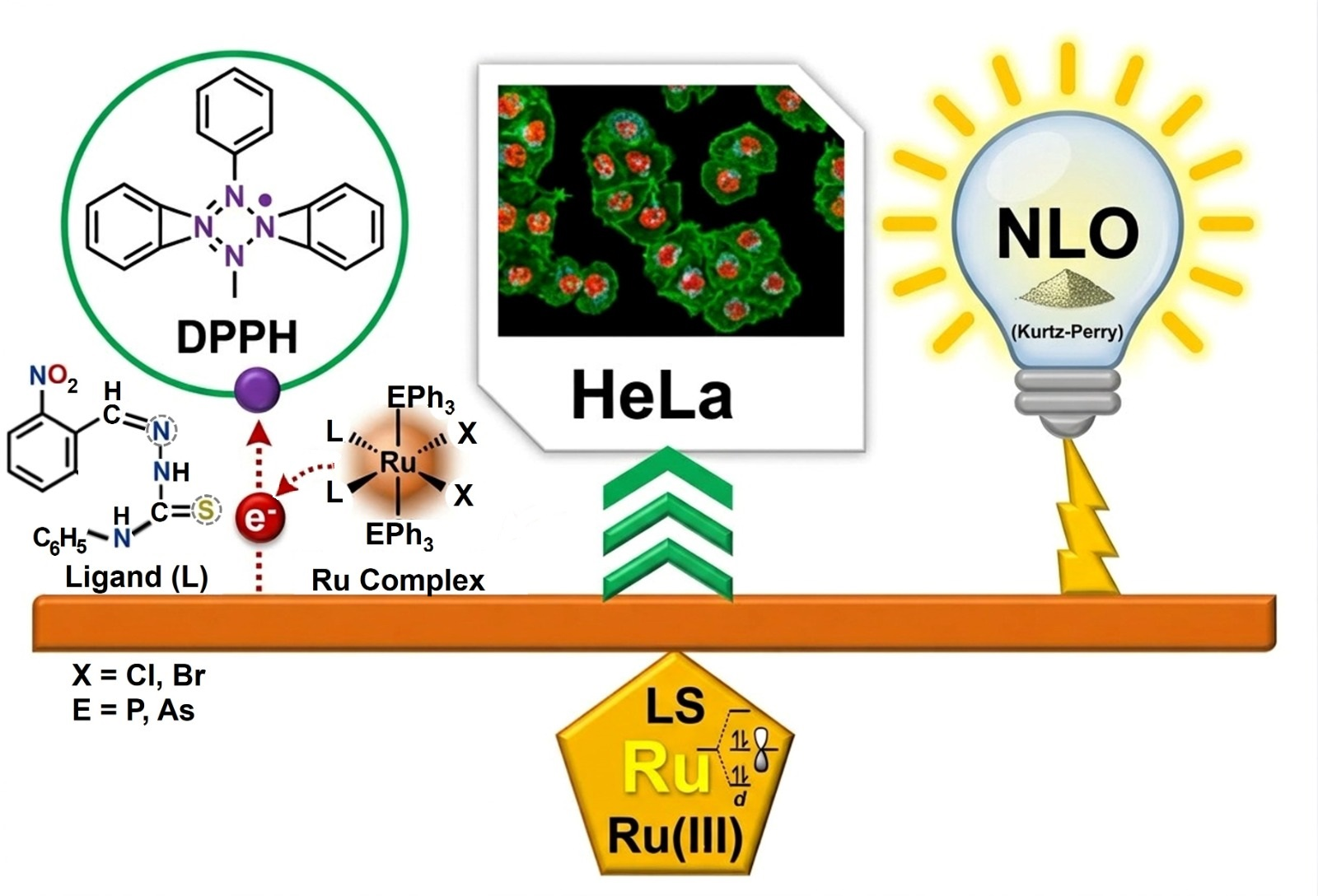
The technological promise of nonlinear optical (NLO) compounds has stimulated intense interest in optoelectronic devices, data storage, photonics, and anticancer therapy. Thiosemicarbazone ruthenium materials are of growing interest because of their tunable ligand framework and coordination sphere, allowing fine control over geometry, electronics, and functional properties. Here, we report an N-substituted salicylaldehyde thiosemicarbazone ligand and a series of octahedral Ru(III) complexes bearing triphenylphosphine or triphenylarsine and halide (Cl, Br) co-ligands. The complexes were characterized by elemental analysis, FT-IR, UV–Vis, EPR, mass spectrometry, and magnetic susceptibility measurements, which together confirm NS-chelation to a low-spin Ru(III) center in a distorted octahedral environment. Their photophysical and NLO responses were assessed by UV–Vis spectroscopy and powder second-harmonic generation measurements (Kurtz–Perry method), revealing promising NLO behavior. In parallel, antioxidant activity and in vitro anticancer effects against HeLa cells were evaluated by 2,2-diphenyl-1-picrylhydrazyl (DPPH) radical-scavenging and 3-(4,5-dimethylthiazol-2-yl)-2,5-diphenyltetrazolium bromide (MTT) cytotoxicity assays. These results provide insight into ligand-controlled structure–activity relationships, in which the halide (Cl/Br) and ancillary triarylphosphine co-ligands regulate electronic interactions and lipophilicity and ultimately increase biological performance, underscoring the dual materials and medicinal potential of these Ru(III) complexes.

Graphical Abstract

1. Introduction

Nonlinear optical (NLO) materials are becoming a cornerstone of modern photonics and opto-electronics, with applications ranging from optical communication to data processing, biological, and storage [1,2]. In laser pointers, second-harmonic generation (SHG) continues to be the foremost choice for nonlinear optical applications. Notably, the inorganic crystals, potassium titanyl phosphate or lithium niobate, possess significant NLO properties, but many inorganic compounds can double the frequency of incident light and are SHG-active [3]. Metal complexes have emerged as key players in this domain, particularly those featuring donor–acceptor configurations and conjugated π-systems [4]. Organometallic complexes have enriched the NLO landscape due to their structural flexibility and enhanced charge transfer processes [5]. Recent studies and reviews on metal complexes strongly suggest that incorporating an organic framework allows for the adjustment and enhancement of their optical, pharmacological, and electronic properties [6]. Significant progress has been made in exploring novel metal–organic complexes, particularly those featuring acceptor donor systems, which contribute to improving second-order NLO responses and their biological properties [7,8]. Ruthenium complexes, for example, exhibit charge transfer transitions, offering high molar absorptivity and tunable ligand exchange properties. These characteristics underscore their potential as NLO materials with tunable optical properties and anti-cancer properties [8]. Experimental investigations on the Schiff bases have shed light on the improvements in optimizing NLO responses and the pharmaceutical field [9]. Particularly, azomethine complexes have demonstrated superior performance owing to effective coupling between donor metal centers and acceptor π-bridges, facilitating robust charge transfer and significant quadratic nonlinearities [10]. Adding to this collection, Schiff base metal complexes bring remarkable versatility and functionality in the growth inhibition activity against bacteria, free radicals, and cancer cells [11]. These complexes, characterized by their azomethine (-C=N) groups, not only offer strong coordination capabilities with transition metals but also exhibit impressive biological and optical properties [12]. Complexes involving thiosemicarbazones, for instance, display enhanced stability, significant first-order hyperpolarizabilities, and biological efficacy. Their applications extend beyond NLO materials to catalysis and biomedical fields, marking them as multifunctional systems with immense potential [13,14].
In this study, we report the synthesis of a nitro-substituted salicylaldehyde thiosemicarbazone ligand and its octahedral Ru(III) complexes bearing triphenylphosphine or triphenylarsine and halide (Cl, Br) co-ligands. The complexes are characterized by elemental analysis, FT-IR, UV–Vis, EPR, mass spectrometry, and magnetic susceptibility measurements, which together support NS-chelation of the thiosemicarbazone ligand to Ru and a low-spin Ru(III) center in a distorted octahedral environment. Their photophysical and NLO properties are studied using UV–Vis spectroscopy and powder SHG measurements via the Kurtz–Perry technique to evaluate their potential as NLO materials. In parallel, the in vitro biological behavior is explored through 2,2-diphenyl-1-picrylhydrazyl (DPPH) radical-scavenging assays and 3-(4,5-dimethylthiazol-2-yl)-2,5-diphenyltetrazolium bromide (MTT)-based cytotoxicity studies against HeLa cells, allowing an initial assessment of structure–activity relationships that link the Ru(III) coordination environment and nature of the Ru–ligand bonding, where variations in the halide electronegtivity (Cl/Br) and ancillary triarylphosphine ligands (e.g., triphenylphosphine versus triphenylarsine) tune the electron-donor strength and lipophilicity of the complexes, thereby influencing biomolecular interactions and cell-membrane permeability for modified antioxidant and anticancer property.

2. Experimental Methods and Analysis

2.1. Materials

All the reagents were of analytical reagent grade and used as received. Solvents were purified and dried according to standard procedures [15]. Ruthenium trichloride trihydrate (Hi-LR grade) and triphenylphosphine (Hi-LR grade) served as the ruthenium source and phosphine co-ligand were obtained from Himedia, India. Triphenylarsine was obtained from MilliporeSigma, Bangalore, India. Aqueous formaldehyde (99%), concentrated hydrochloric acid (ACS grade), and hydrobromic acid (ACS grade), were employed as ancillary ligands and reagents and were procured from Merck, Bangalore, India. The organic ligand precursors, 4-phenylthiosemicarbazide (99%), 2-nitrobenzaldehyde (98%), and the antioxidant probe 2,2-diphenyl-1-picrylhydrazyl (DPPH, AR grade) were purchased from Sigma-Aldrich, Bangalore, India. The HeLa cell line was obtained from the National Centre for Cell Science (NCCS), Pune, India. The metal precursors [RuBr3(PPh3)3] and [RuCl3(EPh3)3] (E = P, As), as well as the free thiosemicarbazone ligand, were prepared according to reported procedures [16,17,18,19].

2.2. Characterization Methods

Elemental (C, H, N, S) analyses were performed on a Vario EL III CHNS analyser (Elementar Analysensysteme GmbH, Langenselbold, Germany) at the Sophisticated Test and Instrumentation Centre (STIC), Cochin University of Science and Technology (CUSAT), Kerala, India. Fourier transform-Infrared (FT-IR) spectra (KBr pellets, 400–4000 cm−1) were recorded on a PerkinElmer FT-IR 8000 spectrophotometer (PerkinElmer, Shelton, CT, USA). Electronic spectra in Dimethylsulfoxide (DMSO; 200–800 nm) were measured using a Systronics double-beam UV–Vis spectrophotometer model 2202 (Systronics, Ahmedabad, India). Magnetic susceptibilities were measured with a Gouy balance. X-band Electron Paramagnetic Resonance (EPR) spectra of powdered samples at room temperature were recorded on a JEOL JES—FA200 ESR spectrophotometer (JEOL, Tokyo, Japan) at the Indian Institute of Technology (IIT) Bombay, Mumbai, India. Electron Ionization (EI) mass spectra were collected on a JEOL GCMATE II mass spectrometer (JEOL, Tokyo, Japan). 1H and 13C Nuclear Magnetic Resonance (NMR) spectra were recorded on a Bruker AV III 500 MHZ instrument using tetramethylsilane (TMS) as an internal standard at SAIF, Indian Institute of Technology Madras, Chennai, India. Melting points were determined using a Veego VMP-DS melting point apparatus (Veego Instruments, Mumbai, India).
Antioxidant (DPPH) and anticancer (MTT) assays were carried out at Kovai Medical Centre and Hospital Pharmacy College, Coimbatore, India, using standard cell-culture and spectrophotometric protocols. Nonlinear optical (SHG) measurements on powdered samples were performed at the Indian Institute of Science (IISc), Bangalore, India, employing the Kurtz–Perry powder technique.

2.3. Synthesis of (E)-2-(2-Nitrobenzylidene)-N-phenylhydrazinecarbothioamide Ligand (Ligand L)

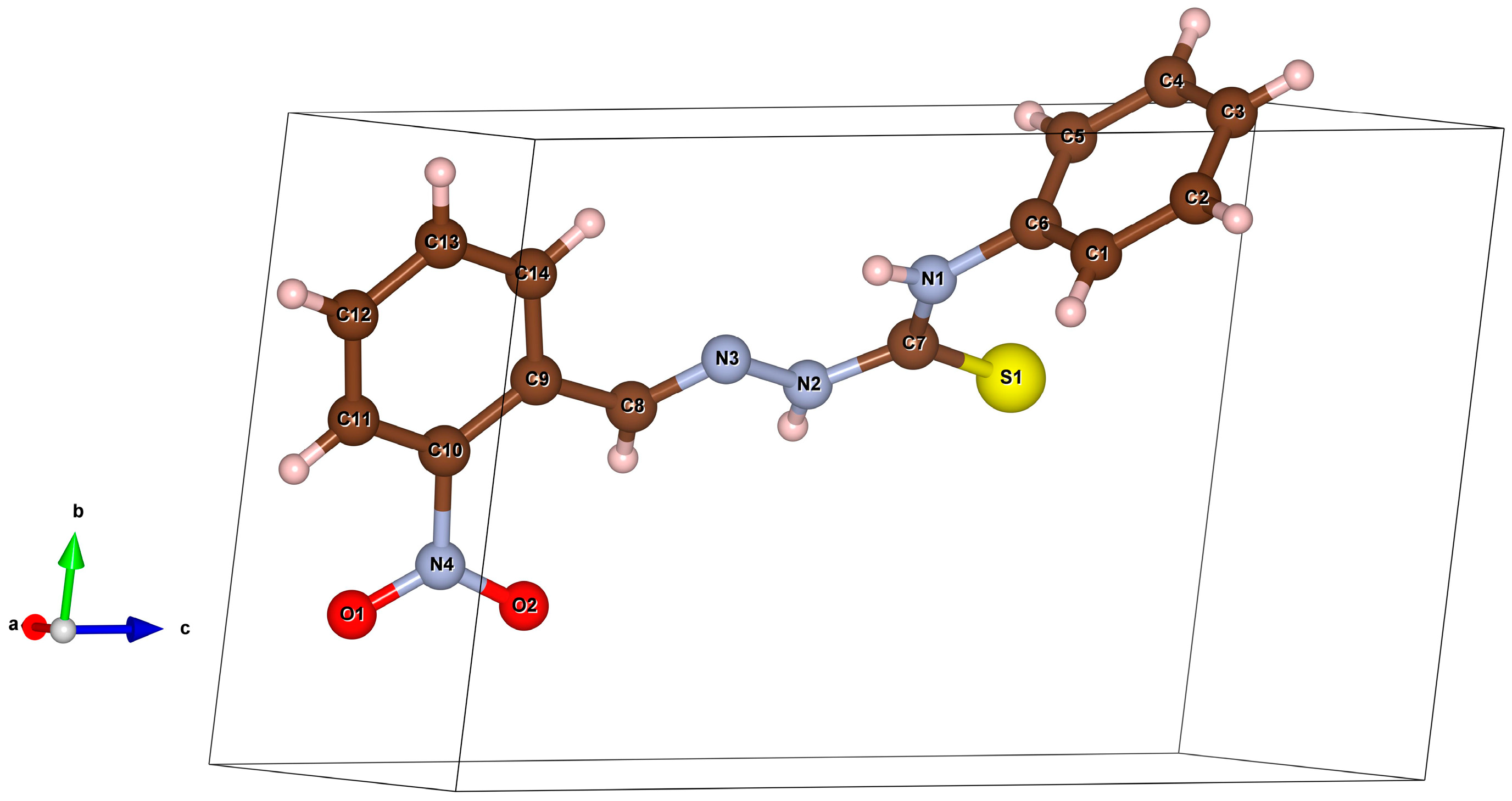
The ligand L was synthesized following a reported procedure, as outlined in Scheme 1 [19]. A methanolic (MeOH) solution of 4-phenyl-3-thiosemicarbazide (0.01 mol in 50 mL MeOH) was mixed with an equimolar amount of 2-nitrobenzaldehyde (0.01 mol in MeOH). The mixture was stirred for 10 min and then refluxed for 30 min. After cooling to ambient temperature, the precipitated solid was collected by filtration, thoroughly washed with methanol, and recrystallized from methanol. Slow evaporation of the methanolic mother liquor yielded yellow crystals of (E)-2-(2-nitrobenzylidene)-N-phenylhydrazinecarbothioamide, hereafter denoted as ligand L, whose crystal structure of ligand L is shown in Figure 1 (yield: 81%) [19].

2.4. Synthesis of Ruthenium(III) Complexes [RuX2(EPh3)2L] (E = P, As; X = Cl, Br)

2.4.1. Synthesis of [RuCl2(PPh3)2L]

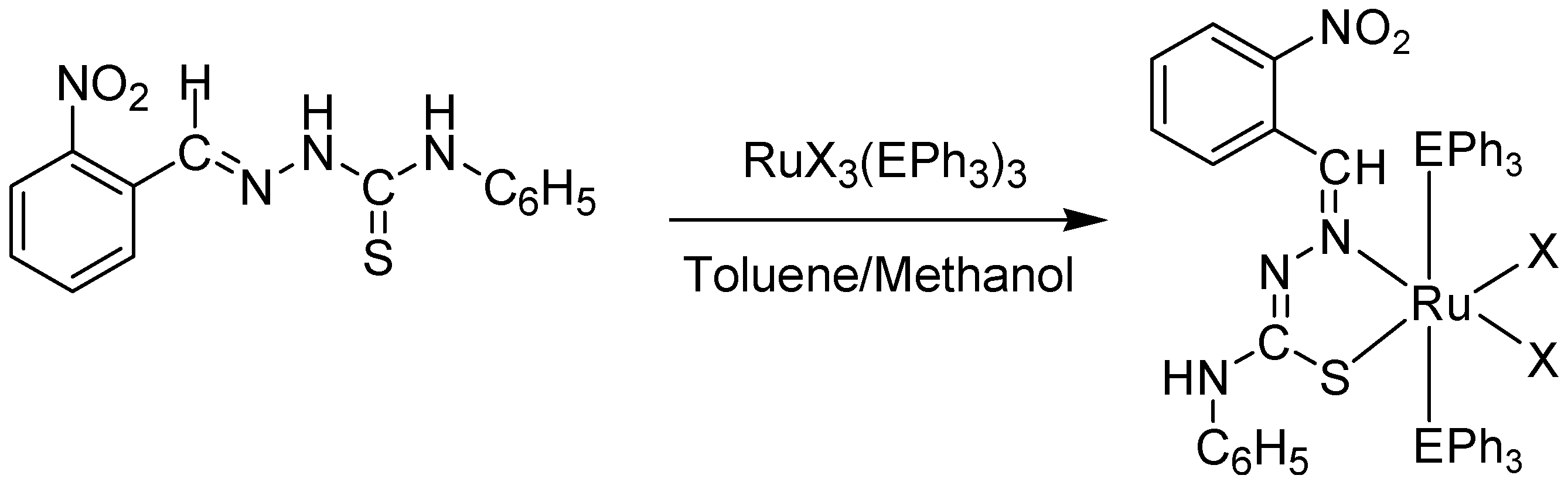
A methanolic solution of ligand L (0.5 mmol in 20 mL MeOH) and triethylamine (0.5 mmol) was mixed in a 1:1 molar ratio and added to a benzene solution of metal precursor, [RuCl3(PPh3)3] (0.5 mmol in 20 mL) as outlined in Scheme 2. The reaction mixture was refluxed for 8 h and then allowed to cool to room temperature. The resulting brown precipitate was collected by filtration, washed thoroughly, and checked for purity by thin-layer chromatography (TLC) using ethyl acetate–petroleum ether (60:40, v/v) as the eluent (Rf = 1.14). The solid product was recrystallized from a chloroform/hexane mixture to afford the complex, with 55% yield; this complex is denoted as C1. Attempts to grow single crystals suitable for X-ray diffraction analysis were unsuccessful. Analytical data for the complexes are summarized in Table 1. Electron ionization-mass spectrometry (EI-MS): m/z 995.24 (M+). Electron paramagnetic resonance (EPR): g = 1.25, µeff = 1.88 µB.

2.4.2. Synthesis of [RuCl2(AsPh3)2L]

This complex was prepared by the same procedure used for [RuCl2(PPh3)2L], employing ligand L (0.5 mmol) and [RuCl3(AsPh3)3] (0.5 mmol). A dark-brown crystalline powder was obtained with a yield of 57%; this complex is denoted as C2. EPR: g = 2.08; µeff = 1.84 µB; Rf = 1.50.

2.4.3. Synthesis of [RuBr2(PPh3)2L]

This complex was prepared analogously, using ligand L (0.5 mmol) and [RuBr3(PPh3)3] (0.5 mmol). A light-brown crystalline powder was obtained with a yield of 56%; this complex is denoted as C3. EPR: g = 1.35; µeff = 1.86 µB; Rf = 1.13.

2.4.4. Synthesis of [RuBr2(AsPh3)2L]

This complex was prepared in the same manner, with ligand L (0.5 mmol) and [RuBr3(AsPh3)3] (0.5 mmol). A brown crystalline powder was obtained with a yield of 57%; this complex is denoted as C4. EPR: g = 1.38; µeff = 1.88 µB; Rf = 1.06.

2.5. In Vitro Anticancer Activity Assay

The cytotoxicity of the synthesized ruthenium complexes was evaluated in human cervical cancer (HeLa) cells using the MTT assay [20]. The HeLa cells were cultured in Eagle’s minimum essential medium (EMEM) supplemented with 10% fetal bovine serum (FBS) at 37 °C in a humid atmosphere of 5% CO2 and 95% air. For screening experiments, cells were seeded into 96-well plates at a density of 10,000 cells per well and incubated for 24 h to allow attachment prior to Ru(III) complex treatment. The complexes were dissolved in dimethylsulfoxide (DMSO) and further diluted with culture medium containing 1% FBS. After 24 h, the medium was replaced with fresh medium (1% FBS) containing the ruthenium complexes at various concentrations, and the cells were incubated for an additional 48 h under the same conditions (37 °C, 5% CO2, 95% air, 100% relative humidity). All treatments were performed in triplicate, and wells without complexes served as the control. After 48 h of treatment, 15 µL of MTT solution (5 mg mL−1 in phosphate-buffered saline, PBS) was added to each well and incubated for 4 h at 37 °C. The medium containing MTT was then carefully removed, and the resulting formazan crystals were dissolved in 100 µL of DMSO.
Absorbance was measured at 570 nm using a microplate reader. The percentage of cell inhibition was calculated using Equation (1), and dose–response curves (percentage of cell inhibition versus concentration) were used to determine the IC50 value for each complex.
%   cell   inhibition   = mean   absorbance   of   untreated   cells     mean   absorbance   of   treated   cells mean   absorbance   of   untreated   cells × 100

2.6. Antioxidant Activity

The 2,2-diphenyl-2-picryl-hydrazyl (DPPH) radical scavenging activity of the Ru(III) complexes was measured according to the method of Elizabeth [21]. The DPPH is a stable free radical with a characteristic absorption maximum (λmax) of 517 nm. A fixed volume of the test complex (100 µL) was added to 1 mL of ethanolic DPPH solution (0.3 mM), and the final volume was adjusted to 4 mL with double-distilled water. DPPH solution in ethanol was used as the control, and methanol alone was used as the blank. The reaction mixtures were incubated in the dark at 37 °C for 30 min, and the decrease in absorbance was recorded at 517 nm. All the experiments were performed in triplicate.
Various concentrations of the complexes (20–100 µg mL−1) were tested to determine the concentration at which each complex exhibited 50% radical scavenging activity. The percentage scavenging (suppression ratio) was calculated using Equation (2):
%   scavenging   suppression   ratio   =   A 0     A c A 0   ×   100
where A0 is the absorbance of the control, and Ac is the absorbance in the presence of the test complex. The IC50 value (concentration required to achieve 50% scavenging) was obtained from the plot of percentage scavenging versus concentration.

3. Results and Discussion

3.1. FT-IR Spectra

The crystal structure of the free ligand L was reported previously by our group [19], and the corresponding molecular structure is shown in Figure 1. It reveals the expected E-configured C=N bond linking the 2-nitrobenzylidene and N-phenylhydrazine carbothioamide fragments, with conjugation extending across the aromatic rings and thioamide unit. This connectivity is fully consistent with the 1H and 13C NMR data (Figures S1 and S2, Supporting Information), which display the characteristic hydrazinic NH and imine protons, together with well-resolved resonances for the azomethine carbon, thioamide (C=S) carbon, and aromatic carbons [19]. Therefore, as the molecular structure and NMR characterization of ligand L have already been established and reported in detail, only a concise summary is provided here.
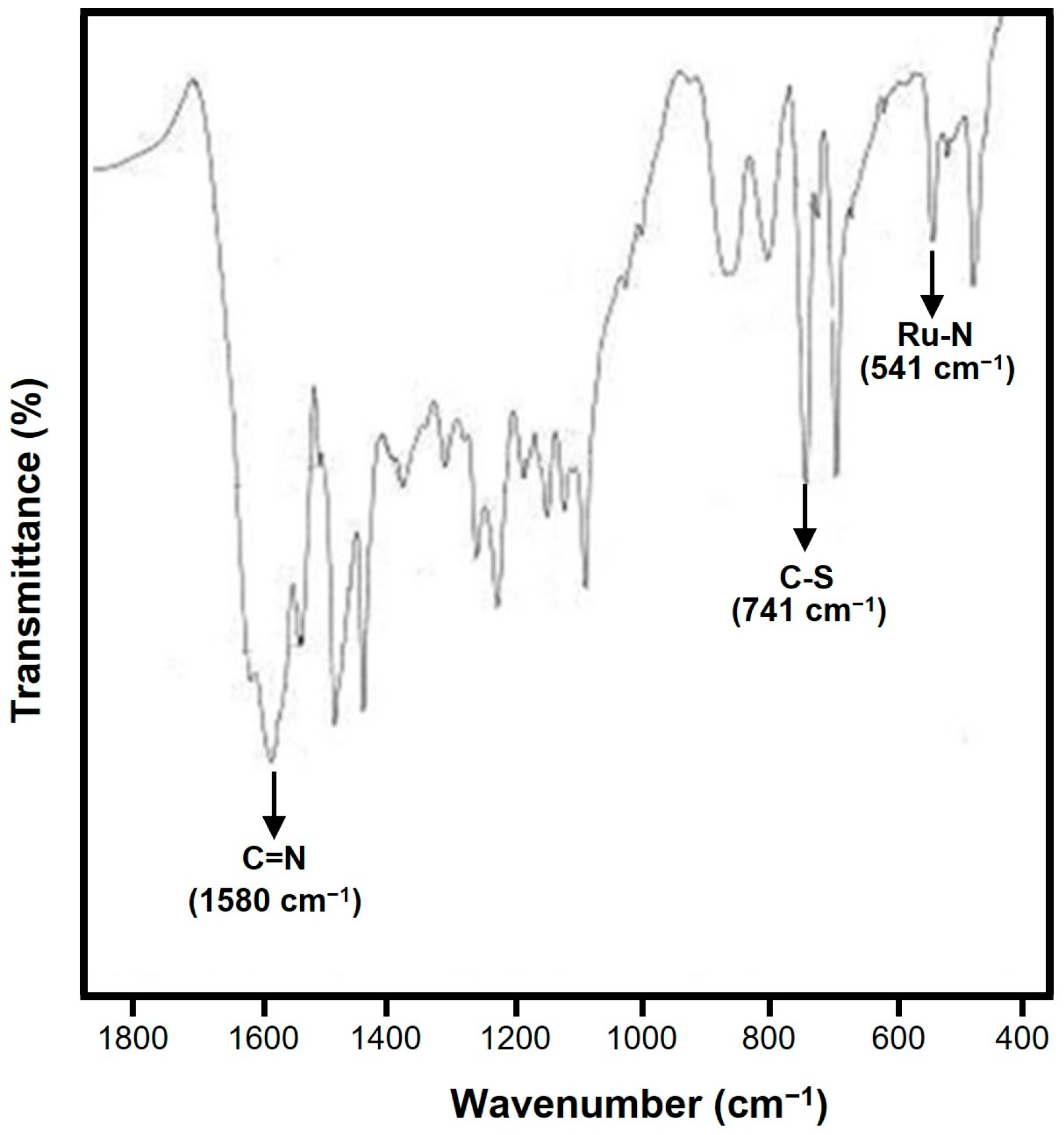
The coordination mode of the ruthenium(III) complexes was probed by comparing the FT-IR spectra of the Ru(III) complexes with that of the free ligand L, and the key bands are summarized in Table 2. The FT-IR spectrum of [RuCl2(PPh3)2L] is shown in Figure 2. In the free ligand L, the azomethine ν (C=N) vibration appears at 1599 cm−1 [19], whereas in the complexes, this band is shifted to lower wavenumbers of 1535–1580 cm−1, consistent with coordination of the azomethine nitrogen to the Ru(III) center and a concomitant decrease in C=N bond order [18]. The absence of ν (C=S) band in the complex for the free ligand at 846 cm−1 [19] and appearance of a new band emerges at 741–746 cm−1, assigned to ν (C–S); this transformation indicates deprotonation and coordination of the thiolate sulfur to ruthenium [19]. The additional bands at 539–541 cm−1 for the [RuCl2(PPh3)2L] complex can be attributed to ν Ru N , further supporting Ru–nitrogen bonding, thus confirming the bonding of ligand L with Ru(III) center [22]. Characteristic bands of the triphenylphosphine and triphenylarsine co-ligands also appear in their expected regions, confirming their retention upon coordination. Taken together, these spectral features demonstrate that the thiosemicarbazone behaves as a monobasic NS-donor ligand, forming bidentate chelates to give distorted octahedral Ru(III) complexes.

3.2. Electronic Spectra

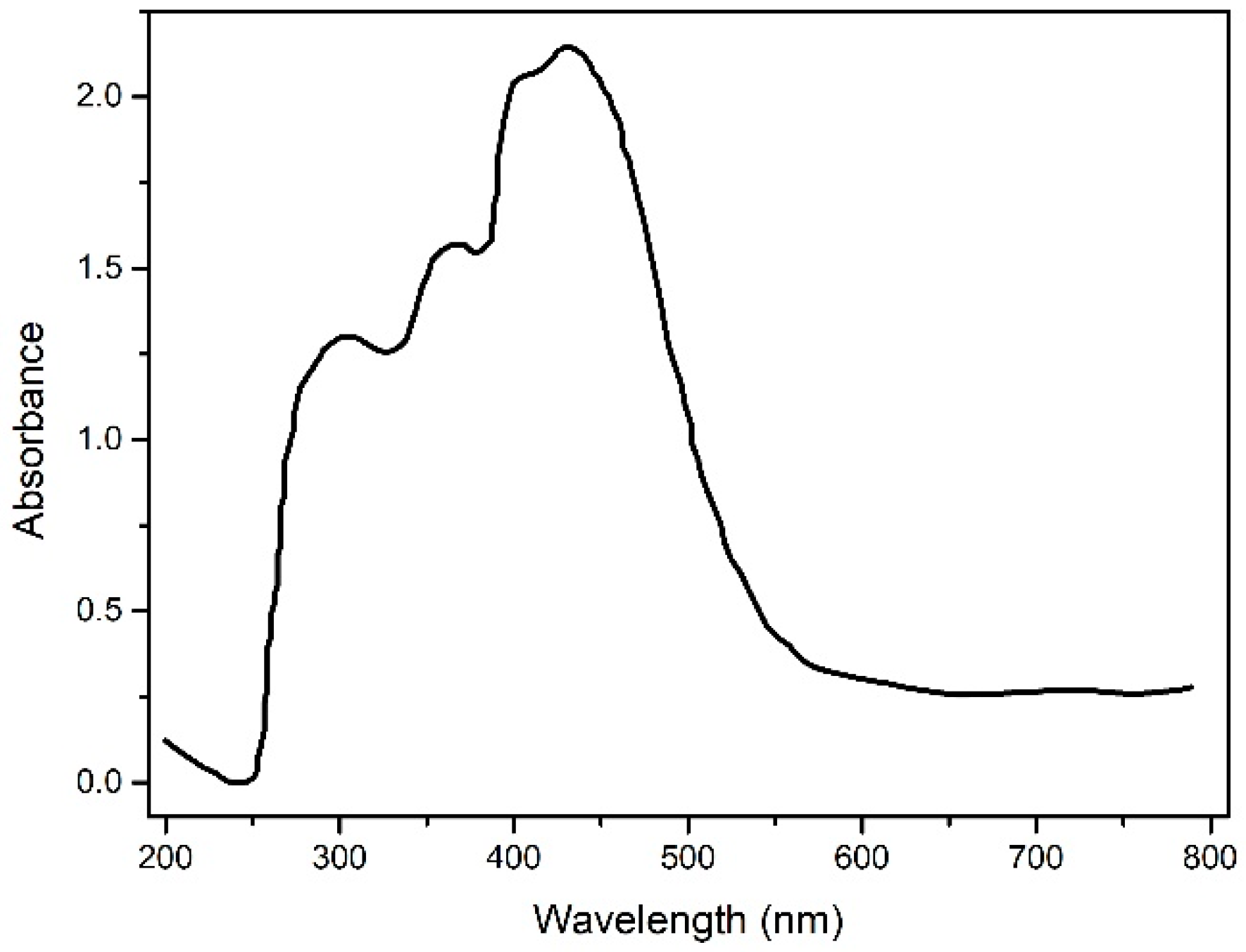
Electronic spectra of the Ru(III) complexes were recorded in DMSO, and a representative UV-Vis absorption spectrum of [RuCl2(PPh3)2L] (C1) is shown in Figure 3; the main bands are listed in Table 2. Three intense bands are observed in the 310–440 nm region. The higher-energy bands at 310–315 nm and 368–370 nm are assigned to ligand-centered π–π* and n–π* transitions, respectively, associated with the aromatic ring, thioamide moiety, and azomethine chromophore [22]; these bands appear slightly shifted relative to the free ligand (310–312 and 368–372 nm), indicating perturbation of the ligand orbitals upon coordination to Ru(III) [23]. A band in the 408–411 nm region is attributed to intra-ligand charge-transfer (ILCT) transitions within the coordinated thiosemicarbazone framework.
For low-spin d5 Ru(III) complexes, the metal center is relatively strong oxidizing and ligand-to-metal charge-transfer (LMCT) transitions of the Lπ→t2g type dominate in the visible region, masking the weak, spin-forbidden d–d transitions. Accordingly, the broad absorption observed at 437–442 nm is assigned to LMCT, in line with previous reports on Ru(III) thiosemicarbazone complexes [23,24]. The overall spectral pattern therefore supports a Ru(III) center engaged in significant ligand-to-metal charge transfer, consistent with the proposed NS-chelated, distorted octahedral geometry thus confirming the Ru-ligand bonding interactions [19]. The powder XRD result of [RuCl2(PPh3)2L] shows sharp, well-defined reflections, indicating that the Ru(III) complex is highly crystalline (Figure S3, Supporting Information). Although suitable single crystals for full structural determination could not be obtained in the present work, these PXRD results complement the spectroscopic and analytical data in supporting the proposed formulation and geometry. A detailed single-crystal X-ray diffraction study to refine bond lengths and angles will be of our future investigations.

3.3. Magnetic Moment and EPR Spectra

Magnetic susceptibility measurements show that all ruthenium complexes are paramagnetic, with effective magnetic moments in the range 1.84–1.88 µB. These values correspond to one unpaired electron and are characteristic of a low-spin 4d5 (t2g5, S = 1/2) Ru(III) configuration, confirming the +3 oxidation state across the complex series [25].
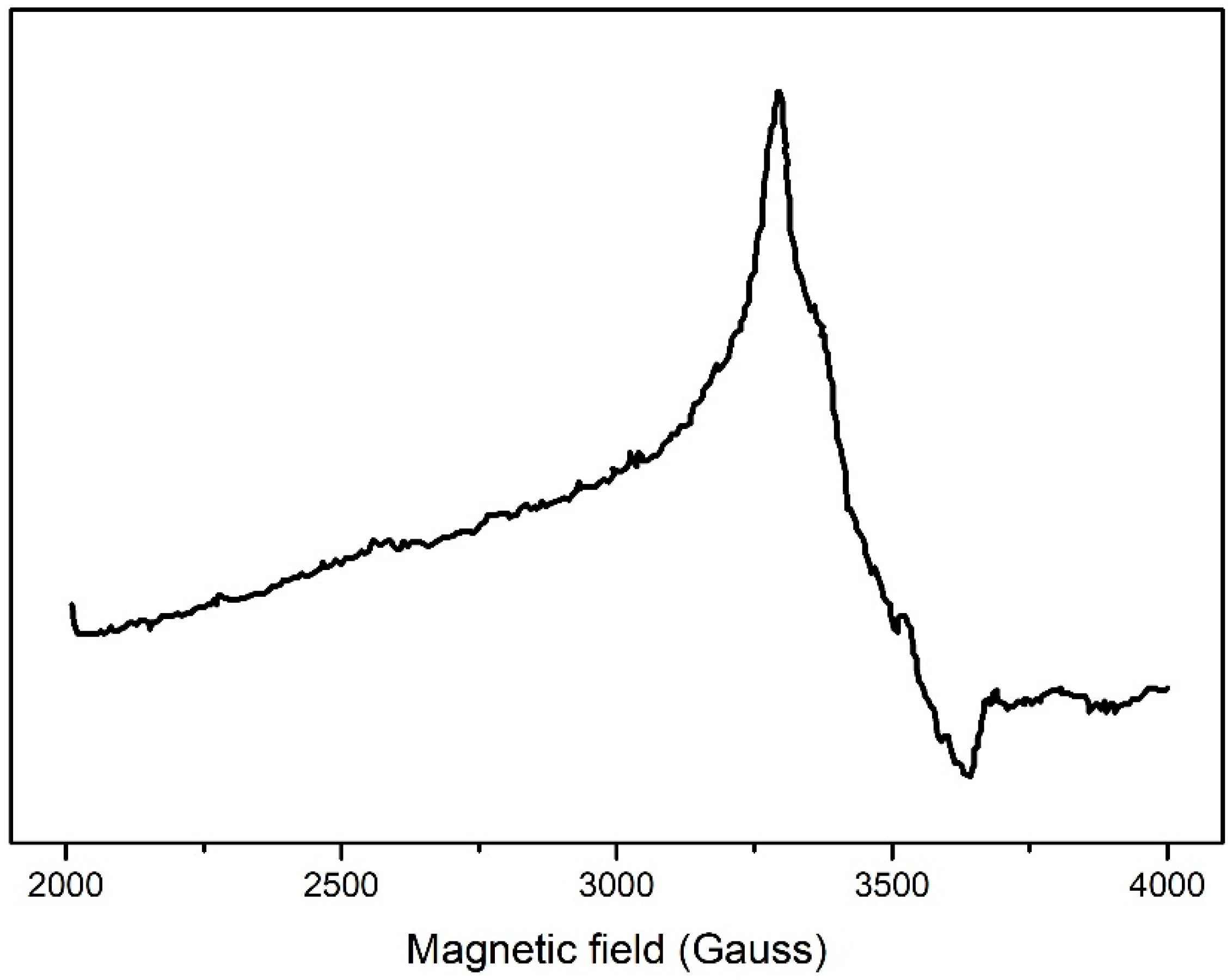
The X-band EPR spectrum of [RuCl2(PPh3)2L] (C1) is shown in Figure 4 as a representative of Ru complexes. A single, nearly isotropic resonance is observed, with g values lying between 1.25 and 2.08 for the [RuX2(EPh3)2L] (E = P, As; X = Cl, Br) series (Figure 4 and Figures S4–S6; Supporting Information), as is typical for low-spin octahedral Ru(III) species in which the unpaired electron resides primarily in a t2g-based, orbitally degenerate ground state. The absence of well-resolved anisotropy despite some distortion from ideal octahedral geometry suggests that any tetragonal or rhombic splitting is modest or negligible by molecular tumbling in solution [24]. On steric and electronic factors, the bulky PPh3 or AsPh3 ligands are most reasonably arranged in trans positions to one another, an arrangement commonly found in related Ru(III) phosphine/arsine complexes and is favored over a cis geometry due to the steric hindrance of bulky PPh3/AsPh3 ligands [22]. Overall, the magnetic susceptibility and EPR data are consistent with low-spin Ru(III) centers in distorted octahedral NS-chelated environments, in good agreement with earlier studies on Ru(III) thiosemicarbazone complexes [22,26].

3.4. Electron Ionization-Mass Spectral (EI-MS) Analysis

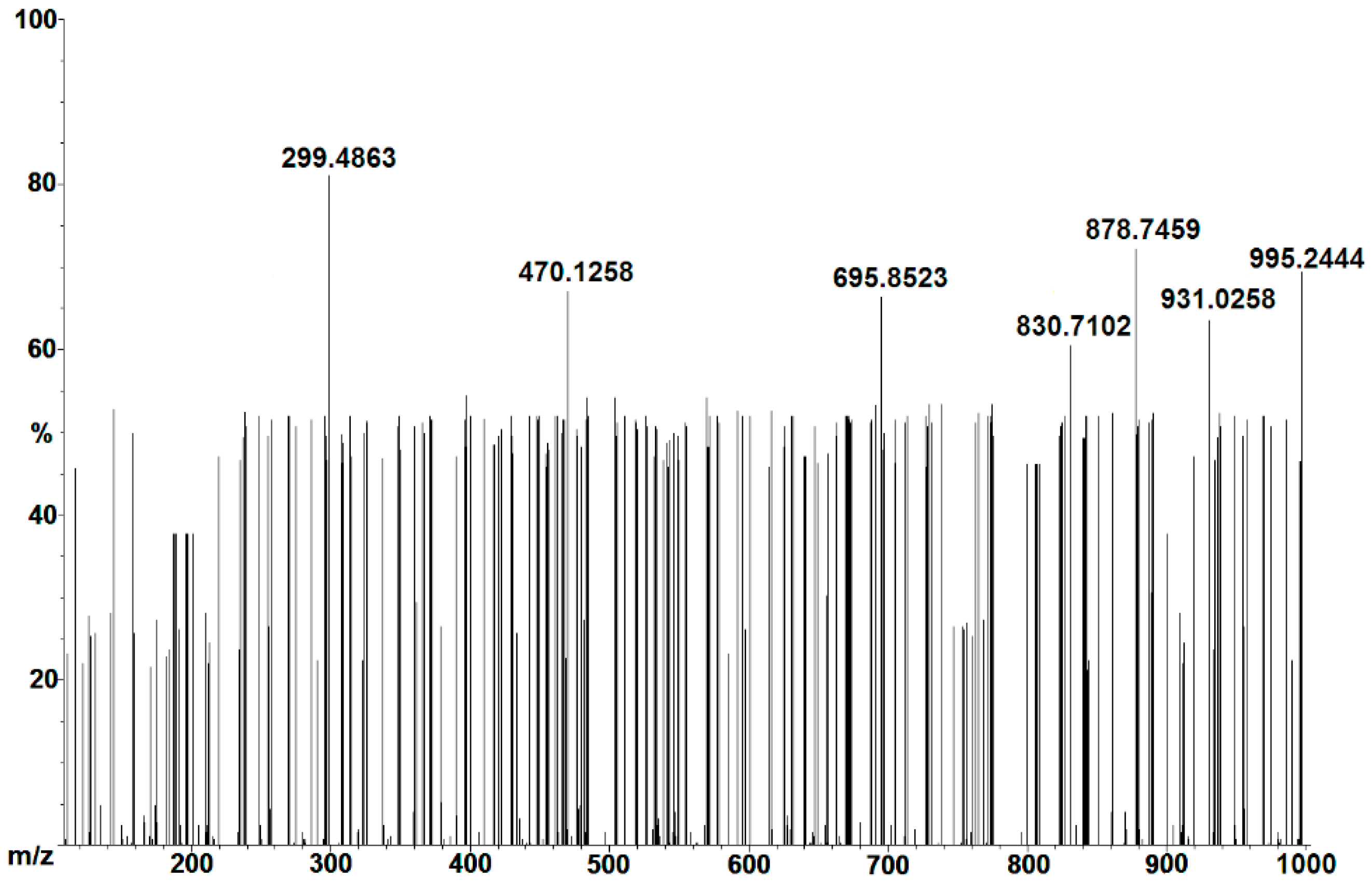
The [RuCl2(PPh3)2L] (C1) complex exhibits an EI-MS result consistent with the proposed formulation, as shown in Figure 5. A prominent molecular-ion peak [M+] is observed at m/z 995.24, in excellent agreement with the calculated molecular mass for [RuCl2(PPh3)2L], thereby confirming the 1:2:1 stoichiometry of Ru:phosphine:ligand in the C1 complex. In addition to the parent ion, several fragment peaks are detected at lower m/z values (e.g., 931.0, 878.7, 831.0, 695.9, 470.1, and 299.5), which can be ascribed to successive loss of chloride, triphenylphosphine, and ligand-derived fragments, a fragmentation pattern typical of Ru–phosphine complexes and further supportive of the assigned structure.

3.5. Non-Linear Optical Property

The design of efficient SHG-active materials remains a key objective in developing bespoke compounds for photonic and optoelectronic applications, and coordination complexes are particularly attractive because their donor–acceptor framework and packing can be tuned through ligand and halide substitution. Motivated by these considerations, the NLO response of all Ru(III) complexes was evaluated using the Kurtz–Perry powder technique with KDP as the reference material. Under irradiation with a Q-switched Nd:YAG laser (fundamental wavelength 1064 nm), all Ru(III) complexes generated a green output at 532 nm, confirming their SHG capability.
The SHG output voltages are summarized in Table 3. For each measurement, KDP gave an output of 36 mV, while the Ru(III) complexes C1–C4 produced SHG signals in the range 13–34 mV. The chloride–triphenylphosphine complex [RuCl2(PPh3)2L] (C1) exhibits the highest response (34 mV), corresponding to ~0.94 times the efficiency of KDP under identical conditions, whereas the bromide–triphenylarsine analog (C3) shows the weakest signal (13 mV). The enhanced SHG activity of C1 can be rationalized by its relatively lower-energy ligand-to-metal charge-transfer transitions and more favorable donor–acceptor pathway along the Ru–N–N–C–S–aryl conjugated framework, which together increase molecular polarizability and macroscopic NLO response [27]. These results highlight that subtle variations in halide (Cl vs. Br) and ancillary phosphine/arsine ligands significantly modulate the SHG efficiency, and they identify C1 as the most promising candidate for further NLO and device-oriented studies.

3.6. In Vitro Anticancer Activity

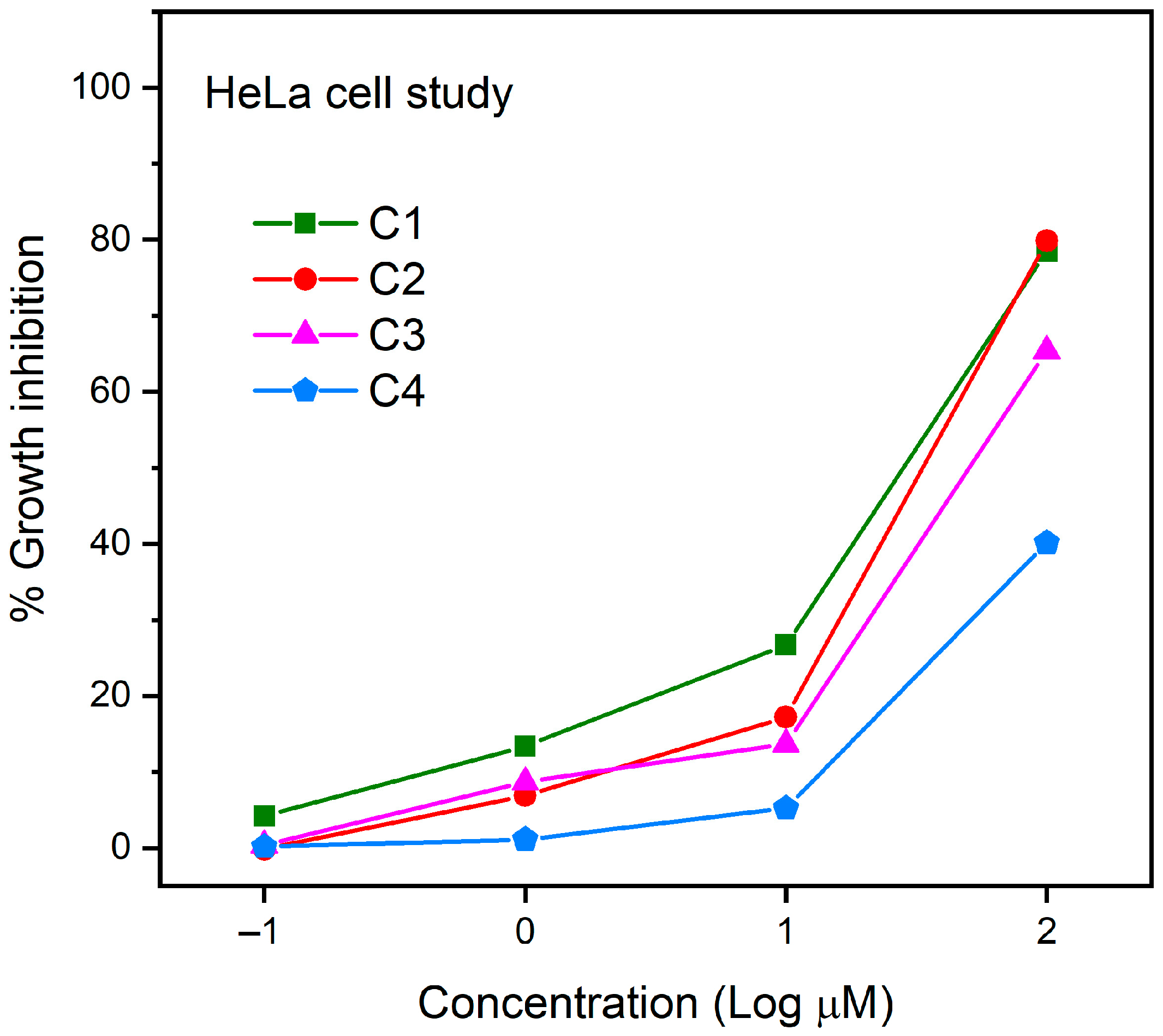
Deoxyribonucleic acid (DNA) is a primary target for many chemotherapeutic agents, so the in vitro cytotoxicity of the Ru(III) complexes against HeLa cells was evaluated using the MTT assay; the detailed experimental procedure on the MTT assay is given in Section 2.5. The resulting IC50 values are summarized in Table 4, and the corresponding dose–response curves (% growth inhibition versus log concentration) are shown in Figure 6. Among the series, [RuCl2(PPh3)2L] (C1) is the most active complex, with an IC50 of 25.77 µM, followed by [RuCl2(AsPh3)2L] (C2, IC50 = 33.67 µM). The bromide analog [RuBr2(PPh3)2L] (C3) shows only moderate activity (IC50 = 54.28 µM), while [RuBr2(AsPh3)2L] (C4) is essentially inactive at concentrations up to 100 µM, in agreement with the low growth inhibition seen in Figure 6.
The IC50 values indicate that all active complexes are less potent than the reference drug cisplatin (reported IC50 = 12.52 µM under similar conditions), but they still exhibit meaningful cytotoxicity in the low-micromolar range. The trend C1 > C2 > C3 > C4 shows that both the halide and the ancillary phosphine/arsine ligands influence biological activity; chloro complexes are more cytotoxic than their bromo analogs, and PPh3 generally confers higher activity than AsPh3 [22,24]. In particular, the chloride complex [RuCl2(PPh3)2L] (C1) is more active than the corresponding bromide complex [RuBr2(PPh3)2L] (C3), which can be attributed to the higher electronegativity and smaller ionic radius of chloride relative to bromide, which is expected to affect Ru–X bond strength, ligand-field splitting, and ultimately the kinetics of ligand exchange and biomolecular interactions. Moreover, triphenylphosphine (PPh3) is typically a stronger σ-donor and more lipophilic than triphenylarsine (ArPh3), favoring enhanced cell-membrane permeability and stronger Ru–ligand back-bonding; this provides a reasonable explanation for the much higher activity of C1, which combines Cl and PPh3, compared with C4, which contains Br and AsPh3.
Overall, these structure–activity relationships can be rationalized in terms of differences in ligand-field strength, Ru–ligand bond lability, and global lipophilicity, which together influence cellular uptake and interaction with intracellular targets such as DNA, as commonly reported for Ru(III) thiosemicarbazone systems. The free ligand L was not cytotoxic (IC50 > 100 µM), underscoring the importance of Ru(III) coordination for inducing anticancer activity. A relatively short incubation period was employed to limit the development of resistance and to reduce potential off-target effects [28].

3.7. Antioxidant Activity of Ruthenium (III) Complexes

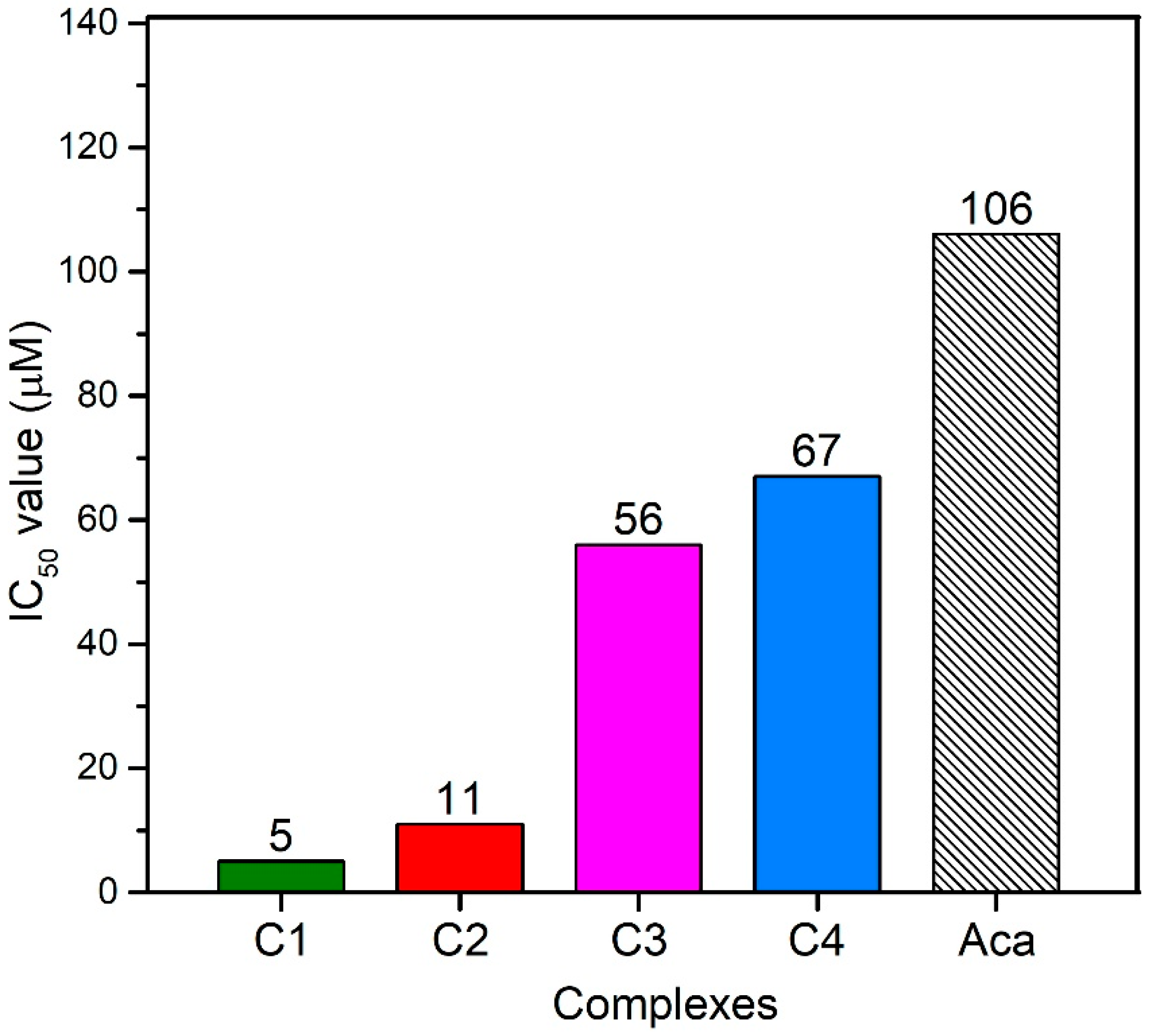
The promising cytotoxic profiles of the Ru(III) complexes prompted an evaluation of their antioxidant properties using the DPPH- radical-scavenging assay. The IC50 values obtained from the dose–response curves are presented in Figure 7, where lower IC50 values correspond to higher antioxidant potency. The complexes follow the activity order C1 < C2 < C3 < C4 < ascorbic acid (Aca), with IC50 values of 5, 11, 56, and 67 µM for C1–C4, respectively, compared with 106 µM for Aca. Thus, all Ru(III) complexes exhibit stronger radical-scavenging activity than the standard ascorbic acid under the present conditions, and the chloride complexes (C1, C2) are markedly more potent than their bromide analogs (C3, C4). These findings are consistent with previously reported antioxidant profiles of ruthenium(III) complexes [20,29].
Among the series, [RuCl2(PPh3)2L] (C1) shows the highest antioxidant efficiency (IC50 = 5 µM), indicating that subtle changes in halide and phosphine/arsine ligands significantly modulate the electron-donor/acceptor properties and, consequently, the radical-quenching ability of the complexes. The much weaker activity of C3 and C4 suggests that bromide substitution and/or replacement of PPh3 by AsPh3 decreases the overall redox responsiveness or accessibility of the Ru center. Collectively, these results demonstrate that Ru(III) coordination strongly enhances the radical-scavenging capacity relative to typical small-molecule antioxidants and highlight C1 as the most promising candidate for further antioxidant and redox-modulation studies.

4. Conclusions

The present study demonstrates that the synthesized ruthenium(III) thiosemicarbazone complexes exhibit promising NLO properties in the solid state. Structural characterization was carried out using FT-IR, UV–Vis, EPR, and mass spectroscopic analyses, and, together with analytical data, supported a distorted octahedral Ru(III) environment with NS-chelation and trans-phosphine/arsine ligands. The NLO measurements further indicate that these complexes possess measurable SHG responses, suggesting potential utility as candidate materials for photonic and NLO applications. From a biological perspective, [RuCl2(PPh3)2L] shows the highest in vitro cytotoxic activity among the series against HeLa cells, and all complexes display measurable radical-scavenging activity in the DPPH assay, with IC50 values following the order of [RuCl2(PPh3)2L] (C1) > [RuCl2(AsPh3)2L] (C2) > [RuBr2(PPh3)2L] (C3) > [RuBr2(AsPh3)2L (C4)]. These findings indicate that the complexes are biologically active in vitro; however, the biological evaluation remains preliminary and is limited to a single cell line and chemical antioxidant assay. Future work will focus on obtaining single-crystal X-ray structures, extending the biological studies to additional cell lines and in vivo models, and performing more detailed NLO and mechanistic investigations to better assess and validate the potential applications of these ruthenium(III) complexes.

Supplementary Materials

The following supporting information can be downloaded at: https://www.mdpi.com/article/10.3390/pr14060947/s1, Figure S1: 1H NMR spectra of ligand; Figure S2: 13C NMR spectra of ligand; Figure S3: Powder XRD of RuCl2(PPh3)2L complex; Figure S4: EPR spectra of RuCl2(AsPh3)2L complex (C2); Figure S5: EPR spectra of RuBr2(PPh3)2L complex (C3); Figure S6: EPR spectra of RuBr2(AsPh3)2L complex (C4).

Author Contributions

S.K.—conceptualization, visualization, data curation, investigation, methodology, resources, and writing—original draft; A.K.—Formal analysis, Software, and Writing—review & editing; N.M.M.I.—Formal analysis, Software, Writing—review & editing; S.G.—Formal analysis, Funding acquisition, Writing—review & editing; J.H.H.—Formal analysis, Funding acquisition, Writing—review & editing; P.A.—Formal analysis, Funding acquisition, and Writing—review & editing. All authors have read and agreed to the published version of the manuscript.

Funding

This study was partly supported by the Priority Research Centre’s Program through the National Research Foundation of Korea (NRF), funded by the Ministry of Education, Science, and Technology (2018R1A6A1A03024334) and the NRF grant funded by the Korean Government (MSIT) (2018R1A5A1025224). This study was also partly supported by the NRF funded by the Ministry of Education (No. NRF-2022R1I1A1A01068015 and No. RS-2023-00237664).

Data Availability Statement

The raw data supporting the conclusions of this article will be made available by the authors on request.

Conflicts of Interest

The authors declare no conflicts of interest among the authors and co-authors in bringing out the publication of this work in this journal.

Abbreviations

The following abbreviations are used in the manuscript
MTT3-(4,5-dimethylthiazol-2-yl)-2,5-diphenyltetrazolium bromide
DPPH2,2-diphenyl-1-picrylhydrazyl
SHGSecond-harmonic generation
NLONonlinear Optics
FT-IRFourier transform-infrared
UV-VisUV-Visible
EPRElectron Paramagnetic Resonance
NMRNuclear Magnetic Resonance
AcaAscorbic Acid
IC50half-maximum inhibitory concentration
MeOHMethanol
DMSODimethylsulfoxide
TLCThin-layer chromatography
EI-MSElectron Ionization-Mass Spectrometry
HeLaHuman cervical cancer cells.
EMEMEagle’s minimum essential medium
FBSFetal bovine serum
PBSPhosphate-buffered saline

References

  1. Nadeem, S.; Anwar, A.; Khan, M.U.; Hassan, A.U.; Alrashidi, K.A. Exploring the ON/OFF nonlinear optical (NLO) response in tetracene-based chromophores: A DFT study on solvent and frequency-dependent NLO properties for switching applications. J. Mol. Liq. 2024, 411, 125730. [Google Scholar] [CrossRef]
  2. Guleryuz, C.; Mohyuddin, A.; Hassan, A.U. Exploration of deep UV-NLO responses of non-conjugated crystal systems by harnessing aprotic solvents: DFT vs experimental. Opt. Mater. 2024, 156, 116023. [Google Scholar] [CrossRef]
  3. Lu, W.; Gao, Z.; Liu, X.; Tian, X.; Wu, Q.; Li, C.; Sun, Y.; Liu, Y.; Tao, X. Rational Design of a LiNbO3-like Nonlinear Optical Crystal, Li2ZrTeO6, with High Laser-Damage Threshold and Wide Mid-IR Transparency Window. J. Am. Chem. Soc. 2018, 140, 13089–13096. [Google Scholar] [CrossRef]
  4. Sangeetha, K.G.; Aravindakshan, K.K. Experimental, NBO, NLO and docking analysis of a novel ligand derived from vanillin and N(4)-methyl-N(4)-phenylthiosemicarbazide and its transition metal complexes. Results Chem. 2022, 4, 100453. [Google Scholar] [CrossRef]
  5. Kosar, N.; Wajid, S.; Ayub, K.; Gilani, M.A.; Mahmood, T. First, second and third order NLO response of alkaline earth metals doped C6O6Li6 organometallic complexes. Chem. Phys. 2023, 570, 111894. [Google Scholar] [CrossRef]
  6. Bibi, T.; Jadoon, T.; Muhammad, S.; Ayub, K. Second-order NLO properties and two-state switching effects of transition metal redox complexes of iron and cobalt: A DFT study. J. Mol. Graph. Model. 2021, 107, 107975. [Google Scholar] [CrossRef]
  7. Shen, Y.; Li, X.; Yao, Y.; Zhang, Y.; Qiu, Y. Second-order NLO properties of bis-cyclometalated iridium(III) complexes with β-diketiminate ancillary ligand: Substituent and redox effect. Inorg. Chim. Acta 2020, 511, 119835. [Google Scholar] [CrossRef]
  8. Cheret, Y.; Szukalski, A.; Haupa, K.A.; Popczyk, A.; Mysliwiec, J.; Sahraoui, B.; El-Ghayoury, A. Ruthenium based terpyridine complexes as both luminescent and NLO materials. Polyhedron 2023, 233, 116299. [Google Scholar] [CrossRef]
  9. Avcı, D.; Ozge, O.; Sonmez, F.; Başoglu, A.; Tamer, O.; Atalay, Y. Novel schiff base-azide metal complexes: Synthesis, spectral, nonlinear optics, and DFT studies. Mater. Sci. Semicond. Process. 2024, 179, 108523. [Google Scholar] [CrossRef]
  10. Singh, H.L.; Singh, J.B.; Khaturia, S.; Ameta, K.L. Synthesis, spectral, antibacterial and NLO properties of organotin(IV) complexes of Thiosemicarbazones and Semicarbazones. J. Organomet. Chem. 2024, 1015, 123206. [Google Scholar] [CrossRef]
  11. Bai, X.G.; Zheng, Y.; Qi, J. Advances in thiosemicarbazone metal complexes as anti-lung cancer agents. Front. Pharmacol. 2022, 13, 1018951. [Google Scholar] [CrossRef]
  12. Fillaut, J.-L. Ruthenium(II) polypyridyl complexes as two-photon absorbers and sensitizers: Design, structure-properties relationships and applications. Coord. Chem. Rev. 2024, 518, 216050. [Google Scholar] [CrossRef]
  13. Chavan, S.S.; Patil-Deshmukh, A.B.; Kumbhar, G.M.; Deshmukh, A.H. Synthesis, characterization, luminescence and NLO properties of heterotrinuclear MII-RuII-MII (M=Ni/Zn) complexes composed of coordination and organometallic sites. J. Organomet. Chem. 2023, 999, 122818. [Google Scholar] [CrossRef]
  14. Ravindran, R.; Minitha, R.; Fazil, S.; Devi, A.S.; Sindhu, T.K.; SanthoshKumar, S. Synthesis, crystal structure, spectral analysis and NLO studies of five-coordinate Zn(II) complexes of hydrazo chromandione. J. Indian Chem. Soc. 2024, 101, 101368. [Google Scholar] [CrossRef]
  15. Vogel, A.I. Textbook of Practical Organic Chemistry, 5th ed.; Longman: London, UK, 1989; p. 264. [Google Scholar]
  16. Chatt, J.; Leigh, G.J.; Mingos, D.M.P.; Paske, R.J. Complexes of osmium, ruthenium, rhenium, and iridium halides with some tertiary monophosphines and monoarsines. J. Chem. Soc. A 1968, 2636–2641. [Google Scholar] [CrossRef]
  17. Thangadurai, T.D.; Natarajan, K. Synthesis and Characterization of New Ruthenium(III) Complexes Containing Tetradentate Schiff Bases. Synth. React. Inorg. Met. Org. Chem. 2001, 31, 549–567. [Google Scholar] [CrossRef]
  18. Sathya, N.; Muthusamy, P.; Padmapriya, N.; Raja, G.; Deivasigamani, K.; Jayabalakrishnan, C. Spectrometric, catalytic, and antimicrobial studies of mononuclear Ru(III) Schiff-base complexes. J. Coord. Chem. 2009, 62, 3532–3543. [Google Scholar] [CrossRef]
  19. Sampath, K.; Sathiyaraj, S.; Jayabalakrishnan, C. Evaluation of DNA-binding, DNA cleavage, antioxidant and cytotoxic activity of mononuclear ruthenium(II) carbonyl complexes of benzaldehyde 4-phenyl-3-thiosemicarbazones. Spectrochim. Acta A 2013, 115, 287–296. [Google Scholar] [CrossRef]
  20. Mossman, T. Rapid colorimetric assay for cellular growth and survival: Application to proliferation and cytotoxicity assays. J. Immunol. Methods 1983, 65, 55–63. [Google Scholar] [CrossRef]
  21. Elizabeth, K.; Rao, M.N.A. Oxygen radical scavenging activity of curcumin. Int. J. Pharm. 1990, 58, 237–240. [Google Scholar] [CrossRef]
  22. Sampath, K.; Sathiyaraj, S.; Raja, G.; Jayabalakrishnan, C. Mixed ligand ruthenium(III) complexes of benzaldehyde 4-methyl-3-thiosemicarbazones with triphenylphosphine/triphenylarsine co-ligands: Synthesis, DNA binding, DNA cleavage, antioxidative and cytotoxic activity. J. Mol. Struct. 2013, 1046, 82–91. [Google Scholar] [CrossRef]
  23. Raja, N.; Ramesh, R. Mononuclear ruthenium(III) complexes containing chelating thiosemicarbazones: Synthesis, characterization and catalytic property. Spectrochim. Acta A 2010, 75, 713–718. [Google Scholar] [CrossRef]
  24. Sathiyaraj, S.; Sampath, K.; Jayabalakrishnan, C. Synthesis, Spectral Characterization, DNA Binding, DNA Cleavage, and Antioxidant Studies of Ruthenium(III) Heterocyclic Thiosemicarbazone Complexes. Synth. React. Inorg. Metaorg. Nanomatal Chem. 2014, 44, 1261–1271. [Google Scholar] [CrossRef]
  25. Priya, N.P.; Arunachalam, S.V.; Sathya, N.; Chinnusamy, V.; Jayabalakrishnan, C. Catalytic and antimicrobial studies of binuclear ruthenium(III) complexes containing bis-β-diketones. Transit. Met. Chem. 2009, 34, 437–445. [Google Scholar] [CrossRef]
  26. Jayanthi, E.; Kalaiselvi, S.; Padma, V.V.; Bhuvanesh, N.S.P.; Dharmaraj, N. Solvent assisted formation of ruthenium(III) and ruthenium(II) hydrazone complexes in one-pot with potential in vitro cytotoxicity and enhanced LDH, NO and ROS release. Dalton Trans. 2016, 45, 1693–1707. [Google Scholar] [CrossRef] [PubMed]
  27. Sampath, K.; Krithika, S. Synthesis, Characterization and NLO Property of Ruthenium(II) Thiosemicarbazone Complexes. AIP Conf. Proc. 2019, 2162, 020118. [Google Scholar] [CrossRef]
  28. Beckford, F.A.; Thessing, J.; Stott, A.; Holder, A.A.; Poluektov, O.G.; Li, L.; Seeram, N.P. Anticancer activity and biophysical reactivity of copper complexes of 2-(benzo[d][1,3]dioxol-5-ylmethylene)-N-alkylhydrazinecarbothioamides. Inorg. Chem. Commun. 2012, 15, 225–229. [Google Scholar] [CrossRef]
  29. Kanchanadevi, S.; Fronczek, F.R.; Mahalingam, V. Ruthenium(III) hydrazone complexes with triphenylphosphine/triphenylarsine co-ligands: Synthesis, DNA/BSA binding, antioxidative and cytotoxic activity. Inorg. Chim. Acta 2021, 526, 120532. [Google Scholar] [CrossRef]
Scheme 1. Synthesis of (E)-2-(2-nitrobenzylidene)-N-phenylhydrazinecarbothioamide ligand (ligand L).
Processes 14 00947 sch001
Figure 1. Crystal structure of (E)-2-(2-Nitrobenzylidene)-N-Phenylhydrazinecarbothioamide ligand (ligand L).
Processes 14 00947 g001
Scheme 2. Synthesis of ruthenium(III) thiosemicarbazone complexes [RuX3(EPh3)3L] from (E)-2-(2-Nitrobenzylidene)-N-Phenylhydrazinecarbothioamide ligand (ligand L) where E = P, As; X = Cl, Br.
Processes 14 00947 sch002
Figure 2. FT-IR spectrum of the ruthenium(III) complex [RuCl2(PPh3)2L] (C1).
Processes 14 00947 g002
Figure 3. UV-Visible spectrum of the ruthenium(III) complex [RuCl2(PPh3)2L] (C1).
Processes 14 00947 g003
Figure 4. EPR spectrum of the ruthenium(III) complex [RuCl2(PPh3)2L] (C1).
Processes 14 00947 g004
Figure 5. Mass spectrum of the ruthenium(III) complex [RuCl2(PPh3)2L] (C1).
Processes 14 00947 g005
Figure 6. Anticancer activity (% growth inhibition) of ruthenium(III) complexes [RuX2(EPh3)2L] (E = P, As; X = Cl, Br) against HeLa cells as a function of concentration for complexes C1–C4.
Processes 14 00947 g006
Figure 7. Antioxidant activities of ruthenium(III) complexes [RuX2(EPh3)2L] (E = P, As; X = Cl, Br) expressed as IC50 values for complexes C1–C4, compared with standard ascorbic acid (Aca).
Processes 14 00947 g007
Table 1. Analytical data for ruthenium(III) Complexes [RuX2(EPh3)2L] (E = P, As; X = Cl, Br).
ComplexesLabelM.P. °CElemental Analysis
C%H%N%S%
[RuCl2(PPh3)2L]C129960.344.175.663.25
[RuCl2(AsPh3)2L]C226755.473.885.132.93
[RuBr2(PPh3)2L]C329855.393.855.193.01
[RuBr2(AsPh3)2L]C426451.213.824.982.71
Table 2. FT-IR and UV-Visible spectral data for ruthenium(III) Complexes [RuX2(EPh3)2L] (E = P, As; X = Cl, Br).
ComplexesLabelFT-IR (cm−1)UV-Vis
ν(C=N)ν(C–S)ν(Ru–N)λmax (nm)
[RuCl2(PPh3)2L]C11580741541315, 368, 408, 437
[RuCl2(AsPh3)2L]C21545745539310, 368, 410, 439
[RuBr2(PPh3)2L]C31535745540312, 370, 410, 440
[RuBr2(AsPh3)2L]C41538746541311, 372, 411, 442
Table 3. SHG activity of ruthenium(III) Complexes [RuX2(EPh3)2L] (E = P, As; X = Cl, Br).
ComplexesLabelKDP, mVOutput Energy, mV
[RuCl2(PPh3)2L]C13634
[RuCl2(AsPh3)2L]C23624
[RuBr2(AsPh3)2L]C33613
[RuBr2(PPh3)2L]C43619
Table 4. In vitro anticancer activity of ruthenium(III) complexes [RuX2(EPh3)2L] (E = P, As; X = Cl, Br).
ComplexesLabelIC50 Value (µM)
[RuCl2(PPh3)2L]C125.77
[RuCl2(AsPh3)2L]C233.67
[RuBr2(PPh3)2L]C354.28
[RuBr2(AsPh3)2L]C4>100
Reported value (Cisplatin) 12.52
Disclaimer/Publisher’s Note: The statements, opinions and data contained in all publications are solely those of the individual author(s) and contributor(s) and not of MDPI and/or the editor(s). MDPI and/or the editor(s) disclaim responsibility for any injury to people or property resulting from any ideas, methods, instructions or products referred to in the content.